
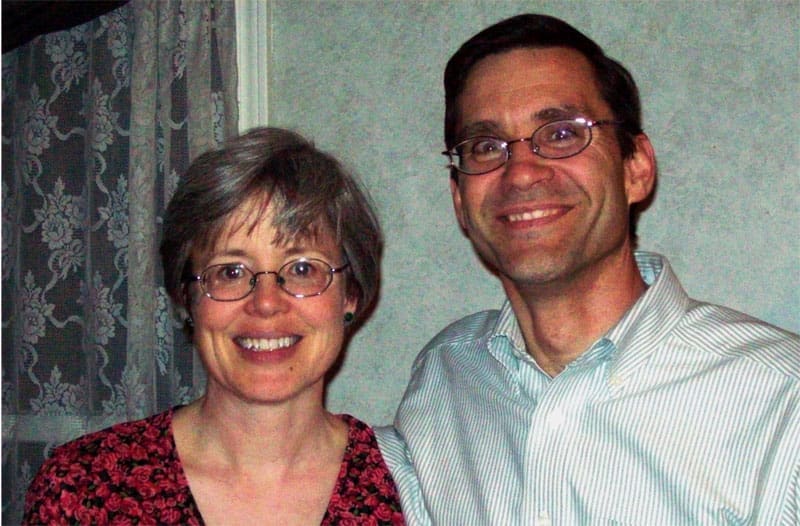
Heather Hardy has a BS and an MBA from Brigham Young University (she says the latter seemed like a good idea when Grant was studying Greek; someone was going to have to support the family someday). She worked in university finances at Yale and then as the scholarship coordinator at BYU for a couple of years. She has published articles in Dialogue and the Journal of Book of Mormon Studies, but is mostly a full-time reader masquerading as a stay-at-home mother. Grant and Heather have been married for 28 years and have been talking to each other non-stop the whole time.
- Part 1: Introductions, early personal, academic, and scholarly experiences, and approaching the Book of Mormon as world scripture and literature.
- Part 2: Understanding the Book of Mormon: A Reader’s Guide, thoughts on narrative structures, phraseology, historicity, evidences, anachronisms, Book of Mormon usage in the LDS Church, and on balancing faith and reason.
- The Book of Mormon: A Reader’s Edition (Google Books, Amazon)
- Understanding the Book of Mormon: A Reader’s Guide (Google Books, Amazon)
- The Book of Mormon: The Earliest Text (Google Books, Amazon)
Episode Transcript
Host: John Dehlin · Guests: Grant Hardy, Heather Hardy
This transcript is machine-generated and lightly edited for readability. The audio is authoritative. Please excuse occasional errors in names and spelling.
Introduction and Welcome
Part 1 of 2 · Ep. 250
John Dehlin [00:00:03] Mormon Stories Podcast is a production of the Open Stories Foundation. All donations to Mormon Stories are fully tax deductible and go directly towards keeping the podcast alive and towards building a community of support for Mormons like you. To support the podcast or to join the community, please become a monthly subscriber today@mormonstories.org hello and welcome to this special edition of Mormon Stories Podcast. This is John Dehlin. Normally. Normally I don't necessarily provide an opening disclaimer for a podcast, but this one's kind of so special, I felt like I wanted to. This interview with Grant and Heather Hardy, for me, is a really important one for Mormon Stories, and it's important for a number of reasons. First, it was produced by a good friend, Casey Kern. Casey is the grand nephew of Richard Bushman. He's the person most responsible for my interview with Richard Bushman, and he's just a class act. He's a believing, thoughtful Mormon who's committed to the church, but open to seeing it in its full Technicolor. And anything Casey does, I think is worth checking out. Secondly, Grant and Heather Hardy's story is truly a Mormon story. The way that they talk about their BYU years, their belief, their commitment to the church, their early family years, even just their relationship, I think is a beautiful example of Mormon intellectuals who are thoughtful and excited and energetic about the church, and. And I just think it really captures that story very, very well. Also, I think that anytime a believing scholar is willing to come on Mormon Stories podcast, it deserves our respect. I think the believers who listen to Mormon Stories are going to love this podcast, and I'm hoping that non believers will as well, because it's so rich with information. I believe that Grant Hardy is to the Book of Mormon what Richard Bushman is to Joseph Smith and his wife Heather is no intellectual slouch either. So the fact they're willing to come on, that they're thoughtful and that they still love the Book of Mormon and look at it, I think is worth listening to. But most importantly, I think that the last 30 minutes of this podcast are literally worth their digital weight in gold. The last 30 minutes is just an incredibly frank, candid discussion of the Book of Mormon and a friendly critique of traditional Book of Mormon apologetics that I think even the most ardent disbeliever will find refreshing. So I love this podcast. I'm proud of it. I'm grateful for Casey, Grant, and Heather for producing it, and I hope you guys will enjoy it. So, without any further ado, here's Casey Kern interviewing Grant and Heather Hardy on the Book of Mormon and Scholarship thank you.
Meet Casey Kern and the Hardy
Guest [00:02:44] Hello and welcome to Mormon Stories. My name is Casey Kern and I'm the guest host today and by way of introduction, I have been a contributor on the Mormon Matters blog and I'm also the creator and custodian of bookofmormononline.net which is a resource for the study of the Book of Mormon today. It's my great privilege to have on the program Dr. Grant Hardy and his wife, Heather Hardy. Dr. Grant Hardy is a Professor of History and Religious Studies at the University of North Carolina at Asheville. He has a BA in Ancient Greek from Brigham Young University and a PhD in Chinese language and Literature from Yale. In addition to having written books and articles on early Chinese history, he has authored Understanding the Book of A Reader's Guide and is the editor of the Book of A Reader's Edition, and he is the author of the introduction for Royal Skousen's recent Yale edition of the Book of Mormon. Heather Hardy has a BS and an MBA from Brigham Young University. She says the latter seemed like a good idea when Grant was studying Greek. Someone was going to have to support the family someday. She worked in university finances at Yale and then as the scholarship coordinator at BYU for a couple years. She has published articles in Dialogue and the Journal of Book of Mormon Studies, but is mostly a full time reader masquerading as a stay at home mother. Grant and Heather have been married for 28 years and have been talking to each other nonstop the whole time. Grant and Heather, thank you for coming on the program. It's very nice to have you here.
Heather Hardy [00:04:06] Thank you.
Grant Hardy [00:04:07] To know something about Heather, you should know that she's actually a reader and we can talk about how she came into that. But I'm just going to put her on the spot for a minute and ask her, Heather, what have you read since the beginning of the year?
Heather Hardy [00:04:18] I started out the year reading the NRSV from beginning to end just because I haven't done that for a while.
Grant Hardy [00:04:23] So that's like 1,500 pages.
Heather Hardy [00:04:26] Yeah. And then I read. I keep notebooks so I can remember. I read a book about the tragedy of girls in America right now. I read a new book about Tocqueville in America. I read a book called Reading Genesis Public Lecture by Cambridge Essays on that. I read Ethan Smith's View of the Hebrews because somehow it had come up and I hadn't read that before. I read a great classic math book called how to Solve it by Polia however you say that name. And then somehow I got interested in the out from view of the Hebrews, the ten Tribes. So there was a book by Oxford not too long ago that came out on the lost 10 tribes and a book about the Jews in India. And then Grant just happened on some book about a guy named Isaac Kasseban who was a Jewish scholar, scholar of Judaism in the Renaissance. And we went to a conference and somebody had mentioned Robert Orcio. I hadn't heard of him. So I read a couple of books by him.
Guest [00:05:25] And this is since January 1st?
Grant Hardy [00:05:28] Since January 1st.
John Dehlin [00:05:29] Wow.
Grant Hardy [00:05:29] Right. So the way that things work in our family is I bring her books from the library. Anything I'm interested, I bring her and she reads. And then she tells me, like, what she needs to read, what I should read or what I can skip as well. So she reads this enormous amount of material, but she doesn't remember things very much. So we talk about them. And I remember what I read, which is a great talent to have. It's a gift for a college professor. So it's happened more than once that Heather has found a reference to a book and thought it was pretty interesting. And then I tell her what's in the book, and she says, have you ever read this? And I said, no, you did, actually, and you told me about it. So we kind of work together in this way.
Heather Hardy [00:06:09] And I do keep notebooks of things so I can retrieve these kind of commonplace books anyway in very old fashioned ways. The Isaac Kassebaum book talked about how he would read with a pen in hand. And that warmed my heart because I don't know anybody else who reads that way really anymore. But that's what I do for fun.
Grant and Heather's Background and Love Story
Grant Hardy [00:06:29] All right, how's that for an introduction? That's why you should talk to Heather today as well.
Guest [00:06:32] Great. That's fantastic. So could you set the stage a little bit? Maybe tell us about the time before you met each other and maybe how you met each other and how you developed this kind of symbiotic back and forth.
Heather Hardy [00:06:47] Sure, maybe I can start with that. I think both Gwen can speak for himself, but I think both of us think our life really sort of started when we met each other. Actually, we both grew up in pretty similar situations. I grew up in upstate New York. My dad had a Ph.D. was a professional chemist, grew up in Utah and then got a job after graduate school in upstate New York. Very faithful family, very faithful ward. I think I, for whatever reason, was always particularly interested in texts and reading. I loved the scriptures, but I Also, I loved genealogy. And, you know, I was the only teenager I knew who like, saved money. This was long before things were on the Internet, but saved money and went to Scotland to do genealogical research when I was in high school and all
Grant Hardy [00:07:33] those kind of things.
Heather Hardy [00:07:34] Yeah, the new Register, whatever it's called, I don't know. Anyway, and very serious about missionary work and all of my friends that had missionaries and several of my teachers had been to our house. My poor parents just said, okay, here we go again. But Grant grew up in Northern California, very similar, very faithful family. His dad was a dentist, kind of parents who. His dad was a bishop, mother released society presidents, state callings, those kinds of things.
Grant Hardy [00:08:04] I wasn't as missionary minded, though, as genealogy minded. I did care a great deal about the Scriptures. And I think I read through all four standard works, including the Bible, from COVID to cover before. Before I started seminary at the age of 14. So we were pretty intense about that.
Heather Hardy [00:08:18] I remember seminary one year we had early morning. But most of the time I did home study just because they didn't have it there. And I actually did what they said. Like, I got up every morning at 6 o' clock and spent 45 minutes a day doing this. And then it was only much later in my life that people said, are you kidding? We've never known anybody who did that. But I remember, I think I did read through the Old Testament first in seminary, but loved it and was just amazed. I've never heard any of these stories. It was particularly taken in Proverbs by all the wisdom things. I said, I want to be wise, like, how do you do that? And, you know, sort of looking for wisdom models in all kinds of ways. I had no idea that there was anything like out of the ordinary about any of that. I just thought that was what we do.
Grant Hardy [00:09:03] And I was always interested in intellectual things in books. And I guess maybe this is the secret of our relationship. When nerds fall in love, it's just the most beautiful thing. But the only scholarship in my house growing up was two Nibley books my parents had. Most of the books in the house were Mormon books. And so I thought that's what intellectual life was about. And I sort of headed off to college with that sort of idea in mind, which is why I guess I signed up for Ancient Greek the first semester of my freshman year to sort of follow that path. And then we met each other in the.
Heather Hardy [00:09:38] Yeah, we were freshmen the same year, 1979. We both were Kimball Scholars that year, and we signed up for a freshman Colloquium, which takes care of most of your general education requirements. It was like a 12 hour class that went over two semesters. I think there were probably 70 or 80 students taught by four professors. One of them was Jean England and Noel Reynolds and Karen Lynn and brother Hess. What was his first name? He was the science guy, Wilfred Hess. And we met in that class. And actually after just in the very first week of school as freshman, after probably a week or two, we sat together. We sort of gravitated toward each other and just sat together for six hours a week for all of our freshman year. And then we'd walk to and from class often and just chat about ideas.
Grant Hardy [00:10:27] Yeah, but the strange thing is we were never romantic, that we were just friends who shared a lot of common.
Heather Hardy [00:10:34] Yeah, mostly one of us wanted to be romantic and the other was completely oblivious, you know, whatever it happens. And actually well into the second semester, we had gone out to go see something. We would go out several times in a week, but not really on dates. Like, we often would meet at the library or we'd go to concerts or lectures or whatever and process them coming and going. But do you want to tell this story?
Grant Hardy [00:11:00] Well, I can tell part of it, I think.
Heather Hardy [00:11:03] Remember?
Grant Hardy [00:11:04] Well, this is. It gives you an idea of how clueless I was as a freshman. But I had asked Heather, so what are your major plans? You know, thinking about your major kind of things, trying to be clever. And Heather said, you. And I said, you mean you're transferring to the you of you. What? Didn't he said, never mind. I said, no, no, forget it, forget it.
Heather Hardy [00:11:24] You're obtuse. But in the same conversation, I said, well, and you know, what do you want? What do you want to be when you grow up? What do you want to do? And he said, I want to be Hugh Nibley. And I said, what? You want to be like Hugh Nibley? He goes, no, I want to be Hugh Nibley. And it was like, okay. Anyway, he was a little funny, but he actually was as a Greek major, those kind of things. He went to BYU with an interest in applying academic and scholarly knowledge to his faith. I actually talked pretty soon after his mission. I talked him out of. He had thought he wanted to be like a CES guy. At one point I said, I don't think that's what. That's not for you, Grant. I don't think that's what you want to be. We can get to that or not. Probably not.
Grant Hardy [00:12:13] Okay. So after my freshman year, I was called on a Mission to Taiwan, which was completely unexpected, I guess. Mission called Oftenar. And a strange thing was, even though we did a lot of things together as freshmen, Heather had a boyfriend at BYU who didn't really understand why she kept doing things with me. And I had a girlfriend who was still back in high school. And then once I went on my mission, I discovered that I missed Heather a lot more than I missed my girlfriend, which is actually a good thing to discover at some point, I guess. And we kind of fell in love through letters. I guess people do this now with email all the time. But this is way back before email. This is a time when it took three weeks for a letter to get from the United States to Taiwan and then to get back. And so we had. It's like in the 19th century, we have a whole book still of these letters where we sort of. Our relationship changed, I guess while I was in Taiwan learning Chinese. And while I was there, I discovered Chinese culture. It feels like my life started when I went to BYU and partly meeting Heather, but also I went to international cinema every week, like all of them every week. And I would keep up with probably 20 or 30 journals in the library. And I was going to lectures and. Plus a full load of classes and all kinds of things. And going on my mission was difficult because it was really a reduction in sort of the intellectual stimulation I was used to that I've really come to enjoy. And for some people, when they go on their mission, it's a time to really focus on scriptures and gospel study in a way that they haven't before. For me, it was pretty much the opposite. I discovered dialogue and sunstone, which actually kind of saved my faith because it showed me that other people were concerned about similar sorts of issues. And of course, all of that was off limits in Taiwan. But I had a mission president who said, well, if you're reading something about Chinese culture, that might be good because that would help you be a better missionary. And that was a loophole big enough to drive a truck through. I actually ordered some English language books by mail from Taipei. And so I started reading Chinese history and philosophy and literature. And at one point in my mission, I used to get up an hour earlier than other missionaries so I could read that sort of stuff. And the family joke is I went to Taiwan to be a missionary, and they almost converted me. I guess it was a great experience for me to discover this culture that was rich and ancient and knew nothing about Homer or about Aristotle or all of these other things that I had
Heather Hardy [00:15:08] interested in while he was on his mission, I went to school year round. I was actually an elementary education major, which as I think about it now seems like just kind of amazing because it isn't really who I am. But it was the era when women, if you can go to school full time, you get marketable skills and teaching is very compatible with motherhood and all those kind of things. So I was like. Within a half semester of graduating, Grant came home from his mission. We actually got married very shortly after his mission. Like three months after his mission, we were married. And then the week after we got married, I started MBA school. Because when I finally got into student teaching, I said, I can't do this for the rest of my life. It isn't exactly what I had anticipated it to be. I called my father, I said, I'm changing my major. And he said, you are graduating in August. You're not changing your major. You can do whatever you want after that. Anyway. So at that point you said, what can you do in graduate school if you didn't do that as an undergraduate? And whatever. Anyway, I ended up. It was an era. 1982, BYU was recruiting women. I had a very fine GPA in elementary ed. I think I was their first elementary ed student in the MBA program. But as a result, I think I started school like three or four days after we got married. And MBA school, BYU's MBA school is actually very rigorous. They pride themselves on that. But also, I had like, no background. And so the first year of our marriage, I was doing all nighters like once or twice a week, and I was pretty stressed out. And Grant would come up and do his study his translate Greek in the MBA lounge. And anyway, it was kind of an interesting combination.
Grant Hardy [00:16:57] Much to the amusement of your study. Heather's a little bit modest. One of the reasons she got into the MBA program with a scholarship is because when she was wondering what to do with her life, she sort of went in and took the GMAT on a lark and scored in the 97th percentile, I think.
Heather Hardy [00:17:14] So they said, we'll take a chance on the elementary edge major.
Grant Hardy [00:17:16] I guess I'm also going to back up a little and tell another story. This is a story that matters a lot in our family. I don't know if other people will find it interesting, but back to our freshman year when we were friends. I realized toward the end of that time period that Heather was the most like me of anybody I had ever met. But that just seemed like an objective observation. It was just sort of an odd Thing. And I remember my mother coming up once and visiting. I guess it's probably when I took out my endowments, just when I was ready to go on my mission. And I remember asking her, so when you think about who you should marry, like, should you marry somebody who's just like you, or is it better to marry somebody who's different from you, whose strengths can balance your weaknesses and vice versa? And my mother didn't have an answer to that because there isn't really an answer to that question. Different kinds of marriages work for different people. But I actually was thinking of Heather at that time.
Heather Hardy [00:18:12] Well, and part of that, too, as I said, when I grew up in New York, I was very academic, I was very. A good student and those kind of things. But I always, you know, I didn't even know, really, or wasn't aware. Would never have applied the term intellectual to myself. But I had this. I had a deep interest just in ideas and in figuring out how the world worked that, like, I really didn't share with anybody. And even, like, you know, well, you've been to high school, you know, like good friends who are in AP classes and that kind of thing. Most of them aren't, like, really looking for how the world works. They're just looking to be professionals and things. And actually, it was just this amazement. And it's partly why we sat by each other all through this colloquium. And the topic of the colloquium was the intellectual history of the west or something. You gave plenty of food for thought. But Grant was like, I could talk to him. There was this partnership in thinking about the world and actually having a little pushback. Grant was a really bright kid. He was happy to sort of sit back, pontificate. And I think girls, like, would say, wow, you're so smart. But, like, I challenged him. I said, that's not, you know, like, I'm all kind, you know, like, that's not right. What are you talking about? You know, or whatever. But anyway, it just sort of introduced this conversation that I had never known could exist. Okay, enough of that.
Grant Hardy [00:19:34] Back to the story here that I was headed to in the first place.
Heather Hardy [00:19:37] Oh, yeah, right.
Grant Hardy [00:19:38] Which is after I went home. And I had a week at home before I left on my mission. And I spent as much of that week as possible with this high school girlfriend. And then we did something the last day, something that I could wear a suit to. And so we went on a date. I dropped her off, and then I drove over to the stake president's House where I met my family. And I was set apart for my mission about that quick. And I clearly remember sitting in the chair and the stake president was setting me apart. And it was sort of an odd setting apart blessing. It was like another patriarchal blessing in some ways. It talked about my mission, but it talked about my life after my mission as well in some detail. And the stake president said, there's a young woman who's preparing herself to be your eternal companion. And she is exactly like you. You are so close. You're so similar. You're like peas in a pod. And I remember hearing that and thinking, I think I know who that is. And that's not the girl I've been kissing for the last week. Like, that's Heather. But it just seemed. And if I tell the story like that, it sounds like a revelation. And it was all clear. It wasn't clear. It was just like.
Heather Hardy [00:20:49] It's like, how clueless can you be, baby? He needed a little divine intervention. It was completely obvious to me. But anyway, whatever.
Grant Hardy [00:21:00] When missionaries went off to their field of labor, people could meet them at the airport before they went. And Heather came up to the airport to meet me.
Heather Hardy [00:21:10] I actually was working at the financial aid office at that time as a student. And the director of the financial aid office, Ford Stevens, who was named, absolutely adored Grant. He had interviewed him for the Kimball Scholarship. He thought Grant was just like the most wonderful breath of fresh air. Like, bright. Anyway, no wonder I got enjoyed. Yeah. But anyway. And I would, like, date other. You know, a lot of times boys would come pick me up for dates at the window at the end of the day at the financial aid office. And Ford always would say, remember Grant? He's on his mission. But he, like, you know, when he knew that Grant was going on his mission, he said, don't you want to go see him at the airport? Like, I'll give you the day off. All those kind of things. He was sort of encouraging us to from the beginning.
Grant Hardy [00:21:55] Heather finally made it up to the airport. We had about 10 minutes before the plane left. And I said to her, why don't you do me the favor of getting married while I'm gone? Because you just complicate my life. I'm just not sure what to do. This is the stupidest thing I have ever said to anyone in my whole life. Fortunately, she didn't take my advice. We wrote. As I said, she actually dated a lot while I was off in Taiwan and fended off several marriage proposals and things. But by the time I Came back. The only question was, is she the person who I thought she was from letters? And it took me about a week to figure that out. We were engaged a week after my return and married within a few months. And then we got to entered an MBA school. I came back thinking that I would study Chinese because I thought it was more marketable than Asian.
Heather Hardy [00:22:43] Wrong, wrong, wrong. He didn't think anything about market. Like that was the mba. He was just going to do Greek and classics. But he had found this new love of Chinese and didn't really know how to balance them.
Grant Hardy [00:22:54] What did I recall? I was going to major in Chinese and I was going to minor in Greek. And Heather said, this is the only time in your life when you can really focus on Greek that you love. So major in that minor in Chinese and then go to graduate school in Chinese. And that turned out to be a pretty good advice from someone who had a vested interest and all that.
Grant's Yale Education and Biblical Scholarship
Guest [00:23:14] If you could just kind of briefly give us an overview of your experiences at Yale and kind of how that transitioned into an interest in biblical scholarship and scripture scholarship in general, and then how that led you to interest in tackling the Book of Mormon on an academic level.
Heather Hardy [00:23:29] Grant always was. He majored in Greek so he could read the New Testament.
Grant Hardy [00:23:35] And Plato.
Heather Hardy [00:23:35] And Plato. Right, Absolutely. Okay, well, anyway, maybe you can pick this up and I'll jump in.
Grant Hardy [00:23:40] I went up to Yale and I studied classical Chinese. And I guess even when I went to graduate school, I was interested in a historian named Sima Qian, who lived about 100 B.C. or so and wrote a whole history of. Well, it was the history of the whole world as he knew it, but it was basically China and its neighboring tribes. And one of the things that fascinated me about this, it's a large, very innovative history, really important in Chinese culture. But one of the things that caught my attention was at the end of his life, Sima Chen put a copy in the capital, and then he also buried a copy as well.
Heather Hardy [00:24:18] Well, it actually gets better than that because his father had attempted to write a history, and on his deathbed, like, told his son, you need to finish my work, and Sima Chen's. Anyway, his history turned out to be much more important and much more comprehensive and a much bigger endeavor than his father's. But. But there was that connection as well. And I'm assuming that Mormon readers, like, hear some echoes that would anyway, indicate why this particular caught Grant's attention.
Grant Hardy [00:24:48] So this dissertation really didn't have anything to do with Mormon studies other than I was sort of interested in this particular fellow because it sounded like things that were familiar to me.
Heather Hardy [00:24:57] Well, and he was so sincere, too, you know, about.
Grant Hardy [00:24:59] Like me or through my.
Heather Hardy [00:25:00] Both. And bearing this lengthy record. And the record becomes his child, essentially, it becomes his life.
Grant Hardy [00:25:08] He writes for the scholars and sages of later generations. It's also a really interesting book because of the structure of it, how it's put together. And so I guess as an undergraduate, learning Greek, but also in doing classical Chinese as a graduate, I learned to read really carefully with an eye toward form and how things are structured and put together and what difference that makes for the meeting. So that's going to lead me to some Mormon kinds of things.
Heather Hardy [00:25:33] Well, and mostly when we were at Yale, I was financing this education. The MBA came in handy. I worked in the controller's office at Yale, put Grant through school. But one of the things, it was like, very difficult for me because I'm happy to do numbers and financial statements and all those kinds of things. But Grant, Yale is an amazing place. They have these exquisite libraries. And I was actually quite envious. Grant would go off to class into his happy, wonderful scholarly adventures. And every morning I would say, don't leave me here. You're going off to nirvana and you're making me slog through investment accounting. But actually, because I work at the controller's office, at one point we needed some new computer equipment. And just because we did the financial statements, normally budgets are such that you cannot do this. But I went to the boss and said, I know where we can get that money. Like, if I could work four days a week, if I could work 80% time, we have enough money to pay the bills. But if I could have Mondays off to go spend in the libraries, I would be so happy. We managed to do that. I started reading voraciously at Yale.
Grant Hardy [00:26:41] Something else that's happening in New Haven as well is one of the reasons we went there is because they didn't have a student ward. And we were tired of student wards at BYU and were interested in being in family ward. And for two years we were in the New Haven ward, where there were people who still remembered the Hollands when he was. When they were students as well. And it was really great to sort of have that connection of students and regular people, townspeople. And then about two years into that, the Stake president decided that they needed a student branch. And Heather and I both went to talk to him and said, we think this is. Is a really bad idea because it's good for young people and older people. And families and single people to all be together in sort of a church environment. And the stake president listened, and then he said, okay, I'll think about it. And then he went ahead and created a student branch and I guess stay back. In return for our candid advice, I was called to be the first counselor in the student branch, and Heather was the relief society president there. And we were wrong. The student branch was one of the most exciting church experiences that we've had to be with some people in similar circumstances and very bright and interested in all sorts of ideas. And we just had the most wonderful Sunday school discussions.
Heather Hardy [00:28:06] Well, and we also continued the Sunday evening, you know, having people for dinner and we, we would kind of make the rounds. But. But most of the branch got together most every. Every Sunday night in somebody's apartment. And, you know, we would just visit and chat. And anyway, it was a wonderful, wonderful experience. Actually, I think one of your books, is it the understanding Book of Mormon, like, he actually dedicated to the. To. To our. Our wonderful branch members and many of
Grant Hardy [00:28:32] whom we still have kept in contact with and having people, people that you can talk to, who you trust, who you can talk about faithful things, but also doubts and issues. It's certainly been available to me in my marriage, but in the student branch. Let me just tell you one quick story about the student branch is we were having a discussion, I think it was in Sunday school or someplace. Now, these are a lot of married couples, some singles, but nobody's been married that long. And just.
Heather Hardy [00:29:00] Well, also very bright, clever, lots of law students. So it was delightful. Well, and it actually let you sort of live parallel lives because, you know, Grant, you know, by that point we were. We were scholars or whatever, and he was choosing a life of academia. But you could imagine yourself in other lives. And one where I got paid a lot. Yeah, one of those lives. But these other students, like, you know, we loved them with all our hearts and they were living like. Like these lives that we had bracketed off for ourselves. It's almost like that painful decision when the roads diverge and you say, oh, I'm going to go this way, but you could sort of live vicariously. Your alternate choices.
Grant Hardy [00:29:38] But anyway, okay, back to the story. Sunday school young couple and the question comes up. So do you think that there's like one person that you're supposed to marry in sort of a Saturday's warrior kind of way?
Heather Hardy [00:29:49] It's your mother's question.
Grant Hardy [00:29:50] Yeah, well, a similar kind of question. Or do you think that any two faithful Latter Day Saints could make a marriage that would work out. And we talked about this for a while, and after a while people pretty much decided maybe it's not exactly one soulmate or God doesn't really get Heavenly Father doesn't really get involved in those kinds of marriage decisions and things. And someone at the back said, no, Heavenly Father probably doesn't, but Heavenly Mother does. Maybe that's what she does. And that seemed like the most satisfying thing I've ever heard about the Heavenly Mother. Maybe she sort of pulled strings for matchmaking up in heaven. Not official doctrine, but very satisfying for people who think they were made for each other. Some things about biblical scholarship.
Teaching Institute and Early Book of Mormon Study
Heather Hardy [00:30:37] You taught institute at Yale, right?
Grant Hardy [00:30:39] I was asked to teach. I guess the same stake president asked if I would teach an institute class. And having just come off of a degree in Ancient Greek, I said, well, why don't I teach the New Testament? But this was without any connection at all with ces. The stake president just said, why don't you just do this and just do whatever you want to do? So I went to the Yale bookstore to see what Yale undergraduates were using for New Testament studies. And at that time they were using an introduction by Norman Perrin. And so I said, well, why don't we just use that standard book and that we'll just go through it, but from a Mormon perspective, and we'll see places where there might be commonalities or where Mormons may feel like they need to disagree with standard scholarship. Going through that book was really an eye opening experience because even though I had majored in Greek and I had taken a class in Greek New Testament, which we basically teach, just read through some of the Gospels. I had never been exposed to scholarship, New Testament scholarship, BYU sort of carefully keeps its students away from that sort of thing.
Heather Hardy [00:31:47] Actually, I do have to interject a little bit. I was an elementary ed major, so with GE classes and things, I was always looking for just a little more stimulation or whatever. And probably the class I remember the most, other than Colloquium as an undergraduate was a classic, a religion class I took with Kent Brown, and he taught a class where he learned rudiments of Hebrew. And we read through Genesis 37 in Hebrew. And as the semester went on, you'd read that. But the assignment that he gave that was something completely unfamiliar to me was every week we had to read two or three completely non LDS scriptural commentaries, exegesis by Jewish and Christian scholars, but on the Book of Genesis. And I had never imagined that other people wrote about the Old Testament and wrote so intelligently about them. It was a new discourse and I was captivated by it. I had never imagined such a thing.
Grant Hardy [00:32:38] And I had a similar experience when I, looking at this introduction was the first time I'd seen the Scriptures approach with a very logical kind of approach and trying to follow the evidence where it led. And it's sort of like character in Moliere's play who discovers that he's been speaking prose his whole life. I discovered that I had been proof texting my whole life, which is pretty much the way Mormons read the Scriptures. And it sort of opened up a new world. So I was, at the same time I was studying classical Chinese. I started reading all kinds of stuff on biblical scholarship and whatever I could fit in. Of course, Heather's reading all the time as well. But all of that is pretty much self taught.
Heather Hardy [00:33:21] Grant was at Yale for four years, which seemed like a long time in comparison to those law students, but apparently it was nothing like. Anyway, I just kept saying, are you going to get a job sometime? And we sort of pushed him through that. After Yale, he taught for a couple years at byu.
Grant Hardy [00:33:37] I had a position at byu, a visiting professorship for two years in the history department, which was wonderful for me because I was trained to teach Chinese language and ended up kind of on a fluke in the history department. And history turned out to be the place where I really needed to be. I just loved teaching world civilizations and Chinese history and Japanese history and all of that, though I was kind of learning that as well while I was going because I didn't really have any classes on history.
Heather Hardy [00:34:04] And actually as early as an undergraduate, Grant had been interested in Book of Mormon things when he first walked onto campus when he was 18. But after we were married, he did summer internships and things and worked for farms and contributed to some of their volumes and whatever. But he was involved, like our whole married life. He's been, you know, engaged in Book of Mormon research and things.
Grant Hardy [00:34:28] One of the stories that maybe I should tell rather than Heather perhaps, is I was doing. I had offered to help out farms, this is in their first critical edition. And they were, were trying to track some of the biblical computers. So I had strong concordance trying to track biblical allusions and quotations in the Book of Mormon for them. And I was doing that for a summer and talking with, I think it was Jack probably at the time who said, so do you want a fellowship for this kind of thing? And I said, no, it's okay. My wife works.
Heather Hardy [00:34:58] You don't have to pay me. My wife works.
Grant Hardy [00:35:02] I thought they were just going to give me money for pens and paper or something. But Heather had never let me live that down. She said, that is the wrong answer. I'm working hard.
Heather Hardy [00:35:10] Take the money, Grass.
Grant Hardy [00:35:11] Exactly. But I was kind of naive and idealistic and very interested in the Book of Mormon. We were at BYU for two years and then after two years I was offered a tenure track position at byu and we chose to. I took a position at a small liberal arts college in upstate New York.
Heather Hardy [00:35:27] It actually was much more problematic than that. And this probably doesn't matter, but byu, he was not a history major. In fact, he is a full professor of history. But he never took a history class as an undergraduate or as a graduate student. That is true. Isn't that true? That's true. Yes, that's true. But he was delighted to be in history. He had never processed or thought through how tedious it would be to teach Chinese 101 three times a semester for the rest of your life. And he loves teaching history. But they hired him in a two year position in history because they needed somebody. I don't know, somebody was on a mission or something they needed to fill in. But then afterwards they told him they were going to do a full search for a tenure track position. But almost every week they reminded him, you don't have a degree in history, so there's like no way we're going to hire you. And the second year that he was there, very well meaning, but like his department chair every week was putting notices of other jobs in his box saying you should be applying elsewhere. You know, by the way, Grant is a wonderful professor. He's very engaging, he's a great teacher. And they actually did decide to offer him the job. But by then there were two things. One, you can train people to be looking elsewhere. But also there was the issue during that time at byu. We actually adopted a daughter, our first child. I was working, working at byu. I was in charge of undergraduate scholarships full time and we balanced the childcare and all those kind of things. But it also was the time President Benson was actually really encouraging women and women, just wives, but also mothers, to stay home. So it was just, I knew if we stayed at byu, I loved my job, they loved me. They said, we'll set you up, you can work from home. They were amazingly accommodating. And it was like I knew that if we stayed, I would never quit. But so in the end we left byu and it was sort of a whole Package of ideas. But we do like to say I was an ETB retiree, sort of, you know, like, anyway, it was like calling women to stay home and sort of soul search. And we went out, you know, we adopted this child like we should.
Grant Hardy [00:37:31] You may be the only person in the church who quit your job because as President, Benson asked women to and still claim be a feminist, probably and did at the time.
Heather Hardy [00:37:40] Yeah.
Grant Hardy [00:37:41] There's some other things we like New York, upstate New York. It was close to every family. There was all kinds of wonderful things.
Heather Hardy [00:37:47] Well, and part of it was Liza, because, you know, when we loved BYU as students, we were thrilled to be working there. We enjoyed working there. But as parents, we said we both grew up far away from Utah. And we said, this isn't like the reality. We want art children to grow up in the context of
Grant Hardy [00:38:08] sometimes Mormonism works best as a minority religion, at least in our opinion. So we went elsewhere to upstate New York. And there I published first book on Sima Chen. I had done my dissertation pretty quickly. I did a five year program in four years.
Heather Hardy [00:38:25] Well, they say the average is like 11 years. PhD programs in humanities take, because everybody has a great time anyway, so it
Grant Hardy [00:38:33] was a decent dissertation, but it really wasn't bookworthy. So I rewrote pretty much. I think everything except for one chapter I entirely rewrote. So it took me. It's not the most efficient way to get your first book out, but I was doing that and of course teaching lots of classes, a lot of which I didn't have a lot of background for, and doing a lot of extra reading and study. So we were in this college in upstate New York for four years. Not a great college, but it was just 45 minutes from Cornell, which had glorious libraries there and was enough to keep us going. And then we decided we weren't really sure that we wanted to spend our whole lives there and then eventually came down to North Carolina, Asheville, North Carolina. So all the time that I'm doing the regular academic things in early Chinese history and historiography, I was also doing things with the Book of Mormon. And this brings us now at last to the reader's edition of the Book of Mormon. And this is something. I worked on this project for about 10 years. There was a lot of other things going on at the time, but it really was about a decade.
Creating the Reader's Edition of the Book of Mormon
Heather Hardy [00:39:38] He was pretty focused actually on this.
Grant Hardy [00:39:40] And it's a little embarrassing that it took me a decade to just reformat a book that Joseph smith produced in 90 days and probably 60 or 70 working days. And as with most long term projects, there are several stories about origins for how this project started. I'll tell you four stories. I'll tell you three and Heather can tell you one. The first one is having come from an undergraduate degree in Greek and then doing the New Testament stuff at Yale, I had read a number of other translations of the Bible. I really like the new English Bible which deliberately tries to use different wording, quirky and provocative. And we like the new International version which we got people at Yale read. I think that's what I recommended my institute students read.
Heather Hardy [00:40:31] Now we like the Annals Recvite, but that's another story.
Grant Hardy [00:40:36] But the first origins story is that I wondered if the Book of Mormon could be put into the format of modern translations of the Bible. So the poetry in poetic form and some thematic subheadings and paragraphs and so the reader's edition is not all that creative. It's not exactly plagiarized. Well, maybe it is, but I tried to put it in this format. So that was the first story. Second story is while we were at Yale there was one time at a priesthood meeting. Where have you been there? You haven't been there?
Heather Hardy [00:41:12] Well, I haven't, but everybody else has been there.
Grant Hardy [00:41:14] It's very classic, classic priesthood meeting where every week they would hand out a missionary copy of the Book of Mormon and challenge somebody to give that to someone and then report back the next week. So I was given one of these missionary copies of the Book of Mormon and as I looked through it, some well meaning full time missionary had gone through and done a scripture chain. Have you seen those? Where you sort of outline a verse and then say go to page whatever and then there's another verse. And I looked at that and I said, and I thought there's no one that I know that I can give this to. Like all of the people that I talk to regularly are readers like in 500 page books. Don't throw them off. And it looks like I'm talking down to them. So I got another, an unmarked copy and managed to give that away and report the next week. But then I was left with this copy of the Book of Mormon that was marked up and you know, you hate to throw away scriptures or something. I thought maybe I should try this idea of trying to make the Book of Mormon look more like a modern translation. And that starts with dividing it into paragraphs. So I took a, you know, ballpoint pen and I just started like drawing lines about where I would do paragraphs and maybe do some quotation marks or that sort of thing. And it was an act of faith at the beginning because I wasn't sure, even though I'd been reading the Book of Mormon for my whole life, I wasn't sure that the Book of Mormon would come out into paragraphs. The fact that it's the word of God, that it's a revealed text, doesn't necessarily mean that it has to have that level of literary coherence. But it turned out that it did and actually had with a lot more coherent, inconsistent than I had thought. So that was the second story.
Guest [00:42:52] Hang on, at this point, were you referring at all to earlier editions?
Grant Hardy [00:42:55] I knew that the earliest editions had been in paragraphs, but looking at those paragraphs, those paragraphs were added by John Gilbert, the typesetter. And he basically started a new paragraph every time he came to. And it came to pass unless they were consecutive, unless they were in consecutive sentences. So some of the paragraphs are very short and some of them go on for pages and pages. I just have to say John Gilbert is a hero in some ways because he did the original punctuation of the Book of Mormon and somebody who's just reading it through for the first time, trying to make sense of this sort of long mass of words, which is what he was handed in the printer's manuscript. He actually did a pretty fine job with that. But I thought I could do better paragraphs than that because I know the Book of Mormon way better than John Gilbert did and I have a sense
Heather Hardy [00:43:42] of how it works well, and even with that, you know, you just have to remember with the bookworm, because I know, you know, throughout these 10 years, on occasion Grant would have conversations with people about, you know, this Book of Mormon project that he was doing. And actually after it was printed, people said, you did what? To the. Like, what makes you think you can do anything to the Book of Mormon? But you know, and the response, the words haven't been changed. Like, what is revelation with this stream of words, you know, was this oral stream of words from Joseph Smith and the punctuation other than. Apparently there's some indications that there were chapter breaks or something that were, you know, on the original manus, you know, that Joseph Smith indicated in some way. But, you know, other than that, you have John Gilbert, the non LDS typesetter at Grandin Press, you know, was the one who put in the punctuation as it is. So anyway, part of it's like, can we take this stream of words and make them, like, more accessible and make it so that their meaning comes out more clearly than either like those original very long paragraphs or than, you know, what later added 1879, like the sort of sentence by sentence, verse, structure.
Grant Hardy [00:44:49] We went to Palmyra when we were living in upstate New York a couple of times and went to the grand and Print shop there that the church owns now. And you know, they didn't make a big deal out of the press and the. And I say, no, show me where John Gilbert sat.
Heather Hardy [00:45:01] I want to sit in his chair.
Grant Hardy [00:45:03] Right. That's what I'm really impressed with in this whole operation.
Heather Hardy [00:45:07] No, you were impressed with some other things in the operation.
Grant Hardy [00:45:10] See, she still tries to keep me on.
Heather Hardy [00:45:12] Come on, Grant.
Why Format and Structure Matter for Readers
Grant Hardy [00:45:13] Three stories. Third story is I have had a number of colleagues since I've been teaching, well, teaching outside of Utah, who I go into their office and they have a copy of the Book of Mormon on their shelf. Usually that was given to them by a missionary minded student at some point. And I would ask them, so you've got a copy of the Book of Mormon, have you ever read it? And generally the answer was, you know, I started it and made it through, I don't know, 30 or 40 pages or something, but the names are all foreign and it's kind of complicated and it's hard to see what's going on and it's hard to sustain that interest unless you're an investigator, unless you're actually in religious studies. It's kind of a difficult book to get through. And so I tried to make an edition of the Book of Mormon that would be reader friendly and that would also have all of the helps and the things that I would want my colleagues to know about the Book of Mormon. So I included some charts in the back, some genealogy tables, a short essay on Book of Mormon poetics with some examples of chiasmus. I think that the Book of Mormon should always be published with the witnesses or the testimonies of the three and the eight witnesses. And then for this edition, I'm actually really happy that I got two more women in the Book of Mormon as well, because I think the testimonies of Emma Smith and Mary Whitmer are in some ways as impressive as our standard witnesses. And so I put in all of the. And I wrote a new introduction. This started out as a project for farms, and then when FARMS became part of byu, they got a little more hesitant about doing things with the Book of Mormon. And eventually it went to the University of Illinois Press. And when it went to Illinois, then it was clearly aimed more at a non Mormon audience. So I had to provide more background information, actually, just to pick up the story that Heather started telling you. When I talk to Mormons, sometimes they say, you did what to the Book of Mormon? Because it seems almost sacrilegious to do anything to the standard format. And then when I explain I didn't change any of the words. And it's basically, it is the 1920 edition, which is only about 100 words off from the current 1981 edition. And then they say, well, if you didn't change any of the words, like, what's the big deal? And it is a big deal.
Heather Hardy [00:47:32] We'll get to that a little bit later.
Grant Hardy [00:47:35] Well, there was one more story about where this comes from.
Heather Hardy [00:47:37] Well, and this is my story, actually. When we moved to New York, I had been working full time professionally for seven years. And then like, I retired with the care of a one year old. We kind of got settled in. I just needed something to engage my mind. And so I turned back to serious reading, but was ready to just say, grant was doing this book mind. I said, I'm just going to zip through the Book of Mormon. And I actually believe that scripture you should read in large chunks rather than chapter by chapter. So one day, not long after we were in New York, I read first Nephi in a sitting. Grant comes home. Grant is like so devoted to this book. Grant comes home and I throw the book across the room at him. And I said, you know what, Grant? I'm done. I'm done with the Book of Mormon. I've read it many times. I read it in seminary. I know all the stories. I know the proof text. I said the basic doctrine. I know the correlated. I wouldn't have said that as a correlated story. But I said, there's nothing here for me. The language is so tedious. I said, if you would give me a red pen and I could just eliminate a third of the words. Can we just get to the point here? And I said, I can't read this book anymore. And Grant, tears streaming down his face, said, I will give you a Book of Mormon that you can read. And those first three stories, like, yeah, they're all right. And he was working on it, but it became that, you know, this reader's edition. And it actually, the first copy off the press from Illinois arrived on my birthday. So like I said, this is my Book of Mormon. And now we can get back to this point that. Who would think that changing the format can transform a text as much as it did? It absolutely changed I'm a reader. It absolutely changed my reading experience on a couple of levels. One is, who would have thought? Common wisdom is right. Paragraphs really matter. Paragraphs are very, very important for idea content and for keeping ideas going. And even though I was a pretty decent reader reading scriptures a verse at a time, it makes it. Well, for me, you can't remember it. It absolutely destroys the coherence and the continuity of the text. But like, once it was in paragraphs, all of a sudden you're seeing all kinds of things that had been completely invisible before. Enough that many times I would actually go look, open up the Blue Mission and say, is that in there? Like, how have I never seen that before? Another just very minor thing was all those annoying. And it came to passes and just sort of like awkward sort of folk language just sort of disappeared again. It became invisible when you're focusing on idea content, which is what paragraphs push you to. A couple of other things. And I guess if I were giving a last lecture series or if I had like one thing, the Book of Mormon, the book I was done with, you know, 15, 20 years ago, has absolutely become my favorite text. I am absolutely fascinated by it. I read it all the time. As Grant said earlier, when I don't remember anything I read, it's sort of like Moroni making weaknesses your strengths. Because I am probably one of the very few people who's read. I don't know, I probably read the Book of more than 50 times, maybe 100. I don't know.
Grant Hardy [00:51:01] Well, you don't always read it sequentially,
Heather Hardy [00:51:03] and I don't always read it sequentially. But like whenever I open it, it's like it's a fresh text. It's not brand new. Like, I'm familiar with it, but I see new things all the time. And this format has absolutely facilitated that.
Grant Hardy [00:51:19] Actually, just last Thanksgiving we were with some friends, actually friends from the Yale branch long ago, and Heather said, well, I'd to sit down and read First Nephi again. She read First Nephi in the morning in the reader's edition sort of text. And she.
Heather Hardy [00:51:32] Not a whole morning. It wasn't all of First Nephi.
Grant Hardy [00:51:35] And she said, oh, I've got like four new ideas. I said, you still have new ideas about First Nephi?
Heather Hardy [00:51:40] Yes, and one of them is great. And I've been developing it and I'm giving a talk on it at the Sperry Symposium in the fall. Who would have thought? But. And I think it's the key to, to the small plates into the book of Mormon.
Grant Hardy [00:51:53] I think different editions show you different things. The church's edition of the Book of Mormon is useful in some particular ways. It's correlated with all of the other standard works. And if you're reading for doctrine, if you want to know what the Book of Mormon says about baptism or about faith or those kinds of things, that's a good way to get at it. And it's really the institutional, the institutions.
Heather Hardy [00:52:16] The church's book, I absolutely, like, believe and have a testimony in, like, the community of saints and the Blue Book of Mormon, the Missionary Book of Mormon, and with all the notes and apparatus, absolutely represents the scripture of our community. When I go to Sunday school, which actually isn't very often because I have been in primary for a very long time, which I think. I think, like, lets me be uncorrelated in ways that I don't have. I don't. Anyway, you can't be on, like, you think out of the box. It's a lot easier if you're not in the box. Every Sunday, Yeah, I teach the nursery lessons, but when I go to Sunday school, I bring the Blue Book of Mormon. And I thoroughly believe that there is a community interpretation that is absolutely central part of what scripture means and what it means to me as a member of that community. But the church also emphasizes personal scripture reading. And when I do personal scripture reading, whether it's reading the NRSV through in a month or reading the Book of Mormon, when I do personal scripture reading, I don't need to be correlated. That is my own private time with the text. And I love to read, and I love texts, and I do all kinds of things.
Grant Hardy [00:53:27] So I'm mediated by this.
Heather Hardy [00:53:29] So when I read the scriptures on my own, I never use the church is King James and the church's Book of Mormon. Or one time a year or two ago, when I was the primary chorister, they were challenging kids to read the scriptures every day or read the Book of Mormon. And I said. They said, oh, it's so hard. It's so long. And I said, it's not. I said, I can read it. I'll read it this week. And I said, you read the Book of Mormon in a week? I said, absolutely. By that time, I read the little blue one because I was reading it for the community.
Grant Hardy [00:53:56] All right, so that's the first one. The second one is Royal Skousen Yale, the earliest text, which I think takes us as close as we can get to Joseph Smith. It's like Joseph Smith's Book of Mormon. As he dictated those words, sort of in this continuous stream of words. And it's broken up by lines, sense lines. And Royal Skousen doesn't know that those are the exact lines that he gave, and then the scribe would read it back to him. But when you read that, it's like you're looking over Joseph Smith's shoulder or Oliver Cowdery's shoulder, or they're writing this down, and it gets you as close to that initial revelation as possible. And as you read that book, that can give you all sorts of new ideas and insights and new perspectives.
Heather Hardy [00:54:37] And actually, I was the one, not that anybody cares or matters, that was asked to. I am a professional reader of the bookmark. I was actually paid to read through Royal's edition as the proofreader for Yale. And the first thing you notice is the awkward grammar. And that actually is kind of lovely and delightful in a certain sort of way. It makes the Book of Mormon just a little awkward in ways that seem completely appropriate to the nature of the text. But it also is something that after a dozen chapters or so, it doesn't bother you. Your ear gets attuned to that. Sort of like whenever you watch a Shakespeare play, it takes about the first act to get your ear into this system. But the other part of that, I guess if you're ever writing anything about the Book of Mormon, you look it up in Royals just to make sure there isn't something that you should know about. You know, that's another reason for it. But I do have one plug for just reading Royals edition straight through. And it was something that I had not anticipated at all, but absolutely felt. And, you know, Grant kind of hinted at it, but I think he got it from me. I don't think he had this from his own experience at all. But there were times when I felt like I needed to cover my head. I felt like I was in sacred space. And somehow, if I would say that the blue Book of Mormon, the missionary one, is like the church's Book of Mormon, for me, Royal's book done in the sense line. It truly felt like you were in the sacred presence of the dictation moment. And I'm not exactly sure why. I think it's the sense lines in some ways evoke the words that Joseph would have read at a stretch or something. But there were many times that I felt like the burning bush could have been right there. And you sort of had to look around to say, are there angels in the room with me? And I would very much say for Me, if you're doing academic, scholarly things, you're writing, check to make sure that words haven't changed that you want to know about, but also reading it straight through. Royal's book is Joseph's book. It's the book, the dictation.
Grant Hardy [00:56:33] We've got the church's Book of Mormon and Joseph Smith's Book of Mormon. And then the third one is the reader's edition of the Book of Mormon, which I think is Mormon's Book of Mormon.
Heather Hardy [00:56:43] Well, it's a narrator's.
Grant Hardy [00:56:44] The narrator's.
Heather Hardy [00:56:45] All of them, Nephi, Mormon, Moroni, Jacobs.
Grant Hardy [00:56:48] When I put it into paragraphs, it came out so naturally. And actually Royal is in paragraphs as well. They're a little harder to see, but the stories had a certain contour to them. And the sermons have sort of a line of argument that was impossible for me to see before in the verse by verse presentation. And so I think of this as the narrator's book. And that's something that was a surprise to me is to how present the narrators were and how important their voices were. And so hopefully this is going to lead us to the understanding the Book of Mormon, which is basically what we learned about the Book of Mormon by editing the reader's edition and then by reading it, the reader division for.
Heather Hardy [00:57:28] And actually two things just as a reader that this new format that Grant did completely change, one he's talking about is that the narrators become very, very present in the text, which for me opened up two different things. One was like I could begin to see and investigate the Book of Mormon as literature. People have written it's the greatest thing since Shakespeare. But like in the Mission, in the blue edition, I just was never able to really see that. But in Grant's edition with the narrators being prominent, the Book of Mormon is literature comes to take shape. You see, like how the narrators, they had very similar agendas about bringing people to Christ. The Book of Mormon is still didactic the way it's always been, but all of a sudden you start to realize there's all sorts of nuances and coherences, that they tell their stories in very different ways ways. And you can see like kind of the signatures that what Nephi is saying or telling or how he thinks he can best bring readers to Christ is actually different in some ways than Mormon or than Moroni, you know, and it began just as sort of like this sense. And then, you know, you just say, yeah, I have this impression. It's like, what exactly are they doing and so that began, like, starting with these, you know, proofs of things that Grant had done that be began like the questions like, why does Nephi sound different than like, what are they doing? Actually, after many years of reading and conversation, trying to figure that out turned into the understanding the Book of Mormon.
Grant Hardy [00:58:54] The language is still rather awkward for whatever reason. And it's. And it's hard to. It's kind of tedious. It's very repetitive. When we were reading the Book of Mormon and family scripture study actually around this.
Heather Hardy [00:59:06] Actually, Royal's book is actually good for reading aloud because the sense lines show you the natural breaks. It actually reads aloud nicely.
Grant Hardy [00:59:14] I guess. We were reading the reader edition aloud or in family scripture study around this table when we had little children who would listen in and one of them and they would argue about, I want to be, behold and I want to be. And it came to pass. So when we came to those lines, we just point at one and they come up with. And it came to pass to keep them interested in scripture. The awkward grammar and the repetitiveness is still there. But looking at it from this sort of deeper literary level of the way that it's structured and the narrator voices and all that makes it a much more interesting book than people would imagine when they first pick it up and read it off.
Heather Hardy [00:59:52] It makes it much easier to follow arguments too. Like, what a delight to read through many of the sermons in the Book of Mormon that actually they're just like underlying arguments that are coherent and they come back to the beginning at the end. And those kind of things makes it much more easy to see.
Grant Hardy [01:00:08] The other thing that it does is it puts those sermons into context.
Heather Hardy [01:00:11] It does everything.
Grant Hardy [01:00:11] And when I wrote the headings, the topical headings, which were actually very difficult to do because I tried to be as theologically neutral as possible. But when you open up any page in the reader's edition, you can see who's speaking and generally kind of what the main topic is and where it fits in. Because all of these sermons are not. It's not like gospel principles where they're just sort of lining up the basic doctrines of the gospel. They are told to particular people in particular circumstances by people with particular backgrounds. And I think reading it in larger chunks in a way that's possible with the reader's edition makes all of that evident.
Heather Hardy [01:00:52] Probably the way I say, if you're writing a scholarly article, you should refer to Royal Scouses book to make sure you haven't got something wrong. Probably if you're giving a Talk in church. You probably should look at Grant's edition just because people all the time will quote Second Nephi and say, as Nephi said, it's like, no, Lehi's speaking in second Nephi 2. Jacob's speaking in second Nephi 9. In Mormon 8 and 9, that's Moroni and Moroni 7, 7 to 9. That's Mormon anyway. But it's just keeping track of who's speaking so that you sound like you know what you're talking about. But again, in the Blue Book of Mormon, every verse looks like every other verse, and it's difficult even to know where your context begin and end. One other result of, like, having the presence of these narrators is that they really are present. I said, I just read Robert Orsage, who talks all about Catholic saints, which is kind of embarrassing. But I said, grat, that's what Moroni is to me. It's like he's a Catholic saint. Like, is that like, if you become like this icon figure in my life? But they are very present and it's. Their voices are different than nearly all, like, biblical narrators, biblical stories, because not only are they, like, shaping the text, but they also have, like, lives that are embedded in these texts. Now, I said before, the Book of Mormon is very didactic, but it enables you, with this ear to these narrators, to see two different things that they're trying to do. Nephi, Jacob, Mormon, Moroni. Every one of them absolutely is trying to urge, in any way they possibly can, their readers to come unto Christ and to take this seriously and to prepare for the Judgment Day. But, you know, I think it's sort of like the thing in King Benjamin's speech where, you know, he talks about, we need to, you know, put off the natural man and become saints. It's like there are two levels there that you can see this at, because at the same time, because they are themselves embedded in a world where they're embracing faith even as they're facing hostility and challenges to their faith. They become models to us about how we can become saints and how we
Grant Hardy [01:02:51] can be sanctified models for reading scripture aspects of your life.
Heather Hardy [01:02:56] I just think I'm so keen on these narratives. I've never read commentary on the Book of Mormon that is in any way as wise and as insightful as these narrators are themselves. I just love them.
Grant Hardy [01:03:10] But you're talking about these like, you think they're real people.
Heather Hardy [01:03:14] Yeah, that's because I can do that. I don't have to be, like, academically respectable or anything. I do think they're real people. They speak to me. Not in like Obviously I am really keen on this edition of Grant and I think probably really the only reason he wanted me in this interview is because he is kind of self deprecating and would feel very reticent about saying how wonderful his books are and how they completely change the reading experience and all that. But he's completely fine for me to be saying all that, and I'm happy to say it because it is my own experience. I can bear testimony of it. But but one other thing that still just fascinates me is the reader's edition. In the paragraphs with the headings, the poetry in poetic form, the context, you know where you are, you feel the narrator, the minimal notes. The minimal notes. Amazingly, you get two things at the same time. The first is it is a great book to give to teenagers, to new converts, to people who haven't really made it through the book. It makes it a lot easier to read. Amazingly, to me, at at the same time, it also enables and facilitates and encourages much more sophisticated reading for the Book Mormon than I've ever seen. And to have a book that can do both of those simultaneously still just is a wonder to me.
John Dehlin [01:04:32] Thank you for joining us today on Mormon Stories Podcast. To discuss this podcast with others, please check us out@mormonstories.org to keep the podcast alive or to join our support community, please consider a tax deductible donation today@mormonstories.org music for this podcast was provided by Clayton and Sky Pixton. The Mormon Stories logo was generously provided by studiocase.com thank you for listening.
Heather Hardy [01:05:10] Of his commandments that we may return home to his presence to live in his sight Always, always to walk in the light.
John Dehlin [01:05:36] Father in heaven, we thank Thee this
Guest [01:05:42] day
John Dehlin [01:05:44] for loving guidance to show us
Heather Hardy [01:05:50] the way Grateful, we praise thee with songs of delight Gladly, gladly we'll walk in the light.
Understanding the Book of Mormon for All Readers
Part 2 of 2 · Ep. 251
Heather Hardy [00:00:03] Mormon Stories Podcast is a production of the Open Stories Foundation.
Guest 2 [00:00:07] All donations to Mormon Stories are fully
Heather Hardy [00:00:09] tax deductible and go directly towards keeping the podcast alive and towards building a community of support for Mormons like you. To support the podcast or to join the community, please become a monthly subscriber today@mormonstories.org.
Grant Hardy [00:00:27] That brings us to understanding the Book of Mormon. Part of it is trying to put down the things that we had learned by reading this, and a lot of it is things that Heather has learned. This is the way that we work together oftentimes is I go up to work pretty early in the morning. I taught early morning seminary for three years, actually, at the same time I was on the High Council. It seems like some nights we were there for long meetings and people would say, so you're just going to stay over because you've got to be back in the same room with a tie on in five hours.
Guest 2 [00:00:56] So.
Grant Hardy [00:00:56] So I get up early in the morning. I don't teach seminary now, but I get up early in the morning, go to work, and then usually I call Heather two or three times sometimes. And I have a kind of flexible schedule where we can talk for 15 minutes or 45 minutes sometimes. And she's always telling me about things she's read and about ideas she's having in the Book of Mormon. And I was at a conference once, a rather small, informal conference, and I was sitting next to Terrell Givens, and we were supposed to introduce the person next to us. And Terry, before we started, said, what have you got in your lap there? And I explained, and then he was introducing me, he said, this is Grant Hardy and he's from University of North Carolina, Asheville, and does this reader's edition. And he said, and Grant is the only person I know who takes notes when his wife talks. And that's what happens, is Heather talks to me on the phone. And I'm usually trying to do something in Chinese history or world history or Buddhism or something like that.
Heather Hardy [00:01:50] No, he always gives me his full attention, I'm sure.
Grant Hardy [00:01:55] And then when she starts to say interesting things, I take notes. And then part of my job in this book was to try to take these conversations and these notes and to try to put them into a coherent, concise form. And so I would write a draft of a chapter and bring it back home and Heather would look it over. She's actually a fine reader, critical reader. She's a terrific editor. And she. I sometimes take in these pages to show my students for whom I'm trying to do the same thing and there's red all over them. And I say, this is what my wife does who loves me. And she's usually not very happy with my first attempt or my second or third attempt. But as I rewrite and we talk about things, we manage to get things that we can agree on or that we're satisfied with. In understanding the Book of Mormon, the chapter that gave me the most trouble was the one on Third Nephi. And Heather said, you've begun some other good things, but Third Nephi cannot be the low point of your book. Like, you need to go back and rethink this and here are some ideas and have you thought about this? And I ended up rewriting that chapter. And so it's like a 50 page chapter in manuscript. I rewrote it eight times almost from scratch before I got something to pass muster with Heather. So we're working together on this book and this book is going to be. I knew from the beginning I wanted it to be an academic book. And I came to. After talking about the narrators and trying to figure things out, it occurred to me that I could write a book that focused on the narrators. That would make sense for people who are coming to the Book of Mormon from a background of faith, who believe in its historicity, who believe that Mormon and Nephi are actual historical prophets, but would also make sense to people who are on the outside who believe that the Book of Mormon is fiction. Because if the Book of Mormon is a work of fiction, Joseph Smith organized it, wrote it in such a way that these narrators shape the text and that gives it an extra level of interest. And for me, historicity is not particularly a burning issue. I've sort of made my peace with it. I think that the Book of Mormon is historical, but that's a matter of faith. And I think there's plenty of reasons to doubt its historicity. It seems like a wild tale to anybody who didn't grow up with this sort of thing. And there are all kinds of things that everybody knows about with, you know, there's the lack of New world archaeology and there's. And it quotes the King James Version and sometimes the places where the version, the KJV isn't very accurate. And then there's a story of an angel bringing place. And I understand all that and I'm happy though to talk to people from that and say, you know, if you think it's fiction, that's fine with me. Let's read it as fiction as best we can. And try to make sense of it. And it turns out that if you focus on the narrator, looking at the way the book is organized, sort of the way I looked at the Shiji Sima Chen's book, looking at how the book is put together, kind of makes sense from both perspectives. So in this book, Understanding the Book of Mormon, my thesis isn't Joseph Smith couldn't have written this, so you need to become Mormon. In fact, when I started this project, I was pretty frustrated with the CES approach to the Book of Mormon, which is a lot of paraphrase and then quotes from general authorities, some proof texting and an attempt to sort of make the Book of Mormon
Heather Hardy [00:05:20] correlated.
Grant Hardy [00:05:21] Correlated to teach the gospel principles that we know and love. At the same time, I was pretty frustrated with four arms approaches, which is based on this nibbly idea. You know, after I got a little further on.
Heather Hardy [00:05:33] He doesn't want to be Nibley anymore. He wants to be Robert Alter now. He could be anybody, but that's tricky. Robert Alter's alive.
Grant Hardy [00:05:38] Well, I guess Nibley was alive then when Heyers, Sternberg. We read a lot of Jewish scholarship in our house, which is we think
Heather Hardy [00:05:47] that the chosen people. We are completely convinced.
Grant Hardy [00:05:50] Absolutely.
Heather Hardy [00:05:51] They're brilliant in so many ways.
Grant Hardy [00:05:53] Actually, I'll just tell you a quick story. We'll come back. My son, who's now 13, came back from Sunday school a couple weeks and said they had the teacher there was talking about the translation of the Book of Mormon and asked the question, if Joseph Smith had given up and had never managed to translate the whole Book of Mormon, how would our lives be different? And my son came back and reported that his answer was if we didn't have the Book of Mormon number one, my parents would have nothing to talk about. And second, my parents would be Jewish. And I think it's because we talk about Jewish scholarship so much in Nazarel. Okay, back to this idea of trying to write for English insiders and outsiders at the same time.
Heather Hardy [00:06:33] The thesis of this understanding the Book of Mormon for non Mormons and Mormons is, whoever you are, the Book of Mormon is better than you think it is. Unless you're reading Grant's edition and like learning using it to learn how to read well and see what the text has. Whether you're a member who's read it 50 times or like a non member who dismisses it as nonsense. The Book of Mormon as a text is better than you think it is. There's more there. It's more coherent, it's more engaging. It responds to bigger questions. It presents things in, like, much more engaging ways than I would guess. Pretty much everybody on the planet, with a very few exceptions, have ever even supposed. It's just like a really fascinating text that's wrapped up in this folk art package.
Grant Hardy [00:07:19] And that was a message that I was happy to write in an academic setting even.
Heather Hardy [00:07:24] But like with non members, you get tired of the chloroform in print. There is this tendency to just dismiss it as being nonsense. The Book of Mormon is not nonsense. It may be fiction, it may be history, but it's actually a much more coherent and engaging and interesting text than pretty much anybody considers.
Grant Hardy [00:07:43] But this is where the Golden Rule is important in academics, because I think that the Book of Mormon is worth more than a casual dismissal. I think there's a lot more there if you learn how to read it in a sensitive sort of way. At the same time, I think when Mormons want other people to be interested in the Book of Mormon, they should be interested in other people's scriptures as well. I think you can read the Koran and be interested in that, partly to tell you about Islam and the modern world, but also to tell you about the varieties of religious experience and about a book that's motivated and has inspired millions of people over millennia. And in a similar way, some people in the. Some Muslims, when they write about the Quran, they make the point that it is marvelous Arabic poetry. I don't read Arabic, but I think that's true. I've read enough things. Michael Sell's book approaching the Koran with a CD that sort of has recitations of this. He's convinced me that it is wonderful poetry. And then some Muslims will say, well, it's poetry that's so wonderful. Muhammad could not have written this by himself. And I'm not really. He's not Muslim, I'm not Muslim, I'm not interested in converting. I'm happy to acknowledge, okay, it's great poetry. It says some interesting things like that, fine, but I don't need to become Muslim because of that. I think there are outsiders who can read the Book of Mormon and who can say, okay, it makes more sense than I thought. It's sort of an interesting book in some ways. It tells us about modern Mormons or about the varieties of religious experience. But I'm not saying, oh, the Book of Mormon is so consistent and so coherent that Joseph Smith couldn't have written and therefore you have to be Mormon. I'm very happy to talk to colleagues and others who are just Interested in. Just interested in. Out of curiosity or from an academic perspective. And I think the more people that read the Book of Mormon, the better. It's great. I think the more people that read the Koran or the Lotus Sutra or the Confucian Analects, the better as well.
Heather Hardy [00:09:38] And part of it is it's Mormon's responsibility, not Mormon the person. You know, it's Latter Day Saint's responsibility to claim the Book of Mormon as our scripture, but to make it accessible to outsiders. And, you know, I actually don't think that, you know. Well, I guess there's a lot of outsiders that have found the Blue Book very accessible because it is like the number one missionary tool. But that was kind of the motivation behind or part of the motivation behind. Pick which of those four stories you want. But behind the reader's edition was to make the Book of Mormon accessible so that outsiders can, like, understand what the text is saying. You know, very frustrating. Many people I have read who, like. Who talk about. Are writing about the Book of Mormon,
Grant Hardy [00:10:27] writing about Mormonism, who are writing about
Heather Hardy [00:10:28] Mormon, even writing about the Book of Mormon. Like, we've read some manuscripts of people writing about the Book of Mormon who like, really clearly have not even read it because they found the text impenetrable. And I think Grant's reader's guide makes the text accessible to. To anyone inside our. And then the other thing we, like Latter Day Saints, need to do is to let people know, like, what, you know, what the strengths are of this book. Absolutely. The Book of Mormon absolutely presents itself as being didactic and its messages, it's another testament of Christ. It's an invitation to come to Christ and have your life changed in eternal sorts of ways. Again, if you want to read the Quran, I want to read Commentary, a mediation on the Qur' an by somebody who's Muslim and who's devoted and who loves the text and who understands what it is. And I think Latter Day Saints have the responsibility to like, let people know, like, what this text is about. You know, pretty much that's what Grant's been trying to do in these two books.
Grant Hardy [00:11:30] I teach a class sometimes on world scripture, and we spend a week on the Book of Mormon and 15 weeks and do all sorts of other things. And for example, I am puzzled by Baha' I scriptures, which is a religion that's even newer than Mormonism. There's a lot of them. I've tried to look at them. It's sort of hard for me to make sense of. I would love if there were a Baha', I, an insider who would take the time to sort of explain, these are the main ideas. This is how it works. Yeah. And the ADI Grant as well would be almost impenetrable to outsiders. But there's starting to be actually some good scholarship. This is the Sikh scriptures. Just another notion about how this fits with my career is I'm at a fairly small school, about 30 to 3,300 students, and it's a school that's mostly a teaching school. And they are thrilled when I write anything that's published with university press things. So I do Chinese things and I do books on historiography. But they were happy to.
Heather Hardy [00:12:29] Poetry.
Grant Hardy [00:12:30] Yes, that's right. Poetry as well. And their attitude when I told my colleagues, my department chair at the time, I'm going to be working on this book on the Book of Mormon, the reader's edition that Illinois is going to publish, their attitude was, regardless of what you think about the Book of Mormon in terms of its religious value, it is a significant text in American history, and it deserves to be studied as much as any other text from 19th century America. Actually more than a lot of texts because it's been so influential. So they have been very supportive on this sort of thing and just thrilled to see me making sense of this kind of a text that's kind of been impenetrable to outsiders. All right, so what do we want to get out of the understanding the Book of Mormon here, Heather? A focus on the narrators, an idea of how they're distinct from each other, some sense of how clever that is as well in the book. I compare it to Nabokov's, which is a novel that has a similarly intricate structure to it. And then there are, I suppose people could just go get the book and read it. I don't want to just go over what's in the book. But, Heather, if you were to give some highlights from the book, I know that she's sometimes frustrated that one of her favorite things is there's a transition. There seems to be a transition. As I read the Book of Mormon carefully at the end of Third Nephi, where Mormon goes from being a historian, historian who cares a great deal about trying to get the stories right and organizing them in certain ways and trying to make them as persuasive as possible. He goes from being a historian to being a prophet, where God is speaking to him directly and telling him exactly what he should put in. That, to me, is one of the most dramatic moments in the Book of Mormon. But I don't know that Mormons have ever.
Narrators, Chiasmus, and Textual Complexity
Heather Hardy [00:14:13] I don't know that anybody's ever talked about. And it actually is really poignant. But even. And we mentioned earlier about. Each of these narrators has the same overall agenda about bringing people to Christ, but they take very different approaches. For example, Mormon thinks that he can demonstrate some kind of providential history, that God is in charge. And he thinks that he can prove to people that it's reasonable and rational to believe in Christ. And it's actually interesting because you see this as a missionary approach with Mormon and certainly with farms, like, we can prove this to you. But he actually, as it's presented, he actually is anticipating some skepticism. But the skepticism that he seems to be anticipating is that the Nephites were Christian long before Christ came. And so he uses his historian toolbox to, like, sort of demonstrate that this is a reasonable thing and it's how it was. He does argument for fulfilled prophecy. One of the things that he does, he uses embedded documents and sermons. He lets Alma say that in his own words to say, like, I'm not making this up. You know, it's really here. I'm not reading this backwards into the story. And then things like his. Thus we see passages, narrator intrusions to, like, make this happen. Moroni gets the task of finishing this huge work, sort of like Sima Chen, except unlike Sima Chen, like, he is not a writer. He finds himself very inadequate. And I don't think that's just posturing. I think he really has a very difficult time. And he has this book, you know, he has records from Nephi and from Mormon, and he only has, like, complete admiration and awe. But it's his job to, you know, the plane is in the air and the pilot had a heart attack, and it's Moroni's job to get the plane down. You know, he's got to end this in an appropriate way. But, like, even though he's so humbled by these prior two very literate literary narrators, he realizes at some point, and I think, like, look at Mormon 8 and 9, he realizes the skepticism of his readers. I think Moroni understands his readers and undoubtedly well, he saw them in vision more than anybody else. But he realizes even as he's, like, completely full of admiration and intimidated by the work of his predecessors, he realizes that their approach is completely wrong and it won't work and basically says these people are skeptical. And I think Grant makes a point in his book. It's almost like the light bulb goes on and Moroni says it's not that they're not going to believe that we were Christian before Christ. They're not going to believe that we exist. The proof stuff isn't going to work. And then you've got this amazingly humble Moroni who can't write, who borrows words even when he sees things in vision. He uses other people's words to say what he's seen. But it's his job to like offer this completely different validation of what it is. And he basically says, I can't prove anything to you. I can't convince you of anything, but ask, are you humble enough to pray about it? I just find there becomes even in these sort of different agendas that these different narrators have all the way through. There's this whole trajectory of the text that's actually really tender and moving and we're always tender. I love Moroni in many ways.
Grant Hardy [00:17:19] Sounds like the patron saint for a skeptical age.
Heather Hardy [00:17:23] Yeah.
Grant Hardy [00:17:23] Yeah, well, yeah, we love this book. The more we read it, the closer it takes us to the actually in some ways with the Book of Mormon because it's mediated by narrators. To read it intensely isn't to take you directly to God, it's to take you to these narrators who we clearly love and believe were historical individuals in some way or fashion. On the other hand, if you're an outsider, it still is remarkable that Joseph Smith has managed to create these characters that seem so compelling to insiders, so compelling and so coherent and so consistent. And that itself is a remarkable sort of thing. The Book of Mormon is more interesting than it might appear at any time.
Heather Hardy [00:18:05] I don't think members of the church who've been reading this book forever know how compelling Moroni is and Mormon and what there.
Grant Hardy [00:18:12] When we talk about Nephi, for example, we always talk about Nephi as the teenage Nephi, the one who's illustrated in the Arnold Fryberg paintings or in the little Nephite action figures. So he's this young man who has problems with his brothers, but he has confidence and he'll go and do what the Lord has commanded and put his brothers to shame. And we love that guy, but that is not who we hear in the Book of Mormon. And it was that realization that what we get in the Book of Mormon is this second draft. It's Nephi who's writing 30 to 40 years afterwards. He's a middle aged guy, sort of like me, who's trying to make sense of his life and where he's come and how it's fits into prophecies as well. Particularly Isaiah. And he keeps coming back to these earlier experiences of his early. It's like somebody who can't quite get past high school and those experiences and how traumatic they were. And when I see Nephi as a writer, as somebody who is perhaps frustrated with how his life has turned out, who's turning to the Scriptures to try to make sense of where things are going, that's a Nephi that I find very, very compelling, surprisingly.
Heather Hardy [00:19:19] And this has just been the last little while. I love this book on understanding the Book of Mormon because it is trying to articulate, like, things that we've seen. It's like, what difference do paragraphs make? Understanding the Book of Mormon is trying to articulate what differences it makes to read the Book of Mormon in this way. But interestingly enough, right now in my life, I am really happy with the presentation of Mormon and Moroni. But already I agree with. With everything, you know. Well, I probably don't agree with everything, but I agree with most of how things are presented with Nephi. But actually, even since the book has been published on two different counts, Nephi is becoming more. Anyway, not done with Nephi yet.
Grant Hardy [00:19:59] That's why I'm taking notes with conversations with Heather. And this will be the next book that I've already started trying to figure out more about how the book.
Heather Hardy [00:20:06] Yeah, yeah. Anyway, conversation goes on and on.
Grant Hardy [00:20:10] But Heather, why do you think that we're not just reading what we want to read into the Book of Mormon instead of isis, instead of executing our own creative reading in ourselves, our own ideas or.
Heather Hardy [00:20:24] Why are you asking me that? You know the answer just as well. Actually, one of the games that I discovered several years into our marriage and then we processed it, and here's an example right here in conversation early on, I discovered that I always ask Grant questions that I don't know the answers to. And he always asks me questions that he does know the answers to. And I was like, what does that mean? As a dialogic, whatever. Anyway, understand the book when it tries to point out textual features that would demonstrate these things. One example is in Moroni, I think you can demonstrate. I don't think anybody ever did this, but two of the points that are made in the Moroni section. One is this sort of audacious. I guess somebody once thought it was very audacious, but observation that it looks like the Jaredites were non Christian, but actually you can take a red pencil and highlight. You can read through Ether. And Moroni, he's not a subtle narrator at all. Whenever he says I Moroni. And he intrudes pretty awkwardly, but you can identify exactly with a red pencil where it is that Moroni inserts himself into the text. And then you can just line up like, where is Jesus being talked about? And how is that related to everything that Moroni is inserting rather than the text that he's doing well? Or like the very last chapter. Do you call it the curtain call in your book? We talk about it as a curtain call, but, you know, again, just looking at Moroni's words and realizing that in the end he actually is quoting every, pretty much every writer that's in the plates. He quotes their final words and works it all into this passage. And did I just make that up? It's like, well, you know, the pleasing bar of God appears in two places only in the Book of Mormon. It appears in Jacob's sign off. And it appears in Moroni, Moroni 10, where he's quoting, he's alluding, he's paying homage or whatever to, to all of these prior things. It always is the question all the time, like, am I making this up? Am I seeing what I want to see? Or is it in the text? I think the Book of Mormon formatted the way Grant has formatted it enables you to see things that are in the text. It's always the question.
Grant Hardy [00:22:39] So some of this book is admittedly speculative. We're trying to provide a reading that makes sense of the data that's there. But some of it is clearly, clearly there. I'll give you an example.
Heather Hardy [00:22:51] See, he had an answer. He knew what he wanted to say. Yeah, yeah, yeah.
Grant Hardy [00:22:56] Like one of my favorite things in the book that's truly impressive to me is the way that Mormon keeps track of chronology. He talks about in the commencement of the, whatever year of the Judges, and then he'll tell a story and then he'll sometimes close that off and say, okay, that was the end of this year and this. And sometimes those years are just a few verses. Sometimes there will be several chapters within the same year. But Mormon is always on top of that, so that you have years that begin and then end and begin and end. He doesn't make mistakes through that. Or if you think that Joseph Smith was the author, he doesn't make mistakes in keeping that strict chronology going. And that's clearly in the text. And it's pretty impressive to keep that
Heather Hardy [00:23:39] going well, but also to take from that, that Mormon is fastidious. The character or the person. He's a historian. He cares about data and evidence and proof and he's very careful.
Grant Hardy [00:23:52] And I know that some of this stuff is going to sound convenient, but here's another example. Heather brought up the idea of the Jaredites being non Christian. Actually, I'll tell you a quick story about this. I had encouraged Heather to write an article, and she wrote an article about ether that had this idea in it. It sent it off to the Journal of Book of Mormon Studies. There was a little bit of hesitancy about publishing it, and the editor actually really wanted to publish it. And by that time, I said, why don't you not publish it with that, because I can use that in my book. So we'll just. And it'll make more sense in sort of the whole context. So I have sort of stolen some of her work.
Heather Hardy [00:24:26] Marital property. Marital company conversations.
Grant Hardy [00:24:32] Yeah, conversations about marital intellectual property and who owns what. It's all shared, of course, something that I wish that I had put in the book. But this comes from Heather's reading, ongoing reading, and she came up with it a couple of weeks after I turned in the final manuscript was she had been reading a Jewish commentary on the Book of Esther. And it turns out that the Book of Esther is a little bit controversial because it never mentions God in the whole book, even though we know that story and love that. I guess that's a seminary story, even though it's about Jews, Mary, non members. But, okay, we know this story, but it never mentions God, which is a little bit awkward from a religious point of view. When that story was put into its Septuagint form, whoever was doing the translating added sections. And there are like five separate sections that are added where they talk a lot about God and about fasting, about praying and religious sorts of things. So that there's been an editor who's taken that original story of Esther and then changed it into a Jewish story, theologized it by putting in these discrete sections, comment sections, which is actually exactly what Mormon seems to have done in the book.
Heather Hardy [00:25:42] Moroni.
Grant Hardy [00:25:43] Sorry, Moroni. Seems to have done in the Book of Ether. And I guess it would have been telling or betraying had I first known about Esther and said, oh, I can find that in the Book of Mormon. But in this case, it was the exact opposite that happened. Heather had discovered this in the Book of Mormon, and then later on we found a biblical analogy for it.
Guest 2 [00:26:02] There are a few questions I'd like to ask about the Book of Mormon kind of in a broader context. We've covered a lot of ground with the textual issues. There is one thing I Was wondering if you could comment on maybe some of the more problematic issues that you bring attention to. Maybe the inclusion of second Isaiah, some of the KJV phraseology. How do you process that?
Grant Hardy [00:26:23] Or could you give us a little
Guest 2 [00:26:24] background on maybe why those are problematic?
Grant Hardy [00:26:27] Sure. People have been concerned for a long time about archaeology, and they're really, as far as I can see, there really isn't specific.
Heather Hardy [00:26:35] It's just Mesoamerican Book of Mormon archaeology.
Grant Hardy [00:26:37] There isn't New World archaeology that directly supports the Book of Mormon. There is some things in. In the Arabian Peninsula and things like that. But once they leave the Old World, there isn't much at all about that. And I don't really know quite what to say about archaeology other than I admit there's really not much there. And they must have been a very small people that got sort of submerged in a larger thing. In addition to that, I think one of the greatest challenges for the historicity of the Book of Mormon is the presence of second Isaiah. Nephi starts to write like the kinds of issues he brings up, I mean, aside from the clear Christology, which is going to be anachronistic. But I think when you read it carefully, it seems like that comes from Revelation to Lehi and to Nephi, but the presence of some of the later chapters of Isaiah, and this is scholarly consensus that goes back about 100 years or so. Okay. Scholars are about everything in the Bible, in the Hebrew Bible, but it seems pretty clear that there were different authors who contributed to the book that we now see as Isaiah and usually the second Isaiah. So that's what, Isaiah 40, 50, 36
Anachronisms and Historicity Questions
Heather Hardy [00:27:53] or something in the Book of Mormon,
Grant Hardy [00:27:55] it's 48 through second Isaiah.
Heather Hardy [00:27:58] We see, you know, 48, 49, 50.
Grant Hardy [00:28:03] And most scholars think that the second Isaiah is going to be an exilic prophet. So it's too late for these chapters of Isaiah to get onto the brass plates to be brought by Nephi. Now it would be easy to say, well, maybe that's just a translator thing. Maybe Joseph Smith just sort of added this in and there was something kind of like that. But when you look at those chapters, they're pretty integrated into what Nephi is saying. So it clearly seems to be anachronistic. I'm happy to acknowledge that that does seem like an important concern for the historicity of the Book of Mormon. I'm not sure how to explain it other than maybe the Book of Mormon as we have it now. Maybe it's a fairly free translation in some ways. I Actually go with Royal Skousen. I've been convinced by his arguments that it looks like this isn't Joseph Smith's words. That. Okay, if you believe it's a translation done by a seer stone, it looks like he read this off of a seer stone. So if he's not the translator, maybe somebody on the other side is. Who had access to the King James version? I mean it's in English, right? Or who had access to 2 Isaiah? Maybe Nephi himself sort of revised this in a post mortem fashion on the, you know, once you allow for the possibility of gold plates and angels and miraculous translations through seer stone, there are all sorts of possibilities to accommodate the evidence that's there. But clearly Second Isaiah is in the Book of Mormon and it's important in the second Book of Mormon. And it looks like it's anachronistic Second
Heather Hardy [00:29:37] Isaiah pretty clearly written in Babylon during the exile. But there could have been like, you know, prototypes of some of those things that were rewritten. Again, the question is which leads to the second problematic question. But the Isaiah that Nephi is quoting is Second Isaiah that was written later. But also it's in King James English. And you know, how not just King James English, it's the King James Bible. There's just a lot of looseness in terms of where the text actually comes from. I always play these games back and forth because I, I actually have processed things in a way that suits my soul just fine. But I know that it sounds like over the top apologetic and all of those kinds of things. It doesn't hold up in academic circles. But I don't really pretend to be academic. But actually for me, first statement is it is what it is. Second Isaiah is there. Well, it's not just second Isaiah things that from Paul out first Corinthians 12, first Corinthians 13, Hebrews 11, those are absolutely in Moroni's writings and they are again, they're not just overlaid. It's not just like a Joseph Smith translation saying, oh, that sounds like they are thoroughly integrated with the arguments that are presented. And so there are ways to deal with that. They are very apologetic, they're very faith filled. I can say this because I'm just, I'm just a nursery leader who loves the Book of Mormon. I actually really believe that the Book of Mormon that we have is what Jesus wants us to have. I think the Book of Mormon is Jesus book. This is where like the scholars just click off like, isn't that convenient? But I think he actually conversed with Nephi and Mormon and Moroni. They report it. I think very possibly in his conversations with Moroni he told him about Paul's writings and they got included in that way. And I think, I think very possibly that the King James language. There are reasons why the King James language sounded authoritative and was appealing to the first initial audience of the Book of Mormon who may not have been as critical or skeptical. But I also think that Jesus wants the King James in there partly to
Grant Hardy [00:31:49] challenge people's faith wise.
Heather Hardy [00:31:50] Now I'm going to tell you what Jesus thinks. This is really great. I think they're meant as a stumbling block, which is a very, you know, Hebrew Bible and Book of Mormon kind of idea. I think the Book of Mormon is meant as a sign, a Latter Day sign, but like all of these sort of eschatological signs are to judge and save people simultaneously. I think there's enough evidence there, it's Moroni's agenda that like, are your hearts humble enough that you are willing to ask and can know of the spirit? Mormon's agenda doesn't work. It's not supposed to be an obvious proof. Any academic, like I know all the arguments, but I think it is the text that Jesus wants us to have partly as a challenge debate. I think also I think Jesus loves the Bible. I think a lot of those just sort of gratuitous, seeming like anachronistic phrases and there are hundreds of like New Testament phrases throughout the book in the King James. And I think a lot of those are there completely anachronistically because if you actually investigate the context that they came from, there's sort of mutual insight that texts can add to each other. So part of it's like the nature of intertextuality and what you can do with that and how they reflect on each other. But I guess in the end my response would be I think the Book of Mormon is what it is and it's the book that Jesus wants us to have.
Grant Hardy [00:33:15] I'm going to go back for a minute to the Second Isaiah thing because
Heather Hardy [00:33:17] do you have a scholarly response?
Grant Hardy [00:33:20] I'm going to go back to Second Isaiah because there's a way not to handle that, which is sometimes there's a temptation from Latter Day Saints who first encounter this to want to reject modern scholarship to say, well, those people who believe in Second Isaiah don't believe in prophecy and they don't have any faith. And that's a sort of fundamentalist, insular kind of reading for people who make those arguments I would say, have you ever looked at the anchor Bible, the three volumes by Blankenship on Isaiah? Like there are important reasons and it's not just a rejection of prophecy. Why things shift@ Isaiah 39. I hope that's where it is. I hope I'm getting that right. Latter Day Saints who want to reject second Isaiah. I say, well, why don't you write in biblical scholarly journals and make your arguments? They've been arguing about this forever. But you can't just reject out of hand the work of very careful scholars who know the Hebrew Bible, who know Isaiah better than I will ever know it and better than people at BYU or in CES know it. And to disparage what they've done out of hand because it doesn't fit with our idea of what the Book of Mormon should be. Seems like a mistake to me. I think it's important, important to recognize what's there to follow, where the evidence leads, to acknowledge when there are problems. Perhaps someday there will be discoveries and it will turn out that second Isaiah we could date to earlier. You know, that would fix everything up. Or maybe there we'll know something about the miraculous translation and how that worked out. But I'm content to sort of put those kind of explanations on hold and just look at what's there. And it's not just two Isaiah. Even that Isaiah 2:12 through 13 is 14. Thank you, Heather. Is done in the King James Version. And it's of a text that was. I mean, even the first Isaiah looks like it was revised and augmented onto for centuries before it reached the final version. And of course, when we try to explain this, oftentimes it comes back to, well, you just believe it on faith. Which I guess brings us to Moroni. But some things we believe on faith. But it's also important to use your mind to try to figure things out, because some things don't fit the text. But there are sometimes evidences that come up that seem to be indications that the Book of Mormon is what it claims to be. And this is the sort of thing that Farms writes about. And sometimes some of those are pretty exciting things like chiasmus and such. And sometimes Mormons want to say, oh, if the Book of Mormon is an authentic Hebrew ancient record, then there should be chiasmus. And because they're chiasmus, then that proves it. But actually it just makes it a little more credible. So in the case of chiasmus, there are other explanations and other people from the outside might not see this as concrete proof the same way with my work in understanding the Book of Mormon. Dan Peterson has talked about it, and I'm appreciative of any publicity. But he wants to say the fact that the Book of Mormon is so complex and so coherent means that Joseph Smith couldn't have written it. And I would say, well, it lends some credibility to that, and that maybe make it much more credible or just a little more credible, depending on a lot. Lot of other things that you bring to this conversation. So I guess part of the message would be when Latter Day Saints come up with things that look like they are supportive of traditional claims. I think we should still reserve some judgment, not get so cocky about things or get so judgmental about. Well, we should reserve judgment about ourselves, but not just a. That, oh, if other people are not believing this, then it must be because they are wicked or unintelligent.
Heather Hardy [00:37:12] Yeah. But it also is just the nature of religious truth, ultimately religious truth, whether that's about the meaning, the validity of the Book of Mormon, it's not demonstrative, and it's sort of intentionally not demonstrative. It's heuristic. The idea isn't to prove, and I think that that's what actually is the difference between Mormon and Moroni, we talked about that a little bit earlier, is that Mormon thinks he can prove the Book of Mormon to any, you know, arguments from fulfilled prophecies and things. But, like, Moroni makes this jump into, you know, maybe it's really about, like, heuristic truth. It's about becoming more credible, and it's about, like, feeling and intuition and relying on the spirit that's going to, like, guide you through this.
Grant Hardy [00:37:54] Heather, is there anything that would take. Take you out of heuristic sort of thinking and that would be, like, demonstrative proof of the. Of the Book of Mormon potentially?
Heather Hardy [00:38:03] And it's like if, you know, if there was some cave in Guatemala that turned up a whole roomful of records that independent scholars found evidence of Zarahemla and, you know, Alma and, you know, all these kinds, or we've even talked about, like, some Geniza in Egypt turning up a complete copy of the Book of Zenos that matched the Book of Mormon, that would be great. Or you say, yeah, but. Or would it. If the Book of Mormon was in some way demonstrably true, would we respond to it in the same way? Or does it just become a historical text as opposed to a religious one?
Grant Hardy [00:38:41] But I don't want to make it sound like postmodernism, because some things are clearly wrong. It's clear that the Nephites and Lamanites are not the principal ancestors of the American Indians. Like the DNA evidence looks pretty clear that way.
Heather Hardy [00:38:56] The Book of Mormon itself never claims that. Exactly. So you have to separate what we assume about the text versus what it actually says about it.
Grant Hardy [00:39:05] And it's also clear, at least to me, that Lamanites or Nephites probably did not run around in full Roman style metal armor like in the Freiburg paintings. Like that just would have left some evidences somewhere. So it's good to not. All right, I don't want to believe things that are clearly false, but on the other hand I'm interested in things that are, that lend toward credibility. And I think there are things like that.
The Book of Mormon's Future Role in the Church
Guest 2 [00:39:32] So let's talk about the Book of Mormon and how it's used in the Church first. Do you have any idea, any guesses or conjectures on how the Book of Mormon is going to be used or viewed in the future, maybe 10, 50, 100 years from now? What's the place of the Book of Mormon going to be?
Grant Hardy [00:39:48] I think the Book of Mormon will always be central to Mormonism. It's clearly central as a missionary tool. And the idea of reading the Book of Mormon and praying about it and receiving a witness of the Holy Spirit and it's a testimony of Joseph Smith's calling as a prophet and the rest of the restoration, that's not going to change. That's always going to be very important to people. I would hope though that in addition to seeing the Book of Mormon as a sign, we're able to read it more carefully, sort of for its own message. And I think the Book of Mormon has things to say to us that we're not really in tune with at this point. And we tend to read the Book of Mormon and look for evidences of what we know from gospel doctrine or gospel principles. But I think that the Book of Mormon has some themes that perhaps we haven't paid too much attention to. At least that's the idea of the next book that's coming up.
Heather Hardy [00:40:41] Right. Well, and just kind of goes on a point I made earlier. I think the Church will always embrace the Book of Mormon as this didactic text. As you know, we alluded to King Benjamin where he talked about we need to put up the natural man and become saints so it will always be. And it has been like this conversion vehicle for how to put off the natural man. And Nephi talks about very plainly like, you know, faith, repentance, baptism, the gift of the Holy Ghost, Endure to the end, you know, and it says, you know, I'm telling you, like, how it is to come unto Christ and be saved. But I think the Book of Mormon offers this, like, second step. There's this other. There's this other level about how to, you know, put off the natural man but then become saints. And I think the Book of Mormon is actually a key to individual progress and sanctification, even as you serve in the church. I like one of the things in the section on Mormon ingratitude. I understand the Book of Mormon talks about people who act out of their confidence in serving God versus people who are endowed with grace in serving God. There are all kinds of significant, really beautiful, wise, lovely things. I wrote a paper on Alma 32. Alma 32 is a lot more interesting and a lot better than we think it is. I would love to see the Church embrace and investigate how we can use the Book of Mormon to be sanctified, not just to be converted.
Grant Hardy [00:42:05] Because the Book of Mormon.
Heather Hardy [00:42:06] I don't know. That's wishful thinking. I don't know.
Grant Hardy [00:42:08] I don't know. Maybe because the Book of Mormon is narrative as opposed to just prophecy, propositional doctrine, it lends itself to new readings and new understandings. For example, one thing that may happen is it may be that some people are able to find in the Book of Mormon a justification for community of saints, but also for society. I think you can read the Book of Mormon and find messages about social justice in there that some people may find useful in coming decades or there are lots of things to discover. The first time I met Royal Skousen, I was out at BYU doing something. I was aware of his work on the critical text. I went to his office and introduced myself, and he had already gotten a copy of the Reader's Edition. We chatted for a minute and he said, well, you know, the Church will someday use this format. I said, I don't know. Maybe not. No. He said, the Book of Mormon reads much better in paragraphs. Eventually the Church will go to paragraphs because it's so superior to the verse by verse presentation. And that verse by verse presentation was done in 1879. It was done to make the Book of Mormon look like the Bible. But now that Bibles are written in paragraphs, eventually the Church will want to make the Book of Mormon look like Bibles again, and we'll go to that, and it will be its own self. So I hope that will happen. I don't know that that will happen in my lifetime, but I love Royal because he said that he thought that would eventually happen. I would like to see everybody read the Book of Mormon in paragraphs someday.
Guest 2 [00:43:40] The Sunday school curriculum is fairly basic, covers general stories and principles. Given that that's the majority of the members exclusive exposure to scriptural study, how would you encourage the kind of critical thinking and analysis that you've demonstrated in some of your books? How would you encourage that kind of on a more general membership level?
Grant Hardy [00:44:03] I'm not sure it can be done exactly in Sunday school. Sunday school has a particular function and there are things that need to happen in Sunday school. We go through the cycle every four years and it includes people who have been members for a long time and new members as well. And Sunday school is a time to share experiences. It's not like the gospel doctrine teachers are given professional training in this. Even seminary teachers aren't given professional training. But it's a time to sort of share testimonies and share insights that come. And I find gospel doctrine the way it is now actually kind of satisfying with a teacher who allows for some discussion. And I always have new ideas or things as I read along. But I think the kind of scripture study that we would like to see that we do is something that will happen as people discover sort of for themselves in personal scripture study and maybe in conversation as well, maybe in blogs as well as they read the Book of Mormon and the Bible and discover new things and make connections with it.
Heather Hardy [00:45:02] Hopefully there will be models, I'd like to think, grant to understanding the Book of Mormon. I would like to think that there are some people who've read it and who've said, I love to think about the Book of Mormon this way. I want to read the Book of Mormon. You know, like, how do you. How can I find these things in it?
Grant Hardy [00:45:18] Well, people want to argue with me
Heather Hardy [00:45:20] and people want to argue as well.
Grant Hardy [00:45:22] Maybe he missed something. Maybe he got this wrong.
Heather Hardy [00:45:24] But hopefully there will be more people who are writing these kinds of things that can feed the souls and minds. Anyway, show what you can get out
Grant Hardy [00:45:36] of the Book of Mormon. The kind of approach that I've taken to the Book of Mormon actually comes from reading particularly Jewish approaches to. To the Hebrew Bible. Maybe we'll come back to Hugh Nibley one more time. Maybe I do want to be Hugh Nibley because what Nibley was able to do was he was able to start a conversation to show Mormons to sort of make it safe for Mormons to go into libraries again and to show Mormons that there was more to the Book of Mormon than they had originally thought. And that has been a very fruitful conversation. But in recent years, I found it a little bit, kind of like a dead end. A little bit like, I'm engaged with farms. I do some things with them. I'm supportive. I was an associate editor for the Journal of Book of Mormon Studies for a while. But a lot of the submissions that we got were kind of frustrating because people just wanted to follow the same plot for everything, which is to find some esoteric ancient Near Eastern kind of thing and then show it in the Book of Mormon. And that proves that Joseph couldn't have written it.
Heather Hardy [00:46:33] And then talked about. About the endowment and then talk about, you know, it's like, read the text, read the Book of Mormon.
Grant Hardy [00:46:39] It tends to be things that I think if I were not Mormon, I would not find particularly compelling or persuasive. It makes Mormons feel better about the rationales for the Book of Mormon, and it makes it more credible in some ways. But it's really a conversation for insiders. And it seemed to me like it was getting sort of more and more esoteric, and they tend to focus sometimes on just a few verses. And I am really hoping with the reader's edition and with understanding the Book of Mormon to be humibly. And I would like to start a new conversation to say, here's another way that we can approach the Book of Mormon where we can find all kinds of richness and insights and ideas. And actually, in this way, if you come at it from. From a perspective of faith, that's fine. If you come at it from a perspective of an academic perspective, just sort of looking for Joseph Smith in the Book of Mormon and how this is created and what it might tell us about religion in the 19th century, that's okay, too, because we can talk to each other on this level. We can find things for Latter Day Saints who say, well, I'm okay with the Book of Mormon as inspired fiction. And that's just as inspired. Inspiring to me as if it were history. Okay, I think that's fine. I don't think you should be kicked out of the church. I think there's. It's hard to.
Heather Hardy [00:47:58] But a little bit you want to say, well, read it that way, you know, and maybe, okay, this is. This is like, way too clever by half. And so apologetic. I'm kind of embarrassed to say it, but, you know, maybe the Book of Mormon, you know, we've done terrible disservice to it. Maybe it was given to us in this completely. Ahistorical, way that, like, you can't really make connections with the ancient near east or Mesoamerica. Maybe we were given this, like, this text in a vacuum so that we would read the text instead of looking for everything that it's connected to. But still we seem to be, like, so, like, those who approach the Book of Mormon in, like, academic ways seem to be so interested in, like, finding these connections to validate it or to say, like, is it really okay to believe in this? I love the Book of Mormon.
Grant Hardy [00:48:45] But even if you believe that the Book of Mormon is fiction, like, I say, okay, what do you see in it? Like, what do you find inspiring? Let's talk about the contents of what's going on. If you don't think the Book of Mormon is historical, it's easier to live outside of Utah. Here in North Carolina, if you show up in sacrament meeting like you're in college. We don't really care about your politics or what you think about polygamy or Mormon history or mountain meadows like you're in. We can use you and we would be happy to put your talents to good use in the community of the faith. But sometimes people get so wound up in archaeology, they care about racism in the Book of Mormon, about anachronisms in the Book of Mormon.
Heather Hardy [00:49:25] Horses and steel.
Grant Hardy [00:49:26] Horses and steel. And like. Right. I know all about all of that. And yes, those are problems, but can we put those aside and see the contents? Because those are important questions and historicity is actually an important question. But there's more to see in the Book of Mormon. It's just a fascinating text from whatever angle you come to it from.
Heather Hardy [00:49:47] That's not a respectable answer, is it?
Guest 2 [00:49:49] I think it's helpful to, but I find it compelling. So I guess that leads me just to my final question. What final thoughts or feelings or convictions would you like to share with our listeners here?
Final Reflections and Reading Recommendations
Heather Hardy [00:50:04] At the end, Read Grant's edition. It will change the relationship you have with the Book of Morin. It's amazing. And try to figure out what the paragraphs do. And just so you know, we don't make any money on this book. We signed away all the royalties to the Humanitarian Services Fund. Grant's parents were doing humanitarian service missions. So we have no particular interest other than that we think think the Book of Mormon is just more wonderful than most Mormons have really appreciated. And get a copy of the book that you can read and you will be amazed at how much it can speak to you.
Grant Hardy [00:50:39] And I guess I would say as sort of A conclusion, thinking about how to balance out scholarship and faith and doubt and careers. It's always been important to me to study the Book of Mormon, and I found it a compelling text, one that's, as I said, fascinating and that engages my attention. At the same time that I've been studying the Book of Mormon and Mormon history and biblical scholarship and things, I have also been very active in the Church. I've accepted callings. I served as a ward mission leader, which was kind of challenging in some ways, and served in young men's program and in bishopric's and as I said, early morning seminary teacher on the High Council. And I'm now in a Stake Presidency. Heather has been Young Women's President and Relief Society president and primary president a couple of times. And it's important while you're studying and it's okay to have doubts and questions and things, but to make sure that you're active enough that you're having regular experiences that put you in connection with the core of the faith. I guess it's a balancing thing, or it might be even therapeutic that I spend several hours every week with members of the Stake Presidency as we're discussing the needs of wards and branches here, needs of individual Latter Day Saints as part of the community where we try to seek and receive inspiration, where we try to listen to the promptings of the Holy Spirit. And those are as important to me as the scholarly, intellectual activities. I'm. Sometimes people make a distinction between intellect and spiritual, and to me, they kind of go together, they're part of a whole. But it's important to make sure that you're in contact with all of those. Just one quick experience from not too long ago, a couple months ago, I was in sacrament meeting. I was sitting up on the stand and listening to the sacrament prayers, and I was irritated or frustrated with something in Mormon culture or Mormon politics or something or other. But I remember listening to the sacrament prayers and the promises that are there and thinking if there is a God and if he responds to these particular promises, these particular prayers, this ritual saying with priesthood authority, in this way, everything else is negotiable as to what I believe, I can change my mind about all sorts of things. There's all kinds of flexibility. But if it is ultimately true that if we take upon ourselves the name of Christ and if we remember him and keep his commandments, and in response, if we're blessed with the Holy Spirit, that's what matters more than anything. And I truly, truly believe that Heather has kind of spoiled me in some ways because she knows how faithful and also how skeptical I am sort of at the same time. So when I go to church and I speak in church and I'm pretty orthodox in those kinds of settings because I want to be helpful and because I want to build the community and because I have a responsibility, because I've taken covenants to do so, and those matter a great deal to me. At the same time, I think some members of. Of my ward, my stake, might be a little surprised at how skeptical I am about some things or that I give credence to various difficulties and take those seriously. So this is sort of a layer of faith, and then under that is a layer of skepticism, and then under that, though, is another layer of faith, a deep faith that has to do with my upbringing, has to do with experiences that I've had in serving and in friendships and conversation and is part of a community and I think inspiration as well. Maybe that's a reasonable place to end. Does that sound like a testimony? It's supposed to sound a little like a testimony.
Guest 2 [00:54:39] That sounds great. Thank you so much for your time today. Grant and Heather, it's been a pleasure to talk with you and to have you on the program, and thanks so much for your time and everything that you've done.
Grant Hardy [00:54:50] Our pleasure. Thanks for giving us a chance to just talk and talk and talk.
Heather Hardy [00:54:55] Thank you for joining us today on Mormon Stories Podcast. To discuss this podcast with others, please check us out@mormonstories.org to keep the podcast alive or to join our support community, please consider a tax deductible donation today@mormonstories.org music for this podcast was provided by Clayton and Skye Pixton.
Guest 2 [00:55:15] The Mormon Stories logo was generously provided by studiocase.com thank you for listening.
Heather Hardy [00:55:25] Come little child and together we'll learn of his commandments that we may return home to his poetry presence to live in his sight Always, always to walk in the light Father in heaven we thank thee this day for loving guidance to show us the way Grateful, we praise thee with songs of delight Gladly, gladly we'll walk in the light.
Transcript © 2026 John P. Dehlin. All rights reserved. Brief quotations are welcome with attribution and a link to mormonstories.org; all other use requires written permission.

65 Responses
Be warned — No hater comments welcome on this post. Faithful scholars are VERY hard to get onto Mormon Stories….so I want them treated well. Please keep all comments respectful.
I think I tend to have a binary view of the Book of Mormon that diminishes my appreciation of the good parts. I know that the more realistic view is that every book on earth has good parts and bad parts, and as Moroni says, Don’t condemn the good parts just because there are bad parts. But I’m sure I still have residual disappointment left over from when I first saw the bad parts (eg. beheading of Laban, exalting of Captain Moroni, favor of war) in the Book of Mormon for what they were. And I’m still influenced by the binary position of people who quote Joseph Smiths blustery, boostery “I told the brethren that the BofM was the most correct book on earth, and the keystone of our religion, and that a man would get nearer to God by reading it than any other book.” Hearing the view of the Hardy’s was somewhat helpful, though I couldn’t help but wonder in the end what was the net benefit of the Book of Mormon, and whether the remainder of my life would be better off with or without cracking it open again.
I’m very interesting in listening to this episode. I’ll leave more meaningful comments afterwards :)
Thank you John. I can’t wait to listen. As one who once found great meaning in the BOM, I’m hoping interviews like this can help restore some interest.
These two know how to get one excited about the BOM! I’m convinced they could sell snow to a Eskimo and I’m in line! What delightful, brilliant people! I think I’ll re read the BOM this month! Thank you for introducing them to us, those are my kind of Mormons!
I think it’s a good thing for all of us that Heather does not drink coffee.
I was thinking the Hardys should release an audio book of the BoM. They could fit it all on one 50 min disc..
The Reader’s Edition is a wonderful. publication. It is indeed much more readable than the “blue book.” I bought a copy for my son as he was preparing for his mission, and he found it very useful.
I love the idea of the readers edition. I first read the book of mormon when I was 10. I think it was a five volume set written for a younger crowd but was done in story or reader type without the verse by verse of the regular book. I loved it because I could understand it. At that age the actual book of mormon made no sense. I wish I could remember what those books were called as they have been lost sometime over the past 30 years. (maybe someone out there remembers them). I would love to reconnect with that early reader edition. I have since read the book of mormon probably 20 times but that first experience was the best.
I believe that if we continue to see the book of mormon as a historical scripture, that Nephi, Lehi, Zarahemla actually existed somewhere in north, central, or south america, more and more people will be disillusioned as they come face to face with the realities of the historical scientific record. Guns, Germs, and Steel by Jared Diamond, the best selling book that traces the cultural evolution of all societies across all continents including the book of mormon lands of north and central america, quickly dispels any notion that the people, culture, and events portrayed in the book or mormon could possibly be historical. Actually, Diamond doesn’t have anything to say about the book of momon or even religion. But the rise of societies, culture, technology, language, agriculture, plant and animal domestication over the past 10,000 years are well known and the book of mormon cannot be reconciled to the historical record.
Thus, I wholeheartedly concur with the Hardy’s, lets enjoy the text of the book of mormon and lets get past the historical issues. I’m still trying to figure out what the book of mormon is but I know as long as we as a church are caught up in the literal historical accuracy of the people, places, and things of it we will continue to miss the richness of that book.
The Book of Mormon Reader edition is a great start. Thanks, Grant and Heather.
Of course now I want to read his Chinese stuff :-)
Wow! I absolutely loved this episode. I thought it was very insightful, and it makes me want to go read the Book of Mormon. Thank you for creating a place where people like the Hardy’s can be interviewed and give an example of faithful members who are great examples to those who struggle, but who want to remain faithful. Thanks for the amazing podcast.
I really enjoyed this podcast. I can related to the desire to be Hugh Nibley; unfortunately for me, I did not deviate from studying dead languages early enough. I think if things had played out differently, I might have been Grant. Maybe I still can be, but it will require some hard work: it is hard to stay active and engaged in a community where you cannot find a voice (in part at least because leaders only notice you to point out that you are wrong and/or wicked). Thanks to Grant and Heather for trying to give us a rhetorical space where true believers and free thinkers can just be Mormons together without passing judgment on one another’s beliefs regarding doctrine and history. I hope their approach becomes more normal throughout the church.
Also, I have yet to find a better bare-bones map for politics than the battle between Coriantumr and Shiz: there is a visceral level on which this myth does ring true, over and over again (unfortunately).
Layer of faith over a layer of skepticism over a deeper layer of faith. Love it.
Hermes I cannot tell you how much I can relate to what you said about your leaders fortunately things have changed a lot since I came back to the church and they turned out for the best on my side of the world.
Heather and Grant will you adopt me? I am just a tiny bit too old to be your child but if you had me as a teen it could work.
Think of all the benefits: already raised and grown up child. RM. I also have a cute accent and I cook very well.
The down side is that you’ll have to spend a lot to visit me but you’ll get to go To France everytime you’ll want to see your new daughter.
Back to being serious. I can’t read the Bible or the BoM without looking for the evidence that man mingled with the inspired writings. Don’t get me wrong, I am not looking for evidences that all religious matter is a scam. I am looking for understanding of what God could not give us in first place and that he wants us to understand. I am aware of all the proofs against the BoM and I love to confront my testimony to it. It makes it a riddle to solve.
This is why I can relate so well to what Heather said about the BOM being a tool to come unto Christ. I am sorry to sound “weird” with this analogy but I practice Aïkido. If you see a show of Aïkido and if you read comments on youtube about it you’ll frequently read “this is staged”. The thing is that people DO throw themselves on the floor in a very spectacular way for two reasons: this is the only way to fall safely and if they don’t throw themselves they will get hurt really bad.
Now when people have been convinced that Aïkido works they face two stumbling blocks. The first one is that, unlike karate for example, you won’t get to the point where you can show off a little something before at least ten years. So you have to learn patience and humility.
The second stumbling block is that you have to listen and obey. When the teacher tells you that if your body is just one centimeter too far on the left you won’t be doing good Aïkido you have to listen, believe and obey.
The problem is that VERY often people use their strength, they are brutal and because they get seemingly to the same result they think they have mastered this armlock or throw and therefore they know Aïkido. But they absolutely miss the point.
To me this whole plan of salvation thing is just like Aïkido and the BoM is just an Irimi-Nage or a Sankyo and those are just two technics with multiple ways of being done and there are numerous technics.
Is what I say clear enough or do I just sound really, really weird?
Oh and for those who don’t know what Aïkido is and how much it can look staged:
https://www.youtube.com/watch?v=AfHARbHgOFs
I have loved to listen to this pod cast and I will come back to it because there are things I need to ponder about.
Thank you so much for this interview
Whenever someone talks about obedience I become very cynical. I understand the need for it, but in my opinion, in a religious context, it has become somewhat negative, and often used for purposes that do not always benefit the obedient.
Don’t worry, I am not talking about the kind of obedience that makes anyone cringe. In my ward I am the lunatic rebel who doesn’t want to follow the path that is obviously the good one :) This is why I use this allegory.
I am not saying that I understand better than them either. I am just saying that I deeply believe that the purpose of it all gets twisted by man because it needs to be shaped in a more acceptable way so people can have the feeling to grasp it.
And therefore also feel they are smarter than those who reject the gospel (I heard this no later than the week before GC! by someone who was not from my ward fortunately)
My belief is that we need to either stop trying to understand the concept of obedience (for example) or just apply it but the right way. Not obey to the mormon culture or the mormon interpretation. And I am using the word “mormon” on purpose I make a difference between being a mormon and being LDS.
You are the first lds person I have ever seen make a distinction between being a mormon and a latter day saint. I have been writing as a postmormon for six years. I have in fact become somewhat weary of it. I hope you will always keep an eye out to help those you think might be hurt by the faith. I wish you the very best. If the leaders only knew how much they need you and those like you.
WOW 2533 you need to meet my younger sister then. There are at least two of us (I suspect there are more)
My understanding of the difference probably comes from the fact that:
a) I have been taught the right way to have a personal relationship with whoever is really in charge up there.
b) I have been excommunicated and I am back but not out of fear of losing anything I was raised to believe is the reward for the “faithful ones”. Although I admit I like what I have been taught. I just think that it is just an incentive and not the full purpose but hey this is the gospel according to Saint-Gwennaëlle so I need to stop now before my grammar gets so twisted that what I write really does not make any sense.
c) Last but not least: I am not American. Believe it or not it makes a difference. Sometimes for the best, sometimes for the worse.
Interesting. I agree with the non american perspective. You have to remember we still think we are the greatest country ever. :(
Hi Gwennaelle,
As tempting as your offer is (you’re already through college, right?), we already have two adopted children who roll their eyes when we start talking about the Book of Mormon. Three might just be too much. But do let us know if you’re ever planning a trip to North Carolina. We’d love to have you join us for dinner sometime.
All I could think of while listening to this is that, “Yep! These are the typical Mormons I remember.” Not that it is a bad thing either. It was a nice refresher to get to hear some of the nice, insightful, and very faithful Latter-day Saints that you have a tendency to forget about when struggling with Mormon issues. I was also glad that these two were well read, even read Origins of the Hebrews. Also, I especially appreciated them tackling some of the more problem ridden apologetics that has been used to defend the Book of Mormon. There are so many different types of people in Mormonism, but I feel every ward needs a Grant and Heather Hardy.
Another classic episode. For my part, I really like listening to the faithful scholars like the Hardy’s and the Bushman’s. After listening to this I went right out and bought the reader’s edition. I have read Hardy’s “Understanding the Book of Mormon” and found it very insightful. I’d say anyone interesting in Book of Mormon scholarship I’d recommend both of Hardy’s books along with Terryl Givens’ “By the Hand of Mormon”. I like to see this kind of serious scholarship centered around the Book of Mormon. Thanks for putting this podcast together. And thanks to the Hardy’s for being willing to be interviewed.
Dr. Grant Hardy, Heather Hardy, and KC Kern:
Thank you. Seriously, thank you so much for this interview. Again, thank you.
This interview is timely. I was looking at your book, The Book of Mormon: A Reader’s Edition, less than a month ago (at Amazon). I didn’t purchase it at the time, but I bookmarked it. You sold me with this interview. I purchased it today, and I look forward to reading it. That said, I am not a paperback person. I prefer Kindle eBooks or hardcovers. I didn’t purchase it originally because I was holding out for the Kindle version (or a 2nd Edition of the hardcover).
So may I ask, is a Kindle version coming? I know there may be some challenges with screen size. Nonetheless, Kindle eBooks provide a phenomenal reading experience. So this version is needed. Also, has your publisher considered a second print of the hardcover? The hardcover was fairly expensive when it was originally published. Now that it is out-of-print, the book is ridiculously pricey. So a reprint of the hardcover would be nice.
Dr. Hardy, you speculated that The Church would probably eventually adopt the paragraph style. Has anyone from The Church contacted you about printing your book? Would your current contract with U of IL Press allow this?
Now onto several serious questions… I ask these questions with sincerity. If I come off as antagonistic, I apologize (in advance).
May I please ask how have you kept your faith after learning about The Churches’ historical problems? Especially when you realized that The Church is not forthcoming with these issues/topics? Most people lose all faith/trust in the institution. And from there… well that is it!
So how did you both avoid this spiritual collapse?
And my last question… Have you looked at the Community of Christ or The Church of Jesus Christ (in PA)? It sounds as though you (probably) have? Their succession claims seem compelling. And they don’t seem to have all of the baggage that The Church of Jesus Christ of Latter-day Saints has. So what conclusion did you both come to?
Thanks for considering (and hopefully answering) these questions.
Warm Regards,
Joe
Joe,
I’m hoping that a Kindle version of the Reader’s Edition will be out by the end of the year. The hold-up wasn’t screen size, but rather permissions to reproduce some of the copyrighted photos and charts electronically. Way back in 2003, electronic rights were not part of standard permission forms. I’ve recently gathered those permissions and sent them on to the University of Illinois. So some sort of e-book version should be in the works.
The Church has never contacted me about paragraphing but it wouldn’t be that hard to do. In fact, I was hoping that they would go that route with the Doubleday Edition. Royal Skousen did his own paragraphing in the Yale Edition and the Church could compare both our efforts and come up with their own paragraphs. There wouldn’t be a copyright problem at all.
As for historical difficulties, I’ve found that a little skepticism, some understanding of historiography, and a lot of humility go a long way towards making intellectual concerns less of a crisis of faith. It tends to be very rigid belief structures that are most threatened when things turn out to be more complicated and more ambiguous than we originally supposed. The Church has not always been forthcoming about embarrassing events from the past, but they are getting much better. The easy availability of information (i.e., the Internet) changes things, as does more confidence in our own story and beliefs, and we’re still a pretty young religion. It also helps to put yourself in positions where you can enjoy regular positive spiritual experiences to balance intellectual inquiry (though I’m not convinced that “spiritual” and “intellectual” are mutually exclusive categories).
I have looked at the Community of Christ and though I’m quite content as a Latter-day Saint, there is nevertheless a lot to admire in some of the other branches of the Restoration, and particularly in the Community of Christ. It’s always a delight to visit their visitor’s center in Nauvoo.
Grant
P.S. You can email me directly with your other questions, if you want.
BTW, my “serious questions” started out as ten paragraphs worth of questions. I loved this interview! Dr. Grant and Heather: I wish I could pick your brain and discuss many of these topics in-depth.
Again, I want to thank all you all for your time.
Love this podcast. Amazing. I smiled ear to ear, then I cried. Thanks to all.
Joanna, what elicited the tears?
Two words: delightful, delightful! Not only from the perspective of understanding the Book of Mormon, but from the standpoint of what seems to be a happy and spontaneous communication between spouses in a whirlwind of apparent love and respect. Thanks so much for this podcast.
A couple of questions and comments:
Poor KC, as he hardly got a word in edgewise. At home do Heather and Grant talk as much and are there any times of silence in their household? ;-)
I can relate to the comment that minority Mormons are different than majority Mormons. I served a mission in Ireland. In Dublin, a city two of more than 2 million who were mostly Catholic, the active Mormons, who numbered less than 20, were some of the most loving people and really looked out for each other more so than most any other organization of people whom I have had the pleasure of knowing. When I returned home from my mission I went to Ricks (Now BYU – Idaho) and one day, being frustrated with a unchristian and dogmatic attitude I found there, I went down to the local Catholic church to meditate. My companion and I did so in Ireland to inspire us to get out and convert these people who were blindly following Catholicism. In Ireland the Catholic Chapels were open 24 hours a day, and so I thought that would be the case in Rexburg. When I arrived the Chapel was open and I went in to mediate. While doing someone approached me and invited me to attend a social they were having in other room. I did so and the same spirit of warmth and commitment that I had experienced with Mormons in Dublin, I experienced there. They were the minority in a majority sea. I don’t think it is so much the religion as it is the majority vs minority difference and forces one to live their religion more faithfully or not at all. A flashlight stands out in a darken room more so than in a well lit room.
Heather and Grant, as believers, you mentioned how you approach the Book of Mormon, both spiritually and intellectually. I would be curious how you view some of the differences between what it teaches verses what the Church teaches today specifically in regard in to the text “God Himself shall come down among the children of men, and shall redeem his people. And because he dwelleth in flesh he shall be called the Son of God, and having subjected the flesh to the will of the Father, being the Father and the Son—“. It teaches the trinity as taught in most mainstream Christian Churches today. Also what do you think about the things that it doesn’t mention, that is temple ordinances, baptisms for the dead, Adam-God, Mother in Heaven, the everlasting covenant of polygamist marriage in heaven, etc. There is more “Christianity” in the Book of Mormon than most mainstream protestant Christians give it credit, and also there is less Mormonism (the Church kind) in it than most Mormons think. I know of at least one person converted to Christ through it without believing in the Church. Grant, I appreciated learning about “Book of Mormon, the Readers Edition” and will have to get it especially after Heather’s great sales job! Until she mentioned the proceeds from it going to charity, I thought she was still working on being the bread winner in the family! ;-)
It was refreshing to hear people who have read and appreciates all forms of writings held to be sacred. I have listened to the Koran both in English and Arabic many times, and see very few places where I thought it not inspired. When one listens to the Koran in Arabic you sense its poetic nature even if you don’t know what it means without the English translation. But then I am sure the Psalms are as poetic in their native Hebrew. Poetry loses something in translation. However interesting as the Book of Mormon is from a scholar’s point of view, how would you approach it if you knew that it was not what it purports to be? Would you still hold it in the same regard? I liked KC’s question. What would it take to show the scholars that it is a real historical record? That brings up another question. There are some scholars that view the New Testament as not written by any of the authors which it purports to have written it. Have you, from believing but scholarly, skeptical viewpoint, approached that, if so, how? With that same scholarly hat, what would it take to show that the New Testament is a real historical record?
Grant, Heather and KC thanks again,
Glen
Thanks for your note, Glen. Here are some quick responses to your questions.
Actually, we were pretty embarrassed that we virtually ignored KC and just talked on and on.. After the taping was over, Heather had to run an errand and I stayed on the line with him for another hour, asking about his life and ambitions. We are usually more attentive to guests in our home (and for any of you single sisters out here, KC sounds like a great guy!)
I am currently working on a project on Book of Mormon theology, and you’re absolutely right–what we read in the Book of Mormon is more akin to traditional Christian thought than to current Mormon doctrine. I’m still trying to figure out the details, but I don’t know that that this is a cause for gave concern. We believe in continuing revelation, and much of what makes Mormonism distinctive came during the Nauvoo period. At the same time, close readings suggest that the Nephites were themselves trying to deal with innovative doctrines that came through prophets and revelation. Perhaps the Book of Mormon is not just a repository of religious principles (in the LDS sense of the word), but also a model for coming to grips with new revelation.
If I wasn’t LDS myself, I think I might read the Book of Mormon much as I read the Confucian Analects or the Daodejing–as a source of wisdom and insight, as well as an intriguing examples of the varieties of religious experience.
Grant
Thanks! I liked this interview, and I ordered the readers’s edition of the Book of Mormon. I’m very excited, as my last read-through of it was less inspiring than normal, and I can sympathize with Heather when she said that she became so frustrated with it that Grant decided to do the new editing. I thought that was a very touching moment in the interview, and I am so glad that the two of you are so open in your conversation and studies that the results could be a paragraph form of the BoM. I’m so excited! I get it tomorrow:) That being said, I still have lots of questions about historicity, but for now I am just comforted that others have those questions as well. Thanks for sharing part of your spiritual/intellectual journey with us!
I ordered the book, and I love the format! thanks again!
While I acknowledge that the BoM actually contains some valuable and admirable principles (King Benjamin’s speach about the importance of compassion for and service to our fellow beings comes most prominently to mind), I find zero justification for concluding that it is any less the work of fallible humans or more likely to to be divinely inspired than anything else that has ever been written. I take issue with Heather’s claim that it is free of nonsense. How anyone can read the Book of Ether, for example, and not see how much nonsense is contained therein is completely beyond me. Likewise the story of Nephi beheading Laban and managing successfully impersonate Laban while wearing his miraculously un-bloody clothes. Given the inconsistencies, anachronisms and complete lack of confirmatory archaeological and historical evidence that is even slightly compelling, by far the simplest and most reasonable conclusion that requires the fewest unwarranted assumptions is that the BoM is entirely fictional.
I can see some utility in faith, but I cannot accept that faith alone is ever valid justification for claiming to know the truth of anything, no matter what, or that faith trumps evidence and reason when they conflict with it. I agree with Einstein when he said that reason without faith is lame, but that faith without reason is blind. I may not have achieved the optimum balance between reason and faith, and may never achieve it, but I know that given the two extremes (reason without faith or faith without reason), I would rather choose to be lame than blind. There are numerous, mutually contradictory religions whose devout adherents (including Muslim terrorists) all claim to have arrived at what they sincerely believe to be divinely revealed truth by asking God in prayer, like Moroni asks us to do. This simple, undeniable fact is the strongest evidence I can possibly imagine of the inherent unreliability of that approach to discerning any kind of truth, whether religious or secular.
It is blazingly obvious to me that no precept or belief system is more deservedly suspect than one that can ONLY be supported by invoking the claim of divine authority for it–no matter who or what claims such authority.
Church leaders are fond of admonishing us to “beware of the teachings of men”, which is actually good advice, because there have always been people who are either honestly mistaken, fools, or charlatans (the worst of which claim that their teachings are God’s rather than their own), but it is very far from established beyond any reasonable doubt that there are ANY teachings available to us that are NOT of men.
Admittedly, even the diligent application of evidence and reason to discern what is true is not invariably infallible, but history has repeatedly shown that approach to be far more reliable than appeals to subjective faith. The thousands of mutually contradictory religiouss belief systems that exist are incontestable proof of that!
Utterly charming! (And Heather, I worked as Kent Brown’s teaching assistant, so I graded a lot of those papers you were talking about, although not the year you took the course.)
My wife and I listened to this podcast. It has been a great place to find common ground on the BofM. We also have the Dr. Hardy’s books on order and look forward to reading them together. Thanks to the Hardy’s and Mormon Stories!
I agree with so much already said–the Hardys are simply delightful, charming, lovely people. Thank you, for a great interview. And I, too, was hoping for a Kindle edition!
Grant and Heather, I loved the podcast. I had been considering getting the Doubleday version of the BoM, but now I would like your work. I thought the Doubleday version was in paragraph style, but I gather that it is not. Can you fill me in on the differences between the Doubleday version and your version?
Martha, to compare the DoubleDay edition to the “Reader’s Edition,” i would invite you to see the previews on Google Books and Amazon:
https://www.amazon.com/reader/038551316X?_encoding=UTF8&page=30#reader_038551316X
https://books.google.com/books?id=wbSqttrggZIC&printsec=frontcover#v=onepage&q&f=false
The DoubleDay edition is really not much different from the official blue book. It does differ in that has a more elegant typeface, greater line spacing, fewer annotations/footnotes, and minor textual differences in the headings and introduction. Other than that, it follows the book-chapter-verse presentation just like the official version, with no paragraph breaks or headings that you will find in the “Reader’s Edition.”
Thanks KC. That is just what I was looking for.
As others have said, this was delightful! What wonderful people the Hardys are. I just loved hearing them bounce back and forth in their storytelling and explanations, and even asking each other questions as they went. What a great example of a healthy intellectual marriage. I almost got more out of this display of their relationship than the Book of Mormon discussion. This was a great podcast and I’m grateful to everyone involved for making it happen.
This was a pleasure. Thanks for a wonderful podcast.
This was a pleasure. Thanks for a wonderful podcast.
Grant and Heather, Your thoughts on faith, scholarship and the BoM are extremely valuable. Thank you!
I appreciate the generous spirit and candor that Grant and Heather (G&H) brought to their interview. I hope to honor this in my response, notwithstanding the differences in our perspectives.
G&H gave us a valuable clarification of the 2nd Isaiah anachronism. I was impressed with their unambiguous argument and respect for Biblical scholarship. Their position powerfully supported what I heard to be their main message – a plea to move beyond biased apologetics and rancorous criticism.
G&H did offer faith-promoting explanations for 2nd Isaiah, which they appropriately presented in personal terms. Grant speculated that, “someone on the other side [perhaps Nephi in a ‘post-mortem’ state] provided the anachronistic Isaiah material.” He added: “Once you allow for the possibility of gold plates and angels … there are all sorts of possibilities to accommodate the evidence that’s there.”
Heather reiterated Grant’s ideas by suggesting Jesus intentionally communicated the Isaiah anachronisms to Mormon and Moroni. She posited that Jesus intended these as stumbling blocks that would serve “simultaneously to judge and save people.”
These rationalizations (not intended in a pejorative sense) struck me with a jolt of recognition. I entertained similar working beliefs in the course of my study of Mormon history and doctrine in the years following my teenage conversion.
Today, my best attempts at self-insight understand that these arguments were born of my anxious need to preserve a faith first innocently and earnestly offered to God but soon straining under the weight of new information. Betrayal hurts more than discordant facts. Trust was the part of faith I wanted to preserve – much more than the story.
I’m not unique. How many of us have felt jerked to and fro by a divided self shocked by facts come to light with their frightening implications? One self asks: What if I’m wrong? What if these problems are meant as my ultimate test?” The other self asks, “What if I’m just doubling up on mistakes? How can I live a life of virtual delusion? Why would God do this?”
I called Grant’s extrapolation from angels and gold bibles the “method of miracle leveraging.” I called Jesus’ intentional injection of Book of Mormon anachronisms (or any implausibility) “the doctrine of “faith-testing-by-designed-implausibility.”
Well, my miracle lever broke bit by bit against the problems it tried to lift. Ten years of gradual degradation. That persistence was not a mark of pridefulness, but of a mourning that finally ran its course. The “faith-testing” doctrine was my final anti-apologetic apologetic – a shield against both overreaching apologists and opportunistic anti-Mormons. At first this doctrine felt like the “high road” of faith. Eventually it felt like a circular argument that disrespected God.
The feeling of disrespecting God might be more terrible than a divided self. It meant exchanging a relationship with God-as-loving-parent for a God-as-pious-fraud. Doesn’t the normal course of life provide enough stumbling blocks? What would such a construal of God be salvaging?
In an earlier Mormon Stories interview Richard Bushman referred to Terryl Givens statement about belief in Mormonism being a moral choice. Though I suspect few of our choices are determined by the reasons we say, I’ll go ahead and claim that leaving the Church can be a moral choice. It is moral not to hold on to implausible claims when they support a problematical construal of God. By this I don’t just mean the “pious fraud” god, but the god of 3 Nephi 9, D&C 132, Abraham 1, and of all the institutional bits that clung to these, no matter how many have been abraded by the expediencies of growth and survival.
I do not begrudge any faithful Mormon his or her desire to preserve faith by focusing on the good bits. If God exists, perhaps He will forgive my stitching together models of goodness from “this-worldly” expressions untethered to extraordinary Mormon claims. This stance seems to avoid conflating “the good” with “the true” while leaving one open to both. I ordered Grant’s two books. G&H convinced me that the Book of Mormon is worth another look. I saw goodness their invitation to approach it from either side of faith.
Thanks
JT
I am reading the Book of Mormon using Grant’s “Reader’s Edition.” It is helpful for all the reasons he mentioned. However, it continues to force the moral issue of its acceptance. I have just reached Alma 14, verse 10 and 11.
JT,
What a thoughtful and generous response. Thank you. If your travels ever take you through North Carolina, please give us a call. We would love to have you over for dinner.
The Second Isaiah issue is, for me, one of the strongest arguments against the historicity of the Book of Mormon. The archeological absences and contradictions might be ascribed to very small populations or digging in the wrong places, but the presence of Second Isaiah is right there in the book, in the wrong historical context. And as I tried to show in Understanding the Book of Mormon, it can’t simply be written off as a quirk of the translator (i.e., when Joseph Smith came upon Isaiah material in the plates, he just used the King James Version), because the rendition of Isaiah 48-49 in 2 Ne. 20-21 is modified in ways that are integral to the narrative. It has to be Nephi actively interacting with the anachronistic Isaiah text (just as Heb. 11 is integral to Ether 12).
I’m familiar with the phenomena of “miracle leveraging” and “faith testing” (I like your terms) because I use them in my own life to reject implausible beliefs. For instance, some defend Creationism against the overwhelming scientific evidence for natural selection by appealing to miracle upon miracle or suggesting that God created fossils as fossils as a test of faith. That seems like nonsense to me, and if rejection of evolution was a requirement of membership in the LDS Church, I would be out.
So why is Second Isaiah any different? If Joseph Smith had produced metal plates, or even a single plate, which included excerpts from the Masoretic text of Isaiah (even if transcribed into phonetic Egyptian), that alone would be sufficient evidence that the artifact was a fraud. But what we have instead is a translation (or at least that is the claim), and indeed a translation ascribed to supernatural means. That should set off alarm bells for anyone, but I am open to the idea of religious miracles and I find much about the Book of Mormon compelling—not just its message, but also the story of its origins. The manuscripts and eyewitness testimonies are strong evidence that the book was dictated, one time through, and I find the coherence, consistency, and complexity of the text remarkable. I also don’t think that Joseph Smith knew the book very well—it seems, in some ways, like something external to himself. Though of course these observations don’t rise to the level of conclusive proof.
Then what about Second Isaiah? Professions of faith are often admissions of ignorance, and I’m not exactly sure what constitutes an “inspired translation.” It seems like something sui generis; I don’t know of any other examples to compare it with. (The JST did not come through the same means and, to my mind, is not nearly as impressive as the Book of Mormon—it seems like the sort of thing someone like Joseph might have done in harmonizing and revising biblical passages). It’s a similar case with the resurrection—I have never seen a resurrection body, I don’t know anyone who has seen such a body, I have no idea of its physiological properties, and the whole concept seems suspiciously too good to be true. Yet belief an ultimate resurrection is central to my faith. And so I wonder if there aren’t possibilities in an inspired translation that might accommodate the clear fact that our English-language, nineteenth-century Book of Mormon is obviously in dialogue with Second Isaiah, not only in the final form of the Masoretic text but in the exact language of the KJV.
Is it the result of posthumous revisions? An extreme example of dynamic-equivalence translation by which glosses to the KJV may represent Nephi’s own glosses on an early version of Isaiah? God’s delight in literary patterns and puzzles? Perhaps even a transcription of what Nephi would have said, had he had our version of Isaiah? I don’t claim to have the answers, though I’m still open to the possibilities.
Yet there are some limits to how far my faith will stretch. I would have a hard time believing in a Joseph Smith who created the Book of Mormon as a deliberate fraud. I would find a sincere but subconsciously produced Book of Mormon to be less compelling (though I think that such a belief would be perfectly acceptable for full fellowship in the Church; there are comparable examples of these sorts of texts in other religions and I find them spiritually valuable). And I would be a bit put off to discover that the Book of Mormon is a fiction written by God, which he revealed to Joseph through a seer stone, though I suppose that’s a possibility too. (Who am I to pass judgment on God? Or at least that appears to be the lesson of some of the more reflective parts of the Hebrew Bible.)
Faith, for me, requires constant renegotiations. I get a bit queasy at fideism or the notion that “I believe because it is absurd.” There are many elements of Mormon scripture, history, and culture that I find troubling and problematic, yet there is enough that seems right and good to me (both intellectually and spiritually), that it is worth continuing to grapple with such issues. Of course, others have experienced different mixtures of good and bad, or have different levels of tolerance for certain kinds of dissonances. I don’t have a problem with that, and I understand how my own attitude can be construed as rationalization. Perhaps I should be more bothered by what seem to many to be intellectual betrayals (usually having to do with the less respectable parts of Mormon history) or the possibility that, in the end, it will all turn out to be a delusion. But I’m not shocked by evidence of human error or poor judgment in religious contexts, and I don’t think that giving my life over to a worthy though somewhat flawed cause represents a existential threat to my integrity (hooray for Democracy! and Academia!). I am a sincere believer, but I also think that Mormonism has been a net good in my life, regardless of its ultimate validity.
Heather and I have talked for decades about the dangers of overly-rigid faith, of painting oneself into theological corners, yet at the same time a faith that is impervious to evidence, that never tries to accommodate new data and perspectives, hardly seems like a faith worth having. I believe in a God who respects honest doubt as well as skeptical faith, and who is less patient with dogmatism. So even though I’ve chosen differently from you (and that choice has, to be honest, a great deal to do with my upbringing, my marriage, and my experiences in church service), I too believe that leaving the Church can be a moral decision. God alone can weigh intentions and reasonableness against experience and background.
In my profession, I spend a lot of time with world history and non-Western religions and philosophies. (In fact, I have a Teaching Company Course coming out next month titled “Great Minds of the Eastern Intellectual Tradition.”) With that background, I have to believe that at the final judgment, God will care more about how we have treated others and what we have done with our gifts than which particular theological propositions we have subscribed to. Given the right sort of evidence, it is easier to change one’s mind than to change one’s character. I suspect that everyone will be surprised in the next life (and if there is no next life, that will come as a surprise to many as well). So thanks, JT, for your honesty and openness. The God I believe in and worship—from my own limited perspective—values those qualities.
All the best,
Grant
First, JT thanks for continuing the dialogue so gracefully.
Grant, you are one of the most interesting believers that I’ve ever encountered. The last 30 mins of the podcast and this response have been amazing contrasts to the power of the BOM, which you clearly demonstrate in the first 90 mins through you and your wife’s unparalleled enthusiastic style.
There is a mountain of evidence against the historicity of the book, most members don’t know 95% of it. The small number of members and non-leaders of the church that do get through all on the historicity problems and continue to believe in it seem to be so few. And in my view those experience some amount of cog dis and/or throw up their hands and say something like, “the book is powerful so it must be of God and I know longer consider the mountain of evidence important.” This is a reasonable position, but it is not satisfying for those of us that both know and care about the mountain AND approach and especially have be taught to approach mormonism from a God’s-only-true-church perspective.
I love your approach because you acknowledge the mountain of evidence. Very uniquely, you’re not afraid of it. Your not dismissive of it, and yet you believe. For me that puts you in a very small and select group that I want to understand better.
Thank you.
Amen.
Grant,
I can’t tell you how grateful I am (and many others are) for your engagement
here, and for your unique, candid approach.
Bless you and Heather.
If the church has a healthy future with thoughtful people, I believe that it
will depend largely on an approach similar to yours.
Thx for your willingness to share.
John Dehlin
Thank you very much Grant. I’ve been thinking about this and will continue … as I gear up to read the the Reader’s Edition of the Book of Mormon with your guide on the side…They both arrived last Thursday.
Thanks again Heather.
And thank you John Dehlin for all of these programs. By the way, Dr. David Christian’s presentation was remarkable.
Best wishes,
JT
“or have different levels of tolerance for certain kinds of dissonances” … I think Grant may have diagnosed what, as an agnostic but still active Mormon, I continue to see as my main affliction — the inability to believe. I just can’t seem to get my brain to do it. (Just like I can’t get my arms to lift 500 lbs of deadweight). Nevertheless, despite my inability to do what he does, I could read Grant (and TJ for that matter) all day long. (And in fact, I am — his two books just arrived from Amazon last week.) :)
” I believe in a God who respects honest doubt as well as skeptical faith, and who is less patient with dogmatism.” Amen!
I got both of Grant’s books as well, and am re-energized to read the Book of Mormon again.
Thanks to Grant and Heather for sharing your faith and thoughts. I loved the podcast!
Steller podcast, folks. Thanks.
To Heather and Grant – I really appreciate your willingness and candidness in the podcast. Your up-frontness about the limitations of your own arguments was refreshing. The LDS church needs more people like you.
Be well in your journey.
-Clay
Grant, Heather, and KC. That you so very much for doing this podcast. The approach of “whether this is history or fiction, it is a compelling and important text either way” resonates deeply with me. I find it tremendously useful and think it is the most resilient and productive way to move forward as a spiritual people into the 21st century. My wife and I are so excited to read the Reader’s Edition! people into the 21st century. My wife and I are so excited to read the Reader’s Edition!
Grant and Heather are the cutest couple ever. Thank you for your excitement for the Book of Mormon. It is what keeps me in the church. I love it when Mormon Stories has podcast interviews with believing Mormons. Wish there were more. Thanks!
Thanks, Laura.
The best part about this podcast is seeing the relationship of Grant and Heather (very cute couple). When are you two going to write a book on marriage? It’s amazing to see how well these two get along after 28 years of marriage. Very cool.
I truly loved this podcast. As an unorthodox thinking, faithful Latter-Day Saint who was only converted when young because of a very powerful experience with the Book of Mormon, I felt that this was meant for me. I have struggled for years with the culture of the church, and the fact that saints here have seemed to irrevocably weld that culture to their religion. I could go on and on with my frustrations with the culture, at least here in Utah, and how disturbed I continue to be with it’s embracing of political ideals which to me are so blatantly anti-Christ in it’s very unloving and uncompassionate rhetoric, but I will stop. I just wanted to illustrate how much I have always, and still love the Book of Mormon, because without it I would have disassociated myself with the church long ago. For me it doesn’t just invite me to come unto Christ, but I feel justifies all of my liberal ideals to the tee.
I’m enjoying the Reader’s Edition. It is the first time I will have read the Book of Mormon straight through (though I have to admit to skimming though some of the Isaiah chapters). I mostly knew the Book of Mormon from just turning tom passages referenced in Sunday School lessons and such. It’s been interesting to “hear” the different voices as the Hardy’s described.
One can notice a lot of things when reading something straight through … And notice things that aren’t there. I’d like to share a bit of my experience of this by way of a poem – though just reaching i3 Nephi today I’m taking the chance of being a bit premature – as I may find out from alert reader responses.
The title of my poem is “It’s Not in the Book”
It’s Not In The Book
By JT
No fishes for eating,
No tables for seating.
No teachers or schools,
No rulers for beating.
No Butchers, no Bakers,
No candles or their makers.
No barns for the flocks,
of chickens or ducks.
No eggs – there’re no birds!
Nor no fences for herds.
And there’s not a one doctor,
So please knock off a lawyer.
No mines with their miners
For the senuns of silver,
Which is an a-senine way
Or portraying ten dollar.
You’d think these would be there,
In the times that they prosper,
But that just can’t happen
Without a bad stirrer upper.
Which is a matter of course,
For a god of great mercy,
Who seems to enjoy,
Being angry and cursey.
The End
Yeah! A candle turned up in 3 Nephi 8:21. Just in time for Jesus’ beatitude in 3 Nephi 12:14. Ignore, that line please.
JT, is your concern that relevant items should be mentioned but are not?
I suppose you must be unsatisfied with the author of 3 Nephi’s admission that “…this book cannot contain even a hundredth part of what was done…” (3Ne 5:8)When taken in context of the Book of Mormon’s internal universe, your poem could have been written by Mormon himself.
Oh, I was just decompressing, and having a little fun. I am sure there are strong apologetic responses for these items that one might superficially claim “ought” to be found in the Book of Mormon if it were true, but is not there. And you provide an excellent one.
Michael Coe provided a pretty good one that is better than any I came up with. Chocolate/Cocoa beans used as currency. And also corn (?). And very little gold was mined and used until post-Moroni (?)
Got the Reader’s edition for Christmas and just got through 1 Nephi. I find myself looking at it and wanting to read it, but I stop myself because of all the other books I need to read. Great work, I wish he would have changed the chapters to make more sense too. I just use his section headers to decide where to leave off instead of the chapter headers.
I’m downloading this podcast again. Love it!
I really enjoyed listening to this discussion. Just listening to two people who are so enthusiastic about something is very exciting. I am definitely considering getting a copy of the reader’s edition. One thing that didn’t sit well with me was when Heather said she thinks Jesus wanted anachronisms in the Book of Mormon as a stumbling block. I just don’t like the idea of God trying to trick us. It is already hard enough to believe so why does he have to make it even more difficult? It reminds me of the idea that God brought together pieces of other planets with dinosaur bones, what appear to be human ancestors, etc to test our faith and see if we would still believe in Adam and Eve and that there was no death before the fall. I just can’t accept that kind of explanation.