
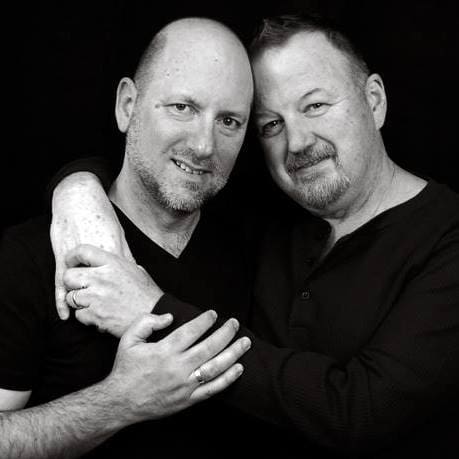
In this 3-part series, we interview Buckley Jeppson. Buckley, 57, says he’s been informed verbally by a senior church leader that his life is incompatible with the doctrines of The Church of Jesus Christ of Latter-day Saints, and that a disciplinary council will soon address the matter. Jeppson, of Washington, D.C., married Mike Kessler in Toronto on Aug. 27, 2004. It is believed that if Jeppson is excommunicated, it would be the first time a Mormon in a legal, same-sex marriage was punished by the church. Jeppson claims that over the past five months Nolan Archibald, his Stake President and CEO of Black and Decker, has encouraged him to resign his church membership, which would avoid disciplinary action.
To read the most current news articles about this story, click here.
For those interested (and as referenced in the podcast), an organization entitled “The Safe Space Coalition” has been formed to “ensure safety and respect for gay and lesbian Latter-day Saints,” and is attempting to garner support for Buckley and Mike. To read more about this effort, and what you can do to support Buckley and Mike (if you are inclined to do so), click here.
Episode Transcript
Host: John Dehlin · Guest: Buckley Jeppson
This transcript is machine-generated and lightly edited for readability. The audio is authoritative. Please excuse occasional errors in names and spelling.
Introduction and Episode Overview
Part 1 of 3 · Ep. 19
John Dehlin [00:00:11] Hello and welcome to Mormon Stories podcast. My name is John Dehlin. I'm very excited to have you with us again today for yet another edition of Mormon Stories. As always, it's been a few weeks and I spend each day wishing that I had spent more time doing more podcasts. But alas, life happens.
John Dehlin [00:00:31] I've been traveling too much, and here we are.
John Dehlin [00:00:34] But as a sweet reward for your patience and endurance in sticking with us, we have a very, very special guest today to share with you the guest that we have today, his name is Buckley Jeppson. And those of you who keep really current in the news, and specifically in Mormon news, the name may ring a bell because over the past day or two, newspaper articles about Buckley have appeared literally in probably 15 to 20 newspapers worldwide. And it may be more and it's definitely growing.
John Dehlin [00:01:18] But for those of you who aren't familiar with the story, let me just go ahead and read the A bit from the Associated Press article basically says that the headline, the one that I first saw on March 15, the headline said, Mormon in Legal Gay Marriage Faces Cutoff. And it begins by saying a gay man who is life, who is a lifetime member of the Mormon Church, could be facing disciplinary action and and excommunication. After legally marrying his partner in Canada, Buckley Jepsen, 57, said he'd been informed verbally by a senior church leader that his life is incompatible with the doctrine of the Church of Jesus Christ of Latter Day Saints and that a disciplinary council will address the matter.
John Dehlin [00:02:08] Jepsen, of Washington, D.C. married Mike Kessler in Toronto on Aug. 27, 2004. It is believed that if Jepsen is excommunicated, it would be the first time a Mormon in a legal same sex marriage was punished by the church, said Olin Thomas, executive director of Affirmation, an advocacy and education group for gay Mormons.
John Dehlin [00:02:32] And finally, Jepsen said that over the past five months, Nolan Archibald, the senior leader or president of a group of Mormon congregations in the Washington area, I believe that's his stake president, has encouraged Jeppson to resign his church membership, which would avoid disciplinary action. Jepsen is unwilling to do that, and he's quoted in the article as saying, it's not going to be my choice to deny my heritage and my faith. So, Buckley Jepsen, thank you so much for coming on Mormon Stories. It's an honor to have you and
Buckley Jeppson [00:03:06] it's an honor to be on.
John Dehlin [00:03:08] I imagine the past couple days have been a little bit crazy for you, huh?
Buckley Jeppson [00:03:12] Yeah, they have been a little bit crazy, especially today since the newspapers came out this morning. It was online yesterday by noon or so, and the calls started coming in. But today, especially after it, after it's hit several of the presses, several newspapers, especially in Utah, it's generated quite a bit of interest.
John Dehlin [00:03:34] And has this hit your local papers yet there in the D.C. area?
Buckley Jeppson [00:03:39] The Washington Post has had it online, but it was not in this morning's paper.
John Dehlin [00:03:45] The Washington Post. Excellent. Well, again, thank you for coming on and I appreciate you coming on so late in the evening there. I believe it's 11:10 your time. Is that right? And we're just getting started.
Buckley Jeppson [00:04:00] Right. We're just getting started.
John Dehlin [00:04:02] So thanks to you and Mike, your husband, for bearing with me in the time zones here. So you've listened to Mormon stories at least a few episodes. I know, and for me, the most important part of Mormon stories isn't so much necessarily having an agenda or trying to make lots of points or prove positions. But, you know, the central purpose of this podcast is simply to let people tell their stories. And in that light, even though there's a lot to talk about with the story, if you don't mind, I'd like to begin by just talking about you
Buckley's Background and Early Life in the Church
John Dehlin [00:04:41] and your story leading up to this moment before we actually talk about the moment. How does that grab you?
Buckley Jeppson [00:04:47] Sure, of course, as you said, I'm 57, so I've got a lot of years, but I'll spare you most of it. I was born in the church. My family on both sides have been members for generations. One side emigrated from England, the other side emigrated from Scandinavia.
Buckley Jeppson [00:05:08] And so I come from a long line of genetic Mormons, all of whom are all active in the church. I was raised in the church and born in Utah. I grew up in. My teenage years and early adulthood were all in California.
Buckley Jeppson [00:05:32] And that's where I went to college and got married and then ended up moving to Utah for a few years, for about 15 years, I guess, before coming to Washington, DC. So I've been a lifelong Mormon and held a lot of callings in the church, just like everybody else who's active and works hard.
Buckley Jeppson [00:05:56] So that's the basic beginnings of how it all began. I didn't know when I first got married that I was gay. I didn't even. I guess I'm of that age where it didn't even occur to me that such a thing was an option or even that it was.
Buckley Jeppson [00:06:21] That it was a life. The only gay person I knew in high school was this strange young man who wore Makeup. And I thought that was very peculiar. And I would never have identified or even sympathized with him or people like him. So it really didn't occur to me, thinking back now, years later, decades of looking back, I guess there were probably the signs, but I didn't know what it was.
John Dehlin [00:07:00] What were some of those signs?
Buckley Jeppson [00:07:02] Well, when I was a youth, I realized that I seemed to be attracted to men, but I was dating women, and not sexually attracted, just emotionally attracted, or I admired them, and that was really about all.
John Dehlin [00:07:26] So were you attracted to women as well?
Buckley Jeppson [00:07:29] Yeah, but in a different way. And I didn't really understand what that difference was at the time. And I just assumed, especially being youth, growing up in the church, any feelings you have for anybody are sort of. You don't talk about them much. And so I didn't. So I just assumed, the older I got, that everybody has these trials and feelings they have to go through and work through, and that if I worked hard enough and excelled and studied and prayed and fasted and did all those things, that I would get over it, just like everybody else who's around. You must have gone through it and got over it.
John Dehlin [00:08:13] Sure. Let me ask you. You know, one of the things, I
John Dehlin [00:08:18] had an aha moment when I lived in Chicago after I'd been married a few years, where I, at the time, George Bush Sr. Was running against Bill Clinton, and the gay issue had come up in one of the campaigns, and. And I remember being in an office one time and debating with people about gay marriage and gay issues, and. And basically coming down in your traditional hardcore Republican dealing with gay issues at the time. And the other people in the room were clearly shocked by how outspokenly conservative I was being. And after sensing their concern, I said,
John Dehlin [00:09:00] you know, I do hold these strong positions, but I do have to admit,
John Dehlin [00:09:05] you know, I've never actually known a gay person before. And one of the guys in the office turned to me and he said, well, yes, you have, actually. And that was like a watershed event for me in my life, because for many Mormons, you know, they've never really talked to a gay person before or made friends with them.
John Dehlin [00:09:26] And so I'm trying to put myself in their shoes now. And they're thinking, you know, how is it that he can just sort of
John Dehlin [00:09:33] one day realize that he's gay?
John Dehlin [00:09:37] How can it be that he has
John Dehlin [00:09:39] sort of a normal adolescents and. And. And a lot of stereotypes are often in the minds of. Of Mormons as to what leads to someone being gay. Things like abuse, things Like a domineering mother. So if you were to.
John Dehlin [00:09:55] If you were to sort of address
John Dehlin [00:09:57] those stereotypes as to whether or not any of them were relevant in your life, talk about that for a minute, growing up or even.
Buckley Jeppson [00:10:07] And this again, looking back in hindsight, I tried to find all those things as I studied and tried to learn about it, as I started coming to grips with it. And I thought, well, maybe that's what it was. Maybe it was something about growing up.
Buckley Jeppson [00:10:25] And I didn't have a terribly domineering mother. She's strong, but she's no stronger than any other Les woman, really. Sighting president, you know, stay out of the way kind of person. My father was also very strong, very loving, really good guy, and I admired him greatly. I played church softball and basketball and did all those things growing up.
Buckley Jeppson [00:10:56] Excelled in school, you know, was student body officer, all those things in high school. Went to early morning seminary, did all of that. And I couldn't find anything that seemed to fit that stereotype at all. Later years, I learned that of the 10 biological cousins, boy cousins, on my mother's side, three of us are gay, which is a pretty high percentage, all LDs.
Buckley Jeppson [00:11:30] But as far as growing up, no, no, there was nothing that I could pinpoint that would have brought that on. It certainly wasn't. I had no abuse in my life, you know, physical abuse, no sexual abuse, none of that.
Buckley Jeppson [00:11:51] I grew up in a totally normal, really nice, conservative house household. Father is a school teacher, my mother stayed at home, and I'm the oldest of five siblings.
John Dehlin [00:12:06] Right.
John Dehlin [00:12:07] And a lot of people aren't aware of the Kinsey Scale, I guess. I'd like to ask you, you know, in your courtships of young ladies, were you attracted to young women in a normal sense? And then if you want to talk about the Kinsey Scale, if you know about it and where you think you might fit on that, looking back, or even now, talk about that for just a second.
Buckley Jeppson [00:12:32] I don't know how valid that is 50 years or so later, but looking back in hindsight, I assumed, and it seemed to me that my real reactions and the way I treated and interacted with girls as a teen were the same as anybody else.
Buckley Jeppson [00:12:54] And so it didn't strike me as being odd at all, any different than any others. When I did sense some feelings also for guys, it was always, again, well, it's the temptation. Just the same way, you know, you're always taught, keep your hands off girls, keep your hands off girls. It was the same sort of thing. You know, there are all the Prohibitions and everything. And that gets all jumbled in your mind anyway, I suppose. But no, I thought at the time that it was perfectly normal. Normal relationships and in the church where you're chased as a young adult and you're trained to be. And trained.
Buckley Jeppson [00:13:43] What kinds of thoughts you're supposed to have and not supposed to have, then I seem to fit in just fine growing up and went on my mission and did all those things really without a serious clue.
John Dehlin [00:14:00] And you did say earlier that looking back, your attraction for women was probably
John Dehlin [00:14:06] a little bit different than the average boy. What do you mean by that?
Buckley Jeppson [00:14:11] Looking back, it probably was. I just didn't recognize that at the time.
John Dehlin [00:14:15] How do you see it as different?
Buckley Jeppson [00:14:17] Different. But because. Because how I feel now, I. I think it comes through being. At least in my case, it came through being older and more mature, having a greater life experience, having other role models and being exposed to more. To more things in the world and coming to. Coming to understand myself better over the years.
John Dehlin [00:14:45] Sure.
Buckley Jeppson [00:14:46] As far as the Kinsey scale, I don't know where I would have been back then, but I think if I were to qualify myself now, I would say I have a lot of really great friends who are women. But. But. And emotional attractions to them, certainly. But as far as physical attractions, it's definitely men.
John Dehlin [00:15:08] Okay, so talk to us, if you don't mind. Share with us,
John Dehlin [00:15:15] you know, getting married
John Dehlin [00:15:18] and take us through the parallel course
John Dehlin [00:15:21] of you,
John Dehlin [00:15:24] I don't want to say
John Dehlin [00:15:24] rising in church leadership, but you've served in bishoprics.
John Dehlin [00:15:28] Did you tell me earlier that you
John Dehlin [00:15:30] had been on a stake high council?
Buckley Jeppson [00:15:32] No, no, just branch president and that sort of thing.
John Dehlin [00:15:38] So take us through the parallel track
John Dehlin [00:15:41] of your advancement in the church with your discovery about your orientation and tell us about how it was that this unfolded in your life. The discovery.
Buckley Jeppson [00:15:57] Okay, yes. I was married in the temple to a wonderful, talented woman who I was very impressed with. We are great friends. We became really, really good friends first, and it developed from there. And that's how I thought it should be. I admired her talent and her independence and her strength and all those things that I would have looked for in a mate. And so I was definitely attracted to her as a friend. And that friendship grew and marriage seemed like the next logical step to me at that point.
John Dehlin [00:16:44] Where did you meet?
Buckley Jeppson [00:16:46] We met in college at an institute in California. We were both to the same university and that's where we met. Turned out she was also in my stake and we had met before, but just sort of. She was in different wards. And so we didn't really know each other until that point.
Buckley Jeppson [00:17:09] And we then started dating and were engaged within several weeks and married six months later. So I'd been home from my mission for about nine months the time we got married, and I was still in school and continued in school and got my degree, continued to graduate school, working part time and got a dissertation, and then from there went on to teach at Weber State University.
Buckley Jeppson [00:17:51] That's how I ended up in Utah. And so all this time, everything was going pretty well, as far as I could tell. But enough time had gone. I'd been married by then about five years, I guess, and I kind of started to sense that things weren't quite the same as everybody else, as all the couples. I couldn't.
Buckley Jeppson [00:18:23] I couldn't say. I could hear people say, oh, she walks in the room and everything lights up, and I'm immediately in love and all that. And I thought, well, you know, I'm just not that kind of guy. So I'm just not a romantic, I suppose.
Buckley Jeppson [00:18:45] And so it didn't bother me. I didn't really think about it. And I started working right away, living in Ogden, working in the wards and in the elders quorum presidency, and then working in the stake and doing some teaching in service training, and continued all the way up through into.
Buckley Jeppson [00:19:15] I taught gospel doctrine for many years, taught elders quorum for many years while we lived in Utah for about 15 years, became a high priest. And somewhere along in there, I made the realization that that things were not right.
Buckley Jeppson [00:19:38] Probably had been married maybe 10, 12 years or so by then. And I settled down and said, I've got to figure this out. And I did a lot of studying. I did all the things we're supposed to do, Studying, praying, fasting about it, talking to people, getting counseling, and trying to get to the bottom of why I was feeling the way I was. I started to become depressed.
Buckley Jeppson [00:20:16] And finally, eventually, I just came to the realization, you know, if you face it and if you're honest about it, this is what you got to face. And so that's where I was.
Marriage, Attraction, and Living a Double Life
John Dehlin [00:20:32] So. So were you there. There are two elements that come to mind.
John Dehlin [00:20:36] One is that maybe you weren't feeling the attraction for your wife that you thought you. You should. And the second track would be that you found yourself being attracted to other men.
John Dehlin [00:20:48] Were both of those happening?
John Dehlin [00:20:49] And if you can talk a little bit about it without.
Buckley Jeppson [00:20:52] Yeah, they were. It was both going on, but I was never attracted to a particular man or anything, just in general, in General sense. I would see a man that I admired or that was attractive. And then I started realizing, you know, everybody doesn't do this. All the guys out there aren't looking at all the guys, too. But I had. I took the vows that I'd made very seriously. This was not her fault. This was my cross to bear, and I was going to bear it in the way that we as Mormons bear our crosses, which is work harder, fast harder. Do your home teaching earlier, study harder, do all those things. Spend more hours on the steak farm, volunteer more. Give and give and give, and you'll get over it. And I just did all those things and got more tired and more depressed and didn't get over it.
John Dehlin [00:22:07] And was there ever a sense that
John Dehlin [00:22:10] your wife might be suspicious or was
John Dehlin [00:22:12] concerned or felt like something wasn't quite
John Dehlin [00:22:16] right before you were ever able to talk to her about it?
Buckley Jeppson [00:22:21] I didn't sense it. We had been trying to have children for a number of years, and she had a medical problem, was not able to for quite a while. Eventually, after we'd been married 12 years, we had a daughter and realized that since that was so difficult on her, that it would be our only one. So I put my attention, pretty much all of it, into caring for her and tried to divert my attention. I was still able to be a husband. I was still able to do the things a husband needs to do. I was able to be physically fulfilling.
Buckley Jeppson [00:23:06] So I was able to go through the motions of it all and do the very best I could. It just over time, that. That pull, that sort of dissonance, just can't last forever. It lasted as long as I could make it last.
Buckley Jeppson [00:23:31] I did go to bishops and talk to them about it eventually, before I talked to her, they were sort of puzzled and told me the same things. Pray harder, study harder.
John Dehlin [00:23:45] Was this before you had served in bishoprics?
Buckley Jeppson [00:23:48] Yes.
John Dehlin [00:23:48] Okay.
Buckley Jeppson [00:23:49] And I had seen counselors who shake, you know, sort of scratch their heads and said, you know, we don't. If you're coming to get cured, you know, forget that, because that doesn't work. But we work with you to understand and accept it and learn how to deal with it in a healthy way.
John Dehlin [00:24:13] Was this LDS social services or secular counselors?
Buckley Jeppson [00:24:16] It was. And they were more baffled than anything, and they weren't any help. They were really confused. And so I gave up there. And we continued on that way for a number of years, and I just kept it to myself.
Buckley Jeppson [00:24:41] And then eventually, we'd been married about 20 years and moved to Washington, D.C. for employment. And, you know, it was pulling harder and harder and it got more and more difficult. But then I would be called to serve in something and I would immerse myself in my calling and I could push things out of my head.
Buckley Jeppson [00:25:12] And I was called into bishopric and there was some really serious problems in the ward that needed my attention. And the bishop was not around to deal with it, became ill, and I was really acting bishop for many months.
Buckley Jeppson [00:25:32] And so I was able to keep all of that in check and just kind of try and put it out of my mind for all those years. But down inside it was really getting to me. And because there was the letter of the law, you shall not sin. And then there's the spirit of the law, you shall not lust. And those were certainly pulling me from different directions also.
John Dehlin [00:26:11] Thou shalt not lie, huh?
Buckley Jeppson [00:26:13] Yeah. And thou shalt not lie. And I could truthfully talk to my bishop and say that I had not transgressed or anything, but I couldn't truthfully say that I, you know, that I didn't feel these things. And so I never did lie about it. I always told them about it. And luckily, because I guess of where I live, that, and I was honest about it, that I was accepted and continued to work in the church.
John Dehlin [00:26:50] And your church leaders knew before your wife did?
Buckley Jeppson [00:26:53] Yes. Yeah. And eventually it just got to be. It just got to be too much. And I had been. The bishopric had changed and so I was teaching a class at the time and I again was seeing, seeing counselor. I was experiencing incredible depression and she was doing everything she possibly could to help me adjust in a way that was within my framework. To her credit. She didn't try and make me a non Mormon or anything.
Buckley Jeppson [00:27:34] She understood. And she tried to work really hard with me to help me find a place of peace within the framework of the church. But I eventually realized that that just couldn't happen, that I couldn't be happy completely, and that I was really. I was being deceptive to those around me and my family. And it was going to blow up on me eventually. And so I had to. I had to eventually talk to my wife about it.
John Dehlin [00:28:16] Were you ever counseled by your leaders
John Dehlin [00:28:19] to not tell your wife?
Buckley Jeppson [00:28:22] No, no, no one ever said that.
John Dehlin [00:28:25] Because there are stories. I've heard that it was the policy
John Dehlin [00:28:29] for many years when a young man felt disorientation and was engaged to be married, but he felt this conflict. He. He'd go to the bishop and apparently I've heard that the policy was get married, that Will fix this and do not tell your wife. Have you heard that?
Buckley Jeppson [00:28:50] I've heard that many times. And I think especially people who were maybe just a bit younger than me, they got that a lot. That isn't the case anymore. I was reading, in fact, earlier today, a speech from 1996 for Elder Oaks, and. And he was specifically saying, we do not encourage people with homosexual feelings to get married because that doesn't fix the problem. So the church has certainly come a long way on that. And I think part is they just. I mean, it just destroyed so many families and so many people. That was not a viable way to do it.
John Dehlin [00:29:39] Right.
Buckley Jeppson [00:29:41] The church tried a lot of things, and to their credit, I think they thought they were doing the right thing. But a lot of it was ultimately destructive. You know, things like aversion therapies and those kinds of things.
John Dehlin [00:29:58] Tell the listeners a little bit more
John Dehlin [00:29:59] about that
Buckley Jeppson [00:30:02] at BYU, especially during the late 60s, early 70s, I don't know how long after that, but I had a couple of students that I was teaching at Weber, who had been at BYU in the mid and late 70s, and they had been subjected to all manner of therapies on campus, trying to straighten them out. A couple of them had confided to me about some of the details. Things like, you know, wiring their genitals to electrodes and then showing them pornography. And if they reacted wrong to male pornography, then they would get electric shocks. But if it was male, female pornography, heterosexual pornography, they would not be shocked with electricity. Well, of course, all that does is make them crazy. As it turns out, this happened at
John Dehlin [00:31:01] BYU in the 70s.
Buckley Jeppson [00:31:03] Yeah, it was actually campus part of research, you know, psychology research. There was another student I had who he. They gave him drugs so that, you know, they would show him again homosexual pornography and then give him some sort of a drug to make him throw up, make him really, really sick and thinking that that way, over time he would realize that he would associate. Make an association with homosexual feelings and being physically ill. So they tried a lot of things, thinking that they could change orientations of people. And I didn't. I didn't see it changing anybody. But I have certainly met a lot of damaged people who came out of that era, and they do not do that anymore. I understand. And haven't for a number of years, thank goodness.
Coming Out to His Wife and Family
John Dehlin [00:32:14] So, Buckley, let's shift gears a bit. Tell us about. Once you reach the point where you knew you had to tell this to your wife, what was that experience like,
John Dehlin [00:32:26] both in running up to it, what you were feeling and, you know, how
John Dehlin [00:32:30] did you tell her?
John Dehlin [00:32:32] And what was the reaction and that whole aftermath? How did that go?
Buckley Jeppson [00:32:39] Well, it was certainly up to that point, the hardest thing I had ever done, the most difficult decision. And I kept remembering the sayings that the hard things are the right things. And so eventually, I did have to sit her down and say, you know, this is really difficult for me, but this is the situation. And I told her that I was gay and that I hoped that wouldn't change anything. I hoped that by getting that out there that we could deal with it together and we would be able to keep our family, keep our family together.
Buckley Jeppson [00:33:28] We had never fought, argued, screamed at each other, called names, never did any of that. And we've been married over 25 years by then, so there was no. I mean, we weren't about to start hating each other by any means.
Buckley Jeppson [00:33:44] So it was. It was a really very difficult time. My daughter was a teenager, and we. And we talked with her the same day, and her. Her concern was that we were going to get divorced. And we assured her that that was not our intention, that we were going to try really hard to make it work. And we.
John Dehlin [00:34:10] How old was your daughter at the time?
Buckley Jeppson [00:34:12] She was, let's see, about 14.
John Dehlin [00:34:16] Right? In high school, huh?
Buckley Jeppson [00:34:18] Yeah. Yeah. And so we. We talked about, you know, what this would mean and how we would try to negotiate what. What it would mean. I. And I said I have to be able to be open and be able to talk about it at home, not be, you know, not suffer that shame that goes along with it, because I felt like that was what was really making me ill mentally and making me grouchy and all the things that I never wanted to be and just weren't me.
Buckley Jeppson [00:34:55] And so we went on like that and tried very hard for a long time to keep things at that level. And it just. Over time, we realized that we cared enough about each other that we just had to let go.
Buckley Jeppson [00:35:21] And I felt like she needed somebody who could really care for her and love her in the way that she deserved and without, you know, without any qualms, without any hesitation, without any qualifications. And she deserved that, and I deserved it, and she felt like I deserved it. So together we planned our separation and when it would be many months in advance and made arrangements and did all of that very amicably.
John Dehlin [00:36:04] And what was the length of time between you telling your wife and your daughter and you making the decision to separate?
Buckley Jeppson [00:36:13] It was nearly a year.
John Dehlin [00:36:15] So you tried it for a year?
Buckley Jeppson [00:36:17] Yeah. And we were able to do it and not dislike each other, be able to stay close. And it was difficult for my daughter because everybody knew we had the perfect family and admired us greatly. And so we knew it would be difficult and it would be a shock for people.
John Dehlin [00:36:48] Let me throw in a bit of
John Dehlin [00:36:49] a hard question here. Just trying to think about what a listener might be thinking and maybe give them a bit of a voice.
John Dehlin [00:36:59] I can think of some pragmatic but
John Dehlin [00:37:02] loyal LDS folk who are thinking, okay, fine, you know, you knew you were gay, and, you know, you had to tell your wife and your daughter knew, and, you know, life wasn't what you wanted it to be.
John Dehlin [00:37:17] But at the same time, we all
John Dehlin [00:37:19] have our crosses to bear, and we all have, you know, some of us are overweight, some of us, you know,
John Dehlin [00:37:25] have depression, some of us have illnesses, you know, whatever. That's your cross to bear. Why not stick it out with your wife?
John Dehlin [00:37:36] Why not keep your family together and,
John Dehlin [00:37:40] you know, consider this your cross to bear to help you earn your rights, you know, to the pearly gates on the other side.
John Dehlin [00:37:47] What?
John Dehlin [00:37:48] Help us. Help us understand why.
John Dehlin [00:37:51] Why, for you, that wasn't an option.
Buckley Jeppson [00:37:55] Actually, it was the option. It was the option for 25 years, and I was convinced that was the way to do it. I was convinced that there was something wrong with me. And then when I finally came to a place of peace in my own life, then it became that. It became, okay, this is.
Buckley Jeppson [00:38:18] This is my cross. This is what I have. This is the thorn, my thorn on my side, as Paul talked about. And so that really was what I did for many years. I guess the realization that times changed by then, and we both realized that it was possible to.
Buckley Jeppson [00:38:46] To have a healthy relationship. I realized it would be possible to have a healthy relationship with another man. We knew other GI people, and they seemed perfectly fine and happy. And I kind of envied that and realized that I would never have that.
Buckley Jeppson [00:39:12] And eventually I wasn't able to accept never having that kind of happiness. I felt in my prayers and all that God wanted me to have happiness and that I could do a lot more. I could do more service. I could be a better emissary of his church if I were more honest with myself.
Buckley Jeppson [00:39:38] And so that was the path that I chose. I say chose now. Although at the time, it didn't seem like much of a choice. It was more a choice of survival, mental survival, emotional survival at the time, and it seemed like much less of a choice.
John Dehlin [00:40:08] The depth of your dreams, the height of your wishes.
Church Teachings on Gay Members
Part 2 of 3 · Ep. 20
Buckley Jeppson [00:00:11] You know, some church leaders have. Have compared it to being diabetic or an alcoholic or something. And. And that's really not. Not a fair comparison. It would be like talking to someone who's heterosexual would be like saying, what if you were forced. What if your church and your society forced you to have affections for a man? And you had no choice.
Buckley Jeppson [00:00:40] You had to keep up that front. You had to have sexual relations with them. You had to enjoy it, and you did that, and you were forced to do that for 25 years. And then you come to a point where you say, you know, this just isn't. This just isn't right. It's wrong.
Buckley Jeppson [00:01:02] It's wrong to ask this of any human being. It's abusive to ask it and to ask it of myself. And that's the best. I don't know, the best comparison I can come up with, because it is. Really is parallel if you put. If you're to put yourself in that position.
John Dehlin [00:01:24] So here's. Here's one thing that, you know, I saw Brokeback Mountain. My wife and I saw it, and we loved it. You know, here's this movie where these. These two guys, it isn't really clear in the movie whether they had had any gay relationships before they met, but they clearly are off tending the sheep in a summer, you know, in the mountains, and they. And they have a relationship and. And then wham, bam, you know, after the summer's over, the years over, the guys go and get married and have kids and they're able to be intimate with their wives and they have children.
John Dehlin [00:02:01] It does show the anxiety and the sadness that they have, but they're able to. And one thing that I think our listeners would love to understand, and I don't know if there's an easy answer for this, but, you know, I'm thinking if I were on the Kinsey scale, I'd probably be a zero. If society told me, I would tell myself this, that if society were to tell me, john, you have to sleep with men and marry men and stay married to them over 25 years, I'm thinking I would either, you know, run away or kill myself, but I would. That would. I would physically not be capable of doing that.
John Dehlin [00:02:42] So if we turn that analogy back, how would you explain to somebody how you were able to do that 25 years? When. If we extend that same logic that you pose to me, I would feel like that would be something I'd be totally, physically, emotionally, socially incapable of ever doing right.
Buckley Jeppson [00:03:02] And I wasn't at that point and that's why I have my issues with the Kinsey scale sort of black and white view. If you were to use that yardstick, I certainly would fall somewhere in the middle because I was capable of it, but it wasn't pleasant. And in the case of Brokeback Mountain, there's a good example. I mean, this started in 1963 and went on for 20 years. And a lot changed in that 20 years.
Buckley Jeppson [00:03:35] And yeah, they were able to perform, but even the quietest of them was divorced within a few years and was never able to find intimacy because he could never come to grips with who he was in the place that he lived. It just wasn't thinkable.
Buckley Jeppson [00:03:58] And the other one was in a place in a more urban place, and he was able to escape and hide. And he treated it in his own sort of dysfunctional, dangerous way by slipping across the border into Mexico and even eventually there at home, it's implied that he was having relationships.
Buckley Jeppson [00:04:22] So they didn't really win, that they both lost. And that's the saddest part, I think, of. Of the film and of the story. And that's kind of what I am really glad I avoided.
John Dehlin [00:04:40] So it's not what I'm hearing is, you know, sexuality is clearly part of this, but the dimension seems more to be about intimacy and joy than it is, you know, sexual stimulation.
Buckley Jeppson [00:04:56] Oh, absolutely. Yeah. That's what it is, I would say, pretty much entirely, to me, at least. I mean, how else do you explain people who are older, for example, and don't and marry? They may marry for companionship, but there is no sexual stimulation or interest there at all, perhaps. And there are a lot of reasons people form their bonding and their pairing. And it isn't all about sex, certainly. And being gay is not. Is not about sex, believe me, any more than being married is all about sex.
John Dehlin [00:05:36] Or not, as the case may be.
Buckley Jeppson [00:05:41] It's no different.
John Dehlin [00:05:42] Yeah. Yeah. Okay. Well, thank you. Oh, go ahead.
Buckley Jeppson [00:05:46] It's a different thing, I think, for a lot of Mormons to understand, because the only way they can perceive of homosexuality is sex. That's all they see. And that just is a misconception. It's who you bond with, who you feel that it's a person that you care about, want to share your life with, want to make commitments, want to take care of, protect, and spend your life with.
Life After Separation and Finding New Love
John Dehlin [00:06:20] So let's transition now to post marriage. What was life for you when you and your wife separated? How did things progress both in your personal life, socially, and also in the
Buckley Jeppson [00:06:39] church, in parallel well, they continued to run parallel. And I immediately, when I moved, I moved out of suburban Washington, D.C. and into the city so I could remain close to my family, but, you know, within a few minutes, but still be out of the ward and stake and that kind of thing so that we could have our lives.
Buckley Jeppson [00:07:08] And I immediately, first week, went to the district president. The District of Columbia was a missionary district at the time, and I had served with him before as one of his counselors in a bishopric. And so he knew me well.
Buckley Jeppson [00:07:27] And I immediately went to him and I told him the situation. And he said, you know, the District really needs people like you, who can work hard like you. And I will talk to your branch president and explain the situation and make it clear that you should just be left alone to find what you need to find. You don't need to be hassled.
Buckley Jeppson [00:07:57] And to his great credit, he did that. He was really a great man. The bishopric that I served with him in was in the District of Columbia when there was a ward, and it was a very welcoming ward. And we counted one time as we were trying to do some outreach that there were 24 gay men in the elders quorum that we knew of.
Buckley Jeppson [00:08:26] And so, you know, that started to color my thinking even back then that, yeah, maybe this is possible. I could see these people. One of them was teaching gospel doctrine class and was a wonderful teacher. And so I, I came to it with that and I came to him and, and, and he was very understanding and he did speak with my branch president and I was always welcome.
Buckley Jeppson [00:08:56] I was a bit leery and a bit, you know, sort of burned out on lots of church service for a long time. And I was 49 years old at this point, I think in, yeah, 49. And I was not.
Buckley Jeppson [00:09:14] I needed a bit of a rest. So I needed to be with my people, my Mormon family, and needed to worship with them and, and sing the hymns with them and, and renew my covenants with them. But I didn't need to coach basketball quite yet.
Buckley Jeppson [00:09:33] So I was very frank with the branch president. And that's basically the way it went for a number of years. A new branch president came along and I immediately went to him and explained the situation. He was even more understanding because of some experiences in his professional life. And he was African American, and he said, hey, took us a whole long time to have the priesthood. And I've gotten over it.
Buckley Jeppson [00:10:07] The church will just have to get over it eventually. So I was really blessed. I had some great local leaders who were kind and accepting and not condescending, who were really very good to me. And so I was able to continue on and growing in the church and I didn't hold a calling.
Buckley Jeppson [00:10:35] And I just sort of went to sacrament meeting and after a while I was going to sacrament meeting and then leaving. And that's sort of the way it continued on for a long time until I met my husband. I did.
Buckley Jeppson [00:10:58] I did develop some friendships. I tried hard to sort of fit in, but it wasn't. That wasn't my life at that point yet. I was still. I wasn't going to go through any sort of a gay adolescence or anything. So I still needed to. To calm a bit. I had been in touch with Affirmation before. I had been in touch with Tell
John Dehlin [00:11:32] our listeners what those are.
Buckley Jeppson [00:11:33] Affirmation is gay and lesbian Mormons. It's sort of a support and educational organization in support of people who are. Who are Mormons or of Mormon heritage. Men and women and transgendered people also. And Gammaphytes is gay Mormon fathers. That's what the GA comes from gay. And the MO comes from Mormon. And fights. And of course, we're all me fights, Lamanites or Gamma fights.
Buckley Jeppson [00:12:05] So we. They held retreats on weekends occasionally. And I went to several of those and got to know a lot of other married or formerly married LDS men and found that my story was very much like their stories.
Buckley Jeppson [00:12:28] And that gave me more confidence to feel like I could go ahead and have life, have a real life, even at that late point. So that was. That was my really my first contact with the gay community. Also, there was a local.
Buckley Jeppson [00:12:54] This is before the days of the hard Internet, the big Internet. There was a local electronic bulletin board and a gay bulletin board. And I specifically was a member because they had a. A section for married gay men, like a support section.
Buckley Jeppson [00:13:19] And that's where I sought advice when I was coming out to my family and then for that year afterward, trying to figure out how to negotiate all that. It was through the help of some friends in Affirmation and in Gamma Fights and the local bulletin board. And it was through the local bulletin board, in fact, that I eventually met Mike.
John Dehlin [00:13:46] Your husband?
Buckley Jeppson [00:13:48] Yeah, yeah. It was one of those odd things. He discovered that he had dated a guy who was married and was kind of interested in, you know, what all that dynamic was all about. And so he happened to beyond. And when I was asking for advice and getting it, he was one who. Who assured me that all would be well, that he had seen it before and that people would survive. And I would survive. He was moving off. He was living in Washington D.C. but his condo was for sale and he was moving off to the West Coast. So we didn't really become really close friends or anything at that point. But we corresponded while he was gone and after I had separated and sometime later when things didn't work out the way he'd hoped in California, he moved back to a friend's place. And then months later we started dating. And rest is history.
John Dehlin [00:15:04] Right. Let me jump back real quick and ask one, one question before we talk about your relationship with Mike and where it's led. What was it like? You come from an LDS family.
Buckley Jeppson [00:15:16] Yes.
John Dehlin [00:15:16] Probably a conservative LDS family. What was it like breaking the news to them really hard? Tell us about that, if you don't mind.
Buckley Jeppson [00:15:29] No, my wife and I had chosen not to for that period of time that we were trying to work through it and we thought, you know, it doesn't involve them at this point and why, you know, why get into the drama?
Buckley Jeppson [00:15:48] And so we went to family reunions and, and did all that stuff and they didn't know. They didn't have any clue at all. And eventually when we told them, what I told them was when just before we separated and I just let them all know. And of course each one has their different reactions.
Buckley Jeppson [00:16:24] Never what you expect. You always overestimate or underestimate people. The ones that you think be the most understanding often or not, and the ones you think that are the least tolerant often rally. And that was the case in my situation.
Buckley Jeppson [00:16:45] But in fact, one of my brothers who remains the least accepting, although he certainly is tolerant and puts up with me and is kind, the first thing he said was, I knew when you started reading Sunstone something like this would happen. Which I thought was a really funny reaction.
John Dehlin [00:17:10] But here's a little shout out to my buddy Dan Weatherspoon out there. Hey, Dan,
Buckley Jeppson [00:17:16] what you've done? Actually, I was a different kind of. I mean, I admit I was definitely a different kid growing up. I subscribed to Dialogue on my mission and had some of those first copies from the 60s back when Elder Oaks
John Dehlin [00:17:33] was on the editorial staff.
Buckley Jeppson [00:17:36] Exactly. Way back then. And the first issue of Sunstone that came out 7th east, all that I was, I ate it all up right away.
John Dehlin [00:17:45] And that's back when Mormon history was legitimate. New Mormon history was actually church sponsored.
Buckley Jeppson [00:17:51] This church sponsored and appreciated and encouraged. And it was a great time. It's a great time. But yeah, my family at first had a very hard time, but they three brothers and my Sister and my mother, all. My father had passed away a few years earlier, but they all said, you know, we may not understand, may not be totally accepting, but we do love you, and that's something that won't change. And that was really. That was great. That gave me the hope that. That eventually, they might eventually come around. And it was a long process for some, and some have trouble with it, but I've never felt unloved or excluded, so I'm lucky there.
Falling in Love and Getting Legally Married
John Dehlin [00:18:58] Okay, so tell us about falling in love and the contrast, if there was one, between what you thought life and intimacy was like and what you discovered it could be.
Buckley Jeppson [00:19:17] That was so shocking was that when he walked in the room, I really did see the sparks, and I really did feel all that thing that I heard people talking about all that time, and I didn't get. I never got that. And suddenly I did. And then I knew for sure that this was who I was and that I could develop a relationship, a real one, and feel really good about myself and form a good bond. So it was an eye opener. I have to tell you. It was tremendous not to negate my relationship before with my wife, which was wonderful, but it was a different kind of relationship than this.
John Dehlin [00:20:13] Yeah. So take us to the point where you decided to consummate your relationship in matrimony.
Buckley Jeppson [00:20:23] Yeah. He was in Los Angeles, as I said, when I moved out, and was sort of feeling my way around eventually. But we did stay in touch by email occasionally. And he was having a really hard time with a job and trying to find a job. I grew up in Los Angeles, so I was giving him all the contacts I knew. I was giving him names of gammaphytes who lived out there, who were. Might be able to talk to him and help him out. I was doing everything to help him out because it didn't really occur to me that there would be a future spouse there.
John Dehlin [00:21:06] He's Jewish, right?
Buckley Jeppson [00:21:07] Yeah, he's Jewish. But eventually it wasn't his home, and he knew his home and his friends were here, and he missed them, and they all missed him. And one of them, even when he was running out of money, sent him a plane ticket to come back. And another put him up in his basement for as long as he wanted to while he found work here and got settled again. So he had some great friends here, people that I didn't know at the time, and they rallied around him and helped him out. So he also was lucky to have some good friends.
Buckley Jeppson [00:21:51] He knew he was gay his entire life and had come out quite early in his life, he's nine years younger than I am. And that difference in those nine years, I think, was sort of tremendous difference in time, in history.
Buckley Jeppson [00:22:11] And he also comes from a tradition which is more accepting, religious tradition which is more more accepting. And so he. He didn't have as difficult a time of it as I did. But when we did, we did meet up again after he got back, after being home a while, and I'd been out a while, and we started going to dinner and talking and, you know, talking and talking, talking, doing all those things you do when you first date and seeing the things that mattered the most to us.
Buckley Jeppson [00:22:54] It was really interesting to discover that here was someone who. Spirituality was very important to him. Not necessarily what the spirituality was, but it had to be somebody who was spiritual, who had a basis, a moral center to him. And that was very important to me, too.
Buckley Jeppson [00:23:15] And because he had known someone and found he was married and was not being true to his family and was not taking care of his children, he placed very high value on that. And the fact that I had a good relationship with my wife and my daughter was devoted to them, that was very important to him, and he liked that.
Buckley Jeppson [00:23:46] So we found a lot of things that we shared and that we cared about that were a lot alike. And eventually we would have. Had it been possible for us, we would have gotten married right away, within weeks, just like I did the first time.
Buckley Jeppson [00:24:09] But that wasn't an option. Eventually he did move in. We shared my apartment and the. And we were really excited when Massachusetts passed a law to allow marriages. And that was in our plan. We were going to go up there. And then, of course, the.
John Dehlin [00:24:36] In a twist of irony.
Buckley Jeppson [00:24:38] In a twist of irony by the Mormon governor, an old misogynation law and would not issue. Would not allow them to issue marriage licenses to people who were not residents. We had lots of people who offered us their residences and their addresses and their vacation homes there to establish residency so we could. But we just didn't feel right about that. We wanted to be married and be married real. So as soon as it became legal in a couple of provinces in Canada, we started making plans right away and went through all the paperwork and all the hassles to do it from afar and eventually were able to get it all cleared and. And go up to Toronto and get married.
John Dehlin [00:25:36] How was the ceremony?
Buckley Jeppson [00:25:38] It was great. Mike's parents were there. They're very supportive. They adore me, and I think they're great. They're big P flag parents in South Florida. And have always been very supportive of Mike. Did you say P. FLAG? Yeah, yeah.
John Dehlin [00:25:55] What is that?
Buckley Jeppson [00:25:56] Parents and Friends of Gays and Lesbians. It's. It's a family organization for. Support organization for people who have family and friends who are gay or lesbian. And they've been very active in civil rights and equal rights for gays and lesbians. So that's been really helpful. And he has three sisters, and they also. And their families have been great. So I have extra nieces and nieces and nephews, and it's really great. I was accepted right away.
John Dehlin [00:26:42] Was any of your family. Did any of your family attend the wedding?
Buckley Jeppson [00:26:46] No, they weren't able to. My daughter actually had been married just a few months earlier, and everybody had trekked all the way out to Washington, D.C. for the wedding, and. And I knew that it would be difficult for them. I didn't want to put any pressure on them.
John Dehlin [00:27:06] And were you able to attend her wedding?
Buckley Jeppson [00:27:09] I was not able to attend it in the temple, but I did the reception, everything. Handled it all and took care of all of those details. And my degrees were in theater and film design. And so she always wanted me to make her wedding dress, so I even made a wedding dress for the temple.
John Dehlin [00:27:35] How do you keep from just being devastated that you can't attend your daughter's wedding?
Buckley Jeppson [00:27:42] It was hard, but I knew. I'd known for years that I wouldn't be able to, and I just accepted it. It was. It was nobody's fault. It's just the way. It's just the way things are.
John Dehlin [00:27:56] You weren't angry? You weren't, you know, screaming at the world?
Buckley Jeppson [00:28:00] I wasn't bitter. I'd never been one to, you know, to blame the world for things that go wrong like that. You know, it's just. It's. It's. This is my life, and I have a spiritual life and beliefs, and I respect the organization, and it's the fact that it has its. Its rules, and there's no point in being bitter about it. I mean, it wouldn't gain anybody anything and certainly not make it any easier for her. I cared more about. About her and about my wife and the rest of the family than. Than trying to make some sort of big deal about it. That wouldn't do anybody any good.
John Dehlin [00:28:54] Well, that's impressive. I can't say that I would have been as mature or had as good of a perspective as you did.
Buckley Jeppson [00:29:04] It was hard. I don't mean to say it wasn't difficult, but I had friends who had a couple friends who flew off from Utah and. And Idaho and places just to sit outside the temple with us. And that meant a great deal to me. And people like that in our lives really enrich us and give us the strength to do the hard things we've got to do.
Buckley Jeppson [00:29:32] But being married up there was great. It was because we're of different face, of course. No, a Mormon bishop would marry us, we knew that. And a rabbi would not marry us. General Linus was a reformed rabbi, but we felt that that would be disingenuous too. And so we wanted a spiritually based wedding, but definitely civil marriage. And that's what we had. And it was held there at the City hall in Toronto, Ontario, and his parents stood as our witnesses and we had a number of other friends who were there also.
John Dehlin [00:30:20] Tell me again who performed the ceremony.
Buckley Jeppson [00:30:23] He was a minister. They have, you know, their ministers or judges, retired judges on call. When you get married there, it's you either bring somebody with you or it's whoever's on duty. And it was the. The one who was on duty and
John Dehlin [00:30:36] what was he of a particular denomination?
Buckley Jeppson [00:30:39] Was. I don't recall right now.
John Dehlin [00:30:41] That's fine.
Buckley Jeppson [00:30:45] But it was a great experience. I'd been married and I know what being married is like, even though it's a different kind of marriage. But for Mike, it was. He speaks of it the way. The way marriage is. You know, you put that ring on and the world changes. You see things differently and your relationship changes no matter how well you know somebody. And all of that is changed very quickly. So marriage has been great and especially great for him and great for me.
Navigating Church Attendance After Marriage
John Dehlin [00:31:27] So all this time you were still attending sacrament meeting at least occasionally?
Buckley Jeppson [00:31:36] Yeah, yeah, most of the time.
John Dehlin [00:31:38] And after your marriage, even did your ecclesiastical leader find out about the marriage?
Buckley Jeppson [00:31:47] I don't know actually at that time, but. Well, certainly he knew about it because they had been in our home and we had home teachers all that time. The missionaries came, came by all the time. We were their bathroom and water stop. Along the way. I worked at home for a number of couple of years doing freelance work. And so I was always the one in the middle of the day who got the missionaries visiting. And so certainly we had home teachers and there was never any secret about it. We have wedding pictures up all over. We send out wedding announcements, and it was in the paper, in the local newspaper.
John Dehlin [00:32:34] But you weren't at this point having interviews with your bishop or becoming buddies with your ecclesiastical leader?
Buckley Jeppson [00:32:42] Certainly they knew and, you know, we would meet and talk in the Halls and just the normal stuff you would do with your bishop, General conference or state conference come and I go to state conference and just, you know, like everybody else.
John Dehlin [00:33:01] And you weren't the only person. Were there other people that you knew who were in committed gay relationships that also attended church regularly?
Buckley Jeppson [00:33:13] No, not that I knew of, actually.
John Dehlin [00:33:15] So in that. In that element, you were sort of an anomaly?
Buckley Jeppson [00:33:18] Yeah, yeah. The ones that I have met, even to this. This point, most of them, they. They've really been damaged somewhere along the way. They've had some horrible experiences, and they just really. Some of them have been mistreated or some of them just really felt unwelcome, been condescended to or treated badly. And they just haven't had. It just hasn't happened to them in a way that they could cope and move on. There's one couple here in the affirmation group, a committed couple, and his parents back in Utah kept calling. The stake president kept calling and calling, saying, you know, our son is gay. You have to do something about it. You have to do something about it. And so finally the stake president said, okay, and called the disciplinary council and excommunicated him.
John Dehlin [00:34:19] So the parents were begging that their child be excommunicated.
Buckley Jeppson [00:34:22] They were demanding that this happen. And so that's the kind of experiences and things a lot of people have. It's really hard on them. And so most of the ones I knew were really bitter or defensive or just lost hope. So their connection with Mormonism was definitely more of a cultural kind of connection and more of a sense of fellowship with people who understood their background. But it wasn't a spiritual connection.
John Dehlin [00:34:59] Right. Okay, and so what. How did this all come to a head?
Buckley Jeppson [00:35:08] Well, a couple. I go to a inner city branch here in Washington, and it's very diverse and interesting. And there are several others. Two of them were combined and made into a ward and a bishop brought in from.
Buckley Jeppson [00:35:28] I don't know if he was from the other branch as I know him, or if he was brought in from the suburbs, which happens a lot here. You know, inner city people don't know how to do things right, so they have to ship somebody from the outside in.
Buckley Jeppson [00:35:42] And so they brought this guy in, and he was a little overzealous, I guess, within a couple of weeks, he called me in and was asking me, you know, what's your story and what's going on and on and on.
Buckley Jeppson [00:36:00] And so, like all the others, I just told him, I said, I'm here, I'm married, I've been married for some time and here's where we live and you're welcome to stop by. He and his wife continued to be our own teachers, but he felt the necessity to talk to the stake president right then. And soon thereafter the stake president called me. And that's sort of where it all started.
John Dehlin [00:36:29] So would you characterize the understanding you had with your former ecclesiastical leader as a don't ask, don't tell sort of agreement where you.
Buckley Jeppson [00:36:40] That's exactly. And we even characterized it as that My, my last branch president before the combining, in fact, had come from a background that was a military background. And he, and he referred to it as a don't ask, don't tell policy.
John Dehlin [00:37:00] And so what was it? What do you.
Buckley Jeppson [00:37:02] What was the understanding that you was for recommend? I don't ask for a calling in the ward and he doesn't ask me any questions. And I serve however I can. I purposely kept low profile because I just did not want to, you know, to make anybody uncomfortable or embarrassed or anything.
Buckley Jeppson [00:37:25] I mean, Mike and I were on a panel of mixed religious couples at a Sunstone symposium out here. It wasn't like I was hiding. I had a lot of friends in other wards who knew me when I was married and continued to be friends and invited us both to their kids wedding receptions and we went out to dinner movies with them. And so there certainly was no secret going on by any means. But I did try out of respect for not wanting to put anybody in a bad position. I did try to just kind of serve in the ways that I could serve. I did things like anonymously.
Buckley Jeppson [00:38:07] I would buy subscriptions to magazines for new converts and have them sent to them and anonymously buy him books to replace the ones that were disintegrating in the branch and just have them delivered the things that I could and of course donated and that kind of thing. But I just served in the ways that I felt like I could in the war and then in the community too, to make up for all those other things that I couldn't do in the church.
John Dehlin [00:38:40] As I think about your experience, I feel a lot of parallels to my experience in discovering new Mormon history, but trying to stay and I've really struggled with. If I hear a talk that enrages me or that's historically inaccurate, or if I'm in elders quorum or Sunday school and people say something that's inaccurate or false or misleading, I have to fight this incredible urge and I almost always lose, to scream out and to set things straight and to try and Be an advocate for deeper understanding. And I almost always regret that I speak up because I always end up feeling dirty and I feel sad and I feel like I just ruined everybody's day. And I'm trying to imagine how you, I'm sure you, you would hear disparities, things and stuff. How did you deal with that?
Buckley Jeppson [00:39:38] And that's, that's really why I only attended sacrament meeting, because those things didn't happen in sacrament meeting as often, especially in my branches. They, they happen in priesthood meetings and in Sunday school and, and places like that. People feel more free to say things that they might not otherwise. And I just, after a few of those, you know, I just couldn't, I just didn't feel like I wanted to subject myself to that. And I couldn't lash out in that way because it would be really, I mean, it would be dangerous and I would run the risk of upsetting the balance that I had for all these years and being able to maintain my membership and my spiritual level. And I didn't want to do that and it wasn't worth risking that.
John Dehlin [00:40:32] Yeah, what about the urges to fight for truth and honor and justice and all those idealistically dangerous things?
Buckley Jeppson [00:40:39] It's extremely hard. And that's kind of the situation I'm in now. And that's what's finally, finally brought this about, is exactly that issue.
John Dehlin [00:40:54] And just tell us, do you have one or two really brief stories just so we can discourage things like this from ever happening again? Do you have a story or two of a statement that was made in your presence or things that were said that really caught you off guard or made you feel sad?
Buckley Jeppson [00:41:09] Things like, you know, those people who think they're gay but really aren't or you know, you know, the so called gays or the so called intellectuals, you know, you've heard all that. Those people know it all. You know, I mean, you've heard that equivalent in meetings and we'd hear the same thing.
Buckley Jeppson [00:41:30] Normal relationships, for example. And here I am in an inner city ward that with people from all over the world struggling, most of them just to try and speak the language, many from Africa and from all over and, and hardly anybody was in an actual normal family.
Buckley Jeppson [00:41:53] I don't think I knew two families that had a husband and a wife and children. And so it was so absurd to hear that priest all the time. And then my family was not normal, but somehow everybody else's families were normal.
Buckley Jeppson [00:42:16] So it made no sense to me. Pitied sometimes, or as Elder Oaks says, it's like the alcoholic or someone with diabetes, they just have this hard thing they have to do in their life. But, but just because you're an alcoholic doesn't mean you have to drink.
Buckley Jeppson [00:42:46] So that kind of sort of condescension or things like the homosexual agenda or the homosexual lifestyle, that kind of thing, people don't even realize sometimes how offensive that kind of thing is. Like my homosexual agenda. It's coming home from work, doing the laundry, making dinner, one of us does the dishes.
Buckley Jeppson [00:43:18] That's the agenda, everybody's agenda. And my lifestyle is no more different than anybody else's lifestyle is what kind of car you drive, I think, and what sort of furniture you surround yourself with. And whether you jog or not. It's not, you wouldn't say a heterosexual lifestyle.
Buckley Jeppson [00:43:41] So it's that kind of thing, you know, over the years, it's kind of grates on you, grated on me and made me realize that they just, you know, nobody's going to get it. And there was no point in it. I had nothing on my side.
Buckley Jeppson [00:44:00] It wasn't like I had. I was going to argue the scriptures with it over it. So I just went into avoidance mode. And I think that was probably what allowed me to continue to survive and thrive.
John Dehlin [00:44:27] The depth of your dreams, the height of your wishes.
Faith, Conscience, and the Lead-Up to Discipline
Part 3 of 3 · Ep. 21
John Dehlin [00:00:12] So I'll ask one last question, then we'll talk about the actual disciplinary action, if that's okay. You know, we had a lesson last week in Elders Quorum here in Logan, Utah, and it was on the gift of the Holy Ghost versus the light of Christ.
John Dehlin [00:00:28] And, you know, it's a classic lesson where it's basically taught that, you know, what is the Holy Ghost. And a member is a member of the Mormon Church is privileged because they have the gift of the Holy Ghost, which means that the Holy Ghost can be their constant companion, et cetera, et cetera, et cetera. And, you know, several times throughout this conversation, you've talked about the importance of spirituality in your life and in your partner's life and in your husband's life. And, you know, for some Mormons, and hopefully it's a minority, this cognitive dissonance is arising in their minds. How in the world, you know, either he's lying or I don't understand how the Holy Ghost works, because how can a man.
John Dehlin [00:01:15] How can a man who's sinning against God, violating God's law, you know, he must be delusional, thinking that he's spiritual, because the Holy Ghost clearly would be constantly withdrawn from someone who's involved in such a lifestyle. So. So you must be lying. So what I'd love to do is just help explain to an ultra conservative LDS person that spirituality is not maybe like they thought.
Buckley Jeppson [00:01:48] Yeah, it isn't, if that's what they think. And it must make them crazy if they think that and if they know me or people like me. Because we believe as a church in personal revelation. We believe that as members, if we work hard and if we study and pray and fast and do all those things, that we have a right to personal revelation about our lives.
Buckley Jeppson [00:02:16] And so it's not just going through all those motions even it's dedicating your life to try and following the principles of Jesus and the Scriptures and trying to be a better person. If we do that, I think we do have the guidance of the Holy Ghost. And I have felt that, believe me, I prayed many, many years and many hours, and still.
Buckley Jeppson [00:02:49] And I pray for guidance on things. I pray for my family. I pray when I have difficult decisions to make, and I want to make sure that I'm making them right. And I get the same kind of answers that everybody else seems to be getting.
Buckley Jeppson [00:03:08] So I don't think that the Holy Ghost is withdrawn from my life at all. I feel that as long as I'm doing what I'm supposed to be doing and working at it. I have that same. As I've always had it before. I have that same testimony and that same faith and that same moral compass that I've always had. It doesn't agree with theirs, I grant you, but for me, it feels good. It feels right. I have that burning in my bosom.
Buckley Jeppson [00:03:48] I can say that I have a very strong faith in the gospel, and so I just don't allow people to take that away from me.
John Dehlin [00:03:59] And how do you reconcile this with the commandments as they're taught both in the Scripture and by past and present general authorities?
Buckley Jeppson [00:04:09] Well, that's always a difficult one, I guess. Everybody has their. I mean, everybody has their spiritual hobbies or things that they believe or don't believe or accept or don't accept for one reason or another. You know, some people accept the Book of Mormon, you know, as a literal translation of golden plates that sit on the table and they look through glasses and that. Other people say, it's fine if Joseph Smith looked into a hat and saw it in a stone. Other people say, you know, it's okay if he was sitting by the river and received revelation. Everyone has their way of understanding and coming to grips with the questions they have in.
Buckley Jeppson [00:05:02] In doctrine, in history and practices in the church. And I've had to develop those myself. To me, being true, not committing adultery is very important. Being true to your spouse, service is very important. The things that God told us in the Scriptures, has told us in scriptures, especially the New Testament, you know, love God and love your neighbor and demonstrate that those are the greatest commandments to me. And I've seen so many other things change in the church that I just.
Buckley Jeppson [00:05:45] I think that as the world changes, as it always will, then the church will also change as it will, at its own pace. I mean, I spent more than half my life with blacks not being able to have the priesthood, and I stuck it out. That was very painful for me. Very painful. Growing up the way I did and having to live with that. And I had no explanation for that.
Buckley Jeppson [00:06:16] I made no excuses to anybody for that, because I couldn't. I didn't have an answer for it. And it's the same sort of thing. I guess I didn't believe that then. And I don't believe in being told or that my marriage and my life is not. And my family is not a valid and legitimate family.
Buckley Jeppson [00:06:46] There is. I know you can argue the Scriptures all day as to whether or not it is outlawed. Being homosexual is outlawed in the scriptures. There's nothing in The Book of Mormon that I recall, or Doctrine and Covenants or any modern scriptures about it. But certainly, or in the New Testament, other than some people do interpret something from Paul as speaking to that.
Buckley Jeppson [00:07:16] But I just see it as one of those things that I'm just going to have to live with and disagree with. I can't reconcile it in that I can't convince anybody that I have a legitimate family and they can't convince me that I don't. And it's a mystery. I think ultimately I'm willing to let God make that decision for me, and I'm at peace with that.
The Disciplinary Council and Its Aftermath
John Dehlin [00:07:55] So tell us about the confrontation or the climax and how this has played out until now.
Buckley Jeppson [00:08:04] Right. Well, like I said before, the first inkling of it was when the bishop called me in back in mid October and. And then in the first part of November, the stake president called me and we met and he.
John Dehlin [00:08:21] This is Nolan. Archibald.
Buckley Jeppson [00:08:22] Right, Archibald, yeah. He's stake president. He's president CEO of Black and Decker Company, which is headquartered out here. And he's a very powerful man. He gets his way. And there are lots of stories that probably don't belong here because he's a good man. He does his job, he works very hard at it and does what he thinks is right for the church. And so we met in early November and he told me that I was not living a fundamental teaching of the church in that my marriage was not legitimate in the eyes of God. And he gave me the choice of either resigning my membership or he would call a disciplinary council, and I would then be facing excommunication.
John Dehlin [00:09:20] Did he seem to have a preference for how you might. Which path followed?
Buckley Jeppson [00:09:25] And he wanted me to go away quietly. And I. That was very clear. And I said, well, you know, I've been living quietly for eight years in this. In this stake, and I. I just want to be left alone. I'm not asking for any special favors. I. I don't want to, you know, I don't want to make any big disturbance or anything. I just. I just want to have a peaceful family like everybody else. And he was, you know, he's having none of it. He said, now you got to make your choice. So I did.
John Dehlin [00:09:59] He did. He seemed sad or compassionate or, you know, like he was being in a bind or pressured or what was the emotional coming from?
Buckley Jeppson [00:10:10] This is all. From my sense of. Was all business. It was all business. It was all, this is my duty. This is what it's supposed to be. And I found it kind of odd So I started trying to bring in talk about Jesus and about God and all that, but he subconsciously, I think, just was having none of that. It was all about, the brethren are spokesmen for God on earth and what they say is the way it's going to be and has to be. And our church is a church of order and this is my job and I have to do my job.
Buckley Jeppson [00:10:58] There is actually no religious overtones to it at all, other than I was disobeying. I seemed to be disobeying God. Never actually asked me, by the way. He just never asked you what? He never asked me anything about my relationship, the nature of it, or anything other than me telling him that I
John Dehlin [00:11:20] was married, like if there are sexual relations or anything like that.
Buckley Jeppson [00:11:24] Never brought that up. And in fact, when called me in, he called me and he said because he had heard I was married and that he wanted to make sure I was aware that it was not a legitimate marriage.
Buckley Jeppson [00:11:39] So I left and I told him I would get back with him. He said, so just give me a call, let me know what you decide. And I said, I'm sorry, but I take this a lot more seriously than that. You'll have my answer and you'll have it in writing.
Buckley Jeppson [00:11:57] So I did. I sat down, I wrote to him, and just a one page letter recounting our conversation and making sure that I understood correctly, reiterating that I was disappointed, that I felt like the bishop had broken confidence without asking me.
Buckley Jeppson [00:12:21] And I was still unhappy about that, but that I understood his position. I tried to explain what it was and it was delivered. And then I heard nothing. During that conversation with him, I asked him if he had spoken to anyone else first. He said no. And I said, well, you haven't spoken to anybody. You haven't spoken to any regional authorities or general authorities or anybody about this.
Buckley Jeppson [00:12:52] And he said no. And I said, well, somebody, you haven't talked to anybody about this? And he finally says, well, yes, I did speak with the previous stake president who is now a member of the sixth quorum of the 70 and someone I know well, Ralph Hardy.
Buckley Jeppson [00:13:10] And so after my meeting, I sent a letter to. To President Archibald. I set an appointment and met with Ralph Harding. And he confirmed that they had spoken and that he had spoken very highly of me. And he recounted some of the things in the bishopric that I had done in a very difficult time.
Buckley Jeppson [00:13:33] And he expressed sympathy, but said he's the stake president, not me and et cetera. So I said, well, you know, I just wanted to go away. I want to live in peace. I want to go back there to that peaceful place where I can worship.
Buckley Jeppson [00:13:55] So if you have the opportunity to speak to President Archibald and you have my permission, you can express to him that I would really like to just go back to living my life in peace. I didn't understand at this point why this church that talked about the family so much seemed so intent on tearing mine up. And I was starting to get really concerned about it at this point.
Buckley Jeppson [00:14:26] It was about then that I reached out and I started wondering if I was the only married Mormon active guy in the world and certainly wanted to know if any had been facing discipline. So I started asking around. I went first to Mormon alliance, who documents cases that feel her ecclesiastical abuse.
Buckley Jeppson [00:14:53] And they didn't know of a case. And I went back to Affirmation and their lists, and nobody knew of any case before where this had happened.
John Dehlin [00:15:06] And.
Buckley Jeppson [00:15:07] And so I just didn't understand why, you know, why this was going on. So when I heard nothing for about three months, and then the state president called me again. President Archibald wanted to meet again. So we met again at his house. And he acknowledged having received my letter three months earlier. And he agreed that what I had said in there was indeed the substance of our conversation. He didn't believe that the bishop speaking to him was a breach of confidentiality, but other than that, we agreed on the rest of it. And he asked me again if I had reconsidered the options. And he encouraged me to resign, and I declined to resign.
John Dehlin [00:16:00] How did he encourage you?
Buckley Jeppson [00:16:02] He said, I really recommend that you resign because we don't want to make this difficult on you and on your family and on the rest of the church. I remember saying, it's going to be fine with me. It's not going to be difficult on me.
Buckley Jeppson [00:16:21] It's not going to be difficult on my family. I think the church will survive. I see no one who would win from this. And I told him I felt like I was pushed up against a cliff. And he was saying, jumper will push you. And that didn't seem like a very fair way to be treated in the religion of Jesus and a religion centered around families.
Buckley Jeppson [00:16:53] I felt like I was standing on that cliff and holding the hand of my husband and my daughter and my progenitors and my ancestors and all that was about to be broken apart. If I didn't jump, he was going to push me and see that it happened.
Buckley Jeppson [00:17:09] And so I just. I said, I can't in conscience resign my membership. It's Just. It is not. It's not an option for me that would be untrue to who I am. So that's kind of where we left it.
Buckley Jeppson [00:17:34] And the bishop, who's my home teacher, a few weeks later, a couple weeks later, visited me, and we discussed a bit where things were headed. I explained to him how sad I was that I. That President Archibald was so intent on getting me to resign that I just didn't understand that. I understood that you could resign yourself or if you were being accused of some sort of behavior or speaking out or something against the church, that you could then be brought before a council.
Buckley Jeppson [00:18:13] And so I wasn't getting it, and why he was trying to push me to resign. And by this point, words had gotten out because it had been three months and people were asking me, what's happening? What's happening? Soon there were some press people that were calling, and I. I wasn't talking to anybody. I didn't want to get into all that.
Buckley Jeppson [00:18:46] And I explained this to the bishop. I said, this is a bigger deal than the stake president understands, and it's bigger than I am, bigger than he is, and there's going to be a lot of explaining to do. And I don't want this to happen. I just want to go back to living in peace. That's all I've ever asked for. That's what I want.
Buckley Jeppson [00:19:10] And so we have permission to speak to the stake president again. And I said, of course. And he did. And then a few days later, the stake president called me, and he was. He was pretty angry and asked why I was so intent on embarrassing the church and all this kind of stuff. And I kept trying to explain, no, that's not my intent. I had resisted all these requests for press interviews and all that, but I was not going to just jump off the cliff.
Buckley Jeppson [00:19:47] And I asked him if he had spoken with any leaders in Salt Lake about the implications of this crusade. And he said that he. Well, he wouldn't say. Finally, he did say that. He says, my discussions with my priesthood leaders are confidential, which I interpreted to be yes, but then that may be just my interpretation.
Buckley Jeppson [00:20:15] Gave me a couple of articles to read that I had already read. A speech by Elder Oaks and a story from the Ensign from a couple years back. And I thanked him, and I did go home and read them again to see if there was something I had missed. But I told him at the time, I said, I'm not going to resign, and you are going to get asked about this because I'm going to be asked about it, and I will grant interviews about it if I'm asked.
Buckley Jeppson [00:20:54] And. But so the third time he'd asked me to resign, I said no. And he said, okay, I'm going to have to call council. And I was leaving town for a few weeks, and he agreed not to hold the disciplinary council until after I return.
Buckley Jeppson [00:21:13] And that's basically where the two of us left it. But he is. And I did speak with a reporter from Associated Press and told her how to get a hold of him so she could make sure to get all sides of it. She was, I think, very thorough.
Buckley Jeppson [00:21:38] She spoke to the church. She had done an interview with President Hinckley before. She knew the church pretty well, and the dynamics there had a good relationship with the press office. And so she wanted to present. A fair portrait of someone who was being threatened with being excommunicated for being married.
Buckley Jeppson [00:22:08] It was really tough because I asked President Archibald what would I have to do to. To be back in full fellowship if I were to, you know, discover I was a sinner and want to repent and all that. And he basically led me to believe that I had to move to Canada and establish a year of residency, get a divorce, come back and, you know, start the process of repentance and all the rest, and live the rest of my life as a, you know, as an unmarried and unfulfilled and celibate gay person.
Buckley Jeppson [00:22:49] And so she wanted to get. Get both sides of it. She could see that it was a difficult question, and she did. And. And he thought I was mischaracterizing it, but he wouldn't explain how. And, you know, so it's. It's where it is. It went out on the Associated Press Wire yesterday, 15 March and the IDES of March.
Buckley Jeppson [00:23:22] And it's sort of taken on a life of its own. And again, it's. I. I have no intention and no reason to. To embarrass the church. And I don't believe it does any more than I believe the history of the church embarrasses the church. It is what it is.
Buckley Jeppson [00:23:47] You believe what you believe. And if you believe you have the truth, then you open your doors, you open your doctrine, your thoughts, you share them, and people either accept them or they don't. But there's nothing to be embarrassed about.
Buckley Jeppson [00:24:04] So I'm not trying to embarrass them. The church has huge resources in public relations and attorneys and, you know, public affairs and spin and all that. I don't have any of that. I have no intention Going up against that kind of thing, I just want to be left in peace, just want to have my quiet little family. That's all I've ever wanted. And I think that's what everybody wants. So I just want the same thing.
John Dehlin [00:24:35] So I don't want to, you know, feel free to not answer this question at all. But I'm just curious. I'm sure you've heard of. Who was it the anthropologist in Washington who did a lot of work on DNA in. In the Book of Mormon.
Buckley Jeppson [00:24:55] Yes, yes.
John Dehlin [00:24:56] What's his name?
Buckley Jeppson [00:24:57] I've forgotten.
John Dehlin [00:24:58] But I do know it's not Simon Southerton. It's. It's. Anyway, he. He was called into a disciplinary council and he actually brought. I think he brought the press with him. And. And what that led to was them calling off the disciplinary council. Thomas Murphy. Thomas Murphy is his name. And to this day, apparently they've left him alone, even though he basically has gone public saying that he no longer believes the Book of Mormon is historical and that it must be inspired fiction. I don't want you to reveal your thoughts or predict the future, but how do you intend on handling the disciplinary council?
Buckley Jeppson [00:25:48] I.
John Dehlin [00:25:49] Or do you know?
Buckley Jeppson [00:25:51] Yeah, I believe it should be a public event. I see no reason why the church should be embarrassed about it. They confront me with whatever their charge is, and I have a chance to confront them with my witnesses.
Buckley Jeppson [00:26:12] And I think it's perfectly reasonable to invite one's family and friends and anybody else who wants to come along. And I don't have any illusions about how church disciplinary councils work. I've been in bishoprics. The decision lies entirely with the stake president. There's no question about that.
Buckley Jeppson [00:26:36] And so it's just, you know, it's a formality. And because it's a formality and there isn't much. I mean, it isn't like anybody's going to vote against him, you know, or any of that. So I see no reason not to require him to answer for the church. He's speaking for them. He's throwing me out in their name.
Buckley Jeppson [00:27:11] He should, I think, feel perfectly comfortable in that position and comfortable speaking to it. And so I expect to have family members there. I expect to have lots of friends and others who care. And so that's probably what of what will happen.
Buckley Jeppson [00:27:37] The Safe Space LDS Safe Space Coalition has sort of taken on our family as a campaign. They've adopted us. And their website, they've provided a way to write letters to the stake president, to the counselors, and they'll print those out and deliver them in advance and also to purchase pink carnations to deliver as a symbol of.
Buckley Jeppson [00:28:09] They've done this for General Conference before as a symbol of trying to make the church, the LDS Church, a safe place for everybody. And so they will have their, I'm sure their event and everybody who takes place in it should, I think, face the gravity of it all myself and everyone should face it equally. So I'm not at all adverse to having anybody wants to show up, show up.
John Dehlin [00:28:52] And I mean, you know, history is replete in seminal moments with people who are willing to be the test case, to push an issue and have it be a prime instigator for change. I mean, are you still of the feeling that you would rather this all just go away, or do you really now, are you at the point where you really want to force the church's hand and you sort of might be feeling like a symbol to help be one of the prime movers in really getting the church to change its policy and its doctrine and its practices with how they deal with our homosexual brethren and sisters.
Buckley Jeppson [00:29:41] At the beginning, I. And still, if they called it all off, I would be delighted. That's all I want. That's all I've ever wanted. And I would be perfectly happy. That's my goal. And that was always my goal. But also in the back of my mind, now that it's gone this far and I'm being pushed sort of to this inevitable conclusion against myself, will, I'm of the mind that if somebody else can see it and learn from it, maybe be more enlightened about the issues, if they think about the ramifications of what they're saying about Canadian civil law and respect for it, if they think about the real natures of families and how people put them together, if I get people to think about that along the way, then that's a bonus. But I'd still be perfectly happy if they just drop it. I'd much rather have that.
Reflections on the Church's Future and Closing Thoughts
John Dehlin [00:30:58] And if you were to, if, you know, you reference things like Blackskin, the priesthood, there's obviously polygamy, which is a hot topic in the news these days, major changes in the church. I'd like to hear your view on how this plays out sort of in a 1, 5, 10, 20, 50 year scenario. Do you have in your mind a chronology of what major steps and progress might happen to where homosexuals would receive the same type of changes that the other groups have?
Buckley Jeppson [00:31:41] I think it would probably take place in much the same way. There would be a lot of pressure against the church to sort of join the rest of the civilized world. And the rest of the civilized world isn't there yet, so it's going to take a while.
Buckley Jeppson [00:32:06] But there I think it would be, it would start with. With things like this, where the outside world is stepping one direction, the church is stepping in another direction. The international church wants to grow in places that are legalizing marriage between two people of the same sex.
Buckley Jeppson [00:32:30] So they don't have marriage equality in the church, and they're in countries that do have marriage equality. So there's a disconnect there. And eventually that's going to be too hard for them, I think, and they're going to have to start thinking about it, and they're going to have to do what they did before, which is pray about it a lot, ask the questions, seek inspiration, seek revelation, whatever it takes to bring. To bring peace.
Buckley Jeppson [00:33:02] And things as. As dramatic as polygamy, which was taught by Joseph Smith, you cannot get into the celestial kingdom, the highest level celestial kingdom, unless you practice polygamy. Well, we don't believe that now. That seems really out there.
Buckley Jeppson [00:33:21] And so I think in time we'll look back and we'll say, you know, it really wasn't worth all that pain that. That people had to go through. Family is a family. They. They want the same thing for their kids. They want to go to their PTA meetings, their soccer dads. It's just.
Buckley Jeppson [00:33:49] It's just part of life. And that's the way it is with my friends around here, a lot of them. I mean, I'm completely out at work, always have been. No one thinks anything about it. I have full spousal benefits at Mike's job, enlisted as his spouse because it's an international organization and they honor that.
Buckley Jeppson [00:34:16] So I think the church will eventually have to confront it and. And however they're inspired to deal with it, they will eventually, incrementally, I think, deal with it. I've seen some movement in my life. It used to be somebody said he homosexual and they were out immediately. There was no question about it. That isn't the case anymore.
Buckley Jeppson [00:34:45] It changes and it's changed in time. The church is a little more tolerant in a lot of ways, but right now they're kind of hunkering down, so like the rest of the country. And so it'll be interesting to see where it goes. But I do see eventually a loosening up of some kind.
John Dehlin [00:35:12] And if you had to predict which would happen first, the church dissolve or men would be married in the temple and hold any calling that a heterosexual man would hold. Which do you predict happening, or can you even say? I know it's speculative.
Buckley Jeppson [00:35:36] I can't even see at this point, a time when two men would be married in the temple. It doesn't even cross my universe. I just want to worship with everybody. I think I'm perfectly capable of serving. I'm capable of praying in church, certainly I'm capable of teaching a class.
Buckley Jeppson [00:36:04] I'm capable of all those things. And I'm in a ward that could certainly use me and could certainly use an extra home teacher. But, you know, they determined that being married to a man disqualifies me for all of that.
Buckley Jeppson [00:36:23] And, you know, the presumption that I'm living a life that's inconsistent with the teachings of Jesus. So I think that that probably won't come for a very long time, if ever, because the eternal man, woman thing is such a strong part of the heritage of the church.
Buckley Jeppson [00:36:58] It used to be man and more than one woman. There have been a lot of things that have changed, but I think it'll be a very long time because the external forces aren't there yet to put the pressure on.
Buckley Jeppson [00:37:15] But I think within my lifetime, and I hope within my lifetime, there will at least be an acceptance that we're humans and that rather than pity and compassion, that there is acceptance and a realization of who we are and a more welcoming attitude and that we would get a chance to serve serving callings. I think that's a reasonable request and a reasonable goal, and I don't see that that hurts anyone and benefits everyone.
John Dehlin [00:37:56] Well, Buckley Jepsen, I just want to, on behalf of my listeners and myself, tell you it's been an honor and a privilege to what I see as a historic moment to be able to talk to you a day after this broke and have you share your story with us. For me, it's a very moving and inspiring tale.
Buckley Jeppson [00:38:17] All it is, it's not one I would have chosen for myself, but then I. I think so many times people don't choose where they end up being. It just happens that they're at a place and a time and it's them. And that's kind of where I am. And I accept that. I accept it as a calling, and I'll do whatever I can to make it right.
John Dehlin [00:38:52] Well, thanks again. Thank you for coming on Mormon Stories Asking.
Buckley Jeppson [00:38:56] And keep up the good work. It's great. I enjoy listening.
John Dehlin [00:38:59] I appreciate it. For our listeners, just to close, thank you for tuning in to this podcast. We'd like to encourage you to please visit MormonStories.org which is the blog that I run, but also LDS Liberation Front, which is. Which is the other blog that I'm affiliated with the good people there. If you have comments or suggestions or thoughts, please do. Please do feel free to engage in the communities there. In addition, there is this Safe Space Coalition. Is that right?
Buckley Jeppson [00:39:41] That's right. The website is ldssafespace.org and it's a very good place to get information not just about our story, but also about what the Safe Space Coalition is about, their declaration and some of the campaigns they've been involved in.
John Dehlin [00:40:04] It's a good group, so check that out. My personal thanks to Helmut Lots, who sort of brought all this together. Got to give a shout out to our homie Hellmut. He's actually sending me instant messages saying when is this thing going to be over? So. So I'll thank you again, Buckley, for coming on. Thank our listeners. Please send us email@mormonstoriesmail.com and we hope to talk to you again very soon. Thanks and take care.
Buckley Jeppson [00:40:32] You too. It.
John Dehlin [00:41:26] The depth of your dreams, the height of your wishes,
Transcript © 2026 John P. Dehlin. All rights reserved. Brief quotations are welcome with attribution and a link to mormonstories.org; all other use requires written permission.
Part 1
Part 2
Part 3
21 Responses
I was disappointed in your reference to Kinsey, whose studies were full of gross statistical errors and biased sample groups. Please see Jeff Lindsay’s roundup of many of the reported problems in Kinsey’s research: https://mormanity.blogspot.com/2004/07/gay-marriage-and-10-myth.html.
John, I think what you’re doing here is huge, HUGE!
Trackback:
I just posted a topic over at Purim which links pack to this post, titled: “The Mouse that Roared: Jeppson v. The Mormon Church“.
Hmmm…link didn’t work. How about this:
https://www.purimblog.org/2006/03/the_mouse_that_.html
John, great podcast. Buckley, congratulations on finding happiness with your husband and hat’s off for standing up for your beliefs. I think it’s about time we understand you better, learn to ignore your personal sexual preference, and love you for who you are.
But let’s see if I get this right: it’s homosexuals’ turn to get equal rights in God’s true Church: Let’s make it as uncomfortable as possible for the Church to stand by their published proclamations against homosexuality, so that the brethren will progressively warm up to the idea of tolerating homosexual families and petition God, who will then say “I was just waiting for you to ask” and reverse His doctrine. Is that the plan? As I recall, Jesus wasn’t too shy about introducing revolutionary doctrines and defending them to the death. Today, he seems much more of a demagogue. Personally, I don’t know which way is up any more.
I just finished listening to the podcast series.
Thanks you John, and thank you Buckley…this was very enlightening for me in many ways. I’m sorry that you appear to be a test case for the subject of whether the church will recognize legal gay marriage, but I think you are fully qualified.
I think you are qualified to represent the case that one can be homosexual, be legally married, be spiritual and thoughtful, and have a desire…even a conviction to reamin a true and faithful member of the church.
There are many, many people that see no conflict with the gospel (despite the conflict with some church members) and will support and sustain you as any brother or sister in the gospel…I am one of them.
PS. Thank you Hellmut for your efforts and that of The LDS Safe Space Coalition. This is huge.
I think trying to revolutionize the church is the wrong attitude. I think Mr. Jeppson has every right to seek happiness the way he desires and worship the way he wants, but the church also has its right to maintain doctrines how it sees fit.
God will judge Mr. Jeppson, and He may judge him differently than His church judges him. God will also judge the church, which is sure to make mistakes.
But if this is God’s church, it’s not a democracy.
I have listened with growing interest the stories that have been played out here. I have pondered the struggles and searching attached to each of them. I have read some of the comments, which attach words like “huge” to the story line. I have not been able to put my arms around all of this until I came across a conference talk given many years ago (1977) by Elder Packer entitled “The Mediator”. As I reread the talk I was struck with why I felt unsettled about all of these stories. In the context of Elder Packer’s talk these subjects, as moving and critical as they are, are still the branches of the gospel and unless we unite them with the root we are cut off from understanding and comprehending them. And that root is the truth that Jesus Christ is our Mediator …. “For there is one God, and one mediator between God and men, the man Christ Jesus.” (1Tim2:5). That single truth settles all. We are in His hands. As life presents each of us with our “special” challenges, we are reminded that these experiences are for our own good and Christ has suffered more. So what does that mean, for me it means I made not understand all the branches of the gospel but I have some understanding of the root. I may not understand why things are done they way that they are, or why things change, or don’t change. But I understand what my role is and what I must do. Joseph said it best in the concluding verse of the 123th section of the DC. “Therefore, dearly beloved …, let us cheerfully do all things that lie in our power, and then may we stand still, with the utmost assurance, to see the salvation of God, and for his arm to be revealed.” What a great blessing it is for me to know this. What a great blessing it is for me to know that we have Prophets on the earth today to instruct us. Now I must continue in obedience and patience knowing that He is at the head.
Thanks to you both for this courageous podcast…and I’ve only listened to 2 of them at this point.
I tell my friends that my faith in the church died “…a death by a thousand cuts…” As I listened to this podcast, one was temporarily re-opened that occurred 20 years ago when my brother; returned missionary and a member with faith and conviction far beyond mine in spite of my priesthood and years of church leadership, made a similar decision as Mr. Jeppson. At the time, while inside I was hurting and confused that God had ignored all of his efforts, prayers, and fasting; outside I was indignant and judgmental, refusing to recognize and accept his own personal joy as he fell in love and decided to commit to a life partner. I dismissed and scoffed at his feelings. I, too, argued with him to seek excommunication (that was the choice in those days) and almost called his bishop myself. Since then, I have repented and my brother has forgiven me, although he never held my actions against me. To this day, I can only hope to aspire to be the man that my little brother is today.
My congratulations to Buckley and Mike. Looking forward to listening to Part 3. Keep them coming John.
I enjoyed this podcast very much, I thought it was informative and accomplished the purpose of the podcast (which I believe is to allow the individual to tell their own story). With that said, I did disagree with some of the things that were expressed or implied. I thought John asked, for the most part, the appropriate questions. Yet, I was surprised he didn’t ask some harder questions. For example, what are Buckley’s ideas about the proclamation to the world on the family. Certainly there is no parallel to that document in the history of the Blacks and the priesthood (which is used as a comparison). Further, I thought John’s inferences regarding the Holy Ghost and its role in Buckley’s life were interesting. Certainly being gay wouldn’t require the Holy Ghost to leave, but I think it is problematic to suggest that involvement in sexual activity (among those of the same sex) doesn’t impact the influence of the Holy Ghost. Lastly, I thought Buckley’s comments regarding his surprise at the church’s actions against him and his family was interesting. Certainly anyone growing up in a conservative Mormon home would not be surprised at the church’s actions. Well, I am glad the opportunity is provided to make comments. Also, I have enjoyed very much the Mormon Stories podcasts, so keep them coming!
I am truly happy for Mr. Jeppson. Really, life’s tough enough, and any happiness we can find on this confusing planet is a boon.
I just think there’s more to happiness than “fulfilling personal joy.” Deeper joys, at least according to the gospel, come from sacrifice and losing oneself, not satisfying personal ‘needs.’
The best analogy I can think of is my marriage. Sure, I was in love with this girl, and I was swept away in the joy of love. I was finally fulfilled (stress on the ‘I’). After THAT faded, I found some deeper joy from working through things and learning charity, sacrifice, and compromise . . . losing myself.
That’s the principle I see the church holding onto.
Dear Jordanandmeg,
> But if this is God’s church, it’s not a democracy.
It may not be a democracy, but it also not a human despotism.
If you have listened to the Podcast about Joseph Smith’s plural marriage,
you know that Joseph married women who were actually married to other living husbands.
Thus, he broke the law given by God in D&C 132,61:
“And again, as pertaining to the law of the priesthood—if any man espouse a virgin, and desire to espouse another, and the first give her consent, and if he espouse the second, and they are virgins, and have vowed to no other man, then is he justified; he cannot commit adultery for they are given unto him; for he cannot commit adultery with that that belongeth unto him and to no one else.”
We see that the first Presidency, the heads of the church do not always follow the will of God. Therefore, our aim is to follow God doesn’t imply blind faith in the fallible human beings of the first Presidency.
Buckley Jeppson has mentioned that he has felt the Spirit, that he has felt the burning in the bosom, that he has a testimony of Jesus Christ.
Therefore, his guidance by the Spirit is as valid as anyone else’s.
The Bible condemns homosexual acts in the law of Moses which is not generally followed by Christians anymore (we neighter burn animals to redeem our sins, nor do we throw things away on which a women sat during her period, nor do we hesitate to wear dresses made up of different fibers, nor do we…)
Jesus does not condemn homosexuality, on the contrary, he talks about people not being suitable for marriage from birth on (Mt 19,12, eunuch : eunae = “marriage bed”, ouch = “not” => not suitable for marriage).
The second part which mentions homosexuality is Pauls talks in Romans.
Ok, if you buy the story that homosexuality is due to the confusion of God with his creatures, so all homosexuals have comitted the sin of worshipping creatures, whereas all heterosexuals did not, then I can’t argue with you.
Else, I would suggest that Paul had some kind of naive knowledge about human psychology, combined with the old testament of “an eye for an eye” attitude that God would liken the punishment to the sin, which is kind of outdated as well.
It’s actually not so much the bible which condems homosexuality but the conservative interpretation of the scripture which was written in a completely different time, with a different worldview, in other social concepts.
Neighter does Buckley and Mike’s marriage resemble the rapes performed in Sodom, nor are they child molesters. All they want to do is expand the virtues of a marriage to their case, even if they cannot have children together.
To sum it up:
If the Church hieararchy is despotic and does not express the will of God,
it is legitimate to proclaim God’s will democratically.
That’s why America is pushing the democratic ideals on other countries and
even puts its soldiers in danger, because democracy has a far less danger of being corrupted than a (highly paid) hierarchy of despots.
I agree with you that the leaders of the church are imperfect.
And I agree with you that there’s no need for blind faith.
So would church leaders.
Here’s a great Brigham Young quote: I am more afraid that this people have so much confidence in their leaders that they will not inquire for themselves of God whether they are led by him. I am fearful they settle down in a state of blind self-security, trusting their eternal destiny in the hands of their leaders with a reckless confidence that in itself would thwart the purposes of God in their salvation, and weaken that influence they could give to their leaders, did they know for themselves, by the revelations of Jesus, that they are led in the right way. Let every man and woman know, by the whispering of the Spirit of God to themselves, whether their leaders are walking in the path the Lord dictates, or not. This has been my exhortation continually (Journal of Discourses, Vol. 9, p. 150).
The church is ran by men who are doing their best and who will undoubtedly make mistakes.
If this isn’t God’s church, well then . . . . hell, let’s go get a drink.
But if it is, then we’ve agreed that while it’s led by men, it is cradled by Him to make sure it doens’t fall apart (by our own undoing). This being the case, it’s not a democracy. It’s a church that one can participate in if one wants to.
I believe this is God’s church. I would never think it perfect, but I believe things’ll work out in the end. God will fix any mistakes His leaders make.
As for homosexuality. No clue how this will play out or how God will judge it. I am just going to do my best to hold onto the church and love everybody to death.
On many other blogs and forums I have seen a lot of outright anger and hatred(I do not use that word lightly) against him. They have the view that he is a “gay” activist who is being brought to the court due to his vile activities.
The interview was well done and he came across as anything but an activist. He came across as a man who simply wants to be a member and love the special person in hsi life.
Thanks for this one.
Buckley blogs.
It has been humbling to read all the comments generated by the podcast interview with me on Mormon Stories. Mormon Stories’ reach is very wide. Your tireless work is much appreciated.
I have learned a great deal and have received some amazingly insightful questions and expressions of support from around the world. This entire experience has been a positive one, overall. At least the conversation continues and that’s about as much as we can ask for. Thank you, John, for the invitation and for all the rest you do to strengthen our community.
Wow, this dialogue is just awesome!!! I am proud of Buckley and Mike for their marriage and for their willingness to speak out about this. There are several in the Church of Jesus Christ of Latter-day Saints who have been clearly and concisely led by the Holy Spirit to do exactly as Buckley has done. There are others who are on that road. I have a dear friend who is extremely faithful who received the word of the Lord (heard His voice clearly) in the Los Angeles Temple that God would direct him to the man whom he was seeking. Gods will is God’s will and He is just and fair and “far more liberal in His views and boundless in His mercies than we are ready to believe or receive” as Joseph Smith said. God is not a dogmatic being and the grace of His Son (our eldest Brother) is made manifest through the wonderful and spiritual gay men and women in the Church. Our God is an awesome God and He sometimes shocks us (the Church) out of our complacency and gives us the best possible tests to love one another as His Son showed us. His gay children are like angels of that message. The contrast between a dogmatic worldview and reality are ever deepening.
hello! I was impressed by the expressions of love and kindness in the previous comments etc. My prayers are with Brother Buckley Jeppson and his family.
There are covenants, commandments, guidelines etc. that we all promised at baptism, in the temple etc. of our own free will and choice. I do believe through all of our lives we need to love one another, regardless of life’s circumstances and situations, and be much more kind as has been demonstrated.
I agree with the brother who said Jesus the The Mediator. He is also the Healer of the Brokenhearted. I have a knowledge, a real spiritual knowledge, of the legitimate claim that this is the Lord’s Gospel and it is led through the Priesthood, namely Prophets of God. Having converted from an Orthodox Jewish background at the age of 12 and as a former journalist, I love information, research and mostly Church History. Consistently, we are a “line upon line, precept upon precept,” church. However the basic commandments remain intact. My husband,. a descendant of Hyrum Smith, has beautiful journals of the testimonies of the founders and families of this Gospel. I testify that it is real, and “what God has joined together, let no man put asunder”. The Proclamation of the Family is an inspired document, not meant to hurt or shun the homosexual community. God gives us commandments, and they are ofttimes difficult, requiring a sacrifice(s). All of us have and do sacrifice for the Lord. Usually its our uttermost desires, ofttimes, self-centered, yet there is a purification of the soul that seems to take place when one accomplishes such an arduous road as giving up the “sins of the flesh” if you will. I have family and close friends who are homosexual and some have stayed in the Church, some were never members and some have left. It is a trial I would not wish them or myself to endure~that is why we all need to love and support Brother Jeppson and all our homosexual brothers and sisters, even while not agreeing with their interpretation of what’s right/wrong. Although I obviously belief in the “letter of the law” concerning homosexuality as a sin of morality, and that the Prophet did “ask God” and I believe received the Proclamation of the Family as a result/code for us, I do not believe in ostracizing other folks for their choices in life.
The Lord said “the World will pass away, but my Word will last forever.” I believe we are comparing apples and oranges with the blacks/priestood versus gaylifestyle/membership. Never in the history of the early christian Church nor the Restored Gospel has man being with man been accepted as moral. The whole posterity/plan of salvation would be frustrated if God created man to lie with man (as part of his plan I clarify) I do believe as does my sister a PHd from Columbia University who works with sexual abuse victims in NY, that many of these unfortunate, tender souls, have been victims of environment, sexual abuse etc. and that their attractions are as real as mine are to good-looking male doctors. They cannot be discounted, “therapied” away or stuffed down inside. The Atonement of Jesus Christ is the Balm in Gilead. It is the only Way, there is none else. His Gospel Plan is the only Way as well, a narrow way indeed, difficult and full of sacrifice, yet great joy, peace and the Holy Ghost are our rewards, in this life and the next.
Love and best wishes to everyone,
Kittywaymo
An absolutely beautiful and thoughtful podcast on such an ever increasingly important and vital topic! “I cant convince anybody that I have a legitimate family, and they can’t convince me that I don’t”. Powerful. I felt his humble sincerity all the way through. I love hearing real stories from real peoples experiences. Lives effected by so many vast issues in the gospel and in life.