
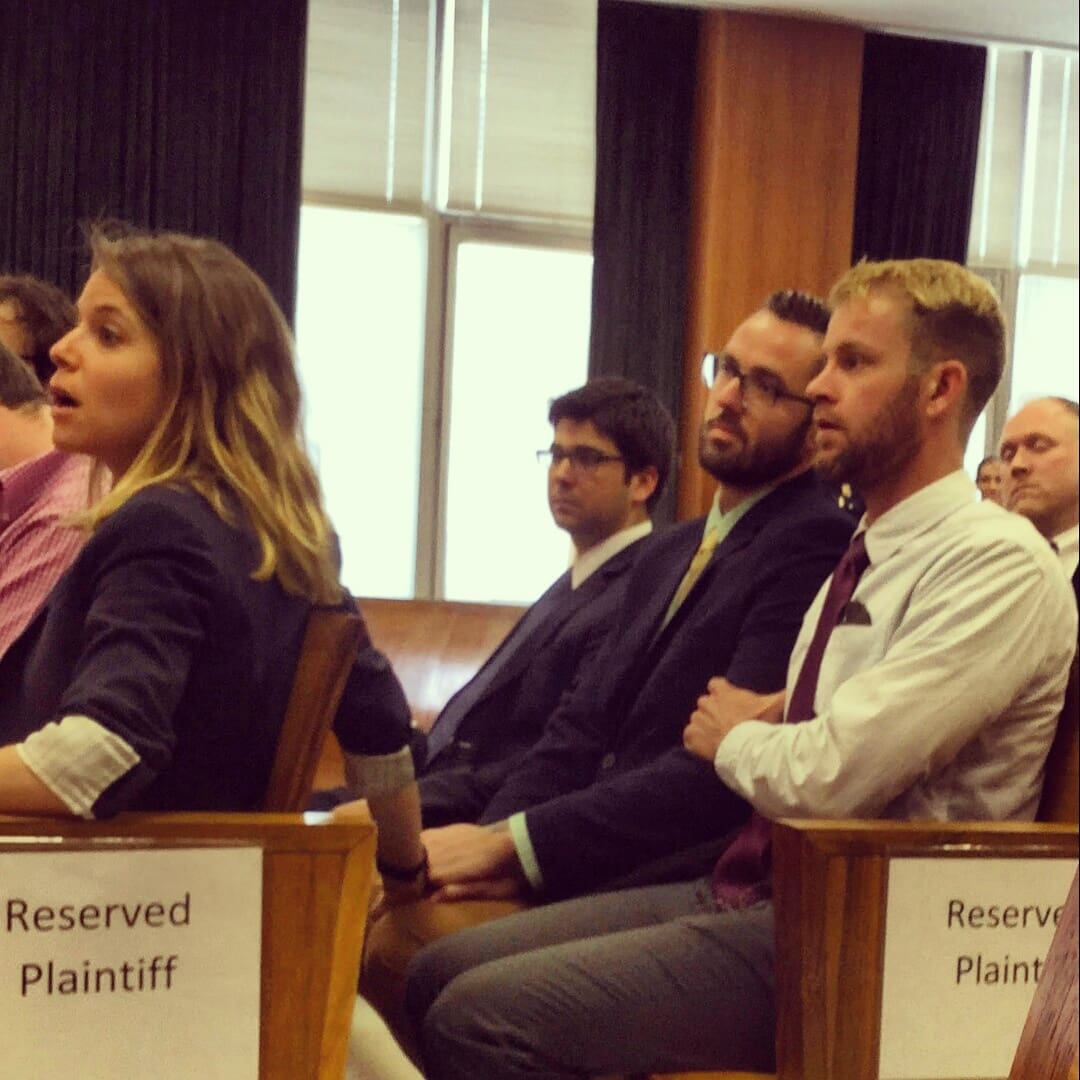
J Seth Anderson and Michael Adam Ferguson were catapulted into the public spotlight when they became the first same-sex couple to be legally married by the state of Utah. Seth and Michael both grew up in LDS homes, completed full-time missions for the Church, and throughout their twenties, undertook tortuous journeys to renegotiate their relationships with both the institution and with the faith of their childhoods.
Since November 2012, Seth and Michael have been embroiled in a first-of-its-kind lawsuit against a gay conversion therapy organization in New Jersey named JONAH: Jews Offering New Alternatives to Healing (formerly Jews Offering New Alternatives to Homosexuality), filed by the Southern Poverty Law Center. On June 25, 2015, a New Jersey jury unanimously found JONAH liable for multiple counts of consumer fraud and unconscionable business practices.
For a link to the Ferguson v. JONAH – Unofficial Trial Transcripts, click here.
This trial has significant implications for LDS LGBT individuals, primarily because:
- The Journey Into Manhood program is co-founded by LDS church members Rich Wyler and Dave Matheson, and has had direct participation and support from NorthStar Founder and BYU Professor Ty Mansfield.
- Ty and Danielle Mansfield have been put forward by the LDS Church including on the MormonsAndGays.org web site as role models for gay Mormon men (encouraging mixed-orientation marriages, which are reported to have divorce rates of around 70% and very low quality of life ratings).
- Ty’s Book “Voices of Hope” is published by Deseret Book, and is the main LGBT-themed book sold at Deseret Book today. Jeff Bennion and Preston “Pret” Dahlgren, who were both interviewed in the JONAH trial, are also both contributors to Voices of Hope, and were also featured on the recent My Husband’s Not Gay TV show on TLC.
- For decades, LDS participants in both Evergreen International (the now defunct LDS reparative therapy-sponsoring organization) and NorthStar have reported strong encouragement to participate in Journey Into Manhood (and other reparative therapy-based programs) from their organizational leaders and/or members.
- Considerable research has been conducted on the dangers of religion-based sexual orientation change efforts and mixed-orientation marriage, which should call into question the LDS Church’s historical and current approaches to dealing with its LGBT members.
Seth and Michael recently completed their graduate work at the University of Utah–Seth finishing his master’s degree in social history focusing on the history of sexuality in the Western United States, and Michael defending his PhD dissertation in bioengineering in which he developed new analytical methods for monitoring brain activity using fMRI.
Seth and Michael are actively involved in education and advocacy on behalf of LGBT and queer individuals, including the project Team Truth–a grassroots campaign they are creating with advocates and allies to end the lies and harm of gay conversion therapy.
Episode Transcript
Host: John Dehlin · Guests: J Seth Anderson, Michael Adam Ferguson
This transcript is machine-generated and lightly edited for readability. The audio is authoritative. Please excuse occasional errors in names and spelling.
Introduction and Episode Overview
Part 1 of 2 · Ep. 559
Guest [00:00:06] Mormon Stories Podcast is a production of the Open Stories Foundation. All donations to Mormon Stories are fully tax deductible and go directly towards keeping the podcast alive and towards building a community of support for Mormons like you.
Michael Adam Ferguson [00:00:19] Come, come, ye saints. No toil nor labor fear, but with joy when you're.
John Dehlin [00:00:34] Hello, and welcome to another edition of Mormon Stories Podcast. My name is John Dehlin. It is July 15, 2015. We are recording live from the Utah Pride center in downtown Salt Lake City in front of a live audience. Let's hear it, audience. Very happy to have you all here. And we're here to interview two friends of mine from many years back, I'd say we're here to interview today Michael Ferguson and Seth Anderson. For those of you who are real Mormon Stories nerds, you'll know that I interviewed Seth along with, I think, members of his family on Mormon Stories. And I don't even know if I was on that interview.
J Seth Anderson [00:01:26] It was Natasha.
John Dehlin [00:01:27] Natasha. Let it. I'm going to guess around 2010ish? 2011.
J Seth Anderson [00:01:31] It was 2011.
John Dehlin [00:01:33] And so you're going to, you know, we're not going to be digging as much into Seth's story tonight because you will have heard it there, but also because I've been wanting to interview Michael for a long time, but Michael and Seth are married and we want to have them both. So. But, but the main story that we're going to be focusing on tonight is, is Michael Ferguson. And Michael and I actually go way, way back.
Michael Adam Ferguson [00:02:00] John and I met when I was in high school.
John Dehlin [00:02:03] Yeah, it had to have been around 1992, I'm going to say we'll talk about that. But Michael Ferguson's cool for a whole lot of reasons. I guess some of the main things he's known for. Well, he and Seth were the first couple to be married in Utah. I'm going to guess that was around 2, 2013. Yes. Yeah. So they were the first couple in Utah to get married.
John Dehlin [00:02:32] Michael has been getting his PhD in bioengineering. Bioengineering at the University of Utah. And he's been leading up a really exciting research project called the Religious Brain. We'll talk about that briefly tonight, but we may have a future episode more dedicated to that.
John Dehlin [00:02:51] But I think maybe one of the main reasons we are interviewing Michael is to talk about his journey as someone who was raised in the LDS Church, but who began experiencing attraction to men sometime in his youth or childhood. We'll talk about that. But what's kind of most central to tonight's Theme is that Michael engaged in various attempts to try and change his sexual orientation over the years, including engaging in what I think he would call some controversial approaches called reparative therapy.
John Dehlin [00:03:28] These approaches are under a lot of scrutiny in 2015 and even several years before. A couple states have made these practices illegal for minors. And I'm not totally sure on the total legal status, but it's basically attempts to change one sexual orientation through either meeting with a psychotherapist, marriage and family therapist, a social worker, or engaging in group therapy or support groups. And sometimes there are even more extended group activities or weekends or retreats that people have engaged in over the years to try and change their sexual orientation.
John Dehlin [00:04:13] They're still controversial today in 2015. There was a lawsuit recently where Michael was the plaintiff in the lawsuit. Ferguson vs. Jonah Jews offering new approaches
Michael Adam Ferguson [00:04:26] to homosexuality, new alternatives to homosexuality. They've changed to new alternatives to healing.
John Dehlin [00:04:33] Right, which is. Which is sort of, I understand, over the years has been sort of Orthodox Judaism's attempt at supporting their, you know, gay and lesbian members of their churches and congregations. There have been other strains of this, including, you know, Mormonism has had various organizations that we'll be talking about who have encouraged or supported reparative therapy and other types of things. Evangelicals had sort of their approaches and others. But we're going to just be diving into why would someone attempt to change their sexual orientation? What's that like, you know, for Michael? Was it, you know, to what extent did he feel like it wasn't good for him and what would lead to him wanting to actually be the plaintiff in a lawsuit?
John Dehlin [00:05:21] You should know that the lawsuit ended a few weeks ago, victorious from the plaintiff's point of view, in that Jonah was basically found guilty of, I don't know, fraud or misrepresenting consumer fraud, promising things that it couldn't deliver in terms of changing or eliminating people's sexual orientation? We're going to get into all that, but with more of a Mormon flair.
Meeting Michael Ferguson and Seth Anderson
John Dehlin [00:05:46] What's really cool and I think really fun and interesting and compelling is that in our live audience today, we have. We were honored with the attendance of various people who we plan to actually bring into the discussion because they, in various ways, have been involved in various, let's just say, flavors of these activities or approaches. And so while we want this to be Michael's day and we want it to be Michael's story along with Seth, and he's going to bring some anger, he's going to bring some pain, some frustration, some sadness, we have to make room for that because it's his story.
John Dehlin [00:06:26] You know, we just got through singing I'm trying to be like Jesus. We have a theme which is be gentle and loving. Indeed. And in thought, we're going to try and be gentle and loving and honest. And we want to make sure that we're, we're accurate. And so we'll have a question and answer period at the end. And if any of the, you know, people who, who are part of this community want to set the record straight or ask questions or clarify, we'll leave some time for that. But we've also offered Ty Mansfield and Dave Matheson and others a chance to have sort of a follow up interview where they can actually talk about their approaches and maybe give their side and we'll let them decide if that's something that feels right to them.
John Dehlin [00:07:08] But we just want to let you know that, that we want to be fair and we want to give all sides a fair shot. So with that, we are ready to dive in to this interview. So, Seth, welcome back to Mormon Stories.
J Seth Anderson [00:07:23] Thank you. Pleasure to be back.
John Dehlin [00:07:24] And Michael Ferguson, welcome to Mormon Stories.
Michael Adam Ferguson [00:07:27] Thank you very much.
John Dehlin [00:07:28] It's an honor to have you here.
Michael Adam Ferguson [00:07:30] It's an honor to be here.
John Dehlin [00:07:31] All right, so let's begin where we always try and begin, which is with your story. Just a really crazy set of coincidences just to sort of tie me into Michael's family a bit. I served a congressional internship in BYU around 1992. I went to Capitol Hill and there was a really cool connection between a congressman named Jack Fields from Texas, where I was from, and BYU Study Washington seminar. The leader, sort of the office manager of Jack Fields Congressional office was Michael Ferguson. Michael Ferguson.
Michael Adam Ferguson [00:08:10] No, just kidding.
John Dehlin [00:08:10] It was my dad, whose name is Bob, Bob Ferguson. And he was amazing to me. So that was the first introduction I had to Michael's family before I knew anything about Michael. And I remember he had us to his home in Virginia, beautiful area. I think he may have even played the piano for us at the time. But just a really, it felt like a really loving and awesome, amazing family. Later, Michael's brother was in the dorms with me at BYU in Chipman Hall. What?
Michael Adam Ferguson [00:08:41] I don't think that I knew that
John Dehlin [00:08:42] the year after I got off my mission, your brother was in the dorms in Chipman hall when I was an ra.
Michael Adam Ferguson [00:08:47] This is getting creepy, John.
John Dehlin [00:08:48] I know, I know. So I know your brother well.
Michael Adam Ferguson [00:08:52] Your brother's in my brother's ward now, right?
John Dehlin [00:08:54] Yeah. Yep. That's another connection. And then I Met Michael later on. So lots of connections, but a loving family. So tell us a little bit about your Mormon upbringing and kind of what the church meant to you, kind of to what extent your family met the stereotypical Mormon family and how your feelings about your own sexuality started to emerge and how that was for you, the church and your family all together. So just start talking.
Michael Adam Ferguson [00:09:25] Just that?
John Dehlin [00:09:26] Yeah, just that.
Michael Adam Ferguson [00:09:30] So when you're asking the question, the first image that comes to my mind is a photograph of my baptism day. And I was the most somber looking child. I just was taking it so seriously that ever since I started to become cognizant of what these promises meant, of what these doctrines were, it was this gravid, serious approach that stayed with me throughout my upbringing. My family was very enthusiastic and joyful to live the letter and the spirit of the law.
Michael Adam Ferguson [00:10:08] You remember road shows? So they used to be ward performances. You'd have shtick on stage or on film. And our family was asked to portray the cleavers like Leave it to Beaver, you know, and so that I feel like that was pretty symbolic of what we tried to embody though was just that very traditional nuclear family. That's so beautiful.
Michael Adam Ferguson [00:10:33] And we did a good job of it in seminary. I took it really seriously. All the scripture mastery, scriptures, mini missions. I mean, pretty much your enthusiastic typical list, checking off type of LDS upbringing.
John Dehlin [00:10:52] How many siblings?
Michael Adam Ferguson [00:10:53] Youngest of three. So we did kind of fall short in the large family category.
John Dehlin [00:10:57] Okay, youngest of three. And your dad worked on Capitol Hill.
Michael Adam Ferguson [00:11:01] That's right.
John Dehlin [00:11:02] And I imagine the wards there in Virginia are pretty strong, right?
Michael Adam Ferguson [00:11:06] They are. And in the Virginia area, it's very flavored by politics. You have a lot of people who are working in FBI or in security administrations at some level, in addition to people who are working on Capitol Hill and in the military bases. So there's a strong, strong sense of patriotism that I think flavors Mormonism in the Washington area. Perhaps even a little bit more than the blends that are scattered in other places.
John Dehlin [00:11:31] Yeah. So tell us when you first started experiencing your sexuality as a, as a young Mormon boy or adolescent and what that was like for you.
Early Life, Faith, and Discovering Sexuality
Michael Adam Ferguson [00:11:44] So I started first experiencing sexual arousal with, you know, same gender peers in fifth grade at the time. I think that all of us, especially all of us that grew up in, you know, a pretty conservative sexual hierarchy of sorts, didn't really know a lot about the hormones and what was happening with the hormones at the time that they started hitting you. Like the first real notion that I had of prohibitions on sexual behavior was as a deacon, you know, when the bishop calls me in for my first one on one temple recommend interview for baptisms for the dead and asks, you know, do you touch yourself?
Michael Adam Ferguson [00:12:30] And there weren't explicit terms of do you stimulate your penis? And blah, blah, blah, you know, but like, you realize what he's talking about? And it was this moment where it was like, oh, oh, we're talking about this.
Michael Adam Ferguson [00:12:42] And I think that I lied in that first one and said no and then went home and repented that I said no and like stopped and was terrified to touch myself for years after that. But that was, I think, the first time that I realized, okay, there's just conflict, period with touching myself whether I'm thinking about a boy or a girl.
Michael Adam Ferguson [00:13:08] And I think that that was the first sort of socialization into shame and into anxiety surrounding sex. And then later, I would say it was around seventh or eighth grade when I then took the further step and realized that, oh, this anxiety that I feel around sex goes even deeper because not only am I having this feeling and these temptations, but they're directed in the wrong direction, you know, it was actually pretty easy though, to stuff that all into the allegorical closet.
John Dehlin [00:13:47] Do you remember like a friend you were attracted to or.
Michael Adam Ferguson [00:13:50] Yep.
John Dehlin [00:13:50] Like the stereotypical locker room middle school. Like any vivid memories of sort of going, oh my gosh, where are these feelings? What are they doing?
Michael Adam Ferguson [00:14:00] Oh, for sure. Like, I thought it was absurd that we had to do wrestling in middle school and like get in doggy style position with like an age matched peer. That was just an absurd experience and one that caused me like so much anxiety because, I mean, those gym shorts don't hide very much.
John Dehlin [00:14:17] So you. That would be. That might have been something that would have aroused you maybe. Yeah. Okay. Okay. So it was clear to you. It was, it was clear to you by seventh grade.
Michael Adam Ferguson [00:14:28] Yeah.
John Dehlin [00:14:28] Okay.
Guest [00:14:29] All right.
John Dehlin [00:14:30] And you say, what was that terrifying? What was it just nerve wracking? How would you have described.
Michael Adam Ferguson [00:14:37] Caused me to just completely mentally castrate myself during that period of time? It was really easy to stay in that asexual groove Because I wasn't supposed to be dating until I was 16 anyway. Then after 16, it's supposed to be in groups. And so it's not like you got a lot of opportunity for hot and heavy action. And frankly, kind of the philosophy that I grew up with was that you don't start seriously dating until after your mission. So the coast was clear to just fly under the radar for a long time.
John Dehlin [00:15:13] And so did you experience any fear or guilt or was it just denial? Stuff it down, turn it off.
Michael Adam Ferguson [00:15:22] Oh, there was lots of, there was lots of, lots of guilt and anxiety that I manifested in terms of bargaining. Like, I would make these intense bargains back and forth with Heavenly Father and say, okay, I'll promise this. If you'll do this, I'll, like, promise
John Dehlin [00:15:42] what, what would you promise?
Michael Adam Ferguson [00:15:43] Like, that I'll never tell anybody about my sexual orientation if you let me get married to a woman. That and I had these fantasies of like, I visualized on my deathbed that I would tell one of my children that I carried the cross of same sex attraction and then it would be this, like, faith promoting experience for them that would, you know, attach them to the faith even longer.
John Dehlin [00:16:08] Okay. And you were pretty, pretty committed to the church as a teen?
Michael Adam Ferguson [00:16:15] Yes, very much so. I was the nerd who had the Mormonad posters in his locker with the parrot that said, foul language is for the birds. Like, total dork.
John Dehlin [00:16:26] And would you have said, would you, would you say that your peers experienced you as sort of exhibiting stereotypical, let's just say gay male traits or not or something in the middle?
Michael Adam Ferguson [00:16:39] Well, so this is, you know, high school aged set of peers in the 90s, and it wasn't as transparent and common and visible as it is right now. So I've had friends from high school who have retrospectively said, oh, we always knew. We were just waiting for you to realize. And I'm like, you're full of crap. Like, you did not always know, but I have some friends from high school who say that they were in on it but were waiting for me to realize it.
John Dehlin [00:17:09] But for you, do you remember feeling like everybody knows or everybody's looking at me or like everyone can tell I need to hide it or did you not perceive yourself as sending those vibes?
Michael Adam Ferguson [00:17:21] No, I perceive myself as hiding it and passing, if you will.
John Dehlin [00:17:25] Okay, okay, Seth, just real quick.
J Seth Anderson [00:17:28] Sure.
John Dehlin [00:17:29] How does Michael's experience map to yours?
J Seth Anderson [00:17:32] Just a lot of similarities. I grew up, My ancestors are Mormon pioneers. I was born in Utah, grew up in Southern California and Arizona. We moved around a lot of. I lived in pretty Mormon areas, so it wasn't like Virginia, where it was very rare to be Mormon.
J Seth Anderson [00:17:50] I knew when I was seven that I was different from other boys and I didn't have the language at the time to explain what it was, but I knew something was different about me. By the time I was 11, I knew very much what the word was and I knew that it was a bad thing. And that was the messaging that I heard at church and from my peer group. And I very clearly remember at age 11, going deep into the closet and knowing that I had to be a step ahead of everybody else to keep this facade up of not appearing gay. And it was right around this time, too.
J Seth Anderson [00:18:22] I remember a girl in school called me a faggot and it freaked me out. And it wasn't because the word was mean. It was because I thought, oh my God, somebody knows.
John Dehlin [00:18:33] Using it in a generic way, just
J Seth Anderson [00:18:34] in a generic kid way targeting you. No, but it felt like it. Right? Like I was. It felt freaked me out. Same with Michael. I stayed really busy in high school to not have to date, not do the whole talk about the girlfriend thing because I was working or I had student council or I had swimming, a million things to stay busy. I did love my Madonna, which I had to keep under the radar. Also.
Michael Adam Ferguson [00:18:58] Britte Midler.
J Seth Anderson [00:18:59] Oh my God, Bette Midler. Yeah. I used to listen to my mom's Bette Midler records when I was a little boy. And Barbara. So. Right, okay. And then it's a similar bishop story. I don't remember him asking me the masturbation question, but he asked me about petting. And I was very confused by what that meant and just knew that I had to stay a step ahead. And I also made these similar deals where if I read the scriptures every day, that this feeling would go away, that if I went to church every week it would go away and it never happened. And it got worse as I got older.
J Seth Anderson [00:19:35] And when I got to my mission age, I knew that was another sacrifice. Right. I hear this a lot from a lot of gay returned missionaries that you're going to go on the mission and you're going to come back and you're going to be straight. And also didn't happen and got worse after that. But so, yeah, a lot of similarities, even though different sides of the country.
John Dehlin [00:19:58] Okay, thank you, Seth. So. So, Michael, regarding your testimony of the gospel, would you have considered yourself as an adolescent, even teen, as having a strong testimony of the gospel knowledge, a strong relationship with Heavenly Father?
Michael Adam Ferguson [00:20:17] Yes. I was one of those people who was always getting up every testimony, meeting to share their testimony, but because it came from such a heartfelt, earnest and sincere place where I took so much joy in the experiences that I understood to be from the Holy Spirit, that I understood to be from the light of Christ. And I mean, it really was this organic behavioral outcome that is typified in Lehi's tree of life vision, where he tastes this fruit that's so sweet and desirous to his soul and that he just wants to go out and to share it. And that really was just in my place of innocence and in my place of pure loyalty and belief, my disposition during those years.
John Dehlin [00:21:11] So you. You prayed and felt like you got answers?
Michael Adam Ferguson [00:21:16] I did.
John Dehlin [00:21:17] And you felt like you knew the church was true and. And what God wanted for you?
Michael Adam Ferguson [00:21:22] I did. And here's the thing, is that at the time, what that meant to me, I think that I was right.
John Dehlin [00:21:31] Okay, so you still. You still hold to those convictions.
Michael Adam Ferguson [00:21:35] I understand them differently, but in the sense of this being an instrument to connect me to divine love and to something that transcends my own nature, it was that.
John Dehlin [00:21:51] And you probably internalized the messages that were coming from the church culture, which was how you were feeling. Was what? How you were feeling about men. Was what?
Michael Adam Ferguson [00:22:03] Well, I really didn't even tune into that until I was on my mission, because I remember reading, unfortunately, as many from my age demographic and my seniors, we read the Miracle of Forgiveness by Spencer Kimball that uses particularly harsh, damaging, and even violent language with regard to a homosexual orientation. That was my first real direct slap in the face with that type of fortitude. When I was on my mission, there was an Ensign article that, you know, was in one of the magazines left in my apartment in my area. You know, on your mission? So many missionaries cycle through and they just leave all kinds of LDS paraphernalia. So there was a Ensign article with Dallin Oaks speaking about same sex attraction. And at the time.
John Dehlin [00:22:58] Was that the Wickman interview? No, no, no.
Michael Adam Ferguson [00:23:01] This is okay, Earl. This is well before that. Okay, thank you, though. But I was on a mission in 2001-2003, and at the time, just even having the validation that same sex attraction exists as an experience, as a construct, and as something that many people have as a part of their journey, that was just this huge revelation to me
John Dehlin [00:23:34] that it existed and that it existed,
Michael Adam Ferguson [00:23:37] that I wasn't alone, that there were other faithful Latter Day Saints who were experiencing this.
John Dehlin [00:23:42] Because you had felt pretty alone up until that point.
Michael Adam Ferguson [00:23:45] Absolutely. Absolutely. There were many times when I wanted to come out to a mission president, but it was this back and forth between feeling the need to be authentic and to be transparent with someone who ostensibly was assessing the quality of my soul and at the same time fearing that if I had that type of authenticity and transparency, that there would be some type of punitive consequence.
John Dehlin [00:24:15] So did you tell your Mission president.
Michael Adam Ferguson [00:24:17] I did not.
John Dehlin [00:24:18] Didn't tell him. How was your mission overall?
Michael Adam Ferguson [00:24:20] Successful struggle successful. I served most of my mission in Seth's old stomping grounds in Arizona. First six months were in English. Second six months or last 18 months were in Spanish and those were higher. Baptizing, which mission? I got called to the Tempe, Arizona mission, which then divided and I went to the Mesa, Arizona mission.
John Dehlin [00:24:44] I served the last four months of my mission in Tempe. In Tempe, Arizona. Fun. Okay, so stalking my life. I'm stalking you. You can't get away from me. Okay, so when do you remember being the first time you felt really tormented, like really sad or conflicted or scary in a scary place emotionally?
Mission, BYU, and Early Attempts at Change
Michael Adam Ferguson [00:25:09] The first time that, you know, it ripped me asunder, if you will, was leading up to my mission. I had my mission call. I had started BYU young, so I had had two years education at byu and I wasn't leaving for my mission until August so I could fit in one more semester. So I went for a spring term. And it was during that buildup in anticipation of my mission, that I started having breakdowns where I would start sobbing for hours and I would just run sobbing because I didn't want to be around anybody. I didn't want anybody to see me. I didn't want to talk about this.
Michael Adam Ferguson [00:25:50] And there's a night that's very vivid in my mind where I went sobbing from south of campus, ran up to the temple and just collapsed on the lawn of the temple. And a non verbal prayer started pouring out from my heart that was primarily asking the question, why? What is this all about? What's going on? This doesn't fit.
John Dehlin [00:26:19] Had you, you know, secretly dated a boy or kissed a boy or any. Any experimentation up to this point?
Michael Adam Ferguson [00:26:27] Not up to that point.
John Dehlin [00:26:29] And were you trying to date girls at BYU and do the.
Michael Adam Ferguson [00:26:32] No. Because I was really living by the philosophy that a serious relationship, or even just a dyadic one on one relationship was best reserved until after a mission. It was convenient.
John Dehlin [00:26:46] Yeah, absolutely. Okay. So that was the first real moment of torment. And I imagine, like Seth, maybe you've already said this, that the mission, and this is very common for the LGBT people we've studied, the mission becomes sort of a bargain you make with Heavenly Father that if you'll serve an honorable mission. What did you have a bargain like that?
Michael Adam Ferguson [00:27:10] Yeah.
John Dehlin [00:27:10] What was it?
Michael Adam Ferguson [00:27:11] That I would come home, that I had pathologized it by that point, and so that I would come home healed.
John Dehlin [00:27:19] And Seth, you had the same kind of thing going on.
J Seth Anderson [00:27:21] Same. I called it from high school up until post mission, I could refer to it as the feelings. So I.
Guest [00:27:26] The what?
J Seth Anderson [00:27:27] The feelings.
John Dehlin [00:27:28] The feelings.
J Seth Anderson [00:27:28] Attractions. Right. And same thing. That I'd go on a mission and come back, and they'd be gone.
John Dehlin [00:27:33] Yeah. Okay. All right. So talk us through when the torment reappeared and how it built to the point where you felt like you were in crisis. So this can be during mission, post mission. Just take us to where it really started building to where you felt like you needed to do something.
Michael Adam Ferguson [00:27:52] Sure. On my mission, I was pretty much able to stay focused on the business and on the activity.
John Dehlin [00:28:00] Like, attraction to companions.
Michael Adam Ferguson [00:28:03] Oh, yeah. But I had locked my heart, even to men. So, you know, I mean, I was pretty, like, so not a problem. Straight arrow. Yeah, it wasn't a problem.
J Seth Anderson [00:28:16] Yeah.
John Dehlin [00:28:16] Okay, man.
Michael Adam Ferguson [00:28:17] But I hear these sexy mission stories of, like, guys who came out to each other and then, like, became lovers in Europe on their mission, and I'm
Guest [00:28:25] like,
Michael Adam Ferguson [00:28:27] I'm sweating it out in the desert with this smelly guy from Idaho.
John Dehlin [00:28:30] Geez. Okay, so, yeah, talk us through when things got really awful to the point where you felt like you needed to do something.
Michael Adam Ferguson [00:28:42] It was when I came back from my mission, and I started pretty promptly to date women. And there was a woman who was a medical student up here at the University of Utah, and we started, you know, dating across tribes between BYU versus the University of Utah.
Michael Adam Ferguson [00:28:58] And I felt like things were moving really quickly. She came to Virginia to meet my family. I traveled to meet her family. And then the formula is that within three months, you put a ring on it. So I was leading up to that and felt very troubled inside. I did not feel peace in my heart about moving the relationship forward without having a disclosure that I had attractions to men.
Michael Adam Ferguson [00:29:30] And that's what compelled me to speak with the bishop of my singles ward was to seek guidance and to seek assistance. And when I came out to a bishop for the first time, I could barely speak. He was so concerned. He had no idea what I was going to say because we just sat there in silence as multiple times I tried to initiate vocalizing what I wanted to say. And he could see with each failed attempt to initiate talking that something was profoundly troubling me.
John Dehlin [00:30:06] And so what happened?
Michael Adam Ferguson [00:30:09] He said, you know, you're very wise to come to me. He said, I have had other people who have come to me with these challenges, and what we need to do is just turn down the dimmer, switch on the attractions to men, and turn up the dimmer, switch on the attractions to women.
John Dehlin [00:30:28] And this would have been, this would have been what year?
Michael Adam Ferguson [00:30:31] This was in 2003. 2004. Either the end of 2003 or the beginning of 2004.
John Dehlin [00:30:38] Okay, okay. And so how did he propose you do that?
Michael Adam Ferguson [00:30:43] He directed me to the BYU counseling center. And there I initiated my first foray into the world of therapy that I've gotten to know very well. And basically he started engaging in a causal theory wherein homosexuality was an outgrowth of distance in the relationship with my father over compensation on the part of my mother, with a smattering of peer wounds to kind of reinforce the trauma that theoretically springs into homosexuality.
John Dehlin [00:31:21] And this is the bishop or the therapist?
Michael Adam Ferguson [00:31:23] This was the therapist at the byu.
John Dehlin [00:31:24] The therapist at byu.
Michael Adam Ferguson [00:31:25] That's right.
John Dehlin [00:31:26] Okay. Okay. So kind of a developmental theory of homosexuality.
Michael Adam Ferguson [00:31:33] Well, I mean, sexuality is developmental definition, a bogus developmental model of homosexuality.
John Dehlin [00:31:39] Right, right, right, right, yeah. So, so did he, did he provide a treatment for that?
Michael Adam Ferguson [00:31:46] And what was it with the counseling center? It was cognitive behavioral therapy.
John Dehlin [00:31:53] Okay.
Michael Adam Ferguson [00:31:53] And so it was things like looking for opportunities to have physical contact with same aged peers. It was disclosing same sex attraction to my parents. You know, I guess for the purpose of overcoming those out of balance dynamics and to initiate a process of doing guy things with my dad and pushing my mom away a little bit.
John Dehlin [00:32:28] I'm guessing that that theory that you think is bogus may have resonated with you at the time. Because my guess is your dad was super busy. And so you're like, well, I guess my dad was distant for me. And mothers tend to be more involved with kids, so it's very easy to say my mother's. Yep, my mother was extra involved in my life. Uh oh, I fit the pattern.
Michael Adam Ferguson [00:32:49] Well, this is part of the like maddening circularity of a theory that was derived from this 1950s patriarchal, heteronormative society where by definition the fathers were outside of the home. If you have this top down hierarchy, imposing a situation where the father is supposed to be outside of the home, being the protector, the provider, and going to every single priesthood, auxiliary meetings ever invented by the church. Well, yeah, you've kind of created a theory that was based on the culture that you created to begin with. And so it becomes very self fulfilling in that way.
John Dehlin [00:33:31] And so mother was more involved.
Michael Adam Ferguson [00:33:32] Sure.
John Dehlin [00:33:33] And so you're like, oh, okay, that theory fits me well.
Michael Adam Ferguson [00:33:36] So it was more than the theory fits. It was that I knew that my counselor was also a bishop and I can't overstate the amount of social capital that that had for me. If someone was approaching me with the calling and the mantle of a bishop, I really believed they had the divine right of kings, that they had some pure vision into the divine will. And if anything, that perceived special access to the divine is what hooked me even more than the content of the theory itself.
John Dehlin [00:34:15] The power differential is really profound.
Michael Adam Ferguson [00:34:18] Very profound.
John Dehlin [00:34:19] When you're very vulnerable. Right.
Michael Adam Ferguson [00:34:21] Yeah.
John Dehlin [00:34:22] So were you engaged at the time you were working with this BYU therapist? Were you still engaged?
Michael Adam Ferguson [00:34:26] I did not get engaged.
John Dehlin [00:34:28] Okay, you didn't get engaged. Were you still trying to make it work with this. With this medical student?
Michael Adam Ferguson [00:34:33] I was. And then very abruptly had to freak out and broke it off.
John Dehlin [00:34:38] Okay, so you started with cbt with byu?
Michael Adam Ferguson [00:34:42] Yes.
John Dehlin [00:34:43] What happened after that?
Michael Adam Ferguson [00:34:44] After I graduated from byu.
John Dehlin [00:34:46] So that. Did that work? Did it not work? How was that for you? Being more manly with your dad and trying to hang around guys more and do manly things? How was it?
Michael Adam Ferguson [00:34:55] I mean, if at best, it helped with some behavioral modification that allows you to pass. To exist in a world that's perceived as more stereotypically heterosexual. As far as. Did my orientation shift away from attractions to men and toward women?
J Seth Anderson [00:35:17] No.
John Dehlin [00:35:17] Okay, so you graduate from byu.
Michael Adam Ferguson [00:35:20] Graduate from BYU in what? Biochemistry.
John Dehlin [00:35:23] Okay. All right.
Michael Adam Ferguson [00:35:25] It was a tough choice between biochemistry and musical theater.
Guest [00:35:28] Yeah.
John Dehlin [00:35:28] Because you're very musically talented, you know.
Michael Adam Ferguson [00:35:31] Yes. And so we might get to it later, but that's where Madame Fergie fits into my life. Seth is like, oh, will we get to that later?
John Dehlin [00:35:39] All right. Okay.
J Seth Anderson [00:35:42] So.
John Dehlin [00:35:43] So, yeah, talk us. So, Seth, do you have anything in your parallel experience that this college was
Michael Adam Ferguson [00:35:50] a lot more fun?
J Seth Anderson [00:35:50] I was. I was in college at ASU in Tempe. And there's really nothing that prevented me from going down the path that Michael did. It could have happened. I wasn't as invested. I don't ever remember thinking that I knew about reparative therapy. I knew about conversion therapy, but I never remember believing that it would actually do anything. And at the exact same time, 2003, 4, and I was at ASU politically, the marriage thing had begun.
J Seth Anderson [00:36:22] Massachusetts had passed marriage equality, and all the bans started to roll through the states. And I was at institute at asu, and they passed around a petition getting signatures to get a ban or an amendment on the Arizona ballot at the upcoming election. And I wasn't out at the time. I wasn't talking about. I wasn't talking to anybody about the gay thing. I wasn't even calling Myself gay. But I remember being so deeply offended that they were using the church building to gather political signatures for this amendment that wasn't needed. Same sex marriage was already illegal in Arizona at that time. The Supreme Court of Arizona had already ruled on it and said, no, this is not legal.
J Seth Anderson [00:37:05] We're not doing that. And it was just this really vicious move I saw and I didn't go back. And that was 2003, 4. And that was sort of for me, like the beginning of the severing of my deep involvement with church when I started to rethink who I was, what I wanted my life to look like, what role I wanted the church to have in my life, and rethinking my own Mormonism and where I fit into that.
John Dehlin [00:37:30] So you actually didn't engage in significant attempts to change?
J Seth Anderson [00:37:34] Yeah, no. But thinking in my mind the other option, which was just being celibate and really talking up to myself that that's something I could do and that that's what I should do because the other option was to come out. And that was just like not even an option.
John Dehlin [00:37:55] I should correct one thing. We talk about sexual orientation change efforts as if they only involve a therapist. But one of the findings from the study that I did with Bill Bradshaw is that personal righteousness and speaking with a bishop are, you know, two of the three most common methods people use to change their sexual orientation.
J Seth Anderson [00:38:16] Sure.
John Dehlin [00:38:17] And they're often perceived as the most harmful of all. So in, in truth, you had engaged in sexual orientation change efforts. They were just religious and private, is that right?
J Seth Anderson [00:38:29] Correct?
John Dehlin [00:38:30] Yeah, sure, yeah. Were you going to say something, Mike?
Michael Adam Ferguson [00:38:32] I was, I was going to say that for me, a big part of that, of the religious component was temple service. That that was another common theme that came up repeatedly was if you're just going to the temple more frequently, you know. And so at byu, I would go in the mornings before classes. I became an ordinance worker. I mean, we had one meeting where they said, okay, we have a special gathering at 6:30 on Tuesday, 6:30am on Tuesday. And I was working so hard on being righteous. I really thought that Jesus Christ was going to manifest and that we were going to receive the second comforter in that meeting. Like I thought that that was how much I'm putting into this, that that's the level of expectation for the output from this. Spoiler alert. He didn't show up. And it was really devastating.
John Dehlin [00:39:31] But that's also one of the findings we found in our research. This hyper religiosity almost to the Point of scrupulosity, which is a clinical term for kind of religious based obsessive compulsive disorder. But just I will pray extra. I will fast extra. I will serve in the temple, take multiple callings, assistant to the present on the mission, work in the mtc, being a temple worker. Anything to sort of to try and make that go away.
Michael Adam Ferguson [00:40:01] Right.
John Dehlin [00:40:01] What does that do when, when it doesn't go away? To your relationship with God, to your relationship with yourself.
Michael Adam Ferguson [00:40:10] For me, and this is a common theme that I've heard as I've talked with other people who have been through similar circumstances, is that you assume a lot of self blame. Because if this is something that can be worked through, and especially if this is something that you would be rewarded with a change of heart, if you really consecrate yourself to the Lord, then if that doesn't happen, well, it's not the Lord that's dropping the ball, it must be me. And it just creates more and more weight that starts to sink your battleship.
John Dehlin [00:40:42] Yeah. Yep. And I think that's when things get most dangerous. When people feel like they're promised that if they do do Christ, do faith, do Mormonism, the, the right way, they'll be cured. And when they don't, they, they blame themselves. And then that's when they say, God must not love me and I must not be worthy of living because God will help these other people who are on the magazines or who are out, you know, speaking publicly. He'll help them, but he won't help me. I must be beyond redemption.
Michael Adam Ferguson [00:41:16] There's a, there's a lot of factors to it. I think that once you start spiraling downward in these negative affect dynamics that you know, at some point your ability for pure logical thought breaks down. And so at that point it, I wouldn't, I don't know that it's, that it's even that rational of a process, but those are certainly contributing factors again, that create that downward momentum.
Exploring Conversion Therapy Organizations
John Dehlin [00:41:44] So you graduated from byu. Talk to us about what led to eventually Jonah and Journey into Manhood, North Star, whatever that path was. What was it?
Michael Adam Ferguson [00:42:00] Retrospectively, I understand things different than the way I understood them linearly going through them. So from my, from my perspective now, Grace, if you will, was trying to break through and tell me that I was perfectly acceptable the way that I was, and I was the one who was resisting that.
John Dehlin [00:42:23] But take us through your mindset at the time and then come back to the reframing, if you don't mind.
Michael Adam Ferguson [00:42:28] Sure. The mindset at the Time. Time was that here I'm in. I'm in the temple, right? And I'm seeing this monologue from Eve where she partakes of the fruit that's been explicitly forbidden. And she, she explains why this is a higher path, that you can know the bitter from the sweet and that you can grow toward godhood. And that the only way for that to happen is, was to step outside of the garden, was to exercise conscious, intentional transgression, and then let the shit storm fly from there. That's, you know, essentially one of the primary messages that we learned from the opening part of the endowment. And that was something that I was wrestling with because it was creating cognitive dissonance. Where in the ward that I was in, in Boston, the bishop was extremely strict.
John Dehlin [00:43:23] Why were you in Boston?
Michael Adam Ferguson [00:43:24] I was in Boston. I was doing some research at the Harvard School of Public Health, doing genetics on diabetes.
John Dehlin [00:43:32] Okay. With the plan to go to med school.
Michael Adam Ferguson [00:43:34] With a plan to go to med school.
John Dehlin [00:43:35] Okay. In Boston, your bishop. Go ahead.
Michael Adam Ferguson [00:43:38] So the bishop was one of those bishops who would aggressively schedule monthly interviews with the priesthood holders and ask them the severe litany of questions like, are you looking at pornography? What types of pornography? Tell me about the pornography. Are you masturbating? How do you masturbate? When do you feel like, to the point where you're like, you're enjoying this a little too much here. But it was that type of intensity of going through that screening process of having to be sent to a 12 step recovery program run by the LDS Social Services. If you masturbated at all, I mean, literally once a month, you're in addiction recovery for the next six months until you can report, like, total absolute desexualization of self.
Michael Adam Ferguson [00:44:31] So that also was pushing on me very, very hard in the opposite direction from my internal guidance system that there was this outward extreme social direction and pressure. There was what was starting to bud through and to wrestle with these deeper concepts that are being taught to me in the temple.
Michael Adam Ferguson [00:44:52] And I mean, at that period of time, obedience won over wisdom. And I, you know, attended really religiously my 12 step programs. I was under the explicit understanding that being attracted to men was an addiction, that I was just addicted to male attention.
Michael Adam Ferguson [00:45:17] And so I had to release it to my higher power, do my journaling, like, all of the steps to overcome this addiction to attention from men. You know, again, like, it probably goes without saying that that was not an effective way of reducing or overcoming same sex attractions that were unwanted at the time.
John Dehlin [00:45:37] So you went through that in Boston Yep. And then.
Michael Adam Ferguson [00:45:40] And then in Boston, also got involved with a Christian Exodus affiliated group. So Exodus was an organization formed in the evangelical Christian community in the 1970s. And for a long time, Exodus was pushing very hard. Conversion therapy, reparative therapy, sexual orientation change efforts. To their credit a few years ago, the leaders.
John Dehlin [00:46:02] Don't get. Don't get ahead. Don't get ahead.
Michael Adam Ferguson [00:46:03] Sorry, sorry, sorry, sorry.
John Dehlin [00:46:04] Okay, so there was. There was Exodus, and then came Evergreen and Jonah. Right.
Michael Adam Ferguson [00:46:11] We still have a couple of stops along the way there, but I moved to get to those places. I moved from Boston down to New York, and that's where I got involved with the Jonah program. There was an LDS counselor in the area who was working with a lot of Orthodox Jews. I was there for. I was in medical school at the time, and because that was the closest office that was operating services, that was where I was attending in Jersey City as I was living in Brooklyn.
John Dehlin [00:46:47] What med school?
Michael Adam Ferguson [00:46:48] It was the State University of New York.
John Dehlin [00:46:49] Suny.
Michael Adam Ferguson [00:46:50] Yep.
John Dehlin [00:46:50] Okay. And so you, through your connections in New York, decided to attend a Jonah event. How did that happen?
Journey Into Manhood: Practices and Experiences
Michael Adam Ferguson [00:47:02] I started by participating in Journey into Manhood.
John Dehlin [00:47:05] That was your first attempt?
Michael Adam Ferguson [00:47:07] That was. Sure. That weekend was my first. Shepherding into kind of this network of interconnected communities.
John Dehlin [00:47:16] And how did you hear about Journey into Manhood?
Michael Adam Ferguson [00:47:18] Through Ty, who I think is over here.
John Dehlin [00:47:20] Okay, so how'd you hear about Thai?
Michael Adam Ferguson [00:47:24] Well, so we had.
John Dehlin [00:47:26] This is Ty Mansfield that.
Guest [00:47:27] We're.
Michael Adam Ferguson [00:47:27] Ty Mansfield. Yeah. We had met in choir at byu, just briefly. We didn't really connect, though, until after my mission. It was around the publication of In Quiet Desperation and again, was very eager to be able to talk to somebody.
John Dehlin [00:47:41] That's a book that Ty co authored.
Michael Adam Ferguson [00:47:45] That's right.
John Dehlin [00:47:45] With Stuart Mattis.
Michael Adam Ferguson [00:47:47] With Fred and Marilyn Mattis.
John Dehlin [00:47:48] Fred and Marilyn Mattis, who's a young Mormon man who killed himself around 2000, 2001. Is that right?
Michael Adam Ferguson [00:47:55] Right. In the proposition 22 era.
John Dehlin [00:47:57] So it was like one of the very first book books coming out by Desert Book or the church that was really trying to grapple with this issue, I think, in a. In a serious way.
Michael Adam Ferguson [00:48:07] It was the first book that, number one, wasn't written from the perspective of someone prescribing that. It was the first time that someone had used their voice, their identity, their name to tell a lived experience.
John Dehlin [00:48:22] It's kind of an important book, right?
Michael Adam Ferguson [00:48:24] Yeah.
Guest [00:48:24] Yeah.
John Dehlin [00:48:25] Helped a lot of people.
Michael Adam Ferguson [00:48:26] It did. And it was definitely this watershed moment in the paradigm and the conversation.
John Dehlin [00:48:36] And had you read that book?
Michael Adam Ferguson [00:48:37] Yes.
John Dehlin [00:48:38] Okay. Okay.
Michael Adam Ferguson [00:48:39] So You.
John Dehlin [00:48:39] So you had known Ty, Choir, BYU and then stayed in touch?
Michael Adam Ferguson [00:48:45] Yes.
John Dehlin [00:48:46] Okay.
Michael Adam Ferguson [00:48:47] And so like it was actually. So during my time in Boston was about the time that emails started exchanging between a group of us who are interested in forming something roughly comparable to what's called the Genesis Group. So the Genesis Group in the LDS Church was an organization formed by black members to wrestle and understand the history of the Mormon Church in regard to their racial ban prior to the priesthood.
John Dehlin [00:49:15] Prior to lifting of the priesthood ban.
Michael Adam Ferguson [00:49:17] Yeah, that's right. And so kind of the spirit and the intention was to create something that could be a gathering place for people who identified as SSA or LGBT or. You know, initially it had this vision of being this big umbrella approach to have a place of inclusion and welcome.
John Dehlin [00:49:42] Okay, okay. So you were talking to other people through email about that type of group.
Michael Adam Ferguson [00:49:46] That's right.
John Dehlin [00:49:47] And that's kind of where you're talking to Ty and others. And through that you learned about Journey into Manhood.
Michael Adam Ferguson [00:49:55] That's right, yep.
John Dehlin [00:49:56] Okay. And then you attended it.
Michael Adam Ferguson [00:49:58] Attended Journey to Manhood. For those who aren't familiar with it, it's a program. It's a weekend where you go into an encampment.
John Dehlin [00:50:10] Were you in New York? Was it in Utah? Where was it?
Michael Adam Ferguson [00:50:14] The weekend itself was in Pennsylvania.
John Dehlin [00:50:16] For you?
Michael Adam Ferguson [00:50:16] For me. Okay, so I was living in New York, met some other guys, drove down to Pennsylvania to have the Journey into Manhood experience.
John Dehlin [00:50:24] Are you comfortable talking about the things you did there, what it was for you, what you experienced?
Michael Adam Ferguson [00:50:30] Sure. Journey into Manhood is a weekend that is an experiential process where you're to identify with a character who you're seeing depicted through this dramatic unfolding of events. The allegory that's used is the Jack and the Beanstalk allegory. One of boyhood innocence and wonder, confronting the various giants in his life, having power taken, reclaiming power. Lots of pretty heady principles.
John Dehlin [00:51:17] I hate to say it's almost sounding like the temple ceremony in the sense that there's a main character and you're kind of putting yourself in the position of a narrative of another character.
Michael Adam Ferguson [00:51:25] The brethren will now imagine themselves as Jack.
John Dehlin [00:51:27] Yeah, yeah. Anyway, that's what came to mind, but keep going. Yeah.
Michael Adam Ferguson [00:51:33] So on that weekend you have, you know, group processes. It's pretty much like the initiation weekend into a series of follow up weekends. And so you're introduced to concepts like holding, therapeutic holding, what is that? By various names. Some, you know, I've called it healthy touch, some call it healing touch, and the first introduction of it is representative of a father figure. So it's usually one of the older counselors who invites one of the journeyers, as they're called, to go into a childhood, a golden child kind of regressive emotional state and to receive from this golden father figure what they perceived to be deficient in their nurturing from their father figure.
John Dehlin [00:52:27] So you were held by another man.
Michael Adam Ferguson [00:52:28] Yep.
John Dehlin [00:52:29] How was that for you?
Michael Adam Ferguson [00:52:35] It was a lot of things because this is, you know, A free pass is the word that's coming to mind to participate in physical intimacy, like, as a point of contrast, I guess. When I was at byu, there was a guy who I met in the music program who confided in me that he was same sex attracted. And so he and I one night went on the south hill on the BYU campus and sat on a park bench and just touched wrists. And when someone came along the path, we stopped touching wrists. And then when they walked away, we just touched wrists just because we were so hungry for any type of touch and comfort and affection. And so when this is then not just, you know, wrist touching, but in an entire room of men who are fondling and holding and cuddling and cradling like it's. It is, it's a.
John Dehlin [00:53:37] But you weren't doing. You weren't going to all this effort and expenditure to be able to have a free pass. I mean, you were trying to fix yourself, right?
Michael Adam Ferguson [00:53:46] Correct.
John Dehlin [00:53:46] So, I mean, in your mind, is there a part of you that's like, this is working or, oh, I'm habituating for sure.
Michael Adam Ferguson [00:53:52] Because touch feels good. Especially if you're gay and another man is touching you. It feels really good. Like your body was wired to have dopamine and endorphins and all kinds of juices squirt out of your brain when you're gay and a man is holding you. And so, yes, like, it felt really good. It was a release. And I think that that's one of the reasons why it's a pattern for people to participate in these programs, to initially have a euphoria, a rush, almost an evangelical edge in their relationship with the programs, and then later to start to experience disillusionment and have this letdown when they realize, oh, it's not that my orientation is changing, it's just I really like being with dudes and touching them.
John Dehlin [00:54:36] So when you're being held close on
Michael Adam Ferguson [00:54:39] in the first retreat, most of the time, close stay on.
John Dehlin [00:54:43] Okay, so what are some of the other things you experienced?
Michael Adam Ferguson [00:54:49] Some of the other things that I experienced were. And I talked about this in testimony from the trial, there were exercises where you were recreating traumatic incidents from childhood. So one that is very vivid to me is an Orthodox Jewish man who was particularly short.
Michael Adam Ferguson [00:55:14] And on the weekend retreat, he was told to share with us words that had been used to hurt him as he was growing up and to traumatize him. And so he shared, you know, the typical words that a lot of us have been subject to. Faggot, queer, homo, sissy, pussy.
Michael Adam Ferguson [00:55:35] And he was asked, okay, but what was the most hurtful of all the words? And he said, shrimpy, because he was made fun of for being so short. And so the facilitator said, we're now going to tie him, we're going to wrap him in a blanket, in a heavy blanket, duct tape him around, that, put him on the ground, and recreate the moment when he was most brutally bullied. And so we all stood around him and started shouting these different words at him with the specific intent, the way that it was explained to us, was to get him in touch with his warrior and his anger.
Michael Adam Ferguson [00:56:16] And the idea is that if you access your anger and your warrior energy, that you'll be able to break out, overcome whatever has emasculated you and detached you from your latent heterosexuality. And so that, I mean, it was basically a modern Stanley Milgram experiment, which the Stanley Milgram experiment is where you had a researcher and the volunteer was told that there's someone on the other side of a screen who's going to receive an electric shock, and you're going to hear them scream, you're going to hear them cry, you're going to hear them shout, please stop.
Michael Adam Ferguson [00:56:54] But this is for their own good. This is for their own learning. And so it was a test to see how much voltage the subject of the experiment would push through the wires. And the person on the other side of the screen was shouting, please stop. It's killing me. It's killing me. But because the person facilitating the experiment said, keep going, keep going, your average Joe from the street delivered shocks that they believed were near fatal level.
Michael Adam Ferguson [00:57:24] And so, like, you could ask the same things, like, how is it possible that these perfectly nice Mormon and Jewish men go into an environment and recreate the Lord of the Flies? And it's, well, when you're under this coercive influence and you have bought in so deeply that this is what I need to do to show up, do my work, get through the program that you are so willing to surrender and to go through all these processes.
John Dehlin [00:57:52] What do people pay, think on average to go to these?
Michael Adam Ferguson [00:57:57] I know that at the time that I was doing Journey into Manhood, the standard rate was $650 for the weekend. There were, you know, discounts for people like I was a student, So I paid $450 for my weekend.
John Dehlin [00:58:08] And how many kids would go at a time?
Michael Adam Ferguson [00:58:12] I would. It was between 30 and 40 on the weekend.
John Dehlin [00:58:15] Okay, so any other. Did you only do journey into Manhood once?
Michael Adam Ferguson [00:58:23] I only did journey into manhood once.
John Dehlin [00:58:24] Any other things that you experienced on the journey into manhood that was particularly troubling or disturbing for you or.
Michael Adam Ferguson [00:58:32] One of the things was in a personal counseling session. And this, you know, I later found out is something that was very common and that a lot of men had been victimized by. Was in a closed door session with one of the therapists who was a defendant in the lawsuit.
Michael Adam Ferguson [00:58:49] Sorry, not therapist. One of the advertised therapists is actually not a therapist, but a life coach, which means you get a drive through certificate. Basically, they ask you to disrobe an article of clothing at a time and the justification is that this is going to help with your body shame. And so you say a negative message with each article of clothing that you're removing until you're naked with this counselor.
Michael Adam Ferguson [00:59:17] And at that point in my personal process doing this, I stopped when he was asking me to take my pants off is when I said, I'm not comfortable with this. And he asked several times and you know, use the typical language of like, if you're serious, you have to show
J Seth Anderson [00:59:34] up for your work.
Michael Adam Ferguson [00:59:35] Don't forget the principle of surrender. But I said, I'm not comfortable taking my pants off. Some of the other plaintiffs in the case did proceed fully disrobe, at which point they're asked, where in your body is your manhood? And come on, what's the first thing you think of? You know? And so they said, touch the area of your body that represents your manhood. And so again, that's one of the things, like in the case of the defense of, well, we don't tell them where to touch themselves. You know, it's like, well, come on, guys, that especially for someone who's been a victim of sexual abuse growing up is like reliving the sexual trauma. And for someone to do that where they've advertised themselves to have qualifications that they don't hold to be completely unprepared with any clinical formal training to handle situations of trauma and re traumatization is just absolutely unacceptable.
John Dehlin [01:00:32] So any other so how did it progress from there for you? Where did you go to from there? Did you experience changes?
Michael Adam Ferguson [01:00:41] So I became very distressed because I thought that I had found the magic solution. I thought that I had found the silver bullet and it wasn't working. And so if this isn't working, what is going to. I took a leave of absence from school.
John Dehlin [01:00:59] Why? Why'd you take a leave of absence?
Michael Adam Ferguson [01:01:01] Because I wanted to return to Salt Lake City and dive headfirst even deeper into my religious approach to my sexuality, my sexual orientation.
John Dehlin [01:01:12] So you dropped out of med school to try and solve this problem?
Michael Adam Ferguson [01:01:17] Yeah. Leave of absence.
John Dehlin [01:01:18] Yeah. That's what I. Sorry. You elected to leave?
Michael Adam Ferguson [01:01:22] Yes.
John Dehlin [01:01:22] Because this was so distressing to you?
Michael Adam Ferguson [01:01:24] Yes.
Moving to Salt Lake and Seeking Further Help
John Dehlin [01:01:25] Okay, so you come back to Salt Lake?
Michael Adam Ferguson [01:01:26] Came back to Salt Lake, got involved here with Northstar for a while.
John Dehlin [01:01:30] Talk about that. So Northstar was just emerging. Was it already. Was it just about the form?
Michael Adam Ferguson [01:01:34] It wasn't at the. At the level of function that it is right now, but it was. It was pretty high operational. Like, there were early retreats that were being form, but they were more like planning, like, vision, leadership type retreats.
John Dehlin [01:01:46] Why was Northstar needed when there was already Evergreen? And maybe talk a little bit about the history of Evergreen and why and how Northstar emerged based on your understanding.
Michael Adam Ferguson [01:01:57] We're getting into all of it, aren't we, Evergreen? Well, this is a good question. Like, there's a lot of, you know, there's a lot of discussion about what happened with Evergreen and why they ultimately dissolved. But essentially it was a premier referral group for bishops who were approached by somebody who said that they were having some kind of distress surrounding sexual identity and sexual orientation. And so it was sort of a patchwork quilt of support groups that had some degree of central leadership. They would have annual conferences, the Joseph Smith Memorial Building would be donated to the them. They would always have a general authority on their board of advisors who would speak at the annual conferences. And I mean, for a long time, if you were gay and Mormon, Evergreen was the thing.
John Dehlin [01:02:51] I've even heard that the church provided some financial support to Evergreen through humanitarian funds. That's what I've heard. I don't know if that's.
Michael Adam Ferguson [01:03:00] You know about that.
John Dehlin [01:03:01] Yeah, I'm not sure.
J Seth Anderson [01:03:02] I'm not sure.
Michael Adam Ferguson [01:03:03] I couldn't confirm or deny.
John Dehlin [01:03:04] Anyway,
Michael Adam Ferguson [01:03:07] so then one of the reasons why this is. Again, it's like in. In Ty's Mormon Stories interview, you can go into this deeper because this was.
John Dehlin [01:03:15] Wait, Ty hasn't done a Mormon Stories interview?
Michael Adam Ferguson [01:03:17] What's that?
John Dehlin [01:03:18] Did you say in Ty's Mormon Stories
Michael Adam Ferguson [01:03:19] interview, when you do it, you go into this deeper.
John Dehlin [01:03:21] Oh, okay.
Michael Adam Ferguson [01:03:22] Because he was really in the center of the action during this time that there was another prominent figure named Dean Bird who was really at loggerheads with him. Part of the crux of their conflict was that in the book, in quiet desperation, it talked about before his passing, Stuart Mattis receiving blessings about his sexual orientation. Not changing. That kind of the old guard was this is. There's so much plasticity to sexual orientation that you just have to engage in the right practice and you can mold yourself from being homosexual to being heterosexual. And if I'm remembering correctly, and again, I'm happy to be corrected, but in the original stages, that there was a lot of discord surrounding the malleability of sexuality and that that was one of the more divisive issues between the founders
John Dehlin [01:04:19] of Northstar and the old guard with Dean Byrd.
Michael Adam Ferguson [01:04:21] That's right.
Guest [01:04:22] And Evergreen.
Michael Adam Ferguson [01:04:23] And in particular there's, you know, one of the early voices in Northstar was very outspoken that he was gay. He's not same sex attracted. That this is a part of his identity and he's not interested in change efforts. And so that again, at the time, that was one of the positions underneath of the North Star umbrella. And that was at odds with the agenda that was being primarily pushed by Evergreen.
John Dehlin [01:04:47] Okay, so you were kind of there at the founding of Northstar in one way or another?
Michael Adam Ferguson [01:04:52] In some. Yes. I was in. When I was living in New York City at the time, the discussion was to have my address be the mailing address for Northstar in order to. Because New York City sounds cooler than Salt Lake City. Sorry, sorry. Salt Lake City, I love you. But New York City sounds cooler.
John Dehlin [01:05:08] Okay, so you come to Salt Lake and what happened?
Michael Adam Ferguson [01:05:12] And I was still gay.
John Dehlin [01:05:15] And this is what year? What's the year now?
Michael Adam Ferguson [01:05:19] It's 2009.
John Dehlin [01:05:20] 2009, yep. Okay.
Michael Adam Ferguson [01:05:24] And to condense a lot of dark times into a couple of sentences, there were some people here in Salt Lake City who were advertising themselves as providing conversion therapy services and that I was sexually taken advantage of in those situations. And it was that direct sexual abuse that again, kind of borrowing from the temple, if you will, that my eyes were opened. You know, there's that scene where Satan actually says to Adam and Eve, I see your eyes have not yet been opened. And this was sort of my moment where I confronted the evil and the Satan so pronouncedly that it opened my eyes in a way that they hadn't been opened before.
John Dehlin [01:06:17] So you were seeking help from people that put themselves forward as mental health professionals or as people who could help fix you?
Michael Adam Ferguson [01:06:25] Yeah.
John Dehlin [01:06:26] And you felt like you were. You experienced sexual abuse?
J Seth Anderson [01:06:30] Yes.
Michael Adam Ferguson [01:06:30] It's more than I felt like it. That. Yes.
John Dehlin [01:06:32] Yeah.
J Seth Anderson [01:06:32] Yeah, yeah.
John Dehlin [01:06:33] So you were sexually abused.
Michael Adam Ferguson [01:06:35] Correct.
John Dehlin [01:06:35] Okay. That's awful.
Michael Adam Ferguson [01:06:38] It's terrible.
J Seth Anderson [01:06:39] Yeah.
John Dehlin [01:06:40] So how did you. How did you cope with that? Like, where did that leave you?
Michael Adam Ferguson [01:06:45] It left me with a lot of existential questions because I was searching for a foundation. Everything that I had been experiencing up to that point had been built on sand. And without exception, it had all eroded underneath of my feet.
Michael Adam Ferguson [01:07:05] And so that was one of the principal motivations, actually, for diving deeper into my Mormon faith and into Mormon history. And it was there that I became acquainted with ghosts like Fanny Alger and with oddities like Jupiter Stones. And I started going, what the.
Michael Adam Ferguson [01:07:29] But I knew that there was an explanation. I knew that there was a way to hold this all together and for the church to be traditionally true. And I came up with really, really creative mental constructions that could give Daniel Peterson a run for his money. You know, kind of like these apologetic gymnastics that I look back on now, and I'm like, wow, that was a lot of energy being poured into elaborate frameworks for everything to be literally true.
Michael Adam Ferguson [01:08:00] And kind of the moment for me when the house of cards that I had built fell was, ironically, in reading Terrell Givens book by the Hand of Mormon, which Terrell Givens is a respectable Latter Day Saints scholar who his background is in comparative literature, and he goes through the origin story of the Book of Mormon. And again, here's the irony is that Terrell is trying to normalize the Wiccan pagan spiritualist practices of Joseph Smith with scrying and peep stones and seer stones. And Terrell says, everybody was doing this at the time. Everybody had spirits that were guarding buried treasures. And it was one of those episodic memories where I can see myself on the couch in my apartment on First Avenue in the Avenues, when I realized, crap.
Michael Adam Ferguson [01:08:56] Joseph Smith was a product of his culture. Like, he was a product of his culture in a way that made all of the stuff that seems so weird and challenging to me fit into a sociological explanation. And it's just that turn of the dial that when it fits and you see it, you can't unsee it.
Michael Adam Ferguson [01:09:19] And I had to grapple with that. There's a lot more that I could say about it, but that's sort of what caused me to pivot my Worship and my devotion outside of Mormonism and into other faith directions.
How Evergreen and North Star Organizations Operated
John Dehlin [01:09:37] So because this plays into the trial, how did, what's your understanding of how kind of the Northstar groups and Evergreen evolved? I'm guessing that you saw a lot of people go through Evergreen experiences. You saw a lot of people participate in Northstar activities. What were the activities that people were engaging in and what sort of pipeline did you see and what sort of effectiveness did you witness from being in Salt Lake and being around the community that ties into the trial?
Michael Adam Ferguson [01:10:12] Yeah, no, that's a lot of questions.
John Dehlin [01:10:17] I'm good at that.
Michael Adam Ferguson [01:10:18] You are good at that.
John Dehlin [01:10:20] I'm bad at that.
Michael Adam Ferguson [01:10:23] Again, just within recent years, Evergreen ended up dissolving and Northstar ended up absorbing a lot of the functions and the connections, like the direction, connections with high ranking leaders in the church that previously had been within the purview privilege of
John Dehlin [01:10:44] Evergreen and I think the membership list or whatever, maybe, I don't know. That's what I've heard. Okay, keep going.
Michael Adam Ferguson [01:10:50] And this is where it becomes complicated. And this was a complicated part of the trial is that these different communities. So you've got Jonah, which is Jews offering new alternatives to healing. You got North Star, which is the LDS kind of stake in the ground for the Voice on being attracted to the same gender and other various topics.
Michael Adam Ferguson [01:11:15] You've got in kind of the dissolution of Exodus, which was again the Christian group. You have a sprinkling of other organizations that are starting to grow and train, assume the place in the, in the vacuum where Exodus used to fill.
Michael Adam Ferguson [01:11:35] But all of these programs share retreats that the leaders are staffing one another's programs that they're referring for phone counseling or direct counseling. And so it becomes very, very messy because they're all feeding from the same hypothetical theoretical origins. They're all sharing the same practices, the all trading notes. And I think that that's why you see so much cross pollination between exercises that otherwise you'd be like, how on earth did anybody think this was going to make you more straight? And yet all these groups are doing the same types of work in terms of like what are the direct communication channels and who meets with who and who strategizes.
John Dehlin [01:12:22] I'm more curious, like what's your understanding? You knew people in Salt Lake City who either went through Evergreen or participated in Northstar groups. What did they experience and what were the most common outcomes that you experienced from their attempts to engage Evergreen or Northstar? So I'm kind of asking anecdotally.
Michael Adam Ferguson [01:12:45] Well, the most common outcome that I saw personally was people going to groups, going to weekly accountability groups, and then cruising online. You know, like, I can't tell you the number of guys who I met online who was like, oh, don't I know you're from Northstar? Don't I know you're from Jeff Benion's groups? Don't I know you from Evergreen? That it's like, that's the most common outcome that I experienced is that there's still so much covert behavior that's going on. I mean, I hate to use this dark analogy, but we saw so vividly in the Catholic Church what happens when you try and repress healthy, normal sexuality in human beings that it goes into really wonky places.
John Dehlin [01:13:32] So gay men in Salt Lake City would go to the Mattis firesides, or they would go to Northstar groups or Evergreen activities with the sincere intent to try and change or fix themselves.
Michael Adam Ferguson [01:13:45] Absolutely.
John Dehlin [01:13:45] But they would end up meeting people and developing relationships on the side and in some cases, hooking up or whatever you would want to say. Is that.
Michael Adam Ferguson [01:13:54] Sure.
John Dehlin [01:13:56] Is that rare? Or do you think that was common?
Michael Adam Ferguson [01:13:58] No, that's common.
John Dehlin [01:13:59] You think that was common? Definitely.
Guest [01:14:00] Okay.
J Seth Anderson [01:14:01] All right.
Michael Adam Ferguson [01:14:01] Then it becomes a clearinghouse for meeting. But also it becomes a way to maintain the facade that everything in my life is going according to the priesthood plan because you have something that you can point to and say, look, here's what I'm doing. But what you don't see is here's the secret life and activity that I'm also doing that I'm hiding behind the whitewashed sepulcher inside that's full of dead men's bones.
Guest [01:14:30] Thank you for joining us today on Mormon Stories podcast. To discuss this podcast with others, please check us out@mormonstories.org to join one of our 80 plus support communities across the globe. Click on the Support communities tab@mormonstories.org to keep this podcast alive. Please consider a tax deductible donation today by becoming a monthly subscriber@mormonstories.org audio and video for this podcast were provided by Richard Holdman. A big thanks to the Saber Ratler for providing the music for today's episode. The Mormont Stories logo was generously donated
John Dehlin [01:15:04] by studiocase.com come, come, ye saints.
Michael Adam Ferguson [01:15:09] No toil nor labor fear but with joy wend your way.
Part 2 of 2 · Ep. 560
John Dehlin [00:00:06] Mormon Stories podcast is a production of the Open Stories Foundation. All donations to Mormon Stories are fully tax deductible and go directly towards keeping the podcast alive and towards building a community of support for Mormons like you.
Michael Adam Ferguson [00:00:19] Come, come, ye saints. No toil nor labor fear, but with joy when you're.
John Dehlin [00:00:34] And maybe this is probably. This may be the most sensitive thing we talk about. I don't know, but I think it's important to talk a little bit about. You know, I read through some of the transcript of the case. It talked about some of the activities that would. That would go on in the. You know, the holding nights and the electrician group. Talk about some of that just as a way for us to get a sense for what these groups.
Michael Adam Ferguson [00:01:04] Can we just watch it?
John Dehlin [00:01:05] I've been trying to do. Is it time?
Michael Adam Ferguson [00:01:07] It's a good lead. Okay.
John Dehlin [00:01:08] All right, so we'll start with the video, and then we'll. Then you can answer the question.
Reviewing Conversion Therapy Materials and Methods
Michael Adam Ferguson [00:01:12] Okay. So this right here.
J Seth Anderson [00:01:15] Yeah.
Michael Adam Ferguson [00:01:16] Is a video expert excerpt from deposition of the trial. And this is one of the counselors from the Journey beyond program in his own words. And this is why I think this is important, that it's coming from someone who leads these programs as opposed to coming through the filter of this angry gay activist, like, you know, but he's telling what goes on during the advanced retreat that's called Journey Beyond. So Journey to Manhood is kind of the first round recruiting an induction retreat. And as a participant of Journey to Manhood, you don't know what happens on Journey Beyond. You just know that everybody has these, like, really intense, secretive experiences on the weekend. And so, I mean, it piques your curiosity. And here, for the first time, someone from the program is describing what happens on this retreat in the woods.
▶ Video Clip 1Video Clip 1 [00:02:46] There's a process that's like rebirthing, where you are kind of born and you experience being kind of held sort of like a nursery and feeling kind of that warmth, nurturing environment. Is the subject naked when he's reborn? Yes.
Video Clip 1 [00:03:03] Is there baby powder as part of that? Yes, they're placed on a mattress blindfolded, just so that they don't know where they're going and what's about to happen. And then before they are placed, they're told to undress, and then they're led to this mattress, their own specific one. It's not a full mattress. There's many different individual mattresses, and they're covered up very tightly in a blanket to simulate the womb.
Video Clip 1 [00:03:30] And then there's music that talks about in dialogue that explains there being a birthday and what it feels like to now be a baby and nurtured. And you hear music accommodating that. And then men come and kind of nurture these new babies in a very affirming and loving sort of way. You know, kind of wipe water on their face and kind of clean them up, and it feels very real.
Video Clip 1 [00:04:01] What happens after the rebirth is there's a call to kind of leave the mother womb and experience what it's like to kind of go out and be crazy in the outside world and be, like, a boy. At what point do the participants put their clothes back on?
Video Clip 1 [00:04:22] Much later, there's like, an archetypical. I'm not sure how to say that word. I'm sorry. Like, there's an archetype father, a man representing, like, a kind of crazy, fun father who, like, burst into the nursery and says, like, come on, boys, let's have some fun together. And then they're called out to. Well, they're called out to this field where there's just so much fun, boyish things to do with each other. There's music and dancing, and there's a fire. There's like, fireworks. There's throwing. There's like a water slide. And it's literally such a fun boy atmosphere where men are just having a lot of fun together, experiencing their wild side.
Video Clip 1 [00:05:04] And during all this course, the participants are still naked, but not the other individuals. By the time the wild party comes along, everyone kind of joins the celebration unclothed. After the wild party, they're led to the showers to clean up after all the cake that was flung around and button mud and just all the carefreeness. They're woken up by the archetype boy who starts to play fun games with them. Kind of like when boys wake up and they want to go crazy already and there's, like, fun music and they play games, and then they have, like, kids cereal for breakfast, like, tricks and all these sugary stuff.
Video Clip 1 [00:05:43] And there's like, a frog hunt where they're paired up with, like, a buddy and they, like, look for a real frog. And it's just kind of like this cute way to start the day just to remind everyone that they're still in, like, a boyish energy right now.
Video Clip 1 [00:05:58] There's sort of like this adolescence where. Where men are kind of put into a room and asked to really evaluate their bodies, body imaging, and kind of feel their bodies kind of change and transform. Just like puberty, when the body does do exactly that, there's fun music that kind of facilitates this more kind of budding up of masculine energy.
Video Clip 1 [00:06:27] And it's like a dance and there's movement and people are blindfolded. And then I think the blindfolds are taken off and everyone is together and sees each other again undressed. And there's this feeling of camaraderie and unity. But now in a place of more mature manhood, as opposed to boyish manhood, they might have. Yeah, they might touch themselves, sure, because they're feeling that masculine energy in their body. There's like a impromptu, like skinny dipping into a pool where everyone jumps in and takes out their clothes and still kind of remain as boys, which that's what boys do. They have fun together. Again, not really care about all these kind of boundaries that they put on themselves via clothing, but just sort of be fun and carefree and jump into a lake or jump into a pool.
Video Clip 1 [00:07:10] And it's a really fun environment, really fun atmosphere. Day three begins as a man processing different wounds without women there being present yet, but wounds around femininity. So this process regarding the anima allows a man to kind of. To tap into that feminine energy, which is a little more flowing, more creative. And there's kind of very beautiful music that's played and men can sort of sway to it or dance to it and get in touch with it.
Video Clip 1 [00:07:43] What's the experiential aspect? Men are blindfolded and given a very soft, silky cloth. That to me, just felt very feminine and kind of like silky hair, at least for me. And there's somewhat of a dancing with it and kind of moving it to the music.
Video Clip 1 [00:08:03] And it's like, really interestingly. It's really interestingly cool. How would they interact with the cloth, holding it and moving it and kind of dancing with it? I think I even laid down with the cloth and kind of imagined having a woman with me kind of dancing with me, like by my side. It really helped me get in touch with the love that I can and now really experience toward women.
Video Clip 1 [00:08:32] What happened after that process? I believe that after that process, they're taken to an open space in woods and they allow themselves to get in touch with the lover energy. During that process, men are blindfolded at the beginning and asked to take off their clothes. It's a new process.
Video Clip 1 [00:09:00] The idea being that men in that place can feel very at one with earth and the environment around them because it's in the middle of woods. And the process helps men get really in touch with literally every sense that they're experiencing in the Middle of the woods, whether it be the wind on their skin, taste. Are given fruits and things to taste. And to really be in love or kind of use that lover energy to appreciate my taste buds or appreciate the feeling of my skin and how it reacts to the environment, or appreciate my feet touching the ground.
Video Clip 1 [00:09:40] What happens next? Men are asked individually after the dinner. They're kind of just chilling and relaxing and the staff member kind of all disappear and the men don't really quite know why. They just, I think, assume that something's about to. That they're just setting up another process. But a staff member kind of collects a man individually and takes them outside of the dining room and blindfolds them and takes them to a lodge where there's a woman inside, a really beautiful, well dressed woman who men are not expecting to be there. And then they're asked to take off their blindfold and to enter. And they're told that you're about to take a really big step on your work.
Video Clip 1 [00:10:23] And it's this point when you open the door that you realize life isn't about just getting to my prime masculine state. It's, oh my gosh, there's actually feminine in my world. And then you see her and you're already very masculine charged because of all the work.
John Dehlin [00:10:55] As I think about that, you know, as I watch that, it is kind of shocking to me and the mental health professional in me is kind of screaming because, well, we could talk about that later. But I also, just to go back a little bit to that temple analogy, I'm going to guess if we're trying to be respectful here, that for those who have been through that experience and found value in it, that that's perceived as a very sacred thing to them. So I just want to acknowledge that because that's my guess from having watched it, never having spoken to anyone who's actually been through it.
John Dehlin [00:11:35] So I guess I want to find a way to talk about this with that in mind. That to some people that's probably really a special thing. Sacred and sex is a special thing. No, no, I'm not trying to. I'm just saying, you know, that's just the reaction I have. I think also I think one reaction will likely be that that was edited in a way that left out important things. That, that somehow the editing job of that was, you know, somehow biased opposed
Michael Adam Ferguson [00:12:03] to those other contexts where nude cake fights are totally understandable.
John Dehlin [00:12:09] That's, you know, I'm, I'm just saying.
J Seth Anderson [00:12:12] And I would add that that was a four hour Deposition that we watched in court. The trial transcripts are very available.
John Dehlin [00:12:19] Yeah, yeah.
Michael Adam Ferguson [00:12:19] So let's just as like an experiment here to drive the point of like, if you identify as a straight man. Sorry, ladies, if identify as a straight man, just stand up on your feet. Don't be ashamed. Okay. If you've ever been with guys and it spontaneously erupted into taking your clothes off and showering each other, please remain standing. Jeff. Well, you've been to Burning Man. That's not fair.
John Dehlin [00:12:49] So you're saying that's. Those aren't masculine behaviors.
Michael Adam Ferguson [00:12:52] I mean, one of the things that you hear repeatedly in these testimonies is, you know, like, guys do. Like guys do. Because guys do this. And it's like, guys don't do this unless they're radical fairies.
John Dehlin [00:13:04] Okay, so. So tell me, let's just hit it. Tell me what you think is wrong with what we just saw. What are the ways in which you. No, let's be explicit. I know it should be self evident, but be respectful and scientific or bring your humanity to it. But what's wrong with it? What are the categories for you that are wrong about what we just saw?
Michael Adam Ferguson [00:13:31] Number one, the secrecy is a huge problem. That you end up believing so deeply that these are the programs that are going to deliver me and put me on the path where I'm sexually oriented toward women and can fulfill the measure of my creation as I understand it. And then behind the curtain, if this is what it takes to be straight, what the hell does it take to be gay? Like, it's. It kind of pushes me to the point where I lose words because it's so inconceivable that these practices are being seriously commercially marketed with success rates that are completely unverifiable as being able to change and influence sexual orientation from gay towards straight. It's just, it's. It is unconscionable.
John Dehlin [00:14:26] So people would pay what, 500, $800 to go to this thinking that there was a. What probability that they would. What?
Michael Adam Ferguson [00:14:34] The statistics that were advertised to me were 60% success rates in overcoming unwanted same sex attractions. Other plaintiffs in the case were advertised 85% success rates in overcoming same sex attractions.
John Dehlin [00:14:48] And do you think that that was. Led them to believe that the same sex attraction would go away or just become manageable?
Guest 1 [00:14:54] Yep.
Michael Adam Ferguson [00:14:55] That it was advertised as going from gay to straight. That you would be able to reorient and find attractions to women. It's not. Here's how you can come and learn a new vocabulary to very strategically remain in a state of Self denial, like that's not what was advertised. It wasn't. People can change the labels that they used for their same based feelings, like that's not what the program advertises. But then at the end of the day, that's the bait and switch that is used to try and evade the blatantly obvious violations of consumer fraud.
John Dehlin [00:15:36] So you don't like this because, number one, you don't feel like it represents male behavior. Number two, you feel like it's falsely advertised and that consumer fraud's happening because people are paying for something that they feel that you feel doesn't deliver for them in the way that they were led to believe.
Michael Adam Ferguson [00:15:56] That's right. And I want to push back a little bit because I respect that you're asking me questions about what I feel. But these are facts. These are facts that were found in a court of law by a unanimous jury vote, 7 to 0, a jury of peers that making representations that these types of practices can convert you toward heterosexuality are fraudulent on their face. Saying that you have a license in psychotherapy when in fact you do not, is fraudulent on its face. Offering statistics and giving commercial advertisements based on those statistics when there's no basis that held up in court at all is fraudulent on its face. This isn't just what does Michael Ferguson feel. This is what has now been weighed by the judicial process and found to be lacking in integrity.
Expert Witnesses and Key Testimony in the Trial
John Dehlin [00:16:52] Talk about the groupings of witnesses in the trial and what the main findings were in terms of their testimony as expert witnesses.
Michael Adam Ferguson [00:17:02] Sure. So just to paraphrase, and again, as Seth said, all of this is fully available online, that there's complete transparency in the proceedings of the trial and that you can read the documentation if in any way you think that we're shading or distorting.
John Dehlin [00:17:19] And we'll link to the video, we'll link to the transcripts on MormonStories.org, but go ahead.
Michael Adam Ferguson [00:17:25] Sure. So one of the expert witnesses is a world class sociologist, social psychologist, and she studies cult dynamics. She studied numerous cults, child abuse cults, sex cults, religious cults, and she outlined very clearly and succinctly the principles that are very classically involved in cult formation and maintenance and how they map on directly to these programs. The secrecy, the coercive influence. How many times did you hear him talk about blindfolding, the nudity, the high arousal techniques. All of these are patterns when people know that they need to be living this thickly veiled and hidden life with its own special rituals, vocabulary words and practices to indicate who's an insider.
John Dehlin [00:18:20] So one testified about cult like similarities.
Michael Adam Ferguson [00:18:25] Another expert witness was the former president of the American Psychiatric association. And she's one of the ones who oversaw the creation of the DSM 5. And the DSM 5 is the Bible. It's a diagnostic and statistical manual. It's the fifth edition. It is what psychiatrists, psychologists, clinical practitioners use as their guide set of criteria in diagnosing and treating. She testified a lot of different things. One of them being that the ethics violations are just off the charts.
Michael Adam Ferguson [00:18:59] That there's no case in which secrecy, in withholding information about a psychotherapeutic process in any way increases the success of the outcomes. That there's no justification for not having fully informed consent for someone who is going through some kind of treatment. Another thing that she testified about is the unconscionability of having nudity in a clinical setting. If you're someone who is posturing as a mental health provider and you're having clients disrobe or disrobing with them, that there is no situation in which that is an ethical or a conscionable practice. I mean, she basically eviscerated every possible defense to justify the legitimacy of the practices that were under scrutiny.
John Dehlin [00:19:48] Okay, what about the empirical support for these practices?
Michael Adam Ferguson [00:19:53] So we keep in mind that we filed this lawsuit two and a half years ago. The defense has had two and a half years to find success witnesses. And the best that they found were men who still engage in frequent nudity and constant holding in these high emotional relationships with other men. And who on the stand, every one of these supposed success stories testified under oath that they still experience same sex attractions. It got to the point where the judge finally said to the defense, frankly, nobody who you have presented has been a success story. Unless you have somebody who is presenting information that is relevant to the claims of the defense and is a success story. You're wasting the court's time right now.
John Dehlin [00:20:48] And talk about the evangelical group and the founder. You were going to get into this very early on. What's the name of the evangelical reparative therapist? Talk about Exodus International. What their founder or president ultimately admitted after years.
Michael Adam Ferguson [00:21:05] We're talking about decades since the 1970s of what, of pushing the storyline that change efforts are the legitimate response, excuse me goodness, to homosexuality is that they finally admitted a couple of years ago that they had been very misguided, that change efforts are ineffective and in many cases harmful, and that that's an inappropriate path to take if someone is experiencing distress around the intersections of Sexuality and faith.
John Dehlin [00:21:32] Wasn't it some crazy statistic like 99% of those who'd been through the program, it didn't work for them. Wasn't it something crazy like that?
Michael Adam Ferguson [00:21:39] I don't recall that specific statistic.
John Dehlin [00:21:41] We could look it up.
Michael Adam Ferguson [00:21:42] A lot of discussion.
John Dehlin [00:21:43] Yeah. This is the president of ex gay reparative therapy group admitting that after decades of leading people through reparative therapy that people really didn't change. That's another confirmation of what was found by the judge in your case.
Michael Adam Ferguson [00:21:59] Yeah.
John Dehlin [00:22:02] How does this tie to Mormonism? Because that's not, you know, North Star, that's not evergreen.
J Seth Anderson [00:22:09] Right.
John Dehlin [00:22:09] So how does this or these practices make their way into the lives of Mormons?
Michael Adam Ferguson [00:22:16] Two of the, again, success stories with very bolded scare quotes who were, who were put forward by the defense are individuals. One who used to be on the board of directors forever green before it was dissolved, and one who is currently in the leadership of North Star. But I have, again, I'm very sensitive about being accused of exaggerating or embellishing or taking out of context. And so I have the actual notes from their testimonies under oath that are their words, if that's okay to read a little bit of it now.
John Dehlin [00:22:51] I think it should be accurate. So. Yeah. How, how does this infiltrate Mormonism in a way to where we would even care? Like.
Michael Adam Ferguson [00:22:59] Well, so. And again, it's been a couple of years since I've been directly involved in Northstar and so I can't speak as directly about present day situations when I was involved in it. One of the projects that we were doing was to reach out to bishops at BYU and to target and to recruit students at Brigham Young University who were experiencing distress at the intersections of faith and sexuality and start pushing them toward journeying to manhood and getting them on the path of these increasingly secretive retreats. And so a lot of it comes per recommendation of LDS bishops. Again, the degree to which you can break down percent of referrals that come from the church versus word of mouth, that is a whole dicey conversation.
John Dehlin [00:23:48] But it's safe to say that LDS bishops and LDS social services, LDS Family Services over the years have routinely referred to their LGBT clients to journey into manhood and other sorts of similar activities of what we just saw here.
Michael Adam Ferguson [00:24:04] Yes.
John Dehlin [00:24:05] Okay, keep going.
Michael Adam Ferguson [00:24:07] So this, let's go and jump into this. This is from. And again, it's. It's one of those things that if it weren't the testimony in a trial under oath from their own mouths, I don't know that I would even believe it because it's so radical and extreme. This is the testimony of a man named Preston Dahlgren. He was one of the individuals who is featured on the national television show on TLC entitled My Husband's Not Gay. Do you want to do this back and forth or how do you want to.
J Seth Anderson [00:24:40] Going back and forth? Yeah, I'll do a question.
Michael Adam Ferguson [00:24:42] So Seth is going to be the attorney and I want to be Pratt. Yeah.
J Seth Anderson [00:24:47] Question. Did you participate in any processes that involve nudity?
Michael Adam Ferguson [00:24:51] And he's referring. This is in reference to the journey into manhood. So the first retreat. Yes, I did.
J Seth Anderson [00:24:56] Question. Can you just very briefly describe that process for the jury, please?
Michael Adam Ferguson [00:25:00] Yeah. So this man ultimately asked to be rebaptized, to be cleansed. So we, there was a local river and we went and held a baptism for him. He was a very religious man. And so here he's describing this nude ritual re baptism process that they participated in on the Journey into Manhood retreat.
John Dehlin [00:25:21] So this is a Mormon, maybe even an active Mormon, engaging in naked baptism rituals as part of Journey to Manhood.
Guest 2 [00:25:28] Right.
Michael Adam Ferguson [00:25:28] And so again, let's, let's, let's put this into the context of like the normal lived experience where imagine that you had a missionary who said to his mission president, we did a re baptism that was unauthorized on this inactive member and we did it naked. Like, whoa.
Michael Adam Ferguson [00:25:53] The mission president would be like, you know, probably filtering a lot of expletives and surprise and shock, but there would be consequences for that. Whereas in large part because of the secrecy, that these organizations have been able to do all kinds of things without any scrutiny, without any accountability to them. And again, it just perpetuates, as far as we know, as far as we know, as far as it's publicly visible, but it perpetuates the false narrative within a culture that is searching for answers and hungry for information and truth, that here are things that you can do in order to fit into the box that your culture is pushing onto you. So I want to read this next one. This is continuing from Preston's testimony.
Guest 3 [00:26:43] Sure.
J Seth Anderson [00:26:43] Question. I want to return to the very first time you staffed Journey into Manhood. I'm sorry, One of the people that staffed that weekend was a man named Jonathan Hoffman. Right.
Michael Adam Ferguson [00:26:54] And this is the same Jonathan Hoffman that we just saw in the video.
J Seth Anderson [00:26:58] And the first time you met him was at Journey into Manhood, right?
Michael Adam Ferguson [00:27:01] Yeah, that's right.
J Seth Anderson [00:27:01] And he experienced same sex attraction himself, right?
Michael Adam Ferguson [00:27:05] Yes, I assume so.
J Seth Anderson [00:27:07] And you were physically attracted to Jonathan when You first met, right?
Michael Adam Ferguson [00:27:10] Yes. I thought he was an attractive man.
J Seth Anderson [00:27:12] After you met, on that weekend, you spent time with him, right?
Michael Adam Ferguson [00:27:15] Yes, I did.
J Seth Anderson [00:27:16] For example, on one occasion, you and four other men gave Jonathan a massage, right?
Guest 1 [00:27:21] Mm.
J Seth Anderson [00:27:21] And Jonathan took his shirt off for this massage, Right.
Guest 4 [00:27:25] Mm.
J Seth Anderson [00:27:25] And it was Jonathan who initiated that shirtless massage that you and four other men gave him, right?
Michael Adam Ferguson [00:27:30] I can't answer that. I don't remember who initiated it.
J Seth Anderson [00:27:33] Do you remember testifying at your deposition that the way the massage came about was because Jonathan wanted a massage?
Michael Adam Ferguson [00:27:40] He had asked for it.
J Seth Anderson [00:27:43] So you have also engaged in holding with Jonathan, right?
Michael Adam Ferguson [00:27:48] Yes, I have.
J Seth Anderson [00:27:48] On multiple occasions?
Michael Adam Ferguson [00:27:50] Yeah. A couple.
J Seth Anderson [00:27:51] Including privately at your house?
Michael Adam Ferguson [00:27:53] Yes.
J Seth Anderson [00:27:54] And one of the ways you hold each other is in each other's arms, facing each other. Like a hug.
Michael Adam Ferguson [00:27:59] Like a hug.
J Seth Anderson [00:28:00] I believe the way you described it was, quote, I remember leaning against the couch and he lay down next to me, and it was my arms around him and his arms around me. Like a chest to chest.
Michael Adam Ferguson [00:28:11] Yes. Okay. I do remember that.
J Seth Anderson [00:28:13] Okay. And sometimes you'd play soft music during these holding sessions.
Michael Adam Ferguson [00:28:17] Mm.
J Seth Anderson [00:28:18] And then. And they could last as long as half an hour or an hour, right?
Michael Adam Ferguson [00:28:23] Yeah. Generally it's not holding the entire time. There's also talking and conversing.
J Seth Anderson [00:28:28] So half an hour to an hour. Thank you. I'm stopping this. Keep going.
Michael Adam Ferguson [00:28:35] I think that that's the main gist of it, but again, it's this thing where it's like, this is the double speak and double standard that's being perpetuated. I mean, two men holding each other on a couch, chest to chest, listening to soft music, talking and conversing.
John Dehlin [00:28:58] But I'm sorry, I'm not in any way an expert on this, but my understanding is that there's theory behind it from their perspective, which is basic behaviorism and habituation, that if there's some sort of attraction or experiences that you're feeling, if you expose yourself to those. To those feelings sufficiently, that over time, their impact, their strength. It's kind of like being married when you're heterosexual.
Guest 2 [00:29:27] Right.
John Dehlin [00:29:27] Over time, the strength or when you're same sex married, the strength of the feelings ultimately decrease. And so the idea is, let's just do this until it's no longer arousing for us and no longer a problem, and then we'll be cured. We'll be better.
Michael Adam Ferguson [00:29:46] And BYU bishops are totally cool with that. When members of the ward are like, yeah, we were just cuddling and spooning and soaking as much as we could. So that we overcame our attraction. It's like, that's not how this works.
John Dehlin [00:29:59] Well, okay, but what if for them it does?
Michael Adam Ferguson [00:30:02] Then they should have testified to that in court.
John Dehlin [00:30:05] But they. What did they testify?
Michael Adam Ferguson [00:30:06] They testified that they're still primarily attracted to men and that they have to have these exercises on a recurring basis in order to sustain the lifestyle that they've chosen.
John Dehlin [00:30:18] Do you understand. Is your understanding that married men engage in these activities too?
Michael Adam Ferguson [00:30:25] You mean like extramarital?
John Dehlin [00:30:28] Yeah, like a guy. A gay man is married to a woman, but he engages in the holding exercises while he's married?
Michael Adam Ferguson [00:30:37] Yeah, that's what. That's what is starting to.
John Dehlin [00:30:40] It's not just single gay men. It's married.
Michael Adam Ferguson [00:30:42] Correct.
John Dehlin [00:30:42] Heterosexually married gay men.
Michael Adam Ferguson [00:30:45] Men who are living a heteronormative, visible life in their community and then invisibly participating in exercises like this.
John Dehlin [00:30:57] And is it your understanding that the wives know that this is going on or not? Is it kept from them?
J Seth Anderson [00:31:02] I don't.
Michael Adam Ferguson [00:31:03] I don't know the degree to which there's transparency.
John Dehlin [00:31:06] Okay, so I have to stop and just say that. There's a part of me that feels like this whole conversation is sort of exploitative. It's kind of like, let's shame these people who are trying their best to work through a very tough situation, and let's, like, expose it and shame it and make fun of it. And there's a part of me that feels uncomfortable about that. That might be how it's received. I don't think that's. I know that's not my intent. I don't want to try and judge your intent. I sense that you actually have lots of sincere intent aside from that. But what would your reaction be to that? To that concern? This is a very just this event tonight. Showing the video, reading the transcript is a very shaming.
Harms of Reparative Therapy and Research Findings
Michael Adam Ferguson [00:31:58] How is it shaming as opposed to truth telling?
John Dehlin [00:32:01] I don't know. I'm just saying that that occurs to me. What do you think?
Michael Adam Ferguson [00:32:05] I think that for a long time, reparative therapy and conversion therapy has been able to operate in the shadows. And that as a result of that, a lot of practices that in the court of law were found to violate basic tenets of social integrity, including these practices, again, that were found guilty of multiple counts of consumer fraud, that it's part of bringing to light and educating, especially for people who are in these vulnerable, precarious situations where they're trying to make a life decision based on promises of hope that are being offered to them. It's so critically important. That if there's going to be this portrait painted and shoved so heavy handedly into a culture as the norm and as the standard, that it's only fair for a full exposition of facts and considerations to be on the table.
John Dehlin [00:33:15] We haven't spent much time talking about the perceived harm of the individuals who have engaged in these types of behaviors. Now obviously there will be people who are able to say I went through this, it really helped me, I really benefited. I mean you could almost find that for anything. You could find it for crystals, you can find it for tarot card reading. Like lots of different things. People will say it was really beneficial. But there are going to be people who say it is beneficial. We'll stipulate that right now and we've invited them to come on and talk about it. They will.
Michael Adam Ferguson [00:33:50] Here's the thing is that let's reground this in fact that we're in America and grown men can go into the woods and do whatever kind of kinky stuff they want to do. We're not restricting the rights to do that. What you cannot do is falsely advertise, say that you have some kind of clinical license or therapeutic credential when you don't. You cannot say that you have success rates and statistics that are completely unfounded, fabricated, that don't hold up under any sort of scrutiny and then advertise this as a commercial product. That is where it violates from being illogical to being illegal.
John Dehlin [00:34:31] And I guess the only other now I'm switching back to kind of, you know, my role is having researched this for three or four years as part of my dissertation. Dr. Bradshaw and I and Renee Gallagher and some others, we did survey 1,612 current or former Mormons who have experienced same sex attraction. A little over a thousand of those reported engaging in sexual orientation change efforts. So about two thirds attempted to change their sexual orientation according to our study for men. On average, I'm going to say they tried at least three different methods for a duration of about 10 years on average they attempted to try and change their sexual orientation.
John Dehlin [00:35:11] We asked them very specifically to what extent did you experience these efforts as being beneficial or effective versus harmful. We worked really hard to get as a diverse sample as we could. We worked really hard to reach out to members of Evergreen of North Star and then we recruited through the newspapers, primarily over 100 newspapers worldwide. So what you can't claim in Exodus International and others, Jonah and Evergreen were guilty of this. They would conduct these surveys in the 80s and 90s where they would survey participants in their program and only ones that maybe they were in touch with. And so it. You could really argue that those samples were just not in any way diverse.
John Dehlin [00:36:05] And there's all history behind that. But we sincerely worked as hard as we could to get the biggest sample that we could from the most fair, representative sort of bodies that we could. Again, like a third or more came from just newspapers alone. But then we went to every single group, not just affirmation and groups that would sort of be aligned with our ideology, but we went to Evergreen, we went to Northstar and everyone in between, not holding any punches, making extra efforts to reach out to Northstar and Evergreen, actually, so that it's like bring your participants, let them come. In our study, we want them all of the thousand plus that engaged in sexual orientation change efforts, 0% reported that through their sexual orientation change efforts that their same sex attraction was eliminated.
John Dehlin [00:36:56] That's 0%. So a full third of our sample were active in the church at the time that they participated in the survey. So you can't just argue that our survey was only, you know, ex Mormons and angry post Mormons. A full third were active in the church. And even with that sizable of a group, 0% reported that through sexual orientation change efforts, their same sex attraction was eliminated.
Michael Adam Ferguson [00:37:22] And if I can just back you up on that a little bit with regard to statistical power, which I feel like I can talk about now, I just defended my dissertation successfully this week, so I feel like I can like say a thing or two about a thing or two. But you know, Jeff, who was here earlier, and there he is in the back. But we've talked about this before, that there are political polls that are made for nationwide demographic assessments based on 500 people, and we're talking about calling elections within percentage points.
Michael Adam Ferguson [00:37:51] So once you get to that large of a sample size, you have tremendous predictive power. For populations that are, you know, 250 to 300 million, talking about the tall United States. Ergo, that is completely a valid sample size to begin to extrapolate for a population like 11 million, 13 million members that you have in the LDS Church, the statistics are. The statistics are in your favor.
John Dehlin [00:38:15] Yeah. And it's not a random sample, so that's fair. But I get really frustrated at attempts to discredit our study because there's been no study like it ever in the history of the social sciences in terms of the size of it and the sincere attempts at getting a diverse sample. The biggest second study that I could find had about 200 participants. And this is in decades of social science research trying to study sexual orientation change efforts, most of them around 50 to 100. It's always like participants in Exodus or participants in Evergreen. No one's ever broken 200 and we had 1600. And again, advertising through newspapers.
John Dehlin [00:39:00] I would love it if people who attacked our study would acknowledge that and give the study its fair due and credit that it deserves. The results have been published in the Journal of Counseling Psychology, which is an APA accredited journal, and probably by this point six or seven other peer reviewed scientific journals.
John Dehlin [00:39:21] All of these articles have come from this single data set. And it's legitimate, although it's not perfect, but I think it deserves more respect than some are giving it. And to finish so 0% reported an elimination of their same sex attraction. 3.6%, as my memory recalls, reported some change in their sexual attraction. So that would be, you know, some slight increase in their other sex attraction or some decrease in their same sex attraction. So about 4% said, yeah, I did experience some movement in my sexual orientation or sexual orientation. That's 4%. Right. On the other hand, 40%, that's 10 times the amount reported harm from engaging in sexual orientation change efforts.
John Dehlin [00:40:14] So you're talking about people who are 10 times more likely to report experiencing harm from religious attempts, group Attempts, psychotherapy attempts, 10 times more likely to report harm, having experienced harm than any benefit. And you're saying, well that's 60% that didn't report harm. Well, even if, you know, even if you don't report harm, you spent 10, 12 years of your life paying therapists, paying people for retreats, going through these experiences, trying to date women, praying to heavenly Father above fasting such that you're 30, you're 35, maybe you married a woman along the way, maybe, maybe you even have children. And you're in your 30s now, 40s, sometimes 50s, you've sort of spent a good portion of your good years and you're saying no effect.
Michael Adam Ferguson [00:41:09] Well, and this actually, you know, at
John Dehlin [00:41:11] best, but at worst, harm.
Guest [00:41:14] Right, right.
John Dehlin [00:41:15] Sorry, that's my soapbox. I'm going to go back to interviewer mode now.
Michael Adam Ferguson [00:41:19] It's a good soapbox. This gets to the point where of one of the very pivotal realizations for me, and this is a principle that I believe very strongly and it was revealed to me, like to many other people here listening in the LDS temple where we're told that there is a pattern in life wherein the greatest joy is experienced when you fulfill the measure of your creation. And I had this epiphany that I had committed my time, talents and energies to fighting the measure of my creation and that that was not the path delivering on the promises of joy. The way that spirit works in my life is that being in harmony with the measure of my creation and operating from that point is when I experience my cup running over and I experience clarity claiming the blessings of heaven in my own life. So there's my soapbox. Mr.
Guest [00:42:28] Okay.
Guest 4 [00:42:29] So
John Dehlin [00:42:32] just to tie it back, the things we just saw in the video, the things we've been talking about in the transcript, these are the types of practices or like them.
Michael Adam Ferguson [00:42:42] And there's more. There's, this is the thing is that there's so many and so frequently practiced exercises, groups, secret groups, secret retreats. I mean, this is one of the reasons why this was a three and a half week trial. This was a very long process of, first of all, trying to cut through the insincerity that was being put onto the stand and the dishonesty, frankly, that was being put onto the standard by the defense. I mean, probably for the interest of time, we're not going to go into it fully, but it is shocking, it is astonishing, the direct lies being told under oath that then were impeached, in other words, that were being proven on the stand to be false and the testimonies reversed during the process of the trial.
Michael Adam Ferguson [00:43:37] If someone at the beginning of their testimony starts by saying, no, I don't host nudity exercises in my house, and by the end of the testimony, after they've seen the documents and the emails where they're saying, this is the type of nudity stuff I do in my house, that they say, oh, yeah, well, I think that sometimes we do this type of nudity stuff in my house that it's like, it's, it's especially frustrating that you can't even take them at their word and that you have to pierce through all of the misrepresentations that are being brought to the conversation. It just, it again, it just exacerbates the feeling of stress that's intrinsic to this conversation.
Guest 2 [00:44:17] Right?
John Dehlin [00:44:18] So, so this is the, this is the part that's most, you know, difficult for me because people's lives, we're talking about people's lives here. And, and in this case, you know, Dean Byrd, you know, I'm going to get personal here, but it's with an open invitation for candid discussion and people correcting us if we're wrong. But I you know, I just spent the past five, six years of my life as a therapist, you know, in training to gay and lesbian Mormons. And I've seen them go through these different programs and I've, I've been there to try and pick up the pieces as they were suicidal or whatever or so disappointed.
John Dehlin [00:45:02] And so here's where for me, the biggest questions come. Because it could be we have it all wrong. It could be we've been totally misrepresenting things. But I mean, we did our best to be accurate. We're reading from court testimony, we're showing not video of people on sort of Michael's side, but actually people who represented the defendants in the case. So we're trying to be accurate, we're trying to be honest, we're trying to be open. But here's where the rubber meets the road with Mormonism. Because, you know, it used to be Dean Byrd that was sort of viewed as the figurehead for sort of. Even though he was behind the scenes.
John Dehlin [00:45:39] He would write the Ensign articles, as I understand it. He would be in the committee meetings where the brethren would talk about, about same sex attraction. He would be the consultant to the LDS Church as they were, you know, referring people to Evergreen and referring people to these programs. It used to be Dean Byrd. Dean Byrd passed away a few years ago.
John Dehlin [00:45:57] And you know, who's the face of LGBT issues within Mormonism today? It's, it's Ty Mansfield. And so, you know, he has a, he, he's worked for byu, as I understand it, he got a book contract with Deseret book called Voices of Hope. When a gay or lesbian Mormon, you know, goes to Desert Book to get a book to try and help them, they get Ty's book. He's, he and Danielle. And they're here tonight. And I really give them respect for, for coming tonight.
John Dehlin [00:46:30] I invite them to respond now or later. But when they, you know, they're on the COVID of LDS Living magazine, they, you know, they're holding conferences and retreats in Utah and throughout the world, and they're leading North Star. And so now instead of Dean Bird and Evergreen, it's, it's time to Danielle Mansfield and Jeff Benning and others and North Star and these types of things we just saw with Journey into Manhood and the holding and the cuddling and all that stuff, apparently those are the types of things that a struggling young gay Mormon now is going to encounter when they participate in North Star or other types of activities.
John Dehlin [00:47:16] And so it's really confusing. How can the church support this? How can they let them be the face of you know, LGBT Mormonism, active Mormonism, when these, these confusing things are going on. So for me, this isn't a hit job. This isn't like trying to attack. It's like a simple question. It's like, do we have the facts right?
John Dehlin [00:47:39] Is this misrepresentation? Is it true? If it's true, show us how it's helpful and be open and honest about it and show us the empirical support and the scientific basis for this behavior and explain the ethical concerns about how these things are condemned by all the major mental health associations and the claims versus the reality, the money. Help us understand if we've got it wrong and help us understand how in the world these sorts of activities can be reconciled with a faithful LDS law of chastity kind of paradigm. Now, I'm sincerely open, but I think it's fair that we talk openly about this, not with the intent of embarrassing or shaming or excoriating, but because lives are in the balance.
John Dehlin [00:48:36] Suicides happen, people get in marriages that then, you know. Another finding from our study is that up to 70 to 80% of mixed orientation marriages result in divorce. Very, very low quality of life ratings in these marriages. Very high depression and low self esteem. And it's even worse for those who are celibate. Super low quality of life reported ratings. These are active members reporting quality of life ratings lower than people who report having lupus, which is a really debilitating disease.
John Dehlin [00:49:10] Help us understand why the data show that these things aren't working and they're leading to, in many cases, depression and sadness and despair and divorce and even suicide. Help us understand why this is a good thing.
Michael Adam Ferguson [00:49:22] This is also, and it gets complex where, okay, Mormonism is my religion of origin and there's something very deep about your primary attachments. Whether you want them to or not. They always pull on you emotionally. And there's this protective element that I feel about the potential for Mormonism to be a force for good. And I see this as once again a place where the church is getting it so dead wrong that in the interest of protecting its potential to do good, I feel an urgency for this to be something that we resolve, that we have serious, difficult conversations about and that we come to the table willing to have new, I'll say the word revelations and invoke that, that Mormon phraseology.
Reflections on the Trial and Its Broader Impact
John Dehlin [00:50:26] So anything else about the trial that you want to talk about before we kind of move on to healing and growth and other sorts of things? Do you feel like we kind of
Michael Adam Ferguson [00:50:37] covered it or the tip of the iceberg There was again, hundreds and hundreds and hundreds and hundreds of pages of documentation and information that came out. And a big part of the challenge in the aftermath of the trial is public education and awareness that how do you distill this down into the most important talking points and what are those and how can we communicate those most effectively?
J Seth Anderson [00:51:01] I would just add, as a spouse, it was a very difficult process to watch. When Michael and I first met and this discussion about this lawsuit came up, he, very hesitantly, he didn't want to do it. It was too much, and it was too much to think about. It was too much to relive. And he knew that if we did this, that that part of his life would be public, that he would have to take the stand in front of a jury and a judge and lawyers and. And he told me about some of the things that he had been through. And I remember feeling so sad that this sweet gentleman had gone through these experiences.
J Seth Anderson [00:51:39] And there was a night around that same time, I don't even know if you remember this, but I was house sitting for a friend in Arizona. We got some takeout. We were sitting there, we were kind of talking about trial and the potential maybe being a part of this. And Michael turned away and he looked back at me and he had tears in his eyes.
J Seth Anderson [00:51:56] And then he started sobbing and, sorry, I started talking about it now, but we went and we laid down and I didn't know what was wrong and I didn't know how to talk to him, but it was so. He was just in this really traumatic state. And I just remember I held him and I said, it'll be okay. This will be okay.
J Seth Anderson [00:52:14] So I thought about that day a lot. Watching trial, watching the trial, especially the days when he had to testify, because I knew that I couldn't be there to help protect him. And so as a spouse, that was. I didn't go through conversion therapy, but this affects my life too. And it was. It was intense.
John Dehlin [00:52:35] Were you proud of him?
J Seth Anderson [00:52:36] So proud of him. He's so smart. Like I. We go back and we read his deposition and just laugh.
Michael Adam Ferguson [00:52:43] It's hilarious.
J Seth Anderson [00:52:44] It's really funny. He's. Michael was five steps ahead of the defense attorney every time. And the questions that were asked are just ludicrous, some of them. And on the stand, Michael held his own very well. And Michael was the last witness for the plaintiffs before they arrested. And so I had seen the defense attorney crosshairs on the other witnesses that had been up there. And he was vicious and very cruel.
J Seth Anderson [00:53:13] And I feared that he would try to tear Michael to pieces. And it turned out to not be so awful, but it was still very intense. But I was incredibly proud of him for sharing his story, for being courageous. A lot of people that we meet who have gone through this come up and very timidly and shamefully will whisper. I went through conversion therapy, and they're so embarrassed about it, and they don't want to talk about it, nor do they want to remember it, especially the older generation of men that I've met who went through electroshock therapy in the 70s and are still so traumatized by it.
J Seth Anderson [00:53:53] So I was very proud of him for being brave to take this on. And it's been like you said, this was filed in November 2012. It's been a part of our life since then until a few weeks ago.
Michael Adam Ferguson [00:54:06] One of the things, too, for anybody who is listening, who feels a need to have through professional, licensed services, some of these issues of conversion therapy and of recovery from conversion therapy addressed in their own lives. We're working with the Pride center to establish resources, a referral resource, a group recovery program. It's very, very in the beginning stages. But There's a website, teamtruth.org where, as we're building it out, people will be able to share their stories and to find validation that I'm not the only one who came through this on the other side and is still surveying the damage and trying to make sense out of it. I think that that's going to be an important component moving forward for a lot of people of the healing process.
Seth's Story and Being First Married Couple in Utah
John Dehlin [00:55:00] All right, well, Seth, let's give you the microphone for a second. Tell us a little bit about what it was like to be the first married couple in Utah.
J Seth Anderson [00:55:10] That was an exceptional day. Totally unplanned, Michael and I. So the day was December 20, 2013, also known as Shelby Friday. That was the judge who ruled in the case. And Michael and I had been engaged since the summer.
J Seth Anderson [00:55:27] We got engaged in Japan while we were working on a tea farm. It was very romantic and unforgettable. But in the interim, we had been talking about marriage plans. The idea of being married in Utah was not on the top of the list. We knew that wasn't going to happen. We were talking about going to California, getting the paperwork, but knowing full well that we would come back to the state where we live and work, where it wouldn't be recognized and thinking about, where would we do a reception, who would we invite, what would it look like? Just, you know, normal wedding plan stuff. And then on that day, December 20th, we got a call from our friend Paul Burke, who's an attorney here, who said, judge Shelby ruled today.
J Seth Anderson [00:56:06] And we knew that Judge Shelby was going to rule soon. He had intimated that he was probably in January of 2014. So Michael and I actually had the marriage application printed and filled out by the door. And the plan was, well, when the decision comes down in January, we'll just quietly take this, go down to the courthouse, not tell anybody. And then in the summer, we'll do a big reception and say, surprise. We got married in December or January. Ha ha. How funny.
J Seth Anderson [00:56:28] But that day on the 20th, when Paul called and said, judge shall be ruled today. And we looked at each other and said, oh, my God, are we getting married right now? Holy crap. And Paul said, we know. We don't know if the state's going to get a stay. You could have five minutes, you could have five hours, you could have five weeks. We really have no idea, but you need to go right now if you're serious about getting married. And so we hopped in the car, and I was in really frumpy jeans and my grandma's sweater, and I don't think my hair was combed.
J Seth Anderson [00:56:55] Michael was in his purple hoodie. And we drove down to. On down state streets 24 south to the county clerk building there. And we were at the light to turn left, and it was taking forever. And I was like, michael, just get out. Just run across the street. Go get in line. Get in line. And so we ran across lanes of traffic to get.
Michael Adam Ferguson [00:57:10] Expecting there to be this huge line weaving outside the office and around the building.
J Seth Anderson [00:57:14] We thought everybody knew and that everybody was there and that we were. We needed to get there quick. And I was texting some of the plaintiffs in the case here. I was like, oh, my God, did you hear? Are you coming down? What's going on? And we got there and flung open the doors and just silence. Nobody had heard a thing.
Michael Adam Ferguson [00:57:28] They hadn't even known. They hadn't even heard.
J Seth Anderson [00:57:29] Nobody knew. And we went up and said, we're here to get married. And the woman there was really sweet, and she leaned forward, and she's like, there's nothing more I want to do than do this for you, but the state forbids me. I'm really sorry. And I pulled out the email from Paul. I said, no, look, the judge ruled today in the case, you can. And she gasped and said, I need to speak with somebody. Hang on. And then we just were pacing around
Michael Adam Ferguson [00:57:56] frantically, nervously, kept saying, please don't Go away. I still want to marry you. Please don't go away. I still want to marry you.
J Seth Anderson [00:58:02] And we're sitting there feeling like just waiting, and we're texting everybody, everybody. And I'm live tweeting it. And I had, like, a thousand Twitter followers. I didn't know anybody paid attention to Twitter. Like, my tweet the night before was about some stupid pizza joke. Like, it was so dumb. But I was tweeting, oh, my God. The judge ruled today. We're at the marriage. We're at this office. We might get. We're getting married in Utah. And I was taking pictures of people in the office. People are really being great here. There's some people who are crying. We're like, oh, my God. Then Sim Gill walked in.
J Seth Anderson [00:58:30] Sim Gill's the district attorney for Salt Lake. And he was flanked by, like, five people. And I thought, oh, game over. We missed it. Like, whatever. He's here to tell everybody, you know, it's over. We can't. And he came in, and he knew why we were there. He knew who we were.
J Seth Anderson [00:58:46] And he said, are you here to get married? And I said, yes, sir, we are. And he shook my hand. He said, well, congratulations. Hang on, I need to get everybody up to speed. Give me 20 minutes. We said, okay.
Michael Adam Ferguson [00:58:56] And he said, and I wouldn't lose your place in line.
J Seth Anderson [00:59:00] And at this time, still nobody's there. And I'm still tweeting, oh, my God. Sam Gildis got here. The DA Is here. He's talking to people. Bob Henlon from Q Salt Lake showed up. He had seen my tweets, and he. Q Salt Lake is a local gay paper magazine in Salt Lake. And he came in totally thinking we were BSing it, totally thinking this was just a scam. We were freaking psyching everybody out. So he came in, and he sees what's going on, and he's talking to people through, too. And he gets on the phone with Michael Aaron, the publisher, and he goes, no, this is really happening.
J Seth Anderson [00:59:30] And then 20 minutes later, the woman, her name's Wanny, she came out and said, I've been told we can proceed. And we had the form filled out. We paid her. And this is how, like, how little I knew about getting married was. I thought it was like a driver's license that you fill out the form, you get your marriage license, and, yeah, you're married. And she's like, no, who's gonna marry you? And I said, I don't know. I didn't have time to think about that. Someone has to marry you. And she's like, well, I can do it. Everybody here can do that. I'll be happy to.
J Seth Anderson [01:00:00] And just at that precise moment, it was three o'. Clock. The county clerk building has rooms where you can get married. And it had been reserved, but someone didn't show up. And all of a sudden, this room became available. And we went in with everybody who was there in the office that day, complete strangers.
Michael Adam Ferguson [01:00:14] Everybody had, during those 20 minutes, realized what was happening and started tuning in with intense interest. And they said, is it okay if we come in and watch you guys get married?
J Seth Anderson [01:00:24] We said, of course. Like, a wedding party is better than no wedding party, even though I don't know any of you. And we went into this room, Wanny came in for a minute. We started filling out the forms, and she got called out. And I thought again, oh, no. Like, it's too late. Like, they just got word that she can't do this. She came back two minutes later, and I don't know why, but she said, I've been told that I cannot marry people today. I can only issue license. So unless somebody here is qualified to marry you, this is kind of the end of the road. And Bob Hanlon from cusolake said, I can do it. I'm ordained in whatever church it was.
Michael Adam Ferguson [01:00:55] He's an ordained minister.
J Seth Anderson [01:00:56] And he said, I can do it. We said, oh, my God, do it so very quick. Like, quick vows. We signed some papers, we said some things. There's a little video of it somewhere. And right when it ended, a knock came on the door. And in the video, Michael says, don't answer it. Because we thought it was the.
Michael Adam Ferguson [01:01:11] I thought it was gonna be news from the governor's office that, like, the Death Star had landed.
J Seth Anderson [01:01:17] And so we opened the door and it was the News. It was Fox 13. Annie Cutler had seen my tweets, too. And that was when the media started showing up. And I made that. I made a. We took a picture of us with the marriage license and the certificate, and I tweeted, me and my new husband, my polygamous great, great Mormon grandparents would be so proud. And I mean, that. That wasn't just a total snark. That was true. They fought for their right to live the life they wanted to, to be married free of intrusion. And they did, at great cost to themselves. And I stand by that tweet. Rachel Maddow retweeted it that day, which was totally weird.
Michael Adam Ferguson [01:01:55] He fangirled over that.
J Seth Anderson [01:01:58] So that's what happened. And then we Walked out and there was just media everywhere. And then Michael's advisor, Jeff Anderson and K Carrie, his wife, came down, celebrated with us there in some of the pictures. And it was just this whirlwind of. It was just unbelievable. I still think about that day and don't know what exactly.
Michael Adam Ferguson [01:02:16] We walked around in a daze for the rest of the day. It just came like a thief in the night. It was just such this unexpected blessing that fell.
J Seth Anderson [01:02:26] And by that time people were lining up and there was starting to form a line and through the next couple hours of the day. And they stayed open late that night I think till. I think they closed at 6, but they stayed open till 8 or 10, something like. And it's, you know, a holiday weekend before Christmas. They were great.
Michael Adam Ferguson [01:02:40] And all the workers were so happy to be there.
J Seth Anderson [01:02:42] Everybody was so happy to be there. Complained, yeah, it was just electric. Every. I still can't believe it. Taking pictures of everything, videoing everything. And then that night we got home and we lived in the avenues and we were just walking around South Temple. And I really, truly remember the ground felt different to me, the air felt different to me. And I can't explain it other than just knowing that for the first time in my life that the state recognized me as an equal. And then 17 days later that was taken away when the state continued to fight against gay and lesbian families and their children. And that went back and forth for a while until it was finally resolved with the the circuit of the district court in October. But it was an intense year of
Guest 2 [01:03:25] feeling
J Seth Anderson [01:03:28] the state really after you trying to destroy your family and your marriage.
Michael Adam Ferguson [01:03:34] During that 17 day period, Troy Williams, who is now the executive director of Equality Utah, organized a rally at the state capitol. And it was an experience of jubilation that mapped for me onto the experiences that I read about the Kirtland Temple. When it talks about the charisma of the saints in the early temple and about the spiritual manifestations.
Michael Adam Ferguson [01:04:00] I felt as clearly as any type of transpersonal presence the spirit of Harvey Milk, the essence, however you want to understand that the guiding principles that he built his life on, that that presence and energy was there that day. Troy even invoked it and he said, you know, people ask us all the time, who is going to be the next Harvey Milk?
Michael Adam Ferguson [01:04:23] The truth is that he still is inspiring us. That that day was for me as real of a spiritual experience as a temple dedication had been for me when I was an orthodox faithful Latter Day Saint. That that's the point that I would want to underscore and emphasize in all of this that this was period of spiritual ecstasy in addition to the just emotional exuberance that was so, so intense during those weeks.
J Seth Anderson [01:04:56] Can I share my with Grandma?
Michael Adam Ferguson [01:04:57] Yeah, of course.
J Seth Anderson [01:04:58] So the marriage happened on a Friday, and we went down to see my grandparents in Provo on that Monday the 23rd to do Christmas. My grandparents are very small town. They grew up in Fountain Green, Utah. You know where that is? It's up in Ife Canyon. If you blink, you pass it.
J Seth Anderson [01:05:13] Salt of the earth, Mormons, temple workers for 15 years, every calling you can imagine, just like TBM in every way, right? Like, they are my pillars of what Mormonism is, was, and can be again. And we went down on the 23rd to see them. Just Joseph Smith's birthday happened to be. And I came out to my grandparents years ago.
J Seth Anderson [01:05:37] They knew Michael. They sent us Christmas presents and birthday presents. They knew all of that. But we had never had the marriage discussion. We had never had the political side of it. They loved and accepted me for who I was without question.
J Seth Anderson [01:05:49] There was not any struggle for them in that. So we get to my grandma's house in Provo. We open the door, and I hear her shuffling down the hallway. She's like, yay high and 80 years old. And she's like, on Friday, Aunt Kathy called and she told us to turn on the tv. And we saw that, that you were down there and that you and Michael went and got married. And she grabbed my hands and she looked me in the eye and she said, and we think that's so cool.
J Seth Anderson [01:06:13] And that just melted my heart, like that is. And also tragic that my experience is the exception rather than the rule, that there were a lot of people who got married, whose families were not thrilled about it, who didn't think it was so cool.
J Seth Anderson [01:06:29] But Mormonism has that within it to be that and to celebrate gay and lesbian people to be accepting and inclusive. And that's the, I think that's kind of why I stay involved and long for that to return.
Advice for LGBT Members and Audience Questions
John Dehlin [01:06:50] So when Lee Beckstead reached out to me earlier today and asked that we, that we try and be, as, you know, expressed his hope that this would be as healing and as, you know, respectful as possible. I, you know, I, I, I told him that I would, I would honestly do my best because that's what I've always tried to do with Mormon stories, even though sometimes I haven't. But I feel like just getting into the specifics of the case took up a lot of time. And honestly, that that took up so much time that we haven't been able to focus as much on, on the healing per se. So it's, it's, it's nearing time of trying to start to wrap up. Everybody here has been very patient.
Michael Adam Ferguson [01:07:42] So I think you guys have been wonderful.
John Dehlin [01:07:44] So I want to, I just want to say, just kind of editorially, that I really do just want to say that, that our heart has really been in trying to come to truth and understanding of a perspective. And I know that that's going to come at the expense of others, including people here in this room, Dave Matheson, Ty and Danielle Mansfield, others, Jeff Benion, who are going to feel maybe that this wasn't respectful or this was an attack. And I just want to say, number one, that isn't our intent. Number two, we hope that we've handled this respectfully. But number three, we want to invite you or others that you would like to come on Mormon stories or go on any program and conduct whatever interview you want.
John Dehlin [01:08:35] And I'll still release it, but please know that we did this out of a deeper love and desire for truth and health and well being and healing for our LGBT brothers and sisters. And even though this is a difficult conversation, we want you to know that we love and respect you and want truth and healing to prevail in the end.
John Dehlin [01:08:57] So we want to explicitly, again, make that invitation. And then before we open the floor up to some questions or comments from them or others, I do want to end with this idea of healing. And Seth, I want to start with you and then Michael will let you finish.
John Dehlin [01:09:15] You know, there's people who were raised LDS who have left. There are people who have been through reparative therapy, others that haven't. If you guys had any lessons about healing and growth that you would like to leave, or any comments about reconciliation, whatever, I want to give you a final chance to kind of close with your thoughts or messages or recommendations to LGBT Mormon youth and adults out there who are either suffering from what they've been through or trying to figure out what they're about to go through. What wisdom can you leave with them? Seth, why don't you start? Sorry to put you on the spot.
J Seth Anderson [01:10:00] I think often that the first step, for me at least, is open dialogue. And I think we as Mormons have to be okay with having these difficult discussions and not foreclosing them before they begin by asserting that it's an attack, that it's anti Mormon, that it's not fair. We need to take people at their word and listen to the experiences that they've had. I would say to LGBT Mormon youth and LGBT youth everywhere, you're perfect and good as you are. I'm sorry that we live in such a homophobic world that tells you otherwise. I know it's a struggle, but you are loved and valuable and we need to talk about these issues openly and honestly.
Michael Adam Ferguson [01:10:43] And I would say that if you're any individual who has had an experience with patriarchy, with Mormonism, with, you know, a heavenly father figure that's been abusive, traumatic, trying, degrading, negative in any way, but you're still feeling that intensity to connect spiritually to something beyond yourself, I would invite you to focus that prayer energy toward a heavenly mother, toward a divine feminine source. There's the children's song in the primary songbook that says heavenly father, are you really there? It's really a simple switch to ask heavenly mother, are you really there? Do you hear and answer every child's prayer? And the refrain to that, you know, is pray, she's there, Speak, she's listening.
Michael Adam Ferguson [01:11:36] If prayer is something that is central to you still, I invite you to direct that toward a mother who you'll find there just as real as you found a father there at one point. And there's a tremendous amount of healing that can flow out of that.
John Dehlin [01:11:54] So you're saying for you, praying to a heavenly mother has. Has been a source of healing?
Michael Adam Ferguson [01:11:59] It's been a major source of healing, yeah. Just getting in touch with the divine feminine. To the many representations of the divine feminine, this is, I mean, if we have a show about the religious brain project, this is a very intense and involved conversation, bridging the worlds of neuroscience, neurobiology, psychology, with the worlds of religion, of faith, of spirituality. The way that throughout culture and history and evolution that different God representations have come forward, the purposes that they've served, all of that is very, very involved, but the simple distillation of it is that for me, yeah, that getting in touch with a divine feminine source, an object of worship and devotion, has been incredibly empowering and healing for me.
John Dehlin [01:12:44] One of the findings from our study is that some of the decisions that are most associated with healthiness and well being include sexual activity, but in a more profound sense, committed same sex, love and companionship. Has that been healing for either of you tremendously?
Michael Adam Ferguson [01:13:12] Yeah, absolutely. I mean, it's kind of hard to say. My advice is that you go find an amazing kick ass husband, like I did. Like, that's not really just like generic counsel that you can kind of give. But being with this guy right here has brought so much completion into my life. I feel like he's my helpmate, my Ezra Konigo, my soulmate, my beloved. He fulfills the roles for me that I was taught that a companion is always supposed to bring that power and that force into your life that's been enormously healing.
John Dehlin [01:13:46] How about you, Seth?
J Seth Anderson [01:13:47] I agree. He said it very well. I agree.
John Dehlin [01:13:51] Okay. Okay. All right. Ladies and gentlemen, Michael Ferguson and Seth Anderson. I want to thank everyone for their patience. Now, I want to invite members of the audience to come up and no pressure, you won't be on the camera unless you want to be. I can get up and get out of my seat, but if you want, you guys can start a little line right here. Whatever. Grab the microphone, you know, please, you know, ask your questions for Seth and Michael. Or if you have experiences that mirror what's been talked about today, that's great.
John Dehlin [01:14:36] But we invite. If you've had different experiences or disagreements or feel like things are mischaracterized, we want to give you a space to at least start that conversation, inviting a more detailed conversation later. But just try and be concise. But we want to hear other perspectives. And we promise, I promise, I hope you guys will promise that you'll be dealt with respectfully.
Guest 1 [01:15:00] Just two quick, silly comments to set up a serious question. You had alluded to earlier, having people in your life close to you that expressed shock and outrage, albeit feigned or real, at your coming out. And I wanted to tell you, as someone who's known you since you were younger than 8.
Michael Adam Ferguson [01:15:16] Jeff was my neighbor growing up in Virginia, my next door neighbor, that you
Guest 1 [01:15:20] did not surprise the next door neighbors we had known for a very, very long time. And we have joked about this many times. And I hate to tell a story, stereotypical story, but I have a younger brother the exact same age as Michael. They both signed up for ice skating lessons. My brother went into ice hockey. Michael went into figure skating. And that kind of sealed the deal for us. And we knew that there was no turning back. I say those silly stories just to remind you, and I've told you a million times, I'll tell you a million more times that we knew. I mean, there was no question in our minds that you were a gay child prior to the age of eight.
Guest 1 [01:15:57] There was no. There was nothing in your life that you were going to do that was going to change that course. So my question is not how you envision your family relationships over the next 10, 20 years realistically, but how would you like them to be best case scenario in a world of your own that you could create going forward, what does the relationship look like with your mom, with your dad, with your siblings, and with your extended family?
Guest 4 [01:16:24] Wow.
Michael Adam Ferguson [01:16:24] I like the questions where I get to design my own fantasy outcome. My fantasy outcome is that they all start praying to heavenly mother, get a revelation that same sex marriage is a legitimate spiritual path, and celebrate the companionship that I have with my husband. That's a fantasy outcome that hasn't happened. Not yet.
Guest [01:16:43] Okay.
John Dehlin [01:16:45] Did you have an answer, Seth?
J Seth Anderson [01:16:47] So my family future?
Michael Adam Ferguson [01:16:49] Yeah, the fantasy outcome.
J Seth Anderson [01:16:50] I kind of do. No, like I said, it's sad to me that my life's the exception, not the rule. My family's great. My parents are wonderful. They love Michael. They ask about him all the time. And my sisters love him. They refer to him as their brother. The church sexuality thing is just not an issue for them.
John Dehlin [01:17:08] Okay. I'm one of those people that went through Evergreen back in the early 90s. 91. Well, 92. Somewhere around there. And I can tell you unequivocally, from my standpoint, it was incredibly damaging. I walked away. I didn't even have the depth of experience that you did, but I walked away feeling like a poison had been put into my soul and it was really bad. I was one of the 40% of the people that it was really. It was a really damaging experience. So that's all I wanted to say. Yeah, it's.
Michael Adam Ferguson [01:17:45] I'm so sorry.
John Dehlin [01:17:46] It's. It's shame is the very core of these experiences. And so. Yeah, that's my experience.
Guest 2 [01:17:55] Yeah. I was wondering, you mentioned specifically that North Star had sexually abused you. I could imagine.
Michael Adam Ferguson [01:18:02] Not North Star. Not North Star.
Guest 2 [01:18:04] Oh, maybe I misheard it.
Michael Adam Ferguson [01:18:05] Oh.
Guest 2 [01:18:06] I was going to say a TBM person listening to the program would say. You didn't specify anything, so I guess I misheard.
Guest 4 [01:18:13] Okay.
Michael Adam Ferguson [01:18:13] No, that's okay. That's okay.
Guest 2 [01:18:15] Oh.
Michael Adam Ferguson [01:18:15] Oh, okay. Someone who is advertising themselves as a clinically trained professional.
J Seth Anderson [01:18:21] That's right.
Guest 2 [01:18:21] I'll ask a different question then, but
Michael Adam Ferguson [01:18:24] thank you for bringing that up.
J Seth Anderson [01:18:25] So you could clarify that.
Guest 2 [01:18:26] Yeah. If I misunderstood, maybe someone else might have. When a person goes in for a recommend with the bishop or whatever, and there's a lot of women that have talked about when there's been a sexual transgression that the bishop asks very probing questions and very voyeuristic, I was wondering, are there people in the North Star or in the Green Other program where you felt they were totally straight? They said they were Straight and everything. But you got a feeling that they were voyeuristically experiencing some of the things. By asking about what your experience was, did you ever felt there was voyeurism from a very straight person about almost second living through your experiences sexually?
Michael Adam Ferguson [01:19:11] That is an experience that I had on, you know, private dialogue, specifically with a bishop who was asking levels of details of questions that felt. It just felt. It felt odd. It felt like there's something going on here. And again, like I can only speak to my side of the experience, but that it did feel like you said voyeuristic, where it was almost like this feeding off of the sexual details that I have had experiences. And specifically it was in the context with the bishop where there was that dynamic.
The Future of Conversion Therapy and Paths to Healing
J Seth Anderson [01:19:54] So this trial was so far reaching, it seems like, you know, as you guys move forward, a lot of these programs are going to be outlawed and shown as fraud. Do you think that in that process the LDS Church will have any liability? And to what level of liability do you think they will have?
Michael Adam Ferguson [01:20:15] If so, is Sam still.
J Seth Anderson [01:20:18] Yes, absolutely.
Michael Adam Ferguson [01:20:20] Can we. That's a really good question. Just because I'm not an attorney and trained in the legalities of the case, is it cool if we.
John Dehlin [01:20:29] Sam? Yeah, if Sam wants to answer it.
Michael Adam Ferguson [01:20:32] Just to understand, Sam is one of the attorneys from the Jonah case, and just because it is still, you know, active litigation, it was important for him to be a participant. So go for it, Sam.
John Dehlin [01:20:47] Okay, go ahead and start now, Sam.
Guest [01:20:50] Yeah, I mean, our case wasn't against a religious organization, it wasn't against religious practices. And so there's no way to really analogize our case to liability from the Mormon Church, as far as I can see.
Michael Adam Ferguson [01:21:06] So to paraphrase, what Sam was saying here is he said that that's pretty far removed from the Jonah case in the sense that it was not a religious organization, engaging religious practices. And so it's hard to analogize.
J Seth Anderson [01:21:19] Can I ask a follow up?
John Dehlin [01:21:20] Yeah, but do it through the microphone.
J Seth Anderson [01:21:26] So I get that your trial maybe didn't address that specifically, but in your experience and in your experience with the other people who went through conversion therapy, did the LDS Church, do you feel they have any liability?
Michael Adam Ferguson [01:21:42] These are really good questions and they're hard questions. Certainly one thing that has to happen is better education and better training on the part of appropriate responses. In addition to having, again, trained, licensed therapists who can address the conflicts that typically arise, who, you know, between conflicts of faith and sexuality, who bishops can refer to, There's a wonderful organization that's growing called the Mormon Mental Health Association. And they're taking a very, very difficult intersection of topics and trying to navigate it in a way that takes into account the best of psychological science, sociological science, biological sciences, and create a platform to work from that is different from the referrals that have been traditionally given by bishops. I know that's not the direct answer to your question, but one of the things that definitely needs to happen is better information, training.
John Dehlin [01:22:54] Other. Other questions or comments for Michael and Seth or perspectives. Alternate perspectives.
J Seth Anderson [01:23:08] Well, guys, I had to chuckle because, Michael, with your experience with musical theater and my background's in dance.
Guest [01:23:15] There you go.
J Seth Anderson [01:23:16] You know that some of these therapies they were doing at those camps at the bases of in improvisation, and those were the very things that, as a dancer, enabled me to come to understand myself as a gay man and to fully accept myself. The fact that the lived experience with my body as I learned to be a dancer and had the training for that told me I was just fine as I was and was sort of amusing for me to hear the improvisational aspects of that journey they went through in the journey through manhood. Yeah.
Michael Adam Ferguson [01:23:56] And again, I think that a lot of people comment on it because they're like, oh, I did these types of things. Again, the examples come up several times, But I did these things with the radical fairies. That some of these same behaviors have been used in the context of deepening one's gayness. Again, there is, I think, that that glaring irony that leaves a lot of questions for people.
John Dehlin [01:24:23] I'll just say just briefly that one of the really important findings from the study that we did with Dr. Bradshaw and Renee Gallagher and others, it turns out that the people who engaged in attempts to change their sexual orientation, a percentage of them did report benefit.
John Dehlin [01:24:43] I don't remember the exact percentage, but a certain percentage did report benefit. When we asked what type of benefit they most often experienced, one of the most common themes that was reported back was one of self acceptance. So they would go to the psychotherapist to try and change. They would go to the journey to manhood retreat or pray to heavenly father hoping that they would change. But the outcome was that in spite of what their original intent was going in to their attempt to change, they ultimately realized, you know what? I need to just accept who I am. And so even though they didn't get their originally desired outcome, that ended up being a positive outcome of attempting to change.
John Dehlin [01:25:27] So, Brian, I think that reflects a little bit of your theme of self acceptance. That's reflected in the data that we have. So it's an important theme. Any other comments or feedback? Excellent. Just a comment on what was just said with that comment about self acceptance. You finally, finally begun to talk about what journey to manhood is really about. Do you want to elaborate?
Guest [01:25:57] No.
John Dehlin [01:25:58] Another time, another venue. Okay. Can I say your name? David Matheson, a co creator of Journey to Manhood and co creator of Journey Beyond. I want to thank. Thank David for his courage in coming and being willing to share. So I hope that Dave Matheson or Ty or others can elaborate on that. And again, the idea is that journey to manhood helps lead to self acceptance and I would love to learn more.
Guest 4 [01:26:28] Michael Zell, wonderful job tonight. Thank you. Question I had, Jeff and I, my husband ran into a little bit of a conundrum that we weren't expecting. We read through a lot of the trial and we also saw the show, what was it? My Husband's not Gay with Jeff Bunyan. And we were both so outraged by it because it seemed so obvious that they were looking for victims to abuse sexually in a lot of cases. And so my husband, who's a very good writer, started to write a letter to the, to the editor, to the Salt Lake Tribune.
Guest 1 [01:27:01] Real quick.
John Dehlin [01:27:01] What do you mean by looking to abuse?
Guest 4 [01:27:03] They were looking for. They're trying to solicit unexpecting innocent young gay people into these groups that can be molested further down the line. And whether it's all the way to a complete, complete sexual orgasm or not, I don't know that there's certain amount of levels of. Of. Would you say that I'm misrepresenting that?
John Dehlin [01:27:23] No, no. I just want to make sure I understand what you're saying. So you're saying that you view sort of naked holding, for example, as, as kind of an abusive practice.
Guest 4 [01:27:31] Okay, I will, I will claim that as my view. I saw some of these views I just wanted as a way almost that
Michael Adam Ferguson [01:27:36] you see it as a. Whoops. You see it as a grooming process.
Guest 4 [01:27:39] Yes. Okay. And I should add, Michael's so beautiful. The way he expressed stresses things. But what I'm getting at is we ran to this conundrum as we started. As he started writing this letter, he realized that there are a lot of gay people in Mormonism who have chosen to go to the heterosexual normative path, have married, and maybe some of these practices that we are outraged about are the only escape valve they have in their life. And I'm just going to ask you that, does it serve that level in any Kind of a healthy way do some of these practices that we look at as outrageous that maybe obviously don't change sexual orientation, but they maybe provide some way to cope with the life that they're trapped in, so to speak, which is, would you say that. That it could offer that service?
Michael Adam Ferguson [01:28:28] I would. I would say that, you know, if you're in a situation where you're repressing your fundamental sexual nature and you have these opportunities to engage in touch, in nudity, in intimacy, certainly you can understand why these guys go back over and over and over and that after they go on them, that they go back as counselors. It's one of the reasons why the Journey beyond program that the counselor to participant ratio is about three to one. Like, what the heck do you need three counselors for? Standing around watching somebody dance naked? And I think that it begs that exact question, like, is this a sublimated outlet for sexual gratification? It begs that question, You know, so the question is, could it help somebody within Mormonism? I feel like it's a ticking time bomb
John Dehlin [01:29:30] for some.
Michael Adam Ferguson [01:29:33] I think that, again, I put it in terms of if this were a heterosexual person who is approaching their bishop and having a frame conversation about behaviors and activities that they were participating in, it would be nuclear.
John Dehlin [01:29:49] So if, if somehow men and women were having young boys and girls who were heterosexual do naked holding or other types of, you know, rituals that involved naked baptism or, you know, birthing rituals or developmental rituals that in a heterosexual context, that would be explosive, you're saying. It would totally be explosive and probably grounds for excommunication or for.
Michael Adam Ferguson [01:30:16] For some type of. It would not go over well. And that's the point that, that I guess that I'm making is that given the realities of the culture in which these programs operate, they continue to drive an incongruous lifestyle where if there were transparency, it would not be seen as a compatible path of choices with the norms that are being prescribed by the church. And I think that that creates a lot of conflict.
Guest 3 [01:30:47] So speaking as a former Mormon out gay father who is also a clinical social worker and a therapist, we are, from a familial or religious or political standpoint, anytime we're seeing homosexuality as inferior to heterosexuality, we're already creating really dangerous places for people to operate in. We're saying you need to change. We're saying this is the standard by which you should live, and anything else is substandard. So any effort to try to change, we're already admitting within ourselves that there's something Wrong that needs to be amended. And when we grow up with that kind of baggage, it creates really long term damage. So even for people who choose to enter a heterosexual marriage, if they're gay or who choose to live celibate or who choose to try to seek to change, or maybe I can set things aside and learn to live in another way, you're automatically creating a rift within yourself, saying I am inferior because I am this.
Guest 3 [01:31:52] And that creates long term damage, in essence. So I just wanted to take a big picture view of that because it creates very painful damage. I saw it with myself and I saw it with my clients.
Michael Adam Ferguson [01:32:01] Thank you for bringing that up. There's definitely an insidious trauma in addition to the acute trauma that is experienced.
John Dehlin [01:32:10] I think in the literature they call this internalized homo negativity. Right. As kind of, you know, the. The negative outcome of such beliefs that it's a pattern.
Michael Adam Ferguson [01:32:21] Yeah, yeah.
Guest 4 [01:32:25] I just want to kind of address what you said. I have someone I'm close to in my life who is told. Told by a general authority that he was now cured of being gay and he was never to talk about it again. He got married. He has children. His wife found out after they were married. I look at the impact on him who says every day is a lie and on his wife and on their children. It is completely not okay to tell someone that they cannot be sexually attracted to who they are and to take that away from the. Their lives, to take it away from their wives and their children and to model that. Thank you for speaking.
Michael Adam Ferguson [01:33:03] Thank you for sharing that. If I could respond with one of my experiences that mirrors something similar to that. It was a very destructive experience for me under the hands of a stake president who laid his hands on my head and in a blessing said, you're not gay. Satan has worked very hard to trick you into thinking that you're attracted to men, but you're not gay. And that messed up my mind because I put so much belief and sincere faith in those words, believing that they were coming from revelation. And it invalidates on a deep, profound level who you are as a person to hear those types of words and that type of counsel. And it is. It's something that perpetuates a lot of harm unnecessarily.
Closing Remarks and Audience Appreciation
John Dehlin [01:33:58] Any final questions or comments? Okay, well, once again, let's give Michael and Seth a round of applause.
Michael Adam Ferguson [01:34:13] Thank you very much for having us.
Guest [01:34:14] Thanks, guys. Thank you.
John Dehlin [01:34:16] I want to thank all of you for coming today. I think this has been an important beginning to a conversation I hope that we can have more conversations again. I invite participants in Evergreen, participants in Northstar Other Journey into Manhood who have more positive or affirming sort of stories to tell or want to set the record straight. Tell us we're wrong, tell us we've lied or mischaracterized, want to invite whoever to come forward, do an interview with someone else or with me, and we'll give you a chance to share your side of the story because that's important to us.
John Dehlin [01:34:55] To close thanks to all of you who support Mormon Stories. Please go to mormonstories.org if you want to have a conversation with Seth or Michael or anyone else who wants to participate. We'll have documents. We'll have the video excerpt up there. We'll have documents to the transcript. There are other documents that Michael is willing to share that he shared in court that sort of give a sense for the evidence that he brings when he when he makes these claims. And we just want to encourage you to keep supporting Mormon Stories and thank everyone for listening. And we hope to tune in again soon for more cool stuff.
John Dehlin [01:35:31] So thanks very much and thanks again to all of you. Please please drive safely on your way home. Take care. Thank you for joining us today on Mormon Stories Podcast. To discuss this podcast with others, please check us out@mormonstories.org to join one of our 80 plus support communities across the globe. Click on the Support communities tab@mormonstories.org to keep this podcast alive. Please consider attending tax deductible donation today by becoming a monthly subscriber@mormonstories.org audio and video for this podcast were provided by Richard Holdman. A big thanks to the Saber Rattlers for providing the music for today's episode. The Mormont Stories logo was generously donated by studiocase.com come come ye saints, no
Michael Adam Ferguson [01:36:20] toil nor labor fear, but with joy when you.
Transcript © 2026 John P. Dehlin. All rights reserved. Brief quotations are welcome with attribution and a link to mormonstories.org; all other use requires written permission.

52 Responses
If there is no God, then all is permissible. But if there is a God, then we need to find out what he says, what he thinks on the issue.
Charles–don’t forget to ask Heavenly Mother what she thinks, too. Her input also matters.
I’m not Mormon, and don’t believe in a Heavenly Mother. But I do believe in God, and believe he has spoken on this issue in the Bible. Just my two cents.
And thanks, John, for letting me frequent you forum. I love keeping up with what’s going on in the LDS world, and appreciate that you tolerate discussion.
Charles, it’s usually a good idea to actually watch an interview before you comment on it. Glad to know Bible-thumpers like you continue in the tradition of inconsiderate, unthinking prejudice.
Charles, I hope you will listen to the whole three hours, because this is not just about Mormonism. It is mostly about conversion “therapy”, which has been used by Christians and Jews, as well. The discussion is very enlightening and very sad, at the same time. This therapy not only doesn’t work, but is often deeply harmful to the participants. I promise, you will be touched by this interview and it may not change your mind about homosexuality, but would hopefully change your mind about conversion therapy.
As for asking God for answers, I would suggest prayer. The Bible has some wonderful things in it, but also some very questionable things. It was written by man and not all of it is inspired, IMO. I believe God wants us to use our brain and our conscience in deciding moral issues.
Based on the time-stamp of your comment, Charles, it is clear you did not watch or listen to this nearly 3-hour long interview. Which tells me you are uninterested in facts or even discussion of conversion therapy and that you have already reached a conclusion you have no intention of questioning.
Second, your scriptures are not a multiple choice test. You don’t get to pick the things you like and ignore others. Per the Old Testament, your God is OK with slavery, beating slaves, owning women, and disapproves of shellfish and poly/cotton blends of clothing. Your God is OK with fathers impregnating their daughters, and won’t allow men with disfigured penises into the temple. No mention of homosexuality appears in the Book of Mormon the D&C or the Pearl of Great Price. Why focus on one topic and ignore others? By what standard are you privileging one over the other?
I call on you to repent and come to an understanding of our Heavenly Parents who love and cherish their many Lgbt children. It is not pleasing to God when his/her words are used to mentally abuse and emotionally torture young people in his name.
I expected the interview to be up for a least a day before someone makes ignorant insinuations about same-sex relationships being tantamount to the stance that “all is permissible,” and then wilting with a persecution complex the moment they get called out for it. Oh well–might as well accelerate an inevitable dialectic.
But it’s totally unacceptable to suggest “all is permissible” without a God. We are still human and we still feel pain. We can still hope that our lives will be filled with people whose moral compass requires them to live the golden rule, regardless of the motivation behind it. And I want to be one of those people as well.
When Dostoevsky or a philosopher says “If there is no God, then all is permissible”, I think they just mean in a universe that is ultimately impersonal, and is nothing more than the product of material plus time plus chance, what we do here ultimately doesn’t matter. You can be nice or you can be mean, and it’s ultimately equal either way. I believe God exists, so it’s a moot point for me, but I can see where they’re coming from and think that they’re right — given no God.
Charles,
In my opinion, even if there is no God, not all is permissable. Human decency [humanity] limits what can be considered acceptable behavior. [Your rights end where my nose begins, in other words]. I have no right to harm you nor you to harm me intentionally.
Frank, you say
“In my opinion, even if there is no God, not all is permissable. Human decency [humanity] limits what can be considered acceptable behavior. [Your rights end where my nose begins, in other words]. I have no right to harm you nor you to harm me intentionally.”
A philosopher I know would say “says who — your grandmother?” If the universe is really nothing more than time plus chance plus matter, what we say or feel or think is ultimately meaningless. It will be forgotten, and if Napoleon is nice, or if Napoleon bashes a few heads in is ultimately meaningless either way. The universe will cool, all will be forgotten. In a universe without God, all you have are individual preferences, and group consensus. You are expressing your opinion, and it’s shared by many, so you can enforce it by coercion. But it’s no less arbitrary in the end, given an impersonal universe. Dostoevsky is right. (Except, of course, God does exist.)
Charles,
The arbitrariness of my opinion is no different than that of yours where you so emphatically assert that “God does exist”. I wish I knew that as a certainty [as you claim to and I certainly hope you are correct in that He does], but whether He does or not, I will cast my lot with the attempt to be kind and caring to all mankind, and if in the end it is all in vain and the planet grows cold, then so be it!
Michael and Seth,
Much needed fight. Will prevent a lot of suffering. Did the Mormons ever give up their conversion program, Evergreen?
tropical animal–Evergreen was essentially repackaged into Northstar, which currently receives various forms of endorsement from the institutional church. These topics are elaborated in the interview. Cheers.
Charles, I get what you are saying about the Bible. Simply because something is in there doesn’t mean that God wants it to be that way. Divorce was allowed in OT times “because their hearts” were hard. Writing about Lot and his daughters is an explanation for how a people came into existence and is NOT intended to condone a behavior. It certainly didn’t make the 10 commandments. It is my understanding that cultures in OT were purposely wiped out because they contained rituals of human sacrifice and sexual deviance in the form of orgies that were difficult for the children of Israel to resist. I know this because of my study of ancient civilizations. In the New Testament Paul speaks frequently about the need to be sexually pure. This, combined with Genesis, a man leaving his father and mother and cleaving unto his wife, is the basis for Western morality. I get it.
This was a beautiful (and heartbreaking) interview.
I wonder if there were/are comparably damaging therapy experiences for women, or if, as I myself experienced at BYU in 1996, (religious) men are so unable to comprehend women as sexual beings that the path is totally divergent. Instead of Journey to Manhood, my bishop-ordered therapist in the basement of the SWKT read to me from The Little Prince about how friendship is beautiful.
Anyway. So glad you have found peace around some very horrible past experiences, and at the risk of being happy-ever-after-reductive, hooray for love and marriage!
<3 Thank you, Shannon.
And, wow, who knew Le Petit Prince could turn a sister? I'm imagining the title of that study: "The role of French children's literature in converting lesbian-identified women toward heterosexuality" (published in no journal, ever!).
It’s a little more complicated — and I don’t know if I can articulate it without sounding like I’m protesting too much.
I identify as bisexual, and I’m also extremely monogamous, which explains being happily married to a man for the past 17 years. My view of my relationship in college has evolved as I’ve learned more about both human sexuality and the church, but listening to your interview made me wonder if, in addition to the fluidity of my sexuality and being bisexual (pansexual?), if perhaps the clueless males in authority that I encountered actually did me a real service by not requiring or expecting me to pathologize my sexual attraction to and romantic relationship with a woman. (Even if they were motivated by the false impression that women a) aren’t very sexual and b) certainly couldn’t be sexually attracted to each other.)
So perhaps the wrongly conceived counsel I received worked out for the best. Of course they wanted me (us — we went in to our bishop together, haha) to stop acting on our sexual feelings, but they never suggested we stop being friends. And maybe, by not making it taboo, I was able to just be me, and that relationship didn’t work out because I was 18-19 and then it just happened that the next serious relationship I had was with a man (also at BYU), who looking back I married way too quickly, and still too young, and it was blind luck that he turned out to be the right person for me.
In other words, if I’d been labelled at that time as a lesbian, or told that I needed to fix something about myself, I don’t know where I would be now. It would’ve precipitated a much larger crisis, I think.
Sorry, this is getting long, but my husband and I left the church a year and a half ago, and sexism and LGBT issues were my big shelf breakers.
Two things I knew for sure from my years at BYU were a) romantic love and sexual attraction between people of the same gender is a real and natural possibility and in all the ways important to me they feel the same as romantic love and sexual attraction between people of opposite genders. And b) romantic love and a sexual relationship, i.e. marriage to my husband, brings me great joy, therefore, I could never expect someone else to not seek that in their own life, and I could not respect a church (or a God) that would ask anyone to forgo even the hope of love in this life.
As a heterosexual female I learned so much from this wonderful interview. When Michael spoke about the words from the LDS temple ceremony — fulfilling the measure of creation — I recalled thinking this same thing a few months ago. Everyone should be free to fulfill the measure of their creation, to be who they really are, and to know that they are not “less” than anyone else. Thank you, Seth and Michael, for your courage and for teaching those of us who are seeking to understand.
Fascinating discussion. I wish both Michael and Seth joy and peace as they continue their journeys.
From anthropologist Bronislaw Malinowski: “To the average normal person, in whatever type of society we find him [or her], attraction by the other [or same] sex and the passionate and sentimental episodes which follow are the most significant events in his [or her] existence, those most deeply associated with his [or her] intimate happiness and with the zest and meaning of life.”
I abhor religious institutions and doctrines that deny LGBT members (and, I would add, hetero singles) the opportunity for an abundant life, which includes love, sex and intimacy. Not to mention the support of practices/”therapies” that promote changing or repressing sexual identities and feelings.
Thanks Michael and Seth for taking a stand against damaging practices and for speaking your truth.
I am a true believer that when you have a real issue in life, be it alcoholism, drug abuse, anger issues ect. Whatever it may be, God in prayer shows the way over time. Isn’t it amazing that these people with same sex attraction who see that they have or truly perceive themselves to have a problem because of their church beliefs, never find through prayer or making deals with God or even making sure they stick to the letter of the law just to make sure God will change their situation, but never find the change. That must tell us something, maybe nothing was wrong in the first place, maybe some beliefs are just by man.
Amazing how much harm can be done in the name of God and good intentions. Since Pres. Uchtdorf contradicted Pres. Packer and declared that homosexuality is not a choice, you would think the church would recognize how damaging it is to try to “help” homosexuals change and would stop this nonsense! The bizarre practices of the described conversion therapy program is disturbing on so many levels, it leaves me sputtering to find words for it. I am so glad the court has given these men validation and has exposed the charlatans. Common sense alone tells me that getting a bunch of gay men together and having them dance around naked and cuddle with other men would not work to cure them of same sex attraction! If the LDS Church recommends these or similar programs without actually knowing what goes on, it is terribly negligent, let alone uninspired. If they know what goes on, especially the final step of sex with a woman (outside marriage), it puts their integrity, and any claim to having the last word on morality in the toilet.
Great interview- yes I watched all three hours. As I transition out of Orthodoxy Mormonism my mind keeps going back to different aspects of teachings in the temple and how most of them make a lot more sense in the construct of mormonism being untrue (at least on a literal level). Your comments about eyes being opened, fulfilling the measure of your creation, taking of the fruit and letting the shitstorm fly etc. really spoke to me and reflect thoughts I have on the teachings in the temple helping me transition away from the faith at least in a literal sense. So… does anyone out there think that at some point or on some level there is something to this? Is the whole program and are all the teachings of the church only meant to be taken symbolically? Is someone on the inside tipping their hat to all those who find out the real history of the church and the fraud that is the priesthood, b of m, etc.
This was an eye opener for me. I’m sorry but Journey Into Manhood sounds preposterous on its’ face. It’s tantamount to treating heterosexuals who cheat on their spouse by sending them on weekend retreats where they do nude cuddling with strangers of the opposite sex. If, as one audience member seemed to suggest, the purpose of this “therapy” is self acceptance, how can it possibly be sold as “conversion” therapy? At any rate, being hetero, I can’t imagine the pain so many young people are forced to endure due to misguided cultural phenomena that assumes homosexuality is something that needs to be fixed. The sooner we recognize that sexual orientation is simply something to accept, not something to fix, the better off all of us will be. Conversations and interviews like this one lead in that direction. Thanks.
Just watched this amazing interview with these two strong young men. I admire your willingness to share your truth, and feel real gladness that you have accepted who you are and are living authentic lives!
I love John and the way he tries to understand and be sensitive to both sides of a situation. In this case however I found myself getting a bit angry with him as it seemed he was trying to lend legitimacy to the horrible practices to which you, Michael, were subjected. I am so sorry that you felt you had to participate in something like this.
Conversion therapy in my mind is an absolute abomination. My sister is gay and I cannot even imagine feeling a desire to want her to try to change herself. Which is one of the major reasons I left the church, well that along with some of the historical shenanigans. Most of my family has found it’s way out of the LDS church. Once you see how real people you love are being hurt by the practices of discrimination it’s hard to unsee that.
Seth and Michael, I wish you both the best in all you do!
Michael and Seth (John too):
I was in tears at the end of this complete podcast. What amazing work you all are doing. John, this was a very bold, gutsy podcast, to take on Evergreen and the conversion therapy movement, with the invitation to have the proponents of the practice provide a response on a future podcast. I’m looking forward to more on this.
Enjoyed the podcast very much. I remember when I received my patriarchal blessing before leaving on my mission. The patriarch was well known in the community and was a scholar and pillar of the community. When we were making small talk afterwards, he made a comment that has stuck with me my entire life – basically he said that he believed that in the spirit world before coming to earth, we had a choice whether we would be male or female. It was a profound concept to me. Michael’s comment about a heavenly Mother made me think of that experience.
The conversion therapy discussion was very unsettling for me. I was never comfortable telling a Church authority (bishop or state president) anything about myself. There were several breaches of confidence in our community and I simply did not trust that information with anyone. I am sorry Michael had to go through such an awful experience. I assume it was initiated through a visit with the Bishop that recommended this course of action. We trust our leaders and like many things, the Church has been so wrong on this subject.
I really enjoyed Seth’s comments about their marriage and especially his Grandmother’s reaction to it. That is really how life should be. My own Grandmother, back in the 1970’s, believed that gay people could form families just like straight people (although I don’t think she used the word straight – I think she said regular people). Not a popular position in that period of time. She was always ahead of her time. She was also a Mormon. I think she had that philosophy due to her positive outlook on life. She always looked for the good in everyone and had a great desire that everyone was included. That was a wonderful quality in a small community where acceptance is very important to those that were different.
I am stunned at the descriptions of what goes on at these Journey into Manhood and other similar programs! I’m still trying to pick my jaw up off the floor. Mostly, I feel sorry for the poor guys who attend the program hoping for change and all the resulting sexual confusion they must feel. Thank you for bringing this out into the light. We need to stop this abuse. As a hetero guy, I can relate in a small way to the culture of shame I experienced over what are victimless crimes or more accurately, no crimes at all (i.e., masturbation) while growing up in the LDS Church. That really messed with my head, so I can’t imagine what kind of horrendous damage was done to gay people.
Thank you for the podcast!
Micheal- Thank you for sharing your story. Also, thank you for inviting those that were hurt by patriarchy and Mormonism to reach out to a heavenly mother. I cried as I heard you talk about the feminine divine. I needed that message.
All the best to you and your wonderful husband!
Michael,
Which ward in Virginia were you in when you were little? Do you have an older brother named Rob? I lived in Woodbridge, VA from birth until I was 11 in 1987 when we moved away. The last name Ferguson sounded familiar to me and my older brother confirmed that there was a Rob Ferguson his age and that he even spent the night at his house once. I’m guessing this is your family, am I right? My maiden name is Meurer.
Really enjoyed the interview as well and learned a lot that surprised me about the conversion therapies. I knew they were ineffective but I hadn’t realized quite how crazy they were (are).
I congratulate the courage and wonderfully articulate and sincere manner that Michael and Seth demonstrated in this beautiful, insightful interview. I applaud John for his continued efforts to bring healing to many souls. I appreciate his dedication, love and caring towards LGBT individuals. I am 62 years old, formerly married, have 5 beautiful children, 10 grandchildren, was a Mormon Bishop, and will always be a ‘Mormon Boy’ culturally. I am gay and was part of the first men’s group of “change” therapy in the mid 80’s through LDS Social Services. It was a very confusing time. I am deeply grateful for two wonderful male counselors at LDS Social Services, who tried to be helpful. Two years later, they had left church employment to go into private practice. When I asked one of them why he left, he said, ” I could no longer approach clients with an agenda for ‘change’ that the Church demanded I have with clients. I just care that you are happy, healthy and have a good life.” One part of our therapy was to have a men’s group who met in a rear store room of a store at the Bountiful Mall. We entered through an alley looking for a secret door. We were regaled by a straight therapist who regaled us and tried to shame us with a tirade about how pathetic gay sex was. The experience was shaming and not uplifting. It was a very confusing time. I am no longer a member of the LDS Church, but have never felt healthier and happier about who I am now. No individual could shame me now to feel otherwise. I’ve been very troubled by many stories of local church leaders who have been punitive to gay and straight followers over support of gay marriage. I know people who have taken their lives, thinking there was no hope. It’s been a long journey. I have a deep faith in the life and mission of Jesus Christ. I know that I have a very loving Heavenly Father who loves me. This interview made me weep at several places as I heard Michael and Seth share their experiences, faith and emotions about this very personal journey. I didn’t realize how many raw nerves and sensitive feelings i’d tucked down over the years. This interview made tears flow as I felt like someone finally understood the same feelings and experiences I’ve had. This was a very cathartic experience. I never believed I’d live to see the wonderful things that are happening in this era! I’m deeply grateful. I thank God every day. I hope we can make LGBT people feel more welcome on a church pew, and in families; rather than on a barstool feeling alienated. LGBT people have spiritual yearnings and a hunger for spiritual engagement like others. I’ve been deeply touched by so many straight members, who boldly are coming forward offering support and love. Bravo for this interview! Thank you for the hope it provided! Blessings to you wonderful men!
Amen!
Is there a direct link to that video you refer to with the guy describing the JIM weekend activities? I’d love to share it with a few people. I can’t believe I almost shelled out 600 bucks for that! Thanks! great episode!
Quick correction: Mansfield is a part time faculty teaching Church history at BYU. He is not a professor.
It sounds as if North Star, and some of these other groups, may be doing their best at filling the gap left by the rest of the mental health community. Sure, their techniques are questionable and likely don’t work (taking the statements from the interview at face value), but at least they are trying to help these religious homosexuals who BELIEVE their condition is a sin change their inclinations.
No one else is even trying to do that. If the professional mental health community isn’t going to try and fill this need (i.e. of religious homosexuals who want to change their orientations) then the only place left for gay believers is in the hands of quacks.
Perhaps the people running North Star really believe they are helping. It could be that they are causing harm just through their ignorance and lack of training.
And I say this as an ex-Mormon who takes his kids to a Unitarian Sunday School with a transgender teacher (who plays a mean guitar, by the way). I just don’t think that it is reasonable to leave no option for gay members of anti-homosexual religions to receive the quality professional help they dearly want to change their orientations.
If psychiatrists are willing to treat pedophiles to overcome their predilections then why won’t they help homosexuals?
To be clear, I am NOT equating pedophiles and homosexuals (i.e. one doesn’t lead to the other). I am merely pointing out that pedophilia is a deeply ingrained sexual preference for which there are no known effective treatments just as is the case with homosexual orientation re-assignment. Nevertheless, this hasn’t stopped mental health professionals from TRYING to help pedophiles overcome what they perceive as a defect.
That’s like saying: “There are no mental health professionals out there that are willing to help people who think they can fly and who just want to be pushed off of a tall building!”
Mental health professionals don’t help people change their sexual orientation because it is impossible to do and unhealthy to try to do. No matter how much a patient believes they are a duck, there is no therapy in the world that can teach them to fly and anyone who claims otherwise is a liar. And a quack.
Any organization or mental health professional who continues with an agenda of ‘changing’ a person’s sexual orientation; believing that it is God’s will and God’s work is deceived in their aim and ‘righteousness’. It is harmful and destructive to other human beings — plain and simple. Anyone who professes to speak in God’s name on this matter is deceived. This includes LDS apostles. Instilling in another human being the notion that “you are not whole” unless you follow the agenda of change is evil. People born with same sex orientation are tougher on themselves internally, than most humiliations added from the outside. They do not understand why they were born a certain way, with certain inclinations; no more than a straight person understands their inclinations. Why add further humiliation to that? It seems so afar from the gospel of Christ. And frankly ‘religionizing’ a person’s inner core, identity, self worth and happiness; tying it to sexuality is very misguided, evil and destructive. The practitioners and faiths who prey upon individuals at a vulnerable time in life, are harmful, evil and destructive. Many of us who were indoctrinated with ‘change’ therapy in the 70’s and 80’s have been able to slowly see the light and have been able to shuck off the crap that was foisted on us at that time. It’s taken years to finally feel like you are an equal to others. That you are worthy of happiness, respect and love; like anybody else.
You said what I wanted to, beautifully.
I see no need for a ‘gap to be filled’ if it’s only purpose is to further make a person feel worthless and cause harm. I’m not sure how any health care professional in this day and age can even sleep at night if they are involved in this type of ‘therapy’.
But mental health professionals DO try and help pedophiles change their orientation (or at least learn how to cope without enacting their desires). From what I have read, pedophilia is as innate as any other kind of sexual orientation.
If mental health professionals are willing to try and “help” pedophiles then why not provide the same thing to people with other sexual orientations who are likewise troubled by their respective orientations?
My original point still stands. Gay people who BELIEVE in a religion that condemns homosexuality are going to do everything in their power to stop being gay. If the only people who try and help them in this are scam artists and quacks, then those are the people they will turn to.
It’s all well and good to say these anti-homosexual churches should change their beliefs, but that is unlikely and certainly won’t happen in a time frame to make a difference for today’s homosexual believers. Trying to “educate” believing homosexuals into understanding their sexual orientation is just fine is also pointless. A BELIEVING homosexual has bought into the teachings of their religion and that’s all there is to it. We have to find a way to help these faithful homosexuals on their own terms without making them question their faith.
Sorry but putting my 1.5c worth in.
Even if we believe that it is just another on the spectrum of sexuality there is a vast difference between pedophilia which can never be acted upon in a safe and consensual way and homosexuality, heterosexuality, bisexuality, and the others which can be.
I reject the notion that we have to preserve a faith in an institution that at best is going to make a person feel as if he/she is broken.
Unfortunately, gay believers don’t usually give us the choice of trying to de-convert them from their bigoted faith until they have already been through the pain of seeing every quack and scam artist there is to try and remedy their orientation.
Approaching gay believers with a message that they need to just give up on their religion is a non-starter (except in the cases where people have already hit rock bottom).
This is why I wish there were some mental health avenues available to actual believing homosexuals that would actually do some good yet didn’t scare them off with the taint of apostasy. The way things are now the only mental health options that are sold as working in a framework that is 100% true to their religion are generally run by quacks who do more harm than good.
It seems that people continue to ask permission to give up on their religion, while seeking meaning in other areas of their lives. It took me a few years as a disenfranchised gay man (excommunicated) to realize that all of the ‘busyness’ and the business of my religion had nothing to do with my spirituality, my relationship with a loving God, or my self worth. Once I realized that each of us is in charge of our own lives, could I finally make a leap to serious progress in spiritual communion with God, a sense of being loved and supported, and a challenge to go forward trying each day to lift and help others — getting outside of yourself. In doing so, I realized that I didn’t need the help of any professional to heal. It took 3 decades to stop asking permission to be a ‘whole’ human being. I realized that I wasn’t defined by being ‘gay’ anymore than a straight person is defined by their sexual preference. It took 3 decades to throw off the crap that had been promulgated in the 80’s about change therapy. I admire mental health professionals whose only goal and hope with clients is that they have healthy, happy , productive lives. For those who feel they need the help of a professional, I admire their strength in seeking a little help along life’s journey to learn some life skills. It is not a weakness to seek help. Life is about taking charge of your destiny, not letting someone else define it for you. You don’t need permission for that. A loving God has already told you it is okay. You don’t need any man or religious institution to stand between you and a loving Father who already thinks you’re perfect in his love and acceptance of you and your potential.
Can someone clarify for me why The Church (TM) bears no legal responsibility for this type of conversion therapy nonsense?
Loved Ryan and Samantha’s millennial perspective.
My question is this: do you ever feel angry about being deceived by these so called therapists? If so how do you deal with this anger?
Hey Guys, If you are interested in all the Free Sex you want, Check out Vividstream!
I watched the video in its entirety . The damage of ex-Gay conversion therapy stories are way too common. I am glad that yours and other’s blogs and news shows and documentaries are broadcasting what would have been more hidden in the past. I think it is sad situation that people trying to be righteous prodce twisted results and hypocrisy among those trying to get rid of the gay. As an example of hypocrisy: all that physical contact and nudity in the ex Gay conversion therapy examples sound pretty “Gay” to me, and only prove the futility of it all. Participants are getting their fix of physical contact so they can continue the masquerade in the real world?
I know this reply is long past the podcast but I still wanted to respond. When I heard that Mormon Stories was going to be doing this podcast, I didn’t realize it was going to be dealing with the Southern Poverty Law Center case. When I listened a few weeks after the podcast, I had wished I had been in attendance to give a different perspective.
I attended the Journey Into Manhood weekend, later to be referred to as JIM in 2002. It was the second weekend they had put together and I just happened to find it on the internet. Back at that time, there wasn’t much available for men such as myself who were looking for answers to their sexuality and their desire to change. The weekend was very healing for me in that it taught me that I can choose the type of man I want to be and yes, it gave me hope that I could change my sexual orientation.
There was no nudity nor role playing that was in anyway uncomfortable to me. It was very strange to me having not been involved in reperative therapy to go through some of the processes, but it did have a healing effect on me.
I continued to staff many of the JIM weekends in the years to come. I was instrumental in bringing the weekend to Utah and was very proud of the fact that many men were able to attend the weekend in my area rather than traveling to other places in the country.
I was also part of the “steering committee” for Journey Beyond weekend and participated in developing some of the processes that they use. Again, I felt proud of the work I had done and never once felt like I was part of an organization that was harming anyone in any way.
I continued staffing JIM and Journey Beyond weekends up until 2007. At that time, I had an experience outside of the organization that caused me to loose my “sobriety” or in other words, I started started secretly acting out sexually with men, again. Something that had started with me from the time I was 12 years old. Some may say, “See, it doesn’t work” but that is all in the way that you look at it.
In listening to the podcast, I felt like John was very observant when he made the comment that comments being made by Michael were very “shaming”. That is exactly how I felt when Michael was making light of a program that had done so much good for me, and I was in tears feeling those same feelings I had felt growing up and being shamed by my peers for being “different.” The thing that hurt the most was that the shaming was coming from someone who also was “different” in the worlds eyes and he was shaming me. It still hurts when I think about Michael making such derogatory comments about men who are just trying to find their way, even if they are doing it in a way that didn’t work for him or that he doesn’t agree with.
Fast forward to today. I no longer participate in the People Can Change organization, although I still have friends who do and love and respect them for the work they do to help men and women to be happy. I have come to find myself and my sexuality through other means and find that being around men who still want to have “holding sessions” and hang out and talk about other guys in a “gay” way isn’t healthy for me and my life. Also, I am 59 yrs old and I don’t feel a need to participate in meetings with much younger men than myself. We have different needs and lives and I think it is important for me to be with those that support me in the choices I have made. I attend Sexaholics Anonymous, not to get rid of my sexual orientation, but to acknowledge that all the cheating and lying to my wife for over 28 years wasn’t due to my sexuality, but to my addiction. One night stands, cruising for hours, lying, not getting enough was all part of an addiction that I didn’t see until 8 years ago. I am now 8 years sober and happier than I have ever been. My friends are all straight men who know about my past and present and accept me and love being around me. We go on trips together and enjoy being together.
What I have learned through all this is that I can’t change. Simple as that. I am gay and will always be that way. But, I chose 8 years ago to remain in a loving and dedicated marriage to a wonderful wife who has stood by me all these years. In making that decision, I can change my actions, the people I choose to associate with and the things I decide to do.
I am a better man for JIM. It put me on a path that I am so happy to have traveled, because it has put me in touch with who I am.
Some may disagree and say that I am not being true to myself….well, that is your opinion and I respect that, but let me and others who choose not to go the direction Michael and his husband have chosen live our lives just as you want to live yours. I agree that reperative therapy should not be forced on a person and that young men and woman under the age of 18 should not be forced to participate. But for those who chose to use it as a means to help themselves, who are you to make that decision for them. But at the same time, let’s all try to live together in love and respect. That to me, is what life is about. Not gay, straight bi or anything else. Just people, trying to get along on this wonderful journey called life.
Glen,
I think your comments are commendable. If it works for you [and others] more power to you. As you imply, there is room in this world for all of us. Lets just get along and love and accept one another!
Top notch podcast. Thank you. Question: I am for commitment and marriage and taking sex seriously, and although the Church frowns on all gay sexual activity, would you support teaching all youth to reserve sex for marriage, whether gay or straight? For the numbers to work, I guess there would have to be plenty of people who are committed to the idea…
Thank you so much for your courage and for bringing this subject to Mormon Stories. As a busy Mom and therapist you have made it so much easier for me to access this information. It is so needed. I will be contacting the director of LDS Family Services and seeing if we can get this information out there more broadly to the LDS therapist community. I know I will face some rejection but it is of no matter to me. Enough is enough. I feel sad that I haven’t followed this more closely. If you have any good contacts in the Dallas area, please let me know. Thank you for your courage and congratulations. Thank you John for your work on this subject.
Thank you so much for your courage and for bringing this subject to Mormon Stories. As a busy Mom and therapist you have made it so much easier for me to access this information. It is so needed. I will be contacting the director of LDS Family Services and seeing if we can get this information out there more broadly to the LDS therapist community. I know I will face some rejection but it is of no matter to me. Enough is enough. I feel sad that I haven’t followed this more closely. If you have any good contacts in the Dallas area, please let me know. Thank you for your courage and congratulations. Thank you John for your work on this subject.