In the 1950s and 60s, the Mormon church faced internal turmoil as a group of intellectuals known as the “Swearing Elders” challenged orthodox doctrines. This clash between free-thinking scholars and conservative leaders like Joseph Fielding Smith led to attempts at excommunication, spy infiltration, and the firing of liberal educators. Amidst this tension, Church President David O. McKay emerged as an unexpected protector of intellectual freedom. The period also saw the church grappling with civil rights issues and racial policies, as public pressure forced leaders to confront their teachings. This tumultuous era set the stage for decades of struggle between faith, scholarship, and authority in Mormonism.
Episode Transcript
Full text · 27,600 words · 13 chaptersHost: John Dehlin · Co-host: Gerardo Sumano · Guest: Matt HarrisRead transcriptHide transcript
This transcript is machine-generated and lightly edited for readability. The audio is authoritative. Please excuse occasional errors in names and spelling.
Introduction and Series Overview
John Dehlin [00:00:01] Hi everyone, this is Dr. John Dehlin of Mormon Stories podcast. I want to thank you for joining us today on this epic 17 part series featuring Dr. Matthew Harris and his amazing book, Second Class Black Mormons and the Struggle for Racial Equality. This series has been groundbreaking. We've never had the response so far that we've had in terms of people really valuing our in depth coverage of this groundbreaking book that's talking about the Mormon Church's priesthood and temple ban against black people and then the dynamics, the inner workings, the political machinations of how the sausage gets made in terms of lifting the priesthood ban in the aftermath.
John Dehlin [00:00:44] So we have some good news and bad news about this series. The good news is thanks to the generous donations of those who have been watching it so far, we've been able to, I believe, more than generously compensate Dr. Harris for his contributions. That's the good news. The bad news is, you know, because we made the promise that 100% of the donations would go to Matt, we have not received any compensation for about the $20,000 of production costs that we incurred to produce this series and that that sort of imbalance would make it so we wouldn't be able to produce series like this going forward.
John Dehlin [00:01:21] So, so if you value this series, if you want to see the Open Stories foundation also be compensated for its production cost for this series and if you want to see series like this with Matt and with other people continue, we kind of need you to step up and donate to cover our production costs. And it's really easy to do that. All you have to do is go to MormonStories.org donate or go to MormonStories.org and click on the donate button and you can do a one time donation, a recurring donation, and if you want to, you can type Second Class Saints or Matt Harris in the description and that will hopefully allow us to cover our production costs for this epic series.
John Dehlin [00:02:03] Regardless, we want to thank Dr. Matt Harris for his generosity in doing this series. We want to thank all of you who have supported us. Please go buy this book, Second Class Saints, Black Mormons and the Struggle for Racial Equality.
John Dehlin [00:02:17] And again, if you're wanting, if you're grateful for this series and you haven't donated and you want to see it continue, please, please donate to Mormon Stories Podcast. Thanks again to everyone who donated to make the series possible. Thanks to Matt and we hope you enjoy this next episode in the series. Take care.
John Dehlin [00:02:36] Hello everyone and welcome back to another episode of Mormon Stories podcast. I'm your host, John Dehlin. It is June 11, 2024. And today is part six of our epic series covering Matthew Harris's book, Second Class Saints, Black Mormons and the struggle for racial equality. Today's episode, we're going to be talking about church educators who expressed dissent or disagreement or maybe even respectful opposition to the Mormon Church's ban on race in the, we'll just say 40s to 60s, 70s. We're going to be talking about Sterling McMurran, Lowell Bennion, T. Edgar Lyon and others. And it's going to be sort of a insider's view of how the Mormon Church deals with critics and dissenters.
John Dehlin [00:03:30] This is part of a hopefully 10 to 20 part series on this groundbreaking book. And hopefully soon you'll be able to find it on Spotify or on Apple podcasts and also its own dedicated playlist on the Mormon Stories Podcast YouTube channel.
John Dehlin [00:03:50] We are asking for people who value this program to become a monthly donor just to Support the series. 100% of your donations will go to Matt and you can go to donorbox.org Matt Harris to sign up to become a monthly donor. If just 50 of you will sign up, we'll be able to make sure Matt gets paid what he deserves throughout the series. So without any further ado, we welcome back Gerardo Simano. Hey, Gerardo.
Gerardo Sumano [00:04:19] Hey, John.
John Dehlin [00:04:20] Thanks for being a leader in helping this episode happen. Yeah, of course. Really excited about it and we missed you last time, but you were, you were at Lagoon, so I think, you know, you, you were excused.
Gerardo Sumano [00:04:35] Yeah, yeah, for sure. And I couldn't help but to think about how Lagoon is featuring in the book as well.
John Dehlin [00:04:42] Yes. Yeah, I mentioned that to Gerardo yesterday. Right, Matt, Lagoons in the book.
Matt Harris [00:04:47] Yeah, it was segregated.
John Dehlin [00:04:51] I'm happy. Congratulations, Lagoon, for switching to the right side of history and, and, and integrating. And Also we have Dr. Matt Harrisback. Hey, Matt.
Matt Harris [00:05:02] Hi, John. Hi, Gerardo.
Setting the Stage for Today's Discussion
John Dehlin [00:05:04] So, Matt, as of today's recording, we have now released episode one to the public. So this is the first day after releasing episode one of the series. Anything you want to say so far? Other than the fact that I think we have a fun announcement about the status of your book in terms of its ranking?
Matt Harris [00:05:23] Yeah, I'm pleased and gratified that thousands of people have already seen the first episode that was dropped yesterday. And that just tells me that there's an interest in this topic and it tells me that a lot of people recognize how important it is in the church.
John Dehlin [00:05:38] Yeah. And we're, we're, we hope that your book can achieve and hold number one status for at least a good long while in the Mormon Mormon category on Amazon. All right. So, so Matt, do you want to kind of give us any introduction you want today before we dive in?
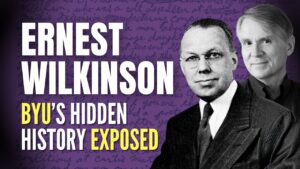
Matt Harris [00:06:01] Today we're going to talk about dissenters within the church education system to the Church's race teachings. These are people who work, who are seminary those who teach high school students LDS theology and history and also institute teachers for the church, those who teach college age youth at campuses or on on properties that are adjacent to public universities. And then finally, we'll talk about BYU religion professors who express their dissatisfaction both publicly and privately with the band, so much so that it creates a crisis for the church. Pres. For the BYU president, Ernest Wilkinson yeah, yeah.
John Dehlin [00:06:45] I'm just so it's, you know, a really fascinating part of this book is just to understand that like in the 30s, 40s and 50s and 60s, as we already talked about Lowery Nelson in a previous episode, there were faithful Latter Day Saints who had problems with the priesthood ban early in the 20th century. And many of them spoke up. So I'm just excited to hear that and I think it gives us a good model to understand how the church deals oftentimes with critics and dissenters today. So let's dive in. Where should we begin?
Expectations for Church Educators and BYU Professors
Matt Harris [00:07:18] Matt Boy so let's begin today about let's set the stage for what's expected of a church education system teacher and also a BYU religion professor, what they're expected to teach to their students and what they're expected to learn.
Matt Harris [00:07:39] In the early 20th century, the Brigham Young University, it started out, it was called Brigham Young Academy at one point, then it morphed into Brigham Young University. But in the early 20th century, the institution was trying to attract the best and brightest of Mormon PhDs.
Matt Harris [00:08:00] And in the early 20th century, they had hired a handful of biology and botany professors, a philosophy professor, and they were bringing, as the brethren like to say, their worldly learning to their teaching assignments. That is, they're bringing their secular ideas, books that they're reading that were published outside of the church, and they're bringing those into the classroom. I know that sounds silly for us to think today because this is a university, but in the early 20th century, I mean, this is an academy, an institution that's not very old.
Matt Harris [00:08:34] And the founding president, Carl Mazer, the guy who founded byu, John, if you want to put that quote up, if you have it, but he has a wonderful quote that has been used over the years about Mazer quote, the Carl Mazer quote. Yeah.
John Dehlin [00:08:51] Okay, tell me what the quote is and I'll put it up.
Matt Harris [00:08:54] Oh, I'm sorry, I thought you had it up. That's okay.
John Dehlin [00:08:56] Oh, do I have it up?
Matt Harris [00:08:58] Oh, I thought I saw it earlier, but.
Gerardo Sumano [00:08:59] Oh.
Matt Harris [00:09:00] Anyway, Carl Mazer said to BYU faculty when the institution was first started in the late 19th century, he said that faculty should not teach any subject unless they do so through the spirit of God or through the Holy Ghost, whether it's mathematics, whether it's English literature. They're supposed to have the Holy Spirit with them as they teach. And they're supposed to also teach through the lens of Mormonism. So that was a founding message of the president.
Matt Harris [00:09:29] And that became complicated in the 20th century when some of these Mormon professors from Mormon backgrounds, from pioneer stock, they start to bring their secular ideas into the academy, including evolution, including biblical criticism. And at the time, evolution was seen as a counterpoint. This is a national discourse that folks are having that evolution would be incompatible with traditional biblical readings about the age of the earth and about how the origin of man.
Matt Harris [00:09:58] And with higher criticism. There was a movement coursing throughout a period we call modernity where biblical scholars are starting to question the veracity of some of the literalist claims in the Bible. Did somebody really reside in the mouth of a fish for a few days? Did Jesus really take a couple of loaves of bread and feed the multitudes? Or are these better left understood as metaphorical or allegorical? And for people who read the Scriptures in a very literalist way, like a fundamentalist Christian, higher criticism posed a threat to their interpretive view. And Latter Day Saints are swept up in these national dialogues about the meaning of Scripture.
Matt Harris [00:10:43] And so in the early 20th century, some of these students recognize that they're professors have liberal ideas and they're captivated by these liberal ideas. Well, the board of trustees were not captivated by these liberal ideas and decided that they were going to fire at least four of these liberal professors, both of whom were two sets of brothers. And so they get fired. And some of the faculty at BYU aren't happy because they gear it as a threat to academic freedom.
John Dehlin [00:11:14] What year is this about again?
Matt Harris [00:11:16] This would be just before World War I.
John Dehlin [00:11:18] And this would be evolution based stuff.
Matt Harris [00:11:21] This would be evolution based stuff. This would be biblical higher criticism based stuff.
John Dehlin [00:11:26] Okay.
Matt Harris [00:11:26] And also it would be stuff that they would have students read in, let's say, a religion class at byu. And it wouldn't be just, you know, stuff by general authorities or church leaders. It would be stuff by a biblical scholar at the University of Chicago or Harvard Divinity School.
Matt Harris [00:11:47] One can't imagine today that the BYU Religion department would be allowing stuff from the Harvard Divinity School to be used in their curriculum. Very progressive view about what education could be, at least among some of these BYU professors. And they learned early on that their views would not be tolerated, so they were dismissed. Also, I want to set a foundation here that the church, as they start to spread their institutes and the institute program, I think started in the 1920s, really in earnest, it starts to take off where they establish an institute, the University of Idaho and Moscow, University of Utah, University of Arizona, all of these places that have a high density of LDS kids as they start to hire teachers to staff these important positions.
Matt Harris [00:12:35] Franklin west, who's the Commissioner of Education, and Lynn Bennion, who is the older brother of a person we'll talk about today, lol. Bennion, who's the head of the seminaries and institutes, his. I think his official title was supervisor of seminaries and institutes. And so he and Franklin west, the Commissioner of Education, they decide that they want to hire people who have non traditional backgrounds. They want people who are trained in biblical languages and literature. Those are the people who will teach the Bible to the institute classes. And so for a short period, they decide to send some promising LDS students off to the University of Chicago to get formal training in biblical languages and literature.
Matt Harris [00:13:18] And the idea, of course, would be that. That secular training would bolster LDS Church truth claims. Well, it backfires. A number of the men that the church education system sends to the University of Chicago, one of the preeminent universities in the United States, it backfires because they're on the church dime. They're getting their graduate education paid for. But a number of these men who were sent over there, they end up leaving the church, and so they discontinued the program. Well, this brings us to 1938, where there's been a long standing.
John Dehlin [00:13:51] Is it true Fawn Brody was kind of there at the same time as these other men?
Matt Harris [00:13:55] Approximately Fon Brody would have been a decade later.
John Dehlin [00:14:00] Okay, okay.
Matt Harris [00:14:01] Yeah, she's there, I believe, and somebody will correct me if I'm wrong, but she's there in the early 40s.
John Dehlin [00:14:05] Okay.
Matt Harris [00:14:06] And these men are there in the 30s.
John Dehlin [00:14:07] Okay. So they would have been her predecessors.
Matt Harris [00:14:11] They would have been her predecessors. And she would not have hobnobbed with them.
John Dehlin [00:14:15] Okay, got it.
Matt Harris [00:14:16] Yeah. I mean, she was in, I think her, her master's degree was in English, and they were in the school of what they called Oriental Studies that time.
John Dehlin [00:14:26] Got it.
Matt Harris [00:14:27] And anyway, A lot of these. These PhDs who work for the church, who are having their graduate, their PhD paid for, they're just absolutely imbibing these new secular theories. They're studying with some of the preeminent biblical teachers, biblical scholars, and at least one of them that I know of, guy named T. Edgar Lyon, who was an associate of Lowell Bennion for a number of years in their capacity at the University of Utah Institute of Religion.
Matt Harris [00:14:52] Edgar Lyon wrote his parents back when he was there working on his PhD, and he just said, look, this, some of the stuff we're learning is going to be incompatible with the church and the gospel. And I want to just take a quick.
Matt Harris [00:15:03] Make a quick note about what that means incompatible. So they're studying biblical languages and literature, and they're learning all of these techniques and higher criticism, which is that maybe there really wasn't a guy named Moses who parted the Red Sea. Maybe Moses never existed. Maybe there were, you know, two or three Isaiahs in the. In the Old Testament rather than just the traditional one. And the reason why that's significant, of course, is because that clashes with the scriptures that Joseph Smith produces. When the Doctrine and Covenants and some of the other scriptures talk about Moses, they mean one person, Moses, or when they talk about Isaiah, they mean Isaiah, one person.
Matt Harris [00:15:40] Now they're learning biblical criticism with the notion that they're some of the things that in the restoration scriptures may be inaccurate. So it creates a challenge, and Edgar Lyon recognizes it. And some of the others may have recognized it, too, but it didn't seem to bother them.
Matt Harris [00:15:56] So they come back from Chicago and they're bringing these secular, or as the brethren call it, worldly ideas with them into their classrooms. And some of the people in the church education system applaud this. That's why they pushed for it in the first place. So Franklin west, the commissioner, applauds it. Lynn Bennion, who's the supervisor of the seminaries and institutes, Lowell's older brother, he applauds it. There are a couple of apostles, at least early on, who support it and applaud it. Guy named Joseph F. Merrill supports it. John A. Widtsoe initially supports it. We'll have some issues later on.
Matt Harris [00:16:30] So it's popular. But on the other hand, there are a growing number of brethren within the quorum who adamantly oppose it. And, and these are the literalists in the hierarchy. Joseph Fielding Smith, who's not trained, does not have a graduate degree, but yet reads the Scriptures literally. And he starts to feel threatened by these secular Ideas coming into the Church's seminaries and institutes, and also at BYU in the religion department, and more importantly, J. Reuben Clark of the governing First Presidency. He's the one that really, really lays down the gauntlet that the Church needs to change lest members of the church, the youth of the church, leave the church.
Matt Harris [00:17:10] I want to share something, if I can just quickly, about a survey that was done, and if I can just turn to it quickly.
John Dehlin [00:17:20] While you're turning to it, I'm just going to share something personal. After my mission to Guatemala, I had my first real faith crisis because of stuff that happened on my mission. And I went to the David M. Kennedy building to try and get advisement on whether or not I should minor or major in international relations. And Ted Lyon, professor Ted Lyon received me there, told me about the honors program at byu, about Honors Colloquium at byu. And I ended up forging a multi year close friendship with Ted Lyon, who was the son of T. Edgar Lyon. And when I took Ted Lyon's Honors colloquium at byu, he taught those very same subjects about evolution, about the age of the Earth, about the Flood, about reproductive rights, and, and you could argue there would be no Mormon stories without Ted Lyon, son of T. Edgar Lyon. So I just had to share that while you were finding your.
Matt Harris [00:18:18] Yes, the apple doesn't fall too far from the tree between.
John Dehlin [00:18:23] Ted Lyon wrote T. Edgar Lyon's biography, as I understand it.
Matt Harris [00:18:26] He did. And it's. BYU studies published it.
John Dehlin [00:18:29] Yeah.
Matt Harris [00:18:30] And it's, it's a. It's. It's a fine book.
John Dehlin [00:18:32] Yeah.
Church Leaders Push to Purge Outside Influences
Matt Harris [00:18:33] All right. So Joseph Hilling Smith and J. Reuben Clark are behind this idea that the Church needs to purge itself of these outside worldly influences, that the church education system, teachers, and the BYU religion faculty that they ought not to go to Chicago anymore, especially on the Church's dime. And one of the things that's driving this orthodoxy between Smith and Clark is a survey that was done, I think, in the 1930s. I need to nail down the date, but there was a survey that was done among BYU students, and we only know about this survey because one of the participants had published the survey in the 1970s. And so otherwise this wouldn't have been something that would be public knowledge. But anyway, in the survey, the BYU students were asked if they believed that modern prophets received revelation. And a quarter of the student body did not believe that the prophets received modern revelation.
Gerardo Sumano [00:19:39] Wow.
Matt Harris [00:19:40] 62% of them did not believe that there was a literal devil. 64% believe that humankind's creation involved biological evolution. Those darn professors.
Gerardo Sumano [00:19:54] Wait, what percentage of that.
Matt Harris [00:19:56] 64%. Oh, wow. And then most ominously, that, or at least nearly as ominously, nearly half did not consider drinking alcohol morally wrong. 89 were fine with birth control. And only half to two thirds of students attended church every week, paid tithing, kept the word of wisdom, or engaged in daily prayers.
John Dehlin [00:20:22] Okay, two things. What year was that again?
Matt Harris [00:20:24] Just to drive it, let me. I think it's the 1930s.
John Dehlin [00:20:28] And then I want you to read that very first statistic one more time.
Matt Harris [00:20:32] Around a quarter of the student body did not believe that modern prophets received Revelation 25%.
John Dehlin [00:20:39] That's crazy. Especially compared to. Well, I guess we wouldn't know what BYU would be like today, right?
Matt Harris [00:20:45] I mean, these are internal surveys that are not meant for public consumption. And like I said, the only reason why we know this particular survey is because one of the participants got a hold of the survey and he published it in the 1970s, which is where I got it.
John Dehlin [00:21:00] Okay, Got it. Fascinating.
Matt Harris [00:21:03] Yeah. So, boy, can you imagine if you're. The whole purpose of BYU is to build testimonies and to create adherence among the church's theology. And here you have a number of people that are pushing back on core tenants fundamental teachings.
Matt Harris [00:21:21] And I know to our eyes today, our ears today, the idea that 89% were okay with birth control, that's no big deal, right? But in those days, in the 1930s, birth control was anathema. There was a raging debate nationally about the legality of birth control, the morality of it, the ethics of it. And the idea would be, of course, that if you were using birth control to curtail your children within a marriage, that somehow you were putting limits on God's grace, that if God wanted to bless you with a child, that you ought not to tamper with that. There was also a belief, of course, that it would lead to promiscuity and immorality, that youth would have sex gratuitously without any consequences if birth control was permitted.
Matt Harris [00:22:05] And it wasn't until 1965. Just to give listeners a sense of this, wasn't until 1965, where the US Supreme Court said that birth control is okay, that the government has no compelling interest to prohibit a married couple from exercising control over their own bodies and reproductive capacities.
Matt Harris [00:22:25] So this is really startling. And one can imagine that when Joseph Fielding Smith and Reuben Clark read this, I mean, the alarm bells went off and they immediately start to blame it on these secular liberal professors who are on the church dime. These people coming back from Chicago armed with their PhDs and their new worldly learning.
Matt Harris [00:22:47] So they began to purge a lot of these teachers from the church education system ranks, and they will set a tone that is still with the church today. And the foundation for this new purging begins in 1938 in a beautiful place of the world called Aspen Grove. It's in Provo, Utah. I'm sure John and Gerardo, if you guys. I know you've probably been.
Matt Harris [00:23:16] If people have been to Provo, especially BYU students, they'll have been to this beautiful location. And it's nestled on a little mountaintop. It overlooks Utah County. The LDS Church owns a sizable chunk of acreage up there, as does Robert Redford, the great Hollywood actor and movie producer. So there's a ski slope there for people who ski. So. And mountain bike. So it's a beautiful area. And for a few summers, the 1930s, the church education system employees would meet there in these fireside capacities, and they would receive instruction from the brethren in Salt Lake about the gospel, about church teachings. And even incredulously, they would. They would invite a couple of three professors from the University of Chicago to talk about biblical scholarship.
Matt Harris [00:24:09] And this, of course, is before J. Reuben Clark laid down the law. But it was at one of these summer meetings in 1938. These are men who were. These are church education system employees who were there to receive instruction. They're living in tents around campfires. It's really this idyllic existence. They go for hikes during the day, and they talk with each other about theology, about history, about world religions. And so it's more than just, you know, a series of seminars for nine hours a day. It's really a bonding experience for the men in the church. And instructive to note that this is the men in the church.
Matt Harris [00:24:45] Women at this time were not permitted to teach in the church education system. That would come decades later. Women were expected, of course, to be at home raising their children, being the nurturers, while the fathers or the men were off making a living being the breadwinners.
Matt Harris [00:24:59] So at this one of these meetings in the summer of 1938, J. Reuben Clark addresses the group and he gives this seminal talk. This is a great picture of Clark.
John Dehlin [00:25:18] You've already talked about his background, I think, in a previous episode. Is there anything we want to say about his background, or do you think we've already covered it?
Matt Harris [00:25:24] Yeah, no, I think I've talked about him, but just briefly. He is the. He's not a very good speaker, but he's a brilliant man and he's the one that will lay down this, this idea of doctrinal orthodoxy. He's a lawyer by training and people really, really respect him. In fact, the Brethren are not supposed to have acolytes, but J. Reuben Clark has followers in the among the 12 that people call themselves Clark men, or in some cases they would call themselves McKay Men after his associate, David O. McKay.
John Dehlin [00:25:57] So he's an attorney, right? Am I right?
Matt Harris [00:26:00] Okay, yeah, he's an attorney, works in the Woodrow Wilson administration. Noted in a previous episode that he wasn't active in the church when he was called into the governing first presidency in 1933. But Heber J. Grant called him in because he wanted to use Clark's considerable influence to get the church into Mexico, where Clark had been a one time ambassador. So really a gifted man and Clark had recognized his experience also. Something I didn't say last hour is that Clark was a counselor to Heber J. Grant and to George Albert Smith and both of those men fell ill during the latter part of their administrations.
Matt Harris [00:26:41] And. And it was Reuben Clark running the church when these two men fell ill. And then when David O. McKay was ordained the church president, 1951. 52, actually. 52. He dropped Reuben Clark as the first counselor, even though he had been the de facto church president for the previous several years. Dropped him as the de facto or dropped him as the Counselor to number two. And David O. McKay put Stephen L. Richards, his good friend, in as number one. And of course it crushed Clark because he was a proud man and he was essentially demoted. And when this happened, the apostles were absolutely horrified because they didn't see it coming and they thought it was disrespectful to do that to a powerful person like Clark who had been running the church.
Matt Harris [00:27:26] So he's not an ordinary person. He has enormous influence. And so when he gave this talk in the summer of 1938 called the Chartered Course of the Church in Education, it really, really turned a lot of heads. And maybe we can talk about a few of the most salient passages from this seminal talk now.
John Dehlin [00:27:44] Yeah, okay, so I'll pull up a version of it just to give people a view of at least one edition of it. Here's kind of the blue, you know, the church font and the blue kind of a global map of this kind of a. Published by the church.
John Dehlin [00:28:05] Again, the Chartered Course of the Church in Education, they call it the Church President J. Reuben Clark, Aspen Grove, August 8, 1938. And then I'll just jump forward to Just a few excerpts. This PDF is about 18 pages long, so we're not going to be reading all of it, but I'll just read a few excerpts. So no teacher who does not have a real testimony of the truth of the Gospel as revealed to and believed by the Latter Day Saints and a testimony of the sonship and messiahship of Jesus and of the Divine mission of Joseph Smith, including in all its reality, the First Vision has any place in the church school system.
John Dehlin [00:28:55] If there be any such, and I hope and pray there are none, he should at once resign. If the Commissioner knows of any such and he does not resign, the Commissioner should request his resignation. The First Presidency. Expect this pruning to be made. Now write off a couple things. This would indicate that there were already people that didn't believe in the reality of the first Vision of the Divine mission of Joseph Smith in the sonship and Messiahship of Jesus, etc. Isn't that right, Matt? There must have been problems there if this statement had to be made. Is that a. Is that a fair thing to say?
Sterling McMurrin's Views on Race and the Church
Matt Harris [00:29:34] Yeah, we're going to dive in to one of the people who were there. Who was there, Sterling McMurran, who was. Most people know him as this outspoken popular philosophy professor at the University of Utah, also a government official in the Kennedy administration, the secretary of education.
Matt Harris [00:29:53] McMurran was also an envoy to United States, envoy to Iran. In 1959, Dwight Eisenhower appointed him and his grandfather was Joseph McMurran, who was one of the presidents of the powerful first quorum of the Seventy, which had in those days, in the mid 20th century, had authority equal to that of the quorum of the 12. That's not the case today, but in those days, the presence of the Quorum of the Seventy had equal power to the 12. So he comes from royal Mormon stock. He's a Mormon intellectual.
Matt Harris [00:30:24] And when he was hired. We'll come back to this talk in just a sec. But just a quick story about MacMurran. When he was hired, when he finished his master's degree, he was recruited by Apostle Merrill and Franklin west, the Commissioner, to teach for the Church's Seminary Institutes program.
Matt Harris [00:30:45] And he. He was never asked if he had a testimony of the Church. He was never asked if he believed in the First Vision. He was never asked if he believed in the Trinity. And so later on he would say, if they asked me, I would have had to have been honest that I didn't believe in any of it. But they didn't ask, so I didn't volunteer it. So they Hire this guy.
John Dehlin [00:31:10] Here's a photo of him.
Matt Harris [00:31:11] He's an agnostic. He doesn't believe in the most fundamental truth claims of the church. But yet they hired him because he had such a capacious mind. He had a photographic memory. And he was one of those guys that would just really, really turn heads whenever he talked because he had such a strong grasp of history and theology and comparative religions and also philosophy. So they hired him because they wanted to. They thought he would connect and do some good at the seminaries and institutes. But only later would they run up against a lot of problems with someone like him who wasn't a core believer.
John Dehlin [00:31:48] Yeah, I don't necessarily want to nitpick every. Every statement made here. The only thing that comes to mind here is, let's just say there's a Jewish scholar that really knows the Old Testament and could really help BYU students understand the Old Testament. But he wasn't a Mormon or wasn't even a Christian. This would. Or a really good New Testament scholar who is Christian but not Mormon. This would preclude them from being able to be on the faculty at byu. Right. And that's.
Matt Harris [00:32:19] Yeah, that's right. Because, I mean, I think this statement is best read as a strong statement of orthodoxy if you don't believe in all of this stuff.
John Dehlin [00:32:26] Stuff.
Matt Harris [00:32:27] And today, if they were to do it, they would throw an lbgtq, which would be one of the pressing issues of the day. Right. Not so much in 38. But if you don't believe in any of this stuff, these core principles, we don't really care what you know about comparative Christianity or world religion. Doesn't matter.
John Dehlin [00:32:43] Yeah.
Matt Harris [00:32:44] You need to be focused on the core truth claims.
John Dehlin [00:32:46] Or biology. Right. Or chemistry or geology. Right.
Matt Harris [00:32:50] That's exactly right. And so what you're seeing here is, is that Reuben Clark's laying down the law that people like Sterling don't have a place in the church.
John Dehlin [00:32:57] So if. If Stephen Hawking wanted to come to BYU to teach physics, they'd say, no, thank you.
Matt Harris [00:33:03] Well, in 38, they would.
John Dehlin [00:33:05] Yeah, yeah.
Matt Harris [00:33:05] Today, of course, that's not the case. As long as you don't, you know, criticize the church, you can teach whatever secular theory you want.
John Dehlin [00:33:13] Okay, a couple more quotes. The successful seminary or institute teacher must also possess another of the rare and valuable elements of character, a twin brother of moral courage and often mistaken for it. I mean, intellectual courage, the courage to affirm principles, beliefs and faith that may not always be considered as harmonizing with such knowledge, scientific or otherwise. As the teacher or his educational colleagues may believe they possess. Okay. Anything you want to say about that, Matt, before I go to a couple more?
Matt Harris [00:33:47] Well, the first few sentences, Sterling McMurdan would say, that's me. Moral courage, intellectual courage. What's the problem here? And then when you read the last part of the sentence, what it's really saying is if the Church's teachings collide with scientific thought or other secular thought, then it's clear which side you ought to follow.
John Dehlin [00:34:04] Okay, a couple more. You do have an interest in matters purely cultural and in matters of purely secular knowledge. But I repeat again, for emphasis, your chief interest, your essential and all but sole duty is to teach the gospel of the Lord Jesus Christ as that has been revealed in these latter days, which, as we're showing in this book, is kind of hard to define sometimes. Right, sorry, I digress. You are to teach this gospel using as your sources and authorities the standard works of the Church and the words of those whom God has called to lead his people in the last days. Which again is a problem because they often disagree, as we see in this matter of the priesthood band and the temple band.
John Dehlin [00:34:51] You are not, whether high or low, to intrude into your work, your own peculiar philosophy, no matter what its source or how pleasing or rational it seems to you. To be. To do so would be to have as many different churches as we have seminaries, and that is chaos. Last paragraph. You are not, whether high or low, to change the doctrines of the Church or to modify them to as they are declared by and in the standard works of the Church and by those whose authority it is to declare the mind and will of the Lord to the Church. The Lord has declared that he is, quote, the same yesterday, today, and forever.
John Dehlin [00:35:30] And I'm just going to know, Matt, I've been bringing this up a lot. It's one thing for men to make mistakes, but here is a perfect example. They're not claiming just to be mentioned. They're claiming to be men who declare the mind and will of Jesus Christ himself. And that's a whole different standard of. I don't know, that invites a whole. Another standard of scrutiny when they claim to be voicing the will and mind of Jesus Christ.
Matt Harris [00:36:02] Well, I mean, for a lot of Latter Day Saints, I think that's the case. Because when it comes to issues of race and culture and civil rights, question I hear often is, why didn't the Church lead the way? Why were they not at the vanguard of all of this, of these progressive changes leading to racial equality? Why are they Always bringing up the rear.
Matt Harris [00:36:22] And those are faith questions, you know, that I don't typically delve into in my professional work. But my response is usually that. I mean, their culture influences them. And I think I seek to understand people. I'm not so much interested in criticizing people as understanding them. And one of the things I point out in my book is that, you know, what do you expect? I mean, a lot of these guys are from Utah and Idaho. They did not grow up around people of color. And most of their views towards African Americans, for instance, were governed by an all white media in the 20th century, essentially an all white media.
Matt Harris [00:37:00] And also governed by instances when they left Utah and they went to, say, New York City or anywhere else and they rubbed shoulders against African Americans and they felt profoundly uncomfortable because they'd never been around them. And so those are the things that interest me also what they read, you know, what are you reading? And so little surprise that some of the Brethren are not. A lot of the Brethren are not racially progressive because they've never been exposed to that sort of thing. And they've never known black people that would lead them to be sympathetic to some of those, to a number of the injustices that they're faced with in the 20th century.
John Dehlin [00:37:35] Okay, so he gives this talk and what comes next?
Matt Harris [00:37:40] Well, there's a great purging. There's the wheat from the chaff, right, or the wheat from the tares. And people like Sterling McMurran recognize that they don't have a home in the church education system. And for Those who don't, McMurran's case, he was working on his PhD in philosophy at this point. So his bachelor's degree was in political science at the University of Utah.
Matt Harris [00:38:03] Stayed on for a master's in history, and then he decided to work for the church. And then he realized after this talk he couldn't stay. And he had been working on a PhD at that point at the University of Southern California in philosophy. And so he decides to, to work on his PhD full time.
Matt Harris [00:38:24] And it's then that he would come back to Utah and accept a degree position in the philosophy department at the University of Utah. And the same institution that was experiencing the same challenges with modernity as BYU did. The U had been purging some of their faculty in the early 20th century when it was deemed by the president that they were an LDS president, I might add, they were being too racially or too progressive with, with evolution and some of these other secular ideas. So McMurran, he calls himself a Good heretic. He's not a believer. He makes it clear. I don't believe in the Book of Mormon.
Matt Harris [00:39:03] This whole idea that there were golden plates, that's nonsense. I don't believe in the first Vision. I don't believe in the divinity of the Scriptures. I mean, to a good Latter Day Saint, this is like, wow, you're ripping the entire rug out from under our feet. But McMurran is a good heretic, as he calls himself, because he identifies as a cultural Mormon. And what's hard for people to understand is how loyal he was to the church, even though he was a critic. In fact, in 1952.
Matt Harris [00:39:34] Let's talk about the Swearing Elders. Now. There was a group of an organization of free thinking Mormon scholars that he had founded with his colleague, a guy named Bill Mulder, who taught in the English department at the University of Utah. And McMurran and Mulder formed a group called the Swearing Elders. It's a group of intellectuals from not just the University of Utah, but from Weber State. From Utah State. From members of the church education system. Here's a great picture. So this is wearing.
John Dehlin [00:40:05] This is from Sunstone magazine. And it's kind of like caricatures, right?
Matt Harris [00:40:09] Yes.
John Dehlin [00:40:10] And it's got a photo of little Bennion, of Jay Adamson. I don't know who that third person is. Is that third person?
Matt Harris [00:40:18] I don't. Let's see. So the first person, of course, is Lowell Bennion. The second one is a guy named Jack Adamson who was an English professor at the U. Served a mission under Hubie Brown's leadership in the late 1930s in England. The third guy, I don't see a name. Not sure. The fourth guy is Waldemore Reed, who was a professor of philosophy at the U. Who was one of Sterling McMurran's teachers. He was also a free thinking Mormon who came to disbelieve the veracity of the Church's truth claims, but was also a huge influence on McMurran. Then you've got O.C. tanner here, the great philanthropist for your audience who've been to Utah.
Matt Harris [00:40:59] If you've come across Tanner Jewelry, that business. Tanner was a lawyer by training, although he never practiced the law. And he was one of those guys that would. Was very cerebral. Enrolled in a philosophy master's program at Stanford, then finished that degree, then enrolled in a PhD program in philosophy at Stanford, Finished most of the degree requirements, but decided that it was time to return to Utah. And so he took a job teaching philosophy at the University of Utah. Despite not Having finished his PhD, he was close friends with Gordon Hinckley, and he was also close friends with John A. Widtsoe and Joseph F. Merrill.
Matt Harris [00:41:45] So early in his career, he decided that Mormonism wasn't for him. He had doubts about its truth claims, although he was never public about his criticisms. And so, anyway, he was one of the ones that would help to protect Sterling McMurran, who was very vocal in his criticisms of the church, despite being a loyal Mormon in many ways.
Matt Harris [00:42:08] He would always criticize the church when he felt that it needed to be criticized. And it was Tanner who would sort of come to his aid when some of the leaders wanted to excommunicate him. And so before I get to that, I want to just talk about the swearing elders now, about what they were, who attended, and how the church leaders responded.
The Swearing Elders and Intellectual Dissent
Matt Harris [00:42:28] And the church has always been squeamish about intellectuals meeting and talking about the church and doctrine and philosophy. And even to this day, the church is not keen on saints meeting and sharing ideas in literature, because obviously it could lead to unwanted conclusions. And in the early 1950s, over a period of, I think, about three years, the group, the swearing elders, met on the campus of the University of Utah.
Matt Harris [00:42:56] And they had sent out invites to anybody, the who's who of the church education system, including Hugh Nibley, the great church apologist at byu. And a number of people showed up, including Lowell Bennion, who worked for the church. Edgar Lyon showed up, and of course, McMurran was there. Bill Mulder was there, who helped to found it. Guy named Brig Madsen, who taught history at the University of Utah, was there.
Gerardo Sumano [00:43:22] Did you say that Hubie Brown. Sorry, not Hubie Brown.
Matt Harris [00:43:25] Brig Madson.
Gerardo Sumano [00:43:26] Okay? And Nibly showed up.
Matt Harris [00:43:28] Hugh Nibley. No, Hugh Nibley did not want to be associated with the group. He was a loyal guy, okay? And they called them the swearing elders for a reason. And so Nibly didn't want to be associated with them. But it's telling that Lowell Bennion and Edgar Lyon and guy named George Boyd, who taught at the institute, the University of Southern California, he was Apostle Spencer W. Kimball's brother in law. So when he was in town, he made it a point of going to the meetings. And Larry Nelson would fly in from the University of Minnesota and attend the meetings. You can imagine this is right up Lowry Nelson's alley. And I mean, you know, the guy flies from Minnesota to Salt Lake just to attend this meeting. Nothing else, you know?
Gerardo Sumano [00:44:11] Yeah.
Matt Harris [00:44:12] And then Del Morgan, the great Western writer, will show up. Bernard Devoto will show up a time or two. And I'm certain that Fawn Brody, that would have been interesting. I don't have any evidence that she attended because she was not living in Salt Lake at the time. And it would have been interesting as a woman. She would have been the only woman, as far as I know, who showed up. It's hard to know if the, the sexism of some of these men would have allowed that, but nonetheless, it's a free thinking group where they will focus on the Church's claims about evolution, about the race and priesthood policy, about the Word of wisdom.
Matt Harris [00:44:51] There was nothing that was off limits for these men. And as word got out that these men were meeting at the University of Utah, some of the. Some of the brethren from down the hill. So at church headquarters is down the hill from the University of Utah. So some of the brethren from church headquarters down the hill decided that they would attend some meetings.
Matt Harris [00:45:14] And one of the people who attended was Apostle Adam S. Banion. And it was to the swearing elders where he broke the news about the secret committee that he was chairing and that he shared the results of their secret committee with the swearing elders. That there was no scriptural justification for the ban, that it was based more on a policy than a practice, than it was on any revealed doctrine. And this, of course, was alarming for many of these men, a lot. Many of whom would go on and record in their diaries about that meeting what they had experienced. And of course, I cite all this in my book.
Gerardo Sumano [00:45:49] This is so I just want to say this is like, this is just sounds crazy to me, like just thinking about something like this happening today where, you know, a bunch of intellectuals are gathering together to discuss things about issues with LDS doctrine. And then an apostle shows up and not only shows up to just listen, but then he started is leaking information about a secret committee that he's. That he's been leading and, and the stuff that he. They found and like you said, like just this explosive information that the, the ban is basically built on up in sand. And it's just that. That sounds crazy.
Matt Harris [00:46:34] Yeah, it would be unheard of today. And. But Apostle Bennion is not any ordinary person. He is a PhD himself. So he feels an intellectual affinity with these scholars and thinkers. And as we've talked about in previous episodes, he was not a fan of the band. He wanted to see it go. So he felt no compunction about sharing this private report with these men.
Matt Harris [00:46:59] And so he was one of the friendlier voices who showed up and participated There was a lower level general authority who came to a couple of sessions and one of the people who showed up when he got word that they were criticizing Joseph Fielding Smith's brand new book on evolution called the Origin. What's it called? The Origin of Man, I think. Anyway.
Matt Harris [00:47:23] But when word got back to the brethren that Joseph Fielding Smith's new book, that's essentially anti evolution, when they were criticizing that Bruce R. McConkey, Joseph Fielding Smith's son in law, shows up to defend his father in law.
Matt Harris [00:47:39] Now this is an interesting thing, just pause for a moment, which is that you have a member of the first quorum of the 70s. So Elder McConkey had not risen to the quorum of the 12 yet. That'll come in the early 70s. Right now he's just a lower ranking general authority. He'd been in the quorum since I think 46, so you know, a handful of years. And he's a big man. He's 6 foot 5 inches tall. He's got unusually large hands and feet. He wears a short haircut, it looks like it's a crew cut as they would say in those days. And he's trained in the law, but he's very overbearing.
Matt Harris [00:48:18] Those who knew him knew him as somebody who was very overbearing. I met him before, I remember when I was a youth. I was at a. We were at a regional conference in Maine. And in those days we didn't have a facility to, to accommodate a tri stake meeting. And so they rented the auditorium at a local high school. And I think I was 13 or 14 at the time. And I was asked to speak.
Matt Harris [00:48:46] I was the youth, the designated youth speaker for this massive gathering of Latter Day Saints. And I was absolutely terrified to speak as a young 13 year old.
Gerardo Sumano [00:48:54] Wow.
Matt Harris [00:48:54] But I was even more terrified when all 6 foot 5 inches of Bruce McConkey was sitting right next to me. And I remember thinking when I shook his hand, I mean, you know, of course I'm 13, so my hands were not, were not fully developed. But I remember shaking his hand. His hand just sort of bend dwarfed mine. And I remember sitting next to him and I saw these massive wingtip loafers that just looked like skis. So he was a very intimidating man and he was very nice to me afterwards. You know, what's he going to say? You know, you got the doctrine wrong, young man.
Matt Harris [00:49:25] I mean, so he was very cordial to me, which I appreciated, put me at ease. But Bruce McConkey was there and he was known to call the saints to repentance. He was, he was known to, to really extrapolate on controversial teachings and teach them as though they had been settled in the church when in fact they had not been.
Matt Harris [00:49:46] And when he would advance these kinds of doctrinal points, he was usually quoting his father in law. He was quoting Brigham Young and of course the founding prophet Joseph Smith. The authorities he never quoted because he didn't like them. Neither did his father in law. He never quoted widow, rarely quoted B.H. roberts, and certainly did not quote James Talmadge. He had too much of Victorian America in him. So McConkie and Smith did not like Widow and especially James Talmadge and never quoted them even though they were very popular at the time.
John Dehlin [00:50:17] Interesting.
Matt Harris [00:50:18] What's up?
John Dehlin [00:50:19] Interesting.
Matt Harris [00:50:20] Yeah. With that aside, that also speaks to why Elder McConkie was so adamant in producing a multi volume series on the Messiah. Because he thought that the Jesus the Christ, this famous text that missionaries, including myself, had to read on our missions, and he just thought that it was just such a poorly done book, even though the First Presidency had commissioned it in the early 20th century.
Gerardo Sumano [00:50:42] Which book?
Matt Harris [00:50:43] Jesus the Christ.
Gerardo Sumano [00:50:44] Oh, oh, wow.
Matt Harris [00:50:46] It was, it was too Victorian and wow, Elder McConkey, it just didn't like it. And I, I have a just theory about this is that McConkey and especially his father in law, they felt like they were the designated arbiters of Mormon orthodoxy. They wanted their ideas to course throughout manuals, church manuals. They wanted their books to be read by missionaries, not this Talmat's guy, whose ideas to them seemed dated and seemed unduly influenced by Victorian thinkers, including biblical scholars.
Matt Harris [00:51:23] So a little turf war going on here between Smith, McConkey and, and then of course with Widow and, and talmage. So Bruce McConkey, this bold, overbearing sort of man, this large towering presence, shows up at the swearing elders, one of the meetings unannounced and Sterling McMurran called him Bruce. It wasn't Elder McConkey. Hi Bruce, nice to see you. Thank you for coming today.
Matt Harris [00:51:50] And so they started talking more about his father in law's book. So they talked about it in a previous meeting and now they started talking about it again. It was. I should pause about the book for a moment. It's hot. This is stuff that's being, that's rippling throughout the church education system. Because Joseph Fielding Smith was not content just to write the book. He wanted to see the church's seminaries and institutes, study the book. Now this is a book about the origins of man and the. It's, it's, it's anti evolution. It's, it's influenced by fundamentalist thinking and not Mormon thinking. But Smith is reading fundamentalist scholars, or not scholars, but fundamentalist Christian clergymen.
Matt Harris [00:52:35] And he's taking his ideas from them that are anti evolution and frankly, anti scientific. And so he wants these, this book to be read in the seminaries and institutes, and he wants the BYU faculty and the science curriculum to assign it. And there's a number of people who are predisposed to scientific thought. They don't like the book and they speak out against it, including a whole host of church education system employees. And they'll meet with President McKay in private and express their reservations about the book. It's not scholarly, it's not scientific. Since when does the church advance something like this? And President McKay will listen to these church seminary people, including George Boyd, Spencer Kimball's brother in law, who's one of the people who complain, meet with the president, complain, and he listens to them and puts the kibosh on Smith's anti evolution book as being published.
Matt Harris [00:53:30] Thank you. A Man and His Origin and Destiny puts the kibosh on the church employees studying it. And when it gets, word gets back to Smith that it's the church president who says, no, we're not going to study this. It creates a long standing rift between these two men that will take decades to heal.
Matt Harris [00:53:50] And I want to say one last thing about this before we get back to the swearing elders. Joseph Hilling Smith had written this book earlier and he had tried to get it published, but some of the more scientifically inclined apostles opposed it, including Widtsoe, who has a PhD in chemistry, and also James Talmadge. And they adamantly opposed this book, didn't like it, thought it was poorly done, poorly written, poorly reasoned.
Matt Harris [00:54:16] And so they used their influence as senior apostles to see that it wasn't published. And John Widtso's wife, Leah Widtsoe, who is quite outspoken in her own right when her husband died in 50, I think 53, the book, Smith's book came out the following year and she said something like, the flowers were not even yet wilted on my husband's grave when this book was published. And so what that means is, is that Smith sees the opportunity to publish this book when one of his biggest critics had passed. So this is why McConkey went to the swearing elders to defend this book, even though there was a cloud of controversy swirling around it.
Matt Harris [00:55:02] And so as they started talking about the book. And they were being gentle, they were being respectful that a general authority was there. But as they were criticizing some of the ideas, McConkie wanted to weigh in and defend the book, and they allowed him to do it. But they had a rule that nobody could pontificate for more than, you know, a few minutes before other people needed to weigh in with their ideas. And when Sterling McMurran, the convener of the meeting, when he told Bruce, he said, bruce, your time is up. McConaughey just ignored him and kept talking.
Matt Harris [00:55:34] And finally McMurran, he stood up and he pounded his fist on the ground on the desk. And he said, now, damn it, Bruce, sit down. And he yells at him. And it took McMurran yelling at Bruce McConkey to get him to shut up and sit down.
Matt Harris [00:55:50] And later in life, McMurran would later chuckle about that. You know, telling his grandkids, let me tell you about the time I told the general authority to shut up and sit down. And, you know, he's laughing about it in his later years. But
John Dehlin [00:56:05] this would have been before McConkey was an apostle, is that right?
Matt Harris [00:56:08] This would have been in 54. And McConkey wasn't called until the early 70s.
John Dehlin [00:56:12] Yeah. Okay. All right.
Matt Harris [00:56:14] But he also, just to give your listeners a sort of sense of perspective. So this would have been early 50s. His famous book will put him on the map in Mormon. Mormon doctrine would not be published until a few years later in 58.
John Dehlin [00:56:28] Okay, right, yeah, yeah.
Matt Harris [00:56:30] So he's unknown at this point in the church. He hasn't really established himself as this great doctrinal authority yet, but that'll come.
Gerardo Sumano [00:56:37] Do we know what kind of arguments he was making in order to support Joseph feelings? Myth's book?
Matt Harris [00:56:48] Yeah. So both he and his father in law were scriptural literalists. There was nothing or very little that was allegorical or metaphorical. When. When God said that he created the earth and. Or when the scriptures said that the earth was created in six days, I mean, it meant six days.
Matt Harris [00:57:06] When the scripture said that Adam was the first human. Adam was the first human. And the swearing elders, some of the more scientifically inclined of them, including there were a few scientists in the room, including a guy named Pack and some others, Frederick Pack. But anyway, when it said 6,000 six days, it meant six days. But Adam being the first man, that didn't leave any room for. For pre Adamites, as they were called, for people who may have existed before 6 or 7,000 years. I mean, cavemen, all of that. I mean, that would have been unknown to them, Neanderthals unknown to them. Frankly, Smith didn't care about that.
John Dehlin [00:57:47] And for those who don't know doctrine and Covenants 77, which is scripture to Mormons, basically says that the Earth is 7,000, has a temporal existence of 7,000 years. Yeah.
Matt Harris [00:57:59] So, yeah, thanks for that. And there's, I mean John and Gerardo, there's a. I can't emphasize enough, this is the mid 20th century and a lot of universities and frankly a lot of religions are trying to grapple with modernity that there could be readings of scripture. They're not always literalist.
Matt Harris [00:58:20] And there it might be okay to think that you could, you could support this scientific theory called evolution and that it could actually be compatible with Christian teaching that maybe God used evolution to further his own purposes. They don't have to be juxtaposed or at odds with each other.
Matt Harris [00:58:38] One last thing about Joseph fielding Smith and McConkie and their literalist views. So Reuben Clark was also a very literalist thinker. When the scripture said something, he believed it literally. And anyway, Joseph Fielding Smith was just hell bent on getting the brethren to support his literal views of the scriptures. And he writes several letters to the apostles trying to always win them over, whether it's his view that Adam was the first man or whether it's an anti evolution view which he borrows on scriptures to sort of bolster his point. But he even turns to Reuben Clark, a fellow literalist, to win him over.
Matt Harris [00:59:13] And Clark, Clark is a funny dude. Clark is. He's got this quirky sense of humor. So Joseph Fielding writes in this long letter and he's trying to convince Clark to come over to his position on some doctrinal point. I don't even remember what the point was, but. So he writes him like this five single space page letter. And Joseph Clark reads it, he writes back and he says, dear Joseph, I'll make you a deal.
Matt Harris [00:59:42] I won't. I'll make you a deal. Your thoughts don't govern me any more than my thoughts govern you. You be you, I'll be me. And I'm sure Joseph Fielding wasn't happy because he was always seeking followers to his position. And just to remind your readers, he really felt that God had wanted him to be the preserver of Mormon orthodoxy. His father, the late church president, had given him this blessing in 1910 when he was ordained into the Council of the Twelve. And that's one of the reasons why he felt so called to always write about doctrinal books and historical Books is because he thought that that was his divine calling as an apostle. Right, right. Wow. All right. So the Mormon. The Mormon. The swearing elders.
John Dehlin [01:00:30] Yes.
Matt Harris [01:00:31] So how do the brethren feel about this? At least some of them. And so as I mentioned earlier, word gets back down the hill what the brother. What the swearing elders are up to. And I should add that some of these swearing elders are still very much practicing Latter Day Saints. Some of them are on the fringes of the church, like McMurran, but Lowell Bennion's there, Edgar Lyons there. And one imagines that, you know, they're going to these meetings and they're criticizing a general authority for his views on evolution or maybe even other views. Right. About some other doctrinal point. One imagines that Lowell Bennion and Edgar Line and others like them who work for the church are probably nervous, you know, should we be here?
Matt Harris [01:01:12] You know, these guys a little bit more vocal than we're. We're comfortable with. But Lowell Bennion and Edgar Line were fiercely independent. And so they kept coming. Well, Harold B. Lee, who was the second cousin to Sterling McMurran, he was a junior apostle, very, very orthodox in his thinking and straight laced, as we would say today. He was the second cousin of McMurran and also an ally of Joseph Fielding Smith, the great church doctrinal teacher. And so Joseph Fielding Smith and Harold B. Lee, they call in Sterling McMurran for a special private meeting.
Matt Harris [01:01:49] And this would have been 1952, this is during the midst of the swearing elders. And they called him in and they said, so he's no longer teaching Seminary Institute at this point. And they said, Brother McMurran. It was always Brother McMurran or Dr. McMurran. They would alternate between the two. They would never call him Sterling, which is interesting, showing respect for his title, I suppose. But Dr. McMurran, do you believe in the First Vision, Harold Lee and Building Smith Ask. No, sir, I don't. Do you believe in God, the Eternal Father and his Son, Jesus Christ and the Holy Ghost? No, sir, I don't. Do you believe that the Book of Mormon was given by the angel Moroni to the prophet Joseph Smith?
Matt Harris [01:02:35] No, sir, I don't. And so he's having this respectful dialogue. He's not angry. Those who know Sterling McMurran, he's just not. He does have righteous indignation like he did with Bruce McConkey, but for the most part, he's an even killed kind of guy. And he's a loyal critic of the church. He didn't like that term loyal critic, but that's what he was. And he was a good heretic, he liked to call himself. And so he was having this respectful dialogue with these two important apostles and they could sense his goodness that he wasn't out to put his finger in the eyeball of the church. He just had some reservations about belief.
Matt Harris [01:03:13] He was raised in a free thinking home. He developed some of his heretical views early on in his life as a teenager. And he reflected toward the end of his life in the 1990s that there was never a time that he really believed in the core truth claims.
Matt Harris [01:03:26] So someone asked, you know, when did you lose your testimony? And his response was famous. He said, lose it? I never lost it. I never had one. How could you lose it if you never had it?
Gerardo Sumano [01:03:35] And by this point, he's meeting with Harold Billy. Is he. Is he still working for BYU or has he resigned?
Matt Harris [01:03:43] No, he's long gone from BYU at this point. He's now a philosophy professor where he has a position of independence at the University of Utah. Right, at the University of Utah. And they're absolutely fearful of him. Because I should say something about this guy. He does not look the part, that he wears a bolo tie, he wears a cowboy hat, he wears scuff cowboy boots. His credentials are impeccable. Not only does he get his PhD at the University of Southern California and studies with an eminent philosophy professor, but he also does postgraduate work at the Union Theological Seminary at Columbia University, spends some time at Princeton. I mean, this guy is developing this reputation. And also he's got a photographic memory. And anybody who's been in his presence would often comment about that. He could just stand and talk. And they were just amazed at his prodigious memory.
John Dehlin [01:04:34] I'm pretty sure, like Assistant Secretary of Education under John F. Kennedy or something like that.
Matt Harris [01:04:39] He was the Secretary of Education under John F. Kennedy in 19, I think, 60. Well, it would have been when Kennedy was called in. So it would have been 60. Yeah, 60 to 63. So until the time that Kennedy was murdered, and then before that, Dwight Eisenhower called him in to be the United States envoy to Iran in, I think, 50, 58, 59. So he's got this reputation and he's not just a philosophy professor at the U. He would later rise to become the dean of the College of Liberal Arts and Sciences, becomes the academic vice president, the provost. He was recruited for several presidencies, but he turned them down over the course of his career because they thought it would compromise his independent thinking.
Matt Harris [01:05:19] That as a President, you couldn't espouse, you know, these free thoughts that you'd have to be more circumscribed based on your employment. So anyway, he's, he's a man of infinite capacity, and he is respectful and loyal to these two apostles. And even though he's just complete heretic and he makes his views known in very, very clear ways, but he's respectful. And as he leaves the, the meeting, Joseph fielding Smith says, Dr. McMurran, I feel inclined to tell you that you have the Holy Ghost with you.
Matt Harris [01:05:56] And McMurran turns to this, this important church authority, and he says, president Smith, I think you're much too generous with me. And that's how this meeting ends, is by telling this heretic that he's got the Holy Ghost with him.
Consequences for McMurrin and Dissident Educators
Matt Harris [01:06:11] And anyway, but here's what happens next is this is interesting, is that Joseph Finling Smith and Harold Lee are absolutely terrified of the damage that someone like Sterling McMurran could do. They're really afraid that a free thinking person like him and other swearing elders with positions of authority over LDS youth could really damage their testimonies. And so word gets out to Sterling McMurran's bishop that he's to hold a church court over McMurran and excommunicate him. And Smith tells the bishop, just ask him about some of his core beliefs and you'll know why he needs to be excommunicated.
Gerardo Sumano [01:06:53] Wow.
Matt Harris [01:06:53] In other words, just ask him and he'll tell you all of his heresies. He won't hold back. And so the bishop contacts McMurrant and says, hey, I'm instructed to hold a church court over you for your heresies. And the bishop says to Brother McMurray, he says, but the problem is we can't find any witnesses who can attest to your heresies. Do you have any witnesses who could attest to your heresies?
Matt Harris [01:07:25] And McMurran says, yeah, I do. Apostle Lee and Apostle Smith. So he tells him that you'll have to call in the two apostles in the meantime. Obert Tanner, one of McMurran's close friends, who's also close friends with Apostle Merrill. Obert Tanner is a huge advocate of independent thought and thought that it was absolutely wrong to excommunicate somebody not because of something they had done, a sin they had committed, but because of a thought that they had held.
Matt Harris [01:08:01] And so Obert C. Tanner reaches out to Apostle Merrill and says, can you contact the president, President McKay, and let them know that they're about ready to cut off your friend McMurran. And can you have him intervene? And when David O. President McKay, gets word that these two apostles are going to excommunicate Sterling McMurran, he told Apostle Merrill, and he would later tell Sterling McMurray directly, if they hold a church court over you, let the bishop know that I will be there as the first witness on your behalf, the church president.
Matt Harris [01:08:43] So in my mind's eye, I've got this interesting scenario where, you know, Apostle Smith and Apostle, you know, Lee show up saying, excommunicate him. He's a heretic. And you've got the church president saying, no, he's not. Keep him in the church. We need him.
Matt Harris [01:08:56] And so that's what's going on. And later On, David Lawrence McKay, President McKay's son, said something really fascinating. He said, for a number of years, my father kept McMurran in the church. When they tried to excommunicate him. They meaning Smith and Lee. So it wasn't just the first time they tried. My father kept him in the church. And the phraseology that David Lawrence used was my father put his arms around McMurran, figuratively speaking, and shielded him from these two outspoken apostles. And McMurran is the kind of guy that didn't hold grudges. And when he was told in 1972 at Joseph Fielding Smith's passing at the age of 95, when he was learned that this aging apostle had passed away, he wept.
Matt Harris [01:09:44] He said, I couldn't. I couldn't. Couldn't control myself. I wept. And the reason why I wept is not because we agreed with anything theologically, but because Joseph Fielding Smith was always a straight shooter. He was always honest and sincere in his convictions and always gave me a space to talk to him. And he said, I never felt that way about Markey Peterson and Harold Lee, two other apostles who didn't seem to share the same respect that. That McMurran had for Joseph Fielding. So anyway, that's the kind of the. Where we're at now in this story is that there's a bunch of intellectuals who are posing a threat to the youth of the church. None more so than the priesthood band.
Lowell Bennion and the Priesthood Ban
Gerardo Sumano [01:10:26] Yeah. Yeah. Do we want to talk about Lil Bennion? Because we. I think we've talked to him about him in previous episodes. We talked about the report. Right. Anything else that you want? Because I think this. He's going to be another important figure as well.
Matt Harris [01:10:45] Yeah. Let's talk about Lowell Benyan now. And Lowell Bennion is, as I noted earlier, low Banyan works for the church he has a strong testimony of the church. I noted in a previous episode that Lowell Bennion is friends with some of the apostles, that his belief of religion and theology was supposed to make people be better people, be racially inclusive.
Matt Harris [01:11:11] And if it didn't help people become better people, he thought it was poor theology. And that's how he read Mormon scriptures. And that's one of the reasons why he became friends with general authorities who thought like him, like Hubie Brown, they developed an affinity. Lowell Bennion had been working for the church since the 1930s as an institute professor.
Matt Harris [01:11:34] His PhD was in sociology. He went overseas from Germany, and Apostle Widtsoe had helped him become employed in the church education system. His older brother, Lynn Bennion, as I mentioned, was the supervisor of the seminaries and institutes. And Lowell's father, Milton Bennion, named after the great English poet, was a prominent educator, trained at Columbia. So Lowell Bennion grew up in a very educated home, was taught to really read texts critically, to ask important questions.
Matt Harris [01:12:06] And even though he was always loyal to the church and had a testimony, it really gnawed at him that the ban seemed to stymie the brotherhood of the races, as he put it. He didn't think that the ban was scriptural, as we learned from the Bennion report. And he didn't think it was good for the church as it sought to fulfill its mission, to expand. And so Lowell Bennion did something that got him into a lot of trouble.
Matt Harris [01:12:32] In the early 1960s. He was telling his students and colleagues that the ban was going to be lifted. And as I note in my book, he has it on good authority. Hugh B. Brown, his close friend of the governing First Presidency, tells him that the ban will be lifted at the April 1962 General Conference.
Matt Harris [01:12:49] And this is the same time when the church has started to consider moving into Nigeria to open up a mission in this sub Saharan country. And we'll talk about that more in, I think, the next episode about what's going on in Nigeria. But anyway, in the early 60s, the saints are. The church is starting to consider going into Nigeria. And so the brethren recognized that it would be impossible to move and expand the church in Nigeria if you get.
Matt Harris [01:13:16] If you have to have white missionaries or white priesthood holders from Utah go to this country to run their. Their services because they can't have the priesthood. So he's pushing for the priesthood. Brown and tells Bennion that it's going to be lifted in 1962.
Matt Harris [01:13:33] And Bennion, of course, is elated. He had been arguing or. Or commenting both publicly and privately for a long time now, giving church firesides, writing the church president letters, some of the apostles letters, expressing his dissatisfaction with the. The band.
Matt Harris [01:13:50] Well, in 62, he's spreading the word. And word gets back to Joseph Fielding Smith, one of the hardliners, that this is what Lil Bennion is doing. And Joseph Fielding Smith is absolutely terrified that somebody in a position of authority like this could be perceived as undermining the Brethren's authority about the ban. And Joseph Fielding Smith obviously does not support lifting the van, did not agree that it should be lifted in April of 1962.
Matt Harris [01:14:18] So what they did was that they sent a spy. Joseph Fielding Smith had commissioned a spy by a man by the name of Melvin Tag. He was a younger man. He worked for the church education system. And the institute director, Lowell Bennion, was told that we're going to send this guy named Mel Tag to teach the students to be on the faculty. And Lal Banion and Edgar Lyon and a couple of others who comprised the institute at the time, they were upset because they felt that they should have say over who ought to join their faculty ranks. But instead, they were being told that, we're going to hire this guy whether you like it or not.
Matt Harris [01:14:58] And almost immediately, Bennion and Thiago, his close associate, they recognize the subterfuge. They know that the Tag has been sent to spy on them and to report back to Joseph Fielding Smith and to some other church history or church employees.
Matt Harris [01:15:17] And so Tag asked them right up front. He asked Bennion and also Lyon, what do you think about the priesthood ban? And these guys have a lot of integrity. They don't sugarcoat. They don't obfuscate. They don't beat around the bush. They tell them, we don't think the band's a good thing for the church. They're respectful about it. They're not going to be sort of unfiltered like the swearing elders would be, but. Or like Sterling McMurran was when he spoke to the NAACP.
Matt Harris [01:15:45] But. But they tell him, you know, this is how we feel. It's not compatible with the scriptures. It's a policy, not a doctrine. It needs to be changed. So Tag takes this back, this information to Joseph Fielding Smith. And Fielding Smith commissions an investigation in which he sends one of the church history employees to the institute to start to interview the faculty and the students.
Matt Harris [01:16:12] And they're asking them, did. Did Bennion and Lyon tell you that the ban would be lifted? Did they tell you that. That if you put pressure on the Brethren that the band could be expedited? That's the real issue that they're worried about is the pressure. And so they do this interview and the.
Matt Harris [01:16:35] The people come back to the Brethren and I'll read you part of the interview. The person conducting it was a guy named Lawrence Peterson who was in the church historian's office. He had worked with Joseph Philly Smith for years in Smith's capacity as the church historian while he was also in the quorum of the 12.
Matt Harris [01:16:53] So Lawrence Peterson interviews these students and this is what I write. After a hasty investigation, Peterson declared that false teachings were being taught. The church was being attacked from within, end quote. And he also identified the culprits as not only Bennion and Lyon, but also their. Their colleague Albert Payne, who complained at a recent faculty meeting that, quote, by denying the priesthood to the Negro, we discriminate against the colored race. Close quote.
Matt Harris [01:17:22] So they take this back to the Joseph Fielding Smith and they talk about that. They're talking about Mormon racial teachings being racist and that social pressure could influence the Brethren. And Joseph filming. Smith is now just alarmed as heck because Lowell Bennion is not any ordinary person and neither is Lyon. They are beloved people. They had taught the who's who of Mormon thinkers and educators, including Pulitzer pri, future Pulitzer Prize winning author and professor Laura Thatcher, Laura Thatcher Ulrich of Harvard University.
Matt Harris [01:17:58] They had taught general authorities. Marion D. Hanks, who would. Who would. Was a student of Lowell Bennion's early on. And Marion Hanks said that little Bennion was one of the greatest influences of my life. And Lowell Bennion said something interesting. He said, and this isn't his unpublished autobiography. He said that I taught a number of general authorities. I taught a number of great thinkers who would go on to receive. Earn PhDs and win all these accolades. Accolades, he said, but there's only one general authority I never got through to, and that was Bruce McConkey. He taught Bruce McConkey as a young student and he said he was just too independent, even back in his student days.
Matt Harris [01:18:36] So I guess once it's in your DNA, it's always in your DNA. But so. So they don't know what to do with. With lion and Bennion. And I have a. They do know what to do, but they need to get their ducks in order before they terminate them.
John Dehlin [01:18:51] Right.
Gerardo Sumano [01:18:52] I have a question. So in your book you mentioned, you talk about how a little Bennion's response or. Or his thoughts about the talk that Peterson and Smith gave to the church education employees. And you mentioned that he publicly criticized them. Do you want to talk about that a little bit? I thought that was really interesting.
Matt Harris [01:19:20] You meant the BYU Education Conference.
Gerardo Sumano [01:19:22] That's right.
Matt Harris [01:19:23] Yeah. So that's some good context, Gerardo, that. So yesterday's episode, we spent some time talking about this, this talk that Markey Peterson had given to the BYU and CES religion teachers. This is a talk in which he was denouncing strongly the Brown versus the Board of Education at Topeka, Kansas Supreme
John Dehlin [01:19:44] Court decision back to like summer of 1954. Now, is that right?
Matt Harris [01:19:50] Yeah, just a brief drop back to August of 1954. And so Lowell Bennion had criticized or at least challenged Apostle Peterson in his views on the pre existence. And one of the things that Lowell Bennion said at this teachers conference In August of 1954, when there are dozens of church educators in the room along with the Apostle Mark Peterson and Joseph Billing Smith, he said, how could a Justin loving God, how could you teach this, that people were less valiant because of a sin that their ancestor had committed? That seems to contradict all of the gospel teaches that you'll be responsible for your own sins and not for somebody else's.
Matt Harris [01:20:33] And also Lil Ben and asked Mark Peterson, how could this be compatible with the Scriptures where it talks about God being a God of love and justice and mercy? How is there any justice and mercy in denying of black people the sacred privileges of the temple?
Matt Harris [01:20:50] And so he's putting this apostle on the spot. And obviously in Mormonism, you're not supposed to do that. And so Lowell Bennion's in the crosshairs of Mark Peterson and Joseph Fielding smith ever since 1954. So this is 1962, when they send the spy to the institute.
The Bennion Report and the Push to Remove Dissenters
John Dehlin [01:21:07] And so really sorry, Matt, really quickly, we mentioned the Bennion report last time as well, and your book mentions it several times. And even though it was Apostle Adam Bennion. Right. Who was the, you know, the attributed author for it, he enlisted the support of Lowell Bennion to write it. Correct. Then I have a question. Is that, is that right?
Matt Harris [01:21:28] Yeah. So Lowell, I don't know 100 certainty that Lowell Banyan authored it, but I'm, I've read enough of Lowell Bennion. It reads like him and they were related how?
John Dehlin [01:21:36] Adam Bennion and Lil Bennion cousins. Okay. And then my question is, is there any chance or, you know, Markey Peterson or Joseph Eing Smith or anyone who would have not liked The Bennion report would have attributed any of it to Lowell Bennion back in 54 or afterwards.
Matt Harris [01:21:56] That's the million dollar question, John. Did Joseph Fielding and Mark Peterson know who wrote the report? And I don't know the answer to that. Adam. Adam Bennion. He knows the landmines and the politics. I, I can, I can foresee an, an instance where Adam Bennion put his name to it or the committee's name to it without identifying Lowell Bennion as the author simply because he wanted to protect Lowell Bennion from the hardliners. But I can't prove that.
John Dehlin [01:22:22] Okay. All right. Just curious about that. All right, go ahead. And back to the early.
Matt Harris [01:22:28] Yeah, so, so when, when this report from Lawrence Peterson of the, the assistant church historian, when it gets back to when he sends the report or gives them a recounting of the interviews that he had conducted at the institute and he tells Joseph Fielding, it's true, they've been teaching that the ban would be lifted, that pressure would force the brother into change. Joseph Fielding Smith knows he needs to fire them, but he has to get his ducks in a row because these are, these guys have been teaching for over two decades at the institute there. I can't emphasize enough how iconic they were.
Matt Harris [01:23:02] And the general authorities that had been students at the U back in the day, they, they would often, like Marion Hanks, recognize Lowell Bennion and Edgar Lyon as transformative voices in their life. And a whole host of Mormon intellectuals would claim Lowell Bennion and Edgar Lyon as heroes in their life.
Matt Harris [01:23:25] And so anyway, they're, they're just an institution and you just can't fire these guys Willy nilly. You've got to get your ducks in a row. So one of the things they do next is there are two lower ranking general authorities who used to teach in the church education system with Lowell Bennion and Edgar Lyon and others.
Matt Harris [01:23:43] And this is now Boyd Packer and Theodore Tuttle. So they taught in the church education system for a while and then they got called into the quorum of the 70. And it was Boyd Packer and Theodore Tuttle who met with Bennion and asked him point blank, what are you teaching your students about the band and the church's race teachings? And Bennion said, I'm teaching that it's going to be lifted because Hugh Brown told me, and I'm teaching that it's incompatible with the gospel and the Scriptures.
Matt Harris [01:24:17] And now Lowell Bennion, let's just pause for a minute. He is Not a very, let's say, strategic person. He's admitting to general authorities that he's teaching all these heresies, that he's teaching things that Contradict Reuben Clark's 1938 Talk to the church's educators.
Matt Harris [01:24:35] So there's nothing political about Bennion at all. I mean, he's just speaking from his heart and lying as well. So what happens next is that Boyd Packer and Theodore Tuttle, they make this report to the board of trustees. And in the report they say that Lowell Bennion and Theodore Lo Benyan and Ted Lyon, T. Edgar Lyon, they're undermining the Church's teachings on race.
Matt Harris [01:25:04] And they're also lousy administrators. Particularly Bennion And Packer had been telling Bennion and others at the Institute for a long time that you've got to keep roll. Let's keep a roll of the students who come to the Institute. Let's try to bolster our numbers. We need the Institute to be a bulwark against the secular theories that these students are learning on campus. We need to boost our numbers and we need to report how you're going to boost our numbers. We also need you to talk to the right people on campus to see if we can give college credit for the classes that they're taking at the Institute.
Matt Harris [01:25:38] And Lowell Bennion, for as wonderful as a man as he was, he was not interested in any of that administrative minutiae. He didn't want to glad handle across the campus with the powers that be in can you take our classes for credit?
Matt Harris [01:25:52] And he wasn't interested in keeping roll. His idea was, I want to give them something that they'll want to come back to on their own. I'm not going to penalize them for classes they may miss. So he was a lousy administrator and self identified, self professed lousy administrator. So it wasn't just that the. The church's teachings on race that bothered Packer and Tuttle. It was some of his administrative attitudes that annoyed them. Anyway, so what happens with Lawrence Peterson and also the Boyd Packer and Ted Tuttle reports is that Joseph Fielding Smith now has the ammunition he needs to terminate these two important instructors.
Matt Harris [01:26:34] And they recognize right away that they can't just fire them. I mean, I can't emphasize enough the following that Lyon in Benion have. And so what they do is they come up with this ruse that we will reassign them to write church manuals. We'll remove them from the classroom and we'll reassign them to write church manuals. And we'll characterize it as a promotion.
Matt Harris [01:27:00] The problem with that is, is that Lyon and Bennion both know it's a ruse. There's not a promotion involved here. It's just simply a ruse to remove them from the classroom. And when they get the pink slip in the summer of 1962, Lowell Bennion and T. Edgar Lyon, they're, they're not given a reason why they're removed, they're not told why.
Matt Harris [01:27:23] And so they demand a meeting with the chancellor of the church education system, a man who also doubles as the president of byu. And this is Ernest Wilkinson. I can say more about him in just a second. But Ernest Wilkinson says, I don't know why they fired you. That's not true. Wilkinson knows, but he says with characteristic understatement, it may be thought of some of the brethren that you were a little too liberal in your attitudes.
Matt Harris [01:27:54] And so they weren't happy with Wilkinson's view that, you know, we're not sure why they fired you. They turned to his deputy, a man named William Barrett, who was like the vice president of the church education system. And he says the same thing. I'm not quite sure why. Maybe you're a little too liberal. They're not really giving him a direct answer. And Bennion and Lyon are upset, so they demand a meeting with the board. And the board agrees to give these two high profile educators a hearing. But at the last minute, Boyd Packer intervenes and he tells Joseph Fielding Smith that why would we give him a hearing?
Matt Harris [01:28:26] Nothing good would come of it if we give them a hearing, because really what's going to happen is they're just going to air their grievances and nothing will change. So anyway, one of the things that I learned from about Lowell Bennion is that in public he, he's. He'd been asked over the years about his, his termination from the church education system. And he, unlike Lyon, who agreed to the.
Matt Harris [01:28:54] To write the church manuals to keep his employment, Lowell Bennion was just so bitter. And it was bitter that David O. McKay didn't come to his defense. He was bitter that other authorities with whom he was friends didn't come to his defense. And David O, of course, was too ill at this point. He was feeble. He wasn't, didn't have the energy to fight the hardliners. But so David L. Rather or low Banyan, rather than stay in the church education system, he decided to take a job at the University of Utah in administration and when President McKay said. He asked President McKay's you know, advice, should I take this job?
Matt Harris [01:29:26] And President said, yeah, you should. And that really hurt Bennion because he thought that the president would basically implore him to stay in the system teaching religion or some capacity. But that wasn't the case anyway. But so in public, Banyan would always say in interviews over the course of his life that, you know, I'm not bitter by this. I'm. I've accepted it. It's okay. And he was bitter about it. In private, he's writing his friends.
Matt Harris [01:29:54] He's, I faithfully taught. 26, 27 years in the system. They didn't even have a decency to tell me why I'd been fired. And he was really, really upset by it, as one can imagine. And also T. Edgar Line was upset by it. And Lowell Bennion's wife, Merle Bennion, she said something interesting. She said that when she would watch General Conference over the years, the. I would turn the TV off every time Boyd Packer's face came on, and she just couldn't watch Elder Packer, who at this point became an apostle in the early 70s, and when she made this admission, it was in the mid-80s. So she said, anytime Elder Packer's face came on, I just couldn't do it because she was so bitter that he played a role in her husband's ouster.
Matt Harris [01:30:42] So Ernest Wilkinson is the unfortunate person that has to deal with the fallout because he's the chancellor. And Joseph Fielding Smith is playing a role behind the scenes, but he's not, of course, volunteering that he was the one behind the purge.
Matt Harris [01:30:58] Joseph Fielding Smith said something in his diary. He wrote with a cool indifference. I write, he said that. Let me read it to you. He said that Apostle Smith called Bennion's termination a reassignment. Informing Inquisitor, quote, we needed him somewhere else. Close quote. He echoed the same talking points about Edgar Lyon. In private, though, Smith responded to Bennion and Lyons predicament with a cold indifference, writing in his diary that, quote, he received a number of letters of protest because of the release of Drs. Bennion and Lyon, who had been the at the Institute for a number of years. Smith writes, I have also interviewed some students who were taught by them and reached the conclusion that.
Matt Harris [01:31:38] That the change in release was in order. Close quote. So, but it's. It's Wilkinson that has to deal with the follow because he's the chancellor. And so Wilkinson recognizes when it goes public that these two beloved Teachers have been fired. He produces a public relations statement indicating that they had been reassigned and promoted. And he gives this to the, the media outlets, gives it to the Desert News, gives it to the select Tribune. Over 200 students write protest letters to the Office of the First Presidency, including a young student at the University of Utah who ended his letter by saying, may God have mercy upon your souls.
Matt Harris [01:32:18] Talking about the general authorities. Marion D. Hanks, who's now a general authority himself, when he got word he was overseas on a church assignment, and when he got word that his beloved teachers had been fired and or reassigned, he said, quote, I made my views known. I don't know what that means, who he talked to, but Elder Hanks was just really, really upset about it. And so this is really not a good thing for the church. It wasn't something that Smith had anticipated. He knew there'd be backlash, but not to the extent that people would be writing these protest letters. And they also marched at Temple Square.
Matt Harris [01:32:57] Some of his current informant, or excuse me, Lyon and Bennion's current former students were marching at Temple Square in protest. So, you know, it's, it's really a pivotal moment because the church decides that they want to enforce Clark's 1938 address that if you don't toe the line on our core teachings, there is no place for you in the system.
Gerardo Sumano [01:33:22] Yeah.
John Dehlin [01:33:23] Yeah. And. And I. Do you. I.
Gerardo Sumano [01:33:27] It.
John Dehlin [01:33:27] What, what year did David. Do you know what year David O. McKay protected Sterling McMurran relative to when David O. McKay chose not to protect Low Benyan? Do you, do you know the, the years for both of those events?
Matt Harris [01:33:42] Yeah. So 1952 was the famous meeting with Lee and Smith.
John Dehlin [01:33:48] Okay.
Matt Harris [01:33:49] And then David O. Is. Will protect McMurran up until the day President McKay dies in January of 70. I mean, given his health.
John Dehlin [01:33:58] Yeah.
Matt Harris [01:33:59] So they're trying to go after him several times because McMurran gives a series of high profile addresses to the NAACP. At least two.
Gerardo Sumano [01:34:07] Anyway, I wanted to ask you about
John Dehlin [01:34:09] that one really quick before you do. I guess, I guess if this is 62, when Bennion gets booted. McKay could have defended Bennion if you wanted to. He was.
Matt Harris [01:34:21] He could have. I mean, he did have health issues that year. There's no question he could have. But in my reading of the documents, McKay was, was already doing battle with some of the hardliners on evolution. He was doing battle with, with them on some other issues. And it was just a simply a function of picking and choosing your battles.
John Dehlin [01:34:41] Okay, go ahead, Gerardo.
Gerardo Sumano [01:34:45] Yeah, I, I wanted to ask you because you write about that first talk, sorry, that Sterling McMurray was going to give at NWACP, and you talk about how the brethren are really scared about what he's gonna say, even to the point that they send spies to the, to the talk. Is that, is that correct? Did I get that?
Matt Harris [01:35:09] Yeah, yeah, I'm glad you asked about that.
John Dehlin [01:35:11] To give people the timeline. Now we're jumping back into the 50s again, right?
Matt Harris [01:35:15] 1960, just a couple of years before.
John Dehlin [01:35:18] Okay.
Matt Harris [01:35:19] Yeah. So the question is, Gerardo's asking is about a high profile address that Sterling McMurran had given to the NAACP. And this would have been in 1960. And the NAACP was a civil rights organization that had popped up in the early 20th century to protest against lynching. One of its founders was the great African American sociologist, W.E.B. du Bois.
Matt Harris [01:35:44] And so its whole existence was to push for racial equality, to push against lynching, to push against Jim Crow laws, segregation. So Sterling McMurran, this white Utah man, is a member of the NAACP and they invited him to speak at their, their regional conference in 1960 because he is an outspoken critic of the priesthood band. And a number of the members of the naacp, they're not Latter Day Saints and otherwise they don't really give a fig about LDS teachings on race or anything else. But they perceive that the LDS teachings on race are a great barrier to the racial discrimination they feel when they apply for jobs or when they apply to certain buy a house and move into a certain neighborhood.
Matt Harris [01:36:36] And of course, the presumption is if you think that black people are cursed, you don't want them to be your neighbors, and you certainly don't want them to be your marriage partner or your co worker. So lots of racism going on. And so when the naacp, when they learned that they have a kindred soul in this very intelligent man, Sterling McMurran, they invite him to speak to their group.
Matt Harris [01:36:57] And so the word gets out that Dr. McMurran is going to address the NAACP. And so Joseph Fielding Smith of the church historian's office will send his assistant, another assistant. So we've talked about Lawrence Peterson being his assistant, but here's another one named Thomas Romney. He tells Thomas Romney, I want you to go to keep an eye on McMurran, take notes of what he says.
Matt Harris [01:37:20] And the First Presidency dispatches a man named D. Arthur Haycock, their secretary. They too want to know what McMurran's up to. So this is really, you know, an extraordinary moment because they know that because of Dr. McMurran's formidable gifts that he could cause a lot of headache for them on what they call the Negro question.
Matt Harris [01:37:42] So they sent him to, to give it or to monitor his talk. And there's about 150 people in attendance. It's at a Baptist church not far from Temple Square, at church headquarters in Salt Lake, I mean maybe a mile and a half apart. I mean they're really close.
Matt Harris [01:37:57] And he, I'm going to read a couple of things that he says during this high profile speech. Yeah, he, he always spoke extemporaneously, never had notes. And that's difficult for a historian like me because I want to see the transcript.
Matt Harris [01:38:11] So I might tell your, your audience that the only reason why I'm able to write about this particular speech is because of Thomas Romney and D. Arthur Haycock took great notes and, and I also should tell you that they cleared the notes with McMurran. I mean they weren't hiding anything. They said, hey, we were there, we took notes, we're going to report back to the brother and what you said. Can you look over our notes and make sure they're accurate? And McMurray, I mean that's the kind of integrity that he had. He said, sure, be happy to.
Matt Harris [01:38:44] So and then later on he gives Another speech, the NAACP in 1968, it gets published. So I don't have to go through somebody else's note taking prowess to determine if it's accurate. I can see the transcript itself because it's published, but in 60 it's not published any. He starts out by saying, I feel very keenly the situation in which the Mormon people find themselves. This is McMurran, a long standing member of the church, entertaining a religious doctrine of racial discrimination which certainly is unworthy of a church and unworthy of a religion and I believe myself unworthy of what is in many respects the praiseworthy and great tradition of the Mormon Church.
Matt Harris [01:39:21] McMurran explained the origins of Mormon racial discrimination as he understood it from reading a controversial biography of Joseph smith by Fawn McKay Brody, David O. McKay's niece. McMurran explained, echoing Brody, that the ban began in Missouri after Latter Day Saints migrated there in the 1830s when the slave question was very intense in that state. The Saints had to convince Missourians that they didn't oppose their pro slavery policies. To accomplish this, they instituted a priesthood ban for people of African heritage and, and incorporated harsh rhetoric towards Negroes, as he puts it, into their theology.
Matt Harris [01:39:58] McMurran closed the address with a tantalizing detail that must have greatly unnerved the First Presidency. And Apostle Smith, the philosopher said that, quote, there is far more of a liberal attitude on the Mormon race question than most people would expect.
Matt Harris [01:40:16] End quote. And he cryptically noted that a general authority had explained to him not very long ago that he did not believe that Negroes were under any kind of curse. And as far as he was concerned, this was not the doctrine of the church and never was.
Matt Harris [01:40:31] He didn't say who the general authority was, but he teased the audience that it wasn't a bishop or a stake president, but a high ranking church leader. Few, if any in the room could have known that McMurran was talking about church president David O. McKay as his source.
Matt Harris [01:40:48] That disclosure would come years later, but for now, McMurran was simply content to let his audience know that not everyone in the high church leadership believed in the sanctity of the band. So a couple things to note in this address that Sterling McMurran argues. He's borrowing Fawn Brody, this famous book on Joseph Smith that she had published in 1946 that drew national acclaim.
Matt Harris [01:41:18] He's arguing that the priesthood ban began in Missouri because the Mormons had to appease these pro slavery Missourians. And what a better way to appease them by saying, hey, look, we don't like black people either. We have this policy that bans them from the full privileges of our church. So McMurran's buying into this. And I should just add parenthetically that the scholars don't believe this today. This is, this is just not accepted. There's so many holes in this Missouri thesis, as it's called, including the fact that Joseph Smith ordained black men to the priesthood.
Gerardo Sumano [01:41:49] Right.
Matt Harris [01:41:49] But McMurran did not know that. And so he adopted the Fawn Brody position, lock, stock and barrel, shares it with the NAACP about how the band began. And then, of course, most instructively, he teases the audience that I know somebody in the high church leadership who does not believe that this ban is a doctrine. It's merely a policy. And of course he's talking about David O. McKay, because it was McKay who told McMurran just after the Banyan Report was issued in the spring of 1954, so six years earlier, that this is a policy, not a doctrine. And McMurran had tried to get him to acknowledge that publicly in the spring of 54, but President McKay said he couldn't, of course, because of the hardliners.
Matt Harris [01:42:33] So now he's got this great secret that he's now letting out into the public for the first time. And the NAACP members, I'm certain it goes right over their heads. They're not lds. They don't really know the distinctions between doctrine, policy, practice. But certainly for Thomas Romney, Joseph Fielding Smith's associate, and also D. Arthur Haycock, the secretary of the First Presidency, that's not lost on them. There's something sinister going on, but they can't put their finger on it because McMurran will not let that secret out until 1968, eight years later. So this is something that's. That's really greatly unnerving the brethren.
Matt Harris [01:43:11] All right, so what's interesting is how does the First Presidency respond? They. I mean, Smith and Lee have been trying to excommunicate him for a number of years at this point. And Smith and Lee will try it again, and David O. Will come to his defense and protect Brother McMurran, even though he's got harsh views, even though he's criticizing the church for its racist teachings. President McKay does not want to see his good friend Sterling McMurran excommunicated. So, yeah, he protects him yet again from the two hardliners who want to see him cut off.
John Dehlin [01:43:45] Yeah.
Matt Harris [01:43:48] Yeah.
Gerardo Sumano [01:43:49] Well, what do you think, John?
John Dehlin [01:43:51] Yeah, so I think this is, for me, this is a really important moment in Mormon history, kind of the 50s and 60s, because prior to, you know, prior to J. Reuben Clark's talk, prior to the ascent of Joseph Fielding Smith, and frankly, tell me if I'm wrong, prior to the demise of Woodstow and Talmadge and, and, you know, some of the more scientifically minded apostles, we have a church that was more open to science, more open to secular wisdom. I remember Ted Lyon sharing with me some sort of statistic that Utah graduated more women from graduate school than almost any other state in the United States, sort of in the early 20th century.
John Dehlin [01:44:47] In other words, there was a time in the early 20th century when the Mormon Church was much more open to science and progress. And then once the right apostles died out, then Joseph Fielding Smith, Bruce Alma Conkie Boyd K. Packer kind of really have their ascendancy along with, you know, Wilkinson and Peter Markey Peterson and others in the 50s and 60s, such that church educators get put on notice that they need to prioritize faith and church doctrine over science and scholarship and education.
Spying on Educators and Purging the Church System
John Dehlin [01:45:25] And then they start sending out spies to spy on certain, you know, thoughtful educators that are viewed less scholarly, less in line with church doctrine, I should say. They start spying on them, they start threatening their membership. And by the early 60s, but between the 50s and 60s, they start weeding out people that don't fall in line, educators that don't fall in line. And if you follow that line all the way through the 70s and 80s and early 90s, there's this sort of purification of the church education system that really, really impacts people like me that were raised in the Mormon church in the 70s and 80s, where we were very much raised as Joseph Ellie smith, Bruce R.
John Dehlin [01:46:19] McConkie, Mormons, very literalistic. That then sets us up for disaffection once the Internet comes online and we start understanding problems with the church's truth claims. It's a very important moment in church history. And your book really does a great job. And when I say your book, this book, Second Class Saints Matthew Harris, does a really good job of discussing that dynamic within church education, church discipline, as it relates to the priesthood band. That's my summary. It's a long summary, but that's what all this means to me.
Matt Harris [01:46:59] It also means something additional to this larger story. Certainly affects people like you, John, and others. And because for the quintessential moment is when you're a general authority, that your ideas, your talks, the books that you write that make their way into church manuals, and it's McConkie and Jose Smith, as you pointed out, that are dominating the church manuals in the 70s and 80s. It's not so much, you know, Widtso Talmadge, B.H. roberts, those of whom were dominating the church manuals in the early 20th century. Now we've got new doctrinal expositors on board. And this moment of 1938 with this groundbreaking address by Reuben Clark, and this moment in 1962 when these two beloved professors are removed from the classroom because they're not orthodox enough, that they have questions and concerns.
Matt Harris [01:47:59] It's a defining moment in the church. And this tension has always been there in the CES and BYU Religion Department. And the tension is, do we want people with academic training, biblical languages and literature and PhDs in religious studies or PhDs in American religious history?
Matt Harris [01:48:19] Do we want those people in our faculty, or do we want sort of the seminary and institute types that come up that have degrees in recreational management or leadership or something along those lines? And that tension has always, always been there.
Matt Harris [01:48:34] It's there to this day in the church. And depending on who you talk to and what year you're talking about, the pendulum may swing towards we want to hire people with legitimate credentials in the languages and literature, and then the pendulum may swing the other way, where we're more interested in hiring People who come from non religious backgrounds and their graduate degrees are in leadership. And just a quick antidote to illustrate the tension with this is that in the 1960s or 1950s, when BYU President Ernest Wilkinson made a surprise announcement to the BYU religion faculty, he said, we're going to hire Cleon Skousen on the religion faculty.
Matt Harris [01:49:19] And Cleon Skousen was a political person. He was not trained in languages or literature, the Bible. He was trained in the law. And he was more partisan than probably anybody else on that faculty. And when Wilkinson announced that there are three religion professors who marched into his office and they were angry, and Hugh Nibley and Sidney Sperry and a younger scholar named Richard Lloyd Anderson. All three of these men, two of them had degree PhDs from Berkeley in ancient history, and the other, the third one, Sidney Sperry from the University of Chicago in the Bible. And these Anderson, Sperry and Nibley, they all said to Ernest Wilkinson, what do our degrees mean?
Matt Harris [01:50:07] If you're going to hire someone like Skousen, he's just a political hack. We don't want him on the faculty. And Wilkinson's response was classic. He said he was hired above my head. I was told from Salt Lake that we needed to have him on the faculty. And so I don't know if scous. And I'm certain he felt it, that he felt like an outsider because he didn't have the appropriate credentials. But we've always seen that tension. And the idea would be that if you're trained with these academic credentials, that somehow you can't be spiritual enough, you can't be orthodox enough to bless the lives of Latter Day Saint youth.
Matt Harris [01:50:43] And that, of course, is nonsense. I mean, some of the best people I know who've taught BYU in the religion department have legitimate academic credentials, and they are as fine a teacher of the church and its teachings as anyone I know.
John Dehlin [01:50:57] Yeah. And so just like last time we talked about this moment in Time 54, where the brethren get the Bennion report. They know there's no real scriptural or theological or doctrinal basis for the priesthood ban. And they get that in the spring of 54, and then in summer of 54, Markey Peterson doubles down and then spreads this racist doctrine of theology to all of the prominent church educators. That's a real important moment in time for sort of like extending the life of the priesthood band. This moment in time in the 50s and 60s of like sort of a purge on the church education system and the firing of Lowell Bennion and Thiadgar Lyon sort of sets the church on this path of literalism and rigid orthodoxy, where it could have taken a very different path.
John Dehlin [01:51:50] Let's just say Joseph F. Smith had not hired his son to be an apostle or called his own son nepotistically to be an apostle in his 30s, way back in the early 1900s. Maybe he wouldn't have outlived some of these other apostles. And maybe by the 50s and 60s, the church could have followed, let's just say Judaism in respecting academics, respecting science, respecting scholarship and church education and church culture, maybe could have taken a very different turn. Is that fair to say that this was a moment in time where the Church took a turn that really impacts us now?
Matt Harris [01:52:32] Yeah, I think there are a lot of contingent moments in any episode in history, including this one here. And I mean, here's another one that it's Franklin west and Lynn Bennion, two progressives in positions of authority. They were called by the Brethren. So Franklin west be the commissioner who hired all of these liberal people and also Lynn Bennion. Imagine if they hired. Had someone like Boyd Packer in that position. Right. Imagine if they asked Sterling McMurran, do you have a testimony of the gospel? Do you believe in the first vision and the plates and all of that. They never asked him. I mean, that alone speaks volumes here.
Matt Harris [01:53:09] They're going to hire you for church employment and they never ask you some of the most fundamental questions that one ought to be asked in this kind of employment. So today, of course, that would never happen. They're going to ask you all kinds of detailed questions about your beliefs and the people that you associate with. Maybe. But. So yeah, if Joseph Hilling Smith wasn't called into the quorum, he wasn't given the special blessing.
Matt Harris [01:53:33] And let's say that I don't know if John Widtso or James Talmadge, men who had the capacity to entertain secular ideas, they were trained, they went to universities. Joseph Hilling Smith was basically high school educated. So if they had other men in that position, we probably wouldn't have seen this clamp down in orthodoxy that we've seen that still affects the church today.
David O. McKay and the Priesthood Ban Debate
John Dehlin [01:53:58] Yeah, there's at least a couple parts of the book, chapter three of the book on segregation that I just want to make sure we mention before we move on to the next chapter. Chapter four. Can you talk about the. The news articles that broke out? I don't think we talked about this last time. Time does an article related to the. The treatment of black Mormons that along with the deseret news editorial causes a big scandal or at least a lot of stress with the brethren. And I also want you to talk. Just remind us, you claim in your book that David O. McKay considered lifting the priesthood ban in the 1950s, and that really kind of blew me away. Can you talk about those two things?
Matt Harris [01:54:49] Yeah. So when President McKay returned from South Africa in February of 1954, he recognized that the gospel, the church, couldn't globalize in places like South Africa, Brazil, and elsewhere with this ban. And. But he also recognized that he was essentially a lone voice in the wilderness, and he didn't have the support in the Quorum to lift the ban.
Matt Harris [01:55:14] And he also was a student of history as. As would be Spencer Kimball, who would ultimately lift the ban, that if he did it unilaterally, McKay did it unilaterally, lifted the ban, just like Wilford Woodruff did with the 1890 manifesto. The result would be that it would create a schism within the quorum of the 12, which it did with polygamy, and also create a schism in the church where people didn't want to be told that they had to essentially abandon their wives and their families. And so they left Mormonism, Some of them were excommunicated, and they started their own fundamentalist groups. And so McKay was worried that if he announced, you know, a revelation or some kind of doctrinal change or policy change unilaterally, it would have a similar effect among the Quorum.
Matt Harris [01:55:59] And so he was too astute to do that and recognized that he had. Would have to have the full support of the Quorum. And they frequently told him that, too, which is kind of interesting. You know, they're telling the church president, look, you can't do this unless we agree to it.
Matt Harris [01:56:12] And it's like the president doesn't know what the Doctrine and Covenant says, right? I mean, he knows that it has to be by the unanimous consent of the 12 and the first presidency, the top 15. But he. But they're telling him, just as a gentle reminder, don't even think about it.
Matt Harris [01:56:27] So he wants to do this. His son recognizes that his dad would have lifted the band in the 50s. So this is McKay's son. McMurran recognizes it. Hugh Brown recognizes it. But it's all about having the support. And as I mentioned in an earlier episode, that Mormon revelation is. There's an idea that we. That comes to us, the 12, in the first presidency. We talk about the idea, we argue about it, we bandied it about, we discuss it, rehash it, hash it out some more. And then once we reach a consensus, we pray about it. And then the President says, I fail to say that this is a revelation, and that's how institutional revelation is given, and that's essentially how it's supposed to work now.
Matt Harris [01:57:10] But again, McKay doesn't have the support. The timing's not good. Right. This is Jim Crow America. The Saints in the south and probably elsewhere in the church would have left the church because they're so thoroughly racist in their views. So McKay doesn't really push the issue as much as Kimball would two decades later. But the brethren in the 1950s, that they're starting to get pushback on their views on racial equality. And I do.
Gerardo Sumano [01:57:42] I know you're going to get into this, Matt. I do want to point out really quick, though, that it seems to me you, although you do talk in your book about McKay really not liking the priesthood ban, there are other instances where I am disappointed with President McKay, and I think you're going to talk about it with, with the support of the bill that a general authority, Marion D. Hanks, get, gets to the first presidency. So just make sure you, you comment on that.
Matt Harris [01:58:17] Yeah. Yeah. So it's. I know this is hard for people to, to maybe understand because we can. It's easy for, for one to. To say, oh, President McKay's. He's progressive. His views on race. He's not. He's not at all. I mean, he wants to lift the ban the spring of 54 because he's convinced by the Bennion Report that it's not scriptural. But also, he's pragmatic. He recognizes that it's. It's stifling the church's growth abroad.
Matt Harris [01:58:45] And. But he's. He's not progressive racially. I mean, there's a number of things that disappoint me with President McKay, frankly. I mean, one quick instance where it was asked by, I don't know, I think a bishop, you know, President McKay, there's this Negro, as he put it, in our ward. Can we have this Negro speak to our ward? We understand he can't have the priesthood, but can he at least speak? He's a good man. President McKay wrote back, no, we don't want our members to think it's okay to take instruction from a Negro.
Gerardo Sumano [01:59:13] Wow.
Matt Harris [01:59:13] And I read this letter and I'm just crossed. I'm thinking, oh, my goodness, you know, you'd hope for better. And in 1957, in 1957, there's an important Civil Rights act that's proposed and it's the first Civil Rights act passed its reconstruction, the period after the American Civil War. And this is the country starting to think about civil rights.
Matt Harris [01:59:35] Rosa Parks had been arrested a few years earlier for refusing to abdicate her seat on a bus. And so she violated a Jim Crow law that said black people just sit in the back of the bus. And she demanded to sit in the mid part of the bus, which is okay for both black people to sit or black people to sit as long as white people didn't request the seat. So when a white person requested her seat, she unhappily was told that she had to give it up and she refused to do it. And then Emmett till, this young 14 year old lad from Chicago who visited a relative in Mississippi was brutally murdered.
Matt Harris [02:00:06] So those two incidences in 54 and 55 and then the Brown decision, I mean really, these three incidences are pushing the civil rights movement forward. And the church is caught up in this. As I mentioned last episode and with 1957, the first Civil Rights act since 19 or since Reconstruction, essentially what the act did was it said that there would be the federal government would create a commission to look at civil rights violations for people who wanted to interfere with black people and their right to vote.
Matt Harris [02:00:40] And the, the church just said David O. McKay when he was asked by Marion Hanks, a general authority, and also asked by a Utah congressman who was also a general authority, guy named Adam Duncan, who was friends with David, with Marion Hanks.
Matt Harris [02:00:59] So just to recap, Marion Hanks, the general authority, Adam Duncan, the friend of Hanks, also a Mormon congressman, also a member of the NAACP. They're working with the NAACP to get church support for this 1957 Civil Rights Act. And Hanks was, was disappointed, as was Duncan, when President McKay said we're not going to do this. We need to remain silent. We don't want to cause it, bring attention to ourselves either supporting the act or, or not because we're afraid that, that people will take criticism, criticism at our church teachings on race. So they don't do it and they leave themselves open. And by 1960, this all sort of starts to slowly seep out the way that black people are treated in Utah.
Matt Harris [02:01:47] And there's a Civil Rights commission that had evaluated the state of racial equality in Utah in 1960. And it wasn't pretty. The NAACP executive director, a guy by the name of Roy Wilkins, he said, quote, the Mormon Church is further behind than even the bigoted white churchmen in Mississippi or Alabama.
Matt Harris [02:02:11] That's a. I don't know if I agree with that. That's extraordinary. I know a lot about Mississippi and Alabama and it's hard for me to imagine. I mean, there are lynchings galore there. For him to say that Utah is just as bad or worse is. I don't know if that's, you know, sustained by the evidence, but it doesn't matter. I mean, the perception that he has is it's a terrible place for, for minorities and he's not wrong.
Gerardo Sumano [02:02:31] Do you think that part of it is Because, I mean, I think in your book you talk about how black people at the time were taking a lot of offense on how Mormon doctrine was codifying the racist, the racism into, you know, into teachings and putting it in the mouth of God, whether, where that would have been a little bit more difficult for other Christians and be more like opinion based rather than, oh, this is my, this is part of my doctrine. But I'm not sure if that could
John Dehlin [02:02:59] be part of that.
Matt Harris [02:03:00] Well, no, unfortunately not. I mean, Mormons are not unique in this. I mean, Protestant Christians, especially Southern Protestant Christians, I mean, they are thoroughly as this is their doctrine too. They're. They're using the Bible to justify. And because it was so thoroughly codified into their own theology, it'll take in the 1990s, there's a number of Protestant Christians that will apologize. So it wasn't just a belief. I mean, they really thought it was doctrine and they thought it was grounded in scripture and that's what would lead them to apologize in the 90s.
Gerardo Sumano [02:03:31] Yeah.
Matt Harris [02:03:33] And sadly, the LDS Church does not apologize. But we'll. I'm sure we'll talk about that.
Gerardo Sumano [02:03:37] Yeah.
Civil Rights Pressure and the Church's Response
Matt Harris [02:03:37] All right, so let's go back to the, the advisory report that the Commission on. On Race and Civil Rights. So these are federal authorities from, from the naacp and they're doing this. They're not federal authority, they're national authorities. So they're from the NAACP's National Home Office. They're not local chapters of the NAACP. So the national office representatives come to Utah and they say a couple of highlights about it was they conclude that Jews, Greeks and Japanese were, well, were treated well in Utah, but that Indians, Mexicans, and especially the Negroes were routinely discriminated against in housing and education.
Matt Harris [02:04:24] And then here's a quote from the report. The Negro is the minority citizen which experiences the most generally widespread inequality in Utah. That adding that the Negro is simply not given any kind of equal chance to compete for the jobs for which he is qualified, irrespective of his personal habits. Or his ability to pay, he simply will not be allowed to buy a decent home.
Matt Harris [02:04:50] And then the report tries to understand why it is that black people in Utah are treated so poorly. And this is what they come up with. The Mormon interpretation of the curse of Canaan in the Old Testament and Latter day Saint scriptures, together with unauthorized but widely accepted statements by leaders in years past have led to the view among many adherents that birth into any race other than white is the result of a performance in a pre earth life and that by righteous living dark skinned races may again become white and delightsome. Close.
Matt Harris [02:05:25] So this is, this report's coming out the same time that, the same year that McMurran's given this hotly charged address to the NAACP. And little wonder why the brethren are going to dispatch their two people from the inside to look after them because they're coming under scrutiny now. And Time magazine, this is like the church's worst nightmare when you have this, this national magazine with a huge readership. They're going to run a story on this 1960 civil rights report.
Matt Harris [02:05:59] And I write in my book that that Time magazine obtained a copy of the report and issued a scathing rebuke of the Mormons. Its conclusions were unusually strident or critical for a magazine that sought to reach a broad audience. And this is what just a little quote from Time magazine, it says, whatever they may do or leave undone about their negro brethren, most U. S Churches hold that all men are created equal before God.
Matt Harris [02:06:27] One notable exception, the church of Jesus Christ of Latter day Saints. So all other churches are coming around to racial equality, which is not entirely true, but that's what they're saying. They're all coming around to racial equality except for the Mormons. And so with Time magazine publishing this, this big report, this is the first time that, or that, well, it's probably the second time if you count Lowry Nelson, that Mormon racial teachings are really being exposed to a broader audience.
Matt Harris [02:07:03] And the Deseret News, the church owned newspaper, the folks who run there take their cues of course from the general authorities and they're told that we need to run a piece to respond to this. We can't let the Time magazine define us without us responding. And so they do. And the Deseret news ignores a lot of the main points that the report says they don't really want to deal with some of the doctrinal points about racial fluidity and curses and all of that.
Matt Harris [02:07:34] So what they say is this is the editorial from the Deseret News that the negro race is Certainly treated no worse in Utah than elsewhere. And most whites and Negroes would mutually agree that treatment here is generally much better.
Matt Harris [02:07:47] There was no racial segregation in schools, employment, or elsewhere in our communities, which may have been, and I write, which may have been true as a matter of law, but was demonstrably false as a matter of fact. So, I mean, you know, that's not a very good defense that, oh, we're racist. Well, you know, we're no worse than anybody else. And it's not a good look for the church in the early 60s. Yeah,
Gerardo Sumano [02:08:12] well, certainly that's a way that the church has responded to other issues. You know, we're not worse or we haven't been worse than. Than other people. So I'm not totally surprised, but it is surprising that the church, that the Brethren are. To hear that the Brethren are behind the response. And. And are the ones that either either commissioned the response or wrote the response. Do we know, Matt?
Matt Harris [02:08:41] No, not in this particular thing. It could have been. I mean, I can guess it. It was. It could have been somebody on the inside that is somebody who works the Desert News, just a church bureaucrat. Or it could have been somebody who wrote. When he was employed by the Desert News, who wrote a number of their editorials.
Matt Harris [02:09:02] And it could have been Mark Peterson, the apostle. He was known to write dozens of editorials. Or it could have been J. Reuben Clark of the First Presidency, who also wrote a number of editorials. And when they wrote editorials for the Desert News, they oftentimes did it anonymously. They didn't let it be known that they were a church authority. They would just simply hand the editorial over to the Desert News staff and say, hey, publish this. And of course, they would do as they were told. But I don't have any evidence who wrote this, but I would say, probably Peterson or Clark.
Gerardo Sumano [02:09:30] That makes sense. And something that's like, shocking to me is that a lot of. A lot of orthodox members are upset about what their church wrote on the Desert News about the editorial. Is that right?
Matt Harris [02:09:43] Yeah. So a couple of the. So some of the members, they respond back with their own editorials where they. I don't know if your listeners may know this, but in those days in newspapers, when there would be. And also journals, too, for that matter, there would be a story written or an article published.
Matt Harris [02:10:03] There would always be feedback that people could write a little note about. I read the article yesterday that you published on the church and the naacp, and it might be a paragraph or two. I mean, the word limit's Pretty small. But they would often publish those in a subsequent edition of the newspaper. I don't know. I don't think they do that as much today, just for a lot of different reasons, time constraints, space constraints. But they would allow those voices from people to write in. And so the Saints wrote in when they read this editorial in Deseret News and also when they read the Time magazine piece.
Matt Harris [02:10:40] And one of the women who writes identifies herself as a Mrs. Peterson, and she calls the First Presidency's office, and she left a long and rambling message with J. Reuben Clark, his secretary, Rowena Miller. Peterson growsed quote, that there is a large group of people who are very much upset at the Desert News editorial because this will invite Negroes into the area. And all they are interested is in intermarriage.
Matt Harris [02:11:09] And so just to kind of put that in context, the church is defending itself in the Desert News editorial that, hey, look, we're not that racist.
John Dehlin [02:11:16] We're actually.
Matt Harris [02:11:17] All right. And now you have Sister Peterson. I don't think it's Markey Peterson's wife, but it would be comical if it was. But one could imagine that it was based on that fictional piece that we talked about yesterday that she wrote defending her husband. But yeah, anyway, Mrs. Peterson writes, and you know, I'm really worried about this. If we're too racially progressive, we're going to invite black people to our area and that'll lead to intermarriage, and we can't have that.
Gerardo Sumano [02:11:42] Right. And another one, I mean, another one that was really interesting was a letter to President McKay that left me really disappointed with his response at what he did with that letter. It sounded a lot too familiar with a letter that I, I. You probably can't. Won't be able to comment about this if you don't follow what's happening. But Elder Oaks recently read a similar letter at a BYU address of, of apparent concern about what's going on at BYU with LGBT issues. But this sounded remarkably similar to that, to this letter that Elder Oaks read. But do you want to talk to us about that letter?
Matt Harris [02:12:22] Yeah, yeah, I'm familiar with the Oaks letter, too. Usually the, the parallels here are remarkable. That the, the squeaky wheel gets the attention, right?
Gerardo Sumano [02:12:32] Yes.
Matt Harris [02:12:34] And so, so this letter, just to preface it a little bit, the, the Brethren had, in the 1950s, they had been getting word from concerned Latter Day Saints that the church was being a little bit too cozy in its views on race. And for example, the Deseret News had published a picture of a white, a brown And a black kid on one of its picture headings.
Matt Harris [02:13:02] And some saints saw that and thought, oh my goodness, this is anathema. This is, this is really indicating. This is the 1950s. This is indicating the Desert News, the church's newspaper, that it's okay for black and white kids and brown kids to hang out together.
Matt Harris [02:13:16] And so they complained about that, that the church is becoming a little too racially progressive. And Reuben Clark put a stop to that when he. He was also angry that when he read that the Desert News, he told the churches or the Desert News editor, don't ever do that again.
Matt Harris [02:13:31] And even Ezra Taft Benson, when he was the Secretary of agriculture in the 1950s, his daughter was in school at the time, I think high school. And Ezra Taft Benson and his daughter and a black student, a young black girl who was friends with the Benson girl, the three of them had their picture taken. So Apostle Benson, who was also the Secretary of Agriculture, and his white daughter and a black classmate have their picture taken together. I'm not sure how the picture gets out or circulated, if at all, but I do know that one of Benson's associates in Salt Lake told him, this is not wise for you to take pictures with black kids or your daughter because it could lead to mongrelization, the mixing of the races.
John Dehlin [02:14:22] Wow.
Matt Harris [02:14:23] And then Benson writes back, okay, I'm so sorry. I made a mistake. So. But again, I, you know, I don't. I'm not here to defend anything or anyone, just here to defend the truth. But Latter Day Saints are not unique in any of this. I mean, there's a growing chorus of people in the United States who are fearful that black and white people ought not to be together, not in pictures, not in school, not in restaurants. And so Latter Day Saints are just following these larger cultural trends. And that's why I push back on Roy Wilkins, the NAACP leader, when he said that Utah's is bad or worse than Mississippi.
Matt Harris [02:14:59] I don't see that. I mean, I just don't see that. And this is not to say that Utah is racially progressive or even better than most, because they're not. But the truth is that Utah is not lynching people in the south like they lynching people in Utah like they were in the South.
Matt Harris [02:15:16] And they don't. They don't have sharecropping in Utah like they do in the South. And so the south has its own unique issues that Utah is not burdened with, even though there's a racist theology here that of course makes black people both members and non members Alike. Uncomfortable.
Gerardo Sumano [02:15:34] Yeah. Yeah. And just going back just a little bit to the. To the letter that President McKay received. The reason why I think this. This letter was significant was because he will. He will make copies of it. Right. And passing around a church. Church headquarters, telling church employees, make sure this doesn't happen again.
Matt Harris [02:15:54] Yeah. Do you want to read maybe, Gerardo, a little part of the letter. Yeah. Interest you?
Gerardo Sumano [02:15:59] Yeah. I think it's on page 86, John. It says Disgruntled. There we go. Latter Day Saints also made their voices heard. This is what the letter said. Many of us are becoming confused at recent trends in some of our church literature, namely the publication of pictures depicting Negroes mingling with whites socially.
Gerardo Sumano [02:16:23] She objected to two pictures published in the church magazines, One depicting a little white girl and a smaller Negro boy, and another showing young people lounging in picnic fashion on the grounds. A Negro among them. The anxious woman piled on. Too many of us are being led astray. Recently, I assisted in a hospital with.
Gerardo Sumano [02:16:43] In a hospital with the delivery of a baby to a beautiful blonde white girl. Soon into her room walked a tall Negro. I tried to usher him from the room. She assured me that he was her husband. Within a few days, her little baby acquired the deepening gray of his father's race. The girl knew no shame. She felt that modern are above a race about race differences.
Gerardo Sumano [02:17:11] The women then wrote in all caps. Perhaps she would have known better had she been taught. She followed that story with another one of equal drama, saying that a stake president she knew had a daughter who married a black man. She wondered if the stake president didn't grieve for his. For his error in failing to teach his daughter that each race has a different in destiny. Has a different destiny.
John Dehlin [02:17:38] The.
Gerardo Sumano [02:17:38] The women bluntly critic criticisms Joel to President McKay. So much so that he shared a copy of the letter with his counselors and asked them to share it with all auxiliary officers of the church, accompanied by a letter of the for with the signed by the First Presidency, asking them to read the letter carefully and avoid printing anything in the church magazines that would give appearance that the church favored interracial mingling. What do you think about that, John? I saw a lot of stars in there.
John Dehlin [02:18:10] Yeah. Honestly, it. I. I wrote in the margins. It reminds me of Holland Musket spring speech because we know that starting in the, you know, 2000s and 2000s that the church started changing its stance on LGBT people. And then with all the backlash about LGBT youth suicides and LGBT youth homelessness in Utah with Dan Reynolds Movie Believer with Tyler Glenn. With all the podcasts coming out about, again, LGBT suicide and problems, the national negative media exposure, that the church started becoming more progressive as it related to LGBT people. And then, and then, you know, we, you know, just a few years ago, we learned that several parents of BYU students are starting to share a backlash with.
John Dehlin [02:19:04] With church leaders saying the BYU has become too liberal, the BYU is becoming too LGBTQ affirming, which in my understanding, leads to Elder Holland giving that really deplorable talk where he asks basically, BYU employees to pick up their muskets in defense of church doctrine. And, you know, which was. Which was understood to mean against being too LGBTQ affirming. And it's that sort of back and forth that church leaderships have to walk between managing bad pr, bad public relations and disaffection from the progressive left within the church, but also then managing backlash from the far right and trying to thread that needle, which I think is an unenviable position by anyone who's just objective. Right, Matt?
Matt Harris [02:20:02] Yeah, I mean, yeah, I think I, you know, it's. It's interesting how these things work. There's, I think with speeches with Eller Holland, I mean, you know, there are. There are times when general authorities feel inclined to speak out to preserve, you know, the purities of the church, the doctrines of the church as they see it. And there are other times where it's an assignment, you will do this even if you don't want to do it, you're given that assignment. And, but with this here, I think that President McKay, this letter is laying down the law that, hey, look, we can't be doing this in our church magazines, our church literature, because we're sending the wrong message that it's okay for the races to mingle.
Matt Harris [02:20:49] It's something that McKay is worried about because of his own racial proclivities. But also, as I note in this chapter, that it wasn't just the quorum of the 12 that McKay's worried about with becoming too permissive, with black and white Latter Day Saints mixing, or just black and white people in general.
Matt Harris [02:21:08] I write in the book that when one third to one half of Latter Day Saints walked out of a church service in 1959, when a Negro from the Fiji Islands visited a Mormon meeting house in Memphis, Tennessee, it spoke to the wrong, the strong prejudices of the era.
Matt Harris [02:21:25] And when President McKay considered lifting the ban in the 1950s, it wasn't just the hardliners in the quorum of the 12 that he had to worry about as general authority. Paul Dunn stressed Years later, if McKay would have ended the priesthood restriction in the 1950s, there would have been a break in the church. I think he would have lost the South, Dunn noted.
Gerardo Sumano [02:21:45] Yeah, and sometimes you can see the brethren, even though they have private, more progressive, private views in public, they would change their rhetoric to advance the narrative of the. Of the church, or depending on what's going on, you have a story there in 1960, when J. Rubin Clark was talking to mission presidents and talked to them about.
Gerardo Sumano [02:22:16] About the amalgamation of the Negroes, both in religion and biological grounds. And. And you say that these were strong words coming from him because he particularly had expressed sympathy before for people who were part, as he called them, part Negroes.
Gerardo Sumano [02:22:35] And he had tried to even get them ordained to the priesthood some 10 years earlier, but now he's coming hard on them. So you can see how they change their views sometimes, you know, in public to protect the church as they see, you know, members who are really orthodox or. Or conservative, threatening the health of the church.
Matt Harris [02:23:04] Yeah. In the audience for this speech that you refer in the spring of 1960. So again, about the same time as Sterling McMurran's address to the NAACP we mentioned a minute ago. But Clark is talking to mission presidents. And I'm always, as a historian, I'm always concerned about context because nothing happens in a vacuum. Even general authority addresses today or any era in the church, really. I mean, there's always usually a context why an authority, an apostle, decides to give the sermon they give could be somebody complaining, a member complaining about something, could be something that they perceive themselves, that needs to be addressed in the church from their experience.
Matt Harris [02:23:42] And in this case, Reuben Clark chose to address missionaries or mission presidents and basically tell them that, look, interracial mingling is wrong. Amalgamation is wrong. And he says something that's fascinating. He says that amalgamation is wrong on both religious and biological grounds.
Matt Harris [02:24:03] So in other words, it's not just wrong from a scriptural standpoint, he posits, but it's also wrong because we don't want to mix the purity of the bloodlines. And I mean, this is a hardcore position, which is much different than Spencer Kimball's position, which is, you know, marriage is hard enough. Let's have white people marry white people, Catholics marry Catholics, middle class marry middle class. That was President Kimball's line because he was following marital prescriptive literature from the 20th century. But J. Reuben Clark's line was different. We've just got to protect the purity of the bloodstreams. And amalgamation would ruin that and obviously curse people from the priesthood.
Matt Harris [02:24:38] So. But he's telling us to mission presidents because the presumption is the mission presidents will pass it on to not just their missionaries, but also to members in their jurisdiction.
Gerardo Sumano [02:24:47] Yeah.
John Dehlin [02:24:49] Well, we should probably start wrapping this episode up. It's been so brilliant and I think it's so important. One thing I just want to do really quickly, just because I'm trying to imagine this happening today, but I just want to we're going to share Matt, did you share with us the Deseret News article that we referred to just for Julia to be able to share? Do we have a PDF or a link to that in any way? Do you know?
Matt Harris [02:25:13] Yeah, I sent it to you yesterday.
John Dehlin [02:25:15] Okay, I'll make sure Julie gets it. The other thing I just wanted to share was just quickly to look at this. We'll also share this Time article So this is April 13, 1959 and I just want everyone to imagine an article like this about Pick your Mormon Church doctrine appearing in, you know, one of the main publications in the United States. News publications in the United States, it reads. Whatever they may do or leave undone about their Negro brethren, most US Churches hold that all men are equal before God. One notable exception, the Church of Jesus Christ of Latter Day Saints. The Book of Mormon teaches that the colored races are descendants of the evil children of Laman and Lemuel who impiously ward against the good children of Nephi and received their pigmented skin as punishment.
John Dehlin [02:26:09] Last week a Utah State Advisory committee to the US Commission on Civil Rights drew on this Mormon scripture in a scathing report on the state of the tiny non white minority in Utah. Quote the Indian in Salt Lake City or Ogden is lost, friendless and generally out of a job. According to the report.
John Dehlin [02:26:31] The same is true of the Mexican American and the extent of mistreatment of the Negro in employment, restaurant and hotel service, higher education, housing is almost impossible to ascertain. And then it concludes, the Mormon interpretation of the Curse of Canaan, together with unauthorized but widely accepted statements by Mormon leaders in years past, has led to the view among many Mormon adherents that birth into any race other than white is a result of inferior performance in pre earth life and that by righteous living dark skinned races may again become white and delights them. I guess all I'm saying there, Matt, is imagine major news publications today just shining the spotlight on Mormon Church doctrine and theology.
John Dehlin [02:27:21] I'm not seeing a lot of that these days. And so this is kind of. It's stunning to think that this was happening back then. The only other thing I'll just say, Matt, is that it just as I read this amazing book, Second Class Saints, there's this paradox that the thing the Brethren see most, the Mormon Church leadership, when I say the Brethren, the Brethren, the Mormon Church leadership seem most terrified to have people think is that the Brethren are susceptible to or influenced by social and public pressure or embarrassment or lower level dissent.
John Dehlin [02:28:01] And then it also just seems incredibly obvious that that's exactly how influence and change happens in the church. Tell me if I'm getting it wrong, Matt, or if you would phrase it.
Matt Harris [02:28:14] Yeah, I've been, I've been saying this for a very long time in public addresses. I've given that leaders, any leaders, Catholics, Jews, Protestants, Muslims, I mean we're all influenced as humans by our context, our surroundings, our culture and church leaders are no different.
Matt Harris [02:28:31] And I'm always intrigued when I'm reading their diaries, their letters about the things that capture their interest in the news. Of course I'm interested. Did Apostle so and so comment on the Brown versus the board decision? Are they commenting on what's going on in Vietnam or the Civil rights movement or the women's movement? I mean they're reading the newspapers, they're watching the news.
Matt Harris [02:28:55] And one of the things that we'll learn in the next time we meet and talk for our next episode is that in chapter four I talk about where Ezra Taft Benson, this Apostle, has got some very, very radical views on politics. I'll talk about. He's writing right wing talk radio which emerges during the Cold War. There's this new radio broadcasting apparatus that pops up and it's a very radical brand of Cold War conservatism. Well, Benson's, Benson's listening to this stuff. It's not unlike let's say Tucker Carlson or Sean Hannity or any number of these folks today. This is what Benson's listening to. And so he's imbibing his news through that.
Matt Harris [02:29:40] And you know, and sometimes Elder Benson is, is listening to their broadcast and the next minute he's giving a talk, let's say the next day to the Saints and he's just parroting back the same things that he heard radio broadcast. So to say that they're not influenced by the context and the things they that surround them is, would be remiss. Let me say one last thing about Joseph Hilling Smith. A couple of years ago, 2022, I did a, an article for a dialogue that your listeners can read online if you want to just Google Matt Harris, Joseph Feeling Smith. It should come back, come right up.
Matt Harris [02:30:14] But anyway, I was. The article is about how Joseph Feeling Smith's views evolve over time. He never thought that the ban was, you know, he always thought it was doctrine and he always thought it was right and God's will. But you can see him evolve in terms of his heart softening, recognizing that the apostles, the teachings on race were affecting black people and they could see the harm involved and how it was causing them. I mean imagine this if you're a black Latter Day Saint and it's disclosed that you have accursed ancestry, that it's not just your church calling that could be at jeopardy, but it could be your marriage to your spouse in the temple or if you live in a tiny little, let's say Utah community or Arizona or Idaho, these three states with high populations of Latter Day Saints.
Matt Harris [02:31:06] If you live in a small area like that and it's out that you're cursed and you own a small business, people will boycott your business. You could be, be done economically, you could be ruined. And Joseph Feeling Smith recognizes this and comments about it in private about that. He sees the harm in the policy but apparently not enough to change it because he thinks it's God's will to keep the policy in place.
Gerardo Sumano [02:31:30] Yeah, I mean that's, that's kind of how things go. Right? Like, I think it's pretty obvious that they, the brethren are being influenced by, by what's happening around them. And just, I mean the letter that we read earlier, you know, from the, the member writing McKay obviously had some influence and how this shaped later internal policy about how things are managed inside church headquarters. I think one of the things that you talk about later is the long standing policy, internal policy that the church had of not portraying inter interracial couples in, in church publications. And I have a really close family member who work for church headquarters in the Liahona department and she told me that up until very like in one of their meetings up until very recently they brought up that uh, that policy that was in place just, just a couple, until just a couple years ago where they couldn't portray interracial marriage, interracial couples in church publications.
Gerardo Sumano [02:32:41] I not probably the, apparently the, the, the policy was still in place up until just a couple years ago. So, and you know, seeing where it all all started or worried or these instances in church history where um, policies like this um, you know, are reinforced by, by the first presidency, it's kind of enlightening.
John Dehlin [02:33:07] And I'll just add to close that, you know, I. I just googled the Chartered course in education. Here's a slide that would be shared in modern times by a modern church educator. And it basically says over half a century has passed since President J. Reuben Clark presented the charted course of the church in education. It has been and remains still our standard by which we set our course and direction as religious educators. And it continues to be quoted often whenever teaching in the church is discussed. And then if you go to, you know, a recent. What is this? A packet, Gerardo, that the church has put together or a course?
Gerardo Sumano [02:33:47] Yeah, it's the course for the new course for BYU called Foundations and Dreams. Yeah, some.
John Dehlin [02:33:56] Yeah, we're showing it here. It has basic foundational texts as a BYU course. Do you know how this course is used, Gerardo?
Gerardo Sumano [02:34:07] So this is a new course that BYU is implementing. And all. All BYU new freshmen, BYU students have to take this course. Going to be part of the curriculum that every student has to take.
John Dehlin [02:34:20] And if you look, it's got, you know, DNC88 Reinhard Maser text, Carl G. Mazer text. And then there it is, J. Reuben Clark Jr's the Charted Course of the Church in education. It's got some stuff from Spence W. Kimball and, and President Woren. And then, of course, we can't forget, they added, inexplicably, Jeffrey Holland's Musket Talk, the second half of the 2nd century of Brigham Young.
John Dehlin [02:34:48] So, I mean, again, J. Reuben Clark. And this mentality is still alive and well. For those of you who think Ernest Wilkinson's rhetoric was just isolated to, you know, black members of the church, his. His comments have impacted the LGBT community as well. We just included this quote just so that people know. He's quoted as saying in 1965, as BYU president, nor do we intend to admit to our campus any homosexuals. If any of you have this tendency and have not completely abandoned it, may I suggest that you leave the university immediately after this assembly. We do not want others on this campus to be contaminated.
John Dehlin [02:35:32] And he used the word contaminated by your presence. Of course, Ernest Wilkinson's legacy lives on in various ways at byu and. And so that we're not just being completely critical and negative. Of course, there's still a Lowell Bennion Service center at University of Utah, as I understand it, that honors the legacy of Lowell Bennion. Here's a lovely quote by Lowell. Learn to love the sunrise and sunset, the beating of rain on the roof and windows, and the gentle fall of snow on a winter's day. You know, Mormonism is the legacy of Ernest Wilkinson and Mark E. Peterson and Joseph Ealing Smith. It's also the legacy or the inspiration for the Lowell Bennions and the TE Edgar Lyons and the Eugene England's of the world.
Legacy of Race Doctrine and Closing Reflections
John Dehlin [02:36:16] We can't forget that it's created some inspirational, beautiful, progressive individuals as well. And then in that light. I know, Matt, you wanted me to make sure and mention Sterling McMurran's book the Theological Foundations of the Mormon religion by Sterling McMurrant. And I'm just. I'm curious to see a book on the theological foundations of the Mormon religion by a guy that didn't believe in any of the doctrinal foundations of the Mormon religion. But I hear it's an amazing book. I haven't read the whole thing. Anyway, Matt, closing word. We've gone on longer than we thought we would today, but I think this is a really crucial chapter in Mormon history. So I'm grateful you took the time with us. Any final words, Matt?
Matt Harris [02:37:04] Yeah, we talked about a lot of things today, and this is a defining moment for the church in the mid 20th century. They're drawing a line to sand that if there are people like Lowell Bennion and Edgar Lyon who are critical of the Church's race theology, we're not going to tolerate it. And In August of 19 or July of 1962, about the time these guys were losing their employment, Mark E. Peterson gave a talk to the CES educators in which he reaffirmed J. Reuben Clark's message in his 1938 address at Aspen Grove. And he just basically, this is Elder Peterson. He said to the church educators that we only want teachers.
Matt Harris [02:37:44] A fundamental orthodox doctrine and truth. That's an exact quote. And so those fundamental teachers, of course, where people had to toe the line on the race issue. And I might add a parallel today, since you brought it up, John. I mean, we're seeing the same thing today with CES teachers that they have to litmus testes on lbgtq, that if CS teachers and BYU religion faculty or any faculty in the Church education system are not toeing the line on LBGTQ teachings, then that would be detrimental to their employment, much as it was in the 60s with race. The Church is feeling the heat on civil rights beginning in the mid-50s, well into the 60s.
Matt Harris [02:38:24] And they absolutely don't want critics in their own system carping at them over the Church's race policy when they're taking fire from external critics over the Church's lack of support for civil rights.
John Dehlin [02:38:36] All right, well, let's just tell people very quickly what's up next. Next is chapter four. We're probably not going to be able to cover the whole thing in one episode. Do you want to give us a preview of what might be in store for next episode, Matt?
Matt Harris [02:38:51] Yeah, boy. This is a critical chapter because this is the 1960s, the core of the 60s, and this is with Dr. King and civil rights, the Civil Rights Act. The church is going to be forced to respond to a much more high profile Civil Rights Act. So this is 64 and when I say much more, I'm talking about compared to the 57 Civil Rights Act. That was sort of just flow under the radar. But this one's going to be really, really paramount. George Romney, a faithful Mormon governor from Michigan, state president. He becomes a presidential aspirant in 63 and 4 and his running for the presidency puts the Brethren on notice that this is going to be difficult because the press is going to make a lot of Hail for the Race Doctrine.
Matt Harris [02:39:36] Also you've got Elder Benson's right wing extremism. You've got Hubie Brown who is pushing for racial equality both with civil rights and also to end the band. And this next chapter will talk about his clashes with Benson and among other leaders I might add. And then finally we've got the church's growth in Nigeria and you know, it's a really, the optics don't look very good if an all white leadership in Salt Lake is going to go to Nigeria to run all black churches. The Brethren are really, really fearful of the NAACP and other critics thinking that the church is doing it for the wrong reasons to embrace or to advance George Romney's presidency. So all of these things are intertwined and we're going to dive into some of them next episode.
Gerardo Sumano [02:40:30] Awesome.
John Dehlin [02:40:30] All right, brilliant. Well, thanks Matt. Thanks Gerardo for a wonderful session. Again, I'm just going to remind everyone the book Buy it Now. Let's make this the number one best selling book in Mormonism for the next, I don't know, 6 months, 12 months.
John Dehlin [02:40:46] Black Mormons, Second Class Saints by Dr. Matthew Harris Black Mormons and the struggle for racial equality. Also, if you want to see us do the full 10 to 20 episode series with Matt, we would love to see people step up and become monthly donors. You can go to donorbox.org Matt Harris We've had about five or six people sign up as monthly donors so far. We know that tens of thousands of you are watching. So literally if just a few hundred of you do that, we'll be able to pay Matt what he deserves. So please support it.
John Dehlin [02:41:21] Remember that this series will be made available Spotify and Apple podcasts as a standalone series like LDS Discussions. And of course you can find it as a standalone playlist on the Mormon Stories Podcast YouTube channel. All right, we'll see you soon, Matt. Dr. Dr. Matt Harris. Matt Harris. Thanks, Gerardo. And also we hope to have additional like Nate Byrd. We're hoping to invite other people of color, black, biracial, Latter Day Saints for future episodes. We know we need to do that and we are looking and if you are a black or biracial Latter Day Saint that's really into history and really interested in focusing on the history and the historical aspects of this discussion, we welcome you to email us@mormonstoriesgmail.com and we'll consider you to be a panelist. All right. Take care, Matt. Take care, Gerardo.
Matt Harris [02:42:16] Thank you guys.
John Dehlin [02:42:16] Again soon on another episode of Mormon Stories. Take care.
Transcript © 2026 John P. Dehlin. All rights reserved. Brief quotations are welcome with attribution and a link to mormonstories.org; all other use requires written permission.
We are thrilled to announce that we have reached our donation goal to compensate Dr. Matt Harris for his contributions to this series. We sincerely thank everyone who supported this effort. While the goal to pay Matt has been met, producing this series incurred significant costs for the Open Stories Foundation. If you find value in this content and want to help cover these expenses and support future productions, we encourage you to donate at mormonstories.org/donate. Your generosity makes a difference—thank you!
Purchase Matt Harris’ book, Second-Class Saints: Black Mormons and the Struggle for Racial Equality