
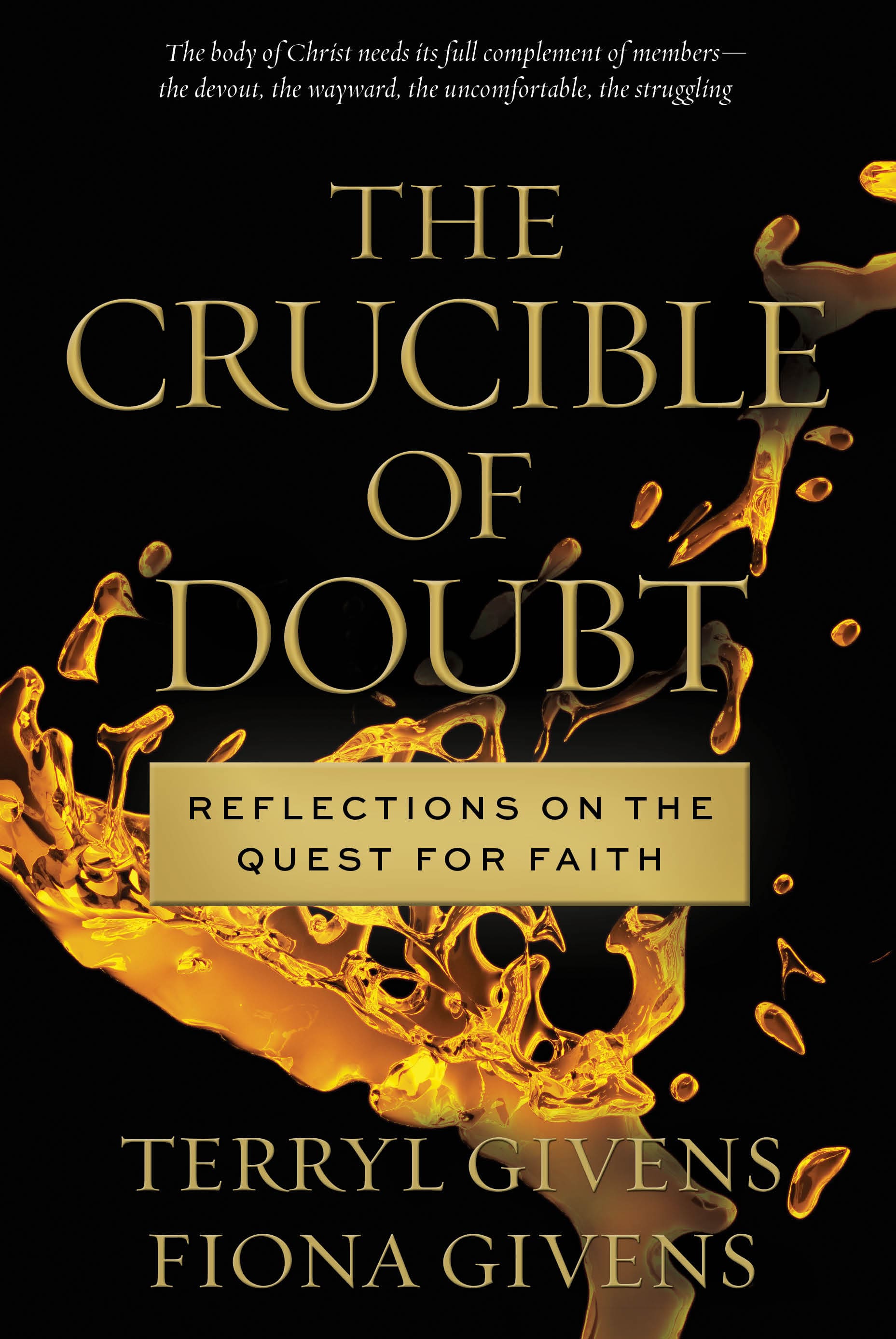
In their latest book, The Crucible of Doubt, published by Deseret Book, Fiona and Terryl Givens tackle perhaps their most daunting — and important — subject to date: doubt in the context of Mormon faith.
- In Part 1, we interview a Mormon Stories listener and contributor, James Patterson, about his struggles with doubt and how the book helped him.
- In Part 2, Terryl and Fiona take us through the book as we discuss the elements of Mormonism that cause some of the biggest doubts and how to approach them with new paradigms.
Time last night didn’t allow for a Part 3 (the a Q&A with your questions), but Terryl and Fiona expressed a willingness to do a Part 3, based on popular demand…so please let us know if you are interested. And thanks for tuning in!!!!
Episode Transcript
Host: John Dehlin · Guests: Fiona Givens, James Patterson, Terryl Givens
This transcript is machine-generated and lightly edited for readability. The audio is authoritative. Please excuse occasional errors in names and spelling.
Introduction and Donor Message
Part 1 of 2 · Ep. 495
James Patterson [00:00:00] Hi, this is James Patterson, Mormon Stories Podcast producer. Did you know that Mormon Stories relies entirely upon the support of people like you, its listeners to help keep Mormon Stories alive? Please consider becoming a monthly subscriber right now by texting the word Mormon to 41444 on your smartphone, you'll receive a text message directing you to a donation page where you can set the amount and frequency of your contribution. Again, that's the word Mormon to 41444 to donate now. You can also donate by visiting MormonStories.org and thanks for your support. The kindly light amid encircling gloom Lead thou me on. The night is dark and I am far from home. Lead thou me on.
Welcome and Guest Introductions
John Dehlin [00:00:59] Hello and welcome to another edition of Mormon Stories podcast. I'm your host, John de Lynn. It is August 27, 2014 and as usual, I am so super excited to have with us our guests for today. Two of them are repeat participants in Mormon Stories and one is new. The repeat participants are the are the amazing and gifted and talented, although I won't drop into hero worship because your book explicitly warns against that. But we have with us today Terrell Givens and Fiona Givens. We're here to talk about their new book published by Deseret Book entitled the Crucible of Reflections on the Quest for Faith. And just a brief intro about Terrell. He is a professor of literature and religion at the University of Richmond in Virginia and he's the author of several books. His books are amazing. When Souls Had Wings, Parley Pratt, the Apostle, the Apostle Paul of Mormonism, the Angel Wrestling the Angel, the Foundations of Mormon Thought by the Hand of Mormon is a fantastic book. People of Paradox. I could go on and on. Viper in the Hearth read Terrell Gibbons's books and he is of course the co author of the book that we've had them on, Terrell and Fiona, recently to discuss which is the God who Weeps. So Terrell Givens, thank you again for joining us on Mormon Stories.
Terryl Givens [00:02:28] Nice to be with you again, John. Thanks.
John Dehlin [00:02:30] And Fiona is a retired modern language teacher with degrees in French and German and a graduate degree in European History. She's an independent scholar in Mormon Studies and she's published in the journal Mormon History Exponent, two LDS Living, et cetera. Again, she is a co author of the God who Weeps, which everyone should read if they're into thoughtful, faithful Mormonism. And both Terell and Fiona are the grandparents of five, five children, which they write, are the fonts of delight. Are there grandchildren yet?
Fiona Givens [00:03:08] No, those are actually The. The grandchild.
John Dehlin [00:03:10] Okay, I'm sorry. I got it mixed up.
Fiona Givens [00:03:12] We. I don't know. Yes. We did it the wrong way around. Five grandchildren, six children. Don't want to let you know. Miss out any of the children.
John Dehlin [00:03:23] So, Fiona, welcome to Mormon Stories.
Fiona Givens [00:03:25] Thank you, John, very much. It's lovely to be here.
John Dehlin [00:03:29] And we have as a third guest on today's episode, a friend of mine. I don't know what to say, James, other than say that James Patterson has. Has been sort of a real substantive supporter of Mormon Stories over the past several months. And we're going to be digging into James's story sort of in the first hour. So, James, welcome to Mormon Stories.
James Patterson [00:03:58] Thank you. Thanks for having me. And it's great to be with all of you.
John Dehlin [00:04:02] And I'll just say that. So I'll tell a little bit of a story, and then I'll explain what the format's going to be for today, and then we're going to dive in. So several months ago, and James, you can correct me if I'm retelling the story wrong, but several months ago, I started receiving, you know, private messages from James. And one day it would be sort of like, john, I'm really struggling. I really have a hard time. And then another day it would be like, hey, John, I think I got it all figured out. And then a couple. And I'd say, well, good for you if that's true. You know, my experience is it takes a little longer than four weeks to figure everything out, but if you've got it, I'm happy for you. And then, you know, maybe a month later, James would come back and say, whoa, I'm really struggling again. And then he learned that Terrell and Fiona were working on a book called the Crucible of Doubt. And so he was so motivated and excited about this book that he said, hey, John, let's make a deal. If I can reach out to the Givens and get them to come on Mormon Stories to talk about their book, you know, is that all right? And I'm like, sure. So James read the book, and not to say that anyone's journey is ever finished, of course, so we're not going to set James up for that, but James did read the the Crucible of Doubt from start to finish. And I'd say less than 24 hours or maybe 48. James, is that true?
James Patterson [00:05:31] Yeah, it's about 48 hours.
John Dehlin [00:05:32] Yeah. And by the end, he felt like it was really a turning point for him. So. So what we're going to do is we're going to start. So we thought it'd be cool not just to cover this book in the standard way, but instead to have James tell a little bit about his story, to kind of, to kind of represent the modern struggles that people have in 2014 a little bit. Then we're going to talk about, have James talk about kind of his finding of the book. And then we're going to pause. We're not going to have them talk too much about the book. Then we're going to bring Terrell and Fiona on and they are going to talk about the book itself and we're going to cover some of the main points that they are trying to convey in the second hour. It's going to be kind of a Q and A. And and this has been one of the most active sort of question postings that I've ever had on Mormon stories. Probably up to 90 or more really substantive questions. Generally respectful. I didn't see a lot of really mean spirited or disrespectful questions there, but I doubt we'll be able to get to all the questions, but I'm hoping that we'll be able to tackle many of them. And so with that, James, why don't you dig in and tell us a bit about your Mormon story as it relates to this book.
James Patterson's Mormon Upbringing
James Patterson [00:06:53] Sure. So, I mean, you know, backing up all the way. I had a pretty average Mormon upbringing. I mean, I was born into a Mormon family. My dad's family was converted when he was a kid. My mom was actually adopted and her adopted family comes from pioneer stock. She would tell us stories of one of the pioneers, apparently relatively famous, maybe like a Bee lister pioneer by the name of Pleasant Green Taylor. I knew he was a B lister because when I was on my mission, I actually found out that somebody I was teaching was related to him and found out that it was a relatively common pioneer. But so I remember going to church since I was a little kid. I've never not known all of the primary songs. I've never not known most of the hymns. And I just kind of grew up relatively what I would think is a relatively average, normal upbringing in the church. I was very active as a youth. I was deacons, quorum, president. My mom taught seminary. I grew up in North Carolina. So, you know, all of my friends for the most part were Mormon. We kind of stuck together because that was kind of what you did in our area. There was some, a little bit of anti Mormon sentiment in our school. There's a big Baptist church just down the road. A lot of kids active in the Baptist church, and they would have these monthly rallies or youth rallies where the preacher would preach supposedly anti Mormon doctrine. So I'd get questions from kids at school, and we'd just all kind of band together. We hung out on weekends, the guys from Young Men's and whatnot. So. So, I mean, it was really a formative time for me in my youth, you know, banded together with people who kind of thought and felt the same way that I did. So I kind of had what I guess you would call it kind of a. It was kind of a Peter priesthood. That was the term that some people would use. I mean, skipping school was about the worst thing I did when growing up, and I felt guilty for that. But I just grew up with a love and a reverence for the gospel, for the church, and for the prophet. I always thought President Hinckley was a bit stodgy when he was a counselor. But then when he became prophet, I remember, it's like in my eyes, he became this whole different person. I felt like I knew him and he was always speaking to me. I actually went to the Raleigh Temple dedication, and I was sitting maybe 15ft from him, and I had this really profound spiritual experience. And I had those growing up as a youth, these spiritual experiences that led me through the church and, you know, kind of led to my testimony. But I also grew up with a very inquisitive personality. My mom calls it argumentative. I choose to call it inquisitive. So I search the scriptures more than I think probably most kids my age did. And searching the scriptures combined with these questions that I would get from kids at school is kind of where, you know, vernacular that we use. And building a shelf. That's probably where my shelf started. Although I guess looking back, I don't think I realized I was. I was building a shelf at the time, but I was. I was putting these things on the shelf that I couldn't quite figure out. You know, there was like, you know, one of my questions growing up, I remember was, you know, Alma in the Book of Mormon, you know, where did he get his authority from? Because it doesn't say that he, you know, had the laying on of hands before he baptized. So, you know, there's those kind of little nitpicky questions that I had that led into some bigger questions. You know, who did he confess his sins to? If, you know, it was a very. I was examining the Book of Mormon through a very, you know, 20th century Mormonism view, which led to Some questions, but it also led me to kind of question things. And then being on my mission and getting older. I served a Spanish speaking mission in Idaho and questions would arise then. And that's where I really started to find out more details about the priesthood band. There was a beautiful, just a beautiful African American couple in my ward growing up. They were just absolutely the softest, kindest people you would ever meet. And they were who I would think of when I got these questions or I started reading or studying about the priesthood ban. And it just never made sense to me. But I never really talked to anyone about it. I never went out and tried to get my, my concerns resolved in a real way. So I went on a mission. And my mission really followed kind of the pattern of me growing up. I was a. I was a rule follower. I learned about obedience was a huge thing on my mission. Our mission president actually had this thing called, they call it the celestial form, where at the top of the form would list the days of the month and on the side of the form would list all of the rules that you had to follow. And you had to put a little black mark for every rule that you didn't follow. And at the end of the transfer period when you'd have your interview with the president, you'd have to give him your form. So that was a big part of growing up then in the church, learning obedience. And I was a rule follower. I really felt like success was tied to obedience. I felt like blessings were directly tied to obedience. It seems so odd now to think that, I mean, God would really tie someone else's eternal progression on whether I went to bed by 10:30 or not. But that's how we were trained. That's how I really thought. I went through a summer on my mission where this was just like, I mean, really hyper focused. I was an area leader for the first time and I was just desperate for success. It seemed like this area was ripe for right before the picking. And I mean, we sacrificed and put in more hours in this area than I've ever seen any missionary do. We split off. We were actually in a threesome companion and we split off three ways with members and put in like 120 hours a week. We didn't open our letters until P day. I mean, we did all these things that just, you know, I was trying to bind the Lord to give us baptisms and it was the least, from a baptism standpoint, it was the least fruitful three months of my mission. And I just, I couldn't for the rest of my mission. I couldn't understand that experience. It didn't make sense to me. And then I had another experience on my mission that was kind of the first chink in my armor when it came to, you know, church leadership. I had a really big, really kind of a negative experience with my mission president. I won't go into a lot of detail, but I just. I lost kind of some faith in and some trust in him for the most part. We ended up working it out, but it just kind of changed how I've. You know, I kind of put him on a pedestal and it changed my viewpoint of him and made me question some things, you know, about church leadership and whatnot. But all these things I continue to just kind of put on the shelf. And so I got off a mission and I went to BYU Idaho. And the decision to do that was another one of. I don't consider myself a very spiritual person. Meaning I don't have. I don't regularly have, like, you know, any sort of profound spiritual experiences. I would say that I feel. Feel the spirit on a relatively regular occasion. But, I mean, I've never had a real profound spiritual experience. But when I. The decision to go to BYU Idaho was probably one of the exceptions. I just. There was just something that told me that that was the right decision for me and it would lead to good things. And it was interesting because that coincided. I had a phone call with my mission president. I was just checking in with him. He was asking how life was, and he was asking me where I was going to apply to school. And I told him I have some options around home. And I wasn't planning at all on going to BYU Idaho, not at all, because I just spent the last two years there. And I wanted to stay in North Carolina. When he suggested that I apply there, just had this. I can't even really describe it. It was just this wave of spiritual light or truth that just told me that's where I should go. It was a completely different experience than I've ever had. And BYU Idaho actually ended up being a really, really good experience for me for a lot of reasons. I mean, I'm. You know, I met my wife there. That's kind of what launched what is now, you know, my career as a writer and in advertising and marketing. It all kind of the genesis of that was at byu. So I'm definitely grateful for that experience. And that's really where I started into. I was on the student newspaper. And for the first time in my life, I was able to, you Know, what I couldn't do on the mission was kind of step outside myself and kind of test certain boundaries. Not when it came to, like, obedience, but when it came to critical thinking. And so that's kind of what I did. I was actually an opinion writer for the newspaper. And so I would just kind of take observation of things I saw around campus and I would write columns about it. And kind of the way my columns tended to be written were from kind of poking the Mormon bubble a bit. That's kind of the bent that my columns tend to take. I would talk about the honor code, and one of the things that always was curious to me was how the honor code at BYU Idaho is different from the honor code at byu. You know, you could wear shorts at byu, you can't wear shorts at BYU Idaho. So I started poking that bubble a little bit. I started around.
Attending BYU-Idaho and Early Faith Questions
John Dehlin [00:17:38] What year was this, James?
James Patterson [00:17:39] I started at BYU Idaho in 2003.
John Dehlin [00:17:43] Okay. And who was president at the time?
James Patterson [00:17:46] Elder Bednar.
John Dehlin [00:17:47] Okay. Okay. Yeah, Just making sure.
James Patterson [00:17:48] Yeah. So I was kind of poking all sorts of little bears around campus, like honor code and curfew, the activities program. Because BYU Idaho doesn't have sports like byu, they have kind of a glorified intramural program. And devotional was another thing. And just these kind of things that I was. I was just kind of poking this. This Mormon bubble a little bit. It was very kind of a high profile experience because a lot of students on campus read the newspaper and we got a lot of letters to the editor. Some really good and some people kind of. It resonated with. And other people, you know, they really had a hard time with it. You know, I tried to be. I tried to be a balance of, you know, providing good information, but also to be entertaining. One of my favorite columns I wrote was a very satirical column called how to Keep youp Super Bowl Sunday Holy. I've had a lot of fun with it, but some people took it. I mean, it was a completely satire column, but some people took it absolutely seriously and wrote it in letters to the editor, wondering why I would dare suggest some of the things I was suggesting. So it was just interesting in those ways that I was just kind of trying to poke at that.
John Dehlin [00:19:04] Yeah, you know, BYU has this long tradition of like the 7th East Press and then Student Review. And I've always wondered if BYU Idaho had anything even similar. Sounds like you were trying to play that role.
James Patterson [00:19:16] Yeah, yeah. We didn't really have any kind of underground thing. And so, yeah, it was, you know, me And a couple other writers that were trying to kind of, which we were trying to, I mean, push the boundaries a little bit and see what kind of things we could talk about and what kind of reactions we would get. For the most part, I mean, there was never any. I never ran into any problems with anything I wrote. With one exception, there was. So there's a. To make a long story short, there was a curfew policy that got changed during the time I was there. And it was a really complicated situation. But in essence, the student life office announced that they were going to be changing curfew. And all the students, I think they were going to be extending curfew by an hour.
John Dehlin [00:20:10] Okay.
James Patterson [00:20:11] But I don't know if they do this at byu, but there's also a guys out, girls out rule where, you know, an hour before curfew, girls have to be out of guys apartments and vice versa. And so when they published the actual pamphlet and the information, the press release and everything to announce the new curfew, you know, they said, I think they were extending curfew from 11 to 12. They actually said that they, you know, however was written, made it seem like guys out, girls out was not moving. So now there was going to be a two hour period in between when guys had to be out of girls apartments and vice versa, and when curfew was. And a lot of students were actually kind of up in arms about it because they felt like it was kind of putting, you know, some kids were going to see it as a situation where, well, you can't be in each other's apartments and you don't have to go home yet. So being Rexburg, Idaho, people were worried that some people were going to go park or go to dark places and do things they shouldn't. And so there was a lot of chatter around campus about it. And so I did what I usually do and I decided to write a column about it. And I criticized the administration, saying this new curfew policy was either poorly communicated or it was not very well thought out. And, you know, I think students would just kind of like to know which one it is. And a couple days later I got called into the office of the dean of student life was a great, great man. His name is Jim Gee. He's been a mission president. He's an amazing man. And I was told that administration. And it was, it was made pretty clear to me that by administration he meant that at the time, President Bednar was not happy with my column. And so I kind of got a little Bit of, you know, a little bit of a slap on the wrist for that. And then about. I don't know if it was six months after that or a year after that. That's when Elder Bednar was called as an apostle. And so I was kind of like, whoa, this guy just called to be apostle? And I kind of called him out in public. And it was kind of a. A weird, interesting experience for me. And I was at the press conference when he was called to be an apostle, and I got to ask him a few questions. And just kind of those interactions were really interesting, but kind of indicative of my time at school and how I started kind of poking the bear, as it were, a little bit. I started to get outside my shell and start questioning things more. That's kind of what college represented for me. So I got married in our senior year of college. We graduated, we moved to the East Coast. We lived in New York for a few months, did internships, and then we moved to D.C. and so I got. So, I mean, it's quite a culture shock to go from Rexburg, Idaho to Manhattan and living in New York and living in D.C. and, you know, working. Working here in this area. It kind of, you know, in the sense of meeting new people who weren't Mormon, it kind of, you know, opened my eyes to a lot of things. It was a great, great time in our lives. We were, you know, we didn't have kids and we were working and just enjoying the city. And this is actually around. I believe this is around the same time that things with Proposition 8 were kind of heating up. So I started to really develop this kind of internal turmoil. About the same time, a friend who we'd gone to school with came out as gay. And I had friends and co workers who I worked with who were openly gay. And it just started to become very, very difficult for this equation that I had put together in my head in regards to the church and, you know, the issue of homosexuality, it started to not compute anymore because I was actually starting. I was actually being exposed to, you know, real people in my life who were gay. And that's. That's when it really started to get kind of difficult for me. And. But I tried to put that on the shelf as well and just trust that, you know, God's going to figure it all out. And then we moved back to Idaho for work reasons, and I got called eventually into a bishopric where I served for several years. And that was another, you know, it was a great experience. It was a very hard experience. There's a lot of things that I learned. It's, it's. It was uplifting at times, but it was also very, very difficult at times. And it was. I almost liken it to. I mean, it wasn't all like this, but it's kind of like, you know, the thing about, you know, working at a sausage factory, you know, I got to see kind of the. More of the inner workings of what it takes to really run the church on a local level for the first time. And there were both positive and negative aspects to that. And then just after that, we moved back to D.C. which is where we are now. So we've kind of been hopping back and forth. And when we moved back here, I was called a seminary teacher. And that calling really, I was really at a weird, stagnant place in regards to the church and my testimony. I viewed moving back here and being out of the bishopric as kind of an opportunity for me to kind of take a break from thinking about all these hard things and kind of clear my mind. And I wasn't planning on going inactive or anything, but, I mean, I just had a lot of my mind and things were just hard for me. And then I. So that was my plan. And then I got called to be a seminary teacher. So that was actually a good experience because I got to work with the youth, which was great. And I actually tried to really sincerely dive into the scriptures and learn new things. But as I studied, it was just this last December. I don't remember what I was studying or what I was looking up, but I. I happened to come across the church's new essay that came out in December on the priesthood ban and blacks in the priesthood. And it was just this really weird thing where reading that, and especially the last section of that, where the church completely disavowed the teachings of past, essentially past prophets about the priesthood ban and about, you know, racist statements that. That past leaders have made. It was just like this. This singular moment where everything just came kind of came crashing down my shelf, just completely crashed because I just started to realize that even, you know, up to the very top, this kind of experience that I had with my mission president, you know, I was like, oh, you know, nobody's safe. You know, it goes all the way up to the very top. Everyone can make mistakes. And what does that mean for everything? I suddenly realized the prophets had been wrong. That means everything could be wrong. And just over the course of several weeks, everything just started to completely unravel, and I felt like I was in a complete free fall.
John Dehlin [00:27:46] You're not the first person to tell me that the church's new essays, which, by and large, for me, I'm grateful for and excited about. You're not the first to tell me that. That those were actually the impetus to a faith crisis, which is, you know, unfortunate and interesting and probably natural, too. Terrell and Fiona, have either of you heard similar stories around that or not?
Terryl Givens [00:28:12] Well, we've heard that there are some of the more conservative and orthodox membership of the church who have been deeply offended and disappointed in those essays.
James Patterson [00:28:24] Yes.
John Dehlin [00:28:25] Okay. So for you, it's been more. The More the orthodox you've heard.
Terryl Givens [00:28:29] Yeah.
John Dehlin [00:28:30] Yeah. Because if they sort of say, hey, the brethren were wrong in the past, or they're kind of maybe viewed as giving up some ground a little bit, and that might make some of the more conservative folk uncomfortable. Is that.
Terryl Givens [00:28:43] Yeah, I think so. And because it represents a kind of flexibility on the part of the Church, a kind of accommodation to historical research and recent developments that some people see as a kind of cowardly movement away from core positions, which I think is a pretty poor interpretation.
John Dehlin [00:29:03] Right. And we'll. Yeah, we'll definitely get to that. Anything to add, Fiona, or.
Fiona Givens [00:29:09] No, but I do. I do agree that some people on both sides are finding the essays disconcerting, but I think that's a good thing. Yeah, disequilibrium is actually a good thing. We need more people thinking more. More intensely about these issues. And disequilibrium is not bad.
John Dehlin [00:29:30] Right, right. And it's just natural. The church couldn't make any move without, you know, people being happy and mad at the same time.
Fiona Givens [00:29:37] So true. Absolutely.
James Patterson's Faith Crisis Unfolds
John Dehlin [00:29:39] All right, James, back to you.
James Patterson [00:29:40] Yeah. And I. I guess I wouldn't say. I mean, the essay itself itself didn't make me angry or upset. I mean, the words themselves, it was, you know, is the realization that they brought me to that was just really troubling for me. And this all happened over the course of Christmas break. You know, we were on break from seminary, and I'm just in a whirlwind about literally, you know, everything, and I just had no idea what to do. And seminary was starting back up the next Monday, and I just was. I was at a point where I didn't know what to do. And so I just. I mean, I emailed the bishop the night before seminary was to start, and I just told him, I don't think I can teach seminary anymore. And he was concerned, and, you know, he wanted. We met later about it, and that went okay. But, I mean, I had to abruptly stop teaching seminary because, I mean, I got to a point where I just had to completely deconstruct everything and I mean everything about. About what I believed. So I just went through this process of where I just kind of threw. I mean, I threw everything out that I. That I thought I knew.
John Dehlin [00:31:03] Did he release you? Did you just say yes?
James Patterson [00:31:06] I asked to be released, so I said, I'm not going to be able to teach you anymore. It was a really awkward situation because we had two other teachers that we were coordinating with. But I said, I know this is awkward, I know this is frustrating, and I apologize to the other teachers, but I just can't. I can't do this and I really need to be released. And it was really awkward and frustrating.
John Dehlin [00:31:23] Yeah, I know you know this, but my crisis of faith started in around 2002, in my second year of teaching seminary. And I actually too had to step down halfway through the year. So that's a. That's kind of an interesting coincidence because I had the same experience.
James Patterson [00:31:40] Yeah, I was like, I was down to the wire and it was like, either I wake up tomorrow morning and I teach this stuff that I'm really not sure that I believe, or I have to do this awkward, you know, hard thing and just step down. And that's what I decided to do because I had no idea what I would even say to my students the next morning. So I was released from seminary and I just kind of went through this. I think it was like a two or three week period where I just kind of deconstructed everything and I. I just, I started to just try to examine what in my life that I knew was true. Because that's where I realized I was at the point where I don't know that the Book of Mormon is true in the sense that, you know, it's a real. I mean, it's a real book about real people. I've, you know, I've never met Nephi or Lehi. I wasn't there in the sacred grove when Joseph had his first vision. So I can't say that I, you know, I used to say in my testimony, I know that Joseph saw what he said he saw, but I can't say that anymore because I don't. I wasn't there. And I started to just do that about everything, everything about my testimony. And I just broke it all down. And I started to say to myself, okay, what do I know? And I just, I kind of marinated in that question for like two weeks. What is it? I know. And what it came down to was I actually remember the moment I was sitting on the bench waiting for the bus, and it was this beautiful, crisp winter morning, and there were not really a lot of people around, and there were leaves rustling. And I was sitting there just thinking about this question, what do I know? And this overwhelming feeling of just. I can't even put a word on it. It's love, it's compassion, it's warmth, its kindness just washed over me. And I knew at that moment that there. That's what I know. I know that there is this essence, this something, you know, call it whatever you want, call it divine nature that exists in the universe that I can't deny, because when I tap into it, it's real and I can feel it. And that's the feeling that I feel for my family. It's this real thing. So I was like, I know that that exists because I can feel it. And I know that I love my family above anything, but other than that, I don't really. I don't really know anything. And so it was like, what do I know? And then I started to make kind of a new category. What do I. What do I believe or what do I hope for? Because, like, there's some things that I just. I are probably just not knowable. And that's where I kind of put a lot of the things about the church in respect to. That's where I put God. I don't know that he's real, but I hope that he is. And I know that when I think about him in that way, I feel that feeling of love and everything else just kind of became kind of periphery in a way. And I just kind of. When I came to that. That belief or that, you know, choosing to hope in God that the world doesn't. To me personally, the world doesn't make sense without some sort of divine interceptor or plan or purpose. This belief in God and Jesus Christ, the world just doesn't make sense to me personally without those. And so I kind of put that in the belief, in the hope box. And I just kind of sat with that for a couple more weeks. And I just felt so different. I felt alive in a different way. I viewed people differently. I viewed my family differently. I feel like I started expressing love in a more unique way. And, you know, silly, stupid things, like, I tend to be a little aggressive when I drive. You know, you can ask my wife. But I started to notice that, you know, when someone would cut me off, whereas before, I'd be like, you know, I get it back or honk at him, let them know that I'm really mad. And now it's just this very natural, you know. Yes, absolutely, sir. You must be in a big hurry. Something must be going on in your life. Please, you know, take the spot in front of me. I'll happily break for you. But it was a real tangible, like, change in my heart that happened and that. I mean, it wasn't, you know, it sounds funny saying it, but that was, it was real. And I still try to kind of tap into that.
John Dehlin [00:36:13] And it's lasted, huh?
James Patterson [00:36:15] I mean, it ebbs and flows for sure, but I just swam in that it was like this two week period where that just flowed through me with this intensity that I'd never. I mean, I never felt anything like that on my mission, which is, you know, logically to me that would be the place where you would feel it. But I didn't. I mean, it happened through kind of my shelf breaking is where that kind of deconstructed and turned into that. And then kind of life got, got back in the way. I mean, I was back at work and I ended up meeting with my bishop. And that was not the best experience, meeting with him, because he wanted to know, you know, he wanted to know if there was something that, you know, I was unworthy to teach seminary. And so he wanted to meet with me. And, you know, I was at a point where I was, you know, a little frustrated with some, some stuff with the church. And so I kind of, I didn't unload on him, but I, you know, I let him. I wasn't, I didn't beat around the bush about the stuff or the reasons that I stopped teaching seminary. And he, you know, he handled it like probably most people would, but it just wasn't in the most loving way that I would have loved. And so that was hard. And that kind of made it frustrating to go to church. And that kind of wasn't that specific experience that kind of launched me into. But I just naturally kind of, as I studied more and started thinking about things more, I kind of left this kind of spiritual high that I was on. And I entered kind of what I call the anger phase, where I was just angry, you know, I was angry because the picture that I had in my mind of Joseph Smith growing up was not the picture I was learning about.
John Dehlin [00:38:01] Hey, James.
Fiona Givens [00:38:02] Yeah.
John Dehlin [00:38:05] How did you learn about the race and the priesthood essay and to what extent did sort of involvement on the Mormon Internet, with blogs or podcasts or Facebook or Whatever influence, you know, what led to that December kind of event.
James Patterson [00:38:21] Sure. I. The only interaction I really had with the. I mean, you know, the Mormon blogosphere would be, I. I read by common consent on a semi regular basis, meaning I would. I would kind of check a post here or there every maybe few weeks, but I was not a regular reader.
John Dehlin [00:38:42] How'd you. How did you learn it by common consent? I'm just curious.
James Patterson [00:38:44] I don't. I don't remember. It's probably. It was probably through a friend or through social media. I honestly don't.
John Dehlin [00:38:50] Okay, that's fine.
James Patterson [00:38:50] I don't remember.
Terryl Givens [00:38:51] Okay.
John Dehlin [00:38:52] So no Mormon stories at this point?
James Patterson [00:38:54] No, no, I had not heard of anything about Mormon stories.
John Dehlin [00:38:57] Okay.
James Patterson [00:38:58] And I came across the essay. I believe it was on Facebook. Somebody had shared something about it, and I clicked on it. And it was a night while I was studying for seminary. And I was like, oh, this is interesting, because it's a topic that I had always wondered about and the church is actively talking about it. So I thought I'd read it. And that's kind of where it all started. And so, you know, furiously searching and googling and reading. After that happened, after my shelf kind of broke and after I was down off this spiritual high, that's when I just. I mean, I tore up the Internet looking for information. And I had always. I'd always. On my mission growing up, I'd always tried to distance myself from what I thought of as anti Mormon materials. And so I was very keen on trying to go to read about from safe sources and stuff. I wanted to hear from active members of the church and stuff like that. And that's, I think, about the time I stumbled on. I think it was your interview with Richard Bushman. And I listened to that and I was like, whoa. I mean, some of the stuff that I heard on there that I had never heard about before, like, you know, polyandry. And I had heard some of the stuff about Joseph Smith and his involvement with magic and peep stones, but I didn't actually think that a lot of that stuff was actually true. I thought it was just anti Mormon stuff that, you know, anti Mormon people put out. And so I kind of. I would. I would always push it off. But to hear an active member of the church who was a patriarch and a former stake president talk about these things as, you know, factual realities was just. That's kind of, you know, what kind of opened my eyes and in a way made me kind of angry and frustrated. And so I just kind of. I Just jumped in with both feet, my whole body into reading everything I could.
John Dehlin [00:40:56] I don't mean to keep drawing parallels, but I can distinctly remember reading Joseph Smith and the beginnings of Early Mormonism, which was before Rust Unrolling was published. And I had read Fawn Brody. I had read, you know, Grant Palmer all before, but. But just like you here, reading it from someone who had been a Stake president, a patriarch and confer, it wasn't that his book was. Was gnarlier or more controversial. I had read the tougher stuff elsewhere. But having someone from the inside confirm it. Right. Really, really shook me. Maybe even more than Fawn Brody's book did, which I was surprised about because, you know, he's. He's still, you know, obviously Richard Bushman and is still faithful to this day. But, yeah, that I had the same experience. So.
James Patterson [00:41:45] And I think it was because I could always. I could always rely on putting that anti Mormon stamp on stuff that I heard about. You know, that was always my fail safe. Okay, I'm just, I'm gonna stamp this as anti Mormon.
John Dehlin [00:41:56] It's suspect. It's suspect, exactly. Because it comes from an apostate source. Right.
James Patterson [00:42:00] So I'm gonna stamp that and then put it on the shelf. And it's fine on the shelf because it's stamped with anti Mormon. So to hear that was. I mean, it was like this. Okay, I have to examine this in a completely different way than I was before. And so, I mean, I really kind of went through a little bit. I mean, not directly, but like this. You know, the stages of grief. I was. Sometimes I would be bitter, sometimes I would just be in denial about it. Sometimes it really, really scared me. And, you know, sometimes it made me really angry. So I went through all these different emotions with it. So, you know, and it started in a way to, you know, affect, you know, life at home. I had trouble going to church, feeling motivated to go to church, because I really know where everything was at. And I was angry and frustrated at the church. And, you know, the only thing I knew at the time was that, you know, I love my family. I wanted that no matter what happened, I wanted to just, you know, keep our family together. And, you know, we, you know, we had a lot of long hard talks, me and my wife and trying to work through everything. And I just got to a point where the more I learned, the more frustrated I got. But I started to feel like it was the most frustrating thing for me was that it felt almost impossible that I was going to be able to live an authentic life within the church. And that's when I started to really get sad. I guess I started to get really frustrated and bitter about little things like were primary teachers and, you know, part of the primary curriculum this year is they're teaching about the proclamation to the family. And, you know, in primary they have, you know, how the children stand up at the end of primary and they'll give a scripture. And one Sunday I was sitting in primary and the scripture was a quote from the proclamation. And I was incensed. I got up and walked out. I was so frustrated because, you know, technically the proclamation to the family is not to canonize scripture. And I shot off an email to the bishop and I was, you know, was very frustrated about it. You know, he, by that, by this point, had just kind of, you know, kind of had enough of. Of me and my rantings. And so he kind of brushed me off. And so I sent an email off to the stake president because I was bound and determined to rid our stake of this, you know, corrupt curriculum. And he actually was incredibly gracious. And he asked me to his office and we had like a two and a half hour conversation about tons of stuff. And he, you know, I walked out of there not seeing eye to eye with him at all. But he just. He was able to talk to me in a way that made me feel loved and accepted and like I was welcome. And so that. That helped a lot. But I still was just. I was just in a very strange place. I just felt heartbroken. I remember one Sunday, I was just sitting right in the middle of the chapel, in the middle of testimony meeting, thinking to myself, I can't bear my testimony. For the first time in my life, I feel like I can't bear my testimony. And I just started to sob because that was a feeling I'd never felt before. I could always stand up and feel confident bearing my testimony. And here I was in the middle of church and I couldn't do that. And it was like. It was like a part of my identity had been taken away from me. And it was this point where I was just voraciously reading everything I could find that I came across an essay that Terrell wrote called Letters to a Doubter. And it really, really resonated with me, some of the points that you made in there. And I'm nothing if not persistent. And so I found Terrell's email and I shot an email to him I enjoy communicating with. So I shot off an email to him. I said, I just want to let you Know that, that really, really resonated with me and that kind of led me to John, your interview with him. It was like a five part interview where you guys just tackled pretty much everything. I mean, it was amazing. I have an hour, you know, over an hour commute every day to work, so I can blow through some podcasts. And so I listened to that one over the course of only like two or three days.
Terryl and Fiona Givens on Doubt and Disillusionment
John Dehlin [00:46:27] And Terrell, I should just tell you that people to this day tell me that they sometimes listen to an interview four or five times a year, just. Oh yeah, as a continual rejuvenator of their faith.
Terryl Givens [00:46:38] So, so that's nice to hear. Oh, I should probably listen to it some.
James Patterson [00:46:46] There was a, there was a spot right in the middle of that, that podcast where Terrell talks about this kind of concept of belief as a choice. And I just, it was, it was, this just resonated with me so, so much in the, in the context of what it, you know, it was a discussion about the Book of Mormon. And I started to realize that concept just started to really resonate with me and it started to really help me put together some of the pieces that had been broken. And that's probably one of the occasions, John, where I, you know, I shot off a message to her like, I'm feeling really good, you know, yada, yada, yada. But then, you know, something else would, would inevitably happen. I came to a point where I had solved. I hadn't solved, but I had come to a place where I felt, I felt more comfortable with some of the, you know, historicity issues because of that podcast with Terrell. But I hadn't really solved some of the modern day kind of frustrations that I had with the church and modern revelation and stuff like that. So I was kind of going through a very up and down period as you talked about. But that podcast is one of the things that really resonated with me. And so I shot off an email to Terrell and we started corresponding back and forth a little bit. But then I had one week. For some reason, I don't remember what it was, but I just had a very, very bad week at church. It seems like it would be every other week. One week would be a really good week and I'd feel like, I can really make this work. This is, you know, I'm okay. And then the next week something would happen that would kind of trigger me and I would just feel like I couldn't go back. And there was this one week where I just. One of the Worst, I felt like, I literally felt physically like I was in a straight jacket. I felt constricted. I felt this anxiety, like I didn't fit in, I didn't belong. And it just, I, I was trying to fit into something that didn't fit. And it was that same week that news about the disciplinary action against Kate Kelly and you, John, came out. So it was the very week after I had had that experience at church. So I was all that put together. I was just extremely angry. And I had already scheduled a meeting with my bishop because we'd just gotten a new bishop. Our bishop moved and I wanted to, I wanted to meet our new bishop and kind of talk to him. And I was sitting in the, I was sitting in the hall waiting for the bishop and the stake president ended up showing up. And so he was like, I'm going to meet with the bishop. And I was like, I am too. You know, would you mind sitting in? Because I'd had a really good experience with him and I was really frustrated at this point. So I really wanted to talk to somebody who understood and I didn't want to unload this completely on my brand new bishop who had been literally only called a couple weeks. So I asked the stake presence to sit in and we had another two hour conversation about everything. And I told him that I had gotten to the point during that week because of everything that was going on with John and Kate and how I was feeling about things that I told him that I didn't know if I could stay in the church. I was legitimately considering resigning my membership and I wanted to know, you know, if they had any thoughts or anything. And it was a, it was a, it was a pretty good conversation. They, you know, they, they, you know, we talked about things and you know, they weren't able to necessarily resolve my concerns, but my new bishop was just so unbelievably loving and compassionate toward me and has, is every time I interact with him that he just, he just made me feel a lot better from that standpoint. And so I told him, you know, I'm not going to make any rash decisions, but I just want to let you know that this is really on my mind and I'm really struggling. And all this was also happening as I was kind of corresponding back and forth with Taro because he told me about his new book that was coming out that was going to kind of be kind of based on or kind of the same theme as the Letter to a Doubter. And that really piqued my interest Because I was looking, you know, I was trying to soak up as much tarot gibbon stuff as I could because it always really helped. And so we started a conversation like you talked about earlier, John. It was just kind of like I was corresponding with Terrell and I was corresponding with you, John. And it was just kind of like this thing where when that book comes out, there should be a. You should do a podcast about that, John. And then I started kind of insert myself. And so. But in corresponding with Terrell, he actually. I was able to view an advanced copy of it. So this was about. Probably all of this happened that I've been talking about over the course of the last six or seven months. And about a month ago, a little over a month ago, he sent me an advanced copy of the book, and I just devoured it within about 48 hours. I mean, I had to sleep and I had to eat, so it took me a little longer, but it's just. Just the way he was able to.
John Dehlin [00:51:59] And Fiona.
James Patterson [00:52:00] Yes, and Fiona, too, absolutely. I apologize. The way. I mean, I've always been just mesmerized by the way both of them frame their outlook on the church, both from kind of a philosophical standpoint. And I just. I'm mesmerized by. It's kind of this poetic feeling that I get. And I'm always mesmerized by Fiona's accent, too. So it's kind of this siren song that draws me in. So, I mean, I listen to the podcast. I listened to the one about the God who weeps. I read this book, and so I just couldn't get enough. So I read this book, and the way that they talked about things and framed things helped me just get a new outlook on things. And it just lifted a huge weight off my shoulder. And we'll talk about this probably a little bit later, but it changed my paradigm of the way I viewed a lot of things. You know, I was expecting certain things out of the church and its leaders and its history that had shaped my outlook. And once I let go of that and of the way I had grown up looking at the church, my outlook completely changed on everything. And that analogy, or the concept of the paradigm shift just really resonated with me. And as I was willing to let go of my previous paradigms, that's when things. You know, I absolutely wouldn't say that I have things figured out by any means, because now I'm at a point where I feel like there's a lot of things that just aren't Necessarily knowable. So I haven't yet, nor will I ever arrive anywhere. But I'm just able to examine things in a whole different way. That just makes more sense for me. And literally since I read that book, I mean, I haven't had a bad day at church. I enjoy teaching primary, although some things still kind of stick in my craw bit. I don't love the whole teaching that the proclamation is scripture because technically it isn't. But I don't let that, you know, ruin my whole church experience. And so the last month has been really just different. A great uplifting departure from where I've been the last six or seven months.
John Dehlin [00:54:33] Well, Fiona, how's that for a one hour endorsement?
Fiona Givens [00:54:38] I thought. James, I thought your story was very beautiful and very moving. I had a question. When you were going through a faith crisis, did you feel isolated? Did you feel that you were the only one in your ward or in your friendship group who was going through this? I mean, was there a sense of isolation, that this was only happening to you and not happening to anybody else?
Isolation, Leadership, and Bearing Testimony
James Patterson [00:55:04] Yeah, absolutely. I mean, it was the point where, I mean, I couldn't talk to anyone. It took me forever to even bring this up to my wife because, I mean, there's so many implications to even suggesting that the church isn't quite what you thought it was. I mean, even getting those words out of your mouth has so much weight to it that it's just almost impossible. But it's interesting that as I started to open up my best friend, it turns out we had some conversations back and forth. Turns out that he was having some faith struggles as well. And I've come to know a lot of people in my personal life who are struggling with their faith in similar ways. So as I've reached out, I have been able to find people close to me who are going through a lot of similar things. And that has been a huge, not just a help, but a relief to know that you're not alone.
Fiona Givens [00:56:02] Right, Absolutely. I think that's probably the most awful thing is feeling absolutely on your own and that you're the only one, that you're the odd man out or the odd woman out. And it's very interesting. Terrell was asked to give. I hope this is all right, darling. Me jumping in a priesthood quorum, high priest quorum lesson in a ward, not our ward, it was in Utah. And he actually started off the lesson by saying, put your hand up if you are in faith crisis, if any member of your family is in faith crisis, or you have Friends in faith crisis. And the place was packed. There were so many high priests in it. How many were there, do you think, darling, would you estimate?
Terryl Givens [00:56:49] I don't know, 40 or 50.
Fiona Givens [00:56:50] Probably 40 or 50. Every single one of the men in that room put their hand up, except for one who then challenged Terrell at the end. But he, he had, I think there were issues there, but apart from that one person, every single person raised. And I think that is so warming, you know, to know that you're not part of, you're not on your own and you're not a minority. Because this is a very well established ward in Provo with people who had served high positions or were serving high positions. All of them obviously had been in bishopric cornings. Some of them had been mission presidents. So, yeah, I think that's probably the most important thing is to realize that you're not on your own.
James Patterson [00:57:40] Yeah. And that's why, I mean, not to. I mean, I feel like I'm just free advertising for everybody. But that's one of the reasons why Mormon stories has been such a lifeline for me, because being able to connect and communicate with other people who are going through similar things and have been, I mean, there's people who've been going through this for years and years and years and have been processing the same things has absolutely been an essential part of helping me.
Fiona Givens [00:58:10] James, I was very interested and I wonder if you could explicate a little bit your relationship to leadership and how your, your feeling about being a member of this church was either supported or not supported. And it seems to me that it started with your mission president. You describe your mission, your relationship with your mission president as sort of you, as a very rule orientated man, like to check off the boxes. Was that the primary feeling you had coming from your mission president? Were there any feelings of love that you felt emanating from him towards you as a missionary?
James Patterson [00:58:56] You know, I love my mission. I loved my mission president for the fact that he was my mission president. And I think you naturally develop a bond with your mission president. Especially as, you know, missionaries tend to put their mission president on a type of pedestal that we tend to put our leaders on. And I definitely put him on one of those. And so I have great respect for him and a love for him. But he was, he was a businessman and he was not a naturally affectionate person. I remember, you know, not physically affectionate. You know, you would have to ask him for a hug after an interview. It's one of the things I remember from My mission, he was just very, you know, down to business. He was very much about filling out the social form and getting your numbers in by 9:30 on Friday nights and things like that. That that's how, that's how I gauged my worth. You know, not in all ways, but in a lot of ways that's how I gauged my worth to him as a missionary was through those kind of things. And my interaction with him towards the end of my mission was when, I mean, I felt like I was really reaching out to him for some compassion in a very literal way, and it was not reciprocated. And that's where I just kind of got really angry and frustrated and where I kind of lost a little bit of that kind of reverence, I guess you would say, for him.
Fiona Givens [01:00:27] And then also you mentioned, as you were struggling with your faith crisis, you know, going to your bishop and then your stake president, and it seems to me that, well, describe that a little more for us, if you wouldn't mind. The meeting with your first bishop seemed to make matters worse, whereas the meeting with your stake president following that is different. Do you mind extrapolating?
James Patterson [01:00:54] Absolutely. I mean, the whole time I'm going through all this, like we talked about before, I'm feeling like I don't belong. Maybe I'm feeling like other people don't understand what I'm going through. I'm feeling, in a real way, I'm not feeling safe at church. And so, you know, when I emailed my bishop, tell him I'm not going to be able to teach seminary anymore, like I said, he wanted to meet with me to find out what was going on. And I kind of unloaded all my doubts and concerns and all the, like, real, you know, historicity problems I was dealing with. And that was really not what I was going into the meeting. I was going into the meeting to kind of get this sense of, do I, you know, can I really belong? Can I feel safe at church feeling the way I feel? Because I told him at the time, I was like, it's not like I'm not going to go and stand up at the pulpit and say all these things during fast and testimony meeting. That's, you know, that's not, that's not my intent, but I just, I just don't know if somebody like me really belongs at church feeling the way I feel. And his specific reaction was just, I mean, his, his tone was generally kind of just casual during the meeting, which I took as a little dismissive. And when I finally, you Know, we talked about a lot of stuff. We probably talked for over an hour. And then I just, you know, he was like, is there anything else you want to talk about? I just said. But I just said, well, there was just one main question that I came into this meeting with, and that was, do you think someone who feels the way I do and thinks the way I think belongs here at church? And I was expecting him to, you know, lean into me and, you know, quiet his voice and tell me how much he loved me and how much. How welcome I was. But it was kind of the opposite reaction. He sat back and he kind of threw his head up in the air and he laughed. And I was really taken aback at first, and I guess examining what he was really trying to say, it kind of makes sense because he laughed a little bit. And then he said, if, you know, of course, you know, that's. It's almost like that's a silly question to ask. And I understand what he was trying to communicate, but his, you know, the whole way and, you know, future interactions with him just made me feel just not safe. That's. That's the best way I can kind of describe it. And then. But then to kind of juxtapose that with my interactions with the Stake president and now with my new bishop, we're just. It was kind of like. It was kind of like night and day to me.
Fiona Givens [01:03:33] I thought it was also very interesting when you said in the middle of the fast and testimony meeting that you couldn't feel that you could bear your testimony and how. As I had actually misspelled it as I was writing it down, but I just realized that you couldn't. You can bear it, like, make it bear. And an authentic testimony. Because you also mentioned about being authentic.
James Patterson [01:04:01] Right.
Fiona Givens [01:04:01] An authentic testament does require some type of vulnerability. And I think we'll probably go into this. But this is something that Terrell and I talk about in the book. This. This culture of certainty we have adopted, which is really very destructive because it prohibits authentic testimony in many cases, because not all of us. I don't know how many of us can actually go to the podium and say, you know, concretely certain things. And, you know, that's. That's. That's been a great concern to Terrell and myself. When God doesn't seem to differentiate between knowledge and belief, you know, to some is given to know that Jesus is Christ, to some is given to believe on their words. And so there needs to be, I think, some room to move. So, you know, when you said that you couldn't. But that struck me as so tragic. And I just wonder how many people listening feel exactly the same way you do. But for me, I feel that there is always an element of risk and an element of courage now, particularly within this culture of certainty in which we've been swimming for so long, that we bear authentic testimony, because I don't feel that the Holy Spirit can bear witness to something that is inauthentic. But the idea of bearing, it's like baring your soul really, is now the sort of place where we need to go, where we can't just, you know, shoot off platitudes at the podium, because nobody, I think, is feeling anything with the cliches coming out. But that really struck me that we are. That we are now entering this sort of era of vulnerability where we're sort of reclaiming the idea of bearing testimony as inauthentic. I hope I believe that sort of thing. Yeah. Well, those were my two questions. Please do answer that. That would be lovely to just.
James Patterson [01:05:53] I think the. And the interesting thing for me in that moment was I was. I was sitting in, you know, testimony meeting, trying to run through my mind some way that, I mean, I could get up there. And the only way that I felt like I could even, like, boil it down to something that wouldn't be threatening to anyone or anything would be to stand up and give the classic testimony that I would usually give. I know the church is true. I know the Book of Mormon is true. I know Joseph Smith is a prophet. But replace no with believe. And I was sounding it out of my mind, and it still sounded so incredibly foreign. And I felt like if I stood up and I said, I believe the church is true. I believe that, you know, President Monson is a prophet, it would still sound so foreign that I would have so many eyes on me, and I would be so uncomfortable. And that. That thought that just changing that one word would change so much for me is what just kind of just in a way devastated me. And so I think there's a real point to that, that, you know, as I've tried to examine the way that I bore my testimony in the past, and like you said, mostly speaking in platitudes, and since my faith crisis started, I still haven't bore my testimony to church because I'm still searching for the right words to say and the right way to say it. But that feels so much more real to me to think that I want to really come up with the best words that I can find to Express how I feel about things. That feels so much more real to me than. Well, I guess, you know, I guess. I guess I should bear my testimony so I'll get up and say the same things I've said before. You know, this new way of thinking about it feels so much more real to me. And so I know when I do get up and do it, it's going to be a more uplifting, a more profound experience for me than the other times that I've done it before.
Honest Testimony and What Faith Can Look Like
Fiona Givens [01:07:49] What did you think of our friend's testimony? Non. Testimony that we have written in the book, which essentially she said, you know, I don't know anything. She's been a member of the church ever since she was a child, has had no belief in God, has struggled with all of that and stood up and essentially bore an on testimony, but then said, you know, I know when I read the scriptures, you know, the atmosphere in our home changes. Did you find. Did that resonate with you? I felt.
James Patterson [01:08:20] I read that and I remember thinking if I was sitting in testimony meeting and I heard that kind of testimony, I would stand up and I would clap. Because, I mean, I just. And it's not just from a. You know, it's a different kind of testimony to hear.
Terryl Givens [01:08:32] It's.
James Patterson [01:08:32] It's like you, like you were talking about earlier. It's this feeling of being vulnerable with your thoughts and your beliefs and sharing that with other people and being able to do that and be accepted in spite of. Maybe there's people in the audience who don't think exactly the same way you do, and yet you're still accepted. That's beautiful. To me. That's. That's what testimony meaning to me should be more about.
Fiona Givens [01:09:00] Yeah, no, I'm. I hope we're there when you obey your testimony. Please tell us. We'll drive up. But, but no, seriously, seriously, because I, you know, I want to be there for the applause because there are. There are so many people in. It's like the little girl in the math class who finally raises her answer and says to the teacher, I have no idea what you're talking about. And everybody else in the class is going, oh, thank goodness. I thought I was the only one.
James Patterson [01:09:27] You know, such a sense of bravery in that, that, that.
Fiona Givens [01:09:30] Yeah, yeah, yeah. And I think, I think, I think your congregation is full of people. I think every congregation is full of people who would just rejoice, you know, as, oh, I'm not on my own. Okay, so this is. Okay, the. I wasn't struck by lightning and the chapel didn't collapse.
John Dehlin [01:09:47] Right.
Fiona Givens [01:09:48] So, yeah. Yeah.
John Dehlin [01:09:51] Great questions, Fiona.
Fiona Givens [01:09:53] Oh, thank you.
Terryl Givens [01:09:54] Thank you.
Fiona Givens [01:09:54] John
John Dehlin [01:09:57] Terrell, any quick reaction or question regarding James's ringing endorsement?
Terryl Givens [01:10:02] No, I'm, I'm delighted to hear that. What we had to say resonated with him and I was glad to hear him focus in particular on the notion of faith is a choice because to my mind, that is kind of a master paradigm shift that at least in my life, rescued me from my own, I guess, trek through the wilderness of doubt. And I think it's an important way of rehabilitating the importance of faith in our tradition.
John Dehlin [01:10:36] Excellent. Well, James, I loved your story and I'm super excited now to, to jump into part two in just a second where we will discuss with, with Terrell and Fiona kind of the main, the main points or the main premises or foundations or pillars of their wonderful book, the Crucible of Doubt, Reflections on the quest for Faith. So stay tuned for part two.
James Patterson [01:11:06] Mormon Stories is production of the Open Stories Foundation. Music for today's episode was provided by the Lower Lights. Check out the rest of their music by visiting thelowerlights.com or on facebook@facebook.com thelowerlights. Heart, anger or mouth I draw myself apart searching my soul.
Part Two Begins: Origins of The Crucible of Doubt
Part 2 of 2 · Ep. 496
James Patterson [00:00:00] Hi, this is James Patterson, Mormon Stories podcast producer. Did you know that Mormon Stories relies entirely upon the support of people like you, its listeners to help keep Mormon Stories alive? Please consider becoming a monthly subscriber right now by texting the word Mormon to 41444 on your smartphone, you'll receive a text message directing you to a donation page where you can set the amount and frequency of your contribution. Again, that's the word Mormon to 41444 to donate now. You can also donate by visiting MormonStories.org and thanks for your support.
Terryl Givens [00:00:36] Lead kindly light, amid encircling gloom Lead thou me on. The night is dark and I am far from home Lead thou me on.
John Dehlin [00:00:56] Hello and welcome to part two of my Mormon Stories interview with Fiona and Terrell Givens about their new book, the Crucible of Reflections on the Quest for Faith, published by Deseret Book. We just finished a really wonderful hour with James Patterson, a friend of mine, kind of a newer friend of mine, who talked about his journey. And James, I would have to say that your journey really is in many ways, you know, very familiar and very typical of the things that many people face. From the, you know, the early shocks to the, you know, from the shelf to the early shocks to the, you know, to the stages of grief, to the oscillations back and forth, to the eventual rage and anger and disillusionment. I just really resonated with your story. And so if those of you haven't listened to it yet, I really recommend it. And now I would like to dive into the book the Crucible of Doubt, published by Deseret Book. And I actually want to begin before the birth of the book. Terrell, this is going to, I'm sure you're going to remember this. I remember one of the most stunning things from our interview. And our interview, I believe, was a few years ago. Does anyone know how many years ago the interview was? Terrell?
Terryl Givens [00:02:34] I've lost track.
John Dehlin [00:02:35] James?
James Patterson [00:02:35] Two or three years, I believe. It's 2012.
John Dehlin [00:02:40] Yeah, two or three years ago. And Tara, one of the, one of the things you told me that really stunned me was at the time you told me that it was your understanding that Deseret Books was not willing for some reason to stock all of your books. Do I have that story right?
Terryl Givens [00:03:00] Yeah. Yeah. The very first book, Viper on the Hearth, was rejected because they assumed by virtue of the title that it was an anti Mormon book. Right. At least that was one explanation given to me by somebody there in the corporate headquarters. And I don't know that there was any particular reason. I mean, I think Deseret just tends to stalk their own publications for the most part with a few others, but they tend not to stock a great deal of material that appeals to a more scholarly clientele. And I know that Sherry Dew has made efforts in recent years to address that deficit, so I've been very pleased to see that.
John Dehlin [00:03:44] Yeah. And I remember feeling really impressed that you. I mean, I think as a writer and, you know, your books have been published by Oxford University Press and, you know, really reputable press, I just remember thinking, wow, I would be kind of hurt and offended. And you were still sort of holding fast to the iron rod in spite of that, what would be perceived as a setback. And so.
Terryl Givens [00:04:09] Well, yeah, it did feel like a slight. It seemed rather ironic that as Mormon authors were breaking into Oxford in a significant way, that the church publisher and bookstore wasn't supporting that effort.
John Dehlin [00:04:23] Yeah. So talk to us about how that changed a little bit, and take us then to the work of the Temple Observatory Group and kind of your travels around, because I'm guessing that all of that is what led to this book. Is that true?
How Widespread Is Doubt in the Church?
Terryl Givens [00:04:41] Yeah, Well, I guess it's kind of a long, tortuous path that got us to this book. But, you know, I had conversations with Sherry Dew a few years ago at the time that they weren't carrying any of my books. And it was shortly thereafter that she approached me and asked me if I would write a book for a general audience. And as I turned to start writing the God who Weeps, I realized that most of the best ideas were coming from Fiona and that it was hard to tell where her ideas ended and mine began and vice versa. So we decided to do it as a collaboration. So we were really thrilled that Deseret was as supportive as they were of that effort, even though it took a rather unconventional approach to LDS culture and thought and belief. And it was subsequent to that book that I was invited to give a Fireside in Palo Alto. And the choice of what to speak about was left to me. And so at the time, we had various members of our own family who were struggling with faith challenges, and I had written a letter to one of them, and I decided at that point to take the letter and present it as the Fireside. And so that was where I first read in public the letter to a doubter, which had actually been written and addressed to a personal family member. And the reaction to that was so overwhelming, both at the time on site and through the Internet. And Communications we received. In days and weeks following that, I realized that this was like the great elephant in the room that nobody wanted to address was the fact that a number of recent developments having to do with open access to the archives and Internet developments, and perhaps also just the fact of a new, younger generation in the church who was less prone to accept received wisdom and traditional answers, all were precipitating a number of. I don't like to use the word faith crisis, but I'll say faith challenges that were fairly, I think, unprecedented in volume. So Fiona and I began to give firesides on the topic. And generally, once it was known that we were willing to offer these firesides, we did them by invitation. We didn't put ourselves forward, but were asked to do these by a number of local leaders throughout the British Isles. And the response was really quite phenomenal, Overwhelmingly positive. And the most common response that we got to these firesides was, thank heavens that we finally have a place and a time where we can just express honest questions and doubts and perplexity and talk about it. So it wasn't that we had any particularly good answers, but it was that we tried to create a setting in which it was appropriate and helpful to talk about these issues in a constructive way. So Fiona and I did these throughout England and Scotland and Ireland, and then we came back to the States and we invited Richard Bushman to join us in doing some stateside. And again, the reaction was, for the most part, very, very favorable. And so out of those efforts grew our decision to turn the Letter to a Doubter into a full length book, which is the crucible of doubt.
John Dehlin [00:08:20] And so did you propose it to Deseret book, or did they ask you to do it?
Terryl Givens [00:08:24] Fiona, do you remember? I think we ran it by them. Not sure that they would want to broach a subject as fraught with minefields as this one, but. But they did.
John Dehlin [00:08:36] Yeah. Okay. And, you know, one of the questions from the listeners was, did they provide any ground rules? You know, to what extent did they have a heavy hand in editing? Did the correlation committee kind of seize the book? I don't expect you to say anything that you'd be uncomfortable to say, but what are you guys able or interested in saying about those types of questions?
Terryl Givens [00:09:01] Fiona, you want to take that?
Fiona Givens [00:09:02] Yeah. No, I don't think it had to go through the board, of course, the Deseret board. I think there was some concern about whether the book would raise faith challenges, challenges to the faith, or whether they would assuage faith challenges. So I think that was a sticky wicket, but otherwise there was no heavy handedness. I worked primarily with the editor, who was a very sensitive reader and very much aware that there were two audiences that were being addressed. One was the sort of faithful membership who either don't have questions, haven't entertained questions, or who have shelved questions. And then the audience with whom we are primarily engaged is those who are really struggling. And it was just a really interesting exercise trying to coalesce the subject matter so that it would help create empathy among those who, who have no problems with their faith at all. I mean, there are people whose gift is that of faith and. But develop an empathy, hopefully, for those who are struggling and create a safe place for those within the pages of the book for those who are. So it was actually a really edifying process, I think uplifting. And the general consensus from Deseret book was that that this, this book was needed and that while a number of people working for Deseret didn't have challenges, they felt much better about their faith. In fact, one, one person with whom I talked said that she had shelved. I think we do a lot of shelving in our church. She. Well, I think actually in every faith tradition things are shelved. But she had been able to take those things off the shelf, re. Examine the puzzle and put the pieces into an order with which she was now much more comfortable than she had been. So that. And that was typical of the response we got from the leadership at Deseret. So they felt, they felt that this, it was very important that this book come out and at this time. So it's very encouraging.
John Dehlin [00:11:31] Do either of you and Fiona, your anecdote about Terrell asking the question in Hyper's group leader and having all the hands go up speaks to this. But, you know, do either you have a sense for how serious, you know, of a problem this is? I hear everything from. This is really just a very small segment of the church's population. It's within a very narrow band. Maybe, you know, maybe one or two in every ward. But, but, you know, it's, it's not as big of a deal as people want to make it. And then of course, you have other people with their histrionics basically saying that the sky is falling and the church is hemorrhaging and that everything, you know, that the church is going to not exist in 20 years. You know, I guess. Do either of you have a sense for how serious of a problem this is in the church? And you know, do we have a sense for any conversations with church leaders about the sense of gravity or non gravity, you know, involved.
Terryl Givens [00:12:36] Well, the problem is that we don't have any hard statistical evidence, and we can't because there aren't any metrics that are measurable. In other words, the only statistics that the church keeps have to in this regard have to do with how many people ask to have their names removed from the records of the church. But there's something about today's younger generation where most of these faith crises seem to be occurring that they're not going to go through that bureaucratic process of asking to have their names removed. In most cases, they will either lapse into inactivity, form parts of new communities like New Order Mormons or semi dissident communities, or marginalized groups that get together on websites and chat rooms and find solidarity with another. So there are all of these kind of underground communities that are a manifestation that there is great perplexity and engagement with faith challenges. But all evidence ultimately is going to be anecdotal. But our experience certainly convinces us that there are overwhelming number of people who are personally or indirectly affected by this.
Fiona Givens [00:13:40] I think also a lot of it is geographical. I think there's a huge, in the west, western part of the U.S. i think the numbers of people who are being challenged are big because, and particularly with this younger generation, because the Internet, social media is the way everybody connects with each other and that's how you transfer information and it comes very quickly. But also Europe, for a lot of Europeans who are also keeping touch with people and up to date on the Internet, this is an issue. So it's not just the United States and our particular ward, probably not so many. We're a rural ward in, in Central Virginia and for the most part. Well, I think, I don't think anybody in the ward has heard of the latest issues, quite honestly coming up. So, you know, I think a lot of it is geographical, but I do agree with Terrell that it is larger than we think.
John Dehlin [00:14:45] So you feel like a lot's at stake?
Fiona Givens [00:14:48] I do, Yes, I do. You know, my personal feeling is that the Lord wants as many people in his circle of influence as possible. So my feeling is that he wants that umbrella kept as wide as it possibly can be.
John Dehlin [00:15:07] Right. And you guys may or may not have information on this, but one of the most common questions I get is, do the brethren, number one, know about the issues that are causing people the doubt? Number two, do they know the extent to which this is a problem? And three, to what extent do they really get it and care versus sort of, are they kind of out of touch and maybe not really having a grasp of what's going on? And it's a tough question. It may be speculation. Feel free to just say you don't know. But I just. Listeners ask that all the time, so I thought I'd ask.
Terryl Givens [00:15:45] Oh, I think there's no question that the brethren are fully aware of and they get the seriousness of the problem. I think the evidence of this is the fact that we have the Gospel topics web pages that have come out and very directly and honestly addressed key issues in church history, that the manuals are being revised, that the Joseph Smith Papers project is proceeding apace with unprecedented openness and transparency, that they recently approved the council of 50 minutes to be published. So I think it's clear to me, at least, that these are all the church's way of responding to these developments by saying the solution is greater openness and transparency.
John Dehlin [00:16:30] Yeah. And this book is obviously evidence of that as well. Okay, so, Fiona, you talked a tiny bit about audience. I'm eager to jump into the book, but I'm just going to ask this one last question. You know, I thought about how to. How to conduct this interview. You know, I could put on my. My sort of faithful believing hat and just sort of explore. This book is just one huge celebration of awesomeness. And that's kind of what James communicated in his ringing endorsement last hour. Because if I'm wearing my sort of thoughtful, faithful believing hat, you know, I'll just say, I'll just compliment this book like, it's rich, it's powerful, it's meaningful, it's poetically written, beautiful prose. It's actually incredibly accessible from the standpoint that it's not a long read yet it's so dense with insight that you can read a chapter in literally five or ten minutes. And yet by the time you're done with this book, it feels like a game changer. So, you know, from a thoughtful, faithful perspective. The other thing I have to say is that it really is truly a groundbreaking book if you consider the publisher, if you consider our history. It is just sort of standing in the middle of the huge challenges and with. With a lot of grace and power and wisdom and insight. It's. It's taking the issues head on. It's not some expose. It's not going into detail on the problems. But I don't think that's neither necessary or the point of the book. But I. I say all those things to say that for those, you know, for the. For those who are wanting to believe and for those who are trying to find a way to hang on, I think it's a groundbreaking masterpiece.
Fiona Givens [00:18:37] John, I just want to interrupt you. That was so kind of you. Thank you so much. And I know I'm speaking for Terrell as well. That was just such a beautiful thing to say. We felt that we were taking a risk with this book because we do feel that we are tackling head on issues that are disconcerting. And so to have your endorsement as well as James is is really absolutely, quite marvelous. You've been so kind. Thank you. Thank you very much.
John Dehlin [00:19:13] My pleasure. And it's. And it's well earned. Now, my. My praise. I mean, now, now I am going to ask a question about the audience because I think you both probably know as well as I do that there's a group of. We'll just say, you know, struggling Mormons or post Mormons or ex Mormons, where the frustration or the doubt or the disbelief is so incredibly grave and forceful that there's probably pretty much no text or prose that could be written in defense of faith that would be satisfactory to, you know, to the certain types of people. And I'm. I'm not even meaning to distance myself, because I can put that hat on, too. And if, If I read the book from that perspective, to be honest, there, you know, there are things that made, you know, I started feeling frustration and anger from that perspective. And really, it's from a. A disbelieving paradigm, because people can get to the point where they just. They're angry at God. They don't believe in God anymore. They don't believe in a literal Jesus anymore. They see the church as corrupt or as evil or whatever it is. And so for them, the fact that you might be quoting scripture or quoting general authorities or speaking out in defense of faith might even make them more angry than they were before. And so I wonder if you've thought about that particular audience and whether you would say, like, this book really isn't for that audience or. No, we wrote it for them, too. Do you have any insight into the extent to which this book has kind of a bracketed target of those who are still within the realm of faith and commitment and openness versus there being sort of a point that they can go past where you would say, yeah, probably not. Probably not for. For you?
James Patterson [00:21:19] Well, we'll.
Fiona Givens [00:21:19] We'll soon find out.
John Dehlin [00:21:20] Okay.
Fiona Givens [00:21:21] Because angry, angry people are not shy about letting their hurt and anger be shown. And that's fine. I Think there is this wonderful piece where we haven't have in that I think as, as a culture, Mormons are raised to be deferential to God and that anger is a bad thing in relationship to God. But I think God can handle anger and shouting and yelling at him quite well. So I'm hoping that there are parts in that book that are actually not from the brethren and not scripture, that are actually other people speaking outside our faith tradition that would appeal to those people who just simply cannot hear scripture anymore, cannot hear words of the brethren anymore without being angry because they feel so betrayed and their pain is such that it's just not going to fly, that hopefully that they can hang with the book. You know, just getting from one non Mormon to another because I think our non Mormon writers have really important things to say. So this isn't just an issue about Mormonism really. We're a new church, a young church. I'm pretty sure that the Catholic Church was in this very same position, the same predicament about the same time. It seems like a number of sociologists are saying that we're tracking. So I think that they would be. That's why they had all of these different councils is just try and sit down and sort out the theology. And we don't have a systematized theology as yet. But the idea that other faith traditions have gone through this. I think my mother was a very, very orthodox Catholic. And I have to tell you, when all of the scandal broke about pedophilia, it really shook her. It really, really shook her. But to her day, she just went through her morning liturgy and she hung onto what she believed in, God, even though her faith in the church, the institutional church, had been severely shaken. And I think many Mormons are in that very same case where their faith in the institutional church has been so traumatized that it is very difficult for them to bear with anything at all. And so no, we, we do hope, and I suppose this is my plea is like, you know, I know you're going to get angry. Just skip over the scriptures. If you're. As soon as you come to a general authority or a scripture, just jump and then just look for the, look for the ones who are obviously not lds.
John Dehlin [00:24:30] Yeah. And I definitely didn't mean to mischaracterize the book because for me some of the most beautiful parts are when you're quoting from poetry or literature or non LDS religious scholars. It's certainly at least I'd say half non LDS sources from which you draw inspiration.
James Patterson [00:24:49] So, okay, John Can I kind of. Can I jump in just with a comment just as you both were talking? I think from my perspective, I think I just want to acknowledge that I do marketing and advertising for a living. So I tend to look at everything from that angle at some point and in some way. And I fully acknowledge and was aware as I was reading and as I've been thinking about the book, that if you had to identify a primary target audience for this book, I would fall smack dab into that. From my perspective as I read the book, you know, I was, I was. You know, I feel like as we talk about, you know, putting things on our shelves when you. I feel like, at least for me, when I would put something on my shelf, it's almost like it would take. It would take a little piece out of me. And my searching and my yearning was trying to fill that hole that I had created. And I had all these holes that I was trying to fill. And this fit so well into that hole that I'd created. That's why I had such an experience with that. But that's me. And different people resonate. Different things resonate with different people. And so I just wanted to make that point that I fully acknowledge that I went into reading. The book is probably kind of the primary target audience that this book was kind of designed for. And, you know, it's. It's going to resonate differently to different people because the fact of the matter is we are all different people.
John Dehlin [00:26:32] Sure, you were in the sort of struggling, but. But not. But not done right.
James Patterson [00:26:37] And I was. I was primed. I really was primed for exactly what this book said and how it said it.
Core Premises of the Book
John Dehlin [00:26:42] Yeah. Okay, so I'm ready to dive into the major premises of the book, but I want to, because I don't want. I want to. I want to try and keep some people that I think we might otherwise lose there. A lot of people really fastened on to the description in Amazon about the fact that people's testimonies are based on false premises. Possibly. And it's true. Each chapter of this book, as I read it, sort of takes on maybe a less mature or maybe even a possibly completely false premise or perspective or paradigm that then. That. Then I think both of you try and offer maybe a more mature or a more reasoned or more accurate perspective or a safer, solid foundation upon which to build. But many people immediately interpreted that very defensively, as if to say, oh, yeah, you're doing it wrong. And for somebody who's really been struggling, you know, these people are oftentimes you know, they consider themselves to be some of the best and brightest in the church. Marlon Jensen has used those terms. They studied, they prayed, they were APs on their mission. They were leaves, presidents, bishops, you know, they don't want to hear, you know, just read the scriptures and pray. They don't want to hear you were the problem. Because many of them feel like if they built their foundation on weaker or false premises, that it was the very sort of church leadership that encouraged or nurtured those false premises. And so to not lose anyone from the start. Terrell, do you have anything to say so that that sort of opening salvo, if you will, isn't perceived as sort of blaming the victim? Does that make sense?
Terryl Givens [00:28:38] Sure, sure. Well, I think that to the extent that we keep offering the same solutions, you just need to pray more, you need to read your scriptures more often, you need to have your family. Who means. I think we both trivialized the problem. And that actually can be a form of blaming the victim. I mean, no less an authority than Elder Dallin Oaks once gave a General Conference talk in which she related the story of his close friend who had read the Book of Mormon. And from Elder Oaks perspective, he had done everything enjoined by Moroni in chapter 10, and yet had found himself utterly unable to receive the confirmation of the truthfulness of the Book of Mormon that he was seeking. He gave that as an example of the fact that the gospel doesn't always work according to simple formulas. And so I think what Fiona and I are trying to do here is to take a non traditional approach by saying maybe instead of just suggesting that you work harder, that you reconsider some of the premises and kinds of questions that you're asking and see if there isn't a more fruitful lens through which you can view these difficulties. And so we try to offer this in a spirit of humility by simply suggesting, look, we have had our faith challenges and we have found that these different approaches to these different paradigms have proved a more fruitful way for us to pursue our spiritual journey. And we offer them in the hopes they may do the same for others.
John Dehlin [00:30:07] But not out of a spirit of, you're doing it wrong and it's your fault.
Terryl Givens [00:30:10] We certainly don't. I don't think there's anything in the book that would. Could honestly be characterized in such a way.
John Dehlin [00:30:18] Yeah, I think we'll just. I think we'll just get more people because I think maybe that little Amazon quote might have struck some people the wrong way and I just want to. I want to grab them and keep them versus have them turn off because of that.
Fiona Givens [00:30:30] No, John, you're absolutely right. And the thing is that these people to whom you're referring and hopefully are listening, have been so beaten over the head with these platitudes, if you just do this or do that, things will get better, therefore it's your fault. We're hoping to validate the. The reason that they're feeling this way is because they've been hit by these paradigms again and again and again and they haven't worked. It didn't work for me.
Terryl Givens [00:31:03] Yes, darling, Can I give an example of this? We talk exceedingly, frankly, for example, about the kind of history that dominated the 20th century, and we lay the blame firmly at the feet of the historical department. But at the same time, we tried to understand the world from which people like Joseph Fielding Smith, who was church historian for 50 years, came and the fact that he's one generation removed from the horrors of Carthage.
John Dehlin [00:31:33] So, yeah, I just have to say, I love the part where you talk about Joseph F. Smith, like, standing over the body of his dead father at like age 8 or 9.
Terryl Givens [00:31:41] Yeah, exactly.
John Dehlin [00:31:42] That really drove home to me kind of the. The multi generational trauma. You know, I've honestly viewed Joseph Fielding Smith as somewhat of an enemy, but dang it, if I can't put myself in his shoes and his father's shoes and at least have a little bit of empathy for the multi generational trauma that they likely experience, that I'm not much of a psychologist, I can tell you that.
Terryl Givens [00:32:07] Well, exactly. And I'll say at this point that that was the page that probably made the editors at Deseret the most uncomfortable. And one of the comments we got back, you can't blame the prophet and church historian for this. And we responded by saying we're not blaming, we're seeking to understand what his perspective was.
Fiona Givens [00:32:29] Yeah. And I think it does seem, you know, you have either two ways to go. You can either blame him because he was church historian for 50 years and he essentially, the history on which we have all been raised leaders and, you know, all of us is his history. But if we understand, as you so correctly said, this generational trauma and that his, in his eyes, he needed to protect his family. And so anything that would discredit or would make his family appear badly was eradicated from the history. When one understands that, it doesn't justify what, what he did, but it certainly makes it more reasonable. We can empathize, we can put ourselves in his shoes and say, well, you know, what would I do if I were in that situation and the outside world was really, really bad and they had killed my uncle and my, well, my great uncle and my, my grandfather? One can see that one would, would actually delineate history in a very white and black way.
John Dehlin [00:33:39] Yeah. Yep. And, and again, that, and that's, people are going to say, oh, we're just making excuses. And I'll just say, I do believe it's important to understand people's perspectives. And you guys do it beautifully here.
James Patterson [00:33:53] If I could jump in from just like the reader's perspective on the point of, you know, to me, as I was reading, you know, there's no feeling of blame by any means, even on me as a reader. I just, I felt this feeling from, from the outset of the book that it was an invitation to, I kind of look at it like almost looking through a kaleidoscope. I've been looking through this kaleidoscope in this certain fixed way my whole life, and it was almost like the book was an invitation to. Why don't you just try, why don't you try turning that kaleidoscope just, you know, a few degrees to the left and see how that resonates with you. And it was just like those parts in the book like that, like we're talking about with Joseph Smith. I had never considered looking at in that way. And being able to turn the kaleidoscope in that way opened up new possibilities for me that helped me feel more safe. So it was just this kind of sense of an invitation to just look at, look at things a little differently.
John Dehlin [00:35:03] Yep. Yep. Very good. Okay, so let's dive in. I, I, I don't know if it'll take too long, but I, you know, one format is just to take each chapter and spend a few minutes just talking about the, the paradigm shift we're considering. So I'll start with you, Terrell. Is there anything you would want to say just about the, the introduction, which is paradigms and premises starting off on the wrong foot?
Terryl Givens [00:35:32] No, except in a way, this is a revisiting of your earlier question about where blame is. I would just add this thought that there is very little that we can do to alter the church, its history, its overall leadership, or culture. So all we're really left with is what kind of adjustments can we make that will bring us greater peace if we are seeking a way to remain within the boundaries of the church? And I guess that is why we're suggesting in the Introduction. And I love the analogy that James used. We would have used that if we'd have thought of it, that if you just try rotating the prism a little bit that these may turn out to be much more fruitful and peace bringing ways of thinking about your relationship to the Church.
John Dehlin [00:36:19] Excellent. Okay, well, let's move to the use and abuse of reason. Who, Fiona, do you want to start, start off tackling that one?
The Proper Role of Reason and Science in Faith
Fiona Givens [00:36:29] Well, we've definitely got our favorite chapters, the ones that definitely speak to us and this speaks to Terrell. So I'm going to let him go. He seems to, he's. He. His ideas seem to dominate, then mine pick up towards the end. But he loves this, this chapter. Yeah, you remember, you take, you go away, darling. You take it away. Yeah.
Terryl Givens [00:36:49] Okay. Well, we frequently get questions that have to do with how can you prove in any scientifically verifiable way that the claims of the Church are true? And part of what we're trying to suggest here is that there are very few of our major life decisions or commitments that rely exclusively upon the use of reason or that we would jettison if we can't articulate a rational defensive. I mean, we know that child abuse is wrong, but we don't know that it's wrong because of some rational calculus of good and evil. We know that it's wrong because our conscience tells us, because we revolt intuitively at the notion. So in this chapter we simply explore a few of the alternative ways of knowing that we use and that we rely upon to suggest that we need to escape the error of scientism, which is the fallacy that only science can offer access to the truth, or that it offers necessarily the best or most unimpeachable access to the truth.
John Dehlin [00:37:53] And this is going to be one of the, you know, a really inflammatory sort of just title for some people because there, there are some who sort of have said science is the best method we have at discovering truth. It's the most reliable emotion, can be manipulated emotion. You'll have any member of any faith using emotion to substantiate their own distinct and varying claims. And so if the Muslim or the Catholic or the Buddhist all use emotion to take their contrary points of view, then why rely at all on emotion or what we call the spirit? But sometimes we can't differentiate between the spirit and emotion. Why even rely on that? Reason and science are really, are really the most reliable foundations. What would you say in response to that?
Terryl Givens [00:38:49] I'd say, well, the unfettered and unchallenged use of Reason and science got us Hiroshima and euthanasia and mass killing and the Nazi regime. So the unfettered use of reason can be just as perilous as the unfettered, exclusive use of emotion. What we're arguing is that there needs to be a balance of the two in any wholesome and healthy life.
John Dehlin [00:39:13] And people are going to say but you know, but, but, but emotion got us the Crusades and, and you know, lots of atrocities done in the name of religion too. Right?
Terryl Givens [00:39:23] That's right. Sure, sure. Either one carried to the extreme.
John Dehlin [00:39:27] Okay, okay. And so it would. Would it be. Would it. Would you guys be, be willing to offer reverence and respect for the, the place of science just to make sure that people don't misunderstand what you're saying?
Terryl Givens [00:39:40] Absolutely. I think we make that caveat clear. I think we acknowledge the fact that science itself is a magnificent, splendid, clearly successful avenue to all kinds of great truths and understanding of the earth and everything in it.
John Dehlin [00:39:58] So you're not deniers of science or not of science.
Fiona Givens [00:40:02] We're huge promoters of science. In fact, Terrell, his alter life would be a scientist. That's all he reads in his free time are books on science. But no, I think what we're trying to do is, Terrell said, is, is sort of, you know, combine the two. So the mind and the heart, you know, one without the other is going to lead to, you know, absolutely absolute catastrophe. So I think, I think we've come to the point where we're now privileging science over conscience and that that can be very dangerous. We're trying to not privilege one over the other, that they both have a part to play in our lives.
John Dehlin [00:40:39] Okay.
James Patterson [00:40:41] All right.
John Dehlin [00:40:44] And, and you guys talk so beautifully just about there being something else, something higher, something that's calling us. And I, I will, I will confess that at times I, I have my atheistic or completely skeptical moments. But, but I think I still call myself a believer. I don't even know that I can give form to my belief. But it's because I, I still either want to feel or do feel that there still is something unknown out there, something magnificent or higher. And it seems like it seems like you both are refer to that often. Is that true? Something transcendent?
Fiona Givens [00:41:28] Yeah, no, absolutely. I think, you know, John, you are so like we are, I mean we certainly have our atheistic moments. I think everybody does. If was one's watching or listening to the news, I mean the tragedies in this world, you know, you're definitely going to get angry at the universe at one point or another, or you. You don't have a soul. But I think there is something transcendent. I may not have an opportunity later on. May I share my favorite quote? This is kind of my creed. Sort of like the basis, the fundamental of who I am. Please, would that be okay? It's from George MacDonald. It's a little long, but anyway, you. You decide whether you want to keep it. Whatever energies I may or may not have, I know one thing for certain that I could not devote them to anything else. I should think entirely worth doing. Indeed, nothing else seems interesting enough. Nothing to repay the labor but the telling of my fellow man about the one man who is the truth and to know whom is life, even if there be no hereafter. I would live my time believing in a grand thing that ought to be true if it is not, as facts can take the place of truths, and if these be not truths, then is the loftiest part of our nature a waste. Let me hold by the better than the actual. And fall into nothingness off the same precipice with Jesus and John and Paul and a thousand more who were lovely in their lives and with their death make even the nothingness into which they have passed like the garden of the Lord. I will go further and say I would rather die forevermore, believing as Jesus believed, than live forevermore as those that deny him. So that's sort of my creed. That's my fundamental. I find the truths of the Gospel to be so beautiful that even if they're not true, I would prefer to live my life as though they were true. I find that it adds richness and beauty to my life and a sense that my fellow man is a fellow traveler in mourning and suffering and struggling along with me. And it helps me to be less selfish and to turn outward rather than inward and assume that everybody is coming carrying crosses. I think that's beautiful.
John Dehlin [00:43:49] It is beautiful. Thank you for sharing. Kind of reminds me of kind of an Occam's razor. I'm sorry, a Pascal's Wager. But. But rooted more in love and beauty and then in sort of a calculus of consequence, right?
Fiona Givens [00:44:05] Absolutely.
John Dehlin [00:44:05] Yeah.
Fiona Givens [00:44:06] Yeah.
John Dehlin [00:44:07] And that resonates with me. So I. I can say that as. As much as I'm struggling, I still. I still want to believe in something. And I still. Sometimes I miss a lot of the certainty and conviction that I had. But also I. I still long for that at times and sometimes even feel like I still am led by it. So love it. Okay. The role and function of the church. Or no, I'm sorry, of life. Of life's fundamental incompleteness. Chapter two. Who likes that chapter?
What We Expect Religion to Provide
Fiona Givens [00:44:42] Well, I think. I think we both do. I like it because I think a lot of us turn to religion, assuming that we're going to have peace. We're going to go into this in a little more detail later on, but we. We always assume that religion is actually. We want religion to be an opiate. Isn't that funny? Mark said it was, but so many of us actually want it to be, but it's not. It actually contributes to huge disequilibrium. I mean, Christ, I think, is the great example. You know, he's. He's talking some really, really unintelligible, very uncomfortable doctrine. And most of the disciples leave him and he turns to the apostles and they're the only ones left. And he says, well, are you going to go away, too? And it's like, okay, so we've really, really put everything on you, and we are really disturbed by what you have just said, but we don't know where to go. And that's what religion does. I think that's its purpose. It's not to offer an opiate to the masses. That's not what it's supposed to do. It's actually supposed to stir us up and keep us thinking and keep us a little off balance. Because it's only in the off balance that we are actually asking the questions we need to be asking. And diving. I like what Flannery o' Connor says, and it's in this chapter. Religion costs. They think faith is a big electric blanket. And of course it's a cross.
John Dehlin [00:46:14] And yet we have the scripture. Men are. That they might have joy. It's almost like men are. That they might have joy and discomfort.
James Patterson [00:46:20] Yeah.
Fiona Givens [00:46:21] No, I don't think you can have one without the other, to be quite honest. I think it's. I'm seeing this. It's. I think Terrell put it so eloquently that the. That the. The tree of the knowledge of Good and Evil and the Tree of Life are in the same orchard. They're not in different orchards. They're in the same. You know, so it's like, yes, there will be joy, but my experience of joy is that it's. It doesn't last.
Terryl Givens [00:46:49] It's.
Fiona Givens [00:46:49] You. You have to hang on to it. You have to remember it. But there will be moments of joy in our lives. We've all experienced moments of joy in our lives. It's not to say that life is going. It's going to take away life's difficulty and our fears that there is no hereafter, our fears that there may not be a God. I mean, I think those are. Those are important things with which we have to wrestle.
John Dehlin [00:47:14] Yeah. It almost reminds me of the premise of Buddhism, which is that life is suffering. It's. It. What would you say to somebody who said, well, you're kind of lowering the bar here. You're basically. You're basically telling people to lower their expectations.
Terryl Givens [00:47:29] That's exactly what we're talking.
John Dehlin [00:47:34] Yeah.
Terryl Givens [00:47:35] Yeah. It just.
James Patterson [00:47:36] I mean, I. Can I just jump in here and say that it's funny and I laugh because. But that's exactly why, you know, this specifically, this chapter resonated with me so much because that's, you know, that's exactly what it did for me. Do you. Do you mind if I just. I mean, I went through this and highlighted a bunch of places, but especially the parts that resonated with me, Fiona and Terrell. Would you mind if I just read some small excerpts?
John Dehlin [00:48:02] Hey, James, have Terrell or Fiona reference the page and have them read it if you want.
James Patterson [00:48:07] Okay, sure.
Fiona Givens [00:48:08] No, James. No, James, you go ahead and read it.
John Dehlin [00:48:10] Yeah, go ahead.
Fiona Givens [00:48:11] People are hearing us too much anyway.
James Patterson [00:48:13] All right, so this is on page 31 of the chapter we're talking about. And it says, we feel unmoored if our religion fails to answer all of our questions, if it does not resolve our anxious fears, if it does not tie up all loose ends. We want a script. And we find we stand before a blank canvas. We expect a roadmap, and we find we have only a compass. We have yet to learn. As the poet John Ciardi wrote, that clean white paper waiting under a pen is a gift beyond history and hurt in heaven. And that. I mean, I remember reading that and thinking that that concept had never truly entered into my soul. And when I read that, it was one of those fundamental paradigms that I had been expecting my religion to answer all of life's burning questions when perhaps that's not really its intent.
John Dehlin [00:49:13] And why lower expectations, Terrell?
Terryl Givens [00:49:17] Well, because if we come into church misunderstanding what the nature and the function and the design purpose of our church and our faith is, then we're doomed to disappointment from the get go. And the expectations that we have, I think, are often misdirected. And, you know, I say lower expectations half jokingly because it's really to change your expectations rather than lower them.
John Dehlin [00:49:47] Right.
James Patterson [00:49:47] Yeah.
John Dehlin [00:49:49] Okay. The role and function of the Church of Sadducees and sacraments. Terrell, do you want to take that one?
Terryl Givens [00:49:55] Sure. You know, of course, what's really at stake in faith crisis is usually whether or not we're going to remain in the church. And so in some ways, this is one of the most fundamental topics to address is, well, what are we expecting out of the church? And we make two points in this chapter. One is that there is an indispensability to the kind of community that the Latter Day Saint faith offers. It was Dietrich Bonhoeffer who said that one form of cheap grace is to accept baptism without the discipline of community. And the Latter Day Saint church offers a unique kind of community in that it's the only community in Christendom today that is modeled on the family, in that we can't escape it. If you move into an area that's your ward, you can't shop around a church. And so that's the kind of discipline that I think Bonhoeffer was talking about, where we are forced into proximity with people that we don't love. Gene England talked beautifully about this in his essay on why the church is as true as the Gospel. But we also tried to add some other dimensions to this question. We point out, for example, that if you look at how the word worship first appears in both the Old and New Testaments. In the Old Testament, it appears in conjunction with Abraham's sacrifice of Isaac. In the New Testament, it first appears in conjunction with the offering, the gifts that the magi offered to the Christ Child. So in both cases, worship is associated with offering of gifts, not seeking of gifts. And yet we tend to go to church expecting to receive edification or inspiration or satisfaction. And what we're saying is that if we look to church more in terms of what it is that we bring to the altar instead of what we take home, we'd be less prone to disappointment and frustration.
Community, Ordinances, and Scripture
John Dehlin [00:51:45] Excellent. And two of the main. Two of the main sections you have in here are community and ordinances, right?
Terryl Givens [00:51:55] I didn't address the ordinances.
John Dehlin [00:51:57] Oh, no, no, it's good. And community is a beautiful thing. I think it's one of the. I think it's one of the most important, profound parts of the religious experience. I did, you know, you asked the question yourself on page 46. You say, but why should such formality be required? Meaning why do people need to have ordinances? You know, why can't God just bring everyone back without these sort of certificates or, you know, whatever word you want to use? And I do think that's a Question that a lot of people who are struggling have. They think about the tremendous expenditure of time and money and resources on these ordinances for people who have passed away that, that they may not, you know, may or may not ever really take advantage of. And I think some people kind of get caught up wondering, is that really necessary? You know, what would you say about ordinances?
Terryl Givens [00:52:57] Well, I think it's a terrific question, right? One time I got a call long distance from my daughter Lizzie, who put me on speakerphone to ask the question before herself and friends, dad, why do we believe in a God who's going to separate me from my family if I don't go through the hoops of the ordinances that he asks us to? And that seems to me as an absolutely fair question. But with a little reflection, one should begin to consider, well, wait a minute. Exactly what kind of a concept of heaven is implicit in that question. That presupposes that heaven is a place to which God could simply grant admission to whomever he wants. But the thing that is absolutely unique about the Latter Day Saint conception of heaven is that it is constituted entirely of relationality. That it is a sociality that constitutes the celestial kingdom. And if that's true, then it isn't simple adherence to moral requirements that qualifies us for heaven, but it is the constituting of particular kinds of heavenly relationships. And so it's our argument in this book, and this relies on a wonderful insight provided by a student of mine, Ryan Davis, who points out that ordinances may very well be the mechanism by which those relationships are constituted in at least two ways. One, because every ordinance in the church is associated with some kind of familial relationship. We are adopted into the family of Christ. We are sealed to our wives and our children. We constitute part of the chain of belonging that goes all the way up to Heavenly Father. And the second way is that it is precisely the arbitrariness of ordinances that is the point. Just in any loving relationship, my wife Fiona loves flowers. I think flowers.
Fiona Givens [00:54:49] I love flowers.
Terryl Givens [00:54:51] I think they're a ridiculous waste of money because in three days they'll be wilted and thrown out. But it's precisely because her request of me is arbitrary, that it is not grounded in any kind of rational utility. That when I offer her flowers, it builds our relationship, one constituted of interpersonal acts of generosity and giving an unquestioning service. And I see ordinances in the same light, and so does Fiona, that complying with the ordinances that Heavenly Father asks of us become the building blocks by which we establish a relationship with him. And therefore, that is how we build heaven.
John Dehlin [00:55:34] Wow, that's a. That's an interesting take. I've never heard that before. Thank. Thanks for sharing.
Fiona Givens [00:55:39] Yeah.
James Patterson [00:55:41] All right.
John Dehlin [00:55:42] The use and abuse of Scripture. Who. Who wants to take that one?
Fiona Givens [00:55:48] Oh, this is so much fun. We had to bring in Henry viii. It's actually Terrell's. It was absolutely brilliant. He said, you know, there's canon and canon, there's scripture, and then there's this loaded weapon. And Henry VIII was. Is such a great example. Essentially, we're talking about the fact that there are inconsistencies within the Scriptures. And I think, James, you happened upon them. This was probably part of your crisis, if I'm not mistaken.
James Patterson [00:56:19] Yeah, that was one of the points I brought up with my bishop. Of course, one of his first questions was, well, are you reading your Scriptures? And I said, yes, Bishop. That's part of the problem.
Fiona Givens [00:56:31] All right, so you're reading the scriptures really closely, which is just excellent. And I think Scriptures serve the same purpose as religion. They discombobulate. There are so many inconsistencies within scriptural text. And I think Henry VIII is such a. Such a wonderful example for this. So he. He wants to marry Catherine of Aragon, who is his brother's wife. And the Pope says, no, you can't do that, because this is sort of incestuous. And so what does he do? He has his, you know, scriptural know it alls, run to the Scriptures and say, look, find me something to help me out. So they did. And the Deuteronomic law says, if brethren dwell together and one of them die, her husband's brother shall take her to him to wife. Done. So he gets the papal dispensation to marry Catherine. And then some years later, you know, Anne Boleyn steps onto the stage, and Henry's tired of his wife, who hasn't produced any male heirs anyway. So he petitions the Pope for an annulment of this particular marriage. And he sends his scriptorians off to the Scriptures again. And in Leviticus 18, it stipulates that thou shalt not uncover the nakedness of thy brother's wife, which most commentators took to me, shall not wed your brother's widow. And so, you know, then we have this huge conflagration and, you know, the. Henry's reform and heads roll and one thing and another. So he used the canon. He used scripture as a weapon to get what he wanted because he could find the contradictory scriptures. So there is a There is a concern that we tend to take the scriptures literally. And Terrell and I don't believe that they should be taken literally. Even the Book of Mormon is, is said to be the most correct book. But in that record, you know, Nephi says, you know, there may be mistakes because, you know, if it's more correct, it could be less. There are the less correct books and then, you know, as only as far as it's translated correctly. Now, translated and transmission are used interchangeably. Yes. The Book of Mormon was transmitted through one editor, namely Joseph, although there were many editors within the Book of Mormon who were writing from various points of view. So I think this is generally a warning against reading the scriptures literally. You know, there are different ways God is portrayed in the scriptures. There are some passages who refer to him as having emotions and being feeling and regretting things that he has done. And then there are others who paint him as a genocidal maniac. And so, you know, it's again, I think it's, I think the scriptures are really, really good because they like religion. They force you to come to the table. Like, what are your experiences of God? Who is the God you want to worship? What qualities would he emulate? So I think that this, this chapter sort of follows that train of thought.
John Dehlin [00:59:53] And, and so we, you know, but, but, but there's still a reverence for Scripture. But you're basically saying that, that not, not to take it so literally, not to use it as a weapon and
Terryl Givens [01:00:10] not to expect them to be infallible. John. I think I'd add it's not just whether they're literal, but we can't expect there to be perfect compatibility or perfect consistency in the Scriptures. We find too many flagrant inconsistencies.
Fiona Givens [01:00:25] Sorry, darling, continue.
Terryl Givens [01:00:26] Yeah, so our point is that you have to read the Scriptures with a spirit of discernment and not as if you are a textual critic completely divorced from the workings of the spirit.
Fiona Givens [01:00:38] Yeah, because Joseph himself said that many plain and precious things have been removed from the Bible. And if they've been removed, nature pours a vacuum. So things that are neither plain nor precious have been placed in their. And I think again, this is a really important working of reason and your heart, as a heart and mind thing, they have to be working in tandem not only to go through religion. How does religion fit in my life? What is its role? But then also the same can be said with scriptures. I like the most common verb used as far as our engagement with scriptures is to search. It's really interesting verb why would you search? You know, you search because you've lost something or there's something there that is so deeply, you know, hidden between, you know, under heaps of ecclesiastical rubbish that you've got to. You've got to really search to find the truth therein.
Terryl Givens [01:01:43] So we think one of the problems is that we. We often find ourselves boxed into the same kind of indefensible corners that the fundamentalists are in. And there's no reason why we should be. Joseph Smith was never a scriptural literalist or fundamentalist. And we also get into trouble trying to understand the nature of God if we assume that everything in the Old Testament is equally inspired as the prophecy of Enoch, for example, in the Book of Moses.
John Dehlin [01:02:09] So I'm mindful of what my good friend Phil Barlow has said to me before. He says that some people look at the Church as this predominantly divine institution that occasionally is marred by the. The flaws of mankind. And he says he likes to flip that over and say that he. He sees the Church as like, comprehensively mortal and it basically represents man's attempt to understand the divine. And I guess I would ask you whether you think that applies to Scripture, because as a Mormon, the. What I absorbed was, okay, Scripture is truth and solid. And then if it's something that came in the modern dispensation, if it's something that the First Presidency has kind of ratified, then we can call that kind of secondary doctrine. And then there's all these general authority opinions that may or may not be considered. And it could be just the opinions. And I'm just wondering whether is what you're saying the Scripture also represents its author's best and editor's best attempts at understanding God, but not necessarily the explicit literal mind and will of God. Is that what you're saying?
Terryl Givens [01:03:23] Absolutely. And I think the Church itself has radically affirmed that position by virtue of the conduct of the Joseph Smith Papers Project, in which part of their task has been to show the repeated and consistent, consistent efforts of Joseph Smith and five or six additional editors to continually revise and change the revelations in an effort to achieve an ever greater harmony with what they believe. The original intent of the Spirit was in the revelatory act.
John Dehlin [01:03:59] And I thought it was bold of you to kind of reference that, because obviously I interviewed Sandra Tanner just, just a few months ago, and, you know, the critical perspective is just that Joseph was making it up as he went along and that he sort of brazenly and brashly would take something in the Book of Commandments and like, flip A revelation over and have something in the Doctrine and Covenants actually be the opposite of what the revelation was in the Book of Commandments. And some people show that as evidence that, that he's actually a false prophet. That when a prophecy doesn't come through, he just, he just flips it and that in reality he's just kind of making it up. Can you empathize with that perspective? And then, you know, what do you. Do you have an alternative perspective?
Terryl Givens [01:04:48] Yeah, I can't empathize with that perspective really, because if I were going to set myself up as a false prophet claiming to have the same kind of revelatory prowess as a Moses, I would make sure that the revelation I gave out the first time was the only one that anybody would ever see. I certainly wouldn't invite five collaborators to help me revise my own revelations. That seems to me a pretty transparent acknowledgment on Joseph Smith's part that even as a prophet he didn't have perfect access with unambiguous clarity to the mind and will of God, but that he was continually seeking a greater understanding of what he felt generally as spiritual impressions and intimations. Now there were a few more dramatic revelatory experiences apart from that, such as the first vision and section 76, but in general he worked by the general principle of a kind of inspiration and intimation. That seems to me it betokens honesty, not fraudulence. And in those times when he did utter prophecies that failed to find fruition, he was quite frank in acknowledging that he was only a prophet. When he spoke as a prophet. And some revelations were of God and some were of the devil. That seems to me a pretty frank acknowledgment of a capacity to fail.
John Dehlin [01:06:06] And maybe he didn't even know when one was one versus the other, even from his own mouth at times.
Terryl Givens [01:06:13] I think that may be true. I think that there were moments when he was very self questioning. And I think you see some of that in section 132 where the Lord is responding to Joseph's own sense of self doubt about his practice of plural marriage.
James Patterson [01:06:28] I think we can always. At least me personally and the way I kind of grew up in the church and my view of prophetic revelation is I boxed it into this. One specific category of this is obviously this must be how a prophet receives revelation. And I stuck it in that box and I didn't allow it to kind of have those different. It's kind of, you know, the bat phone analogy. Obviously the you know, the prophet must have a phone that he just picks up and is able to talk to God. And that's how it works. But I love this passage on page 56 that says, you know, the reason for scriptural imperfection should be obvious. Scripture comes to us through human conduits. This does not suggest a process by which a prophet invariably takes dictation as the Lord verbally recites a set of verses. The variety of prophetic utterance, the assortment of genres and categories, the array of circumstances and conditions under which Scripture came to be recorded and canonized admits no such simplistic view. So that, to my mind, takes prophetic revelation out of that box. And while that makes it much more complicated, it also helps. It helps me reconcile a lot of the problematic things that I saw, especially with Joseph Smith and other things.
John Dehlin [01:07:46] And I'll just end this part by just saying that if I put my believer desiring to believe hat on. What this chapter does for me is it basically says we are all in it together with all our flaws and frailties, trying to discern the Lord's will imperfectly. From ancient prophets to ancient Scripture to modern prophets, modern scripture, to every single last member of the church, faithful or struggling. We're all sort of democr, in a democracy, democratized sort of way. We're all doing our best to figure it out. There's a beautiful message of sort of democratization, I gather, from that.
Fiona Givens [01:08:30] No, I think you're absolutely right, John. I think, James, you're absolutely right. Most of us have grown up on the idea that, you know, you have the prophet God receives. You know, God gives revelation through this prophet. But Joseph is showing that this is a collaborative effort. You know, he may have received revelation, but, you know, he's. He acknowledges that he's working with a fractured, broken language. And his was particularly fractured and broken. You know, so. So he did rely on better educated men, people who had read more widely than himself, to help him pass it out and elaborate on this, to make the revelation as close to what he had experienced as possible. I think that shows an incredible humility on his part that he wasn't playing around. You know, he was genuinely asking questions. I need your help to get this the way I feel it sounded. And you're right, it's a democratizing thing. It's a very collaborative effort which most people are unaware of.
John Dehlin [01:09:39] Right. Well, I think one of the most important chapters in this book is the Perils of Hero Worship, which is chapter five. Who wants to jump in there? Because it's Obviously talking about how we. I mean, I thought it was a brilliant point that if you. If you tear down a hero of a human, the average human is going to just find some hero to replace it. It's almost like we have this irrepressible need to create heroes at even. Even at those. Those targets. Best attempts at trying to prevent us for. From. From making them. So. So who wants to tackle this?
The Dangers of Hero Worship and Prophetic Infallibility
Fiona Givens [01:10:19] All right. So, yeah, darling, why don't we both tackle this? We both really love this. Go ahead.
Terryl Givens [01:10:26] I'll do the Ring of Pharaoh next.
Fiona Givens [01:10:27] Okay. All right. Brilliant. I think we love to create heroes, and Thomas Carlisle thought that was a really great thing. You could see heroes is actually working as lightning rods, getting people to move in one direction or another. I think Dostoevsky was actually more insightful when he said that, you know, we're all struggling. We're all trying to eke out an existence on this miserable planet of ours for the most part. And we just need somebody. He says, you know, there was no greater need and comfort than to find some holy shrine or person to fall down before and worship him. And then this leads to the idea of responsibility. And when Christ says, you know, take my yoke upon you. Most of us would rather just ride in the cart, even though he promises that the yoke we can actually carry. And so it's sort of a release of the burden of responsibility. If you can create a heroic figure, then you can just put on him everything you don't want to take responsibility for, which, in an ecclesiastical sense, is really, really dangerous, because these are, after all, men. And when the Lord announced to Joseph that he was going to tell him why, he actually called him to be the prophet of this dispensation. You wonder what was going around in Joseph's head. It's like, oh, maybe he thinks I'm particularly amenable to truth, or I'm super humble or something. And the next morning, the Lord says, you know, I called you, Joseph, to be my prophet because I want to show the world what I can do with the weak things of it. So I sort of flattened any expectations he might have had of getting a, you know, confirmation that he was the best man for the job. And I think that works for all prophets and leaders and heroes, quite frankly, they all have feet of clay. And it's interesting that the Lord says, you know, don't rely on the arm of flesh. It's like, all of it. And I go to Winston Churchill, who is a huge hero for England and for most people, actually, quite Honestly, I don't think Europe would have got through the Second World War had it not been for him. But at the same time I do believe that he should have been tried as a war criminal at the end of the war because it was he personally who ordered the fire bombings of those German cities that had nothing to do with infantry or military stuff at all. So I think when you realize that our heroes and our prophets also have feet of clay, that that that puts the responsibility back on us. And Brigham Young actually said, and I'll just end with this quote, I'm more afraid that this people have so much confidence in their leaders that they will not inquire for themselves of God whether they are led by Him. I am fearful that they settle down in a state of blind self security, trusting their eternal destiny in the hands of their leaders with a reckless confidence that in itself with what the purposes of God let every man and woman know by the whispering of the spirit of God to themselves whether their leaders are walking the path the Lord dictates or not. He's squarely putting that responsibility back on our shoulders. You know, there's no cart riding for Mormons. We have to study everything out, everything we hear and read. It's a huge responsibility, but it's placed. And contemporary leaders of the church are saying the same thing. Reminded by Elder Todd Christophson that leaders of the church make mistakes. It's important for us to understand that our leaders are fallible. And I think the story of Gideon is so instructive in this regard. You know, he has this huge army. He's going to fight the Midianites, it's going to be great. And then God says no, actually not, because your armies are of equal size and strength. And therefore they'll think, people will think that if you win this battle it's because of your brilliant battle strategy. So we're going to pare this army down. So they pare it down to the 300, which I think is really interesting. The 300, there's a film of that name as I recall. But anyway, so he does and they win. And you know, does everybody say, wow, God won this battle? No, they go straight to Gideon and they want to worship Gideon because Gideon is the one they see. And so it's just really, really that we, we don't idolize our leaders that, because that is, that is a sure way for disappointment and hurt and a sense of betrayal to set in.
John Dehlin [01:15:37] And I felt like you, you really made a strong case. And I just have to read this one quote That I don't think I'd ever heard before. You have Joseph Smith saying, quote, I don't want you to think I am very righteous, for I am not very righteous. I, I'd never heard that quote before. And, and of course, Brigham Young's quote, I'd heard a bit more. So I, I love the case you make. It resonated with me. I think it's true. I, I have two follow up questions here. The, the first is that, you know, one of the things I wrote in the margins is kind of, you know, selective quotes kind of question mark. Because, because certainly you can find instances where Brigham Young also very much probably was grumpy or even punishing of people who ever crossed him. And maybe, you know, Joseph Smith excommunicating people who doubted or crossed him. And, you know, you could think about the church's own, you know, some of the covenants that we make in the temple that basically, that basically forbid us from being vocal critics of our leaders. And I can tell you I've tried really hard in the history of Mormon stories to not criticize the Brethren. But there came a time where a speech was given last fall that really upset me. Is it related to LGBT people and suicides that might happen? And I did publicly criticize a speech, and I got a really severe backlash. And so I guess I have a two part question. Part one is, haven't the Brethren themselves fostered a culture where adoration, where at a minimum, criticism is discouraged and punished, but sometimes where, when you think about everyone rising to their feet when President Monson enters the room where they've almost cultivated a culture of hero worship, that's part one of the question. And then part two of the question is, if we shouldn't worship them, does it then follow that it's okay to criticize them? So who wants to tackle that?
Fiona Givens [01:17:54] Well, I'll tackle the first part of the question and maybe the second, if I remember it, my concern about this issue arose when the books, the hagiographic biographies of the Brethren, started coming out, because it's very much a Gideon. I think Gideon is a leader. He's posed as a spiritual leader as well as a military leader, and he falls prey to the adoration. It is really, really rare for a person not to succumb to adulation and adoration. It's something we all wrestle with. And as a Catholic coming to Mormonism and leaving Catholicism where I could no longer see Christ because he was completely obscured by myriad of saints and particularly his mother, to a church where I Felt Christ was central and venerated. As soon as I saw those books coming out, I thought, no, this is wrong. This is wrong. Our attention should always be on Christ. Whatever it is, it should not be on anybody, no matter how good a life they've led. Mother Teresa should not be worshipped for the myriad good that she has done. Everything we do, everything our leaders do, should point us in the direction of the Christ. So when that stops happening or where the, where the emphasis is, where Christ's role, central role is de. Emphasized, then we are on a path that will cause great unhappiness. What was the second part of the question, John?
John Dehlin [01:19:43] Well, so I guess I'll ask that first part a little bit more directly. And that's. Don't you think the Brethren themselves in some ways have contributed to the, to the Brethren worship that, that so many Mormons fall privy to right now? And I know I'm touching on the second part of the question, which was, are we allowed to. To say criticisms or is that still taboo? And isn't that part of the problem?
Fiona Givens [01:20:13] Absolutely. I think insofar as they allow these books to be written about them, either posthumously or while they are alive. Absolutely. Adds to that whole culture of adulation and idol worship. And I mean, they may not be doing it consciously. It may be, you know, this is, you know, to help church members feel stronger or whatever. But most of us church members are just struggling. We want to see real people struggling with us. I mean, Terrell, that was a beautiful talk in General Conference that you heard. Can you talk about that? Because I think it was a priesthood meeting.
Terryl Givens [01:20:57] It was a priesthood meeting about three years ago where a Latin American 70 gave a talk. And I think it was in the priesthood session in which he related what ended up being a really poignant and yet hilarious story of trying to get his family together for a family home evening. And as all of us can identify with this, where he's trying to gather the scattered kids and they're busy and voices get raised and it escalates and pretty soon people are yelling and tears and his daughter runs into a room and barricades herself. And then he realizes the pathetic irony of him as a father trying to assemble for family home evening, and he's ended up hurting and alienating everybody. Well, it was the mere fact of the confessional honesty of that story told in General Conference that struck me as almost without any parallel or precedent. And I thought what a healthy, wonderful thing it would be if more of the Brethren felt comfortable revealing that kind of human Dimension to themselves.
John Dehlin [01:21:56] The vulnerability.
Terryl Givens [01:21:58] Yeah.
Fiona Givens [01:21:59] And the humanity. Humanity that they make mistakes, you know, that they sin as well. You know, I think that's what's caused this huge gulf, and that's what's caused an incredible amount of hurt. Because one, it's expectations. The expectations now are so much higher. And so when the institutional church, led by these men, then you sort of wonder and mistakes are made. That's a huge letdown for many, many people. Absolutely.
Terryl Givens [01:22:34] You do have some brethren trying to dial the expectations back. Elder Holland and Elder Christopherson have both addressed fairly Adeld Ostorf and, yeah, President Uchtdorf have addressed quite directly the fact that leaders have erred. Things have been said, decisions have been made that weren't right. So that's a refreshing bit of honesty, but we don't see enough of that.
Fiona Givens [01:22:55] Yeah, but hopefully that will start, you know, that that will start the ball rolling because we need to see more of it. I think as a church, we need to bridge the gap. It's a chasm between us and our leaders because quite frankly, we are a lay church. Sorry.
Terryl Givens [01:23:14] No, no, go ahead, please.
Fiona Givens [01:23:16] I mean, we don't have theologians. And that also puts them in an incredibly untenable position because one assumes, therefore, that they know the history of the church, that they know the real history of the church, and they've just been keeping it hidden when in actual fact, they were raised on the same manuals. They're not historians. They were raised on the same manuals we were all raised on. And you know, but. But if you set those expectations so high, then you're thinking, well, then that you should have known the history of the church, then you must have known the real history of the Church, when in actual fact, they don't.
Terryl Givens [01:23:51] Yeah, it's kind of a damned if you do and damned if you don't predicament that the brethren are in. Because as soon as you get acknowledgement, such as in the Gospel Topics webpage that says, look, Brigham Young probably made a mistake, then immediately you have people clamoring for, well, then why am I going to stay in a church where prophets can make mistakes? So you can't have it both ways. We either have to be willing to embrace the fact that our leaders can make mistakes even in high position, or we have to. But if we do that, then we're also going to have to lower our expectations of the infallibility of prophetic direction.
James Patterson [01:24:27] Can I jump in with just a personal example of why this all resonates with me? And if there are Any young children cover yours, because I'm about to talk about Christmas, but just a personal example of how I'm dealing with my children, how I can kind of, you know, we talked about having maybe more empathy for our leaders. And as I'm going through a period with my 6 year old in which he's really questioning the literality of everything around him. He's very much into superheroes and he's very much into whatever particular LEGO set he's in. And he wants to know what things are real. They taught him last year in school the difference between fiction and nonfiction. And so he goes around the house asking what things are fiction and nonfiction. And as it relates to Christmas, I have really had this existential struggle with him, as he's asked me, is Santa Claus real? And I haven't been able to find the right way to explain the principle of Santa Claus and Christmas in a way that will resonate with his six year old heart in the right way. I think maybe if I allow myself to put myself in our leader's shoes, I can see a little bit of that, that they maybe anticipate what happened with me happening with a lot of people and it brings a level of sadness or fear or discomfort or something, and I can, I can readily empathize with that because, you know, I go through a similar kind of thing on a very much different scale with my children. And I'm not really sure how to respond. And I make mistakes along the way and I'm not, you know, I don't say the right things all the time and I end up, you know, hurting where I should be helping.
Fiona Givens [01:26:20] Yeah, I think, James, that's so relevant to the discussion because when you think of the brethren that, you know, they're flying all over the place, they're in meetings 24 7. There are so many things that are of absolute immediate import, you know, like the possible attack on the temple in Nigeria and so many global issues with which they are daily involved that I think a large level of generosity behooves us understanding that these aren't paid ministers in the same sense as many others are, you know, and that we are a lay community. And I really like what Joseph said, you know, I'll put up with your imperfections if you put up with mine. So it, I think our own particular issue, of course, is burning. And it tends to obviate the other particular issues that are burning for people around the globe who are members of our faith tradition.
John Dehlin [01:27:33] So does it follow then that we should develop a culture where we're comfortable saying, I disagree with President Packer on this or that talk by Elder Oaks really rubbed me the wrong way. Do you guys feel like that's a step too far? Or that actually that would be a healthy thing to foster as an antidote to our desires and proclivities to worship these men?
Fiona Givens [01:28:00] No, I think that's a. Darling, you took a breath. You wanted to answer. I think I've really commandeered this question. Go ahead, darling.
Terryl Givens [01:28:08] I would just say I would wish we would have a culture in which people were not intimidated into silence or afraid of expressing discontent or disagreement. At the same time, I personally ask myself, when I'm about to say something negative, is this going to be constructive and conducive of some good end, or is it merely venting of spleen? So I wouldn't ever presume to prescribe to others what degree of dissent or criticism they should feel comfortable with.
John Dehlin [01:28:41] So. So we should be able to talk constructively about disagreements, even if it reaches to the level of the brethren, but try to do it responsibly?
Terryl Givens [01:28:52] Yeah, I think so.
John Dehlin [01:28:53] Yeah. Okay. Ring of the Pharaoh. Sorry, Terrell, we're ready for you.
Delegation, Difficult Church History, and Doubt
Terryl Givens [01:28:58] Okay. Ring of the Pharaoh is in some ways an extension of chapter five, where we continue to talk about the ramifications of a church belief in prophetic leadership and authority. And the chapter is really oriented around an anecdote that is told by the family of Elder McConkie that one day he came back from a stake conference and his son asked him if he had installed a new stake president. And he said he had. The question then arose, are you sure that he was God's choice? To which Elder McConkie replied, He is now. And most people who hear that story, they chuckle because it's a story that somehow seems entirely consistent with what we know about Elder McConkie as a man of great self confidence and powerful leadership. But there's also an important principle embedded in that statement that seems innocuous enough when we think of it at that level of leadership. Certainly no one would be so naive as to believe that every calling a bishop makes is inspired. That every pianist and young men's leader he calls is exactly the choice that God had in mind. And yet we understand that delegation means that God gave to that bishop the authority to make those calls. And so we accept them as if they were made by God himself. And so we're simply posing the question, really, what might that mean in terms of prophetic leadership if we were also to believe that, as when The Pharaoh gave his ring to Joseph, or when a Spanish king gives authority to a viceroy or God gives keys to a prophet, he is effectively giving a kind of power of attorney which carries with it no guarantee whatsoever that every decision made with that authority will be perfectly in harmony with the Lord's will. And to my mind, that's. It can be a daunting or a frightening consideration, but it also, I think, is a very comforting one because it tells me that as long, and this is an important caveat that we want to emphasize, as long as I am not being asked to violate my conscience or engage in anything that is wrong or harmful, then it seems to me that we are called upon to sustain our leaders in the knowledge that. That their actions will not always be perfectly inspired, but that that's what it means to sustain somebody within the concept of the principle of delegation.
John Dehlin [01:31:55] And that's maybe the trickiest part of this whole book for me and maybe for others, because it's these very types of issues, whether it be polygamy or that many people have a hard time believing to this day the treatment of blacks, historically that now the church has acknowledged probably wasn't really of a divine treatment. And many would say, whether it's the equality with women or the treatment of LGBT individuals, they would say the giving of that ring and then the sort of blind trusting of the leaders, on the one hand, is maybe too much allegiance that we can offer because of the historic examples of damage, that collateral damage that's been wielded from that confidence.
Terryl Givens [01:32:52] We knew that this would be by far the most controversial and contentious aspect of the book. And no matter how we reworked it, we weren't satisfied that we had conveyed with sufficient clarity what we mean and what we do not mean. We do not mean to suggest in any way, shape or form that the principle of delegation implies that we should give unquestioning, blind obedience or assent to anything that is issued from Salt Lake. We believe that it is always our responsibility to confirm through our own study and prayer and responsiveness to the Spirit, whether what we're hearing is the mind and will of the Lord or not. And I think you mentioned the case of the priesthood ban. I think that's a great example of how this works within the concept or under the rubric of the principle of delegation. Many people were uncomfortable from the get go with the priesthood ban. They objected. They criticized it. They couldn't sustain it in their hearts, and time proved them to be right. And I believe that they were blessed then and will be blessed in eternity for their responsiveness to a conscience and a sensitivity to the humanity of all people. At the same time, I believe other people with more limited experience, with less reflectiveness, with less of a tendency to question and interrogate for themselves, that accepted too readily and unquestioningly this principle will bear the burdens of. Of that unquestioning acceptance. In other words, I think that in every case, we are responsible for how we respond to that direction that comes from prophetic leadership, understanding that it is always our responsibility to personally confirm, through the spirit, the truthfulness and inspiration of those words. That's what you know. Fiona quoted a few minutes earlier, a quotation from Brigham Young to that very effect, that his greatest fear was that people would resort to blind obedience rather than finding personal verification for what comes from the leadership. All I'm saying is that there are many, many cases where we can assume that there is going to be an imperfect degree of inspiration behind what happens. And in most cases where there is not grievous harm that is at stake, it seems to me that there is no harm in simply acceding to that leadership.
John Dehlin [01:35:32] And yet what do we make of those who see, maybe even ahead of some of the prophets, the error of a particular doctrine or policy, and then when they speak up about it, they find themselves, in some ways almost terribly punished or marginalized or ostracized or even rejected from the fold for what turns out to be vindicated, but at the time, it caused them great pain and suffering. What do we make of that? How do we. How do we feel good about that?
Terryl Givens [01:36:05] I don't know that we can feel good about it, but what we can see are many heroic examples in history of people who had to pay that price as part of the cost of discipleship. I think of Helmut Huebner, the faithful Latter Day Saint teenager in Germany who opposed the Nazi regime and was excommunicated by his own congregation. Or I think of Orson Pratt, who alone, of twelve apostles, refused to consent to the false doctrine of Adam, God, and only many years later was vindicated for his steadfast integrity. So it may be that in the short term, we do find ourselves on the margins or ostracized. But I think that our devotion always has to be first and foremost to our conscience before to any institution.
John Dehlin [01:36:54] Are there any modern examples, like Eugene, England, or Lil Binion, that either of you draw inspiration from? Juanita Brooks, you know, or is it mostly 19th century?
Fiona Givens [01:37:06] No, no, Absolutely there are. I see them all around me. Modern exemplars of. Of holding on to their conscience above all else. This is, you know, you've got to be true to yourself. And what, what I have discovered in my own life, not that I put myself in the same category as these people, but what I have noticed in my own life is that while God cannot prevent the suffering that incurs due to lack of inspiration or just an inability to see as God sees, is that he is able to transmute that suffering and that pain into joy at some stage or another. That's. He cannot, he does not create chaos. We create chaos. But what he can do with chaos is he can alchemize. And this is my daughter Rachel, who brought this to our minds, that he alchemizes suffering and turns it into something beautiful. It won't be immediate. I think it's very interesting that Christ enjoins us to take up our crosses and follow him. Each of our crosses is different, and he's not carrying them. I think it's really important that we understand he is not carrying our crosses. We have to carry them ourselves. We follow him, we follow his example. But it's going to be very, very painful for those of us whose consciences feel that they simply cannot go there. I think of Darius Gray. He is one of the, my great heroes. I have to tell you, John, when I met that man, I don't think I could have felt that meeting Nelson Mandela would have been a greater experience than meeting that man. He is a holy man and has worked for years and years and years quietly behind the scenes, not making a fuss, trying to, but years and years of his life, his entire life in trying to change the position of the church on blacks and the priesthood, but also members changing their views of blacks in the Latter Day Saint community. So, yes, there are, I have extraordinary contemporary models whom I, I venerate as great and holy men and women who are leading out in, in many of these areas.
John Dehlin [01:39:54] Excellent. All right. Well, I, I, I definitely don't want to end this part of our discussion without discussing chapter seven. I kind of view it as the greatest universalistic chapter. So holy persons ye not know, ye know not of, Of Mormons and monopolies.
Fiona Givens [01:40:20] Yeah, I think. Is it right if I start on this one, darling?
Terryl Givens [01:40:24] Sure, go ahead.
Fiona Givens [01:40:25] Okay. And of course, this is a lot of me coming from Catholicism, so I'd love. Do we use that quote at this? Yes, I love it. The old Catholic church is worth more than all this. Is what Joseph said in his last sermon before he died. Of course. That makes me feel really good. After we've been vilified by the leadership of the Mormon Church, at least through most of the 20th century.
John Dehlin [01:40:52] Right? Yeah.
Fiona Givens [01:40:53] But what this chapter speaks to me is that we do not have a monopoly on truth. And that's really, really important because I keep hearing people standing up and saying we are the only true church. And that would make God an incredible favoritist. There is such a word, you know, that we are, you know, a community of what, a few million million maybe, and there are billions of people on the earth and yet we're the only ones that have, you know, they have the repository of truth. It makes absolutely no sense. I have traveled most of the globe. I have seen beautiful Christlike men and women of myriad faith traditions. And I think I was just reading in Alma 5 and pretty much I can't find it now, but what he was saying, that anything that persuade us to do good is of God. So, you know, once you open the category to that, then all of the faith traditions and all of the peoples of different cultures are now involved in this process of moving the great work of goodness throughout the world. And this is what we were really trying to do in this chapter. And also talking about the KE Ona Mauer, I think that's in this chapter as well, the Church Without Walls. And, and then there is a scripture that Terrell happened upon, and it's absolutely beautiful. Darling, can you, can you comment that? It's DNC 1053, 55d and C10, which
Terryl Givens [01:42:37] is, remarkably enough, given in 1829 before the organization of the church. We're beginning in about verse 52. The Lord, through Joseph Smith is expressing concern for those members of his church who might be threatened or offended by the restoration. So it's clear that he considers there is a church that is not comprised within the institutional framework of the church. So even in Joseph Smith's Revelations, you find very firmly entrenched this notion of the invisible church, a universal church that transcends any particular denominational boundaries. And so we just think that's a lovely allusion that the Lord is making there to people whom he considers his beloved, people who are not Mormons.
John Dehlin [01:43:31] And yet there's. And so I love that there's clearly a universalistic impulse in this chapter. I think it's sorely needed. I celebrate it. And the only thing I'd say is there's a difference between saying, you know, we're the best, but of course, others have some truth. And that, that stops short of where I'm comfortable. What I, what I, you know, where My egalitarian sort of impulses want to go is sort of where Elder Werthland went in one of the talks he gave before he passed, which was, you know, maybe what if every faith tradition, and what if even the atheists and the agnostics, what if we're all part of this beautiful orchestra and just like the hand cannot say to the foot, I have no need of thee, what if we're all sort of, in some quasi egalitarian way, all God's children, and nobody can say they're better because just saying that we have all the truth, but they have some truth, that's almost a bit of a. It's not as important to me as to say we're all legitimate children of God and nobody can say they're superior. Am I going too far?
Fiona Givens [01:44:41] No, no, John, you have hit the nail right on the head. I mean, you have said it absolutely eloquently. That's exactly what we're saying in this chapter. We are all God's children.
Terryl Givens [01:44:53] Part of what we're trying to do is shift the discourse from emphasizing truth. Because the church, the Latter Day Saints, don't even have all the truth, right? I mean, clearly Joseph Smith said there are many things yet to be revealed. We think when that expression the true church is used, that what it has reference to is the fact that the Lord has designated this particular institution and its people to be the guardians of the temple ordinances that serve as the portal to salvation, but it's not the reservoir of the righteous. So there's no monopoly on truth. But there is an important, important role that the church plays relative to priesthood keys and ordinances.
John Dehlin [01:45:37] But not a superior status to other traditions?
Fiona Givens [01:45:39] Absolutely not.
John Dehlin [01:45:40] No. I love it. I love it. Okay. That, that chapter in and of itself is groundbreaking for me. Okay, well, I, I, I hoping that we're not wearing out our listeners, let's. Let's talk briefly about finding your watering place.
Finding Spiritual Nourishment Beyond Sunday Meetings
Terryl Givens [01:45:58] Okay. This is one. Can I do this one?
Fiona Givens [01:46:00] Of course, darling.
Terryl Givens [01:46:01] This is one that comes out really of our personal experience. You know, we, as so many other people, learned long ago that if you go to church on a Sunday expecting to come home replenished with all kinds of new Gospel insights and understandings and spiritual edification, you'll often be disappointed. And so we have made a habit in our own home of creating a kind of library of people that we consider to be members of the Church of the General assembly and Church of the Firstborn, inspired, beautiful, gifted, lovely people from past ages and other traditions. And we have found tremendous kinship with these people, a source, a sense of fellowship and tremendous insight and inspiration. It's really began first when I was working on my book on the pre existence when I discovered a plethora of people who had been beautifully inspired to uncover this truth that was so long in being restored to the earth. And so in this chapter, find your own watering place. We're simply suggesting that people should make more of an effort to find their own sources of spiritual nourishment and find a path to communion with God and devotion and spiritual development out of your own resources that you develop independently of any church structure.
John Dehlin [01:47:29] And this is an idea that sometimes is referred to as supplementing. But what I hear you saying is if you're not comprehensively nourished in your LDS Sunday experience, if in some ways your spirituality is sagging, don't for a moment hesitate to find a wonderful movie or a wonderful piece of music composition or a wonderful piece of literature that might be created by the non LDS folk and that might not even be sold a deseret book that you can still feel comfortable grasping to, to be inspired and uplifted.
James Patterson [01:48:06] Absolutely.
Terryl Givens [01:48:07] Joseph Smith was. I'm sorry, he was so eclectic. I mean, in his personal library he had sermons from Congregationalist ministers, from Catholics, from other Protestants, from Unitarians. And that's.
John Dehlin [01:48:20] There was from Muhammad. Right.
Terryl Givens [01:48:22] And I don't know if he was. If he had any Islamic texts. I don't know that he may have as well. It certainly would have been in keeping with his kind of universal generosity.
Fiona Givens [01:48:32] He's a huge fan of Walter Scott.
Terryl Givens [01:48:34] That's right, yeah. And you know, the school of the prophets that promulgated the study and the absorption of all kinds of literature and history and tradition. So we need to be much less provincial than we are in the modern church.
Fiona Givens [01:48:51] Sorry, James. No, go ahead.
James Patterson [01:48:53] I love this part from the book, this chapter. I didn't expect to jump out at me so much, but it did in a very real way. And I circled this part about three times where it says on page 100, the challenge then, and the enticing opportunity is to find a pattern of devotion and nourishment that extends beyond the confines of a Sunday curriculum, one that constitutes our private life of discipleship. And it goes on and says, for while the established church provides a framework of service, an occasion for community and a vehicle for saving ordinances, it is in the secret chambers of our private temples that we must have ultimate recourse to the inspiration and revelation that guide our discipleship. That part just resonated so wholly with me.
Terryl Givens [01:49:37] Thank you.
John Dehlin [01:49:38] Beautiful.
Fiona Givens [01:49:39] Thank you.
John Dehlin [01:49:41] I don't. I, I. Unless you guys object, I feel. I feel the need to jump to chapter 10. Do you guys. Are you guys gonna object if I skip the chapter about.
Terryl Givens [01:49:51] No, we gotta leave something.
John Dehlin [01:49:53] Okay. Yep. Okay. So I'm gonna. I'm gonna skip to the chapter 10 on silence and solitude. This is something that, that really did. It really did jump out to me, and it. It made me uncomfortable. But maybe that's kind of. Fiona, what you were saying, sometimes discomfort isn't necessarily a bad thing. But what are you guys saying in chapter 10? Who wants to grab that one?
Fiona Givens [01:50:17] Well, we are. We are saying that it's all right when we feel that the heavens are closed. It's a really difficult thing to say. But the heavens do close at times in our lives when we feel that they must stay open. When things are urgent, we have a loved one in distress, and we get no inspiration, we get no answers to our prayers, and we feel like we're just sending off letters or entreaties and they're not being heard. I think it's very difficult for Mormons to grasp this because we have been told all the time that if you ask, the question will be answered. And I'm not saying that the question won't be answered, but it won't be answered immediately. And it often the answers don't come in the way we anticipate. And there is also a tendency, unfortunately, and I don't know if this is. Well, Catholics actually don't believe God's going to answer their prayers. But this tendency that God will answer our prayers the way we prescribe that there are certain models of reception, of revelatory reception that we anticipate. And I think what we're trying to do in this chapter is say that God is trying to reach out to us in all sorts of ways, you know, for us to be able to see his handprint in our lives. He is trying to offer us opportunities, different avenues for revelation. And yet so often we stop him from answering our questions because we are telling him how he should answer our questions, if you see what I mean.
John Dehlin [01:52:14] Right.
Fiona Givens [01:52:15] So this idea of this really dear friend of mine who was in this awful depression, couldn't get out of it, and the revelation comes through a dog. I mean, it sounds absolutely ridiculous, but seriously, that dog, penned up in the neighbor's yard opposite her, was her way out of her depression. As she started walking him, people would talk to her. And so we found. I mean, we were In a discussion with a young man who wanted to tell us why he had left the church. And this really was the issue for him is that he wanted clarification on the job that he was deciding. And he never felt that God answered that particular prayer. And I said, well, what did you want to do? And he said, well, I really wanted to work in a humanitarian basis and also make some money. And it just so happened that his job was facilitating the movement of wheelchairs across Africa. And it was like, but your prayer was answered, but it wasn't answered in the way he expected it to be answered. So he was oblivious to the answer. So I think this particular chapter is just open yourself up. Just let those tenets, the traditions, traditional modes of revelatory experience, drop them, because God will speak to you in your language. For times we aren't even aware of our own revelatory language because we're trying to seek for another.
John Dehlin [01:53:57] It's a great message. Well, I. I think. I think I want to. To sort of do what, what tarot suggests, which is to not necessarily close out every chapter, but to leave a little bit for the reader to actually buy this, the splendid book for those who want to believe and to. And to read it cover to cover. So. But I do want to have an impactful close to this, to this segment. And so I haven't really. I haven't really given you guys time to. To come up with a. With a few closing statements, but I. I guess I do want to just close by again, thanking you for this book, thanking you for sharing and asking each of you to sort of, if you can put your minds for a second into the perspective in the heart of those who are really struggling right now, those who are really, really feeling the anxiety, the depression, the isolation, feeling alone, feeling hopeless. And I guess I would ask each of you to close this interview tonight with any final words. It can be additional wisdom, perspective, testimony, whatever you want. Just to sort of make your final appeal to the struggler as a way to close out this beautiful hour and a half that we've shared together. So, Fiona, why don't we start with you and then we'll end with Terrell, if that's okay.
Personal Reflections and Closing Thoughts
Fiona Givens [01:55:36] Yeah, absolutely. And I'd love to hear what James has to say as well. For me, I only know one thing, John. The only thing I know is that Jesus is the Christ. It's part of my genetic makeup. I was born with it. It is the only thing I can say with any conviction that I know. And so the question is When I left Catholicism. And while it was a wonderful Pentecostal experience, my conversion, when I left Catholicism, I left something incredibly beautiful. And there was a price that came with that, and I'm still paying it. There is still a lot of suffering involved. And so for me, I had to ask then, what is it that Mormonism has to offer that Catholicism couldn't offer you? Or why on earth would God ask you to move from this extremely beautiful, liturgical, rich tradition to an obscure religious group very few people know about? And so the things that help me when I am struggling myself is the beauties of the fundamentals of Mormonism, that God himself is a universalist, that he has devised a plan whereby all of his children will eventually, it's not automatic, but all of his children will return home. I think that is absolutely wonderful. The Catholic Church has just recently announced that there may be hope for children who die unbaptized. And so that distance of coming from that to a God who will save all of his children and has devised a way to do so is extraordinary to me. The idea of the Fall as not being a fall at all, but being an ascent. The idea that Eve is the heroine of the human family is particularly empowering to me as a woman. And the fact that sin is educative, not punitive, because we all sin, and therefore there must be some reason to it, or God is absolutely irrational. He could have created us with better spirits. Those things resonate very, very deeply with me, and they help me hold on when the going is tough or when I have particularly bad days.
John Dehlin [01:58:38] Beautiful. Thank you, Fiona. James, before we have Terrell give the final word, is there anything you wanted to close with?
James Patterson [01:58:50] I think one of the biggest things that this book in particular, but my faith transition, this journey that I've been on, has helped me realize is that there is great beauty and yet great struggle in nuance. I have found so much richness in my faith when I allowed it to open up to these great possibilities. I went through a period in my life where I felt like, and this is part of my personal hubris, but coming off, coming out of seminary and then my mission and then going into young adulthood, I studied a lot about the church, the doctrine of the church. I felt, in a sense, like when I would listen to General Conference, there usually wasn't anything that I didn't already know. It was just all repeating the same things. That's how I often felt in church. And so I came to a point where I almost got bored with church. And what I've Noticed has been one of the great blessings of what I've gone through in my faith transition is how it has opened up so many new possibilities and nuances to my faith that didn't exist before, and how I can explore those things knowing full well that there are a lot of those things that I will probably never fully reconcile. And whereas before that, that would have been a great fear of mine, it is one of the most beautiful things about my life right now. And I just love what Fiona just said and the kind of list that she checked off. And all those things resonate with me. And I feel like I often hear the statement that everything that is true about Mormonism is not unique and everything that is unique is not true. And I really struggle with that, that statement because I find a lot of unique things about the church that resonate so deeply with me. Many of those same things that Fiona just, just talked about. And they. Those are the things that make me want to keep trying with Mormonism in spite of how difficult it can be at times and how painful it can be, not just for me, but the struggles that I see other people going through. That's what keeps me going, is the beauty of those principles and how those resonate with me and draw me closer to God.
John Dehlin [02:01:32] Beautiful. Thank you, James. What a wonderful contribution to the close. All right, Terrell, bring us home.
Terryl Givens [02:01:39] Well, I will end with a quotation from Flannery o', Connor, the great novelist. She wrote, I think there is no suffering greater than what is caused by the doubts of those who want to believe. And I think because of our own personal experience and experience with family members whom we love, that Fiona and I have come to know firsthand what suffering Flannery o' Connor was referring to. And it was out of concern and a desire to alleviate the pain of those who want to believe that we wrote this book. And I feel that because of my own experience off the coast of Africa, as you, John, know, when I had my near death experience, I know what it is to have one's faith wrenched dramatically and abruptly away from one. And it also occurs in many cases, of course, that it dissipates more gradually. But I'm grateful that in my own case I discovered that one of the gifts of the Spirit that the Lord promises to his people is the ability to choose to believe when knowledge and certainty are gone. And I have made that choice to believe. And along with my wife, Fiona, I am drawn to the same beauteous truths that Joseph Smith restored. I am drawn to a vulnerable God who weeps over our misery. I am drawn to an expanse of heaven that is generous and universal in the souls that it admits into heaven. I am drawn to the idea of an eternal sociality and relationality heaven that consists of eternal relationships with those whom we love. And I'm drawn to the exciting and exhilarating possibilities of human futures and possibilities that Joseph taught about. Ultimately, though, I think what keeps me in the Church are the words that are spoken in the Epistle to the Galatians where the author refers to the fruits of the spirits as being peace, joy and love. And when I contemplate what I think are these beautiful and sublime truths that Joseph Smith restored to the world, when I'm able to focus on those rather than on the institution and its flaws and foibles and those who sometimes lead it, then I feel the peace and joy and love of which the Scriptures speak. And that is why I choose to remain. Thank you John for having us here tonight.
John Dehlin [02:04:25] Well, thank you Terrell. For me, the word for tonight is lovely. It's a lovely couple. This has been a lovely conversation and frankly, it's a lovely book. The book is the Crucible of Doubt or Reflections on the Quest for Faith. The authors are Terrell and Fiona Givens, the publisher of Deseret Book. You can order it pre order it@mormonstories.org right now. You can go to Amazon.com and order it. And I hope everyone who is desiring to remain in the church will get this book and read it because I think it'll help many people. So Terrell and Fiona, thank you again for coming on Mormon Stories and for that trust.
Fiona Givens [02:05:07] Thank you John.
John Dehlin [02:05:08] Thanks John and James, thank you for making this happen. It would not have happened without you. So thank you James.
James Patterson [02:05:13] Thank you John. Thanks for having me. And thanks for Terrell and Fiona was a pleasure. Pleasure talking about this.
Fiona Givens [02:05:21] Thank you James. Likewise,
James Patterson [02:05:27] Mormon Stories is a production of the Open Stories Foundation. Music for today's episode was provided by the Lower Lights. Check out the rest of their music by visiting thelowerlights.com or on Facebook@facebook.com TheLowerlights
Terryl Givens [02:05:44] cease to make me whole
John Dehlin [02:05:51] when with
Terryl Givens [02:05:53] a wounded heart, anger or malice
James Patterson [02:06:02] I
Terryl Givens [02:06:03] draw myself apart Searching my soul.
Transcript © 2026 John P. Dehlin. All rights reserved. Brief quotations are welcome with attribution and a link to mormonstories.org; all other use requires written permission.
132 Responses
Yes! Please do part 3! Please please please.
Yes, please do Part 3 – There were some great questions for them and that was the part I was most looking forward to!
I want “want more from this amazing couple[!!]” :)
I would like to hear the responses to the listener questions. Please!
Yes please on part 3!!!!
The Givens’s have in recent years become something of the “poster children” (“poster parents”?) of Big Tent Mormonism proponents. But in the midst of a possible retrenchment and boundary maintenance by local leadership across the Church (possibly spurred in part by top leadership’s reactions to OW and Kate Kelly, though there’s no real way to be sure) it is important to me to know more about how they respond to those of us caught in these issues on the ground between the Big Tent and the boundaries. Part of what made their “Crucible of Doubt” notable among us Internet Mormons was that they responded to audience questions. Let’s have more of the dialog between us and them. Please have a Q&A session with the many difficult and interesting questions given in the announcement post.
Tom Doggett, I love your term “Big Tent Mormonism”!! Right on. Is that your invention? The Mormonism I identify with is well beyond–far beyond–that “Big Tent” and int the land of the Internet. Thanks for a well focused image!
I also like the term ‘Internet Mormon’ !
Surely, I’m IM !!!!!
Peace,
Adrie
what is a Big Tent Mormon?
I understand “Big Tent Mormonism” to refer to the Salt Lake City corporate version of the Faith. It is far smaller and less inclusive than “Mormonism” in general. Besides, to me the term also suggests a circus.
Big Tent Mormonism is quite the opposite of the Salt Lake City corporate version of the Faith.
Big Tent Mormonism is a version that allows everyone to remain involved, even if at the edges of the tent. The Corporate Version is Small tent Mormonism with no tolerance for differences in faith, opinion, gender, sexuality or even dress sense. The corporate version is better described as Stepford Mormonism where everyone is pushed into the same mold, even if it destroys them.
I have no expectation that the tent will expand. In my experience, one of the tenets of the church that keeps so many members enthralled is the exclusivity–the idea that they belong to the “one true church.” It feeds a human need to feel special and different. Of course, just about anyone who’s taken Sociology 101 can list the negative repercussions of telling people they are special and different, i.e., they start to believe it and pity or condescend to or just dislike those outside the tribe.
Mormon culture does not tolerate open derision or making fun of others, so some human impulses manifest in more acceptable ways, like individual Mormons saying they “feel sorry” for those from other cultures and faiths. As an active Utah Mormon many years ago, it took me a long time and living outside the state to see these kinds of statements as soft-peddled pity and condescension.
The church may have painted itself into a corner. How can it remain true to founding principles and creation myths in the face of a) gobs of factual information calling many of those creation stories into question, and b) a rapidly diversifying population, both in the U.S. and abroad, that does not see itself in Mormonism?
I would love to hear Part 3.
A problem with an interview like this is “Who are the Givens?” Or for that matter, all of the rest the people you’re interviewing. None of them represent the “official” doctrine of the Church…they’re all spouting their opinions which can be taken with a grain of salt since underneath all of whatever they say is some disclaimer suggesting that “we’re giving our opinion and don’t represent the official position of the Church.”
Truth be told, whenever any of the leadership gives a response that isn’t scripted, they screw up which is why we’re hearing from the PR department that way the leaders can hide behind them.
So the question that follows, if the prophet and his counsellors and the apostles represent the Church and are divinely inspired and directed by Christ and we’re not supposed to criticize them according to Oakes, why aren’t we hearing from them directly? Why are we hearing from any of the people you’re interviewing at all? Why isn’t there a General Authority who can speak authoritatively to handle the concerns to the members? And if it’s true, why a history of deceit and half truths? If you claim to be the “true Church on the face of the earth” why do they act the way they do?
Has an invitation to come on Mormon Stories been extended to some one who can speak for the church?
I agree with you Bob. A GA or Official Rep SHOULD be interviewed. I would VERY interested to hear what they have to say.
Why is this problem? The Givens are intelligent and are giving good perspectives on how they interpret their years of study. Why does it have to come from an official source to be true? Why does it have to be official to be accepted?
People criticize the church saying there members don’t have to think. Now when members have a real chance to think people say, “we need an official response.” Why can’t we just think without there being an official response? We have thousands of pages of official material to work with, why does everything have to answered for us?
The Church is there to bring people unto Christ, that is their job. They are not there to answer every possible question. That is why God gave us brains. Hence, why the Givens are such a great resource, they are an unofficial material that we can just think about.
Mormon Stories is about giving all different types of Mormons a chance to tell their stories. It’s about more than that, but going back to the very first episode, that has been the core objective.
The Givens’ have written several books and are notable for their scholarship, views, and faithfulness to Mormonism despite grappling with hard questions.
I too would like to hear from an official church representative, but my sense is that the church is understandably reluctant to put a representative on the spot answering questions in a less-than-fully-correlated (so to speak) forum. They also tend to be extremely busy people, church leaders.
I heard one representative from the office of public affairs on RadioWest, and I think she got grilled, especially over the issue of womens’ ordination. The interviewer was Dan Wotherspoon (?) I think, but I could be mistaken. He asked some very good questions, like “where does it say that womens’ ordination is contrary to doctrine, e.g. in the D&C,” but she was understandably very evasive and eventually frustrated, and probably reluctant to return.
Point being, it’s very difficult to get a church leader or representative on the mic who is simultaneously comfortable with being there AND answering interesting questions.
The Givens don’t represent the church, but they *do* represent a point of view that is both faithful to the church and yet also willing to answer (very thoughtfully I might add, not that I always agree with them) difficult or interesting questions, and they do it in a graceful and respectful way, not evasively or abrasively They are easy, fun, yet thought-provoking interview subjects, which is hard to find in the official church.
Correction, it was actually Doug Fabrizio interviewing Ally Isom, Senior Manager of Public Affairs with the LDS Church, not Dan Wotherspoon. The interview is here: https://www.mormonmomma.com/index.php/2014/latter-day-saints-and-excommunication-kuer-radiowest-podcast-transcript/
…again, Doug’s questions were good, but I can see why it would be difficult to get a representative of the church to sit down for an interview, especially in an “uncorrelated” forum like Mormon Stories.
Mr. Geller,
You are right. An official LDS authority probably wouldn’t be interviewed. I remember the interview you are referring to, and the PR woman WAS frustrated with his questions. The interviewer wasn’t insulting, just asking good questions, but the PR lady didn’t really have any good answers. She was an embarrassment to the church. I think one of Bro. Dehlins best interviews was with Edward Kimball. All of those involved–interviewer, interviewee, persons spoken about were dealt with with dignity and respect. Very uplifting. Salutes to all–thanx to J. Dehlin.
It was Doug Fabrizio interviewing Ally Isom and I’m not sure why it is that we shouldn’t expect interviews with the top dogs of the LDS Church who claim to be the “Lord’s chosen” acting with “his Priesthood and authority” to be able to handle hardball questions beyond the comfort of giving a prepared correlated talk to a body of fellow Mormons. Saying that the apostles are too busy is nonsense. That they’re always to busy sounds like avoidance. Little wonder why. Hinckley pretty mch botched that interview with Larry King. And hearing from them delivering only prepared, correlated comments and not ever having to defend the faith leads me to believe that Mormonism can’t withstand any real scrutiny. If they can’t defend their faith and beliefs in a hearty and spirited manner, then why should they be given any quarter at all? If they expect the members to be honest and they’re our “leaders” shouldn’t their character be impeccable? That they hide behind the PR department and need groups like FAIR to defend their faith and so called LDS scholars to represent them is telling isn’t it? To me it’s all window dressing without any real foundation. If the Church truth claims and history can’t stand up to scrutiny and debate, it deserves to be toppled. It’s far time for the members to expect and demand accountability from it’s leaders.
Hi Bob,
In fact it is just fine that no authorities are speaking here. Here we hear from people with related thoughts and ideas, and we recognise ourselves in their experiences. This is very refreshing after hearing the official statements which are provided continually in the church.
The funny thing is that I find myself swaying from one side to the other and back and so forth.
So, after having heard a lot of talking about doubts about the Book of Mormon, I thought by myself: ‘But I have had wonderful positive spiritual experiences with this book, I cherish these !’ And so I was open again to hear positive information about the Book of Mormon and happened to have found a speech on FAIR about the relation between BOM and Popul Vuh. Have to listen again, since my english is not good enough to understand all at once, but it was nice to hear how someone worked out his thoughts related to the BOM and place it in a broader view, while he believed in it’s truth.
I was amazed about myself: I was able to listen to positive information again ! Without being satisfied first on the negative info I would have never found room within me to be able to open up for a positive talk.
Thing is: or one ignores and runs away from the questions in it’s mind and only accept truth from authorities and stay ‘safely’ close to the leaders, but miss the chances to grow with insight through struggle. Or one faces the questions, take them seriously as a part of it’s own and deal with them. Than this is a wonderful place to work it out and give things a place, and extremely important to know: One is not alone ! That makes this place such a place of comfort.
And slowly working through all these questions, feelings, dissappointed expectations and to hear how others deal with it I found myself swaying to the other side: ‘Hey, but what do the TBM have to say about it ?’. Suddenly there was curiosity and room in me to find out !
That’s why it is so silly that the church doesn’t want places like these. Infact to make an healthy environment they should create places like these themselves ! Not to control, but to have freedom of speech and thoughts be encouraged and problems be worked out. So, when you have listened to one of the stories of the many podcasts, you might feel you want some more official statement information. Feel free to go to the LDS.org and search for the information there and let it still your hunger. And feel free to share your experience of growth here, so, we all can rejoice in it !
That is how it goes, one question araises another question, it’s a dance of thought and mind, feelings of the heart and yearning for light. And after a while you feel fullfilled and more happy because you have a clearer idea of how to make your choices and live true to yourself. And once living true to yourself there is room for your truth and sincerity, that gives you energy to help built the church or choice otherwise, built the world around you.
Now is the question: is the church open and inclusive enough to gather all these true living people in their church ?
I remember I was an active member in the 70’s and it was not hidden at all that some people said they doubted the truth of the Book of Mormon or The Vision of Joseph Smith. I was amazed about it, that they could stay in a church without having themselves a testimony or faith. But they were there ! Every sunday ! And raising their kids in the church, feeling they were safe.
I wish the church could be that place for all of us again !
Loved part 1 ! Gotta go listen to part 2 before part 3 arrives ! :o)
Peace,
Adrie de Jong, The Netherlands
Adrie I’m from Canada and I have family members who served in the Canadian army during WW2 who helped liberate Holland. In my home town of Ottawa, there are miles of tulips which were donated to Canada after the war for Canada’s part in liberating Holland from the Nazis.
To this day, Holland recognizes the courage and personal sacrifices it took those young Canadian soldiers who participated in that horrific time in history.
Can we say that of our leaders in the LDS Church? Do we see any courage or character from those who claim to hold “The Priesthood” as they show up with their expensive suits, coiffed hair and makeup telling the same stories over and over?
I’d be interested in hearing from a “general authority” because they’d be off script and then maybe we’d really know what was going on in the Church. Maybe we would get to experience some real honesty instead of the same dog and pony show we experience every conference.
In my mind, they’re not leaders… they’re administrators who simply do more of the same. The talks given at conference are more of the same. They’re so far removed from real life and real people it’s frustrating.
Hi Bob,
WOW ! This is so special: Your family were in Holland to liberate us in WW2 !!!!! I have been raised with a great grateful attitude toward Canada and the US for liberating us ! My mom was a small kid when she celebrated The Day of Freedom, not being able to put in words how happy she was and see all the soldiers that had brought freedom !!!!!! WOW !!!!! I’ve been born and raised in Scheveningen, near The Hague. Every year I follow the memorials on tv and still these soldiers come to our country to celebrate our freedom with us. Did your family come to these memorials, too ? Please, accept my great respect and gratitude for all your family has done for us !!!!!
LOL ! I completely misinterpret your message ! I thought you were a TBM who wanted to hear the corraleted stuff also from this podcast ! LOL ! Reading your answer explained I was wrong ! You want them to be more openly involved and also countabillity ! I’m afraid the age of these men are such that they are not able to run around everywhere. Now I understand what you mean I agree with you: Also Joseph Smith would say they should go out into the world and preach ! Which could also mean: talk in these podcasts and enjoying answering questions from John, no matter how tough they might be ! It surely would make the church more lively ! :o) I geuss the age is not that way to make it possible !
I have been wondering: the last years, during the financial crisis, I heard the US borrowed a lot of money from countries in the east. I wondered if the church borrowed their money from that area, too ! In Holland we have a proverb: ‘You speak the same thing, as the one who puts your food on the table.’. You keep the same ideas high as the one who brings in the money. If the church had to borrow money from the east, they probably had to deal with moslims and moslim expectations. When I look at how women have been pushed backwards the last decades, even blaming them for sexual arrousel by men, because of a shown uncovered shoulder, I see too many simmularities with moslim attitudes toward women. If they have borrowed money from Moslims, and moslim influences are found in our church, the church of Jesus Christ is now a branche of the moslim culture. Pretty much far away from what Joseph Smith stood for ! And it might raise a frown above Jesus Christ’s eyes: being back in the middle east, but with a completely different coat on !
The church-leaders do have to put some things straight.
Let go of their office attitude and behaviour.
Put away patriarchy and start following Jesus Christ again.
Get rid of borrowed money whom givers demands too much on how to behave and rule the church and
Be open about miss-steps.
Yes, we will be angry !
Yes, we will loudly cry !
But most of all:
we will look at what has happened, where help is needed and many hands can make the burden light.
For instance: if the church is tied because of having borrowed money from wrong places, can’t we create activities we sell our homely creative and baked stuff and bring the money together to buy back our church, by getting rid of this borrowed money ?
Offcourse we can yell and cry about wrong things going on, but much better is it to learn about it and to solve the problem so we can start anew ! We don’t need sensational gossip-stuff, we want sensational solved problems ! And having it done together we are more than ever tight and bound to the church we want to built up ! I would even love paying tithe again, lol !
We have been looking for the Shepherd to come and find us, but maybe our Shepherd is in problems now and we as a flock have to come together to lend a hand / give some wool.
I have this idea about the leaders being in problems, some things have gotten out of hand and is not simply turned around and solved. But the leaders have to be open, show a clear financial account and together we could set up goals and activities to raise money to get rid of the dirty borrowed money, to get a clean list again and put from then on our efforts in putting Jesus Christ on top of the church again and that tithe and other money surely will be used the way Jesus would love to see. If this goes together with Ordaining Women the Priesthood, fresh new people will flow into the organisation and help put straight and correct what has gone wrong and help put it on a road ahead to make things work as Jesus would have wanted us too !
In the meantime leaders won’t have to hide from us anymore and speak openly about what went wrong and lessons learned and we all could get a great chance to practise forgiveness.
That things go wrong is not nice, but to let wrong things continue is terrible. I’m outside of the church, but in my heart have never been away from it. I love this church so much, and I believe that is where our concerns, hurt, worries and anger comes from: we want to see it work well ! If our leaders got lost, and even Joseph Smith had his faults, we are still human beings and help each other.
Wow, didn’t know I was going to write this long epistle, thank you for triggering, Bob !
I agree with you: the leaders should talk freely on these podcasts, too, without correlated well prepared speeches, but from the heart, from the human insight and free, openly, nothing to hide. How lovely would their testimony of Jesus Christ sound !
But I’m afraid they got problems, and like Adam and Eve hiding themselves in the beautiful Garden of Eden, they hide on top of this beautiful church. They have to come out, show the the dirty environment, so we can work on it and make it work again, so flowers and fruitfull trees will grow again after the weeds and mess have been cleaned up from this barren land.
My question is now:
Are we able to join hands together ?
The leaders, the TBM and we on the edge or outside the church ?
I believe our love is big enough !
‘I’d be interested in hearing from a “general authority” because they’d be off script and then maybe we’d really know what was going on in the Church. Maybe we would get to experience some real honesty…’
I would love that, too, Bob ! :o)
Peace,
Adrie de Jong, The Netherlands
Part 3…Part 3…Part 3!
Love, love, love the George MacDonald quote that Fiona calls her “creed” — that really spoke to me.
Mike,
Yes, “love, love, love”….a timeless concept that was a big part of the music of the 60’s (when I was in high school)….The Beatles…”all you need is love”. “Message of Love” (Jimi Hendrix), not to mention Jimi’s quote “When the power of love, overcomes the love of power, the world will know peace”. You will have to get out some of your parents records! I thought it might be fun to share some other sources of the “message of love” besides the scriptures….you know…anything virtuous, lovely, etc….we seek after those things.
Hi E.E.T.
” … anything virtuous, lovely, etc….we seek after those things.”
You might like the principles from Attitudinal Healing.
When I found them I felt like comming home !
The Twelve Principles of Attitudinal Healing
https://www.ahinternational.org/about/about-ahinternational/principles-of-attitudinal-healing
Enjoy !
Peace,
Adrie de Jong, The Netherlands
Hello Adrie, from the Netherlands!
First off, I sure did enjoy your country’s soccer team, during the last World Cup.
Thanks for the link…excellent principles discussed.
Enjoyed all of your comments to others also.
It seems the Givens are lovely people. I can’t help but think that their version of Mormonism has contributed to making them the nice people they are today. I take nothing away from the good that Mormonism or the Church can do in the lives of members. However, I think that the Givens are conveniently forgetting about the other “elephant in the room”. That elephant being the one true church paradigm. I find the changes in expectations and the new proposed framings in each chapter of this book to tie down nicely if they are talking about the LDS church as just another church or way up the mountain. Instead, what they seem to be inferring but not specifically addressing is how each of their chapters support the Mormon Church being the one true church on the face of the earth. Frankly, I don’t find any of their rationalizations holding up beyond a couple of follow up questions. Because the one true church paradigm is paramount in the church today, I believe their not addressing how their ideas still support this belief borders on disingenuous.
I totally support their efforts to reframe Mormonism into a healthier paradigm for those who stay. However, the one true church paradigm is THE most important driver in the church today. The story of the first vision, Book of Mormon, priesthood restoration etc. are what directly give the Church the audacity to put themselves forth as the only true church on the earth. Somebody needs to call them out on how what they are saying still ties down to supporting belief in the one true church. Until they directly take on reframing the one true church paradigm, their efforts to make the Church a healthier place will fall short.
I can’t totally blame them for doing this because I highly doubt Deseret Book would support any effort on their part to lower the one true church expectation. One may gain great comfort in their words but those same words are of little help when you are running up against the one true church paradigm every sunday, in every class, in every program and interview, during the week…….well basically 24/7.
It is my belief, after almost 10 years of reading and thinking about this stuff and trying to make the church better, that the one true church paradigm is at the core of what is causing damage all across the church. I hope someday insiders like the Givens will have the courage to take their intellectual talents and dismantle this very poisonous paradigm.
Seasickyetstilldocked – I felt like the Givens directly addressed the “one true church” question in the interview. Not sure what else you wanted them to say? That the church is false? What were you hoping for? Sincerely curious.
John,
Thanks for pointing that out. Please let me know the time of that part of the podcast and I will listen again and then give a more fair commentary.
They addressed it John again only in a wide, vague sense that as been agreed to since Joseph Smith said “having a form of Godliness”. Nobody is arguing weather other churches have truth. The Givens know this and it is my opinion they are obfuscating the question. What we claim through the revealed word through Joseph is the “only true and living church upon the face of the earth”. This claim has been verified and supported by modern prophets and apostles who have taught that it is the “fulness of the Gospel and doctrines and teachings” that make it living. It is the priesthood that administers the saving ordinances making our Mormon baptism, or being born of the water and spirit as required by God Himself to be saved, the only valid baptism recognized by God, and our church the only true and living.
The Givens did not directly answer this question but only indirectly, and in my opinion dishonestly approached the question. Let me rephrase the question. The end goal for our Mormon understanding of God is to bring to pass the immortality and eternal life, and happiness of man. Presumably this includes man reaching his full potential, which in our parlance means being sealed under the New and Everlasting covenant, and participating in the saving ordinances only administered by the LDS church, reaching the highest levels of the Celestial Kingdom. Terryl, Fiona, according to Mormon teachings, is it only through the Mormon church that man can reach our highest potentials and reach the heavens where God dwells? Will membership in other churches while good and honorable, only relegate these adherents to second class spheres and separation from the Father? Short answer please.
I have found a scriptural support for the notion that the Church, by itself, isn’t the one and only true church on the face of the earth. First Nephi 14:10 says: “And he said unto me: Behold there are save two churches only; the one is the church of the Lamb of God, and the other is the church of the devil; wherefore, whoso belongeth not to the church of the Lamb of God belongeth to that great church, which is the mother of abominations; and she is the whore of all the earth.” Now, if I understand correctly, LDS doctrine wouldn’t limit the church of the devil to one entity, but would include any organization which has as its goal the destruction of Zion. It is a collective effort led by the devil but not limited to one specific earthly institution.
If we take that logic and extend it to the church of the Lamb of God, then our church, to the extent that it seeks to establish Zion, is part of a collective effort by many organizations under the direction of Jesus Christ.
Doctrine and Covenants Section 1:17-18 reads “Wherefore, I the Lord, knowing the calamity which should come upon the inhabitants of the earth, called upon my servant Joseph Smith, Jun., and spake unto him from heaven, and gave him commandments;
18 And also gave commandments to others, that they should proclaim these things unto the world; and all this that it might be fulfilled, which was written by the prophets—”
Note the word “others” in verse 18. We assume that those others are members of the Church, but what if they’re not? What if they are other people inspired by heaven to do the Lord’s work in other organizations?
Later in that Section verse 30 reads “And also those to whom these commandments were given, might have power to lay the foundation of this church, and to bring it forth out of obscurity and out of darkness, the only true and living church upon the face of the whole earth, with which I, the Lord, am well pleased, speaking unto the church collectively and not individually—”
Collectively and not individually? I think it is plausible that the revelation here is referring to the church of the Lamb of God, the collective of efforts seeking to establish Zion, just as the church of the devil is a collective of efforts to prevent and destroy Zion. It is the church of the Lamb of God that is the only true church of the face of the earth and is not limited to the Mormon church.
Seasickyetstilldocked,
Excellent comments and insight. You sound quite grounded, rather than seasick. Oh, the struggle to make sense of it all! At minimum, I try to at least live the 13th Article of Faith…about Love of Life, seeking the wonders of this life, developing talents, trying to live “pure religion”/”correct principles” and enjoying my life with a wonderful wife and family.
Terryl dealt with this issue pretty well in his first round with John way back when.
And I really liked the interview with Edward Kimball – (Spencer’s son) who framed it something like, “I believe the LDS Church is the truest church on the face of the earth, but some folks are better off being Catholics.”
D. Kim Croft,
I agree with both you “Unknown Authority” reguarding Edward Kimkball. That interview was good. I also liked it when he said he felt comfortable in the LDS church and it answered all of his questions. If something/someplace doesn’t, seek out what / where it does. I wouold like to ask Bro. Dehlin something. Is it written / prophesied that one day the only meeting available for LDS members to actually attend will be sacrament to receive the sacrament as well as hear some talks, but that all other study be one eaches own? I have heard this. Do you or anyone know if it is true? Thanx.
Most DEFINITELY part 3.
Q&A parts are ALWAYS more interesting to me! YES, Part 3!
As for Bob’s comment, “Mormonism” is not the corporation, dear sir. IT’S THE PEOPLE (like those you seem to dismiss above) who have been touched by the story of an uneducated, passionate, seeking, controversial and charismatic young man in the early 1800s. I am one of those people. Are you?
In some ways, I almost think the church is using the Givens. The church gets to have their cake and eat it too. They get to use the Givens to lower all of the expectations regarding scripture and prophets, which in turn even further lowers the expectations upon the leadership of the church, while the church still does not having to give away the authority they claim to have over not only their members, but the entire planet. Once again, someone other than the Brethren get to do the heavy lifting while the top 15 do nothing but continue to reap the authoritarian benefits that come with running the one and only true church on the face of the earth. It is amazing really. Imagine being the people who are regarded as a literal prophets, seers and revelators with the keys, authority and approval (never lead the church astray) of non other than Jesus Christ himself to run His church on earth and then have wonderfully intelligent and kind people like the Givens create rationalizations and explanations that lower membership expectations upon you and your history/doctrine to the point to where you really never have to do or say anything prophetic. And it does not even end there. Not only are the expectations upon church leadership redefined to the point to where you can’t really hold them accountable for being what they demand you say they are but you also wind up taking all the responsibility (as well as guilt) for maintaining this paradigm yourself. In the end, the church never actually has to do anything to earn or maintain their status as the one true church upon the face of the earth while requiring absolute and constant obedience to their paradigm from their members. All the church ever has to do is to simply exist.
What I really hope happens one day is that the Church pisses off people like the Givens. Frankly, I don’t think the church deserves them.
Of course, the real tragedy happens at the ward level. The book the Crucible of Doubt may give comfort to members who want to believe but it falls well short of empowering those same members in their relationship with the authority of the one true church. At the end of the day, you are still not in charge of your own life let alone your religious life. I know a lot of people who don’t really believe but wind up still behaving in their life like they totally believe. They still pay tithing, still donate their kids lives to the church even while they are unhappy with their church situation. The Givens book may be giving people like this permission to empower themselves regarding how they can personally rationalize the problems of history and doctrine (and of course, remain faithful) but that member still lives under the same authority and with no additional permissions. They still don’t have choice when it comes to how they behave or what they say publicly.
The people that I see who actually create a healthy relationship with the church are the ones who use this crucible of doubt to FULLY empower themselves in their relationship with the church. They not only pick and choose how they interpret scripture and science but they also give themselves permission to totally control how they practice their Mormonism. These members live under their own authority and not under the authority of the church. These people may go to church less and their kids may not get their eagle or young womanhood in excellence award but they are way less conflicted and guilt ridden. Infact, many times their relationships with the Saviour becomes more personal and deeper because the authoritarian middle man has been cut out.
Seasickyetdstilldocked,
Once again, superb points! I hope the top leaders will eventually either read or be made aware of these messages. As an “active member”, and family man, I have to keep most of my feelings about the “truths” of the church silent. I identify closely, with your last paragraph. It doesn’t bother me to consider that all religion is man-made, and question, and continue to search for truth, or at least reject that which is not true, and in the mean time embrace good principles and follow the admonition of Paul (13th Article of Faith).
E.E.T. I am right there with you…..or was for several years. I remember when I began to create more NOM paradigms regarding the truth claims of the Church while still going to church with my family every Sunday. I’ll give an example. The Givens talk about how all of our modern day prophets are fallible and human and how it is really up to us to interpret what they are saying by the Holy Ghost and then decide whether or not it is revelation, scripture or counsel for our day. Sounds great!
Except, this is only great within the vacuum of my own mind. In reality, this rationalization does not travel within the paradigm of the one true church. In reality, this belief did me no good when I have to live with my family within a church system that not only does not validate this kind of new framing of prophets but punishes members who try to validate this kind of belief within the ward. Really, at no point when I was going to church could I get away with saying, in any class or meeting, that while the Prophet may say xyz, that the Holy Ghost has told me that this is not actually doctrine but rather purely his opinion as man. That statement would work if I was going to a church that was just another church but no, the stakes are much higher with the LDS church. I can’t make that statement in the LDS church because since the LDS church is the one true church, it means that I don’t have the keys or authority and consequently the right to disagree with the Brethren. Keys are real. Authority is real. The Prophet can’t lead the church astray. While fallible, they can’t be wrong when it comes to the church. These are absolutes. Absolutes exist in the Church whether the Givens want to address them or not. It’s not that I can’t be right with my new framings of the church, it’s more that at the ward level, I am always wrong because the church can’t be wrong.
The advice in this wonderful book by the Givens can certainly be adopted by the member but there is no way the member can get these new interpretations and framings, indeed the kinds of beliefs that are keeping them in the church……I mean there is no way those new beliefs are going to get validated at the ward level. No way. How healthy is it to go to a place every Sunday where you can’t be honest and your point of view can never be validated? It’s not healthy. I know, I did it for years.
Well said seasick, it looks like I am just beginning to find this to be case. It sounds like you’ve gone through this years back, but I am still finding my way as NOM.
Yes, I thought that bringing up heroic examples of faithful members being pushed to the margins or to the outside by standing up to church attitudes and teachings, (as even John acknowledged and seemed to put skin in the question) regarding the questioning of what could be fallible positions on LGBT/Gay Marriage, historicity of scripture, past practices and teachings, as rather loose talk by the Givens. It’s easy to call those who do what John is doing as brave and certainly it is, however the reality is that there are lives, careers, reputations and societal standings at risk, as those who question our “fallible leaders” are sometimes pushed all the way out, then pushed out of homes and family, jobs and careers. That’s the reality. You should have probed past the liberal rhetoric John and nailed this question down. If the church is eager to push the “fallible leader” angle of yesteryear, it ought be ready to expect “fallible leaders” logic present today, connecting the logic of members standing up in Gospel Doctrines class and denouncing any calls of support to ban gay marriage and the historicity of the Book of Mormon and fabrication of the Book of Abraham without repercussion.
That’s la la land I know. Major disconnect here.
seesickyetstilldocked,
Joseph said in Article of Faith #2., that man will be punished for his own sins not Adam’s transgression. You have EVERY right to question and determine your own path of righteousness. We are free agents unto God. You’re allowed to question anyone / anything in the church regardless of some paradigm (spelling?)I’m a TBM I think it’s called, and I ask the Lord if what has been said really is true. Who cares of the ward members validate anything, as long as you know the truth. Like Hamlet said “To thine own self be true”. Sounds like you are.
Seasickandstilldocked,
Thanks so much for your reply and message. Sometimes a person just needs to step back and get away for awhile, as you continue on with life…where feeling and beliefs are aligned in harmony. For some things in life, it gets to a point, where one may feel, as John Lennon, sang in a song, “I just had to let it go”.
Hi John, speaking of part 3, is there also going to be a part 3 of Brent Metcalf’s like you previously mentioned?
Part 3 is definitely coming, George. It would have been out sooner if not for some technical glitches with the recording. Sorry for the delay!
Yay, for a moment there I though I’d heard wrong, thanks!!!!
J. Patterson / J. Dehlin,
What is part 3 for B. Metcalf going to be about?
Unknown Authority
J. Patterson / J. Dehlin,
Please answer, What is part 3 of B. Metcalf going to be about? If there’s no response, then I will note that my question isn’t important, so I won’t ever trouble you again.
With all due respect Terryl, how can you possibly say that the church’s statements are direct and honest? Have you actually read the statements? What is direct about “we disavow theories of the past…” (paraphrased)? Or have you read the racist statements from JSJ to SWK? When I was taught repentance, it required godly sorrow and a pleading for forgiveness. How can I possibly look my african american sons in the face and equivocate on the issue of race relations like the church leadership does? Here’s an invitation for you, read THE MORAL LANDSCAPE by Sam Harris. Our lives can mean something without having to bend to a broken philosophy….You lost me John…not nearly enough direct challenges.
I think that it’s wonderful that the Givens’ will agree to answer questions about those having a crisis of faith.
I think that this begs the question: “Where are the Brethren in these matters?” Why do they send apologists to address these questions? Though the Givens do a good job, why is this left to them? They are only offering their opinion. Why don’t the brethren have an honest and open discussion about these matters? Why did the Brethren send Ally Isom (LDS Public Affairs officer) to answer and not answer questions about women and the priesthood? Christ didn’t run away from difficult questions or hide behind a PR department. He met the curious and the detractors head-on and used truth to show that he was the Christ.
I wish the brethren would start to believe in the divinity of their own callings and demonstrate that faith. They seem to be in equal need of renewing their faith, just like the rank and file membership, myself included.
My thoughts exactly, heck I was even expecting Mr. Otterson with Doug Fabrizio, but Ally? I didn’t even know who she was other than she’d only been at it for 6 months or so. I mean, seriously?
Would love to know whether Stake President Bryan King is listening to John and Fiona and Terryl and James discuss the Givens’ new book published by DESERET BOOK which is owned & operated by the LDS CHURCH. Does this podcast sound like heresy to you, President King, or has the paradigm just shifted?
The Givens appear to be sincere and kindly people with the best of intentions. I agree that there must be room in an accepting community for those who question and comfort for those who doubt. But it must be done without anyone covering homely facts in ermine cloaks. For the Crucible of Doubt can not produce celestial gold from leaden truth no matter how hot the fire of faith.
Love the descriptive phrasing here. Bravo!
Fiona, thank you for stating clearly that there is pain in leaving a tradition like Catholicism, with it’s deep spirituality, history (including all the muck), theology always up for debate and update (no matter what they say…).
After 40 years of spiritual seeking post Mormon mission, many detours, much theological education (yes! Theology!), I was attracted to the podcast on a long, long drive home from a Mormon family reunion last summer.
I have been listening since then and watching what has been happening in the church since that time. With a bit of horror actually, and I am ready, after today, to let go again. Before I do, let me say just this bit about my take away.
1. The Mormon Church is a newborn baby. Much of Christendom, (what is left of it…) understands the content of what the book says. Time, brutal honesty (is isn’t the 12th century anymore)and paid theologically oriented clergy could help with the maturation process. There are rich, bright traditions of prayer, action, silence, reading and study which lead to less literal EVERYTHING.
2. The immaturity I speak of is demonstrated by members STILL taking everything so literally, holding human beings to small concepts, giving away the joy and work of the spiritual journey and making it small, black and white, full of rules and obedience for obedience sake.
3. These issues are not small and they can’t be covered up by quick, lithe by well written lines. We need to grow UP and realize spiritual maturity is a big job.
4. This is a tragedy to me. But, it isn’t my fight, anymore. Each of us has to find our way. The journey isn’t easy and it constantly changes. Yes, it changes as you go and it is full of peace, wonder, laughter and lightness.
Thanks so much,
Yes to Part 3!
I love these two! I miss these type of podcasts. I feel like it has been years since there was a good, uplifting Mormon Stories.
With all due respect, I didn’t find this podcast uplifting. Instead I found it to be more of the same… confusing and now scholarly misdirection. I was left with more questions and a deeper sense of uncertainty.
It causes me to wonder. What are the Givens trying to accomplish with their book? Rather than address the specific concerns of the doubter, they’re suggesting that we “reframe our questions”, reconsider our perspectives until the Church’s message makes sense.
It goes right along with Uchtdorf, with all his looks and charm suggesting that members doubt their doubts before they doubt their faith.
Most of us that have been questioning things have been doing cartwheels trying to give the Church and it’s sordid history every possible consideration but our integrity and sense of “cognitive dissonance” has about left us brain dead and emotionally numb. I hardly think that this is the peace Christ was referring to.
First you have an Elder Marlin Jensen who claims that people are leaving the Church in record numbers that hasn’t been seen since the early days of the Church. Yet, Terryl suggests that’s there’s no real way of knowing. How about we start with the actual number of those sending in their letters of resignation? How about the Church start showing some actual transparency? Even with the activity rates the Church can rely on why not stop pretending there’s 15,000,000 members? Given the Church’s propensity to keep records about almost everything, it shouldn’t be too hard to get a “best guess”.
When an organization receives the kind of money the Church gets, as Sandra Tanner said, saying “we spent the money the way we said we would” is hardly an honest financial report. And when you’re talking about that kind of money, knowing the Church’s history, they don’t report the facts because we know they’ve got something to hide.
Given the Church deliberately bought the Hoffman forgeries, not with the intent to display it but for purpose of hiding it, we know that it’s likely that anything the Church is allowing anyone to see has been carefully gone through by staff to make sure anything that doesn’t support their claims has likely been removed. Why else would they tell leaders not to keep journals? John, you interview Grant Palmer who said as a young institute or seminary teacher he was invited to the Church where he got to see the original peep stone Joseph used to translate the Book of Mormon. I just went through the visitor’s center last week and didn’t see it on display. I wonder why?
Terryl talks about the love, and the focus of the Church on family. Help me to make sense of this pretense given I’ve been forced to miss out on 3 of my children’s weddings so far after 28 years of incredible, devoted service while other members who hardly know my children and who haven’t spent a single dime to raise them are considered “worthy” to attend and me, as an incredibly loving and devoted father wasn’t?
Why do they not tell you in the missionary discussions about the exclusion of your non-LDS family members attending family weddings until after you’re in the Church?
I kept thinking of the words of Sir Walter Scott, “Oh what a tangled web we weave when first we practice to deceive.” The Church has almost 185 years of deception and dodging the truth and is it any wonder, now they’re doing everything they can to explain away their deceptions.
For those of us who question and doubt, how can we trust the leaders of the Church when we know full well that were it not for the internet and the availability of information, the Church would have continued in it’s deception.
Instead of being the leader in terms of civil rights, the Church was the last to change it’s policies regarding race and now disavows any racist comments made by any of the previous prophets.
Instead of being the leader in terms of equal rights for women, or gay issues, the Church has been the last to acknowledge these rights. Now when Martin Luther King day shows up, or Nelson Mandela dies, why the Church now embraces these men after an entire history of not doing so.
As for gay rights, I can still hear in my mind the tv interview of Elder Ballard arrogantly saying that “we know what the Lord wants” after the Prop 8 campaign. I wonder what he’s saying now?
So the Givens write yet another book…published by Deseret Book which is owned by the Church. They were hired and their book has gone through the “approval process” to make sure it reflects current LDS views. In light of the fact that we don’t hear from any of those who are suppose to be “leading the Church”, are we to assume the Givens are accurately representing the new teachings of the Church? Is it now ok to challenge the teachers who present a white washed history that’s presented in every SS and PH class around the world because the Givens say it’s our responsibility to do so?
What a dramatic change eh?
If the Church is now in alliance with the Catholic Church, or any of the other churches in traditional Christianity, why the need to send out any missionaries at all?
Like you said John, a real issue is when a believe decides to make any effort to learn more about the Church and it’s history.
From your very first podcast, and learning the deceptive ways the missionaries was going about getting people to join the Church, and the leaders said and did nothing to correct it.
People with the truth have no need to lie John.
As kids we used to say, “Liar-liar, pants on fire…tongues as long as a telephone wire”.
In my mind, people who misrepresent the facts on so many issues can’t be trusted.
What a hell of a conundrum, eh John?
My brain and heart have about had all it can take from being around or involved with the LDS Church.
Thank you, well articulated, agree with everything you wrote.
Bob,
Thank you for your honest passion, and real efforts and fairness in trying to make sense of things that don’t make sense. Your words are important, as are so many other feelings expressed…thanks to the Givens, and this whole group, where we can “come and reason together”. As I’ve stated earlier, I hope these pleas and prayers, are seen and read by our top leaders, and if there is a God, I know he would be listening.
Perhaps, this is part of the revelation process…maybe God wants us to try and reason together, do some thinking on our own and help each other make things better…”eternal progression”, is going on in this life too, isn’t it?.
I like to think, that even as my own father (who passed on years ago) appreciated some of my insights and opinions, that the leaders do also. They have families, and children with concerns and challenges, just like us.
To John Dehlin, thank you for creating, what I consider to be one of the best resources for an honest “read” of the feelings of many of the “best and brightest” in and out of the church.
Back to Bob’s message. Here is just one example of one of those tough issues that go beyond the plain and simple parts of the gospel. In your eighth paragraph, you told us about missing out on three of your children’s weddings. This, is in my view, is a doctrinal practice that will eventually change. Unfortunately, like polygamy, and “Blacks and the Priesthood”, it will come far too late, after so many years of unnecessary suffering within family relations. The irony of our “families forever”, and yet in this life, families can’t be together for something as special as a wedding. We are taught, to trust our feelings and the “spirit”. Well, I can say “without a shadow of a doubt”, that I have the same feeling about this practice, that I had about “Blacks and the Priesthood”, back when I was in high school….it simply feels so wrong. The excuse …well, the Temple wedding is “too sacred”, does not ring true…that card is played too much. As far as I can tell the most sacred activity in the church is the Sacrament…the ordinance that puts the big picture into focus. This most sacred moment, can be experienced by all family and friends.
I know of no other event in our lives that can bring a family together in love and joy, more than a family wedding. The temple is full of “symbols”, that are suppose to teach us something. How about this for a symbol…a symbol of families together forever: A Temple Wedding, where you are surrounded by your entire family and extended family, including the children without recommends and older family members that are not yet perfect. Ponder that.
Thanks again all of you….we just have to keep trying, and reasoning together, and share our own inspiration. Be humble, and yet bold….”Bold as Love” (some of you may know where that lyric came from…if you don’t know, then you can find out on your own…I’m not going to give you the answer).
Recommends for the temple to end for other family members to go to a wedding–I wish? But in a couple of weeks– at least here in Utah, we will need a recommend to go to church to watch the re-dedication of the Ogden temple-people will be turned away from a meeting in their chapel–sad! That day I will be attending another faith for a chance to try and find God again?
Here’s a link to something I discovered this morning that isn’t addressed in all of the interviews here on Mormon Stories…or in the presentation at visitors square… or in the Book of Mormon…or in any of the books by any of any LDS author including Fiona and Terryl Givens.
Just as access to the internet has given people more information about Mormonism than is beyond the control of the “General Authorities”, here’s a link to the geographic growth of Islam in the world that the Givens haven’t considered.
The birthrate of Islam is so dramatically far above that of any of the Caucasian cultures, in fact higher than other group in the world, the sheer numbers are swallowing up most all of Europe, Canada and the United States. You want a shot of reality? Check it out for yourselves.
https://www.facebook.com/video.php?v=1312110880060
Now tell me how relevant any thing any of the Mormon prophets have to say about anything is?
They’re straightening the deck chairs on the Titanic.
Like the video suggests. Wake up people.
Not sure what you mean here. A couple options to choose from:
1. “Watch out, here come the big bad Muslims. They’re taking over the world. Oh Noes!”
2. “The number of people in the this world that are Mormon is so minute and growing smaller day-by-day” (please let this be the right answer)
Please clarify your meaning as your comment comes across as stereotyping our Muslim neighbors and friends. I’m not sure why the Givens would approach this topic.
I’m embarrassed to admit I hadn’t finished watching the entire video where it talks about spreading the word of Christianity. My apologies for that.
Still I think it’s worth recognizing the overwhelming growth of the Islam faith in the world particularly as it pertains to the LDS Church and it’s truth claims.
As for “big bad Muslims”, that’s something you interjected here but of course the Givens wouldn’t talk about this subject. It wouldn’t occur to them to even think about it, nor would the Church consider mentioning it either.
I used to live in Southern California and in the city I lived in was 95% anglo/white when I moved there. Twenty five years later it was 85% Asian. Most all of the signs were in Chinese or Korean and English. The conversations in the City were now about where to put the Buddhist Temple. The market of course changed to multiple aisles of Asian foods. With a voting block that large, they voted to have it their way. While in previous generations, people who immigrated here to the US had a desire to learn the language and culture, this is not the case any more. In many instances they bring their culture, their politics, and grievances here too with no interest at all to blend into this culture.
I don’t know how many Muslim “neighbors and friends” you’re talking about in your area, but be assured that when they’re owning and running your neighborhood and community you may feel differently.
In some respects I wonder if this is the similar experience of those in Ohio, Missouri, Illinois who got fed up with the Mormons who came into their communities with their “take over the world” attitude and group buying power.
And I’m in agreement with your part 2. Here the Church is pretending that they’re growing in leaps and bounds, temples “dotting the globe” and missionaries reaping the harvest when the facts present a much different reality. The Muslims are the fastest growing faith in the world…not the Mormons, Seventh Day Adventists, or even the Catholics.
Given the direction the world population is headed with real statistics, how relevant is anything any Christian church leader says about the viability of their faith, especially one that claims to be the “true Church”?
Oh dear me, yes to TREE.
Inspirational Crucible of doubt,
or Mormon Tautology which is it?
For the sake of argument let’s call it The Persistence of Doubt,
a state that is not factored into the Mormon Mind –– or is it?
Could it be that mormons know they are fooling themselves, a form of willful bamboozlement. Are Terryl and Fiona among the Priests and Priestesses of Mormon Conjecture using dog whistles to gather the devout and tone deaf alike. The rhetoric used is a gushing, fountainous, lacy brew aligned to the principles of hypnosis. And we are swayed by the gush of verbiage designed to teach us to Dance With The People Of Paradox.
Mormons are hanging by their own imaginings, fallout from the Great Awakenings and American Exceptionalism. Terryl and Fiona are sages –– mediums for channeling all manner of misdirection in our contemporary milieu
Spiritual Authenticity:
If there were to be a 3rd session, a more grounded approach might serve the aspirational and inspirational aspects of the People of Paradox. The complexity of the state of our planet today eclipses Terryl and Fiona’s world view. Perhaps this could be confronted in the next session of
“The Crucible of Doubt”
Ephima
John, you were spectacular yet restrained. thanks to James Patterson for context and Fiona / Terryl for content.
ADDENDUM
I meant to include a link to
THE PERSISTENCE OF DOUBT
https://www.scari.org/anonymous_magazine.html
Yes. PLEASE do a third part. We need a q&a with the Givens couple!!!
It would be nice if one could stand up and give a true testimony professing hope or belief rather than knowledge. The problem is if one does that, they would be I denied as a nontraditional believer. Members and leaders would no longer true you. Interviews would be more probing and many members would not true you. In the current climate this is true.
It would be nice if one could stand up and give a true testimony professing hope or belief rather than knowledge. The problem is if one does that, they would be identified as a nontraditional believer. Members and leaders would no longer trust you. Interviews would be more probing. In the current climate this is true.
I can see why people are eager for part 3. It seems like part 1 and 2, although filled with many words, seemed to have little of anything specific to say. It was pretty language, fortune cookie philosophy, but like a fog, seemed to hoover just slightly above and at times cover the issues we’d love to have heard articulated by this nice couple. There were a couple of times I got excited when a specific issue was about to be addressed, but alas, the flowery platitudes of guarded speech came swooping in to disappoint, as I had to rewind a few times to make sure I didn’t miss anything, which I never did despite a universalisitic ribbon of squishy…I don’t even know what to call it. It’s like the Givens’ use language like the LDS church uses the Givens’, as a distraction to avoid the truths that lurk beneath the wisps.
Terryl, Fiona, it seems to me that you are using language to softly tease the Mormon church out of embarrassing pastures of the 19th century American restorationist religion and into the more comfortable fields of gentle protestantism, which in turn is steering itself towards even more liberal fields where one doesn’t even need to accept the death and resurrection of Jesus to be counted with the believers. All fine and good but you know, what you’re morphing into already exists, something that may philosophically resemble your last universalistic chapter plus more, and that is the beauty of simple humanism. Humanism does all you’re talking about without the divine or supernatural, which is important because as soon as you insert the divine or supernatural, you march straight away from your goals, and into the separations of spiritual preference and interpretation and worse, the less integrous wagers of Pascal. I’d rather ye be hot or cold.
The one thing that did catch my attention rather quickly was Terryl’s unfortunate blurb about science and reason. I’m sure he’d take it back if he could for it is a comment beneath his intelligence. When the Christians launched its many Crusades it was done under the flag of the Cross, under Christianity. Today militant Islam crusades under the Crescent and Moon. The Swastika has ancient roots as an equilateral cross and used as a symbol among the ancient Celts, Indians and Greeks. The Swastika was adopted by the Nazi Party of Germany as a symbol of the aryan race and associated with antisemitism, as its use today by white nationalists is ongoing. This is the flag, along with the yearning for Lebensraum to accomodate the 1000 year Reich, that Hitler marched under. Stalin and others marched under the flag of the Hammer and Sickle, representing industrial labourers of the proleteriat, and the peasantry respectively. Both Stalin and Pol-Pot were fanatical for the totalitarian state, and disavowed religion not to promote Atheism for its own sake, but to eliminate religion as competition to themselves as leaders and devotion to the State (many visitors to North Korea today have remarked that despite the ban on religion in that country, North Korea is the most religious country on earth with its endless praising and worship of the “Dear Leader”). What you meant to say Terryl is that strict Ideology is what kills millions of people. Ideology of which both religion and totalitarianism/nationalism/political-purism are twin siblings. Sure, you can use science to further any human endeavor, good or bad. Science invented both the sword and the plow. To say that Hitler and Stalin murdered in the name of science and reason was a rather fatuous statement. It isn’t amusing now, nor was it amusing when Monson used “So called science” to push rather inane comments about doubt, nor was Russell Nelson’s “big bang and the explosion in the printing shop producing a dictionary”. Ya’ll talked about people in a faith crisis being angry? The only thing that makes me grouchy are statements like this. Statements that water down and obfuscate, statements that come from two well meaning people whose opinion are for the itchy ears of those who are hanging on to anything, just anything.
Rude Dog–I agree with you! I used to enjoy the two of them and today I do not. The words were shallow and apologetic and it has caused me more doubt in the Church and more angst to get out. John I felt like you were hero worshiping them– there were times you could have asked questions for the non believing member and still done it to not offend those who think you have been more negative? I don’t know? I am tired and warn out and have had enough of this thing–like ordinances–and people answer for god saying he can’t just do it simply??? Lies have happened and truths hidden–who do I believe??? God for me is dead, if I have to believe like I have for the last 44 years?? Good day all!!
Interesting that you complain about saying nothing but offer nothing in your complaint about this “nothing”.
Rude Dog, Teryl’s screed laying the worst evils of history at the feet of “unfettered reason” really made me angry as well. Is he really going to try to claim that it was reason that led Hitler to think that his race was superior and that Jews and other minorities deserved extermination? And his line justifying the use of your gut instincts as truth was terrible, too. He said that we know child abuse is wrong because we intuit it, not because of reason. While in a trivial sense, that does describe how many people come by their morals, it’s absolutely false that reason is not used to determine morality, and the idea that our instincts should be more trusted than our reason is extremely dangerous. We know child abuse is wrong because we see the suffering it causes in its victims. Yes, we intuit that it is wrong, but there is plenty of empirical evidence to back up that intuition. On the other hand, there are all sorts of things that our intuitions tell us that turn out to be wrong, things that come from traditions or our culture or just the fact that our brains take all sorts of shortcuts that can be useful in many cases but mislead us in others. Intuition is what told many slave owners that black people were less human and worthy of subjugation. Intuition is what many people rely on when they think that gay sex is gross and that same sex couples can only be inferior parents to children. In certain cultures, intuition made it obvious that the weather was controlled by vengeful gods that needed to be appeased by sacrifice. Reason and science are the best tools we have to figure out whether our intuitions match actual reality.
Well said. One doesn’t need God nor religion to tell right from wrong. If you can’t tell tight from wrong, you lack empathy, not religion. Terryl assumes we non-believers lack this empathy, like somehow in our struggle we somehow throw love, wonder and awe out the window with God.
When I finally put the concept of God aside, my appreciation for life, my everyday, and the well being of my fellow creatures became razor sharp. I think it’s the religious that are on thin ice with its attitudes of endearing or ignoring suffering thinking it will be remedied in the life to come. That The Lord will clean up our planet, make peace between the factions, dry every tear…..in the next life. This to me is the empty cup.
Rude Dog,
Thank you for putting words to my sweet/sour frustration listening to the Givenes. When I wasn’t attempting comprehension I had the warm comfortable freeling of drifting into a nap while listening to GC but I’m still looking for the substance.
To. John, James, Terrell, and Fiona,
Wonderful interview!
Given the churches statement/explanation on race (that past prophets teachings about race were wrong) how can we trust they are right about traditional marriage? Or, right about anything? Like James, I remember a mission steeped in obedience rhetoric, coming home to a get married quick counsel, leading to a have a large family goal with children trailing along behind.. So many years of paying tithing on a formula based on what was taught by leaders whose voice was the same as God. So many decisions about life given to prophetic pronouncements because I wanted to be obedient to God. And now after the churches “race” article to find out that all of it might have just been the opinion of a man?!!!
I don’t see a way out of this. A “true church” in my way of thinking is a religion that teaches truth as god would teach it if he were here. Prophets were supposed to be the instrument by which this was done, the watchman on the towers to give us the guidance we needed to protect ourselves from false teachings. Now, who is to say that ten years from now, another written statement from the church will support gay marriage? We don’t,know! And that leaves us with a church just like any other church, a church of the philosophies of men mingled with scripture. As for me, I am waiting for the further light and knowledge of a real handshaking messengers from God….if such exists.
John or James, or Terrell or Fiona, how do you get out of that box without gutting Mormonism of its one real and important claim: THIS IS Gods church. The only organization guided by him and not man.
In case anyone wanted the text from the George MacDonald quote, “Whatever energies I may or may not have, I know one thing for certain, that I could not devote them to anything else I should think entirely worth doing. Indeed nothing else seems interesting enough–nothing to repay the labour, but the telling of my fellow-men about the one man who is the truth, and to know whom is the life. Even if there be no hereafter, I would live my time believing in a grand thing that ought to be true if it is not. No facts can take the place of truths, and if these be not truths, then is the loftiest part of our nature a waste. Let me hold by the better than the actual, and fall into nothingness off the same precipice with Jesus and John and Paul and a thousand more, who were lovely in their lives, and with their death make even the nothingness into which they have passed like the garden of the Lord. I will go further, and say, I would rather die for evermore believing as Jesus believed, than live for evermore believing as those that deny him.”
Yeah, with that quote, Fiona lost me. If you are more concerned with what you want than what is real, then there doesn’t seem to be much point in discussing reality. We can still discuss what is good and why, but if you are determined to persist in believing in something even if you are shown that it is not true, then delving further into why it’s true or why not seems rather pointless.
The Givens seem to be delightful people seeking to give shape to those who desire to believe. As they state, belief is a choice. Yet choosing to believe does not make truth. Belief in things not seen, yet not true is not faith, but delusion. I feel the Givens provide a wonderful framework for living more comfortably in a state of delusion. I feel this has a place among those who suffer greater pain from evident truth than from delusion. For those of us wired for evidence, it provides little consolation.
John A,
You made some good points. I do want to comment on your last sentence of the importance of evidence. I agree that evidence is important for discovering most truths. As Christopher Hitchens stated, “extraordinary claims require extraordinary evidence”. There are however, some things people (including myself) “choose” to believe that don’t require evidence or self deception. The essence of “pure religion” is in most ways the same as humanism. Love, charity, giving service to our fellow man, developing talents, education, discovering the wonders of life…all pointed to in the 13th Article of Faith.
E.E.T., I can agree that not all things believed in require evidence. That was a rather shallow claim on my part. I too believe in lots of things I have little evidence for. I guess I hope for those things, but I’m not sure if that’s faith or delusion until I am presented with new information or knowledge that either confirms or denies it. Then, if both sides are presented, which do I give more credence to except that which I choose to. I feel like I’ve been presented with greater evidence against many of my former beliefs in gospel ideas. Yet, I suppose I could contort my perspective enough to discount and disqualify the evidence if it hurts more to lose those beliefs than to embrace a new reality. I think I did that for years until, as many describe, the shelf broke.
John A,
Thanks for your thoughtful reply and clarification. Even though your shelf may have finally broken, perhaps there are a few good books on that shelf that can be salvaged…in other words, the good memories and experiences you had along the way with other fine people, along with the good principles you may have learned. We are all “works in progress”, and the new adventures are exciting. All the best in your own adventures ahead!
Actually, I don’t even agree with them that belief is a choice. At least, not in the vast majority of cases. When I was a believer, I couldn’t have chosen not to believe. All the information I had been presented with and the ways I had been taught to view that information led me to believe that the teachings of the LDS church were literally true. Trying to choose nonbelief at that point just wouldn’t have made any sense.
But when I was presented with additional information, and other ways of processing the previous information I had, it then made much more sense to me that the LDS church, like all the other ones I am familiar with, is a human made institution with no divine cause. At this point I could no more choose to believe that Joseph Smith was a literal prophet than I could choose to believe that Santa Clause actually flies around the whole world in a sleigh giving presents to kids. (I usually try to avoid the religion/Santa comparisons, but since James used a Santa story himself on this podcast as a metaphor for how the leaders treat members, I figure I was justified.)
The only time I can see belief as a choice is if someone has truly thinks that there is nearly equal evidence for both belief and disbelief. But even then, one doesn’t choose to have the evidence stack up that way. Without some outside factor, even Teryl Givens couldn’t choose to become either a completely literal orthodox believer or a wholly atheistic naturalist. He may be convinced one way or another by further argument or study, but it’s not a choice the way we can choose to have cereal or pancakes for breakfast.
I used to enjoy the two of them and today I do not. The words were shallow and apologetic and it has caused me more doubt in the Church and more angst to get out. John I felt like you were hero worshiping them– there were times you could have asked questions for the non believing member and still done it to not offend those who think you have been more negative? I don’t know? I am tired and warn out and have had enough of this thing–like ordinances–and people answer for god saying he can’t just do it simply??? Lies have happened and truths hidden–who do I believe??? God for me is dead, if I have to believe like I have for the last 44 years?? Good day all!!
All I can say is these interviews were AMAZING! Absolute potent therapy for my aching and struggling heart. Thank you to everyone who helped produce this podcast. I hope to hear more from the Givens and I will purchase their book.
Fiona Givens described Joseph Smith’s view of his prophetic mantle as being corroborative with other men. I am assuming she puts forward that viewpoint because the historical record reflects that he changed his versions of revelations as church practices evolved.
But the story of Hiram Page and Page’s use of his own seer stone to receive revelation calls into question Smith’s willingness to collaborate in receiving revelation with others. LDS D&C Section 28 indicates that Smith alone was authorized to receive revelation.
Any thoughts?
A person has no choice but to believe the way he or she believes. This belief is formed from knowledge the person has, past experiences in life, and the emotions the person is experiencing at the time.
Therefore it is dishonest for someone to choose to believe if actually he or she does not believe.
Could be so. Do you think a person might choose to filter the experiences they have or craft a particular perspective in order to support a more palatable option? As I’ve become more comfortable being a “nonbeliever” I find it easier to view from this perspective, but question how much I’m filtering to support my new beliefs.
I relate to James’ experience of removing everything you thought you knew, and re-building, and saying, “What do I know?” And feeling like you can say with absolute certainty that there’s a divine presence / intelligence / essence of LOVE. I’ve had numerous “crises of faith,” starting small, getting resolved, then a bigger one entering in, getting resolved, and then a bigger one, etc., over more than 20 years. Each time, you think you’re finally certain, and then realize you aren’t. Of course, now, I’ve finally reached a point of not looking for permanent certainty anymore, realizing that that’s one of our fallacies (this culture of certainty). It’s hard to operate in a culture of certainty when you don’t think that way anymore. I do believe in learning things, line upon line — forever. I’m still in the Church, among other reasons, because LOVE, PEACE and CLARITY, for me, seem to be inseparably connected with Christ. And certain aspects of the Restoration and Book of Mormon are very enlightening and profound to me in this regard. I see much truth, beauty and potential in the Church, but also much falsehood, ugliness and destructiveness. I read “Letter to a Doubter” only about a month ago, and I liked it, but felt more like it played an affirming role about some realizations I had already come to, and it was appreciated, but I didn’t feel like it shed light on some of the weightier matters that I deal with sometimes. I will listen to part 2, and perhaps read the book, but I don’t expect either to be extremely enlightening, though likely enjoyable and appreciated. The Givens certainly seem like lovely people I’d love to associate with. Thank you ALL. You should definitely do part 3.
Thanks again John!
I came to the conclusion myself, several years ago, that faith is a choice. Therefore, I don’t judge or condemn others if, using the same set of facts, they make a different choice than myself. Some will have a desire to maintain ties and activity within the church, others will choose to sever those ties.
I appreciate the Givens sharing how they piece together their faith journey–much to ponder, contemplate and explore there. Thanks too, for James sharing his experiences and struggles with these very difficult issues.
What about anger? Sometimes I wonder why so much anger and what that means, as opposed to apathy and not caring about the church. What factors into individual’s continued anger? is it unhealthy? is it productive or unproductive?
It is great that the Givens have figured out a way to help us all with our doubt by lowering our expectations of religion, allowing revisions to revelation, and looking at scriptures from new points of view. It is just too bad that no one who actually runs the church is telling us this stuff. Who are the Givens? Prophets? Revelators? Seers? No,… they are scholars, thinkers, intelligent human beings. Good for them that they got it to work. But we aren’t encouraged to look toward scholars, thinkers, and intelligent human beings for our spiritual guidance. If God wants us to stay in this Church, and if what the Givens are saying is the way to make it happen, I’d like to think that the Q15 would eventually be getting the message.
I’ve only listened to James thus far, but I do appreciate his participation as the preface for Team Givens. A few things jump out as I listen to James’s experience:
1) The walls started to close in around me as he described the mission and post-mission efforts to make sure even the most minute detail was pleasing to God. I sometimes think Mormonism promotes an OCD God that is more concerned with little, rote behaviors than love, empathy and kindness. For the naturally anxious, this tendency in the church exacerbates mental instability, in my opinion.
2) Per James’s experience regarding forbidden literature, how is anyone to deal with an organization that labels documented fact as anti-Mormon and then instructs members not to read it? It’s just so patronizing and manipulative and disingenuous. I sometimes feel physically ill that I allowed myself to be messed with in this way.
3) I was close to stunned when the conversation included Fiona and she recalled a ward in Utah where almost all the men raised their hands to indicate having had a faith crisis. Is this the church’s Protestant Reformation? What has happened? I grew up in a rural Utah ward, and all the men ever did was stand up to say how they “knew” the church was true. I don’t know the experience she describes.
Thanks so much, James, for telling your story. Even though you don’t know me, I feel so much love and respect and empathy for you and your struggles. It takes remarkable honesty, curiosity and self-awareness to share.
Two notes:
First, you can’t ask “Would you like them to answer the questions you asked?” Of course listeners want their questions answered! I think that goes without saying.
Second, I was profoundly saddened to see the Givens crossing what the Christian thinker Francis Schaeffer has called ‘the line of despair.’ In Schaeffer’s analysis, modern man (dating back to Kirkegaard) have increasingly abandoned a unified view of the material world and metaphysics. That sounds all very impressive, but basically it’s reflected in this: the Givens are giving up on an objective, literal reading of the BOM, opting for metaphorical, personal readings instead. The shift is significant because it signals an abandonment of a belief in absolute truth, the law of noncontradiction, A and not -A. The problem, as Schaeffer explains is once you go down that path, it’s a slippery slope. There is nowhere to stop in principle after you go down that road — yoga, homosexualty, polygamy, beastiality, ‘intergenerational love’. More importantly, God, truth, and the gospel itself is redefined and eventually abandoned.
I agree. The Givens have given up on an objective, literal reading of the BOM. Well, they had to because an objective, literal reading of the BOM leads to the realization that mormonism is not built on truth.
The Givens are just looking for a way to hang on and allow the mormon church to have some meaning. As someone eloquently posted above, a lot of flowery words nicely pronounced, but no meat. To me, the Givens have confessed the mormon church isn’t true and are clinging on by saying its a nice community of people and the scriptures aren’t true but they’re good.
“The bare facts of the matter are that nothing, absolutely nothing, has ever shown up in any New World excavation which would suggest to a dispassionate observer that the Book of Mormon, as claimed by Joseph Smith, is a historical document relating to the history of early migrants to our hemisphere.” Michael Coe, the Charles J. MacCurdy professor emeritus of Anthropology at Yale University
Exactly what do you do with this Charles? If acknowledging this kind of truth signals “an abandonment of a belief in absolute truth” I would submit that your concept of “absolute truth” needs serious revision – because it has nothing to do with truth!
P,
I agree with Professor Coe on the complete lack of physical evidence for the Book of Mormon–in Mesoamerica. John Sorenson notwithstanding, there isn’t a shred of evidence for so-called Book of Mormon anomalies such as steel and horses showing up in Mesoamerica.
The United States of America is another matter. The Adena and Hopewell cultures based in what would one day become the United States preceded all Native American cultures and offer dozens of correlations with the Book of Mormon. It’s a pity so many folks anguish over the lack of physical evidence for the Book of Mormon in Mesoamerica to the point of parting ways with the Church. There may be valid reasons to do so but this is not one of them.
Exploring those connections has strengthened my testimony of the Book of Mormon and Joseph Smith. For insight into this alternate history of the Book of Mormon that is full of documented physical correlations, check out Rod Meldrum’s and Wayne May’s work: https://www.bookofmormonevidence.org/index.php
John, either of these guys if not both would be terrific interviews for the podcast. You’ve interviewed Sorenson, the chief proponent of a theory that thousands of people have found damaging to faith–consider chatting with the folks that propose a theory that has nourished the faith of thousands. A number of the General Authorities are familiar with the work of Meldrum and May and are even quietly supportive.
One Given, two Givens.
One Givens, two Givenses.
It’s GIVENSES.
Keeping up with the Joneses; keeping up with the Givenses.
If a name ends in “s”, the plural (more than one) is formed by adding -es. Not by adding an apostrophe, which is possessive.
It’s not hard, people!
Thank goodness we got that cleared up. Now we can resume worrying about less important problems, like losing faith and doubting God.
So, Joseph Smith’s wifeses?
A plea for some moderation in tone:
Spirited debate about the issues surrounding the podcast is fair. Belittling others’ beliefs is not.
Please keep in mind #4 of the Mormon Stories Shared Values Statements:
“We acknowledge and honor different spiritual paths and modes of religious or non-religious truth-seeking. We respect the convictions of those who subscribe to ideas and beliefs that differ from our own.”
Yours was an important part of this interview, James. In sharing your story and your practical enthusiasm for the Givens’ book you were an Everyman-Everywoman for us. Good luck on your search for spiritual meaning.
I finished part 2 now. I was hesitant at some points in the dialogue, i.e., when they said that the Church has been perfectly honest and forthright with the new essays, etc. It got better towards the end, and by the end, I felt like overall, they more than made up for it. I could be completely at peace, happy and motivated to serve with all of my heart if we operated in a paradigm more like this. I, too, have found this type of paradigm in the process of working through my faith, doubts and questions. They hit on some of the most important issues: fallibility of scripture and prophets (letting the Spirit guide); God’s love and inspiration towards all people and cultures; not putting the institution above conscience, etc. etc. etc. I loved when Fiona spoke about the invisible Church because I have come to believe in that very much. I was very uplifted by what Fiona said at the end. It all comes back down to Jesus Christ, for me, too, and she articulated many of the unique and beautiful things Mormonism has to offer. What’s frustrating is that the Church, at the top (and hence throughout), doesn’t seem to validate this paradigm or perspective (in fact it seems to contradict it), and it’s not really moving in this direction. They seem to have substituted men for God in many instances, and seem afraid to embrace change and turn more completely to God. On the discussion about Joseph Fielding Smith (and JS), I, like so many, am happy to have charity and empathy towards the leaders and sustain them as fallible men called of God, doing their best. But that’s not really what’s demanded of me. I’m asked to sustain (obey) them as Prophets, Seers and Revelators in all instances. We say they’re mortal, but seem to only apply it in personal matters, not when they’re speaking for the Church (except when it comes back to bite; then they can use their humanity as a scapegoat). I don’t believe God truly wants men to live in such an authoritarian and hierarchical society. After all, what’s Zion? I do believe in revelation . . . but true, pure revelation quickens and awakens; it operates by the principles of D & C 121 (no need to force people to accept it). I believe we all have access to it, and so I believe in greater equality among us in this regard (Numbers 11 & 12). We’re all in this together. I wish the Church weren’t so intent on protecting their special place and power in the world-view, and recognize that we’re just one essential, beautiful piece of God’s tapestry, and that if we open up and embrace our brothers and sisters, and what God has given them, instead of trying to assimilate them, we’ll know God and JOY. Thank you, ALL, again!
John—To me, many concepts provided by the Givens in this broadcast seem pretty much outside the Mormon box. (Fallibility of leaders, etc. Imagine Elder Packer or Oaks listening to this broadcast and not freaking out!) My wife and I find it ironic that you are being called on the carpet for providing an outlet for honest discussion, yet the Givens have this book published by Deseret Book! It’s sort of like how everyday members are being called in for worthiness interviews because they support OW or the LGBT community and their issues, yet Carol Lynn Pearson, who supports the same issues traverses Mormonism freely without consequences. It’s truly is a strange Mormon universe.
The eBook was just released on Deseret Bookshelf and is selling for $9.99 for anyone not wanting to wait:
https://deseretbook.com/Crucible-Doubt-Terryl-L-Givens/i/5129785
“The Crucible”
vs
“The Crucible of Doubt”
I can’t help but reflect on Arthur Miller’s fabulous play “The Crucible” a profound investigation into the workings of doubt, doubters and doubted.
I can’t help but think that Terryl and Theona were actors in a play that was scripted by the same spirit of suspicion, doubt and fear of the unknown –– a passion play of sorts.
Seems they are channeling the same content given the immediate crisis at hand.
But we are armed with better tools for investigation than dunkings and hangings, yet the tumult of confusion is bridled and ridden by the confidence of some and distanced by the restraint of others seeking for a sign –– but there is none.
For the Church, it’s not manichean evil climbing the walls but the internet ramming the doors.
Sooner is better when disclosing the sore linen of the people of paradox.
A revisit to Arthur Miller’s Crucible would stand the faithful and apostate in good stead. The DVD us absolutely riveting better than any Mormon Movie you’ve seen.
and yes it is faith promoting
If I hear or read the word ‘paradigm’ again, or at least too many more times, I’m going to have one hell of a paradigmatic shift.
Part 3! Part 3! Part 3!
Part 3! Part 3! Part 3!
Part 3! Part 3! Part 3!
James,
It is interesting to me how upset you were about the reading of The Proclamation to the Family as scripture in Primary. It is signed by the brethren. At the same time, a lesser document written and added to the website about race and the priesthood (approved by the brethren without signatures) caused your shelf to collapse. Would you put these essays at the same level as scripture, the same level as the Proclamation to the Family, or below both?
Dave,
The proclamation on the family bugs me, too. Despite the widespread fondness for and focus on the proclamation at all levels of the Church, the proclamation on the family is a carefully-crafted position paper, not a revelation. Were it a revelation shouldn’t we’d expect to see something like, “thus saith the Lord” attached to it somewhere? For an institution that asserts families are at the heart of the mortal experience, the proclamation is oddly quiet or quietly dismissive of the million, perhaps billions of human beings who are not married and/or are LGBT.
It’s late, but after listening to most of Part II of this program, I just have to get this thought off of my chest. I think the only thing that would bring me back into the church is if, as an institution, it did what I grew up hearing from the church I should always be doing, and that is REPENT. I would like to see an influential apostle, like, say, Elder Oaks, stand before the members in general conference and official lyrics apologize for all the strictly faith-promoting history which the church has been teaching for years and years. And I’d like the apology to be given without qualification or rationalization. And I’d like him to acknowledge how the church has benefited by choosing to only share their sanitized version of events. And I don’t want him to just throw the church’s historical department under the bus. I want him to admit that the policy of dishonesty went all the way up to the president. Then, once this “confession” has been given, the church just has to let the chips fall where they may, and hope for the best. I’m sure such a confession will cause possibly great harm to the church’s tithing revenues, but, speaking for myself, they would quite possibly regain my loyalty. But I know they will never issue a public apology.
Nathan! I’m sure your comment speaks to many formerly committed members, who have become seriously disillusioned. You give credit to your name! Allow me to share a poem written to Pres. DAVID O. McKay during a time of personal spiritual crisis. It is marked “To President McKay–Urgent”
“Nathan’s Cry:
Must there be strife
Before the truth is known?
That which came before
Would clear the eye for Light.
But who believes?
And who can share?
Why can this one not speak?
The song burns bright
Inside my breast—-
Yet locked inside by blindness….
E.N.Kovalenko
26 September 1965”
In 2005 this hand-written poem was found in Pres. McKay’s personal papers by one of the Church archivists, who graciously scanned it and sent it to me in an email. That Pres. McKay had kept this particular poem, above all the other stuff that I’d sent to him in those days, moved me a great deal to learn about it.
Thanks for caring enough to present a practical way to come clean to those Brethren who I’m confident are feeling a bit trapped by their Soviet-like attitude of managing history.
Eugene, thank you for your kind words. I am certainly not totally deserving of them. Also, thank you for looking past my typos. The spell check function does not always behave as intended, particularly late at night while typing with my thumbs on an iPad.
I need to think about your poem some more to make sure I’m gleaning from it all that you intend.
On this subject, I remember a conversation I once had with my father, who is similarly disaffected from the church. He said, “Do you know what the number one requirement is for a man to become an apostle?” I said, “Charisma?” My father said, “No.” I guessed again, “A testimony of Christ?” My father said, “They would like us to believe that, but there is another requirement that is much more important. Finally I said, Well then what???” My father saiid, “Utter and total loyalty to the Church, and a commitment to protect its interests at all costs. The parable of the ‘one and the ninety nine is a myth in the Church.” This is obviously a very dark depiction, but I think it explains a lot about why the Church behaves in the way that it does. Above every other consideration, the GAs’ utmost concern is the perpetuation of the institution…totally unfettered honesty about its history be damned!
Delighted to receive your thoughtful response, Nathan! There is much more to the poem from today’s perspective than I realized when it was first composed, which I’ve since learned is not unusual for budding poets. The inspiration for this poem came in a letter 5 months earlier from an old mentor, a legendary faculty member at Rick’s College (now BYU of Idaho). I was a new PhD in the nuclear business at the time and we had developed a lively correspondence since summer 1959, when I was an undergrad at UC Berkeley. In May 1965 my friend wrote:
“Dear Israel:
“…I have a novel brewing in the back of my skull. The hero is a 19th Century Romanticist, is a 20th Century chemist, an Israelite of the first water, and an adventurer in ideas. I’m not sure, but I think his name will be NATHAN, a man not quite sure of his identity but very sure of his entity. He will be far greater than he knows but greater in a very different way from the way he thinks he knows. He will seem to stumble on his destiny and will flounder around in it till everyone else will see he is right in the thick of it before he catches on. The account of my Nathan will be heavy with irony. It will be no accident that Russians will roam in and out of the novel as though they had a right to, but they will add up in the end. From time to time he will follow simply and faithfully and directly the sudden promptings, the kind unattended by sudden illuminations, and every time he does his instrumentality will be felt by others with extraordinary power. My big problem with this novel is in staying out of his life: I will be so fascinated with him, so taken up by his charming idiosyncrasies, so involved in both his blind and knowledgeable pursuits, so eager to identify myself with him, that my own life may disturb the necessary detached control with the ripple of autobiography. If I can stay out of the thing my hero will be seen standing there, acting, contemplating, introspecting, retrospecting, resolving, concluding, deciding, suffering, rejoicing, declaiming, questioning, asserting, negating, affirming, and living like few heroes created by the imagination have ever done. I will not dedicate this particular novel to you….”
Nathan, my friend had been struggling with having been recently excommunicated by Hugh B. Brown, then a member of the First Presidency, who had been my friend’s old missionary companion when they were young men before WWII. It was a traumatizing experience for both these now old friends. You may understand this better when I tell you that my former professor friend was gay. When I wrote my poem to DAVID (Pres. McKay), I had my friend’s letter in mind along with other overpowering spiritual events that I had been experiencing since his letter.
Note: please feel free to contact me at enkovalenko@gmail.com
About your father’s answer to his question to you re “the number one requirement…for a man to become an apostle…” After your several guesses, he said: “Utter and total loyalty to the Church, and a commitment to protect its interests at all costs…”
To me that is the very definition of idolatry.
Bless your dad for nailing it and expressing it so precisely and simply.
Loved these interviews. I only really have one disagreement with the Givens.
I agree that certainty can be a problem, but I don’t believe it is the opposite of faith AT ALL, and I think that if we wish to engage religion in any meaningful discussion we have to look at certainty as a helpful and necessary element of the religious setting.
How many people have actually studied what certainty is, and what its source or wellspring is? Have the Givens read Dr. Robert Burton’s book “On Being Certain: Believing you are right even when you’re not”?
Again, I’m not saying certainty is wonderful in every case or even in 99% of the case. I’m just saying it has a place in a religious framework and should not be summarily dismissed.
Love the interviews and the Givens. Great minds and wonderful people. But I ask the same question again and again. If the church is only persons with unsure inspiration and no further presence of God other than doing the best we can with what we have; what in the world was restored? We can read hundreds of years of history of the church as established by the apostles in Antioch, Greece, Asia, as doing the best they can with what they have. What is the difference and what is the restoration?
This is exactly what I need. Thank you! I am a life – long member, believer in my late 40’s, and never thought I’d find myself in a faith crisis. It’s awful. I am anxiously looking forward to a Part 3. Thank you! Thank you!
Very thoughtful and insightful. With all the respect and admiration I can muster from my heart, I still sense the need to not let go of the idea of God and of a spiritual journey to Him that is not evidence based but rather hope based. It seems to be a reworking perhaps “turning of the kaleidoscope” as was mentioned, of the notion that somehow it is still true despite so much evidence that might make one wonder if it is. In my humble opinion, seems to still be a subtle undertone of apologetics. In other words, “I must create a scenario to fit my belief because I refuse to let go.”
First of all, I would love a part 3. I loved Terryl Givens interview previously and I loved this one. I just put in my purchase for the book and am waiting anxiously for its arrival.
I was also thinking as I was listening, how closely some of the thoughts in this interview overlaps with Adam Miller’s thoughts in “Letters to a Young Mormon”.
I really wish there was more cross referencing among faithful Mormon scholars, who were coming to many of the same conclusions.
The idea of Joseph Smith coming back to his previous revelations and refining him is beautiful and echos Adam Miller’s chapter on scripture and how we should continue the work of re-translation.
These thoughts and beautiful, expansive, poetic. I honestly can’t get enough of them.
Scott,
In certain cases, it seems acceptable for Joseph Smith, to clarify previous revelations and “refine” them. In other instances, some changes expand far beyond refinement. You also express a desire for the idea of “how we should continue the work of re-translation”. Could you clarify what you mean by that?
For example, do you believe that if there are versus in the Book of Mormon (“the most correct book”…)that are incorrect historically, socially, and scientifically, that we should modify those scriptures?
In regards to the “Corner-stone of our religion”, the Book of Mormon, came forth to “convince the Jew and Gentile”. The more we have to rework, re-translate, re-explain, these scriptures or revelations, the less “convincing” they become, based on the original claim. Why wouldn’t something so important be correct the first go? The Ten Commandments of done quite well, with their simple clarity.
Scott,
This is not another question for you. I just forgot to add a couple other thoughts. Perhaps you are a younger member of the church, based on your interest in “Letters to a Young Mormon”. You also referenced other “faithful Mormon scholars”, and your appreciation for “beautiful, expansive, poetic” thought.
Don’t forget to go to other sources besides Mormon scholars, for “beautiful, expansive, poetic” inspiration, as recommended in the 13th Article of Faith. For example, one of the great inspirational books, Les Miserable, by Victor Hugo, is a remarkable novel with inspired messages. The author himself referred to his novel, as a “religious work”.
All the best to you!
And I agree that there are plenty of other sources and although not scripture technically, they are pretty close. I read widely and love and learn from a variety of books. Article of Faith 13 is wonderful council.
E.E.T.
I’m not a younger Mormon, but Adam Miller’s book still resonates. Here’s what he said about translation to clarify:
“Joseph translated the Book of Mormon. And then he retranslated the bible. And then he revealed the Book of Abraham. Then Joseph went back and started again. He never stopped working on his translation of the bible. Brigham Young even seemed to suggest that, if Joseph were still alive, he might try a fresh translation of the Book of Mormon. Joseph always expected more revelations, and ‘translation’ was one vital name for the hard work of receiving them. For Joseph, translation was less a chore to be done than a way, day by day, of holding life open for God’s word. Translating scripture is a way of renewing life. In translation we lend our lives— our minds, our ears , our mouths— to the local resurrection of old texts, dead words, and lost voices. We put down our stories and take up theirs. And as we give voice to them, they, for a time, rejoin us in the land of the living.”
and
“You and I must translate these books again. Word by word, line by line, verse by verse, chapter by chapter, God wants the whole thing translated once more, and this time he wants it translated into your native tongue, inflected by your native concerns, and written in your native flesh. To be a Mormon is to do once more, on your own small scale, the same kind of work that Joseph did.”
Miller, Adam S. (2014-01-22). Letters to a Young Mormon (Kindle Locations 293-295). Neal A. Maxwell Institute. Kindle Edition.
Scott,
Thank you for your reply and clarification. Adam Miller’s ideas and interpretations of translation/revelation. It certainly does seem that this approach and reasoning, has been applied by the majority of Christianity, and the Bible. All the different churches and “interpretations of man”….enough to make one’s head spin. The same holds true with different interpretations of the Koran. This is just one aspect of religion that makes so many struggle, and feel that it is man made..
E.E.T.
I guess the point that Givens makes (and one that I found so empowering), is that my spiritual journey is mine. It is up to me to re-interpret the scriptures into my own language and in my own paradigms to guide me forward toward more truth, and toward a life closer to Gods. This is my work and no one else’s.
I think one of the points of the institutional church is to support that effort by providing community and an organizational structure. But the important work is done by me, internally.
Givens also explains in the podcast (and I agree) the importance of ordination and priesthood authority to bind and connect us to Christ and to our familial relationships. That is essential.
But to really explain the entire truth, 100% accurately up-front, the first time, is just too much to ask any one person (or scripture, or institution) to do. Plus it removes the work we must do on our own.
I find that concept empowering personally. And I find the diversity of religious thought beautiful – I can find truth everywhere. I can learn from almost everyone.
Thank you for this! More Givens, please! I devour any podcast with both or either of the Givens and have listened to theirs more than once, taken notes, and journaled the many thoughts and impressions their work brings to mind.
Question for the Givens:
Do you believe Nephi was a real person?