
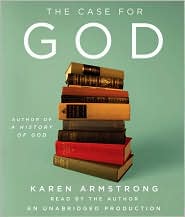
I would like to kick off the inaugural “Mormon Stories Book Club” with our first book: Karen Armstrong’s “The Case for God”.
- In Part 1, I re-publish Terry Gross’ 2009 Fresh Air interview with Karen Armstrong. Please listen to this episode, buy and read the book this week, and next week we will:
- In Part 2, John Hamer, J. Nelson Seawright, Joanna Brooks and I lay out Karen Armstrong’s major premises, and analyze them
- In Part 3, we discuss how Karen Armstrong’s book might or might not apply to Mormonism.
Episode Transcript
Host: John Dehlin · Guests: J. Nelson Seawright, Joanna Brooks, John Hamer
This transcript is machine-generated and lightly edited for readability. The audio is authoritative. Please excuse occasional errors in names and spelling.
Introducing the Mormon Stories Book Club
Part 1 of 3 · Ep. 132
John Dehlin [00:00:00] John this is Mormon Stories. I'm John Dehlin. Today I would like to try something new with all of you. I would like to begin the idea of a Mormon Stories book club. And here's how it can work. We'll decide together on a book we want to read and then we read it together or we publish some audio material that helps you get a sense for what's in the book. Then I'll bring on two or three or four of my favorite listeners, smart, witty, thoughtful people to discuss the book. And I'll figure out a way to take your call in questions so you guys can participate in the discussion.
Introducing The Case for God by Karen Armstrong
John Dehlin [00:00:34] So without any further ado, the book that we're going to start with is the Case for God by Karen Armstrong. I've attached to this audio an interview with Terry Gross from Fresh Air and NPR Radio of Karen Armstrong talking about her book, the Case for God. So give it a listen, see what you think about her perspectives on God and religion. And then very soon, in the coming days and weeks, I will have panelists on Mormon Stories to discuss these ideas, how they apply to Mormonism. And I'll be excited to take your calls and you can discuss your thoughts and opinions with us on the program.
John Dehlin [00:01:11] I would also love you guys to go up to the MormonStories.org webpage and post any questions or thoughts you might have there so that we can have a richer and more thoughtful discussion. So thanks again. I look forward to Mormon Stories Book Club, to doing it with all of you. And here is Terry Gross. FRESH AIR Interview with Karen Armstrong talking about the case for God.
Karen Armstrong Interview on Fresh Air
▶ Video Clip 1Video Clip 1 [00:01:33] This is FRESH air. I'm Terry Gross. My guest, Karen Armstrong has written best selling books about the religions of the world, but her new book starts with this. We are talking far too much about God these days, and what we say is often facile. She goes on to say, despite our scientific and technological brilliance, our religious thinking is sometimes remarkably undeveloped, even primitive. In her new book, the Case for God, she looks at the history of religion as a practical discipline that has taught how to discover new capacities of mind and heart and how people through the centuries have translated doctrines into ritual or ethical action.
Video Clip 1 [00:02:13] Religion, she says, requires perseverance. Armstrong's books include A History of God, the Battle for God, Islam, Buddha and the Spiral Staircase, which is a memoir about why she left the convent in 1969 after seven years feeling she'd failed to find God.
Modern vs. Premodern Conceptions of God
Video Clip 1 [00:02:33] Karen Armstrong, welcome back to FRESH air. You write that many people today think of God as the supreme being, a divine personality who created the world and everything in it. But God is not a being at all. We really don't understand what we mean when we say that he is good, wise, or intelligent. What do you mean when you say God is not a being at all?
Video Clip 1 [00:02:55] Well, the idea of God as a supreme being means that he is simply like us, writ large and just bigger and better, the end product of the series. Whereas this divine personality that we meet in the Bible was for centuries regarded simply as a symbol, a greater transcendence that lay beyond it. Some theologians call this the God beyond God. And this God isn't just a being like you or me or the microphone in front of me, or even the atom, an unseen being that we can find in our laboratories. What we mean by God is, some theologians have said, is being itself that is in everything that is around us and cannot be tied down to one single instance of being.
Video Clip 1 [00:03:52] You know, one of the recent language problems people have had with religion is deciding whether to call God he or she. And I think you would say none of the above.
Video Clip 1 [00:04:04] None of the above. God is neither he nor she.
Video Clip 1 [00:04:07] So what are some of the difficulties that early religious theologians had in describing or naming what God is and finding language to describe what they meant by God?
Video Clip 1 [00:04:20] Well, always in the religious quest, India has been way out ahead. And way back in the 10th century, before Christ, some of the Brahmin priests there devised a ritual which was a sort of competition. They went out into the forest, and there they made a retreat to put themselves into a different frame of mind. They'd fast and they'd practice certain sort of breathing exercises, early forms of yoga. And then they came back and the competition would begin. And the challenger would try to define the Brahman, that is the ultimate reality in Hinduism, something that lies way beyond the gods, that is way beyond anything we can know and yet is within us all.
Video Clip 1 [00:05:08] And he had to do this definition in a very sort of poetic and enigmatic way. And his opponents would listen to him very carefully, and then they would respond, moving on from what he had said, and make their own definition of what Brahman, or we would say God is. And the winner was the priest who reduced everybody to silence.
Video Clip 1 [00:05:34] And in that silence, the Brahman was present. The Brahman was not present in the wordy definitions of the divine. It was present in the stunning realization of the absolute powerlessness of language and speech to describe this. And that, I think, is an authentic model of religious discourse. Theology should be like poetry, which takes us to the end of what words and thoughts can do.
Video Clip 1 [00:06:07] Now, what you're describing sounds to me like maybe these are the theologians and scholars who are from the more mystical ends of the religions that existed then, the more educated theologians. But in terms of what most people observed, were they observing religion, do you think, in earlier times, in a more literal way, where the gods were real, where the gods were nameable, something where God was a being or the gods were beings, depending on your religion, yes.
Video Clip 1 [00:06:46] And indeed, in India and throughout the world, the gods were seen as real beings, unseen beings. And of course, before the scientific era, there were so many aspects of life that were unseen, like wind and emotion, that are realities in our lives. And they thought the gods were more powerful than they. But they knew, too, that the gods were not the ultimate realities. The gods were not like what we call God today. They were not omnipotent. The only thing that made them different from human beings is that they were immortal. They wouldn't die, but they were bound by the law of the universe just as much as we were.
Video Clip 1 [00:07:29] They shared the same predicament. And gods and humans, they thought, would work together to preserve the cosmos and keep its energies going. But they also knew that there was a reality that the gods couldn't reach that lay beyond all this and that they call Brahman. Now, what the ancient Israelites did was a very daring thing. They took one of these gods, Yahweh, and said, that is our chief symbol of this ultimate reality. And no one had done that before. There was a clear distinction always in people's minds between the gods and the God beyond God.
Video Clip 1 [00:08:15] Do you think that monotheism brought us closer to believing that God was the one? That there was one creator called God?
Video Clip 1 [00:08:26] There is a danger in monotheism, and it's called idolatry. And we know the prophets of Israel, and we were very, very concerned about idolatry, the worship of a human expression of the divine, not just a statue, but simply even an idea or thought about God.
Video Clip 1 [00:08:46] And there's always a danger that we'll mistake this symbol for the absolute, for the reality to which it's supposed to point. All religious language must reach beyond itself into a sort of silent awe. And it was all too easy to end, stop it and say that, well, God is a bit like us, writ large, with likes and dislikes similar to our own.
Video Clip 1 [00:09:11] And when the Crusaders went into battle in the Middle Ages to kill Jews and Muslims, they cried out, God wills it. This was their battle cry. Now, of course, God meant nothing of the sort, but what these crusaders were doing were projecting onto an imaginary deity that they were creating in their own image and likeness and giving it a seal of absolute approval. And today terrorists do the same. So theologians and priests were very much alert to this. And so they devised spiritual exercises not just for mystics, not just for an elite group, but for all the faithful to make them realize that when we talked about God, when we said God was good, we were doing this in a very inadequate way, that God couldn't be good like you or me.
Video Clip 1 [00:10:06] When we talk about a good person or a good meal or a good dog, we have an idea of what we're talking about. But God was, as the Muslims say, Allahu Akbar. God is always greater than anything we can understand. And in the Quran, for example, God is continually saying, look, everything I'm saying to you is an ayah, a parable, a sign. Even the great statements like paradise or talk about creation or the last judgment. These are ayat. They're parables, symbols of realities that we with our finite earthbound minds can't grasp.
Video Clip 1 [00:10:47] My guest is religion scholar Karen Armstrong. Her new book is called the Case for God. We'll talk more after a break. This is FRESH air. If you're just joining us, my guest is Karen Armstrong, and we're talking about her new book, the Case for God. You describe in your book how most premodern cultures recognize that there were different ways, two different ways of thinking, speaking and acquiring knowledge. And the Greeks called this mythos and logos. And I'd like you to briefly describe what mythos and logos mean and how you think that applies to religion.
Mythos, Logos, and the Limits of Reason
Video Clip 1 [00:11:19] Well, logos is science or reason, something that helps us to function practically and effectively in the world. And it must therefore be closely in tune and reflect accurately the realities of the world around us. Mythos was about the discourse, stories about the more difficult aspects of our humanity about for which there were no easy answers, like the fact that we get sick, that there are all kinds of questions about suffering and pain that concern us. And for this, people turned to mythos and mythos and logos. They were not seen as in competition with one another. People felt we needed both, and each had its particular sphere of competence. And it was really rather dangerous to mix the two up.
Video Clip 1 [00:12:13] What do you mean by mixing the two up?
Video Clip 1 [00:12:16] Well, if you're going to organise a hunting expedition, you need to be absolutely focused on the practicalities, your situation where the animals are and the man force and the terrain. You can't go off into a dream about gods. And you can't mix myth into politics, though, or the economy Though that's been done sometimes recently, I think, and it's not a good idea. Now, if your child dies or you experience a terrible natural disaster, you want a scientific explanation. But a scientist will be the first to tell you that it cannot help you to find some ultimate meaning and come to terms with this tragedy that lies outside the remit of science to find that kind of meaning.
Terry Gross [00:13:08] In your book, the Case for God, you talk about the 16th and 17th centuries as being the period when myth was discredited and the scientific method was thought to be the only reliable means of attaining the truth. What happens in the 16th century century that discredits myth?
Karen Armstrong [00:13:27] Well, we began to create modern science. And science in the 17th, 18th centuries achieved such spectacular results that everybody was focused on it. And myths looked awfully flimsy beside these scientific discoveries, which were backed up with the advanced mathematics and clear and concise proof. So we started to want only information that was scientific, that could be proven logically. We were choosing Logos. And gradually myth became discredited and people weren't interested in this more elusive form of knowledge anymore.
Terry Gross [00:14:15] At the same time, during this period, science starts to come in conflict with the Church. Like Galileo, you know, he said Copernicus was right. The planets didn't revolve around the Earth, the Earth revolved around the sun. And the Church condemned this view as false and contrary to Scripture. He was accused by the Vatican of heresy and sentenced to house arrest for the rest of his life. So is this the time when religion and science really start butting heads?
Karen Armstrong [00:14:49] That's certainly a symptom, if you like, of a new kind of spirit that was coming into being. When Copernicus had actually presented his theory in the Vatican some 60 years earlier, the Pope had given it a cautious approval, but things were tougher. By the time you've had the Protestant Reformation, you've had terrible political disasters in Italy. There was a new hard line Vatican that wanted people to toe the line, and Galileo was not going to toe the line. And so the Pope made a terrible, terrible mistake when he condemned Galileo. There's no excuse for it. It was an absolute disgrace. But also, Galileo made mistakes.
Karen Armstrong [00:15:35] He was also could be quite an intransigent human being. He believed in mythos and Logos. He believed that you shouldn't mix the two. And yet he kept continually bringing up Scripture in a way longer, quite safe to do in this new hardline climate. But actually, this wasn't the beginning of the end, because just a little later, when Newton, the great Sir Isaac Newton, starts his Great discoveries. Science and religion became best friends. Science and religion fell passionately in love with one another.
Terry Gross [00:16:10] What do you mean by that?
Karen Armstrong [00:16:12] Well, because Newton and Rene Descartes said that they'd found proof for God and the church, theologians, priests, church bishops, they were intoxicated by this notion of a scientific religion, a scientifically based religion that was in touch with the most exciting thought of the day and that could give them cast iron certainty. And so they started to make Newton's God absolutely central to Christianity.
Terry Gross [00:16:45] What was God? How did he prove that God existed?
Karen Armstrong [00:16:50] Well, Newton and Descartes too, both felt that unless you had God, the solar system made no sense. God was absolutely essential, they thought, to the universe. Something needed to start the whole thing off to get things going. And Newton discovered such a magnificent order in the universe that he said that the only way you could explain this was by an absolute divine intelligence that was omnipotent, omniscient, all knowing and that, and here I quote, was also very well skilled in mechanics and geometry. He said that you couldn't have a solar system unless you had an intelligent designer. Well, of course we know what happened. It was only a few generations before later scientists were able to dispense with God as the beginning of the universe. A necessary explanation.
Science, Religion, and New Atheism
Terry Gross [00:17:48] You see this, this coming together of science and religion and the use of science to prove that there is a God as opening the door to two fairly new phenomena. One is fundamentalism and the other is atheism. Let's start with fundamentalism. How do you see the coming together of science and religion as creating or at least opening the door to fundamentalism?
Karen Armstrong [00:18:11] Well, once this scientific religion caught hold, people started to read the Bible in a literal manner in a way where they never have before. Nobody before the 17th, 18th century understood the first chapter of Genesis as a literal account of the origins of life. Is that true?
Terry Gross [00:18:30] Like, I never really know. Is that really true? Nobody, nobody started as literal before?
Karen Armstrong [00:18:35] Well, no, because you could always have a new version of it. And right up to the 16th century you find people making up entirely new creation myths. The great Jewish mystic Isaac Luria, 16th century, created an entirely new creation myth that bore absolutely no relation to Genesis at all. Now if someone did that today, there'd be hell to pay because people would say, you can't do that, it contradicts the Bible.
Karen Armstrong [00:19:01] But Luria's story new, his new myth inspired a Jewish mass movement from Poland to Iran. It was the only theology in the Jewish world to gain such universal acceptance. St. Augustine had made it quite Clear too, in the Christian world that if a biblical text contradicted Scripture, that text must be reinterpreted and given an allegorical interpretation. And that remained the practice of the church right up until the 16th century.
Karen Armstrong [00:19:40] So right up on the dawn of the scientific revolution, you have John Calvin saying that the Bible has nothing at all to tell us about science. And he's very cross with what he calls frantic persons who are trying to impede science by saying it doesn't agree with the Bible. He said, if you want to learn about cosmology, don't go to the Bible, go elsewhere.
Terry Gross [00:20:06] And you say that this coming together of science and religion also opened the door to a new form of atheism.
Karen Armstrong [00:20:13] Yes, because really, the certainty that people were beginning to expect from religion was unsustainable. Once you've got people like Laplace, who says that, a French physicist of the early 19th century who says that he doesn't need the God hypothesis, he can account for the universe perfectly well without God, and finally Darwin, then no longer is the advanced thought of the day. With religion as it had been for 200 years. Now people are expecting absolute certainty. They're expecting scientific proof. And when they don't get it, and when science no longer comes up with the goods they want, atheism becomes inevitable for some people.
Terry Gross [00:21:01] So you're saying this is relatively new because until the 16th and 17th century, no one expected that science could prove the existence of God. Therefore, nobody expected that kind of literal proof.
Karen Armstrong [00:21:15] Nobody expected literal proof from Scripture. And that's whether you look in the Jewish world, people like Maimonides, in the Muslim world, people like Abicenna or Al Ghazali, or in the Christian world with Thomas Aquinas. Thomas Aquinas in his great work, the Summa Theologiaes, he says, yes, now here are some proofs to show that brought something into existence when there could have been nothing. But then he pulls the rug out from under our feet and says that but we don't know what it is we've proved. All we've proved is the existence of a mystery. We have no idea what God is. And that's basically the way religion was left at the time. Religion wasn't about answering questions that we could answer perfectly well by our powers of logos, of reason and science. Religion was helping us to deal with aspects of life, facts of life for which there are no easy answers.
Terry Gross [00:22:20] Karen Armstrong will be back in the second half of the show. Her new book is called the Case for God. I'm Terry Gross and this is FRESH air. This is FRESH air. I'm Terry Gross, back with religion scholar Karen Armstrong. Her new book is called the Case for God. When we left off, she was talking about how religion and science first came into conflict and how that led to a new form of atheism from people who demanded scientific proof of God. What's your response to an atheist like Richard Dawkins who wrote a best selling book explaining his atheism and using scientific thinking to disprove the existence of God, and he calls religion supernatural thinking?
Karen Armstrong [00:23:02] Well, Dawkins is a great biologist and I have been inspired by his account of natural selection. He's helped me to see the wonder of that. And it certainly deals a blow to the simplistic idea of God as creator that has taken root in the west since the early modern period. And many religious people talk about God today in a way that's really quite simplistic, even primitive, and give rise to the kind of attacks that Dawkins, I think he sometimes goes too far in his attack, but we thinking about God and talking about God far too easily.
Karen Armstrong [00:23:47] Very often people hear about God when they're little and when at the time they first learn about Santa Claus. And over the years their ideas about Santa Claus have changed and developed, but their ideas of God have got stuck in this rather infantile mode which mistakes the symbol that God is supposed to be for hard facts.
Karen Armstrong [00:24:10] And so I think that in pointing out that you can't think about God in this way, Dawkins could have done a service to religion and getting people back to a more developed and symbolic sense of the divine that lies beyond us.
Terry Gross [00:24:27] So you agree with him in rejecting a literal minded version of religion, but where do you start to disagree with him?
Karen Armstrong [00:24:35] Well, I think some of his characterizations of religion are a bit sort of simplistic and uninformed, really. I don't like the way he says that we should withdraw all respect from religion because whether he likes it or not, the vast majority of human beings on the planet want to be religious, want to live in relation to transcendence. And it seems to me that you don't want to wipe out a species or to exterminate it. You want to nudge it perhaps into a more healthy form of evolution, if I can put it that way. And I don't like his aggression. I think that in our very polarized, dangerously polarized world, we can't afford yet another divisive discourse that puts us at odds with one another.
Terry Gross [00:25:25] Let me ask you a big and impossible to Answer question. Which is, what do you think religion is for?
Karen Armstrong [00:25:31] Religion is about helping us to deal with the sorrow that we see in life, helping us to find meaning in life and helping us to live in. In relation to that transcendence that I was speaking about earlier. Religious people are ambitious. They want to feel enhanced. They want to feel at peace within themselves. They want to live generous lives. They want to live beyond selfishness, beyond ego. All the world religions say that the way to find what we call God or Brahman, Nirvana or Dao, is to get beyond the prism of egotism, of selfishness, which holds us in a little deadlock and limits our vision that if we can get beyond that, especially in the practice of compassion, when we dethrone ourselves from the center of our world and put another there, we live much more richly and intensely.
Terry Gross [00:26:33] You were in a convent for seven years. You were committed to Christ and to the church. And then when you left, when you decided that this life was not for you, you left religion behind for a while. And then you made the study of the religions of the world. Basically your religion scholarship of, you know, religious scholarship became like a religion to you. And every time you're on the show, I like to kind of take your pulse and see where are you now in terms of what religion means in your life. So where are you?
Karen Armstrong [00:27:09] Well, for me, my study, my study of these wonderful, wonderful texts has become my form of meditation or contemplation. And when I'm sitting at my desk or even in the British Library, I can have moments of awe and wonder and excitement that lift me up beyond myself, give me intimations of something touching me deeply within, and that, that's become my path. And I can't see any one of the world religions as superior to any of the others. Each has its own particular genius and each its particular flaws. And it's pushed me into a more compassionate mode of living.
Armstrong's Personal Practice and Compassion Charter
Terry Gross [00:27:58] Do you practice any kind of rituals, meditation, prayer? Because you talk about religion in your book as being a way of living, as being a practice. So do you have any kind of practice to help you get that kind of focus that you want in life?
Karen Armstrong [00:28:18] It is my study for me, and I can't pray. I'm absolutely hopeless at prayer.
Terry Gross [00:28:25] Why do you think you're hopeless at prayer?
Karen Armstrong [00:28:27] Well, when I was in my convent, we'd have to make a meditation every morning for a whole hour. And I could not keep my mind on this for one minute at a time. My mind would instantly go skittering off down a whole alleyways of distraction and worries and anxieties.
Karen Armstrong [00:28:50] And I think I just seem to encounter an absolute emptiness and nothingness. I had a very simplistic idea of God. I had the idea of God as this divine personality that would somehow get in touch with me, there'd be some kind of encounter. Now I realize I was barking up the wrong tree. That isn't what God is at all.
Karen Armstrong [00:29:12] But those years of failure every morning going into that church and coming out, not having meditated at all left me with a kind of fear of meditation, if you like, the thought of a sort of a worry about it, just like people might have after having had, say, a bad sexual experience that they don't want to go there again. And the last thing I ever thought I would end up doing is writing about religion. And yet here I am.
Terry Gross [00:29:46] My guest is Karen Armstrong. Her new book is called the Case for God. We'll talk more after a break. This is FRESH air. My guest is religion scholar Karen Armstrong. Her new book is called the Case for God. I wonder if you've been following this. There was a poll that was released by the Public Policy polling firm, and they polled New Jersey residents. And one of the questions they asked was if they think President Obama is the Antichrist.
Karen Armstrong [00:30:16] I did.
Terry Gross [00:30:17] Did you hear about this?
Karen Armstrong [00:30:18] No, I didn't.
Terry Gross [00:30:19] Okay. 8% of the people polled said yes, and 13% said they weren't sure. And then among Republicans, 14% said yes, Obama is the Antichrist, and 15% said they were unsure. What does that say to you?
Karen Armstrong [00:30:35] Antichrist is a kind of bogey. It's a fundamentalist bogey, the epit of evil that challenges true faith. And just to pin that on a human being is a kind of a very worrying projection. We're making scapegoats and looking at people to blame for the immensely difficult and complex problems of our world. Antichrist is a kind of bogey. It has no real roots in the Christian tradition.
Karen Armstrong [00:31:07] It doesn't. And not really. It's a couple of chance remarks of St Paul and then there's the Book of Revelation. But the whole idea of there being end time battles reflects a more sort of Zoroastrian view of the world. And I think it reflects a very pessimistic view of life that the world seems to be so evil that it's hurtling towards some unimaginable catastrophe in which the evil and the evildoers will be vanquished and Christ will be victorious. The Christ of Revelation will fight Antichrist in terrible end time battles. This if you know, if People came to psychiatrists with this kind of fantasy. The psychiatrist would probably denote a profound disorder, a profound neurosis.
Karen Armstrong [00:31:59] And the fact that it has such a grip in America is a sign of, I would say of an unhappy society. Dare I say you see a big
Terry Gross [00:32:09] difference between America and England when it comes to religion and general fundamentalism in particular.
Karen Armstrong [00:32:15] Oh well, England is just not interested in religion at all. And I think only about 6% of Britons attend a religious service regularly. And atheism is almost de rigueur among the chattering classes of London, which makes it a rather lonely existence for me here. I mean, friends will actually ask me not to speak about religion when I come round to dinner as though this were some kind of really retrograde subject and find it difficult to imagine why I should bother with this discredited stuff. But there we are beginning to seem endearingly old fashioned in our aggressive secularism. Because in the rest of the world outside Western Europe, there is an immense religious revival.
Karen Armstrong [00:33:01] And a lot of it, like that Antichrist thing reflects real a, the aggression that we have inherent in the modern world. 20th century was a terribly violent century and religions absorbed some of that violence and also profound anxieties. We've got so much to worry about at the moment that perhaps it's no wonder that it surfaces perhaps in a religious form.
Terry Gross [00:33:28] You recently made a wish while getting an award that. What would you call that, A compassion committee or something?
Karen Armstrong [00:33:36] Charter for Compassion.
Terry Gross [00:33:37] A Charter for Compassion. Explain what your wish is.
Karen Armstrong [00:33:41] Well, I was given this award by the TED Conferences and they like to give a prize to people whom they think have made a difference in the world, but with their help could make an even more of an impact.
Karen Armstrong [00:33:56] And so my wish was that they would help me to create and craft a charter for compassion that would restore compassion to the center of the religious life. And instead of seeing religion as part of the problems of our world, would actually help religion to make a positive contribution towards peace.
Karen Armstrong [00:34:20] And so the chart has been written now and it will be launched in November. But primarily it's a call for action, not just a sort of feel good factor. So that we. Compassion, which is at the heart of all morality, of all religious systems, far more important than believing things or accepting orthodox views, should speak again loudly and clearly in our world. And I shall be working on this now, I think, for the rest of my days.
Terry Gross [00:34:54] Is part of the group that you're trying to organize around compassion. Do you want that to be an antidote for some of the more extreme forms of religion? That are forming now.
Karen Armstrong [00:35:08] Yes, definitely. Because, you know, when we hear about religion, when it hits the headlines, it's either something like that Antichrist poll or else we hear the voices of hatred or extremism, or we hear church leaders condemning things like condemning homosexuality or enforcing rigid beliefs.
Karen Armstrong [00:35:31] And this is not what religion is about. Religion, all the world faiths have developed their own version of what's been called the Golden Rule. Don't do to others what you would not like them to do to you. And they've said, all of them, that that is the essence of faith. That it is that not our beliefs, but that bring us into relationship with what we call God or Brahman or Dao.
Karen Armstrong [00:35:58] And it's that that gives meaning our lives. And so I want to restore compassion to that. And so that we have, instead of religious antagonism, religious aggression, we have a voice that speaks continually of compassion, that endlessly tries to put us, make us put ourselves in the position of the other. Because I'm worried that. That if we don't manage to implement the Golden Rule globally, so that we treat all peoples, wherever they are, as though they were as important as ourselves, that we, I don't think we'll have, if we don't do that, a viable world to hand on to the next generation.
Terry Gross [00:36:43] The way you've portrayed it in your book and in our interview, religion used to be something that was understood as myth. And it's only later on in modern times when science comes in that there's this more literal version of it and that it used to be more about compassion too. But just really, isn't it true that throughout human history there have been religious conflicts both within religions and between religions, and that religion has always been a force for. For bad as well as for good?
Karen Armstrong [00:37:23] Yeah, because that's what we are. That's what the Garden of Eden story is telling us about. That good and evil are inextricably combined in our inner hearts, in our all, every single individual. And of course, a lot of people don't want to be compassionate. They'd rather be right.
Karen Armstrong [00:37:40] And a lot of people get a kick out of hating people. And God, as I've said earlier, can be abused and made to back up that hatred. Because religion is very difficult to do well. And it's not the easy thing that people imagine. It's not a question of just bopping down to church and singing a couple of hymns. It requires a daily effort to overcome the ego that holds us back from enlightenment. And a lot of people are not quite ready for that.
Karen Armstrong [00:38:11] It must also be said that a lot of the tensions that we. Religious violence that we see in the world today as well as in the past have been the result of political tensions. And when violence becomes ingrained in a region where warfare becomes chronic in a region such as the Middle east or Afghanistan, then religion gets sucked into the whole unholy mess and becomes a part of the problem, too.
Terry Gross [00:38:43] Your view of religion isn't that there's a personal God who has some kind of physical manifestation and who can appear to you and speak to you, but some people say that they've experienced that manifestation of God, that they've had some kind of direct contact or message from God. How do you process that?
Karen Armstrong [00:39:05] Far be it from me to decry anybody's religious beliefs or religious experience. And if religion, your experience of God speaking to you or whatever, compels you to live a more compassionate life, then it's doing its job. If it's filling you with respect and awe for the natural world and for all God's creatures doing its job, what we call God comes to us in many ways. I couldn't make the personal God work for me, but that's not to say it won't work for other people. We all experience the inimitable, limitless God in as many different ways as there are human beings.
Terry Gross [00:39:49] Karen Armstrong, really good to talk with you again. Thank you so much.
Karen Armstrong [00:39:52] Thank you, Terry. Thank you.
Terry Gross [00:39:54] Karen Armstrong's new book is called the Case for God.
Book Club Discussion Begins
Part 2 of 3 · Ep. 133
John Dehlin [00:00:00] Mormon Stories podcast takes a ton of work and depends solely upon listener support to keep this program alive. Please consider a donation today@mormonstories.org.
John Dehlin [00:00:18] This is Mormon stories. I'm John Dehlin. Today I'm very excited to have with me a very distinguished panel to discuss and Karen Armstrong's relatively new book called the Case for God. For those of you who tuned in to the previous episode, we released Karen Armstrong's interview with Terry Gross on the Fresh Air NPR radio program from, I believe last October of 2009. It is now March 2010. And all of us have tried to read the Case for God or at least the important parts of it, and have come prepared. And my distinguished panel I will now introduce I will begin with the ladies first. We have with us Joanna Brooks, who has a website called askmormongirl.com Is that right, Joanna?
Joanna Brooks [00:01:04] Yep.
John Dehlin [00:01:04] And she's a, I think a department head at San Diego State University in the English Department and a well known scholar of all sorts of things. I won't go into your bio because we did that in my previous interview, but thanks for coming on, Joanna, Always a pleasure. We also have with us Jay Nelson Seawright, who is well known in his own right on the Mormon Internet as a blogger for bcc. And I don't know, Jason, what else you want me to tell the listeners about you?
J. Nelson Seawright [00:01:34] Nothing would be fine.
John Dehlin [00:01:35] Okay. Jason is an academic heavyweight, but I'll let you guys Google him if you'd like as to what he does in his background. And finally, we have with us John Hamer, who I've also interviewed on Mormon Stories. He is a Mormon historian. He's contributed to the Joseph Smith Papers Project. He's an important part and a co leader of the John Whitmer association. And he's one of the world's foremost authorities on Mormon mapmaking. Is that right, John Hamer,
John Hamer [00:02:09] There's a lot of mapmaking competition in the Mormon world.
John Dehlin [00:02:14] Well, thanks to you all for joining us today. I'd like to begin and we're going to turn the mic over to Joanna. We've asked Joanna to sort of give us a summary of some of Karen Armstrong's main points. I have a few follow up points that I'll be adding. But Joanna, why don't you start us off and talk to us about Karen Armstrong's view of history and of religion and of spirituality and maybe a beginning of analysis of what she has to offer us.
Joanna Brooks [00:02:48] Sure. And the other panelists, I'm sure I'll be brief in an Initial summary and hope that Jay and John and John will fill in this book is an argument basically against an oversimplified concept of God. And the way she frames her argument is, is through the lens of religious history, theological history. So she tries to give us great moments in the history of the concept of God from pre modern times. And she reaches back into South Asia, the tradition of the yogis, into Judaism, early Islam, early Christianity, premodern religions, pre modern spiritualities. Their take on God, which she instructs us, was never the literalistic, anthropomorphic, I.e.
Joanna Brooks [00:03:51] man shaped concept that has a hold on many believing people today. Instead, God was understood in pre modern times or encountered in premodern times in all these traditions as a great ineffable otherness that exceeded comprehension and that the way to God was through discipline and ritual and that it produced some very specific effects of self emptying and compassion. And then she traces the history of the God concept forward through the onset of modernity, the Renaissance, Scientific Revolution, the Enlightenment, philosophical Enlightenment, and shows how a new emphasis on a need for evidence changed the God concept and pressured into being new forms of religiosity that are centered more around certainty and evidence.
Joanna Brooks [00:04:53] And that this pressure to have evidence of God or to have certainty or doctrinal certainty about God produced both atheism and religious fundamentalisms. And then moving forward from this modernizing moment that was so based on certainty and evidence, she takes us into where we might be now with a more mature God concept, a postmodern God concept that in some ways moves beyond certainty back into an uncertainty that it was redolent of pre modern religiosity. That is again recognizing that after world historical events like the Holocaust, after the invention of the atomic bomb, after the Heisenberg Uncertainty principle, after developments in thought and in human experience that exceed or defy understanding, we can come home to a concept of God that is once again about embracing or respecting or revering something greater than us. And that's the narrative she's trying to draw out.
John Dehlin [00:06:04] That was beautiful.
Joanna Brooks [00:06:06] Oh, thanks.
John Dehlin [00:06:07] You did good work.
Joanna Brooks [00:06:08] I studied hard for you, John.
John Dehlin [00:06:11] I'm honored. Now, I've got a few things I might add, but before I do Jason or John, let's start with Jason. Before we start critiquing, is there anything else that you guys see as fundamental to Karen Armstrong's narrative or arguments that you guys would like to add? Start with Jason.
Apophatic Theology and the Problem of Defining God
J. Nelson Seawright [00:06:31] Well, John, in addition to the historical argument that Joanna's just talked about, Armstrong really has. I think I'd call It a strong theological argument about the ways that we should think about God and not just the ways that people have thought about God. So central to that is the distinction she makes, and this has been something through many of her books, between mythos and Logos, where logos is the sort
Joanna Brooks [00:06:55] of
J. Nelson Seawright [00:06:56] this sort of rational and evidence based way that we think about problems that we have to solve in the world. Whereas mythos is the kind of poetic or artistic or symbolic way that she says people have traditionally thought about religion, that we should think about God and religion, and that we deal with the questions that are difficult to answer, for which there are no easy answers. So this distinction between kind of two modes of, of thinking and of being is central to her argument here.
John Dehlin [00:07:28] Okay, that's great. That's a really important piece, the Logos and the Mythos piece. And it's actually a piece that resonated well with me. Before we dive into any of those, John Hamer, is there anything else you wanted to add about Karen Armstrong's main arguments?
John Hamer [00:07:43] Well, I guess the other argument that she has is probably the one that I have the most trouble identifying with or getting into or understanding, which is what do you do with all of it? Or how do you. How do you engage God or religion and what are you doing? And she has this idea of religion as being something that you are doing more or something where you're achieving transcendence rather than something that is just a set of beliefs or this sort of thing. And she talks about it a lot and a lot of the practice of how you're practicing religion, how religion is an art and how you, I guess, experience a transcendence. And so that's another part of it, right?
John Dehlin [00:08:33] Yeah, that's pretty central. Well, let me begin by backing up then with sort of this overview combined with the Terry Gross interview, and maybe just ask you guys to start providing an analysis of some of her main points. And one of the first points that jumped out with me, jumped out to me almost immediately, was her argument that made it sound like only us 19th and 20th century fools ever thought to interpret the scriptures literally. That sort of pre 17th century, everyone and their dog looked at all their scriptures as metaphorical. Now I'm exaggerating, but there's a point where Terry Gross in the interview actually says, is that true that reading the scriptures literally is a modern phenomenon?
John Dehlin [00:09:21] And she even then just asserted, absolutely. And she went and quoted all these early theologians who were very comfortable subjugating religious texts to science whenever they were in conflict, basically acknowledging that the scriptures have Very little to tell us about how the world is created or what's going on scientifically in the world.
John Dehlin [00:09:46] So, Jason, I know you have some feelings about that, so why don't we start with you analyzing this notion of how modern is the literal reading of Scripture?
J. Nelson Seawright [00:09:57] Right. Thanks, John. This is one of these areas where something Armstrong does that kind of bothers me is she creates what I see as kind of false dichotomies. And there's one here between symbolic and literal. All people before the modern era, before the rise of science, and all of this certainly did read Scripture symbolically, that's absolutely for sure. That happened all the time through the Middle Ages. The Catholic theologians were all over the place telling us what the layers of meaning in the Old Testament were. But a key point that I think Armstrong just obscures is that symbolic readings and allegorical readings did not replace literalism.
J. Nelson Seawright [00:10:41] You could believe that these things actually literally happened and also that they had several extra layers of meaning. Now, this is actually a way of reading that Mormons are used to. We're used to saying that Isaiah was talking about political events in his day and also Jesus and also the restoration and maybe three or four other things at the same time.
J. Nelson Seawright [00:11:00] This is the way that a lot of medieval theologians read the Bible. That doesn't mean they didn't think that Abraham existed or that Moses existed. They really did seem to think that when people suggested otherwise, they got excommunicated. What they did think was that those stories had more to tell us than simply history, not that they weren't history.
John Dehlin [00:11:23] So do you think she overstates her case then?
J. Nelson Seawright [00:11:25] Absolutely. I think there's no question. I mean, there are lots of examples we can find in early Christian writings of people clearly taking the Bible literally.
John Dehlin [00:11:35] Good example.
J. Nelson Seawright [00:11:36] She goes through a bunch of stuff about how St. Augustine had sort of a non literal or non material approach to spirituality. And the things she says are right as far as they go. But there's a lot more to the man. I mean, he wrote about how to incorporate secular knowledge into interpreting the Bible. You know, he talked about how we can use history to figure out how many years long Jesus ministry was and what the date was when he was baptized. And we can use the natural sciences to sort of understand what was miraculous about his miracles. And we can use biology to interpret sort of, you know, what his diet might have been.
J. Nelson Seawright [00:12:12] These are just not the kinds of questions that a person who is totally non literal would ask. And the idea that science could contribute to our understanding of God really, really cuts against the grain of her argument, I think.
Joanna Brooks [00:12:24] Can I add something, please, Joanna? Just, you know, in agreement, but also adding that when religion scholars look at the history of religion, we often draw a distinction between theological history or the intellectual history of religion and what we call lived religion. And studies of lived religion often yield different findings about how traditions handle matters like life, death, birth loss, sin. And that could be operative here too. The evidence she musters to argue that no one took the Bible literally, she musters from scientists and cutting edge thinkers.
Joanna Brooks [00:13:09] What I know of, for example, of myth oriented societies, and mine comes from kind of study of American Indian societies and religions, is that the story, the myth, does order reality and is taken literally, although not literally as we understand it today in this kind of verifiable, evidentiary way, the story orders reality day to day life. So I agree with Jay that she might be a bit overstating her case a bit. She doesn't really have the evidence to tell us that. Why? You know, everyone understood that it was all symbol, that that's probably not a case she can make successfully about how common people lived religion.
J. Nelson Seawright [00:13:52] I'd say we could actually even take it a further step and say that some of the elite evidence she brings shows that her case is overstated. When she has theologians saying that you hasty people who are trying to use science to prove religion are wrong, that proves that there were hasty people trying to use science to prove religion. I mean, the interlocutor there that Armstrong is sweeping under the rug in a sense had to have been real.
Joanna Brooks [00:14:21] I'm just imagining too premodern European societies that would have had stories that ordered their relationships to the land, to the community, and then adopting Christianity into those premodern ways of experiencing spirituality, they would have mapped one onto another and again, used mythos in a quite literal way. Does that make sense to orient themselves to their own environments? So again, I agree with Jay about the distinction between the elite and the common or the lived.
John Dehlin [00:14:54] John Hamer, anything to add here?
John Hamer [00:14:56] So one thing I would add there is that she does make a great point that fundamentalism, all the different kinds of fundamentalist religions today that have arisen today, that are existing in our postmodern era, modern and postmodern era, I don't mean so much here, Mormon fundamentalism, but all fundamentalism in a general sense is in fact a. It's, it's not the way things were in the past. It's actually a new phenomenon, because fundamentalists are part of the postmodern rejection of modernity. And so they're not actually, you know, just reliving the way things always were. They are having. Their belief system is based on what has happened, all this thought that have come forward and rejecting a lot of the things that other people, other ideas that have developed in the modern world.
John Hamer [00:15:46] But while she gets that right, I think she doesn't seem to. She doesn't. There's this problem that J. Joanna have identified where she imagines that pre modern people could have not believed in literalism before the development of textual criticism, history, the science of history, all these other things. So in other words, we have an idea, an understanding of verifiable history. And what is history and everything like that based on, you know, the modern era. And so obviously before that existed, you can't, you can't say, well, they rejected that because they weren't. But they weren't aware of it. Their ideas aren't based on that.
John Dehlin [00:16:31] Is there anything to her argument that the mixing of mythos and logos, of science and religion in the 17, 18, 1900s did something different, caused something to happen amongst religious discourse, theology and doctrine that that became problematic and that truly did lead to this notion of fundamentalism and atheism here in the 20th and 21st centuries. Anyone want to take a stab at that?
J. Nelson Seawright [00:17:08] Well, I think that what John was just saying is really relevant to that. I mean, before you have evolution, for example, you can't sort of not believe in evolution. You don't have the idea, it's just not there. So you can be a creationist, but you can't be a creationist in a modern sense, which is creationist against evolutionary science. You're just a person who believes the story that you know about creation.
J. Nelson Seawright [00:17:33] I'm not sure, I'm not absolutely sure that the attempts to use science to sort of refine religion make as much of a difference as she wants to say they do. Because I think that science was going to get there anyway. I mean, Darwin didn't happen because people were trying to defend the Bible. Darwin happened because he was really interested in naturalism and other people had had ideas that paved the way for that.
J. Nelson Seawright [00:17:56] And once that happens, once that comes on the scene, I think that changes the game for religion and I think it would have done anyway.
John Hamer [00:18:04] One place where science does affect this in this mythos, logos competition or dichotomy that she's making is is this rejection of in a way of myth or making myth into what we think of as myth today instead of sacred story. So before we were able to have sacred stories that are meaningful to us that they are framing reality and all those kind of things for us. But then we now, once we have textual criticism, once we're able to analyze, we have, you know, do source criticism and decide, well, that didn't actually happen. There's no way to, to verify the existence of Abraham or anything like that. And these other things are clearly myths in the modern sense, the way we think of myths, that all that development did affect sacred story.
Joanna Brooks [00:18:57] I think, John, referring to the advent of the higher criticism that she talks about in 1860, that for me was a much more convincing part of how evidence entered the religious thinking equation in a powerful way. Rather than the early scientists she talks about, you know, Newton and a lot of his cohort were just as much occultists as they were anything else. And she, she misses that whole interesting strand. They were all alchemists, you know, a lot of them were who were contemporary Freemason. Freemasonry with the onset of Freemasonry, where they were Masons. So there were a lot of things going on with the early scientists that don't really fit into her narrative of faith and mythos.
Joanna Brooks [00:19:36] But the biblical criticism as she talks about it, I think that's really where the evidentiary pressure comes to bear on Christianity, especially in the U.S. i mean, that part of her narrative was really convincing for me. But another thing I think she entirely leaves out is the role of the massive displacements of people from their original environments that's happening in the modern era and how that affects religious belief. Because myth systems are often based on places and an intimacy with places and environments. And it's no accident, I think, that as we see more peoples, both European and African descended and indigenous American descended peoples, becoming physically displaced from their homelands, that we see greater reliance on the Bible as freestanding, literal myth, evidence unto itself.
Sacred Stories, Homeland, and Scripture
Joanna Brooks [00:20:28] Does that make sense? It's a major factor that shapes what stories are sacred to people. When you have a homeland, your stories are in your homeland and they make sense. When you're displaced from your homeland, new stories make sense and they're out of context. And I can see how the Bible took traction as evidence unto itself in a modern society characterized by global displacement.
J. Nelson Seawright [00:20:52] There's another piece of that that I think connects into what Armstrong is trying to do as a theologian. And to me, that's actually the more important part of what her project is, the kind of theological side, because one of the things that goes with globalization is not only are you displaced from the sort of context of your stories, but also you inevitably Start encountering dozens of completely different stories and myths and rituals and things that compete with yours. I mean, it just can't be true. Islam and Christianity don't necessarily fit together that well. And then if you want to throw in Buddhism, every single story you run into challenges you. And Armstrong's approach to this is to say that, well, if we step back and think in this ancient, postmodern way about these stories, that they're all really saying fundamentally similar things.
Joanna Brooks [00:21:41] They all have a lot in common,
J. Nelson Seawright [00:21:43] and they have a lot in common. And when she starts doing that, she starts sounding a little bit like nibbly to me. And I'm not sure if this is the good nibbly or the bad nibbly, but it's the Nibley that says we can look to antiquity as a whole to try to make arguments about how to situate our belief.
Mormon Concepts of God and Prayer
John Dehlin [00:22:02] Well, let me ask you guys about her views on God. This has been marvelous so far. She talks about us needing to not define God so narrow. And as I think about the narrative that I grew up with in the LDS Church, even the one that I gleaned from the types of doctrines that informed the temple ceremony, there seemed to be within the LDS Church sort of this almost hostility to this notion of a God that's defined very vaguely, a body without parts or passions.
John Dehlin [00:22:43] It almost seems like that might be the Catholic God as Mormon doctrine tried to define it, or even the Protestant God, I'm not quite sure, but it's pretty clear that the Mormon doctrine with Joseph Smith brought a body to God, and not just a body, but potentially a story of a pre. Sort of existence on an earth somehow like us. I mean, Mormonism does a really good job of making God about as concrete as it can, with 10 toes and 10 fingers and a beard and a spouse and children and almost every possible anthropomorphic quality that you can imagine. And, you know, so at face value, her view of God seems to be very much in opposition to the Mormon one.
John Dehlin [00:23:30] And I'm just curious if that's accurate and if there's any way to try and reconcile the two or if they're sort of irreconcilable. Let's start with John Hamer.
John Hamer [00:23:44] I guess I would think that she would say that that kind of a God, a God that is that you can picture that he has all of those characteristics that are so human, like, is specifically an idol. And so she would think of that as idolatry. That's the criticism and that you can't. I think that the theology that she, when she's defining God, she, in a lot of cases, are just defining God negatively. So God isn't this, God isn't that. And God certainly isn't a he. SCOTT isn't a being like that. We think of beings, God isn't these personalities. And all those kind of things in this conception is that she's drawing out. So I don't know how I've tried to think of how we could reconcile that. Maybe Jay or Joanna have an idea of if this is reconcilable with the Mormon concept of God.
John Dehlin [00:24:39] Let me even ask, let me ask Jay or Joanna, how consistent is her version of God with the other major strands of Christianity or with the Eastern, you know, other Eastern religions? Joanna
Joanna Brooks [00:24:56] so easy. I think we're right in being astonished by the familiarity of God in the Mormon tradition. I mean, it is truly astonishing how anthropomorphic, you know, 10 fingers, 10 toes, you're saying. JOHN that's pretty distinctive. And yet I think there's a possibility in Mormon theology to have something more expansive. If we take seriously the doctrine of eternal progression. Right. Then God becomes eventually, in the grand scheme of things, a very extensive relationship. Right. And in which, you know, there's man. It's so hard to articulate sometimes that, you know, there are there are eternal principles that if we learn to conduct ourselves by these principles, we will become joint heirs with God.
Joanna Brooks [00:25:52] And so God then becomes a reference to the Heavenly Father and Heavenly Mother who we know, but as well to the possibility of eternal progression. So there's when you start stepping back from that and thinking about the immensity, it lifts a little bit of the intense, astonishing familiarity of the God concept and turns God into a much larger matrix of relationship and belonging.
Joanna Brooks [00:26:21] But again, we've been backing away from the eternal progression as a top note of our theology a little bit lately, I think, but it's there. It's there. So that, to me, would be more consonant with this larger, ineffable, so difficult to imagine God that she describes so powerfully. I don't know.
J. Nelson Seawright [00:26:46] Jay I really like what Joanna said, what you just said. Joanna this is one of these areas where I feel like I'm going to come at this two ways. I'm going to start first by talking about God in other Christian traditions.
J. Nelson Seawright [00:26:59] God in Catholic creeds definitely doesn't have a body without body parts or passions. That's explicit. But it isn't the case that there's nothing you can say about God. The creeds are all about things you can say about God, you can say that God the Father is a spirit. You can say that God the Son is a body. You can say that God the Holy Ghost is.
J. Nelson Seawright [00:27:20] You can say that these are three persons with one substance. And there's this long, long list of specific claims that you can make about God. Now, the point that I think Armstrong is going for, and I agree with her on this, is that it's important to see God as not exhausted by the things we can say. You know, God. When we say something about God, that's not the limit. So my silly example here is I can say God is not a bank robbery.
J. Nelson Seawright [00:27:47] And probably most believers will say, yeah, that's right. Now, Armstrong's method would be to say, well, you know, whatever we can say about God, the opposite is true also. But I don't think I am forced to say that God is a bank robber. God is not a bank robber. It's just that that's not all that God is. By saying God is not a bank robber, I haven't defined God. I've made a claim about an attribute of God. I think that that's a way that we can look at the body, the embodiment of God. God, in Mormon thought, has a body, but God is not only a body.
J. Nelson Seawright [00:28:19] I mean, if you see the body of God, you don't know God. You've just seen a body, and God has that body, but is not limited to it. In Mormon thought, I think. I think there's room for transcendence together with the familiarity.
John Dehlin [00:28:34] I'd even add that even if you take the traditional Mormon belief that. That God might have even had a God before him, and that God might have been a man and all that stuff, that sort of seems to speak to some higher law or power or force that. That God is invoking and exercising and becoming a part of.
John Hamer [00:28:56] And so wouldn't that higher law, that higher law that you're identifying isn't that, though, than Karen Armstrong's God and the God that you're thinking, in other words, Heavenly Father is not God.
J. Nelson Seawright [00:29:08] Well, but no, no. I mean, I don't know. I mean, to say that there's more that God is involved in this other relationship isn't to say that Heavenly Father is an idol, which is what she would say.
Joanna Brooks [00:29:19] And Mother.
J. Nelson Seawright [00:29:20] Yeah, and Mother. Absolutely. Heavenly Father and Mother and their parents and their children and all of the wonderful stuff that, you know, Joseph Smith and Brigham Young love to go into, and that these days we don't anymore love to go into, I mean, that would be the ultimate reality in the sense that, say, pre Judaic Greek thinkers talked about the ultimate reality behind the gods. But that doesn't mean that the gods are now idolatry, because they're not that ultimate reality. Our relation to that ultimate reality in Mormonism is through our relationship to the people in those relationships.
John Dehlin [00:29:56] I almost wonder whether you could put the label of priesthood on what she describes as a God, because if God's God and all of us who might become gods are all engaging in some type of power and influence, maybe we could just slap that priesthood label on it. And that's kind of what she's trying to get at.
J. Nelson Seawright [00:30:16] You sound so 21st century when you say that.
Joanna Brooks [00:30:19] But there's more of a total. I mean, she refers. She really likes Heidegger, and she uses this concept of Dasein, which is the German for being, as, you know, this approximation of the totality of the God concept. She's trying to refer to. You know, I am. That I am not. Not emphasizing I, but emphasizing am. Being, that is being. And so I don't know that priesthood quite ascertains that totality, unless I'm working with a limited definition of priesthood.
John Dehlin [00:30:52] No, I was just trying to. I was just trying to stretch it.
J. Nelson Seawright [00:30:55] I think something you could do is you could go to Second Nephi, where Lehi starts talking about sort of, in some sense, the laws that God has to follow, and maybe those laws are the right thing.
Joanna Brooks [00:31:06] Right.
John Dehlin [00:31:07] Yeah, right.
Joanna Brooks [00:31:08] Or even, you know, go into the DNC and, you know, some of the marvelous equations of spirit to matter, that sense of totality, a discipline, totality being God, something.
J. Nelson Seawright [00:31:22] The thing that Armstrong sometimes goes to that. I think it's at least worth thinking through the implications is she likes Einstein's God, which could also be related to the Heidegger being idea. But really what Einstein's God is, is just the universe. It's the same as Spinoza's God. It's the sum totality of material things. There's no transcendence there other than what's material.
Joanna Brooks [00:31:51] And.
J. Nelson Seawright [00:31:51] And I think that if you go that route, you actually, there's. There's a temptation to atheism. Really?
John Dehlin [00:31:56] Yeah. Go ahead, John.
John Hamer [00:31:58] Oh, I was just gonna say in the. When she's doing her history, you know, there's a couple. Just places where she decides that there were wrong paths, that history went down, and she would like to go to the Wayback Machine and tell everybody not to do that. And it seems like one of the. One of the early spots that she identifies is when everybody starts to decide that the universe was deliberately created. And so I think that, like you're saying that that messes up her idea of God, because if the universe is God's creation and it's created from nothing, then the universe isn't God because it's separated from God. Right.
Joanna Brooks [00:32:34] But see, this is exactly the conversation she wants us to be having. Pressuring definitions of God, searching out even within our own traditions, you know, which is for me, one of the reasons why I welcome this book. As a rejoinder to, you know, the celebrity atheists who have come to dominate public sphere discourse about religion, the Hitchens camp. I mean, it's just we. She is calling us out of, you know, what she calls the Santa Claus concept of God to have these more complicated discussions in which we come to. Well, that's not quite it. I can't quite describe. This is exactly where she wants us to be.
John Dehlin [00:33:12] Yeah, I mean, if I could just for a moment take this to the practical level. What appeals to this idea for me and why I liked her book is I speak to a lot of people whose prayers aren't getting answered in any way that they can identify.
John Dehlin [00:33:31] And when they read the scriptures and they read about how God is described, an angry God, a mean God, a God that might promote genocide or sex or slavery, that's just a God that a lot of people are having a hard time getting behind.
John Dehlin [00:33:47] Yet simultaneously, there are a lot of people who still feel transcendence. There are a lot of people who still want to believe that there's something out there. And what I feel like she's doing is trying to define God in a broad enough, vague enough way to where we can still believe and hold to something as a belief, as a God, but not feel compelled to try and justify and resolve all these things that are unjustifiable and irresolvable.
John Hamer [00:34:21] Well, on your point about the people who are praying and don't feel that they're getting the direct answers or answering in the way they were taught that prayer should work. I mean, she does address that kind of prayer and essentially talking about prayers where you're asking God to make little interventions in your life and all those kind of things.
John Hamer [00:34:41] And she says, I think that that's the kind of thing that God can't do or doesn't. Or can do, I guess, but doesn't do, because then that God would be a tyrant. And so instead we're having this again, this big God that doesn't. That doesn't do all these interventions, but the problem with it. And she, I think, is aware of this problem, is that she says that if the God is too remote, it fades from people's minds and hearts. And so what. What is the thing that brings us back to this God that isn't making those interventions?
John Dehlin [00:35:18] So what do you guys think? Is her God meaty and substantive enough?
J. Nelson Seawright [00:35:23] Honestly, I sometimes wonder. I mean, she equivocates sometimes about whether a weather important that there even be a God, whether it's enough that there be rituals and ways of thinking and that it can be purely human. And so it's hard for me to know whether she cares that we think that these ideas actually reflect something substantive or meaty.
Joanna Brooks [00:35:52] I really identified with what she said about practice and, you know, her account of premodern spiritualities and the vision of a postmodern spiritual practice. She's trying to gently push us along too. Is one that focuses on discipline, practice, ritual without seeking answer, certainty, kind of being in the practice itself and then experiencing an emptying of self and then, you know, compassion as being one of the products of this. I mean, it's a very familiar Buddhist account, but, you know, in my own practice, as a Mormon person who's been through a lot of, you know, stages of faith there, you know, I've never stopped praying, but there came a point in time when I stopped imagining who I was praying to, and it didn't.
Joanna Brooks [00:36:47] And I've always used traditional Mormon prayer forms. You know, I've always used the language of dear Heavenly Father and you know, and later dear Heavenly Father, dear Heavenly Mother. So I've always used Mormon prayer forms, but I've stopped imagining God the same way. And yet I still maintain the discipline. And that's been satisfying for me in its own way. It's not in the way where I'm praying for intervention or, you know, it's in the way where I'm just trying to discipline the shape of my own need into harmony with that would be acceptable to the loving, compassionate force I hope is out there. And that's where I've arrived and through traditionally Mormon forms most of the way, along the way.
Joanna Brooks [00:37:34] So I do identify with what she's saying, and I really like her emphasis on just on the practice of it, on the practice of it, you know, living without answers and great humility day to day, trying to maintain a positive, loving relationship to a tradition, to a faith community that requires a lot of humility and discipline. And that's, I think, what she has in mind.
John Dehlin [00:37:58] I think. John Hamer, I think, you might have some thoughts on her comments about practice but before I just want to join with you, Joanna. My prayers these days I do very little asking, if at all. Almost my entire prayer is one of thanks. It's almost an exercise in gratitude where I'm just saying, let me just list 20 things I'm really grateful for, because if I don't, I'm going to be ungrateful. But more importantly, whenever I'm discouraged, I find that just being thankful is a way to get me out of my discouragement. And so, you know, that sense of expressing gratitude and of just meditation and contemplation is what prayer has come to mean for me.
John Dehlin [00:38:41] And instead of looking at prayer like a bidirectional conversation between two anthropomorphic beings, I'm sort of floating my feelings and emotions and aspirations to the heaven and with some sense of faith that righteous things will come about as a result. Maybe not in the form that I would conceptualize in my prayers, and that may seem weak and mamsy pansy, but it's still meaningful to me. And it's less frustrating for me because I'm no longer sort of auditing whether or not my requests are received and responded to in the way that I expect. That became very dissatisfying at some point. And waiting and waiting and waiting for some type of answer like you guys might give here on Skype also became very unsatisfactory for me.
John Dehlin [00:39:38] And so that's what's appealing to me about what she offers. I just sometimes don't know how Mormon it is or whether it can qualify as satisfactory for Mormon doctrine and theology.
Joanna Brooks [00:39:53] You're asking the question. I don't want to take too long. I know John H. Is on deck too. Just Is Mormon theology compatible with negative theology? Right. We have.
J. Nelson Seawright [00:40:01] What do you mean?
John Dehlin [00:40:02] What do you mean by negative theology?
Joanna Brooks [00:40:03] She uses the word apophatics throughout the book. Apophatic theology. It's negative theology. It's a root of describing God by not describing God. Right. Holding and holding an empty space in your hands as a sign of reverence rather than, you know, clinging to a doctrinal point as we are brought up from little to say. I know. Right. And so I believe that it's capable that one can practice a negative theology within the Mormon tradition, but it's certainly not the orthodox or coherent thrust of our tradition.
J. Nelson Seawright [00:40:43] I think one step in that direction, I'm going to let John Hamer back in, and I have some other things to say in a minute. But one step in that direction is to realize that for a lot of Mormons, saying I know really is a ritual. That testimony is actually a practice more than an assertion of evidence. They don't have polaroids of God. They know God lives because that's the ritual. And that I think is valid and valuable. That's something that I think we want to be able to hold on to.
John Dehlin [00:41:09] But she would call it idolatry, wouldn't she?
J. Nelson Seawright [00:41:13] If she does, I disagree with her. I just don't think that's right. I mean, I don't think it's right to say that my little daughter, when she says a prayer to Jesus Christ, is engaging in idolatry because she knows that there's a picture of Jesus. We have concepts of God that we build from. What the idolatry thing would be is to say that our concept is the whole thing. It can be a part or a path, and there's no problem. It's just if we think we know the limit of God, then in my view, that's the trouble.
John Hamer [00:41:43] Right. I would think that the problem that she would be having with that is not the ritual part. The ritual part was the part I presume she would approve of, but rather the part of insisting then inside your beliefs is saying, when I think of that picture of Jesus or the statue of Jesus in the visitor center in Salt Lake City, that that is exactly what Jesus is. That's exactly what Jesus is like, and that's exactly what God is like in a very literal way. And that literalism would be her problem with.
John Dehlin [00:42:18] Yeah, it just occurred to me that I don't think there's an LDS apostle alive who wouldn't concede to the notion that we really have no idea about the expansiveness of God's power and glory and influence. And it seems like that might be a bridge to combining these two theologies.
Joanna Brooks [00:42:38] Yep.
J. Nelson Seawright [00:42:39] Well, it might be. There's actually another option within Mormonism that's attractive for a lot of people, which is to say, well, you know, there's the earthquake in Haiti, right. And there's no reason that God shouldn't have stopped that. I mean, it wouldn't be tyranny to stop the earthquake. That would have been a kind and loving thing for a powerful, all controlling being to do. It doesn't take away anyone's choices. So some Mormon theology says, well, you know, maybe what we have is a God who's very, very powerful compared to humans, but actually isn't all powerful, that they're just capacities that God doesn't have, that God is overwhelmingly more knowledgeable and powerful than we are, but falls far short of the big God in Armstrong's sense. And that's actually another route that I think can solve some of these problems for people who find that kind of more limited God attractive.
John Dehlin [00:43:33] And I think that's also compatible with Mormon theology, because if our God once was not a God and had to ascend to become a God and had to follow certain laws and principles to arrive there, it follows that there are certain laws that can't be violated or that must be adhered to, which does make the Mormon God sort of not all powerful, isn't that right?
J. Nelson Seawright [00:43:56] Yeah, exactly. This sort of Brigham Young concept of God that Joanna was talking about a minute ago, where God is continuing to progress, if God is continuing to progress, that means God and gods are not at a limit place yet. Now, of course, Bruce Armaconki deeply disagrees with this idea and many contemporary Mormons regard it as heresy. But there are contemporary Mormons who continue to think this, that gods are gods relative to us. But this sort of absolute notion of God, for some Mormon thought is a construct of philosophy and is something that we ought to move away from.
John Dehlin [00:44:34] Right?
John Hamer [00:44:35] And like, this brings up like with the Haiti earthquake, this is how Mormons are able to have in some ways a more successful resolution to this problem of evil than people who do believe in the totally all powerful God who is not bounded. I mean, if God, the Mormon God, is bounded by the plan of salvation and the underlying law of the universe of plan of progression and everything like that, whereas the all powerful, the infinite God that isn't progressing isn't bounded by those things. And so when we wonder why did then that God, if that God created everything, that God created evil and allows all this evil to happen. And it's very unsatisfying for a lot of people.
J. Nelson Seawright [00:45:24] And there are further elements, I mean, in Mormon accounts of creation, we're pushed back to what's actually in the Hebrew Bible of this idea of a God organizing stuff that was already there. So that God in a sense actually is subject to materiality. And isn't the author of materiality, he or she or he and she, I guess, are interacting with stuff that exists beyond just them. So there's a lot of ways to think about a kind of less than fully transcendent God in Mormon thought.
Logos, Mythos, and Responding to Atheism
John Dehlin [00:46:00] Let's turn now, if it's okay, to the idea of logos and mythos. I'll just set it up by what I really enjoyed in her book, because I interact with a Lot of atheists and a lot of agnostic people. And you know, there's a lot of hostility sometimes towards theism, towards belief. And all I can say is I related to what Karen Armstrong talked about when she compared mythos to music. And the way that I describe it is put in one room, the most wonderful symphony, playing one of the most beautiful or majestic or inspiring pieces of music, such as Beethoven's ninth Symphony. Put in another room, the most erudite scholar trying to describe what is going on in that other room in some way that is uplifting, comparably uplifting or inspiring to the people listening to him, trying to use words to describe what the musical transcendent experience is going on in the other room.
John Dehlin [00:47:07] And which room would you choose to go to? There may be some people who don't love music, who would love to hear the person describe music. But for me, I get what she's trying to say. There is a feeling and an emotion and an inspiration that comes from music or from a great movie that can't really. That words will never be able to do justice to. And I think that that's what she means by mythos, at least that's how I interpret it. That there is this power, there is this value in the transcendent that can never. That there almost isn't room for logic and reason and analysis to sort of play that as soon as you try and introduce skepticism and criticism into that world of the transcendent, you spoil it and you ruin it.
John Dehlin [00:47:57] But it still is its own form of truth and of inspiration and value. But it's crazy because her book is a huge thick set of pages with words on them using logos to try and establish her arguments. But at the same time, I totally resonate with this notion of mythos and frankly, how words and logic and 500 Sunstone symposiums and 200,000 volumes of dialogue will never do justice to the Mormon experience that I've been able to experience at times. Let me start by giving it to John Hamer. Then we'll go to Joanna, then Jake.
John Hamer [00:48:38] Well, I think that this is an important thing that she's hitting on, which is I had to tell people, I think a million times when I'm on the blog, I always to say, look, that scripture isn't the same as history and history isn't the same as scripture. And it's a problem when people have decided that they're identical. If we were to have right now the perfect history of the Hittites and it was absolutely accurate, that wouldn't be scripture for everybody. In the same way, there's something about the stories that we have, the sacred stories that are in scripture that make them scripture and important to us.
John Hamer [00:49:16] And it's not based on, I think, the historical accuracy necessarily of them. And so I think that trying to decouple that the way she does, I think is important. And it also has important ramifications for Mormons because there's so many problematic things about taking some of the scriptures as being literal histories, right? Not just Mormon scripture. It's the Bible too, right?
Joanna Brooks [00:49:46] Jonathan Edwards described what you're trying to get at John through, you know, the metaphor of music through taste. He used the word sweetness a lot. The 18th century American theologian Jonathan Edwards. The sweetness, the sweetness, the sweetness thing. And what I love about this book is, you know, that it tries to nudge us towards that an aesthetic in its own dense, you know, learned, redacted millennia of religious history into 500 really dense pages. You know, it tries to nudge us towards this aesthetic appreciation. Right. And is that kind of what it is at the end of the day, that we prefer mythos because it's soothing and it's beautiful and it makes life bearable in ways that a world without it doesn't.
Joanna Brooks [00:50:30] But I like it because she takes it even one step further. Her book helps me, makes a case that, you know, atheism is its own form of mythos as well. It has its own rituals of practice, it has its own aesthetic preferences, it has its own music.
Joanna Brooks [00:50:46] She really periodizes secularization and atheism in a way that kind of puts them among the options. Do you want life with or without this form of music? And that's just a choice that faces responsible adults of faith who come to a crossroads where they might say, well, I no longer can cling to doctrinally to the kind of doctrines I might have once held firmly as self evident. But I still prefer the room with music. I really do. I really want that in my life.
John Dehlin [00:51:18] I'm going to jump in before Jason responds, because that was beautiful. Joanna and that's how I feel. My testimony unraveled a couple years back. I stared atheism and agnosticism in the face. I didn't have some overwhelming literalistic manifestation that there is a God. I sort of said, when I've been living within the Mormon tradition, I feel good. When I lift prayers up to heaven asking for some type of inspiration, I do feel a power and a force rally around to help righteous desires of mine bring to pass the good things that I want to try and accomplish. And so I'm just happier choosing to live in a world with faith.
John Dehlin [00:52:04] And as I think about one of my original podcast interviews with Richard Bushman, I really tried to nail him on this question of, is this the one true church? Are you a one true church kind of guy? Is your testimony rooted in absolute certainty? And I'll never forget his response. He said, I choose to want to live in the type of world where God speaks to man through prophets. And Richard Bushman, himself a patriarch of the church, did not reduce it to intellectual certainty or any type of manifestation. He said, I want to be that type of person who wants to live in the type of world where God speaks to man through prophets.
John Dehlin [00:52:48] That resonates with me, even though I know for other people, they want to live in a world where there isn't a God messing with and screwing with humanity. And they're just fine saying that this is all there is and they're content with that. And I actually respect that position. It's just not mine. Now, Jason, did you have a response,
J. Nelson Seawright [00:53:06] a bit of one or a kind of complicated one? I'd say this is something. The mythos Logos idea of Armstrong is something that I've thought about for several years. Some years ago, I was sort of active in the New Order More Mormons board, and this distinction was big and important for a lot of people there. And so I know that it can be useful and powerful for people. But with the metaphor of the music and the guy lecturing about the music, is it crazy that I want both? I mean, I read books about classical music, I read about Philip Glass, and then I go listen to Philip.
J. Nelson Seawright [00:53:44] Actually, you don't have to read very much. He's too simple. But I read about more conflict, complicated people and then go listen. And there's more that I get from the music. Having read, I mean, there are ideas in music and there's music in the ideas about the music. I want to move back and forth between the rooms. I want dialogue and the temple ceremony. I think that we get more from both.
J. Nelson Seawright [00:54:05] Another thing I would say is in the kind of mythos register, I'm going to pull in Paul and say that mythos goes a lot of ways. There's the faith kind of mythos that where we think we sort of can hold onto these ideas and take them seriously and get comfort from that. There's the gift of hope, too, where maybe I don't.
J. Nelson Seawright [00:54:29] Maybe I don't always have the gift to have faith in everything, but I can hope for that complicated reality where men and women both have equal roles to play in a creative, eternal growth of togetherness. I can hope for that, and that's a gift, too.
J. Nelson Seawright [00:54:49] But the third one that Paul has, that I think is key and that I worry about sometimes with the Armstrong view is there's the register of charity as well. Within Mythos, there's the call to community and to action and to make the world a better place. That comes from the idea that God gives us power, that there's a God who wants us to be better than we are.
J. Nelson Seawright [00:55:13] That I think is really important. And that in very individualized, aestheticized versions of spirituality, I think can sometimes get lost. As a Mormon, I want a community and I want a community of people who want to change the world.
J. Nelson Seawright [00:55:32] We ought to have that mission. That's what the Book of Mormon is all about. We ought to have the mission to go out and make the world materially and socially a better place. And I want us to have a mythic register that pushes us to do that.
John Dehlin [00:55:51] Thank you for joining us today on Mormon Stories. To comment on this episode or to provide feedback, please check us out@mormonstories.org if you want to help keep Mormon Stories alive, please consider either making a financial contribution or spreading the word about this episode through your blog, Twitter account, Facebook page, family newsletter, or through your ward bulletin and ward newsletter. Just kidding about those last two. Music on this episode was provided by Clayton and Sky Pixton. Check them out@claytonpixton.com or skypixton.com that's sky with an E. S K Y E Pixton. Thank you.
Guest 1 [00:56:53] The soul yet in my dreams I be Nearer my Go to. There let the way appear Steps unto me to heaven all that thou sendest me in mercy angels to beckon me Nearer, my God, to thee Nearer, my God, to Thee Nearer to Thee. Then with my waking thoughts bright with Thy praise Out of my stony griefs Bethel I raised so by my woes to be Nearer, my God, to Thee Nearer, my God, to thee Nearer to Thee O' er if on joyful wing Cleaving the sky sun, moon and stars upward I fly still all my song shall be Nearer, my God, to thee Nearer, my God, to the end Nearer to thee Nearer, my God, to Thee.
Joanna Brooks [00:59:01] Sam.
The State of Mormon Intellectual Life
Part 3 of 3 · Ep. 134
John Dehlin [00:00:00] Mormon Stories podcast takes a ton of work and depends solely upon listener support to keep this program alive. Please consider a donation today@mormonstories.org. So let's just assume that we're not going to be able to. Just by the fact that she has so many words in her book invoking Logos, I think we can all agree we're never going to escape it, that we need to find a way to mix these two things. Is it fair to put limits on where logos need not tread within religion and spirituality? Can we do that? Can we say that here's where you go too far when you start trying to bring the intellect into the religious experience, or here are areas where the intellect is not welcome? Let's start with Joanna.
Joanna Brooks [00:00:53] Oh, see, yeah, I'm like Jay. I like the room and the music too. I mean, in my comments, I didn't mean to give the sense that, you know, I don't see intellectual practice as a form of spiritual discipline because it is. It is.
Joanna Brooks [00:01:14] It's not something that's really valued within contemporary Mormonism to a great degree, but it sure is. You know, the theologians I learned to really Levin and Meyer spent time with in my own scholarship, you know, are people like Jonathan Edwards, who, you know, who after mastering, you know, incredible amounts of intellectual content, were finally pushing themselves to use the medium to the medium of language, to not betray what they had experienced. And so he comes down to sweetness, right? He's a thinking man, he's an intellectual theologian, and he directs us to the taste, right? To sweetness. So there's a way in which I think intellectual practice done with humility and with dedication, leads to greater experiential depth.
Joanna Brooks [00:02:03] Not greater than other people's. But for the person who feels called to do the intellectual work, does that make sense? I'm not prioritizing or preferring one path to another. I'm just saying for those of us who have. Who wake up with these inclinations or these callings or these burdens of being intellectual types, why not? I want to reserve some space for the intellect within all this. Yes, please.
John Dehlin [00:02:30] What about just the simple exercise of trying to demonstrate scriptural historicity? Is there ever a place for that or a value?
Joanna Brooks [00:02:38] Well, here's my bigger intellectual question, and forgive me for just hopping in, is what is the state of Mormon intellectual life right now? Where do we find ourselves in this book? How do we position ourselves in relationship to these great world historical conversations? You know, if we, you know, Mormon's reading this, we are not in the index. We are not even in the narrative? You know, where do we place ourselves now, historically? We'd put ourselves like, you know, we can find a page that's about the moment that Joseph Smith. It's like page 236. I marked it.
John Hamer [00:03:09] Right. Something about the. The Second Great Awakening. And they're talking about,
J. Nelson Seawright [00:03:14] that's us.
Joanna Brooks [00:03:15] And the word she doesn't use, that many of these Disciples of Christ movements at the time were using to refer to themselves were restorationists. Right. And our doctrine of the Restoration has caused us oftentimes to place ourselves in an exceptional position to world religious history. We have an entirely different. How do we square the narrative of, you know, the Great apostasy and the Restoration against this account? Can we make common ground with this account at all? As Mormon readers, you know, are Mormon intellectuals doing the kind of work that allows us to engage in this global conversation about faith? I've had some conversations with evangelicals, but we're not. I don't know that we're there yet.
J. Nelson Seawright [00:03:57] I'm going to say there's one thing, one way in which I think we can really engage well, with this intellectual project. A kind of amazing irony, which is we've noted that Armstrong wants to take her preferred mode of spirituality and kind of project it back all the way to, I guess, almost hunter gatherers, the caves. Amazingly, she knows what they thought, and
John Hamer [00:04:20] it's what she thinks.
J. Nelson Seawright [00:04:21] And the thing that I love about that is that that is exactly the Mormon impulse. We want to take our spirituality and make it ancient because ancient is best. And that, at least, is a narrative move that I see myself in.
John Dehlin [00:04:37] Yeah, Adam got baptized and Jesus was married in the temple and did an endowment ceremony.
Joanna Brooks [00:04:42] Right.
John Hamer [00:04:43] Either Mary or Martha was Relief Society present.
J. Nelson Seawright [00:04:48] Peter didn't do his home teaching.
John Dehlin [00:04:52] Well, who's going to answer? John Hamer, Are you going to answer Joanna's question about how we can step up and be part of the global conversation, or are we forever destined to be the stepchild, redheaded misfits of exceptional? Of what?
Joanna Brooks [00:05:10] Well, exceptional. Sometimes we talk about American exceptionalism. I mean, if we were the American religion, we have our own form of Mormon exceptionalism. Where do we belong in this world story?
John Hamer [00:05:21] But I guess I don't think that Mormons are engaging in this kind of conversation with religions that much, or even we've talked about it before as defining out some of these just basic theologies. When you go through and when you read all of these histories of theology and you read the medieval Christian theologies and all of the different ideas that everybody from Anselm Canterbury and Thomas Aquinas. And everyone is formulating everything about all the nature of God, why this works this way, why that works that way. There's been all kinds of wonderful speculation where in this conversation tonight where Jay or Joanna has explained, well, if we think of our Mormon concept this way and kind of expand it out and talk about this, the laws of the universe as being like our God.
John Hamer [00:06:09] But the point is, we haven't actually. It hasn't actually been formulated. In other words, there isn't a defined or even really long. Like, it's not. Even if we all agreed to one theology, even somebody simply spelling one out like that and how it all fits together and how it all works. It's mostly just a couple. I mean, there's beliefs, but they're not all put together like that.
J. Nelson Seawright [00:06:30] No, I think that's right. And, you know, I mean, this is something that causes all. We're too busy talking to ourselves. We can't talk to anyone else, and we can't hear what they have to say. This has funny consequences. One of my favorites is that the concept of God that we think other Christians have and that we rebut, actually, it's heretical according to the creeds. The concept of the Trinity as being one person, that's modalism. That's not trinitarianism. The Trinity is three persons with one substance. Now, what exactly that means, that's very hard. But we don't even get close to that. We just talk about how for them, Jesus and Heavenly Father are the same. Well, no, that's just not true. That's a conversation with ourselves, not anyone else.
John Hamer [00:07:14] I remember the first time I told, you know, I was telling somebody who I didn't believe in the Trinity, you know, and I remember telling some Protestant that they believed that, and they're like, well, I didn't believe that. You know, I was like, wait a second, now, what is the Trinity? You know, or even.
Joanna Brooks [00:07:31] Or even coming, you know, landing in graduate school and ending up with other, you know, people of faith, people, you know, raised in conservative orthodox traditions who were, you know, studying postmodernism at the great university and not having the native language coming out of BYU to be able to have a discussion with them about 19th or 20th century theologians who are pretty common to the whole Protestant family. Like, everyone's a part of this family tree. And I had no purchase, like, we have a long way to go in developing, I mean, as a culture, a greater facility with the conversations, the global conversations about faith.
John Dehlin [00:08:11] It Seems like if I had to give a novice stab at why this conversation isn't happening and why we're not included, I can think of three or four dynamics. The first is that we doctrinally, theologically have such a level of certainty that we don't think anybody else has anything to add to our conclusions. And so we don't seek them out because we feel like we don't need their insight. That's number one. Secondly, we subjugate their primary text in terms of Christianity, the Bible to the Book of Mormon, and so we don't see their fundamental scriptural texts as being equivalent to ours. But then if you flip it around, I think that probably almost everybody outside of Mormonism does not view the Book of Mormon as a credible religious text because of its lack of archaeological, geographical, etc. Problems. And so they sort of view us as a laughingstock because we're not legitimate,
Joanna Brooks [00:09:25] which is totally illegitimate. Even by the lived religion methodologies and religious studies. There's a lot of work the academy needs to do too, or other intellectuals need to do too in developing greater respect for the tradition that is Mormonism. It is a robust, complicated tradition. We just aren't invited to those reindeer games quite yet. But that's not to say it won't happen. And I think as our tradition grows more self aware, it'll happen.
John Hamer [00:09:57] When you say that part of the problem. I was just going to say it wasn't part of the problem in terms of developing a theology, the tradition of lay leadership where there's a major skepticism about professional church leaders. And so any idea of like, let's say professional church leader training is also therefore looked, looked on with suspicion. Because if you're going to do all of that sort of professional training, then if anything, you're going to be led away from personal inspiration or being led the way you should be led.
Joanna Brooks [00:10:37] Yep.
Mormon Theology, Mythos, and the Book of Abraham
J. Nelson Seawright [00:10:38] And then there's, I think, a point that fits nicely with that is possibly one reason that we aren't at the table with the theologians and philosophers is that Mormons preferred genre has been just a different one. You know, we don't write abstract ideas, we write personal experience, write journals and personal narratives. We tell our conversion experiences and tell our family histories and tell our miracles. And that for us has been and to some extent continues to be much more important than nailing down exactly what it means to say that God the Father and God the Son are separate or not separate or whatever it is that we think.
John Dehlin [00:11:21] It seems like Armstrong would agree with. It seems like Armstrong would agree that maybe those conversations that are going on that Joanna talks about are of little relative value. And those activities that we're busily engaging in that are part of our religious practice are actually where it's at.
Joanna Brooks [00:11:37] We have mythos, our narratives. I love what Jay's just said about the narrative quality of our theology. We have a very applied theology, you know, we have. Yeah, we have mythos. We're still a people of the mythos
John Hamer [00:11:53] in doing all that history though. And so I have a lot of, you know, spend a lot of time in the Mormon historians community. It's still also though, all done internally. So every. We all talk to each other and then if anybody comes in and wants to do it from outside and do Mormon history, they are immediately assassinated. Red on the inside.
Joanna Brooks [00:12:16] And in ethnic studies and religious studies, I'm almost always the only Mormon in the room. Always? Always.
J. Nelson Seawright [00:12:24] Oh, well, that's true in political science for me too. So.
John Dehlin [00:12:28] Yeah, well, it wasn't always that way. There was a time where we were sending, we were graduating more PhDs, male and female per capita than any other state in the early 1900s. Isn't that right? You guys heard that before?
J. Nelson Seawright [00:12:44] No, I've never heard it either.
John Dehlin [00:12:46] That's what some professors at BYU told me back. That must be true.
Joanna Brooks [00:12:50] Mythos.
John Dehlin [00:12:51] Mythos.
J. Nelson Seawright [00:12:52] Yeah, yeah, yeah. I would be a little surprised. Yeah, I would guess that Massachusetts would beat us every year per capita.
John Hamer [00:13:02] Uh huh.
J. Nelson Seawright [00:13:02] Yeah.
Joanna Brooks [00:13:03] MDs, maybe. I mean, there's the, you know, there's the vaunted, you know, legacy of the female doc, you know, but PhDs.
J. Nelson Seawright [00:13:11] Yeah, I know.
John Dehlin [00:13:12] Well, let me extend that this line of thought a little bit to sort of a question I came up with. I mean, as I think about what was most formative in my early orthodox, almost fundamentalist views of Mormonism, it was people like Joseph Fielding Smith and Bruce R. McConkie. And if I think back to what they're trying to do in books like Doctrines of Salvation and Mormon Doctrine, it's like in a sense, or even those seminary film strips that we used to watch in the 70s, like Mormon America, you know, the Ancient America Speaks or whatever, the ones I used to show on my mission.
John Dehlin [00:13:49] It. It does seem like we did what Karen Armstrong's talking about. We basically said we not only think that science has value, we're going to use science to prove our religion. And, and so as I understand it, when the papyru were discovered in the 1960s, didn't we actually, as LDS people, try and get Egyptologists to validate that Actually, the Book of Abraham really was an accurate translation.
John Dehlin [00:14:20] And didn't we try and use anthropology regarding ancient America to try and demonstrate through discoveries of baptismal fonts in Aztec temples, that in reality, you know, science proves that Mormonism is true? And even now, don't the apologists try and use archaeological or DNA evidence to bolster their own claims?
J. Nelson Seawright [00:14:49] Yeah, I think that might be right. It might be. Can you hear my daughter?
John Dehlin [00:14:54] That's okay. It's beautiful.
J. Nelson Seawright [00:14:56] All right. She actually has an ear infection, which isn't so beautiful anyway. She'll get better. There are antibiotics in the world, which I'm grateful for, the logos there.
John Hamer [00:15:05] But
J. Nelson Seawright [00:15:08] I think it might be right that those things created were a moment when we tried to use science to prove our. And that might have consequences, but I'm still proud of that. I think that's a great thing to do, to take your beliefs seriously enough to try and. To try and go and see if they're right. I mean, maybe you end up learning that you have to rethink things or you were wrong or something like that, but I love that our ancestors took them seriously enough to try.
John Hamer [00:15:35] I don't think that the. I mean, right from the start that Mormonism ever had an idea of itself that it was antagonistic to science. So I don't think that Joseph Smith and all the other early leaders are simply saying. I think that they rather are thinking that. That the religion that they're revealing is consonant with scientific discovery. And as things are going to be discovered, those are only going to prove Mormonism. And so I think that there's been this idea all along. I think that we can look at all of these science as a way to help prove things. But the problem. The problem has arisen when conflicts do arise, and then people have to try to resolve beliefs with what scientific findings are.
Joanna Brooks [00:16:25] My sense, too, is that we are so acutely aware that we're not at the table that apologetics, and that's even itself kind of a defensive word.
Guest 2 [00:16:40] The.
Joanna Brooks [00:16:41] You know, I love how Jay put it, you know, what our ancestors did, trying to bring their best intellectual technologies to bear to defend this tradition. They loved to justify it, to celebrate its power and its beauty. You know, as long as we feel that we have to keep doing that, we're missing out on one of, I think, the greater responsibilities of any. As long as that keeps absorbing most of our intellectual, theological, imaginative energies as a culture, we're missing out on a greater calling, which might be to address the reality of human suffering, its magnitude. You Know what? What can we bring to that table?
Joanna Brooks [00:17:19] You know, can we move away from feeling like everything we do as Mormon people in the public sphere, as Mormon intellectuals, has to be about defending our own or focus so interior on our own tradition? You know, like John said, the historians, you know, the clique of Mormon historians, really. And this, for me, was epitomized in her book when she talks about. I mean, you know, of course, the Holocaust does nothing but yield unimaginable suffering. But amazing stories. But, you know, the idea of the people kind of in the camps, you know, putting God on trial and resolving that God was dead and then saying their prayers.
Joanna Brooks [00:17:57] I mean, when we can finally move past a place where we feel like we have to defend our tradition anytime we speak about it in public, then we'll be able to really explore its power in full.
John Dehlin [00:18:11] I like that discussion, but it feels like there's a hole in the bucket, Liza. It feels like the DNA argument against the Book of Mormon, the archaeological and historicity arguments against the Book of Mormon, even the Bible. It just feels like science has poked this big hole within Mormon belief, and thousands of people are draining out of the Mormon bucket every year. And from the people that I continue to talk to, apologists do a great job at helping people who aren't serious thinkers sort of say, well, smarter people have worked through all this. And I don't get that DNA argument, and I don't get all that papyrus stuff, but Hugh Nibley's smarter than me.
John Dehlin [00:18:59] And so I'm just going to sort of lean on these smart people and stay in the church, because I know that these, you know, Daniel Peterson has already worked through it. For me, you know, there is a group of people for whom that's satisfactory, but for the people who are really smart or who take truth claims really seriously, they find apologetic defenses and arguments not only sorely wanting, but almost so discouraging and so unsatisfactory that apologetic answers actually accelerate both their disappointment and their disaffection from the church. And so I'm wondering, what if the church just shut everything down, told Farron Farms to go away?
John Dehlin [00:19:44] And what if they just said, we don't deal in the apologetics business. We don't defend who we are. We don't know everything. But our church is about, just like you said, Joanna, it's about hunger and it's about social justice, although Glenn Beck might not approve.
John Dehlin [00:20:03] It's about loving our neighbor. It's about these rituals that we are engaged in. Could it be that apologetics is seriously Damaging Mormonism. And is there a way for us to just shut that whole conversation down, not say that. You don't have to say that the DNA claims are illegitimate. You can say, hey, yeah, there are lots of reasons why you could question our doctrine of theology. That's not something we choose to do. We think that we're credible, but we're not going to spend our time there. We're going to spend our time elsewhere and just shut down the hole in the bucket that, that it seems like apologetics almost feed. So John, what's your response to that? And then Joanna?
John Hamer [00:20:46] Well, I think that the problem you would have with your, you know, shutting everything down or you know, saying we're not going to, we're not going to have farms and fair and we're not going to answer these kind of questions when there's a challenge like DNA evidence or whatever it is. I mean, I think you would find this too, just in what your experience, John, is when people are coming to you with, with faith crises, they ask you specific questions and if you, if your answer doesn't, if your answer is we do something else, we don't worry about that, we do charity work and all
John Hamer [00:21:19] those kind of things, that wouldn't be a satisfactory answer, I think, for people who are struggling with, well, I've just decided, you know, what if this means that the Native Americans aren't, you know, Israelites or something like that and they're coming to you with that question, your answer is, well, we do charity work now people. I don't think that would be satisfying.
John Dehlin [00:21:37] Okay, but what if it's this? What if it's this? What if it's not so dismissive? But you just say, look, we don't believe that science is conclusive in these areas, but we're not in the business. What if they take a page from Karen Armstrong and say we're not in the business of logos, we're not in the business of science. Science is going to cut its own way and religion and spirituality works and operates under its own rules and laws. And while we understand the claims, we've read them, we see their points, we feel like our religion still stands and that's not a business we're going to get into. I think that that can be a non dismissive answer that doesn't provide a bad answer like tapirs or what they, when they said horses, they met tapers.
John Hamer [00:22:30] Yeah, yeah. Well, I don't know that the, that like you say that the tapers thing is helping anybody. Maybe it is. But you Know, I think that, yeah, what you have to do, though, is you can't replace something with nothing, you know, so you would have to come up with some other way that we're saying it. So that would be a major program shift all throughout all of, like, the church's materials, I think, where you would start saying, well, we have to. We are in the business, since we aren't making these literalistic assertions. And so therefore, we can't be challenged by science because we're not saying that this scientifically happened or something like that.
John Hamer [00:23:06] And so instead, we're always, in all the manuals that's going to talk about the story of Abraham, not about Abraham the guy and all those kind of things, or the story of Amaleki or something like that, so that it's always framed that way. You would have to go through and change everything in order to get off of the ground. Right now the ground is there, and it more or less has to be defended as long as it's going to be stood on.
John Dehlin [00:23:30] Joanna?
Joanna Brooks [00:23:31] Yeah, I mean, I, you know, first of all, I have no stand on what the Church should or shouldn't do. You know, I mean, and I don't know that I would want any segment of Mormon discourse to be, you know, shut down, especially if it is providing comfort and support to people who are seeking differently than I am. I just think. I just like to see a broader range of options for presenting ourselves to the world. I think there's room for us to be far less defensive.
Spiritual Practice Over Doctrinal Conformity
Joanna Brooks [00:24:05] I think there's room for us to be a bit more fearless. So much of our energy is drained away by our apology. We barely most, you know, dated most, you know, I'm not talking about the general authorities here, but most common people really don't know how to talk about being Mormon to outsiders. We just don't. We don't know how to talk about ourselves well at all.
Joanna Brooks [00:24:26] But I think once you do learn to interact with people outside of our own community, you find that there are a lot of people on this planet who know what it means to inhabit a complicated tradition and love it and still love it for all its complication.
Joanna Brooks [00:24:43] But in order to kind of enter that common conversation, we're gonna have to acknowledge our commonality with other faith traditions. You know, that's hard, especially as long as one holds to orthodox belief that this is the true church.
Joanna Brooks [00:25:04] It's a matter of will we be able to come to see ourselves as a peculiar and beloved people, but as one peculiar and beloved people among many peculiar and beloved peoples. I mean, that kind of pluralism is, you know, I don't know.
Joanna Brooks [00:25:21] That's a place I inhabit. And I make no recommendations on what the Church should do, you know, but there are a lot of people who understand what it means to inhabit a complicated tradition and still choose to love it.
John Dehlin [00:25:34] Sure. And that's very hopeful. John, did you have anything to add to that?
John Hamer [00:25:45] No. I mean, I agree. I had to think about where I'm trying to. I'm trying to play back where I was. Sorry.
John Dehlin [00:25:56] No, it's okay. Let me read a quote. I know that nobody's comfortable advising the Church, but I mean, the truth is the Church is always having to look at where it is, where the world is, and how it's going to adjust. If you read Armand Maass's angel in the Beehive, there's this constant leaning towards either retrenchment or assimilation. And some people see the Church as intransigent. But I think if the Church has shown anything, it's the capability to change, whether it's through shedding polygamy, at least as a practice, whether it's through shedding old Brighamite type doctrines, whether it's a lot of the emphases that we're now focusing on.
John Dehlin [00:26:40] So I think it's worth at least discussing a little bit, the implications for modernity in the Church. And I wanted to start, and we'll kind of end on a couple of these questions and then with a few final thoughts. But there's a quote in Karen Armstrong's book and I'll read it and then I'll ask John Hamer for response and Joanna for response.
John Dehlin [00:26:59] Jay is tending to his sick child, and so we're going to excuse him for at least the time being, if not for the rest of the program. But Karen Armstrong writes, religious leaders often spend more time enforcing doctrinal conformity than devising spiritual exercises that will make these official beliefs a living reality in the daily lives of the faithful. Instead of using scripture to help people to move forward and embrace new attitudes, people quote ancient scriptural texts to prevent any such progress. Now, this is on page 325 in the epilogue of Karen Armstrong's book. So she's basically saying that we need to move away from enforcing doctrinal conformity and towards more spiritual exercises.
John Dehlin [00:27:49] And I would just ask the question, maybe I'm going to flip it and ask Joanna first, could you make the argument that that is exactly what the Church is doing? You could see how Bruce R. McConkie has been stripped from the Gospel doctrines manual. You can see how we're not sure about that.
John Dehlin [00:28:07] God man. Couplet. That's just kind of a couplet. I don't know that we teach it. I don't know that we practice it. The whole polygamy thing isn't doctrinal anymore, allegedly, as we said to Larry King.
Joanna Brooks [00:28:20] Allegedly.
John Dehlin [00:28:21] Well, you could argue that this is exactly what we're doing, at least from the standpoint of no longer enforcing doctrinal and theological rigidity.
Joanna Brooks [00:28:29] Missy, I've experienced the last two decades differently. I think there's been a great deal of doctrinal enforcement. Now, some of that might be against. Well, just. I'm still in the Purge sometimes, and September 6th and feminist excommunications that followed in the years following. And, I mean, I think we have retrenched and established, you know, I mean, at the same time, is there movements towards, you know, adopting a fourth mission of the church? Marvelous. This is, you know, humanitarian, you know, purpose overtly as one of the great four missions of the church.
Joanna Brooks [00:29:08] But, you know, there's been a lot of emphasis on obedience for obedience's sake. There's also been proclamation on the family, which created new doctrine in some ways about the nature of gender, in ways that were overtly trying to choose the right word, overtly negative towards feminist theological impulses. That really brought a lot of oxygen and energy into the tradition in the early 90s. So, you know, I see both going on. There is an expansiveness, but there is also a retrenchment right now still going on, even.
John Dehlin [00:29:54] Even in the past five years. Joanna?
Joanna Brooks [00:29:55] Yeah. I live in the state of California,
John Dehlin [00:30:03] So is that a Prop 8 reference?
Joanna Brooks [00:30:05] Yeah, that was hard. I mean. I mean, that was. That was obedience, and that was the proclamation on the family. And, you know, there are wonderful things about obedience, and there are wonderful things about the proclamation on the family, but I see those as being very conservative within Mormon tradition. Very conservative movements in the Mormon tradition.
John Dehlin [00:30:32] Very orthodox.
Guest 2 [00:30:33] Mmm.
Joanna Brooks [00:30:35] Yeah, it's hard. It's been hard.
J. Nelson Seawright [00:30:39] Yeah.
John Dehlin [00:30:40] I have a lot of people tell me that Prop 8 led them out of the church. A lot of people. Hundreds and hundreds of people. John Hamer, what's your thoughts on whether the church is becoming less theological, less doctrinal, less orthodox, and whether it should.
Innovation and Spirituality in Mormonism
John Hamer [00:30:58] I guess that you've cited the most recent changes. There has been a long trend. I think the transition moment for the church was when the turn of the early 20th century, it was this moment of deciding whether or not it wanted to continue to be completely outside of the American norm and be doing Mormon things that the rest of the country was absolutely opposed to and was trying to do everything to stop. And then that's the pivot when you get into the second and third generation of actual members who aren't all converts, but they're actually raised in a church, and the church just switches massively from being completely out of the mainstream to trying to be hyper conforming to the American mainstream as much as possible.
John Hamer [00:31:47] And so there's been a continual path ever since then to delete distinctives that are seen as being weird or make people uncomfortable. So that, and so I think that those changes that you're citing, even things like the deleting, the practice of not ordaining black people, are just, are all in that same path. In other words, that's just a continuance and that I don't see a lot of actual change other than just where that path is fixed. And going forward.
John Dehlin [00:32:30] What about innovations in spirituality in the lives of the membership, trying to augment the spiritual experience that the average Mormon has.
John Hamer [00:32:44] So I think the one thing that has definitely happened since I was a kid in the church, what I've observed in going back and visiting people now, is that this, the temple, the program of building all of these temples actually has had a big change. So there is now it's much more temple based Mormonism than ever existed. I was a mission field Mormon as a kid. We didn't have temples. There was, there was no. And now there's so much emphasis on temple attendance and even temple theology, all kinds of things like that. So I do think that that is something that has changed as a result of, you know, building all the temples.
Joanna Brooks [00:33:31] And that is really exciting because, you know, among contemporary religions, we are one of the very few with such a highly demarcated ritual sphere. Does that make sense that, you know, that's not happening in mainline Protestantism, that's not happening in, you know, anyway, we are fairly unique. Not totally, but fairly, fairly unique in that. And I think that's exactly the kind of ritual discipline practice that Armstrong wants to celebrate. My question is, does it always lead to the kind of liberal compassion output that she imagines? I'm not sure that it does. But, you know, I do think we're doing the mythos in Mormonism and it is. That kind of discipline and that kind of ritual practice is very special.
Closing Reflections and Final Thoughts
John Dehlin [00:34:31] Well, let's, let's draw this wonderful discussion to a close. So let me go ahead and read this wonderful story out of the Case for God on page 278. One day a group of Jews decided to put God on trial. In the face of such inconceivable suffering. They found the conventional arguments utterly unconvincing. If God was omnipotent, he could have prevented the Shoah. If he could not stop it, he was impotent. And if he could have stopped it but chose not to, he was a monster. They condemned God to death. The presiding rabbi pronounced the verdict. Then they went on calmly to announce that it was time for the evening prayer.
John Dehlin [00:35:14] Ideas about God come and go, but prayer, the struggle to find meaning even in the darkest circumstances, must continue. And this seems to point to what I think is one of Karen Armstrong's, you know, most emphatic points. And also I think it's a wonderful way to maybe conclude this discussion with your guys thoughts and it's going to be interesting to get perspectives from both of you.
John Dehlin [00:35:43] But basically it seems like what Karen Armstrong is saying is the only viable natural theology, as she describes it, lies in what she calls religious experience. She's very big on the doing. And it's very ironic because when Terry Gross asked her whether she engages in any religious tradition or in any rituals, she admits very readily, not only that is she bad at prayer and doesn't really pray in the traditional sense, but she doesn't really attend any particular denomination. And she considers her academic, scholarly work, which I would argue to be Logos, as her main religious practice. But even so, I think there's something beautiful in that once we stop trying to separate the Logos from the mythos.
John Dehlin [00:36:31] But first I'm going to ask John Hamer, who's someone who actually has left the traditional LDS church, but I would venture to say is definitely not a non religious person or to eliminate the double negatives, I think, John Hamer, you are a religious person and you might even feel comfortable describing yourself in some ways as a spiritual person. So what do you think about her culminating argument that religion is all about the practice? And then we'll turn it over to Joanna with some final comments in the same light?
John Hamer [00:37:04] Well, I mean, I think in this conversation I might have come off as being very skeptical and skeptical about what she's doing. And it's not though that I'm not, I'm not open to it. I'm actually very interested in it because in a lot of ways this program that she's doing, which is where she is trying to construct her own kind of theology and she's trying to construct her own belief and religion and her own practice and universalizing it and looking for precedence for it and all these kind of things. That is in a lot of ways, the process that I've been going through for the past three years where I've just been doing all kinds of study, both of scripture, of scriptural criticism, but also of history of theology, all history of religious philosophy and that kind of thing, and trying to decide in a way on a personal theology and a personal practice and all those kind of things for me.
John Hamer [00:38:04] But for me also, though, with what she brings out as. As interesting as it is, and as much as I'd like to, you know, I'd like to get closer to it and think about it more and be open to it. You know, when you guys were bringing that analogy up about the symphony and then the guy lecturing about the symphony, I'm the person over there in that lecture hall. I want to listen to the lecture rather than the symphony. And so it's kind of a. So for me, it's a problem. For me, I don't meditate. I'm no good at what she's talking about in terms of banishing thought from your head and just experiencing things.
John Hamer [00:38:49] And I just simply can't do anything like that. And so anyway, I'm interested in it. I'm not dismissing it as a thing that is potentially important. It's just a matter of can that kind of thing, Can I relate to it, or do I just accept that other people who are in the community that I'm in might find that useful?
John Dehlin [00:39:14] That's good, John, because I know there are a lot of people who just don't speak the spiritual language in the way that it's traditionally communicated. And there has to be a place for them. And that's. That's probably why it's so important that we don't eliminate the logos and other non traditional forms. But, Joanna, why don't you take a shot at expressing what you love about this final culminating assertion by Karen Armstrong?
Joanna Brooks [00:39:42] I feel like so much great and weighty and sweet content has already been laid out in this podcast. I am just coming back to the image of the camps that you used to introduce this question, John, and the idea that what is left after a great disappointment is prayer. I mean, that practice has been the orienting practice for me through a lot of different phase stages and transitions.
Joanna Brooks [00:40:23] And I love her emphasis on it here. This book resonated with me a great deal, even though I could see flaws in this methodology and how it was carefully constructed in a certain way. As an argument. And yet I find myself very much a participant in the moment she's describing, you know, very comfortable with not holding on to doctrinal particulars, but with trying to maintain a discipline and a practice. And part of that practice is prayer. And part of that practice also, though, is figuring out how to maintain a relationship to a tradition that is, for me, complicated, but that is still my home.
Joanna Brooks [00:41:05] And bringing a good heart and a good mind to this matter, that takes an awful lot of discipline, as you know. I mean, as anyone who's, you know, come through some transition in their Mormonism knows, it takes work and discipline to keep bringing an openness of heart and seeking for the good, you know, back and back and back again. So, you know, that. That describes my practice, you know, the ongoing search to find out how to maintain, you know, a good relationship to God through the tradition I was raised in. So this book works for me.
John Hamer [00:41:49] So to sum up, we're all converts to apophatic theology.
Joanna Brooks [00:41:55] Yeah, it's true. It's true. Although I still like God the mother. I don't want to lose that image. It's so simple.
John Hamer [00:42:02] No, I was teasing. I just wanted to say the word epithetic.
Joanna Brooks [00:42:09] Oh, I get you.
John Dehlin [00:42:10] Well, this has been fascinating. What I loved about her book, Just to conclude, just one quick thought. In her very opening introduction, she makes the point that God is hard, that religion is hard. And, you know, I think there's a lot of profundity in that. There is a stage three Fowler like level where everything's answered, the answers are simple, obedience is clear, and everything can be wrapped up and packaged in a tight, neat little bow, and the world is wonderful. And then it all falls apart. But then there can be a beauty in the struggle and in the wrestling and in the search to try and make meaning from the transcendence that we often still feel.
John Dehlin [00:42:57] Even as atheists, sometimes we still feel. And to try and pull together the remnants of the community and the theology and the doctrine and the faith and the prayer that we all still sometimes feel pulled towards. If we can lose this notion that everything is simple and re engage religion as if it's difficult. But in the same way that lifting weights is difficult, it can also make us stronger. Maybe many of us can rediscover an appreciation for the struggle that is religion and spirituality. And that's the thought that I wanted to conclude with in this book.
Joanna Brooks [00:43:36] That was so pretty. I want to embroider it on a sampler. That was. That was lovely.
John Dehlin [00:43:41] On a doily.
Joanna Brooks [00:43:42] No, not a doily I got a little framed on the wall, like, you know, no success in the world compensates for failure in the home. Instead of that, I want what you just said.
John Dehlin [00:43:50] Okay, well, good luck distilling it. My Ramblings John Hamer and Joanna Brooks and Jay Nelson Seawright I want to thank you all for coming on this podcast. You guys have been wonderfully fabulous.
Joanna Brooks [00:44:06] Thank you, John.
John Hamer [00:44:07] Thank you, John.
John Dehlin [00:44:08] And for our listeners, I want to encourage you all to please come up to the blog mormonstories.org and leave us your comments and thoughts. And I want to extend an open invitation to anyone who cares enough about the past couple hours and has their own insight. What I'll do is I'll pick a day next week where I'm just on Skype and I'll be happy to invite panelists back if they want to come on, or bring on other panelists who listened and want to comment. But we would love to take your calls and engage in a discussion about your thoughts and reactions to what we talked about today.
John Dehlin [00:44:43] So without any further ado, thank you for joining us at MormonStories.org thank you. Please email us at MormonStoriesmail.com come up to our website, and thank you so much for tuning in, and take care. Thank you for joining us today on Mormon Stories. To comment on this episode or to provide feedback, please check us out@mormonstories.org if you want to help keep Mormon Stories alive, please consider either making a financial contribution or spreading the word about this episode through your blog, Twitter account, Facebook page, family newsletter, or through your Ward Bulletin and ward newsletter. Just kidding about those last two Music on this episode was provided by Clayton and Sky Pixton. Check them out@claytonpixton.com or skypixon.com that's sky with an E S K Y E pixton.com thank you.
Guest 2 [00:45:46] Though like the wanderer the sun gone down Darkness be over me My rest of soul yet in my dreams I be near Nearer my Go to thee Nearer my Go to Thee. There let the way appear Steps unto heaven all that thou sendest me in my mercy Angels to beckon me Nearer my God to Thee Nearer my God to Thee Nearer to Thee. Then with my waking thoughts bright with thy praise out of my stony grace Bethel I raise so by my woes to be Nearer my God to Thee Nearer my God to Thee Nearer to Thee O if on joyful wings Cleaving the sky, sun, moon and stars forgot upward I fly still all my song shall be Nearer my God to thee Nearer my God to thee Nearer to thee Nearer, my God the nearer to the.
Transcript © 2026 John P. Dehlin. All rights reserved. Brief quotations are welcome with attribution and a link to mormonstories.org; all other use requires written permission.
Part 1
Part 2
Part 3

Our Platforms:
Social Media:
Contact us:
MormonStories@gmail.com
PO Box 171085, Salt Lake City, UT 84117
35 Responses
This sounds great! I actually just finished reading this book yesterday. I’m game!
Whoa! Only 1 week to get it and read it?! Hmmm…that’s a tall order, my friend. Love Karen Armstrong, sometimes I need a little time to process her stuff though.
Great idea… This is one of her books that I haven’t read. A couple of weeks ago I read THE SPIRAL STAIRCASE and loved it. I’ve read her books on Buddha and Mohammed a couple of years ago.
Thanks for all you do John. Your podcast is my favorite. I teach early morning seminary and we listen to “Holy Now” all the time. : )
Hey! If ya’ll can’t get the book in time, no worries at all. This podcast is all you need to be able to discuss next week. In fact, I’ve listened to this episode like 5 times, and I’ve ALREADY READ the book.
Ya’ll are awesome. Can’t wait!!!
BTW, it’s also available on audio……. which is my preferred mode of reading. : ) I just downloaded it from audible.com
I read this book last month, and I really enjoyed it. Although I do have some reservations about Karen’s assertion that mythos used to be completely seperate from logos.
A book club may not be a bad idea, but just do not go Oprah Winfrey on us, John.
I received a gift card to Barnes and Nobel for my Birthday last month. I was thinking about using it to buy this book, but was a bit hesitant. Now you convinced me to check it out!
“We are talking far too much about God these days, and what we say is often facile.” Sounds like a confession there; I think her opening line describes most of what I’ve read/watched of her own work so far. But I’ll give her another chance.
GREAT idea. She smiled when I told her that her book had transformed my faith. Met her at a book signing. Can’t wait to share thoughts with everybody. Thanks John!
What do you call a person who doesn’t believe in a literal and definable god? I think most people would call that person an atheist. I consider Karen Armstrong a de facto atheist. Let’s set aside, for a moment, all the metaphysical double-talk and poetic symbolism. Either a conscious god, with specific attributes, exists or it doesn’t. Either we have, somehow within our physical bodies, spirits “of more refined matter,” that continue to live after our bodies die, or we don’t. Either grandma is up in heaven waiting to welcome us back with open arms when we die, or she isn’t.
This black and white distinction matters in the LDS church because of the culture of literalism and certainty within the church. I think many members are comforted by this certainty. It is nice to sit in testimony meeting and hear how many other people also KNOW that this is the one true church. Karen Armstrong’s approach to religion is almost the complete opposite of the standard Mormon approach.
What a pleasant surprise. I am currently reading this book and am very interested in discussing it. Keep up the good work, John.
I would be very interested in hearing about how the unique aspects of Mormon theology can contribute to the manner of spiritual mode of worship that Armstrong advocates, especially since mainstream LDS worship seems to be placed so squarely within the box of fundamentalism which has absolutely no spiritual appeal to many of us. I thing Sterling McMurrin wrote a book on the transcendent aspects of Mormonism – the title escapes me…
Great choice for the bookclub John. I read this last year while I was recovering from some surgery. I’m looking forward to hearing what you and the panel make of it.
I’ve read several of Armstrong’s books, ‘A Short History of Myth’ is interesting along with ‘A History of God’ and her biography ‘The Spiral Staircase’.
I wonder what she makes of Mormonism as an observer? Would she come on the podcast do you think? It would be great to hear from Jan Shipps too.
What books do you recommend for the future? Something by Joseph Campbell might be stimulating’ The Hero with a Thousand Faces’ or ‘Thou Art That’ perhaps.
Ok thats my ‘two pen’worth’ as we say in Northern England.
I echo some of Steve’s concerns. I just listened to the podcast, and I had a hard time defining how she differs from an atheist. She seemed to tip her hand at the end of the interview when she was asked, “What do you say about all those who have had visions of God?” Her answer was intellectually difficult for me to grasp. Basically, so long as it leads to compassion and love, it doesn’t matter what others’ manifestations are. The end game is compassion for all. Referring to visions, “It doesn’t work for me,” she stated, “but I won’t tell others what they saw.” (I paraphrase.) How can you have it both ways?
In the final analysis, Armstrong appears dogmatic in her compassion. For her, the only purpose of religion is mutual respect and equality. What if a Muslim’s worldview of God is to require women to take a secondary role to men? To a Muslim, this is the will of God. Perhaps this Mulsim had a personal manifestation from Allah so declaring it. But Armstrong’s position is that her mythological God wouldn’t support this. Here, Armstrong would have to tell a Muslim, “Your vision of God is wrong. My worldview of God is more correct than yours.” This is Armstrong’s dogmatism: You must accept equality in the form of the Golden Rule. She has merely traded a Catholic dogmatism for an egalitarian dogmatism. But, at the same time, I don’t blame her in this. It seems that anyone who takes up a narrow truth-claim (e.g. the Mormon version or the Catholic version) necessarily becomes intellectually vulnerable to science and injustice.
An interesting incident to be aware of; a brief article KA wrote:
https://www.guardian.co.uk/world/2003/oct/18/religion.uk
Prompted this response from the Bishop of Durham, re her interpretation of his teachings:
https://www.guardian.co.uk/theguardian/2003/oct/22/guardianletters2
Ok, I read Armstrongs book and found it somewhat unfullfilling. All said and done…I think we could find a better book.
Kirk W,
I am a huge fan of the BioLogos Foundation website where N.T. “Tom” Wright has a few videos and posts there. I read the letter and that sounds like him. He sees both liberal Christian groups and liberal religious scholars entering this stage of “Post Modern” Christianity. What are your own personal views about this?
– Aaron
Hi Aaron,
Not really the right forum for my personal thoughts; you can email me at circvs@hotmail.com if you like for a chat.
Jason, I wouldn’t call her an atheist, nor would she; rather she’s in the tradition of what’s called the “god of the philosophers” in contrast to the “God of the Bible”, which is an ancient antagonism.
Regarding egalitarianism and world religions, something that bothers me is her attempt to link the golden rule to religion, when it only relies on human agreement and has nothing to do with Gods (even if Jesus, Confucius et al. said it, so did the philosophers, outside a religious context; e.g. Epicurus in the 300s BC: “Natural justice is a pledge of reciprocal benefit, to prevent one man from harming or being harmed by another.”).
My final thought is, regarding the mythos/logos split, I understand that Armstrong thinks that it wasn’t until the Enlightenment that religious myths were set against Reason, but look at these:
From Plato’s Phaedrus (360 BC):
“Phaedr. I have never noticed it; but I beseech you to tell me, Socrates, do you believe this tale?
“Soc. The wise are doubtful, and I should not be singular if, like them, I too doubted. I might have a rational explanation…Now I quite acknowledge that these allegories are very nice, but he is not to be envied who has to invent them; much labour and ingenuity will be required of him… And if he is sceptical about them, and would fain reduce them one after another to the rules of probability, this sort of crude philosophy will take up a great deal of time. Now I have no leisure for such enquiries… ”
Or this from Lucretius’s Nature of Things (50 BC):
“When man’s life ay for all to see foully grovelling upon the ground, crushed beneath the weight of Religion which displayed her head in the regions of heaven, threatening mortals from high with horrible aspect… a man of Greece [Epicurus] was the first that dared to uplift mortal eyes against her, the first to make stand against her; for neither fables of the gods could quell him…”.
What a great idea John. I love book clubs. I have read the book and am listening to the podcasts now. I love listening to such interesting conversation. Keep it up!
To me the question of whether Anderson is or isn’t an atheist is secondary to the challenge of modern (or post-modern) life that she has, in my opinion, quite successfully summarized.
Are we required to come down on one side or the other of the dichotomy between science and literal religion? Is that dichotomy even real, or if real, useful?
I can tell you that as a life-long, mission serving, temple-married, plenty of church callings person, I’m hoping against hope that the dichotomy is a false one, and that I am free to accept the historicity of founding stories, creation myths, etc. only to the extent necessary in order to gain the faith required to live according to my covenants and conscience.
On a broader scale, it is clear that much of the philosophical and political fighting that is to some extent driven by the literal religion vs. atheist dichotomy is indeed fruitless or worse.
It may be that having all of the answers — to literally know — is a comfort to some. To others who similarly consider themselves faithful and striving, that certainty (and the efforts to claim exceptional status that often go with it) may be troubling.
So if Anderson’s work spurs a productive dialog within Mormonism that yields creative ways to skirt the (false?) dichotomy, and live with more peace and more unity, I’m all for it.
Of course, by “Anderson” I mean “Armstrong”. The hazards of quickly shooting off a message while at work. :(
John, I LOVED this conversation. I think there is so much more to be said about this gem of a book, but you guys definitely covered some of the most important points. THANK YOU!
Check out Bill Moyer’s interview with Karen Armstrong from March 2009 here: https://www-tc.pbs.org/moyers/rss/media/BMJ-1248.mp3
John, in part 3 you started to take the position that maybe the Church should not try to answer questions. Well, I think that is exactly what the Church has already been doing. And I found myself very uncomfortable with what you were suggesting. I am one of those who found my faith damaged more by the Church’s seeming refusal, or at best inability, to answer my questions than would have been the case if they would have given me a more mature response even if that response had to be in private. I think it would be regressive for the Church to not want to make clearer statements about the very real concerns that are being learned in “Internet Mormonism 101.”
B.H. Roberts asked, “Will not silence…be a confession of defeat?”
I am left with the challenge of figuring out how I can answer my young-adult children’s concerns about gospel issues while getting no help from the Church. Don’t get me wrong, I am trying to uphold the Church in the eyes of my children but the Church seems impotent to help.
I expect that the Church will just wait until there is some kind of doctrinal tipping point where it becomes imperative to act. Then the Church will think of better, more satisfying answers but probably not before.
Great show!
I think Armstrong would agree with Kierkegaard: “Better to truly believe false things than to falsely believe true ones.”
And perhaps even with Robert Ingersoll: “If there be gods we cannot help them, but we can assist our fellow-men. We cannot love the inconceivable, but we can love wife and child and friend.”
So when do we start the next book? I loved the discussion. The podcasts for the first book were excellent. Well done.
Great podcast. You chose an intelligent, articulate panel to discuss the book. Keep it coming!
LOVED this podcast and conversation. Thank you!!!!
Great discussion.
Many of my own feelings were articulated in a way that I could never hope to achieve, and many thoughts were discussed that had not previously occurred to me.
Thanks for the thoughtful discussion.
I see in the discussion an attempt to put new wine in old bottles. There is good evidence that the universe had its beginning approximately 13.7 billion years ago in the big bang. This event could have occurred spontaneously or it could have been consciously caused. If the latter, it would necessarily have been by an immaterial conscious agent, since atomic matter, as we know it, did not come into existence until millions of years after the big bang. This possible creator of the universe is my idea of God. I personally liken this Force to dark energy. I imagine it as influencing the formation of galaxies, stars, habitable planets, and the evolution of intelligent life. Anything else, whether material or immaterial, that identifies itself as God the Creator is in my mind a false god. Over the eternities individual conscious agents could have emerged from Original Consciousness (what we refer to as souls) that are able to inhabit life and experience a material world. Here on planet Earth we have used both mythos and logos in an attempt to explain this process. Mormonism is one such attempt. Perhaps we need new mythos to accommodate current logos.
I really like Armstrong. That being said, I think she is dead wrong when she says that pre-moderns did not read their myths literally. As a long-time student of several pre-modern cultures, I have to say that many of them certainly did.
From my perspective (which I hear somewhat echoed in the panel), many of the things she decries are more a product of the uneducated masses rising up and becoming conscious of their beliefs (and asking themselves: “Why do I believe this?”) than of cultural elites changing their theological tack. Our own story bears this out somewhat: Joseph Smith becomes conscious of his own power to shape his own belief and tries to make sense of his world with the (somewhat unsophisticated) hermeneutic tools available to him. He comes up with some stuff that is modern and progressive, some stuff that is really primitive and backward.
Still, I hear her call for the religious and cultural elite to engage their fellowman more carefully (and I really, really like reading her work, even as I disagree with it).
I’ve often contemplated on ideas very similar to this here’s where I’m at with it. To my understanding of mythology/religion started it started when the caveman found fire – maybe even the burning bush :) Then it evolved to the plant world world, then to animals, and then finally to stars (greek gods, etc..) Joseph Campbell articulates on each these evolutions of Man. And along with each of these dispensations/periods the myths that were told to understand God were comprised out from these viewpoints.
I think one of things that happened in that grove that April morning was to move us into another (possibly final) interpretation of God. We now have gone from the stars to Man himself. I do think there is grave danger in doing so, as articulated so well by Ms. Armstrong, but it has been done and here we are. I’m sure we can use the past to uncover some of the clues, but if we truly are in another mythological dispensation then I think we’ll also have to find ones to gain a better understanding of our relationship to this entity we call God.
The panel discussion was fabulous and it was good to hear that there are Mormons who recognize that their faith is being left out of theological discussions because their faith thinks it already has all the answers. Although it was mentioned that part of the cause was “lay leadership”, I would have like to have heard someone mention more forcefully that not having a single theologian in the Qo70, QoTA, or FP is a fundamental reason why Mormons avoid discussing God in anything but Santa Clause terms. It is likely that as long as MBA’s and attorneys are called into executive leadership in the Church that Mormonism will always be a “Santa Clause” faith and avoid admitting that doubt and incomplete knowledge is an acceptable and necessary part of having a mature faith.
Loved it!