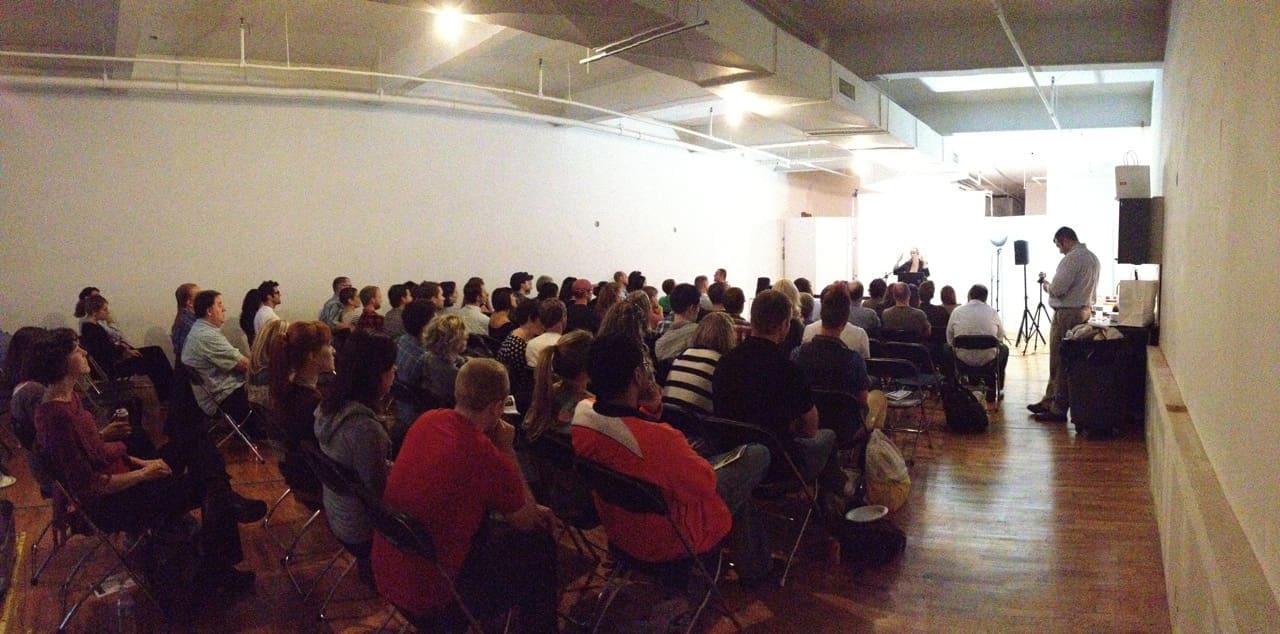
The second half of the 2012 Mormon Stories New York City conference, recorded in the fall of a presidential election year with a Mormon at the top of the Republican ticket. Part 1 (Ep. 381) is a panel on politics and foreign affairs; Part 2 (Ep. 382) is the story-sharing session that John Dehlin says tends to be people’s favorite.
John introduces the panelists. Spencer Higgins is a Washington, D.C. attorney who studied political philosophy at BYU, interned for Orrin Hatch, and describes himself as still very active in the church. Carrie Sheffield is a writer and political analyst in New York, a former Washington political reporter with a Harvard public policy degree, who has written about her own faith crisis in USA Today and the Washington Post. Subin Huon, who converted to the church at sixteen in Southern California and now works in finance, moderates. Carrie’s opening remarks weave together the politics she grew up with and the faith crisis of her last several years. The conversation moves through Romney and Mormon partisan identity, what individual Latter-day Saints owe the wider world, what might happen if the church published its finances (prompted by a Bloomberg story on the church’s new Salt Lake mall), and where to draw the line between Mormon belief and public law. John thanks Elna Baker for taking part in the session, and it ends with a hymn.
Part 2 opens with a musical number, then Tara sets the ground rules and goes first. Dave, raised by a bishop in a family of eight kids, describes how he ended up resigning. Bo was baptized at eleven, lost his mother at seventeen, and served a mission and attended BYU as the only Mormon left in his family. Adam calls himself a “moody believer” who still attends. Katie, a new mother in Washington Heights, explains how her faith wore down through dating a non-member, being a Democrat at BYU, and writing about gay students there, and how her daughter’s arrival made the questions urgent. A still-active member closes by reading the eleventh Article of Faith and playing two songs on the piano, before the room sings “Come, Come, Ye Saints.”
What’s covered
Part 1 (Ep. 381)
- 00:00 Political panel introduction and opening remarks
- 14:44 Spencer and the panelists on Romney and Mormon politics
- 20:59 Mormons as citizens of the world
- 30:32 Church financial transparency and foreign policy
- 43:28 Separation of church and state
- 49:48 Closing hymn and panel wrap-up
Part 2 (Ep. 382)
- 00:00 Story sharing session begins with a musical number and Tara’s story
- 18:28 Dave shares his resignation story
- 37:41 Bo shares seventeen years as a Mormon
- 46:21 Adam shares his experience as a doubting believer
- 59:55 Katie and others share their departure stories
- 1:10:14 A still-active member shares her perspective
- 1:19:16 Closing hymn and conference farewell
Related episodes: 379: 2012 New York City Conference Featuring Richard Bushman, Andrew Kimball and the Sabre Rattlers · 380: 2012 New York City Conference Pt. 2 with Elna Baker · 505-506: Carrie Sheffield on Leaving Mormonism, Finding Stoicism, Politics, Conservatism and More
Episode Transcript
Host: John Dehlin · Guests: Carrie Sheffield, Spencer Higgins, Subin Huon
This transcript is machine-generated and lightly edited for readability. The audio is authoritative. Please excuse occasional errors in names and spelling.
Political Panel Introduction and Opening Remarks
Part 1 of 2 · Ep. 381
Spencer Higgins [00:00:00] 12 3.
Guest [00:00:07] Mormon Stories Podcast is a production of the Open Stories Foundation. All donations to Mormon Stories are fully tax deductible and go directly towards keeping the podcast alive and towards building a community of support for Mormons like you. To support the podcast or to join the community, please become a monthly subscriber today@mormonstories.org
John Dehlin [00:00:31] so next we are going to have a panel on politics and foreign affairs in relationship to Mormonism. So we have a couple of people on our panel and also a moderator. So I would just like to go ahead and introduce the people who are first on our panel. Spencer Higgins on the very end Spencer spent his formative years in Coldis, California in Las Vegas, Nevada before heading to byu, his last choice for college. After his father told him he could either stay in Las Vegas or go to BYU for the year before his mission at the age of seven, Spencer inadvertently started the meeting where speakers in church detail how the bishop called them and asked them to speak. For this he apologizes. Spencer studied political philosophy at byu, which provided him a strong foundation for being pedantic and self important, especially in the area of politics. He hails from a long line of Mormon Democrats where his mother, upon getting educated, sensed real progress, lied elsewhere and supported Goldwater. She hasn't looked back. Upon finding out that he was interning for Orrin Hatch, Spencer's uncle told him his maternal grandfather would be turning in his grave. Perhaps to assuage his grandfather's disappointment from the grave, Spencer insists that he is the second most liberal among his siblings and parents. His father's family, on the other hand, was more concerned with maintaining their reputation as the best bar brawlers in Fresno, California. Eschewing atheism, Hedonan hedonism tempered with doses of altruism and bar brawls for the lds. Robust discussion in the household My dad
Spencer Higgins [00:02:22] moved church when he was 27. He was a former ball brawler. His brothers were like the most famous bar fighters in Fresno.
John Dehlin [00:02:29] Okay, his most famous bar brawlers in Fresno. Wow.
Spencer Higgins [00:02:38] He just got released from the state president.
John Dehlin [00:02:40] Okay. And he was just released as Stake president. His parents encouraged robust discussion in the household where family home. Evenings in the Kiggins home consisted of watching Mississippi Burning followed by discussions of civil rights or frank discussions of Joseph Smith's life and prophetic calling. Spencer practices law in Washington, dc. Our second panelist is Carrie Sheffield in the middle. Carrie Sheffield is a writer and political analyst here in New York. Raised in a multi generational Utah pioneer family, she studied print journalism at Brigham Young University and earned a master's degree in public policy from Harvard University. She worked as a political reporter in Washington, including stints as an editorial writer and blogger for the Washington Times, reporter for Politico and the Hill newspaper. During grad school, she was a correspondent covering the Israeli parliament for the Jerusalem Post. Kerry wrote about her experience with faith crisis in USA Today and the Washington Post. Her writing has also appeared in the Wall Street Journal, Newsweek, and the Huffington Post. We also have Subin Huon, who is going to be moderating the panel today. Hailing from Southern California, Sobin converted to the LDS Church at age 16.
Subin Huon [00:04:11] Here I knew Facebook. So this goes along with the theme for today. I converted through people like Carrie and Spencer when I was younger. And I really want to if Elma is still here, she look at her and you know, everything that you said today, kind of I found myself just nodding, thinking I went through the same thing. And you know, thanks to Kerry for introducing me to the Mormon stories. Here I'm thinking maybe this is kind of not as scary anymore to say I have my doubts and I respect the church. I respect everybody I've met during my formative years and when I decided to convert. But I honestly still have my doubts. And I, you know, I'm searching for that truth as well. So with that, I'd like to Carrie, do you want to have me introduce and you speak. So I'll have Kerry come up and give you her spiel. Yeah, okay,
Carrie Sheffield [00:05:34] whichever. I think Spencer and I are both going to give some opening thoughts, and then I think we're going to open it up to questions. So I wrote down some remarks and I tried to combine kind of the theme of faith crisis and interleaving it with politics, since politics was a big part of my family growing up. My father was or my grandfather was, the majority of us in the Utah House, very red household. So politics has always been something we discussed growing up. And then faith crisis was something that I've been dealing with in the last several years. So here goes. So don't tell the Federal Election Commission, Ms. But I voted multiple times before age 18. No, this wasn't election fraud. And most likely many of you did this, too. Over many years, I voted on various propositions and callings at my local LDS church. I felt empowered early on and invested in my Mormon community. I felt that I was part of God's democracy. In my naivete, I imagined that general conference would screech to a halt if I was that one lone vote against some Sistine in question. Of course, I never tried it, yet the idea remained a tantalizing thought. Since Mormonism began as such a thoroughly American religion, the idea of one's vote mattering in both the secular and a religious sense held a natural congruence for me. But as an adult, I began to question whether I was truly enfranchised as a voter. Mormons are counterculture to the mainstream, and that is by design. Mormons are peculiar people who left the United States for the uninhabited territorial wasteland later called Utah. Young Mormons generally don't do mainstream things like get tattoos, read Vogue magazine, hold bachelor parties, or play beer pong. The list goes on. But what makes things even more obscure for many of us here in Mormon stories is that we are in many ways a counterculture to that counterculture I've written about my faith crisis and how as a student at byu, I felt that I had inadequate support and no environment to openly and rationally connect with others who felt that same way. Till then, the gospel had been my reason for being. It was my roadmap, my inspiration. And at that time I had no way to connect with others who were experiencing the same doubts. But this so called Mormon moment has changed this for many of us. A column earlier this year by Ralph Stealth in the New York Times described his theory on why so many Mormons are attracted to the GOP or the small government philosophy. And I'll put the disclaimer here that I know many Mormon stories, people are left leaning. Aside from the fact that Mormons were persecuted by their own government, Missouri's extermination order comes to mind. It's also because the Mormon community emphasizes charity and the social safety net as the responsibility of private religious authorities rather than a government or public that authority. Utah also has an exceptionally low crime rate and high quality of life, in part because the people are self governed from within within the nuclear family rather than from some external quote unquote Manny state. I found this theory to be to make sense from from Ross Dapit. And it got me thinking about how Mormons place such enormous trust in their leaders. Because Mormons in many ways shift the social responsibility away from government onto private institutions. They give up that same transparency that they would get from government or from a publicly traded company. There's no media pool monitoring President Monson's every move as we have with President Obama. There's no 10k financial disclosures posted on Edgar stating the typing inflows and operational outflows. We don't know which apostle earmarks which line items in the church budget. We don't know if tithing money is coming from the persons of gambling. Vegas, my resident Vegas friend here.
Spencer Higgins [00:09:34] I don't gambling
Carrie Sheffield [00:09:38] so should all these pieces of information be released? Perhaps. But perhaps some should remain private. The question is, should these decisions about what should be remain private? Should they be made by a few men behind closed doors or by the church body? Many of us here are upset with how the Church offers an incomplete picture of Mormon history and doctrine. But is the LDS Church a science or history school? No. Does the Catholic Church preach about the horrors it wrought during the Inquisition or the Crusades?
John Dehlin [00:10:07] No.
Carrie Sheffield [00:10:09] However, the Mormon Church is different from many older faiths in that it emphasizes history and culture in ways that many mainstream religions do not. Mormons obsess about history, dressing up in pioneer clothes and reenacting pioneer treks. They make pilgrimages to otherwise incredibly boring destinations like Liberty, Missouri, Martin's Cove, and Winter's Quarters. We are here with Mormon stories because we are taught to speak out in monthly testimony meetings, sacrament talk assignments, and every member of missionary concept. We were programmed basically to openly and talk about our feelings. So it seems natural now that thanks to the Internet, to social media, to this Mormon moment, we are in some ways exploring experiencing a democratization of Mormonism. We are leveling the playing field. We're equalizing the power asymmetry from the past. What does that mean for the future of Mormonism? Word is that the folks at church headquarters have begun to overhaul the church curriculum, which is fantastic so long as it offers a fuller and richer future. In Europe, the Church reportedly has issued what is known as the Swedish Rescue, which is guidance on dealing with gay crisis in an even more secular continent than ours. It encourages love and acceptance of doubters. We've also seen progress in how LGBT Mormons are welcomed in the church and at byu. This is a counter to the church's heavy involvement in passing the anti gay marriage Proposition eight. But questions remain. Will we see the financial transparency from Salt Lake City that we see from the Evangelical Council for Financial Accountability? I mean, come on, are we really going to let the evangelicals beat us here? Will we see term limits on apostleship? Could doubters serve a mission that's based entirely on service and not on proselytizing? There are a lot of these questions that remain. Will women be true helpmates and equals in the church leadership, for example? So in this panel award on Mitt Romney, in full disclosure, I'm a Romney supporter, so apologize to Mormon fans, but I plan to vote him for reasons not because He's Mormon, but other reasons and happiness are offline. But you know, if he wins, he would be a constant, visible Mormon presence around the world. Would this mean droves of new Mormon converts? Most likely not. I've never met anyone. I don't know if you have anyone who became evangelical because of George W. Bush. Using the LDS Church Almanac, which is an annual statistical guide from the church, I tracked the Warden state in Massachusetts while Romney was the governor and was surprised to find that Mormon baptism raids in Massachusetts actually slowed down while he was governor. So this counters many of the fears from people in the south who worry that President Romney would generate new converts. So if anything, under President Romney we could see a slowing of baptismal rate just due to the secular nature of the way things are going in the world. Anyway, to wrap up as I pondered leaving the church, I questioned whether this would disrespect my ancestors, who sacrificed much for Mormonism. But traveling gave me a broader view of genealogy. I've got lots of British ancestors. I'm a bit of an eagle file, and during my BYU study abroad I visit Stonehenge, and we aren't entirely sure the purpose or the significance of Stonehenge, the sundial sculpture, but anthropologists tell us that it's most likely pagan in nature. So that got the wheels in my head turning. What if my ancestors had helped build Stonehenge? It was a very remote chance, but it's possible since I'm British, British roots. What would they say? What would my ancestors say if they knew that I belonged to a Christian sect born from the American frontier? Oh, the shame. Perhaps they would. Maybe they'd want the missionary discussions. Who knows? I say this tongue in cheek, but my sentiment is true. I seek to honor all that is good and true within mormonism, as the 13th article of faith states, with many bumps along the way, I seek for things that are of good report and praiseworthy. For me, this means honoring a commitment to transparency and honesty that allows all members to take part in the church in good conscience and to feel that their practice of offering a sustaining vote actually holds meaning.
Spencer and Panelists on Romney and Mormon Politics
Spencer Higgins [00:14:44] I'm Spencer Tiggins. I'm still very active in the church and you know, my mom's family there was in the brief biography talked about my mom's family being Democrat and it's true, they're all very Democrat except for my mother, who is about as ardent Republican as you can get. I did convince her though over the last few years that Dianne Feinstein is a good senator from California. And I Felt very good about that. I actually am Republican as well. I've worked on the Hill for a couple Republican senators. And although I no longer work on the Hill, and I have no desire to go back to that godforsaken place, but bless their hearts to those who do that thing. But that said, I hope there's no new papers here in case I do apply for a job on the Hill some future day and change my mind. My dad's a convert, and he was an atheist before he became Mormon. He was actually on the land. He was living underground at the time he joined the church. He had dropped out of law school. He had come home one weekend from law school. He was at law school in San Francisco at UC Hastings. And he came home to Fresno one weekend and walked in the house, and his first wife was in bed with another man. And my father was not happy about that. He was a little disappointed in her. And they got divorced somehow. And there are some details I'm not entirely clear about. But he, I guess, being a little impulsive, decided that the best course of action was to take my brother, my oldest brother, my half brother, and go on the lam for a couple years. He didn't want his first wife to have custody of Doug, my brother. So my dad goes on the land and ends up in Arizona and ends up living in Phoenix. And he has no place to take my brother Doug. He starts working at a JCPenney in Phoenix. And the person he meets, he meets somebody at work, this guy named Bob Nally. And Bob finds out about my dad's situation and says, you know, Warren, where can you. My dad's name is Warren. Says, warren, where do you take your son when you go to work? And my dad said, you know, I have nowhere to take my son. So Bob says, why don't you just bring him by my house, and my wife will look after him while we go to work. He said, okay. My dad was raised evangelical. He had become atheist. He comes from a very, very broken home, Just a terrible home. I have not had any personally. We don't have any contact with my dad side of the family. They're just not very. I guess they're doing their best, but, you know, my dad walked into Bob's home the first time he took my brother to be babysapped. And he said he felt a peace he'd never felt before. And as soon as he left the home, that feeling left. And it happened several times until he finally asked Bob, why is it that I feel this peace that I've Been seeking that I don't find anywhere else. And as they started discussing religion and Mormonism, My dad was an atheist and he read the Book of Mormon in six weeks. He read it while drinking beer. He had been a bar brawler in Fresno. One of his younger brothers had gotten thrown in jail for getting in a bar fight. And my dad went down to the local jail and tried to bust him to jail to bust my uncle out. That was how he was before he became Mormon and he joined the church. And he said he joined the church, he wasn't sure if God existed, but he joined the church. He thought that if God existed, this was his church. He studied philosophy in college and he said it took him two years after he joined the church until he came to the conclusion that there's God. So my family, my household, we were very open about some of the issues. Sometimes as I listen to other people talk, I think, you know, we had our family home meetings were like checkerboards or chess. We were. My parents decided when I was like eight or nine that it would be good for them to watch Mississippi Burning, a rated R movie. Heaven forbid to the family. Then we talk about civil rights. When I was 10, I found out my school teacher in California was a second generation Japanese American whose parents had been interned during World War II. And so as we were talking about California history, my teacher, Mr. Shimizu mentioned that. And I was astounded. As a 10 year old, I was, you know, apparently very into America. And I was very. I was very astounded that this country, this land of freedom, this land of liberty. I had my faith crisis about America at 10, that this land of liberty would intern citizens who were for no reason other than the fact that they were Japanese. And I went home just beside myself. And I talked to my mom about it. And my mom, we talked for a while. And my mom says this is one of her favorite moments with me as a child, as a 10 year old in fourth grade, being really concerned about the treatment that happened to Japanese Americans. Not that I'm a great guy. I'm just saying this is what happened. And then what happened is that my mom said, you know your grandpa, the one who's turning in his grave that I'm a Republican. Your grandpa organized a book drive and volunteered his time at the local. At the internment camp that was in central Utah. My uncle was a school teacher. And that gave me like a feeling of redemption that my grandpa had, seeing the plight of these Japanese Americans, had given up his time to assist them. And so my brief comments before we get into panel discussion. What does it mean to be a citizen of the world as a Latter Day Saint, as a Mormon? What are the ethics? What are the attributes that Mormons should have? You know, the international community, there's no central government, there's no police force. It's a world that's reigned by anarchy. And so each country tends to view international relations through this, the paradigm of power maximization. They're trying to maximize their power relative to other countries to seek some sort of security and stability for their own interests.
Mormons as Citizens of the World
Carrie Sheffield [00:20:59] And
Spencer Higgins [00:21:01] so an institution like the LDS Church, what can they do in international affairs? You know, obviously they're involved, they're very much involved in international development. And then they had become more involved international development. What can we do as individuals, as Latter Day Saints? You know, my law school talked a lot about, we had this theme of being a citizen lawyer, continuing to be active in public affairs as lawyers. And so I think my thought is what can we do as Mormons to be citizens of the world? What are the ethics and attributes? And I'm reminded President Uchdorf gave a, in one of a recent conference address, he said, you know, the merciful obtain mercy. And the first line says this. He says, when our hearts are filled with the love of God, we become kind to one another, tenderhearted and forgiving. And I thought, well that's perhaps that's the ethic we should have as Latter Day Saints of Mormons and whatever we do, and perhaps that's the citizen we should be in the world. That's the type of citizen we should be. To be meek. I'm not very good at being meek, I acknowledge that. But to be meek, to be tender hearted, to be patient. One of my favorite political theorists is a secular Jewish woman named Hannah Arendt. And she passed away in the 70s. And Hannah Arendt, in her book the Human Condition she talks about, she actually says that she thinks that one of the kind of the saving graces, I guess one of the areas of hope in human affairs comes from the come from emanates from the teaching of Jesus Christ. And as a secular Jew, she analyzes what Christ teaches and she says that forgiveness is a key principle. And she says this about forgiveness. She says the forgiveness allows us to be released from what otherwise would be an unending from being held a slave to deeds that we have done. We couldn't be released from any of our former mistakes or even positive acts. And she says only through this constant mutual release from what they do can men remain free. Agents. Only by this constant willingness to change their minds and start again can they can they be trusted with so great a power as that, to begin something anew. And then, she says, without being forgiven, released from the consequences of what we have done, our capacity to act would, as it were, be confined to one single deed from which we could never recover. We would remain victims of its consequences forever. And so I think, you know, as Mormons, those who remain active in the church, those who are no longer active, but hold on to cultural aspects of, of the LDS faith, there are ethics that I think are imperative to being good citizens in the world that we can take from being being kind hearted, being thoughtful, seeking to understand others, having empathy, being quick to forgive. And these are attributes that we don't often see in the realm of international relations as countries interact with, among each other. And I think that's something we can do. And I have some more comments, but I think I probably should have my time. I'm a bit, I talk quite a bit. So I guess I'll hand over the, I'll hand the mic back to Sophie and she can moderate us.
Carrie Sheffield [00:24:28] Thanks.
Subin Huon [00:24:30] I wanted to ask, and start off, I'm just going to have, I have two questions I'm going to ask and then I'll open the questions out to the audience here. We were talking earlier. Spencer did a lot of work on Prop 8, the trial, not supporting it
John Dehlin [00:24:55] or
Spencer Higgins [00:24:57] I'm happy to talk about talking about, I don't want to talk about the merits of gay marriage, but I will talk about legal aspects of it. If people have questions on what's the status of the leopard litigation, where it's going to go, stuff like that.
Subin Huon [00:25:12] Spencer wasn't done yet. All right. Since we all have that political science train and you mentioned a lot about international relations and in light of the theme of the conference today with the faith transitions in the information age, we see these news reports recently with the Libyan ambassador, there was a drone attack on the embassy. And that was because of a film that came out that was so controversial, attacking their religion, the Prophet Muhammad. What do you think, you know, in today's environment with YouTube? YouTube was just, you know, I just realized YouTube, it started in 2005. It's only been six years and already you have that and you have the pastor in Florida burning the Quran. And it's causing so many issues abroad, putting, you know, Americans. My uncle served in, he was the US Ambassador to the UN and then just people like that, it hits home to me just because it's, I mean, that's affecting us Americans here with extreme, with this kind of extremism.
Carrie Sheffield [00:26:43] What do you think?
Subin Huon [00:26:45] How do we manage that? When YouTube, you know, what are the regulations we need?
Guest [00:26:49] Who.
Subin Huon [00:26:50] Who inputs these regulations so that Americans are safe abroad?
Spencer Higgins [00:26:59] My first response is that I think we may have gotten the wrong chickens on this panel. My brother is a professor of international relations at Williams College. Probably should have called him up. So I'll try to think about what my, my brother would say. You know, first and foremost, you, you know, one thing we have to consider is that with freedom, if you think of freedom spatially, if you want to, if we want to allow people to have a certain right to act a certain way, to be involved in certain acts, we have to allow that right to be used in both the way that we agree with. That's virtuous, if you will, and a way that maybe not be so virtuous, but isn't entirely illegal, but we don't necessarily agree with it. And so it's tough, right, because you have these people who, what they're doing is constitutionally protected speech here in the US and unfortunately, it's causing quite a bit of unrest in other countries. And I look at this and I think I'm reminded of a couple of papers I read back when I was in college and studying international relations. There's this, this idea of the clash of civilizations, and there's certainly cultural clashes, and this is one thing where it's kind of a gamble, right? But, you know, you have going on the thing of like kind of the ethics we can use as Mormons, as citizens of the world. You know, you think of the situation, you think, you know, if there was just a little bit more understanding and there wasn't this kind of distinction, this skepticism and doubt between cultures and misunderstanding, we could probably avoid a lot of these issues. That's probably not the best answer. But I'm not willing to say that we need any regulations to minimize these videos. It's protected speech, and I think we need to protect speech because if we want to be able to say the things that we want to say, we have to allow people to. To say things that may not. That may be kind of dumb and stupid, but that's the right, and that's just kind of unfortunate.
Carrie Sheffield [00:29:09] Yeah. No, I think the answer comes down to education. You know, talking to people about this earlier, if you look at the long view of Middle Eastern culture, they were the cutting edge. They were the ones who gave us groundbreaking mathematical descri. Scientific discoveries, and then in many ways they regressed because of a culture of repression and fundamentalism. And it's incredibly unfortunate that that's how it is today. And you know, I spent some time in the Middle east and I was in Egypt during it actually does. I was about to say it's in many ways there are a lot of similarities. It's not as extreme by any stretch, but Utah has a lot of similarities in that it's a very conservative culture, very religious, people don't drink, the women are covered. Not as extremely covered, but it has to do with education. And if that's the export that we can give, I think we should give in a much more compelling way, more than Britney Spears and Lady Gaga. If, if we can export the philosophical and the ethical and the moral foundation that's built on reason and rationality that we had in the Enlightenment, that's the best export we can give to the Middle East.
Church Financial Transparency and Foreign Policy
Subin Huon [00:30:32] And then with what you, in regards to what you were talking about in creating more transparencies with the church's financials, I remember I work in finance now and so we always have to read Bloomberg. And then I remember one of the headlines, I think it was a couple weeks ago, it's how the Mormons make money. So of course I clicked on it and it was talking about this multi million dollar mall that they're building in Salt Lake now. And it just went down the list of how much money the Mormon Church makes. What do you think the repercussions are if the church was to release the financials, their financials?
Carrie Sheffield [00:31:20] Well, no one can say for sure. I don't have a crystal ball, but my hypothesis would be the repercussions would probably be a lot less severe than maybe a lot of people think it would be. As I mentioned, you know, the evangelicals have much better disclosures. The Catholics have very awful disclosures. There was a really interesting piece in the Economist a few weeks ago talking about all the shell games that are played within the Catholic Church to basically try to avoid paying reparations for sexual abuse, which is very tragic. But fortunately we don't have that problem in the LDS community. But at the same time, we don't have the disclosures that you see in some other churches. And frankly, you know, I think as you know, I don't pay tithing anymore, but I used to, as someone who paid tithing and was a quote unquote shareholder in the church, I felt that I had the right to know what was being my money was being spent on. And you know, I Think for some people it's not as big of an issue. But you know, I think it's a budget is a statement of your values and your priorities. So it'd be nice to know what the church actually values and prioritizes in a very transparent way.
Spencer Higgins [00:32:33] Spencer, you know, I take a little bit different view. I think back to a talk that president neatly gave. I think when I was a freshman at BYU in October of 1999, I think was the conference where I think the talk was entitled why the church does some of the things or why we do Some of the Things We Do. And he talks about some of the church's missions. Again, it didn't lay out, I don't remember the talk or I don't remember the talk, any of the numbers that, any of the specific numbers that were laid out in that talk. But yeah, I remember they said that I think that the number one cost is building churches and building buildings and temples. And number two, at least in 1998, 99, that time was financing BYU and BYUIU, why? And the church educational system. And so, you know, if you look at the cost of education these days, you know, where tuition at private universities is $50,000 and at BYU I think it's what, 4,500 now? It's a little higher than it was when I was there, but that's a great charitable act. You're subsidizing, gosh, nearly 90%, if not 90% of the tuition costs and that's it. You know, I'm comfortable with my patio into that, but I guess I can see where ticket's coming from, where you want the budget itemized really in an itemized way. I mean, I don't know, I'm not too moved by that, I guess. Kind of indifferent.
Subin Huon [00:34:14] Thank you. And then so now I'll just open it to the audience if you guys have any questions. Knowing Carrie and Spencer, they're very, they're well versed. He is.
Guest 2 [00:34:27] Okay, I'm going to try to speak out loud.
Guest 3 [00:34:29] Right.
Guest 2 [00:34:29] I'm no longer lie to a couple years ago, but I grew up lifelong. Larry, Stan, just have a question that both of you seem to be persuaded and I'm not. And I always felt like one of the lone voices that was stuck in a strange one liberal. But anyway, the question I have is how would a Latter Day Saint reconcile the contradictions that we see publicly going against their own faith? Let me try to just give an example. The other day Romney came out and criticized President Obama for apologizing or being apologetic and for, you know, and there's this longer running narrative about Obama being an apologist, giving an apology to her and all that kind of stuff, when as a latter day saint, you mentioned much earlier, you know, we're to be a forgiving kind of people, we need to be the first one to say we're sorry. But then Romney appears to give the image of, you know, never say we're sorry for Americans. So how does the Mormon reconcile the message of telling the world Americans should never say they're sorry but then in our religion we need to, you know, you know, be a sorry. You know, I mean, you know what I'm saying, to say our sorry, forgive and all that sort of stuff.
Spencer Higgins [00:35:56] It's interesting you bring that up. I was recalling there was an Clark gave in October of 1940, 46 where he talks about he was incredibly critical of the atomic bomb. You know, we're taught in American history, right, growing up that dropping the atomic bomb on Japan was a great thing. It ended, the war would have lost, I think decimations. There would have been at least a million casualties having invaded Japan. And J. Reuben Clark says this, he says, and the worst of this atomic bomb tragedy is not that only not is that not only did the people of the United States States not rise up to protest against the savagery, not only did it not shock us to read read of this wholesale destruction of men, women, children and cripples, but that it actually drew from the nation at large a general approval of this fiendish butchery. Thus we in America are now deliberately searching out and developing the most savage, murderous means of exterminating peoples that Satan can plant in the in our minds, we do it not only shamelessly but with a boast. God will not forgive us for this. And he says if we are to avoid extermination, if the world is not to be wiped out, we must find some way to curb the fiendish ingenuity of men who have apparently no fear of God, man or the devil, and who are willing to plot and plan and invent instrumentalities that will wipe out all the flesh of the earth. And as one American citizen of 130 million, as one of 1 billion population in the world, I protest with all the energy I possess against this fiendish activity. And as an American citizen, I call upon our government and its agencies to see these unholy experimentations are stopped. He said this, he said and he said, then let Lester Jeremy Clark also said that no nation has to bear greater blame for this. For the troubles of the world for the atomic bomb than our own. Now, I know it's interesting what J. Reuben Clark said, and he said that from the pulpit at a general conference as a member of the first presidency. And you can you. And I'm not trying to be critical of Mitt Romney. I think it's interesting just to compare what J. Reuben Clark said with Mitt Romney's stance. I think there is a tension. J. Reuben Clark was a diplomat. He served in the State Department as a senior official. There certainly is a tension between this kind of more idealistic foreign policy. He was an isolationist. J. Clark was an isolationist. He talks about that. He was. In fact, he says, I'm a confirmed isolationist, a political isolationist. And he cites. But you know, there is this tension,
Guest 3 [00:38:27] right, where
Spencer Higgins [00:38:31] there is this idea among people involved in foreign policy that international relations scholars, that realism, right, that you have to maximize your power relative to other countries to be able to seek your own interests and to have security for your country vis a vis other countries. And I think Romney's coming from that perspective and that's a very common perspective in the realm of international relations. And I think there's this, you know, it's the tension between the reality of where we live, of the world we live in and the idealistic world we want to live in. How do you resolve that tension? You know, that's a tough one. I actually don't really have a great answer, unfortunately.
Guest 2 [00:39:17] And I want to extend that out, by the way, to the policies on immigration where the Latter Day Saints, you know, strongly believe in Lamanites coming to, you know, to New Jerusalem. But, you know, there seems to be a contradiction, you know, holding up the borders to where we don't want any more Mexican
Spencer Higgins [00:39:37] on immigration. This is actually. So I think you're overstating the case, to be honest. On immigration, the church did come out and issue the Utah Compact. It was very encouraging of Utah to not follow, to not follow the path of Arizona and pass that law. So I think you might be overstating the case on that one. I think there probably are some Mormons and I think it has less to do with being Mormon than. It's just, you know, it's. If you're, if you hail from the American Southwest, it's easy to see. It's understandable. Not easy. It's understandable why people would have some issues with illegal immigration. I personally, and think it's, I personally, I mean, let them say, I don't, I don't see the issue So I don't have much issue with legal immigration. I think our immigration laws are outdated. But that's another discussion for another time. But that said, I don't want to paint a broad brush and say that all Mormons are xenophobes and, you know, hate Mexicans and they're not being good Mormons because they're not following their religion. I just don't. I'm not gonna go there.
Subin Huon [00:40:44] I might not have the answer for that, but I do have a great resource. Rami gave a speech at the Bush Library a couple months back. It's called Faith in America. And I just skimmed it over and he kind of outlines, you know, in his role as president, the thing, how he would prioritize his faith and how that would or would not collide with his time in office if he were to be voted into as president. So you might want to check that out.
Guest 3 [00:41:32] I think there's actually some interesting scriptures
Spencer Higgins [00:41:34] where we can actually kind of draw
Guest 3 [00:41:36] some of the conclusions that, you know, I guess some of the more ideal conclusions about the separation and, you know, Christ. But then, you know, there's also this notion that we eventually, ultimately are not able to serve humans. We're not able to, I don't know, we're not able to kind of give
Spencer Higgins [00:42:04] our all both to God.
Guest 3 [00:42:05] And then I guess in the middle of that, really the ultimate hardware, which
Spencer Higgins [00:42:12] way we go and who we serve
Guest 3 [00:42:15] is our own conscience. So I don't know, I'd be interested to know what you guys, you know, what you guys think. Obviously, you know, this could span various different issues and you know, go into the whole topic. Things can go into, you know, our stance on immigration, on foreign policy, law, et cetera, et cetera. I would be very interested. Good to see what you guys thought. You probably thought about this, you know, the division possibly there. There is, you know, totally satisfying answer, but I would be kind of interested to know about.
Carrie Sheffield [00:43:01] Yeah. So I'll try to summarize, just for the recording, your question. If I'm wrong, correct me. So you're kind of wanting us to talk about the idea of you can't serve two masters. So the question of the division between church and state and whether we think that's feasible in a religious context or as a latter day saying.
Separation of Church and State Discussion
Guest 3 [00:43:28] I think, you know, from the LDS standpoint, I've seen a lot. We're encouraged to be activists, to be active in our.
Carrie Sheffield [00:43:48] Yeah. So the question is, where do we draw the line between what's appropriate, I guess, insertion of Mormon belief into the government. And yeah, it's a really tough question because where do you draw the line? I mean, essentially law is regulated, morality or ethics, and every society has their own wars, their own pornography standards, for example, or what have you are very different here, mostly in Europe or
John Dehlin [00:44:19] prostitution
Carrie Sheffield [00:44:19] or, you know, any number of things that would be seen as incredibly immoral somewhere. It's not the case elsewhere. And, you know, that's. I don't think that there's one right answer. I think it's something that each society has to grapple for themselves. Yeah. I mean, I think from my perspective as someone. You know, I was an editorial writer at the Washington Times, which is. My perspective is I think that the more a citizenry governs from within rather than from without, the better. And by without, I mean both religious and civic authorities. So, you know, I left the church, obviously, I have problems with authority, both religious and governments. So I think the more we can basically train our citizen really to govern from within, I think that could be the solution.
Spencer Higgins [00:45:23] A couple comments. Thomas Jefferson drafted the Virginia Statute on Religious Freedom, and he was highly influenced by some of the Scottish Enlightenment philosophers in the 1700s. They were his contemporaries. One in particular is this philosopher who's not very well known these days, but his name is James Berg. B U R G H He has a book called Political Disquisitions. There's actually an original copy of the BYU library that was sitting in the stacks. They didn't realize that it was, you know, like a rare book. But nonetheless, James Berg was very big into. He was a big promoter of the importance of separating church and state. And the reason he wanted to separate church and state. These days we think of the church polluting government, but the reason why he was for separating church and state, he was English, well, Scottish, but. He was for separating church and state because he thought that when religion and government are combined, that government then tends to influence the religious practices and ideals of a certain religion. So he thought he saw that government would infect religion more so than religion would infect government. And it's very interesting the way that we tend to. We kind of think of it in a very flipped way these days, even though kind of, if you go to the. If you want to get into this whole concept of original meaning, but if you think of kind of what the original meaning may have been at the First Amendment, as far as the separation
Carrie Sheffield [00:46:54] clause,
Spencer Higgins [00:46:57] it's likely that religion, the framers were more concerned with government kind of being a little too involved in religion. If you look back at What James Byrd was saying and his dedication to his book Political Disposition. He dedicated the book in part to Thomas Jefferson in 1776. So that's one thought. The second thing with separation of church and state and Morgan, dumb. I think it's fascinating because if you look at our history, the government caused quite a bit of harm to the church. Right. Or not harm. The church didn't have a great relationship with the federal government for decades. Right. And then now there tends to be this willingness to kind of then work more closely with the government or use or. I don't know. It's a funny tension.
Guest 3 [00:47:47] Right.
Spencer Higgins [00:47:47] Because there was this. You would think that we would have some kind of distrust based on our historical interactions with government. And yet there's a more willingness to kind of take what we think are certain ideals and legislate them on some level. Whether that's right or wrong. That's a question I'm not gonna, you know, I don't want to answer that now, but I think so we asked it.
Subin Huon [00:48:13] I think our time is up. Chrissy's giving me the piping and so I'm just going to ask her for maybe one or two minutes. If you guys have any more questions, we're going to answer with one word.
Carrie Sheffield [00:48:30] Yes.
Guest 2 [00:48:30] Okay. You mentioned that your father.
Spencer Higgins [00:48:45] Yes, he did. They were actually both divorced.
Subin Huon [00:48:50] Yes.
Guest 2 [00:48:54] And I have a question for you as well. Your transition, as you have a theological connection, are you going towards.
Spencer Higgins [00:49:09] That's not the answer to that question.
Carrie Sheffield [00:49:12] We can talk after. Yeah, I mean I believe in. I mean it's pretentious to quote Einstein, but I was reading a quote by him the other day saying basically his God is the God that expresses, expresses itself in the very few things that our people minds can even comprehend. And that's basically it.
John Dehlin [00:49:34] I,
Subin Huon [00:49:37] I think that's it for us. Thank you.
Closing Hymn and Panel Wrap-Up
John Dehlin [00:49:48] I want to thank Elna Baker for participating in the session as well as our panel, Spencer, Carrie and Subin. So Bend. I thought I had it right that time. So sorry. We're going to take a 30 minute break. There's still some snacks available over here, so please feel free to grab a drink and some snacks. We'll come back at 1:05 and we'll do the third session which is the story sharing session. This tends to be people's favorite session, so I hope you'll join us for that session. Thanks. 405. 405.
Subin Huon [00:50:27] Thanks.
Guest [00:50:32] Thank you for joining us today on Mormon Stories. Music today was provided by the Saber Rattlers. Check them out at sabre-. Rattlers.com the Mormon Stories logo was generously donated by studiocase.com thanks for listening.
Guest 4 [00:50:47] Come come ye saints no toil nor labor fear but with joy when you're away Though hard to you this journey may appear Grace shall be as your day Tis better far for us to shine Stride our useless cares from us to dry do the San jo your hearts will swell oh, all is well all is well. Why should we mourn? I think our lot is high
Guest 3 [00:51:52] T
Guest 4 [00:51:52] not so all is right why should we think to earn a great reward if we now shun the fire Gird up your lo fresh courage take Our God will never us for sake soon we'll have let's tell it tale oh, all is well all is well oh, all is well all is well. Sam. And should we die before our journey is through Happy day All is well we that are free from toil and sorrow too with the just we shall dwell but if our lives are spared again to see the saints the rest obtain I will make this chorus well oh, all is well all is well all is well all is well
Guest 3 [00:54:43] all
Guest 4 [00:54:43] is well oh, Is well all in the way.
Subin Huon [00:55:12] Sa.
Story Sharing Session Begins
Part 2 of 2 · Ep. 382
John Dehlin [00:00:00] 1, 2, 3. Mormon Stories podcast is a production of the Open Stories Foundation. All donations to Mormon Stories are fully tax deductible and go directly towards keeping the podcast alive and towards building a community of support for Mormons like you. To support the podcast or to join the community, please become a monthly subscriber today@mormonstories.org.
Guest 12 [00:00:30] welcome back to the third and final session of our conference. I think we're gonna. Looks like we've got everyone who's gonna stay seated, right? Okay, so we're gonna kick off the third session with a musical number. Are they. I don't know if they're. Are we not doing. We're not doing musical number. Sorry, Just. Okay. I don't want to mess this up, and I think I'm on my way to doing that. Apparently, I've been left out of the Loyola something. Yes, we are getting musical number. I gotcha. Okay, so we're turning it back over to Mark. Mark's gonna go again. All right, thanks. What's called.
Guest [00:02:24] Oh, honey, I can't make it, can't make it with you it. All do these days. Step across that line when you put your arms around me Know your love ain't true however much I want you I can't leave it
Guest 2 [00:02:52] now folks that
Guest [00:02:53] try to tell me that I find it by Let me take you by the handle from this awesome train. Honey, I want to love you.
Guest 3 [00:03:23] Sa.
Guest [00:03:55] Honey, I can't make it can't make
Guest 4 [00:03:58] it
Guest [00:04:01] I just can't make it.
John Dehlin [00:04:21] Sa.
Guest 3 [00:05:25] Night.
Guest [00:05:33] To death. Jesus, My free spirit. Stranger star from the sky.
Guest 2 [00:08:03] My.
Guest 12 [00:08:52] Thank you, guys. That was great. Okay, so it has been left up to me to kick off this sharing session, and I assure you that there are far more interesting stories to be heard than mine. Many of you know that my husband. Those of you who know me at least know that my husband is the more interesting to have when it comes to our marriage. But you got me. Little ground rules for the sharing because there's such a big group. Try and just be mindful of your time. If you choose to come up and share your story. Maybe around five to seven minutes. I'm gonna try and do that. We'll see how I do. My name is Tara. I was born and raised Mormon. My family, most of them, are currently living in Utah right now. Brian, my husband, and I moved out here in February, and I started my. I mean, I think for the most part, I started separating myself from the church while living in Utah in my mother's basement. So it was a unique place. To have this all kind of culminate. I went to school, I went to college at byu. I studied anthropology, social cultural anthropology. And I think right there is kind of when I started thinking a little bit differently. It encouraged me to really try and embrace other cultures. And I think one of the underlying principles of anthropology is that everyone's truth is true. It's their perspectives, how they see the world, whether or not they're cutting chickens heads off to determine whether or not you're going to live in the community or just. There's a lot of different things, but it's all true. And that's kind of, it's a very interesting dynamic in BYU that this little community exists. I had a professor even say to us once, if you're studying anthropology, you'll probably lose your testimony. And I'm the one sitting in there going, I'm gonna be fine. I'm so not fine. But I digress. So BYU is a big, I think, big mind opener for me, believe it or not, in the community filled with Mormons as it is. I think that's when I really, I really started to see things and marrying into my husband's family, they're a little bit more liberal minded than my family too. And so hearing him question things and being part of that relationship was a big influence as well. And from there, you know, I saw some things that I studied in anthropology in particular, power structure and hierarchy really come into play. Some personal experiences that we had in the church, really seeing some of the power and hierarchy come into play in the family, excommunication. And it was a very fascinating experience for me. It was very difficult too, just because I can be very strong willed and cynical. And since my faith journey I've been able to embrace my sarcasm and cynicism
Guest 5 [00:12:22] fully without having to filter it.
Guest 12 [00:12:25] And it's been marvelous. I think for me right now that's what I really like to speak about, is where I am right now. And I feel for me a lot of my separation from the church has been an opportunity to really express myself, find out who I truly am, what I truly love, what I don't love, and focus on things that really just experience life. I feel like I put a lot of restrictions on myself, a lot of guilt and shame in high school and college. It was a recurring theme in my life. And a lot of things have improved for me since personally. And it may not be that way with everyone, I know that. But for me it was a severing the ties with the church, really. It got rid of a lot of that guilt and shame for me. And it's been an incredibly freeing experience for me. One thing in particular, I've got this book up here. It's called the Shack. I don't know if has anyone read it for me. It puts the words so perfectly. What I think I felt a lot in the church, what I wanted out of a relationship with God, out of a. A religion of sorts. And I'm just going to read a couple things from here to just kind of close up my thoughts and where I am right now. So in this book, a man has the opportunity to meet God and Jesus and the Holy Spirit, and they take different genders and forms, but he's having a conversation with Jesus at this point. No, the Holy Spirit. And she's talking to him about how the difference between verbs and nouns in regards to thinking of God. And she says, and as my very essence is a verb, I am more attuned to verbs than nouns. Verbs such as confessing, repenting, living, loving, responding, growing, reaping, changing, sowing, running, dancing, singing, and on and on. Humans, on the other hand, have a knack for taking a verb that is alive and full of grace and turning it into a dead noun or principle that reeks of rules. Then something growing and alive dies. Nouns exist because there is created universe in physical reality. But if the universe is only a mass of nouns, it is dead. Unless I am, there are no verbs. And verbs are what makes the universe alive. Now, the main character who's meeting God is really struggling at this point. So she gives an example. Let's use two responsibility and expectation. Before your words became nouns, they were first my words. Nouns with movement and experience buried inside them. The ability to respond and expect. My words are alive and dynamic, full of life and possibility. Yours are dead, full of love and fear and judgment. That is why you won't find the word responsibility in the scriptures. I have no idea if that's not true.
Guest 6 [00:15:34] Go ahead and check.
Guest 12 [00:15:36] Religion must use law to empower itself and control the people needed in order to survive. I give you an ability to respond, and your response is to be free, to love and serve in every situation, and therefore each moment is different and unique and wonderful. Because I am your ability to respond, I have to be present in you. If I simply give you a responsibility, I would not have to be with you at all. It would now be a task to perform, an obligation to be met, something to fail. Let's use the example of friendship and how removing the element of life from a noun can drastically alter a relationship. If you and I are friends, there's an expectancy that exists within our relationship when we see each other or are apart. There is an expectancy of being together, of laughing and talking. That expectancy has no concrete definition. It is alive and dynamic. And everything that emerges from our being together is a unique gift shared by no one else. But what happens if I change that expectancy to an expectation, spoken or unspoken? Suddenly, law has entered into our relationship. You are now expected to perform in a way that meets my expectations. Our living friendship rapidly deteriorates into a dead thing with rules and requirements. It is no longer about you and me, but about what friends are supposed to do or the responsibilities of good friends. Jesus then says to him, Mac, I don't want to be first among the list of values. I want to be the center of everything. When I live in you. Then together we can live through everything that happens to you rather than the top of the pyramid. I want to be the center of a mobile where everything in your life, your friends, family, occupation, thoughts, activities, is connected to me, but moves with the wind, in and out and back and forth in an incredible dance of being. It's all about relationships and simply sharing life. What we are doing right now, just doing this here at Mormon Stardies and being open and available to others around us. Christ Church is all about the people and life is all about relationships. You can't build it. It's his job and he's pretty good at it. And so for me, it's been this experience of building relationships and focusing on that. I do believe in God and I do believe that he's the center of my life. And it's been a free experience to be able to live that without judgment and have a relationship for one of the first times in my life. And so with that, I turn the time over to you to come up to the mic and share your stories and we'll try and conclude at quarter past five, right?
Dave Shares His Resignation Story
Guest 2 [00:18:28] Hello, my name is Dave. I would have to tell you this is kind of weird, you know, because it feels like a sort of like a testimony meeting, right? And I haven't done that for probably a decade. So I'll also tell you that I, throughout my entire life, I never thought I would be where I am now as far as my worldview. The last thing I wanted, the last thing I was seeking for or anything like that just kind of hit me. I was the kid. Maybe a lot of you have similar stories, but I was the kid that grew up in the totally believing, absolutely 100% dye in the wool Latter Day Saint. Dad was a bishop. I idolized my father. Eight kids in the family. Member remember being three years old, singing that song. I want to go on a mission, and I hope they call me on a mission. And where other families, maybe they were teaching their kids, which college you want to go to, for me was, where am I going to go on my mission? You know, my superheroes were all the prophets and the apostles and everything that was on the wall.
John Dehlin [00:19:41] I mean, that's.
Guest 6 [00:19:42] That's.
Guest 2 [00:19:42] You know, that's. That's the kind of family that I
Guest 7 [00:19:45] grew up in,
Guest 2 [00:19:48] you know, and out of four boys, I'm the one guy who actually went out and served a mission and the one guy who actually went to college. I wound up joining the military because I like that structure that I found, just like I found in the church, you know. And to cut my story very short, bottom line is I began to go through my faith transition during a deployment in Iraq, of all places, which made it kind of hard because there I was, trying to concentrate on doing my job in the Army. And sure enough, all of a sudden, I am having questions about God. And then returning home from the deployment, coming back to the family that changed man in so many ways because of what war does to you, you know, that's a wholly different story, but also because of suddenly I no longer had that footing, you know, and my worldview is starting to change, I think. I'm so. I'm so glad about the Mormon stories podcast thing that's going on, right, because of the support that I received, knowing that there's other people, we all have completely different stories, but to know that there's other people that's going through faith crises like my own. I know one of the challenges that I had at least, was trying to open up to my wife, because when I came back, suddenly I didn't want to go to church anymore. And she would ask why, and it's kind of hard to tell her why. You know, I couldn't tell because Joseph Smith is a fraud or something like that. You know, I was worried how she
John Dehlin [00:21:29] was going to take it,
Guest 2 [00:21:32] and the added stress of, obviously, we're unique. You know, my wife is deaf, and we were living in an area that didn't have any interpreters. And so it made it a challenge for her going to church and sitting there and not being able to participate or be actively involved because she depended on her husband for interpreting. So, you know, there was a lot of tension going on right there. But after a couple of years went by, eventually, you know, Lisa asked me, you know, what's going on? You got to tell me. And that's when I kind of broke the news to her. And then she took it. I didn't know she was going to leave me or what was going to happen, as fate would have it. You know, obviously we're still together, we have a great marriage and we both wound up going along the path, eventually resigning from the church. You know, it happened when we decided to resign from the church. It felt like the right decision to do. I certainly do not believe anymore. But after we made that decision, Lisa has been able to seem to move on spiritually and, and find a new path. But for me, it's. I kind of feel like I'm still stuck in the mud after four years of being a Mormon. I don't know what else to do. And so I'm still trying to figure that out right now. You know, I went into, last week I went into, I flew out to California to attend a civil Mormon marriage in a church. You know, there's hoops or maybe I don't know why they're not getting married at a temple type new wedding. And so I walked into the church and it just felt strange and funny, but at the same time it felt like I was at home. And those conflict, those feelings, it's hard to describe. I don't know what to do with them. You know, here I am, I'm an educated man and I'm a soldier and all this other kind of stuff. I can handle my own business, but my spirituality is so confusing.
Guest 4 [00:23:34] Right.
Guest 2 [00:23:35] I still have no worries right now. Okay, so that's faith transitions. I'm still kind of going through that right now. I don't know whether to believe in God, whether to, you know, throw religion out all together or what. I tell you one thing though, the podcast have been fantastic. I mean, there was probably a three month period where that's all I would listen to on my, on my iPad, over and over and over and over again. Driving to work, back and forth when I go out for a run or whatever it is. And, and you know, this is kind of a therapy that I think that I needed. But someone just recently asked me here, you know, so am I going to be like the, the anti Mormon now? I'm going out trying to, you know, unconvert everybody, you know, and I don't
Guest 7 [00:24:22] know
Guest 2 [00:24:25] because, you know, I was trained to be a great missionary, right? So that, that still part of me you know, sharing what I believe.
Guest 7 [00:24:31] Right.
Guest 2 [00:24:33] But at the same time, I'm not trying to destroy anybody's faith either.
John Dehlin [00:24:35] I'm not into that kind of business. You know, my.
Guest 2 [00:24:37] My folks are in their 70s. The last thing I want to do is, is kind of sticking with this information at that stage of their lives. At any rate, bottom line is,
Guest 7 [00:24:51] you
Guest 2 [00:24:51] know, it kind of sucks to be me as far as spiritual things go, and. And there's not a whole lot I can do about it. But at the same time, I think I am glad that our marriage has been able to survive through it. I know that not every marriage has been able to survive through this kind of transition. So I'm very thankful for that, for my wife. I just still don't know what's going to go on with my family. My family right now. I suddenly went from the shining good sun example to, oh, my God, goodness, nobody talk today. You know, do not bring. We just brought up politics earlier. Don't talk politics. Religion, nothing today.
Guest 7 [00:25:32] Okay.
Guest 2 [00:25:34] But yeah. So anyways, that's my story.
John Dehlin [00:25:38] Thank you. Thanks, Dave. My name is Jared Moon, and I actually work on the podcast with John, editing them down to listenable lengths and those kinds of things. So one of the things I really love about Mormon's stories, you said this feels like fast and testimony. It's absolutely full of contradictions. Like, you know, if you. Whenever people say things to John Dehlin like, hey, this could be my new church, or something like that, he's like, no, no, no. You know, like, that's like the worst
Guest 2 [00:26:21] idea in the whole world for him because he doesn't want to replace the church.
John Dehlin [00:26:26] And yet here we are in a fast and testimony meeting on a Saturday, a voluntary one, no less, talking about Mormonism.
Guest 2 [00:26:38] And,
John Dehlin [00:26:41] you know, and it showed up to. To dinner with some of the organizers last night, and everybody sits down at the table. And in this ostensibly Mormon gathering, I mean, like, the. The thing that everybody at the table has in common is, is Mormonism. And yet the prevailing question among those people is what religion are you?
Guest 3 [00:27:04] Like,
John Dehlin [00:27:06] so where are you at in relation to Mormon? And I just, I love that Mormon Stories is full of those contradictions. We have a Sunday school, for goodness sakes.
Guest 12 [00:27:19] Right?
Guest 2 [00:27:19] You know, this idea
John Dehlin [00:27:25] of trying to be everything for everybody is a really beautiful thing. And at first glance, and almost everybody has probably had this thought in relationship to Mormon stories is like, that's just crazy. Why is it trying to be everything for everybody? Why is it trying to have a space for everybody? But it's in exactly that contradiction that I think Mormon Stories is really fundamental to our lives. I'm a member of the church, active and believing, believing in a nuanced way of believing.
Guest 2 [00:27:58] And
John Dehlin [00:28:01] at the same time, I would describe my wife and I as activists, I would describe this as unorthodox.
Guest 7 [00:28:13] And
John Dehlin [00:28:16] whether or not she agrees with those characterizations is another thing. But the real strength that Mormon Stories has been in my life in the last year has been and giving me even greater exposure to the experiences of other people and a means by which to have greater empathy. My personal experiences with the church are complicated, frustrating, but I can't honestly say that they've really ever been painful. My feelings about the church are still complicated, many feelings about the church that are still frustrating. But I'm grateful that I have pain now. It's not personal pain from my own experiences,
Guest 3 [00:29:13] but it's the pain that other
John Dehlin [00:29:14] people have shared with me that I've been able to feel very closely as a result of people coming together and doing this and talking about the experiences that they've had trying to be gay in this church and trying to have an identity of their own when they feel like what they're being asked is for their identities to be assumed into some kind of collective mind.
Guest 2 [00:29:49] I
John Dehlin [00:29:52] know personally that it's possible, and I really appreciate Dr. Bushman sharing the things that he did, because I know that everybody can have a path that is their own right and it's right for them. And.
Guest 6 [00:30:11] And
John Dehlin [00:30:15] the realization that I've had is that the path that's right for me is not the path that's right for everybody. And I think that God would agree with me. I think that there are people who should leave this church if the church isn't. And it's as simple as this. If the church is a net asset in your life, then stay and make it work and try and make it better. The church is a net liability for you. If it's causing more pain in your life, then it is causing joy. If you're experiencing more trauma than you are peace, then you have to do what's right for you. And I'm a firm believer in this idea. And anybody who wants to know, I will show you in the scriptures where it is and where it's written and where it's clearly taught that what is right for some person at one time in their life may not be right for another person. The gospel is not black and white like that. There's all kinds of shades of gray, and the gray is what makes it beautiful and what makes it, makes it possible for it to work to our advantage. I believe in God. I believe in probably a different kind of God than my parents believe in. I believe in a different church that my parents believe in, even though I'm a member of the same church my parents believe in. I believe Jesus when he says where two or three are gathered in my name is saying, it's my church. You know, the church is all of us. And the church is a lot bigger than Mormonism. And Mormonism is a lot bigger than the Church of Jesus Christ of Latter Day Saints. Joseph Smith, when asked to define Mormonism, said, mormonism is truth. And unless we seek out all the truth that's available to us in the world, no matter, like where it comes from, we won't come out good Mormons. And I believe that with all of my heart. And I believe Jesus when he says that if you don't have love, you're nothing. It doesn't matter if you have immense faith that you could move mountains according to Paul and according to Christ. That means nothing if you don't love your fellow man. So love and truth.
Guest 5 [00:33:04] I was not gonna do that,
Guest 4 [00:33:07] but
Guest 5 [00:33:08] I just wanted to add to what he said, I'm the believing steps. But that's not my whole story. And the church is not about black, white and gray. It's about black, white, and all the colors of the rainbow. And it doesn't matter what color you are in that rainbow. You belong if you feel it. And about a year ago, my husband told me about his struggles with faith. And I had known about them pretty much most of our marriage. I went into our marriage knowing he was a doubting Thomas and knowing that that's part of the reason he married me. And it's been an interesting journey. It's brought more people into my life through more stories. It's made me analyze more closely my beliefs, what I'm teaching my two daughters, what I believe. And I feel like our family is going to come out of this stronger because of this. And we've gone through all kinds of stuff that normal people don't go through. We've gone through a contested adoption, infertility, all kinds of stuff that is not typical.
Guest 4 [00:34:54] And
Guest 5 [00:34:57] I really feel like the gospel is love.
John Dehlin [00:34:59] Love.
Guest 5 [00:35:00] It's love. And we need to embrace one another and not judge and accept one another and make our congregations more kind, more loving, more embracing of every single person who wants to be there. And I remember several years ago, I was sitting in a Zulu society president and his Sister called me up on the phone, very suicidal. And she said to me, I'm not a good Mormon. And I said to her, what does it mean to be a good Mormon? What do you mean when you say that? And she said, well, I can't cook and I can't sew and I can't do all of these domestic things. I don't believe the way everybody in the congregation believes. And I said to her, do you feel that God loves you? And she said, yes. And I said, that sounds like a good morning to me. I feel like it's important that we're authentic, that we're real with one another and that we embrace each other and understand that we all are on different paths. But we're put in each other's path for a reason. Whether it's for 10 minutes or 10 years or longer, we are put in each other's paths by God, by Creator, by heavenly parents who love us and care about us. And anyone who feels like they are in control of their life is going to come to a point in that life where they realize you are not in complete control of your life, but you are in control of how you react to the things that happen to you in this life. And hopefully the reaction is that love, and if you can use that verb the most in your life, you will come out not just looking heaven in this life, but with the heaven in the hereafter. That's my Mormon story for you today.
Bo Shares Seventeen Years as a Mormon
Guest 3 [00:37:41] Hi, my name is Bo. It's been full three years since I've been in front of the congregation to speak. Just a little background, I guess, of my Mormon story. My family, my mother, sister and myself were baptized when I was 11. So I. I didn't have the early primary years of Mormonism, but I did by the time I was 16, I was very devout. And when I was 17, actually, my mother passed away. My sister was younger than I was, than I am, and she was at an age where she didn't really care about church, really. So my sister stopped going. So by the time I was 17, I was the only Mormon in my family. My family was not against that, but just wasn't the same. I was still very devout. I went on a mission, I went to byu, did my best
Guest 6 [00:38:54] follow the
Guest 3 [00:38:55] Commandments, and by the time I left byu, and currently I am a very happy atheist, and I feel like I see more of the world now than I ever had. Even as a very happy Mormon, I did well in the church. It was something that I excelled at. I excelled at Being Mormon, people liked me. You know, I had fairly good callings, but there was something that really wasn't
John Dehlin [00:39:41] fulfilling it for me
Guest 3 [00:39:44] anyway, you know, despite now being an atheist and very, you know, I guess devout, I wouldn't say that, but that's the only term I can think of right now. I don't. Some people argue that atheism is a faith, but I strongly do not believe that. But I'm very convinced. I guess another word that I hesitate to use. But despite that, I still value the Mormon heritage that I had growing up. I grew up in Las Vegas and
John Dehlin [00:40:28] there's a ton of Mormons there.
Guest 3 [00:40:30] So all my friends in high school were Mormon, 98%. It was very high percentage. So, you know, I don't know. I still value that heritage. I still value the music. For example, today the music has been wonderful. And I still listen to the hymns that are given out by the distribution center. The very basic like quartet, hymn, hymnal, all 342 or whatever. There are hymns. I listen to them and I feel the spirit, although I don't believe that spirit is telling me what's that. It's a true thing anyway. So I still value the heritage that I got from Mormonism and that's why I'm here, I suppose. I think something about Mormonism, people don't. Mormons don't trust other people with their stories. I think it's probably a product of this organization. This organization is a product of that. I think a great example. In recent news, the NBC special Rock center had a special on Mormonism about an hour long on Facebook. I saw a lot of my Mormon friends. I didn't watch it. A lot of my Mormon friends were like this to all my non Mormon friends. This does not represent Mormonism. This was a false representation. And they only spoke to people that hate the church. And then I go to some of the quorum, I participate online with ex Mormon and they're like, that was the biggest propaganda for the church I've ever seen in my life. And so. So both sides are extremely unhappy with that representation. And I actually don't want to watch it because I think it will only make me mad. But I think that illustrates how there's some intricacy to Mormonism that we all have, we all experience. And it's difficult to let someone else explain that. You can see that in the comment section of articles on Mormonism. I've read Kerry's articles and I'm sure she's experienced that. And I've seen them. I've seen the comments and they're frustrating. They're so frustrating to read because there's Mormons on one hand that want everything to be, it seems they want everything to be, you know, perfect. This isn't my experience. And then, you know, there's just some intricacy. And I know it, I know it. I've served a mission. And I, I hated when other people said, you know, Mormons get their own planet. No, that's not it. You hate your own universe. So I didn't say that, obviously. But, you know, and that's, it's the same. I still feel the same way now. I feel like, you know, I hated my cpu misrepresenting the children, because that's not it. There's things, an intricacy that you can't get unless you go to church, unless you experience it for years even. I can talk about Mormonism to my friends who are interested for hours and hours, and I'm sure they want me to shut up about it. But it's such an intriguing experience in my life and it still has had a huge impact. Even though I feel like I've moved on spiritually, there's residuals of that lifestyle that I had. In any case, I love this world that we live in. I guess one final point I want to make is that although I'm atheist, I. And I'm ex Mormon, I don't ever see myself going back to the church. You know, I've heard it said in church something along the lines of, you
John Dehlin [00:45:04] know, people aren't perfect, but the church
Guest 3 [00:45:06] is perfect or the gospel is perfect
John Dehlin [00:45:08] or something like that.
Guest 3 [00:45:09] And honestly, I believe it's the opposite. I love every single person I met in the church that I knew. I love them and I still do, and I care about them very much. And I'm still friends with some of many of them who know my current state. And many of them I don't want to tell because I have lost friends because of that, but I still love them, the ones that I've lost. And I think that's, you know, that's the thing that, that's one reason I love Mormon stories is we all get our chance to tell our own story. And I think they're all valuable stories. And I value each of your stories and each of the stories I hear because the people are wonderful. And I guess I'll leave you with that. Thanks.
Adam Shares His Experience as a Doubting Believer
John Dehlin [00:46:21] Hi, my name is Adam. I guess you could say I'm a moody believer. I still attend church, participate quite a bit, but I guess my Experience is really about, I guess those times when I do believe, most times when I don't believe, trying to find a way to bring my experience, the things that I've gone through. I guess I would say that the bastard son in a long line of pioneer stock grew up in Utah. And that's given me kind of freedom to embrace a lot of the contrary ideas in Mormonism. You know, a lot of the goodness that people have shown to me, a lot of, you know, the things that I don't really like about Mormonism. It's a little bit of both for me. The thing that I find strength in Mormonism is that it's just a flavor of human experience trying to figure out a way to move forward, try to wait to figure out if there is a God, great, if there isn't, great,
Guest 7 [00:47:39] you know,
John Dehlin [00:47:41] I don't know. I guess that's my story is uncertainty. I love listening to people, I love learning, I love experiencing what people have to offer. Since we moved out here, my wife and I, she was diagnosed with cancer, got over at one time, fought it again. It's in those moments, calling on God and feeling abandoned, not having a man, not having to take away our pain, or not having solve our problems, that a lot of our strength is growing, you know. So I guess my experience is I love Mormonism. It's going to always be a part of me, no matter where what happens going forward. This is my people and my story. I guess I'll try to keep going any way it works out. Just trying to figure our way through it. So I appreciate you guys sharing with me. I really enjoyed Mormon stories, podcasts, and just hearing people and giving me reference points for my own experience. My views are very, very personal. My beliefs are very personal, but it helps me understand what I believe or what I've experienced by hearing other people. When I hear an atheist, somebody that is probably a better person than I will ever be, bring their experience based on their non belief in God, that gives me a strength to, to try to be a better person, whether I believe in God or whether I don't. And it's, it's these conversations that help me understand life. Thank you.
Guest 7 [00:50:00] Mine will probably be the most unusual testimony, but my wife encouraged me to come up here and I said, what should I talk about? And she said to tell my faith or non faith experience and so I'll try to do so. Prior to my going on my mission, a friend came over to the house and said in my particular mission film that things were very tense, that the mission president would raise his voice with him and that he was very traumatized. And my reaction was that there was something wrong with my friend. Not in a negative way, but I thought that if someone had true faith and spirituality that any kind of barrier would be nothing because the mission field is something that you're supposed to do as positive. So I went on the mission field and my very first phone call from my mission president who wasn't my friend's mission president was replacement mission president. He was screaming in my ear because I had. I had said in my letter, I guess that my companion wasn't doing anything. And the culture of my mission was a pretend, a very high. It's called the celestial level. It is pretend. And if you didn't pretend, then you were cast away. So anyway, to make a long story short, fortunately for you all, prior to my mission my what I thought was Mormonism was my mother's religion. My mother's a liberal Democrat Mormon, an intellectual and believed that Mormonism had to do with truth and my mission. Phil taught me that Mormon Mormonism had to do with hierarchies and reflecting, just giving Juan to doma. And I felt conflicted. When I was a little boy, I would come up to the stand and say I know the church is truth. And then when I became more mature, I began to wonder about things like what is truth? Which you could spend all forever wondering about. So I entered the mission field. I was psychologically traumatized probably because of my own who I am as a person. There's other people that would just slide off their back. But I guess I've spent my. I'm now 56. I spent probably 50% of my time analyzing these things. As I said a little different testimonial today. So that's my experience and I hope my wife is happy. I know that Mormon stories is true. I think as Brother Kimball talked about or no, as Brother Bushman was talking about no, what is knowledge of truth as he very carefully analyzes the history of the church to bring out the good aspects of. And you know, if magic is wrong, then our religion is wrong. And yet religion is a universal and people are wonderful and religion is wonderful and I love Mormonism and I love Mormon stories. Thank you. In the name of Buddha and everyone else.
Guest 4 [00:54:01] Hi, I'm Nadia. I feel like I should preface by saying that I'm not woman never been Mormon. I'm actually Catholic and I grew up in a really conservative home and I remember as a little kid practicing how to say transubstantiation because I couldn't get it down right. And I was really hard on myself growing up about memorizing my prayers, making sure that at the tender age of 10, that I went to confession once a month and that I always had this nice clean slate. And in high school, I met some Mormon kids, and I was always a weird kid walking up to kids out of school like, what religion are you? What do you believe in? I was always very curious. And I met these Mormon kids and they were more than happy to tell me everything. Everything. And my friendship with them continued into college. And right when one of them went on their mission, I kind of started reading up on Mormonism more and found Mormon stories and found that old podcast of John de Lynn talking about his mission. And it was a complete eye opener for me that I didn't have to be so hard on myself. It was okay that if not everything didn't align so great that if there were things the Catholic Church did that
John Dehlin [00:55:12] I was like, oh, can you please stand up?
Guest 4 [00:55:15] Like, could you not dig a hole for yourself? And so Mormon stories gave me this great avenue to kind of look into Catholicism and my own faith journey and kind of look at it from a distance, like, look at it through, like, okay, what's going on in Mormonism right now? And then how does that apply to Catholicism? And that kind of chance or that opportunity has been so wonderful for me. I love Mormons. Like the previous speaker said, I love Mormons. I love Mormons stories. It's made kind of my spiritual journey that much easier. Sometimes I skip church and I skip mass. I sit in the parking lot of my parish back home. I listen to Mormon stories on my ipod. I have this thing that if, like, I have to go to church, if I don't go to church, my parents would really cut a thing. But something about if I go to the parking lot and, like, sit in my car, it'll be okay. Because, like, what if I decide to go to Sonic instead and I get into a car accident? How am I going to explain that? So instead, you sit in the parking lot, you listen to our own stories. It's all good. And we just all have to stop being so hard on ourselves and expecting us to align to something, which is something else. So thank you so much.
John Dehlin [00:56:36] I really just wanted to get up here and, you know, dance or something. So. So what is a Mormon story? That's the question. How do you interpret a Mormon story? Do it by singing, by dancing. I've decided to do it in Aborigine frozen. Sorry, I can't do that. I guess the whole point is to come together, to bring these stories together. I feel like my story is kind of unique. I mean I did, I was raised in a Utah Mormon home.
Guest 3 [00:57:14] I still practice.
John Dehlin [00:57:15] I'm actually in the Elders Quorum presidency back in Albany, New York. The interesting thing is the quirk is that not many people know this but man, you all know this is funny. Hey, is that a video camera? No, but I actually am gay and not. And if people knew that, I don't know if the presence that I would have in church would necessarily change. But I'm content with people who do actually know. This is a fairly open group and, and the reality is that where does my faith stand in my practice of my religion? I mean I've spoken to this, spoken to this subject with a couple different people who know about my orientation and I actually have sort of repeated what John Dehlin has said. You know, you don't use your religion as a crutch, basically, you know, make yourself so super Mormon so as you as, so as to sort of over, over drive yourself. I mean, I don't know how you over inflate yourself to become super morbid because then you just wear out. And so for me it's like I have to have this, this very sensitive tightrope between what I want to do with myself in my life and how I want to serve the Lord and bring other people to the gospel, so to speak. I don't know that I've ever really questioned my purpose significantly in the church. I think I've just always been driven because maybe I'm just a natural believer. I was told by a previous bishop that there are some gifts and I think in the DNC that there are like national gifts that people have and one of them is to believe. And he said you're probably just a believer. And I mean, I don't know that maybe that goes along with what Krishna said this morning. It's like, hey, I'm a believer. I don't know it, but I'm a believer.
Guest 7 [00:59:34] So
John Dehlin [00:59:37] yeah, I don't know if that really seemed to make this sort of arch, but I guess that's my story. So thank you.
Katie and Others Share Their Departure Stories
Guest 6 [00:59:55] Hi, my name is Katie, I live here in the city, here about six years live in Washington Heights. As I was getting ready to come up here, I was preparing my husband to take care of our seven month old daughter. Don't leave her with him very often because I'm kind of a control freak and so I was writing down things like she needs to eat at this hour and nap at this hour and she might be hungry at this hour again. And you know, I was writing down a list. And he laughed and said, I got this. I'm super dad, I can do it. And I said, you know, it's just easier to follow rules sometimes. Like life is easier when you follow the blog. You said, why don't you bear your testimony about that at Mormon Stories. It made me laugh because the majority of my life I followed rules and it's been easy. I never really rebelled. I just did what my parents said. I grew up in a traditional family, moral family in California. My dad was a bishop. A typical story, he woke me up every morning to the cougar fight song to wake me up for seminary. He would often ask me and my siblings if we were ready right then to walk to Missouri. No. So I don't know. But I never, I just did what I was told. I. I went to byu,
Guest 4 [01:01:30] but through
Guest 6 [01:01:30] a series of experiences from when I was about 17 till now, my faith has deteriorated sort of. And I've questioned everything from dating and falling in love with a non member, to being a Democrat at byu, to studying journalism and writing articles. I wrote an article about gays at byu. Just really difficult things. Moving to New York was a great and hard thing at the same time. But I don't know, I'm lazy or something. I just kept going and put it on the shelf like, I'll figure it out later. But seven months ago I had my daughter and I thought I figured this out. Now I look at her and I think, oh my gosh, the clock is ticking until I have to teach her things. And I don't know if I know those things.
Guest 5 [01:02:30] And
Guest 6 [01:02:32] so that's when this. I've really turned to this community. I've known about long stories for a couple years, but just casually listened and now it's become a really integral part of my life. I don't know, it's funny because I found myself hearing, going through this transition, worrying that if I started to question, I would end up leaving and worrying about my relationship with my dad and my family. But since I started questioning, I feel more comfortable and more confident in church. Ironically. It's very liberating. I think Tara addressed that when she began this meeting. And it's. I feel so free. It's just like the greatest feeling ever. I feel like alive for the first time. I'm still a Mormon, I'm still active, but I feel like I'VE found my place and found my path. And I'm just really thankful for that. Thankful for all you guys. It's kind of funny being here. Like, you have really surface conversations meeting people, but at the same time, you know, you're like, just dive deep into these really tough conversations. So it's just nice to, like, have a knowing look and look at this crowd. Like, I know what you're going through kind of thing. Yeah, that's my story.
John Dehlin [01:04:08] Hey, everyone.
Guest 7 [01:04:08] I'm Wayne.
Guest 3 [01:04:11] I have.
John Dehlin [01:04:11] I guess my story with the church is very similar to a lot of stories that we've heard either on
Guest 3 [01:04:21] the
John Dehlin [01:04:21] site with Mormon stories or even here, where you grew up in a really strong Mormon family and you do everything you can and.
Guest 7 [01:04:32] And something happens.
John Dehlin [01:04:34] For me, it was trying to reconcile science and the church and things like
Guest 3 [01:04:39] that that eventually took me away.
John Dehlin [01:04:43] But when I left the church, I was very convinced that I didn't want to go back to it.
Guest 3 [01:04:49] Okay, I'm finally out. Yeah, family is still warming, but I'm out. This is great.
Guest 7 [01:04:59] And
Guest 3 [01:05:01] I guess the crazy thing is
John Dehlin [01:05:04] coming to New York, I was like, all right, well, chances of me having any connection with the church are so small.
Guest 7 [01:05:13] And then
John Dehlin [01:05:15] a good friend of mine, someone who's been my friend for 12
Guest 3 [01:05:20] years, since high school, she moved out here as well.
John Dehlin [01:05:24] And we'd been interested in each other from time to time throughout these 12 years that we've known each other.
Guest 3 [01:05:35] And having her out was just fantastic.
John Dehlin [01:05:38] It was wonderful to be able to be with this friend of mine. And the thing is that I guess the last time they seen each other,
Guest 3 [01:05:48] which was about four years, well, I
John Dehlin [01:05:51] guess it was about three years before,
Guest 3 [01:05:54] is we had been very, very interested in each other. Had been, I guess, flirting heavily or whatever.
John Dehlin [01:06:04] And at that time, I just. It'd been a year or so since I'd left the church.
Guest 3 [01:06:10] I knew that she was still a believer.
John Dehlin [01:06:13] And so that was really hard for me because I didn't want to even
Guest 3 [01:06:19] confront that with her and say, I'm
John Dehlin [01:06:21] sorry, we can't move forward in any
Guest 3 [01:06:25] way, because I don't believe.
John Dehlin [01:06:27] And then I was also moving to another part of the country, so that distance was there. But then just last year, when we both moved to New York, we just really found that we needed each other's company. And there was this kind of
Guest 7 [01:06:50] this
John Dehlin [01:06:50] tension where she wanted to put me on the shelf that is off limits.
Guest 3 [01:06:55] And I wanted to stay, keep my distance as well, in the sense that
John Dehlin [01:07:00] I wanted to be dating other people. I Didn't want to have Mormonism come back into my life and have to
Guest 3 [01:07:05] deal with that in any kind of serious way because I'd already dealt with it. It was a closed chapter of my life.
Guest 7 [01:07:11] But
John Dehlin [01:07:14] we actually
Guest 3 [01:07:16] started dating despite ourselves
John Dehlin [01:07:19] and despite our efforts. And my best friend Laura is now my wife.
Guest 3 [01:07:26] And this is a really hard decision to make.
John Dehlin [01:07:29] It's a really hard decision to say, what is my relationship to the church going to be? What is her relationship to the church
Guest 3 [01:07:35] now that she married me?
John Dehlin [01:07:37] She's someone who has been so interested in having a temple marriage and so convinced that she was going to have a temple marriage and then to not marry in the temple.
Guest 7 [01:07:47] And
John Dehlin [01:07:50] her family's reaction to that has been interesting. But also, I guess, most importantly was her reaction to that. And I guess the way that we have try to understand what that means for her and what it means for me.
Guest 3 [01:08:06] And it's something that we're very excited about.
John Dehlin [01:08:13] I guess. It's obviously something that we're very optimistic about and something that we believe that a lot of people overcome. And I really appreciate those people who have mentioned that if you're going to go with the whole God thing, you
Guest 3 [01:08:29] it's such a great idea to go
John Dehlin [01:08:30] with God is love idea and trust in love. And so I think, I think these kinds of communities in this kind of event really does help foster that love and understanding. And it also gives me a place to be more and once again with my very modern wife. And I love her and I'm happy to be here and share this experience with people.
Guest 12 [01:09:10] That was spectacular, I think. And I love that we get to clap after everyone speaks because that's just what I want to do. Seems very fitting. Thank you to everyone who shared. And then, you know, I'm sorry for those of you who haven't had a chance to. Hopefully we've made some great connections here today and we'll continue to. For those of you who are in the New York area, the New York chapter does like, we're trying to get together every month or so. So make sure, you know, you follow the Facebook page. If you aren't in the New York area and you do end up coming out to visit, let us know. It'd be great to. I think that this is just such a unique group of people and it's been fantastic hearing from everyone. We're going to close up here with a musical number by Nate Keller. He's going to play a couple songs and then we're all going to sing Be Still My Soul. The words are printed on the back of your programs, if you have them. And then Spencer Higgins is going to give us a prayer.
A Still-Active Member Shares Her Perspective
John Dehlin [01:10:14] It. Well, I've enjoyed being here, listening to everybody, and just want to throw my tiny little Mormon story in there. I'm actually still an active member of the church, but I love to hear everybody's stories. And I. I believe really strongly in the 11th article of faith, which maybe many of you know, it just says, you know, we claim the privilege of worshiping Almighty God according to the dictates of our own conscience. But I love this part when we allow all men the same privilege. Let them worship how, where, or what they may. And anyway, I celebrate everybody's chance to think and do what you want. It's a beautiful environment here, so I'm glad to be here. I'm going to play a hymn that's not in the normal hymn book. It's Come now fount if you know that one. And then I'm going to play somewhere with the rainbow.
Guest 4 [01:13:17] Sa. Ra.
Guest [01:17:37] J.
Guest 5 [01:18:03] Sam.
Guest 3 [01:18:32] Sa.
John Dehlin [01:19:01] Thank you for joining us today on Mormon Stories. Music today was provided by the Saber Rattlers. Check them out at saber-rattlers.com the Mormon Stories logo was generously donated by StudioCase.com thanks for listening.
Closing Hymn and Conference Farewell
Guest [01:19:16] Come, come, ye saints no toil nor labor fear but with joy wend your way though hard to you this journey may appear Grace shall be as your day Tis better far for us to strive Our useless cares from us to drive to the San Jo your hearts will swell oh, all is well all is well. Why should we mourn? I think our lot is hard t Not so all is right why should we think to earn a great reward if we now shun the fire night Good up your l Fresh courage take our God will ever us for sake soon we'll have. Always Is well oh, all is well all is well.
John Dehlin [01:21:31] Sam.
Guest [01:22:10] And should we die before our journey is through Happy day. All is well we that are free from toil and sorrow too with the just we shall dwell but if our
Guest 2 [01:22:42] lives
Guest [01:22:44] are spared Again to stand See the sa the rest obtain I will make this ch oh. All is well all is well all is well all is well all is
Guest 2 [01:23:13] well well
Guest [01:23:17] oh, is well. All is the way all in the way.
Guest 6 [01:23:39] Sa.
Transcript © 2026 John P. Dehlin. All rights reserved. Brief quotations are welcome with attribution and a link to mormonstories.org; all other use requires written permission.