
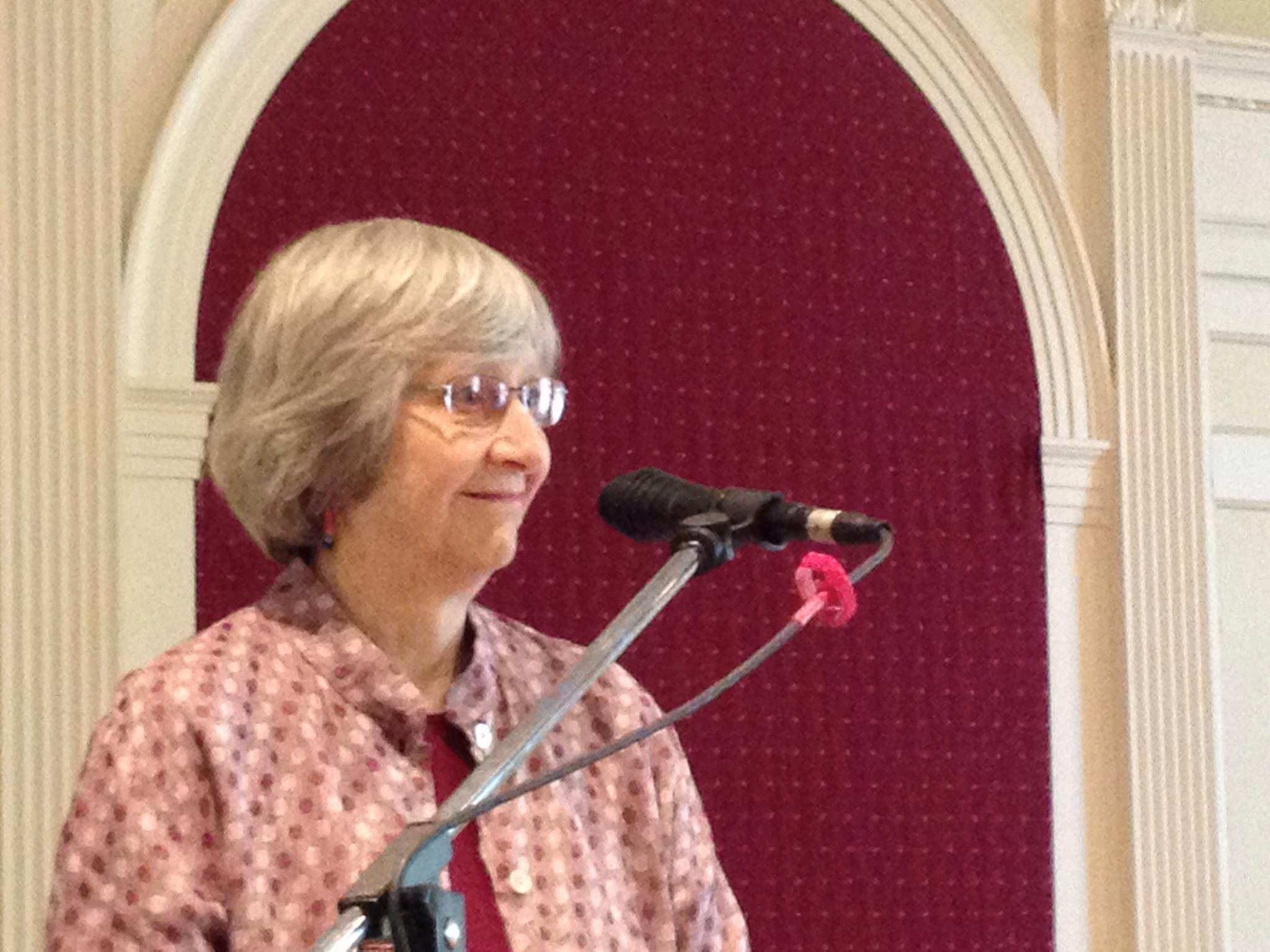
 Speakers at the 2012 Boston Regional Mormon Stories conference were asked to address the topic of: Using personal narratives to create spaces where Mormons of all levels of orthodoxy can interact authentically.
- Part 1: Dr. Laurel Thatcher Ulrich discusses the importance and of history and personal narrative within religious traditions and John Dehlin discusses the evolution of Mormon Stories and the role it plays in the lives of listeners and community members.
- Part 2: Joanna Brooks talks about changes in spiritual narrative scripts over time and how telling personal stories affects community development. Conference attendees share their personal stories in an open-mic format.
Dr. Ulrich is a historian of early America and the history of women and a university professor at Harvard University. Ulrich’s innovative and widely influential approach to history has been described as a tribute to “the silent work of ordinary people”—an approach that, in her words, aims to “show the interconnection between public events and private experience.” Her books include: Well-Behaved Women Seldom Make History (2007), Yards and Gates: Gender in Harvard and Radcliffe History (2004), The Age of Homespun: Objects and Stories in the Creation of an American Myth (2001), All God’s Critters Got a Place in the Choir, a collection of essays coauthored with the Utah poet Emma Lou Thayne (1995), A Midwife’s Tale: The Life of Martha Ballard based on her diary, 1785–1812 (1990), and Good Wives: Image and Reality in the Lives of Women in Northern New England, 1650-1750 (1982).
Joanna Brooks is a national voice on Mormon life and politics and an award-winning scholar of religion and American culture. The author of The Book of Mormon Girl: Stories from an American Faith, she is a senior correspondent for the on-line magazineReligionDispatches.org and has been named one of “50 Politicos to Watch” by Politico.com.
Episode Transcript
Host: John Dehlin · Guests: Carrie Crawl, Danielle Mooney, Elizabeth Hammond, Joanna Brooks, Laurel Thatcher Ulrich (Harvard University), Mark Abernathy
This transcript is machine-generated and lightly edited for readability. The audio is authoritative. Please excuse occasional errors in names and spelling.
Welcome and Conference Introduction
Part 1 of 2 · Ep. 346
John Dehlin [00:00:00] This presentation was delivered as part of the 2012 Boston Mormon stories Conference held at Harvard Square in Cambridge, Massachusetts, as organized by the awesome Boston Mormon Stories Support Community. To start or join a support community where you live, click on the Support Communities menu option@mormonstories.org to plan and host your own Mormon Stories Conference. Please email us@mormonstoriesmail.com and thank you for listening.
Elizabeth Hammond [00:00:28] On behalf of Mormon Stories, I'd like to welcome you to our first Boston Mormon Stories Conference. Very excited about this. My name is Elizabeth Hammond and I am a member of the local Mormon Stories group and a member of the Cambridge First Ward. I'd like to express a lot of great and heartfelt appreciation for everybody who was involved in the logistics of pulling off this conference and to people who traveled from long distances to be here.
Elizabeth Hammond [00:00:53] So thank you so much for making the event yesterday possible. And today and tomorrow morning we'll also be meeting again informally if you'd like to hang out and talk some more. On behalf of Boston, I'd like to welcome Mormon Stories here to Harvard Square. Boston, Massachusetts and the surrounding areas have a deep history of engaging Mormonism in ways that align with today's conference theme, which is using personal narratives to create spaces where Mormons of all levels of orthodoxy can interact authentically.
Elizabeth Hammond [00:01:26] Diversity of belief and practice often poses significant challenges to creating emotionally safe spaces where people can express their perspectives and their experiences out loud. Differences in belief and practice have caused innumerable conflicts in relationships in both in real life and on the Internet, and these conflicts in turn can compromise friendships, ward communities, and the whole spectrum of family relationships. So to prevent such conflict, individuals often will attempt to silence others or choose to remain silent themselves, which has high costs for everyone involved. So the Mormon Stories community seeks to move beyond the notion that a community's members must all agree on belief and subscribe to the same practices.
Elizabeth Hammond [00:02:09] And the goal of our conference is to invite all voices to resonate with each individual's perspective and lived experience without the fear of being dismissed or reproved. And by doing so, we hope to create useful dialogue, preserve relationships, learn from each other, and ultimately create a diverse, inspiring and productive community of all kinds of Mormons and Friends of Mormons. Each of today's speakers has strong lived experience in both participating in and creating these kind of communities that meet these kind of objectives.
Elizabeth Hammond [00:02:38] So no doubt we have in the audience today traditional believing members of the Mormon Church. We probably also have in attendance members of varying levels of Mormon belief, people who have left the church, perhaps even fundamentalists Apologists, atheists, agnostics and members of other religions. And all people from all these groups, as well as women, men and all people of all sexual orientations, are equally welcome and have an equal standing in the Mormon Stories community. So to honor and protect everybody here, Mormon Stories conferences are convened in the spirit of the Mormon Stories shared values, which I will read now and which you can find printed on the brochures, the back of brochures of today's conference.
Six Founding Principles of the Conference
Elizabeth Hammond [00:03:23] Number one, they're not numbered on your brochures, but I'm going to read them as a list here. Number one, we acknowledge the richness of Mormon heritage, teachings and community in all of its diversity. Number two, we believe that one can self identify as Mormon based on one's genealogy, one's upbringing, beliefs, relationships and other life experiences, regardless of one's adherence or non adherence to the teachings or doctrines of any religious organization.
Elizabeth Hammond [00:03:51] Number three, we seek spaces where we as Mormons can live lives of intellectual and spiritual integrity, individual conscience and personal dignity. Number four, we acknowledge and honor different spiritual paths and modes of religious or non religious truth seeking. We respect the convictions of those who subscribe to ideas and beliefs that differ from our own. Number five, we recognize the confusion, the distress, the emotional trauma and social ostracism that people on faith journeys often experience.
Elizabeth Hammond [00:04:21] We seek constructive ways of helping and supporting people regardless of their ultimate decisions regarding church affiliation or activity. And finally, number six, we affirm the inherent and equal worth of all human beings. We seek spaces where Mormons and all people can interact as equals, regardless of race, gender or sexual orientation. And in this spirit of egalitarianism, we prefer non authoritarian and non hierarchical means of organization and affiliation. I invite you at this time to turn off your cell phones. And please note that the proceedings here are being recorded for later distribution.
Musical Selection by the Saber Rattlers
Elizabeth Hammond [00:04:59] We will now hear a musical selection by musician Mark Abernathy of the Saber Rattlers, whose work many will recognize as being utilized on the Mormon Stories podcasts. Would you like to introduce yourself? Your selection? All right, thank you.
Mark Abernathy [00:05:23] This one goes out to Russ and to Joanna by special request. And I have to cheat because I haven't sung this in a long time. Now let us rejoice now let us rejoice in the day of salvation no longer as strangers on earth need we roll. Good tidings are sounding to us and each nation and shortly the hour of redemption will come when all that was promised the Saints will be given and none will molest them. From morning till Eve and earth will appear as a garden of Eden And Jesus will say to all Israel, come home.
Mark Abernathy [00:06:28] We'll love one another and never dissemble. And when the ungodly are fearing and tremble, we'll watch for the day when the Savior will come and all, all that was promised the saints will be given none will molest them from morn until Eve and earth will appear as the Garden of Eden. And Jesus will say to all Israel, come home.
Mark Abernathy [00:07:19] Faith will rely on the arm of Jehovah to God through these last days of trouble and gloom and after the scourges and harvests are over, we'll rise with the just when the Savior doth come, then all that was promised the saints will be given and they will be crowned with the angels of heaven and earth will appear as a Garden of Eden and Christ and his people will ever be one. Thank you.
Elizabeth Hammond [00:08:17] Thank you, Mark. Okay, in the spirit of embracing diversity and creating safe space, we will open our conference with a non traditional prayer and that will be offered by Ann Peffer.
Opening Prayer and Keynote Introduction
Laurel Thatcher Ulrich (Harvard University) [00:08:30] Dear Heavenly Mother and Father, we thank thee so much that we can be here today and feel thy love for us and share thy spirit and the spirit of love and caring for all. And we thank thee that we have found the Internet and have been able to find one another and develop communities here and in other places where all can feel safe and can find a place to speak and share their thoughts regardless and find safety and warmth and home. And we say these things in the name of Jesus Christ.
Mark Abernathy [00:09:08] Amen.
Elizabeth Hammond [00:09:12] It is now my privilege and honor to introduce this session's keynote speaker, who is a dear friend and mentor of mine. Laurel Thatcher ulrich is the 300th anniversary university professor at Harvard University) and past President of the American Historical Association. She is the author of many articles and books on early American history, including A Midwife's Tale book, which won the Pulitzer Prize for History in 1991. Her most recent book is well Behaved Women Seldom Make History. A Fifth Generation Latter Day Saint. She has published personal essays in, among Other places, dialogue Exponent 2, the Ensign Weber Studies, the Journal of American History, and in an anthology co authored with Emma Lou Thane called All God's Critters Got a Place in the Choir.
Elizabeth Hammond [00:10:01] She is currently working on a book about 19th century Mormon diaries. She and her husband, Gail Ulrich, are the parents of five children and grandparents of seven. They are active members of the Cambridge First Ward in Massachusetts.
Laurel Thatcher Ulrich (Harvard University) [00:10:24] Thank you, Liz, and thanks to Mark and Ann for establishing a wonderful spirit, and I hope I can live up to that. I'm really delighted to be here today and at the same time, a little intimidated. You know, I feel like the old timer in the room kind of working on what we used to call the unsponsored sector of Mormonism for more than 30 years. Really, maybe 40 years, maybe my whole life, who knows?
Laurel Thatcher Ulrich (Harvard University) [00:10:59] But I'm very excited to connect with such a dynamic group and a group of people who are doing innovative and very important things today. Because Liz sort of asked me to and kind of gave me a prompt, I am going to talk about history.
Laurel Thatcher Ulrich on History and Meaning
Laurel Thatcher Ulrich (Harvard University) [00:11:19] I'll say a little bit about Mormon history, but I really want to get us thinking a little bit just about history in general and what it means or might mean to people as they contemplate their own lives in the present.
Laurel Thatcher Ulrich (Harvard University) [00:11:38] And I want to start with a little snapshot of Harvard history. So how many of you out there have ever taken a guided tour of Harvard Yard? Ah, most of you haven't. So you have this experience ahead of you.
Laurel Thatcher Ulrich (Harvard University) [00:11:56] And if I'm not mistaken, here's what will happen to you. You get a lot of funny stories from guides, young undergraduate type guides, and you will probably end up standing in front of a statue of a seated figure that stands in front of University) hall, which is one of the administration buildings.
Laurel Thatcher Ulrich (Harvard University) [00:12:22] And this statue has the inscription on the base, John Harvard, founder, 1638. Now, your guide will quickly tell you that this statue is known as the Statue of the Three Lies. What are the three lies? First, it isn't John Harvard.
Laurel Thatcher Ulrich (Harvard University) [00:12:47] The statue was done in the middle of the 19th century. John Harvard died in 1638. And besides, nobody knows what he looks like. Second, he wasn't the founder of Harvard. He was one of the first donors. And doesn't everything get named after a donor?
Laurel Thatcher Ulrich (Harvard University) [00:13:09] And finally, Harvard was chartered in 1636, not 1638. So that is the statue of the three lies. Now, this is the kind of gotcha history that gets a lot of attention. And I thought maybe I'd imitate it a little bit today by moving across Massachusetts Avenue to the building just beyond us. The main part, Sanctuary building, the Carpenter Gothic building, the gray building that faces Massachusetts Avenue and that is connected to where we are at this moment.
Laurel Thatcher Ulrich (Harvard University) [00:13:49] I apologize for doing that because this is a wonderful space. Both this one and the older part of the building and the church that inhabits this space does great things. But I'm going to have to tell you, if you go into the front of the building and you look, there's an inscription right beside the very large door that opens off Massachusetts Avenue into the sanctuary.
Laurel Thatcher Ulrich (Harvard University) [00:14:19] And this inscription Makes this the church of the three lies. So what does that inscription say? It says, the first parish in Cambridge, the first church, Unitarian Universalist, 1633, 1636. It's a fabrication. There were no Unitarian Universalists in 1633 and 1636. The building was built in 1833.
Laurel Thatcher Ulrich (Harvard University) [00:14:57] And even more interesting, the church that inhabits this building does not have an undisputed claim to being the success successor of the little Puritan church of the 1630s. It's actually a really interesting story. In the early 19th century, there was a big squabble over theology. There was a liberal group and a conservative group, and the liberal group won temporarily, and they deposed the existing minister, who was the father of Oliver Wendell Holmes.
Laurel Thatcher Ulrich (Harvard University) [00:15:37] So the conservative group moved out and renamed themselves the Shepherd Congregational Society, naming themselves after the first minister, the minister of the 1630s who laid the foundation of the church. And this squabble went on until 1899, when it was finally settled and when people decided we would have two first churches in Cambridge. And that's right. And you can see it on the markers on this building. There's this church, which is Cambridge First Church, Unitarian Universalist. And if you go up, around and up Garden street and go a bit further, you will find Cambridge First Church, Congregational.
Laurel Thatcher Ulrich (Harvard University) [00:16:32] So who's the legitimate heir to this tradition? The conservatives or the liberals are? Neither, or both have a legitimate claim to this story. I tell this story to remind us of some important things. First of all, that history, if looked at closely, is very complicated.
Laurel Thatcher Ulrich (Harvard University) [00:17:02] And it's not only complicated, it's controversial. And it cannot be stuffed into inscriptions or websites or monuments or timelines in the way we often do. It invites us to. To think about complication. And even though we can't stuff it into these sound bites, that doesn't stop us from trying to do so.
Laurel Thatcher Ulrich (Harvard University) [00:17:33] We all do, because a claim to history is one of the ways we define ourselves as human beings. History is an ongoing dialogue between present and past. It's about us as much as it's about them in the past.
Laurel Thatcher Ulrich (Harvard University) [00:18:00] Think about that. History is the study of how things change. We often talk about the way the past influences and shapes the present and the future. But I don't think we talk nearly enough about how the present shapes the past.
Laurel Thatcher Ulrich (Harvard University) [00:18:23] Now, we can see that in the mission statements of the two first churches in Cambridge. And I was intrigued that Liz read a mission statement to us for Mormon stories. Very traditional thing to do. The mission statement for the first Church, Unitarian, comes across as a little more liberal, perhaps even edgy than the other. But they're both there and both of them, I'll let you go to the websites and read them. They're very, very interesting to see this.
Laurel Thatcher Ulrich (Harvard University) [00:18:55] They both come across with the point of view that they're trying to connect present and past. They're trying to breathe new life into a very old tradition, an ancient tradition with a future mission. I think one of them says, well, I'd like to push that a little bit further.
Laurel Thatcher Ulrich (Harvard University) [00:19:18] And I'd like to consider whether we in this room today are also part of the heritage of Cambridge First Church. It's kind of an interesting idea. We're in this space apparently with no connection whatsoever to Mormonism. We're here to tell Mormon stories. What on earth does it have to do with this historical space that we're inhabiting?
Laurel Thatcher Ulrich (Harvard University) [00:19:52] Well, I think Mormon stories is heir to a very long tradition of what Mormon stories calls faith formation, what the website for this church calls faith formation. That was exemplified in the history of 7 17th century Cambridge. You may not know that New England's early Puritan settlers engaged in a particularly rigorous form of storytelling.
Laurel Thatcher Ulrich (Harvard University) [00:20:20] That is, you couldn't become a member of Cambridge First Church unless you could offer a narrative, a statement about the progress of your soul and the way that you came to an understanding of faith. And the minister Thomas Shepard kept notes.
Laurel Thatcher Ulrich (Harvard University) [00:20:41] One of the very richest collections of early Puritan faith narratives comes out of these very crab notes from Thomas Shepard. There's something like 61 of these little narratives and they're full of scriptural references, they're full of theological concepts that probably most of us won't get or understand.
Laurel Thatcher Ulrich (Harvard University) [00:21:04] But you know, they're not easy reading either. But there are moments when a little sparkle comes through, at least to me that makes me recognize something. Even though these are very different from me, they help me to recognize something about my own faith narrative and about narratives of other Latter Day Saints that I know. For example, here's Abram.
Laurel Thatcher Ulrich (Harvard University) [00:21:34] The first time the Lord did me any good was what a friend, a godly man, Brother Isaac. Being at work together, he spake to me how it stood with me about my estate and asked me whether God gave me a heart to seek him.
Laurel Thatcher Ulrich (Harvard University) [00:21:53] So I told him I had little mind or heart that way. And he then said it was high time to look in it, for now was a fair season. High time. 17th century expression. Isn't that nice to know.
Anne Hutchinson and Puritan Faith Narratives
Laurel Thatcher Ulrich (Harvard University) [00:22:10] Here's Isabel Jackson, Goody Jackson. She did express much how she was afraid of falling away. Having known and been well acquainted with some people that had been eminent in profession, that is, profession of faith, had been eminent in profession, yet falling away to the great dishonor of the Lord and scandal in religion. And they being strong and tall cedars and she. But weak and a low shrub, this did much affect her heart.
Laurel Thatcher Ulrich (Harvard University) [00:22:52] Has that ever happened to you? Have you ever been accused of anything like that? The tall cedar and the lowly shrub, and someone might be falling away. Well, I love the statement of Elizabeth Dunster. I'm sorry to confess I can relate to this.
Laurel Thatcher Ulrich (Harvard University) [00:23:16] There's a lot of lamenting about one sinful state in these narratives. But I really like the way Elizabeth Dunster put it. She said that she found her own heart dead and sluggy. So in gathering his church together in the 1630s, Thomas Shepard spent a great deal of time listening to people's stories and probably shaping them as well. Because none of us tell our stories freely in any setting, including this one. Our stories are shaped by our audience. Our stories are shaped by expectations. And he certainly had expectations for those who wanted to join his church.
Laurel Thatcher Ulrich (Harvard University) [00:24:10] And telling this story is. And attempting to identify with faith narratives of people who are very different from me and from my tradition. I want to cross a boundary between present and past. I want to understand them. I want to know why they did the things that they did. But I can't look away from serious problems.
Laurel Thatcher Ulrich (Harvard University) [00:24:38] I need to acknowledge, for example, that first church, Cambridge, in 1637, was the site of a heresy trial, the first in American history. The person on trial was a woman named Ann Hutchinson, who had her own faith narrative. She was banished from the colony, went off and founded Rhode Island. You know, a sink of iniquity down there, as you all know, from Rhode Island.
Laurel Thatcher Ulrich (Harvard University) [00:25:08] But Anne Hutchinson was banished as a heretic because she had the audacity to claim direct revelation from God, which was a no, no. The revelation was to come. Their inward heart was important, but it was to come from the means. The Bible, the Scriptures, and the preaching of men like Thomas Shepard and Hutchinson defied that, and she defied it as well by being a woman and presuming to speak for God.
Laurel Thatcher Ulrich (Harvard University) [00:25:43] Well, I've gone on quite a distance here, but I want to establish that narratives, personal stories about faith journeys are one of the most important genres in American literature and in American religious history. They are also one of the most important genres in Mormonism.
Laurel Thatcher Ulrich (Harvard University) [00:26:05] I was intrigued last evening when Joanna Brooks told us that she had been influenced in part by reading 18th century Quaker women's narratives. And there are many kinds, and these moved into the 19th century with Methodists, with Shakers, with Quakers, with believers of all kinds, and certainly with Latter Day Saints. Saints, There are faith narratives. Often I'm at the moment studying diaries. This is a high literacy era, and so there are a lot of written stories. But it's interesting before people begin their daily diary, which usually happens for men when they're called on missions, for women, usually in a moment of transition or crisis, but they often be lit by began with a little narrative about how they came to this point, how they became Latter Day Saints, what had happened to them prior than that.
Laurel Thatcher Ulrich (Harvard University) [00:27:06] And some of them had been Quakers, many of them had been Methodists. They come out of a tradition of storytelling that's very powerful. One of my favorite examples, and I wish I, you know, I could easily go off into the past, which is where I live, I could easily go off and talk for a long time about one of my favorite diaries and one of my favorite autobiographies, which was written by a man named Hosea Stout, some of whose descendants are pillars of the faith in the Boston area even today.
Laurel Thatcher Ulrich (Harvard University) [00:27:46] Now, Hosea Stout's really interesting because of his unusual background, his unusual upbringing. He was born in South Carolina, but his parents were poor, and they migrated. They moved on to Tennessee and into Kentucky, and they just had lots of kids, some of whom died. But finally they just couldn't take care of their family.
Laurel Thatcher Ulrich (Harvard University) [00:28:16] And so what did they do? They did what a lot of people on the frontier did at that time. They took them to the Shakers. And the Shakers, who were celibate and therefore had no progeny of their own, took in orphans or poor children and raised them. So Hosea Stoud and his five siblings went to live in a place called Pleasant Hill in Kentucky.
Laurel Thatcher Ulrich (Harvard University) [00:28:41] There he learned all kinds of fascinating things. He learned to search, speak softly. He learned not to run and be wild. He learned to obey grownups. And he learned to confess his sins daily, lest he be shut up in the root cellar, which must have been really terrifying.
Laurel Thatcher Ulrich (Harvard University) [00:29:04] He also learned to fear individual bonds. The allegiance was to be to the community. And this became a crisis for him one day when his mother came to visit him, bringing the little brother that had been born after the children had been placed out with him.
Laurel Thatcher Ulrich (Harvard University) [00:29:25] And he writes, she would bring apples and other little articles to please me. And I remember that she took me outdoors once to have a talk with me and give me an apple, telling me to be a good boy and had me to sit there lest the other boys might get it away from Me.
Laurel Thatcher Ulrich (Harvard University) [00:29:44] And I reluctantly went out with her and was in a hurry to go in again, lest the boys might think I loved her. For we were taught to spurn the idea of paternal affection. But when he was 8 or 9 years old, his father came to take him back.
Laurel Thatcher Ulrich (Harvard University) [00:30:03] And it's this reaction that I think is so interesting. He was absolutely terrified because he had learned that terrible things happened among the worldlings. The worldlings. And that the worldlings didn't have enough to eat and that he was likely to starve if he went back.
Laurel Thatcher Ulrich (Harvard University) [00:30:28] But when he discovered that this wasn't the case, that there was enough to eat among the worldlings and there were ponds to play in and lots of things to do, he tells us he learned to swear and fight and jump in the mill race like the other boys. And he began to resent being called a Shaker boy. Now, here's a little guy who has a real identity conflict here. Where does he belong?
Laurel Thatcher Ulrich (Harvard University) [00:31:01] What's going to happen? And his solution was Mormonism. He was joyous when he found the Latter Day Saints because with them he was able to affirm material life. The Mormons valued obedience and unity, but they had fun. And they even took a few passes of the whiskey jug. We find from Hosea Stout, even some of the twelve apostles joined him in a nip once in a while.
Laurel Thatcher Ulrich (Harvard University) [00:31:47] Many people, many diarists, talked about the liberation that they felt when joining a people that not only prayed, but taught them that they mattered. They not only mattered, but they were gods in embryo and even more important, that they might be connected to all those dead relatives. This was a period of extraordinarily high mortality. And there's probably no single doctrine that came into the church at that point that meant more, and that was more quickly embraced than baptism for the dead, which is really fascinating to me as we watch the current controversy about this. Nobody had to teach it.
Laurel Thatcher Ulrich (Harvard University) [00:32:35] They just grabbed it because it solved a problem, a problem about connectedness to family. Okay, so Mormonism then was a liberating force for many Latter Day Saints. It also demanded a lot. But it was an interesting system because people were baptized one minute and sent off to preach the gospel the next. And you really wonder what they preached.
Laurel Thatcher Ulrich (Harvard University) [00:33:08] What did they know? Well, there's one thing they did know, and this is important. And this brings me right back to First Church. For many years, the older part of this building was the place where Harvard held its commencement. There's a very tight relationship between the college and the church.
Laurel Thatcher Ulrich (Harvard University) [00:33:36] And in 1837, the Phi Beta Kappa Society invited a young Unitarian minister named Ralph Waldo Emerson to give the address. And we have somebody who's a guide at the Emerson House. If you have time, you can go out to Concord and see it.
Laurel Thatcher Ulrich (Harvard University) [00:33:56] And his lecture, which became known as the American Scholar, became known as the intellectual Declaration of Independence for American writers. Walt Whitman said it set him boiling. It liberated writers, it liberated artists. We no longer have to look to Europe.
Laurel Thatcher Ulrich (Harvard University) [00:34:22] We can speak with our own voices. We can talk, write with our own hands. We can tell our own stories, American stories. And I want to just give you two quotes because I think, oh, I'll just tell you part of my autobiography. I love this because, you know, I'm kind of a child of the late 50s and 60s and this spoke to me. I practically memorized Walden. But here's Emerson in the Phi Beta Kappa address. Meek young men grow up in libraries believing it their duty to accept, accept the views which Cicero, which Locke, which Bacon had given. Forgetful that Cicero, Locke and Bacon were only young men in libraries when they wrote these books.
Laurel Thatcher Ulrich (Harvard University) [00:35:12] We can do it, too. And then he totally outraged his fellow Unitarians the next year by giving a talk to the graduates of the Divinity School. We've got a Divinity School person here, and I'm sure you've heard this story where he said, it is the office of a true teacher to show us that God is not was that he speaketh not spake the true Christianity. A faith like Christ in the infinitude of man is lost.
Laurel Thatcher Ulrich (Harvard University) [00:35:55] None believeth in the soul of man, but only in some man or person, old and departed. This was a religious Declaration of Independence. And I love the way Dick Bushman uses this Divinity School address in the preface to Ruff's Daughter.
Laurel Thatcher Ulrich (Harvard University) [00:36:20] I mean, he says pretty bluntly, you know, Emerson didn't embrace Joseph Smith. He wasn't the kind of prophet he was looking for. But he was attacking what he thought were the desiccated traditions of his own society, which were so turned to the past that they had lost the spirit which created the past. And he wanted to use history and religion to create more history and more religion.
Mormon History and the Longing for Visions
Laurel Thatcher Ulrich (Harvard University) [00:36:52] Bushman writes, had Emerson looked, he would have found thousands of kindred spirits among unsophisticated Christians who longed for visions, visitations, inspired dreams, revelations, and every other outpouring of the Spirit. These seekers were Joseph's natural constituency. The power of the Latter Day Saint movement is that sense that God speaks wasn't in the past, it's in the present.
Laurel Thatcher Ulrich (Harvard University) [00:37:37] And that the American continent and the ordinary people had a place had a kind of destiny in fulfilling God's purpose. So where does that bring us? History is the study of how things change in period of intense social or personal struggle.
Laurel Thatcher Ulrich (Harvard University) [00:38:13] It can overwhelm us with its strangeness, or it can empower us with its opportunities. I was really kind of blown away when I discovered that in the fascinating survey that Mormon stories did, that history was listed as one of the obstacles that Mormon history was a problem to people. I didn't understand that because Mormon history was such a strength to me throughout my life and my faith. And I was really puzzled by that and very sad.
Women's Stories in Mormon Experience
Laurel Thatcher Ulrich (Harvard University) [00:38:55] And then I thought about an experience I had and that's what I'd like to close with. Just telling you about this interesting experience that I had with my granddaughter. I have. My daughter and her family live in Southern California, so we don't see them a lot.
Laurel Thatcher Ulrich (Harvard University) [00:39:18] And I think it might have been six or eight years ago. It was a while we were visiting them and I was sitting at a kind of picnic table outside. You know, in Southern California, you're outdoors, it's great. You're waiting for your fast food. Southern California, it's beautiful and it's fast food. Okay, so we're sitting there waiting for our order in the restaurant, and I'm trying to make conversation with my 12 year old granddaughter.
Laurel Thatcher Ulrich (Harvard University) [00:39:54] And I opened my bag and inside was a little program that I had gotten from attending a Mormon historical society meeting in which there had been a wonderful program on the poetry of Eliza Arsenault. And I thought, oh, she'd like this. So I showed it to her and said, let me tell you about this neat thing that we did.
Laurel Thatcher Ulrich (Harvard University) [00:40:18] She said, elena, do you know who Eliza R. Snow is? And Elena paused and then she said, oh, is she Lorenzo Snow's wife? And I thought, boy, some primary teacher caught her to memorize the names of the presidents of the church.
Laurel Thatcher Ulrich (Harvard University) [00:40:43] Really impressed. And I said, no, she's Lorenzo Snow's sister. But she was Joseph Smith's wife. And her eyes got very big and she looked at me and she said, well, I thought he already had a wife. And I said, well, he had quite a few wives.
Laurel Thatcher Ulrich (Harvard University) [00:41:12] And then I thought, oh my goodness, what have I done here? I could not believe that my granddaughter, who was descended on many sides from 19th century polygamists, didn't know that Joseph Smith had more than one wife. I was just stunned.
Laurel Thatcher Ulrich (Harvard University) [00:41:36] And I came back thinking, my goodness, we got a problem here. People don't know our own history. But then I thought, well, why am I surprised? Because I was in my 30s, before I knew there was a women's rights movement in utah in the 19th century century. And that there was a publication called the Woman's Exponent, and that Utah women, as Mormon women, were among the first in the nation to vote.
Laurel Thatcher Ulrich (Harvard University) [00:42:14] I didn't know that. And so what that brings me back to is the point with which I began, the way in which the present shapes the past. So we can only know what is accessible to us in the generation in which we live.
Laurel Thatcher Ulrich (Harvard University) [00:42:36] And institutions shape history, not individuals. By and large, institutions shape history. And the history that we need is not always the history that we get. Which is why I think we should be supporting Mormon stories, not just because it talks about us.
Laurel Thatcher Ulrich (Harvard University) [00:43:07] You know, people get to talk about themselves, but because we're creating, I'm thrilled to know, from John, Ann and others, creating an archive, an archive as powerful as that of. More powerful than that of Thomas Shepard. And that includes a wide range of voices and a wide range of faith journeys. And that as we tell our own stories, maybe we can turn more attentively and more industriously to the stories of those who came before us and to understand why things that seem weird to us seemed marvelous and wonderful to them. Thank you.
Musical Interlude and Transition
Elizabeth Hammond [00:44:16] And I'd like to invite Mark up again to perform for us. One more time, please.
Mark Abernathy [00:44:26] Brightly beings our father's mercy from his lighthouse ever more but to us he gives the keeping for the lights long shot be burning send a gleam across the way some poor fainting, struggling seamen you may rescue you you may say your feet the lamp, my brother some poor sailor tempest tossed trying out to make harbor in darkness may be lost. Let the lower light be burning send a glee cross. Some fainting, struggling se you may rescue, you may say. Sam. Dark night of sin has settled loudly angry bil roar Eager eyes are watching longing for the light. Be burning send a gleam across the world way Some poor fting struggling se you may rescue, you may save you may rescue you make sa. Could you hear the ricola in there?
John Dehlin [00:48:55] The microphone?
Mark Abernathy [00:48:57] I've got a nasty cough, so. You guys want to hear another one? You want to take a break,
John Dehlin [00:49:05] El?
Mark Abernathy [00:49:07] You know, actually, the Bushmans are in our wards, and she's on my case to learn some of these tools. I don't know that one off, but see, I could do a poor wayfaring man of grief. Anybody wants to hear that?
Laurel Thatcher Ulrich (Harvard University) [00:49:25] Okay.
Mark Abernathy [00:49:25] Jesus savior pilot me. I'll go where you want me to go. Does anybody want to hear that one? It may not be on mountain tight or over Stormy see it may not be on the battle front My Lord will have no need of me but if by still small voice he calls to pass I do not know I'll answer Dear Lord, my hand in your I'll go where you want me to go I'll go where you want me to go Dear Lord O the mountains or plane or sea I'll say what you want me to say Dear Lord, I'll be what you want me to be I think we could take that up a step.
Mark Abernathy [00:50:53] What do you say? Perhaps today there are loving words which Jesus would have me speak There may be now in the paths of sin Some wonder whom I should see O Savior, if thou wilt be my God the darkness and rub it away My voice shall echo the message sweet I'll say what you want me to say I'll go where you want me to go Dear Lord O mountain or plain or sea I'll say what you want me to say Dear Lord, I'll be what you want me to be I'll say what you want me to say Dear Lord, I am me what you want me to be.
John Dehlin Introduction and Personal Journey
Elizabeth Hammond [00:52:51] Okay, great. It's now my privilege to introduce John Dehlin. John is a candidate in clinical counseling psychology at Utah State University). He is the executive director of Mormon Stories and host of the Mormon Stories podcast. So welcome. Come on up to Boston.
John Dehlin [00:53:23] Just want to take a brief second to thank so many people. I want to thank Liz Hammond and Tom Goodsell and Danielle and Jared Mooney and Ann Peffer for organizing this event. Very, very grateful for the time and effort you guys have put forth. And there are others that I'm forgetting, but to all of you, thank you. I want to thank Mark for your beautiful music.
John Dehlin [00:53:53] So powerful, and I'm just so honored to be associated with your art. I want to thank Laurel and Joanna both for coming here to speak to us. Both of you have just been incredible inspirations to me and I want to thank you for that. And I want to thank all of you for coming today.
John Dehlin [00:54:25] I'm going to read my talk today, if you'll forgive me. Words cannot adequately describe how much I love Mormonism, nor how much Mormonism has enriched my life. The loving homeward of my Katy, Texas childhood, the primary songs, the scout campouts and the Fathers and sons outings, the countless games of basketball played on those blasted carpeted cultural hall floors gave me carpet burn when I fell down.
John Dehlin [00:54:59] The loving primary teachers, youth leaders and bishopric members, early morning seminary, the Stake dances, dance festivals and road shows, youth conferences and testimony meetings, my mission, and most importantly, the thousands of loving, humble church members that I've come to know over the past four decades.
John Dehlin [00:55:23] So many happy memories for me, so much Mormon joy and love. When it came time to apply to college, in spite of numerous opportunities at several fine Texas universities, only one application was submitted and that was byu. Get married in the temple? Check. Have lots of kids. Check.
John Dehlin [00:55:46] Start the cycle all over again with my own four children? Check. I was and am a Mormon through and through. Just as Joanna calls herself Mormon Girl, I still think of myself foremost as a Mormon boy. As you might imagine, never in my wildest good Mormon boy teenage dreams could I have envisioned a time when I would feel cognitive dissonance about the church I love.
John Dehlin [00:56:14] But that's where I found myself in 2001, working for Microsoft in Seattle teaching early morning seminary, waking up at 5am to prepare lessons for those beautiful young Issaquah, Washington High School Mormon minds trying to inspire them, just as I had once been inspired in those high school days.
John Dehlin [00:56:37] After four years of seminary, four years of BYU religion courses, I thought I knew about the tougher aspects of Mormonism because I knew about Brigham's polygamy. I lived through the black priesthood ban, and I sort of knew about the Adam God theory and blood atonement. So I knew all there was to know.
John Dehlin [00:56:59] Turns out I knew very little. And so it was that in spite of 30 plus years of weekly church education, including 4.5 years at BYU, I discovered for the first time as a seminary teacher in Issaquah, Washington, in my 30s, some very troubling things.
John Dehlin [00:57:18] Namely that the Book of Abraham translation, and I put that in quotes, didn't resemble in any way its source. The Joseph Smith didn't translate the Book of Mormon per se, but instead appeared to channel it by placing his head in a hat, peering at a magic stone, most often without the plates even being in the room. As I understand it, I had no inkling that Northern and Mesoamerican archaeological records, along with the newly emerging DNA evidence, provided precious little support and indeed a mountain of credible and serious evidence against the historicity of the Book of Mormon. At least as I understood it.
John Dehlin [00:58:03] I did not know that Joseph Smith had 30 plus wives, many of whom were already married to other men when he took them as brides, sometimes without the knowledge of their husbands or even Emma that some of these wives were as young as 14 or 15, and that Joseph publicly denied his practice of polygamy when asked about it, and that when the practice was finally publicly exposed that he tried his best to destroy the evidence.
John Dehlin [00:58:33] This was hard stuff to learn. Looking back, perhaps the most egregious recognition of all was that the issues surrounding women in the church, the gay and lesbian community and Native Americans didn't even appear on my radar until years after that Issaquah experience.
Hard Questions and Difficult Issues in Mormonism
John Dehlin [00:58:54] I want you all to know that as I enumerate this list, the Mormon boy in me rises up to say, no, John, no. These are things you should not speak about publicly. We don't talk about these things openly as Mormons. You are planting seeds of doubt. Doubt is bad. You are driving the spirit away.
John Dehlin [00:59:16] But there's another very Mormon part of me as well, a voice that's even louder and stronger than the fear and shame based voice that urges me courage. Take for goodness sake. It reminds me, oh say what is truth? Tis the fairest gem and it assures me do what is right, Let the consequence follow.
John Dehlin [00:59:43] This Mormon boy inside of me stands up firm and tall and strong to say that the truth has nothing to hide, nothing to fear, and that we have to learn to talk about difficult things openly as a people because we as Mormons believe in being honest and most of all because people are being hurt and lives are being torn apart by not talking about these things.
John Dehlin [01:00:13] I could be wrong, but sometimes I imagine, I like to imagine that in places like Cambridge, Massachusetts or Berkeley, California, Mormons are provided with the intellectual and psychological tools to handily deal with such issues, whether through philosophy, nuance, metaphor, compartmentalization, or perhaps even through the time worn trappings of habit, status and privilege.
John Dehlin [01:00:42] Maybe to many of you here, these issues are either old news, uninteresting, or irrelevant to your Mormon journeys. And while I have had the good pleasure of getting to know several highly sophisticated, lettered, culturally blue blooded and yet still believing Latter Day Saints such as Bill Bradshaw, Richard and Claudia Bushman, Judy Dushku, Mary Bradford, Marlon Jensen, Terrell Gibbons, Phil Barlow, Laurel Thatcher Ulrich and others.
John Dehlin [01:01:13] My experience over the past 11 years with Mormon stories has taught me very, very clearly that these issues are new to and do not sit very well with the younger rising generations within Mormonism. These issues matter. They are not going away.
John Dehlin [01:01:34] There are mounting casualties, and it seems like we need to learn to talk about them publicly. We ignore them at our own peril as a faith tradition. Perhaps there was a time when Lowell Bennion and T. Edgar Lyon, Leonard Arrington and Eugene England, Mary Bradford and Hugh Nibley Sunstone in Dialogue, Exponent in farms, the Mormon Historical association, even the Church History Department all had enough of a critical mass of participation and influence, such as to help us, to help guide us through these intellectual, cultural, and religious landmines, only to emerge on the other side with our faiths intact, perhaps even stronger than before.
John Dehlin [01:02:23] For whatever it's worth, this was the role that Philip Barlow's book entitled A Thoughtful Faith, and specifically the role that Richard Poll's essay what the Church Means to People Like Me, Laurel Thatcher Ulrich's essay Lusterware, and Eugene England's essay why the Church Is As True as the Gospel Played for me for over a decade. They were my lifelines to a thoughtful faith and to church activity.
John Dehlin [01:02:51] Those Camelot years of church history in the 60s, 70s, and early 80s must have been grand. And how beautiful it might have been for me as a BYU student in the late 80s, to proudly step into that glorious intellectual LDS tradition that those brave women and men laid out for us.
John Dehlin [01:03:15] By the time I got to byu, however, a dark cloud of fear had already been cast over these alternative voices and symposia. Sunstone and dialogue were whispered to be dangerous, professors were being let go from BYU professors that I loved, and scholars were being excommunicated.
John Dehlin [01:03:36] Ultimately, it appears as though the institutional LDS Church made the decision to metaphorically step on the throats of many of these individuals and institutions by either marginalizing, intimidating, or silencing their voices, leaving an entire generation or two, our generation, without any locatable role models for a deeper, more thoughtful approach to believing Mormonism.
John Dehlin [01:04:07] Consequently, many of us wandered directionless for a decade or more, knowing in our hearts and minds that something was wrong, but not knowing what to do about it, nor whom to turn to to look for support and guidance.
John Dehlin [01:04:26] This was the environment that I found myself in in the early 2000s, when I tried to talk to my family, friends and fellow ward members and bishops about these things that I learned as a seminary teacher. I, too, discovered landmines at every turn.
John Dehlin [01:04:43] Outside of my own circle of relationships, I could find precious few role models or practical resources to help me through this crisis of faith. On the Internet, I found two types of those that seem to want to mock and ridicule belief, attempting to convince me to abandon the church and Mormonism and belief altogether, and apologetic resources that seemed to want to bend over backwards in less than credible ways to convince me to continue in my orthodox belief, relying far too often on ad hominem attacks and logic that excessively strained reason and credibility for me.
John Dehlin [01:05:29] But most importantly, I did not want to be convinced of anything. If possible, I wanted to find Strivingly neutral, not overly academic resources that would allow me to get a general understanding of the major issues and allow me to form my own heartfelt conclusions.
John Dehlin [01:05:52] Because I did not want to live on borrowed light and the stakes are too high. And since I couldn't find those resources anywhere, I decided to create some as unworthy as I am to attempt such a task. And that's how Mormon Stories was born.
John Dehlin [01:06:15] Over the past seven years, with Terry Gross from NPR's Fresh Air and Charlie Rose as role models, I've tried my hardest to interview all types of Mormons on Mormon Stories. Podcast apologists and apostates, celebrities and common folk, women and men, gay and straight, young and younger, black and white, bond and free okay, I'm getting a little bit carried away in all of this. I was attempting to explore most of the major issues within liberal Mormonism and including polygamy, racism, sexism, homophobia, apostasy, et cetera. To date, We've amassed over 400 hours of audio and video content, and the demand only seems to be increasing, with some episodes being downloaded as many as 50,000 times within only a month of release.
John Dehlin [01:07:11] Many have questioned the motives of me and of Mormon Stories over the past several years, which is fair because in all honesty, our motives have changed over time. At first, the goal was quite neutral, simply to explore the issues at hand in an open and honest way.
John Dehlin [01:07:31] Once we discovered, however, that simply exposing people to these difficult issues could result in their disaffection from the church, we actually shut down the podcast for a time, not wanting to be responsible for that possible outcome. Several months after we realized that people were going to discover these issues with or without our podcast, thanks to Google and the Daily show and Stephen Colbert and everything else, and that they were going to be able to discover they were going to discover these issues, often in less constructive venues.
John Dehlin [01:08:12] And most importantly, we discovered that people sorely missed what we were offering and they begged us to bring it back. And so we did. We brought the podcast back and continued the journey. To be candid, as I've learned more and more about our church's history and culture, I too have continually struggled with my own LDS testimony, sometimes falling into inactivity, sometimes missing church fellowship and returning to fellowship, sometimes wanting to convince the whole LDS world to stay in the church, and other times feeling so much anger and betrayal that I felt more like burning the whole thing to the ground.
John Dehlin [01:08:54] Though I have tried to remain neutral during my interviews and all this, I am aware that my biases have consistently shown through which I often lament. At least we tried. The response to Mormon stories has truly been humbling.
John Dehlin [01:09:10] I will never forget the day when an early Lister my dear friend Russell, who's here today, traveled from Brooklyn, New York to Logan, Utah just to have breakfast with me, a perfect stranger, and to leave me with an envelope filled with five $100 bills to express his gratitude.
John Dehlin [01:09:32] I don't mean to embarrass you, Russell, but it was at that moment when I first realized how much pain there was out there around these issues and how desperately people were clamoring for support. Since 2005, I personally met with, spoken to, or corresponded via email with easily over 5,000 Mormons throughout the world world.
John Dehlin [01:09:56] And the stories are even more humbling. The daughter of a current general authority who cuts herself with a razor blade as a way to cope with the anxiety that she feels at church and within Mormon culture. She feels inadequate as a wife and as a mother.
John Dehlin [01:10:11] She's terrified to tell her parents what she really thinks and feels because of their position in the church, and she doesn't want to disappoint the people she loves. A proud father of three from the Netherlands who felt so isolated and guilty and trapped in his disbelief that he began intentionally running lights in his car, sometimes with his family in the car, to try to escape the pain.
John Dehlin [01:10:38] Countless people who have been ostracized from their families of origin, whose marriages have been dissolved and whose children have been taken from them lost custody, their only sin being that they happened to read the wrong books and were not able to reconcile the information that they encountered.
John Dehlin [01:10:58] Armies of young and middle aged men who refer to themselves as addicts, attending church sponsored 12 step programs Speaking of their lives and measuring their lives in terms of weeks of sobriety, feeling dirty and unworthy, having lost the ability to take the sacrament or attend the temple, all for the very common act of occasionally masturbating, sometimes as infrequently as once every three or four weeks.
John Dehlin [01:11:28] Many of these men have carried intense and probably women, although I haven't met them yet, have carried intense and debilitating guilt and shame with them since their childhood days when their parents took discovered them for the first time as they have tried with a long line of bishops to repent of their sins, while thousands of others just like them simply aren't asked and don't tell yet secretly live with that same shame and guilt inside for lying about it or hiding it.
John Dehlin [01:12:00] Hundreds of young and middle aged gay and lesbian saints who were promised by their bishops and the good people at Evergreen that if they would just try extra hard to believe in the full power of the Atonement, accept that mission call, marry that righteous young woman in the temple, that their same sex attraction would be taken from them, only to discover that those feelings did not go away as promised, turning the blame to themselves, leaving them wondering if life really was worth living, since there's clearly no place for them in the Church if they desire the same level of intimacy that the rest of us find is essential to healthy and happy living.
John Dehlin [01:12:43] And finally, emails from sitting bishops, Relief Society presidents, Stake high counselors, stake and mission presidents, and even one former General authority, all who no longer believe that the Church is what they thought it was, but who quietly keep everything to themselves, fearing the consequences of openness and honesty, often living quiet lives of desperation, not wanting to disturb other people's faiths.
John Dehlin [01:13:09] These are the types of people that came out of the woodwork when we started Mormon stories, and with the advent of social media, their numbers are only increasing. As mentioned previously, we once launched an initiative called Stale DS.com, and it's still up today to help keep these people in the Church.
John Dehlin [01:13:30] That was our goal for several years, to keep people in the Church, only to find that for so many, once they were able to thoughtfully and independently consider all of the available evidence that the data simply didn't add up for them, it failed the smell test.
John Dehlin [01:13:46] The Church's historical narrative, combined with its current positions towards gays, women scientists, intellectuals, failed to pass the credibility test for them. And staying active simply wasn't an option. Not because they were weak, not because they desired to sin, not because they didn't love or care about Mormonism, but because to do so would violate their own sense of integrity and to be complicit in what they have come to believe is a non credible institution.
John Dehlin [01:14:18] To whom are these people supposed to turn? 55% of them leave the Church as atheist or agnostic. Most of their family, friends, ward members and bishops remain largely unaware of the issues. They're not trained. When the issues are raised, these people are often met with resistance, resentment, hostility, sometimes isolation.
John Dehlin [01:14:41] And to train the church members and leaders on these issues would likely only serve to spread the infection, so to speak. And so these people continue to suffer in silence or as they face the very difficult choice of separating themselves from the church, from their beliefs, and ultimately from their God.
John Dehlin [01:15:01] And a podcast can only do so much at the end of the day. People need warm bodies with names, face to face, connections to weather, the storms of this unorthodox and sometimes post Mormon Journey. Last year, with the irreplaceable help of Ann Peffer, who's up here at front, and Joanna Brooks and many other volunteers, we began to hold these conferences just like this one all across the country to provide safe spaces for these wonderful, courageous souls. From New York to San Diego, Boise to Atlanta, from Houston to Washington, D.C. the response has been stunning and humbling.
John Dehlin [01:15:45] Similarly, over 80 Facebook communities have been created across the globe, including in England, Sweden, Brazil, Canada, and dozens of cities across the United States. All across the globe, these communities of misfit Mormons, sometimes active, sometimes inactive, some believing, many disbelieving or organizing book clubs, play dates, dinner groups, and other meetups literally from sea to shining sea, for the first time in their lives, they are meeting others who understand them, who love them unconditionally, regardless of their belief or their church activity status, and who are willing to have real, meaningful, authentic conversations and forge deep personal connections.
John Dehlin [01:16:36] Has the experience been idyllic? Hardly. Turns out it is very, very difficult to bring together believing, exploring and disaffected Mormons into a single group. Conversations often turn strident or negative. Believers often feel ridiculed or mocked. Disbelievers can often become highly defensive because they feel wounded and angry.
John Dehlin [01:17:04] Personalities clash, feelings get hurt, fractions and schisms abound. Dogs and cats start sleeping together. This is very, very hard work, but it has also been deeply meaningful and beautiful to behold when it does work. At the end of the day, the most important thing we've learned in these communities is that we must figure out a way to foment a community culture where both belief and disbelief are not only accepted but are valued and embraced unconditionally.
John Dehlin [01:17:41] Again, regardless of level of orthodoxy or belief in the church, where semi believers or disbelievers can bring their fully believing spouses or family members and all can feel safe to express their thoughts, feelings, and experiences without the fear of being judged or marginalized or ridiculed. This is the key to our future in Mormon stories, if we have a future at all.
John Dehlin [01:18:07] So where do things stand today? I'll offer a few observations. It is worth noting that the LDS Church has clearly begun to respond to this situation, as evidenced by the Joseph Smith Papers Project, the wide promotion of Richard Bushman's rough Stone Rolling at Deseret book, the release of the Mountain Meadows Massacre Book and its semi apology, the Church's increasingly nuanced and sometimes even empathetic positions and policies regarding gays and lesbians, its response to the Randy Bott fiasco was quite encouraging for many, along with several internal church initiatives that are currently in development, of which I will not speak here.
John Dehlin [01:18:52] Clearly the Church has noticed the situation and is working very hard to respond appropriately. Observation number two Many of us stand in a perpetual state of awe over the fact that none of our own throats have been metaphorically stepped on by church leadership up to this point.
John Dehlin [01:19:16] We've been doing this now for seven years. I've had very candid conversations with my bishop, my stake president, and two general authorities about our efforts and have never been told to stop what we're doing. In some cases, I've actually been encouraged to keep doing what I've been doing.
John Dehlin [01:19:34] In other instances, I've only been cautioned to be careful Are the days of disciplinary councils for liberals officially over within the church, or simply on a temporary hiatus until after November? Will the Church clamp down on us? Will the Church clamp down on us and what we're trying to accomplish? It will be interesting to see. I'm cautiously hopeful in this regard.
John Dehlin [01:20:02] Based on several non scientific data points, including our why Mormons question survey of 3,000 participants participants emails we have received, web hits, podcast downloads, Facebook friend invites, and recent demographic analyses by social scientists like Ryan Cragan, we observed that this phenomenon continues to grow at an accelerated rate.
John Dehlin [01:20:22] As Elder Marlon Jensen recently stated, quote maybe since Kirtland, we've never had a period of, I'll call it apostasy like we're having now. This has been our experience as well. Observation number four Our prediction is that Mitt Romney's recent success at securing the Republican nomination will only accelerate this phenomena, as confirmed by the unusually high number of media inquiries we have received over the past several months.
John Dehlin [01:20:52] Fasten your seatbelts, folks. It's going to be a wild ride over the coming months and maybe years. To conclude, I'd like to end with a list as clearly as possible the questions that we're trying to ask and help constructively answer with the work of Mormon Stories and the Open Stories Foundation.
Paths Forward for the LDS Community
John Dehlin [01:21:14] Number one Given that the LDS Church has done so much good and has meant so much to so many people, are there things we can do to help minimize the unhealthy or darker aspects of LDS Church participation in ways that do not unnecessarily weaken the institutional Church?
John Dehlin [01:21:36] Our efforts are rooted in a deep love for the institutional Mormon Church, and even more so for its beautiful members. We only endeavor to be a constructive part of the solution. Number two Given the historical, scientific, social and cultural problems within Mormon theology Doctrine, history and practice. We are asking is there a credible path of thoughtful Mormon belief and practice that would allow thinking Mormons to engage within the LDS Church in ways that preserve their integrity and their emotional, psychological and physical well being?
John Dehlin [01:22:24] If so, we want to help uncover it. I for one, would warmly embrace such a discovery because I miss the warmth, comfort, security and simplicity of my Mormon beliefs and my fully active participation in the church. Number three for those who are no longer able to believe literally in Mormon doctrine or theology, is there still a place for them within the institutional church or some derivative thereof wherein they can meaningfully engage in some form of Mormon Church experience that doesn't leave them feeling like second class citizens, that doesn't cause psychological harm, and that doesn't leave them feeling like their integrity has been compromised?
John Dehlin [01:23:16] Just as Judaism and Catholicism have found ways to bend to accommodate a wide spectrum of belief and disbelief, orthodoxy and unorthodoxy within their churches and synagogues, can the Mormon Church experience, whatever its form, find ways to bend and stretch to avoid losing a sizable and growing portion of its population?
John Dehlin [01:23:42] A population that includes, in the tear filled words of Elder Marlon Jensen, many of its best and brightest? Number four for those who are either no longer able to or interested in remaining active participants in the LDS Church, is there a path wherein they can still remain culturally identified as Mormons and even experience a sense of benefit to their belonging within the broader Mormon community and culture that is still psychologically beneficial to them, just as the Jews seem to have been able to do themselves?
John Dehlin [01:24:19] And can these good people transition away from the church without facing the strong levels of isolation, guilt, shame and ostracization that they so often experience today? Can we keep more marriages and families from being split asunder as these good people follow their hearts and consciences away from church participation?
John Dehlin [01:24:42] And finally, regarding those for whom any form of religious or even Mormon identity, belief and practice is no longer tenable, can we help to develop some sort of replacement for organized religion in their lives that retains or even extends all of the cultural, social, familial, moral, psychological and spiritual benefits of religious participation, even to believers? These are God's children and they deserve the benefits they deserve to live happy lives?
John Dehlin [01:25:17] These are the questions we're asking at Mormon Stories in the Open Stories foundation, and these are the things we're trying to answer. And while there are many aspects of my Mormon testimony that have fallen by the wayside over the past 11 years, there are other aspects that are stronger and clearer to me now than anything I've ever experienced. Or believed in my life. And so I'll close with the remaining remnants of my Mormon testimony.
John Dehlin [01:25:43] I know that if God exists, she and he can be found in and squarely behind the work that we're doing, even though we do it humbly. I know that the LDS Church has been and continues to be an incredibly positive force in the lives of millions of people around the world.
John Dehlin [01:26:01] We don't deny that. We don't seek to weaken it. We don't seek to tell it what to do or to counsel it. We don't judge the brethren and the difficulties of the decisions that they have to make. We know that it's very hard to make these decisions and we don't trivialize the difficulty of those decisions.
John Dehlin [01:26:21] We try not to. I know that the Mormon people, true believers, liberals, feminists, fundamentalists, Jack Mormons, post Mormons, ex Mormons alike, are beautiful and good hearted people. I know that the LDS Church and its culture sometimes cause deep and significant pain and suffering to certain groups, people, however unintentional it may be.
John Dehlin [01:26:52] There are people who have tough things to say about Joanna and me and many of those who have been trying to engage in these efforts. But I know that we are only trying to do what's right. We're only trying to follow our hearts and help those who are in need.
John Dehlin [01:27:07] We're only trying to do our small part to preserve the best of the Mormon tradition that we've inherited. We do not want to lose this tradition. We do not want to lose our people, our culture, our heritage. We want to save it, we want to preserve it and we want to make it stronger. That's what we're trying to do.
John Dehlin [01:27:25] I know that working to alleviate this pain and suffering and to help people in their Mormon faith transitions is one of the most holy and joyous pursuits that someone from our great Mormon tribe can engage in in this life.
John Dehlin [01:27:37] And finally, I know with every fiber of my being that the answers to these questions that I've laid out today can be found within the very scripture, doctrine and values that we have inherited from our Mormon foremothers and forefathers.
John Dehlin [01:27:56] We know how to do hard things as Mormons. We know how to work. We know how to be pioneers. But most importantly, we know how to love. And so we only need to apply our brilliant Mormon minds and most importantly, our loving Mormon hearts to find the answers to these questions. Thank you.
Elizabeth Hammond [01:28:36] We're going to close this session, move next door to the foyer room for refreshments and to socialize. Mark Abernathy has CDs that he will be able to sell and we encourage you to support his art and his efforts. I believe we'll also have a sign up sheet so that you can be on the mailing list and receive information about the Saber Rattlers. I also want to quickly mention that tomorrow morning we will have reserved the space on MIT campus in Kendall Square and the room that we have is probably the best view of Boston you'll ever see. So please consider coming to that. We'll now adjourn and be meeting here again in about 20 minutes. 30 minutes. We'll tell you when to come back. Thank you.
John Dehlin [01:29:17] Thank you for joining us today on Mormon Stories. Music today was performed provided by the Saber Rattlers. Check them out at saber-rattlers.com the Mormon Stories logo was generously donated by StudioCase.com thanks for listening.
Hymn and Close of Part One
Mark Abernathy [01:29:32] Come come ye saints no toil nor labor fear but with joy when you're though hard to you this journey may appear Grace shall be as your day Tis better far for us to strive Our useless cares from us to dread do the San Jo your hearts will swell oh, all is well, all is well. Why should we mourn? I think our lot is high Tis not so all is right. Why should we think to earn a great reward if we now shun the fight? Gird up your lo fresh courage take our God will never us for sake soon we'll have. Oh, all is well, all is well oh, all is well, all is well. Ram. Sam. And should we die before our journey is through half a day all is well we then are free from toil and sorrow too with the just we shall dwell but if our lives
Elizabeth Hammond [01:32:59] are
Mark Abernathy [01:33:00] spared Again to see the saints the rest obtain or how we'll make this oh, all is well, all is well all is well all is well all is well oh, all is well. Will.
Part 2 of 2 · Ep. 347
John Dehlin [00:00:00] This presentation was delivered as part of the 2012 Boston Mormon stories Conference held at Harvard Square in Cambridge, Massachusetts as organized by the awesome Boston Mormon Stories Support Community. To start or join a support community where you live, click on the Support
John Dehlin [00:00:17] Communities menu option@mormonstories.org to plan and host your own Mormon Stories Conference, please email
John Dehlin [00:00:24] us@mormonstoriesmail.com and thank you for listening.
Danielle Mooney [00:00:29] Thanks everyone. We're going to get started again here with the second session if we can all find some seats. My name is Danielle Mooney, I'm conducting this second session. I live here in Boston with my husband and we're members of Boston First Ward.
Danielle Mooney [00:00:59] I would like to start actually with a big thank you to Liz who conducted the first session. One for conducting, but two also because Liz made all of those pies that we all just ate, Every single one. And what I had was fantastic. So thanks very much Liz. I know that she put a lot of work into doing that.
Part Two Opening Announcements and Music
Danielle Mooney [00:01:30] I have a couple Housekeeping esque announcements. First of all, I would like to direct your attention to the insert in the programs it lists. In addition to listing the social tomorrow, it also lists several worship options in the area if you don't have a place to go or you are interested in trying a new worship experience.
Danielle Mooney [00:01:58] And so if you would like to attend one of those services, if you would find the people connected with that. So specifically Tom Goodsell, for example, is the Community of Christ contact and I think that if nobody's interested, he is probably not going to make the trip out to Lexington himself tomorrow. So if you want to go, he's happy to do that, but do let him know so that if you want someone there with you who knows the lay of the land, he can plan on doing that for you. And Liz is the point person for Cambridge First Ward if you're interested in going there.
Danielle Mooney [00:02:43] Also listed is a service here. We don't have a point person for that, but hopefully you could find your way back if you're interested in coming here tomorrow for services. Also, I'd like to point out that we have Mormon Story pass along cards in the great tradition of Mormon propaganda. And so if you are interested in learning more specifically about our local Boston Mormon Stories group, there's a Facebook URL for our local group on there and also our newly founded Twitter account so you can get information about the various events that we host, typically in the form of potlucks because we would love to see more of you all. Again, we're going to open this session with another song From Mark Abernathy, his last performance for the day.
Mark Abernathy [00:04:06] I spit out my cough drop this time. So we just a song with two songs. What would you like?
Guest [00:04:30] Cookies?
Mark Abernathy [00:04:55] My Way Pursued so humbly for relief that I could never answer I had not power to ask his name where to he went or when he came There was something in his eye that won my love I knew my wife.
Mark Abernathy [00:05:37] Stripped wounded, beaten night to death I found him by the highway side I roused his post, brought back his breath, revived his spirit and supplied wine, oil, refreshment he was he like myself he will conceal from that I forgot smart and peace bound up my broken heart.
Mark Abernathy [00:06:29] In prison I saw him next condemned to meet a traitor's doom and mourn the title Lying tongues I stand and honor him with shame and scorn. My friendship's utmost he'll try, he has to fight for him would die the flesh was weak my blood ran chilled but my free spirit cried I.
Mark Abernathy [00:07:43] Any moment to my view the stranger started from disguise Tokens in his hands I knew the Savior stood before mine eyes. He spake my poor lady named of me Thou has not been ashamed.
Danielle Mooney [00:09:00] Thank you so much, Mark. That was absolutely beautiful.
Joanna Brooks [00:09:03] I still got 15 cities.
John Dehlin [00:09:07] My wife will kill me if I
Carrie Crawl [00:09:08] don't get rid of.
Danielle Mooney [00:09:14] Is now my pleasure to introduce our next speaker, Joanna Brooks. She's joining us all the way from San Diego where she lives with her husband and two daughters. She's the chair of the Department of English and Comparative Literature at San Diego State University), and she's become a well recognized commentator on Mormon life and politics. Joanna is also the author of several books, including most recently the Book of Mormon Stories from an American Faith. Her writing can also be found for those of you who would like to read more of it in the online magazine Religion Dispatches, where she's a regular contributor, and on her question and answer blog, Ask Mormon Girls. Thanks for joining us, Joanna.
Joanna Brooks on Mormon Storytelling Traditions
Joanna Brooks [00:10:14] I feel like the shortest person who stood at this podium today. Mormons reduce tall people, not my family. Thank you to Tom and Liz, the pie maker and Anne and everyone who made today happen in this beautiful space. And to Laurel, such an honor to follow you. Well, I guess I've been sort of following you my whole life, so this is very, very appropriate. And to John for the beautiful, very heartfelt, very real remarks. And Mark, who I listen to on my ipod all the time. And I was thinking when you were singing, where are you just now? That and someone will know this better than me because this is Cambridge, I think the Hebrew word for breath and soul are the same. It's like Ruach.
Guest 2 [00:11:00] Does anyone know?
Joanna Brooks [00:11:01] I know something. Okay, good. And so I was thinking about how it's so great to feel the soul breathed back into some of these beautiful hymns that just. So thank you for that. Mormon Stories conferences are super fun. I've got to go to a bunch of them in the last year. They're this wonderful innovation, and they all have these different themes. And in some places the theme is, hey, I'm freaking out.
Joanna Brooks [00:11:28] And in some places, the theme is, me, meet thinnest fit Mormons like you. And when I said to Ann, I said, well, what's the theme? What do you want me to come talk on? What's the theme of the Boston Conference? She said, using personal narratives to create spaces where Mormons of all levels of orthodoxy can interact authentically. And I said, really? And she's like, yeah, this is Boston. You know, you gotta bring your A game.
Joanna Brooks [00:11:54] And I said, well, Boston, that's why we love you. Not only are you crying in church on a Saturday afternoon when the sun is shining, but you know, you're the home of X Men and two and the fabled Cambridge Ward. And I tell you, you know, Laurel Thatcher Ulrich is your Sunday school teacher. And you should know, every Sunday across the whole United States of America, there are liberal Mormons dreaming of the Cambridge Ward, sitting in their own gospel doctrine classes like this. And they're dreaming of you here in the chosen place. And now you have every political reporter in America crawling all over you, and every inch of the Belmont Ward has just been scoped out.
Joanna Brooks [00:12:35] Judy Dusky's phone is reading off the hook 24 hours a day, you poor things. The eyes of the nation are upon you for the next six or seven months. Bless your hearts. And you know, I've actually spent a lot of my life thinking about Boston and this area, too, because I'm actually an early American literary historian by training. And you're going to hear some things I'm going to cover. Like, I've read the Shepherd. I feel like I'm reporting to my graduate school professor. I read the Shepherd Confessions. I really did.
Joanna Brooks [00:13:05] A big chunk of my PhD studies focused on New England Protestantism. So here we are. I was in LA thinking about Boston for many years. And so I'm going to forgive me as I take you back to graduate school with me for a little while, because I want to think about this. Using personal narratives to create spaces where Mormons of all levels of orthodoxy can interact authentically.
Joanna Brooks [00:13:27] So about 400 years ago, the people who colonized this area, they dedicated a lot of their resources to telling stories and to this question of how to craft a spiritual narrative. And it was a very serious question for them, because in order to attend and become a member of a local church, as Laurel indicated, not just an attender, but a member, you had to give a narrative of your faith, and you had to give it to the congregation, to the minister. And they were really. They were recorded in manuscript. They survived the centuries. And you had to be very careful about how you crafted your story.
Joanna Brooks [00:13:57] It wasn't a casual affair. It was very serious business because each of the different congregations had a different minister who had their own special stamp on what conversion actually looked like. These elaborate conversion morphologies, I mean, they were like, you know, stealing Indian core and hidden the ground, and at the same time writing like, 600 page tracts about whether you felt grace before you acted in grace. You know, like big, huge scholarly treatises, and they're barely surviving.
Joanna Brooks [00:14:24] And, you know, each congregation believed that a proper conversion took a very particular shape, that God moved within individuals, directing their experience and consciousness in some very specific ways. And it was crucial to separate, like, what was in your imagination or what was your own human will from your own flesh, from the actual workings of God in your life in order to understand your spiritual state. Good. Laurel's nodding. I got it right so far. Passed my grad exams.
Joanna Brooks [00:14:50] And it's amazing to think about these communities, like, really on the edge of survival, dedicating this much intellectual and spiritual labor to the crafting of stories. I mean, really meticulously crafted. Because the goal, when you told your story, was not just to make people cry. It was to demonstrate that your experiences conformed to this template that your minister put forward. So you had to really examine and find that the shape of your experience fit the shape that your minister taught you that God worked through.
Joanna Brooks [00:15:19] God was understood to be legible in the events of individual lives, but God was also understood to be legible in the events of community lives. So these collectively experienced events like earthquakes and political controversies and everything. God was sort of legible in it all. And for a few decades at least, people tried to interpret the entire history of New England settlements as like, one big God story. Here's what God was saying to us through this event or that event.
Joanna Brooks [00:15:45] But that was hard to do for more than a few decades because life gets really complicated. And you look at the strange shaped vegetable, and you're like, I don't think I could see God here. I'm not sure what to do with it. The world of the Puritans grew more complicated, and the settlements grew. They developed, actually suburbs. Early suburbs were a source of spiritual crises.
Joanna Brooks [00:16:03] And it sort of stressed this tightly woven sense of intimate story. And the population was growing more diverse. There were working class Irish people who were coming over, working class English who were totally unchurched, and people who were not Puritans. Moving to build the economy.
Joanna Brooks [00:16:19] Local native peoples were converting to Christianity. The kids and the grandkids of the original Puritan settlers were not quite as into the religion as their grandparents were, and still their parents all wanted them to belong. And so the communities were dealing with these new stresses about how to tell a collective story that still conveyed the sense of God being in dialogue with this people. And so by the late 17th century, even these very dedicated missionaries kind of thrown up their hands. They're like, I'm not sure we can really talk a collective story anymore in which we can clearly see God's workings in our Midst.
Joanna Brooks [00:16:53] In the 18th century, it got much, much worse. New England transformed from this little Puritan outpost like a port on this transatlantic world. And all of a sudden, you had entirely new populations of people moving through from, you know, indigenous people who were sailors moving all points in the Atlantic to peoples from Africa who'd been displaced and were captive labor, and they converted to Christianity. They would infuse Christianity with their own indigenous backgrounds. And there was population growth, and there were immigrants, and natural increase even grew the amount of people beyond the number of churches they were. So in many areas, people were actually ministering to themselves.
Joanna Brooks [00:17:30] And there was technological change. The printing press actually happened, and there was more than one. And that meant that print was really available to people. So there started to be newspapers, and people started printing their own stories and printing their own hymnals. And anyone who could afford to either pay the. Or, like, convince the printer that their story would sell. I have a really good one. You want to print it? It'll sell some copies. They had access to media. And so all of these changes, social changes, economic changes, political changes, they changed the way people thought about God in their lives. They changed the way people thought about their own stories.
Joanna Brooks [00:18:05] And in fact, they contributed to this religious movement that historians sometimes called the Great Awakening, which was also. A lot of. It happened right here. Like, a lot of everything happens here. It's not the case in San Diego.
Joanna Brooks [00:18:16] Nothing ever happened in San Die, allegedly. But, you know, these huge revivals that attracted even more unchurched people and people of color and working class People and women, and all of a sudden these really. The science of telling your conversion story just sort of fell away, and the stories reoriented. And what all these stories, people in the 18th century had in common was this notion that there's this big, dramatic change in your life, right? There's this huge change. And all the stories that took center stage and the revivals became fairly spectacular because not only do people talk about changes, but they experienced them, like, right there at the revivals.
Joanna Brooks [00:18:52] And you knew it because they were falling down or shouting out or, you know, shaking. And so there was this really rather dramatic revising of spiritual narrative. And a lot of times, maybe it was some indigenous American or indigenous African influences that were shaping the way even white Christians were telling their stories. Notions of spiritual spirit possession.
Joanna Brooks [00:19:17] And this whole class of very carefully educated Puritan preachers who had such precise notions about what a story should look like, kind of moved to the sideline. And there's this whole class of lay preachers who came up instead, who may have not even gone to college. And if they could tell a really good story, people would listen to them and would gather around and they worked the edges of revival crowds, and they printed their own stories and sold their own stories. And so there was this kind of roiling democratic Christianity with this emphasis on change, turbulent, destructive, dynamic change. And it really made sense, because if you think about the 18th century, it's this time of just huge change, and people's lives are being uprooted and moved around the Atlantic world, and they're separated from their original continents and from their families.
Joanna Brooks [00:20:00] And what else could they say? You know, I've experienced a mighty change. I've been born again. The old me is dead. The new me is alive. I once, but lost, was lost, but now I'm found. I mean, that's where that formula gets born. It's born in the 18th century, in the middle of catastrophe and this remodeling of Christianity to reflect these catastrophic lives.
Joanna Brooks [00:20:23] And so after the Great Awakening, telling your story becomes far less about disciplining it to fit in this precise, orthodox form and more about sharing stories as a religious experience in itself. And what made stories powerful was their humanity was oftentimes this, like, stark confrontation with danger, uncertainty, vulnerability, the sense of coming to the other side of something. That's what made stories work. And these narratives became places where people of all levels of orthodoxy could interact authentically.
Joanna Brooks [00:20:55] And the Great Awakening left these genres of American story. I'm giving Anna Rash for the theme. That's all right. This formula, this narrative formula gets discovered in the 18th century. This I once was lost and now I'm found formula just stays with us through the rest of American history. Think about it. It's the basis for the 19th century slave narrative, right? I was once, you know, enslaved, and now I'm free.
Joanna Brooks [00:21:20] And slaves sold and told their stories as a way of raising money for and building the movement, the abolitionist movement, virtually all of the 19th century reform movements, from reform to temperance, all of it had these conversion like stories about improvements in human lives. In the 20th century, of course, feminist movement gathered in consciousness raising groups. And what did we do? We told our stories and we talked about these moments, these dramatic change. Ms. Magazine called it the click. Do you know this term? The click, when all of a sudden you see, you didn't see, but now you see gender inequality all around you. And recently we've seen this whole new genre of LGBT narrative, the it gets better narrative, right?
Danielle Mooney [00:22:01] It gets better.
Joanna Brooks [00:22:01] I once was lost, now I'm found. And so there's this deep and long standing connection in American life between telling your story and building. And Mormons actually have done this for a long time very well. I think really few religious communities do personal story the way that Mormons do. And I've been to some others, I've even been to some unprogrammed traditions like the Society of Friends or Quakers, you know, where it's sort of a lot in common with a Mormon testimony meeting. But the shape of the stories are different. I mean, our faith is really a religion of converts, and it's forged in the crucible, the second Great Awakening.
Joanna Brooks [00:22:40] And we've always understood the power of personal story. It's always been super important. And the reason I told you all that prehistory, all that early American stuff, is not just because we're here, but I think too that we might be witnessing a sort of a parallel shift in Mormon stories, you know, sort of the 17th century to the 18th century model. And it's a shift that sort of threatens, but also promises to remake our sense of what it means to be Mormon.
Joanna Brooks [00:23:06] The middle decades of the 20th century in Mormonism. If you saw Matt Bowman's really sharp piece on Correlation and Slate the other day, we saw, after sort of a wild and woolly 19th century, this disciplining of public expressions of mormonism in the 20th century with correlation both internally and for the public. So, you know, boiling it down and making sure we have sort of coherent, formulaic answers and a coordinated curriculum, and this once expansive and speculative theology gets boiled down into these theological keywords that we're sure everyone learns in the same way from the cradle to the grave. And this was important, right, because we had a worldwide missionary program trying to teach the gospel and also trying to kind of get everyone on the same page that appear to be normal modern Americans.
Joanna Brooks [00:23:51] And, you know, although I haven't seen scholarship on this, but there's this wonderful book called still the Small Voice, which looks at as a folklorist, actually looks like how Mormons talk to each other and talk about the Spirit. I wonder how correlation affected the way we bore our testimonies. I haven't seen any scholarship about it. I wonder what a Testimony in the 1930s would sound like compared to a testimony in the 1980s. It would be interesting to be sure. There's still, if you go to testimony, mean you'll still hear some truly uncorrelated stories.
Joanna Brooks [00:24:20] You know, a few months ago, I mean, there's always the I lost the check and God found it for me. And a few months ago, someone somehow bore testimony in my award of San Diego Gas and Electric's home energy conservation program. Someone bore testimony of that in my ward.
Joanna Brooks [00:24:36] We're all anticipating a stream of Romney monies this fall because we sure saw Proposition 8 Timonies in Southern California a few years ago, and that's to be expected. Public storytelling is a way that a community processes major collective events. But on matters of faith, there's a tacit understanding in many regions of the Mormon world that a testimony appropriate to fast and testimony meaning is one that ends with conventional statements of belief ascent, an affirmation that one knows the church is true in that phrase, right?
Joanna Brooks [00:25:11] An affirmation of the prophetic calling of Joseph Smith, the divinity and the historicity of the Book of Mormon, or at least its literal veracity or the atonement of Jesus Christ. And that's to be expected too, because public spelling storytelling is a way that communities affirm the reality of their core truths, their orthodoxies.
Joanna Brooks [00:25:30] But I wonder if we might not be witnessing now, in this moment, and especially in this Mormon Stories project, a shift parallel that happened to the shift that happened in the 18th century in America. We've had outmigration from the Mormon culture region. We've had the global growth of the church. These have changed the LDS community. They've opened us up to global influences, even as we've established a more international and cosmopolitan sense of what it means to be a Mormon.
Joanna Brooks [00:25:58] Just like in the 18th century, we've had some pretty dramatic technological change. So Digital media has really shifted control over the Mormon narrative away from institutional authorities and just to just about anybody with a laptop, a good story, and a domain name.
Joanna Brooks [00:26:16] If the theory once held that a Mormon personal narrative should demonstrate sort of this orthodox adherence to convention, there's a competing theory that the articulation of powerful experience can connect one to the collective, regardless of level of orthodoxy. And we've seen this take shape even in the church's own Mormon.org campaign, where you get these kind of fascinating public stories and all they need to say at the end is, and I'm a Mormon and it's a Mormon story. We've seen it in Kendall Wilcox's amazing BYU version of It Gets Better. And this is the premise of the Mormon Stories Project, right? Very simple. Mormonism engenders powerful experiences of many kinds.
Joanna Brooks [00:26:56] And in sharing those experiences, we affirm our relationship to the tradition, even if our experiences and that relationship is not orthodox. So I won't say that what we're doing is entirely new. I will say I think technology has given unorthodox storytelling an entirely new platform and reach.
Joanna Brooks [00:27:18] It's created whole new communities virtually out of thin air. Witness, like the Facebook groups and the blogger nacl. And why these venues matter is that they give Mormons an access to a kind of community we might feel cut off from on Sundays or in fast and testimony meetings where more orthodox conventions of expression are still observed.
Joanna Brooks [00:27:40] Still, in the first year of the Mormon Stories Communities and Conferences Project, I think we've all learned that no community can be entirely without rules and conventions. We've really struggled as a Mormon Stories community to serve people who felt that they can't express themselves authentically in their families or local wards, and yet remain a space that is welcoming for people who identify as active and believing. And that's just an ongoing conversation of how to do that.
Joanna Brooks [00:28:08] There have been extremely charged insider, outsider boundaries in Mormonism for more than 150 years. And those charged boundaries impact the way we speak to each other every day in this setting, with our own Mormon families in our wards, and not always for the good, you know, so we live with that charged boundary, that sense of how you speak or whether that classifies you as belonging or not belonging. And it shaped the way we live our lives. So, you know, for our part in Mormon Stories, among the shared values, we've taken pains to include the statement that we acknowledge and honor different spiritual paths and modes of religious or non religious truth speaking, truth seeking.
Joanna Brooks [00:28:46] We respect the convictions of those who subscribe to ideas and beliefs that differ from our own. And this is something that needs to apply not only to people who are unorthodox or non believing or atheistic and want to be able to say that in a Mormon community, but to those who are believing as well. Everyone needs to have a space to tell their story.
Book of Mormon Girl and Personal Publishing Journey
Joanna Brooks [00:29:05] Now. In the last few months, I've had the wonderful experience of publishing, self publishing my book, the Book of Mormon Girl. And in it I wrote a little bit about the challenge of writing an unorthodox Mormon story. And I'll read just a few paragraphs where I talk about it there.
Joanna Brooks [00:29:22] I grew up writing in fleets of blue paneled family vans, bench seats loaded with children, all going to church in our play clothes on a Wednesday afternoon. Everything perfectly understood among us, all the lyrics memorized, nothing to be explained. I grew up in a world where all the stories I heard arrived at the same conclusions. The wayfarer restored, the sick healed, the lost keys found, a singular truth confirmed. And an orthodox Mormon story is the only kind of story I ever wanted to be able to tell. But these are not the kinds of stories life has given me.
Joanna Brooks [00:30:01] Every Mormon carries with him a bundle of stories like a suitcase of family secrets, polygamous ancestors we have learned to be ashamed of, Histories that reveal the human flaws of the ones who came before us. Doctrines we dare not mention in public for fear of ridicule, sacrifices we refuse to believe that God would ask of us. Stories of loss that do not end neatly with restoration, and stories of leaving that do not conclude with the return home. In the world I grew up in, it was not okay to tell unorthodox stories. We didn't hear them in church, we didn't read them in scripture. But sooner or later, they break through to the surface of every Mormon life, every human life, every life of faith.
Joanna Brooks [00:30:46] I'm not afraid of them, because this is the story life has given me to tell. And really, the story I tell in the Book of Mormon Girl is not a remarkable story at all. It's an American coming of age story. It's a story about growing up in a faith you love and then becoming an adult and facing complications that come to every life of faith. It's a story about leaving behind innocence, about having a spiritual home, losing that home, and then sort of reconstructing that home for yourself. It's a story that most contemporary people of faith just intuitively get.
Joanna Brooks [00:31:18] And I tried in the Book of Mormon Girl to be very plain about my own vulnerabilities. I wrote about childhood insecurities I wrote about body issues. I'm no Marie Osmond. I wrote about coming of age rights, I wrote about sexuality, I wrote about abuse. You name it, and I did so again, not because these are remarkable or unique stories. Quite to the contrary, I did so because I know that except experiences like these are so very common among Mormon men and women. Among human beings, they are as common as grass, a friend of mine told me. And for women especially, so much of our spiritual energy and power is sapped every day and redirected by issues dealing with our bodies.
Joanna Brooks [00:32:04] Like if I ever post just a little thing on Facebook that says, ah, body issues suck. Like the like button turns purple, you know, just from so many pressing this Yes, I hear you. And these matters are a quiet, constant drain on our individual and collective spiritual energies. And yet, as luminous as 19th century Mormon theology was on the body, such theologies have yet to penetrate the self loathing so very many Mormon women feel.
Joanna Brooks [00:32:33] I wrote about these vulnerable matters that deal with the body not because I'm weak, but because I'm actually strong. Not because I'm sick, because I'm actually well, I'm well and strong enough to tell a story that remains largely unaddressed and unredressed in our community, but because I talked about these quietly harmful realities as well as about very common crises points for all people of faith who wrestle with institutional religion, gender conservatism, homophobia, political and theological retrenchment, as well as some crisis points peculiar to the Mormon experience, like polygamy. My story has engendered a little bit of pushback and some of it sort of grouchy.
Guest 3 [00:33:15] And
Joanna Brooks [00:33:17] there's some great jokes I wish. Never mind. There's some good. I have a six year old who, you know, my six and my eight year old live with me, of course, and they see things and sometimes they come up and they're looking on the Facebook and they're interpreting things and they come up with names for people, like translucidated names for people whose names they see appearing in my life. And so oh what the heck. My 6 year old spent a few weeks talking about Mouth rock and Roll if you can figure out who that was. There's K's in someone's anyway, so grouchy pushback kind of person.
Joanna Brooks [00:33:51] She named Mouth rock and Roll who had made mommy cry and she wanted to punish him. But I just say in addition to this rather grouchy pushback, there's been a great deal of positive feedback and reception and love. But I think the Pushback is instructive. I think it's important because it has been public and because it's aimed to sort of stigmatize and wound and shame and belittle rather than engage and understand. And so why, why the force of this reaction? So I'll end with four conclusions. First, it is still very powerful to tell an unorthodox story in Mormonism.
Joanna Brooks [00:34:30] Second, it's even more powerful for a Mormon woman to assume an unorthodox form of public authority. Still kind of a deal. Third, Mormons are terrified of being vulnerable in public. We cry certain times, but in other ways we're terrified.
Danielle Mooney [00:34:50] Terrified.
Joanna Brooks [00:34:51] After so many years of being the object of ridicule and misunderstanding, we have taught ourselves to carefully discipline our public speech, to deflect unwanted kinds of attention, and to promote only carefully managed versions of our story. Really, you know, every member missionary put it out there in this context, revealing one's vulnerabilities as a Mormon is an act of tremendous peril and power.
Joanna Brooks [00:35:18] And then fourth, and finally, in the spirit of storytelling, we need about 50 more book of Mormon girls. We need so many more stories, stories upon stories. We need your story, all of your stories. Because if my story as a straight, married, believing, but sort of doctrinally agnostic on a few things, mostly observant Sunday school teaching, mother of two, can engender pushback, we have a lot of work to do in telling our personal narratives with dignity, candor, and respect. There is the power to build community, the power to say, you are not alone. I am not alone. Let none of us feel alone in this tradition.
Joanna Brooks [00:36:03] It is in our collective Mormon stories that the future of the faith is being written. And now it's your turn. We want to hear from you. Thank you.
Open-Mic Community Story Sharing
Danielle Mooney [00:36:26] So, like Joanna mentioned, this is the part of today where we're going to open the floor to everyone and invite you all to come up and share your stories in the tradition of Mormon testimony meetings. But it's a little different here.
Danielle Mooney [00:36:51] All are welcome to share, and all levels of belief and disbelief are equally welcome and valid. In fact, it is by agreeing to disagree on our varied faith and unfaith that we are able, that we'll be able and are able to transcend those differences and build community bonds that are stronger than whether or not we share exactly the same prototype of belief.
Danielle Mooney [00:37:28] I just want to also remind all of you who, who might like to share that this is being recorded for podcast. So just FYI, be aware. And also so that as many of us as possible can participate. I'D like to ask that you try to keep your remarks concise.
Danielle Mooney [00:37:59] So, in the tradition of Mormon testimony meeting, since I'm conducting, I get to kick this off. And I guess I'd like to start by saying that my Mormonism is founded and constructed around the two foundational tenets that Joseph Smith identified, namely friendship and truth.
Danielle Mooney [00:38:26] I believe that truth can be found everywhere through the whole diversity of human experience, through all traditions of faith, through all areas of science and research. I think that truth very much is much like its scriptural counterpart, light.
Danielle Mooney [00:38:54] We can find it anywhere and in differing degrees of brightness. Some places it might be rather dim, but there are things there that we can find. And while our human sight is necessarily limited to this great truth, there's no way we could collect all the light into our limited human eyes. We, I think, gather what we can and try to carry that little glow around us.
Danielle Mooney [00:39:29] And that's the kind of truth seeking that my childhood and adolescence and Mormonism led me to. I grew up in Minnesota in a Mormon family. My mom was a convert. She converted when she met my dad. And my fondest memories of our religious discussions as I grew up was my mom taking my sister and I in bed with her at night and describing to us our heavenly family and telling us that we had a heavenly father who loved us incomprehensibly, perfectly, and entirely and forever and ever. And that we had a brother, just like I had a sister, but who was also perfect and who loved us beyond our understanding and who died for us so that we could all be together again.
Danielle Mooney [00:40:29] And that I had, in addition to him, innumerable brothers and sisters, and they were all around us. That my mother herself was even actually my sister, in that she was a daughter of God and the Father that we shared in heaven. And I loved that narrative.
Guest 4 [00:40:50] It
Danielle Mooney [00:40:52] was so safe and cozy to me. My whole childhood, I was this safe family place that I always felt that I had when I was 10 or 11. I remember that we sang oh, My Father in church, and that was the first time that the lyric about heavenly mother jumped out at me. And so after church, I brought that up to my mom because I had never heard it before, this idea that in addition to this father and brother that I had been taught about and these innumerable brothers and sisters that I had a mother. And she told me that was, in fact, true. And then she thought it was a beautiful doctrine.
Danielle Mooney [00:41:32] And we didn't really get into it beyond that. But that night, when I crawled into my bed and pulled the covers up around me. I said a prayer to Heavenly Father and I said, today my mom told me that I have a mother in heaven too, just like you.
Danielle Mooney [00:41:53] And I didn't know that before, but I really like it. And so I would like to talk to her, if that's okay. And I felt this feeling that I should absolutely go ahead. So I said in my little pre adolescent childhood innocence, hi.
Danielle Mooney [00:42:17] And I immediately felt an overwhelming rush of love. And I felt cradled by a mother and a father who were infinitely loving and infinitely present in my life. And I didn't really have anything else to say. I was just glad she was there. And I fell asleep just praying, saying that I didn't have anything else to say. But I would just like to keep this feeling for as long as I could, for as long as I was awake.
Danielle Mooney [00:42:54] And I didn't do much with that experience. I guess throughout my adolescence, it just sort of existed in my back pocket. I knew she was there and I knew he was there, and I had them. But as I came into adulthood, this idea of being a woman got a lot more complicated, actually, than it even was when I was a teenager. And it became abundantly clear to me that there is actually not a right way to do this. This being a human woman that you're supposed to fit in box one, but if you could simultaneously fit into box two, that would be great. And if you don't, we're going to have some problems.
Danielle Mooney [00:43:31] And her presence has become much more important to me and has become in equal measure with my father and with my brother. Interestingly, nobody told me that I wasn't allowed to pray to her until I was in college and I heard about the Hinckley comments and the injunction against prayer to her, and I easily rejected it out of hand.
Danielle Mooney [00:44:15] One, because I've never had a problem with rejecting authority figures, which my parents really appreciated, I'm sure, throughout my entire life, but also because my house is not motherless, and I refuse to pretend that it is. And I refuse to live in a motherless house, and I refuse to deny this fundamentally Mormon doctrine that I have a mother and a father with a body in heaven, and that they love me infinitely, and that they sent their son, who is my brother, to save me and all of my brothers and sisters.
Danielle Mooney [00:44:59] The other uniquely Mormon doctrine that I deeply love is the idea of Zion. I find such beauty in this idea that we're saved by Christ's grace individually, but we are exalted together and through the perfection of our relationships. And I believe in the work of building Zion, a place without enmity and of pure equality.
Danielle Mooney [00:45:22] And I believe that we are perfected through the work of love. And I don't think we'll ever finish this building and this working and this driving without Christ and our heavenly parents at our head. But I think that we're supposed to try and I think we're supposed to try hard.
Danielle Mooney [00:45:45] And those are the. Those are the things that I believe and those are the things that I love so deeply about this church and the tradition I grew up with. I'd now like to turn the time over to the rest of you and I think we'll go until just after 4, so any of you who feel inclined to share, please do so. Thanks.
Guest 3 [00:46:26] Hello. It is by chance that I am here. I am, actually. My name is Michelle Eakin. I live in Columbia, Maryland, just outside of Baltimore, deep in between. Baltimore, D.C. i'm here at a pediatric academic conference at the convention center and in looking at my guide, realized I had nothing to do this afternoon. And I saw Joanna Brooks posting that she was here in Boston. I said, why don't I go? And so I'm here. And this morning I went to a session and they were talking about health care transitions. And they put it in the context that the life course theory, this is what they talk about at these conferences, that there's sensitive periods when we're all going through transitions.
Guest 3 [00:47:04] And they were talking about transitioning from pediatric medical care to adult care. And I realized that, that it's nice to think about for health care, but I think even more important there are adult and faith transitions. And it is a sensitive period.
Guest 3 [00:47:25] What they notice in the pediatric research is that during these transitions, these adolescents, emerging young adults, have higher hospitalization rates and they're not adherent and they're kind of the patients their doctors just pull their hair out about. And I said, well, that's what my faith transition was.
Guest 3 [00:47:43] I was that patient. I was non adherent. I didn't go to church. I made major life mistakes. I wear those scars proudly now because that was my transition and that's where I am now. And it really took another transition to bring me to where I am. And I think there will be more transitions to come. And that was motherhood was where I think I found another huge transition in my life. And having the ability to make a person, it's kind of incredible.
Guest 3 [00:48:17] But then to be charged with that task of raising that person, it's even more incredible. And when I realized is I needed a community and I needed an Identity. My maiden name is Nuttall. For those who know Mormon history.
Guest 3 [00:48:36] My great great grandfather was Leonard John Nuttall and he was executive secretary to Taylor. And as my dad puts it, we were on the wrong side of the polygamists wives and ended up getting no money when the church and the state had to separate everything out.
Guest 3 [00:48:51] So true Mormon history and culture. And as I went through my faith transition, I disregarded it, said I can't be Mormon. In fact, when people would ask me, oh, you're from Utah, you must be from Mormon. Oh, you went to byu, you have to be Mormon. I'd be like, well, no, not really. I denied it and I realized, why am I denying my Mormonism when the person sitting right next to me that hasn't been to Catholic church or the Jewish synagogue or whatever in like 20 years proudly claims being a Catholic. And then I said, I am a Mormon. I'm not practicing, but I am a Mormon and I will always be a Mormon.
Guest 3 [00:49:27] And my children now are Mormons. Now I'm married out of the church and my husband is actually a member of the Disciples of Christ, which is another kind of splinter Christian group which we can think about. But he has committed to me, I guess because he didn't have a strong opinion and I did. I think that he raised, that we raise our children Mormon. And so he is a saint and comes every week to church except for open mic night. He does open mic Sundays, he does ask that we sit home and he just couldn't handle those.
Guest 3 [00:50:04] And I respect it. And to the point that I'm actually out of town tomorrow and my husband just texted me, Doug wants to go to primary. So we're going to go to primary and then afterwards we're going to go do a picnic at the park.
Guest 3 [00:50:18] And I realize every week that we go to church and I stand there as a Mormon married to a non member faculty at a Johns Hopkins medical school. And my husband comes and supports me. I am making my story known. And I think that's difficult for me. In fact, coming up here is a little intimidating seeing that recorder there. And I have to. I had a beautiful image given to me recently at a negotiating workshop at Johns Hopkins about how I can get more money. But it was this woman who was saying that women, we don't negotiate for ourselves. We're not good advocates for ourselves.
Guest 3 [00:50:58] In fact, we're terrible men. They can negotiate for themselves a lot better than women. But you know where women are better, so we negotiate better for another person. We are 75th percentile for that 25th for ourselves. And she said, you need to think about yourself as not just identifying for yourself, but for all the women that have come before you. And I include in there, my mother, my sisters, my ancestors, and all the women that come in front after me, my daughter, my granddaughters. And I need to stand up and say, I am a Mormon and I come to church and I have a place there.
Guest 3 [00:51:34] And you'll have to forgive me. I am going to read one of my favorite scriptures for the Book of Mormon that, you know, speaks to me in my presence and my testimony. I love the Book of Mormon. It is another testament of Christ. We can talk about the historical sensations. In fact, I don't even care about the historic because I don't even. I just don't go there. I believe in Stephen Jay Gould, who actually is here at Harvard. He said it best that people of goodwill wish to see science and religion at peace. I do not see how science and religion could be unified or even synthesized under any common scheme of explanation or analysis.
Guest 3 [00:52:10] But I don't understand why the two enterprises should experience any conflict. I believe that's true. We don't have to make it. It's the Rock of Ages and the Ages of Rocks, they don't have to come together. Anyways, aside, going back to my.
Guest 3 [00:52:23] To my scriptures and I no longer have my scriptures memorized, so we'll just have to bear with me. Third Nephi, chapter 18. This is when Jesus has my favorite part of the Book of Mormon. Jesus appears to the Americas and he's about to leave, and these are the things he says.
Guest 3 [00:52:41] Chapter 18, verse 22. And behold, you shall meet together oft. And you shall not forbid any man or woman from coming unto you when you shall meet together, but suffer them that they may come unto you and forbid them not.
Guest 3 [00:52:57] Therefore hold up your light that it may shine unto the world. Behold, I am the light which you shall hold up that which ye have seen me do. Behold, ye see that I have prayed unto the Father, and ye have all witnessed. And ye see that I have commanded that none of you should go away, but rather have commanded that ye should come unto me, that you might feel and see even so shall ye do unto the world. And I know everyone's on their own phrase transitions in your own critical periods. That's my story. Thank you.
Guest 5 [00:53:48] I'm glad somebody found the tissue box. My name is Emily. I'm here from San Diego. I came a long way. It's my. I'm grateful for this excuse to Come visit Boston. I wanted to share a Mormon story. I have several of them, but this one is, I guess, the most recent or maybe reoccurring, revisiting in my own faith transitions, which I describe as constantly undulating and not going away anytime soon.
Guest 5 [00:54:27] But currently in my ward, I serve in the young women's. And there's one of our girls, her name is Piper, and she has been in foster care since she was 4 years old. I have no idea how or why she sought out our church.
Guest 5 [00:54:51] And she started coming to church. And I believe she had some memories of being brought to LDS church when she was young by her grandmother. And I took her home from a mutual activity recently and she described her hopes and dreams to me.
Guest 5 [00:55:12] And she talked about how she wants to become a veterinarian and she wants to open up her own pet store. And it's going to be like no other, she said. And she talked about having a hospital connected to this pet store and also a pet hotel that's going to be like above the pet store. And she just has this real love for animals. And she started talking about how aggressive animals shouldn't be put down. She's very passionate. She wants to close down the pound. And as I'm sure some of you are catching on here, there's the metaphor, you know, for her own life.
Guest 5 [00:55:56] I pulled into her group home. It's across the street from a hospital. It's next to some services to help get transition kids from foster care out on their own. And she talked about, you know, how much love she had for these animals. And I felt, I felt glad that she was able to, you know, have these dreams and have so much love to share.
Guest 5 [00:56:29] At the same time, I, I don't understand why she has had to suffer in her life. I don't understand why she was born in the situation that she was born
Joanna Brooks [00:56:54] in and why I was born into mine.
Guest 5 [00:56:57] And, you know, people at church will say something about the pre existence and I don't buy it, as I'm sure
Guest [00:57:05] some of you don't either.
Guest 5 [00:57:11] And so that part causes a lot of frustration and anger and resentment. But at the same time, she's found a family and a home within Mormonism. And I think that her story maybe represents some of our stories on a broader level. We have a lot. We might have a lot of anger or resentment about certain things, but yet we still find home and family within Mormonism. And I just wanted to share that with you and have that story be incorporated within all of our Mormon stories as they Kind of create this mosaic of. Of this Mormon experience that we're all a part of. And I want to thank everybody for putting on this program. It's been amazing. And thank you all for being here.
Carrie Crawl [00:58:22] Excuse me.
Guest 3 [00:58:25] Hello.
Carrie Crawl [00:58:25] My name is Carrie Crawl. I just got in on a Red Eye flight from San Francisco, and I was interviewing for a prestigious LGBT scholarship. And my story at the scholarship, I think one of the reasons that they are so interested in me is I am one of the gay Mormons. And it's so interesting to me. When I went there as a BYU graduation, I thought that would just make them feel sorry for me, but turns out it actually made it. So I was in the majority. Out of the 20 board members I met for the scholarship, three of them attended BYU and are ex Mormon gay men.
Carrie Crawl [00:59:07] And I actually had an in with the LGBT scholarship committee because I went to Brigham Young University). So I definitely think something about that is, it gets better, for sure. The community that Mormonism has, I think that's what that, to me, testifies to, that people who are then ostracized from that community or feel the need to withdraw, that they still need a community similar to that, and they still need to be involved in order to find that same sense of meaning that they felt and was given to them very easily and very freely in the structure and the belief of the Mormon Church.
Carrie Crawl [00:59:52] I think something I've struggled with a lot in the last year is realizing that nothing I will do in my life will ever feel as significant to me as just praying or just reading my scriptures felt when I was a believing Mormon.
Carrie Crawl [01:00:11] Those things always felt eternally significant. And today, when I do things, I have to constantly be asking myself, is this a good use of my time? Is this helping me reach my goals? Is this going to benefit other people?
Carrie Crawl [01:00:34] And it can be almost a paralyzing question to have to ask about everything you do. I do not want to be crying right now. When I stood in front of this scholarship committee to kind of explain about my story and my history and why I might deserve a scholarship from them, it was the most stressful experience of my life. I just went through the experience of interviewing for medical school, and it was nothing compared to of this interview.
Carrie Crawl [01:01:06] And I think one of the reasons is a lot of the questions that I was being asked about were about my Mormon tradition. They were fascinated by my mission. They kept asking questions about my mission. They couldn't stop.
Carrie Crawl [01:01:18] It took me a full two minutes of my 30 minutes allotted time to explain to a very prominent lesbian woman on this committee how having a companion on my mission was different than being gay. She just couldn't understand.
Carrie Crawl [01:01:39] And so it just very much brought these two worlds that I've been walking a tightrope down the middle for a long time together. When I was getting ready for this interview and I was putting on the clothes I was going to wear, I'm looking myself in the mirror
John Dehlin [01:02:02] and asking
Carrie Crawl [01:02:03] if I was ready for this,
John Dehlin [01:02:06] I
Carrie Crawl [01:02:06] realized I was wearing a tie from my mission. And that made me ask, what else am I bringing to this interview from my mission and from my Mormon background? And there were a lot of wonderful things I was able to answer that question with. And I want to just close by. I'm very grateful for Mormon stories and for this community. Sometimes when I go to pray, I feel guilty. Sometimes when I go to love somebody, I feel guilty. And that's very difficult for me to reconcile why I feel guilty doing both of those things. But I think this is kind of healing the water for me, helping me realize that there's still a place to go or I can still drink from these dreams that I know and are familiar and that they can be good for me. And that's it.
Guest 4 [01:03:35] My name is Lisa. I'm from all around, but I come from a multi generational Mormon family. I have an ancestor that knew Joseph Smith and helped to print off the first copies of the Book of Mormon. They crossed the plains as pioneers and they settled the state of Utah.
Guest 4 [01:03:58] And it's a heritage that has always given me strength that I've always strongly identified with and that I've been very proud of. When I was a teenager, I had a very unfortunate experience that hurt me very deeply, in which I was.
Guest 4 [01:04:23] Strongly condemned by my priesthood leaders and my parents for a mistake I had made. And I internalized that. And then after I had children of my own when I was in my early 30s, I came, I felt, to know more of the nature of God by the experience of becoming a mother than I ever learned in any church meeting.
Guest 4 [01:05:02] And I realized that I would never treat one of my children that way. I would never reject them, and I would never condemn them, and I would love them no matter what. And it was only in my 30s that I realized that something very wrong had happened to me.
Guest 4 [01:05:25] And I became, for a time, very disillusioned and very bitter, and for the first time, stepped one foot outside of the boundaries of the church. And my husband and I went in to talk to our bishop at one point to tell him how we felt and expecting to have him wield his priesthood authority over us. I was fully expecting him to stand from behind his desk and demand that we surrender our temple recommends to him right now.
Joanna Brooks [01:06:08] But he didn't.
Guest 4 [01:06:08] He just looked at us with love and said, I understand that you're going through a hard time, but whatever you do, please don't lose your relationship with Jesus Christ. And those words from my bishop made my mind click that there might be a difference in my testimony between Jesus Christ and my testimony of the Church.
Guest 4 [01:06:37] I had always loved those two together, and I never knew that they could be separate things. And over the years, even though my testimony of the Church has vacillated, though it has endured, my testimony of Jesus Christ has only ever been continually strengthened throughout the years.
Guest 4 [01:06:59] And I am a Mormon. But even more importantly, I am a follower and a disciple of Jesus Christ, and I want to bear testimony of him and his unconditional love for us. And I've realized over the years that I have been much more judgmental of Molly Mormons and Peter priesthoods than they have been judgmental of me, who continually sets myself on the fringe.
Guest 4 [01:07:44] My two favorite scriptures are One is from Timothy paraphrasing, where it says that God has not put it in us, the Spirit, to fear, but to have a strong and sound mind. And the other is in Second Nephi, where through the atonement of Jesus Christ, we are given the power to act for ourselves and not to be acted upon.
Guest 4 [01:08:08] When I was in my 40s, I finally came to terms with what had happened when I was a teenager and I. I had a prayer where I finally just totally gave it up to the Lord. And I was just sobbing and sobbing and just begging for forgiveness and to know once and for all that I was a good person and that I was clean before God.
Guest 4 [01:08:35] And I felt such a flooding of love from my Savior. And it was so a feeling of love and understanding and acceptance. And instead of being forgiven of my sins, he said to me, there's nothing to forgive. I love you.
Guest 4 [01:09:03] When I watched the It Gets Better video by the Brigham Young students, I was so impressed that many of those gay students, when they finally just let down their defenses and gave it all to the Lord, that they felt that same absolute love and understanding and acceptance from God as I did that day, telling me that he loved me as I am and that there's nothing to forgive.
Guest 4 [01:09:40] I'm grateful for these types of places. I want to feel love in the alternative conversation about the church, not anger and bitterness. And I was glad to Find that here today. And I end this bearing my testimony of Jesus Christ in his name. Amen.
Guest 3 [01:10:23] Hello?
Guest [01:10:25] Okay, I can do that. I want to thank you, John, and the others who have had the courage and vision to make a space for a bigger kind of community than I know. I certainly ever could have imagined growing up as a good Mormon girl and a community that I desperately need. So thank you. I have far too much that I would love to share than there is time for. And so let me share a few thoughts and ask for a continued conversation of listening and sharing. I'm living a life that I never thought I would be living when I was growing up. I am divorced. I have only one child. I live alone. I. Am a returned missionary who hasn't
Guest 2 [01:11:51] been
Guest [01:11:51] to the temple for many, many years. My daughter was never baptized and does not have the experience of growing up in a Mormon community that loved her and taught her. I don't drive a station wagon. I drive a small Mazda Protege.
Guest [01:12:31] But I want to express gratitude for the kinds of communities that have sustained me on this journey that I've been on, that I never expected to be on. And to say that that sustenance is part and parcel of what I'm experiencing here and feeling so grateful for and that I thought was not really ever going to be possible again for me within any kind of Mormon realm.
Guest [01:13:05] I am extremely grateful for music. The holiest experiences that I've had in my life have been when I've made music with other people. When I was in the Cambridge ward, when I lived here during graduate school, the best calling I ever had was to lead the ward choir.
Guest [01:13:27] And my daughter was growing in my womb when I did that. And I just think it neutrified her. Living in Nashville, Tennessee for the last 13 years, which is Music City, not just for country music,
Guest 3 [01:13:45] gave me the
Guest [01:13:45] chance to belong to a choir, a community choir, gave me the chance to fall in love with a musician, gave me the chance to find other congregations where my daughter and I felt that we could fit in ways that we didn't feel we could in a Mormon congregation.
Guest [01:14:10] I want to thank you, Mark, for the beauty that you brought to those hymns. I feel thankful as well for the openness of the church that Emma and I found together in Nashville, the Second Presbyterian Church, which was an open and affirming congregation, where the minister was openly gay, where my Mormonism was embraced and seen as a welcome addition, where we had a Sunday school class called Living the Questions, a Sunday school class that I'd never of a nature I'd never experienced were everything was up for discussion and questioning and most of all, where people reached out to us and really loved us.
Guest [01:15:06] It never felt quite the same, though. And Laurel and Joanna have helped me understand a little bit more why that to truly belong in many communities, we have to tell our personal stories. And in that congregation and in the Episcopal congregation that we also visited for a while, I missed testimony meeting and I missed the hymns.
Guest [01:15:42] The journey that brought me back here is a strange and perhaps fortuitous one in that I'm able to blend old and new, to be in the same ward that I was in much younger on, I think, different terms.
Guest [01:16:02] I'm grateful to Carl and Karen for welcoming me and to Gail and Laurel for the same. And to others in the ward, I think I've been kind of a mystery because I. I didn't come to church for a long time after I moved, and then all of a sudden I show up and I'm teaching a Sunday school class with Laurel Ulrich. How's that?
Guest [01:16:28] I don't really know what I'm going to do, but no one has called me in for an interview and no one has seemed to question me. And I really appreciate that. I think the final thing that I want to express gratitude for is,
Guest 5 [01:16:50] I
Guest [01:16:50] think, the theology and the doctrine of free agency and how my own daughter has taught me so much about it. One of the main reasons why we stopped going to the Mormon Church was because she hated it.
Guest 3 [01:17:14] She.
Guest [01:17:14] When she was 6, I remember her looking at me and saying, mommy, why are there no girls passing the sacrament? And I said, we'll talk about it at home. And later it was a miserable experience for her to go to church. And one Sunday we were talking about. I was telling her about what personal values of mine are affirmed or not affirmed by going to. To church. And she was very interested in that and made her own list of values. And basically very, very few, if any of them were affirmed in her experience by going to church.
Guest [01:17:49] And I thought I would test it a little bit. She was about 11. And I said, well, what about school? How many of these are affirmed by going to school? Thinking maybe it's just like something you have to do. Didn't affirm her values, but there were more affirmed by school than my church.
Guest [01:18:05] And at that point I said, you know, to myself, the child has spoken. And for me to continue to force her to go to the Mormon Church won't honor her agency. I was also aware that what I chose to do would be the equivalent of letting to many orthodox Mormons would be the equivalent of letting your child stick her finger in the light socket.
Guest [01:18:35] You know, the sin beyond the head of the parent and all that. And I still struggle with that. But I was not willing to force her to do something that I felt would violate her spiritually. So I don't have a traditional path, and she doesn't know the Book of Mormon stories.
Guest [01:18:56] But I have been grateful to see that when she goes home to visit her dad in Nashville, she goes to Second Presbyterian Church. And there's something I think that she understands about community, even if not an orthodox religious community.
Guest [01:19:16] So, again, there's many more things that I'd like to share, but I just want to thank you again for giving me a place to tell a story that I haven't told to Mormons ever. Thank you.
John Dehlin [01:19:42] Brothers and sisters, I just wanted to take the opportunity today to get this off my chest. It's been a long time since I've been in front of a congregation and had the chance to bear my testimony. You know, someone today asked me, are you a Mormon? Is that why you're here today? And for much of my life, I wasn't a Mormon.
John Dehlin [01:20:14] I'm a convert to the church, and I'm inactive. I came from a background, a Catholic background, and growing up, spirituality, religion, God, none of it made a lot of sense to me. I didn't have any answers. All I kind of knew is from the pictures on the wall, all those sculptures that were on the side that lined the sides of the church that showed the resurrection sequence.
John Dehlin [01:20:52] And for me, it came to the day of first communion after we had some education and we learned what was going on. To me, it was still a bit confusing, but I understood one thing, that Christ was important for me.
John Dehlin [01:21:17] And there was this presentation up in front of the church. And when we got our first communion and the priest ran around with a. Maybe not ran, but went around with a microphone. And he asked the different kids, and he said, well, you know, what does this part mean to you? Who's this person? And he asked me, where does God come from? Where does Christ come from?
John Dehlin [01:21:45] And, you know, to me, just point blunt, bluntly. I said, well, he comes from the cemetery. And everybody just kind of stopped for a second and they went, the cemetery, you know. And I said, yeah, he's always walking up from that crypto and he's in white.
John Dehlin [01:22:11] And that resonated with me as a child. And I had family that, you know, they loved going to church. And I became an altar boy for A while. And I started asking a lot of questions. And for me, a lot beyond that understanding that there was life after this one. A lot of it got fuzzy, who God was, He was everywhere, but not everywhere and of substance, but not of substance. And to me, that there weren't a lot of answers. And I got kind of confused.
John Dehlin [01:22:51] And those answers, those questions led me to Mormonism. And I started to get a lot of answers, and I got hungry for that. I started to be fed, and my spirit really felt nourished. It was like a crypt, if you will, if light started to cast in. And I followed the light.
John Dehlin [01:23:27] And my time that I spent with Mormons and the church was amazing. And I listened to the light that they had for me, the answers. When I decided to join the church, my family didn't follow me. They were against it. The church didn't make a lot of sense to them.
John Dehlin [01:23:53] But I gained a testimony in the Book of Mormon. I prayed about it. I felt something well up inside that this is where I was supposed to go, to follow, to follow that light. And so I did so.
John Dehlin [01:24:08] And, you know, it felt like I was leaving the pact that this was a journey that had to be alone for a time. And I did that. And even there are plenty of times in Mormonism that I fell apart of something.
John Dehlin [01:24:27] But eventually that light disappeared and I knew it was time for me to leave. You know, I like to just express that, you know, people ask me today when they said, well, are you a Mormon? I still consider myself a Mormon. And I had a testimony. And my testimony today is in that I know what it's like to be a pioneer.
John Dehlin [01:25:05] I know what it's like to have to go on a journey to a Zion. And to me, that's the Mormon experience. I never served a mission. I promised my parents when I was going to go into the church that I'd get done my college education while I was there. Eventually I got into BYU and I learned so much. And I spent my time in the libraries and I'd read all these books and try to get more and more answers, and that led me to confusion somehow.
John Dehlin [01:25:37] And here I was. I was a pioneer. And I felt like I was traveling through the wilderness. And a great sandstorm came, and I couldn't see Zion any longer. I didn't know where I was going. And when I.
John Dehlin [01:25:57] I think that sandstorm was. It lasted a long time. And for me, when I started to download these podcasts, it was as if everything cleared and I knew where I needed to go again. And for me, that knowledge of knowing that I'm a pioneer and I'm going toward the Zion, this is a bit of that for me.
John Dehlin [01:26:27] And I'm grateful to. To have the story of stories that have. From people that have led the way before me, that I kind of have a trail now. And even though I have. I've trekked so much of the way alone myself, there's certain things about the Mormon experience I'll never know. I never got my endowments, something I struggled with, and I was having my trial of faith all the way through college, and I never got that opportunity, and I never got the opportunity to serve a mission and those kind of things. So I can't relate in that regard. But for me, Mormonism is about traveling to Zion.
John Dehlin [01:27:18] And I hope when you talk about it with me that you'll know that that's my perspective. And I thank you for your friendship. And I'm thankful for John and putting a stake in the ground and saying that this is a place. This is a place we all can meet and share our stories, and I'm so grateful for that.
John Dehlin [01:27:45] And I finally feel, once again, like I have a home. And I felt many times like that's been absent in my life. And, you know, I'm grateful to be here this weekend and to hear your stories. And I just wanted to personally thank John and the people involved to put this together. And.
John Dehlin [01:28:18] It's going to be a long journey. It's been a long journey already, but we can look back, we can see where we are from the peak of the mountain that we're on and look back and kind of say, it's been a rough road and we still got a ways to climb, but we're all on this trek together. And thank you so much.
John Dehlin [01:28:51] Good afternoon. My name is Dan Gardner. I currently live in Fort Worth, Texas. Happened to be in Boston this weekend because I found a really cheap flight. So I booked it, and I happen to have someone I consider a dear friend. My favorite mission companion, actually is here at Harvard Med. So it worked out. He told me about Mormon stories. Up until about two days ago, I'd never heard of y'.
Guest 5 [01:29:26] All.
John Dehlin [01:29:26] I had no idea what it was about. And I ended up. I feel a little bad, a little guilty confessing this, but even during our break, when I was enjoying the most terrific pie I think I've ever had, I didn't quite get it. I wasn't quite sure what the point of this was.
John Dehlin [01:29:54] And I even told. I met a couple of. I met a couple of New folks. And I even told them that. And I felt a little bad, you know. Now, if you don't subscribe to the belief, you know, if you don't, if it's not something you believe in, then why is this cultural aspect still so important? How do you still hold that so near and dear to your heart?
John Dehlin [01:30:24] And looking at the afternoon session and seeing that they had an open mic, I thought, man, if there's anything, we all know, that awkward moment sitting in, sitting in a sacrament meeting when no one's getting up and you have 35 minutes to go and the bishop's just looking around, I just knew that's what we were going to have. Only so much more compounded, you know, everyone's going, well, I don't even know what he believes or I don't know what she.
John Dehlin [01:30:53] What's this person gonna talk about? You know? But it hasn't been awkward. It's been, it's been, it's been incredible. And I thank you for that. That's. That's incredible. I, I think by, by most accounts, I would be considered a very run of the mill Mormon.
John Dehlin [01:31:13] I, I am active in church, I am straight, I am married, I am having children. I mean, I'm very run of the mill. I do have a testimony. I believe in Jesus Christ. I do believe what Joseph Smith said and many of the things that he taught. I believe those things.
John Dehlin [01:31:40] I come from a family, however, that, I mean, I was certainly raised lds and I have five sisters and a little brother that's on a mission now. My dad was a bishop growing up, and it just seemed to me like we were a very, again, run of the mill kind of family.
John Dehlin [01:32:00] In high school, things started to unravel a little bit. It turns out my, my father wasn't what we thought he was. He was, I mean, he had been a, you know, like I said, he'd been a bishop, he had been a, you know, a church member, he'd been an elected official, and turns out he was a closet alcoholic. Turns out he was.
John Dehlin [01:32:27] He was abusing prescription medication. Turns out he, I mean, there were just so many things, so many things that I thought I knew about him that were false. And there were so many things that I could never even imagined about him that turned out to be true.
John Dehlin [01:32:47] And it was. One of the difficulties for me was that he continually called himself a Mormon and people would, would sometimes accuse him as such. And he was, he was proud to, he was proud to admit that. And I, like a lot of teenagers, you know, people would Tell me all the time how I looked like my dad and oh, I, you know, I talked to people like my dad and oh, I, you know, and I just wanted nothing more than to get, than to absolutely distance myself, to get away from that as much as possible possible. Get as far away.
John Dehlin [01:33:29] I served a mission and he wrote me every week. I read very few of those letters and I certainly didn't write him back. I came home and we've, we've certainly talked since, but we don't have much of a relationship to speak of. He, he continues to call it, to call himself, to call himself a Mormon.
John Dehlin [01:34:00] And this conference, this, this afternoon, hearing from, hearing from you, has made a difference. And time will certainly tell if that's a lasting difference. But I feel right now, in this moment that, that I understand him a little more, that I get it a little more.
John Dehlin [01:34:25] After hearing your experiences and your desires to be considered and to still be part of the group and to have those relationships, I think I understand my dad a little better than I ever have before. And as a very run of the mill Mormon, I can tell you I can't speak. I certainly wouldn't think to speak for the church, but I can speak for myself that I am so honored that you would, you would still want to be associated with the church. I'm so honored that you would want to tie yourself to me and tie yourself to, to the other members and to, and to maintain that relationship.
John Dehlin [01:35:22] I think that's so, I think that's so beautiful. What a, what a, what an incredible opportunity. I'll certainly be listening to podcasts in the future and, and find out what you're all about. But I'm grateful to have come. I'm glad for good friends who encouraged me to do so. And that's my story. Thanks.
Guest 5 [01:36:02] Okay.
Guest 2 [01:36:02] My husband's probably shocked that I'm standing here. I come to this conference because I'm supporting my husband who has stopped attending after struggling for many years. But it's reminded me of an experience that I had probably closer to when he started questioning whether he still believed. And I was sitting actually in general conference and I was like, man, he should just go to the bishop. He needs to fix this. He needs to figure this out and get it all fixed. And as I was sitting there, I got a very distinct feeling that maybe I needed to go to the bishop and figure out what my issues were. And I started, gosh, probably no one intended to cry. I wasn't going to determined facade to carry all the time.
Joanna Brooks [01:37:02] So sorry.
Guest 2 [01:37:04] I Realized slowly but surely how many things I did not understand. The feminism within me that my father tried to squish and still worries about. He's one of his last phone calls I had with him. He's worried about me leaving the church because I got a graduate degree and maybe he should, I don't know.
Joanna Brooks [01:37:36] But, you know,
Guest 2 [01:37:40] I have really embraced the fact that I have so many doubts and yet I still love this church. That's how I connect with the divine. And so about a year ago, different circumstances happened. I just thought maybe I can't keep going. Even though I love it so much, I can't find the community there because people don't like that. I. Okay, so I'm the run of the mill drive the minivan mom. I even homeschool. It's like everything I do, but I hate doing dishes and I hate cooking and I don't fit that model. And it's so hard. And I know, and I keep praying like, what's the plan, God? And God's like, you've got kids. This is what my plan is and it'll all work out. So I stay and I try. Actually, I don't cook anymore. It's all to be dialed between my kids and my husband for sanity purposes. But.
Guest 3 [01:38:47] But
Guest 2 [01:38:51] when I was considering leaving the church and my husband was chiding me that I couldn't leave the church because people hurt my feelings or didn't want to include me because there were so many better reasons,
Guest [01:39:02] but
Guest 2 [01:39:04] I was considering it. And I realized through some different experiences that the spirit still spoke to me and this church was mine and love. And because the church is supposed to be about love, it's supposed to be about acceptance. It's supposed to be about helping us all come to God.
Guest 2 [01:39:30] That's what it's all about. And so Mormonism is mine. And I claim it and I go. And I'm not a quiet voice anymore. I mean, I used to like, be a voice, was like all affirming. Now I'm the voice that says, I don't have a testimony of that scripture in Ephesians that I'm supposed to submit to my husband. I do not have a testimony of that. So. And I don't have a testimony of polygamy and I don't have a testimony of black, like the whole band blacks. And I don't have a testimony. And you know why that's okay?
Guest 2 [01:40:02] Because God will lead me to that knowledge. And so I stand up and I say, I am an at home mom, but I struggle every single day with it. And I do it because I feel like this is what's right for me right now.
Guest 2 [01:40:20] And that's okay. And it is amazing. Every single time I do that, every single time, someone comes up to me, men and women, and say, thank you for being honest. And so I'll continue to be honest and continue to make Mormonism what I know it can be.
Guest 2 [01:40:40] And I will teach my children to also be voices. And the young women branch president wearing a branch. He's probably sorry he called me, but they'll know all this stuff and in a good loving way that we should embrace and love one another. And I'm grateful for this community, even though sometimes I get mad that my husband has to talk about all the time. I'm grateful for this and for Mormon Matters has been a real godsend for me and I'm grateful for these things. I'm grateful that we're all here and that I came today. And thank you all.
Danielle Mooney [01:41:31] Thank you all so very, very much. It was an honor to hear all of your stories. We are going to sing All Together now the hymn for the Beauty of the Earth. And then we're going to close with a traditional prayer offered by Luke Langford.
Closing Announcements and Farewell
John Dehlin [01:42:00] A quick announcement.
Carrie Crawl [01:42:02] So since this is non traditional, I'm
John Dehlin [01:42:04] going to call an audible here and make two requests. Number one, we're going to do away with the traditional but highly useless position of chorister. So I don't know if you are planning on doing that, but have a
Carrie Crawl [01:42:15] seat and I think you'll find it
John Dehlin [01:42:17] works just fine without anyone flapping their arms around.
Joanna Brooks [01:42:20] I was just gonna follow you anyway.
John Dehlin [01:42:22] Yeah, no, you're good. And number two, I'm gonna request that we all stand up. Cause you stand to sing hymns.
Carrie Crawl [01:42:28] And this reminds me of a story
John Dehlin [01:42:30] you can wait a second that my friend Winston Tao tells, and many of you probably know him, about the first time he went to a Mormon church. And so, you know, he was sitting in the pew and the first hymn came up and he stood up and realized he was like the only person standing up. So he quickly sat down again. And then the second hymn came around and he sort of resisted the urge to stand up. And just when he thought he had it all figured out, the third hymn came around and everybody else stood up except for him. And it was highly confusing.
John Dehlin [01:42:58] So we're going to stand and sing three verses. Our dear Heavenly Father, we are very grateful that we've had the opportunity today to all gather here for this Mormon Stories Conference. Grateful to those who helped organize it. Grateful also to John and others who helped start this podcast to help us better understand this faith and its history. We're grateful for the blessings that Thou bestows upon us and Thy love in the spirit which we can feel.
John Dehlin [01:45:22] And we pray that as we've been able to be here today and listen to the stories that have been shared, that we'll be able to reflect and understand how we can each be more authentic, understand what we believe, and understand how we can draw ourselves closer to Thee.
John Dehlin [01:45:40] Grateful again for this and pray that we'll be able to preserve some of the relationships we've built today and this weekend and these things we say in the name of Thy Son, Jesus Christ.
Carrie Crawl [01:45:49] Amen.
John Dehlin [01:45:56] Thank you for joining us today on Mormon Stories. Music today was provided by the Saber Rattlers. Check them out@sabre-rattlers.com the Mormon Stories logo was generously donated by StudioCase.com thanks for listening.
Mark Abernathy [01:46:11] Come, come you see saints no toil nor labor fear but with joy wend your way Though hard to you this journey may appear Grace shall be as your day Tis better far for us to strive Our useless cares from us to drive to the San Jo Hearts will swell oh all is well all is well Hell, Why should we mourn?
Mark Abernathy [01:47:12] I think our lot is hard T not so all is right why should we think to earn a great re Lord, if we now shun the fight Gird up your lo fresh courage take our God will ever us forsake soon we'll have tale and tale oh oh all is well all is well oh all is well all is well.
Mark Abernathy [01:48:22] Ram. And should we die before our journey is through every day all is well we that are free from toil and sorrow too with the just we shall dwell but if our lives are spared again to see the saints the rest obtain I will make this chorus swell oh all is well
John Dehlin [01:49:58] all is well
Mark Abernathy [01:50:01] all is well
Joanna Brooks [01:50:04] all is well
Mark Abernathy [01:50:07] all
Guest 5 [01:50:08] is well
Mark Abernathy [01:50:12] oh is well, All
Guest 5 [01:50:24] is
Mark Abernathy [01:50:24] well all is
Guest 3 [01:50:31] sa.
Transcript © 2026 John P. Dehlin. All rights reserved. Brief quotations are welcome with attribution and a link to mormonstories.org; all other use requires written permission.
9 Responses
About 17 years ago while attending Weber State University, Dr. Laura Thatcher Ulrich spoke for the English Dept about her experiences writing A Midwife’s Tale. I really enjoyed it. She said that she was originally scheduled to speak at BYU but was later told that she would only be allowed to speak to the faculty and not the students.
After she finished speaking at WSU, the discussion was opened for questions. A student asked her why BYU wouldn’t allow her to speak to their students. Dr. Ulrich said she had no idea and that she actually called her Stake President to see if there were any worthiness issues she should be aware of. He wasn’t aware of anything either. If I recall correctly, she ultimately canceled her appearance at BYU and instead came to Weber State, and we had the incredible opportunity of hearing from a Pulizter Prize winning author.
I feel I should apologize because I find far too much joy in sharing that story with friends who attend(ed) BYU. Thank you Dr. Ulrich.
Excellent. One of my favorite classes at the U of Utah was Family History, taught by Dr. Davis Bitton. Family stories told by the surviving children provided most of the information for my project, but they were supplemented by newspaper articles due to my grandpa’s work and political activity. I had also some of grandpa’s journals and ledgers.
The children were all active in the church. Many of their stories were faith promoting. Grandpa was not a church member. A few of his journal excerpts reveal some tensions over that issue. I think the history I wrote is accurate but incomplete because I could not get enough of Grandpa’s perspective.
Beautiful! She captures my own love of history so perfectly. It is something to discover, to learn from and to share. Fascinating information on some of the previous faith backgrounds of the early saints. Thanks Laurel Thatcher Ulrich!!
I really enjoyed the open mic portion of the conference. I especially like the last two, I got choked up. There is such a spirit of love and understanding at these conferences. I wish testimony meetings in our chapels were as uplifting.
A big hug after the fact to everyone at the conference. Attending the Mormon Stories conference in Boise, Idaho was a big treat for my daughter and I and a couple of good friends.
There is an extraordinary synergy between the remarks of Laurel Thatcher Ulrich, Joanna Brooks and the comments shared during open mic time. From my first exposure to Mormon Stories I felt that John was on to something important but I could never quite put it into into words. Laurel’s and Joanna’s talks on spiritual narratives combined with the stories of the good folks who shared have brought clarity on the matter.
John, I was touched by your talk here. I’ve heard you say similar things in multiple podcasts, but this time was special. Not sure why. Any thoughts on that you’d like to share? Thaks again for the work you’re doing.
This entire conference was wonderful. John’s remarks about the purpose of Mormon Stories were so heartfelt and really hit close to home, I loved how Laurel’s and Joanna’s talks really worked well to me, and the open mic time was just incredibly authentic and uplifting. I want to echo Jay in saying that I wish our testimony meetings could be like that. I want to thank John and everyone involved for making these meetings possible. I’m very much looking forward to attending the Salt Lake Conference next month!
I’ve only listened to Joanna and the testimonies so far but I need
to comment right now. First time I’ve heard Joanna; now a huge fan. The “open mike” sharing was off the charts. How possibly
could everyone be that profound?? My deepest prayer is that the
top leaders of the LDS Church will hear this and feel the power,
the transformative power. The unconditional love from a Mormon
perspective.
The Church leaders are wise and loving men. They don’t have to be
prophets. I think they’ll feel the spirit and realize the time
for dramatic change in the Church is here. What form that will take, I don’t know. But please Leaders, come through for us!
Is there any way to get transcripts of parts of these programs? Specifically John’s talk in the first episode of this presentation. I would absolutely love to be able to hand his talk to people to explain to them how I feel and why I have been inactive for the last few years, specifically since Prop 8 served to fully open my previously half-closed eyes to these issues.
John, I cannot thank you enough for what you’re doing. I know you said you feel your biases show through, and you regret that. But I have to say that your fairness, good heart and intention shine through even more. I love what you are doing through these podcasts and now conferences. You have helped ease the pain of facing the difficult truths that I did not think I could face, and therefore did not really want to know.
My goal now is to attend a conference as soon as I am able. Thank you, again, so much!