
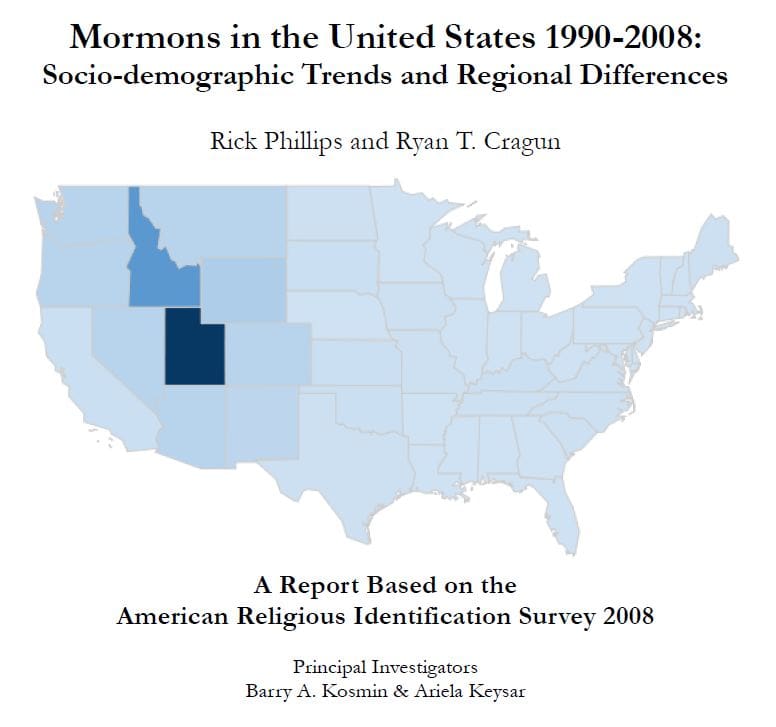
 In this episode Scott H. and I interview sociologist Dr. Ryan Cragun about his newly published report called, “Mormons in the United States 1990-2008: Socio-demographic Trends and Regional Differences.”
Some of the findings of the report include:
- Mormons were 1.4% of the U.S. adult population in 2008, a proportion unchanged since 1990.
- The Mormons of Utah are the only religious group in the U.S. today that comprises a numerical majority of a state‘s population (57% of Utah).
- Mormons remain the most geographically isolated and uniquely distributed American religious group (only 19% are found east of the Mississippi River).
- The Mormon population increase 1990-2008 was more modest than claimed by the LDS Church.
- ARIS data shows that apostasy rates are rising among young men in Utah. There is a growing gender imbalance and surplus of women as a result.
- There are regional differences among Mormons on several socio-demographic variables. Mormons outside of Utah are different to heritage Mormons in Utah.
- Utah Mormons in 2008 had significantly larger households than Mormons elsewhere (4.2 persons per household in Utah vs. 3.7 persons per household elsewhere), suggesting that the traditional norm of large families endures in Utah.
- Mormon women are more likely to be housewives and less likely to work full-time than other American women.
- The period 1990-2008 saw rising prosperity with above average increases in household income among Mormons in Utah.
- In 2008 Mormons had very high rates of voter registration (90% in Utah). Mormons are more than twice as likely to be Republicans (59%) than non-Mormon Americans (27%).
Dr. Ryan Cragun is an Assistant Professor of Sociology at the University of Tampa in Tampa, Florida and Research Associate at the Institute for the Study of Secularism in Society & Culture, Trinity College. His research interests include: secularization, religious change, Mormonism, and religious independents/seculars. His current research is looking at several ways in which secular society interacts with religious fundamentalism.
Episode Transcript
Host: John Dehlin · Guests: Ryan Cragun, Scott Holley
This transcript is machine-generated and lightly edited for readability. The audio is authoritative. Please excuse occasional errors in names and spelling.
Introduction and Episode Overview
Guest [00:00:00] 1, 2, 3.
John Dehlin [00:00:07] Mormon Stories Podcast is a production of the Open Stories Foundation. All donations to Mormon Stories are fully tax deductible and go directly towards keeping the podcast alive and towards building a community of support for Mormons like you. To support the podcast or to join the community, please become a monthly subscriber today@mormonstories.org. hello, and welcome to another edition of Mormon Stories Podcast. As always, I'm your host, John Dehlin, and I'm very excited to have with me two special guests. I say that every time in terms of being excited, but it's still true. Today we have with us first and foremost, Dr. Ryan Cragan. Hi, Ryan.
Ryan Cragun [00:00:49] Hello.
John Dehlin [00:00:51] Ryan is an assistant professor of sociology at the University of Tampa, and he told me to say that his three research interests as a sociologist are Mormonism, the non religious, and secularization. And those all three sound very fascinating. So thanks for joining us.
Ryan Cragun [00:01:11] My pleasure.
John Dehlin [00:01:12] And we're here specifically to talk about a new report that was just released called Mormons in the United States, 1990-2008. Sociodemographic Trends and Religious. Religious Regional Differences. So that's why we're here. And we've asked to join us a good new friend of mine named Scott Holley. Hi, Scott.
Scott Holley [00:01:36] Hello. Thanks for having me on.
John Dehlin [00:01:37] My pleasure. Scott's an mba. He's a active participant of the Mormon Stories community. And what's most cool, some of you may know that we released a survey on why people leave the LDS Church a few months back. We had over 3,000 respondents to the survey. We've been delivering the data from that survey to some people at church headquarters that will remain nameless at this point. But we've been doing a lot of analysis on that data with an eye towards releasing the data in a presentation in a series of podcasts and. And hopefully eventually in some type of book. And Scott, along with a friend of mine named Morgan and several other people, have been really instrumental in helping us do the analysis on that data. And so, Scott Holley, thanks for joining us today on Mormon Stories.
Scott Holley [00:02:36] I'm really excited to be here and that I'm excited as well to have that data coming forward. It's been just absolutely fascinating to hear what people have had to say.
John Dehlin [00:02:49] Yeah, yeah. And some of the listeners may be frustrated that we haven't released the data yet. Let's just say that we've been asked not to release the data because there's an opportunity for the data to be presented at some interesting levels that could have, you know, a positive influence on the church going forward. And so we're respecting that request and holding back and. But we will release it. And the last thing I'll say before we dive in, Ryan, is that we're. This is going to be one of the very first episodes in a series in an. On a new podcast called why Mormons Leave or why LDS Leave. And we're going to do a whole series on these types of topics. And we chose Ryan because sort of getting a sense for, you know, what, what Mormon demographics are, what LDS demographics are, is a great place to start before we dive. You know, the fact that people are leaving and at what rates they're leaving and why they might be leaving. So we're starting with you, Ryan.
Guest [00:03:52] Great.
Ryan Cragun [00:03:53] Happy to be here.
John Dehlin [00:03:54] Yeah. So let's just begin by telling us, just give us just, maybe just start with a little bit of your background. Tell us a little bit about any relationship you might have to the LDS Church and any interesting things about your Mormon journey that, you know, we should know before we dive into your data.
Dr. Ryan Cragun's Background and Faith Journey
Ryan Cragun [00:04:13] Sure. So I'm originally from Utah, from small town Utah, Morgan, which is just outside of Ogden. Oh, sweet. Yeah. Born and raised there, just a couple mountains over from Logan.
John Dehlin [00:04:25] Is that Davis County?
Ryan Cragun [00:04:27] Actually, it's Morgan County. Morgan County.
John Dehlin [00:04:29] Okay.
Ryan Cragun [00:04:29] So it's got its own county. Very small, though back in the late 80s, I think it had the highest percentage of Mormons of any county in Utah.
John Dehlin [00:04:39] Wow.
Ryan Cragun [00:04:40] Yeah. So very Mormon County. Let's see. I served a mission for the LDS Church from 1996-98 in Costa Rica and returned. Finished my bachelor's degree in psychology at the University of Utah in 2000. And then my wife and I, I married in 1999. My wife and I applied to graduate school, went to graduate school at the University of Cincinnati. She finished her degree, a master's in Human Genet, earlier than I finished mine. I was getting a master's and then a PhD in sociology. During that time is when we basically parted ways with the LDS Church. That was 2002.
John Dehlin [00:05:24] Oh, no.
Ryan Cragun [00:05:26] Just didn't work for us. Part of it was the stuff that I was reading and studying. My mission had turned me on to religion. Before that, I wanted to be a medical doctor. I came back and decided that religion was the most important thing in the world and I had to study it, but I had to study it from a scientific perspective and. And that didn't work very well.
John Dehlin [00:05:46] That's dangerous. Dangerous.
Ryan Cragun [00:05:48] That is a little bit dangerous territory.
John Dehlin [00:05:50] And now you're stuck with it as a research line.
Ryan Cragun [00:05:52] I am. I am. I'm making the best use of my mission, is how I like to think about that. So.
John Dehlin [00:05:58] So you have an ax to grind. You're actually coming at the church with your research then, right? I'm just kidding. I'm just. I'm joking. I'm joking.
Ryan Cragun [00:06:07] I mean, early on, I was kind of angry about some things, but now I don't see it as a big deal. I'm out, and it's still of interest, and I know a lot about it, so I retain an interest in studying it. And maybe at some level, this is probably several levels down. I'd like to think that some of the research I do could influence the church in positive directions.
John Dehlin [00:06:36] Yeah, that'd be sweet. That's. That's the only reason Scott and I are trying to do what we're doing. Right, Scott?
Scott Holley [00:06:41] Absolutely.
John Dehlin [00:06:42] Yeah. What were Just. Just real quick, what were. If you could list three to five of the big things that kind of rattled you, what were they? Were they historical stuff? Was it macro stuff? What was it?
Ryan Cragun [00:06:56] The two that I usually mention? In graduate school, I was learning basically about empiricism. I'm kind of a quantoid in sociology. I do a lot of statistics and numbers. I do qualitative stuff, too, but most of my stuff is quantitative. And learning about that way of thinking about the world contrasted very strongly with how I'd been taught to arrive at truth in Mormonism, which was praying for it. So that began to call that epistemology into question. And so once it did, I began to apply my new epistemology, epistemology to Mormonism. And the first thing that really fell for me, that kind of started the whole thing, was the Book of Mormon, just as I learned about. At that time, I had a hemispheric model for the Book of Mormon, which I think is the most common one. And as I learned about claims in the Book of Mormon and obviously the anthropological archaeological record not aligning, it just fell apart for me. And once that happened, the rest just collapsed. It was over. So that's what did it for me.
John Dehlin [00:08:02] So the Book of Mormon.
Ryan Cragun [00:08:03] Yeah, it was the Book of Mormon,
John Dehlin [00:08:05] and it was just anachronisms and DNA
Ryan Cragun [00:08:08] or mostly the anachronisms. That was the big one.
John Dehlin [00:08:12] Well, you got to go listen to my Brent Gardner podcast, because he solves all that.
Ryan Cragun [00:08:16] Oh, great.
John Dehlin [00:08:17] Five hours of an explanation on. On. You've been thinking. You've been thinking about the Book of Mormon all wrong, Ryan. I'm actually. I've been sent here by the Church to bring you back, actually.
Ryan Cragun [00:08:31] Good luck. Just kidding, Ryan.
Scott Holley [00:08:33] What year was that? What year was that that you left the church then?
Ryan Cragun [00:08:36] 2002.
Scott Holley [00:08:38] Okay, so that was kind of relatively early in terms of the Internet explosion. Was the Internet a big part of that? Were you finding things online about the Book of Mormon, or was it mostly in the library?
Ryan Cragun [00:08:50] I was finding some things, but one of the things that happened as a result of my graduate education, I mean, it was only my first year. I just finished my first year master's training. I basically lost my fear that first year of reading uncorrelated books, if that makes sense. And so I started reading some of the sociologists who do Mormonism stuff. Armand Moss, I was reading his work. I read Thomas o' Day's the Mormons, which is a pretty secular approach to Mormonism. I read some of the Shepherds work, and then I started in on D. Michael Quinn's work and some of the other books and. Because I didn't fear anymore, because I'd been told my whole life, you know, the only stuff you should read about Mormonism is stuff that's published by the church. Well, once I stopped buying into that and just kind of said, you know what? I'm mature enough that I can handle this. Yeah. It was mostly just the books that I was reading. There was some stuff online, but most of it was still actually just stuff I was reading in books. And then, of course, I've seen the explosion since then online.
John Dehlin [00:09:52] You're a pioneer then, aren't you?
Ryan Cragun [00:09:54] Kind of. But I think a lot of people were having the same experience right around then. I don't think I was unique.
John Dehlin [00:10:00] Yeah.
Scott Holley [00:10:01] So I have to say that in reading your materials, I'm not coming across the voice of a person who has a large axe to grind. Does it? Would it be fair to say then that you've kind of worked past some of the anger that a lot of people feel in those initial days of leaving and have a more balanced view towards the church, or how would you put that now?
Ryan Cragun [00:10:29] Yeah. Early on, when I left, I think there was a little bit of an axe to grind. I was really upset. Having dedicated two years of your life to trying to build up what you believe to be true and then finding out some of the stuff that I hadn't been taught, I was upset. But today, most of my family is still lds. We get along fine as long as we don't discuss religion, which means we don't discuss any of my research. They don't really know what I do, which is a little bit awkward, but that's okay. They're willing to put up with it. And I think part of the reason why they are not willing to bring religion up with me is because they know this is what I do for my profession. So I know a lot more about even their religion than they do, which can be intimidating to them. But awkward. Yeah. At this point, you know, I really am not out to destroy religion. Like I said, if I could do anything when it comes to religion, it would be to reform it in ways that I think are positive ways. But even that, you know, a lot of the stuff I do is just purely out of intellectual interest. I just think it's fascinating. That probably encompasses most of it.
John Dehlin [00:11:41] So you can take the boy out of Mormonism, but you can take Mormonism out of the boy, is that right?
Ryan Cragun [00:11:45] Yeah, it's still here.
The American Religious Identification Survey
John Dehlin [00:11:49] So let's talk about this survey. In this study that you just released, where should we start? What made you want to do this and what were the main questions you were trying to ask?
Ryan Cragun [00:12:03] So how this actually started? I became affiliated with the people who run the aris, or the American Religious Identification Survey. It's Barry Cosman and Ariella Kesar. They're at Trinity College in Connecticut because of the institute that they run. So this is actually run out of an institute called the Institute for the Study of Secularism in Society and Culture. And my doctoral dissertation was on people leaving religion. And I was really interested in the non religious. And when I was doing that, I was one of the first. I mean, there hasn't been a lot of research done on that. So they saw some of the research I was doing and obviously we had shared interests. So I started going up there and visiting them a couple of times a year. And that was in 2006, 2007. They were just getting ready to launch the survey for ARIS 2008 to gather the data. And so I actually consulted on that. I helped them frame some of their questions, and then they gave me access to that data, which that data is still not publicly available. The two earlier ones are on their website, the 1990 and the 2001. But the 2008 was not and still is not, but I have it for a variety of reasons. And so as I was digging through that data, one of the things that I noticed very quickly, and of course they consult with me because they know my background as a Mormon, was the large sample of Mormons in the 2008, the 2001, and the 2, and the 1990 data sets. And I thought no one's even looked at this. Right. There's just nothing done on this data set. And this could be very, very useful because most other data sets that have anything on Mormons are very, very small. So you may have something like the General Social Survey, which is a very well known study. It's a very rigorous study funded by the National Science Foundation. But in any given year, you're going to have maybe 20 Mormons.
John Dehlin [00:14:03] That's crazy, right?
Ryan Cragun [00:14:05] So you just don't have much data. Whereas with ours, with the Aris in 2008, you have 783 Mormons. Right. And that's just one year. And so it gives you a lot of data to deal with. The limitation that it has is they don't ask lots of questions. So the General Social Survey, they have thousands of questions. They ask Eris has about 20. But you have a huge sample size. So you're getting a trade off. You either get a great sample size or lots of questions with a small sample size. And so once I realized there was a great sample here, I thought, what can we do with this data that, that no one else has done? And that's what led to me working with Rick and coming up with this report.
John Dehlin [00:14:47] Got it.
Scott Holley [00:14:47] And Ryan, are those questions then serial between the different reports? In other words, are the 20 questions you asked in 2008 the same as 2001 and 1990?
Ryan Cragun [00:14:59] Most of the demographic stuff is the same, but the way that the ERAS actually runs is it's part of an omnibus survey which I don't know if you're familiar with this, but basically they contracted out with a survey research company. And that survey research company will basically ask the questions that ERAS pays for. Right. So that the research group pays for as part of other surveys. So it has varied over the years. In 1990 they asked a few different questions. 2001 they actually had an inter religious marriage question which they didn't ask in any of the other years. And then in 2008 they had some other questions that they asked. So the demographic questions are consistent across, but the other questions they have some topical areas that they deal with are not. And that, that makes it hard to do much with those.
Scott Holley [00:15:52] And then obviously the affiliation questions are the same year after year.
Ryan Cragun [00:15:57] That's consistent. That's always been consistent. Yep.
John Dehlin [00:16:01] All right, well, anything else on methodology or the data before we dive in? Scott, you're good?
Scott Holley [00:16:09] Yep.
Mormon Demographics: Age and Geographic Trends
John Dehlin [00:16:09] All right.
Ryan Cragun [00:16:10] Okay.
John Dehlin [00:16:11] Okay, so what, what? Let's just talk about the major findings of the, the survey. I guess it starts with age and gender, huh?
Guest [00:16:21] Mm.
Ryan Cragun [00:16:22] So there are a couple of interesting things there. One that I'll point out that I think is pretty interesting. Mormons have been aging just like everybody else. That's not surprising between 1990 and 2008. But the really interesting finding on that one is that Mormons in Utah, because we break them out, we have Mormons in Utah and Mormons everywhere else. Mormons in Utah aged faster than Mormons outside of Utah. Prior, in 1990, Mormons in Utah were younger than Mormons outside of Utah. Now, if I'm remembering correctly, they're about the same in terms of age. And that, of course, raises the question, why? What has happened over those intervening 18 years to lead Mormons in Utah to age faster?
John Dehlin [00:17:07] Does this mean that we're losing our young people? Is that. Is that what it means?
Ryan Cragun [00:17:10] That's our interpretation. Now, I'm sure other people would disagree with that, but we've got some pretty good data, other data that we're working on for a separate paper to suggest that that's really probably what's going on.
John Dehlin [00:17:24] So maybe it's. We're losing our young people and we're having less children. Is that right?
Ryan Cragun [00:17:32] Mormons in Utah are having still more kids than Mormons outside of Utah. So it couldn't just be right that Mormons in Utah are having fewer kids. It has to be something else. And that's why we introduced the possibility that this could be younger people leaving in higher numbers, particularly in Utah. And that's. That's really what we think is driving the. The increase in the age, particularly among Mormons in Utah.
Scott Holley [00:18:01] So, Ryan, one of the hypothesis that you said could also be behind the. That change is a greater number of younger converts coming into the church from outside of Utah. Why was that kind of discarded or maybe set aside as not being likely? The primary. The primary reason there.
Ryan Cragun [00:18:24] Right. That's heavily driven by another paper that Rick Phillips and I, the other author on this, have accepted and forthcoming at Nova Religio, in which we find that rates of defection or people leaving the church in Utah have gone up in the last 10 years, and now they're actually at the same rate as outside of Utah. So it's not so much that we can't kind of completely refute that converts are moving to Utah. Maybe that's the case. But the percentage of the population in Utah that's Mormon is actually going down. That seems to work against that. And we've got extra kind of external evidence. To the heiress, it's gss Data, general social survey data suggesting that people leaving the religion in Utah is going up. And so we've got multiple sources suggesting that really what's going on is young people are leaving the church in Utah.
John Dehlin [00:19:19] And Scott, that makes sense. And Scott, that kind of mirrors what we're finding, right?
Scott Holley [00:19:23] Yeah, absolutely. I think that there's a lot of data to suggest and what we are seeing and we don't have time series data, of course, with just the first survey that we've now done about why people leave, but we are seeing a greater propensity among young people to leave. And I think that that's actually you can go into the church literature as well and regional conferences around the country where visiting general authorities have made this an emphasis at stake conferences capacitating the leadership on how to keep the 18 to 30 year olds. I guess one other question, Ryan, and this came up in some of the boards where people were discussing this paper is what about out migration? I mean, we know that Utah is becoming less Mormon for one reason, because more non Mormons are moving in and also because more Mormons are moving out, such as yourself, you know, going from the University of Utah to Cincinnati. And I think John and I both did the same thing earlier in our careers. Would that explain fewer kind of younger males if it's predominantly young Mormon males who are leaving the state to pursue education? Or would that not explain the data that you're seeing?
Ryan Cragun [00:20:55] It's, you know, again, it's possible at the same time. Okay, I'm speculating at this point. I mean I honestly, I'm speculating we don't know what percentage of those people who leave Utah, particularly for education, something like that, or seeking jobs, end up going back. And I'll, I'll just give a scenario here. I have a friend of mine, really good friend, who, same age, we graduated the same year from high school, he went away to Iowa to get basically his podiatrist to get his, to get his medical training and he's now back practicing in Utah. So I have to wonder, you know, yes, there are some who leave, but what percentage of those who leave eventually go back? We don't have that data. Yeah, one of my, so yeah, we're forced to kind of speculate about that.
Scott Holley [00:21:46] Does one, one of my non Mormon bosses early in my career called it the Utah boomerang, said you can, you can hire people from Utah, but a few years later they're all going to be headed back to Utah.
John Dehlin [00:21:56] Hey, I resent that. I resent that. Interesting. Okay, so so we're getting younger. What else did you find?
Gender Composition and Women in the Church
Ryan Cragun [00:22:08] So if we look at the sex part of that, we did age and sex. That was one of the kind of more controversial findings which we actually thought was one of the more interesting.
John Dehlin [00:22:17] Mormons are having more sex.
Ryan Cragun [00:22:18] Just kidding. No, just gender, I guess I should use. But biological sex. In 1990, women slightly outnumbered men. Mormon women slightly outnumbered Mormon men in Utah, 52.5%. Right. But by 2008, there was a dramatic, we're calling it a dramatic shift and it is a statistically significant shift to where in 2008, Mormon women make up 60% of the Mormon population in Utah, which is a pretty big increase if you think about it. So it's now 60, 40. So we did have some people call that number into question. But I want to talk about one of the really interesting implications of women now outnumbering men in the Mormon Church in Utah. One of them you're talking about.
John Dehlin [00:23:09] Just.
Scott Holley [00:23:09] So you're basically saying that for every three women in Utah there's. There are two men.
Ryan Cragun [00:23:14] Yes.
Scott Holley [00:23:16] And is that, is that among singles or among married or across the board?
Ryan Cragun [00:23:19] That's across the board. It's across the board. So it's adults. I mean, this is all adult data and that's one of the differences we can talk about. But this is across the board, adults women now outnumber men three to two. And so one of the interesting implications is this is probably going to increase religious heterogeneity in marriages. So Mormon women are going to be. If they're going to find a spouse. Right. They're going to find a spouse who is not Mormon. And one of the practical implications of that, I mean, one, we know those marriages are actually more likely to end up in divorce, but two children raised in mixed religious families are actually more likely to leave religion altogether in the long run. So that is actually going to have one of those really interesting practical implications that if you start getting more inter religious marriages, you're actually going to increase apostasy rates even more.
John Dehlin [00:24:14] Yeah. Isn't someone who marries a non member more likely to leave the church as well?
Ryan Cragun [00:24:19] I would guess that's true. But one of the tricky things that still hasn't been worked out in the sociology of religion has to do with social network analysis. Which direction pulls harder. Right. So is somebody more likely to join or is somebody more likely to leave? If you're in a relationship like that at this point, I don't think anybody has actually worked that out.
John Dehlin [00:24:38] Okay. Okay. Wow. So that's three to two. That's a bummer for the women.
Guest [00:24:44] Yeah.
Ryan Cragun [00:24:45] Not, not so bad for the men, I guess, but for the women, yeah.
John Dehlin [00:24:50] If you're, so if you're a Mormon man and you want to get married, move to Utah.
Ryan Cragun [00:24:54] Yep. That would be the implication.
Scott Holley [00:24:56] Well, you know, we do have a theological solution to this little problem we got here.
John Dehlin [00:25:01] Call the missionaries.
Ryan Cragun [00:25:03] Well, it's funny how many people have said so they're going to reinstitute polygamy as a result. I can't. I mean it's serious. It's like 10 people have said that to me once I mentioned that.
John Dehlin [00:25:13] Oh, nice one, Scott. I was slow on that one.
Scott Holley [00:25:17] Well, so this again, this is self identification. So, so these, these are, are guys who are still there on the rolls. You know, the church is not scrubbing their names off. They just when someone picked up the phone and gave them a call and said, what religion are you? They said eh. Or they said something else other than I'm Mormon.
Ryan Cragun [00:25:41] Right. Self.
Scott Holley [00:25:42] So is, are there any gradations of observation? I mean, if it's an either or question, is it possible that, you know, if someone was given a scale of 1 to 10 that some of the guys might have said a 2 or a 3? Or does it, from your experience, does religious identification seem to be pretty black and white among respondents?
Ryan Cragun [00:26:06] If anything, I would say it probably goes. Well, I don't, I don't want to say goes the other way. I'm trying to think about the way that you worded that People are more likely to report being religious identified in the U.S. not outside the U.S. but in the U.S. even if they never go to church. There is definitely a bias towards saying that you're religious even when you're not. Right. So if anything, what we should be finding is that people, and I see no reason to think that Mormons or people in Utah would be different people are more likely to over report their religiosity than under report it because it's still basically seen as a positive in our society for people to be religious. So yes, this is self identification, but we should be seeing higher numbers of self identification and a bias towards over identifying rather than under identifying. And I don't know why that would differ between men and women. Maybe there's a reason for that, but I haven't seen that in the data either.
Scott Holley [00:27:04] So it's, it's possible then that Even among those two males or the, the 40% that are males, that the activity, the, the, the percentage of those that are active is Even lower. Attending is. Is even lower.
Ryan Cragun [00:27:18] Yep.
Scott Holley [00:27:19] Okay.
John Dehlin [00:27:20] Okay. Any idea why this ratio is different outside of Utah than inside of Utah? Like it's almost flipped outside of Utah. There's actually less. Well, no. Yeah, it's almost 50. 50.
Ryan Cragun [00:27:39] Yeah, it's about 55, 45. So it's not as big. Why the big difference in Utah? Again, we're forced to speculate, we think that what's happening as the percentage of the population in Utah that is Mormon has declined, the normative pressures to remain a member. Right. And to continue to self identify have also declined. My co author, Rick Phillips, wrote a great paper, I think, in 1998, talking about those normative pressures and how they basically forced people in a very dense population where, you know, lots of people are Mormon to go to church. Right. And I don't know if you guys have had this experience, but the idea of going to the, to the supermarket and if you're kind of a nominal Mormon and you want to buy coffee, you don't know who's going to see you. And if it's a member of the local ward, then they could see you. And that's going to actually keep people from engaging in practices that are basically reflective of them no longer being observant. Well, as Utah becomes less Mormon. Right. Those external pressures, the normative pressures to keep people in are declining to where? Now you can go to, you know, pretty much any shopping store, you know, any supermarket, and not really worry about running into somebody who's going to see you buying coffee or buying beer. And those pressures are just going away. You can also find places in, you know, neighborhoods in Utah, which I know there are still many neighborhoods that are very densely Mormon, but there are neighborhoods that aren't at all downtown. Salt Lake City, Park City, you could basically be surrounded by non Mormons in those neighborhoods now.
Scott Holley [00:29:28] Yeah, that makes a lot of sense. And, and you know, without again, going too much into the work that we still have that's ongoing, we did measure the cost of disaffection, disaffiliation, not only by gender, but by region. And not surprisingly, the respondents within Utah reported a much higher cost to their jobs than you would outside of Utah. It's no shock that if your boss isn't Mormon, you he's going to be less concerned about what your level of orthodoxy or orthopraxy is within the Mormon faith. So although we haven't again done our research over, over time, I would imagine that as the number of non Mormon bosses and co workers, et cetera, within the state of Utah grows, that that cost declines. Do you think that it could also be something just about the shifting attitudes towards members of the church becoming more egalitarian towards the disaffected? Or do you think that that cost is static? Again, this is probably supposition. That wouldn't be necessarily in the data. But
Ryan Cragun [00:30:48] no, I was actually thinking about that as you were talking, that one of the factors that could be playing out here as well is that as more people leave, more current members are going to know somebody who has left. And I think that's actually one of the things, not to kind of personalize this, but I think that's one of the things that I have kind of done for my family. The fact that I left the church and my wife didn't immediately fall apart. Right. I'm happily married with a cute little boy, and I'm a fairly successful college professor. Right. I think that has shown to my family that leaving the church does not immediately mean your life will collapse. And I'm going to be kind of engaged in a. In a horrific life of drugs and, you know, wanton sex and debauchery that just never happened. So as more people leave, more current members are going to know people who have left, and that's probably going to reduce kind of the antipathy towards those who have left. But again, we're at this point, we're speculating. I don't have any data to support that. I think it has happened in my own life, but beyond that I really couldn't say, but it seems like that's a possibility.
Scott Holley [00:32:01] Well, maybe. One last question on the lines of speculation. Get back to data. What about the sociality that exists outside of official Mormondom now as providing something for men who previously within the state felt that they needed to stay to see that there is a vibrant community of less orthodox believers or non believers that they can associate with either virtually or in person.
Ryan Cragun [00:32:40] Yeah, I would be surprised if that was having no effect. I mean, I know Post Mormon has put up a couple of billboards in Utah and there are a lot of groups of, you know, ex Mormon, former Mormon groups, Post Mormon groups that meet regularly. John Larsen, who hosts the other podcast
John Dehlin [00:33:00] regularly, that show, which not be named.
Ryan Cragun [00:33:03] Oh, I'm sorry.
John Dehlin [00:33:03] No, I'm sorry.
Ryan Cragun [00:33:04] Kind of like Voldemort here.
John Dehlin [00:33:06] I actually appear on Mormon Expression this week, actually.
Ryan Cragun [00:33:09] Great.
John Dehlin [00:33:09] As a guest.
Ryan Cragun [00:33:11] Well, I know I've talked to him a couple of times and he says that they regularly at their meetings, have lots of new people coming in and their meetings are getting bigger and bigger. So that could be an option too, right? This people, people not only realize, hey, there's not as much normative pressure to stay, but there's also support, a support network for me when I leave.
John Dehlin [00:33:31] Got it? Yeah. Okay. All right, well, what's next? What else do we learn from the data?
Employment, Race, Education, and Economics
Ryan Cragun [00:33:38] So we did age and sex. Those are always fun ones. Another interesting one, if we want to kind of hit there with sex, is that Mormon women are less likely to be employed full time than non Mormon women. And one of the other interesting ones, again comparing Mormon Women in Utah vs. Mormon Women outside of Utah is Mormon women in Utah are significantly more likely to identify themselves as housewives. And that's, that's just kind of an interesting little finding. Why is it they're about equally likely to work full time and part time, but when you ask about that housewife difference, Mormon women in Utah are substantially. It's about 10% more likely to identify as housewives than Mormon women outside of Utah.
John Dehlin [00:34:27] That makes sense, right?
Scott Holley [00:34:29] Yes. So how many full time or part time working moms are identifying as housewives? Because that part does strike me a little odd that you're working 40 hours a week and calling yourself a housewife. Seems like it's stretching that definition. Is it more a label that's applied to a mother who also has household duties?
Ryan Cragun [00:34:53] Well, this was a forced choice response. So they had to actually choose one of those. Right. They had to say that they were either full time, part time, retired housewife or other. So what we get. Yeah, so it wasn't like they were saying, well, I'm a part time and a housewife. They had to choose one of those. But it's 32% of Mormon women, adult women in Utah say that they're housewives. 22% of Mormon women outside of Utah say they're housewives. And then among non Mormons, it's 13%. So they're substantially more likely to say that they're housewives.
Scott Holley [00:35:25] And does that line up with their education status? Is it a similar disparity between education and employment and Mormon women?
Ryan Cragun [00:35:32] Nope. Mormon women are just as likely to actually have bachelor's degrees as non Mormon women. So we actually have. Yeah, I mean, I think that's really interesting, right, that they're getting as much education as non Mormon women, but then they're choosing to. I don't want to say not use it because I don't think that's fair to housewives. My mom was a housewife. I very much respect them. But they're obviously not working right. And they're choosing to stay at home, which there is obviously normative pressure to do that coming from the church.
Scott Holley [00:36:04] But it does seem like that there has been some progress or movement. Call it what you will. In terms of completion of degrees, would that be accurate? Does the survey data then show that more women are completing the degrees or
Ryan Cragun [00:36:20] is that educational attainment has gone up for Mormons as well? But that's true across the board. I guess in the U.S. there's, there hasn't been. Mormons are not more likely are not increasing their education at a faster rate than non Mormons, if that makes sense.
Scott Holley [00:36:38] Great.
John Dehlin [00:36:38] And, and sorry if we've already covered this, but wouldn't you say that women working outside the home continues to increase within Mormonism?
Ryan Cragun [00:36:50] Yes, that would be my take on it. Let me go back and see if we can actually verify that from that data. I'm trying to think.
John Dehlin [00:36:59] Well, it's got, it's got percent of women. Yeah, it's actually, it's saying that percent of Mormon women who are housewives by region.
Ryan Cragun [00:37:07] You've got up now.
John Dehlin [00:37:09] That's weird.
Ryan Cragun [00:37:10] Yeah, that's why I wanted to check the data because there was that really kind of weird shift inside Utah. Right. Outside of Utah it's gone down and I don't think the difference is statistically significant. But inside Utah, the percent of women who are housewives has gone up between 1990 and 2008. And that's another kind of strange little quirky finding that they're actually less likely to work outside the home Now.
John Dehlin [00:37:37] I wonder if they're finding home based work situations.
Ryan Cragun [00:37:42] We think that could be part of it. We also speculate that the incomes have increased. I mean we do show that in terms of income, they've increased for Mormons in Utah. And so it may be the case that they're just more able to stay home as housewives.
John Dehlin [00:37:57] That's interesting. I had no idea.
Scott Holley [00:38:00] What about. I mean, we're also talking about moving into a knowledge economy. Is it potentially the case as well that it's just more difficult to find part time work within Utah, that the jobs that are available to Mormon women who would be looking to migrate from being strictly housewives to having part time work outside of the home, that there's just fewer opportunities?
Ryan Cragun [00:38:31] You know, that could be the case though. One thing that just popped into my head, and I think this is true, is JetBlue. Are you guys familiar with this? JetBlue has all of their totally call centers, right? Call centers. They're basically stay at home moms in Utah. Am I mistaken on that? I'm pretty sure that that's the case. So it may be that that is the case.
Guest [00:38:51] Yeah.
Ryan Cragun [00:38:52] That they're able to kind of find a scenario like that where they can still work and still be housewives. Which goes back to your earlier question of this being a forced choice option. Right. Maybe they are actually working. They're just. They identify as housewives instead.
John Dehlin [00:39:08] Got it. Fascinating. All right, what's next?
Ryan Cragun [00:39:13] There's the race issue, which is always a fun one with Mormonism.
John Dehlin [00:39:17] White is wonder bread, right?
Ryan Cragun [00:39:19] Pretty much the field is very white. There has been a little bit of change. Right. The change is not very substantial, but there's been a little bit of change. So in 2008, 91% of Mormons in the US are still white and about 3% are black. In Utah, they're even more white. They're 95% white. And most of the change is actually coming from Hispanics, not from blacks. So there has been some conversion of blacks. We're seeing that over time. And obviously we're not capturing what's going on in Africa and other parts of the world where the church is doing quite well. But in the US the change is very, very slow, let's put it that way. It's very, very slow. It's becoming less white, but certainly not at a very rapid pace.
John Dehlin [00:40:13] Got it.
Ryan Cragun [00:40:16] And I don't think that's going to surprise anybody.
John Dehlin [00:40:18] I was just expecting to see a large influx of Hispanics into Utah, especially given the church's stance on immigration.
Guest [00:40:29] Yeah.
Ryan Cragun [00:40:30] And we actually did separate that out by white, non Hispanic and Hispanic separately. So I don't know really what to say there because I've heard the same thing. Right. That a lot of Hispanics are moving to Utah, that the church is kind of friendly towards this. I mean, obviously there are some there and that's where the largest growth is. But we're not seeing dramatic growth in terms of, you know, what percentage of the Mormon population in the US is Hispanic.
Scott Holley [00:41:01] And this might be one where I might call into, or not call into question, but perhaps raise the issue of sample and data gathering, which is a good question.
Ryan Cragun [00:41:13] Yeah, just. I think I mentioned this somewhere else, but the eris, most of that data was actually collected using English speaking individuals and it was using landlines. But in order to kind of supplement that, the, the bulk of the data they did actually do, I think it was 500 or a thousand interviews in Spanish and then the same five hundred Or a thousand using cell phones. And then they used that data to weight everything else. So we may be missing some of the Hispanics in Utah who are Mormon, just because most of the surveys were actually done with English speaking individuals.
Scott Holley [00:41:54] I wonder if that survey call center for the US Is headquartered somewhere in Utah county,
Ryan Cragun [00:42:02] the one that they actually use. You mean for the heiress, right? No, it's actually in New England. I have no, it is in New England.
Scott Holley [00:42:09] Okay. Yeah, well, people were able to understand that, those New England accents over the phone. I can say that apparently Boston, but.
Ryan Cragun [00:42:17] Okay, I wasn't gonna go there. You can go there.
John Dehlin [00:42:23] All right, well, let's talk about education and economics a little bit more.
Ryan Cragun [00:42:28] So educational attainment, like I mentioned, it's gone up for everybody. Same is true for Mormons. There's always an interesting thing with Mormons, though, and education is that there's a positive correlation between participation in the Mormon Church and level of education. That actually the more educated you are, the more likely you are to be an active, observant Mormon. And we don't talk about that much, but that is something that has borne out in a variety of studies that the more educated you are, the more likely you are to be observant Mormon. But generally, education has gone up for everybody. And then as far as income, that was another one that was interesting. Incomes have actually increased faster in Utah than they have outside of Utah.
John Dehlin [00:43:09] So Mormons are getting richer.
Ryan Cragun [00:43:12] At least in Utah they are. They're getting substantially richer.
John Dehlin [00:43:15] And Mormons in general are more educated than the general population.
Ryan Cragun [00:43:19] They are by just a little bit. No, that doesn't suggest that they're the most educated religion. That honor typically goes to Jews who are far more educated than pretty much everybody else. A couple other groups that are fairly well educated are Unitarian Universalists and actually hint in the U.S. right, right, right. But yeah, so Mormons are slightly more educated than the average person in the
John Dehlin [00:43:44] US And Scott, does that surprise you, this finding that the more education you have within Mormonism, the more likely you are to be orthodox?
Scott Holley [00:43:52] Yeah, you know, I think that that actually is pretty in line with what we're seeing, you know, from the survey that we've done, which is basically that your, your level of adherence increases with the amount of costs that are attached and that those costs increase with, you know, the amount of stature you have within the community and basically what you have to lose. So, you know, if there's a positive correlation between, you know, your wealth and your level of involvement for males, your leadership within the church, then that's just going to be a cycle where it's more difficult to extricate from. If you so had desire to do that.
John Dehlin [00:44:42] And yet didn't we find a lot of people with advanced degrees in our population?
Scott Holley [00:44:48] There's a lot of people with advanced degrees who are going through the process of doubting. I would have to go back and look at the correlation between those with advanced degrees who left versus those with advanced degrees who had doubts and stayed. I think those with advanced degrees have other methods of working through historical issues by their Sunstone and dialogue subscriptions and participations in the blogger Naco. But one thing I actually wanted to bring up that's related to that is this issue of, of income between, you know, not necessarily Mormons, non Mormons, but Utah and non Mormons. I find this whole Utah Mormon vs outside of Utah really fascinating. And I would have expected, I mean, there's a perception, at least within the professional services that you actually pay a wage premium to live in Utah because it is so service heavy. So if you're, you know, in one of the three true professions of Mormonism, being accounting, dentistry and legal work, you, you're going to take a significant hit going back. But I guess that that's a small enough part of the population that I honestly have to wonder how much of this, since it was 2008 data, was just driven by the real estate boom that was perhaps bigger in Utah than other places. But it did strike me as interesting that Utah Mormons are making more than outside of Utah.
Ryan Cragun [00:46:30] Yeah, well, again, if I were forced to speculate, which I think this makes sense, outside of Utah you're going to have a lot more converts and we know converts. And I actually just had this confirmed by somebody at byu. Converts to the LDS Church, particularly first generation converts, tend to be poor.
John Dehlin [00:46:47] Yeah, totally.
Ryan Cragun [00:46:48] Yeah. And so that could also be driving it that you've got people who have been in the church for a very long time. This is something else that I wanted to kind of mention. The structure of the LDS Church is actually kind of set up to reward people who have higher education. So if you think about the hierarchy, right, positions of authority in the religion, basically the people who get those positions, this is not universally true. Obviously there are people who, you know, don't have higher education who, who get chosen to be bishop. But many of those positions are basically aligned with having the skill set that comes with higher education and white collar jobs. So if you think about things that bishops do and that stake presidents do and general authorities, they're Largely kind of mirroring the things that say a CEO of a company would do. So it has a very similar skill set, which actually makes sense then why people who are more affluent are more actually likely to stay in the religion. Whereas you see different trends outside of Mormonism, because that's basically, you know, it's part of the reward structure within the religion that it aligns quite well with white collar occupations and then people who don't fit into that. And I actually saw this when I was in Cincinnati and still going to church for a year. Cincinnati, of course, is in the mission field, right? It's outside of the Mormon culture region. The missionaries would bring people in and almost universally the new converts or the people who were investigating, they were poorer, they were less affluent, and they would come into a congregation which in Cincinnati, the big employer was Procter and Gamble. And I would say maybe a third of the people in the Mormon church there worked for Procter Gamble in some level of the hierarchy, and they were quite affluent. And there was very little kind of interaction between the Procter and Gamble kind of white employees from Utah and the potential converts who were largely black. They just didn't talk. And so you start to see the retention rates that we know are quite low for Mormons of these people just not fitting into a Mormon congregation, and then they leave. So that would be my suggestion as to why outside of Utah households make less is because they're first generation converts and those people are less affluent and they're more likely to leave.
Scott Holley [00:49:17] I had another question on. Sorry I'm so focused on money here. It's probably an outgrowth of my MBA you mentioned here that I'll just read a line from here. It says Mormon households in Utah have also gained an earning power relative to non Mormons. And then you go on to. When I first read that, I thought, oh great, you know, the Mormons control all the money and it's getting worse. But actually reading further on, it said in 1990, far fewer Mormons, far fewer Mormon households made over 50,000 per year than did non Mormon households, 13% versus 21.7%. So what, you know, again getting into speculation, why were Mormons making so much or why were so fewer Mormons making over 50,000 per year in 1990? And then by 2008 that difference had been erased.
Ryan Cragun [00:50:20] That's gone away. It's a good question. I don't even think we bothered to speculate about that one. I don't actually have an answer off the top of my head on that one. I Could guess.
Scott Holley [00:50:36] Yeah, that would be, I mean, the, the, just the first thing that popped into my head, which, you know, I don't know that this has. Would be, would be accurate. Would. But would be potentially in 1990, if you are living in Utah as a non Mormon, there's a very good chance that you were transferred in, either because you have a skill set or you're in a managerial position with the company. And, but again, that's, that's pure speculation.
Ryan Cragun [00:51:04] But no, I mean, it makes sense.
Scott Holley [00:51:06] Interesting.
Ryan Cragun [00:51:07] Yeah.
Scott Holley [00:51:09] Okay. Very good. All right.
Mormon Political Affiliation and Trends
John Dehlin [00:51:12] So are we on the politics?
Ryan Cragun [00:51:15] We are on to politics.
John Dehlin [00:51:16] This will be, this will be surprising, right?
Ryan Cragun [00:51:18] Yeah. So Mormons are more likely to be Republicans. That's a big surprise.
John Dehlin [00:51:23] But not just, not just slightly more likely.
Ryan Cragun [00:51:28] Dramatically more likely. Yeah. So we found among all Mormons, 59% are Republican versus among non Mormons, it's 27%. So, I mean, it's more than double.
John Dehlin [00:51:40] Twice.
Ryan Cragun [00:51:40] Yeah, more than. More. Yeah, more than twice. And then there is a difference between kind of inside Utah and outside Utah. And there's also been a change between 1990 and 2008. So between 1990 and 2008, Mormons became more Republican, so it didn't go the other way. And then Mormons in Utah are more, more Republican than Mormons outside of Utah. So.
John Dehlin [00:52:05] Go ahead, Scott.
Scott Holley [00:52:06] What's really interesting, though, and I have to be honest, when I looked at this, I was surprised at how to borrow a Fox News term, fair and balanced. You know, maybe not fair, but just a little bit more balanced than even, you know, than I had expected. And maybe that's just, you know, my particular bias. But there is a good, solid 27% of Mormons, you know, both inside and outside of Utah that register as independent, which is not all that different from non Mormons right now. You know, a question is to, Doesn't a Mormon in Utah who claims independent status thinking the same way as a non Mormon outside of Utah who claims to be independent? But, but, but, but that difference is not that far off.
Ryan Cragun [00:53:00] No, it's not, because it's 35% of the population generally. And what, you know what that means. Those could be moderates, people who are kind of, you know, undecided. Or it could be, you know, that there, there's a libertarian bent among Mormons and they're beyond Republican libertarianism. They're actually true libertarians. We don't really know. We don't know what that actually means. That 27% are independents
Scott Holley [00:53:29] and we all register to vote.
Ryan Cragun [00:53:32] Yes. Mormons are 90% in Utah are registered to vote, which is a little bit strange. It suggests, and we take that to kind of interpret it as Mormons have above average interest in politics. Why that's the case, don't really know. But that actually didn't change that much Mormons. It did change a little bit between 1990 and 2008, but it didn't change that much. Mormons were still more likely to register, more likely to be registered to vote in 1990 than were non Mormons.
Scott Holley [00:54:03] Well, it does seem like the letter is still read annually to, you know, be that we don't. The church doesn't support any particular candidate, but we urge you to be active and get out and vote.
John Dehlin [00:54:17] Yeah, I want to know what percentage of Tea Partiers are Mormons.
Ryan Cragun [00:54:23] It's a good question.
Scott Holley [00:54:25] Maybe.
Ryan Cragun [00:54:25] Well, this is before the Tea party, I guess, 2008.
John Dehlin [00:54:28] Yeah, right.
Ryan Cragun [00:54:30] Okay. Yeah. Anyway, so that, that pretty much wraps up the major points in the report.
John Dehlin [00:54:39] Well, it is just really quickly going back to politics right outside Utah,
Scott Holley [00:54:49] you
John Dehlin [00:54:49] know, a combination of Democrats and independence Almost, almost reaches 50%. So I guess I want you outsider Utahns who feel like, who are, who are moderate or liberal, who feel like the conversations in your congregation are skewing, too conservative. You guys should speak up because you pretty much make up half, you know, almost half of the, of the world population. Right?
Ryan Cragun [00:55:16] Yeah, I mean, that's, that's what the numbers suggest.
John Dehlin [00:55:18] So stand up and be counted and represent.
Scott Holley [00:55:21] Well, what I've, what I've always really found interesting there, John, is that, that we do have this, you know, almost annually, this edict from church headquarters to be active and engaged in politics and also to allow our values to inform those decisions. And yet it seems that political discussions in terms of, you know, let's take this principle or this doctrine or whatever and try and apply it to a political situation today, you know, because there is a possibility for contention and we know where that come, where contention comes from, that those conversations don't occur. So I wonder if there is that last mile, you know, so to speak, missing for members to have a discourse where they're talking about, okay, well, what is, you know, how should I take this, you know, kind of nebulous or high level doctrine or theory and apply it to this current situation. I wonder if there's a gap for that discourse.
Ryan Cragun [00:56:42] Well, I would also guess, I mean, it's just hard to speak up when it seems like the majority is against you. Right. And I don't know if you've had this happen in Any of your kind of sitting in church, whether it's in sacrament meeting or in Sunday school or, you know, one of the other quorum meetings, when somebody has actually said, you know, I disagree with that. Have you ever had anybody say that? No, no, it doesn't happen. It doesn't happen in religions.
Scott Holley [00:57:08] Well, I'm in. I'm in Boston, and usually that happens between two divinity school students who are in.
Ryan Cragun [00:57:15] Okay, so it might be there.
Scott Holley [00:57:17] Right.
Ryan Cragun [00:57:17] And I've heard it actually happens in. In Berkeley. But I remember one. One instance that I thought was just fascinating growing up that a member of my ward, this is in Morgan, was actually called to be the scoutmaster. And the bishop hadn't talked to him before they did the showing of support for him in sacrament meeting. And so everybody voted, yes, we agree with this. And then they said, is anybody opposed? And the person who had been called actually raised his hand because they hadn't told him he didn't know. And I remember just like waves of shock in the whole congregation because somebody had actually dissented. It was for a very clear and simple reason. They hadn't told him. There was a miscommunication among the bishopric. They thought that they had said, would you do it? And they just hadn't. So he was the one who dissented. That's the only time I've ever seen anybody dissent in anything. When it comes to religion, that just doesn't happen very often.
John Dehlin [00:58:15] Yeah, not true in Judaism. Right?
Ryan Cragun [00:58:18] Not true in Judaism.
John Dehlin [00:58:19] They take pride in their descent.
Ryan Cragun [00:58:21] Right, Right.
Scott Holley [00:58:23] Yeah.
Overall U.S. Mormon Geography and Membership Numbers
John Dehlin [00:58:25] All right. Well, actually, we. We started in the. In the granularities. What we didn't do is just talk more broadly about. About geography and overall demographic trends. Is that right?
Ryan Cragun [00:58:39] Yeah, we skipped over some of those numbers.
John Dehlin [00:58:41] Let's jump back there.
Ryan Cragun [00:58:43] Yeah. Which I think is an interesting point. So it goes back to how we count Mormons. And we make this distinction very early on. One, it's a methodological issue, but we also want to point out that we've got some numbers that are a little bit different from the LDS Church's numbers, and we want to try and explain why. So we point out that using data from the LDS Church's Deseret Morning News Almanac, which is where we usually get our numbers, the LDS Church claimed in 1990 to have 4,175,000 members in the U.S. and that totaled about 1.7% of the U.S. population. So that's 4.175 million. By the end of 2008, the church claimed 5,974,041 members, about 6 million members or 2% of the population. And that constituted a 30% increase in market share over that time span, 18 year time span. So that's a pretty big increase, right? They went from 4 million up to 6 million, 2 million increase. And they're talking about rather large numbers, 6 million people. We don't find those same numbers. And I don't know that that's going to be a surprise to anybody. But basically what our data suggest is that because of the basically membership practices and how they manage membership records, the LDS Church continues to over report its membership. To what extent? We can't say 100% because our data don't line perfectly with theirs. But we'll just tell you what we have to begin with. The Heiress doesn't include kids. And because of that, obviously we're going to have a smaller number. But if you think about those smaller numbers that we report and then even try and estimate the number of kids, it's clear that the LDS Church is still over reporting its membership. So in 1990, the heiress estimated that there were 2,487,000 Mormons. And those are Mormon adults in the U.S. that's more than, let's see, not quite 2 million less than the church reported in 2008. The ERAS estimates that there are 3,158,000 Mormon adults in the U.S. that's almost 3 million less than the LDS Church reports. Now again, you've got to factor in kids. So you could put in a million kids, maybe two. But I can't imagine that there would be more than 2 million kids. And that's kids under the age of 18. And that's still putting the estimate for the number of Mormons in the US a million below the official membership numbers of the LDS Church. So if you go off of our numbers, we also see a smaller increase in LDS membership. The LDS Church says that they've increased by 30% over 18 years. Our data suggests that they've increased by about 16% or half that.
Scott Holley [01:01:44] And you say elsewhere that the population growth among Mormons is slowing, is that correct?
Ryan Cragun [01:01:50] Yeah, it is.
Scott Holley [01:01:52] So it couldn't be explained by the fact that the age pyramid is just continuing to invert and that we're just getting more kids because the opposite's occurring. We're actually getting older.
Ryan Cragun [01:02:07] Yeah, and that's actually even true in Utah, which I have pointed this out to a couple of people, including a couple of reporters. Early in the 2000s, the LDS Church made the claim that they were raising the bar on missionaries. Right. And that's why the number of missionaries, which hit its peak at just over 60,000, then dropped down by 10,000, which they haven't made a big deal out of that, but they claim to have raised the bar. I think two things actually happened there. One, if you look at the age sex pyramid in Utah, there was actually a huge decline in the number of kids. Right. At the same time that the numbers dropped. Right. At least kids that were hitting the age of 18 or 19. And so that's probably a big chunk of why the number of Mormon missionaries dropped is because Mormons in Utah are also having fewer kids now. There's still more than the national average, but the number of kids is actually declining. So that's part of it. And then I also think fewer people are just going on missions. But, yeah, you've got to factor in the Mormon Church is not still having massive families. Right. Mormons are not doing that. Their family sizes are declining over time a little bit.
Scott Holley [01:03:24] So you're. And you know, it would be interesting to. The one thing you can do with these, with the church's numbers is 6 of 6 million, as we do know, the number of kids, children of record that are added each year. So, you know, ostensibly you could take, you know, 18 years of children of record, which is, you know, about 100,000 a year, and estimate, you know, that 1.8 million there is, you know, our children, although that would probably be somewhat overstated.
Ryan Cragun [01:04:00] Right.
Scott Holley [01:04:01] But you are left with, you know, a number that's significantly less. And again, this is identification. This isn't people who are saying, yes, I'm going to church every week, I'm a Mormon and I go to church every week. It. This could be the person who says, yeah, I'm a Mormon, even if they haven't been since they were ordained enough, you know, deacon.
Ryan Cragun [01:04:22] Right, Absolutely.
Scott Holley [01:04:28] So, you know what? Since assuming that the church didn't change its methodology and how it counts members between 1990 and 2008, and knowing that your survey, as you said, with the demographics was consistent, what. Explain. I mean, basically what you see here is the church saying we went from 1.7% of the population to 2%. And I think the words that you use in your report is, well, it's actually just about treading water, staying steady at 1.4%. So where does that delta come from? Why is the church claiming growth and this story showing just treading water?
Ryan Cragun [01:05:15] It has to do with how they keep track of those records. Right. So we don't know Exactly. I've seen one person try to estimate the number of people who are formally resigning from the LDS Church every year. And, and the LDS Church, based on its membership data record policy, right. Basically says that they'll keep you as a member unless you formally resign or they can't, you know, they can't find you and you're 110 years old. Right, right. So they're, they're just aggregating people who don't self identify as Mormon anymore. And we've, we've seen this. I mean, yes, we're seeing this in the ARIS data. That's the best data that we have basically for the US but when you look at census data outside of the US you see the exact same thing going on, except to a much bigger degree. So Rick Phillips has published about this. Ron Lawson, another person I've worked with, has some data on this as well. If you go to countries around the world where they have census data that includes religion, so religious affiliation, and you contrast that with the Mormon Church's claimed membership in those countries, the overestimate by the LDS Church is anywhere from 20 to 70%.
Scott Holley [01:06:31] Yeah, John and I looked at that for a handful of countries including Chile, which is where I served my mission, and I believe that the number of self reporting was around 200,000 or no, it was around 100,000 and then the church was claiming 500,000. So about a five fold increase.
Church Membership Overreporting and Growth Slowdown
Ryan Cragun [01:06:50] Exactly.
Scott Holley [01:06:52] Well, I mean, I guess the upshot of that is that inactivity rates aren't as bad if there's actually a number of people on those roles who are actually dead.
Ryan Cragun [01:07:07] Yeah, I guess that's true. But I mean we mentioned before, it might be interesting to contrast the way that the LDS Church counts its numbers versus some of the other religions. And I've looked at this again and thanks to Ron Lawson who I've worked with very closely on some of my papers. Ron Lawson is an Adventist, so Seventh Day Adventist. The Adventists actually clean their roles. Right. If you're not showing up, they drop you, you're out. Right. And so when you look at their data and go around the world doing the same thing, comparing Adventist data to census self report data, you actually see a one to one. I mean it's almost exactly right. So they're really close in terms of their comparisons. And then they actually go to the other end of that, which is Jehovah's Witnesses, they actually underreport theirs, which is kind of interesting. The only people that they include as members are what they call Pioneers. And pioneers are the ones who are out going door to door monthly. They have certain quotas that they have to reach. Those are the only ones they actually include. So if you do those comparisons, census data versus Jehovah's Witnesses pioneer numbers, more people self identify as Jehovah's Witnesses than the Jehovah's Witnesses Church actually reports as members. So you've kind of got two extremes there, right? The LDS Church is over reporting its membership, Adventists are right on, and Jehovah's Witnesses are underreporting their membership.
Scott Holley [01:08:40] So what is our motivation for over reporting? Obviously, you know, the church doesn't pay taxes. It doesn't get a dole from the government for each new member. What's the motivation?
Ryan Cragun [01:08:54] Well, you're going to force me to speculate again, which I've been doing a lot of in this interview. I really think that there are people who are just obsessed with numbers, who like those numbers, right? Because really. Well, and the other thing is a tricky one, right. I've discussed this with Ron Lawson and another person as we've been working on these papers is okay, if the LDS Church decided to change the way that it counts members and actually start cleaning the rolls, right. The only way that they could probably get away with this without scaring the membership just crazily is they'd have to slowly change the numbers over time. Can you imagine if the LDS Church said, okay, we just cleaned our rolls this year, let's say 2012, they clean their roles and suddenly the membership number goes from 14 million down to what it probably is 7 million in a year. What would the average member think? What just happened? Right. So they're kind of stuck now. They've been over reporting for so long that now how do you actually change that? And people have begun to expect, right? And this is part of kind of the Mormon theology. This is God's church. God wants it to. We're going to fill the whole world. We're out there converting people. Well, a great way to show that is just with numbers. Every year the number goes up. In reality, that number is probably not going up even close to what they're reporting. I think current conversion or current membership increases every year is close to 200,000. I would guess it's substantially less than half that. But they have to show numbers, right? I mean, this is how you get affirmation that the Mormon Church is true is by basically seeing, oh, it's growing, we're growing. Obviously it's true. People are increasingly saying that it's true. Well, no, they're not. Increasingly, we even see that the numbers have declined. In 19, I think it was 1990, 91, 92, 93, that was the peak membership increase. And we think that they actually were fudging some of the numbers, but they had over 300,000 converts that year or members increase. Now they're down to 200,000. And I don't know how much lower it's going to go, but members still want to see those numbers go up. And I just wait for the day when they say, you know what, we're going to adjust these numbers. And if they do that, especially if they do it in one year, you're going to see the membership cut in half.
Scott Holley [01:11:32] Right?
John Dehlin [01:11:32] Yeah.
Scott Holley [01:11:33] You know, that really resonates. And John, I'm thinking about something that we heard in Terrell Givens interview where he says that basically every general authority or leader of the church inherits the church that was built by the people who came before him. So some of the things that Ryan's talking about that we've seen in our work as well, there are years where, for instance, the membership numbers increase, the net membership numbers increase more than at a rate greater than the number of children coming into the church and new converts being baptized. So, for instance, if you have a year where you have 200,000 converts and 100,000 new children of record, instead of showing 300,000 new members, they're showing 400,000. So I think that that's happened in three years. Additionally, if you look at the loss ratio, in other words, every year there are people who die. Obviously the loss ratio for the church is about four out of every 1,000 members, while the US death rate is about eight per 1,000 members. So, you know, that there are, it's. It becomes a really interesting, you know, it's a little bit like Dancing with a tiger. One thing that I've noticed is actually a shift away from membership as a metric for growth and using temples as a proxy. Obviously, you know, temple building is completely within the control of the church in terms of the speed rate of temple growth. And so you see a lot of emphasis put on that in conference about the announcements of the temple, the new temples coming before the announcements of the membership numbers.
Ryan Cragun [01:13:42] Yeah, well, and I think that's a great point because, you know, I don't follow the conferences as closely maybe as I should, but I still see, you know, summary reports about. Hey, they announced new temples. Oh, here. My son came in. Sorry. Hi, cute boy. But I always just look at those and Go, why are they building temples when they're really not growing? I mean, I just don't understand that. Right. Why are they building all of these new temples when they don't have the members to basically fill them up?
Scott Holley [01:14:09] Well, I think, you know, a perhaps cynical answer is that temples incentivize the people nearby to have temple recommends. Temple recommends require full tithe payments. That's a potential. Yeah.
John Dehlin [01:14:27] I mean, it's the same thinking that went into the baseball baptism stuff in the early 60s. As I understand it, the church took its finances private in the late 50s because it intended to deficit spend. And what it basically did is say, if you build it, they will come. And it started building all these nice chapels, especially in Great Britain. And these chapels happen to include nice baseball diamonds. And thus you got the baseball baptism stuff. But realistically, you also got a large percentage of church growth in the 60s, right?
Ryan Cragun [01:15:08] Yeah, well, it really started to take off in the 80s, but yeah, it started in, you know, hit. Hit in the 60s is when it started to pick up. 80s was the peak, basically, and it started to decline in the 90s.
John Dehlin [01:15:20] Well, I wonder, I wonder whether numerical growth peaked in the 80s, but substantive growth in terms of people actually active retention. I Wonder whether the 80s really is the peak of church growth in terms of retention, because so much of that stuff in the 80s were Latin American and Filipino baptisms that were just sort of paper only baptisms. Anyway, I don't know.
Ryan Cragun [01:15:50] It makes sense to me.
Scott Holley [01:15:52] I mean, if you connect the dots in what you're saying, though, which is youth leaving the church at an increasing rate. Is that accurate there? Or is it just the youth leaving the church at an increasing rate which leads to immediately low, you know, fewer missionaries, if you're talking about teenagers within, you know, less than a decade, the disparity between, you know, men and women means that fewer children of record at some point. You know, this survey is focused on affiliation and you've mentioned that activity rate is lower. At some point, activity peaks. And I think that there's actually some. And the Pew data, for instance, I believe suggests that actually we've reached a negative replacement rate from an affiliation perspective, which with lower activity rate numbers would mean that potentially the average number of people attending on a Sunday, and obviously that's not data that we have available, but that there's a possibility we're at 1% growth rate in congregation, that we're actually at the point where we have hit the. Or we're close to the point where we've hit the peak in terms of total number of Mormons who are attending church on Sundays. And then that would translate into total number of members who are identifying as Mormon. And eventually, like you said, there's either a large correction or, you know, it just seems to me that at some point, and we're not talking a hundred years from now, that someone is going to stand up in conference and announce a membership number that is lower than the previous year, either by a little or based on a full scale adjustment. I mean, would you say that that scenario that I just painted is accurate?
John Dehlin [01:17:59] Why would they ever do that? Wouldn't they rather, wouldn't they rather like announce the Book of Mormon is not historical first? Because I mean, you may as well hold on to illusions as long as you can. As soon as you start correcting in the number of millions church membership downward, you're sending a really dark message to your membership, right?
Scott Holley [01:18:27] Well, I think eventually you run out of options for doing things with the data that don't completely stretch anyone's sense of credulity. I mean, if we have 40,000 missionaries out and each missionary and you know, the missions are now secularized and or are modernized, I guess Ryan is the term you used in your other paper about how there is that kind of that peak optimal time for a country from a baptismal perspective, which is not when they're pre modern or modern, but when they're kind of going through that dislocation period at some point. I think it just, if they were to stand up and announce good news, we have 400,000 new converts this year when we only had 200,000 last year. I think at some point people really begin to scratch their heads. I just don't know if that's something that can happen in perpetuity. Perhaps I'm wrong. Although one interesting thing to note if you do look over the last couple years is that loss ratio has creeped up in terms of the number of people who are removed from the roles each year. Now what I think my hypothesis for what's going on there is you have this lost member file and you now actually have missionaries actively calling to try and locate lost members. You have publicly available data sources where you can track, you know, anyone much easier than used to be able to. I mean, it, you know, I can go out and spend a few thousand dollars and, and hand them a list of names and they'll, you know, tell me the, their last five addresses and you know, whether they like to buy pink socks or purple socks, you know, so information is pretty readily available. Out there. And I think that that necessarily means that, you know, members who might have, you know, passed on at a more standard age of, say, 60 or 70, you know, but are inactive, whereas the church before would have kept them on till 110, as has already been mentioned. You know, now they, you know, this group that's trying to track down the lost members finds out that that person actually, you know, know, passed away at the ripe old age of 75 and is now removed from the rolls, whereas five years ago they wouldn't have been. So you do see things like that, you know, and again, that's just a hypothesis as to why the officially reported loss ratio has crept up in the last couple years. But given the fact that, that we do know that that group exists and that they're out there doing this, I don't think it's illogical to think that they are finding some of these things out. I just personally think that it's going to be very, very hard to sustain that very small incremental numbers game for a very long time.
John Dehlin [01:21:45] So what's. So if I can just summarize really quickly, it sounds like the church is dramatically over reporting its membership numbers both in the US and in places like Latin America and probably everywhere. Yeah, and it sounds like real church, real church membership, at a minimum, its growth has slowed significantly. And we may even be seeing in the near future potentially not only a declining growth and a flatlining of membership, but also potentially eventually a decline in real membership. And I'm just curious, Ryan, if you have any theories on what's going on?
Ryan Cragun [01:22:37] Well, Scott mentioned that the paper that I published with Ron Lawson, we talk about what we call the secular transition. In that paper, as countries hit a certain level of economic development, the three religions that we were looking at, Mormons, Jehovah's Witnesses and Seventh Day Adventists, they basically stopped growing in those countries. And so as countries continue to develop, and we saw that in all three religions, just basically using statistics, but there's a theoretical rationale for it too. But as countries continue to develop, so the assumption is that countries will continue to develop, countries will eventually pass through that secular transition point, which is we use the Human Development Index. I don't want to get too geeky here, but we use the Human Development Index and we're based looking at highly developed countries. If you look at any of those religions in, say, Western Europe or Japan or Australia or New Zealand or even in the US And Canada, they're not growing. Right. If there's any growth, if there's any growth, it's actually in line with the fertility rate in the population or even below it. Right. So the growth is basically replacement level fertility or maybe even a little bit lower than that. There's no rapid conversion growth. And I would say, and we actually, I've got another paper that I'm working on with Ron Lawson. We say the reason why the LDS Church is having such problems is its base is largely today in the developed world. Right. What most people don't realize is Seventh Day Adventists are still adding every year over a million members. Right. And we were just talking about conversion rates for the LDS Church. They're adding 200,000 members a year, maybe 300 if you include infant and blessings. Seventh Day Adventists are adding a million members a year. And the reason why they are is their base is not in developed countries. Their base is in developing countries, which is where you see the growth Then. I don't know that you want to get into all the theory behind all of this, but there's a reason why that is so these religions just don't grow in developed countries. And guess where Mormonism is located. Almost all of its members, over 80% of its members are in developed countries. It's just not going to see a lot of growth.
John Dehlin [01:24:57] Wait a minute. I thought more than half of our membership was in Latin America and in the Third World.
Ryan Cragun [01:25:05] Well, I mean, you've got almost half in the U.S. right. You've also got big numbers in Australia, Japan, the uk. You start adding all of those up and you're getting close to 75, 80%. Right.
John Dehlin [01:25:17] Of our base. But, but our growth is in the Philippines and Latin America. And now Africa. Right now Sub Saharan Africa.
Ryan Cragun [01:25:24] Yes. And you know, they report numbers that are, that are big. Right. That you're growing a lot. But we're still not talking millions of people being converted every year in Africa. We're talking tens of thousands, not even hundreds of thousands, really. Tens of thousands in Africa.
John Dehlin [01:25:39] But we can ratchet that up if we want to. Right? I mean, we could.
Ryan Cragun [01:25:42] If the LDS Church was smart, they would pull every missionary out of every developed country and stick them in Africa right now. Yeah, but there's no reason to happen there.
John Dehlin [01:25:51] How do you sustain that financially? Because if you have a drainage of tithe paying in US dollar members in the US how do you fund growth in the Third World? How do you build the chapels?
Ryan Cragun [01:26:10] You got me. But they're not converting anybody, right? I mean, you send those missionaries to Japan or to the Netherlands. Right. Or, or to Spain. Even right. The only people they're converting there are immigrants from developing countries and those are in various percentages. So we're not seeing any growth of those religions in those countries, including the Mormon Church. They're just not growing in those countries. Why they're still sending missionaries there, I don't know. But if I were in charge, I would not be maintaining missionaries in those countries. I would be sending them to Uganda. Not to play off of the Book of Mormon, you know, Broadway show, but that's where I'd be sending them because that's where your growth is. And those are the people who are now amenable to this. That's where the demand is. Send your supply there. Pull them out of all of these other countries and send them there.
Scott Holley [01:27:01] You know, I wonder if. So all three of us on the phone here served missions in Spanish speaking Latin America over an eight year period or eight or nine year period. So I served mine in Chile just after Chile had attained the distinction of being the highest baptized or my mission achieved the distinction of being the highest baptizing mission in the world at about a thousand baptisms a month. When I was there, it was about 200amonth. Although during the course of my mission our focus was very much on retention as well as reactivation was huge because there were, you know, you baptize three new wards into a mission every month. You know, that's, you can't sustain that. Obviously. I began to see that transition, but what happened was missionaries begin to be the ones who are putting their fingers in the dam, so to speak, in terms of, you know, their rewards where if, you know, our missionary census dropped by four missionaries in a month and we had to, you know, shut down a couple of wards or in other words, or just take the missionaries out of those wards. Those wards really did just kind of cease to, to function. And so I wonder if there is an almost a stabilizing element to what the missionaries are doing in some of these countries where I would say, you know, they're, they're maybe not fully modern yet, but certainly past kind of that, that peak of transition period. And I would put, put Chile in that. I mean, if you look at Chile today, it is, you know, that it is, I believe that it's the lowest growth country of any country in the church, over 10,000 members. I mean, it's less than a percent. And I was back there a couple years ago and you know, full stakes and wards that I had attended had been consolidated. And so, you know, I, going back to this point about, you know, what happens when you hit that peak. I look at Chile and look at what happens when you, you do stand up and you announce that wards are being combined and stakes are being combined and the effect that that can have on, you know, on a populist local and wonder what would happen to, you know, the church globally if that were the same case.
John Dehlin [01:29:43] That's a good point. So this is. Well, is it a big deal that the church's growth is flatlining and maybe be declining? I mean, and do you get a sense that other churches are more successful at retention overseas than we are?
Ryan Cragun [01:30:03] Seventh Day Adventists are. Again, it's a paper that I'm working on with Ron Lawson. They still lose members, Right. But not nearly at the rate that the LDS Church does. And it has to do in part with the way that they go about converting members.
Guest [01:30:18] Right.
Ryan Cragun [01:30:19] So the LDS Church still has a very specific kind of proselytizing program and they haven't modified it very much since the 1960s. You've got a series of discussions, I know they've got a newer version out and they say that you can kind of, you know, go with it how you need to, but the emphasis from the very beginning. I don't know what it was like in your guys missions, but we were told by our mission president to invite people to be baptized during the first discussion.
John Dehlin [01:30:47] Yeah, for sure, for sure we were, yeah.
Ryan Cragun [01:30:50] And I don't think they do that now, but they're still very much the push to let's get these people to church, let's get them baptized rather than, hey, let's teach them and walk them through this process and actually make them wait until we know that they've actually had kind of a change in the way that they think they've been integrated into the congregation and now we can actually have them baptized. For Jehovah's Witness, it's about a six month process at a minimum before somebody can be baptized. And for Seventh Day Adventists it can take two years. Right. So we're comparing that to for Mormons, right, six weeks, eight weeks, maybe a couple of months at most, you know. Yeah, there are some that linger on and on and on and on, but for many of the converts, particularly when I was serving, right, if we went longer than six weeks with some investigators, we thought now they're never going to get baptized and would drop them them. Well, by the end of my mission, the people I had converted at the beginning of my mission, they were already inactive.
John Dehlin [01:31:55] So are we saying that if the Church. Are we saying that if the church required a longer time to actually be able to join, and we're more methodical about making it harder to join, we would actually see an increase in both number of baptisms and an increase in retention?
Ryan Cragun [01:32:20] Yeah, I think that's true.
John Dehlin [01:32:22] So that would actually be a good thing for the church. Yes, initially. Just to ratchet it down, basically.
Ryan Cragun [01:32:30] Yeah. But initially your numbers are going to go down. And that's what goes back to this whole numbers game, that there's somebody who really likes to see the numbers. Right. And then they basically, I mean, this is like, it's a house of cards. It's an Enron game. Right. The numbers are up. Well, no, that's not true. Right. They're just painting this really pretty picture for the members. Is my assumption, right. That there are lots of converts, that the church is growing and that they're not losing members, when in fact they're absolutely losing members and they're not growing nearly as fast as people think. So, you know, take a lesson from Seventh Day Adventists who actually hire missiologists. Right. Which, which, it's a term that I hadn't even heard of until I met Ron Lawson. These are people who study how to be successful missionaries. The LDS church probably has some people kind of like that on staff. But when you went through the mtc, did you ever talk with a missiologist? Did they ever sit down with you and go, hey, here's how you can be culturally aware in approaching people in your country and make sure that our message fits with them? Did that happen for either of you?
John Dehlin [01:33:38] Chances are we'll get there. Right. We always hire, we're good at hiring consultants. We're just usually late. Late adopters. Right.
Scott Holley [01:33:47] Well, I think, I think it might, I think it might be a water to the end of the row thing. You know, I think it's just, it's very local. I had an area authority who made us, you know, memorize the national hymns and learn the national dances. And, you know, we thought it was, it was kind of silly at the time, but it, it had a real impact. But I think like a lot of things, it's. It's what Greg Prince calls trickle up revelation. You know, it doesn't always trickle.
John Dehlin [01:34:22] Yeah. Okay. So, so, so, Ryan, if you had, if you had recommendations, what would you say other than to make it harder to join and adopt or adapt missionary policies to local cultures? Any other suggestions?
Mission Strategy and the Future of Church Growth
Ryan Cragun [01:34:46] Yeah, based on the research that I've been doing, the Mormon Church, like I said, has Most of its base, not most, but a big chunk of its base in the developed world and you're just not going to see much growth there. Right. So you've got to try and find a way to shift that. Whether it's shifting your missionaries, but it's got to be something to kind of target it towards where people, where the demand exists. We speak in terms of supply and demand. The Mormon church still has 50,000 missionaries who are full time. Right. That's a lot of supply, but they're putting it in places with very low demand. Now, obviously they've got some in high demand places, but. But I don't see why they don't shift it. Scott had a good point. Maybe it's a stabilizing effect, but if they're interested in growth, they need to shift that. Another point that we haven't even mentioned is the Mormon Church has virtually avoided any country that is predominantly Muslim. They've tried to get into India. So I can understand that. And obviously there are some predominantly Muslim countries that don't allow them, but there are some that do. A great example of this is Nigeria. We talk about this in this paper that I'm working on on the LDS Church. The fastest growing country for Mormons in Africa is Nigeria. Right. And all of that work is being done in the southern part of the country that is predominantly Christian. They do not have a single mission in the northern part of the country that is predominantly Muslim. The LDS Church hasn't thought through how do we take this message to Muslims. They don't even bother, do we?
John Dehlin [01:36:15] I can imagine the, the lawyers in the risk committee contemplating sending Mormon missionaries into lands trying to convert Muslims to the point where the Muslims would be killed in some countries for converting. Right. I mean, do they really want to go there?
Ryan Cragun [01:36:34] Seventh Day Adventists have figured it out.
John Dehlin [01:36:36] What?
Ryan Cragun [01:36:37] Yep. Where, where they're, they're planting, let's see, 11 new congregations per day in the 10 to 40 degrees north quadrant, which includes the predominantly Muslim countries. They've figured it out. They've adjusted this. They, they know how to get in there. They don't make people join churches. They've got what are called people movements. So they actually convince them that Jesus is the Christ, that they should read the Bible. But they tell them, don't, you know, don't do any outward conversion stuff, stay in your local community and just kind of continue to fit in. But they've basically had a conversion to the Seventh Day Adventists. And they're in other ways. They're actually building congregations as well. So they've figured out kind of subtle ways to get in there and make it work with the culture instead of trying to change the culture.
Scott Holley [01:37:28] So you mean they don't have to have an organ playing three hymns in the northern part of Nigeria for Seventh Day Adventists with white shirts.
John Dehlin [01:37:36] With white shirts and ties.
Ryan Cragun [01:37:38] Exactly. They figured it out.
John Dehlin [01:37:40] Right.
Ryan Cragun [01:37:40] You can't. I mean, you're not going to have much success trying to get them to change their entire culture just to join your religion. So why not adjust your religion to fit their culture?
John Dehlin [01:37:52] So is Mormonism. Well, I have two questions. Is Mormonism set to sort of die in the developed world? Are we seeing a dying church? And how much of this is just broader secular trends that are just manifesting itself in Mormonism? It doesn't mean Mormonism is necessarily doing anything wrong. It doesn't mean that this is anything that other churches aren't facing. You know how much of this is just the global movement towards secularism?
Ryan Cragun [01:38:22] Well, I think you hit it. It's both of those. Right. So the Mormon Church is doing everything right if it was still 1980. Right. I mean, that's perfect. They've got the perfect approach for 1980, when lots of countries were through that developmental transition, particularly Latin America, the Philippines, Brazil, they were going through that transition. So they were still targeting those countries. And they hadn't changed their message. Their message worked. There was a lot of appeal towards the US Right, that this is clearly a US Church. We're trying to spread our culture as well. That all made sense in 1980, but it's not 1980 anymore. It's 2008, and a lot of those countries are slowly starting to secularize. That's hitting all of these religions. Right? Jehovah's Witnesses are experiencing declines as well because they have not quite as much of their base in the developed world, but more than Seventh Day Adventists. And as a result, their membership numbers are going down. Not going down, but their converts are going down. They're not growing as well either. The reason why Seventh Day Adventists are outpacing both of these religions, right, The Mormons and Jehovah's Witnesses is where they're focused and they're adjusting their techniques to the places where people haven't tried before. Right? To Buddhists and Hindus and. And to Muslims and Seventh Day Adventists. They are growing like hotcakes in India. Like hotcakes. They are just blowing up in India. LDS Church growing in India. They got nothing. Right.
John Dehlin [01:39:50] Do we know why?
Ryan Cragun [01:39:53] Why the LDS Church isn't growing.
John Dehlin [01:39:55] Yeah. Why aren't we in India? I've never understood that.
Ryan Cragun [01:39:59] I know we've had people in India before. One of my good buddies growing up actually served there. So there was a little bit of time when we were in. I don't know if we're formally in or out, but one of the things that the LDS Church does that the other two don't, and this is kind of interesting, the LDS Church is very much into respecting the wishes of government and, and on top of that, it's really not willing to compromise its approaches. Right. So the LDS Church will wait to get the permission of a government before it will even pretend to send missionaries. We just saw this in 2010. They were trying to get more missionaries into China and they were negotiating with the Chinese government. The Chinese government was like, no, you can't proselytize people here. And the LDS Church bowed to that and said, okay, fine. Seventh Day Adventists have been converting people in China for almost 100 years.
John Dehlin [01:40:49] You know that. So that makes sense to me. And in another sense, it doesn't make sense to me. I have a friend who served in Portugal in the late 80s or early 90s, or maybe it was mid-90s and they used to, they used to send missionaries into Portugal or maybe it was to Spain on tourist visas and then have them cross the border. I mean, it was something really funky they were doing with visas. So I wouldn't say that the church always respects, you know, national laws. Maybe it's got some type of risk assessment that it does to try and figure out when it should and shouldn't. You know what I mean?
Ryan Cragun [01:41:30] Right. But, but they generally do. Right? I mean that may be one of the kind of exceptions. And you know, if it was, if it was actually early 80s in Portugal, I could absolutely understand why, because that's when the truth church took off there. But generally they don't. Whereas Jehovah's Witnesses, I mean, if you know much about them, they don't even recognize government. Right. So when a government says no, you can't be here, that doesn't even mean anything to them. Right. So for them, government is a non issue. Seventh Day Adventists have been willing to adjust their positions over time. A great example of that is Seventh Day Adventists in Germany leading up to the war. Right. So World War I, World War II, Seventh Day Adventists were pacifists, they were unwilling to fight and their Sabbath was on Saturday, so they weren't willing to work on Saturday. Well, German government came to them and Said, we're going to kick you out of the country unless you're willing to be inscripted into the military and you have to work on Saturdays. Well, rather than give up their foothold in the country, they compromised. They said, ok, we're willing to do that. They assimilated. And obviously there were people who didn't like that. But the way that the Seventh Day Adventist Church is thinking is, look, we only have to do this for the duration of the war and then we can go back afterwards. And we don't really have to even change our beliefs. We just have to say, look, we have to kind of work within this country if we want to take our message to them. And so they were willing to kind of assimilate and just let it be. Right. And eventually they would bring it back. So to where? Today, I'm guessing most Seventh Day Adventists. Right. Still don't work on Saturday in Germany. But you know, they may be inscripted in the military, but you know, that's just one of the concessions they've made. And you don't get nearly that much of a concession from the LDS Church and certainly not from the Jehovah's Witnesses.
Scott Holley [01:43:18] Yeah. I was going to ask, are there any examples of concessions that we've made or any evidence that we've. I mean, obviously there are some. For instance, the weddings in countries where temple marriages as legally binding events aren't recognized, you can get married before you're sealed. But are you seeing any evidence of any increased willingness on the part of the church to modulate for different countries?
Ryan Cragun [01:43:46] The one that I always point to is Pacific Islanders. They, they still got to wear kind of the white shirt and tie, but a grass skirt. Right. So they didn't have to wear slacks. But it's small things like that. Right. As far as bigger issues, I haven't seen any. One of the ones that I think is going to be really interesting if the church continues to grow in Africa, it's going to have to eventually face the polygamy issue in kind of broad, more broadly. Right now the LDS Church is forcing polygamists who can, who convert and join the church to divorce their second and third wives.
John Dehlin [01:44:24] Yeah, that's crazy.
Ryan Cragun [01:44:25] Right? Whereas why couldn't they assume that is a perfect example where they could assimilate and say, you know what? Polygamy is still on the books for us. This isn't really a problem.
John Dehlin [01:44:36] You're dreaming, Ryan.
Ryan Cragun [01:44:38] Oh, I know it's not going to happen, but it's a great example where they Could.
Scott Holley [01:44:42] Right.
Ryan Cragun [01:44:42] They could easily just assimilate with that. But no, they can't do that anymore.
Scott Holley [01:44:47] I think the US Press might have a field day if they change their position on that.
Ryan Cragun [01:44:52] I agree. And that's why they won't do it. Right. Because of the bad PR in the base, which is largely in the US where they get most of their money.
John Dehlin [01:45:01] Right. Well, Ryan, I think Scott and I could talk to you forever. I've got a phone call a minute ago, but I want to thank you so much for coming on Mormon Stories, for doing this research. I hope that we can collaborate on the work that Scott and Morgan and I and a bunch of others are doing because this is fascinating. And who knows, maybe we can help the church turn things around and grow exponentially through adapting the local cultures. What else did we say? Recruitment, Drawing out the length of time required to become members, assimilating. And what else?
Scott Holley [01:45:42] Polygamy in Africa.
Ryan Cragun [01:45:45] That's the key. That's the key.
John Dehlin [01:45:47] All right. Oh, oh. Pull all the missionaries out of the US and out of developed world.
Ryan Cragun [01:45:51] Yeah.
John Dehlin [01:45:53] All right, man. Well, I, you know, my. I'm wondering whether, if Romney becomes president, what if we see some big bump in people joining the church just because Romney becomes president? How cool would that be?
Ryan Cragun [01:46:06] You want to bet on it?
John Dehlin [01:46:09] Well, it'd be fun. You have to be fun.
Ryan Cragun [01:46:13] It'd be fun. But I would strongly bet against anybody who bet for that.
John Dehlin [01:46:18] About Romney becoming president or that leading to.
Ryan Cragun [01:46:21] No, no. That leading to conversions. Yeah.
John Dehlin [01:46:24] All right. Well, do you have any website or book or anything you want to promote while we've got you?
Ryan Cragun [01:46:30] I mean, I've got books in the works, so I don't have anything right now, so. No, no, I'm good.
Closing Remarks and Sign-Off
John Dehlin [01:46:35] All right, Ryan Cragan. Well, thank you so much for joining us on Mormon Stories. And Scott Holley. This is just the first of many. Right.
Scott Holley [01:46:42] Well, if you'll have me.
John Dehlin [01:46:43] All right, Good, brother. Well, thanks to you both for joining us. And for those of you listening, please check us out at mormonstories.org for the conversation and email us@mormonstoriesmail.com if you have any feedback or thoughts for us. But thanks again to everyone for your help. Talk to you guys soon.
Scott Holley [01:47:00] Thanks, John. Thanks, Ryan.
Ryan Cragun [01:47:01] See you.
John Dehlin [01:47:05] Thank you for joining us today on Mormon Stories. Music today was provided by the Saber Rattlers. Check them out@sabre-rattlers.com the Mormon Stories logo was generously donated by StudioCase.com thanks for listening.
Guest [01:47:20] Come, come, ye saints, no toil nor labor fear. But with joy Wend your way Though hard to you this journey may appear Grace shall be as your day Tis better for far for us to strive Our useless cares from us to drive
Ryan Cragun [01:48:00] to the
Guest [01:48:03] hearts will swell oh, all is well all is well Hell, why should we mourn? I think our lot is hard t not so all is right why should we think to earn a great reward if we me now sh the fight Gird up your lo fresh courage take Our God will never us for sake soon we'll have tale to tell oh, all is well all is well oh, all is well all is well. Sam. And should we die before our journey is through happy days all is well we then are free from toil and sorrow too with the just we shall dwell but if our lives are are spared again to see the saints the rest of tame I will make this ch swell oh, all is well all is well all is well
John Dehlin [01:51:13] I'll is
Guest [01:51:13] well all is well oh, all is well. Is well all is well sam.
Transcript © 2026 John P. Dehlin. All rights reserved. Brief quotations are welcome with attribution and a link to mormonstories.org; all other use requires written permission.


52 Responses
In the spirit of speculation..perhaps the church reports higher membership numbers because even though a person resigns from the church or goes inactive they still count them because they understand something of the cosmos that binds them to this religion that they haven’t divulged to the rest of the membership and that number means more to them than church activity. :)
Any idea what the actual “apostasy rates” are, and how that is measured? I’ve been looking through the PDF as well as the main one from ARIS and can’t find that data…
A thought on the statistic of 90% of Mormons in Utah being registered to vote…….When I lived in Utah, back in 2000, people registered to vote at the DMV. And more importantly, it was one of the questions asked upon getting a license.
https://www.ushmm.org/wlc/en/article.php?ModuleId=10005394
2000 JW Killed in the Holocost not thebest example
Also I don’t trust the Seventh-day Adventist. Umber more than the
LDS numbers
Todd
Great podcast so far. I’m listening now. However, this podcast has me thinking about the responses from the survey mentioned at the beginning. I seem to recall this survey posted on one of the boards a few months ago. I don’t remember supplying much self-description information. I would have done so had it been anonymous.
Does the forthcoming survey on why people leave the LDS church break out the 3,000+ respondents by categories: democrat/republican, liberal/conservative, gay-lesbian/straight, current church affiliation, convert/BIC, feminist/traditional, ethnicity, etc.? Was the survey stratified somehow, or did people just randomly respond to internet posts? In what online communities was the survey advertised?
Without understanding some basic details about the 3,000+ online respondents, couldn’t the results easily just be dismissed as unrepresentative of the mainstream LDS community? For example, if 2,000 respondents are liberal (vs 15% of Mormons being liberal), or if 1,000 respondents are gay/lesbian (vs 5% of Mormons being gay/lesbian), or if 1,500 respondents are feminists (vs <10% of the Mormons being feminist) couldn't the survey results be easily discarded or dismissed as unrepresentative of the moderate/conservative (85%), heterosexual (95%), or non-feminist (90+%) Mormons? Assuming data on the respondents wasn’t collected, wouldn't an apologist just rename the survey as "Why people with undisclosed backgrounds (probably angry uber-liberal Ex-Mo's) hate the church and justify their apostasy and disaffection?” I'm not trying to be difficult; I'm just saying there could be valid methodological questions if ANY extrapolative interpretations are made.
I can see it now–Some housewife in Magna reads the SL Tribune book review describing the survey results, saying, “Honey, it says here that 68% of respondents lost their testimony due to the Book of Abraham.” Then the husband smiles and responds, “Dearie, I hear it was Mormon Stories that administered the survey. That means that probably 60% of respondents are gay-lesbian, and we know that 70% of that group end up leaving the church over that issue. Just out of curiosity, what is on the next page?” The husband would be making a bigoted remark by dismissing the gay-lesbian issues, but would he be wrong about how to interpret the 68% observation on the Book of Abraham given that many respondents may be gay-lesbian? If so, how would we know? Is the survey structure flawed in this area?
I’m very sympathetic toward your endeavors, but I wonder (based on my recollections from a few months ago) if a second survey is needed that is more defensible, professional, and publishable. You shouldn’t leave yourselves in a vulnerable position with such an important thing as this. These voices need to be heard in a credible way.
Can someone post a link to the survey questions?
If this new podcast today is to precede the survey results later, will any linkages between the two studies be attempted? If so, how?
Sounds like the 7DA is the one true latter-day Church – and they are even Christian ! John, you sounded put out.
I never imagined that the Mormon missionary program was primarily about increasing membership by convert baptism. I saw it as a way to to secure young men for a life time of faithful membership through personal sacrifice, rite of passage, hyperintense indoctrination, etc. Right when they otherwise would be getting in trouble. Plenty of psychology supporting the idea that when you sacrifice for something you subconsciously convince yourself that it must be worth it – cognitive dissonance theory and all that.
Besides, how effective do they expect 19 year olds to be? How old is the typical 7th Day Adentist missionary? I am wondering if there are not other factors contributing to heir effectiveness.
Does anyone know if there is a bias in terms of mission assignment? I have only a small sample size, and I might have a biased memory, but it seems that the “upper crust” kids, those connected to money and status, always end up in Paris, etc. Any truth to this?
Growing up in the church, there was never any mention that the mission was a way of helping the missionary. It was all about bringing people to the church.
“How effective” can a 19yo be? Well, if you have the spirit of the Lord with you, helping you with your work, there’s no stopping you right? A lot of kids were told that, and came away from their missions disheartened and feeling guilty. As if the Lord would stop converts to teach Mormon kids that masturbation was bad.
Perhaps Mormon missionaries aren’t doing so well because the message they are selling isn’t Mormonism- it’s a whitewashed, redacted, front. People with access to truth aren’t going to be fooled anymore.
I agree about your first point, Michael. I think the idea that the purpose of a mission is primarily to help the missionary seems like an after-the-fact rationalization when the major goal of converting lots of people doesn’t work out.
If the purpose of a mission is to bind the missionary to the Church then the missionary program fails in many cases.
I left with five of my peers. One remains active. Everyone else left.
The brethren know that missionaries frequently go inactive. That’s why they issue instructions regularly to bishops to see to it that return missionaries get calling right away after their release.
The speculation on so-called “overreporting” was pretty poor, I thought. First, I’d say anyone calling the Church’s reporting “overreporting” is bringing an unfair bias against the Church. I can’t find anywhere where the Church has claimed that those numbers reflect active membership… so while that number (which IS the number of members – meaning baptized individuals) may differ from those who are active/self-reporting, and that bothers sociologists… that isn’t what the Church is trying to report…
The most obvious (and oddly unmentioned) reason the Church “overreports” its numbers is that the number of baptisms is meaningful to the Church (they’ve made a covenant with God in the eyes of the Church) and they see no reason to report a different number. Painting it with more sinister motivations (e.g., because they need to in order to show growth that members expect, etc) without mentioning/discussing this feels pretty unfair/biased. Or at very least lacks the rigorousness I hope for (and expect) with Mormon Stories (because if is often great)
You make a good point about the significance of baptisms to the church.
In order to avoid misunderstanding, it would probably be helpful if the church would avoid references to having 14 million members. Instead, it might do something like refer to 14 million “people who have been baptized into the church, and are thought to be still alive.”
Then people would be less likely to assume that the 14 million figure represents active or self-identified members. It would also avoid the misperception that the 14 million figure includes people who were baptized after their deaths.
Alternatively, or in addition to live baptisms, the church could report activity rates, which it tracks pretty closely.
Luke,
I think you’re also missing an important point involving this discussion. Determination of membership in a religion can be made several ways. The LDS Church claims to control membership, but, from a legal standpoint, that is not really the case. So, option #1 for membership control is that the religion has 100% of the say as to who is and who is not a member. Option #2 is that the individual has 100% control over whether or not he/she is a member.
Your statement suggests that people “are members” because they were baptized (which Scott notes isn’t entirely accurate). What I would point out is that the LDS Church is a voluntary association. Legal precedent exists that says that one need only inform the religion that he/she no longer wants to be a member and by simply doing that, they are no longer a member. In other words, the legal reality is that it is a combination of #1 and #2.
When you suggest that 14 million people are members of the LDS Church, what you are really saying is 14 million people have been baptized and are not thought to be dead. What the 14 million number doesn’t include is any sense of whether or not those people self-identify as Mormon. Thus, when we call into question the membership number, what we are calling into question is why the LDS Church continues to report a number as “members” when they know that not nearly that many people continue to self-identify as such and certainly are not participating. If the LDS Church only ever reported its membership number as “There are 14 million people who have been baptized into the LDS Church,” I would agree with your statement. But the 14 million number is repeated in lots of contexts, typically contexts implying the Church is 14 million members strong. That is not true. In fact, that is dishonest. Sure, there are 14 million people who have been baptized (more if you count the posthumous baptisms), but there aren’t 14 million active, self-identifying, strong Mormons.
Finally, in the social sciences, we examine church-reported membership data and self-reported membership data. We make a distinction and are clear when we describe our sample which we are using. The LDS Church doesn’t make a distinction as to what the 14 million number means and, I could be wrong here, but I think they do that intentionally. They don’t have to be nebulous in how they use that number, but they are. And since they are, they leave it open to speculation as to why they are.
Interesting examination; however, the assumption that you have made and that is often made is that if you’re not active, you’re not Mormon. My anecdotal experience as an EQ President in the NE, where our activity rate was below average was quite the contrary.
Many “less-active” people I visited still identified with the church and considered themselves Mormon. Some were hostile to the church. Some attended elsewhere for convenience or time commitment reasons, but still “liked” the church. I kept detailed notes so we didn’t waste home teaching resources annoying those that didn’t want to be visited; and to my surprise, they were much fewer in number than I expected.
So, what number would you have the Church report. How does a religious group gather self-identification numbers? They can’t, because by the very process of asking, they influence the numbers. My anecdotal experience is influenced by who I am and how people responded to me may be very different than how they respond to a person taking a survey.
Self identify research such as the 2008 study are always going to have different numbers. Just as religiosity measures something different and the numbers there are quite .
Therefore, I see no reason why the church shouldn’t report those who are baptized and thus have taken physical and mental actions to become a member. Like you say, a simple letter to the Bishop asking to be removed is all it takes, whether they are called members or not is up to them.
Unfortunately, too many websites encourage people to write Salt Lake instead of their local bishop – thus prolonging the process and making it unnecessarily complicated.
PS And another thing that surprises me when I visiting people, is that many disinterested or even hostile members, when informed that’s all it takes, don’t do it, even when I offer to hand deliver the letter to the Bishop so they don’t have to be bothered. Things that make you go “hmmmm…”
I think that you have this backwards: ” the assumption that you have made and that is often made is that if you’re not active, you’re not Mormon. My anecdotal experience as an EQ President in the NE, where our activity rate was below average was quite the contrary. ” Sociological studies tend to focus on self-identification of affiliation. Ryan clearly stated in this podcast that his data tracked self-identification, and that that number generally was higher than activity rates (as your anecdotal evidence suggests).
Here’s a thought: Why doesn’t the LDS Church report total baptized members AND weekly attendance (or even average weekly attendance)? Why do they only make public the total number of baptized members? Lots of other religions provide the weekly attendance numbers.
And why not include other data like: number of temple recommend holders and number of Melchizedek Priesthood holders? What are the possible reasons for not providing that information? (1) Too cumbersome?(2) They don’t have it?(3) They don’t want people to know those numbers?
Feel free to argue that the reason is 1 or 2 above, but I can’t imagine that is the case. Reporting attendance is no more cumbersome than reporting baptisms. And every Ward Clerk around the world can testify to the fact that they have the attendance numbers, as well as the other numbers I suggested.
That leaves us with reason 3 – they don’t want the members (and outsiders) to know just how low the numbers really are. I’m open to other suggestions as to why they wouldn’t report these numbers, but the most obvious explanation to me is 3.
The real question is why should they? To satisfy your curiosity?
What’s the benefit to reporting those additional numbers? I don’t see any benefit!
If you’re familiar with clerks you know that the church is very hyper about keeping good records and does so in a variety of categories. And the information gathered is used to help priesthood and relief society leaders better reach out to their flocks and meet their responsibilities as shepherds for the Lord.
They should report weekly attendance if their actual goal is to paint an accurate picture of how many participating members there are. I think Ryan’s point above is that simply reporting the total number of people who are (1) ever baptized while living, and (2) not known or suspected by age to be dead, is grossly misleading about the actual size of the Church. So the point is that by reporting only the number that will lead to a misleadingly high impression of how big the Church is, they’re making clear that the goal isn’t accuracy, but rather, to paint the Church in the best possible light.
Keeping people on the books until they are 110 is over reporting, even in a place like Norway where they live very long lives.
I’ve heard most of the “lost” members are in places where governments aren’t able to keep track of everyone’s location. These places also have an average live span far below 110. In my opinion it’s still over reporting to count members who are assumed to live as long as the average American or Australian, maybe 80, if the average life span in an African country is 45 or 55.
The church has enough statisticians on board to know what it’s doing. It knows the number of non-locatable members in every country, and it knows the average lifespan for each country.
Let’s be honest. The church pads it’s membership figures because of the “fastest growing church” line that until recently was always repeated in conference. They no longer say that, but only as preemptive damage control. They can’t say it’s the fastest growing church one year, and the next announce a shrinking membership.
Luke – thanks for the comments. The Church doesn’t claim that the total membership numbers reflect active numbers, and I don’t think that Ryan, John or I made that claim. Admittedly it is difficult to make a numerical argument in an audio podcast format, the evidence for over-reporting of official numbers is fairly strong: 1. Elder Bateman is on record stating that members are kept on the rolls until age 110. 2. The attrition rate (which can be calculated from the church’s disclosed numbers) suggest that lest than 4 in 1000 members are removed from the rolls each year for all reason, including death. That is less than the annual death rate in the US (8 in 1000) as well as the world ex-US (higher than 8 in 1000). 3. there are several years where net membership growth exceeded gross membership growth… ie net members in year x was greater than net members in year x-1 plus reported converts and new members. 4. the Church’s number is NOT baptized members, as you state, but members of record. If you are born in the covenant but never baptized, you are still included. 5. Despite a declining birthrate among Mormons that is well documented by Pew, ARIS, and other sources, the church managed a one year 20% increase in a stable birthrate three years ago. This is highly improbable in light of all other data 5. I wouldn’t label the desire to show growth as a “sinister motivation”. I hope that you and Amy are well.
PaulH – Thanks for your very thoughtful comment.
1 – The forthcoming survey is a non-random sample of respondents that is probably very heavily weighted toward Mormon Stories participants. We can’t (and won’t!) make claims to representative-ness in the sample.
2 – The survey didn’t collect a ton of demographic data that you suggested, which is unfortunate :)
3 – A second survey is certainly needed! (and third and fourth!) There is a lot of work to be done here to gain more understanding.
“Another point that we haven’t even mentioned is that the Mormon church
has virtually avoided any country that is predominantly Muslim …”
I’m not sure this is really true. The Church does not do traditional door-to-door proselyting in many of these countries, but what they do often have is a Church office with senior couples and thus create a means that allows people who are interested in the Church to come and find the Church (rather than the Church actively going out and finding them). In many of these countries, there is a continual trickle of people who find the Church, learn about the church and end up being baptized. At least this is what I understand has happened in Jordan and I think also in Egypt. The last I heard, which was probably ten years ago, there were two branches in Jordan. I visited a Jordanian branch many years ago (one of the most memorable sacrament meetings I’ve ever attended). Everything was translated from Arabic to English or vice versa.
I know of at least one African man (and family) who found and converted to the Church while he and his family were living in Egypt.
The Church has done a lot to build up its relationships with prominent people in Middle Eastern Countries. We were told that when the controversies had initially arisen about the Jerusalem Center being built, that King Hussein (now deceased) of Jordan had offered to build the Center for Near Eastern Studies in Amman.
In regards to Nigeria, I heard a former mission president from Nigeria (he’s American, he was a mission president in Nigeria) say in a church talk that in one of the Nigerian cities there were two attempts by a Muslim mob to burn down an LDS chapel. The first attempt was thwarted because the imam from the next-door mosque intervened. The imam attempted to intervene the second time as well, but failed. The LDS chapel was burned down. He added that this was not an attempt specifically directed at Mormons for being Mormons – but rather happened because Mormons were perceived as being Christians (and not Muslims) and there were attacks happening on Christians in general. I have tried to find specific information about this online and found nothing. I think the Church went out of its way to downplay and not discuss this event.
After the meeting where this talk was given, I went up and asked the speaker if the church rebuilt the chapel afterwards. He said no. I only bring this up to say that the Church is doing what it can to build up the Church anywhere and everywhere – but there are places where missionary work is such a delicate issue that it has to be approached differently. But I think in even the predominantly Muslim countries, the Church is not without representatives, assets and friends.
At the top of this podcast John made statements regarding the delay in releasing the LDS disaffection survey that bothered me. John said:
“We’ve been delivering that data to some people at Church headquarters that will remain nameless at this point … Some have been frustrated that we haven’t released the data yet. Let’s just say we’ve been asked not to release the data because there’s an opportunity for the data to be presented at some interesting levels that could, you know, have a positive influence on the church going forward and so we are respecting that request and holding back, but we will release it.”
Later in the podcast John made further references to his personal agenda of having “a positive effect on the Church” and expressed apparent dismay in response to evidence of the Church’s dismal proselyting success.
What is going on here? Why should anyone listening to this sort of thing not suspect the possibility of Church-serving manipulations or omissions in the data?
I’m sorry John. I am not making an accusation that this is happening. However this process invites suspicion.
JTurn, I don’t know what I can say to assuage your concerns other than… “hold tight”. We do have a schedule for the data release that will be announced shortly. There will be non Church-serving (or Church-opposing) manipulations or omissions in the data.
The Church operates seven districts in India based in the cities of Bangalore, Chennai, Coimbatore, Hyderabad, New Delhi, Rajahmundry, and Visakhapatnam. They are organized under two missions. The prospects of the Bangalore India District becoming a stake in the near future are good.
India, you are going to LOVE a forthcoming podcast with Cumorah Foundation research Matt Martinich where we discuss the growth of the church in Asia.
I certainly will! I am a follower of Matt’s blog and would love to hear his analysis on church growth in Asia.
Really enjoyed the podcast. Thanks guys. Great work.
I was especially struck by the comment about how temple-building may be a substitute for membership growth. In her book “Inside Scientology,” Janet Reitman points out that Scientology’s current building boom began when its membership began falling off several years ago. One disaffected Scientologist’s summary of the current church is “all real estate, no members.”
It was also interesting to hear you remark that it’s “all about the numbers.” This seems to be one of the ways in which the church operates like a large American commercial enterprise. As with any other CEO, I would be surprised if any prophet, apostle, area president, or stake president wants to see the numbers drop on his watch.
I see where the idea that the church is fudging their
numbers comes from, but I think you guys have missed the main reasons for counting
numbers like this. I agree that a
statement like “the church is 14 million strong” is misleading, perhaps even dishonest,
and should be corrected. However, once someone has been baptized and made those covenants
they are the churches responsibility to watch over and we are obligated by
covenant not to forget them. Home and visiting
teachers are assigned. They are always
on our minds and in our prayers and we are expected to be reaching out to them
continually. We aren’t just going to
clear them off the records if we haven’t seen them for a while just because it
is the norm in other churches.
From the outside it’s easy to assume something sinister is going
on in everything the church does, but think back on when you believed. Did you have a dishonest motive behind
everything you did as a TBM? Of course
not, you just wanted to help others come to Christ. Maybe I’m naïve but I’m pretty sure that is
why most people do what they do in the church.
There are unfortunate exceptions of course but I’m talking about the
general rule.
I don’t think you’ll ever see the church stop
counting those who are inactive, they are too important to us. But I agree that for the sake of honesty and
full disclosure, inactive numbers and the numbers of those who have formally
left the church ought to be available at least to those who are interested in
these statistics.
As usual, this has been another insightful podcast and I
enjoyed the suggestions you all had to offer.
Mike, I don’t think it’s fair to ask people who have left the church because they believe they have been lied to, to think back when they believed 100% if they thought there was a sinister motive behind what they did personally in the church. They didn’t know the whole story Mike.
I consider ANY lying by an organisation that claims Christ as its head to be sinister. This includes the lying by omission culture of “milk before meat” and padding the membership figures so the plebs don’t get discouraged.
I agree with a lot of what you said. Here is a great quote from Gospel Principles
manual that I think the church as a whole needs to better remember: “There are many other forms of lying. When we
speak untruths, we are guilty of lying. We can also intentionally deceive
others by a gesture or a look, by silence, or by telling only part of the
truth. Whenever we lead people in any way to believe something that is not
true, we are not being honest.”
Any intentional deceipt needs to be repented
of! On the other hand, I listened to
this entire podcast and don’t remember anyone bringing up how important the
inactive members truly are to the church. Nobody mentioned the fact that to us they truly
are seen as members, and we expend a lot of time and energy to make sure their
temporal and spiritual needs are being met the best we can. I doubt that John Scott or Ryan had sinister
intentions behind ignoring this important and relevant fact. It just simply didn’t come up. I also doubt that church officials have
sinister motives when they report membership numbers.
The information found in this study is
important, and I think Church leaders do need to recognize it and make these
kinds for statistics more widely known. However, as an active member who goes home
teaching, none of the numbers were surprising at all. They are what I would have expected. If the church is trying to hide this information, they aren’t very good at it. Even so, If
they are, those responsible have repenting to do.
fyi, apparently copying from word and pasting here makes the layout funky, my apologies to anyone trying to read the above post:)
One issue not discussed is what is in McKay’s biography (Prince & Wright) with regards to local units ‘cleaning’ out their records. Aparently one bishopric were excommunicating those who wanted nothing to do with the church or where inactive beyond repair but church headquarters interprested this as ‘cleansing out their roles” to make the numbers look better. So they put in policies in place which made it illegal to excommunicate someone for being inactive. Since then we have been stuck with some 50% or more of every ward role of people who will never return to church and probably self identify as catholic’s or other religion.
Now they have also changed the proceedure (in 1998) for those who don’t want to be mormons anymore but it is still a clumsy and bureaucratic process which doesn’t always work. People usually tell you “I aint mormon anymore” but they don’t want to spend time writing a formal letter of resignation. And even some Bishop’s don’t want to go through it because they feel they are taking the gospel away from these inactive people.
So to start solving this problem of overreporting we need to first fix the problem with those who don’t want anything to do with the church at the local level. Maybe if two home teachers give faith that bro X doesn’t want to be mormon anymore and they are accepted, then we can start making inroads into these fantasy membership numbers.
But I don’t think that the church is overreporting deliberately, or doing this on purpose to mislead, its an organisational mistake which could be fix easily if locals are given the authority to solve it
Re Temples around the world.
We should keep in mind that most if not all of the extra Temples are the new small, part-time Temple which can probably function with only 3 stakes supporting it.
Australia had one temple in Sydney. We only got one in each of the larger state capital cities after Pres. Hinckley discovered it was a 5 hour flight from Sydney to Perth. That discovery wouldn’t have needed revelation or a trip by the Prophet, just an atlas.
It may seem cynical, but more small temples equals more revenue, as long as worthiness is defined in dollar terms.
Muslim countries: what about Indonesia? the largest muslim country in the world.
Don’t we have a stake there?
Just FYI, the church has two missions in India (New Delhi and Bangalore) and a realitively strong growth.
What does the 14 million number represent? Are not children of record included in this number. That is children who have been blessed but not baptized? What number most accurately represents size of the church? My neighbor’s teenage kids were blessed but not baptized and never have attended. Why should they be included in the 14 million number? It seems the way the church reports its membership numbers it tries to include as many as possible in this total number, else why include children of record in this number?? I would be more comfortable if the total membership number only included those baptized minus member loss due to death, resignation, excommunication . And then if the church released the meeting attendance numbers we would have a better idea of the actual size of the Mormon church.
This website has stats and good explanations for the various numbers the church reports. Does the church really have 14 million members?https://www.mormoninformation.com/stats.htm
Cumorah.com also is a good resource for membership and activity rates in the church. You can look up stats and estimated activity rates all over the world. https://www.cumorah.com
I’m wondering, as an exMormon, why Dr Cragun would help the LDS church do what those who claim direct revelation from God can’t do – i.e. stop the hemorrhaging of membership?
From my perspective, I believe people are far better off outside the LDS church. Why help this organization to trap more people in situations where, once they discover hidden information about Mormonism, they are forced to live a lie in order to keep jobs or access to kids; or to leave the church and face the possible break-up of their family or other associated negative consequences?
John, I hope part of your plan is to ensure people who join the LDS church do so with their eyes wide open!
Yes. It is.
Michael,
I’m not trying to help the LDS Church stop the hemorrhaging. Honestly, that isn’t my aim. I am, in fact, an “ivory tower” academic. I do research because I am intellectually curious, not because I hope to see my research applied by the religions themselves. I, personally, want to know what drives LDS growth around the world because it interests me, not because I want the LDS Church to then take my findings and improve their efforts. If one of the outcomes of my research is that the LDS Church modifies its proselytizing efforts, that isn’t something I can control.
I do think my work illustrates to those who read it that growth isn’t driven by, say, god’s will or the LDS Church being true. It’s driven by largely measurable, natural processes that can be modeled statistically. When you think about it that way, what I’m really doing is undermining Mormonism – though, again, not intentionally – by offering naturalistic explanations for why and where Mormonism is growing/declining, not supernatural explanations.
Sorry, I got the impression by the intro that this information would be offered to LDS leadership so they can possibly use it to modify their shtick.
If they do use the research to improve their methods, and in so doing they convert more people, I can only see that as a bad thing for all of those converts.
Take away from the new Demographics MS episode.
Seventh-Day Adventists kick ass. For Jesus.
So much admiration and effectiveness. C’MON, let’s learn our lessons! The answers are staring us right in the face. Makes me want to attend services.
“Why not adjust your religion to the culture instead of demanding people adjust their culture to your religion?”Such wisdom. Thanks @google-9968ae30c2451c8a643d9a78a4d16d3a:disqus
I’ve said this about any number of Mormon Stories episodes, but this one was just fantastic. Makes me proud to be a subscriber (even if my monthly offering is meager).
John and Scott – great work on this episode and the survey data. And Ryan Cragun, many thanks for sitting for the interview!
One point of discussion that struck me was the question of how the Church would present membership numbers if/when they declined. This could be either because of a cleaning up of records or because of an actual decline. I’m forgetting who said this (John?) but one of you said you just can’t imagine someone standing up in Conference and admitting this.
I think you’re right, but I think you’re overlooking the Church’s obvious solution. They would simply not report the membership numbers anymore. I blogged about this a few years ago (here, scroll down to the bulleted list): even since the new correlated magazines started in 1971, the annual statistical report has changed dramatically. There used to be far more detail, but it looks like they just stopped reporting numbers (like birth rate) when their levels were no longer seen as good news.
It’s clear what the way forward would be too: y’all already mentioned it. They would focus on numbers that still did look good, like number of new temples built.
Oh, I forgot to say thanks! I really enjoyed this episode. Social sciency stats are my favorite! Ryan, do you know how soon the 2008 ARIS data will be released to the world so the rest of us can play with it too?
Wow, this was amazing, so much amazing on Mormon Stories & Mormon Matters! Very edifying this was.
This was a great podcast. I hope the fifteen take a listen.
I wanted to comment on the polygamy issue and missionary work. I confirmed with a member of the Community of Christ who is a history professor that their Church does allow polygamist to join their Church. They have baptized polygamist, though he says “not too many.” They cannot marry additional wives, and if they do they “will get the boot” as he termed it. He knows of one polygamist who violated this rule and is no longer a member.He was shocked when I told him that our Utah Church will not baptize them unless they abandon all but the first wife.
Was it me or did this guy (Cragun) sound exactly like reporter John Clayton of ESPN NFL coverage? I was waiting for him to break down the latest trade rumors.
Thanks for the podcast. I wish
For a broader perspective on currents trends in religious demographics in America consider the following interview with Dr. Phil Zuckerman, a Professor of Sociology at California’s Pitzer College.
https://www.blogtalkradio.com/thinkatheist/2012/01/02/episode-39-dr-phil-zuckerman-jan-1-2012