
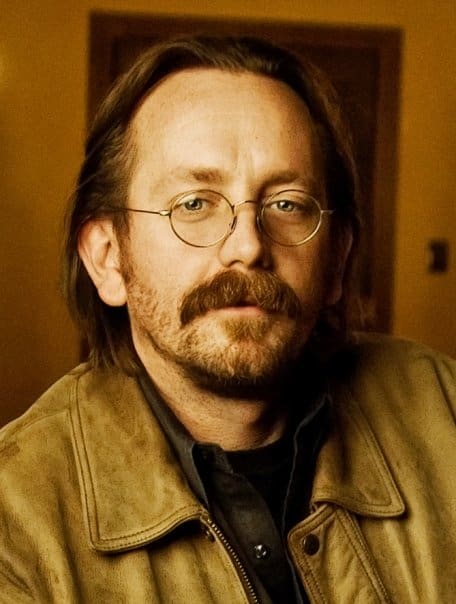
 Please support Richard’s lastest film Triptych by donating here, and by purchasing his DVD collection here.
Richard Dutcher burst into Mormon cultural consciousness ten years ago with the release of his independent film hit, God’s Army. During the ensuing decade, he has remained an intriguing figure to many Latter-day Saints, not only because of the high quality of the films he has continued to make, but also because of his public distancing himself from “Mormon cinema,” a film genre launched primarily because of his successes, as well as his more private (yet also public) distancing himself from the LDS Church and its teachings.
In this five-part interview conducted by Mormon Stories correspondent Dan Wotherspoon, Richard Dutcher speaks with remarkable candor about his upbringing and marriage, his career as a filmmaker, including extensive comments about each of his completed films (as well as ones, such as his planned film on Joseph Smith, that have not yet been made), the rise and decline of Mormon cinema, and his own faith journey.
This interview is available in both audio and high-quality video formats. The video version includes scenes from Dutcher’s films that play over the interview audio.
Episodes: (available below, on Youtube via HD video, and on iTunes):
- Part 1 – Growing up Mormon, Serving a Mission, and Getting Married
- Part 2 – Getting Started in Filmmaking and God’s Army
- Part 3 – Brigham City, the Joseph Smith Movie, and Mormon Cinema
- Part 4 – States of Grace, Falling, and Evil Angel
- Part 5 – Spiritual Journey and Final Thoughts
Part 1:
Episode Transcript
Host: John Dehlin · Guests: Dan Weatherspoon, Richard Dutcher
This transcript is machine-generated and lightly edited for readability. The audio is authoritative. Please excuse occasional errors in names and spelling.
Welcome and Introduction to Richard Dutcher
Part 1 of 5 · Ep. 195
John Dehlin [00:00:02] Thank you for joining us today on Mormon Stories for this very special interview with Richard Dutcher, the Father of Mormon Cinema. I'm John Dehlin. Please bear with me while I make four short but very important announcements with regard to this interview. First, these interviews are not only available in audio format, they're also available in high definition video with footage from Richard's actual movies@YouTube.com mormonstories please check them out if you can. They're quite amazing. Historical even. Second, Richard is in critical need of support for his current film project called Triptych. So please Visit the website kickstarter.com during the month of October 2010 to donate. Kickstarter is a site created to help fund creative endeavors, but it requires that the funding target be completely raised before any funds change hands. Each project is given a particular number of days to reach its funding goals. In this case, it's 30 days, so time is of the essence. To learn more about the Triptych project, listen to this full interview or visit the site and type in Triptych. Triptych is spelled T R I P T Y C H and or Richard Dutcher. That's kickstarter.com k I c k-starter.com we will also have a link to Richard's Triptych fundraising page@richarddutcher.com for those of you who do not own Richard Dutcher's movies, such as God's Army, Brigham City or States of Grace, please consider supporting Richard's incredible filmmaking by buying the DVDs today@richarddutcher.com that's D U T C H E R. These movies are fantastic and you will enjoy these Mormon Stories interviews so much more if you've actually seen the movies. I can't recommend these movies highly enough. Finally, if you'd like to make a gift or investment to help Richard with one of his much larger film projects, including his much discussed Joseph Smith movie, please contact him through richardducher.com or via Facebook. Again, the last name is spelled D U T C H. Let's do our part to help him make that Joseph Smith movie. It's his birthright. Thanks again for listening. And now on with the show. Take it away.
Dan Weatherspoon [00:02:02] Dan Weatherspoon welcome everybody to Mormon Stories. My name is Dan Weatherspoon. For those of you who've been following recent developments on the Mormon Stories podcast, John Dehlin has asked me as well as someone, a Mormon therapist and psychologist named Natasha Parker to begin producing some of the content that will be on Mormon Stories Podcast. So I'm grateful for this chance to meet with you. I've actually done a few interviews with other people, but this will be the first one of mine that airs, and I'm grateful to have it. And I'm very excited to have a guest, and I know that many of you listeners are too. When we announced that our guest today would be Richard Dutcher, quite a few of you wrote in with questions that you were hoping that we'd cover. For those who've never heard of Richard Dutcher, he is considered by many the father of Mormon cinema. It was almost exactly 10 years ago that his movie God's army first hit the scene and sort of created this phenomenon that many other LDS filmmakers jumped into the game of producing films that dealt with Mormon characters in Mormon settings and were geared towards the Mormon audience. Richard himself produced, besides God's army, two other films that were specifically, well, probably three if you count Falling, but he produced and directed, and he basically did everything for a film called Brigham City as well as he did God's Army 2, which is also sometimes known better as States of Grace. He also then did a film called Falling, and so all these would be within that genre of Mormon cinema. But for many of you who know him or have been familiar at all, Richard's also known somewhat for having backed away a little bit from what he created in the terms of Mormon cinema. He hasn't always felt comfortable with the direction that some of the filmmakers have taken this art form, and some of the ideals that he had going into Mormon cinema haven't been there. So we're excited that he's going to talk with us today about all those issues. Our plan today for the podcast is to start at the beginning of Richard's life, take him up through all of his formative experiences, get him into film school, get him into this to be a married man and deciding on a career as an independent filmmaker. The different directions that you can go when you come out of film school. He chose to make independent films to write and direct and shoot his own scripts. So we'll get into all that then. We hope that Richard will be willing to talk thoroughly about each of his films. Following that, we're going to delve into as much of his spiritual journey and especially his relationship with Mormonism that's evolved through the years. And then we will talk about the future of Mormon cinema, advice to filmmakers and things like that. And then we'll close by really trying to figure out what you're and hear the news of what you're doing now. Richard the provocative. Yeah, we were talking a little bit. Let me go ahead right now and give you the scoop on what Richard's doing now. And we're hopefully that right now Richard is filming a new film called Triptych. You can get his other movies, especially God's Army, Brigham City and States of Grace, through mainstreetmoviecompany.com movie co mainstreetmovico.com good. And then also richarddutcher.com so if you were interested in that. And we'll talk about the box set and other options as we go. So those are the ways to get what he's doing. But right now, his film Triptych is being filmed. You can learn about it if you just do a Google search for Richard Dutcher and Triptych. And also if you go to kickstarter.com and would you just kick in, what would you say?
Richard Dutcher [00:05:58] Yeah, Kickstarter.com is a site where you can make donations. So if anyone's interested in helping me get this film made. And we'll talk more about it later. But that's a great way to help out, to be a part of it.
Dan Weatherspoon [00:06:10] And then at the end of our podcast interview, we'll talk more about. But if you'd like to help Richard in a big, big way, if you through a major donation or something like that, you can also contact him through mainstreet movieco.com or you can find him at Main Street Movie Company on Facebook.
Richard Dutcher [00:06:26] Right, Good.
Dan Weatherspoon [00:06:27] Okay. So we're gonna go ahead and. Well, first of all, welcome, Richard, to Mormon Stories.
Richard Dutcher [00:06:33] Thank you, Dan. It's nice to do this.
Dan Weatherspoon [00:06:35] You've been somewhat familiar. I mean, early in 2007, you at least answered some questions from people that were at Mormon Stories, and so you're familiar with it and stuff. But this is the first time we've been able to really land you as a guest. I know you and I did an interview right after States of Grace came out that we did it through the Sunstone podcast. I was the editor of Sunstone for a while and you agreed to come on. And John Dehlin was on that interview, too, and I know that he's released it as a link or something through Morin's stories too. So people can. People might be aware of that. Let's begin with the beginning of your life. Where were you born? Tell me about your family. Tell me about your upbringing and all that stuff.
Childhood, Family, and Early Life
Richard Dutcher [00:07:19] And I'll try to make this somewhat interesting, but I was born in Chicago, Illinois, to a non Mormon family and. I should probably say why I laugh. Anyway, my dad was a short order cook in Chicago and my mom worked at a, I think a heating supply company. And they met at his restaurant and hit it off. And I was the result of that. And so I grew up. We moved away from Chicago shortly thereafter, went to Southern Illinois. That's where my early childhood was. And yeah, crazy childhood. My dad was a bartender, so most of my. And it wasn't a happy marriage. And so it was a very volatile marriage. And besides being a bartender, he was also an alcoholic and liked women quite a bit. But some early memories were for me riding around the bar where he worked. He had a little big wheel there for me. So while he was prepping the bar for the weekend, I would be riding among the tables and playing the jukebox and all the little games and stuff like that. And it was nice memories. I'd get soda and peanuts and just had a great time. But then my parents divorced when I was about six and my mother shortly thereafter started dating a man who. A businessman who came through town. His name was Harold Dutcher and he was Mormon. And so that relationship kind of kicked off. And interestingly enough, how that kind of relates to all of this is I hadn't seen a film in a movie theater at all during my childhood. For one reason we didn't have a lot of money. And the other reason was that my mother's side of the family was Pentecostal and movies were definitely out. You could watch television all you wanted to. But for some reason movies. Going to the movie theater was not acceptable. So I never got to actually see a movie in a theater. And then my father's side of the family was Baptist and so that was kind of my religious background. And so when Harold Dutcher came around, one of the things he wanted to do, he thought a good way to win over the kids would be to take them to a movie or whatever. And so I saw my first film there. It was Mount Vernon, Illinois. And I was tracking this recently and it turned out that my. It's very memorable. But my first film was a John Wayne movie. It was called the Cowboys. And I remember just being absolutely. I was a little kid sitting in this huge. It was one of those old style movie theaters, probably 600, 800 seats in it and watching this great movie. And then as we left the theater, it was just in my mind and I just pretty much knew immediately that that's what I wanted to do. I didn't know how it was done. I didn't know how, never occurred to me that someone could actually make a living doing that, making films. But I knew that I basically had fallen in love that day with movies. And it's never gone away. So that's the earliest childhood. And then we moved around a lot. He was a businessman and so he would go out and raise money. He had a scaffolding company and a ladder company and various things over the years and got into oil drilling. And so I grew up around all of that, living in. We lived in Wisconsin and Kentucky and Kansas and ended up in Utah for my high school years. Which high school went to Hillcrest High School in Salt Lake City. Yeah, so that's that.
Dan Weatherspoon [00:11:19] Okay. Any other aspects of your childhood or anything you want to bring up? So at some point after the divorce with your biological father, your mom, did she come to you and say, do you want to take Harold's last name? So when did you become Richard Dutcher?
Richard Dutcher [00:11:36] Yeah, that wasn't really, you know, as a 6, 7 year old kid, I wasn't really given a lot of choice. You know, I remember being driven around one night by the two of them and they said, you know, that we were going to be adopted and that my mom wanted us all to be baptized. And I was the holdout for me. Didn't really want to be baptized, didn't really want to take my stepdad's name. My brother was more willing, but my older brother Glenn, he was from a previous marriage, my mother's previous marriage, so. So my dad wasn't even his dad. So I guess he was kind of getting used to this by that time. So he was more willing. But I do remember it was a difficult transition as a seven year old kid because there were things about Mormonism that I really liked. As I mentioned, we were Pentecostal. So that was mostly my religious experience up to that point. My grandmother, who I love dearly, is very, very devoted, very devout Pentecost woman. So as a child, that was the church that we went to. It was interesting because it was always. I never felt comfortable in that community.
Dan Weatherspoon [00:13:12] In the Pentecostal community.
Richard Dutcher [00:13:13] In the Pentecostal community. And it's hard to describe except as a. I think it was very much a holy roller kind of church enthusiasm. A lot of enthusiasm, a lot of singing, a lot of dancing, a lot of people speaking in tongues. And the preachers, very charismatic preachers and they lay their hands on people's heads and people would be out of control. And as a child that just scared the hell out of me. I didn't feel the spirit or if that was the spirit, I didn't want anything to do with it. It was like, just never made me comfortable to see my grandfather who had health problems and he was such a calm, quiet, dignified man. But then to see him at church and he would get up and he would be filled with the spirit and he would be dancing and shouting and it was actually kind of terrifying for a little kid. So I never felt comfortable. In fact, there was one time my older brother decided at one point that he wanted to be a preacher and told my mother and grandmother and of course they were telling everybody in the church that Glenn wanted butch, he was known by butch at that point. He wanted to be a preacher. And everybody thought that was so wonderful. And they asked me if I wanted to be a preacher. I can't remember the response, but it was the seven year old's equivalent of hell, no, I want nothing to do with this. It was interesting though, when Harold Dutcher took us to the Mormon Church Mormon services. I actually pretty immediately took to it because I think it really wasn't quite
Dan Weatherspoon [00:14:53] as scary, for one thing.
Richard Dutcher [00:14:55] And it kind of agreed with my personality. And I'm much more, a little more introverted. I think I'm a little bit more of a thinker. And so there was a lot in Mormonism that I really responded to. You know, it was like people were, you know, there wasn't any. The singing was pretty calm, the meetings didn't get too crazy at all. And everything was just very calm and kind of intellectual, you know, and there's a lot of book reading and talking and I really, you know, I really liked it, so I really responded well. And plus the whole Joseph Smith story, which is for a young boy, it's such a perfect story. And so I really kind of thought, well, this is Joseph Smith. He was this pioneer kid and at 14 he saw Jesus and God and he built this church and he had a big city and then he got shot and killed. And to me it was just like, this is the most wonderful story ever. So I'm in. And so I really did find a spiritual home in Mormonism. It was a good place for me.
Dan Weatherspoon [00:16:01] You did. And we'll talk kind of in one of our segments about your whole spiritual journey and I'll maybe ask you more questions about whatever your spiritual core self is like and things like that. But somewhere along the line, obviously from this initial hesitation, you ended up going on a mission, an LDS mission. Can you tell us where you served? And. And maybe the Experience.
Richard Dutcher [00:16:25] Is there a few other things we should fill in before that? I do remember I wasn't too happy with Harold Dutcher at the beginning. Or at the end. The midpoint was okay. So when I finally agreed to be baptized, my mother and brother were baptized, I think six or eight months before I was. And I think the reason besides my reluctance was I don't think I'd turned eight years old yet, so. So they did it. And when it came to be my turn to be baptized, I didn't want Dutcher to baptize me because to me he was still basically an interloper. Here's this guy who came along. He's not my dad, wants to be my dad. Anyway, I agreed to be baptized, but I wanted one of the missionaries to baptize me. So there was one of the missionaries, his name was Elder Dalton, who was one of the missionaries in Mount Vernon.
Dan Weatherspoon [00:17:21] The reason, fill in for those who don't know why that name comes up later.
Richard Dutcher [00:17:27] Right. And so kind of in as a way to honor that or remember him, honor him, this Elder Dalton. I named the character that I played in the film God's Army. I named it him Elder Dalton. So that's where that reference comes from. But growing up in Mormonism, you know, like I say, it really pretty much worked for me. I went through a period of kind of rebellion around 16, 16 to 18, where I wasn't active. But it was far different than what came along later. It was basically just rebellion, misbehavior and experimenting, having some fun. But even at that point, it was never. I never had any. Any issues or questions about the truthfulness of the church. It was just. I was 16 and wanted to misbehave. But then at about 18, 19, I started to examine my life, take things seriously and start to realize that I wanted to be a spiritual man. I wanted to. I wanted to be a man of God. And so I knew that I was mission bound eventually. There's another story there. I don't know how much to tell because I don't want to bore people to death. But another way that movies came into play in this was when I was 18, and this had been a couple years of inactivity at the time. And I was struggling with this. Even though I was inactive. I had a mission in the back of my mind. And I thought as an adult man, of course, I would be an active Mormon and I'd have a Mormon family. But nobody could really get to me as far as getting me to become active again and start Doing the things, you know, going to church and all that stuff. And so nobody, you know, young men's leaders or friends or family, whoever, couldn't really get through to me. And then, oddly enough, I was in St. George because I was working in Arizona. Jacob Lake, Arizona. And so I was in St. George watching the new Star wars movie at that time, which would have been. What would this have been? 1983. So it would have been what, Return of the Jedi, Empire Strikes Back. I can never remember which one it was.
Dan Weatherspoon [00:19:54] Well, that's the second one is Empire, and third one is.
Richard Dutcher [00:19:57] Yeah, well, whichever one it is, that has Luke Skywalker and he's in the. Wherever he is, the Death Star, wherever it is. I guess it's the new Death Star, I guess. But he's in between the evil emperor and Darth Vader, and he knows that Darth Vader's his father. And what's he going to choose? Is he going to choose to follow his father? And so to me, that really surprising. I went into a movie theater just thinking I was going to have fun. But I found myself so emotionally moved by this, because I kind of felt the same way. My own father, who I hadn't seen at this time since I was 7 years old. So this had been 11 years since I'd seen my own real father. And so I really resonated with this, the dark father, trying to get him to go to the dark side. And then you've got him wanting to. What's he going to choose? And it really hit me hard and was very emotionally moving. And it was in the car after that, driving back home, that I. That it really sank in, that I really realized that, okay, I have to choose the good side. I have to choose the right. I have to go on a mission. I have to do this. So I always joke that it was that when nobody could get to me, when Spencer Kimball or at the top Sunday school teachers at the bottom, nobody could reach me, it turned out George Lucas was the one that got to me.
Dan Weatherspoon [00:21:20] Definitely Return of the Jedi is the. That's what it was.
Richard Dutcher [00:21:24] So I definitely credit George Lucas for sending me on a mission.
Dan Weatherspoon [00:21:29] Had you done any student films or messed with video cameras or filmed little snippets of things up through this period?
Richard Dutcher [00:21:36] Yeah, I always loved film. And so I wasn't like Spielberg, who, at least according to legend, was always shooting stuff with his Super 8. But. But, yeah, my stepfather had a Super 8 camera, and so I would shoot. I remember shooting stuff as a little, little kid. And then I Was looking for it recently, and it apparently has been lost. So I did that, had a friend in high school. We did some stuff. And I was very involved in theater as an actor in high school. Tried to stay as busy as I could there. And then also, in other words, I did my first semi. I guess it was semi professional play when I was about 14. Shortly after, we moved to Salt Lake City, and I went up to Promise Valley Playhouse and auditioned for the Christmas Carol and did that. And I was taking lessons, acting lessons, at Theater138, which was right about a block away from Promise Valley. And that was a great time. But that's an interesting thing, and I should mention that, too. I knew, as I mentioned, I knew since I was very young that I wanted to make films. Didn't know exactly how that would happen or what role I would fall into, but definitely loved acting, loved performing. And so when I decided I really needed to be serious about this at 14, I remember going to my stepfather and my mother and saying, hey, I need to take these acting lessons and I want to audition for this play. And I don't know, it was probably more a financial thing. They probably didn't have the money, but they were about as unsupportive as you could possibly be. As in, I couldn't even get a ride to the theater. If I was going to do this, I was going to have to get on the bus. We lived at State street and about 8,000 south, and so I'd ride that bus back and forth. But when I couldn't get money, and my brother Glenn, my older brother, saw that that's what I wanted to do, he actually stepped up and put up the money for me to be able to take these acting classes and then, you know, get the bus so I could go down for rehearsals for this play. So he was very supportive, and I probably wouldn't have been able to do that if it wasn't for him.
Dan Weatherspoon [00:23:54] Well, neat. Well, I'd love to have you tell us just at least a little bit about your mission and we can revisit it as if any themes from it made its way into films. Or we can explore it again a little bit more when we talk more about your own spiritual journey and stuff like that. Where did you serve? Tell us all those kinds of details.
Mission Experiences and Young Adulthood
Richard Dutcher [00:24:14] Well, I remember by the time I was ready to serve, I was very humbled. I was getting my life in order, so I was very humble. And it was an irony because I was willing to go anywhere I really wanted to go to France. For some reason I just wanted to be Paris. I thought would be the mission, that I should be in artistic temperament. And so when people would always ask me, as they ask everybody, it's like, where do you want to go? And just jokingly, I would always say, I want to go anywhere except Mexico. And I would say that just without fail, I want to go anywhere except Mexico. Because I really did not want to go to Mexico. Mexico seemed like the armpit of the world. I didn't want to go. And when I got the. When I received the envelope to tell me where I was going to go, I actually went into my room, closed the door and sat on the edge of the bed. And I just knew it. I didn't even need to really open it. Somehow I just knew, it's Mexico, I'm going to Mexico. So I said a little prayer saying I'll go anywhere, I'm good, whatever it is. I opened it up, sure enough, you're called to Veracruz, Mexico. And it was actually pretty funny. But yeah, it was a great mission. It really, really was. I mean, it was quite an adventure. It turned out to be the perfect mission for me. I think I would have hated Paris, actually, because in Mexico you actually got to teach people and you actually got to. Got to help people. But it was a fantastic mission. I had a great mission president, a lot of great experiences. I was thrown into prison in Mexico just after I had only been there a couple of months. And my companion and I were walking down the street in Oaxaca, Mexico, and this guy with a gun came up and just stopped us and immediately was asking for papers and this kind of stuff. He arrested me. I didn't know this, but there was a law that no foreign born person can be a minister or priest in Mexico. This was the result of all the foreigners coming in and taking over their religion. But anyway, I was led at gunpoint to a jail in Oaxaca, Mexico.
Dan Weatherspoon [00:26:46] And it was your companion a North American too, or. Well, I guess. Was he native Mexican?
Richard Dutcher [00:26:52] Yeah, my companion was Mexican. So he, you know, he wasn't under arrest. And so he. Of course, immediately as they took me into the jail, he ran off to, you know, tell the mission president that Elder Dutcher had just been put in jail.
Dan Weatherspoon [00:27:09] Hermano. That's right.
Richard Dutcher [00:27:10] No, it was elder.
Dan Weatherspoon [00:27:11] Elder.
John Dehlin [00:27:12] Elder.
Dan Weatherspoon [00:27:12] Oh, okay.
Richard Dutcher [00:27:16] And it was the coolest experience. I mean, everybody was so worked up about it, they thought. And it was a nasty jail. I mean, just absolutely. You think of a Mexican jail and this was worse. There were like 16 of us crammed into this room that was probably just a little bit bigger than the room that we're in right now. And it had one toilet, you know, in the corner, which wasn't working. It had overflowed like three days before. And so it just reeked. And it was just concrete, dirty concrete, and a little concrete ledge. And so. And you know, the bars that look out into the courtyard where they had trees, where it looked like they performed executions. And so I'm there. And of course, as soon as the word gets out, the members start coming to the. Coming to bring things, and they bring me a Book of Mormon that I actually used as a pillow because I needed something to use as a pillow. And they started bringing food. And I'd already decided that I was going to fast, so they'd bring food and I would pass it out to the other prisoners. So I became kind of popular. And then I got to know them and talk to them. And there was a guy who was in for raping a woman and a guy who just robbed and a guy who had gotten drunk and broken something. I can't remember what it was. Anyway, we got to know each other a little bit, but they couldn't believe that I was in there for that. One of the guys I remember was asking me, what are you in for? And I said, well, I'm a missionary. And he said, I remember saying, a missionary who did what? I said, no, I'm American, and apparently I'm not supposed to be a missionary here. And they never did believe it. They knew that I'd done something, but then I wasn't admitting it. But as soon as I started giving them food, then they started showing me little tricks about how to stay warm at night because we took newspapers, and it actually does work as a really great insulator. So put the newspapers underneath and over. Had the Book of Mormon as a pillow and had a pretty good night's sleep. But I do remember getting up in the morning and I'm at the bars looking out, and I remember feeling great. It was like, wow, I'm getting to experience this. This is what Joseph Smith and the Apostle Paul, and this is the experience.
Dan Weatherspoon [00:29:27] You're already composing your own letters that will become scripture someday, right?
Richard Dutcher [00:29:32] So I was just having a great time. And while I was there, of course, the whole mission president had called Salt Lake, who had called Mexico City, and they had some arrangement, and of course they had to work everything out. So they shipped me off to Mexico City and everything worked out behind the scenes.
Dan Weatherspoon [00:29:52] So you had to change missions No,
Richard Dutcher [00:29:54] I didn't have to change missions. I just had to leave.
John Dehlin [00:29:57] And
Richard Dutcher [00:30:00] the church leaders were speaking with the Mexico leader, the officials in Mexico City, the government. And so they worked it out, and I was released. And I was allowed to go back to the mission, but I wasn't allowed to. They just said, go back, keep a low profile. Which was fine. You know, in Mexico. That's the reason we never wore name tags in Mexico, but because I think we were kind of not supposed to really be there, but we were. But anyway, there's an interesting postscript to that story, which was, it turns out I was thrown in jail just because the local magistrate, the chief of police, whatever you'd call him, you know, he saw an American and thought he'd throw me in jail and he could get some money out of it because, you know, they operate largely on bribes down there. And so he just thought, you know, the American, throw him in. They'll be able to get some money and be done with it. But it didn't work out that way. And about a year. What was it about a little over a year later, I was the mission accountant. And so I would drive around the mission checking up on the books and taking care of things. And I went through Oaxaca. And just out of curiosity, I went back to the family that we were closest to while we were staying there and asked about. And they said, did you hear about this man? I forget his name now. I remember very distinctly what he looked like. You remember that when you're thrown into jail at gunpoint. But they asked if I knew what had happened. I said, no, no, no. And apparently he had been busted just a couple months before, some kind of corruption or whatever. And he was then in prison, but for going to be in there for quite a long time. And I remember feeling at the time just feeling like, well, that's what happens when you mess with the Lord's anointed. But interesting. Yeah, it was an interesting experience. But that was one experience in a mission that was really great. I had a great mission president, Jack Beecroft, and his wife, Marilyn. They were just the most wonderful and amazing people. Great friendships that continue still, and a lot of success as a missionary as far as teaching and baptizing. Some really, really wonderful experiences. So it's something I've never regretted doing.
Dan Weatherspoon [00:32:24] And obviously made some movies based upon the missionary experience writ large and some neat themes. When we get to the movies, if anything from your mission raises its consciousness for that, we'll move on. So you came home from a mission, had you done some college prior to your mission? At what point did education and that track.
Studying Film at BYU
Richard Dutcher [00:32:48] Yeah, I'd done a year at BYU before my mission. And I'd chosen BYU simply because they had offered the largest scholarship and I was dead broke.
Dan Weatherspoon [00:32:58] The largest scholarship for film or academics?
Richard Dutcher [00:33:00] No, it was for leadership, I think, because in the high school I was student body vice president and doing the plays and editor of the school newspaper. And so I had a few offers. University of Utah and Utah State had offered scholarships, but BYU had offered the biggest one. And so I went to byu, not out of any kind of religious loyalty. It was just pure, pure greed.
Dan Weatherspoon [00:33:29] Well, good man. Free school is the way to go. As best you get, as free as you can make it. That's.
Richard Dutcher [00:33:34] Yeah, exactly. So I did a year there and then afterwards worked for a little while and then went back out to Utah when I was in my. I left from Kansas City as a missionary. That's where my parents were living at the time. Actually they were separated or getting a divorce at the time I left. And so I served my mission. This is actually kind of a funny story where a girl I started liking right before I left Kansas City. And it was one of the things where she was really cute and she was. I just really liked her. And I started to regret. It's like, well, maybe I shouldn't have gone on this mission. But I left and you know, she wrote. We wrote a little bit in between. My parents divorced while I was on my mission. And then my dad, my stepdad stayed near Kansas City and my mother went to Georgia. By the time the mission was over, when I went back to Kansas City, my stepfather had married this girl's mother. So she was actually the mother and the girl that I had been kind of falling in love with were living in the same house. It was a little interesting as an immediately returned missionary to go home and there's a new stepmother and the girl that I had been really liking was now sleeping in the room right next to mine. So I decided I probably shouldn't stay in Kansas too long.
Dan Weatherspoon [00:35:01] So I was only there for a
Richard Dutcher [00:35:02] few months and then I went to Georgia and spent a few months there and then had made enough money that I was able to go to Utah and start school again.
Dan Weatherspoon [00:35:14] So at byu, are you majoring immediately in film or theater and cinematic arts or whatever the major was called?
Richard Dutcher [00:35:21] Oh, yeah, it was always film. Always, always whatever I could get film wise. And I know you'd been interested in. When I decided to be an independent filmmaker, I think that really gelled for me immediately. It was right after the mission where all this time I knew I wanted to make films. I didn't quite know how to go about it. And when I was in Georgia, after my mission, I was actually at a bookstore looking through the film section. I found this one book. It was just called Independent Filmmaking. And it was some guy named Gregory Goodell, I think, something like that. But it looked like a really good book. So I picked it up and I sat down at a Wendy's. I remember sitting down at a Wendy's and starting to read this book. And it was this man explaining how independent filmmaking worked as opposed to studio filmmaking. And I just instantly was like, oh, this. This is it. This is it. This is exactly where I should be. And so I just started devouring that and anything else I could get on filmmaking and then went out to BYU. And BYU was an interesting experience. This was in the 80s, the later part of the 80s was when I was there. And it was interesting. The film school was very interesting in the sense that after I was there about a year, I started to think maybe I was wasting my time, that what I really should do is just pack up and go to la. Because we would learn a lot about film history, a lot of film criticism, film theory, saw a lot of old films, as long as they had no nudity or anything profanity or anything in them. So we missed a lot of great films.
Dan Weatherspoon [00:37:02] And.
Richard Dutcher [00:37:03] But I got to the point there was a couple things that happened. One of them was I was starting to realize that people were graduating who knew nothing about filmmaking. I mean, they knew, again, they could go teach a course on the history of film, but they didn't know how to make a film at all. And it wasn't even required. You could graduate in film and not have made a film. You could if you wanted to, but you didn't have to. And also there was one of the instructors who was making. You know, he'd make his films on the side. And one day he invited us all to come watch the film that he had just finished. It was a short film. And I remember being all excited because this is the guy that taught us a lot of screenwriting. And he was one of the main instructors and so sat down to watch this thing, and I was appalled. It was awful. I mean, it was. I mean, every. You could look at it. I mean, from cinematography to writing to acting to just. The whole thing was just awful.
Dan Weatherspoon [00:37:55] So given his budget, he could have done better, Much better. It's not just Production values?
Richard Dutcher [00:38:02] No, not just production values.
Dan Weatherspoon [00:38:03] Just the whole thing was.
Richard Dutcher [00:38:04] No, no, no. Just seemed completely devoid of time.
John Dehlin [00:38:06] Interesting.
Richard Dutcher [00:38:07] And so I was worried, and I went to the head of the department at the time, whose name was Charles Metton, and sat down with him and just said. And he had known me as an actor mostly because I'd done a lot of acting.
Dan Weatherspoon [00:38:19] Had you been in BYU productions as an actor?
Richard Dutcher [00:38:23] And so we sat down and it was a really memorable conversation because I was telling him my concerns. I said, look, I want to leave. I want to leave BYU with my bachelor's degree and know how to make a movie, be able to make an independent film, start to finish. This is what I want out of my education. And I don't think I'm going to get it. And he did. He's like, no, no, you're going to. You'll learn. You'll be good. And I remember saying something to him. Again, he only knew me as an actor. We never had any film. Other film classes together. But he was kind of. And he was telling me that I should go. Instead of being a producer, I should go be. Go into wardrobe or go into makeup or go into, you know, one of the supporting fields in film. And I was telling him, no, I'm going to be a writer and a director. And I even said, I go. And I said, I can't believe you're even telling me you're even recommending. Without knowing me, you're recommending that I go do this. I could be Orson Welles sitting here and you wouldn't, you know, and you're telling me to go do makeup. And he actually said to me, he said, you're not Orson Wellesley. And he says, if you were Orson Welles, I would know it. And I was thinking, well, how the hell would you know? Because you've never seen anything that I've done. So I remember I walked out, but I thought, okay, well, I'm going to stay. I'm not married, and I'm going to give this everything I've got and put the next time in. Did a lot of great shows. Byu, again, was another wonderful experience. I had a lot of great friends, mostly in the theater department instead of in the film department, but had some great instructors. Tad Danielewski was probably the most influential teacher I've had, mostly as an actor. But it was, again, a situation where I was about to graduate, and I realized that I didn't know how to. I realized that Charles Meton had. And I really liked the man. So I'm not bagging on Charles Metton, but he obviously wasn't a filmmaker, so he didn't really know what it was that I needed to know. And that's the problem with film schools is you're being taught by people who don't make films. So how are they going to teach you how to make films when they don't really know how to do it themselves? And the people who do know how to do it aren't at schools, they're out there doing it.
Dan Weatherspoon [00:40:44] D Census has gotten better since the time you were there.
Richard Dutcher [00:40:47] So no.
Dan Weatherspoon [00:40:48] And you're saying this is endemic to many film programs, not just byu?
Richard Dutcher [00:40:53] Oh, yeah, most. I mean, most, if not, I mean, there's a few exceptions. You know, if you're looking at, you know, Southern California schools where they actually have professionals who are, you know, working and teaching at the same time. But most places, no, you're being taught by people. You're being taught screenwriting by people who have never sold a screenplay. Yeah, some of them never, I would say probably have never actually written a screenplay and certainly never sold one, 100 years from actually having one produced, which makes no sense. And you're being taught directing by people who don't know how to direct. Sometimes you're being taught film directing by people who direct plays on the stage at the college. And that doesn't help. You're being taught a lot of times you're being taught acting by unemployed actors anyway. It's just that kind of a thing. So I think people should really understand that when they go into a film school, even though you're still going to have to largely be self taught.
Dan Weatherspoon [00:41:54] Mr. Now I know at some point you did associate with the BYU Mormon Picture Studio. I know you were in some church films. Is that during this period or that's later?
Richard Dutcher [00:42:05] I mean, that was just as an actor I would go it was not at all associated with byu. I just had an agent in Salt Lake City. And so whenever the church would be doing a production, I'd go up and audition for it. And so I got cast in a couple of those things.
Dan Weatherspoon [00:42:20] Were you able to but you're acting, but are you soaking up the art of making the film? Are you watching the directors? You're watching all the different parts of it?
Richard Dutcher [00:42:28] Oh, yeah, absolutely. But again, where I really learned to make films wasn't in what I really got out of BYU was, well, I learned a lot about Frank Capra. They love Frank Capra there. So I learned a lot of history. I saw a lot of great films that I would never have seen and was introduced to a lot of great filmmakers that I never would have known about. But as far as the filmmaking goes, where I really learned was I just started, you know, I started devouring videos. You know, there was a little video store that was right. There was a little Thai restaurant where it is now, it was just south of campus. It was on my way home. And I would just every day, you know, rent a movie or two. And I would hit the movie theaters as often as I could. And I got in the habit of kind of watching, you know, if I saw a film that I could tell was really well done, I would, you know, I'd watch it three times. I'd watch it without the sound, so I could just look at the images, how the director was creating these images, how it was all edited together. And then like I said, a couple months before I graduated, I realized that I was about to graduate and I didn't know how to really do it. And so there was some equipment available. And so I went and I checked out the equipment and I went out and just basically using the book, you know, that book that I had bought before, right after my mission, that had kind of talked about the entire process of raising money through finishing and selling a film. I basically used that as my education. And I went out and tried to raise money from whomever I could to make a short film, a little 10 minute film. But it would be film, you know, it would be shot on film. I mean, the whole thing, I would do the whole process just as if it were a long film. It would just be 10 minutes. And so it was called Brother John. And it was a fun little idea. I thought it would be really creative and it was unique. And so that's what I did. I was able to raise, I think it was $3,500. And that was enough to buy the film stock. And the school let me use the equipment for free. And so, yeah, I just threw it together and started acting like a movie producer. And I hired people to come on be my crew. And I cast it and then I finished it, edited it myself, finished it, went to the lab and did all the work, the sound work. And so when I graduated, I left with this 10 minute film. And I left knowing how to make a film. And if I hadn't done it, I would have been fit to probably Teach Film History 101, but not know how to make it. And so right after that I started writing, continued writing screenplays, trying to get things done. And then we hung around My wife and I hung around Provo for about another year. And then we packed up our little Plymouth Horizon and went to la.
Dan Weatherspoon [00:45:18] Good. I wanted to loop back. You mentioned your wife. It's Gwen. Gwen Dutcher.
Romance, Marriage, and Early Family Life
Richard Dutcher [00:45:22] Yeah.
Dan Weatherspoon [00:45:23] Tell us. Fill us in on your meeting her in courtship and at what point in relation to film school and all that stupid.
Richard Dutcher [00:45:31] The great romance.
John Dehlin [00:45:34] Yeah.
Richard Dutcher [00:45:36] Well, I met Gwen at byu. She was an art student who also did a lot of acting. And she claims that we met once before. I remember meeting her. But she claims that there's a place called the Slab in the Harris Fine Arts Center. I think it's on the. What is that? The north end of the building, and it's on the main floor. And all the students congregate there because there's a big marble slab or whatever. She claims that we met there, that a mutual friend. Actually, the girl I was dating at the time, introduced us. And she's probably right, but I like the story better telling it my way, which is we. We were at an audition. Well, there's a little prologue to this. She had actually seen me do a few plays where I was playing. One was Star Spangled Girl. And one was. I think it was Born Yesterday. And another one was Thieves or something like this. Herb Gardner's Thieves. And I was playing such diverse characters that she'd seen all three of these plays and liked these three actors. Didn't realize it was the same guy. And so when she had seen Star Spangled Girl, this was before she knew me. And I love this part of the story because it complements my ego. But I guess in the class.
Dan Weatherspoon [00:47:03] Isn't that why we marry our wives? They make us feel good about ourselves, at first, at least.
Richard Dutcher [00:47:09] And then she got up in class and just was talking about Richard Dutcher and that he was a genius. And then she confessed that to me later. And I really liked that story. But I didn't know her and I hadn't seen her in anything. And I went to an audition for a graduate school play, an Ibsen play. It was Ghosts. And they were doing the audition in this room in the Harris Fine Arts Center. It was like on the fourth floor. It's now been turned into some art rooms, I think, where they opened it up and do some art. I checked in recently, just the romantic, you know, revisiting these important places of the past. But it was a room and the director was kind of holding the audition in the middle of the room, which was kind of weird. So, you know, you had people on one side of the Room people on the other side. And she was doing these auditions right there. And so I came in a little bit late. The auditions were already going, and I sat down with a friend of mine. His name was Joe, and. And waiting for my turn to audition. And I was looking across, and my girlfriend at the time, his name was Veronique, was talking to this girl. And I was just instantly captivated by this girl because there was just something so wonderful about her. To me, she was pretty, but she was just so. There was just this loving kind of energy, this goodness that was just so apparent in the way that she spoke and carried herself. And instead of reading the lines and getting ready for my audition, I just kept watching her because she was just so interesting. And I leaned over to the guy at Joe who was with me, and I said, who is that girl that's talking to Veronique? And he said, I don't know. I don't know. And I watched her some more, and then I leaned over again, and I said, I'm going to marry that girl. And he thought I was. You know, he just thought that was me being me. But no, I was really like. I just instantly recognized that she was the woman that I wanted to marry.
Dan Weatherspoon [00:49:19] We're not cueing Saturday's warrior music at this point. No, I've seen that so smile somewhere before.
Richard Dutcher [00:49:24] No, no. It wasn't at all a.
Dan Weatherspoon [00:49:27] Somehow your soul is right.
Richard Dutcher [00:49:29] No, I didn't recognize her from her previous life or anything, but I recognized that she was the kind of woman that I wanted to be with, that there was that love. And, I mean, I could instantly see, and I've told my children this. One of the things I instantly saw about her was that she'd be a great mother. You could just tell by how loving she was and how good she was, that she would be an amazing mother. And she has been. And that, to me, was very important because I've always. Oddly, even though my own childhood was kind of messed up with the divorces and the neglect and abuse and weird stuff, it's kind of odd that I grew up wanting a large family, but I definitely did. And I immediately saw in this young woman that she had the qualities that would be a great mother. And she was pretty. So, yeah, so I just started dating her. And there's another fun part of that story, which was as soon as I. Of course, she was talking to my girlfriend at the time, and they were pretty good friends, turns out. And so I'm out with my girlfriend a couple nights later, and I Just mentioned Gwen. She's like, oh, do you want to drop in? Gwen was living at the little dorms just to the east of campus there. What do they call it? Helaman Halls or something like that?
Dan Weatherspoon [00:50:46] Or Heritage, one of them.
Richard Dutcher [00:50:47] Yeah, Heritage. That's where the women were, right. So went over there, it was late at night, and Gwen was there and went up to her room, you know, and then the kitchen part. And so Veronique and I are kissing on the couch, on their couch, while Gwen's sitting on the end of the couch, kind of talking to us as we're making out. And then eventually Veronique falls asleep. And so I'm there with Veronique and Gwen sitting on the edge of the cab. And I start talking to Gwen, have a really good conversation while my girlfriend's asleep. And I just immediately knew. I just knew that it was like, this is the woman that I want to be with. So now how do I get out of this relationship and into that relationship? And it wasn't very difficult because Veronique, of course, could see that something was going on. So Veronique and I went out to dinner one night. Where was it? Like Skippers or something like that. We had this talk and she said, it's okay if you want to date Veronique. I mean, if you want to date Gwen. And I said, okay, well, maybe I'll do that. And so then I take her home, drop her off, and immediately go find Gwen. And then Gwen and I go park up. That night I stopped and got some nutter butters from 711 and a gallon of milk. And then we went and parked up at Provo Temple and just made out all night long. And so in the morning, she had to be in class at like 8:00'. Clock. So we get done making, you know, we're there all night just kissing and making out all night long. I drive her to class and she goes in and she's got beard burn on her face from making out all night. And she's exhausted, but she goes staggers in, sits down next to Veronique, and Veronique leans over and says, I talked to Richard last night and it's okay if you want to go out with him, but it took a while and
Dan Weatherspoon [00:52:28] you're just talking razor. You couldn't have been wearing a beard. Byu?
Richard Dutcher [00:52:31] No, no, no. It was just stubble from the five o' clock shadow or whatever getting at her. But yeah, and we were just inseparable from then on. And we got married not too long after that. We were going to get married right away. This was like October, November, when we started really dating. And I proposed right before I left to go back to St. Louis, where my mother had then moved for Christmas. And so I was up at the restaurant in Sundance and proposed, and she said yes. And then later I proposed again on the stage at BYU of the play that we were doing, which was called the Foreigner. And she said yes again. And then I proposed, like, three or four times. And she always said yes. It's just that I always. In my life, there's all these places. Places that I wanted to propose. And so we just kept doing it. And of course, she kept saying yes, luckily. And then I got back from Christmas and we were going to elope. We were going to. It was like I was ready. I was ready to go. This time I was almost 24 and really, really wanted to be married
Dan Weatherspoon [00:53:50] for various reasons. Yeah. Some spiritual, some not. Yeah.
Richard Dutcher [00:53:54] Mostly not at that point. I just. Yeah. So we were going to elope, and we were all ready to do it. And we'd gone to the courthouse, and she was 18, so we were legal. We could do this if we wanted to. And then I suggested we should just let your parents know that we're getting married, because I don't want to start off on the wrong foot, you know? And she said, I don't know if that's a good idea. But I said, I think it'd be smart if we do this right. So she calls her parents, and it's just chaos. As soon as she says, I'm getting married, and her mother says, you are not. She says, yes, I am. When are you getting married? Tomorrow. You are not. It just explodes. And you've got something that I do want to film someday. Because I was hearing the conversation as she was talking, and I could actually hear her mother wailing. And I could hear her father on the phone saying, look what you're doing to your mother. And it was just going badly. And so they wanted to talk to me. And I got on the phone and this was my first conversation with them.
Dan Weatherspoon [00:55:02] Where do they live?
Richard Dutcher [00:55:04] They lived in Wisconsin. Madison, Wisconsin. That's where Gwen grew up. And it was. Yeah, it wasn't the best start because I basically just said, I understand, but I'm marrying her anyway. And so just get used to the idea. And that's pretty much how it was left. And then we walked around in the snow and we were talking about it, and I finally said, all right, well, let's just wait a few months. And then in the springtime, they can come out and we can do a wedding. And if that's really important to everybody, then let's just do that. And I felt like I'd just concede this point. What's a few months? We can do this. So that's what we did. We said, okay, we won't elope. We're going to get married in April as soon as the spring rolls around. But ultimately, it didn't make any difference. They weren't any happier in April than they would have been in January.
Dan Weatherspoon [00:56:02] So you're both at byu, but somehow or other the temple doesn't seem to be a goal.
John Dehlin [00:56:07] No.
Richard Dutcher [00:56:07] This is an interesting part of the story. First of all, let me jump ahead a little bit, because we had the best wedding ever in the sense that we wanted to get married outside. There's an outdoor theater up near Sundance, Aspen Grove Stone Theater. And we loved it. And so we decided we're going to get married there. And so we just. And again, we didn't really have even permission to get married up there. We tried, but they couldn't give it to us for whatever reason. But they just said, just show up and do it, and who's going to care? So that's what we did. You know, we just planted it all. And it happened to snow the night before our wedding. It was in late April, April 22. And so in the morning. And her family is completely uncooperative. And my family is completely absent, you know, because that's just my family. And so I'm there, and my best friend, one of my best friends, Darrel, who I'd met in the mission field. And we're there with snow shovels in the morning, you know, scooping out the theater so that we can do our wedding. And we've got. And Gwen, of course, her family's not helping out, so she's running around getting the flowers and things for the wedding. And it was basically just a wedding that she and I threw. And as miserable as it kind of was at the time, it was, you know, it's great. It was our wedding. We did it. Nobody wanted us to get married, and we did it anyway. And everybody was negative. You know, it's like they're all saying, oh, this isn't going to last 18 months. Which I have no idea why they would say say that, except that people are that way. It was a great wedding. And the only bad part was of the entire wedding. Well, everybody's bitching about it, of course, when they get there. And there's snow. And to Gwen and I, it was just romantic. It was, here's our wedding and we're in a beautiful stone theater. And it wasn't all that cold, but there was snow around and it was the mountains and the pine trees and a clear day. It was just beautiful. It was just amazing. And the only downside was our bishop at the time who was doing the ceremony, who of course took the time to lecture us during the. And I gave him the evil. He started into this. It was like a year from now, this couple, they should go to the temple. And I just gave him the nastiest, dirtiest look. And he actually stopped, I think, when he looked at me and saw the Clint Eastwood look I was giving him. So he kind of backed away. But I always thought, come on, man, this is my wedding. And lecture Sunday, don't do this now. And anyway, beautiful wedding. It was absolutely beautiful. And we got in the car, drove away and went to St. George for our very meager honeymoon. We only had a few days, but we went running around seeing ghost towns and old movie sites in St. George. It was just a wonderful thing. There's an old town called Pariah, I think it was called. They shot the outlaw Josie Wales there. And anyway, we made love outside the saloon in Paria in the middle of the day in the desert. It was great. It was great. Now everybody who goes to Pariah is going to go, ew, there's the saloon.
John Dehlin [00:59:09] Ew.
Richard Dutcher [00:59:11] But it was fantastic. But there is a good story here because, yeah, I wasn't. After my mission, I went through another period of inactivity, which was more because I became so focused on my career at this point and I just found myself drifting away. And I didn't really. The BYU environment wasn't really conducive to me. I was always a really good Mormon when I was not in Utah. But something about. I think I just have kind of a non conformist personality. And so there's something about when I'm in a group and everyone's doing something, I want to do something else. Always, it's always been that way. If there's a group, I go in the opposite direction. And I think that was kind of at play psychologically, probably at play as I was inactive at byu. But when it came time and I knew that it was time for me to get married. And I always held the temple, I always had a real sacred feeling towards the temple. I'd had some great experiences in the temple and it had always been very sacred to me. And so I didn't feel like I wasn't necessarily unworthy. I mean, I certainly hadn't done anything and Gwen and I hadn't done anything that wouldn't take a few weeks of repenting and behaving ourselves to be fine, going to the temple. And I had plenty of friends from the mission field who had completely sexually had a field day and still gone to the temple. But I just didn't. To me, that wasn't it. It was like the temple was a sacred thing and I had been inactive and I didn't feel like it was. I just didn't feel like I'm not going to just whip things into shape in six weeks and go to the temple. It just felt. That just felt cheap and wrong to me. So I just said, let's just get married. I mean, it's a big deal, no big deal. Let's just get married and then in a year we'll get married in the temple. And Gwen was fine with that. But it was interesting because instantly everyone just assumed, of course, that we were having sex and wasn't the case at all. But I didn't care if they thought that. Besides, I was 24 and it was like, if people wanted to think that, it's like, alright, well, I've seen you
Dan Weatherspoon [01:01:31] and Gwen together and you guys are an amazing couple and you have seven children together now. Seven kids, never looked back. And some of the people who we may not remember to do it in God's Army. Gwen is in a very brief scene in God's army for those who want to know. Right, God's Army.
Richard Dutcher [01:01:49] Yeah. She's the character that my character baptizes in the ocean. So that's.
Dan Weatherspoon [01:01:53] If you see this blonde woman there for five seconds of film or something, that's Gwen. Yeah.
Richard Dutcher [01:01:59] But the temple thing was important. And then we did marry in the temple about a year and a half after our civil. And interestingly that marriage, I hardly even remember that. It was just. But our wedding in the outdoor theater in Aspen Grove was just beautiful and it was perfect. Especially considering how things have evolved spiritually for me. I'm so very glad that I was married in the mountains of Utah.
John Dehlin [01:02:35] Thank you for joining us today on Mormon Stories. To comment on this episode or to discuss it with others, please check us out online@mormonstories.org if you want to find other friends, family members, former missionary companions or ward members who approach Mormonism like you, consider adding me, John Dehlin, as your Facebook friend. This may seem like a strange idea, but many of my closest friends have discovered that they are not alone in their thoughts or feelings or family or even ward situation through discovering mutual Facebook friends. Finally, to keep Mormon stories alive, please consider a donation@mormonstories.org music on this episode
Richard Dutcher [01:03:12] this episode was provided by Clayton and Sky Pixtone. Still all my songs shall be Nearer my go to Lead me of my go nearer to J.
Part 2 of 5 · Ep. 196
John Dehlin [00:00:01] Thank you for joining us today on Mormon Stories for this very special interview with Richard Dutcher, the Father of Mormon Cinema. I'm John Dehlin. Please bear with me while I make four short but very important announcements with regard to this interview. First, these interviews are not only available in audio format, they're also available in high definition video with footage from Richard's actual movies@YouTube.com mormonstories please check them out if you can. They're quite amazing. Historical even. Second, Richard is in critical need of support for his current film project called Triptych. So please Visit the website kickstarter.com during the month of October 2010 to donate. Kickstarter is a site created to help fund creative endeavors, but it requires that the funding target be completely raised before any funds change hands. Each project is given a particular number of days to reach its funding goals. In this case, it's 30 days, so time is of the essence. To learn more about the Triptych project, listen to this full interview or visit the site and type in Triptych. Triptych is spelled T R I P T Y C H and or Richard Dutcher. That's kickstarter.com K I C K-starter.com we will also have a link to Richard's Triptych fundraising page@richarddutcher.com for those of you who do not own Richard Dutcher's movies, such as God's Army, Brigham City or States of Grace, please consider supporting Richard's incredible filmmaking by buying the DVDs today@richarddutcher.com that's D U T C H E R. These movies are fantastic and you will enjoy these Mormon Stories interviews so much more if you've actually seen the movies. I can't recommend these movies highly enough. Finally, if you'd like to make a gift or investment to help Richard with one of his much larger film projects, including his much discussed Joseph Smith movie, please contact him through richarddutcher.com or via Facebook. Again, the last name is spelled D U T C H E are. Let's do our part to help him make that Joseph Smith movie. It's his birthright. Thanks again for listening. And now on with the show. Take it away, Dan Weatherspoon.
First Filmmaking Efforts After BYU
Dan Weatherspoon [00:02:04] Well, let's get you back on the track of your career. Okay, so you're married by the time you graduate from BYU and all that stuff. And then you, you got us to the point where you're packing up your, your car and you're going to LA to really start it and you've had Brother John in hand.
Richard Dutcher [00:02:19] That's right.
Dan Weatherspoon [00:02:20] So that's. So we're kind of. That point in the.
Richard Dutcher [00:02:22] And I've been trying to sell Brother John because, you know, obviously I had an investor, a real investor, and so I was trying to sell it so that the investor could get his money back. But we get. So we get to LA and we spend some time house sitting and then we spend some time managing apartments. And in the meantime, Gwen starts working at a design advertising agency and I started doing. Trying to get as many acting gigs paid or unpaid that I could get started writing a lot, both the novel and screenplays, and then started submitting my screenplays. It was a really great time because I got to see how things worked in la and see, again, it was reinforcement that the independent filmmaking route was really going to be the only route available to me because again, like I said, I think in the sense that I avoid groups, I'm not a. I don't do well in the Hollywood scene. I'm not opposed. I can't do the brown nosing and the shoulder rubbing and all the networking.
Dan Weatherspoon [00:03:30] Not at home, at cocktail parties. Not because of the cocktails necessarily, but just the chit chat, right?
Richard Dutcher [00:03:37] Yeah, the chit chat, the networking, the relationships. Purely for your professional gain. I could never really get into that.
Dan Weatherspoon [00:03:45] And.
Richard Dutcher [00:03:45] And I couldn't, you know, and I couldn't. The superficial parts of the industry I couldn't consider important. And yet those are the things that in some sense are professionally important, but I couldn't do it. But at the time I was starting to, you know, as an actor, I was just a young mid-20s white kid, very, you know, not overly good looking. I was just average looking. I thought I was a really good actor, but that's pretty secondary in la. So I couldn't really get too far with the acting and the writing. I was starting to make progress. I was starting to submit to contests and place pretty highly and agents, you know, some agents were starting to circulate my scripts. But what I noticed was I kept meeting all these screenwriters who were 60, you know, in their 60s and had been at it their entire lives and had never had a film produced. You know, they'd even sold some. A lot of them were professional screenwriters who had sold scripts to studios that had then just been shelved. And so they'd spent their entire lives basically achieving nothing. And I just thought, this is ridiculous. I can't do this and I can't sit around waiting for an acting job. And so I just thought, you know, I've made this 10 minute film, I know how to do that. And the, you know, a 90 minute film is just 9 of those put together. And so I felt I can do this. I felt confident. So that's when I decided I was going to make my first full length film. And it was girl crazy. But it was a very long process. It was like I decided to do it while Gwen and I were managing apartments in Van Nuys, California. I decided to do it before then. No, no, no, that's right. I decided to do it there because I remember sitting by the pool after I'd been cleaning up at night and coming up with a story I was trying to figure out. I have to tell a story. You know, it has to be here, it has to be present day, it has to be just because of the budget, because I knew I wasn't going to have any money to make this movie, which is whatever I could scrounge together. And so it was going to have to be just something. So I'm thinking, well, I've got this apartment building, so what can I write around an apartment building? And I'm an actor, I can work for free and I can write something where most of the other actors only have to be there for a day or two. I had a friend, Tim from Utah, who was a great actor and I thought I'd bring him down to play a part anyway. So that's where the whole story was born. And girl crazy, basically. And I wanted to kind of show off. I'd had a lot of success as an actor in comedies and so I thought I could play the comedy up a bit. So romantic comedy seemed like a good thing to do. So I devised this whole story about a man who loves women and has this apartment building and has filled it with women. And basically he just. Whether they're young, old, black, white, doesn't matter, fat, skinny, he just loves women. And then some of them he loves a little too much. And then he actually falls in love, like deeply in love with one of the women and he has to learn to commit to just her. And it's a very sweet story and it was fun, but it was such a long process. I immediately just went from friends and family to who do you know, and trying to raise money, and trying to raise money and finally getting enough that I thought, thought I could probably shoot the film. I think I'd raised about $14,000 and I brought out everything that I could, you know, all the documentation. But basically people were just investing in me, they were feeling like, okay, we think he can maybe do something.
Dan Weatherspoon [00:07:34] And this is mid to late 90s.
Richard Dutcher [00:07:37] This is, yeah, early 90s.
Dan Weatherspoon [00:07:38] Early 90s. Okay.
Richard Dutcher [00:07:41] And so. I eventually just started shooting. I pulled in, I'd never had a producer as a mentor, so I was basically just going off of common sense. It's like, okay, I've got to hire crew. So I just handled it as if I was just hiring anybody, calling people in and interviewing them and trying to gauge which ones would be really good at it. And of course, casting the actors was easy because I was an actor and that was going to be just, you know, that was a piece of cake. I just found the good ones and spent a lot of time casting and it was a huge cast. That was a crazy. I mean, I knew it going in. Most people, when they make their first independent film, do something with like six people in a cabin. And I hated those kind of movies. I just hated them. And so I thought, I'm not going to do that, you know. So I kind of ambitiously, I had a cast of, I think it was 55, 60 people and multiple locations, a lot of them around that. I tried to do everything within a couple mile radius of the, the place, try to get everything for free.
Dan Weatherspoon [00:08:43] So did you film at the apartments that you managed? Yeah, yeah.
Richard Dutcher [00:08:46] And so I went to the owner, the property management company, and I kind of downplayed it because I just had, I had the money and I had it all together and I had to have the location. So I went to the property management team and I said, you know, this is what I want to do. It's just a little movie, it's no big deal. I'm just going to be shooting here for a week or so. And they said, oh sure, go ahead and do it. But I was doing it. Even though I had little money, I was stretching out as far as I could go. So the day that I'm going to shoot, I have a couple big trucks and I've got a lot of people and we just take over this apartment complex and I'm using not only my apartment and I had made some friends obviously in the building, so we're using theirs. There were a couple empty apartments that we were shooting in. So anyway, just descend on this place and. And the tenants were pretty good about it for about three days and then they started to really lose patience because we were shooting 16 hour days and they were always walking around. Equipment and parking was crazy. So about this time, the property management lady probably came a few Days after that. So I remember her coming in the evening and walking in and just seeing this movie. I mean, it was a movie crew. We had big lights and we had all kinds. I mean, it was. It was a pretty big production. And she basically just fired me right then. But she knew that. And I said, well, I'm in the middle of this and you gave me permission and I got to finish. And so it's going to be a few more days. And she's like, well, I'll see what I can do, but I can't make any promises. And anyway, I was able to hurriedly kind of finish. But yeah, we basically shot the film and then packed up and left because I was fired. But it was so totally worth it. It was like, great. I had a cool location, but it was a great experience as far as. For me, that was really the graduate school of filmmaking because it was a big project. I had to raise a significant amount of money. For me, who had no money and not really no family members with money, no friends with money. It was really just me pounding on doors and picking up the phone and raising money, then taking the project all the way through, so getting it shot. And then, of course, there was no money again. So I had to go out and raise money so I could keep editing it. In our next apartment, one of the bedrooms was just completely my editing room. Actually, that was our bedroom, Gwen. And our bedroom was also the editing room. So in the daytime I'd have a guy in there helping me edit, and then he would leave. And at night, in fact, the big earthquake, the Northridge earthquake, happened while we were there. And everything came off the shelves. And so there was film all across the bedroom, but nothing was destroyed gratefully. But then the whole process later, and then finishing it and then having it finished and trying to pedal it and trying to get people to buy it and. And it took forever. It was really a long process, probably almost five year process by the time I finally found a distributor who had TV contacts. And then we were able to get it to HBO and then HBO and Showtime or HBO and Cinemax. Bought.
Dan Weatherspoon [00:12:09] Never had a theatrical release at all.
Richard Dutcher [00:12:11] Never had a theatrical release. Yeah, it went pretty much hit a couple of markets, festival type places. And then it went right to. Actually my first trip to New York City was taking that film to market in New York, which was the year after Clerks. And so everybody was still talking about Clerks. And then so HBO picked it up and it. And it played there and it was
Dan Weatherspoon [00:12:41] never released for a couple years. It was just in sort of a semi regular rotation or whatever.
Richard Dutcher [00:12:46] Yeah, and that was pretty cool, even though we didn't make a lot of money on it. But I'd open the TV Guide and I would see it would say something like Patriot Games. And then right after that, girl crazy. And it was cool. I mean, it was just undeniably cool because I'd pulled it off in a taken and it was pretty difficult, basically going from somebody with nothing. And you just put something together and you create it and you have. Even though your faith falters in it, you just stick with it. And I didn't really have any choice, you know, financially, I had to stick with it. And then eventually it sold.
Dan Weatherspoon [00:13:24] So they buy it. It's enough to pay off your investors.
Richard Dutcher [00:13:27] Not quite.
Dan Weatherspoon [00:13:27] Not quite. Okay, so you really never made any money from this. This was just your calling card from that point on. Look at what I was able to do for X amount of money. You can trust me that I can pull off whatever project I'm pitching to you.
Richard Dutcher [00:13:43] But one thing that that did do for me was it made me very aware of the fact I just spent five years of my life on this project. And the thing that really struck me the most was that it was basically. And it's not, it's not. It's my least favorite of all the films I've made just because it's not very well made because I had hardly any money. And it was the film that I was kind of learning on, you know, so despite what people believe, filmmaking is a craft. And so you don't.
Dan Weatherspoon [00:14:14] A little jab there, right?
Richard Dutcher [00:14:17] It is something that you have to learn. You're not just born to be, you know, you just don't come out of your mother's womb knowing how to make a movie and how to tell a story, you know, with a camera. And so it was really where I learned, you know, it's like, okay, this worked and these things really didn't work. And I will never, ever, ever do that again because that doesn't work. And so even now, I mean, I watched the film a couple years ago or a year or so ago, and there are things in it that are well done, but there are things in it that are just not. And so I've always thought about putting it out there as a. Creating a DVD, but more as kind of a Filmmaking 101 type thing where it's like, show the film, but then have a lot of extras on there. Where I'm saying, these are the things that I did right? And These are the things I did wrong. These are the things I learned. These are the things that you need to make sure. Everything from the legal aspects to the production and the post production and selling. So it could be valuable in that sense.
Dan Weatherspoon [00:15:14] I know this audience of Mormon stories would be very. I've tried. We've been friends for seven, eight years. And I've talked to you about letting me see it a time or two. And you always are politely declining the chance. Does HBO and Cinemax still own it or. At a certain point the license is back to you and stuff.
Richard Dutcher [00:15:35] So the only way I'd put it out there again would be in that kind of thing. Frame it in that way where it's like. I'd have to be very clear that this is not a great movie. It's got some good stuff in it and there's some truly funny stuff in it.
Dan Weatherspoon [00:15:48] But
Richard Dutcher [00:15:50] I would have to frame it in. But there's a lot of problems here, and I know that. And here's what they are.
Dan Weatherspoon [00:15:56] But you look at. I mean, just from what you said a little bit earlier, there's guys that write screenplays and 50, 60 years old. And they've never had a film produced. Even though you produced it yourself. Like you say, there's this entity that sits out there now. And you learned a lot. Now I know you were heading. You started down one train of thought that I've heard you talk about before. This was five years of your life. And I know you transition from that saying what's basically your takeaway. I'm never going to spend five years of my life again on something so trivial. So trivial.
Richard Dutcher [00:16:27] Yeah, something that's. Because even if you like the movie and if you do like it a lot, you probably have pretty low expectations. But even if you like it, you walk away. And it's like, it was fun. It was 90 minutes of completely disposable fun. And you'd forget about it. Nobody would be thinking about it the next day. And I just thought, that's not worth five years of my life and everything. The sacrifice, because Gwen and I were. Basically. Every dime we had would go into this film to get it closer to being done. So the amount of work and sacrifice and time and risk. We had a very small little family, that young family. And we were constantly on the brink of bankruptcy because trying to get this film made. And so the risk involved in everything, it was just like, if I'm going to do that again, and I am going to do that again, but next time it's going to be for something that means something, you know, that no matter what, if at the end of the road, nobody wants to see it, nobody buys it, it completely fails financially. I will still be proud of it and still be glad I made it. And so that took us into the God's army era.
Dan Weatherspoon [00:17:38] So what's the gap? Girl Crazy finally hit the HBO airwaves when, and I know God's army is
Richard Dutcher [00:17:46] in 2000, I believe it. I have to check my facts, but I believe Girl crazy hit in 1997 on HBO. And by the time it hit, I had already been trying to raise money for God's army for a year or two. And I took a break to do a little movie called Eliza and I with kbyu, which was a. Well, it should have been a feature length project, but it was cut down to 57 minutes for PBS, for KBYU. So I took a little detour to
Dan Weatherspoon [00:18:25] make that as a director for hire. Or was this your own script as well?
The Vision for Mormon Cinema
Richard Dutcher [00:18:29] No, I had the concept of. Well, it all came out of this period of after Girl Crazy. After I'd made Girl Crazy and was still trying to sell it, I realized that I needed to do something of substance with my life. And at that time that I've spoken about a lot and boy, I don't know if I really want to go into this again, but there was this whole period, this spiritual reawakening that I experienced at that point. And it was. Had a lot to do with the five years that I'd spent on Girl Crazy. But I was getting to this point where I was feeling like my life has to have some kind of meaning professionally. It had a lot of meaning just personally with my marriage and my first son. But I was reexamining things. And if you go into my early, when I was speaking about this, shortly after God's army, there was a real tension always within me between filmmaking and my Mormonism or my spirituality, I should say, because I always felt like they weren't working together. It was like I either felt like I could be a filmmaker or I could be a good Latter Day Saint. And I wanted to be both. But I never really. It always felt like they didn't. You know, it's just like when I got to be 19, instead I had to leave filmmaking and go be a missionary. And I couldn't spend any time being a filmmaker while I was a missionary. So it kind of set you up that way. And also in the church, of course, there's all this. Hollywood is always seen as this.
Dan Weatherspoon [00:20:01] It's Babylon, man.
Richard Dutcher [00:20:02] Yeah, it's Babylon. So how could you do that? So in my mind, there was always that problem, and they always fought each other. They always kind of didn't go along. And so when I got to that
Dan Weatherspoon [00:20:14] point,
Richard Dutcher [00:20:16] when I realized that I wanted to do both, When I realized that I wanted to do well, actually, after Girl Crazy, there was a period where I felt like I couldn't, when it came right down to it, and I thought, I can either be a good Latter Day Saint or a filmmaker. And I always referred to this as my Abrahamic sacrifice, because I really felt like I couldn't. And the experience with Girl Crazy had kind of reinforced that because I had made it for a mainstream audience, and I was never very prudish or I was always willing to kind of stretch things. And I was willing. I didn't care about ratings, and I didn't care. I just wanted to tell a good story, tell it well. And I didn't care if it was a little naughty. In fact, I probably wanted it to be a little naughty because the marketplace would probably do better in the marketplace if it was naughty. Turns out that that was true. But I kind of felt like I was falling into this pattern. I couldn't do that, and I was going to have to push it further in order to succeed. And I just was at that point where I couldn't reconcile the two. And I really felt like what was required of me was to make a decision. So once again, just like I had done earlier when I decided to leave my filmmaking obsession and go be a missionary, I felt that once it was required of me to put this behind me and go do something else. Be a teacher, be a doctor, be anything else that would allow me to do that.
Dan Weatherspoon [00:21:45] Because the Mormonism was the larger voice in your head saying, this is what I should do. So tie this back into the Eliza film.
Richard Dutcher [00:21:54] Well, okay. But it ties in more with falling, actually than that, because there was a period where I got to the point where there was a conversation that my wife and I had in bed one night, late at night, and she. I was obviously upset, and she could tell that I'd been crying silently and asked me what was wrong. And I told her. That conversation is almost verbatim of what you find in the film Falling, where I was basically saying, I've just spent five years of my life or more, and I've accomplished nothing. And I used to be a good person. I was a missionary. I was doing these good things, important things, and now I'm spending my life in Trivial, Pointless Pursuits. And it was really a turning point for me. And that's when I kind of redirected my energies back and said, okay, I'm going to be a Mormon, but I'm going to be the best Mormon since Joseph Smith. I mean, I was like, this is it. And so I really thought I was giving up filmmaking. And. And it was really one of the most difficult decisions of my life because it's hard for me to describe how much I love filmmaking and from being a child and it's been one of the prime motivations for getting up in the morning. I love something about cinema I love, and something about being a filmmaker I love. And so it was really the hardest decision. It was like, okay, for the sake of my God, I'm going to give up what I love the most. Man, it was difficult, and I did. It was like I recommitted myself to church, and these people didn't know what hit them in Burbank at the time, I was about as passionate as anybody could be. And there was one day in particular after I only had to give it up for a few months, as it turned out, because I was out. Of course, even though I'd given it up, I was still very interested. So every Friday, I would get the LA Times, Fridays and Sundays, and read about what movies were opening and the reviews about them. I was always, of course, still very interested. And there was one day, it must have been a Friday, when I was out on the porch with the LA Times spread out and I was out barbecuing hamburgers for Gwen and the boys. And I was reading about the movies that were out there and. And there was this moment I was looking and there was like an Indian movie, not an American Indian, but, you know, the India Indians.
Dan Weatherspoon [00:24:28] Bollywood, Pre Bollywood, I guess, that had
Richard Dutcher [00:24:30] just opened and there was. The gay cinema had just really taken off. And so there were a couple gay themed movies. And there was. For black. There was a movie that would primarily interest black audience. And I was looking at this and I remember being. I was frustrated and I was thinking, why can't Mormons do this? The blacks, the Indians, the homosexual community, everybody's doing this. Why can't Mormons do this? And it just hit me. I mean, it was just like the clouds parting for me. And I literally sat down because it hit me so hard. And it was like, why can't we do this? I think at the time, There was over 10 million Mormons in the world. At least that's what the church was pronouncing And I thought, well, that's plenty enough to. If you make a good movie that would interest them, they would absolutely go see it. And Mormons, unlike Pentecost, they don't have any issues with movies. Mormons love movies, love going. They also love complaining about movies, but they do go. It's like, there's nothing against going. Anyway, I got instantly, and I knew instantly that it would work. I was just like, this will absolutely work. I immediately started to remember these talks that Spencer Kimball had given. I didn't know them well enough to know it off the top of my head, but I went and researched and found out he had given this talk called the Gospel Vision of the Arts. It was back, I believe, in 1977. And he'd also done it, like 10 years before. So, like 67. He'd done it as an apostle, 77, as a prophet. But there's a lot of material of him just basically saying, yeah, these are great stories. Go out and tell it. And of course, I learned later that a lot of people, people were very familiar with this, the arts community in Mormonism, which I was not really a part of. I was part of more a part of the independent film community in LA than I was the arts community and Mormonism. But I immediately started to think, okay, what kind of stories can you tell for Mormons? And there was just a myriad. I mean, at first it was a little difficult trying to find the story, but the first one I came up with was just Knock it out of the Park. It was absolutely. And I was never able to make it because I called it a restoration Western, which it was basically a Western set in around 1844 in Nauvoo. And it was this great. It had all the feelings of a Western and the excitement, but it was also very much tied into the restoration of the church and the migration of the Saints and everything that was happening in Illinois at the time. It was called True Believers, and it totally kicked ass. I immediately went out and I started writing like crazy. And I went out and started putting out feelers to raise money for this, because to me it was like, this thing is going to be huge. But even with my independent filmmaking experience, where I knew I could make things really inexpensively, Girl Crazy ended up costing, I think, total. Like delivering it to HBO was like 55 grand. So that was pretty inexpensive for a feature film. But I knew even with this thing, which was a big Western, you know, which have all the horses and, you know, the carried in a cast and all the wardrobe, and everything. And I knew it was probably, even with my frugality, it was going to cost maybe 2.5 million bucks. But still the numbers worked out. I did all the numbers about all the Latter Day Saints, how many people would go? And I went out there and I started meeting with people. But after four or five months, I just realized that the number was just too high. Nobody believed that it would work in the first place. But I realized that if I was going to do this, I was going to have to scale it way back. And so that's where I went back and I said, okay, this is going to be another Girl Crazy. It's going to be like, I'm going to have to do it for maybe 50 grand, which means it's going to have to be present day, it's going to have to be la, it's going to have to be. I'm going to have to be in it, and I'm going to have to talk people into working for free. And what can I tell in those parameters that Mormon audiences would like to see? And then that's where it came out that I thought, hey, a missionary story. Nobody's told a real story about missionaries.
Dan Weatherspoon [00:28:33] Part the curtain and let's see what happens on a mission.
Richard Dutcher [00:28:36] Yeah, yeah, exactly. If you approached it like an independent film, so it would have the aesthetics of an independent film, but it would be about the Mormon missionary experience. And nobody, nobody seemed interested in telling that story. And I thought I was really well suited to tell it because I knew it, it was my story. That's when everything started to kind of tumble together at that point. And I went, oh, of course. Why wasn't I thinking of this seven, eight years ago? I could have done this instead of Girl Crazy. And of course, they're always saying, write what you know. So why was I off trying to, you know, I was writing vampire movies and these romantic comedies instead of writing the things that nobody else was interested in telling and that very few people would be able to tell anyway. And so I got all excited about it. But interestingly, it was a very difficult process of getting the film written because again, it was kind of the first of its kind. And in my mind, I had all the pollution of all the church media that I had watched growing up. And I consider it pollution in the sense that it kind of dictated a certain aesthetic and a certain approach. And there were obviously certain things you didn't talk about and certain things you did talk about. And so it really took a while for me to get that out of My head, you know, it's like I have to get that out of my head. And it took me several drafts of the screen. In fact, I remember thinking, okay, I've got this screenplay. It's really. I feel like it's there, you know, it's ready to make. And it was really somewhat similar to what the film finally became. But in that story, the main character, Brandon Allen, was a baseball player who had given up his chance to go play in the minors to go on a mission. And so that was the big struggle. And it was basically the same characters, but a lot more soft kind of approach to it. And Gwen, actually, I credit her with the one that really got me thinking, right, because she read it, and she's always the first one to read everything. And she read it and she said. She goes, yeah, it's good, but there's just not a lot of you in it. And I really sat back and started thinking about it, and she was absolutely right. It was like there were things I was holding back. And I think a lot of that was the fact that this programming that I had in my brain from all the church media, that there are certain things you didn't talk about. But I realized that I was telling a missionary story without taking my own life, my own mission, what was real in my life and putting it into there. And so that's when I went back into it, and I was like, okay, the baseball thing is garbage. Forget that. That's cliched. And what am I going to give this guy? What is it that's in it? And I thought, ooh, boy, let's just go for it. My stepfather was still alive at the time, but I remember thinking, once I really understood what the movie was going to have to be, it was like, okay, am I going to be a coward and be safe, or am I going to just jump right in and tell it the way it is? And so I just thought, oh, what the hell, let's just tell it the way it is. And so I gave that. I started investing a little bit of myself in all the characters. And so there's a lot of me in Brandon Allen, the stepfather who becomes a child molester, and that's taken directly from my life and him finding out about it so late in life, and then having the real father that took off when he was 7, which we've already discussed. So that was me. And the stepfather who was a child molester, that was me. Well, I was the stepfather. I was the son of the stepfather.
Dan Weatherspoon [00:32:18] And you were never molested. By your stepfather or anything?
Richard Dutcher [00:32:23] No, no, he liked girls, which I guess I'm grateful for in an odd way. But anyway, so, no, I never had to deal with that, thank God, because he was a big guy. I mean, he was a big man. And if that had been his inclination, then I certainly would have been a victim. So I thank God for that, that I avoided that.
Dan Weatherspoon [00:32:52] So back to investing more of your story.
Richard Dutcher [00:32:54] Yeah, so that jumped into there and then, of course, going into the. There were things that had always concerned me. So I started injecting some discussion of blacks in the priesthood. I started injecting the. Well, a little mention of women in the priesthood, blacks in the priesthood, of course, the anti Mormon literature, the character that's really struggling with that. And I'd had my struggles with that as well. As a missionary. Actually, as a missionary is when I first came in contact with the real hardcore anti Mormon literature and had some real struggles with it. And also finding out that a lot of what they were saying, although it had their particular spin on it, their particular ugly spin on it, there was still some truth there. And so it was really disconcerting to be learning some truth from such a source and it having been something that was completely ignored by my own, you know, leaders and scholars. Anyway. So, yeah, that was a real turning point in the story. And so I was able to do a couple more drafts while I just basically got really personal and let it go and then went out and. Well, as I was doing this, of course, I was trying to raise money as I was going along. So everything about the movie changed. It was originally called. It's a terrible title. I originally called it White Fields.
Dan Weatherspoon [00:34:26] The field is white right at heart.
Richard Dutcher [00:34:28] White Fields, terrible title. And at some point it became God's Army. So the process of writing it, raising money was again, same kind of excruciatingly long process. And even though I was trying to make it for. I think I was raising $250,000, $300,000, and I had the numbers all. I was getting to be a pretty good businessman by this time and a salesman, because I could lay out all the numbers and say, look, I can't even remember how many it was, but there was a certain number of living returned missionaries. And I said, okay, forget about the whole church, but just if the people who actually served a mission go see this movie, it's going to make a ton of money. And if nobody else sees it except people who actually had the experience, just like you make a movie, make Platoon. And of course, a lot of soldiers. A lot of people from Vietnam are going to want to go see it. So it just seemed like a no brainer to me. It's like there's no way that this cannot succeed. And even after I do this, I'm meeting with as many wealthy Mormons. If there's a wealthy Mormon, I probably met with them. But I learned an interesting lesson, which was I had the wrong approach because I'd lay out the business numbers and. But my main sales pitch was kind of a missionary sales pitch. This is something that we need to do. This is important. This is something that's going to do some good in the world. This is something that God would want us to do. It was basically that approach. And I learned that businessmen don't, they don't care. I don't care who it is, I don't care how prominent they are in the church. That sales pitch did not work. You know, they didn't, you know, they're going to do some good with their money. They're going to send it to Salt Lake and let them do some good with it. Well, all they really were concerned about was making money or a reasonable chance
Dan Weatherspoon [00:36:23] to get my money back.
Richard Dutcher [00:36:24] Yeah, well, it had to be far better than reasonable.
Dan Weatherspoon [00:36:26] We wanted that. Okay.
Richard Dutcher [00:36:27] Yeah. But I. Fortunately, a couple of people finally. Well, and this will play into the story later on, one guy who was a great guy, Craig Earnshaw in Park City was the first person to really. Well, the first investor was a Christian Science lady that really kept things going. I was able to have enough money to keep raising money because of her investment. And then Craig Earnshaw in Park City was the first significant investor that actually was like, okay, I think I can get this made. And I think he responded. He's an excellent businessman, so he definitely saw the business potential. But I think he also recognized that I was trying to do something good aside from doing something smart, business wise. I was really trying to do something good. And he could be down with that. So he helped out a lot. And then I had another investor who, who was talking about investing but never really knew it. And I decided to take the investment that I had and just start doing it. Because I'd kind of had this, I'd kind of learned this approach from, well, from my own experience with girl crazy. But also I'd read Francis Coppola, which basically had the same philosophy. And I thought, well, hey, if Francis Coppola, if he agrees, then there must be something to it. And basically it's just, you just start doing it. Even if you don't have the money, you just start making it. And so that's what I did with Girl Crazy and was able to at least get it shot. And if I'd waited to get the whole budget, it never would have happened. And then with God's army, it was like I had enough that I thought I could get through the shooting. And so I just started, you know, I just started shooting it. But it was obviously, again, this was only my second film, so there are a lot of expenses that I didn't really anticipate. That I didn't really anticipate. And the way that I shoot became very apparent after the experience with Girl Crazy, where I would do just a couple of takes and then move on because that's all the money I had. And later I realized I will never, ever, ever, ever do that again. Because I will never walk away from a scene until I feel like I've got it down. And I don't care if that, you know, I don't care if it screws up the schedule. I don't care what it does. I will never walk away. Walk away from a scene until I feel like I've got it. And so going into God's army and also realizing if this film didn't work, it would probably be my last film that I would ever make. And so I wanted it to be
Dan Weatherspoon [00:38:57] good,
Richard Dutcher [00:38:59] as good as it could be, given the limited resources that I had. And so I went into it, and by the time we were about halfway through the filming and I realized that the money was quickly going to be gone and I wouldn't have enough to get it finished. And of course, then the cast and everybody would just go their separate. And I just knew that I would never get it back. And so I'm shooting and trying to raise money at the same time. And there was one day in particular when we were completely out of money and we were doing the diner scenes when the missionaries are all sitting around the diner. And so I was having to perform, but I was also waiting for an answer from a particular investor. And if the answer was no, I would have been completely done. I mean, I would have had to go out to the crew the next day and just say, guys, I just don't have any money to finish, and I would have had half a film. And so here I am. I just remember the stress of being in that situation and sitting at this table and trying to perform the scenes and direct the scenes in the meantime, listening to the film roll through the camera. And the money that was Going through Cha Ching, Cha Ching and knowing that this might be it and this might be the end of the movie right here. And so when I watch that scene to this day, those scenes in that diner, that's what I see. And I'm actually amazed when I watch myself and I'm like laughing in the scene and I'm like, I don't know how I pulled that off because I was getting 3 inch ulcer in my stomach as this day was progressing.
Dan Weatherspoon [00:40:35] But you got the good news that very day.
Richard Dutcher [00:40:37] Yeah, I got the news that day. I stepped out while we were shooting that thing, shooting that scene and got the phone calls like that this investor was coming in and it was going to be enough to not only finish shooting, but it would be enough to finish the whole movie. And so want to share that person's
Dan Weatherspoon [00:40:55] name, that hero's name?
Richard Dutcher [00:40:56] Yeah, it's Blake Roney. Blake Roney from New Skin. And he just really saved the day on that. And going back in and then the evening scenes that we were shooting, of course I knew that. Okay, I have the commitment. I didn't have the check yet. So the next day was when they were going to FedEx the check. So I guess it was two days later was the day that we were doing the healing scenes when Benny comes out.
Dan Weatherspoon [00:41:26] Yeah. I'm wondering a little bit if we've kind of just assumed a familiarity with the film that we shouldn't have by this point.
Richard Dutcher [00:41:36] Everyone should have seen this film by now. If you haven't, then go to mainstreetmovico.com 1995 or we can buy it in
Dan Weatherspoon [00:41:44] the pack of three. But yeah, so Benny is a character in it who's a recent convert or he's about to turn joined the church.
Richard Dutcher [00:41:53] Right, Right.
Dan Weatherspoon [00:41:54] And he gets beat up. Right.
Richard Dutcher [00:41:56] And he's ill and he's bent. So he's ill. So he's already crippled and then he's beaten up. And it's one of the key moments, kind of one of the climaxes of the film is when they're. When Elder Dalton and Elder Allen go to. It's kind of when things get really down to the nitty gritty. It's like what they really believe, what they're really willing to. How far are they willing to go with their faith? And beautiful. You know, to me it's a really beautiful scene. But that was another one where that night was the night where you never. And when you're raising money for a film, you never know. And people. I have the craziest Things happen. You know, I have people say that they're at the bank wiring me the money and it doesn't. And they're not there, you know, and it never arrives. And you just think, why? What is.
Dan Weatherspoon [00:42:43] Why would you say that?
Richard Dutcher [00:42:44] Yeah. And so you never, even after the papers are signed, it's like until you have a check and until the check clears in the bank, you never really know that you've got the money. And so it was that night that we were doing that when Benny walks out and there was another. There was chaos on the set because the production manager was going insane that day and it was just a crazy, just the craziest, most stress filled day. And I'm surprised when I watch it now at how peaceful and pretty and beautiful it is because it was all just complete chaos, people screaming in the background. In fact, I've got takes which will probably never see the light of day because. But it was just. You hear this production manager screaming at Matthew the actor and then just moments before he has to do his scene. It's just complete chaos. But that was the day that we actually got the check and I could see it and it was in my hand and I was like, ah, I can finish this film. And then, from then on it was just a complete joy. There were the usual struggles and insanities of production that I had to deal with, but at least I knew that I had the money to get the film finished and made. So yeah, that's something. Those two investors, Blake Roney and Craig Earnshaw were so incredibly instrumental in getting the film made. And so I owe them a, a great, you know, a lot of gratitude for that.
Dan Weatherspoon [00:44:14] I do want to move us into, and I'm not 100% sure this is exactly the right spot for this, but I do want to like now do 10 minutes of Richard Dutcher speaking to a film audience or a group of filmmakers or something and say, here was my vision, here's what I set out to do, here's what I think went well, here's what I didn't think went well. We'd love to see more of the. What were your goals? And especially if there are any memorable scenes that you'd want to talk about saying, this is just one of my favorite scenes and why and things like that. So if you're ready to do that now with God's Army, I'm going to want to do it with all the films that we're going to go through.
Richard Dutcher [00:44:58] Yeah, I will do that. Let's go back first though. I Realized that was a long segue. You asked me about Eliza and I oh, yeah. And this became a segue.
Dan Weatherspoon [00:45:06] I kind of remember that myself.
Richard Dutcher [00:45:09] But where that came from was as I was raising money for God's army. And there were a ton of ideas that I had. Once I had the True Believers idea, which was the big Western, and then the God's army thing came along. But in between that, I also thought there were some great ideas for very small films. And one of the things I just wanted. It just occurred to me, one of the things I wanted to do was to take a one person show and actually do an interesting job with it. Because usually somebody would do a one person show and it's just three cameras and it was very stagey. And so I just had this concept before I even knew what show I wanted to do, where you take a film that would start off as a documentary and then it would be kind of like a documentary about the subject, and then suddenly the actress is talking about the character and then you follow her on stage and it becomes a stage show, but then it gradually becomes a film. So by the end, the audience and the stage are gone and it's an actual movie. So I just thought mixing all of these different forms would be really fascinating. And so what I did was I went out into the community, the Mormon community at that point, and I was just like, what's a good play? And there were several one person shows. Most of them were already spoken for. But then Elizabeth Hanson, who was an actress and a writer, and she was teaching at BYU at the time, I believe, and she had this show that she just finished, and it was about Eliza R. Snow, which was right down my alley because I always loved church history. And so I knew who Eliza Arsenau was. And so I met with her and just said, hey, this is what I want to do. Can I have the rights? She said, yes. I paid her a little bit of money. I can't imagine it was much. It was probably like a hundred bucks or something. So I had the rights. And so I was out trying to get that going. But then the interesting thing that happened was KBYU went to her and said, hey, we want to do a. We want to tape your show. And she said, well, that'd be great, but this guy named Richard Dutcher in California, they didn't know who I was, has the rights. And so KBYU said, well, we want to do this. And I said, well, you can't because it's mine. And they said, well, shall we meet and it was Sterling Van Wagenen, who I had known briefly, but not really at all. And so I got together with Sterling and a guy named Dave Monson, who was head of production over there and sat down with them and basically said, well, this is the way that I'm going to do it. And I pitched the concept and they really liked it and said, well, great, that's cool with us. We'll do it. We'll put up the money if you'll do it. I was like, great, I'll do it. And so that was just a little project that was in between. And it was a good experience in the sense that I had. They weren't going to give me much money for it, but I still insisted that we shoot it on film. And then I think I had eight days to shoot the entire thing. And it was a feature length project. And so I'm very. I really like this film. Hardly anybody has seen it. And it's not everybody's cup of tea because. But it does exactly what I was trying to do, which starts off with the. The actress, writer Elizabeth Hanson as herself, talking about Eliza R. Snow and visiting her grave in downtown Salt Lake. And then we're in her office as she's talking more about her, then you see her getting ready to go on stage. And we follow her on stage and then there's an audience there and she's performing. And then at a certain point, I actually pulled the audience away, so they kind of drop into the blackness. And then the set slowly becomes real. And so by the end of the film and we start doing flashbacks that are real cinematic flashbacks with a horse out on location. And by the end of the film, we're actually in Eliza Arsnow's attic bedroom in Nauvoo, and she's at the window and we pull back and you see Nauvoo with people and horses and wagons. And I think most people who see the. I was trying to be very subtle, but I think maybe I was too subtle because nobody ever noticed. It was kind of like. Did you not notice that I just started off with a documentary and went into a stage show and ended with a film. Nobody noticed, so I was always very proud of it.
Dan Weatherspoon [00:49:05] And BYU left you alone pretty well as far as the script and everything.
Richard Dutcher [00:49:10] Yeah, it was Liz Hansen's script and I didn't add a word to the script. It was her thing. And so I just came on as a director with a certain concept of how to tell it.
Dan Weatherspoon [00:49:22] And Sterling Van Wagen, just for listeners who don't Know who is. He won an Academy Award.
Richard Dutcher [00:49:29] Sterling was one of the founders of the Sundance Film Festival. And then he's been a producer and a director and a writer. And yeah, his trip to Bountiful. Trip to Bountiful was. He was a producer on the film. So that was an Academy Award winning film.
Dan Weatherspoon [00:49:45] And then I know his sister Lola. Is it his sister Lola that was married to Robert Redford, I believe.
John Dehlin [00:49:51] Yeah.
Richard Dutcher [00:49:51] I don't know the family too well, but he's.
Dan Weatherspoon [00:49:53] But now Sterling is back and he's again heading up all of KBYU and the different stations at byu. Right.
Richard Dutcher [00:50:00] He's just a first class human being. So it was a real pleasure to work aside from that film. It was a pleasure to work with him and I grew to really love him. He's just a wonderful person. But the craft, it was a great exercise for me because I literally had no time for any coverage. So I couldn't shoot a scene from two, three different angles and edit it together because I only had eight days. I had to have every single shot mapped out in my mind. And so I was literally shooting, linking one shot to the next as I was shooting it so that the editor would then be able to just go in basically and just link it all together like a chain and there would be your movie. The interesting thing about that is where I also learned how subjective film is. When I finished this, I realized I was delivering. Okay, here you go, guys. I thought this would be the easiest thing in the world to cut together because there was no coverage and it was just like you had to literally link it together. And I turn it over to them and I go back to LA and turn it over to an editor that I thought nobody could screw this up. And I get a call back from Sterling saying, yeah, the footage, I guess there's a problem with it. And I said, what's the problem? And their editor said that it was uncuttable, it was a complete mess. This guy doesn't know anything about directing. And I of course instantly was like, whoa, what? What are you talking about? And so I get in my car, drive up to Salt Lake and I sit down with this editor and I'm thinking, maybe I did screw up, you know, maybe I really. And then this guy was the most incompetent editor I've ever seen in my life. He was on staff at KBYU and he was doing the craziest thing where he would cut. I'd given him these overlapping movements where her movements, you could cut on her movement. It would be A seamless cut. And he was cutting instead of. She would be at a chair riding and stand up, which would be the obvious point to cut. But he wouldn't do that. He would wait until. He would wait and then she would be still and then he would cut and then she would get up. It was just awkward cuts through the whole thing. So I had to sit down with him. I'd say, all right, and I would show him exactly where to cut. We're going along, we're going along, we're going along. So I'm finally sitting down, putting this movie together, and it's all working just as I had planned. And there was one moment in particular, I remember where it was during a flashback. And we were at the computer at the console. There were a couple of monitors, I believe. And so I was showing him how to go from the live action into the flashback. It was a perfect little transition where I think the actress Janice Power was reaching for a door. And it was a shot where you went from her in the present day, as in Nauvoo, reaching for the door, and then you cut to her reaching for the doorknob in the past. And it was just. I mean, again, it was a no brainer. So I had it exactly where I wanted. I'd get a phone call, I'd pick up the phone, and I can't remember if it was Sterling or somebody on the phone. So I'm only talking for like three minutes. I'm on the phone talking, I turn, I lean back, and the editor says, okay, I fixed it. And I was like, what? You fixed what? And so we go back and he had taken this perfect cut and turned it incomprehensible again. And I was not a swearing man at the time, but.
Dan Weatherspoon [00:53:07] And here we're talking cut on film, right? So he's actually made this cut.
Richard Dutcher [00:53:12] No, no.
Dan Weatherspoon [00:53:12] Okay.
Richard Dutcher [00:53:13] It's still electronic. We shot on film, but we were cutting electronic.
Dan Weatherspoon [00:53:16] That's at least a little better.
Richard Dutcher [00:53:18] But I literally had to sit there and, you know, to salvage my very young reputation. You know, these people. This was the first time anybody in Utah was working with me. In order to salvage that, I. I had to sit there and basically make every single cut with this guy and do it diplomatically because I wasn't going to get another editor. He was the KBYU guy. And so trying to still be friendly while telling him that he's completely incompetent.
Dan Weatherspoon [00:53:46] So before we leave, Eliza, is it available? How could somebody see it if they were really persistent?
Richard Dutcher [00:53:53] I do believe it's available. I do believe that it's available through Covenant. I believe Covenant has a DVD with, I think, four short films on it. And even though this is an hour long, I think it's included on that. So I think it's available through LDS bookstores. Veal of the Covenant Search Eliza and I. Eliza and I is the title, and it was. I've seen it advertised as being one of my student films, and it's not. It wasn't one of my student films. It was something I made afterwards.
Dan Weatherspoon [00:54:21] Okay, good. All right. If there's enough energy left, let's finish our discussion of God's Army. So why don't you do. I mean, are you comfortable taking what I suggested and just talking about it as a project, your goals for it, what was realized, what wasn't realized, Favorite scenes, things like that?
Making and Releasing God's Army
Richard Dutcher [00:54:43] Well, what was important to me about that was from the moment I conceived the idea of and I conceived the idea of Mormon cinema before I conceived the story of God's army, because like I said, I immediately went into, what can I tell? I came up with the Western and then eventually had to bring my expectations down and do something small. But from the very beginning, it was just like I was saying, I know this is going to work. I just know this is going to work. If I can tell a good enough story and I can tell it inexpensively enough, it's going to work. In fact, I remember telling a friend when I was in this, basically this whole time I was out raising money, I believed in it and my wife believed in it because she believes in me, but nobody else believed in it. I'd be at church and the elders quorum president or the bishop or whoever would say, what are you working on? I'm making this movie about. People told me later they said they actually thought I was brain damaged because they thought, why would anybody tell a story who would go see a movie about missionaries? Why would anybody make it? If he makes it, nobody's going to go pay to see this movie. But I knew they would. And so I just kept plugging away and plugging away and trying to raise money and trying to raise money and basically forcing it into being and willing to take the risks that I'd taken with Girl Crazy doing it all over again where my wife and I were just putting everything that we had into it. And there were some crazy, just crazy times when I should have given up, but I just knew I couldn't. And I think it wasn't just the I'm a fairly stubborn person and tenacious. But also, there was a real sense of mission with this. Because I really. People have asked me, were you trying to start a movement? I was like, absolutely. I was absolutely trying to start a movement. Because to me, it wasn't just God's army. It was going to be a hundred films about Mormon history and doctrine. And they were going to get bigger. They weren't going to get smaller. They were going to get bigger and smarter and better, and the production values would get better, and it would be deeper, and we'd all get better as filmmakers, and it would just be something that would. And I really felt like what I saw in cinema was that nobody was interested in spiritual filmmaking. There were a few people here and there, most of whom I didn't even know about, I didn't even hear about. I never Learned about BYU. I don't know if it was an aversion to showing cinema about other religions. I don't know if that's what it was, or if they were just ignorant as well. But to me, I just thought. I instantly saw that this could work. And I also saw that because nobody else was interested in making films about human spirituality, that if they were made correctly, made right and made well, that could be the source of spiritual cinema, could be Mormonism. I was on fire with this idea, and it kept me going. I really felt like I would read the Spencer Kimball talk whenever nothing was going right. And I would read a talk by that one apostle, what's his name, Elder Ballard, who. Who also at that time, was an inspiration to me. And I would use these as like, this is something that God wants done and nobody else is doing it, and okay, I'll do it. And so I was really filled with purpose and passion and mission. And I told a friend that. What I was saying was, I remember telling a friend, we were in Glendale, I think, watching a movie, and I just said, there was a line. I can't remember what the movie was for. There was some Hollywood movie, and there's a big line for it. And I told them, I go, there's going to be that kind of a line for God's army in Salt Lake City. And they made fun of me and mocked me. And I said, okay, I'm telling you, it's going to be. This is going to work. And he reminded me of this after the film had been a success. But, yeah, I went into it just kind of fearlessly because I didn't know how long it would take, but I knew that it would work. And I was actually worried. One thing that hit me was when I was having such trouble raising money. And there was one night when I just thought, somebody with money is going to beat me to this. Because I'd been out there telling the idea enough that I knew that it was somebody, some Marriott or some Huntsman or somebody was going to go, hey, this is a great idea. And I knew that I would be sitting in a movie theater and I would see a trailer for a movie about Mormon missionaries and I would just explode because I'd invested everything and it was just like I'd been working on it so long. And so that kept me going too. Not only was there a sense of mission, but there was a sense that it was inevitable and somebody was going to do this and if it wasn't me, then I was just going to explode. So that added an urgency to it. We already talked about how eventually I got the one investor and was able to just start and then it happened. The really interesting thing about it was it was all happening in la. Nobody in Utah knew anything about what was going on. So when I did finish the film and. And my wife and I just knew that I was going to be spending the next six, eight, nine months pushing it. And so Gwen and I said, oh, okay, we're kind of sick of la. Anyway, let's pack up and go back to Utah. So that's what we did. We packed up. We'd accumulate a little few more possessions in that 10 years. So we had to rent a U Haul instead of cramming it in the Plymouth Horizon. But we made the trek back. And actually, interesting little tidbit there was as we were driving back, just to keep myself occupied while I was driving the U Haul and I already knew that the film was going to be a success and I just thought, well, if I get to make a God's Army 2, what would it be? So it was in the drive back, it was in the move to Utah to push God's army that I came up with the idea for God's army 2. And actually, as we were unpacking and everything in our new house, I remember stopping Gwen on the stairs and saying, okay, listen to this idea. And I packed. I told her the general story for God's Army 2. And she said, you can't do that. I said, no, I got to do this. Because it was basically the whole story, the gang story, the missionary falling from grace, it was the whole thing.
Dan Weatherspoon [01:01:18] And the fact that there were other heroes that weren't necessarily Mormon.
Richard Dutcher [01:01:23] And she just thought no, you better not do that. That's just too much. And I thought, well, I think maybe the audience will be ready for it by the time I get to make it. But that's just a little tidbit.
Dan Weatherspoon [01:01:32] Okay. Before we go too much farther, I want to make sure. So we've kind of got the story of making it. And I didn't realize that you were, at the time, really already thinking Mormon cinema. I didn't know if, you know, it was after God's army came out that you started articulating that, but that was great to know. I just want to hear about the film itself. I mean, clearly you wanted to tell some kind of spiritual story in addition to just a story that would appeal to the Mormon audience and therefore launch this thing called Mormon cinema. So you were obviously playing with archetypes of different missionaries with different kind of battles. You had a story of healing. I know that that was a. You've had a healing experience in your own life. I don't know if we want to talk about that now or later. So as far as. Just think about the story itself and the movie itself, and what are you most proud of? What were your. You know, what was the big.
Richard Dutcher [01:02:37] Well, actually, before I do that, I got an email recently from somebody. It was probably on Facebook, somebody who found me on Facebook. And I think he was unacquainted with the fact that I'd. That I'd left Mormonism. And so he really wrote me, and he just was calling me on the carpet saying, how can the maker of these movies not be lds? And I think he didn't really seem to understand the fact that I'd made these films. 1999, 2000, 2001. And he was talking to me in 2010. So I was trying to explain to him my own evolution. But it was interesting to me that. And then I've had people ask me, are you ashamed of this movie? Now that your beliefs have evolved and changed, you've left the church, are you ashamed of these movies? Like, no, I'm not ashamed. God's Army. I love this movie. I'm so proud of it. It's such a piece of me, such a sincere work. Very few films are this sincere. People make movies, and most movies are kind of cynical, and you're making them for an audience, and you're just fulfilling an order, or you get to sneak in a little bit of your own feelings or points of view. And this was quite. I mean, this was just me opening up my heart and just saying, here it is. At this point in my life, this is what I believe. This is what I've experienced. This is what I've come to understand. These are the questions I still have. And that's what this movie is for me. I am so. It was such a. Such a pure and sincere piece of filmmaking that. No, I love it. I'm so glad I made it, you know? And one of the comments I had of someone who reluctantly went to see the film, because, again, there was a strange resistance to it, I think, because it was a film.
Dan Weatherspoon [01:04:25] So it wasn't a hit right away.
Richard Dutcher [01:04:26] No, it was. But even.
Dan Weatherspoon [01:04:28] But some people said.
Richard Dutcher [01:04:29] Yeah, I mean, some people. That even though it was almost like they. It was the craziest, stupidest thing, it was so new that some people were still waiting for a general authority endorsement before they would go see it. But I remember one guy who was one of those guys who was in our ward in Mapleton went to see it. And then the next Sunday, he took me aside and he just thanked me so much for the film. And he said it, really, he said. And I love the way he put it. He said, it felt like you just opened up your chest and let everybody see what was inside. And I was like, yeah, that's exactly what it is.
Dan Weatherspoon [01:05:00] That's what it felt like.
Richard Dutcher [01:05:02] That's lit and. Yeah, and it was an interesting thing. And I have a hard time saying there's anything I don't like about it. It's not the best film. I recognize that. It's still a young filmmaker's film. There's a couple of little edits that don't work. Sometimes our budget showed through, and there were some decisions I had to make in order to get the film done in time. So things like that, that. And we were limited with music, and some of the music I would love to go redo, but still, I'm still very proud of it.
Dan Weatherspoon [01:05:43] If you were to pick one or two scenes, what are your favorites? I mean, you've kind of told us the story and why. Some are memorable because of what was going on behind the scenes at the time and the stresses. But I have a couple of favorites, so I want to hear your. And maybe then I'll run one of mine by if it's not.
Richard Dutcher [01:06:01] Well, I really don't have any scenes I don't like. I tend to like the scenes where something important comes across. I think the scene in the diner late at night after Elder Kinnigher has left the mission between Elder Dalton and Elder Allen, when they're sitting there Having pie late at night, that conversation. That's one of my favorite scenes. I love the. I mean, I love things like carrying the casket out through the airport hangar doors. Just those shots and him being carried off into the light, that was a really, really beautiful thing. I like the humor in the film a lot. And I thought the actors. I was happy with all of the actors pretty much.
Dan Weatherspoon [01:06:52] And these are for the most part non LDS actors. I remember you telling me only the mission president and just one or two of the other actors are actually LDS folks.
Richard Dutcher [01:07:02] And I found that interesting side note when I first. I thought the first place I should go cast would be byu because I thought here would be all these returned missionaries, young actors in the acting program. And I came here and I auditioned and it was awful. These people could not play themselves. It was like they couldn't just be. I kept saying, just be normal. And they keep doing this stereotype of what a missionary should be. And I cast one guy out of byu, that was the guy that played Benny, the handicapped kid. The rest of them were just like they. And in contrast, when I was casting people in Los Angeles who didn't know anything about. About Mormon missionaries, anything, and they would kind of start off the same way because they would kind of do a priest thing and I'd say, okay, forget
Dan Weatherspoon [01:07:49] that these are 19, 20 year old guys.
Richard Dutcher [01:07:51] Exactly. I just say, don't do that. This is just you. But they instantly understood that, whereas the LDS people couldn't. So, yeah, casting really wasn't difficult. It just took some time to find the right people. But we found an excellent cast. A lot of them I've used again and again out of loyalty and because they're wonderful people and because they're wonderful actors. But. Yeah. What are some of your favorite scenes?
Financing and the Road to Distribution
Dan Weatherspoon [01:08:18] Well, I mean, as far as the mix of powerfulness. And then you still get the fun of it all too is the rooftop scene where a bunch of the missionaries together having lunch. And it's right after Elder Banks has come back from getting the full force of. Elder Banks, for those who haven't seen it, is a black missionary and he's been teaching a black couple who's just laid into him about that and he's sharing his heart about his testimony and what it's based in and all that stuff. But then you cut to Elder Sandoval and he's just doing it. He's. I can't remember why. He's full of zeal and all of a sudden he pops up and he's standing at the Edge of the Roof and I'm Sandoval the Lamanite and doing all that. Those are just. Just that wonderful mixture of powerful stuff. DeShawn Terry, who plays Elder Banks, is really my favorite actor that you've now used three different times. I think he's just really terrific. And one of my favorite scenes in States of Grace involves him as well.
Richard Dutcher [01:09:17] Yeah, yeah. He is a great actor.
Dan Weatherspoon [01:09:21] So, anyway, the film is wonderful. If you haven't seen it, you've got to be. Everyone who is doing this is absolutely going to see this movie. I'm trying to think if I had any other questions about God's Army. I just. It's neat to hear your passion for it and what you've said about the sincerity with which it was made, that really is evident.
Richard Dutcher [01:09:41] One of the things that also was coming up and the process from actually arriving, because we arrived in Utah and I had basically the film under my arms and I just had to build. So that was the whole process, too. I would contact all the movie theaters and find out who their booking people were and sell them on the concept, because this wasn't a common thing.
Dan Weatherspoon [01:10:07] And you're distributing this yourself. You haven't got anybody else. Right.
Richard Dutcher [01:10:10] I started distributing then people at Excel. Jeff Simpson at Excel was interested in distributing it, but they were taking so long, and I just started doing it myself. But basically just contacting the theater chains and saying. And they weren't based here. They were based in Dallas or Seattle or wherever and saying, this is what I want to do, and I think it'll work, because the demographic here. This is a movie that they're going to like. And they said, well, send us the movie. And I'd send it, and they'd watch it and say, okay, all right, we'll give it a try. And so that's how it all started. And then being able to. And I knew basically nobody here except my investors here in Utah. And so it was a process of. I was just this guy that everyone was unaware of it. I was booking this film into theaters and creating the marketing materials. And I think somehow I can't remember how I. Somebody said, you should let Gene Englund watch this movie. And Gene Englund was. I'd heard the name. I didn't know him personally, but I knew that he was a. He was really big in the Mormon scholarly community and very respected. And so I called. Okay, this is how it happened. It was Peggy Fletcher. That's how it happened. Peggy Fletcher Stack, who was a writer at the Tribune, who I had Contacted the newspapers because I wanted to start getting the word out that this movie was coming. And so she said, well, you should have Gene Englund watch it. And so I called Gene. And anyway, that's where things started to roll. Peggy Fletcher. So the Tribune broke the story about the film, that it was coming and it was going to open. Gene Englin saw it. I did a screening that was my first Utah screening, I think. And Gene England and his wife Charlotte came. One of their sons showed up about halfway through, and they came out very excited about it, and they started to spread the word. And then it started to snowball from there. And so the marketing effort was really fun. And again, I was just. I knew it was going to work. So that was also one of the really satisfying things. Not only that it worked artistically, but within the first weekend, two weekends, it had worked. And that was so gratifying to have been able to go back to all these people who said no, that they weren't going to support it. They didn't think it would work. And not so much to put it in their face, but just to say, look, this is it. This is what I was talking about. It was going to work. And so it was really gratifying to see it through all those years of really scraping money just to make sure that we could eat and that we stayed in an apartment and that I could keep trying to raise money to see it all pay off. It was so very gratifying. So very gratifying.
Dan Weatherspoon [01:12:57] And ultimately, the box office was about $2 million. Am I remembering right?
Richard Dutcher [01:13:01] Yeah, about 2.7 million.
Dan Weatherspoon [01:13:03] And then it's had a profit, pretty decent sales through dvd.
Richard Dutcher [01:13:05] We did about the same amount on dvd.
Dan Weatherspoon [01:13:08] So the investors were happy.
Richard Dutcher [01:13:10] Investors were thrilled.
Dan Weatherspoon [01:13:13] And then from what you made, was that the money that you poured into Brigham City? At least some of it. Was it your own money or did you. Again, I wanted to take a break before you and I dig into.
Richard Dutcher [01:13:25] This is a good segue, because, no, it wasn't. I put a little money into Brigham City, but what I did with that money was actually, it takes a while for that money to come in from the theaters and from the DVDs and all of that stuff. So when I made Brigham City, I made it completely independently. Some of the same investors came in, and then Larry Miller came in. And what I did instead was the money that came in from God's army when I was suddenly becoming a wealthy man, was I made what ultimately turned out to be a very poor financial decision, was I put all of that money into the film on Joseph Smith,
Dan Weatherspoon [01:14:08] which we will definitely. Listeners talk about. That was the number one question as we put the word out. They wanted to know about that project. So we're going to talk about it. But now just tell us this.
Richard Dutcher [01:14:18] But I was very full of faith and zeal. And every time it's like I. I put myself out on the limb with Girl Crazy, I put myself out on the limb with God's army, it worked. And so I was ready to make the ultimate act of faith and make this film on Joseph Smith. I once again did what life experience had taught me to do. I should have been more wise and recognized that it was conditional. But again, once again, I was filled with a sense of purpose and mission. And of course it was going to work. And so I was willing to take everything that came in and put it into that film. And I think that would be a good time for a break.
Dan Weatherspoon [01:14:56] Okay, can I ask one more question first? Just because God's Army. It dawned on me the one thing we haven't covered, the humor, the missionary humor, the insider, you know, parting the veil on missionaries, joking around and messing around with each other. And then also it was startling, and there was a reaction in the Mormon community for the fact that you were showing our ordinance, which I know you have reactions to both of those kinds of things. Can you give us two minutes on each or something?
Richard Dutcher [01:15:25] Yeah. That was tricky because I knew one of the things that was important to me was when I went into this idea of telling something called Mormon cinema, I knew that I couldn't. There were things that I'd seen other Mormon filmmakers do, which you'd call them Mormon filmmakers because they were Mormon and they were working in film, but they weren't doing anything that had anything to do with Mormonism. And whenever they would approach a Mormon story, they would strip it of all of its Mormonism. And so there would be ministers. That could have been anything. In fact, you didn't know what they were because they were so generic. And so as I was kind of studying this, getting ready to make my own film, I realized that was something that was. I thought that neutered a story. I thought that generic approach. And I started to look at the stories that really resonated spiritually with me. And they were whether it was like, Chaim Potok, stuff from his writing, which was so culturally specific and so foreign to me, and yet it's such a universal story.
Dan Weatherspoon [01:16:22] Yeah, the Chosen and Asher Lev and all those things. The more specific you are, the better you can go. You can. Right.
Richard Dutcher [01:16:29] The more culturally specific you can be, the more universal it can become, because then it's a real person. And it might not be somebody that you. It might not be you or your community, but it's a real person. I knew that I'd have to do the same thing. What were the things that made Mormonism different from other religions? From a Mormon doctrinal standpoint, what made us different? It was the priesthood, it was the ordinances, all the things that we didn't show. So I knew I'd have to do that. I struggled with that. A lot of people criticized me because they thought I was just offhanded about it. I was anything but. Again, I was venturing into waters that people hadn't gone into. I was struggling with that for a long time. It was like, okay, if I show an ordinance, having an actor who's not a Mormon perform an ordinance, am I committing some sin showing it? Am I violating? Is this sacrilegious? I went through all of that stuff and came to my own conclusions and then went for it. The one thing, and it's interesting film, we can go into this a lot, especially when we get. Talking about Evil angel and falling is film for me. Also, there's an element of experimentation and exploration where when I made God's Army, I hadn't shot an ordinance. Oh, phew. There's an interesting story. I don't know if we have time to go into that, but I went into. I went into it. It's like you kind of have to test the waters and trust your own instincts and your own conscience, your own sense of what's right and wrong. Because I went into it and basically testing it, I was like, okay, I'm going to try this. I'm going to shoot it. And it's a good thing about film, too, is where you can try something, and if it doesn't work or if you feel you've done something wrong, it doesn't have to end up in the film. That was an experimentation for me. In fact, when I got to the point of the baptisms, I was like, just shoot it. Just shoot it. No cuts, no problem. Like this. Also, I think if I remember correctly, it was just my character that you see perform the baptism, where you actually hear something. I can't remember now. It's been so long. But anyway, I shot the baptisms with the real ordinance dialogue that you would use. But then when I shot the healing scene, I was careful to break it up so that you never actually. So that we'd never actually be performing the ordinance, so, you know, we'd.
Dan Weatherspoon [01:19:05] Oh, so you don't quite. Yeah, you don't do all the different parts of it, but you do enough of it. Yeah.
Richard Dutcher [01:19:11] So it's like I would start the thing off and I would start it off and I'd get halfway through. And of course we're using oil, but it's not really consecrated oil. All these things that I was doing to be careful and just kind of test as we went along. So I do half the ordinance and then I would cut and then I would do another half and just make sure that it was all broken up. Because, again, I was just kind of experimenting. By the time I. And then I got through and I realized it was no big deal. And I understood when I was putting the film together, I mean, what. God doesn't know that you're acting? Of course he knows you're acting. And to me, it was more important as like, what's the most. What am I trying to portray? Where's my heart? What are my motivations? And I wasn't trying to mock these things. In fact, anything.
Dan Weatherspoon [01:20:01] Why not?
Richard Dutcher [01:20:03] I was honoring these things. These are things that were just special and wonderful. By the end of that, it was like, no, I have no problems at all. So when I went into Brigham City, it was just like, sacrament, no problem. Yeah, no problems at all. I would shoot any ordinance and I would have non Mormons doing it, and who cares? I mean, it's all.
Dan Weatherspoon [01:20:22] Yeah. And when you think about it, we've seen enough films of these culturally specific, different religions. We've seen last rites millions of times on the film. We've seen bar mitzvahs, we've seen confession, lots of. Of marriage ceremonies and whatnot. And so really.
Richard Dutcher [01:20:38] But you see, it's our turn from a Mormon's perspective. I mean, a Latter Day Saint would say, well, they don't have a problem with you showing the Catholics because those aren't real.
Dan Weatherspoon [01:20:46] Oh, that's okay. I hadn't thought about that. And that's why those are efficacious.
Richard Dutcher [01:20:50] Exactly. That's why they're touchy about their own, is because these are the real ones. So you don't show these.
Dan Weatherspoon [01:20:54] Interesting.
Richard Dutcher [01:20:56] But yeah, I became very comfortable with it. In fact, I felt it was an essential part of Mormon storytelling, is you have to show these things because these are the things that make Mormonism unique. And they either carry some weight and the symbolism and the meaning behind them. Good heavens. If you're a Mormon storyteller, to not use them is stupid. It's like painting without paint.
Dan Weatherspoon [01:21:22] Right. You're in the direst health situations here. Of course you're going to go to administering food to the sick. And it would just be crazy not to.
Richard Dutcher [01:21:32] Right. Which is one of the things that I, as I was doing this, I was very consciously making these steps and learning these things. And so I was less than respectful when other filmmakers came along after me and were going through the process that I had already gone through. But I was just trying to tell them, hey, catch up, guys. I wasn't allowing them time to learn the things that I had learned. And so, like when Mitch Davis did Other side of Heaven, which really was a pretty good film production wise, but when he did his whole blessing thing and was stepping away from the. Again, stepping away from the specifics of the ordinance and doing an odd thing, breathe in, breathe out, that I didn't even understand what he was doing. I remember being very, you know, it's like I was impatient with that because I was like, mitch, we already solved this like three years ago. Get with the program. You can do an ordinance. Just do it.
Dan Weatherspoon [01:22:27] And then again, culturally specific to make it universal. The humor, God's army is full of the inside missionary stuff, like if you don't look once, you're not a man. If you look more than once at the pretty girl, you're not a missionary. Messing around, telling leprosy jokes. Well, filming a guy quickly grabbing a candid shot while he's on the toilet, you took criticism for it, but to me it is in service of what you were just talking about. You've got to make it true to life and very specific to the kinds of things that go on.
Richard Dutcher [01:23:04] Yeah. None of the criticisms bothered me at all because I was very confident about the story. And again, I'd made all the decisions. I had thought this was so well thought through that to me, I was able to listen to the criticisms and understand to a point where they're coming from, but not let it bother me. One of the things that I think that we've neglected. There's so much to talk about, but one of the things we've neglected to talk about, which was another really motivating force for me, was I was so sick of the way other people portrayed Mormonisms and Mormons. Before 2000, whenever Mormons were portrayed on the screen, we were portrayed as weirdos, just like born again Christians. Not that born again Christians are weirdos, but we were portrayed wrong caricatures.
Dan Weatherspoon [01:23:51] Yeah.
Richard Dutcher [01:23:51] They didn't even take the time to understand the things, the way how Mormons were different from everybody else. Mormons were always just the psychos, the weirdos, the wimps, the. And so I was so fed up with it that that was one of the motivating factors of telling the story too. It's like, why are we letting other people tell our stories? And they're getting it wrong all the time. And so inevitably. So I wanted to put it out there as like, okay, let's start telling our stories and showing us the way that we really are. And let's start, instead of letting other people tell our doctrine and our history and our community, let's tell it ourselves. And that was a real motivating force for me, which also led to some of the conflict later that I had with some of the other LDS filmmakers, because I think, again, I wanted to show what was best and deepest and most beautiful about Mormonism. And then just yahoos came along and started wanting to make fun of us. And it was like, they've been making fun of us for 100 years. Why are you wanting to make fun of us?
Dan Weatherspoon [01:24:54] We have more powerful stories than.
Richard Dutcher [01:24:56] Yeah, exactly. We can. We can tell these amazing stories and you guys are going to tell this. And I was really gratified to see that we did because most, 90% of the audience that saw God's army was LDS, undoubtedly. But it did bring in other people. And it was such an independent film success story and the numbers were out there. So people in the independent film community and broader film community were aware of it because it was like, wow, here's this movie that was made for next to nothing. And it's, you know, within a couple weeks it's, you know, it's just exploded. And of course, as soon as it did well in Utah, we were able to play nationwide. And so it really showed up on people's radar. And I like to think that one of my motivations was to show the Hollywood community that there was this demographic that up until now, you know, they were satisfied to just make fun of. But if they started to realize that it was a real demographic of people that bought tickets, they might be a little movies that they might start laying off a little bit and stop making fun of us and doing some more positive things. And I did. I have seen that happen. And I like to think that the movie. Well, I know that the movie did contribute to a certain degree, to a certain change where. Not that the Mormons are all that well put portrayed now, but it's certainly a lot better than it was in 1995 and there's certainly a lot more understanding of the broadness and complexity and I think Mormons are considered a little more interesting. Media wise human. Yeah, media wise. Well, thanks.
Dan Weatherspoon [01:26:44] That's wonderful.
Brigham City: Creation and Reception
John Dehlin [01:26:47] Thank you for joining us today on Mormon Stories. To comment on this episode or to discuss it with others, please check us out online@mormonstories.org if you want to find other friends, family members, former missionary companions or ward members who approach Mormonism like you, consider adding me, John Dehlin, as your Facebook friend. This may seem like a strange idea, but many of my closest friends have discovered that they are not alone in the thoughts or feelings or family or even award situation through discovering mutual Facebook friends. Finally, to keep Mormon Stories alive, please consider a donation@mormonstories.org music on this episode was provided by Clayton and Sky Pixton.
Richard Dutcher [01:27:38] Be across that raise and me still all my song shall be Nearer my
Dan Weatherspoon [01:27:48] go to thee Nearer my go to
Richard Dutcher [01:27:52] thee Nearer to thee.
Part 3 of 5 · Ep. 197
John Dehlin [00:00:02] Thank you for joining us today on Mormon Stories for this very special interview with Richard Dutcher, the Father of Mormon Cinema. I'm John Dehlin. Please bear with me while I make four short but very important announcements with regard to this interview. First, these interviews are not only available in audio format, they're also available in high definition video with footage from Richard's actual movies@YouTube.com mormonstories please check them out if you can. They're quite amazing. Historical even. Second, Richard is in critical need of support for his current film project called Triptych. So please Visit the website kickstarter.com during the month of October 2010 to donate. Kickstarter is a site created to help fund creative endeavors, but it requires that the funding target be completely raised before any funds change hands. Each project is given a particular number of days to reach its funding goals. In this case it's 30 days. So so time is of the essence. To learn more about the Triptych project, listen to this full interview or visit the site and type in Triptych. Triptych is spelled T R I P T Y C H and or Richard Dutcher. That's kickstarter.com k I c k-starter.com we will also have a link to Richard's Triptych fundraising page@richarddutcher.com for those of you who do not own Richard Dutcher's movies, such as God's Army, Brigham City or States of Grace, please consider supporting Richard's incredible filmmaking by buying the DVDs today@richarddutcher.com that's D U T C H E R. These movies are fantastic and you will enjoy these Mormon stories interviews so much more if you've actually seen the movies. I can't recommend these movies highly enough. Finally, if you'd like to make a gift or investment to help Richard with one of his much larger film projects, including his much discussed Joseph Smith movie, please contact him through richarddutcher.com or via Facebook. Again, the last name is spelled D U T C H E are let's do our part to help him make that Joseph Smith movie. It's his birthright. Thanks again for listening. And now on with the show. Take it away.
Richard Dutcher [00:02:02] Dan Weatherspoon well Richard, I'd love to
Dan Weatherspoon [00:02:05] just move on and let's just take you through the rest of your filmography and tell some stories about each one and the different things and what each one means to you and sort of where it sits in your heart today. What was on your mind then and. And all those different things. And I'll bring us right up to the present with the movie Evil angel that's currently at different festivals and things like seeking distribution. So we'll do that. But before we dive in anymore, I wanted to make sure that our listeners know again, how to order your films so they can go to mainstreetmovieco.com or richarddutcher.com and order any of God's Army, Brigham City and States of Grace, which the two we're about to talk about. Richard is filming a new project right now called Triptych, and he is raising money. And there's a place that you can donate and Support this@kickstarter.com and if you search Richard Dutcher and Triptych, you can learn a little bit more and get a better feel for it. And then I'm sure that through contacting you some way, you'd be willing to talk to somebody who is thinking of supporting you in Triptych. Great. And then finally, for the big rollers, those who say Richard Dutcher is an artist that I really want to believe in to the tune of a bunch of dollars, definitely Richard will take your call and your connection. So just through main streetmovieco.com again or find him at Main Street Movie Company through Facebook.
John Dehlin [00:03:40] Right.
Richard Dutcher [00:03:40] So good.
Dan Weatherspoon [00:03:41] Great. All right, let's. Next in your. How do you say that word?
Richard Dutcher [00:03:45] Oeuvre ouvert?
Dan Weatherspoon [00:03:47] I don't know French. It's one of those. In my head, you know, I see it. I pronounce it a million different ways in my head. But your filmography, your body of work, your oeuvre, whatever it is, Brigham City was next.
Richard Dutcher [00:03:59] Right.
Dan Weatherspoon [00:03:59] So tell us about the inception, the idea for it. I know it was filmed in Mapleton, Utah, where you live. So give us.
Richard Dutcher [00:04:09] Yeah, let me jump back just a bit. After we finished speaking, there was a. And it has to do with Brigham City, but we were talking about my conversation with Charles Metton when I was at Brigham Young University and how I said I could be the next Orson Welles. And you're trying to talk me into being a makeup or costume person. And he said, you're not Orson Welles. But after Brigham City, I got a note from Charles Metton and it was really wonderful where he said, he goes, I remember back when we talked about it and you told me you were going to be the next Frank Capra, which is funny to me because that was very complimentary, but I wanted to write back and say, no, I said I might be the next Orson Welles. And you wouldn't recognize it, but it was kind of a funny story. But he was very sweet and he was very. He loved the movie and thought I'd really accomplished a lot. So that was really sweet. But I would have loved to have been able to even now go back and say, here's all the things you could do to make this film program better.
Dan Weatherspoon [00:05:07] But. But anyway, now, again, as you talk about Brigham City and the rest, let's just kind of remind both of ourselves. Let's kind of assume no familiarity from our listening audience. Okay.
Richard Dutcher [00:05:18] Well, Brigham City came about because it was right after the success of God's army, which was in the spring of 2000. And so I wanted to just follow that up immediately. I was so tired of films taking five years apiece. And so I just thought, there's some momentum, and obviously this works now, so I should be able to raise some money to get another film made. And so I had written the film Falling as I was raising money for God's army before I actually shot God's Army. So I had written this film, and I loved it, and I just knew I had to make it. So that was the first thing that it was ready to go. So as soon as God's army was out there, and by that time, Excel Entertainment had come in and they were helping to get the film out to the rest of the country so I could step away from it a bit. And so I thought, well, now I'm going to bring out Falling, and I'm going to go make it. And so I was actually on my way to Los Angeles to do the casting for Falling. And I was driving out of Mapleton in the morning. I was going to make the drive to Los Angeles. And as I was passing the gazebo at the center of Mapleton. Yeah, there's a little park at the center of Mapleton. It's a very small town. It's not commercialized at all, but there's a nice white gazebo there. And I drove by and I. And as I drove by, the morning sun was hitting it, just really pretty. And I just thought, well, that's so cinematic. I could make a movie something about. With that gazebo in it. And so as I was driving, you'll notice a certain theme here as I drive. Driving is a great time for me to come up with and develop ideas. But as I was driving back to Los Angeles, I started to play around with this idea and I thought, okay. And the movie started off first being. I thought, you know, I saw a couple Maybe dancing on the gazebo. And so I thought, well, maybe it's a kind of a small town romance with, you know, middle aged romance kind of movie. But by the time I got to California, there was a body under the gazebo and it was about a serial killer in a small Mormon town. And I was so excited about the film. I kept playing with the idea and playing with the idea and. And I was piecing it together and I really liked the way it was going. And it wasn't until I got to the idea, the climax of the film that I got so excited that I had to pull over. And by the climax, I mean the story climax when the sheriff is confronting the killer. And the way that I designed this sequence where the killer would be putting together a handgun as the sheriff was explaining his guilt and about to bring him in. And so I thought the tension in that was going to be so fantastic. And I was so excited that I pulled over. I was in. By that time I was at Victorville, California. So I pulled over, went to the Motel 6. And I was very used to all my years of raising money for little movies. Motel 6 was all I could ever afford. So I pull over at the Motel 6 and I sit down, I just start writing like crazy and I'm so excited. And I'm in the shower and I'm taking notes. And then I realized what the end of the. And I wasn't. It was just something I was developing. I didn't know if it was really a movie yet, but as soon as I came up with the very final scene of the film, which was that night, I knew that it was the movie.
Dan Weatherspoon [00:08:41] And you knew it had to be next.
Richard Dutcher [00:08:43] And I knew when I woke up in the morning, it was like, okay, I've got to do this next. It's like falling. I was worried, okay. And it was basically the same film then as it is now. It's maybe a little darker now or when I did make it, but I thought, okay, this could be so jarring for the audience. That again, a very sincere film. And it was something that I didn't have any problems with, but I knew that it would, that I knew it would be R rated. I knew it would be so different from God's army that it might just make my audience's heads explode, which it
Dan Weatherspoon [00:09:23] eventually did in some way. Aces.
Richard Dutcher [00:09:26] So I thought, but Brigham City, maybe this is the kind of thing that I should follow up with. And so I got back in the car, was finishing the drive into la, calling my casting director Saying, okay, we're not doing Falling now. We're doing a movie called Brigham City. And. And so when I got there, we actually started casting a different film. Even though I hadn't. All I'd done is like one, basically one day of writing. So we start casting and then I come back to Utah and start raising money. As I'm writing the script and casting and finding locations, it was all just so, so quick. It was the fastest script, I think I. Well, not the fastest I've ever written, but the fastest from conception to shooting. In fact, I figured it out one time and I was from conception to the movie, actually being shown in an audience at a premiere to an audience was like nine months, 10 months. So it was like a gestation period of a child. And that's the fastest that I've ever.
Dan Weatherspoon [00:10:23] And it's for many, your best. I mean, it's very well received.
Richard Dutcher [00:10:29] A lot of people tell me it's their favorite film. And I would love to be able to have the kind of resources where I could do that just every year, just bam, bam, bam. And instead of these long periods of development.
Dan Weatherspoon [00:10:40] Fundraising.
Richard Dutcher [00:10:41] Fundraising. But anyway, so that's kind of the background of the story.
Dan Weatherspoon [00:10:48] And so for those who haven't seen it, you mentioned it's a serial killer in a small Mormon town. You're the main character again. You've hired yourself to act just to save money.
Richard Dutcher [00:10:58] Yeah, actually, that's exactly why I did it. As we were casting the film and I had a certain budget, you know, so I was trying to do it within a certain budget. And I knew that I was going to. I was going to play the deputy part in the film. I thought that was the fun. That would be the fun part that I really wanted to play. And I was going to. I wanted William Hurt to play the sheriff. I was just so, like, William Hurt would be perfect.
Dan Weatherspoon [00:11:24] You know, he would.
Richard Dutcher [00:11:26] And he would have been toting so much better than I was. But. But I also knew I wanted Wilford Brimley. And I was actually trying to get Andy Griffith first because I thought Andy Griffith would have been fantastic and it would have been playing with this Mayberry thing as well as the other stuff.
Dan Weatherspoon [00:11:42] Yeah, the tagline of this is what a serpent loves. Every garden attracts a serpent. Or nothing. Nothing attracts a serpent like.
Richard Dutcher [00:11:51] Right. Nothing attracts a serpent like paradise. Anyway, I couldn't get Andy Griffith, but I could get Wilford Brimley. But by the time I, you know, and I paid him pretty well. And by the time, you know, everything was Worked out. And I had committed to hire Brimley, and I had no money. I couldn't afford William Hurt. And so it was like, have you
Dan Weatherspoon [00:12:11] talked to him or talked to his people, at least at this point, to
Richard Dutcher [00:12:14] get a Just the ball mark feelers. But it was just kind of like,
Dan Weatherspoon [00:12:16] you know, yeah, he probably gets fields those all the time.
Richard Dutcher [00:12:19] Exactly. And it's just like so much more, you know, there was no way. There's just no way that I was going to be able to afford it. And so at that point, I was like, well, I guess I could play the sheriff. I could bring Matthew Brown in from God's army to play the deputy, and it would work.
Dan Weatherspoon [00:12:35] And it did work. But for those who haven't seen it, your character, who's the sheriff of this small town, is also a Mormon bishop, which brings up some really fascinating tensions.
Richard Dutcher [00:12:46] Right, right. And so it was really a lot of fun to make. It was the first time that I'd had, you know, financing before I started shooting the movie, you know, so I knew that I could actually finish filming. And so that was wonderful. And I was shooting, you know, in my own hometown, so I literally, you know, could crawl out of bed and be on the set in five minutes. And a lot of it was just a real pleasure to make. Like every film, though, it had its challenges, you know, the production challenges. But, yeah, I'm very happy with the film, the way it turned out.
Dan Weatherspoon [00:13:25] And it's a murder mystery, but it, again, is a spiritual film, right?
Richard Dutcher [00:13:30] Well, the murder mystery, that's the thing that a lot of people misunderstood was I was making a spiritual drama. That's what the film was. If it was a genre film, you'd say, well, it's a spiritual drama. But there is no genre called spiritual drama. So therefore, everybody just thought, oh, it's. And so some people went in, some critics especially went in with Agatha Christie expectations. And it wasn't that. It was like. It was marginally. It was a murder mystery. And I was playing a little bit, but I wasn't even taking the murder mystery part of it very seriously. I was just kind of playing. I probably should have taken it more seriously. It's not a genre that I get all that. I'm not a huge fan of murder mysteries. I am a fan of suspense films. So maybe I wasn't. Maybe I should have taken it more seriously, because to me, when people later were criticizing it, saying, well, it was a murder mystery, it's not, you know, it's not the best. I was like, well, okay. It's also not a comedy, but maybe I played a little too much with some conventions of the genre and I should have taken it. But still, I'm happy with the film.
Dan Weatherspoon [00:14:33] But I agree with you, it is a spiritual story. I mean, it is the story of, you know, sin and redemption and community healing and just the different things that if somebody comes into your office and she's in your ward as the bishop, but you have to ask her, are you talking to me as the sheriff? Are you talking me as bishop? And all those different things were wonderful. And then you had the outside federal agent woman came in and you were sort of her guide into how small town Mormon stuff works. But I agree it's a very powerful film.
Richard Dutcher [00:15:11] The interesting thing about it, though, is there are certain things people told me later the film did, ironically, it's been more wide. It didn't do as well at the US Box office, at the Utah box office as God's army did. But it's been more widely seen than God's army because of, you know, it's been, I think because of the serial killer story hook, then we've been able to sell it in a lot of foreign territories. And so it's actually the film of mine that's been the most widely seen to date, even though it wasn't as profitable as the others.
Dan Weatherspoon [00:15:47] Let's just deal with it. How profitable or non profitable was it?
Richard Dutcher [00:15:51] Yeah, it wasn't profitable. We spent way too much because we were kind of. We'd had the experience of having God's army, and so we were expecting that it was going to do as well as that, if not better. I let Excel Entertainment, who were doing the theatrical distribution on the film, I let them make some decisions that I felt like I would trust them. I was like, okay, you guys went through the process with God's Army. I'm going to trust you. Let's go with it. And so some really poor decisions were
Dan Weatherspoon [00:16:24] made as far as not emphasizing that it was a spiritual film.
Richard Dutcher [00:16:29] No, no, no. It was more just logistics of distribution where instead of God's army, we opened on, or I opened on 13 screens, and then it eventually went out till it was nationwide, but we allowed it to grow. And on this instead, we just took the top 50. I think it was 50, 55 theaters where God's army had played, and we opened on the same day in all 50 of those theaters. So it was kind of like not a huge nationwide release, but it was basically a nationwide release. And with a lot of money being poured into the LDS communities for advertising. And the film just didn't, you know, it didn't perform big that first weekend. And so it's hard to keep it in the theater for a second theaters. So in retrospect, we all. We should have done it the exact same way as we did God's army and just allow it to grow as large as it would grow instead of blowing everything in the front. Also, I made a really poor decision afterwards, which was I knew that we had a really poor distribution decision because I knew that we could, through Excel Entertainment and through the LDS world, we had a certain distribution as far as the DVDs and videos would go, but I wanted it to expand beyond that. You know, I wanted things to. I thought the film was approachable. You know, people might. Non Mormons might not embrace the film, but it was at least approachable and interesting. And so there was a company in Los Angeles that wanted to do the DVD distribution and they could get it into so much wider distribution. And that's what they told me they would do. And so I made this decision thinking that it would actually expand the market. But what turned out is they were not the most ethical company. And basically they were looking. You know, they basically just did what Excel Entertainment would have done by marketing to the Mormon community, but so much more poorly that they were just looking for the easy hanging fruit. And so they did not push the film into the wider marketplace. All they basically did was send out ads to all the video stores so that some places in Wisconsin or wherever that wouldn't normally carry the film carried it, but that's something that we would have done through Excel anyway. So basically they didn't do anything that we couldn't have done. They just did it a lot worse. And then they weren't very good about actually paying the money that we had learned. So that was a big lesson for me. And unfortunately, Brigham City really took the hit on some lessons in the marketplace, both on the theatrical side and on the DVD side. In fact, it got so bad that with this particular video, this DVD company, that they had just bungled it so completely for so long that I think it was five years afterwards, even though I was supposed to be tied into this contract for quite a long time, I just.
Dan Weatherspoon [00:19:36] You bought back the rights?
Richard Dutcher [00:19:37] I reclaimed the rights and pushed it, you know, legally so that I could get the movie back so that I could at least make the film available in the LDS market. So it was really a tragic situation because I think the film would have been received so much better and even in the LDS community and in the Utah community, if they had been able to find the DVD and buy the DVD and if it had been reasonably priced, it would have done a lot better.
Dan Weatherspoon [00:20:03] And as far as your investors go, they didn't get fully paid back and sort of got some of their money back. Were they happy with the film as a product?
Richard Dutcher [00:20:11] Yeah, well, it just confused them. There was one investor in particular, a smaller investor, but who, content wise, were very unhappy with the content. They were very nice personally, but were very clear that they didn't approve of the content of the film. And then all the other investors were very happy with the film itself, but of course not happy with the financial return, which I don't blame them because it just didn't work. So that was. And actually, Larry Miller was the main investor on that film. That was his first real experience with a film. But unfortunately, I couldn't bring back a wheelbarrow full of money like I did with God's army just because of some really. Some poor choices that in retrospect, we just should have made other decisions.
Dan Weatherspoon [00:21:12] Well, before we leave Brigham City and move on to God's army, to States of Grace, some favorite moments from Brigham City. Some things you're most proud of. Any stories from the set?
Richard Dutcher [00:21:23] Yeah. In fact, that's one thing I was mentioning before I got off track. But for instance, the scene where the. The sheriff and the FBI agent are outside on the porch of an old house and he's talking about naivete and spirituality and worldliness and all this stuff, that's one of those things that just wouldn't make it into a mainstream release, that kind of conversation. And yet that's. And I was conscious of that. In fact, when I went foreign, a lot of countries wanted to trim out a lot of this stuff. And to me, that was the, you know, it's like, no, that's gotta stay. You know, it's gotta be. This is the reason I made the film. And so even though people who are just wanting to get the murder story on, you know, get on with the murder story, it's like, well, okay, but first you're gonna have to, you know, I want these characters to, you know, to be real. I want them to tell their stories. You know, it's like, I don't want this to just happen to people. I want these to be people that have some depth and have something to. And that are characters unlike other characters that you've already seen in movies. So that was the kind of scene that crept in. So for that reason, that was kind of one of my favorites. I love. I mean, the whole reason I made the movie, the last probably 15, 20 minutes of the movie is for me, just thrilling. I love to watch it even now. I mean, the murder climax when you find out who the killer is and bringing him down. I love that scene. And then, of course, the scene afterwards with the sacrament meeting, which was the reason the movie was made. Love it.
Dan Weatherspoon [00:22:58] I look at that and I say, wow, this guy really rolled the dice. Because if that scene in Sacrament meaning didn't work, and with the ordinance of the sacrament as a moment of reconciliation and healing and with all the strangeness of waiting until the bishop partakes before the. I mean, if that didn't work, that would have been a real problem. You rolled the dice.
Richard Dutcher [00:23:22] Yeah. Yeah. So that's very gratifying to me. The one thing that, again, there's nothing that I really don't like about it, you know, little tiny things, like little tiny shots that I would probably redo or do a little differently. But. But other than that, the criticisms that I've received on the film have been really interesting. A lot of people have a real issue with the fact that when things get really ugly and the young girl is abducted, that the sheriff knows. I mean, he knows her and, you know, he basically violates. Breaks the law and violates the constitution and goes, you know, having the town members searching people's houses without warrants. Some people have become so upset by that. And it's like. And to me, I've never really understood that that's what that character would do in this situation, because to him, his job's not important. All that's important is finding that girl. And it doesn't matter if he goes to jail, if it doesn't matter. So I find that interesting. I found as we were making the film, this was some of the weirdness creeping in where I had a crew member quit, a pretty prominent crew member quit because he thought it was a bad movie, that it was going to reflect poorly on the church. He didn't want to be a part of it. He was in his Stake High Council. He didn't want to be associated with this film. So I just let him go because whatever. I had a guy quit because we weren't praying over the food at lunchtime. He was very offended that I was not asking there to be a prayer for the crew. You know, half of our crew was not Mormon or not active. And to me, that never even occurred to me. So there were some weirdnesses There where we were dealing with some people with sensitivities that I couldn't take the time to be sensitive to their sensitivities. I had to get my film made. And then, of course, the same things. I think by the time Brigham City came out, though, there was a lot of talk about the ordinance of the sacrament. But I think people were. Were getting used to the fact that that's just what I was going to do. In fact, it's kind of a little piece of my personality. But I remember people were giving me hell about certain things in God's army. And I remember thinking, well, just wait till the next one,
Dan Weatherspoon [00:25:48] because at that time you thought it was going to be falling.
Richard Dutcher [00:25:51] No, it didn't matter what it was going.
Dan Weatherspoon [00:25:54] What it was. Yeah, I'm not going to.
Richard Dutcher [00:25:55] You didn't like that? Well, guess what? It's going to get worse. But yeah. So, Brigham City, what else should we cover on that?
Dan Weatherspoon [00:26:06] You kind of hit what I was mostly interested in. But again, to the listeners and viewers
Richard Dutcher [00:26:11] of this, one other thing you mentioned about casting myself, a lot of people are interested in that. One of the things that is interesting is, well, my first film, Girl Crazy, I acted in because I was free and I thought I could do a pretty good job. But being basically my first film and learning to where I learned how to make a film, but also being the lead actor in it. So I was directing and acting at the same time. So people have asked if that's difficult, and I say no, but that's really all I. That's the way I've learned how to do it. So to me, it's just natural. So God's army, it's not weird, but how the. But there was a moment where one of the things that was instrumental in me playing the part, besides the fact that we had no money playing the part in Brigham City, was there was a scene in God's army where the main character is having a spiritual experience where he's seeking some contact with the divine, where he's kneeling to pray. It's Elder Alan. And things are kind of at a point in the film where he has to make a decision, is he going to stay? Is he going to leave, whatever. So he's praying at night and trying to have some kind of an experience, trying to get a testimony or something. And I was shooting this film and I wanted it to be a very quiet moment, and I wanted it to be, but a very real moment. I was trying to capture on film this moment of this connection with the divine. Some spiritual experience where you actually feel like your heart and your soul is touching God. It was incredibly difficult to get that. For one thing, it was interesting. As a filmmaker, I didn't have any reference to go look at other filmmakers films and say, how did this, how did Scorsese do it? He's never done that scene. You know, nobody. Woody Allen's never done that scene. And so I had to do it myself, which was fantastic. I loved filming something that nobody else had really filmed, at least what I was trying to film. But it was difficult to work. Even though Matthew Brown, he's a very spiritual person and he's sensitive, but he had never really had that experience. And so as we were shooting it, the first we shot, gosh, I can't even remember, it was like 11 or 12 rolls of film, which is a lot of film, trying to get this moment. And he just wasn't getting it. And I was trying to explain what we were going after, wasn't getting. Couldn't be a sentimental, it couldn't be
Dan Weatherspoon [00:28:35] sappy, you couldn't have a light appear, right.
Richard Dutcher [00:28:38] It just had to be something internal and it had to happen and we had to capture it on film. And I thought, you know, after all this film that we'd shot, I finally thought, well, we've done everything we can do, so maybe it's there. And I've had that experience before where I didn't think it was there, but it turned out to be there. So shot the rest of the film, went into the editing room and it just wasn't there. And I couldn't cut it together and it wasn't there. So I had to go back about six, eight weeks after filming and do it again and again. We burned through a lot of film and tried a lot of different approaches, but finally got that moment and it was like, ah, okay, great, got it, got it, got it. As opposed to Brigham City, where I knew what experience this bishop had to have. And it was a spiritual moment and it was an emotional moment. And I just knew as the writer and as having had this kind of an experience and having had the experience as a writer of creating the scene and kind of living that as a writer, you know, it's the same thing where we're shooting in a. The production demands, you know, we're shooting in a church or a former church. We only have a certain amount of time. We got to burn through this. So I'm shooting all this stuff and it's kind of like it's my turn to do this. So Turn the cameras on me. And I was able to just, okay, bam, do it. Move on to something else.
Dan Weatherspoon [00:29:53] So you got to skip the whole thing of truly working with an actor to convey all that.
Richard Dutcher [00:29:58] Yeah, exactly. So that's one thing that when you're dealing with when you're making a film, when I'm making a film that's this personal. That's certainly a benefit because I didn't have. I just burned right through that. I knew exactly what I wanted and I was able to access it. Concentrate, bam, it's done. We moved on. Whereas I could have been there for two days trying to get that out of an actor who just didn't really know what I was after.
Dan Weatherspoon [00:30:23] And the same thing, I'm sure, when it came to falling.
Richard Dutcher [00:30:25] Exactly. That was one of the reasons I. Well, when we talk about falling. But that was one of the things. It was like, again, I had very little money. I had to get this done. And there were actors who were better looking than me, who are better actors than me. But when you get to the crunch time and those particular scenes where that either make or break a film, I knew I could do them, and so I did them.
Dan Weatherspoon [00:30:44] Yeah, very interesting. Well, thank you. Brigham City. Highly recommend. Falling was on your mind next, or when did the idea of doing.
The Joseph Smith Film That Almost Was
Richard Dutcher [00:30:56] Well, honestly, the reason that I did States of Grace next was. Oh, gosh. Well, I was supposed to be doing the Prophet next. I was supposed to be doing Joseph film next. And so there was a break between. So Brigham City came out in 2001 and States of Grace came out in 2005. And the reason there was that gap was because I was off trying to make the Joseph Smith film. While I was gone, of course, a bunch of other filmmakers came into the marketplace with their films. So the first two films were God's army, then Brigham City, and then Mitch Davis came out with the Other side of Heaven. Then the singles Word came out, and then there's a whole slew of other stuff. And I say stuff with generosity. And meanwhile, while this was happening, though, I was, you know, I shot Brigham City. It was out there. And then I was on making the Joseph Smith film because as I was doing the marketing part for Brigham City, I finally figured out how to tell the Joseph Smith story. It's something that I'd always wanted to do, but it's such a huge story. And so I was always thinking about, how do you approach it this way? And it couldn't be just some boring historical drama, and it couldn't be just something that only Mormons would like. And so I kept playing with it, but when I finally cracked the nut, it was a big puzzle. When I finally figured it out and it was like, oh, this is how you tell it. You know, just the narrative, the whole structure and the whole thrust of the story and how it would be told, how you could tell this massive story in a two hour period of time. When I finally figured it out, I was very excited and we had the momentum. You know, Mormon cinema was off and running and it was just, I felt like if there's a time to do
Dan Weatherspoon [00:32:35] this, it's gonna mount my expedition to Everest. Here's the season, right? Yeah, right.
Richard Dutcher [00:32:40] And so that's exactly what I did. And, and so I was able to. The screenplay that I'd been working on for a long time, but as I was finally able to put it into the shape that it needed to be in and after all the research was just. And it had been, it was like from the time I recognized that this was a story I wanted to tell, which was probably when I was 14 years old when I knew I wanted to make a film. And I knew that this was a story that had never been told. And so from that time, I'd always been anything that I could find on Joseph Smith. I'd read about it. I was trying to figure out how the story could happen. And literally it was that long. On my mission, a lot of bus rides as I was riding around Mexico thinking, how do I tell this story? How could I tell this story? And then all the way up to that point where it was after Brigham City and I finally figured it out. So I jumped in everything that I had learned and I continued to pull in everything else. And I had just what I thought was a killer screenplay and went out and started raising money for it. The first little bit was easy because Larry Miller was now a friend and he wasn't happy about Brigham City. Money wise, the story was fine, but
Dan Weatherspoon [00:33:52] he thought you were still worth investing in.
Richard Dutcher [00:33:54] Yeah, at least a little bit. He wasn't going to put up the whole 15 million bucks that I needed, but he was willing to contribute a little bit and enough that we could really get going. I had the money coming in from God's army and so I was putting all of this money in and I just went for. I went forward with such a feeling again, feeling of mission and passion and I knew it would work. And in the past I had always taken things to the. It was literally the breaking point, always to the point where I was literally One day away from not being able to have food on the table for my family or a film falling apart and something would happen to keep it going, which helped to increase my faith. So I was a pretty faithful person. I wasn't daunted by much of anything. Again, I knew I had the story. I knew it was a great story. I knew it would just do so incredibly well. But basically, yeah, that's. Basically, there's a whole story behind the unmaking of that, and it's going to be great extras on the DVD for when this film finally does get made. But the unmaking of the Prophet was quite a story. In fact, I watched the documentary on Terry Gillum's Lost in La Mancha, where it's basically the unmaking of his movie on Don Quixote. And it was so painful because I experienced so much of the same thing. But basically, what happened with. I guess I'll be more specific here than I've ever been.
Dan Weatherspoon [00:35:27] Well, I want to talk about the Prophet at some point. We can talk about it now, but I know that there are elements that. Playing with your spiritual journey yourself. Let's talk as much as you want right now and we can revisit anything else.
Richard Dutcher [00:35:43] No, we're kind of on this thread, so I'll talk more about the later. When we're talking about the spiritual journey, we can hit that a bit. It's not as much as people think by one thing.
Dan Weatherspoon [00:35:51] Yes, that was one of the big questions.
Richard Dutcher [00:35:53] But basically what was happening with the Prophet was I was going out. I had made a name for myself within the Mormon community. So I pretty much had access to talk to just about anybody that I could. A couple things I did not realize were the one thing that I learn things as a producer, and one thing I tried that I thought was a smart move at the time was when I knew that I was making this film. I knew that Larry Miller was coming in with a little bit of the money. I knew that I had a little bit of money. I thought the best way to do this would be do a big kind of a press conference, let everybody know this is what I'm doing. Because it's a huge project, there'd be a lot of interest in it. And I thought that that interest would help propel. Propel the project forward. The momentum would continue to gain. Other investors would come in. We'd just get the thing made. It'd be simple. What I didn't understand was as soon as we did the press conference, the antagonism and animosity was unleashed. It was absolutely amazing. Other filmmakers, there were other Mormon filmmakers who for some reason felt that it was their story and that I had. And so instantly the animosity from just the film community, it was almost like every Mormon filmmaker had felt that he was called by God to make this movie and that I was interrupting his divine calling by doing this. And my attitude at the time was, you know, you guys have had. And a lot of these guys were older than me and my attitude was, you know, you guys have had 30 years to make this story and you haven't done it and you're not going to do it. And so I'm going to do it. So I jumped in and didn't care too much about that. But also the anxieties about the film was huge, which I kind of underestimated. I didn't think it was from the general church membership. There was a lot of anxiety. The wealthy church membership to whom I was going for the financing, a lot of anxiety. Church leadership, a lot of anxiety. And I think by this time I'd also gained a certain reputation as kind of being independent and I was going to tell it the way that I saw it. And I think a lot of people were worried about that because they didn't know how I saw it. I would have thought though that the credentials that I had amassed by this time, I mean, if you didn't know that I was sincere.
Dan Weatherspoon [00:38:24] Two very sincere movies. Yeah, very open hearted movies.
Richard Dutcher [00:38:28] I'd served a mission at the time. I'd been everything in my words except bishop, probably by this point anyway. I don't want to go into specifics because I want people to buy the DVD later. But it was like cloak and dagger nonsense, ridiculous stuff going on where there were, I mean, people, potential investors. I already knew that this was touchy. So I would make people sign a non disclosure agreement before I share that script. Yeah, if somebody said I'm very interested in investing, I would say, great, you may see the script, but you must sign this non disclosure agreement that you won't share it with anybody. You give it right back, you won't make copies. It was crazy. I mean, people have. No, those signatures meant nothing. I had people copying it, sending it to the first presidency's office saying, should I invest in this? Read this. And I even had a particular. This in no way had anything to do with my eventual disaffection from the church. But there was even a particular apostle who was having people approach me as potential investors so that I would share all my documents and information so that they would then have access to them. And basically whenever I would get an investor, I would lose an investor. Within a week, I would get one who would be gung ho and here I'm going to give you the money. And then a week later they'd get the word that this was not something that the church wanted to have happen. So I went on for this again. I was used to this process of you hear no all the time. You keep trying to raise money, keep doing it forever. What I didn't realize was that everybody was working. Not everybody, but so many people. And a couple of very powerful people were actively working against me. And the ironic thing is, at the time, if Elder Ballard had called me on the phone and said, brother Dutcher, we appreciate what you're trying to do here, but this isn't the right time. Will you put this project on hold or will you not do it? I absolutely would have said, you bet. That's the kind of Latter Day Saint that I was at the time. I would have said, really? Are you sure? Because I'd love to make it. It's going to be so good. And I would have tried to sell him on it, but if they had said, we don't want you to make it, I would have said, okay. And so the fact that there was all this backroom ridiculous subterfuge going on was absolutely ridiculous. And it was quite offensive to me, actually. I had basically given my whole life to Mormonism and now to this Mormon filmmaking. I'd served a mission. I'd never committed any sins that would keep me from becoming a bishop or whatever. As soon as I said I wanted to make a film about Joseph Smith, I was seen as a threat and as an outsider in some ways. And that's really weird. That was just absolutely weird. Basically that's what happened is even though this stuff was going on, some of it I didn't know about until later when other people came forward after I was basically bankrupt and said, well, just so you know, this is what was happening. I was like, oh, thanks. Somebody could have told me this at the time, because at the time I was just kept funneling money into it. I had it to the point where I was crewing up. I had locations in New York and Canada and. And I was casting and I'd gotten Val Kilmer on board to play Joseph Smith and F. Murray Abraham to play Governor Ford. And I had completely cast this movie and it was ready to go and literally got to the point where it was my last dime. Whereas Every time before, I'd gotten to this point and somebody had come through for me, and it was like I was at the. Out on a limb and the limb had broken and something would always catch me. And this time I was out on the limb, the limb broke, and I just crashed, you know, and, yeah, I just looked around at all these. All the. I was left literally with everybody pulled out. So the only money that had gone into this was my own money.
Dan Weatherspoon [00:42:46] I know you still have storage units with some of the things he had built.
Richard Dutcher [00:42:51] I'm trying to remember.
Dan Weatherspoon [00:42:52] Yeah. If I've heard that from you.
Richard Dutcher [00:42:54] No, it's like I say, we were literally just weeks away from starting to film, but this time it all just dried up. And every phone call, I was just basically left out in the cold. The other thing that pisses me off, though, about this is, again, the behavior of these people is they're playing with my family, they're playing with my livelihood, they're playing with me providing for my kids. And to allow that to happen, you know, to allow. Instead of just coming to me and saying, brother Dutcher, let's not make this film right now, and allowing me to provide for. They let me actually get to the brink of bankruptcy, you know, and that just. That just irritates the hell out of me.
Dan Weatherspoon [00:43:33] Yeah. I mean, there's one story. I don't know how public you've been with it, and just tell me. I'm not going to talk about it at all. Where you were very. It was 100% made clear to you that they had a script in their possession. You called the guy directly in the church headquarters, and he used every lawyerly language or whatever to deny it. Are you willing to share or is that.
Richard Dutcher [00:43:56] Yeah, why not? Boy, let's let out some of this stuff.
Dan Weatherspoon [00:44:00] Hey, Mormon stories. Audience, you're gonna like me. Yeah. If I get this stuff out.
Richard Dutcher [00:44:06] Yeah. Let me think. I block these names out of my brain because.
Dan Weatherspoon [00:44:09] And it's fine if you don't want to name a name, but you've told this story to me in a compelling way before.
Richard Dutcher [00:44:16] Yeah. So one of the. I'd gotten word that the script was in the First Presidency's office, and I even knew where it had come from and who had sent it, who had copied it, who had sent it.
Dan Weatherspoon [00:44:27] One of these people who thought he had proprietary claim in the story. Yeah, I know who that is, too.
Richard Dutcher [00:44:33] Right, exactly. Somebody else who had written a Joseph Smith film and thought that, you know, and had wanted theirs made. And so, you know, was basically Trying to just another person trying to shut it down. But I knew it was there and I was angry at that point. I thought, well, come on guys, if the First Presidency wants a copy of my script, just call me on the phone, I'll send you whatever you want. You can see every version of the script that I've ever written. But to be going behind my back and getting other people to steal it basically and receiving stolen property, somebody who did steal it, then sending it to them and them receiving it, I was really irritated. It just felt like behavior that was very unbecoming of a Christian institution. Anyway, I was irritated, so I called up and it's the assistant of the First Presidency. And I knew the script was there, so I call him up again. I'm a faithful member of the church, I'm not going to cause too much trouble. But I need to kind of, you know, get people to get this in perspective, you know. So I call him up on the phone and I, and I talk to his assistant and she wants to know what I want. And I say, I'm Richard Dutcher, I'm making this film on the Joseph Smith story. And I know that you guys have recently come in possession of my screenplay. And this is copyrighted material. Those who are in possession of it have signed non disclosure agreements that they're not supposed to share it with you. And I just want to let you know that if you want a legitimate copy of my script, I will send it to you. But that I think that I'm not happy knowing that you guys are in possession of one of the screenplays. She said, well, let me talk to brother.
Dan Weatherspoon [00:46:19] Starts with a W, Brother W.
John Dehlin [00:46:23] And
Richard Dutcher [00:46:24] then she gets back on the phone. I talk, I'm on hold for a little while. I get back on the phone saying, oh, well, Brother W says that we do not have a copy of your screenplay in the office. And so we hope that alleviates your concerns. And I said, well, you don't have a copy of it in your office or it has never come through your office. Have you seen my screenplay again? Puts me on hold off, comes back, Brother W says that we do not have a copy in the office. And at this point I was getting a little frustrated. I was like, look, this is ridiculous. It's like, just if you guys want to copy the script, just give it to me. You don't have to steal anything from me. And so I hung up, kind of frustrated, but it was just, yeah, I was so frustrated. And it went back, I think there was even one more Little element to that back and forth where the guy. Oh, there was. Because I said, just, can I talk to him? Because basically I'm accusing you guys of taking my screenplay. And I think I. I should at least have a conversation with someone. And then just back on again. The same assistant saying, brother W says that we don't have a copy of your screenplay in the office. It's just this ridiculous lawyerly nonsense.
Dan Weatherspoon [00:47:37] One more story that I'm aware of. And again, you can share. And this one, I don't know the people's names or something, but you told me one particularly frustrating experience in fundraising was people who had really sincerely liked the script. They were ready to invest. They're so wealthy that even for them to fund the whole entire thing, it would have been less than 1% of their stock portfolio or something like that. They pray about it. They have spiritual confirmations that they should do it. Do you want to finish the rest of that story if you're able to share?
Richard Dutcher [00:48:09] That's just a nutty story, but it
Dan Weatherspoon [00:48:11] just kind of shows that there is this interesting mentality out there. Yeah.
Richard Dutcher [00:48:16] There was a particular wealthy gentleman that I was speaking with, and he did the whole experience. It gets a little weird sometimes with. Which is one of the reasons I'm glad I'm not really doing this anymore. But mixing business with religion. And I'd go and I'd pitch a business idea, and even though it's a good cause and something, I would never use language like, you know, the Lord wants you to do this, or any nonsense like that. But people would always say, we're going to pray about it. It's like, fine, great. Pray about it. That's your own thing. But this particular couple pitch them the idea. They prayed about it. And he said, yes, we've received a very strong confirmation that we're going to finance this film. So my stocks now are, at this certain point, 27. I can't remember the particular numbers now. It's been so long, but it's like at 27, and as soon as the stocks go up to 28.5, then we'll do this.
Dan Weatherspoon [00:49:18] Yeah. Because that'll be enough of a movement that we don't even feel it.
Richard Dutcher [00:49:21] Exactly. Because basically I went back and I looked at. Because I kind of knew their portfolio a little bit. And so I looked back and I went, oh, when it jumps that much, then they've made well above what they need to invest in this. So I was like, well, okay, great. However you guys want to do it. That's Fine. I'm just excited to be able to go make this movie. And then, of course, immediately after, you just watched as their stocks just started to chip, you know, just fall, fall, fall, fall, fall. And pretty soon, you know, they were like, way under. And I knew it would never get back up. And they never did invest. They never would do it. But it was interesting to me that, yeah, I'd forgotten that story.
Dan Weatherspoon [00:49:53] Was the whole stock market trending down at that moment. It's not like for those out there that think Scott didn't want it made, so he's.
Richard Dutcher [00:50:00] Oh, no, no, no.
Dan Weatherspoon [00:50:01] He looked at their particular portfolio.
Richard Dutcher [00:50:04] Yeah. I see it more as if there was a divine element. Then it was punishment. It was him saying, you greedy bastards.
Dan Weatherspoon [00:50:09] Yeah, that's right. That's right. Yeah. No. Anyway, wow, you've told us a lot about the Joseph Smith movie. I'm going to push a little bit more. And can you share anything? I mean, there were questions that were sent in to the Mormon Stories website that wanted to know if you can in any way, what was the approach to it and what subjects were you
Richard Dutcher [00:50:31] going to go into?
Dan Weatherspoon [00:50:31] Peep stones, Polygamy, Polyandry. Joseph and Emma, you know, I mean. I mean, how much are you willing to share as far as, you know, that nugget moment where you said, now I know exactly how to tell it in a compelling way without it being just a historical, you know, Well, I don't want to.
Richard Dutcher [00:50:50] I don't want to talk about too much because I am going to make this film.
Dan Weatherspoon [00:50:55] So that's their big question. Is this still down the road?
Richard Dutcher [00:50:58] Yeah.
Dan Weatherspoon [00:50:58] Is it still your Everest that you're willing to mount more resources to eventually get it made?
Richard Dutcher [00:51:03] Oh, yeah. I mean, if somebody came to me now and said, I'll put up the $15 million you need to get this, I could make it cheaper. $12 million. You know, at this point, I just want to get it made. But.
Dan Weatherspoon [00:51:13] Www.richarddutcher.com no.
Richard Dutcher [00:51:17] If somebody came up and said, I want to see this movie made, too. Here's the money. I would be making it tomorrow.
Dan Weatherspoon [00:51:25] Would you make it the same way as you would have back?
John Dehlin [00:51:29] Hell, no.
Richard Dutcher [00:51:31] But let me just say that. I would learn from all of my previous mistakes, and if I was making this movie, nobody would know that I was making it. There's no way in the world I would open up that can of worms again. So I would just go off and make it and then just come back and spring it on them like I sprang God's army On them. Just say, here you go, it's done, deal with it. No, I wouldn't make it the same, but it's not what you're thinking. And I don't like the story specifically because I do feel like I figured it out. And so I don't want to share that because some again, somebody else could jump on a trust fund. But I do feel like I found a way to basically tell the whole story and I'm aware of different things. I mean, it's something I was telling someone about it recently where they say you put it on the shelf. It's not really on the shelf. I mean, it's on my shelf. But it's become a tradition now. It's like every holiday season, like Christmas, when I've got that break, I seem to pull that out and go through it again and continue to sharpen and develop it even though the screenplay is ready to shoot tomorrow. But I keep sharpening and changing it. So it's evolving in a certain way. But I'm also. This is a story. I'm taking it. I'm going from the way that I see the story, the way that I see Joseph Smith, the way that I see the rise of Mormonism. That's what I'm telling. And I'm very aware of the fact that when I tell this story,
Dan Weatherspoon [00:53:05] there's
Richard Dutcher [00:53:05] going to be true believing Mormons that will hate it and there's going to be a lot of anti Mormons that are going to hate it because it's going to be just like everything else where the true believers are going to say that I was sacrilegious and I slandered him. And then the antis are going to be saying you treated him too nicely. But I'm not making it for any audience. I'll be making it for myself. Especially after all this time. I'll be telling the story the way I want to tell it. But it is. I agree. I've read a couple comments that people say, well, now that you're out of the church, you're in the perfect position to make it. And I agree with that because if I had made the film in 2001, 2002, two like I had hoped, I definitely would have been more sensitive if, I mean, if one of the leaders had called and said we got ahold of your script illegally and there's this one part that we're uncomfortable with, I probably would have massaged it a bit and changed it to, you know, and now I don't care who calls me on the phone. I'm going to make the story the way that I'm going to make it, and I frankly don't care. So about the reactions.
Dan Weatherspoon [00:54:12] Now, that's a good. Right there. So church leaders can't call you out. What about your investors? I mean, do they ever demand script control? Or is that just sort of, I mean, at least some input on things like that? Or how do you massage that relationship with somebody who says, there's strings attached to my money?
Richard Dutcher [00:54:28] Well, to this point, I haven't had to deal with that because people have trusted me and it's just a situation where they like the films that I've made in the past and so they're willing to just let me do. In fact, there's only been a couple of times when I've ever had to share a screenplay for the financing. I just say, this is the movie I'm going to make. Give them the broad outlines. And they've known my work enough to just say, okay. It's just like, if you don't know architecture, do you really need to see the blueprints? But in this case, yeah, I don't know. There are certain strings attached that I wouldn't make it. If somebody came to me and said, I'll give you the $15 million, but you, you know, you can't touch polygamy, then I'd say, well, I can't tell the Joseph Smith story without polygamy. You can't do it, you know, you can't do it with honesty, with integrity. Or if somebody came and said, I'll give you $15 million, but you've got to make Joseph Smith look like the most deviant pervert. And I'd say, no, I'm not going to do that either. So it's always. I mean, it's a give and take. If somebody came and said, I've got the money, you're going to make them, I'll help you make the movie. But here's some of my. I would certainly listen to whatever their point of view was and if there was something that I thought was valuable that didn't destroy what I was already building. Yeah, you bet. I'd love to incorporate stuff, but no, I would love to make the film. And I think it's going to. And I still think it's going to be a. I mean, it's going to be a great film. And I've always described to people, you know, they always think of the Joseph Smith film and they think of the crap that they. The church has done. And they think of the just these very polite, very, you know, it's all very. It's kind of clean, it's polite, it's quiet, it's historical, it's boring.
Dan Weatherspoon [00:56:05] And he's now just like a 21st century guy instead of this frontier, you
Richard Dutcher [00:56:13] know, this incredibly charismatic, you know, so, no, I mean, this movie, when it does get made, is going to be, you know, it's going to be just fast paced and excited, exciting and challenging and people are going to just be outraged and loving it at the same time. So it's going to. I'm looking forward to making it. I just hope I'm not 80 years old by the time I get to make it. But that may be okay.
Dan Weatherspoon [00:56:37] I'm going to let you escape any more talk about it right now.
Richard Dutcher [00:56:40] Thank you.
Dan Weatherspoon [00:56:40] With the proviso that when we talk about Spiritual Journey, I'll see if you'll at least part the curtain a little bit about your take on Joseph Smith as a prophet, as a man or whatever, without totally giving away the heart of your movie. So that's what I'll ask at that point. All right, so now we've learned that this was going to be next after Brigham City, and your hopes are dashed. Your family's basically bankrupt. How did you pull yourself out of that situation? And where did God's army. Two states of grace.
Richard Dutcher [00:57:15] No, by the end of that process, we had basically, my wife and I had bought a little piece of land in Mapleton. We were going to build a house, but to keep the Joseph Smith project going, I had to mortgage the house. I mean, mortgage the property. And then by that time I was so heavily in debt, the only thing we could do is sell the property. So basically we were just starting off from scratch again. And by this time, also it was an interesting position because I had blown all my money on the Joseph Smith film. And then I turned back to the Mormon cinema movement and realized what was happening there. And watching it being just decimated and really the idea to make States of Grace came simply from the idea that time's running out. I looked at it and I just saw it's like time's running out. The lds, the Mormon cinema market is dying fast.
Dan Weatherspoon [00:58:11] And again, we can talk about this more later, but it's dying because the quality of the films, in your opinion, were shrinking the audience because they weren't good.
Richard Dutcher [00:58:21] Yeah.
Dan Weatherspoon [00:58:21] They weren't powerful.
Richard Dutcher [00:58:22] It's not my opinion. I mean, it's my opinion, but it happens to be correct, which is the films were so were so bad that they were driving, that they drove the audience away, that they killed the market.
Dan Weatherspoon [00:58:32] And so even if a great movie came in, it would still struggle because. Because people had already.
Richard Dutcher [00:58:37] I mean, I believe right now, the discipline. Somebody made a brilliant movie, a brilliant Mormon movie for a few hundred grand, put it in the theater, people still wouldn't go see it. That's how bad the reputation is. And it's going to take some time for it to heal, if it ever does. But no, that was the point where I was seeing it, where it was like, I didn't quite understand it until after I'd made States of Grace, But I could see. I kind of predicted what I thought was going to happen. In fact, the day after I came out of the Singles Word, I think the first screening. On the first day of the screening of the Singles Word in Provo, I walked out of the theater and I just knew that the clock had begun, that the first nail was in the coffin, and that it was going to end. And so I saw that thing happening. Actually, I did not endear myself to some of my other filmmakers because. Because I started to speak about it because it was something that. I try to put this in perspective for you now.
Dan Weatherspoon [00:59:33] You appeared in the film in Singles Word out of friendship with.
Richard Dutcher [00:59:38] Yeah, I was trying to be supportive at that time. I was wanting to be supportive of anybody that wanted to jump in and do this. You know, I was like, I'm. You know, anybody that wanted to participate in Mormon cinema. I was very idealistic at the time. I was opening up everything. You know, I was telling people how to book movies into theaters. I was telling people where to go for money. I mean, I was just like an open book, and naively so, and I should not have done it. But again, I was so invested in Mormon cinema, and I thought I still had this kind of cooperative mindset where we were going to do this together. There's a movement.
Dan Weatherspoon [01:00:10] Everyone has spiritual stories to tell the way I do, but they only had caricature stories to tell.
Richard Dutcher [01:00:18] Right. And so I really wasn't prepared for what happened. I kind of thought I was aware of what had happened in Mormon theater and Mormon music, and it kind of. And I should have seen it coming much more clearly than I did. But I started to figure it out, and I actually. In conversations, I was being very upfront with what I thought was happening. I said, we can't do this. The quality has to get better. The movies have to get better. They have to get deeper, they have to get smarter. They have to get more entertaining, otherwise it's going to die. And then when I saw what was happening and singles were especially so derivative and it was so poorly made and it was just awful and I came out and I just knew that it was. And people were going, which I knew was going to backfire. But anyway, I kind of kept. Except in private conversations, I kept encouraging people to make better films. And I really didn't cut loose on singles word until. Because I wanted it to succeed again. I wanted the films to succeed so that more films could be made, my films could be made. And so I waited until they had their whole theatrical run and I waited until they released on dvd. And then after a couple weeks of their DVD release, when I knew they'd made a big chunk of money, that's when I finally said, okay, guys, the movie's crap and you're going to kill what we've got here. But again, immediately, That's where I started to gain a certain reputation for being egotistical and blah, blah, blah, and arrogant. And it was like, imagine that.
Dan Weatherspoon [01:01:56] I mean, to me, just to be an independent filmmaker anyway, there has to be a certain amount of confidence in your own vision, in what you think. Every one of those qualities you can still say, well, of necessary quality in many ways, to do what you've done, to believe in yourself and your story and your vision enough to see it all the way to the end. That's a rare individual, right?
Richard Dutcher [01:02:19] Well, there's a difference between being self confident and being arrogant, though. And I still think I was. And the sad part about it was I was right. It's like I just said, if the quality goes down, the audiences, they're not going to. They're not going to keep paying 7, 8 bucks to see these movies. When they see a few crappy ones, they're not going to go anymore. And I guess everybody wanted me to just be this. By this time somebody had slapped me with this grandfather of Mormon cinema thing. And so I think they wanted me to just be this all supportive, paternalistic. And I wasn't because I saw them pissing away what I had worked for almost a decade to put together. So I was. I felt it was necessary to get out there and say, this is what's happening and we're killing this and we can't. I kept trying to push this idea of we can be the source of spiritual cinema in the entire world. Nobody's interested in doing this. We can pick up these guys that have been dead for 50 years. We can pick up where they left off, and we can really do something here. It was like I was talking to the wall, and I kind of saw that when God's army came out and I started going around to campuses and speaking in groups. And I would say, there's now a market for our films. We can finally tell our stories. And nobody heard. We can tell our stories. It was. There's a market. So you had all these people who were totally unprepared. They didn't know their craft. They didn't care about cinema. It turns out they didn't care all that much about Mormonism. They were just jumping in and trying to. Trying to capitalize on this market. And it absolutely killed it. And so I made a lot of enemies by being up front and saying everybody wanted me. I stopped seeing the movies, actually, because
Dan Weatherspoon [01:04:06] people kept asking me, have you seen it?
Richard Dutcher [01:04:08] Have you seen it?
Dan Weatherspoon [01:04:09] Easier to not comment. I haven't seen it.
Richard Dutcher [01:04:11] Exactly. Yeah. So after Handcart and Singles Ward and some of these others, I finally just stopped seeing the movies because it was easier just to say, oh, I haven't caught that one yet, than to this day, I have not seen the Book of Mormon film. I haven't seen it and don't really want to because I've heard enough about it that I know that it would just make me sad, and so I can't watch it. But those are the kind of films that I feel murdered my child. This beautiful little baby that was going to be Mormon cinema. And these sons of bitches just came along and strangled it. And I do feel that strongly about it. Even though now my beliefs have changed, but I still have. Such an affection for it and such a vision for it. It could still. Well, it can't anymore. It's dead. But it could have been something really beautiful. So, no, the whole Father of Mormon Cinema thing, there's a few things I want to clear up. That was not something I. That was something that somebody slapped on me. And it kind of keeps being applied. And I don't mind. Like I say at the beginning, I was very proud of it because I could see the potential. It was going to grow up into this beautiful, strong, wonderful thing. But then at some, it was just going to be this beautiful baby boy of mine. But at some point, I got hit on the head with a rock, and it started just to become this mentally handicapped. I'm great with metaphors, aren't I? And so I guess the movies themselves, I'm very proud of. And what it could have been, I'm Very proud of, and I'm very proud of the movement. I wish it had. I wish it had become even close to what it could have become. So I have very mixed feelings. And obviously I didn't think, until you bring this up, I thought I had zenned away most of my anger on this. But yeah, it was hard to watch happen because like I say, when you live with this, and it was such a strong vision and a purpose and a passion for so long to keep me going for so many years and to finally see it realized and to get it started off in the right direction and then to watch people just come in and piss on it was really, really difficult. And I would still love to see. Well, here's what I learned. There is not going to be a Mormon cinema. I should have known this when I just wasn't wise enough. I was too young and too naive at the time to realize it. But it's not going to happen. There's not going to be a great Mormon cinema movement. There's not going to be a great Mormon literature movement. There's not going to be a great Mormon anything. But there will be the occasional artists that will come along and there will be, at some future point, there will be a great Mormon filmmaker, there will be a great Mormon writer. There already are a couple of them
Dan Weatherspoon [01:07:21] out there, but mostly it will be because of the tension with the community. It will be Asher Lev, the phenomenal artist and the Hasidic community. And it's that tension that creates and
Richard Dutcher [01:07:36] it's going to be an individual little explosion of brilliance. It's not going to be this cooperative effort because that's just not going to happen.
Dan Weatherspoon [01:07:45] Unequal talents, unequal will, unequal patience to get the right story. So very interesting. Again, this may actually save us some time down the road because I did have a whole section on Mormon cinema that I wanted to get with you on. But are you seeing some potential talents like this right now? Are there filmmakers out there or if you were to see somebody who was just a teenager who wants to be a. A spiritual filmmaker, you can put the Mormon part on that or not. What would you tell them to do?
Richard Dutcher [01:08:26] What would I tell them to do?
Dan Weatherspoon [01:08:27] Yeah. Oh, I'd definitely encourage them try to start a movement. But you would tell them to do it?
Richard Dutcher [01:08:31] No, I would definitely tell them to encourage. I think the best, I mean the most valuable, the best stories we have to tell are these very spiritual stories. The most under explored and under expressed part of, of our human natures is our spiritual nature. So anybody that has an interest in exploring religion, spirituality from a serious point of view. I would absolutely encourage people to do that. I don't. My hopes, if there is something in the future for Mormon cinema, it's going to be somebody who was 8 years old, 10 years old, when God's army came out and kind of saw some of that. I'm still really distressed when I meet so many people in the Mormon community who have seen basically everything except my films. And I'm just kind of baffled. I'm like, really? Wow. Okay, okay. But my hopes are, if there's a hope for Mormon cinema, is that there was some kid that kind of got a glimpse of what I was going for and grows up and is not a part of the generation before me. And it's not a part of the generation that God's army, period generation. Somebody who's going to come along afterwards and have a new take on it, a new spin, kind of a new story to tell. I'd be so incredibly thrilled to see that.
Dan Weatherspoon [01:10:02] And then I'm wondering too. It was really fascinating for me to hear Gwen, reading God's army script, said, there's not enough of you in it. You probably encourage them just to.
Richard Dutcher [01:10:14] Oh, absolutely.
Dan Weatherspoon [01:10:15] I'm opening up the closet to some dark stuff in my family. I'm opening up the closet to xyz. Isn't that every great artist has to be willing to say, the art has to come from my soul, from my own experience to some degree?
Richard Dutcher [01:10:32] No, absolutely. In fact, that's something that's so important to me, and it's been something that's been difficult the past few years for me to struggle with, is the fact that when I left Mormonism, which I felt I had to do for my own personal reasons and for my own integrity, it made it very difficult for me to continue telling personal stories, these kind of personal stories. So it's different, it's unique. It's like one of the main struggles I have right now is how to continue to do that. And as the films continuing this talk on the subject of Mormon cinema, what I found is as my films got better, they made less money. And a lot of that had to do, I think, with the fact that I was trying to make them after the. The tsunami of Mormon themed garbage had come along. And so I was trying to get people to. That was a real struggle with States of Grace is after I'd made it. By that time, I was coming in at the tail end of a lot of bad stuff. And so people were just totally uninterested in seeing another Mormon film. No matter how good it was, you couldn't convince them that it was good.
States of Grace: Story, Controversy, and Craft
Dan Weatherspoon [01:11:46] And yet you deliberately marketed it to not only the Mormon audience, but you were trying to go a crossover with Christian spiritual audience and stuff too. You had characters, and you have characters in God's army, two states of grace that are definitely trying to appeal there. Was that your thinking is. Because I. I mean, did the story emerge on its own to have these other characters that were non LDs for the most part, or was that as you created the same script, you were already thinking crossover possibilities?
Richard Dutcher [01:12:18] I don't think I was thinking crossover. I was just telling the story and it just seemed like, I mean, it was in L. A and it just kind of came about organically. But after it was there, then it definitely was like, wow, this is a film that other Christian religions could really embrace. But what we didn't. What I didn't understand at the time was the real depth of prejudice and bigotry against Mormonism. So at the time, I was right in the middle. By that time, the Mormons were tired of Mormon cinema, couldn't get them to go see my film. So I was reaching out. I was trying to compensate and trying to reach out and get the Baptists and Pentecostals and people to Methodists and Catholics to come see it because it
Dan Weatherspoon [01:13:03] was such a free screenings for ministers.
Richard Dutcher [01:13:05] And it was the craziest thing because we would get. We would have to basically drag these people in, non Mormons in to see the film. Once they saw the film, it was mostly 90% of the reaction was completely positive, people weeping and it was like, oh, it's a wonderful film. We've got to get other people to see it. But they could not get people to come see a movie about Mormon missionaries. It just wasn't going to happen.
Dan Weatherspoon [01:13:34] Then there's the experience in San Diego at the theater. Do you want to experience in San Diego? Yeah, you're screening it and it's kind of being marketed out there to the other Christian community.
Richard Dutcher [01:13:46] It's just called States of Grace. And so it's out there and we've got some great quotes from Christianity Today and people like that, that say that it's a great. Or Seattle, we had a great one. But anyway, saying it was a milestone in Christian cinema. And so we were kind of pushing that. And then some people felt betrayed. You know, they came in, sat down and the film started and there was Mormon missionaries there. And so they got really angry and would go out and harangue the theater staff and saying, and then creating.
Dan Weatherspoon [01:14:16] You need to warn everybody who's about to buy a ticket here that it's not what they expect.
Richard Dutcher [01:14:19] It's not a Christian film. It's a Mormon film. And I kept, you know, you'd want to say, just, well, if you'd sit your asses down and watch the film, by the end of it, you'd realize that it is a Christian film and it's a Mormon film. But, yeah, there were protests and it was just craziness, but it was really interesting by that time to, again, I felt like that was the best film I'd made to that point. And I was trying to drag people, even Mormons, in to see this film. In fact, when I really clued into how bad things had become was when I was. When I ran into Robert Kirby, who's a columnist for the Salt Lake Tribune. I ran into him at the Salt Lake Library, and he had loved my previous films. He'd written really highly about Brigham City and God's Army. Just a big supporter, big fan. And this was three or four weeks after States of Grace had come out, and it was already clear that it wasn't going to do very well. And so I asked him. He was like, hey, did you get around? Did you go see States of Grace? And he's like, no, I didn't do it. And there was something in his voice that I. And so I said, why didn't you go? And he stopped. And he was very honest, and he just looked at me. And that's one thing I love about Robert Kirby. He's very honest. He said, you know, it doesn't make any sense because I've seen your other films, and I really like them, and I really like you. And yet I saw the poster for this, and I just thought, it's going to be another crappy Mormon film. And he goes, it doesn't make sense. But that's honestly what was in my head. It's another crappy Mormon film. And that's when I realized when I had a guy who was one of my strongest supporters, who even he was so sick of Mormon cinema that he wouldn't see a film even if I had directed it. That's when I knew I was fighting an uphill battle and ultimately a losing battle.
John Dehlin [01:16:24] Thank you for joining us today on Mormon Stories. To comment on this episode or to discuss it with others, please check us out online@mormonstories.org if you want to find other friends, family members, former missionary companions, companions or ward members who approach Mormonism like you consider adding me, John Dehlin, as your Facebook friend. This may seem like a strange idea, but many of my closest friends have discovered that they are not alone in their thoughts or feelings or family or even ward situation through discovering mutual Facebook friends. Finally, to keep Mormon stories alive, please consider a donation@mormonstories.org music on this episode was provided by Clayton and Sky Pixton.
Dan Weatherspoon [01:17:29] Go near to the.
Part 4 of 5 · Ep. 198
John Dehlin [00:00:01] Thank you for joining us today on Mormon Stories for this very special interview with Richard Dutcher, the Father of Mormon Cinema. I'm John Dehlin. Please bear with me while I make four short but very important announcements with regard to this interview. First, these interviews are not only available in audio format, they're also available in high definition video with footage from Richard's actual movies@YouTube.com mormonstories please check them out if you can. They're quite amazing. Historical even. Second, Richard is in critical need of support for his current film project called Triptych. So please Visit the website kickstarter.com during the month of October 2010 to donate. Kickstarter is a site created to help fund creative endeavors, but it requires that the funding target be completely raised before any funds change hands. Each project is given a particular number of days to reach its funding goals. In this case, it's 30 days, so time is of the essence. To learn more about the Triptych project, listen to this full interview or visit the site and type in Triptych. Triptych is spelled T R I P T Y C H and or Richard Dutcher. That's kickstarter.com K I C K starter.com we will also have a link to Richard's Triptych fundraising page@richarddutcher.com for those of you who do not own Richard Dutcher's movies, such as God's Army, Brigham City or States of Grace, please consider supporting Richard's incredible filmmaking by buying the DVDs today at richarddutcher.com that's-U T C H E R. These movies are fantastic and you will enjoy these Mormon stories interviews so much more if you've actually seen the movies. I can't recommend these movies highly enough. Finally, if you'd like to make a gift or investment to help Richard with one of his much larger film projects, including his much discussed Joseph Smith movie, please contact him through richarddutcher.com or via Facebook. Again, the last name is spelled D U T C H E are. Let's do our part to help him make that Joseph Smith movie. It's his birthright. Thanks again for listening. And now on with the show. Take it away. Dan Weatherspoon.
Dan Weatherspoon [00:02:05] Okay, so for those who haven't seen States of Grace, God's Army 2 Again, I don't know what in your own brain, do you. Which do you use? God's Army 2.
Richard Dutcher [00:02:11] I call it States of Grace.
Dan Weatherspoon [00:02:12] Okay, so we'll call it States of Grace the rest of the way. Those who haven't seen it. Give us the quick setting and the overview of sort of the themes that it's covering.
Richard Dutcher [00:02:22] And, yeah, States of Grace is a story. We go back to Los Angeles for. Back to the same mission.
Dan Weatherspoon [00:02:27] Same mission with a couple of the same missionaries.
Richard Dutcher [00:02:29] Right. And my concept with the film was to take the supporting characters of the first film and make them the supporting characters in the second film, but have kind of bring in new lead characters, which I thought would be. I couldn't really place another film that had done that. And I wanted to be one of the few. I wanted to make a sequel that was better than the original. I think I did, by the way. I think it's a better film and it made so much less money. But it goes back to the same mission. New story takes the story of a Latino elder who you learn was formerly a gang member, and then kind of brings them together in a very dramatic way with a young black gang member. And you see that. And the Latino elder is thinking that his mission's largely been a failure. He's not a very good missionary, and he's just basically biding time until he goes home. And then he happens to get caught in this gunfight. A gang flare up and finds himself thrust together with this young black kid who's in a gang. And they start a friendship and start to change each other. Also, there's a young Idaho missionary. I think he's from Idaho. Did I say he's from Idaho?
Dan Weatherspoon [00:03:48] I think so, yeah. I think his parents come from Idaho towards the end of the movie. Yeah.
Richard Dutcher [00:03:54] Who's the companion? And he's got his own arc to tell. He's very young, very black and white thinker. And the movie kind of takes him places where the gray starts to come forward. And that's the one I thought was going to be the most controversial element of the story because, well, most people have seen it, those who haven't. He begins a friendship with a young woman who lives next door. And it becomes more than a friendship. And then he has to deal with that. But one of the things I wanted. And then there's also a Pentecostal street preacher who's a main character. I was drawing upon preachers that I knew as a child.
Dan Weatherspoon [00:04:33] And in one of my favorite scenes, he grabs the Book of Mormon that's left around the missionary apartment and he goes out and he's preaching from King Benjamin on his soapbox raising money. That's one of my favorites.
Richard Dutcher [00:04:45] Yeah, that was fun. That was a fun one. Just as a side Note, I was living in the apartment where we shot that. We were living in there while we were shooting there. And one night, middle of the night, I hear some guy out there, and he's preaching scripture. And I go out on the balcony and look down, and sure enough, here's this homeless guy out there preaching. And people are going, shut up. But it was like, wow. It was like this guy. I'd written the character, and then this guy in real life does it. It was crazy. Anyway, yeah, that's the story. And I felt like it was a really important story that had to be told. And again, this was another one where I had the story, but I didn't have the ending. And when I finally understood what the ending was, then I realized, okay, it's a movie that needs to be made. And so it was another one of those movies like Brigham City, and.
Dan Weatherspoon [00:05:39] Yeah, you roll the dice at the end again.
Richard Dutcher [00:05:42] Yeah.
John Dehlin [00:05:44] And
Richard Dutcher [00:05:47] I was very happy with the film, and it was a difficult movie to make. Interestingly, a little background on the story was when I did get to make it, one of the reasons I made it was because, quite frankly, that was something I could get financed because the first movie had done well. And at this point, I was pretty much bankrupt because of the profit. And. And if I'd gone out trying to sell another LDS film, that would have been a tough sell at the time. And so I was just going out saying, I'm making God's army 2. And honestly, that's the only way I could get the film financed was because it was God's Army 2. And even then, it was tough. It was rough. In fact, I probably couldn't have done it, except. I was struggling for financing. And again, this was my life as a filmmaker, struggling for trying to make something beautiful. And you're just, like, fighting every day to keep Cheerios on the table for your kids. It's crazy. You know, if you're trying to make something beautiful, you should be able to at least be able to manage that. But here I'm fighting for this. I'm having the hardest time. And this is one of my lowest points, actually, as a filmmaker and as an adult, was. And this had happened right after my loss of faith and belief. So I was already in a place where I just felt kind of lost in the universe, and I was still fighting to get this film made. And Larry Miller, who had become a friend of mine, and before I tell this story, I got to tell you, the story ends really well and reflects really highly on him. And he was Just a wonderful man. I mean, I have nothing bad to say about him. Loved and respected him. But some weird confusion had happened and I had heard that he was going to go off and make these work in the Glory movies. And I called him and said, you sure you want to do this? Because it's expensive and the market's not really. I didn't want to get in the middle and say, don't do this. But I was trying to give him all the information that he needed to make a wise decision. But he was really gung ho about it and his general authority was helping out and whatever. They're all going to go. And then he did a press conference for Work in the Glory and. Totally slandered me unintentionally. Somebody asked him just like, well, aren't you making the Joseph Smith film with Dutcher? What are you doing making this one? And he said something about Richard Dutcher. Just, I don't know, he just kind of went off into the sunset and I never heard anything. We did a press conference, never heard anything more. And I. I was just shocked. This was like. And it was so completely not true. I had been sending him information, constantly calling him, trying to keep him involved. I was just dumbfounded. It attacked my credibility and the whole thing, it was really just awful. So I went from being really depressed for a day to being really angry. So I pick up the phone and I call him up and we're swearing at each other on the phone and I'm just like, this is messed up. And he slams down the phone and then he goes and looks into his files and then he calls, pulls out
Dan Weatherspoon [00:09:03] his daytimers and starts to see all these.
Richard Dutcher [00:09:06] Yeah. And then he looks and he sees that I was right and all this. That I'd been sending him all this stuff and he'd been either ignoring it or been preoccupied with other things. But that's how the story is a happy ending. Because he calls me up and he just says, I looked into the files and you're absolutely right and I totally misspoke and I'll make this right. I said, great, well that's good. What are you working on right now? And I said, well, I'm trying to get this God's Army 2 done, not getting very far. And he goes, how much more money do you need? And I said, well, I need about 500 grand. And he said, okay, well let's do it. Let's make it happen. I think the only reason I was able to get God's Army 2 made was because Larry slandered me and felt bad about it, and so he wanted to make it up to me. And so after that, I was like, larry, just slander me. Any chance?
Dan Weatherspoon [00:09:57] There you go. I'll keep good records. I trust that you keep good records and let it loose.
Richard Dutcher [00:10:04] But no, it really spoke highly to me. And then we met for dinner, and it was like he had honestly just made a mistake and felt terrible about it and wanted to do whatever he could do. He was never comfortable with the story because it was pretty edgy for him. And he knew going in. I told him what it was going to be about, and he was never too excited about it, but he was willing to trust me and let me go do it. I really think a lot of them because of that experience.
Dan Weatherspoon [00:10:38] If I were to pick a theme that you haven't quite talked about that I think is certainly prevalent there, it's the elder, the companion, who, like you say, he's a black and white thinker. He doesn't see the forest from the trees. The Letter of the law versus the Spirit of the Law. And so he's learning that a little bit, but he's preaching grace and he's teaching it, and he's telling everyone of God's love and anything can be forgiven and stuff like that, but he can't understand it for himself. And so the scene at the end where he's finally at least getting a glimpse of it is so powerful. So I think that's great. And then if I were to pick a couple other things that I think you were definitely trying to take a shot at, and the main one, besides Letter of the Law, Spirit of the Law, I think, is this whole idea that it just needs to be eradicated from Mormon consciousness. And that's the idea of it's better to be dead than to be disgraced, come home in a pine box rather than dishonored, or however it would be, and you clearly take aim and you hit.
Richard Dutcher [00:11:51] There's a few things I was trying to do. One thing just structurally, I wanted to tell a story where the character that you think is the main character, you know, has a certain arc in a traditional story. And I wanted it to have that arc, but then I wanted there to be this other story that comes up and kind of arcs over it. So it's hard to kind of describe, but I wanted kind of the. Supporting story to kind of become the main story and the main story to kind of become a supporting story. It does, and it was kind of fun to. To play with that just Structurally, and do it. Aside from that. Yeah. There were things I wanted. It was the idea of grace, forgiveness, grace, redemption, atonement, all that was very much in my mind, something I really wanted to talk about. It's not spoken about enough, I think, in Mormon Arts and Letters. So I wanted to just dive right into it. I was interested in bringing the cross into a Mormon story in a very real and powerful way. It's something that always disturbed me in Mormonism that was. For some reason, the cross is somehow demonized. I mean, it's actually demonized. And I wanted to just kind of. It's like, can we get away from that? I'm not trying to make the cross a central image in Mormonism, although I don't think that would be bad. But I wanted to throw that out there and just kind of use it in a positive sense and in a beautiful sense in the story. So that was interesting. I definitely took a shot at the. I always hated that story, and I've heard it replayed of fathers or mothers saying, we'd rather have you dead than come back dishonored from a mission or to commit a sin that's that serious. It's better that you'd be dead. It's like, that is so sick and so messed up. And what does that have to do with the atonement of Christ?
Dan Weatherspoon [00:13:43] That.
Richard Dutcher [00:13:44] And so I wanted to definitely bring that out, and I wanted to take a character to that extreme. And what are the real life ramifications of someone who's been told that he actually believes it's better for me to be dead than who I am right now?
Dan Weatherspoon [00:14:01] And he ends up being proved right, at least about his father holding to that in a very rigid way.
Richard Dutcher [00:14:10] Yeah. Somebody after seeing that film, came to me and said, you know what? Fathers don't come off too well in your movies. And I was like, yeah, that's true.
Dan Weatherspoon [00:14:16] Interesting.
Richard Dutcher [00:14:17] Yeah, that's kind of true.
Dan Weatherspoon [00:14:18] That's interesting. There's one more piece, that film that I just can't let pass. If it's all right with you. I want to talk more about violence and spirituality and their intersection and whatnot. And Falling States of Grace has a lot of violence and there's a lot of spiritual stories. But you did. To me, you didn't miss a chance. And to me, I'm so grateful that this chance I mentioned. I like Deshawn, who plays Elder Banks. And you have him come in just for one scene in this. But you do the most beautiful portrayal of the Book of Mormon. A teaching or A story from the Book of Mormon that fits so perfectly at the intersection of this gang members who's trying to. To make a change. Are you willing to give any specifics about that? Or maybe we can cut in. I mean, would you like to flesh out the scene? What story? I'm talking.
Richard Dutcher [00:15:16] Oh, yeah.
Dan Weatherspoon [00:15:17] To me, it's just absolutely. From that baptismal interview scene to the very next scene. And what Carl does is fantastic.
Richard Dutcher [00:15:27] Yeah, I mean, it's a story that I always loved. From the Book of Mormon, the Anti Nephi Lehis and the burying of the weapons who committed murders and then they bury them and then are willing to be killed rather than take up their weapons again. But the whole, visually, the whole burying of the weapons, especially in a mass sense, they're burying their weapons, they're making a covenant, and then they're willing to die rather than break that covenant. I don't even know how that came into the story, except it just organically came as I was writing it. But then it was actually tricky. I remember being a little worried when I had this character actually going out into his backyard and digging a hole and putting his guns and knives into the hole. And I thought, this could be silly. I've got to be really careful how I do this because this could be really silly. But it ended up, I thought, being really nice. And especially when he goes and digs them up again, it's like, oh, this is getting good.
Dan Weatherspoon [00:16:24] But the performance of Elder Banks and the way you had him frame that entire thing, you can be a new man. You know, there's grace right there. You've got that piece of grace.
Richard Dutcher [00:16:35] Yeah, that's a line I've always liked. You be a new man. In a few years, you won't even remember the old one. I like that line.
Dan Weatherspoon [00:16:42] Yeah. Another wonderful. I love J.J. boone, who you've used again in a couple other films. Just as this grandmother who, you know, certainly her own Christian faith. But anything that this grandson wants to do to change, she is 100% supportive of it. And no man is taller than when he's on his knees. And some of the neat lines. So again, for the viewing audience, the listening audience for Mormon stories, you've got to get States of Grace. So while we've got this chance, we've now done God's Army, Brigham City and States of grace. There's a three pack of DVDs that people can get at your website. For how much money? What does it cost to get all three of those films together?
Richard Dutcher [00:17:23] Frankly, I don't know how much it costs, but it's a good deal, I'm
Dan Weatherspoon [00:17:26] sure, so it'd be cheaper than buying them individually, but.
Richard Dutcher [00:17:30] But it's.
Dan Weatherspoon [00:17:30] The Dutcher collection, I think, is what you call it. Yeah.
Richard Dutcher [00:17:34] It's got the three films there. States of Grace, technically. Also, it was interesting because I got to the point where there are a lot of things you keep asking me about what I like about these films. And one of the things I really like about States of Grace is just some of the visual imagery. I had a little more this time. I had a little more time and money than I had had in the past. And so I was able to take, or at least actually it was about the same budget that I had for Brigham City, but I was able to. I knew the pieces that I really wanted to concentrate on. And so some of the images, being able to execute some of the scenes, the scene where Carl was being confirmed a member of the church while his little brother was being attacked by a gang, that was such an important juxtaposition of scenes for me. And some of the imagery, his body in a fetal position, wide with the red against the green. Things like that, as a director, are very important. And I see them now, and I'm very happy that I'm very satisfied with them. And Carl at the ocean in the film. And of course, the ending scene and just so many things in this film and. And so many of the performances were. I think it helped in this sense where I couldn't be in the movie because my character was dead in the first one. And so I was able to just concentrate completely, 100% on the images and the performances. And so I see this film and I see Rachel Emers work and Lucas Fleischer as Elder Farrell and the whole cast. J.J. boone as the grandma was just phenomenal. Lamont. So many performances were just fantastic. That it's a film that I really. That I'm very, very proud of. But I got to a point technically where I felt like. I mean, the film was very. To me, as a director looking at it, it's very, very grounded, very solid, somewhat, you know, traditional, but beautiful. And it still had a feel of an independent film, but it was very. It was kind of a slick independent film. You know, I'd gotten to the point where I felt like, technically I had a pretty good command of this. And that was right when I got to the point where it was like, okay, now I need to step away from this. I need to go in the opposite direction. I need something that's. I Need to deconstruct my technique a little bit because this is getting too clean. It's getting too nice.
Dan Weatherspoon [00:20:02] Interesting.
Richard Dutcher [00:20:02] So that was one of the things about falling where I jumped into that and it was like everything was different this time. I wanted the film to be, you know, grainy, ugly, jumpy. I wanted the editing to be different. I wanted it. I never wanted it on a tripod. I wanted to just approach this film in a completely different way. I didn't want there to be any music in the film. I mean, it was just a complete different. I wanted to shoot it differently, even in the sense of. Instead of just a traditional shooting, I wanted to have two or three cameras going simultaneously and cameramen bumping into each other trying to catch the action. So that's where that came along. But also the reason I did Falling was, like I said, I saw what was coming and I realized that I had to get this film made. This was a film that falling was a film that you had in mind.
Dan Weatherspoon [00:20:47] You said, from God's army, it was going to be next.
Richard Dutcher [00:20:50] And one of the things. And this was a film that was just. I was literally carrying on my back in my mind. It was, like, always speaking into my ear, like, when are you going to make me? And I was worried that I was going to be too old to do it or the market was going to change. I would never get to do it. And it literally was starting to. I mean, literally torment me a bit. It was like I was worried I would never. And I had. I knew. I just. I didn't even know why I had to make this movie, but I knew I had to make this movie. And so when I started doing States of Grace, I started financing States of Grace. I started to think, I'm going to be in la. I got to. I've got to do this as well.
Dan Weatherspoon [00:21:30] I've got a crew I, like, already hired. I'll extend it for a few weeks.
Richard Dutcher [00:21:33] Right, right, right. And so I started to. What I did was I was. I had States of Grace financed. And so I actually started to go ahead and cast the two films together at the same time. So I was calling people in and putting them into one movie or the other while I was raising money for Falling. So it was a completely separate deal. The rumor mill had me. They. And like I say, I made so many enemies by wanting to make the profit and by telling people that their movies were crap that when they saw that I was making two, there was rumors out there that I was using Larry's money to make two movies instead of one. And I was actually having to call Larry Miller and say, I'm not making another movie with your money. It's totally separate. But it got to that point where I was actually having to do damage control with my own investors. But I was raising money for this other film, and I was using the two films to help each other. It's like, okay, yeah, it's a lot
Dan Weatherspoon [00:22:29] cheaper when I've already got people.
Richard Dutcher [00:22:31] Exactly.
Dan Weatherspoon [00:22:32] Catering service. Everything's done.
Richard Dutcher [00:22:33] It's like, you already agreed to do this film. Will you do this one, but at a better price? Same thing with labs and all this kind of stuff. It was helping each other out. So that was the plan. I knew I had to make, take that opportunity because I knew I wouldn't get the chance to make it again. And I knew I would always, to the end of my life, I would regret it. And it was artistically as well as just professionally. I just had to make this film.
Dan Weatherspoon [00:22:58] So tell the story. Yeah. This is obviously your most controversial film so far. Yeah.
Richard Dutcher [00:23:08] Well, it came about because it came about while I was raising money for God's Army. I was getting very frustrated. It was taking forever. And every day it was just me pounding the pavement, making calls, and I was getting sick of. Came about in the sense that one day I just said, I'm so sick of it. I can't do this anymore. I've got to do something creative. And maybe I'm not even going to be able to raise 300 grand, 250 grand to make God's Army. If I end up and I've only got 20 grand, what could I do with it? I had a little office in Burbank in a tiny little building. And I went in one day and I just closed the door and pulled the drapes, and I knelt and prayed, and I was very sincere. And I said, if there were one film that you'd want me to make, what would it be? And that's what I'm going to work on for the next couple days. It's like, if there's one film that you'd want me to make. I hadn't even shot God's army yet, but it was just like a. Completely separate from the marketplace, from anything. What do you want me to make? Then I got up, sat down at my desk, and this just poured out. I mean, it was like I wrote this thing so quickly, and it had been a. I'd been toying around with a couple ideas over the previous few years. One of them was about A stringer, which was a guy that. Or these guys that run around Los Angeles and New York, I guess, trying to find disasters or crimes or trying to videotape these things so that they can sell the footage to the news stations. And I'd seen a Front Line or something like that episode about these guys and had become fascinated with it. I was thinking of what kind of story could I tell in there? And then I was also playing with the idea. Just this person undergoing a spiritual transformation, much like I had undergone after Girl Crazy. So I was writing that spiritual. And then when I thought about combining the two, they both really came alive. And I was like, oh, this is it. And so when I realized that the two could work together, then it was suddenly about a stringer who was having a spiritual transformation, but he had also set in motion. What happens is he videotapes the murder of a gang murder and sells it. And then, of course, so the images are televised worldwide. And the police are looking for the gang members, but they haven't caught them yet. While the gang members. While the police are looking for the gang members, the gang members are looking for whoever took the video. And also, he's married to an actress. And they're both lapsed Mormons.
Dan Weatherspoon [00:25:36] And they. Both. Their integrity is being challenged by their career choices. Yes, they're sacrificing their integrity.
Richard Dutcher [00:25:46] Right, right. So they're dealing in this really touchy area where they're making moral or professional decisions and moral decisions and good. Mostly bad decisions. And anyway, like I say, this story summed up a lot of what I was feeling spiritually at the time, how I was feeling about Hollywood at the time.
Dan Weatherspoon [00:26:09] Yeah, the line about I want marrow or whatever. Yeah. Hollywood was demanding. Just pump up the volume. I've seen that before. I go, yeah, two steps uglier.
Richard Dutcher [00:26:25] And so that's the basic story. And I jumped into it. I wanted to do it very realistically. And so we finished States of Grace. We finished shooting States of Grace, and the money that I was trying to raise, I hadn't raised yet. And so we had to take a break. So we were down for about six weeks while I continued to try to raise money and had someone else trying to help raise money. And then eventually we had enough to shoot, so pulled everything together again and went out and shot. And there's a lot to. I mean, this movie. People ask me what my favorite film is, and it is this. I mean, this is my favorite film. It's my most personal film. It was my riskiest film. It was the Film that I almost went crazy on because I was so. Again, you know, I was at the same point where everything. Putting every dime into this movie and I was opening up in certain ways and. And the experience of making States of Grace had been really difficult. By the time I made Falling, I'd been away from home about five months and was broke. Except for what I could pay myself while I was working on these films. And I was working these 16, 18 hour days. It was insane. And I was just spending myself in every way, every resource, whether it was emotional, physical, emotional, spiritual, financial, it was all being spent. And so it was the most painful movie I have ever made. And the people that were really close to me while I was making it were aware of that. Crick, who. Crick works with me on just about every film. On every film he was aware. And some of the other. Virginia Reese was aware, the actress. There were a few people who were aware that I was really walking a fine line here and wow, what a story.
Dan Weatherspoon [00:28:23] Let me go back and clarify one thing, so I don't want you to lose your track there, but you said expressed what you were feeling at the time. And I think you were talking about that being the time you were filming it, all the frustrations with Hollywood and the various things. But you wrote this back at God's army time. And so I think even though the main character in Falling, he's in a spiritual crisis. You probably weren't in a spiritual crisis at the time you wrote it, were you?
Richard Dutcher [00:28:53] No.
Dan Weatherspoon [00:28:54] Yeah, it's more. Yeah. So let's clarify those kinds of things.
Richard Dutcher [00:29:00] And I've talked about this a little bit where it was like collaborating with. Because I wrote the film at a certain place in my life, shot the film when I was at a certain place. This was after my loss of belief. So I was at a certain place there. And then by the time. And then after we finished shooting, I was editing States of Grace, releasing States of Grace. Then I finally was able to go back and work on Falling. So that was even a couple years after I'd shot it, where by that time I had come into more peace
Dan Weatherspoon [00:29:27] with
Richard Dutcher [00:29:30] my life, my spiritual journey. So, yeah, it was very interesting because it was like collaborating with myself, but at different points it was fascinating.
Dan Weatherspoon [00:29:39] Well, I remember you and I really became friends during the fundraising process for God's Army, Two States of Grace. And you were. I felt a real kinship with you. We were both, you know, we were having. Our eyes were a lot wider open to the good, Bad and the ugly. But you know, it was. We mostly connected over interest in Eastern approaches to spirituality and things. That's the base of our friendship. So I can testify that you were not anti Mormon at the time. You hadn't made full decisions.
Richard Dutcher [00:30:13] Oh, no, no.
Dan Weatherspoon [00:30:14] And this is when you're raising money.
Richard Dutcher [00:30:16] Well, I've never been anti Mormon. No.
Dan Weatherspoon [00:30:20] So
Richard Dutcher [00:30:22] that was another one where it was interesting because when I was. By the time I was shooting the film, I was in a little different place. And even though the script didn't change hardly at all.
Dan Weatherspoon [00:30:30] Yeah, I can see this script coming out of a faithful person because it is a chickens coming home to roost. If you've set your life in a certain motion, things are gonna. There's consequences to every action.
Richard Dutcher [00:30:42] Yeah. And it's a very, very moral film. Even though it. A lot of people have a hard time recognizing that because it's so violent. Because it's a very violent film and very. Yeah, it's got a grit to it and a realism that you don't expect. But, yeah, I think it's a very moral film. It's a tragedy. I mean, it's very. In a classic sense, it's quite a tragedy. So I think. And tragedies are moral. I mean, they just are. So, yeah, that was the process. What was I talking about before? I was talking a little bit about deconstructing. So if you watch the film, you'll notice how. I think you'd be very surprised how stylistically different it is from States of Grace, Merging City. Very different. And I was very happy with it. And oddly, I found that there are some images where I feel some of the most beautiful images I've ever shot. But while I was deconstructing the image. That's a weird word. But while I was trying to basically uglify, I was trying to show Los Angeles to be the ugly place that I often feel it to be. And so. But while I was trying to make it ugly, I often, at times hit upon these little. These beautiful things. So there are things that when I see the film still, I just look at them and the way the colors and the shadows and everything, it's like, wow, that's a. That's a gorgeous shot. And I love the grain. I love grain in a film. And so some of the images in there with the grains and the colors and the shadows, it's beautiful.
Dan Weatherspoon [00:32:19] Well, and it's interesting what you're saying. You were dialoguing with different parts of yourself. The character, he meets his younger self at various points of the film, and you know, the innocence that he had at one time versus where he's at now. And one of the things that you made the choice to do is leave this character. Character and his spiritual as well as physical and still a question mark.
Richard Dutcher [00:32:44] I don't think it's much of a question mark.
Dan Weatherspoon [00:32:45] Okay, so you don't have him. There's no hope.
Richard Dutcher [00:32:48] Well, there's a little bit of an ambiguity there. But, I mean, I know for me what happens, but I don't want to say it. I allow the viewer to come up with an alternate ending if that's the way they want it to end. It's like, okay, it can end that way too. That's fine. But what you're talking there is something that we've talked for hours now, so I'm trying not to leave anything out. But one of the things about the process. One of the most fascinating things about the process of making Falling was watching it evolve. Like I say, I was editing a couple of years after I had shot the film. And I. Whether it was the writing, whether it was the directing, whatever, I was investing everything I had in it. But I always had the feeling that I was searching for something I was exploring that I hadn't quite nailed it yet. And I didn't know exactly what it was. And it was in the editing of the film, the final stage of editing where I was actually shooting or getting ready to shoot Evil Angel. And I had an editing suite in the hotel across. And so I was going to. From Evil angel work to step in to oversee the final editing on Falling. And it was finally at that point when I realized how the movie had to end and what the whole movie was about. Basically, I'd been trying to find it in the editing, and finally it clicked. And so we actually went back after I shot Evil angel, went back and shot a little bit more of Falling so that I could make it work the way that I realized when I realized what the movie was all about. And that's something that just doesn't happen. You don't have that opportunity in filmmaking. Usually you've got a script and then you go out and you shoot the script, and then you edit what you've shot with the script. And it's all just there. You're just realizing a script with this. The script really was just the beginning. And it continued to evolve through the direction of it. And then it continued to evolve in the editing. And I was able to have the luxury because I had some very patient and supportive investors. A patient and supportive investor I was able to take the time to find the movie and then go back and film what needed to be completed. So I was shooting on the thing two years after I had finished principal photography and then getting it ready to go out. So that was just. The artistic process was interesting, and I'd love to be able to do that. And I'm starting to kind of create projects where I can do that same thing, where it's a little more of an exploratory process, and I'm able to explore things that are very important to me.
Falling and the Triptych Project
Dan Weatherspoon [00:35:24] Would you say triptych, what you're doing now? Triptych is one of these that you're talking about right now?
Richard Dutcher [00:35:29] Triptych is absolutely one of these things. One more thing. I want to talk about falling before we leave.
Dan Weatherspoon [00:35:34] I've got two things myself,
Richard Dutcher [00:35:38] but it's like, three days into shooting, I decided I was the wrong person to play this part. And I was like, I thought, I'm screwing this up. I'm totally screwing this movie up. I was very focused on the fact that. I'm not a Tom Cruise, Matt Damon, I'm not the handsomest guy in the world. And. And I knew that I could do the spiritual things I needed to do and the personal things that could deliver. But I thought I was just going to. Nobody was going to see this movie. I was explaining to Virginia Reese, the actress in it, one day I was having a little crisis, and we went for a little walk, and I was saying, I shouldn't be in this movie. I should be playing a supporting character or something. And there was this other guy that I had auditioned who actually played Virginia's brother in the movie that I thought he'd be perfect. I should cast him. He should be the guy. And she was saying, no, you're doing great. Just stick with it anyway. But what I was thinking about, what finally made the decision was I was into this thing, driving to the set every morning, where I was listening to Warren Zevon for whatever reason, that was the music for me in this period. And I was listening to some Willie Nelson, but mostly Warren Zevon. And I started to think, wow, these are guys with such unique voices that nobody would find them and say they would never win American Idol, they would never be signed to a contract because their voices are so different, so unique. But that's what makes their. That contributes a lot to what makes their music powerful and so singular. You know, especially Willie Nelson. He's like, you know, a Willie Nelson song when it's on, and that's Actually, one thing that helped me make the decision to continue playing the part is like, okay, I'm not going to be the most handsome guy and this is going to be a little bit different take than somebody else would give, but it's going to be me. It's going to be my take, it's going to be my performance, and it's going to be different than what anybody else would do. And it's just as valid as if Matt Damon were doing. It gave me the confidence that, you know, yes, I am a self confident person, but you get in these extreme situations and it gave me a little the self confidence that I needed to continue to make this crazy project.
Dan Weatherspoon [00:38:11] That's great. Thank you for sharing that. That's fun.
Richard Dutcher [00:38:14] But it's my favorite film and it hasn't been seen much.
Dan Weatherspoon [00:38:19] That's where I was going to go next. And then I want to talk about violence and spirituality. So tell me, you've indicated in the last month that you don't plan to make this available anytime soon.
Richard Dutcher [00:38:35] Yeah, I'm always telling people that it's back in the vault. And it is back in the vault. I actually have a vault and it does go back in the vault. So I tell people that it's never going to be available. But here's a secret. No, it will. In fact, it was always designed to go after Evil angel because I knew that if I just put it out on its own, nobody would go. I kind of tested the waters with that, with a week in Salt Lake and a week in la and that's exactly what happened. Nobody came. So I pulled it and was going to just piggyback it on Evil angel so that it could come out afterwards, as you know, from the director of Evil angel and all that. But I've been slowed down on Evil angel. So no, I. Yeah, the vault thing is part just BS on my point, trying to build a little mystique and a little demand because I do very much want people to see it, but I don't just want to throw it out there on the marketplace and sell a couple thousand DVDs and have that be it. So that's the challenge. Again, it's mostly just been the challenges of having the sufficient financing to get the movie out in the way that it deserves to be seen. So hopefully, no, it won't be stuck in the vault forever.
Dan Weatherspoon [00:39:47] So there's hope for listeners who eventually want to see it.
Richard Dutcher [00:39:50] Oh, yeah.
Dan Weatherspoon [00:39:51] But we do need to let them know this is completely unlike, I mean, all four of your first films. Deal with violence in some way. But this is very graphic, very bloody. In fact, one of the writers says, I wish Brigham City one of the question people. I want Brigham City to have more blood. This one, they probably most people have challenged exactly how bloody this is. And especially this one pivotal fight scene that just goes on forever and ever and goes over the top. You've talked articulately about that decision in the past.
Richard Dutcher [00:40:26] Yeah, well, that was. I wanted to show the difference between. Well, violence as depicted in movies and television is often so phony. And I think a lot of the problems that we have with this idea of being desensitized to violence comes from the fact that violence isn't portrayed in a very realistic or powerful way. And this really hit home to me one time when I was in LA and I was in a restaurant, it was actually a restaurant that we shot. There was a jumper scene where a guy jumps off a building and he hits. He splats right out in front of the restaurant where I was. I was just sitting there eating a hamburger, talking to some people. And a fight. I mean, some guy just suddenly got up and started punching another guy. And it was pretty close to us. You know, he was probably 12, 15ft away. And the ugliness of the fight was so. I mean, it was really nauseating. You know, it was real violence where some guy was actually pounding into another man's face. And, you know, they carried it on outside and the cops came and everything. But it was a real reminder of this, how sickening real violence is. You know, if you were to see something like that on tv, you wouldn't think anything of it. You just keep eating your popcorn or whatever. But to be that close to it,
Dan Weatherspoon [00:41:43] I mean, you'd be able to do it because they wouldn't portray it as realistically as they would be because it wouldn't come across.
Richard Dutcher [00:41:48] The ugliness wouldn't come across.
Dan Weatherspoon [00:41:49] Yeah. You don't want to be eating your popcorn during the falling.
Richard Dutcher [00:41:53] No, no. I couldn't finish my meal after this.
Dan Weatherspoon [00:41:55] Right. Okay.
Richard Dutcher [00:41:56] So experience. And then, you know, that reminded me of all the actual violence that I have seen and experienced. And it is so ugly and so disturbing. And I wanted. And this was a movie that I was making about this man who lives in this very violent lifestyle.
Dan Weatherspoon [00:42:17] A good day is when he sees a bloody crime to film.
Richard Dutcher [00:42:20] Exactly. And so it was important me, at the climax of this film, to have when the violence comes home to roost, as you pointed out, it had to be sickening. It had to be Real. And so I went and basically looked
Dan Weatherspoon [00:42:36] at
Richard Dutcher [00:42:38] what is it about the approach of a Hollywood film or a TV show that makes it meaningless, that makes it without real impact, and that makes it kind of exciting and glamorous. And I started to strip away all those things. So again, the music was gone. The. The effects were different, the length of it, what I was showing, just everything about it I approached from a new way. And the entire point was to make people just physically ill and to feel the ugliness, at least to get as close as I possibly could to that feeling of real. The ugliness. The real ugliness of violence.
Dan Weatherspoon [00:43:12] I don't want to just see the bone. I want to see the marrow oozing from the center of the bone. Yeah.
Richard Dutcher [00:43:18] And to take a character that you have come to like in some respect and care about and to watch him in this situation. So it was meant to be sickening. And so when people have said that it was sickening and that I went overboard, it was like, oh, good, I succeeded, because you were meant to be disturbed and sickened. Did I push it too far? Maybe only in one shot. One shot that I. Watching the film recently, and there was one slow motion shot during the fight scene that I wouldn't do again because it was just.
Dan Weatherspoon [00:43:54] Would you take it out between now and the next release?
Richard Dutcher [00:43:57] No, the movie's gone. It's in. It's the way it is. But, yeah, there's probably only one shot that I would have taken out.
Dan Weatherspoon [00:44:04] Well, one particular listener sent in a whole bunch of great questions, so let me at least read his question on this one. And. And I think this is the right spot. He says each of your first four films focus on both redemption or its absence and violence. And your view is the relationship. What's the relationship between those two things? Is violence a necessary component to personal, spiritual or religious redemption? And then do you see this combining of violence and spirituality as a theme in your work? So those would be kind of.
Richard Dutcher [00:44:34] First of all, I should clarify.
John Dehlin [00:44:35] Yeah.
Richard Dutcher [00:44:36] That Girl Crazy was actually my first film, and I didn't really deal with violence.
Dan Weatherspoon [00:44:40] Your first four Mormons.
Richard Dutcher [00:44:42] Right. That just dealt with me getting to kiss a lot of women. Yes. Violence and redemption is definitely a recurring theme in my work. It's interesting. I never really thought about what would be recurring themes in my work until I saw them. In fact, my realization of what falling was about suddenly clicked when I realized, oh, this is something that I keep going back to. This innocence, this loss, this destruction of this violation of innocence. Something That I keep going back to. And it's often violence that violates the innocence. So, yeah, that's definitely a part there. Is it a necessary. I think life can be so violent. And not just like a tiger eating some other smaller animal, but just emotionally violent. I mean, life is. At least in my experience, from a very young child, life was very violent emotionally. It's like a lot of pain. And you learn to be happy in the pain because it doesn't ever go away, really. You can lessen it. And I found that a lot of my personal. I found in life separate from art. A lot of my own personal. Epiphany. That's kind of a soft word to use. But my own personal understanding, moments of real perception, clarity, understanding, growth. My moments of real growth as a human have been usually after some very emotionally violent experience. And I've had a lot of. I mean, I think I'm very affected by violence, which is why I keep going back to it.
Dan Weatherspoon [00:46:53] Well, part of spiritual growth is your normal story has to be disrupted somehow. There has to be an opening to where previous theories and views have never. I've got to expand my story to incorporate this level of stuff. So I can see exactly what you're saying. If it's violence, it could be other things, but somehow your everyday life has to be ripped open a little bit, probably to really welcome in the rush of insight.
Richard Dutcher [00:47:21] It's when your mind and your heart and your soul is torn. It's literally torn, and then it's in the process of healing. I guess it's the scar tissue that's what's really valuable. So, yeah, I've definitely noticed that it
Dan Weatherspoon [00:47:39] wasn't a deliberate theme that you'd sent out to do when it's pointed out or when you notice it yourself.
Richard Dutcher [00:47:45] No, I've never had. Like I say, I think as a person, I'm very affected by violence. As a child, I saw so much. My father and mother were. Their arguments were not calm, intellectual debates. There was a lot of throwing and fighting. And that stuff leaves a mark. And also, growing up, I was a little kid. I matured late. And so I was always one of the littlest kids in class. And I was always moving to a new school because of my dad's businesses. And so I was always fighting. I was always having to prove myself. And so I think that probably contributed to that and having to fight, even though I was sickened by it. So, yeah, violence. I don't know how you can tell stories without violence. And I think it's Something that's very important to examine and to explore. I think, you know, that kind of irresponsible violence is irresponsible. It's funny that people don't have a problem with that. It's like nobody has a problem with Magnum PI and people poom, poom, poom, poom. But with falling, when you're really looking at it the way that trying to look at it the way that it really is, people have a problem with it.
Dan Weatherspoon [00:49:03] Well, you look at Christianity, the whole story centers on a very violent act. That redemption and grace and spiritual stuff has flown out from that crevice or that intersection.
Richard Dutcher [00:49:21] I really honestly don't understand. There's a disconnect for me as a storyteller, I think, because to me, I know that it's a story and I'm constructing it from the very beginning through the words and the images and the performances and the editing, everything. And so to me, I don't really. When people come to me and say, your movie's too violent, I kind of look at them with a little. I don't really understand that. You know, it's like, no, it's not. Go look at it again and understand what it's about. And it's not. But again, you're dealing with people that are very illiterate, you know, which is crazy. It's a society, our entire society is so media driven and image driven and yet we're so illiterate about storytelling, images and storytelling in media. So it's fascinating to me that people respond in just consume without thinking.
Dan Weatherspoon [00:50:17] We're being manipulated and shaped without reflection. Okay, one last total. This is like 30 seconds prop. Somebody has asked what is with the Christus statue that's in the front of your offices here? And that comes from a replica that you needed to have made for Falling. Right. One of the most powerful scenes in the movie takes place at the foot of the Christus statue.
Richard Dutcher [00:50:43] Right, Right. The Christus is a very central. The scenes with the Christus are very central to the film falling. So I had to have. There was no way in hell I was going to get permission to go shoot on temple grounds. So I had to recreate a temple grounds and I had to recreate the Christus. So I actually had a Christus statue made. And now I've got this big nine foot Jesus that I don't know what to do with. I keep trying to sell it. So that's what it is. And it's a beautiful sculpture. So I just love it. But yeah, it causes a Lot of confusion.
Dan Weatherspoon [00:51:15] And that particular one, because it's present in Mormon visitor centers.
John Dehlin [00:51:19] Right.
Dan Weatherspoon [00:51:19] You know, that's. You know, this isn't falling. Isn't. It's almost incidental that he's Mormon, the main character that they are. But that adds. That's one of the pieces that gets added back in that it's a Mormon. You know, this image that so many Mormons are inspired by, he's looking up and pleading for grace and for something from this.
Richard Dutcher [00:51:45] A lot in there were, you know, the character being a lapsed Mormon and having been a serious Mormon, you know, a missionary and everything. That's part of his psychology, you know, so it was bringing in these. These iconic Mormon symbols were. Was important to the character and therefore to the story and all that.
Dan Weatherspoon [00:52:02] Great Falling. Eventually people see it. Yeah, I hope so.
Richard Dutcher [00:52:08] We'll have a chance.
Evil Angel and New Creative Directions
Dan Weatherspoon [00:52:09] The current movie that is seeking an audience, it's playing at festivals right now is Evil Angel. Tell us your theory that led to you to all of a sudden make just a fun horror flick with, of course, some spiritual themes.
Richard Dutcher [00:52:25] Right, right. Well, there's a lot. There's a lot to it and a lot behind it. One of the things was simply. Well, one of the fringe benefits of making the film was it was so much fun after having made these four very personal, very meaningful films was to be able to go and just have some fun, you know, I mean, just absolutely have some fun. You know, get to do stunts and special effects and a scary movie and have a decent budget. And I mean, the whole thing was it was just fun to do, but it actually came about. Now, some people are going to think I'm very cynical, and I don't think I'm cynical. I think I'm just being very realistic about it. But as I mentioned before, as my films got better, and I do think they did get better, I think Falling was my best film. And as they got better, they made the least money. People were less interested, and the Mormon cinema movement had pretty much died away. That wasn't really a market anymore. And it was so very important for me to continue making these movies. I mean, to me, falling was
John Dehlin [00:53:33] as
Richard Dutcher [00:53:33] far as I was able to get down that trail, that particular trail. And it was very methodical. It was God's army led to this, to this, to this, to falling. And I wanted so very much to continue, because that kind of filmmaking, where it's really an exploration and the film itself helps me to progress spiritually and as a human being, which leads to the next film and the Next film. For me, it's become something of a. Of a necessary, almost an addiction, where it's like, I've got to keep growing. And this is the way that for whatever reason, this is how it works for me, more so than anything. Maybe I could get the same thing out of writing, just writing purely novels, but whatever. This process is very important to me. And I saw it dying away, and I was like, I'm not going to be able to do this anymore. So there are lots of ways. I'm thinking, how do I continue to do this? I've got seven kids, I've got a family. I've got a. I've got a small company. I've got to support this. But I want to keep making movies. But it looks like I want to keep making movies that aren't going to make any money and that 12 people are going to see. And even though those are the films that are the reason that I'm alive, nobody's going to pay for them. And how's that going to work? That's actually where Evil angel came from. It was like I just poured out my heart and soul on States of Grace and Falling, and I'd watched as people just stayed away in droves. And I didn't care. Shrugged. Yeah, that's a great way of putting it. Just shrugged. And I realized, okay, if I keep doing this, I'm not going to make any more films. This is it. And I had an investor who had seen my other films and actually was interested in helping me get the Joseph Smith film made. And so he actually asked a few friends, said, I'd really like to see that Joseph Smith film made. They knew me, we got together, we started to talk, we became friends. He didn't have the money to put in to make a whole Joseph Smith film, but he definitely wanted to make a film with me. And so I immediately loved him, of course, but I was not going to. And that was the other thing. Seeing the way things were going, there was no way I could go to an investor and say, this is going to make money. This is a good bet. Which is very sad. That was very sad. And so I just knew I could not do that with integrity. And anyway, so he wanted to make a film. And so I said, okay, I'm going to give you a couple options. One is, I can do it. He loved States of Grace, you know, he loved Brigham City, God's Army. He said, we can make another one of those films. Can absolutely do that, if that's what you want to do. I will absolutely make one of those films. But I got to tell you right up front, I explained the marketplace, what was happening. I explained what had happened with States of Grace was happening with States of Grace. I said, we can absolutely do that, or here's another story. And I told him the Evil angel story. And I said, it's not really meaningful. It's not particularly personal. Exactly. It's just going to be a lot of fun. And I think it's going to make a lot of money. And it's going to make enough money that I don't have to spend your money to make some personal film. I'll be able to spend my own money, which I'm perfectly willing to lose, to make something that's meaningful to me. And so that's actually where the. Where it came from. It was just simply a decision. It's like nobody wants to see the films that I want to make. Therefore, I'm going to make the kind of films that they want to see and then make enough money at it that I can make the kind of films that I want to make and not lose money for anybody. Because to me, losing money on a film and disappointing an investor who's put in it just makes me sick. I mean, literally physically ill. Because every time I've gone into a film, I've gone in believing that it's actually going to make money. And when I've been wrong, it's just painful. Yeah. Devastating. It's awful. So that's where that came along. And so Evil angel came along. But I loved making. Wasn't like, all right, I'll go do this one for them so I can make one for me. It was just like, I can do this, too. I love doing it. And I actually did have a great time with it. And it was an opportunity for me to explore stylistically, do things that I had never been able to do before, to be able to play as a craftsman. Because there are certain things that you just can't do in a spiritual drama. Certain things you can't do with the camera or with the editing, and you can't do it. And so it was fun to be able to go where basically I could open up the whole toolbox and I could play with every tool that was there. And so I had a blast, an absolute blast. And from a moment.
Dan Weatherspoon [00:58:16] And you got to film it in Salt Lake City.
Richard Dutcher [00:58:18] I got filmed in Salt Lake City close to my family and close to a lot of people that I love to work with, and had a blast. But I was Also able to do something. That was something I hinted at earlier in this eight hour conversation. But.
Dan Weatherspoon [00:58:35] But
Richard Dutcher [00:58:37] there's a part of filmmaking that's an exploration. And there's only a couple things that I've ever done in film. Evil angel is one of them. It was like, okay, here's an. And I had left the church, not publicly, by the time I was shooting it. I think publicly it was right after I finished filming, but I had left. And so there were things that were concerning me, things I wanted to play with. Well, by saying that, I mean, emotionally I had lost my belief a few years before, but I hadn't publicly come to the point where I was telling people about it until after Evil Angel. But the point being, while I was making Evil angel, there were certain things that now that I was freed from a certain cultural expectation, I knew that as far as the things that we're told that we should never play with as artists, as filmmakers, which never, you know, the profanity, the nudity, the violence. Even though I'd pretty much done a great job on the violence, but just pure exploitation violence or gore or whatever, something I hadn't really gone into in falling. But these were all things that now I was interested in. I was like, I wanted to see if they were wrong. A lot of people don't understand this when I try to explain it, but it's like I had to find out. I just had to find out. And again, I could make a film. And if I shot a nude scene and I thought it turned out to be dirty or perverted or wrong, then I wouldn't include it, you know, and I'd repent or whatever and go on about my business. Same with profanity, same with violence or whatever. And so I made this film and yes, there's a lot. There's a lot of nudity in it and there's a lot of violence in it. A lot of just graphic, gratuitous violence. A lot of profanity. Basically, I just, you know, let it go where it would go.
Dan Weatherspoon [01:00:24] But it still fits within the genre of your typical slasher Halloween horror movie, right? Is there more nudity, more violence, more profanity than something that would fit into that market niche?
Richard Dutcher [01:00:37] No, I mean, I don't think so. And I hope that it's a lot more intelligent than most of the stuff that you get in that genre. But the point being, it was an experiment. And it was actually interesting that afterwards, and to be quite frank about it, I mean, it was basically a couple of scenes of Full nudity. The interesting thing to me was when I was on the set, when I was actually directing the scene, would it feel wrong? And I have a pretty good moral sense, and I'm a pretty sensitive person in the sense that I feel, you know, when I do something wrong, I feel pretty immediately and pretty, you know, pretty strongly, and I feel really bad about it and try to correct things, probably over compensate. So it was very curious to me to be making the film and what would it feel like to be shooting that. And so basically the idea was, when you see Evil Angel, I didn't feel bad about anything that was in that film. There are only two things in my filmmaking career that I've actually felt like I did wrong by. And one of them was in Girl Crazy and one of them was in Brigham City. And I only say this in comparison so that when people see Evil angel and question to me, nothing in Evil angel. It's a movie. It's silly.
Dan Weatherspoon [01:01:58] It's a romp.
Richard Dutcher [01:01:59] It's a romp. It's fun. Yeah. But in the movie Girl Crazy, there was a scene where the main character that I was playing is breaking up with his girlfriend because she realizes that he's been sleeping around, but also she's pregnant now with his baby. And so it's a little bit of a dilemma for her. But there's a scene where they're sitting down in an apartment and he. And I have the character, say the character that I was playing, you know, are you going to have it? Are you going to have the baby? I think that was my exact line. Are you going to have it? You have a choice. Something like that. You have a choice. And I was always uncomfortable with that. I kind of felt like it was because my own stance on that would be, no, once the embryo has begun, once the life has begun, you don't have a choice anymore. And so I was kind of. I kind of felt at the time like I was a little pandering a little bit to, you know, to another opinion or the more popular, the more politically correct, at least in la, politically correct opinion. And I, you know, I did it, cut it in, and it was always in the film. And that's one thing. When I watch the film now and I look at it, and I hate that. I hate that line in that film because I feel like I. Even though I could argue that this character is fine with that, and I have no problem playing characters that are murderers or whatever, even though obviously murder is wrong, but something about that, that I allowed that to Go through. And it was like I violated my own code there. So I've always felt bad about that. The other thing I felt bad about was. Was when we were shooting Brigham City. And there's a whole story that could go into this, but basically, Wilford Brimley was just a pain in the ass. And I love his performance in the movie, but whatever was going on in his life, whatever, he was just. He is the most difficult actor I've ever worked with on any of my films. And I'm glad he was in the film because, again, great performance, but he was such a pain in the ass. Just contrary. In anything I wanted him to do, he wanted to do something else. Just went on forever. And by the time we were shooting his death scene, he didn't want to die in this movie. I have no idea. He just didn't want his character to die. Didn't want his character to get sneaked up on. So I'm giving a little spoiler for those who haven't seen the film. But it got to his death scene, and he obviously hadn't read the scene before it was the day to shoot it. And so when he was reading it, he was grumpy, didn't want to do it. I was forcing him, basically forcing him to go through this scene until we get to the very, very end. And this was after several days of just constant conflict with him. And we get to the point where the gun's supposed to come in to the. He opens the doorway, sees the girl in there, and then the gun comes in and he's supposed to. What I wanted him to do, I wanted him to turn to the gun. And then we'd cut away and we'd hear the shot, explain to him what we want. We do the thing. The guy, the actual killer, wasn't there. So it was just a prop man that was holding the gun, sticks the gun into him. So it's like, action. Okay, he opens the door, he sees the girl, the gun comes in. I'm like, okay, Wilfred, turn. And he just stands there, refuses to turn his head. So I'm like, cut. So I go up and I explain to him again what I want. Same thing. Gun comes in. Okay, Wilford, turn. And I was getting to the point. I was getting. I was like, please, just turn. Just turn. And he wouldn't do it. And so I'm like, okay, fine, I don't need you to turn. Just. I want your eyes turned out to be better this way anyway. But I said, okay, I just want your eye. Just Look. And that's it. Just look. You don't have to turn your head. Just look.
Dan Weatherspoon [01:05:48] Okay.
Richard Dutcher [01:05:48] And action. Gun comes in again. Okay, Wilford, eyes. Move your eyes, Wilford. Look at the gun. And he just refuses. And it's like three. And finally I'm so frustrated that I go to the prop guy and I'm like, give me the jacket and the gun. And so I'm like, okay, I'm going to play the guy now. And really fundamentally, really all I want to do is stick a gun to his head because I was so furious with him by this point. And so we do action. I put the glove on. I've got the gun. Of course, it's an unloaded gun. There's no danger. But still we had action. And so I put the gun to his head. And as I did it, I felt I am the biggest jerk. You know, this is.
John Dehlin [01:06:29] I am.
Richard Dutcher [01:06:30] This is so wrong. This is so messed up. And of course he didn't. Again, he didn't look at the gun. So I pulled it away. I let the prop guy finish it up. The end of the story is finally, you know, the gun comes in after like 8 takes or however many. And finally I was just like, wilford,
Dan Weatherspoon [01:06:46] look at the gun.
Richard Dutcher [01:06:47] And finally he just looks like this, like, cut. Fine, we're done. Move on. We're out of there. So we finally got it. But that actually, even though what ended
Dan Weatherspoon [01:06:54] up was that his last day of filming too.
Richard Dutcher [01:06:56] No, there's another one. Another one or two. But that was the. I was so frustrated with him. But actually, even though that isn't a piece of the film, those are the two moments in my filmmaking career where I felt like I did something wrong. But not an evil angel. No, not an evil angel. And just to throw back, another thing of Wilford. Yeah, excellent performance. I think his performance was pretty much worth the headache.
Dan Weatherspoon [01:07:29] No, it is a great performance. Couple more questions on Evil Angel. If you'll give a quick synopsis of the Lilith. And just the story arc, if you don't mind. And then just what's happening with it right now, what you would like to see happen next with the evil angel.
Richard Dutcher [01:07:46] Yeah, well, Lilith is based on, or at least the main character is the character of Lilith, who in Jewish mythology was a character of Adam's first wife. So when I heard about this story, it was fairly late in the game. I probably only heard about it maybe seven or eight years ago, but the idea that there was this character who was Adam's first wife, but she wouldn't let him be the dominant one and in lovemaking, or in. Mostly in lovemaking in other ways. And so she was basically rejected and she wouldn't toe the line. So she was kind of cast out. And then God created Eve instead, who worked out. And then she became this figure who was kind of the enemy to humanity. And in lore, in ancient lore, if there was a death of a child, a baby miscarriage, it was Lilith who was taking this away because she obviously was the enemy to any of Adam and Eve's offspring. I was fascinated with that. She just became the. I decided to take this character and bring her into the modern day and then basically have her be this. She would possess the bodies of people until that body was dead, and then she would hop into another one
John Dehlin [01:09:05] and
Richard Dutcher [01:09:05] then just carry this kind of mayhem on. And. And so basically I brought it to Salt Lake City. There's no Mormon really content in the film. If there is, it's pretty buried. In fact, most people don't even realize that it's Salt Lake City. They're always kind of amazed. I chose to. I wanted to shoot it in Salt Lake, I wanted to shoot it in Chicago, but I didn't have the budget for it. And so I just tried to shoot every cool old building that I could find in Salt Lake City. And I think I made Salt Lake City look pretty cool. But that's the basic story. And there's an ambulance driver who's our main character, who has accidentally gave the wrong medication to a prostitute who was diabetic and he didn't realize it and so she had overdosed. Anyway, he accidentally kills this character, this woman who was.
Dan Weatherspoon [01:09:58] Who was the host for Lilith, was
Richard Dutcher [01:09:59] the host for Lilith. But then Lilith has some business to take. So she jumps into another body, comes back to take care of some other vengeful business, but also just for fun, decides to have some fun with this guy that accidentally killed her. So it's a fun ride. It's kind of a longer movie for a horror film. It's a two hour film, but the pace is pretty good pace. And I had the opportunity to basically play with everything. In fact, there's one shot in there that I've never seen anybody do, I've never seen another director do. And I was very proud of it. And I'm also proud of the fact that most people don't comment on it.
Dan Weatherspoon [01:10:41] Going to share or not?
Richard Dutcher [01:10:43] No.
Dan Weatherspoon [01:10:43] Okay.
Richard Dutcher [01:10:44] No, no, no. But next time you see it, just check it out. But where it is now, it's finished. And the film star, the the most recognizable star of the film is Ving Rhames, who was in Pulp Fiction and Mission Impossible and recently Piranha 3D.
Dan Weatherspoon [01:11:01] I loved him. And Dave.
Richard Dutcher [01:11:03] Dave, yeah.
Dan Weatherspoon [01:11:04] He's the presidential bodyguard of Dave.
Richard Dutcher [01:11:07] And where it is now it's finished and it's hitting festival. We won several awards and festivals, but it's kind of in a tricky and a risky place right now because it's ready to go into the marketplace. But I don't, again, don't have the funds to get it out into the marketplace. So that's one of the things that's.
Dan Weatherspoon [01:11:24] If you were to distribute it yourself, your real goal would be that somebody buys it?
Richard Dutcher [01:11:28] My real goal would be, yeah, to sell it to one of the studios. And it's definitely a studio. Yeah, you've seen the film several times, so it definitely looks like multiplex fare. But the only offers we've gotten from bigger studios are so pathetically low that I just can't go back to my investors with that and say, oh, yeah, we made that. Besides, the studios are notorious for not paying anymore. So, I mean, paying what you should really get. Creative accounting. So basically, what you get as an advance is usually pretty much all you're going to get. And the advances are nowhere near enough to pay for this movie. So, yeah, I'm kind of left in the situation where I've got to put the movie out myself, which is. I mean, I've had the. I mean, that's an experience. I know how to do it, so I can definitely get it out there as wide as I want. I have the relationships with the theaters, but right now I'm just trying to pull together the financing that I need in order to get the film out there. So really that's what's holding me up. I would have loved to have had that film out last year, but it's just simply been a struggle with the economy the way it is with my. With working. Trying to work mostly with Utah investors. It's been difficult. And that's kind of been hold. That's been holding up falling as well. Because of course, I want to piggyback falling with that. So hopefully we're going to get within the next year, we're going to get it out. But that's my main focus right now.
Fundraising and Distribution Challenges
Dan Weatherspoon [01:12:59] What's your dollar amount trying to raise. What's your dollar amount to do a distribution? Minimum amount that you would need and also your ideal amount to do the distribution.
Richard Dutcher [01:13:09] Well, what I am doing with it is a unique approach. I need $400,000. I could do it with $300,000, but basically that's just the amount to release it in a contained region and show that it performs on par with the studio releases. And then using that data. It's a very scientific approach, frankly, using that data, showing that it. That it performs like a studio movie or a movie that would make 35, $40 million, then be able to go out and raise the $8 million to go out and pull in the 40, $50 million. So it's 300 to 400,000 and then trying to raise 8 to $10 million to put it out wide. But it's absolutely going to work. I mean, it's the same. I feel the same way about it as I felt about God's army, where it's like, I know this is going to work. I just get the finances, the money to show.
Dan Weatherspoon [01:13:59] Yeah, why don't you just take a second? Because a lot of people at the end of this interview, I'm going to tell you, there's people that want to support you and they want to support your work, but just in general, why is opening Box Office Weekend so important? Why is it so important that you vote with your feet when it comes to a movie and something like this?
Richard Dutcher [01:14:21] Yeah, well, you're basically going into a big boxing ring. Well, it's not even a boxing ring because there's seven other people in there. It's like boxing with seven other people, but you're mostly fighting for the space in a theater. So it's so incredibly important that when you open, you. Well, basically somebody.
Dan Weatherspoon [01:14:42] People should come Friday or Saturday.
Richard Dutcher [01:14:43] Absolutely. Because that's what makes the decisions on whether the film gets held over another week.
Dan Weatherspoon [01:14:47] Another week.
Richard Dutcher [01:14:48] Because if you have a week opening, a Friday and a Saturday, and for instance, if there's eight films playing in a multiplex and you're one of the bottom three, and there's three more movies coming in the next week. Well, guess who's getting kicked out? It's the bottom three that are getting kicked out every week so that the next three can come in. And if you're dealing with a big movie like a Harry Potter, that's going to take half of those screens anyway. Well, half the movies are going to be kicked out in order to make room for that. So that's why it's incredibly important. And that's why for me, with States of Grace, it was a battle because I was always coming in like the last third or fourth and having to fight to keep a space, even a tiny little space, so that the movie could try to generate enough buzz, word of mouth so that it would grow and except in a couple of theaters, in the theater in Provo, we did really well because the buzz was good on it. But that's why it's so important and that's why you're throwing so much money into marketing for that first weekend, first couple of weeks, so that people come out and it's a crazy model. It's really become crazy where the studios, they throw everything at that first week and then you see the film drop off 50%, sometimes more.
Dan Weatherspoon [01:16:05] But also theater owners make deals with studios that I'm going to play everything you release for my location.
Richard Dutcher [01:16:16] Even with God's Army, I remember we were doing great. We were doing, in fact, some people were taking us on just because we were doing so well where we would be one of the top three in the theaters. And then some of the distributors were calling the booking agents for the exhibitor. The exhibitors are the actual movie theaters. The distributors are the people like me trying to get it in there. But some of the people like the Paramount type studio, we're calling these people saying we want that movie out. You know, we don't care that it's performing well. We want it off of your screens. And if you don't do that, you're not going to get Spiderman. So it's a crazy, you know, it's a kind of a crazy business, bare knuckle sometimes.
Dan Weatherspoon [01:16:57] So right now people can become a friend of Richard Dutcher on Facebook and learn what festivals it's playing at and perhaps you'd catch it right. Festivals are giving you good reviews, so you're building up the critics praise for when you do open it and all that stuff. But right now, 3 to $400,000 would be the real support that you'd look for right now to say, I want to have this, have a chance to
Richard Dutcher [01:17:22] really go places to prove itself. And it will prove itself, oddly enough.
Dan Weatherspoon [01:17:25] And it's per screen average that they're talking about, right?
Richard Dutcher [01:17:28] Yeah. So actually some people, when they say what's the best way for me to help you make more of your personal movies? It's like, well, help me make this little slasher. Help me make Evil Angel a success. Because when that's a success, you won't have to help me make my personal films because I'll be able to keep doing that on my own and not risk anybody else's money. And it is important for me to keep saying that that is what I'm all about is those movies. But I'll make a horror film, a,
Dan Weatherspoon [01:18:00] I don't know, romantic comedy.
Richard Dutcher [01:18:02] I'll make a romantic comedy. I'll make a flat out comedy. Anything that'll help me get my, you know, my films made. Absolutely. And besides, I love all kinds of movies, so it's not like a big sacrifice to go make a romantic comedy. It's like, sure, sure, if that'll help me, I'll do a great job with it and I'll get to make something personal.
Dan Weatherspoon [01:18:23] Yeah. Right now, are you open to making other people's scripts, sir? Would you still want to be the one who would write whatever genre film?
Richard Dutcher [01:18:30] No, I'd still want to write it. Yeah, absolutely. I mean, I suppose if somebody came to me with a good script and the money and said, we'd like you to direct this, like, okay, but the preference would be to not do it.
John Dehlin [01:19:01] Thank you for joining us today on Mormon Stories. To comment on this episode or to discuss it with others, please check us out online@mormonstories.org if you want to find other friends, family members, former missionary companions, or ward members who approach Mormonism like you, consider adding me, John Dehlin, as your Facebook friend. This may seem like a strange idea, but many of my closest friends have discovered that they are not alone in their thoughts or feelings or family or even word situation through discovering mutual Facebook friends. Finally, to keep Mormon Stories alive, please consider a donation@mormonstories.org music on this episode was provided by Clayton and Sky Pixton.
Richard Dutcher [01:19:43] Nearer my God, to thee Nearer to thee Even though it be a cross that reset me still all my songs shall be Nearer, my God, to thee Nearer, my God, to thee Nearer to.
Part 5 of 5 · Ep. 199
John Dehlin [00:00:01] Thank you for joining us today on Mormon Stories for this very special interview with Richard Dutcher, the Father of Mormon Cinema. I'm John Dehlin. Please bear with me while I make four short but very important announcements with regard to this interview. First, these interviews are not only available in audio format, they're also available in high definition video with footage from Richard's actual movies@YouTube.com mormonstories please check them out if you can. They're quite amazing. Historical even. Second, Richard is in critical need of support for his current film project called Triptych. So please Visit the website kickstarter.com during the month of October 2010 to donate. Kickstarter is a site created to help fund creative endeavors, but it requires that the funding target be completely raised before any funds change hands. Each project is given a particular number of days to reach its funding goals. In this case, it's 30 days, so time is of the essence. To learn more about the Triptych project, listen to this full interview or visit the site and type in Triptych. Triptych is spelled T R I P T Y C H and or Richard Dutcher. That's kickstarter.com K I C K starter.com we will also have a link to Richard's Triptych fundraising page@richarddutcher.com for those of you who do not own Richard Dutcher's movies such as God's Army, Brigham City or States of Grace, please consider supporting Richard's incredible filmmaking by buying the DVDs today at richarddutcher.com that's-u T C H e r these movies are fantastic and you will enjoy these Mormon Stories interviews so much more if you've actually seen the movies. I can't recommend these movies highly enough. Finally, if you'd like to make a gift or investment to help Richard with one of his much larger film projects, including his much discussed Joseph Smith movie, please contact him through richarddutcher.com or via Facebook. Again, the last name is spelled D U T C H e are let's do our part to help him make that Joseph Smith movie. It's his birthright. Thanks again for listening. And now on with the show. Take it away.
Leaving the Church and Spiritual Transition
Dan Weatherspoon [00:02:02] Dan Weatherspoon well Richard, thank you for all the time you've taken with us so far and we thank our listening and viewing audience and I know I found this to be a completely fascinating talk and I'm grateful for you being so open and sharing so much.
Richard Dutcher [00:02:19] How many people do you think are still with us?
Dan Weatherspoon [00:02:21] Well Again, we'll divide it up into different segments and we'll describe the types of things that are on there. But I think there's rich, rich stuff in each segment that we've covered. But I know this last segment that we're going to do right now has really been on a lot of people's mind. You're a fascinating character in Mormon history in the sense of at least Mormon culture. A lot of people respect your talents. They want you to still be our teammate for those who are within the Mormon struggle and they're curious about your journey from the open hearted sincerity of God's army 10 years ago to someone who in the Provo Herald three years ago. So 2007, seven years later, after God's army sort of said, I'm done with Mormon cinema for sure. And you indicated that the church in some ways too, though you've kept somewhat quiet about your different, you know, exactly how post Mormon you are and things like that. So appreciate your willingness in advance to talk about these things, set the record straight, to clear up any perceptions about you, to talk about your family and how they've handled this journey as they've watched you and perhaps gone along with you in some ways too. So if we can just dig in right into your Mormonism today or at least maybe start with how it got to the stepping stones or things that sort of show the evolution of your faith.
Richard Dutcher [00:03:59] Okay, yeah, this is.
Dan Weatherspoon [00:04:02] You can dive in wherever you want there.
Richard Dutcher [00:04:04] That was, yeah. Difficult to talk about. Where to start because it's such a huge and complex topic. I guess the important thing to talk about first is. Yeah, I've been very reluctant to speak about it in any real depth, first of all, mostly because I don't really have the forum to talk about it in any real depth. You know, it's like somebody is writing a newspaper article and they want to talk. It's like there's not even a. There's no point to even beginning because first of all, they'll just take the most provocative things and that's the only thing that'll be out there and taken out of context. It's just too complex. So I haven't really talked about it. Also, I haven't talked about it much because I don't think it will do any good. Just as I used to say, I'm not interested in making any more Mormons in the world. I used to say that a lot when I was making the films. I was interested in the films and making good movies. And it wasn't about Missionary work. And now I certainly don't want to make any fewer Mormons in the world. And also, I didn't leave with an issue. I didn't leave angry. There was certainly anger there, and we'll need to talk about that. But it's always been. I mean, I loved Mormonism. I think I could say I still love Mormonism, but I certainly loved. Was such a very important thing for me. And I love the community. I still love the community and the people. So, yeah, I have zero interest in causing any kind of conflict, which is really not what I'm about at all. And I have zero interest in delving into specific issues that I'm completely at peace with, but that are so contentious. That just becomes about the argument rather than about the issue or the truth claim. It's a tricky thing to talk about. I guess we should talk about it in the sense of. We talked a little bit in the previous segment about my spiritual history in the sense of being raised Pentecostal, being brought into Mormonism by my stepfather, and that it really appealed to me intellectually and emotionally. It was a good fit for me, for my personality and my psychology was a great fit. Some formative experiences that happened later. There was that point when I got to be. The Mormon story was very powerful. The Joseph Smith story was a very powerful, psychologically powerful story, especially for a young man. You're growing up. I remember going, we lived in Kentucky for a while and we had this great forest behind our house. There's woods. So I would go back there and I would pray and. And I was fully expecting to have Moroni come or Jesus. Wouldn't that be great? And they were very sincere prayers. But that narrative was very much in my mind. And I kind of viewed, I guess that Joseph Smith story kind of really lived in me and in my mind. And when I got to the point of being about 14, and this is
John Dehlin [00:07:28] all
Richard Dutcher [00:07:31] not surprising at all, but in Mormonism, you're encouraged so strongly to get your own testimony, to pray and read the Book of Mormon. As a kid, I was the most studious young Mormon that I knew. I'd read the Old Testament. By the time I went on my mission, I'd read the Old Testament twice, the New Testament, several times, the Book of Mormon. So many times. I wasn't one of these missionaries that went in unprepared. I knew it all. I shouldn't say I knew it all.
Dan Weatherspoon [00:08:02] You were well prepared.
Richard Dutcher [00:08:03] I was very well read. But at 14, it was important to me to get that testimony. So I was just following along in the pattern that had been said. A lot of praying, a lot of scriptures. But I did have a really powerful experience. There are a few experiences in my life that. That in my post Mormonism, I've had to really look at and really examine and recognize that these were genuine experiences. What did they mean and how does that fit into my current worldview? And one of those experiences was during this period where I was searching and reading and praying and wanting a testimony and not really getting anything.
John Dehlin [00:08:50] And then.
Richard Dutcher [00:08:51] Then my family went for a Nauvoo Carthage vacation and I went through the Carthage jail. And that experience I put into the experience of Elder Banks, the black missionary in God's Army.
Dan Weatherspoon [00:09:05] Oh, that's right.
Richard Dutcher [00:09:05] But it was my experience of being there and very. I was just there doing the tourist thing and sitting in that room and listening to what had happened. And it just moved me so powerfully. I was just overcome with emotion and I was fighting back tears. And I really did feel like the way I described it in God's army was like the Holy Spirit just walked in and sat down in my body. And I was so filled with light and love and sorrow for what had happened and everything. And of course, my interpretation of that was I've seen the light, I've had the experience, the church is true, Joseph Smith was a prophet, et cetera, et cetera.
Dan Weatherspoon [00:09:46] And this I can extrapolate from this to. Everything's true.
Richard Dutcher [00:09:49] Exactly.
Dan Weatherspoon [00:09:50] That was a very specific moment.
Richard Dutcher [00:09:51] And it was such a real and a genuine experience and something that I didn't feel like I was generating. It's just something that happened, and that's what carried me through my teenage years and everything. I spoke briefly about the. I had a little bit of a rebellious independent phase, and then everybody was surprised when I decided to go on a mission. But because of the experience with Return of the Jedi or whatever.
Dan Weatherspoon [00:10:19] And it just dawned on me when you said George Lucas, your oldest son is named Lucas.
Richard Dutcher [00:10:24] Yeah, it's honestly not, but it's a nice correlation. But no, that's not why his name Lucas. So that was an experience. And of course, in the mission field, I had so many really fantastic experiences that just always seemed to confirm that I was doing the right thing and right place. I was a very sincere missionary. I believed, I worked hard and was really seeking. Even as a missionary, I was still seeking God and seeking experiences where I could feel that divine connection which was really important to me. There were times when, like blessing, I remember a gentleman, a man, a father of a Couple that we were teaching, which, now that I'm thinking about it, the young girl and her sister were the characters, became characters in God's army later. And the father was battling alcoholism and he had throat cancer, I believe. But he needed a blessing. And there was one particularly just, powerful, beautiful blessing. When he requested a blessing. And it was just such a beautiful moment, just full of love and light. And I really, honestly felt like I was a conduit of something divine. And it was just a beautiful experience. And there were things like that that would come along, Experiences of light and darkness. You want to talk about this? And you and I have talked because we're friends. And so one time we were sharing these odd experiences that we were having. And I do have an experience that I don't want to go into it too deeply because it's actually going to crop up in a film at a future point, a very crucial point, but just in broad strokes. There was a period when I was. I think I was about 16 years old. My parents had moved away. They'd moved back to Kansas. I had decided to stay in Utah. So I was going to be basically homeless, living with friends or whoever would take me in so that I could finish high school. And I was actually spending the night in our vacant house, and my friend was there, and we were sleeping in the backyard. And I was feeling guilty about my teenage sins and my rebelliousness. And I go into the house to have a moment alone so I could pray and ask forgiveness. It was a freaky experience that I've always. I'm still trying to kind of explain, but sitting, knelt in a corner of an empty room, in the empty front room of this empty house, vacant house. Started praying and decided I better pray out loud. As I started to pray out loud, suddenly there was doors. I mean, it was such an exaggerated event where it was like there were two big double doors that were the front entrance to the house. And they were just, like, throwing back and forth, like. Like some very large man was trying to break in. And just like, bam. Scared the hell out of me. I mean, just instantly. And I felt at the time, as soon as that was happening, there were picture windows that you could kind of. I could have seen somebody there, or at least shadow of someone, and there was nothing there. Scared the hell out of me. And instantly I just felt like I was surrounded by some very malicious energy. And so I just knew that something that could have been in my mind, it could have been generated by the fear of this and my instant interpretation that I was Praying, trying to repent. Here was something really.
Dan Weatherspoon [00:14:04] Now you're about to have the Joseph Smith experience, maybe.
Richard Dutcher [00:14:07] Exactly. And so I instantly interpreted, but I just felt that way and I felt like I had to get out. And so I just got up and got my behind out of the house and. And went to my friend who was still asleep in the backyard and he was like woke him. I was terrified by this time, I was just so terrified. Then he immediately became terrified. He was LDS but not active at all. And so then I went around to the front to see if anything could have happened, just trying to find some physical explanation of what had just happened. Of course there was nothing there and no one there. And it was such a completely odd experience. And so I've often tried to make sense of that because it really doesn't make a lot of sense. Actually about a year and a half ago, found my friend again and he works up in Salt Lake. So I took him out for a beer and we're sitting down and talking and I'm saying, okay now just for the. I explained that this experience is kind of fundamental and it's still something that I'm grappling with. And in complete honesty. And I'm not going to get pissed off. Even though I ran through that house so fast that there was no way he could have gotten from the front of the house all the way back into a sleeping bag by the time I was there. But still I'm thinking, was this a put on? If it is, you got to tell me now because this has metaphysical implications in my own life and in my work and I need to know what the hell happened. So it was interesting that he just. Years later, there's no reason for him to be continuing the bs. He's like, no, I was as terrified as you were and I had no idea what was going on. And so this is something I'm grappling with. And it was interesting that the feeling of this maliciousness was so real to me that I actually felt bad about having run away. I felt bad about having left. You know, I felt like this was. I should have stayed, I should have stayed.
Dan Weatherspoon [00:16:09] It play out.
Richard Dutcher [00:16:10] I should have. Where was this going to lead? You know, and if. And so I felt bad about that. And actually as a missionary, I kind of sought out any experience. I thought if there was some opportunity to come in contact with a dark force, I wanted it because I didn't want to run away again. I just wanted to confront this, see it through. I felt bad about being so afraid, being Cowardly. I should have stuck it out. It was interesting though. A little follow up on that was there was a Sister in our mission field. I was the district leader in a mission field in a little town of Mexico in Jalapa, and it was not a little town. And she became possessed of the devil. The mission president was a few hours away, so he just calls me on the phone and he's like, will you go cast the devil out of Sister? I won't use her name because it doesn't matter. I thought, okay, yeah, yeah, I guess so. I guess that's what I'm here for. So I'm off. So I'm getting ready and I'm starting to sweat it because it's like, like I say, I had had a little experience with this and I thought this is. Maybe it's. The showdown had finally happened. So, you know, I get there, my companion's with me, he's a native and he's just sweating bullets because he doesn't want to go do battle with the adversary. And so I go in there, I think I'm ready and I walk in the door and go into the. And the other Sister missionary is freaked out. You know, she doesn't know what's. Leads me into the back room where the possessed sister is. And she's of course doing the whole exorcist thing with rolling her head around, making weird noises. And I entered the room and actually the other two got the hell out of there because they didn't want to be any part of it. So I'm left alone to cast Satan out. There was nothing there.
Dan Weatherspoon [00:18:06] You knew what the feeling would be.
Richard Dutcher [00:18:09] And it was completely absent. And it was just this woman acting weird in this room. There was no feeling of any dark presence. There was no dark energy. There was no malicious. There was nothing. I just sat down next to her and I said, okay, I've had a little experience with this and you're not possessed and I don't know what you're doing, but you're not possessed of the devil. And maybe you have emotional problems or psychological problems, but there's no evil spirit here. So I'm not going to cast anything out. I said, I'll give you a blessing because obviously you've got some issues and problems. But there's no. And she immediately, as soon as I said, satan's not here. There's no evil spirits. It's just you and me. As soon as I said that, suddenly she stopped making all the weird noises and the gyrations. And then Gave her the blessing and she thanked me and I left. And then. Interesting. She wasn't possessed again until I was transferred away. And then suddenly she became possessed of the devil again. But, yeah, that was an interesting experience. And that is at least an addition to that story where that original experience was at least genuine enough. Even though I still can't explain it. It was genuine enough that I didn't fall for the bogus I'm being possessed kind of business. But it is my tendency now, and I've got some. Actually, some of my story ideas have to do with possession in a more philosophical way than just creepy, freaky stuff. But it is something that fascinates me and something that I recognize I have a tendency to. Again, I think it goes back to that experience of running away and thinking next time I'm not. If something like that ever happens again, I'm not running away. So that's that story, and that's one of those. So when I speak about these experiences that were kind of formative were very important. That's one of them. And the Carthage experience is one of them. Some of the really beautiful experiences I've had mostly giving blessings to people or. Or feeling just a spiritual confirmation or feeling of some spiritual presence or approval or something, largely in a sense of community as I've examined them later.
Dan Weatherspoon [00:20:36] So in terms of your story then as well as now, you would say that you're still open to the fact that there's an unseen world that maybe has malicious characters in it, maybe doesn't. Are you just agnostic? I guess I'm just trying to get a sense for your peg.
Richard Dutcher [00:20:58] I noticed as I've been answering your questions and talking about things, I think right up until this point, most people will be listening, thinking, he sounds pretty Mormon to me, except for the going
Dan Weatherspoon [00:21:09] and having a beer with your buddy.
Richard Dutcher [00:21:11] Peppered parfait and having a beer with my buddy. But yeah, it's tricky. First of all, I think one of the things that I learned was a real humility about my beliefs because I was so certain I was right. I think we need to jump ahead and then come back to this. But basically, I think the important things to know as I continue this narrative is that I was a true believer. Just completely, especially. And then afterwards, and by the time we get to the period of God's army, I was willing, ready and desirous to do whatever I felt the Lord wanted me to do. And I felt that would be within Mormonism. I felt like I was convinced that Mormonism was true. I was totally on board with the whole restoration of the gospel and all this kind of stuff as that. I was very studious. I'd always been studious, but very studious. I didn't want to know just the Deseret book stuff, but I wanted to know what the anti Mormons were saying so that when I would confront them outside of the Arizona temple when they were going crazy, that I could actually call an intelligent debate, I guess you'd say. I wanted to know the answers, I wanted to know the problems. I wanted to know everything, you know, history, doctrine, everything. I loved Mormonism, everything about it and was very committed. And by this time in my life I'd put. I mean, I'd even gotten to the point where my career was so completely entwined with my professional life, was so completely intertwined with Mormonism that it was basically complete. I was completely absorbed. So it was at this period, this is what really gets to me. There's this perception and this belief. In fact, shortly after I lost my belief, I attended a sacrament meeting where this guy got up and said he pulled a quote from. I can't remember which prophet said it, but somebody said the only reason you lose a testimony is because of sin.
Dan Weatherspoon [00:23:24] So somebody's lost a Testimony D&C84, somewhere in the 50s. That's basically a scripture.
Richard Dutcher [00:23:31] And I was just livid by this because I was experiencing it, I was dealing with the ramifications of it. And I went back, it was like a stake high counselor. So I went up to one of the bishopric members and I was like, are you going to counter this or is this. He was like, no, what's the counter? You lose a testimony because you sinned. And I was just like, ugh, you guys don't know anything. But basically what had happened was, Well, basically an answer to a prayer, which was. I had just gotten to the point where I was feeling like I knew enough about the church history and the church doctrines and stuff. And I got to a point where I was seeing a real discrepancy between. I felt like one of the church's best apologists because I could come up with an answer for anything. I mean, there wasn't a problem in the church, there were just a couple that I really didn't have an intelligent response for. But I could come up with an answer for anything. Even I got to the. I mean, the blacks in the priesthood, that was an easy one.
Dan Weatherspoon [00:24:47] Well, and you were putting it in the elder Dalton character in God's army, you were responding to the multiple accounts of the first vision?
Richard Dutcher [00:24:55] Yeah, very much so.
Dan Weatherspoon [00:24:56] All those different things, I felt like
Richard Dutcher [00:24:57] I could handle pretty much anything. And I did get to the point where there are things I. That even I struggled with, like the Orson Hyde situation when he goes off to dedicate the Holy Land. And while he's gone, Joseph hooks up with his wife. Attempts to. Yeah, and so that was one that. It took me a few days, even as the master apologist, but I came up with a great response. Oh, okay. I can make peace with this. Okay, great. I see it now. I see it differently. Just for the record, I thought it just made perfect sense because to Joseph, any authority other than priesthood authority was imaginary. It didn't exist. So just like a baptism that was done by someone without priesthood authority didn't have any validity. A marriage that was not performed by the priesthood had no validity either. It was just a couple people living together and thinking they were married. Unless it was a sealing by the priesthood, they weren't really married. So it was a great little answer. And it. Actually, I was pretty proud of myself for coming up with that one, because I hadn't heard anybody else do that. But anyway, so the point being, I was into everything, and there were things that. It was like this enormous way to describe it, and this is difficult because I really have spoken about it so little. So I apologize if I'm not being really clear, but it was like this big construct or a big structure in my mind where there's this big edifice that was being built, and some pieces of the edifice weren't quite finished yet, but it was all holding together pretty well. And there were some serious problems, but the whole thing was still generally pulling together pretty well. But I got to the point where it was like, okay, but I get to this point where it's like, do I align myself more with the teachings of original Mormonism or do I align myself more with the. The church as it is today? And despite what people will say, anybody who knows anything about church history and doctrine will know that the church of 2010 is dramatically different than the church of 1843. I mean, dramatically different. I mean, they're almost unrecognizable.
Dan Weatherspoon [00:27:08] And in between, there are lots of different Mormonisms here.
Richard Dutcher [00:27:12] Right. But you get to that certain point, and my commitment was really to Joseph Smith. You know, the Joseph Smith, Brigham Young era, the whole restoration idea. And I was seeing these things that I didn't understand were how does the restoration of all. It was becoming quite the opposite of the restoration of all things. It's like as soon as Brigham Young died, it was almost like, let's get rid of this stuff as fast as we can. So it was the opposite of restoration. And yet maybe there was some divine purpose in that. And so I was willing to go with that, the whole deal. But it was the point where I was praying to get serious answers. And I was praying in the way that, in every way that we're taught to pray. Serious temple goer, true order of prayer, regular order, the pedestrian order of prayer. I don't know what you call the untrue order of prayer, but I was praying in every way possible to get answers. And the answer was, what do you want me to do? Where do you want me to go? Because I will go anywhere. I'll do anything. Honestly. To the point where, if I had received an answer that I was to be a fundamentalist and that the Lord wanted me to take another couple of wives, and knowing that that would destroy my marriage or whatever I was still, I want to do what God wanted me to do, whatever that was. That's the point that I was at for a long period of time. And I was living as close to the church, I guess you'd say the ideal, the Mormon ideal as you could. I was trying to be as good, honest, moral in every way. I was living as upright a life, I think you could say, even including my missionary days, I was right down the line. I guess I was seeing some R rated movies. So that was the whole problem. It wasn't secret. I was perfectly willing to announce that to anybody. But point being, so I'm in this phase and I'm praying. And then it was the oddest and most unexpected thing, truly unexpected. It was after prayer and after some study, scripture study. And I was sitting in my room, in my bedroom, I was sitting in bed and just pondering things, thinking about everything. And for whatever reason, I just asked myself, I think it was the first time I sincerely had asked myself this question since I was 14 years old.
Dan Weatherspoon [00:29:37] But
Richard Dutcher [00:29:40] trying to make sense of everything and not getting an answer, being used to answers, taking a long time but still not getting an answer. And finally I just asked myself, well, what if it's not true? What if it's not true? And I meant in my mind, it was just like. And it was a sincere question. I was open to whatever the answer would be. And I was just like, what if it's all not true? And by that I meant everything. The Joseph Smith story, the restoration. And opening myself up to that question, the most unprecedented Thing happened for me, which was I had always heard people talk in church about hearing a voice, and I didn't understand what that meant. It was as if I could. It was an actual voice speaking to me, and I didn't have anything like that. In fact, if anything, at this moment, I was expecting, because of my Mormon instruction, to be getting something from outside. You get the voice from outside, you get an angel, you get something that comes from outside. But for me, what happened was I heard a voice, but it was my own voice, and I had never heard it before. And it was. And it's certainly not this clear, but it was from the very deepest part of me, the most pure, the most fundamental part of me was the answer that said, of course it's not true. And I just instantly recognized that this was not something from outside. This was me that I'd never really. It's hard to describe, but it's like something that I'd never really heard so clearly. But it was like a voice, but it was my voice. And of course it's not true. And as soon as I really heard that, it was instantaneous. It was just like suddenly this entire construct that I had in my mind just instantly started to. And it just came down. And I instantly understood that all the problems that I was having, that this one answer answered every problem, everything that didn't make sense, every problem, it was the answer. It was like, of course it's not true. And of course I knew that. And I don't know how long I had known that and been carrying it around, but in the deepest part of me, I knew that it was absolutely instantly the most terrifying and awful moment of my life. I went from literally from 10 seconds before being a true believer to that moment knowing that I knew absolutely nothing. And that everything I believed and knew about the universe, about my life, my existence, everything, the world, everything was gone. And I knew nothing. I knew absolutely nothing. And I describe to the few people that I've spoken with it about, I've described it as. I think maybe I'm just a visual. Very visual. But it really felt. You know, the movies, you know, science fiction movies where they're in space and two ships disengage and one of them just starts to drift away. The, you know, force of the natural force is pulling it away, and they're never going to come back to you. And that's what I literally. I felt like something was. Like a piece of me was leaving and that it would only get farther away now I would never get it back. And that was my belief or my faith, I guess people would say. But more, I think my belief, because I still retained faith, but not a belief in Mormonism. And that's basically what happened. It's such an internal thing, but such a powerful thing. But it's very hard to describe what happened. But I just knew, just like people would say, the way I would describe it is just how Joseph Smith came in from the woods, told his mother, I've learned for myself that Presbyterianism is not true. I learned for myself at that moment that Mormonism is not true. As I say that, I want to clarify that I'm not making some universal pronouncement or statement. This is the way that I believe. And as I continue to talk about this, I don't want people to. It's my point of view, and I could be wrong, because that's one thing I learned was a real humility about my beliefs, because I believe so firmly. And now I believe so firmly that no, it's not true. But anyway, trying to communicate the terror that you feel after that moment. Most people that I've spoken to that have lost their belief have lost it, like, piece by piece by piece a little bit, or they never really believed, and then eventually they just leave. But to me, it was just like. It was like a breaking point. And it was absolutely terrifying. I mean, it really was, because I had no idea what it meant. What am I supposed to do now? And at the point, I think I was in my late 30s, 39, I think. And so to be 39 years old and suddenly realize that you don't know anything about the universe and about you, about yourself and everything that you've done before has been based on what I then understood to be a fantasy. Again, for myself, I understood it to be a fantasy that meant that, how am I going to raise my kids? How am I going to. What am I going to do now? I'm a Mormon filmmaker, and I don't believe in Mormonism anymore.
Dan Weatherspoon [00:35:22] So where is this in the lineup of your films?
Richard Dutcher [00:35:25] This was. I was trying to pinpoint the exact date. It was sometime in, like, September, I believe it was, like, September of 2003. 2003, because it was shortly before getting the financing to make States of Grace. And so I actually was so grateful for. Because I was literally like a zombie after that. For a little while. I was like, what? I mean, what do I do? Just putting one foot in front of another. It was like, what's the point? Where am I going? What do I do? And I was so grateful to be able to make that film because it gave me something to do, something physically to do. So as I went into making States of Grace, there was so much work to do that it really kept me occupied. So as I was trying to process this, what had happened and what I was going to do about it, I still knew that it's like, okay, I'm still good with Jesus, I'm still good with God. And I still. You know, Mormonism has been such a positive experience for me. So I felt okay about making the film, and I felt better about making Falling because it was just. I was in such a. I mean, there was such a feeling of despair and depression and impending tragedy that I felt more at home making that, I think, than the other. But that's where it fell in line, and that's where I went from. From that time until now, it's been a gradual. My level of belief has not changed, but it's been trying to manage that and trying to understand what I do believe, what I do think is real, what I do value and what's good, and what do I do with these experiences that I had and that happen
Dan Weatherspoon [00:37:21] within a Mormon context, basically.
Richard Dutcher [00:37:23] Exactly.
Dan Weatherspoon [00:37:24] But yet you still don't want to deny that they happen.
Richard Dutcher [00:37:26] Exactly. I can't deny that they happen. Won't deny that they happened. And the thing for me is very important that I. Reality is a huge thing for me. It's like, I know some people have a really flexible view on reality, and the reality is what you make it. And I tend more towards. There are certain things that are true and that are real. And, yeah, there's some flexibility in that and whatever, but I'm pretty practical when it comes to if you run out in the front of a bus, you're going to get killed by the bus, the bus is real, that kind of thing. And there were things. I mean, there's tons of questions. And the psychology, after having been in mormonism for basically 30 years, a little over 30 years by that point, was, there are things in your brain, you don't even know they're there. But I was so confused by what to do afterwards. It was like I knew that it wasn't true, and I knew that I would always know that it's not true. And it's hard to describe, but it's just. I just knew it.
Dan Weatherspoon [00:38:26] Difference between true and good. I mean, you were able to still say it's good?
Richard Dutcher [00:38:31] No, that's the question. Is it good if it's not true? Is it Good. No matter what good it does, is it good? So all these questions are rolling around. Did I. At first, it was like my. I've lost my. In fact, one of the hardest parts about making Falling was because everything else was. Everything was so spent on every level. But there's a scene in that film when my character, after a lot of awful stuff has happened, and he parks his car and he puts a gun in his mouth, and he is attempting suicide. And didn't think, as an actor, I didn't want to go too much into this scene before. I just wanted to shoot it, do the scene and see what happened. And I didn't go into too much about what I would be thinking, what the character would be thinking, or what I, as me, Richard, would be thinking in order to generate that kind of grief and despair. And so I kept putting it off until I had to do it. I was pulling the car up and doing the scene. And right before I did it, I thought, all right, I know what I'm going to do. Because I was so torn up about the fact that. That my son. Give me the gun. I'll do the same. My son Eli, was about to be baptized, or he was about to turn eight. And I knew that I couldn't baptize him. I just knew that it wasn't a worthiness issue. I didn't believe it. I couldn't do it. There's no way I was going to pretend to believe and do this. And so I knew that I'd have to sit down with him and say. And try to explain to him why he's the first son that doesn't get baptized by his father. Just tore me up so much that it was like, easy, put the gun in my mouth. Love to kill myself. Not have to deal with this. This kind of pain. So it worked great for the scene. Fortunately, by the time I actually had to have the conversation, I was much more at peace with it than I was then. But that's the kind of thing that, psychologically, I was going through. It's the same thing. It's like this. You're going to lose your family forever. And then it's like, I don't even believe this anymore. Why is this torturing my mind that I might be that I'm going to lose my family forever? I'm going to be the link that generates. And it's like, I don't even believe this anymore, but the talons are still in your brain, and you can't get them out. It's the craziest thing. So it was the hardest thing. It's like, are my sons going to serve missions? And even though my mission was like this amazing and wonderful experience, I want my sons to do this. No, I don't. It goes on for a very long time afterwards. Anybody that's been through this experience, I think, can relate. But I think there were so many things in this period. People thinking that it was an easy thing to do, the people that were close to me that knew that I was leaving the church. Those kind of accusations where you're taking the easy way out, and it's like, you have no idea.
Dan Weatherspoon [00:41:40] I have to now put the whole universe back together. And you think that's easy for dead.
Richard Dutcher [00:41:45] I have to keep my sanity and I have to raise a family. I have to make a living. And most of all, I have to be. I can't ignore this. I can't pretend that it didn't happen. That's not the way that my brain works. So, yeah, it's been a real difficult experience. But fundamentally, that's what happened for me. It's like I just instantly somehow knew that it wasn't true. And so I've had to kind of deal with that since then. And, yeah, that's colored my work. Well, it's colored everything. It's been a big game changer. Everybody's interested about how that has worked with my family. Everybody that speaks to me is like, instantly, well, how is it if they know Gwen? It's like, how's Gwen dealing with it? And how's your wife if they don't know her? How's your wife dealing with it? Everybody's very interested because it's interesting. But that was difficult, too, because
Dan Weatherspoon [00:42:48] I
Richard Dutcher [00:42:48] didn't tell her immediately. It was a process of, okay, first of all, being able to talk about it, just trying to process what had happened to some degree, and then finally getting to the point where I did start to talk about it. And it wasn't easy. We'd always had a really close relationship, but this was probably the closest we ever came to having real arguments, was this was going to disrupt everything. And she, to her eternal credit, you know, she always was. I could tell that even when it was difficult, she was trying to be supportive, trying to be empathetic, understand what I was going through. But she was resistant because it was very clear where this was going to go. From the other horror stories I've heard about how other marriages have gone, mine was great. It was not easy, but she was supportive and she wanted to continue to go to church. But she continued to love me and be affectionate and supportive in every way that she possibly. So it was really ideal. But I do remember the one kind of discussion when things got really into the thick of it and I really felt like she might not. Find peace with this and it might become a problem, like a real problem in our marriage. There was one point when we were talking and I remember saying something which I was glad I said it because really expressed it well. But it was like, maybe you love this guy that lived 170 years ago more than you love me, referring to Joseph Smith. And I think that really stuck. And that was probably one of the last difficult conversations we had about it. I don't know if that was as memorable to her as it was to me, but it was very much. It was like, yeah, are you really going to choose some guy that died 160 years ago instead of your own husband?
Dan Weatherspoon [00:45:00] And that translates a lot of times in the gay and lesbian same sex thing is, are you going to choose we have a relationship, but you're going to choose a story, an overarching narrative, a theory over this concrete relationship that we have?
Richard Dutcher [00:45:15] Yeah, it's a very powerful choose an instinct over me. But no, she didn't. To get caught up on the story. When I wrote the exit manifesto in 2007, she was still active in the church and I was still supportive of that. Although at that time I was getting to the point where I no longer wanted my kids going to church because I was starting to realize I don't want them to have to go through what I'm going through now. Sooner I get out, the better. Was my.
Dan Weatherspoon [00:45:48] What would you have placed it with had you put enough of the world together that you really felt like, I can help them feel oriented within the universe?
Richard Dutcher [00:45:57] That was a long process happening, but now they're not attending anymore.
Dan Weatherspoon [00:46:03] Nobody in the family, Gwen included?
Richard Dutcher [00:46:06] No. My youngest, who's going to turn eight in a little bit, came to me this morning and was wanting to be baptized because everybody in the neighborhood is getting baptized. So I told him, well, we'll talk about this, but how do you feel about getting baptized in a river? Do you want to get baptized in a river? In a lake? Wouldn't that be a lot more fun? So maybe I'll just go out and baptize him so he'll have the experience and have the family there for the support that he's committing his life to
Dan Weatherspoon [00:46:37] good values and stuff rather than a specific membership within. Right.
Richard Dutcher [00:46:42] Well, this was really difficult for me because, again, I'd had a good experience. So complex. Like I say, it's so intertwined, it's so mixed. One thing that really creeped me out was as I was trying to figure out, do I want my kids there? Do I not? And I was letting them go. And I would pick them up at church sometimes I didn't go unless somebody was doing something. I tried to avoid it because I just didn't want to be there anymore. But one time, going to pick up the kids and walking past the primary room and hearing 60 kids in there all singing follow the Prophet, Follow the Prophet, it just seriously creeped me out. It just really made me feel like I was just walking past the brainwashing room. And that really changed. And then I started to see everything, all the repetitiveness, and there's so much baggage that goes along with it. That, yeah, you have a great community and you hear some good things, being nice to people and all the basic teachings of Jesus, which I am totally on board with, but it comes along with so much baggage, so much guilt over unnecessary things, so much fantasy, so much believing in things that aren't true, that I made the decision that I really wanted to kind of encourage my children out of it eventually. I mean, at first I wanted them there because of course they had to be there. But then later I got to the point where I wanted to kind of encourage them out. And it got to the point where my oldest son, who's 19 now, pulled him aside a few months ago and just said, so, just want to make. He's not active in the church. But I just said, so how are you feeling? Is a mission at all on your radar? Are you thinking about that? And he said, oh, no. I was like, oh, good, thank you. Which is interesting. And it may seem weird to some people because I had such a good mission myself, but that was me, and he's him, and his life's going to be different. And I really. The torturous. Those torturous days after my loss of belief when I thought that I was going to be damaging my children eternally, has led to a belief that I'm doing the best thing that I can for my kids because, again, I want them to embrace all truth, all goodness. I want them to be good people. But one of the great realizations that I had, and there's so many things you don't even understand about your own mind when you're in the middle of it, but it wasn't until I got out of it and Started just seeing. Looking at humanity in general. And I was very distrustful, of course, of any other religion. So I was still interested in obviously anything.
Dan Weatherspoon [00:49:36] And I knew you Krishnamurti, any institutional stuff is going to be a cloud.
Richard Dutcher [00:49:44] Krishnamurti was very influential.
Dan Weatherspoon [00:49:46] Why carry the boat? That helped me get across the river around with me. And if I've made it over there.
Richard Dutcher [00:49:57] Krishnamurti was fantastic. Actually, that was a book that I just found randomly in Santa Monica when I was shooting States of Grace. And I wanted something spiritual and I just never heard of the guy and picked it up and started reading it, and it really, really resonated with me. So that was really interesting.
Dan Weatherspoon [00:50:15] Think on these things. Is that the one?
Richard Dutcher [00:50:16] Yeah, Think on these things. Things. Krishnamurti. Then later, actually, then reading William James. The Varieties of Religious Experience also helped me make sense of some things, of how I was interpreting experiences according to how I'd been programmed to interpret them. That was really enlightening and good. But, yeah, I guess that's the only thing. I don't know how well I've communicated that, but that period of. It's still a difficult time. I miss the certainty. I miss the feeling that I'm right. I miss the security of knowing what's going on in the universe. Because right now, you ask where I am now and do I believe in God? Yes, I do. But that's as far as I'll go with it. If somebody said, what's he like? I have no idea. I don't even know if it's Him. He. I feel like I've made contact with God in my life several times, but I don't presume to even begin to expound on what he is. And I'll use the term He.
Dan Weatherspoon [00:51:32] But you would believe that God's personal. Or you would say, I don't even know if it's a personal being. But somehow the experience. There's some expansiveness to the universe that you've touched. You can't deny that you've touched it. And that would be maybe what you'd call God. Or at least that's the minimal.
Richard Dutcher [00:51:51] I mean, I know there's something there, and I'll continue to. And, you know, I mean, I've gone back to. In fact, I tried to engage you and some other friends in a conversation one time where I was trying to take us back to what is basic. If we just start from the very basics to try to understand what God is. I was proposing this whole idea that the only way to. How do we start to try to find God. To me, it was like looking at the expressions of God or of creation. So to me, it was life, it was nature, human beings and dogs and camels and everything. Trees, mosquitoes, blah, blah, blah. Anyway, it's taking life. And then if I was trying to understand a creator, an artist, I would look at what he had created. And that might give us clues to who or what or how he is. So that was kind of my approach at the time, was like trying to just look at reality, look at life. Not just life, but death and the decay. It's all a part of God, if there is a God. So all of that was kind of. I guess, to a certain extent, that's still where I am now. Because I do believe in life and goodness. I had one experience that's worth noting that helped me understand some of my own spiritual experiences. And it was unexpected. This was after falling, maybe a year or so after I'd shot falling. So it had been a little while. I hadn't had a lot of spiritual experiences because after this crash, it was mostly just despair. I had another unexpected experience where my wife and I had gone to Washington, D.C. just to get away, to have a nice time. So we were hitting the museums and stuff, and we thought, let's go hit the Lincoln Memorial. Because. Because why not? It's the Lincoln Memorial. You gotta see it.
Dan Weatherspoon [00:53:54] It's the coolest place there.
Richard Dutcher [00:53:56] So we went to the Lincoln Memorial and walk in, and I'm there and I'm looking around and, you know, you got your little bus tours walking around. And I'm looking at this huge statue. And it's beautiful. It's just incredibly well done, powerful and big. And I'm looking at that, and I'm looking up at the walls, and they've got. I think it's the Gettysburg Address that's etched into the walls.
Dan Weatherspoon [00:54:14] And then the second inaugural.
Richard Dutcher [00:54:18] And I'm reading these words and I'm there. And there's something about this whole thing and the ideas that he's talking about, the ideals that he's talking about. I just have this experience that's very much what I would call a spiritual experience. I felt this contact with something other, something higher, something beautiful, something completely good. And am moved emotionally because that's kind of my reaction when I make that connection. There's something that's just kind of melts me because it's so beautiful. And I instantly go, wait a minute, I am having a spiritual experience. And what is this? But it was interesting because I walked away. It was A wonderful experience and I was grateful for it. But I walked away, I think a little wiser than I was when I previously had spiritual experiences, because I didn't walk away going, this experience means that God approves of America.
Dan Weatherspoon [00:55:17] Everything that America does in the free world is right.
Richard Dutcher [00:55:22] Therefore George W. Bush is a true president. Nothing like that. In fact, it made me think and I started to process that and I started to realize that what that experience was was me kind of reaching out to these beautiful ideals and beautiful ideas and these very noble things. And so my spirit kind of reaching out for that and somehow making some kind of contact with the beauty and the power and the goodness of those ideas. So I went back and I started looking at my experiences in Mormonism and I was like, oh yeah, that's what that was. Again, it was within a Mormon context. But I was still reaching. I mean, it was still this. The ideas of community or the ideas of love. I put my hands on a woman's head and just very loving, I mean, opened myself up and just with all the love that I could possibly have tried to help this person. Naturally you're going to have a great experience because it's an experience of love. And then I started to put all this stuff together and realized that all of these things, even that experience in Carthage jail where I was again, I was opening myself up to the ideals of the bravery and the courage of this prophet and him willing to give his life and all these very noble things. I was being moved by that. Then as I stepped back, I started to realize that a lot of these things that I had always assumed to be the. In the domain of the religions because they claim them, the institutionalized religions claim virtue as if it's theirs. Morality is theirs, chastity is theirs. Everything, anything that's good, they pull it under their tent as if it originated there. And I started to realize that all these virtues were human virtues, that the religions had co opted them, but that they were really human virtues. Goodness is a human virtue.
Dan Weatherspoon [00:57:32] So you don't put that virtue into the fabric of the universe somehow. It's enough for you at this point to say it's a human virtue.
Richard Dutcher [00:57:40] Ooh, well, that's a good question. I don't know. Goodness of the fabric of the universe. That's a great question that we should talk about sometime because I see a lot of darkness and maliciousness or at least mindless malice in the universe.
Dan Weatherspoon [00:57:52] There's no overarching arc of the universe luring us.
Richard Dutcher [00:57:57] This is one of the things about God, that concerns me. And I was always somewhat aware of and it really hit me after the tsunami when that was big news and everybody was sending money and everybody was praying and concerned. There was one experience in particular that stuck out for me because I was in a church and they were talking about this, I think a toddler, like a 2 year old or something that had been found floating on a door and so the toddler had been saved and talking about how God had saved this toddler. And I remember at the time just being like, are you kidding me? It's like, why don't we start talking about the hundreds of toddlers not only in the tsunami, but in all the African genocides? And it's like, let's start talking about that because that's just as much an expression of God as the little toddler who's found there. And so that's definitely something that I take into consideration when I'm thinking about God. It's like for every saved person, there's a lot of tragedy and ugliness and that's got to be taken into account. That's part of God, if anything is. So, yeah, do I believe in God? Yes. I don't know anything about him. I love goodness. Those things are still so much something I strive for. And those experiences are still. I'm still reaching for the good things. I recognize that I've become a little more cynical, very much more skeptical. I'm open. Yeah, that's the best way to describe where I'm at right now is I'm very open, but I'm very skeptical even about my own experience. This crazy experience with malicious forces when I was 16, where it's like, I'm open to the fact that that was a genuine experience and that there are malicious forces that wanted to destroy me at that point. But I'm also very aware that it's very possible that something very real happened and I interpreted it in this way or that I was a teenager, I was a crazy teenager. Who knows what energies are flowing around? Maybe so I don't know. I don't know. But yeah, I'm open. I'm still very much searching, but I'm doing it with a real caution.
Dan Weatherspoon [01:00:18] So you're still seeking spiritual experience or this wider connection or truth and ideal. Any spiritual practices that you've kept up, prayer, meditation, deep contemplation, nature walk. I mean, what is it? I love the line for those Mormon stories listeners, maybe Tom Kimball and I did a three parter on Stages of Faith and one of the really Favorite lines for me is the founder of Stages of Faith, James Fowler. Tom asked him a question one day when he came to Sunstone, and Tom says, you know, everybody's having these spiritual experiences and I'm not having them. And he goes, well, what are you doing to put yourself in a position where you would have those. In other words, you can't get hit by a train unless you put yourself near the railroad tracks. And so I'm just saying, you know, sounds. I know listeners. Those of you, Richard and I hang out at least once a month, you know, probably for the last five, six years. I know you're actively pursuing a space spiritual path, even though it's not necessarily a Mormon path. But what practices have you found to be the most helpful?
Richard Dutcher [01:01:32] Awareness, I think is probably the biggest. I honestly think every day for me is kind of a spiritual experiment or at least an observation trying to process everything still. This is what is fundamentally most important to me is figuring it out. And not in the sense that I'm going to figure it out because I don't believe, I don't have that kind of an ego to think that I'm going to figure this out. It's like the created cannot understand the Creator. That'd kind of be my point of view. But I think it's my job to try to live the most genuine and authentic life I can is to try to align myself with realities, whether they're universal reality, spiritual realities, all realities is very important. And so yes, I pray not as often as I think a religious person would expect one to pray. But I think I approach life in somewhat of a very prayerful, reverent way. Hopefully open eyed, clear eyed kind of way. Fasting every now and again I'll do that because I kind of. But that's more of just a religious extremity or an extreme religious practice that's kind of fun. But yeah, generally I just say an awareness and an openness seeking. Ready? I jump down. If I see a clue somewhere, I'm instantly after it because it's a preoccupation, to say the least.
Dan Weatherspoon [01:03:14] These types of things matter to you.
Richard Dutcher [01:03:15] And also filmmaking for me and writing, it's a way for me to continue. And it's still that way for me. I mean it's still very much I want to. I'll chase after stories or elements of stories that I don't understand that I have questions about, that I want to explore. And so this film, now that I'm doing this triptych film is very much one of these Kind of films that's helping me to explore some things, some spiritual concerns and some questions that I don't have answers to. And so that's very helpful. And that's why it's very important for me to maybe, I mean, ultimately, maybe the filmmaking is a spiritual discipline.
Dan Weatherspoon [01:04:01] Yeah, absolutely. Good. So you've already mentioned that you missed the certainty, but overall you're happier than you were. So you're happier today than you were in 2000 when God's armor was released and it was purely open hearted, sincere movie.
Life After Mormonism and Personal Reflection
Richard Dutcher [01:04:24] No, no, I'm not happier. I think in a. I think I was happier in the certainty. I mean, who wouldn't be happier when you know that, you know you're going to live forever, you know that you're going to be creating worlds, you know that you'll have your children with you forever, your wife with you forever.
Dan Weatherspoon [01:04:50] Great story.
Richard Dutcher [01:04:51] Yeah, yeah. And you go to a point where you now. You know that what you have now may be it. And so it makes life so much more precious. I mean, it certainly does. And you realize that if you're going to have relationships with your kids or your family, you do it now because that's most likely it. But no, not happier. But I'm. I'd rather be here because now I'm living in reality as I perceive it. It's a painful reality at times. That kind of pain doesn't go away, that kind of loss. I miss the community. I miss the beauty of some of the doctrines that I no longer believe. I miss the people. I miss going to the temple. I loved going to the temple. I missed, you know, so much of it. But for me, as soon as I realized that it wasn't true, I couldn't stay. I've had people ask me, in fact, one of our mutual friends one night, I think I was complaining about the fact how difficult it is for me now to try to raise money because so many people are prejudiced against me because they know that I've left the church. And then our friend said, well, you did that to yourself. And I'm still irritated about that. It's like, hold on, back up. Was I supposed to pretend to believe in order to raise money? In which case, what the hell is that? What kind of a person would I be? What kind of integrity would I have in order to do that? In fact, that's when those questions were
Dan Weatherspoon [01:06:31] on the ones posed for me to ask you today. Have you ever been tempted since this happened? Stick around and pretend? Yeah.
Richard Dutcher [01:06:40] Oh, Lord, I cannot imagine one of the reasons I eventually had to go public with my own beliefs was just that I could not live. I would have people stopping me in the grocery store, telling me about their sons who were going on missions and how much my work had inspired them and telling me all these other spiritual experiences. Very open. And I was at a point. I was at a very different point. They were making assumptions which were understandable.
Dan Weatherspoon [01:07:07] I'm talking to Elder Dalton here, man.
Richard Dutcher [01:07:09] Exactly. And I was in a different place. And I would find myself at restaurants, and I'd want a glass of wine, so I'd order a glass of wine. But then I'd notice that somebody was over there looking at me funny because they knew who I was. And here I was drinking wine, and they thought. And instantly it was like, okay, I'm not a hypocrite, and I don't want to be perceived as such. And so I needed to come out and just tell everybody where I was. And also, I felt I owed it to the community. It was part of that openness. I'd always been open with my work, and I was also open in other ways. But especially when you live in a community where you work, it was important for me to at least respect that relationship enough to say, okay, this is where I am. This is what I believe. But to have stayed for people to think that I would pretend to believe or keep going to church so that I could raise money so that I could provide for my family. I'd rather not. So to me, even the question to me gets me going, because it's like, how could I do that? How could I have any integrity and do that? And that's been one of the hardest things, is one of the hard things about having the experience that I had was realizing that I was going to potentially lose everything. I could lose my family. I would certainly lose. At least my career would have to be drastically reorganized. I would lose the respect and affection of a lot of people. And basically, there's a bunch of loss. And it all hinged on
Dan Weatherspoon [01:08:43] that voice inside.
John Dehlin [01:08:45] Yeah.
Richard Dutcher [01:08:46] And being true to truth. That was an ironic thing for me, was Mormonism instilled in me such a focus on truth. Truth is paramount. Truth is everything. That is Mormonism. Truth, and you accept the truth. And it never occurred to me that at some point I would have to choose between truth and Mormonism. But that day for me did come, and I chose truth. And everything else has been just a domino effect after that. But I'm still glad I made the decision, because I really don't see what a viable alternative would have been. I see others who. I talk to a lot of people who don't believe, but they keep. Because of family or whatever, they keep going through the motions. And that's not me. I understand why they're doing that, but that's not me. I can't. I couldn't do that. And of course, I'm speaking from a point of view where I don't have a lot of family. That's lds. So I lost a lot of friends, I lost a lot of business contacts.
Dan Weatherspoon [01:09:48] But not the generations back.
Richard Dutcher [01:09:49] But not the generations back. Yeah. Interesting.
Dan Weatherspoon [01:09:53] Well. And, you know, I've made a different choice than you. We've talked about my journey too, in many ways very similar to yours. But I've managed to find reasons to stay that aren't simple in any way. And so I've always felt respected by you for the choices. And I hope you've always felt respected by me and certainly by this audience that are listening to you now.
Richard Dutcher [01:10:18] There's one thing that's important for me to cover, and I hope a few people are still listening now because I've tried to make this very clear from the beginning. But when I left, even though I tried to be very clear without being too specific about things, there was instantly the perception that I had left. Well, of course, the same old reason somebody offended me, but mostly people said I was angry because people weren't going to my movies. And every opportunity I could get, I tried to clarify that this was not the case, but it still persists as being. There's still this perception out there that I left Mormonism because people weren't going to my movies. And that is so incredibly offensive to me because if I were that shallow of a human being that I would abandon my spiritual home because people weren't going to my movies, I would be an idiot, I'd be a fool, an imbecile. And it was so much not the case. And as I pointed out before, even though the films didn't do as well, still they did pretty well for an independent film, for independent films, Even States of Grace, which only made a couple hundred thousand dollars at the box office for an independent film, that's still pretty good. And. And there was, you know, there was an appreciative audience. There were people that did go to good critic reviews every time reviews, and a large audience that still loved the films. And so that was so much not in my mind. And was I. Did I want more people to see my films? Absolutely. Did that drive me out of the Church? Absolutely not. And yet that's what I still get most of all. It's like he left because he's angry because people didn't go see his movie. I was like, are you a moron? Because that is so not true.
Dan Weatherspoon [01:12:14] So, Richard, thanks for talking so much about your journey within Mormonism. One display point of clarification that a couple of people asked on the questions that they sent in ahead of time. And I think I know the answer to this, but it's just. Have you written a letter to resign your membership in the Church? Why or why not?
Richard Dutcher [01:12:35] Well, it was interesting. As soon as I read, I checked up on the site to see what kind of questions were going to be coming. I saw that, and it was interesting. And I thought, oh, oh. And there's that moment of, did I write? And it's like, no, I didn't. I guess I didn't, but no, I haven't. And it was interesting. The first thought when I read the question was, oh, that's some unfinished business I've got to take care of. But I don't know. It's interesting that people have asked me that several times, and it's interesting that that's important. And I don't understand exactly the. The clerical importance of that.
Dan Weatherspoon [01:13:18] Maybe a symbolic. Truly cutting the tether.
Richard Dutcher [01:13:22] Yeah, maybe.
Dan Weatherspoon [01:13:23] So it's a gesture that they feel compelled to make. But maybe, at least to this point, you haven't.
Richard Dutcher [01:13:28] Yeah, no, honestly, it's interesting that I kind of put it out of my mind, because a year ago, that was something that was really pounding away in my head, and I was thinking, I need to do this, I should do this. It's time to do this. And then I didn't. And. So maybe thanks for the reminder that maybe I need to take care of that. But again, it's kind of interesting that it does carry such importance, because I've certainly left the Church emotionally, I've left the Church publicly. And, yes, there's. There's some record in some cleric's or clerk's office that counts me as a member of the Church. So I guess I need to take care of some of the accounting, some of the paperwork.
Dan Weatherspoon [01:14:17] You don't have been active. You don't want to tip the balance on how many active members.
Richard Dutcher [01:14:25] So, yeah, so the question takes me a little bit off guard, because it. It seems very important to a lot of people, and maybe that should be important to me, and it has been in the past. Terrible answer.
Dan Weatherspoon [01:14:39] No, I think it's a very interesting And a very good answer. Appreciate you being sorry.
Richard Dutcher [01:14:44] But if I do do it, that's another thing. That's if I do feel that that's something that's really important to do and I can see why I think it could be important to do. It's probably going to be a very long letter or maybe I'll just include a copy of this podcast and say for my reasons.
Dan Weatherspoon [01:15:04] Listen to the seven hours or however long we've gone.
Richard Dutcher [01:15:07] I think if I do leave, even if I do leave in that kind of formal of a way, and I think I probably should because a lot of people are going to say, well, he's, he's still got his records on the membership, so he's still a member. And it's just kind of confusing for people. So I probably will. But when I do, I want to make sure that that letter again is something that acknowledges the beauty of my time in Mormonism and how much I still value it and how much I'm grateful for it. And it won't be an angry letter. It won't be a, you know, the church has been awful and I'm leaving it not be anything like that. It would just be a, it's time for me to go and thank you for, thanks for the, for serving me on this journey.
Dan Weatherspoon [01:15:59] No, I'm not going to drag you around with me as I keep moving forward.
Richard Dutcher [01:16:03] Yeah, so stop sending the home teachers around.
Dan Weatherspoon [01:16:06] Very good. Last question or two just because it came up through the listeners who ask questions ahead of time. In any of this journey that you've been on, have you found or looked at the ex Mormon, post Mormon message boards, kind of the groups and the things that have been in there? Have you spent any experience with them and if so, have they served you in a positive way, a negative way, etc.
Richard Dutcher [01:16:35] Yeah, I spent a little time on the postmormon.org site and found that to be for a time that was very helpful. Like I say, there are different kind of cycles, at least that I've gone through. I don't want to universalize my own experience, but cycles that I went through. And one of them that was good to be there for a while. For a few months there I was pretty frequently checking in and kind of staying in some of the discussions
John Dehlin [01:17:03] and
Richard Dutcher [01:17:04] found some good support there. But what I found was that that was a very temporary place for me in the sense that, I mean, if you go back now, you're reading the same discussions and the same.
Dan Weatherspoon [01:17:15] It's because new people are coming into it that's the same thing I said at Sunstone all those years. It's the same topics over and over again, but yet it's a new audience. That's right.
Richard Dutcher [01:17:24] And it definitely serves a helpful purpose. I've always tended to stay away from the. Again. I went through a period where I was kind of where I was angry. There were things I was angry about. I was angry because I felt to a certain extent that I'd been duped by whoever it was or whether it was just a mass insanity that I had bought into. So there was a period there where I did feel angry and I tried to the best of my ability to keep that private because again, I didn't like. I still to this day cannot stand, you know, the anger in the anti Mormon community and the post Mormon community. When things get too angry, I just check out because it's like this. Usually they're angry and they're not really speaking in a very informed way anyway. They're just venting, which is an important
Dan Weatherspoon [01:18:18] step, maybe, but yet it's not.
Richard Dutcher [01:18:21] But I'm glad I never vented or I never vented publicly anything. So, yeah, I find them valuable. No, I don't hang around them anymore. And I've avoided the ex Mormon group, frankly. I've been invited several times to go, but I have enough mutual friends who do go and have told me some of the crazy things. People wandering around in temple clothes and that is so foreign to. I want nothing to do with that.
Dan Weatherspoon [01:18:50] Even if you don't believe that it's sacred.
Richard Dutcher [01:18:53] Yeah, well, I was with someone recently who was talking to me, a non Mormon who about. Was talking, talking to me about Mormonism and my leaving. And she asked me about the temple and I said, oh no, there's some really beautiful things. She goes, I heard they touch your privates. And I said, okay. And I said, no, they don't. And it's a really beautiful ceremony. It's called initiatorism. They don't get anywhere near your privates. And then she wanted to know the secret handshakes and everything. I was like, you know what? If you want those, you can go to the Internet and figure that out. But. But I'm at the place now where again, I have such affection for the community and I value my experience in it because I feel like it was very much an important part of my spiritual experience. But I don't participate in the anger. I always want to be considered a friend of Mormonism and of Mormons. And I don't think there's anything constructive to be gotten out of attacking it? And what other point was I trying to make before I got sidetracked on that story? But yeah, that's where I am. It's like I still have a lot of affection, but I don't. And I do have things that I'm still a little angry about, but I keep them to myself because out of respect for the community,
Dan Weatherspoon [01:20:16] I'm going to loop back just for a second. I think I know the answers, but I want to ask them. They were asked in the list. And I think in your 2007 exit, you know, parting words to Mormon cinema, which was really about Mormon cinema and helping to grow. You did mention that you're hoping to not become a Thomas Marsh figure today. So I'd love you to tell what you meant there, if you don't mind. And have you felt like you've been treated the way Thomas Marsh was treated?
Richard Dutcher [01:20:45] No, actually, that came out. That was in the follow up, because I didn't.
Dan Weatherspoon [01:20:48] Oh, that was actually in the one for Mormon stories. You're right.
Richard Dutcher [01:20:52] And then so I did the thing and I was asked to write for that editorial for the Daily Herald, and they wanted me to just do a Mormon cinema. And I kind of came back and said, well, actually it's turning into more of this. Are you guys still interested? And it's like, yeah, we're interested. In fact, we'll give you the whole page. So that's what I gave them. And I tried. I mean, that was such a heartfelt. I wrote that in the office right next to us here in my office. And it was like breaking up. And I was wiping away tears and I was trying to communicate very clearly, but very sincerely and very gently. And I wanted it to be a positive thing. Sent it out there. And just immediately, I mean, the anger and the vitriol just came at me in such force that it really did feel like I just opened up and now I was getting kicked. And that's when the follow up came, when people were already on the Internet saying, oh, he's probably a homosexual, he's probably having an affair, he's a drug addict, he's whatever, you know, just nonsense
Dan Weatherspoon [01:22:05] or in order to make it fit within this world, it says it has to be something.
Richard Dutcher [01:22:09] Yeah, he said something about beer.
Dan Weatherspoon [01:22:11] It's honestly genuine.
Richard Dutcher [01:22:13] It's just the stupidity and then the anger. And that's when I came back and I'd been contemplating and I'd watched that process over and over as people left the church from the very Beginning and you know, the character assassination starts immediately, immediately. And that's when I just stepped up and said, okay, this is probably going to happen to me but I'm not going to go down without a fight and I'm going to at least point out what's happening while you're doing it.
Dan Weatherspoon [01:22:41] For listeners who may not remember why Thomas Marsh was the example you chose, tell us.
Richard Dutcher [01:22:48] Thomas Marsh was the example I chose because he was one of. He's always brought up in Sunday school lessons as this is the appointment that threw away his exaltation and everything because his wife was cheating another sister off of the strippings of the milk and he was so offended that she would be called on the carpet for it. And so he left the church. And that's one of those stories that's such utter bullshit that when you look into it and realize that no, he left during this was the Sidney Rigdon Salt sermon days in Far west when things went crazy and the lives of these leaders were being threatened by other and they weren't happy with how things were going. And basically Thomas March and Oliver Cowdery and a bunch of others just got out of town because their lives were in danger from the saints, from other leaders in the church who weren't turning
Dan Weatherspoon [01:23:31] the other cheek and who were retaliating.
Richard Dutcher [01:23:35] It was complete insanity and they were actually in danger of being killed. And so they got the hell out of town. And of course that part of the story is never told.
Dan Weatherspoon [01:23:44] And I've always as a full blooded person with lots of of reasons to this one sound bite morality tale.
Richard Dutcher [01:23:51] And I thought this is going to happen to me. I do not want this to happen to me. And again instantly I have all this complex story and the very painful story but people want to believe that it's because somebody wasn't buying tickets to my movies. So yeah, I just came out with that to say, okay, I'm aware this is what happens. Especially that idea of it's interesting when I left, a few people reached out to say we love you, we want you back. Is there anything we can help you with? But most people didn't. It was that thing of most people, the wandering sheep. They don't reach out to bring it home. They get up on the tower, pull out the high powered rifle and try to shoot your wandering brains out.
Dan Weatherspoon [01:24:33] Just because it makes their story less complicated if you're gone.
Richard Dutcher [01:24:37] Yeah. And there were things that I needed. I had fallen away at a point where I was probably as worthy as somebody could be. There were all the Interesting parts of my story that, of course, would be more interesting and it would be easier to dismiss if I had just simply wanted to be a gay drug addict. In fact, shortly after this, I ran into another guy, an artist who had left the church. Just happened to run into him in an art museum and spent Springville. And he said, he goes, I totally know what you're going through. He's like, everybody, you leave the church and they instantly think that two years from now, you're going to be found dead, naked in a gay whorehouse with a needle in your arm. It's like, that's exactly what people are reacting this way.
Dan Weatherspoon [01:25:22] Has it happened? I mean, it happened immediately, in the aftermath, or overall, are you still getting it?
Richard Dutcher [01:25:29] You know, I have to actually be pretty grateful because. And I don't know if it was because of that initial stepping out and acknowledging this, but also the way that I expressed myself. And afterwards, I tried so very hard, even though I was aware of just the nastiest things being said about me on the Internet. And there's always that reaction to get on and defend yourself. And I tried so hard. I failed in a couple instances, you know, when I was. It's hard to describe how hurtful that is, you know, to. When you open up to that kind of a degree and you have just this malice being just poured out at you and all the speculation. But for the most part, I was able to hold my ground, just let people say what they needed to say and go on about their business. And whenever I would step in and try to defend myself, I'd always regret it. It was like, that was foolish. That was stupid. Just let them say whatever they're going to say. So there's been a lot of generosity. But no, even now, it's been so long and even all this time that I've made such pains to always very publicly be generous and not angry and avoided. There are so many opportunities. Whenever something would happen with Mormonism in the world, newspaper people would call me. Will you comment on it? It's like, no, I don't want to comment on this.
Dan Weatherspoon [01:26:54] I don't want to be your opposing. Exactly.
Richard Dutcher [01:26:56] I'm not going to be your angry ex Mormon. That's just not me. And so for the most part, yeah, but it still bugs me and it hurts me. It's like people from what I still consider in some ways to be my community, or at least my hometown where I grew up. That's a good way of putting it. Who will especially get on the Internet or write to Papers or whatever and just say the most stupid, hateful things that it gets to me. But I think that's the minority
Dan Weatherspoon [01:27:28] and it's certainly not just Mormonism. It would be a phenomenon in any other close knit religious community with a strong theology of why people go wrong.
Richard Dutcher [01:27:40] One thing I have found interesting, though, that I found very interesting is, is. Since I went public, well, basically, since anybody has known, there's really. I don't think there's been a single time, except for when my stake president came over to visit, who was a very good man, by the way, and very considerate. But nobody wants to know why I left, except people who have left. Family members that are still attending, friends that are still attending. None of them want to know my story. In fact, even if we're at some dinner party or something and the conversation starts to lean towards things, and I know a lot about Mormon history and doctrine, so I'll start talking and it's interesting how quickly I can clear out
John Dehlin [01:28:38] a table
Dan Weatherspoon [01:28:41] because
Richard Dutcher [01:28:43] people really don't want to know. And that's been a little disappointing. And yet I understand that at the same time it's kind of threatening. It's not like I was just some guy that wandered into the church, was there for a year and left.
Dan Weatherspoon [01:28:56] They might have to wrestle with something
Richard Dutcher [01:28:57] in their own life if they heard too much from you, if they open up a little too much and listen to the story, maybe it's a little too. It was a little too much.
Dan Weatherspoon [01:29:07] Well, in that 2007 thing, you also mentioned the possibility of becoming an Oliver Cowdery someday. What? I mean, returning to the church, embracing it in some way again, at least more formally and publicly. Has that waned in the past three years, since you at least left that tantalizing possibility out there?
Richard Dutcher [01:29:34] Well, that would be wonderful, wouldn't it? I think that's pretty much an impossibility, honestly.
Dan Weatherspoon [01:29:45] But yeah, even if I keep talking to you for another 20 years, you're not coming my direction.
Richard Dutcher [01:29:52] I don't see it happening. But to be quite honest with you, what I would love to. If I could organize the universe the way that I want it to be, I would love for. Well, tomorrow, anytime, bring it on now. I would love to suddenly come to some understanding that would make everything make sense, including my very real experience of separation. And to come back knowing that understanding that it was all real, that it's all true, that I was somehow wrong. I would love that because again, like I say, I was happier then, but I don't think that's going to happen. But if I were to say a spiritual fantasy, yeah, I think that would be it to be able to. I would love to come back but I can't come back unless I really believe it. And I don't think that's going to happen.
Dan Weatherspoon [01:30:53] And Joseph Smith, just to be clear, still a powerful character, an interesting, powerful person, someone that you're still wrestling with or have you pretty much figured out who he is and are you wanting to share?
Richard Dutcher [01:31:08] I think I pretty much figured out who he is and I still am fascinated by him and still have a lot of admiration for him and it's more complex than to just say and I know when I do make the film I know there's going to be a lot of questions. Is he a prophet? Is he not a prophet? What do you believe in?
Dan Weatherspoon [01:31:29] We want the 5 second answer.
Richard Dutcher [01:31:30] All the sound bites just aren't going to happen.
Dan Weatherspoon [01:31:32] And I don't want to ask you for a super easy answer, but I was just kind of thinking the universe lines itself up and it's all true or not. I'm just wondering if maybe that conduit to it, or at least that thing that still is umbilical is the decision to keep wrestling with him and his life and the force of his force of his ideas so much.
Richard Dutcher [01:31:56] No, I'm not so much wrestling. I'm still very interested actually one point that I was trying to make earlier and I forgot about it because I got sidetracked but when you ask me where I am it's interesting because I usually find myself being the defender of Mormonism because I find myself often in groups of non Mormons and everybody has a circumstance you want John R. Too talking about. And I find myself more often than not I'm interesting because if I'm with a bunch of just true believing Mormons that want to talk about it but don't really know anything, then I find myself seeming to be the the bearer of unpleasant news. But I also find myself often in the situation of being with people who have axes to grind or they're wanting to bitch about the church or Joseph Smith or whatever and I find myself being the one defending, polarizing. It's like at least saying okay, get your facts straight before you start. If you don't even understand the doctrine then don't talk about it. So I find myself interestingly being the guy that is drinking a beer and telling them that their anti Mormonism is totally off base and ignorant. If they're going to be anti Mormon they should at least be informed Very interesting.
Dan Weatherspoon [01:33:14] You may not come back as a Mormon. You may not be Oliver Cowdery that says, I want to repent and rejoin the community. Is there a chance to get you called back, or is there a chance that you still might call back and change your mind about Mormon cinema? I know you think it's dead and all that stuff, but there was a real. So many of these questions that came in. Oh, Richard, I still want you to tell the stories that we need to have told in Mormonism. Everything from. I want you to tell the story of, obviously, Joseph Smith. They want that told. We want you to teach the world who Sonia Johnson is and tell that story. We want Levi Peterson's Backslider and the Cowboy Jesus to do it. And you're our heroic filmmaker. You're our most talented shining light, and we want you to make those films. So you've talked about Mormon cinema. Bedette, is there any chance that you ever might come back and decide to really tell Mormon stories again or make Mormonism a character in your films?
Richard Dutcher [01:34:19] Well, yeah, Mormon cinema is dead, and I think as a movie, it's dead. And like I say, it's not going to come back. There may be great Mormon filmmakers, but as far as Mormon cinema being some kind of cooperative movement, that's. That's a nonsensical fantasy. And so, no, that's not going to happen. As for me making more films that deal with Mormonism. Yeah, absolutely.
Dan Weatherspoon [01:34:41] I mean, Joseph Smith, obviously.
Richard Dutcher [01:34:42] Yeah, Joseph Smith. But there's more than that because there's so many powerful stories to tell.
Dan Weatherspoon [01:34:47] Would your true believer Western ever.
Richard Dutcher [01:34:49] I don't think I could do that one again because that was so much tied up with the restoration and it being a reality in the universe. So I don't think I could do that again. But, no, I mean, there are things like, I've got a list that I carry around with me that's these film either things that I'm actively working on, scripts that I'm working on, or concepts that are somewhat developed. And, yeah, Mormonism is a part of my. I mean, it's a part of me. It always will be. I mean, it was such a part of my spiritual evolution that it's always going to, I think, influence my work. I'm always going to be responding to it in a certain way, but even more directly than that, yeah, there are stories I want to tell. The Haun's Mill Massacre. Love to tell it. The Mountain Meadows Massacre. That's mine, baby. I want that. I want to make that.
Dan Weatherspoon [01:35:46] Oh, I Thought you were the filmmaker that made September Dawn. There was somebody who I hope was joking when you wrote that in.
Richard Dutcher [01:35:55] And so things like that. Yeah, the Joseph Smith story. And there's more, you know, and I would. Yeah, I would love to tell these stories. A lot of it's just financing, But no, I don't see that. In fact, there was one a friend was recently listening to. She was telling me that she mentioned that she knew me and this guy was ranting about the fact that I left the church and I still want to make. He shouldn't make films about Mormons if he's not Mormon anymore. I find that really weird. It's like I'm supposed to take this 30 years of my life, never let
Dan Weatherspoon [01:36:37] it inform anything else I ever did. Exactly.
Richard Dutcher [01:36:40] I've lost the right now to speak about Mormonism because I don't go every Sunday now. So that's where that is.
John Dehlin [01:36:50] Yeah.
Richard Dutcher [01:36:50] So it's possible. It's possible. In fact, I've got a killer idea for a God's army three of all things that I would love to make. And it was obviously very different from God's army, but it's kind of the wrapping up of everything. It's kind of like Godfather 3, except it would be better because Godfather 3 was no good. But yeah, so there's even that. And of course, when you'd see the story, any intelligent person would realize that there's no conflict between my own personal beliefs at this point and telling the story. Because naturally I wouldn't be going in saying, and this means that Joseph Smith was a prophet of God and that Thomas Monson's a prophet, blah, blah, blah. They would just be stories about and have a lot to do with this,
Dan Weatherspoon [01:37:40] with universal themes that just happen to take place with very Mormon, very particular characters, good storytelling. So you can still consider yourself a spiritual. Films is still your preferred genre. If you could really always work on that. You still want to wrestle with those kinds of things.
Richard Dutcher [01:37:58] Oh, if I could spend my life just year after year making these things that had to do with the cosmic questions, explorations and expeditions, yeah, I'd love it. That's absolutely what I want to do. And in fact, we talked earlier about that was kind of the purpose of movies like Evil angel was to give me the financial freedom that I could. Could do this. One of the things I'm doing now is making a movie like Triptych, which is incredibly. It's tiny, tiny budget film. And mostly it's just being made by me putting my own money into it and any friends, people who are willing to take a little risk. But it's along that same line where it's like I'm making and Triptych. We should mention this quickly before I leave since that's what I'm working on now is it's a story. It's basically I'm taking the concept of triptychs, which were especially during the Renaissance and beforehand three panels, three panel, often altarpieces that would. The two side panels would fold in on the first one. So anyway. And they'd have to do with some scene, a crucifixion or one of the saints or whatever. And so what I wanted to do was make a cinematic kind of the equivalent of this, which is three stories that would be interwoven and are separate, but they all have a similar theme and similar imagery. And all three of these stories in this film triptych have to do with. They're all spiritually based stories and explorations. In fact, one of the stories that I'm the central story, I still quite don't know how it ends yet because I'm still one of the things is largely shot another one I'm about to shoot. But then I'm letting this central story evolve like I did with Falling, where I'm not giving it a concrete ending yet because I want to see how it interplays. And frankly, I don't know where it goes. I don't know what the end of the road is because I'm asking a lot of questions that I don't have answers to.
Triptych Kickstarter and Closing Thoughts
Dan Weatherspoon [01:40:00] Now, if I understand right, you're not necessarily looking for investors in Triptych as much as patrons. You would rather just have people donate money through Kickstarter.com that aren't looking to be paid back. Is that what you would say? Or you're willing to go either direction? I mean, you probably couldn't sell them to them as this will be a commercial.
Richard Dutcher [01:40:20] Exactly.
Dan Weatherspoon [01:40:21] Blockbuster.
Richard Dutcher [01:40:21] Yeah. And so that way the Kickstarter approach, you know, it's a smaller amount of money and it's pretty upfront about, you know, you're just helping me to get this made.
Dan Weatherspoon [01:40:30] Do you want to share a number that would be your dream to receive in the next week?
Richard Dutcher [01:40:35] Oh, dream to receive in the next week for that film.
Dan Weatherspoon [01:40:38] I mean, again, we've had numbers for to get Evil angel distributed all those. We'll swap different numbers and maybe we'll find somebody who says, well, I'd be
Richard Dutcher [01:40:47] tickled if I found someone who was willing to donate or invest $10,000 in triptych. That would be fantastic. We're talking about a very low budget movie here and that would help me basically get the movie finished.
Dan Weatherspoon [01:41:00] And then your goal would be a theatrical release or does that mean, okay, so it would be at least high enough quality to play in a cineplex?
Richard Dutcher [01:41:08] Oh yeah, yeah. I'm not going to do that.
Dan Weatherspoon [01:41:09] So it's not.
Richard Dutcher [01:41:11] And it's going to. I mean, most likely it'll play, you know, in Salt Lake City, maybe Los Angeles or New York or something like that. But mostly it will probably pay there and then immediately go to foreign markets and dvd. So very small. So it's not risking a lot of money. So a few foreign sales and you've already got your money back. But I think the important thing for me is this is the way that I'm dealing with the current way my career and world economics is going is scale things down, go really into deep subjects and things that aren't being addressed or treated in any kind of films. I think could be potentially successful because there'll be an audience of people like the people that are listening to like this or that are interested in spiritual things that I think would really welcome something like a deep, dark exploration of spirituality. And that's what?
Dan Weatherspoon [01:42:09] Dark? Just a deep.
Richard Dutcher [01:42:11] No, this one's turning out to be deep and dark. At least one of the stories is turning out to be deep and dark. One of the stories, it's called the Boy who Found Dead Things. And I've really just fallen in love with this little story. It's like a little short story of a movie and I've just fallen in love with it. Beautiful little thing, beautiful little story. But that's juxtaposed with something that's a little bit darker and more grown up in spiritual terms. But that's something that's very important to me. How often do you get to have an actual grown up adult discussion or exploration of spirituality in cinema? It just hardly ever happens. So I continue to be committed to that. And I'm sure at some point Mormonism will find its way back into that.
Dan Weatherspoon [01:43:03] If these investments don't come or if these grants or gifts or however you'd want to put it, don't come. Main Street Movie Company has opened its doors to filming commercials. What's on the menu of offerings that if somebody says, well, my company is looking to do this or that or the other thing. What types of things are you set up to do?
Richard Dutcher [01:43:28] That's one of the things we've set up to do. And Something we're pursuing more now is just doing commercials. We have a lot of fun with the ones we've done so far. We've had a lot of fun with. But yeah, again, it's like commercials aren't my calling in life. But if commercials bring me a little revenue, that I can put it into movies like Triptych and again, that's what it's all about for me is like, everything is how do I keep making these movies? So, yeah, anybody that's got a company that needs a commercial, that's another way
Dan Weatherspoon [01:43:57] to any other projects. I mean, would you. Promotional videos telling the company's story, Would you be willing to film those types of things too? Or would you want to just stick with the really short 30 and 60?
Richard Dutcher [01:44:09] Oh, we can do anything. I mean, if it's like an industrial film, I may not personally be directing the piece, but yeah, it could go through the company.
Dan Weatherspoon [01:44:19] You either have the people in house or you certainly have good relationships with people that could handle pretty much whatever the project would be.
Richard Dutcher [01:44:27] Right, Great.
Dan Weatherspoon [01:44:29] Well, that's great to know. Now, Richard, I tell you, for those of you who don't know, we started around 6 and we're looking at 2 in the morning right now. So thank you for your stamina. Thank you for your openness, the generosity with which you. You've told your Mormon story and your universal story, and that you've given us a peek behind the curtain to so many wonderful things. And I love you more than I did when I walked in this room, which was already a lot. I just value you as a great friend and somebody who I've been blessed to get to know very much.
Richard Dutcher [01:45:05] Seriously, what an opportunity to spend this much time talking about something that's this important and complex. So thanks for the invitation to do it in this forum. And you've given me plenty of time and plenty of consideration. So if anything hasn't been communicated well, then that's just my own lack of eloquence. But yeah, I think we've come a lot. I'm happy with it.
Dan Weatherspoon [01:45:32] We want to sell videos, we want to sell getting your commercial made by you. We want to sell some of these projects, some of the financial needs that you have as far as getting distribution for Evil angel and opening the door to the other things, that certainly wasn't our main purpose or the reason for doing this. But I'm hoping that those in this audience who love you, who respect your talent, who still are pleading for you to tell our stories or whatever it is, I know that it's going to touch some people out there and they're going to buy the Dutcher collection or they're going to, who knows what it is? Maybe a Forbes 100 person will come forth and say, Joseph Smith, 15 million. No problem.
Richard Dutcher [01:46:19] Well, that'd be nice. That would be nice.
Dan Weatherspoon [01:46:21] Great. Well, thank you again very much. Thank you to our listening audience, to our viewing audience who are seeing this on video. We have had a good time and I think we've about exhausted ourselves. So thank you again. Great.
Richard Dutcher [01:46:38] Good night.
Dan Weatherspoon [01:46:38] Good night.
John Dehlin [01:46:53] Thank you for joining us today on Mormon Stories. To comment on this episode or to discuss it with others, please check us out online@mormonstories.org if you want to find other friends, family members, former missionary companions, or ward members who approach Mormonism like you, consider adding me, John Dehlin, as your Facebook friend. This may seem like a strange idea, but many of my closest friends have discovered that they are not alone in their thoughts or feelings or family or even word situations through discovering mutual Facebook friends. Finally, to keep Mormon Stories alive, please consider a donation@mormonstories.org music on this episode was provided by Clayton and Sky Pixton.
Dan Weatherspoon [01:47:35] Nearer my God to thee Nearer to thee Even though it be a cross
John Dehlin [01:47:45] that
Richard Dutcher [01:47:49] still all my song shall be
Dan Weatherspoon [01:47:52] Nearer my go to thee Nearer I go to thee Nearer to the.
Transcript © 2026 John P. Dehlin. All rights reserved. Brief quotations are welcome with attribution and a link to mormonstories.org; all other use requires written permission.
Part 2:
Part 3:
Part 4:
Part 5:
Part 1
Part 2
Part 3
Part 4
Part 5

53 Responses
I can’t wait to listen to this podcast. I started Oprah’s new book club selection (Freedom) on audio but I may never finish it. Mormon Stories, Mormon Expression, and Being (aka Speaking of Faith) are so much more interesting than ANY of the other stuff out there. Kudos to you, John, for getting this interview.
Richard, your integrity and courage are inspiring. Thank you for articulating the complicated array of feelings and thoughts that accompany disillusionment. At moments I had the strange sensation that I was listening to myself speak. Afterward I had to feel my bald head to verify that I don’t have long hair and glasses. The world is a richer place because you and your films are in it.
I think Dutcher rubs Mormon cinema types the wrong way because he’s absolutely right. Mormon Cinema does seem to be dead. I don’t think it’s permanently dead of course, but let’s face it, the movies were so horribly bad that we all just got sick of dealing with them. I hope he’s wrong about all Mormon efforts into art, particularly music and literature. I think those might have a better chance. We’ll see.
I don’t think the leaders of the church or the scriptures have put any emphasis on the quality of literature or movies, but on the quality of a persons character. I think with all of the problems in the world, we can do better to help our neighbor rather than worry over entertainment.
@Josh
Literature and Movies along with other arts inspire people which in turns help out our fellow man. Are you saying you have never seen a film or read a book that inspired you to go out and be a better person?
Are the movies that the Church puts out including the movie “Joseph Smith: Prophet of the Restoration” that they show at the visitor center meant to be just “entertainment”? If so, they should of used the money to feed the homeless and help out those that are struggling instead of making “entertainment”.
The arts inspire people.
I also recommend you read this talk given by Spencer W. Kimball over at LDS.org entitled “The Gospel Vision of the Arts”
https://bit.ly/bAkR9q
@Josh
Of course the Church emphasizes good film and literature. What scripture is not also literature? The Old Testament? The New Testament? The Book of Mormon? Don’t our leaders ask us to keep detailed journals? Is that not literature? Doesn’t the Church produce countless videos, DVDs, plays, and books of hymns? Aren’t our temples filled with beautiful art and architecture? If art is simply “entertainment”, I wonder why the Church would waste all that time and effort on it.
Wonderful, wonderful interview. Thank you guys.
Excellent interview. It took the better part of two days for me to watch it in its entirety, but it was time well-spent. Thanks for mentioning the acting lessons, but I wish I could have been there for you when you hit the wall. I left the pack so long ago that I failed to grasp the despair you were experiencing.
Hey Josh, how about a trip to historic Social Hall in downtown Salt Lake? That would be very educational. Brigham Young knew the value of entertainment; how about you?
All kidding aside, I can (kind of) see your point, but do you realize how powerful a medium cinema is? There’s a reason why the Church built the Legacy Theater. They know how to use film to get their message across. Perhaps what is shown there is not technically “entertainment,” but the emotional impact has been powerful, despite the inaccuracies in the movies.
If movies are going to be made anyway, why not have a good representation by Mormon filmmakers?
Richard Dutcher is fascinating. I too had Charles Metten at BYU in 1990. Funny short fellow that loved Frank Capra. My hat is off to Richard. My favorite film is Brigham City and I keep waiting for Falling and more.
Richard, the boat analogy I use as my own now. Thanks. Bless Gwen for sticking with you!
mike
Boy, I sure said a lot more than I thought in that short paragraph.
I did use the word ’empahsis’. And I will stand by it. The church doesn’t place emphasis on the quality of movies or literature. This last weekend I listened to conference and the emphasis was on Christ, the spirit, salvation, doing good and avoiding the ways of the world, etc. I have read the scriptures and the emphasis is about the same.
My point is, if the members of the church are making terrible films, then oh well. It’s not the emphasis. If Hollywood is making wonderful films, then that makes sense, it is their way of life and it is their emphasis.
Because of the difficult nature of film making, it requires the lifestyle to make wonderful films. My brother plays for a Major league team, and he doesn’t live a normal life. Baseball requires a lifestyle.
The church requires a lot from its members. Christ requires a lot from his disciples. Christ requires a lifestyle and it makes complete sense why the church members wouldn’t have time to make Casablanca.
As I think of all that Christ was, I think it requires a lot of time to discipline oneself into a disciple; study, concentration, always willing to serve and be out doing good. To let go of ones pride takes at least a lifetime to conquer, if one is diligent.
When we die, I don’t think we are going to care how many movies we missed, but how good we were, how we helped and gave. And, I wish that was the emphasis of all. I guess that is quite an ideal.
@Josh
You know, that makes a lot of sense now, and I agree with you. Thanks for clarifying. I still think art is a powerful tool in the hands of God, but I agree with you about all that.
In any case, my response to Dutcher’s remarks and how they relate to my passion, music, can be found here: https://www.linescratchers.com/?p=1464
Dan and John…GRANDSLAM!!!!!! That was an awesome interview.
Part 5 at about 29min: “…from the most fundamental part of me was the answer that said ‘of course it’s not true’.” Having had a similar experience, it is validating to hear someone describe it so well. For me it was like the scales of darkness falling from my eyes and seeing the world as it actually is for the first time. There are many emotions that accompany an experience like this, and not all of them are pleasant. But it certainly feels irreversible. The science fiction metaphor of two ships disengaging and drifting away is spot on. “It felt like a piece of me was leaving and I would never get it back.”
Thanks for an amazing interview!
An excellent interview!!! Thank you, Richard, for taking the time to do this. It’s a very fascinating and informative seven hours! I’ll be re-listening in the future.
I’m employed as a product designer by day, and I consider film-making another form of product design. It’s one reason I have an interest in film-making. In any form of product design the designer has to understand the customer need. In the case of film-making it’s the ‘need’ to be entertained and emotionally stimulated. The designer also has to be aware of production and financial constraints when designing a product. So for me, it was thoroughly fascinating (and then some) to learn how you, Richard, have dealt with those issues and have been able to get your products produced. Thank you so much for providing a peek behind the screen and revealing some of the nuts and bolts of how you make it happen.
Dan, I think you did an excellent job too. I was quite impressed with your ability as an interviewer.
An incredible interview! Thank you Richard for being so open about your experiences both as a film-maker and about your personal spiritual journey. I bought your box set a few months back and I still need to break out States of Grace – I look forward to it.
I enjoy your work and cannot wait to see your rendition of the Joseph Smith story!
Thank you Dan and John for having Richard on and for doing ANOTHER excellent job! I personally enjoy these longer interviews.
Thanks for the good words, everyone. If you are facebook users, please “friend” me. (Funny how that word has become a verb).
There are some exciting things in the works, and I’ve found facebook to be an excellent way to spread the word.
Thank you Richard and Dan. Richard, I had a very similar loss of faith moment where the universe suddenly imploded within a matter of 10 minutes during the Summer of 2003 and I was left wondering “who the hell am I, and what am I doing here?”. I can definitely relate. Thank you for sharing your experience. I’ve been looking forward to your Joseph Smith film for a long time. It’s hard to believe that no one has yet made a decent film on Joseph Smith’s religious life considering how incredibly interesting the subject matter is, for Mormons and non-Mormons alike.
Fantastic interview. Good work!
Gees I’d love to see Richard’s take on Joseph Smith. I think the controversy alone would generate a massive amount of interest.
I really like Richard Dutcher after listening to all these interviews. Does he see problems with Mormonism? Yes, that is why he left. However, he didn’t see a reason to create large amounts of controversy or be vocal about what he saw wrong with the church. I know most of us who listen to Mormon Stories have had that crisis of faith and many people have chosen to leave the Church because of it. I always wondered why people still watch or listen to these podcasts after leaving, but I am starting more and more to see why they do. We all are part of the Mormon experience irregardless of whether we are believers or non-believers. In a way, listening to open discourse about the Mormon community is good for all of us. I have a strong appreciation for the non-believers, the people who are struggling, and even the TBMs now. I still agree with many that I would love to see Richard Dutcher make the first Joseph Movie that is objective. Even as a believer, I would watch a movie that shows Joseph Smith as the man, warts and all.
I loved the interview. I loved how you had this ”all or nothing” mentality as you made your first film, Girl Crazy. I wonder if that personality trait came through as you came to the conclusion that the church was not what it claimed to be. It seemed like it was the case. I was 39 when I came to the same conclusion. It was especially hard when I saw my daughter being baptized a few months later and I could not perform the baptism not because of sin but because of integrity.
One question for you Richard, in God’s Army, you have a scene in there where a Sister Missionary is talking to the lead actor and she asks which books are his favorite. She mentioned “My Name is Asher Lev”. Does the book have special meaning to you? Why did you include that book in the script? I read that book when I was 18 and it had a huge impact on me. In fact I’ve thought of the book often as I have left the Mormon religion behind.
Thanks for all of your time in this interview.
Josh, your comments are absurd. In any other profession, you would expect people to invest the time and effort to achieve excellence. Do you have the same attitude toward LDS doctors–it’s not the emphasis, so if LDS doctors keep killing their patients, then oh well?
You talk about Jesus. Even Jesus had a career–he was a carpenter. You think he produced shoddy work and that was okay because his focus was elsewhere? Somehow I doubt that.
Mormons are not full-time preachers. They are expected to have careers, and they are expected to excel at those careers. Film makers are no different than any other profession. If you’re going to be an LDS film maker, then you damn well better be the best LDS film maker you know how to be.
I wouldn’t have seen States of Grace if John Dehlin hadn’t posted the sun stone interview about it. I didn’t even know it existed being out east. I’m so glad John posted it because I got it on netflix and I LOVED it! I do think it’s better than God’s Army.
I jumped straight to the 5th part of the interview to see why Richard left the church. I can relate to his experiences, but unlike Richard I didn’t leave the church. I realised that my smug, self righteousness, know-it-all style Mormonism was offensive to others and to God. I hit the wall of faith for the first time in my life and learnt what humility and true faith is all about. I think there is a little voice in all of us telling us it’s not true. I have tried the mind experiment of thinking as an atheist and found this to be a cathartic experience and I think those who discover religion also have this experience coming from the other direction. I believe Richard (and apologists in general) had stretched his brain for 30+ years defending the “truth” and when he released the tension, it felt good. I respect his decision to act on that feeling in the way he did, but for me, I interpreted the loss of tension differently . Now I try not to defend the indefensible, resulting in a more genuine religious experience and an ability to relate to others. I can definitely relate to the brain washing remark with our children. It makes me cringe and I don’t think it prepares them for reality.
I respect Dutcher as an artist and great “market timer”. He was the first to really capitalize on the lack of films going for the mormon market. Unfortunately he got caught up in what a genius he was, and got into bashing his own audience.
Saying that mormon cinema is dead until a new generation in another 20 years or so comes along is pretty egostical of Dutcher to say.
Newsflash: a mormon murder mystery/borderline slasher would never play well to your audience. They wanted to support you but wasn’t ready to see something edgy like that in the brand new genre you helped create.
Whenever an artist slams his own audience or blames them for the lack of success for a film I think they deserve to fail. Go ahead and make a film for a select few hard-core fans, but don’t go blaming the mainstream b/c you made a bad choice.
If he would have kept with the same instincts that made God’s Army a success, and gone more for what the audience wanted, he would have done much better. It might have also paved the way for more involvement in future film projects.
Yes, many of the other movies out there suck. But there are also some great ones that eclipsed God’s Army, like the Best Two Years and Other Side of Heaven.
The market has become saturated, but I anticipate it will revive, and that quality films will again be in theaters soon.
@legrand: “borderline slasher”? you’re either being deliberately deceptive or you didn’t watch ‘brigham city’ at all.
the lds community had, and has more than ever, a great need for what richard does as a filmmaker. ‘states of grace’ and ‘brigham city’ were deeply moving films. i’ve been around the block, and not much gets to me, so these days i judge movies by whether or not they can make me cry.
richard hits the target every time.
thank you, richard, and thank you mormon stories.
Wow, it took me a forever to get through these, but it’s been worth it. Thanks Richard, Dan, John, any anyone else involved. It was great to hear and see Richard clarify things and set the record straight, in his own words. Thanks
Richard, Dan, thank you. I listened to the entire podcast series on several most entertaining bike rides. After all this, and having heard Richard make the same point at Sunstone a few years ago, I still don’t buy into the idea that movies like Singles Ward killed Mormon cinema. It’s like saying Rob Schneider films could kill Scorcese films. They’re different brands, different genres. From where I stand, it just looks like Richard is peeing in Hale’s pool. So why did Richard’s movies fail? My take is that the first God’s Army hit a very special spot in Mormondom. It was faithful and it lifted the veil on mission life. As an RM, I really related to it. Brigham City was a great film with a superb ending but the Mormon aspect was almost incidental. It didn’t hit the same spot. No wonder it failed in Utah. States of Grace was too mature and eceumenical. Won’t Utah audiences respond to another TBM movie that is well made and insightful?
Mormon Stories Crew,
I listened to the entire podcast on a drive from San Francisco to Las Vegas and came away with a few observations.
First, Richard I have always respected your movies but this podcast could have easily been turned into a movie script like unto a Christopher Guest production (i.e. Spinal Tap, Best in Show, Waiting for Gufman). C’mon, they’re just movies!
Second…Dan, thanks for the interview but stop answering your own questions before Richard can respond. We would like to hear his take before yours.
Third… I would love to see a quality film about JS Jr but the enormity of it is overwhelming. A Ken Burns endeavor might make the most sense.
Third, Richard, voices come from many sources.
Richard, I hate to admit this, but I was one of those people that thought you left the Church because members stopped supporting your movies. At the time, I believed there was no good reason to leave the Church so it made sense. Now I can hardly believe that I thought something so stupid.
Great interview and I am looking forward to your Joseph Smith movie. If I ever hit it big, I will definitely invest in the film.
Richard, I think I hated God’s Army when I saw it years ago – and this is part of the reason I was curious to hear this interview. (I write “I think” b/c i have a horrible memory of movies and don’t remember a lot about it.) Listening to the interview segments, I was able to get a lot of boring housework done that I normally wouldn’t have stuck with for long had I not been listening to the podcast. So it was beneficial in that way, but also gave me a better understanding of who you are, which now makes me really want to see God’s Army again and see how my perception of it changes now that I understand where you were coming from in making the movie. I was impressed and touched by your candor in this interview. It can’t be easy to share such personal details, but I appreciate your willingness to share all that you did. I might also add that I am our ward’s Primary president and had to chuckle when you mentioned being creeped out hearing 60 kids singing “Follow the Prophet” – after the experience you had it probably would have creeped me out too! But, being the still-believing Mormon I am, it delights me to hear the kids sing it with gusto (sorry if that creeps you out again ;)
Hi John,
I just watched the video interview of Richard Dutcher and I thought it was really really good. I think his journey out of the church has been really tough for him. There are two comments I wanted to make about it that I thought might help him:
1) He mentioned a period when he was a teenager and he was praying in the corner of the house and he thought he heard the front door banging and felt a malicious spirit near him. He said that he could have imagined it. He wasn’t sure because his friend didn’t hear it. I think I know what that might have been, of course, he knows himself better than I do but this could be an explanation. He mentioned the epiphany he had when he asked himself the question, “What if it all isn’t true?” and he answered himself immediately with, “Of course it isn’t.” And after that he experienced a lot of pain, depression and despair. I think maybe he has lived with this question and answer all his life but it was just locked in a closet, so to speak, in the back of his mind and he was running from it. During his prayer time as a teenager that night, he heard it banging on the door to get out and the malicious spirit he felt was the “demon” inside of him and the threat of the anxiety, pain, despair and suffering that he knew he would go through if he opened the door, so he ran outside and ran away from it. The terror that he felt that night was the terror he had of opening that door and facing the question. The reason he associated it with a malicious spirit is because the LDS are taught from birth that to question the truthfulness of the Joseph Smith story is to be tempted by Satan himself or one of his minions. They are taught to repress it and never question. You see this “evil in paradise” come out in the movie Brigham City – the doubt, the guilt, the fear and the repression. I haven’t seen the movie but I can guess who the killer is – the Sheriff. I believe that movie may have been a reflection of Richard grappling with his “demon.” This “demon” wasn’t a demon at all but was the truth wanting to come out. It was his psyche wanting to break free of the burden of the lies that he was brainwashed to believe all his life. I see this same fear in my LDS friends, two people who are very close to me, when they think I am going to start talking about the history of the church. They are terrified of it. They all have that question repressed in the back of their minds but don’t want to face it. I have huge admiration and respect for Richard because he did face it. It wasn’t easy but the truth never is. Now he is free. And as Jesus said, “The Truth shall set you free.”
2) The other comment I had was that he said he reads a lot now and is searching for what he believes in. I recommend a really good book called Beyond Death’s Door by Maurice Rawlings who is a cardiologist and was an atheist until he started case studying his patients that he revived from death. In the book, he recounts what his patients told him when they came back. It is a very interesting book.
Anyway, I hope this helps. I wish him the best of luck on his journey and with his career.
God Bless,
Melissa
Someone should make a movie about Richard’s life and everything he has gone through as both a film maker and a Mormon. What a movie it would be!
@ Christopher King said:
“It’s like saying Rob Schneider films could kill Scorcese films. They’re different brands, different genres. From where I stand, it just looks like Richard is peeing in Hale’s pool. So why did Richard’s movies fail? My take is that the first God’s Army hit a very special spot in Mormondom. It was faithful and it lifted the veil on mission life. As an RM, I really related to it. Brigham City was a great film with a superb ending but the Mormon aspect was almost incidental. It didn’t hit the same spot. No wonder it failed in Utah. States of Grace was too mature and eceumenical. Won’t Utah audiences respond to another TBM movie that is well made and insightful?”
Spot on, Christopher, this is what I was trying to get across. I have known several local artists, stand up comics, and filmmakers, and hear a lot of negative talk directed at the audience if their art doesn’t do well or the audience doesn’t respond as they would like.
This, I think, stems from being self-absorbed and getting too wrapped up in yourself and the value of your art.
In his interview Dutcher basically damns the whole genre, says it’s dead, will be dead for twenty years or so. Give me a break. The initial gold rush and novelty have worn off for now, but people will get excited about a film that is well-made, that hits the right spot for them.
Richard and Dan, your intellect, generosity, and commitment in making this interview are astounding. I’m not all the way through it, but thank you.
@ Nathan said:
“someone should make a movie about Richard’s life…”
I think this could very well be it! If Kiarostami can count “Ten on Ten,” then surely this interview itself counts as an epic film, a much needed addition to Mormon cinema.
Despite the challenges embodied in Richard’s career I’m still optimistic about the potential for great, spiritual Mormon films, along with more (better) comedies and other things. Hopefully it just won’t take those of us attempting to follow films like “States of Grace” 20 years to do it…
One of the best interviews Mormons Stories has done (and that’s saying a lot). Great job guys!
As a seventy year old man, I often heard the name Richard Dutcher. My three sons were much influenced by your work. I didn’t pay much attention. As life is strange, my path has led out of the LDS church in recent years (prop. 8 was the elephant in the room), while my sons have remained, if not TBM, then NOM. Now I will have to order your packet, and see what the fuss was all about. Thank you for the hours just finished (conversations), I consider them time well spent. As always, I am indebted to John Devlin as well.
Loved the interview. Really interesting.
However…in the podcast with Kathy Soper, everyone ragged on Heather for talking too much. Dan W. did a good job, but his obvious admiration and fanboying got a bit tiresome. Let the interviewee answer the questions!
I thought Dan did a great job. In fact, I wonder if we’d even have heard Richard’s full story without the level of trust Dan/Richard have. Richard is a self-described introvert and seemed a little reticent to even talk about his spiritual turn. That was my take at least.
I agree, Dan did a wonderful job guiding Richard through this interview. Thanks to both of you for a job well done.
Legrand. You are silly.
It’s great to see that Richard has already met his funding goal on https://www.kickstarter.com
I listened to the podcast rather than watch the video. I stuck with it, it was all great stuff. Thank you for posting. Please donate more if you can.
https://www.kickstarter.com/projects/2076544505/triptych-a-new-film-by-richard-dutcher?ref=search
Sure did enjoy this interview. When I first heard about Richard leaving the church, I myself was pretty true-blue. Since then, similar to Richard and after much study/prayer/fasting, I realized how different the church today is compared to what the scriptures say it should be, and different from what Joseph tried to bring forth so long ago. Instead of deciding that nothing about the church is true, I am still able to cling to some of the teachings of Joseph’s (actually his, not all those just attributed to him or the folklore that his story has become, and not those that came after the saints failed to prove ready for his higher teachings requiring their need for the prepatory gospel of laws and outer ordinances) That was a rambling sentence!!! I don’t judge that Richard came away with a different conclusion but found peace in discovering that God is found within – we are manifistations/temples of His – He is in us and we are in Him. Everything in the world around us points to how we should become one with Him as Christ is one with Him. Even the lower gospel that Joseph had to re-establish – because the people demanded those old dead works – is full of symbology that should point us to accepting that we need to become one with God – and accept Christ’s words “Ye are Gods” are true. https://webspace.webring.com/people/np/potai/ Along our path of eternal progress (which includes multiple mortalities) we each have lessons to learn and things to experience. Richard’s experiences were fascinating to listen to and I hope that as he continues on his path, he will find greater happiness and answers to his questions. I always admire a fellow seeker of greater things and wish him all the best in life and in his career and with his family!
I am just watching the interview with Richard Dutcher and I am very upset. He claims that someone high in the LDS church had a stolen copy of his Joseph Smith script, but doesn’t mention names. If he will not mention names, then his claim is not credible.
Dutcher says people said he was arrogant. He IS!! He said “Singles Ward” was crap. Then why did he appear in the movie? Also, he criticizes anyone but himself as far as movie making. He also said the movies he saw at BYU had no nudity and that was unfortunate. Nice.
I know I won’t get a response, but this site seems anti-Mormon. You claim to be active LDS, etc., but all you have on here are negative stories about the LDS church. You really should put on some positive experiences from LDS members and not just complaints about the church and people that leave.
Mike:
Perhaps you should listen to the full 7.5 hour interview (dang Dan, that is impressive). If you did, you might find answer some of the questions that you pose.
Also, this site isn’t anti-Mormon. You will find people who are possibly a little antagonistic. But that sometimes happens to a person when they finally read/study the unabridged LDS history (rather than the sanitized BS that we get in Sunday School and P/RS).
You see, most people can deal with the follies and mistakes of men (even when those men are prophets). But they can’t process the perceived dishonesty that they see with The Church.
Best of luck to you in your personal journey.
Joe
just finished. Lots to talk about, but one comment is that I am surprised to hear Dutcher say that not many Mormons have expressed interest in why he left the church. I am one orthodox Mormon who thoroughly enjoyed hearing him explain it.
Why does John Dehlin think that it’s Richard Dutcher’s “birthright” to make a Joseph Smith movie? If Richard has something to say about Joseph then he should just say it. Instead, he complains that he can’t express himself on this topic because he doesn’t have $15 million. He teases us with the idea that he has something to share that’s more profound than anything anyone else has discovered. But until he finds a kind donor with a fortune to blow, he can’t tell us. Meanwhile, whatever he knows about Joseph Smith becomes less relevant by the day.
This is how life works AND how the movie business works. If you don’t have a track record that says you deserve $15 million then you’re not going to get it. So far, I see a track record of lower-and-lower box office returns. I see a filmmaker who rejects the “business” part of show business to the point where he has no discernable career, either in or out of “Mormon” storytelling. Perhaps he can put his talent to use and start writing novels. I assume he can afford word processing for somewhat less than $15 million.
I appreciate the exhaustive (and exhausting) interview, nonetheless. I am just a year or two younger than Richard and studied in the same, flawed program at BYU. I knew Veronique and her brother, Jon. I was in an acting class with Gwen when she was co-starring with Richard in “The Foreigner”. I also knew Craig Steiner and Fred Hunting, along with a certain, very tall fellow from South Africa who shall remain nameless because I don’t think his feelings about the church are public. These people were the darlings of the various Film and Theatre programs at BYU and who would have dreamed that they’d all break from the fold? (Years later, I even crossed paths with Richard around Rick Koerber’s office.)
Two things stand out where I am prone to personally criticize Richard. First, there’s the way you describe your statement that you felt your wife was choosing between you and Joseph Smith, the man who’d been dead for 150 years. It’s ironic that you personalized your dispute with Joseph Smith to the point where you, in effect, accused him of trying to steal YOUR wife the way you say he stole wives of other men during his lifetime. Wow! And, while I realize you didn’t tell us every detail of the story, it’s odd that you can’t seem to tolerate other people in your family having different beliefs than you do. The passive-aggressive way that you manipulate the situation (or, at least the way you tell the story of how you manipulate your household) is food for thought.
The other thing which stands out is the way you “tested” things in your movies to see if they made you feel like you were doing something wrong. I’m certainly not the scripture expert among people I know but there are examples there encouraging people to experiment or “test” or “prove” God by doing what you think is right and observing the consequences. I can see where, logically, you feel the opposite kind of test is just as valid. But when we’re talking about being guided by spiritual whispers (which is what religion teaches), testing things you think might be wrong doesn’t work.
You’re a talented guy, Richard. I’m serious about concentrating on writing instead of making movies for a while.
Doesn’t anyone remember “The Work and the Story”? Someone decided that “Mormon Cinema” was mature enough for a Christopher Guest-style mockumentary. (They were wrong.) It could never have been made without Richard’s full cooperation. He was wrong to go along with it (although it does show the sense of humor which he rarely shows onscreen). But since that movie was basically ignored we can pretend that the Halestorm folks where the only ones who made bad Mormon comedies.
So did this guy spend his life lying to an audience? Making money? And we want to listen to what he says about being true to self? These guys take until they are into their 40s and 50s and well runs dry before they “get honest.” I don’t want to listen to thieves, adulterers, and in this case a liar talk about honesty. Go away. Your movies were lame and corny and insecure.
Richard I really like your films. You were making history, but one day you started to be deceived and your ego
and pride did not allow you to notice it . Satan exploited your strenghts to lead you little by little out of the Church. You know
as I do that God lives and Jesus is the Christ, that the Church is the only true and living Church upon the face of the earth,
that Joseph Smith was a prophet of God and that today Jesus Christ is at the head of the Church and directs it through a living
prophet Thomas S. Monson. I have known of the truthfulness of these things for 34 years by the power of the Holy Spirit. There is
always a way back. You can be reconciled with God through repentance and the power of the Atonement of our Lord and Savior. He
died for you and for me, the least we can do to show gratitude for what he did in Gethsemani and the cross is to take advantage of the
redeeming and enabling parts of his eternal sacrifice. You know what is currently at stake with you, your life and your family. There is something
much more important than merely making successful movies, because as you well know God doesnt lie. So stop listening to Satan and his followers
and make a sincere exerted effort to recognize the truths that reside within you and accept the loving invitation of coming to Him to find eternal life.
Sincerely Mario Jane
Richard, thank you for your art and talents. I won’t presume to judge or understand you, I can only judge the fruits. By their fruits ye shall know them, right? I was a young men’s president in a ward wherein your movie God’s army changed a young man’s life. I was attending school back east at the time and this young man was a convert to the church at the age of 18 or so. What impressed him was the ‘power’ of righteousness plus faith equals priesthood power, which force you have felt. This is the force behind the book of Mormon, behind Alma, Nephi, Ammon, the sons of Mosiah, which led to the stripling warriors (ironic that not one was killed but Mormon makes certain to record that Everyone of them was injured, some seriously wounded….we all get wounded in this life, everyone), etc. Joseph Smith is the translator of this book, not its author. By their fruits ye shall know them, right? The constants in my life have been the ‘power’ of God and the book of Mormon, inter alia, and we feel their power more than anything else. You said you were happier when you believed, is this not real? We can trick ourselves very easily, believe me I know, but my heart was saddened to listen to your account of falling for this good young man referenced above is falling now too. He is still good, and there is still good in you, I can feel it……throw the emperor down the energy array with his lightening bolts flaying wildly away from your loved ones. Good is universal, all good spirits will recognize it, and you can overcome just as vader did, there is great truth in the early star wars movies. You have made excellent movies as well, but I fear your best movies will remain unmade until you embrace the ‘power’ of God once again since without Him we are nothing and no true miracles can happen without this power, which requires righteousness and faith. If you look for faults in the church you will always find them because it is ran by humans, and even the best ones make mistakes, even big mistakes, so stop focusing on them! God is over all and all will be judged by Him (not us), and He needs you, and we all need the God’s army man back, we need you back to the good side my friend, as does your family, most of all I am sure. God bless you my friend, I wish the best for you and your good family.