
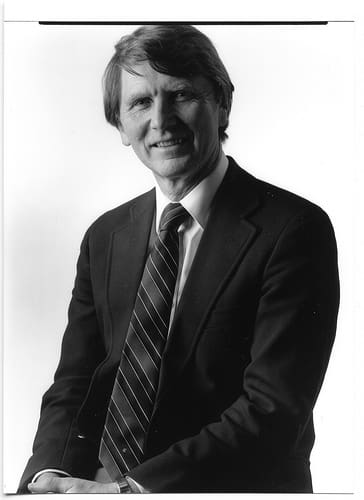
 Eugene England (1933–2001) (his website can be found here) was one of the founders and great leaders in Mormon Studies and independent Mormon discussions. He and four others founded Dialogue: A Journal of Mormon Thought, for which he served as its first editor. He was instrumental in the creation of the Association for Mormon Letters, and he is considered the champion of the “personal essay” as a powerful form for Mormon expression. England was a peace activist, whose reflections on having been present in the Vatican during the 1981 assassination attempt on Pope John Paul II (one of the bullets nicked his hand and left a small burn on his temple as it whizzed past) led him to found “Food for Poland,” a large-scale effort involving students from many college campuses to provide support for the Solidarity movement when it struggling under Polish government crack downs. He was an innovative and highly influential teacher. He revamped “study abroad” programs at both BYU and Utah Valley State College, leading to unparalleled learning experiences for students who traveled with his groups to London. He supported and was an active voice for academic freedom at BYU, championed the rise of Mormon Studies at UVSC, and was an articulate voice and active supporter for nearly every good cause in independent Mormon circles for nearly four decades.
More than any of these or many other accomplishments we didn’t name, however, Eugene England was a person of faith and incredible spiritual depth who, along with Leonard Arrington and Lowell Bennion, stands as an example of a committed, faithful life of intellectual and spiritual integrity, maturity, and grace even as he was often misunderstood and under-appreciated. He is important to get to know, and that is the process that this podcast hopes to help start.
Led by guest host Dan Wotherspoon, this four-segment podcast features interviews with Gene’s daughter Jody England Hansen, granddaughter Charlotte Hansen Terry, Dialogue co-founder Frances Lee Menlove, longtime friend and fellow writer Levi Peterson, friend and student assistant (and now Sunstone editor) Stephen Carter, and UVSC colleague Brian Birch.
Episode Transcript
Host: John Dehlin · Guests: Charlotte, Dan Weatherspoon, Frances Lee Menlove, Jody England Hanson
This transcript is machine-generated and lightly edited for readability. The audio is authoritative. Please excuse occasional errors in names and spelling.
Introduction to the Episode Structure
Part 1 of 4 · Ep. 281
Jody England Hanson [00:00:00] 1, 2, 3.
Dan Weatherspoon [00:00:07] Mormon Stories Podcast is a production of the Open Stories Foundation. All donations to Mormon Stories are fully tax deductible and go directly towards keeping the podcast alive and towards building a community of support for Mormons like you. To support the podcast or to join the community, please become a monthly subscriber today@mormonstories.org hello Mormon Stories listeners. This is Dan Weatherspoon. I'm very pleased to host another episode of this wonderful podcast and to cover, especially this week, a person who I admire to no end. Our subject for this podcast is Eugene England, who died just barely 10 years ago. He was one of Mormonism's biggest and most influential people, especially in the independent sector.
Dan Weatherspoon [00:00:59] He was the founder of Dialogue, the association for Mormon Letters. He started a million different things. He was a peacemaker heading up an organization called Food for Poland that brought Latter Day Saints into social activism in support of the Solidarity movement in Poland.
Dan Weatherspoon [00:01:19] He just models that wonderful, engaged person who was driven by his faith, his deep trust in God, in the goodness of people, and just started projects and influenced thousands and you'll get a feel for him in this podcast. And I'm so excited for those of you who haven't met him up close and personal to at least get this chance from hearing from our various guests about Eugene England, let me go ahead and state up front that I knew Eugene England.
Dan Weatherspoon [00:01:50] I interacted him especially closely for a year or two prior to my becoming the editor of Sunstone magazine in 2001. Eugene England died later that year, and so I knew him for that last year or so of his life. And then I had the honor and the privilege of putting together a wonderful tribute issue of Sunstone magazine.
Dan Weatherspoon [00:02:11] And since then I've maintained a real closeness with the Eugene England family. And one of my freelance projects that I do to keep family fed and things going is I've been the director of the project to create the Eugene Englund foundation website.
Dan Weatherspoon [00:02:28] We've had it up and launched for about a year. The goal of the website is to put basically all of Eugene England's writings online, as many as possible that we can capture, along with tons of pictures, video, audio, reflections from others, really cool letters and things from sort of the special collections type stuff that you usually find. So the website's an ongoing project and we're about to launch a new version of it soon, probably two or three weeks after this podcast comes out. But right now what's there is still plenty of fun and you can discover a lot there. I am going to quickly give you an overview of all four segments of this podcast that will be in lieu of doing it individually at the beginning of each one.
Dan Weatherspoon [00:03:10] So I need to set the stage and tell you what each one of them do and sort of how they came to be. So bear with me for a minute on that. The first podcast covers Eugene England's life from his birth to his death, as I mentioned in August of 2001.
Dan Weatherspoon [00:03:27] And in that segment I interviewed Jody England Hanson, who is Jean and his wife Charlotte's second daughter. She is bright, articulate, wonderfully spiritual in her own right. She's an amazing writer. I've published several things from her at Sunstone. I find her to be one of the most insightful people that I know and have encountered and had lots of great conversations with. So I think you'll feel the depth of her and you'll get a sense for how much her father's legacy lives on through her and some of the ideas that she's formed in her own spiritual journey. But she's going to wonderfully cover that and I think you'll really enjoy that segment.
Dan Weatherspoon [00:04:05] Lots of very interesting moments as well as tremendous pathos, especially towards the end. The second segment, it's Jody again, along with me, and we're joined by Jody's daughter, Charlotte England Hanson, who, since we recorded this, has married. So she's now Charlotte Hanson Terry. And Charlotte is we brought her on because she did her senior thesis at the University of Utah about Eugene England's views on academic freedom. So she did her thesis on that as well as she's been a coordinator up at the University of Utah in the Eugene England Papers project. So she's worked for special collections and has her hand on that, is very, very familiar with her grandfather's papers and work and things.
Dan Weatherspoon [00:04:46] And so she she adds a lot of insightful things. Plus she comes at the pers from the perspective of a student and somebody of that next generation who is interacting with him. She he died when she was 15 years old, so she did get to know him. But kind of that rediscover her grandfather through his writings comes alive for us in both that second segment as well as our final segment. So after what the three of us do then in that second segment is provide an introduction to Eugene England's key writings, favorite essays of all of us, essays that might serve as good introductions for those who want to meet Eugene England and get a feel for his thought.
Dan Weatherspoon [00:05:23] We discuss those and within that podcast segment, so this is again segment two, we tell the stories of a couple of Controversial moments within Gene's life and actually sad moments or. But also moments in which he learned a lot from and displayed his amazing character through. And those are the stories of his getting up and publicly condemning the church's Strengthening Church Members committee back in 1992. He had just heard about it and he rushed up to the microphone and got caught on camera and was shown on the news basically condemning that, only to find out later that it was something that apostles were involved with and it wasn't going to be just quite the inquisition or the McCarthy type inquisition that he had suspected at the time.
Dan Weatherspoon [00:06:08] So he learned a lot from that. And we tell that story as well as the story of the infamous Bruce R. McConkie letter to Eugene England, where they had an exchange on whether God is advancing in knowledge or if God is completely omnipotent and there's no more growth in God. That letter got leaked. It's all over the Internet. Anti Mormons have done interesting things with it. Those in the independent Mormon community are looking at it and they're saying, wow, what a jerk Elder McConkie was. There's just all sorts of things about that to discuss.
Dan Weatherspoon [00:06:45] And so Jody especially and Charlotte to talk about the impact of that letter and tell the whole story and especially add the family's perspective on that. So that's an important thing. I think a lot of you will want to tune in for that. So that comes towards the end of the second segment. The third segment is We Leave Jody and Charlotte, and it involves three different interviews that I did. The first one is with Frances Lee Menlove, who's this wonderful, charming, beautiful soul. And she was one of the original five founders of Dialogue, so worked along with Jean at Stanford to get Dialogue going. And she tells some stories from that era as well as some other moving experiences and conversations and just observations about Eugene England.
Dan Weatherspoon [00:07:29] So there's some very powerful things in that segment. The middle segment of that. The middle interview of that third segment of this podcast is with Levi Peterson, who was a friend of Eugene England's. And we'll learn of their interactions and Gene champing him as a very, you know, a well deserving writer within the Mormon tradition. Even though Levi's fiction is quite adventurous, some of you may have heard of his novel the Backslider. That and others sort of make Levi a little bit, you know, outside the box of the typical. He's certainly not Jack Wayland, much more frank and things like that. But Gene would always invite him to speak at his classes at byu and they just developed a great deal of affection for each other.
Dan Weatherspoon [00:08:15] So Levi shares experiences and observations about Gene, but also some very difficult things as Gene unburdened himself about some of the disappointments and some of the sadnesses of his life. So it's a very powerful interview. We close that third segment with an interview with Stephen Carter and Brian Birch. Stephen Carter, many of you will know, is the current editor of Sunstone magazine. He was, though, for the last year that Gene was at Utah Valley State College, which is now Utah Valley University.
Dan Weatherspoon [00:08:45] Stephen was his student assistant. And so we learn about the whirlwind of what that job involved and all the different personality traits and Gene's frantic nature and his deep faith and all sorts of things that came out through interacting with Gene for that year. So Steven tells some wonderful stories there and also shares very powerfully some very tender moments and feelings about what he saw as the way Gene was often misinterpreted and the pain that he felt from things. And Brian Burch joins in as somebody who was also at Utah Valley University State College back then at the time, and Brian was interacting as a faculty colleague, as somebody who was very interested in bringing religious studies to Utah Valley State College.
Dan Weatherspoon [00:09:36] Gene came in and said, let's do that, but let's also add Mormon studies to it. And so they interacted together and Brian talks a lot about Gene's impact on campus and his lasting legacy there. So it's a wonderful third segment with these four different voices. I also have to admit that I had a major technology failure and I still don't know exactly why. But I also interviewed Jay Bonner Ritchie for that segment. He's another longtime friend and colleague of Gene's. And my recorder recorded 34 minutes of static. So I have no clue why this segment and this podcast is long enough. But another time I'm going to recapture Bonner Ricci and we'll figure out a way to put that in front of you guys too, because it was very insightful.
Dan Weatherspoon [00:10:21] And I've apologized to Bonner for his segment just somehow vaporizing and it's terrible. But he's cool with us going ahead. Finally, our fourth segment to let you know is sort of a wrap up segment. It's the life and the legacy of Gene and how it's relevant today, why he's still a compelling figure, why the next generation should encounter him, and let's not let him be lost into obscurity. He is a Leonard Arrington type, a little Bennion type. He belongs in that same place within our hearts and our history as people interested in the independent Mormon discussion, as people to look up to who were starters, were people of integrity, who handled disappointments that come from that interaction of somebody who knows that they're on a good path and are doing something right.
Dan Weatherspoon [00:11:12] But maybe the church and the hierarchy aren't quite as ready for them as we would love them all to be. And at the end of that fourth segment, we also give you a chance to know a little bit more about what's in the special collections at the University of Utah. We talk a little bit more about the website and things like that. So that is what this podcast will be about, and I recommend it highly to you. Go for all four segments. You won't be disappointed. And any encounter with Eugene England, I think is going to be powerful. I know he's been one of the most powerful figures in my life.
Dan Weatherspoon [00:11:42] So thank you very much and I look forward to interacting with you on the blog as we have a conversation afterwards. So thank you so much. Jody. Thank you for joining us. Welcome.
Jody England Hanson [00:11:57] Thank you, Dan. I'm thrilled to be here and appreciate all you're doing.
Who Was Eugene England?
Dan Weatherspoon [00:12:02] Why don't we just jump right in and if you can just quickly familiarize our listeners who've maybe never heard of him or only barely heard of him about where he grew up. Tell us a little bit about his family upbringing and whatever else comes up for you about maybe the first up to his teenage years or something.
Jody England Hanson [00:12:22] All right. He grew up in Idaho on a farm, a dry farm up in Downey, Idaho. His parents came from pioneer stock and their ancestors were there in Idaho. And so he was basically a farm boy. But from early on in his life he had some amazing experiences and his parents had a great appreciation for the difference dedication and intelligence and education would make. And so from an early age he was well read. He was surrounded by great faith and acts of great faith from his parents, and he often refers to those. And even though it was a very small farm town, I think it's interesting that both he and Burt Wilson came from that same town, knew each other as dear friends from an early age. And Burt Wilson will probably be referred to in other ways.
Dan Weatherspoon [00:13:26] Tell our listeners who aren't familiar with Bert a little bit about why he's fairly well known within some of these circles.
Jody England Hanson [00:13:33] Well, he's a great force in Mormon literature and head of the English department at BYU for many years and a great folklorist and just involved in many of the same things that dad has been involved in. I just find it interesting that both of these great minds and very faithful people came from this tiny little farm town in Idaho. So I think it says a lot about how people can impact each other from an early age.
Dan Weatherspoon [00:14:06] That's definitely true. For anyone who wants to check it out sometime, just go to the Sunstone website. And we've published Burt Wilson a few times. And one of my favorite articles is when he did on the folklore of Mormon missionaries. And just all the different stories, stories that get told and passed along as if they're factual and yet they serve a purpose. And he doesn't spin them, he spins them just in the way a sociologist, or I guess it would be an anthropologist does to show the function that these play. And they're not anything to really be embarrassed about, because everybody's got folklore. Every society tells certain stories.
Dan Weatherspoon [00:14:45] Anyway. I appreciate that. Sorry for the diversion onto Bert a bit, but tell us a little bit more about some of these spiritual experiences, because you're right, it comes up again and again in his writings. Some of the formative experiences that happened during this time in Idaho.
Early Spiritual Life and Formation
Jody England Hanson [00:15:00] Well, one that always comes to mind is at a very early age. Oh, I can't remember exactly how old he was, but he writes about this in several essays, most notably why the Church Is As True as the Gospel about when he was young and he and his father were walking out in the wheat field, as they would do, to check how it was growing and look at things, and his father knelt and dedicated this wheat and my father and his own life to the Lord.
Jody England Hanson [00:15:41] He felt the presence of God. He felt the presence very specifically of Christ. And. And this was a crucial experience for him to not only recognize his own father's dedication, but to have that touchstone of a spiritual feeling.
Jody England Hanson [00:16:01] And what helped him define that more clearly was another experience that happened. I think he was about 10 or 11 in state conference up there. And he was kind of messing around while the talks were being said. And he felt a physical feeling strong enough to actually get him to turn around and sit down and pay attention to what was being said, even though there wasn't someone doing it.
Jody England Hanson [00:16:34] The feeling was that powerful. And Harold B. Lee was the visiting apostle. He was a fairly new apostle, and he was giving that stake and the people there an apostolic blessing. And dad once again felt the presence of Christ and the existence of God in those feelings and was able to identify that feeling he had had earlier because it was the same feeling.
Jody England Hanson [00:17:06] And it was a very important beginning of his testimony of the divinity of the called servants of the Lord. In the church today. And it was an important one for him to have early and to develop and strengthen, because that made a huge difference in how his life went. When I look at the many things that happened during his life, things that so many people would choose in the midst of experiences like that to turn away or give up, he grew stronger through them and more dedicated and more faithful to the organization of the church and the importance that we as members work within it to make a difference for it, because it is the most effective tool that Christ and God work with.
Dan Weatherspoon [00:18:01] Yeah, we can get into that definitely, as we talk about why the church is as true as the Gospel, in other words, essays. Because that really is a key point thing that I always think of. I'm with you in my own brain. I identified those two experiences as just coming up over and over again in his essays. And as he sort of explains his approach to things, they remind me a little bit. I don't know how familiar with the biography of Martin Luther King, Jr. But, you know, he had this experience at the kitchen table, and sometimes he would just refer to it as the kitchen table experience or something.
Dan Weatherspoon [00:18:33] It was kind of early on in the bus boycotts or whatever, but he had this feeling that came upon him from God that whatever was asked, he would be able to rise to the occasion and take it. And he knew that the work he was doing was approved by God and stuff. And this kind of served him through all the terrible traumas and whatnot that he faced the rest of his life. And I've thought of these two experiences and just some of the others that Gene will talk about as kind of serving that same role and just sort of being that grounding that says, God is alive, God is true, and no matter how crazy or difficult it is, somehow or other, I believe that these brethren are inspired. Yes, there's something going on in priesthood or whatever in the Mormon church.
Jody England Hanson [00:19:17] Yeah. Well, I think an interesting thing about this is many times people seem to think that only certain few will have an experience like that, and that makes them special. And the rest of us are excused. But with dad, and I think, like. And I think Martin Luther King did it, and I think Gandhi did it. I think there was a recognition that this is available to everyone, and it happens to more of us than we might be willing to realize or even admit. Dad really saw that everyone could have this or probably has had it. And it's a matter of choosing to see it, and then what do we do with it? And so when people say there was no one else like him. I think that defies what his life was actually about. And that is, we are all capable of this, and God wants to offer it to all of us.
Dan Weatherspoon [00:20:15] Wow. Couldn't have said it better. That is really great. I appreciate that. I am sure they will come up again as we go along here. Before we move on to meeting Charlotte, his wife, and all that stuff, is there anything more about his parents? They're not figures that are in a lot of his essays, but when he does talk about them, they seem like quite remarkable individuals. Maybe just give us a little bit more on that.
Charlotte and Jody Reflect on Their Parents
Jody England Hanson [00:20:39] Well, I am just really glad that I was able to know them through so much of my life. They lived through the mid-90s, and I was able to really get to know them. And they were not. They did not fit the type of people that people just thought would be dad's parents. And yet they had those qualities that made that impact.
Jody England Hanson [00:21:08] They were very supposedly conservative in their politics and in many of their attitudes. And like any parents, they were very protective. But they grew up in a time when you didn't tell your children directly how much you love them and how proud you were, but you sure told everyone else.
Jody England Hanson [00:21:28] And they had this deep, deep faith and dedication. Again, even when it was hard. They came from difficult circumstances, lived difficult circumstances, but saw tremendous blessings come into their life because at an early age, they consecrated their lives and their wealth to the church. And an interesting one of, again, those turning point experiences that impacted me, knowing this about my grandparents when they were running that farm, trying to literally scrape a livelihood out of the dirt.
Jody England Hanson [00:22:10] And they had listened to conference, and when President Kimball was trying to get people to start supporting those who couldn't afford to go on missions, who came from circumstances that would keep them from ever being able to go on missions. And many of these were young at the time, referred to as Lamanites. So young Native Americans on the reservation who desired to go and make a difference in the world as missionaries. And he announced that there was one that needed help.
Jody England Hanson [00:22:42] And they went down to Salt Lake and met with him and said, we will support this missionary. And it would require, at the time, 25% of their income to support this missionary. And while they were in there, President Kimball received a call, and he said, I just received notice that there is a second ready to go if someone will support them. Are you willing to do that? And they looked at each other and in a matter of seconds, promised to support two missionaries. This was half their income, and they were not wealthy at all but it was the beginning of this type of action throughout their life.
Jody England Hanson [00:23:19] And it's like Grandpa was someone who was capable of doing well financially over time. And gradually he did do extremely well. But the whole. All along the way he was constantly as he would acquire property or make money, they would give a large, large percentage of it to the church. And they helped begin a trust fund that now supports hundreds of missionaries and they helped begin the family to Family Book of Mormon program.
Jody England Hanson [00:23:53] So they did a lot financially that has impacted many people. And again, people aren't aware of it. They don't know that this is where these came from. And so it's understandable that. But because of those parents, dad did have that kind of an example. Even though he chose to do it in a way that they often didn't understand at the time, their actions had that impact on him.
Dan Weatherspoon [00:24:20] Yeah, I really can't add much to that. Just to let people know, they went on and they became temple presidents. I remember that from my reading. And then also I remember, I think this kind of shows a bit about the character of your grandfather. He was a. Didn't he graduate from Utah State in agriculture?
Jody England Hanson [00:24:40] Both he and Grandma graduated from Utah State. He graduated in agriculture.
Dan Weatherspoon [00:24:46] And so my memory from some of the readings is that he was among the first to really apply advanced farming techniques to his dry land wheat farm. And then among the things that he did is he says, I'm not going to be subject to the market willy nilly come harvest time. And so he bought an old rundown silo that he then fixed up or whatnot. And he was able to store his own wheat until the market got him a price that he felt was fair.
Jody England Hanson [00:25:09] Oh, people thought he was crazy to farm the way he did, and yet he was successful where others were failing.
Dan Weatherspoon [00:25:22] Anyway, thanks for that. And if anything comes up for you later on, let's go back and revisit it. But I know that somewhere in his teens the family moved to Salt Lake and that's where he met his future wife and all that. Why don't you take us through that? Maybe up through his getting married and going on a mission.
Jody England Hanson [00:25:41] They moved to Salt Lake and he and Grandpa built the house that they lived in and then they would go back and farm during the summer. But the point of that move was that Grandma and Grandpa wanted their kids to have a good education. Dad had one sister, Ann, and they wanted their kids in good schools. So they moved down to Salt Lake and Mom and dad actually met while they both went to East High school, and they double dated. Mom was dating a friend of Dad's, and it wasn't until they were in college and dad had been at University of Utah. And then mom was starting the year after, and dad called and asked her to go to this. It's a dance at the beginning of school. I don't know what it's called.
Dan Weatherspoon [00:26:33] I think it was called the Howdy Dance.
Jody England Hanson [00:26:34] At least something like that. The hello dance at something.
Dan Weatherspoon [00:26:38] Hello. You're right. Hello. That's what it was.
Jody England Hanson [00:26:40] And they went just kind of dressed in what was then casual clothes and went to have fun. And everyone else who was there, they were worried about being rushed by the sororities and the fraternities. And so they were all dressed up in really nice clothing and kind of trying to show off. And mom and dad went in and they were like, oh, dear.
Jody England Hanson [00:27:02] And at first they thought, well, we better leave. And then dad said, no, let's just stay and have fun. Let's just have a good time. And they were dancing and laughing, and a photographer was there saying, you're the only ones here who are having a good time. Can I take your picture? And that's the picture that was put in the yearbook of those two.
Jody England Hanson [00:27:26] Really having a lot of fun there. And we refer to that a lot because it kind of shows what they set out to do. And so they dated. And there were several others who were dating mom at the time. But dad didn't hesitate. He pursued her and he wooed her and did what he had to to win over her parents, specifically her mom, and courted my grandma as well, to make sure she was okay with him marrying her daughter.
Jody England Hanson [00:27:59] And so when they were dating and then engaged, this was at a time when the government limited how many missionaries could be sent out because of the Korean War. And dad wanted to serve a mission. And it was common for the church to send out married men on missions, obviously, because that got passed around some of the government restrictions. So they went and sought counsel. Who was it? I think it was Legrand Richards.
Dan Weatherspoon [00:28:32] Well, Legrand Richards interviewed him for a mission, Right. But they had counseled, apparently beforehand with Lowell Bennion and Elder Kimball.
Mission, Marriage, and Early Family Life
Jody England Hanson [00:28:41] That's it. Elder Kimball. They went and got counsel from one of the apostles. It was Elder Kimball, and said, should I get married or should I try to go on a mission? You know, what should I do? And he said, your first mission is marriage. Get married, and then we'll send you on a mission.
Jody England Hanson [00:28:56] So that's what they did. And then soon after, they Were married, Went in for an interview with dad, Went in for an interview with Legrand Richards. And while he was interviewing, he says, I see you're married and is your wife here? And he said yes. So he called mom in and apparently didn't say much to her once they met. Just turned to her every once in a while and asked a question.
Jody England Hanson [00:29:19] When the call came, it was for both of them to go together on their mission to Samoa, which we have never heard of that happening. A young couple being called on a mission together. And it definitely was not common then, but they were not going to argue with it. And so they, very young, went on this mission to Samoa. And that experience, again, was something that molded them for a life together.
Jody England Hanson [00:29:51] The challenges they faced, what they learned and the way they learned it away from many of the traditions that they had grown up with, made a huge difference in the kind of people and the kind of marriage they had. And again, how they were able to deal with what they dealt with in life.
Dan Weatherspoon [00:30:12] Yeah, I'm actually assisting your mom in completing an essay about their mission experiences to Samoa. And we're specifically organizing it around the idea of two or three themes from their mission that really did affect the rest of her life. So maybe let's just use a jumping off point. One of them, I remember was their open door policy. Can you tell us about how that played out in your family? Do you know what I'm talking about? Just welcoming guests at any time of the day or night.
Jody England Hanson [00:30:44] You know, there are things. There are habits and things that I grew up with that I just assumed everyone did. And come to find out, not so much. We always had people in our home, and sometimes they were people that the day before, none of us had ever met.
Jody England Hanson [00:31:09] But my parents had a way of understanding that we were blessed. And when others needed something and we had it to offer, then we would offer it. And then we also had always had groups meeting in our home. There were firesides, there were concerts, there were musical performances, study groups.
Jody England Hanson [00:31:31] Our home was always. Even when we never lived in some kind of grand, huge home, no matter what home we lived in, it was open and welcome, and it was just used to bring people together. And that's how it was in Samoa. They lived in these open huts, and the people. What was needed, if people had it, it was offered.
Dan Weatherspoon [00:32:01] And they pointed. Charlotte at least points out that they conscientiously made that decision on their mission. Another one she mentions is that's where your dad really discovered his love for teaching, I guess, before his mission he was a math major.
Jody England Hanson [00:32:14] Yes.
Dan Weatherspoon [00:32:14] And he just enjoyed teaching English to these kids and literature and poetry and whatnot. That they were serving on their mission. That that just became. You know, there's this point in his journal where he says, this is it. I've discovered it, what I wanted.
Dan Weatherspoon [00:32:29] And so that was a neat thing. And then the third thing I think she talked about it being there is it was on their mission, they had that experience of sort of feeling like there's a better way that we could be teaching rather than just following the discussions.
Dan Weatherspoon [00:32:42] And they wanted to kind of spur the church into letting you get away from the really rote memorized script where you kind of waited until you got the right answer from the person you're teaching and to teach more by the Spirit. And so she talks about Gene especially taking the lead and writing letters to Salt Lake. And they, of course, through boats, take weeks and weeks to get things back. And then when they do finally get an answer back, it's like, stick with the prescribed program.
Dan Weatherspoon [00:33:13] And so it's frustrating to him, but he never gave up. And then they just had success when they started teaching through the Spirit and kind of going that on its own. But anyway, she kind of points to that as just, you know, constantly trying to rethink better ways to do things that characterize their marriage and your dad.
Jody England Hanson [00:33:32] Well, and not only that, but realizing that if you see that there's something that could possibly make a difference, it's almost like it's important that you try to do that. That you don't just sit there frustrated and say, well, if only they did this, but too bad it's never going to happen. It's very much something that you do something about. And because of that, that's how things change. And it's true, they did get that message back, stick with the prescribed program. But who knows how many saw that and thought there are things that could happen, or theirs was just one of many requests.
Dan Weatherspoon [00:34:21] A chorus, right? Yeah. Now, the program is basically what your parents were requesting back then.
Jody England Hanson [00:34:29] And it's always gone through changes, but I think it's important again. This is something that dad was always telling people. If you see something, don't be afraid to actually speak up. With love, with dedication, and you will, somehow you'll be heard.
Dan Weatherspoon [00:34:47] Terrific. I can't leave the mission without sharing one of my favorite lines or comments. It's probably a paraphrase at this point. I can't remember it exactly, but Levi Peterson became a great friend of your parents. One of my favorite Slides is him always teasing your dad that he probably wasn't quite properly tested from his mission experience because he had the comfort of having Charlotte, his wife, with him. Anyway, from reading their experiences of their mission, they definitely had some adventures and some things. But anyway, I think a lot of us who went as single people would kind of imagine that would be pretty fun. But there were times on their mission where they weren't even assigned to be the same companion. So they were apart?
Jody England Hanson [00:35:29] Oh, yeah, they were apart. And then after my sister was born, she was born. They served the last part of their mission in Hawaii because Mom needed to be near a better facility. When Charlotte was. When Katherine was born, mom was sent home, she was released, and then dad. Yeah, and then dad finished up, so.
Dan Weatherspoon [00:35:54] Well, they eventually ended up at Stanford. I know he was in the Air Force rotc and he became a weather officer. And I know your family moved back to MIT for a little while for him to study meteorology. Is there anything from that period that you want to talk about or should we move right on to Stanford and the beginnings of dialogue and all that stuff?
Jody England Hanson [00:36:14] Well, only that each place that they lived, they became friends with amazing people, and those friendships and connections continued throughout their life. And because of those people, they were part of groups that did things, whether it was literary or church groups or something. And so Boston, there were people they met through Boston, some people in the Air Force when he was stationed in Southern California, but Stanford especially, just amazing people that they would meet and become a part of a community together within the church.
Dan Weatherspoon [00:36:58] Cool. So we're now about in, what, the mid-60s by the time they end up at Stanford?
The Stanford Years and Founding Dialogue
Jody England Hanson [00:37:06] Yes. So we were there from 63. Yeah, 63 is when we moved there.
Dan Weatherspoon [00:37:15] Okay. And tell us what you can about the Stanford years that you remember. That would be something fun to share.
Jody England Hanson [00:37:24] Oh, it was amazing. It was wonderful. The 60s being such a volatile time. And there were student riots on Stanford campus. And while we were never actually on campus when they occurred, we would be there shortly after. And so there was a lot of activism. And as a child, again, it was the water we were swimming in. Dad did not hide us from those things.
Jody England Hanson [00:37:51] And from. Of course, this would not happen now. But there were always things, causes to be involved in. So everything from saving a neighborhood in Palo Alto, from being torn down, a historic neighborhood, to the war, to students that were struggling with being conscientious objectors to the American Indian Movement began.
Jody England Hanson [00:38:23] It became a normal thing. Sometimes to come home from school, we'd hop in the Car. Dad would take us to a neighborhood. He'd say, okay, pass the flyers out, and I'll meet you at the other end of the neighborhood. And we would go door to door. And this is when I was 7 and 8 and 9 and pass flyers out and talk to people.
Jody England Hanson [00:38:46] And I remember seeing dad on the TV when the news would have a specific spot where a citizen could come and present a viewpoint if things were on the ballot. And one of the first times where it was an actual ballot issue. This is when the historic neighborhood was threatened. And.
Jody England Hanson [00:39:05] And the day after the election when this proposition was defeated and the neighborhood was saved. And dad drove us around the neighborhood and pointed to houses, said, because of you, these houses will stay here. Because of you, this neighborhood will remain very cool. And we were little kids, and I really got that.
Jody England Hanson [00:39:32] I was this little kid just passing flyers out, barely understood what was going on. And yet, because of me, something had happened. And so this awareness of our own responsibility to be active and to do what we can do really made a difference. And then, of course, dialogue became, you know, just a regular part of life.
Dan Weatherspoon [00:39:59] Yeah, so tell us about that. I think that the majority of the listeners know what dialogue is, but tell us about what it is, and then a little bit about its beginnings and your dad's role in founding it.
Jody England Hanson [00:40:12] This was the first independent Mormon publication, and dad and several others at Stanford saw the need for it. And I don't know what it takes for people who really, in a practical sense, might not have the means or the experience to actually say, oh, this needs to happen, so let's do it. I don't know if it's a type of insanity. I don't know what it is, but he had it. And they began this publication, and it's an example of so many other things that happen where he would have such great ideas about the difference something could make and the purest of thoughts about it, and yet it would be perceived as destructive.
Jody England Hanson [00:41:13] So he. They started out doing this prospectus and then sending a letter to all of the general authorities and anyone else that they thought could be concerned about what this was for and how they saw it as a means for people to express their testimonies and ideas in a forum for discussing topics, and that it would really help people in the church and those who wanted to learn more about the church, have a literary forum and.
Jody England Hanson [00:41:45] And a thoughtful forum. And they really didn't receive much response, except, boy, was it Hubie Brown. I think it was Hubie Brown that actually responded and said, this sounds great. But then as they proceeded, there was a lot of negative response. And these were people who never read it, just an assumption that if it was, was not being done by the church, that it was destructive or that it was anti Mormon.
Dan Weatherspoon [00:42:14] Right. Now, when you mentioned there's not much of response, you're talking kind of at the ecclesiastical level. My understanding is when they sent out the initial flyer, they were just flooded with subscriptions. It was like, everybody's going, it's about time. Thank goodness somebody is doing this. I know they were very encouraged from that end and at least from the ecclesiastical. And they weren't overly discouraged at that point.
Jody England Hanson [00:42:40] Right, right. There was nothing that came back that said, you do this and you will lose your memory. There was nothing like that. There was the positive one from Hubie Brown and then nothing from anyone else. And so the response that came afterwards, it was negative from a few, but they were ones that apparently really assumed it would be bad, which was too bad. I think overall, most of the people that heard about it thought, oh, well, this will be interesting. And at least that if not positive. And so it did fill the need that they saw it would fill.
Dan Weatherspoon [00:43:29] So it was your dad and four or five other colleagues. I think they were all grad students at Stanford or at Graduate Theological Union there in Berkeley or whatever, from my understanding. But your dad became the first primary editor of the journal. I believe the first issue came out in spring of 1966. And your dad served for two or three years as editor before he got his job to go to Minnesota.
Jody England Hanson [00:43:57] We moved to Minnesota in 1970, and so he was acting editor until then, and then he was a consulting editor after. So it still had quite a hand in it, but not on the same level.
Dan Weatherspoon [00:44:10] Right. Bob Reese, who was at UCLA at the time, I believe, succeeded him as editor. But your dad, I think, wrote a column, a regular column that was always pretty much every issue or every other issue and things like that. So. But he's definitely one of the main driving forces. So why did he go to Minnesota? How long was your family there and what brought you back to Utah?
Jody England Hanson [00:44:33] Well, this was at a time when civil rights and race relations were a huge deal in the United States and Stanford University was no different. The perceived image of the church came up frequently because of the restrictions of blacks of African descent not being able to hold the priesthood.
Jody England Hanson [00:45:02] So there was a lot of pressure and the Stanford sports teams would boycott byu. And I specifically remember BYU coming to play a basketball game at Stanford, and the BYU team was there Warming up and the Stanford team was not to be seen. And the whole crowd was booing them.
Jody England Hanson [00:45:26] That's a stark image. And about that time there was a lot of pressure on those who were active members of the church. So it was kind of interesting because his dad was teaching and this was a very formative time for his teaching, for dad to basically do some, a lot of development, really cutting his teeth on the teaching experience, not only teaching at Stanford, but at the institute there at Stanford.
Jody England Hanson [00:45:54] It's an amazing place and any kind of an academic atmosphere, but especially one that on the level that was going on at Stanford, it's an amazing place to be involved in the teaching process and be a student there because he was also working in his doctorate.
Jody England Hanson [00:46:12] So at the institute he was seen as very liberal and by some as disconcerting. And yet there was amazing discussion going on. Then he would cross the street over to Stanford campus and he'd be seen as this hard line conservative just because he was an active Mormon.
Jody England Hanson [00:46:32] And he was very much an active Mormon. He was always in a bishopric, whether of a student ward or a family ward, very much involved. And so this was just very much a part of our always church service, church discussion, dialogue, being about the church, his job being disrupted because he was a church member.
Jody England Hanson [00:46:58] This was just everything about our life. And I think what he realized is his hope of continuing on at Stanford was not as certain as he originally thought. And I am not familiar exactly with what brought up the offer that came from St. Olaf College in Northfield, Minnesota. But all of a sudden dad was going back there to look at the campus and be interviewed. And then mom was going back there to look at the town and. And here was this job offer and we moved in 1970 and it was
Dan Weatherspoon [00:47:43] a teaching offer as well as to be the dean of students.
Jody England Hanson [00:47:47] Well, it started out administrative. He was the dean of academic affairs. And I don't know when his request to be able to move into a teaching position as well, if that was up front or if that developed over time. But it was very soon that he was teaching there and he became a very influential teacher on this campus. It's a private Lutheran college, beautiful place.
Jody England Hanson [00:48:18] He was very soon made the branch president there. And we went from attending a large ward to doubling the size of this branch just with our eight member family. So our church life, while still very active, it shifted into a time of really understanding what does it mean to be active in the church, what happens when you are one of a few instead of one of many. And I was fully aware of this and to see dad and mom deal with the rawness. And I think their mission was another preparation for them to serve there. And an interesting experience that I had with him because frequently, as branch president, he would receive calls at all times, night or day.
Jody England Hanson [00:49:16] And these were little towns sprinkled throughout Minnesota. Our branch was spread out over quite a number of miles. And I remember. And I would frequently go with him because he was not to go alone to do visits, no matter what kind of emergency it was. But I was really good at staying awake at night. And so one night he got this call in the middle of the night.
Jody England Hanson [00:49:43] And a branch member, a family in the branch who was struggling to reactivate. And they had teenage children who were in various degrees of difficulty. And the parents were dealing with overcoming a lot of bad choices in life and where it had brought them. We got this call from the father and his sons had been out and they had been drinking and driving. Run a light and crashed into another car. One of the sons was killed.
Jody England Hanson [00:50:17] And so dad and I went to meet this family at the hospital. And I remember driving there. It was. I think it was one in the morning and just kind of chattering away at Dad. I think he was 13 or 14.
Jody England Hanson [00:50:36] And dad was really quiet. And during this quiet moment, he just sighed and he said, oh, Jody, if people would just obey the Commandments. And it was one of the clearest moments of my life of understanding that the commandments are there for us.
Jody England Hanson [00:50:59] This shift over from thinking that the Commandments are there so that God can control us, that went out the window. I really, really got. Clearly, they're there for us so that we can have the best life that's possible for us.
Teaching, Faith, and Formative Moments at BYU
Jody England Hanson [00:51:19] And this stark image of going into that hospital and seeing the one brother covered up with a sheet and the other one behind a curtain, not aware that his own brother was dead and he was a mess and he was trying to talk and then going into the hospital chapel and dad trying to console the parents and how all of that could have been different because of some choices.
Dan Weatherspoon [00:51:53] Yeah. And certainly you're not talking about any kind of naive. If you keep the Commandments, nothing bad will ever happen to you. But it was just that idea of, you can sure avoid a lot of situations.
Jody England Hanson [00:52:04] Well. And just through that kind of understanding of what the Commandments are there for, you have the strength when you need it. You really have the strength. Because terrible things have happened to us, even in the midst of obedience. But to have the strength and to know where to turn is really something. So that, that was an interesting thing to see him so involved in reaching out, being a tool to people.
Dan Weatherspoon [00:52:41] I remember during this period I've read the different articles and essays that your dad wrote, and he was all excited to talk about the art of teaching, especially teaching within a faith context. And he edited, co edited a book called Teacher's Faith and Values or something along a title similar to that. And then he was writing essays for dialogue, saying, hey, you guys who are trying to pick a college, why not go to a Christian college? And he was extolling that and he was on campus and he was introducing Mormonism to the people there. And he did a lot of writing in that period of are Mormons Christian?
Dan Weatherspoon [00:53:22] And whatnot. And always, though, instead of the arguments that you get today about whether Mormons are Christian, your dad was like, I think we're Christian, but we sure need to act more Christian than we're doing. And so your dad was. He walked that wonderful line of hitting the hard issues, but then calling us all to our better selves again.
Jody England Hanson [00:53:44] Well, and it's one reason that he was so terrifying to some people.
Dan Weatherspoon [00:53:49] Right? Tell us how he ended up leaving there and why you guys ended up leaving.
Jody England Hanson [00:53:54] Well, students, you know, here are these students. They may not be religious. They might be religious in their Lutheran faith, but for the first time in their life, they're having spiritual experiences. And it's linking them to every part of their life. That's how dad taught. He would ask his students to pray about assignments in an English class, and students would be touched by it and they would actually look at changing the direction of their lives. And of course it was going to bring up. While dad didn't openly proselytize, students couldn't help but realize, this person is different. Why? And then they'd find out, of course, when he would be asked to talk to support our Mormons Christian and make this point.
Jody England Hanson [00:54:49] But when someone is willing to say we need to step up and be who we say we are, that has a powerful impact on people. And those who don't want to be impacted by that are terrified by it because there is a tremendous power behind it and you can fight against it or you can recognize this is something that I can be a part of that will make a difference.
Jody England Hanson [00:55:21] And there were parents of students, very generous patrons of the college who didn't like this. So there was pressure and other administrators and other teachers who didn't like this. And so there was pressure for him to leave. And a student Movement started that basically reversed that decision. There were students who actually signed a petition demanding that he remain.
Dan Weatherspoon [00:55:47] Sounds familiar. At other places that we'll talk about, right.
Jody England Hanson [00:55:52] And they were able to make the point and overturn the decision. But dad was not willing to remain under the conditions that the administration set. One of them being restricting his teaching. So we left Minnesota and returned, well, came to Utah not knowing dad, did not know where he would be working.
Jody England Hanson [00:56:14] And the first year there, first two years there, he was working a variety of places. That's when he started writing for the church history department, working with Leonard Arrington. He taught at the Institute at U of U and Weber.
Jody England Hanson [00:56:29] He would take writing jobs. And he had applied to BYU but was turned down. Apparently some people who had not liked Dialogue had basically done all they could to keep him from being hired there. But he was giving a fireside. And Elder Haight, David B. Haight, was at the fireside.
Jody England Hanson [00:56:51] And in the middle of the fireside, Elder Haight raised his hand. And this was not a question and answer session, but you don't not call on an apostle. And dad said, yes. And Elder Haight stood and he said, I want everyone here to realize what a blessing it is for you to be able to hear what he is saying.
Jody England Hanson [00:57:12] This is an important person in the church. And he sat down and dad, well, you know, tried to continue on. And then he raised his hand again and he stood up and he said, I think it's important for the youth of this church to have people like this teaching them. I'm going to do all I can to make sure he becomes a professor at byu. Wow.
Dan Weatherspoon [00:57:32] I had not heard that story. I knew your parents were friends and close with David B. Haight, but I didn't know this story.
Jody England Hanson [00:57:39] Wow. And so wasn't long after that that dad started teaching at BYU.
Dan Weatherspoon [00:57:47] How long was he actually at BYU?
Jody England Hanson [00:57:49] Let's see. He started there in 1977. Until 2000. No, until 98.
Dan Weatherspoon [00:57:57] Right. And then. And from there on, just to give people ahead, he went over to Utah Valley State College, which is now Utah Valley University, and we'll tell all that story in the course of this. But he had quite an eventful career at byu. And, Jody, I'll just. Whatever comes to your mind as far as significant events or insights from this period, I'll just let you riff and try not to jump in too many times.
Jody England Hanson [00:58:22] Obviously, over that many years, over 20 years, there were different administrators and administrations. There were different heads of department. He was always a teacher in the English department. And another Thing that I really learned from dad is the example he was that wherever you are, you belong there and you belong there by choice. So. So if you didn't expect to be where you ended up, then make it the place that you're supposed to be.
Jody England Hanson [00:58:54] So going from a small Lutheran college to a large LDS university, he just dove in and he helped start programs that weren't there before because he saw a need. Honors Colloquium was an amazing program. And students who went through that, their lives were completely altered because of that program.
Jody England Hanson [00:59:21] It was team taught. He would gather several professors that would teach different subjects, but they would coordinate how they were teaching together. And there would be field trips where they would examine the physical. They would actually go and camp in southern Utah and they would examine the physical landscape, the spiritual landscape and the intellectual landscape of the area and the history of all the peoples and creatures that had been there and how it all came together. It was an amazing education in atonement, in being one with each other and one with where you are and connecting all the different time periods that led up to here and all the different people.
Jody England Hanson [01:00:05] And so it was an amazing experience. He changed how study abroad worked. His first experience with study abroad was in 1981 and we were all able to go when he was a director in the six month program. And I remember the preliminary classes where he told the students, you can look at this as spending a couple thousand dollars of your own or your parents money to have a glorified vacation, or you can see it as an opportunity to learn about everything to do with your life.
Study Abroad Programs and Academic Vision
Jody England Hanson [01:00:42] And he really set about to make that happen. So that was followed by another 6 month program in 85. And then I think by the next year he had developed the six week program and the theater literature program that continues today. And there are none like it.
Jody England Hanson [01:01:02] And the only way that others have been impacted by it have been because he trained my sister Jane and Tim Slover. And when they have something to do with other programs, then there's a touch of dad there. And he developed the Mormon Literature program.
Jody England Hanson [01:01:21] He started literary groups. I think that it was not long after he was there that he started association for Mormon Letters. The events that occurred in 1981 when we were in Rome and he was standing directly in front of the Pope when there was an assassination attempt on the Pope's life.
Jody England Hanson [01:01:44] And one of the bullets clipped dad's finger. It actually left a burn on his right temple, which I think is interesting. It's where the brain tumor was years later. But the impact of that experience and seeing the impact that Pope Johnson had had as a spiritual leader of this non violent resistance to communism led him to do things. When he came back, he started the organization Food for Poland. That whole story, I talk about it in a pope story, which is on the website and there are other writings about it from others who were involved. But it had a huge impact on not only the people that we were trying to help, which were the people of the Solidarity Union in Poland to maintain their resistance.
Jody England Hanson [01:02:39] And eventually the communist regime felt because of it, their resistance. We helped in our way and there were many others who did. And eventually the Berlin Wall coming down. But it also had an impact on anyone who was involved in that.
Jody England Hanson [01:02:55] That was through talks that dad would have with the church, where for the first time they worked with the Catholic Church to get service, to get goods and donations to another place. Bringing a lot of different people who would not know about each other together. It was kind of like creating a type of a ward on a worldwide level. People who normally would not know about each other are coming together to make a difference.
Dan Weatherspoon [01:03:27] Excellent, excellent. Let me take you back to colloquium just for a second. We kind of went past that a little. A little fast. For those who haven't quite heard of this, this was a famous program that. Would you say it lasted eight or ten years or something? Jody?
Jody England Hanson [01:03:41] You know, I don't know how long it lasted.
Dan Weatherspoon [01:03:43] I have a million friends that took it and they're like, you're saying it's the life changing thing. It was something like nine credit hours. So it wasn't just your standard, you know, three times a week you go for an hour and a half to class kind of thing. And as you said, they did team teaching and you would have professors from three or so different disciplines talking to each other. And what you were just saying there about, you know, it's important to have your ideas challenged in life and you shouldn't wait till have to think that college is not the time for this. From what I understand, this colloquium was many times quite intense because the different teachers would start arguing their perspectives in front of the students.
Dan Weatherspoon [01:04:23] And they were seeing what it meant to have an active mind and to be challenged and how to handle a challenge and things. Is there any stories or anything more along that line? Or you just want to say, yay, Dan, you did a good job on that part. But that was just something I really wanted to bring out because I was just so impressed with that.
Jody England Hanson [01:04:40] Oh, it really was. And that was one of the things students, students were going in there and coming out going, this is unlike anything I have ever had before. And I love it because the teachers would be more candid and more open and there wouldn't be this wall not only between the teacher and the student, but teachers themselves.
Jody England Hanson [01:05:07] So, yeah, it was amazing. It was really amazing. And it was a model for what he did with the study abroad program. So it really was a great thing there. Let's see, there were times when there was an amazing appreciation for what he was doing. And there were other times when there were at least one or two powerful voices that were resisting what he was doing. So there was a real tipping point when he wondered if he would get tenure.
Jody England Hanson [01:05:41] And there was a resistance for him getting tenure. And then when he finally did, and what a relief that was. And yet there were challenges. And anytime there was anything, any kind of so called scandal in the church that had anything to do with intellectualism, and dad would not sit silent when he saw people that he thought were good and valuable members of the church. Even if they were doing things that he might not have agreed with, he wasn't going to sit still and not speak up for them.
Jody England Hanson [01:06:16] There were people who automatically assumed that he was not a good person to have at byu. So off and on there were pressures against him. And I know that there are other areas that impacted this, but sometimes at the same time that there might be pressure about what he was saying or doing that some might not agree with.
Jody England Hanson [01:06:42] At the same time, he was getting some of the highest honors that a professor could have at byu. And so it was interesting. There were always those who had great appreciation for what he was offering and those who did not.
Dan Weatherspoon [01:06:57] Yeah, for every thousand students whose testimony soared through your dad's, under your dad's influence, there was just those one or two squeaky wheel voices that would end up causing him to have to defend himself and his methods and to sort of explain his entire approach to teaching and learning over and over again. I'm exhausted just thinking about all the things that he must have gone through for that long career.
Jody England Hanson [01:07:26] Well, and I took his classes whenever I could. And he would always, always start out saying, I want you to know that I will listen to you. This is not meant to be some kind of contest here. I value how you're hearing me and your experience and what you have to contribute. If you are concerned about anything, come and talk to me.
Jody England Hanson [01:07:52] And guarantee if they would come and talk to him, it would be resolved. If there was a concern about something that was said. It was the times when there was just an assumption, no, I can't talk to him. I'm going to go tell someone else that had nothing to do with what was happening or had no knowledge. Inevitably there would be a misunderstanding or miscommunication that had not been cleared up.
Jody England Hanson [01:08:18] And that's when some real problems would start. And usually that was how any problem starts in business, in academics. It's. It's because people will not communicate with those who are involved.
Dan Weatherspoon [01:08:30] Exactly. And I don't think, you know, the church is only to blame, but certainly within our own faith community, it's. That isn't the normal model. I mean, it's what Doctrine and Covenants section 121 certainly says. And it's certainly the New Testament model of, you know, if your brother offends you, you go to him first. But that isn't a habit that we've developed or really nurtured too well in the church. And we don't like conflict. And so somehow we think if I write a letter to a stake president or administrator, somehow I'm doing my thing, when the real courageous thing is to go face to face with somebody and see the miracles that happen, because you do.
Jody England Hanson [01:09:10] And the interesting thing is he knew from firsthand experience that that is how some of the worst problems within the church community begin. So he was trying to teach this at a young age to students so that they themselves could fend off much more tragic circumstances later on if they could learn to trust each other, that people will hear them with love and understand.
Jody England Hanson [01:09:38] And, you know, it's interesting going through his letters, how that would happen. There would be exchanges where he would get a. Of sense scathing letter and he would respond completely with, whatever I have done, I apologize. Please tell me what I can do to resolve this. I have never intended to, you know, and how completely that would shift the whole tone of the conversation. How the letter that would follow would always be, I realize now that I wanted to be angry or I wanted to see fault here or something. And I, you know, just a completely different outcome than if you work at being justified and vengeful or discordant or anything. He really, he really worked to be an example of that. And I know it was not easy.
Dan Weatherspoon [01:10:33] Right. There's definitely. He mentioned some of these incidents in his. In his various essays and stuff. Getting back to byu again, you mentioned quite quickly in passing that he began to teach Mormon literature there. I think we didn't quite probably hear enough about that in the sense of prior to your dad and his teaching of Mormon literature and eventually helping to co found the association for Mormon Letters, there had certainly been a Mormon literary tradition and writers here or there who were LDS backgrounds who either became famous regionally or nationally or something like that. But it was really your dad who said, you know, we ought to study this.
Eugene England as a Teacher of Mormon Literature
Dan Weatherspoon [01:11:16] This is the literature of our people. And he would teach those classes. And sometimes, as we know, literature is a dangerous thing and truth gets told in ways that are polite company and face to face. You sometimes don't do it. But your dad would bring controversial authors to come in and talk to his class because of this sort of commitment to the power of art and the power of discussion and dialogue and seeing different perspectives. So I just wanted to kind of put some stuff out there about that. Do you have any more thoughts about Mormon literature and how that was unique and interesting and important?
Jody England Hanson [01:11:53] Well, I know that when he first started teaching it, it really was meant to be a literature class. But very quickly he saw the need for a Mormon studies program and of all places to not have one, byu.
Jody England Hanson [01:12:10] It's like all of a sudden a light went on saying, of course there should be one here. And so his Mormon literature classes gradually became more of a Mormon studies program. And he kept trying to get an actual program started. And there was always resistance, always from surprising places, because there was this concern that it would have to meet someone else's requirements or that it would be too slanted, or that there would be too much control by the hierarchy and not enough by the people who really understood, or just the opposite, that it would get out of hand and there wouldn't be enough official say in it.
Jody England Hanson [01:13:07] There were all these concerns, and yet he never gave up. He really saw this as a need that especially in a church that is growing and will grow, we need access to understanding what the entire culture of Mormonism is about.
Jody England Hanson [01:13:25] And that's when he would bring a lot of guests in. Because the early Mormon lit classes, there weren't guest speakers. But that changed quickly. And the guests would be more than Mormon writers. They would be former general authorities. They would be representatives of different aspects of Mormon culture and just every imaginable kind of situation. And many times people just assumed, no, no, if this wasn't set up by a bishop or stake president, then there's a danger that something could be said. But these were amazing, faithful people to come and share their experience. It was incredible. And he started that in his years at BYU and continued it when he went to uvsc.
Departure from BYU and Final Years
Dan Weatherspoon [01:14:17] Let's get to that transition. For the last few years of his time at BYU and his officially called a retirement. But probably being more of the writing on the wall that you're going to be forced out if you don't retire, can you tell us really what were the issues that finally came to a head?
Jody England Hanson [01:14:37] I think the hardest thing is similar to what happened at St Olaf. It was just getting to the point where if he did not leave, there were people who were going to make sure he could not teach there the way he was meant to teach.
Jody England Hanson [01:14:55] And it's so hard to give any kind of accurate picture of this because the assumption of many people who were sympathetic to dad staying is that he was foisted out, which is true to a great extent, but not as many people were involved in that as would seem. All it took were a couple of people who unfortunately were run by fear and assumption.
Jody England Hanson [01:15:34] And I think it came down to some people only thinking that with Dad's ability to impact people and to have such an influence on so many aspects of the university, if they didn't agree with him, then they assumed he was a danger and they assumed that his intent had to be evil.
Jody England Hanson [01:16:06] Yeah. Again, it's a human condition. If we don't understand or agree, will assume bad things. And even though it flies in the face of everything that dad ever tried to do with his life or everything he ever tried to teach, there are people who don't want to see that. They only want to function on that kind of assumption. And that's how they live. And unfortunately, there was at least one person and possibly several in the administration who had power, who had that outlook on dad.
Jody England Hanson [01:16:44] And I only know of one instance, and I don't feel at liberty to share the specifics, but he was actually told, it's not that what you've done, it's what you could do. And that's why. Yeah. And that's why we don't want you here.
Jody England Hanson [01:17:01] And I can only imagine I know how dad actually responded in his life, which was the way he had learned to live, and that was to follow the example of Christ. And of course he would be justified in seeking retribution.
Jody England Hanson [01:17:28] But one man's actions were not going to be the thing that caused him to risk damaging his own soul, but also damaging the school and the church. And I think that was what was behind him eventually being willing to leave.
Jody England Hanson [01:17:53] And yes, it was painful, but we don't know if that was when, you know, we don't know how soon the tumor was growing in his Brain. We don't. And so we don't know how much of the concern or the.
Jody England Hanson [01:18:14] Or the. Well, you know, dad always had the best of intentions. He really learned how to. To look for the best in people and always look at himself for, what is it that I can do? What is it that I can learn? And through this, for him to always be asking that, of course, this was a difficult thing, but he.
Jody England Hanson [01:18:35] That look of puzzlement when he became aware that someone would be upset, that was happening a lot at the time. But he. I think where he found strength to go on and say, well, then maybe it's time for me to do work where I will be able to do work. And that's when he went to uvsc, right.
Dan Weatherspoon [01:19:03] And they had invited him, Right. It was sort of in this period that they said, come on. And they created the position of writer in residence for him. And that was basically. Basically a university position where he could kind of write his own ticket to give lectures, to organize events. Am I right in thinking that he started the study abroad program there or he just revived it?
Jody England Hanson [01:19:28] There was something there, but it was not effective. And so, yeah, he technically revived it, but there was nothing like it before. And as happens anywhere, it's not like any college or university is alone in this. There were those who didn't like him because he was doing things that they hadn't been able to do, which I remember him talking to me. And at this time, those last few years, we had always spoken frequently and seen each other a lot, but it's like he made.
Jody England Hanson [01:20:08] Made it a point to regularly call and talk about things. And I remember him talking with me after one time when he was just, you know, here he was at this new place. And like I said, well, if he was there, he was going to belong there and he was going to do all he could.
Jody England Hanson [01:20:31] And yet he had just had someone go around him to the administration and complain. And it had to do with what he was doing with study abroad. And just this puzzlement like, why would someone create a problem when this is working?
Jody England Hanson [01:20:49] So that was happening there like it's going to happen anywhere. But he really did a lot of things in a very short period of time.
Dan Weatherspoon [01:20:59] Right. I know one of the main things that he did was create or he got a grant. I can't remember if it was the Humanities Council or the Endowment for the Arts or something. It was a national grant to study about whether or not Mormon stories could be a thing that would work at UVSC at the time. And he got that going. And from that, he established lectures and wrote all these different reports and whatnot. And that's the precursor of what's going on there today, which now has a Mormon stories or Mormon studies emphasis, at least within the religious studies program. And there wasn't even a religious studies program at the time when your dad was there.
Jody England Hanson [01:21:41] Right. He helped start the religious and ethics program and religious studies and ethics program. And then. And then the Mormon emphasis came from that, right?
Dan Weatherspoon [01:21:52] Yeah, he was a whirlwind. But at the same time, within this first year and a half or so, there. Tell us a little bit more about the decline in his health and take us through to the final months and stuff of your father's Life.
Illness, Final Days, and Death
Jody England Hanson [01:22:08] Well, in 2000, it was when actual physical signs started showing up where, like, normal physicals would show blood results that weren't kosher. So there were some little things like, oh, this isn't good, but then we would have a family fast, or he would have a blessing, and then things would seem to be okay. But that fall, he showed symptoms of really struggling with depression, which he had never, ever had.
Jody England Hanson [01:22:49] And again, like I said, we would have this appointed time when he would call me and we would talk, and he would tell me what he was feeling, and I would say, dad, you realize that this is depression.
Jody England Hanson [01:23:04] And he knew that I had struggled with postpartum depression, and. And it would immediately be something where he would see it as an opportunity to empathize with me, not complain. But he was expressing more of a desire to spend time with us and his grandkids and be more aware of them, although he always had been.
Jody England Hanson [01:23:31] But I would just hear a. I would hear a weight in his thoughts that I had never heard consistently before. This was not a momentary thing where he was just dealing with this one issue. It was ongoing.
Dan Weatherspoon [01:23:51] When did you finally get diagnosed after a few months of this?
Jody England Hanson [01:23:55] Well, this was going on through the fall and then into the winter of 2001. And in February, he suddenly collapsed in the middle of the night. And mom rushed him to the hospital, and they did scans and saw the tumors and went in for surgery. And so we were all getting calls in the middle of the night, and we just. We all gathered in Provo, and from then on, for the next six months, it was being there.
Jody England Hanson [01:24:32] They initially couldn't figure out what kind of cancer it was. And there seemed to be signs that he was recovering well and responding. And I think we did not want to hear any other news. We only wanted to hear the good news.
Jody England Hanson [01:24:49] So it Was hard for us to realize that this would take him. So initially, it was always there helping him as he went through rehab because it was a brain tumor, and they removed tumors and cysts from his brain.
Jody England Hanson [01:25:11] He had no movement in his left side. And trying to rebuild that and how we would work with him and the therapists and eventually getting him home and dealing with the impact of this and seeing the difference in how he was thinking because they had him on a.
Jody England Hanson [01:25:29] I can't remember. It's the kind of drug that prevents your brain from seizures, and, you know, it has an impact on you. But initially, almost immediately, he was more himself than he had been in a long time. So when he started losing his strength again, it was hard for us to realize that the cancer was there and that it would take him. And eventually we did come to realize that it was just trying to be there all we could.
Dan Weatherspoon [01:26:04] Yeah. Who realized it first, him or you? Family members?
Jody England Hanson [01:26:09] That's hard to say. I think there were some of us that realized it before others of us, But I think a part of him knew. But I also think he first and foremost protected mom. And even if it meant that he would not say what he was actually feeling, then he would do that to protect her. And I think there was a part of him that knew she was not ready to let him go. And so. I don't know. It's hard to know what he really knew deep down. I think the hardest thing for me is that the last month, he really. He couldn't speak. He lost his language. And as much as I wanted him to be here, I wanted him to have that back.
Dan Weatherspoon [01:27:19] That would be terrible, for sure. Any spiritual insights or any reflecting that your dad did that's memorable to you during this. I don't know, six months, the final six months,
Jody England Hanson [01:27:33] as usual, he was always looking at, what am I to learn? What am I to learn from this? And where am I with God? And it really was fascinating. As long as he could speak, to hear what he had to say.
Jody England Hanson [01:27:53] In the months before his collapse, he. He wrote some pretty amazing poetry. And he tried some after the surgery. And again, he was trying to see what he was to learn. But he always expressed love. It didn't matter if someone was a nurse that only had one shift around him. He would express love, and they would be touched by him.
Jody England Hanson [01:28:33] And then the other thing is, every time he saw us or the grandkids or friends or anything, it was just expressing love and appreciation and bearing his testimony. He always was bearing his testimony. I remember he was talking with my daughter Anna, who I think at the time, I think she was 13.
Jody England Hanson [01:28:55] And she told him she was getting ready to give a talk on Enos. And he said, I will pray for you and think about Enos. And then when he would see her again, he would tell her what he had been thinking about.
Jody England Hanson [01:29:14] And one of the things that he did testify of is acknowledging the Lord's hand in all things. Even as he was laying there, trying so hard just to be able to move his thumb. Just this appreciation and love for everything around him and seeing that God's hand was in it all. And so the day he died, we were all there, gathered around him.
Dan Weatherspoon [01:29:45] And
Jody England Hanson [01:29:47] within seconds of him dying, and I looked up and he was standing at the foot of the bed. Just air in the shape of him, just very pure matter. And he was looking at us. He was looking at mom, and then he was gone. And to me, this is this gift of grace that he was just willing to offer to those of us who could see it, which at the time was just me. But that's what he would do with every moment, Just offer us grace. And as hard as it was, seeing him go through that and trying to help him heal and just hoping. Hoping that something would work, It's something that I call the terrible blessing that I would not miss out on a second of it.
Dan Weatherspoon [01:31:10] Yeah, I know what you mean. That's very powerful. Anyway, I've got lots of thoughts running through my head. Thank you for sharing all that, Jody. I know that is not easy. And I remember you writing beautifully about that experience of seeing your dad after he passed in a piece that I know is on the website. It's in the section of things that appeared in Sunstone magazine in the special issue. But thank you for sharing that. Why don't we go ahead and close this episode and we'll add your daughter Charlotte on to talk more about specific ideas and writings and approaches to life that your dad had, as well as his lasting legacy.
Jody England Hanson [01:31:52] Okay.
What Animated Eugene England's Life and Ideas
Part 2 of 4 · Ep. 282
Dan Weatherspoon [00:00:00] Welcome, Charlotte. Thanks for joining us.
Charlotte [00:00:02] Thank you.
Dan Weatherspoon [00:00:03] As I suggested at the opening of the first episode, what we've done so far is we've brought, hopefully the whole audience along with us, and they're hanging with us through Eugene England's biography and his career. And certainly in the comments that Jodi and I were kind of offering as we talked, you got a feel for some of the personality characteristics and traits and ideas that animated her dad and Charlotte's grandfather's life and how he made his way through the Gospel and how he had an active mind as well as a believing heart. And so I thought we'd take this episode to explore that in more depth and kind of look at some of the principles in the Gospel or ideas from secular sources or whatnot that sort of animated his amazing life of 73 years of teaching and activism that Eugene, Eugene and Haddon that we're celebrating today.
Dan Weatherspoon [00:01:01] So if I can just throw Charlotte the first question. Charlotte, as we talk about what animated your grandfather's life, what comes to your mind first?
Charlotte [00:01:12] Well, one of the first things that I think of is the importance of dialogue in everything that he did. And I think it's very poignant to think of, first of all, that he helped start Dialogue the journal, and how much of an influence that had on him. And it wasn't just him that did that, of course, But I think it's interesting that that's what the title was chosen as, because in that first editorial that he gave in Dialogue through all the rest of his writings, as I was studying for my thesis, that's one of the things I focused on, was the importance of dialogue in his life and how he saw that as essential to have that dialogue with people, especially that you didn't agree with and that you could learn something from conversations with people, no matter who you were, if you came with an open mind.
Charlotte [00:01:53] And he, in his experiences in his life, not only in his essays, but also in his classrooms that he taught in and in conversations with people every day, he would make everyone feel comfortable in the way that they felt like they had something to contribute to the conversation and that they had taught him. Not only that, he'd hopefully taught them something as well. And so I think that that is a very important thing to keep in mind and something that's essential for us to do today. That's one of my arguments that I had in my thesis, is that having dialogue with people is something that's so important for us to have if we want to continue to progress and have things move Forward in the ways that we hope for. No matter who we are, secular, religious, any type of thing, it is important for us to have those discussions with people.
Dan Weatherspoon [00:02:36] Very cool. Jodi, any thoughts on dialogue or what comes up for you?
Jody England Hanson [00:02:41] When Charlotte mentioned that, well, it's very much along that lines of how he saw every interaction as a two way interaction. And not only that he had the opportunity of listening to someone and offering something of himself, but that everyone was capable of more. I think the quote from Joseph Smith is, all beings are capable of enlargement. And he really practiced that. And so, so often people would say, I felt that I was the most important person to him. And that's one way it happened. He saw every interaction, even with people that were unkind or didn't get him. He saw it as an opportunity of a relationship, an exchange, a dialogue. Whether it was only for a few minutes or for his entire lifetime, that had an impact on people.
Dan Weatherspoon [00:03:42] I remember, in fact, when Charlotte mentioned dialogue as this, first thing, it occurred to me, just into my head was how many people I've read about or in the essays and the tributes to your dad was just like, here's Eugene England, this towering figure, this Mormon studies deity who was interested in what I had to say. It was so many people that just woke up to their own potential and the value of their own voice. Just by your dad's encouragement and just him entering into dialogue and saying something you said in class today has really gotten me thinking and just honoring them as someone to learn from. So anyway, I really appreciate that. I think that's a terrific thing to start with.
Jody England Hanson [00:04:28] I mentioned this earlier in a previous segment, but dad really felt that this life is a life where we practice being like Christ. One of the ways we do that is we learn to look at each other and see each other as Christ sees us. And it does require practice. I know there were moments where he had to remind himself this is what his life was for. This was not an easy thing to practice looking at each other as Christ sees us. But again, that's what the dialogue was. The same kind of thing that God wants with us, that Christ wants with us. We practice it here.
Dan Weatherspoon [00:05:14] Very cool. Jody, when I throw out a question like, what's another driving force or principle or idea in your dad's life? What would you list first? If it wasn't dialogue or what would you list next?
Jody England Hanson [00:05:27] Just following up on what I just said. This is a place where we learn to love. This life is the opportunity to learn and grow, not just past Time and each moment is an opportunity to expand and become more like the example we have in Christ and to look at what our heavenly parents ask us to be. And so seeing it as. And he would use this phrase, the school of love and the opportunity, you know, specific opportunities that heighten that level of practice, such as marriage, parenthood, and very specifically, being an active member of the church.
Jody England Hanson [00:06:17] It asks us to step beyond what is easy or what we would normally do as people, and to step up the level of how we practice that. Even when it's not convenient, even when it's hard, and especially when we will do that when it's difficult.
Jody England Hanson [00:06:35] We become the being that we're capable of becoming and we have the impact that we're capable of having. And through that, the connection, the at1ment being a part of each other, but especially being a part of God becomes stronger. Wow.
Dan Weatherspoon [00:06:58] I think you've nailed it with this School of Love business. That is a phrase, as you say, that is in so many of his essays and the one essay. And I know I want to take us down the road on certain essays down there. But why the church is as true as the Gospel fits absolutely right in with what you're saying there in the sense of, yeah, it's not fun, but guess what? Our church is there to teach us how to love even those people we don't normally want to associate with or who have difficult lessons to teach us either about a different perspective in the world or they're going to be a mirror to things that we don't want to see in our own souls.
Dan Weatherspoon [00:07:38] Your dad more than anybody else, and Charlotte, your grandfather, just. That's what's blown me away these months as I've worked with his essays and re immersed myself in it. So anyway, Jody, I really appreciate it. I think that School of Love, you've nailed it. That that's what life's all about. Charlotte, any thought on that, or do you have another one that you would want to bring up?
Charlotte [00:07:58] I think along with that, there's a lot of. It's interesting with why the church is as true as the Gospel and a lot of his writings. How much? Again, that was another theme that started off with a lot of experiences that he had with the church, which I think is important, that he had gone through those struggles himself when he asked others that, when he told others that within the church you do have to work with people that you disagree with, and his experiences with other college students and on his mission and all those different things that he went through that helped him get to the point where he saw it as that as a learning experience as a member of the church.
Charlotte [00:08:30] And I think that's important to realize that he had those struggles just like any of us do. And that's why he could write about it in such a personal way, which was one of his many talents, especially in his writing was the personal essay that he showed his own weaknesses through his writings, especially in that idea of the school of Love concept.
Dan Weatherspoon [00:08:50] Wow, you have nailed it. That's something you and I left out. Jodi, your dad is the father of the personal essay within Mormonism and how he felt like that was the perfect form for Latter Day Saints to develop. And so I know right now there's a couple of personal essay contests, one with Sunstone, one with Iriantum, which is the journal for the association for Mormon Letters, that are personal essay contests that are named after your father and that are sponsored by the. The Family Foundation. So that's great. I appreciate you adding that. Charlotte, I do want to talk about essays. Is there anything else you guys would want to share as far as, like, a guiding principle? I think a lot of them will come up as we. As we hammer through, you know, and kind of discuss some of the essays. But any other thoughts before we kind of launch into that?
His Personal Essays and Core Themes
Jody England Hanson [00:09:38] The ones that I'm thinking of, I think by talking about some essays that I'm thinking of, they become very evident.
Dan Weatherspoon [00:09:46] Cool. Charlotte, anything on your end?
Charlotte [00:09:49] I think one of the other things that I've noticed that he always had was the idea of self evaluation that he had, which I think is also going to be showing in the essays that we're going to talk about just barely, but really briefly before we get into it, that he always wanted to see what it was that he had done in a situation that made it go a certain direction. So he never tried to point fingers at other people throughout his life. He wanted to see what it is that he could improve on himself. And I think that's why his writing was so powerful, especially the personal essay concept. It goes back to the same idea that he always wanted to look at how he could improve himself instead of trying to say, well, it's their fault. It's something that they did.
Dan Weatherspoon [00:10:26] Yeah, your mom and I did talk about that throughout a couple of the incidents we talked about. I've always been impressed, and I don't know if it was because of Eugene England or. I'm pretty sure it comes up in his things. There's that moment when Christ is at the Last Supper with his disciples.
Dan Weatherspoon [00:10:44] And he says, one of you is about to betray me. And the gospel writer has them say immediately, is it I? They immediately would look to themselves first to wonder, wow, I don't think I'm capable of betraying you. But they look to themselves first. And I saw that over and over again manifested in Eugene England's life, that he would say, what have I contributed to this misunderstanding or this hurt that I'm facing? And I remember there's stories throughout his essays of like, a guy spending testimony, meaning the week after Gene had given a talk, and basically spending his whole testimony rebutting your dad's crazy, you know, too progressive ideas or whatnot.
Dan Weatherspoon [00:11:30] And your dad just. Or your dad and grandfather. I'll have to get used to Eugene Ingman, okay? And him just like, how do I resolve this with this guy? And I think he talks about. He fasts for a day or two, and then he goes over to the guy's house and knocks on his door and just very humbly apologizes and just kind of meets him in sort of that very humble way that changed the dynamics of their relationship. And they became very close and somebody that he loved, even though he still disagreed with him after that point. So, yeah, just over and over again. So I think you've nailed it again, Charlotte.
Dan Weatherspoon [00:12:13] That's just terrific, Jody. Anymore, I'm not really telling the incidents better like that, but just that idea of what did I contribute to this problem.
Jody England Hanson [00:12:22] Well, an interesting thing that dad was able to really see, because there have been times when entire branches or wards or even missions areas of the church have been destroyed because of something as simple as two people disagreeing and neither one of them being willing to approach and love each other.
Jody England Hanson [00:12:46] And to him, it was just a matter of, what on earth is this worth? What is me proving my point worth? And it's not worth destroying souls. It's not worth offending anyone. And by practicing that again, it was a lifelong practice for him. It's not like he was just born capable of doing this, but. But he was aware of the cost of pointing fingers, of disagreeing, and it was just not worth it to him. And yet he also knew the possible blessings of being willing to go to each other. So fasting and approaching that man, as difficult as it might be, was, in his mind, infinitely better than the alternative. Yeah.
Dan Weatherspoon [00:13:41] Wow. I'll tell you, I'm not there yet myself, but it does influence me. I definitely do it more than I used to. And I know that lots of people who encountered your dad did, but, boy, he really walked the talk on that area for sure. Anything else before we kind of talk about essays or major perspectives that Eugene England brought forth? Either one of you?
Charlotte [00:14:07] Nope. I think I'm good to go.
Dan Weatherspoon [00:14:09] Okay, Jody, why don't I throw the first choice of essay out to you, Give us one that comes to mind of the classic essays and just sort of talk us through the principles that essay focuses on.
Jody England Hanson [00:14:24] Well, I still, and have consistently over the years, had people ask me to send them copies of why the Church is as True as the Gospel. It kind of set an early standard for what the personal essay could be about and what it could do.
Jody England Hanson [00:14:40] And Dad's willingness to start off with such powerful but real experiences of his own and how it shaped him, and yet a willingness to actually say, look, being a member of this church is not always a walk in the park. And yet it is well worth it, well worth it for him to lay that out and trust that people would get that, that people could read this.
Jody England Hanson [00:15:10] Basically a testimony, a personal testimony, and yet a presentation of how he saw the essential nature of the church and how it works on the earth and why you cannot separate the failings of the people who run the church from the essential truthfulness of the gospel of Jesus Christ. That it's meant to work together, that we are meant to struggle with each other and learn and grow and fail and forgive and repent.
Dan Weatherspoon [00:15:44] It's that school of love that we were talking about. Yeah, absolutely. Now, there's one thing about this that you didn't mention, and I'm sorry, Charlotte, if you had wanted to pop in, let me at least. Again, I apologize to the listeners. I kind of know Eugene England's stuff pretty well, more than I'll know a lot of my future guest stuff. So I'm probably going to end up talking a lot more than I normally will in podcasts. But the thing about Mormonism that was so specific in this essay that I really liked was your dad saying, it's the fact that we have these geographically drawn communities, these wards, and you are stuck with the people that you are going to worship with.
Dan Weatherspoon [00:16:23] So instead of being able to congregation shop or church shop the way that you can in other ones until you find a vibe or a minister or, you know, a bishop or whatever whose style it is, you are kind of stuck with this group that you are geographically assigned to and how that, again, serves as a school of love because it forces you to get along with each other and to learn to love each other and appreciate each other's perspectives. So that was just one aspect of that that you hadn't mentioned.
Jody England Hanson [00:16:54] Well, and an interesting thing, and I think he does point this out, is unfortunately, especially if you're a leader in that branch or ward, it doesn't force you. You really have to choose it. And there are many who choose not to get along.
Dan Weatherspoon [00:17:12] Very good point.
Jody England Hanson [00:17:14] And yet those who do choose have the opportunity of amazing experiences. And with seeing situations on both sides, life is a lot more miserable when you choose to be upset by the ward that you're in. And yet the difference when you choose to embrace it and see that this is where you belong and this is your opportunity to love and be loved is it's an incredible experience.
Dan Weatherspoon [00:17:45] Cool. Charlotte, any on that, or do you want to bring up an essay or something that strikes you as one of his classics?
Charlotte [00:17:54] I think I'll add one comment to that and then I'll bring up another essay. One thing that I also really enjoy about why the Church is as True as the Gospel is that's one of the ones that I studied recently, and I actually used it in a talk a few weeks ago, and it's one of my favorites to use for talks, by the way.
Charlotte [00:18:12] I used it to talk about service in the church, and a lot of people came up to me after and actually asked for copies of it. So shows you that the new generation likes them as well. But one of the things that I really like about that talk is he talks about the idea of being open to what the most true church is. And the reason that he sees the LDS church as the most true church is because of the struggles within it. And I think his argument in that way is something that's really interesting to think about. He doesn't think of it as well.
Charlotte [00:18:37] It's just because people told me my whole life it's true, or I have a testimony of it because of my experiences. It does build on that idea that his experiences have built that testimony for him. But also the idea that he says if I didn't have to struggle with people and that it wasn't a school of love itself, I would not see it as the most true church, essentially is kind of what he's saying in it. And I think that's a very interesting pattern of argument that he has within that essay, that he was open in that way, that he wanted to be challenged, and he felt that the church that would be the most true should challenge you in that way. And so that's just my final comment on that essay.
Dan Weatherspoon [00:19:12] Yeah, what One strikes you as a classic that our audience should know.
Charlotte [00:19:18] Well, there's an essay that he gave in 1970s. It was actually an address that he gave at BYU, and it was called Great Books or True Religion Defining the Mormon Scholar. And it was interesting because when I was organizing the papers, we found lots of copies of this in little packets that people could take. And so it must have been a popular enough essay that they printed it up so that students could take it.
Charlotte [00:19:40] And the one reason it's one of my favorites is because of the idea within it that he talks about what a Mormon intellectual is and defines it actually for these BYU students. So it's actually at an honors banquet that he gave this address. So these are pretty smart students that he's talking to. And he talks about within the LDS Church, the idea that a lot of people don't realize how important it is to be an intellectual, or they hear the word intellectual and think that's a bad thing. That's a bad word within the LDS Church. And so he talks about what he thought an intellectual was and the idea of using the talents that are given to you as a member of the church, that you have talents of intelligence, that you have talents within these different areas, and using them to build the church.
Charlotte [00:20:25] And so, again, why the church is as true as the gospel. Many of the themes in there come in with this essay. As he's talking to these college students of being he talks about in there, he says. There's a line that he says about being creative as well as obedient. And so the combination of using the talents that have been given to you and helping the church to move forward because you've been given those for that specific reason, but also being obedient to the church leaders and the combination that happens within that. And he even talks about the spiritual heroes is what he calls it, the men and women of the early church and the development that they went through and the experiences that they had as well, and how they were an example of that idea of being creative but also obedient.
Charlotte [00:21:06] And so he challenges the students in this essay. And one reason probably that I like it so much is because of being a student myself and thinking of that, what's my contribution? What's my contribution to the kingdom? And that I can be an intellectual to do so, that it's not what a lot of people think. It's not a bad thing to use the talents that have been given to you.
Dan Weatherspoon [00:21:27] Awesome. Jody, do you remember that essay much? And any thoughts that hit you that Charlotte maybe didn't mention.
Jody England Hanson [00:21:36] Well, again, he gave this. When I was a teenager and I was going through my own awareness of my developing testimony and ability to be intelligent. So to hear this again, it had this familiarity and yet at the same time, a new awareness. And what I like about this is that he would always address. And while most of his efforts were to address students, and mostly college age, but youth as well, it was like he was trying to turn a light back on for something that we already knew.
Jody England Hanson [00:22:20] And of course, God wants us to use everything we can, every tool, every opportunity to grow in each moment and not deny what we're capable of being. That so often people say, well, you just. You just don't get who I really am. I think the point of what dad was trying to say there is we need to get who we really are, and we are meant to be incredible. And God wants us to do everything we can with what we have.
Dan Weatherspoon [00:22:56] Awesome. I don't have a thing to add to that other than to say it's one of the essays that I've read and reread many times, too, and I love it for those reasons and a few others, but I won't share right now. Let's move on. Jody, what would be your next one to mention as a classic if you had.
Jody England Hanson [00:23:18] The interesting thing is, as we've mentioned, there are things that show up repeatedly. And something that I would always hear dad refer to and would come up repeatedly is the Atonement and how can we truly accept it and live it and experience it and why it's so important. And his. There are two. Sorry, there are two that especially seem to work together on this one is that they might not suffer the meaning of the atonement.
Dan Weatherspoon [00:23:53] Oh, yeah, totally.
Jody England Hanson [00:23:55] And the interesting thing about that is how he. And he would do this frequently in his essays, and Charlotte has seen this in working with his papers, how he would research a topic and gather materials and really look at every aspect of that topic in different cultures or throughout history and different religions, and then see how it pertains now and where it's come to.
Jody England Hanson [00:24:22] And this is what he did in this essay, is he looked at the traditional ways of thought towards the atonement and how that might have changed. And an interesting thing is there formally, or at least a worldwide recognized way of looking at the atonement or interpreting it has not changed that much in centuries. And his point is that the restored Gospel brings a whole new meaning to it, especially through the scriptures from the Book of Mormon and the doctrine and covenants. And. And this essay does an excellent job of bringing the atonement to something that is not separate from us. And there's not some physical scale hanging out there in space. And the atonement was meant to somehow balance it for us.
Dan Weatherspoon [00:25:21] Yeah. The justice and mercy, as if they need to be served in some. Like Plato's justice and mercy. As if there are these ideal things sitting out there. You're right. If I recall correctly, doesn't he take the atonement and for him it just becomes this personal. The way that Christ lived his life and the way that he loved. And his example says, hey, this is what God looks like. This is how much God loves you. Why are you not forgiving yourself? Why are you not moving forward? Why are you not excited to know, like you said before, how fabulous you are? That is very powerful.
Jody England Hanson [00:26:05] Once again, bringing it back to our own power to make it work. That the way Christ performed the atonement can only work truly within us when we are the ones that cause it to. And when you consider it, there really is nothing that exists for us until we acknowledge it and for him to basically bring that around to how the atonement works in our lives. That the true power of it is that we get that it is for us that it was performed. Not contingent and not even hinging on when we lived or when we sinned or when we needed it.
Jody England Hanson [00:26:53] But it was there, freely and gracefully given. And now what we need to do is deal with the actual paradox of the human nature that we have of not accepting ourselves, of finding reasons to see that we're wrong, and then allowing this unbelievable love, act of love from Christ to break our hearts and to overcome us and choose to be consumed by it. And the true power of the atonement, having that kind of action instead of something that's boiled down to a physics
Dan Weatherspoon [00:27:39] formula or a banking exchange, somebody has a debt and somebody else has to pay it. And we want to monetize it or we want to make it concrete like that. When it's really like Kierkegaard said, something like, it's a new existential situation that you're in when you realize that God loves you that much. You're never going to be the same if you really let that get to you.
Charlotte [00:28:02] Yeah.
Jody England Hanson [00:28:02] And yet it all boils down to us choosing it. And the interesting thing is to recognize that God loves us, even loves us enough, that there will be no forced acceptance while it's there for everyone. And it has an impact on everyone regardless, because we all will live forever.
Jody England Hanson [00:28:24] It's our choice that has the true power. And again, that's an act of love on God's part. And then Dad's essay, Easter Weekend is an expression of that. It's such a raw, real expression of him experiencing that in his own life and imagining the whole how the Atonement was not a one time event, that it's ongoing. All the different ways and beings involved in reaching out to us constantly.
Jody England Hanson [00:29:04] I think Easter Weekend is a real breakthrough essay in the sense that he now took the personal essay to a level that is even more personal and is not even bound by the laws as we know them. The time frame is not bound by what we consider, the space, the point of view he goes outside of this life to consider. Yeah, consider the dialogue, a report from his guardian angel who he sees as an ancestor of his and all of these things and his own struggle to communicate with God and the ways that he is seeing how God reaches out and what happens when. When he doesn't trust that God is there. It's just this unbelievable personal experience of allowing the Atonement into your life.
Dan Weatherspoon [00:30:18] Yeah, it is an amazing essay. I agree with you in what you said. You used the word raw. I mean, it is one of those I am going to tell you some truths about me or about my experiences or the way I acted that most people really wouldn't want to share.
Dan Weatherspoon [00:30:33] And yet he did it. But it was in service of you said that, you know, if God can love even me or. I felt so guilty in these ways, but yet I came to realize that God loves even me.
Dan Weatherspoon [00:30:45] Yeah, it's an incredible essay. I'm so glad you mentioned it. And just by the way, for our listeners, it seems like so far, I think all the essays that we've mentioned are among the ones that we kind of chose for the website as selected writings or kind of the section of the website. If you wanted to get your first dose of Yujining, then you'd go to. You'd go to these. And I'm almost certain that the ones that we've mentioned so far are in that section of the website.
Dan Weatherspoon [00:31:11] Cool. Jody, do you have any more on that? Or Charlotte, do you have anything on that? Or is there an essay or another writing or teaching that strikes you?
Controversial Essays and Church Tensions
Charlotte [00:31:20] Another one of the essays, especially as I was going along with a lot of these other things that we've been seeing, is his essay called On Spectral Evidence, which was written in the 90s. And the reason it's one of my favorites is because of the circumstances behind it as well, which I think we'll talk about a little bit later on. It was after one of the Sunstone symposiums where there was a situation about the strengthening the members committee that he wrote this essay. But I know we're going to talk about that in a little bit. But the reason I really enjoy this essay is because of how, again, it's very raw in that way, especially once, you know, the experiences that were happening to him right before he wrote this essay.
Charlotte [00:32:01] It makes it even more powerful for me when I read it, that he talks about the idea of what spectral evidence is and how we are guilty of it ourselves. And so spectral evidence, just to explain it really quickly, is the idea of what happened within the Salem witch trials, where people would say that they were being influenced by a devil or all these different things, and that there was spectral evidence is what they called it, that showed that that was occurring.
Charlotte [00:32:28] And so he argues that. That we use spectral evidence in a lot of the things that we do and that we reject someone in some way or say, oh, well, we dismiss them in some way or something that they did because we bring out spectral evidence in some way.
Dan Weatherspoon [00:32:47] Maybe one little bit more on the connection with the Salem witch trials. The theology behind, you know, if you're a witch or if you're in league with the devil was that once you made the pact with the devil, the devil would give you this specter of yourself that would go around doing the evil bidding. So the spectral evidence is the idea that I had something bad happen in my life and so I could make a claim that said, I saw the specter of John Smith do this. And the fact that you could make that claim about John Smith was proof enough or was accepted at least among those who were running the Salem witch trials for all those years.
Dan Weatherspoon [00:33:30] It was often accepted as enough evidence to condemn that person that says, just based on this accusation alone, this person is clearly in league with the devil. So it's this idea of you're making judgments based upon not solid evidence or just one small perspective or something like that. Yeah, I love this essay, too. Please keep talking. I kind of wanted to make sure they got the idea of what a specter was.
Charlotte [00:33:55] Yeah. Thank you. You explained it much better than I did. So one of the. I just wanted to read a quote from it just because it makes it sound a lot better. When I read his words that about right after he talks about this idea of spectral evidence, this is what he says. And the reason I love it is because it shows how much he had been experiencing this and how he felt that we should never do that to someone else. So I'm going to go ahead and read this.
Charlotte [00:34:21] In the essay, he says human beings cannot be reduced to an action, a political or intellectual position, a quotation in a newspaper, an essay or story that they have written. Each of those, even if clearly and fully seen, which is impossible, since we always see only partially from a particular point of view, is still only part, a static part of what is a constantly dynamic, complex, failing, repenting potential God. We are never less and actually much more, because of our infinite potential than the complete sum of our history, our stories, a sum which is constantly increasing, changing through time.
Charlotte [00:35:01] And the reason I love that quotation, especially within this essay, is because I feel that is one of the biggest lessons that we can learn from it, is that we should never, first of all, judge people off of what we are seeing happen within their lives. And that we can never assume that we know exactly who a person is completely. And even with Eugene England himself, that we can't put him in a little box and say this is exactly who he was.
Charlotte [00:35:30] That he never wanted to do that to other people and we should never do it to people ourselves. That we are constantly changing, we are constantly improving, we are constantly becoming who we are meant to become. And how he says that idea of being a repenting, potential God.
Charlotte [00:35:48] And that when we start judging people, when we start using that spectral evidence, we are reducing someone to much less than what they really are. And I think that's why it's one of my favorite essays, is because of how powerfully he tries to get that across and how much he'd been trying to experiencing that himself. And how he would have done it himself right before that. Again, that idea. Is it me? Did I do something? It shows up in this essay that he's struggling with that same type of thing and trying to be better himself.
Dan Weatherspoon [00:36:17] Yeah, Jody, I mean, Charlotte mentioned that we'd probably talk about an incident. Do you know which incident she's talking about? I think it's the one about your dad getting up at Sunstone. As soon as he had learned, I mean, within the evening's presentation of learning that there was this existence of this committee that was called Strengthening Church Members or Strengthening the Members. I can't remember what it officially was called. He learned about it, and then in the Q and A, he got up. Can you tell us about that incident? Why don't we just deal with it right here and now? If that's all right. And Charlotte, feel free to jump in and fill in details, too.
Jody England Hanson [00:36:57] Look, dad is nothing if not passionate. He really felt deeply. And when he heard about this, this committee, he was very concerned that a committee like that existed. A committee where members could be called in not by their bishop or stake president or people who knew them, but just by word of mouth, spectral evidence. They could be called in by a committee of people who had the power to impact their church membership.
Dan Weatherspoon [00:37:29] Now, there's one thing, though. I don't think it actually was the committee that would call them in. It was the committee that would highlight their writings or their teachings and send a copy to their leaders and say, we want you to call this person in. Isn't that right? I don't think you actually showed up like the McCarthy trials. We're talking about the witch trials. You know, it wasn't McCarthy era where you went to before the Senate subcommittee. It was more like they were just like doing the service of alerting your bishop or stake to possible wolves within the flock. Right?
Jody England Hanson [00:38:04] Yeah. But initially what it sounded like is that this committee was independent.
Dan Weatherspoon [00:38:10] Gotcha. Okay.
Jody England Hanson [00:38:12] That was the initial impression.
Dan Weatherspoon [00:38:14] I should have let you keep talking. I'm sorry. You're right. I can see how when you first hear it, that's what you would have thought. So that's why your dad did what he did. Yeah, you're right.
Guest [00:38:22] Got it.
Jody England Hanson [00:38:23] So he stood and he. During the question and answered. And unfortunately, there was a camera there from one of the news stations and they filmed him as he said. You know, he basically condemned it, the idea that there was such a committee.
Jody England Hanson [00:38:39] And boy, I'm not quoting him. I can't remember exactly what he said, but basically he was calling on those who were in authority to do something about this. And it went on the news and it was a short clip and it was not the best part of what he was saying.
Jody England Hanson [00:39:00] And he quickly became aware that this. That some of the people on this committee were members of the 12 that he dearly loved and trusted. And that it was not exactly as he first expected. It was not something that he agreed with, but he realized that what he said and the fact that it was on the news could do some damage and not just personally.
Jody England Hanson [00:39:26] And he immediately went to his. Not only his local leaders, but he apologized. And again, he was always looking at, what have I done that could have caused damage? What am I to learn from this and what can I do? It was a difficult time because people who already saw him as being dangerous or contentious picked up on that and used it.
Dan Weatherspoon [00:39:58] Yeah, it definitely troubled your dad for sure. He mentions it in several essays. But this is the one, as Charlotte pointed out, that this is the one where he really wrestles with that the most, that he was guilty of judging on spectral evidence. And boy, you know, is it I. And he said, yes, I am guilty, and then challenged us all to do better. Any more on that incident or anything, Charlotte, that you wanted to bring up?
Charlotte [00:40:24] I think again, to emphasize that idea of how much it really did influence the rest of the 90s for him, since this was about 1991, 92 when this occurred.
Jody England Hanson [00:40:35] Yeah, I think it was 93.
Dan Weatherspoon [00:40:38] Yeah, it was right before the September 6th. You're right. It was within six months or so.
Charlotte [00:40:43] So I think it's very important realize that time period of what was going on at that point, too. There was. There was a lot of worry happening. There was a lot of controversy over the culture wars. There was so much that was occurring at byu, which I'm sure that you spoke about. It sounds like in the first podcast, and it makes sense when you think of it that way, of how much that was a concern of his and how much it did. It influenced him for the next few years. I mean, he was very careful about what he was saying for the next few years where he was publishing. And it really did have an influence on him. This experience really definitely was a significant one to him.
Dan Weatherspoon [00:41:17] I'd forgotten about that. That was exactly what you just said. There was. He did shift and I think wasn't this the most productive period when he just turned to Mormon letters and assessing the whole situation of Mormon poetry and fiction and short stories and all that? You're right, because he was trying to stay away from any of that.
Charlotte [00:41:40] He stopped. He didn't present at Sunstone for a while. For a few years, he was. He was writing a lot of his. He was doing a lot of his compilation books that he did. Like the one on poetry and New Genesis, for instance, is another one A believing like, you know, you've got a lot of different collections that he helped edit that were done in that time period.
Dan Weatherspoon [00:41:58] Yeah, interesting. I had forgotten that. Wow. Well, we're a little deeper into the hour. They thought be at this point. Let's bring up a couple more. One that I definitely want us to talk about. And whichever one of you wants to pick up on this, I would love to talk briefly because this essay helped my wife so much and certainly helped me rethink things too.
Jody England Hanson [00:42:23] Let me guess.
Dan Weatherspoon [00:42:24] Okay, go for it. Which one?
Jody England Hanson [00:42:26] Polygamy fidelity, and celestial order.
Dan Weatherspoon [00:42:29] You got it. That is one that I think deserves to have a hearing here today.
Jody England Hanson [00:42:34] Your wife is not the only one that found a lot of solace and comfort in this. The subject of polygamy, not only being a part of our history, but a definite part of our future in the celestial kingdom weighs heavily on many people.
Jody England Hanson [00:42:53] And so much of it is due to assumption and very little evidence. And dad wrote this to present a much different perspective that we need to look carefully at what not only how polygamy is an important part of our history, but appreciate what kind of part of our history it was and the true nature of how it was practiced and what it was for, and then understand ultimately the difference between that and what celestial marriage is really about.
Jody England Hanson [00:43:32] Celestial marriage is such a crucial, not only a crucial, part of our doctrine and our practice and so much of what we're asked to prepare for in this life and what this life is for. But as we pointed out before, the whole idea that this life is a school of love, the actual covenant of marriage requires such commitment in that practice and takes us to such a level when we do live it.
Jody England Hanson [00:44:03] Dad realized that this is not something that we should be assuming things about or having misunderstandings. And he did see the pain that so many feel because they feel that hovering over them in their covenant with one person, one man and one woman, and mostly for women. But he saw the impact on men, how it actually impacts their practice of that covenant in thinking that someday this would change to be a polygamous practice and the damage that that could do. It is a very methodical. And I think it is interesting how he starts. Oh, how does he start it out?
Dan Weatherspoon [00:44:48] Something about it's Brutus and stuff, isn't it?
Jody England Hanson [00:44:52] Yes, but how he talks about it, it's a speculative theology, I think that's the word he uses. So he's making it clear that he is not condemning how people have thought, but he wants them to see something new and consider it and see if it tastes good. Just as Joseph Smith said this when he's presenting the King Follet discourse. He says, you taste this and it tastes good. And I think that's how dad wanted to present this. What is it that really our existence points us toward? What kind of relationship are we supposed to have and develop?
Jody England Hanson [00:45:34] And it is difficult to read about what polygamy required and the long term impact of it. But it is a joy to consider what celestial marriage truly is about and the covenant of it and why it matters that we see each other as partners, that we see each other as valuable, that we appreciate this covenant one on one. And the blessings that come from that kind of love.
Charlotte [00:46:06] Exactly.
Dan Weatherspoon [00:46:07] If I can, just in case you don't get to it, my memory of it is there's this because I'm reading it from the male half of it. Doesn't he say something along the lines of, because in the Mormon theology, I might assume that someday I am going to have multiple wives? It sort of gives me this little subconscious excuse to not really truly meet and love and develop the 100% kind of godlike love that my spouse deserves. Because I'm assuming that down the road, if she's ticking me off or if there's something I don't like about her, I can go get my loving or my appreciation or somebody not showing me my faults quite as readily as my current spouse from somebody else. That's a memory I have from that essay.
Jody England Hanson [00:46:58] Yeah. And it's a very real danger, you know, not something that he was just kind of thinking, well, maybe some people are thinking this. This is what people have said. This is how people behave. And they're missing out. And that was his concern. You are missing out on what marriage really has to offer.
Dan Weatherspoon [00:47:19] There's some quote that seemed like he used in lots of essays. I'm sure it was in this one as well as others, but I think it's from Michael Novak or something from a Harper's article or something that he read. But he always says that to see yourself through the eyes of an intimate, intelligent other person, he's humiliating beyond all anticipation. In other words, you're going to get the brutal truth if you really do it. And if life is a school of love, you need to have that brutal truth. You need to have that mirror shown to you. Anyway, that's a great. I appreciate you catching on. That was one I wanted to talk about. Jodi. Thanks, Charlotte. Any thoughts on that particular essay?
Charlotte [00:48:01] I think one thing that's really interesting for me is even still how much that's part of Mormon culture, that concept of people have the idea, because it's been discussed, you know, that, oh, of course there's going to be polygamy in heaven. And so even in my conversations that I have with people, sometimes I'll bring that up and be like, well, why do you think that?
Charlotte [00:48:22] Well, just because. Why wouldn't it make sense? I mean, it seems like girls are more righteous than guys, and that would mean more girls are. So they have these theories that have been developed around this. And so even now they still exist, that these ideas are there. But it's that essay that's helped me kind of be more open to having conversations with people myself and being like, well, have you ever thought of it this way?
Charlotte [00:48:48] And then all of a sudden they're like, no, I guess that would make sense. So even though I don't think in my generation it's as prevalent that people say stuff like that. People still think it because their parents did and they heard it growing up. And the reason that's one of my favorites is because it's helped me know how to have conversations with people about that and help them to be aware of. Well, did you ever think of it in this perspective? And I think it's been really nice that way to have that backup to kind of turn to sometimes.
Dan Weatherspoon [00:49:19] Yeah. I'm going to take my host privileges here and move us ahead towards the Bruce R. McConkie controversy. Many of you who will Google search Eugene England to this day will find that almost the entire front page of the Google searches is taken up by Eugene England and Bruce Armaconka, the famous Bruce R. McConkie letter. I know that there's themes and whatnot that have played into that that we've already talked about and stuff. So let's just take the moment right now to talk about that controversy and at least share the family side of the perspective and sort of the nuts and bolts of what happened. So I'd asked Charlotte ahead of time if she would kind of prepare a little bit about the facts and the. And the different stuff. So if you don't mind Charlotte jumping in with that, I appreciate it.
The Letter to Elder McConkie and Its Fallout
Charlotte [00:50:11] Yes, of course. So I'm taking a lot of this information from my aunt, Rebecca England, because she actually just gave a presentation at the Sunstone Symposium on this, and she researched it really well. So I'm attributing this information mainly to her and her hard work and the conversations I've had with her to understand it. So what happened is. I'll backtrack to 1979, and it was at BYU and my grandfather, Eugene England, he was giving a presentation called the Lord's University Question Mark to students about where the idea for an education and a lifelong education should be and talking about progression and knowledge and even the concept of God.
Charlotte [00:50:53] Does he progress? Does God progress? I shouldn't say he God in general progress. And within that, what happened is Joseph McConkie, who was Bruce R. McConkie's son, called him the night before this presentation. He was going to give Saying, well, actually, I think my father would disagree with you in a lot of things that you're going to be saying in this essay, in this presentation to these students. And so England decided to let him in that idea of dialogue that he had rebuttal him, in a way, during this presentation. And so off of that, because of what Joseph McConkie said, there was a lot of controversy within the students and caused some confusion.
Charlotte [00:51:33] And then what happened is, nine months later, in June 1980, Bruce R. McConkie came to Brigham Young University and gave a very famous talk that many of us have heard of called the Seven Deadly Heresies. And within that, he talks about the first heresy being the idea that God is progressing in knowledge and in learning. And so you can kind of see how this relationship with Joseph McConkie and Bruce R. McConkie was kind of within what was going on at BYU was kind of getting meshed and everything. And so after that presentation by Bruce Armaconki, there was even more students and a lot of faculty that was very concerned because of how many students were coming in with concerns.
Charlotte [00:52:13] And so, again, England, in his typical way of, is it me? Am I wrong? Went through, and he studied prayerfully again, all the information he had in that first talk that he'd given to those students almost a year before, and went through the information again, like, okay, am I right? Am I finding the right quotes? Are there positions on both sides? And so from that, he came up with a new talk where he talks about perfection and progression, the two viewpoints on God. And he makes a new essay up, and he sends it to Bruce R. McConkie with a letter asking for correction if he's wrong, and being very open and showing his respect for the 12 and for what Elder McConkie's position is as an apostle and asking for that help in that way, again, approaching the person that he feels like he might have offended in some way.
Charlotte [00:53:00] And so that's kind of the background behind the letter, is he sent this letter with this new essay with all the circumstances behind it, to Elder McConkie. And then what happened is Elder McConkie wrote a letter back. And that's the famous letter that we find all over the Internet, was one that was sent to England. But the trick is that he wasn't there actually when it got sent.
Charlotte [00:53:20] So he was in London helping with study abroad. So this was in the spring of 1981, when that letter was actually received by him. And some people actually at BYU campus and in Utah already had copies of the Letter because it had been leaked out by Elder McConkie's someone possibly in his office. They're not entirely sure who.
Charlotte [00:53:40] So some people had read the essay, this letter that was sent to him before England had ever even known it existed. And the controversy that happened around that as well.
Dan Weatherspoon [00:53:50] Yeah, I'm sure you're going to get to it, but can you share the content of this letter? I mean, it's got some wild statements in it, doesn't it? As far as kind of some classic, what a lot of people would look at as general authority rhetoric extreme or something. Lay some on us, if you don't mind.
Charlotte [00:54:11] Okay, I will. There's a few quotes from it that are think pretty powerful. He starts out the letter to England. He says, this may well be the most important letter you have or will receive. So that's one of the first things in the letter as he says that
Dan Weatherspoon [00:54:27] in my humble opinion.
Charlotte [00:54:27] And he's going to write with sharpness to him, and then he has a scepter of judgment over England and he talks about. This is another quote that I think is really important. It says, it is my province to teach to the church what the doctrine is. It is your province to echo what I say or to remain silent.
Charlotte [00:54:46] And so within this letter, in a lot of ways, Elder McConkie's essentially rebuking England for his position and saying that he should not be having this position and that he's having concern for his salvation. Essentially the idea that you should not be speaking of such things, thinking such things is bad, and the twelve do not, or I as an apostle do not agree with this and therefore scepter of judging concept that he had. And so it's kind of interesting because within that he also says he's offering prayer for him and that they're concerned with him as the brother. So it's this very back and forth thing.
Charlotte [00:55:23] And the reason actually just to explain why it's all over the Internet, is because anti Mormon groups got a hold of it and because of some of the things that McConkie says in there about Brigham Young and other leaders, about the idea that not always when Brigham Young was speaking, was he speaking as a prophet?
Charlotte [00:55:42] Because what had happened is England had been using quotes from Brigham Young, from other leaders of the church saying this idea of the progression of God. And so Elder McConkie was saying, well, actually he wasn't actually talking as a prophet at that point. So that means that it shouldn't count kind of a thing. And so that was the concern that A lot of people with antimorphant websites caught on to that. Like, oh, look, he's saying a prophet isn't a prophet. Like, again, probably misinterpreting what he was trying to mean. But that's one reason you see it all over the Internet.
Guest [00:56:11] Right.
Dan Weatherspoon [00:56:13] So your dad gets this letter or your grandfather gets this letter after it's already out and about.
Charlotte [00:56:19] Yes.
Dan Weatherspoon [00:56:21] How does he react? And Jody, fill in pieces here, too, if you need to, but this is a great story. Keep going.
Charlotte [00:56:29] Right after he received the letter and found out that it had been kind of out and about, he immediately contacted Elder McConkie saying, I did not leak this letter. I apologize for that. I don't know where that happened. I've been here. Like, he really wanted to make sure that he knew that he hadn't done that, that he wasn't angry at Elder McConkie in any way, that he was very concerned about that, because obviously, because of what was said in this letter and probably how it reflected on Elder McConkie.
Charlotte [00:56:57] And so that was one of the first things that he did when he got that letter. And it did. It caused major ripples for both men. Like, again, if you search either of them still today, you're going to find that letter. It's just, you know, he continued to apologize and everything, and that it must have happened in your office, because it wasn't me. And he was very worried about that. And it was definitely an influence on a lot of things, especially because just again, one really quick thing, and then probably my mom will add more, is in that Elder McConkie asked him not to talk about that essay that he'd written, that perfection and progression, Perfection and two complementary ways to talk about God is the name of the essay.
Charlotte [00:57:35] Elder McConkie asked him not to publish it and to talk about it. And it was interesting because even though England disagreed with Elder McConkie in this, he didn't actually publish it. He waited, actually, until four years after Elder McConkie had passed away before he actually ever publish that essay. He did publish it, and it actually got published in BYU Studies, which is kind of interesting to think about that in BYU Studies itself, which is. I think it's significant that he.
Charlotte [00:58:01] He was able. He published this essay, and that was in 1989 that he actually published that. And so that's kind of like the whole story line within it that even though, again, he respected what Elder McConkie had asked him not to do, did not publish it, but then after his death, it was published in 1989. So there's my information on it, I'm sure my mom.
Dan Weatherspoon [00:58:22] But he disagreed with Elder McConkie's reasoning and his high handedness and all that stuff. But he still honored him as an apostle with a calling and decided that that was more important than his personal stuff. So great. Jody. Yeah. Tell us about the family and the emotions that this had to have brought and whatever else you want.
Jody England Hanson [00:58:46] Charlotte, was there anything else that you wanted to share?
Charlotte [00:58:48] One other really quick thing. I think it was also interesting that again, within this whole situation, England was trying very humble in that idea of what have I done myself? And I think that's something that's very important to keep in mind because I think considering if something like that had happened to me, how would I have possibly taken offense or something? I don't know. I've never gone through something like that. But how he approached it I think is very important.
Charlotte [00:59:11] And then also, just one really last tidbit thing is that also his essay, the Weeping God of Mormonism expands on the information that he did in this essay that he published in 1989 and that was published after his death in 2001. So again, it wasn't something that he just finished at 1989 and stopped thinking about it. He also continued to write about it. And that's another one of his very powerful essays. So now I'm done.
Dan Weatherspoon [00:59:33] Yeah, I wish we had time because that is one of my classics too. If I were to put a list of classics, the Weeping God of Mormonism. So I know that's available on the website indefinitely. It's in selected writings one too. But just in the interest of. We're kind of on the outside edge of our time for a comfortable length for a segment. So Jodi, fill in a little bit more about the family background and then we'll bring this segment to a close.
Jody England Hanson [00:59:59] I think it's difficult for me to express what other family members were going through. All I can tell you is, is it was an emotional time and it was painful. And yet again, it was a crucial step to recognize what was happening.
Jody England Hanson [01:00:24] And the example of dad once again putting in practice his commitment and covenants and weighing the options. He had to have weighed the options because I know that this was hard. And yet his choice was to support and follow his covenants, to sustain his leaders. Even though he could have made a case that not all the apostles felt this way, he could have made a case.
Jody England Hanson [01:00:53] And yet he knew that in his practice of being like Christ and practicing being like God, that would get him nowhere. And that was his decision. We as a family each had to wrestle that out in our own way. I was actually at that fireside, and the moment Elder McConkie started talking about the first deadly heresy, I knew exactly where that came from.
Jody England Hanson [01:01:20] And I remember the physical sensation of hearing him say those words and in my own mind thinking, what am I choosing? What am I choosing? And I can only assume that everyone in my family was having to deal with the same thing as this unfolded, as we dealt with the repercussions of the letter and it being leaked wherever it was, and the anti Mormon pamphlets, because this is before the Internet and the pamphlets that would show up everywhere that had this letter in it and these words that were so not loving.
Dan Weatherspoon [01:01:59] That's a delicate way.
Jody England Hanson [01:02:02] And yet recognizing, okay, at what point do I realize, okay, this is someone that I sustain as a prophet, And I recognize that he himself is not always speaking as a prophet, that he himself is making his way back to God. And dad was this example of that and how hard it was, I can only imagine. All I know is that each of us were dealing with levels of pain in our own way, and we made our own choices about it.
Jody England Hanson [01:02:34] And I think that's ultimately what we need to see. Incidents like this, each one is a turning point, a kind of fork in the road. And at what point do you realize, if you take the other fork, are you really going to want to continue on that? And at what point are you going to turn around and make your way back to this point?
Jody England Hanson [01:02:57] And dad did not want to have to turn around and make his way back to this point to end up going towards God again. And I think that's what was going on in his mind. And to be honest with you, it is probably the thing that more people struggle with, seeing how this was handled and just being puzzled that dad could handle it with such humility, because it is. It's amazing.
Dan Weatherspoon [01:03:29] It's humiliating. And he handled it with humility. That's incredible. Wow. Well, thank you. Thank you so much to both of you for this segment and joining us on this. I think we. We got through a lot and I still think there's more to talk about. So we're going to talk more about the legacy of Eugene England and some of the resources for learning more about him and becoming introduced to him for those that are interested. So at this point, I'll just thank my two guests, Charlotte and Jody, and close this segment and hope that you'll all join us for the next group. Thank you for joining us today on Mormon Stories. Music today was provided by the Saber Rattlers. Check them out@sabre-rattlers.com the Mormon Stories logo was generously donated by StudioCase.com thanks for listening.
Guest [01:04:27] Come, come ye saints no toil nor labor fear but with joy when you're away Though hard to you this journey may appear Grace shall be as your day Tis better far for us to to strive our useless cares from us to drive to the San Jo your hearts will swell oh, all is well all is well.
Guest [01:05:25] Why should we mourn? I think our lot is hard Tis not so all is right why should we think to earn a great reward if we now shun the fight? Gird up your lo fresh courage take our God will ever us for sake soon we'll have.
Guest [01:06:11] Oh, all is well all, all is well oh, all is well all is well. Sam. And should we die before our journey is through Happy day All is well well we that are free from toil and sorrow too with the just we shall dwell but if our lives are spared again to see the sa the rest obtain I will make this ch swell oh, all is well all is well all is well all is well I is well oh, all is well. All is well all is away.
Dan Weatherspoon [01:08:49] Sam.
Founding Dialogue: A Colleague's Perspective
Part 3 of 4 · Ep. 283
Guest [00:00:00] 1, 2, 3.
Guest 2 [00:00:07] Mormon Stories Podcast is a production of the Open Stories Foundation. All donations to Mormon Stories are fully tax deductible and go directly towards keeping the podcast alive and towards building a community of support for Mormons like you. To support the podcast or to join the community, please become a monthly subscriber today@mormonstories.org.
Dan Weatherspoon [00:00:32] Hello everyone. I'm excited to talk with Frances Lee Menlove right now. She is someone who knew Jean many, many years ago as one of the founders of Dialogue, a journal of Mormon thought. And we're really pleased that she's agreed to come on and just share some impressions about Jean, maybe stories about those early days at Dialogue and just other encounters with Jean or just general impressions about him that she's gathered through the years. So Frances, thank you very for agreeing to come on and welcome to Mormon Stories Podcast.
Frances Lee Menlove [00:01:04] Thank you for having me.
Dan Weatherspoon [00:01:06] Just for a little extra background for those. Frances and I have been good friends for years through her coming to Sunstone while I was there. And then she and I have just been working together on editing a bunch of her essays. So if there is any familiarity that you are hearing, it comes from the fact that I have had the honor of working with her this last year or so on collecting her essays and getting them ready for publication soon. All right, Frances, tell us about Stanford, how you got. I mean you don't need a whole lot of detail about how you got to Stanford, but sort of this Stanford encounter with Jean England that eventually led to formation of Dialogue.
Frances Lee Menlove [00:01:45] Okay, I was at Stanford at the same time. I was a postdoc there. And what I remember first was going over to the institute and he was teaching he institute classes, but not the kind that I was used to. He taught one class I remember was a class on. He didn't call it this, but it was a class on heresies, you know, the Strangites and all those people who broke off from the church. And I had never even thought about that. And he taught a class about that and then conversations began and I heard things and they began to have meetings because he had had this idea of start a journal. And then from then on I just remember meetings and meetings and meetings and meetings to see how do we do it, what should be done.
John Dehlin [00:02:40] So what was the process by which
Dan Weatherspoon [00:02:41] you, Gene, was it an excitement that he brought with him that made you say, I'll go keep checking out meetings upon meetings upon meetings or what was it that sort of led to the.
Frances Lee Menlove [00:02:55] Well, he was definitely the tone setter, if that's what you. And some of the meetings were at my house. I was living in student housing, but some of them were there. And the notion of really doing something that was dialogue. And he really took the idea of dialogue, I mean, talking back and listening very seriously, as he did the journal Dialogue. But he had a way of making the discussions and the meetings, while they were a tad hectic. I mean, there weren't printed agendas or anything like that. They were energetic.
Frances Lee Menlove [00:03:35] But what I remember most and liked was that they were safe, intellectually safe and emotionally safe, too. But it wasn't where you were on guard and being a little careful. So there was quirkiness. There was quirkiness. And later on, years later, I didn't. I thought, this is the way projects got off, you know, this is the way things started. But I was involved later, years later, in several projects and realized how unique this was. And it was because of Gene. It was because of Gene.
Dan Weatherspoon [00:04:14] Very interesting. So in these early meetings, I know eventually it became five of you who founded Dialogue were these early meetings many, many more people, and sort of come if you want to learn more. How did it end up whittling down to the five of you who actually said, let's do this?
Frances Lee Menlove [00:04:32] It wasn't. It didn't whittle down. It started out small and got bigger the way I remember. In other words, I don't think any of the meetings were open in the sense of announcements being put out. People were asked and somebody would say, oh, I was interested in that, or someone knew somebody. So they grew from a meeting of, you know, I was in meetings of 2 and 4 and 7, that kind of thing. It wasn't big and then whittled down.
Dan Weatherspoon [00:05:02] Was there any sense that, you know, for Gene, you mentioned, the openness and quirkiness is welcome and it's a safe environment. Was there ever any sense, you know, as if somebody had really the right energy for this, if they had the view of Dialogue that Gene was at least pushing? Or was there always an agreement that even with the quirkiness among the people there, that. That everyone would have been welcome to really contribute to the Journal if they had the energy?
Frances Lee Menlove [00:05:31] I think he worked hard to make room for people to help if they were in concert with the notion? For example, I knew nothing, nothing about publications, and I was the first manuscript editor, I think they called it article editor. But he showed me what to do, and I'm good at following instructions, and so we did it. But there were some grad students and some other people who came Especially when it came time to send out notices and those kind of things when you need a lot of hands. But initially it was quite small.
Dan Weatherspoon [00:06:14] And what was it that made you trust that Gene was in it for the long haul and that you'd be willing to devote a lot of energy for several years to a project like this?
Frances Lee Menlove [00:06:25] Well, I don't know that anyone thought or. I certainly didn't go in with the idea. It was in for the long haul. I went in with the idea. I wonder if this will work. Let's try it and let's send out, get the first edition. After the first magazine came out and the second one, then it became clear that things were looking good, but initially it wasn't. Hey, is this going to go on forever? It was really. I felt it was an experiment, quite
Dan Weatherspoon [00:06:58] an experiment, I guess, really sometime we ought to do a podcast, you and maybe we can get some of the other founders and really do a podcast on the origins of dialogue and all that stuff. So this purpose right here is just to talk with you for a few minutes about Gene as a person, about your impressions about anything that you observed about him that makes you excited that his legacy continue, that more people get to know him and things like that. Do you have any stories you could skip around in time or start chronologically, but I would just love to have you share impressions of memorable moments with Jean.
Frances Lee Menlove [00:07:44] I'm laughing because when you said. The first thing visually that came to my mind was several years later, we were in London. I was with the London Theatre Study Abroad, and we were going into the underground. We were heading across London and I was behind him and I can still see him. He was not running down the stairs and he was not bounding down the stairs to the end, but he was bouncing down the stairs, you know, I mean, and it's sort of physically, he sort of bounced.
John Dehlin [00:08:22] Oh, so not just in this case. This is just.
Frances Lee Menlove [00:08:24] Yeah, yeah, it was good. And another thing, when I was. I'll go back to that London thing, but before I can remember, at Stanford, I was supposed to be the. You know, I was the manuscript editor. And what I did was sending the new. Anything that came in, which were all solicited, by the way, because nobody knew to send it in unsolicited, obviously.
Frances Lee Menlove [00:08:49] And then I was to send it out anonymously to two or three reviewers and they would help show me who to send it to. And then I got the idea of writing and I thought, now that's at least weird, if not a boundary breach. So I went to Gene and said, what do you think if I try my hand at an article and I can remember? He said, that's no problem. Just make sure when you send it out you don't put any names on it. Doesn't matter. It doesn't matter. He didn't see that as a problem at all. So, you know, I just went ahead. But it was. It was a non issue and yet I was sort of stewing over it.
Dan Weatherspoon [00:09:26] You see what I. Yeah, very interesting. And for those listeners who may not know, this piece that you wrote ended up being really one of the true classics in dialogue. I know it's been included in an anthology of the best of dialogue. I know when Dialogue did an anniversary issue, they reprinted it. I know it's going to be the lead essay in the book that you and I are hoping to get published. And it's a piece called the Challenge of Honesty and drew on your background in psychology because that was what you were doing. Your postdoc in was psychology right?
Guest [00:10:01] Correct.
Dan Weatherspoon [00:10:02] And it's just a fantastic piece that I hope everyone who listens will take a look at sometime because it really frames the issues of how to truly be honest with yourself as well as just to handle really, the radical call of Jesus to full and complete honesty. So it's a fantastic piece.
Frances Lee Menlove [00:10:24] As you were talking, I remembered another little story and then I have a big story.
Guest [00:10:29] Okay, sounds good.
Frances Lee Menlove [00:10:31] Time for two stories. The little story is just again, this was in England, in London, Theatre study abroad. He took many students from BYU over and they studied Shakespeare in the theatre. One night we went to. And I was over there for that term with him and some other people. But we went to a play called Our lady of Sligo S L I G O and this is about an old woman who is dying. She's on her deathbed and the nuns are taking care of her and she's recounting her life and semi hallucinating.
Frances Lee Menlove [00:11:11] And the nuns come in at one point and give her a sponge bath, which means taking the clothes off and the sheets off and things. Afterwards in the discussion, one of the BYU students said, and I just remember she had tears in her eyes when she was talking to the group and to Jean. She said, before I saw that play, I would have sworn there was no excuse ever for anyone for any nudity on stage. And then I saw that aging actress who, as I remember, was famous up there with her bare breath sagging, giving a sponge bath on her deathbed. She said it was one of the most moving scenes that you could imagine.
Frances Lee Menlove [00:11:59] She said, I'll remember it always. And that set off the discussion. People learned when they went to Jean's classes. It was wonderful. It was wonderful. That's the little story, the bigger one, the one that. And I really remember this, and I even know the date of this. This was in 1998. What had happened in June. What had happened was. And I wasn't privy to this part, but what had happened was somehow there was trouble in the Hyde park ward because there were a lot of black members, but there had been there, several of them had just found out about the church's ban on the priesthood for the blacks.
Dan Weatherspoon [00:12:48] Okay, so 20 years after it.
Frances Lee Menlove [00:12:51] 20 years after, exactly. Yeah, yeah. And they had been given the missionary discussions, and there was no talk of this and all that. And so the bishop asked Gene if he would come in and do a fireside and invite people and talk about the church's history with the ban on the priesthood and this. And so we went. I was there.
Frances Lee Menlove [00:13:16] I can even remember where I was sitting, because I couldn't imagine how to handle such a fireside. But he stood up with, oh, several, you know, maybe a third or 25% of the people in the audience were black and the rest. But they were these converts in the main who were upset.
Frances Lee Menlove [00:13:38] And he started talking about racism, and he was not at all professorial. He talked right from inside the stories, talked candidly about racism in the society and in the church and in himself. He said, this is the context.
Frances Lee Menlove [00:14:01] This is who we are. And it was just stunning. And then he, you know, he talked about the joy when they lifted the ban on blacks and priesthood, and then said, this is part of our history and we have to own it, and we have to absorb our history and learn from it. We can't disown it, and we have to use this memory to learn from.
Frances Lee Menlove [00:14:30] I just, you know, then the way he spoke, as I said, right from the center. Oh, and some of the people in the audience, a few of the black members, said things like they had been told after starting to look this out. Well, you know, it's because they were less valiant in heaven.
Guest [00:14:52] Right.
Frances Lee Menlove [00:14:52] All the folklore, all of that stuff. And he made really short shrift of that and, you know, part of the racism as it comes through. And others said, I can remember one of the people spoken, and I think his voice cracked, as I recall saying that when he told. When he had gone to a family reunion, they. And told them that he had joined the church. They had said, you joined that racist church. What Were you thinking, who? What have you done? That. That's the kind of response. And he was totally taken aback. So he did. He didn't know. He had no idea that that was part of. Of the package, you see, of the baptism package. It was. It was stunning. So.
Dan Weatherspoon [00:15:45] So he's telling this after Gene is finished. And is he sure?
Frances Lee Menlove [00:15:49] No, right during the middle. Yeah. There were people talking during the time, and then Gene would talk for a while, and then they would. You know, it was back and forth like that. And he did the same thing. Gene did the same thing that he'd done with dialogue. He made it both intellectually safe and emotionally safe to be there, you know, and that's not an easy thing to do when you're in an award fireside with that kind of thing. But the way he ended it, I don't know if this was the exact end in time, but the way I remember the ending of it was he asked everyone there to acknowledge the problem and that we all needed to work diligently on transformation and tagged this transformation as a sacred task for all of us.
Frances Lee Menlove [00:16:48] Okay, A sacred task. Then turned. I'm not kidding. He turned to the black members and he said, and as for you, thank you for the moral seriousness that led you to speak out and thank you for the gift you bring to our church here. We need you, man.
Frances Lee Menlove [00:17:12] Afterwards, as you can imagine, I mean, when it ended, there were many people crowding around him. And, you know, and including, you know, several of the black people, it was. It was an atmosphere. It was stunning. It was stunning.
John Dehlin [00:17:28] Yeah.
Dan Weatherspoon [00:17:28] Boy, knowing Gene as I did those last, you know, seven or eight years of his life, I can imagine it, but you can't imagine it.
John Dehlin [00:17:38] You know what I mean?
Dan Weatherspoon [00:17:41] He was so powerful in person. And it was always, look within your own heart first. Look within the pain that you cause. Own everything in yourself first. But then go forward and acknowledge it. Say yes, but yes, and it's time to move forward and to. To put it in that challenge of moral serious or the challenge of transformation as a moral task. Wow, that's inspiring. Thank you for sharing that story.
John Dehlin [00:18:11] So it's almost like they were in
Dan Weatherspoon [00:18:15] crisis, and then they come out of the meeting feeling better about the church
John Dehlin [00:18:19] and their role in it than they did going.
Dan Weatherspoon [00:18:21] Not even going in before they had even learned about the problems almost. It's like, wow, that's really incredible.
Frances Lee Menlove [00:18:29] Isn't that amazing?
Friends and Colleagues Remember Eugene England
Dan Weatherspoon [00:18:31] Well, if somebody were to just come up to you and say, francis, I don't know much about you or anything about You. But I heard that you were friends with Gene England or that you had some acquaintance with him. Do you have just a minute or two of distillations of what were the qualities of Gene that you admired and that you feel like if more of us would strive for, the world would be a better place, the church would be a more wonderful place. Just a few qualities or anything like that.
Frances Lee Menlove [00:19:09] He was, I think, very at home with himself, and he was intellectually open and could listen and see other people in a way that is often, you know, it's a little bit unique. I think he had a sense of humor and, you know, he could find things to laugh at.
Frances Lee Menlove [00:19:37] Not. I don't remember. I imagine he told jokes. I never remember a joke he told, but I can sure remember, you know, fun times. I mean, puns and things like that. Were well received around. Of course, he's a man of words. You know, he loved language and he loved the English language.
Frances Lee Menlove [00:20:05] But the other thing maybe is I think he saw sort of each day as. He never said this, but this is the way he acted. Ah, this is the day I'm going to learn something. I wonder what I'll learn today, you know, so he was not closed in, not covered with a shell.
Frances Lee Menlove [00:20:28] Oh, and one final thing, one final thing I can remember, and I think he said this years later, but I think it maybe it sort of summarizes a lot of the way I saw it and maybe a little of his philosophy of life. What he said was, you know, he said, we don't take a trip, the trip takes us.
Guest [00:20:51] Wow, I love that.
Dan Weatherspoon [00:20:54] Yeah, a little like. Yeah, don't. No preconceived outcomes. Always in mind, just to be delighted as it comes to you and feel it. That's great again. And if you don't feel like you can speculate on this or something, don't. But you mentioned his comfort with himself. Where do you suppose that came from?
Frances Lee Menlove [00:21:18] I have no idea.
Dan Weatherspoon [00:21:20] Yeah, I recognize what you say there, that I've read enough of his work and stuff through my work on the Foundation's website to know that he had these core spiritual experiences that seemed to feed him continuously throughout his life. And I just didn't know if it was that or when you met him at Stanford, was he fairly much that way and there wasn't really a change or did you see growth in the.
Frances Lee Menlove [00:21:46] No, I was probably too young and naive and you don't see growth. I was a few years there, so no, I didn't. But I do know that years later, he was deeply hurt by the goings on at byu, and you could see it in his face and hear it in his voice.
Dan Weatherspoon [00:22:12] Yeah, yeah, tragic. And we'll be covering that in other parts of this podcast. Well, Francis, thank you so much for taking some time with me and our listeners and sharing a little bit. I know Gene was an important figure in your life, though you didn't encounter him all that often through the years. But I know that you've always thought warmly of him, and I appreciate you sharing.
Frances Lee Menlove [00:22:38] Well, thank you for giving me the opportunity.
Dan Weatherspoon [00:22:41] You bet. Thanks so much. I'm with Levi Peterson, who is a longtime friend and acquaintance of Gene England, and I'm very excited to have him tell us some Gene England stories. Levi, would you give us a start on maybe the first time you met Gene or how you became acquainted and where your relationship began?
Guest [00:23:02] Well, I knew of him because of his relation, his connection with dialogue early on, but I didn't meet him personally until he dropped into the English department at Weber State College when I was chairman of the English department. And he this would have been about 1972, and he was looking for a job. I didn't have a position I was interested, I can tell you. But he soon got one at byu, and as my fiction began to develop, my fiction writing, he became a critic, a very favorable critic of it, wrote some articles or included discussions of my writing in some of his articles, and they were favorable and long.
Guest [00:23:55] In the early 80s, he was having me come to BYU and once a year and do a reading to his Western literature class when the Backslider was published. After it was published in 1986, he used to always have me come and do a reading from the Backslider.
John Dehlin [00:24:16] Let's not assume that the listeners of
Dan Weatherspoon [00:24:19] this podcast totally know what the Backslider is and really what somewhat of a bold move that would be to have Gene England inviting you to BYU campus to read or discuss the Backslider.
Guest [00:24:32] Well, yeah, my writing was mostly about Mormons in sin and turmoil, as I like to put it.
John Dehlin [00:24:40] Good way.
Guest [00:24:43] And the Backslider's certainly that it's a novel, but it turns out well when the main character at the end of the novel has a vision of what's known as the cowboy Jesus. The Backslider is my best known writing, and I think I'm quite widely known for it.
Dan Weatherspoon [00:25:15] Yeah, well, it's fantastic to have me
Guest [00:25:17] come and read from it and talk to his students once a year.
Dan Weatherspoon [00:25:21] Did the students handle it pretty well, or did you get any little flack on why are you painting characters? Not ideally.
Guest [00:25:31] Well, the problem most of them had was the explicitness with which I handled sex in my writing interestingly. And Gene would just stand quietly by and let them ask their questions. And I would make my defense of the propriety of a due proportion of the graphic, as I called it in literature. He kept having me come, so I don't tell anybody who was fired. It may have had something to do with him being fired. I don't know.
Dan Weatherspoon [00:26:08] Yeah. Have been one of many, many little things, I'm sure, if you were a contributor to that. But that's fun.
Guest [00:26:18] In the 1980s, Alfie and I belonged to a writing group. My wife and I and Jean and Charlotte joined the group. And all through the 90s, Althea and I had mostly association with Jean and Charlotte, if not more frequently. But we got to know him pretty well. And I don't know, I guess suppose my anecdotes about Gene would have to have some relation to those evening, Sunday evening monthly get togethers to discuss the writing of one person or another in our group. And Jean actually didn't.
Guest [00:27:02] Well, he'd put his writings before us on occasion when we discuss one another's writings, Gene would usually sit silently, not say much about it. And I'll also say that when his own work was being discussed, he was pretty defensive about it.
Guest [00:27:25] My own attitude about it. Having other people critique your writing before you in your presence is you ought to just be quiet and listen. And even if you don't, if you end up not agreeing with them, you ought to take into account how what you've written strikes another person.
Guest [00:27:45] I don't think Gene was quite. It seemed to me he was more defensive than that. That's funny, but Althea just says in the sideline here that Gene said he'd worked on it a lot but felt like it was okay. Well, of course, Gene, great writer.
Guest [00:28:04] He's got an enormous reputation and he had, I think, an enormous impact on liberal Mormonism. I don't know if there's any other single person has had, maybe Lowell Banyan in the beginning, but Gene certainly had an enormous impact on liberal Mormonism.
Dan Weatherspoon [00:28:28] I agree, I agree.
Guest [00:28:30] And I think that's crux of what went wrong for Gene in his relationship with the church. You remember that his. The preface he wrote. He and Wesley Johnson were partners down there in Stanford, where they got going, that dialogue going.
Guest [00:28:51] They emphasized the cross fertilization between Mormon thinking and philosophies of the world. Gina had an ardent faith in the power of free inquiry felt like it could be reconciled with the principles of the gospel as Mormons understood it, understood them.
Guest [00:29:14] And the very name of the journal Dialogue had to do with stretching, reaching out from the kind of Mormon that Gene was toward other religions and other ways of thought. Let's see how Wesley Johnson put it. I'm looking at a. Oh, you've got one there. Yeah, yeah. I'm looking at a little preface I wrote to the Spring 2006 dialogue when I was editor of Dialogue. And in there, I quoted Wesley Johnson as saying, talking about a new generation of Mormon students who had been out in the universities of the world like Stanford University, and they had been extraordinary, exposed to non Mormon fraud and non Mormon culture in a way previous generations hadn't been.
Guest [00:30:16] And in that first issue of Dialogue, Wesley Johnson wrote that the members of this new generation. And unquote, here's his quote, share the faith of their elders, but also possess a restrained skepticism born of the university, the office, and the laboratory. They display an inquiring attitude which favors open discussion with members inside the Mormon community and pleads for greater communication with those outside of it. And that, of course, is a stance that Gene endorsed. And in fact, in that same issue, that first issue, Gene continued the theme. And this is a quote from Gene. I think and act within a specific context of Mormon faith that defines my life and shapes my soul, but my very grasp on this specific direction, this iron rod, turns be out to all people and their experience and desire for dialogue.
Guest [00:31:13] That's not only the name of the journal, and you can see where the name came from, Gene's thinking, but I think it defines Gene's attitude toward worldly thinking and worldly art and worldly culture, that there could be a meeting between Mormon thinking and culture and a reconciliation.
Dan Weatherspoon [00:31:40] What makes Gene tick that would give him that optimism?
Guest [00:31:43] Well, all I can say is that he had a profound optimism about human nature. Gene was not fundamentally a pessimist. He was an optimist, Taking the word optimist meaning fundamentally human beings were good. He's just a profoundly innocent human being.
Dan Weatherspoon [00:32:06] I agree.
Guest [00:32:08] And that's what got him in trouble, because the human nature isn't worthy of his confidence. It betrayed him in the end and made his final decade dark and depressed and dismal. Decade coin.
Dan Weatherspoon [00:32:27] Yeah, I know that he definitely had those dark and depressed and dismal times overall, though, until his sickness. Did you see it taking his toll?
Frances Lee Menlove [00:32:37] Oh, yeah.
John Dehlin [00:32:38] Oh, yeah. You actually did okay.
Guest [00:32:40] I think, from that shellacking he got in 1992 93. From then on, Gene was a bewildered and unhappy human being.
Dan Weatherspoon [00:32:52] Interesting.
Guest [00:32:53] And felt like he had been dealt with very unfairly. And he had been. And my last intimate conversation with Gene was here, where we, Alfie and I presently live in Issaquah, Washington. Gene and Charlotte called on us. I guess the year 2000, maybe it was. Yeah. Might have been 1999, but it was not long before he. Well, actually it was only six months before he died, so it would have been about February the year he died.
Dan Weatherspoon [00:33:29] Wow. 2001.
Guest 2 [00:33:30] Yeah.
Guest [00:33:31] He and I took a walk down at Greenbelt. He unburdened himself, talked about being very depressed and he had never recovered from the bruising of that elder McConkie had given him. And, and he. He said, I have never been able to reconcile my testimony, the gospel with the behavior of some of those men.
Guest [00:34:07] And he said. He didn't specify the name of anybody. He just said, they have treated me like they used the S word. The only time I've ever heard Gene use a swear word. Seriously, he was very bitter. In my opinion, the quintessential. Gene was the quintessential Mormon liberal. And I'll just offer you my opinion. Sooner or later, the true Mormon liberal hangs in long enough, he or she runs head on into the fact that the liberal attitude isn't welcome in Salt Lake City in the church office building. It has never been, it never will be.
Guest [00:34:56] I think that fact that Gene, in his innocence and his sense that human nature was fundamentally good, expected sooner or later that the attitude represented by Dialogue, the journal and by the whole liberal Mormon movement that that attitude would be accepted by the Brethren.
Guest [00:35:24] He finally realized it wasn't going to be. And I think he got himself finally into a double bind. Famous psychological conundrum where two absolutely essential ideals, but they're contradictory to each other.
Dan Weatherspoon [00:35:43] Right, right.
Guest [00:35:44] That's where he was.
Dan Weatherspoon [00:35:46] Now one thing about Gene, though, is even though he did have this tension, he seems to me remarkable in the sense of. Even though the brethren taught him, treated him at times like S, H I
John Dehlin [00:35:59] T, I guess everyone knows how to
Dan Weatherspoon [00:36:02] spell that word, he still never quit believing that fundamentally they were called of God, that fundamentally the church had been restored and therefore these men need to be respected, etc. Whereas a lot of people will get into that bind, they will collapse one half of that bind particular dilemma in order to ease their tension, Gene seemed to stay within it. He continued to hold both things up. To me, remarkably, do you agree with that basic statement? And if so, what was it? About him? Was he just a glutton for punishment, or was his faith just that strong from life experiences or whatever it was that that made him willing to hold that intention?
Guest [00:36:52] Well, the double bind is that he believed that Mormonism was true, that the testimony you hear born over and over on fast Sunday by innumerable Mormons, that that testimony is a true one. The church is what it says is Joseph Smith, the Book of Mormon, the modern apostles anointed the true heirs and all of that. Gene accepted and he believed it.
Guest [00:37:30] But he was coming up against irrefutable evidence that those anointed brethren weren't behaving like him. Anointed brethren. And it knocked his socks off. This term, the double bind, means he finally can't reconcile him. A friend of mine who's a psychologist described what happens when you take an animal like a pig and you condition it in such a way that it finally can't reconcile.
Guest [00:38:09] Well, for example, you train a pig to push a certain button and food drops out and he pushes another button and he gets an electric shock. Well, obviously he presses the food button and gets his reward. But then what you do is you do a switch on him and you start putting a shock on the food button, too.
Guest [00:38:34] And the net result of that in one experiment was the pig just went into a paroxysm of total collapse, started shuddering and fell to the ground and never recovered. Well, that's the nature of the double bind on a human being, only it can be even more equally devastating to a human being. That's what I'm telling you was in.
Guest [00:39:01] I'm much less sanguine about Jean's ending days than I guess you are. He couldn't have said, well, the church isn't true. I agree with you. That would have defied his nature. But he couldn't explain why the apostles were behaving. Some of them had behaved the way they had.
Guest [00:39:26] I don't think he managed to make that. And that's why I think he was depressive through that whole decade, last chunk of his life. Yeah.
Dan Weatherspoon [00:39:38] Interesting. Unless you want to keep going down that particular trail. I'd love to get some more flavor of Gene as a friend or just somebody. Any question. Quiet times that you had together and better times where something about his personality really some incident that illustrates a character trait or a personality trait. Can any of those come to mind?
Guest [00:40:06] I guess Gene's driving is infamous, isn't it? Charlotte would try to get Cleveland away from him.
John Dehlin [00:40:17] Was it just because he was so
Dan Weatherspoon [00:40:18] distracted and in conversation and not paying attention.
Guest [00:40:22] Yeah, well, yeah. The car would wander back and forth as he talked. The automobile would wander as when he was driving. The automobile would wander from one side of the road to the other. He corrected only at the last moment. And I never fished with Gene, you know, or never shopped with him. Gene liked to fish, but I wasn't enough of a fisherman to participate with him. Doug Thayer, of course, that was his connection with Gene, I think, because Doug's an ardent fisherman and he and Gene had. Do a lot of fishing, including up Ogden way, where Z and I lived in those days.
Dan Weatherspoon [00:41:12] Tell me this. As someone who had been involved with the Mormon liberal discussions for years, I would watch you and Gene and I would get a sense of this deep love and affection for each other between the two of you. And one of the things that really struck me so much was in your funeral remarks about Gene was just that moment where you said that you kind of would talk about yourself as this reprobate or this.
John Dehlin [00:41:43] I'm sure you have lots of colorful
Dan Weatherspoon [00:41:44] terms for your backsliding nature and you're Christian by yearning, but what is it a rascal by nature that you call
John Dehlin [00:41:51] yourself and things like that.
Dan Weatherspoon [00:41:53] And yet Gene seemed to represent to you just kind of the sort of person that you hope that God is, if there is a God, that he somehow just represented this friendship that was pure and he didn't want to change you in any way. Do you mind reflecting on that at all?
Guest [00:42:13] Yeah. Well, that's Gene's attitude. When Gene was dying and Althea and I went in and saw him the last time, just a week before he died, his eyes were closed and his head was bald, totally, because he'd undergone treatments and had shaved him beside.
Guest [00:42:41] I leaned over him and I kind of kissed him on the bald head. And I just said to him, you made me a Christian, Gene. And it's kind of true. I never blessed with the gift of faith. But the fact that several exceedingly important people, and Gene was absolutely one of them and Lavina was another, early on, they accepted my writing as Mormon writing. I wasn't sure.
Guest [00:43:17] My writing, it's so offbeat, and it shows Mormons, as I say, in sin and turmoil so consistently that I'm. I'm not. A lot of people could say, well, I wasn't a Mormon. But the attitude of a person like Gene was that the backslider has backslids from backsliding some. That's a phrase he used to use with me.
Guest [00:43:43] And so they saw a lot more, I guess, Subterranean faith in myself than I had been willing to recognize before. Saying that my faith such as this has to be subterranean. I'm not consciously much of a faithful person, but yeah, I think Gene certainly helped me feel like I was a Mormon.
Guest [00:44:16] I had my good natured arguments with him. He came up here to Seattle. Alfie and I weren't even living here, but we came up. I was asked to speak at a Sunstone symposium up here, and it was quite the biggest one ever held up here, I think back in 19, might have been 89. 1989.
Guest [00:44:47] And Gene was also asked to speak. So while I knew Gene by then and quite well, he read that paper, I think it's published later, which he disputes polygamy.
Dan Weatherspoon [00:45:03] Right.
Guest [00:45:04] And I said, when the meeting was over, I said, well, hell, Gene, you can't. You can't do away with polygamy because my mother counts on it. See, my mother, my mother, my father's first wife, he was sealed to her in the temple and she died. And then later my mother, though she'd been married, divorced, had two daughters. She hadn't been married in the temple, so she was sealed to my father, as were her two daughters in the temple. And I said, if you go to abolish polygamy, Geneva, you just ruined my mother's life. She, she, you know, the first wife, Amanda's going to get my dad and my mom's going to be floating around up there by herself. So I, I repudiate your article. Anyway. You got to have your principles, you know,
Dan Weatherspoon [00:46:06] that's fun. That's fun.
Guest [00:46:09] Now, of course, that kind of. That's just banter, of course, you know, no serious theology being exchanged and all that.
Dan Weatherspoon [00:46:17] If you were to give just a minute or two capsule of Gene England, besides his importance with. In Mormonism and liberal Mormonism and all that stuff, just what adjectives or what kind of phrases come to mind that we could kind of close with?
Guest [00:46:37] Well, he generally affirmed people, didn't he? He was very affirmative of human beings and his wife and his children, his attitude toward them, you could just see it. He, While Charlotte was talking or one of the daughters jeans would look on the kind of affection on a showing on his face. You could just see it on his face, an affectionate approval. And I think that's typical of the guy. That's what he expected of human beings, that they're good and they have something
Dan Weatherspoon [00:47:19] to offer and he can learn from them, everybody.
Guest [00:47:23] And yeah, and he liked to be with them. He enjoyed being in the presence of other People. Yeah, I don't think you'd call him a gregarious or certainly outgoing in conversation, but he liked to be with people. Very affirmative. I guess that's how I would.
Dan Weatherspoon [00:47:47] Yeah, I see that, too. A lot of his students would just write after his passing or I'm sure even beforehand. He's the one that made me believe in my own writing. He made me believe that I had a voice.
Guest 3 [00:47:59] Yeah.
Dan Weatherspoon [00:48:00] That's wonderful. Well, thank you so much, Levi, and we appreciate this. We'll end up putting at least parts of this into a little collage of friends and family and reflections on Gene the person. Other parts of our podcast have covered sort of the basic outlines and the important writings and things. So it's just so neat to get another voice to kind of talk about Gene the person. The person who does not like editing,
John Dehlin [00:48:30] doesn't like critiques of his writing.
Dan Weatherspoon [00:48:32] I recognized that on the couple times that I edited him as Glenstone, that, yeah, he fought back on most of those things. That was always a fun exchange. And thank you so much for this.
Working Closely with Eugene England at BYU
Guest [00:48:47] All right, good enough.
John Dehlin [00:48:50] Stephen, you were Gene England's student assistant here at Utah Valley State College, as it was known back then. Now it's uvsc or now it's uvu. Excuse me, Utah Valley University. And you wrote very eloquently about what it was like to be his assistant for a year. Are there any particular impressions about Gene England that stand out in your mind or any anecdotes that sort of illustrate what it was like to be close to the cyclone or the whirlwind? That was Gene Englund.
Guest 2 [00:49:18] Well, the reason they hired me in the first place was because he was driving Melanie Bananas. She was very good secretary. She could keep up with Elaine Englehart, and that's professionalism. But adding Gene to the pool just drove her bananas because he'd be in there every five minutes with a new idea in his head that he was going to do this and he was going to do that. And so they finally hired me part time to come and field all of his requests.
John Dehlin [00:49:48] So give us a flavor for the types of requests that Gene would throw
Guest 2 [00:49:52] at you every day. Well, he had this great big graph that he was working on. He was getting all of these people together for the Mormon Studies conferences. We'd be getting in Wayne Booth and Jan Shipps, just all of these big name rock star Mormon scholars. And so we had to do things like get them their tickets to come in the first place, get the venue, get the parking validations for everybody who Would be coming, blah, blah, blah. All the advertising, the newspaper reporters, everything. But the thing was, none of these things occurred to Gene all at once.
Guest 2 [00:50:37] They occur to him serially. And so, you know, every five minutes, he would call and say, oh, Steve, I just thought, we need to get out some flowers, flyers about this. And let's make, you know, two or three so that one or the other will catch people's attention. Oh, and would you please call this other person over at the Salt Lake Tribune so that we make sure that they come? Thanks, Steve.
Guest 2 [00:50:58] So I'd open up the computer program and I'd start doing my stuff and then ring. There it is again. You can see it on the little LCD screen. Gene England. I'd pick it up, and he'd have a whole bunch more ideas. We needed to put together lawn signs. Are we sure that the room that we got was big enough? What kind of meat was going to be on the trays that would come to the lecture?
Guest 2 [00:51:23] So then, you know, I'd be making this longer and longer list. And eventually it became. I understood Melanie completely. I thought she was a little bit, you know, picky about Jean, but she was not. I would eventually start ignoring his telephone calls altogether, and that would buy me about 15 minutes worth of constant phone ringing. But at least I was getting some work done. But he lived just down the hall in a converted janitor's closet.
John Dehlin [00:51:53] That was his officer uvlc.
Guest 2 [00:51:55] That was all they could find him. So he would finally get up and come down and find me, and then. Then he'd sit down, Steve, blah, blah, blah, blah, blah, blah. All these other things.
John Dehlin [00:52:06] So whatever he left on voice or he wouldn't leave the voice messages, he would just save up until he found you.
Guest 2 [00:52:12] He would leave it on voicemail. But it was important enough that he would come deliver to me personally. He was very much a person person. I'm sure everybody talked to you has told you that, but. Yeah, it was kind enough.
John Dehlin [00:52:29] Well, but on the other hand, you expressed that you have a great deal of affection for him. What counterbalanced the nuttiness and the scattered order in which tasks were presented to you?
Guest 2 [00:52:42] Well, the thing was, the guy didn't have an ounce of guile in his heart. If I ever screwed up on an something, he wouldn't, like, go to town on me. And he was always certain that I would be able to do things. Well, sometimes I wonder if it's kind of like being. What was that guy Elijah and Elisha. And I was Elisha. And what was going on was that Elijah the Prophet, AKA Gene, had these gigantic visions that he knew could come about. And I was a mere apprentice, following him around, being completely unaware of all the things that this prophet person was seeing. And yet all these things would come to pass miraculously around me. Like there was one day, I remember him coming in thinking, we need to get 300 more flyers printed into envelopes and sent to the mailroom. And we have one hour to do it for the last deadline.
John Dehlin [00:53:56] When the mail went out.
Guest 2 [00:53:57] Yeah, yeah, when the mail goes. Goes out. And you know, I was just like, Gene, we have blanketed Utah county with our advertisements. Nobody could have missed them. But he was a consummate advertiser. And so we got down to work and he sat there and licked envelopes right along with me. And we printed and we folded and we licked and we addressed and it just, it was, it was crazy. And then just as the last envelopes were being licked, he would race down to his car and he would be waiting there right out front of the doors. I'd throw in the.
John Dehlin [00:54:34] The last bundle of them. Then you run over to the mail
Guest [00:54:38] room
Guest 2 [00:54:41] and he always seemed to make it. That was the amazing thing about Gene. Maybe there were some things that didn't happen that he set his mind to, but I was unaware of him. And I was his administrative assistant. So maybe Brian knows about something. I don't know.
John Dehlin [00:54:54] I do like your line. Something about his earnest face, his puppy dog eyes and his bushy eyebrows or something you thought was like a combination where you could talk anybody into anything just because of that. Yeah, really lucky.
Guest 2 [00:55:08] He would have been great in the used car business.
John Dehlin [00:55:11] Good. What else made him a different boss than anything else you've ever encountered in a boss?
Guest 2 [00:55:18] Well, usually if your boss gives you a hug, you like, slap him with a lawsuit. I got hugged every day by Eugene England. And it was actually one of the job's perks because he had this great big soul. And when he put his arm around you, even though he was annoying the heck out of you, the minute before you could feel his just absolute benevolence and joviality and good humoredness just come right in into you. And so I was cool with the hugs. That was something. And then, you know, 10, 11 o' clock at night, he'd call me and
John Dehlin [00:56:04] he'd say, steve, I'm so worried about the next lecture. Nobody's gonna come, Steve. You gotta pray for us.
Guest 2 [00:56:14] Pray with all your might. And you know, that was impossible not to.
John Dehlin [00:56:20] Or it was.
Guest 2 [00:56:21] Well, I mean, we had worked so hard to get everybody out there. There was no way that it was going to fall through. I think that was kind of what drove him so much, was that he was so worried that no one was going to show up to his party. Maybe it was a childhood trauma or something, I don't know. But yeah. So part of my job description was pretty much prayer. I had to pray for the. I don't know if state money has ever promoted that, but I had to pray for the well being of our lectures and things like that.
John Dehlin [00:56:55] Cool.
Dan Weatherspoon [00:56:56] I'll have you.
John Dehlin [00:56:58] I want to turn time over a minute for Brian for some stories, but I both want you to reflect on, you know, a little bit about when he got sick together and how that, you know, sort of of tells about what he was like when he was really in action, that we would all of a sudden notice the definite shifts there. So you'd worked with him, Stephen, for at least a year or a whole
Guest 2 [00:57:19] year at school or a year altogether.
John Dehlin [00:57:24] Well, Brian Burch, you were a major player in the religious studies department and you also worked a lot with the center for Ethics and stuff when, when Gene England was hired as the writer in residence at uvu. Do you want to talk about his coming to campus and how all of a sudden, all of a sudden you became a major conversation partner for Gene and things?
Guest 3 [00:57:47] Well, I was aware that he had come to campus, but he began at UVSC in the English department. He was hired as the writer in residence and was one of his responsibilities was the London study abroad and some teaching responsibilities and other things.
Guest 3 [00:58:06] So it wasn't until about after a year that I came to know him when he started working with the center for the Study of Ethics. And Elaine Engelhardt and Lucille Stoddard were interested in giving him more support across campus. So he. He started to work on his ethics and Mormon studies work in the center. And it was delightful because I had been spending the last few years trying to slowly develop a religious studies program here on campus.
Guest 3 [00:58:41] My plan was to bring Mormon studies into the conversation slowly and to integrate it kind of naturally into this broader framework. And Eugene England arrived on campus. And from day one, that whole vision was upended.
John Dehlin [00:58:59] No slow track with Jason, there was
Guest 3 [00:59:00] no slow integrated track. It was wild. It was fun. It was all the things Steve described in terms of one idea after another. And so I was pulled in, thrown into perhaps to the middle of this, all the while trying to maintain some kind of consistency of vision and trajectory for the program as a whole. And so Gene and I were quite a pair when it came to his work.
John Dehlin [00:59:35] So he's all energy and enthusiasm and throwing out left and right ideas. And you're the one that, that knows that you have to come along and quiet the political factions on campus. Or would you say yeah, to some
Guest 3 [00:59:48] degree, to try to create some consistency of message, to present what we're doing in the spirit of civic dialogue and cross cultural conversations. There were things that we agreed on. We were both enthusiastic about the, the development of Mormon studies. We had some disagreements about exactly how it ought to play out in terms of the cultural studies dimension and the celebration of Mormonism and the critique of Mormonism. I had a much more academic orientation in terms of a kind of neutral forum, if you will, for different voices to come together. And Gene was definitely in interested in the critical and celebratory aspects of the culture. And where we worked most closely together was on the grant he received from the National Endowment for the Humanities that Steve mentioned before. No one thought he would get the grant.
John Dehlin [01:00:49] Okay, so you were aware when he was applying, he just didn't come up. He didn't come to you saying, I got this grant in hand.
Guest 3 [01:00:55] I was aware that he was applying for the grant and Elaine Englehart had been working with him on it. And I think Elaine's perception, and Lucille Stoddard, who was the vice president for academic affairs, her perception was that it had very little chance.
Guest 3 [01:01:11] And to our astonishment and delight, he got the grant on the first try. And it was a grant to host a year long Mormon studies seminar. And the focus of it was to explore how to do Mormon studies at a state college or university with Mormonism there, with Mormonism as the object of study.
Guest 3 [01:01:38] Gene put together a remarkable lineup of people. And like Steve, I experienced the passion and the energy and the whole thing. I wasn't in on the five minute phone calls, it was much more intermittent with me. But I certainly got a sense for how focused he was.
Guest 3 [01:02:00] And I have to say at the time I didn't quite realize the significance of what was going on. Something interesting and important was happening. I didn't realize quite what was happening. And it's only been years later that I've realized the significance of what he started and how much it impacted me and my thinking about religious studies and the value of these kinds of projects and just how much it means to this community and how valuable it can be.
John Dehlin [01:02:39] This community meaning Mormonism in general or the campus community?
Guest 3 [01:02:42] Well, the campus community and the local community.
John Dehlin [01:02:47] So I've Heard you talk about him being responsible for starting conversations that really needed to happen on this campus. This campus is located in Happy Valley, Utah. Right? Utah County. And the, what do you call it, the elephant in the room that nobody's talking about is Mormonism. And how, how do you handle it in a state university? So Gene came in, you knew that this needed to be worked in slowly. Gene came in and forced it to happen quicker than.
Guest 3 [01:03:15] That's correct. That's correct. It happened much more quickly than I would have done it. But I have to say that I don't see how it could have happened any other way. And so the energy and momentum that was created and, and quite frankly, the controversy that was created by Gene allowed me after he passed away to take that momentum and to try to focus it and direct it in a way that created a sustainable long term effort. For that I am deeply grateful in Iowa, a tremendous amount to him for energizing the conversation in ways that I probably wouldn't have.
John Dehlin [01:04:05] So you talked about the controversy. I mean, he comes in and we got to feel that he's an energetic guy and he's a visionary guy and he's passionate. Naturally there's going to be people on campus that are going to be curious about Mormonism and that, and then there's others who are to be openly hostile to anything other than a religious or a spiritual approach to their own religion or religion in general. Talk about, was Gene a good spokesperson to start that conversation between people on different spectrums?
Guest 3 [01:04:42] He was a great spokesperson in terms of where his heart was. He was, was very misunderstood and that was the most tragic part of the whole experience, apart from his death, was that people didn't understand the depth of his sincerity, how inclusive he was, and how much he wanted to see reconciliation.
Guest 3 [01:05:11] In these difficult conversations. He shared with me a couple of emails he received in the middle of this enterprise. One came from a colleague of mine at UVSC who taught in our English department, who said he could never support a Mormon studies program because it was a clear violation of the First Amendment.
Guest 3 [01:05:34] Mormonism was not an appropriate topic to be talked about. And if explored, spirituality was not something to be discussed at a state university. And then within a week, he received an email from another colleague who said that he was hurt and offended by Gene's efforts to examine and to explore and to allow for criticism of Mormon culture. And one of the memorable lines for me in the email was, how would you feel if somebody came in and dissected your faith? Of course, not realizing that Gene Was himself a Mormon and wanted to see some of that reflection. So that showed the divisions that took place on campus among those who paid attention. It wasn't something. Something that was necessarily campus wide, but it certainly brought a lot of attention to the effort.
John Dehlin [01:06:35] And then when it gets to the board of regents and stuff, tell people who really don't know how a university is sort of run by high profile community members and how some of the things that Gene would say would sometimes make things a little more upended or something.
Guest 3 [01:06:53] Well, the board of trustees, they run the university, or at least are responsible for the direction and vision of the university. And so when events or conversations happen on campus that are controversial or reported in certain ways, sometimes these things can reach the level of the administration or the president or the board of trustees.
John Dehlin [01:07:22] And the trustees aren't always necessarily academics themselves.
Guest 2 [01:07:26] They're usually businesses.
John Dehlin [01:07:27] Yeah, that's what I was going to say. Yeah. They can come from a variety of broad spectrum. So sometimes when you talk about a cultural approach to religion or these different things, it's not really something that they. That's second nature to them because they haven't necessarily been exposed to that in their own careers.
Guest 2 [01:07:43] Right.
Guest 3 [01:07:43] And at times it takes a conversation to have people understand the academic context within which these conversations take place and the role of academic freedom and what it means and the inclusiveness a university should have in terms of trying to explore issues that are important to people in our community and in the state and nationally. The challenge for our university has been to. To try to articulate a vision of a state university with all of that means in terms of academic freedom, but also to be sensitive to the local community. And oftentimes the people of influence in this community are less inclined to be open to a kind of rich, diverse, spirited dialogue about sensitive issues,
John Dehlin [01:08:36] Trusting that the issue will sort themselves out through this dialogue. They don't want that uncertainty. That's right.
Guest 3 [01:08:42] Because there's always been the worry that there was a particular agenda at the heart of it. And that's one thing that we've always tried to be very mindful of, is that we wanted to allow multiple voices. And Gene had that kind of heart and that kind of spirit. Everyone has their blind spots, as Gene did, But I think in terms of the spirit of the conversation, he really had a wonderful vision of what conversation within Mormonism and between Mormons and peoples of other faiths and cultures should be like. Genuine, open, heartfelt, rigorous, rigorous. And something that could be done at a state university and something that might
Guest 2 [01:09:32] not Be I thought conversation is a creative thing. You make things out of conversation. It's not just making a sandwich out of a whole bunch of things. It's making something new. It was amazing. My little undergraduate brain was popping out in different corners trying to see what it was that was going on in these little seminars that I was lucky enough to sit in on. But yeah, I'm sure that anybody who came in contact with his ability to lead a conversation would be able to tell you it's one of the best mind and soul expanding drugs that there was. Sadly, it has gone down.
Guest 3 [01:10:16] I agree with Steve that he saw coming conversations as creative, unpredictable adventures. And I think that's just the nature of societal conversation in general and what it ought to be in a pluralistic society. The challenge in religious cultures is that sometimes diversity of opinion is not valued for its own sake and that people often misunderstand why it is that certain voices could be allowed or should be allowed into it. And of course that's been a challenge, as I mentioned with our university is trying to shape our role and our place in the community.
A Pivotal Sunstone Symposium Moment
John Dehlin [01:11:03] All right, let's talk about the very specific case of Gene being at a Sunstone symposium. In fact, I organized that session so I was a contributor to this. It was you guys just talking about, you know, Mormon studies and seeing about getting it going on campus. And Gene just answered a question from the audience about, well, would you talk about Mormonism's history of racism or something as part of this thing and talk about Gene's open hearted answer and how that maybe in some ways created some trouble or at least forced a conversation that maybe could have proceeded in a more orderly fashion in another way.
Guest 3 [01:11:40] Well, as you said, we've been invited by you to participate in a Sunstone symposium panel just to talk about Mormon studies at uvsc, what we were doing, what our plans were. There's a wonderful panel discussion and during the Q and A, in fact it was the, the last question or one of the last questions that was posed was whether or not Jean believed that racism could be an appropriate topic for a Mormon studies program at uvsc. And as you said, Gene gave a very, very thoughtful, wise, deliberative answer about the question. But ultimately he said, yes, it would be appropriate to explore if handled in the right way.
Guest 3 [01:12:36] Well, unbeknownst to us, there was a Salt Lake Tribune reporter who was there covering that session for the Tribune. And a few days later a front page article appeared in the Tribune that talked about UVA as being desirous to explore Mormon Racism.
Guest 3 [01:12:58] And that immediately set off a spirited, if you will, conversation on campus. There were people in our administration and others in the community who were upset, outraged by that. And there was even talk about sending back his NEH grant.
John Dehlin [01:13:22] Oh, wow.
Guest 3 [01:13:23] And one of the things that we tried to explain to these people was that if you want bad publicity, send back an NIH grant because of religious sensibilities. And so a deal was struck whereby the efforts behind Mormon studies would be handled in a much more disciplined way so that we were able to articulate what we were doing clearly and that there wasn't conflicting information coming out of the university, but that the seminar could go ahead. And as it turned out, as Steve knows, it was a remarkable seminar and came off very well. But it certainly was done so under the watchful eye of people associated with this college at the time and others in the community.
John Dehlin [01:14:15] Our goal here in this conversation with you guys is not only to tell stories like that, but I really want to get at the heart of Gene's personality and the feel for Gene England, you know, so when he's answering a question like that at Sunstone and maybe Brian, I don't know. Let me talk for a minute here. I apologize to listeners who don't want to hear me, but just knowing Gene, myself and interacting with him, and then just from reading his writings, this guy, it was always, he's looking at himself first. He wants to make sure that any racism that he's got in his own heart, he examines and tries to work on the same thing.
John Dehlin [01:14:54] Any classism, any kind of biases of any sorts of. He always looks to himself and his own stuff. So if I remember that particular answer at his thing, he says, of course we need to look at that. We need to look at this. We need to look at this. We need to examine our own hearts. For him, the fact that Mormons weren't perfect was not.
John Dehlin [01:15:18] Wasn't a bad thing. It was just part of the condition of any person that you're constantly looking and examining and repenting of your own sins and whatnot. And so I don't know that he would have called it sins like that, but it's just that personality of a Eugene England just talking straight out of his heart and not being aware of the political consequences of just saying that in a public forum.
Guest 3 [01:15:43] You describe it well, but I don't think Gene or anyone else, me included, anticipated that, that this would be a problem. Because on the one hand, it just makes good sense to think, okay, if you're exploring a religious culture, and a religious people, that you would explore the range of experiences, both the challenges involving classism or racism or elitism or anything else. But Gene oftentimes talked in a way where he wasn't necessarily mindful of the consequences of what he said. And I say that in a complimentary way because he was expressive and he was passionate and he said things that needed to be said and probably wouldn't otherwise have been said. He had the place and he had the form to be able to say these things and organize a conversation in a way that just hadn't happened.
John Dehlin [01:16:54] Steve, any thoughts on just genes? You mentioned naivete but guilelessness in early part of your discussion. Did you see times when that sort of got him in trouble as well, or at least maybe hindered the progress of something he wanted to have accomplished?
Guest 2 [01:17:14] Yeah, I wasn't as involved with the political stuff, so I didn't see that hindering him at all. But I think that that was one of the really interesting things about Gene. Sort of one of his defining characteristics is that when you're in the room with him and you're part of the organic conversation with him and with the rest of the group, you could say there's a spirit there. I'm totally willing to say that there's a spirit there. I don't know what other Mormons would say about me using that term, but it's an expansive spirit.
Guest 2 [01:17:53] It opens your mind, it opens your soul. And while you're there, it's really hard to explain. It was a kind of mysticism, even though I kind of hate to use the word. But then when you came out and you wanted to explain it, in a way, it kind of all fell apart without a lot of really hard work. And that's the problem with what. With the little cells of conversation that Gene was. Was creating. He was creating beautiful things here and there, wherever he was going.
Guest 2 [01:18:32] But people had a hard time seeing what it was that was going on because they weren't there. And it was really hard to get what was in there out to everybody else. And so that was his strength, was to make those beautiful places. But once you got outside of them, you just couldn't see what they were, especially if you were unconnected to them and saw them only through a political lens.
Guest 3 [01:18:57] That's very well said. I think that's exactly right. Trying to communicate what it is he was trying to do was difficult. And one of the great things about Gene was that he was consistently surprised that he was misunderstood.
John Dehlin [01:19:16] He was, because in the meeting he's not misunderstood, but it's that secondary. Yeah.
Guest 3 [01:19:24] When something was reported upon or secondhand accounts were given of what had happened and misinformation was being disseminated, or there
Guest 2 [01:19:34] were simply people who came out so full of what he had trying to get out and just doing it in artfully and people hearing it and regurgitating wasn't anybody's fault in a lot of ways. It was just that what had happened was too extraordinary.
John Dehlin [01:19:54] Interesting. Okay, here's what I want to do. I want to talk about the shift when he started to get sick. But I want, first of all, if either of you have a favorite Eugene England story to talk, it doesn't have to be in any context that we've dealt with so far, but just some memory of a moment or two where you were touched or changed or saw the world differently or just that you say sums up Eugene England, the person and the personality.
Guest 3 [01:20:24] Well, I have one story that's very memorable and that was in the process of organizing this NEH seminar. He and I were in his office together kind of hammering out who to invite, and he started talking about his challenges and struggles with his health. You know, he was energyless and he said he oftentimes felt discouraged and depressed and he didn't quite know what it was. And to watch him, you know, work through what it is he was experiencing. And was it some kind of unconscious repression about the challenges he had had at byu? Were things surfacing that he hadn't allowed to surface before?
John Dehlin [01:21:13] That was post traumatic stress, that kind of stuff.
Guest 3 [01:21:18] And I remember feeling for him at the time because he certainly did not have the of kind. Kind of energy and enthusiasm and spirit that Steve talked about during this period. And of course, it was only afterward that everyone realized what he was struggling with. And so there was a kind of collective feeling around here that we wanted to help inspire him, but that we didn't quite know how or what. And it was only a few weeks later that he collapsed and went into the hospital and his condition was discovered.
John Dehlin [01:22:04] But just being in his presence as he just rests, watching the confusion over
Guest 3 [01:22:09] watching him struggle with exactly as you say, the confusion over what it was that was causing his sluggishness, his depression. And he admitted that he just wasn't as patient with people as he had been. And he was really wrestling and struggling with it.
John Dehlin [01:22:28] Yeah, interesting. Did you have a. I mean, we can go ahead and talk about this shift and then come back to maybe a happier story or something, but why don't Brian come of got us on that path of just noticing the shift, did you have a similar experience where Gene would reflect in front of you about the BYU experience as a possible issue and what was going on and just.
Guest 2 [01:22:52] Yeah, that was something that was going through his mind. He thought that he was going through post traumatic stress syndrome. And he sent me to the library to pick up books about it and stuff like it so he could read up on it. But yeah, there was one day when he got sick for about three days and I called him and he said, steve, I don't know what's wrong with me. I've never felt like this before. And, yeah, it was quite a crisis for him. The moment that a lot of poojin was
John Dehlin [01:23:31] testimony.
Guest 2 [01:23:40] Gene's basic idea about life, about what spirituality is and such like that, was that quote from Joseph Smith about testing the. What do you call it?
Guest 3 [01:23:57] Contraries.
John Dehlin [01:23:58] Proving contraries.
Guest 2 [01:23:59] Proving the contraries. So one of Gene's main. The main idea that Gene gave me that has kind of steered my moral, mental and spiritual life is the idea of approving contraries. So in Gene's world, and I believe, believe that this is as accurate a reflection of reality as we can get.
Guest 2 [01:24:28] Life isn't a series of easy choices. The M may tell you, you know, there's a right and a wrong to every question. But Gene had studied Shakespeare and Shakespeare understood tragedy. And tragedy was the idea that the soul, souls of men are made to be tried.
Guest 2 [01:24:51] And he understood that. And I think he saw that in Joseph Smith, saw that in proving contraries. He saw that when we go into life, into our questions with a heart like his, being totally open to the possibilities that are all around you, when. When you go in to prove some contraries, it's not to say you're right and you're wrong. It's to feel the tug of those contraries pulling on your soul.
Guest 2 [01:25:25] And it is only through that pull, through staying in that uncomfortable position, that you become larger. The idea of Mormonism, of spirituality, isn't to become more and more right. It's to become more and more able to envelop those contraries so that you're big.
Guest 2 [01:25:53] And he was that kind of a person. He was so big that it was very easy to hit him with political rocks. So anyway, the time that I saw this most at work was when we were sitting in his little broom closet and he told me, he was telling me that he was thinking that his depression and his sluggishness was a result of what he had experienced at byu. He felt like it had hurt him more than he was willing to admit.
Guest 2 [01:26:32] And the line that sticks out to me is when he said, you don't know what it's like to hear what I heard from people I believe have authority from God. So for a lot of people who have smaller souls to go through what Gene went through would probably have driven them to some point of bitterness, driven them out of the church or something like that.
Guest 2 [01:27:05] But Gene was dedicated enough to his philosophy. It was so much a part of his soul that he was able to go into that very painful place where he felt that he had truly been condemned by people with authority from God and yet still felt like he was
John Dehlin [01:27:26] following
Guest 2 [01:27:29] what I suppose God wanted him to do, because that was the content of his being. God had formed him. God had given him the experiences, and he was a scrupulously honest, if messy individual. And. And had done the things that he had done and had incurred on himself the wrath of people who he still believed had authority from God. And he didn't try to say one or the other thing was right. He let it pull on his soul. And I imagine that it was incredibly painful. And I imagine the temple temptation to remove one of those contraries, to say,
John Dehlin [01:28:18] they really don't, they've lost their authority,
Guest 2 [01:28:20] that would have put his soul at peace. But the man, he was Shakespearean.
John Dehlin [01:28:27] When I talked with Jody and Charlotte, especially Jody, about these parts of his life at the end of the BYU symptom, she would just say. She said something along the lines of, gene handled a lot better than the rest of us in the family did, because it was so much easier for them to just say, well, obviously they're the ones that are out of place, where Gene at least kept that tension
Guest 2 [01:28:50] that you're talking about, something that nobody will ever thank him for, nobody will ever think he's great for. When all the future history books are written, you know, he might get a footnote, and it says, and then he will was kicked out of byu, blah, blah, blah, and nobody will ever know. Well, hopefully they will. This great soul.
John Dehlin [01:29:11] One of the things I like about this Mormon Stories podcast is if you go back to the very beginning, John Dehlin, as he was talking about his own spiritual journey or something, he says, it's people like Leonard Arrington, Lowell Bennion, and Gene England, you know, that sort of inspired him to want to wrestle with complexity. And it's so interesting to hear this story again.
John Dehlin [01:29:30] And because we know that something similar happened to Lowell Bennion with his loss of his leadership at the University of Utah by people who he still supported as prophets, misunderstanding what was going on there. We know it happened with Leonard J. Arrington. And I think it's a neat question for us all to ask is how would we handle it if we were faced that way? Would we resolve that tension the way so many of us do it? Or would we, would we, you know, find it within ourselves to want to stay in that. The tug of the two poles?
Guest 2 [01:30:02] You know, it's a question that you can only answer for yourself.
John Dehlin [01:30:05] Yeah. And you never know till you get there. But anyway, it's very interesting. Any anecdotes or gene England in 32nd glimpses to add to this?
Guest 2 [01:30:18] So one day we were in a seminar, all these big brainy people sitting around talking about stuff. My little brain trying to keep it all in. And Gene Kips keeps burping, burp, burp. And he's trying to hold it back, you know, burp. He finally gets up and walks out of the room and he comes back and he said. And he sits down and anybody would probably just kind of go on with it. But he stops meaning. He says, I'm really sorry about my outburst there. I've been eating a lot of broccoli lately and it makes me burp. Let's continue.
John Dehlin [01:30:56] That's great.
Guest 2 [01:30:57] I don't know if you actually want to put that in. I don't even know if that's funny. But it's one of the weird little things that sticks with me.
John Dehlin [01:31:04] Just openness. His life is an open book.
Guest 2 [01:31:06] It is. And sometimes a little much. So, you know.
John Dehlin [01:31:10] Yeah, I'll read some of you his personal, very personal, personal essays and going, huh. I don't know if I'd ever have the courage to reveal that. The one I'm thinking of is when he gets taken by the guys with the three Card Monty or whatever in New York. That leaves something like that out of my personal essays, but not Gene's. It was important to reflect on all that. Anything from you, Brian?
Guest 3 [01:31:37] None that can match Steve's eloquence or broccoli's story.
John Dehlin [01:31:43] Well, thanks guys.
Guest 2 [01:31:44] Well, there was one more thing that after he was taken to the hospital, somehow I got in a carpal. It might have been with you, Brian. We went over to visit him. Terrell Gibbons was here. This was back before Terrell was a God and he was, he was like an assistant English professor or something like that.
Guest 3 [01:32:05] He had written Viper on the Hearth. And Gene was so enthusiastic about that book and saw it as the future of Mormon studies. And in Certain ways he made Terrell
John Dehlin [01:32:16] and he made Terrell's career in some ways at the beginning.
Frances Lee Menlove [01:32:19] Yeah.
Guest 2 [01:32:20] So I was in this carpool, we're going over to visit team and I was sitting there waiting with everybody. And then Charlotte went wheels across the hall and the side of his head is all shaved and he's got this great big scar on there.
Guest 3 [01:32:35] That had been stapled.
Guest 2 [01:32:37] Yeah, that had been stapled. I mean, he just looked like terrible. And he looks at us, gives us this dazzling smile, waves at us. And they were taking him to physical therapy. He was in the swimming pool. So we all sat there and we watched as Gene, who had control of only half his body, went through very diligently his physical therapy.
Guest 2 [01:33:06] And it just went through my mind how interesting it was to see a man of such stature, intellectual and spiritual, being reduced to such a level and still putting all of his dedication and energy and rigorosity, I don't know what you call that, into just trying to build his body back up.
Guest 2 [01:33:33] And that. That was sort of him in a. In a nutshell. In any situation you would find him in. It was that same dedication that was just driving him on and on and on and sending all those phone calls to his poor harried assistant. Yeah, that was Gene
Guest 3 [01:33:57] thinking of the hospital while Steve was talking. I recall that the last few minutes I ever saw him was in that hospital room where he was still thinking about ideas for essays. And he was trying to encourage me to write an essay on inter religious dialogue and to submit it to the Ensign and that he had a contact or two there. And he was hopeful that we could get this in as he was talking about this, his energy would build up and be. He become expressive. It was amazing to see that even in that very diminished state, his spirit hadn't left him. He was still thinking, he was still hopeful. And he went to his grave with that fighting spirit of wanting to make the conversation better and to heal and to reconcile.
John Dehlin [01:35:05] It was my first six months at Sunstone when he was the most sick. And I would get these calls about things that Sunstone needed to do. And he was very distraught over one mistake that Sunstone had made that he felt really could hurt Sunstone's future. So even he'd pull himself off. And there a was. There's no way you wanted to not follow through on what Gene England was asking you to do just because of that largeness of soul and just in the infection, this infectiousness. Brian, you made a comment in a piece that you wrote for Sunstone after his death, about Gene being probably, in your mind, the most misunderstood. How did you phrase it? Something. The most underappreciated, misunderstood guy that you've ever met in your life.
Guest 3 [01:35:55] I can actually read it.
John Dehlin [01:35:56] Okay.
Guest 3 [01:35:56] Because I was fortunate to have you to bring it down here. Last paragraph of an essay I wrote on. I said, although I knew Gene only for a short time, I have never met a person who was more misunderstood or underappreciated by his own people.
Guest 3 [01:36:14] And yet, in spite of these ordeals, Gene maintained the dignity and decorum of a true Christian. In addition to being a wonderful colleague, Gene was a mentor and a friend to many of us at uvsc. I feel honored by this chance to tell a bit of his story.
Guest 3 [01:36:29] Tell a bit of the story of his brief but extraordinary tenure on our campus. Gene has had a profound impact on both my spiritual and academic life, and his presence will be felt on our campus for many years to come. We hope to continue his vision of open dialogue across religious and cultural boundaries. But the part about being misunderstood and underappreciated I think is something that I observed firsthand.
John Dehlin [01:36:57] Yeah, me too.
Guest 3 [01:37:00] And not only did I observe it, I experienced it and have since experienced it and still do from time to time, experience it. As I continue to teach and develop Mormon studies here at UVU some 10
John Dehlin [01:37:15] years later, you'll experience people's reflection on Gene that don't capture what he was all about, Is that what you're saying?
Guest 3 [01:37:22] Absolutely. The strength of his legacy here is still felt by some, both in positive terms and in negative terms. But I think that goes back to what Steve was saying where, you know, I mean, it's a. It allows those of us who work in this area, you know, of study and who experience him to continue to have those tugs on our souls and on the soul of our university and on the soul of our community and on the soul of the church, really.
John Dehlin [01:37:55] So, yeah, somehow, rather save this. And then I'm going way back to my early philosophy studies days. There was some statement by a fellow who admitted that survived in the record from ancient Greece that he didn't like hanging out. He didn't like it when Socrates came around. Because somehow or other, the power of Socrates, ideas, his mind, his being, made him reflect on his own soul in ways that he just would rather not to. He'd rather not have to deal with parts of himself that sort of came to the front when Socrates was around. And I kind of think that that's what's going with Gene.
John Dehlin [01:38:31] If you really capture the honesty and the guilelessness and all that stuff, it's going to affect you. And some people just don't want to go in certain directions. And I'm not trying to dismiss anybody who is a critic of Gene as necessarily being in that same thing, but I do think that that was sort of the power of his presence, the way he would fill a room.
Guest 2 [01:38:51] Yeah, I took a Mormon literature class from him, and he affected students in very different ways. There were some students who were there. Most of the students actually came because they thought we'd be reading the Work in the Glory.
John Dehlin [01:39:09] And the Deseret book lineup said, you got Levi Peterson.
Guest 2 [01:39:15] We did get Levi Peters. Actually, we did read the first of the Work in the Glory. Gene was trying to make things balanced, but he would lead us very skillfully in those directions that would have us start to examine our culture, what our beliefs actually entail, what our hearts were like. And students would say, whoa, we're supposed to be able to have Sunday school lesson answers here and be okay with that. They wouldn't say that out loud, but that was the way they would react. They would say, well, you know, this gospel principle totally puts that to rest. And Gene would pick it apart little by little and start to open it up.
John Dehlin [01:39:59] Truly the gadfly frightened.
Guest 2 [01:40:00] Yeah, he frightened some people away. He also nourished a lot of us. And the funny thing was, there were also a few people in there who knew him. They were like some adjunct professors or something who also took the class. And they were there to kind of diss on Mormonism. They thought it was going to be a fun little bang time. And Gene wouldn't let them get away either. He would start to pick away at their little ideas and start opening them up as. As well. And so, yeah, if you went in there, my wife went with me to that class, and she was fundamentally changed by that as well.
Guest 2 [01:40:45] But, yeah, if you were just sort of on a glancing course to Eugene, England, you would most likely go boing off in another direction just because the energy there is so intense. You have to be more on a collision course so you can actually get inside.
Legacy, Mormon Studies, and Academic Freedom
Part 4 of 4 · Ep. 284
Dan Weatherspoon [00:00:01] Welcome everybody, back to the fourth segment of our interview and celebration and I don't know what else we want to call it about Eugene England. An introduction to many of you of the man and his writings and his teachings and sort of guiding principles in his life. We thought that we'd take this final segment to sort of look now from the perspective of what's going on today that would show a lasting legacy of Eugene England on the church and on people and what lives on and what should live on and be resurrected or the volume pumped up or whatever it is in today's church. What is it that should live on and that we should take away from his life if we have a desire to.
Dan Weatherspoon [00:00:51] Especially I guess, if our desire is to stay within the church, to stay with integrity and in some ways embrace that idea that church life is a school of. Was it you, Jody, that said something like it's not a picnic or it's not a cakewalk or something?
Dan Weatherspoon [00:01:08] That's what life's not about. It's about learning. And that's what the plan of salvation is about, is growing a character that's a godlike character that means meeting people and difficulties and whatnot in a faithful way that says everybody's of worth and every idea deserves at least respect up until the point where I can persuade them that my idea is better, you know, or something. So that might be, that might be a way to say that. So I'm rambling here. So let's just start.
Dan Weatherspoon [00:01:37] We have some obvious legacies from Eugene England. We have the Dial, the journal Dialogue, which is now in its 40 something year, still producing 44 issues a year, edited by a really cool person, Christine Haglin, and she is doing a great job. So Dialogue sitting out there. The association for Mormon Letters is sort of a niche organization that still is in existence. It doesn't have quite the size or the reach that Dialogue or Sunstone does.
Dan Weatherspoon [00:02:12] But for those who are interested in Mormon literature and becoming a writer, becoming an essayist, becoming a journal writer or memoirist or whatever they would be, they turn to the association for Letters and it's got a journal that's still actively publishing called Iriantum. So that's another one that I would certainly have to say Eugene England, because he came along that organization and that journal exists.
Dan Weatherspoon [00:02:37] You have to imagine that something like this would have come along anyway. But certainly he started things that have, that have had legs. And then finally Mormon Studies in Higher Education is a reality in large part to the thinking and the groundwork that Eugene England did. Would you guys agree?
Jody England Hanson [00:02:53] Yes.
Charlotte [00:02:54] Yes.
Dan Weatherspoon [00:02:55] Cool. So lasting legacies. The man has left a big impact in those ways. What else would you guys add to legacy type discussions?
Charlotte [00:03:04] I think one thing that I would add along with that idea of Mormon studies in higher education is a lot of how England's idea of academic freedom was something, again, so prevalent in his writings, but also about how it's still something that we see today happening. And it was something I actually focused on with my thesis and my research that I was doing.
Charlotte [00:03:24] That even within how many programs are starting to pop up with the religious studies programs, with Mormon studies programs in higher education is the idea of colleges being, again, that idea of being open and having that academic freedom exist, both for students and for professors to be able to have those dialogues that are so essential to learning and for our thoughts to be able to progress. And so I think that's something that his mindset in that way has influenced so many people that it's still having an influence and will continue to have an influence on how college campuses work. I think in Utah, especially with what's occurred in that way.
Dan Weatherspoon [00:04:04] That's interesting. And by Academic Freedom, if I'm recalling right, because I heard you speak at Sunstone, and I was sort of aware, I was editing Sunstone at the time that he was speaking on this, or I was about to edit Sunstone, but I was paying good attention for him. Academic freedom didn't just mean you're not going to get fired if you have open discussions and you're not getting kicked out of school. But it was. Wasn't it also like freedom to have religious themes and spiritual life and whatnot come into the academy as well?
Charlotte [00:04:37] Yeah.
Dan Weatherspoon [00:04:37] And so that's controversial.
Charlotte [00:04:38] Yeah, so it's pretty controversial. Yes. A lot of people disagree with that posit that he had as well, that you should let religion also have a place and be open to that discussion also. But the interesting thing is, actually Krista Tippett's been talking a lot about it. She does Speaking of Faith, which is on npr. And the idea is that there's a lot of changes happening right now where people are more open to religious discussion than they've been in the past, even if they're religious or not. And so we're seeing a lot of changes within college campuses. For instance, religious studies is becoming a very popular thing for people to study while they're in college now.
Charlotte [00:05:15] And so it's this changing with this new generation as well, that are going to college of being open in that way to Having discussions with people that are religious to having discussions with people that aren't religious to having both positions presented at college campuses. And so the way that England was talking about that the whole time is something that we're seeing actually just exist. And again, it wasn't just him, but others that helped that to occur across the nation with this openness that's occurring more than it has in the past.
Jody England Hanson [00:05:46] And I think something that's interesting about how Deb was presenting this is like anything else that he was presenting as being important and challenging. He made sure to point out that we have a personal responsibility concerning it, that the academic freedom requires a great deal from everyone involved. It's not just a matter of going out there and shooting off your mouth and not being willing to be responsible for what you're saying, which I think is different from what we're seeing and always have seen when others have made a big media event over academic freedom.
Jody England Hanson [00:06:28] People say professors who have been fired or denied tenure because they have spoken in a certain way, and they make a big case over it, lawsuits, everything over the point of academic freedom. And yet their actions have not shown that they themselves want to be responsible for what they're saying.
Jody England Hanson [00:06:50] It's the pointing finger attitude. Whereas Dad's point of academic freedom requires more responsibility from those who are trying to find the forum that they themselves have to be willing to lay more on the line if they want to expect that type of thing, which I think is what one of the things that Charlotte has shown, especially referring to Krista Tippett. There is a more responsible conversation in the midst of the opportunity of this freedom. And that's part of the impact, as opposed to some other ways that people have presented academic freedom.
Dan Weatherspoon [00:07:29] Well, neat. Thank you. What else would you guys say might be a lasting legacy that you could point out as a factual thing out there in the universe that maybe came from Eugene England's life?
Jody England Hanson [00:07:41] Well, something that so many were involved with, but in our personal experiences. And Dad's impact, I see as an important part of this, I think his efforts with Food for Poland to support the nonviolent resistance of Solidarity. And then over the years of their struggles and doing what we could to support it, and eventually them succeeding. And that being one of the factors that eventually brought down the communist governments in other countries and eventually brought down the Berlin Wall.
Jody England Hanson [00:08:21] I think that's a literal physical representation of. Of one of the things that dad had an impact on. There wasn't any one single factor that brought that down. There were so many and he was one of them. And in that sense, it's also a physical representation of his efforts throughout his life to bring down walls everywhere. And I think I already mentioned. I'm pretty sure I already mentioned it earlier how through those efforts and asking the church to be a part of helping the food contributions make it over there, and then being in discussions that shifted the church's service program to the humanitarian services and it becoming a worldwide organization for service places where the first people to respond, the tsunami, New Orleans, you know, just earthquakes all over the place.
Jody England Hanson [00:09:18] Sometimes the first people there are members of the church who have organized in local branches because of the efforts of humanitarian services to get them mobilized. So those are physical representations.
Dan Weatherspoon [00:09:32] Yeah, you mentioned it kind of in the first episode, but I really hadn't quite connected what you're really saying. You're saying that the church sort of learned this cooperation method with other organizations and whatnot. That really is. Does guide the humanitarian service thing today in a large part from the 1980s Food for Poland experiment. Right.
Jody England Hanson [00:09:54] Those were the seeds. That's when the seeds were planted and the first ideas began to shift how the church provides service.
Charlotte [00:10:05] Can I add something right there?
Dan Weatherspoon [00:10:06] Sure, please.
Charlotte [00:10:07] I think something that's important to point out with that is, I think, because of the influence of one of his mentors, LOL Bennion. I think that's one reason that occurred, and I think because it's something that had been occurring for a long time, especially with what LOL Bennion emphasized in his work. And I think a lot of times we forget how much of that connection there was between those two great men that Lil Bennion and his emphasis in service and in the community and the mindset that that created within so many, I think also was a great influence on that with how England approached it, but also how the church started to approach things as well.
Charlotte [00:10:42] And I think the progression that happened with that and it's still prevalent today, I mean, we have the Bennion Center. We have so much else that's going on that shows how much that was an influence. So something just to add in right there.
Dan Weatherspoon [00:10:54] No kidding. I don't think we mentioned it, Jodi, early on, but both Gene and Charlotte were students of Lowell Bennion up at the University of Utah Institute. And as we talked about your dad struggling at St Olaf College with sort of forces that were forcing him out of there, and again at byu, he had a front and center seat for all. The same thing was basically happening with Lowell Bennion and your dad Also had the Leonard Arrington and the grace and the way that he handled sort of the factors that tossed him out of being church historian and whatnot. So in addition to just following Christ example, your dad was blessed and certainly saw first hand, graceful ways to handle these kinds of disappointments in both little Bennion and Leonard Arrington.
Dan Weatherspoon [00:11:43] So, wow, that's really good stuff. I'm so glad you brought that up, Charlotte. Okay, my next question to you guys is the church today is wrestling with lots of things. There are lots of imperfections as it struggles to be a more Christlike organization and as we struggle to be more Christlike people.
What Would He Say About the Church Today?
Dan Weatherspoon [00:12:03] There are certain things going on in the church. There's tensions, there's Prop 8, there's women in the priesthood, there's all sorts. There's continued racism. What would be some enduring things from his writings or his teachings or whatnot that you think would speak well for people to consider today? Either one of you, go ahead and start.
Jody England Hanson [00:12:22] I think one reason so much of what he wrote is still pertinent is because he really did speak of developing the qualities in the face of any circumstance. The attacks of 911 occurred only weeks after he died. And of course, it was natural for us to think of what he would have written. And one of the things that occurred to me, and I think I wrote about this in the Pillars of my Faith talk, is we as a people teach that our work, our life continues on after this. And depending on where we're at and what we've done and what we've developed, we have things to do.
Jody England Hanson [00:13:06] And on that day when so many died in such violent, horrendous circumstances, I can only imagine that dad had a part in them continuing on and in them dealing with their connections with each other. And some of the people who died were terrorists.
Jody England Hanson [00:13:32] And I think his efforts and his writings were such that he did not draw the line over where the gospel applied and who belonged to God and who didn't. And so that was kind of a stark image to me that they would all be greeted there.
Jody England Hanson [00:13:53] And he was possibly one of the people, I don't know. But his efforts and his ongoing impact in his writings were always to call us, to see what we are capable of, the terrible things and the wonderful things, and to look at turning towards the wonderful things. So I think with the war primarily, I think he would be writing and encouraging us to turn to each other in peace, to sacrifice our own selfishness, our own desire to prove a point in order to love one another.
Jody England Hanson [00:14:47] And I Know that the whole issue of Prop 8 and same sex marriages has been a point of divisiveness in many ways. And I don't think he would have been pleased with how many people in the church handled the whole campaign.
Jody England Hanson [00:15:06] I think that would have been very difficult for him because there was divisiveness within wards and groups and families over this. And it's heartbreaking to see that. And I think it would have been difficult for him. And I think he would have spoken about it. I think he sees that we have a responsibility to do that. And yet his effort would be, are we setting aside our covenants to love one another? Are we turning away from our journey to return to God in order to prove a point?
Jody England Hanson [00:15:38] Or are we learning how to love each other? And I think that there's not an easy answer in how to do that. When people are being faithful to the church and what they see as part of their faith is asking them to turn away from loved ones. And it would be hard. It would be really hard. The specific image of same sex couples, I mean, the specific idea and policy over that, that's something that he was wrestling with. I know that he was trying to look at that and he was actually shifting things. He had said before about it, but conclusively, I don't know what he would be saying right now.
Dan Weatherspoon [00:16:27] Yeah, it is one of those areas. And I was speaking with your sister Rebecca about your dad and where he would have been on Prop 8 and all that. And she noted that, that he was in such flux at the time that he passed away. And he had had a powerful experience of going to the affirmation conference there in that last few years of his life. And there he.
Dan Weatherspoon [00:16:51] We have his talk on the website. Hope people will visit it. It's probably at the end of the presentations section of the archive. It was certainly one of the final presentations that he did publicly in his life, so you'd be able to find it down there. But if I remember correctly, there he talked his life. If you talk about the development of his thought on this issue, he was saying, well, maybe this is a cross that certain people are called to bear. And it was this idea of you should honor chastity and whatnot and be celibate because that's what you're commanded to do. And he seemed to be shifting towards the end of his life to like. He certainly was backing off from that. Would you say that, Jody?
Jody England Hanson [00:17:36] I think so, yeah.
Dan Weatherspoon [00:17:37] But what really struck me, and again, I'm going off four or five months ago memory since I dealt with or read this essay he was shifting towards a remembrance of what happened during the blacks in the priesthood time. That said, we don't understand why it's taking so long. We know the truth is that God is not a respecter of persons. And just as we knew that on race, we know it here on gender and sexual who it is you're attracted to pray. We all prayed for years for 1978 to come along and that's what he seemed to be encouraging us to do. Until the church catches up with where some of us who are seeing this more clearly are. Pray, stay in, don't let this be the thing that cankers your sore and becomes the last straw for you. So I don't know if I'm doing that justice. I'm sorry to talk so much.
Jody England Hanson [00:18:31] I think something that would be difficult for him to see and it goes right along the lines of that when he more than anything wanted people to see how the gospel and through that the church provided this path and structure for practicing the things that would return us to God. And when you get that all of the other things that become divisive are part of what we can take on here in this life.
Jody England Hanson [00:19:04] And yet the most effective way for us to look at them and to make a difference with them is from within the church. If we let the tendency to be offended, to be hurt, to feel distanced or unloved or unaccepted drive us away, then we will have less impact. And that day of the church as a group being able to accept that this is the level that God loves us at becomes further away.
Jody England Hanson [00:19:39] And it is hard right now because so many are choosing to become disenfranchised rather than stay within and make a difference from within the church. And those who are staying are probably having more of an impact as to when that day will come than those that leave. And it was the same thing with praying for the day that the priesthood would be extended to all worthy people, not just all worthy men.
Jody England Hanson [00:20:09] It will not make any difference and would have taken longer if everyone who didn't agree with that had left. And so I think that would be one of his concerns right now is what will hasten the day? What do we need to do as a people to show that we are ready to accept a new revelation?
Dan Weatherspoon [00:20:33] Very good, very interesting. Let's move on to kind of a final thoughts here. What would be his lasting legacy? We've kind of talked about some physical things, dialogue, various organizations, academic freedom, being one of the people that helped bring down the Berlin Wall, just like there were thousands of ones peoples that did all that. I think that's a point that Jody makes in her beautiful essay on the Pope story. What would you guys say? Well, Charlotte, let's go with you. You're a young person in your early 20s. You're facing a life of 50 to 80 more years in the church. Or just knowing that you're entering a world of continued struggling times and in a world of unrest and whatnot. What would you say to young people like yourselves from your grandfather's legacy that might be important.
Charlotte [00:21:32] One thing that was interesting for me again when I was studying his writings for my thesis is there was a quote that I found by Bob Reese in the tribute issue that was done at the student review in 1998 when he was retiring from BYU.
Charlotte [00:21:46] And I'm just going to read that because I think it helps a little bit. He said, I have a strong sense that Eugene England will be appreciated more by future generations than by his own. So it's an interesting claim by Bob Reese. I think with the idea of what he was seeing, the influence that England would have in the future.
Charlotte [00:22:05] And for me personally, as I have experienced things myself and as I have gone through things in a lot of ways, I can see how that's true. Because I don't know for me, obviously I knew my grandfather, but I didn't at the same time. He passed away when I was 15.
Charlotte [00:22:21] And so I'd gotten to know him. I had probably gotten to know him better than most of my cousins had because I was older. I'm one of the oldest grandchildren as well. And so for me, as I grew up after he passed away and read his writings and learned from people what he had done, it was interesting for me how it helped me to discover him in a different way than a lot of people have, because that was the only thing I had left was his writing.
Charlotte [00:22:48] I couldn't talk to him necessarily. I couldn't take a class from him. I couldn't see what he had done. So much in the 80s, I wasn't there. I mean, I was a baby, but I don't remember it. And you know, all these different things that for me, that discovery through his words and how powerful his words are and that lasting legacy that exists because we have because of the writings that exist and how it's a very unique way to discover someone through their writings, first of all, because you can't just talk to them and say, well, what did you mean by this? You have to interpret it yourself, but at the same time, the learning experience of doing so and finding out both of his faults, but also his strengths and learning from that myself, seeing the struggles that he went through and being like, I know exactly how that feels.
Charlotte [00:23:39] Like I've had that happen when I was in college. I can understand that totally. Or how we talked about these different issues even 20 years ago, that I can still see as issues that I have or other people that are members of the church my age have with academic freedom, with struggling, with what council am I supposed to listen to? The idea of celestial marriage? What does that mean? The issue of blacks in the priesthood and the struggles that happen because of the circumstances around that. Even again, just what we were talking about, what would he think about these different issues? And I wonder sometimes what he would.
Charlotte [00:24:14] And I think the biggest thing that I've learned from the experiences of studying his writings and helping to organize his papers and, you know, having them in my hands and these boxes around me of hundreds and hundreds of documents is the idea of how much for him, it wasn't just the idea of what he could do, but how he could help the next generation.
Charlotte [00:24:36] That there was a reason he stayed on college campuses and didn't give up in that way, that he wanted to continue to teach students and that that was why his writing is the way it is. He wanted to continue to teach and to help people to discover who they were and to find themselves within the church and to find that place where they could feel at one with God. And that, I think, is the biggest thing for me, is that I can do that myself, that I can find my place and bounce off of his, you know, jump off of his writings in a way, and continue that progression myself.
Charlotte [00:25:10] That it was that stepping stone, that stepping place that I can go off of for me to continue my education, for me to continue my discussions within the church and the idea of the potential that there is within each of us, and that he wanted us to be able to question, that he wanted us to be able to learn that he wasn't. That throughout all of his writings, I can see that happening is something that I think a lot of young people, including myself, can grasp onto, that we have the opportunity to continue to push the church forward. That's on us. I mean, we hear that all the time.
Charlotte [00:25:45] You're the generation, that you're going to keep pushing people forward. You're going to be the leaders this next time around. Like it's you. And how England's writings have helped me in the way that I act in that way in the leadership positions that I already hold and his mentors, including Will Bennion, and how they've influenced me and that idea of having charity to all people and being open, having discussion and dialogue, working with secular and religious groups, all of those things I see are happening more and more in young people now. And people are more open than I think a lot of times they were before.
Charlotte [00:26:21] And I think that's one reason his writings are so prevalent and important right now, because he talked about those things decades ago. And we're seeing that being a much more common thing within young people now. And that's the reason, I think studying his writings and having them available now is something that's so important, is because I think young people are very open to that. They want that kind of thing to happen. They want to be accepting of so many different people and different cultures and backgrounds and everything. And it gives them another person they can look to to have writings that can support that for themselves.
Dan Weatherspoon [00:26:56] Awesome. Yeah. When you started talking about the Bob Reese quote about why he'll have more influence in the future than now, the first thing that hit me when you said that was, it's maybe just because of distance from the emotions and whatnot. And it reminds me of Orson Scott Card, really. Probably one of my favorite reviews of any of your dad's books was written by Orson Scott Card. But in it he called your dad and Hugh Nibley Eugenie and Hugh Nible youe dad, grandfather.
Dan Weatherspoon [00:27:29] He called them prophets, but he says that they have a unique difference from the regular prophets and says that the only thing that they can trade on is the truthfulness of their words. And there's no authority or anything that comes with it other than what resonates in the hearts of people who hear them. And yet the general authorities are sort of handcuffed by this idea that pretty much everything that they say is going to be canonized or, you know, so they have to be much more careful in what they say. And so they can't be quite as adventurous in what they say in conference as people without this ecclesiastical stamp on them, like your dad and like Hugh Nibley.
Dan Weatherspoon [00:28:13] They can actually be more influential in some ways. So I don't know if that made any sense to why I thought of that when you said that. But anyway, that was what occurred to me. Jody, would you like to add anything more about a lasting legacy? Or have we left out anything in our three and a half hours or however long we've gone? When you add up all these episodes together. Anything that you're just dying to say?
Family Remembrances and Lasting Legacy
Jody England Hanson [00:28:36] Well, see, one of the things that I really looked forward to for my children was taking classes from dad. It's one of the things that keeps me active in the church. I'm lazy. I would not do the things that would bring me the kind of fulfillment and joy without the structure.
Jody England Hanson [00:29:03] And I wanted the same kind of thing that had come into my life because of dad, for my children without me having to do it. I was really looking forward to dad providing them some pretty amazing discussions and challenges. So when he died, that was heavily on my mind.
Jody England Hanson [00:29:21] I mourned his loss for myself and my husband and my children. And months after he died, I was able to come to a point where I could see that the most important things he offered were not gone and never would be.
Jody England Hanson [00:29:42] And the fact that he did write and that we have recordings and pictures and videos brought me a certain amount of solace. That really what he offered through his practice of life and his rawness in sharing his journey was there in his words and always will be.
Jody England Hanson [00:30:09] And that Charlotte has worked hard to make this available to so many, and that we are doing the well website and this podcast is a means that will provide that for others. But the thing that. And this is one reason that I have been willing to work so hard on the photographs and the videos, and that is so many people might read his words and get so much about how the challenges and the difficulty are a part of our life. And they will bring great rewards. They will bring us a life of deeper love, greater fulfillment, and deeper joy. And yet they might not catch how fun dad was and is.
Dan Weatherspoon [00:31:00] He's hilarious.
Jody England Hanson [00:31:02] He always had a blast. And yes, he dealt with some heartbreaking things and felt that. And yet this life was a life of joy, and he consumed it. He had tremendous energy. And when he died, he was 68, and people thought he was in his 40s, maybe his 30s. He just had this energy and this joy and this life. And I think that is part of the lasting legacy that he offers, is that however difficult it is when you choose to be your higher self, when you choose to go through the things that will expand you, when you take that fork in the road that might be more difficult, you can still have a blast that the fun and the joy is there. And yes, in those moments since he has died, when those few moments where I felt him next to me and I know that his presence and his
Charlotte [00:32:16] love continues,
Jody England Hanson [00:32:19] the thing that always comes through is the deep love and Great joy and tremendous happiness that he saw was part of us. And again, it's a choice. He could have chosen to be pretty miserable, but he didn't. And so that's a really great thing that keeps coming through, and that I want people to see in him is this tremendous life. And that it wasn't just unique to him, that he wasn't some kind of one of a kind being that was placed here. He absorbed from Lowell Bennion and his prophets and his apostles and his leaders, and he took everything that was offered and he put it into practice. He really was an example of what's possible for us each to do.
Dan Weatherspoon [00:33:19] Wow. That is cool. I hadn't thought that that would be something we'd talk about here, but your dad was hilarious, and he was full of life. I mean, constant references and everything to how much he and your mom loved to dance. You guys always built cabins that you would just have family gatherings in. I'm remembering. I think it was Kathryn, in her funeral speech, talked about you guys always upgrading your seats at theaters to have that great experience walking backwards into the exits of museums if the line was too long or they were about to close. Not in a way to steal, but just to keep having the adventures and to enjoy life. Boy, I love that. I'm so glad you brought that up. And I'm sure you have a million more funny things that he did.
Jody England Hanson [00:34:09] Oh, yeah.
Dan Weatherspoon [00:34:10] But you're right. I did know your dad a bit, and he was always joyful, even in the. The midst of all that sorrow. Let's close with just a few references to how people can learn more about Eugene England. We've mentioned the website. We launched it on what would have been Eugene England's 77th birthday. It's www.eugeneengland.org, and we're estimating it's maybe 60% kind of filled to what we hope it'll do. And I'm continuing to work at a slower pace now with Rebecca, Aunt Rebecca, sister Rebecca, and her husband Jordan, along with both of you on completing the website. But right now, if you go there, you'll see quite a few pictures.
The Eugene England Foundation and Archives
Dan Weatherspoon [00:34:58] There's some audio links, there's video links that are going up very soon. So probably by the time this podcast shows up, we'll have video. Our attempt is to have every published thing that Eugene Englund ever published on the site, to have a substantial amount of unpublished materials, things from his journal, lessons that he taught in Sunday school, or lectures that he gave as firesides or whatever, to have all that available Right now on the site, there's a neat section of writings about Eugene England in which we have all the material from the various tribute issues of Mormon magazines that were prepared in honor of Eugene England.
Dan Weatherspoon [00:35:38] I believe both Jody, your Pope essay, the essay on the Pope story, and Charlotte, your essay on Eugene England's Calculated Risk and your talk from Sunstone are up there right now. So the website, pretty neat. We're also trying to get a community discussion going where we've put some teasers on there of various short stories about Eugene England or reflections that people did. And we're inviting everybody who listens to share their own encounter with Eugene England. Or when you read an essay and it strikes you in a particular way that you want to put your ideas together, we hope to make the site living and breathing in sort of our community section.
Dan Weatherspoon [00:36:17] We're of course willing to take money if anybody wants to donate towards the site's future development, as well as just the work of the Eugene England Foundation. Right now, its main work is to get this site going, but it also sponsors several contests. We mentioned the personal essay contest that's in both Orientum magazine and Sunstone Magazine. And there's an annual lecture at the Utah Valley University that I'm not sure if the. I know the foundation certainly helps promote it, but I can't remember if it provides the money for it or not. But anyway, you could learn more about those lectures as they come up on the website and stuff. So what do you guys have to say about the website that I didn't cover?
Charlotte [00:36:57] Well, one thing that I would add is it's a really great resource to find a lot of the essays that we've been talking about because they're all available so that you can download them, you can send them to people and all that. So it makes it really nice. A big purpose of the website is that people have access to his writings.
Charlotte [00:37:12] It's been really great for me because then even when I gave a talk a few weeks ago and somebody's like, oh, I need a. I would love that talk that you just quoted from. I could be like, oh, perfect, go to this website and I could send them the link and. And then they could get the essay. Because in the past it's always been the idea that you have to go find the book in the library or something along those lines to find these essays. And so it makes it really nice to have them all in one place that you can go and find a lot of these writings that a lot of people really like. So that's one thing that I really like that I've been using a lot.
Jody England Hanson [00:37:44] Personally, I think it is really great that it is becoming the go to place for his writings since so many of his books have been out of print for a while and yet I've seen bidding go sky high when used copies are online. So this makes it much easier and accessible for more people. I'm really glad that there will also be that there are audio, there will also be video, and that there are photographs, obviously. But I also.
Dan Weatherspoon [00:38:18] There's more to come for sure.
Jody England Hanson [00:38:20] Yes, more to come. And I do appreciate that there are writings about him on there and that we get unique perspectives from different periods of his life, from people who knew him and worked with him at different times, as well as his family. And so I highly recommend it.
Dan Weatherspoon [00:38:39] Charlotte, I just wanted to hit you up for a prediction about when the Eugene England papers at the University of Library will be made available and sort of just a taste of what's going to be there that isn't on the website, especially things that might serve researchers or others that want to take a really deep dive.
Charlotte [00:38:58] Well, right now a lot of the papers are organized and they also have most of the boxes up there. I'm working with my Aunt Rebecca to get the rest of the boxes in the library so they can finish organizing them. The basic structure set up now is just fleshing it out. So some of the things that are really great that will be available up there is all of his lecture notes from all of his classes that he ever took. He kept everything, by the way, just in case anyone was wondering. He kept pretty much every paper that he had, which is kind of fun because you can learn a lot about him that way.
Charlotte [00:39:28] But again, all of his notes that he would have had for his lectures, it shows the process that he went through when he would write his essays, which I think is something that's really neat to see. For instance, in a folder that he would have for an essay, he would have at the very back, the first draft, like the scribbles that he would have on a napkin or piece of paper or something like that. This is an idea I have for an essay. And then from there towards the front of the folder, the very top, he would keep going to the most current version of it.
Charlotte [00:39:59] And so within that you can find the essays that he would have handed out to people to see what they thought. So different scholars and things saying, what do you think of this? And their comments to his writing, the presentations he would have given. And it Shows the process he went through as he wrote, which I think is something that's wonderful when you have a writer and their papers.
Charlotte [00:40:19] The opportunity that we have to see the process and hopefully get into the mind of how they thought through their writing process. That's one thing that's really great about those papers. He has files on practically anything you can think of. He had what he called his topical folders. And so within those, he'll have so many different things. Maybe just a random comic he found or an article that he thought was interesting too. The research that he did and the different pieces that he found on different issues and topics. So it's a really nice resource in that way too, to find different writings. So not only his own writings in that collection of papers that he has, but other people's writings as well.
Charlotte [00:40:57] And the folder. He would even keep folders on people he knew and their writings and correspondence with them and everything. So even though he didn't keep a journal too often in his life, here and there, he did. It's interesting how his letters and his writings become his journal because of everything that he kept. And so there's just so much up there. It's just. It's so fun. I remember when I was organizing it, I'd laugh so much when I'd find some random things in a folder somewhere or that he would write notes on the folders, or you'd find random pictures in different files. So he had so many things.
Charlotte [00:41:30] And so it's a really fun, again, a great way to get to know him in a way that a lot of people probably haven't before to hold these papers that he worked with so much. So it should be up there in the next year or so for sure that people can access it. And it'll definitely be an exciting time when people can start looking at the papers themselves.
Dan Weatherspoon [00:41:51] Great. We'll certainly keep people apprised of progress on the website and through its various announcements and things. So thank you for that and thank you both for joining me. This has been a marathon, but I think we've held up pretty well. I felt energized and engaged by it, and I hope you guys did too. And I hope our listeners have felt that this has been a rewarding time for them. I know that Eugene England and my encounters with him these last months, as well as just the influence that he'd had over the last 15 years or so of my life as I became aware of intellectual issues and began my own wrestle in my journal journey.
Dan Weatherspoon [00:42:31] He was always just somebody who stood there as this data point of somebody that lived a life of, like Jody was pointing out, joy and integrity and intellect and faith. And it just inspired me often to say, I can handle things more maturely than I have been in the past. And he was always, you know, it was always a chance to call myself to repentance just through his encounter. And I know that's a tough thing for a lot of us, but I know I'm slow to repent often, but.
Dan Weatherspoon [00:43:04] But I'm sure grateful for his role in my life. I hope this hasn't sounded like a total celebratory Eugene and had no flaws kind of thing. And I'm sure if we had another episode, Jody and her siblings could tell us quite a few things.
Charlotte [00:43:19] Oh, yes, yes, definitely.
Dan Weatherspoon [00:43:23] He was quirky and funny and stuff, but I'll tell you, I really, he's the guy that walks the talk. And just the things that you guys have raised about, is it me or what did I contribute to this? And just that perspective of, gosh, if we believe in the plan of salvation at all, this whole thing is pointing towards godhood. And guess what? Gods have to wrestle with people and with ideas and things that they don't enjoy and whatnot. But you can grow and relationships can be transformed and love can become the new dominating factor. So, anyway, I'm rambling and so I think we'll just close the podcast. Either of you have any final thoughts or you're welcome to just wish our listeners farewell.
Jody England Hanson [00:44:09] This was a great opportunity and I appreciate it. Thank you.
Charlotte [00:44:13] Yes, thank you as well. I hope it helps people have a better understanding of who he was. So.
Dan Weatherspoon [00:44:24] Thank you for joining us today on Mormon Stories. Music today was provided by the Saber Radio Rattlers. Check them out@savor-rattlers.com the Mormon Stories logo was generously donated by StudioCase.com thanks for listening.
John Dehlin [00:44:39] Come, come ye saints no toil nor labor fear but with joy when you're though hard to you this journey may appear Grace shall be as your day Tis better far for us to strive Our useless cares from us to dread to the sand Journey your hearts will swell oh, all is well all is well.
John Dehlin [00:45:37] Why should we mourn? I think our lot is high Tis not so all is right why should we think to earn a great reward if we now shun the fight? Gird up your lo fresh courage Take I our God will never us for sake soon we'll have.
John Dehlin [00:46:24] Oh, all is well all is well oh, all is well all is well. And should we die before our journey's through Happy day All is well we then are free from toil and sorrow too with the justice we shall dwell but if our lives are spared again to see the saints the rest obtain I will make this chorus swell oh, all is away well, all is well all is well all is well all is well oh, is well.
Dan Weatherspoon [00:48:52] In
John Dehlin [00:48:56] the.
Transcript © 2026 John P. Dehlin. All rights reserved. Brief quotations are welcome with attribution and a link to mormonstories.org; all other use requires written permission.
28 Responses
John and Don,
Thanks so much for putting this together. I look forward to listening. I was first exposed to Gene’s thought while I was on my mission (1983-1985) when my brother sent me an early transcript of his essay “Why the Church is as True as the Gospel” which he had given at a Sunstone symposium, before the insitutional church began discouraging members from participating there. (parenthetical note, the essay was immensely popular with a number of fellow missionaries, to my mission president’s consternation). I was immediately hooked and always went out of my way to read his essays wherever I could find them. I still have my well-worn copy of “Dialogues with Myself” which is one of the finest collections of Mormon-related essays I’ve ever come across. I was fortunate enough to take a class from Gene at BYU and was able to participate in several small discussion groups with him, both at BYU and at his home in Provo. I’m sure this will be conveyed in the podcasts, but what I hope people understand about Gene is that in addition to being brilliant, humble, extraordinarily faithful, and incredibly helpful to many who were trying to reconcile thought and faith, he was simply a fundamentally decent man who embodied in every sense what it means to be a Christian. To my knowledge Gene did not say much publicly about his departure from BYU, and I wasn’t close enough to him to ask him about it, but I have always believed the way that BYU treated him was shameful, and should serve as a source of embarrassment to both BYU and the LDS Church.
As long as I’m writing, a quick thanks to John and Don for consistently producting such worthwhile and fascinating interviews.
Thanks, Matt!!!!
Hey John, nice to hear from you. Keep up the great work. And my apologies to Dan for calling him “Don” twice above (the “o” in “Wotherspoon” throws me off :))
I had the pleasure of taking a class from Eugene England on two occasions at BYU. One of my favorite recollections of Eugene England’s legacy illustrates his depth and wisdom. In 1993 (+ or -), a debate arose within the English department between England and Richard Cracroft over Cracroft’s attempt to define a standard for determining whether a specific literary work qualifies as “Mormon literature.” England disagreed with Cracroft on the basis that striving to define Mormon literature in advance of reading a specific literary work would ultimately become too exclusionary and restrictive. We would lose the opportunity to be surprised by a literary work that fails to meet our predefined standard of “Mormonness” yet resonates with us nonetheless as uniquely Mormon. While Cracroft proposed to wall off the garden, England had the wisdom to see that the vines would grow over the garden wall. England was right. England’s perspective extended to people as well as literature. His warmth and love seemed to embrace and love people in a way that drew them in and never shut them out.
Most importantly to me, this old debate within the English department evidences a theme in England’s thinking that has become more compelling to me over the years. England was open, inclusive, and ready to be surprised. He was intellectually and emotionally available to unorthodox forms of truth that show us that the systems of thought and the systems of doctrine we build can become a machinery that is too unnatural, too remote, too impersonal, and abstract. England was right. He shows us that we have constructed our towers too narrowly upward to a pinhole in the sky; that we cannot climb as it were to heaven by the machines of our own intellect, by the doctrines of this or that.
England’s openness is actually a humility before the amazement of life, the vastness of truth. England’s vision shows us that theological pride is actually a closedness before the immensity of life; that our prideful orthodoxy and certainty often constrain the circumference of our understanding by gradual degrees until our spiritual vision has become a narrowly precast pinhole. So far down the rabbit hole, the sun and sky are barely visible.
Thank you Eugene England. I truly enjoyed you as a professor, but I never knew what nourishment you would provide until long after I graduated and looked back upon your influence and realized that I was too young, too orthodox, too inexperienced to appreciate your vision. Now I do. Thank you.
Jonah Swan
Jonah and Mathew73, your notes here are the exact type of reflections we’d also love to have you add over on the Eugene England Foundation website (www.eugeneengland.org). In the community section of the site, there’s a place to add reflections. I hope you will share there, as well!
Dan
Thank you Dan for the opportunity to post on Eugene England’s Foundation. I feel honored to have posted there.
Eugene England is my intellectual hero, bar none. He has profoundly influenced my thought about the gospel and the Church and the nature of involvement and participation in that Church. Reading his essays has reaffirmed my faith at critical times. I love that man.
Just finished part II. This is a great treat to “get to know” a man whom I will never meet in this life but whose work has and will continue to touch me. I’ve been thinking about the discussion of the essay “On Fidelity, Polygamy, and Celestial Marriage”. Dr. England’s daughter and grand-daughter both seemed to think that the notion of celestial polygamy is fully cultural in the church. The essay itself challenges celestial polyandry on the basis that the modern church will “sometimes (seal) a woman to more than one man”. Clearly though, this is the exception, and the current church practice is very clear – men who are widowers can be subsequently sealed to a second (or third) woman, but the opposite is not true. Celestial polygamy is enshrined in the existing temple practices, though neither the essay nor the discussion acknowledged this. How did Dr. England address this, if at all?
Beautiful….thank you. In what specific essays can I read more about Eugene Englands’ spiritual ideas about contraries. I was sitting on the edge of my seat the entire time Stephen discussed it. But it was a tease;) I need more;) This was a great podcast about a man that I have always wanted to know more about it. Thanks so much.
This was an amazing series. Thank you! Dan, you’re such a good interviewer. I love your questions and your comments, but I do have a little suggestion: Try not to laugh loudly so much! I know it’s a nervous thing, but in the first episode where your interviewee broke down telling the story of her dad’s death, you started laughing out loud! It was awkward, but you saved it pretty well. Maybe something to look for…
This podcast broke my heart. What do you get when you take the LDS General Authorities at their word when they claim to believe that all truth can be circumscribed into one great whole, that there is a place for every truth in Mormonism? What do you get when you look for a view of the gospel that is not narrow, cruel, and dogmatic? They treat you like shit.
They don’t care what you believe. They don’t care how loyal you are. They don’t care what you contribute to the community. They aren’t interested in a picture of Christ that they did not draw. “Go to hell, Gene England! By the way, we still love you and will take you back if you apologize and shut up.” This just breaks my heart.
I should probably have avoided writing the comment above, or at least had the decency to put it somewhere else. Now that I have some distance from the podcast, I have to return and say that I think Brother England was a true moral hero. I cannot say for myself that I would have the stomach to endure fools as patiently as he did. But I aspire to be able to. I think maintaining honest dialogue with others is important, especially in matters of faith and community. We cannot remain utterly silent (though we need not all be as vocal as Brother England, who really went into the lions’ den), and we should not simply shout down the idiots (who are people, just as we are, as human and as dear to God and the community, however we construe that).
Brother England stands for real moral progress, for the kind of grit that builds real personal integrity (the ability to be oneself and let others do the same without killing the community). For that I honor him (and regret being born too late to know him personally). Thanks for sharing his story with us. Don’t let my griping above deter from his message, which is one of openness and acceptance, even to those who occasionally make us feel like shit.
Appreciate BOTH posts, Hermes!
@ Ashley. Check out eugeneengland.org … A pretty comprehensive selection of England’s essays. Select “Archive” at the top of the page and then select “essays.” I recommend “the possibility of Dialogue: a personal essay”… “Letter to a college student”…”Obedience, Integrity and Paradox of Selfhood”… and “the Weeping God of Mormonism.” They all deal with “contraries” and they’re all fantastic. Another must read is “Why the Church is as True as the Gospel” but I don’t see it on the site. Google it! :)
Hi Jason,
Those are all excellent recommendations for EE’s reflections on “proving contraries.” The essay, “Why the Church is as True as the Gospel” is also available through the site. In archives under Essays, scroll down to 1999. Also it is in the Selected Writings/Personal Essays section, which you can click on off the main webpage.
New version of EE website will be up in early October. Hopefully much will be easier to find….
Cheers!
Dan Wotherspoon
Thanks Jason! I was wanting some specific essay names and you delivered. Thanks so much!
I just finished the first two series of the podcast. I do not know a whole lot about Eugene England, but have enjoyed learning about him from the perspective that has been shared. I look forward to listening to the rest of the podcasts. He sounds like a remarkable person. I just love the thought of when we find ourself in a situation of difficulty with another individual we need to look at ourself and ask, “Is it I”. That will be a blessing in my own life as I apply that.
With that being said though it seems like he maybe took it a little to extreme with the Elder McConkie situation. His essay is well thought out and I don’t believe he was presenting it as official doctrine of the church. Elder McConkie bullied him with his own theology of God already reached his absolute perfection. And the bottom line for Elder McConkie was his title made him correct. I think there are well thought out positions on both sides, but for me personally I side with England (I guess that makes me a heretic). I just wish someone would have publicly stood up to Elder McConkie more. You hear of lots of stories of people – even members of the twelve disagreeing with him, but I guess there is an image to keep. England does seem to have deep respect for the leadership – I appreciate that, but makes me wonder are we under covenant to side with our leaders when they are not acting in love?
It does make me wonder how history (or members of the church) will ultimately judge this instance (and these two people). Elder McConkie certainly has his followers, but they do appear to me to be an older generation. Even he seems to have lost a little respect within the church. People like Eugene England as a younger and more non authoratative generation of Mormons are raised may ultimatley be looked on as a model of faithfulness. It sounds like he was very faithful to the church.
Hi Chris,
Glad you have enjoyed learning more about Eugene England! Your point about wishing more people would have stood up to Elder McConkie reminds me of one of England’s essays when he expresses his own regret that he didn’t stand up more, that he too readily agreed to drop the subject they had their disagreement over. Using a line from Elder Packer, England states that he should have remembered that the call is to follow “the Brethren” and not be quite so cowed when it comes to following a “Brother.” Anyway, here’s a link to that essay, “On Spectral Evidence.” https://www.eugeneengland.org/
Cheers!
Dan Wotherspoon
How can anyone stand up to the title in power and position when the covenantal threat is the throat being cut ear to ear or the gut sliced side to side? How can people keep trying to make Love out of Fear?
Hmmm. Not sure very many Mormons think or worry about those old penalties, nor does standing up to leaders in power relate to an offense that those penalties were ever linked to. Me thinks you might just be trying to stir up trouble here. Can you show that you aren’t?
I have not listened to the podcast but was responding to the notion of follow the brethren in general. I believe that Love is the connective force of the universe and all these wranglings are about “priesthood” or the supposed right of way. Unconditional Love is the power. Priesthood is just a way people give themself permission to Love. One may only use the powers of heaven if they have unconditional love. These comments to this podcast describe a man that has Love and tries diligently to defend priesthood and church through love. All the miracles that have occurred via the priesthood have been expressed through the expression of Love. Faith healings outside of the church happen through unconditional Love. My point I hoped to get across was that Fear and Love are opposites and different things. Why defend Fear? Love is truth. Since you mentioned that the death oaths are no longer practiced that fact alone underlines organizational issues that do not represent Love yesterday today or tomorrow. We are all Love. It’s intriguing that all the secrecy, all the ritual to get where we already are and have eternally been.
I shall listen to the cast and feel for the Love being expressed whether it is misplaced in defense of organization or intellectual notion or not. Thanks.
I have not listened to the podcast but was responding to the notion of follow the brethren in general. I believe that Love is the connective force of the universe and all these wranglings are about “priesthood” or the supposed right of way. Unconditional Love is the power. Priesthood is just a way people give themself permission to Love. One may only use the powers of heaven if they have unconditional love. These comments to this podcast describe a man that has Love and tries diligently to defend priesthood and church through love. All the miracles that have occurred via the priesthood have been expressed through the expression of Love. Faith healings outside of the church happen through unconditional Love. My point I hoped to get across was that Fear and Love are opposites and different things. Why defend Fear? Love is truth. Since you mentioned that the death oaths are no longer practiced that fact alone underlines organizational issues that do not represent Love yesterday today or tomorrow. We are all Love. It’s intriguing that all the secrecy, all the ritual to get where we already are and have eternally been.
I shall listen to the cast and feel for the Love being expressed whether it is misplaced in defense of organization or intellectual notion or not. Thanks.
This is a great discussion. I feel connected to this person I’ve never met or even heard of. I want more….soooooo…….where are the essay links?
Hi! So glad you enjoyed. I don’t have access to add this to the blog post itself, but here is a link to the Eugene England Foundation website. https://www.eugeneengland.org/
The site gives access to nearly every essay he wrote, plus many other things including tributes given at his funeral and in various LDS journals and magazines. And there is more, More, MORE to come on the site. We’re going to be launching a revamped version very soon.Cheers!Dan Wotherspoon
I posted a link to the main page.
I think many Mormons can relate to the surprising realization that the commandments are actually there for our protection, and not to control us (referring to story about drunk driving accident). Perhaps it wouldn’t be such a surprise if obedience weren’t held up as the first law of heaven, as it often is in the church. Sometimes I think the emphasis on obedience actually prevents the development of wisdom, which is the ability to think critically and act appropriately in difficult/complex circumstances, even when there is nobody telling us what to do. Wouldn’t it be better, when raising children, to never label the principles of healthy living as “commandments”? Perhaps this is why even the healthier aspects of Mormonism are sometimes discarded by disaffected members, who no longer have obedience as their guide.