
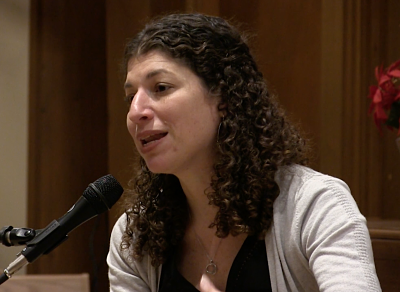
 We are proud to release our live interview held on February 6, 2018 at the Salt Lake City Community of Christ with Tova Mirvis—a past guest on Mormon Stories. For this interview, we relied on the excellent questions from our live audience to drive the conversation. We explore so many of the parallels between the faith transition experiences in Orthodox Judaism and Mormonism, and talk some more about her writing The Book of Separation and how it has touched many of our listeners since tuning into her Mormon Stories episode. While in Salt Lake City, Tova provided more context to her book when she appeared on KUER’s RadioWest that same day—an interview that may be found here.
Our earlier interview with Tova may be found here:
https://www.mormonstories.org/podcast/tova-mirvis/
Episode Transcript
Host: John Dehlin · Guest: Tova Mirvis
This transcript is machine-generated and lightly edited for readability. The audio is authoritative. Please excuse occasional errors in names and spelling.
Welcome and Introduction to the Event
Part 1 of 2 · Ep. 865
Tova Mirvis [00:00:00] Sam.
John Dehlin [00:00:30] Hello, everyone, and welcome to another edition of Mormon Stories podcast. As you know, I'm your host, John Dehlin. It's February 6, 2018. We are very excited to be recording this episode from Community of Christ Chapel in Holiday, Utah. We're very grateful to Community of Christ for hosting us.
John Dehlin [00:00:52] This is the second week in a row where they've hosted us for a live event. Last week, we had the wonderful Carolyn Pearson here talking about her wonderful book, the Ghost of Eternal Polygamy. Hope you enjoyed that episode. If you haven't listened to it, check it out. That's a super powerful book, and I'm so sick of reading Mormon books, but I loved her book, and so I made an exception to read it, and I was really floored by how amazing it was. So check that book out.
John Dehlin [00:01:19] But today, we are not here to talk about Carolyn Pearson. We are here to celebrate the beginning of what I hope is a series on Mormon Stories podcast. We, as many of you know, a little while back, we were so honored to have the great Tova Mirvis. Mirvis. I'm told it's Mervis. It rhymes with nervous.
Guest [00:01:43] Exactly.
John Dehlin [00:01:46] So Tova Mervis is joining us. For those of you who don't know, she is the author of this wonderful book, the Book of Separation, a memoir.
Guest 2 [00:01:57] She
John Dehlin [00:02:00] was raised Orthodox Jewish, and that is an intense upbringing religiously. A lot of us think that we have this, you know, only. Only lower than Scientologist sort of level of intensity of a LDS upbringing and the trauma for some from that experience. But what we are so thrilled and somewhat alleviated to learn is that some people sometimes have it worse than we do. And that's why we brought you here, to make ourselves feel better. So thank you so much.
Tova Mirvis [00:02:33] I am so glad to play that role for you.
John Dehlin [00:02:36] Gives meaning and purpose to your suffering. Right? Exactly. But Tova, this is her fourth book. She's written three other books from national, obviously international presses. But this book is her memoir, and it's such a gripping and compelling read that chronicles her life as an Orthodox Jew and then her time sort of reconsidering her faith, questioning and challenging her faith, and then deciding that she could no longer remain Orthodox, and then what that meant for her and what that meant for her first marriage and what that means to her now. And most of you have already listened to the episode, so tonight, the goal wasn't to necessarily retell the story that we already told on the podcast.
John Dehlin [00:03:29] So for those of you who have not listened to that episode, we're gonna leave the book and that episode to be sort of the meat of your experience. And we're gonna encourage you here or those who are listening to asynchronously, we're going to encourage you to go back and listen to that episode tonight. We won't be seeking to retell that story tonight. The purpose is for you to meet the author and hopefully to have your own questions. But we really want this to be a dialogue between you guys and us.
John Dehlin [00:03:59] We've had a lovely day today in Salt Lake City. Do you want to tell us a little bit about your experience today and any reflections you have of kind of learning a little bit more about Salt Lake City and Mormonism? Tova.
Guest [00:04:11] Right.
Tova Mirvis [00:04:11] Well, I've only been to Salt Lake City once before, and it was just to land here and then drive to Canyonlands National Park. So I've had no experience before of Salt Lake City. And, you know, I think for me, it's been really fascinating to see, to really enter and be able to visit another religious world and to learn about it and to talk to so many people both within the world and outside of the world. And so it's just been. I mean, it's been an amazing day in so many ways.
John Dehlin [00:04:34] Took her to Temple Square. The missionaries hit her up really hard.
Tova Mirvis [00:04:39] It was a Jew in the midst. It was sort of a good way
John Dehlin [00:04:41] to, you know, they were telling her all about the Old Testament and what pro. What. What it meant to have. Have a prophet and what it meant to believe in prophets.
Guest 3 [00:04:49] Right.
John Dehlin [00:04:50] You were very kind and generous, and it was a fun time. So we've had a great day. And. And so. All right, so. So for today's evening, we're going to have a bit of a discussion, and we're just going to ask you guys to kind of line up and. And begin asking your questions. And what we'll try and do is keep the conversation rolling. But what we hope the meat of today's conversation is going to be from questions generated from you guys. All right. Is that okay? Because most of you already listened to me ask her three or four hours worth of questions. So if you want to go ahead and begin listening, lining up for your questions, but I'll begin. And maybe Tova, what I think I want to first do is actually officially welcome you to this evening. And let's give Tova a round of applause for joining us. Thank you.
Audience Gathers to Meet Tova Mirvis
Tova Mirvis [00:05:40] Thank you all for coming.
Guest [00:05:42] Thank you.
John Dehlin [00:05:50] How many of you caught her on Radio west this morning? Did anyone check that out? We were super glad that Radio west was willing so without any further ado, this is author meets reader. So if you'll just come up to the microphone and ask your question, we will do our best to moderate a fun conversation.
Guest 4 [00:06:07] Awesome, Dova. Thank you so much. My name is Tyler. I listened to the podcast as I was beginning my faith transition, and I listened to your book immediately. You read it to me, and it was awesome. And part of why it meant so much to me is because it helped me see my bubble. I didn't recognize it, but recognizing your bubble, and as already mentioned, it's a big deal. And so now that I'm transitioned out, what I'm struggling with that maybe you can help me. And you mentioned in your book you have a place for. For the people who still recognize and follow the faith. And I'm having a hard time with that and I'm struggling to. I'm in a mixed faith marriage now and trying to make it work. And so I'm wondering, did you have anger? And how did you resolve that?
John Dehlin [00:07:11] You get to play psychologist.
Tova Mirvis [00:07:12] Sure.
John Dehlin [00:07:14] Thank you.
Tova Mirvis [00:07:15] You know, I think there's that question of anger and how you relate to the world you've left. I think the experience of leaving, I mean, it's not just something, you know, certainly for my world, and it sounds like for your world as well. It's not like something that you do on a weekend, something you kind of do occasionally. It's the everything. It was all of who I was. Probably. If you had asked me seven years ago to say one thing about yourself, I would have said, I'm an Orthodox Jew. It's the center. And so to leave is to rip out that center and requires you to recreate it in some ways or to ask what you have become instead.
Tova Mirvis [00:07:46] And I think what's so complicated is trying to navigate how do you relate to the world you left? You know, I'm still deeply connected. My entire family is part of the Orthodox Jewish community. Some of my friends, some of my friends don't speak to me anymore. So it makes it easy. I don't have to worry about how to navigate with them because they've made it very clear how they want to do that. But that question of how do you relate to something that no longer feels like the truth? And that experience of leaving is so searing, it's not an easy departure. It's the sense that I was raised to believe something I thought was the sole truth.
Tova Mirvis [00:08:21] I thought everyone else, you know, all of you, of course, were wrong and that I held the truth, the only truth, and to have that shift is so life changing and so painful and, you know, so many things I could say about that. But, you know, with your question of how do you relate to people who are still within it, you know, there are things that are very triggering. We were joking about some things I'm allergic to. I'm allergic to certain parts, but not to the people. Not to the people I love. My parents, my grandfather, my siblings, one of my children. And so I think what becomes so hard is how do I hold on to my own sense of I'm allowed to believe what I do believe.
Tova Mirvis [00:09:00] I cannot force myself to say something I don't believe to be true and yet make space for these people who hold it as the truth, even when some of them cannot make full space for me. And so I think I try to err on the side of being accommodating. And it's an imperfect situation because it's not always met in return, because there's always the assumption the one who is not religious can bend, and yet someone who's religious should not be asked to bend. It's hard to sort of say, no, it's the same in both directions. But I try and it's imperfect. You know, an example, my orthodox world is very much based on practice and observance.
Tova Mirvis [00:09:39] And so it's not even so much a question of belief. But if my kitchen is not kept to a certain standard of kosher, people I love won't eat at my house. And so I've chosen to keep my kitchen very strictly kosher, for example. And there are moments I feel like, oh, look at the irony. I've left this world and now I'm the kosher police officer in the kitchen, taking bowls out of people's hands and chastising people like, oh, I'm sorry, you can't mix that together.
Guest 5 [00:10:05] But.
Tova Mirvis [00:10:05] But I'm doing it not out of belief, but out of love for the people I want to be connected to. But it is, I think, one of the hardest struggles of how to hold on to your own right, to believe something and still find that way across to people who believe differently.
Finding Identity in a Middle Space
Guest 5 [00:10:25] Hi. I think of myself as in the middle space. So perhaps where you were when you published some of your first books, where you're still navigating, staying within, but with questions and a nuanced view of the world. So my question is about your place as a writer before this book came out, before the Book of Separation, before you formally left in the Mormon world. I'm a writer. I write about Mormonism for a National audience also, but within the Mormon world, there's a very strong publishing group of certain publishers that publish only books for Mormon people. And it feels as if these books are stamped with approval.
Guest 5 [00:11:24] You go to certain bookstores and. And those bookstores only have these specific books which are free of bad language and other material that Mormons might consider wrong to read. So when I started publishing about Mormonism for a national press, a lot of people within Mormonism would ask me, like, why would you want to publish about Mormonism with a national press rather than with our safe Mormon publications? And also people. People seem to wonder why I don't necessarily want my books to be in those bookstores where they're easily accessible. So can you talk about what it. What is there a publishing world that's similar in Orthodox Judaism and what is it like?
Guest 5 [00:12:08] And how did you navigate that space yourself as an author who was publishing for a national market but still writing about Judaism? Because I've read your other books I loved, especially the outside world.
Tova Mirvis [00:12:21] Yeah, there are presses like that within the Jewish world. There are Orthodox Jewish presses that gear their books towards a Jewish audience. And everything has to fit in. It has to sort of affirm that worldview, and everything has to sort of be kosher, you know, meet the sort of standards for a certain audience. And even when I first started writing, you know, I wrote. My first novel was the Ladies Auxiliary, which was about the Orthodox Jewish community in Memphis, where I grew up. And I always knew that I didn't want to. I didn't feel like I was writing religious fiction. I didn't feel like I was writing fiction that was going to somehow make everyone be okay in the end, where the goal was going to be to show, like, look how wonderful a religious community is.
Tova Mirvis [00:13:00] I wanted freedom. I felt like so much of being a novelist is seeking out a sense of freedom to tell any story and also feeling that, you know, sure, I was writing about a very particular small world, but I was felt fairly certain that the issues that are at play in one religious world are at play in other religious worlds as well. And so I didn't think that I was writing only for this sort of the Orthodox Jewish audience. And it was interesting. I mean, Ladies Auxiliary was read both within the Jewish world and outside the Jewish world. And, you know, at every book event I would do, there would always be someone who would raise their hand and say, are you still Orthodox?
Tova Mirvis [00:13:34] And I was always like, why would they ask that of me? That's so strange. Like, of course I'm still Orthodox. And I would give an answer at the time, I would say, you know, I'm a liberal, feminist, pluralist, Orthodox Jew, whatever that means.
Tova Mirvis [00:13:45] I had to play it. I had to play it for the laugh because I did not know myself exactly what that meant, But I felt like writing. For me, writing is so much about being willing to say what people don't always want to hear, to go beyond the sort of official versions that communities present, or certainly religious communities, beyond what we're saying, supposed to think beyond what people say they experience, and really go inside people's heads of what do our lives really look like? Everyone's lives, no matter what your religious affiliation is, what you believe has those messy spaces inside, those complicated questions and those experiences that don't match the official, idealized version.
Tova Mirvis [00:14:25] And so I always wanted to feel that, at least in my writing, I wanted that sense of freedom. I didn't feel it in my own life at that time, but I felt like on the page I wanted that full freedom. And so, sure, there are certain bookstores, maybe that wouldn't carry my books or I was regarded in Orthodox Jewish Memphis. I will always be known as the one who wrote that book about the Ladies Auxiliary. And that sense of. I don't know about her. She's a little iffy. And definitely got different articles written about me within the Jewish media, but also outside of it, determining is this positive or negative?
Tova Mirvis [00:14:59] Is this good or bad for us? And I just felt like that's not how you judge real writing. Is it furthering the goal of a community? Is it furthering some story? I feel like I want to tell an honest story, and the honesty is never about furthering an agenda or not.
John Dehlin [00:15:14] Sure.
Guest 5 [00:15:17] Thank you for writing this book. I admire your incredible bravery and just the way that you've been able to put into words, really such a universal experience, I think, among so many religious people. So thank you. One of my favorite sections of the book are where you talk about as a younger child, kind of butting up against these gendered notions of what it was to be a woman and trying to find explanations. The story or the explanation for why it was okay for David to take Bathsheba as a wife was that whole story was so good and reminded me so much of the explanations I got about why it was okay for Joseph Smith to marry other men's wives and then send them on missions. And, I mean, there just were so many similarities.
Tova Mirvis [00:16:01] So.
Guest 5 [00:16:03] But my question for you is, now, how do you have conversations about sexism and feminism with the people that you love in your lives that don't see sexism and think feminism is a bad word.
Tova Mirvis [00:16:18] When I would say I was a liberal feminist, pluralist Orthodox Jew, I meant it also. I would have considered myself a feminist. And I was.
Feminist Awakening Within Orthodox Judaism
John Dehlin [00:16:25] Can you talk a tiny bit about the 70s and the kind of feminist awakening in Orthodox Judaism that you became a part of?
Tova Mirvis [00:16:32] Sure. For a long time, I think there was sort of very gendered notions within the Orthodox world about men's roles in women's roles. Men could be rabbis, women were not allowed to have a fitness official public roles. And certainly within the larger, you know, the Jewish world spans many denominations. The conservative world and Reform world were very different in these issues. But for me, in the Orthodox world, there was a sense that this is just how it is. And growing up in. In the 70s and, you know, 80s in Memphis, there was this small Orthodox Jewish high school and elementary school. There would be things that would bother me, you know, things I would think, why, why do we say a blessing?
Tova Mirvis [00:17:09] You know, thanking God for making us according to his will, while the boys, of course, would have to scream it out in our faces. Thank you, God, for not making us a woman. And that that childhood feeling of this is unfair or this is wrong. I remember feeling that. And there are, of course, apologetics offered for why this is the case or why you're not supposed to be bothered by it. It was sort of, you feel upset, but really you shouldn't feel upset, and here is why you should not feel upset. And I remember wanting to believe those reasons very much, wanting to tell myself, right, no, that's true, that fixes it.
Tova Mirvis [00:17:40] And then that little voice that says, no, it doesn't. And like, no, I want it to. I don't want to feel this sense that the way girls and women are treated is of course unequal, it's not there. And that the explanations for why it's unequal do not satisfy the question. And those questions grew for me as I became a teenager and was very aware of the way a girl's experience in this world was different than a boy's experience. For us, I think dress code was the central. If you had asked me, what is God and religion about, I would have said, it's about my skirt length.
Tova Mirvis [00:18:12] There's some be all and end all was, did my skirt go to here or to here and could I pull my skirt down quickly enough when a rabbi came into the room so I didn't get in trouble? And everything was about body and whether you match these notions or not? And Then I think even within the Orthodox form world in the early 90s, there was a sense of a feminist movement within the Orthodox world. There's a woman named Blue Greenberg, who I was telling John today, I actually, by really by happens, that happened to be her personal assistant one summer. And she was really credited with sparking an orthodox feminist conversation about could religion change?
Tova Mirvis [00:18:47] Was there space within even a traditional fundamentalist religion to make more role, to change the role of women in the community? And so she really did put that conversation on the table in so many ways.
John Dehlin [00:18:59] What was the book called?
Tova Mirvis [00:19:00] Her books. I mean, she wrote how to Run, she read, she wrote what is it called? Women and Women and Judaism. I think she also wrote a book called how to Run a Traditional Jewish Household, which was not her feminist book, but although it was probably more feminist than the title sounds. But she was really, you know, a groundbreaker in this world and continues to be in this world and is someone who I've admired so much for her willingness to say, I'm remaining part of this world, but I want to change it from within. And so I think there is a conversation even in an Orthodox community about the role of feminism.
Tova Mirvis [00:19:33] It's considered left wing Orthodoxy or liberal Orthodoxy or open Orthodoxy. All these sort of adjectives to sort of explain liberal orthodoxy exactly right. My husband gives me a hard time. He's like, liberal orthodox, is that like liberal fascism? You know, what is that like exactly? But this sense of how many adjectives can you use to qualify it? But the idea that you can hold onto a fundamentalist religious belief and still become part of a modern world and still have religion change in some ways. And so that is the conversation in the liberal Orthodox world about the role of women, the treatment of gay people in the community, about issues of openness.
Tova Mirvis [00:20:11] Just all sorts of issues are on the table in the Orthodox world. In a way, they probably were not 15 or 20 years ago in that sense. But the conversation about gender is a hard one because I think what's so hard about it is I used to feel that I had to find a way not to let it bother me. I had to find a way to somehow metabolize what I was being told and tell myself it's really okay because it felt incompatible. But that feeling of incompatibility is a very uncomfortable place, place to be to feel. I live one way and I sort of believe in it, or I'm supposed to believe in it, but I also know a part of me does not.
Tova Mirvis [00:20:48] And that sense of cognitive dissonance or the feeling of your own self is at war with itself was so much of my experience, particularly around gender. And now I don't have that experience. For me, by leaving that world, I no longer have that sort of contortionist feeling of how to make it feel okay. And it is a hard conversation to have sometimes with people who even people who believe in orthodox feminism, but feel there's a certain line past which you cannot go.
John Dehlin [00:21:17] Sounds familiar. Thank you.
Guest 6 [00:21:24] Well, thank you for coming tonight. We're really grateful to have you here. And I just wanted to ask. It's a tricky question. My background is my father is a reformed Jew and my mother is Mormon and she raised me. So I served an LDS mission, got married in the LDS temple. But my Jewish heritage has always been really important to me. I even taught myself some very basic Hebrew when I was a teenager. And when I was doing my Hebrew studies, I came across the phrase tikkun alam, willing enough to heal the world. Kind of the calling, I think it's from the Kabbalah or medieval Jewish mysticism, kind of the calling of the Jew to fix whatever's wrong in the world, to prepare the world for the coming of the Messiah.
Shared Values Across Religious Traditions
Guest 6 [00:22:08] And that falls in line really closely with a lot of kind of the Mormon ethos too. You know, the Mormons see it as their duty to prepare the world for the second Coming, right? Prepare for the thousand year reign of peace and everything like that. When I also lost my faith, that was really hard for me to give up. I kind of saw myself as anything but a gentile, right? I was part of the covenant people on two sides. But when I lost that identity, I wondered, can I still take this with me in some way? Can I still feel that I am called to fix whatever's wrong and broken in the world, make this a better place, and can that carry the same strength, the same sort of visceral spiritual quality that it once did for me? And I was wondering if you have any insight into that.
Tova Mirvis [00:22:56] The term tikkun olam is a Jewish term that means, as you said, repair of the world. And I think it has sort of Kabbalistic mystical origins, but it's used today most often as the sense of an imperative towards social justice, the idea that we have an obligation to repair the world. And I've actually never heard of what you described as in terms of preparation for any kind of messianic time period. I usually hear it, you know, ironically outside of the Orthodox community, but in other denominations in the Jewish world. The sense that there's ritual observance. You can pray, you can keep a kosher kitchen, all these sort of ritual observances.
Tova Mirvis [00:23:31] But the central feature of a religious personality or any of us can be to do good in the world, to help somebody, to feed somebody, to help the environment, to do things that actually do good in our world separate from any religious mandate. And, you know, when I think about leave taking, you know, I often think about the question of, you know, what do I want to hold on to? I feel like not every leave taking has to be complete or total. And there are parts of my world or my upbringing or culture that I still want to be my own. And the mandate for tikkun olam to repair the world is one that I hold on to.
Tova Mirvis [00:24:05] Whether I can claim it as a religious origin or anything mystical, but just as a way of being in the world, a way of living, that, that views my obligation not stemming from any divine command, if I could even make myself say that or believe that, but from a human command, from a human obligation to do something good for the people who are not in a spiritual realm somewhere else, but right here, right next to me. And I think that, for me, has been an important piece to hold onto and to see how it is used in the Jewish world and other worlds and to hold onto that piece of my Jewish identity as that and putting that in the center of it, really, in many ways.
Guest 2 [00:24:47] Okay, so I haven't. I haven't read your book yet, full disclosure, but I did buy a copy for my wife for Christmas. So I feel. I feel pretty great about that.
Tova Mirvis [00:24:56] You filled your obligation. You're good.
Guest 2 [00:25:00] So your. Your podcast that you did with John a while ago, it really had an impact on me. And that leads to my question. It got me thinking very deeply about time and the value of time, especially when you talked a lot about all of the religious practices and how much time and effort and how much stress and worry and concern went into that.
Navigating Time and Personal Transition
Guest 2 [00:25:26] I could identify with it personally. And then listening to your story, it was kind of just even more so. My question really is, as you went through a transition and you maybe spent less time on religious practice and started to evaluate, you know, what matters to me and what matters to my family and what matters to people that I love and what matters to, you know, what good can I do in the world? As you kind of went through that and maybe you spent less time on your religious practice and started to fill that time with other things, could you maybe just talk about that a little bit?
Guest 2 [00:26:05] A little bit. And maybe Give a couple of examples of what that was like and what kind of value, you know, how you, how you filled that time and whether you felt like it was more valuable or less valuable than maybe some of the things you were stressing about and spending most of your time on with your Orthodox religious practice. Does that make sense?
Tova Mirvis [00:26:25] Yeah, sure. So much of Orthodox Judaism is rule oriented, so it's not sort of theoretical beliefs or abstract ideals, but it's in the here and now. It's, you know, to keep a kosher kitchen means that you have two sets of dishes. You have dishes for meat and dishes for milk. Because you can't mix meat and milk according to the laws of kosher. It means you can't wash a meat dish with the milk sponge because that would be mixing it to observe the Sabbath. You know, I grew up hearing the Sabbath is such a wonderful day of rest. It's such an opportunity to just be with family.
Tova Mirvis [00:26:55] And once I was married and had children, I would think, yeah, but you know, Saturday might be nice. But by the time Saturday comes around, I'm so exhausted from the preparing for the Sabbath that I don't want to actually do the Sabbath. Or I would have people over for Friday night dinner and I would think, when will they go home? I'm too tired. I've cooked all day long in order to do this. And so it's a very time consuming religion. In terms of women's work, you know, so called women's work in terms of being in the kitchen or preparing for Passover. I used to find myself thinking, if we took all this manpower spent doing such thorough cleaning of every kitchen in every Orthodox home or every Jewish home to get rid of any drop of breadcrumbs where my mother would take a toothpick along the grooves of the table in case there was a breadcrumb there.
Tova Mirvis [00:27:38] I remember thinking, if I could take all this time and money and energy spent, it's like, I bet we could build so many homes for poor people. We could probably build villages, places. And, you know, that question, you know, for me it's not just a question of time spent, but values and what matters and where we put our energies. And to feel that so much of my time and emotional energy was expended in being this person.
Tova Mirvis [00:28:01] And so there is that question on the other side. And it's, I think, about time. It's also about meaning. I think, what do we do? When you are told for so many years, this is the thing that creates meaning and purpose. This defines you. This gives you community, when you leave that, it does leave a vacuum, an open space to say what fills it. And so in some ways, having three kids, I feel like, wow, I don't have that problem filling that time at all. It just filled itself right up. But I think it does leave open that existential time question of what matters to me in the world and who do I want to be in the world?
Tova Mirvis [00:28:34] And I also think when I was part of this world, I don't think I ever had to wrestle with the question of what did it mean to be a good person. I felt like if I followed these rules, I automatically was, I just checked off that box. And maybe what takes place on the other side is that need to ask the large questions that space to say, well, what do I actually believe in? What do I care about? Where do I want to spend my time?
Tova Mirvis [00:29:00] Because I'm in Utah, because I love Canyonlands and Zion National Park. I'll give you this answer here, but one of the things that's been most valuable to me is the idea that you can celebrate a holiday in more than one way. And for me, the probably most meaningful Jewish holidays I spent have been in Zion and Canyonlands. You know, before there were so called holidays where you could theoretically do whatever you wanted. But of course they were all mapped. We had to go to my in laws, we had to be in synagogue for six hours, we had to have these meals afterwards. There was, you know, no free time at any point because that was just what you did.
Tova Mirvis [00:29:32] And part of leaving is to be recognize that I get to choose how some of these things are going to look. It's not mapped. And so when I think about time in terms of holidays and what my year looks like, I decided that I did still want to observe Rosh Hashanah, the Jewish New Year. It still meant something to me. It didn't mean what it had once meant. But I decided that I was going to spend that time not in synagogue, staring out the window, wishing I could be anywhere else, but I was going to spend it outside. And so I think probably the most spiritual experience I've had in the past few years was hiking the Narrows in Zion.
Tova Mirvis [00:30:08] This sense that I could that, you know, I grew up feeling that religion had a lock on that feeling of wonder or majesty or mystery, that if I were going to feel any sense of awe, it only could take place in the confines of religion. And I think my experience at Zion and Canyonlands, at Arches, at all these places taught me that no religion owns that feeling. No religion owns the feeling of wonder. And I could choose to do that. And that freedom came by no longer observing and having the opportunity to choose how I was going to spend those open days and that time.
Guest [00:30:49] It's wonderful to meet you. Thank you for this book.
Tova Mirvis [00:30:52] Thank you.
Guest [00:30:52] It's been wonderful for me. When I left Mormonism, I lost my God and then I lost my love and respect and appreciation for religions in general. And I think that's true for a lot of people who have different faith crises.
Grief, Loss of Community, and Belief in God
Guest [00:31:09] I'd like to know a little bit more about your sense of loss or if you still have a belief in God. I feel like in Mormonism, we are taught to have a very personal relationship with our Heavenly Father.
Guest [00:31:25] And when the building in my mind started crumbling down about the whole church, God came with it for me. And that was really traumatic because I felt like he was really there. He was really my heavenly Father, and that he knew me and understood me. And so that was really hard. And then secondly, the religion part. I don't want anything in my life to be religious. I don't want my kids to be in a religion I don't want. And you talked about your.
Guest [00:31:57] The differentiation you've got with your three kids and how they're kind of going their own ways. But if you could talk about your respect or appreciation or belief in. In religions in general and with God as well. Sure.
John Dehlin [00:32:13] Pause one second.
Tova Mirvis [00:32:14] Sure.
John Dehlin [00:32:14] We had a request from the audience that those waiting in the queue come sit here in front of. Just so that people in the audience can see. I'm sorry it took me that long to see that. But Verleen comes down just like testimony meeting. It's the cue. Verleen, you're next. Any of you who want to ask questions, just come sit right in the front row and we'll have you come up. Thank you.
Tova Mirvis [00:32:33] Sure. And I think the way you describe it is so apt, that sense that everything comes crashing down when there is that loss of faith. Because faith does feel personal. You know, I think that you're taught. I was certainly taught to believe in the idea of a personal God. That and our God. I don't know, he was the nicest personal God. I sort of felt like this feeling of being watched. Like maybe a parent, but like a very strict parent who had lots of opinions about me. It was sort of this love, hate, parental relationship for me. My idea of what God was, it was always sort of like trying to, like, hope God didn't notice the skirt was a little too short.
Tova Mirvis [00:33:06] Or was God you Know this. So there was that skirting, you know, literally skirting the God sort of feeling. But, you know, and then as I got older, I felt like Judaism had this sort of rationalist stance also where I could distance myself from the idea of a personal God. In some ways, it was almost embarrassing to talk about God. It was like, well, of course we all presume God exists, but in Judaism, we talked a lot about law and observance, observance of the religious law. And so to talk about my feelings about God, I feel it would have been a little like on the crunchy side in my world.
Tova Mirvis [00:33:37] And so I didn't really talk about it. I don't think I even felt it. It was much more about observance. Did I follow the rules? And the idea that God had created this religious structure of law and the rabbis amplified that structure and added to it, and that my job was to follow their structure. And somehow God was a part of the equation. But it wasn't always that personal. I think that God in my world was community, that sense that belonging to the community was the real God. And the loss came less from the feeling that I lost any sense of God as a real figure in my life, but the idea that I belonged to this community, and that was where God was part of my life, where I was part of a community that I was like and that I was connected to, who would be there for me, that sense that I was not at sea in some large, confusing world.
Tova Mirvis [00:34:31] But I always knew that, know, here, you know, right here, this is. This is who I am. And so on the other side of it, you know, it's. It's funny, I feel like in any kind of leave taking, there's that, that, that space of unbecoming. You know, very soon after I said I was no longer Orthodox, people said, okay, so you, are you a conservative Jew? Are you a reformed Jew? You know, if you uncheck one box, can you check the next box? I was like, no. Leaving doesn't look like that. Leaving is about being in the space, space between of uncertainty, of not knowing.
Tova Mirvis [00:35:01] It wasn't like I left because I knew I believed in something else. It was that I knew that the truth was I did not believe in the tenets of the world I lived in. But I didn't have a clear sense of what I believe in instead. And I wanted to sit for a long time in that sense of, I don't know, living with uncertainty and living with the idea that the hard questions didn't have to be answered for so long. I was always told that there's an answer for every question. You just haven't looked hard enough if you don't know them. So the biggest questions, you know, evil in the world, well, there's an answer for that, you know, you just haven't, you know, haven't found them.
Tova Mirvis [00:35:35] Or someone said to me, the rabbis have already answered all the hard questions, you should not be asking them. And I was like, oh, it's so simple if I just knew those answers. And so for me, leave taking has been about being willing to sit with a question mark in terms of belief in God. You know, I don't consider myself religious. I cannot muster any sense of belief in God. It feels hard for me to say it sometimes. Even still, it feels hard to kind of to sit with that fully.
Tova Mirvis [00:36:03] Certainly not a God that is involved in commands, in choosing one group of people over another in answering prayers, that even when we most wish they would, God would answer those prayers. I don't really believe in that. And so the question becomes, what role does religion still play? Because I do still feel very connected to a Jewish world and still feel very connected. And, you know, one of the conversations John and I have had today is, you know, is there such thing as sort of, you know, the way in the Jewish world you can be a secular Jew or a cultural Jew and still feel very connected?
Tova Mirvis [00:36:36] Is there space, you know, I'm curious if in your world, do you feel there's a space to do that as well? And so, you know, for many people in the Jewish world, they would say, you know, I don't believe in God, but I'm deeply Jewish. I connect to Jewish history, to Jewish culture. I can celebrate the holidays as a cultural expression. I enjoy many of the holidays with my family. I don't enjoy them with the same set of rules I once had. I don't worry about whether every single thing I've done has adhered to dozens and dozens of rules. But I can enjoy the sense that I'm connecting to something that's important to my family and where I come from.
Tova Mirvis [00:37:09] I know, well, that feeling you describe, you know, I joke about it as I'm allergic to it. This feeling of there are times when being around certain religious ideas or practices are very hard for me to do. And one of my sons is Orthodox. My parents, my sister, my brother, all are. And so I try to. When I feel that rise of allergy, that feeling that I'm going to break out in hives, I try to sit with it. I try to Sort of like minister to my own need to say, like, to myself, I am not this. I don't believe in this. I don't want to hear, we're going to pray for that person who's sick, and they're going to get better.
Tova Mirvis [00:37:43] To me, you know, does a disservice to that person to. To presume easy answers and so try to honor my own need to disconnect from it and. And be able to participate where I want to. But I think what you describe is very true for many people, that sense that it's hard when you've left something. It's hard to engage in any piece of it when you see the pain it causes and the damage it can cause people.
Guest 5 [00:38:13] You have answered a lot of my question.
Tova Mirvis [00:38:17] I am married to a believing Mormon,
Guest 5 [00:38:19] and I do credit John with us still being together. Thank you, John.
Tova Mirvis [00:38:24] He may not thank you, but I do. The harder relationship is the one with my son.
Guest 5 [00:38:32] And you've mentioned your Orthodox child. My son, after having maybe wandered in
Tova Mirvis [00:38:40] the desert a little bit, is now
Guest 5 [00:38:41] waiting his mission call.
Tova Mirvis [00:38:43] And that's very difficult for me.
Guest 5 [00:38:45] And I'm wondering how you manage to
Tova Mirvis [00:38:49] be authentic in your disbelief and yet
Guest 5 [00:38:53] still mother this child, this very intimate
Tova Mirvis [00:38:56] relationship that's very difficult to navigate. How do you manage that? And if that's too personal, you can just call me later. I'll text you. Right. It's funny, right? When my memoir first came out, I did a reading and someone said, can I ask you a personal question? And I said, I've written a memoir. Like, it's okay, but it is a hard relationship. It's that question of how. It's the hardest parenting question of all, of how do I be myself, my true, authentic self, as you say, and allow my child space to be themselves.
Tova Mirvis [00:39:29] When I had small children, I really thought the hardest part was then, when they were three of them, running circles around me. That was so easy compared to now, having teenagers and a son who's almost 19, where the hardest part is really letting go, accepting the fact that I birthed a child who is an independent being with his own ideas and own thoughts and will make his own choices. And I can have input, I can talk about what I feel, but I don't choose it anymore, anymore. As if I ever did. I don't get to control it. And so navigating that relationship for me with my oldest son, you know, my son is spending a year in a yeshiva in an Orthodox learning institution in Israel.
Tova Mirvis [00:40:08] This year, he's doing a gap year I know Orthodox. Orthodox Jews, we don't do mission. We do yeshiva. A year's gap year in Israel before going to secular college. And so he is doing that this year. And I actually just got back a few weeks ago from visiting him there. And, you know, I asked myself the question over and over again, you know, exactly how do I be authentic? I don't want to. You know, he. First of all, when you write a memoir, there's no doubt about what you believe. Like, he knows. He knows what I think about it, and I want to. And yet I still want to be his mother.
Tova Mirvis [00:40:36] I want to support him in the choices he's making. And I think the way I do it is by to trying. Trying to always be willing to have the honest, hard conversations to say, you know, to sort of be able to disconnect from my own critique of that world and hear his experience. Sometimes it means putting aside the part of me that wants to be like, let me disassemble that argument in five minutes, you know, putting aside that part of myself to hear for him what is moving, invaluable and important and to support that in the same way that I would want someone to do that for me on the other, in the other direction, the same way it comes easier to maybe do it for a child who matches your opinions.
Tova Mirvis [00:41:15] And so to be able to respect what for him, matters in the world. And then I feel that I don't ever want for him to ask me to suspend critical thinking. And I want him to know you still can ask critical questions about the world you're part of. And so we've had a fascinating email exchange these past few days, actually, about belief and about the question of can you prove belief and about the idea of a leap of faith. And it's, you know, it's really. It's Maybe email is a good way to do it because it lets each of us sort of formulate our opinions.
Tova Mirvis [00:41:45] And I can say, you know, I can be sure to say I respect the fact that for many people, they believe in this, that they choose a leap of faith into belief, and they live. Can live meaningful lives. I respect that, that someone else can make that choice. And then I. And then I sort of add the next piece where I say, like, what is complicated for me is this. And so I try to be both honest and gentle and to walk that complicated dance. And my middle son is not interested in religion. You know, he said to me recently, I think it's so much more likely we're just a product of another Civilization simulation than we are, than a God exists.
Tova Mirvis [00:42:23] And so, you know, it's like sometimes I feel like, okay, I've got it on both sides. And you know, my middle son is deeply skeptical of religion in any way. And you know, in some ways it's the same set of questions. I don't want to be like, yeah, go after you get, go get him, you know, you know, like to tear it apart either. I want to, I want to listen to what he has to say and to hear it and maybe offer some of my own thoughts. But to, you know, so much of parenting is not just telling a kid what he's supposed to think or what I think, but teaching him how to think for himself.
Tova Mirvis [00:42:51] You know, I feel like asking questions in some ways is the best way to have a conversation. To say, you know, on both sides and all sides, you know, what does that mean to you? Or what do you make of that? What do you think about that? You know, rabbinic teaching or what do you think about the thing that your teacher said that you find a little questionable and you know, to learn through an asking of questions. But it is, you know, it is one of the hard parts of leaving that there's not this sort of sense everyone matches as if it's maybe never true anyway.
Tova Mirvis [00:43:19] But you, you have to have hard conversations with your children all of a sudden. And in some ways they're the most rewarding conversations. You know, this email exchange with my son has been so meaningful to me to have a serious conversation with an 18 year old, to really engage in these deep questions and that he wants to have that conversation with me and that I really want to have it with him and to know also there are times, it's exhausting. There are times navigating our extended family and we had a Thanksgiving, you know, recently where we have had my ultra Orthodox brother, my parents who are modern Orthodox, my sister.
Tova Mirvis [00:43:54] I got remarried a few years ago. My husband is. He describes himself as Jewish and he is secular and very, you know, I used to say he's not religious, but the truth is he's deeply anti religious would be really the only honest way to say it. And he has three kids who are secular Jews. They. One, my stepson has a non Jewish girlfriend who's Russian. Just this range, I feel like here is the American Jewish experience around my table. And there are moments that felt wonderful that we could all come together. There were moments I wanted to go upstairs and lie down and just take a little break from what's hard about it.
John Dehlin [00:44:32] Jana, after Jane, I'm gonna answer some of the questions you guys have texted, so you guys get a break for coming up to the microphone.
Guest 3 [00:44:42] This is like testimony meeting. It's scary. Like, your heart is racing. I just want to say thank you for coming to our beautiful state. I loved the podcast you did with John, and your work is beautiful. I love your voice. I love to listen to you, and I put you and sweet Margi Dehlin on the same. I just. I love your ideas and I love your brain. So welcome and thank you for taking time and space for coming. Thank you. Thank you so much.
Guest 6 [00:45:10] Thank you.
Guest 3 [00:45:13] So a couple of teasers for those of you have not listened to the podcast. Three things. I had to write him down because I'm like, I'm gonna get up here and forget. So for me, the key to get into the hotel room was very. I was like, oh, my gosh. And then the other one was the tearing. How to use the restroom without toilet paper, you can't tear.
Guest [00:45:35] Like, that was.
Tova Mirvis [00:45:36] I'm like, oh, okay.
Guest 3 [00:45:39] And then the sushi on the floor in the bathroom, I was like, oh, my gosh. That's like coffee. It's the same thing. So there were so many similarities the whole way through. I just kept thinking, there's other people out there. It's so normalized, if you could say that. My experience with leaving Mormonism and I think many of our experiences is like, oh, my gosh. There's other people in the world having similar experiences with their religion.
Guest 3 [00:46:11] So thank you for speaking about it and writing about it. I really appreciate that. The one thing that just came up for me is a little question is guilt. Do you ever feel guilty with how you used to live, how you live now? How does that come up for you, and what do you do with it? Because even, like, singing the song in the beginning, when you said, like, tearing your heart out, I was like, I'm gonna cry right now because it just hits so home. So many things that you say hit so home for me, and I relate to that. And the things with your children, holidays. How do we celebrate? How does that look like? Because it's all different now. Thank you.
Guilt, Sabbath Observance, and Orthodox Practice
Tova Mirvis [00:46:51] Thank you. I should say, about the question of guilt. I assume everyone here has heard the phrase Jewish guilt. So, yes, I think that, you know, when you. When you change the story of how it's supposed to look, when you veer from the path, that sense of guilt is enormous. That feeling of sort of that internal, castigating voice, you know, the meanest version of myself who Lives inside my head who you know, will say, other people were fine with it. Why couldn't you just stay within it? Why did you have to think about it so much? You know, maybe, you know, other people think it's beautiful. What, you know, that question you hear both from externally and internally. I think we internalize a lot of
John Dehlin [00:47:27] heads nodding right now.
Tova Mirvis [00:47:28] You too, right? That sense of why couldn't you just stay inside? Or why don't you find it beautiful? Or everyone, you know, you're giving up on a tradition, you're stepping away. All those voices are tremendously painful. And you don't leave those voices behind. Just when you leave, they come with you. You can take some of the nice things with you, but you certainly take those voices with you. And so that sense of carrying it, and I feel like it lessens, but. But it's certainly there. And there's certain things that kick it into high gear for me. The holidays are one of those things that, you know, that story I can tell myself, that everyone else, of course, is having a wonderful holiday with their family.
Tova Mirvis [00:48:09] They are gathered around their tables. They are all very happy. They experience belief and faith and wholeness, you know, and here I am in Zion national park, you know, that sense that, you know, if only. And it's a fantasy version because then I remind myself, but I was that and I didn't feel that way. That wasn't at all what it felt like. But it's very easy to idolize what used to be. And so I think part of the experience of leave taking is learning to live with that, to know that, yes, I did change. You know, when I was in the midst of leaving and getting divorced, you know, many things were said between my now ex husband and myself.
Tova Mirvis [00:48:43] But one of the things that really cut the deepest was he said, you know, he accused me and said, you know, you've changed. And I realized you're right, I have, I've changed. I can't deny that I'm not the 22 year old, young innocent girl who married her first boyfriend after 12 weeks of dating. I'm not her anymore. And we change in life and life changes us in ways we can't imagine. And sometimes we leave or make changes as a result of it. And I also think that, you know, the pain always stays a piece of the story. It doesn't take away from the sense of freedom or happiness or new possibility.
Tova Mirvis [00:49:20] But I do feel like I can make space for that pain, for the sense that there is a sense of rupture, that the Story is not continuous, that I don't match my family. You know, if you took a picture of us, I do feel like I'm the one who doesn't quite fit in. I do have that worry at extended family gatherings of, wait, who's talking to me? Again, I can't keep track of who talks to me, who doesn't talk to me, that sense of that. And so I think it's part of accepting your story, of knowing that this. That to choose, you know, a path that feels authentic sometimes comes at a price.
Tova Mirvis [00:49:52] But certainly for me, I'm guessing for many of you, the price is what I'm willing to pay. Because what I get on the other side of it is a sense that I am not afraid to speak with my own voice. I don't have to have that constant feeling of trying to find, force myself to think something I don't really think or trying to pretend. You know, for me, there was always this sense of, like, a secret second self who lived inside me. The person who would say, like, really? Or I don't think so, that would protest that that self had to live hidden. And I no longer have that experience of having to tuck away the part of me that wanted to somehow disagree or speak more honestly and more openly.
Tova Mirvis [00:50:35] Thank you. I could explain the card key and the toilet paper and the sushi. Also, I was going to say, do you want me to explain it? So where does one begin? I'll start with toilet paper. Okay. So there are many laws of the Sabbath. There's some that are more widely known, at least in my world, that were more widely known.
Tova Mirvis [00:50:55] Prohibitions against driving, against using electricity. So you couldn't turn a light on or off. We didn't use electronics of any kind. We didn't watch television. You couldn't cook anything on the Sabbath. But there were many, many more prohibitions, many of which we studied in high school. I was an expert on, you know, on my tests would be like, how do you make tea on the Sabbath? And I, you know, I would get an A because I was very good at, like, each of those details. But tearing, you know, ripping something was also seen as forbidden on the Sabbath.
Tova Mirvis [00:51:26] And so the question, of course, became, well, what do you do about toilet paper? Because you can't tear toilet paper. And this was, to me, growing up, this was normal. This was just part of what religious life talked about. And so you always had tissues. It was just like a given there were tissues. And the big problem would be, what if you had forgotten to tear toilet paper or to have tissues before the Sabbath, what would you do? And it was like a theological crisis. You know, what would happen in that situation?
Tova Mirvis [00:51:49] And it was always like, you know, before, like in the 20 minutes before, my mother would light the candles for the Sabbath and it would be a list of things to do. To unscrew the light bulb on the refrigerator to make sure that all the lights, the bedroom lights had to be off, the living room lights had to be on, and we had to tear the toilet paper.
Tova Mirvis [00:52:06] Okay, what was the other card key? So because this is also a Sabbath one, but because you can't use electronics, when hotels converted to electronic car keys, it became an issue of how do you get into your hotel room? And part of me now looks at it and thinks, was this really what I worried about? But if you believe this is the truth, like if you believe this is God's command and the rabbinic laws have the power of God, and you believe that by using electricity you are trespassing on these things, then it's serious business all of a sudden. And so it was always this question of what to do about it.
Tova Mirvis [00:52:44] And so sometimes you would let a child do it. I remember one time at a hotel, I was like, well, we'll just stay out of the room the whole day. We just won't go back into the hotel room until the Sabbath ends. Sometimes we would ask the person at the desk to do it, but you can't directly ask someone to do something for you on the Sabbath. So you can imagine we would say, so we need to get into our room and the key is electronic and we can't use electronics on the Sabbath. And you would get a blank look. And you were like, so, you know, sort of hinting, hoping, hoping that the person would say, do you want me to do it?
Tova Mirvis [00:53:21] And be like, oh, if you want to, you know, sure. This sense of needing someone to do it for you. But it was one of the problems of how to be strictly orthodox in the modern world with technology.
Tova Mirvis [00:53:33] And the third one was sushi. So with the laws of kosher, which is a very big part of Judaism, or certainly Orthodox Judaism, but very strict rules of what you could eat and couldn't eat. So there's no mixing of meat and milk. Certain foods, like shellfish and any kind of pig or pork product are always forbidden. And certain things are allowed only if they're made in a certain way or with rabbinic supervision. And so I would never eat in a non kosher restaurant, even though the food might technically have been kosher. I would never just walk into somewhere and order food unless it was a kosher restaurant.
Tova Mirvis [00:54:05] But as you went sort of more towards the liberal edge, someone might eat a plain salad in a restaurant that was sort of like, you know, it was like a misdemeanor transgression, I guess. But sushi was interesting because sushi wasn't cooked technically. I mean, the rice was cooked, but it was cooked in a rice cooker. So it was only used for rice, and rice was always kosher, and everything else was raw. So some people who were orthodox ate sushi out. And I always thought of it as the gateway drug. You start off with sushi, and where do you go from there?
Tova Mirvis [00:54:37] I did buy sushi at Whole Foods when I was. I was still orthodox, but I was on the fence. I was in that. It was sort of that secret stage where I was sort of quietly experimenting and, you know, I bought sushi at Whole Foods. I felt like I was buying drugs at Whole Foods. I made sure to, you know, I put it in the cart and put everything on top of it in case I ran into someone I knew. And I ate it in my car. I don't think I enjoyed one bit. I felt like I was trespassing on something wrong and sort of gobbled it down and then had to throw it away in a garbage.
Tova Mirvis [00:55:02] I couldn't throw it away in our own garbage. Can him. Because I didn't want my husband at the time to know I was doing that. And so, you know, you. I would like to think that I had some great, you know, delicious culinary first experience, but it was just sort of like I was like, oh, is that all it was?
Guest 6 [00:55:15] So.
Tova Mirvis [00:55:16] Yeah, yeah, yeah.
John Dehlin [00:55:19] All right. You guys have done great with questions. We've got like, 20, so thank you so much. Everyone who's asked questions and everyone who sent them in. We've got a ton of. So how do you dealt. One of the things that many liberal and post Mormons sort of struggle with is if they have family members who remain in the church, they're continually viewed as a disappointment, either by their spouse or their children who remain faithful. So one of our audience members asked, you know, how have you handled your children? Or specifically, how have your children handled you? And I'm going to add to that and basically say. Say, you know, has. Has, for example, your son. Have you ever felt like he kind of views you as a disappointment? And if so, what's that like? And how do you kind of cope with that?
Tova Mirvis [00:56:07] Right. You know, it's funny, I don't Feel it for my. My oldest son, who is Orthodox, I feel that he, you know, maybe because of. I raised him Orthodox, but I also raised him in a very, you know, certainly as he got older and as I was moving away in a pluralist environment, he went to a pluralist Jewish day school where he learned that we were Orthodox, but there were other ways to be that there was not only one way to be. And I feel like he took that message to heart, even though it wasn't part of the mainstream Orthodox community that we also belong to.
Tova Mirvis [00:56:34] And I feel like that's still so much a part of him. And so I have an enormous sense of respect for my oldest son, that he can be Orthodox, and yet I never really feel that from him. I really feel, if anything, I feel like when the book first came out and there were some, you know, Twitter haters out there, he was like, can I go argue with them? Can I take him on? I was like, do you really want to do this? You know, do you really want to, like, fight the fight? He's like, yes. I was like, okay, you know, you enjoy that.
Tova Mirvis [00:56:59] I do not enjoy that kind of thing. And so I think he really did feel a sense of wanting to be who he was and to yet respect the fact that I was going to be who I was. And so it's, you know, there's always the complication of navigating that or any teenage relationship, the idea of, you know, how do I know my parent? You know, I want to just know her as my mom. And yet somehow, you know, she has this whole other part of her life that maybe I don't want to know that much about. I don't. You know, my kids have not read my book, and they've chosen.
Tova Mirvis [00:57:27] My oldest son has chosen not to at this point. And I understand that. I think you don't necessarily want to read about, you know, your mom's first kiss sneaking out when she's 17 in a Jewish camp. It's not high on your list as an 18 year old to read about, but I do feel so my kids, you know, for my middle son, who. Who has felt his own estrangement from religion at a young age. I mean, he actually trespassed before I did. You know, there was one Yom Kippur, which is the Jewish day of atonement, when I was still married and we were part of an Orthodox world, when, you know, there is a day spent fasting and in prayer, but there's usually like an hour break where you get to go home and so we went home, we took a nap, and I woke up and I asked my oldest son, you know, where's.
Guest 3 [00:58:07] Where's.
Tova Mirvis [00:58:07] You know, where's. I'll use his real name, Daniel. Where, you know, where's Daniel? He's like, oh, he's downstairs watching tv, which is so forbidden. I was like, what? Like. And I knew I should have been appalled. I think a part of me was sort of impressed. I was like, wow, like, he is a rule breaker. And, you know, I had mixed feelings about it, but I was sort of shocked that he was not bothered by this, the sense of how taboo it was in our world. And so for him, you know, I think that the experience of my writing about this, I think of all that, you know, he likes to tease his siblings that he is the star of the book.
Tova Mirvis [00:58:40] He is the one who is most in the book, because a piece of the book was in the New York Times this September, which was a scene of me taking him for his slice of non kosher, or technically not kosher pizza, where he asked me if I had ever had non kosher pizza before. And at first I hemmed and hawed, and then I wanted to be authentic. I wanted to be able to be honest with him. And I said that, you know, I had. And he said he asked if I would take him for a slice of non kosher pizza. And I thought, oh, this is getting complicated.
Tova Mirvis [00:59:09] You know, I'm not sure. And ultimately, after much, much wrestling on my part, I decided that I would take him. But I told him that we could only get vegetarian pizza because in the Jewish world, vegetarian cheese pizza is sort of a misdemeanor. It's not a full felony. It's many people who keep kosher in some sense will eat cheese pizza other places. And so I took him and he accepted this rule. He was sort of willing, he was thrilled to be going at all. And he was sort of eyeing the pizza case, eyeing all the different toppings. And he said to me, you know, if one day when I'm older, I decide to eat pizza with meat on it, will you still love me?
Tova Mirvis [00:59:49] I feel like that's the question. I mean, that is the central question. If I am different than you are, if I don't have the same rules, if I choose something completely other, will you still love who I am? And it was the same question I was asking, I think of my own world and my own parents. And so for him, you know, because that was in the New York Times, you know, he heard a lot about it. And he was. He knew he was fine with me sending it there. And he was, I think, excited about having it there. And he said something to me that was so, so moving.
Tova Mirvis [01:00:15] He said, you know, mom, if you hadn't done this, if you hadn't left, then I would be the one who had to do it. And, you know, I feel like, who knows how any of our kids will end up religiously? Who knows what they'll choose? But I hope the message that they get is that they are allowed to choose, that they don't have to be one way in order to have that sense of love. And so I hope that giving them that space invites that kind of respect in return. And so, at least for my kids, I feel. I feel like there is that sense of comfort right now.
Telling Family You Are Leaving the Faith
Part 2 of 2 · Ep. 866
Tova Mirvis [00:00:00] Sa.
John Dehlin [00:00:32] One of our audience members writes, my parents would be heartbroken if they knew my beliefs have changed. I still love and respect them and can't stand the thought of hurting them. How do I be true to my new beliefs without hurting them?
Guest [00:00:47] Right.
Tova Mirvis [00:00:48] I know. I also, I feel I love my parents. I'm close to them. I don't want to disappoint them. I don't want to them to feel a sense of we wish she was different, we wish she lived something different. I think that is the hardest, probably the hardest part of parenting is letting go. Maybe the hardest part of becoming an adult is letting go as well. Of letting go of the idea that we can please our parents, that we can live to do what they want us to do. And it is the most painful part, this fear of, you know, as accepting as my parents have been and they have, you know, when your daughter who's about to turn 40, calls you and says, hi mom and dad, you know, I'm getting a divorce and also I'm not going to be orthodox anymore.
Tova Mirvis [00:01:27] That's not an easy conversation to have. But for all that, I know they have been willing to accept the change. Of course it hurts them. I know that and I think it's knowing that that is part of separating. I think about the title of my book, the Book of Separation. There's separation from religion and separation from marriage. I think it's also separation from who others imagine our lives to be and who we might imagine our own lives to be. And, and I think with parents, I think that one way I try to navigate it is to choose to be as respectful as I can where it doesn't take away from who I am.
Tova Mirvis [00:02:02] And so an example, my 10 year old daughter who has a very strong sense of fair pointed out when we go to, she calls them Nena and Gaga. So when we go to Nena and Gaga's house, we follow the rules exactly as they do them. She's like, but then when they come to our house, we also follow the rules exactly like they do it.
Tova Mirvis [00:02:21] She's like, it's not fair. And I'm like, you're right, technical point of view, you should say like at our house we do it our way. And I hear her point and I try to affirm that. I'm like, you know, technically you're right, you're right, it's not fair. But they're my parents and so I'm choosing a greater degree of respect. I'm choosing to be respectful of who they are and how they've lived their lives in order to lessen the sense of trespass or hurt for them.
Tova Mirvis [00:02:48] And there are things I won't, I can't bend on. I can't pretend to believe something I'm not going to do. I'm not going to give an answer to something or do something that I really can't do, but I can alter where I can. And so, for example, at our house on the Sabbath, my parents come. You know, I feel like you don't have to watch TV right now, guys. You could just turn it off or like we're going to have a traditional Sabbath meal or I'm not going to cook something on the Sabbath, I'm going to cook it all beforehand and I'm going to unscrew the light in the refrigerator and I'm going to do all those things.
Tova Mirvis [00:03:19] I'm going to make sure the bathroom lights are where they need to be out of a sense of love and choosing it. But. But I forever asked that question. I'm sure many people feel that sense, that sense that. I think what is the hardest part about leave taking is knowing that in becoming your true self, in being true to what you actually believe, there is pain caused for others. And sometimes I think there's no way around that fact, but it is, I think one of the painful aspects of the most painful maybe part of leaving.
Finding Belonging After Leaving Religion
John Dehlin [00:03:50] An audience member writes, although I still participate in some family religious events, I still feel like I am on the outside and have a hard time finding something to fill the hole since the church was such a major part in my life. Have you found any kind of community outside of religion to replace what you lost when you left your faith?
Tova Mirvis [00:04:08] I think the loss of community is the biggest one. That sense of a ready made community, a feeling that it wasn't like you had to where you were going to find friends. Like you would move to a place, you would join that synagogue and the friends would be ready made. I think one thing that I have, one community I do still have is the pluralist Jewish day school that my kids attended. So it's not within the Orthodox Jewish world. But I do still feel some sense of community comes from there. It's a looser community and it doesn't have that same ready made feeling. And you know, I do, I still struggle with that question of, you know, I think there's a loneliness in leaving or a sense of not knowing where exactly I belong.
Tova Mirvis [00:04:45] And I think that comes with time. It's sort of a slow recreation of it. I also, I think I was raised to think there's only one community that matters. That religious community is the only. Is really the real one. And anyone who is not part of that community doesn't sort of count as a friend in a real way. It doesn't feed into that sense of community. I think for me, some of this has been discovering you can create community for yourself, that no religion, no one has a lock on community, that it is harder. Sometimes it's not.
Tova Mirvis [00:05:13] But I feel like I've started to develop a community of writers. I think, you know, in all honesty, one of the experiences I've had since my book came out is it's not a community that's right there, but a community of people on Facebook or through emails who've written to me or I've written to a community of people who share this experience of leave taking. I think that leaving something is enormously lonely. And the reminder that there are other people who share this in alleviates that sense of being alone in the world because there are so many people who feel this way. And I also think some of it is having to rethink what I needed a community for.
Tova Mirvis [00:05:49] I think I had such a fear of not belonging to a set community, as if I would be untethered or lost or alone or I would find myself thinking, but if someone dies, what will happen? I won't have. Who will bring me a lasagna? What will I do without that? And I value that kind of community. But I also feel like it's okay.
John Dehlin [00:06:07] Vegetarian lasagna.
Tova Mirvis [00:06:09] Oh, it's so funny for me, I didn't know that lasagna came non vegetarian because you can't mix meat and milk. Lasagna is always vegetarian in my world. But that said that you don't have to have such a tight community. Either that I could also be independent or I don't have to. I can have friends or I can have multiple interests. Without that sense of an all encompassing community around me.
John Dehlin [00:06:32] This is a fun question. They're fascinated by the success of so many Jewish people in so many fields like science and the arts, given their small percentage of the world population. Do you have a theory as to why Jews are disproportionately successful in the world? And you may disagree with the premise, but that's the question.
Tova Mirvis [00:06:51] I don't know. I guess I. You can brag, well, here's why. I wish I had an answer for it, but I think there is a sense of a disproportionate visibility or success in different fields. You know, the answer I was always told was that because there's such an emphasis on education, I don't know. I don't think it's probably only true of my world. I think that the value of education goes to many different worlds.
John Dehlin [00:07:14] So some might say the adversity, you know.
Tova Mirvis [00:07:18] Right. I certainly grew up with, you know, the experience of having, you know, my grandparents were all American born, but I had friends whose grandparents were immigrants or great grandparents were immigrants in the sense of having to work hard to be accepted, the feeling that you had to work even harder to be accepted because of bias. And so that feeling of trying to make it in America, I think it's a very common immigrant story, that a first generation works very, very hard so that a second generation, a third generation can have subsequent success. So I think in some ways, the story of American Jews has been sort of a very classic American immigrant story as well, about succeeding and working hard to make it in America in so many ways.
Relationship With Parents Who Remained Orthodox
John Dehlin [00:08:01] Many want to know what your relationship is with your parents and how they've handled your transition, given that they remain Orthodox.
Tova Mirvis [00:08:09] My parents are fully Orthodox. I mean, they're modern Orthodox, and they are very much part of their community. I mean, growing up, we were always part of the community. My parents joked that they were insider outsiders, that they were sort of observant, but they were regarded as a little more liberal than the rest of the community. They were seen as critical of some of the community institutions. And when the Ladies Auxiliary, my first book came out and it was seen as critical, people would say, oh, I bet her mom wrote that book. Or, you know, people felt like somehow there was this sort of critical stance that my parents had had and that explained me as a product.
Tova Mirvis [00:08:41] And then, you know, I think it's like navigating an ongoing relationship with them. But I do, you know, when I first told my parents, after I sort of dropped that bombshell to them, you know, there was that moment's silence, that pause, sort of the taking it in and, you know, just sort of waiting to hear what they were going to say, that fear that there was they were going to either try to talk me out of it or going to be angry at me that I was going to sort of become a child again in some sense, you know, reprimanded for misbehaving. But they said, we will be here for you.
Tova Mirvis [00:09:09] And I felt like those were the most beautiful words a parent can offer a child. I will be here for you wherever this takes you. And so we navigate it. We just sort of My parents also have. My older brother is part of an ultra orthodox community, so very, very strictly observant, where his kids are not really given secular education or exposed to secular studies in any way. And so there's sometimes a sense of whiplash. Or my middle son, who everything is a sports reference, jokingly said, I guess your parents feel like they're one for three, because my sister is the only one who's like them.
Tova Mirvis [00:09:42] And my father said, no, we're three for three in this sense, this sense that they could accept difference, could be willing to hear that we are different. Which doesn't say that it's always perfect or always easy. I mean, there are moments my mother will say, oh, did you want to try to observe this? And I'm like, mom? And she's like, oh, no, never mind, we're not going to go there. You know, there's moments when it becomes complicated or moments when I'm aware of this is harder than it used to be, or this is more complicated. But there's no other choice really, I guess, than to navigate those complications.
What Tova Misses About Orthodoxy
John Dehlin [00:10:18] Many want to know what you miss about orthodoxy, if anything.
Tova Mirvis [00:10:25] I do, I miss, I do miss things. I miss that feeling of ready made community, that feeling of, especially around the Sabbath, that you have people over for Friday dinner and you go there and everyone sort of does the same thing on this, on the Sabbath, you know, when I miss it, I remind myself that I would also want to jump out the window sometimes on those days as well. And so I tried to idealize. But I miss, I miss, you know, it's. I don't know that I felt it for many, many years, but I missed the feeling that there were answers.
Tova Mirvis [00:10:55] That the world did not feel enormously complicated and that things that were so painful and hard did not have answers that anyone could supply to me. I missed that sense that someone could say, no, no, you don't have to worry about that. Or I missed the feeling that if I prayed for someone I loved not to be sick, that I could somehow have an impact on that, you know, that sense of I don't. I wish, I wish it were true. I wish I could affect the world by that. I don't think it's true. And that, I think, has a loss sometimes, that sense of not, not feeling that I can control or have an impact on things that will happen to all of us.
Tova Mirvis [00:11:35] And so I think those sort of things I do miss, they come with complications. Of course, to feel that you can control something when really you can't is not Necessarily a gift, but I miss at least the. The presumption of that. Sometimes
Finding Peace and Evolving Spiritual Beliefs
John Dehlin [00:11:51] someone wants to know if. If you feel like you're at peace now, and if so, what brings you peace.
Tova Mirvis [00:11:59] I feel more at peace, I would say. I feel more, you know, maybe we're always moving towards a greater sense of things as opposed to any set arrival. I feel more at peace with. With mostly that feeling of not pretending, with not having to do that internal self censoring that I was so good at automatically doing, of thinking, well, don't say it like that, because that sounds like you don't think it. So reshift it. And I feel more at peace as a writer in being able to say what I really think. That freedom that comes from not having to put forth something that I don't really think, or not having to try to fit into a community, not having to worry about, oh, no, will I be seen here on a Friday night, or I was seen in this restaurant, oh, no, what will they say?
Tova Mirvis [00:12:42] The letting go of that feels like a relief because they can read, you know, you no longer have to worry about being seen driving on the Sabbath. When you've written an article in the New York Times about driving on the Sabbath, it just takes away the fear. It's outing yourself in the most public way possible.
Tova Mirvis [00:12:59] And so I think there is a greater sense of peace with that. I do still wrestle with it. I wrestle with the questions. With questions of, you know, my kids being raised in two worlds, with how it is for my kids to go back and forth between a father who is Orthodox on the weekends. They spend half their weekends with him where they observe and with me where we observe the weekends. The kids are with me. We do the Sabbath in a sort of loose way, sort of in a nominal way, but not according to all these strict rules.
Guest 2 [00:13:28] Rules.
Tova Mirvis [00:13:28] And so I worry for them about that. I worry about, I think the fact that there. That I have, that it's a question of will these relatives talk to me or will these people talk to me? I've gotten much better at navigating it. It used to be that going into the kosher bakery on a Friday to buy challah, the traditional bread, was something that would, you know, I had to sort of sit myself down beforehand and think, okay, you can do this. It's fine. Someone might not talk to you or is going to give you that, like, icy, hi look that I know so well, it becomes easier to navigate it.
Tova Mirvis [00:14:01] But those are things that still pierce that sense of being fully at peace. And I Think maybe the notion that we're ever fully at peace. I don't know. Do you feel at peace? I'm going to turn back at you, John. I'm going to ask you to that sense. Do you ever. Is there ever a full arrival? Maybe. Maybe you're always moving toward or something? There's never a full peace.
John Dehlin [00:14:21] Yeah, I'm asking the question.
Tova Mirvis [00:14:22] I'm sorry. Okay. Anyone else? Anyone else?
John Dehlin [00:14:28] No. If you guys want sort of like a year's worth of therapy for 20 bucks, there's a book called the Happiness Trap. Or even a better version of it is called the Illustrated Happiness Trap. And to just summarize the Happiness trap in less than a minute, it's the idea that the pursuit of happiness actually leads to more sadness and less happiness. And that's why I love secular Buddhism so much, because it starts with the premise that life is suffering. And then anything that happens that's positive is kind of just a surprise. And as a bonus. But what we know for sure is that the active pursuit of happiness brings sadness, and that's called attachment. And that's what Buddhism sort of cautions against. So we start becoming at peace when we let go of the illusion that we can be happy.
Tova Mirvis [00:15:18] I guess living is grappling. We're always, you know, grappling with things and changing. We don't get to predict what the thing that we will be dealing with tomorrow, what that will be. We don't know yet. You know, that you're always sort of asked to navigate new things and maybe, I guess, to maybe moving away from the notion of being at peace and more towards being able to. Maybe I would choose authenticity over peace. The idea of being able to navigate those things that come up with. With my full self, as opposed to any fixed sense of now I am who I am. And knowing that I've changed In the past 20 years, I will continue to change, and the people I love around me will change as well.
The Role of Belief and Doubt in Orthodox Life
John Dehlin [00:15:57] One question from the audience. I'm gonna rephrase it just a tiny bit. They perceive from you this idea that especially orthodox Judaism, belief is a lot less important than behavior and belonging to that, it's mostly about just living the laws and kind of keep your beliefs to yourself. I remember in the podcast you talking about this idea of asking someone if they really believe something is almost. You get kind of a scratch look like, why that's kind of weird you're even asking me about belief. So I guess the question comes in two parts. I think they're envying that you Were part of a tradition where belief kind of really didn't matter too much. So they're wondering, how could you leave? You had it so good, right? You didn't even have to believe it. You just did it.
Tova Mirvis [00:16:40] And toilet paper.
John Dehlin [00:16:42] Go ahead.
Tova Mirvis [00:16:42] Having a tear the toilet paper as well. You know, there's a trade off of that.
John Dehlin [00:16:46] So the. So the. So it was the behavior that became hard, Is that what you're saying?
Tova Mirvis [00:16:51] Or the need to feel that the behavior mattered, to feel that this tiny action has enormous theological consequence, or that whether I tore the toilet paper or not mattered in some sense to a God, or mattered to how I fit it into the community, or to feel that my every action had to live according to this rule or that rule, that whether I washed the dishes with this sponge or that sponge mattered enormously. And so in some ways, I envy, like, the idea of, like, the big abstractions of belief. I feel like I'd rather have a conversation about big theological questions than the kind of conversations I had so often about were, you know, I used the meat sponge to wash the milk dish, and now is the milk dish not kosher anymore and do I have to put it away, or is there a way to make it kosher?
Tova Mirvis [00:17:40] I mean, that was the kind of religious question I might ask, as opposed to like, is there God in the world? Or what does it mean to be good? I almost was hungry for those large questions, in a sense.
John Dehlin [00:17:51] The second part of this question was, can you comment on sort of the situation that many here are in? You remember that temple we're at, Temple Square, and Tova's like, can we go in that temple and check it out? And I'm like, it's a little complicated, actually. It's not that easy. So I explained to Tova kind of what you had to do to get in, and you have to affirm all these beliefs. And they're basically saying, help. Not only do we have to do these crazy rules, but we actually have to affirmatively assent to the belief code that they want us to believe. And they're kind of saying, what do you think about not only have to do the crazy behaviors, but to have to affirm the beliefs too.
Tova Mirvis [00:18:28] Right. I think there's something soul destroying about having to say you think you believe something you really don't, or having to say. To say it repeatedly, or to live in a way that says, I affirm this or I believe this when you know yourself not to. And I think maybe that experience more than any other is why it is so hard to live in this middle ground, to live closeted in some sense. And, you know, I think there was never a moment where, you know, in Orthodox Jews where you don't have sort of. You don't. No one asks you sort of, do you believe this?
Tova Mirvis [00:18:58] Do you believe that? It's more. It is about observance. And so you sort of are. You are. Your belief is sort of assumed. It's assumed. You, of course, believe this is true and your observance is supposed to be a reflection of that, but it's not. I don't think I was ever outwardly asked, do you believe in this or do you, you know, can you state your allegiance to it? It was just sort of the assumption that we were all part of this world. And so, of course we did. And so, you know, it was one of the things that was interesting for me today, the sense about how you're asked to state you believe something.
Tova Mirvis [00:19:30] And I always feel like the answer I would have given even when I was part of the Orthodox world would have been so complicated. Well, it depends how you define belief or define God or define redefining every word, because it would have been hard to give straight on answers to those things. Do people offer affirming answers when they don't really feel that is that to
John Dehlin [00:19:51] say heads are nodding. Right.
Tova Mirvis [00:19:53] And so what is it? It does something to you? I mean, I think it does something. You know, I felt this way in my marriage, certainly. But, you know, I think even within my community that the knowledge that what I really thought was somehow dangerous to my own life, or if I were to say what I really thought, I could not remain where I was. I mean, for me, that in some sense coming to know that was how I knew I couldn't stay anymore. Because I couldn't reconcile the fact that if I wanted to be true to myself, I was somehow betraying my own world.
John Dehlin [00:20:32] We have a question about hair.
Tova Mirvis [00:20:33] Let's talk about hair.
John Dehlin [00:20:34] Yeah. So is it true that Orthodox Jewish women have to have their heads shaved by a rabbi when she gets married? Then you have to wear a wig. If yes, do you shave it after that? How did that make you feel? Jill?
Tova Mirvis [00:20:48] Okay, so there's. I mean, there's a. I guess there's a notion of hair covering in the Orthodox Jewish world. It stems from, I mean, sort of the way like Talmudic rabbinic reasoning works. There's a passage in the Bible, the five books of Moses, that talks about the adulterous woman and says you uncover her hair as part of sort of the temple punishment for her. And so from the fact that you uncover her hair, the oral tradition, which is part of Jewish law, deduced from that, that therefore we assume that all women covered their hair. And so we therefore assume that all women must cover their hair.
Tova Mirvis [00:21:25] And so Jewish law becomes sort of codified from a biblical phrase that's interpreted in the Talmud, which is one of the Jewish books of oral law, and then is interpreted more and more by subsequent generations. And so. And that's how Jewish law sort of takes effect. And so from that one phrase, there was this notion or a law that married Orthodox women covered their hair, that Orthodox women's hair was considered an abomination, or it was considered nakedness. It was as naked as any other private part of her body. And so the tradition always for Orthodox women was to cover their hair. And so there were different ways women covered their hair.
Tova Mirvis [00:22:01] And many women wore scarves or kerchiefs. But there became a phenomenon, I don't know what generation, I want to say, in the 19th century for women to cover their hair with wigs, sort of, that if you had to always cover your hair, you may as well have a wig that to do it because it looks better, it doesn't quite stand out as much. And so that phenomenon went forward to contemporary Orthodox world, where people cover their hair with gorgeous human hair wigs that you would never even know are wigs. But the idea is you are still technically covering your hair. And some women, there are many different ways of hair covering, but for most women in the Orthodox world, that was considered sort of the accepted practice.
Tova Mirvis [00:22:40] Some women did not. And, you know, certainly as you went to the more liberal edge of that world, people did not. So on the far right edges of Orthodoxy, women did shave their head. It was not shaved by a rabbi, but usually a mother would shave the daughter's hair the morning after a wedding. And with the idea that if hair is immodest, that no one should ever see your hair. And so, you know, there's a novel called the Romance Reader by Pearl Abraham that has a searing scene of a daughter having her head shaved by her mother. And so in my world, I was going to cover my hair because I was.
Tova Mirvis [00:23:17] I wanted to be. Mostly because I wanted to be regarded as someone who would cover her hair. And so I. But I was going to do it in this very liberal way, what I viewed as a very liberal feminist way, and that I was not going to wear a full wig. I was going to wear a fall. And so a fall is sort of Like a demi wig. And I was like, I'm a feminist. I am wearing a fall fall, not a wig. And it starts here and you pull your hair over it. And I think my entire engagement was spent searching New York City for a fall that was as curly as my own hair.
Tova Mirvis [00:23:45] It seemed that no one could possibly make any kind of fake hair as curly as mine. But I did it with the idea, this is what you do if you're a married woman. And some women cover their hair with just baseball hats or some women don't cover all of their hair. But hair is a big thing in the Jewish world. Women's hair is considered. Considered somehow this lightning rod of conversation. And so if you wanted to gauge how religious a woman is, you would say, oh, does she cover her hair? Or if you want to gauge how religious a man is, you would say, does his wife cover her hair? And so it's a real litmus test and a real marker of where you fall in that world.
John Dehlin [00:24:22] Oh, I wasn't.
Tova Mirvis [00:24:22] Oh, okay, okay.
John Dehlin [00:24:25] I was. David was texting me. Stop texting me, Dave. You're coming soon. My wife's yelling at me because I haven't answered her. I haven't asked her question yet. No, she's not yelling. Just kidding. Sweetie, this is Margi. Apparently delins have gifts for compound questions, so this is like four questions. Okay, so I'm curious. Margi's writing. She started a blog. She writes. I'm curious about the difference in the writing process for writing this memoir compared to her fiction books. Was it more painstaking in trying to consider everyone involved? Did you feel vulnerable while writing? How does it feel to have released something so personal to the world?
Writing a Memoir About Leaving Orthodoxy
Tova Mirvis [00:25:09] My first three books were all novels, and the first two wrestle so much with orthodoxy and with what it means to belong to a community and what it means to believe or not believe. My second novel has a character who describes himself as an observant agnostic. And I was like, no, it's not me. Of course it's these characters. It's other people. I'm just writing about other characters. And of course you're always in your books. And now when I look back at these first two books, I feel like, oh, the religious questions were all over the page. Of course it was right there in the book.
Tova Mirvis [00:25:39] But the nice thing about fiction is that you're there and you're not there. That character, that observant agnostic, is me. Yeah, but he was also a 60 year old lawyer man, so it wasn't me. At the same Time. And so I think what I love about fiction is you get to tease out questions and explore them through other characters. And in terms of your own sense of exposure, it's almost like a game of hide and seek with the reader where you know it's you and it's not you at the same time. And so in deciding to write a memoir, I mean, I never thought I would write a memoir partially because I thought I never want to be.
Tova Mirvis [00:26:14] You know, when I was Orthodox, I thought I couldn't really write a memoir about this because I don't really want to go there. I don't want to ask myself those hard questions. And to write about it means you have to be willing to really to go to those hard spaces. And I sort of wrote the memoir almost by accident. I really. Even after this experience of leaving, I thought that somehow it would become part of my fiction. I thought that I would use the material in some way, but I didn't think I was ever really going to write about my own self. It just. It feels so exposing and so vulnerable, especially.
Tova Mirvis [00:26:46] Especially when writing about religion. I mean, there's such. You know, it brings out people's sort of anger and their responses. It's threatening in so many ways. And I didn't really want to subject myself to that. And so I was very afraid of it. And I wrote an essay. I thought, well, I'll just play with it. I wrote about my Orthodox Jewish divorce ceremony to get, you know, it's not just having a civil divorce, but there's a religious ceremony in which you are given the official divorce document from your husband, and there's sort of a careful choreography you have to do. And for me, that was really the moment of knowing that I was leaving not just a marriage, but I was leaving this religious world.
Tova Mirvis [00:27:20] I wrote the piece, you know, mostly thinking it was probably going to be for myself. I really was very afraid about the kind of anger you get sent back at you from the world when you write critically about religion.
Tova Mirvis [00:27:33] And I wrestled with it, and I kept working on it. I couldn't put the piece aside. And right before my third book came out, my editor asked me if I had any personal essays they could see send out. They sort of like to do that before a book comes out to kind of publicize your work. And I was like, well, I have this thing. I have this essay. And I debated about doing it or not. And then I sent it to the New York Times, mostly thinking, what are the odds anyway that they would publish it? It felt like such A long shot that it almost felt safe.
Tova Mirvis [00:28:01] And then an hour later, I got a response from one of the Times editors saying, we love this and want to publish it. And my first thought was to say, oh, I was just, just kidding. I can't. How could I write about religious transformation when it was so new in such a public venue?
Tova Mirvis [00:28:19] And I did not pull it back as I had the urge to do. And I really had this sense of. It really felt like a coming out in so many ways, like a being willing to say, yes, I am not part of my own world anymore. I'm leaving this world. And when the essay came out, I had that renewed sense of why did I do this? And I also, within an hour or two of it, going live on the Times website, I had hundreds of emails from people. And they were people sharing their own stories of some were divorced, but really the vast majority were from people from all religious backgrounds, from so many different religious worlds, people who were grappling with being part of religious community or people who had left.
Tova Mirvis [00:29:03] And it made me remember why I had wanted to be a writer in the first place. It made me realize that when you are willing to be vulnerable, when you take that step towards exposing your own wrestling and your own leave taking it is what enables other people, I think, to connect with their own stories and to share those stories. And so it was what made me decide to write the book. I really was extremely nervous. And before the book came out, you know, I was. To say I was nervous is such a sweet understatement. I was deeply, crazily anxious about what it would mean to have this story be in the world and to know that you get reactions from people, you get comments, you get, you know, it's.
Facing Criticism and Growing a Thick Skin
Tova Mirvis [00:29:48] You know, people are very bothered by this kind. Certain people are very bothered by this kind of story. And so I knew that I was going to have to grow a thick skin in some ways or to learn that you never read the comments, to not read certain things that I didn't have to read everything that was said about me, it didn't make it true just because someone wanted to write something hateful. And in terms of exposing other people, I also, I felt such a strong sense of responsibility as a writer. You know, in fiction, even if I was using someone's story, it was disguised, it was set in a different place.
Tova Mirvis [00:30:20] I would gave a story, I heard it as a child to someone 40 years older, that it wasn't always traceable and it stopped being the actual person. But in memoir, it was real. People. I mean, it's not just my parents and my siblings, my children, but my ex husband. I mean, no one wants an ex wife who's a memoirist. I mean, it is on no one's wish list in a divorce. And I knew that, and I understood that. And so I felt that I had a responsibility to decide what would stay private, to know that not everything about our marriage was going to be in this book.
Tova Mirvis [00:30:53] That there were things, many things, that I was going to keep out, and there were stories that did not belong to me. There were parts of the book that, you know, if I were writing a novel, I would say, oh, this is interesting. Let's really go here. Let's open this up. You know, one example is my sister was not married until the year I got divorced. She got married in her very late 30s, which in the Orthodox Jewish world is something of a crisis or tragedy to be unmarried at such a late age. And it was always, you know, oh, my God, she's not married.
Tova Mirvis [00:31:19] You know, this thing. And she has her own experience of that and what that means to her. I felt like that was not my story to tell. I told about the fact that she got engaged over the course of the year, and we went to her wedding as part of this year. But the real experience of what it meant to be 37 and orthodox and not married was not something that belonged to me. And so I wanted to be careful about what was mine and what wasn't mine. And also, I think, to write from a place of generosity, you know, there are certain people who you feel like, oh, here's my chance.
Tova Mirvis [00:31:48] You know, never like you, let's, you know, go after you. But I feel like it's not the best writing. You know, life is more complex than, you know, good guys and bad guys and good characters and bad characters. And so I always wanted to force myself to. Or to really open myself in some sense, to write from the most generous place, even about things that were hurtful to me or that still are painful.
John Dehlin [00:32:12] I'm going to give Margi a shameless plug. One of the things I love about Tova is she represents sort of rebuilding a life after you've been down a very Orthodox path. And I'm just super proud of Margi. She's finding new ventures and finding new ways to kind of learn about herself and to share herself with the world. So she has a new website called beautyinthenow.org where she's blogging. She actually got her own Facebook account so she could promote her blog. And she's even doing some coaching for those who are struggling in faith crisis, raising kids in marriages, having healthy marriages. She's great with fitness and health and nutrition, all sorts of things. So that's my shameless plug for my sweet wife. Check it out if you're interested. Beautyinthenow.org so many questions. All right, Dave, one more and then you're next. Okay. Sid wants to know, what are your spiritual beliefs? Now,
Tova Mirvis [00:33:10] that's a good question.
John Dehlin [00:33:11] There's an assumption there.
Tova Mirvis [00:33:14] Maybe I'll divide the two words up, spiritual and beliefs. I do feel a sense of spiritual connection to the world. I feel a sense of beauty in the world. I feel a sense of goodness among people, of wanting to be part of gentleness in the world, of kindness, of wanting to be. To choose kindness when I can, to choose the benefit of the doubt when I can. To open myself to experience, to open myself to the fact that I don't know all the answers, that the world is vast and moving and immense. I would sort of group that as my spirituality in the world. My sense of how to live in the world.
Tova Mirvis [00:33:57] I don't think it has religion or God as its basis. I don't think I would place God in that equation. I don't have that belief. So I think my beliefs stem more. I don't know what category to place those in. Someone once said to me, are you a secular humanist? I was like, oh, that sounds cool. Like, what is that? I don't really know exactly, but maybe to sort of live outside of any set defined world or having to name belief system in that way, and to say that after coming from a world where it was so defined, it wasn't just that I was Jewish.
Tova Mirvis [00:34:29] It wasn't just that I was an Orthodox Jew. It wasn't just that I was a modern Orthodox Jew, but I was, you know, a liberal modern Orthodox Jew. I was this kind of Jew. There's something nice about not having to define it and leaving it open in some sense to. To a not knowing and to an interest in learning. And one of the things I've embarked on recently is I realized how little I know of some science, how crazy that is. And so just reading, just trying to read about science, to learn more about the physical world around me and feeling that immense sense of wonder and mystery, and to feel that sense of appreciation of the beauty of our world without going to a religious origin for it.
John Dehlin [00:35:09] Beautiful. Just so you guys know, we're going to go about 20, 20 more minutes. We're super grateful that you're here. We brought her all this way and I want to get as many questions in as we can. But so grateful that you're all here. Loving these questions. You guys know that we tend to go longer rather than shorter on Mormon stories.
John Dehlin [00:35:28] If you need to go, don't feel bad, but we hope, as many of you can, we'll stick around. But we're going to do. If that's okay. She's got a red eye tonight, so we're going to be taking her to the airport around 10 o' clock tonight. So it's gonna be great. All right, David. David. For those of you who don't know, David's been on Mormon stories, he and his sweet wife and really courageous episodes. So check out the Udis. Udis. How do you pronounce it? Udis. It's a great episode. But, David, why don't you come up and ask your question, please?
Guest 2 [00:36:01] Hi, Tova. So I was a little hesitant to ask this question just because I'm a little. Can you hear me? I'm a little concerned that it might be hard for you to relate to. But I'm going to do my best and hopefully I can articulate myself well. Sometimes that's hard for me, too.
Guest 2 [00:36:17] So my experience with Mormonism, I was raised in a very orthodox believing Mormon home, but also in a very abusive, dysfunctional Mormon home. And in Mormonism there, it's very much about the. The wholesome, sort of pure, functional or at least an appearance of that type of a family.
Guest 2 [00:36:39] And my family wasn't that. And that really, as a young, as a youth, that really affected my identity, something I didn't realize until I grew up and reflected on it. So even though I was raised in a very orthodox believing Mormon home, that was dysfunctional, that seeing this facade of maybe not even always a facade, but sometimes reality of very functional, wholesome Mormon families and me knowing mine wasn't. That sort of caused me to internalize that and believe at a very deep level that I was the other. I was a, you know, I was not. That I was not. And so, you know, as a youth, I was involved in a lot of substance abuse and a lot of criminal behavior.
Guest 2 [00:37:28] Some of my closest friends when I was growing up, I have a close friend that passed away from a drug overdose, another friend that spent a lot of years in prison and has since passed away. So there was a lot of.
Guest 2 [00:37:42] That was just kind of the stew I was brought up in. And as a young adult, I became very active and believing. I always believed, but I became Very active and had spiritual experiences around the church. And to me, that was linked to my ability to succeed and thrive at all as a human being and to stay sober.
Guest 2 [00:38:08] It affected my decision to go to college and to get a degree, to marry a wife who I'm still married to. There's a functionality type of, type of, you know, that I could. That I believe was a functional type of person.
Guest 2 [00:38:22] And when I lost belief, all of that kind of came into question for me. And it took me a long time to sort of rebuild that and reframe a new way of being, of finding spirituality and finding a way to function in a healthy way as an adult and as a parent. So I know that I just explained a lot, but I just wonder, did you either personally or within your community, did you observe anything like that or that can relate to that in any way?
Tova Mirvis [00:38:55] I think I grew up with the notion that if you were part of this religious world, you were exempt from the problems of the outside world. You might hear about things like abuse or alcoholism, divorce, all those issues, but those were other people's problems that we in our cocooned world were somehow shielded because religion was somehow supposed to shield you from any of those other problems. It was always very easy to be like, oh, see, if you step outside this, this is what happens to you. And so there was a way in which it was this almost false sense of comfort. And then of course, you would hear things that didn't quite match, you know, this sense of, you know, rumblings of abuse or questions about behaviors or things like that.
Tova Mirvis [00:39:39] But there was always this gap between the way the world was supposed to look and what actually went on in people's lives. And I think for me, one of the hardest part, one of the most eye opening things was realizing that being religious did not shield you from the outside world, that it did not guarantee that your children would turn out perfectly, that all marriages were happy. I thought that no one who was orthodox got divorced because you were guaranteed a sort of happiness. And I think for me, ultimately became almost separating out happiness and stability in family and functional marriages from a religious world and realizing that, you know, religious world might promise that, but there are other ways toward it.
Tova Mirvis [00:40:22] And that, that sense that, you know, I think, I mean, I think people gain things from being part of religious worlds. And I think people can gain a sense of, of family or connection. Religion helps people in some ways, but it's not the only way to arrive at those things. It's not the only way to have that sense. You know, we Saw the video today on Temple Square. Temple Square, about sort of a happy family. And, you know, we were talking about it afterwards, and I said, oh, you could just put yarmulkes on those family members. And, you know, it would be, you know, the same message of our world, that if you are in this, you will have these happy families.
Tova Mirvis [00:41:00] And the implication being if you're not, you won't. And I just think it's not true. You know, the problems of that we all, you know, that are part of our world plague us wherever we are. And that I think, you know, I certainly felt when I got divorced, I felt like, you know, the term broken home followed me. I carried that term in my head. Or someone referred to child, someone else as a child of divorce. I just cringe, you know, that sense that if you step out of this, you are somehow at risk or your children are at risk. And I think so much, for me, in my own experience the past few years, is rejecting that idea that religion equals safety and being outside of it equals dangers and societal ills, that they cross every boundary in every part of it.
Tova Mirvis [00:41:47] And that your own, the successes you describe in your own life or the transformations can come from you, that you create those things for yourself. They're not something that religion is responsible for, but your own choosing. That we each get to choose and build our own lives. And that I think that fallacy that happiness is only found in religion, that was how I sort of read the message of those videos, that religion creates happy families. And, you know, one of the things I felt like saying was, but you can have happy families other places, too. It's not the only place to have them.
John Dehlin [00:42:24] Thank you. Thanks, Dave. So I mentioned to you before that Judaism sort of has had many branches or sects in the way that it's developed to sort of. You can sort of pick your flavor of Judaism and join that section. In Mormonism, we don't quite have that. We do have fundamentalist Mormons, but there haven't been. And we have Community of Christ.
John Dehlin [00:42:50] But most traditional LDS Church members might not consider that as even a viable option. So really what we have is we have a traditionally very orthodox religion where people are either in or out. And then over the past 10 or 20 years, we have this emerging group of kind of progressive or liberal Mormons that are trying to sort of carve a reform Mormonism within the fold instead of breaking off and starting their own. So the question is, and I think we're going to know the answer, are more liberal orthodox Jewish people Looked down on by more strictly observant Jewish people. How do people with different levels of observance relate to one another in Judaism?
Tova Mirvis [00:43:32] Right. I mean, the answer is probably. What am I gonna say? I'm gonna let you answer for me. Are people in the more liberal stream looked down on by people in the more traditional world? And yes, yes, yes. So, you know, it's certainly not just within Orthodoxy, but, you know, growing up, I basically thought that Orthodox was a synonym for religious. And so if you were Orthodox, you were religious. If you were, you know, there were conservative Jews and reformed Jews. To me, they were like, I guess part of our religious world maybe. It was sort of like you couldn't really go into a Conservative synagogue because you would give credence to that belief.
Tova Mirvis [00:44:09] That was obviously wrong. You couldn't give any sense of validity to it. So there was always that sense that anyone not like me is wrong. There was also someone in the other direction. In my modern Orthodox world, anyone who was right wing, further to the right was crazy. Anyone who was to the left was irreligious. So only just like me was right. As long as you were existing exactly the way I was, that was the only truth. And I think, you know, certainly the culture wars within the Orthodox community right now are very much about or between liberal Orthodoxy, sometimes it's referred to as open Orthodoxy now, and more right wing Orthodoxy there.
Tova Mirvis [00:44:46] Those issues tend to be around issues of women's involvement. And even within modern Orthodoxy, there is a culture war about women becoming rabbis and, and the role women can play. There are many culture wars within the Orthodox community about treatment of the gay lesbian community, where that fits in about anything that doesn't fit into sort of normative notions of who you're supposed to be. There's a constant culture war battle going on about acceptance, about not just disparaging language, but about just sort of flat out rejection and families rejecting them. There's also a culture war going on in the Orthodox community world around people who leave Orthodoxy.
Tova Mirvis [00:45:27] It's considered a crisis. And, you know, how do we address the crisis of the, you know, of people like me who leave and what do we do about them and how do we pull them back in and how do we convince them of the error of their way? So there's always that sense of culture war, but there is the sense of delegitimizing viewpoints that differ from a more right wing Orthodox perspective and saying that they are beyond the pale or they are not authentic Judaism or they, they, you know, they distort True practice. They are letting secular values shape their Judaism as opposed to holding strong to the true faith.
Tova Mirvis [00:46:02] And so those are. You know, when I was part of that world, I was very much riled up by those sort of culture wars and was very much sort of part of a conversation around them, particularly about women's roles in the Orthodox world.
Sharing New Perspectives With Family and Community
John Dehlin [00:46:15] Many people want to know if you ever attempted to sort of evangelize friends or family or former church members or even rabbis with your new version of secularism, or whatever you want to call it, or free inquiry. And if you don't, how do you muster the restraint to not want to kind of be a missionary for your new position?
Tova Mirvis [00:46:37] Right. Sometimes there are moments of, you know, biting one's tongue, of deciding, is this a good conversation to have or not? I mean, in some ways, because of my book, I feel so out there with what I think. I feel like I don't have to even. You know, people are like, oh, we already know what you think. You know, don't worry about that. You know, we know exactly what you think. You know, when I went to visit my son at his yeshiva in Israel, you know, I knew that, of course, his rabbis knew that I had written this book. And so there's the strangeness of it.
Tova Mirvis [00:47:05] There's the strangeness of feeling like you can't just kind of slink in. But people are like, oh, we know about you. We know who you are in this world. And so I don't feel an urge to evangelize or to sway in any ways. I feel more an urge to be able to say what I think and to be able to not have to pretend. And so there are times I don't. There are times I choose not to. You know, my mother and I have, like, an ongoing little joking dialogue about it. She'll tell me something and she'll say, oh, I know you think that this is crazy, right?
Tova Mirvis [00:47:38] I'd be like, no, tell me. She's like, you think it's crazy? I'm like, it's okay. You could tell me anyway. Like, you know, this knowing that we have a gap in belief. But, yeah, I don't know. I guess I feel like there's a difference between sharing your own honest view and trying to convince. Because one of the things I really disliked in the Orthodox world are people who try to convince people who evangelize to become, you know, Judaism doesn't believe in process outside of Judaism, but there's certainly a movement within Orthodoxy to. It's called kiruv, which means to Bring you close to draw people back in and to sway people towards belief.
Tova Mirvis [00:48:14] And, you know, one of the things I would often say in response to that is, how would you feel if I were to do that to your children? If I were to try and convince them of the values of secularism, or if I were to poke some holes in that belief? You know, where is it appropriate to do it and where is it not? And where does respect need to go both ways? But it is sometimes hard to. You know, I think now that my book came out, I feel a sense of relief because I think for a long time I felt like I was hiding it.
Tova Mirvis [00:48:41] I felt like I was privately thinking these things. And maybe when I was inside, it was when I most felt the need to talk about it. In one of the scenes in my book that I most enjoyed writing, but that felt the most nerve wracking was a scene where I was invited to talk to a panel of Orthodox rabbis. It's called the Orthodox Forum, which is sort of like a gathering of modern Orthodox rabbis who address a different subject every year. And this year they were talking about religion and culture. And so I was invited as sort of a practicing Orthodox Jewish writer, to come talk about whether there was a struggle between art and religion.
The Tension Between Artistic Life and Religious Identity
Tova Mirvis [00:49:17] And at first they sent me a series of questions, and at first I wrote back answers sort of that I knew they wanted to hear. You know, no, there's no struggle whatsoever. That I love using Jewish sources in my writing that, you know, no problem here, you know, don't worry about art. Art is not going to threaten you in any way. And they sent me back my responses to proofread along with the other Orthodox artists responses. And I hated them. I hated everyone else's, I have to say too, but I mostly hated my own. I hated the falseness. I felt like I was telling them what they wanted to hear.
Tova Mirvis [00:49:51] And in doing so, I was just requiring other people to pretend also that when you pretend, you invite pretending from other people. And so I asked if I could revise my answers. And I was so at the. If they had known where I was, they would never have invited me to this event. I was at that, like, dangling by a thread moment. My marriage was falling apart. I was trying desperately to finish my third novel, wrestling with the fact of my own inhibition in writing. And I wrote freely. I wrote what I really thought. And there's something so exhilarating and honest about saying there is a problem, there is a problem with being an Orthodox artist, that I value artistic freedom and I am not willing to change my work so that it adheres to a religious notion.
Tova Mirvis [00:50:34] Or one of the questions was, would you ever ask a rabbi permission for any of your work? I was like, no, I would never, ever do that because I would never recognize rabbinic authority over my creative work. And I decided that I was just going to say it. And they asked me if I would come speak at the conference.
Tova Mirvis [00:50:52] And I was like, oh, okay, could I not just say it in writing, but could I say it in person? And I decided to do it. I felt like there. I felt the need to say it. I felt like if I belong to a world where I cannot say what I really think, then I don't really belong to this world. And so I went and it was, you know, there's a room of 100 people. There were probably five women in the room. You know, it was mostly men. And, you know, you got to get a series of questions. And so the questions were all. They'd all read my responses.
Tova Mirvis [00:51:21] So I felt like, okay, there's no backing down anyway. But there were questions about the role of art and the role of freedom and the role of personal autonomy to make your own choices versus adhering to religious law.
Tova Mirvis [00:51:33] And I really felt like it was one of the first. First times that in public, I just said what I thought. I mean, I did not. I no longer felt the need to say something so that I could remain inside. And it was sort of thrilling, I guess, maybe an odd place to decide to really go, to Let It, Let it rip. But I felt like I could not pretend for one more minute. And, you know, I think someone said to me was, you know, are you saying that, you know, you are somehow outside of religious law? And I said, I'm not answering from a perspective of religious law.
Tova Mirvis [00:52:05] I said, I'm answering as a writer, and that is what I am. And that I believe in the idea of freedom and that I have my artistic freedom. And I said, you know, there had been all this conversation about art and how we can use art to draw kids into religion, how we can, you know, change the music, change the lyrics of hip hop music so that it's had a religious message. And then kids would see, oh, we're cool too. You don't need to go outside. We have all this inside. And I said, like, art is not about affirming. Art is not about making you feel better about your own world.
Tova Mirvis [00:52:34] That art is really about asking questions. And that sometimes when you ask questions, you don't always end up where you began, that you do open the door. Art is designed to make you think and to change you. And I was going to. And I was changing and was willing to say that, ironically, it happened to take place at a religious institution. They had a student art show. And so there was a big sign behind me that said, think outside the box.
Tova Mirvis [00:53:02] And I just said, you know, it's not a slogan. You know, you can't say think outside the box and not mean it. You know, thinking outside the box means sometimes you leave the box. And so there I felt the need to really. I don't know if evangelize is the word, but I felt like. Because I was so often asked to pretend there, I felt the need to say say. To really say.
John Dehlin [00:53:22] I like that. Okay, we're. We just. A couple more quick questions and we'll close. There are some people here who are kind of stuck in their transition. They're just. They've hit kind of a rut. They. They feel like they missed out on so much, and now they're just kind of feeling stuck. What advice would you give someone who's
Advice for Those Stuck in Religious Transition
Tova Mirvis [00:53:48] feeling stuck in feeling stuck in that. In moving forward from that in between space?
John Dehlin [00:53:52] Yeah, yeah, they've left, but maybe they're not thriving. Maybe they're in a rut. Maybe they're depressed.
Tova Mirvis [00:53:58] Right. And one of the things I felt was that you can leave, but never not really leave, you can let go of. You know, I felt that way for a long time. I feel less now, but I did feel that sense that I had let go of community and ritual. But I still had the hard parts in my head. I still felt that I was bad.
Tova Mirvis [00:54:16] The irony of my name, Tovah, means good in Hebrew. And I felt like it was sort of the perfect and the worst name my parents could have given me, because I felt like in leaving, I couldn't move past the emotional state I might have no longer observed. But inwardly, I was still in the place of asking myself the question again and again of was I good or bad? You know, what did it mean to no longer be this? And somewhere along the way, somewhere in the midst of leaving, you know, a few years into leaving, I realized it wasn't. You know, it wasn't just enough to ask myself the same question, have a different answer.
Tova Mirvis [00:54:51] It wasn't just. I could say, do I keep kosher or not? Am I observing or I'm not observing? But I had to ask myself a different set of questions. I had to stop asking myself whether I adhered or not or whether I was good or not. And Almost dispense with those questions and come up with new questions about who do I want to be in the world and what do I really care about and what do I think about?
Tova Mirvis [00:55:12] You know, I also, I think with leaving, I think it's so important to be gentle with yourself about the fact that leaving is so hard. It's leaving everything and it's leaving an entire world. And to. I think when I felt impatient with myself of why am I still. Still feeling, you know, why am I still taking back roads on Friday night when I'm going to drive? Why am I still sneaking around so that people I know don't see me? I felt sort of ashamed of my own. Like, you know, what kind of leave taking is this when you're still sneaking around or still looking over your shoulder?
Tova Mirvis [00:55:44] And I just felt like I was going to be patient with myself, to be in that space, that sort of desert space between places where I didn't yet know who I was and it was not yet clear who I was going to become. And, you know, maybe being patient with yourself, knowing that, you know, to know that, you know, there are people in my life who I think did not understand why I had such a hard time with leaving. They felt like, well, you weren't happy in it, so you should be so thrilled not to be part of it now. I was like, but no, that's not at all what it's like.
Tova Mirvis [00:56:17] It felt like you let go of it one piece at a time and it's like snipping every thread again and again. And I think so much of it was just being willing to sit with the sadness of it and to sit in the discomfort and to sit in the pain, to say that there is tremendous pain here and leaving and there's no way around the pain. There's no way almost. But then to almost accept the pain, to sort of embrace the sense of I'm doing something that is really radical to. To my own sense of who I am in the world. And also there's something that floats around the ultra Orthodox community about the idea of leaving.
Tova Mirvis [00:56:59] It gets better movement. There's sort of a Yiddish play on it. It gets besser, which is like a Yiddish version of saying that. But this idea that it gets better, that the initial leave taking it doesn't stay that way. And a year goes by and it's a little easier.
Tova Mirvis [00:57:13] Three years go by, you know, four years go by. Now I can drive right through the center of my town on Friday night. I do sometimes look down or I sometimes feel Like, I wish I had, like a hood. I could wear my sweatshirt, but I'm still gonna do it. I'm gonna drive. And it's like those incremental movements towards something as opposed to feeling like I need to have a clean break in any way.
John Dehlin [00:57:37] I'm gonna have to read a little passage. Then I have Darla ask her question. Then I'm gonna maybe have you read a final passage. Is that okay? So this book is well marked because both Margi and I read this book, but there's actually a page with 10 stars on it. So I'm gonna. I'm gonna have you read the ten star page. Is that okay? What's that? Yeah, I'm curious what it's gonna be, and I think. I think it ties into what you just said, but I want to get you reading just a few passages. So start here and then finally finish after the 10 stars are done.
Tova Mirvis [00:58:07] All the photos. Okay.
John Dehlin [00:58:10] We are on the bottom of page 47.
Guest [00:58:14] Okay.
Tova Mirvis [00:58:15] Okay. And this scene takes place in my parents visiting my parents in Memphis, where I grew up, in my childhood home. Okay. All these. And this is looking at family photos of my brother, who's ultra orthodox, and my sister and me.
Tova Mirvis [00:58:31] All these photos are not just family memories, but photographic evidence of the presumed threats to modern orthodoxy, which views itself as being under siege from the right, from the left, and from inside. There is the problem of kids rejecting the so called pick and choose laxness of modern Orthodoxy and becoming right wing Orthodox. There's the problem of kids falling through the holes created by the relative openness and becoming non observant. And if that's not bad enough, there's the problem of singles who don't get married at the conventional time and who linger for years feeling the community has no place for them.
Tova Mirvis [00:59:11] Now my siblings and I represent all of these. My parents, I imagine, must sometimes feel like they have whiplash from the varying paths we have taken. But even so, they have maintained this middle ground. They believe you can remain strictly orthodox without being a separatist. You can grapple with modern ideas, engage in art and science, believe in a limited feminism if you must, although not so much that it pulls you away.
Tova Mirvis [00:59:39] Teach your children to span two worlds and trust they can navigate between them. But here lay the dilemma. If you allowed yourself to be a critical thinker, was religion exempt from this examination? If you raised children to think for themselves, what did you do if they thought in ways that were foreign to you, if you believed in free choice, what did you do if your children chose Something else.
Tova Mirvis [01:00:08] Do you know what it feels like to live something you don't believe? I ask my parents when I come back into the kitchen. Each time I say this outright, I leave a little more. To leave a marriage, to leave a religion, you never go just once. You have to leave again and again.
Guest [01:00:41] That was beautiful.
Tova Mirvis [01:00:42] Thank you.
Guest [01:00:42] I read your book, and I had all my friends and a lot of my family read it so much. It meant a lot to me. And I don't want to take away from that with this silly question, but it's a silly question. So my son had his DNA done, and it came back that we are 2% Ashkenazi Jewish. And I said, yay, we're part Jewish. That's great. And he said. He said, mom, that just means you're German. He said, you can't be part Jewish. It's like saying you're 2.6% Mormon because Judaism is a religion, not a race. And I said, well, I think it's both. So we had this argument for a while, and I don't know which is true.
Tova Mirvis [01:01:30] My husband did 23andMe and did DNA testing, and he is 98% Ashkenazi Jew. He's like, I'm more Jewish than you are, I'm sure. And, you know, 1% Japanese and 1% Native American. And so, I mean, I should ask him. He's a genetic specialist. But I. I think it means that you have ancestors who are Jewish. Doesn't it mean that, you know, Ashkenazi refers to Jews who came from Germany as opposed to. Or Eastern Europe, as opposed to Sephardi Jews would have come from Middle Eastern countries.
Guest [01:02:01] It's not.
John Dehlin [01:02:02] Use the microphone, please. Use the microphone, please. Thank you.
Guest [01:02:05] It's not the same as saying, well, you're 2.3% Mormon, because Mormon isn't a race. It's just a religion.
Tova Mirvis [01:02:16] Right. And people always debate, is Judaism a religion? Is it a race instead of people but Judaism? I mean, the fact that you can. That Ashkenazi Jew shows up in your DNA testing means it's different than just a religious belief. I mean, it's a set group of people. So I think that it's. I think if it says Ashkenazi Jew, I would side with you over your son. I don't think it just means German. Okay, thanks, Darla.
Guest 2 [01:02:38] All right, so
John Dehlin [01:02:41] there are. I want to. Whenever I try and do the thank yous, there's a couple more things I just want to say. It always falls really flat to end that way. So I'm going to Just make a couple final comments and then I'll have her read a passage and then we're going to give her a warm Mormon stories. Thank you for being with us today. But I just want to.
John Dehlin [01:03:01] There are a couple healers in the audience that I just want to acknowledge really quick. Jana Spangler, will you stand up? This is Jana. She's a coach and she works with Natasha's Symmetry Solutions. But she does really great work. If anybody is looking for someone who can help them kind of through a faith crisis, Janice here. And then Liz Dalton, will you stand up, please? Liz Dalton is a dear friend of our families. She is also. She's a divorce mediator. She's an attorney, but also she mediates divorces to save you all sorts of expenses and costs. But in addition to that, she's very skilled at saving families and healing families and she's been a really important part of our family.
John Dehlin [01:03:43] So I just want to thank you for being here, Liz, and acknowledge that. I also want to acknowledge Steve Holbrook, if you'll stand up with Chris. Steve is on the board of directors of the Open Stories foundation. And Chris, why don't you stand up, too? They've been really important supporters of the Open Stories Foundation. We wouldn't exist without our board. And Steve, I didn't mention you in the opening, so I just wanted to thank you guys for being here and tell you we love you. I appreciate that. Okay, so I want to thank everyone for joining us for coming.
Closing Reflections and Reading From the Book
John Dehlin [01:04:12] Like, you know, we flew Tova out. We didn't know if people would come. We did a ton of work, Amy and Sharon, to make this possible. And it's just so deeply meaningful to fill this room. So for everyone who came, who bought the books, I just want to give you applause for coming.
John Dehlin [01:04:33] Thank you so much for coming. It means the world. I sandbagged with Tova. I'm like, I think 20, 30 people are probably going to be here. I told her, what is it? Under promise and over deliver. So again, Amy and Sharon, thanks for making this event possible. So I'm going to close having you read kind of a longer section, but it was Margi's favorite. I think I got it the right. It was Margi's favorite part of the book and I really loved it too. And I think it's a great way to end.
John Dehlin [01:05:08] So, you know, maybe here to the end and you'll see what it is when I hand it to you, but maybe you can set it up a bit and then we're gonna end by Tova reading. She can provide any commentary and then we're gonna give her our our warm thank you. And while you're checking that out, email us@mormonstoriesmail.com all of you who donate to the Open Stories Foundation. You make this possible, literally. Our staff, our work, the podcast, the events. Thank you so much to everyone who donates to the Open Stories Foundation.
John Dehlin [01:05:39] If you don't support us, we. We welcome you to please consider a monthly donation. It makes all this possible. And we're going to spend the rest of our years trying to support people in transition and to heal and to bring joy to the earth. So thanks to everyone who does support us. If you don't support us, please do consider. So with that, Tova, do you want to sort of set this up and then give us your final reading?
Tova Mirvis [01:06:02] Sure. So this is towards the end of the book, as I mentioned, my sister got married over the course of the year the book takes place in. And you know, for my parents it was sort of like, should we talk about the wedding or the divorce kind of going on simultaneously? And this is sitting watching my sister get married in Israel in an orthodox world and knowing that it's a world I got married in but at this point was no longer part of.
Tova Mirvis [01:06:26] Even after all these years, I still wish I could go back in time and call to my younger self before her betrothal documents were signed, or catch her eye as she was being reminded about how the bride has a direct line to God before she sets off down the aisle, a white flower wreath in her hair, her face covered with a pearl studded veil that makes everything appear blurred and soft.
Tova Mirvis [01:06:53] I want to whisper warnings to her to be the evil fairy who comes uninvited to the festivities, bringing not happy blessings, but ugly truths from the future. I want to open her eyes and ask her if she is sure, really sure, gently remind her that life doesn't always turn out the way it's supposed to. Tell her she can wait longer until she is more sure of who she is, awaken her curiosity about the other choices that will await her if only she could live with the unknown.
Tova Mirvis [01:07:30] And if she won't listen to these gentle warnings, because of course she won't, then I will hold back nothing, be relentless and brutal, show her the artifacts from the future, her red rimmed eyes and her arms that she squeezes tightly in order to keep herself intact. And the stunned look on her children's faces when she pulls aside the coverings on their lives.
Tova Mirvis [01:07:55] I will tell her she will have to bear the pain on three young faces that she will love more than anything she could yet imagine. I will tell her of the anger held in for too long that will come see, spewing forth.
Tova Mirvis [01:08:10] Tell her she will be accused of not trying when she is exhausted from years of trying. Tell her she will know she is doing this to save herself, but even so there is a price to pay, and she must be willing to pay it again and again that in the end, after dividing everything of the marriage, she will have to bear all the blame.
Tova Mirvis [01:08:34] Tell her this is a story that will divide her life in two, a story she will carry with her always. Tell her this is a story she will want to tell, need to tell, but first she will be able to have to face it herself.
Tova Mirvis [01:08:49] The Sheva Brachot the seven marriage blessings are being recited now, but my mind is spinning and I think not of the words praising God who created the groom who rejoices in his bride. Instead I think of the Sharon Olds poem. I go back to May 1937, hardly good wedding material, about her parents disastrous marriage.
Tova Mirvis [01:09:13] I want to go up to them and say, stop, don't do it. She's the wrong woman, he's the wrong man. You are going to do things you cannot imagine you would ever do, sharon Olds wrote. I still want to go up to her my bridled bridal style and plead with her one last time.
Tova Mirvis [01:09:31] Please. You are barely 23, so much younger than you realize. Please. You know so little of the world. You know so little of yourself. The sound of broken glass returns me to this wedding to now. My sister who has waited, who knows herself is married and her face is shining and she and her husband are holding hands and dancing down the aisle. The people around are calling out mazel tov. And I am sitting here happy to be in this moment, at this time.
Tova Mirvis [01:10:04] But I don't do it. I want to live, concludes Sharon Olds. I look down at my daughter sleeping in my lap, the softness of her cheek, the rise and fall of her breath. My boys next to me prodding each other, whispering and smiling, looking mischievous even when dressed in their wedding clothes.
Tova Mirvis [01:10:23] I shake myself from all this backward looking. It's true, I didn't heed my own voice when I was younger. I waited too long to recognize my doubt. But it's time to acknowledge to myself that the only way to have learned all this was to pass through it. Do it anyway, I tell that bride. Walk down that aisle. Thank you.
John Dehlin [01:10:50] Let's give Tova a warm, warm of stories.
Tova Mirvis [01:10:53] Thank you. Thank you all so much.
John Dehlin [01:10:55] You've been a blessing, not only to your people, but to ours.
Tova Mirvis [01:10:57] Thank you. Thank you all so much. Thank you. Thank you. I just wanted to say, you know, in having this book come out, for all the fear of exposure and vulnerability, I truly feel that the most moving experience has been the Mormon Stories podcast and the emails I've gotten from so many people. That sense that you can be from presumably such a different world and that there's so much connection. And I think those, you know, for all the weirdness of the past few months, for me, those emails and the comments on the Mormon Story podcast, I think it fills that loneliness, that sense of being the only one to have a story when you realize how many people share that same same story and travel that same path. So, thank you all so much.
Guest [01:11:59] Thank you.
John Dehlin [01:11:59] Thank you, Tova. And if you. Thank you. Thank you so much. And if you want Tova to sign your book, she will be staying around for the next 30 minutes or so, and you guys are welcome to come talk to her, meet her, and have her sign your book. Thank you, everybody. Love you so much. Join us again on Mormon Stories. Take care.
Transcript © 2026 John P. Dehlin. All rights reserved. Brief quotations are welcome with attribution and a link to mormonstories.org; all other use requires written permission.
Part 1:
Part 2:
Part 1:
Part 2:


2 Responses
Thank you for sharing yourself and your gifts, Tova. I love your gentle approach, it is who you are but also hard won.
Mormon Stories, thanks a lot for the post.Really thank you! Much obliged.