
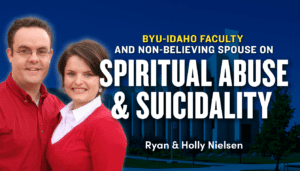
 For today’s Mormon Stories Podcast episode we interview Ryan Nielsen and Holly Parson Nielsen, who were both raised as devout Mormons in Rexburg, Idaho. After marriage, Ryan worked as full-time BYU-Idaho faculty for twelve years in the Department of Music, while Holly taught middle school art.
Important themes for this episode include:
- Ryan’s perfectionism and guilt/shame as a Mormon youth.
- Holly’s closeted feminism as a Mormon youth and adult.
- Holly and Ryan learning to listen to their own inner voices, which also involved navigating a religious faith crisis.
- Navigating BYU-Idaho while one is full time faculty, and in a mixed-faith marriage. This story includes harassment from bishopric over maintaining continuing faculty endorsement (mostly related to Holly’s resignation from the Mormon church.
- An insider’s view of BYU-Idaho administration, including difficulties dealing with BYU-Idaho executives related to Title IX issues (e.g., sexual misconduct of Mormon ecclesiastical leaders towards BYU-Idaho students and faculty).
- Navigating and healing from religion-based depression, including suicidality.
- Deconstructing Mormon literalism and reconstructing a nuanced worldview.
- Learning to choose love over ideas.
- Ryan’s AMAZING faith crisis/transition Reading/Podcast list can be found here, and has also been included below, after the video and audio links. This is probably the most impressive and thoughtful resources list I’ve ever seen for Mormon/religious faith transitions.
- Holly’s Art: https://www.artbyholly.
com/abstract.html — This link goes straight to the art Holly has done related to her faith transition, and her reclamation of motherhood. - Ryan’s Music: https://www.ryannielsenmusic.
com/music — This link goes straight to the music portion of Ryan’s website. Several pieces there are related to my faith transition, including “Prayer for Peace” and “Requiem.” - Support Ryan! Ryan has written a 9 movement suite that explores his experience of a faith crisis, through the lens of the life of Elijah Abel. It’s time to get this recorded. Ryan has created a GoFundMe campaign to raise funds for the project. Please support this worthy project!
========
Part 1: Fighting religious perfectionism, becoming BYU-Idaho faculty, suppressing doubts, depression, and suicidality
Episode Transcript
Host: John Dehlin · Guests: Holly Nielsen, Ryan Nielsen
This transcript is machine-generated and lightly edited for readability. The audio is authoritative. Please excuse occasional errors in names and spelling.
Introduction and Episode Overview
Part 1 of 7 · Ep. 1287
Ryan Nielsen [00:00:00] Sa.
John Dehlin [00:00:29] Hello everyone and welcome to another edition of Mormon Stories Podcast. I'm your host, John Dehlin. It is March 17, 2020 and we are in the midst of a global pandemic. For those of you who were paying attention this morning, we did a special one hour Mormon Stories podcast episode in response to the outpouring of emails and text messages I've received from parents of missionaries, children of temple workers, children of employees of Deseret Industries and elsewhere.
John Dehlin [00:01:08] Super concerned about the way the Mormon Church is responding to the coronavirus or COVID 19 and it's intense. We are now in the Mormon Stories Podcast studios in Salt Lake City, Utah following all the recommended suggestions. Not handshaking, keeping it small, having washing hands, having Purell on hand, sitting six feet apart, following other rules, but needing to continue this important effort on Mormon Stories Podcast of sharing stories important to Mormons. Today we have another epic and important Mormon Stories Podcast interview series that we're going to be doing today. We have in studio Ryan Nielsen.
John Dehlin [00:02:06] Ryan was BYU Idaho faculty for 12 years and in the Department of Music and we are going to be talking about a lot of really important themes in Ryan Nielsen's story. Ryan was raised in Rexburg, Idaho, which is a thing.
John Dehlin [00:02:28] He ended up again as faculty at BYU Idaho and himself. He himself has experienced a lot of depression and anxiety and even suicidality related to his religious observance as a Mormon and then also as he navigated a crisis of faith, a mixed faith marriage and trying to stay on at BYU Idaho as faculty. Once he started experiencing a lot of harassment and even ecclesiastical abuse at the hands of some members of his bishopric and or Stake presidency. As he tried to maintain his continuing endorsement to stay as faculty at BYU Idaho. We're also going to get an in depth look at BYU Idaho administration from the perspective of a faculty and particularly we're going to be talking about Ryan's interactions with executives at BYU Idaho as he tried to discuss and raise issues around Title ix.
John Dehlin [00:03:37] For any of you who have worked at administrative levels at universities, and particularly BYU or Utah State or any of the important universities around, the federal government has important regulations regarding the reporting of sexual misconduct, rape and assault and all sorts of those things.
John Dehlin [00:03:58] And Ryan has his own story to tell about as he tried to report misconduct of Mormon ecclesiastical leaders so bishops, bishopric members, stake presidency members as they interacted with BYU Idaho students and faculty and staff, he tried to make important improvements in that regard and ran up against some very difficult interactions from BYU Idaho executives. We're also going to be talking about Ryan's own faith crisis and how he healed and grew and progressed, how he dealt with depression and even suicidality, how he deconstructed Mormon literalist worldview and reconstructed a more nuanced worldview. And ultimately how he and his wife have learned to choose love over ideas, people over doctrine and principles.
John Dehlin [00:04:54] And if all goes well, tomorrow we will be doing this in two parts. And tomorrow we'll have Ryan's wife on to talk about those experiences. Well, so this is one of those epic Mormon stories interviews. And I think it's really important because lately, as we've seen all the LGBTQ honor code notices in the news about BYU Provo, BYU Idaho, I just think it's really timely to just get a sense for what it's like for those on the inside of the byu just trying to make it all work. So that is what you're in store for today.
John Dehlin [00:05:37] I hope you are excited. We have many people joining us live on Facebook as well, so we will be doing our best to incorporate your comments as appropriate. So without any further ado, rather than Ryan Nielsen, welcome to Mormon Stories podcast.
Ryan Nielsen [00:05:54] Thanks, John. It's a pleasure to be here.
John Dehlin [00:05:56] Anything I got wrong or anything you want to add?
Ryan Nielsen [00:06:00] No, I'm comfortable with that introduction.
John Dehlin [00:06:02] Yeah.
Ryan Nielsen [00:06:03] Yeah. Thank you.
Ryan's Early Life and Mormon Upbringing
John Dehlin [00:06:05] All right, so I guess it would make sense to begin. And I should just say I am not seeing this on the. I'm not seeing this on the Mormon Stories podcast page. So with all that introduction. Oh, there it is. I'm seeing it now. All right, so we're good. So, Ryan, let's begin. Is there anything you want to correct or change or add regarding the introduction? And if not, let's jump into the beginnings of your Mormon story. How does that sound?
Ryan Nielsen [00:06:41] That sounds great. Yeah. No, I wouldn't. I feel like that's a fair introduction. I. I do want to start just with a few thoughts about framing the conversation today and your intent. Right, yeah, my intent behind doing this.
Ryan Nielsen [00:06:57] I really hope that I am able to humanize every person in the story. I really hope that nothing comes across as black and white. And I just want to say if any of my believing friends are listening to this, I just want them to know that I completely love and support them. And when they tell me that they feel called to stay in the church, I completely believe them. And to my friends who are at the margins of the church and are choosing to stay and they feel called to stay, I believe them too. And I feel like their faith is rare and powerful and largely, I want to Share my story, to maybe offer some empathy and companionship to those my friends who like me, are aching from the grief of losing the church in their life.
Ryan Nielsen [00:07:50] And so that's really why I'm here to share it. So those are three groups of people who I care very much about and hope that the way that I talk today is helpful to them. That said, the audience that I have chosen to speak to largely are people who are hurting from, from a faith transition and who have realized that they needed to move on from the church. So.
John Dehlin [00:08:14] And so just to be clear, our intent is not to tear down the church. I think we both come from a place of love for byu. I myself met Margi at byu, graduated from byu. I'm a proud cougar in many ways. I know you love BYU Idaho and have a soft place in your heart for it. We're here to make the Mormon Church better. We're here to make BYU better. We're here to, we're here to improve the lives of the faculty and staff and students of the byus. And we're just here to help people who are struggling and in need. And if we do offer occasional criticisms or critiques, it's out of love and a true desire to just improve everyone's lives.
Ryan Nielsen [00:08:54] That's the hope.
John Dehlin [00:08:55] All right, so yeah, go ahead.
Ryan Nielsen [00:08:58] For whatever my failings will be today. That's my genuine intention.
John Dehlin [00:09:03] So, so let's begin by going back and let's, let's start with kind of your early Mormon story.
Ryan Nielsen [00:09:09] Great. So I was born in Salt Lake and spent the first few years of my life growing up in my grandparents basement in Holiday, Utah and later moved.
John Dehlin [00:09:20] That's where we are right now.
Ryan Nielsen [00:09:21] Yeah, just actually really close to where I grew up. So. And I think one of the first memory, one of the earliest memories that I have that's really relevant to talking about my faith story is I have a very clear memory as a five or six year old kid of sitting on the floor of my bedroom and reading the Velveteen Rabbit and feeling like really deeply that I wasn't real, that there was something about me as a person that wasn't real as a, you know, the valley.
John Dehlin [00:09:54] What does that mean?
Ryan Nielsen [00:09:55] Well, maybe that'll become. That's an interesting question.
John Dehlin [00:09:59] Talk about the Velveteen Rabbit a bit.
Ryan Nielsen [00:10:01] Just. So the story of the Velveteen Rabbit is the story of a stuffed toy rabbit that basically goes through this process of becoming real and at the end of the story he turns into a real bunny. Right. It's kind of, we read that to our kids.
John Dehlin [00:10:17] So I relate to that.
Ryan Nielsen [00:10:18] Yeah. And this feeling was so deep and stayed with me for so much of my life that I even shared it with my wife, Holly, very early in our marriage. Just this. That I always had this sense of not being real, and I didn't know why. I mean, I couldn't even articulate at the time what that meant, but I just felt that really, really, really deeply. And.
John Dehlin [00:10:42] And that's a theme we're going to come back to.
Ryan Nielsen [00:10:44] We're going to come back to that theme for sure, as we go through this today. So. But I loved. I mean, as a primary kid, loved all the music, loved the. I was very invested in the church even as a young kid. I remember feeling connected to it in really strong ways. My parents were both very active. My dad was always serving in a bishopric. He was a music teacher here, and he taught at Olympus Junior High for years.
John Dehlin [00:11:13] My son went to Olympus Junior High, so.
Ryan Nielsen [00:11:16] And then my mom was also really, really active. She was in young women's leadership. And so the church was definitely the centerpiece in our home growing up. Yeah.
John Dehlin [00:11:29] And you loved it. That worked for you?
Ryan Nielsen [00:11:32] It worked for me, yeah. Absolutely. Yep. When I was 8 years old, my dad got hired at Ricks College, and so we moved from Utah up to Rexburg, and that was his dream job. He often talked about how much he wished he could combine his testimony of the gospel with his love of music. So when he got hired up there, we moved up there and continued as usual. Eventually, he was actually called as bishop. He was my bishop. As I went through my adolescent years, we really had this extraordinary ward. And I don't think it's just me kind of idealizing my past. The 15th Ward in Rexburg at the time was a group of people who had lots of flaws, knew they had flaws, and just kind of embraced everybody. That was my experience of it.
John Dehlin [00:12:27] Talk about when a. When a Mormon ward is working well, what that's like for somebody in it.
Ryan Nielsen [00:12:33] I had an extended family that was incredibly supportive. I had beautiful, beautiful, meaningful relationships with people from all kinds of generations. I miss that now, actually. But I loved. I mean, I felt connected to people. My great grandparents age, my grandparents age, my parents age, and to my peers. And there just was a. It was an incredible network of support, love, and encouragement.
John Dehlin [00:13:04] I had the same thing in Katy, Texas. Yeah.
Ryan Nielsen [00:13:06] Yeah. It's amazing.
John Dehlin [00:13:08] Yeah. When. When a Mormon ward is working well, it's. It's beautiful.
Ryan Nielsen [00:13:13] So incredibly beautiful.
John Dehlin [00:13:14] And that was your experience in Rexburg?
Ryan Nielsen [00:13:16] Totally. Well. And, yeah, it was, yeah, that was absolutely. And all my siblings and I, we talk about it. We all have very fond memories of that time and largely because of that community.
John Dehlin [00:13:29] Yeah, yeah. I imagine music was an important part of your childhood or no.
Ryan Nielsen [00:13:34] Yeah, absolutely. So my dad teaching it. I have really beautiful memories of watching him conduct his bands and just feeling the emotional impact of that.
John Dehlin [00:13:46] What types of bands?
Ryan Nielsen [00:13:48] Just like concert bands, like at junior high, you know.
John Dehlin [00:13:51] Oh, right, right, right.
Ryan Nielsen [00:13:52] Yeah. Because he was a music teacher and also my mom kind of like Dan
John Dehlin [00:13:57] Fogelberg, leader of the band.
Ryan Nielsen [00:13:59] I don't know Dan Fogelberg.
John Dehlin [00:14:00] Oh, you don't know that song, Leader of the band.
Ryan Nielsen [00:14:02] Nope.
John Dehlin [00:14:03] It's about the son of a band, a high school band leader.
Ryan Nielsen [00:14:06] Oh, I need to check that for you.
John Dehlin [00:14:08] I'll play it for you.
Ryan Nielsen [00:14:09] Okay, that sounds good. So it was around that and then. My mom is just a marvelous pianist and she and my dad co directed the ward choir for 27 years straight. Even when my dad got called as bishop, he was not willing to give up the choir. He loved that. Oh, that's so cool. He and my mom, it was really fun watching them. They connected, they flirted with each other in front of everyone as they co led the ward choir. And I have really beautiful memories of singing in that. I started singing in it when I was 10 or 11. That was really important for me. Yeah, same thing. 11 year old sitting next to a 56 year old and connecting through music in a beautiful ward. It was great.
John Dehlin [00:14:58] Any favorite musical numbers that come to mind? Just a few highlights.
Ryan Nielsen [00:15:02] Well, my Anything by Crawford Gates. I loved singing.
John Dehlin [00:15:07] What are some examples?
Ryan Nielsen [00:15:08] There was one that we sang every Easter. He is not here for he is risen.
John Dehlin [00:15:14] He is not here for he is risen.
Ryan Nielsen [00:15:17] I loved singing that. Yeah, loved it. And that's a great one. I still like just thinking about the way my dad has just an amazing gift for pulling music out of people beyond what they thought they could offer. And my mom just have very great memories of hearing her playing and watching him kind of have everybody connect through the music. So yeah, I love that.
John Dehlin [00:15:42] Okay.
Ryan Nielsen [00:15:43] Yeah, absolutely. So yeah. Should I just keep playing forward here? So one of the things that started happening in my teenage years, I remember my first few doubts and feeling incredibly guilty for them for having those doubts and just like, no, no, no, can't think about that. But in my patriarchal blessing, I was.
Teenage Doubts and the Role of the Church
John Dehlin [00:16:08] You had doubts, like about the church. Do you remember what kind of doubts?
Ryan Nielsen [00:16:11] Yeah, I remember them very specifically because they scared me so much. But one of Them was like, they're small things, but to me, they felt big. So, like one of them was reading in the Joseph Smith history that at the beginning of it, it says, he writes that he had often crossed his mind, which of all these parties is right or are they all wrong together?
Ryan Nielsen [00:16:35] And then 30 verses later, it says, it had never crossed my mind that they could all be wrong. And so it was just like these little inconsistencies that I. Or in the Book of Mormon prophecies. Anyways, there were little teeny cracks that I was terrified of that I begged God to forgive me for having, and I just shut that down completely, you know, having none of that, because in addition to that beautiful, functional Mormon ward as a child, I also felt in my bones the fear of losing my family if I wasn't good enough.
John Dehlin [00:17:15] Meaning your parents and siblings, just eternal.
Ryan Nielsen [00:17:17] Yeah, Eternal family. Right. I felt very keenly this sense that if I didn't live up to what was expected of me, that I would lose everything that I loved in the eternities. And so I remember having that feeling really young and being really afraid. And so when those doubts surfaced that to me, I immediately framed as an attack from the adversary, and I shut that down quick. So. Yeah. But in addition to that, I also, in my patriarchal blessing, I was told that I would become a really important leader that would travel the face of the earth in the church. And so I think that really, I started to. I have a propensity for grandiosity for, you know, and it's very Mormon, so I think it is.
John Dehlin [00:18:13] Right. Yeah.
Ryan Nielsen [00:18:14] Yeah.
John Dehlin [00:18:14] We're all going to be gentle authorities today when we get our patriarchal blessings. Right.
Ryan Nielsen [00:18:18] The patriarchal blessing and other blessings and people saying things like that to me, and I believed them. So I think that that sort of fed into the gumbo that would eventually become problematic.
John Dehlin [00:18:35] And what's interesting there is it's good and bad. Like it strike. It helps you strive for goodness, strive for excellence, strive for kindness and love and service and charity.
Ryan Nielsen [00:18:46] Yeah.
John Dehlin [00:18:46] And it can feed your ego and be a lot of pressure and.
Ryan Nielsen [00:18:49] Yep.
John Dehlin [00:18:49] And it could backfire.
Ryan Nielsen [00:18:51] Absolutely.
John Dehlin [00:18:51] Both are true.
Ryan Nielsen [00:18:52] Absolutely.
John Dehlin [00:18:52] Not just one or the other.
Ryan Nielsen [00:18:55] Yeah. And, yeah, so that was very much my experience. I was on seminary council in high school. Yeah. I don't know how deep you want to go into the childhood stuff, but
John Dehlin [00:19:10] whatever's an important part of your story.
Ryan Nielsen [00:19:13] So one of the really big things that happened is I had a karate teacher named Brian Miller who kind of saved my life when I was a struggling 13 year old. He taught me to believe in myself and to have confidence in myself and was. We would go to his garage, me and my friends, every Tuesday night anyways. But when he served his mission in Connecticut and while he was there, he was killed in a hit and run accident. And there are two times in my life that I can remember just sobbing uncontrollably. And one of them was grieving his passing and the other was at byu Idaho, when I realized that I was gonna need to leave. But what did.
John Dehlin [00:20:00] What did he mean to you?
Ryan Nielsen [00:20:02] He. What did he mean to me? He's still. There's still lessons that he taught me that I carry with me today. He like. I mean, he was a senior in high school and I was in junior high and he would go out of his way to get like. He took me to a park once and we crossed a bridge over a pond and he said.
Ryan Nielsen [00:20:37] And he pulled a pebble out of his pocket and he said, ryan, I want you to know this pebble is your life. And then he dropped it in the water and the ripples went out and just taught me that my life matters.
Ryan Nielsen [00:20:48] And I think that was that confidence and belief that who I was mattered was just huge. Not just at that time, but I would rely on that later when my mental health got really bad. That was one moment I can remember someone teaching me that my life was worth living. That stayed with me. So it meant a ton.
John Dehlin [00:21:16] And did that relationship. Was the church interwoven between sort of.
Ryan Nielsen [00:21:23] That relationship was in my ward. Yep. I still have a. I still have a really good relationship with his family and I love his parents spaces. My dad was the bishop when this happened, and so he actually was the one that had to go to their home and. And let them know what had happened. That was a really impactful experience for me growing up to see how that all played out. And it was also where I had started having experiences at his viewing and elsewhere that I really talk about that. Well, I just felt very. I felt a distinct sense of his spirit being there. And I. And I anchored my testimony to that for years and years and years.
John Dehlin [00:22:15] So at the viewing you felt.
Ryan Nielsen [00:22:17] Yeah. And just standing in a circle with my friends and I and we were just sharing our memories of him together and it kind of knocked all of us back, sent us reeling. But yeah, he will forever be with me.
John Dehlin [00:22:36] Okay.
Ryan Nielsen [00:22:37] For sure. So that was really important to me.
John Dehlin [00:22:44] Yeah. So anything else before we jump to your mission? Just about your church experiences. Did you have a lot of guilt besides the Doubts.
Ryan Nielsen [00:22:52] Oh, for sure. I mean, if you can just go listen to Bent Washburn talk about the Armageddon of adolescents for any LDs.
John Dehlin [00:23:00] So for those who don't know, Ben Washburn's a comedian and he talks a lot about masturbation or self abuse, as he called it. And just all the guilt and shame around that. He's hilarious.
Ryan Nielsen [00:23:11] Yeah. And that was actually really healing for me to listen to that conversation between you and him and. But for sure, all of that. But I was a real rule, like, keeper. Yeah.
John Dehlin [00:23:25] Okay.
Ryan Nielsen [00:23:28] Yeah. So plenty of guilt. Yes.
John Dehlin [00:23:31] But also good. Like, how did the church help you in your teen years?
Ryan Nielsen [00:23:38] Ed Comforman was my teacher's quorum advisor. I think he's a mission president in Russia or Ukraine now. And I still remember how I felt when he would look at me and smile at me. And he really loved every one of us. It was amazing. And I think of, like, Greg Palmer, who. Anyways, there are so many mentors in my ward growing up that were so supportive and funny and there was so, so, so much good. And in my teenage years is when I started to get really serious about being a practitioner. I think when other people were choosing rebellion, I chose a really rigid attachment to practicing my faith.
John Dehlin [00:24:33] Almost kind of scrupulosity, like.
Ryan Nielsen [00:24:35] I think that's where. Yeah, I think so.
John Dehlin [00:24:37] Yeah. Yeah. And you met your eventual wife?
Ryan Nielsen [00:24:43] Yes.
John Dehlin [00:24:44] Through the church.
Ryan Nielsen [00:24:44] Yeah. So Holly and I sang in choir together in high school, actually, and we got sat next to each other on the front row because we were both kind of short and. Yeah, that's where our knees touched. And the rest is history. So that's where we started to get close. And then after I graduated, she was a year behind me. We dated for the first time, and then off and on between our missions and everything.
Mission, Marriage, and Early Married Life
John Dehlin [00:25:17] Anything important about your mission you want to say?
Ryan Nielsen [00:25:21] Yeah. So I served in. In Brazil, in Northern Brazil in the Bin Lang mission. And my mission president was Carlos Godoy, who's currently a 70. And he'll come back into the story later. While I was there, I was really, really, really. I got really sick. I got a combination of an intestinal infection, E. Coli, and dengue fever all at once. And I just remember waking up in the back of an ambulance because I'd passed out. And actually, this kind of plays into some of the things you were talking about earlier today. Because the other level to that is, in my mission, we weren't allowed to go to the good hospitals. We had to go to public hospitals first and then go to private Hospitals. So with this pandemic, that's kind of an interesting consideration too.
John Dehlin [00:26:18] What do you think the justific logic was there?
Ryan Nielsen [00:26:21] Money, keep it cheap. That's literally what they told us. The funds are sacred. So we don't want to spend any of the tithing funds on private health care if we can avoid it, is what we were told 20 years ago. So.
Ryan Nielsen [00:26:39] But when I came back from the church, it was interesting that they had me go through a hole because I had gotten so sick. They had me go through a hole, legion of medical exams, and then had to sign a waiver promising never to sue the church, which stuck out to me as kind of odd. But at the time, it was like, why would we ever sue Jesus church? Why would I sue Jesus? Yeah, that's. So that was an interesting mission experience. But I think on my mission, definitely scrupulosity increased for me. Like, just how so?
Ryan Nielsen [00:27:16] I mean, my mission was very focused on obedience. And we used to have to. There was a list of things that we had to do every day, and we had to fill in a graph that showed if we had done to kind of check all the boxes for all the things that we'd done.
Ryan Nielsen [00:27:34] And if you missed one, that's actually what you did. If you missed one of the things, you had to fill it in. And we called them holes. Like. Like you. This is a hole in what you were supposed to do. And you had to send that into the mission president every week. And that was like, if you come home at 9:28 instead of 9:30, then
John Dehlin [00:27:51] that's a hole too early.
Ryan Nielsen [00:27:53] Yeah, if it's two minutes. So we would. But also, 9:31 was too late. I mean, it was very, very, you know, regimented that way. And obedience was everything. I mean, it was the first law of heaven, but it was reinforced in pretty intense ways. And there was also a lot of rhetoric around your righteousness is what determines your number of baptisms. And I took very seriously, I felt keenly my responsibility to save anyone who I could possibly save. And I was terrified of missing someone who I was supposed to save. And I believed all of that completely. And I worked really hard and then would be frustrated when I wouldn't have zillions of baptisms.
John Dehlin [00:28:52] And if you don't have success, then you kind of blame yourself. It must be that maybe you had impure thoughts or you did some things you shouldn't have done as a missionary, or maybe you broke a rule. And. And it can push you towards excellence, but it can also feed scrupulosity and guilt and shame and make you feel like you're not just wrecking your life, but you're wrecking the lives of eternal souls.
Ryan Nielsen [00:29:16] Yeah. And so my last area, I remember it had been trying to become a stake for I don't know how many years. But when it really. I was made zone leader near the end of my mission, and in order to unlock that dry spell, I decided I would fast twice a week, which I did. Which was not good. I don't recommend that.
John Dehlin [00:29:48] Why not?
Ryan Nielsen [00:29:49] Well, it made me sick. I mean, it was. Of course, if you go without food and water for 48 hours a week, that's. And you're living in the Amazon, that's not a nice combination for well being, I would say. But the problem was baptism started picking up and I assumed it was directly related to my good faith efforts. And so around that fasting and it just. Yeah, So I can feel that the rigidity of that scrupulous thinking, magical thinking, attaching to those kinds of behaviors more and more intensely towards the end of my mission especially.
John Dehlin [00:30:31] And so overall, as you. As you think back, as you were leaving the mission, what were your feelings about it? It was amazing. It was difficult. It was both.
Ryan Nielsen [00:30:39] I was. It was both. I was really lucky because my mission president may be sensing these patterns in me. He actually, three months before I came home, he'd keep. In our last interview, he pulled me aside and said. He said, elder Nielsen, you've done everything that the Lord wanted you to do, so now I just want you to enjoy being on a mission. Which was actually really gracious of him to offer that to me.
Ryan Nielsen [00:31:04] And I still love that he did that. I didn't succeed at enjoying it. I was still worried about things, but that was actually really helpful for him to have said that to me. And. Yeah, so it was. I still tell people I'm still benefiting from the things I learned. I'm still growing from the things. That was the beginning of realizing there was a bigger world. I mean, I grew up in southeast Idaho, so to go to northern Brazil was huge in terms of opening my eyes to a lot of things. And I'm still recovering from a lot of what I experienced. You know, 20, 21 years since I've been home now.
John Dehlin [00:31:47] Recovering from what?
Ryan Nielsen [00:31:48] From the mission experience. From which.
John Dehlin [00:31:51] Which parts, though, are you still recovering from?
Ryan Nielsen [00:31:58] I still have to stay, I guess I should say I still have to stay on guard about the patterns that I. The mental patterns that I learned while I was there. It would be really easy for Me to pick up that perfectionism again. To pick up that black and white thinking, to assume it's all on me, that other people's behavior is on me. A lot of those patterns which fed into dealing with depression, they can still come back if I'm not aware. Yeah.
John Dehlin [00:32:36] Okay. So what happened after your mission? I'm assuming you went to Rick's. Yep.
Ryan Nielsen [00:32:44] Off to Rick's College. Started as a music major there. My dad was my teacher there.
John Dehlin [00:32:49] He was the teacher at Rick's.
Ryan Nielsen [00:32:51] Yeah, he was the director of bands there, so. Marching bands, symphonic band. Yep. Yep. The concert band, so. And then Holly and I dated again. And then she went on her mission. She served in Houston.
John Dehlin [00:33:07] Yay. That's where I'm from.
Ryan Nielsen [00:33:09] Yeah. So, yeah. And I deer Jane her twice, which turned out to be a good move because everyone else got dumped except me.
John Dehlin [00:33:19] So.
Ryan Nielsen [00:33:20] Playing hard to get worked out for us. When she came back from her mission, we were engaged very quickly and got married in Idaho Falls Temple. So we'd been dating on and off at that point for five years.
John Dehlin [00:33:33] So it wasn't the rushed marriage, so to speak. You knew each other?
Ryan Nielsen [00:33:37] We knew each other, yeah. I mean, yeah.
John Dehlin [00:33:41] With an asterisk.
Ryan Nielsen [00:33:42] Yeah, with an asterisk. That's right. Absolutely. So. And kind of one. Funny, and this maybe relates to the scrupulous thinking, but one of the funny early faith crises we had, and this is a hilarious story, is that the. After our marriage at the temple, we went on our honeymoon and they had. They had. I guess they had messed up the paperwork and they had been desperately trying to get ahold of us, but we were up at a cabin in middle of nowhere, southeast Idaho, and they. They called us in. Anyways, it turned out that our marriage was neither legal nor lawful for the first few days of our honeymoon. And so they hadn't done that.
John Dehlin [00:34:28] They hadn't figured out the paperwork yet.
Ryan Nielsen [00:34:30] Yeah, there was. Someone had forgotten to get one specific signature from us, so it was all but done. But it wasn't done. And I remember really being concerned that I didn't like if this was the. If this was the sin next to
John Dehlin [00:34:46] murder and you did it without being married.
Ryan Nielsen [00:34:49] Why didn't I feel, you know, any kind of spiritual anything which I still giggle about. That's pretty. That was a funny scenario. But it really did mess with my. It was like, wait a second, wait a second. Something's not lining up here.
John Dehlin [00:35:06] You know, Maybe the Lord understands the intent of the heart.
Ryan Nielsen [00:35:10] Yes. That's what everyone assured us. So. So. But yeah, so that was. Yeah, that's kind of a funny story there. That was in 2001. We got married, so.
John Dehlin [00:35:24] 2001.
Ryan Nielsen [00:35:25] Yeah.
John Dehlin [00:35:25] Okay.
Ryan Nielsen [00:35:26] Coming up on 19 years this May.
John Dehlin [00:35:28] All right, so how was married life?
Ryan Nielsen [00:35:33] It was largely positive. It was really good. We were lucky, I guess, because we've had a lot of friends talk about how hard the first year was. It wasn't.
John Dehlin [00:35:43] You know what? I should do this. I should read just one second. Nicholas Greer writes, I attended Rick's BYU Idaho with Ryan, having played trumpet alongside him in several ensembles. I remember returning to BYU Idaho because the Philharmonic was playing an arrangement I wrote and bumping into Ryan in the stairwell, you were obviously suffering with something internally but were unwilling to talk about it in the building. I wish we had more time to chat then. I followed you closely over the years as you slowly but surely left the BYUI and the church. You have always, always been an inspiration to me, Ryan. Love you, brother.
Ryan Nielsen [00:36:19] Oh, my goodness. That's so nice, Nick. Thanks. Yeah, I, I totally remember that encounter in the stairwell. And yeah, we played trumpet together for years there.
John Dehlin [00:36:32] Had to share that.
Ryan Nielsen [00:36:33] That's beautiful.
John Dehlin [00:36:34] Thanks, Nick.
Ryan Nielsen [00:36:35] Thank you for reading it. So, yeah, I mean, marriage in a lot of ways was beautiful, but in ways that, in retrospect now, what was not healthy about our marriage is that we were trying so desperately to become the roles that we'd been taught to become. And so later in the story, when Holly resigns from the church, in some ways that was the greatest gift to us because all of a sudden we were married to each other.
John Dehlin [00:37:08] The roles were, we'll get there, we'll get there. But at the time, yeah, but at
Ryan Nielsen [00:37:11] the time it was, we were reading the marriage and family relation manuals and doing everything we could to conform to the expectations that had been given us, which included a patriarchal home. And I certainly have plenty of regrets around that in my own, My own inability to see her as a complex human being and the harm that that caused her, Which, when she comes tomorrow, might be really beautiful and meaningful to have her speak to that a little bit. But yeah, without getting ahead of myself, that that's definitely something that I, that I still hurt about.
John Dehlin [00:38:10] Just like with missions and everything, you know, the youth experiences in Mormonism, it's always a double edged sword. There's always so much beauty and power and then there's often some really heavy and challenging things that come with it. And in a marriage situation, it gives you something to strive for, it gives you commitment, it gives you purpose and focus. But Then you can also sometimes neglect the relationship and sometimes do harm to yourselves or to each other, or neglect yourselves or each other, your children or your health in the process. It's so mixed.
Ryan Nielsen [00:38:48] So mixed. Yeah, yeah, it really is. But yeah. So that's how I see my early marriage now. As we finished up at BYU Idaho, something huge happened, which was that our first child was born. And he was born. He was going to get here early. He was born at 24 weeks. And so we were in our last semester at BYU Idaho when that happened. Right after it happened, all of the health care costs for students went up exponentially because we used up a million dollars worth of DMBAs money anyways.
John Dehlin [00:39:34] What's DMBA?
Ryan Nielsen [00:39:35] It's the insurance company, Desert Mutual. Desert Mutual Benefits administrators or something like that. So that happened and that was huge. That turned our whole world upside down. And again, she was, for Holly, kind of the two edged sword nature of it. Her teachers there were incredible.
Ryan Nielsen [00:40:01] They basically got together and realized that she had met the competencies that they expected from her. And so they just passed her through to her degree while we were at the hospital, which was such an amazing thing and so characteristic of faculty at BYU Idaho in my experience, that they care so deeply for those students that they are working with. And.
Ryan Nielsen [00:40:29] But it was a really interesting. The dichotomy between my response to that trauma and Holly's response to that trauma was huge for me. Responding to that trauma, I grasped even more rigidly to my role as a priesthood holder, to all the answers that the gospel provided. And it also increased kind of the scrupulosity. I felt like I was asking for miracles and they were happening.
John Dehlin [00:41:04] To keep your child alive.
Ryan Nielsen [00:41:05] To keep my child alive, yeah. And I gave my son a blessing and told him that he would live and that there would be no 1.
John Dehlin [00:41:12] £15 ounces is tiny.
Ryan Nielsen [00:41:14] That's tiny. Yeah. He. He fit in the palm of my. Like if his legs were curled up, he could just lay, right. You know, he was itty bitty.
John Dehlin [00:41:23] That's basically six months, right?
Ryan Nielsen [00:41:26] Let me think about that.
John Dehlin [00:41:27] 24 weeks.
Ryan Nielsen [00:41:28] Yeah.
John Dehlin [00:41:29] Five or six months.
Ryan Nielsen [00:41:30] Six months.
John Dehlin [00:41:31] Way too early. So.
Ryan Nielsen [00:41:32] Yeah. So really scary time. Really, really scary time. So we were in the hospital at the University of Utah for four months there. And again, an outpouring of love from so many people in our wards and support and prayers and money and I mean, just people were amazingly supportive of us.
John Dehlin [00:41:56] And you were saying it pulled on your scrupulosity. Were you contrasting that with how it
Ryan Nielsen [00:42:01] was affecting Holly's response. Because for Holly, for years, she'd been. And she'd brought this up to me and even to her dad. I remember some pretty heated discussions at her house between her and her father because she was asking about prayer, basically, and why prayer and how does it really work? And this experience kind of brought that to a head, because while I was looking at how our son was doing, well, Holly was there in the hospital the day that another family who had a child. Preemie child, who was one of our roommates, basically, that they lost their. They lost their child. And Holly heard them grieving in the hall. And for her, there was a fundamental shift.
John Dehlin [00:43:03] And they would have had prayers, too.
Ryan Nielsen [00:43:04] Right, Right, exactly. So to her, it really brought that to a head and the question of who would do, like, how could God put someone through that suffering on purpose? Right. And so she still stayed connected to the church at that time.
Family Struggles and Faith Challenges
Ryan Nielsen [00:43:27] She resolved that concern for herself and just said, well, he can't possibly be that way. And that was it in her mind. But the other thing. And she just recently realized this because she's doing her master's degree in painting and drawing at the U, and she's processing a lot of this trauma.
Ryan Nielsen [00:43:45] And she said that she just realized that part of what was so traumatic about that was she was living what she'd been taught her eternity would be as a heavenly mother. Because her son was in an incubator, she wasn't allowed to touch him. She wasn't allowed to hold him.
Ryan Nielsen [00:44:13] She was watching him suffer. He would often cry, but he had a tube down his throat, so no sound would come out. You just see him crying in pain from all the things that preemies deal with. And she couldn't do anything.
Ryan Nielsen [00:44:33] And that inability to even be present for her own children, for her own child at that time, it really hit her because it was so closely related to what her experience of the divine feminine had been, growing up Mormon, which is. We don't talk about her, she doesn't talk to us. Right. Which I think is a pretty common experience in Mormon families when we talk about heavenly mother.
Ryan Nielsen [00:45:03] So for Holly, that was. That was really big, and that was a pivotal moment in her faith journey, for sure. And meanwhile, I was. My. The way I got through was that that rigid attachment to orthodoxy. And it wasn't long after that that the depression started to get really hard for me. So.
John Dehlin [00:45:32] For you?
Ryan Nielsen [00:45:33] Yeah. Yeah. So it's definitely when the depression getting really, really bad, I think, is definitely connected to that traumatic experience, which I'm still processing. He's turning 16 in a week, so. So, yeah.
John Dehlin [00:45:52] So how'd you guys continue? Where'd you go from there?
Ryan Nielsen [00:45:56] From there, we. We went to Arizona State University for my master's degree. And that was really hard because Brian. Because our oldest son Brian was preemie. He was preemies. We spent four months in the hospital. And their lungs, they're hooked up to an oscillator because their lungs are so small, they can't use a ventilator or it'll burst the lung. So there's this little oscillator that's just making the lungs inflate really, really rapidly over and over again, and it causes a lot of lung damage. So preemies are at high risk for rsv, respiratory virus. And so we were basically. Holly and Brian were quarantined for the first two years of his life, which was really hard on Hollywood, more than I think I realized.
Ryan Nielsen [00:46:58] And it was really. Yeah, it was just hard for all of us. So while I was kind of putting my head down and getting through a master's degree in trumpet performance at Arizona State, Holly was home. And we had some incredibly. Again, amazingly supportive. The church came to our aid in such beautiful ways at that time. The bishop in the area arranged for an apartment for us.
Ryan Nielsen [00:47:28] Anyways. Yeah, it was. There was a lot of difficulty and a lot of people going out of their way to help us in really beautiful ways. So, yeah, Arizona State grad school. And then the job opened at. Near the end of that at byu, Idaho.
Ryan Nielsen [00:47:49] And I applied, and they had a really strict anti nepotism policy at the time. So I remember the chair, the then chair of the department of Music actually called me in tears because he was a dear mentor of mine because they weren't even going to let me be considered for the job because my dad worked in the department and anyways, so
John Dehlin [00:48:14] your dad was still there.
Ryan Nielsen [00:48:15] He was still there.
John Dehlin [00:48:16] So it'd be a father and son team.
Ryan Nielsen [00:48:18] Father and son in one department. Yep. And they. So they didn't let me apply. They brought in three finalists, then in the meantime, convinced them to let me come in and apply for the job. And after I went and interviewed, I interviewed the week before general conference. And that weekend at general conference, President Hinckley got up and joked about nepotism
John Dehlin [00:48:47] because his son had just been called as a. Yep.
Ryan Nielsen [00:48:50] And so that kind of softened the anti nepotism stance. And the long story short is interesting. When Kim Clark came back, they were willing to offer me the job. So. Yeah. So from Arizona. We went to BYU Idaho, which was truly my dream job since I was 16. It was like, I want to work there. That's what I want to do with my life.
John Dehlin [00:49:18] That is kind of miraculous that you and your dad could both work there.
Ryan Nielsen [00:49:22] It was. Yeah, yeah. And it was really. Yeah, it was. It was a very cool thing. So my dad and I were colleagues for a few years before he left BYU Idaho for some other ventures and. Yeah. But one of the funny things that happened is I was in. My general authority interview for the position at BYU Idaho was with Robert Siochs. And I went online to try and soften my. I was really nervous for this interview. And so I went online to help calm my nerves. And it didn't help because I found out that he was a four star general in the Air Force. And so then I was especially nervous. But that was one. That was before they did remote interviews. So they flew me to Salt Lake.
John Dehlin [00:50:07] Oh, really?
Ryan Nielsen [00:50:08] Yeah. And I went to the. To the church office building and. Or no, the other one. It's not the office building, it's where the administration building. Yeah. And I met with. With Robert C. Oaks and. And it was just an interesting. The interview was actually a really nice conversation. And then at the very end, he said, I just have one more question for you. I just was wondering if you read Sunstone or Dialogue. And I said, what are those?
John Dehlin [00:50:37] Good answer.
Ryan Nielsen [00:50:38] I literally didn't even know what that was. And he immediately said, you know what? I really think that the Lord has prepared you for this. So there it is. So on his recommendation, I was hired at BYU Idaho.
John Dehlin [00:50:51] What year was that?
Ryan Nielsen [00:50:52] That was 2007.
John Dehlin [00:50:53] Okay.
Ryan Nielsen [00:50:54] Yep.
John Dehlin [00:50:55] So that's two years into Mormon stories podcast life.
Ryan Nielsen [00:50:57] Okay.
John Dehlin [00:50:58] Yeah. I always like to get the timeline straight for me.
Ryan Nielsen [00:51:02] Yeah. So yeah, 2007, we. We moved to Rexburg for that. And that was an amazing thing to have a job out of my master's degree. Usually people have to wait till they're done with their doctorates, and so we felt really, really lucky.
John Dehlin [00:51:17] And also, you're back home, you know, you're kind of a homeboy, and now you're back on your home turf with the school you love and in your dream job working with your dad, like, this is. How could it get much better?
Ryan Nielsen [00:51:27] This is like, how could it get much better? Which is why it was so confusing that I felt what I now know was depression. It just took. Started taking over. Really at this time when everything.
John Dehlin [00:51:40] All your dreams came true.
Ryan Nielsen [00:51:41] Yes. Which only reinforced. So at the core of My depression was a belief that there was something fundamentally wrong with me.
John Dehlin [00:51:51] Why?
Ryan Nielsen [00:51:53] Because this growing darkness inside, no matter what I did, it wouldn't go away. And I. I mean, I prayed and fasted. I assumed, not knowing anything about mental health, I assumed that this was like the adversary trying to attack me now that I was at the Lord's school.
Ryan Nielsen [00:52:14] And I just. I doubled and redoubled and redoubled my efforts to be more and more obedient, hoping that I would get healing from this darkness that I could feel growing inside. And that was really, really scary to me.
Ryan Nielsen [00:52:34] And no matter what I did, no matter how faithfully I completed the inspired checklist, I couldn't get better. And so rather than question whether or not there was something wrong with the inspired checklist, I went to questioning whether or not there was something wrong with me. Because if you.
Ryan Nielsen [00:52:56] My thought process was, if I have the truth, my leaders have told me that the only place in the world that can offer healing, the only thing in the world that can offer healing is the atonement, and the only place in the world that has access to that fully is this place.
Ryan Nielsen [00:53:15] I believe that wholeheartedly. So then when I failed to access healing, that didn't mean there was something wrong with the system or the teachings. That meant there was something wrong with me. And then that made it spiral even more.
John Dehlin [00:53:32] That's such a hard situation because we're taught the atonement of Jesus Christ is all powerful. That it saves, that it is. The core purpose of life is to tap into that. So if you're already depressed, you're already struggling, you're already sad, then that extra pressure of, like, the atonement should be making it all better, and it's not. I must be so awful. I'm beyond Christ's own power to save.
Ryan Nielsen [00:53:58] That's almost exactly like. Almost word for word, the thoughts that I had about that experience. Exactly.
John Dehlin [00:54:05] Yeah. And then you just feel like I must be lower than dirt and terrible. And that just for someone who already has a scrupulous personality, who struggles with anxiety and depression, it just piles on the intensity of the horrific nature of what you're experiencing.
Ryan Nielsen [00:54:22] That's absolutely what happened to me. And so in the middle of this, something kind of remarkable happened that I still don't have an explanation for, but it happened, and it was that I. Something deep inside me gave me this dream that just shook my whole world up.
A Vivid Dream and Its Spiritual Significance
Ryan Nielsen [00:54:43] And I'm actually going to look at my notes because I wrote the details of this dream down in 2007. Because it was so vivid as a believer. As a believer. And so just to make sure that I wasn't changing the dream itself, but.
Ryan Nielsen [00:55:02] But in the dream, I was. I was living in a commune that resembled in every detail like an LDS church house. And. Except that everything was gray and brown all around me and the walls were falling apart. And my job was to walk around holding up the walls and keeping them from falling.
Ryan Nielsen [00:55:26] In this dream, right. That was my assignment. That was my duty. And when I would walk around, there were other people in this kind of compound with me. And whenever we saw each other, we would smile and just look at each other and hold each other's gaze and completely ignore the fact that the walls were falling down.
Ryan Nielsen [00:55:48] And at one point, well, and it had that. It had this feeling, you know that feeling when, like when you're in public and somebody mistreats a child and there's that tension in the air, whether or not someone's gonna acknowledge it. That was the feeling in this dream. And at one point, a figure entered who I recognized as my brother. It wasn't an actual brother of mine, it was like an archetypal brother.
Ryan Nielsen [00:56:17] And I just felt really drawn to him. And then later in the dream, he had disappeared. And I just knew, I sensed that something was terribly wrong. And so I was terrified to leave my duties of holding up the walls, but I did, to go in search of this full color brother of mine.
Ryan Nielsen [00:56:44] And when I finally found him, he was. He was laying down in a field and curled up in the fetal position. He was naked. He'd clearly been hurt, so I knew I had to save him. And so I jumped into this field. The floor of the field was about 3ft below the edge of this compound. And so I jump into the field to get him. And this huge black horse comes out of nowhere and like charges me and scares me back into the compound.
Ryan Nielsen [00:57:22] And so then I try to sneak in again and the horse comes back again. And I sneak in a third time and the horse comes up again. And this time I just looked it in the eye and just screamed out loud. And the horse shrunk.
Ryan Nielsen [00:57:39] And then I went over to my. My brother, who was kind of like in the dusk between sanity and insanity, couldn't quite recognize me. And I realized that he wasn't looking at me, he was looking beyond me. And so I turned around to see what he was looking at. And there was this huge 15 foot fence and beyond it, this vibrant green, right, the grass, it was alive and it was really different than the grays and browns in the compound around me.
Ryan Nielsen [00:58:17] And so in that moment, I knew that he wasn't going to stay. And he just take. In my dream, he just takes off running. And I remember worrying that he was going to get hurt when he hit the fence.
Ryan Nielsen [00:58:29] But he just leapt over it like it was nothing and disappeared into the green. And in that moment, I wanted more than anything to follow him, but I couldn't. I just knew I couldn't. I didn't have it in me to. And so I went back into the compound and sort of a long story, short version of it. Eventually at one point, a bookshelf appeared that I hadn't seen before. And I pulled one of the books off, which was camouflaged to match this compound. And I opened it and this full color food spilled out of it that was the same color as the green that he went to, right?
Ryan Nielsen [00:59:10] And I looked down at the ground and I saw little patches of moss that were also green that led to a staircase out. And in that moment in the dream, Holly, my wife, appeared at my side. And then together we walked out, following the moss to get to the alive green beyond.
Ryan Nielsen [00:59:32] And then I woke up and there was this period of. I think of it now as like a pre conscious knowing I knew exactly what that dream was saying to me, which was you did. In that for a split second it was like, there is something wrong with my life in the church. And that's what it was like. And you need to get out. And it was like, no.
Part 2 of 7 · Ep. 1288
Ryan Nielsen [00:00:00] Sa,
John Dehlin [00:00:29] This is.
Ryan Nielsen [00:00:29] Everything's Perfect.
John Dehlin [00:00:30] This is 13 years ago.
Ryan Nielsen [00:00:31] This is 13 years ago.
John Dehlin [00:00:33] Now you have your dream job with your dad.
Ryan Nielsen [00:00:35] Everything's perfect.
John Dehlin [00:00:36] You know, it's hard to get onto byu.
Ryan Nielsen [00:00:39] So hard.
John Dehlin [00:00:40] And you're doing exactly what you love and you're supposed to be happy and thrilled. You're married, you're living the dream. And then you have this Jungian dream saying, get out. And how do you get out? Like, once you're at byu, it's hard to jump to other universities. You kind of cash that chip in. There aren't a lot of people going for, from byu, Idaho to other great university positions. So, like, I imagine you felt trapped.
Ryan Nielsen [00:01:04] Well, what I did is I shut again. I shut that down. Like I was not going to face. Like it was sort of before I could get my usual thinking going again was when I had that realization. And so I created my own sort of apologist's interpretation. It was like, that can't possibly be what that means. Right. Like, I'm. I'm going to come up with my own interpretation of this. I think what it's really saying is that the green is the. Is the true church, and that I need to be careful about idolatry. Like, I came up with this whole way of interpreting the dream, but I knew that I was lying to myself on some level. It was a really weird experience.
John Dehlin [00:01:46] A couple of the things about that dream, one is that it just reminds me of Joseph Smith Sr's dream and Joseph Smith Jr's dream and Lehi's dream. You know, just the whole tree.
Ryan Nielsen [00:01:54] I just thought of that.
John Dehlin [00:01:55] Just. We have. We have dreams at the core of our earliest Mormon history.
Ryan Nielsen [00:02:00] Totally.
John Dehlin [00:02:01] So, you know, this for me, and I'm not for me, I forget my dreams. I mean, I have them, but I don't really. And they don't really shape me. So meeting somebody who's had a formative dream that really shapes them sort of makes real maybe a little bit more the origin stories of Mormonism. But also what's curious to me about this dream, as a psychologist, you mentioned Carl Jung and you know, Jung and Freud, both, both really like to interpret dreams, thought that was really important. You weren't. It sounds like you weren't consciously questioning the church. You weren't consciously having a faith crisis. You weren't, like, consciously empathizing with LGBT people, Like, not at all. You weren't aware of any churches, you know, like, struggling with church history problems. Just your subconscious is screaming out, saying there's something wrong. Ironically, when Everything was perfect. That's interesting.
Ryan Nielsen [00:03:00] Yes, it is. No, I just. And that's a perfect. I mean, that's a very accurate capture of it. It was so confusing because of that. Everything outside of me was perfect. And, no, I had no doubt about the divine origins of the church. My testimony was rock solid. I 100% believed and practiced. And. Yeah. So the fact that something in me would point right as this darkness of depression was rising, as I was becoming unwell, that something deep inside pointed me to an unthinkable cause. Still, kind of. I feel like that's really significant, that there's something in me, and I might say in us, that goes deeper than enculturation, indoctrination, sociality. The fact that there is something, whatever self is, that is that powerful and that would offer something like that is really compelling to me. And so, yeah, that's.
John Dehlin [00:04:22] And it's so interesting, whether it's a spirit or consciousness or just the complex brain, just this idea that some part of you is trying to communicate with another part of you saying, hey, ego conscious, you know, Ryan, something's not right. And that's not a therapist, that's not a parent, that's not a sibling. That's your own self trying to get through to you to say, you got to fix something. There's something wrong. All is not well in Zion.
Ryan Nielsen [00:04:53] Right. Yeah.
John Dehlin [00:04:54] That's so fascinating.
Ryan Nielsen [00:04:56] So I would love to say that at that moment, I had the courage to trust that and follow it, but I didn't. I shut it down as completely as
John Dehlin [00:05:04] I could, and we do that to our peril.
Ryan Nielsen [00:05:07] Yeah. And that's exactly so, as I did, things got worse with my mental health.
John Dehlin [00:05:13] Oh, sorry. I have to say one more thing. And people get annoyed when I interrupt, but I have to make some connections. Think about the thousands and thousands of BYU Provo faculty, BYU staff, BYU Idaho faculty and staff, BYU Hawaii faculty and staff, and then all the church employees. This thing that we're talking about of, like, your soul crying out and saying there's something wrong, but you're trapped, because your livelihood, your employment, your benefits, your insurance, your retirement is all. All tied to not listening to your inner self. I just have to make the point that you are representing literally thousands of people. And you hear this all the time about BYU employees, faculty staff, church employees that no longer believe that are LGBT or they have empathies with people who are leaving or people who are struggling or just flat out don't believe anymore. And they're trapped. And that's what you're representing.
Ryan Nielsen [00:06:21] Yeah, it's a really, it's a hard thing and I kind of want to. So while there is this part of me that was pointing to a need for a change in regards to my relationship to the church, I also loved and continue to love.
John Dehlin [00:06:42] Yeah, me too.
Ryan Nielsen [00:06:43] The church.
John Dehlin [00:06:43] Yeah.
Ryan Nielsen [00:06:44] With all my art, like, it's so. It's not what. I would hate for that to sound like because I have many friends at many BYU's who are suffering. I would hate for it to sound like somehow they're being disingenuous by staying.
John Dehlin [00:07:06] Oh, no, no. There's so many who love it. Again, it's this double edged sword. There are plenty of people who are in all those positions who love it and it works for them.
Ryan Nielsen [00:07:15] Yeah.
John Dehlin [00:07:15] It's just for those for whom it doesn't work.
Ryan Nielsen [00:07:19] Right? Yeah, absolutely.
John Dehlin [00:07:20] Yeah.
Ryan Nielsen [00:07:22] So the. So, so my. After I shut that dream down and what it, what it was trying to get through to me, the depression got worse and. And it got so bad that my mom started to notice something was wrong and she said, you know, maybe you should see someone. And I felt like a complete failure in that moment because if I was really going to go to the world for help, because back then, I know that now there's a lot of positive talk in church culture around mental health and going to see psychologists, but that in 2008, 2009, that's not how people talked about it.
Ryan Nielsen [00:08:06] It was very much a sign of a lack of faith to need secular help for spiritual problems. Right. And so I felt that failure keenly as I, as my mom very gently invited me to consider seeing someone. And the first, the first one that I went to was actually a, like a BYU Idaho approved counselor. And I figured that would be safe. Right.
Ryan Nielsen [00:08:42] And so I went to him and he basically with me, he kind of played bishop and he gave me a talk from a general authority that, you know, the boy K. Packer talk about just change the thoughts on the stage. And if you change the thoughts on the stage, then everything will be fine. And to me, that was like, oh, I can do this with obedience still. Right. To someone dealing with scrupulous thinking, it's like, I can still beat this thing by being obedient, only now I'm going to be obedient to this talk.
Ryan Nielsen [00:09:12] And for the first, for two weeks, it actually worked amazingly well at first. Yeah. And I went, oh my gosh, maybe I'm not lost. Maybe I'm not beyond the saving power of the Savior and his atonement. Maybe I can find some kind of healing this way. But then after two weeks, it was like Pandora's box opened. It was like, you can only push that stuff down for so long.
Ryan Nielsen [00:09:39] And. Yeah, so in retrospect, that first therapist that I met with, what he practiced with me was like a pseudo cognitive behavioral therapy, but not. Because later I would meet with a therapist who really was an expert in CBT and who really did help me a lot. But that particular version, it really hurt me, and it sent me into a depressive spiral. That was really scary.
John Dehlin [00:10:07] What's hurtful about that approach, the turn it off approach, to suppress it. Change your thoughts, fight your thoughts, fight your feelings.
Ryan Nielsen [00:10:18] I mean, what was hurtful about it for me in retrospect is that that was actually an act of violence towards myself. Rather than caring for these things that were coming up, rather than offering them my attention, rather than taking them seriously and listening to them, I was attacking them. I was trying to kill them. Right. I wanted them gone.
Ryan Nielsen [00:10:49] And so. And that wasn't. That wasn't just an act of neglect. It was a violent act. And it was supported by a lot of ideological thinking that I had learned the glorifying sacrifice and. This. The root of all evil is selfishness, and that you should kill the self in order to become selfless. There's a way of understanding that that can be empowering and beautiful. But the way that I was understanding it at the time was incredibly harmful. And it was.
Ryan Nielsen [00:11:30] Yeah, it felt like an act of violence. This is all in retrospect, right at the time, I had no idea why I was confused and terrified. But looking back now, I think that's what it was that I was attacking myself.
Ryan Nielsen [00:11:45] Deep self, whatever. You know, I don't know what to call that, but. But that deep thing needs to be honored, and you have to. Yeah.
John Dehlin [00:12:02] And as someone who has a PhD in psychology and who has studied in depth anxiety disorders and depression, literally the worst thing you can do if you want to get rid of a thought is to try not to have the thought, to pack it down, to avoid it, to push it away, to try and think of other things, to avoid the thought. Because mathematically, scientifically, what you do is you. You literally multiply the. The frequency and the probability that you're going to keep having the thought, and you amplify the power of the thought and the feeling. And so all those things you said, plus, it's just bad.
John Dehlin [00:12:40] It's bad psychology. It's bad mental health. Again, try not to have a thought and you'll have it a hundred times in a minute, literally in retreats, tell people not to think about the pink elephant, and then they count in 30 seconds and they think about it 50 times.
John Dehlin [00:12:57] And this is just where religion and folk wisdom don't match with mental health. This is why we need therapists and psychologists and mental health professionals, because some of these anxiety disorders are heavily worsened when they're treated with religion, frankly.
Ryan Nielsen [00:13:12] Yeah, that's definitely my experience. And so then when things started getting worse after that two week period of winning, that's when I really, that was for me, that was crossing over to believing there really is something wrong with me. There really, like, I must be horrible. There must be essentially something wrong with me. And so that's when the toxic shame became complete in my mind.
John Dehlin [00:13:50] And by this point you have how
Ryan Nielsen [00:13:51] many kids at this point? I have two of our three kids.
John Dehlin [00:13:55] Okay.
Ryan Nielsen [00:13:56] Yep. And so I finally. So again, it was actually my mom who saw this going on in me. And I remember saying to her, nobody understands how much darkness there is inside me. Like, I was convinced that I was that bad of a person that lost.
Ryan Nielsen [00:14:23] And so she actually invited me to consider seeing another therapist in Rexburg who. And this will reveal maybe the depth of my orthodoxy and patriarchy at the time. But I remember being concerned if it didn't work to go to a priesthood holding man therapist, why would this other therapist was a woman who was not lds?
Ryan Nielsen [00:14:46] So I was like, if she doesn't even know the truth, how could she possibly help me? And so I went to her and. In our first session together, after 90 minutes of talking, she did these longer first sessions and she said, she just looked at me and she said, I've got your ticket. I know how to help you.
Ryan Nielsen [00:15:11] And we started talking about things and at first we talked about medication and this is not. And I know that medication has been tremendously helpful to so many people. So this is just my story, that's all. But I said to her, I said, I want to just try if we can. I feel like I learned this somehow. I'd like to unlearn it if I can. This what I'm experiencing, you know.
Battling Depression Within a Religious Framework
Ryan Nielsen [00:15:40] And so she said, well, if you're going to do that, you're going to have to exercise every day for this amount of time. And if you do that, we'll go from there and see. And so basically my sessions with her were a combination of taking care of my body and exercising again and then.
Ryan Nielsen [00:16:00] And like real cbt, like really learning to recognize cognitive distortions, to catch Thoughts as they come to let them be there completely, but to see if they were accurate representations of what was going on in my world.
John Dehlin [00:16:17] CBT stands for Cognitive Behavioral Therapy. And it is a great form of treatment for anxiety and depression. It's empirically supported, evidence based.
Ryan Nielsen [00:16:26] Okay.
John Dehlin [00:16:27] It's a solid standard treatment for what you're experiencing.
Ryan Nielsen [00:16:30] Cool. So the first. So right after that first session with her, the next day we flew to my cousin's wedding, which was on Vash island just off the coast of Washington. And that was the first place where I started exercising specifically as a part of a treatment for my depression.
Ryan Nielsen [00:16:49] And I mean, I didn't even own running shoes. I went running in jeans, in my BYU Idaho dress shoes, and the locals were looking at me pretty funny. But I had this really powerful experience where when I first started jogging, the thoughts. I mean, right before that, I remember getting to the bed and breakfast and just pacing and wringing out my hands, and I couldn't stop. Like I was in a really bad place. And I started jogging. And at first the thoughts in my head, which had become so destructive and very much about my worthlessness, and they got loud.
Ryan Nielsen [00:17:30] I thought I could almost hear them. And I'm jogging, and as I came around the bend on the island, I saw this tree that just stood out to me. And the top, about 4/5 of the way up the tree, there was this scarred section of the tree.
Ryan Nielsen [00:17:52] And it just stopped me in my tracks because I thought it was so beautiful. And as I looked at it, I realized, and I'm looking at the scarred section of the tree, that the tree wasn't beautiful in spite of the scarring, but that the scarring itself was actually part of what made the tree so beautiful to me.
Ryan Nielsen [00:18:10] And that moment was like when I had my first glimmer of hope in years because of that tree. You know, just really. Anyways, I think really important to me.
John Dehlin [00:18:26] Beautiful. And if you don't mind, there's a paragraph in the outline you put together that talks about how you had read the scriptures and doctrine prior that. I'd love you to kind of talk about that a little bit. Abraham and Isaac and Cain and Abel. Basically, religion teaches this kind of purity model where you're beautiful if you're pure, you're whole and you're clean if you're pure. And then if you make mistakes, then you're sustained and there's a blemish and it's dark and. Yeah, and just talk a bit. And now that you reached some insight, it's probably not chronological to go back and talk about your interpretations of Mormon scripture and doctrine that weren't helpful, but let's do that anyway.
Ryan Nielsen [00:19:13] Okay. Yeah, absolutely. So before I started getting help with my depression from a professional and I was turning to the scriptures for help, the things that I saw there that impacted me is that I read about Nephi and he says, oh, wretched man that I am.
Ryan Nielsen [00:19:33] And he was often held up as a spiritual example because of his humility, because he saw his wretchedness. And so that reinforced to me this idea that I should see myself as wretched. Let me see what else I wrote here.
Ryan Nielsen [00:19:58] I also had a lot of leaders that taught me that the only way to fully access the healing power of the atonement was a complete recognition of my own brokenness before God, to recognize that I was less than the dust of the earth to recognize.
Ryan Nielsen [00:20:17] And I even had a bishop very specifically instruct me to take more time to feel badly about the things I had done wrong. And this was in my adult life. And so I started seeking for reasons to feel badly, hoping that I could feel bad enough to qualify myself for some kind of healing. And so I ended up trying to sacrifice myself in exchange for healing and my experience of.
John Dehlin [00:20:51] And you had metaphors. You mentioned Cain and Abel, Abraham and Isaac, Joseph Smith, Christ and Gethsemane. Talk about. I mean, it sounds like the core problem was you weren't listening to yourself, but every story in scripture was basically saying, sacrifice yourself, ignore the self, kill the self, put the self down. Seems like you were stuck in sort of a doctrinal.
Ryan Nielsen [00:21:14] Absolutely, that's exactly where I was.
John Dehlin [00:21:16] Catch 22.
Ryan Nielsen [00:21:17] Yep. All of those examples. Right. So, I mean, even the sacrament, while I fully recognize that communion can be a beautiful healing experience for so many people, for me, it was a reinforcing of this idea that sacrifice is what produces healing and that what I was supposed to put on the altar, just like Abraham put Isaac on the altar. Right. Was. Was myself. Right. My heart. A broken heart and a contrite spirit.
John Dehlin [00:21:48] Yeah.
Ryan Nielsen [00:21:48] And so. And the way that I experienced that, it's. That all those. All those stories around sacrifice kept me going down this really harmful path with regards to how I viewed myself and how I treated myself internally, because I was literally trying to. To die so that I could be born again. I mean, that's even the symbolism of baptism. Right. It's death of the natural man and the birth of the spiritual. All of those things played into the way I tried to approach my illness, which was rather than Approaching it with compassion was to try and sacrifice it. And that was. That was very much my experience.
John Dehlin [00:22:34] Yeah. So hard.
Ryan Nielsen [00:22:36] Yeah. Yes, it was.
John Dehlin [00:22:38] When what you needed to do was listen to yourself. That was what you needed. You needed to hear what your soul, what your spirit, what your brain was telling you. But all the time the messages you hear religiously are, sacrifice yourself, ignore yourself, be selfless. And that's what leads sometimes to people wanting to die is they want to kill the self because they can't, you know, because the self is the problem, when really the self is often the answer.
Ryan Nielsen [00:23:07] Right, Absolutely. That was very true to my experience. So, yeah, so I did start. So after seeing that tree and kind of having our third child was born. And in the meantime, I had gotten a two year sabbatical to go do my doctoral studies at the New England Conservatory in Boston, which was a stipulation for my tenure. I had to complete a doctorate to get tenure at byu, Idaho, which they call continuing faculty status.
Ryan Nielsen [00:23:45] And again, just amazing support from people. But I started to heal. One of the things that blew me away about this experience of needing to go on sabbatical is this is. This was 2008 when I put in for it, which is when the financial crash happened and the church put a hiring freeze on everything.
Ryan Nielsen [00:24:09] And a member of the church, who. Dailey, who is one of my dearest mentors, he volunteered to serve a mission and come teach trumpet at byu, Idaho so that I could go do that. And I don't even know what to do with that kind of generosity, but I know that his faith inspires that and I love him for it.
Ryan Nielsen [00:24:38] So, anyway, so we went to Boston as I started to heal. And once we got there, it was like something really deep inside me just knew that we were far enough away from the bubble to really have some real healing happen. And so the depression resurfaced and aggressively. And it was really, really, really scary time. Really scary time.
John Dehlin [00:25:07] One quick thing we think of depression is something we need to beat and beat back and push down and fix and cure ourselves from. If you've seen the movie Inside out, depression has a psychological function, which is it's basically yourself trying to communicate with yourself. So the last thing you need to do is beat it back. You need to listen to it. And it's just so interesting that once you felt safe, you know, like you're, you're outside the bubble, the depression rages because it's basically saying, listen to me, listen to me, listen to me. Maybe now you're in a place Outside of Rexburg, where you can listen. And so it's throbbing even more.
Ryan Nielsen [00:25:46] Yep.
John Dehlin [00:25:46] Once maybe it. We're almost personifying it as if it's a thing, but it's basically saying, maybe now you'll listen.
Ryan Nielsen [00:25:54] Yes, absolutely.
John Dehlin [00:25:56] That's why it gets worse. But really, that's just. It's getting louder. So you'll listen?
Ryan Nielsen [00:25:59] Yeah, absolutely. And for me, right. And none of this was conscious. Like, I didn't. I was just terrified and confused at the time as to why it was coming back so aggressively. And. And it got. And that's when it started crossing over into suicidality. And it got really scary because I felt like I didn't have.
Ryan Nielsen [00:26:27] So the solution of suicide was presented to me. I wasn't thinking about it or considering it. It was like my brain, when it realized I was ignoring the depression again, that I wasn't listening to the message of it, then it offered suicide.
Ryan Nielsen [00:26:47] And every time I would close my eyes when it was really bad, every time I closed my eyes, my mind would flash really explicit images of me taking my own life to me. And so I was scared to close my eyes. I was scared to sleep. I was scared to.
A Crisis Point and Thoughts of Self-Harm
Ryan Nielsen [00:27:09] It was just a really scary thing. And. And so it kept intensifying until kind of the apex of all of this was I was walking home from the train. This was our first year in Boston still. I was walking home from the train.
Ryan Nielsen [00:27:33] And I got. And there was a park that I walked through every. Every day when I came home. And as I was kind of leaving, passing the threshold from the park into my neighborhood, like so many. Like the. The cruel thoughts were just yelling and. And the suicidality was flashing and intermixed with. All this was me seeing my kids in my mind's eye. And this was all just churning inside of me and kind of escalating and to the point where as I was walking past some of these houses, I actually thought that I saw, like, shadow, something coming out of the houses to attack me.
Ryan Nielsen [00:28:22] Kind of like the movie Ghost or something. And then something deep inside just thought, wait a minute, this isn't real. I'm hallucinating this. And with me considering suicide on one hand and seeing the faces of my children and my wife on the other, I had this realization that if I continued in the church the way I had been, that I would end up dying.
Ryan Nielsen [00:29:02] And so all of this is happening so quickly. Right. It's hard to parse it out. But once I realized that, I said my last verbal prayer that I've said by him I've prayed with other people, but just my own personal out loud prayers, the last one I've offered, and it was in 2009 or 10, and I just looked up at heaven and the first thing I did at the sky, and I said, heavenly Father, I'm so sorry I failed.
Ryan Nielsen [00:29:40] Like, I literally felt in all of me that I had failed my mortal probation, basically, right, That I had failed the test. And so I just said, I'm so sorry that I failed. And then like a switch that just shifted from all the chaos and all the everything to just this quiet resolve. And I just said, but I think my kids need a dad.
Ryan Nielsen [00:30:09] And then I swore at God. It was the first time in my life that I said the F word. And it was to God. I mean, that's the kind of. I never swore, I never. Right. And I. And there was something. So I just looked up and I said, you know, fuck you, God. And it just all went away, just like, boom. It was like this awakening moment. Sorry for the language there.
John Dehlin [00:30:36] What did that mean to you at the time?
Ryan Nielsen [00:30:38] At the time? Well, and so looking back at it now, I think it was two things. One is that using the F word, right, having never spoken it before, it was so taboo. And I think there was something about the fact that it was taboo that gave it kind of psychological power, actually.
Ryan Nielsen [00:30:59] And then, and then the other thing is that that's the first time in my life that I addressed God as God and not as father. And I think there was something really significant about the fact that something deep inside me stripped him of that title at that moment.
Ryan Nielsen [00:31:19] Because it was like how. How I had kids. I could not possibly imagine myself on purpose putting one of my children through this. Like, I was fine with theories around a fallen world and the things that. But. But the idea that a God with the capacity to.
Ryan Nielsen [00:31:43] That a father would do this to a child, I think that was really significant that that title shifted. That's what I think it meant to me. But at the time also, I literally thought I was saying goodbye to all of it, to the church, to faith of any kind, to. I mean, I was ready to just drop it all and figure something else out. Keep in mind, I'm on sabbatical for byu, Idaho and about to have to go back. Right.
John Dehlin [00:32:18] I mean, it seems like it's a moment of empowerment. It's a moment of kind of downgrading God's status and upgrading your own status. It's basically saying this model isn't working for me anymore and I'm taking my power back. Seems like that's at least part of what was going on for sure.
Ryan Nielsen [00:32:36] And I had another. Like in this moment, once I said, and it all goes away, I had another experience with a tree where I'd looked and I saw, and it was like. It was like everything in my mind stopped after that moment. Like it just went quiet finally. And. And I saw this tree there, which I'd walked past dozens of times. And it was like seeing a tree for the first time in my life.
Ryan Nielsen [00:33:00] It was, except before, where I would walk around and see things and I would map their beauty and usefulness to my worldview. Right. This has meaning because God created it. Now I looked at the tree and it was whole all by itself.
Ryan Nielsen [00:33:20] It was connected to everything and separate and beautiful. And it was like I was seeing this without labels, without dogma, without beliefs, without just really seeing it for the first time. And it felt like touching reality momentarily. Right? Just a glimpse of. That's what it felt like. I don't mean to be hyperbolic, but it was a really profound experience. And it shifted the way I saw my kids after that.
John Dehlin [00:33:56] In what way?
Ryan Nielsen [00:33:58] My instead of the purpose of my child. So until that time, the way I saw my role as father was to ingrain obedience in my children. Obedience to the proper authorities who could offer them life and salvation. Once I had that experience with the tree. Now the purpose of my parenting was to see them as whole, already whole, and to nurture that and to join them side by side in a discovery where I still am, mentoring and passing on the lessons that I have to pass on, but recognizing that it wasn't about obedience. It was about life and wholeness and the imperfection of it all. So because I had that glimpse of the tree, I was able to shift how I looked at my own kids to where I was no longer mapping their usefulness onto the way I saw the world, but rather was wanting to discover alongside them what was in them.
John Dehlin [00:35:12] We read in the scriptures Jesus talking about being born again. And for those of you who were raised near evangelicals, there's this idea of a born again again experience I have liked, and often I do this with retreats and workshops and in my coaching, take back that idea and apply it to a situation like this. It almost seems like you were born again, like you were born into a sense of your own power, moving the locus of control to an external source of power and authority to your own. And then kind of seeing yourself and the world and your children with brand new eyes. It really is a born again experience, I think.
Ryan Nielsen [00:35:53] Yeah, I think that's an apt metaphor.
John Dehlin [00:35:55] Yeah.
Ryan Nielsen [00:35:56] Yeah.
John Dehlin [00:35:56] And it can transform everything. Your marriage, your. Your parenting and your own mental health.
Ryan Nielsen [00:36:02] Yeah, for sure.
John Dehlin [00:36:05] There's a. There's a listener gala who writes something somber. She writes, what a poignant, poignant story. I have a family member who did commit suicide at that juncture. So, I mean, there's. And we're so sorry, Gail. And I've heard that in the mental health community, we're changing the way we talk about it to death by suicide.
John Dehlin [00:36:31] And not to stigmatize anyone. I'm just trying to educate myself about how to talk about things in a bit more sensitive way because we don't want to ever blame or shame anyone for reaching that point. But Gayla is basically acknowledging and putting voice to so, so many people who either, you know, don't make it through that hard time or die inside, which can be just as bad.
John Dehlin [00:36:57] And. And what I love about your story is that you're hopefully giving people hope that. That if they can find a way to listen, maybe they can not follow kind of down that same dark path.
Ryan Nielsen [00:37:11] Yeah.
John Dehlin [00:37:11] So thank you and love, love to you, Gayla, and anyone who's experienced a loved one dying by suicide. It just shouldn't happen. And it happens way too much in the Mormon context, in the human context. But we know that Utah apparently leads the nation in all sorts of different categories of death by suicide. And so it's something we just need to keep talking about.
Ryan Nielsen [00:37:37] Yeah. Yeah, I'm. Yeah. My heart goes out to you, Gayla. That's so sad.
John Dehlin [00:37:46] Yeah.
Ryan Nielsen [00:37:46] And I just feel lucky. I guess I don't chalk it up into much other than that. But, yeah, it's way too big of a problem. And that question right as my story unfolds, what strikes me? I spent dozens and dozens of hours writing this over the summer because just processing it.
Ryan Nielsen [00:38:12] And what strikes me is how much my story is so far mapping itself to the dream that I had that day and. Right. That awakening of the self. If we go back to the dream, I think of the brother figure in my dream that way that's the true self that was actually me that got so close to.
Ryan Nielsen [00:38:39] To the edge and it feels so far away. Like now that I'm in a healthy place, it's hard to even remember. I literally can't remember what it was like to be in that place. But when it's happening, it's definitely not something that someone is choosing.
Ryan Nielsen [00:38:59] And it's not. I just think that's really important to say. You really aren't making a choice to. It's. Things are out of control. Just for the sake of empathy.
John Dehlin [00:39:15] Yeah, let's do this. Since Holly's gonna be coming tomorrow.
Ryan Nielsen [00:39:19] Yeah.
John Dehlin [00:39:20] Let's. Let's talk about your journey from that point forward, including your discoveries and everything.
Ryan Nielsen [00:39:26] Okay.
John Dehlin [00:39:27] And all the way through to whatever point you want, independent of Holly. But let's. Let's allow Holly to tell her own story as the way we start tomorrow.
Ryan Nielsen [00:39:38] Okay.
John Dehlin [00:39:38] So you don't need to feel compelled today to kind of film to reflect her story.
Ryan Nielsen [00:39:43] Okay.
John Dehlin [00:39:44] We'll. We'll layer that on at the beginning of our interview tomorrow. Is that okay?
Ryan Nielsen [00:39:48] That sounds great.
John Dehlin [00:39:49] Okay.
Ryan Nielsen [00:39:49] Yeah, that'll be great. So in that moment. So after that, right. We're still doing the school thing in Boston, and this kind of goes to the books part of the dream. This is where I started giving myself permission to ask questions I had never allowed myself to ask before, and those early doubts as a teenager, starting to explore some of those things. So the very first thing I did, and I remember this so clearly because I was so afraid to do it, because there was a lot of talking about, don't go to the Internet. Don't go to the Internet, don't go to the Internet. But I did, and I went to the Internet, and I typed into the search bar symptoms of being lds. Because it's the first time I allowed myself to wonder out loud to myself if the mental illness I was experiencing was somehow connected to my experience,
John Dehlin [00:40:44] to
Ryan Nielsen [00:40:44] my personal experience of being LDs, and immediately clicked on the first link, a list of, like, 100 plus symptoms. I remember specifically that I had 96 of them. And then I looked off to the left, and I saw this word that I'd never seen before, and it was polyandry. And I thought, oh, what's that? And I clicked on that and went down the proverbial rabbit hole at that moment with a lot of those things.
Discovering Church History and Beginning Deconstruction
John Dehlin [00:41:11] Tell our listeners what polyandry is for those who don't know.
Ryan Nielsen [00:41:14] So polyandry is when someone marries somebody else's spouse. So it's. Is that right? So in the.
John Dehlin [00:41:25] In this case, when a woman marries multiple men, is polyandry okay? I think.
Ryan Nielsen [00:41:33] Yeah, I believe you.
John Dehlin [00:41:35] Yeah.
Ryan Nielsen [00:41:35] So in this case, though, it was talking about Joseph Smith, who. Who married other men's wives in addition to. I knew that polygamy existed, but I had no idea about polyandry. And that kind of hit me for sure.
John Dehlin [00:41:52] So basically, Joseph Smith married women. So he would. He would seal himself and then have sexual relations with women who are already married to other men.
Ryan Nielsen [00:42:01] And that was a. That one blew my mind. And, yeah, I don't necessarily want to go down the truth claims, but that was the beginning of me starting to untie the. I'll call it the perfectionist narrative of the church that I had inherited, because that is what hurt my mental health. The idea that hearing stories growing up about, well, if there's one bad part in something, then it's all bad.
Ryan Nielsen [00:42:33] And the really intense work to prevent us from talking about our problems as a community, the idea being that if we found flaws, that it would somehow make all of it bad. I internalize that in the way I saw myself. If there's one bad part of me, then I must be all bad. And so.
Ryan Nielsen [00:42:54] So this was the beginning of me untying that perfectionist narrative around our origin. And it was really important for my healing for that reason. And I became obsessed with. When I learned that death by suicide. Thank you for teaching me that. Then I learned that death by suicide was such a common problem in the LDS community, I became obsessed with figuring finding a historical origin for that.
Ryan Nielsen [00:43:26] It was too just. If it was just random, then it wouldn't be what it is. And so I really started going after finding a historical source for that. And I had learned, growing up, right, I'd heard all sorts of stories about general authorities telling their kids that it would be better if they came home in a pine box than without honor from their missions, and that it would be better to die than to dishonor the community. And scriptural phrases like it would be better if you'd never been born were often applied. And specifically, I remember one of my seminary teachers, because that particular scriptural phrase is about.
Ryan Nielsen [00:44:10] Could be read as. It could be read as somebody who hurts children, right? And crisis is better for a millstone for you to be hung around your neck and be better if you'd never been born. If I'm remembering right, which is totally possible, that I'm not.
Ryan Nielsen [00:44:25] But I had a seminary teacher frame that as it wasn't talking about actually harming children. It was talking about people who offend the apostles. And I believed that. And so the idea being right, if you offend the church, which the apostles embody, then it'd be better if you'd never been born. So I had all those messages, and those quickly came to mind, but I felt like that wasn't actually enough. And so as I was researching and researching and researching, I finally Got to the point where I was willing to look online and I don't even know where this came from, actually. But I realized that the one place I had not dared look was in a previous version of the temple ceremony.
Ryan Nielsen [00:45:07] And so when I looked there, to the pre 90 endowment ceremony and I learned about blood oaths and that, that. That, you know, my parents.
John Dehlin [00:45:19] I. Me.
Ryan Nielsen [00:45:20] You okay? Did you go?
John Dehlin [00:45:21] I did, yeah.
Ryan Nielsen [00:45:22] So the idea that you enacted your own suicide ritually as a symbol of your lack of worth if you didn't keep the covenants you made, that. That was such a central place, held such a central place in the sacred rituals of my faith community. It just bowled me over. And to me, that was my. There it is. This is why this is so palpable in our community as something that our minds offer to us in times of great distress, especially if that distress is related to somehow failing the community in terms of our faithfulness. And it broke my heart. It completely broke my heart. And so, yeah, next. I'll leave that to Holly to talk about tomorrow.
John Dehlin [00:46:30] So how did that connect with. Was there anything about Rexburg culture that.
Ryan Nielsen [00:46:37] Well, I mean, a lot of people had kind of. As I talked to some of my friends and colleagues at BYU Idaho, they would say, boy, that your experience is so different than mine. I think it's just because you grew up in Rexburg, which is the most conservative town, the most Right in.
John Dehlin [00:46:53] I call it Mormon Saudi Arabia.
Ryan Nielsen [00:46:54] Right.
John Dehlin [00:46:56] It's really Mormon Wahhabism, basically.
Ryan Nielsen [00:46:59] It can be really intense.
John Dehlin [00:47:00] Sharia law.
Ryan Nielsen [00:47:01] So. So for a while I thought, oh, okay, well, I must have just had this unusual experience because of where I grew up. But to discover that that held such a central place in all of. Made me sad. It made me angry that no one had spoken to this openly, that we weren't talking about it in a way that could bring healing.
Ryan Nielsen [00:47:31] Yeah, it was a whole wash of grief and everything that goes with that when I realized that. But it was also an important moment for me. And I also went to other books. Right. If you're willing to go into the forbidden section of the library. Right.
Ryan Nielsen [00:47:53] Which had been pretty much outlined by. By Boy K. Packer. Right. Feminist intellectuals and homosexuals. So I started daring to read those things. And this was really important to me because I needed. So I actually initially started reading a lot of, like, the New Atheists, Daniel Dennett and Sam Hawkins and Sam Harris. Sam Harris. Thank you. And Christopher Hitchens and Richard.
John Dehlin [00:48:21] Richard Dawkins. Yeah.
Ryan Nielsen [00:48:23] Yeah. So I am. So I read a lot of their Books. And it was really important for me in terms of deconstructing literalism. Their goal is to deconstruct all of
John Dehlin [00:48:35] religion, all belief, all churches.
Ryan Nielsen [00:48:38] I would gladly. That could be a whole other podcast where I refute that. But the tools that they offered to deconstruct literalism were really valuable to me and helped me maintain certain boundaries as I continued my journey. However, they fell short in that it felt like the dogma of the new atheists felt very familiar to my taste buds. Right. It was still separating the world into us and them, the enlightened and the unenlightened. Right. And so. So there was a period where those were helpful for me, and they were helpful for deconstructing literal thought, but they offered nothing by way of constructing, giving language to my experience of the self as I was now experiencing it. I don't know. Do you want me to go through some of these books?
John Dehlin [00:49:35] Yeah, the formative books. It's a great. I want to include this book list sort of in the podcast notes, because there's just some phenomenal books here. So. Yeah, share some of the ones that were most influential. For sure.
Ryan Nielsen [00:49:50] Will do. So one really important book which my therapist gave me is called Healing the Shame that Binds you by John Bradshaw. And that one just really helped me understand the difference between toxic shame and guilt. And he also does a good job. It's not a particularly rigorous book in terms of academics, but there was a lot of really helpful information there for understanding the basics of how less healthy family systems can work.
Ryan Nielsen [00:50:20] And it just gave me a lot of tools for that. So the Drama of the Gifted Child by Alice Miller was incredibly important for me. Alice Miller was one of the earliest advocates against child abuse and for believing the experiences of children. And when she says gifted child, she's not talking about children who are, like, gifted and talented in the way. She's talking literally about children who had the gift of cutting themselves off from their true selves in order to satisfy the expectations of the people around them.
John Dehlin [00:50:59] Oh, the gift, as in sacrifice.
Ryan Nielsen [00:51:01] Yeah. And so it's a really power. It was the kind of book that I would read one paragraph and have to close it and come back to because it was so, so much to internalize. But it was. In the end, it was this tremendously powerful advocate for believing myself is how that book helped me.
Ryan Nielsen [00:51:25] There's a book called Resilience by Boris Zurulnik, and that one just talks a lot about the power of tap, how the only way. Sorry. One of the most powerful ways to tap into our resilience is to share our stories with what he and Alice Miller both call enlightened witnesses. People who will hear us and believe us. And that people who have experienced trauma, they need to find languages like the arts actually that allow them to express their experience in socially acceptable ways in order to tap into their own resilience and keep moving forward. It's really powerful.
Ryan Nielsen [00:52:08] An Adult Child's Guide to what's Normal by John Friel. That was super helpful for me because it was like these just very specific scenarios that you're going to come across in life and what an unhealthy response would look like and some options for more healthy responses. And I needed that sort of nuts and bolts approach to becoming an adult. Thought reform in the psychology of totalism was huge. I know you've talked about that a lot on the podcast.
John Dehlin [00:52:36] Stephen Hassan, who we've had on, who's one of the world's experts in cults.
Ryan Nielsen [00:52:41] Yeah.
John Dehlin [00:52:41] He basically looks to Robert Lifton as one of his main sources of inspiration for all his work that you mentioned later.
Ryan Nielsen [00:52:51] Yes.
John Dehlin [00:52:52] You know, combating cult mind control, et cetera, is sort of a. A way to simplify and popularize the work of Robert Lifton.
Ryan Nielsen [00:52:59] Absolutely. Yeah. And so for me, I think it's chapter 22 that was the really helpful one from the Lifton book for me. And again, like, not to characterize, because the Steve Hassan book was also really important to me.
John Dehlin [00:53:14] It's not useful to call any church a cult. Right.
Ryan Nielsen [00:53:18] Well.
John Dehlin [00:53:19] Or be careful.
Ryan Nielsen [00:53:20] Well, and just for me, it's like I'm totally open to the possibility that someone else has a non cultic experience within the same organization. Right, right. Like, I'm like, I'm. I'm just saying this was my experience. And that is as far as.
Ryan Nielsen [00:53:35] As I'm going with that. So another really important book for the kind of deconstruction phase was the Origin of Satan by Elaine Pagels. She's a brilliant religious historian and she traces the evolution of the concept of Satan from early, you know, from kind of the when Greek culture meets Christianity and how that evolves and how it changes. And that was really important to me because I spent so much of my life feeling like I was being attacked by Satan. And so to see that a historian could demonstrate the evolution of that concept, it removed that power, the power of that ideation, I guess.
Ryan Nielsen [00:54:20] Brene Brown, of course, everybody. And then one of the big ones for me was this book called Bounded Choice. True Believers in Charismatic Cults by Janja Lalitsch. Do you know that one? Have you stumbled across that?
John Dehlin [00:54:32] I need to read it.
Ryan Nielsen [00:54:33] It's pretty fantastic. It was even more effective, helpful for me than the BITE model because she's a sociologist and there was something about the sociological perspective of looking at high demand groups that was really helpful for me. And her definition of bounded choice, which was also really helpful for me. It's this concept she created where the idea is that if you're in a group that's unified by its allegiance to a charismatic leader, that there's this idea, what they're offering you is freedom.
Ryan Nielsen [00:55:17] Here's freedom in exchange for your complete and total obedience. So it's this dichotomous way. She calls it bounded choice. You're free to choose, right, but the only choice that will produce freedom and happiness is this one. And so that feeling stuck in that. It was a really, really, really important book for me. She just does a comparative study of Heaven's Gate and the Democratic Workers Party. So a political organization and a more, I guess, spiritual minded one. And it was just fascinating to read all the similarities in those experiences. And then of course, I turned to a lot of podcasts. Mormon Stories was super helpful. Thank you.
John Dehlin [00:56:06] What was important about podcasts?
Ryan Nielsen [00:56:08] Well, the podcasts, it was sort of, you're not alone, you're not crazy. Right? Like, there's a lot of people experiencing this. I could go through a list of several of the Mormon stories, I mean, episodes that had profound impact on me. Listening to Lindsay Hansen park talk about dealing like her. Her journey into mental. Well, well, being really powerful for me. Bent Washburn's episode, I think I've listened to that more times than I can count. And it was actually, he's the one that turned the corner for me to start really believing my LGBTQ friends with humor. Right. You get in the comfort of your own laughter and all of a sudden realize your. Your worldview is shifting and it's really beautiful and powerful. So. So I listened to every Mormon Stories podcast I get my hands on at that time. So that was 2010, I think.
John Dehlin [00:57:05] So you used a term for therapy through reading.
Ryan Nielsen [00:57:11] Oh, when we were talking before. Yeah, Bibliotherapy.
John Dehlin [00:57:15] It's a real thing. Talk about that.
Ryan Nielsen [00:57:17] I just know that the more I read, the. The more information I had that allowed me to build a new kind of relationship with myself and with the world around me, the more I was able to keep the boundaries in place for this experience of my. What I guess I would call my true self. Now it was really helpful for me. So all of these books were super important to having language to support my experience.
John Dehlin [00:57:57] So we'll make sure and include a list of these books in the podcast notes and just reiterate that that's one of the main reasons we do podcasts, that other people do podcasts, because people do get sometimes years worth of therapy through listening to podcasts and reading books. And. And it's just really helpful.
Ryan Nielsen [00:58:21] So helpful to me.
The Transition Toward Disbelief
John Dehlin [00:58:25] So I wonder, tell me if you agree. But I mean, it seems like we're kind of two hours in, and it seems like this is the point where you're going to be going back to byu, Idaho, and then your wife is going to be having her struggles, and then you're going to have to be navigating like we talked about. Let's save that for tomorrow. But is there anything else you want to tell about your story?
Ryan Nielsen [00:58:50] Yeah, I think just on the other side. So I've talked a lot about sources that helped me deconstruct harmful things. So there were a lot of things that helped me build a healthy sense of source.
John Dehlin [00:59:01] Yeah, let's talk about that.
Ryan Nielsen [00:59:02] And I just. One. There was a. So another one of the podcasts that's been really useful for that is called I'm being Krista Tippett. Yeah, absolutely. But she had a guest on, named John o', Donohue, who's an Irish philosopher and poet. And he made this one statement in there, which was that psychology gives us tremendous tools for understanding illness and deconstructing unhealthy things, but that we need other language. This was his. We need other language to help build. And so in his view, he said that for that we need poets and mystics. And so I have turned to a lot of poetry, actually, to help me find language, to give me an experience of myself that's more honest. And so Joy Harjo, Mary Oliver, Walt Whitman. Anyways, maybe I could provide a list of poets who were just so important for me. Rumi.
John Dehlin [01:00:10] They.
Ryan Nielsen [01:00:10] When I need to touch, when I need to experience something beyond the duality of thought, I guess that's where I go there. And also to music. And music's been a huge. A huge piece of my healing as well. But yeah, maybe we can talk about that tomorrow as we move forward.
John Dehlin [01:00:34] So shout out to Kimberly Anderson. We're always glad to join us, Kimberly. She writes, I love his understanding of various therapeutic modalities, both helpful and not helpful. He puts them into very accessible terms and language. Thank you, Ryan. This is an incredibly powerful interview Hugs and kisses from Kimberly. Hey, Kimberly. Judy writes, how did you learn to trust what you read in the church? We are warned of outside influences and the philosophies of men.
Ryan Nielsen [01:01:00] Yeah.
John Dehlin [01:01:00] Especially reading the new atheists and listening to podcasts like Mormon Stories. You're warned against that. How did you overcome that?
Ryan Nielsen [01:01:07] For me, it had to come to an emotional breaking point for me to be able to do that. It wasn't for me, it wasn't. I know some people, their journey gets started by thoughts from outside of the proved thinking, but for me, it really was having that emotional crisis and realizing that something had to change. And so, yeah, that's the best I can do to answer that. I think that's great.
John Dehlin [01:01:38] Nicole Upchurch writes, ryan has a way of embracing his deepest sadness and transforming it to help himself and others. He is a leader, even if not within the context of the church, as his patriarchal blessing implied. There's power in sharing our individual stories. Thank you, John, for having Ryan on your show.
Ryan Nielsen [01:02:00] That's my sister.
John Dehlin [01:02:01] Hey, Nicole, thank you for joining us.
Ryan Nielsen [01:02:03] She is an amazing singer, songwriter, banjoist. Anyways.
John Dehlin [01:02:08] Yeah, she's still in the church or. You don't have to out her.
Ryan Nielsen [01:02:12] No, she's. She's not.
John Dehlin [01:02:14] Okay, okay. Jack writes the first one. Oh, go ahead.
Ryan Nielsen [01:02:18] Start that journey in our family, actually.
John Dehlin [01:02:20] Oh, okay.
Ryan Nielsen [01:02:20] She's the leader.
John Dehlin [01:02:21] A little bit of a pioneer in your family. Jack writes, I survived growing up in Rexburg. Patricia writes, dreams can communicate with us when we are denied our own voice. And then Ali writes, thank you for sharing such painful moments. You're helping many who have experienced the same pain of suppressing true self and the resulting depression. So lots of people thanking you. Yeah. So I don't want to stop. And I know listeners, we've got 133 people tuned in, but I just want to really get your wife in at this point because I think her, her part of the story is crucial, and then it really plays into what you're experiencing once you go back to BYU Idaho. So is this the right point? Is this the right point to stop?
Ryan Nielsen [01:03:15] I think this is a good. Yeah, nice pause right here.
John Dehlin [01:03:18] Okay. All right, so, listeners, here's what we're going to do. We're going to end for now, and then we're going to bring. Going to bring Ryan back with his dear wife Holly, and we're going to talk about what happens with her faith and then how that impacts a professor at BYU Idaho when he's trying to survive and thrive and get his continuing endorsement to stay worthy to remain an employee.
John Dehlin [01:03:47] And unfortunate abuses that happened, ecclesiastical abuses to Ryan and his family. And then we'll also talk about what it's like to navigate BYU Idaho from the inside to deal with executive leadership within a byu, a church owned school. This will give insight into the honor code debacles we've been having lately. And then we're going to talk about the struggles for BYU Idaho to comply with Title IX and issues around sexual abuse and sexual harassment and sexual misconduct, particularly as it relates to the relationship between bishoprics and stake presidencies and BYU Idaho students and BYU Idaho staff and faculty. And I just think it's a really important and timely set of stories around that.
John Dehlin [01:04:40] So I'm sorry to have to end today, but it'll be worth it to bring Holly on and to tell the story from both their perspectives tomorrow. So we'll be coming right back at you tomorrow morning probably, and we'll get this done. Any final things you want to say just for this episode?
Ryan Nielsen [01:05:00] No, I think this is great. Thank you, John. It's been a pleasure.
John Dehlin [01:05:05] All right, Kimberly says time for Crown Burger. That's right. It's time for lunch. It's time to eat.
Ryan Nielsen [01:05:12] Drive through. Cram burger.
John Dehlin [01:05:13] Yeah, drive through only. Kimberly Anderson, do not, do not go into any food establishment. Use hand sanitizer and don't shake hands, Bump elbows. Keep six feet from other people. Don't be in crowds. Stay away, stay home as much as you can. And respect COVID 19, respect the coronavirus and let's get our missionaries home, get our temple workers home. Let's get our desert industry workers home. Let's get our, you know, beehive clothing people home, patriarchs home. Let's do all we can in a time of crisis to get our Mormons healthy and well and safe from what's going on around us. Thanks, everybody. We'll see you guys again soon. Tomorrow. And again, thank you so much, Ryan, and for your willingness to share such heartfelting stuff. We'll see you tomorrow. Heartwarming stuff.
Ryan Nielsen [01:06:17] Sounds good.
John Dehlin [01:06:18] See you tomorrow. We'll see you tomorrow.
Ryan Nielsen [01:06:20] Thanks.
John Dehlin [01:06:21] All right, take care, everybody.
Holly Joins the Conversation
Part 3 of 7 · Ep. 1289
Ryan Nielsen [00:00:00] Sa.
John Dehlin [00:00:29] Hello, everyone, and welcome to another edition of Mormon Stories podcast. I'm your host, John Dehlin. It is March 18, 2020. We had an earthquake in Salt Lake City this morning. The trumpet fell out of Angel Moroni's hands. We have a mascot, Angel Moroni, behind us to commemorate what a crazy day. We are still in the midst of the Coronavirus COVID 19 pandemic, pandemic lockdown. And we are in the middle of what I think is an epic interview.
John Dehlin [00:01:02] A really fascinating and interesting and compelling interview. Today, we are interviewing Ryan and Holly Nielsen. So for those of you who tuned into our previous episodes that were recorded yesterday, Ryan talked to us about growing up in Rexburg, Idaho, where his father was on the music faculty at BYU Idaho.
John Dehlin [00:01:28] He talked about a somewhat scrupulous childhood, a lot of perfectionism, a lot of guilt and shame, but also a lot of excellence. He ended up majoring in music and marrying, going on a mission, marrying Holly and returning triumphantly with some limited drama to BYU Idaho, where he became a faculty as well in the music department.
John Dehlin [00:01:58] And we talked about how Ryan always felt kind of this brooding doubt or questioning, some darkness, some depression, including, and sort of augmenting during a time where Ryan and Holly moved to Cambridge or no, to Boston area, Massachusetts, for Ryan to pursue graduate school, where Ryan almost had sort of a complete, what we'll call it a rebirth where he realized that he had to start listening to his inner voice as his core primal guide because otherwise he wasn't going to last.
John Dehlin [00:02:39] And his spouse and his children deserved a husband and a dad. So Ryan also shared with us so many incredible books and podcasts that he listened to or reading so much great stuff in those first several hours. So please go back and listen and check those out. And today we are so thrilled to have Holly with us joining Ryan. Holly, welcome.
Holly Nielsen [00:03:09] Thank you.
John Dehlin [00:03:09] It's good to have you.
Holly Nielsen [00:03:10] Good to be here.
John Dehlin [00:03:11] And Ryan, welcome back.
Ryan Nielsen [00:03:12] Thanks.
John Dehlin [00:03:14] You guys had a night to sleep on things. You guys slept through the earthquake or I guess you guys said the earthquake didn't hits you.
Holly Nielsen [00:03:19] Yeah, I didn't feel it.
John Dehlin [00:03:21] Yeah.
Holly Nielsen [00:03:22] Yep. Not down in Springville.
John Dehlin [00:03:24] Yeah, well, woke me up, I can tell you that. Well, we're so glad to have you here, Holly, and we're so excited to jump in to your part of the story. So we're thankful to everyone joining us live on Facebook. Feel free to make comments or questions. We had a great audience yesterday. Part of what I love about doing these episodes during the pandemic, the coronavirus pandemic, is lots of people are home and are able to watch. So we're grateful, you know, on Mormon Stories podcast to be able to provide you with some programming for those of you who are trying to figure out what to do when you're home and not able to go to work or quarantined.
John Dehlin [00:04:01] Anyway, I'm really thrilled that we made the decision to bring Holly on because all these episodes where we have couples on, especially when there's mixed faith stuff going on, and just in general, to have both the wife and the husband's point of view just make. Makes it an all around better interview.
John Dehlin [00:04:22] So, Holly, we have, you know, we've kind of heard Ryan's side of the story so far up into the point where you're about to move back to Rexburg. Let's go ahead and back up now. And we would love to hear kind of your story and your commentary, in addition to your story on the parts of the chronology that we've already covered, if you want to provide perspective on what we've heard from Ryan so far. How does that sound?
Holly Nielsen [00:04:54] Sounds good.
John Dehlin [00:04:55] Anything you want to start with in terms of your intentions? Like, yesterday, we wanted to make sure Ryan had a chance to kind of say why he's doing this interview and why he's not doing this interview. I know that you guys have believing family and friends, and so it's important for people to know where our hearts are when we do this. So do you want to start there?
Holly Nielsen [00:05:12] Yeah, I do. I also, and very supportive of my family and friends who are lds. And it was my life. So I do have parts of it that I love and parts that I still support. And as far as me, I think I've been out for about 10 years now.
Holly Nielsen [00:05:40] I think when I was going through my crisis of faith, it was helpful for me to be able to talk to people who were in different stages. And I remember talking to actually one of Ryan's cousins that she had been out for 10 years. And she said it was kind of nice because enough dust had settled that she kind of figured out how to heal and sort of get going on with other parts of her life. And it really is kind of an interesting magic number of 10 years kind of is helpful. And so me being able to share part of my stories is in the hope of, you know, that hang in there and things do get better. Yeah. And then for those who want to
John Dehlin [00:06:38] think that these interviews are about tearing down the church or taking people out of the church, what are your thoughts about that?
Holly Nielsen [00:06:44] No, not at all. Not at all. I grew up trying to be really tolerant of faith, some people from lots of different areas. And I also wanted to be able to develop that tolerance and acceptance to. And giving space to Mormonism. And I feel genuinely that I'm at that stage as well. And that's my hope and intention that I, yeah, do support Mormonism in the parts I personally feel are healthy anyway. So. Yeah, not here to tear down. Just to be able to help give a voice and to help create space for people that very much need space and are hoping to find that. So space.
John Dehlin [00:07:28] So love it.
Holly Nielsen [00:07:29] Yeah.
Holly's Mormon Upbringing and Growing Questions
John Dehlin [00:07:30] Okay, so why don't we have you back up and tell us kind of your Mormon story and take us up through the point where we ended yesterday.
Holly Nielsen [00:07:39] Yeah, sounds good. Okay. So I was born in Los Angeles and then quickly moved to Rexburg where my dad got a job teaching at byu Idaho in the art department. So both Ryan and I grew up in Rexburg being college professor kids. My dad just saying a little bit. I come from an artistic family, so I'm an artist myself professionally. My dad is a. Was a wildlife artist and he. That was his part time. He kind of had like two full time jobs teaching and producing his art and marketing it and freelancing. He was a wildlife. Wildlife artist up until like the end of the 90s and beginning of the 2000s where he was greatly influenced by Boy Kid Packer to kind of change his.
John Dehlin [00:08:40] Do you want to tell that story or do you not want to tell that story?
Holly Nielsen [00:08:42] I'm not sure how much, but just that it was. It was interesting to see how he came to visit my dad and my whole family was there at his studio. He stayed about seven minutes and pretty much sort of chastised my dad for not having his art focused around the restoration. So that visit changed and my dad started doing religious art.
John Dehlin [00:09:11] I'm trying to remember. I know Boyd K. Packer was an artist, but I don't remember all of his art being focused around the restoration.
Holly Nielsen [00:09:17] It wasn't. I knew that he carved ducks and that I think he did some watercolor. I know that Irene did some little watercolors too, but. Yeah, yeah, that it wasn't consistent.
John Dehlin [00:09:29] Interesting.
Holly Nielsen [00:09:30] Anyway. Yeah, so then he started doing some religious art. So one of his paintings is First Vision and he has deer in the foreground. And then currently he does temple murals. So he did Rome and he's done a handful. I don't remember all of them now. And then he's been doing portraits of like the 12 and stuff like that redoing them that are in the church office building. And then his older brother is Del Parson who's done the iconic Christ in the red robe. So I come from the Parson family. Okay, all artists.
John Dehlin [00:10:13] What's that like? Was it a religious home growing up for you?
Holly Nielsen [00:10:16] Very, yeah.
John Dehlin [00:10:17] Talk about the. To what extent?
Holly Nielsen [00:10:20] Very orthodox. Every house has got its own little mixture. So there was, there was always space for the idea of me being a professional artist. And I really was very. I was encouraged by both my parents and it was, it was interesting having my dad support me having a career in that. Usually that wasn't the standard for women to be able to be encouraged to have a full time career though I had up to that point always planned on being full time or freelancer that I could work out of my home, which I have been doing and is still.
John Dehlin [00:11:03] So you do art?
Holly Nielsen [00:11:04] Yes, yeah.
John Dehlin [00:11:05] What type of art?
Holly Nielsen [00:11:06] Illustration. And then, you know, and I've done also portraits and landscapes and stuff like that. So a mixture. My background is in illustration and then I'm currently right now getting a master's degree up at the U in painting drawing.
John Dehlin [00:11:20] UVU or the U?
Holly Nielsen [00:11:21] At the U. And then I was teaching part time at UView in the art department, which I fingers crossed we'll be able to get back onto that once I'm graduated. Anyway, so my dream job is teaching part time college level, freelancing the other half. And then I may anyway go full time teaching somewhere at university as well.
John Dehlin [00:11:45] Okay, so a religious home.
Holly Nielsen [00:11:47] Yes, very.
John Dehlin [00:11:48] All the normal stuff.
Holly Nielsen [00:11:49] Yes, yeah.
John Dehlin [00:11:50] Scripture study, prayer.
Holly Nielsen [00:11:52] Yes, yeah, yeah, yeah. And then I was seminary council. I went on a mission.
John Dehlin [00:11:59] Where'd you go?
Holly Nielsen [00:12:00] Texas.
John Dehlin [00:12:01] Oh, that's right. And Houston. Right, yes. And as I understand it, you went during a time when all the women weren't going on missions.
Holly Nielsen [00:12:09] Right, Correct. Which actually. Yeah. I was thinking of this yesterday. There's only been one time I've lied to a church authority figure and that was to my stake president. When I was being interviewed to go on a mission. He asked if I was dating anyone or had anybody waiting for me. And I flat up lied and said no, which I never had done before. And that's because I had heard of. I had some friends who said that they were dating someone and they would not let them go on a mission.
John Dehlin [00:12:44] Oh, that's right, yeah, because.
Holly Nielsen [00:12:46] And I was like, oh, hell no.
John Dehlin [00:12:48] Because back then they felt like a woman's primary job was to get married and have kids.
Holly Nielsen [00:12:54] Yeah.
John Dehlin [00:12:54] And so if it was, they didn't Want to leave that choice to women.
Holly Nielsen [00:12:58] Right.
John Dehlin [00:12:59] And so if you were eligible in any way, they would make that decision for you.
Holly Nielsen [00:13:03] Yeah. So I thought up. Nope, nope, no, it's me not dating anybody. Yeah. So. Because I. Yeah. Wanted to go. I wanted to go because I wanted to be able to teach people about Christ. And it was kind of a. There's probably three. I wanted to be able to do things that all the other men were doing. And then also I really wanted to postpone marriage as far as I could to get myself, you know, I just. I felt too young, and there was so much I wanted to do and just all everyone around me, they were getting married at 19, 20, that. That was just terrifying to me.
John Dehlin [00:13:41] So. So as I think about Ryan's story that we talked about yesterday, I remember Ryan talking about having questions and doubts from an early age and kind of stuffing those down. But it was pretty clear from all of Ryan's interview that he's always been kind of a thoughtful human. And I'm sensing that you were also very aware of what was going on around you and probably had a lot going on in your brain during those adolescent years. Do you want to talk about the stuff that was orthodox and faithful and then the stuff that was unorthodox and difficult or challenging for you as well?
Holly Nielsen [00:14:22] Okay. Yeah, for sure. There's a few different pivotal moments that I think. One particular one, I remember being at probably grade school age and asking my mom if God answers prayers to people who are not Mormon. And she says, well, of course they do. And I remember thinking, well, that doesn't fit. And I remember asking her, well, what about people?
Holly Nielsen [00:14:48] If he answers people's prayers, they're not Mormon. Why do you have to be Mormon then? I'm getting a little bit mixed up. Okay. Anyway, but just the point. Let's see. Sorry, I'm getting a little distracted by you. Okay.
Holly Nielsen [00:15:07] That God does answer prayers to people who are not Mormon. And then I said, well, don't you have to be Mormon to get your prayers answered? And she said, yes. And I remember that being really confusing to me why God would want us to be Mormon, but he's still going to answer all of his children's questions and prayers.
Holly Nielsen [00:15:29] And then also I was totally a closeted feminist from the get go. You know, now realizing that closet feminist is a swear word within Mormonism to be a feminist. But it was just me being a normal human because we are equal men and women anyway. But I. So I con. I constantly was aware of how men and women Were treated differently, seen differently within Mormonism and how I was treated differently.
Ryan Nielsen [00:16:00] And.
Holly Nielsen [00:16:01] And that was something that I wasn't okay with. And I didn't have anyone to talk to. I didn't feel it. I didn't have anyone to talk to.
John Dehlin [00:16:08] In what ways did you feel different? What were some of the ways that. That stuck out for you?
Holly Nielsen [00:16:12] I remember being a kid and watching the boys pass the sacrament, and I thought, why is that happening? Why can't I do. I love Jesus just the same. I can be reverent and quiet. And it was the boys that I went to school with and, you know, normal, nice kids who were also punks anyway. But I. That was. It was hurtful to me that I couldn't do that and that I wanted to do that and that I knew that I would do a good job. And I also. That it was just the men that could give prayers, that was hurtful to me as well. And then I do also remember thinking as far as, like, I mean, the
John Dehlin [00:16:59] only men could give prayers in sacrament meeting.
Holly Nielsen [00:17:02] To give.
John Dehlin [00:17:03] Oh, the blessings. The blessings.
Holly Nielsen [00:17:05] Okay. Yeah, yeah. To give blessings.
John Dehlin [00:17:06] There was a time when only men could give sacrament prayers.
Holly Nielsen [00:17:10] Yeah. And that was just recent.
John Dehlin [00:17:11] Yeah.
Holly Nielsen [00:17:11] Wasn't it? Yeah.
John Dehlin [00:17:12] And even women weren't allowed to speak in general conference. Like, it's so weird in 2020 how, just in thanks to ordained women and the Mormon Internet, how much things have changed. But there. There's so many things that we now don't even realize were super different when you and I were growing up. Yeah.
Holly Nielsen [00:17:29] Yeah. Which is always really frustrating when things kind of slide. Slide under the back door. And, you know, no one seems to connect those all. Anyway, then in high school, I remember kind of going back to thinking back to prayer again.
Holly Nielsen [00:17:49] If God is going to do his will, regardless of what we do as humans, then why do we need to pray? And the answers I was given were just. They were not. They didn't satisfy me, you know, because I was told that, well, we need to do our part. He wants us to pray. It's good for us. And I just thought for me to pray and to hope that things change differently, that just seemed like an emotional roller coaster that I didn't want to have to go through if God was going to do his will. Anyway, then I went on a mission and I met people from. I was in Texas A and M area for most of College Station. Yes, College Station.
John Dehlin [00:18:39] Shout out to the yaggies out there.
Holly Nielsen [00:18:41] Yes. For most of my mission. 11 months. So I got to meet people from all over the world. And so I got to. Which I always wanted to do. So I loved that part about my mission. And so I met people from all different kinds of faiths. And I remember a little bit being surprised that I seemed a little bit surprised at how devoted other people were to their faiths, and that some seemed more devoted, I kind of felt in some ways than I did, but that they 100% believed that their faith was the chosen one. And that was kind of shook me my world a little bit.
John Dehlin [00:19:25] Sure.
Holly Nielsen [00:19:27] And then. Do you have a question?
John Dehlin [00:19:31] No, no, no. I mean, I just relate to that. I grew up in Houston, and all those Southern Baptists know their church is true, and they're coming after the Mormons and calling them cults. And then you're like, well, how do you know your church is true? And they're like, well, I feel it. And you're like, wait a minute. That's how I know.
Holly Nielsen [00:19:48] Exactly.
John Dehlin [00:19:49] Yeah. So I relate to that.
Holly Nielsen [00:19:50] Yeah. And then after my mission, Ryan and I got married, and he then having my oldest son early. Brian talked about that yesterday in the interview and being there while he was in the hospital.
John Dehlin [00:20:09] Oh, wait. I have a question.
Holly Nielsen [00:20:10] Okay. Yes.
John Dehlin [00:20:11] How was the temple. How was the temple endowment and the temple ceiling for you as sort of a. Would you. Would you have called yourself a feminist?
Holly Nielsen [00:20:21] Yeah.
John Dehlin [00:20:21] You would have called yourself a feminist?
Holly Nielsen [00:20:23] I would. I was very careful who I would tell that to.
Ryan Nielsen [00:20:26] You.
John Dehlin [00:20:26] Okay.
Holly Nielsen [00:20:27] And if I ever said it to anyone, it pretty much was just there was a handful of girls that I got to know in high school and in college that would identify themselves as feminists. So I would only really let them
John Dehlin [00:20:41] know that you were like a closeted feminist.
Holly Nielsen [00:20:44] Totally. Totally.
John Dehlin [00:20:45] Yeah.
Holly Nielsen [00:20:48] There was actually a couple of things with the endowment and then also the ceiling. I remember when I got my endowment. I remember feeling heartbroken when I was key to my endowment. Let me. I'm trying to think of which part when you stand up and pretty much, I don't remember all the wording, but that you can talk to God. And the way it was framed, it depended on your marital status so you could talk to God through your husband.
John Dehlin [00:21:23] Right.
Holly Nielsen [00:21:24] And that just broke my heart.
John Dehlin [00:21:26] So you noticed that?
Holly Nielsen [00:21:28] Absolutely. Because I had been taught that the temple was the most pure, closest, nearest place to heaven on earth. And I remember thinking, trying to be able to make that fit. How could the place that's closest to heaven, why would it be that I had. I couldn't talk to God directly because I can in all my prayers.
Holly Nielsen [00:21:56] And now I have to be married to be able to talk to God. That. That just wasn't okay with me. So in the moment, I was trying to wrestle with that, and I don't remember how soon after, but I kind of came to the conclusion, okay, a little bit of the mortal humans not being perfect must have got in because there's no way that that's how it is.
Holly Nielsen [00:22:22] So that's how I justified that. And then when I was sealed and I didn't get to know my husband's real name, but he did, I was not okay with that either.
John Dehlin [00:22:36] The temple name.
Holly Nielsen [00:22:37] Yes. And I. Yeah, he got to know
John Dehlin [00:22:40] your name, but you couldn't know his.
Holly Nielsen [00:22:41] Yeah. Yeah. And I thought, there's no reason why I can't know his name. You know, it. That. That didn't jive either. And so. Okay. I guess the, you know, mortal feelings of men got in with that too. Anyway, and. And there. Because there's a long list that I was planning, talking to God about anyway, like polygamy being the top.
John Dehlin [00:23:06] That was bugging you too, in high school.
Holly Nielsen [00:23:08] Always. Always from the get go.
John Dehlin [00:23:10] Yeah.
Holly Nielsen [00:23:10] Because it always bother my mom, kind of throwing her in the. Yeah. Exposing her a little bit. But that's. It's a huge issue because me personally, it's. It's a terrible, dysfunctional thing anyway, so.
John Dehlin [00:23:27] So I'm just. That's a lot of doubts and questions to be having, you know, in your teen years.
Holly Nielsen [00:23:32] Right.
John Dehlin [00:23:33] And then in your early marriage.
Holly Nielsen [00:23:35] Right.
John Dehlin [00:23:35] So I'm wondering if. If it ever reached the point at that point of you saying, well, is the church true? Do I really believe in this kind of crisis of faith, or were you just building a really heavy, early, big shelf?
Holly Nielsen [00:23:48] I was building a really big, heavy shelf.
John Dehlin [00:23:51] So it never occurred to you that the church might not be true? It was just lots of problems.
Holly Nielsen [00:23:56] Yeah. And that didn't really. Yeah, that didn't happen until we were in Boston.
John Dehlin [00:24:02] Okay, so you were still in. Totally orthodox.
Holly Nielsen [00:24:04] Yeah. And I think one of the ways I still was able to kind of justify that and keep my shelf in the back of my mind is for me, being a female and the structure of the LDS Church, I was invited to the party, but I was never welcomed to the table. So me, from the beginning, trying to make that all fit, that I wasn't really a part, you know, but I was there and welcome having these other things put on the shelf.
Holly Nielsen [00:24:41] And I got questions to ask God in the next life. And this world's not perfect, so there's I've been told that, you know, even prophets, when they talk, it could be prophet the man instead of, you know, God's mouthpiece. So I was okay with there being inconsistencies.
Holly Nielsen [00:25:07] So I think that's how I was able to sort of shelf it and justify things that were going on and my doubts without saying, oh, is the church even true then? Yeah.
John Dehlin [00:25:21] Okay, really quickly, any. Were there any interesting observations that you want to talk about about your dad working at byu, Idaho or your dad or your uncle being artists for the church? Anything you want to share that was interesting about that to observe?
Holly Nielsen [00:25:37] Okay. As far as, like, it was interesting once my dad did start working more closely with the church directly, especially like with the portraits and things like that where that. Still. Up to that point too, everything was still perfect. They run things functionally. It was interesting hearing how some parts of his interaction were more like business and quirky parts about the business and how. Yeah, I don't know. That there were a little more imperfections with his dealings with them that I were a little bit surprising to me.
John Dehlin [00:26:32] So. So kind of the mix of religion and spirituality with ecclesiastical leadership and patriarchy with business.
Holly Nielsen [00:26:39] Yes. Yeah.
John Dehlin [00:26:41] It's always fraud.
Holly Nielsen [00:26:42] Yeah, yeah, yeah.
John Dehlin [00:26:44] I remember hearing just the other. We did a retreat here at Mormon Stories. Mormon Stories. Faith crisis retreat. And I had a guy tell a story. He. He entered into a business deal with the church, and they built a building or whatever together. And I don't know the full story, but he. He had the deal go sour, and he mentioned it to a bunch of friends who were all contractors.
John Dehlin [00:27:06] And the way that he somehow stayed in the church after a really devastating bad business deal with the church is one of his contractor friends said, all right, contractor friends. How many of you. How many of you have had a bad business deal with the church? And like, every contractor raised their hands and it was just so obvious and normal to everyone around in terms of his peers that that's just how it was working with the church, that it made him feel weirdly better about it because that was everyone's experience and maybe it wasn't that personal. I don't know why I felt like I had to tell that story. But anyway.
Holly Nielsen [00:27:41] Yeah, yeah, yeah.
John Dehlin [00:27:42] That is interesting, but it is weird.
Holly Nielsen [00:27:44] Yeah, yeah.
John Dehlin [00:27:46] So to mix business in church. Okay.
Holly Nielsen [00:27:48] Yes.
John Dehlin [00:27:49] Okay. So you get married and where'd you guys. How did things progress from there? What did you like about Ryan and what was kind of the agreement when you guys got married? Kind of like church wise and gospel wise? Was there an Understanding.
How Ryan and Holly Navigated Doubt Together
Holly Nielsen [00:28:05] Yeah. You know, Ryan mentioned that we know each other for like about five years before we got married. And you know, how well do you know each other? I'm so glad that we knew each other for at least five years and had been around each other's families for that long.
Holly Nielsen [00:28:21] But we talked a little bit about kind of like our expectations and plans, but not really that much if I remember, you know, as far as, I don't think we even talked about how many kids we wanted and I don't remember any kind of. Yeah, so it was more, more both of us. He mentioned that we were both trying to just follow the rules that the church gave us.
Holly Nielsen [00:28:49] Though me being a artist was definitely always going to be in the mix and he was totally supportive of that. You know, and then me myself, self trying to figure out how can I make sure that that part of my life will fit within the roles for women within the LDS Church, even though I was also trying to make it fit within my hope and expectation.
John Dehlin [00:29:21] So how do you work outside the home as a Mormon wife and mother?
Holly Nielsen [00:29:26] Basically, yes. Yeah. Yeah. And I've always, I, from the get go try to figure out how I being a closet of feminist and as a kid and being like constantly a little kid who would rather go out and ride their bicycle but is being told all the time when you're a mother, this and this and that and I'm a six year old kid, I want to climb a tree. I don't, I, I didn't like baby dolls. I didn't want, you know, I wanted to be able to be kid. So grooming and training to be a mother and a particular type of mother was part of the language of my home from my mom and then the church around me.
Holly Nielsen [00:30:19] So I had like a constant little struggle because I did want, I genuinely did want to be a mom and I do want to be a mom. And so that was a genuine, real part of me. But I wanted to be able to try to figure out what parts were me and what parts were just the expectations that were being put on me. And even like today, 19 years later, well, 16 years later when I became a mom, I'm still trying, I currently am trying to back up and find the parts that I can claim as my motherhood.
Holly Nielsen [00:31:03] Anyway, so there was, I would fight against having to be a mom and as far as like growing up as a teenager and it really was actually more just quietly to myself, I kind of would keep it in anyway. So having that go back to mine and Ryan's Roles.
Holly Nielsen [00:31:27] I don't really remember us talking it out because I also. I didn't really know what I wanted and what was. Yeah, I knew what was expected, and I wasn't really sure what I wanted, and I was still trying to figure that all out.
John Dehlin [00:31:42] Sure, sure.
Ryan Nielsen [00:31:43] My memory of the time is that that was when the church released that marriage and family relations manual. And so I think part of why we didn't spend a lot of time talking that out is because we had the instruction.
John Dehlin [00:31:56] Right.
Ryan Nielsen [00:31:56] It's like, oh, well, here it is. This is what we'll do. So I remember us studying that together, like, regularly.
Holly Nielsen [00:32:02] Yeah.
Ryan Nielsen [00:32:03] For our early family home evenings and stuff. So that was really. And I have kind of a beautiful story about Holly's dad in regards to what she.
John Dehlin [00:32:11] Go ahead, jump in. Yeah.
Ryan Nielsen [00:32:12] Which is that I think when he saw us trying to be the roles, he pulled me aside, he sat me down in his bedroom, and he let me know in no uncertain terms that your art was a profound part of who you are. And basically, if I did anything to mess with that, he was not going to be okay with it. So that was one of. I actually look back on that with a lot of fondness now because I think that was really beautiful for him to have stepped in and kind of reinforced to me how important it was for me to support you in that.
Holly Nielsen [00:32:51] I thought that was cool, which I think is awesome. Thanks, dad. If you ever hear this, I don't think you will. I do remember struggling with getting married, trying to figure out because as females, you really do give your power away also as. As men. So whoever is the top dog authority in your life, you kind of hand your power over to them to make decisions and things like that. So, yeah, as far as, like, that was super great and helpful to have authority figure kind of in both our lives to say that to Ryan, because there really wasn't any other voices going on around that would support my art, and it wouldn't.
Holly Nielsen [00:33:42] And it absolutely is a part of me. And if I didn't have a. I. Huge part of me would die. That's just such a large part of who I am. I do remember when I was back at Ricks College, when I was in the last semester, last year of getting my degree, I had an art professor who was, you know, there. I loved the art department was great and all the professors there. Awesome.
Holly Nielsen [00:34:06] I remember I was finishing up my senior show, and I remember him turning to me and he. In all seriousness, and kind of in a sad way, he said it's too bad you're not a boy. And I remember because I had been fighting for my chair, claiming my chair for my whole life. And I remember for some reason, that just kind of put a kink in, because I had. I was married at that point in thinking, oh, my gosh, is. Is this even worth it? Am I even gonna have a space to be able to be an artist as a female within Mormonism?
John Dehlin [00:34:48] Yeah.
Holly Nielsen [00:34:48] Because I'm not a guy. This really sucks. And a part of me kind of died, actually. That was a little bit of. A. Bit of a turning point anyway. And then I was think I. Well, I was pregnant at the time anyway, with our first son.
John Dehlin [00:35:08] Are you feeling a little emotional about that?
Holly Nielsen [00:35:10] Like, with just.
John Dehlin [00:35:12] With that story you just told? Like, you had a. You had a realization that I did. You were gonna have to kind of back off the art.
Holly Nielsen [00:35:20] Yeah, yeah. And it happened. Well, and there were other circumstances because my son's birth and then the first two years of his life were.
John Dehlin [00:35:29] He was born a premature 1.1 pound, 14 ounces.
Holly Nielsen [00:35:33] 14 ounces? Yeah. He was four months early.
John Dehlin [00:35:36] Hospital for four and a half months. Four and a half months, yeah.
Holly Nielsen [00:35:39] Up at the University of Utah.
John Dehlin [00:35:41] That kind of changes your life, right?
Holly Nielsen [00:35:42] It does, yeah. So those. Yeah. So those two first years in Arizona, you know, he and I were homebound, and so my whole life came to a screeching halt.
Ryan Nielsen [00:35:53] And.
Holly Nielsen [00:35:55] And it was also. It was very hard to see the end of the tunnel at all, you know, that I thought, okay, my art is on hold, My whole life is on hold, and I'm gonna be a mom. And sort of just vanished. To me, it felt like I was vanishing.
John Dehlin [00:36:10] It felt like a bit of a death inside.
Holly Nielsen [00:36:13] Yes. Okay. Yeah. Yeah.
John Dehlin [00:36:16] Did you get a sense. So Ryan talked a lot about his perfectionism, about a lot of guilt and shame that he experienced and some closeted doubts that he had that he would be packing down and just this conflict of having an inner voice, but trying to hunker down with kind of extra hyper religiosity, to kind of counter and be running from the voice that was inside of him. When you married him, was his sort of faithfulness an important part of why you married him? And at any point up until where we are in the story, did you ever have any idea that he was struggling internally as much as he was?
Holly Nielsen [00:36:58] I don't think I had that much because you didn't really say. Neither of us talked about our doubts, which is really sad. I think that of all the little relationships that should be able. That you could turn to. Because we turn to each other with other things. But just the structure I think kind of Mormonism is you don't talk about your doubts, but you can't even talk to them about with your spouse. His faithfulness and his religion and devotion to Mormonism was big with one of the reasons why I was attracted to him and that was important to me. So. Yeah, that was. Yeah.
John Dehlin [00:37:44] And you had no idea he was struggling inside?
Holly Nielsen [00:37:46] No, and he didn't either about me.
John Dehlin [00:37:49] Oh, so you both were.
Ryan Nielsen [00:37:50] No idea.
John Dehlin [00:37:52] Okay, so let's. So let's talk about how your doubts first started emerging and as it parallels Ryan's story. Unless there's other parts of your story you want to share before that point.
Holly Nielsen [00:38:04] Okay, now there was one though, another one in high school. I do remember hearing people start outside sources saying that Mormons worship Joseph Smith. And I remember being surprised just like everybody else with our name. The title of the name of the church is Jesus Christ, so of course we worship him. And I remember thinking, well, where in the heck are they getting that idea? And I started noticing just church meetings, you know, for a few months or so. And I thought, oh my gosh, we talk way more about Joseph than we do Jesus.
Holly Nielsen [00:38:42] That I remember shutting down, trying to stuff that down of oh my gosh, what does that mean? Anyway, so that was something that was on my shelf kind of chipping away. Polygamy always was massive to me. And then just how men and women were not seen equal and treated equal was always massive. So those always squared pegs, round holes.
John Dehlin [00:39:11] Had you been taught about Joseph's polygamy that he had had 30 wives and the 14 year olds and the polyandry and the. Had you been taught the full extent of his polygamy?
Holly Nielsen [00:39:21] Not the full extent, because the full extent general public of worms don't know. But I was taught that he was a polygamist. I didn't know he was. And Brigham and some other ones. And it wasn't. I don't know when did they. I think when they started having individual. More prophets manuals that they started to frame it when Brigham was married just to his first wife and Joseph just to Emma. So I was aware of polygamy from the get go. Not to the extent of how many people he was married to and a 14 year old. Yeah, yeah. So yes. So there were struggles and doubts that we both were having at the same time, but we didn't talk to each other about that.
Holly Nielsen [00:40:05] I do remember us both when we were In Sugar City. So this is when our oldest son was a baby post Arizona, that I wanted to be a devout Mormon, but also a little bit more of a normal person to be able to show the world that were normal and not kind of weird.
John Dehlin [00:40:27] That sounds dangerous.
Holly Nielsen [00:40:28] Yeah, it was dangerous. Yeah.
John Dehlin [00:40:30] How did you show that? How did you manifest that? How did that come out?
Holly Nielsen [00:40:33] I think part of it was my trying to be tolerant and then also trying to see how I could fit women and men being more equal within the faith.
John Dehlin [00:40:49] You started talking about that at church or to Ryan or what?
Holly Nielsen [00:40:53] Just to friends? Yeah, probably. Yeah. And to Ryan.
Ryan Nielsen [00:40:55] There were things in our house, like if people were visiting. Right. We would make a point out of me not leading, asking who would give the prayer. And that goes way back. Right? You weren't comfortable with that?
Holly Nielsen [00:41:07] Yeah, that was probably right before we went to Boston. You know, I started to have that be. No, no, no. There's two heads to this family, and it works and it can.
John Dehlin [00:41:18] Interesting.
Holly Nielsen [00:41:19] This should be that way.
John Dehlin [00:41:20] And were you plugged into any, like, Mormon. You know, Mormon has a rich history of feminism with Carolyn Pearson, with Lavina Fieldy Anderson, with Maxine Hanks. You know, the. September 6th. Were you aware of any of that Mormon feminism stuff?
Holly Nielsen [00:41:36] No, not to that point. I found all of them at the time.
John Dehlin [00:41:39] At the time. Okay. So.
Holly Nielsen [00:41:40] Yeah, yeah. So it was me just desperately trying to. This is just you, someone. Yeah, yeah, yeah. And, you know, my mom really is kind of a closeted feminist, too. She's got a good little streak to her. So it was, you know, so there was a little bit of that influence. But it was. It was also really confusing to see her be such a powerhouse that she was. Her mother a powerhouse. Her sister, I have one sister who's a powerhouse, and then other women in my warden stake. And it seemed like there's two groups of women, those who are the powerhouse. And it was confusing that they wouldn't.
Holly Nielsen [00:42:17] They allowed the inequality. And then there seemed to be a group of women that were smiling on the outside, but their eyes kind of seemed empty. And you just got the sense that they were kind of a shell of a woman. And so those are really my only influences. Except for National Geographic.
John Dehlin [00:42:40] Okay.
Holly Nielsen [00:42:40] I looked through those all the time before I could even read.
John Dehlin [00:42:44] That's pornography.
Holly Nielsen [00:42:45] Yeah. And I remember, you know, reading little captions of different women. And Jane Goodall was actually massively influential to me of the little bits that I found of her that I. Anyway, there was this woman that went into the jungle and she Followed her dream. And anyway, that she was totally just doing it solo. And that was huge. That was a big, big one to me.
John Dehlin [00:43:12] Ryan, I have to ask, what was it like for you in a patriarchy, as the patriarch, to see Holly slowly sort of having feminist concerns and exerting more power? Was that threatening? Was it scary? Did you try and stamp it out? Were you nervous inside?
Ryan Nielsen [00:43:33] I was nervous inside.
John Dehlin [00:43:35] You were?
Ryan Nielsen [00:43:36] Yeah. There were a couple of things that happened. One, there was a family in her parents ward that asked her to babysit for them early in her. And they had five very rambunctious children, bless them all. And they were all sick before the parents went out of town. And the parents went anyways and left them to Holly. And they were not just kind of sick. And it was. It was a horrible weekend. But what was interesting. And I.
Holly Nielsen [00:44:08] Chest cold. And you had to go on a tour because you were going to come.
Ryan Nielsen [00:44:11] I was going to be able to help. But then it worked out. Yeah. Then I had to go on tour with a student group. And anyways, I did it solo. Yeah. But the thing that made me. I remember she was like at the end of that weekend with five very sick children, she was like, I don't want to kids.
Ryan Nielsen [00:44:34] Right. And that terrified me, actually. And I feel really badly that I. That's definitely a regret I have. Instead of receiving that with empathy, I was scared. That statement scared me. And then. And it did make me nervous.
Ryan Nielsen [00:45:00] When the things started shifting in our home, but I also supported them. Like it was conflicted. Like I felt nervous because I could tell that we were doing things differently than we'd been told to. But I also was doing my very best to be supportive, but I don't know how supportive that actually felt. We haven't talked about that.
Holly Nielsen [00:45:23] Right. Well, let's do it right now. I think, you know, as far as us feeling both confused and conflicted, there. There was no one else that was supporting it. So as far as the bits that you did support was great. And as far as me trying to navigate how can we make more of these things fit that are kind of catered to us as a couple and individuals, There was no pattern, no mirrors. I mean, mirroring. Nobody else was really doing it. So any little bit was awesome.
Holly Nielsen [00:46:03] Anyway, we're totally doing it solo. Yeah. But with that particular babysitting experience, I still in the back of my mind, wanted kids. But I also was like, oh, my gosh. I was feeling confused too, and my parents were freaked out also. So as far as you feeling Freaked out.
Holly Nielsen [00:46:26] Everybody else around me was. And I'm the oldest daughter of seven kids. I have two older brothers. So I was also a huge, big caretaker because my parents also had that art print business. So I was kind of thrown into the role of being a mom from the beginning, 10 years old on. And so. Which also aided in me trying to fight and figure out what I wanted as a future mom.
John Dehlin [00:46:56] Yeah. Yeah. So when did. When did the faith cracks really start forming invisible ways in your memory? Was it with you? Well, when was it with you? Because you didn't know what was going on with Ryan. So when did things start getting problematic about your faith?
Faith Crisis Intensifies in Boston
Holly Nielsen [00:47:14] I think really a lot of stuff started to hit the fan when we were in Boston.
John Dehlin [00:47:19] Okay, so you moved to Boston.
Holly Nielsen [00:47:20] Yeah.
John Dehlin [00:47:21] You got how many kids by that point?
Holly Nielsen [00:47:23] All three. So we.
John Dehlin [00:47:24] All three kids?
Holly Nielsen [00:47:25] Yeah.
John Dehlin [00:47:25] You're in Boston. What year is it about?
Holly Nielsen [00:47:28] What year was it? 2009.
John Dehlin [00:47:31] Okay.
Holly Nielsen [00:47:31] And actually, I do need to back up a little bit.
John Dehlin [00:47:33] Okay.
Holly Nielsen [00:47:33] So when my oldest son was born and he was in the hospital, there were actually a couple of things that, like, permanently changed for me as far as my faith. And I, like everybody, couldn't quite put it all into words, didn't quite recognize it, trying to run away from something, stuffing some stuff down. But there were some things that I was aware of that changed forever when I remember thinking that it really was the things that were saving him was not the priesthood and was not God
John Dehlin [00:48:15] when your baby was really sick.
Holly Nielsen [00:48:16] Yes. Yeah. It was the medical field that was saving him. It was his own fight to survive and then just plain old luck. And I also remember, and Ryan had mentioned just me trying to figure out if God intervenes or not. And I remember thinking, as far as, like, there were babies who died that were there, and me trying to.
Holly Nielsen [00:48:48] Everybody around me of our family and friends, you know, your son's chosen. This is such miracle. He's doing so well, yada yada. And that just didn't sit well with me because I thought, well, what about all these other babies?
Holly Nielsen [00:49:02] And it's not okay for God to let them die and to protect my son just because I'm Mormon or he has a plan for me, all that stuff. And then it kind of woke up all of the. If God's going to help me find my keys but not protect a child who's being molested or someone who's been tortured to death, that's not okay. So either God intervenes or he doesn't. And so I had to decide, okay, God doesn't intervene at all. And therefore the priesthood is not protecting and saving my son. It's those three elements.
John Dehlin [00:49:39] And you had those feelings at the time.
Holly Nielsen [00:49:41] I did. Which was massive and huge. So I stuffed them down and I did not share them with anybody because who was I going to tell?
John Dehlin [00:49:49] I mean, that's so interesting. There are, I think most Mormons and probably religious people if their baby was going to die, but then they, you know, the baby was saved and Ryan did do a blessing and many, maybe multiple blessings, they would just sort of take that and run. It'd be like, oh, God saved our baby. Sorry about the other people. But the God lives and the priesthood power is real and the church is true. I think the majority of religious people and or Mormons would kind of make that interpretation. So it says something about you guys and maybe both of you, that you were able to look past that, see the other people suffering, and somehow feel like you needed to have that empathy and think it all the way through. Do you know what I'm saying?
Holly Nielsen [00:50:38] Yeah.
John Dehlin [00:50:38] Because there are lots of social incentives to not think that through.
Holly Nielsen [00:50:43] Right. Because the rabbit hole that that can cause. Yeah. So yeah, that was big and massive. And I remember that my shift as far as went more towards Christ and more towards him, kind of being a loving, empathetic brother figure and much less towards God and heavenly Father for me. And it, you know, was kind of gradual and I know that my memories of what I can gather isn't all the way reliable, but that those were huge things that did actually shift permanently for me.
John Dehlin [00:51:25] Sure.
Holly Nielsen [00:51:27] And then.
Ryan Nielsen [00:51:28] And if I can jump in real fast, to be clear, I did not have the inner strength to see it that way the way she did. I did take it.
John Dehlin [00:51:37] You're like, haha, priesthood power, priested power, I've got it. You know.
Ryan Nielsen [00:51:40] Yeah. But for me, what was interesting for me is the thing that made me kind of stutter that way was that when your dad was talking, your dad gave a talk in church about the whole experience with Bryan. And I was kind of like, oh, he's finally going to accept me as a fellow priesthood holder in this talk. Because look at the miracles that happened. And in the talk he attributed Brian's survival entirely to your love, which to me just kind of shows you where I was, I guess. But I was like, wait a sec,
John Dehlin [00:52:16] what about me?
Ryan Nielsen [00:52:17] Yeah, what about me?
John Dehlin [00:52:20] Everybody's trying to take credit for just nature.
Holly Nielsen [00:52:25] Yeah. Which is still kind of surprising for my dad for his personality to say that as well.
Ryan Nielsen [00:52:29] That was surprising.
Holly Nielsen [00:52:30] Yeah. Yeah.
John Dehlin [00:52:33] Well, it can't be the son in law.
Ryan Nielsen [00:52:35] That's precisely it. We don't have to go all the way down that together. But suffice it to say, when I saw Meet the Fockers the first time, I didn't laugh, actually, not even once.
John Dehlin [00:52:50] That's in our movie. You're not supposed to see that movie.
Ryan Nielsen [00:52:52] Yeah. So
John Dehlin [00:52:55] maybe it's not. Maybe it's not.
Holly Nielsen [00:52:56] Yeah. And I think there was one thing that did help a lot to this, because I was there 12 to 15 hours a day, and I saw the rigorous routines that the nurses and doctors went through to keep him alive. And he got ill and he had a few surgeries, whole tons of stuff that also was like, if there's that much and those little, tiny, tiny things are so crucial, then that's what's saving him anyway.
John Dehlin [00:53:28] So, yeah, totally.
Holly Nielsen [00:53:29] It's.
Ryan Nielsen [00:53:29] Yeah.
John Dehlin [00:53:31] Then.
Holly Nielsen [00:53:34] So I found it's hereditary for me to have preterm labor, and I didn't really know that until I was pregnant with our second child. So I was on bed rest for about four months with my second child, my last child, and on severe medication. But another thing that happened when I was on bed rest, I realized that my Saturdays, Sundays and Mondays, were the best I had ever experienced in my entire life. Yeah. And it was because I wasn't going to church, even though I was, like, at such a height of anxiety to make sure that that baby didn't come early. But, yeah, so my Saturday was great. Didn't have to prep for church, didn't have to go to church on Sunday and didn't have to have a fallout on Monday to recover. So that was.
John Dehlin [00:54:24] That's dangerous.
Holly Nielsen [00:54:26] And it stuck. And I went, oh, what am I supposed to do with that? Yeah. So that was a little crack in the dam.
John Dehlin [00:54:32] Okay.
Holly Nielsen [00:54:33] Yeah. Then in Boston, it was a mixture of things. It was Ryan's mental health getting to where I actually was worried and scared for the first time for him and his safety in life. And then just a couple experiences that our oldest son had at primary that I thought, this is not okay.
John Dehlin [00:55:00] So you knew that Ryan was suicidal at some point?
Holly Nielsen [00:55:03] Yes, because he was open with me in Boston about that, which I was really grateful for.
John Dehlin [00:55:10] And how did you process that? What sense did you make of that?
Holly Nielsen [00:55:14] I have. There's other people in my immediate family that are. That have depression, and so I was familiar with it enough. But to where he was saying, I actually am feeling this way, I, you know, did take it seriously, and I was worried and scared. Did that answer your question?
John Dehlin [00:55:36] Yeah.
Holly Nielsen [00:55:37] Yeah, yeah, yeah.
Part 4 of 7 · Ep. 1290
Holly Nielsen [00:00:29] Yes. And so then. Yeah, so I don't know if you, you didn't talk about just the two experiences that our oldest son had with primary. I don't know if you wanted to share those, do you actually, because one of them, you were with him, another one, so one, he came home and so he is seven years old.
Ryan Nielsen [00:00:52] You're six, right?
Holly Nielsen [00:00:53] Six. Okay, that's fine. And he said something within a primary, something about the devil brings bad thoughts. The devil, you have to be baptized. So it's prep for them to be baptized. And he kind of had a meltdown and was terrified that the, that Satan was taking over him and that he needed to be baptized then. And I was really shocked that, that this little six year old was responding in that way. And I thought, this is not okay that this little kid is experiencing this kind of terror. And this is 100% directly coming from primary. And a little kid should feel safe, you know, and especially in religion that is good news.
John Dehlin [00:01:46] Right.
Holly Nielsen [00:01:46] So that bothered me. And then the experience, the other one that you were with him.
Ryan Nielsen [00:01:51] Oh, there was a primary sharing time while we were in Boston where they.
Holly Nielsen [00:01:55] It was just junior primary.
Ryan Nielsen [00:01:57] It was just junior primary. And it was supposed to be a lesson on the atonement, which, you know, you're dealing with junior primary. So most of the kids in that room don't even have like object permanence in their mind yet.
Holly Nielsen [00:02:11] Right.
Ryan Nielsen [00:02:11] So to go to an abstract concept like the atonement was a pretty big stretch, but they, but one of the things that they did is they invited this, this little sunbeam dude who's 4 years old up to the front and they asked him to hold a weight above his head for as long as he could, basically to show that he didn't have the strength to do it on his own. Right. But if you're a four year old boy in front of all your friends and like all he wants to do is show that he's strong enough. He did everything he could to keep that weight up and eventually went like reeling back and crashing into the tv. And it was like, it was really, it was really upsetting to Brian. And he actually, I think that's the one where he turned to me and said, dad, can we leave?
John Dehlin [00:02:58] Wow.
Holly Nielsen [00:02:58] And I thought that was because.
John Dehlin [00:02:59] What a sensitive boy. Right?
Ryan Nielsen [00:03:00] Yeah.
Holly Nielsen [00:03:01] Well, I do remember you saying that they, they needed to be quiet during the whole time. And if they did, the reward is that they would get to watch a movie which ended up being the Lamb
John Dehlin [00:03:12] of God to junior primary, which I
Holly Nielsen [00:03:16] totally I don't think appropriate for junior primary kids anyway.
Ryan Nielsen [00:03:20] So that's when Brian asked to leave. You're right.
Holly Nielsen [00:03:22] Okay. So they did end up showing it.
Ryan Nielsen [00:03:24] Yeah. If they behaved, they could watch a movie. And the movie was that pretty graphic depiction of the crucifixion. And that's when Brian asked if we could leave.
John Dehlin [00:03:35] What a sensitive boy. Right?
Holly Nielsen [00:03:37] Yeah. Yeah. And so I kind of got to where I thought, okay, I've taught primary school before. I start to think for my children, for them to be able to be getting their spiritual teachings, and I'm leaving it up to total strangers. And there really isn't training and there is manuals, but it's also left up to. You can have the lesson kind of go towards the guiding of the spirit and things like that. So I became concerned that my. That I was just handing my children's spirituality over to strangers, which also involved their emotional health because of the way my son was responding. And also just with my own experiences as a kid growing and up until now.
Holly Nielsen [00:04:29] So those. All that and then the mental health of my husband. I remember thinking, you know, some things have got to change. So I was trying to figure out what to do. I. As Ryan, as we start to learn some more things about the past of Mormonism.
John Dehlin [00:04:52] Wait, what was that?
Holly Nielsen [00:04:53] Oh, like. Well, things that you were learning and reading.
John Dehlin [00:05:00] So at some point. So you're saying at some point Ryan started to read books and read church history?
Holly Nielsen [00:05:07] Yeah.
John Dehlin [00:05:07] Did that make you nervous? What were you.
Holly Nielsen [00:05:09] No, he was first.
John Dehlin [00:05:11] Okay, so you're having these doubts, right? These cracks are happening.
Holly Nielsen [00:05:18] Yes.
John Dehlin [00:05:19] You don't talk about it, but then you notice that Ryan is starting to read church history. Is that how it worked?
Holly Nielsen [00:05:25] The experiences with my son and him starting to read things and his mental. It was kind of happening all at the same time.
John Dehlin [00:05:34] So what was it like for you? So, Ryan, you were reading what kind of things you were starting to read?
Ryan Nielsen [00:05:38] So this was after. This was the very beginning. So I started listening to Mormon stories and then basically whatever authors you had on, I started chasing down. So I listened to the Todd Compton interview, and then I went and got in Sacred Loneliness and then Mormon Enigma and.
Holly Nielsen [00:05:55] And I read.
Ryan Nielsen [00:05:57] And you're the only one that read. And Sacred Loneliness.
Holly Nielsen [00:05:59] Yeah, because that was my.
John Dehlin [00:06:01] Okay. And so it's. I don't want to interrupt you. That was your what? That was your what?
Holly Nielsen [00:06:05] That was. You know, like I mentioned, polygamy was always at the top of my list. I could not. That just was never jiving for me. And I Thought, I want to put this to rest. I think it is a crap show.
John Dehlin [00:06:19] Oh.
Holly Nielsen [00:06:19] So I had always felt that way.
John Dehlin [00:06:21] Look at me. Look at me.
Holly Nielsen [00:06:22] Yeah, something's wrong with this. So I did read Sacred Loneliness, and I went, cool. Nail that coffin. That was the nail in the coffin
John Dehlin [00:06:29] that led you to think, what, permanently?
Holly Nielsen [00:06:31] That that was 100% wrong. It wasn't okay that that happened. Parts still are probably true, though, right? Anyway, so as far as. When Ryan started reading and he would share everything with me, so we actually were talking and very open about parts of our doubts at that point.
John Dehlin [00:06:54] Cause normally this part of the story, if it's a stereotypical story, one or the other. Yeah. It's often the man that stumbles on CES Letter or Mormon Stories podcast or some book or something on the Internet, starts having a faith crisis, and then the wife freaks out because she's like, this is not what I married. And how dare you? And now I'm terrified. And what I'm hearing you say is, that wasn't your reaction.
Holly Nielsen [00:07:19] True.
John Dehlin [00:07:19] What was your reaction?
Holly Nielsen [00:07:21] It was. I realized I was quietly excited.
John Dehlin [00:07:29] Why?
Holly Nielsen [00:07:30] Because I. Well. And it was. I didn't realize, you know, till the time that that was happening, that I thought, oh, my gosh, I think I've got, like, a metaphorical suitcase that's packed. I'm ready to go anytime.
John Dehlin [00:07:45] You were?
Holly Nielsen [00:07:46] Yeah.
John Dehlin [00:07:46] You were ready?
Ryan Nielsen [00:07:47] Yeah.
Holly Nielsen [00:07:48] Yeah.
John Dehlin [00:07:48] That.
Holly Nielsen [00:07:48] I did not realize that.
John Dehlin [00:07:49] You didn't realize it?
Holly Nielsen [00:07:50] No. And I was.
John Dehlin [00:07:51] Was there a moment where you're like, oh, my gosh.
Holly Nielsen [00:07:53] It kind of did freak me out a little bit, you know, and that I was surprised that, wow, have I. Have I been done for a long time? I. Because I was in a place that I felt safe, and I knew my marriage would be okay and my kids would be okay if I allowed myself to go. You know what? I'm actually not okay with this, and I'm fine if we leave, and I want to leave. Great. This is great timing. I can now allow myself to ask those questions.
John Dehlin [00:08:28] Oh, my gosh. I'm having a thought. Ryan and Holly, you know, we talked about. Ryan, your inner voice from a young age, shouting out to you that the. That something wasn't right, and you kind of packing it down.
John Dehlin [00:08:41] It sounds like you had that going on too, Holly, that you had your conscious self, which was like, I'm all in. The church is true. This is the one true church, and I'm in. But you had this parallel process going on in your own brain simultaneously, where you were kind of losing Faith putting things on the shelf, and things were eroding, but you weren't really conscious of it. It was happening. It was in the back burner, but that was constantly progressing to the point where when your conscious self was ready to consider leaving, you were there already. The parallel process was already fully baked, that it was just like. So both of you had this parallel process going on inside of you. I think that's interesting.
Holly Nielsen [00:09:29] Yeah. Yeah. And I think one of the elements, too, of why I. I didn't feel like I was. I wasn't in a safe place to think that and ask those questions up until that point without him. It's because when I got married, I went, I am now totally dependent on another adult. And that. That is.
John Dehlin [00:09:52] That's where feminism comes back to terrifying
Holly Nielsen [00:09:54] to me as a. As a capable adult that could have taken care of myself and my dependents. So me trying to take care of my dependents meant I had to completely rely on Ryan. And then since he was okay to leave, it made me go, oh, my gosh, I'm ready to go. Ready to go right now. Let's get in the car and head out. Anyway, then my kids were safe, and I, you know, safe, and I'm loyal, and Faith, you know, he's my partner for life and forever. So I thought back, well, what if I would have gotten to the point where I questioned and decided I didn't want Mormonism?
Holly Nielsen [00:10:42] What would I do? And I still don't really know, but parts of me kind of thought, well, I guess, you know, like, other families and stuff, I would have, you know, I don't know. I don't know what I would have done, but I would have stuck with you and just hoped that you would have. I don't know. There actually were points. Well, we'll probably get to it, but when we did go back to Rexburg anyway.
John Dehlin [00:11:10] Yeah, okay.
Holly Nielsen [00:11:10] We'll get kind of jumping ahead, but.
Both Partners Questioning the Church Simultaneously
John Dehlin [00:11:12] Okay, so you guys now are both in active questioning of the church. You're living in the Boston area.
Ryan Nielsen [00:11:19] I'm still totally active.
John Dehlin [00:11:21] Yes, you're still totally active, but you're both totally questioning the church. Right.
Holly Nielsen [00:11:26] I do remember that there was one point where I went, I don't want my kids to go to church anymore. And I, you know, we did talk to Ryan, and I talked about this, and I thought, okay, I'll do home primary with them.
John Dehlin [00:11:41] Is that before you had stopped going?
Holly Nielsen [00:11:43] I had stopped going.
John Dehlin [00:11:44] Okay, so we didn't talk about that. So how was that conversation like. Like, you're Going from having doubts simultaneously, was there before or after? I mean, okay, so there's both of you having doubts and questioning. At some point there's going to be a decision that I no longer believe the church is true on either one or both of your parts. And then there's also a decision for you, Holly, to stop going, how was the chronology? Which happened first? Or is it all kind of happening at one time?
Ryan Nielsen [00:12:14] So in my mind, it was just all exploding at the same time.
John Dehlin [00:12:17] So you're just like, I'm out. So when Holly said, I don't want to go to church anymore, what was that like for you? Well, oftentimes for the one who's still in church, that's pretty traumatic.
Ryan Nielsen [00:12:29] So because we had gone through again, for me, it was like, in retrospect, now it was deconstructing literalism, but that just for me.
John Dehlin [00:12:39] But you were becoming a progressive Mormon.
Ryan Nielsen [00:12:41] Yes, very much so, yeah. And even though there was a part of me that was done with it, there was another. This is where the black and white thinking just doesn't work. And I know this frustrates some of my post Mormon friends and some of my active believing friends, because at the same time that I had, you know, when I said goodbye to God, I meant it. I thought that was the end of my faith period. At the same time, I really, really wanted to find a way to stay in. And so. And that's just. I know that doesn't make rational sense,
John Dehlin [00:13:21] but I did it.
Ryan Nielsen [00:13:22] I'm definitely not making the argument for 13 years. Yeah.
John Dehlin [00:13:27] So I get it. A lot of people get it.
Ryan Nielsen [00:13:29] Yeah.
John Dehlin [00:13:29] I mean, honestly, something we're not bringing in enough is that you were freaking on contract to byu, Idaho. Like, they say that it's impossible to get a man to see a point of view when his livelihood depends on not seeing it. You were. This was your. Your career, this is your love.
Ryan Nielsen [00:13:45] It was my love.
John Dehlin [00:13:45] And there's a lot of good in the church, if you want to see it that way. So there's just a lot of binding forces that would make it so of course you don't leave. I mean, the church right now is full of people that don't believe it. Some are all of it. But for business or for family or for social pressures or for marriage or because they don't know how else to raise the kids or for their own psychological reasons, they stick with it. Yeah, right. Sure. And so that's where you were, right?
Ryan Nielsen [00:14:13] That's where I was. So I don't. I mean, I remember Being nervous. Like, I remember watching Holly walk towards being completely done. And even though I totally empathized and supported her, it still scared me.
John Dehlin [00:14:27] What were you scared of? Oftentimes it's the infidelity or divorce might happen. Sometimes it's career, sometimes it's the children.
Holly Nielsen [00:14:38] When also we were told, you know, if people leave, this is how they will be.
John Dehlin [00:14:43] The conditioned fear. Yeah, you'll be dark.
Ryan Nielsen [00:14:45] And that's what was largely. And even now, I mean, I still have those fears come up, like in my body, you know, like that was very effective conditioning, I'll say, because I still feel those fears from time to time. And in fact I had to write them all down in one sentence. That was just a few weeks ago to help myself realize that I didn't need to be afraid of those anymore.
Holly Nielsen [00:15:12] Which ones?
Ryan Nielsen [00:15:13] Just, just. All right. If you leave, then it's not going to be long before you're a, you know, drug addicted prostitute, you know, like who's widowed and has cancer and your children have died tragically. And you know, I mean, there's so many stories that I heard growing up that that fear felt very real to me.
Holly Nielsen [00:15:37] Okay, yeah, yeah, yeah. There was. Yeah. Hoping mixture of stuff going on at the same time.
John Dehlin [00:15:42] But you weren't as worried.
Holly Nielsen [00:15:45] No, no.
John Dehlin [00:15:46] What was happening with you?
Holly Nielsen [00:15:47] I felt relief. There was a mixture of feelings. I felt relieved, scared out of my brains. Also the. Even when I was a true believing Mormon, I was terrified of the people I loved dying. So that was always massive. But then with no longer having the golden ticket of being a Mormon, so I would be protected and my children would be protected.
Holly Nielsen [00:16:17] With that ripped out, I was way more panicky of and I know that's normal of my children or husband dying or me dying and not being able to be there for them. So there was a mixture of fear and relief and actual final peace and excitement of. I can now decide how I think about all issues in my life and I get to make decisions for me.
Holly Nielsen [00:16:47] Oh my gosh, how wonderful. I do remember though, there was a point where I also, besides doing just primary at home, this was a little bit past that where I remember thinking, when I thought, okay, I don't think this is a healthy place. It's not a healthy place for me. I don't think it's a healthy place for my children. I don't think it's a healthy place for my husband because of what he's dealing with and his suicide. Suicidality.
John Dehlin [00:17:25] So you started to tie his suicidality. I did. To the church.
Holly Nielsen [00:17:29] I did.
John Dehlin [00:17:30] And you know, what was the connection
Holly Nielsen [00:17:31] in your mind of that? Just of the way teachings that were broken, that we come broken, and that only Christ can heal us. And. He mentioned a few of the things, and those are some things that he did share with me.
John Dehlin [00:17:54] You shared those. You were feeling like the church was a big part of his depression and suicidality.
Holly Nielsen [00:18:00] Yes. Yeah, yeah. And I remember getting to the point that I thought, super mama bear, hell no. Are they going to hurt my children? I'm drawing a line they will not cross. If they do, I will take them out. I'll fight to the death. No way. I survived. I don't want my kids to have to go through that because what if they don't survive? What if my husband doesn't survive? He's going to die because of this dysfunction that's happening. No. Nope. No way. Anyway, so.
John Dehlin [00:18:35] And part, I have to say this part of what's interesting is that he's the one that's suicidal.
Holly Nielsen [00:18:39] Right.
John Dehlin [00:18:40] And he's wanting to stay in the church. And then you're just the observer and you're wanting to get out of the church because you're attributing his suicidality to the church. But as he's experiencing the suicidality, he wants to stay. It's almost. I don't want to offend anybody, but what it reminds me of is like an abusive spouse, a spouse of an abusive spouse that's kind of tied to something that's hurting them. But as an observer, you're saying it's abusing you. Get away. But they don't see it. And I'm not saying that that's how I'm defining the church. This. This is sort of what. What your situation is reminding of. You're sort of saying, get out of this. It's hurting you. And he's saying, no, I want to stick in it. Is that a stretch?
Holly Nielsen [00:19:25] No, actually, I've referred to this recently. You know, it's like, well, you are going through a huge divorce right now. Right. You're divorcing the church. So this is, you know, massive. That's massive. Anyway, so, yeah, this is kind of interesting. Yeah, we did sort of agreement that way a little bit.
Ryan Nielsen [00:19:45] Yeah. In our own conversations, we've talked about the parallels between those things.
Holly Nielsen [00:19:50] So. Yeah, yeah. Because there are good things. Just like within some marriages with a dysfunctional relationship, the person who could be the abuser also has some real genuine, actual goodness.
John Dehlin [00:20:02] Always. Pretty much always.
Holly Nielsen [00:20:03] This is why it makes it really difficult.
John Dehlin [00:20:05] Yeah, yeah, yeah. Okay.
Holly Nielsen [00:20:07] Anyway, so you're getting excited.
John Dehlin [00:20:10] You're getting excited, but scared. Terrified, but excited.
Holly Nielsen [00:20:14] Yes. And also knowing we're going to be moving back to Rexburg forever. Oh, my gosh, what are we going to do? And I thought, well, I'm fine, because I'm an adult. I can handle it. We've got little kids. Oh, my heck. And it's 89%, 98% LDS, and we're gonna raise kids there. What in the hell are we doing? What are we gonna do? Anyway, so.
John Dehlin [00:20:42] And that's also. That's also a really interesting conundrum because so many people stay in the church for their kids, but then there's this point in a faith crisis where you flip. Instead of staying in the church for your kids, you wanna leave the church for your kids. And that's a bit of a flip, right?
Holly Nielsen [00:21:01] Yes. Yeah, yeah, yeah.
John Dehlin [00:21:03] And that's how you were feeling. You're like, get these kids out of here.
Holly Nielsen [00:21:05] Yes. Yeah, yeah. And. Yeah. And then how was that conversation with Ryan and I?
John Dehlin [00:21:11] Yeah.
Holly Nielsen [00:21:13] How did we. It's like tiny little snippets. What's your interpretation?
Ryan Nielsen [00:21:17] I mean, mine. It was similar. It was like, I. So I no longer felt the urgency to have them baptized because my literalism had crumbled. But. And Holly was like, absolutely, they are not getting baptized. She was adamant about that. I just kind of ended up deferring to that. It was like, if that's where she is and she was very, very much there, then that's what we'll do. Then we won't have them be baptized. That's my. Is that.
Holly Nielsen [00:21:56] Yeah. Yeah, I think so.
Ryan Nielsen [00:21:58] Or do you remember?
Holly Nielsen [00:21:59] No, no. That sounds.
Ryan Nielsen [00:22:00] This is all very fuzzy to me at this point.
Holly Nielsen [00:22:02] Yeah. And for us to be going back to Rexburg, where we were both from, where Ryan's job was and our livelihood was. And it was also. It was really heartbreaking, too, because that was his dream job, and he had his dream job, and it was really great job financially. And he was, you know, teaching in music, what he. What he does, and he's great at it. So really there was just a whole bunch of unanswered. I don't know what we're gonna do. We had to face.
John Dehlin [00:22:42] Yeah.
Holly Nielsen [00:22:43] Going back there. So.
John Dehlin [00:22:44] Anything else worth mentioning about Cambridge before we. We moved to move into Rexburg?
Ryan Nielsen [00:22:50] I have two kind of important things to me. One was that near the end, I had this. There are these important trees to me through my story, and one of them was this. I used to jog from. From Needham to Newton on a daily basis as I was going through. Whereas we were coming to the end of Boston. That was my Mormon stories. Time was out jogging. And. And so I would jog across this bridge across the Charles river every day. And at one point while I was jogging, came across this. I noticed that there was a tree on the bank of the river and that there was a branch at the base of the tree that had snapped and was kind of being tugged at by the water while it was still holding on to the tree. Right.
Holly Nielsen [00:23:43] And.
Ryan Nielsen [00:23:43] And I. And that became almost as. It really was kind of a personal ritual for me to go jogging over the bridge and to look. And I was always rooting for that branch, like to see if it would finally be able to let go of the tree.
Ryan Nielsen [00:24:01] And I remember playing out scenarios in my mind. Well, if it lets go of the tree, it's going to die. And then I would play out others and I was like, no, it's not going to die. It's going to eventually find its way to the ocean and become part of the cycle of life, you know, and it became this whole. For me, it became a really important metaphor. And I had this realization at the time, like, because our last day in Needham, I went for a jog. I went and was like, okay, this is the day it's gonna have let go. And I came and jogged across the bridge and it was still there, still holding on to the tree.
Ryan Nielsen [00:24:35] And I just remember just feeling very clearly, some day it's gonna. I don't know when someday it's gonna find the strength to let go of the tree. And so that was really important to me. And the other really important thing to me in Boston was that I stumbled across Newell Bringhurst.
John Dehlin [00:24:58] Yeah.
Ryan Nielsen [00:24:59] Research on Fon Brodie or something else on Elijah Abel.
John Dehlin [00:25:03] Oh, on Blacks and Pieces.
Ryan Nielsen [00:25:05] Yeah. The Neither Black nor White book. And when I learned the story of Elijah Abel, it just captivated me completely. So much so that I ended up. My doctoral project was that I composed a nine movement suite based on his life in Trumpet for Jazz Quintet. Yeah.
John Dehlin [00:25:26] Wow.
Ryan Nielsen [00:25:27] Yeah. And we're actually hoping to record that later this year finally. But anyways, what did that mean to
John Dehlin [00:25:37] you, the Elijah Abel story?
Ryan Nielsen [00:25:38] It was huge to me because I didn't know any of the details around his life and when he. And the. And for me. And this. I recognize this is fictional because we don't have the records, but the thought to me was he made the trek across the plains, Right.
Ryan Nielsen [00:25:56] Expecting with his wife and children, hoping to be embraced as a fellow citizen with the Saints as he was when Joseph was leading the church. But he came over when he arrived in the Salt Lake Valley. It was right after Brigham Young had basically instituted the temple band and the priesthood band. And just thinking to myself, what would that have been like for him? It was very autobiographical for me to.
Ryan Nielsen [00:26:33] Just the disillusionment of that. But then he chose to stay. He stayed for his entire life. And the last thing he did was serve a mission for the church, if I'm remembering all the details right. So there was something about that model of staying that felt really important to me at the time, I think, but also allowed me a vehicle to explore feelings I wasn't even letting myself realize I was having that I could think about them in relation to his story.
Ryan Nielsen [00:27:07] And Holly's told me since then it was super obvious to her that what I was composing was autobiographical. But truly at the time, I was not allowing myself to see that again.
John Dehlin [00:27:16] The parallel processing. Yeah, we're continuing that theme.
Ryan Nielsen [00:27:20] Yeah, totally. So those were two important pieces kind of wrapping up the Boston years for me.
John Dehlin [00:27:28] Trees is a constant metaphor in your life. They keep coming back really quickly. At this point, you're kind of in a bit of a mixed faith marriage, even though you're becoming more nuanced and liberal. Ryan. But Holly, you're like, you're done. It's normally common in mixed faith marriage for the less believing partner to try and get the more believing partner out, to get them to stop believing, to get them to stop going to church and to be super angry and kind of like even annoying about trying to dislodge them so that you're kind of on the same page. Did any of that go on or. Not really.
Ryan Nielsen [00:28:07] Holly was incredibly supportive of me and has always been just. She would always say things like, I want you to have your journey, your. Your Mormonism, whatever that's going to be. I want you to have that. And I'm. And I'm here while you do.
John Dehlin [00:28:23] And how were you able to do that? Or why was that? Because you knew BYU Idaho was there and there was no out, or was it just that's who you are to let someone else have their process?
Holly Nielsen [00:28:33] Right. I think, you know, as a little mixture as. However things were adjusting as they went along as far as like, well, it was. We could be here for the rest of our entire lives in Rexburg at BYU Idaho or possibly another job, who knows, could come along and we could take that. But since it was Ryan's dream job, it Pretty much when we were Rexburg, it did feel like that's where we're going to be. As far as, like, him being able to be his own Mormon and have his own religion. There's a handful of things. One, because he was supportive of me not wanting our kids to be Mormon. That was huge.
John Dehlin [00:29:17] You felt less panicky because your kids were going to be out?
Holly Nielsen [00:29:19] Yes. Yeah. Yeah. And then also the way he gave me space and respected my feelings and beliefs made me not worried about our kids. And then also me to be able to have my own space. I mean, I wanted to return that to him, to be able to respect his space. And because it was very important to me that whatever his spirituality was and his relationship was that he could feel safe and that it could be genuine and it had time and could develop, grow however it was going to be. There always was a tiny little in the back of my mind of, what if he changed and became, like, super orthodox and kind of, like, you know, unhealthy orthodox?
Holly Nielsen [00:30:13] What would I do? And I, you know, well, I'll make. I'll figure out some way to make it work, you know, and I really hope that doesn't happen. So I never mentioned that to you?
Ryan Nielsen [00:30:25] No. That's my first time hearing that.
Holly Nielsen [00:30:27] That we shared with all of you as well. Anyway.
Moving to Rexburg and Living as Non-Believers at BYU-Idaho
John Dehlin [00:30:32] Okay, so we're off to. We're off to Rexburg. Is that the next.
Holly Nielsen [00:30:37] Yes. So my family, being super devoted, devout. Our oldest was nearing his eighth birthday, and we're going to be coming back to Rexburg. So I spilled the beans and sent them all a big, massive I'm leaving letter.
John Dehlin [00:30:55] What? That's a big deal. So you did write the letter?
Holly Nielsen [00:30:59] I did. To my family. Yeah. And that was, you know, horrible.
John Dehlin [00:31:04] Horrible. Horrible to write or horrible for them to receive?
Holly Nielsen [00:31:07] Horrible for them to receive.
John Dehlin [00:31:09] Were you worried about being cut off or are you the only. You're the oldest, so.
Holly Nielsen [00:31:13] One of the oldest.
John Dehlin [00:31:14] Yeah, one of the oldest.
Holly Nielsen [00:31:15] Oldest daughter.
John Dehlin [00:31:16] Okay. Oldest daughter.
Holly Nielsen [00:31:17] Yeah.
John Dehlin [00:31:17] Were you the first of your siblings to leave?
Holly Nielsen [00:31:19] Yes. And only sibling still to this day? Yes. Yeah.
John Dehlin [00:31:23] So that's super hard.
Holly Nielsen [00:31:24] Yeah. Super hard for everybody. Super hard for me, super hard for all of them.
John Dehlin [00:31:29] A lot of people just decide to stay in the closet just to avoid that conflict. What made you feel like you had to write the letter versus just kind of in your mind, drift away and just fake it or just keep it private?
Holly Nielsen [00:31:43] Two things. My son was going to turn eight, and then actually my youngest brother was getting married.
John Dehlin [00:31:50] And some people just lie and get their Temple recommend.
Holly Nielsen [00:31:52] And I toyed with that back and forth because my recommend. So they were going to get married. I can't remember a particular date and my recommend would have still been current through that month. And I thought, okay, I can stuff it in and be totally fine because this is, you know, I'll 100% support my brother and this is super special to him and I can still go make it work.
Holly Nielsen [00:32:25] But then they changed the dates and so it ended up being passed. So I would have had to have gotten and getting it renewed and I, it just like made me physically ill. The thought of, you know, having to do that and lying as far as, like, I didn't feel bad lying to them, but just for me. And I thought, oh my gosh, I can't. That just. It feels so yucky for me to do that. And so that was actually extremely difficult for me to go to my. And he was, you know, since I was one of the caretakers, he was kind of my little baby sort of.
Holly Nielsen [00:33:01] So for me to go to his wedding and have everyone excuse me walk into the temple and I stayed by myself. That, yeah, that was difficult. But I, anyway, I, I just couldn't lie and get in there because. And then it was, it was just bad timing. So I needed to tell. I wanted to tell my family and it was like probably five, four months before we moved back to Rexburg so that hopefully enough dust would settle. Settle and anyway, so it was the timing of my son's birthday and then my younger brother's wedding and how.
John Dehlin [00:33:46] What are you able to say about how your family received the news and how they did or didn't treat you?
Holly Nielsen [00:33:51] Looking back, I wish I could have written the letter in a different way.
John Dehlin [00:33:55] Did you like list all the truth claims problems? Yeah, I did. So you enumerated them all?
Holly Nielsen [00:33:59] Yeah, you know, and I was raw and yeah. So I wish I could have written in a different way. I think it would have just softened it a little. I think the actual outcome would have been the same. But I. That's a regret. I wish I could have. Could go back and fix that. Yeah, they didn't cut me off like happens with some faiths and families. Um, but it was permanently changed and is still. And I knew that that would happen, but it was worth it to me even though it's so difficult because kind of overnight I. My street cred was gone and you know, my opinion was always and mostly still is question always like. Or my interpretation of how my opinion on anything pretty much is being received by all of my family member. Family members.
John Dehlin [00:35:08] So you kind of become a second class citizen in the family.
Holly Nielsen [00:35:11] Yeah.
John Dehlin [00:35:11] And generally they lose respect.
Holly Nielsen [00:35:14] Yes. Yeah, yeah.
John Dehlin [00:35:16] Overall, Globally. Not just in church matters, but just kind of every. Yes, all matters.
Holly Nielsen [00:35:20] Yeah. Which parts of that. I was kind of surprised how broad that became. Yeah.
John Dehlin [00:35:27] So anyway, really quick, Ryan, did you go. Did you go to the temple or while she stayed out or did you both stay out of the temple? No, I mean, when she had. For that wedding.
Ryan Nielsen [00:35:40] Oh, no, I actually wasn't there for that.
Holly Nielsen [00:35:42] Yeah. Because I still was in. So it was like the month. Month when we moved back. So it was right before we moved back. So I flew out.
John Dehlin [00:35:51] There's an earthquake.
Holly Nielsen [00:35:53] All right.
John Dehlin [00:35:54] Hopefully it's just a tremor.
Ryan Nielsen [00:35:59] Wow.
John Dehlin [00:36:00] We just experienced an earthquake. I don't know if you could notice that on camera, but we just had our second or third earthquake of the day.
Holly Nielsen [00:36:09] Awesome. We'll know which door frame to run into.
John Dehlin [00:36:14] Internet's still running. All right.
Holly Nielsen [00:36:16] Okay. Yeah. So it was my little brother. Yeah. So I flew out.
John Dehlin [00:36:20] Okay, you flew. But it wasn't like he went in Massachusetts.
Holly Nielsen [00:36:23] Yeah.
John Dehlin [00:36:24] And part of why I'm asking is because also when one stays in and the other leaves, that. That introduces an interesting dynamic in the family. Because then, you know, some people might be blamed and others, you know, that might not be. And.
Holly Nielsen [00:36:38] Which is interesting.
John Dehlin [00:36:39] Yeah. Do you want to talk about that?
Holly Nielsen [00:36:41] Well, he got blamed for me leaving.
John Dehlin [00:36:44] Even though he stayed in.
Holly Nielsen [00:36:45] Yes, even though he's the one that stayed in.
John Dehlin [00:36:48] How did that happen?
Holly Nielsen [00:36:50] I'm not sure. And it bothers me. And it wasn't just. It was. It was my family and family members and friends. And it. It. That made me. Still makes me angry because the way I received it was you, Holly. Can't stand on your own. Stand on your own.
John Dehlin [00:37:11] Can't make your own decisions.
Holly Nielsen [00:37:11] Can't make your own decisions.
John Dehlin [00:37:12] That's not a good thing to. It communicated to a feminist.
Holly Nielsen [00:37:16] No, no, no. It's still. Yeah, yeah. Still bugs.
John Dehlin [00:37:21] And he wasn't leading. He wasn't leading you. I mean, he was questioning and he was doubting.
Holly Nielsen [00:37:24] Right.
John Dehlin [00:37:25] But he was very much wanting to stay in.
Holly Nielsen [00:37:26] Right. And he needed to scramble and form his own relationship, which he was doing.
John Dehlin [00:37:31] And this was your processing. And so then they. And you felt the family was kind of attributing that to him because they don't want to. I would just guess that they wouldn't want to think that a daughter that they raised could ever arrive at that decision on their own.
Holly Nielsen [00:37:45] Yeah, for sure.
John Dehlin [00:37:46] So I would think that they would got to find. They would have to find someone to blame. Who's the biggest influence on you? It's your husband. But I still don't get it. If he's staying in, what made them want to blame him if he was still staying in? Did they know he was questioning too?
Ryan Nielsen [00:38:02] Well, there had no.
Holly Nielsen [00:38:04] I don't know.
Ryan Nielsen [00:38:05] So I had one. The only evidence I have for what led to that is that I had one interaction with Holly's mom where she flew out to Boston to visit us. And she. And told me. She sat down with me and told me that the reason that she had flown out was to tell me like she felt like God wanted her to tell me that my liberal thinking was negatively affecting Holly because I had started reading books, books by like Thich Nhat Hanh, the Buddhist.
John Dehlin [00:38:42] Oh, that's super dangerous.
Ryan Nielsen [00:38:44] Yeah, yeah. All about mindfulness and compassion. But one of the things. But that was the. That became sort of my grounding for my own developing tolerance because Thich Nhat Hanh, in those opening. In the opening pages of his book, Living Buddha, Living Christ, which is incredible, he says he was at an interfaith conference and a leader of another faith got up and said, you know, we're here to taste other fruit, but we're not here to make fruit salad, you know, at this interfaith conference. And then Thich Nhat Hanh, it was his turn to get up and speak, and he got up and said, fruit salad can be delicious.
John Dehlin [00:39:24] I love that guy. He's like Dalai Lama. He's like Eckhart Tolle. He's one of the.
Ryan Nielsen [00:39:29] Yeah. So for me, that became. I think that I remember them being uncomfortable with me reading those things.
John Dehlin [00:39:39] So mom, her mom flat mother in law flies out to tell you stop. She felt, stop reading these non correlated, you know, non deseret book, non general authority approved. She was worried.
Ryan Nielsen [00:39:50] She was scared.
John Dehlin [00:39:51] Yeah.
Ryan Nielsen [00:39:51] Yeah.
Holly Nielsen [00:39:52] And you know, and possibly a thing that I think gave space for that, for them. Thinking that way is kind of throughout my life when there was things, I didn't say things as much because there was no one I could talk to, you know. So as far as like some of those shelf things I mentioned, I didn't talk to my parents about most all those. So as far as like them getting any wind of, I'm not okay with this and it's not healthy for me. You know, they didn't get a whole lot of that. But still, regardless, you shouldn't think that someone's decisions that they're not capable of making their own decisions. So that was still hurtful and frustrating,
Ryan Nielsen [00:40:39] and we suspected that that was what was going on, and we. Just. A few months ago, a couple of Holly's cousins came over to the house to kind of share their faith journeys with us.
Holly Nielsen [00:40:50] I'm not alone.
Ryan Nielsen [00:40:51] And they confirmed that that's what had. They actually brought it up that when Holly left, that most of the talk going on in the extended family was that somehow that was me and my family. Actually, that had been. And that was when they said that I said I knew it anyways. That's still hard for me. That's still hard.
John Dehlin [00:41:17] What's hard about that for you?
Ryan Nielsen [00:41:19] Um. I guess my. I. It's frustrates me, and maybe they don't see Holly this way anymore, and. And. But it really is frustrating to think that they would see her as someone who just follows the. Whoever she's around, because my experience in our marriage, as it regards Faith, is quite the opposite. I mean, I feel like she has led. And I have slowly come to realize that, you know, like, I wrote a huge essay about all of this, and I titled it Holly and Eve, because I feel like our life is playing out like, in that archetype, Eve, she ate the fruit. She saw it had to happen as a good thing. As a good thing? Yeah, like, she. Yes, as the. As a. As like, this has to happen for us to thrive as an act of
John Dehlin [00:42:21] courage and as an act of love. Of truth. Right.
Holly Nielsen [00:42:23] Courage.
Ryan Nielsen [00:42:23] Love of truth. And I cannot fathom the solitude or the suffering that she must have gone through to lead like that. So, yeah, I've kind of a reclaiming of that narrative. So.
John Dehlin [00:42:43] So you felt like she deserved. You kind of felt like she deserved courage. She deserved respect and honor. And then. And then to see it juxtaposed with not only them not honoring her, but them just not even viewing it as her own decision. That. That made it doubly hard.
Ryan Nielsen [00:42:59] That that made it doubly hard. And like I said, maybe that has shifted. It may well have. And.
John Dehlin [00:43:05] But we don't talk about.
Ryan Nielsen [00:43:06] But we don't talk about these things.
John Dehlin [00:43:09] We just avoid. We completely avoid ever talking about anything super important.
Ryan Nielsen [00:43:16] So.
Holly Nielsen [00:43:17] Yeah.
John Dehlin [00:43:17] Okay.
Holly Nielsen [00:43:17] That way.
John Dehlin [00:43:19] Okay. So you moved to Rexburg. You don't baptize your child.
Holly Nielsen [00:43:25] Right.
John Dehlin [00:43:25] You don't go to the wedding. And now you're in Rexburg, where you've got your old job back. You're now on track for tenure because you got your master's.
Ryan Nielsen [00:43:37] Yeah. Finish the doctorate.
John Dehlin [00:43:38] Finish Your doctorate. And then you're living as a mixed faith couple in the belly of the beast in Mormon Saudi Arabia in Mormon downtown room. Yeah. Yeah. So how does that go?
Holly Nielsen [00:43:54] It was hard.
John Dehlin [00:43:55] What's that like?
Holly Nielsen [00:43:56] Hard difficult. Like day to day difficult.
John Dehlin [00:43:59] What's it like? Let's just back up. What's it like living as a married couple in Rexburg? Like, we never really like, is it just like Utah County? Is it just like Salt Lake? Is it just like Massachusetts or is it like a whole different level?
Holly Nielsen [00:44:13] It seems more concentrated in my observations.
John Dehlin [00:44:17] More Mormon.
Holly Nielsen [00:44:18] Yes. For example, the big grocery store there, one of the screensavers are different photos of temples, which you know is in the grocery store. So for me to like not have anxiety attacks every day if I was there, I think, okay, let's pretend I'm living in New York City and I'm going to a Jewish deli. Sure. Of course they can have parts of their religion that are there. Great. Because this is privately owned grocery store. But it was tough.
John Dehlin [00:44:53] What else about Rexburg that's unique or different? Either of you jump in with.
Holly Nielsen [00:44:57] Well, yeah, and jump in when you want.
John Dehlin [00:45:01] I mean, the fact that it's.
Holly Nielsen [00:45:01] I think that it's.
John Dehlin [00:45:02] It's a university town that's Mormon owned and the whole town is built around the university and the temple, I'm guessing.
Holly Nielsen [00:45:09] Right. And it being 98% Mormon, that means that your accountant's Mormon, your grade school teacher's Mormon, your next door neighbors are Mormon, everyone's Mormon.
John Dehlin [00:45:22] Your ward is like two streets. Probably.
Holly Nielsen [00:45:24] Yes. Yeah. So church and state is just intermixed all the time. And it being a totalitarian type of faith, everything is Mormon and it's in the air all the time. And there I would phrase it, I'd call it air suckers. That sometimes I'd be somewhere and just sitting there at the doctor's office and everyone talking about the religious sitting next to you, it's just. I just felt like everyone's sucking the air. I don't have air to breathe that I can sit here and be in my own little space to breathe my own air. And people weren't doing it intentionally, but that's just how it was. So I.
John Dehlin [00:46:02] You just can't escape. Is it? Because you just feel like you can't escape it. Like you're at the dentist office, you're at elementary school pta and everybody's talking about their callings in the temple and the latest Mormon news and you're like, how do I, the freak, get away
Holly Nielsen [00:46:16] from this and even, like, my children's school teachers assumed that I was Mormon and they would, you know, drop little comments and things like that. And I, you know, just like, wow. Not even when we're having parent teacher conference, is there? Church and state separated. And I did end up finding a little group of women. And there was so post Mormon group that was in Rexburg, and that was
John Dehlin [00:46:42] shout out to Don Anderson. Yes. Hey, Don.
Holly Nielsen [00:46:45] Yes. Yep. And that was so helpful because I could go, how'd you find him? I.
Ryan Nielsen [00:46:53] This is a funny story, actually, because one of the members of the group, like, I don't know, maybe
Holly Nielsen [00:47:03] she's now in Arizona. So.
Ryan Nielsen [00:47:05] But she.
Holly Nielsen [00:47:06] She.
Ryan Nielsen [00:47:07] She found me.
Holly Nielsen [00:47:08] You're teaching?
Ryan Nielsen [00:47:09] I'm teaching at BYU Idaho. And she found me right before I was going in to teach a class. Are you Holly Nielsen's husband? And I was like, how would she
John Dehlin [00:47:18] have heard of Holly?
Holly Nielsen [00:47:19] Wait, what was it?
Ryan Nielsen [00:47:20] Your guess is as good as mine. That's what was so fascinating about this. Right.
Holly Nielsen [00:47:24] Because the town, you know, what was it through, Don? Well, you know, it might have been through dawn that they found out there's a new family that came back. The wife left, you know, and I went through the papers. I signed my name. I was officially, completely resigned.
John Dehlin [00:47:39] You resigned from the church?
Holly Nielsen [00:47:40] Yeah, completely.
John Dehlin [00:47:40] But it's weird that in a town, number one, someone would find out that you weren't a member and that then that they would all talk about it and then that they would, like, be so concerned about who it was, and then you have to go hunt down and find, like, these people weren't in your ward. Right. Like, how in the world would they have known that you were a part member family?
Holly Nielsen [00:48:02] Yeah. Well, let's see. Yeah, yeah, yeah. And I think. So Diana did talk to you, was kind of going through the same thing herself. Faith crisis and transition. Her husband also teaches somewhere else in hat at BYU Idaho. So, yeah, I can't remember now. She told me how she heard wind of it, but then tracked down Ryan.
John Dehlin [00:48:25] Basically, someone hears that there's some couple in Rexburg where there's someone, one of the two is not a member.
Holly Nielsen [00:48:34] Right.
John Dehlin [00:48:34] And it's like, I gotta find out who the couple is. You know, where's the. You know, and how do I find them? Because, like, this is. It must have been super rare that these people were just like, oh, my gosh, there might be one other person like me.
Holly Nielsen [00:48:49] Yes.
John Dehlin [00:48:50] Right.
Holly Nielsen [00:48:50] Yeah. Yeah. Which was awesome to find someone else like me.
John Dehlin [00:48:54] Yeah. Because they're desperate, right?
Holly Nielsen [00:48:55] Yes. Yeah.
John Dehlin [00:48:56] You feel so alone yes, absolutely.
Holly Nielsen [00:48:58] And so yeah, so she introduced me to the group and I went. And I would go the whole five years. However long were you there?
Ryan Nielsen [00:49:06] Still seven.
Holly Nielsen [00:49:07] Seven years I went.
John Dehlin [00:49:09] So what did the group. What was the group like? What did it do?
Holly Nielsen [00:49:12] We framed it as a book group. So we did have intentions of reading
John Dehlin [00:49:15] a book together so you wouldn't have to tell people it was an anti Mormon group or an ex mormor group. Yeah, it's just a book group.
Holly Nielsen [00:49:22] Yeah. So every once in a while we would read. You know, some people would read the book, sometimes we would talk about a book, but it was a whole mixture and there's. We mostly. There was a bigger extended group, but it was pretty much just kind of was. Were women within the Rexburg Rigby area. And there were a lot of women who were mixed marriage, faith and some that were. Had public jobs. So they were all. The vast majority were not. Were not out in public about it because they were afraid for their jobs and their marriages, some of them and things like that. So I. I felt fortunate that I wasn't in their position and. But I super felt horrible for them that they were experiencing that.
John Dehlin [00:50:13] And would you guys would meet how often?
Holly Nielsen [00:50:16] I think it was one. Once a month.
John Dehlin [00:50:18] Once a month. And what types of things would you do? Just where would you meet and what would you.
Holly Nielsen [00:50:22] We kind of rotated it through different people's houses. Most of the time it kind of was a space where women could come and say, this is what I've experienced within the last week. I have nobody to tell this to. I got to tell someone. And so it was a place where they could be safe and share that their frustrations and crazy stories of things that they, you know, went through with Rexburg and within Mormonism.
Holly Nielsen [00:50:52] And also it was. It was kind of cool, a cool group and experiment, not experiment place because there was a variety of spiritual. So all post Mormon. So some that were. There were, you know, a couple people who were progressive Mormons, couple people that were.
Holly Nielsen [00:51:20] It was mostly all out. Someone's a mystic, someone, you know, a handful of atheists, someone that were just mainstream Christian had, you know, transitioned into that. So it was nice that I was actually experiencing a real environment where it really, really was totally accepting in an actual safe, real space. So that was nice to have.
Holly Nielsen [00:51:46] And it was nice because it was lonely being in Rexburg since it was the town I grew up in. And it's a small town. My dad worked at the university, so you know, everybody. And everybody knew me. We'll see it's gotten bigger now. That's not the same.
John Dehlin [00:52:04] How many high schools in Rexburg?
Holly Nielsen [00:52:06] One.
John Dehlin [00:52:06] Okay.
Holly Nielsen [00:52:07] Yeah. So small town. Yeah. So it was Holly Parson coming back to Rexburg, who is just not active. She actually, you know, resigned completely. So I was no longer a Jack Mormon who's inactive. I was a dangerous wolf.
John Dehlin [00:52:25] And word got around.
Holly Nielsen [00:52:26] Yeah. Yeah. So there were people.
John Dehlin [00:52:28] How did you get a sense that word had gotten around town that you had resigned? Because that's kind of a private thing. You told your family, but did you kind of try and keep that private or not?
Holly Nielsen [00:52:38] I did and I told. I told a couple of friends. But it, you know, it spreads like wildfire.
John Dehlin [00:52:46] Does it?
Holly Nielsen [00:52:46] Yeah, it does. Totally does.
John Dehlin [00:52:48] And what was that like to be in your hometown? It's where you grew up. You have warm feelings, all these relationships. You've just made a private change around your faith, and it becomes a town gossip that sweeps through the town like wildfire. How does that make you feel, to live in that town, in that circumstance, A stranger?
Holly Nielsen [00:53:09] And it was. It was odd because, You know, being a town family member and then being like a permanent overnight stranger and we love you. It was. It was a mixture still, because there were some people that. A few that honestly didn't care, but most of those were people who moved into Rexburg who had the experience of living with variety. People, you know, with some exception of some people who grew up in Mormon. In Rexburg.
Holly Nielsen [00:53:46] But then there were some people who were still kind and loving. And I understand this because I kind of experienced this when I was still Mormon with people who had left that still were kind of loving and treated me well. But there still is a pity that was there and that was sad. And then it was.
Holly Nielsen [00:54:09] It was surprising what people like, totally cut me off, you know, And I. And I knew that that was going to happen, that there I. There would be people, friends and family that would. I'd be surprised the way that they would respond, but it still was surprising who it would end up being.
Holly Nielsen [00:54:32] Yeah. So just weird feeling of being back. Surreal being back in your home, but you're not welcome anymore and things are permanently changed. And the feeling that you. That I was seen as dangerous, that was horrible because I thought the reason I'm actually leaving this organization is because of my ethics and love. And this isn't okay. And I don't think parts of this are healthy and I don't want to support it and be associated with anymore, but I'm fine with other people are. But then to be Seen as dangerous or, you know, all the other stereotypes. That was difficult.
John Dehlin [00:55:20] It's super hard, nobody to talk to.
Ryan Nielsen [00:55:22] I think. I think part of why it might have is because Holly went through like the full old school process of resigning. This was before QuitMormon.com.
John Dehlin [00:55:30] yes.
Ryan Nielsen [00:55:31] So she went through her bishop and had to meet with him multiple times. And. Oh, it was like a whole. It was. Yeah.
John Dehlin [00:55:38] How did he treat you? He.
Holly Nielsen [00:55:41] He was civil. Yeah, he was civil. I think it was helpful to. Since it's a small town. I knew he had some children who had left, so I think that was. Just made it a little bit nicer. So he was a little more civil, I think. Yeah. But it was frustrating that I had to go through the organization's rules that I was divorcing, but still had to go by their rules for me to leave. But there was a part of me that's like, fine, I don't care, because I. I want my name completely off this. I do not want them to have any ounce of authority over my head ever again. So we're done. And that was very important for me to completely sever ties.
John Dehlin [00:56:32] Right. I just. I relate a lot. It's not the same thing, but when, you know, Cache Valley is a small town where people talk. Lots of Mormons, especially North Logan and north. North Cache County. And when Margi and I were excommunicated, when I was excommunicated and our family left the church, we had known people for over 10 years. And it's just the psychological energy of, like having this wonderful community and then having. Having it become like a spiritual, social ghost town and being viewed as dangerous. There's a psychological tax, a psychological energy that comes with that, that just. It's always with you. Whenever you're going anywhere.
John Dehlin [00:57:12] You drive by houses, you see people at the grocery store. There's just a never ending psychological process in your mind. I'm dangerous. What are they thinking about me? What gossip are they saying? You know, oh, my gosh, that's sad. We used to be so close. Now we're not friends anymore.
John Dehlin [00:57:32] Am I even safe here? How's this affecting our kids? How could it affect. You know, it's just like this constant. And Margi and I felt this and we did. We stayed for two years after the excommunication. But it really wore us down after a while. And I'm just imagining what that was like for you, having grown up in the town.
Holly Nielsen [00:57:49] Yes. Yeah, it. Yeah, it was heavy. It wore me out. It was a constant struggle. Yeah.
John Dehlin [00:57:57] Yeah.
Holly Nielsen [00:57:58] Constant struggle. Some days it's just. And there are some days that I thought I need to be able to give myself draw a boundary. I'm gonna wear shorts and a tank top outside today. And then there was other days that's like I don't have the emotional energy to deal with looks all day long for me to go buy some lettuce at the store. So I'm just gonna wear my regular.
John Dehlin [00:58:23] Regular clothes.
Holly Nielsen [00:58:23] Clothes. Yeah. And then. Yeah. The constant worry about my kids and they faced it.
John Dehlin [00:58:29] Will they be able to have friends and will they be rejected?
Holly Nielsen [00:58:31] And they were. And they had friends and they were rejected and yeah, it had some bad. Yeah, it was kind of like 50. 50. 50% of people were great. 50% weren't. Anyways. Yeah.
Ryan as BYU-Idaho Faculty With a Resigned Spouse
John Dehlin [00:58:45] So Ryan, I'm wondering now, let's switch to you a little bit like your faculty at a church school. And you know, you're supportive of Holly's decision to leave the church, but at the same time, you know, words getting around. So talk about why that, you know, in. In the normal outside of Utah world and probably even in more predominantly religious towns, a university job has. Is going to have nothing to do with the religious choices of a spouse of faculty. Right. It would just never. I don't care even if you're Notre Dame, that nobody's going to care in the Notre Dame administration that a music faculty spouse isn't going to the Catholic Church. Just. It's a non issue.
Ryan Nielsen [00:59:35] Yeah.
John Dehlin [00:59:36] Now maybe in a Jewish yeshiva of a rabbi's wife leaves the church. I'm just. I'm sure there's somewhere Joe's Witness Scientology somewhere where it's a big deal, but like very few places in the United States would it even be relevant in a. In a university faculty position.
Ryan Nielsen [00:59:53] Yeah.
John Dehlin [00:59:54] So how is that different for byu?
Ryan Nielsen [00:59:55] Idaho is hugely different.
John Dehlin [00:59:58] How? Right now I'm just not even. I can't even guess.
Ryan Nielsen [01:00:02] So the first. Actually one of the first things I did after we got back is I set up a meeting with Kim Clark, who's the president, who was at the time the president of byu. Idaho.
John Dehlin [01:00:10] Former Harvard guy. Like big name, right?
Ryan Nielsen [01:00:13] Yeah. And I went and met with him and I still have really positive memories of that now.
John Dehlin [01:00:19] Why did you want to meet with him?
Ryan Nielsen [01:00:20] Because I was afraid that I would lose my job.
John Dehlin [01:00:22] So you're there and you're just having this fear.
Ryan Nielsen [01:00:25] Yes.
John Dehlin [01:00:26] Was someone giving you signals? Was there. Was there some sort of messaging? Like why would you even have the fear?
Ryan Nielsen [01:00:32] Because the messaging all growing up about people who leave is just huge. And if my primary responsibility at byu, Idaho is to engender faith in the students, I needed to know if that was going to affect my employability there. So I set up a meeting with Kim Clark, and I went and met with him.
John Dehlin [01:00:52] I just have to say that's interesting in and of itself. The fact that you felt like you needed to talk to the president of the university out of fear of your standing at a university just because your spouse wasn't in the church. That's really just. That alone is kind of blowing my mind.
Ryan Nielsen [01:01:10] See, and I don't. That's funny to me, because to me, it was, like, just obvious, like, oh, I better do this.
John Dehlin [01:01:15] You know? Oh, my gosh.
Ryan Nielsen [01:01:17] So weird.
Holly Nielsen [01:01:18] So weird.
Ryan Nielsen [01:01:19] So.
Part 5 of 7 · Ep. 1291
Ryan Nielsen [00:00:29] So, yeah, so I met with him and he assured me that it would not affect my employability there at all. And he even promised me that he would have. Basically that he would have my back. And then he offered to say a prayer, and he said a prayer that was just so beautiful and thoughtful and kind and. And I still remember how that felt and loved it. And he said basically it was just, you know, praying for. For just the well being of my family and support and strength and love for me. And it was just a really beautiful gesture on his part. That was a really positive experience. And so I started moving forward, feeling like, okay, well, Kim Clark says I'm fine, so I should be fine.
John Dehlin [00:01:18] Yeah.
Ryan Nielsen [00:01:18] You know,
John Dehlin [00:01:22] case closed.
Ryan Nielsen [00:01:22] Case closed. Right. I will say, when Holly resigned, before I jump into that, it was really, really hard for me when she resigned.
John Dehlin [00:01:33] Why?
Ryan Nielsen [00:01:34] Largely because I felt like even though I support her leaving the church, I know that she needs to do that. And I. And even though I share many of her concerns. Right. That's still our ceiling, you know, that's our marriage. And there was something about that that felt really hard to me. She was canceling. Yeah. Because that's what she was doing was canceling. Right.
John Dehlin [00:02:05] And did you even believe in the ceiling?
Ryan Nielsen [00:02:07] Not necessarily. At that point, I was like, I don't. No, I don't think I did. I don't know.
John Dehlin [00:02:12] There's also the fear that should go off the end. Go off the deep end. Divorce you. You know, being unfaithful. Like, that's the common belief that a. That a wife would have about a husband who, who leaves the church or resigns.
Ryan Nielsen [00:02:26] I. I don't even remember. I think I've had fleeting thoughts about that, but nothing substant like that hasn't been a big part of my mental energy.
John Dehlin [00:02:40] Okay.
Ryan Nielsen [00:02:42] But it was really hard. And it was also really hard that, again, we just don't talk about these things. No one asked me what that was like for me. No one.
John Dehlin [00:02:52] Meaning who, who would you have wanted to ask?
Ryan Nielsen [00:02:54] Her parents? How you doing, Ryan? Possibly anyone, just anyone. It felt really lonely, but it was just. We don't talk about this thing, you know? Yeah. So I just wanted to add that and that once she resigned, she got the church sent her a letter, and the letter basically threatened her with eternal consequences. And the minute she read that, she just took the. She looked right at me, said, now I know I made the right decision and just tossed it in the garbage. And that was it.
Holly Nielsen [00:03:35] I recycled it, tossed in the recycling.
Ryan Nielsen [00:03:38] Excuse me. Yeah, that's Right. So that's right. So that was really.
Holly Nielsen [00:03:46] Yeah. When different things are coming up and new things that are frustrating with the church that come up, I'm surprised that I get surprised. That was another moment that I thought, really, guys, you're gonna sit here and try to shame me and threaten me to come back? Don't you know, that's part of the whole problem? Anyway, so that was. It was just. Please, come on.
Ryan Nielsen [00:04:13] And I was really heartbroken because I had hoped that it would be some kind of a generous something, but it wasn't. It was an awful letter and some pamphlets. I was sad about that. Oh, were there pamphlets, too?
Holly Nielsen [00:04:25] Yeah.
John Dehlin [00:04:26] And who sent it?
Ryan Nielsen [00:04:28] Like, from the church headquarters?
Holly Nielsen [00:04:29] Yeah. I don't remember.
John Dehlin [00:04:30] Oh, right. It's sort of that let says. And I don't know if they still send it, but it's just like, you're wrecking your family, you're wrecking your kids. You know, these are all the. These are all the blessings that you're not going to have anymore, and you're now cut off and, you know, cursed be unto you, but you're always welcome back.
Holly Nielsen [00:04:49] Yeah, that's an interesting way to say that.
John Dehlin [00:04:54] Is that fair? Did I characterize it fairly?
Holly Nielsen [00:04:56] Yeah. Yeah.
Ryan Nielsen [00:04:57] I was very disappointed, to say the least, in that response.
John Dehlin [00:05:01] So hopefully they've changed that letter.
Ryan Nielsen [00:05:03] I hope so, too, but. So anyways, after Holly resigns, people around us start getting suspicious of us and of me. For me, I think some of the. I'm just trying to think of why the crosshairs ended up on me. I think part of it is that we didn't get our kids baptized. Right. I think part of it is that when people talk to me, they didn't hear me talking about how much I wanted to change Holly.
Ryan Nielsen [00:05:30] I think part of it is that in talking it over with my bishop, actually, at his recommendation, who felt like it would be a good idea for me to not take on any callings that I needed to be home with my family at this time. But all these things in retrospect, kind of drew attention to me.
Ryan Nielsen [00:05:51] And so I would have, like, teaching callings and things. And then, you know, occasionally I would make comments, you know, when they would say, you know, dismissive things about other faith traditions, I would raise my hand and push back on that. And I think that drew attention to me.
John Dehlin [00:06:09] It kind of flags you as scary or as dangerous in the ward. Is that right?
Ryan Nielsen [00:06:13] I think so. And so then eventually, my elders quorum president actually came over to the house and visited with Me and just straight up asked me, do I need to be worrying about you?
John Dehlin [00:06:24] What?
Ryan Nielsen [00:06:25] And I said, what do you mean? You know, and he said, well, do you sustain the brethren? You know, And. And in retrospect, what I should have just said is, absolutely, I do. You know, that's what I should have learned from Jim on the office.
John Dehlin [00:06:40] What is sustain, really?
Ryan Nielsen [00:06:43] But what I said was. What I said was. And I think this.
John Dehlin [00:06:46] Wait, what do you mean? Jim and Pam in the office?
Ryan Nielsen [00:06:47] Oh, there's Jim's response to Dwight in the office. Whenever Dwight asks him something crazy is to say, absolutely, I do.
Holly Nielsen [00:06:54] Right. Like this.
Ryan Nielsen [00:06:56] Which I think is a very healthy approach to this. If the crosshairs are zooming in on you, just draw a boundary. Yeah, go there.
Holly Nielsen [00:07:04] And I never said a peep. So I was actually not, you know, I couldn't say things to people, you know, so as far as, like, well, your wife's out there, you know, making people question their faith or whatever, I didn't say anything. If I ever say anything, it would passive aggressive with my family. But we were. We were all going head to head sometimes.
Ryan Nielsen [00:07:26] Yeah. So I. So my response to that was, well, I. I do reserve the right to hold anyone's actions to the standard of the Savior. That was what I said, which should be great.
John Dehlin [00:07:38] Bells go off.
Ryan Nielsen [00:07:39] Yeah, bells, I think, went off. And then when it really came to a head, is that I was attending a high priest group, actually, again, in discussing with my bishop, one of the challenges I had was being in the elders quorum is nobody had really lived much life yet, so the possibility of nuance in the way they saw me and my situation was almost none of them. And so the bishop, in talking with him, he felt like it might be a good idea for me to attend high priest group instead. So I'm in high priest group, and the high priest group teacher gets up to teach a lesson.
Ryan Nielsen [00:08:08] And in the lesson, he said, and this is an exact quote, that what gays do is lower than animals. And I just had this really strong emotional response because I had survived my own suicidality and I was now aware of the death by suicide crisis in the LGBTQ community, particularly within the LDS community.
Ryan Nielsen [00:08:33] And so I was just shaking. I was so upset by that. And I raised my hand and I said, we have to change the way we talk about our gay brothers and sisters. We can't say things like that anymore.
Ryan Nielsen [00:08:46] I said, this is no longer the position of the church. Because I knew that I had read Miracle of Forgiveness earlier in my life. I knew that that was a paraphrase of what Spencer Kimball had written. But. But I just. I challenged it and I said, this is not the position of the Church. And I waited for things to kind of die down in the room, and I walked out of the room, you know, when I felt like it wouldn't just be super disruptive. And two of my friends followed me out, or people who I thought were really good friends.
Ryan Nielsen [00:09:21] And they started asking me, you know, you can talk to us, Ryan. We can tell you're upset. You know, tell us what's on your mind, what's frustrating to you. And I. And I just remember saying. The only things I remember saying to them is I feel so confused right now about so many things. And I feel so confused about how much, you know, the Church has changed its position on things. And one of them said to me, well, you know, they've never changed their position on the atonement and on the infinite nature of Christ's atonement. And I said, well, actually, Brigham Young taught that it was finite.
Ryan Nielsen [00:09:57] And it was heartbreaking of me to find out that he taught that and another one. Anyways, and it just turned. And that was all we said. But in the end, what happened from that conversation after they told me that they were so safe and they were concerned about me? One of them was my elders quorum president from before, who had since been made a high priest. What they ended up doing is that the two of them actually went to my bishop and basically accused me of apostasy.
John Dehlin [00:10:32] They kind of drew it out of
Ryan Nielsen [00:10:33] you and then turned you in. Well, but they didn't. Like, literally all I said was, I'm confused. And then I said on that one thing about this, actually, Brigham Young taught this once, and I'm confused. That's literally all that I said to them. But, like, the irony of this, right, Someone had just actively taught hate in the classroom on a position that was against the position of the Church.
John Dehlin [00:11:00] Around. What year is this?
Ryan Nielsen [00:11:01] This is 2012. Okay, right. So right after the Mormons and Gays website had come out, actually. So that teacher taught all those things which were against the Church's position, but he didn't get called in because you
Holly Nielsen [00:11:17] followed up and asked.
John Dehlin [00:11:19] Most bishops hadn't even read, didn't even know the Mormons and Gays website existed, let alone had read it.
Holly Nielsen [00:11:24] It was one of those. Under the.
John Dehlin [00:11:25] It's kind of like the Church does in modern times. They do these things for pr so that for the world they can have a public position. And for Liberals and progressives that pay attention, they can sort of not hate the church and not want to leave it, but they don't tell the leaders or they don't make a big deal about it. They don't talk about in general conference. They don't tell the general members. And so everyone else is kind of unaware. So to your elders, quorum friends or high priest group or whatever, they're just like, whoa, you're an apostasy. When in reality, you're more in sync with the church than they are. But they don't know, right?
Ecclesiastical Interviews and Emerging Spiritual Abuse
Ryan Nielsen [00:12:00] Yes. And so my bishop called me in and led with this question. He said, okay, Ryan, we need to find out where you really are. That was the. And I went. And my heart just sunk. It was like. I mean, at this point, I would have given anything to have someone embrace me with compassion, to offer support to me, to offer me answers. Like, I would have given anything for that. And what I was met with instead was suspicion and fear.
Ryan Nielsen [00:12:38] And basically for the next hour, we sat and talked. And he specifically said that he was trying to figure out if he could endorse me for my job, which is unbelievably stressful. And so we talked for an hour. And I didn't know it, but at the end of that meeting, he had decided I was fine and things were good, but he didn't tell me that. So I spent the week not sleeping, wondering, because my understanding was he was going to be praying about it and trying to get an answer about whether he could endorse me. And also my entire time at BYU Idaho, my highest student evaluation scores, they have a scale of seven, and I scored seven out of seven.
Ryan Nielsen [00:13:20] Every semester on He Brings the Gospel into the Classroom. Like, I took very seriously my responsibility to fulfill, to be engendering and nurturing faith in my students. And so. So it just made me wonder, kind of after I listened to the interviews you posted, the language that he used was so similar to the language that your leaders used with you. And that strikes me to this day, I did learn in a subsequent discussion with my bishop that there's just this perfect confluence of events around paranoia. But Carlos Godoy, who was my mission president, and now 70, and in one of the 12, it was either Elder Ballard or Elder Oaks, and I can't remember which one had come and given a regional training where they had basically warned all of the local leaders about the dangers of apostasy.
Ryan Nielsen [00:14:15] And so that was on my bishop's mind when my two friends went to him and accused me of apostasy, who. He later told me who they were. And it completely broke my heart because I really believed that they were good friends.
Ryan Nielsen [00:14:34] And the result of their fear was that that kicked off seven subsequent years of spiritual abuse for me. They have since been promoted up the hierarchy and are currently serving as bishop and first counselor in that same ward. And it just really. It hurt so much. I felt that betrayal acutely. So I just want to.
John Dehlin [00:15:03] And I just have to say, I relate to that. I mentioned in my interviews with my bishops and stake presidents leading up to my communication, I mentioned the names Stanton Allen and Tyler Bruff, and there was another guy, Ben Godfrey, and. And these were all either people I home taught or they home taught me. They were elders, quorum presidencies. They would be in our home. We knew their kids, you know, just. And. And I had the same experiences of betrayal where I was investigated, and people turned stuff in to the bishop and. And they were out to. To bring me down. One of them has since apologized to me, which was a really validating and healing moment.
Ryan Nielsen [00:15:43] That's beautiful.
John Dehlin [00:15:44] But it was. It felt incredibly spiritually violent.
Ryan Nielsen [00:15:48] Yeah.
John Dehlin [00:15:48] And it leads to this. I didn't have it in the same way because, you know, I cared about the podcast. I cared about my membership, I cared about my family, cared about the community, my kids, but my job wasn't directly tied to it. But in your case, your job was tied to it, and so you deserve to feel paranoid and you deserve to. To feel afraid. In addition, all those feelings of betrayal and spiritual abuse and all that as well.
Ryan Nielsen [00:16:19] Yeah, it was really, really hard, for sure. And that's where it kicked off. And, you know, just over the years, he called me in again a year later, and then a year after that, when we moved from that ward was when we decided, okay, we're really going to stay in Rexburg. And we bought a beautiful home. And because we'd been renting up to that point, just want to make sure we could make it work. And.
Ryan Nielsen [00:16:42] But he actually apologized. My bishop apologized to me because his son had left the church, and he said, I think we understand each other now. Oh. So at some point, that bishop apologized to me, although I am sad to say I just spoke with some friends over the weekend, and it feels like those patterns are emerging in other people's lives still. So even though he apologized to me, there's still some really concerning things going on there. But anyways, so when you say a
John Dehlin [00:17:14] pattern of spiritual abuse emerged over multiple years, what was that?
Ryan Nielsen [00:17:18] I'm talking the pattern that I'm referring to is this repeatedly being called in for quote, unquote, endorsement interviews, which none of my colleagues had. None of them. For everyone else, it was, oh, it's your Temple Acreman interview. Kind of go through the questions. Great. Temple recommend. Current. Yep. Okay, thanks. Endorsed. Right. But for me, every year I was being called in for these interviews where they were probing and looking and it just. Yeah, it was really stressful. It was unbelievably stressful.
John Dehlin [00:17:54] And is there any way to parse out how much of it was that you were saying things in church that made people comfortable versus it just being you were guilty of the crime of your wife having left the church and living in Rexburg?
Ryan Nielsen [00:18:09] Yes, in many instances they specifically referenced Holly before they talked to me about it. So I know for a fact that that was the context that they were seeing me through. They were looking at me as the guy who stayed with the unfaithful of the apostate wife. And there were so many things. Oh, the stories to tell.
John Dehlin [00:18:39] You can give some examples.
Ryan Nielsen [00:18:40] Yeah, let me just.
John Dehlin [00:18:41] Yeah, no, no, Follow. Follow your. Your story wherever it goes.
Ryan Nielsen [00:18:47] There were. So there were messages about this. So on a larger cultural level, Quentin Cook came and spoke at a BYU Idaho commencement and he gave a talk where he gave a cautionary tale about a couple where the wife was less faithful to the church and the husband chose to stay with her. And eventually they both lost their faith and lost all their blessings. And I was sitting there as a faculty member at BYU Idaho just like,
John Dehlin [00:19:17] what do you think Quentin Cook was trying to say?
Ryan Nielsen [00:19:20] It felt really clear to me that, I mean, he actually made a side comment after he told the story. He went off of his script and said, you know, it really would have, you know, would have been better if he hadn't stayed with her. I mean, it was this very. He just off the cuff.
John Dehlin [00:19:37] And do you feel like Quentin Cook believes that that's what he was communicating?
Ryan Nielsen [00:19:41] I don't know him. I have no way of judging that.
John Dehlin [00:19:44] But that's how it came across.
Ryan Nielsen [00:19:45] That's absolutely how it came across to me. And I was sitting there, a full time faculty at BYU Idaho, scraping and clawing and doing everything I could to stay in and to be married to Holly. And that was just so frustrating. There were so many times where faithful in air quotes, members of the church went to my parents and told them that them or their daughters or their sisters had recently been divorced and that they wanted my parents to let me know that they were available. So like as in while I'm still married to Holly, people are literally like actively trying to break up our marriage. And one of them was a dear friend of Holly's family, actually, who told my mom, ryan deserves better. And just. This was a common.
Holly Nielsen [00:20:41] I don't know who it is. I don't want to know.
Ryan Nielsen [00:20:43] Yeah.
John Dehlin [00:20:44] And do you think there's a part of your parents that were like, yeah, we kind of want our son to be with someone in the church. Did you.
Ryan Nielsen [00:20:50] No, because my parents at that point had also transitioned out. I feel like I was.
John Dehlin [00:20:55] Did we talk about that yesterday?
Ryan Nielsen [00:20:56] We haven't talked about that.
John Dehlin [00:20:57] Do you not want to talk about that?
Ryan Nielsen [00:20:58] We can if you.
John Dehlin [00:21:00] How did that happen?
Holly Nielsen [00:21:02] Paul was the pioneer.
Ryan Nielsen [00:21:03] Yeah. My sister who commented on that yesterday, she was really the first to leave. I still have one brother who's in.
John Dehlin [00:21:15] So Nicole left how many years before you?
Ryan Nielsen [00:21:19] 25.
Holly Nielsen [00:21:19] High school.
Ryan Nielsen [00:21:20] She was way early.
Holly Nielsen [00:21:22] She was a little in and out after.
Ryan Nielsen [00:21:24] Yeah. And then she had. She later. So. But my other siblings, like I said, I still have one sibling who's still in. And my parents, I felt like they were holding on. There were some really. I probably ought not to tell some of the stories coming to mind, but they kept holding on. And I actually still feel some guilt because I felt like when I started calling home from Boston saying, I learned this and I learned this and I learned this, there was sort of a. I feel like that affected them.
John Dehlin [00:22:05] But your dad was still faculty at BYU Idaho.
Ryan Nielsen [00:22:08] Had he left at that point? He had left BYU Idaho at that point.
Holly Nielsen [00:22:13] He's teaching somewhere else. Yeah.
Ryan Nielsen [00:22:14] Yeah. To go teach.
John Dehlin [00:22:15] So he was free to actually consider things at that point.
Ryan Nielsen [00:22:19] Yeah.
John Dehlin [00:22:20] And so you think you may have planted some seeds?
Ryan Nielsen [00:22:22] I wonder if I've, I often wonder how I affected that. So.
John Dehlin [00:22:27] But, but at the end they're. They're grown adults. Right. So just like with 100%, they get to, they get to be accountable for
Ryan Nielsen [00:22:33] their decisions and they've been so supportive.
John Dehlin [00:22:36] But at what point in the timeline did they.
Ryan Nielsen [00:22:38] Did, did they.
John Dehlin [00:22:40] Yeah.
Ryan Nielsen [00:22:40] Stop going. While we were in Boston. Right.
John Dehlin [00:22:44] Okay.
Holly Nielsen [00:22:45] But they're still both. Yeah. On.
Ryan Nielsen [00:22:49] Yeah, they, they, they haven't resigned nor.
John Dehlin [00:22:51] Yeah, but they, but they stopped attending and so that made it easier on you for the fact that Holly had left. They, they didn't care about that.
Ryan Nielsen [00:22:59] Yeah. That wasn't a concern for them.
John Dehlin [00:23:01] Okay. At least your in laws.
Holly Nielsen [00:23:04] It was nice to have. Yeah. A space. I could go.
John Dehlin [00:23:08] Okay.
Holly Nielsen [00:23:09] Yeah, that was nice.
John Dehlin [00:23:10] Okay. But. But people are still. They're coming to your mom saying, hey, we've got someone to line up your son with in a roundabout way because we know his wife has fallen.
Ryan Nielsen [00:23:22] Exactly.
John Dehlin [00:23:23] I wonder if your parents were offended by that.
Ryan Nielsen [00:23:24] Oh, for sure. Yeah. But I. I mean, even in my last ward in Rexburg, I actually had to avoid a specific family because their daughter's husband had fallen away from the church and they got divorced. And clearly it was a sign that we should be together. I mean, it was super uncomfortable.
Holly Nielsen [00:23:45] Like, even her parents would.
Ryan Nielsen [00:23:49] In the chapel, the whole family would be like, hi. Like, it was super, super weird. So.
John Dehlin [00:23:57] And I've heard that a lot in reverse, where the. The wife. The wife stays, but the husband leaves the church. And so the bishop and others give messages to the wife that. That there are other worthy priesthood holders, and she won't be going to the celestial kingdom if she doesn't get that righteous priesthood holder.
Ryan Nielsen [00:24:14] Right.
John Dehlin [00:24:16] And that's awful.
Ryan Nielsen [00:24:17] Yeah. And then I had another temple recommend interview with a member of my stake presidency who, when he asked, you know, I know they've changed this question now, which is a whole other thing, but they used to ask, do you affiliate with anyone whose views? Right. And I was trying to be funny, and I said to him, I sleep with. What if you sleep with one? And it was like crickets, you know, like nothing. And he just kind of went quiet and kept going down the list of questions, and three or four minutes later, he looks up at me and says, and you're still married to her.
John Dehlin [00:24:49] Really?
Ryan Nielsen [00:24:49] Yeah.
John Dehlin [00:24:52] Yeah.
Ryan Nielsen [00:24:52] So this was explicitly stated from my ecclesiastical leaders.
John Dehlin [00:25:00] Was he joking?
Ryan Nielsen [00:25:01] He was not joking. He was absolutely not joking. He could not understand how it was that I was staying with her.
John Dehlin [00:25:10] Oh.
Ryan Nielsen [00:25:12] And so. Which is partly Rexburg. That's. But that's what it is, you know?
John Dehlin [00:25:17] And so, Holly, you're kind of smiling about that. Like, that feels traumatic.
Holly Nielsen [00:25:22] It was at the time. And it's. Yeah. Still bugs me because that's terrible. That's horrible. You know, to overnight brush, you know, throw someone out. But anyway, yeah, I don't know. And I just. During all of it, I felt protective and really sad and frustrating, angry that he was being treated this way besides the way they viewed me. And that's another issue. But the way they were treating him that I thought, oh, my gosh, give this guy a break. He is going to church every Sunday all by himself. He's going, why are you doing this to him? He needs someone to give him a hug and be like, you know what? We're here for you. We're supposed to be here for you. Why? Anyway, it just. It. It was. It was hard to watch and made me really frustrated and sad for you.
Institutional Pressure and Attempts to Divide the Family
John Dehlin [00:26:20] Yeah. There's a comment from a. From a listener reviewer. Nancy writes, I love how, quote, family is central to the gospel unquot. But then they try to break up a family if one is unbelieving. So frustrating and sad. And that's weird because you do think Mormons are all about families until, like, someone falls off plan, and then all of a sudden, Mormons are breaking up families. And it's just kind of an odd, weird bizarro land that is a reality for so many people, unfortunately.
Holly Nielsen [00:26:52] Yeah, yeah, yeah.
Ryan Nielsen [00:26:53] And there are so many who really. Family is number one.
Holly Nielsen [00:26:56] Right.
Ryan Nielsen [00:26:57] Like, they really are. I have a lot of great friends who. They really mean it when they say that. Yeah. So.
John Dehlin [00:27:04] But there. But there are real doctrinal and institutional pressures to either stay in line or you risk the family being fractured. Whether it's through divorce pressures, financial stuff, in laws. Those pressures can be real and scary.
Ryan Nielsen [00:27:23] For sure.
John Dehlin [00:27:24] Yeah.
Ryan Nielsen [00:27:24] And they were really scary. Yeah. I mean. And then another. So I will say so. I went through those three years with the one bishop we moved, and the bishop that we had when we moved to the new neighborhood was amazing.
John Dehlin [00:27:45] Meaning what? Let's talk about the good.
Ryan Nielsen [00:27:46] He called me in for an interview, and I got sick to my stomach again. I thought, here we go again. And he sat me down and he said, ryan, I want you to know people have been trying to tell me things about your family, which is weird. Which is weird. Right. For the last month, they've been trying to tell me stuff about your family.
Holly Nielsen [00:28:03] It wasn't like the first Sunday that we. I don't know, church, whatever. It was before we even actually moved into our house.
Ryan Nielsen [00:28:09] It was before we had moved into our house that people were going to
John Dehlin [00:28:11] go saying about you before you even arrived.
Holly Nielsen [00:28:14] We did have two allies in the neighborhood, though, that I grew up with. A couple that had my back.
Ryan Nielsen [00:28:21] Yeah. They had gone to the bishop and said, stop the madness, basically.
John Dehlin [00:28:25] I just wonder, what are people. Couples coming in, like, this is great. And what are they possibly doing?
Holly Nielsen [00:28:33] Yeah.
Ryan Nielsen [00:28:33] Small town, man.
Holly Nielsen [00:28:36] Wow.
Ryan Nielsen [00:28:37] So. So he told me that people had been trying to tell him about me and my family for a month. And he said, I want you to know that I stopped all of them and I would not let any of them talk because I want to hear it from you. And then he said, and I want you to know you don't have to tell me Anything. Right. So he was very respectful of my boundaries that way. And he said, but anything you do want to tell me, I'd be happy to listen. He said, but I just want you to know that I see myself in one way with you, and that's just to be supportive. And that was it.
Holly Nielsen [00:29:10] That's what
Ryan Nielsen [00:29:12] it should look like. You know, I definitely believe that if it. If he had remained my bishop, that we likely would have stayed in Rexburg quite a bit longer. But sadly, he was promoted up to the stake leadership eight months after that. And the new bishop that was put in is somebody who grew up in Rexburg, got his school through CES institutions, moved back to Rexburg, and has been teaching seminary since then. And so his whole.
John Dehlin [00:29:45] Real quick. Had that previous bishop served five years or was he removed early?
Ryan Nielsen [00:29:50] He was removed early. Okay.
John Dehlin [00:29:51] So that makes me a little suspicious that they're trying to. They're following you, trying to get rid of you, that they're afraid of you at some higher level, which, you know, it's weird for me because you weren't. You didn't have a podcast, right?
Ryan Nielsen [00:30:06] No.
John Dehlin [00:30:07] Yeah, but. But, like, the church is not beyond pressuring a bishop to go after someone and then if the bishop doesn't toe the line, removing the bishop and then putting. And that's what they did with my stake president.
Ryan Nielsen [00:30:19] Right.
John Dehlin [00:30:19] They put in a state president that would do the job because my previous one wouldn't do the job. And do you think that there was that going on?
Ryan Nielsen [00:30:27] I don't know. It would be too easy for me to get paranoid. So I'm kind of like, okay, I just don't.
John Dehlin [00:30:32] Did you think about that? Did you wonder about that?
Ryan Nielsen [00:30:34] Only after I listened to the interviews you posted. Ok. Because the patterns were so similar that I went, oh, wait a second. Yeah, so. But I don't. I certainly don't know. But he called me in for an interview then the new bishop, the seminary teacher, and it was.
Ryan Nielsen [00:30:56] It was awful. I mean, he was. I just don't understand, Ryan. I don't understand how you can be a good priesthood leader in the home and not be. Be baptizing your children. And, you know, it was those kinds of questions. And I walked him through. Thankfully, I was very familiar with the scriptures and had my Terrell Givens ready and walked him through scriptures that talk about how, you know, God can work through people who aren't members of the Covenant and, you know, you know, sacred. What's that? There's that scripture that Terrell Givens likes to point To a lot of the sacred, sacred people I. Sacred leaders I have, whom, you know, not of things like that. So I had to kind of walk him through.
John Dehlin [00:31:42] Basically had to train your bishop.
Ryan Nielsen [00:31:44] Yeah. And so I did my best to do that. And by the end of that he said, you know what, I think we're good here. And I said, great.
John Dehlin [00:31:52] Okay, so on the one hand it's great, but on the other hand it's like now it's a continual started, I'm back on track to be fourth year. It's more harassment. It's stressful. You just want to keep your job, you're teaching well.
Holly Nielsen [00:32:04] And no one has those interviews. No other faculty.
Ryan Nielsen [00:32:08] Yeah, that's. I told him.
Holly Nielsen [00:32:09] Oh, okay.
Ryan Nielsen [00:32:10] No one. Nobody has those. Like these endorsement interviews don't happen. And so I do have to think something followed me in a record somehow because it was just over and over again. Or maybe this is just how the fears play out in a small community, you know, But I mean, sorry, I just.
John Dehlin [00:32:30] This is fascinating to me, so listeners and viewers, forgive me for jumping in so much, but it's gotta be the good thing about a small town is that every. It's. It's close knit and everybody's on the same page and. Which provides a lot of social pressure for there to be agreement and conformity. But it's also gotta be that if somebody leaves and somebody's not in line, that can have a ripple effect. In a close knit community where everyone talks, where it can do a lot of damage in a short amount of time. It must be that when the field is all white flowers, that one red flower just sticks out way too much.
Ryan Nielsen [00:33:07] It's.
John Dehlin [00:33:07] It's too threatening. It's. It's too dangerous. And I love that you wore red today. But, but I must have been threatening. I don't know what else to say. Yeah, too much conformity, differentiation is just too threatening. Is that possible?
Ryan Nielsen [00:33:23] Totally.
John Dehlin [00:33:23] Okay.
Ryan Nielsen [00:33:24] Yeah, totally. And yeah, I mean, and it hit our. It impacted our children too. Right. Like my son had a really traumatic experience at school where, where kids formed a circle around him and started chanting to him that he needed to go to church and they wouldn't let him leave the circle until he said he would. And, and it just. Great school in grade school. Really. Yeah. It was really sad. And, and you know, and in defense of those kids, if you're being taught that this kid, this friend of yours who you love, can't get to heaven with his family unless he starts doing what you do, that's actually a Logical response to that, you know, So I don't. I certainly don't hold those kids responsibility. They're kind of victims of hurtful views.
John Dehlin [00:34:10] Yeah.
Ryan Nielsen [00:34:11] But it definitely hurt. Hurt our children, you know, and another time where a niece of mine told my son that he was going to go to hell. And again, I don't feel any anger towards that niece of mine for that. That is, she's. That's just her trying to help someone who she's worried about, if you believe those things, you know, So I.
John Dehlin [00:34:36] But.
Ryan Nielsen [00:34:36] But that when you talk about being the one red flower in the white field, that's what comes to mind is those. That. It didn't just impact us adults, it impacted our kids directly, which was super sad. So, yeah, maybe before I finish up the last bishop interview, I did have one other experience I wanted to talk about. Two really. One is that the last time I listened to General Conference was three years after Holly resigned, and I was actually out in our garage building bookshelves, and I'm out there listening to it just by myself. And Dallin Oaks gave a talk that basically minimalized every concern that Holly had. And for some reason.
John Dehlin [00:35:33] Can you remind us about the talk?
Ryan Nielsen [00:35:35] I just remember he was addressing the role of women directly. And I don't. But it was very. The way I felt was 40 years of progress just got thrown under by this one talk. You know, I'd have to go back and find it. Maybe I could. But it was, you know, it was reiterating the proclamation and making it very clear that the role of women is to be a mother, and that is what their role is. And I just remember it felt so dismissive of all of the concerns, the heartfelt concerns that Holly had that I shared. And actually, that's like, I just stood there in my garage by myself and I just started crying because that's when it hit me that Holly's really not coming back to this. Like, that was my moment of grief.
John Dehlin [00:36:31] So Holly heard the talk.
Ryan Nielsen [00:36:32] She did not.
John Dehlin [00:36:33] Oh, okay.
Ryan Nielsen [00:36:33] But for me, it was a moment of grief and acceptance of, like, complete acceptance of she's really done. Like, he just. Whatever. Teeny. I didn't even realize I was holding on to day cracks of hope like little daylight, hoping that maybe we could find a way to build a life in it again.
Ryan Nielsen [00:36:53] Until I heard that talk, and it just dashed those hopes completely. That was really hard for me. And then I had one other really powerful experience my last year there. Some friends of mine had a brother and son who had passed away, and they asked me to attend the temple with them to be proxy for him.
Ryan Nielsen [00:37:19] And I had this just this profoundly empathic experience, a lot along the lines of what Holly talked about, her first experience in the temple. But somehow I experienced that emotionally. Watching the inequities in the ceremony, the women veiling their faces, and having to go through their husbands to get to God and those kinds of things, they hit me really, really hard.
Ryan Nielsen [00:37:46] And again, I didn't even realize that I had been holding on to some hope that there would be the kind of change that would make it so that we could do this together at some point. But that day, when I went through the veil and when they named the most sacred token in all of Mormonism, I realized that literally at the heart of all that is sacred in.
Ryan Nielsen [00:38:14] In it is the grip of patriarchy. And something about that kind of stopped me in my tracks. And I think that's when I wholeheartedly accepted that this wasn't going to change for my daughter in time for my sons. This, like, because the centerpiece itself is about reinforcing the grip of patriarchy. And something about that felt really disheartening to me and really hard.
Ryan Nielsen [00:38:50] And I just had never my. Had it framed that way in my mind. So. Yeah, so. So jumping to that. That last bishop's interview, Holly, real quick,
John Dehlin [00:39:04] how does it make you feel to hear him talk about feminism and patriarchy that way?
Holly Nielsen [00:39:10] It's so. Gratifying is not the right word. Supportive. Because, you know, it's hard to explain something to someone else who isn't experiencing it. And, you know, I don't know. He. It just felt really good. Felt really good to be believed. So. And yeah. And then just the way that you framed it and the way that was framed in your mind, it's like, yep, that's true. That is how it is. You know, so. Yeah.
John Dehlin [00:39:49] Nice.
Temple Recommend Interrogations and Bishop Confrontations
Ryan Nielsen [00:39:53] So, yeah. Should I just jump in? So a year after the. So the new bishop gets put in, I had the first hour with him. It was actually an hour and a half. It was really, really stressful. But then he said we were all good. And the next year, my temple recommend was going to expire, so I knew I needed to get it renewed. And I very intentionally set up my temple recommend renewal interview with a counselor in the bishopric so that I wouldn't have to deal with him again.
Ryan Nielsen [00:40:23] And I'm. So I go to my temple recommend interview. I'm sitting outside the bishopric office, and I get a call. It's the executive secretary. The bishop has changed the appointment. He wants to meet with me instead of his counselor.
Ryan Nielsen [00:40:35] And my. I just. That's like, oh, here we go again. This is, you know, even though he had told me we were completely good, you know, everything was great, he supported me and I. And so the bishop came and I sat down with him and he started the interview in what felt like a really grace filled way. He said, you know, Ryan, I've been thinking a lot about your wife. And he said, I want you to let Holly know I don't see myself as her bishop. And I thought, oh, that's actually really sweet. Right? Like he said, I just, just let her know if she sees me around.
Ryan Nielsen [00:41:12] I don't see myself that way. And I'm just a neighbor to her and I just don't want her to feel uncomfortable when she's around me. And I'm just thinking to myself, this is really cool. This is a different person, right? And then he says, because in the end, I'm really only here for people who want to repent of their sins.
Ryan Nielsen [00:41:30] And that was like a punch to the gut. And that's when I knew, like, oh, it's on. He's coming after me right now. And so he pulled out the temple recommend binder with all the questions and he looked at me, you know, and said in his very inspired soft voice voice and a twinkle in his eye, you know, these questions are so impersonal. Why don't we just set them aside?
John Dehlin [00:41:52] Oh, ding, ding, ding, ding, ding, ding.
Ryan Nielsen [00:41:58] And so, and then he just starts, same thing as the last time before. He just started coming after me and he did go through the questions, but he was asking a whole ton of follow up questions. And he was just.
John Dehlin [00:42:10] He was fishing.
Ryan Nielsen [00:42:11] He was fishing.
John Dehlin [00:42:12] Is that how you felt?
Ryan Nielsen [00:42:12] Yeah. Oh, totally. He was absolutely. It was witch hunt. He was. He was. Or a warlock hunter. He was. He absolutely had an agenda and he was trying to. To get me to mess up or something. And. And I finally, it dawned.
John Dehlin [00:42:29] Did it sound a little bit like my interviews with my bishops and stakeholders?
Ryan Nielsen [00:42:32] Totally.
John Dehlin [00:42:33] What kind of stuff?
Ryan Nielsen [00:42:34] Well, and just the tone, the qu. I just the, the types of follow up questions. The. Though he would. And if he framed a question to me, he would make me look at the picture of Christ suffering Gethsemane on the wall and then say if he did that, then maybe we need to expect a little more from you is what he said to me.
John Dehlin [00:42:54] How is he seeing you falling short at this point? I'm just, you know, because in my case, I had a global podcast that they perceived as taking people out of the church. You're just a byu, Idaho faculty with a wife who isn't in the church. Like, what, what is making him see you as such a threat?
Ryan Nielsen [00:43:13] He did bring up again, the fact that my children weren't baptized and that he couldn't figure out how someone could be a fully believing, worthy priesthood holder without doing that.
John Dehlin [00:43:24] And did you explain that as just you being respectful of your wife?
Ryan Nielsen [00:43:27] Totally.
John Dehlin [00:43:28] Yeah.
Ryan Nielsen [00:43:28] Yeah, absolutely. And. And he, and he was really concerned because with the previous super supportive bishop again, at his recommendation, he was like, you know, I think you should just come to sacrament meeting. Like, you need to be home with your family. Which I really appreciated because, you know, to have the church be the thing that takes dad away for four hours every Sunday, you know, when it's all said and done, that's not the best impression. And anyways, so the supportive bishop actually recommended that I just go to sacrament meeting and maybe occasionally come to priesthood.
Ryan Nielsen [00:44:07] And then this particular bishop had real issues with that. He was not okay with me not attending priesthood. And it just. I still don't have the words to describe how distressing that experience was. But at a certain point, I realized I had this thought that was, if I'm going to get out of this office, I'm going to have to start to flatter him.
Ryan Nielsen [00:44:34] It's the only. So to be in the middle of having someone spiritually abuse me, to have to start telling them. And I did. I told him what a great leader he was, what a great, What a spiritual person he was. And every time I said that, like, something died inside. It was such an icky, gross feeling. And, and I, and I told him I couldn't imagine what it would be like to bear the burdens that he bears and how much I appreciated his support. And, and the, and the interview got to the point where he was like, okay, well, I think we're good, you know, and, and, and then when I got up, he insisted on giving me a hug.
Ryan Nielsen [00:45:15] Like, and it was the most awful feeling I can remember having in my life because this guy, he had just spiritually abused me for an hour. And now it was like, but we're good, right? Can we hug? And so I did, because it was like, I'm not going up against him because if I drive.
John Dehlin [00:45:35] Your job's at stake.
Ryan Nielsen [00:45:36] My job's at stake.
John Dehlin [00:45:37] Was it more than that, your job being at stake, or was that for
Ryan Nielsen [00:45:40] me, in that moment? Yeah, it was my job. It was. But, and, but this was also, like. So I Left his office and I was shaking. I couldn't stop shaking. And I was crying, and it was just. And I. And I. And I. Luckily, a dear friend of mine who's not LDS was in town at the time, and I called him and that's when I knew we had to leave. Like, I just couldn't do this anymore. And that's when I started going to the executives at BYU Idaho and asking them if they basically. If they wanted to help me or if they wanted me to leave. So that's kind of the next step. So do you have any questions about
John Dehlin [00:46:26] before?
Ryan Nielsen [00:46:26] I just keep plowing ahead.
John Dehlin [00:46:29] Holly, how does it. Are you aware that he's going through this and how.
Holly Nielsen [00:46:32] Yes.
John Dehlin [00:46:33] How are you feeling? And how does it feel to hear him tell these stories of abuse? Basically,
Holly Nielsen [00:46:39] again, I was super frustrated and I thought it was totally unfair that I was the one that was not Mormon, a former Mormon who didn't say things to anybody and that he was not being supportive. And everybody knows, countless Mormons who are wonderful, but countless Mormons who are actually child abusers. And they go. And the bishops know. This was before legally, they had to tell police.
John Dehlin [00:47:13] No, they don't have to tell police.
Holly Nielsen [00:47:15] They still don't.
John Dehlin [00:47:15] Okay, cool.
Holly Nielsen [00:47:16] Well, there are child abusers and domestic abusers who get to go and work
John Dehlin [00:47:23] at the temple full standing.
Holly Nielsen [00:47:25] Yeah. And aren't questioned. But that he's getting cornered and having all these extra interviews that don't even exist for anyone else on faculty or staff on campus. I'm sure there may be one or, you know, someone else, but it's absolutely not the standard at all. They. Right. They just. Did you explain that?
Ryan Nielsen [00:47:47] Yeah, Well, I had friends all across campus.
Holly Nielsen [00:47:50] You got to tell them. Right. Going great. Done. Anyway.
Ryan Nielsen [00:47:53] Yeah.
John Dehlin [00:47:55] As I'm imagining Margi and I being in a situation like this, I can imagine the conversation just going to one or both of us just basically saying, it's not worth it. This job isn't worth it. We gotta get out of here. And maybe even Margi saying, it's not worth it, let's just go find another job. At this point in the chronology, were you guys having conversations like that or was that not even a possibility?
Holly Nielsen [00:48:19] No, I think we started having conversations like that. And also we were concerned, thinking all three of our kids are, you know, a perk of being able to teach your university is that your kids will have some kind of benefit financially to be able to go to school there. And that wasn't an option for us.
Holly Nielsen [00:48:40] And so we thought, well, if we were able to get another job, that's another benefit. Our kids can go to school there because we don't want our kids to go to school up here. And really, it's just the way that it was.
Holly Nielsen [00:48:56] Ryan seemed to be like, just experiencing such anxiety and stress daily and then experiences that our kids were having and also knowing that since we both grew up in Rexburg, what it was like for the tiny few teenage kids who were not Mormon, what life was like them. Because once kids get up to dating age, that's a whole nother ball game within Mormonism. And for the kids who are not Mormon, a whole nother ball game of prejudice and, you know, but dating and. Yeah, yeah. Anyhow, so we thought, what are, you know, how long do we want to stay here? Do we want to stay here?
Holly Nielsen [00:49:42] And if we do, those are big issues that we're going to have to figure out. And Ryan and I grew up Mormon in Rexburg and things were fine for us, but, you know, anyway, we don't know what it'd be like for them. And it didn't sound good.
John Dehlin [00:49:57] Did you have the same stake president in both places or different stake president.
Ryan Nielsen [00:50:01] Different stake presidents. And actually the thing that happened was after that last bishop's interview, I had to go to the stake presidency to get my temple recommend renewed. And the person doing temple recommend interviews that night was my previous incredibly supportive bishop. And he.
John Dehlin [00:50:15] And I was he in the state presidency or stake.
Ryan Nielsen [00:50:18] In the stake presidency. And I was still, you know, he could see that I was shaken and upset and I told him everything that happened. And again, he was just incredibly supportive. And he assured me that if it went, if the bishop actually did come after me, that he would stop it from moving forward. So it was this bizarre, like just from one side of awful, awful, awful non leadership to the most supportive kind of leadership, just back to back.
John Dehlin [00:50:47] Because oftentimes in these situations, it's sort of like an area authority leaning on a stake president who's then leaning on a bishop. And so I'm trying to just get a sense if any of your bishops were getting pressure from a higher level.
Ryan Nielsen [00:51:00] I don't think they were because then when we moved, when we did sell our house to move, I got another new stake president and he was totally supportive. So.
John Dehlin [00:51:10] Okay.
Ryan Nielsen [00:51:10] I don't know.
John Dehlin [00:51:11] Okay.
Holly Nielsen [00:51:11] And if. Yeah, yeah.
Ryan Nielsen [00:51:13] Who knows? Yeah.
John Dehlin [00:51:16] Okay. So now you're, now you're in the, in the chronology. You're basically feeling awful about your church situation and you're feeling like you need to talk to your school officials again. Is that what you said?
Seeking Administrative Help and Employment Concerns
Ryan Nielsen [00:51:29] So what I did is I set up a meeting with the academic vice president, Kelly Bergner, and I basically went to him and said, look, I wrote out a huge letter about all the things that had happened to me, and I sent them and I copied in the people, including the previous bishops who had been involved in this. And I said, you know, here's my take on what has happened over the last seven years. You know, please seek out, like, other people's version of events, because I'm sure that there are things I could be missing, but this has been my experience for the last seven years.
Ryan Nielsen [00:52:03] I set up a meeting with him and said, you know, Kelly, I need the university to assure me that in the event that a bishop's fears really went out because of my wife. Right. That the university has my back. I need in writing that I don't have to go through this stress every year anymore. And so he went to the president.
John Dehlin [00:52:24] Did you have enough power or standing in the university to do that? He was. Or enough options. Because I would imagine some in that situation, as faculty at BYU Idaho wouldn't want to introduce any of that. They would want a firewall between what was happening in the ward and their university, and they wouldn't want to even introduce that there had been problems because it could pollute it and introduce more problems. Versus if you feel like you have power, standing at the university and other options to go to, then you would feel like you were in a bit more of a position to sort of demand some sort of a reassurance.
Ryan Nielsen [00:53:03] For me, I would say it was more just sheer naivety and a belief in the goodness of humans, you know, so I. They. So what's that?
Holly Nielsen [00:53:13] Oh, I was gonna say, but they all knew. Kelly knew the whole situation, so.
Ryan Nielsen [00:53:17] Because the vice.
Holly Nielsen [00:53:18] I didn't totally understand all the way, but.
Ryan Nielsen [00:53:20] So the vice president previously was a member of the art department faculty. So he was a dear friend of Holly's family. So he knew everything that was going on already.
John Dehlin [00:53:29] What?
Ryan Nielsen [00:53:30] Small town, man.
John Dehlin [00:53:32] So these bishops were. Were informing the.
Ryan Nielsen [00:53:36] No, Holly's parents had talked with him.
Holly Nielsen [00:53:38] Well, he also knew. Yeah, everybody knew. Yeah,
Ryan Nielsen [00:53:44] we don't know how everybody knew,
Holly Nielsen [00:53:45] you know, and, and yeah, and I, I knew Kelly Bergner once he was hired at Rick. So, you know, and I would chit chat and stuff with him. So for years, anyway. So he knew.
John Dehlin [00:53:58] So you.
Holly Nielsen [00:53:58] The current situation.
John Dehlin [00:54:00] So this is just blowing my mind. So you're going to now your BYU Idaho administration to say, hey, We've got all these problems with our bishops, and they're like, oh, yeah, we already know.
Ryan Nielsen [00:54:11] Well, they're like, we know what's happening with your wife. They didn't know what had been happening with my bishop.
John Dehlin [00:54:17] Okay, okay, got it.
Ryan Nielsen [00:54:18] Yeah. Okay, so they didn't know that, but they even.
John Dehlin [00:54:21] That's weird. Obviously.
Ryan Nielsen [00:54:23] Yes. So. But in talking it through with him, he took it back to Henry Eyring the Younger, who is currently the president of BYU Idaho, and then he came back and met with me and he told me, henry's counsel to you is to be long suffering in your experiences and to over communicate with your bishops. And I said, I'm already doing that. And what if that doesn't work? What happens then? I just need to know if the university will have my back. And he said, well, I'm really sorry, but we're not able to help you. And I said, kelly, not able or not willing? And he paused.
John Dehlin [00:55:04] What does that mean, not help you? Not able to.
Ryan Nielsen [00:55:06] We're not able to give you what you've requested. We're not able to give you in writing an assurance that we will have your back if this goes bad. We're not able to do what you've asked us to do.
John Dehlin [00:55:16] In other words, they're just saying that the ecclesiastical endorsement trumps all.
Ryan Nielsen [00:55:21] Yes.
John Dehlin [00:55:22] On the local level.
Ryan Nielsen [00:55:23] Yes.
John Dehlin [00:55:24] That's interesting, because so many times we think that it's all corporate, it's all top down. That's giving a lot of power to the bishops.
Ryan Nielsen [00:55:30] Yes. And so I asked him, I said, are you not able or are you not willing?
John Dehlin [00:55:38] Okay, meaning is this really coming from above? Is that kind of what you mean?
Ryan Nielsen [00:55:43] That's exactly what I mean. Are you truly not able to help me because someone above you has restricted you from helping me? And then my follow up was, or are you not willing to help me? And he paused for a minute and he looked at me and he said, not willing. And this is like a dear friend and mentor to me. He was the dean that hired me when I came on, like I felt, and I still don't know what to do.
John Dehlin [00:56:08] Meaning he's saying it's a choice.
Ryan Nielsen [00:56:09] He's saying it's a choice. We are choosing not to help you. We are not willing. Like, if your bishop says that you need to go, then you need to go.
John Dehlin [00:56:18] So they could intervene.
Ryan Nielsen [00:56:20] But that's what he was saying, we could intervene. We're not willing to. And that was serious. I still don't know what to do with that. That's Such a strange thing to have somebody look you in the eye and say, I do have the power to help you, but I'm choosing not to. That was awful.
John Dehlin [00:56:42] And somebody thought was a friend. Yeah, yeah, that's sucker punch.
Ryan Nielsen [00:56:47] That was a gun punch. But at this point, I'm getting good at those. So taking those. So I asked. I said, you know, I met with Kim Clark before, and he. He said that. That he would, you know, have you taken this to him, because he said he would always have my back. And he said his answer actually, in retrospect, was not as clear as I thought it was at the time. But he said. He said he is. He is aware of your situation, and I don't know what that means, but the bottom line was, was I was on my own. And so I. At this time, the job down here opened up, and I did the interview for it, and it went.
Ryan Nielsen [00:57:28] And the interview went really, really well. And so I came back to Rexburg and I called the vice president on the phone again and said. I said, hey, my interview. The interview down here.
John Dehlin [00:57:40] Okay, so you.
Holly Nielsen [00:57:41] It's.
John Dehlin [00:57:41] At this point, you're feeling so uncomfortable
Ryan Nielsen [00:57:43] that I'm applying elsewhere that you're starting to play elsewhere.
John Dehlin [00:57:46] And this is what year?
Ryan Nielsen [00:57:47] 2017.
John Dehlin [00:57:50] So three years ago. Two years ago.
Ryan Nielsen [00:57:52] Three years ago. Because I ended up. Yeah, so.
John Dehlin [00:57:55] Okay, so three years ago, you're, like, feeling so uncomfortable, you're not getting the reassurances. You go to UVU and you say, hey, do you guys want me?
Ryan Nielsen [00:58:03] So they had a job opening that was a perfect fit for my skill set. And I applied, and the interview went really well. And. And so when I got back from the interview, I called the vice president at his home, and I said, look, I really think I'm going to get a job offer here. Are you sure that there's nothing that you can do to help me stay? And he said, I don't want to tell you to leave. But that was it, man. He was like, go ahead.
John Dehlin [00:58:33] Yeah.
Ryan Nielsen [00:58:34] So it was really, again, super disheartening.
John Dehlin [00:58:38] What do you think? What do you. I know you'd have to speculate. What do you speculate was happening behind the scenes there, if you can?
Ryan Nielsen [00:58:46] I have no idea. I don't even have a speculation. I just. It was.
John Dehlin [00:58:52] Did you get a sense they wanted you gone? It was making them uncomfortable, like it
Ryan Nielsen [00:58:57] was to me at that point. I think it was more like this guy's the vice president of a university. He's got so much going on. He has spent hours and Hours with me. I think he was just done with the situation at that point.
John Dehlin [00:59:09] Just didn't want drama.
Ryan Nielsen [00:59:10] Yeah.
John Dehlin [00:59:11] Maybe.
Ryan Nielsen [00:59:12] I think maybe. I don't know.
John Dehlin [00:59:13] Keep it simple. Keep it pure.
Ryan Nielsen [00:59:15] Yeah.
John Dehlin [00:59:16] Do you have a thought?
Holly Nielsen [00:59:17] Yeah. Which I think is in watching this happen, one of the thoughts that was frustrating with me, for me, was that there's this man who is excellent at his job, who is a great teacher, who's got a doctorate degree from a reputable university.
John Dehlin [00:59:37] Yeah. The New England School of Conservatory of. That's, you know, it's not Juilliard, but it's.
Ryan Nielsen [00:59:43] It's. Well, that's like. That's like saying that the Sox aren't the Yankees.
John Dehlin [00:59:47] So they're on par with each other.
Ryan Nielsen [00:59:49] Totally.
John Dehlin [00:59:49] And you have a doc. You have a doctorate at the New England Conservatory of Music. Conservatory of Music. That's a big deal.
Holly Nielsen [00:59:55] Yeah. And he's performing professionally and just, you know, all these amazing things.
John Dehlin [01:00:02] What a catch for Rexburg Idaho University. Right.
Holly Nielsen [01:00:05] And that this man. That his. That his. By his own merits in his profession and is not. That's not what's being taken into account. It's. His wife is not Mormon. He's no longer mainstream. This is rocking the boat for us in whatever ways. So we're gonna toss him out instead of judge him by what he's, you know, his profession. And that he was an excellent teacher. Anyway, it was just. It was disheartening to watch.
John Dehlin [01:00:38] And it's not like he's handing out the CES letter, you know, flyers, pamphlets.
Holly Nielsen [01:00:42] I mean, top scores for bringing the gospel into his teaching and not causing
John Dehlin [01:00:48] trouble in his ward.
Holly Nielsen [01:00:48] Correct. And other professors. I remember you asking. I thought some other colleagues. And they're like, no, I don't get perfect scores in that area. Nobody talked to them about that.
John Dehlin [01:01:00] Anyway, we have a student of yours, Natalie Hansen. Mariam writes as a student of Brother Nielsen's around this time, I was completely oblivious to all of this going on. I respected and looked up to him then as a fully believing member. I had no idea the depth and struggle that was going on back then. Serious props to these two.
Ryan Nielsen [01:01:23] Do you remember. Totally remember Natalie.
John Dehlin [01:01:26] And how does it feel to have her share that?
Ryan Nielsen [01:01:29] That's. Thank you, Natalie. That's. Yeah, that's. Yeah, it feels. That's super validating. Yeah. No, I. I kept my face on. I kept my game face on. It was because. And not just out of, like. I genuinely felt invested in helping. I think what it was in large part was helping these young people find an authentic way to stay connected to their faith. That wasn't as painful as mine. And if I could somehow help them find that, I would love to be able to do that. To this day, I would never, ever do anything to intentionally harm someone's relationship to what they feel as sacred. Ever.
John Dehlin [01:02:16] So, yeah, I should throw in a comment from Gerardo. Gerardo Sumano, who I've met. He's great. He and his partner got married. He's gay. He and his fiance, male fiance, got married while there were BYU Idaho students.
Ryan Nielsen [01:02:36] That's serious, man.
Holly Nielsen [01:02:38] Props.
John Dehlin [01:02:40] But kept it, you know, private until after, you know, the. The one who's a student had graduated, and wow, now they've moved. But he's been great. And he writes, that is the main reason why LGBTQ students at. BYU, Idaho and Rexburg have to stay in the closet. As soon as they come out, their bishops spiritually abuse them, wanting to have constant interviews with them, keeping them in high demand, callings to make sure they aren't, quote, acting on it, end quote. I saw it many times. It is horrible.
John Dehlin [01:03:11] And I'm sure it also means a lot. I'm imagining. I know BYU Provo has this where there are professors who are safe. They're still progressive, they're still liberal, but they're also act as kind of safe harbors to questioning or doubting or unorthodox or even LGBTQ or feminist students at the university.
John Dehlin [01:03:34] And from my time at byu, there was always a pressure to weed those professors out because you wanted to. To keep it pure. So it's just, you know, this is just. This is byu.
Ryan Nielsen [01:03:46] This is old hat. Yeah.
John Dehlin [01:03:47] If you're going to be a faculty member, byu, if you're going to be a student at one of the BYU's, you just need to know what you're getting into.
Ryan Nielsen [01:03:53] Yeah.
John Dehlin [01:03:53] And it can go bad really quickly, can. Or it can be chronically horrible, you know.
Ryan Nielsen [01:03:59] Yeah. Because you just. You're. You feel powerless. Once this. Once this happens, there is no recourse. There's no institutional recourse for someone in my situation. And there are other faculty members on that campus in my situation now who I know where their wives, their spouses have left, and they're trying to figure this out.
John Dehlin [01:04:19] Are they getting harassed as much?
Ryan Nielsen [01:04:22] Not yet is how I'll answer that.
Holly Nielsen [01:04:26] And you kind of gave some helpful advice to. Some of them just don't.
Ryan Nielsen [01:04:32] Like. You don't owe them anything.
Holly Nielsen [01:04:34] Put your head down.
Ryan Nielsen [01:04:35] Just butchered. When they ask the questions, it's yes and no. Don't like my mistake was the naivety. It was honesty of trusting, like, like believing that a compassionate response would be the default. That's the mistake I made. So if you're in that situation, there's, yeah, you just, you just answer those questions the way they want to hear them answered because maybe, I don't know, maybe they don't have the capacity of understanding just because of their circumstances. That could have come across really wrong. What I mean is if I had continued my life in sort of the trajectory that it was initially on and being a privileged, I could absolutely see myself making similar mistakes.
Ryan Nielsen [01:05:26] And that's my path to empathy for these people who did this to me. Not that I excuse it in any way and I will continue to speak out against it, but, but it would be wrong for me to think that somehow I would be above that if circumstances were different. And so, yeah, any.
Part 6 of 7 · Ep. 1292
Ryan Nielsen [00:00:00] Sa.
John Dehlin [00:00:30] So I want, I want to keep going. I wanted to make sure and talk about the Title IX stuff.
Holly Nielsen [00:00:36] Okay.
John Dehlin [00:00:36] And, but before we do, I'll just play. I don't know if it's devil's advocate quiet. But I'll just say that, you know, there's the argument to be made that this is a religious school, that it's a, you know, it's a church owned school. They've got the honor code.
Ryan Nielsen [00:00:52] Yeah.
John Dehlin [00:00:53] Their game, their rules. And you could even argue that you weren't fully on plan. Like, it's probably fair to say that you weren't a literal believer in the one true church and exclusive priesthood authority by some point. Right?
Ryan Nielsen [00:01:11] Yep.
John Dehlin [00:01:11] That you were not just an orthodox, but maybe even, maybe your beliefs were even threatening to the church in terms of if the beliefs got around and spread, it could even do harm to the church. Maybe. And so if that's all true, then they have a right to get rid of who they want. And someone could also say, were you a wolf in sheep's clothing? Were you sort of benefiting from a church run, church financed institution? Not as a fully committed member, if not in deed, then at least in thought or belief.
Ryan Nielsen [00:01:57] Right.
John Dehlin [00:01:58] I'm just trying to explore the other side and I talk as much or little as you want about those. It's not really a question, but it kind of is.
Ryan Nielsen [00:02:06] Yeah.
John Dehlin [00:02:11] Do you get what I'm asking?
Ryan Nielsen [00:02:12] Totally. So. The problem that I see with that argument is that what's really happening is. That argument places the blame on a human for going through what is an entirely natural human development, which is to come into your own understanding of your relationship to the world around you and your spiritual life. And so. My response, there's so many ways I could respond to this.
John Dehlin [00:02:57] Take your time.
Ryan Nielsen [00:02:57] And I don't want to respond to it in a way that validates that actually. I went through years of reclaiming in authentic ways the symbols of Mormonism for myself.
Holly Nielsen [00:03:17] And.
Ryan Nielsen [00:03:23] So in that sense, my connection to it was really authentic. I think it's a fair assessment that if I hadn't had byu, Idaho, it's very possible I would have left at the time that Holly did. But I'm so unbelievably grateful that I did not because of my own propensity for all or nothing thinking, which is the question that you posed. Did the assumption behind that question is all or nothing.
Ryan Nielsen [00:03:51] And so for me, if I had held onto an all or nothing version of the world, and if I had left, I think if I had left at the same time that Holly left, I would have been the same kind of black and white post Mormon that I was a black and white Mormon. And neither one of those would have brought health or healing to me personally.
Ryan Nielsen [00:04:11] And so I remain profoundly grateful that I was around the most extraordinary kind of people who were fully devoted to the church and who inspired me to be a better person. It made it so I could not just adopt a black and white narrative about the church itself or about my own journey.
Ryan Nielsen [00:04:39] And so the piece of that question that I want to push against is that all or nothing assumption, because that only yields suffering. And I think that. The process of growing into an adult version of spirituality, I now see, like, I feel like the black and white all or nothing is an adolescent version of spirituality and that the purpose of it is to grasp aggressively to certainty and rigidity and solidness, right? Even the metaphors that I used when that was my spiritual life, the metaphors I used were like building on a rock, right, so that I could never fall. And like it was all about rigidness and strength and standing up to.
Ryan Nielsen [00:05:34] But now I feel like an adult version of spirituality is actually not about certainty and rigidity. It's actually about embracing uncertainty, embracing change, practicing being open to the reality and the. To the constant change that is life. And that's a different kind of spiritual practice than holding on to certainty.
Ryan Nielsen [00:06:10] And it's a more painful one, but it yields more empathy and it yields more compassion. And I feel like that's the direction. I'll just say it makes me really sad that there is a significant contingency of the members of my faith community who do and would see me that way, because that means that this suffering will continue, that they will continue to fail to create spaces for creative spiritual growth as long as it's that cut and dry in their minds.
Ryan Nielsen [00:06:55] So the other part that I would push against is the notion that faith is synonymous with belief. Beliefs are ideas that exist inside of our minds, our dualistic bicameral minds. And whereas to me, faith is an experience of one's relationship to everything, whether they frame that as divine or not.
Ryan Nielsen [00:07:25] And there has to be until this community finds a way to make space for people to experience that growth, towards embracing uncertainty, towards then this suffering that I have experienced and that so many experience will continue to happen until we see those patterns and start to untie them. So it's a decision that you're. If someone were to level that at me, kind of as you're playing devil's advocate, if you're Absolutely right. It's within the church's right to create a community like that.
Ryan Nielsen [00:08:03] The question is whether it's in their best interest, in the best interest of the people who love it and follow and. And I would want to reframe it that way. I mentioned before that Mary Oliver's become really important to me. And one of the poems that she writes, she writes about a bird that sings and I can't remember word for. I wish I could remember word for word, the phrase. But it's something like, were he to suddenly be assaulted with answers, the song would stop.
Ryan Nielsen [00:08:41] And that is where I am interested in going in my spiritual life and practice. I want to be the bird that sings because of the questions. So that's a decision that the church, I think, is in the middle of making.
Ryan Nielsen [00:09:07] Whether they can create a space that allows for ambiguity and growth, or whether they'll say no, we need everyone to use Mormon symbolism. The decision right now is do we keep trying to stay in the garden or not?
Ryan Nielsen [00:09:24] Do we buckle down and say, no, we're staying in the garden no matter what, and anybody who leaves the garden is bad? Or do we take the step as a community into the majestic and wonderful lone and dreary world? That's the question facing the community right now. So that's my response. The best I can think of today, anyways.
John Dehlin [00:09:49] Anything you want to add, Holly?
Holly Nielsen [00:09:51] I just enjoyed hearing you frame it that way. So I think, yeah, I think it's. Yeah. Healthy. And I wish for people to be able to have some more space because, you know, sometimes the LDS Church will fight against people saying that they're a cookie cutter producing, cookie cutter people.
Holly Nielsen [00:10:18] And that was one thing that always bugged me when I would hear that. But for there not to be space for people to be able to be individuals anyway, there's just. It's just kind of like two different. Two sides of a sword that you're an individual and your individuality is so important to God and to Christ and to the church, but it needs to fit into this. And I think, you know. Yeah. So many other people get hurt and there's not space. And gosh, first of all, it is great and it can be eaten and enjoyed by people. And, you know. Anyway. Yeah, that was great how you framed that.
Ryan Nielsen [00:11:05] Thanks.
John Dehlin [00:11:09] There's this idea that if things are flexible, they can bend and not break, but if they're too rigid, they'll break. And I'm sure the church and its leadership are always trying to walk that line of being open, being compassionate. Being flexible but not being so flexible that faith erodes. And so they're always trying to walk that line and they're always having to draw boundaries. And sometimes people get drawn in the boundaries and sometimes people get drawn out of the boundaries. And on the one hand I feel upset that they're not more flexible and, and diverse and broad minded and so forth.
John Dehlin [00:11:51] And then on the other hand I just feel like I wouldn't want their job because doubt and progressivism and feminism and LGBT love and support and multiculturalism, they're all a virus that can spread and cause people to question prophetic authority and the church's truth claims and, and they can kind of spoil Eden.
John Dehlin [00:12:18] And so I can understand the mentality of wanting to weed out progressives, to weed out questions, to weed out truth and science and feminism and progressivism and LGBT support, because it really can catch like a wildfire and burn up faith in large populations in a short amount of time. Am I wrong?
Ryan Nielsen [00:12:44] Well, this is, I mean, I have some, I've been thinking a lot about and I think it only burns up faith if you've made the mistake of equating faith to belief one to one. So I feel like there has been a tremendous amount of suffering in my. Well, I'll just speak from my experience that came out of growing up in the 90s, which may have been the most correlated version of Mormonism that got taught to a generation. You know.
John Dehlin [00:13:06] Yeah, Bruce, I'm a conkey Mormon doctrine, so.
Ryan Nielsen [00:13:10] But the idea is if you embrace the idea that the ideas you have are faith, then yeah, that's going to burn up because those are going to be limited, they will continue to be limited and they will continue to fail us as we try to connect more with each other and as we experience things that are not so all or nothing. And so to me, that's the door that could be taken meaningfully is loosening the grip of belief around the idea of faith and return faith to a realm of experience rather than one of ideas and have language support the experience rather than force experience to support the language and the ideas. So I think about that a lot. But I do think there's a door there and it doesn't, it's only going to burn up if you've made that one to one.
John Dehlin [00:14:10] Yeah.
Ryan Nielsen [00:14:12] And then you're right if you've put, if you've put all your chips on the correct belief orthodoxy. Right, Belief, right. If that's where you've put all your chips, you're right, that's going to burn up because life experience is so much bigger than that. So there needs to be a re centering, I think. And I actually think that there's ample theological underpinning for that to happen within this faith tradition.
John Dehlin [00:14:45] But it's the type of underpinning that Catholicism and Episcopalians and Lutherans and Presbyterians have all been down those roads. And I think those churches are. Some would argue they're weaker. If you define strength as butts and seats and tithing receipts, all those religions are kind of weaker for going down those roads.
Ryan Nielsen [00:15:08] Then they're failing to produce experiences that feel compelling to people. Go find some brilliant musicians.
John Dehlin [00:15:20] I love it. Okay, so I think the next part of this story is just to talk about your experiences with BYU Idaho executives and. And Title 9, and this probably should be its own episode. Are you ready to go there?
Title IX, Honor Code, and Institutional Accountability
Ryan Nielsen [00:15:38] Yeah.
John Dehlin [00:15:38] Do you need a break? Are you okay?
Ryan Nielsen [00:15:40] I'm okay.
John Dehlin [00:15:40] Okay. All right, well, let's jump in. Like, let's shift gears.
Ryan Nielsen [00:15:45] Shifting gears.
John Dehlin [00:15:46] So give us some context, because. And I'll just set this up a tiny bit. You know, we've talked a lot about BYU over the years and specifically around the honor code and the federal government. And, you know, this has come into play not only over the past few years as LGBTQ BYU students have been impacted by changes to the honor code policy and enforcement, but also sexual assault and rape. And we know that the Salt Lake Tribune won, like, a Pulitzer Prize for investigating the connections between the Provo Police Department, the BYU Honor Code Office, the BYU Police Department, the Honor Code Office, and bishops and stake presidents and byu.
John Dehlin [00:16:36] Just the sharing of information, of private things that bishops and stake presidents and their counselors talk to about their students with byu. BYU sharing things with bishops and stake presidents and then police getting involved and people getting raped or sexually assaulted, and somehow that getting in the hands of the honor Code office or bishops and stake presidents, and some students getting kicked out because they confessed to rape, and then the women being blamed for being raped. And just a real nightmare that's led to significant changes in the BYU Honor code, along with now protests around BYU's treatment of LGBTQ students and how that might lead to questions around federal grant money and support and the higher ability of BYU students outside once they graduate, like a big mess.
John Dehlin [00:17:31] And so what's cool about this next segment is that a lot of these sort of issues, you know, sort of will be touched on because Ryan has had some experience with some of these interconnecting influences and then how BYU administration did and didn't handle These appropriately. Is that fair? Is there anything else you want to say as a setup, Brian?
Ryan Nielsen [00:18:00] No, I think that's fair.
John Dehlin [00:18:02] That's the context.
Ryan Nielsen [00:18:03] Yeah. And that really is the context for what happened with my experience with this, because all of that that you just mentioned was going on right before these things happened. And so those. Many of the changes that you referenced had been made at BYU Idaho, as well as at BYU Provo. So.
John Dehlin [00:18:21] So take us back.
Ryan Nielsen [00:18:23] So I'll just say, as I started sharing my experiences with all the things we just talked about, just sharing my story of being pushed to the margins, other people started coming out and sharing their experiences with me. There's kind of this amazing thing that would happen that way, is people would start seeking me out just to talk with me.
Ryan Nielsen [00:18:45] And one of the things that started surfacing is that a lot of my female colleagues from departments across campus would started to trust me more with their stories of being marginalized. And in many instances, those stories were really harrowing experiences with sexual misconduct at the hands of ecclesiastical leaders who also had the power to endorse, to give them an endorsement. So one of the reasons they talked to me is that as I experience my problems and my powerlessness in an endorsement process, they shared with me their experiences of powerlessness in an endorsement process. And I need to be so careful.
Ryan Nielsen [00:19:35] Several of these friends and colleagues of mine actually asked me to speak about these because they don't feel safe speaking about them because they're afraid that they will lose their jobs if they do. And that in and of itself is terrifying to me and just points to a real problem with the culture on campus at BYU Idaho. That there would even be one person feeling this way would be huge. That there are many is really concerning to me.
Ryan Nielsen [00:20:09] So. So the experiences, and I have to be, of course, so careful here. The experiences that my colleagues have shared with me range from everything as simple or as benign. And this is not benign. As a bishop joking with them about how it's too bad that polygamy is over, because if it wasn't, he'd sure have his eye on them for one of his plural wives. I mean, just.
Ryan Nielsen [00:20:42] That's so objectifying. I can't imagine going to someone who's supposed to be a spiritual leader of mine and having them say that to me anyway. So everything from that to instances where bishopric members would grope them in inappropriate ways and.
Ryan Nielsen [00:21:03] Or anyways, I need to be really careful about not sharing too many specifics. But true sexual harassment and sexual misconduct, even including physical touching, that is Just not okay at all.
John Dehlin [00:21:20] By bishopric membership.
Ryan Nielsen [00:21:21] Rick members, two faculty colleagues of mine.
John Dehlin [00:21:24] Okay.
Ryan Nielsen [00:21:25] And since we're talking about Title ix, this also relates to other colleagues who. And female colleagues who throughout the hiring process had a variety of really sexist questions asked to them by executives at BYU Idaho in the hiring process. And so. When all these stories came to me again, I guess I'm just looking at it, talking about it to you today, I'm realizing I'm kind of a naive person, but I thought, surely nobody knows about these things and we just need to report them. And so there was a concerted effort by the faculty association. Several members of the faculty collected pages and pages of experiences with the endorsement process in particular, but also included these issues around sexual misconduct in the endorsement process.
Holly Nielsen [00:22:21] Include some of students too, because you had mentioned.
Ryan Nielsen [00:22:25] I'm actually not. I haven't received permission to talk about that. I can say that there have been issues with students as well, but I haven't gotten permission from the people who experience that to talk about that directly today. But yes, these issues absolutely applied to students as well.
John Dehlin [00:22:45] And we just have to say it's such a position of authority because these bishops or bishopric members or stake presidents or stake presidency members determine one's continued employability.
Ryan Nielsen [00:22:54] Yes.
John Dehlin [00:22:55] So there's this real catch 22 of what if you have an abusive bishop or stake president, what if they've hurt you or abused you in some way, or assaulted you or harassed you. But then if you call it to the attention, you're going up against the patriarchy. And even men, when they go up against the patriarchy, maybe especially men, when they go up against the patriarchy, they get smashed. And so do you want to even try to go up against it when your job could be in jeopardy? And you know, we all want to assume that bishops and stake presidents and their counselors are all lovely, kind, compassionate people, and many of them are. But you get bad apples. And when you do get bad apples, they have a lot of power over you. It's not just your church membership and reputation community, it's your livelihood at this point.
Ryan Nielsen [00:23:48] Absolutely. And that's not hyperbole at all. That's absolutely the case. So in addition to the faculty association report, another colleague of mine actually typed up a six page single spaced report detailing their experience with sexual misconduct. And in the case of one of the more extreme cases, one of the executives ended up taking care of it themselves, kind of vigilante taking care of it and, and getting the ecclesiastical leader in question basically kind of shuffling them out of town.
Ryan Nielsen [00:24:29] But no systemic changes were made of any kind to help prevent this from happening again in the future. And to be sure, I think the narrative that the executives want to believe is that these are just so rare that there's no need for a systemic institutional response.
Ryan Nielsen [00:24:49] But. And. And I think for sure the majority of. Of of leaders are not doing these things, but even just one bad apple can affect hundreds. Right. And so I. Yeah. So. So as I realized. So. So as these reports started going up, it came to our awareness that.
Ryan Nielsen [00:25:16] That in fact, they did know that these things were going on, or rather they had received these reports and that the Title 9 office had passed these reports along to the executives.
John Dehlin [00:25:28] So let me just. So. So let's just say, yeah, bishops or bishopric members had harassed or abused BYU Idaho faculty or staff. That information had been passed on to
Ryan Nielsen [00:25:43] executives at the Title IX office, who passed it on to the executives.
John Dehlin [00:25:46] And what does. I don't even know if we can address this legally, but what does what a church leader does to one of its congregants have anything to do with federal Title nine?
Ryan Nielsen [00:25:59] So the intersection here is that the purpose of Title IX is to ensure equal access to educational opportunities, regardless of gender, among other things, for faculty and
John Dehlin [00:26:11] staff as well as students, or just there.
Ryan Nielsen [00:26:13] Well, this is one of the. This is. We're already about to the depth of my understanding.
John Dehlin [00:26:19] Okay.
Ryan Nielsen [00:26:19] Legally. Right. And this is where when I. Because I did report this to the Office of Civil Rights, and they actually, they felt like this would be more an equal employment opportunity issue than a Title IX issue with regards to faculty. That's. From what I've been able to research, that's actually not necessarily the case because we've received several trainings at UVU about Title ix, which has been a whole different experience around Title ix because I have to pass training there every year just to stay on faculty with regards to Title ix, which is such a refreshing and wonderful thing.
John Dehlin [00:26:56] You like that?
Ryan Nielsen [00:26:56] I love that.
John Dehlin [00:26:57] Yeah.
Ryan Nielsen [00:26:57] Yeah. I want to be taught. I want to know how to. To. To do better. So I've loved those trainings. And. And in those trainings, they've actually said that Title IX cases have applied to faculty as well. So.
John Dehlin [00:27:11] Okay.
Ryan Nielsen [00:27:12] So I guess it depends on who you talk to. The person in the Office of Civil Rights that I sent these concerns to seem to think that maybe it wasn't a Title 9 issue, and for that reason, it stopped short of having anything happen. But.
John Dehlin [00:27:26] So BYU Idaho executives are made aware.
Ryan Nielsen [00:27:29] Are made aware.
John Dehlin [00:27:29] Bishops abusing faculty or staff and.
Ryan Nielsen [00:27:32] Or harassing. Yeah, absolutely.
John Dehlin [00:27:34] And.
Ryan Nielsen [00:27:37] And nothing.
John Dehlin [00:27:38] What do you mean?
Ryan Nielsen [00:27:39] No institutional response of any kind? The requests. Unless those changes have been made since I left, which I just spoke with one of my colleagues over the weekend, and they assured me that changes had not been made. There was no institutional response to helping people in those situations have any recourse or a path to help or anything. And so we ended up having a Department of Music training session where the number two person in the Title IX office came and gave us a training session. And I don't think that they realized how much we knew about this when they came to give this training. So maybe they were a little extra open with us than they would have otherwise been.
Ryan Nielsen [00:28:25] But at one point in that training session, I was asking these kinds of questions, like, so the executives know about this. Like, well, is there any training being done? Can the Title 9 office train the bishoprics and the ecclesiastical leaders and help them understand what sexual misconduct is? Right. Even if we're going to say that maybe this is just ignorance growing up in the good old boys club in Southeast Idaho, how are they being trained to prevent these really harmful experiences from happening?
Ryan Nielsen [00:29:02] And the response from the Title IX representative was that they had been given explicit instruction from the executives at BYU Idaho that they were not to train the bishops, that that would be crossing into the priesthood line. And so I don't think I fully answered your question before. So the reason that this matters for Title IX is that if you can't get endorsed, you don't have access to the education. Right. So this is absolutely a Title IX issue.
Ryan Nielsen [00:29:32] So that was really concerning to me that it was the impression of this member of the Title IX office that they had been instructed by the executive council at BYU Idaho that they were to defer to the executives, as that's tantamount to the executives holding themselves above the law, because Title IX office has very specific guidelines from the federal government about how to operate with any of these kinds of concerns.
John Dehlin [00:29:59] So deferring to the executives means what?
Ryan Nielsen [00:30:01] Means that. That when it comes to. So Even though Title 9, the Title IX office desperately wanted to give training to the ecclesiastical leaders to help mitigate this problem, the executives told them they could not, and they were instructed that they had to defer to the executives on this issue.
John Dehlin [00:30:21] So the Title IX office wanted to train Mormon bishops and stake presidents about
Ryan Nielsen [00:30:26] what sexual misconduct is as it relates to the endorsement process, not as it relates to their role as bishop. But endorsement is not a priesthood key. Key endorsement.
John Dehlin [00:30:35] Right.
Ryan Nielsen [00:30:36] Endorsement is A is a power given to the bishops by the university. And in the university handbook it actually says that its final say rests with the academic vice president, although I would guess by now they've probably eliminated that from the handbook.
Ryan Nielsen [00:30:53] But the SO endorsement is a university granted authority to these local leaders for the sake of expediency. Yeah. And so that's where the crux of this issue is. If someone has to put up with being sexually harassed in order to get an endorsement, there's a problem and the universe, to my knowledge, BYU Idaho has not done, certainly not sufficient systemic solutions, has not created sufficient systemic solutions to this problem in a way that would protect students.
Ryan Nielsen [00:31:35] And I think it's really important, like parents need to know, if you send your daughter to that campus and if she happens to get one of those bad apples as ecclesiastical leader, she will have no recourse, None. What the bishopric says goes. And so unless changes have been made that I'm unaware of, which is possible, but like I said, one of my sources over the weekend assured me that those changes had not been made.
Ryan Nielsen [00:32:08] So I took these concerns, I sent letters to the crediting body, to the, to the Office of Civil Rights. I don't know what's been done with that. I went to the press. No one picked up the story. I just feel like it's really important. I'm super worried about all of these students and my colleagues who continue to be held hostage. I mean, if they're so afraid of retaliation that they don't feel like they can speak about it, there's a huge problem here.
Ryan Nielsen [00:32:39] And like I said, my inclination, maybe if you'd told me about this 10 years ago, I probably would have found ways of minimizing it. I think once you've been pushed to the margins and you've experienced this abuse firsthand, you start believing people when they tell you these things are happening. And so I'm something I'm really concerned about.
John Dehlin [00:33:00] So just to reiterate, it appears as though, based on your experience, that the Mormon Church did not want Title 9 officers at BYU Idaho educating Mormon Bishopric members and Mormon Stake Presidency members about how sexual harassment, sexual abuse, any of that could and should not interfere or intermingle with the ongoing ecclesiastical endorsement process.
Ryan Nielsen [00:33:35] Correct? Did I state that that was my understanding? Yep. And like I said, that we asked very specific follow up questions. I have a letter that I wrote to summarize it because when we got that training, I was dumbfounded. I mean, it was like, wait a second, we can't. I mean, I knew the executives were. And to be clear, I have a. And I said this in the letters I wrote to the Office of Civil Rights. I do have a conflict of interest because of my negative experience with this same council. So I'm totally open about that. At the same time, these colleagues of mine are still really concerned and hurting and afraid and they're still sharing these things with me.
John Dehlin [00:34:22] Well, you could say that your experience having experienced ecclesiastical abuse, spiritual abuse, actually qualifies you to, to speak on the behalf of, of other women and others who would be experiencing similar abuse. Instead of it being a conflict of interest, it might be a qualification.
Ryan Nielsen [00:34:41] I, I hope that's the case. Yeah. Yeah, I certainly. But like I said, they have asked me to speak about this because they're too afraid of the retaliation that would come in their experience if they were to raise any more concerns.
John Dehlin [00:35:04] And let's talk really quickly. I think I alluded to this previously. You did get a job at UVU and you were able to move on. Talk about the employability or the non employability, the attractability of a BYU Idaho faculty member when compared with a faculty member of other universities, kind of. Of a similar level that are secular. Sure.
Ryan Nielsen [00:35:31] I had to fight to stay relevant in my field because. And I was very lucky to have department chairs who were incredibly supportive all the way through of my creat and professional development. And so largely because of their support combined with my work ethic, I was. Because BYU Idaho is a teaching institution, you're expected to teach full time every semester in addition to doing some kind of professional development to stay relevant in your field. And as a result, there really are a lot of faculty members who just can't stay completely current in their field as professionals in their discipline.
Holly Nielsen [00:36:14] Just because of time.
Ryan Nielsen [00:36:15] Just because of time. Yeah, just because of time. So I fought really hard to make sure that I kept developing myself that way. And it was swimming upstream.
John Dehlin [00:36:29] So for a lot of these other staff and or faculty members, when they go to another place, university at the same level and apply, what do you think the impressions are of the hiring bodies when they're looking at a BYU Idaho faculty or staff member?
Ryan Nielsen [00:36:48] I mean, it's not uncommon. I mean this isn't necessarily the norm, but it's not uncommon for faculty members to feel stuck at BYU Idaho because when you're applying for a university job, they're basically, it's like they're looking at three areas. They're looking at your service, they're looking at your teaching, and they're looking at your research. Or creative interests. And BYU Idaho faculty members on their resumes have tons of teaching and service. But it's really hard to keep your resume portfolio or your research portfolio competitive. It's probably the simplest way I could explain that.
John Dehlin [00:37:26] And then what about just BYU Idaho's byu, the Mormon Church's reputation overall, there's a lot of bias against religious organizations or conservative religious organizations in general, but also Mormonism in particular. There's also a lot of perception out there that Mormonism is a bigoted religion, that Mormonism is a anti LGBT religion, it's a racist religion, it's a sexist religion. Can all of that. And then there's just a perception that maybe the BYU's, especially BYU Idaho, just isn't very academically credible. Would all those things potentially play into the employability of someone who would otherwise want or need to leave BYU Idaho?
Ryan Nielsen [00:38:14] The short answer is yes. The longer answer that I want to say, like out loud to the world or whoever's listening, is that the faculty at BYU Idaho, by and large, are extraordinarily competent.
John Dehlin [00:38:27] Oh, yeah.
Ryan Nielsen [00:38:27] I feel like that.
John Dehlin [00:38:28] Oh, yeah.
Ryan Nielsen [00:38:28] The perception that they're somehow not as academically rigorous as is actually often not true. More often than not, that is not true. But that's because of their personal devotion to teaching and to their students and to their development. Not because the culture, the administrative culture at BYU Idaho really is focused on teaching. And so it is an uphill battle for them. But I just want to say my colleagues up there are brilliant and remarkable practitioners of the fields that they teach, by and large.
Ryan Nielsen [00:39:11] But you're absolutely right that that perception creates challenges. To leave, I had to be very careful about making sure that my potential employers, as I was applying elsewhere, understood that I was an advocate for lgbt, because I knew that would be an issue.
Ryan Nielsen [00:39:28] I've done writings that address how jazz, because I'm a jazz musician, and how jazz music actually was instrumental in kind of helping me fiercely and compassionately confront my biases with regards to race and gender and sexuality, because it has been instrumental for me to. When you hear something that moves you to your core as a human being, and it's coming from somebody who's gay or somebody who's, you know, it changes everything. And so I've tried to be public about that in ways that would be acceptable on applications as evidence of my hopefully evolving beyond the prejudice that I inherited, but that's a continual. That's an always thing for me. I have to keep my eyes out all the time for those kinds of thoughts. And ideas coming up inside.
John Dehlin [00:40:30] So a lot of great faculty and staff.
Ryan Nielsen [00:40:33] Totally.
John Dehlin [00:40:33] Members.
Ryan Nielsen [00:40:34] Amazing.
John Dehlin [00:40:36] But certainly an institution that would have a lot of concern and bias from the outside world that would then kind of amplify the problem of this ecclesiastical endorsement, bishop roulette sort of situation.
Ryan Nielsen [00:40:54] Absolutely.
John Dehlin [00:40:55] Where it's one. It's bad enough that your career is tied to the roulette of a random bishop member bishop that could be a dentist or he could be a plumber. He could be a used car salesman. Not to offend any of those, you know, groups. It's just some random person. Not only is he affecting your career and potentially he could make decisions that are devastating to your career and your livelihood, but you're at an additional disadvantage of being in an institution where, because of the nature and the structure of the institution, it's even that much more difficult to find. To find jobs elsewhere.
Ryan Nielsen [00:41:40] Yeah, I think that's accurate.
John Dehlin [00:41:42] Yeah. What if we have to speculate on why the church wouldn't just jump all over the Title IX office, training bishops and stake presidents about what is sexual harassment, what is sexual abuse, and why would they just not be all over that?
Ryan Nielsen [00:42:02] I don't think they know about it.
John Dehlin [00:42:04] What do you mean?
Ryan Nielsen [00:42:04] That's my hope anyways.
John Dehlin [00:42:06] What do you mean?
Ryan Nielsen [00:42:07] I don't think that. I don't. The top. Top. Yeah. When you get up to the. Like, I'm like the corporal.
John Dehlin [00:42:13] The first presidents.
Ryan Nielsen [00:42:14] I'm fairly confident that when Henry Eyring, the younger, meets with the board, he's not bringing up Title 9 problems. I mean, there's a. Like, you don't. You don't want to bring that image to yourself if you're the president of a university trying to put your best face forward. I don't. I think there's an inherent conflict of interest there. So in my mind, the likelihood of those reports actually making it all the way up is quite low.
Ryan Nielsen [00:42:42] I think it's being stopped at the. Okay, so I think it's BYU Idaho. I mean, they've made some very good changes in the wake of the Tribune's story on BYU Provo. They made some very important changes. I know that the people who work in the Title IX office at BYU Idaho are amazing advocates for people they are safe to go to.
Ryan Nielsen [00:43:06] If you are a BYU Idaho student and you've experienced sexual misconduct firsthand, you really can go to the Title IX office. They will help you. But I don't think it's making its way past the executive council at BYU Idaho.
John Dehlin [00:43:24] So. So Henry Jr doesn't doesn't talk to Henry Senior about. About these sorts of things.
Ryan Nielsen [00:43:29] Well, just to be, to be super clear, you asked if we were speculating. That's. So I have no firsthand.
John Dehlin [00:43:36] And then why do you think just the administrators of BYU Idaho wouldn't want. Do you have thoughts on why they wouldn't want surrounding bishops and stake presidents well trained on matters of sexual harassment and sexual abuse?
Ryan Nielsen [00:43:48] Yeah. I discussed this at length again with the vice president, and I told him several times that this was going to really hurt people if they didn't make changes. But really what it comes down to is they can't. I mean, if I'm remembering our conversations accurately, he felt like they, they simply could not question the priesthood line in any way, shape or form. And so that was the line that they were drawing.
John Dehlin [00:44:20] So really it just is that. That the most sacred thing in the Mormon Church is the priesthood authority, is the priesthood hierarchy, is the patriarchy.
Ryan Nielsen [00:44:31] I think certainly at BYU Idaho that's accurate.
John Dehlin [00:44:35] I mean, that's been my experience across the board. And that really highly ties into your issues as well. It really is. At the end of the day, yeah, the church cares about Jesus. Yeah, the church cares about the atonement and Joseph Smith and eternal families.
John Dehlin [00:44:53] But when push comes to shove, if authority gets compromised, that's the frame that it's all built around. Because if our prophets don't speak to God, if authority isn't true, isn't fully respected, then where'd the Book of Mormon come from? Where did the Doctrine and Covenants come from?
John Dehlin [00:45:15] Was the church even divine to begin with? Why should we. If you actually listen to the prophets now, like, how are we any different from any other church that's just trying to do good? Like, I don't mean to be reductionistic, but really, at the end of the day, everything is expendable. If it's going against the patriarchy and church authority, is that too extreme?
Ryan Nielsen [00:45:42] I feel like it can be reductive if. What if by the church, you mean the entire body of the church?
John Dehlin [00:45:50] Well, I do. I mean, if we're talking about the
Ryan Nielsen [00:45:52] institutional leadership of the church, I think that that's large, that in my experience that's largely accurate. And. But if we're talking about the body of the church, again, I just. There are so many wonderful practicing Mormons who absolutely. The center is not authority. It's love.
John Dehlin [00:46:11] Right.
Holly Nielsen [00:46:11] But to throw in my two, two bits, I think, I think one, my opinion, one of the reasons that the BYU Idaho, the, the administration support the bishops is If a bishop is a rotten apple, it's going to make them look bad because they're the ones that, you know, down the line that called them and got inspiration. And so it makes everybody above them look bad if they've got a bishop
John Dehlin [00:46:46] who is a bad apple. Yeah, yeah.
Holly Nielsen [00:46:49] Anyway, so. And oftentimes you want to look good on paper. Unfortunately not. Unfortunately. That's a common human thing. And it's very, I think there.
John Dehlin [00:47:00] And oftentimes these bishops or stake presidents or whatever, they're. There's nepotism or there's business relationships or their family, their friends, their in laws. I mean, just like Henry Eyring Jr. Is the son of Henry Eyring Senior, just like Matt Holland was the son of Jeffrey R. Holland. And we all know that the state legislature controls Utah Valley University and the state legislature's Mormon. So they're going to have an influence on who becomes president of Utah Valley University. You know, there are relationships that also are going to weigh very heavily in these sorts of decisions in addition to not wanting, you know, stake president inspiration to be called into question. So it's problematic on a lot of levels.
Ryan Nielsen [00:47:54] Yeah.
John Dehlin [00:47:55] I also imagine that they don't want this appellate, this option of an appellate process where everyone can sort of challenge their bishop, you know, who wants to administer. You know, word gets out that any student or faculty member or staff, if they don't get the endorsement, they can go through an appellate process and that maybe the bishop's word can get overturned. Who wants to administer that. Right. There's probably a lot of administration headaches. Right.
Ryan Nielsen [00:48:25] Then, then just makes sense then, then don't use the bishops for the endorsement. It's a university power. Have the university endorse people and then just like other places have one alternative option if one says no. And then, you know, there are, there definitely are solutions. They could have people in, in positions to, to help with those endorsements that had been fully trained about these tremendously important issues which are hurting so many people. Yeah, they really could. I understand that it would be a little bit messy, but it's not as messy as somebody's life getting turned upside down.
John Dehlin [00:49:05] And if we're talking about lives being turned upside down, I'm guessing the number of faculty and staff who face these sorts of problems at the BYU's pales in comparison to the number of students who, if they get the wrong bishop and they admit that they masturbate or they admit that they pet or if they just get turned in or someone suspects them of something or they're LGBTQ or whatever. They're feminist or they have doubts. How many students are being harassed or intimidated or their education, even if they just have a sincere loss of faith, their educational, you know, experiences, their time, their money, their mental health are all sort of being held hostage.
Ryan Nielsen [00:49:53] Yeah.
John Dehlin [00:49:54] To this process. Not from an employment perspective, but from an educational perspective. True, true.
Holly Nielsen [00:50:01] And I've heard people, you know, they've told me anyway. People. Yeah. Former and. Yeah. Students that have experienced that.
John Dehlin [00:50:10] Current informer.
Holly Nielsen [00:50:11] Yeah.
John Dehlin [00:50:12] Yeah. It's just this honor code thing is just is. And the. The nature of. Of ecclesiastical bishop roulette is so fraught, you know, it's so fraught.
Ryan Nielsen [00:50:24] It really is.
John Dehlin [00:50:26] Yeah. Yeah. Anything else you want to say about. About this?
Ryan Nielsen [00:50:33] No, I think that's. That's what I've got in me today to say. I hope some of it was clear. I'm really. I mean, I just am so worried about my friends and students, current and former, because while if you go to BYU Idaho, you will have, like I said, the most caring, wonderful faculty who will really do everything they can to help those students, there's a toxic culture there around the endorsement and around the administration that is definitely harming a lot of people. So I hope it changes. That was part of why I decided to contact you and see if we could talk, because I've tried every other venue that I know, and so maybe this will get some traction and people. Maybe some parents can start calling and asking about this and helping that change move along.
John Dehlin [00:51:31] And so just to summarize, if you had a Recommendation for BYU Idaho, the BYU's, the Mormon Church, do you have kind of a summarized set of recommendations?
Ryan Nielsen [00:51:42] No, not off the top of my head. Nothing beyond what I've already spoken to. But there has to be a way to separate. I mean, if you are going to use the priesthood line for those endorsements, then you are absolutely responsible for training them around these things. And if you're choosing not to train them, in my mind, you're a party to it, especially if you know that this is happening.
John Dehlin [00:52:07] Right. All right, so we've covered a lot of ground between yesterday and today. What major sections do we have left for either of your stories? Like, there's kind of your journeys since then with the church and out of the church. There's, you know, how your family's doing now and how you guys are each doing individually now. What. But where do you guys want to go next? Or are you spent?
Leaving Rexburg and BYU-Idaho Behind
Holly Nielsen [00:52:38] I like talking. I could talk all day. I know. I think as far as like, we're at. Now, we're still.
John Dehlin [00:52:45] Are there other parts of the story that you want to throw in or have we covered it?
Holly Nielsen [00:52:49] Yeah, I think that. Yeah, I think we got it. But, you know, we're still in Utah. Still not mine.
John Dehlin [00:52:54] So you moved to Utah County. You're not. That's a thing. But compare Utah county to Rexburg, because some think of Utah County. What's that?
Holly Nielsen [00:53:05] I feel so much more space, and I think that our kids feel less space, which is just funny that that is.
John Dehlin [00:53:13] I mean, some people look at Utah county as like, the worst possible place for a liberal, progressive or post Mormon. And you guys are, like, gushing about how wonderful Utah county is compared to Rexburg, which says a lot about Rexburg. Right?
Holly Nielsen [00:53:27] Yes.
John Dehlin [00:53:28] So now. I'm sorry. So. Yes. So now say.
Holly Nielsen [00:53:31] Oh, anyway. Yeah. Just that we do feel more space, I think. And, you know, and our kids are still. We've only been here for about three years, so they're still. Anytime you move, they're still trying to get into the groove of it, but, you know, and they've all three have had a couple experiences, which is a bummer because it's still the majority religion. But I.
John Dehlin [00:53:53] But for you, leaving Rexburg was like, what?
Holly Nielsen [00:53:54] Feel better?
John Dehlin [00:53:55] What was it like to leave Rexburg
Holly Nielsen [00:53:57] and to come here? Like, so much. A breath of fresh air and so much. Yeah. So much more space. And then going up to all that
John Dehlin [00:54:07] harassment, all that monitoring, all that gossiping, all that hometown stuff. You left all that, right?
Holly Nielsen [00:54:13] I did. And that. Yeah. And so now I'm here somewhere where nobody knows me. And so it's really nice to have space, to have people get to know me as me, you know, Some degrees. You had an interesting experience with the bishop when we first got here that tracked us down.
John Dehlin [00:54:32] But, yeah. Someone's asking about Ryan's faith journey and what happened with you in the church after leaving byu.
Ryan Nielsen [00:54:38] Yeah. So my last.
John Dehlin [00:54:41] Was it hard to leave?
Ryan Nielsen [00:54:42] To leave byu, Idaho?
John Dehlin [00:54:44] Yeah. Or were you happy to leave?
Ryan Nielsen [00:54:45] So hard to leave. So I mentioned yesterday there have been two times that I can remember just being, like, racked with sobs. And one of them was when they were doing the hiring process at BYU Idaho for my replacement.
Ryan Nielsen [00:55:03] I just. I got really concerned about some things in that process, and I went in to talk to my chair about it, and I just broke down crying because I was so worried about my students. I just wanted to make sure someone was really going to take care of him.
Ryan Nielsen [00:55:22] And. Yeah, I just. And that chair of mine, he's always been a friend who I just knew I could trust. Something deep inside me knows that I can trust him completely. And I think that's why I just lost it there.
Ryan Nielsen [00:55:38] And I went to my office right after that meeting with him and I was still just totally losing, like just truly grieving. And I went in my office and had this experience of. Well, for the year before, I had started writing a piece and only the first half of it would come and I would always get stuck halfway through. And then as I was grieving leaving byu Idaho and I went back to my office, like just something inside me said, you know that tune we've been writing all year?
Ryan Nielsen [00:56:14] This is why it's time to finish it. Sit down. And so I sat down at the piano and started playing. And every time I would find the right sound, it would like unlock more grief. And it was like the music was guiding me into these places of grief that I couldn't go into all by myself.
John Dehlin [00:56:34] Now I want you to play that for us.
Ryan Nielsen [00:56:37] I haven't recorded it yet. We need to. That would be. I'll have to see what I can do. But. But I. So it was really hard to leave byu, Idaho and. And I love my colleagues and friends there and my former students so much. They were amazing through all of this craziness, my colleagues like formed a support group around us and our family and regularly invited us over and. And we had awesome foodie nights. And the thing about Rexburg is if you live in Rexburg, a lot of people learn how to really cook. So we ate some good food up there with these friends of ours. So it was really hard to leave. My last sacrament meeting in Idaho,
Holly Nielsen [00:57:26] I
Ryan Nielsen [00:57:26] actually got up and bore my testimony and just told everyone how sad it was to me how my family had been treated.
John Dehlin [00:57:35] Wow, that's direct.
Ryan Nielsen [00:57:36] That's what I just left it right there with all of them. And I need to do that for me. I've stopped wanting. I don't say things to change others anymore at all. But I've learned that there are things that I have to speak out loud for my own well being. And so that was one of those. And then after we.
John Dehlin [00:57:56] Anyone come up and apologize or comment,
Ryan Nielsen [00:57:59] a lot of people.
John Dehlin [00:58:00] What did people say?
Ryan Nielsen [00:58:01] Just an outpouring of love largely.
John Dehlin [00:58:03] That's nice.
Ryan Nielsen [00:58:04] It was really nice. Yeah. And apologies. And we had a good crew show up to help us move and load the truck. Maybe out of a little bit of
John Dehlin [00:58:16] guilt,
Ryan Nielsen [00:58:20] but that was the last time I'd been to church and I haven't been back since.
Part 7 of 7 · Ep. 1293
Ryan Nielsen [00:00:29] When we got here, I just. At first it was like, I'm just going to take a little break. And then it was like, just something in my body knew I couldn't go back. And that's been really sad to me in a lot of ways, but it's something that I know I need to do.
John Dehlin [00:00:50] So if some of those bishops were suspecting that you were a wolf in sheep's clothing, were to know that, yep, as soon as you're not working for BYU Idaho, you left the church, which shows that you were just, in their minds, taking advantage of BYU Idaho when you really were a wolf in sheep's clothing, how would you respond to that?
Ryan Nielsen [00:01:18] They don't. I would. First I would say, I don't know what they're thinking. Right. Like, I don't actually know what they're thinking.
John Dehlin [00:01:28] So.
Ryan Nielsen [00:01:28] But if somebody had that narrative that's theirs to have, like, if they're gonna. If that's how they're gonna be, that's on them. Not my problem.
John Dehlin [00:01:39] But how would you explain it?
Ryan Nielsen [00:01:42] I wouldn't need to.
John Dehlin [00:01:44] How would you explain it to us, to your listeners? Like,
Ryan Nielsen [00:01:48] I don't think I could say anything else right now that I haven't said.
John Dehlin [00:01:52] Well, if. Okay, I'll just ask it in a direct way. If. If you leave the church immediately after leaving BYU Idaho's employee, maybe that says something about what your testimony and faith was while you were at BYU Idaho, that it wasn't what it should have been.
Ryan Nielsen [00:02:13] Or maybe it says something about how tremendously devastating the experience of spiritual abus is. I still can't pray. And that breaks my heart because if I start praying out loud, it fires up old patterns that eventually become mental illness.
Ryan Nielsen [00:02:39] It's triggering. It was taken from me. I wish I still had it. The closest thing I've had to praying is that there was one. So as a jazz musician, we're improvising. That's what the art is. We're literally making up what we play in the moment. And then there was a performance that I was doing with my brother in the Cathedral of the Rockies in Boise, and we were playing some sacred music that he wrote. And it was actually the day after my awful interview with the last one bishop and I do have a recording of that. If you want to hear someone screaming through a trumpet in, you know, at the world for experiencing those things.
Ryan Nielsen [00:03:22] But one of the things that happened is I was in the middle of a solo and I realized that I was playing this. This melody over and over again. It's A old jazz standard called Never Let Me Go.
Ryan Nielsen [00:03:38] And I realized that something, like, deep in me was still, like, crying out to God, like, please don't let me go, whatever that is. There's still something that wants that so much, and it's in many ways been taken from me. And so I think that's like, the idea that some people will place this on me. And like I said, that's their business. But let's be clear about what they're doing. That's just another form of gaslighting. That's another way of them preventing themselves from looking inward and realizing that there are real problems that need to be addressed and they are not being addressed.
Ryan Nielsen [00:04:24] And if someone chooses to judge me that way, that's cool. I want them to know that I will be here to give them a hug when their world gets more complex and they can't be accepted by the black and white anymore.
Ryan Nielsen [00:04:41] So that's what I would say. But I desperately wish that I had that thing that was taken from me, and I wonder if it'll come back someday. I hope it does. For now, the only safe place that I can practice my spirituality is in my music. If I put language to ends up backfiring.
John Dehlin [00:05:12] Holly, I saw you tearing up a bit as. As he. As Ryan was expressing some of those things. Is there anything you want to speak as someone who's. Who's been able to kind of watch him go through this and as he talks about spiritual abuse.
Holly Nielsen [00:05:30] Abuse is so. It's. It's horrible by nature. And it's really hard to see someone that I care about and especially for someone that I've known since high school, that his spirituality was at the core of his life and part of his personality, part of Ryan, be able to be Ryan is us. His having spirituality and to see him have to redefine it out of survival because he's been hurt is really hard to see and be thinking of ways that I've been hurt, you know, and just talk about them ways that I've been hurt.
John Dehlin [00:06:23] Spiritual abuse.
Holly Nielsen [00:06:26] I me, it's so much tied to being a female and having that be within Mormonism tradition, that being who I'm being told or who the people I'm being told, how I'm supposed to be as a female. And my spirituality is coming from men.
Holly Nielsen [00:06:54] And I know that men also are down the totem pole as well. But it's for me, frustrating when I had my own spiritual voice and not. And when I would share it almost was thanks for sharing and a pat on the head instead of it being, you know, seen equally.
Holly Nielsen [00:07:28] For me to be. Not being able to have this. The growing up feeling like this space for me to be able to grow my own individual spirituality when there's a structure that is given to you and expected in my own spirituality. Now I don't believe in any deities, so I don't know.
Holly Nielsen [00:07:57] That was most definitely from my experience. And I think it's. For me, it's. It's hard that that happened. I. I'm okay with where my spirituality is, where I've been able, for me to be able to feel safe is like. Is through nature. That's always been. And it's a huge part of human lives. But for me, nature's been a place where I have felt peace and safety and where I can feel connected. My spirituality is the kind of living energy that's connected to all humans as a human family, all living creatures and plants and, you know, the planet.
Holly Nielsen [00:08:55] So secular humanist and then just finding spiritual healing and space within nature. And it's just so frustrating as a human to see other humans get spiritually abused, especially little children being ex. You know, their expectation. And then a grown man, another grown adult to feel that kind of pain isn't okay. So, Yeah.
Healing From Spiritual Abuse and Finding Recovery
John Dehlin [00:09:39] How do each of you. How have each of you kind of healed or not? Have you found ways to heal in each of you? I want you to kind of take that on separately. How do you bounce back? Obviously neither of you are joining a religion anytime soon. Your. Your beliefs in God and, And Jesus have been impacted and that's very normal in. In the Mormon faith crisis sort of paradigm. How do you guys have any tips for others who have been spiritually abused for healing and growing beyond that?
Holly Nielsen [00:10:23] Oh, well, I had mentioned that I was. I've. One of my fears is my loved ones dying, and it's always been that way. I think I'm starting to kind of have a healthier view about that. I think us growing up there is, you know, growing up in a black and white environment besides just theology of this life and next life. And I think being able to try to develop a way. I'm trying to do this present currently developing a way that I can accept the unacceptable, accept that it's. What are words I'm looking for? We talked about it recently, just that
John Dehlin [00:11:25] life is the impermanence of life.
Holly Nielsen [00:11:27] Yes, yes. Yeah. And, you know, that's such.
John Dehlin [00:11:31] The uncertainty, the groundlessness.
Holly Nielsen [00:11:33] Yes. Which is not what I came from. And I've been doing that for 36 years. When I left however old I was, but to listeners that there is a way to be able to do that. And I am trying to develop that and to be able to be accepting and okay with not having a certainty with that and then being able to put that aside so I can enjoy life with, with my loved ones.
John Dehlin [00:12:08] Is there, some would say, like I. Somebody posted on Mormon stories a comment the other day, the blog that basically said, you know, oh, we were talking about the coronavirus and COVID 19 and people physically dying. And their basic answer was, you guys are way too negative.
John Dehlin [00:12:30] You guys think that death is the worst thing. I'll tell you what the worst thing is. The worst thing is the death of the certainty that the gospel brings. And I thought, wow, I mean, I kept the comment up. Sometimes I delete awful comments, but I kept that up because it was so kind of revealing and powerful that like Mormons really love certainty. It's almost like an addiction. And so it's a big loss.
John Dehlin [00:12:55] And I have words to frame the trade and how I'm, I'm, I'm happy to trade the certainty for a set of other things that I receive. I'm wondering if you guys have any case to be made for how it's what you've gained as you've given up that certainty that's made the trade worthwhile. Does that make sense?
Holly Nielsen [00:13:16] Yes, that totally does. So for me, it is massively huge for me to be able to trade part of that certainty. For me to not have any authorities over me. For me personally, it's massive. Huge part of the things that I was able to gain.
John Dehlin [00:13:35] Becoming your own authority is a huge deal for you.
Holly Nielsen [00:13:37] Huge. Huge. Huge. Yes. And you know, besides all the things we talked about through this whole interview that I wanted to protect and prevent,
John Dehlin [00:13:52] you rescued your kids, basically. Yes.
Holly Nielsen [00:13:53] Yeah. Yeah.
John Dehlin [00:13:55] You broke the, from your perspective, you broke the chain of abuse.
Holly Nielsen [00:14:00] Yes, yes.
John Dehlin [00:14:01] Instead of patriarchy.
Holly Nielsen [00:14:02] Yeah. And that I'm a grown ass adult and I get to be one. I can actually make my own decisions and my decisions are good. So I can trust, I can trust myself, which I think is huge. You do.
Holly Nielsen [00:14:19] When you go through a crisis of faith, your ability to be able to trust other people and yourself and authority, you know, it's. That's so often gone and destroyed, which was. But now I can trust myself and, and to be able to give yourself time and that, it just takes time, you know, Takes time. And it's okay if you're really mad because that's part of it. And angry. That's that's healthy.
Holly Nielsen [00:14:47] And as far as, like, if you are a tolerant person and you might feel that you're not being tolerant towards the Mormon Church, which is what I dealt with, you know, that I was able to go, it's all good. I got hurt by them. I eventually will be able to have space and have tolerance for them as well. Just needs time.
John Dehlin [00:15:09] That's good.
Holly Nielsen [00:15:10] Yeah.
John Dehlin [00:15:11] What do you want to add, Ryan, to that same question?
Ryan Nielsen [00:15:15] So there were two questions. One was, what have you tips you have for kind of healing and recovering? And I want to. Okay, yeah, with that question. And I think for both of us this has been integral too. But my tip is you need to create. You need to like Krug. And the best advice that I've ever been given about that is just do what's obvious and ordinary to you. Don't try to create something good. Just make things.
John Dehlin [00:15:55] What do you mean create? You mean create creative endeavors, Write music,
Ryan Nielsen [00:15:58] do art, sing, speaking, cook, writing, write scrapbook, whatever it is, create woodworking like, and know that, that what's ordinary to you is who you are. So you don't have to reach, you don't have to become incredible at something, but create for just for the sake of creating. And that will take you on its own. I think that that will take you on a path of self discovery. That that absolutely is connected to the healing process. For me, that's been really, really important.
Holly Nielsen [00:16:42] For.
Ryan Nielsen [00:16:43] Yeah, for me too. I needed language that would give me a sense of what was unfolding inside. And so some of the authors that have been really important to me for that are John o', Donoghue, who I mentioned yesterday, Mary Oliver, the poet, Joy Harjo, the poet. Walt Whitman, who talks about how the interminable rivers, that we are as interminable as they. Pema Chodron has been really important for me. Rumi Thich Nhat Hanh, Ralph Waldo Emerson.
John Dehlin [00:17:19] You've traded profits, basically.
Ryan Nielsen [00:17:22] No, I would actually say the commons. So maybe I'll answer that with an Emerson thing. The common theme in all of these people for me has been like, Ralph Waldo Emerson got kicked out of Harvard Divinity School for giving an address where he said, everything divine about Jesus is in you too. And so he got booted. And so the reason I would say I haven't traded profits is because I'm not. I am not handing that center over to anything outside of me, but I am going to people who have walked the path more than me and allowing them to point me to experiences that will deepen my own Roots, that's a different thing to me. So that's why I would push against that.
John Dehlin [00:18:19] So becoming your own prophet?
Ryan Nielsen [00:18:21] No, I don't know. I'm not ready for the word prophet yet.
John Dehlin [00:18:25] I guess there's some attachments, some negative
Ryan Nielsen [00:18:31] associations, I guess, for me. But anyways, Gregory Orr and Samuel Allen, that's my list of poets and writers who have been tremendously important to the way that I am rebuilding a recovering and discovering relationship with myself. So. And then the second question was. So that was my tips was so find language that helps you feel like you're building a relationship with yourself. That's. That feels authentic to you and create. And then I can't remember what the second question was.
John Dehlin [00:19:17] Now, the trade. You traded certainty. I love the trade.
Ryan Nielsen [00:19:20] I traded certainty for empathy. I traded certainty for life, for aliveness. I traded certainty for the ability to see my children as beautiful whole beings on their own paths, rather than as people who had to fit the script I had for them.
Ryan Nielsen [00:19:51] We traded certainty for a real relationship between us as individuals. And that's been just awesome. Like, that's been so good for our relationship to see each other as complex individuals and that we're not enmeshed, we're just along the ride with this individual, and we're just supporting each other as things unfold inside of us.
Ryan Nielsen [00:20:24] And you can't have that with certainty, because if there's certainty, then there's no asking questions. And if there's no questions, the song dies. I don't think there can be intimacy and certainty. Maybe I'm. It'd be interesting to hear you talk about that as a relationship expert, but in my experience, certainty always came from a place of fear and grasping for certainty came from a place of fear.
Ryan Nielsen [00:21:01] And so if that's where that person really was that made that comment, my heart goes out to them because it'll break. So have some sense of what's coming.
Holly Nielsen [00:21:16] And I've got two practical.
John Dehlin [00:21:19] Oh, wait, can I just say one thing? Don't forget what you were just about to say. There's a Thich Nhat Hanh quote that comes to mind, and he's talking about romantic relationships, but I'm going to paraphrase, but he basically says if you're driving in the car with her and you don't really ask her any questions, and you know, because you think you know everything about her, basically, she will die. And what he means is the relationship will die because there's always a mystery. And it's in the. It's the mystery it's the uncertainty, it's the unknown that allows a relationship to be driven to deeper and deeper levels.
John Dehlin [00:21:55] I think that applies to yourself. I think that applies to relationships in a marriage or in, you know, committed relationship. I think that applies to a parent, child relationships. I think that applies to healthy organizations. So in that sense, I think questions and uncertainty provide life and certainty and a lack of curiosity are fatal to individual well being and relational well being. Is that. That's my reaction. What do you think?
Ryan Nielsen [00:22:34] I love that. And then the other thing that I traded.
John Dehlin [00:22:42] Oh, wait. And then you had your. Were you gonna.
Holly Nielsen [00:22:44] Well, this is actually an additional.
John Dehlin [00:22:46] Okay.
Holly Nielsen [00:22:47] Yeah, yeah. So, yeah, you can.
John Dehlin [00:22:48] Okay. So don't forget.
Holly Nielsen [00:22:49] Finished. Yeah.
John Dehlin [00:22:50] Okay. All right. So, Ryan.
Ryan Nielsen [00:22:51] No, that's. So. And the other thing I traded my certainty for, because. Certainty. If we go back to talking yesterday and that experience when I was a kid reading the Velveteen Rabbit and just knowing in my heart that I wasn't real, I traded certainty for knowing that I am.
Ryan Nielsen [00:23:12] And I've had that come up. And really I went on a. Gina Colvin hosted a retreat, a spiritual retreat that was all about thinking about thresholds. And. And I had a little dialogue with myself that I wrote down as it was happening, which I think I'll just read real quick.
Ryan Nielsen [00:23:32] But. So myself asked me, what are you afraid of? Because I was considering leaving the church. And my response was, what if I'm wrong? Myself said, you will be. And then I said, well, what if I lose all the social capital I've built up for all these years? What if my friends will no longer hear?
Ryan Nielsen [00:23:55] And something inside me said, they are where they are. They need their time and their space. With you or without you. You've been called to the threshold. It's time. And then I said, I'm afraid to follow. Myself said, follow what? And I said, the burst inside, it tore so much apart. And then something inside me said, it tore flimsy cloth.
Ryan Nielsen [00:24:15] We're not trying to weave a new cloth. And I said, well, I'm afraid to disappoint those that I love and respect. And myself said, you will. They can't see where we are going or where we are. And I said, my fears have been my support. It's how I know I'm here.
Ryan Nielsen [00:24:34] And then something inside said, let go. And then I said, I'm like, question mark, I'm. And then something inside said, real. And so to go from that feeling, to have that come up that naturally inside me meant the world to me. The response to who I Am is I'm real. And I had to give up certainty to come to that.
John Dehlin [00:25:00] So it's been worth it for you, for sure.
Ryan Nielsen [00:25:05] I would not, I wouldn't even. All the things that have happened, I. They helped soften me and deepen my empathy and that's what I hope to have keep happening. So
John Dehlin [00:25:20] beautiful. So good.
Advice for Parents and Raising Kids Outside the Church
Holly Nielsen [00:25:24] Holly, I just have a couple of practical things of advice or tidbits. And this is to parents who have kids that are no longer going to be in Mormon realm. So especially if you're like in a predominantly Mormon community. So your children, within Mormonism, you've got. There's lots of activities. So there's so many different networks and community groups and things that they're part of.
Holly Nielsen [00:25:57] And when that's taken, the little kids definitely feel a lack and that they're kind of, they're an exclusion. So I think if you're able to find interests that your kids have and you know, try out something. So you know, there's, there's like 4H and there's usually a lot of activities at local libraries that can be part of reading groups and then after school clubs and things like that. But I think it is really important to be able to find a way that you can fill those voids because those are very much going to be there, especially if you're in a Mormon community because all those kids know each other from school, excuse me, from church and like mutual and stuff like that.
Holly Nielsen [00:26:45] And then the other thing which I'm in the process of trying to put together is now within Mormonism, if you may have a pioneer ancestry, even if it's not that now you've got a, you were pre existence, you've got a long origin.
Holly Nielsen [00:27:04] So for you to be able to develop a community, an origin that your kids have, you can have a mixture of that. So I'm trying now to develop different. Find different photographs of actual just past family members and find just stories that I think would be ones that they could enjoy and be able to connect to and have an origin group and you could even do like, I don't know, I've got Celtic origins, you know. So I thought that that could even be something that I could draw from. Just for them to have something I think that's important, I think helpful could be a helpful thing as well.
John Dehlin [00:27:47] So love it. Practical solutions.
Holly Nielsen [00:27:51] Yes, you need some of those.
John Dehlin [00:27:53] So your kids are doing okay. They're not fallen off the way. I mean it's always hard to raise kids. It's hard to be a kid. In 2020.
Holly Nielsen [00:28:01] Right, right, right, right.
John Dehlin [00:28:02] But you're. But your kids are. You feel like they're doing okay?
Holly Nielsen [00:28:05] I think. Yeah.
John Dehlin [00:28:06] I mean, what parents could have say no? Right. But, yeah.
Holly Nielsen [00:28:09] And I think they're surviving. It's. It's still been hard.
Ryan Nielsen [00:28:11] The move has been hard.
John Dehlin [00:28:12] It's hard to do this in Utah, too.
Holly Nielsen [00:28:15] Yeah.
John Dehlin [00:28:15] To leave the church in Utah.
Ryan Nielsen [00:28:17] Yeah.
Holly Nielsen [00:28:18] Yeah.
John Dehlin [00:28:20] It's not a trivial thing.
Holly Nielsen [00:28:21] Mm. But, yeah, I think they're. Yeah. Surviving. I think it's. It's getting a little easier. I think.
Ryan Nielsen [00:28:30] I think the moose is starting to
Holly Nielsen [00:28:31] get easier year by year.
Ryan Nielsen [00:28:32] They're amazing.
Holly Nielsen [00:28:33] Yeah.
Ryan Nielsen [00:28:34] They're just awesome little people.
Holly Nielsen [00:28:36] And so dang brave.
Ryan Nielsen [00:28:38] So brave.
Holly Nielsen [00:28:39] Our daughter and our son just have told the stories of. Anyway, how they've stood up for other people. I thought that, but I. You know, at their age. But, man, they're pretty brave.
Ryan Nielsen [00:28:52] Yep. Yeah. So. And then I don't think I fully. Someone asked where I am with the church now. I actually just two weeks ago, finalized the process of submitting my name for resignation, which is, again, something that's heartbreaking to me.
Formal Resignation and Life After Mormonism
John Dehlin [00:29:12] Why was that important? A lot of people are trying to decide if they should make that choice. And some people are like, I don't want to give the church power. I don't think the church is true. So resignation is irrelevant. It's meaningless and validates power in a way that some people don't want to do. Others just don't want their name associated with it. It feels almost dirty or like a weight bearing them down. Some, it's a matter of conscience. Some don't want to be followed and tracked. Others want to stay in so they don't break the heart of their parents or, you know, or. So that they can keep their options open. There's so many different factors to think about. Would you.
Ryan Nielsen [00:29:55] Well, I would want to first just validate and honor every one of those thoughts that people have as they come to what is going to be the right move for them. For me, I mean, part of it was knowing I was still. I think if we still lived in Boston, that maybe I wouldn't have. Because. Interesting, because there wouldn't be this.
Ryan Nielsen [00:30:17] There's. There's just. There's a certain type of ecclesiastical leader in the Wasatch front in Idaho that is wanting to get points, but to move up the ladder by proving their loyalty by catching people they deem to be dangerous. And so I'd had enough experience with that that I just was done wondering if that could ever happen. Again.
Ryan Nielsen [00:30:40] And I did have one interaction with our current bishop that suggested to me that that would be possible. So I just. There was a part of me after that that was just like, I will never again place someone above me in that way. And if that means that I have to do this, then that is what I will do. Even though it scared me, I hesitated on this for the last six months.
Ryan Nielsen [00:31:09] It still scares me. When I did it, my heart was pounding in my throat. All those, all that conditioning came up really strong. And so it was really scary to me and really sad to me to even have to be considering it. But that's what I knew I had to do. So that's what it is.
John Dehlin [00:31:31] And just to kind of close it sounds like you both would characterize yourselves as psychologically healthier and happier. And it sounds like it seems like your marriage has been strengthened by this, not weakened by this.
Ryan Nielsen [00:31:54] Yeah, for sure.
John Dehlin [00:31:56] And it seems like it. It feels to you guys like you're giving your children a better life experience or a healthier set of options or choices than. Than if you had raised them in.
Holly Nielsen [00:32:15] I think so that's my hope.
Ryan Nielsen [00:32:16] Yeah, that's the hope.
Holly Nielsen [00:32:18] I feel that way and then. Yeah. Just trying to develop and learn what I am missing.
John Dehlin [00:32:29] Yep.
Ryan Nielsen [00:32:29] Yeah, that's it. Yeah.
Building New Community and Closing Reflections
John Dehlin [00:32:32] Have you guys found community to replace or at least supplement or to even supplement the post Mormon community you had in Rexburg?
Holly Nielsen [00:32:45] Right. I. Well, up on campus has been at the U. That's. That's a great community.
John Dehlin [00:32:50] At the uh.
Holly Nielsen [00:32:51] I love everybody at. No. Yes.
John Dehlin [00:32:55] Here in Salt Lake.
Holly Nielsen [00:32:56] Yes. Yes.
John Dehlin [00:32:57] You commute here?
Holly Nielsen [00:32:57] Yeah.
John Dehlin [00:32:58] Okay.
Holly Nielsen [00:32:58] Yeah.
John Dehlin [00:32:58] You found community here?
Holly Nielsen [00:33:00] Yeah, yeah, just with. With the students and some of the faculty and some of the other grad students.
John Dehlin [00:33:04] It's the art program.
Holly Nielsen [00:33:05] Yes.
John Dehlin [00:33:06] Okay.
Holly Nielsen [00:33:07] Yeah. Yeah. So it's just nice to find even more like minded people and that's. It's nice. That's kind. It's relieving. As far as with our kids, we're still, you know, we're finding little bits and still trying to find their niche. Still working on that.
John Dehlin [00:33:23] But have you guys heard about the Thrive community in Springville that Jenny and Clint Martin have.
Ryan Nielsen [00:33:29] No. No.
John Dehlin [00:33:31] You haven't heard about that? Oh, well, just my. My dear friends Clint and Jenny Martin, who. We did. We did the first couple Thrive events together. We've set up like 50 little support groups across the country and they run a Thrive group in Springville that meets a couple times a month on a Wednesday night or a Sunday. And they have food and they have Potluck. And they have music and kids play games and they do a book club and they all kind of talk. Sometimes they've had 50 or 100 people there.
Holly Nielsen [00:34:05] Nice.
John Dehlin [00:34:05] You guys haven't heard about that?
Holly Nielsen [00:34:06] No. This is.
Ryan Nielsen [00:34:08] It sounds awesome.
Holly Nielsen [00:34:08] Yeah.
John Dehlin [00:34:09] Post.
Ryan Nielsen [00:34:09] We'll do a post pandemic hang.
John Dehlin [00:34:12] Yeah.
Ryan Nielsen [00:34:13] When it's. That would be great.
John Dehlin [00:34:14] Safe to do that again. They have it to cancel for now, but they're great people and there's a lot of great people. And there's also the Utah Valley Post Mormon community. Have you guys heard about that?
Holly Nielsen [00:34:25] No. Yeah. Because Ryan has mentioned that he would still like to find somewhat of, you know, a community because, you know, like, I don't know, I'm not comparing myself to like, veterans. When you're going, when you've had some kind of experience, it's difficult for sometimes for someone else who hasn't experienced it to know where you're coming from. So, like, veterans understand each other and post Mormon. So it's still, I think, helpful. And.
John Dehlin [00:34:56] Yeah. Also just to find friends and people to hang out with and do life together with and to have your back and to talk about parenting and relationships and. Yeah. So, yeah. The Utah Valley Post Mormon community is the largest post Mormon community in the world.
Ryan Nielsen [00:35:11] Wow.
John Dehlin [00:35:12] They've got like over 2,000 members. It's very active. They have coffees and meetups and activities and all sorts of stuff. It may or may not be your type of thing, but that's, you know, that we were told at one point that the bad thing about Utah is all the Mormons and the good thing about Utah is all the post Mormons and I love all the Mormons in Utah, you know, and post Mormons can be annoying.
Ryan Nielsen [00:35:37] So.
John Dehlin [00:35:38] But, but certainly it's true that Utah's got the. The most awesome postmortems in the world. So that's. That's at least a silver lining if there's a cloud.
Ryan Nielsen [00:35:49] Yeah, that sounds awesome.
John Dehlin [00:35:51] Yeah. So check those out. And listeners, you go to mormonspectrum.org map to see a. A Mormon spectrum community near you. And you can go to thrivebeyondmormonism.com and there's a map there where you can find a local Thrive group to help you find community if you're interested in that kind of thing. It's all free. It's all just volunteers and you don't need to be alone and you don't even need to talk about Mormonism. You can just try wine together if you're into that, or do a Book club or go to movies or have playdates or just get togethers, camping, whatever. It is like it can be just about that as well. Not to mention Waka. Have you heard of Waka?
Holly Nielsen [00:36:31] No.
John Dehlin [00:36:32] What.
Holly Nielsen [00:36:34] How do we survive?
John Dehlin [00:36:36] So Waka is Women of a Certain Age. It's a support group for post Mormon women who are 40 and above. And they have some subgroups for under 40. Are you 40 or above or above 40? Yeah, yeah, yeah. And they. It's a thousand or more women now across the Wasatch front who just do women's events and activities together and book clubs and camps and retreats and activities. It's great. So you can go to WAKA Worldwide and Facebook, fill out their little application, and you can find immediate friends wherever you are, in Utah and sometimes elsewhere, so.
Ryan Nielsen [00:37:21] Sounds awesome.
John Dehlin [00:37:23] Yeah, just a few plugs. Yeah, check those out. Good plugs. All right, so we're. We're coming to the end. Any final things you guys want to say before we close? Or have you said it all?
Ryan Nielsen [00:37:37] I mean, I just keep kind of marveling at how from my perspective this is playing out like that. Like I said, the writing I did about this to process it over the summer, I ended up calling it Holly and Eve because I just feel like she's been such a powerful leader in our home. And like I said, I can't fathom the courage or the suffering, the loneliness of it. And. And I am super grateful that we have each other to walk through this together with. And the support that I felt from her is just absolutely amazing all the whole way through. So. Yeah, thanks. Yeah.
John Dehlin [00:38:33] How about you?
Holly Nielsen [00:38:34] It can work out. Um.
John Dehlin [00:38:38] What'd you just say?
Holly Nielsen [00:38:39] I. I said it. Yeah. It could work out.
John Dehlin [00:38:41] What does that mean?
Holly Nielsen [00:38:43] Oh, I don't know. Supporting each other.
John Dehlin [00:38:45] Uh huh.
Holly Nielsen [00:38:46] I don't know.
John Dehlin [00:38:49] That was a nice tribute.
Holly Nielsen [00:38:50] Yes, yes, it was.
Ryan Nielsen [00:38:52] Yeah.
Holly Nielsen [00:38:53] Really nice.
Ryan Nielsen [00:38:56] Yeah.
Holly Nielsen [00:38:57] Anyway, I lost my train of thought
John Dehlin [00:39:00] and for those who are afraid to make to make the jump, who are in the middle of the fear and feeling overwhelmed about the implications of navigating their faith and potentially making a change. Any words of hope you want to give?
Holly Nielsen [00:39:19] I think keep going. And I've talked to a few people who didn't talk to their spouses about it and kind of were discovering things on their own and were so afraid that their spouse would leave them. And so far it seems like the majority haven't. And so. And I don't know that such. That is a whole world that I didn't experience. So I just think. Oh, you Know, hang in there. And maybe if you're afraid to tell your spouse or your family members and stuff like that, it might work out, because it seems like the majority of the time, it's still can. Sometimes it doesn't, though, but that you're not alone. You're not alone. So many people out there. So.
John Dehlin [00:40:09] Yeah, you're not alone.
Holly Nielsen [00:40:11] Not alone.
John Dehlin [00:40:12] That's not bad. Well, Ryan, I want to hear you play music sometime.
Ryan Nielsen [00:40:19] Okay. All my gigs got canceled because of the coronavirus. Otherwise, there would be all sorts of opportunities coming up for. For that. It's had a lot of things coming up, but they're gone now.
John Dehlin [00:40:31] All right, well, this is. I'm just saying I want to see your music at some point.
Ryan Nielsen [00:40:35] That'd be great.
John Dehlin [00:40:37] And, Holly, I want to see your art.
Holly Nielsen [00:40:39] Okay.
John Dehlin [00:40:40] At some point.
Holly Nielsen [00:40:41] Yeah. And I could share some of the stuff that I've been doing right now, because it's kind of. Anyway, I've been dealing with sort of facing some past trauma and kind of.
John Dehlin [00:40:52] What are you doing?
Holly Nielsen [00:40:54] I'm doing abstract stuff. My background is illustration, so it's been figurative. But I think that's kind of been a really good platform in realm to do that because feelings and memories and things like that can be. Are abstract. And I think it's been a safe place for. To visually express those anyway.
John Dehlin [00:41:22] So. Like Picasso stuff or Salvador Dali stuff or none of that.
Holly Nielsen [00:41:26] Yeah, More the. It's not quite fitting into a niche. My professors have been saying. Good. That's good. Yeah.
John Dehlin [00:41:36] You need some man to be associated with.
Holly Nielsen [00:41:39] Yeah.
John Dehlin [00:41:40] It's your own style.
Holly Nielsen [00:41:42] Yeah. And I'm finding. Anyway, some of them had some amazing wives that cooney. His wife was just. Anyway, Just as good, but forgotten. Anyway, that's another story. Yeah. Just for probably like, expressionists, abstract expressionists could be that the closest.
John Dehlin [00:42:01] So now I'm really intrigued.
Holly Nielsen [00:42:03] Yeah, that's good.
John Dehlin [00:42:05] Yeah.
Ryan Nielsen [00:42:06] And her MFA show will be next April, right?
Holly Nielsen [00:42:09] April, June. Yeah, in the spring.
Ryan Nielsen [00:42:11] Yeah, in the spring.
John Dehlin [00:42:12] This month or next year?
Ryan Nielsen [00:42:13] A year from now.
John Dehlin [00:42:14] Okay.
Holly Nielsen [00:42:14] Yeah.
John Dehlin [00:42:15] All right.
Ryan Nielsen [00:42:15] Yeah.
Holly Nielsen [00:42:16] So I want to.
John Dehlin [00:42:17] I want to see it.
Holly Nielsen [00:42:17] That'd be awesome.
John Dehlin [00:42:18] All right.
Ryan Nielsen [00:42:19] Yeah.
John Dehlin [00:42:19] Send us an invite, and then I'm good.
Ryan Nielsen [00:42:21] Like I said, I'm working on recording that suite about Elijah Abel this year, and I'll be doing that with members. There's a band that I'm in called the Kobe Watkins Group Tet, which we released our first album together in 2018, and the Chicago Tribune very graciously named us one of the top 10 albums of the Year.
John Dehlin [00:42:39] Whoa.
Ryan Nielsen [00:42:40] And so if you want to go hear some of what we do, you can just go to YouTube and type in Kobe Watkins Group Tet and find some music there. But, yeah, so those are the people that I'll be recording the Elijah Abel suite with, and hopefully that'll come to fruition finally this year.
John Dehlin [00:42:59] And they're like, what is all this weird Mormon stuff you're doing?
Ryan Nielsen [00:43:02] Yeah, exactly. It's perfect.
John Dehlin [00:43:06] So beautiful. All right, well, you guys are just lovely. This has been so healing. The comments have been really complimentary. Go back and check those out. Everyone loves your stories. I've loved your thoughtfulness and your spirit and your sensitivity and wisdom. So this has been a grand slam from my perspective. So thank you for taking the time to tell your stories.
Ryan Nielsen [00:43:33] Thank you, John.
Holly Nielsen [00:43:34] Thank you.
John Dehlin [00:43:35] And stay in touch.
Holly Nielsen [00:43:36] We will.
Ryan Nielsen [00:43:37] Sounds good.
John Dehlin [00:43:38] Yeah, yeah. Keep doing. Keep creating.
Ryan Nielsen [00:43:41] Absolutely.
John Dehlin [00:43:42] Yeah. All right, well, thanks, everyone, for joining us on Mormon Stories Podcast. Stay in touch. Mormorestoriesmail.com Stay safe. Sanitize your hands. Wash your hands, don't shake hands, don't hug. Socially isolate and. And stay away from earthquakes. And. But thanks for all the support.
Closing Thanks and Support the Podcast
John Dehlin [00:44:08] If you do support us. Thank you. If you don't support us, mormonstories.org donate button, you can become a monthly subscriber, help keep this podcast alive. Less than something like 1/2 of 1% of our listeners actually donate. If 1% of our listeners donated, we would. We would be able to do this for years and years and years to come. So please become a donor and a supporter if you can.
John Dehlin [00:44:34] And please recommend us share these episodes like us on Facebook, give us positive reviews on Facebook or on itunes, and do whatever you can to support us, because we need your support. So thanks again. Also, I love your ideas. So email us@mormonstoriesmail.com if you have ideas on other episodes we can do.
John Dehlin [00:44:57] And just keep living wonderful, glorious lives of light and truth, like our wonderful guests today, Ryan and Holly Nielsen. So, Ryan and Holly, thanks again. You guys are awesome.
Ryan Nielsen [00:45:11] Thank you.
John Dehlin [00:45:12] Take care.
Holly Nielsen [00:45:13] You too.
John Dehlin [00:45:14] And we'll see you all again soon on another episode of Mormon Stories Podcast. Bye, everybody.
Transcript © 2026 John P. Dehlin. All rights reserved. Brief quotations are welcome with attribution and a link to mormonstories.org; all other use requires written permission.
Part 2: Ryan begins to question his beliefs and seeks for answers
Part 3: Holly’s years of faith, feminism, and then doubt
Part 4: Holly leaves the church in Rexburg, Idaho, while Ryan is BYU-Idaho faculty
Part 5: Ryan encounters ecclesiastical and spiritual abuse as BYU-Idaho faculty
Part 6: Ryan challenges BYU-Idaho administration regarding spiritual and sexual abuse of faculty and students
Part 7: Leaving BYU-Idaho and eventually the church, and finding healing, joy and peace
Part 1: Fighting religious perfectionism, becoming BYU-Idaho faculty, suppressing doubts, depression, and suicidality
Part 2: Ryan begins to question his beliefs and seeks for answers
Part 3: Holly’s years of faith, feminism, and then doubt
Part 4: Holly leaves the church in Rexburg, Idaho, while Ryan is BYU-Idaho faculty
Part 5: Ryan encounters ecclesiastical and spiritual abuse as BYU-Idaho faculty
Part 6: Ryan challenges BYU-Idaho administration regarding spiritual and sexual abuse of faculty and students
Part 7: Leaving BYU-Idaho and eventually the church, and finding healing, joy and peace
============
The Books that Helped Me
By, Ryan Nielsen
Part 1: Untying the False–Self
So much of what I learned came from books; just like in my dream. I read, and read, and read. Here are a few of the most important ones to me.
The following books showed me what went wrong. They taught me to identify and challenge the systems, thoughts, and beliefs that fed my illness. They gave me the tools to deconstruct the false-self, and the courage to start believing my true-self.
- Healing the Shame That Binds You by Jon Bradshaw
- The Drama of the Gifted Child by Alice Miller
- The Truth Shall Set You Free by Alice Miller
- Resilience by Boris Cyrulnik
- An Adult Child’s Guide to What’s Normal by John Friel
- Bounded Choice: True Believers in Charismatic Cults by Janja Lalich
- Thought Reform and the Psychology of Totalism by Robert Lifton
- Combatting Cult Mind Control by Steve Hassan
- Take Back Your Life: Recovering from Cults and Abusive Relationships by Janja Lalich and Madeleine Tobias
- The Origin of Satan by Elaine Pagels
- Darwin’s Dangerous Idea by Daniel Dennett
- The Moral Landscape by Sam Harris
- God Is Not Great by Christopher Hitchens
- Healing the Child Within by Charles Whitfield
- Co-Dependent No More by Melody Beattie
- The Language of Letting Go by Melody Beattie
- Combatting Cult Mind Control by Steve Hassan
- The Gifts of Imperfection by Brene Brown
- Sacred Pleasure: Sex, Myth, and the Politics of the Body–New Paths to Power and Love by Riane Eisler
- Between the World and Me by Te Nehisi Coates
- The New Jim Crow by Michelle Alexander
- Americanah by Chimamanda Adichie
- Mistakes Were Made (But Not By Me): Why We Justify Foolish Beliefs, Bad Decisions, and Hurtful Acts by Carol Tavris and Elliot Aronson
- God on Trial by Frank Cotrell Boyce
Brief Summaries
Healing the Shame That Binds You by Jon Bradshaw
Perfectionism (trying to be more than human) and self-destructive behavior (trying to be less than human) are both sides of the same coin: toxic shame. Toxic shame fuels addictive behavior. The first rule of a dysfunctional family system is to NOT talk about the center of the system, whomever that may be. (consider Dallin Oaks: “It is wrong to criticize a leader of the church, even if the criticism is accurate.”)
The Drama of the Gifted Child by Alice Miller
Believe the emotional truth of your memories, love the child within, and embrace uncertainty. “We despise weakness, helplessness, uncertainty—in short, the child in ourselves and in others.” Miller explains the harm of the grandiosity I learned: “The contempt for others in grandiose, successful people always includes disrespect for their own true selves. . . . Their scorn implies: ‘Without these superior qualities of mine, a person is completely worthless.’ This means further: ‘Without these achievements, these gifts, I could never be loved, would never have been loved.’” She also explains well-being: “The true opposite of depression is neither gaiety nor absence of pain, but vitality.”
The Truth Shall Set You Free by Alice Miller
We are willing to do so much to hide our true selves. “Who is he really? No one knows–he himself probably least of all. To find that out, he would have had to stare into his own inner void, and it was precisely to avoid such an insight that he employed such amazing ingenuity for so many years.” Miller writes with confidence in our loving nature: “The split off, denied, and repressed parts of their personalities can be reintegrated. Once that happens, there will be no more need to preach love and responsibility to them because they will see the necessity for themselves.”
Resilience by Boris Cyrulnik
To tap into our innate resilience, we need people who hear us and believe us, who allow us our feelings, and we need to create. “All sorrows can be borne if you put them into a story.” (Thank you, John, for letting us tell ours.) Cyrulnik points to how connected we are, with stories of people on the brink of giving up whose lives are forever changed by an unaware invitation to participate in creating. “A person should never be reduced to his or her trauma.”
An Adult Child’s Guide to What’s Normal by John Friel
Friel offers empathy for why we get stuck in unhealthy patterns. “Something happened to us a long time ago. It happened more than once. It hurt us. We protected ourselves the only way we knew how. We are still protecting ourselves. It isn’t working anymore.” And he gave me concrete examples of how to change those patterns.
Bounded Choice: True Believers in Charismatic Cults by Janja Lalich
Thought Reform and the Psychology of Totalism by Robert Lifton
Combatting Cult Mind Control by Steve Hassan
What happened to me was neither unique nor innovative . . . organizations across the globe use similar systems of control. My experience within Mormonism was honed for feeding toxic shame, and for cutting myself off from my true self. It appears we are wired to create communities like this. These books also offer tools for recovery. Steven Hassan’s model of undue influence within a cult focuses on psychology; Janja Lalich’s focuses more on social systems and ideology.
According to Dr. Lalich, a charismatic cult is a hierarchical organization that places true believers in a state of “bounded choice” where obedience to leaders is the only path to freedom. In groups like these, the only legitimate “choice” is to follow the leaders, under penalty of loss of spiritual and/or temporal life, salvation, or enlightenment. Hence, bounded choice. Without going into the details of this model, to my shock and bitter grief, my experience in Mormonism batted 1000% when examining it through the lens of the Bounded Choice model.
Take Back Your Life: Recovering from Cults and Abusive Relationships by Janja Lalich and Madeleine Tobias
A practical guide to recovery. Their discussion of “Dealing with the Aftereffects” was especially helpful to me. They discuss black-and-white thinking, “floating” (the disconnected smiling non-confrontational receptive state of mind), and triggers, giving practical tools for dealing with each as they come.
Also includes a useful summary of dangerous leaders as “master manipulators.” “Cult leaders have an outstanding ability to charm and win over followers. They beguile and seduce. They enter a room and garner all the attention. They command unwavering allegiance and strict obedience. . . . Paranoia may be evident in simple or elaborate delusions of persecution. Highly suspicious, they may feel conspired against, spied on, cheated, or maligned. . . . Any real . . . . unfavorable reaction may be interpreted as a deliberate attack on them or the group . . . . Beneath the surface gloss of intelligence, charm, and professed humility seethes an inner world of rage, depression, and fear.”
The Origin of Satan by Elaine Pagels
Because I spent so much of my psychological and spiritual life feeding fears about Satan, this book was incredibly powerful. It demonstrates the historical evolution of the concept of Satan in a way that removed its power in my mind. “While angels often appear in the Hebrew Bible, Satan, along with other fallen angels or demonic beings, is virtually absent. . . .”
Darwin’s Dangerous Idea by Daniel Dennett
The Moral Landscape by Sam Harris
God Is Not Great by Christopher Hitchens
No-holds-barred tools for critiquing religious literalism. Those tools shored up my boundaries; gave me the strength to try standing on my own two feet. At first, their certainty was intoxicating. Eventually, I realized that their dogma resembled the dogma of my upbringing. Like the literal Mormonism I was taught, this atheism divided humans into two groups; only instead of “saved vs. damned” it was “enlightened vs. unenlightened;” those dumb enough to be religious, and those smart enough to see through the “sham.” And, like the Mormonism I inherited, certainty was their rallying cry. Still, studying those books smashed down barriers in my mind and gave me new ways to critically engage literalism. (For a beautiful rebuttal of that dogmatic approach to atheism, I highly recommend this conversation with Marcelo Gleiser and Marilynne Robinson.)
Healing the Child Within by Charles Whitfield
An impassioned advocate for trusting the child in us all, and dis-covering our relationship to it. Builds on Alice Miller’s work. More tools to healing from shame; more empathy for the time we spent stuck in it. “While we are in a dysfunctional, shame-based relationship, we may feel like we are losing our mind, going crazy. When we try to test reality, we are unable to trust our senses, our feelings and our reactions.”
Co-Dependent No More by Melody Beattie
The Language of Letting Go by Melody Beattie
Though at times a tad too “pop-psychology” for my preferences, these books were still really helpful. They offer tools to recognize enmeshed thought patterns as they emerge, and offer healthier alternatives as well. Beattie is a wonderful advocate for letting go of feeling responsible for everyone else’s well-being and emotional state of mind. “I used to spend so much time reacting and responding to everyone else that my life had no direction. Other people’s lives, problems, and wants set the course for my life. Once I realized it was okay for me to think about and identify what I wanted, remarkable things began to take place in my life.”
The Gifts of Imperfection by Brene Brown
Everything we value about ourselves and about others grows in the soil of imperfection. This was a powerful balance to the perfectionism I inherited. “Wholehearted living is about engaging with our lives from a place of worthiness. It means cultivating the courage, compassion and connection to wake up in the morning and think, ‘No matter what gets done and how much is left undone, I am enough.’”
Sacred Pleasure: Sex, Myth, and the Politics of the Body–New Paths to Power and Love by Riane Eisler
Powerfully dismantles patriarchy. Helped me challenge so much of the sexism I inherited, with a focus on human sexual relationships as a metaphor for social models. Eisler simplifies the question of harmful power by exploring two types of relationships between men and women: hierarchical models versus partnership models. A monumental work, she traces the historical evolution of harmful patriarchal practices from pre-history to the present. Truly stunning.
Between the World and Me by Te Nehisi Coates
The New Jim Crow by Michelle Alexander
Americanah by Chimamanda Adichie
Helped me deconstruct the racism I inherited. I return to them regularly. Between the World and Me is a letter written from a father to his son about how to navigate living in the United States as a black man in a world of “dreamers” who “believe they are white.” A painfully honest discussion of things I never had to consider. The New Jim Crow lays out the historical and legal evolution of racism in the United States, from its intentional creation by property owners in order to keep the “lower” economic classes divided, to chattel slavery, to Jim Crow, through the Civil Rights Movement, to the Southern Strategy, the New Jim Crow, and Mass Incarceration. Totally heartbreaking, and tremendously urgent and timely. Americanah is a novel whose main character is a Nigerian immigrant, and explores—brilliantly—how race operates in the United States. I was never be able to see our society the same way again.
Mistakes Were Made (But Not By Me): Why We Justify Foolish Beliefs, Bad Decisions, and Hurtful Acts by Carol Tavris and Elliot Aronson
A compelling look at the implications of cognitive dissonance theory, and the mechanisms in all of us that makes it so easy to justify the hurtful things we do. The chapter on marriage was especially useful to me. “Most people, when directly confronted by evidence that they are wrong, do not change their point of view or course of action but justify it even more tenaciously. Even irrefutable evidence is rarely enough to pierce the mental armor of self-justification.”
God on Trial by Frank Cotrell Boyce
A play set in Auschwitz, in which the prisoners place God on trial, prosecuting him for breaking his covenant with the Jewish people. Poignantly explores the confusion of a faith crisis.
Church History
After my experience with my true-self, I knew what my heart was telling me; but, being Mormon, I needed my mind to confirm it. (D&C 8, right?) I needed a ton of evidence to support the Bursts I’d experienced. This was just too big.
The following books/documentaries were critical to supporting my intuitive bursts about the church, and to creating a more complete version of church history than the one I learned growing up.
Mormon Enigma: Emma Hale Smith by Linda King Newell and Valeen Tippetts Avery
In Sacred Loneliness: The Plural Wives of Joseph Smith by Todd Compton
Brigham Young: Pioneer Prophet by John G. Turner
Rough Stone Rolling by Richard Bushman
Neither White Nor Black ed. by Lester Bush and Armand Mauss
The Mormons a documentary by Helen Whitney
Mormon America by Richard and Joan Ostling
The American Religion by Harold Bloom
The Mormon Murders by Steven Naifeh and Gregory White Smith
Under the Banner of Heaven: A Story of Violent Faith by Jon Krakauer (The most concerning part of this book was not the narrative itself, but the church’s apologetic response to it, which Krakauer responds to in a later edition.)
Important Podcasts
Several podcasts/interviews were tremendously important to me as well:
Mormon Stories by John Dehlin
- Tova Mirvis (Ep. 865-866)
- Carol Lynn Pearson “The Ghost of Eternal Polygamy” (Ep. 860-861)
- Tova Mirvis “Losing Faith and Mixed Faith Marriage as an Orthodox Jew” (Ep. 818-820)
- Gina Colvin “Kiwi Mormon and Fearless/Faithful Mormon Heretic” (Ep. 542-543)
- Infants on Thrones Podcast (Ep. 514-515)
- David Michael “A Non-Member Reads the Book of Mormon” (Ep. 513)
- Lindsay Hansen Park “On Bulimia, Body Image, and Faith” (Ep. 460-462)
- The LDS Indian Placement Program (Ep. 456-457)
- Greg Prince “Faith and Doubt as Partners in Mormon History” (Ep. 439)
- Hans Mattson “Former LDS Area Authority Seventy” (Ep. 430-434)
- Top Ten Mormon Mental Health Issues (Ep. 389-391)
- Fiona and Terryl Givens “The God Who Weeps” (Ep. 385-386)
- Carol Lynn Pearson “The Hero’s Journey of the Gay and Lesbian Mormon” (Ep. 388)
- Joanna Brooks “The Book of Mormon Girl” (Ep. 366-367)
- John Delin “Scrupolosity, OCD and Acceptance and Commitment Therapy” (Ep. 323)
- John and Brooke McLay “From CES to Ex-Mormons” (Ep. 313-316)
- Jana Riess “Flunking Sainthood” (Ep. 305-306)
- Jennifer Finlayson-Fife “LDS Women and Sexual Desire” (Ep. 300-301)
- Terryl Givens “An Approahc to Thoughtful, Honest and Faithful Mormonism” (Ep. 289-293)
- Michael Coe “An Outsider’s View of Book of Mormon Archaeology” (Ep. 268-270)
- Jared Anderson “An Academic Introduction to the New Testament” (Ep. 239-243)
- Deity’s Brian Dalton (Ep. 205-206)
- Richard Dutcher “A Filmmaker’s Journey” (Ep. 195-199)
- Bill Bradshaw “A BYU Professor on a Biological Origin of Homosexuality” (Ep. 191)
- Carol Lynn Pearson “Mormon Author, Poet, Playwright, Feminist, and Philosopher” (Ep. 173-177)
- Natasha Helfer Parker “LDS Sexuality, Depression, Faith, and Marriage” (Ep. 168-169)
- Bengt Washburn “Mormon Comedian” (Ep. 135-136)
- Lisa Butterworth “Feminist Mormon Housewives Founder” (Ep. 129-131)
- Peter and Mary Danzig “Faith Transition Story of a Musical Couple” (Ep. 119-122)
- Joanna Brooks (Ep. 112-113)
- Linda King Newell “A Gift Given, A Gift Taken: Washing, Annointing, and Blessing the Sick Among Mormon Women” (Ep. 67)
- Margaret Merrill Toscano (Ep. 62-65)
- Richard Bushman “Experiences of a Mormon Historian” (Ep. 47-51)
- Grant Palmer “An Insider’s View of Mormon Origins” (Ep. 30-33)
- Darron Smith “Black and Mormon” (Ep. 22-24)
- Todd Compton “An Introduciton to Mormon Polygamy” (Ep. 12-14)
A Thoughtful Faith by Gina Colvin
- Gina Colvin “For New Beginnings” (Ep. 300)
- Lesley Butterfield “Women’s Abuse, Oppression, Trauma in the Patriarcy (Ep. 297)
- Gina Colvin “Section 132 Read in Plain English” (Ep. 289)
- Tim Kosnoff “Taking Mormons to Court: Defending Sexual Abuse Victims Against the LDS Church” (Ep. 258) “Boy Scouts, the LDS Church, and Sexual Predators” (Ep. 288)
- Sara Hughes-Zabawa “Revisiting Fowler’s Stages from 0-6: Stages 0-1” (Ep. 231) “Revisiting Fowler’s Stages from 0-6: Stage 2: Myths and Symbols” (Ep. 241) “Revisiting Fowler’s Stages of Faith: Stage Three–A Synthetic-Conventional Faith” (Ep. 253) “Fowler’s Stages of Faith: Developing a Healthy Individuative-Reflective Faith” (Ep. 266a); “Fowler’s Stage 5: A Complex Spirituality” (Ep. 274); “Fowler’s Stage 6: A Universalizing Faith” (Ep. 285)
- Joanna Brooks and Kalani Tonga “We Hold Your Name” (Ep. 283)
- Craig Vernon “To Win at All Costs: The Church and Its Heartless Legal Machine” (Ep. 278)
- Newell Bringhurst “Uncovering a Doctrine of Black Priesthood Denial” (Ep. 244)
- Thomas McConkie “Navigating Mormon Faith Crisis” (Ep. 124) “A Compassionate Response” (Ep. 151) “Mormons and Meditation” (Ep. 228)
- John Bonner “Dancing Like No One’s Watching” (Ep. 194)
- Bryndis Roberts “Awakening the Mother God” (Ep. 158)
- Joanna Brooks “Mormon Feminist Writings and Other Stuff” (Ep. 128)
- Jana Riess “Roots of a Vibrant Faith Life” (Ep. 117)
- Kate Kelly “A Conversation with Kate Kelly: Feminist and Optimist” (Ep. 63)
As I said, these resources showed me what went wrong. They taught me to identify and challenge the systems, thoughts, and beliefs that fed my illness. They gave me the tools to deconstruct the false-self. However, try as I might, they could not give me the language to explore, let alone experience, what was inside me, though they did clear the way.
Part 2: Dis-Covering and Building a Relationship with the True-Self
- Irish poet John O’Donohue talks about how psychology is so powerful for untying illness, but that we need poets and mystics for language that speaks to the myster of who we are. These books/podcasts helped me with that.
- Anam Cara by John O’Donohue
- Beauty by John O’Donohue
- On Being podcast with Krista Tippets
-
- John O’Donohue, The Inner Landscape of Beauty
- Marilynne Robinson and Marcelo Gleiser, The Mystery We Are
- Gregory Orr, Shaping Grief with Language
- Michael Longley, The Vitality of Ordinary Things
- Mary Oliver, Listening to the World
- Yo-Yo Ma, Music Happens Between the Notes
- Bela Fleck and Abigail Washburn, Truth, Beauty, Banjo
- Bobby McFerrin, Catching Song
- Blue Horses by Mary Oliver
- Why I Wake Early by Mary Oliver
- The Essential Rumi translated by Coleman Barks
- Leaves of Grass by Walt Whitman
- Divinity School Address by Ralph Waldo Emerson
- Living Buddha, Living Christ by Thich Nhat Hanh
- Is Nothing Something?: Kids’ Questions and Zen Answers About Life, Death, Family, Friendship, and Everything in Between by Thich Nhat Hanh
- Inside the Now: Meditations on Time by Thich Nhat Hanh
- The Places that Scare You by Pema Chodron
- Harriet Tubman (a.k.a. Moses) by Samuel Allen
- The Power of Myth by Bill Moyers and Joseph Campbell
- The Last Love Poem I Will Ever Write by Gregory Orr
- And Still I Rise, documentary about Maya Angelou
- Bossypants by Tina Fey
- The Girl with the Lower Back Tattoo by Amy Schumer
- Thank God for Jokes by Mike Birbiglia (Netflix)
- Paddle Your Own Canoe by Nick Offerman
- Hell Bengt by Bengt Washburn
- Poking a Grizzly by Bengt Washburn (Amazon Prime)
Mary Oliver showed me how to find beauty and trust in the day to day; she pointed me to the “new voice,” “which [I] slowly recognized as my own.” She also showed me the source of song-life: “Song being born of quest he knows this: he must turn silent were he suddenly assaulted with answers.”
Rumi showed me that “Having the idea is not living the reality.” He helped me loosen the death grip of thought.
Walt Whitman pointed me to the infinite within. “These immense meadows, these interminable rivers, you are immense and interminable as they.” And he urged me on. “Whatever you are! Claim your own at any hazard!”
Ralph Waldo Emerson’s Divinity School Address coaxed me away from imitation; challenged me to be true to what was inside me. “Let me admonish you, first of all, to go alone . . . . The imitator cannot go above his model. The imitator dooms himself to hopeless mediocrity. The imitator bereaves himself of his own beauty to come short of another man’s.”
Thich Nhat Hanh’s Living Buddha, Living Christ clarified the suffering caused by believing that my church was the only source of Truth; pointed out the “deliciousness” of exploring truth in every tradition; taught me to keep the touchstones of the faith of my upbringing, to make peace with them; showed me I could touch the kingdom of heaven right now.
Pema Chodron’s The Places That Scare You pointed me to a basic choice in life: hardness or softness. “The problem isn’t the beliefs themselves but with how we use them to get ground under our feet, how we use them to feel right and to make someone else wrong, how we use them to avoid feeling the uneasiness of not knowing what is going on.”
Samuel Allen’s Harriet Tubman (a.k.a. Moses) taught me to move. “Moses pulled out her revolver and she quietly said: | Move or die. |You ain’t stoppin now |You can’t stop now |You gonna move | Move or die.”
Bill Moyers’ interviews with Joseph Campbell, found in The Power of Myth, offered new ways to consider my relationship with intuition and taught me to reconsider symbol. I reclaimed the symbols of my faith, removed them from the stain of abuse. Perhaps most importantly, Joseph Campbell helped me regain my ability to trust my intuition again.
Tina Fey, Amy Schumer, Mike Birbiglia, Nick Offerman, and Bengt Washburn helped me laugh. And I needed to laugh! Seriously, I can’t overstate how important these brilliant comic minds were to my well-being.
Music
For me, music remains so important to my spiritual life. I recognize that my taste in music is far from mainstream. Several of these are projects that I was involved in. So much of my music came out of the trauma and rebirth of my faith transition.
- Divine Colors by Justin Nielsen – A portrait of the divine by my brother. The final movement, Peace, moves me to my core every time I hear it. A musical theophany that features cello quartet, voices, and jazz sextet.
- Weeds in the Wall by Sister and Brothers – An album produced by my siblings and I in the folk/bluegrass/Americana genre. Most of the songs were written by my sister, Nicole Upchurch, and arranged by my brother, Justin Nielsen. “At the Veil” uses the imagery of the temple veil as a spiritual threshold. “Quiet Times” explores belonging and loss. “Wild Sorrel and Strawberry” finds hope in a simple garden. “Requiem” is a song I co-wrote with my sister, and uses the imagery of a tree as a metaphor for faith transitions and loss. “Perennials” gives us something to believe in “I believe in perennials; I believe in the spring.” Love my sister’s writing!
- Sky Blue by Maria Schneider – A spirit journey by one of today’s most remarkable composers, I would listen to this whenever Rexburg felt just a little too hard J
- Season of Changes by Brian Blade – Hope in loss, rebirth through change.
- Gift of Breath by Ryan Nielsen and Ra Kalam Bob Moses – Many of the pieces on this album came out of the challenges of finding wholeness within my faith transition. Matsevah is inspired by a poem by Robert Brown, and explores the idea of a cairn being both a sanctuary and a marker of grief. The Lioness is part of my longing for the divine feminine. Already Gong is a blessing of sorts. I was super excited when this album was named a 2017 Recommended New Release by the New York City Jazz Record.
- Movement by the Kobie Watkins Grouptet – Creating with these brothers of mine continues to be a soul-enlivening experience, and has been critical to finding my own resilience. It’s always about spirit, dance, and truth-telling with these guys. I especially love the title track, Movement, and Falling Upward, which, to me, is a musical portrait of a spirit journey. We were thrilled at the international critical acclaim this project garnered, which received a 4.5 star rating on All About Jazz, and was named one of the 10 best albums of 2018 by the Chicago Tribune.
- The Preacher’s Wife by Whitney Houston and the Georgia Mass Choir – My favorites are “I Love the Lord,” “Joy,” “Hold On, Help Is on the Way,” and “Joy to the World.” A mega-dose of hope and resilience. Love it!
- Prayer for Peace by Justin Nielsen, featuring the Kobie Watkins Grouptet – As close to prayer as I have been able to get . . . pleading for peace as we move through challenging thresholds.
I hope these resources feel helpful as you continue your journey. I know that they have been tremendously helpful to me.
Ryan Nielsen



16 Responses
John,
This has been for me one of the most profound podcasts I have experienced on Mormon Stories. Kyle touched on so many really deep salient points regarding Church membership and what is really going on under the floor. Thanks to him and his wife who also inspired me with her clarity.
Hi Randal —
Thank you so much for those kind words. I’m so glad that our story felt like something you could connect with. All our best to you on your continued journey —
Kind Regards,
Ryan and Holly
I found the content of these interviews difficult while appreciating Holly and Ryan’s willingness to share their experiences. Listening, I was continually reminded of how closely the Mormon Church parallels the characteristics of psychopathy – and with that, the long lasting spiritual, emotional, and sexual harm to anyone who is, or has been, in a relationship with a psychopath. I was pleased to hear Holly (in Episode 7) talk about claiming herself as her own authority and Ryan describe the healing nature of creativity. His words, in describing Mormonism: “When there are no questions, the song dies,” sums up the religion for me so well. My ancestors, and my parents lived in the made up world of Mormonism and raised my six siblings and I in it. So far, five of us have hatched into reality.
Hi Maggie —
You and me both! Living the content of these interviews was difficult (Ha!) . . . . and I’m so glad to have found more health and well-being now. The further away I get from BYU-I et al., the more I realize just how damaging it was for me. What’s been hard since the interview is having people contact me, sharing their experiences; more stories of ecclesiastical abuse; more stories of spiritual abuse. More stories of John’s theory about Rexburg holding true . . . . Some small part of me wanted to believe that these experiences are somehow unusual, or anomalies. To your point, they really aren’t, are they?
Your comment got me thinking . . . . along the lines of the “song dying.” As a believing mormon musician, I always wondered . . . . given that we were the only people on earth with the complete truth, why don’t we have our own music? (What we think of as our music — the hymns, TABCATS — is really the sounds of 19th-century Western Europe mixed with some film scoring.)
I think John summed it up beautifully in the interview . . . . where there are no questions, no curiosity, there cannot be intimacy. If there is no sense of mystery, if you already have all the answers, then where will the song come from? Without mystery, the song literally dies, not just metaphorically! ( There are so many wonderful LDS musicians in the world . . . . some who are truly world class. I love so many of the hymns, and so many of the songs of my upbringing. I have so many brilliant colleagues and friends who are incredible musicians and are still in the church. But, to be fair, the ones who are remarkable musicians are not “typical” or “orthodox,” and have found their own very authentic ways of stay connected to the faith that allows for an expansive sense of mystery and grows roots in the soil of a love that finds expression in the universal and the particular.)
But it’s still fascinating to me that no original musical sounds evolved from what I once believed to be the only group/culture on the earth that was still connected to the “source,” to the beginning of all human life (I mean, we are the ONLY people with the same cultural practices as Adam and Eve . . . but when we go to participate in them at the temple, we hear more of Western Europe and Film Scoring :-)
Mormon music was, and remains, Western European (mixed in now and then with the sounds of film scoring). In fact, the rules regarding “appropriate” music for worship are literally designed to keep African-American sounds OUT of our worship. (I don’t think the folks that make those rules realize that’s what they’re doing . . . but it is–100%–what they’re doing. The official institutional stance of the church music committee (albeit unconscious . . . I hope . . . ) is that African-American music “has it’s place” . . . just not when it really matters; not when we really need to feel the spirit ;). Have mercy! And, to be clear, I have SO MANY Mormon colleagues who don’t think this way, and who push against those restrictions all of the time.
The closest we ever get to bringing African-American sounds into our worship is when the TABCATS (i.e. MoTab) sing an African-American spiritual in “Music and the Spoken Word.” . . . in deeply concerning ways . . . with no respect for tradition of the black church . . . . They basically strip it of every African-American innovation when they sing “spirituals” to make it “appropriate” for that setting. No swing. No blues inflections. No groove.
I’ve had people suggest that the TABCATS, “Just can’t sing it more authentically.” This, itself, is a profoundly concerning argument to make, rooted in centuries-old racist tropes. To which I reply, “You mean to tell me that the TABCATS just aren’t good enough musicians to go deeper into that style? Please. They just aren’t willing to.”
In a stunning irony, our quintessentially “American” religion rejects the only authentic “American” music (i.e. African-American music). We tolerate it . . . we embrace it in our “cultural celebrations.” But it is supposed to stay over there . . . . It just can’t occupy our sacred spaces. . . . by which we mean our white spaces. (It appears the writers of, “Stranger Things” may have their finger on the pulse of this one. . . . :-)
I don’t mean to suggest that this is intentional . . . I certainly hope that it isn’t . . . . But that’s how racism works; not as a feeling of hatred, but as a system that we remain blind to. And again, I have SO MANY Mormon friends and colleagues who see this clearly, and are working for change. They inspire me.
I do see beautiful movement among my mormon-artist peers right now. With the grip of correlation and orthodoxy giving way, there are creative expressions emerging that are compelling to me. It will be interesting to see how that evolves.
Anyways . . . . your concept of the song dying being a summary expression of your experience of the religion sent me down this thought-path. Thank you so much for sharing! And thank you so much for listening. I am so, so glad that you are not alone in your faith transition with your siblings.
Kind Regards,
Ryan
I so enjoyed listening to Ryan Nielsen speak in his poetic way. That was a musician talking, about the old revelatory dream, the scarred tree, the falling branch and his other inspirations from nature, his deep understanding of “the grip of patriarchy”. I could go on and on. This kind of thinking is where music comes from. He is the first one I’ve heard in these podcasts who looked for the impulse to suicide within the faith. I could listen for hours and hours more. Thank you so much.
It was very interesting to hear more about BYU I and what’s really going on with students and teachers
Remember the church is a cult based on complete obedience to leaders. That is why JS created the temple oaths. The foundation for everything It is what defines the Mormon religion
Also I didn’t “give up certainty“. . I loved knowing that I would be with loved ones forever Certainty was torn from me— ripped out of my heart— by learning the truth. I now face that fear. It will not go away or become easier to bear . some of us choose to have our own hope for the next life — knowing it cannot be proven either way
Thanks John
Love your story. Thanks for sharing!
Hey – this is great and sorry for the trauma. Sorry they wanted you out of BYU I.
Get out of Utah quickly for your kids sake. Come to WA where you can be free. It is not a healthy space for you to stay there and please know there are other options. I’d love to help if this is an option. We have a economy with lots of good, kind and thoughtful ex Mormons and you can live in a world that doesn’t give a fig about Mormonism. Plus women are not treated as subservient and are seen as having a right to using their brain power (I mean, like duh). Hang in there, you got this mate!
I have a dear friend from high school who is on the music faculty at BYUI, Jon Linford. I was his accompanist in high school and for 1 year at Ricks College. You must be acquainted?
Ryan should look at one of the church’s early “official” definitions of the word “faith”, as explained in the “Lectures on Faith”. It has been misused by the modern church to argue that faith is “a principle of action”…..that somehow by acting, ones faith can be tested and increased. This puts the cart before the horse and misinterprets what is intended to be conveyed by the “Lectures” in this respect. When read accurately and in-context, the Lectures on Faith explain that faith is “THE” principle of action in all intelligent beings (I’m paraphrasing from memory)………I take this to mean that action by intelligent beings is evidence of their faith. When an intelligent being acts, we can be sure the being had faith in the outcome of that action. It cannot be forced, it just happens. Thought this might add to Ryan’s view of the concept of faith.
Ryan, you touch me deeply in the 1st 6-9 min. Thank you! I want to be the bird that sings, too, because of the questions. I will listen to the rest after my piano students this afternoon. So inspirational. Thanks again, Ryan.
I loved the 1st 6-9 min of part 6 and the ending of part 6 about the piece you were able to finish! Hope we get to hear it!
I love your conversation with yourself at min 24. So helpful to me. Thank you!
The comment about Packer’s different stage, in part 2, as ultimately being “an act of violence” to the self was so profound for me, bringing back memories of my experience as a teen struggling with the testimony that I was supposed to have but could not obtain. Though socially, post-Mission, leaving Mormonism as a young adult was sometimes an ostracizing hell, similar to my school time bullying I experienced, it was liberating in finally being able to let my sceptical, curious thoughts be OK by the person I had become.
Ryan is a thoughtful man. I’m glad I’ve listened to his experience.
This has been my absolute favorite interview. I loved every minute of it and felt so moved.
I was one of the fortunate BYU-I students to have Ryan Nielsen as a professor (I took his Intro to Jazz class in the summer of 2007). He was an amazing professor that put so much love and passion into his subject. I hardly remember any of my college courses, but I remember his. There was a particular day that still stands out to me…
Brother Nielsen had prepared a beautiful lesson on tolerance. It was inspiring, emotional, and moving. But at one point, a young man in the class raised his hand and said something along the lines of “Why are we learning about this? I signed up and paid for this course so I could learn about Jazz.” It was beyond disrespectful and the rest of the class was simply shocked. Brother Nielsen pulled up a picture on his slide show of Black men being treated horribly and in a firm voice said, “Until you understand the injustices done toward these people, you will not understand the heart and soul that shaped Jazz.” It was a powerful moment and one that has stuck with me, even 13 years later. As I listened to this podcast, I simply started crying as I thought about the important lessons he taught me so long ago and now he’s once again enlightening me and teaching me things that I really need right now. This whole process is so hard and so burdensome, but being able to listen to this professor again in his loving and soft voice gives me such hope and encouragement that it will all be ok. Thank you so much Ryan and Holly. You both are inspirational and for at least the moment I feel that everything will be ok. I hope I’m able to confront my own hardships and be as open and vulnerable as the two of you have been. Thank you thank you thank you.
Nicole, that comment about ryan’s lesson on tolerance broke my heart wide open. What a beautiful lesson. They’re such a powerful couple.