
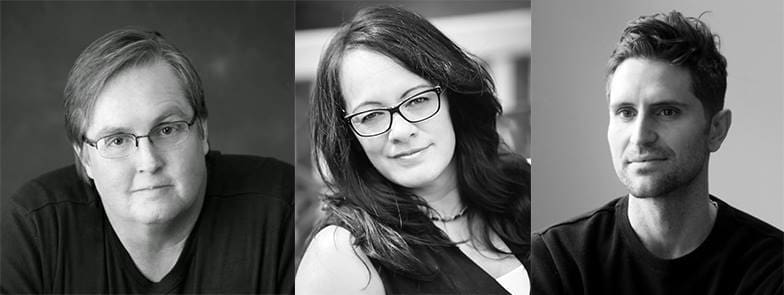
 In this episode Gina Colvin, Ph.D., Dan Wotherspoon, Ph.D., and Thomas McConkie explore the path of staying active in the LDS Church as an unorthodox member. This episode was recorded live at Studio at 50 West in Salt Lake City on June 15, 2016.
For background on our participants:
- Gina Colvin is the host of A Thoughtful Faith podcast and the founder of KiwiMormon blog.
- Dan Wotherspoon is the host of Mormon Matters podcast.
- Thomas Wirthlin McConkie is the author of Navigating Mormon Faith Crisis.
Episode Transcript
Host: John Dehlin · Guests: Dan Wotherspoon, Gina Colvin, Thomas McConkie
This transcript is machine-generated and lightly edited for readability. The audio is authoritative. Please excuse occasional errors in names and spelling.
Introduction and Welcome
John Dehlin [00:00:00] Mormon Stories is a production of the Open Stories foundation and relies solely upon the support of people like you, its listeners to help keep the podcast alive or to become a member of the community. Please become a monthly subscriber by visiting MormonStories.org and clicking on the donate button on the right side of the page under support. All contributions to Mormon Stories are completely tax deductible and go towards producing the podcast and building communities and programs of support for Mormons like you. Thanks for your support.
Guest [00:00:36] The kindly light amid encircling gloom
Guest 2 [00:00:43] Lead
Dan Wotherspoon [00:00:43] thou me on the night is dark
John Dehlin [00:00:48] and I am fine. Yeah, excited to be here. My name is Shonda Lynn. I'm your host. Also want to welcome everyone out. We're live streaming this. I had someone from Facebook reach out to me a week or two ago and said we should consider live streaming our events through Facebook. So we're live streaming on the Mormon Stories page. So hopefully our audience is enjoying and hopefully they can hear us. Okay, we're so glad you're all here. I want to begin by thanking club cafe at 50 west for being such gracious hosts. Jake Jensen's not here. Alicia is also helpful. Let's thank club cafe at 50 west for sponsoring us. They're very generous, very generous with us. This whole production is put on by the Open Stories foundation, which is the 501c3 nonprofit that allows all of the many podcasts that many of you are familiar with to happen. So Mormon Stories Podcast, the Thoughtful Faith Podcast, Mormon Matters Podcast, Mormon Mental Health Podcast, Gay Mormon Stories Podcast, Mormon Transitions Podcast, there's a lot of them. We just want you to know that those of you who support the Open Stories foundation or any of these podcasts, we take your donations very seriously. We're fully transparent with the money you give. We try to be very, very good stewards of that. And this production is sort of a product of that effort. So I want to thank every one of you or those of you in the audience who do contribute to one of the various assets that we have, because it makes all this possible. Really quickly. Hey, Martin. Really quickly. The Open Storage foundation does lots of things. In addition to podcasts, we also have been holding events. We've been holding workshops and retreats, and they've been very, very successful, and we're really happy with them. We have a workshop coming up soon in Phoenix, another one soon thereafter in Dallas. You can go to the Mormon Transitions page to read about those two workshops. We have a retreat coming in mid July in Park City. They've all been received very well. But those workshops and retreats that I'm referring to are for people specifically who are feeling themselves in a transition away from Mormon orthodoxy and sometimes out of the LDS Church altogether. And these workshops are very positive. They're very uplifting, and they're all about healing and growth in your transition. What we're really excited to announce today is that we've gotten together with Dan and with Natasha, Alfred, Parker, Gina, others, and we've decided that we are going to hold our first retreat for specifically targeted towards sort of, you know, Dan's audience, Gina's audience, people who are trying to remain faithfully and constructively engaged within the church. So it's August 26th through 28th. Some of you will see the flyers. Natasha Helfer Parker, who's an amazing, not only licensed marriage and family therapist, but she's also a licensed sex therapist, but she's also been dealing with people in their Mormon journeys for 20 years. She is a believer. She considers herself a believer.
Dan Wotherspoon [00:04:23] Just a fun person.
John Dehlin [00:04:24] She's super fun. She's skilled. But they'll be having discussions about healthy sexuality, about healthy relationships, about healthily and constructively engaging in your church participation, raising children in healthy ways. These are amazing retreats. Dan's going to be heavily involved in this, and we're going to have more of these in the months and years ahead. So consider that. And we'll put up a URL soon as to how to register. But I'm super excited about that and I just wanted to let you know that that's coming. So I'll do just a really brief introduction about what this event is about, and then we'll, we'll turn it over to the panel. I just want to thank you all for coming. And the background of this is just kind of is kind of interesting. Some of you who have been tuning into Mormon stories for a while know that I've interviewed Dan a couple times. And the most recent interview I did with Dan was sort of us going to toe to toe a little bit in terms of me sort of having struggled with leaving or being kicked out of the church and Dan sort of resolutely sticking in his position of supporting people constructively. Engaging. And that was a bit of a slugfest in a polite way, I'd say. At least that's how I might characterize it. But that's actually not what today is about. I, you know, of course, when I was trying to stay constructively engaged with the church, I started a, a website called Stale DS.com that's still very much going strong. There's a real thriving support community there. People trying to remain constructively engaged. And, you know, I also, you know, we. And the foundation started, you know, Mormon Matters. I invited Dan to start that podcast. And then also very proud that we brought Gene on to start to reboot A Thoughtful Faith. But in the Open Stories foundation, we basically want to try and support people anywhere outside of just Mormon orthodoxy. So the church does a really great job of supporting those who are orthodox, and pretty much everybody else is kind of left to figure things out in some ways for themselves. And so while I was a real champion of staying in the church, there obviously became a point where I couldn't champion that anymore. And maybe at times, I felt even conflicted about championing that and even sometimes felt angry and wanted to burn it all down. And so I said that jokingly. That was a joke.
Dan Wotherspoon [00:06:59] So.
John Dehlin [00:07:00] But I've been curious to see how those things would continue. And I've been really impressed with how Dan has continued to grow his audience at Mormon Matters. A Thoughtful Faith started strong with Sarah and Micah, but it kind of fell down a bit. But then Gina picked it right back up. And I think A Thoughtful Faith is one of the most interesting podcasts in Mormonism right now. I think Gina's brilliant. And then, yeah, you gotta applause for Gina and Dan. In addition, there is a. I hope Jerlee doesn't mind. There is a. There is a Facebook forum that is dedicated to supporting people who want to thoughtfully engage with the church. It's not for post Mormons. It's not for people who want to vent or be angry. But if there are people who are trying to sincerely remain faithfully engaged with the church. This Thoughtful Faith Group has grown to about 2,500 people. It's highly moderated. You have to fill out an application to join it, but they've done amazing things in that group. How many of you are sort of either members of the A Thoughtful faith group or listeners to Dan or Gina? Raise your hand. All right, lots of friends in the audience.
Thomas McConkie [00:08:12] Yay.
John Dehlin [00:08:14] So as those things have continued to come on the scenes and thrive, I see it as a worthy movement within Mormonism, Something that definitely is helping a lot of people and is gaining a lot of traction. In addition to that, I had the pleasure of meeting Thomas McConkie a couple years ago. He just reached out to me and we had a little thing at Starbucks. I don't know if he drank coffee. I don't even know if I was drinking coffee at that Point. But we certainly had a delightful meeting. And, you know, within a year or two of that meeting, Thomas came out
Guest 2 [00:08:47] with a really great book called Navigating Mormon Faith Crisis.
John Dehlin [00:08:51] Navigating Mormon Faith Crisis. And Thomas brings a really interesting developmental approach to this whole thing. And his book has really had a lot of traction with a lot of people, and Thomas himself, as a speaker has garnered a lot of interest. So Gino was in town, and I just had this bolt of lightning that said, let's get these cool cats together and have a discussion about what they're doing, why it's important, and what it means to people. And at the end, we'll have some questions to kind of, you know, to kind of try and understand better. If any of you have compliments or concerns or questions, you can save them for the end. But without any further ado, I would like to present to you our distinguished panel, Dr. Gina Colvin, Dr. Dinner Wotherspoon, and Thomas McConkey. Thanks for coming.
Dan Wotherspoon [00:09:50] Thank you.
Guest 2 [00:09:51] Thanks, John.
John Dehlin [00:09:52] Super exciting. All right, well, we have a real full house, and this is a really exciting audience. You have a lot of fans here. I wanted to begin by having each of you just briefly talk about a little bit about your background that led to wanting to carve out an alternative approach. So, Gina, we've done an extensive interview with you on Mormon stories. Dan, with you quite a bit as well. But for those of you, those in our audience who may not know a little bit about your history, just talk specifically about what led you from, if you were in an orthodox place, what led you from that to actually wanting to carve out this, some might say middle way. Gina, why don't we start with you, because. Ladies first.
Gina's Faith Journey and Identity Shift
Thomas McConkie [00:10:38] Oh, thank you very much. That's very kind of you to put me in the hot seat first. And can I just say, it is not.
Guest 3 [00:10:46] It's.
Thomas McConkie [00:10:46] It's. It hasn't gone beyond my attention that I'm one of one woman and three with three males. And which reminds me a little bit about going to a temple recommend interview a couple of years ago. I'd been corralled into it by my stake president, whose job I think it was to get everybody go to the temple. And I was sort of a little reluctant, and I went in there with all guns blazing and I said, you know what this feels like? This feels like a pap smear test. At which point he very quickly went through the questions he didn't want to probe too deeply. And if he ever watches this, I still love you, Jack. Do you Know what I think? I actually think that a more nuanced Mormonism sort of found me, and we can get into that a little bit later. I sort of opened myself to the possibility that I was seeing Mormonism in a particular way, which wasn't healthy for me, regardless of whether or not it was true. And then I just sort of, like, opened myself to the possibility that there was much more there for me to. To rest myself, rest my spirituality in. And I need to say that my desire to spiritually flourish underscores absolutely everything. And it was a big surprise to me that I was able to do that in Mormonism.
John Dehlin [00:12:14] And what about specifically your willingness to occupy a role as a spokesperson or an advocate for an unorthodox approach? What was it that kind of put you in that. On that trajectory, that path?
Thomas McConkie [00:12:33] You did? It was a PM message.
John Dehlin [00:12:37] I guess that's true, huh?
Thomas McConkie [00:12:39] I mean, originally I began blogging and I began blogging.
John Dehlin [00:12:42] Tell us your blog.
Thomas McConkie [00:12:43] Yeah, Keely Mormon. And I did that because I just. I kind of wanted to tell my story. I didn't care if I had readers. It was just. I wanted to just carve out a place which I felt was authentic. That was me.
John Dehlin [00:12:57] She's a brilliant writer. Have you guys read Kiwi Mormon? Brilliant. Yeah.
Thomas McConkie [00:13:03] So I don't know that I want to be a spokesperson, but I feel so passionate about everybody's story that becoming a podcast host meant that I could pour some love into other people's stories. And I think the difference in everybody's stories is what makes the story of Mormonism.
John Dehlin [00:13:18] Yeah, Brilliant. Okay, Dan, tell us a little bit about your journey.
Dan's Background and Big-Picture Thinking
Dan Wotherspoon [00:13:23] Well, as far as I have a philosophy undergraduate degree, and so I've always been big picture oriented, sort of. Sort of. Oh, you're not looking at me. Sort of oriented to the. To the big questions. I didn't mind tension. I didn't mind, you know, things not being super clear. I enjoyed the dialectic. But then I decided to go on and get a master's in religious studies, and I was able to see these theories of religion for that first semester and kind of keep them at an arm distance, you know, the explanatory power that's kind of there in sociology and religion and psychology and religion and feminism and religion and all these fields of study out there. And I was able to sort of not let my Mormonism get affected by those. But then I took a class during my second semester, and it was on scripture and specifically the New Testament. And somehow or other, you know, as brilliant as I was already I still kind of considered scripture, this protected class of stuff, you know, these writings that somehow God really did break through in a unique way in the Western canon and things like that. And a study about the humans involved and all the forces that are going on there and all the different things behind it was crisis in some ways. But it also, as it started to feel good enough. And then guess what? All those other questions I'd kept to bay and now I have to ask those questions about Mormonism, Mormon scripture as well as everything else. But the beauty of that journey for me ultimately was, and it took me six or seven years to fully embrace this was I love these world religions I'm studying. Every one of them is fantastic. And at some point early on in the game, I started to simply say, I don't care if they're true or not. They're good and they're wonderful and they frame lives and they ask interesting questions of the universe and people, you know, kind of make their way through these. And I was finally able to totally relax and say my religion is one of those. Instead of having to be the true one of all those different things. And so I think more than anything, my journey when I came to peace was we have a great religion among other religions in the world. And all the things that I saw that I admired there, they're here. Even though we have a very more top down organization than almost any other religion. Right.
Guest [00:16:05] Thomas.
Dan Wotherspoon [00:16:05] You know, and it's hidden, but it was just fun to sit in there and do it. But the crisis came just through schooling and more questions. Yeah.
John Dehlin [00:16:14] And I believe I met you around 2004, right as I was trying to orient myself towards the universe.
Dan Wotherspoon [00:16:23] I thought I was going to be a college teacher and I ended up heading up some sunstone. And that's where John.
John Dehlin [00:16:27] Yeah.
Dan Wotherspoon [00:16:27] First.
John Dehlin [00:16:28] And even at that point, I knew that you kind of worked. You kind of had this, this shadow stake president sort of role or bishop role of counseling people. But even then I wasn't exactly sure how solid you were in your resoluteness to sort of make Mormonism work. And I almost remember you saying at one point that you might kind of take a sabbatical at some point and disengage. I don't, I don't. I'm not saying that's true. It's just kind of what my memory is. But did you always have it in your mind that you would sort of move into this space of almost being a champion for this kind of movement? Or is it. Did it Grow or.
Dan Wotherspoon [00:17:06] Yeah, and I'm still. I don't still wear that very well.
John Dehlin [00:17:09] You what?
Dan Wotherspoon [00:17:10] I don't wear it.
John Dehlin [00:17:10] We don't wear.
Guest 3 [00:17:11] Well.
Dan Wotherspoon [00:17:11] I don't wear this champion or even this public role that.
Thomas McConkie [00:17:14] Well.
Dan Wotherspoon [00:17:15] Like I said, I was a very skilled college professor type thing, adjunct, you know, everywhere.
John Dehlin [00:17:21] You know, it's just a tough field, religious studies.
Dan Wotherspoon [00:17:24] And then all of a sudden, you know, and I'd been speaking at Sunstone symposiums, and all of a sudden, Elbert Peck decided to step down and I'll apply. And the next thing I know, I discover that instead of an academic voice, and I was always kind of interested in religion at the level of public discourse. So get it out of the jargon and list where does the tire meet the road? Anyway, so. So the Sunstone gig came along, and then I realized within that first six months how pastoral it really was. You know, I'm producing a magazine. We're putting out symposiums and things like that. But it's the phone calls and it's the emails that all of us receive now that really was a big aspect of it. But in terms of being. Honestly, I thought Sunstone was kind of a big platform. Maybe 10,000 people either read or, you know, or kind of in it. Nothing compared to podcasts. So John kind of saw the wave, and we even did a Sunstone podcast for a few episodes. And then I kind of, you know, too many mean things to do in that job. But I'm grateful for you putting me back into it, even though I'll say one other thing. I was blessed in that first year of real struggle to meet a fellow who served as a mentor for me. Still to this day is Randy Paul. Some of you have met him on my podcast or something like that. He introduced me to Eugene England through his writings, to dialogue, to Sunstone and stuff like that. And here at this moment, when I'm thinking, dang, my religion is failing me, it must be the worst religion in the world, you know, just because, like, my parents suck, they're the worst parents in the world. You know, there's that kind of attitude. I saw people engaging in this way, and. And there was just subconsciously a piece that Randy had just as 10 years ahead of me on the path, you know, looking at Gene England and stuff like that, that just kind of were always there as lights to me when things got worse, that somehow or other there's a piece on the other side of the mess. I think I've been on the other, mostly on the other side of the mess for a good eight or ten years now or longer. But there's no going around it. You know, I'm a champion of going through it, and if we serve that role, great. But we're going to fail you, too. So you're reluctant.
John Dehlin [00:19:47] You're reluctant.
Dan Wotherspoon [00:19:49] I'm a reluctant, you know, here. But on the other hand, I'm paying it forward, too, in some ways to those guys.
John Dehlin [00:19:56] Thank you, Thomas. So just really quickly, what is your relation to the McConkeys that we all know?
Family Connections and Early Church Experience
Guest 2 [00:20:06] My granddad is Oscar, so he founded the law firm downtown with Bill Curtin. Okay. He's Bruce's youngest brother.
John Dehlin [00:20:14] Okay.
Guest 2 [00:20:14] So that's where the McConkie. That's where I fall on the McConkey side.
John Dehlin [00:20:17] So Bruce R. Would be your great uncle. Your great uncle. Okay. Since. Since many of us don't know much about your background, talk a bit about your upbringing in the church and your journey out and in.
Guest 2 [00:20:32] Yeah. I was raised in the Mormon Church, and it was about age 13 where I really relate to what you said, Gina, that the faith crisis, the shift in identity really found me. I think at age 13, I was way too young to go theologizing or. Or philosophizing about what Mormonism means and if it was for me. But I knew just on a gut level that something was wrong, and I kind of expressed that to the family. And I remember, I still remember this moment when I was 13 years old. It was the first time the thought had ever occurred to me. And it felt like an alien thought just floating through the ether. And it was, what if you don't go to church today? Man, I had never had that thought in my life. It was an unthinkable thought thought in my family culture, and I knew it right when I had it that no one had ever had this thought as a Makan, let alone acted on it. And I remember that day I didn't go to church, and I had never seen my parents so upset. And I am unusually stubborn. And so when I saw the reaction in the family, that actually really piqued my curiosity. I thought, huh, what if I take another step in that direction? How. How deep does this go? And, you know, I just happened into it. But after the falling out when I was a young teenager, it just put me on a new path, which is a whole other story.
John Dehlin [00:21:59] So you. You disengaged for how long?
Guest 2 [00:22:03] About 20 years.
John Dehlin [00:22:04] You were out of the church for 20 years? Okay.
Guest 2 [00:22:06] Give or take. Yeah. I like to be thorough when I go down a rabbit Hole and make sure I.
John Dehlin [00:22:12] So you didn't serve a mission?
Guest 2 [00:22:14] I didn't.
John Dehlin [00:22:14] Didn't serve a mission, no. Ever got married? Temple married?
Guest 4 [00:22:18] No.
Dan Wotherspoon [00:22:19] No.
John Dehlin [00:22:20] Okay. And did you go through periods of, like, trying other religions, Atheism, like.
Guest 2 [00:22:27] Yeah, absolutely. Well, I mean, backing up to, you know, you touched on a couple important things there. No mission, no marriage. It means, as a man in the LDS culture, I missed every major rite of passage that we've produced as a culture. And, you know, there was a long time where I wondered if I even existed. It was such a bizarre kind of Twilight Zone existence for me that I thought, well, China seems nice. Maybe I'll move there. It's got to be better than what's going on here in Salt Lake. So I really did move across to the other side of the world and just tried to distance myself from it. All right. But in the meantime, you know, I left the church when I was 13, and it was just a few years later before I, you know, found my way to the Canzion Zen center in Salt Lake City. So I started my Buddhist studies and practice when I was still a teenager, and that's been really formative. That's really changed who I am, and it's changed the way I've come to re. Engage Mormonism.
John Dehlin [00:23:24] So Buddhism is. Do you identify as a Buddhist or. No, Buddhists probably would avoid any labels because that's part of Buddhism, right?
Guest 2 [00:23:35] A good Buddhist, an orthodox Buddhist? No, no. I mean, some do. I think I just always felt really Mormon. I just knew intuitively that family lineage, karma, my own identity, I, you know, native. I always say this about Mormonism, that it feels like my native tongue. You know, it just feels like the most natural way to express myself, you know, in the vein of worship and devotion. And, you know, it's never felt better, frankly.
John Dehlin [00:24:02] Yeah, yeah. Are you talking about Buddhism or Mormonism?
Guest 2 [00:24:04] Mormonism.
John Dehlin [00:24:05] Okay.
Guest 2 [00:24:06] Right.
John Dehlin [00:24:06] But you're bringing. You're bringing your Buddhism into your Mormonism, right?
Guest 4 [00:24:09] Yeah.
John Dehlin [00:24:10] It's like chocolate and peanut butter. It's like they go better together. True.
Guest 2 [00:24:14] Exactly. Well, I can't imagine leaving behind my Buddhist sensibilities at this point. It's really enriched my life of faith. And, you know, at the end of the day, I think you two would appreciate this. But what I've come to find is that we come to talk a certain way in a given culture, and we wear certain clothes and we do certain dances, but Buddhism really helped me kind of get beneath that, those surface structures of religion and, you know, tap into something that Seemed to be generating it. That sounds kind of esoteric, but all I mean to say is that, you know, going to the source of Buddhism took me right to the heart of Mormonism. And at that point it's like, well, flip a coin. Like, I just love the devotion and the worship and the reality of who we are. So let's get excited about who we are and who we're becoming and, you know, maybe worry less about the dividing lines of how we talk about it.
John Dehlin [00:25:11] Not just Mormonism, but Christianity too. I'm. Yeah, a lot of Buddhism and Christianity. Real quick, did, did you. Were you estranged from your family for all those years? Was there a point where they just accepted you and you were welcome in their graces as a, as a non member or a non believer? Like how, how was your relationship with your immediate extended McConkey family during that time of being out?
Guest 2 [00:25:38] Yeah, I was really grief stricken for years. I mean, from. From age 13 to 18 when I was still in the home and just this walking anomaly of an inactive Worthland McConkey son. You know, there's just no place for me. It was, it was really challenging for all of us and we lived that way. We just tried to coexist for about 15 years. That was really painful for all of us. And I had a major turning point. I had lived with.
John Dehlin [00:26:06] Wait, so 15 years of pain and
Guest 2 [00:26:07] 15 years of estrangement? Yeah, just.
John Dehlin [00:26:09] Yeah, almost no talking, like distance.
Guest 2 [00:26:12] Little talking distance. Yeah. And like, you know, living all around the world, trying not to steal how I felt when I was here at home or what should have been home. It was so painful. And I had a turning point in my later 20s. It just. It was this kind of moment that came all at once, just as a grace. But I realized that I had felt so much anger and resentment towards my family, towards the culture, for not being able to just take me as I was, that this is my life and this is how it's unfolding. And there's a mystery to it. I don't understand it either, but would you please just love it? And I realized in just this moment of a lightning strike that I was actually the one who couldn't accept their Mormonism that didn't accept me. I realized that I was my biggest problem. And at that point my heart just broke open and again and I realized.
John Dehlin [00:27:04] Wait, you were the one who couldn't accept their Mormonism?
Guest 2 [00:27:07] The Mormonism that didn't accept me.
John Dehlin [00:27:10] Right. So you were being as non accepting as they were to you?
Guest 2 [00:27:14] Exactly. And the moment I saw that irony, my heart opened and that was my entry back into Mormonism. I thought, well, if Mormonism is just forgiveness and letting people be what they are and support them in their faith journeys, then I could sign up for that.
John Dehlin [00:27:34] You kind of simplified Mormonism in your mind a little bit, right?
Guest 2 [00:27:37] Well, that was part of it.
John Dehlin [00:27:38] But you also, it sounds like you decided that you were going to let go of the same judgment that was being directed towards you and that you were going to work to build bridges, not break down bridges. Is that right?
Guest 2 [00:27:54] Absolutely. And everything shifted when I shifted. When I could let go of that, my own heartache, I was able to come home again.
John Dehlin [00:28:02] So that was five years ago.
Guest 2 [00:28:04] That was, that was like I was around 27. That was eight, nine years ago. But that was my. That was the beginning of my return. And then it was a long process of re acclimating to the three hour block and that took several years. That was, that was a bitter pill. John,
Returning to Activity as an Unorthodox Member
John Dehlin [00:28:21] was there ever a point where you, I mean, there might be some people in this audience who aren't big fans of your uncle, Great uncle. Is that Bruce? Bruce, yeah. He's your what?
Dan Wotherspoon [00:28:35] Great uncle.
Guest 2 [00:28:35] I'm not sure what you mean.
John Dehlin [00:28:39] What's his relation to you again?
Guest 2 [00:28:41] My uncle, Yeah.
John Dehlin [00:28:44] I think there's probably a lot of people here, maybe even myself included, who feel like in some ways he really damaged some really positive trajectories the church was on along with Joseph Fielding Smith and others. But was there ever a point where you realized maybe some of the more negative ways that he might have impacted Mormonism and carried maybe regret or shame in that family name or anger or whatever?
Guest 2 [00:29:13] Yeah, no, that's a fair question. I grew up in a family culture. Any family, you grew up in struggles. We all have our unique pathologies and, you know, the things we struggle with within our own nuclear families. And you know, my family grew up with struggles and you know, in many ways they bore the pattern of some of Bruce's struggles.
Guest 4 [00:29:34] Right.
Guest 2 [00:29:35] I think in some ways, and I want to be fair here, but I think sometimes Bruce could be rigid.
Dan Wotherspoon [00:29:40] Right.
Guest 2 [00:29:43] Let me just see how that does with the crowd.
Dan Wotherspoon [00:29:46] Shocking.
Guest 2 [00:29:49] Bruce felt strongly about things. And I grew up in a house with parents that felt really strongly about things and that culture felt rigid to me. It was hard for me to live and to flourish that way. So certainly from a young age, even before I knew where it was coming from, I had a sense that we feel pretty tightly wound in this family culture. And the flip side, the downside of that is that the older I get, the more I appreciate that Bruce had his own ministry. And I think the moment where he served in the church and really created a firm bedrock of doctrine, and this is who we are. Its time has passed, arguably, but there was a time in the church where it was going global, and we needed to cement our identity as a global organization. So I've come to experience Bruce in a more nuanced way, and I appreciate who he was and that he was on his own path as well. I'll let you, you know, have a breath with that. Deep breath, you know. Well, in all fairness, I've been. In all fairness, that was. That was like 15 years of therapy
John Dehlin [00:30:56] it took me to get that.
Guest 2 [00:30:57] So if. If you're not there yet, it's cool.
John Dehlin [00:31:01] I'll make it. I'll make an appointment with you. All right. Yeah, Good. Okay. So when was there some, like, prodigal son return where. Like, the whole immediate, extended. I mean, every. Every one of us, if we stray, wants to be the prodigal child, to return and to be celebrated and to have. Kill the fatted lamb or whatever in the feast. Right. I mean, certainly there were familial, social, even psychological pressures or gravity to have you come back and be the triumphant sort of returning son.
Guest 2 [00:31:43] Yeah.
John Dehlin [00:31:44] Is that how you were received, and is that how you're sort of viewed now?
Guest 2 [00:31:48] Well, it's interesting. I was gone for so long, and I missed all the rites of passage. Most of my closest friends, if anything, they think it's strange that I have gone back to church rather than encouraged me to.
Guest 4 [00:32:01] Right.
Guest 2 [00:32:01] There wasn't any obvious incentive to come back, and I had grown up estranged from my family, so on some level, I think I'd really made peace with that. I think, in theory, I could have lived out the rest of my life not engaging with the church, and I certainly didn't have a conscious intent to. Right. But I just. Like I said, I was a devoted Buddhist practitioner, and every way I knew how, I plumbed the depths of that tradition. And literally, in an instant, I kind of woke up and found myself at the heart of Mormonism. It just happened, and it felt really natural. And I celebrate it understanding that this is maybe one of the most problematic times in Mormon history to, you know, to come back. But, you know, the last thing I wanted to say is that it was funny. My parents hoped and prayed that I would come back over the years, and I think their first reaction when I. I actually did start to come back into the fold, they were confused that I was still so Buddhist. I think they imagined that something fundamentally would change. And, yeah, I mean, I seek to integrate it all. I don't want to leave any of the good stuff behind. And I think Mormonism on its good days does that. It just doesn't leave anything good behind.
John Dehlin [00:33:19] Okay, but did they celebrate you? Did they celebrate your return?
Guest 2 [00:33:24] I think they're getting used to it.
John Dehlin [00:33:25] Okay.
Guest 3 [00:33:27] All right.
John Dehlin [00:33:30] All right. So Dan or Gina. I'm not sure. Maybe both of you can speak to this. And Thomas, feel free to jump in. I fell in love with Kaim Potok at byu, with my name is Asher Lev. And since I've read three other Kaim Potok books. Kaim Potok was this author in the, I don't know, 70s, 80s who wrote a lot about how Judaism sort of went from orthodox, sort of Hasidic, very conservative traditions. Sort of any traces in many of his books how modern strains of liberalism and progressivism transformed Judaism as it struggled to face historical criticism of the Old Testament as Jews faced the Holocaust and sort of century after century of persecution. And, you know, how the social strains within Judaism led to a branch, multiple branches of Judaism, but one branch in particular, Reformed Judaism, but also Reconstructionist Judaism, that today represents the largest branch of Judaism in the United States. And it happens to be a branch of Judaism where believing in God is optional, believing in Moses, the founder of your religion, is optional. And you can be a female rabbi, you can be a gay or lesbian rabbi, you can be a transgender rabbi. And it's super broad and progressive and inclusive. And also. It's more about the ritual and finding community and even spiritual value and enlightenment within the tradition and basically saying, you don't have to choose between truth and science and knowledge and your heritage, your traditions, and even spirituality, religiosity. And, you know, for many, many years, I was trying to see, could we carve this out within Mormonism? Yes. No. If we can't, can we create sort of a reform Mormonism? And that's had its big, long history in terms of how I've been thinking about things. But, Dan and Gina, have you guys thought about the way that history has unfolded in other religious traditions and the extent to which this is sort of our time to go through these growing pains? So sort of the historical context that we find ourselves in relative to other developmental trajectories of other religions, of other religious traditions? Do you see this as that moment for us? And is that in any way what fuels what you're doing? A vision for what we can become in that same light. That's a really long question.
Tensions and Growing Pains Within Mormonism
Thomas McConkie [00:36:40] It was a really long question. I want to take issue, not issue, but question the idea of we, because I think there is a little bit of a consistency seat here to suggest that in Mormonism there is one we. So I grew up in New Zealand. The way that I experienced Mormonism was markedly different than perhaps you had experienced Mormonism here in Salt Lake City. And so I suppose I have always bucked at the notion of a kind of a Mormon cultural imperialism imprinting itself on the way that we managed Mormonism here in New Zealand, where it was always a very syncretic tradition. It beautifully fused Mori spiritual practice with this, you know, this audacious American religious practice and held those two spaces really well right up until about the 1970s, where correlation meant that there was an impinging in the expression of indigenous, indigenous realization of Mormonism or expressions of Mormonism. So I think that's. And this largely happened during the Mori renaissance. And I say Maori. I think you guys say Maori or something like that. It's actually pronounced properly Maori. And we found a lot of that flexibility to express both our culture and our religious tradition curtailed by visiting authorities who would say, well, we don't want you to speak the Mori language anymore. You all speak English, you can just stop that. Or the death rituals in which you can't hold that at the meeting house anymore for three days, you need to bring bodies to the chapel and you can have it in one day, you know, reminiscent of whatever happens here in your mortuaries and funeral homes. And so there was a huge divide between this very white American wasatch front culture and an effort to wash out the nativeness, the indigeneity of that. So in terms of responding to the question about religious traditions, this moment, I think, asks us to pay attention to the way in which Mormonism is expressed right throughout the world in its different iterations, the way it wraps around and nourishes indigenous or other cultures. I mean, I always experienced growing up. I always experienced these American authorities. And I grew up in a gorgeous, gorgeous area of the church where people were so loving. I mean, I'm a bastard child of a single mother, you know, and they just enveloped and I think we've already had that discussion. They just housed me and nurtured me and loved me, and they still do. And so when I experienced that against this very sort of americentric. I think I may have made up that word, but I used it a lot. Yeah, this very American way. And Americans would come and they had these big friggin white teeth and I'd stand at the podium with this kind of audacious confidence. They were like large flickering televisions. And I didn't like the way, the effect that that had on the people that I loved, they became smaller in those spaces. And that really pissed me off growing up. And I noticed it very young as well. So back to your question. Sorry, this has taken a long time.
John Dehlin [00:40:17] Dan, that's important. It's important stuff. Thank you for.
Thomas McConkie [00:40:20] Yeah, so in terms of the moment that we have, I think that Mormonism's breath is realized at the periphery, both at the periphery of the church and also in its shadows. We make a lot, I think, of Mormonism writ large. I suppose corporate Mormonism wants to celebrate the light, but no religious tradition happens in just light. It happens in light shadow, it happens at center and periphery. And I don't think we've got. We've reconciled the light and the shadow of Mormonism. You know, these kinds of conversations may be monitored as something other to the people over that direction. Is it that direction? Temple Square?
Dan Wotherspoon [00:41:05] Exactly.
Thomas McConkie [00:41:06] Yeah, I was right. So. And I think the great conversation needs to bring the shadow. I mean, in many respects we're shadow workers doing religion and spirituality in this sort of baro space, this threshold space. When Mormonism can reconcile what's happening at the centre with what's happening at the periphery, with what's happening in the shadows, with what they would like to see in the light, then I think that we've got a healthier Mormonism. I don't know if that really answered you, your question. That's what came up.
John Dehlin [00:41:39] No, it's important. So am I hearing you say that there never has been just one Mormonism?
Dan Wotherspoon [00:41:45] No, ever.
Thomas McConkie [00:41:47] And you've seen. And there's been lots of resistance and
John Dehlin [00:41:50] there's always been a tension, sort of dialectical tensions within our tradition. And it's always been so.
Thomas McConkie [00:41:58] I think so.
John Dehlin [00:41:58] So there's not this single monolithic Mormonism moving in progression. And there's a lot of people here who feel like there has been. They were raised in a correlated mindset where they felt like there was a single Mormonism. And you guys represent something other than Mormonism. They're like, you guys are making this up. You know, there's a lot of people here who just say, you guys are making up your own thing. It's not even Mormon, it doesn't even sound Mormon. And you're basically challenging even the premise of the question, saying it's always been A messy sort of fringy dialectic of a progression.
Thomas McConkie [00:42:36] Absolutely.
John Dehlin [00:42:37] Okay, Dan, what would be your answer to my really long question, in addition?
Dan Wotherspoon [00:42:40] Well, there's different parts to it, and I know that Thomas has some really good stuff because of previous conversations on. I think he thinks we're at a great moment now for a developmental shift and things. But something came up for me in the question, so I'm just going to go with it. And it's a story I have. I haven't told in a long time. I did write about it once. It was just the trigger of an Orthodox Jewish woman and the role that she played in my life. And where I'm going with this, I'm taking the part of your question, like, does this idea of a Reform Mormonism or some kind of even labels like progressive Mormonism, does this occupy my brain? Am I trying to create something? So that's kind of the part of the question to do. Well, what happened in 1997? I was at the American Academy of Religion, and I was trying to get a job and all that kind of good stuff. But I was teaching, and I had a student that was going to be writing about cloning. And so I went to a session on cloning at this thing just to kind of educate myself so I could engage his paper better at the end. And there was a revelation that happened in the way an Orthodox Jewish woman spoke who was also a scholar. So it was like in this embodiment of a woman that had the full brain power and the articulateness and this brilliance and the ease at which she spoke about her own religious tradition. And I don't remember exactly the arguments she was making, but as she talked about cloning, she really kind of talked about the Jewish nature of the body. And she got into burial and preparation for burial rituals and things like that. And it was just this amazing moment for me to look at somebody who had both things going on, but she wore them so much. Well. And so here I'm. I graduated in 96, write my dissertation. I'm in my second year of trying to do a cycle, and you're at the academy, and I wrote a Mormon dissertation. And people are like, hey, what do you study? What's your thing? I go, well, I did a dissertation on Mormon theology, you know, or something like that. And I would introduce myself as a Mormon. But I always say, but don't worry, I'm a liberal Mormon, or I'm a progressive Mormon, or I'm, you know. You know, I also hate Tom Green. I don't know if you remember the polygamist Tom Green. He was like, really conspicuous there in the 90s in my head. And Orrin Hatch was doing crazy things. And I always was putting a but I'm a Mormon, but. And it was so interesting. I just had one of those, like, moments to reflect on this when I was just like out of body kind of noticing. The very next session I attended to after that, somebody and I started a conversation and she just said, so what's your field of study? I go, I'm a Mormon theologian. And I just left it right there. And from that point on, my goal has just been than to say I'm a Mormon. You're a Mormon. Everyone here is a Mormon. I don't love these labels. I see them as necessary evils right now. But, you know, there's generally no one questions that a contemplative Catholic is a Catholic. You know, no one questions any of the forms of Judaism as Jews. That's my goal to, you know, if anything. So I'm really not trying to create a particular brand here. I'm just trying to, to let everyone know that whatever you are, speak it and let them do the work of. Oh, well, he certainly doesn't sound like the normal Mormons that I run into. Let them do the work instead of giving the easy answer. So at least that part of your question, that's what I address.
What Does It Mean to Be Mormon Today
John Dehlin [00:46:13] So am I a Mormon?
Dan Wotherspoon [00:46:15] Everyone who claims it is Mormon. For me, Yeah, I really, you know, I'm a part of this workshop and we're calling it Progressive Mormons. And you explain. Explain partly why we're, why we're trying to attach a different crowd than the transitioning out ones. But, you know, ultimately this is just a question for, you know, healthy living and spirituality and all those kinds of things.
John Dehlin [00:46:36] Brilliant. Did you want to add.
Guest 2 [00:46:38] I wanted to ask you if you are a Mormon. I'm interested in that question.
John Dehlin [00:46:42] You really are?
Guest 2 [00:46:43] Yeah. I would love to hear your answer.
John Dehlin [00:46:45] I definitely feel culturally Mormon still. I mean, you saw how I sing those primary songs. I mean, that, that feels like home to me. Singing a primary song. I, I know that makes some people angry when I say that, but it, it very much feels like home. Having said that, it's almost like a divorce in the sense you'll always be family, but it, but there's also a lot of trauma and problems that made it so you couldn't be together. So it's. I'm a bit conflicted, but in my heart, I still feel very Mormon.
Guest 2 [00:47:20] Thanks, John. Well, I'm happy to sing with you tonight.
Guest 3 [00:47:22] What's that?
Guest 2 [00:47:23] I'm happy to sing with you tonight.
John Dehlin [00:47:24] Oh, thank you.
Guest 2 [00:47:26] I have a little something, just kind of an image to offer, really. You know, when Gina and Dan were both talking about how Mormonism is growing, how it's changing in their own person, but also as a. An organization, the community, I think about the Big Bang. You know, the story we tell in science, like, there was nothing, and then there was a whole lot of something. Right. And, you know, everything that proceeded from the nothing was part of the bang. Right. It's all made of the same universal substance.
Thomas McConkie [00:48:01] Right.
Guest 2 [00:48:01] At its core. Right. It's light, energy. Einstein would say.
Guest 3 [00:48:05] Right.
Guest 2 [00:48:05] And there's something beautiful about what I hear in your voice. Like, if we just claim our experience, like, if we're in the Mormon orbit, if we're part of the Mormon Big Bang, and this Mormonism is screaming out into the edges of space, then everything from that bang is Mormon. Every experience we have is some kind of Mormonism. And there's a real dignity in that, and there's an incredible value in that. And I love. I mean, I got chills when you just said that, Dan. Like, I'm a Mormon theologian and like that, to me, that is evolution. And sometimes evolution is synonymous with restoration. Right. It just muddles along. It's messy, but it's happening. And we're growing into these new categories that we haven't seen before, and we don't even know what to call them yet. We're evolving a new language for it. But I think what really excites me is that in the structure of Mormonism and the theology itself, we're actually invited by to create those new structures. We're invited to deeply participate in the restoration. So I think it's a beautiful invitation. And there are worse places and religions to be born into.
John Dehlin [00:49:15] Yeah.
Guest 3 [00:49:16] Yeah.
John Dehlin [00:49:17] All right.
Dan Wotherspoon [00:49:17] You have a hopefulness for this moment, too. I'd love to at least prompt you to talk about that.
Guest 2 [00:49:23] Sure. Do you want to go somewhere else?
John Dehlin [00:49:26] Quick answer.
Guest 2 [00:49:27] Why am I hopeful?
John Dehlin [00:49:30] Do you see this as a historic moment or a pivotal moment or at a crossroads, you know, a great opportunity? Do you have a framing of the moment?
Guest 2 [00:49:39] Well, I mean, this is where I love the Buddhist framing. I mean, in Buddhism, we talk about every moment as potentially being the moment where we wake up to our own nature. And I think there's definitely a quickening in the Mormon culture. Just our ability to come into community together, our ability to communicate with one another. It feels like there's a quickening and, you know, every single moment, including, and especially this one, why shouldn't it be a turning point in history?
John Dehlin [00:50:11] Okay, it's very Buddhist. So for many of us, and Gina, this is maybe a different experience than your beautiful experience. For many of us there in our minds, there really is one Mormonism, and it's the corporate correlated 15, you know, apostles and prophets that lead us and they tell us what doctrine is. They've got the authority. And, you know, from their perspective, our job is to. And this is in the. Let's just say in the post Mormon world, the pejorative is pay, pray and obey. Right? Pay your tithing, you know, worship and do what we say. And so for many who, let's just say, emerge or fall out of or awaken from Mormon orthodoxy, they just, first of all, they don't even see sticking around as a possibility once they decide that it's not what it claims to be and may even be false or other sorts of things. And also they sort of say the church is what the brethren say it is, and the church, and they don't want people like us and we're not doing Mormonism like they say we should be doing Mormonism, therefore we should leave Mormonism. And Thomas, we'll start with you and then Dan and then Gina, what would you respond? There are many people. How many of you in this audience sort of feel that way or have experienced that? Okay, what would you say to someone who said to you, you can't do your own Mormonism, you do what the brethren say, and that's Mormonism, right?
Guest 2 [00:51:52] Yeah. This is a painful question, because I know from personal experience, and I'm sure there are more people than indicated in the room that carry this pain of feeling like there's no category for them and they can shoehorn themselves into a proper category of Mormonism where they can get out. And that's a terrible choice to make. Again, I would just refer back to my own personal experience with it. I find a really powerful practice of forgiveness and noticing the way that some Mormons can't include me and making my Mormonism a matter of including them. Right. I've said this in past conversations, and I continue to say it, that, you know, in a sense, there's the church that you're talking about. I don't disagree with that at all. And what's the church without all of us? You know, it's a bunch of books that aren't getting read and a bunch of buildings that aren't getting filled. We Are the church like, what's the church if it's not the aggregate of, of the members? And so if we can live into new realities and if we can tell new stories about Mormonism, how could the church do anything but change and become something new? So I'm optimistic about the power of the individual and the power of community in dreaming a new kind of Mormonism that is the kind of world we want to be in, you know.
John Dehlin [00:53:18] Dan?
Dan Wotherspoon [00:53:20] Yeah, I mean, I am living as a Mormon. Active, teaching, priesthood, participating, being welcomed and valued by people around me and every single one of them. My wife and I marched at the Pride Parade, you know, recently, and they know who we are and we share openly. I'm kind of a frequent flier at testimony meeting these days. And it's never about truth claims so much as experiential goodness and gratefulness. When my daughter got married, I was just so grateful for all the forces that raised this child that has had to express those kinds of things. So that's my kind of testimony and my gratitude. But I am living, I am living this life, but I'm. 1989 is when I started, you know, what are we now, 27 years later and after 10 or 11 years of hell of negotiating that exact terrain of wow, you know, the culture versus me, little old me. And just, it just took, it just took, took growing confidence in myself, my own connection with God and spirit. I had a fantastic mission. But late in life, 24 years old when I went, well, a couple months shy of it, powerful spiritual experiences that kind of taught me how God and I work together, you know, kind of how to hear the voice and things like that. And so that when I'm struggling, I'm grateful that I had at least I know what that feels like. But I was unable to stand being in church half the time. There was a four year period when it was maybe one out of three weeks that I could stand to go and I'd come home madder than when I left and my wife would support me in this. And there was a couple years where I was a member of the First Unitarian congregation in the morning and you know, doing my thing in the afternoon. But luckily I had guy like Tom Rogers who was in my ward and I became friends with him and you know, just at the right time, mentors and models of how to kind of, you know, be this were always there and felt authentic to me. So I'm just again, more of a, if anything, if you're feeling that way now, I felt that way, you know, Grateful for Randy Paul, just like take the long view, you know, grateful for the voices I have. And so if the podcasts and if the Facebook groups and all those things are serving that for you, they served that for me in the different, you know, just a different earlier iterations of that. But this is a powerful journey to be on. It's the human journey, I really do believe, to move from other people's authority to your own authority, your own connection, any theology, any claims that's weighed now against this entirety of my own sitting in spirit and my own weighing and all those different things. And so I'm perfectly comfortable in my Mormon skin and I'm perfectly comfortable at church. I'm sad a lot. I'm sad that there's not greater depth of discussion. And I do my part on the weeks that I can kind of work something in, you know, to kind of say, let's shift this to a different plane. But I can do it, and I know it can be done, but it took a dozen years to even be close to.
John Dehlin [00:56:57] You're saying it takes time.
Dan Wotherspoon [00:56:58] Yeah. And you live into it. You know, I wish there were the top 10 things I could do and you know, within six months I've mastered this. But Thomas and I both kind of know and, you know, just from studying all the faith development theories out there in the world, it's. It's a whole reorientation. And one of the big shifts is, and it doesn't sound possible from what you believe becoming just least less and less and less important to just, you know, for me, I go, my words are from belief to centering, just to feel centered in the universe, to feel comfortable in my own skin, all those kinds of things. Then beliefs are just interesting and some lead to better experiences, experiential, you know, things, and some lead away from it and things like that. But there's not a single Mormon claim that I believe literally. But boy, the gist of them, the sensibility of them. There's lots of those that I say, these are expansive and ennobling. And that's where I sit. And then I begin. I can usually take something that's lousy in church and go, ah, what's the deeper thing there? As soon as you start talking about it for Ghost. Oh, yeah, that's Mormonism too. You know, we just haven't talked about that in a while. But anyway, I ran on too long.
John Dehlin [00:58:10] Thank you, but thanks, Gina.
Making Space for Nuanced Belief in the Church
Thomas McConkie [00:58:12] So your question is whether or not it's possible for us to occupy these more nuanced positions. Yes, Just try and stop me.
Guest 4 [00:58:30] Nice.
Thomas McConkie [00:58:36] What I realized some time ago is that the church is weighed down by the dead weight of semen.
John Dehlin [00:58:47] And somebody tweet that. Somebody tweet that the church is weighed down by the dead weight of seamen. Yes, tweet that somebody.
Dan Wotherspoon [00:58:57] There's going to be a meme. Kiwi Mormon. What's your Twitter?
Thomas McConkie [00:59:00] And human is fine in certain contexts, but not in a spiritual context. And I think the great thing, the great moment that we're waiting for, and it will only come, it will only be realized. Sorry, I'm filthy. I'm just filthy.
Dan Wotherspoon [00:59:24] So there'll be a climax to this journey?
Thomas McConkie [00:59:26] Yes, there will be a climax.
John Dehlin [00:59:34] Do we need some Barry White here?
Thomas McConkie [00:59:36] Yeah, I think I don't. I just need to kind of run through my glossary of words, my thesaurus.
John Dehlin [00:59:43] You're making it hard.
Guest 2 [00:59:45] Oh, man.
Thomas McConkie [00:59:51] My sense is that.
Dan Wotherspoon [00:59:52] I'm sorry, Thomas, you want to at least get one?
John Dehlin [00:59:56] No,
Thomas McConkie [01:00:00] my sense is that unless we claim, particularly women claim, all that Mormonism has and continues to offer us that is not offered for, but is there, our church will putter along in this sort of wasteland of evolution, waiting for the brethren to do something. Now, unless we women wake up to the extraordinary power that we have and we demand a sex balance, I think that the church will just putter out. It will kind of tip over into this sort of, you know, this. Of nihilistic patriarchy. It will become irrelevant. So when we talk about whether or not there is another kind of Mormon, there must be another kind of Mormonism, and that is the Mormonism that is claimed by women without looking for authority. So.
John Dehlin [01:01:01] Do I hear you saying woman instead of women instead
Thomas McConkie [01:01:06] what I'm just might be an accent.
John Dehlin [01:01:09] Is that accent okay?
Thomas McConkie [01:01:10] Woman.
John Dehlin [01:01:11] Okay. No, I just want to make sure I, I. If there was. If it was a different word choice, I want to understand it.
Dan Wotherspoon [01:01:17] So, woman.
John Dehlin [01:01:17] Okay. Perfect. Beautiful. That was beautiful. Except we lost the spirit in that exchange.
Thomas McConkie [01:01:24] I felt the spirit.
John Dehlin [01:01:25] You drove the spirit out. You felt more. You felt the spirit more.
Dan Wotherspoon [01:01:28] A type of spirit.
Why Stay Rather Than Leave
John Dehlin [01:01:29] Okay, really quick. I know you've all communicated that Mormonism for each of you is a fertile ground to develop spirituality. There's many people who see it as a spoiled ground where our history is one of, you know, abuse or deceit, you know, polygamy and abuse of, you know, marginalization of women, of hiding things, of. Of punishing people who speak out. And they sort of see it as this war zone of carnage and polluted, sort of a Chernobyl, a Moral Chernobyl. And why would anyone want to build a house there? Right? How do you guys, each of you, let's do Dan, Gina, Thomas this time. How do each of you decide that in spite of Mountain Meadows massacre and Polyandry and September 6th and just all the different examples of carnage along the road that you still want to sort of put up shop in the middle of what some think is Chernobyl? Like, why not just be a good person? Why not humanism? Why not just sort of strike out with. With secularists and build something that isn't tainted by what many view is. Is immoral ugliness? Was that a loaded question?
Dan Wotherspoon [01:03:01] But you, well, you can empathize with anybody who's.
Thomas McConkie [01:03:04] So why not to sleep the church is what you're asking.
John Dehlin [01:03:06] What's that?
Thomas McConkie [01:03:06] Why not leave the church is what you're asking?
Dan Wotherspoon [01:03:08] No, no.
Guest [01:03:08] Why.
John Dehlin [01:03:09] Why try and build a spiritual home in a place that's so fraught?
Thomas McConkie [01:03:13] Oh,
Dan Wotherspoon [01:03:16] well, I guess for me, autobiographically, I did build a spiritual home within this environment. So I know it was possible. It's my native language I've shared, you know, coming back when my life was so broken to the. To the story in the Book of Mormon of the Sons, Messiah and Alma the Younger and just going, that's me. They made something of their lives again after this sort of, you know, trip, so can I. I don't know that they ever lived or breathed or anything like that, but that was a story that felt real to me, at least archetypically. Of course, then I did think that it was for sure literal. So, man, Mormonism was a fertile ground for me to say, I'm a person of worth, God loves me. There's. There's nothing I can do. I can change. I can become something again. And of course, there's lots that you have to go through to make those transitions, but Mormonism worked for me. I teased at it, so I won't spend a lot of it. When it became to get complicated again for me during the school time, that beauty of seeing Buddhism, Islam, every form of Christianity, Judaism, lived at deep levels and surface levels, and people that, you know, unthinkingly do things versus people that are contemplative and stuff like that and saying every tradition has that. Therefore, that's what's within my Mormonism. I'm not going to say all of Buddhism is this because there's people that are really, you know, wanting the prayer flag kind of automatic universe. You know, I don't. It's been too long. But you Know, that's where there's. That's where they're centered in their practice. And so Mormonism always had a bigger spectrum for me, thankfully, because of my study of world religions. As far as the toxic environment versus others. There's a great phrase. It's from a Krista Tippett podcast. If you guys don't listen to Krista Tippett, boy, she is in my top five favorite people in the world. Somebody she was interviewing basically said, yeah, I see all the crap. So they say yes, and then their next phrase is and. And I go about doing my. Doing my thing to ease that, to, you know, acknowledge it. I'm not afraid to notice it. There's Carolyn Pearson, you know, talks a lot. She's got the great metaphors about, you know, there's that polygamy tree and there's those other things, but they're in my backyard too, you know, and I have to wrestle with them and stuff like that. So you don't want to, like, deny that they're there. I don't want to deny the experience of everybody here who's, you know, more damned been damaged. You know, I haven't been damaged personally by Mormonism.
John Dehlin [01:06:15] You have or have not? You have not been.
Dan Wotherspoon [01:06:17] Not too much so. Again, I know I'm only speaking from my experience about that, but it's.
Guest 2 [01:06:23] I'm just.
Dan Wotherspoon [01:06:26] I guess this is one of the few things I came here to express. And if I'm using up all my time now, that's fine. At a certain point, I've just made peace that I'm never going to be living a life where I'm going to seek total victory. You know what I mean? There's sort of good people get in and they fight a fight, and they live and they die, and things have changed, perhaps in their lifetime and because of their efforts, but that's not a reason for staying or going. And whether or not I'm successful in changing it, I feel called to this life by my own story, my own autobiography, my own temperament. I have this ability to kind of like, not be, you know, reactive super fast. So whatever it is for me. But there is this beauty. It's a tragic beauty, but there's a beauty in never fully being able to declare victory in this fight that we want. But there are resources for the spiritual renewal. So in other words, it doesn't have to be the external validation. This changed because of efforts, but it's when you know that you're in tune with your highest self or what you're called to do. And you've got that sort of stuff coming together in you. You don't need the external, you've got the internal renewal and those sources and the energy that flows. And so every day spend some time in those energies, find those things that speak to your higher self. And I promise you, at least for me now, 10 or 15 years into kind of living at that sort of
Guest 3 [01:08:14] peace,
Dan Wotherspoon [01:08:16] it's possible, it's enjoyable. I did remember one thing. When Gene England died, Peggy Fletcher Stack called me up and said, who's going to be the next Gene England? And my first thought was who would want to be? Because it seems so painful to be that misunderstood by so many people and things like that. And yet, you know, as I prepared for a while there, I got the website together for EugeneEngland.org and I did a few things like that. There was a time when I was probably going to write a biography of him. But times passed, but I saw the joy too, and I experienced that joy. So amidst all this pain, amidst all this horrible things, I promise you I'm not having a non joyful life and I really do want to go to church on Sunday because these are good people, you know, not every life has to be about brilliance and, you know, depth of conversation. I'll take goodness over correctness anytime. Thanks.
Thomas McConkie [01:09:18] What was the question again?
Dan Wotherspoon [01:09:19] The poison, the poison.
John Dehlin [01:09:21] Why try and build a spiritual home in what some might describe as kind
Guest 3 [01:09:26] of
John Dehlin [01:09:29] a wasteland, a fraught wasteland.
Thomas McConkie [01:09:32] I'd have to be convinced that it is a wasteland. And I'm really compelled by the notion. I think it's Samsara, isn't it? The Buddhist notion of the burning house. Like I'm not going to make excuses for Mormonism.
John Dehlin [01:09:43] Which house?
Thomas McConkie [01:09:44] The burning house. It's the idea that the house is burning.
John Dehlin [01:09:48] Oh, right.
Thomas McConkie [01:09:50] And so I can't make any excuses for some of the injuries inflicted upon the psychic and the spiritual injuries inflicted upon people. And I was having a chat with Christine before, just in case people don't know this about me, but there were times that I would go to church and I would think to myself, if, if my brains explode and splatter all over the chandeliers, I wouldn't be surprised. There are times that I would show up at church and pull into the car park and I couldn't breathe. And it has been deeply, deeply painful. And as each layer of sort of mythology has been deconstructed before me, I'm thinking this place is a mess. However, having said that, I can't deny the ineffable, I can't deny the goodness that has come my way. I mentioned that I have a very complex childhood and I was claimed at every moment by a member of the Mormon church. I was 14 years old, sitting in a prison cell at Christchurch police station, wondering what was on, going, going to happen to me. And the district present comes along and he takes me, he says to me, we want you. We've always loved you. We want you. I'm 16 years old and my stepfather had a vile, vile temper and he was just merciless with me. And the stake president's family said, come to us, we want you. And there is a generosity that exists in, in Mormonism that is spectacular. And I have been the beneficiary of a lot of that. And I have to say, in all honesty, all of the good things that have happened to me have happened because I'm a Mormon. Some of the worst things that have happened to me have happened to me because I'm a Mormon. And that's just the terrain, that's just what it is. And if I'm looking for a single story, a story of certainty, a story that is. That is whole in its goodness, then you know, that's just not life. Sometimes the house is on fire. And I talked about my sabbatical before, about leaving, and that was me leaving the house. And surprisingly, I'm nurtured in the Baptist tradition for a good year. I think I said it was six months I was on my sabbatical, but I lied a little because I'd been sort of going to the Baptist church for about a year where my. My spirituality was nurtured, where I was heard. I had wonderful relationships with the ministerial team. My kids loved going. They were like, wow, we don't have to wear uniforms here. And so there was just this real sense of recovering my relationship with God, my understanding of the importance of Jesus life. And then surprise, surprise, it surprised me that I felt the call to go back to church. And I can't explain it, just go back. And surprisingly again, all of those things that bothered me, that claimed me, that claimed my aggression, my hurt, ceased to have the kind of potency that it had once before. Not that I couldn't see it, but I saw a different way. I used to put bludgeon people with my fury. And I ruined a lot of relationships in my ward. You know, I'd sit by somebody and say, well, did you know City Creek and tithing gross net, da da da da da. And they had no idea they were terrorized by me.
John Dehlin [01:13:26] Any of you terrorized anybody?
Thomas McConkie [01:13:29] Yeah. And understanding that my relationship with God was much more central than anything else, and that God was calling me to compassion, and he wasn't obligating me to live a life of obedience or to these sort of unwieldy, sort of discursive priesthood structures. Not that I don't respect some of the men. And I came back. I came back really sort of unbound by all of the things that I feared before. And now people are afraid of me, particularly men, which I like. Yes. I enjoy that.
John Dehlin [01:14:18] Beautiful. I'm scared of you.
Thomas McConkie [01:14:20] Yeah, you should be.
John Dehlin [01:14:23] Thank you, Gina.
Thomas McConkie [01:14:24] Yeah.
John Dehlin [01:14:24] Thomas.
Guest 2 [01:14:26] Well, one thing I want to say, I was struck again by what you said, Dan. That was it, that you haven't been traumatized in the church. You haven't felt that?
Dan Wotherspoon [01:14:34] Not particularly.
Guest 2 [01:14:35] Not particularly.
Guest [01:14:35] Right.
Dan Wotherspoon [01:14:36] My friends and stuff.
Guest 2 [01:14:37] Yeah, of course.
Guest 4 [01:14:37] Yeah.
Guest 2 [01:14:38] I mean, when you said that, it struck me that my deepest pain and wounding comes straight from my Mormon experience.
John Dehlin [01:14:45] You have been.
Guest 2 [01:14:46] Yeah. If there's any. If I could point to any single author of the pain in my life, it would be the Mormon Church. And so it makes your question all the more relevant and all the more poignant. And I suspect I'm not alone. I think there are a lot of people like me. There's a pattern I'm seeing that I hope I can articulate, which is that at some point, all of us who are in the Mormon Church, there was a point in our lives where it just held us. It held us so well. It was basically invisible. It's just the way we did things. It was supporting us, it was growing us. And all the language tonight, or a lot of it, what we hear is like. And then all of a sudden, I was really upset about the history, you know, mountain meadows massacre, September 6th, that kind of thing. All of a sudden, we're tuned into the historical problems or, you know, what on earth happened with that priesthood ban. How could that happen in a church like this that claims divine authority or the current. I mean, the brutal conflict with the LGBT community right now and learning how to really include them deeply. We wake up out of the womb. We're born out of this womb that just holds us and nourishes us. And all of a sudden, the bright lights of Samsara are burning our eyeballs, and we're saying, how could I have ever stayed in a place like this? And we're turning around and looking at. At the parent and saying, like, how could I possibly stay in a home? Like this, that has been my abuser. And what I just want to point out is that what I see is a part of all of us that is growing into the parent. We're actually leaving behind the role of the child and learning how to be a parent and saying we can actually take care of the church in its infancy. We can actually find a place in our heart that's bigger than we thought we. That can include that and love that in all of its shortcomings. So the question, to me, it's not so much how do we, like, why would we stick around and build something here with all of the problems? The problems are evident, and I don't make any excuses for them either. But I know in my own experience, in my own growth, that to include the church, to learn how to love the church, especially the parts I don't want to love, is to grow myself and to actually honor what I can become. And that spiritual birthright is too important for me to give up for anything.
John Dehlin [01:17:15] So I sort of. I find myself feeling like those responses were really wise and poised and brilliant. And I also feel a strong reaction. Just a couple really quick stories to frame the question, because I like long, drawn out questions.
Thomas McConkie [01:17:37] Shocking.
John Dehlin [01:17:38] I remember when I was living in Chicago, I was first starting to become awakened to the plight of LGBT people. And I was trying to talk to my brother in law about it, who's a really active, devout, believing member. And I remember him saying something to the point of, yeah, you can spend your life worrying about really obscure populations like, you know, red headed, freckled midgets, but, you know, then there's the rest of us who have to live day to day, and, you know, I can't bother myself with these sort of obscure minorities. We have to sort of go with, with where we are and who we're mostly with. And his point was LGBT people, some small minority, they're almost not that even substantive enough to think about. And then I fast forward to a friend that I had at Utah State University who had been with her partner for, let's just say, eight, nine years. And I asked, I mistakenly called her partner her husband. And she said, oh, I'm not married. And I'm like, oh, okay, okay, well, cool. And she said, my partner and I have decided that until marriage is available to everyone in the United States as an act of solidarity, we're not going to partake in it. And so we'll get married as soon as everyone in the United States has the same right. And it was just to say until we're all welcome. We're not interested in being a part of the franchise. And so to, like, mix another metaphor in, if you look at the way intellectuals have been treated, people excommunicated, if you look at the way women are in some ways held to a second class status and people advocating for feminism have been excommunicated. And then you look at sort of the gut Punch that was November 2015, where in very real ways, a substantive and important part of our population were basically said, you're not wanted and you're not welcome here. And then you add to that a knowledge about, like, the suicide epidemic that is in the LGBT community. Right. How. How did those successive sucker punches not just take you out? And how can you see the church metaphorically on the Titanic, throwing people off the boat? And. And yet you're willing to stay on it and enjoy the benefits of membership while so many people have been kicked off. And it sounds like a charged question, but it's really not accusatory. And I'm not even asking you to. I'm not even asking you to defend yourself. It's not. You're not on trial here. I'm saying those must have been sucker punches for you. And I'm guessing they continue to be. And I'm guessing you of all of us have deep sympathies for these populations that have been told you're not wanted. How did you make that work for you? And we'll go, Gina, Thomas and Dan.
The Cost of Continued Participation
Thomas McConkie [01:20:48] I think that's a great question, John. It's a question that when Thomas and I did a podcast, I asked him, how do we keep doing Mormonism when showing up seems like an affirmation of the institution when it's so deeply, deeply flawed? And I want to acknowledge my personal feeling about each of those sucker punches. I mean, that was just wounding, wounding, spiritually, deeply wounding. And for me, one of the biggest sucker punchers that I received was when Kate Kelly was excommunicated. Kate Kelly is a friend and I love her dearly.
John Dehlin [01:21:29] And you're on the Ordained Women board right now?
Thomas McConkie [01:21:31] No, I was on the Ordain Women board recently.
John Dehlin [01:21:33] Okay.
Thomas McConkie [01:21:33] Yes. And the reason I say that is that I was at the action in October 2014. 2014. And I was talking to Joanne at 14. Yeah, I was talking to Joanna Brooks, and I said, I'm not sure. I was in San Francisco anyway. And I said, I'm not sure if I want, you know, if I'm going to go. And we debated it, and she convinced me to come and the minute I said to myself, okay, you're going to go. I mean, I'm not one for big, squishy, sort of fat spiritual experiences. They sort of are more sort of meandery. In me. I was struck with how utterly vital showing up was at that point. It was one of the most extraordinary experiences, and it surprised me. Knocked me for a six. That's a cricket term. I'm sorry. For those people, cricket is a game.
John Dehlin [01:22:23] Knocked you for a six.
Thomas McConkie [01:22:24] Yes. Yes.
John Dehlin [01:22:25] Okay.
Thomas McConkie [01:22:26] Sorry, I had to translate. I was really, really surprised by it. And I was surprised at the depth of feeling at that event. And so when she was excommunicated, it felt so at odds with the spiritual experience that I'd received. And I think a lot of us feel that. That there is a tension between the way that we experience the spirituality that we feel in these progressive moments, in these moments of wanting evolution and change for the church and what the church is doing. Is this still on? Okay. And I met with my stake president after that happened, and, well, he asked to see me, and he just gave me a chance to cry and to weep for that. And because he's a priesthood man, he didn't convey one way or the other about whether or not he felt that Kate should have been excommunicated or not. But I felt waves of empathy for him. And that, at that point, told me that there is a bigger story. Story than just right or wrong, that, you know, I could occupy that place in Mormonism because there were enough people. And I was just beset with calls from people, former bishops, who said. Who reached out to me and said, I know how you feel about this, and I'm really sorry. And you should know that if I was that woman's bishop, she would not have been excommunicated. That was wrong. And so it wasn't just one strange. Like her excommunication was a million stories shared all over the world. And it just so happened that, you know, my spirituality was sustained inside the church. So I don't know if that answers your question, but for me, I didn't experience it as just this monolithic kind of clear, black or white, that the greatest spiritual sustenance I got was inside the church. And it continues to be that way.
Guest 2 [01:24:24] Can you help me understand the question better, John? I'm just trying to feel it.
John Dehlin [01:24:29] Yeah.
Thomas McConkie [01:24:30] I feel like I haven't answered it. If you don't understand it.
Guest 2 [01:24:32] Well, no, you know, it's changing. It's a restoration process.
John Dehlin [01:24:39] Yeah. I mean, there are important, beautiful, wonderful people who have been told they're not welcome, they're not wanted. And for some, it comes down to a matter of privilege. If you happen to be straight, if you happen to be cisgender, if you happen to be middle class, white, whatever it is, smart enough, enough family connections, sure, you can have your cake and eat it, too. You can have the privilege of membership and of affiliation and be the celebrated, you know, prodigal son returned. But you're, in some sense, you're doing that in the face of a lot of people being kicked out and turned away. And how are you not in some ways complicit either by lending your name or your money or your time? How are you not complicit in the damage being done by others? And how can you. How have you been able to remain a member in the face of that, you know, that position the church has taken with so many people who now don't feel welcome.
Guest 2 [01:25:53] Yeah, no, thank you. That really helps. The first thing I want to say is that I just feel the tremendous pain in the question, and I appreciate that you're willing to feel the pain and give voice to the pain. It feels incredibly real to me, and I don't know how I could be participating in this moment in Mormonism without being really honest about the pain that you're speaking to. So I appreciate it. I appreciate how you ask it and how you're willing to feel it. And my answer at the moment is I just don't know. I don't know if going to church makes me complicit in all of that or if it's helping. I hope it's helping. And I don't know if cold coming here tonight and, you know, gathering the saints and hopefully holding a space where we can grow together and, you know, let go of some pain together and heal and create a brighter future together. I hope that, but I don't know if it will. All I can say is that I bring an attitude of experimentation. Like, I'm willing to take big risks and experiment with. Like, how can we probe the system? How can we make moves to get things going again? I can't be okay in the church. I can't be okay as a Mormon until my LGBT brothers and sisters feel as welcome as I do at church. I just can't. So how we get there, I don't know. But I'm here, you know, like, I'm throwing everything I have at it. And I love you guys for doing the same. Everybody,
John Dehlin [01:27:22] just a moderator's pause. I have to say how much I love the answer. I don't know. I almost never get it and I love it. So all things aside, I love. I love that answer.
Thomas McConkie [01:27:34] I don't know.
John Dehlin [01:27:35] I think sometimes I don't know.
Dan Wotherspoon [01:27:36] I don't know how I did it.
John Dehlin [01:27:37] Can say so much. So thank you, Thomas.
Guest 4 [01:27:39] Thanks, John.
John Dehlin [01:27:40] Dan.
Grieving the Church and Finding Optimism
Dan Wotherspoon [01:27:41] Just quickly, three things came to mind. I grieved. I grieved till I couldn't, you know, a good six, eight weeks before I found any kind of zest and optimism again. You know, Jerry Lee, my good friend here, we're moderating a thoughtful faith. We, you know, eight hours a day we're just trying to process all this pain that we're all feeling and all this confusion. And then I got to meet the double blow was President Nelson. And like, it's a revelation because it was, you know, I got enough of a sense of how corporations work and institutions have evil, you know, inadvertent evil, but how they can really dismiss people and do all that stuff. But when, you know, he actually went and said it's a revelation, that was giving me another month. But I'll let you know what happened. Helpfully, the thing came out on Thursday. Sunday morning, I'm talking with Carolyn Pearson and Mitch Main on my podcast. Later that week I put together another one where we're trying to read the tea leaves. So my podcast helped me process out loud. Two weeks later, we did four parts with Bill Bradshaw and Daniel Parkinson, John's cousin, and Natasha Helfer Parker on the sociology and the science and all that stuff about lgp. So I luckily had a forum in which to talk and to grieve openly as well as to wrestle. So I felt like I was able to still do something good in the world at the same time that I was grieving. So I was really, really grateful for that. But, you know, again, I really can't say enough about the saving practice of something every day where you and God are alone, or you and the universe or whatever it is are alone every single day where you can scream and process out loud and stuff like that. And I've never once felt rejected by God, universe or something for throwing out pain and fus and things like that to God.
Guest 3 [01:29:50] Sure.
Guest 2 [01:29:53] Head turn.
Dan Wotherspoon [01:29:55] No, you know, I'm certainly early on I would have, you know, but not now. So those are my three things grieve together. But at a certain point you move on. And now this is not really the question, but at some point I have made peace with you. Look it Mormonism is going to survive. It's not going to explode and be off the face of the earth. If I'm capable of and I think I'm showing that I am capable of staying in and being a witness for the good things, to give voice to the pain of the people who are missing because of these struggles or something. If I can do that, it feels like a good thing. Like Thomas says, we don't know that it's not an unadulterated good. William James says, we never know what our good is. Our actions are good until we hear the cries of the wounded left in our wake, you know, in other words, but we still act. So I'm able to do it. I'm trying to be sensitive to see the LGBT young man there and make sure he is acknowledged and welcomed on a Sunday. And I miss having some of the voices here that would have been doing the same.
John Dehlin [01:31:05] Another moderator, Paz I've certainly had a love hate relationship with what my friends represent. But recently I made some really aggressive posts on Facebook about how people who stay in the church, maybe they're complicit in the harm that's done. And from two different channels. One is from Winnie Montgomery, who's one of the Mama Dragons who read this beautiful story from the Mama Dragons Story Project about why she stays. And then the other example, one of my favorite people in the world, my cousin Brett Parkinson, he's here. His daughter Greta gave me a very similar response. The response was from both of them. I go to church every Sunday to be there for that young gay or lesbian child or young adult or adult who would need a friend in that context where if I weren't there, they would feel a little bit less safe, a little bit more brutalized. And I go to help be a bomb and a support to those people. And I thought to myself, that's an argument I have not found a negative response for. In fact, in some ways it feels like a very sacred decision. Knowing how punishing church has been for me, for someone to decide in spite of the punishment, I'm going to go to be that support for people who might need that support most. That's one of the most powerful things I've heard. So I have. Maybe I'm surprised a bit that I'm even holding this event tonight. And it's certainly not because I want to to stand as this position being the one that I advocate explicitly. At the same time, I have a bit of a renewed reverence for those who feel like called to this position because who else is trying to be that positive voice from within, both for positive change, but also for those who are still suffering within. So I find a lot of beautiful there. So sorry, that's my editorial moment. So that's. I'm going to clap for you. Still with a love hate relationship, but with a lot more respect as well. So where, where do you see us going? You know, there's this, you know, the past couple years have been kind of brutal and there's a lot of people who have jumped ship and there's a lot of people who want to say that the church is sort of going to reach this tipping point where the future may be a lot less bright, that maybe even the church will go the way of Protestant Christianity and other Western religious traditions where, where it's going to start being in decline. And in some ways, maybe even it's the sinking good ship Zion, in a sense. Where do you guys see guys and women? Where do you see this heading woman? I mean, do you live with the threat of being punished by the church? Do you see this taking hold, what you're advocating for taking hold and growing? Do you see people rising up, leaders from within to try and cut it off? And how are you seeing the future of the positions that you're advocating for? I think it's. Should we do Thomas, Gina, Dan? Is that all right? We'll go in that order. What's the future for what you guys are representing or do you even have a sense for? I know you're going to say I live in the now.
Thomas McConkie [01:35:14] Say, I don't know, he likes it,
Guest 2 [01:35:15] or I don't know, I don't know.
Guest 3 [01:35:18] John.
Guest 2 [01:35:21] I have a thought about that and it's a little bit of a developmental perspective on it. Almost by definition, when we grow, when we move through a transition of identity, we feel repulsion towards the former stage that we're leaving. Like whatever we were before, we find it totally distasteful, totally inadequate. We want to distance ourselves from it as much as possible. It's to say that when we develop, which we all do, we run the risk of divorcing ourselves from the prior stages of development that is actually our root bed. It's the former stages that get us to, you know, the actual crown of the tree. It's how we come to blossom. So I see an incredible opportunity in the moment right now in the Mormon Church, which there's unmistakable growth. I mean, the wisdom coming from people tonight and the wisdom sourced from, you know, the collective membership of the church. It's profoundly growthful and evolutionary and new things are happening the temptation is to take one step forward and then take 10 steps backwards by divorcing ourselves from the very system, the very root bed that nourishes us. So I hope for a future of Mormonism where we learn to hold one another and really learn to see ourselves and the people in every single stage of development of faith, every moment of transition for every member. If there's a way that we can actually honor the dignity of it, then maybe we'll create a culture where people honor the dignity of our own transitions.
John Dehlin [01:36:59] Beautiful, Jeta.
Thomas McConkie [01:37:02] I feel like you're asking me to prophesy, which is wonderful.
Guest 4 [01:37:05] And see.
Thomas McConkie [01:37:06] Yes.
John Dehlin [01:37:06] And reveal. Can women do that?
Thomas McConkie [01:37:10] Oh, yes.
John Dehlin [01:37:11] Let's see it.
Guest [01:37:11] Let's see it.
Thomas McConkie [01:37:12] Yes, they can. I believe that there's an energy working, particularly among women. I think there is a spiritual force that we are collecting around us, and that. So this is me in the spirit of prophecy. Yay. Verily, verily, verily, verily. A day will come where women will rise up in their awesome power that they will no longer ask men for the priesthood. They will claim the priesthood that they already have, and it will be a sight to be to behold, And that will change everything. Yeah.
John Dehlin [01:38:01] All right.
Dan Wotherspoon [01:38:02] Wow.
John Dehlin [01:38:03] Love it. Got chills. Got chills. Dan, how do you follow that up? It's a mic drop.
Dan Wotherspoon [01:38:10] Well, I'll drop the mic. I'll quote scripture. Yeah, I'll quote scripture.
Thomas McConkie [01:38:15] Thus saith Sophia, a person.
Dan Wotherspoon [01:38:18] A person might put forth their puny arm and stop the mighty Missouri river or whatever that was, than to stop what's flourishing here.
John Dehlin [01:38:27] You know, that's bold.
Dan Wotherspoon [01:38:30] Well, not that we're going to become dominant in the church, and I'm not even positive that we should, you know, but that comfort level with truly being ourselves, openly saying, you know, that part of Mormonism doesn't strike me. Well, here's where I concentrate on and just being able to share from your personal experience in church. I really think that as we share with each other on the Internet, we're learning the power of our own voice, and people are going to no longer be silenced. And so for those that change, we're going to change the community just by naturally being there. Let me say something maybe controversial. I want the church to go super fast, you know, in the directions that I, you know, think. But I think there's actually a proper pace for organizations at this. At this level. And I'm not positive that we're not at about the right pace. Certainly, I'm going to say, you know, 20% faster, please or something like that. But you know, I changed, you know, I'm talking about a 10 year change for me, you know, of the real wrestle. That's pretty dang fast. And just because I'm ready, I have to allow everybody else, you know, to change with me. And I have to honor the, that I was that certain. Sure, this is true. We got the tiger by the tail. I know everything about the heavens and my place within them. And how can, like Thomas says, I have to, I'm rejecting myself if I don't hold place of love and stuff or like, and say grateful that I was able to journey. And so I had Christine Haglin two or three years ago on my podcast and she said something and I'm not going to do a great job with it. But she, you know, as we're talking about change within the church, she says, you know, yeah, I want this. But my mother, who gave her whole life in the paradigm of, you know, correlation and patriarchy and finding her place and saying that she's happy and content and all that stuff, she is beginning to see what I'm, what I'm revealing in my own life. But I don't want her to feel like this isn't her church anymore too. So in other words, I do think there's this right pace, this incrementalness of just more people showing up who are like us, who are speaking up and things like that that will move us along. And certainly, you know, leaders are always going to called probably from the more conservative core. But you know, when you're raised in an environment like Thomas talks about, it's all invisible to you. You're going to naturally, women's voices are just like, how can you deny the power and the spiritual gifts? And at a certain point they're going to be like, I've done that. It was fun. 15 or 20 years I just called this woman will be the greatest bishop on the earth. You know, and more and more people are gonna, are gonna just see that
John Dehlin [01:41:47] naturally or that gay man or that
Dan Wotherspoon [01:41:50] lesbian woman or that trans person without even thinking it'll work. But you know, we're all ticked because it's not going as fast as we want it to. But I'm gonna at least say, well,
John Dehlin [01:42:04] yeah, say it again.
Dan Wotherspoon [01:42:06] She says, wait till the women really do rise up with their voices. Like she's.
John Dehlin [01:42:10] Did your battery go? Did your battery go out? We may have a battery go up. Did you, did you want to repeat?
Thomas McConkie [01:42:19] I just said I think we're working at a man's Pace, wait till the woman rear up.
John Dehlin [01:42:23] Oh, okay. We're working at a man's face. Beautiful. So if that doesn't come back on, Dan, I'll need you just to hold it to your mouth like a microphone and share it with Gina. So, one question. For those of us who have been kicked out, or for those of us who just said, beautiful story, I can't abide, and they've chosen to leave, what do you have to say to them? Dan, you go first, then Gina, then Thomas.
Messages for Those Considering Leaving
Dan Wotherspoon [01:42:59] Just.
John Dehlin [01:43:00] Nope.
Dan Wotherspoon [01:43:00] Oh, yeah, sorry. Just keep growing. Just don't. Mormonism didn't work for you. Don't think that that's every religion. You know, to me, there's a spirit. I think our lives are better when we're in dialogue with this deep core as well as what we say and think. And I think science and religion both have important things to say. And so keep that dialogue going, but don't just think because a particular brand of Mormonism that was in your house versus my house, you know, put it on mountain shoes.
John Dehlin [01:43:35] Okay.
Dan Wotherspoon [01:43:37] Don't, you know, I'm saying don't treat that as Mormonism altogether. Hopefully you'll consider other things, but just keep growing. I'm. I truly, you know, it doesn't seem like it, but I'm destination neutral as far as being within Mormonism. But if you're going to leave Mormon,
John Dehlin [01:43:52] what do you mean by that? So to somebody who's like, God's out of the picture for me, this is the only life I have. I'm an atheist, I'm an agnostic, and I don't want to ever step foot in the church again. What do you say to that person? It's what you just said, but go
Dan Wotherspoon [01:44:10] ahead and say it.
Thomas McConkie [01:44:11] Yeah.
Dan Wotherspoon [01:44:12] Go down that path. I certainly tried. And you know, again, it's going to sound like, oh, you'll come back, you know, like. Like that sort of thing. I'm just saying I believe that I know from my own experience that my life is better when I'm not relying just upon my brain, just upon my own will, just upon all those things, just upon logic, that there's a sense, there's centers of energies and levels. Religion at least is comfortable talking in those. In those fields and things like that.
John Dehlin [01:44:41] It's more than emotions.
Dan Wotherspoon [01:44:42] Don't cut.
John Dehlin [01:44:42] Yeah, no, it's more than emotion. It's more than community.
Dan Wotherspoon [01:44:45] I felt emotion and I've had profound spiritual experiences. They are not the same to you. I mean.
John Dehlin [01:44:51] Yeah.
Dan Wotherspoon [01:44:53] You know, and again, not. Lots of people I know haven't had them.
John Dehlin [01:44:56] Yeah, that's right.
Dan Wotherspoon [01:44:56] You know, but there are befores and afters in my life. You know, I'm forever changed by this experience. And even though I'm living my regular life and I'm doing things, things, and I'm getting all caught up in drama and stuff like that, eventually, those always kind of remind me and say, oh, well, this can't be all of it, because you got to hold that intention with this. And so I'm grateful for profound spiritual experiences, grounding experiences, these ones that, you know, I don't remember the movie Contact with Matthew McConaughey talking to Jody Foster about this. It's like, you know, science couldn't touch this, you know, with his. That kind of accent and stuff like that. I'm grateful for those.
John Dehlin [01:45:42] Even though that's a Texas microaggression, by the way.
Dan Wotherspoon [01:45:46] I'll forget those things in the daily drama, but I would love to have everyone just be at peace with themselves and the universe and all that stuff. I really don't. I don't think I've made a decision based upon the afterlife or am I pleasing God or anything like that in 15 years. It just. Somehow or other, I found it. I found something. You know, it's obviously a continual thing, and I feel like I'm still growing and God's, you know, or the universe is serving up different things for me. But I don't even remember where the original question. I just rambled. I rambled too long.
John Dehlin [01:46:29] But, but, but I. But I also heard. So I heard you say, whatever path you're on, follow it.
Dan Wotherspoon [01:46:34] Follow it. And I hope it includes something like this. That's what I would say.
John Dehlin [01:46:38] And I think I heard you say, keep growing and developing.
Dan Wotherspoon [01:46:41] Yeah.
John Dehlin [01:46:42] Don't give up on growth and development. Even if religion isn't a part of.
Dan Wotherspoon [01:46:47] Exactly. And God was a trigger word for
Guest 2 [01:46:50] me for a while.
Dan Wotherspoon [01:46:51] Spirit was a trigger word for me for a while. I mean, again, I trusted that I have had an arc of growth and every idea. Early in my marriage, when I was going through all this, I'd serve up to my wife. You know, I would be trying it on for size, but she thought I was forever there. So, golly, explore everywhere. And if I can tell you anything, I don't think that God cares one bit whether or not you're Mormon, if there is a God, you know.
John Dehlin [01:47:19] But you said if there's a God.
Dan Wotherspoon [01:47:20] Yeah, well, I don't.
John Dehlin [01:47:21] You talk like there is. You talk like you have a relationship with the God.
Dan Wotherspoon [01:47:24] Well, I Have faith in God and God's an easy language for me.
John Dehlin [01:47:28] But for you, you're a bit agnostic.
Guest [01:47:31] Sure.
Dan Wotherspoon [01:47:32] I don't know what God's like or something. I would say for me, I'll just share probably why I'm. I feel like I'm on, I called it earlier the human journey. And it's this movement from self centeredness and from other people's authority and stuff like that into my own self and this. And again, a philosophy temperament and all that stuff. I'm okay with both and ness and I'm okay with, you know, mythic truth and symbolic truths. I just have a real comfort level with that. I lost my train of thought. But it has to do with just.
John Dehlin [01:48:19] I was asking about God and whether there's a God for you.
Thomas McConkie [01:48:22] Yeah.
Dan Wotherspoon [01:48:22] Oh, yeah, yeah. I was going to give you my little. Honestly, because of this. And this feels like the natural thing. The thing about Mormonism is so great is it's calling us to, to just keep growing forever. Right. And so to me, it's just like I imagine myself down the road. If I kept on this path. I can at least see the Mormonism sort of affirming a personal deity. But then I was telling Thomas I had a non dual experience a few years ago, you know, where I really truly felt like all categories of are possibly
John Dehlin [01:49:02] there.
Dan Wotherspoon [01:49:03] I've always kind of said Buddhism talks about eventually you stop reincarnating and the drop returns into the ocean. And I was like, oh, what a loss of the personal that that would be. But I haven't experienced it. But that was the closest thing I had to say. And it was more like less of a loss of me and more of a gaining of everything, you know, and again, it's an experiential thing that I barely have.
John Dehlin [01:49:28] Interesting.
Dan Wotherspoon [01:49:29] Have touched around. So I don't know that there's a God, but it's language that works for me. And if you listen to me on the podcast or something, the God I'm believing in is always compassionate. You know, there's, you know, beautiful Gina.
John Dehlin [01:49:48] So what about. What would you say to the. What would you say to the people who've been kicked out or the people who felt like they had to leave, or even the people who say, I'm just not interested in religion. Anything that smells of religion. What's your message for them?
Thomas McConkie [01:50:04] Okay, very simply, number one, for the people who have been kicked out, when I'm an apostle, you will be reinstated to the church.
Dan Wotherspoon [01:50:12] If you want to come back so
Thomas McConkie [01:50:14] that you, you can choose for those people who want to leave. God bless you. You're still my people. I love you. And flourish. That's all.
John Dehlin [01:50:28] That was a shorter answer than Dan's,
Thomas McConkie [01:50:29] but that was a real.
Dan Wotherspoon [01:50:31] Every time feeling conspicuous about that.
John Dehlin [01:50:34] It's giving me a hard time. Thomas?
Dan Wotherspoon [01:50:37] Yeah.
Guest 2 [01:50:37] What comes to mind in the moment? I love the doctrine in Mormonism that we all bear the light of Christ, right? That we're made of the same stuff as divinity. And for people who have been kicked out, for people who are leaving, who just can't make it work if the language of having the light of Christ doesn't work, I would say that we all have a basic goodness and that we can trust that basic goodness. So I'd say to those people, trust your basic goodness and you will love where it takes you and who you become in doing that.
Thomas McConkie [01:51:16] Nice.
Dan Wotherspoon [01:51:19] Can I jump in again real quick?
John Dehlin [01:51:21] Super quick.
Dan Wotherspoon [01:51:22] Okay.
John Dehlin [01:51:24] Tom?
Dan Wotherspoon [01:51:24] Yeah. Because I'm already conspicuous. I said that there's. If you're going to leave Mormonism, though, I hope you'll leave the most robust version of it and not a cardboard version of it. Thomas said something a month or so ago when I was in a setting with him. You know, if you're still in pain, if Mormonism is still triggering for you, if it's still this thing, that's a sure sign that you have work to do to make peace with it in some way. Again, it doesn't mean that you're going to make peace with it and I'm going to be back in it, but somehow or other we have to have a healthy relationship with all of our home homes and all of our stages, like he was talking about. I don't know if you wanted to.
Guest 2 [01:52:03] No, that's good.
Dan Wotherspoon [01:52:04] Thanks, Dan.
John Dehlin [01:52:08] Is this working? Is this on? Can you hear me?
Guest 2 [01:52:11] Okay.
John Dehlin [01:52:12] All right. I've really enjoyed our conversation. It's way better than I even anticipated. And I had high expectations.
Dan Wotherspoon [01:52:21] What's so funny?
Thomas McConkie [01:52:22] Nothing. Nothing, John.
John Dehlin [01:52:24] I had high expectations. Now it's just time to open up the mic. So I would love anyone who is interested, who loves. Who wants to thank these beautiful people, anyone who's angry at them and wants to yell at them, anyone who just has a sincere question. The mic is yours right here. Please cue up and contribute a little bit. And can someone tell me what time it is? Shout it out.
Dan Wotherspoon [01:52:57] 9 12.
John Dehlin [01:52:58] 9 12. Okay. Yeah. Let's get 5 or 10. Steve?
Guest 4 [01:53:05] Yeah?
John Dehlin [01:53:05] If you want to be on camera, just thumbs up as you walk to the mic and Steve will shine it all Right. Go ahead. John Ogden.
Thomas McConkie [01:53:14] Right?
Guest [01:53:14] Yeah.
Spiritual Practice Outside Orthodoxy
John Dehlin [01:53:15] I just have a. Just a pragmatic question.
Guest 2 [01:53:18] Just.
John Dehlin [01:53:18] Just what does your daily spiritual practice look like in unorthodoxy?
Thomas McConkie [01:53:26] Who are you asking, John?
John Dehlin [01:53:27] So go, Thomas. Gina. Dim and brief answers.
Guest 2 [01:53:31] Yes.
Dan Wotherspoon [01:53:32] Yeah. Thank you.
John Dehlin [01:53:34] Yeah.
Guest 2 [01:53:34] Thomas, what is our practice in unorthodoxy?
John Dehlin [01:53:38] What's your spiritual practice?
Dan Wotherspoon [01:53:39] I'm looking for ways to grow spiritually
John Dehlin [01:53:41] in unorthodoxy, and I'm looking for pragmatic suggestions of how to do that.
Guest [01:53:48] Yeah.
Guest 2 [01:53:49] Well, I'll just say that in the different traditions, a really classical polarity is stillness and movement. And I found that really being intentional about bringing stillness into my day dynamizes the movement. So from stillness to motion every day. But the stillness is so key, and our culture probably won't give it to us. We have to take that for ourselves.
John Dehlin [01:54:17] And does that take the form for you in meditation, mindfulness practice?
Guest 2 [01:54:20] Well, call it anything, I don't care what it's called, but just the stillness. Anything can happen in that.
John Dehlin [01:54:26] So being still. Moments of just stillness.
Guest 2 [01:54:28] Being still in the body and the mind and the spirit.
John Dehlin [01:54:31] Five minutes, ten minutes, an hour, whatever. Whatever it comes. Stillness. Gina.
Thomas McConkie [01:54:37] I struggle with being still, and I also struggle with, like, kneeling, praying, because I think our body weight, you know, like our body sort of, you know, physicality as women, isn't conducive to kneeling. I prefer the whole notion of just sort of lying and allowing, you know, whatever in the cosmos to rest upon me. You know, I'm in this. You know, am I speaking as a woman and a womanist? I'm in this sort of odd space where I'm having to shuck off the notion that the only deities that I can access, the only practices that I can access, are really sort of male centric, full of masculinity. So I would say that my daily spiritual practices are working on my own practices as a Mori woman. And what rests in that, in conversation with other women, it's sort of an emergent thing. So I can't give you. Yeah, that was great.
John Dehlin [01:55:35] That was really good, Dan.
Dan Wotherspoon [01:55:36] It's evolved for me right now. A half hour a day, quite protected time. Usually 5 to 10 minutes worth of reading. I've been doing a lot of Richard Rohr lately.
John Dehlin [01:55:51] I did the.
Dan Wotherspoon [01:55:52] I. I did some stuff on addiction and recovery. So I was kind of in the big book for a while. And then I just try to sit. There's. You know, I'm not really a mantra meditator or something like that, but there was some Somewhere along the line a while ago, I can almost like find a channel, a stillness channel or sort of a flow state channel. And usually within a few minutes, I can kind of get there. Things will come up for me that I don't really want to deal with right now. So I keep a pad of paper next to me to kind of, oh, that's a thing for today, or something like that. And I just try to just see what comes up. Sometimes I certainly go longer than the half hour, but I always try to at least have, you know, I'd say a 20 minute practice of some sort of meditation, contemplation.
Gina Colvin [01:56:38] Thank you.
Guest 2 [01:56:40] Thanks, John.
John Dehlin [01:56:40] Thanks, John. Next question. Hey, I've been listening to this therapist named Renee Brown, and she kind of makes a connection between shame and certainty. Like the shame that we feel produces the certainty that we need to feel. And I feel like it's so present. I'm wrestling with it so much every time I go to church. Like, the need to feel shame almost like. Or the like depressing the shame onto me personally. And then also the need that I need to declare certainty also. And I'm just wondering if that's something that you currently wrestle with as well, or if it's. You have someone specific you want to direct it? Any of them? Yeah. All right. Volunteer. You got something? Shame and certainty. Is that the kind of.
Thomas McConkie [01:57:32] Thanks for your question, Tassie. Shame. I don't anymore. I used to, but I felt that that was just unproductive. So I struggle mostly with feeling guilty about anything. And certainty I also find really unproductive because, you know, I think my faith is, you know, increasingly, whatever it is, God has wrestled my hand open so that I hold my faith with less of a tight fist as that nice lady who wrote that Monkey Town thing, Rachel Held Evans. But that's been an evolution. But certainly in terms of spiritual nourishment and power, holding the uncertainty as something sacred has yielded much more spiritual and fulfilling results. And I think shame is deeply unproductive. That's not to say repentance isn't unproductive or renewal or change is unproductive, but shame is just, you know, it's. I think it's. It's an evil.
John Dehlin [01:58:41] So there's a lot of people queuing up any quick addition to. Gina. It's okay to pass if you got a response. Just keep it.
Thomas McConkie [01:58:49] Thanks, Tessie.
John Dehlin [01:58:50] Is that good tan?
Dan Wotherspoon [01:58:51] Yeah, just something I was just going to say, there are different temperaments and I. And so the fact that not everyone has that particular thing I think that's almost a product of just kind of a temperamental thing, which there's no judgment of good or bad or, you know, but it's certainly a challenge that I honor and hope that you'll, you know, find success for.
John Dehlin [01:59:14] And Brene Brown's a big thumbs up.
Dan Wotherspoon [01:59:15] Yeah, Brene Brown's amazing.
John Dehlin [01:59:18] Next question, please.
Guest 3 [01:59:20] Well, thank you, guys. This question is more for Tina. I think a lot of, in fact, if not most of the feminist Mormons, they feel that a lot of the ethical problems that we have in the church stem from the structural imbalance. So how do you cope with that? We saw how Kate Kelly went, and it's just, I think that a lot of, especially the friends I talk to, they say, you know, there's no way. It's too authoritative. There's no way. I mean, how do you. How do you cope with that?
Thomas McConkie [01:59:56] I've said this other places. I'm mostly a womanist. So my feeling is that, like, I don't ask. It was really difficult for me to go to ow and ask to be led into. Because I'm a Brown girl. Like, Brown girls don't ask. So as a womanist, what I want to see is the reconciliation of the sexes. And I'm not saying that in a sensualist way that all women need to be this way and all men need to be this way, that masculinities and femininities need to be reconciled. And so that comes from here. It doesn't come from permission from anybody else. And I think that as women, it is a spiritual practice to understand the power that we have, the enormous sexual power that we have. And I'm not talking about shagging everything. What I'm talking about is that being present in our bodies, claiming our body's power as women and bringing that into the church. I mean, that's phenomenal. Think about it. All of these women claim their sexual power, their huge feminine feminine power. Imagine, you know, the watershed that it would happen, like on a daily, you know, on a weekly basis at church. Like, it's enormous. So I don't know if that answers your question.
Guest 3 [02:01:13] So are you advocating for more of a grassroots movement where all the, all the women kind of retake that power in order to kind of move up through the. Through the authority?
Thomas McConkie [02:01:24] No, not move up through the authority. Claim our own authority. We don't need mail permission for what we already have.
John Dehlin [02:01:33] And I think that'd be an interesting follow up, how to do that. I'm sure it sounds awesome and I think it is awesome. And I'm sure you're wondering how to do that in a ward, and that's probably its own podcast, but.
Thomas McConkie [02:01:44] All right, let's put a pin in that. We'll do a podcast.
Gina Colvin [02:01:47] Thank you.
John Dehlin [02:01:47] Thank you.
Audience Questions on Faith and Personal Goals
Guest [02:01:50] Hi.
Gina Colvin [02:01:50] I'm really excited to ask this question because it's been months, so I'm asking it even though it's probably offensive.
Thomas McConkie [02:01:55] Hi, Rich.
Gina Colvin [02:01:56] Hi, Gina. So you'll probably want to, like, unfriend me on Facebook after I ask this one.
Thomas McConkie [02:02:00] Happy to do that, but.
Gina Colvin [02:02:02] And, John, if it's. If there's a psychological answer to that or psychology answers it, then I'd love to hear from you, too. But at this point, you know, maybe it's because my wife left and I'm fresh. I'm 10 months out, but when Tyler Glenn spat on Joseph Smith, I don't even think that was a show. I think that's justified almost, because all the history that I've read, except maybe the Kirtland Temple, I think is just bullshit. But even though I feel that way and I feel as strong as Tyler does, I will feel pulls to come back, and that's why this thing is so interesting to me. But then I'll think to myself, maybe I'm thinking that only because I like to think at least I have this personality to, like, accomplish things in life and, like, just a personality to be very driven and motivated and be great. And if I allow for the shelf to fall even further and I. Then I'll just feel like a slug and there's no point to life. And who am I? What's my identity? And I won't do anything in life. And I feel like you three are obviously very successful. Gina, I know you are. And. And so that maybe it's just that personality. Yeah, you guys, I don't know, but
Dan Wotherspoon [02:03:16] Gina, for sure, not financially, but you
Gina Colvin [02:03:19] guys are so, like, driven and have that personality that just. That innateness that you have is what really in large part drives you to be Mormon, because you have this identity to begin with. So do you feel that that's fair? Am I off? You know, I think it's fair.
Thomas McConkie [02:03:35] Yeah. We're just big mouths.
John Dehlin [02:03:38] Yeah, just big mouths. She says. Yeah.
Guest 2 [02:03:42] I didn't get your name. I'm sorry, Rich.
Gina Colvin [02:03:44] Oh, it's Rhett.
Guest 2 [02:03:45] R A T, T, Rhett. Just listening to your question. I want to ask you, like, what matters to you right now? You know, like, sounds like you're in a moment and, like your life is really reorganizing. I just wonder like, what's next for you?
Gina Colvin [02:04:01] So I prefer professionally. For instance, I want to start a business, but I'd get so obsessed buying books. Like, instead, when I had like a few leads to follow up on a day I was at Benchmark Books, like buying Michael Quinn just so I could read more. And I get obsessed. And I only will. I'll read. I'll only be able to work like a few hours a day, and I'll obsessively study Mormon history. And it's like, this is not helping me at all. Like, this is not helping me in my own life goals and things. And I just feel like I don't lot of my friends who have like these life goals and so they can't even start reading about Mormon history or getting caught up in the LGBT stuff because then they're going to get totally screwed over in their lives by thinking about everything, everything that isn't the life goals. Right. So that's me.
Guest 2 [02:04:44] Thank you.
John Dehlin [02:04:52] Did you have response for.
Guest 2 [02:04:54] Well, you know, I'm just going on an intuition here, but it would feel really powerful to just name what you want. I mean, you're talking about a perception of what the three of us are doing, one of the three of us being successful and the other two kind
John Dehlin [02:05:09] of a little bit, you know.
Guest 2 [02:05:12] But seriously, I mean, I just listening to you and being present to you.
Guest [02:05:16] Right.
Guest 2 [02:05:16] I want to hear, like, what you want.
Guest 3 [02:05:18] Right.
Guest 2 [02:05:18] And if you can name that and claim that
Gina Colvin [02:05:23] when we get my wife and I back together, that'd be another one. But I don't know, like, I'm happy to talk about it more, but why don't we have more time to talk? And I don't know if that was getting to the question of just. I just feel like personalities often keep people in the church.
Thomas McConkie [02:05:40] I think you're right.
John Dehlin [02:05:41] Certainly a factor. And I like what Thomas is saying here, like Rhett. And it ties back to what Dan said about just. I like the question, what do you want? And I like the suggestion to follow the goodness. Like, yeah, what if this is an opportunity for you to discover who it is you want to be and what it is you want to be? And what if this is an opportunity for you to get on your path and church, no church, like, it's your path. And what if you were to be able to, after the pain, after the processing, after the screaming and yelling and frustration, what if after that processing, it began this beautiful journey for you and it becomes the best thing that ever happened to you, when it seemed like the worst thing that ever happened to you? What if. That's. What if? That's the question and the opportunity for you.
Gina Colvin [02:06:37] So when I have more money, I'll ask you to be my psychiatrist.
John Dehlin [02:06:43] Thank you. Thank you for the question. It's beautiful. Thank you.
Dan Wotherspoon [02:06:45] Thanks for your open heart.
John Dehlin [02:06:47] Vulnerability is beautiful.
Dan Wotherspoon [02:06:50] So I'm wondering in what ways we can encourage a dialogue in our communities about spiritual experience, when often church leaders sometimes encourage members to keep quiet about uncorrelated spiritual experiences.
Thomas McConkie [02:07:05] Thanks, Anges.
Guest 2 [02:07:06] Thanks, Angus.
Dan Wotherspoon [02:07:11] Well, it seems to me that probably it's those ones where people are, like, extreme and look at me and this phenomenal thing happened to me, and they're mostly probably reacting to those. I would say, as far as if. If you have spiritual experiences that come up for you to share, my guess is they wouldn't have any problem with that because you're going to warm that with. And here's the effect that it had on me. This is why I'm transformed for the better from this, rather than I'm just trying to impress you, because I'm, you know, I got the flashbang, wowee, zowie kind of thing going that I'm guessing that they're doing. But I've never gone wrong in a class meeting in these last 10 or 15 years where I kind of, you know, it's a skill set to almost, like, talk, you know, across experiences, to simply say, you know, when this subject comes up for me, I go here, and here's why. And that's just talking about spiritual experiences, that's talking about life journey, and that's what I would say, but I don't know how to have formal conversations about it, you know, So I don't know.
Guest 2 [02:08:28] Can I jump in on that? I love what you're saying. What it's bringing up for me, Anders, is I just think about the long history of dysfunction and Buddhism of how do we talk about awakening? And the moment one person talks about I've awakened, then the ego's online and everyone's talking about, did that guy actually awaken? And we're comparing our spiritual experiences. So what you're pointing to is it's a clear and present danger in any spiritual tradition that we have authentic experiences and they're empowering and they can go to our heads. Right. But like, Dan, you know, you said so beautifully, I just wanted to echo it, that if we manifest the virtue of the experience, forget the storytelling and how special it makes us that we're enlightened or whatever, if we just manifest the virtue of, like, I'm just totally in love with you. I love everything about you. I love your life. I love that I get to be in fellowship with you. I don't know a lot of Mormons or anyone otherwise that isn't willing to be loved that way, you know, so it's nice.
John Dehlin [02:09:29] One of my favorite people on the planet, Dr. Brett Parkinson, my cousin, please. Next question.
LGBT Issues, Inclusion, and Church Community
Guest 4 [02:09:33] I love my cousin.
John Dehlin [02:09:35] Thank you, cousin.
Guest 4 [02:09:37] I came tonight expecting to agree with all of you and to be enlightened and to walk away spiritually fed. Instead, I come away frustrated. And that's a good thing because it's challenged the way I think. And here is the frustration You've described. A church tonight, that sounds terrific. A church that is moving forward, that's progressing, but that's not the way I see it. I don't think it's the way the institutional church sees it. Were there general authorities here, I think that they would find this very upsetting. We are still governed by the proclamation of the family. What happened in November is fresh for many of us. If my gay son were still alive, I think that proclamation would have killed him. Killed him twice. So my question to you is, how do we stay in this church and be good citizens? And full disclosure, I still do go to church. With that still looming in the horizon, what is our duty to our LGBT brothers and sisters and those who have been disenfranchised? If we continue in the church the way we have and we make good when we go to church and we're polite, isn't it like golfing at the country club that excludes blacks or Jews or anybody else that is not like those inside? So I want to know what you all think is the best way for us to fight this. My wife said, just like my daughter Greta, that the reason she's going to go to church is so she can tell people that she thinks the policy is wrong and she wants to reach out to those young gay people. I want to know what you all think is the best way for us to handle this, because as far as I'm concerned, that's the elephant in the state and not just the gop.
Dan Wotherspoon [02:11:34] Well, I've certainly talked around that a time or two, at least earlier tonight, and maybe that's what frustrates you. Yeah, right.
Guest 4 [02:11:40] And don't talk around it. I want this spoken directly to. And I don't. I want to put you on the spot because I know that you are very good on your feet. You're all good on your feet. But I think we need Some direct answers.
Guest 3 [02:11:54] Yeah. Dan.
Guest 2 [02:11:58] Dan.
Dan Wotherspoon [02:11:59] I came to the conclusion probably 10 years ago that if I were to have had a gay child, or even now, if one came out and they say, dad, it causes me so much more pain that you're in the church, you know, I would absolutely be completely gone. My guess is for lots of people, though, they can see that I am fighting. I am out there. My wife and I end up both bearing our testimony a time or two ago about LGBT things and pain and whatnot. And so we're doing our part within the church. And so the fact that I'm temperamentally able to do that, that I'm, you know, autobiographically, you know, positioned in such a way that I can do that, I am fighting. I'm fighting as hard as anybody else, I believe, but I'm not making nice on Sunday necessarily. So that's where I think maybe the,
Guest 4 [02:13:11] you know, and that's great on a ward level, but I'm talking about at an institutional level, what can we do to move the institution? Because it took 100 years for our black brethren and sisters to be able to enter the temple. I don't want to wait another hundred years.
Dan Wotherspoon [02:13:28] True.
John Dehlin [02:13:30] Gina, you take a stab. And then, Thomas, if you have a. If you have a stab.
Thomas McConkie [02:13:34] I come from a democratic Socialist Republic of New Zealand, and we, you know, I kind. I was percolated in the grassroots and the power of the people. So I don't make nice at church, honestly, you know, I say, yeah, I'm going to pour some love and compassion, but I never make nice. And I've made it very clear where I stand. And I just. And I see people, some people very afraid to do that because it's painful. It changes your identity. You risk social shunning. And I know that this monolithic, sort of institutional church feels like it's impregnable. But I also know that over time, the. The church has responded to a mood, to a feeling. That's what they do. And I just. I mean, I guess it's just hopeful and maybe it's pie in the sky, but I just think that, I mean, I just hope that people would show up with courage and speak their truth and tell their stories. And when you see, I mean, gospel adoption is the worst. Do you know there's all these disembodied heads with arms like that, women who shrink, who say nothing because these big chested men are always putting up their hands and putting the kind of period on fricking everything. It's like, for goodness sake, shut the hell up. And I think it's time for us to own our voices, however unpopular it may be. And if it's just you and a ward doing that work, then that is sacred work. That's holy. That's what I have for you, bro.
Guest 2 [02:15:17] Yeah, I just want to say, Brett, man, I'm just, like, really feeling George right now. George is Brett's son. I just want to reiterate that I'm really not okay until your son has an honorary place on the pew in the community. I'm absolutely not okay with it. And I'm not going to stop. I don't know what to do, but I'm not going to stop.
John Dehlin [02:15:49] You're not going to stop what?
Guest 2 [02:15:51] I'm not going to stop showing up and participating. I'm not going to stop showing up in activism and being alive and being embodied and saying this hurts too much. To be a part of a church like this, it has to change.
John Dehlin [02:16:12] Love you, cousin.
Guest [02:16:15] Hi, I'm anonymous and I don't want to be on camera, and I'll tell you why in just a sec. Listen, I love that religion you guys are introducing. In fact, what are we going to call it? Because the Church of Jesus Christ of Latter Day Saints has already taken that name. You know, I don't know. There's such a disconnect. I think. I know we sit here any given weekend night down at the Marriott center is filled with thousands and thousands and thousands of students, while the orthodoxy at the pulpit will lay down what the LDS Church really believes and what our tenants really are. But here we are, just maybe a hundred of us in a bar in Salt Lake City talking about how we're on the precipice of breakthrough, of how suddenly our views are going to permeate the fortress lds. And suddenly our wishes of inclusion, of love, of relaxing truth claims, are suddenly going to spring into a fruitful reality. I mean, the bite is I'm the atheist, but am I the only one that goes to church every Sunday? Because that's where I am. People ask me why it's a quiet time to sit next to my wife and hold her hand. But it's also of my community that I grew up in, that I'm generations in that I served a mission for that I married in the temple for that I served in presidencies that I gave my heart, my mind and my soul to. And I sit there and there is such a disconnect. Gina, you talk about women receiving the priesthood. I no doubt they'll receive the priesthood. Probably 30 to 50 years after everybody else receives the priesthood in this church. And to say that, Thomas, you use the word esoteric, that's a great word. But sometimes esoteria will distill into something that's palpable, something that's visceral. There's something that could even be a doctrine. But these ideas discussed tonight, I just don't. I see them. It's like Givens, you know, Terrell and Fiona Givens. Wonderful people, good hearts, flowery words that just float above the reality of the ground, but never quite distill, do they? They're just a bunch of words that. I'm like, going, well, what was said. What was said here tonight.
Thomas McConkie [02:18:40] What.
Guest [02:18:41] Let's do better. Let's. Let's show up. And no offense, Thomas, let's. I'm showing up all the time.
John Dehlin [02:18:47] And.
Guest [02:18:48] But. And Gina, you say something, and I'm sorry, I'm grouchy. I'm just grouchy because there's not anything said. There's. There's limits to what you can say if you want to keep your membership. That's the reality. Dan, I followed you. You're one of the most annoying human beings on the planet to me because I love listening to you. You have such gems to me. Such gems. And you said some things tonight that just. My heart just like, man, I want to just come up and hug you, but I want to come up and shake you, because, correct me if I'm wrong, you're still an LGT apologist. You still defend the limited geography theory, right? You still have. Or do you.
Dan Wotherspoon [02:19:28] I heard this.
Guest [02:19:28] I've heard this in past.
John Dehlin [02:19:30] I can vouch for Dan.
Guest [02:19:31] Okay. Any truth claims that you still no. Adhere to? Okay, well, then I. I've heard things.
Dan Wotherspoon [02:19:37] Wrong sensibilities, you know, But I've listened
Guest [02:19:40] to your podcast for a long time, and I don't think I pulled that out of thin air. I think there was a time. And I've listened to you when you.
Guest 3 [02:19:45] With.
Guest [02:19:46] With Brian Dalton, when you've interviewed Brian Dalton.
Dan Wotherspoon [02:19:49] That was an interesting.
Guest [02:19:50] Yeah, I mean, he cleaned your clock. It would for me. I mean, because, I mean, it's just. There's a time to sit down and say, this. This is what is, and this is what it isn't. And that's what I just don't get a lot of here. And maybe it's my thinking, maybe it's. Maybe I've got that old Mormon black and white thinking. I don't think so. I'm ready for nuance. But there Comes a time when truth is truth, that there are facts are facts and there are things that work and things that don't work. And this church is pile driving. Pile driving, concrete, whatever you want to call it, indicators that. That don't point to a more inclusive church. We have proclamation of the family. We're doubling down on exclusion of our GLBT brothers and sisters. We are setting channels that are going to be hard to take out in years to come. Yet here we sit, like I said, just a hundred of us maybe, in a bar in Salt Lake City saying we're on the precipice.
Guest 3 [02:20:44] All right.
John Dehlin [02:20:45] Beautiful. Isn't that beautiful? I love that. Okay.
Guest 2 [02:20:50] I didn't get your name. You don't.
Guest [02:20:54] I am still in the church. Like I said, I'm an atheist. But I sit in the church because it's my family, it's my people, it's my sidewalks that get. It's my sidewalks that get shoveled ruse that receive my atheist nails Scouts pulled behind my atheist boat. And you know what I'm saying? So fires built by these hands, you know, Brother, I love that shit.
Guest 2 [02:21:18] Brother.
John Dehlin [02:21:18] Good brother. Brother, good brother.
Guest 4 [02:21:20] Brother.
Dan Wotherspoon [02:21:20] You would have fit great in Utah in the 1870s.
Guest 2 [02:21:26] I just want to echo Gina's sentiments here. You know, she said a moment ago that women are already powerful. Women already have the priesthood. They don't have to ask permission. I'm not asking for permission to worship this way. Not waiting for the church in a hundred years to. To include the esoteric and its practices. I'm just doing it right now. That's it.
Guest [02:21:48] What, to exercise the priesthood in this organization? Gina.
Thomas McConkie [02:21:53] What?
Guest [02:21:53] To exercise the priesthood in this organization.
Thomas McConkie [02:21:56] I never said we asked receive the priesthood.
Guest 2 [02:21:58] That's not what I'm saying. I'm just pointing out that the way the question is framed, it's as though we're under the church's thumb. And I don't live under the church. I feel powerful.
Guest [02:22:08] No, and that's super. But it. To participate in this church.
Thomas McConkie [02:22:13] I participate, but I don't. I'm not hailed by the institution. I do it on my own terms. And that to me is spiritual activism.
Guest [02:22:21] Yeah, but do you not understand how that comes across as vague as a kind of a. That's not how. Like I said, I sit every Sunday in church. I know how it works.
Dan Wotherspoon [02:22:32] I know what you talk about.
John Dehlin [02:22:34] Last word. Go ahead.
Thomas McConkie [02:22:37] We're vague.
John Dehlin [02:22:38] You're too esoteric. You're too vague.
Thomas McConkie [02:22:39] We're esoteric, we're vague, but we're also exercising moral Imagination. And I think that is what's necessary to spark a conversation where people can find their feet in the church in the way that they want to. I think this is a sacred conversation, as kind of pie in the sky as it may be. I think that to me is powerful and I know that what you want is, you seem to want to have something really certain. I don't think we have certainty. What we have is a conversation and
John Dehlin [02:23:07] there's power for you of a conversation. Sacred.
Thomas McConkie [02:23:10] Conversation sacred, yeah.
Dan Wotherspoon [02:23:12] Right now your gaze is on the institution. I probably polarize and go to the community and both are essential. And so to me the church is not, not the institution. To me, those BYU students, a third of them are not hearing those words in lockstep. You know, I trust the intelligence and the brains and the life experience and oh, that doesn't sit right with me. You know, when you're young, you still kind of, you're kind of the story is running you. This is how I get ahead. This is what my life is going to look like and stuff like that. But all those experiences and feelings that they're going to have are eventually going to flower and there will be change. So I just don't, I reject the idea that just because it's preached that it's heard, you know. Exactly.
Authority, Autonomy, and Final Reflections
John Dehlin [02:24:02] We have three more quick questions and we'll have some quick responses to quick questions.
Guest 3 [02:24:07] My name is Elisa and I apologize. I came in a little late so I missed some of the conversation. It's been interesting. When I found out the truth about the church, I had been in it and I tell my friends, you know, just complete and utter sheep like person. It turned off my brain when my family joined when I was seven and I was told this is true for
John Dehlin [02:24:30] the sake of time. Just because we're running out of time.
Guest 3 [02:24:32] Jump to the question what you're saying. I guess it's less of a question. But here's what I wrote. There's a lot of talk about prisoners privilege and understanding that and here's my feeling, just even in the last couple questions, is that you are privileged in your boldness and your self empowered personalities. I had no way to feel, I had no self empowering ability to question, to do anything other than exactly as I was told. My question to you is how do you really teach priesthood? How do you really talk about a relief society? When somebody in my relief Society mentioned evolution, the gasp in the room like how do you really say it to people? Can you stand up and say, yeah, I actually think that's kind of bullshit, but here's what I learned from it. Or do you kind of, you know, wash it over?
Thomas McConkie [02:25:30] So it's Regina, for me, I say it, but I don't say bullshit. I think bullshit, and I say, mmm. I do have a question about that.
Guest 3 [02:25:37] Yeah, they'd listen better if you said that.
Thomas McConkie [02:25:40] What's that?
John Dehlin [02:25:40] They'd listen better.
Guest 3 [02:25:41] They'd wake up and listen better if you said that.
Thomas McConkie [02:25:45] I just say it sometimes. Yeah.
Guest 3 [02:25:46] Okay.
John Dehlin [02:25:47] Gina says, just say it. Next. I know that penultimate question, the ultimate.
Dan Wotherspoon [02:25:53] The question I'm pondering in my mind is the thing that I think you said is how you move from other people's authority to your own authority. And in this dogmatic, authoritative church, it seems like you've picked the most. One of the hardest institutions to do that. I have sat in interviews where the stake president has put his elbow on my recommend, saying, you have to do what we say you have to do. If not, I'm not going to sign this.
Thomas McConkie [02:26:21] I hate him.
Dan Wotherspoon [02:26:22] And so we do is obviously not. And, you know, I've been in. In the bishopric where unfortunately, a McConkie was one of the last name spelled.
Guest 2 [02:26:34] Was it I, E or E, Y.
Dan Wotherspoon [02:26:36] And, you know, his format was question answer, question answer.
John Dehlin [02:26:42] It's just so authoritative.
Dan Wotherspoon [02:26:44] So I want to know in particular, a particular instance about how you would deal with being told, you will do what I say you will do because we have all the power. I mean, you're choosing to be in
John Dehlin [02:26:55] the most authoritative church. Got it. Three quick answers. Just. Dan.
Guest 4 [02:27:00] Dan.
Guest 3 [02:27:01] Okay.
Dan Wotherspoon [02:27:04] Without an experience. Well, I haven't had. I haven't had. I mean, I was not allowed to ordain my son to the priesthood. I wasn't prepared for that in the moment. I let it go ahead. I even let that bishop do it because my son was excited to do it, all that stuff. But I had moments of grace in that moment and stuff where I shared that I didn't agree with what had happened and things like that. I don't know that, you know, if somebody's coming at you that hard, sometimes you have to do tai chi or something like that where you just, you know, you pivot and counter that sort of energy.
John Dehlin [02:27:42] But Dan has a really good episode on Mormon Stories with Tom Kimball on Stages of Faith very early on where he talks about how he dealt with that and grew from it. Check out that podcast. It's one of my best. Last question.
Dan Wotherspoon [02:27:55] Oh, I thought everyone's gonna.
John Dehlin [02:27:56] Hi, I'm Alex.
Thomas McConkie [02:27:57] Hi, Alex.
John Dehlin [02:27:59] So I guess the. I wouldn't even say it's fully formed yet, but I have kind of a. A basic direction for it. So we have the example, as recorded in the Bible, of Jesus being quite
Guest [02:28:15] the rebel,
John Dehlin [02:28:18] quite the dissident rebel, didn't conform to social norms by any respect, and he did not pull any punches, especially in moments, whether we have recorded where he says that I, I am here to turn brother against father, to be a stone of stumbling and a rock of offense. And so I think about that we have the aspect in the gospel of universal love and inclusion that God intends, and then also that aspect of division. And so basically my question boils down to how do we unify, but also how do we. We divide in a productive fashion? Tension of unity.
Thomas McConkie [02:29:02] And that's a Thomas question.
John Dehlin [02:29:04] All right, Thomas, you get the last word.
Dan Wotherspoon [02:29:06] Stillness and movement.
Guest 2 [02:29:07] Yeah, just naming the paradox is powerful. Just acknowledging that we need both of them to thrive as a Christian community, as Latter Day Saints. I already feel invited to live into that with you, Alex, and beautiful.
John Dehlin [02:29:26] All right, thank you. Thank you very much.
Closing Remarks and Upcoming Retreat
Guest [02:29:29] All right.
John Dehlin [02:29:32] Boy, the time has flown by really fast for me. I hope it has for you as well. Really quickly, Thomas, talk really quickly about your book. Just real quickly.
Guest 2 [02:29:44] Yeah, we have books in back. Come chat to me.
John Dehlin [02:29:47] And it's called the book is.
Guest 2 [02:29:49] It's Navigating Mormon Faith Crisis, and it's about transformations of faith in a Mormon context.
John Dehlin [02:29:56] So how much. How much are you selling them for?
Guest 2 [02:29:58] 20 bucks.
John Dehlin [02:29:59] 20 bucks in the back. Also available on Amazon.
Guest 2 [02:30:02] Thanks, buddy.
John Dehlin [02:30:03] Yeah, check it out. Gina, plug your stuff really quick.
Thomas McConkie [02:30:07] Well, I'm going to plug the food because I was asked to plug the food. The food is good. You should come for the food and share feelings about. About the food.
John Dehlin [02:30:15] The food here?
Thomas McConkie [02:30:16] Yes, that's what I was asked to say.
Dan Wotherspoon [02:30:17] Tip your weight, staff while you're eating.
Thomas McConkie [02:30:20] Listen to a thoughtful faith podcast and ring my bell. Kiwi Mormon.
John Dehlin [02:30:24] Kiwi Mormon Thoughtful Faith Podcast. Beautiful. Thank you, Dan.
Dan Wotherspoon [02:30:30] Mormon Matters is pretty much every week or every nine or 10 days. We put you through several hours. So don't digest it all at once. It's never homework. Don't listen to anything that you're not interested in. But we'll be there and hosting, hopefully good discussions. I'm excited to work with Natasha on this. She'll certainly be the leader and for our listening audience.
Guest 2 [02:30:53] What is this?
Dan Wotherspoon [02:30:53] Oh, yeah, this is coming up the end of August. We're going to do like a Friday evening to Sunday right before dinner kind of retreat. We'll feed you. We'll have a bunch of different sessions. It'll be professional, you know, psychologists, counselors, family dynamics, sex therapists and things like that. I'll probably throw in at least one session on religious framings or something like that.
John Dehlin [02:31:19] But check out the retreat.
Dan Wotherspoon [02:31:21] Yeah.
John Dehlin [02:31:21] All right. Go to Mormon Master of Thoughtful Faith to learn about this retreat August 26th to 28th it's been a joy to have you here again. This is brought to you by by the Open Stories Foundation. Please support any of these podcasts you can donate. Monthly donations are great because we can sort of rely on a revenue stream which allows us to hire staff and to serve more people. So please support the Open Stories foundation or these podcasts with your tax deductible donations. They will continue to bring much goodness to current and future generations. Thank you for your support. Here we have workshops and retreats at Mormon Transitions or at these websites if you want these deep, immersive one day or three day experiences where you can meet with others and really heal and grow in whatever space you're in. So thank you for your support. Thanks to all who made this possible. Thanks to Club and Cafe at 50 west to these beautiful participants here. To all of you for coming. To all of you in Internet land for two joining us, please tune in again for more Mormon Stories, a thoughtful faith, Mormon matters, Mormon Transitions, gay Mormon stories, etc. Etc. Have a beautiful night. Drive home safely. We love you and thank you for coming. Thanks for joining us today on Mormon Stories. If you enjoyed this episode, please help us make more like it by becoming a monthly subscriber@mormonstories.org music for this episode was provided by the Lower Lights. When with the wounded heart, anger or
Guest 3 [02:33:20] mouth,
John Dehlin [02:33:24] I draw myself apart, searching my soul.
Transcript © 2026 John P. Dehlin. All rights reserved. Brief quotations are welcome with attribution and a link to mormonstories.org; all other use requires written permission.



78 Responses
Just an the outside perspective, to encourage people to continue the mental gymnastics to stay an active member is like encouraging an ostritch to keep it’s head in the sand. Having a website to encourage people to stay active is in and of itself crazy. One shouldn’t need support to be a believer in anything. When challenges arise, answers should be readily available without having to use any double speak or dodge direct questions. “To thine own heart be true”. Anything less than that is perpetuating a lie. The Church is pretty black and white and as Hinckley said, it’s either true or it isn’t. and given the behavior of the leadership and the facts in broad daylight shows that it isn’t, why not pull the arrow out and actually have some real healing.
Bravo and Amen!
Life is full of paradox and anomaly. In fact, one hallmark of an individual with mature faith is the ability to hold multiple dichotomies in her / his mind, heart and body.
Think Taoism – which values yin and yang in a suspended non-duality. Think Buddhism – which values equanimity (the balance of all elements in natural reality). And Christianity – which values atonement – or at-one-ment.
Life is not black-and-white. In fact, it’s not grey. Nor is it technicolor. It’s all of that – and the constantly evolution into ever more complexity and infinite new combinations of consciousness, intent, energy, physical manifestation, and experience.
Growth into an ever-expanding universal / integral perspective is our individual and community destiny.
Amen, Bob. Well said and thank you for saying it. In my experience, you have explained the only healthy path a Mormon can take.
Gina, So glad your brain has never exploded all over the chandeliers! Now catch an episode of Braindead and laugh at the irony of the infectious malady that happens in D.C. politics and exploding heads.
Thank you for this thought provoking episode. I am trying to participate in the Church on my own terms. It’s nice how not paying tithing to LDS Inc. automatically precludes me from the things I’m not interested in including leadership positions (or what are called leadership positions for women), the temple, etc.
However, I understand the frustration expressed by the audience. There are two churches, the one we create in our own wards and the larger institutional Church. While I will use the tools the panel discussed to help my unorthodox participation, I think it must be recognized that this type of worship comes at a great cost: marginalization, fractured family relationships/marriages and isolation. It is a lonely road and one that often raises the question if we are really helping those marginalized including LGBTQ brothers and sisters. Like Thomas, I don’t know but I hope so.
Btw, loved anonymous’ comments. So honest! But he’s shown in the video so I’m concerned he will not remain anonymous particularly if the strengthening the members committee sees this.
Anna thanks for your comment. Loved it. John reached out to me personally about my comment. I approved it to be included. After all these years, I’m ready to go to court. I see excommunication as a badge of honor to the free thinker.
I can’t fathom how some of the panel can buy into a philosophy or life plan when it may not be true. Are you kidding me! Whether or not the book of Mormon is true or not is not relevant is simply gaslighting yourself into a comfortable view of reality. There is objective truth. Anecdotal evidence of it “works for me” is a intellectually dishonest approach to living a genuine life. Finding characters in the book of Mormon that resonate with youre life situation is cherry picking evidence to justify cognitive dissonance. Rant over.
I don’t buy anything Jed. I’m not acting out of some kind of robotic unconsciousness. I don’t think any of the panelists are. We just see the necessity to assent to a prescriptive literal religious practice as being unhelpful for our spirituality. And I don’t believe anything is objective – particularly the spiritual.
Gina. Well prescriptive religious dogma is exactly what Mormonism is. I don’t know how you define spirituality. Is it the feeling of something bigger than yourself or the feeling of awe in life? Because for me if you try to build social mores from feelings it leads to a world of inconsistencies. Trying to shoehorn ones view of spiritual nuance in Mormonism is impossible.
Prescriptive Religious Dogma is exactly what Mormonism is…according to the lens you are looking through and the definition in which you have chosen to define it, Jed. This is cognitive dissonance too. But it much more difficult to see when it is your own. And be careful with how you throw around expectations (you seem to expect that Gina should represent an ideal you have) because you can come off sounding just like the institution you so intrinsically loath.
I doubt this is cognitive dissonance. The truth claims of the church do not pass critical thinking in almost all their doctoral issues . I am not maintaing two conflicting views about their nature. Staying in an organization knowing full well it is nonsense is pure cognitive dissonance or just plain selfish.
I’m deeply grateful to the entire panel: John, Dan, Gina and Tom. I appreciate your honest and reflective responses about the realities of your personal faith. I appreciate the overall theme of a peaceful process of walking together with inclusion and understanding of each other. I appreciate the notion of giving space for each person’s individual journey. I appreciate the honesty in this discussion about it being okay not to know answers to things — but to allow space for wonder and discovery on a faith journey. Especially in a world that is increasingly cynical and centered on the negative. I appreciate Dan’s comment, “I will take goodness over correctness any day”. I also appreciate each panelist’s words of kindness and love towards people who have left the faith, as well those who are struggling. I appreciate the discussion about coming to a personal peace and empowerment within our own personal journey’s. Great podcast.
I wonder if the approach propounded by some on the panel can help gay kids stop killing themselves?
Hi, I appreciated the discussion and the questions. It takes courage to put oneself out there on either side of this discussion.
With that said, something I have not seen discussed much anywhere is how to handle this unorthodox situation when one has children – Primary-aged and in the youth programs of the church. The dogma of the institution permeates those programs, from the songs children sing to the content of the lessons. If you want to see the direction the LDS church is going theologically, take a look at the new Doctrinal Mastery New Testament Teacher Material here:
https://www.lds.org/manual/doctrinal-mastery-new-testament-teacher-material?lang=eng
That material is what our children will be indoctrinated with over the coming years. It is the latest material and even includes, as an example of modern revelation and its process, Russell Nelson’s recent claim that the November ban was a revelation (see the “Prophets and Revelation” section).
It is all well and good to develop the nuance and “I’ll just be there” thinking this panel suggests, but what about our children in Primary, YW, and YM? How do they get the space to develop nuance when the lesson material is like that above, when the conservative, orthodox viewpoint is jammed down their throats at all turns within the church, with, as the leaders claim, God’s imprimatur? I can understand the desire to hold on if it is just you, as a critically-thinking adult, but children, with their impressionable minds, are a major part of the equation for many of us.
I would like to see some serious discussion on how to do this from the “staying active” crowd. It’s fine for us adults to engage in this mushy fancy-talk to finesse our way through activity, but black-and-white, authority-laden messages are what our children get to hear. It won’t change, and, due to our unorthodox beliefs, we will be marginalized, preventing us from participating in the efforts to “prepare the youth” in our children and youth programs. Largely, those programs will be staffed with the company men and women.
How do we work through this? Can we get a real discussion on this difficult topic from the “stay active” crowd?
Thanks.
Excellent point and topic, Cody. I think waiting for the church and its teaching materials to change is a mistake. The music alone has an emotional hook that is hard to overcome, but it can be replaced at home with other uplifting music and literature that teaches good values. It is impossible to constantly undo what kids hear every Sunday at church, especially if you are not right there in class in the moment with them hearing what is being said and able to counter it in real time. There is so much pressure to believe, to bear testimony, to follow the Prophet, right or wrong, to take scriptures literally. I don’t see an available middle road in the church, and the kids cannot possibly feel accepted and on equal footing for very long if they have doubts and questions and liberal beliefs expressed at home. Get them out now.
I have gained so much from watching this podcast..Thank you! However, i have to say that this one gave me an almost physical feeling of revulsion. I guess it was a “perceived threat” of taking steps backward. I had to turn it off, then try to watch again. Once that ostrich takes her head out of the sand there is no going back, and the courage that takes is HUGE! I did not perceive courage in action here, just a lot of rhetoric to support the head in the sand. It made me feel ICKY!
It’s offensive to refer to members of the church that have pulled their heads out the sand so to speak but want to or chose to stay active as ostriches putting their heads back in to it. I think we can all pull our head out the sand and still enjoy being members of the church, and in doing so we will create a better church for everyone.
If everyone who pulls their heads just leaves, it makes it harder for those who still have their heads in it and become aware of the issues. Won’t you love them enough to show them a better way, even if it requires some patience and kindness on your part? Or is that to much to ask?
Being an active member of the church does not equate to ignorance, but it’s a lifestyle we chose to engage in culturally even if we don’t believe everything to be historically true, their are traces and elements of the divine that are valuable and can be honored and cherished.
I have been walking the paths we have all been discussing, in one way or another, for 20+ years now, and have found them to actually be just one path through many highly personalized stages of transition, that, I think have to ultimately lead to personal evolution beyond organized, institutionalized Mormonism, one way or another, either through our own evolution and agency or through the decisions of local leadership. This was the only healthy path through it all for me, anyway, and after having listened to many many episodes of Mormon Stories, I think I am not alone in that.
I too, tried my version of this stay active approach, in Idaho and Utah, before there was even the beginnings (at least that I knew of) of online community support, but could not sustain it for long. I think the realities that Anna listed might have been even harsher then, in the early and mid 90’s, in Provo and Boise, or I was just not emotionally ready to deal with that kind of feedback and rejection from a community and culture I had been raised in. Either way, it was essential for me to face that reality for myself, ask the tough questions, face the answers for what they truly are, look at all the evidence and accept it all, and do the healthy thing for me by walking away. In the ensuing years, with work on myself, seeking, and study, my life has progressively become a more and more beautiful place to be. I don’t think I could have ever had this happiness and peace within Mormonism, however I had chosen to approach it. At the time, it didn’t feel like walking away. It felt like I was being shoved out. I agree that the real SLC Mormonism is very rigid, that it was designed and meant to be that way from the very beginning, and that it always will be. I was taught that I was to conform my thoughts, beliefs, and very personality in order to be truly, exactly obedient to commandments and Mormon culture and that nothing even slightly different was acceptable to either fellow ward members or to the Brethren. I don’t see any evidence that that has changed in the church office building although, from what I gather, local wards are seemingly changing for the better in some places. I don’t think the Brethren will stand for much local change, though. I think all we can do is live each stage we’re in, however long each one personally lasts, with as much love and support for those around us as we can give.
Esther,
I appreciate your prospective and feel that it really aligns with where my thought process and transition is at the present time.
I grew up outside Utah but the SLC rigid Mormonism you speak of definitely exists outside Utah. I believe this rigidness comes from the foundation of the church leaders (especially Joseph Smith and Brigham Young) which was a result of the black and white(we are right, you are wrong) Christianity of the 1800’s. The message from the beginning and has always been is “We are right and everyone else is wrong (or only partially right)”. This message has been very clearly carried forward from the foundation. I agree that this won’t change from the church office building but I don’t really think it has even changed much on the local level. People just don’t want to believe that could be wrong.
I once heard a mormon apologist say “you can believe anything you want in the church, you just can’t teach it…” Which means just keep your thoughts to yourself and we will tell you what to believe and teach. The reality is that if are a member of the church and publicly denounce, disagree, or claim things like women already have the priesthood (bold move Gina) then you are in danger of being kicked out of the church.
Giving up the fear of being kicked out of the church is the greatest liberation from spiritual tyranny and unrighteous dominion. It leaves one free to be authentic. So what if I get kicked out? It won’t make a difference to my spiritual life, my desire to be a Christian disciple nor will it make me any less Mormon. I hope I don’t because of the damage and violence discipline always does to the community but of myself I see CD as more an expression of our religious fear than something sacred.
Gina,
Thanks for your response. I also want to say that I really respect your perspective and strength. It’s good to see someone who will stand up and challenge things that just don’t make sense or flat-out ridiculous tradition. I feel that excommunication falls into the ridiculous tradition category.
Question for you… do you feel excommunication is ever necessary? or even dis-fellowship for that matter?
No I don’t Jake. I think the more we can hold our broken, sinful, margin dwelling, questioning, doubting people the more enlivened we will be and the more spiritually nourished we will be because we will be stuck with each other. And our only healthy response to that diversity and challenge is love and compassion. I say this as someone whose first husband was excommunicated. At the time I felt smug and vindicated. But I see now that no good came of that for him or me or the ward he used to preside over. There are situations of predation that need a heavy legal and community hand to protect. I can see the value of the church improving their systems to safe guard but even in that situation I see no value in excommunication.
Yeah but Gina, why don’t you lose the baggage? Don’t tell me about your permission of heritage. I’m 5th generation Mormon. Lose the baggage. Or would you better be labeled the homophobic, misnogyinistic, the most unpleasant character in all fiction: jealous and proud of it; a petty, unjust, unforgiving control-freak; a vindictive, bloodthirsty ethnic cleanser; a misogynistic, homophobic, racist, infanticidal, genocidal, filicidal, pestilential, megalomaniacal, sadomasochistic, capriciously malevolent bully believer?
I have to say these people are the kind of folks I’d like to have in my Sunday School class each week–wherever that might be. This kind of dialogue is engaging and worth my time. I agree with some things that were said, and disagree with the overall perspective it takes to continue participating in a local ward when the evidence is there to prove (to me anyway), that the LDS church is not what it claims to be.
Mr. McConkie is, as the King of Siam might say, “a puzzlement” and he sounds a lot like Adam Miller in his voice and his perspective. Whenever I hear someone like Tom or Adam Miller or the Givens speak I think “what would Elder Bednar say if he was in the audience and asked to respond to what is being taught?”
It was interesting to hear the different reasons people decide to stay/return LDS Mormon. Thank you for the honesty of the panel. Most of it sounded like personal journeys so that is not something another can give comment except “go for it” However what I did not really h ear addressed is what Mormonism professes to BE and what it means to support it in the world. ” The restored gospel of Jesus Christ.” ? The “only true Church on the face of the earth”.? That is the message. If you believe it and want to try to reform it then great. But why would you want to reform the true Church of Jesus Christ led by a prophet? If you know it is not true then it is fraud and why do you want to dedicate your life to its growth.? It deceives and manipulates people and has done so since its inception. Why one would want to focus their energy and resources to enrich such a snare is confusing It sounds like some of the panel is attributing the goodness of the human spirit to the LDS religion. Not so.
Jake and Gina, thank you both for your comments and insight. I appreciate the way this podcast and conversation has helped me to uncover and reconsider some of my own continued preconceived notions and extremes of thinking. I honor any opportunity to do that. Gina, to be able to beard the lion in it’s den, so to speak, to call it as you see it and not care if you get kicked out requires a deep courage, ethic and care of others. This is the middle way, done well, done right. You have my respect and my gratitude for that as I can see the real need for that now. Before I could only see it as supporting a manipulative and hurtful organization based on fraud, as well as keeping oneself in an emotionally untenable situation, as that was my experience. Life is complicated and so are our personal solutions to such complicated situations as being Mormon and waking up to what that really means.
And I also have to say that your semen comment was one of the best things I’ve ever heard anyone say out loud! Well said and on the mark!
I can also honor Anna’s decision to not pay tithing while continuing church attendance, which is eventually noticeable to ward members and could possibly wake them up to realities they weren’t aware of before. One way or the other, it is a continuing statement to local church leaders about the corporate church, which I can applaude now. Another way to make a statement, although my eventual choice was to make a statement with my feet and a resignation letter!
Thank you, Thomas, for crystallizing and reinforcing something that’s probably been floating around at the edge of my mind for several years now: If I can’t accept the fact that my TBM husband can’t accept the fact that I’m no longer a believer in everything his church teaches (and no longer a member, at least not until some of their membership policies radically change, if ever), then I’m guilty of the same kind of non-acceptance that I accuse him of. And now that my head finally gets that, I’m hoping that my heart can eventually feel it, and that my behavior can change to match. I’d be interested in any suggestions you may have.
And thank you John, Gina, and Dan, for doing Mormon Stories, Thoughtful Faith, and Mormon Matters. I’ve listened to almost all of your podcasts ever since I discovered them several years ago, and they’ve helped me cope with what Mormonism has done to my marriage and my life, and to think about my relationship with my husband and his church in new ways. I too hope to make peace with it all, somehow someday. And it sure was fun to watch a video with all of you together in one place.
BTW, here’s my take on the discussion about why would anyone want to stay a member of an institution once they find out that it’s doing harm, and maybe even more harm than good. I think of what people do when their home is threatened, such as by a flood or a fire, or when their city is threatened, such as by crime or war. Some will take whoever will come with them and whatever they can carry, and do their best to escape, but others will stay and fight to save their homes or their cities, and try to rebuild them and repair whatever damage has been done. Both responses are valid, and I respect both those who choose to leave and those who choose to stay.
EDiL13 (Elohim’s Daughter in Law)
“If I can’t accept the fact that my TBM husband can’t accept the fact that I’m no longer a believer in everything his church teaches, then I’m guilty of the same kind of non-acceptance that I accuse him of.”
I agree its a profound insight.
A subsequent question is (even if I accept their non-acceptance) how much energy do I spend with the person or institution? Is that the best use of my time? Or do I spend more of my time with people who project an energy of acceptance?
As a life-long non-mormon, these questions have been central to my life journey. I’ve found a more fulfilling existence limiting the projection of non-acceptance. I find I’m more joyful, productive, fulfilled when I limit the non-acceptance and surround myself with supportive, positive, encouraging energy.
This is false. You have evidence that makes truth claims false or true. You are victim blaming yourself. You can provide a rationale reason for decisions you make whereas a believer resides in faith.
It takes a lot to make Mormonism work once one realizes that there is more to Mormonism than what correlation provides. I am impressed by the nuanced and thoughtful perspectives that each of the panelists provide. As Dan mentioned, it takes time to be able to come to a place where you can accept the church’s flaws but still see the light it can provide.
I spent the last year building a website that I believe will be helpful for people to evaluate the pros and cons of Mormonism. The site is: https://prosandconsofmormonism.com/
I evaluate over 60 topics in Mormonism and try to show the good and bad of each topic, from different perspectives. It is a safe place tat does not link to anti Mormon websites. For progressive Mormons trying to make their way in Mormonism, I think this is a very valuable resource. It will be more valuable if other people also leave their perspectives, and I hope that some of you will stop by and leave yours.
I feel torn. Part of me can’t wait for the day when we stop giving air time to Dan. His line of reasoning kept me trapped in a protracted faith crisis that should have ended sooner then it did and I regret ever having listened to the likes of him, the Givens and those who have tied themselves up in so many knots and then try to convince others to do the same.
On the other hand, maybe the point of John Dehlin continuing to bring Dan, Gina and others like thin back is there are those not like me who are trying to tie themselves up in these same kinds of knots, but when they hear Dan and Gina say the things they say these other people recognize how ridiculous they were to think like that.
It’s a bit rude to call our position ridiculous. I don’t think your desire to back away is ridiculous so perhaps you could do us the same courtesy? Having said that if homogeneity and certainty is what you wish for then this isn’t the conversation for you. Dan is a fine human being who embraces complexity. For some that works and for others it doesn’t. But it’s not ridiculous.
Amen, Gina.
Gina, you misinterpret what I’m saying. Let me give you an example. Years ago, when I was going through my faith crisis I listened to a MormonStories podcast with Tom Kimball and Dan Wotherspoon. While I sided with Tom, Dan kept making statements to Tom as if he was his post-Mormon bishop along the lines of (paraphrasing from memory) “are you still seeking spiritual experiences in your daily life, are you seeking connection,” etc, etc, etc.
As a confused and struggling person those kinds of comments worked on me and caused me to spend a number of years reading books by the Givens, listening to Dans podcast, trying to be like them or a Richard Bushman.
That is because we post-Mormons are still used to this kind of “bishop-like” behavior and we feel guilty when talked to this way. It’s the same passive aggressive guilt tripping that works so well for the church and we experience from leaders, family members, and friends.
As a result of thi for many years I felt like I needed to be like Dan, Bushman, etc. However, all that did was create more cognitive dissonance and protracted me getting to a healthy place and moving on with my life.
So, what I’m trying to say is, be careful about this middle road you’re trying to propose and champion. While there may be some that need to go this route before they’re done, I think the vast majority of us do not and your ideas are dangerous.
Dan in particular needs to change his pattern of speech. As you can tell from so many of the comments here, he actually triggers PTSD in many of us. His last interview with John last year almost sent me back into counseling as I listened again lto him guilt tripping John just like a Mornon bishop would do.
So, maybe I’m just one angry person who feels duped by Dan, just like I was by the church. But all you middle-roaders need to hear this kind of feedback, and be carful that while you may still be stuck and tying yourselves up in knots, don’t encourage the rest of us to do the same. It’s both a symptom of what you’re saying and how you say it (especially Dan). You may be doing more harm than good.
I see that.
The longer Dan talks the more the air drains out of the building. Even Dan seems to list into an almost despondent, defeated, resigned state as he tries to explain his view. His body language and almost pleading to be understood tone reveals the futility of his position. He’s grasping and I agree that many people can see that realize that there is no there there. He’s holding open the exit door for many in my opinion.
Thomas is unquestionably eloquent and insightful. I think Dehlin needs to explore Thomas’ ideas in a one on one.
I’ve done a couple of interviews with Thomas if you are interested in his ideas.
https://www.athoughtfulfaith.org/thomas-wirthlin-mcconkie-navigating-mormon-faith-crisis-2/
https://www.athoughtfulfaith.org/thomas-mcconkie-a-compassionate-response/
Thanks.
I’m enjoying!
Agreed. You have a right to your opinion as to what you see as ridiculous. I don’t know how others compartmentalize, live with the dissonance, can ignore so many shelves that are so overloaded with damning evidence. Perhaps they feel forced to because of business, family, and societal connections to the church and the resulting pressures. Their struggle to hold on is perplexing and disturbing, but perhaps their views do add contrast that is instructive, just as are the ridiculous church essays.
Flabbergasting. Completely cannot understand or identify with any of the three panelists. The person who made the most sense to me was John’s cousin. Oh, and the anonymous man.
I thought every participant in this discussion made sense. Each panel member and post-discussion questioner had a personal paradigm, process, life experience, and personality. Each expressed a valid point of view. I would love to see every man and woman find his/her own spiritual path and walk it without disparagement (or summary dismissal) by others. Surely we can only “be right” about our own spirituality and its practice. We cannot “be right” about someone else’s.
Perhaps we could understand and respect others more fully by listening, hearing, and then imagining what it is like to be them. Instead of projecting our unique points of view upon those around us, maybe we could suspend our paradigms long enough to realize they have every right to hold their own……and that it is impossible for them to do otherwise. We are, each of us, products of our individual environments, intellectual capacities, temperaments, genetic inheritances, belief systems, circumstances, and so forth. We cannot and should not be measured by someone else’s personalized measuring stick and found wanting. Do others only “make sense” when their points of view align closely with our own? If we “can’t relate” to them, maybe we have some figuring out who they are and where they are coming from to do. Opening our minds and hearts in this way is possible, but I reckon it takes practice. As a discipline, it is one I hope to cultivate as the Church and its people move through the coming years. My objective is to do my best to “relate” to others, even when I can’t or don’t agree.
Opinions can only be considered “valid” when they are well founded, sound, reasonable, rational, logical, justifiable, defensible, etc. We can defend everyone’s right to express his or her personal opinions and beliefs. We can be polite and kind by listening to others’ beliefs without challenge. We can delve into others’ personal experiences and emotions to help us understand why their ideas make sense to them. However, in a forum where there are so many who feel betrayed and deceived by incorrect, misleading, and deceptive information that has emanated from the “only true church,” it is high time for critical thinking, transparency, and frankness, and niceties are not their top priority.
The problem with any discussion of faith is that people confuse their religion with truth. Truth is that which is in accord with reality or fact. With science, it is facts, critical analysis, a preponderance of evidence, and experimental results that can be reproduced that define truth. With religion, truth is defined by those who write the holy writ. Religious belief is perpetuated by traditions, habituation, family and peer pressure, and emotions. It is the sense of community support, the hope in an afterlife, and the emotional comfort people find in their religion that convinces them of their religion’s truth and rightness.
We should not discuss truth and religion as if they were on the same plane. I agree that religion or spirituality is something personal and individual. That is why there are as many different types and variations of belief within human hearts, even within each religion, as there are people. Believers need to admit to themselves that all religion, including their own, is logically indefensible, that it is outside the realm of any standards of truth or validity, and that it is an individual CHOICE, embraced above and beyond all reason, because it is emotionally satisfying to them, not because it is a fountain of truth. We can eliminate intolerance, personal angst, cognitive dissonance, mental gymnastics, and any need for apologetics, when we admit that religion has little to do with reality or truth, but we seem to like it and need it anyway.
My Mormonism, simply put, is about community, though I do find great beauty in Joseph Smith’s expansive cosmology. If you queried, individually & privately, all the members of my Midwest college-town ward, you’d probably find, for instance, that half don’t believe the Book of Mormon is historical. No big deal, actually; we still have our ward dinners & activities, we still do our genealogy, and even go to the temple, Such community cohesion and observance is a prerequisite for mental health, at least for most of us.
The behavior of church leaders should not make people abandon the Church any more than the behavior of certain political leaders should make citizens abandon the USA. The institution does not belong to the leadership. Their prehistoric opinions of and behavior towards homosexuals, women, minorities, and their bizarre far-right political orientations do not reflect the attitudes of a large sub-set of members, nor will these opinions/behaviors prevent the Church from evolving into what it will one day become: radically inclusive, truly loving – Christian!
“The institution does not belong to the leadership.” Actually, it does.
As in “The Corporation of The Church of…”
Ouch, you’re right! So much for THAT moral assertion. I repent.
I’ll stay out of the debate about who the institution really belongs to, but either way, I hope you won’t really “repent” for your beautiful thoughts about being part of a community, or for your lovely vision of the future. I hope you’re right about it, even if I don’t live to see it.
But then, I could be wrong too…
EDiL13
Actually, it should have been “The Corporation of the President of The Church of…”
Got it, EDiL13 & thx, but technically Wanderer is correct. That’s a piece of information progressives & general troublemakers might want to factor in before they make their next push for reform, i.e., when Trump actually owns the building, he gets to chose the carpet.
Yes! It does absolutely! I do agree.
Investigators of the church are given a simple challenge . . . pray about the BoM to know whether it is true (meaning it is an authentic, historical, and god inspired document as Joseph Smith represented it to be). If it is true, then the church is true; if it is not true, then the church is not true. The validity of the BoM is the central, basic, fundamental, official teaching upon which the church stands or falls. If half your ward does not believe in the historicity of the BoM, and you are in the church only for the community, how can they or you feel comfortable or honest in this church membership and affiliation? Why stand as a representative of a scam and something you do not believe?
Reading these comments has been really interesting to me. I feel like they mirror the conversations that are occurring in my daily life. I once considered leaving Mormonism. I am a straight ally to the LGBTQ community and am devoted to building equitable communities. My ideas don’t fit within Mormonism. In my career I work in suicide intervention and crisis counseling. When I began doing suicide intervention with youth in Idaho, I realized that leaving Mormonism was a bit more complicated because I would be leaving behind LGBTQ youth. Those youth needed a person to create safe places but they are born into Mormonism and often to conservative parents, they are in need of people willing to stay and provide safe harbor until they are old enough to exit. So I have embraced this new spiritual path in my Mormon faith community. What has been surprising is that I meet very little negativity from my ward members and I am absolutely honest with them about my intentions. Instead, I often receive cruel judgment from individuals who have chosen to leave Mormonism. I am still unpacking what is behind this.
Nice Jen.
Cody’s comments above — that’s exactly the point. I understand that wards can be great communities and have been a part of that in various places in the US and abroad. I also understand that there are different roads people take, and that staying part of the community can be a valuable thing for many people. It has been my choice, for example.
But is there ever a cost. You can’t talk away everything your children hear and do at church. Reading through or trying to teach through the Primary manuals is an eye-opener. Or reading online the Primary Sacrament Program for 2016? Or worse yet, being IN Primary as you find yourself unable to teach more and more. Read through some of the lessons. See the new song they’re learning? Called “Praise to the Man.” The children get a very, very strong and clear message. It is not nuanced. And it starts in Nursery. And the messages are even more leader-roulette as children get older and into their teens where even more church-leader energy is pointed their way. If you are active in the church, you know how much energy is poured into the youth. The strongest leaders, the most attention.
We can have hours of podcasts where insightful points are being made. But meanwhile, it pays to be aware that if we are sending our kids to Primary and to Mutual, no matter what conclusions about the church we ourselves come to, our children are being, for lack of a better word, strongly indoctrinated and they, like so many of us, will have to work through all of that later when critical thinking skills kick in.
I would love somewhere to have a discussion about children in a mixed home, where one spouse believes and the other doesn’t. I would love somewhere to see that while we are all talking about having a big, accepting tent the church is sharpening its message and drawing even stronger lines.
Beautiful, Jen. Thank you. I work in special education in an Idaho school district. A student committed suicide at my high school last year over issues regarding his sexuality. His parents weren’t Mormon, but they were conservative and religious and he wasn’t always supported by his peers. I didn’t know him and he didn’t fall within my sphere of influence, but I have been haunted ever since as are the all the other staff members at the school. There is a need for what you have chosen to do, both professionally and personally and I thank you for that. I feel you have eloquently addressed the complexities of this conversation that I have been clumsily trying to address. Just make sure you take care of yourself too. You don’t have to stay engaged in a religious organization for any reason that takes too much out of you or that you feel might do more harm to those you’re trying to help than you can individually do good. There is a lot of power in leaving too. Ultimately, though, it’s only up to you and your authentic life.
https://mobile.nytimes.com/2016/07/03/jobs/the-power-of-why-and-what-if.html
If only the leadership would approach the membership in this manner, how many problems would find solutions!
Lucy, I hear what you’re saying about indoctrination, but, in my experience as a parent, clear, strong & rational messages from parents balances everything. Particularly useful are those opportunities/examples that frequently arise that indicate that life is not quite as neatly compartmentalized as the leadership wants it to be. Gender & orientation issues come immediately to mind.
But I must say, Hats off to Dan for speaking out against the church policy toward lbgt. I do admire that he acknowledges some of the problems with church doctrine and lends some support to questioning individuals.
There is one topic that seems for me to be missing. If I attend and continue to be completely honest I can not really be a full member. I can not attend the temple. I can not participate in my children’s wedding ceremonies. I would feel real weird and like a fraud to “give” my son the priesthood. I would never feel like I am really part of the group. I would have a hard time holding in comments that would likely offend someone and embarrass my wife. Would I really be treated much different than the LGBT group in the way of not really being fully accepted for who I am and what I believe?
I do really appreciate the real love you guys all show. I only wish we could all have that type of love and acceptance no matter what a person’s situation.
I’m not currently temple attending. I speak up. I’m hard to place in church callings. Yet I go and feel part of the community. It wasn’t always like that. I thought that unless I showed up in conformity I wasn’t being Mormon. Then I gave myself permission to be myself found it was fine, my contributions are welcome and I’m appreciated. But by the same token I try to make space for other peoples’ expressions of faith even if I don’t agree or feel a bit irritated by it – cause that was me once. It won’t be like that everywhere I guess but it works for me.
Bravo for another insightful and fascinating Mormon Stories episode. I applaud it simply for happening, and for defining a conversation around this idea of “Unorthodoxy”. The challenge to hegemony begins with honesty and open listening. Though I found myself vigorously agreeing or cringing from time to time, I think the diversity of the panelists is critical, as it reflects the fluid spectrum of Mormonism, a fact which the LDS Church would like to suppress. I especially appreciated Gina’s approach that Mormonism comprises the vast collective experience of Mormonism across the globe. I also feel like all panelists were wonderfully self-aware, which is in and of itself an act of rebellion within a religious culture that survives in an echo chamber.
Alas, I still do not hear any hopeful answers for the LGBTQ+ community. While Church leaders are stuck on the “be celibate and wait until the next life” narrative, too many straight Mormon allies are doing their own handwringing and calling for patience and forbearance. I have yet to attend an LDS ward where I felt fully welcomed and fellowshipped as an out gay Mormon. As I was not willing to spend decades of my life waiting for the Church and its members to adjust their thinking and doctrine, I left. Now, long-suffering and waiting is literally killing our LGBTQ youth. As what point does it become too much? How many kids will we sacrifice before someone speaks up and says, “Stop.” It is very difficult for me to listen to two straight white males (Tom and Dan) whose unorthodoxy is nourished by a roost of privilege, while so many of us unorthodox believers have been erased simply for being. While I am grateful for these important philosophical discussions, I am not convinced we are addressing the real crisis.
I believe the crisis is over when we find the courage to know and share our authentic selves. The best way I know to do this is by getting to know, understand and value our personal dreams. We need no permission from others to make this decision.
I enjoyed the discussion tremendously. I believe Jesus Christ himself would have enjoyed participating. He’s also intelligent, thoughtful and friendly, willing to let each of us choose our own paths. Good strength to you all.
Awesome podcast John, you are an inspiration and doing so much good. Your conversations are helping a lot of people and I wanted to say thank you. It seems a stark contrast to Elder Holland’s recent mental illness video that is creating labels instead of helping people talk. Could it be that many people that are labeling themselves as depressed or mentally ill are really just suffering from false church teachings or difficult policies without an outlet or way to talk about it? For example huge numbers of LDS missionaries returning home early due to mental health concerns / sickness.
I appreciated the Q&A afterwards and the panel’s patience and willingness to engage the audience. I feel similar to Dr Brett Parkinson / John’s cousin, and Mr Anonymous about feeling frustrated after listening to the interview. The participants seem well meaning and motivated, but I, like those two men, want to hear more grounded certainty. It is not good enough to have to be patient for change. I am not willing to subject my children to my life’s greatest source of pain. The paradox is that it is also the greatest source of happiness for me.
Thomas mentioned his disaffection starting at age 13 and it sounds like an age many Mormons start feeling problems. Sarah Collett, the host for A Thoughtful Faith before Gina, expressed a similar reaction at that age. She pins it to the polygamy doctrine and the extreme uneasiness that came when learning about it (Episode 82, Curtis Henderson). I’m interested in finding out if that’s what Thomas is talking about as well?
Is it possible that polygamy was not of God, but Joseph was still a true prophet before he fell, pre-Nauvoo? (I believe the sources for pre-Nauvoo allegations for polygamy are weak, and pre-Nauvoo revelations are strong evidence of a worthy prophet). This has been the most useful tool in sifting between truth and error. We just ask ourselves, “Was it revealed before polygamy, or during?” It’s a unique paradigm that everything fits into perfectly. We believe there’s a difference between priesthood authority and power, and Joseph lost his power when he started living polygamy. But the church structure was still there and Jesus Christ has been leading others after polygamy to get back on course and regain priesthood power. (We believe Jesus Christ is leading any person or organization that is willing to live correct principles.) As Elder Uchtdorf has said the restoration is an ongoing process. That’s why my wife and I remain active LDS members.
To believe in the church is to believe that Joseph Smith truly saw God the Father and his Son. That through him the church was restored including the authority of the priesthood. That there is a living prophet today that continues to speak with God and that God is directing the Church and His truths are immutable, unchanging eternal laws. When I peaked behind the curtain and found that wasn’t true, that Joseph Smith committed acts and taught doctrine that could not have been in harmony with the God I believe in and that either God continuously changes his mind about the laws and more importantly, who are accepted children and how valuable certain of those children are, or the church leaders are just doing what they believe in without actual direction from God. If the Book of Mormon is not true, the prophet is not the single anointed leader on earth, the doctrines are not true and the brethren don’t have the direct authority from God, what’s the point in continuing to remain? It’s either true or not. And if it’s not true why stay and try and change it? Forge your own path with those who believe that all people are equal under the eyes of God and the path to God is not through those who believe the only way back to heaven is simply church attendance. The panel members claim to be Mormons, but to be Mormon you actually should believe in the Mormon religion, not the hope that the church will someday believe in yours.
“It’s either true or it’s not.”
Your binary misses the point. No religion is “true.” That’s not a requirement for a religion/church to fulfill its psychological/social function.
RJR,
Thanks for sharing your thoughts. It’s easy to see you are a person of integrity. We’ve been thinking about your comments and questions. We also “peaked behind the curtain”, having always felt that polygamy is wrong and cannot be from God. What we found on the other side was shocking to say the least, and a lot darker than we thought it would be.
We had a hard time believing in the priesthood authority of the church. How could Joseph have priesthood power and authority if he was living polygamy, what we believe to be adultery? We now think there’s a difference between priesthood power and priesthood authority. Authority has more to do with church organization. Power has more to do with how you are living your life and qualifying for God’s power. We believe the church still had priesthood authority but Joseph was lacking in priesthood power, as well as the 6 presidents that followed him that also had plural wives. That would explain why Brigham Young had so many ridiculous teachings.
We had to ask ourselves, how can we still believe in prophets but also believe they make mistakes? This question required another. Where did we get the idea that prophets are perfect or can’t ever lead us astray? We found it has been incorrectly taught in the church for many years. One main quote is from another Polygamist prophet who was also lacking priesthood power. It was Willford Woodruff at the time of the Manifesto “The Lord will never permit me or any other man who stands as president of this church to lead you astray”. But his teachings also need to be questioned the same way some of Joseph and Brigham’s have been, because he was unworthy. That statement he made is simply not true. Church leaders are not God-like, infallible men. They are weak and simple, like all human beings. They can make minor as well as major mistakes.
The church leaders have done such a good job of indoctrinating this false teaching, that even people who get angry with the church still hold this teaching at the core of their beliefs. If people are going to throw out false teachings, this should be the first.
If you read the bible, it seems that imperfect church leaders have been getting in the way of God’s will since the beginning of time. This is not new to the modern day LDS church. God’s truths are immutable, unchanging eternal laws. But God is working with imperfect, fallible humans, and he won’t force revelation. Even prophets have agency.
So why can’t our church leaders renounce polygamy and apologize? They are like Thomas McConkie, making excuses for their Uncles and Grandpas generations back. It’s ok to say that Bruce R McConkie was a good person, and at the same time, was completely wrong when he said we’d all live polygamy after the Second Coming.
It’s ok to say Joseph Smith was a true prophet but fell hard when he started living polygamy. It doesn’t mean many things he taught before he fell aren’t true. Why do so many people believe someone can repent and become good but not believe someone can be good and then become bad? We think that is answered by what we said earlier.
We believe polygamy is at the core of the LGBT children policy. It seems church leaders felt they had to be consistent and apply the same policy that they’ve had for polygamist children. Why have they had that policy for polygamist children? They are vulnerable to polygamy until they eradicate it from their own doctrine. We believe they are still making mistakes because they will continue to lack FULL priesthood power until they renounce polygamy and the church fully repents.
Find out for yourself if most of the major past and present problems with the LDS church would exist if polygamy had never happened. Research it chronologically with polygamy unworthiness as your filter.
Is the church true or not?
We think D&C 1:30 is an example of why many believe the church either has to be 100% true or not true. The tricky thing with this verse is it’s very similar to Jacob 2:30 – it contains parenthetical phrases and can easily be misunderstood. Many misread this and think that the Lord was saying His one and only true church has been fully restored. If you can get around the confusing parenthetical phrases, you can see the Lord is talking about a group of people that were given his commandments / the Book of Mormon and they would have power to “lay the foundation” of his church, and inferred is a construction project that is not yet completed. Where is the scripture where Christ has said the LDS church is all done? If not completed and somewhere between foundation and finished, then there’s going to be a lot of things that are not true. We think it is better to say it’s the “truest” church but not yet the “true church”. When Jesus Christ himself is speaking at the pulpit in the Conference Center, then it will be “the only true and living church upon the face of the whole earth.” We feel it’s our privilege to participate in building the Church of Jesus Christ of Ladder Day Saints to become the Lord’s church. We do believe that Joseph Smith saw God the Father and his Son. And we do believe the Book of Mormon is true. The book of Mormon is a 30-60 lb golden stumbling block keeping us from leaving the church We’ve had a spiritual witness of its truthfulness that we cannot dismiss as nonsense. We don’t feel the same for most of the book of Abraham, but that can be explained with our chronological theory mentioned previously.
Sorry, we know this is a bit long. Maybe we should start a blog!
Said the members of The Church of Jesus Christ of Ladder day Saints! I love the Fruedian slip! There is a fundamental flaw in your rationale. You say you believe God and Jesus appeared to Joseph. I’m assuming you understand “why” God appeared to Joseph, you know, the part about none of the sects or churches being true? Which leads us to the great apostasy, which we’ve been taught as the priesthood being taken from the earth because of the break in particularly, priesthood authority. It sounds to me that you think the first 7 prophets including Joseph astray. The flaw is your views on priesthood authority and power. You’re forgetting the priesthood “keys” aspect. LDS.org says: “Priesthood keys are the authority Heavenly Father has given to priesthood leaders to direct the use of His priesthood on earth. Jesus Christ holds all priesthood keys. “The keys of this dispensation,” which are necessary to lead the Church, were conferred on the Prophet Joseph Smith (see D&C 110:16). Today the members of the First Presidency and Quorum of the Twelve Apostles hold those keys. Priesthood keys are also given to the Presidency of the Seventy; presidents of temples, missions, stakes, and districts; bishops; branch presidents; and quorum presidents—including Aaronic Priesthood quorum presidents.”
You assert that Joseph lost his priesthood power but the “church” retained the authority. Other than you stating this as an opinion, where would anyone find reference to the validity of your claim? Priesthood keys according to Mormon doctrine have always rested with the individual, not the organization. If the latter were true then any agent of the organization could confer priesthood keys and offices upon any member. If your argument were valid it would seem not to notice the case that certain “individuals” did not, or continue not to be blessed with receiving this “authority”. This is especially validated by Joseph Smith, who’s hold of the keys only deepened as his authority was questioned. There were those in the early church that would have loved to have given the authority to the organization, however Joseph Smith contended that the keys and rights of the priesthood resided with the individual presidents of the offices of the priesthood, his being the ultimate office, that of prophet, seer and revelator. The church did not have the authority but the individual, based on individual worthiness, according to the founders of the religion that you seems to have sway in your heart.
There are many machinations, mental gymnastics and hoops to jump through with your response. This church is a restorationist church, whose entire philosophy was to restore that which was lost specifically due to the broken chain of priesthood authority and keys that followed primitive church of Judea. To say that somehow that 7 prophets, seers and revelators lost their way, with the priesthood keys secretly surviving on the periphery with rogue counsellors who never had such keys conferred upon them, and who in their hearts and actions denied polygamy only to have such keys passed on via a quasi Knights Templar, and resurface with…who…Heber J Grant? It betrays everything this church is founded on.
As an Atheist I think it’s all turtles, but at least I have a pretty good idea what this church does and does not believe and stand for, and for those that chide for the binary approach let me say this. It’s the church that has put us in the binary thinking mode. It has made one concrete truth claim after another, and to deny this is to deny reality. The three panelists and the anti “binary” thinkers live in the dualistic realm, as in the earth is round and the earth is flat. If we argue that we are accused of binary thinking. Hence our three panelists who love to live in the esoterica of flowery words and lofty platues of pink skies. Sigmund Frued said something very profound that describes our three panelists and those that are most things not Mormon, but just can’t let the title go. “In reality are only attempts at pretending to oneself or to other people that one is still firmly attached to religion, when one has long since cut oneself loose from it. Where questions of religion are concerned, people are guilty of every possible sort of dishonesty and intellectual misdemeanor. Philosophers stretch the meaning of words until they retain scarcely anything of their original sense; by calling “God” (or I’ll inject, “Mormon”) some vague abstraction which they have created for themselves, they pose as deists, as believers, before the world; they may even pride themselves on having attained a higher and purer idea of God.”
Only someone still deeply attached writes with such fire and eloquence.
Deeply attached for damned sure. There’s still a blacksmith shop in Nauvoo that has my family name. Spiritually? Don’t misinterptpret fire and eloquence with annoyance and dissapointment. As well might man stretch forth his puny arm to stop the Missouri River in her decreed course as to stop my annoyance from going forth upon the land. ;)
Hi Rude Dog,
Thanks so much for the feedback. We appreciate your intelligent and thoughtful reply. We quickly saw the issue with our prior comment and felt challenged to do more research.
We looked through every scripture in D&C and the BOM having to do with Priesthood Keys and Priesthood Authority. We have come to realize Keys and Authority have some unique differences from each other. Church leaders have used Authority and Keys interchangeably, the same way “priesthood” is used interchangeably with Power or Authority. We don’t have a problem with Priesthood as a synonym for authority or power. We do have an issue with the definition of keys you mentioned from lds.org. Here’s one way Keys and Authority are different. In D&C 121:36-37 it says that unrighteousness = “Amen to the priesthood or authority of that man”. Based off these verses, Joseph and the leadership of the early church would have lost the priesthood, the authority and power, because of polygamy. Yet if you search D&C for “Keys” you will find scriptures stating that “Keys” of the kingdom have been given to Joseph Smith and the Twelve, and will never be taken away (D&C 90:3 and D&C 112:14-15). These scriptures would cause the Lord to contradict himself, unless Keys and Authority are separate things.
You mentioned Joseph dug in his heels towards the end of his life and claimed he had the Keys, and therefore the Authority. However, at that time Joseph was living polygamy and was unworthy of priesthood power and authority. Therefore we need to question his claim that holding Keys automatically meant he had Authority.
We stated that the church kept the authority but leaders had lost priesthood power. We also were using the word Authority interchangeably with Keys and now realize that was wrong. The church did lose its Authority.
But what about Keys?
We believe you can have Keys without having Power and Authority.
Jesus Christ holds all the Priesthood Keys. And if he told Joseph he wouldn’t take them away till he comes again (D&C 112:15), he either changed his mind, or the LDS church still has the Priesthood Keys. Righteousness isn’t a prerequisite to holding Keys, or he would have made sure to state that somewhere in a revelation to Joseph like he did for Authority and Power (D&C 121). Less-than-perfect men holding offices in the church can pass on Priesthood Keys because they are not their Keys. They are borrowing them from Jesus Christ. One has to be righteous to know what to do with the keys, but we believe they were indeed passed down through generations to today.
We believe that the Lord does not take away Keys of the kingdom, but they can be lost, as with Christ’s original church. If the essential positions that Christ created, such as the 12 apostles, don’t exist, then who is there to hold the keys? In the case of the LDS church, the succession of Keys has not been broken since Joseph Smith.
Keys are similar to Authority where it is based on the person, like you mentioned. The difference with Keys is that they are associated with the calling / office or position too. A good example of this is a Bishop. He has a “mantle” of inspired direction that comes when he is called and leaves when he is released.
In April 2010 General Conference, President Packer said “We have done very well at distributing the authority of the priesthood. We have priesthood authority planted nearly everywhere. We have quorums of elders and high priests worldwide. But distributing the authority of the priesthood has raced, I think, ahead of distributing the power of the priesthood. The priesthood does not have the strength that it should have and will not have until the power of the priesthood is firmly fixed in the families as it should be.” We believe this principle is true if the word “Keys” is used instead of “Authority”. Referencing back to D&C 121:36-37, there couldn’t be Authority out in the world at a different level than Power because Authority is taken away the same time Power would be, due to unrighteousness.
The lds.org definition of priesthood keys is almost right. This is how we would say it: “Priesthood keys when combined with priesthood power are the authority Heavenly Father has given to priesthood leaders to direct the use of His priesthood on earth.”
Here is how President Joseph Fielding Smith should have said it: “Keys are the right of presidency; when combined with power they give someone authority to govern and direct all of the Lord’s affairs on earth.” (Conference Report, Apr. 1972)
Power + Keys = Authority
We wanted to clarify one thing from our last post where we mention the mantle of a bishop. We said there’s a position based difference between keys and authority. That’s not correct because authority is inclusive of keys. To have authority means you have keys.
“The Lord will never permit me or any other man who stands as president of this church to lead you astray”. But his teachings also need to be questioned the same way some of Joseph and Brigham’s have been, because he was unworthy. That statement he made is simply not true. Church leaders are not God-like, infallible men. They are weak and simple, like all human beings. They can make minor as well as major mistakes.
This is where you totally lose me and I have never heard the church say the prophets are weak and simple men prone to mistakes. They might make a mistake here and there, but on big ticket items, I think God would be crystal clear about how he wants his people to be led or what is the purpose of having a prophet? What Wilford Woodruff taught is the basic tenet of the Church today, i.e., God works through his prophets (Amos 3:5 which I taught a thousand times on my mission). First of all, of the billions of people to populate the planet, the all-knowing God chose Joseph Smith to restore his church in the great council of heaven. He is number two, second only to Christ himself. I have a hard time believing God chose someone he knew would become almost immediately apostate to his core teachings. That’s not a simple man just making a mistake. The church believes that the prophet speaks directly to God. To say JS went off the deep end with polygamy could be believable, and one might even argue that’s why God let him be killed in the Carthage jail, except that polygamy was carried on as the basic doctrine for the church for decades. I have a really hard time believing the next six prophets were counterfeit or unworthy prophets and would love to see where that theory is supported by the church today. That is simply a rationalization that is contrary to Church teachings.
As to the comment on being “binary,” all of my life I was taught the Church was the only true church on the earth, restored by heavenly father, and I spent hours on my mission teaching that the church today was exactly like the church Christ set up. The Church does not believe its purpose is to fill a some physiological or social function. Where did you get that?! It’s purpose is “to bring to pass the eternal life and immortality of men.” This is the one and only deal and the difference between Mormons and all other churches is that there is a prophet who has the keys and who speaks directly to God. To believe the Church is mostly true and you get to pick and choose which tenets suit you, is absolutely contrary to the teachings of the church. To say that Joseph and the next six prophets spoke directly to God but just weren’t living worthy is not only contrary to Church teachings but is an enormous stretch of the imagination. For that to be true, they weren’t prophets in the true sense. It is either the true church of God or it’s just like every other Church on the planet. I don’t criticize those who go because they find some goodness in the members, the B of M or the teachings themselves, but this is the only Church where you have to be all in to be a true believer and enjoy the blessings of the temple, etc. I personally attend Sacrament sometimes still because I find some goodness. But I also have no delusions there is value in attending to try and change the church and I don’t speak out about what I don’t believe in out of respect of those that do believe or choose not question.
I respect anyone who believes in the doctrines of the Church as much as those who don’t. The message is really beautiful if you don’t peel back the layers and in some respects it’s exceptional for the youth. I do, however, have a hard time with people who don’t believe in it but are working so hard to change its beliefs and stay in with that hope. It’s like playing football for the sole purpose of trying to get everyone to play soccer. If you want to play a different sport, just go do it.
Honestly I would have liked to stay to help our LGBT youth but attending church was so bad for my mental health. That place is toxic! Mormonism is a cult! All the energy I spent rationalizing beliefs I knew were wrong sent me into an emotional breakdown. Mental gymnastics are hard and ultimately futile. I predict most of the panelists will leave the church eventually. It will wear them down.
I kept looking for the meat. It felt like a lot of lofty talk with little substance. Here’s the question I would have asked: There are 4 opportunities every year to offer sustaining or opposed votes to the 1st presidency and 12 apostles. Do you vote to sustain, abstain, or oppose? If you sustain or abstain, isn’t that actually supporting the harmful policies that you want to see changed? Why do you not vote OPPOSED?
Sam, the LDS Church corporate ecclesiastic system is nothing if not legalistic. In that vein the mechanism of sustaining is the only legitimate legal road one can travel to its ultimate destination. Unfortunately that road seems to have many roadblocks, which have been placed their by members un-use or misuse. I used to think I could get through those roadblocks, but was rudely awakened to their reality in my second excommunication in 1992, which was followed by the ‘Sept Six” events of 1993.
If you want to stay true to yourself, but remain active in the community, I suggest simply continue raising your hand in opposition at all the levels of opportunity you have and note the official reaction that results. If you can weather the local storms that may come from the waves you stir up, you may get attention from higher levels of ecclesiastical scrutiny, which could give your personal vessel its greatest challenge. Keep up your valiant voyage, my brother, and the sharing of your journey’s experience with the rest of us. You have an audience. BUT, it’s not for you to know its outcome. After all, so far as I know, only Jesus had control of the waves and weather when he was in the flesh long ago. Fortunately we still have him directly available to us as navigator, adviser and friend. We simply do not need any ecclesiastic intermediary!
Sam, the LDS Church corporate ecclesiastic system is nothing if not legalistic. In that vein the mechanism of sustaining is the only legitimate legal road one can travel to its ultimate destination. Unfortunately that road seems to have many roadblocks, which have been placed there by members un-use or misuse. I used to think I could get through those roadblocks, but was rudely awakened to their reality in my second excommunication in 1992, which was followed by the ‘Sept Six” events of 1993.
If you want to stay true to yourself, but remain active in the community, I suggest simply continue raising your hand in opposition at all the levels of opportunity you have and note the official reaction that results. If you can weather the local storms that may come from the waves you stir up, you may get attention from higher levels of ecclesiastical scrutiny, which could give your personal vessel its greatest challenge. Keep up your valiant voyage, my brother, and the sharing of your journey’s experience with the rest of us. You have an audience. BUT, it’s not for you to know your journey’s outcome. After all, so far as I know, only Jesus had control of the waves and weather when he was in the flesh long ago. Fortunately we still have him directly available to us as navigator, adviser and friend. We simply do not need any ecclesiastic intermediary!
Crashing on the Church for doing what Mother Nature designed her to do makes no sense. Religion will be revealed for the evolutionary adaptation it actually is. Whether those various memes are crafty enough to, themselves, adapt to a radically different era remains to be seen, but don’t underestimate them, they are incredibly durable. At this point, and downsides notwithstanding, religion would still seem useful in maintaining psychological health & social cohesion. Look for the creation of secular entities that resemble faith and can be plugged directly into existing mental structures – that, or we evolve into enlightened Bertrand Russell’s, which gets my vote.
P, I almost thought I understood what you said.
My deepest thanks to the panelists of this episode. I wish I could hug you all. Believing Mormons wonder why in the world I stay active when I don’t believe. And, as evidenced by the above comments, former Mormons also wonder why in the world I stay! That makes the world a pretty lonely place. Hearing from you guys made me feel a little less alone in the Mormon world. (I’m part of the Thoughtful Faith Facebook page, but hearing the actual voices of people in my situation is even better.)
I’ve been a non-believer for the past three years, but still active due to the orthodoxy of my husband and extended family. Some ex-Mormons say to me, “aren’t you worried about all the damaging doctrine that the church is teaching your four children?” But, really, wouldn’t a divorce be worse for them? Staying active is important to my spouse, and staying authentic is important to me. So I attend, but I no longer hide my faith crisis or my unorthodox views. I’m grateful to be in a ward filled with eclectic people who still accept me and even let me teach lessons sometimes. I don’t think I’d be able to survive in some of the other, more traditional wards in our stake.
The most difficult moments for me are when damaging doctrines are taught (such as LGBT-related stuff, the temple, inherent racism, or modesty rhetoric). I get really angry about it sometimes, but one benefit of staying is that I can be the dissenting voice that breaks up the “yes men” in the room. For instance, last Christmas I was out caroling with some ward members, and all six elders were carpooling in my vehicle. I asked them how everything was going and they told me that it had been difficult to find investigators recently because of the new LGBT policy. The elder I was talking to acted like it was ridiculous that anyone would be offended by the policy. I told him that I was furious about the new policy. I went into detail about my views. I feel strongly that those elders benefited greatly from hearing this opinion from a member of the Church (rather than a non-member or ex-Mormon). It’s experiences like these that keep me going and help me feel like I have a place and a purpose.
My biggest struggle with church attendance right now, is figuring out what my “testimony” is as an agnostic member. The hardest thing about having a faith crisis is losing the comfort of knowing all the answers, knowing that life has a purpose and you’re on the right path. The state of “not knowing” has caused me a lot of distress. Dan, one comment you made was especially helpful in giving me a seed of a new testimony. You made a comment along the lines of, “I believe in a God of compassion. Whether that ‘God’ is an actual being or the collective compassion of humanity, it doesn’t matter.” That is a concept I can get behind. It brought tears to my eyes to find something, one little thing, I can start to build a testimony from. I would appreciate if anyone reading this comment knows some additional podcast episodes I can listen to, that discuss the process building an agnostic Mormon testimony, the process of finding a new spirituality. But in the meantime, I’m grateful for this podcast and the balm it’s been for my weary soul. Thank you all.