
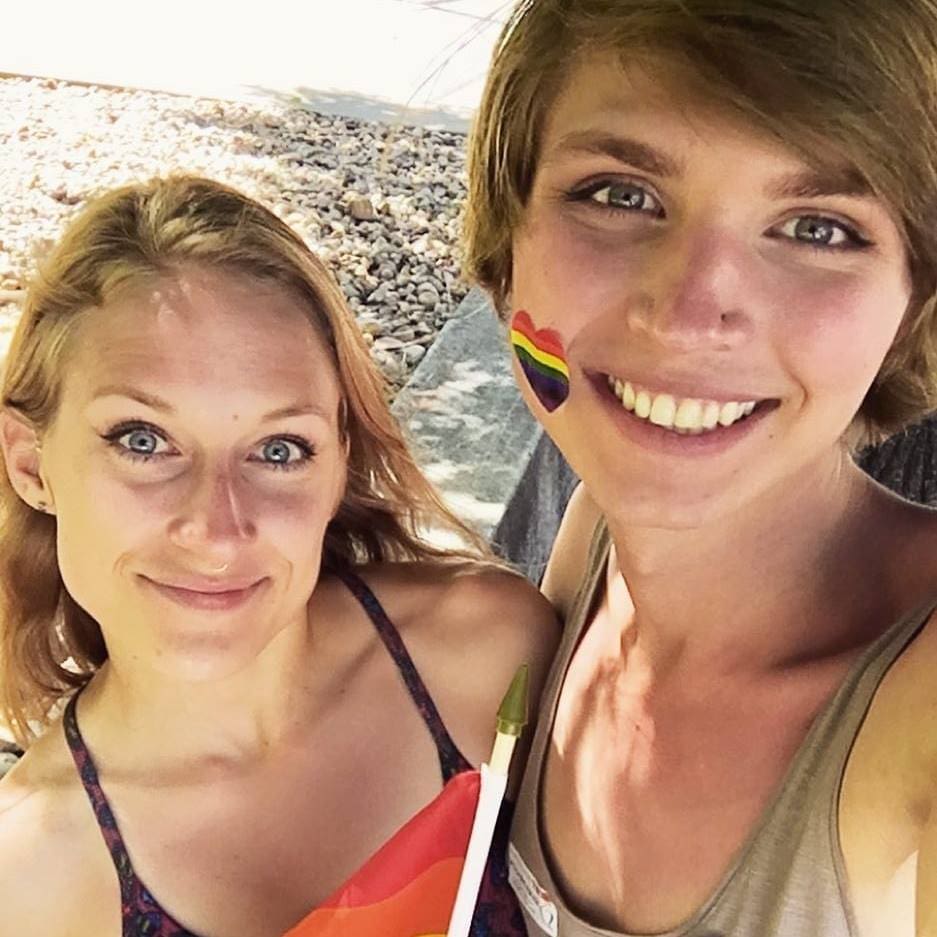
 Described as one of our most raw and moving interviews by our Facebook live audience, this special Pride edition of Mormon Stories Podcast is an interview with Jaime Olivine Soulé and Madeleine Ruth Soulé of Utah. In this episode we discuss:
- Their upbringing in the LDS Church. Madeleine was raised by a lesbian mother and a devout LDS father. She also privately identified as bisexual, but did not “act on it” as a youth. Jaime had a non-traditional LDS youth, but became a strong LDS participant/believer during college at USU. Jaime also began to question her gender identity during late high school.
- Their meeting and falling in love in high school, and their commitment to marry.
- Their decisions to serve LDS missions, which were spoiled and terminated early due to egregious worthiness interviews and punishment in the MTC.
- Their resolution to marry in the temple anyway, only to lose their faith as a married couple after the November 2015 policy was announced.
- Jaime’s transition as a trans woman, and their growth as a couple through all these transitions.
Episode Transcript
Host: John Dehlin · Guests: Jaime Soulé, Madeleine Soulé
This transcript is machine-generated and lightly edited for readability. The audio is authoritative. Please excuse occasional errors in names and spelling.
Introduction and Welcome
Part 1 of 2 · Ep. 940
Madeleine Soulé [00:00:00] Sa.
John Dehlin [00:00:31] Hello, everyone, and welcome to another Mormon Stories podcast. I'm your host, John Dehlin. It's June 1, 2018, and this is a special Pride edition of Mormon Stories podcast because it's Pride Weekend in Salt Lake City. This is the weekend where LGBTQ affirming and LGBTQ individuals all descend on Salt Lake City for Saturday and Sunday and maybe even Friday night. And they march in a wonderful parade. Sunday morning, they go to these cool booths and meet a bunch of cool LGBTQ people and allies, celebrate the LGBTQ experience, and there's even a party and festivals and music and food and all sorts of wonderful stuff. So. So to celebrate Pride weekend on Mormon Stories podcast in Salt Lake City, we have two very special guests, and I'm going to first introduce them and then tell you just a tiny bit about their story. Today I present to you Madeleine and Jamie Soule. Hi, guys.
Jaime Soulé [00:01:37] Hi.
John Dehlin [00:01:38] Welcome to Mormon Stories.
Jaime Soulé [00:01:40] Thank you so much. Thanks for having us.
John Dehlin [00:01:42] All right, so here's the backstory. Tim and I were talking yesterday, and Tim made the suggestion that we find a way to add, I'll just say, an LGBTQ Pride flair to Mormon Stories in celebration of Pride Week. And serendipitously, Madeleine messages me last night with this beautiful message, telling me a bit about her story with Janie, and it was so cool. And I'm just gonna give you the quick 32nd version of their story, and then we're going to dive in for two hours. I'm going to limit this to a two hour interview. A lot of restraint. I normally don't do this, but I've got time constraints.
John Dehlin [00:02:22] So here goes the story. I have permission to say from Jamie that Jamie was, you know, when Jamie was born. Jamie was assigned the gender of the male gender and with the name Jarom during her childhood. So she was raised as a Mormon or inactive Mormon boy. We'll get into the details of the Mormon experience there.
John Dehlin [00:02:54] So Jamie's early years were being raised and growing up as a boy and as a young man. And so obviously, Jerem has transitioned to Jamie, and we'll be talking about that. And then also Madeleine was raised by a mother who identifies as lesbian, but also Madeleine herself has identified internally as bisexual for many years. And all of this happened in Bountiful.
John Dehlin [00:03:28] Bountiful, Utah. You know, we're talking Bountiful High School and Woods Cross High School here. So they. They both ended up, you know, going on missions and we'll talk about that. They ended up getting married in the
Jaime Soulé [00:03:42] Temple Civil and then Temple Civil and Temple Yeah.
John Dehlin [00:03:46] And then afterwards, Jarom transitioned to Jamie, and, you know, they've had their faith journey along the way. And now, now Madeleine is identifying as. As queer or bisexual. So we'll talk about that and we'll talk about what that's been like for their marriage. They've had a child along the way, so it was definitely a Mormon upbringing up until the mission and marriage. But then it kind of all, in some ways became queer in lots of different senses of the word and all positive. And so we're going to be talking about that and celebrating.
Jaime Soulé [00:04:25] I love it.
John Dehlin [00:04:26] Celebrating their queer marriage for Pride weekend. How's that sound?
Jaime Soulé [00:04:33] Beautiful.
John Dehlin [00:04:33] Okay. Did I mess up? Where did I mess up?
Jaime Soulé [00:04:35] No, I think you're great.
John Dehlin [00:04:36] Did I do okay?
Madeleine Soulé [00:04:36] Yeah, you did great.
John Dehlin [00:04:38] Well, welcome. Thank you for reaching out to me, Madeleine, and thank you for coming on Mormon Stories.
Madeleine Soulé [00:04:42] Thank you.
Jaime Soulé [00:04:43] We're so excited to be here.
Madeleine Soulé [00:04:45] We're so excited to be here.
John Dehlin [00:04:46] And thanks to everyone joining us live on Facebook. Please do send your comments and questions to us, and we'll do our best to incorporate them as we go.
Jaime Soulé [00:04:55] Beautiful.
John Dehlin [00:04:55] All right.
Jaime Soulé [00:04:55] Yes.
Madeleine's Mormon Upbringing and Family Life
John Dehlin [00:04:57] So let's begin with Madeleine. Okay. Yeah. Tell us about the extent to which your upbringing, you know, was or was not Mormon and what that was like.
Madeleine Soulé [00:05:08] Yeah, So I was raised. My. My mom was not religious and my dad is currently. Is currently Mormon. And my parents kind of offered me the freedom to choose, you know, what. How I'd like to navigate that, I suppose. And I chose to go to church with my dad on Sundays. And so I, I was raised fairly typically, in so many ways, LDs with the twist that my mom is a lesbian. That you don't hear often. I didn't hear often.
John Dehlin [00:06:04] So in your childhood and adolescent years, were your parents married? They were together or separated until I
Madeleine Soulé [00:06:08] was six, I think.
John Dehlin [00:06:10] So they were together till six. Parents got divorced.
Madeleine Soulé [00:06:14] Yeah.
John Dehlin [00:06:14] And was it because LGBT related issues
Madeleine Soulé [00:06:17] or, you know, I don't feel like I have the liberty to decide that, you know. Yeah, my parents have been pretty private about, you know, their divorce, and I want to allow them.
John Dehlin [00:06:31] Love it. So they, they got divorced. And then did your mom come out or was it known to family and the group?
Madeleine Soulé [00:06:41] Yeah, she, like, I was so young that I don't, you know, I may misconstrue the truth, but, like, for me, like, I wasn't aware and she's told me that she had, you know, a coming out party, so I'm under the impression that maybe she knew, you know, personally, you know, maybe my dad knew But I don't know to what extent, you know, that journey was for her, but I do remember when I was 9 or 10 years old, she came to me and said, you know, my friend, is it okay if I date her? And me, as the kid was like, mom, why are you asking me?
Madeleine Soulé [00:07:27] But I. Thinking back and just like, that was so, you know, respectful of her to ask her children and. But also thinking back to my own memories, I just thought, like, I didn't. I think, understand what it meant, you know, in the Mormon community socially, you know, in our. It's a big thing in our country even.
John Dehlin [00:07:53] Did she remain active during that time, or did she stop going to church?
Madeleine Soulé [00:07:56] No. You know, in my entire life, I can't remember a time that she was. I might be wrong about that, but, you know, I can't remember my little baby years. But I remember as a little kid going to church with my dad, like, even when they were married, going to church with my sister and my dad and coming home to my mom. She grew up in. She was born in California, grew up in Washington in the Northwest, and wasn't religious growing up, and had a visit from Mormon missionaries and was a convert and came down to byu, which is where she met my dad. But I think that, like, I suppose I haven't discussed, you know, her former faith with her to a great extent, but, yeah, during my life, she wasn't an active member. I think that she. I don't think she removed her records, but, yeah, she wasn't an active member.
John Dehlin [00:09:01] And was your dad attending the. The whole time you were growing up?
Madeleine Soulé [00:09:04] Yeah, he has attended and continues to attend very regularly and is very devoted to the very. Yeah.
John Dehlin [00:09:11] So how active were you in your childhood and adolescence?
Madeleine Soulé [00:09:15] I was very active in my childhood and adolescence. I'm very completely involved. I considered myself, you know, wholly Mormon, just with a different background than most of my peers or others whom I knew who were Mormon. But I, you know, I went to all the church activities. I went to church on Sundays. I held callings. I went to the temple. When Jamie and I met, I was Laurel's president at my ward. And so I was very active. You know, after high school, I continued to, you know, prepare for a mission, and I went out on a mission to Georgia.
John Dehlin [00:09:57] We'll get to that.
Madeleine Soulé [00:09:58] Yeah.
Jaime Soulé [00:09:58] Yeah.
John Dehlin [00:09:59] So battlefield, for those who don't know, bountiful is kind of intense. Like, I think. I think there's probably general authorities that live there, apostles that live there. There's one.
Jaime Soulé [00:10:10] Yeah. He, like, assigned my Nelson, like, Personally assigned my brother and I's calls, and they're very similar, so.
John Dehlin [00:10:18] Yeah, that's right.
Jaime Soulé [00:10:19] Yeah. So, yeah.
John Dehlin [00:10:20] So, I mean, this is like more. This is like almost provo. Intense, right, in terms of, like, the Mormon?
Madeleine Soulé [00:10:27] Oh, definitely, yeah. Like, I grew up in both Salt Lake and Bountiful. My mom lived just downtown Salt Lake, and my dad has lived in Bountiful my whole life. And there was a big contrast in, you know, just the neighborhood vibes when I travel back and forth between my parents. Like, in Bountiful, you just. All of my neighbors, it felt like to me as a kid, I'm sure not all of them, but so many of my neighbors were Mormon. So many of my classmates were Mormon. And in Salt Lake, none of my neighbors were Mormon. It is intense. It is intense.
John Dehlin [00:11:08] So what did your dad hold? Family home evening scripture study, family prayer. Like, to what extent was Mormonism really woven into your life, especially as an adolescent seminary? And how was your testimony all that?
Madeleine Soulé [00:11:25] Yeah, yeah, it was. I feel like it was pretty integrated into my life. You know, we prayed over our meals, we went to church together. It wasn't ever really in question. It was just what we did. You know, family home evenings probably weren't so regular, especially in adolescence when it was hard to get my sister and I to come home at night. But we were stubborn, and we didn't like to be home. But. But, yeah, we were really.
Jaime Soulé [00:11:54] You had a strong testimony.
Madeleine Soulé [00:11:57] Yeah, I had a strong testimony. And I think that my whole childhood, like, I think that there were a lot of aspects of the church that I had a hard time understanding because of my unique circumstances. And that kind of.
Madeleine Soulé [00:12:20] That kind of, you know, made me think in different ways and feel different things than a lot of children, you know, had to consider. Like, even just not having my mom at church with me, like, you know, getting on the stand to sing Mother's Day songs was kind of weird to me. And that's not even just, you know, some kids, it's not like their mother's inactive necessarily, but maybe they don't even have them. And I think that's probably something that many children experience. Like, it was.
Madeleine Soulé [00:12:52] It seems small, but when you're a kid, it feels really massive to just be reminded, you know, the entire meeting of your mom not being there and kind of drawing on your feelings for that. I remember trying to decide, like, if I, you know, why I felt sad, because I didn't feel sad that my mom wasn't Mormon. I think I just felt sad about the context that That I was singing to everybody else's moms, and that on Mother's Day, I wasn't with my own because I was supposed to be at church.
Madeleine Soulé [00:13:33] And I remember that being really difficult for my mom, too, growing up. Different holidays or conflicts with church meetings or young women's meetings and things that were in her parental time that took away from that, and it was a big sacrifice for her.
John Dehlin [00:13:54] Did. Did your friends or ward members or family or extended family. You may have already said this, but did they know that your mom identified as lesbian or was that kind of kept secret?
Madeleine Soulé [00:14:05] Yeah. Yeah, they did. And my. My. My award that I grew up in, I just. I grew up with them for so long, and I grew up with my, like, living with my dad, but also with my aunt, my grandparents, all in the same house. And so my grandparents have lived there.
Madeleine Soulé [00:14:26] They built the house back when my dad was like 10 years old. So that ward has been their ward for so long that I think that. That. That I really felt that my ward understood me and understood my family's background, like, not just from my perspective, but from my father's perspective, my grandparents perspective, because they've known each other for so long. And it was a really cohesive ward. And I had a lot of support from my ward members, my neighbors, my friends that I grew up with in my ward that knew my circumstance. And, And I think that that helped me maintain my testimony during my childhood and adolescence was knowing that my circumstance was different and that I had, you know, confusion and fear and questions about, you know, eternity and things with my family dynamic, and to just have.
Madeleine Soulé [00:15:42] Have my. My ward be really empathetic to that, it gave me, you know, kind of a sense that that's what the church felt like as a whole and how I would be treated as a whole. And I began to recognize that.
Madeleine Soulé [00:16:05] That when I, you know, went off to college and began to go to student wards and other wards where. Where people didn't know me my whole life growing up in the church where they didn't know my parents, my grandparents, and my mother and my whole family's background, it was a lot harder to.
Madeleine Soulé [00:16:22] To feel understood and trusted and respected. And like, I. It felt like I had to explain, explain myself a lot more. And I recognized so much was the community that made me feel like. Like I could be different in my testimony, like I could support my mom and respect my mom's, you know, decisions and relationships and feel like, you know, the church doesn't explain it right now, but God is compassionate and he'll you know, we'll figure it out when we get there. And that helped me develop a testimony of this very compassionate God that knew me and knew my circumstance perfectly and just that if I, you know, lived how I felt was best for me and best for my family, God would understand and he would, you know, judge me accordingly.
Madeleine Soulé [00:17:22] And so the relationship that I grew up with. With God, my faith, I suppose my testimony felt so personal because I just felt this huge comfort in. In that unknown, like, you know, like, it conflicts with doctrine. But God can overlook that because he's compassionate and he knows me and he cares about me. And I felt like that just began to disappear when I moved out.
John Dehlin [00:17:54] Got it. So when a lot of people in their Mormon experience sometimes will hear kind of homophobic things said at church, like, gays are the sides of the times, or marriage is being attacked, and would. Because people would have known in your bountiful ward that your mom was lesbian, is lesbian. Would they? Maybe. Would you have heard less of that? Would people have been more sensitive about that type of language?
Madeleine Soulé [00:18:22] I'm sure that many were. I can't remember feeling like there were many instances of really hurtful attacking language, but just language that I felt was so misunderstood. It didn't feel so intentionally hurtful towards the LGBT community so much as it felt kind of more like pity, I suppose, you know, than anger or anything. It's just, like, sad. Sad. Yeah.
Jaime Soulé [00:19:03] And that's how people saying, I'm sorry.
Madeleine Soulé [00:19:04] That's how I was always treated when I would, you know, talk to ward members, and especially when I talk to new people in my life about my circumstance. It was always with sadness, with, I'm sorry, like, and trying to justify how heaven will still work out for me, you know, with my circumstances, when it just felt so absurd to me when. When that judgment was so quick to be made, when. When I grew up in my family, I knew my family. I knew my mom and her, you know, knew her heart and knew her relationships and her commitments and that she was just like everybody else. And it didn't make any sense to me how nobody could. Not nobody. But how there are so many people that didn't understand that.
John Dehlin [00:19:56] Yeah, sure. How did you navigate being a believing adolescent girl and knowing inside that you were attracted to females and males? When did you first know that, and how did you navigate that as a believer?
Madeleine Recognizes Her Queer Identity
Madeleine Soulé [00:20:16] Yeah, I think that when I. I remember seventh grade, specifically, when my sister and my friends would all just gush about their crushes on boys, and I just had no Input, Like, I couldn't. I didn't feel. I didn't feel what they were feeling. And it was partially just because it's still seventh grade and a lot of people don't. But I think that it began that kind of, I don't know, like a clock in my mind. Like, when is this going to happen for me? When am I going to be able to relate to my friends?
Madeleine Soulé [00:20:55] And I think that it began my questioning about my identity a lot. Like, you know, especially when you're in seventh grade, I thought a lot, like, am I broken? Am I ever gonna, you know, feel attraction to anybody? Like, there's a lot of panic when you're in seventh grade, so.
Madeleine Soulé [00:21:17] But I think that that's when I started considering and keeping track of my feelings. And as I got older, I didn't really feel polarity towards a specific gender because I felt like my relationships or the way I felt towards people was
Jaime Soulé [00:21:42] more
Madeleine Soulé [00:21:45] focused on the way we interacted with each other and not so much about the way our societies have constructed gender. Because, you know, breaking it down, you can just go down a huge rabbit hole of what is gender besides our reproductive systems? And it's just so, you know, pink and blue rainbows or trucks, like, it's. There are so many things that just don't make sense.
Jaime Soulé [00:22:15] So rigid.
Madeleine Soulé [00:22:17] Make me feel like, as I considered it as an adolescent, like I didn't care so much about, you know, our reproductive system. So what was there to care about in a relationship? Sure. Yeah. And I think that that's kind of what guided me. But what guided me more in action in relationships was definitely the church. And I think that once I recognized that I didn't have that polar attraction, I thought, you know, this is a choice I can make. And, You know, part of me, I was raised by my lesbian mother and understood that her, you know, her love towards her partners was the same as any of my friends, parents, love for each other and that, like, I didn't want to limit myself on who I would date, but I was.
Madeleine Soulé [00:23:20] But there's a lot of fear tacked onto that in the church. And I thought. I felt sad that I couldn't explore my sexual orientation completely. But I also thought I was fortunate for being bisexual rather than gay because then I could hide, you know, half of that orientation and still live a normal Mormon life.
Jaime Soulé [00:23:48] Yeah.
John Dehlin [00:23:48] Are you comfortable talking about whether you tried to experiment with your bisexuality during those adolescent years or did you just.
Madeleine Soulé [00:24:01] I didn't.
John Dehlin [00:24:01] Okay.
Jaime Soulé [00:24:02] We would go. We would go to the.
Madeleine Soulé [00:24:04] Well, I didn't. In relationship wise.
Jaime Soulé [00:24:06] Yeah, you and I would go to, like, gay club.
Madeleine Soulé [00:24:08] Gay club, yeah.
Jaime Soulé [00:24:09] We went to pure and high school and go together.
Madeleine Soulé [00:24:12] Yeah, but it was kind of more community.
Jaime Soulé [00:24:15] It was about dancing with each other.
Madeleine Soulé [00:24:17] But, like, I. I almost felt like I was raised in the LGBT community to some extent. Like, I, you know, I. I went to Pride with my mom as a kid. I went to, you know, I. I met her friends and, you know, was just kind of immersed in that community from such a young age that it just felt very comfortable and inclusive to me. And so I think, like, that, as a Mormon, I felt like that was kind of the extent to which I was allowed to explore my sexual orientation is that you can. It's okay if, you know, that you feel that way, but you can't act upon it. That's where, like, the. The line of sin is drawn. And so I walked that line. You know, I tried to stay with the community that I felt comfortable with the best that I could without crossing that line.
John Dehlin [00:25:19] Okay, last thing I just want to say, and then we'll switch over to Jamie for her upbringing as well. How was your mom not crazy scared from her perspective that you were being raised in a homophobic church and that you were being raised to see her as lesser than or evil, that you would be. Some. Some people who are not Mormon or who leave the church are like, oh, they're in a cult, and they'll be. They'll be brainwashed and they'll learn to hate me. How did your mom abide the idea that her daughter would be raised in a church that saw her as lesser than or even worse, broken or defective?
Madeleine Soulé [00:26:08] I don't know how she decided to navigate that in my upbringing, but as I reflect on. Took a lot of strength and a lot of trust and. And I think the way she navigated it was just by. Through her maturity and trying to not project her fears onto her children. She's always been really supportive of letting us choose for ourselves, and she would, you know, kind of take us to some other churches to, like, kind of give us, you know, a wider palette to understand religion from. And also just. I think she tried to just teach us at home what she believed and what she valued and then let us decide. And that's as far as she felt like she was able to. To extend that, you know, parental authority without just smothering us. And she's very mature about it.
John Dehlin [00:27:25] Do you get the sense that she was constantly trying to dig at the church or criticize it? Or tear it down or kind of mess with your faith or kind of share things with you that make you question.
Madeleine Soulé [00:27:36] No, not at all. Not at all.
John Dehlin [00:27:38] In the world did she do that?
Jaime Soulé [00:27:40] She's pretty mature.
Madeleine Soulé [00:27:41] She's amazing. She's really mature and she's. She really respects my dad and she. I think that that is a huge part of it is just navigating a co parenting relationship with someone that you're divorced from is that you as parents can fundamentally disagree on so many things, but you still have to remain in contact with each other and have a peaceful relationship so that if you want to work together to raise the kids like I, we didn't have the kind of.
Madeleine Soulé [00:28:20] Schedule where it was, you know, hugely put onto one parent for custody. It was split really evenly. And I think that took a lot of maturity on both of their parts, which they are. They're both very mature and they're both really respectful of each other. And I'm very good at working out conflict. And I think that, that I'm sure that was.
Madeleine Soulé [00:28:45] I don't know if it was a spoken agreement or just both had huge levels of maturity to just know what to say and what not to say to the kids in order to maintain a peaceful relationship as a sort of unit still.
John Dehlin [00:29:08] And love it.
Madeleine Soulé [00:29:10] Yeah.
John Dehlin [00:29:10] Beautiful. Okay. Anything else about your pre mission life that's really important to your. To the story we're trying to tell today in two hours. Is there any like big traumatic thing or, you know, any other thing that's really significant that we haven't covered is kind of the major building blocks for your. The arc of your story.
Jaime's Portland Upbringing and Gender Identity
Madeleine Soulé [00:29:31] You know, traumatic events I think are really interesting to dive into with the church because I think that there are so many things that I felt as traumatic as a kid and in my teenage years that I didn't really recognize until later that I felt trauma, but that it felt so, I guess, normal in the culture that I just felt like it was, you know, that it was my fault for feeling it. And so I guess I don't really have one specific experience I want to draw from, but I think that there are just a lot of parts of the way that doctrine and history and tradition tie in with culture that can just be so, so harmful.
Madeleine Soulé [00:30:31] The effects that it can have on the way LDS members treat each other and react to each other and judge each other, which always brings up the debate of doctrine versus culture. But in my opinion, they can't be separated because it's. Yeah, it's all an experience.
Madeleine Soulé [00:31:01] And if you can't feel comfortable in your place of worship. If you feel hostility or fear or pain or trauma, it's really hard to worship. It's really hard to feel spiritual.
John Dehlin [00:31:17] Totally. Okay, Jamie, let's switch to you. Let's hear a bit about your upbringing, the parts that you think are most central to the story.
Jaime Soulé [00:31:29] Okay. So, yeah, I was actually born and raised in Portland for a good portion of my life. Portland, Oregon. And so we. I wasn't really surrounded by a lot of members growing up, but we were very devout Mormon. We went to church every Sunday.
Jaime Soulé [00:31:46] And then my parents actually divorced and we moved to Utah soon after that. And that's the short of it. But. But, yeah, so key points in my life. So I had held callings. I had had a testimony, gone to efy and been very involved in a lot of the church programs and the church education.
Jaime Soulé [00:32:08] And when I was like, 15 or 16, I think I heard someone give a talk just about kind of saying how it's, like, sad that other people's religions aren't true because they believe it. And to me, that really struck a chord of, okay, well, who are you to say? And so from that point on until I graduated high school, I was actually very, very much against the church. And I would speak out against it at home and at school, and I lost a lot of friends because of it.
Jaime Soulé [00:32:38] But I also met a lot of amazing people because of my outspokenness. But, yeah, and then. So that's like adolescents, I guess, in the sense of when I really, really got involved in the church, it was actually after we got married. That was probably my most active was after we had gotten married.
John Dehlin [00:33:02] So your child and adolescent years were where?
Jaime Soulé [00:33:05] Again, Portland. And then until I was 10 or so. And then when you moved to Utah.
John Dehlin [00:33:11] Okay, but while you're in Bountiful, you're not LDS at all?
Jaime Soulé [00:33:15] Yeah, yeah. So the first. Maybe the first three years we were in Bountiful, I was so from like, 12 to 15, and then we moved, and I sort of started to. I was actually questioning my own sexuality. I was like, you know, branching out my ideas and looking at other parts of the world and trying to learn about new religions and new cultures. And that just took me away from the church because for me, the world felt a lot bigger than what I had been raised in.
John Dehlin [00:33:42] What about your parents?
Jaime Soulé [00:33:43] Yeah, so my mother and father were both raised Mormon, and they're still active lds. My stepdad actually converted after marrying my mom. And so, yeah, they're all still active. My siblings, I'm not really sure. I don't want to put words in their mouths, but, yeah, right now, my brother and I don't go to church, but he served a mission. He was really involved in the church. So it was just, you know, it was like we had the ensign on our table in the living room, like the new addition. And, you know, we would try to have family home evenings, but those often result in revolt, so. Yeah. Yeah, by me. Yeah.
John Dehlin [00:34:31] So parents were active kids.
Jaime Soulé [00:34:33] Yeah. They never really made us go. There would be like, you know, that Sunday morning conflict that I feel like everybody's familiar with in the church, but. But, yeah, they never really forced us to go to church. They were pretty open about that. And I think it might be because we pushed back a little bit if they tried to force us. I didn't really stand for that growing up.
John Dehlin [00:34:57] Okay. Kind of a bit of an independent upbringing.
Jaime Soulé [00:35:03] Yeah. I mean, they definitely supported my upbringing, you know, in ways parents do. But thinking wise, I definitely was very independent, so.
John Dehlin [00:35:15] Right. Okay. So. You were assigned the male gender at birth, and you're assigned the name Jerem.
Jaime Soulé [00:35:25] Yeah.
John Dehlin [00:35:25] So at what point was that not okay for me or a problem or.
Jaime Soulé [00:35:31] Well, it's kind of a weird journey for me, personally. I felt pretty genderless for most of my younger years. Like, I was just kind of doing what, you know, the church environment is very binary. There's what the men do and there's what the women do. And so I just followed that. It was, you know, I was socialized male.
Jaime Soulé [00:35:52] And it wasn't until I stopped going to church that I actually started to move towards more feminine things. And I was kind of there. It was like my senior year of high school. I was, you know, I was dressing more feminine. I cut my hair more feminine. That's when I met Madeleine, and we really bonded over my femininity a lot. It was a big part of. Of the foundations of our relationship. And. Yeah, yeah, so that was. That was towards the end.
Jaime Soulé [00:36:22] But I. You know, I meet a lot of trans individuals who kind of say they feel like they have always been this gender, but I don't really know that I even felt like I had a gender growing up. But now. Well, we can get into that.
John Dehlin [00:36:38] Yeah. Talk about that for a second. You're Woods Cross High School, is that right?
Jaime Soulé [00:36:42] Yeah.
John Dehlin [00:36:42] And you're surrounded by a bunch of Mormons. Well, some non Mormons. Right.
Jaime Soulé [00:36:47] Yeah. Woods Cross is. Is a little bit different than Bountiful, in fact.
John Dehlin [00:36:50] West High School.
Jaime Soulé [00:36:51] Yeah. Yeah. So Woods Cross is a little bit more diverse in fact, we had a. We had a gay SBJ my senior year, and that's an alliance or something. A student body officer. Yeah, so, yeah, elected. Yeah. So we were actually. And I was able to make a lot of friends my junior and senior year of high school that were separated from the church, but I also had a lot of friends who were in the church that I just completely stopped talking to, but have actually reconnected with as an adult, so.
John Dehlin [00:37:19] Okay, yeah, got it. So Gowood's cross, you know, a little progressive.
Jaime Soulé [00:37:23] Yeah. You know, I think it was a little art, sort of oriented, and I think that. Yeah, I think that was beneficial. Yeah. But.
John Dehlin [00:37:31] Okay, so. All right, so you're. So when you're. When you're experimenting with. When you're sort of exploring your femininity in high school, did you have role models? Did you have musicians like, I. Growing up, we would have had Boy George, you know, Morrissey, which is, I think, the cure.
Jaime Soulé [00:37:55] Yeah.
John Dehlin [00:37:56] Like, there would have been some role models for gender fluidity.
Jaime Soulé [00:38:01] You know, I want to say less than role models. There was some subcultures that really helped me flesh that out a lot. Well, first. First of all, I. I basically made a lot of gay friends, but I didn't consider myself gay. But it's just how I felt most comfortable is being around people that I felt like I could be feminine with and they would accept me, and I just didn't really know what it was. I didn't know why I was most comfortable in those situations, but I was.
Jaime Soulé [00:38:27] And then film was a big. A big influence on my life, was just getting really involved in foreign film, which really tackles a lot of LGBTQ issues and experiences and stuff. So it was maybe less individuals and more that I opened my eyes to film and subcultures that are kind of have more progressive leanings at times and can kind of shed light on situations that you might not otherwise ever have any understanding of. So.
John Dehlin [00:38:59] Okay.
Jaime Soulé [00:39:00] Yeah, so does that.
John Dehlin [00:39:01] Yeah, that's great.
Jaime Soulé [00:39:02] Okay, so.
John Dehlin [00:39:03] But no interest in the church up to your senior year of high school?
Jaime Soulé [00:39:06] Yeah, I mean, I was. Like, when I would go to efy, I would totally get psyched. Like, I loved it. I just. I loved that, like, that fire and community aspect and stuff. But then, yeah, when I. When I stopped going when I was 15, I completely pushed that away. And then I moved up to Utah State and became Mormon.
John Dehlin [00:39:25] So it was college that Mormonized you?
Jaime Soulé [00:39:27] It was college. It was. Yeah. I was living with tons of Mormon people right there. And, you know, wanting to be Friends and wanting to connect with that and what are you thinking?
John Dehlin [00:39:43] So.
Jaime Soulé [00:39:44] No, that's great.
John Dehlin [00:39:45] So I want to stay in high school for a little bit more.
Jaime Soulé [00:39:47] Yeah, let's do it.
John Dehlin [00:39:48] So was there ever a point where you questioned your sexual identity in high school?
Jaime Soulé [00:39:55] Like my gender identity or my sexual orientation? Yeah.
John Dehlin [00:39:59] Having been assigned the gender of male.
Jaime Soulé [00:40:01] Yeah.
John Dehlin [00:40:02] Were you. Did you ever question your sexual identity?
Jaime Soulé [00:40:05] Yes. Yeah, absolutely. There was a time where I, like, I've had feelings for people of the same sex and opposite sex for years, but I never really was. Was set on labeling it as anything. And then, of course, like, we were married so young that we didn't really explore a lot of those things, but. Yeah, but, but, but, yeah, no, I definitely did. And then. And then I moved away from that sort of. When I became Mormon, I, like, pushed that away and tried to suppress it at Utah State. Yeah.
John Dehlin [00:40:38] And so was. Was a possibility of a trans identity something that occurred to you in high school?
Jaime Soulé [00:40:48] Absolutely not. No, no, no. The only thing that I. That I felt was that I didn't belong with boys, but I didn't know that I could belong with girls. I didn't know that that was really even a thing when I was in high school. Bountiful, Utah, you don't get really exposure to that.
John Dehlin [00:41:06] When you say belong, you don't mean as a partner. You mean as part of the group.
Jaime Soulé [00:41:10] As part of the group.
John Dehlin [00:41:11] Wow.
Jaime Soulé [00:41:12] Yeah. And I was on the swim team.
John Dehlin [00:41:13] You belong as a girl?
Jaime Soulé [00:41:15] As a girl, yeah. And I. Some of most of my best friends throughout my life have been women. I have some. Some really, really close friends who are men. But. But it's never been in a group setting. And so that was something that I never really. It was hard to ever feel connected to any thing that I tried to do, whether it was swimming or theater, even things like that, because I would be. You know, they group up. It's. It's that binary system that we have established in our society, but they group us into. You know, even in theater, it was the men do these songs, the women do these songs and don't. Like, why even question that? And I didn't feel like I had a grasp on gender enough then.
Madeleine and Jaime's Relationship in High School
John Dehlin [00:41:57] Okay, so really quickly for both of you, what was your relationship like in high school? How did you think of each other?
Jaime Soulé [00:42:06] I loved Madeleine.
John Dehlin [00:42:08] Yeah.
Jaime Soulé [00:42:08] Yes.
John Dehlin [00:42:09] You met her when.
Jaime Soulé [00:42:10] So I was. I was best friends with her twin, and Madeleine was Mormon, and so we never really hung out with her that much. But then.
John Dehlin [00:42:18] But her twin was that inactive.
Jaime Soulé [00:42:20] Yeah.
John Dehlin [00:42:20] And more liberal?
Jaime Soulé [00:42:21] Yeah, pretty much. Yeah. And so, yeah, she and I would go. She was liberal together in the city? Yeah, yeah, pretty. Pretty much. But then I met Madeleine. She was singing Regina Spector, who's like my favorite. And I just died. Yeah. Yeah. So I was totally in love with Madeleine. But it was, it was definitely different because we would argue about religion.
Madeleine Soulé [00:42:40] Yeah, I think that that kind of pushed us apart a lot in high school. Like, we really cared about each other and loved each other and, you know, had so much in common. Like, Jamie was the first person that I had dated that had like feminine quote qualities. And it was so. It was so exciting to me to feel like I could share my interests and share my passions with her and not feel like I had to be so polarized between like masculinity, femininity. I felt like we could do more together and express, you know, interest together. And it just felt so powerful to me. But we did argue about the church a lot and I was very like shy, introverted, like conflict averse person in high school. And you were in the debate club and won things in the debate club.
Jaime Soulé [00:43:38] And I would, I'd tackle the, I would tackle the issues, the differences between us. I would, you know, I'd confront. You wanted to pick a fight a little bit. Yeah. Because I, you know, I would hang out with Madeleine and I would literally say, like, why, why are you going to mutual tonight? Like, what are you doing? Like, you literally, like, we've just been like all day we've been discussing like, you know, progressive ideas that I don't feel like conform to what you say you're doing.
Madeleine Soulé [00:44:03] I remember when you're like, take this quiz. I swear you're a liberal.
Jaime Soulé [00:44:06] And she was so. Yeah, yeah. But yeah, I remember, like, it was like temple session. I'm like, please don't go, don't go hang out with me. Yeah.
John Dehlin [00:44:16] Wow. I have to say this is the cutest thing ever. I hope that's not insulting. Just imagining this Molly Mormon girl and this sort of inactive but, you know, boy, but progressive, but embracing his feminine side at the time. Was that ever spoken where you're like, hey, I'm a boy, but I have feminine parts of me? Or was it just you happened to, you know, like more feminine things and you appreciated that?
Madeleine Soulé [00:44:47] Yeah, in high school.
Jaime Soulé [00:44:49] Well, I experienced some things because, like, I had friends that would actually like, make fun of the fact that I would wear even cardigans and things like that. And I loved that and Madeleine loved that. So yeah, there was, I Guess there was like, maybe it was in the cardigan's feminine. Mr. Rogers, right? Mr. Rogers, yeah. I love Cardigan. Exactly. But yeah, no, it was pretty limited. I think that for us, it's always been very much like us in our own little world of. Of not necessarily kind of genderless.
Madeleine Soulé [00:45:24] Like, gender is what we define it. Just being ourselves, you know, as feminine or neutral.
Jaime Soulé [00:45:31] Yeah. But living. Living publicly. Yeah. I do have to say living publicly. Like, I express myself femininely. I consider myself a trans woman. But yeah, when we're together, gender is not often something we even discuss because we're just. We just live, you know?
John Dehlin [00:45:46] And Madeleine, what were the feminine parts of. I'll say, Jerem, because you've given me permission to say that.
Jaime Soulé [00:45:53] Right.
John Dehlin [00:45:53] What were the feminine parts of Jarum, that you loved or appreciated most?
Madeleine Soulé [00:45:58] Just, we had the same taste in music, which was really refreshing for me because a lot of people I dated just like, hated my music and it was too surly and not enough like.
John Dehlin [00:46:08] So give us four names of musicians that are.
Jaime Soulé [00:46:13] Regina Spector. Regina Spector. Yes. That's it.
John Dehlin [00:46:17] That's all. That was just all.
Jaime Soulé [00:46:18] There's Ingrid Michaelson. Brandy Carlisle. Yeah, yeah. Death Cab for Cutie. I like that. But I know a lot of people who like that. Yeah.
Madeleine Soulé [00:46:26] I don't know.
John Dehlin [00:46:27] But this is music that traditionally is associated with more girl music, less kind of macho or guy music.
Madeleine Soulé [00:46:33] Oh, yeah. I went to Regina's concert last year and I. I think the only men there were like, with their girlfriends, like, pressured into.
Jaime Soulé [00:46:45] You know, it's pretty feminine.
Madeleine Soulé [00:46:48] A lot of women that.
Jaime Soulé [00:46:49] Her big. Probably the call from. Oh, yeah, from Chronicles of Narnia. So that's why it's like.
Madeleine Soulé [00:46:55] So she's kind of an alternative.
Jaime Soulé [00:46:57] Yeah. I'll send you some music. I think you'd like her anyway. No, no, no, no, no. That's like that classic anyway. Yeah. Okay.
John Dehlin [00:47:09] It's not hurting.
Madeleine Soulé [00:47:10] I know that song.
John Dehlin [00:47:11] Okay.
Jaime Soulé [00:47:12] You're fine. Yeah, I dressed really. Feminine music.
John Dehlin [00:47:15] You dressed? How. How would it have been different for a high school boy?
Madeleine Soulé [00:47:19] Skinny jeans and cardigan flowy clothes?
Jaime Soulé [00:47:21] Very. My hair was in a bob. My senior year. It was. It was similar to this, but the. The whole, like, back was cut and
John Dehlin [00:47:28] were you ever harassed or abused like that by boys or girls?
Jaime Soulé [00:47:33] Yes, I was very harassed. Like in junior high, I had a kid who. He actually called me gay. And then he stapled my hand and like, lots of. Lots of little, like, microaggressions just being like, you know, hey, Jerem, like You're gay. Right. And I never even. I didn't even know what I was, you know, what my identity was at that time. But because of my feminine attributes and in this polarized society, I feel like I saw a lot of that sort of like, well, why don't you fit in this mold? But expressed in bullying and expressed in pointing out, you know, making cheap jabs and very homophobic jabs and stuff like that, even though I didn't even identify as gay. Yeah.
Madeleine Soulé [00:48:18] And I think that's something that we kind of could silently bond over, is that we just felt safe together, and we didn't feel like we had to label anything, and we would just get together, and our favorite activity was, like, we didn't even have to talk to each other. We'd just sit in the same room and write poetry for hours.
Jaime Soulé [00:48:35] Yeah. So that was a big one.
Madeleine Soulé [00:48:36] Yeah. And it just felt like it was just comfortable. Like, we could just be together safely.
Jaime Soulé [00:48:42] It felt like we had to make that safe space, though. Like, I felt like I needed a person and a place to be able to express those things and really, like, get to know myself. And I think Madeleine really helped me with that. My brother did, too.
Madeleine Soulé [00:48:57] An important space for me, too, to kind of express and feel, you know, surrounded by values that really were important to me, that aren't so supported by the church, but without. I mean, often we did fight about stuff, but I think often we would just be able to express our similar interests without, you know, involving, you know, how the church felt about it. We could have conversations about our strong values and what was really important to us. And I knew that if I talked to people in my ward about it, my very LDS friends, that it would not be a very fun, easy conversation, but that it just felt really natural with you. It didn't feel like it had to be conflict. Like, I felt like it would be with anybody else. I felt like I could just be myself and it could be a good thing.
John Dehlin [00:49:52] I love it.
Jaime Soulé [00:49:53] Yeah. Okay. Okay, go ahead.
John Dehlin [00:49:55] No, go ahead.
Jaime Soulé [00:49:56] I was just gonna say that, like, with Madeleine, I think that something I really struggled with watching the church, and it was kind of something that solidified my, like, disdain almost for the. For the church, at least the culture and the people that I was associated with, was that I felt like I was upholding really high moral standards as far as, like, just being a human goes. Like, I felt like I took my humanity seriously. I took proper treatment of people seriously and stuff. And I saw members around me not doing that at all. But I was the one who was not passing sacrament or blessing. Sacrament because, you know, because I didn't get the priesthood at that time, and I chose not to. But they, you know, kind of seeing that contrast of living a good life, living your true self, and wondering why, like, other people are praised.
John Dehlin [00:50:50] Yeah.
Madeleine Soulé [00:50:51] When it's authenticity, that is ceremonial things that is chastised. When you. When you know that people aren't living authentically aren't.
Jaime Soulé [00:51:00] Yeah. Like, when, you know, personal.
Madeleine Soulé [00:51:03] Because they're able to hold callings and temple recommends and go on missions.
John Dehlin [00:51:07] Their status.
Madeleine Soulé [00:51:08] Yeah, like, it's. It's such. It's a really a social status thing, and we became very familiar with that
Jaime Soulé [00:51:16] in our time after our missions.
Deciding to Serve Missions
John Dehlin [00:51:18] Okay, so let's jump to how in the crud did you end up going on a mission, and how did you end up going on a mission? How did that happen?
Jaime Soulé [00:51:29] We went to different colleges. Let's start there, because that's after high school. We went to different colleges. She went to Snow when I was.
Madeleine Soulé [00:51:35] Okay.
John Dehlin [00:51:35] Did you guys date in high school?
Jaime Soulé [00:51:38] Yeah. So, yeah, we did it for a little bit, and then the religion got in the way. We just put it off. But we were kind of on and off for a while. And then after we graduated.
John Dehlin [00:51:49] Okay.
Jaime Soulé [00:51:49] I think we even actually had a conversation after we graduated, like, yeah, let's, like, date and have fun and stuff in college and go our respective ways, and then we'll see each other again soon and stuff. And then.
John Dehlin [00:52:01] Were you attracted to each other in high school?
Jaime Soulé [00:52:03] Oh, yeah. Oh, yes.
Madeleine Soulé [00:52:04] Yeah.
Jaime Soulé [00:52:04] Yes.
John Dehlin [00:52:05] Okay.
Madeleine Soulé [00:52:05] Yeah.
John Dehlin [00:52:06] Yeah.
Madeleine Soulé [00:52:07] We dated and we really, really cared about each other and liked each other, but I think that it just became really overwhelming for both of us to butt heads so often.
John Dehlin [00:52:16] On religion.
Jaime Soulé [00:52:17] On religion.
John Dehlin [00:52:17] Okay.
Jaime Soulé [00:52:18] Yeah.
John Dehlin [00:52:19] So you go to where, College?
Jaime Soulé [00:52:20] I went to usu.
John Dehlin [00:52:22] Usu? You're an Aggie. Go Aggies.
Jaime Soulé [00:52:24] Yeah.
John Dehlin [00:52:24] Thumbs up to the Aggies.
Jaime Soulé [00:52:26] We're both Aggies now. Yeah. Yeah.
John Dehlin [00:52:28] Okay. So how did you end up getting active in the church, Jamie?
Jaime Soulé [00:52:33] Well, I started making a lot of friends up at USU, and they were pretty much all Mormon.
John Dehlin [00:52:38] It's like 80% Mormon.
Jaime Soulé [00:52:39] Yeah, like 80%. Yeah. And I think, like, I had this sort of, like, sense of morality that I was following, but I was. I was kind of pulled away from this feminine mindset I had when I moved in with, like, you know, five other guys who were all pretty. Pretty masculine men. And I.
Jaime Soulé [00:52:57] I struggled. Like, when I first started up there, I would dress a little feminine, and I was ridiculed. By some people for it. And it's. It's okay. But it definitely pushed me away from where I was in high school and. And then so I think that allowed for some more influence from.
Jaime Soulé [00:53:15] From surrounding friends. And so I started going to church and then Madeleine was like the. The Mormon I knew, like, who was. Who was like following all the rules. And so then I reached out to her again and I'm like, hey, I'm going to church. Like, maybe we should talk again. Because, like, this is what didn't work.
Madeleine Soulé [00:53:33] We're not talking about heads anymore.
Jaime Soulé [00:53:34] Yeah. Yeah. And so I kind of reached out to Madeleine for help a little bit with like, how do I be Mormon again? And kind of. It was that November that the
John Dehlin [00:53:47] 2015.
Jaime Soulé [00:53:48] That was 2012.
Madeleine Soulé [00:53:49] 2012.
Jaime Soulé [00:53:50] We've been married five years.
John Dehlin [00:53:51] Oh, wow. Okay. Wow.
Jaime Soulé [00:53:53] Yeah.
John Dehlin [00:53:54] That's the year. Okay.
Madeleine Soulé [00:53:55] The mission age changed.
Jaime Soulé [00:53:56] Yeah.
John Dehlin [00:53:57] I'm at USU at this point, by the way.
Jaime Soulé [00:53:59] Yeah. Yeah, probably. Yeah.
John Dehlin [00:54:01] Right.
Jaime Soulé [00:54:01] Yeah, yeah, yeah.
John Dehlin [00:54:02] 2012. I was there. That was the middle of my PhD.
Jaime Soulé [00:54:06] Okay. Right.
John Dehlin [00:54:07] the counseling center. I was doing. I was doing lgbt.
Jaime Soulé [00:54:10] We probably.
John Dehlin [00:54:11] I was doing ally training at the time.
Jaime Soulé [00:54:14] Probably cross. Oh, yeah. We've do the ally training since then.
John Dehlin [00:54:17] Okay. Anyway.
Jaime Soulé [00:54:18] No, you're fine.
John Dehlin [00:54:20] I was there. Okay. So November, what happened?
Jaime Soulé [00:54:25] Age changed.
Madeleine Soulé [00:54:25] The age changed for missions so girls could go when they were 19.
Jaime Soulé [00:54:30] So we're both like, let's just go.
Madeleine Soulé [00:54:31] Yeah. And I had wanted to serve a mission since I was a little kid. It's always been something I wanted to do. And so it wasn't even really a question to me. When that was announced in general conference. I'm like, yeah, like, that's for me. I'm supposed to be in this herd that, you know, that does this. I'm in this group that goes on missions right now.
John Dehlin [00:54:52] Tell me again where you were college wise.
Madeleine Soulé [00:54:54] Oh, Snow.
John Dehlin [00:54:55] College Snow. Okay.
Madeleine Soulé [00:54:56] Yeah. They're on music scholarship for saxophone.
Jaime Soulé [00:55:00] It's a long drive.
John Dehlin [00:55:02] You got chops.
Jaime Soulé [00:55:04] Yeah. Your soulmate.
Madeleine Soulé [00:55:08] Yeah.
Jaime Soulé [00:55:09] Thank you. But that was a long drive. We dated, though, between USU and Snow.
Madeleine Soulé [00:55:13] It was a long drive, but we dated.
Jaime Soulé [00:55:19] Yeah.
Madeleine Soulé [00:55:20] Jamie reached out to me again and I think I was really excited about it because I cared so much about you. And I felt like I just, you know, couldn't handle debating with you anymore because you're so much better at it than me. But I, you know, I couldn't handle the conflict. And so just feeling. Feeling like that conflict maybe dissolved, just felt serendipitous to me. And Just, you know, we were vibing again.
Jaime Soulé [00:55:48] Yeah, that was good. Yeah. But of course.
John Dehlin [00:55:54] So mission.
Madeleine Soulé [00:55:55] So mission. Yeah. So we were dating, but we were also both working, like on our mission papers, mission call stuff. And so, like, we knew that we couldn't, like, you know, think about marriage at the time, but we knew that, like, we wanted that eventually. And so we, I, I ended up proposing.
Jaime Soulé [00:56:18] Yeah. To me, to Jamie before our missions.
Madeleine Soulé [00:56:20] Like, just like in my old Buick.
Jaime Soulé [00:56:23] Yeah. She's like, this is something that I want to happen. And yeah, we just agreed on it.
Madeleine Soulé [00:56:29] And we're just like, we know that this will be the next step after our missions, and so we just, you know, consider ourselves engaged. And with a two year.
Jaime Soulé [00:56:41] No, people were definitely thrown off. Yeah. They were like, why, why are you getting engaged before your mission?
Madeleine Soulé [00:56:47] I think it was, it felt comforting to go and be alone for so long knowing that we had each other.
Jaime Soulé [00:56:56] Yeah. But of course, we were in a relationship for a long time before our missions, kind of. Well, I mean, a long time. It was like six months or so before.
Madeleine Soulé [00:57:07] Long time for teenagers, our missions.
Jaime Soulé [00:57:09] Yeah. And. And so of course we go out on missions.
John Dehlin [00:57:15] So who got called to where?
Jaime Soulé [00:57:16] Okay.
Madeleine Soulé [00:57:17] We actually opened our calls together and
Jaime Soulé [00:57:20] we went through the temple together.
Madeleine Soulé [00:57:21] Yeah.
Jaime Soulé [00:57:22] Anyway. Yeah, so I. You go.
Madeleine Soulé [00:57:26] I was called to Georgia, Atlanta mission.
John Dehlin [00:57:29] Okay.
Madeleine Soulé [00:57:30] Yeah.
Jaime Soulé [00:57:30] I was called to Melbourne, Australia, speaking Mandarin.
John Dehlin [00:57:33] Okay, you just said Melbourne.
Jaime Soulé [00:57:34] Melbourne.
Madeleine Soulé [00:57:35] Melbourne.
Jaime Soulé [00:57:35] That's how they say it. Yeah. But my brother was called the New Zealand, speaking Mandarin.
John Dehlin [00:57:40] Oh.
Jaime Soulé [00:57:40] So like both by Nelson.
John Dehlin [00:57:44] Nelson. Russell. And Nelson.
Jaime Soulé [00:57:45] Russell. Nelson.
John Dehlin [00:57:46] So he was a bountiful boy.
Jaime Soulé [00:57:47] Oh, no, sorry. Anderson. That's who it was.
John Dehlin [00:57:49] Neil Anderson.
Jaime Soulé [00:57:50] Neil Anderson. Yeah.
John Dehlin [00:57:51] He's a bountiful boy.
Jaime Soulé [00:57:52] Yeah, he was in that ward. I think there was, I think there was definitely some like, hey, let's make this happen. So you knew Andrew. Let's make this look pretty. Yeah, I met him. Yeah.
John Dehlin [00:58:01] Okay.
Jaime Soulé [00:58:01] Yeah. In fact, I met him when I submitted my papers, I think in my home ward. But. Yeah.
John Dehlin [00:58:07] Wow. Okay, so let's do your mission first.
Madeleine Soulé [00:58:13] Okay.
John Dehlin [00:58:13] How'd it go for you?
Madeleine Soulé [00:58:16] It's such a tricky question because I felt like it was going phenomenally. Yeah. So I went to the mtc like a month before you, right? Yeah, it was a month, you know, English speaking. So I was only there for a little bit, and then I went out to Georgia and I was there for two months and I just felt, you know, I had some difficulties because I have a lot of anxiety, so I had difficulties with, with a panic disorder. But like, spiritually. I felt so. I felt. It felt so right. And I felt really in tune with my own spirituality and my relationship with
Madeleine Soulé [00:58:59] God and with my relationship with my companion and my mission president and, you know, mission president's wife, who actually, like, lived down the street from me in Bountiful, which was kind of weird. My mission president did. He was the dad of a kid I, like, grew up since elementary school with.
Jaime Soulé [00:59:18] So it's weird how the world works.
Madeleine Soulé [00:59:23] But, yeah, I felt like everything was going so well, and it felt really harmonious to me, and I loved my mission, and I loved what I was doing. And then Jamie entered the mtc.
Jaime Soulé [00:59:39] The mtc. And they got me to talk. No. Yeah. So.
Experiences and Trauma in the Mission Field
Part 2 of 2 · Ep. 941
Madeleine Soulé [00:00:00] Sa.
Jaime Soulé [00:00:31] Should I tell that now? Yeah. So I went to the mdc and like, the same. I was happy. Go lucky. I was great. Like, I was ready to go on a mission. And. And I felt like I had a really close personal relationship with God and I felt like I could make a lot of change. In fact, the day I got there, I was selected to be district president or not district president, district leader for my group. And yeah, MTC district and language training is really, really hard. And. And there's sort of an immersive, Right? Yeah, and immersive. Yeah. And. And there's sort of an atmosphere of this might. This probably won't work out for you if you are not solid, if you're not, like, totally clean, you know, and they. They really push it hard in the mtc.
Madeleine Soulé [00:01:19] I remember that too.
Jaime Soulé [00:01:20] Just like, it felt like worthiness, I should say. That's.
Madeleine Soulé [00:01:24] It felt kind of scary to me. The MTC did. And I felt really lonely when I was there because. And I wasn't there for very long, but so many of my peers around me just seemed to love their experience. And I just felt so isolated and lonely and uncomfortable and awkward. Like, I felt like so many of our activities and, you know, the talks that were given to us were just a lot more negative than I thought that MTC would be. I thought the MTC would be like this little missionary oasis where you just talk about Christ all the time, but it felt so focused on, you know, on guilt, on trying to make us question our worthiness and our.
Madeleine Soulé [00:02:19] And our testimony, like the strength of our testimony. And I think that it was really difficult for me to feel like I felt so completely in tune with my own spirituality and my own being. But that. That wasn't the focus.
Jaime Soulé [00:02:44] It felt like that wasn't. Yeah, it almost wasn't.
Madeleine Soulé [00:02:46] The focus was on, you know, breaking us down.
Jaime Soulé [00:02:49] It was kind of like losing. Losing self, which I understand, like a concept of selflessness. But basically, in order to do the best I could, I felt like I had to go talk to the branch president about my relationship with Madeleine because that's. We.
John Dehlin [00:03:04] What about it?
Jaime Soulé [00:03:06] We. We had a physical relationship while we were dating.
John Dehlin [00:03:10] You were naughty.
Jaime Soulé [00:03:11] We were naughty. Yeah, according to Mormon standards. Yeah, according to Mormon standards. We were actually really healthy with it. Everything was fine.
John Dehlin [00:03:17] Yeah, in healthy standards, you were healthy.
Jaime Soulé [00:03:20] Yeah, in psychological standards, we were healthy.
Madeleine Soulé [00:03:23] In non Mormon standards, I feel like we were very conservative still, physically, you know, like we weren't.
Jaime Soulé [00:03:29] But not conservative enough to stay.
Madeleine Soulé [00:03:31] Yeah.
Jaime Soulé [00:03:31] So they. I talked to the branch President, he's like, yeah, you're solid. You're going to stay and go out on your mission. Great. And they sent me to the district president, and this is probably the most trauma I have from the church in general. Was he. He, like. Well, I. I told him about, like, the situation. He wanted to know very specifically what happened. And, like, as it was unfolding, I was like, can I call Madeleine? Like, she's on a mission. And he's like, wait, what? She's on a mission? So we'll get to that later. But. But during this confession, he basically said, like, I need you to go back as far as you can remember about your sexual habits and history.
John Dehlin [00:04:13] Had you lied or not been asked about law of chastity stuff with your bishop in Bountiful?
Jaime Soulé [00:04:19] Well, I wasn't meeting. I was meeting one at usu. A bishop at usu.
John Dehlin [00:04:23] Okay, okay.
Jaime Soulé [00:04:24] Yeah. But. But that's neither here nor there. I. I guess, like, I definitely danced around the truth. Okay. And so I, like, I take. Take ownership for that, for sure. But at the end of the day, what I felt like my experience was as a human being in the MTC wasn't right, because when I actually sat down in the chair with this guy, it wasn't about what I just did. It was about what I had been doing my whole life. He wanted to know how long I had been experiencing sexual feelings, basically. And I talked to him for three hours about my life. And afterwards, like, he just said, okay, we're gonna send it to Salt Lake and we'll let you know what kind of.
John Dehlin [00:05:07] And I'm not ask. I need to be very clear about this. This is not me asking for any print. Sort of weird reasons. This ties to the Sam Young movement of Protect LDS Children about sexually explicit interviews. So that's why I'm asking this question. Tell us some of the, like, awful things he would ask you.
Jaime Soulé [00:05:27] Do you. Do you mind if I just go into it? Tell him, like, say things. Well, yeah. Like, he would ask me, like. Like, while performing digital sex, which is like, fingers or whatever, he was like, how many fingers did you use? Things like that. Or like, how.
John Dehlin [00:05:43] How.
Jaime Soulé [00:05:43] How many times, you know, did. Was. Did oral sex happen? And how long did it occur for? And, like, how did you feel before and how did you feel after? And, like, you know, like, how long you had known Madeleine before this happened? And, like, you know things like that. And, you know, just those. Like, why. Like, why do you need to know that? And why does Salt Lake need to know that? Because that's what he kept saying is like, this is going to Salt Lake. I'm sending this to Salt Lake. He'd repeat that because I would pause and say, you know, he's like, this is going straight to the general authorities so they can review. And he said, we want to know your sexual history, like, throughout your life, because we want to establish whether or not there's a pattern. And I'm like, pattern of what? Of.
Madeleine Soulé [00:06:27] Of human feeling. Yeah, it has to be.
Jaime Soulé [00:06:30] Yeah. Like, we could all talk about that, but, like, you know, it's not really. It's very invasive, but of course, I.
Madeleine Soulé [00:06:36] And retrospectively very confusing that the general authorities have time to review all the natural feelings of every, you know, gene that.
Jaime Soulé [00:06:46] So then after that, they sent me back to band room training as if nothing had happened. And I spent 21 more days there and heard nothing, absolutely nothing. And then he just called me into his office and said, hey, we got word back from the first presidency, and they say, you need to go home, and so go call your mom and tell her to come pick you up. And I hadn't made any communication with my family about it, really. I mentioned that, like, some things were going on, but I didn't say I was going to go home or anything. So my mom is like, what, you're going on a mission right now?
Jaime Soulé [00:07:16] Like, what are you doing? You're in the mtc. You're not going to come home? And he's like, no, you just have to tell her to come home. And this whole time, I was trying to just talk to Madeleine on the phone. Phone so that we could have a little bit of a. Like, an adult conversation about what was going on in our lives, but that was completely forbidden. And then your story is what I feel like. You can go ahead.
Madeleine Soulé [00:07:38] Yeah. So back to that question you asked about, you know, withholding information from authorities. You know, I thought it was interesting you mentioned, like, you know, I take accountability for that, but. But I guess I feel a little bit more frustrated with that, that accountability is more. That has to be used because, like I mentioned earlier, like, I. I had this, you know, peaceful, you know, understanding, you know, friendly relationship in my homeward and bountiful that I just felt like.
Madeleine Soulé [00:08:25] Like, you know, those bishops interviews and things could be uncomfortable, but I just felt like I had been known by these people for my whole life, which, you know, in a way is extremely uncomfortable to have just, like, neighbors and, you know, friends, parents and stuff asking you these questions. Untrained, but also, like, they. They knew. They cared about me because they me grow up, they cared about me as a person in a way that I felt like I thought was Mormon related generally.
Madeleine Soulé [00:08:59] When I realized that that's just human nature when you know somebody for the community together. Yeah. To care about somebody and to use your judgment to think like, well, I know you as a person and you're a good person. Yeah.
Jaime Soulé [00:09:15] Like you are worthy. You should be out there.
Madeleine Soulé [00:09:17] You don't deserve, you know, criticism and, and suffering and you know, all these things. And I felt like when I went to. When I went to college at Snow College, I just felt so. I guess my first experience talking to my bishop there was so, so different from mine, so negative that I was just so terrified to talk to him about anything because I felt like. Like he didn't know me as a person. He didn't understand my life and my background and hadn't known me for. Didn't know me at all, didn't ever talk to me outside of his office. And so it felt really especially inappropriate for him to be making judgments on me without knowing me.
Jaime Soulé [00:10:06] I think it's important to note too, when we went to talk to our bishops while we were preparing go on our missions, I went to my bishop and I told him what kind of had happened this one time. And she told her bishop the same thing.
Madeleine Soulé [00:10:19] Yeah, the same thing he told me.
Jaime Soulé [00:10:21] Yeah, he told me that I was good like, that I'm solid and I deserve to be on a mission and just to go on my way, but Madeleine's.
Madeleine Soulé [00:10:28] And so I felt like, you know, we've experienced the same things and my bishop is hostile towards me and I'm not going to talk about my sexual life with a stranger who's hostile towards me. And I just. My whole life had felt so in tune with God that it just made so much sense to me that like, why use a third party of the bishop to make these judgments of whether or not I am worthy to go on a mission when God knows me perfectly? When God knows me perfectly and I feel clean and I feel worthy and I feel the spirit. All these things they tell me that I wouldn't feel if I wasn't worthy.
Madeleine Soulé [00:11:10] And I thought, you know, it's this bishop that's just not in line with me. And Jamie's bishop gave her the okay. And you know, we gave the same stories. So I just felt like, you know, there was just a discrepancy there with my bishop and God knew me perfectly. So I would go through the repentance process with God, you Know himself rather than through a third party, someone you hardly know.
Madeleine Soulé [00:11:37] And so in my mind, I was worthy on my mission. I had gone through the repentance process. It was personal, it was spiritual, it was, you know, deeply rooted inside of me, inside my being, of what I thought, my relationship, you know, with that God was.
Madeleine Soulé [00:11:58] And. And so to have things turn out the way they were was really unfortunate because we weren't allowed communication while we were on our missions. And, you know, I was doing my missionary routines, getting our, you know, our contact. What do you call them?
Jaime Soulé [00:12:22] Contacts.
Madeleine Soulé [00:12:23] Contact ready for a baptism. And I just felt like things were just honorable. Things were going so well. I had made so many friends, you know, with the members there and was, you know, learning so much from my lessons and felt so in tune with God. And then one night I just got a call on a, you know, mission cell phone from my mission president saying, we got a call from the mtc, you know, they, is your fiance there? And I said, I just felt panicked, like, yes, yes, my fiance is there. What's going on? And he began asking me all the questions that Jamie had told the district president that had been sent to Salt Lake, that had been sent to my mission president. Have you done all these things? Have you participated in oral sex?
Jaime Soulé [00:13:21] It's like this person you knew since childhood?
Madeleine Soulé [00:13:23] Yeah, yeah. My classmate's dad asking me these questions of, you know, whether I performed oral sex. And with my companion there beside me, like, how was I supposed to defend myself?
John Dehlin [00:13:37] What was your companion doing there?
Madeleine Soulé [00:13:40] Do you know how missions work?
John Dehlin [00:13:43] You're being interviewed with your companion?
Jaime Soulé [00:13:45] No, he called.
Madeleine Soulé [00:13:46] He called me at like 11pm in my apartment.
Jaime Soulé [00:13:49] And then he.
John Dehlin [00:13:49] So your companion's listening, sort of like
Madeleine Soulé [00:13:53] she can't hear his end. So I'm trying to be as discreet as I can, of course, saying like, yeah, yeah, yeah. And he said, pack your bags. You're going home in the morning. I was devastated. And I was so confused because I had been in contact with my God personally, you know, for so long in preparation for this, so constantly throughout my mission and to. To have this decision made without even a, you know, a fair conversation, face to face with me in private.
Jaime Soulé [00:14:40] And we hadn't even spoken at all,
Madeleine Soulé [00:14:41] haven't even spoken yet. Just completely blindsided me. And I was really sad to leave my mission. I love my mission. And so, you know, I got on a plane and came home the next day, Cried all of the plane rides home, still tried to savor the last missionary moments because I was still. Still technically a Missionary until I was released. And so I gave out like three Book of Mormons on a plane and talked to everybody in the terminals on my layovers. And, you know, I was just so confused about, you know, why, you know, if God had part in this, why he would, you know, give the head of the church different information than he would give me. And if he wasn't a part of it, then I had completely lost my faith in the priesthood. Yeah, I weren't in tune with the same God that I was.
Jaime Soulé [00:15:53] And I remember with my interview, when I talked to him, one of the things he said to me that stuck with me a lot. Um, and it was very much, I feel like it's gaslighting in a lot of ways was he just said that like any spirituality that you felt like you had while these things were going on was not real, was counterfeit. That's what he said. Yeah. And to me that's just like, you can't know, how am I supposed to be even be out on?
Madeleine Soulé [00:16:25] How are you supposed to prove that? It's so personal. It's so spirituality, you know, inner spirituality that you have no proof and no authority. You can't defend yourself.
Jaime Soulé [00:16:37] So by the time I got out of the MTC and after those days of waiting and stuff, I was just ready to be out of the mtc. It definitely felt.
Madeleine Soulé [00:16:47] Yeah, like you hadn't had that experience.
Jaime Soulé [00:16:49] The mission. Yeah, like the mission mission.
Madeleine Soulé [00:16:51] Part independence with a companion by your side all the time, but, you know, like planning your days and, you know, feeling like God was guiding you rather than the, you know, kind of conveyor belt.
Sent Home Early and Leaving the Church
Jaime Soulé [00:17:07] But as soon as we got back, it turned to Madeleine and me, like the entire. Well, like a very large portion of the interactions we had with people was just about getting me to go back.
Madeleine Soulé [00:17:20] Yeah. Because men, which, you know, were considered at the time, were expected to. To serve full time missions, to be
Jaime Soulé [00:17:30] worthy priests, whereas women, women weren't. So everybody was like, well, Madeleine, you're fine, but Jamie Jaram needs to go back. Yeah, you need to get him to go back.
Madeleine Soulé [00:17:38] When we came home, you know, I think I was still just in shock and so upset about losing my mission. That was so important to me that I dreamed of since childhood, you know, that part of me, like just wanted to do whatever they asked of me to get back out there. But part of me also remembered my.
Madeleine Soulé [00:18:11] I mean, part of me was also devastated and betrayed and confused and, you know, didn't want to, to try to return from something that I was kicked out of you know, when I was willingly there giving my time and my, you know, my money to the church and then, you know, kicked out because they didn't think I was worthy. But then they wanted me to come back. Like, it just, it. It felt insulting.
Madeleine Soulé [00:18:38] And so I. We stuck to our commitment to each other. We said we would get married when we got back from our missions, and we were back two months instead of two years, but we were back.
John Dehlin [00:18:50] And so you both served two months.
Jaime Soulé [00:18:53] She served like four months, right?
Madeleine Soulé [00:18:55] I served like two and a half.
John Dehlin [00:18:58] So did you go to Atlanta?
Madeleine Soulé [00:19:00] Yeah, because I was only in the MTC for like.
John Dehlin [00:19:02] Okay, so you went to Atlanta for a month and a half. Two months.
Jaime Soulé [00:19:05] And I was in the MTC for like a month.
John Dehlin [00:19:07] Because you never went to Australia.
Jaime Soulé [00:19:10] No. Yeah. That was like the looming giant that made me confess, to be honest. It was, it was. I didn't know where this place was. I had to learn this language and I was like, shoot, I better all
Madeleine Soulé [00:19:20] the way across the world if it wasn't going to work out.
Jaime Soulé [00:19:22] Yeah. And you know, I fully believed in the church at that time.
Madeleine Soulé [00:19:26] If they told you that, you know, that you. If you got all the sins off your chest, then you could go out on your mission worthily. You didn't want to risk that. Yeah.
Jaime Soulé [00:19:35] I was like, hey, I'll just tell you, okay, I'll tell you.
Madeleine Soulé [00:19:38] Go out worthily and not risk, you know, this counterfeit spirituality, you know, seeping into these members lives that I'm trying to touch.
Jaime Soulé [00:19:49] Jeffrey.
Madeleine Soulé [00:19:50] True. You know, it's from Good Intentions that, you know, that you decided to give into that pressure.
Jaime Soulé [00:19:57] I remember it was that talk by Holland who where he basically was like, if you are not completely clean, the words will choke. And of course that's not true, but at all.
Madeleine Soulé [00:20:08] But which also is why I felt like, you know, I'm clean. My words aren't choking. I'm loving my mission.
Jaime Soulé [00:20:15] Exactly.
Madeleine Soulé [00:20:16] I feel like my, you know, I would give lessons and I felt like I was connecting so much with members and with non members and, and people cared about my story and my background and, and it just, you know, and so that's. I felt completely blindsided feeling like, what do you mean? If that's counterfeit spirituality, then. Then I've never felt real spirituality, whether I was or wasn't, you know, clean.
Jaime Soulé [00:20:44] And she didn't even know this was coming.
Madeleine Soulé [00:20:45] Yeah.
Jaime Soulé [00:20:46] Like, it just. Yeah, that's amazing to me that. Yeah, it's amazingly frustrating. I should say that I had been fully informed in this Situation of being able to, you know, like, know when I was kind of. When I was gonna hear back and that this thing was going on and Madeleine was going on her mission, and she didn't even have any idea. And then all of a sudden, it was, kay, you're going home. And it's like, what? No, I have a baptism date two days away from you. Yeah.
Madeleine Soulé [00:21:13] It was devastating for, you know, my missionary purposes, for my, you know, my plans for my mission, for, you know, my. My internal goals, my relationship with my mission president, which was good, and he was also the dad of a kid I grew up with. Like, it was just really, like, shocking and sensitive and humiliating.
Jaime Soulé [00:21:37] And then we had to go home
Madeleine Soulé [00:21:38] and to be sent home so abruptly without any notice. And when you're. When you're a missionary planning to, you know, serve your full mission, you expect the homecoming to be the, you know, traditional. You know, your whole family greets you and hugs you and are proud of you, and then you give a talk. Talk in church, and everyone cares about your mission. And to come home from what I felt was a worthy mission, you know, to my loving dad at the airport, for me alone to pick me up and for my family to just not talk about it, for nobody to talk about it or ask me how there
Jaime Soulé [00:22:29] was talking, but it wasn't to us.
Madeleine Soulé [00:22:31] And it just felt like, you know, nobody wanted to. It was such isolation to have your reputation stripped from you and then for nobody to want to talk about it because it's, you know, taboo. Felt I felt completely undeserving of that. Like, it felt so horrific to me to be treated that way when I tried so hard to be, you know, worthy that, you know, that the reason I'm sent home isn't even. Isn't even a crime or.
Jaime Soulé [00:23:17] Yeah, they said very specifically why, but
Madeleine Soulé [00:23:20] it was an expression of love. You know, it was an expression of love that I was sent home for and lost my reputation for and lost relationships with family for. And we had to meet with our stake presidents when we got home to, you know, be released from our callings. And I remember that was kind of the difficulty of growing up in such, you know, like you said, like an intense place, like Bountiful, where, you know, I grew up there. I knew everybody there. They knew me. And when you're in good standing in the church, it's such a beautiful feeling of community. But suddenly I wasn't. And my stake president, who was like my trekpaw, and we were like, good friends before my mission, suddenly treated me Completely differently, you know, and told me, you know, I don't. I don't.
Jaime Soulé [00:24:23] Oh, yeah.
Madeleine Soulé [00:24:24] I don't think that you feel enough remorse for this and to. To try. Sorry. My God. You know, we. He'd like schedule meetings with. We did have meetings together with our stake presidents, but he'd schedule meetings with just me to tell me that, you know, that to be, you know, a worthy woman in the. In the church, you know, to be. To be, you know, the kind of spouse that God would want me to be. I need to, you know, send Jamie back out on her mission first and to be supportive of that instead of to.
Madeleine Soulé [00:25:11] To go on with our plans to get married. And I just was so, so insulted, first of all, to be told that I wasn't feeling enough remorse just for keeping my composure in front of my stake president, like, I have to.
Madeleine Soulé [00:25:31] If you could see all the crying I'd done in my own time, you know, all the pain that I felt on my own time, I don't think he would have said that. But we tried so hard to just.
Madeleine Soulé [00:25:49] To just put it past us and move on to the next chapter of our lives, because we were. We were sent home, and what else were we to do?
Jaime Soulé [00:25:59] I wasn't gonna go back out. That was a big aspect of it. I told Madeleine as soon as I got back that I'm done, and I
Madeleine Soulé [00:26:05] wasn't going to try to push you on a mission when that wasn' your plan and it wasn't our plan. You know, we were both forcefully sent home from our missions. We had given our effort and denied it, and so we. And I just felt like, socially, we felt like we only had each other when we returned.
Jaime Soulé [00:26:30] Yeah. So when I got back from the MTC, my family moved to St. George, and so I moved into their house for a bit, but then their house went back to the renters, and so I just moved into my car and I stayed, like, a couple nights at my dad's, and then I moved into an abandoned house, and I got two jobs, and Madeleine and I just lived. Yeah, we both got two jobs and we just lived.
Madeleine Soulé [00:26:58] Save up for some kind of an apartment together. And we. We wanted to. You know, we felt so betrayed by the church, but we were. Our testimonies were so strong in God. Even though we had been betrayed by so many people whom we thought cared about us, whom we felt cared about us, that we. You know, it was really conflicting to just feel that sense of.
Madeleine Soulé [00:27:30] Of humiliation and your identity kind of ripped away from you, that we kind of only had each other to understand each other, and we chose to get married. And we told our stake presidents this, and my stake president told us, you know, I'm not comfortable with you being sealed in the temple right now, but I want you two to pray about it. Pray about, pray and ask God, like, what date he'd feel comfortable with you being sealed.
Madeleine Soulé [00:28:01] And we took it seriously. And we prayed and we. And we prayed and we prayed, and we felt. We both felt like God had provided us with it, you know, A date.
Jaime Soulé [00:28:12] Yeah.
Madeleine Soulé [00:28:13] We went back to my stake president and told him, and it was sometime.
Jaime Soulé [00:28:16] He said no.
Madeleine Soulé [00:28:17] A few months away, and he said, no, I don't feel comfortable with that. And I feel, like, just so frustrated that all these things that I felt like God was inspiring me to feel were just so quickly swept aside by the authority figures. Like, you know, what you're feeling isn't real, and what I'm feeling is.
John Dehlin [00:28:40] And that's actually something that's kind of tricky, is we're taught personal revelation.
Madeleine Soulé [00:28:44] Yeah.
Jaime Soulé [00:28:44] Versus their revelation always transformed.
Madeleine Soulé [00:28:46] And my personal revelation was never real, was never valued as real revelation. And that was so frustrating to me to feel like. To feel such a strong, you know, feeling that I. That I couldn't deny. That was so important to me, you know, to trust myself, to trust these instincts, to trust Jamie, my future spouse, and to return to my trackpot stake president and have him tell me that he wouldn't, you know, grant me a temple recommend. It was deeply frustrating. And we went to your.
Jaime Soulé [00:29:27] Yeah. So at one point, we decided to just. We were going to get well, we were considering civil marriage. But my big thing with my stake president was trying to tell him to stop convincing me to go back on a mission. But he wouldn't move past that. He said, this is prophetic. You need. Need to go back out on a mission. And I said, I don't have the same feelings about that. And he said so. But he turns to Madeleine and he says, if I were you, I would run away from him as fast as you can. And we're sitting in an interview together, like. And he just says that, and I'm right here. So, like, you need to get away from this.
Madeleine Soulé [00:29:58] And it just felt, like, terrifying to be, like. I don't know, to feel, like, threatened, like, you know, like. Like he knew this, you know, nasty, horrible thing was going to happen in our futures if we trusted our. Our instincts, our spirituality instead of the authorities. Spirituality.
Jaime Soulé [00:30:19] Yeah.
Madeleine Soulé [00:30:21] And so we gave up on trying to be temple married because.
Jaime Soulé [00:30:26] Because I gave up on all that.
Madeleine Soulé [00:30:28] We knew our instincts, we knew our spirituality, and we knew each other and we knew what we, you know, promise to each other and what we felt like we had to do. And so we were civilly married in my backyard.
Jaime Soulé [00:30:40] We walked out of after the interview, walked out to the car, and I'm like, so do you just want to get married? Like, just get married?
John Dehlin [00:30:45] Of course.
Madeleine Soulé [00:30:46] That's our plan. And we knew that like after being married civilly and then like being temple worthy for a year, you can be sealed in the temple. So we're like, it would be so much easier to just be civilly married and live our happy married Mormon lives together and then be able to be sealed without any pushback about it. So we did.
Jaime Soulé [00:31:09] We were married and kind of inactive for a while when we got married. And then we went back to church and our bishop at our ward was my dad's bishop in Missouri growing up, which was like super random, but anyway, so we like went through a process with him and then we're finally cleared to be sealed and Manti Temple. And so we did that actually and we, we went back to church and we were really in. Involved members. I was the, the, the second counselor of the elders quorum for a while.
Madeleine Soulé [00:31:47] I think the day we got sealed was the day after I figured out I was pregnant.
Jaime Soulé [00:31:51] Oh, yeah, yeah. Madeleine got pregnant.
Madeleine Soulé [00:31:53] Feeling just so like, you know, all three of us are united as a family. And it was really special to feel like, you know, after so much trauma, you know, we were finally able to receive the blessings that we had fought so hard for and been denied.
Jaime Soulé [00:32:12] I had been. I had a challenging moment that day though, because when we were going to get sealed, I was pulled aside into a room and this man sort of grilled me about my marriage so far. Like, we had had our temple recommends, we were there to get sealed, everything. It was a great day. But then I got pulled into another room and that's. It's. It's a recurring. Yeah, it didn't happen to Madeleine. Um, but yeah, so I was taken into a room and he basically asked me about my marriage and about how we had been with each other and, and all this stuff and then was like, okay, like, I think that you guys are ready to get sealed. As if, like, I don't know, as if that hadn't already been decided.
Madeleine Soulé [00:32:51] We had the temple recognize.
Jaime Soulé [00:32:52] Exactly. So, yeah, yeah, so we did that. Do you want me to just like, jump? I don't know how much time we have. I can Jump a little.
John Dehlin [00:33:01] Yeah. So let's go to, I think the next maybe. I mean this is beautiful. And this is worthy of a, of a three to four hour interview at a minimum. Maybe you ever want to be 10. But, but we won't have that time today. So that's fine.
Madeleine Soulé [00:33:16] We'd be happy to meet again.
Jaime Soulé [00:33:17] Yes, absolutely.
John Dehlin [00:33:19] Well, let's, let's, let's do at least the kind of overview. But your story has been so harrowing. That wasn't even the main reason we did an interview. But we've covered inappropriate bishops interviews. We've covered just the sexual standards of the church.
Madeleine Soulé [00:33:36] Yeah.
John Dehlin [00:33:37] Early mission.
Madeleine Soulé [00:33:38] Look at your website, like, sort by topic. I'm like, boy, which topic would mine go into? I don't even know.
John Dehlin [00:33:45] Several, including early mission return. That's also one that we've done a
Jaime Soulé [00:33:49] series on the fallout for. That was big. We can talk about all these things. But. Yeah, yeah, gets.
John Dehlin [00:33:54] That's so. So. But you were married in the temple.
Temple Sealing and Life as a Married Couple
Madeleine Soulé [00:33:58] Yes.
John Dehlin [00:33:58] How did they let you.
Jaime Soulé [00:34:00] Well, we just waited a year.
Madeleine Soulé [00:34:01] Well, yeah.
John Dehlin [00:34:02] And then they're okay.
Madeleine Soulé [00:34:03] Well, yeah, cuz like you're married, so like nothing you're doing is a sin anymore.
Jaime Soulé [00:34:07] So like it did feel kind of weird. Yeah. Like going in and being like, hey, we've been married for a year. We're like spouses and very close to each other. Can we.
Madeleine Soulé [00:34:15] We ruined your, your social reputations and spouses, you know, reputations in the church over a blow job.
Jaime Soulé [00:34:24] Yeah, I love that.
Madeleine Soulé [00:34:25] But you've been having regular sex for a year, but you're married. So.
Jaime Soulé [00:34:28] So it's okay. So now you can get sealed.
Madeleine Soulé [00:34:30] I do feel kind of strange.
Jaime Soulé [00:34:32] Oh my God. But, but yeah, so, so we were really devout Mormon though. I need to like acknowledge that for probably a solid two years, maybe a little more. And while we were married. But then we started to have.
Madeleine Soulé [00:34:48] And it was hard.
Jaime Soulé [00:34:49] Yeah, yeah, it was hard. There were challenges.
Madeleine Soulé [00:34:51] I feel like it was hard to be devout Mormon.
Jaime Soulé [00:34:53] Yeah, no, that's something that, going to
Madeleine Soulé [00:34:54] the temple together I feel like was extremely challenging.
Jaime Soulé [00:34:58] We have to. How you probably have to be careful about. I don't know. How do you feel like when we talk about temple things, that's kind of like a. I don't have to be
Madeleine Soulé [00:35:06] specific if I can say it was challenging.
John Dehlin [00:35:08] If it's an important part of your journey, mention it.
Jaime Soulé [00:35:10] Well, yeah, it's very, very difficult to be in a temple environment and constantly see that your wife has to, has to almost like swear allegiance to you while you Swear allegiance to God.
Madeleine Soulé [00:35:22] And that's marginalizing my personal relationship with God too. To feel like, you know, no matter who it was, there was always a middleman, that my relationship. But yeah, like, my personal relationship with God always felt discounted. And that was always really frustrating to me to feel like, just so, like, so frustrated and angry with these policies in the church that just made me feel marginalized and my spirituality and relationship with God feel unimportant or fake, counterfeit, without any chance to defend myself. But that these horrible, traumatizing feelings that I was feeling were supposed to be the right ones. Supposed to be, you know, when I was a devout, worthy member was miserable in so many ways. And to feel like, like I wasn't living my true values, like I wasn't living my life to my fullest. And to picture, you know, spending the rest of my life that way was really. Painful.
Jaime Soulé [00:36:38] I think it created a lot of. Well, there was some disconnect between us that formed because of the church, because we were trying to be devout. And one of the challenging things with the church is that they're wrong. They're wrong in a lot of ways, like on a, we'll say, like an objective level, like on a humanistic level. And so when I'm trying to serve this, this church, this, this God of Mormonism, I, I, I took on a role that I didn't want to take. And that was, you know, that was authoritative.
Madeleine Soulé [00:37:11] Yeah.
Jaime Soulé [00:37:12] And it was bad and I didn't.
Madeleine Soulé [00:37:14] And it wasn't enriched who we were when we fell in love, you know.
Jaime Soulé [00:37:18] Yeah.
Madeleine Soulé [00:37:18] And so it was really a strain to try to uphold standards that weren't our own, values that weren't our own, and to suppress the ones that were because they were supposedly wrong. And to feel like we were only living half our lives because we had to suppress so much.
Jaime Soulé [00:37:39] Yeah.
Madeleine Soulé [00:37:40] I actually treat each other. You know, I missed the conversations we would have in high school where I knew that they weren't ones I could have with devout Mormons, but that they felt so freeing and comfortable to me because, Because Jamie helped me feel like I didn't need to be ashamed to have the values that I did. But then I feel like the church kind of held us hostage against each other. Like, if we try to talk about our true values, then we're conflict devout. And we'd have to, we'd have to
Jaime Soulé [00:38:12] be like, okay, well, is that in line with the church? And for some things, Madeleine would be more headstrong. And for a lot of things, I would be More headstrong. For me, it felt like the first time life that I was taking the church seriously and I actually believed it. And for me, that was. That made a big difference. As soon as I stopped believing in the church, none of it mattered. I didn't even. I didn't have any obligation to these archaic.
Madeleine Soulé [00:38:35] Yeah, hurtful.
Jaime Soulé [00:38:36] Yeah, hurtful positions. You know, I. I personally feel like I've seen generations of men in my life who have been put on the wrong side and have taken responsibility for that or like, you know, owned it, I guess, so to speak, and have been abusive because of it, you know. And so my experience basically being a devout married church member was that there it was hard to, I guess, to have as cohesive of a marriage as. Especially as we do now, but as
Madeleine Soulé [00:39:12] we could have married to the church before, married to each other.
Jaime Soulé [00:39:15] Yeah. And that felt very, very present. And so. But eventually it wasn't sustainable. Questions arose and we got frustrated. I started walking out of Sunday school because I would get mad at some of the sexism that I feel like I was hearing in scripture and then. And then the policy change.
Madeleine Soulé [00:39:34] Yeah.
Jaime Soulé [00:39:34] Where they said that children of same sex couples could not be members of the church or be baptized until 18 and they have to disavow the relationship of their parents in order to do so. And I couldn't, which is very.
Madeleine Soulé [00:39:49] And I couldn't support that, you know, because I was that child and I knew my mom's relationship. I knew my own, you know, orientation, my own feelings, and that it wasn't. And that they were wrong, you know, that. That it wasn't.
Jaime Soulé [00:40:05] That the church was wrong.
Madeleine Soulé [00:40:07] Sorry, your feelings were wrong. Yeah, no, not my feelings, but that the church was wrong. That they're not, you know, bad, you know, sinful, disrespectful, tearing apart the family. It's just love, you know, I feel like love is fought against more than hate.
Madeleine Soulé [00:40:24] And that's so frustrating to me to feel like, to put that weight on a child, on a family, that it's not their decision anymore between the parents and the children. Like it was for me with my mom and my dad to make that decision for myself.
Madeleine Soulé [00:40:47] I felt like went completely against everything I've been taught about accountability, personal autonomy, and just taking control of your own spirituality as a member of the church. And it really hurt me to think that if I was 8 years old at the time of that announcement, that I would have been that child who, you know, when all my friends were being baptized at 8 years old, I wouldn't be allowed to be at this
Jaime Soulé [00:41:26] point, you had already felt so much disconnect. You always have a mediator between you and God.
Madeleine Soulé [00:41:31] I had already pushed through so much trauma with the church that this just
Jaime Soulé [00:41:36] broke the camera back.
Madeleine Soulé [00:41:37] How, like I didn't know how much, you know, how much I could disavow myself and my own values to keep in line with the church. Because, because I knew my values and I felt, you know, constantly like I had to suppress them or, or justify them. Justify, you know, like I only feel this way because I've been raised differently than everybody else. And so that's why everybody. But like, that's first hand experience and that shouldn't be discounted. You know, I had so many people try to explain to me that this policy was to help the relationship between parents and children. And you know, my parents are very mature and our relationship, you know, deciding about, you know, how we would manage our religious life was handled very well.
Madeleine Soulé [00:42:40] But even if it's not, it's so personal that to take that autonomy away from everybody in that situation, it puts children in an unfair position. It puts parents in an unfair position, you know, where they feel like they are causing this to their children. Where children, if they, you know, decide to be baptized at 18, have to
Jaime Soulé [00:43:05] be disloyalized, have to confront a very large.
Madeleine Soulé [00:43:08] It's horrible. And that just. And to feel like it was just to protect, you know, to be told it was to protect, you know, a little like spats about whether your kids are going to get baptized or not is such the tip of the iceberg of how hard that conversation became after the policy changed.
Jaime Soulé [00:43:32] Yeah, there was that big thing about whether or not it was even doctrine. And it was very sketchy. And at that point I just, you
Madeleine Soulé [00:43:39] know, like, you know, it just felt so polarizing and so like it could tear families apart that it would just. I imagined my own life being that child. The LDS church is a very social religion, as many religions are. And just to imagine as an eight year old making the decision like, okay, in 10 years I'm willing to be baptized and disavow my parents. To think about how long those 10 years feel to a child and how, I mean, that's.
Jaime Soulé [00:44:16] Yeah.
Madeleine Soulé [00:44:17] And how young you are and how little, you know and understand to have that pressure put on you and to be consistent with your choice while all your friends are being baptized without you, all your friends are passing the sacrament without you, all your friends are going to the temple together without you, all your friends are, you know, getting Mission calls without you. That. That's your entire, you know, childhood and adolescence. A very crucial, you know, church checkpoints that you miss
Jaime Soulé [00:44:53] at this while waiting
Madeleine Soulé [00:44:55] to disavow your parents. And it just. I wouldn't have been able to withstand that. And I don't know any child that would. And even if they could, it's completely.
Jaime Soulé [00:45:11] Coming from a prophetic source. It really misses the mark on what that human experience is. And for me, it felt like that was enough. I had had enough of this. So, okay, I'm gonna do what the church has always told me not to do. I'm gonna read about the church objectively. And within a week, I resigned.
John Dehlin [00:45:32] What'd you read?
Jaime Soulé [00:45:34] The CES letter.
John Dehlin [00:45:35] How'd you find it?
Jaime Soulé [00:45:37] My friend sent it to me because he saw me on Facebook. I said, I don't know why this policy is going on. You know, it's really throwing me off. But just have faith. Yeah. And my friend was like, here, read this. And of course, I didn't.
John Dehlin [00:45:49] I didn't let it. CES director.
Jaime Soulé [00:45:51] Yeah. Letter to Cesar.
John Dehlin [00:45:53] I've just let. Some people may not know what you're.
Jaime Soulé [00:45:55] Yes. No, read it. And, you know, if you have to, he links all the sources in it. It's like you can get a confirmation from where this information comes from. And it just. I.
Madeleine Soulé [00:46:06] What was interesting about that is Jamie read it before I did.
Jaime Soulé [00:46:09] Yeah.
Madeleine Soulé [00:46:10] And was, like, on a road trip.
Jaime Soulé [00:46:14] I was going up to Salt Lake
Madeleine Soulé [00:46:15] for work and just called me and said, madeline, I'm resigning from the church. The church isn't true. I'm like, we haven't even talked about this. What are you talking about?
Jaime Soulé [00:46:23] I just said. I called her. I'm like, the Book of Mormons. Not a true book. Joseph Smith is not a prophet. He was. You know, we can talk about that later.
Madeleine Soulé [00:46:31] But, like, we. We were. I know we're upset about this policy change, but we haven't had this conversation, like, come home. Talk to me in person. And Jamie told me about the CES letter, and I was wary, as many Mormons are, because, you know, if something can get my wife to change her opinion in one road trip up north, like, that was really serious. And I didn't know what this document was, so I, like, put off reading it for at least a week or so.
Jaime Soulé [00:47:06] I think it was, like, a month, because it wasn't. I resigned in November, and then it wasn't until the end of December that you removed your records.
Madeleine Soulé [00:47:13] Yeah, it was. I was, like, nervous to read it, but. But, yeah, When I, as I read it, I was just like shocked at how uncharacter. Not uncharacteristic because I had nothing to compare it to. But it wasn't the anti Mormon literature that I had been taught to expect. You know, it wasn't.
Jaime Soulé [00:47:34] It's just the facts.
Madeleine Soulé [00:47:35] It wasn't an analysis, maybe church bashing. It was asking questions that I had asked myself and answering them with links to lds.org, links to scriptures.
Jaime Soulé [00:47:46] Yeah, I remember we read sources that
Madeleine Soulé [00:47:48] were answering these questions and I just.
Jaime Soulé [00:47:50] We read DNC 132 right on that road trip. And I feel like that has always been in the Doctrine and Covenants. But we read it and we're just appalled, like completely thrown off that this is the doctrine that we had been representing and supporting and like we had read the Book of Mormon and read Doctrine and Covenants. So to read it now sort of with, you know, without these rose colored glasses, you know, just from purely like
Madeleine Soulé [00:48:17] analytical, what we are sacrificing our values to support wasn't worth it anymore. We wanted to be our full selves. We wanted to be our authentic selves that we, if there is a God and is an afterlife that we could feel comfortable defending our decisions to. We wanted to live in a way that we felt comfortable and, you know, healthy and, and we couldn't do that in the church.
Jaime Soulé [00:48:46] And so we left. We left the church and that was a pretty big bombshell. So, yeah, we think about like our mission. Coming home from missions was traumatizing and then leaving the church was very traumatizing for us. Yeah. And then coming out has been pretty
Madeleine Soulé [00:49:02] good in our lives.
Jaime Soulé [00:49:04] Yeah. So.
John Dehlin [00:49:05] Oh, wow, this is a lot. This is so brilliant. I have to say, the listening audience, we've had a. We had some technical glitches, so we lost some people, but we've had a strong audience the whole week.
Jaime Soulé [00:49:18] Yeah. Thanks for listening to us.
John Dehlin [00:49:19] People are saying this is. I'll just read a couple. Linda says. Hi, Linda. This is the most raw and moving interview I have ever witnessed on Mormon Stories podcast and beyond. Wow. I appreciate their courage in authentically sharing their stories. Please please schedule additional time with this amazing couple. Tyler writes, beautiful couple. It's tragic that they had to be put through so much unnecessary trauma and abuse at the hands of a church and people who really think they're doing God's will. I'm so glad they found their way out. Connie writes, reading about the churches why I Left, Donna writes, one of your most poignant interviews. Two beautiful, amazing Human beings.
Jaime Soulé [00:50:03] So thank you for. Thank you for letting us come in and share this. This is something that we've been. We've talked about to analyze and try to understand for years and to have. To finally be able to conversation for a long time.
Finding Themselves After Mormonism
John Dehlin [00:50:17] What are you feeling, Madeleine?
Madeleine Soulé [00:50:22] Grateful to have support when I felt so isolated for so long. You know, it's. The shame you're told to feel is so vivid that it's. I feel like I'm tricked into humiliation, you know, instead of into trusting myself, instead of into bravery. And it completely isolated me. It was the worst feeling of my life to feel just like I had no one to. To turn to.
John Dehlin [00:51:01] To be.
Madeleine Soulé [00:51:02] To be honest and authentic with. Even when I felt, you know, like I was being my best self because it wasn't doctrinally good enough, you know, it wasn't church standards, you know, in line that, like, living and out of the ordinary life is wrong.
Jaime Soulé [00:51:27] Something that has been. I've had to. Well, I've taken it upon myself to specifically communicate to family members and friends and associates in my life that, like, I know what you think is going on in my life is bad, and it's not. I am better than I have ever been in my entire life.
Madeleine Soulé [00:51:47] It causes so much passive aggression where assumptions are made about you, but nobody speaks them to you, so you can't even defend them because it just becomes, you know, the unspoken sin. You know, that like, that you. I didn't know how. I, you know, still don't know how to discuss so many of these issues with my family.
Jaime Soulé [00:52:14] Yeah, we don't. I wonder what they're going to. Hi, family. If you watch this. I love you. It's just hard
Madeleine Soulé [00:52:22] to know that our beliefs and values differ so dramatically that I don't know what to say to be understood. And I've learned that the experiences of feeling understood and valued and trusted are the most important human interactions in my life. Like, I. I don't know how to live without them. And it's. It's hard to. Even in, you know, silent. What's just like, you know, accepting, tolerating, tolerating each other's, you know, lifestyles without feeling comfortable talking about them has been really challenging because, well, you want to commute.
Jaime Soulé [00:53:27] We're social beings.
John Dehlin [00:53:27] Yeah.
Jaime Soulé [00:53:28] Because, you know, like, it's hard to just have these elephants in the room and just for, you know, like, for peace and harmony's sake, not bring up the fact that I have been abused and traumatized and hurt and challenged and. And beaten down by the Church, you
Madeleine Soulé [00:53:43] know, are just, you know, lazy, or
Jaime Soulé [00:53:45] we just want to drink coffee now,
Madeleine Soulé [00:53:48] you know, have, you know, lost our, you know, our light or whatever, our faith in God. Like, it's just so hard to have to be. To have these assumptions made that make it completely impossible to feel heard by loved ones. Because I. I've felt overlooked instead of genuinely cared for.
Jaime Soulé [00:54:11] I mean, I do have to, like, make a little note because, like, our parents have been.
Madeleine Soulé [00:54:15] No. Yeah.
Jaime Soulé [00:54:16] You know, amazing. We have a lot of amazing family members and good people in our lives. So, like, I don't want to, like, shy over that, but just like a general. I mean, being up in Logan's family
Madeleine Soulé [00:54:25] and outside the family, you know, it's just like you. I felt like, you know, like I finally felt comfortable in my skin, comfortable in, you know, upholding my own values and in my own life, living the way I do. I feel more confident than ever. And yet I still feel like. Because I'm seen as the outsider because, you know, anti. Not. Anti. Not post Mormon is post Mormon.
Jaime Soulé [00:54:56] People see post Mormon as anti Mormon.
Madeleine Soulé [00:54:58] Yeah. That, like, it's one and the same. That. Like, that because you're, you know, you left the church, it's something that you can't discuss with each other. And it created these really big voids where, like, the biggest, most traumatic and painful and lonely moments in my life had to remain lonely.
Jaime Soulé [00:55:23] Yeah. And it's, you know, we're both. We both are in therapy for a lot of these, you know, multitudes of things, but a lot of it is the church. And I speak to my therapist, and it's that, you know, he says, you know, up in Logan, I came from out of state, and this is just staggering how many people come in here and. And their trauma is. Is sourced from the church. And, you know, before transitioning, we didn't have a community up there, and our neighbors have been really nice to us and stuff. But that's just, you know, living in. In Utah after, you know, what it's like after leaving the church, you have to find. Find you're being your best self and you are more isolated than maybe ever
Madeleine Soulé [00:56:05] before to be trying your best and feeling better than you ever have. But because you're not, you know, a worthy member of the church, you can never be at the tier of respect that you could have.
Jaime Soulé [00:56:20] There was a weird. Because I've kind of stayed at home with Lydia a lot and our daughter, and. And there is definitely that weird dynamic of, like, I go to be with the moms and the Moms don't want to talk to me. I've got tattoos. I have, you know, there's a lot of, like, those things and, and obviously, like, this reflects a higher culture, but it adds up to be my experience. And my experience is what drives me
Madeleine Soulé [00:56:44] to make the decisions I do surface based. I feel like to, to be and to come from the positions that we were in, and especially I feel like where I came from, I was so devout my entire childhood, adolescence. I was a really obedient member and student, a really good student. I just tried to be a people pleaser and tried to get good grades and meet all the expectations. And to be, trying to meet those expectations and still come up short, short out of, because of things that are out of my control is a really frustrating thing.
Jaime Soulé [00:57:23] My personality, it was really interesting. I think when we left the church, the most common message I got from people trying to get us back was, you are good enough. Like, you're good enough. Come be here. Like, you're good enough to be here. And it's like, well, why couldn't I have been good enough when I was on my mission? Why couldn't I have been good enough when I was actually cared about the church?
Madeleine Soulé [00:57:40] And why can't I be good enough, leaving my own values and feeling, you know, good?
Jaime Soulé [00:57:46] Well, you can be. You are.
Madeleine Soulé [00:57:48] Yeah, but just like in, in, you know, our, in our, you know, neighborhoods, in our culture.
Jaime Soulé [00:57:57] Yeah.
Madeleine Soulé [00:57:57] And that's why the culture, you know, even if it is different from the doctrine, is damaging enough to damage my life. And it's.
Jaime Soulé [00:58:09] I, I, I think that, like, just in this final context of, like, where we are in the church, the thing that has kind of taken me away from it, in fact, I don't discuss it a lot. I don't, I don't read about it a lot. I don't even really ever think about the church anymore. And that's been. Because, you know, like, I kind of want to touch a little bit on the fact that when we, when I transitioned, Madeleine had already come out to me as queer, um, and no one else and. Yeah, but just me. And so then I came out to Madeleine, like, very casually, just like, I think over text. Yeah, over text.
John Dehlin [00:58:43] What'd you say?
Jaime Soulé [00:58:44] I said, I really think I'm trans, Jen. Yeah, I really think I'm trans. I think that's what I said. And I said, we'll talk about it later when it's not through text.
Madeleine Soulé [00:58:51] And she said, you were at work.
John Dehlin [00:58:52] What year was this?
Madeleine Soulé [00:58:54] This was in the list last Last year.
Jaime Soulé [00:58:55] Last year.
John Dehlin [00:58:56] Okay.
Jaime Soulé [00:58:57] End of the summer, Right? October.
John Dehlin [00:58:59] Right. Of 2017. 17, yeah. So this was two years after you kind of left the church.
Jaime Soulé [00:59:05] Yeah, yeah, yeah. So we had left the church and we kind of spent those two years. Honestly, we were pretty just bitter about it. And I spent a lot of time, like, being bitter isn't.
Madeleine Soulé [00:59:14] There are so many feelings, though.
Jaime Soulé [00:59:16] Yeah, it's true.
Madeleine Soulé [00:59:17] Like, there was bitterness because there was trauma. There was bitterness because there was abuse and pain and, you know, because. Because my feelings were marginalized because, you know, I could never be good enough. But there was also so much pain that I think is overlooked a lot as an ex Mormon that so much of it is chalked up to just bitterness when so much of it is really grief.
Jaime Soulé [00:59:46] It's hard living on campus and seeing maybe like four or five missionary companionships every single time I go to class when my mission experience was one of the most traumatizing experiences of my life. And I go out every day and I see these young men who are basically in the same position. I was acting like they know better than I do about the truthfulness of this. Organize organization of this business. And basically.
Madeleine Soulé [01:00:13] And to feel like, you know, leaving the church, it wasn't just. Just laziness, just bitterness, just sin. It was pain. It was pain of losing.
Jaime Soulé [01:00:24] So much pain.
Madeleine Soulé [01:00:25] One of the most important, important relationships of my life with, you know, with the God that I believed in, with the church that I believed in fully, that I trusted. To lose that trust, to feel betrayed was so devastating. Was so devastating. And, yeah, so we spent a lot of time and to feel like, in a way it was freeing to be able to focus on my own values and my own confidence and to love myself and to try myself. But in another way, I felt like the rug had been pulled from beneath my feet. This thing that I wanted to be true wasn't. Wasn't that I couldn't believe in it anymore.
Madeleine Soulé [01:01:07] And I had. I was just stuck in a void, like there was nothing below me to catch my fall except for myself. And I. You know, to discover that from the ground up is terrifying and amazing. To be able to learn to trust myself and regain a relationship with myself that much. But to at the sacrifice of losing.
Jaime Soulé [01:01:36] And it's been. It's been really rebuilding our relationship too, because it's like we came full circle at this point. I went through this. This awful. To be honest, it was this hyper masculine. I want to use that word because it was toxic, hyper masculinity that to me, drove Me away from Madeleine during our church years, and us from who we knew.
Madeleine Soulé [01:02:02] Yeah.
Jaime Soulé [01:02:02] Who we knew we were and who
Madeleine Soulé [01:02:03] we knew each other to be.
Jaime Soulé [01:02:04] Yeah. And at this point, like, when I transitioned, it really became. Let's, like, we're. Let's stop being angry. Let's figure out, like, how to be healthy. Let's figure out how to, you know, have therapy, work, have, you know, bring our lives back together, learn how to
Madeleine Soulé [01:02:23] communicate what we're feeling and not just what we feel like we're supposed to be saying to each other while hiding, you know, what we're actually feeling has been really a healthy transition.
Jaime Soulé [01:02:34] Yeah, it's. It's very interesting because a lot of the times when we bring up. Well, it's. It's obvious that I'm trans, but I. When that is sort of acknowledged, it's. It's say, okay, how are you guys getting through that? But for us, it's almost. At least in my experience, it's almost been, thank goodness that I figured this
Madeleine Soulé [01:02:54] out when I did, you know, and
Jaime Soulé [01:02:56] it's been so good.
Madeleine Soulé [01:02:57] Crises aren't bad. They're just hard. Yeah. They aren't always bad. They can just be really difficult. And, you know, difficult can be painful, but it can be so. So worth it. And, yeah, in a way, Jamie coming out to me as transgender, well, personally, like, when she sent me a text coming out to me, I'm just like, okay, let's talk about it.
Jaime Soulé [01:03:20] When you go,
Madeleine Soulé [01:03:23] I didn't care. Like, you're my person, and I love you for who you are and not what, you know, not what reproductive system you have, not what hormones are in your body, not what, you know, societal elements are that are brought into gender. Like, I love you for you, but I. So I feel like the most difficult parts of this transition were. Was fear of social repercussions and the future that would affect our anxieties and depression and, you know, our interactions because of our fear of the way we would be treated because of it.
Jaime Soulé [01:04:03] It very much came to a point, though, where we were like, we need to own up to our lifestyle. Like, and so we. We got involved.
Madeleine Soulé [01:04:10] Yeah.
Jaime Soulé [01:04:11] Yeah, we started. We started reaching out and being LGBTQIA plus advocates and trying to share.
John Dehlin [01:04:18] Utah State.
Jaime Soulé [01:04:19] Yeah, Utah. At Utah State. And, you know, just like, in general, we try to be. But, yeah, at Utah State specifically, which
Celebrating Their Queer Marriage and Looking Ahead
Madeleine Soulé [01:04:25] is so, you know, such a liberating feeling for me, especially because I had been, you know, an ally and a member of this community internally since I was a child, to feel like I Can be open about. It just has been so freeing in so many ways.
Jaime Soulé [01:04:51] Yeah. Where you have a lot. Well, I personally have a lot more courage and I think. Yeah. Now Than I. Yeah. Than I even had six months ago. It's been. It's been.
Madeleine Soulé [01:05:04] And it radiates to every part of our lives, like being able to trust yourself in your core values and your. In your beliefs, in the way you spend your time, in the way you
Jaime Soulé [01:05:15] manage your money, in the organizations you like yourself.
John Dehlin [01:05:18] Yeah.
Madeleine Soulé [01:05:19] Support in the way you live your life allows you to. To expand so much in a way where if you're trying to stay inside, you know, the lines fit inside these puzzle pieces, you know, that aren't yours. It becomes. You get really, you know, focused in on something that doesn't fit.
Jaime Soulé [01:05:42] And it's frustrating, but you're like, why isn't this working?
Madeleine Soulé [01:05:45] But, you know, leaving the church, I feel like we've been able to focus on our relationship and our education, on
Jaime Soulé [01:05:51] the things we know we do have right now, not the things we might have someday and our roles as parents,
Madeleine Soulé [01:05:56] even, you know, to feel like looking back to the beginning of our marriage when you were so frustrated trying to find a. You know, trying to be the provider, and I was so frustrated.
Jaime Soulé [01:06:08] Yeah. Now we've.
Madeleine Soulé [01:06:08] Being at home, and I'm like, I'll be the computer scientist. We're good. This is what I want in life.
Jaime Soulé [01:06:14] Well, I. Yeah, I do my. My things. I study earth science and environmental policy and planning.
John Dehlin [01:06:19] But I was gonna say you're the housewife. But you're more than the housewife.
Jaime Soulé [01:06:21] Yeah.
Madeleine Soulé [01:06:22] I was gonna say both very involved in school and extracurricular.
Jaime Soulé [01:06:25] Yeah. Madeleine just started to take on so
Madeleine Soulé [01:06:28] much more and focus on so much more when they're my things that I'm passionate about, that I value, truly.
Jaime Soulé [01:06:34] Yeah. Mentioned mention the women's leadership thing.
Madeleine Soulé [01:06:36] So this past year, I've been involved in this awesome organization at usu, the Women's Leadership Initiative, which is provided by the center for Women and Gender Studies. And it's just been really, really amazing for me to gain these. To gain skills in confidence for myself. In confidence. Leading others in learning the challenges of being a woman in the workplace and how to combat that and how to be able to feel like, have this program available to me to teach me confidence in myself.
Madeleine Soulé [01:07:26] I've loved it, and I graduated from it in April. And I was talking to the director of the program about my input, as I often did. She would ask me after every session, you know, questions that she had and thoughts that she had, and I'd give her my input. And I was sad that it was our last meeting, and I asked her if she had any students on their advisory board, and she said she didn't. And I said, can I start a student advisory board for this organization? And she said, said, of course you can. And so I'm so excited to be leading that this next school year.
Madeleine Soulé [01:08:02] And I'm hoping to kind of explore that the path of inclusivity of, like, what our goals are as serving women in the workplace and how we can help trans women feel included and help minorities feel included. Help. Just these issues that segregate us even as men and women, instead of segregating to. Though women do have particular challenges in the workplace, I think that there are so many other groups that face very similar challenges that if we don't focus so much on, you know, one type of person who faces these challenges, but what these challenges are in general and how we can, instead of seeing each other by gender, just help everybody feel included, no matter what your gender is.
Madeleine Soulé [01:09:09] No matter if your gender has a name, you know, like, it doesn't matter. We're all human, and we all deserve to be treated with respect and with trust and with opportunity and validation and love.
John Dehlin [01:09:25] I love it.
Jaime Soulé [01:09:27] At the same time, I was selected to be president of the Gay Straight alliance that Life Love is for Everyone club at usu.
Madeleine Soulé [01:09:34] We're going through a new.
Jaime Soulé [01:09:37] But. Yeah, that's like. I've been involved in these panels, and one of the things we do and a lot of people are involved in is this Encircle group, which is where we speak to LDS youth and adults and stuff about how to be allies about the LGBTQIA experience, things like that. And it's been very different because I've had a shift in perspective from very clearly separating the organization of the church from the members and how I can connect with those members and realizing that I have a lot more. More in common with them than I have different from them.
Madeleine Soulé [01:10:14] Because Mormons and ex Mormons aren't opposites.
Jaime Soulé [01:10:17] Yeah.
Madeleine Soulé [01:10:18] We're all human.
Jaime Soulé [01:10:19] Yeah. That organization does not make your life.
Madeleine Soulé [01:10:22] Yeah.
Jaime Soulé [01:10:23] And so, yeah, I really want to bridge the gap between members and non members and questioning and how to find
Madeleine Soulé [01:10:30] respect, how to talk about topics that isolate us and segregate us just because we're. We don't know how to talk about them just because we're uncomfortable to talk about them. We've never been taught how to talk about them, just to bring those topics out in the open and say, like, I don't bite. Like, let's have a conversation and learn how to respect each other.
Jaime Soulé [01:10:50] Yeah. Could you imagine if everybody just fully healthily communicated, like, what they needed to? I think that. Yeah.
John Dehlin [01:10:59] But I love it. Well, I do not want this interview to end. This has been the perfect interview to kick off Pride weekend in Salt Lake City. You are literally one of the most endearing, insightful, wise, loving guests we've ever had on Mormon stories. And we're 920 plus episodes in. I don't know if I believe in a divine being, but I feel like this was meant to be. And I don't know how, but I love you guys, and our audience has loved you, and you're inspiring. You're inspiring, courageous, and you are going to help so many people at this interview. And I just. I want to, like, be in your family.
Jaime Soulé [01:11:43] You're always welcome.
John Dehlin [01:11:44] Can I be in your family?
Jaime Soulé [01:11:45] Yeah.
John Dehlin [01:11:45] I know.
Jaime Soulé [01:11:46] Next time. Next time. You're in Logan.
Madeleine Soulé [01:11:48] Yeah.
Jaime Soulé [01:11:49] We'll cook you dinner. I'm a good cook. She is.
John Dehlin [01:11:51] I like my family. I want to join. Can we merge our families? I want to.
Jaime Soulé [01:11:57] Yeah. You know, the two of you that I know. I love.
John Dehlin [01:12:02] Yeah. So we have to run. Even though I don't want this to end, maybe we'll figure out a way to get you back on Mormon stories in other ways.
Jaime Soulé [01:12:11] We'll talk.
John Dehlin [01:12:12] Yes, let's talk more. But let's have you each give a closing testimony or whatever you want to say.
Jaime Soulé [01:12:19] Closing remarks.
John Dehlin [01:12:20] And. Yeah, and. And let's just say, Madeleine, let's give you the first shot because we'll give you the last word. Is that all right?
Jaime Soulé [01:12:29] Does that agree with you?
Madeleine Soulé [01:12:30] Of course. Yeah, of course.
John Dehlin [01:12:32] Okay.
Jaime Soulé [01:12:32] Sounds great.
John Dehlin [01:12:33] Closing statement.
Madeleine Soulé [01:12:35] Okay. I feel like this has to be profound, and I don't know how to
John Dehlin [01:12:40] make it be simple. Whatever you want, I guess.
Madeleine Soulé [01:12:44] Thank you, everyone who's listened and who will continue to listen in the future to our episode. And whoever you are, however you identify, whatever your religious beliefs or sexual orientation or gender identity or, you know, race. Yeah, race. Anything. Anything. You know, whether you like, you know, Pokemon or not. Like, just.
Madeleine Soulé [01:13:13] We're all one. We can all be one, and we don't need to segregate ourselves because of any little group that we create as humans. We create these groups as humans, and they are important, but they can also segregate.
Madeleine Soulé [01:13:29] And I think it's important to use the groups that we create to find those who can help us feel positivity and love and support and help us to grow as human beings rather than to tear each other down or judge each other or limit each other, because we are capable of so much.
Madeleine Soulé [01:13:52] Human beings are capable of so much if we allow ourselves to be and don't focus on petty things and so just love each other.
John Dehlin [01:14:03] Beautiful. Perfect. Thank you, Madeleine. Jamie.
Jaime Soulé [01:14:12] Yeah. So, yeah. Thank you for listening. Something that a lot of trans individuals struggle with is like, suicidal ideation and feeling like there isn't, you know, that dread of like, oh, no, what am I gonna do? Or like, I'm. I am gay or I am trans, or I am bi or I'm pan, or any of these, you know, things that can feel scary.
Closing Messages for LGBTQ Listeners
Jaime Soulé [01:14:40] You know, the. The best way to be is just not afraid, because what. What could possibly. You know, like, there's consequences to your situation. You have to be smart when being your true self, but strive to be your true self. Make the changes that you need to make to be your true self.
Jaime Soulé [01:14:59] Because right now, just to be honest, I'm currently trying my best and doing my best to make up for behaviors and attitudes and actions that I took when I thought I was doing the right thing based on what I was told, but I didn't feel like I was doing the right thing. And don't get put in that position where it doesn't feel right, but you're doing it because you're told to.
Jaime Soulé [01:15:30] That's. That means it's not right. Yeah. And in addition to that, love yourself and other people will feel your love. And it's been really hard for me, to be honest. There was a lot of months where I didn't feel like I could transition, and so I felt stuck.
Jaime Soulé [01:15:48] Stuck is what I like to call it. I just felt stuck. But I pushed forward, and I am the happiest I've probably ever been in my entire life. It's difficult, but I'm very happy. And if you're LGBTQIA questioning anything like that, there is a place for you. In fact, come stay with us in our big family. In our big family. Yeah. Come hang out with John family. And that's. That's from my heart.
Madeleine Soulé [01:16:18] I know you were supposed to have the last words, but I wanted to. To say, following up on that, that any of you who feel isolated, who feel, you know, who feel suicidal, who feel depressed and don't know how to open up to people about how you feel, don't let yourself stay isolated, because it doesn't get better in isolation. You need to find a community. You need to find people who help you feel validated and valued and loved because you are. They exist. This world has 7 billion people in it. They exist. Trust me, people love you. You just need to find the right people and not surround yourself by people who make you feel worthless because you're not.
Jaime Soulé [01:17:09] Love it.
Madeleine Soulé [01:17:09] I love you.
Jaime Soulé [01:17:13] I love it.
John Dehlin [01:17:15] Most beautiful couple ever. So beautiful. I'm overwhelmed. I love you guys.
Jaime Soulé [01:17:23] Thank you so much for coming.
John Dehlin [01:17:25] Thanks for taking off work, arranging babysitting,
Jaime Soulé [01:17:28] everything you had to do to get down.
John Dehlin [01:17:30] Thank you. Thanks to everyone for listening now and in the future. Thanks for your support. Go to Pride Salt Lake City if you're around. Enjoy it. Love your LGBTQ friends and family. Love your LGBTQ self. Love your LGBTQ ally self. Lots of LGBTQ plus love. We can all be one. Let's do it. Thanks for supporting Mormon stories. Check us out again soon. We love you. Have a great weekend. Take care, you guys.
Jaime Soulé [01:18:01] Thank you. Bye.
John Dehlin [01:18:02] Love you guys.
Transcript © 2026 John P. Dehlin. All rights reserved. Brief quotations are welcome with attribution and a link to mormonstories.org; all other use requires written permission.
Part 1:
Part 2:
Part 1
Part 2


13 Responses
Wow!
Thank you so much for putting that out there.
What a touching, heart-felt, genuine interview.
Blown away.
Incredible! Shame in both mission presidents. But……. encourage Madeleine to allow Jamie to finish her thoughts/responses before she (Madeleine) interrupts if you invite them back.
I agree! It was awesome and would love to hear more from Jamie, next time🙏🙏🙏🙏🙏
Madeleine and Jaime….
I love your story and am so grateful to learn about your courageous journey. I’m so sorry for the traumatic and shameful treatment you were both made to go through on your missions. Your situation is a perfect example of how shameful the worthiness interviews are. It is also a crazy reality about leader roulette in how one Bishop or Stake President can handle a worthiness interview and the confession process, and yet another Bishop or Stake President can handle the confession process so inappropriately.
I was glad to hear that you are going to therapy. The two of you are young and beautiful and have a great future ahead of you to enjoy. And your ongoing joy will be so much greater since you figured this all out while you are young instead of living a conflicted life for decades. I wish the church would create a therapeutic education fund to pay for all of the trauma and shame it has brought on people with individual cases that are so varied and different. How cool would it be for the church to admit that religious transitions have caused severe depression, sadness, divorces, and even suicide? How cool would it be for the church to defer a few million dollars each year out of the $32 Billion on the stock market to help people that have found themselves in a faith/personal crisis and to use the money to seek appropriate therapy rather than to be harassed by Priesthood Leaders that don’t have a clue. It will never happen, but one can dream!
It is interviews like this that make it so important to financially support Mormon Stories and other podcasts that get the messaging out there about the Mormon Church. Thank you John for what you are doing and for bringing so many different stories to light.
Good luck to you Madeleine and Jaime! I hope you have a great and happy life together. You have helped a lot of people today with this interview.
Jamie and Madeleine, your love story—the love you have for each other and for your authentic selves—inspired me and gave me hope for the world in which my children are growing up. Madeleine’s beautiful, intense integrity and open-mindedness are a great example of the “fruits” of LGBTQ parents (to use an LDS phrase). I loved hearing how the two of you were drawn to each other as human beings, not as boy and girl or priesthood holder and whatever the female counterpart to that is supposed to be. I loved how this made it a non-issue for Madeleine to learn that Jamie felt compelled to begin identifying openly as a trans woman.
You have both been through so much in your short lives, and you’ve used it to make you stronger and to build up the people and community around you. Utah needs people like you, and I hope you continue your activism of love. I wish you all the best and hope you can come back on Mormon Stories to discuss more about Jamie’s transition, about how parents and family can support non-gender-binary paradigms in a practical way, and about how feminist/women’s empowerment groups can do a better job of integrating the LGBTQ community. Thank you for sharing in such a vulnerable and powerful way!
I have only listened to part 1 so far, but I am so moved by this story. The authenticity is so beautiful. I have not had such a good experience being authentic and I feel that I need to hide my queerness.
I love these two so very much!!! Jaime reminds me of my tender nephew that committed suicide because of not fitting into this world. My heart is full of mixed emotions as I listen to the unbelievably sad hard things these two went through. That they seem so genuinely at peace and happy with being themselves now. How I hope there is just one young person who see’s this that felt like my nephew and finds encouragement to find a safe healthy space to live like these two beautiful people!
Thank you for your interview. It was beautiful!
This interview is blowing my mind. Beautiful. You can hear the heart <3 I love how comfortable you were always able to be with each other and how gender wasn’t a defining part of your relationship. True love, transcendent of society in a lot of ways.
This is a question about all of the podcasts. Do you have a list of song credits for songs that play in between portions of the episode? There have been some good ones on all of these.
The honesty expressed by these two is powerful stuff indeed. Others have already expressed most of the feelings this interview evoked in me so I will add just this. The good news is LDS Inc. has nothing to do with God and your personal relationship with the almighty is every bit as valid, in fact more so, than the pious jerks who claim to have authority over others. The bad news is LDS Inc. continues to mishandle and abuse those who put personal integrity above the sanctimonious pronouncements of those archaic hypocrites who stand at its’ head. Thanks John for continuing to shine the bright light of day into the dark recesses of this dishonest and secretive organization.
I loved hearing your story. A suggestion to Madeiline, would be to let Jaime finish her sentences. You may not notice it much, but you cut her off all the time., and it was kind of distracting and frustrating.
Much love to you both! Thanks for sharing your story.
I was sent home early from a mission back in 1990 and the memory of the ride home from the airport is still so vivid. I cried along with you as you told your story, Madeleine. I wasn’t sent home for “worthiness” reasons but my mission experience was horrible and involved emotional abuse and gaslighting which had long-lasting impact. That feeling of being told to pack and that I’d be on a plane the next day…. Not being able to teach at the MTC, which had been a dream of mine, and not being able to fulfill my calling because of circumstances that were confusing and outside my control, caused grief that continued into my early marriage. I was still having actual dreams (when I was sleeping) that I was going to go back, even after my first child was born. I dreamed once that I was going to be leaving her and my husband to go back. There was a deep subconscious shame for having never finished my mission, but the experience also made me a more realistic and compassionate person, and gave me a deep empathy for vitims of emotional abuse. I’ve been able to help many people because, once I had healed from my experience, I could recognize and name what was happening to others. Thank you both for sharing your stories. I cried along with you, but also am so happy for the beautiful life you share no and the example you are setting for others.
Thank you speakers for your wonderful and amazing accounts of Mormon faith journeys! The area of youth and young people sexuality in the realm of Mormonism is something I find interesting and helpful for me to hear.
I am a Church convert. I joined as an older teen. I had my own Church sexuality struggles, and for me lived so many (I realize now!) unhealthy lies and self-deceptions to myself as a new Church member.
As a child raised without the Church’s influence I had very healthy and ordinary sexual desires. At a very early age I felt no shame whatsoever to masturbate.
Starting in preschool I loved to daily undress and pleasure my body. It became my daily sensual enjoyment time experiences, my daily moments of intimate personal exploration, orgasms, and private joy.
I’d pleasure myself everywhere. Sometimes I’d stretch out in our family’s bathtub. Many times I’d relax on a couch, carpet, rug, or bed. Other times I’d position myself under spigots, shower sprays, and faucets. I’d even press myself against our family’s running clothes washing machine and dryer to feel the vibrations. I found ingenious places and ways to feel my body, and feel climaxes. I discovered places on my body I liked to pull, press, enter, squeeze, and touch. It wasn’t just sexual but also self touch. I’d caress my skin and feel pleasing sensations. I think it was simply exploring myself, normal sexual and enjoyable body curiosity, and feelings.
At around eight years old I realized I must be bisexual. I felt no guilt for loving girls and boys. I was already dreaming and imagining boys and girls I liked. I’d pretend in my mind holding their hands, or imagining observing them naked, and visualizing us kissing. I actually had a very vivid and wild childhood sexual imagination. (I don’t want to make this message too long, so I won’t get into everything!) I realize now everything I was doing and feeling was healthy and even normal.
Fast forward to high school. I am still not yet a Church member. I am still a healthy sexual person, still masturbating and enjoying my orgasms and sensual enjoyments every day. I was brought up in a home where love, feelings, and sensations of a person’s body were perfectly acceptable and expected to be cherished and enjoyed.
I should add my non-Mormon family had introduced me to nudism when I was very young. As a child and later teen I loved to be naked. I’d often be outdoors in the sun nude especially with some of my closest friends. We’d swim without even swimsuits. We’d just have fun, playing undressed with each other in scenic spots of nature. I loved also being nude in the privacy of a home. I also loved sensual massages from others. I loved to feel hands sliding soothingly and lovingly over my skin.
My normal directions of teen sexual desire, curiosity, and exploration expanded as I became older. Later good friends and I would masturbate together. I eventually let some masturbate me. I would masturbate them. Later we tried oral sex too. It was just normal ordinary teen discovery and sexual exploration, an ordinary evolution in teen sexuality.
My dearest friends and I would sometimes suntan nude, talk about our feelings, and soak up the sun. There was no shame in my mind just being a sexually free teen. I even enjoyed porn and sexual fantasy with little non-Mormon guilt.
I felt happy. I loved my body, especially my long golden hair, my big smile, my green eyes, and even the little freckles I had on my cheeks and nose. I felt special. I felt loved. I was deeply proud of myself in a very healthy way. I felt fortunate I had an attractive figure and was healthy. I wasn’t really ashamed of myself. I’d say I was very polite, sweet, and kind. I really was a very responsible and empathetic teen.
I can understand now why Mormonism was in some ways so easy for me to join. I lived many life values the Church teaches. I didn’t even swear, and even lived as a nonmember already living the Word of Wisdom.
But then as an older teenager investigator I was told by the Church missionaries and members that chastity and modesty were extremely important.
It felt confusing what I was being told. I never wore clothes except in public or when people were around. I was even known earlier at my schools as the student who dressed with less clothes on at school than any of my classmates. My mother was a great defender of my body, where she eventually helped change the school district policy to permit me to wear short pants to classes. Soon boys and girls everywhere in my town were also wearing short pants to school.
But as a Church investigator I felt lots of confusing things. The missionaries and members were saying it was wrong for me to masturbate. It was wrong for me to have sexual fantasies. It felt like it was wrong for me to even feel anything sexual or sensual.
As a new Church member I began to feel very ashamed. I was told I had to dress more modestly, and to stop my nudism. I was instructed to no longer enjoy my nude massages with my friends. I was told I shouldn’t even suntan nude ever again. I was told I needed to put on a bathing suit or wear clothes even at desolate swimming and sunbathing spots.
I tried. I honestly tried.
But after my baptism I felt the normal and healthy urges and desires still existing within my body.
I was bewildered with all the guilt and body shaming the Church preached. It was wrong for me as a baptized person to even see a photo of an undressed or scantily clad person.
I will shorten this message by just saying I later served and completed a full time Church mission. I probably wasn’t considered worthy to go on a mission by the opinion of some of my Church leaders, but I nevertheless knew God wanted me to go anyway.
I knew God knew I was worthy.
I knew absolutely God didn’t care if I suntanned nude or even if I sometimes masturbated, even if I climaxed.
I knew God loved me.
I knew God wanted me to serve.
I knew God knew my soul, even my desires.
I knew God deeply wanted me to be healthy and happy, to share His love and Spirit to the world.
I think I was an extremely positive missionary influence. I actually helped the Church to change some of its policies on how missionaries were treated as missionaries. I witnessed many great people join the Church, even entire families. I was never perfect and still sinned as a missionary, but I think I was an influence for great good as a full time Church servant.
It’s just not healthy to shame young people for having Heavenly Parent-given feelings and desires.
I hope one day the Church will be more accepting (even embracing!) of youth and young people human sexuality, just like Blacks now get to have the priesthood, women say prayers in Church General Conferences, sister missionaries can now wear slacks while proselytizing, or the recent changes in the Church temple ceremonies to treat sister members more equally to the brethren.
The Church is still changing.
I’m so sorry both invited speakers in this podcast had to go through so much disturbing and painful stuff to just be healthy, loving, obviously wonderful friends! While I have no one currently as a partner in my life, I always admire those who do find someone in this world to be love partners! My heart is with both invited presenters always! ❤️
I would like to hear Jaime speak in an interview by himself, because he has much more to say.