
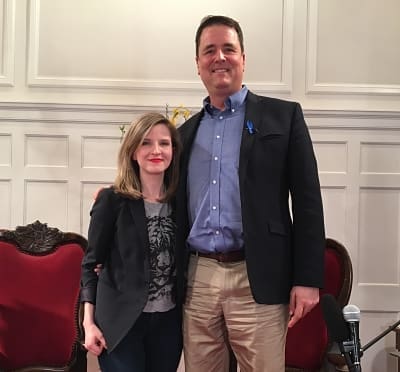
 We were honored to host a live Q&A and book signing with New York Times bestselling-author Tara Westover on March 29, 2018 at the First Unitarian Church in Salt Lake City.
Tara is the author of the book Educated. Born in Idaho to a father opposed to public education, she never attended school. She spent her days working in her father’s junkyard or stewing herbs for her mother, a self-taught herbalist and midwife. She was seventeen the first time she set foot in a classroom. After that first encounter with education, she pursued learning for a decade, graduating magna cum laude from Brigham Young University in 2008 and subsequently winning a Gates Cambridge Scholarship. She earned an MPhil from Trinity College, Cambridge in 2009, and in 2010 was a visiting fellow at Harvard University. She returned to Cambridge, where she was awarded a PhD in history in 2014.
If you missed our first interview with Tara, you may find it here.
Episode Transcript
Host: John Dehlin · Guests: Angie, Tara Westover
This transcript is machine-generated and lightly edited for readability. The audio is authoritative. Please excuse occasional errors in names and spelling.
Introduction and Welcome
Guest [00:00:00] We like to throw rocks at the people who don't see the world in the way we do.
John Dehlin [00:00:11] Mormon Stories is a production of the Open Stories foundation and relies solely upon the support of people like you, its listeners. To help keep the podcast alive or to become a member of the community, Please become a monthly subscriber by visiting MormonStories.org and clicking the donate button on the top right side of the page. All contributions to Mormon Stories are completely tax deductible and go towards producing the podcast and building communities and programs of support for Mormons like you. Thanks for your support. Well, hello everyone, and welcome to this wonderful evening with Tara Westover. Again, this is Mormon Stories Podcast. I'm your host, John Dehlin. We're so happy to have you here for the viewing audience. We are here to celebrate this wonderful book, Educated a Memoir by Tara Westover. This is sponsored by the Unitarian Universalist Church, First Unitarian Church in Salt Lake City, and also by King's English Book Store. And we're so happy to have you here. So, Tara Westover, welcome back to Mormon Stories podcast.
Tara Westover [00:01:26] Thanks.
Writing and Revising the Memoir
John Dehlin [00:01:28] How's Salt Lake been treating you today?
Tara Westover [00:01:30] Pretty good so far. It's nice to see mountains again.
John Dehlin [00:01:33] Yeah. You've been away for a while, so I'm going to tell a secret or two of hers. One. One thing I heard today is that over the past six weeks, she's actually slept in her own bed. How many. How many days?
Tara Westover [00:01:45] I think two.
John Dehlin [00:01:46] Two days in six weeks. So what has been unexpected about this journey of promoting the book?
Tara Westover [00:01:56] I think all of it has been pretty unexpected.
Guest 2 [00:02:01] Yeah.
Tara Westover [00:02:01] When I first wrote the book, I thought maybe someone would publish it, but I didn't really. I don't know how much faith I even had in it getting that far. So pretty much everything that happened beyond that has been published. A shock.
John Dehlin [00:02:16] So you're just kind of like a happy shock or a sad shock or a terrifying shock.
Tara Westover [00:02:21] Yeah, but I'm definitely kind of catching up with.
Guest 2 [00:02:24] Yeah.
Guest 3 [00:02:24] What it.
Tara Westover [00:02:25] What it means to have the book and to go around talking about it and. Yeah, it's. It's not what I expected, but it's. It's interesting and, you know, I'm really pleased to be doing it. So it's really fun to be here. I meet different people. Yeah.
John Dehlin [00:02:41] So you mentioned earlier today that it took you about a year to write the first draft of the book and then a year to rework the manuscript. Is that right?
Tara Westover [00:02:50] Yeah, I wrote the first draft in a year, and then I found a publisher, and then with my Editor. We spent another year revising it.
John Dehlin [00:02:57] So why. That's a lot of time to dedicate. What were the motivations that you had that would lead you to endure two years of writing?
Tara Westover [00:03:11] Well, so I'd had this experience which the book is about. Well, the book's about a lot of things. But one of the things that the book is about is this experience that I went through where I lost half my family. And at the time that I was going through that, I felt like it had never happened to anyone ever before, which I now know was not true. It happens to people. Maybe not all the time, but it certainly happens. And it seemed to me that there was a real absence of a story about that. I think people do write that story, but they tend to write it when they're a little older. They tend to write it maybe toward the end of their life or after the people with whom they're estranged have passed away. But I was 28 years old when I started to write the book. And I was healthy. My parents were healthy. It seemed like we could be living with the situation that we were in for quite some time. And I didn't feel like I had a roadmap. I didn't feel like I had access to stories that would kind of tell me how I was supposed to feel about that. And I think that is what stories do. I think they tell us how we're supposed to feel when we're supposed to feel happy, maybe not so much happy, but maybe when we're supposed to feel proud, when we're supposed to feel ashamed. And I had this experience with my parents. My parents were telling people I was possessed. And I did not know how I was supposed to feel about that. I did not know how I was supposed to believe that I was a good person when my parents didn't. And how I was supposed to reconcile with myself with the decision that I'd made not to have them in my life. So that was kind of the germ of the idea of writing the book, was that I felt like I wish that story had been told. And because it really hadn't, I just decided I would do it myself.
The Therapeutic Process of Writing
John Dehlin [00:05:01] Was it therapeutic for you to write the book? And if so, how it was?
Tara Westover [00:05:06] I would say this kind of writing can be therapeutic, but it's not therapy. I mean, it's a really different kind of writing. I did a lot of journal writing that was more explicit therapy for myself. And this is because you're writing and you're trying to write something that other people will find useful. Or might identify themselves in. And it has a lot more to do with craft and a lot more to do with storytelling. But it was therapeutic. It was therapeutic to try to go through the story and understand things from points of view that I hadn't necessarily considered. I spent a lot more time in my dad's head, in my brother's head, in my mother's head than I had previously. And at the end of that experience, I felt like I had a better understanding for them. I felt like I had more empathy for them, but at the same time, I felt more certain about my decision.
John Dehlin [00:05:58] Your decision to write the book?
Tara Westover [00:06:00] My decision not to have them in my life.
John Dehlin [00:06:02] Okay. Yeah. That's such a. Such a difficult decision, and I think we'll be coming to that throughout the evening. I think one of the most. You know, you mentioned in the book, there's a part in the book where once you're at Cambridge, it seems like you are trying to avoid telling people, you know, who you really are. And you mentioned not wanting to be a Horatio Alger sort of figure, which. Actually, it was at byu where I learned who Horatio Alger was.
Guest 4 [00:06:40] Me, too.
John Dehlin [00:06:40] In my American Heritage class.
Guest [00:06:42] Me too.
John Dehlin [00:06:43] Yeah. And I'm curious, you know, do you feel like that's sort of how the book has shaped up? Do you feel like that's kind of the main. One of the main themes of the book? And do you feel like that's how people are now, sort of heralding you as a Horatio Alger sort of story?
Tara Westover [00:07:02] I don't think so. I think there's a few people who will always want to take it that way. And I do have some people who, when they ask me questions, will say, well, what we really need you to write the book about is how you and your brother were able to teach yourself and then go to college. And that's what the book should be about. And I just don't. For one thing, I don't have any insight into that. I don't know why he was that way. It'd be amazing if you could bottle him.
John Dehlin [00:07:28] Do you mean Tyler or.
Tara Westover [00:07:29] Yeah, Tyler. And just put a drop of him in everyone's nighttime drink. But other than that, I don't know why he was able to teach himself trigonometry. I don't know why he was able to teach himself calculus. I was far less successful at it than he was, but I was able to do a kind of less impressive version of what he did. But, I mean, to me, the story isn't so much about those. Are Sociological questions that have to do with education. To me, the questions that the book asks are more psychological than sociological. They're kind of about. They're about change. They're about the many different types of a person that can exist in the space of a life. And they're about whether your first self is your only true self or whether you're allowed to change. And especially they're about what happens when the people close to you can't allow you to change or just can't accept any other version of you other than the one that they knew.
John Dehlin [00:08:28] Why did you say that what Tyler did was more impressive than what you did?
Tara Westover [00:08:32] Well, he objectively got a higher score
John Dehlin [00:08:35] on the act, so it's all about the act.
Guest 5 [00:08:40] Got it.
John Dehlin [00:08:40] I'm going to write that down. It's all about the act.
Tara Westover [00:08:43] He also taught himself calculus, and I sort of taught myself algebra.
John Dehlin [00:08:50] Okay.
Tara Westover [00:08:51] Lower standard.
John Dehlin [00:08:52] You have a Ph.D. from Cambridge. That's not slouchy.
Angie [00:08:56] Yeah.
Tara Westover [00:08:56] He has a Ph.D. from Purdue. It's, you know, Purdue. We're not going to get into measuring.
John Dehlin [00:09:01] No, but you said it. I was just curious. Well, when I read the book, I wondered whether.
Tara Westover [00:09:05] Well, I would say. I should say. Well, he was the first one. It was much easier after he had done it for him to then come back and say to me, why don't you do this thing? Because even though it was a complete unknown for me, it was not as unknown for me as it was for Tyler. Cause Tyler had done it. So I think Tyler. I can't account for it all. Me doing what someone I admire told me to do and helped me to do is probably less of a mystery than why he did what he did.
John Dehlin [00:09:34] Could you even speculate as to whether or not you would have been able to break free if Tyler hadn't?
Tara Westover [00:09:39] No, I have no idea.
John Dehlin [00:09:41] Okay. You don't. You don't know for sure. I wondered that a little bit. Do you still sing a bit?
Tara Westover [00:09:49] Not at the moment. I've got a cough drop here.
John Dehlin [00:09:51] I was gonna have you sing, but then I realized I couldn't do that.
Tara Westover [00:09:54] It would sound weird.
Positive and Negative Liberty Through Education
John Dehlin [00:09:59] Talk a little bit about. You talked about this in our interview, but talk a little bit about positive and negative liberty and how that learning, that concept kind of helped sort of frame your transformation a little bit.
Tara Westover [00:10:12] So I learned about negative and positive liberty pretty late in my academic trajectory. So I went through. I went to BYU first. When I went to byu, I didn't know anything. I was. You know, I thought that I had been educated. I thought I'D been homeschooled, and I thought that we'd received this great education. And I got to byu, and I raised my hand and asked what the Holocaust was. Everyone thought I was being anti Semitic. They very much heard that as me saying, you know, what is this? But it was very sincere. What is this? I didn't know. So what followed after that was a pretty long period of coming to terms with the depth of my own ignorance and all the stuff I didn't know. And I'd never written an essay, never taken an exam, all the stuff that I had to do just to function in an academic setting. Then if you fast forward four years, I thought that I was this. I mean, that's when I went to Cambridge. I got the scholarship. I did well at byu. I was able to go to Cambridge. But, you know, change is kind of slow. And you think that just because you're learning all of these things academically that it will have this immediate, forceful impact on your life. And sometimes it does, and sometimes it doesn't. So Negative and Positive Liberty, it was a lecture I went to my first week in Cambridge, and it was a lecture about Isaiah Berlin's concepts of negative and positive liberty. And for those of you who know, negative liberty is what we think of negative freedom. Negative liberty is what we think of when we think about restraint. So I can't do something because someone's tied me up. So I can't go outside because I'm tied up and I'm chained to the wall and I can't. I can't go outside. That's negative liberty. You've been physically restrained. Positive liberty is the idea that. How do you describe positive liberty? If someone restrains your positive liberty, they've done it by convincing you of something that either is true or isn't true, but that. That then restrains your action. So you can't go outside because someone's told you that there's someone on the other side of the door with an axe who will kill you if you go outside. So it doesn't matter whether it's true or not. The fact that you believe it will mean that you can't go outside. So that's the basic idea. And that was really revelatory for me because it had never occurred to me before that moment that maybe the most important restraints on a person would be not external to them, but might exist in their own mind. And when I learned that it was about the same time, a friend of mine sent me this song. It was a Bob Marley song. And it had that wonderful lyric in it. Emancipate yourselves from mental slavery. None but ourselves can free our mind. And that led me to Wikipedia, where I was looking up Bob Marley, and I read about the cancer that he had on his toe and how he had had the Rastafarian belief in a whole body. And so even though the doctors had said to him, we need to amputate your toe, he had said, no, I won't. I have belief in my whole body, and I won't do that. And the result was he died. And he was a young man. So I was reading this story, and it wasn't really until that moment that I realized I had never had my vaccinations. So I had grown up in this family with a father who believed that doctors were evil, that they were possibly trying to harm you, that if you took a pharmaceutical, it some way damaged you spiritually so that herbalism wouldn't work. The spirit would leave your life. That's how I'd been brought up. And in a technical sense, I'd renounce that. For many years, I'd been saying to people, no, I don't believe that. I believe in the mainstream. And yet I had never actually gone to a doctor and been vaccinated or had kind of normal treatments. And so it was a moment where I realized, sure, I've kind of renounced my father's worldview in one way, but I've never quite found the courage to live in this new world. So it was a time that I realized there was no physical restraint, obviously, on me, keeping me from going to the doctor. But there were beliefs and impressions I had, maybe even that weren't in my rational mind, but were still so much a part of me that they were still dictating what I did.
John Dehlin [00:14:15] And if you had to name sort of the major components that were constraining your positive liberty, what would you say those were?
Tara Westover [00:14:25] I think I had a fear of doctors. I'd never actually. I'd been to one, I think, at that point in my life, and really briefly. So I'd never. In a rational sense, I. I didn't believe what my dad said. And yet all of my instincts and my ideas about what a doctor was were very much still those ideas, because in order to overturn them, I would have to actually go and have an interaction with the doctor in order to have a different frame of mind about it. And that would have required courage. And I never. I had never found that courage before.
John Dehlin [00:15:00] So your beliefs about the medical system were an example of A constraint to your positive liberty. Any others?
Tara Westover [00:15:07] Oh, I'm sure there were so many. I'm sure there's so many.
John Dehlin [00:15:10] Your family is, you know, sort of the upbringing you got from your parents. That is one that sticks out.
Tara Westover [00:15:16] Yeah.
John Dehlin [00:15:16] And then. And then something that we've talked a tiny bit about is, is the role that religion may or may not play in constraints to one's positive liberty. Do you. Do you view it that way for you, that. That in some ways maybe your religious beliefs contributed to that, or do you not see it that way?
Tara Westover [00:15:34] I think anything in your life gives you ideas about yourself and what you are and what you're capable of doing and who you're able to be. I think I had a lot of sources in my life that were telling me I was one thing. You know, I guess you could say Mormonism generally has specific gender ideas. My family, they're much more extreme than Mormonism. So I think my dad's view of. And especially my brother Sean's view of what a woman is, what she's supposed to do, what she's capable of. I think that those were putting some pretty serious restraints on how I thought of myself and who I thought that I was. And some of that, in a very limited way, was rooted in Mormonism, but I think a lot of it was quite specific to them.
Religion, Family, and Personal Identity
John Dehlin [00:16:21] Margi and I had this kind of strange experience this morning where I was feverishly trying to prepare for today, and we had a clogged drain in our shower. And I was listening to your interview with Doug Fabrizio this morning while I was preparing. And you were talking about, I guess, your dad and some of the abuse that you had experienced. And I think religion came up here or there and.
Guest [00:16:49] Sorry.
John Dehlin [00:16:49] And the plumber who was coming to help us unclog the shower drain had been listening to the interview on the drive to our house and then was listening to it while he was fixing. And there was this point where he just kind of called out, like, why can't she just say it? Like, her dad was awful and her upbringing was terrible, and the church has been a horrible influence in her life. How many of you felt that when you were reading the book? Anybody? Okay, so obviously this book is universally loved, right? Obviously, you're a global phenomenon, in my words. But at the same time, it does seem like you really want to avoid ever really just saying, my upbringing was awful, my parents were abusive. The church is terrible. It seems like you really work hard to avoid those sorts of conclusions.
Tara Westover [00:17:41] Tell us why I use the Word abuse quite a lot when I'm interviewed. But I don't think there's any value in saying they were abusive and that's the end of them. And there was no other elements of that story. For one thing, it's not very helpful. To tell someone you should get out of an abusive relationship is kind of like saying, did you know that one on one is two? Why do people stay in those relationships? They stay in them because there's something compelling about them. They stay in them because there's real love there. There often is real love there. The love isn't a trick, the love is real. They stay in them because they, there are positive qualities that these people have. You know, my brother saved my life.
John Dehlin [00:18:21] Which one?
Tara Westover [00:18:22] Sean? The abusive one, the violent one. And he, he could be incredibly self sacrificing. He could put himself in terrible danger. I tell this story about the time that we were breaking horses together and I was on a horse that went completely mad and I lost the reins and my foot was caught in the stirrup and I was, I was done, basically. I was going to fall off that horse and I was going to get dragged until my head was split open. And that's how that story ends. That's how that story always ends. And he was on a horse 20ft behind me that had never been ridden in his life, never had a rider. It was his first time, this 1200 pound thoroughbred. And I thought, I'm done. There's no way he's going to whip that horse into a fit knowing full well that he'll never be able to calm it down again. But that's what he did, and at great risk to himself. So he was capable of that. He was capable of some truly hideous, unbelievable behavior, but he was also capable of that. And I think for people who are in those relationships, the good things aren't a trick either. They're real. And that's what makes it hard, that's what makes it complicated, is that you take the good things and you use them to justify or rationalize away the bad. So I don't see any benefit in denouncing them as abusive. I'll call the behavior abusive when I feel like it is, when I feel like it needs it. I don't shy away from it. But I don't see any value in a story. It just tells you the obvious, a dysfunctional relationship, you should probably leave. It doesn't really get to the heart of why it's hard to leave. And that I thought was much more useful thing to Explore why is it hard to leave?
John Dehlin [00:19:56] In your interview with Doug, it also seemed when you talked about religion, you talked about how the Mormonism of your upbringing was very different from the Mormonism at byu and that there were some very beautiful things that happened in the latter. Can you talk about it? Seems like the theme you're sort of putting forth is there isn't a lot of use in sort of viewing the world in a black and white way, but there's lots of shades of gray or even color. It seems like you like to look at religion in the same way.
Tara Westover [00:20:25] I do like to look at religion in the same way. And I think some of that is for my own sanity, even when it comes to my family. I mean, can you imagine a worse life than going around talking about how much you hate your parents? I can't. I can't really imagine a worse way to spend your time. I do believe in talking about that relationship and what was bad about it and what was hard to see about what was bad about it. But the reality of it is I have a lot of good memories of my parents, and I prefer to keep them. You know, I think anger. Anger is this incredible thing. Anger can be so good. Anger can be the most appropriate thing in the world, because what anger does is it's a mechanism that your brain uses to get you out of situations that are bad for you and that will do you harm. And when you need it, you should absolutely feel it. And it can be really consuming and it can take you over for a while. And it certainly did me. There were several years after what happened with my parents that I was unbelievably angry. And my whole life became that. I was filled up from my first memory to my last memory with just rage. And I became someone who had no beautiful memories. And it's just not a nice way to live. And I kind of feel like now I don't particularly need my anger towards my parents, and I don't need it because I'm no longer under their power. They're not a threat to me, so I don't need to be that angry with them. I need just enough anger to keep me from going back. But mostly I just need sanity and the ability to evaluate what happened and think, well, no, let's not do that again. But I don't feel the need to have it in my life. And what's nice about writing the book, in a way, is, yes, I wrote about all the terrible things that happened because I needed to, but I also wrote about some of the lovely things that happened. And for me, it was really nice to reclaim both sides of that story so I could write the book in a way that everything was both connected, but kept completely separate. So my brother that saved me on the horse that day could be the same brother that attacked me in the parking lot. He could also be different. And at the end of that process, I felt like someone who had had a beautiful childhood. I also felt like someone who'd had a difficult childhood. And to me, it's important to keep hold of both of those things. Because I don't want to live a life of rage. I don't want that. But I also don't want someone to be able to come into my mind and distort reality in order to justify their behavior or rationalize things. So I guess for me, it's important that no one can take from me the good and no one can obscure for me the bad. And that's what I mean when I say I just want to live in my own head.
Feminism, Mormon Culture, and Intellectual History
John Dehlin [00:23:00] In the book, you talk about sort of a feminist awakening that happened. You talked about kind of how feminism was referred to at byu. And then later, when you started reading some of the primary seminal feminist texts, how that led to sort of a bit of an awakening. Can you talk a bit about what feminism sort of has become for you and how that's become a part of your identity?
Tara Westover [00:23:26] I've read a lot of things since I read that first John Stuart Mill quote. But I haven't read anything that has excited me the way that did. Because I think I'd grown up in a family where the nature of women was thought to be so well known and defined and laid out. And everything about what a woman was and what she could do and what her value was and what she was supposed to do with her life and what age she was supposed to do. All that seemed known. And I really loved that line in John Stuart Mill when he said of the nature of women. Nothing final can be known. Because his argument, of course, was sociological and historical. He was saying, for centuries we've been forcing women into these weird contortions through pressure, through laws that now we just. We don't really know what they are. If we just left them alone, we don't know what they are. And he was arguing against some. Some of these laws that people either had passed or trying to pass. They would say that women couldn't be in certain professions. And I thought he had a wonderful retort to that. Because they were obviously saying, well, it's not Natural for women to be working in these professions. To which he said, if it's not natural, why do you need a law? Which I just. I don't think anyone's ever answered that satisfactorily. So I found his. I've never found a statement of it that I found more liberating, to use the cliche, than that statement of the nature of women. Nothing final can be known to me. It just says, whatever you are, whatever you think you can do, there's no reason to think you can't.
John Dehlin [00:24:56] I received a question from an old friend named Matt who said that at some point somewhere, you had said or written that you sort of followed Mormon feminism for a bit. But I think the word he used was that it was exhausting or tiring.
Tara Westover [00:25:12] I did say it was exhausting.
John Dehlin [00:25:13] Okay, can you tell us about what you were following about Mormon feminism and what made it exhausting?
Tara Westover [00:25:20] I think there was a time I tried really hard to reconcile how I thought of myself and who I thought I was with the life that I would have been expected to leave if I had stayed in the church. And I just found that mental project exhausting. And for me, it was a lot easier to. I just felt like I could live a more genuine life, more genuine to myself, if I stopped trying to do that. So it wasn't that I was following any particular movement or reading any particular texts in Mormonism, or following any. For me, it was a project that I was doing very much on my own of trying to work out an identity. A lot of the book is about identity, and I found that very difficult.
John Dehlin [00:26:07] So it was difficult to sort of continue following or tracking Mormon feminism.
Tara Westover [00:26:14] I think Mormonism has strong ideas about gender, and if you're someone who fits into those ideas, then that can be wonderful. But if you're not, it can be really difficult, and you can maybe feel like you're doing harm to yourself, trying to force yourself into it. And I guess I felt more like that I felt like I wasn't being fair to myself, trying to force myself into a shape that just wasn't natural to me.
John Dehlin [00:26:39] Are you saying that trying to advocate for positive change within the church maybe would have made you twist and bend in ways you ultimately decided you couldn't? Bend or twist? Is that what you mean?
Tara Westover [00:26:48] I don't know if I even made it as far as activism. I think I just thought trying to live this life, I don't think feels as genuine to me as. As a life that doesn't come with these sets of ideas already. In place. Again, for me, if you think about it, it makes perfect sense because I'm so obsessed with that line from John Stuart Mill, the nature of women. Nothing final can be known. And that is. That's not Mormonism. Mormonism knows a lot of things. And again, I think this is what a lot of people value about it, is how much it knows and the worldview that it puts forward. But for me, because I didn't feel, and I didn't identify with, that I didn't resonate with, was just. I just felt like I was forcing myself into a shape that just wasn't natural to me.
John Dehlin [00:27:33] Yeah, really quick, there's several people standing. There's at least three or four seats up here front. If somebody wants to come sit down, there's maybe a couple more as well. So I feel bad for those who are standing. I want to invite maybe three to five of you to go ahead and come up, and I'm going to have you stand maybe in a line behind the piano and we'll call you up maybe one at a time to ask a question. I'm going to go ahead and ask one more question. But if there are about five of you who want to come get ready to ask a question, I'll invite you to sort of form a little queue right here behind the piano. When I was reading about your time in Cambridge and specifically the point where you decided to write about Mormon intellectual history, specifically in the 19th century, there's a part of me that was like shouting at the book, saying, what is interesting about Mormon intellectual history? Why would you waste your time at Cambridge reading Joseph Smith and Brigham Young? Not because I think that they were worthless, but just because I can think of your Cambridge. I can think about so many different authors and scientists and activists and poets and scholars that you could read about. So did you discover anything interesting from your work, reading about Mormon intellectual history? And if so, what was that?
Tara Westover [00:28:56] I think I did. They gave me a PhD.
John Dehlin [00:29:02] So you found something interesting.
Tara Westover [00:29:04] Mormonism was one of four movements I looked at, and for me it was. I picked two religious movements, Mormonism, and then another community called Oneida. And then I looked at a political movement, an anarchist movement called Modern Times. Then I looked at a socialist movement, an economic movement in the UK called Owenism. Well, it wouldn't have been the uk, but England, shall we say. And basically, how to summarize the thesis is really complicated, but I was trying to take movements that had been marginalized by intellectual historians and dismissed as radicals and not taken seriously. And I Tried to take them seriously. I tried to look at what they were doing and looking at their own justifications for the practices they had that had got them labeled as radical. And for Mormonism, that was polygamy. For Oneida, it was a strange version of free love. For Owenism, it was rational marriage, which. Which meant a whole bunch of things, but mostly meant that you could get divorced very easily, which, in that time period was unusual. And then I looked at an anarchist community that had abolished marriage altogether. They had no concept of it. And so I looked at what they were trying to do. Like, why did they think that they were doing it? What did they think that they were going to achieve, and what were the justifications for it? And what I found was that these movements were pretty idealistic about what they were trying to achieve, and they were trying to build a better world, and they had ideas about why they. That these various institutions were going to achieve that. But they had a lot to do with. With a lot of the intellectual ideas that were. That were swimming around at the time about private property, about utopianism. The family was at the heart of that. The idea that the family might actually be a kind of capitalist institution, that because people hoard wealth for their children, that that is a primary driver for selfish behavior. So a lot of these movements were. Were really intentionally and deliberately trying to break that. And Mormonism was not an exception. There were a lot of justifications from Brigham Young of polygamy that were about distributing property, and they were about other kind of big social ideas that I think maybe we don't take seriously. So I ended up looking at these movements as manifestations of some of the bigger philosophical debates that were taking place at the time. And I don't know. I mean, I found it kind of reassuring. It was something that I felt really bound Mormonism to the rest of the human story.
John Dehlin [00:31:38] Beautiful. Okay, Jamie, let's have Jamie come with a question.
Guest 2 [00:31:44] Okay, I've got two questions for you. I really love the part about the.
John Dehlin [00:31:48] Can I interrupt you for a second? This is Jamie. Hannah's handy. She's been on Mormon Stories podcast several times. Some of the most popular ones, including our discussion of DNA. So I just want to say, Jamie, you're awesome. We're glad you're.
Guest 2 [00:32:02] And it reminded me of a Gloria Steinem quote that said, the more educated a woman is, the more depressing it is because we study our own absence. And so I wondered if you. How influential it was as you looked at Mormonism. Just the complete absence, lack of women, and how much that influenced you. And then the second one is another really Mormon topic, which is just the reverence we have for our Mormon pioneers. And I loved, as I read about your brother Tyler, you know, seeing him as your pioneer and what other pioneers have been in your life that have allowed you to. To get this far? You know, who are, who are your other influences that pioneered this path for you that we could also look to?
Tara Westover [00:32:38] Yeah, big questions. It can be a bit depressing. I was talking to a filmmaker the other day who's making a documentary right now and was just finding it impossible to find. He's interviewing a lot of kind of high level tech CEO types and she found it impossible to find women who would talk to him and was kind of playing with the idea, like, why is this, why is it that women will not talk? And I think that. I think women can be really risk averse and I think sometimes it's because they've had so many bad experiences and they're held to such a higher standard that they have no reason to take an extra risk when so often they just get punished for that behavior. But it was really depressing just to hear that because so many things happen when you take a risk. You know, this book was a huge risk and I'm glad that I did it. So I find, yeah, I do find the lack of women at a certain level, yeah, really depressing. And I do feel like a lot of things will not get better until women are represented at a higher level. As for pioneers, I don't know if I have any in particular that I think of, but I think that the heritage of a pioneer as a, you know, whether you are Mormon or not, whether you're believing or not, I think that image as something that you inherit as part of your identity is a really beautiful one. And of hardship and trial and of wandering off into the wilderness in search of a better life, I think is just. It's just a really beautiful image. So I really like the image of pioneers.
John Dehlin [00:34:20] Next question. Thanks, Jamie.
Guest 2 [00:34:25] Hi.
Guest 6 [00:34:25] I really apologize if you've answered this question in the book because I just learned about your podcast within the last few days. Finished it, finished the Mormon Stories one yesterday and at the end of that was the announcement that you were going to be here on the 29th. So I'm like in the throes and super excited to meet you and read your book in the future. Probably tomorrow, this weekend. But there are some copies out the
John Dehlin [00:34:50] back for you to buy.
Guest 6 [00:34:53] So maybe you do go more into this in the book. But I just. As I've been listening to you talk on this podcast, just thinking about other women, other children, other people in situations all around the world. And like you said, every family has its own dynamics. But there are definitely communities, and communities in the west in particular, where isolation and prevention of learning and knowledge and exposure to the outside world is a problem. And do you think that as a society, there is something we can do as people who were allowed to go to public school and to the doctor? But is it? I guess my first part of the question is, is it appropriate for us to want to do something, to reach out or to make available knowledge and information to those from whom it's being withheld? And then, so if it is appropriate,
Tara Westover [00:35:53] what would we do?
Guest 6 [00:35:54] And if it isn't appropriate, what would you recommend to those who may ever be exposed to your advice and are trying to come out? Does that make sense?
Tara Westover [00:36:06] I think so. I don't know if I have a solution for the general problem of people being isolated, because, I mean, I think that's something that the state has been wrestling with forever.
Guest 2 [00:36:20] Right.
Tara Westover [00:36:21] When do you step in? When do you take kids out of a home? And what are the criteria for that? And who decides? And how do you apply a rubric that is. That is even remotely universalized? And I don't have an answer to that. I do not. I do think the Internet is changing things. When I was a kid, there wasn't really the Internet. We got the Internet when I was a teenager. So I don't know how that will change, how that will make information more available. It is harder to isolate people now than it used to be. Excuse me. I do think that people, you know, everybody is isolated in a way because increasingly we do all live in these kind of ideological bubbles. Sorry, I'm gonna get a drink.
John Dehlin [00:37:10] No, go ahead.
Tara Westover [00:37:13] So, yeah, I don't know if I have a solution to your problem. Do you?
Guest [00:37:19] No.
Guest 6 [00:37:21] But the podcast is a good start. And the book.
John Dehlin [00:37:24] And the book, yeah.
Guest 6 [00:37:25] Getting your voice out there.
John Dehlin [00:37:27] Thank you so much. If there's anyone with a seat next to them that's open, please raise your hand. There are several people in the back who still have a seat, so raise your hand high if you guys any want to come have a seat. Everyone else, raise your hand if there's a seat next to you. Please offer someone a seat next to you. There's one up here in front as well.
Guest 5 [00:37:44] Thanks. I had a question about boarding school. They do boarding school a lot more in the UK than they apparently. Than they do in the US I personally, when I went to byu, I viewed that as going to boarding school. I was 23 when it happened.
Guest 7 [00:38:04] Thanks.
Guest 5 [00:38:07] And I also want to get your response on the idea of having a cultural Mormon. Listening to Jewish tv one time, they said that it would be a good idea for those in Israel to at least recognize that there are cultural Jews. And apparently they don't. So that's. Those are my questions.
John Dehlin [00:38:35] Thank you.
Tara Westover [00:38:36] I wish there was more space in the LDS Church for there to be cultural Mormons. I think probably a lot of people here feel that way. I would identify that way if that were a category. I wish it weren't quite so black and white. I do think that probably is changing, but I don't. Yeah, I don't know how long that will take or how soon it will be coming. Like I said, there are bits of that culture that I would never really want to give up. And it's where I'm from. It'll always be where I'm from. So, like it or lump it, I still often identify as Mormon. I just say I'm not practicing.
John Dehlin [00:39:12] About the boarding school question.
Tara Westover [00:39:16] I don't know anything about boarding. I'm uniquely unqualified to answer that particular question.
John Dehlin [00:39:22] Have you not attended K12?
Tara Westover [00:39:24] Yeah, exactly. I'm probably the least qualified person here to talk about boarding schools.
John Dehlin [00:39:29] Thanks for that question.
Guest 4 [00:39:34] Hi. So I work as a writing coach at the Community Writing center here in Salt Lake. And then I'm also an undergrad at the University of Utah's Writing and Rhetoric Studies program. And one of the things. So first of all, I read or heard something in an interview where you said that you basically taught yourself how to write by listening to the New Yorker Fiction Podcast.
Tara Westover [00:39:55] It's true.
Guest 4 [00:39:56] Which I just kind of flipped out a little bit when I heard that. I was so excited because at the Community Writing center, one of our motto is sort of that everyone is a writer and we work with people at every different ability. We go to writing groups in the county jails. We do them at various places all over the Valley. People come in, work with us one on one. And, you know, these people come to us and they have these stories that they want to tell. And one of the things I tell them is, you know, if you really want to, like, pick apart the craft of it and get a teach yourself how to do this, listen to the New Yorker Fiction Podcast. I got very excited just because it spoke to me so much. And so I wonder if you would talk a little bit. And the other thing That I was fascinated about in the book, among many things, was that you do an amazing job articulating. I mean, you're sort of in this unique position of, like, going to university as an adult and experiencing learning all these things for the first time. And so you have a way to, like, remember them where so many people learn them when they're so young. Right. And so then you were able to articulate this in the book. And so I would. I wonder if you would talk a little bit about what it was like to actually teach yourself how to write, particularly this, you know, novel. It's not a novel, but a long form work. Right. And then just what it was like to go through that learning process on your own, almost.
Guest 6 [00:41:11] Yeah.
Tara Westover [00:41:12] So I had. I made the decision to write the book after I had finished my PhD. And so I'd had this kind of 10 years where I got to. And I didn't know anything, and I didn't know what the Holocaust was. And I thought Europe was a country. And that's true. And I had had to learn all of that. And it was hard. In fact, it was really hard. And I remember when I decided to write the book, there was a brief. Oh, brief but lovely period where I really thought that my academic writing, that those skills would just translate and that it would be kind of the same. It was not the same. It was terrible. So everything I wrote, I mean, if you think about it, what makes a good academic essay or is it just really unbearable in storytelling? I mean, it's just the worst. And so I was writing these stories and I was taking them to this writing group I had in London, and they were just. I mean, they hated it because it was really bad. And there was a moment where I realized, actually, if I really want to do this, I'm going to have to do it from scratch. I'm enough to learn it the way that I had to learn a lot of other things. And I kind of felt too tired maybe to learn it because I was pretty tired from my 10 years of studying that I'd just done. But in a way, I feel like I was kind of lucky because I had, you know, my parents. There were a lot of things about the way my parents raised us that were not so great, but they did teach us that we could learn things. And they had a philosophy of learning that really gave a lot of confidence to your ability to teach yourself things. And they had always said that you could teach yourself anything better than someone else could teach it to you. And I was grateful that I had the belief that I could learn. And so for me, when I thought, okay, I want to try to learn how to write so that I can write this book, I knew I could do it. The question is, did I want to commit all of the effort that it would take? And I knew that it would take a lot, but I did do it. And I think, you know, the New Yorker fiction podcast was an amazing source for me because there's so many different stories every month. A writer picks a story by another writer and they read it and then they discuss it with a fiction editor. And this will explain to you how it works and all the mechanics of it and all the tools that you need. You don't have to read every story. You can pick the ones that you really like. You can pick the writers that you really like and you can obsess over them. And I really like obsessing over things. So that worked really well for me to just pick the kind of 20 stories that I thought were the best that really spoke to me and really just listened to them over and over and over and listened to the lecture over and over and over and figure out how they were built and how they worked. And I just feel like it was a way of designing my own curriculum. And I don't know. As though if I were attending a lecture on how to learn how to write, for me, I don't know if that would have worked as well. And so I don't know. I think coming to it as an adult in some ways was nicer because there wasn't a teacher standing over me saying, you have to learn how to write. Here's your homework for the day so that I could then try to find a bunch of ways to get out of it. I'm pretty good at that. I wanted to do it. I was the only one in my life who wanted me to do it. So I had to provide the creativity of how to learn it and then the drive. And in a way, I think that kind of self reliance is a lot more stable maybe than having another person prodding you along, trying to motivate you, which is. Which is ultimately kind of impossible, I think trying to motivate someone else to do something they don't want to do.
John Dehlin [00:44:45] Thank you.
Guest 5 [00:44:48] Thank you for coming. I'm a high school math teacher and
Education, Access, and Opportunity
Tara Westover [00:44:52] so good job teaching yourself math, Sohcahtoa. It's impressive, but I teach at a low income school and one of the
Guest 5 [00:45:00] major issues that we encounter is just apathy. And so for someone that didn't have the opportunity to go to a public school, what would your message be to
Tara Westover [00:45:10] a discouraged, apathetic student that is just
Guest 5 [00:45:13] struggling to find motivation?
Tara Westover [00:45:16] What would you say to them, to the student? I don't know. I feel like, because I never actually experienced public education at all, but I do, from listening to some people talk about it, I do feel like maybe what's missing is an element of kids feeling like they have some ownership over what they learn. And I don't know how that would work in math. I really truly don't. But I do feel like if you go back to John Dewey, you know that great pedagogic thinker, he said that there's two components to education. There's what society brings to it and there's what the individual brings to it. My parents took it way too far the one direction. Like they were like, oh, you don't need any society, you don't need books, you don't need anyone to teach you anything. You just go learn something. That was very much individual driven. And that was my, you know, that was one way of thinking about it. But I do sometimes wonder if sometimes when my friends are describing their high school or my nieces and nephews, I wonder if that has too much of the social. And I wonder where is the individual element there? And I do wonder if there has to be a way, if there could be a way to introduce more of the individual element into these collective learning processes. Because it seems like I can't imagine putting any real effort into learning something if I had no control over what I was learning just from knowing myself. I'm just not sure that I would. So in as much as we could give kids some flexibility over what they learn, I mean, I think this is like all parents know this, right? That like really famous trope where you kind of say, well, you're trying to manipulate your 2 year old into doing something and you're like, well, do you want to brush your teeth or do you want to clean your room? And you set it up as this dichotomy. They don't really have much of a choice, but they have the illusion of a choice at least. And I think I really don't want to brush my teeth, so I'll go clean my room. I just think that there's that kind of sense of getting some say in control over your life. And everybody wants that. Two year olds want that. So I can only imagine that every kid, I think, wants to have some control over their life. And when I hear some of my friends talk about their school experience. Sometimes I'm so jealous and I think, wow, you had all this stuff I didn't have. But that's not something I'm jealous of that they felt kind of subjected to something over which they had no control.
John Dehlin [00:47:48] I'm wondering if your interactions with Professor Steinberg sort of typified the balance between those two parts that Dewey talks about. Because I kind of celebrated when I saw him. If I remember it right, he basically says, what do you want to learn about? Is that right?
Tara Westover [00:48:02] Yeah.
John Dehlin [00:48:03] And then he was there.
Tara Westover [00:48:03] What books do you want to read this year? And we'll read them together. And he gave me suggestions. He was kind of like a consultant. He told me what was out there and I picked what I wanted to read and what I wanted to write about. So it all came down to what interested me and what I was drawn toward. So I'm not sure our relationship would have been as productive if he'd said to me, well, here's the five thinkers that we're going to look at. I don't know, it would have felt very different.
John Dehlin [00:48:33] So he, he exemplified maybe that balance.
Tara Westover [00:48:34] I thought he did, yeah.
Family Loyalty and Ethical Dilemmas
John Dehlin [00:48:36] Beautiful. This is Bert. I'm glad you mentioned your thesis and I'm curious about the topics. I wonder if personally you came to any ethical conclusions about the different arrangements that people had proposed and separately, if you had ambitions to turn that thesis
Tara Westover [00:48:58] into a, a book at some point
John Dehlin [00:48:59] or if you had other book length
Tara Westover [00:49:02] projects potentially in the works. I had a brief period after I finished my PhD. I thought, I will be an academic, I will turn this into a monograph. And then I decided to write this book instead. And now whether I'll go back to academia or write a different kind of narrative book, I honestly have no idea. But I expect in a few months when I have some time to think about it, I will have to make a life plan and do all those things people do when they grow up, like decide what they want to do when they grow up. But for right now, I have no idea what will happen to that thesis. No clue.
John Dehlin [00:49:40] And about conclusions regarding the different systems, if that was the question.
Tara Westover [00:49:46] Yeah, I think, well, huh, I'm not enough to abolish the family person and I'm not a free love person and I'm not a polygamist. So I guess I wasn't moved by any of them.
John Dehlin [00:50:04] Does that make you kind of traditional then?
Tara Westover [00:50:06] I have no idea. Do you have any easier questions?
John Dehlin [00:50:11] Leave it to Bert.
Tara Westover [00:50:13] I honestly don't know. I don't know if I can answer that. I was a lot more interested in the reasons why they were doing it and how that linked them to other philosophical traditions than I was in trying to decide to work out, you know, which one worked best. To me, if I'm honest with you, they were all pretty fraught with problems. I mean, the people who tried to. Have. Tried to have the free love situation had so much drama. It was an unbelievable amount of drama. And the people who tried to abolish the family altogether didn't fare a whole lot better. And polygamy had a fair bit of drama. And so, yeah, I just, you know, there are none of them that I thought, well, this seems peaceful. You know, they all seemed like they were really struggling. So I was a lot more interested in why they were doing what they were doing rather than how successful they were at it.
John Dehlin [00:51:02] And yet your own family, which I think many would call traditional in a very simplified sense, maybe was more fraught than all of the other systems you studied. And I wonder if that left you with any optimism or pessimism about the traditional family.
Tara Westover [00:51:19] I don't think so. I don't know. I think when I was younger, I had a skepticism of marriage because I didn't feel like my parents were very happily married. And I thought, I don't want to end up like that. But I don't know how much of that's persisted. You know, kind of like, I think my dad isn't representative of Mormonism. I also don't think that their relationship is representative of all relationships. So. So I think when I was a kid, that was less clear to me. But as I've gotten older, that seems kind of. That doesn't seem too hard to grasp that difference.
John Dehlin [00:51:52] Thanks, Bert.
Tara Westover [00:51:55] I'm Isaac. Hi.
Guest 7 [00:51:56] I'm intrigued by the negative and positive
Tara Westover [00:51:58] liberties, and I'm wondering, especially the positive liberties about this, like a strongly held belief being restrictive. How do you. How do you feel like you can get outside of yourself so that you can realize that that belief is restrictive, especially if it's a strongly held belief? Do you know what I mean? Seems like you almost have to get outside of yourself to have sense data on the sense data that you're receiving. And I'm just wondering how. How that can be done. I think it's a long, slow process. At least it was for me. And as much as I was able to do, I feel like it was just, I think, thinking seriously about ideas that you would normally dismiss out of hand. You know, I kind of. I worry a lot about the Fact that increasingly I think that we are growing up now and we're living in a world of kind of scientific positivism in a way, where we believe in science really strongly and we believe that science has an answer, a single answer. There's one answer to everything. And the problem is everybody thinks that they have it. And so there's a lot of. You hear that term, you know, well, science has proved or there's been a study that's shown. And oftentimes people that are using this have no idea what the study is. They don't know who did the study. You know, it could have been done in some random village in Estonia for all anybody knows. But it's used as this kind of like, standard of absolute truth. And I think it, in a way, there's irony there because there's something that is meant to stand in for rigorous intellectual inquiry. There's scientific study. There's a scientific study done about. That becomes shorthand as a way to avoid any inquiry at all and becomes a way to just shut down debate. And I just. I do feel like increasingly people, and I'm no exception to this, have so much confidence in viewpoints that are completely unexamined. And often those viewpoints are the ones that people are supporting with. Well, everyone knows that science says this, and I don't know. I do feel like it's becoming a shorthand way that we convince ourselves that absolute truth is on our side about things that we just haven't really thought about. And I notice it in myself, but I do notice it in other people. And I notice it generally, and I notice it's a problem on the right, and I notice it's a problem on the left that this thing that used to be symbolic of control groups and experiments and questioning and a really rigorous process is now being called upon without any process at all. And that seems really. That just seems really unfortunate. That's the thing that I watch the most carefully now when I am talking is the way that I appeal to science, because I've noticed that from. For me, anyway, it's become a dogma, and I don't necessarily know what I'm talking about. And I use it to sound like I know what I'm talking about. So that's my personal one. I've just become aware of other people doing it. I've become aware of myself doing it. I think it's an issue. I think what any other person's particular thing is, you know, you have to have self reflection and it's painful. It's difficult developing a capacity for self criticism. There's no shortcut to that.
Family Members Reflect on the Book
Guest 8 [00:55:25] Hi.
Guest 5 [00:55:25] I believe in the book your professor at Cambridge referred to you as his own Pygmalion. For those who are familiar with Bernard Shaw's Pygmalion work, I was curious and I was really wondering if you could speak to your own resilience and how you found that in the face of, in my opinion, tremendous violence, tremendous adversity and all of the things that you faced getting to where you got today.
Tara Westover [00:56:00] I have a lot of help, but I don't know. Sorry. If you haven't noticed, I have a cough. I don't know if I know why. Why that happened or why it is the way that it is, why I am the way that I am. I do feel like
Guest 3 [00:56:20] I got a
Tara Westover [00:56:20] lot of help and I feel like I was able to get help. I was able to receive help, I was able to accept help, which at times in my life is actually very hard for me to accept help, that would be a really difficult thing, accepting help. But for me, I think it would probably be one of the more important skills I would have. And I think there are periods of my life where I was too prideful. And I found it really painful because it is really humbling to, like, have someone teach you something is really humbling. Asking questions of people is humbling. Having someone help you in any way is really. It requires humility. And I didn't necessarily have a lot of that at various times in my life because I didn't feel like I could afford it. I needed to be arrogant because I was in survival mode. There's an irony there, but that's how it is. And so I don't know. I don't know what makes me resilient, what makes people not resilient, what makes other people resilient, what made me unresilant in some of my moments that I wasn't resilient, I don't know. But I do feel like. I do feel like I've always had people around in my life that would help me. The question was just whether I was able to accept that.
Angie [00:57:32] Actually jumping in from the wrong side. Which tells you a bunch about me.
John Dehlin [00:57:36] This is one of your aunts. Tell us your name.
Angie [00:57:38] I'm Angie.
Tara Westover [00:57:40] Hi, Angie.
Angie [00:57:41] Hi. What I really wanted Tara to kind of explain to the group and even to me, because I don't understand yet, but what I loved about her manuscript when I first read it, long before I even knew it was really going to be a book. For sure is that thing that when you wrote about getting a job at Stokes and never working for your dad again, and then having the ultimatum that if you live here, you have to work here, and I realized you literally drove past my house to go back into an environment you didn't want to be in. And I also realized that we had had at least three other people kind of escaping bad environments live in our house in your lifetime. And at the same time, I was an advocate for victims in the county, and I think if there was ever like, hey, here's help. Stop here. What is it that positive, negative freedom that makes it so difficult for a victim to realize that there are people to help? And I don't. You know, I've asked this question a lot, and I don't know what the answer to that is, but I think as a society, if we can figure out how to empower the victim so that when they see that open door, they actually see it as open and not closed. And so why did you drive past my house? You could have lived there.
John Dehlin [00:58:59] Angie, can you stay at the mic before she answers? Let her answer. And then I want to ask you a question, if that's okay. I have to stand here, if you don't mind. Do you mind?
Tara Westover [00:59:08] She looks like she minds.
Angie [00:59:10] If you don't want to, I'll come back. Okay.
Guest 4 [00:59:12] She just.
Tara Westover [00:59:13] She wants to run away. She thinks I'm gonna throw something at her.
John Dehlin [00:59:17] Why didn't you stop at Aunt Angie's?
Tara Westover [00:59:19] Well, as she was talking, I was thinking about some of the people I know that have stayed with my aunt over the years that came from the air quotes, troubled families. And I think in my mind, maybe it was because of the prejudices I was brought up with in the community, but in my mind, troubled families looked a certain way. There was alcohol in them. They smoked. This is no real. I'm not joking. I had an idea of what troubled family looked like, and it wasn't my family. That's not what I thought a troubled family looked like. A troubled family was a family that didn't go to church or there was a drinking problem or this, like, very stereotypical set of things that in or
John Dehlin [00:59:58] used doctors or went to public schools. Right?
Guest 6 [01:00:01] Yeah.
Tara Westover [01:00:01] Maybe none of that, too. Probably.
Guest 3 [01:00:03] Yeah.
Tara Westover [01:00:03] But do you know what I mean? There was an idea of a bad family, and that wasn't my family. My family was mostly good. They were just really bad some of the time. But most of the time, they were really great to know. I never thought of my family as one of those families. I never thought that I needed help in the way that those people did. It's really clear to me now that I did, but I didn't see myself that way. And there was no amount of someone telling me that I was in that. That I was that way that would have changed it.
Angie [01:00:36] Yeah, come on.
Tara Westover [01:00:37] You made this decision.
John Dehlin [01:00:38] And, Angie, this is a personal question you don't have to answer. But I'm curious what it was like to see your sister Tara's mom written about in a book that was sort of maybe, might not have always been perceived as flattering by her.
Tara Westover [01:00:54] Okay, you do not have to answer if you don't want to.
Angie [01:00:57] I don't think there's really any question I wouldn't answer. I don't know if I'd answer it right or wrong. But for me, like I said, I was the advocate for the county. At the same time, she was a teenager, and so I had lost the preconceived notion of this is what an unhealthy family looks like. So it was very interesting to read the book and go, oh, yeah, I knew about the car wreck and the second car wreck firsthand. I knew about these things firsthand. And it was just alarming to go, A, B, C. Oh, that all adds up to this. But I didn't see that because that's not what I was told it was, you know, it was an accident. It wasn't abuse. It was, you know, and as she said, we quite often, without even realizing it, take what somebody says this is and go, oh, okay. You know, when I heard about the story with Diego and the dog, I was like. And I remember talking to my sister about it and saying, why would he have a knife? Why would you say that you should wash? And I remember questioning that. But so much of what we perceive as real, we don't even realize. You don't know what you don't know. I guess.
John Dehlin [01:02:10] Go ahead.
Tara Westover [01:02:10] I just think these, you know, I mean, when my parents set about to discredit me, when I confronted about my brother, they decided not to believe me. Then they decided I needed to be silenced in a way, and the best way they could do that was to kind of destroy my reputation. They made that decision. They were really good at it. You know, they weren't casually good at it. They were really good at it.
Angie [01:02:32] And,
Tara Westover [01:02:34] you know, when my aunts came back into my life, I was just really grateful. And there's never been a part of me that thought that has blamed them for believing for whatever short Period of time. Because, you know, if my mother had come to me and said what she'd said about me about another one of my siblings, I can't promise that I wouldn't have believed her. I just can't give that promise. I might have. It's pretty likely, even.
Angie [01:02:57] And I know that if my sister. Because, you know, I was an advocate, if she had said, tara's possessed or you can't speak to her, you know, I would have absolutely tracked her down and spoke to her, just because I was told I couldn't. I mean, I came by the wrong side. But what her mom told me was she didn't want to talk to me. And I was like, oh, okay. You know, she's got these growing pains. We'll work this out later. And so I think when that's what makes deception so effective is because people do it subtly with your prejudice. You know, she had come to my house and. And been a little angry at me, so I figured, okay, you know, she'll get over that. And so she was buying into my preconceived notions. My sister here, who's chicken if she can't tell I'm shaking? So she ought to. I can.
Guest 3 [01:03:50] Do you want Tara's book? Even before it was published, and her articles, before they were published, helped me to get my daughter and I out of a very abusive situation. And. And if she. If I'm the only person this book helps, it was worth it.
John Dehlin [01:04:13] Do either of you.
Angie [01:04:27] One more comment? When Tara told us she was writing this book, we live right. My husband and I write in Franklin county, and we did this discussion of do we want to sell a house and move now? And we weren't kidding. But one of the things I said to him is if I didn't know Tara at all, and I didn't know this is a book that, as an advocate, I would have had on my bookshelf to loan out because it tells people how to think of their own head. And I said, if it only helps one person, then it's worth whatever chaos erupts. And what I didn't realize is the first person that I know of this book would help would be Debbie. And the thing is, and I don't want to get real personal, she'll tell you everything, but I won't do that because it's her story to tell. But Tara was writing the rough draft for the Vogue interview and was talking about how people get in your head and tell you what to think. And that made her stop and think about the relationship. She'd had 41 years with a man who was really good at getting inside her head. And so I think when people say, what is this book about? And you know, in Franklin county, it's supposed to be anti Mormon. It's not. And it's not a lot of things, but I think what it is is permission to think and to think for yourself and to think about yourself. And I love that.
John Dehlin [01:05:42] Do either of you just want to briefly express what it's been like to see your niece become a global phenomenon and how it's made you feel? Not only that, but to see the courage that she's. To see the courage that she's displayed.
Angie [01:05:57] No, I'm sitting down long before you're sitting down.
John Dehlin [01:05:59] In becoming who she's become, but also in writing this book.
Angie [01:06:03] Arizona. I'm just staying at my brother's friend. There's a wedding, and this guy says, hey, you're from Idaho. I was listening to this NPR interview about this girl who graduated from Harvard. And I'm trying to catch my husband's eye and just go, shh. Don't say a word. Just don't say a word. Just five minutes apiece. And he goes, would her name be Tara? It's awesome. I love it.
Guest 3 [01:06:32] As my sister pointed out, we were told Tara didn't want anything to do with this, and we respected that. We have now chosen Tara, and our sister has written us out of her. Her life, too. We knew that would happen, but we're not believing the lies anymore. And so it's been fantastic to see Tara's courage. And I'm living at my daughter's in Bluffdale, and a friend was over and she saw Tara's book was raving on and on about it, and we wanted to see what she thought before we told her. Finally, my daughter spoke up. That's my cousin, so we're proud of her.
John Dehlin [01:07:05] Thanks, Stebold. Thank you so much. Super nice.
Survivalism, Mental Illness, and Family Dynamics
Guest 7 [01:07:16] Hi, my name is Nick. Thanks for being here. I kind of had a question. It's a little bit more, I would presume, about your research. So you mentioned you studied movements that were ideologically based. I was wondering if there was anything qualitative to the different beliefs or the way the beliefs were used that gave movements more salience or staying powered. It seems like some of the others that you talked about, I don't know if they've become as quite as big or stable of movement as the Mormon Church. I'm kind of just wondering in your research, what was the difference or that you found It's a little bit of
Tara Westover [01:07:54] speculation, but I didn't actually look at why some stuck around and why others didn't. Socialism. Oh, night socialism was a bigger movement, had a lot more. More adherence, didn't stick around the way Mormonism did. But I can't really answer that because that wasn't really what I researched was why some of them endured and some didn't. So I'm sorry, I can't quite.
Guest 7 [01:08:16] Do you think. I guess just to follow up. Do you think. So you mentioned that the radical idea of Mormonism was polygamy, but they quickly just ditched that. Did you find that in the other movements you studied or. I mean, can you speak to that at all? Because it.
Tara Westover [01:08:34] Most of them had a lifespan that was roughly the same amount of time that Mormonism practiced polygamy. So I kind of took that phase of Mormonism as a comparative phase of the other movements. Once Mormonism moved away from polygamy, I think it was quite a different movement, really, by that point, I mean, that changed the church quite a lot in a lot of different ways. So, yeah, none of the other movements, though, they did tend to just kind of peter out.
Guest 4 [01:09:00] So.
Tara Westover [01:09:01] So they didn't necessarily go through a massive evolution the way that Mormonism did with statehood and all of that and the expansion and so.
Guest [01:09:10] Thank you.
John Dehlin [01:09:10] Thank you. Last question from the audience from my good buddy Christian. Welcome, Christian, it's good to see you.
Guest 8 [01:09:17] Great to be here.
John Dehlin [01:09:19] In the mic. In the mic.
Guest 8 [01:09:20] I'm a clinical social worker. It's my background. And on behalf of the mental health community, I do want to thank you for doing a beautiful dance with having love and compassion, setting a boundary, but having tremendous compassion for people with mental illness. There needs to be more of that. I don't know what you're planning to do with the rest of your career, but I do hope that you continue to speak out and help people understand that forgiveness, you can still have that boundary there and not be walked on, but have that compassion. So it had a huge impact on me. Even in that way. It opened my eyes to some things. But what I'm real curious about is the moment in the book that I got really excited. I literally jumped up. I was so excited when you made the decision, when your dad offered to give you that blessing. And I'm kind of curious where the inner strength came from to be able to work through that. I'm curious, obviously regrets about it, but that had a huge impact on your life. And I'm just curious where the strength came from. For you to make that decision. I know you've talked a little bit about in the past, but just like to hear more depth what was going on in your mind there. Thank you.
John Dehlin [01:10:28] Thanks, Christian.
Tara Westover [01:10:28] I've had people kind of say to me, try to do a counterfactual. People love counterfactuals. What if you had accepted the blessing? How do you think life would have been different? I don't think it would have been different because I think that's kind of the point. I don't think it was a superficial change that made me reject that blessing. I think it was a complete change. I think it was a fundamental change. And so I don't know as though any one particular action. I think that there was a symbolic value in saying, no, I'm not going to submit to this kind of exorcism. But I don't. I honestly feel like. Because the fundamentals of who I was was so different, what I did in any one particular moment. I don't know if in the long run, it would have changed anything. In the long run, I was not a person any longer who could let go of my own reality so easily as I had been. I had been for a long time someone who was. Really didn't have strong ideas about what I'd experienced. I didn't have strong ideas about what I thought. If my dad said that the past. If he gave me a historical interpretation of something, I took that at face value. And I hadn't been that person for a really long time. My dad had his ideas and I had my ideas. My brother had his ideas, and I had my ideas. And it had just been. It had been so long. But I just think, however, that one day turned out, I was too different. I was a different person than I had been. And maybe I would have had a moment of weakness and maybe I would have submitted to the blessing. But in the long run, I don't think there was any way I would have gone back to that house and been able to have those relationships on those terms. I just don't think it would have played out. Maybe I would have had another year of back and forth and an extra year tacked on of uncertainty and misery and self recrimination. But I don't think that in the
Guest 3 [01:12:19] long run,
Tara Westover [01:12:22] it wasn't any one decision. You know, I just was different. It wasn't a decision that made me different. It wasn't rejecting the blessing that made me different. I was just different. So. So I rejected the blessing. And I think it was just a long Process of change. I think it took a long time. There were plenty of years. I did make the equivalent of submitting to the Blessing, you know, for most of my life.
John Dehlin [01:12:46] Your cousin wants to say something.
Tara Westover [01:12:50] Family reunion.
John Dehlin [01:12:51] Come on up. Family reunion.
Guest 5 [01:13:02] Thank you.
Tara Westover [01:13:02] It's just hard to get to the line.
Guest 2 [01:13:09] Okay.
Guest 3 [01:13:09] Yeah.
Tara Westover [01:13:10] Okay. Yeah, that works. So you shared with me some of your drafts, and I read those at kind of a darker time of my life than I'm in right now. And it's something that I've been thinking about since those days. And your draft helped me in a way that's been hard for me to express to you. And it's kind of made me also want to try to share, like, my own story's narrative, in a way. And I was wondering if you had any, like, advice on how to, like. Like, go back into those emotions in order to write about them without getting lost in, like, the rage and the despair of them. Hmm. Well, I'm not sure. I think making sure you have good people in your life, you know, there might be times that you do get. There might be times that you do get lost in them, and I think it's just important that you have a way back out again. I don't think that there's an easy way to write about difficult things, and I don't think there's a set of five principles that will make it safe and comfortable to do. So. The things that are hard to write about, for me, anyway, kind of surprised me. Things I thought would be really hard to write about were not the things that were hard. I thought that it would be hard to write about the relationship with my brother, some of the violent scenes with him. And weirdly for me, that was not hard to write about. I feel like I had. Before I ever started writing, I felt like I had come to terms with those moments of my life. It was hard for me to write about some of the good things. And I have no idea if that would be your experience, because I don't know if it would be. But I guess what I'm trying to say is it can be a surprising experience, and it can be good, and it can be awful. And because it's unpredictable, that's why I think it just becomes important that you make sure you have support and a system in place to kind of bring you back to where you're okay again.
Audience Questions on Writing and Vulnerability
John Dehlin [01:15:13] Thank you. We have a few questions from the audience that they've emailed in. Ryan is asking Tara, you have laid bare your vulnerabilities and put to Ink so many of your secrets. Now you are retelling these things to complete strangers like us day after day. It sounds miserable.
Tara Westover [01:15:32] Thank you.
John Dehlin [01:15:33] What will you do to have fun relaxing when he gets some free time is his question. Walk your dog?
Guest 2 [01:15:43] Yeah.
Tara Westover [01:15:43] I'm obsessed with that dog. Yeah. No, that's. That's not a joke. I'm gonna live the most boring life I can think of. I think I'm gonna watch tv. I think I'm gonna read books. I think I'm gonna walk my dog. I think I'm gonna have dinner parties with people I've had dinner parties with 5,000 times before that will say nothing new. And that will be delightful. Yeah, no, I'm just looking forward to kind of going home and living my boring life again. But I also like going out and doing this. So it's a. It's a. I'm glad I did it. It's an adventure. It's. They're hard moments.
Guest 4 [01:16:20] Yeah.
Tara Westover [01:16:20] There's nothing comfortable, really, about going out and talking about difficult things with a whole group of people. It's really uncomfortable. But it's something that I wanted to do, and it's something I'm glad I did do. So I'm glad I'm here.
John Dehlin [01:16:35] Brad asked two questions. The first is, are you going to visit your hometown in Idaho on this trip?
Tara Westover [01:16:42] I'm here for one day, so no.
John Dehlin [01:16:45] Second question by Brad is, what do you do for work now? What's your day job?
Tara Westover [01:16:49] My day job is this, but I aspire to having a job job soon. That would be great.
Gender Roles and the Church
John Dehlin [01:16:59] Hannah asks, you mentioned that some women fit into the strong gender roles within the church and others don't. Yet, as Mill has said, the nature of women can never fully be known. And often our positive liberty is restricted within the church. And we are convinced we fit that role when in fact we are suppressing a more natural identity. Often we need a person to help show us that the things we're being told are negative and restrictive. Do you see yourself as an advocate for any kind, of any kind, for those suffering or feeling restricted within the LDS Church? Or rather, is the book just a way to share your story with the world?
Tara Westover [01:17:39] I don't know if I think of it specifically within the LDS Church, but I think of it as more. I think that there's taboos that exist maybe within Mormonism, but also just within life, within culture, within the world. And I think, you know, one of those big taboos. You're meant to honor your parents. That's not just unique to Mormons, that's how Mormons phrase it. Maybe you're meant to be loyal to your parents, you're meant to be loyal to your family no matter what. And I think I wanted to tell a story that was a bit more reflective about what family loyalty means and especially what family loyalty means and situations where loyalty to your family is in some kind of conflict with loyalty to yourself. And I wanted to tell a story that said sometimes it's okay to choose yourself. And I do think that there are ideas about who we are, maybe even specifically as women, I think, that make it hard to get out of these kind of relationships because I think to walk away from a relationship like this and to choose estrangement, these are decisions that are fundamentally, they're acts of self love. There's no other reason for them. You leave a relationship that is toxic for yourself, you don't do it for anybody else. And I do wonder if sometimes, maybe particularly as women, we're so trained to avoid even the appearance of selfishness. I worry sometimes we never learn how to practice anything like self love and that we never learn that we have a right to those two things. You know, we have a right to pursue our own happiness and to insist on our own safety. And it seems kind of obvious, but it took me a really long time to have any conviction of those things, that I had a right to pursue my own happiness and to insist on my own safety.
John Dehlin [01:19:22] There are several people here who maybe have kind of weakened their relationship with the Mormon Church or have left it. And I work with these people quite a bit and some of them end up feeling so angry at the church or so disillusioned or frustrated that they spend at least some of their time trying to sort of evangelize people out of the church. Do you, have you ever felt those impulses? And if so, why? Or why not?
Tara Westover [01:19:55] I think maybe there was a brief period I did, but not really, not for any sustained period of time and certainly not in my recent memory. I have no interest in whether or not people stay or go in with the Mormon Church. I have an interest in people feeling like they have what they need and feeling like they can be true to themselves and they can do that within the church or outside of the church. I've never felt particularly like it needs to happen one way or the other. That's kind of the point of pursuing your own path and self definition. And I think for me to dictate to anyone, you need to self actualize and you need to do it this way. There's a serious irony there.
John Dehlin [01:20:41] But if you maybe don't feel like the LDS church maybe, let's just say, treats women the way that might be treated, with enough equality, how do you. What keeps you from saying, hey, women, you know, get out of this church because the church doesn't treat women well, that sort of thing.
Tara Westover [01:21:00] I guess I feel like it's more constructive to put forward a positive story than to shout at people that something I don't think is quite right. You know, I'm not. I don't know what use it would be for me to write an essay saying, I think the church should have more, should have female leaders. I think women need to be in the upper echelons of the church. I do think that, but I don't think it's particularly useful for me to go around saying it. I think what I've done instead is write a story about someone who was female, who did make decisions about her own life. That some of them were. Some of them were problematic from a religious point of view, and some of them were problematic from just from a conventional point of view of what you're allowed to do in relation to church, but also to family and other things. I find that that feels more helpful to me. Maybe I'm wrong, but it feels more helpful to me.
John Dehlin [01:21:52] So maybe for you, the most effective form of advocacy is a positive example.
Angie [01:21:58] Yeah.
Tara Westover [01:21:58] And I think that there's real value in taking the other approach. I can see why people want to point out the shortcomings. I think a lot of positive change has been achieved by people pointing out, look, there's an absence here. You know, why. Why is there segregation? Why is there this? I think that it's not to say that there's not a reason to do it the other way, but for myself personally, this just feels. This feels more like the way that I would do it.
John Dehlin [01:22:28] Love it. Kristin asks. Well, first she says, I appreciate that you don't demonize your father or brother, although it is clear they did some terrible things. In the book, it seems that you believe your father has a mental illness. Think you've mentioned undiagnosed bipolar. Do you think people suffering from mental illness can be totally excused for their behaviors, or do you think there's a part where they have some responsibility for their behaviors?
Responding Thoughtfully to Abuse and Trauma
Tara Westover [01:22:55] I'm not interested in the responsibility question. I'm interested in how it affects the people that it hurts. So I feel like abusive behavior can be abusive behavior, whether it's intended to be abusive or whether the person is responsible, responsible for It. I've never been particularly worried about whether my dad is responsible for the actions he takes. I only am worried about the effect of the actions that he takes. And so I don't know as though I would ever. If I had 10 graduate degrees in psychology, not sure I would be able to parse out to what degree my father is responsible for what he does. I just don't think I have that ability. I don't know if anybody does. But luckily, I think for me anyway, I found it really helpful when I decided to cut off contact with my parents. I had a lot of guilt about it. I found it really hard to accept that decision. I found it really hard to forgive myself for that decision. And I think when I did forgive myself for that decision, or in as much as I was able to, it was because I stopped making it about my dad and I stopped making it about him deserving that. And I started making it about myself and that I needed it. It was, for me, nothing to do with him. When I was trying to. There were a lot of years. I thought if I could just get the list long enough of all the terrible things he'd done, that I would be justified and that I could forgive myself for what I had done. And at the base of that whole project was just a completely impoverished sense of. Of self respect and an inability to just say, no, I deserve this and I'm going to take it for myself. And that was a much healthier way to go about it, I think.
John Dehlin [01:24:36] Elizabeth asks, I'm curious to know if Tara suffers from any residual anxiety or PTSD as a result of the abuse. And if so, how does it manifest and how does she manage it?
Tara Westover [01:24:48] Not that I'm aware of, but I probably do. Yeah, I don't think so. No, I really don't. But, I mean, it's possible. I mean, I think everyone's a little bit insane. So, like, at what point do I start to worry about being crazy? Has not happened to me in a while. I do. My family gets to me. There's no question when my parents do something, they can get to me still. They absolutely can. How? I don't really judge myself on whether they're able to get to me. I more judge myself on how long it takes me to kind of come back down. So if they do some new terrible thing, they can absolutely send me over the edge. And I figure as long as I come back in a day or two, we're all good.
John Dehlin [01:25:35] Scott's a BYU student. He says, tell us more about your experience at byu. He's currently a non believing member finishing his undergraduate degree and was listening to your podcast while in his last mandatory religion class. We're not going to give Scott's last name. What was your fondest or worst experience at byu? Did you have any nightmare dating or bishop experiences?
Tara Westover [01:26:05] Yes, yes, and yes.
John Dehlin [01:26:09] All right, next question.
Tara Westover [01:26:12] They're all just cliches of byu, really. I had really wonderful BYU experiences. I had that bishop in the background book who is just like amazingly kind. Unbelievable human being. Yeah, I had all the cliched bad dating experiences that one has at BYU where you meet someone and 10 minutes later they want to get married. Had a lot of that.
A Letter and the Hope for Reconciliation
Guest 5 [01:26:35] So
John Dehlin [01:26:37] when you do sort of book tours, do they have you read? And if so, how much space? How many minutes do they usually have you spend reading?
Tara Westover [01:26:46] Depends on the book.
John Dehlin [01:26:47] What's the range? Kind of the median range.
Tara Westover [01:26:51] Two to seven minutes. I'm not doing seven minutes. I'll start coughing.
John Dehlin [01:26:55] Okay. Is it okay if we have you read a little bit?
Tara Westover [01:26:58] Sure.
John Dehlin [01:26:58] Okay. You can stop when you want. There's a part of the book that I want to have you read. It's just about three pages.
Guest 4 [01:27:07] Three pages?
John Dehlin [01:27:08] Is that too much?
Tara Westover [01:27:08] That's going to be long, but is
John Dehlin [01:27:10] it okay, I'll shorten it.
Tara Westover [01:27:11] We can go till I start coughing. Okay, you can read.
John Dehlin [01:27:16] Do you want me to read?
Tara Westover [01:27:17] I don't mind.
Guest 4 [01:27:17] What?
Tara Westover [01:27:18] What section is it?
John Dehlin [01:27:19] So it's the part where you are texting your mom about trying to get them to acknowledge the abuse and you're kind of excited about how she seems to be acknowledging it.
Tara Westover [01:27:36] I'll see how far I get. You want three pages?
John Dehlin [01:27:39] Do you see these stars? I mean, it's got stars all.
Tara Westover [01:27:42] Yeah. Will I be able to read it? I think you crossed it all out.
John Dehlin [01:27:44] No, I haven't crossed it all out. Well, see what you can do.
Tara Westover [01:27:48] Where do you want me to.
Guest 4 [01:27:49] Basically.
John Dehlin [01:27:50] Basically, you try Audrey. Audrey, your sister. I'll set it up. Audrey, your sister is acknowledging to you that there was abuse as well to her. It makes you feel like, sort of validated, like, okay, there's someone else now. It's time to talk to mom and say, hey, it's not just me, it's also Audrey. And you're asking Audrey to wait until you come back to Idaho so that you both can sort of confront the abuse.
Tara Westover [01:28:15] You want me to start with Audrey?
Guest 7 [01:28:17] Yeah.
Tara Westover [01:28:18] Audrey did not wait, not even a day. The next morning, she showed my email to Mother. I cannot imagine the details of that conversation, but I know that for Audrey it must have been a tremendous relief, laying my words before our mother, finally able to say, I'm not crazy. It happened to Tara, too. For all of that day, Mother pondered it. Then she decided she had to hear the words from me. It was late afternoon in Idaho, nearly midnight in England, when my mother, unsure how to place an international call, found me online. The words on the screen were small, confined to a tiny text box in the corner of the browser, but somehow they seemed to swallow the room. She told me she had read my letter. I braced myself for her rage. It's painful to face reality, she wrote, to realize there was something ugly, and I refused to see it. I had to read those lines a number of times before I understood them, before I realized that she was not angry, not blaming me or trying to convince me that I had only imagined she believed me. Don't blame yourself, I told her. Your mind was never the same after the accident. Maybe, she said, but sometimes I think we choose our illnesses because they benefit us in some way. I asked Mother why she never stopped Shawn from hurting me. Sean always said you picked the fights, and I guess I wanted to believe that because it was easier, because you were strong and rational and anyone could see that Shawn was not. That didn't make sense. If I'd seemed rational, why had Mother believed Sean when he told her I was picking fights, that I needed to be subdued, disciplined? I'm a mother, she said. Mothers protect, and Sean was so damaged. I wanted to say that she was also my mother, but I didn't. I don't think dad will believe any of this, I typed. He will, she wrote, but it's hard for him. It reminds him of all the damage his bipolar has caused to our family. I had never heard Mother admit that dad might be mentally ill. Years before, I had told her what I'd learned in my psychology class about bipolar disorder and schizophrenia, but she'd shrugged it off. Hearing her say it now felt liberating. The illness gave me something to attack besides my father. So when Mother asked why I hadn't come to her sooner, why I hadn't asked for help, I answered honestly. Because you were so bullied by Dad, I said. You were not powerful in the house. Dad ran things, and he was not going to help us. I'm stronger now, she said. I no longer run scared. When I read this, I imagined my mother as a young woman, brilliant and energetic, but also anxious and complying. Then the image changed, her body thinning, elongating, her hair flowing long and Silver, Emily is being bullied, I wrote. She is, mother said. Like I was. She is you, I said. She is me. But we know better now. We can rewrite the story. I asked about memory. About a memory. It was from the weeks before I'd left for byu, after Sean had had a particularly bad night. He'd brought Mother to tears, then plopped onto the sofa and turned on the tv. I'd found her sobbing at the kitchen table, and she'd asked me not to go to byu. You're the only one strong enough to handle him, she'd said. I can't. And your father can't. It has to be you, I typed slowly, reluctantly. Do you remember telling me not to go to school? That I was the only one who could handle Sean? Yes, I remember that. There was a pause, then more words appeared, words I hadn't known I needed to hear. But once I saw them, I realized I'd been searching my whole life for them. You were my child. I should have protected you. I lived a lifetime in the moment I read those lines, a life that was not the one I had actually lived. I became a different person who remembered a different childhood. I didn't understand the magic of those words then, and I don't understand it now. I know only this, that when my mother told me she had not been the mother to me that she wished she'd been, she became that mother for the first time. I love you, I wrote, and closed my laptop.
John Dehlin [01:32:52] Thank you for reading that. I sensed so much hope in you at that time, where for so much of your life you had been questioning your own reality. And then you wanted that validation, and then finally you felt like you received it. This week has been a really intense week for many here in Utah because the issues of abuse and of perpetrators and of victims have, you know, has really come to the forefront as we've learned about a woman who made a recording of a confrontation of a Provo, Utah, MTC president who abused her in the mtc. And she's trying to get him to admit it because she spent decades of her life trying to get someone to listen to her, and to no avail. And so you get the sense in this audio recording of this desperation that not only had it wrecked her life in many ways trying to get that validation, but that she, she wasn't going to quit until she got that validation. And in some sense, I think many of us are happy to see that she got it this week. But this brings up the themes of what is the best way to respond to A victim? How are we not responding the way we should to victims within Mormonism and within the human race? And how are we protecting abusers at the expense of victims? And what is the right way to respond to a victim? So what was it that you loved so much about that interaction? And then I want to talk about the disappointments that came later, and then what we can learn from all that?
Tara Westover [01:34:55] I think that there was a sense that I had with my mother in that conversation. For me, anyway, the apology was sincerely meant. And for me, I think that that might have been enough. I don't. Maybe I would have still been very angry with her. I don't know. But I don't remember feeling that way when we were talking. It was just. I think my greatest fear when I was talking to my parents about my brother wasn't so much that they wouldn't believe me, but that I would discover that they already knew and that they just didn't think it was a big deal, which I do think is how it played out. So my mother, I think when she initially didn't respond that way,
Angie [01:35:48] there was,
Tara Westover [01:35:49] for me anyway, the fact that she was so sad about it and so sorry and seemed so aware of how it had hurt me almost to the point of taking too much on herself, that I kind of felt this need to say to her, you know, it's okay, I'm okay. It's going to be okay. For me, that whole process was just very healing. But it was very important that she be. It was very important that it be about me and not about my brother. And that's the opposite of how my dad responded. His first response was to be worried about my brother's reputation and about what I might say and about protecting my brother and move very swiftly from that to the discrediting me because I was a threat to my brother. And it progressed pretty predictably from that point. But my mother's initial response was not that. My mother's initial response, I think, was a very humble response. It was about my feelings. That was her initial. That was her instinctive reaction. And whatever she did later, whatever she said later, that was her initial response.
Supporting Survivors in a Changing Cultural Moment
John Dehlin [01:36:50] So as the weeks and months and years are going to advance in this sort of. This me too kind of post Harvey Weinstein era, we are probably going to have a lot of victims of abuse come around. All those who are here tonight listening, tens of thousands are going to listen to this later. I think we could probably put together a list of three or four things not to do when a victim comes Forward and maybe a list of three to five things that we should do when a victim comes forward. Would you mind taking a stab at kind of both lists as a way to kind of maybe close with something constructive that we can all kind of hold to?
Tara Westover [01:37:39] I think what my mother did so well in that conversation, as I said a minute ago, is make it about my feelings. And I just don't recall her mentioning my brother at all, which was pretty great, actually. And as I said, that's the opposite of what my dad did. So I think that focus immediately. There's one good thing to do, and there's one pretty awful thing to do. I think that there was some sexism in that for my dad. I think that there was this idea that a woman shouldn't be able to destroy a man's reputation. I think that played a role in why he responded the way that he did. Yeah, it's kind of funny. I don't have a manual for how I think my parents should have dealt with it. I think that for me, there was a pretty broad spectrum of acceptable ways that they could have responded. And the only thing I think, really, that was outside of that box is what they did do, which was tell my brother what I'd said immediately. So that he turned up that night and was very threatening and very intimidating and had this knife. And it was pretty much the most dramatic thing that could have happened, really. So, you know, I think. I don't think it's rocket science. It's just listening, caring about the fact that someone's hurt. Listening some more, caring some more. I really don't think it's rocket science. I think it's hard for people. I always think of the Lena Dunham case because there was that kind of tragedy with Lena Dunham where someone accused one of her writers of sexual misconduct. And she immediately said, well, I know him really well, so this has to be one of the 3% of misreported cases every year. And she did apologize for that. So I don't mean to trash Lena Dunn, because she did apologize, but her mistake was thinking, my experience of this person has been this. Ergo, he's always like this. The thing is, she was his boss. She knew how he behaved to his boss. That's the only thing she was qualified to speak about. And I think it's very difficult, I think, for people who have one experience of a person to imagine that they're different in another context. And I think in the church, that can be a problem, because I think. And I think women Know this. A lot of times you get a man who is really different to women than he is to men, and he's really different to women when other men are around than he is when there's just women around. And it can be really different and really difficult for someone, like a bishop, when someone comes and says, there's this person and he's like this, and he hasn't seen that, that's not his experience of that person at all. So it's. I think all of us are biased. There are people in my life that if a female friend of mine came to me and said. Said so, and so did this, I would find it very hard to believe because that's not my experience of them. And I think we all have to have, in a way, a training against our own prejudice not to believe uncritically every bad thing that we hear, but to be able to entertain the idea that just basic fact that someone else's perspective of a person might be different than mine, you know, we have to be able to entertain that possibility that someone else might have a completely different experience of a person. And, you know, we know that with families, the way that a family looks on the outside is not how they look on the inside.
Guest [01:41:02] Almost.
Tara Westover [01:41:02] Almost never. So I think it's a natural bias that people have. I don't think it's because they're bad people, but I think it's something that needs to be actively countered and we need to be reminded a lot. And very often the relationship that you have with a person, that might not be how they respond to someone who's more vulnerable than you are, someone who has less power than you have.
John Dehlin [01:41:28] So some of the themes. That's beautiful. So I'm hearing, listen, show, caring, believe.
Tara Westover [01:41:41] Examine your own biases.
John Dehlin [01:41:42] Yeah, examine your biases. Keep the victim safe. Avoid preoccupation with protecting abusers or reputation and appearance, because that can really derail what the victim needs.
Tara Westover [01:41:57] At the same time, I really do believe in due process.
John Dehlin [01:42:00] And that there's false accusations, you mean?
Tara Westover [01:42:03] I think that there are, and I think that it's reasonable to have a process in place. You know, I mean, Margaret Atwood took all kinds of flack for signing that letter to that university saying that we should have due process. To me, this is just common sense. You have to. We have ways to be respectful of people and try to get to the bottom of things. And maybe we can't establish the absolute facts of every case, but we have. We have the ability to be respectful. I think I do believe that and judicious. And judicious. And wait to suspend judgment until we have the facts.
Coming Into Your Own and Closing Reflections
John Dehlin [01:42:39] So to close my final sort of question, it seems like maybe one of the most important celebratory themes or healing themes in the book is countering ways in which you didn't know or understand yourself through your upbringing. Maybe when you criticize your brother the most, it was for the power he had in shaping how you defined yourself. And then it seems like some of the most healing, celebratory moments of the book are around you, discovering who you really are and coming into your own, so to speak. So this is probably a tough question, but if you had to describe who you are now, what are the main components? What are some of the main components of who you are and what makes up your identity? Who is Tara Westover? Are there any components that you would list in terms of, you know, describing who you are now that you've come into your own a bit more or fully?
Tara Westover [01:43:44] No, I don't know if I can answer that. That sounds really hard.
John Dehlin [01:43:48] Who are you, Tara Westerwer?
Tara Westover [01:43:52] I don't know.
John Dehlin [01:43:53] Do you have values that I like
Tara Westover [01:43:55] to think I have some values?
John Dehlin [01:43:57] No. Do you have values you want to list?
Guest 3 [01:43:58] No.
Guest 5 [01:43:59] Okay.
Angie [01:44:02] Yeah.
Tara Westover [01:44:03] Interesting. I don't know. I feel like I know increasingly how I want to spend my time. I read really often. I'm just going to meander my way through this answer. I don't have any idea how to answer it for real. I read Joan Didion's essay on self respect probably more often than I read anything because I just love it. And I don't know why, but when I read that, I feel like myself. I feel in touch with myself when I read that, because I just agree with almost every word, the words of it that I can understand because there's some words I don't understand. I don't know what she's talking about. But, you know, when she kind of says having self respect is knowing the price of things, People who have self respect, they know the price of things and they take responsibility for what they do? I don't know. That's become important to me in a way of as kind of a counterbalance to shame and to all the times in my life I felt like I couldn't take responsibility for the things that I did because I was embarrassed about them or I was ashamed of them or I wasn't sure I had the right to do them. And I don't know. I feel like, for me, part of growing up has been taking responsibility for the choices I've made in a way that isn't to be hiding them or trying to make them look better than they were. Just to say, I made this decision. I made a decision not to see my parents anymore. A lot of people would think that was a terrible thing to do. And I made that decision and I don't hide from it anymore. I just, you know, I'll say it. I'll say it to you. I'll say it to anybody. I made that decision and I would make it again.
John Dehlin [01:45:39] Is there anything they could do to bring you back into their lives?
Tara Westover [01:45:42] Yeah, absolutely. There's tons of things that they could do. I don't think that they will do them, but they could absolutely do them.
John Dehlin [01:45:49] What are a few of those things they could do?
Tara Westover [01:45:52] I think if I saw signs that the family culture had shifted away from secrecy and enabling any movement in that direction, I would come back in a heartbeat.
John Dehlin [01:46:03] Beautiful. Well, Tara, we just, on behalf of everyone who's here tonight, everyone who's joining us live through Facebook Live, and all the people that are going to listen to this interview asynchronously later, and on behalf of Utah, we just want to thank you so much for coming tonight for this wonderful gift that is this book, Educated A Memoir by Tara Westover. And we just want to thank you. We know that you could have visited many cities and countries throughout the world and you chose to be with us today. So can we all give Tara a round of applause for being here? Thank you for joining us today on Mormon Stories. If you enjoyed this episode, please help us make more like it by becoming a monthly subscriber@mormonstories.org. Rocks is a featured single on Angela Soph's upcoming album Second Wind. Inspired by her struggle with the faith journey out of Orthodox religion. You can find and follow her on social media as angelasoaf Band that's S O F F E on Spotify or AngelAsof.com.
Guest [01:47:49] So judge me Cast me your stones I will lay them back at your feet Take my hand let's walk a mile we like to throw rocks at the people who don't see the world in the way we do I don't know why we all stand in a circle and point a finger or two Tell me how can you see what is buried beneath a mountain of smiles we're all thrown in the same blue water of the unknown so leave your rocks at. The truth is not what it seems we are told to just be believing the story has never been told and we all need someone to listen to, hold our hearts.
Transcript © 2026 John P. Dehlin. All rights reserved. Brief quotations are welcome with attribution and a link to mormonstories.org; all other use requires written permission.
Part 1


11 Responses
Just finished reading you book. You did a fine job telling a very difficult story. I worked 20+ years with child victims of abuse/neglect, even more years working with adults suffering from mental illness. I also grew up with a mentally ill parent. Your book more than any other I have read, gives insight into the internal experience and anguish of trying to keep the soul together in the mist of physical suffering and emotional degradation. Like so many victims, sworn to secrecy by loyalty, brain washing, and shame. It must have hurt so much to have your parents take credit for your accomplishments. You turned out okay, better than okay, therefore how they raised you was okay; even better than okay. It’s the old paradox of reality vs the appearance of reality. One lesson I hope that others facing similar experiences will take from your book is this; a person can survive hell and still have a life worth living, even if the perpetrators of that suffering never taking responsibility for what they did, never giving any credit to you for what you did. I think you survived because you created an internal parent. You raised yourself.
That’s so true. Created ‘an internal parent’. Love your comment. Such insight.
Some of us don’t have a childhood because we were too busy parenting our parents. As I raised two children, I was still parenting them from as far away as I could live from them.
I really appreciated this interview and Q&A session. It tied some loose ends I had from reading the book. In my life I have known perhaps a dozen people who had come from situations much like the one from whence Tara came. Many of those had joined the armed forces and found new homes in other places. I feel that Tara’s is the voice of a hundred thousand, perhaps, a million, people — and that’s just from the Intermountain region and High Plains.
Recognizing the right question to ask is definitely far more imperative as compared to having a complete reply. First-class questions dispute your thinking. Research studies are very unambiguous that we nurture people who take note of us. Our task and goals are absolutely centrally who we are and who we want to be. In the simplest sense, power questions are our tool for assisting to see the factual reality around us as opposed to shadowy depictions of it. Ask elementary questions regarding the things that all others takes for certain. Everyone is merciful. They desire to have a great conversation with you. We do things for numerous distinctive objectives. Whenever you question somebody as to what fulfills them, it opens the door to exploring something that is definitely very special to that particular person. It could be a miraculous moment in time for others whenever you entice them to talk about their dreams together with you. There are instances when you don’t need to offer instructions.
I have a hard time believing her view that the kind or “selfless” things abusive people do are from a place of real love. Abusive people spread kindness throughout their interactions with you in order to keep you around so they can keep abusing you and feeding their narcissistic need to have power and control over you. If they are always mean and never kind, it makes it a lot easier for you to leave. If they confuse you with inconsistent behavior, they lead you to believe they love you when in reality it’s a manipulation tactic.
Marvelous to see and hear Tara. I like her ability not to prescribe, predict, confer onto others. Tara, you have such a gift of clear thinking, unimpeded by the need to persuade others. Refreshing in the age of fake-everything.
You articulated what I was feeling as I listened to this interview. I was trying to put it into words in my own mind, but then I read your comment, and it did it for me.
I loved your book Tara. Took courage to tell your story. Stay away from your parents and may I suggest you look to Christian’s for more answers. God bless
I have a connection to you Tara . We are related. Your father and my father spent time together . I am from Dayton . I have very fond memories of your grandmother. I can picture her sitting at the small oak table in her kitchen winking at me . I loved her.
I was so confounded, and confused by this tragic family dynamic due to mental illness
of Tara’s parents that I immediately re-read the book to make sure I was comprehending what
I was reading. Children are truth tellers for the most part and Tara had this wonderful gift of recall, a need to speak the truth while she had it fresh in her memory, and a desire to expose what a untreated bipolar parent can do to hold hostage the entire family. What a shame that this should happen to anyone, especially a brilliant young woman who deserved nothing but the best outcome for her life.