
black, black lives matter, guns, LDS, Mormon, police, racism, religion, violence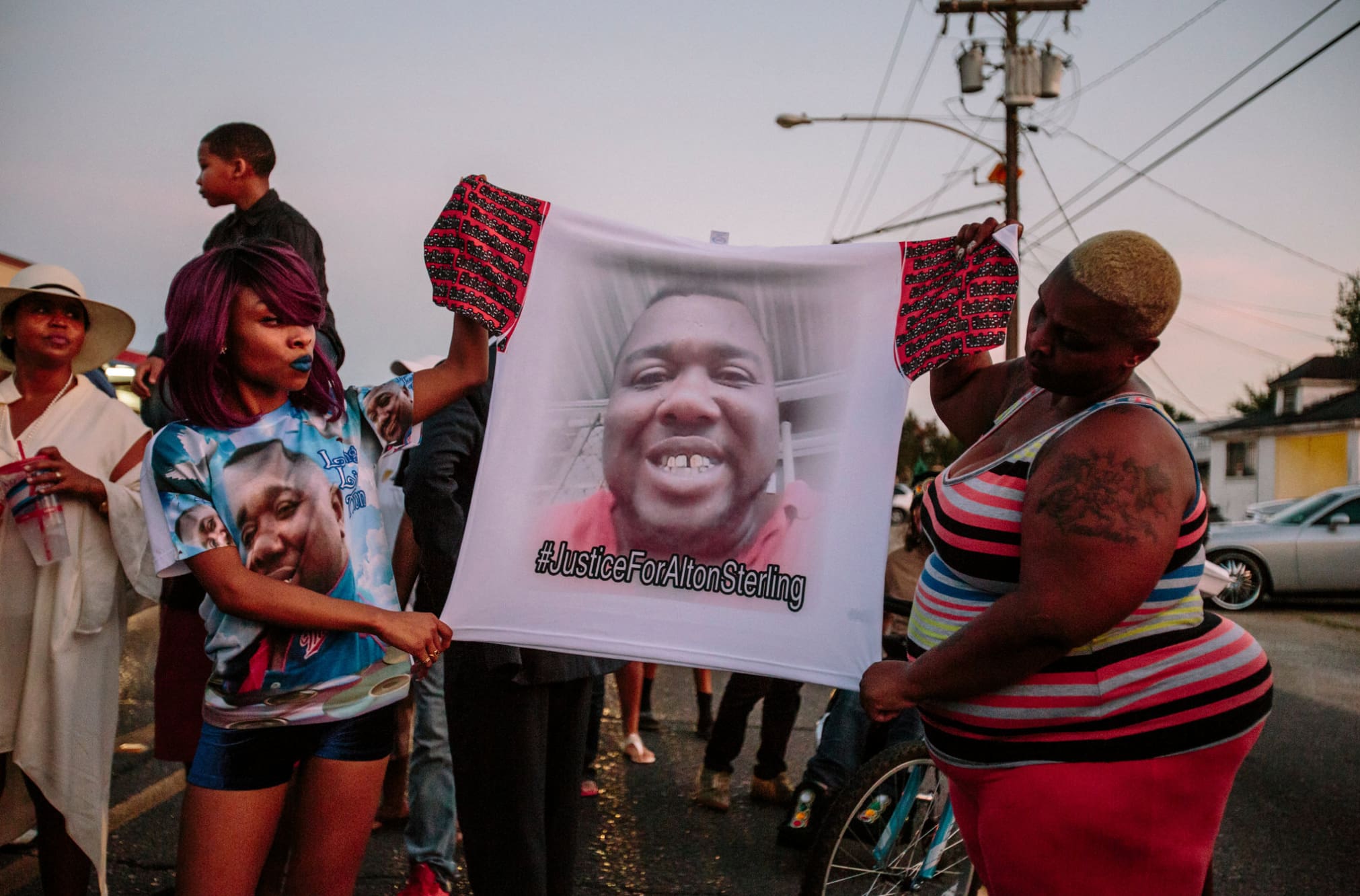 In this episode we invite Psychology Ph.D. candidate Mica McGriggs, Dr. Darron Smith, and Dr. Fatimah Salleh to discuss the recent (and continual) loss of black lives in America due to police action.
Note: Given the sensitivity of this particular issue, I will only be accepting comments in this post that express empathy and support for the panel. In my view this is not the place/time to debate hand gun policies, politics, or to draw attention back to the white experience. Please respect this request, and know that we will do our best to find other ways to discuss these issues at another time, in another context.
Thanks. John Dehlin
Baton Rouge, La.
• On Tuesday morning, two police officers fatally shot a black man, Alton B. Sterling, 37, in Baton Rouge, the capital of Louisiana, while trying to arrest him. The shooting was captured on video that drew widespread attention after it was released online on Wednesday.
• The Justice Department opened a civil rights investigation into the shooting, the latest in a series of killings of civilians that have fueled the Black Lives Matter movement.
• There have been protests and a vigil, but the city has otherwise remained calm.
• Mr. Sterling had a long criminal history, but it is not clear whether the officers knew that when they tried to arrest him.
Falcon Heights, Minn.
• On Wednesday evening, a police officer fatally shot a black man, Philando Castile, 32, during a traffic stop in Falcon Heights, Minn., a suburb of St. Paul, the state capital. The aftermath was streamed on Facebook Live by Mr. Castile’s girlfriend, Diamond Reynolds, a passenger with her young daughter.
• St. Paul has been convulsed by protests. Demonstrators gathered around the home of Gov. Mark Dayton, who said he was shaken by the video. “Would this have happened if the driver were white, if the passengers were white?” he asked. “I don’t think it would have.”
• Mr. Obama, after arriving in Warsaw for a NATO summit meeting, told reporters, “There’s a big chunk of our citizenry that feels as if, because of the color of their skin, they are not being treated the same, and that hurts, and that should trouble all of us.” That was before the demonstration — and the killings of police officers — in Dallas.
• Mr. Castile had notified the police officer that he had a gun on him, and was a licensed gun owner. Whether this information affected the shooting is not clear. Mr. Castile’s girlfriend said he was trying to retrieve his license and registration when the officer opened fire.
Dallas, Texas
• Around 9 p.m., shots were fired as hundreds of demonstrators were peacefully marching west on Main Street in downtown Dallas. Scores could be seen fleeing and screaming, as police officers, who were on the scene to maintain order, took cover.
• Five police officers were killed, seven other police officers were shot and two civilians were wounded. A lawyer for five of the wounded officers said they were expected to recover.
• A senior law enforcement official identified the gunman as Micah Johnson, 25, an Army veteran who lived in the Dallas area. The police killed him using a robot-controlled bomb during a standoff early on Friday.
• The city’s police chief, David O. Brown, originally described the shooting as a coordinated attack by two snipers. Later, officials said they believed Mr. Johnson was the only gunman.
• Three other people are in custody, but their identities and connections to the attack are unknown.
=============
Episode Transcript
Host: John Dehlin · Guests: Darron Smith, Fatimah (Dr. Fatimah Salleh)
This transcript is machine-generated and lightly edited for readability. The audio is authoritative. Please excuse occasional errors in names and spelling.
Introduction and Guest Backgrounds
John Dehlin [00:00:00] Mormon Stories is a production of the Open Stories foundation and relies solely upon the support of people like you, its listeners to help keep the podcast alive or to become a member of the community. Please become a monthly subscriber by visiting MormonStories.org and clicking on the Donate button on the right side of the page under support. All contributions to Mormon Stories are completely tax deductible and go towards producing the podcast and building communities and programs of support for Mormons like you. Thanks for your support.
Darron Smith [00:00:36] The kindly light amid encircling gloom
John Dehlin [00:00:43] Lead
Darron Smith [00:00:43] thou me on the night is dark and I am far from home.
John Dehlin [00:00:50] Hello everyone, and welcome to another edition of Mormon Stories Podcast. I'm your host, John Dehlin, and it is July 8, 2016, and we're here to talk about a very important subject, something that in some sense has happened this week, but in some sense has been happening for decades or centuries. It's an ongoing important discussion to have, and we have three really important and interesting people here to talk about it. So. So for those of you who have been paying attention to the news media over the past several months and years, we've seen an increase in coverage around incidents where police officers end up shooting people of color in ways that are recorded with cell phones or otherwise. They get significant media exposure and lots of discussion. And of course, in the past year or two, we've seen the ascent of a movement called the Black Lives Matter movement. And even here on Mormon Stories, just a little while ago, we had our own episode to try and begin discussing these matters. And we called it Black Mormon Lives Matter. But this week things really seem to escalate. And it began, I believe, in Louisiana, where Tuesday morning of this week, two police officers fatally shot a black man, Alton Sterling. As I understand it, he was a father. It was captured on video and it drew widespread attention. The Justice Department, the US Justice Department opened a civil rights investigation. There have been protests in a vigil. But then to follow that up, on Wednesday evening in Minnesota, Falcon Heights, Minnesota, a police officer fatally shot a black man. Philando Castile is how I'll pronounce his name, 32 years old. It was during a traffic stop in a suburb of St. Paul. The aftermath was streamed on Facebook live by his girlfriend, a passenger with her young daughter. And again it sparked outrage and demonstrations and responses. President Obama weighed in and it escalated again the attention around this issue. And then last night around 9pm in Dallas, Texas, there was a peaceful event with some demonstrators in downtown Dallas, and shots began to be fired at, apparently at police officers Five police officers were killed, seven others were shot, two civilians were wounded. And the escalations and the discussions just continue. I should, you know, I should note that just because we're talking about this doesn't mean that this is new. You know, we've been seeing these things in American history for decades, if not centuries in various ways. What's different now, perhaps, is that we have social media that's able to broadcast and capture these events and stream them. And I think so many people are asking, what's going on? What can we do? And then within the Mormon and post Mormon communities, I think there's a lot of people who want to try and make a difference, who want to understand what's going on and then act accordingly. And in some ways there are ways to help and make it better. There are some ways to act that may not help at all. And there may be even ways to act in well attended ways that cause damage. And so I've asked three people that I really respect to come on and to discuss this with us. And so what I'd like to do now is introduce our three guests. To begin, Misha McGriggs was the first person that I reached out to. We've had Misha on Mormon Stories recently and she's been pretty outspoken. Misha, if you don't mind, why don't you reintroduce yourself to our audience for a bit?
Guest 2 [00:05:45] Sure, no problem. Again, my name is Amisha McGriggs. I am a PhD candidate in psychology, counseling Psychology. My academic research is at the intersection of race and mental health. So I spend a lot of time kind of the literature and understanding different intersections of our identities and how they impact our growth and development. I am very involved in the community, mainly in Utah county, also in Salt Lake, having communications with other community leaders to try to better understand where each other are coming from. I have a good relationship, particularly with the provost, police chief, Chief King. And so that's, that's work that is very important to me is bridging gaps and creating understanding. That's, yeah, that's, that's probably about it. So I do a lot of writing, you know, as well, on these issues, intersectionality. And yeah, that's, that's basically that's it.
John Dehlin [00:06:58] Oh, well, thank you so much for joining us and also, you know, helping us put this panel together. It's so great to have you back on Mormon Stories, Misha.
Guest 2 [00:07:08] Thanks, Sean.
John Dehlin [00:07:09] All right. Another voice that will be familiar to Mormon Stories listeners is Darren Smith, Dr. Darren Smith. Darren recently published a book about black athletes at byu. We had him on Mormon Stories a few months ago to talk about that. It was a great discussion. And Darren was one of the first, I'd say 30 or 50 interviewees on Mormon Stories where he talked about being black and Mormon and history, church history as it relates to people of color, African Americans and the church. But Darren Smith, why don't you reintroduce yourself to our audience?
Darron Smith [00:07:53] You bet. Welcome. Hello audience. It's nice to be here again with you. And I hope that what I have to say and the panel has to say is of some help to you moving forward. Like Misha, I finished my PhD. She's working on her still, praise God. I'm done with mine. And I also do my work. Misha is very close to yours actually. I actually focus on trauma and brain morphology, how the brain changes shapes as a result of trauma and violence and how that impacts upon our longevity vis a vis telomeres and telomerase, which is an enzyme responsible for how long or how long your, your cells, your biological cells will last, typically somatic cells in your body, like in your belly, your heart, et cetera. So I look at that, I look at how the impact of racism, how that influences our mental health, our physical health and our, and other types of, you know, other things associated with our well being. So this is a very important discussion and this is something that, you know, I think I mentioned this last time when we're talking, John, this event that happened in Dallas and these other things that have occurred with, with the two men who were gunned down, this is just a continuation of what's been going on for 400 years. The only difference is that now we have technology that can capture it on film. But this is not, this is nothing new. Same stuff, same, same stuff, different day. So, and, and until I'll just say one last thing and I'll just shut up. So until white people get as angry and as animated about this as black people, this will continue to go on. It's not going to stop. So I hope that we can, at least the panel can say something today that might spark, you know, some, a bit of activism in some of your listeners. And hopefully they'll be much more responsive to these kinds of things and not just in their own little camps like the LGTB community in their camp. This group is in their camp. We all, particularly those who are stigmatized, have to work together. And that's all I'll say for now.
John Dehlin [00:09:59] Beautiful. Thanks, Dr. Smith or Darren. Our third panelist today. I'm very excited to have her on for the first time on Mormon Stories podcast, it is Dr. Fatimah Saleh. Fatimah, would you mind introducing yourself to our audience a bit?
Guest 2 [00:10:18] Not at all.
Fatimah (Dr. Fatimah Salleh) [00:10:19] Thank you for this opportunity. I received my Ph.D. in Mass Comm. From UNC Chapel Hill in 2012. And I study black feminists, women feminists, and how they communicate resistance and how they become empowered to resist. I just finished my Masters of Divinity in Maine at Duke, and there I studied more womanist, which is. And I also take a theological stance to liberation and. And how we can incorporate what is black women struggle and personal becomes the political and how that all works together. And so right now I'm trying to see how all of that works, to really explain, empower, learn how to grieve well, in a way that I can raise my four children, three boys and one daughter. And so my emphasis now is not necessarily on my academic work, but how my academic work and my theological work can help me as a mother, a brown mother, raise children of color in this country who can withstand and be able to understand how they're hunted in this country. So I think I'm not as much in my studies as much as trying to really put to work what I've learned to really explain and try and prepare my children for this world, which I feel like I have little. Sometimes it's hard to feel like you have any power to keep them safe.
John Dehlin [00:12:10] Yeah. Beautiful. Thank you, Fatimah. It's such a pleasure to have you on Mormon Stories along with Misha and Darren. So thank you for joining us.
Fatimah (Dr. Fatimah Salleh) [00:12:20] My pleasure.
John Dehlin [00:12:20] Yeah. I think I saw something on Facebook just this morning that had this picture of a father with a black father with his children in the car. And I think a policeman pulls him over and the children say, is the policeman going to kill you? Like, that's the environment that many of us are living in right now. And it's really sobering.
Guest 2 [00:12:45] So, John, can we shift for just a moment? I think that those who have men and women who have taken an oath before their mayor or their governor. Right. Have taken an oath to the United States of America to protect and to serve their community and to serve the people. Many of them are executing black people. And that we're having an issue right now in America. The black community is having an issue that is not new, but it's finally starting to. The spotlight, is starting to reemerge on that. And so I think the first thing is to acknowledge this is happening, has been happening, is currently happening, and we, your black and brown brothers, and sisters in the gospel or in humanity are hurting. We're in pain. We are in pain because we are fearing for the lives of our children or the lives of our friends children. And we're fearing for ourselves and our bodies, feeling completely incapable of protecting our bodies. And a long time there was a narrative that was, if you will just do these things, you will be okay. If you will just be respectable enough, if you will just be educated enough, if you will be well spoken, well dressed, well groomed, well mannered, you will be safe. That is not true.
Darron Smith [00:14:32] That's a lie.
Guest 2 [00:14:34] That. Right, That's. That is true. And the truth is that being black, having a melanated body is dangerous combination with breathing on this earth, girl, preach. And that is the issue at hand, is that we are not safe.
Darron Smith [00:14:56] And.
Guest 2 [00:14:56] And for those who have made covenants, right? Or who believe in the ethics of the law of reciprocity, right? For those who have done either of those things, it should matter. You're not safe. Your fellow human beings on this earth, your neighbors, your friends, the people you sit in church with, the people you go to work with, the people that are your bosses are your. Your friends. They're not safe. And so to just sit with us in that pain for a moment I think is a really good place to start. So I don't know if the doctors have anything else to add. I'm sure they do. I would love to hear their thoughts on that. And again, I'm sorry for going this way, John, but I really feel like that's an important place to start is what's happening for us, of course.
John Dehlin [00:15:44] So Darren and Fatimah, please respond. How you guys feel? You want to start the discussion?
Darron Smith [00:15:52] You want to go first or you want me to go or.
Fatimah (Dr. Fatimah Salleh) [00:15:54] No, sir, you can go.
Darron Smith [00:15:56] Okay. Well, I just feel. I just feel that, you know, Misha killed it pretty much. I mean, I think African Americans are just tired of this, are absolutely beside ourselves having to deal with this kind of stuff constantly. Constantly. And so the question then remains. I'm going to go back to the original. The original statement that I made, John, that this absolutely infuriated a lot of your listeners. I'm going to go and say it again. White Americans are racist. I keep saying it. White Americans are racist. I don't mean y' all out there burning crosses and calling people the N word. I'm not talking about that kind of racism. I'm talking about the subconscious type of racism that drives and facilitates behaviors. The unexamined attitudes that whites have. If they've not taken the. The time to look in the mirror at themselves and to recognize that racism is a systemic problem that somebody is doing. You know, if you're not doing it, then who's doing it? It's become a part so ingrained in our society that it literally takes a timeout moment to sit back and assess the situation, to see for what it is. So when I say white people are racist, I want to be clear on that, because I guess last time one of your listeners was so pissed that I said that, he actually went on Amazon and wrote a scathing rebuke of my book. And he. I'm sure he hasn't read it, but he, you know, simply because I said that whites are racist. So again, white folks looking at. Looking at racism as an individual phenomena, and when you do that, you err, because that's only one aspect of racism. In fact, it's a very small aspect of it. The much larger aspect of it is, is the systemic. Is the systemic issue. So you have police officers out. In. Out, you know, in various cities across the country. Here in Memphis. I'm in Memphis. Of course, Memphis has a really bad crime problem here. Right. Right about now. But the requirements to be a police officer here in Memphis is you have to either be. Either have gone to basic training, military training, that's one. One requirement. Or you either have to have a 54 hours of an associate's degree. That's one requirement. Or you have to be a high school graduate. That's the third requirement. That's it. That's it. So you have a lot of young men and young women, you know, who are going into the police academy with very little education, okay? Very little. And the education they've had, particularly those who live in Memphis, is subpar. Subpar. So you have these ruffians, if you will, dealing with the community, who are dealing with the community, and they don't have the skills to do it. And not to mention in the sec, the greater aspect of it, the greater aspect of it is that. It's happening. So it happens almost automatically when a police officer sees a black man or black woman, particularly a black man, because black men have been socialized to be that threat to white men. They feel some type of way, right? And the way that they typically feel is that I am a potential threat. Whether I'm an educated black man or whether I'm not, it doesn't matter the stripes that I wear. These individuals come to the job already racially primed. Already racially primed. And so you have A mismatch. You have a cultural mismatch, if you will. You have a group of people who have very little, very little, if any, experience with black people other than what they. Other than a couple of friends they may have or a couple of acquaintances and what they've seen on tv. Policing a group of individuals that they've already been conditioned to believe are threats. I mean, that's a terrible mismatch. And then if you want to. I'll add one more aspect of it. If you want to add one more thing to throw one more thing into it, then you throw a black police chief on the force and say, oh, yeah, he's a black guy. So therefore, you know, we ain't racist. And as if having one black person or brown person, whoever that individual happens to be, is the end all and be all of racist practices in America. No, white Americans must do this work. Now, I say, Misha, you mentioned earlier, this ain't about white people. It's not about white people. I get that. But it is about them. Because we're all a family. We can't exist without white folks. White folks exist without us. We're all symbiotic. We work together, whether we like it or whether we see that or not. We all function through osmosis, if you will, as a unit. So white America, the listeners on this podcast, don't get mad at me or Misha or Fatimah. Don't get pissed. Go out and do what we're suggesting that you do. Look in the damn mirror. First and foremost, assess your own racial past, your own racial history, and begin to make sense of that. When you can make sense of that, then you can understand the absolute frustration, anger, if you will, and just level of. Just deep resentment toward police simply because of the history of policing and also the contemporary realities of policing today in American cities, that my daughters or my sons, right, are actually criminalized by the police simply because they're black. That's the only basis for it. No other basis for it. We gotta do better than that. You know, shame on us as. Shame on us as a nation, shame on us as individuals, and shame on us as a group. And as long as we keep this racial division, these racial divisions going on, they will continue to go on. Listen, I mentioned this before. I'll say it again. I am in my 50s. I'm 50 years old. I've been teaching race and ethnicity for very. For a long, long time. I taught at byu, several places around Utah. Stuff has not changed all that much in the time between the time That I was the undergraduate until the time that I finished my. My degree. And at the time I'm working professionally. Not a lot has changed. The faces have changed. But the institutional practices that undergird the racism in America is still very much alive today, and it's been handed off to the millennial generation. I'm having to deal with that generation now who are completely oblivious to race. So I won't say any more. Your turn. I'm sorry. How are all the kind of.
Experiencing Racism in Everyday Life
John Dehlin [00:22:41] Fatimah.
Darron Smith [00:22:42] Yes, sir. Yes, sir.
John Dehlin [00:22:45] What would you like to. What would you like to add, kind of as a. Let's just say an opening commentary or statement on these issues, these difficult issues.
Guest 2 [00:22:56] Well, Misha and Darren did such a
Fatimah (Dr. Fatimah Salleh) [00:23:00] really good job of, like, kind of covering the many aspects, you know, several key aspects to this. I think, First and foremost, how hard it is for me. And I certainly cannot speak for Darina Misha, but how hard it is for me to even speak into an audience right now. There is just so much. I was just talking to a good friend, just saying, how can I be so raw and so numb at the same time? And what to do with the complexities and the real hardship of repeated trauma and not allowing, like, I have no time to grieve before something else happens. And grief, and the process of grief is somehow stripped down. It's somehow stripped away from this process of black death. And some. I tried to ask myself, do I have any more words? Do I have any more tears to speak into these moments? Because there is. At the base of it for me is a real deep frustration with a God. I want to hear me and to hear the cries of my people,
Guest 2 [00:24:24] and
Fatimah (Dr. Fatimah Salleh) [00:24:24] I want it to be right. I want my people to stop suffering like this, for this history to stop being on this path. And for the old black spirituals that say, how long, Lord? How long? And to speak even in the midst of your own frustrated cries, And you. You just don't know if you have anything more to give to this but your raw pain. And. And merely for. Okay, let it out merely for the three of us. And I guess I can't speak for you guys. It is so hard to even speak into an intersectional space for me. And I am. And I'm married to a white man who I love dearly, who has become part of that intimate circle of which I could discuss race and just how pissed off I get and how angry where I have children who have said things to me like, mom, I can't see a white person today. This sort of knee Jerk response to constant trauma and having to make it look and make sense of it. So when we start talking about ways that we can help, ways that we. I don't know. Let me just go ahead and say that I have no idea how to begin working through this vast amount of pain that I feel like we're swimming in constantly, if not drowning under. And yet I seek a God who I know sees me and sees my people and sees my children, sees my ancestors. And I cannot help to think that their blood cries out from the ground, cries out to a God to say, how long will you let us be in this situation? Have we no more psalms and lamentations to offer? And so part of this is also me working through an immense amount of grief, saying that I don't have to be at a place of healing right now. I could just be at a place of rage, a real rage, because the system is so deep. I think Malcolm X said it's like a Cadillac. Racism is the same car. It's just remodeled, you know, and if you don't recognize it, it just looks different, but it's the same thing. And so for me, I want to begin, if not end or stay in the fact that this is a painful, painful place my people have been in for a very, very long time and still yet find faith, still yet try to believe in a God that will hear us and yet beg our brothers and sisters of different hues of skin to see that this is actually a pain place for which us to live. So not only do we beg God to help us, we go around and then we get frustrated because we got to look at our brothers and sisters and say, can you not see us? I think that's what I've got.
Darron Smith [00:27:58] I mean, how do you respond to that? I mean, how do you respond to that? That. That pain, that. That deep pain that you hear, that visceral pain. I feel you. I mean, I. You know, I. I feel the same way. I mean, you know, I mean. I mean, today I'm having white people fatigue. I mean, you know what I'm saying? I mean, John, you know, you're lucky. You my boy. You know, lucky I answer the phone or email. I just. I'm just. Just. Rage is the word that I. That best describe how I feel. Just rage. Because. And I'm gonna say it again. This is on Yalls watch, John. This is on Yalls watch. So as long as y' all act ignorant, this is going to continue to happen. Black folks are going to continue to die. Brown folks, right behind, trailing right behind them. White folks have to end racism. White folks have to do this. If y' all don't do this work, this is going to continue to go on. I mean, and I don't. And I'm not. I'm just saying that. And I know, I know some of your listeners are just cringing when I. When I mention the words racism and them. I mean, I'm sure they just get enraged by that. But it's true. It's true. White folks harbor these feelings. You know what? There's been studies on this that look at white empathy. I think I mentioned this before. Whites have less empathy for blacks than they do for their own group. Now, you probably, you know, that probably makes a lot of sense simply because this is the sad part. Most white Americans, not all of them, but most white Americans tend to see black people as less than human. Still. Even still. So if you've been constructed to see me as less than human, you're not going to feel some type of way for me when you see my black body bleeding out in a car? You're not going to feel some type of way for me when you land on top of me and you fire them rounds in my chest? You're not going to feel some type of way for me because most white Americans generally see black, particularly black youth, as much older than they are, or they typically superhumanize black people as having these super. These superhuman powers. Like we're, you know, this guy was five. This guy was six foot seven. He weighed 300 pounds. He was coming at me. He looked like. He looked like the. A demon. I mean. I mean, I've heard. I've heard that testimony in court describing an encounter with a. With a. With a black man. So this is painful, man. It's painful. It's. I watched this all last night, you know, and I had to get up and drive to Nashville this morning, but I was all night watching this. And just when is enough already, enough? We gotta do better than this. We gotta quit the damn talking and start putting together some action.
Intersectionality and Black Identity
Guest 2 [00:30:59] As someone who really believes some people don't believe in intersectionality. I happen to believe in it. I really do believe that the intersections of our identities can be brought together in a symbiotic way, in a synergy that we can meet each other where we are. But one thing I will say is that one thing that people can do is allow the black experience to just be the black experience, to not have to say, well, all oppressed groups or all marginalized groups, or to pair Our struggle with the LGBT movement and that struggle. Because what I see from Mormons and post Mormons and the communities that I spend most of my time with is I see. Not only do I see sympathy and, oh, I'm sorry, when it comes to LGBT suicides or to the shooting in Orlando, I see action. I see we are going to write letters to the church, we are going to write letters to our congress people, we are going to take down the nra. We are going to mobilize because that pain is felt. And what I see when we're talking about black death and the loss of black life is, I'm sorry, that's sad. You know, bummer, you know, or no acknowledgement at all. And so to me, it's one thing that our white contemporaries can do is to. Is again, what Darren said is to understand that if you. If to understand that you've been programmed to not value our lives. When we were less, black people were less than cattle in America. People paid more for their cattle than they did for their slaves. And understanding how that is deeply embedded into our psyche, that is something that you can examine is what do I actually see as the value of another human life, of a black life? Because it's not clear. And so examining that, do you really value black life or do you just value the caricature of black entertainment and someone that's black entertaining you and giving you a laugh, Right. Or a black person imitating you, Right?
Fatimah (Dr. Fatimah Salleh) [00:33:52] What.
Guest 2 [00:33:52] What black lives. Do I actually value that? That is something that. That listeners can do is to really evaluate. Do I actually. And this is. And this is hard, right? It's hard.
Darron Smith [00:34:01] And it's.
Guest 2 [00:34:02] And it's ugly process to accept some of this, that these biases, these prejudice that we have and understanding that racism is systemic and I'm either oppressed by it or I benefit from it. Right? But examine what do I actually believe about the value of human life? Because these are the folks. A lot of these people are the folks that are saying they're pro human life, they're anti abortion, they're, you know. You know, but for some reason, not pro black life, which is so. So examine what. What do you actually feel about our lives if we don't look like you or sound like you are there for your enjoyment and entertainment, if we're just living our lives in a completely different neighborhood on the other side country, right? Do you still value my life? Do you still value my life? If I have a record, right? I got answer for that, right? The response, and I think you could say, Dan. Right. The response to philanthropist Philando or Phil. Compared to the response. Alton. Yeah, right.
John Dehlin [00:35:11] What do you mean? Tell us what you mean by that.
Guest 2 [00:35:13] So people have been. I've seen a lot more empathy and understanding for Philando Castile, who was what we would call an upstanding citizen. Right? Someone who worked in the school, was a part of his community, was a positive impact in his community. Right. Was respectable, as compared to Alton Sterling, who had a criminal record. And that has been what we have pivoted to. This victim, this man who is dead, these children, this sobbing, sobbing child on the news. What we have said about his father is we've talked about his criminal record, and his life has been given more value than. Or less value. Excuse me. Than the life of someone without a criminal record. What do we believe? Do we believe that the worth of souls is great in the sight of God? Right? It didn't say some souls. It didn't say souls without records. It didn't say white souls. It didn't say souls who pay their taxes on time. It said the worth of souls is great in the sight of God. So do we believe that or do we not?
Darron Smith [00:36:15] That's the truth.
Guest 2 [00:36:16] Examine that.
Darron Smith [00:36:18] Oh, God. Listen, listen. Let me just sort of. I mean, I didn't mean to interrupt your wonderful oration. I am so. As a older black Mormon, someone who's been trying to fight this fight for many, many years, long before you two were around, you know, I was alone for many, many years. I mean, I had a few people helping me out, like Darius and other folks. But I'm doing my own thing, right? I'm calling folks out. I'm not placating white folks. I'm not doing that anymore. That's why I say y' all racist, because you are. And you need to own that shit. The sooner you own it, the better off you get on with the healing process. But the thing is that. The thing is, though, I was gonna say ladies, it just makes me feel so. I'm humbled by your. Your intelligence. I'm humbled by your. Your. Your way to articulate it. I'm humbled by the way that you found. You found a way to work gospel principles into it because they make sense if you apply them. And I'm just. I feel like we finally got some black scholars coming in the church, and I'm just thrilled to see it. I'm just thrilled. I didn't think it would ever happen. So hearing you two talk and hearing you two say what you're saying, and to recognize that you two recognize that racism is a reality and it's systemic and so on, it just makes me feel like, okay, I'm good, I'm good, I'm good. Now. I just. So I wanted to say that I appreciate your, your courage, your bravery, for speaking out. I mean, I just want to say you may not hear that a lot from anybody, but I want you to know that, you know, from, from me, I appreciate your work. I really do. And the things that you're saying, the things that you're doing. And I won't say any more about that.
Fatimah (Dr. Fatimah Salleh) [00:38:00] Thank you.
John Dehlin [00:38:00] Yeah.
Guest 2 [00:38:01] And I appreciate those who have come before because it always makes it easier when the path has been traversed. Prior. Yes.
Fatimah (Dr. Fatimah Salleh) [00:38:10] I think if I could add here, of course, I'm going to take this a little bit theological because I don't
Guest 2 [00:38:15] think
Fatimah (Dr. Fatimah Salleh) [00:38:17] we can somehow separate the theological project of this all. We have kind of all of us in some way shape or form connected to the Mormon Church and we've got to put under examination. And I know I'm going hard here for a minute, so bear with me. But theology in and of its core, if we are Christians, we serve a Christ, a brown Christ, and who was born to a marginalized, oppressed group who came in and turned the church up because he just. Things weren't doing what they were supposed to. But one thing hard about the work of great groundwork. And I think one of the problems with whiteness and theology that stems from whiteness, the site of whiteness, is that you don't know how to do social justice work because you haven't necessarily developed a theology that's from the margins, you haven't heard, put people in places where you can actually learn how to move in social justice work, because you have never been at the sight of it to hear your theology of a God. And so for me, when you show up at church and only white men are speaking, how do you expect a population who may love their brown brothers and sisters to know how to work on their behalf? So this is an issue also the fact of us not knowing how to be with each other, with oppressed peoples, and in particular how to be with black people in this moment is also because as much as we're taught in our pews to serve and to love, that has never hardly taken on a social justice aspect. Well, and so when you have a gospel devoid of social justice, then you get a people who don't know what to do when they're faced with injustice, when in fact you believe in A Christ who hung on a cross, because one of my professors said it's almost a fugitive theology. He died as a fugitive. And so I think we have to understand that some of our feelings of not knowing what to do is also stemming from a sort of a perspective and a theology coming from a white mainstream look at God. And so we find ourselves, not me particularly, but I find that my colleagues and beautiful people that I love who are in white mainstream churches, evangelical and Mormon and otherwise, do have a hard time sitting with people on the margins and knowing what to do. Now, sitting in grief is one thing. You know, the Jews have a Shiva. If I remember correctly, Native Americans have a way of grieving with people where they sit in that space with them. There's a way of learning how to grieve with one another. There's a way of knowing how we move with each other towards creating this to be a different world. But first and primarily, I think we need to know how to sit with each other. And as Dr. Jennings said, we need to refrain from trafficking and trite sentimentality, as if you could just say certain words and they'll mean something. And I think it's also imperative that we learn to hear one another's stories, to validate the stories of the marginalized, to realize how our own institutions, even our ecclesial institutions, a further part of a racist system.
The Need for Black Voices in Social Justice
Darron Smith [00:41:53] I don't want to hear white stories. I've heard enough of them. I need to hear stories.
Fatimah (Dr. Fatimah Salleh) [00:41:56] Exactly. I think that this is all a part of learning how to sit with people of color and then moving into action with people of color, Especially African Americans at this time is really taking on the aspect of one, how do we move with people in grief? And then how do we move to change the world around us? And for a large portion of that, there will be a large amount of listening needed to be done. You will need to listen. And in order for you to be in places to listen, you must allow these people to speak. And I'm just saying some of our pulpits are silent. So for me, I am grateful. And I'm not going to let this go past without saying this. I've had many people come in this last time, embrace me in beautiful ways during this time. And it's been something as beautiful as Fatimah, I see you. I know that this time is deeply, deeply, deeply painful. I'm here. Should you need me, I'm here. And. And that's been for my white brothers and sisters. And if you look on Facebook, several people have put places, things of how you can help. Please avail yourself to other people who are speaking into this space and listen to how they're asking you to help put yourself in places to listen. And for me, I have been as angry as I am. I have found the embrace somehow in this same space, also showing me that God still moves. And so I've got to be very grateful at this same point in time that I'm married to a white man and have wonderful white friends who have
Guest 2 [00:43:48] been
Fatimah (Dr. Fatimah Salleh) [00:43:52] Christian, who have been not only Christian, who have been deeply good and saying. And as my husband said, this is our anniversary. 15 years. He said, I would take the shot for you. You know, I'd take a bullet for you. And sometimes maybe it's putting out their white bodies in front of our brown dying bodies.
Darron Smith [00:44:12] You know what? You know what? If I may, I so agree with you. I have always said your voice is
John Dehlin [00:44:20] coming across a little bit faint.
Darron Smith [00:44:22] Oh, I said, I said, I said, I've always said. Can you hear me?
John Dehlin [00:44:26] Yeah.
Guest 2 [00:44:27] Okay.
Darron Smith [00:44:27] I said, I've always said that one way and one way in which whites can show a manner in which they truly care for their, you know, for their, you know, melanated brothers and sisters is by taking a bullet for them, you know, and, you know, and I don't see enough bullet taste. I mean, you know, you know, I'm, you know, I don't see enough of that, but I'm gonna be. Fatimah. Did you say brown Jesus?
Fatimah (Dr. Fatimah Salleh) [00:44:52] Yes, brown Jesus. I believe in my little brown baby Jesus.
Darron Smith [00:44:56] I about fell over when I heard brown Jesus. I said, did he not say brown J. Jesus? I mean, oh, is your, your, your listen is going to commit Harry Carey, when they hear this, man, I mean, they're gonna be, they're gonna be going through it. Wow. Brown Jesus. Go ahead, girl. Listen, I don't know if the church ready for you. I don't. I don't know if they're ready for you. You, you. You were speaking. You were speaking so much truth, power. I don't even know if the listeners understand what you're talking about. I mean, it's too deep. You coming from a place of pain, a place of power. You coming from a place and they ain't there. I mean, some of them, Some of them might. Some of them might be getting it. And I believed like you believe. I believe like you believe white folk can do this. It's not, it's not, it's not that they can't do this, right? I mean, they can do this. I know two people, three People, Three white people. I know a lot of white people. I know three in particular. Right. Who have really done this type of work, the kind of work that you are talking about. They're literally putting their bodies right in the margins. You know, they're straddling two worlds, if you will. And they're very conscious of it, you know. And so any rate, I'll just say that. But I was just wanting to tell you about the brown Jesus. I was going to. You know, I had to give an amen to that when I was like, she did say brown Jesus. Oh, my goodness. Brown Jesus. Go ahead.
Guest 2 [00:46:31] You know, two. Two weeks ago, about two weeks ago, I heard. I heard Jesse Williams, a Hollywood, speak so much truth. It was such a. It was such a breath of fresh air to hear him using his platform for such important and good and true messages. If you don't know Jesse Williams, he is the fine brother man that plays on Grey's Anatomy, my boo. And he said a name. He mispronounced it, but he said a name. He said one of our names. He said the name Darion Hunt. And I didn't even know that mainstream activists knew about Darion Hunt because it was so quiet. There was a small group of us who mourned together here, physically mourned here together in Utah. But his funeral, held in a LDS chapel, was so poorly attended. I was so ashamed of my family, my Mormon family, my community, Utah family. This place that is a difficult home, but right now is home to not see the support, to not be able to see him. This is a young man who was innocent young man gunned down by the police here in Utah County. And not only was he black, but he was Mormon. He was part of the Mormon family. And to see Mormons, white Mormons, completely ignore that story or not have empathy for that story, or make excuses and say, well, he shouldn't have had a toy sword, or he shouldn't have run, or he should have done this, that or the other. It was beyond painful. And so to. To realize, oh, my goodness, people do know who this is. People do know this story. Important people, activists who are really moving and shaking out there in the world outside. Because sometimes I get tunnel vision. I think the world is just here in Utah. There's something in the water that makes you feel that way. And it's crazy, but to realize no people knew this story, and yet this story was out there in the mainstream media. People knew about it, and I heard nothing from my brothers and sisters. It was painful. And so know the Stories know these names. Show up when tragedy strikes us. Your black and brown brothers and sisters show up. Show up to the funerals, show up to the vigils. Say you give us a. You know, a message on Facebook, something. Because we see you. We see your struggle when. When many, many, many of my white friends are going through faith transitions or faith crises. Right. I try to make an effort to show empathy to that because I see that pain. When my LGBTQ friends and family, who I'm very close with and have a lot of. Of friends and family from the queer community, are in pain, I show up. That's because that's what we do. We show up. And so show up for us, and it will go a long, long way. And that doesn't. It doesn't mean you have to be perfect. It doesn't mean that you have to know every single thing about history or be an academic or be a theologian or be an activist yourself. It means that you are a good friend. Yes. Yes. Be a good friend.
Grief, Presence, and Mindfulness as Resistance
Fatimah (Dr. Fatimah Salleh) [00:50:54] I think that that's such a powerful
Guest 2 [00:50:55] thing of the art and the discipleship
Fatimah (Dr. Fatimah Salleh) [00:50:59] that involves being present and what being present means in time of grief, struggle, pain, trauma, and. Misha. I couldn't have said that any better. But it's just learning what it is to be the discipleship of Christ, to be present or even as brothers and sisters in this world. What is it to be present? And sometimes it will require listening in silence. Other times, it requires you speaking out. Other times it will require you to step in front of somebody and take that shot. Take that so that your brother or sister can have a chance at life. It's a dance. And knowing the steps and knowing the rhythm of presence is so important in any way that we move with each other, especially with communities that are deeply, deeply oppressed.
Guest 2 [00:52:03] And if you're not. If you're not a believer, you're not active. Right. Maybe you don't believe you're a disciple of Christ. That's fine.
Fatimah (Dr. Fatimah Salleh) [00:52:09] That's totally fine.
Guest 2 [00:52:11] That's fine. Because we have a name for the alternative, which is mindfulness and mindfulness practices, and we understand the neuroscience of what it means to be present in the present moment. And it's powerful, and I'm grateful, and I hope that we are respectful and not appropriative when we incorporate some of these Eastern practices into our lives. But. But there are avenues. This is spiritual and it's secular, and so you could pick your poison, whichever speaks more to you. But there's a place for you in being present. And in being the type of friend that sees and hears,
Darron Smith [00:52:58] Gian drops the mindfulness on your audience, John. I mean, I certainly hope they know what it is. And the incredible amount of research that's being generated in that area, you know, and you know, and I would even add, ladies, I would even add this in my work, you know, it's like my work is sort of circular. You know, you look, you're looking at things, you're trying to understand, you know, phenomena, etc. And then you keep coming back with the same thing, right? Going in the circle. So you're trying to like get something. Okay, what so it's a so what question. So what? So what? After all this, so, so what? I mean, we're asking for fundamental radical change, right, to structure. And that's, and that's going to be a long term, long time coming. There was modest change throughout the history of the United States. The most significant being, I believe, the 1964 Civil Rights Act. You know, but great law, wonderful laws, but they're never enforced, right? So we don't enforce them because they black people. And of course, and of course, and it tilts back and forth given the political whims. But what I have uncovered in terms of self care and what my work has led me to, in terms of, you know, recognizing the deep impact this has on people's psyche and well being and recognizing that this has deep biological consequences for people of color, right? Whether in early life or in utero or, you know, postnatal if they're exposed to trauma. And I happen to believe that epigenetically, blacks have inherited these traumas from the voyage over here during the, during slavery and of course the hell and trauma of slavery, you know, these epigenetic tags have been handed down to blacks, which I believe causes blacks to have issues prematurely, premature disease particularly. One in particular would be a high infant mortality rate. Although it's coming down, it's still high. And the only explanation for it is racism. After you control for wealth, you control for education, you control for, you know, income, a neighborhood school, all that, the only thing left is, you know, is race. So we know that race has a deep impact upon people's health, their psychological well being. And so wouldn't you know it, that after all of this, you know, searching and trying to find some way to shift the paradigm so that it's much more equal than it is now. It's certainly not equal now, I've been led to mindfulness and that's been my, that's what's been sustaining me, you know, is taking myself or at least taking the energy out of this stuff, you know, and trying to render it, you know, you know, less significant in my life at times. And so my practice is very helpful in that. So having said that, I think that one way that blacks deal with this is by learning how to be more present and learning how to, and learning how to take these traumas, these multiple traumas, contemporary traumas and historical traumas that we endure and learning how to render them less important, less significant in our lives than they are. You know, and I think that, I really believe that that might be an anecdote to helping African Americans deal with and contend with everyday racism, everyday white racism, whether it's passive racism or whether it's, you know, overt racism, the kind of, you know, egregious racism we've seen in the last, what, 11 years since Obama's been in office.
John Dehlin [00:56:39] So Darren, Darren, really quickly, I think a lot of people, they think of mindfulness, they think of like Buddhism and sitting in a cross legged and meditating, trying to clear your mind. Maybe just apply it a bit more in a practical sense of what you mean by that and how it might apply situation what I'm saying.
Darron Smith [00:57:02] And please ladies, if you have any, any remarks, please, by all means, hop in. I'm saying that the secular practice of what we would know as meditation, Zen meditation if you will. Right. So I follow, you know, mindfulness based, you know, stress reduction program that was, you know, written by Jon Kabat Zin. I don't know if you heard John Kabat Zinn, he's one of the gurus of my, the mindfulness movement. So essentially mindfulness is a, is a, is a way of meditation, you know, 25 year old practices, Eastern practices and employing them in contemporary times, stripping it of its religious roots and just going with the mind, the mind focus present in the moment paradigm. So once you strip all of the religious practice and implications from the practice itself, all you have is a secular practice. So we, so what I do is a secular practice. I don't mix it with any religious significance at all. But its roots are very much stooped in Eastern Indian religions and also Asian religions. So you've got these Eastern traditions that inform mindfulness. But mindfulness has stripped itself, its meaning, stripped its meaning of, associated with these types of religious traditions. And so I will just say it, say it that way. So I think if blacks can learn how to, you know, and you don't have to sit with your cross legged, you can sit in the chair, you can lay down, you can stand up. All kinds of ways to. To. To engage in mindfulness practice. But. But meaning this. Teaching people how to focus on just the everyday present moment. And one of the ways to do that is to breathe. Simply breathe and follow your breath. Right? Follow your breath. And it's the natural state of the mind to wander. So your mind will wander. And, you know, don't try to stop your mind from wandering, because you can't. But the mind will wander. And when it does wander, come back to the present moment. And the present moment is the breath and the breath, focusing on the breath. And then magically, I'll say, I'll just use that. That adjective magically. You sort of forget about things that were bothering you at that particular moment. You're like, huh? It's not that important. Because at the end of the day, John, thoughts are just thoughts. They're just thoughts. They have no meaning to them unless we construct meaning for them, but they're just thoughts. And what mindfulness does is help us to appreciate that it's just thoughts. And one of the things that I think is very helpful with whites practicing mindfulness is that we know that in research that mindfulness helps people develop empathy. I've told you mentioned to you earlier, I don't believe that whites have a lot of empathy for black people as a group. Whites as a group. Now, of course there'll be outliers in there, but as a group, in general, most whites just don't have any empathy for blacks. Mindfulness practice has been shown to help improve empathy. Right. Because I think that whites, you know, white Americans, you know, have what's called alexithymia, Right? This, you know, I don't know if you know what that is. You know what that is? Anybody? Yes. Thank you. Alexithymia, A lack of empathy. Because that's what whites have been handed down from their forebears, 1600s, 1700s, 1800s and so on. Whites have been handed. That's one of the things that whites have been handed down is a lack of empathy for people other than themselves. So mindfulness might help correct that.
Guest 2 [01:00:35] So Marcia Marsha Linehan would say that. Would say the founder of dialectical behavior therapy, which incorporates kind of cognitive practices and mindfulness for therapy, particularly for borderline personality disorder, but really for many types of therapy and conditions, she would say that mindfulness is paying attention on purpose. Pay attention on purpose. And because, like Darren said, our minds were made to wander evolutionarily, we needed to be able to pay attention to two things at once so that we could ward off predators, so that we could cook and know if there was a predator coming into camp or whatnot. So it's a good thing. It's kept our species going to be able to multitask. However, what we have, we know that we don't live in those primitive times. And so there aren't as many threats. And so we don't need to be as in multitasking as we once did. And so what they found is that when we pay attention on purpose and we bring our focus into the present moment and focus on one thing and again, right, non judgmentally, just kind of observing any wanderings that our mind might do as we do, that they have found that we actually reduce suffering and increase our happiness. And so not only are we going to develop the, this empathy for others, but us, ourselves, we're going to have less suffering in our lives. And don't we all want that? Less suffering and more happiness?
Darron Smith [01:02:06] That's right, Absolutely. And if I make a tag team with you on this one, from a physiological standpoint, the reason why we do mindfulness, the reason why I think it's an anecdote for blacks in dealing with white racism, is that just being around white people, people, right, particularly white people, we don't know, it can be stressful. It's just something about being in the presence of somebody white that my blood pressure goes up. I don't know what it is that y', all, y' all dropping on me, but there's something that's flowing from you to me. It's making my blood pressure go up. So I think blacks who have to deal with whites or deal or live in a white world and have to, and have to conform to that world when they're not given the tools to form or with or denied the tools to develop the same chances or had the, you know, the same opportunities as whites have, you know, blacks have to find a way to deal with that. And so some deal with it through crime, some deal with it through other means, whether it be yoga, whether it be those who are middle class, whether it be yoga or some other, you know, you know, exercise modality, you know, and mindfulness might be something that might be important simply because when black people are in close proximity to white, our blood pressure goes up and it ignites or fuels the physiologic stress response. Right. A whole flood of hormones just course through your body. And after time, after a while, after this phenomena occurs over and over and over again, the cumulative effects of it can begin to have an impact upon your organs and your brain. Right. And so we need a way to deal with that, a way to contend with that. And of course, mindfulness has been shown to actually reduce blood pressure and actually, you know, be able to have. Provide some. Actually, some empirical evidence, some empirical research that supports this, actually lower their blood pressure, actually, you know, aid in reducing depression, et cetera, and so on and so forth. So you got this tool that's free, that could be implemented not just for blacks, but also for whites who need empathy, who lack empathy for blacks.
John Dehlin [01:04:15] Beautiful. Well, so we're about. We're a little over an hour, and I know that we need a lot more than just an hour. Having said that, more people are going to listen if we don't let it go too long. So what I'm going to do. I've been taking furious notes here, and I'm really grateful that to some extent, this conversation has just been very fluid and natural. And I've had the privilege of just getting out of the way and listening and taking some notes. So what I'm going to do is I'm going to summarize a lot of the things I've heard, and simultaneously, I'm going to ask you guys each to just prepare in your minds, if you don't mind, just a closing thought that you want to share with our listeners to wrap up this episode. And I also want to let you guys know that I'd love to continue this conversation and to figure out ways that we can have this conversation be a persistent, edifying, constructive, permanent component of our discourse. But some of the things I've heard so far is that for those of us who want to try and make a difference, we need to look in the mirror. We need to understand, as Darren said, that racism isn't just an individual thing, but it's participating in an overall system. And we need to understand, look deeply inside and understand, look at how we value black lives. See if we can figure out how to increase their value in our lives. We need to understand the past and the history and the context that people are in. We need to work on developing empathy for others. There was a heavy emphasis on grieving and sitting in our pain, mourning, mourning with those who mourn. We talked a lot about showing up how important it is to be good friends, friends to put our bodies into the effort and not just our words. Fatimah gave us the quote, refrain from trafficking and trite sentimentality. I love that we need to understand the stories and promote the stories more we need to learn the names of people that are affected and show up for them in whatever ways that we can. We need to not so quickly pair the black experience with other experiences of other minority groups. We need to think about how we need to show up for people of color, maybe in ways that we're not, as it might compare to LGBT people and others in the churches. Our pulpits are too silent. We don't have enough people of color speaking and participating. We don't have enough leadership. And as we're thinking about theology, we need to realize that some of our best theology, our strongest theology, can come from the margins with the social justice element. As Fatimah said, that Christ could easily be boiled down to somebody who is about social media justice, about those who are downtrodden, neglected, marginalized, devalued. And somehow that doesn't inform our religiosity as much as it should. And sometimes those of us who lose our religiosity, you know, don't. Hi as it could. And maybe most importantly, white people need to make sure that we're not making this about us, that we're not focusing on us and what we need and our pain. Misha mentioned this idea of white tears. And just remember that we shouldn't use our advocacy as a way to just gain more attention for ourselves. We need to make sure that the people who. Who are struggling are at the front and center of our focus and our attention and our efforts, not just our words and our tweets and our Facebook posts. So, having done my best to summarize some of the main things. Oh, and mindfulness. Mindfulness can be a great key and a focus and a tool to focus on the present moment, to reduce our blood pressure, to, as Misha said, reduce our suffering and increase our happiness and even decrease our depression. So that's me summarizing some of what I heard today. And I'm going to go around. Maybe I'll go around in reverse order, and I'm going to ask if it's okay. Fatimah, could you give us just a few closing thoughts or words or sentiments as we're spending some time mourning this week for people that are being killed unjustly? What. What some. What are some final thoughts and feelings or even action items that you want to leave with us today?
Motivations for Allies and a Call to Action
Guest 2 [01:09:32] May God be with us.
Fatimah (Dr. Fatimah Salleh) [01:09:36] May God be with us. That's it. As we really strive to be with one another and to fight and to. To love one another better and see each other deeper and better. So that's it for me.
John Dehlin [01:09:53] Beautiful. Thank you Darren,
Darron Smith [01:10:02] I don't know. I'm much more of a doubting Thomas type only because living in this body of mine over these last 50 years, I've just not seen a whole lot of change. I just don't see a lot of change. We've been talking a lot. People can. People were talking 30 years ago about this, but nothing's really changed. So I'm much more. I don't believe white people. I don't believe that white. There's enough in it for whites to change. There's no. There's no moral expediency to change for whites.
Guest 2 [01:10:33] Right?
Darron Smith [01:10:33] There's nothing in it for them. They have privilege. You know, you have everything. So there's no reason. So asking you to change from a Judeo Christian standpoint, just like King did, right? We're invoking a Judeo Christian ethical framework to try to lure y' all into doing what you know you ought to be doing, right? And that only worked temporarily, but it really didn't work that much for Northern European whites. It worked well for Jews, but not really Northern Europe. So. So y' all really. I'm skeptical. I'm just really skeptical. And I don't. So my. I don't think it's going to change in my lifetime or your children. Because there's nothing in it for you now. Because we live in a capitalist society. So if there's something in it for you, then maybe you would do it. Maybe you would do it. But if you feel like you're giving up something or you're losing power, absolutely not. It's not worth it. So we can. We can sing. Ladies. Until we Blew in the face, they don't give a shit. They might give a shit sort of emotionally, but not really enough to do anything about it. So I'll end on that note.
John Dehlin [01:11:39] Thank you, Brother Darren. Misha.
Guest 2 [01:11:43] So what could the motivation be? There's a lot. There's not a lot to gain, right? Is what, as Darren pointed out, for white folks. But I think that there is by way of growth, development, actualization, enlightenment, there is for maximizing your potential on. On in this experience, right? And if you're spiritual, there's. There's going to be a judge and a jury about how well you did. If you're not. This is your one shot. This is your one chance to make the most of this life. And being distant and disconnected from one another is not going to enhance your experience. There's a quote that's from Audre Lorde that says it's not our Differences that divide us. It's our inability to recognize, accept, and celebrate those differences. And I believe that, that we are here. We have been created to be different. We have evolved to be different so that we could learn and learn from one another and grow together. We use our differences divisively right now, but that doesn't have to be the case. And we will find that when our hearts have less contention and less apathy, that we will have not only clarity of mind, but we will actually have health, physical health benefits. So there is benefits to leveraging, to deconstructing your privilege and to leveraging your platforms in a way that helps to level the playing field a little bit. But I do believe that the arc of the moral universe is long, but it bends toward justice. And we're not seeing it now, but I think each person becoming a safe person and a good friend does impact our communities and hopefully. And we got to do the top down and the bottom up approach. We need both. But there is something that, that, that we can do. And, and I understand, Brother Darren. I understand kind of the, the frustration and the hopelessness because I feel it all the time. But I think there is something in it for our white brothers and sisters. So find what you do and then do that.
Darron Smith [01:14:25] Yeah, you know, I mean, I was, I was once where you were. I was once where you were, both of you. I felt that fire. I felt that fire. I felt that at hope. I was there. And I just, I, I. This experience has taught me that if I'm going to rely on white people, I may as well, you know, I may as well go ahead and, you know, handle it myself. I mean, it's not going to happen. You know, I mean, individuals one and twosies, three. These, four, these. Yeah, you may get a cut, but not as a group. No way. Absolutely not.
Guest 2 [01:14:56] Be one of those people, listeners. Be one of those people, because you are impacting the people that are in your life. The people you work with, people you go to church with, your friends. Be one of those and prove us wrong.
John Dehlin [01:15:10] Love it. Okay. Well, this has been a really wonderful panel today. I can't thank you all enough for coming on. I know it's hard to talk about these things. I know it's complicated. I know that, as Fatimah has said, if all we did was mourn, that would be plenty. But I want to thank you all for your courage and your willingness to come on and share. And so, Fatimah Saleh, Dr. Fatimah Saleh, thank you so much for joining us today. And I hope you'll Come back again soon on Mormon Stories.
Closing Reflections and Farewell
Fatimah (Dr. Fatimah Salleh) [01:15:52] Thank you for the invitation.
Guest 2 [01:15:53] Thank you.
Darron Smith [01:15:55] Fatimah, please, let's. Let's be friends on Facebook. I don't know why we're not friends, so let's make.
Fatimah (Dr. Fatimah Salleh) [01:15:59] Let's.
Darron Smith [01:16:00] Let's make sure we handle that, girl. I'm just. I'm impressed. You don't even know. Okay, I'm. I'm on my knees. Go. Putting my hands down. I'm not worried. I mean, I'm just blown away. Thank you.
John Dehlin [01:16:14] Likewise. Likewise. Thank you, brother. Brother Darren Smith. Dr. Darren Smith. It's always a pleasure to have you on more men stories. I want to get you back more and more. So thank you for taking my call and for joining us today.
Darron Smith [01:16:32] John, you are absolutely welcome. You're the only person that can do that, just so everybody knows. Thank you.
John Dehlin [01:16:38] Well, thank you. And then, Misha McGriggs, you've become such an important voice in Mormonism, and I'm grateful for your friendship and all you do. And so thanks for helping me organize this panel. And thanks for all you do. Good luck with your internship in. In Seattle. I look forward to calling you doctor Soon.
Darron Smith [01:17:01] And yay, Fatimah, make sure we. I don't know why we ain't Facebook friends, so let's make sure we hook up, okay? Please.
Fatimah (Dr. Fatimah Salleh) [01:17:08] Yes, sir.
Darron Smith [01:17:10] Okay. We got to write something together. We have to do something together. I mean, I think we can put something out that's off the chain.
Fatimah (Dr. Fatimah Salleh) [01:17:16] Okay.
Darron Smith [01:17:18] All right.
Guest 2 [01:17:19] It's all family, you know, John, thanks for having us.
Darron Smith [01:17:22] I appreciate it.
John Dehlin [01:17:23] All right. It's all family.
Fatimah (Dr. Fatimah Salleh) [01:17:25] Yeah.
Darron Smith [01:17:25] All right.
Fatimah (Dr. Fatimah Salleh) [01:17:25] My brothers and sisters, thank you very much. Thank you for standing beside us in this struggle. And for Misha and Darren especially, I am grateful to be in your number.
Darron Smith [01:17:39] Oh, man. No. Oh, God. You don't even know. You don't even know. I'm on my knees. I ain't worthy, y'. All. Y' all are some powerful women, boy. Oh, Lord, where were y' all 20 years ago? 30 years ago? Jesus had to wait this long, had to wait this long for one of y' all to pop up. Jeez.
John Dehlin [01:17:58] All right. All right, guys. Thank you. And listeners, please join us on. On MormonStories.org with your comments. Hopefully Darren, Fatimah, and Misha can. Can participate there to the extent that they're able to. Please listeners, be respectful in your comments. I do not want to hear people attacking what was said today or judging or dismissing. I want to hear questions. I want to hear support. I want to hear commitments, but I don't want to hear the parsing and dissecting of these people's heartfelt and sincere experiences. So I'm just going to warn listeners now that I'm going to have a heavy hand in moderating if there's, if there's disrespect. So please join us for that conversation. And all of you, thank you again. And please, please join us again on Mormon Stories soon. You guys take care and have a, have a good weekend. I don't want to say a happy weekend, so just let's keep, let's keep these people who are suffering in our thoughts and our prayers and in our hearts and let's continue learning and trying to change.
Darron Smith [01:19:04] Indeed.
John Dehlin [01:19:05] All right, thanks, you guys. Take care.
Darron Smith [01:19:07] Okay, take care. Bye.
John Dehlin [01:19:09] All right. Thanks for joining us today on Mormon Stories. If you enjoyed this episode, please help us make more like it by becoming a monthly subscriber@mormonstories.org music for this episode was provided by the Lower lights.
Darron Smith [01:19:32] Cease to make me whole
John Dehlin [01:19:39] when with
Darron Smith [01:19:40] a wounded heart, anger or malice I draw myself apart searching my soul.
Transcript © 2026 John P. Dehlin. All rights reserved. Brief quotations are welcome with attribution and a link to mormonstories.org; all other use requires written permission.


41 Responses
Thank you all for sharing so generously of your strength and vision. Praying that you each are protected in your work and your families as well. Sitting with you in the discomfort.
Thank you for taking the time to speak about this, especially in the heat of your pain. This week was particularly heart wrenching. It truly is helpful to obtain more perspective and to hear how each one of us can help. Much love to you and know that many are standing by you.
On this and the last episode about race I kept on waiting for John to ask the hard questions. Do black people, on average, commit more crimes than white people? Are black people more dangerous than white people? Please educate me if I am wrong, but I believe that blacks do commit more crimes, which can be perceived as making them more dangerous. I understand how this is related to slavery, discrimination, and poverty. It’s white people’s fault. However in a way I think the cause is now practically irrelevant to the effect this creates. If it is a fact that black people commit more crimes and can thus be considered, on average, to be morre more dangerous than white people, how can white people as a whole possibly overcome racism? I think your suggestions to mourn with black people and show up for black people are good. However, I don’t think that trying to develop empathy will alone be enough to overcome the rational fear of a group of people proven to be dangerous by numbers of crimes committed. It is also difficult to develop empathy for a threatening group. I believe that the day black people can confidently tell white people that they are not more dangerous than us and don’t commit more crimes than us will be a day that racism has a real chance of dying. How to get there, however, I don’t know.
This may be trite but I am so sorry for your pain. I wish I could be better at feeling it with you.
You might have reached out of your comfort zone by appearing on this podcast, and I am reaching out of my comfort zone by posting this comment and revealing my ignorance and racism. Please enlighten me if so inclined.
Sam,
I believe that you are sincere in your comments. I also believe that as you say, you are out of your comfort zone and ignorant on race matters. I also noted that you find it necessary to fly the banner of Moroni on your post, therefore assuming that you are a devoted Mormon and likely conservative in your views.
I was frankly, very appalled at some of your comments: ” rational fear of a group of people proven to be dangerous by numbers of crimes committed. It is also difficult to develop empathy for a threatening group. I believe that the day black people can confidently tell white people that they are not more dangerous than us and don’t commit more crimes than us will be a day that racism has a real chance of dying”.
The fear of another group of people that you do not take the time to know, is not rational. It is irrational. To generalize any group of people and lump them all into one judgment as being “proven to be dangerous” or “threatening”, is stunning to me! It is a very judgmental statement.
I am white, middle age and have served a mission to a black nation and have within my own country, rubbed shoulders with so many wonderful, intelligent, kind black people who were very gracious at so many times when treated poorly. I am humbled and inspired by the example of so many of these children of God.
Your comment: “I believe that the day black people can confidently tell white people that they are not more dangerous than us and don’t commit more crimes than us will be a day that racism has a real chance of dying”. This statement actually made my heart hurt. Black citizens have nothing to prove to you or any other white group or individual about not committing crimes or being dangerous. I was actually appalled by the insensitivity of this comment.
I continue to be amazed and stupefied at how Mormons feel it worthy to go out into the world trying to convert and colonize people of all races, but in the same breath enjoy qualifying the humanity, worthiness, and hierarchy of supremacy. over them. The Church always has to have a group that is marginalized in order to elevate the standing of a small group along the Wasatch Front.
There is a vast ignorance among many white americans about the reality of race and the make up of our great country. Most do not understand that by 2020, 60% of America will be hispanic. Most of our metro hubs in this country are predominantly people of color. White americans are a minority already. To ignore this contributes to racism.
The night of these shootings, I sat at my dinner table and wept as I witnessed the video of a young man bleeding out in his car, while his fiancé caught it on video, while a white cop stood with a gun still pointed into the car after pumping 4 bullets into an innocent man who was simply reaching for his driver’s license. All of this, with a 4 year old sitting in her car seat in the back seat! Unbelievable! This young black man was a hard working, honorable man who worked in a public school, had a child, was engaged to be married. I also watched the young son of the other man who had been shot, weep and sob uncontrollably at the announcement of the death of his dad. Watching the grief of this young boy was so touching. If you were not touched while watching it, you have many questions to reflect upon.
If this did not touch your heart at a basic human level, I ask, “why not?” If this were your son, your grandchild, your daughter, how would you feel? If you had to worry each day whether your dad, child, sister, mom was going to come home, would it change how you feel about racism? Empathy is putting your heart and head in the same place as your brother. Compassion is about walking the same path with him/her.
Historically, Mormon narrative has been about denying and shutting out people in God’s name (revelation??? seriously!) and then trailing off in the same breath, “but we love you”. This voice knows nothing about love. Nothing. Mormon theology has always been about a white God, white leaders, and white majority. How do we expect to change the world to be a more loving place without gaining a love for one another’s stories and journeys — all cultures. What do we share in common? What are the basic needs of all people?
To my brothers and sisters, and fellow citizens who are black or brown, my heart goes out to you. The most earnest prayers of my heart are with you and for you and for some mutual healing through this time of grief. I am so weary of the flags of our nation flying at half mast due to acts that are unimaginable. I’m weary of watching a poor president of our nation, who happens to be of color, have to give yet another speech of condolences because of another act of hate. With dignity this president has humbly and honorably conducted the duties of the highest office in our country.
I simply ask, “how would the Savior react to so many of these painful and hateful acts that are happening today?” I would urge you and many to get out and rub shoulders with those you fear in your community. It will change your heart. It will change how you value the souls and lives of the marginalized. I hope that you can.
Doug, to the contrary I actually don’t believe in God anymore and left Morminism a couple of years ago. The Moroni banner is from my website, which tries to fairly evaluate the benefits and harms that come from Mormonism. You can click on my name to go to the site, where you can read more about me, and contact me in a private forum there if you want to continue this coversation. Out of respect to John’s request I am going to end this conversation with you here and avoid focusing on the white experience, even though I believe you both misunderstand me and fail to address my points.
I realize my comments were insensitive, and this was probably not the best time to start the difficult discussion my questions lead to. I am sorry.
I am Black and listen to the podcast and appreciated the topic. This podcast is continually changing my views on the LGBTQ community and hopes it can do the same for others on the issue of race in the church.
I also do not and will not speak for Black people, but I can confidently say I am not more dangerous than any other listener of this podcast.
Thank you to all of the panelists for being a great example for me and my family by sharing your views.
Brian,
Thanks for the note and for making me smile! I find the tendency right now is to stereotype and cast people all into certain ideas of what a class of people are like. On both sides. I believe all of us are walking around with a lot of inner grief over unexplainable, tragic public acts of violence. Some of us don’t even have the tools to adequately process what we’re feeling or seeing on a daily basis. I wish there would be a podcast on how to process these things; given by a panel of psychologists and sociologists.
I remember a few years back, following the Trolley Square shootings in Salt Lake, that when the names of the dead and wounded were published, that out of the 7 who were shot, I personally knew 4 of them. It was bizarre and numbing. I asked a psychologist friend how people push through public tragedies. He said, “just keep talking with people”. I found this to be good advice.
I have so many friends who are of different ethnicities, including LGBTQ friends, straight friends, etc. My hope is to try to treat everyone equally and with dignity. That is my hope for everyone. Your post helped me. Thank you.
Thank you for coming on the podcast to discuss this really difficult issue. I am writing to recognize how difficult that must be and to relay my sincerest appreciation for putting yourself and your pain out there. It helps so much to hear you put these ideas, feelings, and thoughts into words that can be shared more easily. To give breath and life to ideas that are under exposed. To expose so that we may, indeed, learn more empathy.
I’m a white woman living in an East coast city that has many racial issues. My own racism sometimes rears is ugly head and when i recognize that, it disgusts me. I find myself having to actively remember it and make decisions to overcome it. If you are white you have never actively made choices or redirected thoughts to overcome your racism, you are only reinforcing it.
I strive my best to overcome by exposure, exposure, exposure. Exposure creates empathy. It provides opportunity to put words into actions.
What you said about no one being at the funeral… that is infuriating and shameful.
Thank you again. I’m sitting here with you in this loss, grief, and anger as are so many. Much love to you.
Expressing my sentiments without sounding trite is perhaps beyond my capabilities. I don’t want to appear banal and so I resort to saying nothing at all. The more we see these senseless killings, the more the sentiments seem to be mere platitudes.
I think it was Fatimah who expressed the raw emotion of not being able to have time to grieve over one fallen brother before the next brother is killed. Your comments resonated and I understood.
Darrin, I appreciate your honesty in revealing how difficult it is for you to even deal with white Americans at this moment. Same with Fatimah’s children. Your honesty helps me to understand how my black supervisor, peers, and subordinates are feeling.
Thank you to Mica, Dr. Smith, and Dr. Salleh for allowing me to eavesdrop on this heartfelt discussion.
Further comment to Sam Rogers comments. In seeking what the official LDS church current position is on blacks and racism, here is what is said on the church’s official website: “Today, the Church disavows the theories advanced in the past that black skin is a sign of divine disfavor or curse, or that it reflects unrighteous actions in a premortal life; that mixed-race marriages are a sin; or that blacks or people of any other race or ethnicity are inferior in any way to anyone else. Church leaders today unequivocally condemn all racism, past and present, in any form”.
I would urge Mormons who call themselves active, open-minded and faithful, to understand the church’s currently stated position on racism.
Sadly, many of us in the past were asked to preach worldwide, that dark skin was a mark of God’s curse and disfavor. We were asked to teach that the bigotry that existed due to a belief that dark skin was lineage that came down from the lineage of Cain; having been a mark and curse given from God due to the slaying of his brother. We were also asked to teach that this curse came from a preexistent life. Because of this, Mormons were justified in acting with racial prejudice.
Many of us have left the church over this and other issues and policies that are now viewed as simply “theories” by the official church. This oversimplification of past actions and beliefs is reprehensible and inexcusable. While reviewing the church’s position on racial history, the church justifies past beliefs due to prevailing attitudes in U.S. history on race. In other words, ‘prevailing history and attitudes guide us, not the will of God’.
As a young missionary in Brazil, I remember the day I was sitting in the shack of an amazing, loving black woman. As I sat there, a personal revelation came to me that God would not hold any person or race accountable for the sins of any ancestor. No more than He would hold me or my ancestors accountable for sins committed by an earlier ancestor. I clearly felt that what I was asked to do in the mission field was clearly wrong. I remember feeling very bewildered the remaining months of my mission over this, as I pondered the many lovely, kind, black people that I knew and who had accepted and helped me. Many who when I was young, fed me and took me in and offered shelter and kindness.
If God leads the leaders of the LDS church it is vexing to understand why a God who has created a racially diverse world of children, would not inspire these men that all of His children are of equal worth. That all are loved equally. These men are not inspired, nor do they speak for God.
Oddly, people of color seem to be of enough worth for the Church to proselytize and colonize them to get the church’s membership numbers up; yet the church could justify marginalizing these same people by denying them certain privileges that were afforded to caucasian members. This is hurtful and shameful behavior that cannot be explained away.
In the 1950’s I clearly remember my mother reading to my grandmother out of the church’s magazine, The Instructor, the church’s repeated position on the evil of interracial marriages. Bigotry within the church was handed down and repeated through statements by every LDS president since Brigham Young. I would urge current-day Mormons to look up these statements. They are heart rending and unbelievable, coming from people who were supposedly the mouthpiece of a loving God.
Mormons tend to diefy church leaders. This practice is wrong and misguided. Mormons tend to believe that church leaders could never be wrong, that they speak for God and therefore are infallible. Mormons have been taught by leaders, that they are ‘a chosen’ people and ‘a chosen generation’. All of these beliefs are wrong.
It is understandable why many current day Mormons are racists and justify racism, due to a long history of official racism promoted and promulgated by the official church. If a Mormon genuinely wishes to not be racist, it is important to realize that you have a brain and heart of your own. The church does not own that. You can (and should) develop through intelligent thought and prayerful pondering, your own beliefs on the worth of all of God’s children. Hopefully, a new age Mormon will realize that his/her position on earth is a small one and no more valuable than that of any other of God’s children.
Gary – There are a few reasons we didn’t address Mormonism directly in this episode. I can share those with you privately, but please don’t worry. Mormon Stories is not changing from what you know and love. We just occasionally try different things. Personally, I think this episode was very important. And very important for Mormons and post-Mormons to hear. Sorry if you didn’t enjoy.
John
Thank you for this episode. It was needed for all of us who were affected by the violence that is so prevalent lately, whether black or white. We are all grieving in daily life as we barely pass from one horrific incident to the next, with no time to make sense of things. Our hearts have been turned to those who are grieving and have lost loved ones. It was so helpful to hear comments and gain some perspective from a black perspective. It helped me to understand how racism affects the dialogue that so many of our black neighbors have in their homes and daily lives. Things that I was not aware of priorly. The fear of losing a loved one to needless violence is very real to them; in a way that most caucasian citizens never see.
I have been deeply touched this week by the intelligent dialogue and measured responses of so many wonderful, talented, intelligent black leaders and professionals. Many of their comments were given with sincerity and heartbreak. Most did not lash out with violence or anger. Most were still reeling from these nonsensical acts of violence, as were many of us who are outside of their community.
Thank you for having the wisdom to bring a podcast like this about at a time where none of us can make sense of these weekly acts of violence. Most of us appreciate the pause taken from the normal Mormon podcast topics, to be able to help process pain, grief and bewilderment. Thanks for giving a platform where this important issue can be discussed and given it’s due weight. It has certainly helped me be more aware of areas where I need to have more empathy and need to reach out more to those who are marginalized.
To those saying this isn’t Mormon enough- get educated. Mormonism has an established and well-documented history of racism, discrimination, and active complicity in prohibiting civil rights.
If you can’t sit through this, listen and learn- you are never going to understand the LDS church’s history with race. This is context Mormons, especially white Mormons need and we’re never brought up with.
If you can’t or won’t understand these issues now, we don’t want to hear you use the priesthood/temple ban as a critique. Ever. If you can’t give the energy and empathy to understand this issue today, your critique of yesterday is pretty empty.
Amen and AMEN…
I listened to this episode and want to thank Mica McCriggs, Dr. Darron Smith and Dr. Fatimah Salleh for being so open, honest and raw. I will tell you that as I have watched the videos of police killings and brutality on black men and women, I have been absolutely stunned. It is disgusting and disturbing. I believe it has been going on for years and technology is now just providing us the ability to see it. Even more, I am disgusted that we can now see it and we still have so many white people screaming that it is not only ok, but somehow justified! It is not justified!
I agree with Dr. Darron Smith, we white people are racists. I am racists. Not overtly, and I don’t want to be! But I do have unconscious biases that expose themselves through my words and actions. The one thing I really wanted to do while listening to this podcast was to LISTEN. I tried really hard not to judge their statements, but rather just LISTEN. I have never been a black person in the United States so how can I discredit their stories or pain? I can’t! What I can do is just LISTEN and try and learn. By doing this, I hope to change myself and increase my ability to really see myself and how I contribute to their pain.
One thing I have to call out is on John. Your statement that the podcast had gone over an hour and if we want people to listen, we need to wrap it up really caught be off guard. I am an avid listener of Mormon Stories and most of the stories are 1-3 parts and cover 2-6 hours. Why is it that we have to keep this topic to an hour or people won’t listen? Do we as white people really only have the capacity to think outside of ourselves for only an hour? We can listen to white people for 2-6 hours, but when we are called out for our behavior we can only listen for an hour? If that is true, that says a lot and it is not good.
Personally, I could have listened and learned for several more hours and hope that this dialogue continues.
Again, thank you to all of you on this podcast. I see you, I hear you, I cry with you and I mourn with you.
Will do more on this is the months and years ahead. For sure. On the other hand, making things short is important for many. So plan on my doing both from time to time.
John,
If you decide to do more of these podcast you need to challenge the myths and inaccuracies mentioned in this podcast. Just like you’ve done with Mormon myths you need to fact check a lot of the statements referenced by these apologist. For example: systemic racism, % of blacks shot by cops vs. other races, criminal acts by race, % of cops in major cities that are black, Is the BLM narrative accurate?
In addition, I was deeply sadden and hurt that you reference the shooting of the Dallas Police Officers at the very beginning but didn’t come back to it again. As a Texan, and more importantly, as a human you owe it to these officers to tell their story. BLM contributed to their deaths and this simple fact needs to be told.
As was pointed out in the podcast “you’re either for human life or you’re not.”
FYI to all – Given the sensitivity of this particular issue, I will only be accepting comments in this post that express empathy and support for the panel.
In my view this is not the place/time to debate hand gun policies, politics, or to draw attention back to the white experience.
Please respect this request, and know that we will do our best to find other ways to discuss these issues at another time, in another context.
Thanks.
Of course John it’s your forum, and you can do as you please. But the problem is that “empathy” is in full abundance on this terrible issue. You find empathy everywhere. But the hard truth is that much more is needed because empathy, condolences, moments of silence, and prayer will never address the root problem. Actions must be taken to change the gun culture as well as to address the obvious racial prejudice that has given rise to the “Black Lives Matter” movement. Also, if you look around you will see a significant white backlash. This something that some of us warned about. Black lives Matter has cemented a black racial context when the problem is really much wider in scope.
As for me, I will raise my voice for change at every opportunity. But of course I will respect you wishes on this matter even though I think this forum could be a force for positive change, especially in view of the strange silence of the Mormon Church (other than to show “empathy” for the victims and their surviving families and friends.
Seriously? They’re all Mormon. Racism is a Mormon problem. It lies at it’s roots and continues today. Not very long ago in the church’s past there were “Black” branches in the south. There continue to be Spanish and Tongan branches. As a missionary in Eastern Europe, there was a Gypsy branch. Why? Is anyone really being helped by this segregation?
I sat in a PEC meeting about ten years ago and the stake was split and a “Spanish” ward was created. I asked the bishop why we segregate in the church. Everyone looked at me like I was speaking, umm Spanish. The bishop asked are you serious? Yes!!!! Why? Why can’t these our “brothers and sisters” simply be accepted into the ward boundaries where they live? Why not help them learn English? That is a skill that would help them advance in our country. Better employment, education, etc., but instead we separate them and put some white guy who speaks Spanish in charge, or in their branch presidencies to oversee their branches. Why do we segregate bishop? The bishop replied, “I don’t know. That’s a good question”.
I submit because we white people weren’t and are not comfortable with people of color around us. Racism is a Mormon problem! It was a big reason I left.
One of the only problems I had with the podcast was “racism is a white problem”. There are racists in every race. I believe Mr. Johnson who murdered five police officers said he wanted to kill white people, especially white cops. I’m going to go out on a limb and say, that’s kinda racist.
While the shootings of the two men by police appears horrible, all the facts aren’t out yet. If the policemen who shot these men are proven by the facts, to have broken the laws they were sworn to uphold, then they will go to jail and deservably so.
I’ve worked in law enforcement for eight years. I don’t ever want to be in the situation to pull the trigger on anyone, nor do I know anyone who wants to. We carry guns not to kill, but to protect. Protect ourselves and you! Who does anyone call when they are threatened? Who do you call after an accident? Who do you call in the most dire of circumstances? The first on scene are people like me. We are given limited facts. We don’t know who, or what we are going to confront in every emergent scenario and we are expected to be perfect.
Are there bad apples? Of course! They are in every group! In eight years of serving our country, I can honestly say and you don’t have to believe it and I don’t care if you don’t, I have never seen any of my colleagues abuse anyone. Have I tackled, punched, kicked people? Absolutely! It’s part of the job when needed.
Has there been police brutality in the past? Yes. Is there now? Yes. And it disgusts me! Are people killed when we go to calls? Unfortunately and sadly, yes. People of all races are shot and killed by us, but we are also shot and killed by people of every race. It’s not a person’s race that we (I) judge during an encounter. It’s the person’s actions. Did you just strong arm rob a store? Did you brandish a weapon? Did you stab someone? Did you rape that kid? Did you kill that family with your car because of what you smoked or drank? Did you shoot someone while robbing that store? Did you just punch your wife because she looked at you wrong? I can go on and on and on.
In the end though, it’s my job. It’s my chosen profession. It’s my problem. I chose to be the guy who you are going to call when you are in dire straights and I will come. You don’t even need to say thank you, most don’t. Maybe everyone could think of us enforcing your laws too? I don’t know anyone in my chosen profession who wakes up in the morning and says, “I can’t wait to go to work today so I can shoot someone”.
That all being said, I did appreciate what the the panel said. Racism is disgusting! There is nothing more deplorable. I believe we all have our own prejudices because of how we were institutionalized.
Unfortunately, I had to hear black people weren’t my equal growing up Mormon. I heard my Bishop call a Black man a N$&@#% during a church basketball game. I was disgusted and embarrassed because my black friend who I brought to play with me was standing next to me. When I apologized to him he replied,”It’s ok, he’s just ignorant”. It wasn’t ok! It was pitiful. Half of my friends growing up were people of color, not at church, but at school. My first crush was black, and she is still a friend today. Do I say this to get street-cred because I have black friends, because most of my colleagues are people of color and from different ethnicities? Maybe. Unfortunately, I had to hear my Grandpa drop N bombs and my Dad spew Brother Brigham’s disgusting rhetoric, which he still believes is true because of what he was taught growing up.
Again, the panel was great. Their perspective is appreciated because we can all learn from it. I did and Thank you! I’m sorry the black community is bleeding. So is mine.
I hope this makes sense, I’ve been awake for about 24 hours. It was a long night at work. I hope one day we can all be judged not by the color of skin, or where we went to school (Go Devils), or our chosen professions, but truly by the content of our character. I believe a very wise man once said something similar.
H,
Thanks for your well worded comments about those who serve to protect. I agree that there are bad apples in every group and class of humans. We are all grieving this needless violence. Oddly, more white people are shot statistically in one year, than blacks. It does not excuse racial prejudice, fears and acts of unfair violence against someone due to skin color. Apparently the Dallas shooter did not care who he fired at when he was firing into the crowd in Dallas — white, black, hispanic, jew, christian, muslim, moms with strollers, police, citizens — and he was a misguided, young, ex-military, black man with deep seated emotions. We’re all trying to make sense of it. We probably never will.
Thank you for your service to the citizens of your local community. I hope you will be able to serve safely in your duties. Many thanks.
H, I don’t know if you will ever see this, but I want to respond to your comment. Racism is a white problem because white people have the power institutionally. People of all races may hold prejudices based on race, but they do not have the power to systematically oppress another race of people, white people (at least in America) do. Our country has always been run by white men, and so not surprisingly our society is structured to favor them. Thankfully, we have been slowly evolving towards justice for all, but we certainly are not there yet.
You say that the officers and their actions will be investigated and if they are found in the wrong they will receive a just punishment. This is simply not so as we have seen over and over again officers who kill or otherwise mistreat black people, ON VIDEO where we can all see the injustice, and the officers get no or a very light punishment. This is because those officers are evaluated within the unjust, racist institutions developed by white men. There is no justice for the offending officer or their victims and this is why black people are rightfully campaigning for their lives to matter as much as others, because within the system as it is now, they do not.
Take another look at your comment and see how differently you evaluate officers who unjustly kill or hurt people and the person who killed the officers in Dallas. The officers are just bad apples one finds in any group. The murderer in Dallas is a racist problem. I would submit that the Dallas murderer is the bad apple and the officers are the racist problem.
I loved this podcast. It was painful and emotional, especially to hear the hopelessness of Dr. Smith. I fear he is justified in believing that the needed change will not come in his lifetime. I hear so many people expressing this outrageous notion that we should fear black people, never giving them the benefit as an individual judged on their own actions. I have resolved to be more vocal, show up with and for the oppressed and do whatever I can to push for change.
Absolutely one of the most powerful and perhaps the most important MS episode thus far. Eye-opening. Mind-expanding. I look forward to more like it on the same topic.
Listening to this podcast and reading the comments reminds me exactly why I do not go to church any more. Thank you for helping me remember why I do not participate in a corporation/ church that has hid it’s new race beliefs in a small essay that is difficult to find. It hurts my heart. Thank you John, Mica, Darron and Fatimah. I felt my ignorance while listening to your pain. I will try my best to do better.
Aren’t Black people, racist too?
While black, Hispanic, Asian, native-American, and other minorities can be just as prejudiced as white people, but they cannot be as racist as white people because they do not hold political, economical, and institutional power. That’s why it’s different. I don’t like when Darron says all white people are racist because I don’t think I’m racist, but yes I definitely have white privilege, which I never thought existed until I got married to someone who is not white.
“All white’s are racist!!!” – Darron Smith. That really makes me want to come to the table. Way to alienate the very people you say have to fix the problem.!!!!!!!!!!!!!
Your comment demonstrates the reason Dr. Smith rightly feels no compulsion to coddle us white folk into getting our “poop” together on this issue.
(Sorry, John, couldn’t help myself)
Thank you for addressing this issue. My heart is so saddened by these events. Because this is Mormon stories, a powerful documentary was made about the militarization of police (by byu film makers) based around the life of a Mormon from centerville, ut (dub Lawrence) who was a sheriff and founded the centerville swat team. 30 years later that same swat team killed his son in law in a controversial stand off. Dub’s mission now is to hold police officers responsible for their actions and demilitarize the police. It’s called “peace officer”. It would be great to have Dub on Mormon stories
This was powerful and insightful. Thank you for helping open my eyes to the systemic racism that I’m a part of. I hope to hear more from all of you. And I need to do better.
Thank you Darron, Fatimah, and Mica for sharing your pain.. I am sitting with you in your grief. The first time I heard Darron say all white people are racist, I was not angry. I was deeply saddened because I believe he is right. Ialso am 50 years old and I am from small town Utah. I have never had a friendship with a darker hued brother or sister. I do believe black lives matter and I believe there are a lot of us who do. I believe that we are tired of the racism as well, we just do not know what to do. I understand that you are grieving , but help us white folk. Tell us how to help. I am willing. I do have hope. I believe we can trascend the state that we are in if we work together, again I am willing!!!!!
I had the opportunity to bring 2 of my children to the Freddie Gray Funeral. The services were powerful. His death (among the many others) was heart wrenching. Rev Jamal Bryant delivered the eulogy. I have never heard the word of G*d been preached in a more piercing way. It is worth the time to listen and to try to feel the Rev. is trying to explain.
https://wypr.org/post/politics-and-emotion-set-tone-freddie-gray-funeral#stream/0.
Thank you for this episode. I grew up in the south where, in my experience anyway, the issue of race seemed like the elephant in the room to me as a kid.(I’m white) I started out by being curious as to what all the unspoken tension was about, which tension I began to learn to take on. I tried to push back in the only way I knew how as a white person in my community and that was to speak out when I saw an injustice and to cultivate friendships with people of color.
I am digesting this episode still (listened to it yeaterday.) Some things were hard to hear as when Dr. Darren said that he doesn’t have hope that whites as a group can change because there’s nothing in it for them. I felt defensive but also sad and fearful that he is right. But I still want to have hope, so I’m digesting what your panelists have shared. Thank you for having this panel. Thank you panel members for being so open, so frank and honest, sharing your true feelings and getting down in it. I need to hear it as defensive and sad as I get with it.
I have a statistical question: Does anyone know-verifiably-what the statistical membership of the the LDS church is broken down by race or color? As a world wide church, it would “seem” that we in fact have a larger percentage of people of color than white, yet our leadership at the highest levels “seems” to only be white.
I put seems in quotes here because it’s my perception and I am curious to know if there are statistics compiled that show – much like the EEOC reports we submit in the workplace- membership and leadership at various levels as well as leadership at “executive” levels, broken out by race. I think it would be interesting to see how our leadership representation stacks up as a world wide organization. Thank you.
As a teenager, my world was split in 2 parts. Almost everyone at church was White, while my school had students and teachers of almost every race. The pre 1978 restrictions the church imposed on Blacks were very troubling to me and I only agreed to serve a mission after the ban was lifted. My parents didn’t understand because they were raised in places with a very high percentage of Mormons, and didn’t have any non-white friends. My point is that my parents agreed with and supported these church leaders because they didn’t know any better, while I pushed back as hard as I could because I knew from personal experience that the church was wrong. It was and still is very personal to me. Go and find someone who is different from you and offer your friendship. You will be surprised how much we all have in common.
Mark
Well worded and presented. These are my feelings as well. Thanks for your courage and belief that a loving God loves all of his children equally, and that we can each have our own inspiration and beliefs, independent from our Sunday place of worship. God is totally okay with this. He’s told me so! :)
thanks!
I wanted to write this comment to Dr. Smith. I can’t imagine what you have gone through in your life and I am saddened that you believe that there is going to be no change. I have seen change in my lifetime and I have seen change in the last few years. It has not been enough. I do however believe that there is beginning to be an educated dialogue that has begun that is hopeful. The more people that understand that there is a systematic oppression set in place the more people can fight it. I didn’t see it because I didn’t know that it existed, but now that I am aware I can be an ally and help. I believe that if most people knew that the social construct was so unbalanced they would fight to seek equal justice. It is in white peoples best interest to change this social construct, a rising tide raises all ships.
I just wanted to say that there are more white people than you know that love you, care about you, and will fight for you. I would take a bullet for you and so would my family and friends. I send much love be and peace to you.
Thank you to all of the panel for being willing to share your pain and experience so openly. I can’t imagine that it is easy by any stretch. I cried listening to it. The pain is so devastating! I want you to know that I hear you. BLACK LIVES MATTER. I value black lives just as much as my own. I know it may sound like lip service given your experiences but it is true. I don’t see you as being here for my entertainment. My friends who are black are honestly better people than I am. I have learned so much from our friendships. I hate that they are stereo typed.
I also have to say, to any others that may be reading this, the man that shot the police officers in Texas was not a part of the Black Lives Matter movement. The movement was to peaceful for him. He was a radical. If we want black people to believe us when we say not all white people are like the mentally ill white man that walked into a black church and shot people then we need to also believe that not all black people are like the mentally ill black man who shot those police officers. No double standards!
It is clear that many black people suffer greatly by many of the racist biases in our society, and my heart goes out to them. I also hope we can all work together to achieve social justice. It was so moving to hear the panelists on this podcast talk about how much racism impacts their lives on a daily basis.
One of the things this podcast got me really thinking about is whether the language we use to discuss racism and inequality is really sufficient. Darron raises a good point about how ALL white people are racist, from the point of view that they will necessarily have a skewed view of reality and privilege. However, this all-encompassing definition of racism has the unfortunate side-effect of eliminating personal responsibility for “racist” attitudes. When all white people are “racist”, then there isn’t any difference between a white person who spouts epithets at blacks and burns churches and the white people who move to mixed-race neighbourhoods and encourage their children to have black friends.
Maybe we need new terms to describe these different forms of racism so as not to lose the nuance of personal responsibility in our own behaviour.
I disagree. A good analogy comes to mind with alcoholism and sobriety: a sober alcoholic is still an alcoholic, even though they may not drink. So it is with racism, no matter the nuance of belief, or action.
Until societal systemic structures of racism are gone, with a fully equitable society for all, then we, who benefit from that systemic societal structure, must all be considered racist, regardless of how little or how much we support or do not support various forms of discrimination/violence/etc.
I am a white female. I am sorry for my ignorance. I thought I wasn’t racist, but I can see where I never even understood or acknowledged what has happened and what continues to happens. My heart is in shreds over the events that are just now coming to light, but that have been going on forever. I wanted to believe that we as a country have moved past this ugliness of racism, but I can see that I became part of the problem. I grieve for my brothers and sisters of color. I grieve for the prejudice that hasn’t gone away. I grieve for all the innocents who have lost their lives. I grieve for the mothers, fathers, family members who live in fear simple because of their color. It is repugnant to me. I will work to NOT be apart of this racist mindset anymore.
I sit with you in pain.
This podcast was so so so so good. Thank you for sharing your pain, your insight, your struggle, and your hope. It is my desire that every white Mormon, and even every white American, would listen to this and learn from it.
May we all take your words and change ourselves and our actions and our communities and our society.