
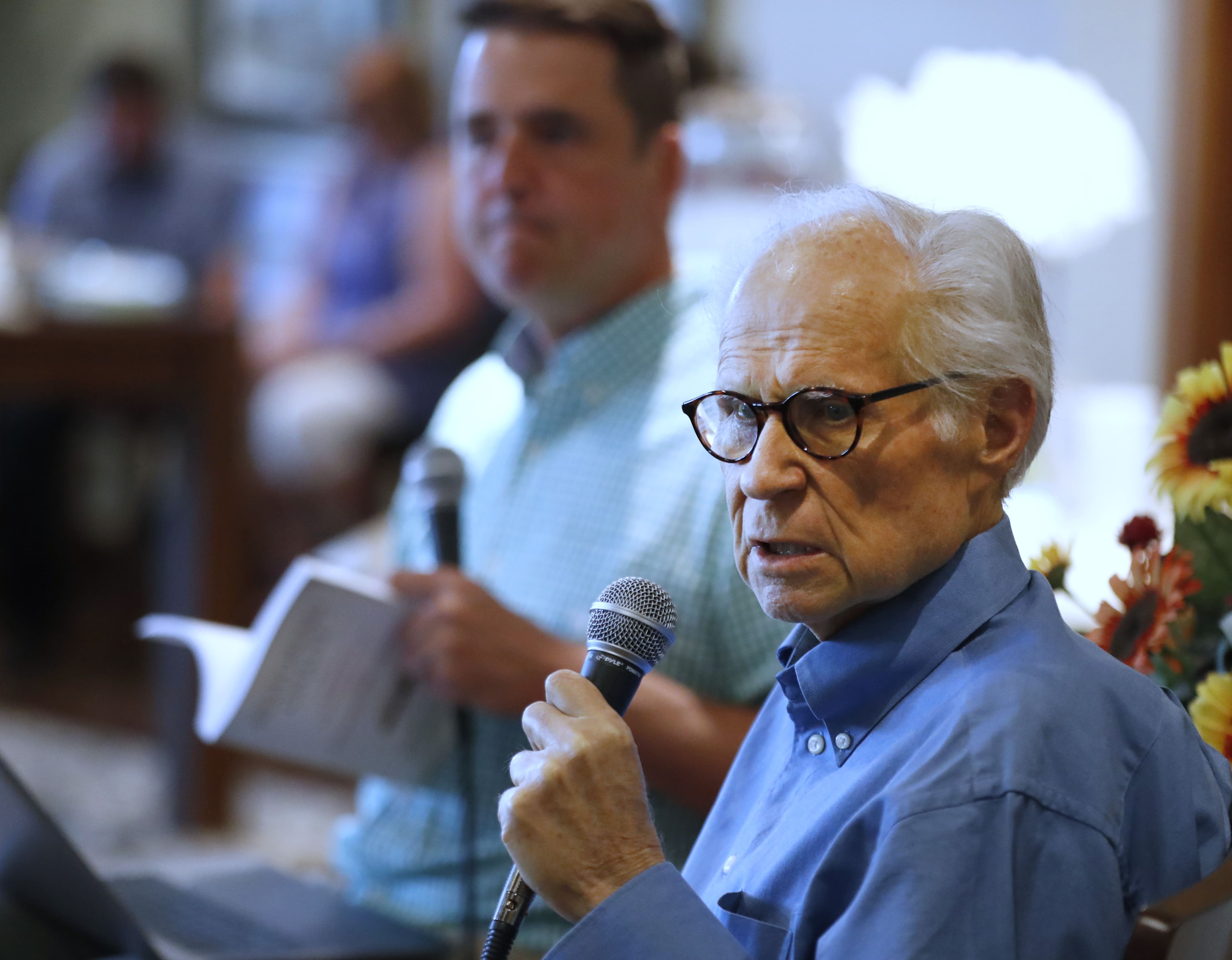
In this two-part episode we sit down a final time with Grant Palmer to discuss the release of his final book: Restoring Christ: Leaving Mormon Jesus for Jesus of the Gospels.
- In part 1 we dig deep into two book chapters: one on Joseph Smith’s possible treason against the United States government, and one on Joseph Smith’s likely use of concubinage in addition to polygamy and polyandry.
- In part 2 we discuss Grant’s research into “leaving Mormon Jesus for Jesus of the Gospels,” and conduct a final Q&A with Grant.
Episode Transcript
Host: John Dehlin · Guest: Grant Palmer
This transcript is machine-generated and lightly edited for readability. The audio is authoritative. Please excuse occasional errors in names and spelling.
Introduction and Welcome to the Evening
Part 1 of 2 · Ep. 781
John Dehlin [00:00:02] Mormon Stories is a production of the Open Stories foundation and relies solely upon the support of people like you, its listeners to help keep the podcast alive or to become a member of the community. Please become a monthly subscriber by visiting MormonStories.org and clicking the donate button on the top right side of the page. All contributions to Mormon Stories are completely tax deductible and go towards producing the podcast and building communities and programs of support for Mormons like you. Thanks for your support. Hello, everyone, and welcome to an evening Together with Mormon Stories. Thank you so much for joining us. I want to give everyone a hand. It's so fun to be here. It's a stormy evening outside, but we're really excited to have you here for this special event. Will Jim and Janice Robinson please stand up? So everyone look in the back. This is Jim and Janice Robinson. They're our hosts for the evening. Can we please give them a round of applause? I was fortunate enough to spend enough time with Jim and Janice, and specifically Janice, to know that Grant Palmer was a very important part of their stories. Is that true? Do I remember correctly? So not only are we grateful that there are hosts for tonight, but I'm grateful that we're bringing them something that hopefully is of value to them personally, as well as to the rest of you. Some of you will remember that we just recently had an evening celebrating Grant Palmer. How many of you were able to attend that? Raise your hands. And how many of you were able to listen to that online? Okay, a lot of you. Well, why are we doing another event? I guess there's two reasons. The first reason is, can you ever get enough Grant Palmer? That's fair. Is that fair? That's fair. You can. Here, hold that. Talk into that. What'd you say, Grant?
Grant Palmer [00:02:11] You can definitely get a. Too much of me.
John Dehlin [00:02:14] Just ask your wife. Right?
Grant Palmer [00:02:17] Exactly.
John Dehlin [00:02:17] Okay.
Grant Palmer [00:02:18] Not here tonight.
John Dehlin [00:02:19] All right. Do you need some water? Here's some water right here if you need it. A second reason is that Grant has a new book that's out, and when I talked to him about it being completed, I just thought what a great thing we could do to call everyone's attention to this important book and to have a chance to spend an evening with Grant discussing it and. And then to record that episode for posterity. So I'm hoping. How many of you have had a chance to look at the book? Be honest. It's okay. All right. How many of you had a chance to read through it? How many of you brought some questions for Grant? No questions. That's my job. You're saying no. Please bring your questions. We also want to invite listeners on Facebook to post questions as well, and we'll try and and get to them as we can. But I put out a call for questions and got hundreds, so we've got plenty of questions to go on. Plus, I've been, I've been reading through this book, so I like to give the date these days. It is August 9, 2017, and we're excited to interview Grant Palmer about his book Restoring Christ. So thanks for joining us. Quick announcements, I guess the bathrooms are behind us, so if any of you need to use the restroom, it's there. I want to thank Amy Grubbs and Sharon for organizing this evening. Let's give them a round of applause. And all of you for bringing food, thank you. And Richard Holdman for manning our audio visual. Richard's always been awesome. So thank you, Richard, for being here. Okay, so tonight we're going to be talking about the book and we're going to be asking questions to Grant. If I can be candid and maybe a tiny bit vulnerable, many of you will know that granted. Is it liver cancer, Grant? Is that right? Talk into the mic if you can.
Grant Palmer's Health and Personal Context
Grant Palmer [00:04:38] Pancreatic.
John Dehlin [00:04:39] Pancreatic cancer. All right, you get well. But Grant has pancreatic cancer and has been given weeks to months to live. That's another reason why we're here. A lot of the questions that have come in are just about his perspectives as he's facing what he believes to be a fun experience on the other side. So we'll be able to talk to him about that as well. So thanks for joining us. And I guess I'll just say as a final moment of introduction that as I was talking to Grant about how to plan this event, he called my attention to two chapters in the book that are of particular interest and from his perspective represent a bit of breaking new ground in Mormon scholarship for those who are into Mormon history. So they're the final, as I recall, they're the final two chapters in the book. Do we have copies of the book here, Grant?
Grant Palmer [00:05:47] We had about eight or nine, but they're all gone.
John Dehlin [00:05:49] They're all gone. So for those of you who brought your copies, the main, the beginning of our interview tonight is going to start on page 181. We're going to be talking about Joseph Smith and whether or not maybe he committed treason in his quest for political empire. And some of the new scholarship from this chapter comes from the council of 50 minutes that were recently Released in full. Is that fair to say?
Grant Palmer [00:06:20] Grant in the Nauvoo period.
John Dehlin [00:06:23] Speaking of the mic, if you don't
Grant Palmer [00:06:24] mind, in the Nauvoo period. It came out. The church published it in 2015. And I'd already written an article on this for the John Whitmer Journal, but this added about a third to the chapter. And it is. I was on the right track, but this is the Church's own words, Brigham Young's own words, Joseph Smith's own words. So, in fact, I would go so far to say, excuse me, I don't think you can understand 19th century Mormonism unless you understand what went on in those 17 meetings with Joseph Smith and then another, almost two dozen with Brigham Young after. Before they left Nauvoo. If you don't understand that background, you can't understand Mormon history in the 19th century. It's that important.
John Dehlin [00:07:20] And you're referring to the Council of 50 meetings.
Grant Palmer [00:07:23] Yes. Okay, we'll get into that more, I'm sure.
John Dehlin [00:07:27] So we're going to get into that chapter and then we're going to talk about this, I guess, the penultimate chapter in this book. That's second to last. Is that right?
Grant Palmer [00:07:36] Yeah.
John Dehlin [00:07:37] Chapter 19, Joseph Smith's practice of concubinage, polyandrian polygamy. And what Grant says is kind of unique about this chapter is he's discussing for the first time what he calls in the chapter the Blessing of Jacob. Is that what you're calling it? Is that right?
Grant Palmer [00:07:57] Well, yeah, I mentioned that Joseph keeps telling people he has the keys of Jacob. But remember, Jacob was both a polygamist and had concubines. And even many of our historians as we sit here today, they don't understand that Joseph Smith was into concubines. They know a little bit, quite a bit about polygamy and polyandry. But we're going to focus a little more on concubinage, because this is dynamite.
John Dehlin [00:08:33] So we'll talk about that. And we can also talk about the first half of this book, which is dedicated to, you know, his. His thoughts, Grant's thoughts on sort of scuttling the Mormon Jesus, but embracing the Jesus of the Gospels of the New Testament. We could talk about that for those who are interested. And again, we can talk about any. Any personal things as well. So please have your questions ready. Should we dive into the. To the treason chapter?
Grant Palmer [00:09:03] I'd say so.
The Council of Fifty and Joseph Smith's Theocratic Kingdom
John Dehlin [00:09:04] All right. So in chapter 18 of Restoring Christ, starting on page 181, Grant gives a little bit of context about the theocratic kingdom that is, is being set up through Joseph Smith and the council of 50. Do you want to give us some context on this chapter?
Grant Palmer [00:09:21] Yeah, let's talk about that. In March of, of 1844, he organized a theocratic government within the United States government. This was an era of states rights. They, they didn't, they liked the Constitution, but they thought there was room for theocracy within the United States government. That's a strange notion to us today, isn't it? Because there were certainly precedents in the Whiskey Rebellion under Washington and so forth that it wasn't okay. But that's why it finally dawned on them that he, he organized this council of 50 men. They call them the Princes of the Kingdom. The fifty princes of, of the Kingdom. And they were setting up cells throughout different areas of the United States and eventually the world to eventually overthrow the US Government, which Joseph Smith predicted would happen in a very, very few short years. And just go back a little bit. The first hundred pages of this book is on Jesus and Christianity, mainly academic essays, some devotional. But the last 160 are 10 chapters on Joseph Smith and Mormonism. And like I said, the cutting edge research is in those last two chapters and they represent about 70 pages of the book. But anyway, to get back to this focus, Joseph Smith called this by various names. For those of you don't know much about it, and you probably don't because first of all, I'm shocked that the Church released these Nauvoo Minutes. They had released the Utah Council of 50 minutes. And they go clear up to 1990, 1890. That's when this Council of 50 was disbanded and Joseph Smith was ordained King of the Earth and Brigham Young was ordained King of the Earth and John Taylor was ordained King of the Earth in 1885. And they had Joseph Smith set it up for two or three purposes. One was to get him elected as President of the United States in 1844. The second was that they became disillusioned that they were going to have to get out of the United States. And so this council of 50 sent out exploratory parties to Oregon, California, Wisconsin, Texas and Salt Lake City. And when the LDS Church came in 1847, they were not part of the United States, they belonged to Mexico. So they were very interested in getting out of Dodge, so to speak, because they knew they couldn't practice their theocracy in the United States. That became clear, crystal clear. As Brigham Young used to say, we love the Constitution. We just hate the damn rascals that administer it. And that is that you can't understand phrases like John Taylor, the kingdom of God or nothing. He's not talking about a church. He's talking about a political overthrow of the United States government. So they called it a living constitution. These council of 50 men, meaning they were, they were the government. They were. And they were very bold. They sent this to all the rulers in the England. They sent one to Queen Victoria saying the real kingdom's here and you're going to, you're on the wrong track, Queen Victoria. I mean, they're very bold and. But if you don't understand what's going on here in those first 17 meetings and subsequent 20 meetings before the church left Nauvoo in 2-2-46, you cannot understand Mormon history in the 19th century. It's that important. And it still lingers. I don't know, I don't want to get in the paper. This past week we had this very conservative Republican legislators say I'm tired of the church whispering behind the scenes and not going through the front door like everybody else to get their legislation done. This is a throwback to that council of 50 in the early, early state of Deseret. When they first came to Utah, they had The Council of 50 actually ran things. They had public legislators, but behind the scenes was the Council of 50 ratifying everything that was passed by the legislature, whenever that was. So this has been an ongoing thing and for most of the 19th century you had essentially a one party system. And we still have that. And I, you know, 88% of those Utah legislators are Les and I think half of them received a patriarchal blessing in their teens that said they're going to save the Constitution. So they go sign up. But there's only 61% of LDS in the state of Utah that, that identify themselves as Mormon. Half of those are in, are inactive. So if you take the, you take this, what the 40% that are not at LDS and you add to the 30% that are, that's over 70%. It's time to, I think to try to get the church to go through the front door and have more people run for legislature because the 88% is not representative of the state of Utah. Was that too political?
John Dehlin [00:15:35] You can say whatever you want. It's your night.
Grant Palmer [00:15:38] I find as I get old, It needs to come to an abrupt halt. It's just been this way for so long and this can be changed and we have the majority to do it. If people will just care enough to do it, I hope they will
John Dehlin [00:16:04] all right, so if you are on a stream of thought, I want you to continue. I have a place to start if you want. Is there something else you want to say before I.
Grant Palmer [00:16:16] Well, that's just kind of a general opening statement, but you really cannot understand Mormon history in the 19th century Great Basin kingdom centered in Salt Lake City unless you understand this council of 50. It's that important. And listen, these men. I give three examples of how they were trying to overthrow the United States government in this chapter. I don't know if anyone's ever done that before, but I've got three. And we'll get more into the nuts and bolts of what they were trying to do and how they were trying to do it, but. I lost it.
John Dehlin [00:16:55] No, it's okay. I think it's probably valuable to start with the Book of Mormon passages that provide the foundation for their thinking on how they're going to overthrow the government. Now, I've got them here. Do you want to summarize them or do you want me to read them?
Prophecies Concerning Native Americans and Gentiles
Grant Palmer [00:17:12] It's too long to read the passages.
John Dehlin [00:17:14] Okay, do you want to summarize what? Basically, the Book of Mormon prophesies about the Native Americans, the Lamanites.
Grant Palmer [00:17:20] One of the big things I noticed about Jesus in his end time apocalypse is found in Matthew 24. He says, yeah, there's going to be great destruction and violence, but I'm not responsible for it. Now go to the Book of Mormon. Jesus, boy, is he. He's gleeful almost about sinking 18 cities in three Nephi nine. And then you jump to chapter 16, 20, 21 Mormon five. And you get this little summary I'm going to summarize goes like this. This is Whitey's land, and we're going to help you Native Americans get your land back. What we'd like you to do is listen to our missionaries and either join the church or make alliances with the Mormons. And when we get enough, we're going to declare war on the United States government. Unless the Gentiles repent, they can join us, but they're not doing too good a job at that. So that is the scriptural basis for this. What I didn't know is that Joseph Smith had himself ordained king and he's going to lead the charge, and that's what he's doing. They are organizing dozens and dozens and dozens of Indian tribes, especially in the. In the Texas territories, from the Arkansas river clear to the Colorado River. Choctaws, Cherokees, Comanches, Sacs, Fox Shawnee, Pawnee. Just dozens and Dozens. And the idea is that if we can, that Brigham Young really gets strong about this when Joseph Smith gets killed. In his view, the Gentiles have rejected the Gospel. Even though they didn't put Joseph and Hyrum to death, they consented to it. And therefore we have every right to sweep them off the land and destroy them. And Brigham Young really did believe that the Indians were capable of overthrowing the United States government along with the church members and so forth and so on.
John Dehlin [00:19:45] And Grant. Can I just read a little bit of the Book of Mormon passage?
Grant Palmer [00:19:48] Yes.
John Dehlin [00:19:48] Third Nephi says, I say unto you. This is third Nephi. 20, 15, 17, 20. I say unto you that if the Gentiles do not repent, Gentiles, meaning whitey, as you call them, then shall ye who are remnant of the house of Jacob, which is who Native Americans, Lamanites, go forth among them, and ye shall be in the midst of them, who shall be many, and ye shall be among them as a lion among the beasts of the forest and as a young lion among the flocks of sheep, who if he go through both treadeth down and teareth in pieces, and none can deliver, thy hand shall be lifted up upon thine adversaries, and all thine enemies shall be cut off. And so the Book of Mormon is basically indoctrinating Brigham Young and others to believe that, oh, looks like the Gentiles haven't repented. Looks like we need to get the Native Americans involved.
Grant Palmer [00:20:43] They killed the prophets, so they've rejected the message. And that's when Brigham Young starts a very aggressive program to make alliances with the Indians. And, boy, they're out there. It's a vigorous thing. And they are surprisingly, none of these tribes bought into it. They're smarter than.
John Dehlin [00:21:07] And some of. And then you go on to provide quotes from people like Parley P. Pratt, Brigham Young and others where they're clearly trying to implement this prophecy.
Grant Palmer [00:21:20] And they're right out of the council of 50 minutes that was written by William Clayton. Journals. He had four or five journals. The Church still will not publish those journals. They published the minutes of The Council of 50, which were written by William Clayton. Joseph Smith told him to burn those documents, but he buried them. That's the reason we still have them, because they dug them up, he brought them west, and we have those council minutes. The miracle is that the church leaders approved their publication. I have no idea why they did that. So I think the church. So whatever article I wrote for John Whitmer In 2012, I was on the right track, but this is just cemented it in their own words, in their own minutes. They can't run away from it. Every historian I know is shocked that they approved this, but the church employees were trying to get them to do it and they prevailed and they did it. I don't know how they did it, but I'm glad they did it.
John Dehlin [00:22:31] So I thought it was interesting, the quotes that you have from general authorities who are sort of speaking about how to implement this prophecy in Third Nephi. So, for example, Parley P. Pratt writes, and not only does this page set the time for the overthrow of our government and all other Gentile governments on the American continent, but the way and means of this utter destruction are clearly foretold. Namely, the remnant of Jacob will go through among the Gentiles and tear them in pieces like a lion among the
Grant Palmer [00:23:06] flocks, cities, their forts, everything. This isn't metaphorical. This is real
John Dehlin [00:23:13] Brigham Young saying, the Gentiles have rejected the Gospel. They have killed the prophets, and those who have not taken an active part in the murder all rejoice in it and say amen to it. And that is saying that they are willing the blood of the prophets should be shed. The Gentiles have rejected the gospel and we will sweep them out of existence. Council of 50 minutes, 300. So what's going on there? It's kind of violent.
Grant Palmer [00:23:41] It's extremely violent. And it's not like the Jesus of the four Gospels. What is the Jesus of the four Gospels is bless those that curse you. This is not what's going on here. The behavior, the radical behavior of the Mormon Jesus in the Book of Mormon is very, very different than the Jesus of the four Gospels. I have a chapter in here on two different Jesus and boy. They are different. And. But again, the cutting edge research is on this chapter, and I've given three examples, and I don't know anyone's ever done that. So this is cutting edge research. And by the way, these 50 men, they had a stake in this. They're princes of the kingdom. So you get Lyman White, who's an apostle, member of the council of 50, he goes down to Texas and sets up his little kingdom. And then you have Alphaeus Cutler doing the same up in Missouri, Kansas. And then you have Joseph Smith in Nauvoo. And what's the thinking? Joseph Smith's king. But they have their own little fiefdoms. They have their own little kingdom. So that when Brigham Young goes west, who's reluctant to join Brigham in his Great Basin kingdom, Alveus Cutler and Lyman White, because they have a stake where they're at their cells. Their. They're supposed to build those. They got the commission from Joseph, not Brigham. And they are going to keep doing what Joseph asked them to do, which is. That's why they don't join Brigham. They end up getting cut off because they don't join Brigham Young's Great Basin theocratic kingdom. But the problem of Utah history has always been it's not polygamy. That's the, that's the outward. It's a government within the government. And that's what every piece of legislation against the church in the 19th century. And it all started with Joseph Smith in March of 1844. So it is pivotal, if you really want to understand Mormon history in the 19th century and even today. And how they approach getting legislation is still with us.
John Dehlin [00:26:18] I thought it was interesting you mentioned Lamanites or Native Americans being mentioned as visiting the city of Nauvoo and showing up in relation to these council of 50 minutes. Can you just talk about that really briefly?
Grant Palmer [00:26:33] Well, Joseph Smith's having all kinds of powwows there. They're bringing in cannon and hogsheads of sugar. They're bringing in ammunition. They're getting ready to do this. And Wilson Law. Wilson Law is the brother of William. William Law, who had just been recently released from the First Presidency. Highest ranking, most important member to ever left the First Presidency, in my view. Wilson Law is a major general in the Nauvoo Legion, and he knows if they pull this off, they're going to hang him for treason. So he bows out. And he, and he. But they're bringing in Indian tribes and nobody knows why. By the way, if you're a member of this council of 50, you know what your punishment was for revealing anything in those meetings? Beheading. Some of you'll know what that means from the temple and
John Dehlin [00:27:46] stop making the signs and penalties back there.
Grant Palmer [00:27:48] No, I'm kidding.
John Dehlin [00:27:50] No, it's fine. We're among friends.
Grant Palmer [00:27:53] But this is real. The main goal of this council of 50, and they're very confident is to overthrow the United States government in a very short year, few years. And Joseph Smith predicts this more once, twice, more than four times. But it's. It's to find a toehold outside of the United States. And, and also three, get him elected as President of the United States in 44. And they. We won't go into that. But these, these three examples. I think my second example is Alpheus Cutler up in Missouri, Kansas, that's, that's where Andrew Jackson sent all the, all the Indians. They're all down there and they. Church thinks it's fertile ground. And he. And they've got him organized to overthrow Fort Leavenworth, Kansas. He said, we can overthrow this in four hours. This is a fort. You know this Leavenworth, Kansas, same fort today. They're ready to go now. Back on Wilson Law. So Wilson Law, Joseph Smith was the lieutenant governor. He wanted to be the general, but because it wasn't a standing army, it was a militia. The governor of Illinois, even though he had a liberal charter, wouldn't make him a general, but right under him was Wilson Law, and he's the one who ran things. And boy, he could see the handwriting on the wall. And he knew if they executed this, he would be hung for treason. So he quit. He left along with his brother. All fits in.
John Dehlin [00:29:30] If it's okay, I'm going to read a little bit more from the council of 50 minutes just to talk again about the Indians, the Native Americans talk about how Texas plays into this. You write on page 191 in March 1, 1845 minutes, Council of 50 member Lewis Dana, an Oneida Indian who reportedly was an interpreter to six tribes and acquainted with nearly all the tribes, was appointed to take a small expedition to all the tribes in this vast area, especially to Texas territory. Dana was advised to, quote, call upon the red men to come speedily to the help of the Lord against the mighty gentile nation. Let him carry the fire amongst to them and tell them that God has set up his kingdom and that the day of deliverance is at hand. Brigham Young predicted, there are millions of the Lamanites who, when they understand the law of God and the design of the gospel, are perfectly capable of using up these United States. They will walk through them and lay them waste from east to west.
Grant Palmer [00:30:44] Yeah. And by talking about this chapter tonight, you know more than
John Dehlin [00:30:51] 99.9% of the members. So you, you made a reference to this before. But how successful were they in recruiting the. The red man, so to speak?
Grant Palmer [00:31:03] Well, they, the, the modus operandi was, like I said, this following summary. Try to convert them if you can convert them, make alliances with them, and when there's enough Latter Day Saints and Indian tribes try to move on to their reservations, to get a foothold and to influence them, to gin them up for overthrowing the government. That's what, that's the operation and that's what they're doing. And the very fact that the Lamanites didn't join in this. They had more sense. Probably prevented the leaders of the LH Church from being committing treason. But my good friend D. Benson lives in my neighborhood. I had him read an earlier chapter. He says, well, they certainly would have spent time in a penitentiary for conspiracy to convict. Can commit treason. And I think they would. Or something along those lines. He's a chief federal judge. I think he's just. They rotate that he's not. But anyway.
John Dehlin [00:32:28] Yeah, and I'll just make a. If it's okay, I'll make a quick commentary. How many of you remember the Brent Metcalfe interview that I did years ago? Okay. So talked a lot about, you know, Book of Abraham and Mark Hoffman. Really cool interview. Definitely one of the top 10 or 20 Mormon stories interviews ever.
Audience Questions on the Council of Fifty
Grant Palmer [00:32:47] He made as bright as they get.
John Dehlin [00:32:49] Yeah. He made a comment that's never really left me. When we were talking about the historicity of the Book of Mormon and I was focusing on steel and horses and other sorts of things, Brent called to my attention what he feels is one of the most condemning problems with the Book of Mormon. And it's that on the title page, the Book of Mormon tells you who it's written for and to. Who is it written for? And to Lamanites. Lamanites. And if you think about this incredibly violent text and plan that's coming out of the council in 50 minutes, to the church's credit, it shows that Brigham Young and others were reading the Book of Mormon and taking it very literally. So if the Book of Mormon is for the Lamanites, they're sending missionaries out to the Lamanites. And then, of course, they're trying to recruit the Lamanites to overthrow the government, because it's in the Book of Mormon. You realize how central the Lamanites, the Native Americans, were to all of Mormon doctrine. And then you think about Spencer Debbie Kimball and in my childhood and how he was always. He couldn't shut up about the Lamanites.
Grant Palmer [00:34:00] Right.
John Dehlin [00:34:01] Well, that's why.
Grant Palmer [00:34:02] Right.
John Dehlin [00:34:03] Because it's. What's the purpose of the Book of Mormon is the keystone of Mormonism. If you ignore the core audience for whom it was written and many of the core prophecies that are laid out
Grant Palmer [00:34:14] in it, it's worse than that. They don't even know who a Lamanite is.
John Dehlin [00:34:18] Yeah, we don't know who they are anymore. And that's the whole.
Grant Palmer [00:34:21] Find one. We got to have one for be a foreman of this city of Temple of Independence. They can't even find one.
John Dehlin [00:34:30] And That's. And that's sort of like. What I'm trying to say is that not only did none of these prophecies come to pass regarding the Lamanites helping overthrow the government, which is in the Book of Mormon, but now we don't even know who the Lamanites are. We don't even talk about them anymore.
Grant Palmer [00:34:44] But it's written for them.
John Dehlin [00:34:45] But it's written for them.
Grant Palmer [00:34:46] Great insight by Brent, by the way.
John Dehlin [00:34:48] Yeah. So, I mean, I. So just to summarize, you're suggesting, and you're trying. I think you're trying to use cautious language in saying this, suggests that maybe Joseph Smith and his supporters might have committed treason. Do you want to just summarize that point and to kind of close out this chapter?
Grant Palmer [00:35:07] I think what prevented them from. Prevented him as the Lamanites. They didn't buy into it, but they committed. Listen, in the Aaron Burr trial in what, 1800, whenever it was, he got off. He conspired to commit treason, but he didn't commit treason. And Chief Justice John Marshall, which is Jefferson's cousin at the time, there wasn't any statues for conspiracy to commit treason. You either did it or you didn't. That's why he got. Aaron Burr got exonerated. But by. As I recall, by the time of what Joseph Smith's doing, John Marshall put the conspiracy to commit treason, these leaders in the church would have spent time in a penitentiary. There's no question about it in my mind, and. Or something along those lines, because I'm not a lawyer, but Dee Benson is, and that's what he tells me, and I believe him.
John Dehlin [00:36:10] All right, any. Any burning questions about council. 50 minutes, come up here. You're gonna have to ask to the microphone if you want to ask a question. So if you want to come form a line right now, we'll just ask a couple quick questions. Yeah, that's okay. If you want to be on camera, you can just.
Grant Palmer [00:36:30] Hi. You mentioned that during the Nauvoo period in the council of 50 that they were trying to recruit the Indians to overthrow the government. Do you. Are you suggesting that that was still carried over when they came to Utah and that they were still doing that with the Utah Indians? You know, that's a good question. I don't. I don't have any knowledge of that, even though I. Western history and Utah history is one of my many focuses in my three studies in history.
John Dehlin [00:37:05] We certainly know that the Mountain Meadows massacre, somehow they were thinking about Indians as being a part of what they did.
Grant Palmer [00:37:14] There, that's a good question. Someone needs to write a paper on that. But I don't know the answer to that.
John Dehlin [00:37:19] Thank you.
Grant Palmer [00:37:22] So the, the Book of Mormon was written long before Brigham Young and like the passages that you guys were explaining about 1830, if you think Smith wrote it, so the church has some history of doing self fulfilling prophecies where they're kind of doing that. Do you think that that's a case of that or what do you think would cause Joseph to write those type of passages within the Book of Mormon? You know, do you have an opinion on that? I don't, I don't really know. I. All I know is it's in there in spades. It really is. You can read chapter 16, chapter 20, chapter 21, Mormon 5 of 3rd Nephi and it's in there in long, long passages. It's not just a footnote and a phrase. This is a integral part of the predictions of what the Book of Mormon is going to.
John Dehlin [00:38:22] Is it fair to say that, you know, right now as Indians have been sort of annihilated, Native Americans have been annihilated en masse and sort of constricted to their reservations that we all see it as an obvious foregone conclusion that we won, but is it possible that in the frontiers of the early 1800s maybe it wasn't so sure how expansion would have worked and so there would have been a lot of anxiety about will the settlers survive, will the Europeans win, will the Native Americans win? And so that could have been a culture for which people are thinking about whitey versus Native Americans.
Grant Palmer [00:39:03] Certainly more then than now nobody worries about an uprising from the Indians.
John Dehlin [00:39:07] But back then would that have been on their minds?
Grant Palmer [00:39:10] Oh yes.
John Dehlin [00:39:11] And so if you combine this idea, where are the last 10 tribes, where are the last 12 tribes view of the Hebrews, you know, all this fascination with the origin of the Native Americans. So you've got that, you've got that they're the pure blood of Israel. So you've already got that. Then you've got them here. You add to that worry about who's going to win, Native Americans versus the European settlers or how they can be used to win.
Grant Palmer [00:39:37] That's Joseph Smith approach, right?
John Dehlin [00:39:40] I don't know, I'm just speculating. But it would be a good topic for researchers to investigate. Who knows, maybe the late war or some of these other texts or texts we haven't yet discovered can provide some inspiration for why it's third. He had that fascination.
Grant Palmer [00:39:54] It's third Nephi that's the driver behind all this. It's scripture according to Mormons. It's not something you can. Oh, this is speculation. We can run away from it. No, this is important. Parley P. Pratt, I think, goes on to say, if this doesn't happen in five years, the Book of Mormon isn't even true. This is 1838. When you were doing your research grant, did you look at any intertwining of
John Dehlin [00:40:27] Smith's comments that he wanted the intermarrying going on to have a pure seed?
Grant Palmer [00:40:35] Was that intertwined with any of this? Well, that gets into a little more complicated problem. In 1831, Ziba Peterson, Warren Parish Ezra Booth, who's a recently joined minister to Mormonism, Joseph Smith, Oliver Cowdery went down to try to proselyte on the Indian nations down there. And they find out you either had to bribe people to get on the tribe or you had to be a relative. There's only two ways you could get on the so Brigham Young is saying or no, Joseph Smith is saying, well, what did he say? It'd be okay for the single men to probably marry the Lamanites. It may be how they become a white and delightsome people. Although that's not what the text of the Book of Mormon says. And you've done interviews on that recently that have been very offensive to some Lamanites you told me about. They thought their skin was going to turn white and using all kinds of letting their hair grow, wearing long sleeve shirts because one woman was so embarrassed that she wasn't turning light and therefore she's a sinner. Anyway, So Ezra's Booth, he came home and immediately wrote 11 letters. He doesn't say one word about marrying the Lamanites. Thirty years later, W.W. phelps, who's part of that party, literally 30 years later says, well, Joseph Smith was talking about marrying Lamanites for single men, but it wasn't polygamy. If you read the caption heading of section 132, it makes it sound this is like the beginning of polygamy. But it wasn't. William Booth wrote these letters and he was there and he wrote it. Contemporary, right? It's contemporary. And he doesn't mention anything about polygamy. I'd go with him over W.W. phelps saying it was about polygamy. Thirty years later, the church is trying to protect themselves. I don't know if that fully answers that question.
John Dehlin [00:42:50] And just to read the quote from Parley P. Pratt, who's talking about Joseph Smith's prophecy, says that there will not be an unbelieving Gentile upon this continent 50 years hence. And if they are not greatly scourged and in a great measure overthrown within five or ten years from this date, then the Book of Mormon will have proved itself false.
Grant Palmer [00:43:11] That's the thinking parley, P. Pratt. Okay, he's an apostle, big deal. But third, Nephi, you can't run away from.
John Dehlin [00:43:20] All right, thank you for your questions about the council of 50. You know, if you feel like that was not enough detail, buy the book, check it out, check out his sources. Thanks to the Joe Smith Papers Project, you can read the council of 50 minutes online. You can cross reference Grant's citations and investigate this for yourself to prove if it's true or not. Let's move on to concubinage. Is that all right? You guys ready for some concubinage? All right, so. So what I think is sort of central to this is giving some context about the Old Testament, Joseph's understanding of it, and this notion of the restoration of all things. Grant, do you want to start there? Is that okay?
Joseph Smith's Practice of Concubinage Explained
Grant Palmer [00:44:06] Well, the linchpin of the doctrine is in section 132. Joseph says he has an appointment, quote, an appointment to restore all things. And then he says, and this includes concubines and plural wives. So there's the hook. He's on the hook right there. And then he proceeds to. I think he starts out with concubines. And the concubine. It's actually.
John Dehlin [00:44:38] Can I, can I jump in?
Grant Palmer [00:44:39] Yes.
John Dehlin [00:44:40] He doesn't totally start with concubines. No. He starts with the second interview that I do with Grant on Mormon stories. The first was about his book, An Insider's View of Mormon Origins, which if you haven't read, you need to read. The second interview that I did was about sexual allegations against Joseph Smith that really have nothing to do with polygamy or concubines, possibly. So you can refer to that episode if you want, but why don't you give us the one minute version of the beginning of this chapter, which. This is about Joseph Smith's problems with sexual allegations.
Grant Palmer [00:45:15] Well, Joseph Smith is accused during a 16 year period by women in five different states of making untoward sexual advances towards them. And you can say there's no fire there, but I wouldn't want to be accused of that by, by 16 or all these women in five states over a 16 year period. And then he shifts into high gear and he gets into the, he gets into the plural marriage and so forth and so on. So this seems to be his MO. He's. I don't know. He just. He's just an extraordinary person, I guess. I don't know.
John Dehlin [00:46:02] I mean, you know, he. Maybe he had a high libido. Right? So.
Grant Palmer [00:46:05] Oh, yeah.
John Dehlin [00:46:07] So. So we've got all these allegations.
Grant Palmer [00:46:10] Lots of ambition. Oh, my gosh, this man has ambition.
John Dehlin [00:46:16] So that's. It seems like you kind of merged together that. That essay that we had discussed previously into this chapter, and that becomes the backdrop. And so it sort of goes from Joseph's understanding of the Old Testament, this idea of a restoration of all things. And if Abraham, Isaac, and Jacob had not only plural wives, but also concubines, well, we've got to. We've got to restore all things. Okay, we got to restore all things. We have his history of untoward sexual advances. And then you've got sort of part three of this book, which is from concubine ish to polygamy. So talk about how he. Maybe in your theory, he progresses from. From concubine to polygamy.
Grant Palmer [00:46:59] Well, the first thing is, is that he calls this. He has different classes of women, it's important to remember, and at least two of those classes are concubines and plural wives. He calls this his spiritual wife system. Sometimes it's shortened to spiritual wifeism, sometimes to spiritual wifery. But this is what he's doing. And some of the apologists have said, oh, this was all about John C. Bennett. He started that. Him and William Smith, brother and apostle. But they're inaccurate because we know. I've got. There's a footnote in there you should read. It's on the second or third page that Joseph Smith uses the term spiritual wife system, as does Brigham Young. After. After William Bennett is excommunicated. Excommunicated from the church and leaves Nauvoo. So we know that it. It's part and parcel of what they call it, Nauvoo. Helen Mark Kimball, one of his plural wives says so. So does one of the.
John Dehlin [00:48:10] Do you want me to read it?
Grant Palmer [00:48:12] Yeah, if you wish.
John Dehlin [00:48:13] Joseph Smith said he received from God, quote, an appointment to restore all things, which included having, quote, many wives and concubines, end quote. The term used to describe these two different classes of women was called a spiritual wife system or spiritual wifeism. Many have attributed the use of this phrase exclusively to the practices of Bennett and others, but this is not accurate. In 1882, Helen Marr Kimball Smith Whitney wrote in that in Nauvoo, quote, spiritual wife was the title by which every woman who entered into this order was called Emily Partridge wrote that, quote, spiritual wives is what they called it in those Nauvoo days. Joseph smith himself in 1844 called it a, quote, spiritual wife system according to the Nauvoo City and High Council minutes, as did Brigham Young. So, yeah, we can't just lay that on John C. Bennett.
Grant Palmer [00:49:05] No. And they try, because they always try to protect Teflon Joseph. You. I think it's really important. Listen, there's hardly any historians that know about the concubines. One of the very, very few is Carmen Hardy and he's a dang good historian. He says that concubinage received such a negative, such a pejorative term that they just quit talking about concubines. That's why nobody knows about them. And it's. And, and they, they just. He says, but he, he put him in different classes, different classes of women. And that at least those two. Maybe polyandrus is the third category. I don't know. We. We're not at the bottom of this yet. But I can tell you that most of our historians don't know about this concubine stuff. And they just quit talking about it being concubines and call them all honorable wives. And that's the way it went down with Brigham Young. And this is what's going on. It starts out as sexual allegations. And by the way. Yeah. Joseph Smith said that he did some things that he wasn't very proud of, but he never says what it is. Everybody thinks it. Masturbation or something, I don't know. But. But he, but he is what.
Women Identified as Concubines and Polyandrous Relationships
John Dehlin [00:50:43] I lost that one in. In part three of this chapter, what you basically do is you list a number of women who you suspect counted as concubines. So I'll read their names.
Grant Palmer [00:50:58] Seven of them.
John Dehlin [00:50:58] Seven women. You have Lucinda Morgan Harris, definitely a concubine. Sarah Pratt, concubine. Mary Heron Snyder, definitely. Melissa Shindle, Catherine Fuller Warren, Nancy Rigdon, Sydney Rigdon's daughter, Mary Clift. And those are the women. Is there, are there any stories or events of note regarding these seven women that you.
Grant Palmer [00:51:28] Oh, yeah.
John Dehlin [00:51:29] Either mention or you want me to try and read from.
Grant Palmer [00:51:31] You can do that. But in Nancy rigdon's case, she's 17 year old daughter of a Sidney Rigdon, his counselor, and he wants her so bad that he's willing to either marry her as a plural wife or. And let her marry anybody else she wants. As long as Joseph can have her as a concubine on the side. He's given her a choice, says, I have the sealing power. I can do what I want. This kind of goes to his head, so to speak.
John Dehlin [00:51:59] You write, I conceal.
Grant Palmer [00:52:00] I can unseal, I can seal you up to eternal life or damnation. I think we should say one thing more before you do any reading. What another way of looking at this is. What's the difference between a concubine and a plural wife? First of all, there is no command from God in the Old Testament to any prophet or king to ever practice concubinage, polyandry, or plural marriage. This is all Joseph Smith. And I. I'm just amazed at some of my relatives think, oh, you're going to be left out. Nobody. There's no prophet in the Book of Mormon that says you have to even be married to get to the City of God. So why do we think that Joseph Smith is the cat's meow and the last word on this thing, you have to be a polygamist to get to the highest degree of the celestial king.
John Dehlin [00:52:59] Because of modern revelation.
Grant Palmer [00:53:00] Yeah, but it's irrational to my. It just doesn't hold up at all. So anyway, I wanted. But here's another way of approaching this. A concubine is not just a mistress. Okay? You could easily fall into that trap. What Joseph Smith is doing, he's getting a revelation that it's okay to sleep with so and so. So he has a revelation, then he presents the revelation. And when he gets her consent, then they have an ongoing dalliance. There's no commitment to these women. And the. Joseph is not practicing concubinage like Abraham and Jacob did. You can read. There's. There's obligations of Jacob and Abraham towards their pa. Towards their. Their concubines. Not so with Joseph Smith. So that's what a concubine is. That's not a plural marriage as. As established in Nauvoo. In Nauvoo, you've got to have. You've got to have a ritual. You've got to have Joseph Smith's priesthood permission. You got to have witnesses. You got to have a ritual. You could have all of these things. And he makes it the crowning doctrine of his theology. And if you turn me down, young lady, your whole family will go to hell. And if you don't, if you do accept, your whole family is in which to me, violates the atonement of the Mormon concept of exaltation. So this is a major difference. And Sarah Pratt comes along and says,
John Dehlin [00:54:42] well, do you want to read it?
Grant Palmer [00:54:45] Yeah,
John Dehlin [00:54:49] she's basically saying, and this is through John C. Bennett, which I have to ask you about. Smith is reported as saying, sister Pratt, the Lord has given you to me as one of my spiritual wives. I have the blessings of Jacob, which is code word for what concubinage granted me.
Grant Palmer [00:55:08] Spiritual wife system is part of that. Plural wives, concubines, all part of spiritual wife system, different orders of women.
John Dehlin [00:55:17] And I have the blessings of Jacob granted me as God granted holy men of old. And as I have long looked upon you with favor and an earnest desire of connubial bliss, I hope you will not repulse or deny me connubial bliss.
Grant Palmer [00:55:41] Anyway, you can read those seven examples there. But what is important going forward there is that Joseph Smith stands up in Nauvoo in that grove you've been down, just below the temple, there's a grove of trees, and he tells the saints what his sexual philosophy is and the importance of secrecy. He says it's okay to do this as long as nobody catches you. That's where he's at. And if you don't have any accusers, okay, then we have contemporary sources by women who talk about this. We have light sources and we have contemporary sources. And those seven examples show that Joseph Smith is into concubines. I think. I think he starts out with just sexual allegations and affairs and maybe concubines, and then he morphs into concubines and then he goes into plural wives. But as Sarah Pratt says, just because. And Bennett is not an ideal source. You understand that?
John Dehlin [00:56:58] That's what I was going to ask you. Is it credible to be using him at all? I can see Brian Hales not liking that very much.
Grant Palmer [00:57:05] No, in fact, Brian Hales accuses Smith and Sarah Pratten and Bennett having a clandestine affair, but there's no evidence for it. He should stick to anesthesiology.
John Dehlin [00:57:20] But how can you use Bennett as a source? What's your thoughts on that?
Grant Palmer [00:57:24] Well, there's so much of it, and again it comes through. I have prayed about this. You're the one. He says this in seven or eight of these cases. It's in italics. But it's his philosophy. Whether it's Bennett's philosophy or not. Joseph Smith owns it. He endorses it. And when they start excommunicating people who are involved in these concubine relationships, they're right, contemporary sources. And they. It fits what Joseph Smith is saying. They says it's okay as long as you don't have any accusers. Just what Joseph Smith said in the grove as recorded by Apostle Wilford Woodruff and in the history of our church.
John Dehlin [00:58:09] Let me read that. Is that okay? So this is Wilford Woodruff's journal, history of the Church, which is based a
Grant Palmer [00:58:16] great deal on a history of the church.
John Dehlin [00:58:18] That source Smith said, if we did not accuse one another, God would not accuse us. So in other words, if you had sex with someone but there was no accuser, no. No harm, no foul. If we had no accuser, we should enter heaven, he would take us there as his backload. If we would not accuse him, he would not accuse us. And if we would throw a cloak of charity over his sins, he would over ours. For charity covered a multitude of sins. And what many people called sin was not sin. And he did many things to break down superstition. And he would break it down.
Grant Palmer [00:59:05] Amazing.
John Dehlin [00:59:07] Boy, did he break it down.
Grant Palmer [00:59:09] He bought and owned what Bennett may have started. Bennett was a renegade. He was doing this before he came to Nauvoo. But Joseph Smith bought and owned the philosophy, and that's one of the quotes that establishes that very well. I don't think you can run away from that quote either.
John Dehlin [00:59:30] One useless thing you do at the end of this chapter is you also list a lot of the apologetic tactic which boggles my mind really, is to say, okay, maybe Joseph Smith did have lots of wives, but he didn't have sex with all of them or with most of them, or only had sex with a few of them. And with the polyandrous wives, there's no evidence that he had sex. That tactic makes no sense. Since all post Joseph polygamy involves sex, why would we be insistent that Joseph didn't have sex when every other instance of polygamy that we know sex was integral?
Grant Palmer [01:00:07] Well, it says right in section 132 that the main purpose of polygamy in this life is to raise up a righteous seed. So if they're not doing it, they failed.
John Dehlin [01:00:17] Right. And what you do is a really helpful part of this chapter at the end is you list at least seven or so instances, seven or so wives, where Joseph actually did. There's good evidence that they actually did. Oh, they're under court oath depositions, right?
Grant Palmer [01:00:35] Yeah, they're under court oath. This isn't a theory, folks. This is 11 or 12 women that are speaking up. I had carnal intercourse with Joseph Smith in my mansion house and in my father's house. And how can you miss it?
John Dehlin [01:00:55] So Helen Mark Kimball says it was more than ceremony. Isn't it nice the euphemisms that they use to describe connubial bliss. Talks about Sylvia Sessions thinking Josephine was Joseph's daughter. Why did she think that? They make a joke with Eliza R. Snow that she didn't have sex and Eliza jokes, quote, I thought you knew Joseph better than that.
Grant Palmer [01:01:23] That was Angus Cannon, who is an LDS stake president. Clueless.
John Dehlin [01:01:29] Melissa Lott says that she roomed with and was Smith's wife. Quote, in very deed. Almera Johnson says she lived with Joseph as his wife at my house, as man and wife. You know, Eliza Partridge. Emma found Joseph secluded upstairs in the mansion house with Eliza Partridge and was much irritated. That's probably a little euphemistic as well. Emily Partridge said she roomed with and slept with and had, quote, carnal intercourse, end quote, with Joseph, so on and so on. So if you want a really quick list of evidences that there actually was getting busy with it going on, you've got that in this.
Grant Palmer [01:02:16] And you have to understand that a lot of these women, this is the Victorian age, they don't like to talk about their sex life. But enough of them did. We don't know that he had sex with everyone. Some of these apologists think if he only had sex with 10 instead of 20, that he's okay or more righteous, and it's silly.
Audience Questions on Polygamy and Spiritual Wifery
John Dehlin [01:02:38] Any questions for Grant regarding concubinage spiritual wifery? Just come on right now. I got to speak to the microphone.
Grant Palmer [01:02:54] I've heard recently that some of the defense of why he didn't was that none of these women ever had any children. Is that. Do we know anything about that? I think that's pretty much true. But I have a little section here on Nauvoo abortions. And some of it's late and some of it's contemporary. And we. It's like a page and a half in there. And see, there were so few children, they'd call them spiritual children. If you're a concubine or a plural wife. And there's so few in Nauvoo. And we've wondered why. The answer may be abortions, but quite frankly, we don't have enough evidence to pin this on Joseph. The implications are there, but you have to be objective. We don't have enough information, but there's two or three sources that say they would either send them out of town to have an abortion, that Dr. Bennett would use drugs, and he had a tool that fit an abortion tool of that era. And it's described to Sarah Pratt and to Orison Pratt, who was an apostle who was disaffected at the time. And this might be one of the reasons there's so few. But we haven't got that pinned down yet. Have to be more objective about that.
John Dehlin [01:04:26] Other questions about this chapter. Please come to the microphone if you don't mind.
Grant Palmer [01:04:39] We see mind your own business as a Mormon motto in early Utah.
John Dehlin [01:04:43] If people in Nauvoo had been suspicious
Grant Palmer [01:04:45] that perhaps Joseph had a relationship with someone they knew, or maybe that relationship was perhaps even in their home, maybe while they were not there or asleep,
John Dehlin [01:04:54] would they be practicing the mind your
Grant Palmer [01:04:55] own business or was that a later development? Well, it was so secret. You have to understand that. Look, Nauvoo. Nauvoo proper had just about 12,000 people. Chicago had in the 1845 census had about 11,000. It was bigger than Chicago. And then you had another 6,000 outside of the city limits of Nauvoo. 18,000 people. You know how many knew anything about this? Probably several hundred. This is a hush hush deal, so people aren't knowing it. I'm not sure how to answer that question beyond that. Except you did mind your own business. All right. I don't know when that started. Probably before we were long ago.
John Dehlin [01:05:55] Just as I was trying to distill my thoughts on the Book of Mormon and Lamanites from Brett Metcalf stuff for me as I try and distill this whole polygamy thing and there's a lot of people who know a lot more than me about this. A couple things we should all try to keep in mind. And you keep me honest, if I'm missing some of the details. The first is that Joseph's first plural wife was who? Fanny Alger. And she comes.
Grant Palmer [01:06:21] We don't know that.
John Dehlin [01:06:22] Well, we don't know for sure, but could be she's the first one either
Grant Palmer [01:06:25] in a fair or a concubine.
John Dehlin [01:06:27] What I'm saying is we do know this, that Fanny Alger comes before the sealing power was actually given to Joseph Smith.
Grant Palmer [01:06:36] That's why Joseph Smith in section 132 likes to say that 31 was the beginning of polygamy. Because even, even apologists are saying that he married her between 33 and 35. Well, there's no ceiling power as understood by the elias Church until April 3, 1836 in the Salt Lake Temp or in the, in the Nauvoo Temple. So I, I don't know. There's no cogent evidence that he's married to her. I mean, she runs off and marries a non member. That's not what Plural wives do.
John Dehlin [01:07:10] And then is it. Am I correct in saying that the Nauvoo polygamy began before section 132 was actually.
Grant Palmer [01:07:18] Oh, yeah, that's.
John Dehlin [01:07:19] So we've got nauvoo polygamy already starting before D and C.132 happens.
Grant Palmer [01:07:24] The first documented ceiling, as far as we know, was identified by several sources. Sarah Pratt 1. But others. It was on April 5, 1841, three months after Sarah Pratt turned down Smith and. And then he streamlined his Nauvoo polygamy and made it the centerpiece of his doctrine and theology. By the way, what you've learned tonight on this, most of our historians don't even know about this. It will be coming.
John Dehlin [01:08:03] And the only other thing I was going to say is that then DNC 132 comes. It's got all those threats against Emma. And where was Emma in the sequence of being sealed to Joseph?
Grant Palmer [01:08:14] She's number 21. She finds out that Joseph has 21 wives. Her and William Law about June of 43.
John Dehlin [01:08:24] So in what universe would it be okay for Joseph's first wife to be the 21st wife sealed to him?
Grant Palmer [01:08:32] And he. She doesn't even know about it unless she caught him. And she did catch him several times.
John Dehlin [01:08:37] And doesn't that violate the. The law of Sarah in DNC132 that basically requires the first wife.
Grant Palmer [01:08:43] They wheeze a lot of that. The law of Sarah is that you are supposed to tell your wife, but if she rejects it, you can do it anyway. So it's a cop out.
John Dehlin [01:08:54] But you put all this together in addition to the early sexual allegations, you know, I think it kind of completely neglecting just the ethics of women being treated as cattle and as sort of being a dime a dozen to men as property.
Grant Palmer [01:09:12] And a part that's not particularly new in there, but it's. Joseph Smith uses almost any highly questionable message to procure a concubine. And if you can't get a concubine, he'll make her a plural wife. I'll take either one, he says, whatever works. And my gosh, the stratagems he used. There's about six pages on that and it just goes on and on. And he always threatens these women. He says, if you turn me down, I won't do anything, but if you go public, I'm going to call you a whore. And boy, he does, right in the church, Nauvoo newspapers and everywhere else you can think. And I've got, I think, eight documented cases where he's got. He's. You probably know this part of it, but he gives him 24 hours, he uses the thing. Well, an angel is going to slay me if you don't marry me. You wonder if that angel knew anything about the Ten Commandments. Thou shalt not bear false witness against your neighbor. I mean, he's breaking the commandments. William and Jane Law says they were appalled. He broke six of the Ten Commandments. And I talk about that briefly in there. He's using all kinds of stuff in there, and there's so much of it, even some of these apologists don't know how to answer it. They like to say, well, Martha Brethington later was good friends with the church or something, but what do you do about the other seven? He. He's out there calling them nasty names. He says, they'll believe me over you. And he was right. And. And when they go to these church courts In Nauvoo in 1842, all these people are tried except William and Joseph Smith. The Smith family gets a pass, but he didn't do anything. He's not among the. They throw John Bennett under the bus and everyone else, but they don't throw the family under the bus.
John Dehlin [01:11:21] All right, so I think. Final question about polygamy or concubinage.
Grant Palmer [01:11:29] Do you suppose that
John Dehlin [01:11:33] Joseph Smith's sexual drive has more to do than just his libido? And maybe for John, is it like
Grant Palmer [01:11:38] an ICD10 code for that? Is there a diagnosis for something like that? Or is it just a. It's called a sexual predator. You don't, you don't see g. You don't see Jesus doing this kind of stuff in the New Testament. He attacks the religious apocrypha of leaders. He's protecting the vulnerable. He's not doing this kind of stuff. And so Joseph Smith, he is. He is. These revelations from Mormon Jesus in practice by Joseph Smith, this is a radical change from the behavior, character, and God of the. Of Jesus in the New Testament. They are nothing alike. And that's why I say in the preface, he's not worth saving. The Mormon Jesus, we need to call it for what it is. And look, Joseph Smith writes up all these scriptures, calls them ancient, and we know he gets them right out of his 19th century. What kind of a guy does that? He's. He's marrying. Or he's. He's marrying teenage girls, and he's 37. He's. He's trashing women who publicly oppose him. He's marrying married women. He's. He's he has himself ordained king. He's going to go after his enemies. He's going to violently overthrow this nation. You show me where That's Jesus in the New Testament. You can't really find it. We can find it in the Book of Revelation. I have a few things to say about that, too.
John Dehlin [01:13:33] All right. So if that's okay. That concludes our discussion of polygamy, concubinage, polyandry, etc. Connubial bliss. Thank you for joining us today on Mormon Stories. If you enjoyed this episode, please help us make more like it by becoming a monthly subscriber@mormonstorm stories.org thank you very much.
A General Authority Source and Its Significance
Part 2 of 2 · Ep. 782
John Dehlin [00:00:02] Mormon Stories is a production of the Open Stories foundation and relies solely upon the support of people like you, its listeners to help keep the podcast alive or to become a member of the community. Please become a monthly subscriber by visiting MormonStories.org and clicking the Donate button on the top right side of the page. All contributions to Mormon Stories are completely tax deductible and go towards producing the podcast and building communities and programs of support for Mormons like you. Thanks for your support. All right, so the next round of questions we have the situation with with Elder Hamula. Yesterday it was announced that a very senior member of the LDS quorum of the 70 former, you know, one of the leaders in the Church history department and recently learned the head of the correlation committee for the church yesterday, was excommunicated. Or at least it was announced that he's been excommunicated from the Church for unspecified reasons. Except to say that while the Church doesn't comment on disciplinary councils, they're not only telling us that he's been excommunicated, but they're also telling us why he wasn't excommunicated. He, according to the Church, was not excommunicated for matters of apostasy or disaffection. Which of course leaves us all to speculate as to what he was excommunicated for. And I'll go on record saying that I think excommunication, the practice is barbaric and medieval and revolting and disgusting, especially
Grant Palmer [00:01:34] for people who want to stay in, like you and I did, and they go after you anyway and look at
John Dehlin [00:01:39] the damage, but also the public feeding frenzy of speculation and rumors and innuendo and slander. I went through it and I didn't even do anything that merited that. I still got it and it was awful. So my my heart and they punish people who know. Go out to the Humula family. What's up?
Grant Palmer [00:02:02] They punish the people who who know.
John Dehlin [00:02:05] Right. So having said all that, one of the chapters that we've referenced in here before, it's one of the more popular things that that you've discussed since since an insider's view. We did talk about this in my last interview with you. Was your meeting that you had or your series of meetings that you had with an LDS general authority from 2012 to 2014. So I'm saying all that because probably the most popular question I received for you was, was Elder Humula that secret general authority? The timeline doesn't match, so we know the answer, but go ahead.
Grant Palmer [00:02:47] I had eight meetings with this general authority. And I wasn't the only one in the room. There were four people in that room. One of them is here tonight, but he doesn't want to be identified because he's too close to the general authority. And people could figure it out. But he had a meeting with Elder Humuli today and he did not leave, supposedly because he didn't believe. But they know each other and he's committed some kind of a, maybe a sex crime or some something along those lines. And of course he has the background, in my way of thinking that he could defect. He's got a degree in philosophy and law and political science and that's the humanities. And so I, you know, I'll take, I'll take my GA's word on that. But you know how they do it. If they can get you on adultery or some crime, they won't say you're disillusioned or apostasy. But apparently in his case he is not. Although he was removed. I think he was the 70 in charge of the correlation. Correlation for 2014, 15 and 16. He had an apostle over that, but. So we'll let that go as it is. But that's what they did to Simon Southernton. You know, he defected, but they didn't talk about his apostasy, talked about his mistake of adultery and they focused on that. So I, I on that. This really puts Hamuli in a hole because it. He's vulnerable to whatever they say. And I wish he would speak out, but it doesn't sound like he's going to. But I don't know that. I hope he does
John Dehlin [00:04:44] from my understandings of how these things often work. Once you reach a certain level in the church, you are entitled to a pension.
Grant Palmer [00:04:51] They took that away from. They call it a stipend, but it's more than a stipend.
John Dehlin [00:04:57] But are you saying emeritus 70 don't have a retirement?
Grant Palmer [00:05:04] They do, but they took it away. Is what my source is from. From Hamuli.
John Dehlin [00:05:10] Hamuli lost his retirement, you're saying.
Grant Palmer [00:05:12] Well, they call it a stipend. I assume it's a retirement.
John Dehlin [00:05:15] You're saying your general authority source claims that Humul.
Grant Palmer [00:05:19] That's what he reported today, stipend. And he doesn't think that Hamuli has six kids or something. He's not rich. So they have punished him. I don't know if he'll speak out. I wish he would. My guess is. I don't know. I'm not going to guess. I'm just saying what we know and what we don't know. But my g. If you know what I mean by that. He says he's. It's not because he lacked the faith. It's some kind of. I think his wife has given him a bad time. So it's, you know, it's. I don't know. Of course, wives can give you a bad time for a lot of.
John Dehlin [00:06:05] So regarding this general authority source of yours, will you. Will you ever leave record of who that was? Even
Grant Palmer [00:06:16] I tried to get him to go on record like Leonard Arrington did and put it in my special collection papers, interview him and 25 years later open it up. He wouldn't even do that. They just call him crazy. He has no reason to. Look, the church knows who he is. Let's get real here. But as long as he doesn't say anything, they're not going to out him. What's the advantage if he does? There's no advantage at all. And this is a high profile. He's been an area president, a temple president, a mission president, and he was a member of the first quorum of 70. He's been around the block.
John Dehlin [00:07:00] Is he on the stipend?
Grant Palmer [00:07:02] Yes, because he never squealed.
John Dehlin [00:07:08] Okay, so that was one of the major questions. And again, check out Restoring Christ the book for that chapter and many other good ones. Let's talk. Let's. Let's switch to your, you know, the first half of this book, as you mentioned, our writings on Jesus and Christianity pages.
Restoring Christ: Jesus for Post-Mormon Believers
Grant Palmer [00:07:25] There's actually more on Joseph Smith and Mormonism. And by the way, that's a little bit bothersome on my part that I didn't do it right. The title is all about Jesus. The back cover statements are largely about Jesus. I had a choice to add some stuff that you did, and I wish I would have, but I didn't have room. So people could get the impression this is just a book, how to come to Jesus. But the. The raw edge research chapters are the big ones. 160 pages on Joseph Smith and Mormonism, roughly 104 on Jesus. By the way, my chapter 10 on understanding the Atonement, I think that's the best stuff I've ever written on it. I'm trying to make it reasonable. I don't know if people buy it, but it's as reasonable as I know how to get it.
John Dehlin [00:08:16] How essential is a belief in both a historical Jesus but also a resurrected Jesus and atonement Jesus that bleeds from every pore for our sins for questioning or doubting or post Mormons that are still considering whether they want Christ to be part of their lives at all. How important are those sort of literal aspects?
Grant Palmer [00:08:40] Well, if you read Jesus Testament, you know you're a dead duck if you don't believe he's divine. I have a more hopeful view. Second, Peter is a very good statement. He says, now let me tell you who, what Jesus represents. He has these nine qualities and he lists them. He says, when you have those qualities inside you, you know Jesus Christ. So if you come to know him without thinking he's divine, and I think it might be from my perspective, a little harder to do that. But if you do, I like to think that he's going to be generous in his grace with those people rather than harsh. That's my own personal belief and I don't want to be struck down because that's his decision, not mine.
John Dehlin [00:09:35] And what if somebody says, yeah, I don't think I can know whether he bled from every pore for my sins or even was resurrected. Would you still suggest that Jesus had a role for a doubting or a questioning or even an atheist or agnostic post Mormon? And if so, what would that role be?
Grant Palmer [00:09:58] I'm not sure I understood that, John.
John Dehlin [00:10:01] If somebody says, I don't think we can know whether Jesus bled from every pore to atone for our sins. I don't even know if Jesus existed, let alone resurrected from the dead. If somebody says to you that stuff's not knowable, so if that's a requirement to have Jesus be a part of my life, I'm not interested. Could you respond with a case for why Jesus could be important to someone who's not interested in some of those more literal or materialistic materialistic claims?
Grant Palmer [00:10:30] My answer to that is to try. Religion gets too many passes on logic and reason. And if it's true, it's true. And I there's no such thing as a separate set of truths for spiritual things and that. But we've fallen into that trap and religion deserves a lot of the criticism they get. Maybe my answer would be turn to chapter 10 and I do it in a question answer period. And you can get a flavor. What I'm trying to do to make the atonement of Christ.
John Dehlin [00:11:05] What part do you want me to read? Which question?
Grant Palmer [00:11:07] Question 3.
John Dehlin [00:11:09] Because why did the Father will that Jesus be crushed with pain on the cross?
Grant Palmer [00:11:14] That's right, Isaiah 53:10. Because it's such a contradiction. I have a chapter in there of how I think the God of the Old Testament got a violent reputation. I think that's an important chapter myself, but I hope other people do as well. But just read that answer. That's my best effort at trying to make this as logical and reason.
John Dehlin [00:11:41] Do you want me to read it now?
Grant Palmer [00:11:42] Yeah.
John Dehlin [00:11:43] The Epistle to the Hebrews informs us that Jesus learned from what he suffered. Some kinds of suffering can soften the heart and and in Jesus's case, it deepened his understanding, which perfected his judgment. While his suffering is evident during his ministry, it was on the cross and in Gethsemane that the Father allowed Jesus to experience the collective emotional, mental, spiritual and physical burdens of humanity. This crushing experience changed Jesus and made him who he fully is.
Grant Palmer [00:12:15] It goes beyond the, the satisfaction ransom substitution theory and all of that which is totally inadequate to me to answer. This goes deeper in my view. This is my answer. I don't know if people are going to buy it, but it's the best I can do.
John Dehlin [00:12:35] Feeling the full measure of human sin, disease, pain and suffering made Jesus more empathetic, forgiving and magnanimous in judging all humankind. And to profoundly comprehend the tremendous weight of his responsibility. By descending below all things, Jesus became Christ, a perfect judge.
Grant Palmer [00:12:55] That's when it happened.
John Dehlin [00:12:56] He could not have learned this from a book. This searing experience was indelibly engraved by the Father upon the character of Jesus forever. No wonder his final words, it is finished, were uttered with a loud cry of agony from the cross. So what are you saying there?
Grant Palmer [00:13:12] I'm saying that his journey went right up to the very end. And that's why I know you have to read the whole chapter to get the flavor, but the next question is, well, why did he do it? Why did he willing to suffer? And the easy answer is that Father asked him to, frankly, but he pled with tears and crying to have that hour pass by him. He didn't want to do it, but Hebrews 12:2 is a better answer. He says, I endured the cross because of the joy it would bring humanity. Now there's love. From a Christian point of view. When did he get these bestowal of his authority? After he visited the Father. You wouldn't allow Mary to hug him. Remember, she comes down. He says, now all power in heaven and earth has been given to me. And it goes from there.
Audience Q&A on Scripture, Sexuality, and New Testament
John Dehlin [00:14:18] We had a listener write in and ask for those who want to use the New Testament to say that homosexuality is against God's law. What is your view on that? On that position as a Christian?
Grant Palmer [00:14:33] I like the way the Pope answered it. We're all sinners and let's not Castigate certain sinners. Jesus never said one word about homosexuals that I'm aware of. Lgbt and it was. That kind of stuff was really common in the Roman world. They were upfront about it.
John Dehlin [00:14:58] Are you saying it's your position that being LGBT is a sin? Is that what you're saying? Or are you saying stop even pursuing that line of inquiry? Probably stop judging.
Grant Palmer [00:15:08] Probably stop. I mean, look, go to the Book of Leviticus. They used to say, leave Iticus alone because it's so crazy. There's all kinds of crazy things in there. You don't like what your children did, stone them. But what we don't say is that was the father that had to throw this first stone. So there wasn't too many stonings. That's important with the homosexuals. I don't know. I think that the key thing there is if they come this way, and I believe they do, this isn't not learned behavior. I don't believe that. The Church can't really, really tout that, can they? Because as soon as they say it's not a sin, then they're left high and dry in their arguments, in my opinion. So if it is a sin, I like the way the Pope dealt with it, and, hey, let's fellowship him, make their contribution. We're all sinners. We're all in this together. Let's not go out and isolate.
John Dehlin [00:16:23] But it sounds like you're also open to the possibility that the Bible just gets a lot of things wrong, and that could be one of the things it gets wrong.
Grant Palmer [00:16:30] Well, what do they really know about this stuff? Do they know any more than we do? They know less than what we know about it, and I'm open on that.
John Dehlin [00:16:43] Excellent. Do any of you have questions for Grant about Christianity? Please come up and form a line if you guys want. And I may throw a couple questions in here and there as well.
Guest 1 [00:16:58] My question is about using the New Testament.
Grant Palmer [00:17:00] You quoted a lot in that first part of your book. How do you reconcile some of the more disturbing things in the New Testament, specifically regarding the way women are treated, wives are treated, the misogyny? Well, you have to understand that nobody was treated very well in the Roman world. I mean, only about 3% could even read or write. They're all slaves. So it isn't just that women get it. It's 97% of the Roman Empire gets it. I don't know if that's a cogent answer or not, but.
John Dehlin [00:17:42] So with those passages saying women should stay silent in the Church, you're saying that might not be from God either.
Grant Palmer [00:17:48] Well, Paul has. I have a chapter in there.
Guest 2 [00:17:52] Who.
Grant Palmer [00:17:52] The consensus of who wrote these 27 books in the New Testament. And there is a difference of view on women. And one of them is definitely written by Paul and the other is probably not written by Paul, but put in the words of Paul.
John Dehlin [00:18:12] One listener asked, can you restore Christ and remain in the restoration? So can you remain LDS and restore Christ?
Grant Palmer [00:18:21] I've got daughters that feel very comfortable in the service of the Mormon Church. I'm just asking them to change their Jesus. If they want to be a Mormon, so be it. I can't see it. But if they want to change your Jesus, get a. Get a better Jesus because we go because we got a better Jesus.
John Dehlin [00:18:39] Upgrade your Jesus. Jesus 2.3.0.
Grant Palmer [00:18:44] Of course, this is, this is why I emphasize this in the book, because 70% of the people who leave Mormonism have been bitten and they don't want anything to do with authoritarian religion. So I don't know why they'd want to stay in the. The Book of Mormon. Jesus is.
Guest 1 [00:19:02] Wow.
Grant Palmer [00:19:03] I mean, that's where it really gets down and gritty. I don't know why anybody would want to worship that Jesus. But anyway,
John Dehlin [00:19:14] many have asked, do you attend a Christian church? Or have you. And I know you talk about this in the book, especially in the final chapter called what's Next? Is that what it's called?
Grant Palmer [00:19:25] Where do we go from here?
John Dehlin [00:19:26] Where do we go from here?
Grant Palmer [00:19:27] What do you do when the narrative of your life burns down? Wow, that's a good one.
John Dehlin [00:19:36] David, did you attend any Christian churches?
Grant Palmer [00:19:39] I've been to about half a dozen of my. I'm so old, I don't like guitars, but I found a few that that would be very helpful. I really like the community of Christ. These men had a burst of integrity and they says, we're putting Jesus first and let the chips follow. If there's a disagreement between Jesus and Joseph, we go with Jesus even though we're a restoration heritage. And they paid a price for that. They lost thousands of members, but they've stabilized and they're beginning to grow again. And they're very much a Christian church. You don't even have to believe in the Book of Mormon to be a Community of Christ member. But I admire them and I, I like their model. My. I have a relationship with Jesus Christ. He hasn't disappointed me. You've heard me say this before, but I, I think there's several churches you could feel comfortable with. Paul Roby As a South Mountain church, they talk about Jesus a lot. Mormons say, well, so do we. Well, they've never been anywhere else. They. They think they do. And, and honestly, there are congregations. The bishop make sure they do, and I applaud that. So it's not universal. But the L Church just lets Jesus fall through the cracks.
Guest 1 [00:21:04] It's.
Grant Palmer [00:21:05] They have such a smorgasbord of concerns. And C.S. lewis, the lay Protestant theologian, addresses this. He says, if they're not focusing on Christ, they're missing the boat. So the LDS Church, from their perspective, they've got all these things. They got all these. The beauty of their theology and their standard works of the church, and they've got education and welfare and missionary and just all kinds of things. And pretty soon Jesus just falls through the cracks. One, one such person who visits me, he's finally quit paying tithing. He says, I've made a boatload of money and I've given him enough money to build a major luxury house, but I'm not giving him any more. He says, I'm tired of the Jesus fast. He says, my ward doesn't talk about Jesus and that's what I want to talk about.
John Dehlin [00:22:04] What are the most popular questions we get for you is have you applied the same level of scrutiny to Jesus in the Bible that you've applied to Joseph Smith in the Book of Mormon and Mormonism, or did you give Christ and Christianity a pass?
Grant Palmer [00:22:19] I don't think so. I think it would be true to say I had previously this book. But we get into some pretty good issues on this. I have a consensus of what most scholars would believe who wrote the 27 books. It's not 100% comforting, folks, but I don't think it's serious enough to throw anything out either. I think we're okay. How God got a violent reputation in the Bible, I think is a very important chapter. I'll let the reader decide that when they read the book.
John Dehlin [00:22:58] But this is your attempt to apply the same intellectual rigor to Christ in the New Testament that you.
Grant Palmer [00:23:04] More so it's mainly academic stuff. And remember, there are a few devotional pieces in there. I admit all these chapters have been written since my two books came out in the Incomparable Jesus and the Insider. But, you know, good minds. Malcolm Muggeridge was a Fabian socialist and he came around to Christ at the end of his life. Brilliant editor of Punch magazine, C.S.
Guest 3 [00:23:38] lewis.
Grant Palmer [00:23:39] Thomas Aquinas. No dummy. So I think it's not that all religious people are inferior intellectually. They're not in my view. Although too many people who run the churches think they get a pass and they don't. They shouldn't and they won't. For me,
John Dehlin [00:24:06] as I've interviewed you in the past, it seemed like your commitment to Christ is largely rooted in spiritual or emotional experiences or witnesses that you've received. Is that a fair summary?
Grant Palmer [00:24:20] Yeah, except for one experience I had that goes way beyond that. But I won't get into that. The reason I'm a Christian is Jesus says if you if this is his promise. If you take upon yourself these nine qualities and Peter, Paul, John and Jesus all say the same basic list of eight or nine things that my peace will be with you, my spirit will be with you. I will bring all things to remembrance in your hour of temptation and you will see me. My guiding principle in my life. I will be alive in you. What I don't understand is why more people don't try the experiment. Because that's what he's Jesus never ever invited anyone to know him by a religious feeling alone. He never ever does that. So different than the Mormon Jesus. You know the truth of all things by the Holy Ghost Moroni 10 you don't get that at all. It's in a more of a piracal approach but you have to make the first step.
John Dehlin [00:25:32] What does that look like? So someone's post Mormon, they're leaving the church.
Grant Palmer [00:25:36] That's why I'm a Christian. That's why I'm a Christian because it works for me.
John Dehlin [00:25:39] What are the steps a post Mormon would take to find Jesus? Just high level five steps.
Grant Palmer [00:25:46] Well I would hope that this they'd
John Dehlin [00:25:49] read read your book, buy and read your book is step one. Okay what's step two but to give
Grant Palmer [00:25:55] Jesus, to give Jesus a second chance. They've thrown out everything.
John Dehlin [00:26:00] Yeah. So what do they do to build it back? Give them some just starting points.
Grant Palmer [00:26:05] See the difference? The most cathartic experience I've had is to compare the Mormon Jesus with the four gospels Jesus and that has helped me deal with things, separate things out.
John Dehlin [00:26:20] So get to know the real Jesus not the Book of Mormon Jesus.
Grant Palmer [00:26:23] So if you give Jesus a second chance and you realize this is what he stands for, these eight or nine qualities and then take a little bit of leap of faith, step out into the dark and the spotlight will follow. You have to make the move. It can be a small move but swallow your pride and try it. It works.
John Dehlin [00:26:45] Try. What do you mean go to church? Do you mean read the scriptures every day? Well what is It.
Grant Palmer [00:26:50] Well, people. People, they come home from their mission, they never read the New Testament again. Pretty soon weeds are between them and God and they wonder why they're falling away and not believing.
John Dehlin [00:27:02] So read his holy book. What are any other steps? Attend a church.
Grant Palmer [00:27:10] I think a church can definitely help. I have. I'm engaged enough. No, but there's lots of people that could benefit from.
John Dehlin [00:27:23] And I'm guessing you would just say
Grant Palmer [00:27:25] you've got to make a move. This is.
John Dehlin [00:27:27] What do you mean, make a move?
Grant Palmer [00:27:28] I mean, you have to step out and have a little bit of faith that he's going to come through on the promises. He says, I. My grace will transform you and help you achieve these qualities. If you will let me, I will become alive in you. Try the experiment. He's very much into experiments. He's not into feelings.
John Dehlin [00:27:59] So live his word. You're saying, live his word.
Grant Palmer [00:28:01] Try it. You'll like it.
John Dehlin [00:28:03] And your soul will enlarge in with the Spirit.
Grant Palmer [00:28:05] Well, he's promised these blessings and his grace will transform you. And then he specifically, he says, look, you need to be born again. And this is nine qualities is basically born again. And when you take. When you do that, I will become alive in you. That's my promise to you as Christians. As a Christian, I can say it happened. I can't tell you what to do. I'm just saying maybe swallow a little bit of pride and try the experiment.
Grant Palmer Reflects on His Health and Legacy
John Dehlin [00:28:33] And is there a chapter where those nine qualities are listed?
Grant Palmer [00:28:36] Yeah, the born again saint.
John Dehlin [00:28:38] Born again saint. Page 25, chapter three. I want to find. And I just want to read these off. Oh, they're not there. Where are they?
Grant Palmer [00:28:48] Oh, they're after the Beatitudes. Look.
Guest [00:28:51] Jesus.
John Dehlin [00:28:52] What, 45?
Grant Palmer [00:28:57] Yeah,
John Dehlin [00:28:59] 29. Be diligent in the ministry. Exercise self discipline. Do what is right. Are these them? Yeah, basically, forgive others beyond what justice requires. Be pure in heart and honest to us and others. Be a peacemaker. Return good from evil. Diligence in revealing his Father's divine nature. Strong faith in God, virtuous behavior, knowledge of the scriptures, temperance, meaning self control, moderation and balance, patience with others, godliness or goodness, brotherly kindness or gentleness, enormous charity, love and compassion for those fellow beings.
Grant Palmer [00:29:39] What does Peter say there? When these qualities are inside you, you know Jesus Christ.
John Dehlin [00:29:46] So pursue those qualities and you, Christ, will. Will enlarge in your soul.
Grant Palmer [00:29:53] That's my experience.
John Dehlin [00:29:54] Okay. All right. That's the recipe. All you skeptics out there, you now have been served by Grant Palmer. Do what he says. It's in the book, chapter three.
Grant Palmer [00:30:06] But I. I'm the first to admit there's things in the New Testament that don't. Are not that generous. It's not my call, it's his. But I just like to think in his grace, he's going to be more willing than some of our ministers.
John Dehlin [00:30:27] So for you, if some. If a Hindu dies never knowing Christ, for you, there's.
Grant Palmer [00:30:31] Well, I don't know. I don't want to get too far out on that. I don't know. That's his call, not mine. I just know works for me. And. But you got to have a little modicum of faith. Now. Down in the Salt Lake County Jail, those men are driven. I've worked there for 13 years. And he walks the halls of the jails and prisons of this world. He doesn't just hang out in temples. And if they showed that. This is what I learned about my boss down there. You show that much willingness to change, he's there. That's what I learned. And I quit being so judgmental. It's shaped who I am. And they're driven to Christ. They. Their parents, they've gone to high school counselors, psychiatrists, psychologists. Nothing worked. That's why they're in jail. And they are literally driven to seek the mind of Christ, as Paul would say. And their parents have abandoned them. And that's not always a bad idea, because as long as they have their crutch, they'll use it. They have to get really down low. And that's when some of them start making. More mature decisions. And the problem with that is that they got four or five fires to put out. You and I got one or two. And they're so habituated that they like to change, but their habits make it very, very hard. That's why their recidivism rate is so high.
John Dehlin [00:32:10] Okay, I want to sort of close by talking about maybe the most sensitive sort of questions of all. Grant, tell us. You joked with me about your complexion when we had lunch recently. What did you basically say about your own complexion?
Grant Palmer [00:32:29] My grand thing. Kids think I look like a yellow neon tube and a prisoner of Treblinka.
John Dehlin [00:32:35] Okay, what's going on with the. With the yellow? What. What is that?
Grant Palmer [00:32:39] That goes into the yellow or in the liver? My doctor and nurse tells me that will continue. I'll get more yellow and get weaker and weaker. I don't have pain yet. The tumor grows. Tumors are very greedy. They demand their share of the food, and as it gets bigger, it depends where it grows. Will Depend on the pain. You go on morphine, you go into coma and you go to sleep. That's not too bad.
John Dehlin [00:33:09] And this strikes close to home for me because my sister Gina was diagnosed with colon cancer in October, and I noticed an ashen complexion then and she was gone in December. So it was a two month sort of time period. And my sense is you're on a similar time period, is that right?
Grant Palmer [00:33:28] Yeah, they're talking two months. They gave me three months up to 12 weeks. And I've been through five of those weeks. So you can figure it out from there. I'm okay.
John Dehlin [00:33:39] So, so, so this.
Grant Palmer [00:33:40] I've had an overpouring of love. I've been working right up to this day, as the Beatles used to say. And I've repeated this. Get a little help from your friends. And you're my friends. I had far more friends than I have. And this guy right here is an incredible supporter of me. Incredible. He's been there all the way. And I appreciate that.
John Dehlin [00:34:06] Thank you. Well, thank you. You know, when I talk about 2000, 2001, your book was really. 2002 is when your book came out. Right. Your book was a really central part of helping us really make sense of what we were reading elsewhere. But back to you. Thank you for that. So you're staring death in the face. How does that feel? How are you experiencing it? What are you thinking?
Thoughts on What Lies Ahead
Grant Palmer [00:34:39] I don't fear the future. I look forward to the adventure. I think we're going to learn a lot. It's new. I like to think in two months I'll be younger and more energy.
John Dehlin [00:34:51] What do you think the other side is going to be like? What are you going to be doing over there? Well, do you have any theories, speculation, wishes?
Grant Palmer [00:35:02] I think that there's. I think Mormons are going to need a lot of counseling over there.
John Dehlin [00:35:11] This is like reverse spare prison. With Grant Palmer as teacher, I really.
Grant Palmer [00:35:19] Well, psychologists too. Oh, maybe you can help out.
John Dehlin [00:35:25] No time soon.
Grant Palmer [00:35:27] There's one big job because they're going to have major adjustments to find out that this system that they are so sure is true isn't anywhere close. And maybe, maybe we're all wrong. I don't know, maybe we're being observed from a maze or something. And this is all part of. I think about that once in a while. It's a little problematic.
John Dehlin [00:35:57] So you've been a teacher for most of your life. It sounds like you hope to continue teaching.
Grant Palmer [00:36:02] I do, and I think I'll be a much better teacher.
John Dehlin [00:36:06] I also, as we Talked outside your front door when I dropped you off. When we had lunch this last time, you spoke to me fondly about your gardening and your birds. Do you have any theories around that or hopes?
Grant Palmer [00:36:23] Well, I think we'll all get a little plot. It's like whether Adam and Eve were literal or metaphorical is probably whatever. Doesn't matter. Well, I won't say that. But even if it isn't, if it's metaphorical, so be it.
John Dehlin [00:36:44] Anyway, Plot of land.
Grant Palmer [00:36:46] I think it says they dressed and keeped it. I like to think that one of the things we're going to focus on is to dress and keep this little plot we're going to be given. And there's a great deal of joy in certain things. I love my flower gardens. I don't have energy to take care of them anymore, but I had my racing pigeons, I had parakeets. During the summer, I'd take the panels off and it's like a garden of paradise around there. You could hear these birds all over the yard. And of course, I've done seen much of the world in my travels, and I really do believe that World is the best book. And I like to quote W.C. fields, the comedian, why this life is so difficult. It's a wonder anyone gets out of it alive.
John Dehlin [00:37:37] Well, it sounds like a beautiful vision. I hope it comes true for you and man. It'd be fun to see on the other side. So we will.
Grant Palmer [00:37:49] Yeah, I'm pretty confident about that. Went to lunch with Draper. He probably doesn't want to know this, but he came away from the pastor who introduced us.
Guest 3 [00:37:59] He says.
Grant Palmer [00:38:01] He said it puts me to shame that Palmer, really, it's. It's humility to me that he's. So that he. He doesn't have these problems of whether we live or not. Now, I've said this before, and I'll just briefly say it again. I have a philosophy degree and I can argue with the of them. We don't know for certain, but like my friend Richard Russell said, who wrote a dust cover statement, he says if it all goes dark, I won't know. If I'm around, I'll be joyous and grateful. That's the philosophical argument, the religious argument I gave you tonight. And I've had enough experiences that I just. It just seems natural to me. I just can't believe this is the end of human personality. If it is, it's such a tremendous waste of time, isn't it?
Closing Tributes and Audience Farewells
John Dehlin [00:39:02] All right, so to conclude, I think it would be cool if whoever wants to can come up and give a super brief question or even a brief comment or thank you to Grant, just to give him a sense for what he's meant to us.
Grant Palmer [00:39:13] This has gone on long enough. Nobody's going to listen to it, Joan.
John Dehlin [00:39:17] Yeah, and nobody listens to long podcasts. Right? This is. This is short. This is a short one. What are you talking about?
Grant Palmer [00:39:25] It actually is. Yeah. I'm. Yeah.
John Dehlin [00:39:28] Anybody want to give some final. Final thank you or final comment note of appreciation to Grant? Just make a little line. Let's give him a little love as a way to close.
Grant Palmer [00:39:39] Oh, I feel the love. You don't need to pour that on.
Guest 3 [00:39:42] I have some more.
Grant Palmer [00:39:43] Beyond my wildest expectations. I had no idea this would be the response in literally thousands of emails. Whatever.
Guest 3 [00:39:53] Well, get ready for some more because here it comes. I listened to your podcast together. It was the week of the Mayan calendar, I believe, predicted the end of the world.
Guest 1 [00:40:08] And.
Guest 3 [00:40:08] And that was the very night that I was listening to you and I had my shelf, and you were the straw that broke that shelf, sent me into faith crisis. Thanks a lot for that.
Grant Palmer [00:40:23] You have to unfreeze people before you refreeze them. That's what Mormon missionary here, they say. You don't have any authority in your churches in apostasy, but we have good news. We have a restoration.
Guest 3 [00:40:34] The irony is that I so appreciated your view on Christ. And I had studied in BYU Jerusalem and had this wonderful academic background to know the reliability of the Bible. So I turned to the Bible more seriously and saw this, what you're talking about, this comparison between a Mormon concept of Jesus and a biblical view of Jesus. I ended up going to another church, gave myself to the Lord. My wife and I, we have a blended family. We're a big Brady Bunch group. We have 10 kids. We have all come out together. And I just wanted to thank you. Sorry. Very Mormon of me to start crying and getting emotional. But I wanted to thank you. My pastor told me that the gospel is so simple, you can summarize it in nine words. We're all sinners. We're all sinners. He is perfect. Make a trade. And I want to thank you for leading me in that direction.
Guest 1 [00:41:45] Just real quickly, Grant. When I first started questioning the church, the insider's view of Mormon origins was something I could go to because it was written by an institute director. And I'll never forget the confidence I had in what you wrote and how it impacted me and made me come to the realization that the church wasn't true. And I just want to thank you.
Grant Palmer [00:42:12] Made a major contribution in your podcast as well.
Guest 1 [00:42:16] Thank you, Grant. And I enjoyed interviewing you as well, but you had a great impact on me and your book, and I felt comfortable going to it because I was reading Mormon at the time and that meant a lot. So thanks.
Grant Palmer [00:42:31] You're welcome. This is my cousin, Zenda. Maybe I shouldn't say that. That's okay. I just want to let you know, Grant, that I really appreciated our phone calls and you really helped me a lot. And I will miss you when you're gone. I'll cry. And I don't cry often when that people leave this earth, but I will cry when you leave. I'm worried about myself. The closer I get to death, I'm getting a little more emotional. I'm afraid I'm becoming a histrionic.
John Dehlin [00:43:22] We have time for maybe three more.
Guest [00:43:34] I just also wanted to thank you for having the courage to write an insider's guide to Mormon origins, because it was a big. It's kind of been my Book of Mormon to hand out to the people that have come to me, the few people that have come to me since, in the 10 or so years since we've been out. But that was a. Always a catalyst, but also something I felt comfortable in sharing with people that were just on their beginning of their journey. And, you know, like you said, when your foundation kind of burns to the ground. And I was going to ask you this, so maybe it's a question too, but do you feel like having that happen or having things kind of fall apart, the belief that you grew up with did it.
Grant Palmer [00:44:14] I was extremely orthodox. I had great uncle Charles h. Hart, who's first quorum of 70 in the 20s and the teens. And my parents were socially friends with Bruce and Amelia McConkey, Joseph Fielding Smith and his wife, New Harold B. Lee. You know, I mean, I was true blue. Our mission led the world 1962 in convert baptisms. And I was very much a part of it. I was one of these missionaries that came home. I didn't have earrings in my ears. Two weeks later I was, I went into ces. I, I was serious about this.
Guest [00:44:55] Well, I've won and I've, I've felt like, you know, it's. My life is so much better since. Even though everything came crashing down, things have become so much brighter, you know,
Grant Palmer [00:45:04] and almost everybody says that. And that's what I was going to say. Mormons can't believe that. But it's, it's the testimony of most the people I hear about.
Guest [00:45:12] So thank you for that and for your help in that.
The Future of the Mormon Church
Guest 2 [00:45:28] You may have been asked this question before, but I'm wondering if, because of the amount of research that you've done and the background that you have, I'm wondering if you can give us kind of an idea of what you see the next 15, 20 years of Mormonism being.
Grant Palmer [00:45:49] Well, I think John's got a better answer to that. He's the one that interviews all these people and John is doing a great service. He's documenting what's going on in people's lives. This will become a very important and already has historical records and you need to know that and support him for this reason alone. Now as for the crystal ball stuff, I like to think that Mitchell Gorbachev come up through the ranks of the KGB and as he stepped up the mountain and saw that they were becoming a third world country, that he made some changes. And I whoever's in charge in 15 to 20 years from now when the church, when it's no longer to their advantage, when there's a tipping point and this is going through every family in the church like diarrhea and it's in the trenches, they just know about it. It's not oh, have you heard about this? They, they seem to know that when they realize that it's maybe in their best interest to get past this and be open and they're there. And I know that according to my general authority, President Utdorf is trying to lead the church out of this mess, but he's a junior apostle and I don't have a crystal ball. But I think that there's. They're growing in certain parts of Africa, Asia, Europe, even in the United States. They're losing market share. But I like to think that they will eventually not only allow the true history to be written in a more definitive manner, but I think they ought to do what the RLDS church has done. And I advocated that from the beginning move to Christ and quit talking about all the glories of Mormonism and Joseph Smith. I don't. They had so much more money and members that they're not willing to do that. Are they like community of Christ? But the community of Christ in my opinion made the right decision on this and they did it with a burst of integrity. And I admire that. I really do. I think you should chime in on that question.
John Dehlin [00:48:28] Is that a command?
Guest 1 [00:48:30] Yeah.
Grant Palmer [00:48:35] Well, nobody knows.
John Dehlin [00:48:44] You know, this is a non satisfactory answer, but I saw one of the best movies I've seen in the past. Decade is called Spotlight. How many of you have not seen Spotlight? How many of you have not seen it? How many of you have seen it? Okay, go see Spotlight. If you haven't seen it. And what it shows is that religion is incredibly resilient, because if you can have systemic pedophilia where a very large percentage of your entire ecclesiastical force is systematically not only sexually abusing children, but also covering it up and perpetuating it across multiple decades, across multiple continents, and if your church can do that and your church can continue to grow and thrive, what that means is that religion is very resilient. How many of you have not seen going clear. Okay, go see it. And what you'll see there is that Scientology, the buildings are empty, but Scientology has more money than it's ever had because it realized that once it got a bunch of money. If you remember the quote from L. Ron Hubbard, if you want to get rich, start a business. If you want to get really rich, start a religion. So once they obtained all that money, now they're just investing it. And Scientology is diminishing in terms of membership, but they're growing in terms of their wealth and their power. And our church is taking same pages out of the same playbook. I just saw it announced recently that the church is buying another billion plus dollar investment in Texas. And the commercial real estate investments continue
Grant Palmer [00:50:31] to thrive to finance the third world missionary laborers, I suppose.
John Dehlin [00:50:36] And, you know, the church owns 2% of Florida, et cetera. So the church is probably going to
Grant Palmer [00:50:40] get richer, but it's sinking.
John Dehlin [00:50:43] And it and the Florida. But I don't think that the LDS Church is going to disappear anytime soon. I think it's going to continue slowing in its growth. It's going to top out. And I think within 30 or 40 years, we'll start to see a decline in. In membership in the developed world. I think it'll continue investing in the third world, and it'll be able to do a numbers game where we grow in the third world while we're shrinking in the US and in Western Europe and in parts of Asia. But to be honest, I don't think the church is going anywhere. I do think that you can. If there's one thing that's reliable about the church, is that it's 30 years behind the rest of the developed world in social progress. So we will make progress with women and with LGBT people. It'll just be about 30 years from now, long after everybody else has sort of mass adopted any progress.
Grant Palmer [00:51:46] Big churches don't die. They change it's not going to survive.
John Dehlin [00:51:50] So the church has adapted. They'll adapt honestly. They're just waiting for enough old people to die out so that the pain of making a change is diminished and they'll counter that with trying to save the younger generations. So I'm not draconian in my predictions about the church. I do think it's continuing to lose its most thoughtful, informed, educated, wealthiest, best and brightest is Marlon Jensen. That will continue to happen. The brain drain, the integrity drain. And they're losing. That's good for me because turns out those are my favorite people in the world, are people who used to be Mormon and now they're not. And they're fun to hang out with.
Grant Palmer [00:52:36] So I still get a lot of doctors who stay in it. They get a lot of prestige being, you know, a doctor in the ward. But the brain drain as well on the teachers, the speakers, the thinkers. They're leaving. Yeah, the analyticals.
John Dehlin [00:52:51] And so I'm super happy about organizations like WACA and, you know, Oasis and a lot of cool Facebook communities. I'm just so thrilled to see post Mormons and other ex religious people finding dear friendships, finding community and learning how to thrive where Mormonism is largely just in the rearview mirror. And that's. I see that as a growing industry of beautiful people making dear friendships and having a lot of fun together. And that's the projection that I want to leave you with if I'm going to leave you with the projection.
Grant Palmer [00:53:27] And I think, you know, I have different religious and political views in my family, but my family's pretty open and mature and we've transcended it with love. And I hope you have that gift because there can be some nasty relationships between sisters and parents, and I'm fortunate to be leaving. And that's not a problem. If anyone has a really strong view as to what they think is going to happen in 25 years, I'd like to hear it if we have time.
John Dehlin [00:54:07] You're the boss.
Grant Palmer [00:54:07] I liked Richard Bushman, and I reported this in a Sunstone session last year, last evening, last year ago, that the Mormon Church cannot sustain its current narrative. Boy, that says volumes. So they've got to morph if they're going to live. And he's their top apologist, and I think he's right on the money. He backed off of that, but he said it and it's true a little bit. Anyone have anything? What they
John Dehlin [00:54:46] let the speculation.
Guest 3 [00:54:48] Yeah.
Grant Palmer [00:54:48] What do you. Where do you see? Where are things going in 2030? I'll keep it brief.
Guest 2 [00:54:53] I don't really have much say, but I think with the thought of truth being independent of belief and indifferent to the amount of people who believe in it, I and knowing and with the idea that truth is difficult to obtain but not. But much more difficult to unobtain, I think we will continue to come closer to it for the rest of humanity.
Grant Palmer [00:55:25] So, well, we got a phenomenon saying
John Dehlin [00:55:28] the truth will advance nobly and bravely until it's penetrated every continent. That what you're saying?
Guest 1 [00:55:35] All right.
Grant Palmer [00:55:35] And if you're willing to put truth as a higher virtue than loyalty. Tradition. Tradition. You're vulnerable to leave. You are vulnerable to leave.
Guest 4 [00:55:47] I think I told you this, Grant, a couple days ago. Last week I did a tour through the new MTC in Provo, and I was shocked when I got through. It's basically devoid of restoration, first vision, pretty much Joseph Smith golden plates. It's very Christ centered in the paintings. And I don't know if the missionary discussions have changed equally, but the video that they showed people that toured had nothing about the first vision or golden plates or anything with the restoration. And as a missionary from 35 years ago, I was actually shocked. So I think they will adapt. I was a journalist. I cover the church, and I think they're very slow and hard to change, but just like any living organism, they want to live and survive. But I was shocked with what the new MTC had in at least the
Grant Palmer [00:56:43] parts they showed us. Thanks. Well, thanks for those comments. Thank you for coming and I appreciate it.
John Dehlin [00:56:54] Our pleasure. And lots and lots of love sent to you from those out on the Internet. And I'll just read a couple final things. Mindy writes. Thank him for me. I appreciate all his efforts and I've always enjoyed his style of writing. May he rest in peace always when his time draws ever closer. She says, great family. His son is our bishopric. Amazing son he raised. So there's a shout out for a son of yours,
Grant Palmer [00:57:24] Orthodox. I got one on the bishopric. One just releases bishop and one, well, my daughter's husband just released and the other one is releases release Saudi presence. So they're quite devout, except for my son here, his wife, who've seen the light.
John Dehlin [00:57:43] Eliza writes thank you for being authentic and sharing the quest. And then I'll end with Michelle's thank you. And then I'll ask you all to join me in a round of applause for Grant as we close with with this one comment from Michelle. No, it's not from Michelle.
Guest [00:58:00] It is
John Dehlin [00:58:04] just one second. I had a really good thank you. To close with. Oh, my goodness, that's anticlimactic. Give me one more second here. I thought there was a really good comment to end with. Oh, there it is. Please thank Grant profusely for all that he's done. Words can't express how much he's helped us, so I wanted to end with that. Thank you. And would you please join me in giving Grant our thanks for all he's given us. Thank you for joining us today on Mormon Stories. If you enjoyed this episode, please help us make more like it by becoming a monthly subscriber@mormonstories.org thank you very much.
Transcript © 2026 John P. Dehlin. All rights reserved. Brief quotations are welcome with attribution and a link to mormonstories.org; all other use requires written permission.
Part 1:
Part 2:

11 Responses
Dearest Grant, thank you for a most wonderful valued last interview, you are a lovely person and you have made such a huge impact in my own life and in many others lives too, l appreciate you and send you my love and wish you and your family all the love in the world, you will be sorely missed and l know your family will say the same, god bless and look after you grant and take you into his loving arms, l am thankful for the chance to have read your previous books and to have listened to most of your interviews over the years, l would have loved to have met you personally, my heart goes out to you and your family, l send you my love, thanks john for a wonderful interview with grant.
Grant,
You are on to far bigger and better things. Countless near death experiences across the globe and throughout history (the best evidence the world has about the afterlife) tell us that an indescribable heaven awaits us, even our real home, where we will all meet again. Thank you for leaving us with your great insights and knowledge about the real Christ, who definitely is far different than the ‘Mormon Christ’.
I have a couple questions if you happen to see this and can respond. I’m curious your opinion as to why Joseph Smith would preach and publish so much against polygamy if he secretly believed in it and wanted people to eventually go along with it. For he seemed to intentionally turn the church against accepting him if they ever found he lived any form of polygamy, for he continually taught that members would lose their salvation if they fell for or supported anyone, even a prophet, or even him, if they/he preached or practiced polygamy of any kind.
I understand that Joseph may have lied to avoid certain outcomes, but it does not make sense why he said as much as he did, for he didn’t need to. Even in his BoM, as well as in his public teachings he condemned all cases of polygamy, etc, even to not even give himself a loophole when he was eventually found out, as he surely knew he would be. Why did he say all those bold teachings against it and turn most people away from him if he really believed in and lived polygamy? Once he died many, if not most members, refused to follow BY because of all that JS had said against polygamy. Had JS been found out he would have probably lost most of the membership because he had taught them to reject him if he ever fell for any type of polygamy, no matter by what name it was called.
Also, why would we trust the statements about JS and his polygamy by women (or men) who lived and supported BY and polygamy themselves? It seems they had every reason or pressure to say what they did.
I agree with those 9 attributes you mentioned that bring someone to know and be like Christ. I also believe that Christ’s commandments in the NT, which are few and clear, are the ‘how to’ to gaining those 9 attributes. and that those commandments are just ‘natural law’, and are just science, and history can prove they work. They are like 2+2 to gaining and maintaining peace, prosperity and liberty as a people.
But I it also seems that false things were added to Christ’s words and teachings in the NT, for even the NT seems to have Christ contradicting himself. For example, why in your opinion would Christ seem to teach or convey that Abraham and other polygamous prophets of the OT were righteous or in heaven? For Christ taught against all forms of polygamy, in multiple teachings throughout the 4 Gospels.
It seems to me that NT authors altered or added those false words and teachings since polygamy (and Abraham, etc) were so accepted in Christ’s day, and they probably didn’t like Christ’s teachings against all forms of polygamy.
Thank you!
“Faith is to hope for things which are not seen, but which are true .” This is what we were all taught, growing up in the church, only to later in life learn, that the “true” portion of the statement is not so true in regards to so much of our history , prohets, scripture/inspired fiction, and so on. We all have to ask ourselves, as has Grant….how important is truth to your faith?
Thank you for your work Grant. Even if things ultimately “go black” as you mention as one possiblity as the next step, I don’t think life should seem like a waste, as we consider what we pass on. You have a great family, the memoires you have created, the research and books….you have made a great contribution and it will continue one way or another. William James, once said, “the greatest thing we can do in life, is for something that will outlast it”. You have certainly done your best at that, with an honest heart!
After hearing Grant talk about the council of 50 this article of faith becomes cringe worthy.
“10 We believe in the literal gathering of Israel and in the restoration of the Ten Tribes; that Zion (the New Jerusalem) will be built upon the American continent; that Christ will reign personally upon the earth; and, that the earth will be renewed and receive its paradisiacal glory.”
The Minutes of the Council of 50 are even more fascinating when viewed against the background of current developments in the alt-Right in the United States and specifically when contrasted with the LDS church’s recent press releases in that arena. Thank you, Grant, for helping us understand a difficult period of history, viewed through a lens of faith in Christ.
Grant and John,
Thanks for your multiple interviews on Mormon Stories. This one is bitter-sweet because of Grant’s late stage cancer, but I love your attitude and hopeful thoughts about the next adventure that is just ahead for you. I love hearing you speak (teach) about the historical facts that put new information into context from the vanilla version of church history that the Church puts out. I have had close friends in positions of Bishops and Stake Presidents tell me “everyone has heard that before,” or “there is nothing new here, we need to have faith in the vanilla church message.” But they are deceived by their hope for things to stay the same, when the factual truths tell us otherwise.
I have just finished reading “An Insider’s View” and can’t thank you enough for the well documented details related to Joseph Smith and the creation of the Book of Mormon. It is fascinating, and I will continue in my studies of great books like Grant’s (and Quinn, Compton, Brodie, and others).
If I was able to enjoy lunch with Grant and John, I would love to ask some questions about Truman Madsen and his thoughts about Joseph Smith and the coming forth of the Book of Mormon. I had the great opportunity to meet Truman Madsen when he was a guest church historian (and BYU professor) at a great youth conference when I was about 16 years old (in the mid 1970’s). He and I met during the conference and started a very nice friendship, and I was able to speak with him a couple of times before my mission 3-years later. Although he just passed away in 2009, I would love to know his interpretation of all of the historical information that puts Joseph Smith in a much different light. Madsen has tons of videos on YouTube about how great Joseph Smith was, and it makes me wonder how he could stay on course with his beliefs and teachings with all the troubling facts that have been made public by the church and other notable historians.
Grant, I’m glad you have felt an outpouring of love and appreciation from all of the people who’s lives have been touched by your writings. Thank you again, and God bless as you move forward to the other side!
Loved you’re interview!
If you could haunt John a few times after you pass over that would be great!
you know like move things around on his desk . Just make sure he knows it’s you !
I will be ready your book this weekend . I’m hoping to find some of that catharsis you talked about . God bless you . You have helped recover that truth what better thing could you have done.
Dearest Grant,
Thank you for all that you’ve done. I hope this is appropriate to say, but please say hi to my brother and parents when the time comes. God knows I could use them right now.
Cheers!
Grant and John
You have given us a gift of insight and intelligence. And now I have to read the book.
Thank you so much for your courage to search for truth and then to share it so that we could find the light even though it’s so painful for all of us
You are truly an amazing man!! Send my love
Crazy that there was no follow up on the GA that “came out” to him.