
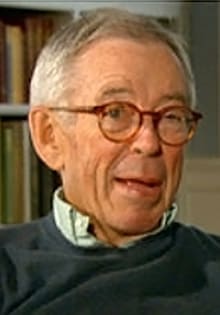
Dr. Michael Coe – An Outsider’s View of Book of Mormon Archaeology Ep. 268-270

Dr. Michael Coe is the Charles J. MacCurdy professor emeritus of Anthropology at Yale University and curator emeritus of the Division of Anthropology at the school’s Peabody Museum of Natural History. He is an expert on the Maya, who inhabited the same part of Mexico and Central American where Mormon scholars say the events of the Book of Mormon took place. In this interview, Coe discusses the challenges facing Mormon archaeologists attempting to prove the historical truth of their central scripture and his own views on Joseph Smith.

A few resources from the interview include:

A follow-up interview with Dr. Michael Coe has been released in April 2018.  You may find this interview here.
Episode Transcript

Full text · 25,200 words · 17 chaptersHost: John Dehlin · Guest: Michael Coe

This transcript is machine-generated and lightly edited for readability. The audio is authoritative. Please excuse occasional errors in names and spelling.

Introduction and Guest Background

Part 1 of 3 · Ep. 268

Michael Coe [00:00:00] 1, 2, 3.

John Dehlin [00:00:07] Mormon Stories Podcast is a production of the Open Stories Foundation. All donations to Mormon Stories are fully tax deductible and go directly towards keeping the podcast alive and towards building a community of support for Mormons like you. To support the podcast or to join the community, please become a monthly subscriber today@mormonstories.org. hello, and welcome to another edition of Mormon Stories Podcast. I'm your host, John Dehlin, and today I am very, very excited to have with us a very special guest. His name is Dr. Michael Coe, and the subject for today is sort of an outsider's view of Book of Mormon archaeology. Very fascinating. Let me give a quick introduction of Dr. Ko. He is the Charles J. McCurdy Professor Emeritus of Anthropology at at Yale University and Curator Emeritus of the Division of Anthropology at the school's Peabody Museum of Natural History. He is an expert on the Maya who inhabited the same part of Mexico and Central America where Mormon scholars say the events. Well, I should say where some Mormon scholars say the events of the Book of Mormon took place. In this interview, Coe discusses the challenges facing Mormon archaeologists attending, attempting to prove the historical truth of their central scripture and his own views of Joseph Smith. I'm now reading from the biography from a PBS documentary in which Dr. Coe was featured. But with that, I guess I'll just say, Dr. Ko, thank you so much for joining us on Mormon Stories today.

Michael Coe [00:01:44] I'm happy to be here.

John Dehlin [00:01:45] All right, so I guess I stumbled upon your interview with PBS just on Facebook. Someone had posted a link to it and I read it and I said, wow, this is a Yale anthropologist who cares about Mormonism. And I found that to be fascinating. And so I did a little more investigation of you and found out that you published an article on the Book of Mormon and archaeology as early as 1973, I believe you said. Is that right?

Michael Coe [00:02:16] That's correct, yeah.

John Dehlin [00:02:18] And so this is, you know, this is interesting because the Book of Mormon is in the year 2011, coming under a lot of scrutiny that I guess it's been under a lot of scrutiny for some time, but that scrutiny hasn't really penetrated the traditional, you know, orthodox conservative or, you know, kind of, I guess I should just not be repetitive. The traditional Mormon consciousness until, let's just say the past five years as DNA evidence and other things have really started people, Mormons thinking more clearly about what the Book of Mormon claims to be, what type of record and evidence it purports versus the evidence that science continually affords us. And so I thought it'd be fascinating to bring you on and talk all about your life and how it intersects with Mormonism and what you know about the Book of Mormon and Mayan archeology. How's that sound?

Michael Coe [00:03:17] That sounds good.

John Dehlin [00:03:18] Okay. And I should add that I served an LDS mission in Guatemala, and so I've spent a little bit.

Michael Coe [00:03:24] That's excellent.

John Dehlin [00:03:25] Yeah. So I've spent a little bit of time in the area that you're in which you're a specialist. So. So let's start in typical Mormon stories fashion, Dr. Ko, and please tell us a bit about your early years, your upbringing. If, if religion, and specifically reconciliation of religion with intellectual issues was a part of your formative years, I'm, you know, I'd be curious just to have you talk briefly about that and. And then we'll jump into how your training led you to be interested in Mormonism, in the Book of Mormon.

Dr. Coe's Personal and Academic Background

Michael Coe [00:04:01] Well, I was a. I was born in 1929 to a very devout Episcopalian, or rather Anglican family. My parents were strong churchgoers. My father had been to a church school, a boarding school in New England called St. Paul's and I was raised. I went to Sunday school when I was a little kid. Raised with the Bible, with Christianity, right from the very beginning. And St. Paul's was a church school. It really. The head of the school, the rector, was a reverend Episcopalian minister. That's not true now, but it was back then, a whole series of them. And you had very serious study of Christianity there. Not only did you go to chapel every day that you were there twice on Sunday, three hours on Good Friday minimum.

John Dehlin [00:05:09] Holy moly.

Michael Coe [00:05:11] But you had, literally, you had something called Sacred Studies, which was a course that you took. And all. We had forms rather than grades, and every form you had sacred Studies. And I must say, I rather enjoyed it all. It's fascinating. The Anglican Church has a marvelous tradition and it was fun reading the King James Bible, I suspect during my years there, I read the Bible twice, which is more than I can say than a lot of the whole Bible, the entire thing beginning to end. So, of course, with emphasis on the New Testament. And I was confirmed at the age of 13, Episcopalian church by the Bishop of New Hampshire, which is where that church was. We had a retreat. I was very religious, I think, up to this point.

John Dehlin [00:06:03] Were you a believer? Did you kind of believe in the story?

Michael Coe [00:06:05] Of course, Absolutely. And then I'll say one thing. The Episcopalian church and its Anglican background, they've got some of the best music in the world. It was an aesthetic, very satisfying experience as well as a religious one. So during in Sacred studies in my last year there, my sacred studies teacher in that particular class, who was a minister, tried to give us the reasons for the existence of God. 10 of them, 10 reasons. St. Thomas Aquinas came up with, yeah, how can you prove the existence of God? And suddenly it hit me. One of the reasons that was given by St Thomas was Thomas Aquinas was that this world exists, therefore it had to have a beginning and therefore a creator. I stuck my hand up and suddenly it hit me. I said, what if the world is eternal? That is, if there's eternal in the past and eternal in the future. And the guy was stumped. It's a stupid, silly child's question, but one that I thought was important. You know, maybe the world is eternal, there's no beginning and therefore probably no end. And he couldn't answer it. And suddenly things started to slip away from me. By this time I was already, I think, 16 or 17 my last year before I went to college, and I discovered an amazing book by a wonderful English anthropologist named Fraser called the Golden Bough, which is sort of a popular introduction to anthropology and all about it. And suddenly everything slipped away from me completely. I lost all my belief in religion, although I still kept a real interest in it.

John Dehlin [00:08:16] What about the book made you lose your belief in religion?

Michael Coe [00:08:20] Frazier went through the guy, had an encyclopedic knowledge, he's one of the founders of anthropology in the 19th century and went through and showed for instance, all the things we take for granted, like celebrating Christmas, things of that sort. And the sacrifice of a figure like Christ, for instance, is found in many, many other cultures through history. He was a classical scholar and could go back in the Greek and Roman classics, and he knew all about Africa, all about different places. It seems that he put it all in perspective, that this is a religion is a man made construction to answer certain important questions, not something that comes down from on high. And it's from then on. I suppose it got me started on trying to find out scientifically what religion really means to people. Why is it religion? And of course there are many, many answers, because religion is many, many things to many people. But any rate, I started to become a skeptic then, and I'm still a skeptic now. Absolutely. So that was my background in being interested in religion, of course, about Mormonism, I knew very, very little. An uncle of mine in Wyoming, where my grandfather had a nice place, told me to go, if you Want to read something interesting? We had an Encyclopedia Britannica there on the ranch. Now go look up Mormonism and you'll find it fascinating. And there was a wonderful article on Mormonism, early edition of the Encyclopaedia Britannica. And I really, I think, got my interest in Mormonism started back then as an amazing phenomenon in the history of religions and in the history of America. So I always was interested in this subject. When I went to Harvard as a graduate student, although I eventually had to leave because of the Korean War, I was taking a seminar there with some really hotshot graduate students who were way ahead of me in anthropology and walking back at night to the place where I lived with one of the students there who we got started to talk about Mormonism for some strange reason. Turned out he was a Romney and a Kimball Romney, descendant of presidents of the church and, you know, cousins of all the famous Romneys and a direct descendant of George Romney, the portrait painter, English portrait painter. And we started to talk about this, and he again was. His career as a Mormon had followed my career as an Episcopalian, the same kind of a thing. He discovered anthropology and was no longer, you know, let's say, a true believer. So we talked a lot about this. I learned things about the Mormons that I never, ever knew, such as garments. I'd never heard of garments. This was, to me, amazing. Just all these fascinating things. And I love to talk to him about this. He's an extremely distinguished anthropologist in this field now with the Smithsonian for years. But any rate, that also sparked my interest. And even before that, as an undergraduate, once I got into anthropology, I'd taken a great course on the anthropology of religions by one of my professors, Evan E V O N Vote Vogt, who was born and raised in Mormon country in the Southwest, but his family were not Mormons. But he had deep interest in Mormonism and he had a guest lecturer named, I think it's Thomas o', Day, who wrote a standard book on the Mormon religion. A Catholic anthropologist writing this. And he gave a. A lecture on Mormonism which just held me spellbound, such as, for instance, the whole concept of that, you know, that as God once was, man now is, as God now is, man may become. He went into that and it fascinated me, absolutely. I never became a Mormon, obviously, but I really got to, through him to respect this whole thing, not as a weird phenomenon of crazy polygamists, but as something really serious, worthy of study. Now, I never really deeply studied this, except when I was asked to write this article for Dialogue magazine back in 1973, Journal of Mormon Thought. And I did a lot of research at that point to write that article and found out things that I never knew about, you know, the background of Smith and Book of Mormon archaeology and all the rest of it. So I've always been. And then of course, later on, I really got to know a whole lot of Mormon archaeologists, so both in the field and at BYU and elsewhere. So, yes, I've always been sort of connected with this.

Training and Expertise in Mesoamerican Archaeology

John Dehlin [00:14:02] Okay. And just really quickly, I read your bio, but tell us how you're trained in ways that it relates to how you might know a thing or two about the scientific record versus kind of what the Book of Mormon might be claiming.

Michael Coe [00:14:20] Well, of course, anthropology has various sub fields in it, and one of which was archaeology the past, the study of the past. And that's what I was from the beginning, an archaeologist. And I had had the good luck in my sophomore year at Harvard to visit the Maya area just as a tourist. I went to Yucatan over Christmas holiday and to Chichen Itza, which is a famous site. It's quite a late site in central Yucatan and great, a beautiful, wonderful place. I came back, I was flabbergasted by it. So I discovered that to really get into this seriously, there wasn't any major in Maya archaeology. When I got back, I was in English Literature. Until then, I couldn't change to Maya archaeology. I found out that if I wanted to do this, I had to take anthropology. And that was my introduction to anthropology as a field. But right from the beginning, I was hooked on Mexican Central American archaeology and in particular the Maya. And that, of course, leads directly into Book of Mormon archaeology. It's the same area and I can talk something about this, the same time period involved, supposedly. So I've always had that connection. I got my. Finally. I took three years off during the war to do other things during the Korean War, which I can't tell too much about, and then got back to Harvard as a serious graduate student in what we call Mesoamerican archaeology. That's Mexico and Central America, the past. We call that whole area Mesoamerica, and I'll be using that term later on. It's basically the area of Mexico and Central America, countries like Guatemala, Honduras, Belize, etc. That had high civilization at the time of the Spanish conquest. So northern Mexico is not part of it, but the rest of it is in southern Mexico. So it's Mesoamerica that claimed me.

John Dehlin [00:16:49] Gotcha. Gotcha. So you're you're both, You're. You're an ant. Tell me if I got this right. You're an anthropologist, broadly, an archaeologist, sort of specifically. And you focus on Mesoamerica.

Michael Coe [00:17:01] Right on. That's it.

John Dehlin [00:17:03] Okay. And you, what were a professor at Yale for?

Michael Coe [00:17:07] I taught at the University of Tennessee for two years. Volunteers frantically writing my PhD thesis, which I got accepted by Harvard and eventually was invited up to Yale. And I spent about 35 years here at Yale.

John Dehlin [00:17:26] Okay, all right.

Michael Coe [00:17:28] I'm now retired. I was retired in 1995, but I still write books, still write about the Maya, and I have other interests too, that I've written about, but mainly race of America.

John Dehlin [00:17:41] Okay, gotcha. All right, well, good. So I guess let's jump right in to what your understanding is of what the Book of Mormon claims from an archaeological, geographical, historical perspective.

Migration Narratives in the Book of Mormon

Michael Coe [00:18:00] Well, the Book of Mormon, of course, like the Old Testament, has a migration or series of migration legends in it. And there were, you know, and it involves people crossing, you know, whole oceans, not just crossing the Red Sea, but crossing the Atlantic out of what today we would call the Middle east, the near east, the Holy Land, to what Smith claimed to be a land that he eventually the land Zarahemla, to be somewhere down towards Central America. So this is what it's about. Now, there were actually two big migrations in the Book of Mormon. There are. The first of which were the Jaredites. And these people came across, but they didn't really survive terribly long. The great migration was the Nephites, who were highly civilized people. They had the compass to navigate by, they had iron, they had cattle, they had horses, they had wheat, all the things that they had at that point in the Middle east, of course, and frankly, none of which, or almost none of which were ever found in Mesoamerica, but that didn't. Joseph Smith would not have known about that. But he went ahead and described this mighty civilization with people who built these huge temples and so forth. And then, of course, as you know, if you follow the Book of Mormon, that there were a kind of a heretical group sprang up of discontents, Malcontents called the Lamanites. And the Lamanites eventually won out and destroyed the Nephite civilizations and killed all the Nephites and basically took over. And according to Book of Mormon archaeologists and according to the faithful. Why? Who are the Lamanites? Well, they're still there. They're the American Indians. And as Smith or somebody said that if they play their cards right, these pathetic Lamanites, these Awful Lamanites. They'll become white once more. White and delightsome, I think, is the term. They'll become white men and white women and white children. So basically, that's my whole migration thing, and that's the whole business about Book of Mormon archaeology. To find Zarahemla, to find the plates of gold that were inscribed at the last trump, so to speak, that were shown miraculously through Joseph Smith that he supposedly translated as the Book of Mormon. That's the background of Book of Mormon archaeology. This kind of thing has been going on for a long time. Book of Mormon archaeology, especially at byu, although it's basically not practice now, but it was back then at the beginning, and I got to know the people involved with this.

John Dehlin [00:21:31] So let's actually, we'll talk a bit about the specifics of the discrepancies, and then we'll talk about your experiences with the archaeologists and what they were trying to do. Does that make sense?

Michael Coe [00:21:44] Yeah, that's fine.

What Archaeology Would We Expect to Find

John Dehlin [00:21:45] Okay, so according to what the Book of Mormon. And let's go into a little bit more detail about what the Book of Mormon would lead us to expect to find archaeologically, geographically, anthropologically. If the Book of Mormon historical record were accurate, what would we have expected to find? And let me just maybe give a little bit of a disclaimer. You know, I think Hugh Nibley, at some point. I'm sure you're familiar with Hugh Nibley.

Michael Coe [00:22:19] I never met him, but I certainly know the name Hugh Nibley. All right, Right.

John Dehlin [00:22:24] So one of the defenses that I think he would have made at some point is that with jungles and with weather and with temperature, you know, lots of things can be destroyed and eroded. Bones, you know, books, records, weapons, you know, who knows what can be rusted and deteriorated over time? You know, when you're talking about a thousand, 2000 years, maybe even, you know, 2400 years. And so, you know, let's just assume at the beginning that we're going to account for reasonably, sort of plausibly deniable, apologetic responses that are reasonable. Given that, what would we expect from the Book of Mormon text to find if the Book of Mormon text were his in historical document?

Michael Coe [00:23:19] Well, Hugh Nibley is wrong about the idea that this stuff, all of it, has disappeared forever. Take iron, for instance. Nobody ever used iron in the New World per se.

John Dehlin [00:23:36] Does the Book of Mormon claim iron, or does it claim steel? I know it claims steel.

Michael Coe [00:23:40] Well, okay, call it steel. Iron is a principal component of steel,

John Dehlin [00:23:46] and I think there are steel swords mentioned in the Book of Mormon or shields or helmets or whatever.

Michael Coe [00:23:51] That's correct. You would expect with all this mayhem taking place, let's say with the Nephites fighting the Lamanites, you'd expect to find that stuff. Archaeology relies on a host now of physical and chemical methods of detection that we didn't even know about. A lot of this stuff, say 50 years ago when I first got into archaeology, that are now available now. And these things don't disappear forever, they leave traces. If you had iron or steel, you would expect to find these things. Even if they were all rusted, you'd still find them. You'd find the chemical remains. They've never been found ever. Take wheat. Now, wheat may claim that the Book of Mormon archaeologists claim, well, the wheat's going to disappear. It's organic and so forth. Well, if wheat were grown, it would have to pollinate, like all grasses. It's a grass. It would have windblown pollen. Hundreds of tests have been made in lakes and other places in Mesoamerica, coring going down through the sediments. Nobody has ever found, prior to the arrival of the Spaniards, any indication that wheat was grown. The pollen is distinct in all of these plants. Maize pollen, for instance, shows up naturally all through the thing. There's no. Maize, by the way, isn't really mentioned in the book of Mormon.

John Dehlin [00:25:42] Dr. Koh, just going back to metal for a second. I seem to recall that the Book of Mormon mentions brass, iron, copper, gold, silver coins and steel swords. So does any of that.

Michael Coe [00:26:00] Let's do the coins.

John Dehlin [00:26:02] Okay.

Michael Coe [00:26:02] Nobody has ever found pre Columbian coinage ever, okay. Anywhere in the New World, Mesoamerica or Peru or, you know, Wisconsin, any place, okay. It's never been found in pre Spanish times. Coinage. Coinage was brought by the Spaniards, first of the New World, okay? So there's one that you can discount right away as proof for the correctness.

John Dehlin [00:26:31] And you think those things could survive in the dirt, you know?

Michael Coe [00:26:34] Oh, they certainly would. They certainly would. Coinage is, you know, this is the whole idea behind coinage is that it's common, that commerce is conducted with it. You certainly would have had. The only real coinage in quotes that they ever had in Mesoamerica was cacao. Chocolate beans, which did serve as small change, had value. The chocolate beans, dried chocolate beans. That's exactly. If there were coins, there'd be chocolate beans. Why aren't chocolate beans mentioned in the Book of Mormon?

John Dehlin [00:27:11] Oh, so I've never thought about that. What isn't mentioned in the Book of Mormon? Like corn.

Michael Coe [00:27:17] Now, copper alloys, like brass. Copper. In any form doesn't show up in Mesoamerica, although it's very ancient in its use in the Andes in the Peruvian area, doesn't show up in Mesoamerica until at the earliest 800 AD period. The same way in Mesoamerica that gold doesn't show up in any way until seven or 800 adults, period. There's none. Although these things existed in the Andes, it isn't until people brought them up, probably by sea trade early on, that you'd ever find anything like that.

John Dehlin [00:27:58] And the Book of Mormon record ends somewhere when like 3 or 400.

Michael Coe [00:28:03] Well, yeah. The whole idea of Book of Mormon chronology is, I think this has all been worked out by Book of Mormon archaeologists, that the Jaredites are the first and they go back, what, something like 4 or 500 BC that would put them scientifically, if they existed as Olmecs. Now, that's one of my specialties, is the Olmec civilization of Mexico. I've excavated a very, very big and the oldest Olmec site. And I can assure you that everything we found there is Native American everything.

John Dehlin [00:28:50] Meaning what?

Michael Coe [00:28:50] Meaning it's not meaning it's got a tradition of these people are eating maize, they're growing maize, they're using chocolate. We just found that out, that they were drinking chocolate there. All sorts of things that are typically American, nothing to do with the Middle east at all. These are amazing people who could make absolutely huge monuments of basalt, of volcanic rock, carve them as colossal heads. They're amazing in their own right. There are many questions still about the Olmec to be answered, but we know that they're very ancient. They go back to the Olmecs, were there from probably about 15, 1400 BC until about 400 BC. So let's say they're pre Lamanite and it's already an advanced civilization. And you can check with one famous Mormon archaeologist about this, my friend John Clark. Those are the dates, because he's had a lot to do with this old business. They don't check in with the Book of Mormon. With Jaredites bringing civilization over from the Middle east, there's nothing in the slightest bit Middle east about the Olmec. Not at all. So you've got crops mentioned in the Book of Mormon that never existed in pre Columbian America.

John Dehlin [00:30:18] And that's barley and wheat.

Michael Coe [00:30:21] Exactly. Never has there been any. All of these things would have produced pollen if they'd been grown by anybody. And a lot of this stuff is windblown. It would fall onto ponds and lakes and get Enclosed in sediments and tremendous amounts of pollen work has been done in this area in Mesoamerica. Very interesting because it shows climate differences and the arrival of maize, corn cultivation and things like that.

Plants, Crops, and Pollen Evidence

John Dehlin [00:30:50] So you're finding ancient pollen, you're not finding ancient barley or wheat pollen.

Michael Coe [00:30:55] This kind of work for, you know, 50, 75 years drilling down into lake beds. And yes, we find ancient pollen and there's none of this stuff that's in the Book of Mormon does not exist, period.

Warfare, Weapons, Silk, and Chariots

John Dehlin [00:31:08] Okay, what about things like silk, chariots, swords?

Michael Coe [00:31:15] Okay, silk, nothing. Now that silk, of course, is highly organic, but there was never any production of silk in the New World prior. Well, probably the colonial Spaniards brought it across eventually. You know, silk was invented in Asia Far east, not in the Near East. And there's no silk whatsoever. No idea of silk cultivation. No conquistador mentioned silkworms eating mulberry leaves or anything like that which you need for the production of silk. So silk wasn't there. What else do we have now besides

John Dehlin [00:31:57] that seven day calendar?

Michael Coe [00:32:00] Seven day calendar was unknown in Mesoamerica. Our seven day calendar was totally unknown. They had a completely different calendar that operated on different principles. They had a. They had a 260 day calendar that saw the permutation of the number of 13 numbers with 20 day names. And these produce to see, 13 and 20 have no common denominator. They produce a 260 day calendar. Every 13 days the same number will repeat again. That would make a week, but it would be a 13 day week. Or the 20 day cycle would produce a 20 day week. Seven day. Totally unknown. None of the names associated with the seven days, which are all planets, the sun and the moon and so forth with us, that was unknown in Mesoamerica.

John Dehlin [00:33:00] Okay, no evidence of that. What about like war stuff like chariots and helmets and swords and shields and stuff like that?

Michael Coe [00:33:06] Right? Well, they had helmets all right, but they weren't made out of brass, that's for sure. And they used them in the ball game and probably in something that resembled jousting, where they fought each other with special stones that they held in their hands and tried to smash each other's heads. This game is still being played in west Mexico, incidentally. Highly dangerous. These guys were sort of like gladiators. They probably wore padded wooden helmets, probably with leather over them. For this. We have actual, in Oaxaca and even in the Maya area, some scenes that show this. Chariots. They never had chariots, that is for sure.

John Dehlin [00:33:51] What about wheels?

Michael Coe [00:33:53] Well, they had the wheel, but because they hardly Ever used it. There are wheel toys known in classic times, that is, you know, probably from about 4 or 500 AD on, in Veracruz on the Gulf coast of Mexico. There are wheeled clay toys and they probably had a very simple potter's wheel, which was still in use in Yucatan through the conquest period. But for transportation, they had the backs of people. All records that we have show that enormous amounts of goods passed or people passed on foot and stuff was carried on people's backs with a tump line that went around the forehead and connected to these big packs. And it was highly efficient. By the time the Spaniards got there, all the battles were fought on foot by native troops against the Spaniards. There were no chariots there whatsoever. And there never been any remains of chariots. Never any remains of the wheels of chariots. You'd expect to find these things eventually. There are places where preservation does happen. Nothing after 100 years of archeology. Zero.

Animals Mentioned in the Book of Mormon

John Dehlin [00:35:20] Okay, let's do animals. So the Book of Mormon mentions horses, cattle, oxen, donkeys, goats, sheep, swine and elephants.

Michael Coe [00:35:30] Okay, let's.

John Dehlin [00:35:31] Oh, and kurilums and kumamums.

Michael Coe [00:35:34] Let's get the horses out of the way first. There were. The horse was not domesticated. The horse evolved in the New World. The whole evolution of the horse took place in the Americas and during the. The height of the Ice Age, I guess.

John Dehlin [00:35:53] Oh, so you mean like tens of

Michael Coe [00:35:54] thousands or tens of thousands of years? Hundreds of thousands of years ago. And the horse crossed over into the Old World across the Bering Straits during a period when the ice. There was a lot of ice and the water level dropped and revealed dry land as a land bridge into Asia. This is something Book of Mormon archaeologists don't really like to talk about. But yes, this was a huge way of animals crossing back and forth between the Old and New World. So when the first American Indian ancestors arrived, probably, certainly by 15,000 years ago, probably as long as 20,000 years ago. There are plenty of horses in the New World. But very shortly, in the space of, let's say, five or 10,000 years, they had wiped them all out, every single one. The horse was extinct. Probably by 7,000 B.C. the horses were gone along with the other many of the other large animals. There was human overkill. They came in, it was happy hunting grounds. And horses were food in those days, as they had been to our European ancestors back in the Paleolithic. So they wiped them out very quickly. The horses disappear from the new world. By 7,000 BC there's no evidence for horses whatsoever in any archaeological Site ever until the Spaniards arrived with horses. And of course, the horses. Their horses became feral. A lot of them ran out onto the Great Plains. And the Great Plains Indians got them, became the greatest cavalry men who ever lived. We think of Indians and horses together, but that's late.

John Dehlin [00:37:42] So it would have made sense for Joseph Smith to associate horses with Indians because.

Michael Coe [00:37:47] Yeah, right. He sees them incredible people like the Comanche and the Sioux and Cheyenne and people like that. Unbelievable, ferocious horsemen. I mean, like the horse and the animal was one thing. They were the greatest horsemen who ever lived. But that probably would have influenced him a lot. He had to have horses. But of course, you've got horses in the Old World, in the Bible, in the Holy Land.

John Dehlin [00:38:14] And he might have even associated the crops that we talked about and coins with Indians because maybe what the Spaniards would have brought them over.

Michael Coe [00:38:22] It took a long time. Coinage. Probably wouldn't have been among the Indians for a long time, actually. But they eventually got it, particularly down in the Southwest in the Pueblos after the Spaniards took them over. Spaniards were eventually kicked out down there in 1691, I think it was. But they had already introduced the horse wheat, certainly to the Pueblos. The Pueblos were growing wheat eventually, but only introduced by the Spaniards there. Okay, so that. So the horses. There's no question about the horse. That's late. That comes in with the Spaniards.

John Dehlin [00:39:02] Okay, what about the others?

Michael Coe [00:39:05] So let's remind me. Cattle.

John Dehlin [00:39:07] Cattle, oxen, donkeys, goats.

Michael Coe [00:39:09] Okay. Cattle and oxen are the same thing. They're all genus, both Taurus in the Latin name. Definitely Old World def. No evidence whatsoever for any kind of cattle of any sort, whether oxen or what have you. In the New World prior to the time of the Spaniards, Spaniards brought those in donkeys. The same thing again. No wild asses or donkeys have ever been found in the New World. They were evolved in the Old World and came in with the Spaniards. Or if they had existed before they were reintroduced by the Spaniards, Absolutely no bones of these creatures ever showed up. Peg zero. Not one pig bone has ever shown up in pre Columbian excavations. And I can tell you that huge amounts of excavations all through the New World have been made over the last hundred years.

John Dehlin [00:40:10] And they do find animals. Do they find ancient animals?

Michael Coe [00:40:12] Lots of animals.

John Dehlin [00:40:12] Okay. What do they find?

Michael Coe [00:40:15] You find wild animals. Deer, for instance. Dog. Dogs were in the New World and were eaten by almost all the American Indian groups. I've dug up Olmec kitchen mittens. You know, they're old Olmec garbage down in Mexico. Just full of dog bones and whatnot.

John Dehlin [00:40:39] So animal bones can survive 2,300 years?

Michael Coe [00:40:42] Oh, no question about it. They're highly impervious to disease. Disappearing turkeys, Lots of turkey bones, eventually, especially in classic times. Once you get into the classic civilizations, like the Maya, one Muscovy duck, which is the New World duck, definitely show up. And then many, many wild animals. Deer, tapir, South America. How about tapirs, relatives of the camel. How about what?

John Dehlin [00:41:10] Tapirs.

Michael Coe [00:41:12] Tapirs, yeah, but tapirs, they were formidable animals and they generally used tapirs for their hide, which was. They could make armor out of it, so heavy and thick. But yes, tapir bones do show up in these things. All of us who do these excavations have saved all the animal bones. They've all been carefully identified by competent zoologists who have comparative collections. And there's no question, none of those things mentioned by Smith in the Book of Mormon are in pre Columbian or pre Spanish archaeological sites from 10,000 B.C. i mean, on. There's absolutely nothing.

John Dehlin [00:41:58] And let's do elephants real quick.

Michael Coe [00:42:00] Elephants. There's nothing. Absolutely zero.

John Dehlin [00:42:04] You're not giving us much to go on here, Dr. Koh.

Michael Coe [00:42:06] No, I'm sorry, this is zero. I would, you know, back in Smith's day, let's say 1835 or 30s or back in those days, 20s and 30s, these things just weren't known. Nobody had ever dug an archaeological site except to loot it for gold or something like that. Nobody knew any of this stuff. We have enormous amounts of information now about all of this. Just vast, vast quantities. So basically, if you're looking for Old World connections and looking at the near east, you're looking in the wrong place. That's another topic, because I'm not saying that there was never any contact between the Old World and the New World in pre Columbian times, because I'm sure there was. But none of it looks like it comes out of the Middle east in the form of Jaredites, Nephites or Lamanites or what have you.

John Dehlin [00:43:08] Yeah, so, you know, so that's an interesting point. I think I recall, and for my listeners, a lot of this information I'm getting from my questions comes from a website called MormonThink.com it's an excellent website which lists a lot of the stuff, but it mentions something about some type of painting or drawing on a cup or some type of material that has an elephant, an Indian elephant, roaming a city that might be dated to kind of the 600 to 900 AD time period.

Michael Coe [00:43:40] Well, that 600 to 900 AD would be Lake Classic Maya. There's a lot of painted pottery. I mean, we now know not only from excavations, but principally in museums and private collections, we've got a record of over 6,000 Maya vases. There's a website devoted to them, a wonderful website. My friend, the photographer and archaeologist Justin Kerr has rolled these things out photographically available to everybody. So we know what they cover. And I have never seen on any of this stuff convincing elephants. There used to be a British anatomist, Sir Elliot Grafton Smith, back in the Beginning of the 20th century in England, who wrote a book called Elephants and Ethnologists, in which he claimed that some of the monuments, the stone stele, the standing dated stone monuments at the site of Copan in the western part of Honduras in Central America, that what's shown on the top of one of those are elephants with the mahout, the guy running the elephant, Indian style, on top, sitting on top of his back of his ear. Well, we now know that those things are not elephants. They're rather baroque macaws, which is a very large parrot with a huge beak. And in fact, the hieroglyphs that go with it tell us that we can now retell us that those are in fact macaws up there. They're not elephants.

John Dehlin [00:45:25] They kind of look like them. Right.

Michael Coe [00:45:26] There were elephants in the New World back in the Pleistocene, in the Ice Age, definitely. There are wonderful elephant kill sites that the Clovis people, the people who made these beautiful fluted points at about 10,000 BC that they slaughtered these animals, but they killed them all. All the elephants were killed off by the end of the Ice Age. They're all gone. There's none.

John Dehlin [00:45:55] Do we have digs from before the Ice Age for humans that we've found or anything?

Michael Coe [00:46:03] No, I mean, when you get back beyond the Ice Age, you're back beyond the Pleistocene, you're in the Tertiary Period, the Pliocene, and there were no humans in the New World at that point. They arrive at the end of the Pleistocene or the Ice Age, across from Asia, from northeastern Asia. All of us who are scientific archaeologists think that the evidence is conclusive. That was never a barrier at any point. To tell you the truth. It's a highway into the New World. And we now know that they came, that they had boats. Boats are very, very ancient in the world, much more ancient than we ever thought. And then the reasons for thinking this, and people would have had boats, would have come down the Pacific coast all the way to the Pacific coast of South America in boats, establishing Colonies on the way. And by shortly after their arrival when they were saw these amazing, this megafauna, they like to call it, the huge animals roaming the landscape, including elephants, they would have, they wiped them out. It was overkill. There are also, people claim there are environmental reasons for this climate change and whatnot that probably entered into it. But the main reason most of us think was humans slaughtered them. Overkill just wiped them out. And you don't have any elephants until God knows when. Who brought the first elephant over after the Spanish conquest? I mean P.T. barnaby, right? Somebody. Somebody brought it across to establish zoos.

Language and Culture in Ancient America

John Dehlin [00:47:52] All right, all right, so let's turn a little bit now to language and culture. What language do we think that, that, you know, people in Jerusalem, you know, Laman or Lemuel or Nephi or Lehi. What language do we think they would have spoken in 600 B.C. coming out of Jerusalem?

Michael Coe [00:48:13] Well, they would have spoken a Semitic language. I mean they would have spoken, you know, the illiterate of them probably knew Babylonian, Old Babylonian. Some of them probably would have, you know, been literate and Assyrian. I don't know how far back Aramaic goes. But that was the language of Jesus at the time when he lived. Jesus almost certainly spoke Aramaic. That was the kind of everyday language that people spoke at that point. But all of these languages there that they would have spoken, except possibly some people who knew Old Persian, which is an Indo European language, they would have spoken Semitic languages.

John Dehlin [00:48:58] And what about people who would have been descendants of the twelve tribes of Israel and Abraham and all that? You know,

Michael Coe [00:49:06] they would have spoken one of the other Semitic language, Hebrew. Hebrew was becoming a literate language rather than a spoken language at that point. But the literate among them would have certainly have spoken Hebrew as a scholarly language and sacred language. But the everyday language was Aramaic. So you want to know, is there any evidence for these languages in the pre Spanish New World?

John Dehlin [00:49:39] What would a linguist tell you is realistic? Because languages I guess can die all the time and they can get subsumed and combined. And so I guess apologists now are okay, so here's. I'm going to go back for our listeners and just restate kind of my understanding of what the deal is. It seems to me like the Book of Mormon pretty early claimed to be a historical record of the ancient American inhabitants. And whoever wrote the titles, the title of the Book of Mormon clearly tied Native Americans to the Book of Mormon. And then Joseph Smith himself would walk around and see a, a pile of bones and say that was the famous Nephite warrior Zelf or whatever, he would see a city and say this was the ancient city of blah, blah, blah. So it's pretty clear that Joseph Smith tied Native Americans to the Book of Mormon. Now what apologists are saying now is that even though Joseph Smith may have got it wrong, there's nothing in the Book of Mormon that precludes the possibility of other peoples living in ancient America prior to the arrival of the Jaredites or prior to the arrival of Nephi and Laman and Lemuel and Lehi. And so it's very possible that they lived in these small little colonies or cities, but that they also had interactions with existing civilizations such that it's very easy for not only their language and not only their culture, but also their DNA to ultimately be subsumed or enveloped and eventually erased by these other larger existing cultures. Now, if you believe that latter theory, then you have to say that Joseph Smith didn't understand the Book of Mormon or didn't get it right, that he made a lot of errors. And you also have to assume that pretty much all the church leaders from then to now who would travel to Latin America and call descendants of, you know, call Native Americans and the descendants of Native Americans who would call them Lamanites. And they do. I mean, in Guatemala, the Guatemalan members of the church there would call themselves Lamanites. And they would do that because Spencer B. Kimball, one of our former prophets and others would go down there and call them Lamanites too. And so there's this a bit of a pickle where there's going to be a problem either way. Either Joseph and all the prophets from Joseph to now, or most of them pretty much all got it wrong calling people Lamanites who they shouldn't have called Lamanites, or we should have to think about what's realistic to expect for a potentially existing culture to then envelop and subsume another one. So talk about that if you can.

Michael Coe [00:52:43] Well, let's talk about the evidence for language in, let's say, the Maya area. You know, when Joseph Smith read the great two volume work that came out by John Lloyd Stevens and with his artist Frederick Catherwood, travels in Central America, Yucatan, etc.

John Dehlin [00:53:13] How do we know Joseph would have read this book?

Michael Coe [00:53:15] He did read it because it was one of the most popular travel books ever published in the United States or anywhere else. It was a wild hit, huge edition, everybody had copies of it. And I have read, I hope it's true that when Smith read this, which was the first really Solid account of the Maya ruins by a marvelous writer and a wonderful artist. That was accurate. He said, that's it. Those are the Nephite cities. If the Nephite cities, you take the Nephite cities were Maya, therefore Classic Maya, because the civilization, pretty much Classic civilization disintegrated by 900 A.D. you would have to say, what language did they speak? Were these people. They would be one of those enclaves that you're talking about and these highly civilized people. And every time you look at, say, the illustrations in the popular edition of the Book of Mormon, you see that's a Mayan because there are Maya temples, Maya pyramids, and people dressed as Maya. So let's say they're Classic Maya. What language did the Classic Maya speak? Now, it used to be that you could play around with that, you know, and say, well, we can't really read the hieroglyphs except for the, you know, the dates and the calendrical stuff and whatnot. That's not true. Now, we can read almost everything. We can read 95% of what follows the dates on these inscribed monuments. We can read 95% of what the Maya themselves wrote. And what language is this in? It's in Maya. Not only Maya, there are 29 extant Maya languages which are all closely related to each other, but all somewhat mutually unintelligible. It's like we speak English, but our languages related to German, to Dutch, to the Scandinavian languages, you know, mutually unintelligible when we speak them. But they were all one at one point. They're now 29 Maya languages. Which particular of those languages is being reflected in the hieroglyphs? Now, since because of the great decipherment which has taken place in the last 20 or 25 years, we can read those, and they are all in one particular ancestral Maya language which we call Choltan. Now, the guy, one of the two main people who discovered, I think, conclusively what this language is, happens to be a professor at Brigham Young University, John Robertson, a good friend of mine, fantastically good linguist. All of the inscriptions now, we know from all through Guatemala, all the way up to the northernmost part of Yucatan, Belize, Honduras, and so forth, southeastern Mexico. They're all in this literary language, which was a special language, and that the only language that's close to it now among these Maya languages is Chorti, which is spoken by a small group of people on the border between Guatemala and Honduras. If you drive from Guatemala City to the ruins of Copan, you go right through chorti country. This is a language that was spoken by their ancestors that became the literary language. Now, like Hebrew is the literary language of the Bible, of the ancient Bible, like Sanskrit is the language of the Hindu religion, like Latin is the language of the Roman Church, the Catholic Church, or what used to be the Western church. A prestige language that was understood by everybody, and it was a literary language. It's in Maya, it's not in Aramaic, it's not Semitic. There are no Semitic words whatsoever in it. It's got no relation whatsoever with any languages that we know of in the Old World. It's strictly Mesoamerican. And right from the beginning, they were starting to write about 400 B.C. we've got some evidence for that, right until the Spanish priests wiped it out and burned all their books. That's how. I mean, that's what the language is. And there's nothing Old World about it.

John Dehlin [00:57:48] No characters, no references.

Michael Coe [00:57:51] We can read all these hieroglyphs.

John Dehlin [00:57:53] What do they say? What do they talk about?

Michael Coe [00:57:56] Now, the monuments, of course, are public monuments. Most of their books, except for four extant ones, are missing. The monuments mainly talk about the dynasties. They're all about the people who ran these city states. They were all city states. The royal marriages, birth marriages, conquests, royal deaths, rituals that they performed at important times that has to do with their conquests.

John Dehlin [00:58:33] And is it stuff happening? Do we have writings between 600 BC and 300, 400 AD?

Michael Coe [00:58:41] Oh, yes, we certainly do.

John Dehlin [00:58:45] Do they talk about a King Benjamin or do they talk about an Alma and a range of sages?

Michael Coe [00:58:50] We start with, you know, back, let's say, Go BC There are some writings. We know they were already starting to write that they're very hard to interpret, but there's nothing in them other than a Mesoamerican explanation for them. There are no King Benjamins or anybody like that. The Olmec, for instance, who Book of Mormon archaeologists say were Jaredites. We had no writing whatsoever for the Olmec. None. Zero. Which is peculiar if these people came from the Middle east, where writing goes back to at least what, 2800 BC or earlier. We have nothing from them except that not so long ago a tablet was found. I call it that because that's what it looks like. And it's inscribed with hieroglyphs that are all Olmec, but we can't read them. We call that the Kaskahan block. I published it along with a whole bunch of other people who are interested in this whole thing. And it's probably about 9 or 800 B.C. the date of it. But this is the only Olmec writing we have, and we can't read this, unfortunately, there's not enough to crack. We have about beginning about 200 A.D. we start getting extensive Maya inscriptions. And they're in Maya, and they can be read in Maya.

John Dehlin [01:00:23] And do they mention a Mormon or a Moroni?

Michael Coe [01:00:26] They don't mention any of these wonderful people out of the Book of Mormon. Nothing. Zero. They're all. They're all Maya. Every single one of them.

John Dehlin [01:00:37] Okay. All right.

Michael Coe [01:00:40] So the language of these people who Smith was talking about was Maya.

John Dehlin [01:00:51] Thank you for joining us today on Mormon Stories. Music today was provided by the Saber Rattlers. Check them out@sabre-rattlers.com the Mormon Stories logo was generously donated by StudioCase.com thanks for listening.

Guest [01:01:06] Come, come, come, ye saints. No toil nor labor fear but with joy wend your way though hard to you this journey may appear Grace shall be as your dead Tis better far for us to strive Our useless cares from us to drive to the San Jo. Hearts will swell oh, all is well all is well. Why should we mourn? I think our lot is hard till not so all is right why should we think to earn a great reward if we now, now sh the fight Gird up your lo Fresh courage Take our God will ever us for sake soon we'll have tal Tal

Michael Coe [01:02:52] well.

Guest [01:02:54] All is well oh, all is well all is well.

Michael Coe [01:03:18] Sam.

Guest [01:04:00] And should we die before our journey is through Happy days All is well we that are free from toil and sorrow too with the just we shall dwell but if our lives are spared again to see the saints the rest obtain. I will make this chorus well. Oh, all is well all is well all is well all is well all is well well oh, is well.

Michael Coe [01:05:28] Sam.

Part Two: Polynesian Contact and the New World

Part 2 of 3 · Ep. 269

Michael Coe [00:00:00] 1, 2, 3.

John Dehlin [00:00:07] Mormon Stories podcast is a production of the Open Stories Foundation. All donations to Mormon Stories are fully tax deductible and go directly towards keeping the podcast alive and towards building a community of support for Mormons like you. To support the podcast or to join the community, please become a monthly subscriber today@mormonstories.org okay, and so when I was on a mission in Guatemala, we showed a little film strip. And the little film strip was, I think it was called Ancient America Speaks. I'm not sure, but I think, have you seen this film strip?

Michael Coe [00:00:44] Ancient America's what?

John Dehlin [00:00:45] Ancient America Speaks, I think it was called, but I'm not sure. But here's the basic premise. It was that, you know, Jesus lived in the old world and he visited people there. But he also said in the Bible, other sheep I have that are not of this fold, them too shall hear my word. And then it said, did you know that Jesus, after he died, came and visited the Americas? And he came to America, There's a big earthquake, came to America, sat down, called twelve apostles, formed a church. And this is what the Book of Mormon claims. And the people prior to Jesus were already believing that Jesus was going to come. They were baptizing in his name. They were setting up temples or doing rituals that were kind of Jewish or pre or Christian rituals. But that Jesus came, called 12 apostles, started his church. And there's evidence of that in the new world because, you know, there's this legend of a great white God, maybe his name was Quetzalcoatl, who came and visited. There was a light, you know, there are hieroglyphs about a light skinned people and a dark skinned people. And you know, there are excavations of temples that had baptismal fonts, which is likely where people performed these Christian baptisms. And you know, there's even hieroglyphs about the Tree of Life, about a big tree that very much maps what Lehi, Lehi's dream and what he would have told in the Book of Mormon. So this is a film strip that I showed, you know, probably a thousand people on my mission, basically saying that New World, you know, this is published by the church, this was given to missionaries to teach people. And, and, and it basically said, hey, you people in Latin America, did you know that you are the descendants of these Lamanite people, that the light skinned people were killed off and the dark skinned people lived and they're the pure blood of Israel? And you're awesome because you are these people and you're the chosen blood. You Know, that was kind of what I remember. Could have some of the details wrong.

Michael Coe [00:03:09] That's a big order here.

Michael Coe [00:03:12] You know, I first came into contact with this when I took. When I first got married. I took Sophie, my wife. I said, you've got to. This is Christmas vacation. Let's go down to Yucatan and whatnot. You've never seen Maya sites. I mean, you know, she married to a Maya archaeologist. She was an anthropologist, but a social anthropologist. I said, let's go on down and see some of the main Maya sites in Yucatan and get down to Palenque and Chiapas in southeastern Mexico and I'll take you through these. So we did, and we spent two or three weeks down there. We saw everything. I mean, went back to Chichen Itza and places like that, got to Palenque and when we were sitting in an outdoor restaurant cafeteria in Veri, the capital of Yucatan, saw this obvious American with a young guy who seemed to be his assistant there, a Mayak kid, teenager there. And he was listening to us talking. He came across and he said, are you folks Americans?

Michael Coe [00:04:15] Yeah, we are and whatnot.

Michael Coe [00:04:18] And he says, well, why are you down here? I said, well, I'm really an archaeologist and I'm looking to get my PhD in archaeology. He said, well, I'll tell you something. He said, did you know that Jesus came, had a second coming to this part of the world? I said, well, I said, I've heard that some people believe this. And he said, yes, to Palenque down in southeast Chavez and actually preached from the Temple of the Cross at Palenque. Well, we were headed to Palenque. I'd never been there. And then he gave me his card and it had a name on it and it said Council of the twelve Apostles. But not from Salt Lake City, from Independence, Missouri. He was a reorganite. And this is the first time I'd ever heard of the reorganites. Very nice guy. So I heard about that a long, long time ago, over 50 years ago. Let's just talk about Palenque. The Temple of the Cross at Palenque. There are three temples together in one part of this great, beautiful, well understood site of Palenque. We get huge amounts of inscriptions that we can read everything on them. Now, the Temple of the Cross. There is something that looks like a cross. A great slab in the back. It's all got a huge bas relief on it with two individuals facing each other on either side of this thing. And there's a bird on the top sitting there. We now know that this is basically a world direction tree. It's a stylized tree, that it's sprouting vegetation and whatnot on all sides, that the two individuals are not Jesus down below or somebody else and a disciple, but rather that this is a great Maya king whose name we know. And his name is Kanvalam, which means snake, jaguar. And he's shown as a kid and as a mature individual who's taken office. It's two parts. It's really his life story and that Kambalan built. All of these other temples around it are his work. There's no mention of Jesus or apostles or anything that's Christian or Hebrew in that inscription. It's a very long one. And as I say, we can now read it in its totality. There's no mystery about it whatsoever. It's got to do with a Maya creation, with a Maya idea of this particular dynasty at Palenque, about their divine origins, how they descended from the gods and so forth. It's got nothing whatsoever to do with the Bible or with Jesus. So that one which is often used is simply invalid. I think that's the other things that were in your film strip. Again, when you really analyze them, they all turn out to be things that are either misunderstood or else they're Native American, period, that have nothing to do with the Middle East. I'd like to say one thing now is that about this whole idea of contact between the Old World and the New World. I'm not entirely against the idea of oceanic contacts. In fact, there's beginning to be evidence for it. The leading scholar of this kind of stuff is a Mormon, a friend of mine, John Sorensen at byu, who's written extensively on this whole thing. Very interesting stuff. I mean, he's a real scholar. I think that he's again, often looking in the wrong direction, but I think there's pretty good evidence for contact between East Asia and Southeast Asia. Not the Middle east at all, but totally in another direction, across the Pacific. Recently, not so long ago, very recently, within this past year, they have done analysis of bones found on the coast of Chile, Northern Chile, and what was the Inca Empire within the Inca Empire, but right on the coast of a culture, of a community that could be dated about 1100, 1200, 1300 AD, hundreds of years before the Spaniards got there. There are chicken bones in this. We've got the radiocarbon dates now on it. They have analyzed the DNA in the chicken bones and they turn out not to be Middle Eastern chickens at all. I'm sorry, but Rather Polynesian chickens. The Polynesians, who are an Old World people, they moved out into the Pacific, had been in contact with the New World, I think, for a very long period of time. Wonderful, wonderful. Certainly from, say, 1200 A.D. on, they had the means to get to America and go back. They brought the sweet potato, which is a totally American plant, back across the Pacific to the Old World long before the Spaniards got to the New World with the name, the native name of the sweet potato.

John Dehlin [00:09:52] Man, I would like to meet those Polynesians who made that boat trip.

Michael Coe [00:09:55] Those people were really good. I mean, listen, they reached Easter island, which is the farthest point of anything from anywhere else on Earth. I mean, it's the most distant place on Earth. They got there, you know, and these are the people who set up all the big heads on Easter Island. The Polynesians and the Micronesians also were the most incredible navigators. Really incredible.

Michael Coe [00:10:19] Wow.

John Dehlin [00:10:20] Okay.

Michael Coe [00:10:21] So all of, as I say, I'm not against this kind of study and John Sorensen has really come up with some interesting stuff, but to me, it all points to the eastern part of the Old World of Eastern Eurasia, I.e. china and Southeast Asia in particular.

John Dehlin [00:10:39] Gotcha, gotcha. And just this idea of, is there any evidence that a Christ figure came that, you know, the light skinned, dark skinned, that any of the narrative in the Book of Mormon, the reign of Judges, just, you know, all that stuff. Any evidence of that? Christian teachings, Christian remnants in, you know, Mesoamerican religious ritual?

Mesoamerican Religion and Jesus Narratives

Michael Coe [00:11:05] Well, let's say that Mesoamerican religious rituals

Michael Coe [00:11:10] and religious beliefs and whatnot were really complex, highly complex. When the Spaniards came, the Catholic priests came, the first friars arrived, they were kind of amazed to see that they

Michael Coe [00:11:28] had confession to the gods. They had a mother goddess. They had, which is not, again, something

Michael Coe [00:11:38] out of Jewish ideas at all. They had all sorts of things which made it easy for them, they thought,

Michael Coe [00:11:47] to convert these people to get them to recognize Jesus.

Michael Coe [00:11:53] The question about Quetzalcoatl, the feathered serpent, the culture hero, right, the great white God, right? This comes up over and over and over again.

Michael Coe [00:12:04] And you have to go to the

Michael Coe [00:12:06] original sources about Quetzalcoatl. The Spaniards, I think, had every reason to want to make this guy into a white man because they weren't thinking about Jesus coming, you know, second coming to the New World arriving, but rather Cortes, the white conquistador. They wanted a story that was they could identify a native prophecy that would justify and kind of clinch the idea that Cortez was a God, they're not thinking about Jesus at all. They're thinking about Cortes as their returned God.

John Dehlin [00:12:52] So the Indians would accept the conquest.

Michael Coe [00:12:54] More so Indians would accept the conquest. There's now a big literature, a study about this thing. You have to take what the Spaniards said. They built this thing up big to justify the horrible things that they did to the Indians. But this whole idea of a white people coming to the New World is basically made out of whole cloth. It was propaganda. First set up by the Spaniards, then picked up by European racists who didn't want to accept the idea that dark skinned people could have built temples and huge mounds in, let's say,

Michael Coe [00:13:33] the middle

Michael Coe [00:13:34] part of this country or anything, or the Inca. It all had to be somebody from elsewhere with white skin.

John Dehlin [00:13:41] So there is a dark and a light skinned narrative outside of Mormonism that tries to explain or interpret first by

Michael Coe [00:13:49] the Spaniards and I think to justify their conquest. What I consider, I would rather call the invasion, the European invasion of the New World. Yes. And it was picked up by people in 19th century America. Very quickly. This whole idea that there must have been another race that built those mounds because these miserable Indians that we look at, they couldn't have possibly have done something like that.

John Dehlin [00:14:19] Okay? And so those who would say, those who would say, yes, Jesus came, yes, he descended in a pillar of light, yes, he taught Christianity and started a church and you know, yes, all this happened, but because the dark skinned people killed all the light skinned people and they were savage, you know, kind of ignorant savages, their culture devolved to the point where their language deteriorated, their legends and stories deteriorated, their knowledge of coinage and of metallurgy and everything else deteriorated. And not only do we not find any artifacts, but we don't even find any written or cultural remnants of Christianity. You know, that argument of saying, of course we don't find any of this because they denigrated into savagery. How do you find that type of.

Michael Coe [00:15:23] That's one more racist story. Absolutely without any merit whatsoever.

Michael Coe [00:15:31] Look at what the American Indians, these degraded Lamanites, these dark skinned people gave to the rest of the world. You know, after the conquest, after contact had been made between the conquistadores, let's say, and the Portuguese and others with these people, look what they gave to the rest of the world. The list of domestic plants is enormously long.

John Dehlin [00:15:59] What does that mean? That means that they had to work and use their.

Michael Coe [00:16:02] Those were all domesticated by them. They're all carefully selected. I mean, domestication is evolution under the control of man. And these, over thousands of years, they domesticated these wild plants. What we eat would be unheard of before they were discovered, so called by Columbus and whatnot. What were Europeans eating? Mush, mainly. I mean, tasteless mushroom, these people. I mean corn, for instance. Maize, which is a giant grass, wild maize. You would never look at it twice. It's so small and measurable looking. It's called teosinte. You wouldn't even think about it. They took that and domesticated it over thousands of years. They took all of the squashes that we eat, the tomatoes, the peppers, just a whole manioc or cassava or tapioca, whatever you want to call it. There's a list that's enormously long, not even mentioning the pharmaceutical plants that they had. They were incredible people, the Spaniards, these wonderful white skinned Spaniards that everybody says are superior conquistadores and whatnot, because they're, you know, how wonderful they were. How many plants were ever domesticated by the Spaniards? Zero. How many plants were ever domesticated by the Italians, who really were civilized? Zero. How many plants were ever domesticated in Europe? Zero. The Middle east domesticated them. These are the plants in the Book of Mormon, but they're basically a tiny list compared to the list that New World Indians, these degraded Lamanites did.

John Dehlin [00:17:49] Maybe they got their domestication from the Middle East.

Michael Coe [00:17:53] No, they didn't.

Michael Coe [00:17:54] It goes back. Plants were starting to be domesticated in the New World according to radiocarbon date, at the same time that they were being domesticated in the Middle east and in China. The dates are the same. They started doing this way back then, very close to once the Ice Age was over. It didn't take them long to do this. And maize, for instance, is probably the most productive plant in the world today. It now runs our automobiles. There's nothing like it that never came out of the Middle East. These people were incredibly civilized, even if they didn't have temples like the Maya or the Incas and their ancestors, they were hard at work on the natural world, molding it for human needs.

John Dehlin [00:18:43] Wait, who didn't have temples?

Michael Coe [00:18:46] Well, a lot of the Indians of the New World who lived more marginal areas like southern South America, didn't have temples. And in the far north of North America, no.

John Dehlin [00:18:58] Okay, okay.

Michael Coe [00:18:59] The Pueblo peoples of the Southwest had them, and they had mighty apartment houses. Really, the big temple people were in Mesoamerica and in the Andes.

John Dehlin [00:19:10] Okay, and do you find their technologies other than, you know, agriculture, their language, their technologies, their civilizations, their cultures to be highly evolved for their time or

Michael Coe [00:19:24] Devolved or you know, the Andes metallurgy was highly evolved from really very, very, very early. I mean, going back to, you know, 1000 B.C. and earlier, they started to experiment with technology and casting metals and doing things like that. Never iron or steel. Never.

John Dehlin [00:19:48] What were they? What were they? What metals were these?

Michael Coe [00:19:50] Copper, gold, bronze, bronze alloys. Very sophisticated technologies which they later brought to mesoamerica after, from 7 or 800 AD on.

John Dehlin [00:20:04] Okay, so the general idea that at one point these were civilized people but then they devolved into savages doesn't resonate with.

Michael Coe [00:20:14] It does not resonate with professional archaeologists at all. And I'm amazed that it would resonate with the Native Americans themselves in any way because they're being depreciated.

John Dehlin [00:20:26] Right. And that's, to be honest, that's kind of bugged me a little bit if the narrative is that the bad darkies killed off the good whiteies and became savages. And by the way, you're a descendant of these people. Like maybe they have a, maybe they have ancestors they might be more proud of and gain confidence by instead of shame, you know, from. Does that make sense?

Michael Coe [00:20:51] Yeah, it does. And it's had political repercussions too. I mean, I don't want to really get into this, but Guatemala as you know, went through this terrible period of civil wars and outright genocide on the part of the Guatemalan military and Guatemalan government where hundreds of thousands of these dark skinned Maya were slaughtered at the behest of a white government and white army officers. And I think some of that racism is spilled over to them. There are still people in Guatemala who think that way. When I came to Yucatan early on, again in a restaurant, remember this old Yucatecan, completely white descended, you know, of the conquistadores, you can be sure, a little Maya shoeshine boy shining his shoes and he points to him and he says, do you consider this guy human? I said, what are you talking about?

Michael Coe [00:21:58] He said, well, you know, people say

Michael Coe [00:22:00] that this guy and all of his. Those other Indians built Chichen Itza. Do you really believe that? I said, why not? And he was saying this in Spanish, so this poor little guy was understanding what he was talking about. That's the mindset that really I object to. And that's in this idea of the Lamanites as the dark skinned savages.

John Dehlin [00:22:25] Gotcha. Okay, but is it possible? Well, I'll get to what Joseph Smith might have been thinking at the time real quick. DNA. What's your understanding of the DNA? I know you're not a Geneticist, but what.

Michael Coe [00:22:38] I'm not a geneticist. My father in law was a very distinguished one, Theodosia Dobzhansky. I married the daughter of one of the great geneticists, but he died some time ago. But I would submit this question to him. I know they use a lot of the DNA stuff, but as far as I've never seen anything there that would convince me that these people have Middle Eastern DNA, let's put it that way.

John Dehlin [00:23:09] Okay, gotcha. Okay, so. And then the Book of Mormon mentions hundreds of thousands of people sometimes if I, if I recall correctly, battles where hundreds of thousands of people kind of fought each other again with swords and shields and whatever. If I'm, if I'm recalling correctly, you are. Is that type of population possible?

Michael Coe [00:23:41] Yes, that's true. I mean, well, whether this. You'd have hundreds of thousands of sides in an army. The Aztecs could field fairly good sized armies, but never that size. The Maya area, which is the one in question, if we're going to talk about, you know, what happened to the Nephites, the Maya area, there was never an empire. People used to think there was an old empire, a new empire. You know, archaeologists like the great sylvanus Morley, back 75 years ago, he was big on an old empire that then collapsed. And then there was a new empire up in northern Yucatan. There was never any overall political empire in the Maya area. They were quite small city states, but there was big populations. I mean there were a lot of Maya. Nobody can really estimate how many Maya there were because we don't have any census figures for us at all. But you can estimate what could have been the productivity of this kind of maize, corn, agriculture, given this kind of land, etc. And come up with some guesses. And it would have been many millions. There's no doubt about it. At the height of the Classic Maya, let's say at about 500 to 700 AD, there would have been probably several million people in the Maya area. But the way they fought, there were never probably any big armies fielded, you know, permanent armies. The Aztecs had them later on, but they never amounted to that many people. So the Maya wouldn't fought that way, and certainly not with swords and shields. You'd find evidence for that.

John Dehlin [00:25:33] Big mounds of bones and shields and helmets.

Michael Coe [00:25:35] Yeah, you'd find big mounds of bones. What you do find, there's limited evidence for this. Well, I'd like to backtrack and say it's very hard to find evidences for battles, even well known ones, except in Modern times where you have so much hardware out there. But for instance, the battle of Hastings 1066 in England, that changed the entire course of English history. The Normans defeated the Anglo Saxons there. The English. You think that that battlefield would be very easy to identify archaeologically, even if you didn't know from the records what happened in 1066. Hardly any evidence whatsoever archaeologically for the Battle of Hastings. It's very hard to pick up battlefield evidence. Nevertheless, there are limited. In the Maya area, there have been found limited evidence for mass battle or for defeat of a particular city. And one of them is a site called Aguateca in Guatemala upon the Petesh Pathun region, where you have almost a Pompeii like situation where everybody had to leave, including the royalty and the scribes and the whole work, pick up and leave everything there that's been dug by a very good of Arizona archaeologist, Takeshi Inomata. There is at the site of Yash Chilan, along the river that divides Mexico and Guatemala, the Usuma Centa, one of the mounds there that really the result of a temple collapsing is covered with stone arrow points, not steel ones. And then Richard Hansen, who is a Mormon archaeologist, but likes to say he's an archaeologist who happens to be a Mormon who's digging great early site of El Mirador in northernmost Guatemala, the greatest probably of all Maya sites, he's got evidence for again, such a battle. But these are stone points, obsidian and things like that. No steel, no metal whatsoever.

John Dehlin [00:27:54] Okay, okay, I forgot to mention. This is just jumping back, but I forgot to mention any reformed Egyptian remnants in the languages or linguistics of. I mean, we don't even know what that is, but I mean, any remnants of Egyptian hieroglyphs in Mayan or.

Michael Coe [00:28:12] Well, let's say this way. No, there's no hieroglyphs have ever really shown up. There are some roller seals, clay roller seals that showed up in one of the New World Archaeology foundation sites called Chapa de Corso. And it was claimed early on by Thomas Stewart Ferguson, who I might say a few things about, that there were Egyptian hieroglyphs on that, but nobody really believes that anymore. What is reformed Egyptian? I mean, you know about the Book of Abraham, which is really an extremely important Mormon text in the Mormon religion, which Smith claimed was. Smith said he translated this from an Egyptian manuscript which was sold to him. It actually was. I forgotten what the date was, but it was something like 1835. And he immediately saw that it was Egyptian, but he claimed it was in reformed Egyptian and that he could read it and he did. He provided this translation, which is the Book of Abraham, supposed to be Abraham's sojourn in Egypt in captivity when he worked for the pharaohs and what happened to him and his relatives and all the rest of it. And this is a well known Mormon text. It's part of the, I think what the pearl of great price. This manuscript disappeared after a while and it showed up in fragments in the Metropolitan Museum of Art, I don't know how long ago, but it was, let's say within several decades ago. And they have extremely good Egyptologists there who immediately recognize it as an Egyptian book of the Dead. A fragment of it, that's the most common Egyptian. It's a funerary text, deals only with Egyptian gods, you know, Isis, Osiris, all the rest of them, Thoth, the God of writing, etc. Has to do with the journey of the soul, the Egyptian soul to the land of the dead and what he or she is going to inquire. It's a very common text there. Dozens and dozens of books of the dead. Smith had absolutely no knowledge of Egyptian hieroglyphs. He had no ability whatsoever to translate any Egyptian hieroglyphs, whether he called them reformed Egyptian or not. Now let's get to Thomas Stewart Ferguson. You mentioned that idea of one fold and one shepherd.

Book of Abraham and Thomas Ferguson's Research

John Dehlin [00:31:01] Yes.

Michael Coe [00:31:03] Tom Ferguson was a lawyer from Orinda, California and a former FBI guy, worked for the FBI for quite a while. A really, really nice guy. I knew him. He's a wonderful person with a wonderful family and of course a believing iron rod Mormon, I think.

John Dehlin [00:31:22] Right.

Michael Coe [00:31:23] An old time Mormon. And he was desperate to find, to get archaeologists interested and finding evidence, archaeological evidence, digging to identify Zarahemla and to dig there and to find evidence for it. He was one of the founders, along with Milton Hunter and others And I think Mr. Marriott of the New World Archaeological foundation, which is still in existence. And he and others persuaded the church to put in a huge amount of money into this project. They did the right thing from the beginning. They got some of not only Book of Mormon archaeologists and enthusiasts onto this, but they got renowned American archaeologists, Americanist archaeologists, scientific ones on it, like AV Kidder, Alfred Kidder, who I knew very well, who I think was a great archaeologist of his day anywhere. And this was going to be set up not as specifically as Book of Mormon archaeology, but to dig in the most likely place in the right time, according to the Book of Mormon, to find evidence for the Jaredites and the Nephites. And this was identified by Book of Mormon geographers as a location in southeastern Chiapas, specifically the coast, and then inland at a site called Chapa de Corso. And they dug there for years and years. I visited them early on, really under orders from AV Kidder, to find out if this was a legitimate excavation. I came back singing high praises for these people who were doing this job. Really amazing guys like the late Gareth Lowe, who knew more about this pre classic formative period in Mesoamerica as anybody else I ever knew. A wonderful human being, now deceased, but a really terrific guy. And most of the archaeologists, almost all of them who have been working there are first class. It's now run by really in the hands of John Clark, who I consider one of the great Mesoamericanists of today. They really never found plates of gold or wheels or steel swords or anything of the sort. They've got a wonderful evolution of stuff from really very ancient villages going back to, let's say almost 1800 to 2000 BC all the way on through the whole story of pre Columbian Native Americans in that area. And they're nothing else but Native American cultures one after another. Magnificent, magnificent piece of work. So constantly arriving there in early days were kind of slight screwballs out of Salt Lake and places like that, coming down with metal detectors, trying to shoo off the sites, running around trying to find plates of gold and whatnot with metal detectors. But it was a completely legitimate operation. They published everything that they've ever found. Beautifully, wonderful reports. I rely on them very, very much. I've worked very, very closely with these guys. I'd say, okay, if they're Mormons, they're Mormons who are scientific archaeologists, not Mormon archaeologists.

John Dehlin [00:35:06] Gotcha, gotcha. Okay, I want to ask you about these archaeologists, but before we close kind of the more detailed section, what about Book of Mormon geography? Is there any geography that you think find is credible or reasonable that could map or tie to Book of Mormon geography?

Book of Mormon Geography Debates

Michael Coe [00:35:24] Well, there's a huge amount of literature on this and I relied on a friend, a good friend at Princeton who was raised as a Mormon, to help me end this. And when I did that article for Dialogue, I had to go into all of that and I've forgotten a lot of it. I do know that there's considerable disagreement between Salt Lake City Mormons and Independence, Missouri Mormons about Book of Mormon geography because there are all kinds of stuff, you know, in both traditions. And so I really. It was so long ago that I looked. I hate to even open my mouth on It.

John Dehlin [00:36:02] That's fine. The general idea traditionally was that the Book of Mormon, I guess we've gone back and forth, but some people kind of view kind of a limited geography where somewhere in Mesoamerica, you know, the Lamanites and Nephites existed as part of a smaller group of these other existing populations. And, you know, when they talk about Zarahemla and when they talk about the waters of Mormon, you know, it's somewhere in Mesoamerica and then there's others. But the problem with that is if Mormon and Moroni wrote plates and buried them in a hill Cumorah.

Michael Coe [00:36:38] That's right.

John Dehlin [00:36:39] Does that mean that Moroni carried these plates. Plates all the way up to New York to bury the plates? I mean, could. Could a feasibly a Mesoamerican 300, 400 AD walk and carry metal gold plates up to Palmyra, New York, to bury them? Like, any idea of whether that's.

Michael Coe [00:37:00] Let's put it this way, it's unlikely, but of course not impossible. Okay. Actually, you know, in ancient America, I think people were moving around a lot. Really?

Michael Coe [00:37:15] People.

Michael Coe [00:37:16] I mean, for instance, Central Mexicans, they knew about the Maya area. They traveled there as traders and whatnot. I mean, the Aztecs relied on all kinds of products from the tropical lowlands, such as chocolate and their culture. We do know that in Illinois and Ohio and the Hopewell culture, which is about contemporary with Classic Maya, they went all the way to Yellowstone park to get obsidian. That's a long way.

John Dehlin [00:37:50] So they could travel a long way.

Michael Coe [00:37:51] Oh, yeah, that doesn't bother me. But the idea that there were plates of gold that even existed. There's no gold among the Classic Maya period.

John Dehlin [00:38:02] I thought there was a ton of Aztec.

Michael Coe [00:38:05] Right, But I'm talking about the Classic in the time frame of the Nephites, there's no gold. All right, but gold is late in Mesoamerica.

John Dehlin [00:38:18] How late?

Michael Coe [00:38:20] There's no real provable gold until about 700 A.D. and that's after. And just a little bit of it shows up.

John Dehlin [00:38:27] And that's after Moroni went.

Michael Coe [00:38:29] And it's a technology done in a technology that came to them from the northwestern part of South America, Ecuador and Peru, where people had sailing rafts that could get up to those places and were trading, I think extensively in pre Columbian times all up and down the. That's on the Pacific coast side. The idea that somebody could get from the Maya area carrying golden plates up to bury them. I've been to the hill Cumorah. I know where it is. Palmyra, New York. I've stood on it to get up there is about 99.9% unlikely to me.

John Dehlin [00:39:07] Gotcha. And there's no record of there ever being metal plates in the new world where things were written on them. Or is there?

Michael Coe [00:39:15] No, none. Wait. Let's say there are a few hieroglyphs on some of the gold disks that are very, very late. They're probably about 1400 AD that were

Michael Coe [00:39:33] fished out of the sacred well at Chichen Itza.

Michael Coe [00:39:36] No, there are probably about three hieroglyphs on some of that. That's where they went. And some guy went diving down there with a Greek sponge diver's costume. The beginning of the 20th century brought all kinds of stuff, which is up at Harvard. And the gold is very, very late. And there are a couple of hieroglyphs. They're round, they're discs. And the stuff that's on them is completely Mesoamerican.

John Dehlin [00:40:08] Okay. Not like Hebrew.

Michael Coe [00:40:10] But I'm not going to say there are no hieroglyphs on gold because there are one or two examples of that, and they're kind of unreal. They're. They're really badly done hieroglyphs. They're very late.

John Dehlin [00:40:19] But never like plates in a ring binder.

Michael Coe [00:40:21] No. Make up a book, period, Nothing, period.

John Dehlin [00:40:25] Okay. Thank you for joining us today on Mormon Stories. Music today was provided by the Saber Rattlers. Check them out@sabre-rattlers.com the Mormon Stories logo was generously donated by StudioCase.com thanks for listening.

Guest [00:40:44] Come, come, ye saints no toil nor labor fear but with joy wend your way though hard to you this journey may appear Grace shall be as your day Tis better far for us to strive Our useless cares from us to drive to the San Jo. Hearts will swell oh, all is well, all is well. Why should we mourn? I think our lot is high Tis not so, all is right why should we think too earn a great reward if we now shun the fight Gird up your lo fresh courage take our God will ever us forsake soon we'll have hell it's tail to tell oh, all is well, all is well oh, all is well all is well. Sam. And should we die before our journeys through happy death all is well we that are free from toil and sorrow too with the just we shall dwell but if our lives are spared again to see the saints the rest obtained I will make this chorus swell. Oh, all is well all is well all is well all is well all

John Dehlin [00:44:41] is well

Guest [00:44:45] all is well. All is well. All is the way,

Michael Coe [00:45:04] Sam.

Part 3 of 3 · Ep. 270

John Dehlin [00:00:00] 1, 2, 3.

John Dehlin [00:00:07] Mormon Stories podcast is a production of the Open Stories Foundation. All donations to Mormon Stories are fully tax deductible and go directly towards keeping the podcast alive and towards building a community of support for Mormons like you. To support the podcast or to join the community, please become a monthly subscriber today@mormonstories.org okay, so this has been fabulous. Let's switch really quickly to your experience with Mormon archaeologists. And basically, I'm curious to know if you've ever pulled these guys aside and asked, man, do you believe this stuff and how they reconcile it. I'm curious to know if you've ever seen a. A believing archaeologist loses a believing Mormonologist lose his faith, or if you've seen nuanced views of the Book of Mormon. And then finally, wasn't there a famous Mormon who wrote a book about ancient American archeology who then stopped believing in the church and left. So talk about all that to the

Michael Coe [00:01:15] extent that you've got stories, of course, this is a very tender subject with, with archaeologists who are Mormons. A very tender subject. I had many, many discussions over the years with Gareth Lowe, who was a really good friend. I just, I still respect him enormously, you know, one of the great people of New World archaeology. He started out when I first met him that time when Doc Kidder told me to go over and look at those excavations in Chiapas. I was working on the Pacific coast of Guatemala on really early stuff, finding stuff that was quite amazing on the earliest villages. And I went over not only because of Doc Cater telling me to be my spy in the New World Archaeology foundation, but also because I wanted to see what they've been getting because they were right next door to where I was. And so I got to know Gareth then and we remained close friends all through his life. Gareth was a definitely a believing Mormon then, he really was. But he was bothered by certain things, there's no question about it. And he was seriously embarrassed by these amateur enthusiasts who come trundling down to his site with metal detectors and trying to shoo them out. I mean, he wanted to do serious archaeology, but he still, he was an anti evolutionist. I don't know whether the church takes a stand on this or not now, but being the son in law of one of the noted evolutionists of his day, I felt I had to bring this up. And he wouldn't buy that evolution couldn't take place. But he said, it bothers me. You know, I'm bothered by this because he was a good Thinker and whatnot. Year by year by year by year. I think he lost his faith. I think at the end, I don't think he had any of it at all left at all. And, you know, he would talk, ironically, of some of those old Book of Mormon archaeologists like M. Wells Chaikman at BYU and people like that, who really were iron rods, but he didn't take them seriously at all. And he was a total skeptic and. And really, I'd say a scientist. At the end, I think he'd lost all his faith. I don't care what anybody said. I knew him as well as anybody, and I think he'd lost his faith. I know others who had worked for the foundation who also no longer believed in it. They accepted the church as a social, cultural thing completely, very much so. How could they do otherwise? When you're living in Utah and Provo or anywhere else, it's a complete way of life to give up. You know, when I became, let's say, a Jack Episcopalian, I didn't have to give up my way of life, you know, at all. Not one bed.

John Dehlin [00:04:24] You didn't, like, your wife didn't divorce you and your parents didn't.

Michael Coe [00:04:26] That's exactly right.

John Dehlin [00:04:27] Estranged you and. No, everyone judged you as being evil and wicked.

Michael Coe [00:04:31] Episcopalians, Anglicans in general, are very tolerant of all this kind of stuff. They say, well, you might come back someday. But no, you may be right. Who knows? They're quite open to this kind of thing. But not, of course, as we know, for Mormons. So it became a real problem. And I know a really. Let's just mention, I won't mention their names, a couple of really, truly outstanding Mormon archaeologists, that is, archaeologists who are Mormons. One of them doesn't like to talk about it at all. I don't think either of them want to talk about it to me, at any rate, as a goy, you know, as a gentile, that they want to do it. They're both extremely good archaeologists and go to meetings and talk our language and never bring this stuff up. Never mention Zarahemla or any of this kind of stuff. Moroni, not one word of it. But I think when they're back among the true believers, it's another story. And I just think it may be because they can't afford to openly break intellectually with their own culture and their own people and their own families and their own wives. I don't know what I mean. It's an extremely touchy subject. You know, I've known devout Marxist archaeologists very well, who I have a lot of respect for and whatnot. But it's another thing they can't seem to break with it. You know, it's a given mindset. I've been a rebel, I think, all my life and what I do and I just can't. I couldn't accept this kind of, kind of thing. But if you have done so and it's a cradle to grave kind of thing like Mormonism and Marxism both are, then it's a tough call. So now let's get to the one guy that you mentioned who did, was a believer all his life and openly broke. And this is Tom Ferguson, Thomas Stewart Ferguson, already talked about as this Orinda, California lawyer and ex FBI man who was one of the founders of the New World Archaeological Foundation. He brought out a book early on once the foundation had been going and digging and whatnot called One Fold and One shepherd. And I was asked to review it. Can you imagine that? By American Antiquity, which is a kind of house journal of American archaeologists. And you know, he's such a nice guy. I wanted to be nice to him. I didn't want to hurt his feelings at all. But I had to point out the total illogic of the whole thing. And you know, it's built on totally, on a foundation of sand in general and in details that just don't add up to anything. But you're dealing with a native New World culture that is mainly 99.9% autoxinous. That is, it rose up by itself. These people, these, these Mayas and these Aztecs and all these people did this stuff under their own steam. And this approach just is taking away from them a heritage which belongs to them and not to Europeans or to Hebrews or ancients out of the near east or anybody. They did it themselves. And I thought that was unfair, not unfair to Tom, but unfair to the New World people to take that position. And I pointed out the fallacies all through that. But you know, the reaction is very interesting because Mormons are some of the nicest people I know. And the average guy, author who's written a book like that that got torn apart in a journal the way the young Michael Coe did it would have really been burned up and resentful and never speak to me again. Not Tom. We remained friends for a long, long time. Always cordial. I always had the best of relations with the people at byu, the ones who I know were true believers and the ones who weren't. And I think I've kept this up. I Mean, I'm still invited to byu. Wonderful. Department of Anthropology, which includes archaeology now.

Motivations for Speaking Out and Scientific Credibility

John Dehlin [00:09:08] So why would you want to talk about all this stuff and risk, you know, making hurting some feelings?

Michael Coe [00:09:14] Well, they're very frank about this and their feelings. If they've been hurt, they've been very nice in disguising them because they are really nice to me. I mean, you think after my review of Tom Ferguson's book and after what I wrote in dialogue, which is all over the Internet, still, you think, keep this guy out? Not at all. If you'd been Marxist, I would have been sent to the Gulag, or worse, to the Lubyanka prison and shot. No, the Mormon people are really nice, moral, upstanding people, really. And as a whole, as archaeologists, they're a lot nicer than a lot of the Goyan archaeologists and anthropologists. I know, a whole lot nicer. I still have very good friends among them.

John Dehlin [00:10:09] Right. What happened to Ferguson?

Michael Coe [00:10:12] Ferguson. Ferguson. I talked about the Book of Abraham and that Egyptian manuscript he finally saw, came to the conclusion that if Joseph Smith basically made up all this kind of stuff out of whole cloth, out of the top of his head, that this was the Book of Abraham, that he had the ability to translate this stuff when actually the first steps were being taken by Old World scholars like Champollion to crack the Egyptian script. This is after the discovery of the Rosetta Stone. This was made up of whole cloth by Smith out of his fertile brain. Then the Book of Mormon was made up, too, that there's no truth in it whatsoever. And he. It was just like his skin sloughed off, his heart dropped out of his body. He just lost his faith completely. But he didn't want to give up his membership of the church because it brought him so much satisfaction. He's involved, you know, his family got big family and kids and all the rest of it. And he simply. He felt guilty about doing this, but nevertheless, he couldn't intellectually, you know, his brain just couldn't handle this idea that there was any truth whatsoever in either the Book of Abraham or the Book of Mormon. So that's a tragedy. There's a lot of stuff on the Internet about. About Tom Ferguson. He's a tragic figure. I mean, he died, I think, a very, very unhappy man.

John Dehlin [00:12:08] All right, so do you know any credible Mormon anthropologists or anthropologists who happen to be Mormon who will look you in the eye and say, yes, I believe in. Is there a Hemla? And yes, I believe in the waters of Mormon and a King Benjamin? And then A Nephi and a Moroni. And I'm a credible scientist.

Michael Coe [00:12:32] I think I know one. One. And he's very, very credible.

John Dehlin [00:12:38] And then how many Mormon anthropologists do you know who don't view it that way, who don't view the Book of Mormon as a literal historical document?

Michael Coe [00:12:49] Well, I can't ask them all, but, you know, it's only. I have my suspicions here. I knew one. No one. I think he's still alive. Who actually wrote this stuff down? Why? Book of Mormon archaeology is basically a lot of hooey, really. I think took a lot of brickbats for it. You know, people like Hugh Nibley rising up to defend the faith and whatnot. It's hard to say, but I would say I know about a half dozen.

John Dehlin [00:13:27] And have you known some to lose their faith completely in the Book of Mormon?

Michael Coe [00:13:31] Yeah, I think Gareth Lowe is one of them.

John Dehlin [00:13:33] Okay, all right.

Michael Coe [00:13:35] I mention him because I know he's dead. He, by the way, was also a wonderful guy, but also a true fundamentalist at one point, and you know what that means. But he gave. It just disintegrated on him. We have many conversations about this over the years, over the decades.

John Dehlin [00:13:58] Not fun. Okay, so there's this rumor that went around in Mormonism for a lot of years that I don't know if it was Smithsonian or National Geographic archaeologists used to take the Book of Mormon along with them to help them find ancient American archaeological sites. And apparently it got so annoying to the point where the Smithsonian, I believe, actually published a letter. Do you know this story at all?

Michael Coe [00:14:30] I do. I do talk about that for some. I've seen that letter and their official statement about the Book of Mormon. I don't know of any National Geographic archaeologists or anybody backed by the National Geographic anywhere in the world, whoever, especially in the New World, who would have taken the Book of Mormon with him or her or Smithsonian as a guide or the Smithsonian. I've known a lot of archaeologists out of both places. They knew about what goes on and they knew about Book of Mormon archaeology, but basically they didn't buy any part of it.

John Dehlin [00:15:10] And. Okay, and are you aware of, like, farms, the foundation for Ancient Research?

Michael Coe [00:15:15] Yes, I am.

John Dehlin [00:15:16] Like, you know, there's a Daniel Peterson there, there's a John Gee. There are all these different.

Michael Coe [00:15:23] That was a Book of Mormon archaeologists,

John Dehlin [00:15:25] essentially, and are like, you know, when 10 non Mormon archaeologists are sitting around smoking a cigar or drinking a glass of wine and Farms comes up, or Book of Mormon Mormon apologists comes up. What's the general Sentiment or feeling or would this never happen?

Michael Coe [00:15:52] I think it's been mentioned and the general feeling is that this is not a really serious scientific group at all, that it's a continuation of the old Book of Mormon archaeology that used to be practiced at BYU in the bad old days or good old days. However you look at it by people like Christensen and Jakeman and people of that sort, it's basically true believers. I mean they've got their minds made up and all they want to hear is confirmation what they already know. It's a lot like Marxist archaeology. The Marxists go into the field especially this is true in the Soviet Union in the old days, used to be true in China and it's now changed. These people are dropping a lot of their Marxism. But you only went into the field in the Soviet Union to find out whether Marx and Engels theory about the development of societies and cultures is correct or not. Well, you knew it was correct. You just wanted to find further corroborative evidence. What a scientist would ask is, is this true or false period? And to pose a question, what science is, is a way of posing a question. Or at least science has questions, poses them in a certain way where a thing can be validated or shown to be false. It's why science and religion don't really coordinate at all. Because how can you pose a question whether God, whether there is a God or not, that can be falsified or validated and it can never be done. And these are two different realms. So when you mix them together, as in let's say old style Mormonism or, or Marxism, which to me is another religion, or let's say Catholicism in the days when Galileo was around, it becomes totally non scientific. It can't be. If you accept as given everything that's in the Book of Mormon, how can you say whether it's true or false, you know, as a total proposition? And it can't be done. It's a religion, it's not a scientific question. So therefore to try to come up with a hard data without asking this question, you know, can it be falsified as well as corroborated? You can't do it the way FARMS is approaching it, hmm, can it be.

John Dehlin [00:18:47] But can it be falsified? Like, you know, I know that some people mock this notion of, you know, there's an argument that you can never prove that God doesn't exist. You can never prove, yeah, that's a scientific question. And then people laugh and say, well maybe there's a flying spaghetti monster you know, living on the dark side of the moon. But we can't prove it, like it's so ridiculous. What would the probability be?

Michael Coe [00:19:11] That's what it comes down is probability.

John Dehlin [00:19:13] And for you, what's the probability that the Book of Mormon narrative happened and is a historical document?

Michael Coe [00:19:21] It's less than 1%, I'd say it's as close to zero as you can get it. It's all probability, but it's highly improbable. Someday somebody may dig up a chariot with whales on it, but it hasn't been done yet. Or someday somebody may dig out of a classic Maya site and firm context a steel sword or a steel shield. It hasn't been done in a hundred years. And they've been digging, I'd say now 80 or 90 or 100 mile sites. So I'd say the probability is almost non existent. It exists. There's always a probability that I can jump over the Empire State Building, but it's pretty small.

John Dehlin [00:20:06] So I guess we could hear all this if I were to ask you. And the evidence from the Book of Mormon, that would conflict. And the details from the Book of Mormon, that would conflict with the evidence we have percentage wise A lot, a little bit, none. Some.

Michael Coe [00:20:22] I'd say 99% almost of everything that the Book of Mormon has as details is falsifiable.

John Dehlin [00:20:36] 99% is falsifiable.

Michael Coe [00:20:39] That's right. It's false. You can say, do chariots exist in Mesoamerica before, say the Spaniards came in with wheeled vehicles and the answer is no, they do not. You can go through that and you come up with a. I'd say those are falsifiable questions, those are scientific questions.

John Dehlin [00:21:07] And what about those who would try and redefine the language in the Book of Mormon? They would say, well, when they said horse, and this is a common one,

Michael Coe [00:21:16] I've heard this comment.

John Dehlin [00:21:17] Okay, yeah, when they said horse they meant taper, or when they said steel, they meant shale or some type of rock.

Michael Coe [00:21:25] Yeah, right.

John Dehlin [00:21:26] What are your thoughts about that?

Michael Coe [00:21:29] Well, you can go through and twist all those things. The person who's done most of this work is John Sorensen. He's a wonderful guy and I respect a lot of the stuff that he's done, but I think he's barking up the wrong tree. I mean, linguistics is a science now. It's not guesswork and moving this word around and seeing if you can twist it. We know how the Maya languages work, we know their phonetics, we know their history. Now going back, couple of Thousand years, thanks to the great decipherment. And you can't fool around with that all that much. And you always want to remember that when the Spaniards came to the New World, they'd never dealt with these people before in their lives. They're dealing with languages that they knew nothing about. The friars learned them rather quickly, and they had to come up with, with words they could use in their sermons that dealt with things that were in the Bible that they were trying to put over when they were Christianizing these people. So they came up with some new vocabulary. And for instance, this business of the word, the Maya word is qi min, which means taper and Maya. And if they ever, for instance, they took that word and started to apply this to. To actually to cattle, to cows which they brought in with them, which never had existed before. Then they said, okay, we have to now have a word for tapir. So they use the word double word, tsimin kash. Ka means forest or wild jungle. So it's the cattle of the wild jungle sort of coming back. They warp the language to fit it to their own things. You have to remember where these words come from and what their history is. But in pre Spanish times, we know what those words meant and we know their history. You can't warp those.

John Dehlin [00:23:31] Okay, and when a Book of Mormon apologist finds, like chiasmus in the Book of Mormon or he finds bees in the Arabian Peninsula, that sort of say, hey, wait a minute, how would Joseph have known that there were bees in the Arabian Peninsula? That maybe Laman and Lemuel could have traversed through there and then came here, or even a fertile land? Or why is there chiasmus in the Book of Mormon? How could Joseph have known that chiasmus was an important thing back in the Old World and now it's in the Book of Mormon. What are your thoughts about those types of proofs?

Bees, Joseph Smith, and Assessing the Book of Mormon

Michael Coe [00:24:11] Well, let's start with the bees. I used to be a beekeeper. I had six hives up at my farm until the bears wiped me out three years in a row. So I got interested in bees. These bees are Old World bees. Actually, they're Italian bees, which are the best for honey production and the tamest, the least likely to sting the living daylights out of you. There are many species of bees and of course, a larger group of them, much, much larger group, which include New World bees. The New World bees, however, are all stingless. They keep them in log hives still today in the Maya area, you can see them back in people's houses. These are stingless bees. They don't sting. They're not Old World bees at all. They're native New World bees. Especially in the tropics like the Maya area. They produce a wonderful honey. But you know, they're wild as can be. They're really hard to domesticate. You really can't do it. The bees are just completely different. But there are bees. And beekeeping shows up in one of the four Maya manuscripts. Actually the Gods of the Beekeepers. They just simply happen to be there all along. I mean, and this particular manuscript is pre Spanish, pre Columbian. Had nothing to do. You know, it was already there. And it has nothing to do with bees in Arabia or Jerusalem or any other place in the Middle East. Absolutely nothing to do with it. Native stingless bee. They can still bite you. They can get quite unpleasant getting your hair and in your eyebrows and so forth. They're sort of like sweat bees. You all may be familiar with that which is a typical New World bee. Remind me what chiasmus is. I know Hugh Nibley's written about this.

John Dehlin [00:26:04] It's some. I can't even fully. I can Google it real quick and.

Michael Coe [00:26:10] Yeah, right.

John Dehlin [00:26:11] But it's something. It's something about a pattern. It's. Okay, I'll read it. I'll read it. From the. The Great Sage Google Crossing. A rhetorical trope in which the first line or clause of a statement is repeated in reverse order in the second.

Michael Coe [00:26:29] Okay, okay, I got it. I got it. There's.

John Dehlin [00:26:33] Why does that prove the Book of Mormon's true?

Michael Coe [00:26:38] It's certainly something similar to. It existed in the New World. But it exists in a lot of places. Actually the most famous piece of literature from Mesoamerica and I think the greatest piece of literature ever to come out of the New World is called the Popol Vuh. It's been wonderfully translated. It's been translated into a number of languages. There's two great English translations. One by a non LDS guy, Dennis Tedlock, who's at the University of New York, Buffalo, New York State University, Buffalo. And then by. Alan Christensen, who happens to be at BYU is a good friend of mine too. It's a wonderful translation in the original. And this is typical of Mesoamerican tropes altogether to be a great.

John Dehlin [00:27:38] What's a trope? What's a trope?

Michael Coe [00:27:41] It's a form of poetry. It's a poet to say something as poetry or metaphor. It's a trope. And let's call it metaphorical speech. The way in the Aztecs are well documented. For them who aren't even in Book of Mormon zarahemla, it's a way of oratory and of poetry and of myth. Declaiming myth in which you say something as a declarative sentence in the first line. In the second line, you say something with the same meaning, but you change the words slightly. And often these it's on the final word, and it often rhymes with the word in the first line. You can also do this as triplets, which is really tricky. And the popol vu is written that way. The original in Kiche Maya K' iche is One of the 29 Maya languages still spoken in the highlands of Guatemala. You probably heard it when you were a missionary there.

John Dehlin [00:28:49] Yep.

Michael Coe [00:28:52] So this is what you find, but it's sort of scattered through the New World in general, it means nothing to me that this proves the Book of Mormon is correct. The Book of Mormon is, to me, frankly, a recreation of the language of the Old Testament in the King James Bible, which I grew up on. And you find the same kind of thing there in the Book of Genesis, for instance. It's very common in that. I mean, this stuff is basically poetry in there, but poetry is found all around the world. Things of this nature, metaphorical speech where you're showing how really wonderful you are by doing this. Aztecs highly valued this. I mean, you were considered to be a great thinker and whatnot. If you could speak this way and it's all laid out.

John Dehlin [00:29:52] How you can do doesn't prove the Book of Mormon.

Michael Coe [00:29:56] It has nothing to do with the Book of Mormon.

John Dehlin [00:29:58] Okay.

Michael Coe [00:29:59] Except what it does show is that Joseph Smith knew the Old Testament very, very well.

John Dehlin [00:30:06] Gotcha. Okay, so. So one of the biggest arguments for the Book of Mormon is its mere existence. You'll find most traditional believing Mormons will say, this is an incredible, amazing book. It's got intricate economies, entire measuring systems, currency systems. It has, you know, different styles from different authors. It's just so inspirational. So intricate, so complex, so sophisticated, so advanced. So many things that are in there that Joseph Smith couldn't possibly have known that there's no way that one person, especially an uneducated, illiterate farm boy from upstate New York, there's no way that he could have generated this book. So how Dr. Ko in the world, can you explain what so many people would think is a miraculous book?

Michael Coe [00:31:10] Well, this brings me to how I feel about Joseph Smith. I think, and I said it on the PBS program on the Mormons, that I think he was one of the greatest people who's ever lived. I think every once in a while you get a guy who's illiterate or I think he wasn't totally illiterate. I think he may have been semi literate, who had memorized, was able to. To memorize something like the Old Testament. I think he'd memorize a lot of it, especially the book of Genesis. I think Joseph Smith was not only one of the greatest Americans who ever lived, but I think he was one of the greatest men who ever lived. He was an incredible leader. I know it's anathema to a lot of Mormons, but the biography of him, no man knows my history. I think it's the greatest biography ever written by Fawn Brodie, who was drummed out of the church for writing this thing. Incredible thing, the respect one has for Smith. After reading that, I just had enormous. One of the most interesting, amazing people. I think that the guy, if you look at how he started and whatnot, as a very bright kid interested in old things and treasure hunting and sort of Tom Sawyer like guy, first in Vermont, then in upstate New York, that this guy had an incredible brain. I really do think so. If you really knew the Old Testament, all those things you mentioned that, you know, Book of Mormon apologists come up with, they're all in the Old Testament, every single one of them. And all you have to do is change things around a bit with a, you know, fairly lively imagination and stick to the. The language of that which was really the beautiful English of the King James Bible, the best English ever written. I think you can do it. And it takes an incredibly amazing guy to do this. The question is, did he fake the whole thing? Now, I think in the interview that I did for pbs, I said, as an anthropologist, I look on him as a shaman or shaman. You look at some of these amazing people who've been studied, let's say in Africa or among the Inuit, the Eskimos and so forth, or anywhere in North South America. I think a lot of these people start off as kind of magicians where it's hocus pocus. They're going to fool somebody and do something to really put themselves on the map. But then they start picking up followers and they wonder now, why does this person believe this? And then you start asking yourself, well, maybe it's true what I found. And then after a while you get enough followers as he did. I mean, he was a born leader of men. They begin to believe that this really happened. I don't think he was a faker. At the end at all, like a lot of anti Mormon people, I think he truly believed that he had received this, you know, on the hill, Cumorah, you know, as divine intervention. And I just say if you were dealing with any old farmer, New England farmer, farm boy, which is what he started out with, they wouldn't know anything. Nothing. I mean, this guy had an inquiring mind. I think he was brilliant. I think he was a genius. And I ascribe it to that. I'm not denigrating it. I don't believe in it. I think originally he made the whole thing up from beginning to end, but it wasn't any old person who did it. And I think at the end he truly believed it. He was willing to sacrifice his life for it, which is the ultimate test.

John Dehlin [00:35:10] And have you thought about. There's a really good book by a man named Grant Palmer called An Insider's View of Mormon Origins, where he tries to explain. He tries to explain where he thinks the Book of Mormon came from. And there's also a book called Losing a Lost Tribe by Simon Sotherton, who also tries to discuss kind of what the environment was during the day that Joseph Smith would have come up with the Book of Mormon. And, you know, we know, for example, that there were several books that talked about the Native Americans. You know, a lot of people were saying, where do these people come from? If there was a flood and the Tower of Babel, like, how did they get here to America? And so there would be theories about Israelites somehow arriving in America. Can you talk about that or should I talk more about it or.

Michael Coe [00:36:01] Well, this goes back to the early Spanish friars. You know, they had no idea where these people came from also. And they had to deal with it very fast without, you know, no fooling. And, you know, originally they thought, well, maybe it's the. These were Israelites. That was one of the theories that came up. Finally one of them, Father Acosta, said, you know, from everything he read about Asians and Northeast Asia and so forth, he thinks they came over there must have been some kind of a land bridge between East Asia and there. And that, of course, that's Acosta's theory. And of course it finally won out and eventually became the scientific theory. In fact, scientific fact. It's during this time that Joseph Smith was in upstate New York. Can you still hear me?

John Dehlin [00:36:59] Yep, I'm here.

Michael Coe [00:37:00] Okay. When he was, you know, in upstate New York there. Upstate New York was, of course, what's called by historians the burnt over district. It was A time when all of these new religions were coming up. One of the most well known ones were the Millerites, who prophesied the end of the world on a certain date that it never happened. And they were transformed into the Seventh Day Adventists of today. But there are a lot of others. The Shakers were very active communities at this point. I think a lot of Mormon theology, I know Mormon friends won't believe this came from the Shakers. The idea of a male and a female God, a God goddess, a Mr. God and Mrs. God, which is very much part of Mormon theology and ingrained in Shaker theology. The Shakers are gone because, you know, they believed in celibacy, which was not a good way to keep a religion going. There's one Shaker working Shaker left in southern Maine, now it's Abbott Day Lake. Whereas how many Mormons are there? 10, 15 million Mormons, which tells you something. But I just think that this was the milieu in which this happened. It was part of the culture we're trying to find. People wouldn't accept that the Indians, they knew, I mean, Joseph Smith must have known some of the Iroquois peoples in upstate New York, the Seneca, the Oneida, the Iroquois, the rest of them, and not accepted that they could have had anything to do with the mounds that you can see, not so much in upstate New York, but in the Middle west and whatnot. At the same time this was going on, all of these people were coming up with new religions and new theories about the American Indians and having to fit them into these new religions. There were actual scientists at work too. And our first surveys of the great mound sites of the Middle west were taking place at that time. And the conclusion that these people came to, they were U.S. government archaeologists, was absolutely correct in retrospect, that this was all the work of the ancestors of the Indians that you see there today. The Hopewell mounds, the great Mississippian ones like Cahokia, which is one of the largest, has one of the largest pyramids in the world, etc. That these were Indian civilizations, Native American ones, and not from white people coming. But a lot of whites couldn't accept that. They just could not accept the idea that Indians somehow or another were inferior and because of their dark skins and their so called primitive way. And of course they were the enemy to a lot of people on the frontier. So you had to denigrate them. I mean, it's the way a lot of Americans feel about Muslims. You can't say anything nice about Muslims, you know, because you're fighting them. And it's unfair to a lot of the Muslims who don't want to be involved in this thing the same way today then with the American Indians. They were the enemy to probably most white Americans and were treated as such.

John Dehlin [00:40:31] Okay. And so you could look at the Book of Mormon as a text and look at the environment that Joseph Smith was swimming in. And you know, and this is kind of Grant Palmer's thesis, you know, a fifth of the Book of Mormon is copied straight out of the Bible. In fact, it's copied out of a version of the Bible that we know Joseph Smith had, where it even carries over some of the errors that that actual edition of the Bible I do know that carried. So that's like you can explain a fifth of the Book of Mormon away like all the Isaiah part in Second Nephi as just direct copying from the Bible. Then you've got all these evangelical ministers preaching sermons about baptism and repentance and faith and, and all that stuff. And you know, Grant Palm would say that maybe a fifth of the Book of Mormon is just sermons that Joseph Smith heard in the burnt over district that he puts into the mouths of King Benjamin and Alma and Mosiah and all these great people.

Michael Coe [00:41:33] And the second coming, of course.

John Dehlin [00:41:35] Right, right, right. And all that, all that kind of stuff. And then there's a good chunk, some would argue there's a good chunk of Joseph Smith's own narrative in there that he had brothers, that he had a father who was a visionary. In fact, there's even a record of the. Of Joseph Smith Sr. Having a dream very much like Lehi's dream was with the tree and the fruit and too delicious to the taste. And a lot of the stuff about a younger brother who was righteous and maybe a little more noble than some of his older brothers. And you could write off a good chunk of the Book of Mormon to that. And then if you want to say that there was these concerns about the Native Americans, these racist teachings about a light and a dark skinned people, and even from the Book of the view of the Hebrews and other books, even claims or allegations contemporary to Joseph Smith that maybe the origin of the Native Americans came from Israel and Jerusalem itself, you can find books that said that. Then that whole part about the race narrative and the dark and the light skinned and the traveling from Jerusalem can all be attributed to those sources. Is that right?

Michael Coe [00:42:48] That sounds right. That sounds convincing to me actually. You know, you mentioned the dream of Lehi. There are two very interesting publications that came out back in the Days when the Book of Mormon archaeologists were running the archaeology department in BYU about what we know of as Stela 5 from ISAPA. That's a wonderful site that the New World Archaeological foundation excavated, wrote wonderful reports on. And a very early one that's in Chiapas, not too far from where I was digging in Guatemala. Full of beautiful carved stone monuments, really interesting ones. The stelae are slabs, stones with reliefs on them, full of iconography, gods doing all sorts of interesting stuff, stuff right out of the popol Vu narrative actually having to do with the hero twins and their defeat of the underworld gods, etc. There's one publication with that stele on it which is a very big and intricate one. It's been, you know, artists have been trying to copy it many times because it's somewhat worn. One is a straightforward description of this stele. It dates, I would date the thing to about 100 BC, maybe late, what we call late pre classic or late formative. And it's very Maya in its content. Actually the, this scene that it describes shows a world tree. Not a cross but a world tree with a lot of branches. All kinds of other weird looking stuff going on underneath it. All of which I think can be explained from Mesoamerican president. Okay, that comes out with a plain cover with it looks like an archaeological report and it's very good by M. Wells Jakeman who was a Book of Mormon archaeologists. Very important one back in those days. Then there's one that's put out for the true believers which is totally different in content and in its cover. Its cover is. I've got it. It's wonderful, it's blue. And the so called tree of life, Lehi's dream is all in gold. It's a gold on blue one. It's a magnificent looking publication. It's a pamphlet but it really looks good and inside it's completely dream of Lehi interpretation. So that is for the true believers and the other one for the gentil like myself and whatnot. This split goes all the way back, you know, people trying to narrow this thing down so that, that became an icon and they made plaster or plastic replicas of it. Very good ones sent all around the world too. So it becomes sort of like a. The Russians would have an icon in the corner with a candle burning from it. I've seen it in Mormon houses that I've been in. There's the dream of Lehi, steal a five from Aesopa. It's just a different world and if you want to believe. That's it. But if you take a scientific point of view, you'll have to read the other publication. Absolutely. It's two different worlds.

John Dehlin [00:46:17] So.

Weighing the Critique and Responding to Critics

John Dehlin [00:46:18] Okay, so I guess those who've made it through this podcast so far would kind of view this as a stinging denunciation or critique or, you know, evisceration of the Book of Mormon.

Michael Coe [00:46:36] You mean from my point of view

John Dehlin [00:46:38] and, and just the narrative of this podcast. Right.

Michael Coe [00:46:40] I mean, I would never eviscerate somebody's holy book. I mean, the Quran, you can look on the Quran. You know, you can do that kind of job on the Quran. But I don't think it's a good idea really, because how's that not enormous amount of people believe in this thing and I'm not going to take their beliefs away from. Just don't make me believe it.

John Dehlin [00:47:01] Well, how is that not what we're. I mean, okay, I'm not saying should you have done this podcast? But I mean, I think the effect to those who listen, who are trying to square these things, the data and the perspective that you offer will, you know, will have that effect for some.

Michael Coe [00:47:17] Well, you know what Jesus said famously when asked, rabbi, should we pay taxes to Caesar? And he said, render unto Caesar what is Caesar's, and render unto God what is God's. To me, this means that there's two paths here. One is science and the other is religion. And they don't mix up very well in most cases, particularly not in the case of the Book of Mormon. If people feel that this makes their lives better, as it obviously does for several million people, I'm not going to take that away from them. But don't tell me that this is science, because it's not.

John Dehlin [00:48:01] And let's say there's someone who let's. Someone who says, well, Dr. Koh, I believed the Book of Mormon isn't just some peripheral part of Mormon doctrine and theology. The church calls the Book of Mormon the keystone of its religion. Joseph Smith claimed that the Book of Mormon is the most correct book on the face of the earth. If the Book of Mormon is a laughingstock to non LDS anthropologists, and if the historical record and the scientific record, if 99% of it is contradicted by the scientific record versus what's in the Book of Mormon, this is devastating to me and to my faith and to my religion. And do you have thoughts or feelings or perspective on that clash? I mean, you can kind of live in a partitioned world where you kind of reap the benefits of science. And of. And of intellectual inquiry and at the same time compartmentalize and still believe. But at some point, for some, it becomes untenable. But then you don't want to throw off the traditions and the heritage of your forefathers. So now I'm asking you to step out of the realm of scientists and now into the step into the place of, of a counselor, a father, or a sage. But how would you help someone who's sort of reaching this point in their lives, facing this conflict? What would you say?

Michael Coe [00:49:44] I started out with a little bit of biography. I mean, I'm not a believing Christian, that's certainly true. But I'm not going to give up my culture. I'm not going to give up what's in the Bible necessarily, not going to give up the teachings of Jesus because they were very good teachings. I just happen to not believe in the supernatural side of it, in the miracles, in the transubstantiation of the host. All these things that go along with Christianity, I simply can't accept them as a scientist totally. But I think in the world of morals and ethics and things of that sort, texts like the Bible, particularly the Sermon on the Mount, which unfortunately doesn't seem to be followed by many political fundamentalist Christians these days, I think those are really important to go by. I mean, the Golden Rule, these are things given in these texts which have nothing to do with science. They have to do with living as a human being. I mean, I'm a father, I'm a grandfather many times over. And in fact, people think I'm a Mormon because I have so many children and grandchildren. I want them brought up in the right way. But you don't necessarily have to accept supernatural explanations to do that. There's a lot of morality in these things. The Bible's full of things of this sort. I mean, the Book of Job about, you know, how do you cope with disaster and misfortune? But certainly the teachings of Christ can stand by themselves. Jefferson, one of our great founding fathers and presidents, actually constructed for himself out of the Gospels all of the things that Jesus actually said during his time on earth. And as a core of, you know, he wasn't a big believer either. I don't think he believed at all in the supernatural. But he followed, he tried to follow.

John Dehlin [00:51:55] Who didn't?

Michael Coe [00:51:56] Jefferson.

John Dehlin [00:51:56] Oh, okay, yeah, right.

Michael Coe [00:51:57] And I think other people in his generation were that way. A lot of the founding Fathers, basically, at the most, they were deists who kind of lead in a general kind of nature worship. But you could be A very moral, ethical, decent person without having to go the God way and decide that there's some, you know, pie in the sky and a supernatural up there. Most scientists that I know, and I think there have been polls taken of this, are either agnostics or atheists. And they live very moral, good lives. They're good people. Darwin was one of the finest people who ever lived, in spite of what these enemies against evolution say. He was a better Christian than almost all Christians I know, to his family, to his people, to his country, to his contemporaries and whatnot. I mean, he was an exemplar and yet he didn't have any faith. He lost it. But he was a very moral, ethical person. If you can take this out of the Book of Mormon, don't give it up.

John Dehlin [00:53:04] Okay, so you're saying, you're saying that you can embrace science in the historical record and either look at religion as more of a social phenomenon, as a moral phenomenon, spiritual phenomenon in your life and just let go of the literality of it all and kind of become absolutely, as you wrote in dialogue, kind of a Liahona Mormon or a metaphorical, symbolic Mormon, a cultural Mormon, but not take the doctrines and the teachings literally. That's one option.

Michael Coe [00:53:37] That's exactly the point. You write to it.

John Dehlin [00:53:40] Or you can stop believing, but still be a highly moral, ethical person.

Michael Coe [00:53:47] That's absolutely true. The majority of scientists in the world are that way, believe it or not. They're not demons crazed mad men doing what they want to do with the world. They're family men too.

John Dehlin [00:54:01] You're not debaucherous. Are you saying you're not debaucherous? No.

Michael Coe [00:54:06] You can give up all supernatural stuff and live a decent life as part of your own culture and society. Have you known it's hard for Mormons though, because that's a cradle to grave thing. I mean, you're in a place where the majority of the people around you are Mormons. You're part of a society, you're an educational system. Everything you do is surrounded with the church. And I think this was a dilemma faced by Tom Ferguson. But I think the thing to do is to be philosophical about it and accept that this is a good way of life. But you don't have to accept the literal side of the Book of Mormon at all to do that.

John Dehlin [00:54:55] Some people are going to say, man, it's either true or false. And if it's false, I'm out of here. You know what I mean?

Michael Coe [00:55:00] Well, you know, there's a lot of history behind this after all, you have to remember that LDS was once at war with the United States. You know, there's a lot of bad history here. And you know, one of the first Sherlock Holmes books, A Study in Scarlet, is all about the avenging angels and the Danites chastising and tearing after Mormon apostates. It's an amazing book. I mean, incredible story. But there's a long history about this, anti Mormonism, anti Mormon feelings, and vice versa. There's a terrible history of this. So I think a lot of people will say, man, I'm out of here too. But for a lot of people, it's impossible. That's their lives. They're living there. I mean, there they are.

John Dehlin [00:55:49] What if people were to just discount you and your perspective? This Dr. Koh is just clearly an anti Mormon with an ax to grind. He's just an atheistic, secular, bitter, angry man who must have some. Must have been wronged by someone at some point and is just coming at us as much as he can. What would you say to that?

Michael Coe [00:56:10] Well, okay, it's not true.

John Dehlin [00:56:14] Where's your evidence? Where's the data?

Michael Coe [00:56:16] Yeah, well, I'm not going to, you know, throw my curriculum vitae at you. I have managed to raise a family, children and wonderful grandchildren, to be surrounded with a circle of friends, both scholars and non scholars and all kinds of people, many of whom are fellow fly fishermen. And I have had some of the best students in the world while I've been at Yale who are still part of my family in many respects. And they now have their students who I look on as my grandchildren. And even they are starting to get senior and to have their students too. So I don't think I've done wrong.

John Dehlin [00:57:04] Right, gotcha. And just really quickly, in this world of new media, Facebook and Twitter and

Michael Coe [00:57:13] such,

John Dehlin [00:57:15] different things are kind of possible. I went ahead on Facebook and just kind of posted, hey, I'm finishing up an interview with Dr. You know, the Al. Anthropologist, Dr. Koh. And you know, a bunch of people are having this big, long conversation before this interview is even released. And a close family member of mine, this is what he wrote. He wrote, if Dr. Koh thinks there is no evidence for the crucifixion of Jesus, then I'm not sure why I should care what he says about the Book of Mormon. And so he's basically. And really what my question there is, what about people who say, oh, well, the Book of Mormon, okay, problem with that. But we still got the Bible to cling to. Like, you know, is the Bible if someone's going to dig into the Bible, are they going to find similar archaeological problems or not quite as severe or,

Michael Coe [00:58:05] well, let's say which part of the Bible you're dealing with. There's plenty of archaeological evidence for quite a lot of the stuff in the Bible, but there's no. For instance, take the Exodus, which is so important to believing Jews as well as Christians. There's no archaeological evidence whatsoever that the Exodus ever took place. There is not one shred of evidence for this. So there's whole sections of the Bible that are there for a purpose, but it's not. It's to convince people that there was a reality when there was no reality there. And the Exodus is a fiction. It's what you would expect from a people who are lording it over other people of a different ethnic group or a different tribe, that we came in and we conquered you people, we took this land over. That's what it's all about. You find this type of myth, for the Aztecs, very similar myth like that, that they came in and conquered all these people and made things new, came out of the desert and did these wonderful things. It's a typical thing that you find in anthropology and archaeology around the world. So there's a lot of the Bible that one cannot take. To get back to the crucifixion, there isn't any archaeological evidence or even valid historical evidence from the Romans, let's say that Christ was ever crucified. We know they crucified plenty of people, thousands, sometimes tens of thousands of people. Is that the way? Did that actually happen? Probably dead. I mean, I'm not denying that, but there isn't any scientific evidence for it. I think the Romans later on pretty much decided that Jesus lived, that there was such a person because they had to deal with his followers. But as far as the miracles go, and, you know, the ascension to heaven, there isn't any evidence for that. That's in the realm of religion, of God, and keep it there. There's no archaeological, scientific evidence for this at all. That's all I'm trying to say.

John Dehlin [01:00:23] Gotcha. Okay, okay. Well, this is. I mean, this is a tough thing for believing Mormons to hear, but I think it's important if we're going to live in a world of reality, if we're going to benefit from all that science has provided us, I don't think we as Mormons can just conveniently dismiss what science, history and linguistics and anthropology and archaeology and genetics all tell us about the Book of Mormon. So I really appreciate you being willing to share with us your life's work and perspective, even though it's a really tough pill to swallow.

Michael Coe [01:01:10] It is. I mean, I don't have any feelings of vengeance or anything of that sort. Not at all. I'm dispassionate about it. As I say, I have a lot of very good friends who happen to be Mormons, so I'm certainly not out to get them by any means. I respect them, absolutely. And I respect what's been done by the church in many places. But as far as scientific truth of it, no, I can't swallow it.

John Dehlin [01:01:41] Gotcha. Gotcha. Well, let's end in a. In the way Mormon stories always ends. Well, first of all, thanking you so much. You're brilliant, and it seems like you've led a really good, meaningful, exemplary life in so many ways. And I'm inspired. Makes me wish I could start my life over a little bit in some ways, but, you know, you may not. You know, I usually ask the people that I listen to to kind of bear their testimony about the. The truths of Mormonism that they still embrace. And I'm not going to ask you to do that, but what I would ask you to do is to bear your testimony just about the things that are true for you in your life. And when a Mormon says bear their testimony, it just means give us a few minutes of what's true and what's meaningful and what's lovely that you've learned from your experiences in life. It's a tall order. But just tell us a little bit about your life's philosophy and what you find is beautiful and true as a way to maybe close this interview, if you don't mind.

Closing Reflections and Farewell

Michael Coe [01:02:48] Well, I think the first thing is, of course, I'm involved with my own family, in my own society, in my own country, in my own world. And I think science, science can help understand all of this. I really can. I think there's a scientific way to knowing all these things that is not necessarily the way of religion, although religion, you know, looks for things that perhaps science doesn't. But it's been a meaningful life for me. I've had to me to contemplate, to read about what's going on in astronomy, cosmology, about the beginnings of the world, about how the earth and the moon were formed and the galaxies and all the rest of it. To me, this gives me a feeling of immense awe at everything. Not that I believe that there's a supernatural hand running everything. I get an immense kick out of reading about the evolution of people and of man. And I also, at the other side, that I think I have been influenced by by Christ's teachings. I mean, not that I'm a Christlike person in any way, but that his way of living and dealing with other people is the right one. Absolutely. I mean, and tolerance is certainly one thing that I think I've learned from that which is not found in a lot of religions by a long shot. Tremendous amounts of intolerance and hatred are bred by. By religions. You only have to look at the world today, what's going on. People like Yugoslavia, ex Yugoslavia, for instance, all the identical people, three different groups, Serbs, Bosnian Muslims and Catholic Croats, they're all identical, speak the same language. Absolutely. In culture, the same people. And yet they hate each other. They're willing to kill each other. And why? Because they all differ in religion. Religion can lead to terrible intolerance as well as tolerance. The history of religion, of Christianity, has been a very bad one, actually, in Europe and elsewhere. But if you took what was the germ of the thing, what Christ actually said and stood for, that's a different story. And you can do that without being a believer that there is a God and do it very well, as many people have, as Darwin had. I think if I were asked who was the greatest man who ever lived, other than Jesus, I would say Darwin. And I've had other scientists, very distinguished ones in this case, tell me the same thing. He was a wonderful person. And I think to be loyal to one's family and good to them, and then to be loyal to one's society and country, those are all important things. And I don't think you need give them up just because you don't have a sacred text to hark back to all the time. I think that's all part of my life. Well, that's my philosophy for what it is, and that's the way I am, and I'm too old to change it.

John Dehlin [01:06:09] Well, Dr. Michael Koh, I can't thank you enough for coming on the show. Is there any book or website or anything I can help you promote to? Thank you for what you've shared with us today. Anything you want to leave us with something to go to?

Michael Coe [01:06:24] Well, if you want. I actually wrote an autobiography, a memoir.

John Dehlin [01:06:28] Oh.

Michael Coe [01:06:29] And it's. Yeah. And it's called Final Report. Now, that sounds grim. Okay. That's the last thing this guy's going to say, and then he's off. So Final Report published by Tim's and Hudson, New York. And it's called Final report because archaeologists, after they finish tearing a site apart and doing all this digging and whatnot, have to write a final report. And this is a final report on what I know as an archaeologist and as a human being.

John Dehlin [01:06:59] Oh, wow. Okay. We'll. We'll. We'll try to remember to put a link up to that when we put a self advertising. All Right. All right. Dr. Koh, thank you so much. I can't thank you enough.

Michael Coe [01:07:10] Thank you, John, for inviting me.

John Dehlin [01:07:11] All right, take care.

Michael Coe [01:07:12] All right, bye.

John Dehlin [01:07:16] Thank you for joining us today on Mormon Stories. Music today was provided by the Saber Rattlers. Check them out@sabre-rattlers.com the Mormon Stories logo was generously donated by StudioCase.com thanks for listening.

John Dehlin [01:07:31] Come, come, ye saints no toil nor labor fear but with joy wend your way Though hard to you this journey may appear Grace shall be as your day? Tis better far for us to strive Our useless cares from us to drive to the San Jo. Hearts will swell? Oh, all is well all is well? Why should we mourn? I think our lot is high? Tis not so, all is right? Why should we think to earn a great reward if we now shun the fight? Gird up your lo Fresh courage take Our God will never us for sake soon we'll have let's tell a tale? Oh, all is well all is well? Oh, all is well? All is well? And should we die before our journey's through happy day? All is well we then are free from toil and sorrow too? With the justice we shall dwell but if our lives are spared Again to see the saints the rest obtain I will make this chorus swell. Oh, I'll insist? Well, all is well all is well? All is well? All is well? Oh, is well. In the.

Transcript © 2026 John P. Dehlin. All rights reserved. Brief quotations are welcome with attribution and a link to mormonstories.org; all other use requires written permission.

Download MP3

Download MP3

Download MP3

A supporter is worth a thousand followers

Your generous donations ensure we can continue to provide support for those transitioning. Help us keep these essential discussions alive and accessible to all by making a donation today.

similar episodes

213 Responses

  1. I have not listened to teh podcast, but THREE HOURS of Michael Coe, I believe they call this heaven.

    This is wonderful John, thank you very much for doing this interview and making it available to people like myself.

    You are amazing.

      1. Is this three years, or three hours? Because I might be able to spare the latter, but the former’s a bit much.

      2. I have now listened to most of the three hours and I can honestly say this is the best interview and/or podcast on a Mormon subject that I have listened to, thank you John.

         Michael Coe’s honesty and humor are completely engaging and his knowledge of Meso-America is unmatched. My only complaint, and it is minor, is that the two of you could have spent more time of the Indian people and culture. Ten or so years ago I was able to attend the Maya art exhibit at the Palace of Legion of Honor. I was both shocked at my ignorance and amazed at the complex culture of the Maya people. They are one of the most interesting people in the history of the world, I would suggest that the are comparable to the Chinese when it comes to being a great culture during their time of influence.

  2. Great podcast.  I loved the bit in the third section about living in two different worlds (the faithful and the scientific).  It can be very disorienting trying to create bridges between the romantic and the classic (to use the terminology of Robert Pirsig), especially if you do not realize that the world is always bigger than your view of it (as I did not for too many years).

    1. I liked that part too. That’s why I’ve never been too into archaeological evidence of the BoM (for or against) and especially the idea of having a department like FARMS. When it gets right down to it, it’s looking for rational evidence to explain an irrational phenomenon. All religion is irrational. No rational evidence, really, can fully prove or disprove it’s validity. Now, to qualify that, I do think that it can detract or add to someone’s already existing belief. But in the end, it’s entirely illogical to pursue scientific data to completely prove a religious premise or proposition.

      I agree in using probability to gauge, scientifically at least, whether a religious proposition is true or not, but to look for evidence to completely prove that a religion or philosphy is true or false is, ultimately, a huge waste of time (in my opinion). I also realize how hypocritical this is considering how much time I spend studying Mormon history (and listening to podcasts like this).

      1. Yes, but you have to get into the mind of a true believer. If you REALLY believe the reality claims of your religion, then it makes perfect sense that you’d want to find evidence that will convince the rest of the world. What surprises me is that there are not MORE people who try to look for evidence to support their religion. Which makes me think that doubts are very widespread.

      2. Don’t you agree that a certain religion (and not the existence of God) can be easily disproven? In my mind, if one claims to be a prophet and says something in the name of (his) Lord, and that thing is incorrect, then the religion is also not true. This was how I so easily lost my testimony and never recovered it. All it took was one thing of that nature.

        You can’t prove a religion, but in my scientific mind, you can disprove one very easily.

        1. Abstract, objective truth can be disproven, but concrete, subjective experience cannot.  To put it another way, religions (as languages with the capacity to express objective and subjective ideas that may or may not be true) are neither true nor false: they are just there.  If you reduce religion to dogma (abstract, objective truth), then it becomes bad science (because it is always behind the times, often centuries behind).  But if you see it as a way of being human (integrating individual and community; creating a narrative that contains childhood, adolescence, maturity, and senescence), then it is not really “true” or “false” in an objective (falsifiable) sense.  It may prove unhelpful or maladaptive and die out (as languages do), but that is more a matter of fashion (and historical accident) than anything else.  (If all we cared about was objective truth, we would be a different species.  Life would be totally different.)

          The thing is, many “religious” people don’t really care how old the world is, who did what when, or what magic powers they or their leaders allegedly possess.  They just know that certain rituals draw them and their loved ones together (integrating them as whole persons with life histories in an established community), and they like this (the way a pianist likes playing the piano, or a painter likes painting: Bach is not more true or false than Flogging Molly; he is just older, a little different, in a different genre, etc.).  They use religion to express who they are.  Sometimes, unfortunately, they are nasty people.  Sometimes they are not.  Sometimes, they get hung up trying to assert that their way of being religious is better than other ways (with or without any good reason): this often leads them to dogmatize (and make bad science, since most of us human beings are bad scientists).  As one of these people myself, I think the ultimate solution requires more than simple refutation (disproving God in the abstract); you have to engage people personally, find out what it is in their unique, subjective experience which makes God a good coping mechanism, and then help them preserve the good that God does for them even as they let go of whatever bad God may also be causing them.  Generally speaking, when people have no need of God it is because they have managed to integrate themselves (individually and communally) without him (or her or it); believers, on the other hand, rely on God to integrate themselves, and require viable substitutes (that they can trust on a visceral level) before they let go of a familiar concept that anchors their life (which is more than just a sloppy worldview cobbled together from sporadic scripture-reading and sermonizing: this is just a tool they use to enable them to do what they really do, i.e. live as whole individuals in a working community).  

          1. “As one of these people myself, I think the ultimate solution requires more than simple refutation (disproving God in the abstract); you have to engage people personally, find out what it is in their unique, subjective experience which makes God a good coping mechanism, and then help them preserve the good that God does for them even as they let go of whatever bad God may also be causing them.”

            This depends on what your goals are. If your primary goal is the truth, then this counsel will fall on deaf ears. If your primary goal is emotional well being in others, then this counsel will likely be accepted and embraced. I think one’s goals are largely a function of personality. Hallelujahx2 may be in the former camp.

          2. Yes.  All people whose goal is the (abstract, objective) truth and nothing but the (abstract, objective) truth will be obliged to be agnostics (leaning heavily towards atheism).  They will only care about falsifiable propositions.  They will only know what is not true.  (Every hypothesis is only provisionally true for them, i.e. true until it proves false.)  But that does not mean that they will escape their biology; they will still need to interact on a regular basis with many others who couldn’t give two figs for (abstract, objective) truth really, even though they think they do (because they grew up with concrete, subjective truth masquerading as abstract, objective truth).  I am just trying to help myself (and people like me) relate meaningfully to these people.

          3. I agree with you. And I think what you’re doing is great. I’m just cautioning you against spending too much time and effort trying to communicate with people who may not be receptive to your message.

          4. I’m actually in both camps. I think the truth and emotional well-being need to evolve into one.

          5. Me too.  All of us make emotional judgments (at some point): reason is a little candle that shines very bright over a small area, but it is always behind the times.  If we waited for all the data to come in before we did anything, loved anything, committed to anything, we would die empty and meaningless (as few of us actually do).  Agnostics, atheists, scientists, liberals, etc., are all people too: they like stories, community, service, family, church, etc.  It will be interesting to see how the coming century integrates the increasingly intellectual approach to life evident in the modern world (Pirsig’s classic) with an abiding humanity (Pirsig’s romantic). 

          6. I still don’t think you fully appreciate the diversity of individuals. People are not as similar as you think. As an example, stories have little effect on me. I never watch tv or movies (unless it’s the occasional documentary) and I never read fiction (all my reading material is nonfiction). Myths and legends do not interest me. And I’m not very interested in interacting with people in my community (unless there is a specific goal or problem). Church (of any kind) has never interested me. I remember LDS church services being excruciatingly boring for me when I was younger. I’m the type of person who, while watching an emotional scene in a movie, will point out a continuity error in the background.  :-)

            It’s natural to project one’s personal emotional landscape to everyone else. But I think it is an error to do so.

          7. I don’t think we disagree or differ as much as you seem to think.  Maybe we mean different things when we say words like “emotion”?  You have tastes, I presume, and eat things that taste good (to you)?  If you do this, then at some point you are irrational (not that that is at all bad), making an innocent choice between this and that merely because you can and something in you inclines (for whatever reason) this way or that.  There is no magic personality that can elude basic human biology (or the limitations inherent in the human condition, which does not allow any of us to be wholly rational, no matter what our tastes in food, clothes, or ideologies may be).  When I say people are irrational, I am including the most rational among us: they fight the chains, but are still bound by them.  That is why science is about falsifying hypotheses, and no hypothesis is ever perfect.

          8. When I speak of emotionality, I’m using the word in a psychological sense. There are many personality models out there, but according to the HEXACO model, emotionality is (from their website):

            “Emotionality: Persons with very high scores on the Emotionality scale experience fear of physical dangers, experience anxiety in response to life’s stresses, feel a need for emotional support from others, and feel empathy and sentimental attachments with others.  Conversely, persons with very low scores on this scale are not deterred by the prospect of physical harm, feel little worry even in stressful situations, have little need to share their concerns with others, and feel emotionally detached from others.”

            Emotionality in the HEXACO model is similar to a combination of neuroticism and agreeableness in the Big Five model. It is also similar to the thinker/feeler dichotomy in the Myers-Briggs typology (though I’m not a big fan of the Myers-Briggs system).

        2.  Unfortunately, it’s not quite that simple. In recent years as I read the scriptures, I’m struck with how imperfect the prophets were. How many times is Moses chastised for his actions? Peter’s recorded mistakes are numerous, despite the fact that it was he in whom Christ trusted the Church after his ascension. And this is what is recorded so that people can learn from it. It’s not some dark, hidden secret. If it applied to the ancient prophets and apostles, I cannot see why it doesn’t apply in the modern era. Speaking specifically of Joseph Smith, stories of divine correction are not unheard of.

      3. [Disclosure: haven’t listened yet.]

        Let’s not forget, the church for most of its existence has put out the challenge that the Book of Mormon is either exactly what it claims to be, or it’s a fraud. The church itself has invited testing the authenticity of the book. Now that things aren;t going so well for the Book of Mormon, suddenly they’re going to change the rules and say testing it doesn’t matter?

        Nuh-uh! You made your bed, church, now lie in it.

      4. If I understand your comments, you think it a waste of time to use scientific fact to validate religious claims. You would rather live in a world of pseudoscience, fantasy and assumptions. Wow!

  3. Excellent podcast!  I’ve read Search for the Gold Plates and B.H. Roberts’ Studies of the Book of Mormon, and I still learned a few things.

    Would there be any way to find out who the one believing serious archaeologist is that Dr. Coe referred to in the third section in order to invite her or him to participate in a podcast?

    1. Haven’t had a chance to finish the whole interview, yet. But he could be referring to BYU and NWAF Mesoamerican archaeologists, such as John Clark, Don Forsyth, Ray Matheny or others who have been and are currently working in and around Chiapas, Mexico and northern Guatemala. John Clark, especially, is one of the preeminent authorities on the Olmec, a believing member, and (as a former student of his) an exceptional critical thinker and writer.

  4. yeah, excellent interview. I’m only through the first podcast and he seems to do a good job of proving that BoM wasn’t in Mesoamerica. Guess we should go drill in northeastern Columbia……..

    1. Patrick – Do you ever download? Things are always slow the day of and after I release a podcast episode, FWIW.

  5. Any sense what he thinks about claims for chiastic structure as a Hebrew linguistic device in the BoM?  Or if chiastic structure exhibits in any mesoAmerican literatures?

      1. Awesome podcast.

        As I remember word print was a big thing when I was at BYU – that word print studies identify multiple authors on the BoM and also the Bible, mostly correlating to the dfferent books (except Isaiah have 3 authors).  I still wonder is Chiastic structure is found in mesoamerican literature (he referred to couplets and triplets but not chiasmus specifically) and also if ancient texts could be studied for word print.  Or has word printing been debunked?

  6. I wish he’d provide some proof or links to articles on the spanish making up the Cortez being Quetzalcoatl story [re min 12:40], that the Spaniards came up with that……..very interesting new theory to me. I always thought that it was the Aztecs who first told Cortez that they considered him Quetzalcoatl and the cunning Cortez thought he’d hit the jackpot!

  7. In this podcast, Dr. Coe says how remarkable he thought Joseph Smith was for authoring the Book of Mormon. It was not discussed, but there is a very plausible theory (at least to me) that the Book of Mormon was primarily written by two individuals: Solomon Spalding and Sidney Rigdon. According to the Spalding-Rigdon theory, Solomon Spalding wrote an unpublished manuscript (fiction) which contained the historical content of the Book of Mormon. Sidney Rigdon then took this manuscript and weaved in his own Campbellite theology to it. And the result was the Book of Mormon. Then, according to the theory, Sidney Rigdon colluded with Joseph Smith to form the Mormon church–with Joseph Smith being the frontman. So, according to the Spalding-Rigdon theory, Joseph Smith didn’t write the Book of Mormon at all (or at least he contributed very little to it). It’s a very interesting theory that has some evidence to support it.

      1. I read the article that you referenced, but there was no substantive case against the Spalding-Rigdon theory in it. Holland did say “would these men [Joseph Smith and Hyrum Smith] blaspheme before God by continuing to fix their lives, their honor, and their own search for eternal salvation on a book (and by implication a church and a ministry) they had fictitiously created out of whole cloth?…They would not do that! They were willing to die rather deny the divine origin and the eternal truthfulness of the Book of Mormon.” But Joseph Smith and Hyrum Smith were not given that choice (deny the Book of Mormon or die). Furthermore, I’m not entirely convinced that Joseph Smith knew he was going to be killed when he voluntarily submitted to arrest. In any case, the article you referenced did not directly address the Spalding-Rigdon theory at all.

        1. True but really saying today that Spaulding is related to the BoM is like saying that Laurance of Arabia is the source of
          inspiration for the bible!  apples and oranges….coincidence at times not at others….

          However the one to ask this question  is to God himself…..we don’t need to prove or disprove Spaulding to continue
          preaching the BoM because conversion depends on a Spiritual event and not some conspiracy theory.

          1. But the BoM makes innumerable reality claims (if it is to be taken as nonfiction). The idea that it is ok to dismiss or ignore all those reality claims is completely foreign to me. I just don’t understand how someone can do that.

            And, yes, the Spalding-Rigdon theory is a conspiracy theory. But it seems to me that you almost need a conspiracy theory to explain the origins of the BoM. The creation of the BoM was an unusual event. And, therefore, the details behind it will probably have to be somewhat complicated.

          2. yes, but its also plausible to just say that Joseph Smith wrote it as any fiction author would.

            Actually that probably makes more sense to me than the Spaulding theory, after reading the spaulding’s work.

            The BoM does make ‘reality claims’, however, although there isn’t any evidence of it or of the Nephites, that doesn’t as yet mean they never existed. Kind of like the dilemma of proving Gods existence, won’t happen any time soon.

          3. According the Spalding-Rigdon theory there was a second manuscript called “Manuscript Found” that is non-extant. It is this manuscript that the Book of Mormon was based on–according to the theory.

            If you want to learn more about the Spalding-Rigdon theory there’s a book entitled “Who Really Wrote the Book of Mormon?” by Wayne Cowdery, et al. I also found two video presentations on Youtube about it. One is entitled “Authorship – Who Really Wrote the Book of Mormon?” by Dr. Craig Criddle and another one is entitled “Unraveling the Spalding-Rigdon Theory” by Robert Hancock.

            Lastly, I think you underestimate the evidence that is available. It is not just that there is no evidence of the Nephites; but, instead, there is substantial evidence that there were no Nephites. Those are two very different things.

          4. Yeah, I’ve heard about the second one that’s mysteriously still missing.

            However why is it that we do have to accept that theory but reject Rigdon’s many statements that he became interest in mormonism After reading the BoM? why ignore the fact that he never wrote anywhere that the spaulding theory was true or could be the case, even after leaving the church? or that he only traveled to Palmyra in september 1830 after the BoM was published? and there’s Oliver Cowdery who always kept to the story that he was Smith’s scribe in 1829?

            We could go back and forth for hours here but all I ask is why do you guys -the doubters?- always accept anything critical of Smith or his story and not accept anything he said? I guess when you start from the premise “Smith lied” then it’s easy to accept a very weak theory like the Spaulding-Rigdon manuscript.

          5. I don’t consider Sidney Rigdon a credible person. He is known to have lied on several occasions. Furthermore, if he was the architect of the BoM–which is what the Spalding-Rigdon theory says–then of course he would want to cover up its origins. And after the succession crisis, he started his own branch of Mormonism (the Rigdonites) which still used the BoM. So if the theory is true, then it is understandable that he would not want to reveal the secret origins of the BoM. And perhaps Oliver Cowdery was Smith’s scribe. According to the Spalding-Rigdon theory, Rigdon’s manuscript (or parts thereof) were given to Joseph Smith to dictate to his scribe. If the theory is true, then the screen that was sometimes used to separate Smith from his scribe was really used to obscure the fact that Smith was reading documents that were given to him from Rigdon. And perhaps he had Rigdon fragments in his hat when it was necessary to be more theatrical. If this translation process involved the destruction of the original Rigdon manuscript, then you can see why Smith (and perhaps Rigdon) were so upset when the first 116 pages were lost.

            In any case, I don’t think the Spalding-Rigdon theory is definitive. It is, however, a very interesting candidate theory for the origins of the BoM. And I don’t accept any theory that is critical of Smith a priori. The only reason why I think the Spalding-Rigdon theory is interesting is because of its explanatory powers and because there is some evidence to support it.

          6. “I don’t consider Sidney Rigdon a credible person. He is known to have lied on several occasions”

            I hope that’s not the standard you’re setting for Joseph Smith.

          7. “I don’t consider Sidney Rigdon a credible person. He is known to have lied on several occasions”

            I hope that’s not the standard you’re setting for Joseph Smith.

          8. Yeah,..while your comment makes sense logically, reading it I still get the impression that its all a “maybe this, maybe that” with very little proof. And sure, Rigdon may not be a creditable person but after his failures with his new church and subsequent problems the common sense explanation would be that at some point he’d tell the truth on Spaulding, if indeed it was the case. But he never diverted from his belief of the supernatural origins of the BoM nor of what he saw with Smith, like the vision of Jesus, Moses and others in the Kirtland Temple, and he didn’t deny it all because he had that spiritual testimony of the BoM and he did indeed see that vision inside the Kirtland Temple.

          9. I think you need to study the Spalding-Rigdon theory more. There are a bunch of statements from various people that Sidney Rigdon had Spalding’s manuscript (including his niece, grandson, and others), that the Spalding manuscript had BoM names, narratives, etc. (but no religious content), that Rigdon had close ties with the Pittsburgh printing press that held Spalding’s manuscript, that Rigdon had foreknowledge of the BoM, and that Rigdon knew Joseph Smith earlier than 1830. And there is more evidence besides.

          10. “Rigdon had foreknowledge of the BoM, and that Rigdon knew Joseph Smith earlier than 1830”

            There is simply no evidence to support that apart from gossip and innuendo from the enemies of Smith and the church. But there is evidence to show that they met in late 1830. Anti-Smither’s have no limits, simply making things up to discredit him, and only because they don’t believe the ‘prophet’  label.

          11. According to several letters and statements, Sidney Rigdon said a book would soon be released that explained the Indians and other important things. The following are the names of the people who wrote these letters and statements (there may be more):
            – Darwin Atwater
            – Dr. Storm Rosa
            – Adamson Bentley
            – Thomas Clapp
            – John Rudolph
            – Reuben P. Harmon

            These people were acquaintances and parishioners of Sidney Rigdon. I’m not aware of the details of these sources or how credible they are. But it is not just “gossip and innuendo”.

          12. from memory i think it was fawn brodie (not the mormon’s best friend) who wrote that these letters where all far too similar to be true , and that they seems dictated. but this is from memory so i could be wrong..

          13. You are probably thinking of the E. D. Howe statements. The letters I referred to were not in E. D. Howe’s book nor did Brodie address them in her book. Also, Brodie’s book came out in 1944. There has been a substantial amount of additional research that has been done on the Spalding-Rigdon theory since then.

      2. “Elder Holland already disproved the Spaulding/Rigdon theory.”

        Disproved? Was there ANYTHING in that talk beyond an argument from ignorance? And if Joseph Smith cared so damn much about the Book of Mormon, why did he never bother quote from “the most correct book on earth?”

  8. Ok. That does it. This finally took me over the top. I have donated $100. Finally. 

    John, thanks for sharing your journey.

  9. Great podcast John! Dr Coe was fascinating, and you did a great job at drawing out interesting and relevant points. One of your best ever. 

    Dr Coe lightly touched on the genetic evidence that Native Americans are descended from Asia (rather than the Middle East). Maybe you could get a molecular biologists/geneticist (Dr. Southerton perhaps) to do a podcast about this relevant evidence? 

    1. Though still greatly under-sampled, the vast majority of modern Native Americans possess segments of their genome that are distinctive but most similar to those of modern East Asians. The most studied portions solely track matri- and patrilines. While Southerton, or even Murphy, might have interesting stories to tell regarding their changing Mormon identity due to their perceived problems with traditional interpretation, the issue would be better addressed by current scientists who actively research in human population history and genetics and are also familiar with the Book of Mormon question (e.g., Ugo Perego comes to mind off the top of my head).

  10. “Stinging denunciation of the book of mormon”……yeap, accurate description. I think Dr Coe could qualify as a twin brother to Grant Palmer……!! (Although I’d judge him to be a good decent gentleman; nothing personal my criticism)

    I agree though that it isn’t science. No argument there…..its more about the supernatural than science. And morality is one of the main objectives of the BoM!

        1. There are several highly regarded Mormon scientists (esp. geneticists) who would have interesting stories to tell as well as get at the heart of the genetics and the Book of Mormon issue:
          John Butler – expert on forensic DNA typing and fellow at the National Institute of Standards and Technology
          David McClellan – specialist in molecular adaptation and evolutionary bioinformatics at the Bigelow Laboratory for Ocean Sciences
          Michael Whiting – evolutionary geneticist and director of BYU’s DNA Sequencing Center
          Ugo Perego – human geneticist and senior researcher at Sorenson Molecular Genealogy Foundation
          … among others.

          As a PhD candidate researching in this combo-field of archaeology and genetics I have come to find more and more that given the current state of things–with gaps in knowledge on the population history and dynamics of past Native Americans–this whole issue is moot and fruitless, but also harmless… unless you believe in a hemispherical model ; ) As of right now, any perceived issue with genetics and the Book of Mormon shouldn’t be a deal-breaker for a Mormon in the midst of a crisis of faith.

  11. Thank you, John Dehlin. I stopped believing a few years ago, but your podcasts have helped me get to a healthier place where I can be supportive of my family’s continued involvement with Mormonism. 

    If anyone can bridge the disparity between believers and non-believers, it would be you. Hopefully, the day will come when people from different areas of the faith spectrum can all get along. 

  12. Great podcast with information that is usable, believable, explanatory and based on evidentual facts. Yes , I too suported the “corporation” and not only showed the filmstrips but also bought the projector and filmstripsto show to investigators.

  13. I went to see Gareth Lowe in 2002 in Tucson, AZ (director of NWAF 56-59, 61 -75), but he did not come to the door. His wife answered and we chatted about an article by Hampton Sides in Doubletake in which he interviews Gareth Lowe about the NWAF research.  My grandfather who was one of the first mormons to get his PhD in anthropology from the University of Chicago always had great respect for the work of NWAF.  It should continue to receive funding.  I have always thought of the book of mormon as a doctrinally rich sacred text teaching powerful christology and teachings on salvation rather than a NW archaeology field guide or history book.  

    1. I worked with Gareth Lowe in Chiapas in 1991.  His is a very complicated story and this isn’t the place for me to really go into it!

  14. Great interview–really fun stuff!

    I shouldn’t do this because it’s so pedantic, but I can’t seem to stop myself. Apologies in advance.

    Old Babylonian, as a dialect, was about a thousand years old in 600 BCE.; it’s very unlikely anyone in Jerusalem at that time could read it. Its descendant, Neo-Babylonian, was probably in the process of being supplanted by Aramaic as the vernacular in Babylonia as a result of widespread incursions of Aramaean tribes from the west.  (The evidence for this process has to be triangulated since languages written in cuneiform, like Akkadian–Babylonian and Assyrian–tend to survive since they’re on clay, but Aramaic documents, written on velum, would have disintegrated in that climate.) As a result, Judahites in captivity in Babylonia shifted from speaking Hebrew to speaking Aramaic, the vernacular around them.

    But 600 is on the verge of the captivity (i.e., before it). Aramaic is attested from the 10th century BCE, but I know of no reason to think Judahites before the captivity were speaking anything other than its close cousin Hebrew. It’s a good bet your average Jerusalemite in 600 spoke Hebrew.

    Whew! Thanks for letting me get that off my chest.

  15. While Dr. Coe fully debunked any connection from the Book of Mormon to current archeological evidence, he also stated that there is no evidence of the Exodus or the Crucifixion. 
     
    This is the sad tired argument of all atheists who can’t fit spirituality in their toolbox, ……if I can’t see it, it isn’t true.

    1. I propose that “spirituality” is actually a personality trait. Some people have lots of it, others have very little or none at all. And most people are somewhere in the middle. To criticize someone for not being spiritual (or being less spiritual) is actually a form of intolerance of which the less spiritual person has little or no control.

    2. Better than “if i can’t see it but I really really want it to be true maybe it is true!”

    3. The problem is not so much that I cannot see it as that I cannot help seeing other things where it claims to exist.  The Maya are real people, with a real culture, a real geography, a real history with many fascinating stories.  We lose something when we suppress their story to continue pretending that a nineteenth-century fairy tale might be true history (as we define this in the twenty-first century).  Likewise, the Jews and early Christians were real people too, with a real culture, a real geography, and a real history (including many legends of miracles).  The more we ignore information about their real lives (past and present), the more impoverished our viewpoint.  I wanted the legends to be true (all of them), and believing that they were (abstractly, objectively) true (the way I learned them), I spent the last 10 years pursuing a doctorate in the humanities (researching Greek and Roman civilization), expecting that I would emerge as a qualified apologist for Christian and Mormon legends as viable historical readings of antiquity.

      My first serious paper as an undergrad was a 44-page manifesto (with more than 100 footnotes) arguing that the Exodus really happened.  Even then, the best I could do was say that it might have happened.  Today, with much more reading done (on both sides of the argument), I don’t think it did, largely because there is no singular “it” in reality: there are multiple versions of the Exodus myth.  Which one of them is the one and only truth?  The same problem comes up with the myth of the Crucifixion. At some point, I realized that what really spoke to me in the scriptures was not their objective, historical reality, but the human emotions they channeled in me (i.e. the subjective, concrete experiences I had while contemplating losing everything to save other people).  I liked sharing those emotions with other people.  I liked singing.  I liked being with friends and family.  I liked serving other people and feeling like part of a community bound together by something more than material profit or private, personal gain (not that those have no place in church per se).  Why pretend like this reality has to depend on the historical truth of myths (including the latest “true histories”)?  Am I really only charitable, sociable, or whatever only because Moses did this or Christ did that in antiquity?  Really?  When I looked deep into my soul, it seemed to me that my religion as a faithful believer had much more to do with personal moral choices (i.e. my own history) than with ancient history (which may or may not have happened: if it did happen, we can be almost certain we do not know exactly how).

      1. Hermes,
         
        That was beautiful.    Definitely something to think about today. 
         
        Thanks for sharing that.

    4. This is the sad tired argument of all theists who can’t fit evidence  in their toolbox. If I don’t like the evidence, I’ll pretend it’s not important. 

  16. I was confused about the landing of Lehi and the Book of Mormon until I watched the dvd
    DNA Evidence for Book of Mormon Geographyby Rod Meldrum .

    He presents the theory that Lehi  landed in the gulf of Mexico and the the river Sidon is actually the Mississippi and the narrow neck is actually
    land between two of the Great Lakes.

    Also there is DNA evidence of European dna in the Alquonquian and several Midwestern Indian tribes of a DNA X factor.

    Check out this site below for more info.

    https://www.bookofmormonevidence.org/

    This has pulled a few pieces of the puzzle together for me.

    1. The X genotype made it’s way into the Americans thousands and thousands of years before the Nephites or the Jaredites. 

    2. The X2a matriline (the one that Meldrum is trying to reference) not only predates the Lehites in North America but also is unique to the New World and distinct from European or Middle Eastern X’s (though the nomenclature might make it seem otherwise). In looking for anything to bolster his theory, Meldrum jumped the gun on that one.

    3. As much as I wish this were the case a casual google search turned of a scathing review from the Maxwell Institute that refutes the scientists and there methods found at that website  https://maxwellinstitute.byu.edu/publications/review/?vol=22&num=1&id=793

  17. John,

    I’m about half way through the interviews, so by my own comment I should withold judgement until finishing the entire podcast, however as much as I appreciate, respect and welcome the open dialogue and Dr. Coe’s experience and insight, I found the information, or at least the depth of discussion to be underwhelming. Also as much as I am no defender of the Church’s nearly 200 years of misguidance and mis-direction on this topic, and cannot support lots of what comes out of FAIR – still I think that Dr. Coe was too quick to gloss over large sections of potential areas of discrepancy with a broad brush. 

    Perhaps its his right and prerogative as an expert in the field however it doesn’t make for a very scientific discussion. Again I’m not saying there aren’t huge problems of historicity with the B of M – however at the same time I am well aware that human scientific endeavors are by no means complete. The same logic and methodology of ‘wait and see’ after years of tedious research I think should be maintained even if it is thought that all the research has been done and put to bed. 

    I am no scientist, not even an amateur one however I am an avid reader, and amateur investigator, and am always fascinated to open the newspaper one morning about every 3 – 5 years and read about something like the Coelacanth which was thought to be extinct for 65 million years – and was then found alive and well in 1938.  Again I’m no apologist but is it less plausible therefore that evidence for other animals (like elephants/mammoths) having survived the ice age perhaps in very small numbers down to a couple thousand years BC and that we still haven’t found evidence for it yet?  Again I feel like I’m a logical, critically minded person, and frankly this just doesn’t seem like too much of a stretch – and not unlike the case of  the Ceolacanth or many other such ‘fossils’. 

     My argument really is that Dr. Coe, while although very intelligent, and an expert in his field reminds me completely of a professor I had in college at the U of U who was a physics professor. He was very satisfied with his positions of pschyo acoustics and couldn’t be dissuaded or persuaded to consider new evidence or information since he formulated his thesis and written his book last updated in 1988.  Listening to your conversation with Dr. Coe reminds me of the hours I spent talking with Dr. Symko about why redbook CD sample rates were not the maximum resolution format required to create a realistic illusion of fidelity to the human ear. It was only 6 short years later than CD was quickly determined insufficient by high res DVD audio formats, recently supplanted by higher res Blu-Ray (HD-DVD) and Sony DSD Super Audio Direct Stream Digital, etc.  My prof was a bonafide industry expert – sure than the pinnacle of digital recording, encoding and playback had been reached – but it was obviously too soon to declare victory. The same should be the case here with Dr. Coe in some instances with B of M – perhaps some day absolute proof will be attained of its unacceptability by archaeology – but in meantime I think prudency recommends against too sweeping a conviction either way.  

     As much as humans are very smart, and science, logic and study are elemental tools of understanding our world, they are by no means infallible – and I think we should be as careful with their use as with the use of blindly using the tools of faith to completely shape our understanding of the world and how it works. Just my 2 cents. 

    1. er, Thanks for including your 2 cents. I agree with you and would like to add in my 2 cents for what it’s worth.

      First off, a shout out to John –  I appreciate and admire the way you are able to articulate and format your questions when interviewing someone such as Dr. Coe. Thanks again for all the time and effort you put into your work and these podcasts. I enjoyed listening to Dr. Coe’s opinions/theories about the B of M and the Mayan Culture – so much so that I have now listened to all of them 3 times.
      In the Podcasts, Dr. Coe mentions Thomas Stewart Ferguson.  I was married to Thomas Stewart Ferguson’s grandson, Derek Ferguson, who passed away in 1997.  Nevertheless, I continue to be very close with the Ferguson family.  I have visited the parts of Meso America that Dr. Coe mentions Thomas S. Ferguson was involved in excavating/researching, have listened and discussed with family members regarding his relationship and feelings towards the church in general and more specifically the B of M., and found myself feeling very defensive with regard to Dr. Coe’s explanation of how, in his opinion, Thomas S. Ferguson became disaffected and lost his belief in the church over time due to the lack of  B of M evidence produced.  This is not how I believe the Ferguson family would depict his relationship and feelings for the church,  or the B of M. and I was hurt by his pronouncements.
      Knowing that I am listening to someone revered in his knowlege of Archaelology and the Maya civilization, I agree with er, I felt he “glossed over large sections of potiential areas of discrepancy with a broad stroke” and found myself dishearted and frusterated by what I felt was a “that’s not worth the effort to discuss further” attitude.
      At one point,  Dr. Coe discusses the Book of Abraham and the Joseph Smith papyrus that he supposedly translated into the B of A. Although this topic does not pertain to Maya Archaeology, Dr. Coe in my opinon, presents his opinion regarding the J.S. papyrus as factual.  He discussed this again, using such broad strokes, it made me question  if he had enough knowledge/research regarding the collection of scrolls and mummies J.S. had to be discussing it so authoritatively. He then proceeds to factually conclude his knowledge concerning the Papyri as additional proof Joseph Smith was a fraud. (He also states that this is what ultimately led to Thomas Ferguson disbelief in the church and in the B of M. – which is not accurate). 
      er, I think you said it best;  “As much as humans are very smart, and science, logic and study are elemental tools of understanding our world, they are by no means infallible – and I think we should be as careful with their use as with the use of blindly using the tools of faith (and may I add pride) to completely shape our understanding of the world and how it works”.  

      1. Julian,

        I would love to talk to you or someone else about Mr. Ferguson. If Dr. Coe has it wrong about Mr. Ferguson, so do a looooot of other people….so if Mr. Ferguson is being misrepresented, the record needs to be cleared up by those who have the data/evidence to do so.

        Please help us right this wrong if you can. And thanks for writing.

        John Dehlin

        1. A step in this direction was already taken by Dan Peterson and Matt Roper, in a review of Quest for the Gold Plates by Stan Larson, I doubt anyone in the “uncorrelated Mormon” crowd noticed or gave much thought to it though. It’s available here:

          https://maxwellinstitute.byu.edu/publications/review/?vol=16&num=1&id=531

          Peterson spoke to TSF’s son and discussed it. They come to the conclusion that TSF probably lost his testimony, but that the evidence is more ambiguous than folks like Larson and Coe would have us believe. If there is more to this story that suggests that TSF did not lose his testimony, I too would love to hear it. 

    2. I think you’re making over-generalizations here. The reality is that science (that is, the scientific consensus) is uncertain about some things, moderately confident about others, and completely certain (or virtually certain) about still others. And then, of course, there’s everything in-between those positions. Caution is warranted on some scientific theories, but not on others. I mean, should one be cautious of the existence of gravity? No, that would be silly. There is too much evidence to support the existence of gravity.

      I think the correct course is to not use sweeping generalizations about science or man when analyzing an issue. Instead, one should investigate and analyze the specific issue at hand.

      1. Yes.  The more we know about real native Americans, the harder it becomes to see them as Lamanites.  I think it is safe to say that the Lord of the Rings is as likely to be true history as the Book of Mormon.  Both are interesting cultural artifacts showing many traits common to records of historical peoples.  The only difference is that no one seriously believes that Tolkien’s hobbits were the ancestral British.  The real British are a little too present for that.  The more we know about all the pre-Columbian tribes, the less we can believe myths that contradict what we know (not because we haven’t found enough Old World widgets in the New yet, but because we have studied culture enough to see the difference between stories people tell about themselves and stories other people tell about them).

  18. The best podcast ever on Mormon Stories. Thank you John Dehlin for putting this together. However, I think it would be fair to have a faithful accredited Mormon scholar respond to this.

    1. Mormon apologists are always responding to findings such as those presented by Coe. They’ve been doing so for decades.

      Just go to FAIR, the Maxwell Institute, or the new Mormon Defense League (which is the latest attempt to borrow from organizations like the Jewish Defense League, thus implying that criticism of LDS doctrine is as irrational and offensive as anti-Semitism). Their responses are unconvincing.

      Except, perhaps, to those who have been convinced that the BoM must be wrong if the apologists are presenting the best arguments available to support it.

  19. John, I know that Dr. Coe’s expertise is in Mayan culture but I wish you would have pursued his comments on the Hopewell Indians where a miriad of iron objects (including axes) have been found between 400 BC and 400 AD. 
    See link   https://kb.osu.edu/dspace/bitstream/handle/1811/4817/V61N06_341.pdf?sequence=1

    1. @c0287a10069da77b48588b41d57b7c7a:disqus
      : “…the Hopewell Indians where a miriad of iron objects (including axes) have been found…”

      This patently underhanded and deceptive approach to justification for unfounded beliefs is positively revolting. Some Native Americans found some iron meteorites and used them primarily in their jewelry, and, in one case, an axe. (Not “axes” as you reported.)

      THIS IS NOT the ability to smelt and forge iron and steel weaponry and armor that the BoM describes. If anything, your citation underscores the paucity of archeological evidence for BoM claims because it’s a defacto admission that you’re not aware of any actual metallurgical technology unless you count metal that literally fell out of the sky.

      I heard a Muslim apologist once insist that the Koran supports the Big Bang theory. While it takes zero effort for an outsider to see that he’s merely finding ideas that retroactively support his holy book, it is virtually impossible for the believer to see his own blatant self-justification for unfounded beliefs.

      1. “living and learning” may not be doing this intentionally. He/she may have read this from another source.

      2. Brian

        Check out Rod Meldrums essays and research on metalurgy in the Americas.  I don’t think you’ll find it patently underhanded, revolting, or misleading.  They are finding metal in Hopewell Indian mounds during Bof M time periods.  By the way, I underscore, currently finding!!

  20. Greatly enjoying the interview so far!  Big thanks to John and Dr. Coe for a thorough, honest, and stimulating conversation.  Maybe someone here can clarify something for me: why the assumption that the Nephites were Mayan?  If we extend the possibility that the BOM people were not Mayan, does that affect the evidence presented here?  Finishing the interview now so my apologies if this is addressed later.

    1. My understanding is that it is based on timeline. The Nephites were supposed to have been 600BC-400AD, and the Maya were around in the same timetable.

      Same story with the Olmec being the Jaredites–the timetable fits what the book says. So far as I know, that is the main (perhaps the only) reason for putting them together.

  21. Great podcast. Thanks, John.
     
    I especially enjoyed Dr. Coe’s (all too brief) comments about the similarities between Mormonism and Marxism. They share a lot besides Coe’s observation that each comprises a worldview that is difficult to leave behind.
     
    Both began as belief systems that were self-consciously “scientific” (does anyone still quote John A. Widtsoe on “rational theology” or Gordon T. Allred on “a comprehensible God”?) and ultimately came to rely on repeated demands for faith that believers were expected to summon through force of will. Both started out as revolutionary groups with youthful appeal and leadership, and ultimately became deeply conservative institutional gerontocracies. Both were originally filled with passionate believers, and eventually contained a large proportion of members who were just going along to get along. 

  22. Its interesting to hear Dr. Coe’s understanding of the Book of Mormon narrative.

    His perspective (especially in part ll) that the narrative is a form of institutionalized racism.

  23. John, 

    Based on the case this episode makes it might be time for Mormon Stories to have series on how to disengage from the L.D.S. church. Something on the lines of, “Inactive with a Purpose : A Best Practices Guide”.  Mormon Expression had an episode, “Mistakes were Made: How not to Leave the Church”  that was interesting.It’s like the land underfoot of the believing Mormon is shrinking down to the size of a quarter. It is an amazing trick to stay on it and balance – but wow! how long can it last (especially for the youth)? Maybe give them a safety net so that if (or when) they fall the damage to them and the innocent bystanders can be minimized.
    Maybe have some guests on to voice their opinions on the best approaches by people that are in the process.

    For example, I have found it best not to talk about any issues with believers. The debate simply creates negative associations with you and the relationship suffers. The last family contact I had I simply gave them the mormonthink.com URL and told them it was only for the purpose of gaining credibility for the path I am on (currently) not to effect their testimony. I think it’s also good to leave some hope in theirs minds. 

  24. I’m curious to hear more about the reliability of carbon dating. A lot of Dr. Coe’s assertions about the existence of certain seeds, iron, etc., are based on our understanding of carbon dating. Isn’t that correct? Do Mormon apologists argue against the validity of carbon dating? Are there other techniques archeologists use to date items?

    1. Archaeologists do not depend on a single dating technique, but use complementary methods to cross-check and to refine results. Among these techniques are:

      Stratigraphy – based on the principle of superposition, ie. older objects will be found deposited below younger objects (and yes, they take into account disturbances of the stratigraphic record). Stratigraphy gives relative ages to objects found within the same area – so it’s a contextual dating method.

      Dendrochronology – comparing the ring-growth pattern of a sample from an unknown date with the library of known ring samples (a database which includes factors such as geographic area and species)

      style analysis – comparing artifacts such as tools, pottery or textiles to known and dated examples.

      Archeomagnetic – looking at the magnetic alignment of a sample that has passed through the ‘Curie point’ which means a ferromagnetic material has melted enough to so its magnetic elements re-align with the current direction of the magnetic field. By comparing the alignment to known alignments a corroborative date can be produced (useful for about 10,000 years or so).

      That’s just a few of them. There are also things like thermoluminescence for dating ceramics and other inorganics, potassium-argon used on fossilized remains, and other stuff.

      So an archaeologist looking to date, for example, a Maya site, would definitely do C14 on seeds, but would also compare pottery styles to known Mayan pots, would look at the stratigraphy in the local geology, would try to find samples of timber to compare tree rings, and so forth. That’s without looking at the hieroglyphs that might give the name of a known ruler or family!

      1. This was a recurring problem I ran into as an archaeological skeptic.  I wanted fervently to doubt archaeology, since it denied the historical reality of myths I was determined to defend.  Unfortunately, I encountered the accumulating waves of different evidence that Megan lays out, and I realized that while I might nitpick a little here or there, I was never going to overthrow the whole edifice of rational, scientific archaeology unless I tossed my own rational faculties out the window as well.  It was somewhere close to this point that I decided God was going to have to do more than send me warm feelings if he wanted me to doubt all reason and believe in the historical reality of Nephites (while accepting a metaphorical Santa Claus).

        I can believe that one test is faulty, that one archaeologist screwed up, that reason stumbles on its way to making sense of the chaos.  But I cannot believe that every test fails all the time, that every archaeologist is a fraud, that reason is completely useless.  I need a faith that doesn’t require me to stuff my fingers in my ears and ignore the whole world around me, pretending that some modern businessmen with a collection of myths (some old and some not) understand everything better than I do.  At some point, I have got to be able to trust myself.  Maybe the archaeologists are taking us all for a ride.  Maybe.  But at least they won’t cut me off without a hearing when I ask them tough questions.  At least they let me disagree with them (not always nicely), while they showed me how they connect the dots to come up with the myth that unmade my myths.  At least they doubt themselves openly, inviting people like me to tell a better story.  (It was this challenge more than anything which made me realize my own bankruptcy; faced with it, I realized that I did not really have a story of my own, that I was just parroting what I had read with no substantial reason for its reality beyond my gut feeling, which was all about me and had nothing to do with the ancient history of Israelites or pre-Columbian American tribes.)

        1. You made the other point I wanted to make – which is that radiocarbon (and other) dating is not okay for one set of tests and unreliable when applied to BoM or biblical archaeology – it’s a methodology that is applied in the same way, using the same theories, in every archaeological setting across the globe. Just like other scientific techniques it has been refined and, yes, changed somewhat as the methodology improves, but those changes have served to give better, more accurate dates, not to disprove the entire timeline of mesoamerican history! In other words, there is no archaeological conspiracy to bluff the entire world into believing an arbitrary set of dates – heck no, these are scientists who are trying to get as close to truth as they can because, for them, accurate facts have value. So while biblical antiquarians might take bible dates as, pun intended, set in stone and don’t look further, archaeologists will actually continually challenge dates and dating techniques, always looking for greater accuracy!

          Radiocarbon is an excellent example – when it was invented it was based on an assumption that the half-life was 5568 ± 30 years. A bit later scientists came up with a more accurate 5730 ± 40. Libby (the inventor) also assumed in his exchange reservoir hypothesis that the exchange reservoir was globally stable – the same around the world. We now know it’s not, and that the reservoir can be affected by all sorts of things including the earth’s magnetic field, or local volcanic activity, or whether an artifact was submerged in sea water. Knowing this means that raw C14 dates can be calibrated and give far better results than were possible before. And with more and more dating techniques being invented, techniques that can be used as cross-checks, our ability to know when something happened has never been better.

  25. In this interview Dr.
    Coe has affirmed the intuitions of most “gentiles” and many informed current and former Mormons about Book of Mormon’s historicity.  What is far more important is the model
    of intellectual and moral integrity he provides – of a life unhampered
    by “Biblolotry” or “Book-of-Mormon-olotry,” both which rest on the false
    assumption that transcendent authority is the necessary basis for human
    goodness.


    This truth was powerfully
    revealed in the last 20 minutes.  Dr.
    Coe brought it into focus by outlining the moral dilemma created by Mormon’s belief
    in Lamanites.   On one horn this belief dishonors the wonderful heritage of the aboriginal Americans.  On the other it seems to invite the
    meltdown of our own heritage and everything that depends on it, which is nothing
    short of eternal salvation.


    This is simply a recapitulation of prior moral dilemmas forced on Mormonism by its dogma.  I am
    thinking of the canonized doctrine that created (or creates) the false choice
    between obeying God and honoring (or enfranchising) blacks, women, homosexuals, unmarried
    people, and other faith traditions (including agnosticism/atheism).


    But these outcomes make perfect sense from a social psychological perspective.  Religious beliefs derive their power by staking
    claims on authentic history and nature. 
    This is the power needed for constructing and solidifying social groups that
    help people face mortal existence in what can be a cruel world. 


    Sadly, what makes these
    beliefs so powerful also makes them difficult to give up, even when shown to be
    implausible, dysfunctional, and collaterally harmful.  It is sad because they persist simply for want of a better
    alternative.


    Dr. Coe began to reveal that alternative in his final comments.  It is a reason- and evidence-centered naturalistic world-view that will not be forced by dogma into
    false moral dilemmas.  It is a world-view that can leave a person open to truth however slowly and tenuously it makes it way
    toward him or her.  It leaves a person free
    to pursue goodness for its own sake and to use their intelligence to achieve it.

  26. John,

    No Offense but your valid questions about honey bees, chiasmus, land of bountiful in the middle east and other Arabian evidences… etc – you missed the boat.   Dr. Coe clearly misunderstood the questions and his answers to those questions showed that.  Again I’m not TBM by any stretch – at all – but these things are due some serious consideration I think – and I think the entire interview is tarnished without having vetting these very crucial points.  Although the New World American proofs are sketchy at best – the old world ones are pretty interesting and much harder to explain – and by association almost lend credibility to the rest of the book. I think this section deserves a re-visitation, addendum to the interview because you totally blanked on this one. 

    1. er,

      I totally agree that I botched those portions of the interview. But I think I have a pretty good idea what Dr. Coe would have said….which would lie somewhere between “confirmation bias” and “meaningless coincidence” at best. I’m happy to follow up with him if you’d like. Or if you’d like me to forward a few questions on to him…I’m happy to do so and will publish his response. Just send them to me in email.

      Thanks.

      John

      1. No its ok but thanks.  Obviously it just tightens up the interview to have that zipped up tight along with other items.  I don’t think that Coe would really be up to speed on these Old World evidence issues as you note – but I think he should be in order to take such a strong position on the whole thing. 

         I’m not arguing in its favor but as I said that Old World stuff, especially what I’ve read about Nahom and the other items are at least piquing of my curiosity – and like a good murder mystery or thriller – even if it is fiction – its always fun to see how the ‘crime’ was committed, if you know what I mean.

         Maybe I’m just not smart enough to critique these ‘evidences’ as portrayed on that Journey of Faith (FARMS DVD I think?) but it is kind of a fun little exercise and that’s why I’d love to hear a real scholar respond to those things.  If JS did just pull THAT stuff out of his brain I’ll be super impressed! Maybe he did – who knows…!

  27. I really enjoyed the podcast.  Thanks so much for it.  It is refreshing to hear.  You know, for a very long time I thought that Mormonism  either had to be true or false.  I couldn’t understand the really powerful experiences of calm and reassurance that I felt in it while at the same time complete despair.  What I have come to find as the story falls apart is that it doesn’t matter whether the story was true or not, my heart always was.  I feel that the truth in me, which I saw outside of me in Mormonism, was always there.   I think that is what my testimony was, I just didn’t know it.  I love what Dr. Coe said about Darwin.  I really believe he was so brave to speak when those around him hated him and his name, in many circles, became a “hiss and a by-word”.  Thanks to everyone out there who has the courage to speak the truth as they see it whether it is popular or not.  John Dehlin, you are awesome.  You too Dr. Coe.

  28. “So you’re telling me there’s a chance!”  Lloyd (Jim Carrey) in Dumb and Dumber when told he only had a one in a million chance of getting together with Mary.  I was reminded of this great movie line when John asked Dr. Coe what’s the probability that the Book of Mormon is a historical document and Dr. Coe said less than 1%, infact “as close to zero as you can get it”, just downright “highly improbable”.   John, you should have then quoted Jim Carrey!!  But, I do think that most true believers who are aware of the scientific challenges to the BOM discussed in this podcast and elsewhere do fully expect that each of these pesky facts will eventually be explained away or invalidated.   And the slightest degree of evidence promoted by FARMS or others is enough to latch onto.  It’s just a matter of remaining faithful in the present until the truth is fully revealed, whether in this life or the next.     But year after year we only see more comprehensive evidence stacking up against a historical interpretation of the Book of Mormon.  The linguistic, anthropological, archaeological, genetic, and paleontological fields are all independently lining up to tell a very consistent story of the New World that brashly conflicts with any possible scenarios portrayed by a historical BOM.  Then, only isolated and highly subjective evidence is ever found in favor of it, and only by the true believers.  Add to this the continued insight we’re gaining of church history regarding Joseph Smith’s sheer intelligence and family history (he wasn’t just some dumb farm kid), the source/development of another “translated” scripture (the book of abraham) and some beliefs in the early 1800’s about native american origins found interwoven into the BOM narrative, and we see a much more highly probable, non-inspired, scenario for the authorship of the Book of Mormon.  At one point this all became too much for me.  In my true believing Mormon ways I had to ask myself whether I could really believe in a God that required such a high degree of mental gymnastics to navigate all these converging facts in order to remain faithful.  Even when I tried to shrug it all off as being too much for one person to comprehend or that the science was just downright flawed, I felt that I was compromising God’s intent that I use my god given intellect to figure it out myself.  After all, what kind of God expects us to maintain such blind belief in literal interpretations when the facts are so significantly weighted against?  Is this some kind of deranged test of faith for those of us living in the latter days?   And then the A-HA moment.  I realized that this was not in fact the kind of God I believed in; that I wasn’t expected to just blindly believe, to “put my questions on a shelf” for a later time or to rely only on past warm fuzzies to sustain my faith.  I could look at the high probabilities that the BOM, thus church, weren’t true and follow a different path.  It was a liberating moment!  I experienced a true sense of calm in my life knowing I didn’t have to try bridging the cognitive dissonance anymore.  Now, several years later, I can honestly say my relationship with the Divine is ever more enriched, complex and meaningful.  The world is a dynamic place that I get to personally interpret and navigate, rather than a narrow path and linear rod fraught with dark mists, spacious buildings and mocking people. 

    1. “The world is a dynamic place that I get to personally interpret and navigate, rather than a narrow path and linear rod fraught with dark mists, spacious buildings and mocking people.”
      The book of Mormon isn’t the source of the “straight and narrow way.”  Consider this quote from Christ in Matthew: “Enter ye in at the strait gate: for wide is the gate, and broad is the way, that leadeth to destruction, and many there be which go in thereat: 14Because strait is the gate, and narrow is the way, which leadeth unto life, and few there be that find it.”

      If you leave Mormonism, the gate does not get any wider. 

      I have to ask, how do you square your new perspective with what Jacob says in the Book of Mormon? 
      “And whoso knocketh, to him will he (Christ) open; and the wise, and the learned, and they that are rich, who are puffed up because of their learning, and their wisdom, and their riches–yea, they are they whom he despiseth; and save they shall cast these things away, and consider themselves fools before God, and come down in the depths of humility, he will not open unto them.” 2 Nephi 9:42

      1. By the way, the post displayed unexpectedly, showing the first part of my email instead of my name. My name is Dennis. 

        I dislike the fact that text carries no tonal information. Please don’t interpret my tone as aggressive or combative. I see no enemies here. 

  29. Coe’s malarkey is a good 30 years, and way more common anti-mormon chestnuts OLD…..He’s a joke when it comes to modern LDS scholarship. Plus, he clearly never even knew it back when he was half alive, but he especially doesn’t now.He understands and deals with nothing related to mormonism, and yet he’s somehow an “expert” on commenting on how Mormonism relates to Archeology??? Please.This is like those stupid Christian anti-mormon videos on either the Book of Mormon or the Book of Abraham which pulls out “experts” who know NOTHING about LDS scholarship and materials, people who are only experts in their fields, but know nothing about how LDS materials relate.That’s bearing false witness at it’s core…. tisk tisk… :(

    1. I take it that you are an expert.  How about some actual proof that he is wrong rather than ad hominem attacks?

    2. I am wondering- what IS an expert in Mormonism? As far as I heard, he never claimed to be an expert in Mormonism, but an expert in his field of archeology, which deals directly in things that are supposedly literal history for Mormonism. And what is LDS scholarship and materials? Is this the faith promoting stuff or the whole unadulterated story? Talk about bearing false witness… At this point I tend to appreciate the neutral position of a person who has nothing to gain or lose, but just tells it like it is. This is not the case for Mormon apologists who often spin complicated and sometimes far fetched stories. I would give equal weight to a non-Mormon archeologist who supports the views of the LDS church, so if they are out there, willing to speak, bring them on, John!

      1. Coe’s is hardly a “neutral position”–among other things listen again for the strident defense of Native American people against the supposed claims that they couldn’t have created civilization on their own without diffusion from the Old World.  This is a long-standing bias in anthropology and archaeology with roots in political correctness and the theory of social evolution’s requirement for independent cases of “the rise of civilization”.

    3. Unfortunately,  LDS scholarship in the last 30 years hasn’t found any new New World evidence for the BOM. The best they’ve been able to do is try to shrink down the borders of the Nephite and Lamanite homelands down to a postage stamp – whatever size is necessarily to avoid falsification. That isn’t good scholarship. 

      1. Buffalo, you and Coe are both in error on this one.  As John Clark (who has looked at the BoM much more carefully than Coe) has written, “The trend over the last 50 years is one of convergence between the Book of Mormon and Mesoamerican archaeology” and “The archaeology that has been undertaken in Mesoamerica is confirming historical, geographical, and political facts mentioned in the text.”
        https://maxwellinstitute.byu.edu/publications/jbms/?vol=14&num=2&id=376

        1. RobF – Please invite John Clark to come onto the podcast and answer the questions…and I would be happy to give him a voice.

    4. I will concede that Coe is not familiar with LDS doctrine and apologetics, just as modern astronomers are not necessarily familiar with all the historical variants of geocentric cosmology before Copernicus (or even the heliocentric models predating modernity).  Geology professors are similarly ignorant of the latest arguments advanced by people who believe that the earth is flat.  

      Experts are useful because of what they do know.  Coe does know there is not a scrap of bona fide evidence that Nephites, Lamanites, or Jaredites ever existed.  The fact that we LDS might suddenly rewrite the Book of Mormon and claim our new version as the original composition of Joseph Smith (and/or whoever else had a hand in it) does not change what he knows (or make our shifting kaleidoscope of fictions any less fictional).  Coe is not a mind-reader with miraculous access to stories no one has told yet.  Unlike certain other people, he has never claimed to be such.

    5. I thought that Dr. Coe had a remarkable understanding of the BOM – particularly for a non-member. Dr. Coe could speak of BOM characters with ease. He sounded like a member at times. Allen, I would also encourage you to read Dr. Coe’s article from Dialogue, if you haven’t already. In that article, Dr. Coe demonstrates thorough understanding of the BOM.

      1. I would call it more of a strong passing familiarity with the BoM, rather than a “thorough” understanding.  Unfortunately the interview did not carefully examine the text of the BoM itself, but rather mostly skimmed through the traditional list of criticisms based on supposed anachronisms in the text.  Much more can and should be said about the BoM and archaeology than the shallow analysis provided in this interview and subsequent posted comments.

        1. RobF – My biggest concern with “apologists” these days is that they are relatively skilled at criticizing, but are not nearly as good at accepting invitations to face the heat of tough questions. Instead, so many apologists (in my experience) seem to want to hide behind the safety of their own carefully correlated events….or within their own carefully moderated forums (where continual support/praise/reinforcement can be safely relied upon). They CERTAINLY don’t seem to be very interested in standing up to true scholarly peer review.

          If you or someone you know can do a better job than Dr. Coe, then I invite you (or them) to record a podcast with me and face the tough questions….vs. simply lob somewhat broad criticisms and/or insults, avoiding the more difficult work/scrutiny.

          The invitation remains open.

          1. John, there may be other reasons why you haven’t attracted a more informed BoM discussant.  Having an informed archaeological discussion about the BoM is a big challenge–for one thing it would involve getting an audience up to speed on so many issues including the limits and possibilities of archaeological preservation, detection, and interpretation; ethnohistorical sources and linguistic issues; BoM hermeneutics, etc. before we can even dig into the specifics of hundreds of Mesoamerican archaeological sites from dozens of archaeological cultures spanning over 2,000 years, etc.  That’s a tall order–and it isn’t clear that there is a real audience with that level of interest.  In a perhaps ironic way it is similar to the problem of discussing evolution with a confirmed biblical creationist–there are mountains of evidence in favor of evolution, but it takes a fair amount of training to appreciate and make sense of it.

            Is a MS podcast the appropriate venue for such a discussion?  Perhaps.  I’d like to see it happen.  I am not involved with FAIR or the Maxwell Institute and my own recent work in Mesoamerica is more ethnohistoric and ethnographic–I study bird names, bird lore, and the role of birds as (divine) messengers in various Mayan language communities.  I’m hoping someone else will step up to the plate so I can go back to studying birds :-)

          2. RobF – In some ways I am sure that these topics are all very sophisticated and complex. In other ways, my guess is that “Occam’s Razor” applies quite nicely.

            Anyway….I hear your concerns…and (again) invite you or someone else to step up and face the questions, if possible. I’d love to try to make this dialogue work…even if our hopes are ambitious (as you indicate).

        2. That’s an unfair point to make.  He is familiar with the BoM’s claims–and that’s enough for me because he spends his time on real science.  We want a non-Mormon’s opinion, but you expect him to show up as if he had been reading the BoM all his life.  Further, I don’t care if he knows the nuances of apologetic arguments because apologists don’t care enough about those arguments to actually submit their papers to the scientific community or show up and discuss their papers at a secular forum where real scholars will critique their work.  The BoM contradicts the prevailing wisdom of the scientific community.  From the perspective of the scientific community, the burden of proof is on the apologists, but they prefer to preach to the closed audiences of TBM attendees who take them at their word.  Because religion relies heavily on authority over evidence and reason, most Mormons are very authority-centric, so all an apologist has to do is show up with a PHD and they’ll take him at his word. Most of the time.

          Start submitting your papers to peer review so that other archaeologists can see your work and critique it.

          What needs to happen is this: we as a vested third-party with a stake in this process need to take everything that FARMS and FAIR produces and submit it to a rigorous non-Mormon peer review.  We’ll gather up a bunch of willing non-mormon thought leaders in respective fields and using technology, we will have them start writing reviews of everything FARMS and FAIR writes.  That way, everyone can see what real scientists think of the stuff they produce.

  30. I’m surprised it hasn’t come up in the comments, but I’m curious as to his thoughts on the new pro historical Book of Mormon hypothesis that the lands of the Nephites was the Baja peninsula.  achoiceland.com

    The lead proponent, a former Geography professor at the University of Calgary gave a presentation to my institute class a few months ago.  Basically states that the current in vogue theory that the Nephites were in the lands of the Maya is bunk.

    1. Michael,

      Is the archeology in Baja any more promising than in meso-America? If so, please share the info.

      John

      1. I have also heard this presentation from Lynn Rosenvall. He is probably the first professional geographer to approach the problem that has traditionally been approached from the perspective of archaeology. Archaeology doesn’t do you any good if you’re digging in the wrong spot. The geography, specifically the climate and minerals, of Mesoamerica do not match the BoM. You can’t take seeds from Mediterranean and have them grow abundantly in the tropics. Nor can you make swords and breastplates without the minerals, and available near the surface. The Baja theory fixes both of these. (Horses and elephants are still, shall we say, back burner, depending on the timescale of the LaBrea tar pits near Los Angeles). And all the distances and landmarks fit (or don’t disagree). There has been little archaeology done in the Baja, other than the cave paintings, but there are some amazaing, ancient, currently unused “cast up highways” networking out from San Ignacio (/Zarahemla?) that may create a stir once the publicity on the theory picks up (you can actually see them on Google Earth). I’ve heard rumors of BYU faculty heading down there soon…

        You should interview him. He’s a great guy. But read the website first.

  31. Episode Summary:
    A scholar in one field of expertise asked to comment outside of his field as often as inside his field.  For example, he’s asked to set up a strawmen (e.g. John asked him to summarize the Mormon faithfuls’ understanding of the BoM’s content vis-a-vis Mesoamerica), then knock them down.  He lectures on items well outside his field of study and expertise (Book of Abraham scrolls? Ancient near-eastern linguistics?).Scholar gets to psychoanalyze other scholars and historical figures. Interviewer gleeful. Podcast commenters call this “the best podcast ever” and come to the defense of the trainwreck.  All of them just glad to have someone reenforcing their existing opinion and glad to be here in the Dehlin echo chamber.

    I miss the Mormon Stories about Mormon people, and not polemic arguments for former and future-former Mormons.
    I loved the shoutout to John Robertson. He is indeed a first rate linguist.

  32. I very much enjoyed this interview. Clearly Michael Coe knows what he is talking abou. However, it should be noted that nowhere does the Book of Mormon mention coins (not including the chapter headings).

  33. This is an interesting point related to BoM criticism. We should evaluate the text based on the text – not what any number of people (even JS) have and will say about the text.

    1. Christian,

      Very true…but this also means that we might have to look at what it means to be a “prophet, seer and revelator” a bit differently than we have culturally been brought up to think/feel. At least many feel that way….I certainly do. Because if pretty much all the prophets (since and including Joseph) can get something so important so fundamentally wrong…what else have they gotten wrong? That’s a fair question, anyway.

      John

      1. Sure, that’s a big questions John. I personally have never understood the infalible prophet expectation. Where do you draw the line? Getting past it, I think its reasononable to believe that God can work through an instrument, without that instrument knowing every detail (and even getting some big things wrong). The OT model supports this.

        All this considered, I take seriously the opinion of Dr. Coe.

      2. But then you can apply that reasoning to anyone and anything. ie Mohammed was flawed but there are still inspired teachings in the Koran because God inspired him etc. The Dalai Lama, Reverend Moon, the Pope. Where do you stop. Some people may say ‘sure! God can work through those people’, but them what does that say about the exclusivist claims of the church and it’s leaders? Can President Monson then be thought of as the one and only voice of God? Apparently not! More than this, doesn’t the Bible say somewhere that we can test a prophets words?
        Deut 18
        21 And if thou say in thine heart, How shall we know the word which the Lord hath not spoken?
        22 When a prophet speaketh in the name of the Lord, if the thing follow not, nor come to pass, that is the thing which the Lord hath not spoken, but the prophet hath spoken it presumptuously: thou shalt not be afraid of him.

        Book of Mormon, Book of Abraham, Kinderhook, blacks and the priesthood etc  etc

        I actually think to say that the prophet is fallible (while I agree that it is inevitable to acertain extent) is a slippery slope, (as already mentioned) where do you stop? What is a prophet allowed to get away with.

        But also if a prophet is fallible, why do we have the mantra of ‘follow the prophet’ if there is a chance that he will lead us down shady paths?

        Why not follow Jesus? ‘Come follow me’, if we did this in the first place, the church might be in a better state.

        1. So, a man or woman has to be infallible in every word and deed before God can have anything to do with them? That prospect should make atheists out of all of us.

          Also, what do you mean, “follow Jesus”. How do we know about Jesus, except through the lens of men and women? Where they infallible?

          1. Follow whoever floats your boat mate. But I don’t go for any exclusivist claim. In fact, I’m quite happy to listen to anyone. Whether I follow their ideas is another matter entirely. And thats the key. Don’t relinquish your right to think for yourself and hand it over to the Corporation.
            As for Jesus! I still believe! And like anything, belief is a choice.

  34. continued…

    combining interviews here, Peterson’s caution to avoid critiquing the BoM on interpretations of what it claims to be (with Friberg paintings etc.) could have been employed more carefully. For example, Coe mentions in passing that the BoM peoples are supposed to be Mayan – not Aztecian. Says who? When he discussed BoM historicity probability, I suspected that he was really asking – what is the probability of BoM peoples being ancient Mayans? Which is the wrong question. Of course, this is our own doing – Mormons have always made assumptions that end up clouding our view of what is actually in the book. The distinction still needs to be made however.

    Overall, very interesting discussion – thanks JD.

  35. I dunno, John, the tone of this one seemed…it seemed like there was some ax grinding.  In other controversial interviews you manage to come off sounding sympathetic to many different points of view, which I really enjoy.  In fact, I would say the open-mindedness of your interviews is a hallmark of  mormonstories.  Not so much in this one.

    Thanks for your time and efforts.

  36. This. Is. Remarkable!! What a wonderful interview. Best podcast ever! Dr Coe is competent, kind, honest, and I can’t tell you how enjoyable this one was! THANK YOU!!! John, I understand why you didn’t fluff or come across as sympathetic this time. Naturally this content isn’t such that you can offer much opposition! I thought you offered lot’s of knowledge to support his comments but you can’t find fault in that. I can’t imagine it going any other way. What would true believers have you say? Something like,  “But, but, but it is exact!” Come on, that would have just sounded ignorant. 

  37.  The
    Book of Mormon’s many secular claims thrust the religion into the dirt and soil
    where it can be—and should be—subjected to scientific scrutiny as opposed to
    personal prayer and spiritual discovery. 
    Consequently, knowing the truth about Mormonism is not merely a matter
    of faith, prayer, and personal revelation as the Mormon Church promises.  The very moment Joseph Smith claimed to pull
    from the soil a record of an ancient civilization written upon golden plates,
    he had muddied his hands and plunged his religion into the domain of science
    which now disproves the Book of Mormon and exposes it as a counterfeit.  The
    inexorable progress of science unearths truth in rocks and dust.  Science continues to dig and discover more
    evidence about the ancient Americas and its inhabitants, rendering the Book of
    Mormon increasingly unbelievable. Consequently, the popular Mormon imagery turns
    on itself: the Book of Mormon claims to be an ancient voice that whispers “out
    of the dust,” but unfortunately for the Book of Mormon, now the dust is
    whispering back (Isaiah 29:4).

    1. Kevin,

      If you can provide someone better than Coe to do an interview, please do so. Otherwise, your comments come across as “same old, same old” apologetics.

      I/we eagerly await.

      John

    2. Kevin,
      I read all those things on my journey of discovery.  Many times, when researching the BoM’s authenticity, many faithful members spend their time on “the issues” but what that means to them is that they spend their time reading FARMS and FAIR and the internet critics.  Consequently, they spend their time in a bubble reading nuances of apologetics and criticisms and counterclaims.  This is unfortunate because Mormon apologetics tend to focus on “what could have happened” and this is a huge distraction from the study of what actually happened.  Consequently, faithful members never get exposed to the prevailing wisdom of the scientific community.  Once you discover the greater scientific community’s wisdom on this topic, you will realize that Mormon apologetics are completely at odds with the greater scientific community and consequently, the burden of evidence is on the Mormon community of apologists to overcome the immense cumulation of evidence that contradicts and actually disproves the narrative that the BoM sets forth.

      One example that got me started down the road: Guns Germs and Steel (Pulitzer-Prize Winning Book) was one of the books that set me off on my journey to research the evidence within the greater scientific community that appeared to be stacked up against the Book of Mormon.

      In 1532, Francisco Pizarro landed on the coast of Peru with horses, muskets, steel swords, helmets, armor, and a silent arsenal of deadly germs. Pizarro and less than 200 men conquered an Inca empire of more than 80,000 soldiers, captured the Inca emperor, and looted the empire’s stores of gold and silver. Why did European and Asian civilizations develop military advantage over the Americas? Specifically, why didn’t the Incas develop the technology and resources to build ships, sail across the Atlantic, land in Spain or England, conquer their troops, sack the throne, and pillage the riches of Europe?

      Guns Germs and Steel explains European and Asian technological hegemony by showing that domesticable animals and domesticable plants are radically transformative natural resources that serve as the foundation on which civilizations develop manifold advantages and critical technological advancements such as wheels,  steel swords, armor, gunpowder, and immunities to deadly animal-bread diseases.

      Deadly Diseases.  The domestication of cows, sheep, and horses in Europe and Asia brought humans into close physical living
      conditions with these animals, exposing humans to animal-spread diseases for which they developed immunities over thousands of years. Because these animals did not exist in the Americas, and because Native Americans had no way of developing immunities to diseases like smallpox that came from these animals, the Native American populations suffered
      devastation upon exposure to Europeans. Millions died.

      The Wheel.   The availability of domesticable animals led to other advancements as well, such as the wheel. What advantage would a wheel give you if you had no large, domesticable animal like a horse or an ox to pull a cart or a
      chariot or a carriage? While Europeans developed many uses for a wheel, early American civilizations never developed a useful wheel, a chariot, or a horse-drawn carriage other than in small toys.  Once again, this is because these important domesticable animals did not exist in pre-Colombian Americas. 

      Steel.  Domesticable plants like wheat gave European and Asian civilizations time away from hunting and processing
      food to develop other specialized trades and the division of labor. Labor specialization gave Eurasians more time to experiment with metals. It took centuries of experimentation to develop steel by adding precise amounts of carbon to iron and further centuries to develop the process of folding steel to strengthen it enough to form the long, slender shaft of a steel sword. These are among the many advancements that the Eurasians developed over the Americas because the many interconnected Eurasian civilizations possessed domesticable animals and plants.

      Not only are these resources valuable–they spread.  They transform entire continents through trade. Guns Germs and Steel shows that domesticable animals and domesticable plants provide the natural resources on which European and Asian civilizations developed technological advancements over civilizations in the Americas, Australia, and Indonesia.

      This is just a start.  One has to continue reading and researching actual science.  This Book raises many issues for the Book of Mormon.  If a faithful member cannot read this book and formulate a list of questions for the Book of Mormon then there’s nothing I can do for them.  Once again, this is just a start.

      1. Kevin,
        Thank you for your thoughtful response.  I’m actually quite alarmed by your post so that’s just a shot over the bow. 

        I had already read that article you listed and had watched the youtube video on topic as well.  HOWEVER, you and the article fail to mention the following:

        1.  In your discussion of Ammon’s story, you say “flock” may not mean “flock of sheep,” and it could mean a flock of some other animal, so what exactly does the word “flock” refer to?  You write as though the Book of Mormon never mentions sheep, but it does mention sheep, and not only sheep, but oxen, horses, cows, elephants, and more–none of which existed in Pre-Columbian Americas.  Accordingly, a flock of any of them would have dramatically transformed ancient American civilizations.  Why don’t you pick one of the domesticated animals the Book of Mormon mentions–was it a flock of oxen, cows, horses, sheep, goats, pigs, what?  A Flock of Seagulls?  The Book of Mormon documents the existence of all of these animals (except the seagulls), so the purpose of arguing over the word flocks is just plain ridiculous.  Just the existence of domesticated horses and oxen by itself would have changed everything for the Ancient American civilizations.

        2.  You write as though the Book of Mormon never mentions steel swords, but that’s wrong. Not only does The Book of Mormon detail the existence of steel swords, but it details mighty battles of steel swords–see Ether Chapeter 7.  Further, in the story of Ammon, the thieves only had clubs, but Ammon had a sword.  Was it a steel sword or an iron-age sword?  Doesn’t matter? The Book of Mormon mentions steel swords in other stories, so why argue the point in this story. In the story of Ammon, he “smote off their arms” and he did it “with the edge of his sword.”  No swords of any kind–iron or steel–existed in the Pre-Columbian Americas.  Good luck defending that.

        What I did respect in your comment is that you seem to be making a substantive retreat, which is great.  You seem to be admitting that the Book of Mormon is wrong when it documents the existence of steel swords and domesticable animals in the Americas–and that’s a good retreat.  It’s the first of many retreats necessary before you come to the truth.

        What is your next step?  To make the next retreat–that Lehi, Nephi, Laman, Lemuel, Ammon, Alma, never existed.  The truth is that the world Joseph Smith created in the Book of Mormon is a naive fabrication that evidences misconceptions common during his time.  It shows that the Book of Mormon is a 19th century fiction; that Ammon, Lehi, Nephi never existed just as oxen, cows, sheep, horses, stables, steel swords, chariots, and yes, elephants never existed in the Americas. It’s all a fabrication.  Based on the Book of Abraham alone, we know that Joseph Smith did not have the ability to translate, so why fight it?  If you already admit that the Book of Abraham is not an actual translation–that it’s just an inspired writing from a mnemonic papyri–then why don’t just do the same with the Book of Mormon, which is riddled with even more problems than the Book of Abraham.

        The discovery of the truth is not only intellectual; it’s also emotional.  I discovered that principle myself when I started researching all of this stuff years ago.  Emotionally, I was pushing back the truth, building arguments in my head and heart to defend my faith.  The realization that the Book of Mormon and the Book of Abraham are fabrications is an emotional event.  It comes when we stop emotionally pushing back on the truth and face the truth head-on.  It will break your heart, but ultimately, the truth matters and as you rebuild, you will build on a foundation of truth, not error.

        To someone who is not emotionally fighting against the overwhelming evidence, these apologetic arguments seem ridiculous.  I dare you to submit any of these arguments to a scientific peer review to be reviewed and criticized by non-mormon archaeologists and anthropologists who specialize in the ancient Americas. So, there’s the challenge.  Let’s see if you meet that challenge.

        1. Kevin,
          I have read and re-read all of those apologetic papers.  They were unconvincing to me, and in some cases, down right embarrassing.  In summary, what I hear saying is that you admit the following:

          Domesticable Plants and Animals:
          You admit that the following domesticated animals and plants never existed in the Americas: Horses, Elephants, Oxen, Cows, Sheep, Goats, Swine, Barley and Wheat, and Silk.

          Technologies:
          You admit that the following technologies never existed in the Americas: Chariots, Cement, Windows, Iron and steel, Metal Swords (BoM uses the term “rusted” and “steel swords”), Scimitars, Coinage, and an economic exchange based on the weight of precious metals.

          Semantics:
          So we’re not disagreeing on fact.  You’re actually agreeing with me that none of these things ever existed in the Pre-Columbian Americas. You’re just trying to make a semantic argument; that the words in the Book of Mormon do not mean what we think they mean: that ox does not mean ox, cow does not mean cow, sword does not mean sword, chariot does not mean chariot, horse does not mean horse, barley does not mean barley, wheat does not mean wheat, and so on. You’re saying that the use of these words in the Book of Mormon constitutes an error in translation.

          Conclusion:
          If that’s the case, then we should all agree right now with Mr Coe–and with the greater scientific community–that none of these things existed in the Americas, even though the Book of Mormon documents their existence in great detail and in many places. 

          Going Forward:
          We will now argue whether the Book of Mormon can make such a claim–the claim that the Book of Mormon’s translation is erroneous, that Joseph Smith got it wrong, but that the Book of Mormon remains nonetheless a legitimate historical record of an ancient civilization.

          <!–
          /* Font Definitions */
          @font-face
          {font-family:"MS 明朝";
          panose-1:0 0 0 0 0 0 0 0 0 0;
          mso-font-charset:128;
          mso-generic-font-family:roman;
          mso-font-format:other;
          mso-font-pitch:fixed;
          mso-font-signature:1 134676480 16 0 131072 0;}
          @font-face
          {font-family:"MS 明朝";
          panose-1:0 0 0 0 0 0 0 0 0 0;
          mso-font-charset:128;
          mso-generic-font-family:roman;
          mso-font-format:other;
          mso-font-pitch:fixed;
          mso-font-signature:1 134676480 16 0 131072 0;}
          @font-face
          {font-family:Cambria;
          panose-1:2 4 5 3 5 4 6 3 2 4;
          mso-font-charset:0;
          mso-generic-font-family:auto;
          mso-font-pitch:variable;
          mso-font-signature:3 0 0 0 1 0;}
          /* Style Definitions */
          p.MsoNormal, li.MsoNormal, div.MsoNormal
          {mso-style-unhide:no;
          mso-style-qformat:yes;
          mso-style-parent:"";
          margin:0in;
          margin-bottom:.0001pt;
          mso-pagination:widow-orphan;
          font-size:12.0pt;
          font-family:Cambria;
          mso-ascii-font-family:Cambria;
          mso-ascii-theme-font:minor-latin;
          mso-fareast-font-family:"MS 明朝";
          mso-fareast-theme-font:minor-fareast;
          mso-hansi-font-family:Cambria;
          mso-hansi-theme-font:minor-latin;
          mso-bidi-font-family:"Times New Roman";
          mso-bidi-theme-font:minor-bidi;}
          .MsoChpDefault
          {mso-style-type:export-only;
          mso-default-props:yes;
          font-family:Cambria;
          mso-ascii-font-family:Cambria;
          mso-ascii-theme-font:minor-latin;
          mso-fareast-font-family:"MS 明朝";
          mso-fareast-theme-font:minor-fareast;
          mso-hansi-font-family:Cambria;
          mso-hansi-theme-font:minor-latin;
          mso-bidi-font-family:"Times New Roman";
          mso-bidi-theme-font:minor-bidi;}
          @page WordSection1
          {size:8.5in 11.0in;
          margin:1.0in 1.25in 1.0in 1.25in;
          mso-header-margin:.5in;
          mso-footer-margin:.5in;
          mso-paper-source:0;}
          div.WordSection1
          {page:WordSection1

          1. Kevin,
            So I now have your position on the topic of cement.  Now I’d like to see you address each of these issues one-by-one. 

            Then, because you’ve actually caused me to stay up an hour late to read this drivel, I’m going to do you a favor: I’m going to make you famous. 

            I’m now gathering top scientists in various fields and we’re going to take what you’ve written, and we’re going to take everything that FARMS and FAIR writes on topic, and we’re going to submit it to a peer review–and I’m going to pay them.  Then we’re going to publish them so the world can see just how ridiculous your positions are in the context of the greater scientific community.   It will give us great context for a larger debate between faith and science.

            So, what I expect from you right now is to actually be concise: to actually focus yourself instead of jumping around, and I want you to write defenses for each of those issues above.  You’ve got a start with cement.  Let’s see the rest of it.  If you’d like to continue to copy and paste other people’s thoughts like a parrot, feel free to do so, but just understand that you will be drawing their papers into scientific scrutiny and peer review.  In addition to all of that, I’d like to see if you’ll write a separate
            paper entitled: “The Book of Mormon vs Guns Germs and Steel.”  That will be really fun.  Good luck.

            Don’t get me wrong, I’m very religious but religion has a few more retreats to make, it’s going to have to narrow the circle of its circumference before I feel comfortable again. 

            Thanks,
            Jonah

          2. Kevin,
            So, I never received a reply, so I guess you’re not willing to defend your position point-by-point against scientific peer review.   

            Dr. Coe is just one archaeologist among many [real] archaeologists who consider the BoM’s claims to be preposterous. The entire scientific community agrees with Dr Coe. What I’ve enjoyed is that Mormon scholars–and you apparently–agree with Dr. Coe, so much so that you’re willing to concede the whole matter and focus your efforts on reinterpreting the Book of Mormon.

            Your objections to Dr. Coe here intentionally avoid archeology–and the real world–by seeking to keep the argument strictly within the text itself, by reinterpreting the Book of Mormon, by saying that the Book of Mormon didn’t really mean what it says (that horse doesn’t mean horse, cow doesn’t mean cow, elephant doesn’t mean elephant, steel doesn’t mean steel, chariot doesn’t mean chariot, etc.).  So, your arguments seek to substantiate the fiction by keeping the discussion within the fiction itself.  That’s what we call self referencing loops.  That line of persuasion may work for some orthodox members perhaps.

            The problem for you and other apologists is simple: the proposition that the Book of Mormon cannot be defended–except by reinterpreting it–is an extremely problematic proposition for orthodox Mormonism and I don’t think you realize what the consequences are.  At least your arguments aren’t rooted anti-science, so I do commend you for that–for not abstracting yourself and your arguments entirely from reality.

            Having said that, I think you really need to make the case–send us your paper–so that the consequences can play out for people.

  38. Kevin Christensen is a “technical writer” with no advanced degrees or credentials in… anything. You really don’t want an interview with him. He simply regurgitates what FAIR and FARMS are cranking out.

    1. Ozpoof,

      That would be wonderful – not so much a debate, but definitely a respectful discussion.

      I’ll cc Dr. Peterson about the idea. If he agrees, I will make sure it happens.

      John

      1. Based on this interview, it doesn’t appear Michael Coe would be in his element when debating.  He appears to be more of an anthropology guru and a source of knowledge.  Not necessarily the Christopher Hitchins or Richard Dawkins type.

  39. I enjoyed this podcast and talked about it at our family dinner table.  My teenage son piped up “Of course they aren’t going to find anything from the people of the BOM.  The LDS church is affilated with the Boy Scouts and what do the Boy Scouts teach?  Leave no trace!”

  40. Great podcast. Thanks, John. Your courage to tackle tough issues is inspiring to me. I’m troubled by the information the church continues to promote regarding the Book of Mormon. I received the October Ensign today, all about the BOM. They continue to show Joseph reading the plates instead of using a seer stone in a hat, on page 6 they talk about how the urim and thummim was used in translation (I didn’t see any mention of a seer stone), on page 78 they state, “there is linguistic, historical and achaeological evidence for the Boof of Mormon”, on page 79 they talk about changes to the text without mentioning any of the substantive changes such as “white and delightsome” to “pure and delightsome”. I wait patiently for more honesty. Not sure it will ever happen though.

  41. Great job again, I’m half way through the 3rd podcast. I’m anxious to see how you round it off.

    It would have been interesting to hear him speak about somethings found in the Book of Mormon that did match his findings. I know it would be little consolation in the many things that he simply could not confirm or in his words were simply false.

    But does the Book of Mormon make any claims that are confirmed by the evidence that were not known in Joseph’s Smiths time?

  42. I have finished now. I have to say that although I thought this podcast was fantastic and very revealing, at least for someone who has never really scrutinised the Book of Mormon in this way before other than overhearing that there have never been horses or elephants found in the areas in questions. I mean, if it was just horses and elephants I could live with that. I probably had never even noticed that there were horses mentioned in the Book until someone told me there were no horses found in the Americas. Big deal!

    OK, to get back on track, do we have an equivalent of Richard Bushman in this area. I would have loved this to be a panel discussion rather than an interview. This is heavy stuff and I’m not quite sure what to do with it yet.

    1. I think Terryl Givens provides a framework that will be helpful for many. Have you read, “By the hand of Mormon” yet? Also, check out his podcast when you have time.

      1. Thanks John, I will download the podcast now. I have heard of him and his work but never had time to look closer.

  43. This is a quote from Dr Coe’s dialogue article, “But  how  is  one  to reconcile  this dating  with  the flat  statement  of  Joseph  Smith himself  that  Palenque was  a  Nephite  city?  This  Maya  center  was  built after  600  A.D.,  according  to  all modern  scholarship,  some  215  years  after  the  Nephites  had  been  wiped  from the  surface  of  the  earth.  I can  only sympathize with  the Mormon  scholar  who has to work  that  one  out!”

  44. I also saw this youtube video of someone having a bit of fun and writing a song that goes along with the Jurassic Park theme tune.

    The lyric goes like this:
    It’s called Jurassic Park, even though most of the dinosaurs in it are actually from the Cretaceous Period
    But it doesn’t bother me that there’s a few inaccuracies, speaking paleontologically
    Because I suppose no-one really knows all that much about…(then starts listing dinosaurs in the movie)https://www.youtube.com/watch?v=G6fdywQlmaYThis isn’t a uniquely mormon problem guys!!

  45. First of all, let me just start by saying “thank you” to both Dr. Coe and John Dehlin for doing this episode. I love Michael Coe and own two of his books; I especially love the fact that he’s open to discuss Mormon subjects.

    On the whole it was a very enjoyable interview, but Coe does more to demolish Mormon folklore than the Book of Mormon itself. Anachronisms are serious arguments against the book, but the lack of Hebrew script at Copan or “the compass” among the ruins are not. I also wonder about some of the interpretations of the Book of Mormon text. The Lamanites that destroyed Mormon’s people were not some “dark skinned”, de-evolved barbarian race, that slaughtered an advanced “white” race. That idea sits well with Mormon folklore but not what the Book of Mormon itself says.Also, I’m not aware of anyone doing actual “Book of Mormon archeology” and Sorensonesque apologists aren’t expecting to find wheels, gold plates or Hebrew writing among the ruins either. What you do have is people studying the Book of Mormon in light of peer reviewed archeology, but that’s a very different thing. Once again, thank you to Dr. Coe and John Dehlin for this episode.

  46. One last thing, Coe is a grandmaster of mesoamerican archeology but I’m not sure he really has a grasp for the current state of BoM apologetics, nor would I expect him too. He’s got enough interesting things to think about with the Maya:)

     For example, when Dehlin asks him about Lehi’s trail and honey bees in Arabia, Coe respeonds by stating that the NW bee and the OW bee are two different species that evolved independantly of one another. When Dehlin asks Coe about possible loan shifts in Nephite vocabulary that might explain equating something like a tapir with a horse, Coe describes how the Spanish brought actual bovine to the NW and together with the natives applied the Mayan word for tapir, tsimin, to the new animal but then insists that linguists know where and how the Mayan language developed etc. When talking about the Jaredites and the Olmec, all Coe says is that there is nothing in the Olmec that comes from the Middle East, it’s all native american.My problem with this is that  none of the apologists I read(Sorenson, Gardner) would disagree with him on those points. I’m not aware of anyone claiming that NW bees came from the OW or that the Mayan language came from Hebrew. Similiarly, no one is claiming that the Olmec are the Jaredites but rather that the Jaredites are a dynasty who’s founders originated in the OW; they participated in Olmec culture the way Mormons participate in American culture, but that’s a very different thing.

    Coe reminds us that we’ll never find chariots because they didn’t exist, but doesn’t seem to realize that most apologists agree with him on that point. Nothing written about the Book of Mormon by Gardner, Clark or Sorenson is mentioned or discussed BUT there’s a whole lot of Ancient America Speaks and Izapa 5, a video and false correlation that deserve to get blasted. The Coe interview does alot to blast a hole through Mormon folklore about the Book of Mormon and I appreciate Coe’s willingness to discuss Mormon things for 3 hours. Thanks again:)  


    1. Pedro — All the items you list reveal the degree to which I was un-prepared for this interview. In that respect, I am guilty as charged.

      1. You’ve got a tough gig brother. Your blog covers a wide range of subjects and it’s impossible for anyone to be up to date on every Mormon issue. Depression, gays, mesoamerica, polygamy, egyptology, biology, fundamentalists, folk magic; the very fact that you have a forum where people can listen to Givens, Coe, Petersen, Toscano, Quinn and Bushman is a victory in and of itself:)

  47. Does anyone have a problem with the premise of this interview? i.e. “If the BoM is true, then it happened in Mesoamerica.” It seems that the “geography” of the BoM began with archaeological sites, then tried to fit geography around them. And now we are finally accepting that the BoM infrastructure actually reads 99% wood structures and dirt mounds, which tend not to leave a lot of trace 1400 years later. It is more likely that the BoM has nothing to do with Mesoamerican archaeology. A lot of disconnects in the original premise here.

    1. Dan,

      Fair enough, but does it trouble you that all modern-day prophets, including Joseph Smith, claimed as such?

      John

      1. I think “all modern-day prophets” is a slight generalization. That would technically include every president and apostle, and frankly (and thankfully) they’ve kept pretty mum in the last 20 years on that kind of speculative talk. I guess I would answer your question by saying no, it doesn’t bother me. We have different levels of communication from our leaders, and the forum and way they are presented to us dictate how credible the communication is. For example, we certainly haven’t voted that mesoamerican orgins of the BoM as canon anywhere, and that’s typically where I stop concerning myself about doctrine and revelation these days. And even canon has plenty of caveats built in it, stating we can expect fallibility. I think the Lord has provided, as part of the inspired organizational structure, a way that revelation is “vetted”, i.e. through voting as canon, because he knew the type of people he was going to call to lead his church would also be supsceptible to shooting from the hip. Otherwise we would have to assume that all the polygamists sects are also true since John Taylor said (and wrote as un-canonized revelation) that it could never be recinded, and that we should have missionaries regularly dusting off their feet at the Vatican, per Elder McConkie (and plenty of other examples I’m sure come to mind). I think knowledge, learning and revelation for the whole church and world are not discrete events, but rather an iterative, progressive process, much like the allegory in Alma 32 says it is…

        1. Dan – Your interpretation about/comfort with this level of prophetic fallibility, to me, seems to be out of harmony with how they prefer us to view, believe and obey them in modern times (i.e. “follow the prophet).
          This may not be troubling to you, but it is to a lot of people….and I think that this dynamic should be acknowledged as problematic by anyone who wants to be taken seriously in a thoughtful discussion about the LDS church.
          In other words, if this isn’t troubling for you, it’s hard for me to take you seriously.

          1. Hahaha… well I also voted for Obama which is certainly a sin by most LDS standards (and if I told people at church, they would also stop taking me seriously). Yes, I generally think that Mormon culture is not equivalent to Mormon doctrine, and a lot of people get them intertwined, especially in Wasatch Front. I mean, how many spurious “doctrines” came out of “Saturday’s Warrior”, compared to what we actually do believe about the premortal existence from scripture? The thing that really shifted my paradigm about this subject (i.e. filtering canonized doctrine from cultural doctrine) was reading “How Wide the Divide” which was co-authored by Stephen Robinson and an evangelical scholar. Because they iteratively looked at each other’s drafts before publishing, they had to pull all undefensible assertions. Robinson therefore acknowledged outright that Mormon doctrine had to be limited to the canonized standard works in order to hold a defensible position. Not only did that bring about a great discussion, but it made my life much easier to live.

            So, essentially, I am comfortable that if I want to, I can believe that mesoamerican origins of the BoM is bunk, vote for Obama, accept and teach evolution AND support gun control, and still hold a temple recommend and be a bishop. (and I think many of your podcast interviews would support my position)

            BTW I do enjoy most of your podcasts. I think you got a little steamrollered on this one. Coe comes across as very nice and very scientific, but then disproved both, I thought, by his backhanded remarks about his LDS colleagues (in one sentence praising their scholarship, and in another reducing them to the level of a circus clown for their beliefs) and his very un-scientific mantra of “No possibilitiy of this, none, zero!”. As an engineeer, I took exception to this last rhetorical device because somebody talking scientifically would answer in terms of probability, and there is very rarely a 0% probability out there, especially in a field where so little has actually been uncovered. Anyway, a typical Ivy-Leaguer.

    2. Dan, 
      Actually,  your position makes the same error.  You start with the complete lack of archaeological evidence and then you attempt to “fit” an apologetic position within the context of that lack of evidence–the “zero-evidence” apologetic so to speak.  Your theory–Book of Mormon civilizations were built on wood structures that leave no trace and therefore require zero archaeological substantiation–is a single position for a single issue.  Even if we were to assume that theory were true, it completely breaks down when you apply it generally across all the Book of Mormon issues.  That “zero-evidence” theory cannot and does not play out across the more comprehensive lie–the lie that a Eurasian civilization existed in somewhere the Americas, built on Eurasian domesticable plants such as wheat and barley, Eurasian domesticable animals such as elephants, horses, cows, and sheep, and Eurasian technologies such as steel swords, helmets, breastplates, chariots, etc.  Here among these issues in the more comprehensive lie, the zero evidence theory doesn’t work precisely because there actually does exist a vast supply of evidence contradicting such preposterous claims.

      1. A valid point. I don’t necessarily get hung up on the metals that much. They corrode (and if my condo in Mexico is any indication, very rapidly), and Coe himself admitted that there was surprisingly little left of a metals battle such as the battle of Hastings, which was only 1000 years ago. Animals I have no answer to, so it ends up in my backburner pot, along with a few other companions, for another day. A pot which I believe anyone who pursues both faith and science necessarily maintains. However, the same argument can go back more metaphysically. Is there evidence of God? My personal opinion is that my feelings of love, intelligence, humor, hope, and especially repentance are much more explicable with a God theory than not, and especially an Atoning figure. And a book that focuses on those, to the point of resonating each much more strongly to my unseeable spiritual side (although the BoM is admittedly a little shy on humor), should not readily or easily be discarded. I also see that our secular understanding (let’s call it Mormon Cultural Doctrine, as I defined above) changes over time, matures, brings in new information, adjusts, and may be different tomorrow, regardless of how much money one may be making by taking gullible Utahns to see their remains. So, in my view, there’s still hope. Dr. Rosenvall’s theories about the Baja are interesting in that they resolve a lot of dissonance about the Mesoamerican theory. They don’t resolve the animal question, yes, but the idea that we don’t need to be tied to a particular paradigm due to tradition in order to maintain our testimony is an important outcome. Remember, it is not the church’s mission to find an archeological site for the BoM, its merely an interesting diversion (I know you will attack me for that one).
        I guess I’m realizing I was frustrated because Mesoamerica origins of the BOM is NOT doctrinal, but it was a base assumption of the interview. And it is a base assumption of a lot of critics of the church, because so many church members believe it. So instead of attacking an annoying cultural doctrine issue in the church, which would be great, I think it unfortunately diverted into an attack that is not, in my mind, directly relevant. Again, I like your podcasts John and don’t be offended. I’m just saying this for those listeners whose faith is on the line. I think it is an important distinction.

        1. Dan,
          This idea that an entire civilization of metallurgy could simply corrode and disappear is absolutely untenable, so don’t put it on the shelf or in a pot.  Keep it in your mind like a sliver in the brain telling you that there is something wrong with the matrix.

          Just to show you how false that assumption is, I challenge you to do a search on ebay or the internet for ancient swords from Rome, China, etc.  They’re all over the place, from many different periods of time.  That’s how common they are; they’re on ebay. Further, the geological smelting signatures do not disappear.  Lastly, the idea that all traces everywhere would have disappeared from corrosion is preposterous.

          In the middle of my three year search, I found myself collecting maps pinpointing the thousands and even millions of stone-based weapons called Clovis Points and Folsom Points that date back to 10,000 BC.  The Maps show a dot for every location where these tips are found.  The North, Central, and South American Maps were covered with these locations.  A stone tip is literally indiscernible from the landscape–not easy to find because they look like rocks and can’t be detected with metal detectors–but millions of these things have been found from the top of the Northern Arctic to the southern tip of Argentina.  They found a clovis tip wedged into the rib of a Mammoth Skeleton dating back 10,000 BC.  Crazy. You ask yourself how all of this can be found and yet not a single metal scrap has been found–with the aid of metal detectors–or produced to substantiate the BOM’s metallurgical culture.  The zero evidence theory–that it all corroded and disappeared–is implausible.  It’s  a preposterous claim.  Figure it out. You’re an engineer with a head on your shoulders. 

          As far as the animals go, you’re on the right track.  The BoM is preposterous.

          By now, all these slivers should be causing a little schitzophrenia :-) between your rational and spiritual capacities.

          In my opinion, the most important factor for discovering that the BOM is fictional–even more important than all of this negative evidence against the BOM–is a single proposition that unlocks everything: you can believe the BOM is fiction and still be a fabulous member of the church.  People will disagree, but only because they don’t have the courage to discover the truth–the truth that the BOM really is fiction.  Once you discover that truth, you’ll understand why you can also remain a fabulous and a very worthy member of the church. 

          Nietzsche said, “Faith means not wanting to know the truth.” That should never be our motto.

          1. Well I appreciate your point of view but I don’t see myself making a quest out of it like you and Brother Chistensen have. If I can remain a faithful member either way (according to you) then  it shouldn’t really matter. Besides, I’m just not wired that way, although I imagine it will always keep me interested peripherally. 

            BTW I did see some very corroded metal pieces in the La Paz, Mexico museum last November. They claimed to be pre-Columbian. I guess I would frame the issue that if limited metal processing was brought over by Nephi (and it seemed that was partially revelation rather than apprentice-learned, so may not have been Eurasian style), and the destruction of the civilization was as complete as claimed, then would it be possible that the remains of such pieces could have been localized? I know you question my ignorance of the probabilities, but I suppose if I was God and teaching my children faith, then that inherently would mean that the answers didn’t always align with the preponderance of evidence. In fact, I think many of the miracles that religious people claim to experience (and I certainly have to believe many of them) are not impossible, but rather, improbable.

            In the end, I don’t stay in the Church because I find the history intellectually compelling. I stay because I watch TV and see half a million women and children raped during a war in Africa and think, short of nuking Africa, how can we change that? I don’t see many other organizations with the moral focus to change people’s hearts for the better. And the Book seems to have a lot to do with that.

          2. Those are good points.  The church serves those same values for me.  That’s why I remain faithful and continue to observe and serve for now.

            Having said that, those experiences and all those values don’t make the Book of Mormon a historically authentic book. You need to separate that out for yourself.  More importantly for me, believing in the Book of Mormon’s historical authenticity means that I have to become a partial person and turn off my intellect. I won’t do that anymore.

            If you find yourself trying to employ BoM apologetics to explain that in BOM language, an elephant really just means an anteater, a horse actually means a tapir, a steel sword really means a club with flint stones embedded in it, a chariot is well, who knows, and so forth, then you may start to think that it’s time to use that engineer brain of yours and realize that you are indeed wired for truth. It’s just that the system of theology has turned those capacities off and they lie dormant in you. Wake up Neo. Wake up.

  48. I have a difficult time discounting Brian Stubbs’ work on Uto-Aztecan and a very early version of Hebrew. I am neither a Uto-Aztecanist nor a Semiticist, but I do know something about careful application of the comparative historical method. 

  49. My wife and I recently visited Cancun and stopped by the Chinen Itza Mayan site. When I was in the bookstore, I saw an interesting book by Michael Coe titled “Breaking the Maya Code”. This is an interesting book about the history of deciphering the Mayan writing. After reading this book, I thought it would be fun to spend a few hours and chat with Michael Coe and ask him what he thought about Book of Mormon geography. This podcast was better than any conversation I would have had with Michael Coe – great job on a fascinating podcast! Michael Coe seems like such a genuine, down to earth person and yet is an outstanding scholar. I find it fascinating how world renown scholars such as him cross paths with Mormonism.

    On a related note, I think it would be interesting to host a podcast about various Book of Mormon geography theories. Michael Coe is addressing the Meso American theory but there are dozens of others. One of the interesting quirks about Mormonism is the fascination and zeal its members have on particular geography theories. There are some who devote their entire lives to a particular geography theory (and try to make money off of it :). It would be interesting to learn the history of Book of Mormon geography theories, the evolution of these theories, and speculate on what Mormons will come up with next. There was even a recent spat between FAIR and group pushing for a North American model. I wonder if there is an expert that can talk about all of the odd geography theories that have been proposed over the last hundred years or so.

  50. I thought it was very interesting in the second part when he talked about the racism involved in the idea of a dark fallen people.  From the beginning there was this idea that the natives couldn’t have built great civilizations.

  51. You don’t need to split hairs to figure out if the history proves or disproves their people’s claims.

    There are many places theoughout the Bible where God himself cautioned against a false religion, and how to test it ANY prophet is a false one. Here is the easiest one: if even one prophecy doesn’t come true, then they aren’t for real.
    The thing is, God was right every single time. It’s scary how exact the ohricecies in the Old Testament were, and how they were fulfilled “ to a ‘T’”.

    Also…and the Old Testament and New Testament tell us that Jesus WAS the prophecy. His birth, death, and resurrection were prophecies with scary attention to detail. And if He is the prophecy…then we don’t need another prophet. And what for?
    Jesus purpose was to die and be resurrected to die the death that we deserve for our sins and we are gifted redemption and eternal life for rejecting our sin and believing in Him!
    And what Mormons don’t seem to understand (and what all Christians are after with the point of Christianity) as Christians, our ultimate goal is salvation and to life WITH God in heaven. Not rule our own planet or become Gods. We don’t have such simple earthly ideas as needed to be with our family or continue to do Earth based tasks, like procreate or rule. There is a very clear divide between creator and creature in the Bible. Every Christian (no matter the denomination, or translation, which we have all the originals of,by the way, why do I get the feeling that Mormons believe we don’t have our source material to double check from??) believes that we are wanting salvation in Christ. Nothing else. God’s presence is the point.
    “There were none before and there shall be none after. “ “there are no other gods besides me. I know not one. “ he makes it clear that he is God if the heavens AND the earth. He is not limited to here. He’s GOD for heavens sakes! Just because it was hard for Joseph to wrap his head around doesn’t mean that he can throw away the most sacred view of Christianity.

    Our goal is NOT exaltation. How haughty. Other Christians think you’re full of yourselves and think you’re better than everyone else because of THAT. Not because of the wonderful community you have or the way you treat others the way you’d like to be treated. That part is awesome. What we don’t like is the heresy, thinking you can attain clarity with our maker. It’s incredible.

  52. Such a great podcast! Interestingly enough, when I was a kid a had a book that he was one of the authors of, Atlas of Ancient America, and I remember being so excited to read it and figure out which one of these civilizations was the Nephites! I figured it would be pretty obvious, seeing as they are so well described in the Book of Mormon. Funny story, I didn’t find any that fit the description.

  53. It seems to me that the LDS interviewer — who, I guess, is supposed to be a “liberal”? — will only allow for two responses:

    (1) The Book of Mormon is an authentic record of the ancient world and, . . . hence, true as its stands,

    or (failing that due to contrary achaeological evidence)

    (2) The Book of Mormon is an act of prophecy by Joseph Smith and . . . hence, still true as it stands.

    Honestly, it feels like Coe is arguing with the living room furniture.

  54. I’m doing an Anthropology paper at Weber State about the accuracy of BOM narrative and these podcasts were invaluable. Thank you!

  55. Hi Dr. Dehlin:
    In spite of Dr. Coe’s claims that the Book of Mormon has nothing in common with ancient Native American cultures, I have identified over 150 specific correspondences between the Book of Mormon and the ancient Maya.

    Dr. Coe actually knew very little about the Book of Mormon (he read it only once in about 1973) or perhaps he would have seen the many ways the Book of Mormon fits very well in ancient Mesoamerica.

    These correspondences/points of evidence are found in nine editions of his book “The Maya” and also in another more academic book entitled “The Ancient Maya” by Drs. Sharer and Traxler. These correspondences with the Book of Mormon are documented and summarized in two papers I have published. Here are the links.

    https://journal.interpreterfoundation.org/joseph-smith-the-worlds-greatest-guesser/

    https://archive.bookofmormoncentral.org/content/joseph-smith-still-world%E2%80%99s-greatest-guesser-and-getting-better-all-time

    Perhaps your audience would enjoy a counterpoint interview with me entitled “An Informed Insider’s View of the Book of Mormon and the Ancient Maya”… or something similar. :) Then perhaps there would be fewer faith crises for you to deal with.

    If you accept my invitation to invite me on your podcast I promise to be respectful, forthright and entertaining. :) It will be fun.

    Best wishes,
    Bruce E. Dale, Ph. D.
    Michigan State University

    1. Bruce, it feels like with a comment like this it should also be disclosed that your Ph. D. is in Chemical Engineering and not something relevant to the topic you are referencing to avoid confusion.

Leave a Reply

Your email address will not be published. Required fields are marked *