422-423: John Hamer on Returning to Mormonism Through the Community of Christ

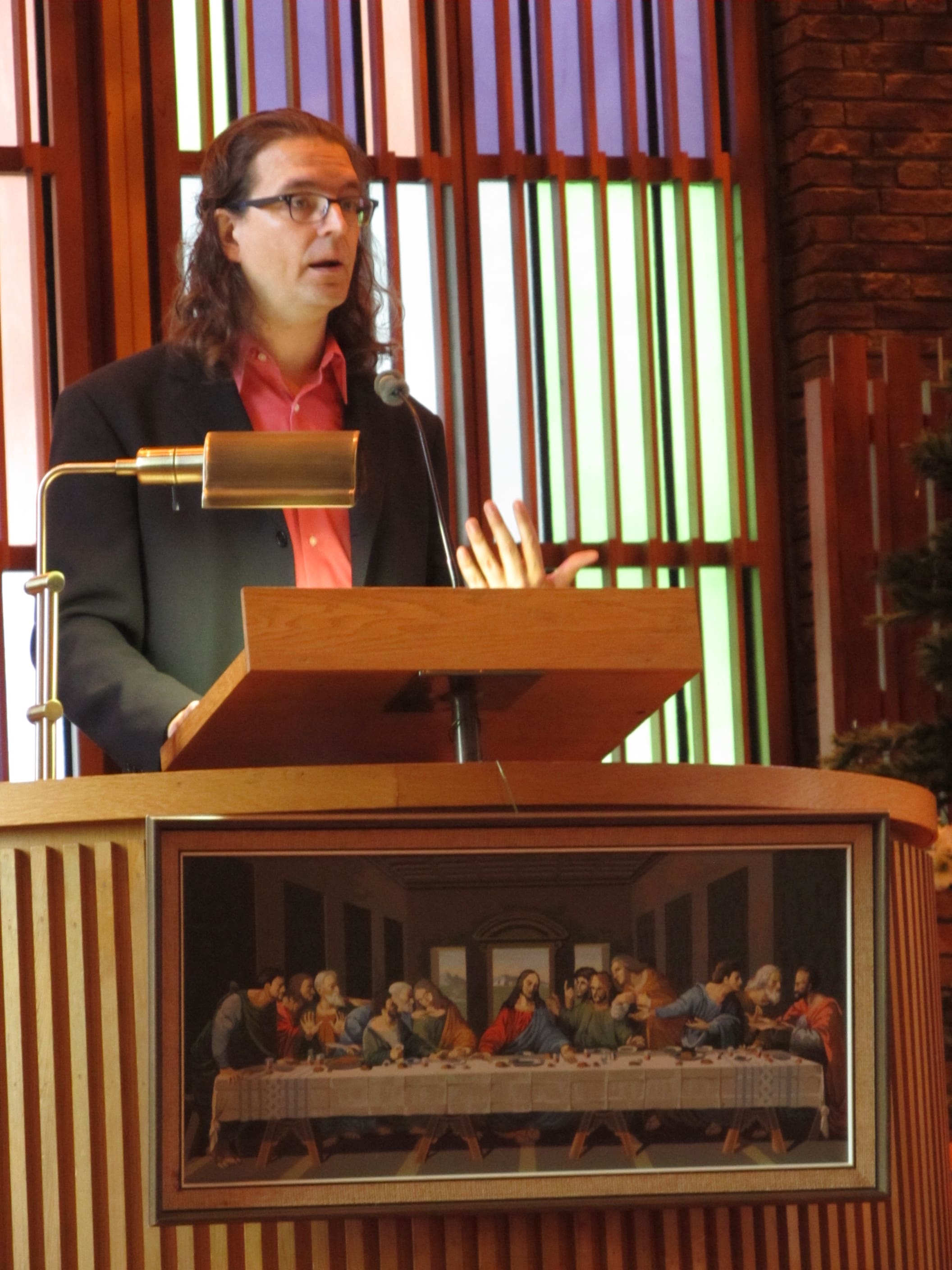
IMG_2926

In today’s episode we interview John Hamer, who left Mormonism and religion/belief altogether with no intent to return (after graduating from BYU). We explore how John’s relationship with his partner, Mike, helped him to discover his love for Mormon history, the Mormon historians community, and the John Whitmer Historical Association. This path ultimately led John to become baptized in the Community of Christ (formerly the Reorganized Church of Jesus Christ of Latter Day Saints) on April 6, 2010 — the 150th anniversary of the Reorganization and the 180th anniversary of the organization of the church.

How does an ex-Mormon who had left faith altogether rediscover the value of religion within a Joseph Smith tradition church? This is John Hamer’s story.

You can talk to John directly at his facebook group “Latter-day Seekers” or follow the SaintsHerald blog.
 

Episode Transcript

Full text · 19,100 words · 12 chaptersHost: John Dehlin · Guest: John Hamer

This transcript is machine-generated and lightly edited for readability. The audio is authoritative. Please excuse occasional errors in names and spelling.

Introduction and Welcome

Part 1 of 2 · Ep. 422

John Dehlin [00:00:00] 1, 2, 3. Mormon Stories Podcast is a production of the Open Stories Foundation. All donations to Mormon Stories are fully tax deductible and go directly towards keeping the podcast alive and towards building a community of support for Mormons like you. To support the podcast or to join the community, please become a monthly subscriber today@mormonstories.org. hello, and welcome to another edition of Mormon Stories Podcast. I'm your host, John Dehlin, and today we have with us a guest that I've wanted to have on Mormon Stories for a long time. This is not his first appearance on Mormon Stories. John Hamer was part of some of the very early Mormon Matters panel discussions that we had several years back. Is that true, John?

John Hamer [00:00:51] Yeah, absolutely. That was a great, great set of discussions. And I also came right after you restarted your podcast, the Mormon Stories podcast. Joanna came on and then I came on.

John Dehlin [00:01:03] I think that's right. That was around 2009 or 2010. But one thing we've never done, and something I've wanted to do with John for a long, long time, is to actually have him tell his story, because I think his story is fascinating. John's interesting for a number of reasons. As far as I'm concerned, he's super nice and super smart. He is a. Is it cartographer? Is that what you call yourself, John?

John Hamer [00:01:31] Well, I usually just say map maker. The reason why I say that, obviously cartographer is the more scientific word. I don't do precision cartographic work like you might do if you were a geologist or something like that. The kind of maps that I make are historical maps where generally I'm illustrating a history book. And so in that case, it's less about precision and more about conveying the ideas of history through maps.

John Dehlin [00:02:02] Right. So if you look at, for example, your LDS set of scriptures, where they have those maps that show, you know, the journey of the Saints from New York to, you know, Nauvoo, it would be that type of map that has some geography on it, but also has stuff related to people. And. And John is not just he has a master's degree from University of Michigan in this type of stuff, but also he's been involved with the Joseph Smith Papers project, doing maps for them, and has been doing maps for Mormon history, various books, for many, many years. He's also been one of the leaders in the John Whitmer Historical association, which is the community of Christian, sort of parallel to the Mormon History Association. And he's actively involved now in the community of Christ, which is the new name for the Reorganized Church of Jesus Christ of Latter Day Saints. So there are many, many reasons why John is interesting to me. But most importantly, he's just a super knowledgeable person about church history. He's very astute in terms of his navigation of these very complicated Mormon cultural waters. He's been a longtime blogger on the By Common Consent blog as a non member of the church. But we'll get into all that. John, is there anything else I left out that should be noted before we jump in?

John Hamer [00:03:40] That's just a really generous introduction. Now I'm really excited to be back on your program and talking about the story.

John Dehlin [00:03:48] And one really important thing that we're going to be talking about is the fact that John, for the reasons that we'll get into, felt like he needed to leave the LDS Church. And probably, I don't know if you we'll talk about whether you call yourself an atheist or an agnostic now or whether you don't like those labels, but my guess is you, you went through times of self identifying as atheist or agnostic. And what I think is really interesting is that John has decided to affiliate with the Community of Christ Church and has been super active there. And so understanding that decision for someone that knows all of the church history, has probably dissected not just Mormonism but religious belief as well, but has then still chosen to remain affiliated not just with the faith tradition, but with a restoration branch or sort of a Mormon related branch of a faith tradition is super interesting to me. So we're going to get into all that as well. So that's a big long introduction for our listeners. All right, John, so let's start with just kind of a little bit about your early years within the church so we can get a picture of what type of Mormon you were.

John Hamer's Family Roots in Mormonism

John Hamer [00:05:13] Sure. So I have a long time family connection in Mormonism, so through my mother's side. I'm a seventh generation Latter Day Saint. Goes back our ancestors were go back to kind of 1832, 1833 Kirtland. The family was the Winchester family and one of their daughters is one of the little known or is the little known younger wife of Joseph Smith. So that people are more aware of Helen Markimbell. But the other one is Nancy Winchester in the Nauvoo period. And so we have kind of a long early history that goes all the way back. But then for my family there's never been a, it hasn't been people haven't been in the entire time. And so the Winchester's kids, the family split apart in 1844 during the succession crisis. And so the oldest son went off with Sidney Rigdon and ended up becoming one of Sidney Rigdon's apostles. The youngest son that I'm descended from did go out to Utah but ultimately ended up leaving the Mormon Church. And so he was kind of an ex Mormon early on in Utah. And the family has kind of gone through cycles of younger children have gone back and then people have left and that's kind of gone all the way down to the present day where my mom is a very active member, as are two of my sisters. My sister Carol is a fairly prominent she frogs is chance in the outer blogness kind of ex Mormon bloggernackle and my brother Ben is a Unitarian and my dad is ex Mormon who became an Evangelical Christian. So we have kind of a whole spectrum of religious affiliation in my family

John Dehlin [00:07:15] and I know a few of your siblings and love everyone I've met. So it's just a great family.

John Hamer [00:07:20] Yeah, well, the nice thing about it for our family is that we have a real policy in the family of family first before all of these things. And so I get along absolutely great with my mom and my Mormon sisters and same thing with Carol and Ben. So that hasn't been in my dad. That isn't an issue. I mean we don't agree obviously in our own where we are religiously, but that hasn't stopped us from staying together as a family and also putting that before.

John Dehlin [00:07:54] I see that as a great role model for all religious people. Just families should come first in my view. So that's great.

John Hamer [00:08:04] I was just going to say growing up we were a mission field Mormon family. I was born in the suburbs of Chicago and we moved to New York and then New Jersey, Ohio and finally Minneapolis, where I grew up in the suburbs of Minneapolis. I was one of the kids who was very active. I was the deacons quorum president, I was the seminary president. I was all those kind of things. And Eagle Scout at 13 I was the. There was a girl too, but I was the boy that the bishop would always call on if they wanted a youth to give a prayer. Went around and gave talks with the Stake High Councilmen when we would, you know, go around to do those kind of things. So it was very active in that way and also was able to talk to adults early on and so was kind of the kid that they called on Trevor to present the face of youth in the church in my ward. But on the other hand also very early on, as early as when I was a teacher, I was Kind of a closet doubting Mormon. And so I didn't, I would feel like a lot of doubt about a lot of the truth claims. I didn't think that the Book of Mormon seemed particularly ancient in comparison to the Old Testament. I definitely didn't think that the. When I was looking at, I remember looking as a young teenager in church, kind of looking through the facsimiles of the Book of Abraham and saying, you know, this is, it's very clear that this is a diagram of someone being mummified and it's not Abraham being sacrificed. And below the Canopic jars are even there, which are part of the Egyptian mummification rituals. And so I was kind of a closet doubter on those things. And then as a doubter, when I was making those kind of talks in church, then I'd have these very spiritual ladies in the church would come up afterwards and say, oh, I felt the spirit, you were so strong, this kind of thing. And I thought, you know, the entire time I'm giving this, I really don't believe it. And so I became very skeptical of what they felt, the feeling the spirit was. And so pretty well by mid teenage years, I was not a believer in the truth claims of the Mormon Church and then considered myself to be not a believer at all and out of it by the time I turned 18.

Deep Church Involvement and BYU Years

John Dehlin [00:10:29] Okay, so, but you were also like president of your deacons, teacher priests quorum, right? I mean, yes, yeah, so. So the church meant a lot to you and you were really into it, but you're saying your faith kind of fell apart by age 18.

John Hamer [00:10:48] Yes. And then the main thing was, so I had really kind of felt by the time I was so 16, I didn't believe in the truth claims. But I still decided, okay, I'd be the head of the teachers, I'm sorry, priest quorum, the bishop is the president or whatever, but it was the leader of it. And so my feelings at that point were. So I had a policy which was something like, you didn't have to go to activities if you didn't want to, and we would have donuts every Sunday, this kind of thing. So it wasn't. So I kind of felt like, okay, I'm enjoying the social aspect of it, I'll probably stay Mormon all my life. But what really was the thing that I decided I couldn't stay in about when I was 18 was I thought the sexism that's inherent in Mormonism is something that I just can't overcome. Inherent in Utah Mormonism. And I was Also very uncomfortable with the. I was only eight when the priesthood ban for black people changed and the doctrine that underlay that ban was continuing to be taught. So my seminary teacher when I was 16 had, you know, just repeated essentially the same kind of race doctrines that justified that priesthood ban. And I also, you know, did not feel comfortable with that at all. So I thought, well, this is actually as much as I enjoy the social aspect of it, this is actually not something that I feel comfortable with in terms of it, the overall good that it's accomplishing. Because I felt like what it is doing for my mom, her place, you know, kind of without being able to have exercise real leadership in the ward when she's here, she's the smartest person in the ward. And also my sisters who were just not as, you know, just not as valued for what their accomplishments were. So I mean, I remember just a very like one of my terrible, searing memories is I was this whatever overly proud 13 year old eagle Scout and my sister who had earned the highest award in the Girl Scouts. I just remember saying something like, well, that, you know, something just really flippant and awful where that, that doesn't count or it isn't the same thing. Right. In other words, that this doesn't have the same. It doesn't, it's not, it's certainly the program isn't recognized by the church and it isn't, it's just a kind of girl's counterfeit of the thing. And it was an awful thing to say and my mom, you know, kind of reprimanded me for it right then and I don't remember what it was. But anyway, that was one of the things that allowed me to start to see why is it that only in this worldview, why is it that only boys are people and men are people and women aren't real people?

John Dehlin [00:13:41] Right. So you felt like the church was a little bit too sexist for your taste, a little bit too racist, at least historically for your taste.

John Hamer [00:13:51] Right.

John Dehlin [00:13:55] And yet, and yet you chose to go to byu?

John Hamer [00:14:01] Yes, I went to byu.

John Dehlin [00:14:03] Okay. Did you tell your family about your doubts or lack of belief at the time? Did your mom or siblings know that you didn't believe anymore?

John Hamer [00:14:15] Well, so my official I, I absolutely don't believe anymore dividing line occurred two weeks after I went to byu. Right.

John Dehlin [00:14:24] Okay. So you couldn't talk to them before.

John Hamer [00:14:27] So before I was a closet doubter and hadn't decided to write everything off. I thought, okay, well maybe I'm going to live with this. I'M going to do this and that. But then when I went to BYU a couple weeks after that, then I like, okay, this is not the direction that I'm going. I'm not going to stay in this.

John Dehlin [00:14:40] So what happened at byu?

John Hamer [00:14:42] So at byu, okay, so I had been in the Mission as a mission field Mormon and there had only been in my high school a handful of other Mormons. And so I had kind of been able to have for myself this sort of identity that Mormons were a model minority, like my Jewish friends or something like that in my school where we were able to say, I don't know, I was able to feel like there was this kind of a, a special identity there where anyway that I, because I didn't have a lot of real firsthand connection to, you know, kind of a real Mormon society where a Mormon majority society and you know, getting to byu, then I was, you know, immediately immersed into the middle of a Mormon majority society, which, you know, as a kind of a, you know, young adult or whatever, an 18 year old, I judged very harshly. And I thought, well, this is, this is pretty hypocritical and everybody here is the same as in any other society and this is really not, it isn't really special. And so that was like, I thought, okay, I'm done with this. And so, yes, no, I did tell my family right away. And I wrote to my sister, who's a year younger than me, and she wrote back and said, well, I believe exactly the same as you, I'm not interested in this. I'm really happy that you wrote me that. You know, and then my mom and dad didn't feel that way at all. So my mom, I don't know, I'm sure she was maybe upset with people at byu. She thought that maybe I wouldn't, you know, that this decision was a phase or something like that. But it ultimately wasn't. So I ended up staying at BYU for three years. I graduated after three years. It would have been, I would have had to go. My undergrad would have taken five years if I had decided to leave and go to the University of Wisconsin or something like that. So I just decided to knuckle under and, and batten down the hatches and plow through and get done with it.

John Dehlin [00:16:39] So was it hard to be at BYU as a non believer?

John Hamer [00:16:42] No, it was pretty easy.

John Dehlin [00:16:46] How'd you pull it off?

John Hamer [00:16:47] Well, so, you know, the way you get in trouble at BYU, this is a while ago too. I'm sure BYU is a little different now. So this was 88 to 91, 92. At the time, there was, you know, everybody was talking about, I don't know, the BYU standards, secret police and this kind of thing or whatever. It was the kind of things that you had to go through. But people really would get in trouble as a doubter or an unbeliever when they would. When they would confess that to their bishop. Right. And so if they would say that, then you'd get flagged and people would have to be in interviews all the time and there would be these, you know, all of the kind of troubles that everybody goes through. But as somebody who was absolutely a non believer and who was just determined to finish and graduate, I didn't feel any qualms at all about, you know, just smiling at my bishop when I would have the occasional interviews. And even the last. The last year, I didn't even have to go to church at all because all I did was to get an ecclesiastical endorsement. I transferred into a new student ward in like May or something and, you know, attended two weeks, smiled the whole time. Then I said, oh, I need this thing signed because I was away for a semester in Europe or something. And he just signed it right off and that's it. I had to go like three times for an entire year. So it really wasn't tough at all.

John Dehlin [00:18:10] Now, that was the time I was at byu. Joanna Brooks was at byu.

John Hamer [00:18:14] Yes.

John Dehlin [00:18:14] Do you remember any of the sort of activist, liberal things happening the September 6th kind of stuff? And to what extent were you a part of any of that?

John Hamer [00:18:25] Well, in fact, I was at the time. Just surprisingly, I was able to construct a kind of a non Mormon life there. And so actually I was not interested in anything to do with Mormonism. And I was incredibly unaware of the September 6th or anything like that that was happening, even though I was in the History department, so I didn't really know about that. I was a part of the liberal Mormon community. So the Student Review newspaper, I was on the staff of that for a whole long time. I was the creative and production director of Student Review. And then ultimately I became the publisher of Student Review and worked directly with Joanna Brooks, who's a good friend of mine, who was the editor.

John Dehlin [00:19:07] Now that's a pretty historic time to be working on the Student Review. Did you enjoy that?

John Hamer [00:19:13] Oh, yeah, absolutely. I mean, so I had a lot of wonderful friends who were progressive Mormons and doubters and non Mormons. So I had a really good community there at BYU and also had a lot of great professors who I really, really enjoyed.

John Dehlin [00:19:30] Yeah, that's a really cool time to be at byu. Now, something we haven't talked about is stuff relating to sexuality. As I understand it, you began experiencing same sex attraction as a teen, right?

Being Gay and Mormon in the 1980s

John Hamer [00:19:48] Well, as a kid, yeah. Or whatever. So, yeah. So this was. So I'm. I'm a gay man. The. I'm. But from. This is again, from an earlier era for young gay people, that young gay people have so many role models in the media that they're able to come out, you know, in junior high and things like that these days. But for me, growing up in the 70s and 80s, I had never met another openly gay person. I'd never seen gay characters in media. And so there was this era still where it was possible to know who you're attracted to. I know all the way back to who I was interested in in junior high and that kind of thing. But not having put that together to say, okay, that means I'm gay. And so definitely this wasn't. This is something that back then, coming out wasn't only just coming out public, it was actually coming out to oneself. In other words. Oh, that's what this all means. Right, Right. And so two years after I got into byu, in about two and a half years after I really had put the church and Mormonism behind me, although I was still living in this heart of it at BYU in Utah County, Utah, I met for the very first time a friend of mine on the student review. We went up to Salt Lake. We met a guy who was, you know, was living in Salt Lake, who's openly gay. He's a couple years older than me, really nice person. And I'm like, wow, okay. So within about a week, you know, I'd been talking to him on the phone. Within about a week, I was like, okay, this all really makes sense to me. I'm gay. Okay? Now it's all very clear. And so within about a month of that, I had told everybody I knew on the student review and my sister. Within two months, I told my parents and everything like that. And I was fairly. I mean, for me, it wasn't something that was traumatic at all. It was something that was very sensible and it made a lot of sense. But in coming out in Utah Valley, Utah, in 1980, this wasn't the best and most supportive environment for being gay. And so the social environment for gay people at the time was essentially independent support groups. And so I met the group that was met there. And so for a lot of the people who had come out or had been coming out in the last couple years. They also were experiencing just the total collapse of their worldview because they came out at a time when they still. Or maybe believers in Mormonism, believers in the church, and so their worldview would then collapse at the same time. And so people not only were going through all of this identity issues, they were also going through a terrible faith crisis. And so even though I was very newly out, I kind of immediately became one of the people who was more doing counseling than being counseled in the support group there.

John Dehlin [00:23:05] You sometimes hear about sort of a gay underground at byu, and you even hear unsavory things. You know, was that. Was that going on? Were you plugged into that at all? And what can you, you know, how can you describe that or dispel myths or whatever?

John Hamer [00:23:28] Well, so in most cases,

John Dehlin [00:23:32] a large

John Hamer [00:23:33] percentage anyway, the people that I knew who were gay at byu, again, because the church was so totally unsupportive of who they are and had a kind of an. Has an unrealistic idea, this denial that gay people exist, this kind of thing. So the church is itself discrediting. If you're gay, you immediately see that the church is wrong about things. So as a result, there's this, like I say, this collapse of the worldview and spiritual crisis that tends to happen at the same time. And so most of the people that I knew in the gay community there at byu, therefore, were kind of functionally ex Mormon. They had left the belief system of it. And then simultaneously, what is happening is they're having kind of an initial adolescence where you're actually dating. You're dating people you're attracted to for the first time. You're experimenting. You weren't like a kid who I never had had, for example, alcohol in high school or anything like that, but that's the kind. So there were definitely drinking parties. We would definitely. Throughout the whole last year I was at byu, I would routinely go up every Friday night to the gay bar up in Salt Lake and so didn't meet people there and that kind of thing. There was, again, all of these stories that the secret police were writing down your license plates and everything like that, But I never had any trouble with any of that.

John Dehlin [00:25:14] And. And how do people keep it secret? How did they keep it secret from their roommates and from others around them? You know, I would think that it would lead to this sort of paranoia that you're going to be told on and that, you know, the honor, the honors, what is it the standards office is going to get rid of.

John Hamer [00:25:33] Yeah, I think that there's. It, you know, it could be totally different now. So I don't know how they, you know, how they might have reformed or changed or what their new procedures would be at the time. The, I think the real, the two ways that you really would get in trouble are one, through confession. So if somebody is busily confessing something, they're really torn up and they're busily confessing things to their bishop, they get in trouble. And then the other way is if you are some kind of, if you're really standing out, you shave your give a mohawk and you stand in the middle of the campus and really made a lot of noise, this kind of thing. You know, I was the publisher of the Student Review and I was totally out to all my roommates and you know, most of the people on student Review and that kind of thing. And there was no, I mean we would, we met with administrative. I mean I wouldn't, I didn't go up and tell people in the administration, I've met with them about the student review and that kind of thing. But so I didn't ever have any, you know, any run ins with standards. I would theoretically have been a problem, but I never had a single run in at all.

John Dehlin [00:26:41] I would think that I'd be paranoid that roommates would tell on me. Did you just pick your roommates really carefully or were you just lucky or is that not a realistic fear that roommates might tell on someone if they found out?

John Hamer [00:26:54] I guess I should probably have been more fearful, John. Very fearful. I didn't have any problem. I mean, one of my roommates was at different times I had a couple different roommates who were gay at different times. I was living, you know, I was living in unapproved housing sometimes, you know, but I didn't find it too hard to skirt any of those things. So.

John Dehlin [00:27:17] Yeah, the only reason I mention is because I found there's a lot at stake. Because if you, if you do invest three or four years at a LDS church run university and then you get kicked out, that can add, like you said, a couple years to your education and sometimes tens of thousands of dollars. And so there is a lot at stake.

John Hamer [00:27:40] I was probably way too honest and flippant about it in that way. So in other words, I was having a little bit of a disregard for it. But also since I wasn't doing a lot of things to stand out or to offend anybody, I mean I was, at the end I was working for half. I mean, I had Five different departments that I was a TA for. So I was working for Bill Hamblin as his research assistant, the History Department. Whoa.

John Dehlin [00:28:03] Bill Hamblin?

John Hamer [00:28:04] Yeah.

John Dehlin [00:28:05] That's awesome.

John Hamer [00:28:06] I mean, I was working for his dad as a research assistant drawing maps for geology books in the geology department. I was the production director for the business college's newspaper. I was production director for the honors department's newspaper, production director for the History department journal. So, I mean, I really was kind of tied into the publishing and that kind of thing and was working directly with, you know, administrative people in the different departments and occasionally again, meeting with the administration in terms of the student review itself. So.

John Dehlin [00:28:40] Yeah. Did you ever feel guilty that you were being dishonest? You know, that you.

John Hamer [00:28:45] No.

John Dehlin [00:28:46] How did you avoid that? Because I think of you as. I think of you as an honest person.

John Hamer [00:28:51] Yeah, well, I didn't feel that the regulations were. Were reasonable. So in other words, like you said, these are things that people can. For no particularly reasonable reason, you can lose something that is as serious as an education degree, get kicked out and get set back, like you say, tens of thousands of dollars in all these years. And so I thought, well, these are the rules under which this whole thing operates. The system itself is dishonest. I'm just going to, like I say, graduate as rapidly as possible and do what the system actually wants, which is keep your head down and not make a lot of noise and offend everybody all around it, as opposed to the letter of the law and all that stuff. Right, right.

John Dehlin [00:29:41] Okay. So I guess you weren't super sad to leave Provo.

John Hamer [00:29:45] No, I wasn't sad at all. My sister graduated at the same time as me, and we almost. We almost had done this as we were driving the U Haul truck home or something. We almost having the dusting off our feet. Richelieu. Which is good that we did, because I've ended up going back so many times, but I didn't think so at the time. I didn't think that would ever happen. So I thought at the time I would be leaving my Mormon identity entirely behind me. So what had happened was.

John Dehlin [00:30:19] And your religious identity?

John Hamer [00:30:21] Oh, yeah, absolutely.

John Dehlin [00:30:23] So for you, I wasn't religious at

John Hamer [00:30:25] all in byu, and I didn't consider. I mean, again, I wasn't religious and I also wasn't interested in Mormonism. I was in history, but I was in medieval European history and classical history, the history of map making, this kind of thing. I had no interest whatsoever in Mormon history, which I had only ever been exposed to in the Kind of Sunday school and seminary sanitized versions, which I therefore assumed that the history was just intensely boring and dull and dumb. And so as a result of it, I actually, what I'd learned from Mormon history, no matter how much I love history, what I'd heard in Sunday school about Mormon history actually turned me off to American history in general. And I just assumed that kind of American history and modern history was just intensely boring. And so it turned me to ancient history and medieval history. And I had had this period of time I was going to go and be a. I was going to go be a TA research assistant or teaching assistant at the Jerusalem center for a semester. And this ended up being the semester that Saddam Hussein attacked Kuwait. And so as a result, I was in Europe waiting to go. And we kept on getting delayed and delayed. And so I was spending this time in Europe traveling around and seeing historical things, but also traveling by rail paths and meeting young students, college, other fellow college students from around the world who had nothing to do with Mormonism. And so right from the day one when I was there, I kind of had made my decision that I was going to excise my Mormon background entirely from my identity. And so I went to the very first youth hostel. I met a guy who seemed like a really cool guy. We went out and this is in Strasbourg, France. We went out to a bar and got a beer. I'd never had alcohol in my life, but I'm just like pretending, oh, I'm cool. I'm just a regular American college student. None of this Mormon background. I drank the beer and I just like, oh my goodness, this tastes like hairspray. I gotta be cool. I gotta be cool. I don't have. Anyway. And so I had this incredible experience and so much more enjoyment by having left Mormonism entirely behind me than I had when I was on that semester abroad that I decided when I leave BYU and Provo, I'm just, this is not going to be part of my story anymore. I am not going to have it be part of my story. And so when I moved to Ann Arbor, Michigan to go to the University of Michigan as a grad student, I told nobody at all that that was part of my backstory, that was just written out.

John Dehlin [00:32:56] And would you have self identified back then as an atheist or agnostic?

John Hamer [00:33:03] Yes, One of the two, I mean, atheist would be, depending on what you mean with an atheist. Atheist is like if you are some kind of a hard atheist, where you're saying there is proof that some kind of God doesn't exist, I don't think that's supportable. So it would have probably been agnostic. In other words, this isn't something that interests me, which is what I guess I would have said at the time.

John Dehlin [00:33:26] Right, right. So tell us how you went from desiring to leave all remnants of Mormonism to extricate all remnants of Mormonism from your identity and experience to becoming one of the most Mormon associated people that I know. Although not lds. Tell me how that happened.

Leaving the Church and Life in the 1990s

John Hamer [00:33:53] So I did spend then the better part of the 90s, just not involved at all. And so it's kind of a little bit of a strange thing. So if you, you know, as you recombine with all of the people who know you from different times in, in your life on Facebook, people who know me from being a Mormon kid in high school to people who know me from being whatever, a liberal gay guy at BYU to people who don't have any connection with. Didn't have any connection with Mormonism, for all of my friends that I had in graduate school to then, like you say, more recent people I've met since the 2000s who have known me as either a secular Mormon, a Mormon historian, or now more recently as a member of Community of Christ. There's a lot of question marks, I think, above everybody's heads as they're kind of looking at the different phases that I've gone through for all of this. What ended up happening was so. In the course of being in Ann Arbor and having nothing to do with it, just studying medieval history, I was also, I also still had all kinds of Mormon values kind of wired into me. And so one of them is just the obsession with getting married and having this companion and being with somebody and sharing your life with somebody forever. One of the problems with that is that you put so much pressure on dating when you're dating because you're really. This is probably universally true or often true for Mormons is that when you're doing dating, you're doing this. The first date is like this marriage assessment interview almost. Right. And so there's all of this kind of pressure on dating that it's just not. Doesn't exist outside that Mormon universe. But I still felt was putting that kind of pressure on kind of the dating that I was doing. And so you were looking for your

John Dehlin [00:35:56] gay eternal companion, basically, my gay eternal companion.

John Hamer [00:35:59] Somebody I was going to be with for a time in all eternity. And I was like, first date,

John Dehlin [00:36:05] awesome. Love it.

John Hamer [00:36:07] And so I've had some, you know, really great guys, you know, who I was like, okay, let's get married, you know, right away. And so obviously that I wasn't prepared to, you know, I wasn't really. I wasn't emotionally prepared to have like, I was. That's like the kind of thing where you're also in love with love. I would say, sure, you're in love with the idea of having an eternal companion and you are, therefore you're missing the person that you're pushing into that ideal.

John Dehlin [00:36:42] I would also guess that because you have such an awesome family, you are in love with the idea of having your own family.

John Hamer [00:36:51] Yeah, maybe so. I'm actually have never had any interest in having kids.

John Dehlin [00:36:57] Oh, I didn't mean kids.

John Hamer [00:36:58] Yeah, so yeah, no, definitely. I was definitely interested in having, you know, in producing a family and you know, having. Having a family in terms of being married to someone. And so. And so definitely though I would put way too much pressure on things and so. And had. And also then the other thing that you're dealing with as, as a gay person in say, a small town, even a progressive college town like Ann Arbor, where. So I went from a place that was very anti gay, Utah Valley, Utah in 1992, to a place that was really progressive and open and accepting and everything like that, in ann arbor in 1992. But the problem was still that there's a pretty small population. So we're a little college town. There's only so many potential people who I can find to be my eternal companion. Right. And so at a certain point, I had just decided that this was too important to me and that I needed to move to a bigger place where I can find more people that I could actually prioritize this a little bit more rationally. I felt like I'd matured enough to actually be able to date without just falling in love with love and that kind of thing. And so I had made this decision to move to California where I would maybe become a creative director for a magazine either in the LA area or San Francisco. And on the way I stopped back at Minneapolis, which is where I grew up. And I had never really gone out to a gay bar, met anybody in Minneapolis. And I thought, well, I'm here for a month. I'm working on redesigning a museum, panels and graphics and making maps for museums in Minneapolis. While I'm here, I'll go out and I'll give Minneapolis a chance. Minneapolis, you got a month to show me what you got. And the very first night I went out, I met Mike Karpowitz. And we've been together ever since. The difference then, though, was that unlike all the previous dating that I'd done in Ann Arbor, Minneapolis is where my family lives. And so when I brought Mike home, like, a week after we'd gotten together, introduced him to my parents, Mike. I couldn't. Suddenly, I couldn't have this backstory that just had this gap where I didn't talk about Mormonism at all, because Mike immediately meets my mom, who's a Mormon. And so he's very interested. What's all this Mormon business? And so I began by telling him kind of my, you know, the backstory, that I knew the Mormon story as well as I'd known it, which wasn't really very deep at all. And so it was kind of through discovering more of what that Mormon story was and then my own family story in it, that kind of led me to realize how interesting Mormon history actually is. And so my mom actually had a copy of Fawn Brodie. No Man Knows My History. I read that, and I was like, oh, my goodness, this stuff is so interesting. And so kind of from there that that got me back into, or got me into for the first time, being really interested in my own family history, my own Mormon family history. And from there, the Internet had started to be created, social connections. There were social boards for ex Mormons. And so I started communicating on those. I also then got in touch with the people who are writing these books through wonderful institutions like the Mormon History association and the John Whitmer Historical Association. And I started to realize that all these people whose books that I've written were so accessible. They're such wonderful people. People like Lavina Fielding Anderson became really good, great, close friends. Everybody from Mike Quinn, Dan Vogel, Brent Metcalfe, all of the people who you end up meeting. Jan Shipps end up being just an intensely close mentor. And so that kind of brought me back into touch with the Mormon community, because I got in touch with the Mormon history community.

Finding a Partner and Reconnecting with Religion

John Dehlin [00:41:15] And how long you been together with Mike?

John Hamer [00:41:19] Since 1997.

John Dehlin [00:41:21] 1997. I want to do the math. So that's 16 years. Is that right?

John Hamer [00:41:25] Yeah. Yes.

John Dehlin [00:41:26] That's awesome. 1997. Okay. And. And so, in part, we kind of have Mike to thank for bringing you back to Mormon culture.

John Hamer [00:41:38] Oh, absolutely. Yeah. In fact, he was so interested in it, there's nothing he likes more than road trips. And so we added to. I mean, he likes to go and see, like, president, you know, presidential history sites and that kind of thing or any other number of things. But we just added into the mix Mormon history sites. And so we started, you know, going to different Mormon visitor centers. And, you know, we went to the Hill, Cumorah and to Voree, Wisconsin and St. George and any other number of places. And so, in fact, it was for my 30th birthday that Mike took me to the Kirtland Temple for the first time. And that is actually when I encountered members of the Reorganized Church Community of Christ for the kind of. For the first time. So that was before I got involved more, more directly with the.

John Dehlin [00:42:31] The history Association.

John Hamer [00:42:53] Come, come, ye saints no toil nor labor fear, but with joy.

Part Two Introduction

Part 2 of 2 · Ep. 423

John Dehlin [00:00:00] 1, 2, 3. Mormon Stories Podcast is a production of the Open Stories Foundation. All donations to Mormon Stories are fully tax deductible and go directly towards keeping the podcast alive and towards building a community of support for Mormons like you. To support the podcast or to join the community, please become a monthly subscriber today@mormonstories.org so how did you go from, you know, from disaffiliating with the LDS Church and identifying as an atheist, agnostic, you know, to sort of not wanting anything to do with Mormonism per se, to then rediscovering a love for Mormon history? I can get all that.

John Hamer [00:00:50] Yeah.

John Dehlin [00:00:51] Now, what I want to understand is how you go from that to wanting to actually be baptized a member of the community of Christ and to be an active participant in it, because I know a lot of people who follow those steps out of the church. But I think it's more rare for people, for ex Mormons to find their way back into a church and even more significantly, into a restoration branch church that's affiliated with Joseph Smith in any way. How'd that happen?

John Hamer [00:01:22] Yeah, well, I'll say that for one of the things that I think that one of the reasons why atheism or agnosticism ends up being such a common end state for people who leave the LDS Church are that people have the idea of the idea of God, the idea of kind of a God as a literal heavenly father, as a being with a body, finite being with a body who is all powerful but who performs different miracles. This kind of thing, this kind of very physical and direct, connected to a luminous being kind of concept of God in Mormonism. And then they kind of a very fundamentalistic, not fundamentalist Mormonism, but fundamentalist in the religious sense in general, and literalistic view of Scripture ideas that the Bible is more or less a history book and that things that are told in the narrative stories, the sacred stories there in scripture, are actually historical and not simply symbolic. And so I think that when you have that vision of theology, if you have that vision of God and Scripture, it's hard not to simply reject it altogether. But that is certainly. But I would say that ultimately that is not the only view of Scripture and it is not the only view of what God is. And in fact, it's a. Not also the main traditional view of what God is, but rather it's a recent and modern kind of reaction to the challenges that theism has had since the Enlightenment.

John Dehlin [00:03:29] But it is a very Joseph Smith consistent view to view everything as literal, to view God as some type of anthropomorphic being. I mean, those are probably some of the most defining traits of Joseph Smith. Right.

John Hamer [00:03:43] Well, especially his late theology. Right. So Joseph Smith is a moving target too. His thoughts are evolving. His original conceptions of God that are composed into the Book of Mormon, those are very different from King Follet sermon progression theology that ends up being at the end in Nauvoo. Okay, so I agree. Go ahead.

John Dehlin [00:04:10] Yeah. And so before we dig into that, though, you're just saying that what you've come to realize is that religiosity does not necessarily need to denote a reliance on the literality or the anthropomorphism of a deity or literal interpretations of Scripture.

John Hamer [00:04:31] Right. And so what I would even say is what does in our own restoration experience? What does Joseph Smith, the God, So the Joseph Smith who is in praise to the man, the exalted Joseph Smith, that occurs after the martyrdom, what does Joseph Smith the God tell us about Jesus the man? In other words, we actually have in the restoration tradition a window on how ideas like that evolve and that we can use those to actually unpack what happened in early Christianity. And that can also inform us, have a more realistic assessment of the Jesus of history as opposed to the Jesus of scripture or the Jesus of theology.

John Dehlin [00:05:22] Okay, so that's a beautiful high level sort of preview for what we're going to talk about maybe in parts two and three of this podcast, because in part two, we're going to dive into the history of the community of Christ or the reorganized church. And then in part three, we're going to talk about where the community of Christ is now. But many people who end up leaving the LDS Church feel angry, they feel resentful, they feel disillusioned, they don't want to trust any authority. They certainly don't want anything to do with Joseph Smith because they view him as a charlatan and a fraud. And they just feel oftentimes just, I don't want anything to do with religion or faith at all. And so did you. You know, I can tell your emotional experiences were a little bit different in that I don't know to what extent you ever really felt angry or bitter or, you know, disillusioned by the church. But maybe you did. But regardless, the step from, like, being fascinated with Mormon history to, to the step of like, joining a religion, you know, that's something happened there. So what can you tell us about how that happened?

Why John Returned to a Restoration Tradition

John Hamer [00:06:36] Well, so unlike most people, I think, who you meet when you're Meeting an ex Mormon, you're meeting somebody who's a new ex Mormon often, right? And I wouldn't say that I am immune from emotion and no anger or those kind of things, but for me, that is consigned to, you know, when I was 18 to 21 years old or 22 years old, and then I have this whole long period of time where that was done. I was gone. That was nothing to do with me anymore. I didn't. And so when I came back at it, I'm coming back at it, even though I'm, you know, I'm something of an insider, but I'm an outsider insider. I'm a person who no longer is the whole thing. The whole thing isn't causing me, you know, me, some kind of pain. I'm not like a person who was being kept in, in the movement longer, let's say, if you're a longtime ex Mormon, one of the things that may make you still engage with the community is because you have a spouse who's active or something, and that can just cause continual friction and continual irritation and continually renewal of anger. And if you don't have something like that, you tend to just simply leave after four or five years. So you're upset. You are learning more and more. You're reading all of the ex Mormon boards and you're finding out this and that more thing. You're like, oh my goodness, that, that also, you know, the, you know this. And that is also not the case. According to the, you know, the scholarship on, against this truth claim. At a certain point you're less. The person is less angry and they're more than telling, they're telling those same kind of things to newly angry persons. So the next Mormon boards, you know, and so they are. So there's a kind of a transition where you are, you are more angry and less knowledgeable. Then you're more knowledgeable and less angry, and then finally you're bored, not angry. And then you leave. And so I was really kind of excited when I first started doing all this Mormon history, tourism and Mormon history study. I was just excited also then that simultaneously when there was started to be social chat boards and that kind of thing. And so I was interested to start talking about all this stuff with other people. But I kind of quickly discovered that pattern that there were very few other ex Mormons that were kind of coming at this from where I was coming at it from. And so I had even like, early on, I had even bought like a website domain culturalmormon.org, i thought, wouldn't this be great if we had a model where this is my heritage, this is my family identity going all the way. There's no reason why I should cede the definition of what it is to be a Mormon to the president of the Corporation of the First Presidency in Salt Lake City or something like that. They certainly are in charge of the largest institution within a Mormon culture. But there could, in the same way that we have cultural Catholics or cultural Jews, there could also be cultural Mormons. But I ended up finding that very few people who identify as ex Mormon want to even they don't like the idea of being called a cultural Mormon. They want to separate themselves from the Mormon identity, which they do view as being so totally connected to Thomas Monson.

John Dehlin [00:09:59] So for you, you loved the culture enough that you didn't. You ultimately decided you wanted to embrace it, not reject it.

John Hamer [00:10:08] Well, and I found that it was ultimately that honestly, it's informing me, like I explained to you in terms of my. What even the crazy thing I was doing in dating. I thought, you know, there are things deep inside of me here that are informed by the fact that I have this, what was still at the time maybe a semi ethnicity, but you know, quickly waning as an ethnicity. And so, and I was excited interested in that and I wanted to explore that more with other people who shared that. So that's definitely something I was interested in.

John Dehlin [00:10:40] But not just it was inside of you, but you must have valued it on some level. Some of your Mormon ness you valued.

John Hamer [00:10:47] Absolutely.

John Dehlin [00:10:48] Okay, so again, now I can see you going, hey, I like this culture. You know, we're not going to cede our culture to, you know, the LDS Church president. But then there's another step between that and actually joining a church, getting baptized in a church.

John Hamer [00:11:05] Right, right, absolutely.

John Dehlin [00:11:06] How'd that happen?

John Hamer [00:11:07] So, well, as I say, then I had trouble, you know, generating any interest one as a. In cultural Mormonism because my experience creating, working with ex Mormon support groups, I was administrator for of an ex Mormon chat board for a couple years. I actually orchestrated a couple ex Mormon or New Order Mormon pilgrimages essentially to Kirtland, where we could have, you know, we could talk about it as a place. This is a place that my ancestors helped build. You know, these were their this. But this is the actual, you know, honest history about it. This is not just a sanitized history or a history that reflects the one view of any one institution on it. I kind of gave tours that way. But it was like even in that case, it was some, often, you know, we had one, for example, a, a guy who had been a Mormon bishop in Michigan who came to one of those and at a certain point he couldn't go on anymore. He broke down because it was just too new. And so the emotions were all too raw. And then at a certain point people did lose interest once the emotions were not raw anymore. And so I didn't find that to be very effective. And so I moved from there to spending a lot of time with the different historians institutions. So MHA and jwha and fairly early on, Mike and I became directors of the John Whitmer Historical association, which you mentioned as the Community of Christ equivalent of the Mormon History association and just found wonderful community of historians in those and just sharing all that kind of thing. And so that's one more step. So like you say, move out to back into, okay, so then the next step from there. So at a certain point I then also then started to though see how many of the people in that community, how many of the people in like maybe the Sunstone Mormon community, in the progressive Mormon community, how many of the people and then how many women in the LDS progressive community, how marginalized they were within their own religious tradition. So you could have somebody who is just this incredibly talented, this intellectual giant who, you know, in the case, let's say my good friend Christine Hagland, who is the editor of Dialogue, the premier journal of Mormon studies. And yet she doesn't have a respected role than inside her own congregational experience, inside a ward, inside a ward. She's a divorced woman who is in an age range that how are you even connected to the hierarchical priesthood structure of the local congregation? And so for all of these people who are people who I just enjoy, I are great friends of mine, but they are nevertheless, they fall under, for example, Boyd Packard's list of enemies of the Mormon Church. You know, so they, so people who are intellectuals, people who are women, self realized women feminists, people who are gay, you know, so all of those. I started to therefore see that need simultaneously as seeing the idea that cultural Mormonism in actual secular institutions didn't seem like it was particularly functional or likely to go anywhere. And so then I simultaneously, in the whole course of this thing, as being the director of the John Whitmer Historical Association, I came into a lot of contact with Community of Christ, the RLDS Church. I became way more familiar with the history of the RLDS Church, the incredible brave transformation of the RLDS Church over the past 50 years. And I started to see the real benefits that an alternative and progressive faith community could have for people who are marginalized within the restoration tradition. So that's kind of, as you can see, this path is eventually leading. It is over the course of 20 years. So it did take a little while to go.

John Dehlin [00:15:53] Yeah, yeah. So to summarize, you tried to organize sort of communities around Mormon culture with marginal or liberal or disaffected Mormons, but found that that was hard to do. You saw a lot of people that desired to maintain affiliation with the church, but specifically within the LDS Church's case, women, sexual minorities, and liberal intellectual types. You saw them as sort of being destined to remain affiliated with the church that undervalued, underappreciated, underutilized them from your perspective. And so you saw maybe the community of Christ as a. As a place for these people to potentially congregate, Is that right?

John Hamer [00:16:51] Yeah, absolutely.

John Dehlin [00:16:52] But was there anything spiritual inside of you? Was it an intellectual choice for you? Was it a purely social choice for you? Was there any spiritual or theological elements or factors for you?

John Hamer [00:17:10] Yes, absolutely.

John Dehlin [00:17:11] Talk about that.

John Hamer [00:17:13] Yeah, I absolutely would not feel comfortable or I would not feel that it would be appropriate at all for me to advocate something, you know, without. Without having, you know, a personal spiritual dimension and a feeling of calling. And so in the course of. Although my whole background had been history, as of about six years ago, in kind of seeing this kind of need and also this potential, I switched almost entirely all of my field of study and focus to looking at the entire history of theology, to looking at the history of philosophy, to looking at philosophy and theology, to looking at scripture study so that I could actually speak meaningfully, so that I could actually understand the issues, theological issues, Mormon tradition. There's always. People make the aphorism that Mormons don't have theology, they have history. And I think that that still remains true. There is so much to theology that can be looked at, and there's. It's such a. Anyway, it's a very deep and challenging thing. And that's kind of what I was trying getting at. Like you were saying before in this sort of high focus thing, what are other ways of looking at God than in the kind of the late Nauvoo progression style, literal Heavenly Father kind of God. What other ways can we look at how people have viewed God throughout time? So I definitely, in becoming informed about that for the very first time, I also then definitely have felt a sense of calling that this is, in fact, this is what I'm called to devote my life to. So I am really, I'm entirely committed to helping people within this, you know, this tradition, my cousins, people who are marginalized within their own faith community, helping them to empower themselves by being able to be a part of a community that values them, that they have total ownership of, and that is therefore, you know, incredibly empowering and meaningful to them.

John Dehlin [00:19:58] And I, and I love this, and I love this about you. But. But I'd like to maybe end this segment by talking about your actual beliefs. And I'd start by saying you are called by what or who, who or what is calling you or what is your, how is your belief structured? Is it in a literal anthropomorphic God? Is it in a sort of deistic God that either created the universe and then just kind of checked out, or is just not intricately involved in the universe? Or is it some just type of force? Or do you prefer not even to give any form or description to the belief and just say you don't know, but you just feel called, and that's all you know, like, where do you stand?

Theology, Revelation, and the Nature of Scripture

John Hamer [00:20:51] So for me, calling is the. And actually revelation, inspiration, scripture, all of these things are human response to the divine. And by the divine. I do not. Yes, I don't believe in an anthropomorphic God or a God that is spirit, a God that is body, a God that is finite in any way. So I, I do kind of reject those ideas. I'm going to make a blog post that is something like, there literally is no trinity. In other words, I'm not interested in a view that is literal, rather literal, physical, in terms of a human conception. So I think that anything that we do when we're talking about God as humans and we're ascribing different human anthromorphic characteristics to the divine, we are attempting to limit the imponderable or the infinite. I think the definition of God that I believe in is that God is infinity, not that God is something finite within infinity. And the way that we're able to. Then you say, okay, well, this is the imponderable. How can we, how can we even relate? What's the point? And so my definition of Christ theologically, as opposed to Jesus the human, the Jesus of history, who I don't believe was divine. I think that the historical record that we have, the literary record we can pull out from studying the New Testament, is that Jesus is a prophet, a wonderful teacher who had an incredible gospel message that is still resonates with us today, but that Jesus was not in some kind of literal way imbued with divinity, but rather the idea of the Christ of theology. What I would say about that is that Christ is a model that we use so that we can understand and connect with God. So if we want to think of God as God the Father, if we want to think of God as your mother, if you want to think of God as Jesus the brother, the Son, if you want to think of God as the community of the righteous, the kingdom of God or divine law, or however you want to think about it, that is the way we are able to get our hands around it. And I would call that Christ the model of the bridge that connects us to the imponderable. How do we ponder the imponderable? But we just have to be very aware when we're doing that that our models aren't literally true. And if we start to decide that we worship an individual model where we say God is Elohim, he has X number of wives, this kind of thing, if we understand that as to be some kind of literal thing as opposed to a model that we're using to relate to God, then we are worshiping a model which I would call the danger of putting gods before God. So if the two great commandments are love God and love thy neighbor as thyself, the idea of thinking about the model and worshiping the model is where you are putting a God before God.

John Dehlin [00:24:26] It's a form of idolatry to think that you can encapsulate God in any finite way.

John Hamer [00:24:32] Right.

John Dehlin [00:24:33] And this is revealing a bias for me. But that's something that I hear you saying. And you tell me if this is wrong. You're not coming out of a desire to minimize or marginalize God. You're basically saying God is so powerful or God is so complex or significant or powerful that that any attempt we make to try and put God in a box as humans is ultimately going to fall short.

John Hamer [00:25:05] Right. That's a human way. That's a thing that we just have to understand. That's the thing that humans are doing. We have to do it because that's what we can do. We have the capacity to do. And there's nothing wrong with doing it. It's just a matter of if we make. Then we make that box and we make that be an ironclad checklist, and we then say this checklist is exactly the way it absolutely is, then we've really made. Yeah. Then we're doing what you're saying what I would call idolatry.

Joseph Smith, Polygamy, and the Book of Mormon

John Dehlin [00:25:32] Okay, so where does that leave you with Joseph Smith and the Doctrine and Covenants and the Book of Mormon and the Restoration?

John Hamer [00:25:44] Well, I think it leaves me in really good standing with Joseph Smith and the Restoration and the Doctrine and Covenants. I think that the result of the Restoration and the result of the Doctrine and Covenants of opening up the canon and the canon and community of Christ tradition continues to be open. And so the Doctrine and Covenants, there's continually new Scripture, including some of the very best, in my opinion, best chapters or sections of Scripture in the entire canon are some of the most recent ones that have been added to the community of Christ Doctrine and Covenants. So I think that the idea of opening the canon up to understanding that there is no difference between us and the time period when people are actually in the Scriptures, so that that idea of restoration, that the heavens aren't closed, that the time period that existed, the time period of the apostles or ancient Israelites and all the gifts that were there are available to us today, I think is incredibly powerful and empowering. And also I think that the idea that, like Joseph Smith did with the Bible revision that he had, if there are problems with the Bible, if things in the Bible don't work for our current sensibilities, our understanding that we have, Joseph Smith went so far as to cross it out and change it. This is kind of completely unthinkable in the Protestantism of his day and then modern fundamentalism too, where Scripture is viewed as the sole source of authority and it's almost an imprisoning authority, where every little thing in the Bible is this rule book and the idea of it. That conception itself, though, doesn't hold up because it doesn't understand even the basis of the Bible. The Bible isn't simply something that was dictated out from God in whole cloth in the King James English. It is this incredibly complex collection of texts that two centuries of scholarship have given us incredible insights about where it came from and the historical context of its different components.

John Dehlin [00:28:08] And I love that vision. I think it's beautiful. And it's the only vision that makes sense to me because there's so much that I morally object to in many of the modern, you know, in the LDS canon, there's so many stories or scriptures or verses that morally I just find objectionable. And it makes sense that people are going to write according to their own biases and opinions and perceptions. And it makes sense that if there's a God, the God isn't going to like, go for whatever 1500 years and not communicate with his children. Like, all of that makes. It takes all these difficulties that used to be problematic, and all of a sudden they all make sense. It's like, okay, yeah, yeah, this all makes sense except for, you know, and I hear a lot of my listeners who are traditional LDs saying the following, that Joseph Smith claimed a specific experience with the divine, with actual personages, not some type of less literal type of God.

John Hamer [00:29:17] Well, he later re remembered it with personages. I mean, your listeners may. Well, you've probably done a podcast before on the various iterations, the different variants of the first vision story, which. Which does, I think we can definitely say, refers back to an actual event that was a meaningful event, a vision in Joseph Smith's life. I think that Dan Vogel, who's an atheist, obviously a good friend and a great researcher, has gone through, and I think he doesn't argue that nothing happened, that Joseph Smith just made this thing up later. But what we do know is that the way memory works as time went on, as Joseph Smith's thinking changed, as his circumstances changed, he later remembered the vision differently than what he remembered it in the earliest instances. And so later, once the progression theology has developed more in his mind, then he remembered different personages. But they didn't remember different personages the first time it was written down.

John Dehlin [00:30:23] Right, right. And as a psychologist studying memory a little bit, it is factual, that memory is very malleable and subjects, I think

John Hamer [00:30:35] it's lying later and that he's making that up. I just think that as I remembered when I just told you my story just now, I remember it in the light of where I am right now. And so I would not have told that story precisely that way in 1994, because I would have remembered different parts of it quite differently then.

John Dehlin [00:30:53] Right, right, right. But then the claim that Angel Moroni visited him, that brought him literal plates, and that the Book of Mormon is the product of a translation, those claims come before he even formed the church or even before he started speaking publicly about his vision. So that combined with the Book of Abraham, sort of mismatch between what's known as the Source papyri and what his product was, plus maybe what some view is the unsavory practice of polygamy or of hiding it, or polyandry. How do you get around what many perceive as a history of deception or fraud?

John Hamer [00:31:47] Yeah.

John Dehlin [00:31:50] Do you view those, you know, the Book of Mormon translation, Book of Abraham translation and polyandry, polygamy. Do you view those things as acts of conscious fraud? Or do you View them in other ways.

John Hamer [00:32:05] Well, okay, there's a couple different. There's a couple different ways to look at it. I don't think I would say that. I don't think that everything that Joseph Smith did is something that I would justify myself ethically right now. But there's a difference to that in a question, in terms of that and committing outright fraud in a way where he is having some kind of a conspiracy with Oliver Cowdery and saying, oh, we'll sure fool these morons, this kind of thing. All of these different issues you've raised. So in terms of, of polygamy, I mentioned that one of my great, great, great, great aunt is one of the underage daughters. And in Nauvoo, not underage daughters, underage wives of Joseph Smith, 15 year old wives. The things that Joseph Smith was doing is experimenting with redefining the family in Nauvoo, you know, when he has total ecclesiastical, total executive and judicial and legislative control over that city, social control, the pressure that he then put on these women, these young women, women who were married to other people, I think you can very easily. The historian of the community of Christ has called that abuse of priesthood authority. And I think that that case can easily be made. In other words, this is an abuse of people's trust. This is something that Joseph Smith was doing that was wrong, was very wrong. And so that's how I would label that.

John Dehlin [00:33:44] Okay, so that's the polygamy. How about the scriptural stuff?

John Hamer [00:33:47] So there is no doubt that the Book of Abraham is not translated from a document written by Abraham's own hand upon papyrus. That isn't, that's not in question. The Book of Abraham is. There was a papyrus. The papyrus has nothing to do with Abraham. It's thousands of years too late. Abraham is most likely not an actual historical character. In any event, Abraham is most likely to the extent that Abraham was an actual person, we probably know very little about Abraham because all the things that are written about Abraham are written late by people who are writing in Abraham's name. So anywhere in scripture what Abraham has written, and likewise the Book of Mormon, the Book of Mormon is not a translation of an ancient text. The source text, by and large, for the Book of Mormon draws its inspiration from is the King James Bible. The Book of Mormon is literarily dependent on the King James Bible. So it is scripture. It's scripture in community of Christ tradition and I consider it to be scripture. But it is 19th century scripture, not ancient scripture. And that is, I think, totally in Keeping with our understanding of the component texts of the Bible as well, both the very core of the Pentateuch, the five books of Moses, so called, they're not obviously written by Moses and also the four gospels that are canonized. So for example, the book of Deuteronomy in the Bible claims to be written by Moses. It's Moses last speech. It's written much later than much of the other component texts of the first portions of the Bible. It was not written by Moses. And so the book itself could be called, if you were going to call it susceptible to the same charge that it's a pious fraud that the Book of Mormon would be and set. Likewise, much of the writings of both the Old and New Testaments, in any event, they're not historical books and they're not written by who they claim to be by. So we are dealing with in religion a much more complicated picture than in Scripture, than what we'd like to believe. If we're going to have a very simple and literalistic idea that all of scripture is history and that includes the Book of Mormon and the Bible.

John Dehlin [00:36:27] Yeah, and I can totally understand that. And I concede just personally that there's metaphorical, spiritual, symbolic, even myth based value in all of these scriptural texts. What would be helpful? You know, I think when most people engage the Old and New Testament, they don't think of it as some dude sort of made it all up. When they're engaging it, at least from adolescence through adulthood, for most people, they're really thinking there was a Moses and they're really thinking there was an Abraham and a Jesus and the 12 apostles, that these cities actually existed. You know, so I think most religious people just that's where they are now. I think there's an enlightened group of liberals who are like, well, it may have not happened exactly. You know, of course, you know, they'll read Spong or whoever and they'll realize that, or Bart Ehrman and they'll realize that the Gospels weren't written by, you know, Jesus's apostles, but instead there were oral traditions handed down. But even then it's text that's tied back to people that probably existed and you know, stories that may be stretched or influenced, but still grounded in a real geography, in a real group of people and not some prime author that sort of just manufactured it. And it seems like there is a difference at least. Maybe there's no difference at all. But for many, I think there's going to be a difference between like some guy in the 19th century making this thing up, not grounded in any reality, no source text, no traditions handed down where it can be traced to anything real. It's just sort of. Many would just view the Book of Mormon as this wholesale work of fiction coming from one man, whereas you have to look at the New Testament as lots of different people who may have known Jesus directly, who were operating in real cities, writing real epistles in some cases. And it's much more tied to the plausibility of some semblance of historicity and reality versus just complete fiction. Now tell me where I'm wrong here, because I think you've studied this more than I have.

John Hamer [00:39:03] Yeah, well, it's based on that impression, is based on a misunderstanding of what the Bible is.

John Dehlin [00:39:08] Good. Tell me how, tell me how.

John Hamer [00:39:09] Right. So for example, there are whole. I mean, yes, the Bible isn't all just one author. So that is a difference for the Book of Mormon or, you know, as opposed to the Doctrine and Covenants, which in the community of Christ there's all kinds of prophets that have added to that. But the Book of Mormon is simply one of Joseph Smith's scriptures as opposed to the Bible, which is a. An entire compilation of all kinds of scriptures. But the Bible includes all kinds of books that don't talk about actual historical figures and that are completely whole cloth have nothing to do with history. So for example, the book of Job, the book of Jonah, most of Genesis, all of the beginning things from Noah to Cain and Abel and Adam and Eve and all of these characters who are not. Not in any way is there any handing down of actual history that's going back from. To an actual person. When I mentioned that Abraham and Moses and these, these are names that may well have been remembered. It may well be that Moses is some kind of a lawgiver, but all of this stuff is written centuries after they the person would have existed. And most likely all we're dealing with in most of those cases, David, we have a recollection of an important name. So David is the founder of the royal house of Judah. But almost all these stories with the, you know, Goliath and that kind of thing are all brought up. Those are much later literary creations. In terms of the more recent things, the gospels, like you mentioned, it's not just Spong and Ehrman. The scholarship on this goes back two centuries. And it's a problem that Christian scholars, that people who have done all of this research haven't been able to or haven't been willing to talk about that the actual reality. So what Are the results? What are the conclusions from all of this really deep literary analysis? What can we say about these biblical texts? So the book of the Gospel of John, which is so intensely different from the Synoptic Gospels, which tells the story of a completely different Jesus than the first three gospels do, and that doesn't speak in parables, that is constantly wandering around and is acting like he's already divine, as opposed to the Jesus that appears in Mark. What do we make of contradictions in all of this? Well, it's been studied very, very extensively, but unfortunately, that information hasn't really been transmitted to anybody in the pews.

John Dehlin [00:42:11] And so what I'm hearing you say is that the traditional view that LDS Church members get, which is that, hey, God talks to the prophets, the prophets write it down, and we have Scripture, you're not holding to that view.

John Hamer [00:42:30] That's a modern view. That is a view that has existed since the Enlightenment. And it is a modern view that is a reaction to the Enlightenment. So this literalistic view that people have of the Bible as history has only existed since. Since we have developed history as an actual literalistic discipline. So in other words, people in the Middle Ages did not read the Bible that way. Now, they did believe that those stories existed, but they viewed every aspect of their lives as being symbolic. So if you were to read a medieval book on biology, a bestiary, the book will talk about lions. But the lion is immediately in that book. Everything that the lion does, all the characteristics of the lion are immediately explained symbolically. So the lion represents Jesus in this way and all these kind of things. It's not that they didn't think that lions were like that, but their entire worldview was entirely symbolic like that. In other words, they thought that the reason why lions were that way was to provide symbols for, you know, these eternal truths. And so it's a completely different way of looking at the world that we don't look at the world like that, you know, and so we have this. So anybody who has this kind of modern, literalistic view of Abraham, you know, living within these certain dates and doing precisely what is recorded in either the Book of Abraham or the Book of Genesis, has a modern view of that that would not have been shared by the original authors of either scripture, either Joseph Smith or the underlying authors of the Book of Genesis.

John Dehlin [00:44:18] So one question that I got as recently as today on the a Thoughtful faith forum, because I basically made a very similar argument that you made to people who are, you know, they're basically saying, oh, well, Joseph Smith in the Doctrine and Covenants, you know, he's told this is the one and only true church. And then all the others are an abomination. And the Book of Mormon claims to be a real history. And I say, well, sometimes prophets get it wrong or sometimes they have their own interpretations and we should feel free to accept or discard the things that feel or seem right to us. The response was, well, what's the point? Well then that's not really scripture. What that is is just a bunch of other people's opinions, biases, what's holy about that, what's divine about that? And why is that compelling enough to warrant our attention if in reality it's not inherently superior to what my friend might write in his journal down the street? And so construct, and I don't mean to deconstruct because I'm all about Reconstruction. Construct for us a view of scripture that can be both very flexible and realistic, but also is enlightening or ennobling and worth our attention.

John Hamer [00:45:43] So, okay, there's a couple things. So one of the, I guess one of the points I would make is that the goal again I think of the Book of Mormon and of the Book of Deuteronomy is not to be, not to be deceitful. They're not attempting to pull the wool over the eyes of people around them, but rather there's a very pious motive and a very positive end that's envisioned. And so in the case of the ancient prophet that pseudonymously authored the Book of Deuteronomy and said that Moses had written it, the goal was to institute a religious reform in ancient Judah. And in fact the result of that act is scripture based religion, period. So in other words, Judeo, Christianity, Islam, those are descended from that act of writing Deuteronomy with the intention of, you know, creating that pious religious reform. Likewise, Joseph Smith is in this era, embedded in this era of the Protestant Reformation, the Protestant post Reformation Protestant world of North America. And everybody, all he has all around him is this incredible sectarianism where the Protestants of the day have determined, they've decided that the only source of authority is Scripture. But because every time you read scripture, you are interpreting scripture, they all had their own readings of it. And so everything was immediately breaks into sectarianism. And so if you go to Palmyra, New York, there's just this wonderful square in the middle of the town on the four corners, there's a Presbyterian church, a Methodist church, a Baptist church and an Anglican church or whatever it is. So there's four, four different Churches, and they're beautiful old churches that are opposing each other. And now, obviously all those sects get along quite well. But before, they were arguing that their different interpretations were essentially life and death, life and afterlife, death questions and hurling anathemas at each other. And so Joseph Smith's, and that extends to his own family and Joseph Smith's, I think, pious motive response is we can solve these questions if there is simply new authority, if there is new Scripture. And so I think that that's a completely justified idea. And his response to that, I think, sets in motion a tradition that is still empowering today.

John Dehlin [00:48:46] And so what I hear you saying is that Scripture is born out of mankind's attempts to understand his or her surroundings spiritually and to advance the conversation towards more enlightened or ennobling sort of values or conclusions.

John Hamer [00:49:10] Yeah. And it's a common document amongst all of us. You can read it. You can find new things in it all the time. Every single time you read anything, you're interpreting it. None of the script. We can't read Scripture. We can't read the book of Isaiah the way the first portion of it was written by the first Isaiah writer. Because we are in a completely different worldview. We live in a completely different time. That's why all of these issues of historicity, of literal, of all these things are impacting us all the time, because that's the world that we live in. So we read it differently every single time we do. But if we are able to simply, if we are reading it for other, you know, looking at how other people have wrestled with these issues throughout time in their own time and context, if we aren't saying that what every single jot and tittle that they have written down is some sort of rule book that we have to be imprisoned by if we have to. Every single time we see something in there that's totally objectionable, we have to say, oh, well, in their time, it was great to have slaves, this kind of thing. In other words, all these things that we do to justify the behavior of past people, that's where we're having problems. But instead, if we say people in the past had their own limitations, and some places in Scripture where they have said things that they believed with all their hearts, but we realize, or we decide now are objectionable, we need to not excuse them. But we can condemn that Scripture. And because Scripture is a source of inspiration for us that we have alive in our lives now, we. We can pull the wonderful things out of it. And we can also feel Free, I think, and have to feel free to condemn the awful things at it.

John Dehlin [00:51:11] And this is sort of what I said to my friend on again, the Thoughtful Faith forum. I basically said this is one of the great legacies of Joseph Smith, which is something you referred to earlier, which is that God, divine communication is still happening, the heavens are open, that the canon is still open, but even more importantly, that individuals can receive direct personal communication with the divine, and that they should. And that this notion of continuing revelation sort of implies and almost mandates that we don't look at any. Any question or decision is closed, but it's sort of a continual refinement or advancing or unfolding of truth. Right.

John Hamer [00:52:07] Well, and I would say that again. So, yeah, there's no. So one of the problems we have, I think even in the Restoration and one of the misconceptions that the Restoration, the early Restoration people had was that given the idea that the Gospel or God is all the same past now and the future, that every single time something is revealed, this is this thing that is totally set in stone. And so then when we later roll forward another six years later and we get something that's totally different, this sets up a contradiction. But I think that what we have to understand instead is that nothing can exist outside of its place in time and history as far as the human response to it. So the person who is writing can only conceive of everything within their worldview around them. And the idea ourselves that we have of the divine being perfect and static and unchanging in that way, I think is actually born out of the kind of the Greek philosophers like Plato, who were seeing this idea of the perfect table, which is the perfect unchanging table of which our physical tables are simply shadows of. Instead, I would like to propose a view of God that isn't like the static watchmaker that wound the universe up and went away, but rather God as the dynamic system. So I prefer, as opposed to this perfect stone obelisk that is totally unchanging and static and dead. I prefer to look at Scripture and revelation through the metaphor of the river of revelation that is just constantly rolling forward and it's encountering different things as it goes.

John Dehlin [00:54:00] Right. So real briefly, how would you differentiate scripture from like good literature like John Steinbeck, you know, east of Eden?

John Hamer [00:54:11] You know, I think that ultimately anything can be scriptural to you. And so I. And so I actually, you know, I teach this course, it's kind of a weekend long, 12 hour intensive course for people in, you know, in community of Christ we go on a retreat and things like that. People are doing intense scripture study or study of how scholars use scripture. And one of the things, the very first night that we do is just this shaking up into the question, what is scripture? So we read things. Is your patriarchal blessing scripture? Well, it could be scripture to you. Right. So it may not be commonly held scripture if you read a hymn. That's one of the samples that I give is a hymn scripture. Well, in some ways it talks about theology. When I'm trying to get. We're playing this kind of a little game and I have all kinds of famous scriptures and people half the time can't identify them. But when you're reading off the lyrics to the Spirit of God, that's the one that everybody knows. Right. So the hymn is part of the lived church experience. It's talking about theology in some senses. It also has an idea of scripture to us. So I do think that anytime where we just have a very closed, fixed notion of scripture, like by and large people have with the King James Bible or say that it's very limiting and I think we're better off having a much more expansive view of scripture and that you can find truth and inspiration all over the place. And part of the thing that one does then is bring it back to your faith community and share it there.

John Dehlin [00:56:02] Yeah. And. And much of what you're saying appears, seems to me to be consistent with even modern day LDS teachings in the sense that I've heard it said culturally that the hymns are scripture. And I've even been taught multiple times that the most recent conference ensign should be considered Scripture and carried around in your scriptures as Scripture. Once a month we study from the conference ensign because the conference talks are viewed as scripture, which means that the journal discourses at the time would have been considered scripture too. And so it's clear that even within what some would say is a rigid LDS context, that the term scripture can have a very expansive meaning. And so what I hear you saying is that canonized scripture is simply group of writings that a group sort of officially agrees to honor and study from, but that does not necessarily preclude other things from being considered scripture either as a group or individually.

John Hamer [00:57:14] Yes.

John Dehlin [00:57:15] So back to a question. I don't mean to harp on this, but I do think for you to be persuasive to others, you need to give a little bit more about this one question, which goes back to Joseph Smith, and that's that how do we view, for example, the Book of Mormon as Scripture if We sort of start from the assumption that there were no plates, there was nothing anywhere close to a Nephi or a Lehi or a Mormon or Moroni, and that in reality, it's got to be probable that Joseph just said, I'm going to write this book and tell everybody that I saw an angel and tell everybody that it's a historical record, when in reality there weren't plates and there weren't angels. And, you know, it does have more of a sense of intentional deception or fraud than the New Testament or Old Testament, which, you know, we're going to tend to more view as, you know, less direct or intentional attempts at fraud. And so do you view the Book of Mormon in a different way than how I've described and Joseph's involvement in it in a different way, or do you think.

John Hamer [00:58:34] I think it's entirely consonant with the writers, the prophets who wrote the Bible.

John Dehlin [00:58:40] Okay, So I think there's no moral or legitimate difference between the Book of Mormon and the Bible in terms of its validity or historicity.

John Hamer [00:58:51] So the Bible isn't any one thing. So we have to go through it all. But I think that the idea of writing Scripture and writing with the prophetic voice like the original Isaiah did, or writing with the prophetic voice and pretending to be Isaiah, writing in Isaiah's name like the secondary Isaiah and the third Isaiah, who are writing as if they were the original Isaiah and also still, and therefore that's a deceit, if you want to call it that way. So I think that that's entirely consonant with how the Bible works. The Book of Mormon itself justifies this philosophy, which is that by your works you'll know it. So if you are bringing people to Christ, which is the purpose of this book, if you were bringing people to end sectarian conflict over, let's say, what are probably meaningless issues about whether or not exactly how many people are saved in terms of universalism, of exactly what age you need to be able to be baptizing people, and when it's not a valid baptism, if you do it a day before that, or this kind of thing. So in other words, we can have new answers, answers to all of these sectarian questions that are not in the Bible, because no one ever even imagined these questions, because they're later developments in Christianity that that is the pious motive that the Book of Mormon is taking, that Joseph Smith is taking in composing the Book of Mormon. But the. Then you can say, now there's another question, whether or not I personally would feel justified morally in doing that. And I wouldn't do that, in other words, because I would not write as Terdeo. Isaiah. I would not write as the author of.

John Dehlin [01:00:51] What did you just say? What Isaiah?

John Hamer [01:00:53] Well, Turdio, whatever, the third Isaiah. In other words, the person who we know is not Isaiah, the person who composed the book of Daniel centuries after it's a work of fiction centuries after when it supposedly took place. So the person who again made the Gospel of John, which has probably little or no relationship to the historical Jesus, the persons who pen some of the various epistles, who are not Peter, those kind of things. So people justify that in writing those things. And prophets have justified writing those things for the positive ends of religious reform. Bringing people to God, bringing people to living right behavior and meaningful life. And that is certainly something that has happened. I would hope that in our. In growth and where we are now, where we are, let's say in recent sections of the Doctrine and Covenants that we're maybe behaving. We're doing things that I think are less ethically challenged on that. So I wouldn't do it. But it's what's happened and it's consonant throughout all of religion, all the way back to ancient Israelite religion, to Christianity's origins, to the restoration.

John Dehlin [01:02:16] And, you know, is there anything that you needed to do? Because I think people are going to need help with this. I don't feel this way. Like, I think Joseph Smith was probably one of the most amazing humans, you know, to be born in the 19th or 20th century in terms of some of his gifts and abilities and even I would even say his heart. But many people need some way to rehabilitate Joseph in their mind because they simply just say sexually inappropriate, deceptive. Therefore, I don't want anything to do with any institution that's built upon his foundation. They basically say Joseph is a cracked foundation. So how do you. Have you found a way to interpret Joseph's actions or consider his motives in ways that qualified him for building upon what he did? Do you have a reconstructed sort of favorable view that would justify his actions?

John Hamer [01:03:27] Well, in the first place, I would say one, you don't have to rehabilitate Joseph Smith, in other words, in the same exact way. You don't have to, I think, to be validly a part and an heir to the faith community. So to be in community of Christ, in this case, you don't have to have this view that Joseph Smith was a saint and we justify all the things he did. Oh, well, they just really needed to have more children and polygamy is just the ends to that, or however we want to justify all the different things that were done. So in the exact same way that we need to challenge scriptures, ancient scriptures, views that we have that are sexist, that condone slavery, that condone all sorts of atrocities, genocide, that don't view people initially, they don't view people outside of Israel as actually being actual people that God cares in any way about. They're simply scourges that God uses to test the faithful, this kind of thing, or to purify the faithful. So these views we shouldn't just justify and say, well, that's just how things were at the time, or this and that. And so I think that things that Joseph Smith did that were wrong, that he should be held out, again, you know, condemned for. And he did. He made some awful mistakes and did some awful things. And so I don't need to. To rehabilitate him for everybody. I think if people don't want to forgive Joseph Smith for some of those things, then that's completely within their rights to do that, and they're justified in that. On the other hand, I would say that. Okay, so why do you want to. What is the point of having a church that has all this baggage? The baggage from the Old Testament, the baggage from the New Testament.

John Dehlin [01:05:22] Wait, I want you to answer that, but I want to ask you a question in between that. I guess let's just say that I were to take an extreme example and say, well, you know, Charles Manson thought he was Jesus, you know, but let's forgive him. You know, he did kill some people and, you know, he did do some horrible things.

John Hamer [01:05:41] I don't think that's. Yeah. When there's. I don't even have to go to Charles Manson because there's been a lot of Mormon leaders in little tiny churches that, you know, have killed people. Right. So when you were, you know, when you did, like Warren Jeffs or something. But anyway, so.

John Dehlin [01:05:54] Exactly.

John Hamer [01:05:55] So, okay, I guess there's a lunatic fringe. Right. And so I think that when you're talking about severely deranged people, there's a big difference between Charl Manson or any kind of person who's a mentally unstable murderer and somebody who is. There are all kinds anyway. Somebody who's a visionary leader who isn't a deranged psychopath murderer. Right, Right. So even if Joseph Smith did things where he lost control of his perspective, he didn't have any boundaries by the time he got to Nauvoo. So when he first starts, he's Way more humble. He isn't every single thing that when he restores different offices, he doesn't start off as I'm the, the mayor, the general in chief, the head of the courts, I'm the first president of the first presidency, all the different things. He's just the first elder among all the other elders. And all the elders in the church are apostles. And as different things are founded or restored, he isn't always saying, well, now that we have bishops, I'm the bishop and now that we have a presiding patriarch or evangelist, I'm the evangelist, or now that we have, we're doing Zion's camp and marching. I'm the general of Zion's camp. Well, Lyman White's the general of Zion's camp when they move to Nauvoo. Bennett's initially the mayor of Nauvoo and this and that and the other thing. In other words, he's not initially pulling all things to himself like some kind of an egomaniac, but over time he loses the kind of boundaries around him. So he's more and more. By the end, I think this is my interpretation of Joseph Smith and everyone has their own interpretations, but by the end I think he's more and more surrounded by people who are yes men, people who do believe that everything is justified. And it's Joseph Smith says that that's what it is, right or wrong. And so Kevin, no matter how much of a genius and a religious innovator and every other thing that he is, it is very hard when you are surrounded by yes men to not succumb to this sort of boundaryless flattery that is all around you. You can give orders and people will do that thing. And so you lose this perspective, especially if you're coming in this case from pretty humble circumstances where he doesn't have a lot of grounding that might have helped him. He would never have imagined ending life as the mayor of a large city and this kind of thing from where he started, right? And so he doesn't equipped for it. And by the end I think he is in a self destructive loop where he is doing more and more outrageous things like with polygamy, with polyandry, with consecration, sending people to stealing things, maybe sending people to vengeance killings or any of the things if Puerto Rocco was sent to assassinate bogs or whatever, all of these kinds of things. And then redefining, let's say eternity and heaven and God and everything like that. He's looking for boundaries and I think that it almost isn't finding them anywhere. And it almost has to spiral out of control to the point where he gets killed because he doesn't. He doesn't have anybody stopping him. And so ultimately it's the exterior society that stops him because he just doesn't have any boundaries. He can't find any boundaries inside.

Community of Christ and Institutional Power

John Dehlin [01:09:36] Right. And that all makes sense to me, and I don't even fault them for it because I think with power comes all those trappings. It's just the way it is. Do you have a way to think about the Book of Mormon itself not as just this objectionable, awful deception, but as something more ennobled or enlightened? The production of it and the selling of it as a scriptural text from Plates with an Angel. Is there a way to look at that where it's not so much of a sort of malevolent kind of endeavor?

John Hamer [01:10:18] I don't think it was a malevolent endeavor. I really think that the motivation is, even at a personal level, the sectarianism that is happening even in the Smith family. So Joseph Smith Sr. And Lucy Smith, you know how they are in a religious turmoil in the family. I think that the goal of the book is to end religious sectarianism, to create answers where in the only way that contemporary Protestantism, you know, accepted authority. So, in other words, having new scripture. So I think that the motive for the thing is actually a. A pious motive. I think that the motive of actually having scripture that explains what are we doing in this new world. Where are these Indians coming? Did they come from? None of this stuff exists in the Bible, which is the sole source that anybody had for understanding the religion at the time. And so the problem with the Bible is the Bible is written by people who had no idea about the existence of the Western hemisphere. So it doesn't figure in. There's no. So people who are religious believers in the new world can't look to the Bible for answers, even though their worldview tells them they should be able to. It doesn't exist in the Bible. And part of the reason for that is that the Bible, contrary to what we have tended to imagine when we're reading, let's say, prophecies of Isaiah or Daniel or John in the Book of Revelations, people imagine always with this incredible temporal centric view that those prophecies all relate to their own life right now, in point of fact, all prophecies in all scripture relate to the immediate audience of the writer of that scripture, this prophet is speaking to his or her contemporaries. And in the exact same way, then the book of Mormon has the additional value of speaking way more directly to us and our worldview and our needs today than anything in the Bible does, which is thousands more years out of date in terms of what our contemporary needs around are. So I'll just take one example. So there is this point in the. It's not in the Book of Mormon, but in the inspired version in the Book of Moses and the Pearl of Great Price, where there is a vision that Moses is given and Moses sees this Copernican worldview where there's this giant universe and everything, all the space in it, and the earth is a fleck within it, and Moses is just a fleck on this little earth. And he says at the end of that, which thing I had never thought before or something. And it's true. Moses had never thought that before because nobody had ever thought of that before in the Ptolemaic worldview. In other words, this is a Moses who was responding to the post Copernican worldview that we all share. And the previous Moses that we have from Genesis, Exodus and all that also is written in exactly the same way where prophets at the time, in whatever it is, 6 or 700 BC are writing about a figure that would have existed hundreds of years before that, who would not have had the same perspective as the Moses that exists in that writing. So the exercise is exactly the same.

John Dehlin [01:13:46] Okay. And so. And so Joseph is doing his best to add light and wisdom to humanity, right?

John Hamer [01:13:58] Yes.

John Dehlin [01:13:59] And what do you make of his decision to wrap that in, you know, claims of some type of Native American historical text? Is it just sort of like, do you think that he believed that the truths he had been revealed by some divine source were legitimate and that he just made the decision to wrap that in claims about plates or Native American history as a way to both explain history, a history that we didn't have, or to legitimize his teachings in a way that. That, you know, people would be more likely to view them as holy? Or do you think that maybe in his mind he really was channeling ancient history and teachings and that he believed that it was. It was actually had a historical basis? Like, those are two possible, maybe favorable interpretations, maybe there's others. What do you think about that?

John Hamer [01:15:03] I don't think that he believed he was channeling an exact story that would have been the case. So in other words, the, let's say, the details of Alma the Younger's life or something like that, I don't think that he would have imagined that that actually happened in Those ways, he's a storyteller. He's a very creative storyteller. I think that the overall. The overall concept of the narrative arc of the Book of Mormon, the idea that the Indians are connected to the biblical history via ancient Israel and also the. And also the Tower of Babel story, that. That is actually a fairly common historical idea at the time. And so I think that he probably viewed that as being the actual history and people at the time who believed that hoped to find the record that Joseph Smith said that he found when he was publishing the Book of Mormon. But in so saying it, what he's doing then is speaking with whatever, with pious intent, but also not saying something that was accurate. So in other words, he did not believe that he had actual physical plates, and the physical plates artifact that he ultimately probably must have felt that he needed to have in order to. In order to convince the people around him that that artifact itself is. That artifact itself is not an, you know, is not a spiritual thing. So it is an avatar or whatever, something that was created in order to help convince people around him.

John Dehlin [01:16:54] So a way to put this all together to explain the Book of Mormon would be that Joseph had spiritual truths maybe even revealed to him by a divine source that he felt like could really contribute to humanity. He probably maybe wanted to write a book and even hoped that somehow this book might contribute financially to his position because, you know, who can't use money, and he felt like wrapping it in scripture or claims of plates or historical basis could add to its legitimacy of being. Of being received and valued and that. That all kind of amalgamated. Any probably believed that in some. To some degree, there was at least some historical basis for at least the framework of the book, and that in some way, all those things munged together to motivate his actions relative to the Book of Mormon. True?

John Hamer [01:17:56] Yes. Yeah.

John Dehlin [01:17:58] Okay. All right. And thus we have. The restoration movement gets kicked off.

John Hamer [01:18:06] Yes.

The Reorganized Church and a Path Forward

John Dehlin [01:18:06] All right. So these two hours have been wonderful for me to understand your history and then understand your views of the restoration and potentially a more enlightened or advanced view of how we can still value and utilize this great inheritance of culture and of spirituality and of teachings that we have. So what I'd like to do now, you know, this episode's going to end, but as a preview, we. We're going to jump onto PowerPoint. You know, John Hamer is this amazing, you know, graphic designer and mapmaker, and what we're going to do is go through a comprehensive. Well, as much as can be comprehensive in an hour or two, a history of the Reorganized Church of Jesus Christ slash the Community of Christ. A lot of this history is relevant to LDS Church members as well. And it's going to be this wonderful, wonderfully visual but yet insightful treatment of that history that I think everyone is going to find both fascinating and relevant to their lives. That will be the next segment that we tackle and then we'll finish talking about where the community of Christ is today and the ways in which they're hoping to provide value to people who aren't able to affiliate in any healthy way with the traditional LDS church. Is that safe to say?

John Hamer [01:19:46] Sounds fantastic. I'm excited.

John Dehlin [01:19:48] All right. So those of you listening, thanks for joining us so far. Please join us on YouTube or the audio will still be available for the subsequent episodes because there's more awesomeness, more John Hamer, Community of Christ awesomeness to come.

Transcript © 2026 John P. Dehlin. All rights reserved. Brief quotations are welcome with attribution and a link to mormonstories.org; all other use requires written permission.

Download MP3

Download MP3

A supporter is worth a thousand followers

Your generous donations ensure we can continue to provide support for those transitioning. Help us keep these essential discussions alive and accessible to all by making a donation today.

similar episodes

96 Responses

  1. I loved this podcast and consider John Hamer a good friend. Our love of LDS history is parallel, indeed many aspects of our lives run parallel as well. Thanks John D. for sharing John H’s story.

  2. Thanks to both Johns! Enjoyed this podcast.

    I have a fond place in my heart for the CofC because when I came out of Atheism into Christianity, that is one of many that I explored and enjoyed.

    Questions for John H:

    Scripture:

    Does the Church of Christ still preach from the Book of Mormon?
    Do they still consider the D&C as it has been changed still used by the the CofC?

    Pearl of Great Price?

    What do you consider as scripture and how is it different from just good advice that one might find in good books?

    Community of Christ Church:

    Why did they change the name? They didn’t like the Mormon label?

    Joseph Smith never had physical plates? There were a lot of witnesses (more than the 11) that saw them, at least according to my study. What does the CofC teach in that regard?

    I have met a couple of people who broke away from the CofC because they felt that JS and the BofM were not preached enough there anymore. Is there an official breakaway that is currently active?

    Are the members of the CofC more accepting of gays than the Utah Church? (as the old RLDS friends used to say ;-)

    A lot of the Utah Church women, and especially the MSPC ones might like the fact that women ministers are equal, as I understand it, with men. Is that correct? The Priesthood open to women? I just noticed women conducting while attending RLDS services in Florida.

    Which sections of the Utah Church of the D&C that the CofC throw out? and which new sections of the D&C are added? Are their any other “scripture” like documents in the Church?

    Haven’t looked at the Power Point presentation (3rd podcast segment), so I will have to take a look at it.

    Personal:

    What did your baptism into the CofC Church signify to you? Does it mean different things to different people? Why did you do it?

    You seem to be a different type of apologist, but are you still one? Is this more a culture thing to you, rather than a truth thing?

    You seem pretty happy with your decisions in regards to religion? I haven’t listened to the last segment and am curious if John D. will ask you to bear your testimony. I will look forward to listening to that.

    Thanks again to both of you guys,
    Glen

    1. Hi Glen,

      That’s a lot of questions! This is like another whole interview/episode.

      1. The Community of Christ still preaches from the Book of Mormon, yes. The church recently published 3 new books on the Book of Mormon (including Mark Scherer’s first volume of church history), all of which are intended to be used by adult Sunday School classes. In my congregation, we will begin a Book of Mormon unit in adult Sunday School this fall.

      2. The Community of Christ puts great emphasis on the D&C and we add new revelations as new sections every few years.

      3. The Pearl of Great Price is a Utah creation. It did not exist in the early church and is not a part of the Community of Christ canon. The text that has been labelled “The Book of Moses” and “Joseph Smith–Mathew” are components of the Joseph Smith Bible Revision, which is a manuscript owned by the Community of Christ and canonized as Joseph Smith’s Inspired Version of the Bible. “Joseph Smith–History” and “The Book of Abraham” were not canonized in the early church and are not canon in Community of Christ.

      4. The name “The Church of Jesus Christ of Latter-day Saints” is (if you will excuse me for saying so) an absolutely terrible name for a church. But the “Reorganized Church of Jesus Christ of Latter-day Saints” is even worse. The original name of the church was “Church of Christ.” Community of Christ changed its name (1) to have a better name in general, (2) to have a name that is an homage to the original name of the church, and (3) to have a name that emphasizes our core foci: Christ and the incredible capacity we have to build community together.

      5. There was a physical plates artifact. People lifted it in a box or felt it under cloth. No one other than Joseph Smith was ever allowed to look at the artifact directly with physical eyes. All visions of the plates were visionary. All physical connections with the plates artifact were tactile, not visual.

      6. Yes, there are several conservative RLDS tradition churches.
      7. There is no priesthood discrimination on the basis of gender in Community of Christ. Women fully participate at all levels of leadership: Presiding bishopric, Council of Apostles, First Presidency. I think more than half of congregational leaders at this point are women.

      8. The Utah Church threw out the original section on marriage and replaced it with D&C 132. The Utah Church also added several dozen sections of Joseph Smith material to the D&C that was not in the early church’s D&C (and is not in the CofC D&C). The CofC threw out the section that commands member “build my servant Joseph a house” (which is pretty embarrassing) along with the ones on baptism for the dead. Every single prophet of the RLDS Church / Community of Christ has added multiple new revelations to the D&C — these include, in my opinion, some of the most inspired and inspiring writings in the entire standard works.

      9. The Powerpoint presentation podcast hasn’t been uploaded by John D. yet. We’ll all be looking forward to it.

      10. My baptism into Community of Christ signified for me my personal and public declaration of commitment to membership in the faith community. I did it because sacred symbols and forms have meanings just like sacred stories have meanings. Sacred stories aren’t important because they are (or aren’t) history. Likewise sacred rituals aren’t important because they have literal cosmic significance (they don’t); they are important symbollically, personally, in community, and in personal relationship with God.

      11. Yes, I have a perspective and a bias. I’m a missionary for empowering a group of people in my extended faith community, the Restoration. As such, I’m an apologist. However, the nature of my apologetics is (I believe) wholly consonant with responsible scholarship.

      12. Thank you. Yes, I’m very happy with my decision. I couldn’t be more happy with my congregation in Toronto and with my denominational community, and with my extended community of cousins within the tradition. We haven’t recorded the final segment yet, so I don’t know if John D. will ask me to bear my testimony.
      Thanks,
      John H.

      1. John Hamer, you are the very best! I love how you have found an authentic Way within the tent of mormonism, and that you have pushed so much on publishing authentic history.

        Keep up the great work!

      2. Hi John H. I’m reflecting on your comment that the full name of the LDS church is “an absolutely terrible name for a church” and that “Reorganized … is even worse.” (#4, above.) I’m guessing that you feel that these names are too long, not useful, difficult for outsiders to remember, other. Am I on the right track? Can you suggest a name, or key words toward a name, that fit better?

        I have long felt that someone should have made legal claim (copyright, trademark) of the LDS-portion to create more distinction between LDS, RLDS, and FLDS to give space between them and prevent today’s LDS from being confused with FLDS, a guilt by association in the eyes of outsiders. RLDS smartly detaches from FLDS association by renaming to CoC. Is it too late for LDS to rename and escape FLDS association?

        All comments welcome.

        1. I think Time magazine had it right years ago, the name of the church should be changed to: Mormons, Inc. maybe we could add a wrinkle and change the name to:

          $$$Mormons, Inc.$$$

          Logo could be:

          “Better pay or you too will be burned at His coming.”

  3. Hey John, thanks for sharing your spiritual journey with us, fascinating stuff! I went to the Kirkland temple while in Cleveland for work last October. I have been interested in the CofC ever since. A couple questions.

    1. Is there a good book or website you would recommend to better understand the CofC?
    2. I applaud the CofC for the mainstream Christian changes they made a few years ago. Do you think the Utah Mormon church could make those changes.without losing its membership numbers as I believe the CofC did?
    3. Favorite mormon history book?

    Thanks!

    1. Hi Paul —

      1. As a brief summary, David Howlett, Barbara Walden and I wrote a book called Community of Christ: An Illustrated History. Mark Scherer’s 3-volume “Journey of a People” is much more detailed (although you need to wait for the 3rd forthcoming volume to get us to the present-day). The church’s website (cofchrist.org) has a lot of the most current information available.

      2. Yes, I believe the LDS Church could make significant changes without losing more members than it already is losing because it is a very different organization and has a very different culture than the RLDS Church ever had. And simultaneously, I believe there is no reason to imagine the LDS Church will make any such changes in the foreseeable future, because the LDS Church is a very different organization than Community of Christ is.

      3. There’s too many for any one favorite. I’ll name Steve LeSueur’s “The 1838 Mormon War in Missouri” — if people haven’t read that, they should, it’s excellent.

  4. John, we have never met, but I heard much about you from Susan Skoor not long after you two met. I have created a social news site for anyone interested in the Community of Christ at https://www.reddit.com/r/CommunityOfChrist/.

    I just posted a link to this podcast.

    This reddit site will only have been live for one week, tommorrow, but already has some subscribers, and links to much content that I hope will be interesting and useful. My hope is that it will help foster further community. I would encourage anyone who reads this comment to take a look, and I hope some of you will feel like subscribing and adding your presence from time to time.

  5. This was a really interesting interview and one that answered a lot of questions I had regarding John returning to the CoC.

    The only part that bothered me was when both Johns defended the alternate versions of the first vision, saying that Smith’s memory of the event could have changed. I think this is ingenuous. There is no possible way that someone could see God Almighty, the creator of the universe, and Jesus Christ, the savior and creator of the world and forget who they saw. No way could Joe have forgotten and remembered it as Nephi, then Moroni, and then just angels etc. Sorry, but that excuse just does not hold water. Think what you may about Smith, but there is no reasonable way to believe his first vision in view of the contrasting versions he told of the first vision.

  6. I meant to add, that I am a big fan of John Hamer and also an admirer of the CofC, which to me is what the LDS church could be if you removed almost every problem I have with the church (except Joe Smith) I love the equality, and courage to speak the truth and the apparent humility of the CofC president. I would be very happy there but for my distain of Joseph’s Myth.

    1. CanuckAussie: I think the way John phrased some of those questions to me was — can you make an honest, compelling argument that rehabilitates Joseph Smith in this or that context. I believe it is very possible to re-remember an early formative experience — which was entirely visionary in the first place — in light of your later life. My discussion here referred to the First Vision experience (not the later angel stories). In the original experience, the teenaged Joseph Smith would have been stirred up with the contemporary issues of the “Burned Over District” of the Second Great Awakening. He would have been reflecting on his sinful condition and concerned for his salvation. Being earnestly wound up in that state, praying in isolation, at a certain moment he felt overwhelmed with comfort, had a vision of light and possibly Jesus in his mind’s eye (i.e., with his physical eyes closed), and heard an answer inside his own thoughts that his sins were forgiven him. This was a visionary experience that was incredibly common among Joseph’s contemporaries in Second and First Great Awakening era America. There is no reason to doubt that people have visionary experiences; nor do we have to see these as hallucinations.

      The visions of the angels (or spirits) are a different matter. In the first place, we should note that in traditional Christian theology, angels are a different order of creation than humans; they are not the spirits of pre-existent humans or the ghosts of humans that have lived previously. The word for that in normal English is “spirit”. In part, because neither Nephi nor Moroni were literal historical persons, we can say with confidence that neither’s spirit actually visited Joseph Smith in a physical sense. We can also say this because no spirits or ghosts have ever visited anyone ever in an actual, physical, literal sense. Likewise, angels do not have a physical existence in a literal sense; they are literary, theological, philosophical, and spiritual creations. No one, including Joseph Smith, was ever visited by any such being in an external, literal, physical sense.

      We can’t know Joseph’s personal visionary process. Did he close his eyes and envision Nephi and Moroni in the many years leading up to his announcement that he finally had possession of the plates and intended to begin committing to paper stories he had been orally composing for years and years? Maybe so — he was a visionary guy who believed in folk magic. It’s up to you to decide and you can certainly decide “no.” What we can have a window into is the visionary process when Joseph experienced visions along with other people. For example, with the Three Witnesses and in Kirtland Temple. Joseph and the other participants in the vision would prepare themselves, close their eyes, open their thoughts, and Joseph would envision a man clad in white. He would ask, “I see a man clad in white” and he would go on to describe the vision and ask, “Do you see him?” And the participants in the vision could very honestly say that they were envisioning the same thing and describe also what they were seeing, sharing the experience together. In the case of the Three Witnesses vision, Martin Harris wasn’t initially on board with Joseph, David Whitmer, and Oliver Cowdery’s experience, so Joseph later was able to share the experience 1×1 directly with Martin who in the end believed “it is enough!” and it convinced him. But, again, as with all visions, these are entirely visionary experiences. We are not dealing with glowing spirits walking around the physical world like Obi Wan Kenobi and Yoda from Star Wars. Such things do not exist and never have existed outside of literature.

  7. “We are not dealing with glowing spirits walking around the physical world like Obi Wan Kenobi and Yoda from Star Wars. Such things do not exist and never have existed outside of literature” -John Hamer

    Oh come on. My little Star Wars and LDS heart just failed me for a moment when you said that. blasphemy. May the ghosts of Darth Mall, Obi Wan, Moroni, and Darth Vader all visit you in your doubt.

    1. In the era of polytheism, belief in the gods was wholly consonant with contemporary understandings of science — where “science” is defined as the collective state of human knowledge and understanding. There was no unifying theory as to why humans were beset in the world around them by different, competing, often chaotic, and entirely unpredictable forces. The river would flood, lightening would strike, pestilence would unpredictably take strong people in their prime. People naturally anthropomorphized these forces (the way we still anthropomorphize things like our cars). They told sacred stories to encapsulate and transmit collected wisdom concerning these forces, and they created rituals in order to think about and interact with them.

      Later, monotheism arose in response to scientific observation. Babylonian astronomers/astrologers through centuries of observation realized that the heavens were not a place of chaos. The unfixed stars (the planets, moon, and sun) were not operating at random. They traveled in highly predictable cycles. Phenomena like eclipses could be predicted with incredible accuracy. As a result, the greatest natural philosophers (proto-scientists) of the ancient world, Socrates, Plato, and Aristotle, concluded that there was a Prime Mover — the basis for a belief in a single “God” to which all the lesser powers and forces were merely “gods” that ultimately operated within the divine Law of the one God.

      Unfortunately, in the modern era since the Enlightenment, too much of religion has become detached from the collected wisdom and state of human knowledge and understanding (i.e., science). Progressive or liberal Judeo-Christianity has continued to be informed (among its theologians and core thinkers at least, if not always translating to the pews) by this advance in understanding. However, a large bulk of religion in general has taken the opposite tack: it has detached itself from the knowledge of reality, denied reality, created reactionary anti-reality based world-views, and retreated into new and totally discredited truth claim constructs. This is ultimately a harmful exercise that is totally discrediting to religion in general and which leaves members of reactionary fundamentalist religions with world-views that are not accurate predictors of reality.

      However, in discarding these new, reactionary world-views for what they are, we don’t have to discard all tradition and our entire spiritual / philosophical heritage that came before us. For example, there are lots of Western people who find value in the Eastern religious practice of meditation. We should be similarly open to seeing the value of some of our own traditional spiritual practices, including prayer, private and public, and even contemplative, creative envisioning, of listening within our minds and hearts and being open to inspiration.

      1. What do you think was Joseph Smiths motivation for these visions he had? was it psychosis, hunger for power, greed or something different all together? How out of touch with reality/real world/science was Joseph Smith? In Bushman’s book Rough Stone Rowling he sighted Joseph Smiths desire to create a Zion or a people of one heart. But would that have been JS’s motive from the start?

        Do CoC wear magic underwear?

        1. 1. In my view, Joseph’s motivation in composing the Book of Mormon was to end sectarianism in the society around him and in his own family, to incorporate Native Americans into a relatively positive place within the Biblical world-view, to update Christianity so that it was more in keeping and consonant with contemporary scientific understanding of the world, and to spread the Christian message generally. I think the goal of building Zion followed soon after; it may not have been an initial goal. I don’t think hunger for power was initially much of a motivator; although generating an imagined (and never realized) income from the sale of the book was likely an early motivation. I don’t think we need to rely on explanations like psychosis or madness to understand Joseph Smith at all; nor do I think there is reason to imagine explicit conspiracy.

          Joseph Smith lived in a world that was still on the threshold of an enchanted or magical world-view. If you read his father’s patriarchal blessings, you can see that Joseph Smith Sr. believed completely in things that we today would consider magical, e.g., the ability to teleport oneself from place to place. That said, Joseph Smith did want to bring Christian cosmology more up-to-date with his understanding of contemporary science, including things like setting the earth in a Copernican world-view and denying ex nihilo creation (since at the time it was believed that matter couldn’t be created out of nothing; so Joseph Smith’s scripture has “the gods” organizing matter out of existing matter).

          2. Community of Christ members do not wear garments, no.

  8. Joseph was a proven liar and fraud, the Book of Mormon a Fairy tale based on all the facts available —– there is no way I would believe in a God connected with Josephs lies! Why would anyone follow or trust anyone who was a proven liar. I am sorry but with all my education I failed to follow any logic in your “over-the-top intellectual” babel!

    1. John Hammer. Thanks for taking your time to answer my questions.

      Stormin. I think Joseph Smith was a bit like all people. He was a little more complicated than one dimention. After all, have we not all lied at some point in our life? You labeling him just a liar is an easy blanket accusation. I like to look at causality and motive behind actions even when looking at something we might at first call a lie.

  9. Stormin: You’re welcome to your own conclusions. Not everyone sees value in the past, in heritage, in what went before; that’s one of the reasons why people just tore down all the old buildings in towns and cities in the name of urban renewal in the 1960s and 70s. What’s the point in saving some old building that’s covered in functionless bric-a-brac or gingerbread? Just tear down and throw away everything that went before — wipe out anything that lacks modern perfection, and is compromised. It has no value; we can build something entirely new that has no baggage. That’s a perfectly understandable sensibility and you’re welcome to it.

    1. Thanks for answering the question —– sorry if I was a little terse but I just felt your dialog on the podcast was not getting to the key points with clear specific answers and much logic. Trust is important to me, and sorry, but if he lied about (polygamous wives and golden plates for examples) I tend to easily believe he lied about all heavenly visitations. Just like in a court of law (humans) tend to agree if one lies on the stand, you have to discount anything he says. I agree we can all learn something from Joseph Smith —— he was clearly talented at obtaining and presenting information and putting it together (spinning it) to come up with something that millions not only believe but KNOW to be true. Maybe the brainwashing of members to think they KNOW was really not originated or perfected by Joseph but other false prophet along the way. But millions (LDS) are expecting some kind of salvation from following Joseph Smith and his teachings without the advantage of knowing the negatives about Joseph (this is more a comment about the LDS church the CoC is apparently more truthful). Truly, we need to learn from history —— So we will not repeat the ERORRS of the past —— not to change or only tell one side of history so we do not learn the lessons that exist.

      1. Stormin: I think I said in the podcast that I believed what Joseph Smith did regarding polygamy was an abuse of his authority and was a terribly wrong thing to do. And I think I said in the podcast that what he did in regards to the plates artifact, while it had pious intent, nevertheless is not something that I would feel is ethical to do personally, and I think I said that I hoped that we in the Community of Christ tradition had learned from past obvious wrongs (as well as gray areas) and were now on more clearly defensible ground with recent scriptural additions to our canon.

        I don’t think I attempted to justify the position that LDS leaders have taken; as the main thrust of the interview indicated, I left the LDS Church because I didn’t agree with the positions of its leaders.

  10. This is a good podcast to the extent that I *think* I learned more — that I can better understand Mormonism from some other perspectives. Okay, but….

    The “but” is in reference to the comment made by ‘Stormin’ (“Joseph was a proven liar and fraud,…”). Sure, I understand that there are elements of truth according to the historical context(s) from which they sprang, but certain truths as being what cannot be negotiated or rationalized — truths which stands outside of historical context as being truly ‘true’ — has to factored in, as well. In other words, would Joseph Smith even remotely ‘get away with’ (for the lack of a better term) a lot of things that he was able to ‘get away with’ if he was among us today as the President of the church, or if he started his movement today?

    To answer my own question: Sure, there are always people who will follow charismatic leaders in any age no matter what these leaders propose as being ‘the truth’. However, if JS were born today and started a religious movement, I don’t think you would disagree that it’s highly probable there wouldn’t be any Masonic based rituals, nor a ‘Book of Mormon’ claiming to be an historical, sacred scripture of ancient inhabitants of North and/or South Amercia; there wouldn’t be a ‘Pearl of Great Price’ comprising the writings of Abraham “by his own hand” and about the experiences of Moses, even if he was able to obtain the very same Egyptian artifacts that Chandler sold to the church.

    It’s about this sort of thing that you lose me, Mr. Hamer, i.e., where do you stand, really, with regard to Mormonism? I wasn’t able to come to grips with that. Is Mormonism, for you, the one and only true way (and if so, is it by-way-of the CofC ‘church’ — ordinances) that one needs to ascribe to for the opportunity to obtain the ‘highest degree’ for their ‘eternal salvation’, as taught by JS? Or is Mormonism one of many ‘good’ ways, just like many streams and creeks that flow into bigger rivers (or one Christian river) that finally all reach the same ocean (e.g., eternal salvation) if followed? Yet still, there is the nagging issue, like a thorn in my shoe, that says something isn’t totally right with Joseph Smith and his restoration movement when trying to consider it as the one, valid way. It just can’t be with any degree of rationality be consider as such. It’s ludicrous to me. A pious fraud, perhaps, and a continually evolving ‘nice way of life’ (for many people) in which, for example, to raise a family, but most certainly not anything to do with being the ‘one and only true church.’

    1. Hi Paul B. When did I get so old that everyone calls me “Mr. Hamer”? I’m happy to be called John.

      Joseph Smith — like everyone — was a product of his own historical context. As you say, a person creating a new religious tradition today would have very little overlap with what Joseph Smith did, since everything in early Mormonism is born out of the context of the surrounding history of the newborn American republic.

      Let me say that there is /no/ one and only true church.

      A church that claims to be the one and only true church is self-evidently wrong. To the extent that Joseph Smith believed that he had a monopoly on divine authority, he was in error. Likewise, broader Christianity is not the one and only true religion.

      But no, I also don’t think that lacking exclusivity, we’re just saying our way is merely super nice. Aren’t we swell?

      I believe that experience breeds wisdom. We could create a new religion or a new philosophy today that has no baggage; one that is totally innocent. And that religion or philosophy could fall into error tomorrow since it lacks the wisdom to guide it from error. In the Restoration context, I think the experience of attempting to use force to attack our neighbors in Far West, in Daviess County Missouri, in Nauvoo — I think those failures have helped Community of Christ inform our experience and made us a more credible proponent of peace today.

      I’m not a relativist. Not all world-views are of equal value. For example, some world-views are better predictors of reality than others. In a traditional LDS world-view, where you imagined that the Book of Mormon was a literal history, you would predict that archaeological excavations in MesoAmerica would turn up reformed Egyptian inscriptions. And since they do not, you would find that your world-view is not a reliable predictor of accurate results. My world-view, by contrast, would predict the results that have been achieved by MesoAmerican archaeology, since I understand that the 19th century nature of the Book of Mormon is not in question.

      Not everyone can devote themselves to extensive research on theology, history, literary criticism, philosophy. Many people have other priorities. What if all informed persons totally abandoned religion and left control of all religious institutions to reactionary anti-scientific, anti-reality, unscrupulous charlatans? What choice would regular people have if they decided they wanted to raise their children in the environment of a church? Wouldn’t they naturally fall into error and the control of deceitful persons? Isn’t it important and vital to provide a rational, ethical alternative to people who aren’t able to devote their lives to detailed studies on their own?

      1. Thanks for the response, John (Mr. Hamer!).

        I suppose with regard to my own experiences in Mormonism (in the tradition of the SLC, LDS church) there were *my* historical contexualizations of truth — the ‘useful’ truths (for me), such as:
        – being admonished to have and consequently implement a practical and reassuring ‘being prepared’ home food storage and usage system,
        – experiencing the benefits of abstaining from the use of tobacco and alcohol (and who’s to say, perhaps even coffee and tea),
        – learning to be ‘God fearing’, which did help keep me on a moralistic/ethical ‘straight and narrow path’ that I feel was a boon to me while growing up.
        – learning to share and give freely of my income for (hopefully) the aid others and other good causes ,
        – deriving comfort from some of the eschatological and other doctrines that made sense to me (and still do, to some degree) — what I internally/subjectively identify with,
        – the worthwhile experiences that contributed to my personal development as a result of serving in lay leadership and other positions within the context of ‘community’,
        – and other things which were part and parcel of *my* contextual Mormonism (not failing to mention more importantly than all else, feeling more in tune, or identifying with my Savior, Jesus Christ, had my parents not converted to Mormonism.

        Of course, there were also many deleterious aspects and experiences as a result of being raised in a staunch, Mormon household, and among some members of the church who were abject in their behavior towards me inflicting spiritual, social, and psychological harm. My life within Mormonism certainly was a catalyst to test my mettle in order to grow stronger, wiser, and hopefully more compassionately, or to paraphrase what JS said, “The nearer we get to God, the more we are disposed to look upon perishing (and detestable?!) souls with compassion”.

        Having said all this, what I eventually came to resist and then resent, though, is that aspect of Mormonism (today, as in the time of JS) which promulgated the ‘metaphor’ for truth in the sense of “Yes, Virginia, there is a Santa Claus.” And it does this adamantly, and even aggressively by way of extensive public relations programs, misleading propaganda, and intensive indoctrination of all members both young and old. Yet, the top leadership must surely know that “something is rotten in the state of Denmark.” There certainly has to be some rationale for the behavior of ‘lying for the Lord’ (a good church or cause), and other egregious, ‘not what Jesus would do’ actions, all of which is very disturbing to me. And it started with JS! The historical record attests to that, so why, John, are you a proponent of Mormonism and Joseph Smith by associating yourself with a JS type of church?

        I *think* I understand what you are conveying in your last paragraph although you may have to clarify what you are saying in clearer terms. In light of the reasons listed above, I am grateful for *my* Mormonism, but to be sure, I am no longer singing ‘Praise to the Man.’ That’s for sure! And although I may not want to completely dismiss some the wonderful religious concepts JS introduced, e.g., “the glory of God is intelligence ….. this is my (God’s) work and my glory, to bring to pass the immortality and eternal life of man.” and other esoteric, yet ‘sensible’ doctrines, I still want nothing more to do with the fellow. He is not *my* ‘king of the whole world.’ or *my* ‘god of this dispensation’ or whatever else he claimed, and what the current top leadership believes him to be. In fact, I am inclined to have more faith in and admiration for the ‘exalted’ mortal being Lao Tzu and Zarathustra (Zoroaster), rather than Joseph Smith.

        In conclusion, although Mormonism can be, to some extent, an enigmatic quandary or paradox, perhaps it is also something more akin to what Paul Valery stated: “To see is to forget the name of the thing one sees.”, i.e., it may eclipse a solid definition for many of us who have been, to whatever degree, ‘Mormonized’. If it wasn’t for this, there probably wouldn’t be a ‘Mormon Stories’ podcast, and a reason for those who have left the church, to not leave it alone!

        1. Hi Paul,

          I agree with you that “lying for the Lord” goes back to Joseph Smith. As I’ve said, Joseph Smith did things that I don’t think are ethical. I’m not trying to justify them; I’m attempting to explain them in a fairly charitable way while hopefully continuing to say that one can justifiably view many of these things less charitably. Leaders should be called out and condemned for bad behavior and error. I think I’ve called Joseph Smith out on lots of errors and bad behaviors here.

          Although John D. focused a lot on Joseph Smith in the interview, the Restoration isn’t only about Joseph Smith. In my brief history of Community of Christ, Joseph Jr. dies on page 13 of 72. We can go many Sundays in a row without ever mentioning Joseph Smith.

          People who only have experience with the LDS Church can’t help but think of Community of Christ as the Diet Pepsi version of the LDS Church’s Coke. But the churches are actually very different across the board; there’s especially a complete difference in the way leaders are viewed — as the humble humans they truly are in Community of Christ and as the exclusively-God-touched facades they are presented to be in the LDS Church (an impression that LDS leaders maintain also by “lying for the Lord”).

          You mention “Praise to the Man”. The original lyrics go:

          Praise to the man who commun’d with Jehovah
          Jesus anointed that Prophet and Seer
          Mingling with Gods, he can plan for his brethren
          Kings shall extol him, and nations revere.

          However, Joseph Smith III himself re-wrote the lyrics for the Community of Christ version of the hymn:

          Praise to the Lord for the great restoration
          Brought by the angel to Joseph the Seer
          Pleading with God in behalf of his brethren
          The church to establish, the gospel declare.

          There’s the difference in trajectory right there. And, of course, the hymn has subsequently been deleted from the hymnal altogether.

          So why is God calling me to be in a Restoration tradition church that rejects lying for the Lord, that believes All are Called, and that honors heritage and scripture without seeing either as rigidly authoritative? I believe it’s because the need for such a community is so manifest among seekers in the Restoration tradition.

      1. Thanks! I like your article it is very clear on what you believe. Even though I don’t agree with any religion/church started by a liar and a fraud —— I definitely believe revelation has to be ongoing today to make God relevant. I am thankful we can get that revelation that we need INDIVIDUALLY (directly from God or Holy Ghost) and do not need any religion to enslave us. I am not against attending and supporting churches with like minded believers, as long as the enslavement is rational (support the church with money and time but 10% and doing unjustified Temple work is ridiculous!).

  11. If I could toss in my two-cents here, I think it is important for us to examine Joseph in a multi-dimensional manner. Often, it is easier for us to classify people/institutions into one or two word categories like fraud/charlatan and whatnot. If one approaches the Joseph Smith story from a purely negative and cynical viewpoint, then obviously that is the most obvious conclusion. But as John H, among others, has pointed out, the “prophet puzzle” (to quote Jan Shipps) is much more complicated than that. When one examines the rise of any religious movement, it is never as cut and dry as we would like it to be. For example, in Islam, one has the Koran. Yet in many ways, that can be viewed as a pseudepigraphical text, but it is one of the largest religions on the planet today. Then there is the Bible, which again (especially the Old Testament) is much more a book of spiritual interpretation and tradition than real history. The Book of Mormon falls into that category along with a host of other pseudepigraphical texts. My point boils down to this: By our standards, was Joseph Smith a fraud? Perhaps. In the context of his time, was he anything out of the ordinary? For the most part, no. Does the Book of Mormon fit a pattern of religious tradition that has been around for millenia? I think yes. So before we view Joseph Smith and the Book of Mormon as purely deceptive, we need to expand our world view to truly appreciate value in the book.

  12. Thanks John D. and John H. This was a great interview. I sense the LDS church moving more toward the Community of Christ view. Specifically with the BOM. I heard recently that Terryl Givens gave a fireside talk (at leadership’s request) where he stated that you do not have to have a literal belief in the Book of Mormon to have a temple recommend. This will give peace to allot of those questioning.

    1. If I were told that, when an active Mormon, I would have had significant problems with it. The prophets have claimed it was the “most correct” book on earth —– if it is not historically correct logic would say the church and prophets were false. That’s my opinion but I have taught many a gospel doctrine/priesthood class and know the “intellectualism” of members —— so many are in a daze about doctrine, truth or logic! I believe they have been brainwashed by their robotic testimonies they got from hearing others give so often —– they don’t need to think any more just go to church, home teach maybe, pay tithing, go to temple, say Yes to leaders, hold callings, go to temple —— that is their life and it is too busy to worry about thinking about the doctrine or what truth really is.

  13. I am curious about a couple of things John H. and John D.. There is some solid evidence that Joseph “borrowed” this story from the writings of spaulding. Craig Criddle’s argument is very very strong, so I have provided a link if you haven’t heard it.
    https://www.exmormonfoundation.org/audio2009_low.html
    If you were convinced this was the case would it change your view of Joseph Smith? Couldn’t people making the same argument for L. Ron Hubbard as a prophet that you make for Joseph?

    1. Actually, Craig Criddle’s argument is very, very weak. I believe his study was completely irresponsible and his results are totally irrelevant.

      The principle of parsimony (Occam’s razor) is a core part of determining the likelihood of any thesis in the historical narrative. The evidence for Joseph Smith’s authorship of the Book of Mormon is plentiful and overwhelming — from the fact that so much of the narrative is autobiographical, from the fact that the author goes so far as to name himself (predict himself) in the text (2 Nephi 3:6,15 LDS), from his mother’s recollection of Joseph’s previous oral composition of Nephite stories, from the mass of witnesses of the composition process, and from the various ways events surrounded Joseph during the translation process were worked into the text (see Dan Vogel “Joseph Smith: The Making of a Prophet”).

      The Spaulding authorship theory, by contrast, lacks any positive historical evidence whatsoever beyond the Hurlbut affidavits. As convincing as these seem to be on the surface, it’s clear that the people of Conneaut were misremembering Spaulding’s novel. (Essentially what apparently happened was the people in Conneaut got a hold of a Book of Mormon on their own, they convinced themselves that it was the text of the novel their long-dead neighbor had been working on which they had no access to, they had a Book of Mormon and read parts which were fresh in their minds, the rumor of their theory spread to nearby Kirtland and Hurlbut visited to take down the misremembered affidavits.)

      The conspiracy theory required to take us from Spaulding through Rigdon and Pratt to Smith strains all credibility, especially given the total lack of positive evidence that stands in stark contrast with the very clear and overwhelming evidence of Joseph Smith’s authorship. (For an illustration of the preposterous nature of this theory, see my essay: “https://bycommonconsent.com/2009/07/18/the-spaulding-fable/”)

      Criddle might just as well have tested whether Shakespeare was the author or whether Thomas Jefferson was the author — or any other person who (like Spaulding) we know was not the author from the historical record. All such computer tests, including the Spaulding one, are irrelevant, and merely demonstrate the faultiness of Criddle’s computer analysis.

      Since Criddle’s argument is no better than the arguments people make that the Book of Mormon as an actual ancient text, there’s no way to hypothesize what things would be like if either were the case. We can say definitively that neither is the case.

      Regarding L. Ron Hubbard: I think it would be possible for someone raised in Scientology to come up with a reformed church of Scientology that could potentially have value, especially if it helped individuals free themselves from the hierarchy of the mainline church of Scientology.

  14. I’m sorry I have such a negative reaction but I think you have no sense of integrity. If you don’t want to live the rules/standards of a private university, then go elsewhere. It is cowardly and self-demeaning to go around and lie to sneak your way through the school. I’m sorry, but I had such a negative reaction about people who justify such dishonest behavior, who rationalize away their own integrity… They’re the type of people running our governments and crony-capitalist corporations.

    1. I maintained my integrity throughout the experience. Obviously, when faced with a system that is itself thoroughly dishonest, one must decide how to respond to the system.

      Let’s take the somewhat more extreme example of a person who finds herself living in North Korea and has to decide how to operate there. She can protest overtly and be caught up in the system’s standard operating defenses and perhaps become a martyr of some kind; she can collaborate with the system either with the idea of encouraging reform by making a positive difference within it (probably not a realistic hope) or with idea of forcing reform by undermining the system from within somehow; or she can extricate herself from the system by defecting — in the last case either by leaving as hastily as possible (even at great cost) or by leaving in a planned way (which might require some degree of collaboration with the system while implementing the plan).

      In my case, I chose to extricate myself from the dishonest system (in which I found myself participating) via a planned exit that was relatively fast (3 years total), but not so precipitously fast as to be overly costly. Meanwhile, I did collaborate to some extent by responding to the system precisely as it wanted to be responded to.

      Obviously, one can’t help but admire people who went the more overt path and stood up against the vicious bigotry enshrined in BYU’s rules. The gay people who stood up and were subsequently blackmailed by BYU and/or those who were abused with electro-shock therapy and the like by BYU are certainly heroes who fought oppression head-on and valiantly.

      Fighting evil overtly like that was not an easy path. Obviously, many such heroes lost years of work and the university credits owed them; and, of course, many were psychologically scarred. In the short time I was “out” at BYU, doing my part helping support others in the LGBT support group in Provo, two of my small number of gay friends attempted suicide.

      So there are certainly more overtly heroic ways to fight a thoroughly dishonest and corrupt system than the path I chose, but I nevertheless am comfortable that I maintained my personal integrity throughout; helping out where possible, while causing no harm.

    2. Iamse7n, I am sorry you see the world through such clear black/white or right/wrong eyes. I have no problem with what John did and in no way feel it shows he had a lack of integrity. Rather than see him as a coward, I think he was very courageous in what he did, and at all times he remained true to himself. Sucks to be you to see the world in such a narrow minded way.

  15. Two comments, John:

    1. Thanks for your link to Living Scripture and a Vision of the Living Restoration as I read it with interest. The is definitely the “middle-way of the middle-way) ;-) But I am still confused. I am a “black-and-white” kind of guy when looking at anything at a correct level. I think truth can be stated correctly when asking yes/no questions at the correct level. Labeling Joseph as a fraud, is not helpful, however, to say that he created a book, then said it was “The Word of God” and he received it directly from God’s messengers is fraud if he knew it was false. You are stating that his assertions are false, so my question to you, from your understanding, did he know those statements were false?

    2. Like Jared Anderson, and a lot historians both in and out of Biblical studies, you state a number of assertions that can not be proved because they are stated in the negative. “No one ever saw the physical plates” is one of those statements. You can’t prove a negative. However, the positive testimony of the 8 witnesses is pretty clear:

    “Be it known unto all nations, kindreds, tongues, and people, unto whom this work shall come: That Joseph Smith, Jun., the translator of this work, has shewn unto us the plates of which hath been spoken, which have the appearance of gold; and as many of the leaves as the said Smith has translated we did handle with our hands; and we also saw the engravings thereon, all of which has the appearance of ancient work, and of curious workmanship. And this we bear record with words of soberness, that the said Smith has shewn unto us, for we have seen and hefted, and know of a surety that the said Smith has got the plates of which we have spoken. And we give our names unto the world, to witness unto the world that which we have seen. And we lie not, God bearing witness of it.”

    a. they handled them with their hands the leaves of the book
    b. they had the appearance of gold
    c. they saw the engravings
    d. they hefted the plates (like Emma Smith)

    So you are saying that this might have been true, but only in their minds eye?

    Emma Smith said they were laying around while the book was being translated and said in an interview:

    “The plates often lay on the table without any attempt at concealment, wrapped in a small linen tablecloth, which I had given him to fold them in. I once felt of the plates, as they thus lay on the table, tracing their outline and shape. They seemed to be pliable like thick paper, and would rustle with a metallic sound when the edges were moved by the thumb, as one does sometimes thumb the edges of a book….”

    So are you saying that was a figment of her imagination as well?

    Also didn’t Mary Whitmer actually see them as well as reported by Parley P. Pratt?

    “Mary Musselman Whitmer (August 27, 1778 – January 1856) was the” wife of Peter Whitmer, Sr. Through her son David Whitmer, she and her family became acquainted with Joseph Smith, Jr. around 1828. In 1829, probably during June, she was caring for three boarders (Joseph Smith, Emma Hale Smith, and Oliver Cowdery) in addition to her large household while the Book of Mormon was being translated. She said she was often overloaded with work to the extent she felt it quite a burden. During this time, the male boarders and members of her household were speaking of being shown the Golden Plates. One evening when she went to milk the cows, she said that a stranger with a knapsack spoke to her, explained what was going on in her house, comforted her, then produced a bundle of plates from his knapsack, turned the leaves for her, showed her the engravings, exhorted her to faith in bearing her burden a little longer, then suddenly vanished with the plates. She always called the stranger Brother Nephi.”

    Although visionary this last one was interesting as to the detail.

    Again I appreciate the interview and your responses to previous questions,

    Glen

    1. 1. I believe that Joseph Smith and other early Saints, including David Whitmer, Martin Harris, Oliver Cowdery, Sidney Rigdon, and many, many others experienced visions and other spiritual manifestations, as did many of their contemporaries outside the Restoration, as have spiritually inclined people throughout time. Joseph interpreted his spiritual experiences as a divine calling and I believe he believed he was called to do the work he did.

      In my opinion, he would have been very aware that he had never experienced a “visitation” of an externally perceivable spectral or alien being. This should not surprise us because such visitations do not exist outside of literature.

      Joseph Smith’s calling, in his view, included bringing forth the Book of Mormon, as a new scripture which he believed he was producing by the gift and power of the holy spirit. Although he used the word “translating” in regards to his production of the text, it’s very clear from the internal and external evidence concerning the Book of Mormon, along with the comparative evidence of Joseph Smith’s other scriptural compositions, that Joseph Smith did not use the word “translation” to mean what we mean. Indeed, as I’ve suggested, the word was relatively broadly used for various miraculous gifts that we might call magic — e.g., translating = teleporting; translating = transforming a mortal body to an immortal body.

      In producing inspired scripture via the gift and power of the spirit, I believe that Joseph Smith believed he was revealing the word of God. In so doing, he was speaking with the prophetic voice in precisely the same way that ancient Israelite prophets spoke with the prophetic voice. The original Isaiah, when saying “thus saith the Lord,” presumed to speak for the Lord. When the later Isaiah’s did this, they were not only presuming to speak for the Lord, they were doing so while pretending to be the original Isaiah. Which you can call a pious fraud, if that is the way you view things.

      What Joseph Smith knew was false was the fact that the physical plates artifact that he used to buttress his audience’s belief in the book he was composing was not, in fact, an ancient object. Rather, he knew that this was something that he had himself made, mostly likely from sheet tin. However, that does not necessarily mean that he felt that there wasn’t an actual lost record. Another contemporary example is the translation of the scroll of the Apostle John. Joseph didn’t ever claim to have access to the scroll which he believed was on the other side of the world. And we can tell from the “translation” of the scroll that this was simply another original composition of Joseph’s. In other words, I think it’s quite possible Joseph believed he was channeling or restoring actual history or at least inspired stories that were the word of God.

      The plates artifact can be viewed as an avatar to channel spiritual feelings, much like the various seer stones. Of course, seer stones are just rocks. However, they were obviously part of Joseph’s spiritual formation process.

      2. I don’t have to prove that no one ever saw the golden plates; that all contact with the plates artifact was tactile. The Book of Mormon can be shown conclusively to be a 19th century document by its internal evidence: its ubiquitous anachronisms, its literary dependence on the King James Bible, and the fingerprints of its author, Joseph Smith. This can be buttressed with external evidence, including Joseph Smith’s additional scriptural compositions, along with actual Meso-American history. The proofs regarding the real nature of the Book of Mormon do not hinge on the golden plates; they are conclusively proved elsewhere.

      Rather, with the plates artifact and the various witnesses, we are left having to understand the evidence and testimony given what we already know: that there were no golden plates in a physical sense. When we are talking about the testimony of the witnesses, the fact that there were no golden plates in a physical sense is not a conclusion; it’s a premise that is known from other proofs.

      Given that premise, how do we understand the testimony? As you say, people encountered a physical object wrapped in a cloth or nailed in a box. They touched it and lifted it. In the case of the 8 witnesses:

      a. They handled the artifact yes. Mostly likely this was a tin avatar or prop. It was probably sheet metal because more than one witness of the plates artifact felt the leaves under the cloth.

      b. In the statement they signed that Joseph wrote, the agreed that the plates were the plates “of which hath been spoken, which have the appearance of gold”. That is certainly what has been spoken, that they have the appearance of gold. We are holding them in this box, and it has been spoken that they have the appearance of gold.

      c. They saw the engravings. You can too. Do a google image search on “Anthon Transcript”. That’s what they were shown. The engravings as transcribed onto paper.

      d. They hefted the plates artifact. They most certainly did. In a box. Or wrapped in a cloth.

      Mary’s experience, although visionary, is fairly consonant with the physical experiences people had with the physical plates artifact; except, of course, that people who saw the plates in visions could also see the angels and see the plates directly with their spiritual eyes — something they could not do with their physical eyes.

  16. John, any insight on the Mormon church trying to buy the Kirkland temple from the CofC? When was their last attempt? How much? Would CofC ever sell? I hope not, I love the fact that the CofC has maintained ownership all these years…

    1. Like many American denominations in similar circumstances, Community of Christ is income poor, but property rich. The church also has a pretty significant endowment that are set aside to maintain sacred properties even in the event that there was no more tithing.

      In the case of Kirtland Temple, Community of Christ recently spent millions of dollars constructing a new visitor and spiritual formation center. The church was willing to sell undeveloped properties (including Haun’s Mill site) to the LDS Church in order to perpetually endow the sacred places that have already been developed, including the Joseph & Emma Smith Historic Sites in Nauvoo and Kirtland Temple.

      1. Thanks, I just figured if the LDS church would spend billions on a shopping mall, they might try to buy the temple too…

        Glad to hear they won’t sell!!!

    2. Paul, In my opinion, the Community of Christ (CoC)is the best steward of the Kirtland temple; and their continuing ownership and oversight of that space cannot be improved. If LDS owned or managed it, they would polish it to the extreme; and house missionaries next door 24/7. While I love much about my ongoing LDS faith, I feel that many LDS sites are used to over-simplify and over-glamorize Latter-day history, turning them into a 19th century edition of 1950s Americana, (i.e., June Cleaver, Norman Rockwell, ..). Further, if CoC let it go, I’d prefer to see another one of the Missouri churches (such as the Remnant or Temple Lot churches) be next in line. Comments?

  17. Thanks again John for taking time to answer my questions.

    Given what you have said so far, I Stand All Amazed ;-) that you associate with the Community of Christ as you say it is based on a foundation of a man and a book both of whom you claimed to be fraudulent. Do you love, the organization, in spite of all of this?

    Brings up another question, do they have such a thing as excommunication in the CofC? If so, what are the conditions for that action? Who decides? Has it happened recently? ;-)

    1. Glen: There is no real difference between the Joseph Smith story and the story of the pseudonymous author of Deuteronomy, whose book is the basis for scripture-based religion itself — the religious reform that is at the foundation of Old Testament Judeo-Christianity.

      Likewise, we can see the same thing in the work of the canonical gospel evangelists who did not know Jesus but were very content to create stories about him. For example, we can see directly the work of the anonymous authors of the gospels of Matthew and Luke their editing of Mark and Q and their creation of non-historical stories to fill out their books. The work of the editors who expanded the source text in the gospel attributed to John again created stories that were entirely original to the writer and had no basis in history. Thus, the basis for the New Testament of Christianity is also known to be what you are calling “fraudulent”.

      However, I’m arguing here that it’s not fraudulent. Rather, the error in thinking here is derived from the modern perspective that these writings should be viewed as literal history. They should not be viewed in that way.

      All tradition is compromised. Humans are imperfect. We are continually gaining in knowledge. People did not have more knowledge in some golden age in the past; they had less. That the past is imperfect is not an excuse for throwing it away. But it means that as we honor it, we mustn’t consider it authoritative or enslave ourselves to it. In Community of Christ, we don’t.
      _________________

      To my knowledge, people don’t really get excommunicated from Community of Christ any more. I’m given to understand the last times many excommunications might have happened was during the 1980s schism when separatists were attempting to claim church property.

      1. While excommunications are very rare, they can still happen. One example is that if a polygamous member of the church takes on an additional wife after baptism, they are excommunicated.

    2. I should also say that I’m simultaneously arguing that you can view Judeo-Christianity whole-cloth, including the Restoration, as fraudulent. That’s a reality-based, defensible perspective today that everyone is free to have.

      The indefensible perspectives are fundamentalism (believing that the stories here in the Bible and/or the Book of Mormon are literal histories). Even here, everyone is free to have that perspective; but if they do, it means that their world-view is going to be less useful at predicting reality than a reality-based world-view would be.

      Here’s an analogy: You can reject Newton entirely because he believed fervently in what he thought was the science of astrology. Or you can pick the parts of Newton out that are good and emphasize those while rejecting his mistakes. Both of these are defensible positions. The indefensible position would be worshiping Newton and viewing all of his writings as authoritative (fundamentalism).

  18. Thank you for the podcast. I enjoyed the discussion.

    This comment is directed to both Johns. John Dehlin posed a question that did not seem to be answered by either John D. or John H. The discussion was regarding scripture and whether to view it literally or some other way. I think John H. presented the idea that scripture is largely the impressions of men. My best recollection of the question posed by John D. regarding scripture is this: “What’s the point (if its the impressions of men), then that is not really scripture, what that is is a bunch of other peoples’ opinions, biases. What’s holy about that? And, why is that compelling to warrant our attention, if in reality it is not inherently superior to what my friend might write in his journal.” Its about 45 minutes into Part II.

    In a sense broader than this podcast topic, I think this question deserves an entire episode. If, for example, one of the New Testament writers provided us with his opinions, his recollections, etc. then why should I value his writings any more than I might value John Dehlins’s or John Hamer’s opinions and writings. Similarly, if Joseph Smith’s revelations (like D&C 1 about the one and only true church) are simply his ideas….well…then they are simply his ideas that are of no more value than some other man’s opinions about a church he might have started.

    I can’t quite write the right words to capture my problem in this subject area. If I read the Book of Mormon or the D&C or the Bible, what am I reading? Am I reading the word of God? Either I am or I am not….if I am not then of what value is it? I know this is black and white thinking that many discount. So, what about the middle ground, if such writings are sometimes the Word of God and sometimes the words of man….then the same question seems relevant: What value is it to me because then somebody or myself would have to figure out which portions were God talking or which were a man.

    Or, another middle ground: “What if they are an approximation of what God said to the prophet…the prophets best attempt to formulate into words what he experienced.” If that is true, then which prophet has the best formulation, the most correct, etc. And, if its true, then really any person who has a spiritual experience might qualify as somebody we ought to listen to. But, then the problem is that there are too many opinions/experiences that differ. Still seems to lead to the same confusion.

    I guess I’m arguing for the point (or clinging to it) that President Hinckley made in Conference years ago: It is either true or the biggest fraud perpetrated by a man.

    1. Glen: If you would care to listen to my opinion on this matter, I think I may have an answer.

      For the most part, it is established that the New Testament writers probably did not know Jesus as intimately as they would have us believe, but were merely recording the oral tradition of the great man Jesus from 30 years prior (or when Paul wrote 1Corinthians, 20 years prior). Much of their writings probably reflect an exaggerated rendition of a passed down story. Likewise, and even to a greater degree, the Old Testament is certainly not actual history, but an even better example of embellished Jewish oral traditions. Much of what I am saying can be seen in my earlier post.

      In addition to Christian examples, the Koran contains many inspiring, yet non-literal stories as recorded by Muhammed. Native American writer Vine Deloria has portrayed the fantastic intricacies of Native American oral tales. Although they are sacred to the individual tribes, I would imagine most people (within and without) recognize that they did not actually occur as told.

      Although my point contains several parts, I first refer you to John Hamer’s statement above. Mythical literature and tradition has inspired people (and perhaps has been inspired) for millenia. The goal is to find the portions which resonate most profoundly, while realizing that a fundamentalist viewpoint clouds our ability to truly appreciate such writings. The second thing I would point out is that theology and dogma in general has never been a static, incorruptible concept. Historical context will always play a role in determining doctrine. With regards to D&C 1, I would refer you to Joseph Smith’s 1838 history. Each church was vigorously calling the other one apostate, so naturally Joseph would declare his church true. The Book of Mormon, while it is not for everyone, still fits a long-time scriptural tradition of inspirational messages which affect people deeply. Are we able to feel inspired by anyone’s writings? I suppose so. However, I think scripture is different, as it stands the test of time and affects us at our very core.

    2. Re: “I guess I’m arguing for the point (or clinging to it) that President Hinckley made in Conference years ago: It is either true or the biggest fraud perpetrated by a man.”

      If Gordon B. Hinckley’s framing of the issue — that The Church of Jesus Christ of Latter-day Saints is either (1) the one and only true church on Earth authorized by God or else (2) a total fraud — is valid to assess the organization over which he held supreme authority, the answer is not in question: he and his church were total frauds. The contradictions in the truth-claims are conclusive and inarguable.

      The texts of the Bible, the Moses of scripture, the Jesus of history, the apostle Paul, the Book of Mormon, Joseph Smith, Mormonism, President Gordon B. Hinckley, the LDS Church, and Community of Christ are all different things. Gordon B. Hinckley was able to speak for himself and might have been able to speak for the institution he controlled, but the rest is beyond his monopoly to define.

    3. Very nice points, Jeff.

      I would like to add that my argument here is that if a person wants to value scripture, they have give up the modern, reactionary definition of scripture, i.e., that scripture is the literal, inerrant, and authoritative word of God, written down effectively by a human dictaphone who actually hears God speak in a physical, anthropomorphized voice. If that is approximately your definition of scripture, the answer is that scripture does not exist because nothing exists that fits that definition.

      Glen: I believe you’re essentially asking, what’s the point of scripture if we’re not talking about the actual transcription of a divine dictaphone? We ought to turn that around and ask what would the point be of scripture that was like that, if such a thing did exist? Is the whole meaning of life simply a test of obedience to the transcription? Why would God want to test whether we are mindlessly obedient to the transcription? Is that a recipe for a valuable and meaningful life? What’s the point of an unthinking life like that?

      Conceiving of scripture as the literal word of God, as opposed to the human response to God, is imputing divinity to text. This is, in my view, scripture-worship and idolatry. Moreover, believing that Thomas S. Monson or Joseph Smith is spoken to by God in a way that is a complete order of magnitude different than that available to everyone else is imputing a kind of divinity (certainly supernatural powers) to men. This is, in my view, leader-worship and idolatry.

      If instead scripture is vital and profound human responses to God, then you are reading collected wisdom and experience of people facing life’s issues throughout time, along with parables, symbolic stories, theology, philosophy, laments, prayers, and more. From these you can find new inspiration and meaning as you read and interpret them anew. These aren’t rule books to prevent us from thinking, they are tools that we can use by thinking for ourselves.

      And could John D’s neighbor write something profound and meaningful in his journal that could be valuable to him and you and me? Maybe so. The heavens are open. All are called. If only one person were called and we were merely called to listen to that person, we would called to idolatry and leader-worship. Does the worth of all persons necessarily lead to confusion? It obviously does not lead to everyone agreeing about everything, which is not necessarily a bad thing. But it also doesn’t lead to mindless obedience, which is a good thing. Church doesn’t have to be one person standing up front talking about a talk that leaders gave a few months back, which itself is just a correlated rehash of previous talks given by leaders. Having a discussion like this one about scripture and life and faith can be church.

      For myself, I believe there’s no value to deciding that the point of life is simply memorizing a set of answers or obeying a set of rules or worshiping another human being as if he were a semi-divine viceroy of God. I believe the point of life is to engage our minds, to debate propositions, to ponder ethics, to test ideals, and to continually increase in intelligence?

      Joseph Smith believed that the glory of God is intelligence (LDS D&C 93:36). The ancient prophet who wrote the Priestly source of what was later combined to create Genesis believed that humans are made in God’s image (Genesis 1:27). Shakespeare argued that the quality that made humanity godlike was our “apprehension” or understanding (Hamlet II:2).

      For me, this is a foundation for a meaningful meaning of life — with discoveries and discussions forever building from there.

      1. I’m not as scholarly or articulate as many of you who post here. I like the conversation taking place. If I might humbly address this issue of what makes scripture and what does not. As the Christen scriptures say we are children of God. Offspring of God. He made us. We are part of his creation the Universe. We are intricately connected with God and his inspired creations. We are part of God. I feel that how ever scripture comes about it is inspired. Even if those writings are produced by the synapse in a human brain firing. That being every thing that man can produce or put to paper. Some of it is more helpful or more entertaining or more inspiring than others.

        Regarding President Hinckley’s comment about the church being true or a fraud, it is a very black and white statement and he misses the point. Even if the LDS church is a fraud it is still divine. The LDS church (how ever you think it came into being) is still with in the realm of the universe and is one of Gods creations. Just because the human race is fallible doesn’t discredit our value in being beautiful or created by God. There is great beauty with in the LDS faith. There is wonderful and inspired things with in the church. Many faiths have their short comings but it does not mean they are not with out value. Some more than others. I think the diversity of religions on the planet is a good thing. Even the ones that are quote un quote “wrong” labeled as a fraud.

        1. A lot of beauty caused by Joseph Smith and LDS inc. ??? Polygamy that has many young women in the FLDS church in bondage and depraved in numerous ways NOW. Millions that pay LDS inc. (a corporation that runs various businesses) a tithing and doing mindless/worthless temple and church work instead of being home with their families thinking they are pleasing God versus just providing more investment money to the Cons in Charge. Missionaries traveling the world converting people to a FRAUD and a False God. Finally, just think of the many of us that have identified LDS inc. as a fraud —— many ( around 50%) lose their testimony of Jesus Christ/God and become atheists! Oh the Beauty that Joseph Smith brought to the World —– lets hope he can receive his just reward for the hurt he has caused in this world!

          1. Stormin: Joseph Smith, the LDS Church, the FLDS Church, and Ex-Mormon atheists, are all different things.

            If you’re an Ex-Mormon atheist, you’ll eventually find that there are worse tragedies in the world than missionaries traveling around converting people to the LDS Church.

            However, if you’re an Evangelical Christian, you are a hypocrite who is plainly ignorant of the history of Christianity in general and of textual criticism of the Bible in particular. You are the person of whom Jesus spoke when he asks why are you paying attention to the mote in your brother’s eye, when you ignore the beam in your own? You should study the results of 2 centuries of Christian scholarship on the Bible before worrying yourself about Mormonism further.

          2. Stormin.
            I said different religions hold different value. You may not find much value in a particular religion where another person or society might. I find it hard to believe that you cant find any thing beautiful with in the Mormon religion. You don’t have to believe all the doctrine or be a Mormon to find value with in the LDS faith. All you can see is the negative at this point. I guess that is ok, I was heading down that same path when I first found out about some of the more questionable history of the LDS church. At first I wondered if I had been deliberately deceived. It created a lot of doubt in me and at one point I thought it was black and white like how you and president Hinckley see it. Its ether all true or its all false. That view is something you do have in common with the main stream LDS faith. Some people are able to move on from this point at witch you are at and some people are not. I hope you are like the first and able to find some value where others might find none.

      2. “…Is the whole meaning of life simply a test of obedience to the transcription? ” I find your view on this topic refreshing and enlightening.

        I would have to say that, yes, the LDS meaning of life is one big test of obedience. To the leaders, scriptures, or what ever they decide it to be. The fact that people close to me know it, believe it, and choose to follow it baffles me to no end.

  19. Great points, j!

    President Hinckley’s statement only serves to widen the dichotomy between Mormonism and other world views. In my opinion, such bold declarations are the inevitable side effect of portraying an institution as the one true church. Especially with regards to the Utah church, they are finding themselves in a corner in terms of dealing with the reality of history. The progressive nature of the Community of Christ is refreshing compared to the dominant orthodoxy of the Utah sect. By making black and white statements, we neglect to find any value in the gray. This discussion board has shown that inspiration can exist even in fiction or, in scriptural terms, pseudepigrapha.

    1. There is no gray (binary) if you look at anything at the appropriate level. I think this is why Jesus said, or as Matthew said he said, or whoever wrote Matthew said he said, “But let your communication be, Yea, yea; Nay, nay: for whatsoever is more than these cometh of evil.” Sounds like a pretty “black and white” kind of guy to me ! ;-)

      1. Because he’s talking about oaths. He just said don’t say, “I swear by God that X is the case” or “I swear by heaven that I never did Y”. The idea here is that swearing oaths is blasphemy.

        This teaching about oaths is not saying that the content of everything else we might talk about should be deleted in favor of just wandering around all day saying “yes, yes, no, no.”

  20. “Community of Christ as the Diet Pepsi version of the LDS Church’s Coke”

    Actually the CofC may be more of the “real thing,” where as the SLC, LDS church may be just ‘flat pop’ when considering which one is more of an experiential ‘Jesus’ church (from my personal experience with regard to the SLC, LDS church).

    John, you have been very forbearing by responding to my postings with great technique and decorum, hence, I want to acknowledge that you are also the “real thing” — a real scholar AND a gentleman.

    Perhaps this is outside the scope of this podcast, but I had a thought. It seems that a lot of the ‘validation/credibility’ comments posted here are most pertinent to JS and the Book of Mormon. With regard to JS, however, it would be interesting to see a comparative list of what is perceived as being ‘good’ about JS as to what is perceived as being ‘bad’ (the contrasting headings ‘good’ and ‘bad’ could be substituted with something similar). In other words, being that it was declared by the angel that JS’s name “shall be known for good and evil among all nations; the righteous shall rejoice while the wicked shall rage,” it may be useful or of interest to actually list both those ‘good’ and ‘evil’ attributes, works, behaviors, subjective opinions, conjectures, etc. Just a suggestion.

    And again, thanks for all that you do and have done for the enlightenment of many of us.

    1. Thanks, Paul, I really appreciate that.

      I think your suggestion is a worthwhile exercise to do. There would be lots of different categories, such as “things that were clearly unethical judged by contemporary 19th century standards” to “things that I personally wouldn’t feel comfortable doing ethically” to “things that had bad consequences that were unintended,” etc.

      For myself, I think the obsessive focus on Joseph Smith (by historians, by adherents of Restoration tradition churches, by post-Mormons, and by unrelated detractors) isn’t particularly healthy, useful, or interesting. For me, Joseph Smith is not the most interesting part of the Restoration story, which is why I always prefer to talk about early members of the movement in general and not focus on this one single member in particular. If I end up writing a history of the early church, I’ve thought I would either write it from Emma’s perspective entirely (tentatively titled, “Emma, Her Sons, Their Church, and the Latter Day Saints); or else from the perspective of regular members out in the branches (a much more difficult proposition, which may not be possible).

      I think that Mark Scherer’s concept for his 3-Volume history of the Restoration, Reorganization, and Community of Christ was entitled “The Journey of a People” with the idea that it should be more than just a myopic headquarters-centric history. (Sadly, most histories of the church tend to read like biographies of Joseph Smith Jr. slightly expanded to include some institutional history around him.)

      Anyway, I realize that I’m unusual in my relative disinterest in Joseph Smith as opposed to the movement he participated in.

  21. The Sunday School lesson this week was about the word of wisdom. In the LDS faith the Word of Wisdom didn’t become a commandment until around 1942 when things like coffee and tea where outlawed. Not caffeinated soda drinks. At least not yet. The word of wisdom in the LDS church has become a symbol of ones worthiness and is mandated in order for a person to enter an LDS temple.

    Do you personally live the word of wisdom as out line in section 89 of the DandC. If so, how do you live it and how do you define it? in example “hot drinks”. What enfaces if any is given to the word of wisdom with in the CoC?

    1. J: I think the word of wisdom is just that: a word of wisdom; not a test of faith. As with all scripture, it exists within its time and context in history. People in the 19th century wrongly imagined that drinks that were too hot or too cold were unhealthy. The advice there can be ignored. The WoW is clearly spot on regarding tobacco and I certainly live that. The advice on meat is good, but I admit I don’t live it.

      Regarding alcohol, the WoW is clearly embedded in pre-Prohibition Temperance-movement era America. There’s a minority of people who can’t drink safely who should abstain entirely and obviously alcohol and driving (and other activities) don’t mix — which (in my view) is more a condemnation of suburbs than alcohol. But in general, I think moderate use of alcohol has positive social benefits.

      In Community of Christ, on the books use of alcohol has been prohibited for priesthood (which is held by a minority of members). This mostly unenforced rule has been re-examined as of the most recent World Conference.

  22. John Hamer, I ask to change topic somewhat.

    Over recent months, I attended worship services at about 30 churches in the larger SLC UT area (other than my own: LDS) including the Community of Christ (CoC) in SLC’s Millcreek area. To add value to each visit, I attend the largest Sunday worship gathering of that faith that week. In many cases, I see buildings and sanctuaries that are significantly larger than the week’s attendances needs; and I am sad over the contrast with times past when I image that membership filled every pew. My visits to CoC in Millcreek in 2012/13 matches this.

    Please comment on CoC migration history in last 50 years; primarily, the demographic movement west of (out of) Missouri? Does the building size of CoC-Millcreek indicate expected membership growth that did not (has not yet) occurred, evidence of membership loss, or out-migration over time? Outside of Independence MO, where are largest CoC gatherings today?

    1. Steve: The history of Community of Christ in Utah hasn’t been very successful. From the earliest days, members in Utah feel ostracized by the society and they have really tended to leave. Building up congregations when core members are frequently leaving is hard work.

      So things in Salt Lake there right now are worse than they are for the church as a whole. The congregation there has been at last legs for a while. The overall demographic situation of the past 50 years is bad, but it’s much worse where you are. That said, I believe there’s reason for optimism that doesn’t exist in similarly challenged denominations.

      Specifically, in Utah, if just a tiny fraction of the ExMormons in the are who still want to be in a Restoration church, but who can’t abide the sexism of the LDS Church were to begin to meet together, you could fill that building to overflowing. I believe that will happen, but it does require some people to step out in a leap of faith and take a stand so that others can follow.

  23. I have one other point to make:

    Let’s say, hypothetically of course, that conclusive evidence (not NHM) is discovered and the Book of Mormon is demonstrated to have elements of historical accuracy. It would still fit the pseudepigraphical, scriptural tradition. For example, many of the forgotten/non-canonized books of the Bible contain certain truths, however the story is exaggerated to a level beyond the realm of historical fact. Also, a book like the Koran and, as I referenced above, Native American oral traditions all contain pieces of truth, however they are glorified and expanded. An example in the Book of Mormon would be the story of Jaredite submarines.

    Again, this post is all hypothetical, however the bottom line is that no matter what, the Book of Mormon fits into a long line of scriptural tradition. If we were to accept the Book of Mormon in the manner outlined above, then we would also have to accept the Koran, Native stories, etc.

      1. To clarify, if the Book of Mormon were demonstrated to be an historical text, then the question would remain, to what degree? As I think it was Alexander Campbell who pointed out before any of us, it is still obviously a 19th century text. Like all scripture it would be (and perhaps still is) an encounter with God pertaining to the era it was written in. The Old Testament is just people’s interpretation of events and traditions. While the general sense of it is historically accurate, many of the specific events are ludicrous. Likewise (I know I am being a bit repetitive), the Koran is also generally historical, and obviously inspirational, but specific events just are not true. The thing with scripture is that it is most pertinent in its context and should never be taken completely literally. The beauty of ecumenism is that it allows us to share in the scriptural traditions of others. While I think the chances of the Book of Mormon being historical are slim to none, if it was then it still fits the pseudepigraphical/scriptural tradition. Its important not to shut our minds off to any potential source of wisdom, for if we do, then we risk a myopic world view which I have witnessed, especially in the LDS church.

        1. Yes, exactly. A great point.

          What we should also point out here — following Alexander Campbell while turning his conclusions around — that we maximize our understanding of the Book of Mormon, if we understand its actual historical context. If we try to wedge the square peg of the Book of Mormon into the round hole of actual Meso-American antiquity as it is now understood, we come up with altogether new readings of the text that are bizarre distortions of the original intent: e.g., Nephites and Lamanites as tiny tribes mixed in among giant indigenous nations that go unmentioned, “swords” as sticks with stones tied to the end, and “horses” as tapirs.

          If, instead, we read the Book of Mormon in its actual 19th Century context, we can understand it as an epic of the young American republic in the wake of the Second Great Awakening — excited in its still rare experiment of having thrown off monarchy, divided by sectarianism, paranoid about Freemasonry, and more.

          In this way, I’ve argued that the Book of Mormon is to the Bible as the Aeneid is to the Iliad and Odyssey. The great epics of the Roman and Greek worlds were scripture-like in the pre-Christian Roman Empire, as they provided sacred stories about who the Greeks and Romans were and about their relationships with the gods. However, while the Iliad and Odyssey were composed orally in a non-literate period prior to the development of the discipline of history, and thus had great antiquity and appeared to have an organic quality that people equated with a divine origin, the Aeneid was quite deliberately composed by Virgil in the full light of history in order to connect the Romans into the Greek world-view of the Iliad.

          The authors underlying the 5 books traditionally ascribed to Moses (Genesis-Deuteronomy) all composed Moses stories that have to be understood in the historical context of the actual authors — all centuries after Moses supposedly would have lived. While understanding their own times well, these authors would have had very little insight into Moses’ era. The same is true for Joseph Smith’s Moses stories that have to be understood in the historical context of Joseph’s era, not Moses’.

  24. John I appreciate your candor in regards to your beliefs. One thing that is shared in common with both the Utah and CofC churches is tradition and history and looking forward to salvation in the future (granted the latter is more so with Utah Mormons). Guess this is the case with most religious organizations. In both cases, with restoration churches, that is where difficulties lie. If indeed that both the Book of Mormon and Joseph’s participation with its creation are frauds, as you claim, then your concentration on the effects of the association in regards to making people better now, seems appropriate. However, can they really do this any better than any other fraternal organization? My experience is that both lack in that regard, especially the Utah Church. I know I would rather work with an organization that has arisen spontaneously for a particular current need rather than work for organizations that live mostly in tradition and expectation of future salvation, but then that might just be my proclivity. If you got rid of tradition, history and future salvation seeking, what do you think is the best things that the Community of Christ provides? The Utah Church? Strengths and weaknesses in comparison with each other given those constraints?

    1. Glen: I’m not defending the LDS Church. I personally don’t think people should remain members of the LDS Church because: (1) the hierarchy exercises total power without any check whatsoever; (2) the hierarchy is operating in a “lying for the Lord” mode where individual leaders know they are acting deceitfully, but justify their behavior to themselves because they believe their church is a net positive force; (3) the hierarchy fosters and encourages the members to engage in what I consider leader-worship (which I think is a form of idolatry where you believe the leaders have a direct connection with an anthropomorphized God that you yourself lack) also by refusing to admit error (e.g., where Joseph Smith or Brigham Young were utterly wrong); (4) the church is thoroughly and unrepentently sexist, and as such dehumanizes women, and therefore by extension all men who participate in it; and finally (5) the church is unreformable, so any time spent justifying one’s collaboration with it in the name of reform is time wasted.

      Despite the common origins, Community of Christ is a very different kind of church. In the above characteristics, (1) the members have ultimate charge exercising common consent through voting delegates to the World Conference, (2) the leadership is intensely honest and open despite the difficulties you’ve seen here in this conversation that honesty invites, (3) the leaders are regular people you can hang out with, they retire when their callings come to an end, and the members are called to be “a prophetic people” together and individually, (4) the church believes “all are called” and has full participation of women at every level of leadership, additionally we have or have had Asian, African, Latin American, European, and Pacific Islander apostles in addition to those from North America, and finally (5) Community of Christ has shown that it’s extraordinarily reformable when it finds itself in error. New scripture calls upon leaders and the church to repent when it has been in error.

      Regarding afterlife: Community of Christ is quite focused on this life. Speculation on afterlife can be comforting, but it’s ultimately speculative. For me, the anthem here is the old I think children’s hymn… “Have I done any good in the world today? … then wake up and do something more than dream of your mansions above…”

      Spending time on this life and living this life meaningfully is a good use of life. The core values (“The Enduring Principles”) of the church in this regard are, Grace and Generosity, Sacredness of Creation, Continuing Revelation, Worth of All Persons, All Are Called
      Responsible Choices, Pursuit of Peace (Shalom), Unity in Diversity, and Blessings of Community.

      I can tell you that I personally value the blessings of a sharing community where all are valued, and we can be respectful of each other even though we don’t all agree. And many members don’t like the Book or Mormon and don’t read it or quote from it; and many members don’t like Joseph Smith at all and they don’t have to. And if you don’t like the history stuff and don’t want to come with me on a trip to Kirtland Temple, you don’t have to.

      Now are we actually better than the Rotary Club? You’ll have to go talk to a Rotarian and decide for yourself.

      1. I have to say that for a non-missionary church, this podcast, my preliminary research, and other statements you have made have really piqued my curiosity. If I could examine your points about the LDS church: 1 and 2 are pretty much on target. Add to number 3 Boyd K packer’s talk entitled, “The Mantle is Far, Far Greater than…” It is statements like, “Some things that are true are not very useful” and songs like”Follow the Prophet” that enable that environment. With regards to number 4, I admittedly, have not experienced what you observed at BYU and in your childhood ward, so no comment on that. And number 5, absolutely true. Its that unchanging mentality that feeds “Lying for the Lord” and is why so many people are leaving and losing faith altogether. I think the CoC has a lot to offer from a community standpoint without a lot of the baggage. They need to make themselves better known.

  25. So, John H., do you feel that Paul and the original twelve Apostles, minus Judas, were “hero worshipers”? ;-)

    I don’t know much about the Rotary Club, but maybe the Chamber of Commerce might fit your needs better and you don’t have to change the initials! ;-)

    1. If you view the apostles from a traditional Christian sense, then the apostles would not be hero worshipers in the same way John H. was saying, as they would be worshiping the Son of God. However, the historical debate is more complex than that.

      The Gospels, probably Peter’s epistles, and some of the letters of Paul were not actually written by those people. Modern (especially in the last couple of decades, but extending back to the late 19th century) Biblical scholarship has demonstrated that these texts were written at least two decades after Jesus. The Gospels’ themselves were written at least three decades later, so an historical study of the Apostles is difficult, as the only detailed accounts are from scriptural sources from a later date.

      So from a traditional Christian world view, the Apostles were not “hero worshipers,” but merely worshiping God as is appropriate.

      From a non-Christian point of view, the Apostles were either idol worshipers or worshiping a prophet, in the same way John H. discussed as being dangerous.

      From an academic point of view, it is too difficult to answer such a question, as the historical record is unclear.

    2. Exactly. As Jeff points out, very little is known about the original apostles in a historical sense. Acts (Part 2 of Luke) was written by someone who evidently had never met any of the original apostles; there’s no reason to think most of the stories in Acts have much historical basis at all. (Although the author of Acts makes Paul a major protagonist, the details of the stories about Paul in Acts contradict details in Pauls own writings.) No writings of any of the original apostles (if any were literate) have been preserved, and we don’t even have a good list of names (rather, we have competing, contradictory lists).

      We can know Paul pretty well, but he wasn’t one of the original apostles and he never met the historical Jesus. Paul says he met Peter, which is the place the historical Peter really enters into history most clearly.

      We should point out that the apostles of scripture are different from the apostles of history. The apostles of scripture are part of sacred stories canonized in the New Testament which can serve all the same value as any other scripture. Religion isn’t history and history isn’t religion; we can talk about the characters in scripture without always bringing out historical studies.

      Finally, the idea of the apostles in the first place and their number (twelve) are obviously symbolic and so the apostles also exist as symbolic theological ideas, which can be discussed without worrying whether or not we know anything about any of the persons of history who may or may not have been associates of the historical Jesus.

  26. I just had an idea from the “Age of Reason” come to mind:

    The only true example of God’s inerrant, unchanging nature is in nature and creation itself. That word of wisdom (pun intended) from Paine is a principal I think is valuable and relevant to how we should approach spiritual beliefs. Bask in the indelible mark of divinity God has placed on nature, and find inspiration in potentially inspired scriptural sources. In other words, if nature is truly the unchanging word of God, then scripture has a place as profound additives.

  27. Hey John H.,

    I am in Illinois for work right now and heading over to Nauvou tomorrow and staying the night in town. I am more excited about visiting the CofC sights over the Mormon ones, thanks in a big part to this podcast. Any suggesting a on things I should be sure to see or do while I am there? Thanks!!!

  28. I am a convert to Catholicism from Evangelicalism, and Mormonism helped me on the way. As an evangelical I was interested in witnessing to Mormons. This confronted me with the apostasy theory, and as a trained history graduate I could see the EVANGELICAL RESPONSE WAS INADEQUATE. The Tanners in their book,” Mormonism : shadow or reality” spend two lines on it.

    Bill Mckeever and others use groups who were more heretical than the Mormons.It is a logical question , if Evangelicalism is the true Gospopel wehere was it for 1500 years before Luther. When I confronted Evangelicals they would say, “Oh I know I am saved , stop focusing on periphery.” A very similar response to Mormons, who revert to their testimonmy if challenged by historical criticism.

    Evangelicals also try and accept the ancient creeds and yet they were drawn up by a Church thoroughly Catholic in its sacramental theology.For instance the theology is trinitarian , but they do not accept the clause, ” I belive in one baptism for the remission of sins.”

    Historical claims to evangelical continuity are as bad a Book of Mormon archaeology.

    Instead I found a trail leading to the Ctholic Church and I was appalled. So I decided to re-evaluate mmy response to Chritianity. Was Christianity the Mormonism of Judaism, that is a heresy.

    However I came abck to Christianity and saw the beaurt of Catholic truth and its coherence. Mormons and Evagelicals are poisoned against Catholicism from youth, and it was a whole learning experience.

    Look at catholic theology…its coherence and unlike Mormionis its consistency and unfolding. A Church( protected from doctrinal error) unfolding the deposit of faith and claiming no new public revelation.

    A church (although full of sinners) that tells the truth about mankind and its need for healing and redemption.

    https://www.catholic.com/radio/shows/mormonism-4835

Leave a Reply

Your email address will not be published. Required fields are marked *