
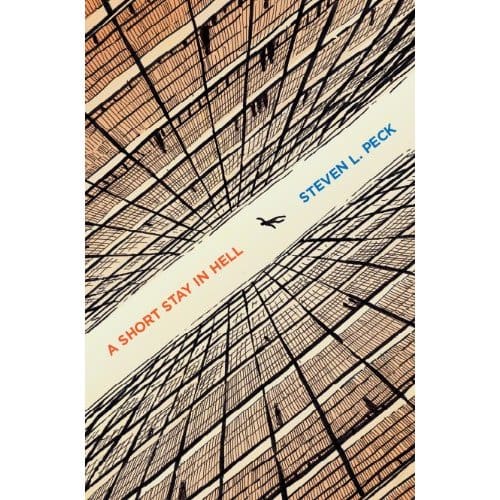
 As the 5th feature of our Mormon Stories Book Club series, we feature Steven Peck and his book A Short Stay in Hell, accompanied by the following readers: Heather Olson Beal, Matt Nokleby, and Amanda Nokleby. Please click on the link to purchase your book through Amazon. A small amount of the proceeds go to help support Mormon Stories.
==============
Title: A Short Stay in Hell
Author: Steven Peck
Publisher: Strange Violin Editions
Genre: Fiction
Year: 2012
Pages: 108
Binding: Hardcover, Paperback, Kindle
ISBN-13: 978-0983748427
Price: $21.95 (hardcover), $9.56 (paperback), $2.99 (Kindle)
Support Mormon Stories by purchasing A Short Stay in Hell through this link.
Book Description from www.amazon.com:
An ordinary family man, geologist, and Mormon, Soren Johansson has always believed he’ll be reunited with his loved ones in an eternal hereafter. Then, he dies. Soren wakes to find himself cast by a God he has never heard of into a Hell whose dimensions he can barely grasp: a vast library he can only escape from by finding the book that contains the story of his life. In this haunting existential novella, author, philosopher, and ecologist Steven L. Peck explores a subversive vision of eternity, taking the reader on a journey through the afterlife of a world where everything everyone believed in turns out to be wrong.
Book Club Resources:
Click here to listen to the Mormon Stories Podcast with author Steven Peck and readers Heather Olson Beal, Matt Nokleby, and Amanda Nokleby.
Episode Transcript
Host: Heather Olson Beal · Guests: Amanda Nokleby, Matt Nokleby, Steven Peck
This transcript is machine-generated and lightly edited for readability. The audio is authoritative. Please excuse occasional errors in names and spelling.
Introducing the Book Club and Steven Peck
Heather Olson Beal [00:00:00] 1, 2, 3.
Guest [00:00:07] Mormon Stories Podcast is a production of the Open Stories Foundation. All donations to Mormon Stories are fully tax deductible and go directly towards keeping the podcast alive and towards building a community of support for Mormons like you. To support the podcast or to join the community, please become a monthly subscriber
Heather Olson Beal [00:00:26] today@mormonstories.org okay, and hello, everybody, and welcome to the Mormon Stories Book Club. This is Heather Olson Beale, and I'm used to having Johndalin here with me doing this, so this is my first time doing it without him holding my hand, so hopefully it goes well. I'm excited to be here tonight with Steven Peck. We're going to be talking about his book, A Short Stay in Hell, and with two really cool cats, Amanda and Matt. So I'm going to have everybody just introduce themselves briefly, starting with Amanda, I guess.
Amanda Nokleby [00:01:00] Hi, I'm Amanda Knockleby. I'm calling in from Durham, North Carolina, which Matt and I just moved here about three weeks ago, and I'm glad to be here.
Matt Nokleby [00:01:14] I'm Matt Nickleby, Amanda's husband, as you probably could figure out, also here in Durham. I'm a postdoctoral research scientist at Duke University and happy to be here.
Heather Olson Beal [00:01:24] All right, And Steven, you are the guest of honor, so we might ask you to tell us a little bit more background information about yourself so we can get to know you a little bit.
Steven Peck [00:01:34] Okay. I'm Steven Peck. I wrote the book Short Stay in Hell. My day job is a biology professor at Brigham Young University. I study tsetse flies and also do research in philosophy of science. So my inclination is towards questions more than answers. I've been writing most of my life, but I just barely started having anything come out for others to read. So it's kind of new and exciting to me. So this is one of my very first interviews. I've had a couple, but none of them have ever broadcast, and maybe we'll know why afterwards.
Heather Olson Beal [00:02:20] Okay, cool. So, because this is Mormon Stories, I wanted to ask you to spend a couple minutes and tell us a little bit about your background with the church.
Steven Peck [00:02:31] Okay. Yeah. Obviously, working at BYU means I'm an active Mormon. You have to maintain a temple recommend to work here. So that gives you a sense of where my activity level is. I had fairly typical church background. I did my undergraduate at byu, did a mission in Arkansas, did my graduate work there in the triangle where Amanda and Matt are. Drives me crazy thinking they're there and I'm not. I absolutely love the area, so I have fond memories and I'M the nursery leader in my ward.
Heather Olson Beal [00:03:16] Oh, wow.
Steven Peck [00:03:17] I think so. They can keep the kids safe from ideas about evolution and things.
Heather Olson Beal [00:03:25] You mean the older kids?
Steven Peck [00:03:26] Yeah, yeah, I get the ones. But I still try to play with plastic dinosaurs and things.
Heather Olson Beal [00:03:32] Awesome. So do you have children of your own?
Steven Peck [00:03:35] I do. I have four boys and a girl. The girl's the only one still at home. She is in 10th grade.
Guest 2 [00:03:47] Okay.
Heather Olson Beal [00:03:49] I have a 10th grader too, but she's my oldest. It's a good age. I feel a little bit like she's coming back to me.
Steven Peck [00:03:55] Oh, it's a wonderful age.
Heather Olson Beal [00:03:57] After kind of a few years where it was like, oh, you're a stranger, but you're in my house.
Steven Peck [00:04:07] She's delightful. She's really bright and does a marvelous job in school and she's a dancer and so she has lots of fun.
Heather Olson Beal [00:04:17] Cool. Okay. So I guess the idea behind the book club is that we're both. We're trying to kind of give people a bit of a teaser or some encouragement to read a really cool book and also maybe provide some good discussion topics for people who have already. So have already read it. So we want to be careful not to do any spoilers, but hopefully get into some good. Some good topics. So I thought we'd start just by reading. I was going to read a couple things, Stephen, from your webpage and from a post I read on BCC about the book.
Steven Peck [00:04:52] Okay.
Heather Olson Beal [00:04:53] Just to kind of give people a background about what it is. So the post on BCC says our author finds himself in a deliciously cruel, comfortable Zoroastrian hell in which he must find the book of his life in order to escape. Trouble is, Hell contains every book that could ever be written. It's not an infinite number of books, but the size boggles his and your mind. Hell could last three days or three trillion years. Count on the latter. And then another one says Soren Johanson. Is that how you pronounce it, Stephen?
Steven Peck [00:05:27] Uh huh.
Heather Olson Beal [00:05:28] Okay. Soren Johan. I have a nephew named Soren. That's cool. Soren Johansen has always believed he'll be reunited with his loved ones in an eternal hereafter. Then he dies. And rather than finding himself in a glorious paradise, he wakes to find himself cast by a God he has never heard of into a hell whose dimensions he can barely grasp. A vast library he can only escape by finding the book that contains the story of his life. And then one little last snippet says that the book is a perfect blend of science fiction, theology and horror, which I thought was a pretty cool. Pretty cool way of characterizing it. So is that a good sort of summary, Stephen?
Steven Peck [00:06:09] Yeah, a couple of things it might be good to point out right off the bat. There's a sign as you enter hell that says that this hell is based off of Borges story, the Library of Babel. And so it's very explicit in knowing the source of the hell in this world. God loves literature and reads it and uses it for his creative energies. So he based this hell on that story.
Heather Olson Beal [00:06:44] Okay, cool. So, Stephen, we'd like to have you read an excerpt of it. Are you ready for that?
Steven Peck [00:06:51] Yeah.
Heather Olson Beal [00:06:52] All right, go for it.
Steven Peck [00:06:54] So the book actually opens with a prologue after he's been there an immeasurable amount of time. And he's sort of reflecting on that. And I'll read that and then jump to the part where he is confronted by the demon right after his death. That sort of introduces him to this world.
Heather Olson Beal [00:07:14] Okay, great.
Reading Excerpts from A Short Stay in Hell
Steven Peck [00:07:16] So here we go. Although I have been loved by many, there has been only one genuine love in my near, eternally stretched life. Rachel, who fell to the bottom of the library without me. Did I know her? Only for so short a time. Strange how a moment of existence can cut so deeply into our being that while ages pass unnoticed, a brief love can structure and define the very topology of our consciousness ever after. I'm getting ahead of myself. I suppose I must start at the beginning. A beginning so long ago that its horizon is a vanishing point at the convergence of two Euclidean lines that would be parallel by any human measure. The first years of the easiest to describe. They were years of adventure, companionship and love. I have not seen anyone for uncountable years. Yet even after so long, I still listen for the sound of another's voice, the ring of footsteps on the stairs or a figure moving silhouetted in the distance. Once I spent a year just listening. Another trying to build a telescope made from clarified sheep intestines from the kiosk so that I might look deep into the library. Despite my substantial efforts, I have failed to find another soul. We have all scattered far and wide into the vastness of this space and cannot find one another. I suspect by now we are all alone. So he ruminates a little bit more, and then. So now I'll read just sort of the opening, where he is introduced to the demon that sends him to the particular hell that he wakes up in. The proficient demon leaned back comfortably in his large, high backed, red leather chair, then swung away from the five terrified guests seated before him. And turned to the window behind him. The room was well lit with long incandescent tubes arranged in several functional pairs that spanned the length of the ceiling, giving the room a soft businesslike feel. Potted plants placed tastefully here and there gave the room a sense of proportion and order. The demon was the only thing that did not seem to belong. The monster's yellow gaze was directed thoughtfully out of the large framed window that dominated the wall behind his desk. Behind the glass was disclosed a large cavern lit with a dancing red glow. He sighed and scratched his leg with one of his black tipped hooves as he surveyed the seething molten bed of lava bubbling thickly like slowly boiling sweet candy syrup in the scene below him. Occasionally from the lake a fire. Occasionally from the lake of fire, a blazing fountain would erupt violently, speckling the ceiling of the great caravan with hot lava, and then would drip in large gobs slowly back to the enormous magma lake, creating high thick splashes of bright orange liquid rock. Inside the lake, scores of wailing people could be seen wading through a pool, screaming in agony. And even though their cries could not pierce the thickness of the glass window, the muted agony and terror visible on their faces transferred the terror of the situation to the five seated guests. All five were trembling and breathless. On the lake's edge. Small shadowy demons wielded jagged leather whips and long rusted pitchforks to drive those souls desperately trying to scramble out of the pool back into the bubbling center. The yellow eyed demon swiveled back toward the three men and two women staring back at them, wide eyed with horror. They were dressed simply in thick white robes of rough cotton. Their feet were bare and they were seated on unstable gray metal folding chairs that squeaked loudly whenever they moved. The imposing demon was tall, about 8ft. His large goat like legs sported coarse thick hair, giving him a satyr like aspect without the charm of a classical pan. His torso was exceptionally well muscled, fire engine red like his face, but covered with a thin layer of moisture from which seemed to emanate a noxious sulfurous stench. His well shaped arms seemed disproportionately long and his hands sported dangerous stiletto like claws. His head was massive, split wide with flaring nostrils and large yellow cat slit eyes that seemed to shine with their own light. On his head two great horns, like those of an eland, spiraled up to a height of about a meter above his skull. He smiled. Not a fierce diabolical smile, but a genuinely pleased and happy grin. Well, well, well, what can I say but welcome welcome to hell. So that's the opening.
Guest 2 [00:12:19] Wow.
Heather Olson Beal [00:12:21] It's really creepy, right? Yes. I have to say that the first line, I thought, wow, that's. I mean, that just really drew me in. The only one genuine love of my near eternally stretched life, Rachel, who fell to the bottom of the library without me. That's a really good hook. Matt and Amanda, do you guys want to weigh in at all on what we just listened to?
Zoroastrian Roots and Mormon Theological Influences
Matt Nokleby [00:12:52] I don't have a specific question about the excerpts that Stephen just read, but I wonder if maybe Steven would like to talk just a little bit about Zoroastrianism and maybe introduce it to a lot of our listeners who may or may not have a whole lot of background in it and maybe why he was intrigued by that religion for his book.
Steven Peck [00:13:18] Basically, it just serves as a foil for sort of giving a disequilibrium to the reader. It's a very small religion. It has about 200,000 adherents in India and Iran right now. And it's ancient, though its texts go back to about the same period as the Old Testament. And so what I wanted to do is to sort of just take away familiarity. So the actual content of Zoroastrium is very, very thin. The names of the demons, the idea of demon functionaries and things are really about the only thing I draw in from the religion explicitly. In fact, it's very light in actual Zoroastrianism. And I don't think they have any concept of a hell like this based on a Borges story or anything. So really its purpose is just to create a sense of disequilibrium. This Mormon guy wakes up in a completely unfamiliar place being completely surprised by what he finds on the other side. So does that make sense? It's more of a foil than a real.
Matt Nokleby [00:14:46] So this is less about Zoroastrianism and more about some sort of faith tradition that is supposed to be completely foreign to the reader.
Steven Peck [00:14:53] Right, right.
Heather Olson Beal [00:14:56] Okay.
Steven Peck [00:14:57] So it's thin on actual Zoroastrianism. I don't think they would see this as a representative of their faith.
Matt Nokleby [00:15:09] Sure, sure.
Heather Olson Beal [00:15:09] Okay. So I wondered who, like, as you were writing it, if you were thinking about an audience, maybe you weren't, but if you were, were you thinking that Mormons would be reading this, or. I mean, did you think that the reader's religion was important to engaging with the story, or did you think it sort of the religious sects weren't really important?
Steven Peck [00:15:32] That's a great question, because when I write, I usually am just writing for myself in a way. And since I'm a Mormon, and that's what I know, that was my background for it. But I was trying to capture some questions about what eternity means. I was wrestling with these kinds of questions myself. When we say we have eternal life, how long exactly is that? Do we have any conception of that? I came across Jorge's story and I just started living in that world. And this, this story unfolded almost organically. I kind of lived there for about the two months I was writing the story. I'd lay in bed at night and think about it and play out in my mind. In essence, what would I do? What would it be like for me to be suddenly so disconnected with everything that I'd once valued and thought was going to happen?
Heather Olson Beal [00:16:49] Wow. Okay. So, yeah, to me, of course this is like reader response theory, right. My comments say more about me probably than they do about the book. But since you touched on that issue of eternity and the description that you just read is really, really points to that. But I mean, it's a horrible, it's a horrible place.
Steven Peck [00:17:16] Yeah, right. So at first does it. At first you're kind of thinking, oh, this won't be so bad.
Heather Olson Beal [00:17:22] Well, yeah, at first I was like, whoa, hell. How can hell be like a huge library? Like that seems like heaven. That's the celestial kingdom. Just books everywhere you can read. But yeah, I mean, it just taken as a whole, it's a terribly negative place. But then when we think about eternity, of course we're not talking about hell, but it's wholly positive. We think it's going to be this immortality. It's amazing. That's what everyone is here working towards. That's what we hope. That's like the crowning achievement, sort of of our earthly life. So there seems like a big disconnect there. That to me seems maybe unique to Mormonism, but maybe not.
Steven Peck [00:18:02] Yeah. And in fact, When we talk about eternity, we often just kind of talk about it in general terms. You know, we don't think about the day to day, I guess, is what I'm saying. And one of the things this world did for me as I was writing it was all of a sudden I was confronting what it would be like to exist on a day to day basis. I mean, I'm sort of assuming some things I'm not sure everybody would grant. I see time as something that has to continue. There has to be a before and after events. And so for me, confronting time will be a real aspect of eternity. And this sort of shows how frightening that may be. I Think,
Heather Olson Beal [00:19:01] oh, sorry, I was muted there accidentally. Yeah. So I don't know, Amanda and Matt, I don't know if you guys want to weigh in here, but does that idea of eternity, I mean, do you agree that when we speak of eternity, that's. Do we say that? I mean, there's a positive connotation to that?
Amanda Nokleby [00:19:17] Oh, we definitely do in Mormonism. And as Stephen was talking, I was thinking about, yeah, what are we. What have I been taught about what eternity means and what that will entail? You know, something that is, that is so unrelenting and sad and depressing in this book is the boredom that these people experience. And I think there's a line somewhere in there, Stephen, where it talks about, this is what hell is. It's this boredom that cannot be satiated. And we often talk about, well, in eternity it will be so much work to do, quote, unquote. What does that mean? What does that mean? And part of obviously this hell that you created is that it's very.
Heather Olson Beal [00:20:14] What's the word?
Amanda Nokleby [00:20:15] It's very narrow in what is there and what people can do and what people can have.
Steven Peck [00:20:21] Right.
Amanda Nokleby [00:20:23] You know, so would eternity then be this, whatever you wanted it to be, that could make you happy and not make you bored and you could work, whatever. And these are questions that I thought about as I was reading the book and then as you were just talking about that. And I don't. I think we don't actually know what that means until we sit here and think about it.
Steven Peck [00:20:45] Right. And. And I think my book is actually sort of a reaction to a strain of Mormonism that was sort of in vogue back in the 60s. And it was this idea that eternal increase largely meant just fecundity. It meant more and more posterity and sort of helping people through this same process. But you didn't learn anything more. You know, this was sort of. We did the same thing over and over again. And that always kind of scared me. It always was a little bit frightening. And a lot of my research right now is in complex systems behavior. I'm really, really interested in the way that novelty comes into the universe, because that's what's lacking here. Right? There is nothing to look forward to. The same thing gets repeated over and over again. And though they try to engage in meaning making activities, I mean, the whole time they're trying to grasp some sense of how can we make this meaningful, how can we hold on to society, how can we grasp what we're trying to do? And unless there's novelty introduced into the system, it can't do. It can't happen. And so in my research, this is my philosophy of science research, I try to look at how novelty comes into the universe. And it's really interesting because our universe is loaded with novelty and newness. Forgive me if I wax too biological in this. But life itself actually introduces novelty into the universe in a really interesting way. Life gets started. We have DNA molecules creating things, and there's this activity called niche construction. And so what happens is life gets started, but it changes its environment. It actually makes it completely new, and then it has to respond to that new environment. And this allows novelty to bubble up into the universe in some really interesting ways. Because DNA is at a size that quantum effects can influence it. You can actually have truly random events. So when a DNA strand, a nucleotide, mutates, it's a genuinely fully random event. By anything that we understand about the universe, it's genuinely random. And so life changes, it changes its environment and you get this sort of bubbling of newness into the universe. Let me give a quick example. Stephen Jay Gould was a paleontologist at Harvard for a long time. He had this idea that if you reroute, he asked the question, really, if you rewound the tape of life, would you get the same thing that you get again in a purely deterministic universe? Of course, you go to state B, you align all the states exactly as they were at that time, and everything's going to unfold in exactly the same way. But life changes that because suddenly you get a truly random event occurs down there that changes, in fact, the nature of the organ, the mutational possibilities for what's emerging, and you get new niches and new all kinds of things. And so for me, getting back to the theological question, an eternity of just increasing the same thing I'd always done, in essence, having more children seemed really unappealing. And yet a universe that was open and new possibilities were emerging, new new creative energies, new universes were unfolding with higher structures. Actually unfolding is exciting. And so I think this book is a little bit of reaction to that idea that eternity is not going to be very exciting. It's going to be more of the same. And rather, I like to imagine God is highly adaptive. I mean, he's responding to the newness of the universe as it unfolds. I mean, it's kind of, I guess, a weird thing to say, but that's. I think, what I'm reacting to, that theological notion of just an eternity spent repeating the same thing. Over and over again. Did that make any sense?
Amanda Nokleby [00:25:41] No, no, no. That kind of blew my mind. In a good way.
Heather Olson Beal [00:25:44] Yeah. This is one of those times when I feel like you're on a podcast, and then it's like, now I need, like, 20 minutes to think about what I just heard, but I don't really have that opportunity. Amanda, what were you gonna say?
Hell's Library, Diversity, and the Search for Meaning
Amanda Nokleby [00:25:56] I was gonna say that one thing in the book that I kept waiting for some kind of explanation, was this idea that all of the people that the main character encounters, they're all white, they're all from America, and they were all born and died in a set number of years. What was that kind of going along with this everything's the same and nothing changes kind of idea, you know, because,
Steven Peck [00:26:23] you know, again, this is the biologist coming out. But for me, diversity is the stuff of wonder and joy and monotony is awful. And so the hell where all. Everybody was the same race, the same color, the same age, was just exactly that. No diversity means no growth, no opportunity for change, no confronting another who's different than me. That will expand my views and expand my world. So that was not there.
Matt Nokleby [00:27:05] Should I interpret this as a subversive critique at the relative cultural homogeneity of Mormonism, or.
Steven Peck [00:27:13] I think so. I mean, you know, I worry about that at byu. I love. I love diversity. I love meeting people. And so, yeah, it is. I mean, I think that's changing. I think probably that's a reflection of where it emerged from. But I do think we need to embrace diversity as much as we can. And so what we have was. It was. Yeah, I'll own that.
Heather Olson Beal [00:27:41] I'll tell a little story about my son, and I'm thinking, hopefully I don't get in trouble for this. We'll see what happens with the editing powers after we're done. Right. So yesterday at church, a member of the ward came and brought me some printouts of the kind of biographical information of the women who were in the General primary presidency, the Young Women's presidency, and the Relief Society presidency, because he knows that I have some sort of feminist issues, he would call them, with the church. And so he brought that to me. And this is kind of a habit that this man has, bringing articles to people to kind of show them that they're wrong. It's very unique. And so he brought this to me to show me, like, how diverse they are. And he was saying, look, some of them have college degrees, so why do you have these problems? And for the record, I don't have Problems with people that don't have degrees. I mean, this is a weird exchange, totally. But so my son, who's 9, was looking at the papers. I was looking at him, too, and kind of trying to figure out why I was being given these. So it was a weird kind of alternate universe moment anyway. And so my son said, who are those people? So I explained to him, and then he said, well, are there any African American women? And I said, no. And he said, mom, that's so embarrassing. And I thought, that's really interesting because in his life, I mean, he sees a lot more diversity than that. We live, you know, our town is about a third African American, a third Hispanic, a third white. His school teachers come from. His schoolteachers are mostly white. And that's the case in the whole US but his principal last year for several years was African American. I mean, he just sees much more diversity. So to him, he looked at that and was kind of like, oh, my goodness, that's terrible. You know, And I was like, well, yeah, I mean, that's not really our forte at this point is diversity. No, go ahead.
Steven Peck [00:29:33] No, I was just going to say I did my sabbatical in Vienna a few years ago, and the international ward there is this delightful ward. It's about a third African, about a third Filipino, and about a third Caucasian diplomats from the US but it was so vibrant and alive, and everybody embraced each other's culture. It was just. It was marvelous. I loved it. So, yeah. And Utah's heart. I mean, Utah is well known for its lack of diversity, and there's historical reasons for that. But I do. I do love diversity. I mean, as a biologist, diversity and variation is the stuff that evolution works on to create newness and uniqueness in the world.
Heather Olson Beal [00:30:27] Yeah. I pulled out a little quote I was going to read that speaks to that, and I'll do that right now because it kind of fits. So at some point of the book, I can't remember where it says that hell is characterized by unrelenting uniformity, its lack of variation from type. If there was a heaven at the end of this, it must be filled with great variety, perhaps a multiplicity of intelligent species spread across universes. Yes. Heaven would be as full of differences as hell was of sameness.
Steven Peck [00:30:56] Yeah.
Heather Olson Beal [00:30:58] Very cool. I love that. That's a really interesting kind of thing to point to, ponder, I guess.
Steven Peck [00:31:07] Yeah, I think that's. I really believe that. I think that heaven won't be uniform. It will be different, and it'll be the differences that allow, you know, New things to come about. And I think for me, that's an important aspect of eternity, that there will be things to learn, because there are things that don't exist yet. This is the way that life evolved on Earth, you see, you know, this barren landscape. And plants invaded. And once plants invaded, then insects could invade, and then fish followed and new niches appeared. And it's just this sort of creative newness. And it's surprising what occurs. The emergent in science means something really specific. It means unpredictable from the forces that you can see on the ground. So I think it's a great idea for the eternities, too.
Heather Olson Beal [00:32:11] Yeah. The other thing, when you were mentioning that whole idea, I think you said from the 60s of eternal increase, meaning having just sort of having more families and. Yeah, that's one of those things that puts the fear in the hearts of many a Mormon feminist. I think the first time I heard that, I was like, wait, what heaven's supposed to be? We're just. We just keep having babies. Like, what? No, no, I'm done having babies. Like, this experience will end, and then I'll be doing something else, but not having more children. And I love my children, but I don't need to have more, especially not in sort of an eternal fashion. Yeah.
Steven Peck [00:32:55] And, you know, numbers are nice, but when I think about my daughter and I think about what future I want for her, I want her life to be rich, filled with things that are meaningful to her in and of themselves. You know, I look at my own life and I enjoy riding, I enjoy nature, I love hiking and running. And these things give me meaning in and of themselves. You know, they're not part of the. You know, I love my kids. I love that they're growing up into lives, but I don't want their lives just to be mean. More of the same. I want them to blossom into wondrous new creatures that are involved in great things all around them. That their lives have personal meaning to them is really important to me. And it's a universe with only one meaning. It's a numbers game. No matter how much you love them, you want them to be in a universe where there's meaning as well. I think, you know, that's. That's. I think, one of the fundamental things that make existence worth continuing. And so in this book, I stripped that away. You know, there is no opportunity for niche construction. The nit they live, you know, they're in those narrow bands, that narrow hallway with the rooms. And even though they try to construct meaning, their failure Seems sort of false and artificial because they can't really bring it about now. It may be possible. And this, I think, is the challenge. So somebody pointed this out to me once. They said, you know, if that were me, I would make my meaning. I would abandon the agenda that I've been handed and I would say, let's make this place meaningful as it is. Let's forget the, the agenda that's been imposed on us to find a book that we can't find. Let's turn this into a paradise. And I really think that was an interesting response. I liked it. In fact, there is that possibility.
Heather Olson Beal [00:35:06] Matt or Amanda, do you guys want to weigh in on anything right now?
Matt Nokleby [00:35:11] Yeah, I had a question that we sort of danced around a little bit. Maybe we can talk about in a little bit more detail, which is about meaning making. And so usually, especially within religious discourse, we usually make this distinction between religious life which has meaning because that meaning is imposed by God and also is solidified by the fact that you have an afterlife after which you can enjoy whatever the purpose of this life was, in contrast to the non religious life where there is no intrinsic meaning. And therefore, you know, atheists are supposed to descend into sort of a meaningless nihilism and therefore not enjoy their existence. One thing that is interesting to me about the book is how it complicates that issue because these people of course, do have purpose imposed upon them very directly, which is find this or find one of the set of this book, and they haven't turned off yet. Meaning is very, very difficult for them to come across. Wonder if we could talk about that a little bit.
Steven Peck [00:36:17] Yeah, and I think what's interesting about that for me, and I think part of the. One of the things I was trying to get to with the book is in Mormonism. And this is, I think one of its real strengths, I really like this, is that God is a being in an embedded universe. The universe seems to be constructed. He has a body, which you can sort of crudely say that that means that there's some kind of celestial biology, which means there are some sort of celestial regularity, rules about the way matter behaves and the things that it does and that we have scriptures that say that if God did this and that, then he would cease to be God. And so for me, I can't help but wonder if that same meaning activity has to go on in the eternities as well, that we have to take that like somebody embedded in a world has to identify things that they value. And we even have really strong scriptures that suggest this and writings from Joseph Smith where he says God found Himself amidst a bunch of intelligences and he had learned to love and to feel love and want them to feel that too. So all of a sudden this value that he wants them to share becomes his objective. To my work and my glory is to bring to pass the eternal life and glory of man. We don't have a really good feel for what that means, but we know that he values it. And presumably our heavenly parents both value it in some marvelous way that I think gives us exciting possibilities so that no one really. Maybe this is my existentialist self leaking out, but no one gets to escape the idea that they have to make their lives meaningful. I think that that's something that I see that I want for my kids. I've made for me a meaningful life. I want them to have meaningful lives, not necessarily my meaningful life, but I want them to have to enjoy their life and their activities and their hobbies and pursuits as much as I do mine. And I think there's in some sense an eternal principle in that. I think there's a principle that, as you pointed out, even atheists construct their own meaning. They say, okay, this universe is handed to me. I'm going to take it and I'm going to fashion it into something meaningful. But I don't think anybody gets to escape that. I think that's an activity that Paul was getting to when he said you need to work out your salvation with fear and trembling. It's this idea that there is something creative about our lives. We have to take the stuff of our lives and make something magnificent, like an artwork out of it. That sounds kind of maudlin and hackney, but I really do believe that life is, is a chance to sort of put our stamp on the universe. Eternal stamp even. Maybe that makes sense.
Matt Nokleby [00:40:03] It does. So if I understand you correctly, you're basically saying that God is as much engaged in meaning making in the face of a set of universal laws that are completely indifferent to him as is any old existentialist absurdist walking around the earth trying to figure out what to do with his life.
Steven Peck [00:40:24] And we actually see kind of hints of that. Where the universe is responding in new ways that require the Lord to respond to things. I mean, I think that we see that in the Old Testament where He gets talked out of things. We get hints of that in, in Mormon scriptures where he comes into the garden and the same old, same old's being going on and saying that's not going to work anymore. We've got a new thing going on here. Something new has emerged and we're going to respond to it differently. And I like that idea that the universe is continually to surprise, that God is surprised. I mean, if he weeps. I mean, I've really been enamored with the Givens book on the weeping God. If God weeps, that means he has to be surprised. I mean, if you're watching the same Gilgan's island rerun over and over again, you know exactly what's going to happen. The jokes don't work anymore, the tear jerking parts don't work anymore. To weep means that you're responding to events as they unfold. And I like that idea. I mean, I really resonate with a universe that is filled with novelty, that has to be responded to, has to be dealt with in new ways. It's not to say there aren't regularity conditions that can be bought into that allow you to do things. Like just recently when they sent a SUV to Mars, that was so cool. There's enough regularity that you can do things like that, but you have to. They had to do some adaptive things as things came up that they weren't anticipating. And I like a universe like that. I don't like the.
Matt Nokleby [00:42:21] You realize you're committing one of Pruce R. McConkie's seven deadly heresies, right?
Steven Peck [00:42:26] Oh, am I really? I knew about the evolution one, so.
Matt Nokleby [00:42:30] Oh well, yeah, I guess you're probably a foul of Rusan Prakanki, but he gave a. I think this is the early 80s, a relatively famous talk.
Steven Peck [00:42:40] Yeah, I've read a lot.
Matt Nokleby [00:42:43] One of his main points was that God is done learning. There's nothing for him to learn. And he was very emphatic about that point.
Steven Peck [00:42:52] Oh well, see, and for me, I hope not. I mean, if I ever reach a point where I'm done learning, I'll be. I'll be grumpy.
Heather Olson Beal [00:43:07] Wow, Matt, I've never heard that. That's Bruce R. McConkie, you said.
Matt Nokleby [00:43:11] I'm pretty sure the title of the talk is the Steven Deadly Heresies, but I have to look it up.
Steven Peck [00:43:16] I think that's right. And I think that was kind of the debate I was referring to earlier where eternities were just kind of meant more increase, more of the same. And his worry was, and I don't share the worry, so maybe I can't appreciate his view. His worry was that if there was something that God didn't know, maybe that would subvert salvation itself. So he didn't want to put God in the position where God is sitting there, the plan of salvation is unfolding, and then all of a sudden, holy cow. I didn't see that coming. I better.
Matt Nokleby [00:43:57] As I recall, it was sort of a public refutation of Eugene England, who at the time was teaching things that within one sphere, God might know everything, but then in another sphere, he might have things yet to learn. And Bruce Armerkaku is very uncomfortable with that idea.
Steven Peck [00:44:13] Right. And this is actually. The debate goes actually further back. And so you have. And I wish I had a better handle on the debate, but I think it came out of some of the Brigham Young, Orson Pratt brothers debates on theology. And so there are these different threads, and people are often surprised to find that general authorities back in the day debated things. And so there's that. But this is the beauty, I think, of Mormonism. We believe that there are many things yet to be revealed. And I don't think that can just mean that we get more added. I think every revelation requires hermeneutics of revisiting everything that we've gotten before and readjusting it based in light of the further revelation. So when something new bubbles up in the universe that requires. It's not additive, it's. It's ecological. So everything has to be revealed. I mean, a new revelation means that we have to go revisit old doctrines and rethink about the things that we once believed about those doctrines in light of the new revelation. So since we're on Bruce Emmerkonki, when the priesthood was extended to blacks, he has this great quote where he says, forget everything I said about the priesthood. I spoke without the further light and knowledge that has come into the world. I'm really paraphrasing this. I don't have it in front of me, but it's along those lines. And what he's saying is new revelation requires us to rethink everything that we held previously. And we can't be afraid of reinterpreting and revisiting the old ways, so to speak. Is this. Am I.
Matt Nokleby [00:46:19] Yes, absolutely.
Steven Peck [00:46:21] I fear I'd gotten off the book.
Heather Olson Beal [00:46:26] No, I'm just really. I'm just thinking and I'm listening. We've covered some really big ideas, so, yeah, I'm not being articulate at all.
Steven Peck [00:46:36] I'm not either. I tend to wander so well.
Heather Olson Beal [00:46:39] That whole idea of God being done learning has my mind blown. Actually. I'm having a stupor of thought. I mean, that runs totally counter to all this other stuff that we have about how God is intelligence and internal increase. So that's really interesting to me.
Steven Peck [00:46:59] I kind of picture Bruce, Emma, Conkie up in heaven saying the same thing. Okay. I spoke without the light knowledge I have now.
Heather Olson Beal [00:47:06] And he's still learning.
Steven Peck [00:47:08] Yeah, and you still learn. Holy cow. I mean. And we all will be. I mean, I don't think, you know, if we're not surprised on the other side, completely blown away by what we find out, then we do live in a rather boring universe.
Heather Olson Beal [00:47:26] Interesting. Let's see. Amanda, do you have a question you want to ask? We're kind of at a bit of a breaking point.
Writing the Novella and Its Emotional Impact
Amanda Nokleby [00:47:35] Sure. We talked about this in our pre conversation a little bit. But why did you decide to write this as a novella as opposed to a full length novel? I especially felt that there was so much to work with. Maybe I'm answering my own question, but there was so much to work with. This world that you created. I wanted more. It ended and I wanted more. And not necessarily that I wanted resolution or I just wanted more. I wanted more of that world. I wanted more of this really morbid sense of existence.
Steven Peck [00:48:13] Well, you know, that really makes me feel good. Thank you. You know, it's hard for me to figure out why the way things turn out just sort of happen. And when I got to where I did, I mean, there were other ideas. I was thinking about expanding the activities they went into, but it seemed that it would just be. Get. It would just get repetitive, you know, kind of, you know. You know, you've seen these series of books that go on and on and after you know, version six of, you know, some, some fantasy series, they're, they're, they're just doing the same thing over and over again. And I just felt like I, I had sort of said the roots of everything I wanted to get to and, and that was, that's where it ended.
Amanda Nokleby [00:49:23] So you didn't want to. You didn't want. You didn't want your readers to get bored with the board? Boredness of. The boredom of hell.
Steven Peck [00:49:30] Yeah, yeah. And you know, it works nicely, ironically I think too, because several people sort of pointed out like in Good Read reviews, holy cow, no book has covered so much such a time span ever and done it so shortly. So a little irony maybe, I don't know. But I do challenge anybody to find a book that covers a larger time span than this.
Amanda Nokleby [00:50:02] But seriously.
Steven Peck [00:50:03] Yeah, you kind of cheated.
Matt Nokleby [00:50:06] You basically just wrote a bunch of very big numbers there and said,
Amanda Nokleby [00:50:11] not
Matt Nokleby [00:50:11] really fair, is it?
Steven Peck [00:50:15] Yeah, no, it's really, really big numbers. I Was really happy, too. A book came out maybe three years ago. So this was about five years after I wrote the book. It was a mathematics by a mathematician called the Mathematics of Jorge's Library of Babel. Kind of a cool book, but when I saw it, I just panicked. I thought, oh, my gosh, what if I calculated it wrong and everybody's gonna make fun of me? But I did it. The appendix has the calculations for the size of the library.
Matt Nokleby [00:50:52] Pretty simple calculation, though, right?
Steven Peck [00:50:54] Yeah, it is. It is. But you'd be surprised how easily I can mess up simple calculations.
Heather Olson Beal [00:51:04] Okay, I've got a. I was going to say maybe related question, but I don't actually think it is, but I'll ask anyway. So I wanted to know why the people were in hell. Or I guess to you, I wanted to know why you didn't tell us why they were in hell. I kept thinking, like, wow, how did he end up there? What did he do? Or is that just me trying to box people in? Or I wanted to know which commandment they had broken or what they had done to deserve this. Was I the only one? Amanda and Matt, did you guys think that or not?
Matt Nokleby [00:51:36] I didn't.
Amanda Nokleby [00:51:37] I didn't really know.
Matt Nokleby [00:51:38] I thought. When she said, words are Astrian.
Steven Peck [00:51:40] Yeah, yeah, that was kind of my idea is they just didn't believe in the right church religion.
Matt Nokleby [00:51:48] It's like that south park episode
Steven Peck [00:51:52] people keep referring to that. I really need to look at that.
Heather Olson Beal [00:51:59] Okay, I'll have to look it up, too. Matt, you've got another question you want to ask?
Matt Nokleby [00:52:06] Do I?
Heather Olson Beal [00:52:07] I don't know. Do you?
Matt Nokleby [00:52:11] My questions have been asked to my satisfaction.
Heather Olson Beal [00:52:17] Okay.
Matt Nokleby [00:52:18] I can make one or two more up, but I don't know if that's worth everyone's time.
Heather Olson Beal [00:52:23] Well, Amanda, do you have another question you want to ask?
Amanda Nokleby [00:52:28] I had more of a comment. Maybe something else we could talk about. I keep hearing from people, and as I'm reading kind of the Goodreads reviews of this and everything that people keep saying that this book really sticks with them. I read this book now a month and a half ago, and it's still something that. Those moments when you're not asleep yet and you're thinking about crazy things that scare the heck out of you, this book, like, comes to mind and I start pondering things and then I can't sleep.
Steven Peck [00:53:10] Sorry.
Amanda Nokleby [00:53:11] No, no, no, it's okay. But I was thinking about why. Why this is something that really kind of sticks to you in a way that maybe other novels don't. And I think we've talked a lot about that, a lot about this. Trying to grasp what an eternity is or an eon or, you know, this. This amount of time, especially as Mormons, when we're. You know, we've already talked about this, but I. What. What keeps getting to me is this. This unrelenting bleakness that's in the novel that is. I don't know if I am just super emotional about it, but it hit me at a gut level, and I hated reading it. I loved it, but I hated reading it. And, like, looking at my own life and being like, how bleak is my life? How hopeless is my life? Is it anything anywhere relatable to this? And it did. It hit me at a gut level. And I think that's one reason why it just is always in. It just kind of always comes back in my mind as I'm thinking about my own life, thinking about an afterlife, if there is one. And, yeah, I wanted to tell you that, Stephen, because I seriously, I keep recommending this book to people and I keep thinking about it, and I think that's a good thing.
Steven Peck [00:54:36] Yeah. You know, it's funny you say that, because I actually had the same experience writing it. When I was, like, in the middle of it, I would lie in bed at night and just. I couldn't let go of it. I mean, it was so real and so present to me, and, as you said, so awful. I mean, it was really frightening to me in some strange ways. And I think maybe that came across when I wrote it. The awfulness of unrelenting sameness, and more than that, too. I mean, there's a kind of hopelessness about the book, I think a hopelessness about the task, especially as the dimensions of the library unfold. So, you know, I think a lot of people have had that experience, and I think it's something about our. About being a human and this fright of a lack of meaning is horrific.
Amanda Nokleby [00:55:51] Yeah. One thing I think you managed to do very beautifully in this novel was to really bring out the humanity of not just humans in general, but especially the main character and everyone else you kind of meet along the way. Even though this is an afterlife which none of us have any kind of real concept of, even though this is in a place where none of us really have any. Again, this is so foreign. It is very science fictiony in that way, and yet there is so much humanity in this book. And I think that's why it hits people at a gut level. It makes you question a lot of those deep, dark questions. Of humanity in a really disturbing and yet like unrelenting kind of way. And I think that's kind of masterful that you were able to do that.
Steven Peck [00:56:47] Oh, thanks. I appreciate that.
Heather Olson Beal [00:56:52] Yeah, I think that the whole monotony, I mean, so we're talking about an idea of hell as being boring and monotonous, but obviously there's parts of our lives now that feel like that too. I mean, I would like, say, oh my gosh, I hate, I hate doing the laundry, I hate doing the dishes. I mean, there's just much of.
Matt Nokleby [00:57:10] Yeah.
Heather Olson Beal [00:57:11] Not just parenthood, but just life is just kind of take. Just slogging through and taking care of stuff that, you know, I've often said, oh, I'd much rather be in charge of doing like the lawn. And I've mowed our lawn plenty. We pay someone now because we're lazy, but I'd rather do that because that only has to be done like once every few weeks. I don't want to do the stuff that has to be done three times a day because it just wears me down. You know, I saw this documentary about Netflix. My husband is a business professor. I don't remember where I saw it, but it was describing the business model of Netflix and how it actually works. And it shows in this movie that there are people who stand in front of the machines and pull the DVDs out of those envelopes that we send them back in. And they do that. They do that or they pull the envelopes out. I mean, the little stick CD sleeve out of the bigger envelope. A person does that. And Brett and Brent, well, many people. Brent and I were watching that and we were just looking at each other like thinking, oh my gosh, like, remind me of this the next time I complain about my job. There are people who are putting in an eight hour shift, pulling those, those CD sleeves out of an envelope. I mean, that's like, that's hell. But that's here. That's right now. You know, that's, that's just the monotony that is the life experience of a lot of people. So it is a good reminder to me of like, oh, my first world problems, you know, I don't have those kinds of, those kinds of burdens to bear, I guess. Yeah, yeah. Sobering. Well, does anyone else have another question?
Closing Reflections and Farewell
Matt Nokleby [00:58:56] I don't.
Steven Peck [00:58:57] Yeah, I'm trying to think if there's anything I wanted to draw out. I can't think of anything. It's a good book club book.
Heather Olson Beal [00:59:11] It is a book club book. And so I'LL take this chance then to ask you, Stephen. We've asked some of the other authors that have done this. I don't actually know that anyone has taken the author up on it, but if there are book clubs that decide to read this, if you'd be open to doing a Skype call with kind of a regional book club.
Steven Peck [00:59:31] Oh, I would love that.
Heather Olson Beal [00:59:33] Although, didn't you do. Did you guys do this in Houston?
Matt Nokleby [00:59:37] We did, yeah.
Amanda Nokleby [00:59:38] We did it with Scholar of Moab.
Heather Olson Beal [00:59:39] Okay. With a different book. Okay. I haven't read that. So that was sort of part of the original vision, was that we'd get these authors and that maybe people would read them and then the. We would ask the authors to please, you know, be amenable to doing a couple of regional book clubs. I don't know if that's actually taken place or not, but it would be really cool.
Steven Peck [01:00:04] Yeah, I'd love to do that. I mean, you know, maybe not 50amonth or something, but I certainly.
Heather Olson Beal [01:00:12] Yeah, I'm sure it wouldn't be 50amonth.
Steven Peck [01:00:16] Yeah. No, this isn't a J.K. rowlings level book, I think.
Heather Olson Beal [01:00:22] Well, there's a ton of stuff in it, though. Just big, really big ideas and. Yeah, some scary stuff, but yeah, big philosophical kind of what are we here, Purpose of life kind of questions.
Steven Peck [01:00:38] Those are the funnest kind for me.
Heather Olson Beal [01:00:41] Yeah, that's great. That's great. Okay, well, unless anyone has any other last thing that they want to say, this is your final roll call, I guess. Anyone else?
Steven Peck [01:00:53] Thanks for doing this, though. I really appreciate it.
Heather Olson Beal [01:00:57] Yeah, for me, it's been cool. So hopefully we'll be able to get this up in about a week and then we can blast out the link and tell everybody. Get the book, read the book. It's available on Amazon, Steven.
Steven Peck [01:01:12] Yeah, it's really cheap on Kindle and it's available on, I can't remember, Smashwords or something.
Heather Olson Beal [01:01:21] Okay.
Steven Peck [01:01:24] It's available in every digital format. You can get it for Nooks and Kindles and PDFs and everything.
Heather Olson Beal [01:01:32] Okay.
Steven Peck [01:01:33] It's fairly cheap that way. I think it's like three bucks. And then if you want a paperback, they're like 10 or so on Amazon.
Heather Olson Beal [01:01:41] Okay, cool. The other thing is we. And this has worked in some cases better than others. There is a Mormon Stories Book club Facebook group. And so I had had in my head that after we kind of had a body of readers of a certain book that we could kind of get some discussions going in that Facebook group. So if we do that Kind of out in the future a little bit in a couple months. It'd be cool if you could weigh in on that, because people don't really want. People don't want to hear from me about it, but they want to hear from the author, kind of like we just did. So that would be.
Steven Peck [01:02:13] Yeah, I'd love to do that. Part of the things that I do when I write is I really write around ideas that I'm very curious about and that mean things to me. And so I love having discussions about it. I sit around with friends, and we still talk about this book. One of my sons read it nine times or ten times now, and he loves talking about it.
Heather Olson Beal [01:02:42] That's very cool. That would be cool to have a conversation like that with your dad about big stuff like that. Okay, well, let me just say I've got two announcements that I want to make. But first, before we do that, I want to thank Matt and Amanda and thank you, Stephen, for writing the book and for being on this podcast with us, and to all of you for putting up with my sort of scatterbrainedness and getting this together.
Steven Peck [01:03:08] Oh, you were great.
Heather Olson Beal [01:03:10] So my two quick announcements are that next month we're going to be reading a book called A Year of Biblical Womanhood, which is written by Rachel Held Evans, who is a Christian columnist, not Mormon Christian columnist and blogger who spent a year living principles of Biblical womanhood. And I'm almost done with it. And it is wild also to imagine that she actually did some of the things that she did, and she's just. She seems just delightful. And I keep thinking, oh, I wish we could sit down and have lunch, but. So she's agreed to be on the Mormon Stories podcast, which I think is pretty cool because she's not Mormon at all. And the other announcement that I'm not sure if I really should be making, but, hey, this is a volunteer gig, right? I can't get fired. Is that the Houston. Maybe we're not supposed to call it Mormon Stories Conference anymore. The cool Mormons in Houston that are friends are having a conference March 1st through 3rd, and we just had a planning meeting about it last night, and we're excited. So we were hoping to use this. I said I would use this opportunity to get the word out again that we're doing that. So if you want more information about that, go to the Houston Mormon Stories Facebook group and check it out. So those are my two quick announcements. So thanks to you guys, and have a good night.
Steven Peck [01:04:29] Yeah, you too.
Matt Nokleby [01:04:31] Thank you.
Heather Olson Beal [01:04:32] All right, good night.
Steven Peck [01:04:33] Good night. Thank you, guys.
Guest [01:04:35] Thank you for joining us today on Mormon Stories. Music today was provided by the Saber Rattlers. Check them out@saber rattlers.com the Mormon Stories logo was generously donated by StudioCase.com thanks for listening.
Guest 2 [01:04:50] Come, come, you saints no toil nor labor fear but with joy wend your way though hard to you this journey may appear Grace shall be as your day this better far for us to strive Our useless cares from us to drive to the San Jo your hearts will swell oh, all is well all is well well, why should we mourn? I think our lot is hard t not so all is right why should we think to earn a great reward Lord, if we now shun the fight Gird up your lo fresh courage take Our God will never us forsake soon we'll have tail to tell oh, all is well, all is well oh, all is well all is well. Sam. And should we die before our journey is through happy death all is well we that are free from toil and sorrow too with the just we shall dwell but if our lives lives are spared again to see the saints the rest obtain I will make this chorus well. Oh, all is well all is well all is well all is well all
Guest [01:08:47] is well
Guest 2 [01:08:51] oh, is well, Is well all is
Amanda Nokleby [01:09:08] ra.
Transcript © 2026 John P. Dehlin. All rights reserved. Brief quotations are welcome with attribution and a link to mormonstories.org; all other use requires written permission.
Reviews of A Short Stay in Hell
https://www.shortstayinhell.com/reviews.html
https://www.goodreads.com/book/show/13456414-a-short-stay-in-hell?auto_login_attempted=true
https://benjaminsbrain.blogspot.com/2013/01/book-review-short-stay-in-hell.html
https://shroudmagazinebookreviews.blogspot.com/2012/07/a-short-stay-in-hell-strange-violin-by.html
Other resources/writings by and about Peck
https://sciencebysteve.net/about/
https://lifesciences.byu.edu/~slp73
Scholar of Moab: https://www.scholarofmoab.com/author-bio.html
The Quickend Chronicles: The Rifts of Rime: https://bycommonconsent.com/2012/06/14/review-steven-l-peck-the-quickend-chronicles-the-rifts-of-rime/



5 Responses
I found this really interesting, and it made me go out and get the book for my Kindle, so thanks!
May I make one small suggestion? Please edit out the parts where you scramble for questions to ask the guest…it’s kind of uncomfortable to listen to “do you have any questions? No, I’m good. Do you? No, I guess that’s all I had for him!” etc. :-) Just skip to the parts where you DO have something to ask or comment. Otherwise, we just feel bad for the guest.
It’s fortunate that this book is short, because I couldn’t have taken much more of this hell! Not that it wasn’t a good book. it was quite riveting, as a matter of fact. I’m glad I read it, if just for the appreciation it gave me of the good life I have. It was pretty disturbing thinking about the cruel God who could have designed such an awful eternity–I like my God a whole lot better. Contemplating such loneliness, boredom, and meaninglessness is so foreign to my Mormon optimism, and since the author is also Mormon, I can see how he would shrink from such a place. The kicker is that his character is a Mormon who ends up in this hell!
I’m about a month late, so I don’t know that Steven Peck will see my comment. But just in case, here are some questions that I would have asked in the interview (WARNING: POSSIBLE SPOILERS AHEAD):
(1) The book begins with Soren’s declaration of love for a woman he met in the afterlife and knew for only a short period of time. Soren’s declaration can be seen as a smack in the face of Mormon romanticism, which celebrates the idea that the love shared between two mortals can transcend death. Given that Soren himself was a married Mormon during his earthly existence, this aspect of his narrative is particularly conspicuous. What messages, if any, were you trying to convey about romantic relationships in general and/or about Mormonism’s view of eternal love in particular?
(2) While reading the book, I half expected that one of the characters would someday pick a book at random and submit it as his/her life story. I thought the character might defend the choice by claiming that any book is as good as another, that just as in life, it’s up to the individual to imbue with meaning whatever one encounters. What do you think would have happened to a person in Soren’s Hell who tried such a thing?
(3) Soren says in the prologue that he is “incapable of forgetting even the smallest detail” of his post-mortal existence. Then, while conversing with Rachel in chapter three, Soren incorrectly identifies Cassandra as an anthropologist. Rachel reminds him that Cassandra is “the Marxist economist.” What should readers make of this? Did Soren feign forgetfulness as a kind of conversational crutch, the way one might vacuously say “right, right” while listening to someone else talk? Was he simply distracted by his attraction to Rachel? Or did Soren genuinely forget something about Cassandra? In short, what insight are we to glean from Soren’s apparent lapse of memory?
(4) To what extent is Soren’s Hell meant to serve as a metaphor for earthly existence, rather than as a vehicle for exploring more abstract theoretical notions (such as what it might be like to live eternally)? Put another way, do you regard your novel more as a commentary on this life and how we actually live it, or as a venture into pure speculative philosophy? To which end is the book more heavily geared, or is it equal between them? (For the record, I think you achieve both ends quite brilliantly, which is exactly why I want to know what kind of mindset or motive you had in writing it.)
This was such a thought provoking book. I have now listened to it twice! I also picked it for my upcoming book club. I love how short the book is as well. Highly recommend this one!